WO2017195594A1 - 加硫ゴム成形用離型剤 - Google Patents
加硫ゴム成形用離型剤 Download PDFInfo
- Publication number
- WO2017195594A1 WO2017195594A1 PCT/JP2017/016477 JP2017016477W WO2017195594A1 WO 2017195594 A1 WO2017195594 A1 WO 2017195594A1 JP 2017016477 W JP2017016477 W JP 2017016477W WO 2017195594 A1 WO2017195594 A1 WO 2017195594A1
- Authority
- WO
- WIPO (PCT)
- Prior art keywords
- release agent
- vulcanized rubber
- alkylene oxide
- amine compound
- adduct
- Prior art date
- Legal status (The legal status is an assumption and is not a legal conclusion. Google has not performed a legal analysis and makes no representation as to the accuracy of the status listed.)
- Ceased
Links
Classifications
-
- B—PERFORMING OPERATIONS; TRANSPORTING
- B29—WORKING OF PLASTICS; WORKING OF SUBSTANCES IN A PLASTIC STATE IN GENERAL
- B29C—SHAPING OR JOINING OF PLASTICS; SHAPING OF MATERIAL IN A PLASTIC STATE, NOT OTHERWISE PROVIDED FOR; AFTER-TREATMENT OF THE SHAPED PRODUCTS, e.g. REPAIRING
- B29C33/00—Moulds or cores; Details thereof or accessories therefor
- B29C33/56—Coatings, e.g. enameled or galvanised; Releasing, lubricating or separating agents
- B29C33/60—Releasing, lubricating or separating agents
- B29C33/62—Releasing, lubricating or separating agents based on polymers or oligomers
-
- C—CHEMISTRY; METALLURGY
- C08—ORGANIC MACROMOLECULAR COMPOUNDS; THEIR PREPARATION OR CHEMICAL WORKING-UP; COMPOSITIONS BASED THEREON
- C08G—MACROMOLECULAR COMPOUNDS OBTAINED OTHERWISE THAN BY REACTIONS ONLY INVOLVING UNSATURATED CARBON-TO-CARBON BONDS
- C08G65/00—Macromolecular compounds obtained by reactions forming an ether link in the main chain of the macromolecule
- C08G65/02—Macromolecular compounds obtained by reactions forming an ether link in the main chain of the macromolecule from cyclic ethers by opening of the heterocyclic ring
- C08G65/26—Macromolecular compounds obtained by reactions forming an ether link in the main chain of the macromolecule from cyclic ethers by opening of the heterocyclic ring from cyclic ethers and other compounds
- C08G65/2618—Macromolecular compounds obtained by reactions forming an ether link in the main chain of the macromolecule from cyclic ethers by opening of the heterocyclic ring from cyclic ethers and other compounds the other compounds containing nitrogen
- C08G65/2621—Macromolecular compounds obtained by reactions forming an ether link in the main chain of the macromolecule from cyclic ethers by opening of the heterocyclic ring from cyclic ethers and other compounds the other compounds containing nitrogen containing amine groups
-
- C—CHEMISTRY; METALLURGY
- C08—ORGANIC MACROMOLECULAR COMPOUNDS; THEIR PREPARATION OR CHEMICAL WORKING-UP; COMPOSITIONS BASED THEREON
- C08G—MACROMOLECULAR COMPOUNDS OBTAINED OTHERWISE THAN BY REACTIONS ONLY INVOLVING UNSATURATED CARBON-TO-CARBON BONDS
- C08G65/00—Macromolecular compounds obtained by reactions forming an ether link in the main chain of the macromolecule
- C08G65/02—Macromolecular compounds obtained by reactions forming an ether link in the main chain of the macromolecule from cyclic ethers by opening of the heterocyclic ring
- C08G65/26—Macromolecular compounds obtained by reactions forming an ether link in the main chain of the macromolecule from cyclic ethers by opening of the heterocyclic ring from cyclic ethers and other compounds
- C08G65/2618—Macromolecular compounds obtained by reactions forming an ether link in the main chain of the macromolecule from cyclic ethers by opening of the heterocyclic ring from cyclic ethers and other compounds the other compounds containing nitrogen
- C08G65/2621—Macromolecular compounds obtained by reactions forming an ether link in the main chain of the macromolecule from cyclic ethers by opening of the heterocyclic ring from cyclic ethers and other compounds the other compounds containing nitrogen containing amine groups
- C08G65/2624—Macromolecular compounds obtained by reactions forming an ether link in the main chain of the macromolecule from cyclic ethers by opening of the heterocyclic ring from cyclic ethers and other compounds the other compounds containing nitrogen containing amine groups containing aliphatic amine groups
-
- B—PERFORMING OPERATIONS; TRANSPORTING
- B29—WORKING OF PLASTICS; WORKING OF SUBSTANCES IN A PLASTIC STATE IN GENERAL
- B29K—INDEXING SCHEME ASSOCIATED WITH SUBCLASSES B29B, B29C OR B29D, RELATING TO MOULDING MATERIALS OR TO MATERIALS FOR MOULDS, REINFORCEMENTS, FILLERS OR PREFORMED PARTS, e.g. INSERTS
- B29K2019/00—Use of rubber not provided for in a single one of main groups B29K2007/00 - B29K2011/00, as moulding material
-
- B—PERFORMING OPERATIONS; TRANSPORTING
- B29—WORKING OF PLASTICS; WORKING OF SUBSTANCES IN A PLASTIC STATE IN GENERAL
- B29K—INDEXING SCHEME ASSOCIATED WITH SUBCLASSES B29B, B29C OR B29D, RELATING TO MOULDING MATERIALS OR TO MATERIALS FOR MOULDS, REINFORCEMENTS, FILLERS OR PREFORMED PARTS, e.g. INSERTS
- B29K2023/00—Use of polyalkenes or derivatives thereof as moulding material
- B29K2023/16—EPM, i.e. ethylene-propylene copolymers; EPDM, i.e. ethylene-propylene-diene copolymers; EPT, i.e. ethylene-propylene terpolymers
-
- C—CHEMISTRY; METALLURGY
- C08—ORGANIC MACROMOLECULAR COMPOUNDS; THEIR PREPARATION OR CHEMICAL WORKING-UP; COMPOSITIONS BASED THEREON
- C08G—MACROMOLECULAR COMPOUNDS OBTAINED OTHERWISE THAN BY REACTIONS ONLY INVOLVING UNSATURATED CARBON-TO-CARBON BONDS
- C08G2130/00—Compositions of compatibilising agents used in mixtures of high-molecular-weight compounds having active hydrogen with other compounds having active hydrogen
Definitions
- the present invention relates to a release agent for molding vulcanized rubber.
- Vulcanized rubber is used in automobile parts, railway parts, construction machinery and the like. These vulcanized rubbers can be obtained by putting unvulcanized rubber into a mold or the like and performing vulcanization molding, followed by desorption. At that time, in order to easily remove the vulcanized rubber from the mold, a mold release agent is applied to the mold and the unvulcanized rubber.
- Patent Document 1 discloses an alkylene oxide adduct of diamine.
- Patent Document 1 it is necessary to increase the amount of the release agent described in Patent Document 1 in order to obtain sufficient release properties, for example, by increasing the use concentration.
- an alkylene oxide adduct of diamine is used at a concentration of 100% or 50%.
- the detergency is poor.
- An object of the present invention is to provide a release agent having excellent release properties and cleanability.
- the mold release agent for molding vulcanized rubber according to the present invention is a mold release agent for molding vulcanized rubber containing an alkylene oxide adduct (A) of an amine compound having 4 to 8 active hydrogen atoms in the molecule.
- the alkylene oxide adduct (A) of the amine compound has a number average molecular weight of 5000 to 30000 and contains 50 to 95% by mass of oxyethylene groups.
- the mold release agent for vulcanized rubber molding according to the present embodiment contains an alkylene oxide adduct (A) of an amine compound having 4 to 8 active hydrogen atoms in the molecule.
- the alkylene oxide adduct (A) of such an amine compound has a structure in which 4 to 8 polyoxyalkylene chains corresponding to the number of active hydrogen atoms are bonded to the residue of the amine compound.
- the residue of an amine compound refers to a group obtained by removing a hydrogen atom of an active hydrogen group (such as an amino group) to which an alkylene oxide is added from an amine compound.
- the alkylene oxide adduct (A) of the amine compound has a number average molecular weight (Mn) of 5000 to 30000 and contains 50 to 95% by mass of oxyethylene groups.
- Mn number average molecular weight
- the mold release is excellent even with a small amount of use because the molecular weight is set high and the content of oxyethylene groups is set high. And can be easily dissolved in water to improve detergency. Moreover, since it is excellent in washing
- the amine compound is a compound having a primary amino group (—NH 2 ) and / or a secondary amino group (—NH—), and in this embodiment, various amine compounds having 4 to 8 active hydrogen atoms in the molecule.
- An amine compound can be used.
- the amine compound include aliphatics such as ethylenediamine, propylenediamine, trimethylenediamine, tetramethylenediamine, pentamethylenediamine, hexamethylenediamine, diethylenetriamine, triethylenetetramine, tetraethylenepentamine, pentaethylenehexamine, spermine, and spermidine.
- Aromatic polyamines such as polyamine, tolylenediamine, diaminoxylene, phenylenediamine, naphthalenediamine, benzidine, 2,4′-diaminobiphenyl, 4,4′-diaminodiphenylmethane are exemplified.
- the amine compound may have a hydroxyl group together with an amino group, and the total number of active hydrogen atoms may be 4 to 8.
- Examples of the compound having an amino group and a hydroxyl group include 2- (2-aminoethylamino) ethanol, N- (3-hydroxypropyl) ethylenediamine, N- ( ⁇ -aminoethyl) isopropanolamine, 1-aminopropanediol, 2-amino-2-methyl-1,3-propanediol, 2-amino-2-ethyl-1,3-propanediol, 1,1-diaminoethanol, 1,3-diaminopropanol, diaminophenol, diaminobenzyl alcohol Etc.
- Each of these amine compounds may be used alone or in combination of two or more.
- the amine compound is preferably a polyamine, more preferably an aliphatic polyamine.
- the amine compound may be an aliphatic polyamine having 2 to 10 carbon atoms having two primary amino groups and 0 to 4 secondary amino groups, and two primary amino groups and A C 2-6 aliphatic polyamine having 0-2 secondary amino groups and 2-6 carbon atoms having 2 primary amino groups and a total of 4 active hydrogen atoms It may be a group polyamine.
- the alkylene oxide added to the amine compound may be ethylene oxide alone, but it is preferable to use ethylene oxide and another alkylene oxide in combination.
- ethylene oxide and propylene oxide and / or butylene oxide may be used. More specifically, ethylene oxide and propylene oxide are preferably used in combination because they are excellent in detergency.
- the addition form may be block addition, random addition, or a combination thereof. That is, the polyoxyalkylene chain may be a block adduct of an oxyethylene group and another oxyalkylene group, a random adduct, or a combination of a block adduct and a random adduct. Any order of addition of the oxyethylene group and the other oxyalkylene group may be first.
- the alkylene oxide adduct (A) of the amine compound is a random adduct of ethylene oxide and propylene oxide, that is, the polyoxyalkylene chain is a random adduct of an oxyethylene group and an oxypropylene group. It is preferable that the releasability can be further improved.
- the amount of alkylene oxide added is preferably 100 to 600 moles, more preferably 120 to 450 moles, and 150 to 300 moles per mole of amine compound.
- the amount of ethylene oxide added is preferably 80 to 570 moles, more preferably 100 to 400 moles, and 120 to 250 moles per mole of amine compound.
- the ratio of the average number of moles added is preferably 3 to 15, more preferably 4 to 10.
- the average added mole number can be determined by 1 H-NMR (solvent: CDCl 3 ).
- the method for adding the alkylene oxide is not particularly limited.
- the alkylene oxide in the presence of the amine compound and a catalyst, the alkylene oxide is introduced into a reaction vessel so as to be 70 to 120 ° C. and 0 to 0.3 MPa.
- a known method such as a method of reacting with the compound can be used.
- the catalyst is not particularly limited, and examples thereof include alkali metals such as potassium hydroxide and sodium hydroxide, and alkaline earth metals such as calcium hydroxide and magnesium hydroxide.
- the alkylene oxide adduct (A) of an amine compound one having a number average molecular weight (Mn) of 5000 to 30000 as described above is used.
- Mn number average molecular weight
- the number average molecular weight is 5000 or more, the releasability between the vulcanized rubber and the mold can be improved while the amount is small (for example, at a low concentration).
- a number average molecular weight is 30000 or less, the raise of the viscosity of a mold release agent can be suppressed and the fall of workability
- the number average molecular weight is more preferably 6000 to 25000, and still more preferably 7000 to 22000.
- the alkylene oxide adduct (A) of an amine compound contains 50 to 95% by mass of oxyethylene groups as described above. That is, the content of oxyethylene groups in the alkylene oxide adduct (A) of the amine compound is 50 to 95% by mass.
- the content of oxyethylene groups is more preferably 60 to 95% by mass, still more preferably 70 to 90% by mass.
- the content of the oxyethylene group can be determined by 1 H-NMR (solvent: CDCl 3 ).
- the alkylene oxide adduct (A) of the amine compound preferably has an average hydroxyl value of 5 to 50 mgKOH / g. By setting it within such a range, the releasability and detergency become more excellent.
- the average hydroxyl value is more preferably 8 to 40 mgKOH / g, still more preferably 10 to 35 mgKOH / g.
- the average hydroxyl value can be measured according to JIS K0070.
- the mold release agent for vulcanized rubber molding according to the present embodiment may be composed of only the alkylene oxide adduct (A) of the amine compound, but may be diluted with a solvent such as water. Preferably, it is diluted with water, and from the viewpoint of detergency and releasability, the concentration of the alkylene oxide adduct (A) of the amine compound is preferably 5 to 70% by mass, more preferably 20%. ⁇ 50% by weight.
- the mold release agent for vulcanized rubber molding according to the present embodiment may contain other components such as a nonionic surfactant, an anionic surfactant, and silicone as long as the effect is not inhibited.
- the mold release agent for molding vulcanized rubber according to this embodiment can be used as a mold release agent for molding various vulcanized rubbers.
- acrylonitrile-butadiene copolymer rubber (NBR), ethylene / propylene / diene copolymer rubber (EPDM), rubber (NBR / PVC) blended with NBR and polyvinyl chloride (PVC), acrylic rubber (ACM), fluorine It can be used for vulcanization molding of known rubber such as rubber (FKM).
- the vulcanization molding of rubber can be carried out according to a conventional method. For example, by applying the release agent of the present embodiment to a mold and / or applying to the unvulcanized rubber, the unvulcanized rubber and the mold can be formed. After applying a release agent to the contacted part, unvulcanized rubber may be attached to the mold and heated and vulcanized. After vulcanization, the vulcanized rubber is obtained by taking out the vulcanized rubber from the mold and washing the release agent adhering to the rubber surface with water or warm water.
- the unvulcanized rubber includes, for example, known additives such as a vulcanizing agent, a vulcanizing aid, a processing aid, a plasticizer, a process oil, carbon black, a white filler, and an anti-aging agent together with the rubber. Can be used.
- the number average molecular weight is measured as follows.
- -GPC device System controller: SCL-10A (manufactured by Shimadzu Corporation) ⁇ Detector: RID-10A (manufactured by Shimadzu Corporation) Column: Concatenated Shodex GPC KF-G, KF-803, KF802.5, KF-802, KF-801 (all manufactured by Showa Denko) Eluent: Tetrahydrofuran Sample injection: 0.5 wt% solution, 80 ⁇ L ⁇ Flow rate: 0.8mL / min -Temperature: 25 ° C.
- the raw materials used in the examples are as follows.
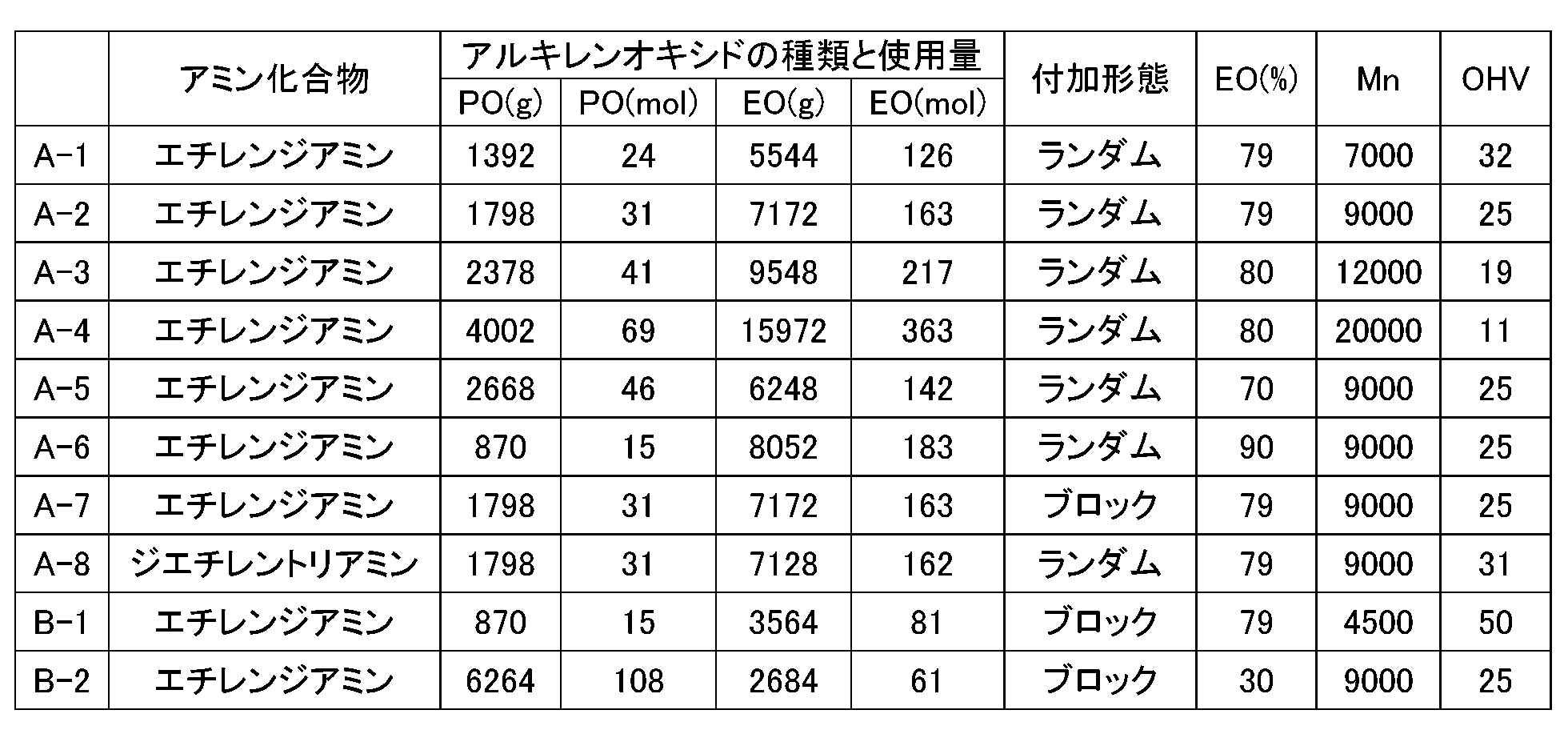
- alkylene oxide adduct (A-1) are shown in Table 1 below.
- PO (g) and PO (mol) in the type and amount of alkylene oxide indicate the amount of propylene oxide used
- EO (g) and EO (mol) indicate the amount of ethylene oxide used, both of which are amine compounds. This is the amount used per 1 mol (ethylenediamine in A-1).
- EO (%) is content (mass%) of the oxyethylene group which occupies in the obtained alkylene oxide adduct.
- Mn and OHV represent the number average molecular weight and average hydroxyl value (mgKOH / g) of the obtained alkylene oxide adduct, respectively. The same applies to the following (A-2) to (A-8) and (B-1) to (B-2).
- Production Example 8 The same operation as in Production Example 1 was carried out except that 103 g (1 mol) of diethylenetriamine was used instead of ethylenediamine, and the amounts of ethylene oxide and propylene oxide were as shown in Table 1, and propylene oxide of diethylenetriamine (31 mol) / ethylene oxide (162 mol) Random adduct (A-8) was obtained.
- Examples 1 to 10 Comparative Examples 1 to 3
- a release agent was obtained by mixing each raw material at a ratio (mass ratio) described in Table 2 below. The following evaluation was performed using this mold release agent.
- A Workability is the same as when dimethylpolysiloxane is used, and vulcanized rubber can be taken out from the mold.
- C Workability is worse than when dimethylpolysiloxane is used, and vulcanized rubber cannot be removed from the mold.
- A There is no slime on the surface of the vulcanized rubber after the first immersion
- B There is no slime on the surface of the vulcanized rubber after the second immersion
- C No slime on the surface of the vulcanized rubber after the third immersion
- D Even after the third immersion, there is a slime on the surface of the vulcanized rubber.
- Comparative Example 3 using dimethylpolysiloxane as a mold release agent was excellent in mold release but poor in cleanability.
- an alkylene oxide adduct of ethylenediamine was used, but because of its low molecular weight, sufficient releasability could not be exhibited at a use concentration of 20% by mass.
- an alkylene oxide adduct of ethylenediamine was used, but the content of oxyethylene groups was small and the detergency was poor.
- Examples 1 to 10 using an alkylene oxide adduct of ethylenediamine or diethylenetriamine having a predetermined molecular weight and oxyethylene group content a low use concentration of 10 to 30% by mass is sufficient. It was possible to exhibit a good releasability and was excellent in releasability and cleanability. Further, from comparison between Example 7 and other examples, it was found that random addition is more advantageous in terms of releasability than block addition as the addition form of alkylene oxide.
Landscapes
- Chemical & Material Sciences (AREA)
- Health & Medical Sciences (AREA)
- Chemical Kinetics & Catalysis (AREA)
- Medicinal Chemistry (AREA)
- Polymers & Plastics (AREA)
- Organic Chemistry (AREA)
- Engineering & Computer Science (AREA)
- Mechanical Engineering (AREA)
- Moulds For Moulding Plastics Or The Like (AREA)
- Compositions Of Macromolecular Compounds (AREA)
- Polyethers (AREA)
- Detergent Compositions (AREA)
Abstract
離型性と洗浄性に優れる加硫ゴム成形用離型剤を提供する。 本実施形態に係る加硫ゴム成形用離型剤は、分子内に活性水素原子を4~8個有するアミン化合物のアルキレンオキシド付加物(A)を含有するものであって、前記アミン化合物のアルキレンオキシド付加物(A)は、数平均分子量が5000~30000であり、かつ、オキシエチレン基を50~95質量%含有する加硫ゴム成形用離型剤である。
Description
本発明は、加硫ゴム成形用離型剤に関するものである。
加硫ゴムは、自動車部品、鉄道部品、建設機械などに使用されている。これらの加硫ゴムは、金型などに未加硫ゴムを投入して加硫成形した後、これを脱着することにより得られる。その際、加硫ゴムの金型からの脱着を容易に行うために、金型や未加硫ゴムには離型剤が塗布されている。
このような離型剤としては、シリコーンが使用されているが、加硫後のゴムホースに付着した離型剤を除去するためには洗剤などを用いる必要があり、洗浄性の改善が求められる。そのため、水で除去可能な離型剤が提案されており、例えば、特許文献1には、ジアミンのアルキレンオキシド付加物が開示されている。
しかしながら、特許文献1に記載の離型剤は、十分な離型性を得るために、例えば使用濃度を高くするなどして使用量を多くする必要がある。具体的に、特許文献1では、ジアミンのアルキレンオキシド付加物を濃度100%や50%で使用している。しかしながら、一般に使用量を多くすると、洗浄性が劣る。
本発明は、離型性と洗浄性に優れる離型剤を提供することを目的とする。
本発明に係る加硫ゴム成形用離型剤は、分子内に活性水素原子を4~8個有するアミン化合物のアルキレンオキシド付加物(A)を含有する加硫ゴム成形用離型剤であって、前記アミン化合物のアルキレンオキシド付加物(A)は、数平均分子量が5000~30000であり、かつ、オキシエチレン基を50~95質量%含有するものである。
上記加硫ゴム成形用離型剤であると、離型性と洗浄性に優れる。
本実施形態に係る加硫ゴム成形用離型剤は、分子内に活性水素原子を4~8個有するアミン化合物のアルキレンオキシド付加物(A)を含有するものである。かかるアミン化合物のアルキレンオキシド付加物(A)は、アミン化合物の残基に対して、活性水素原子数に対応する4~8つのポリオキシアルキレン鎖が結合した構造を有する。ここで、アミン化合物の残基とは、アミン化合物からアルキレンオキシドが付加した活性水素基(アミノ基など)の水素原子を除いた基を示す。
本実施形態において、上記アミン化合物のアルキレンオキシド付加物(A)は、数平均分子量(Mn)が5000~30000であり、かつ、オキシエチレン基を50~95質量%含有するものである。上記のような4~8つのポリオキシアルキレン鎖が結合した構造を持つものにおいて、このように分子量を高く、かつオキシエチレン基の含有量を高く設定したことにより、少ない使用量でも優れた離型性を発揮することができ、かつ水に溶けやすくして洗浄性を向上することができる。また、洗浄性に優れ、短時間で離型剤を除去できるため、加硫ゴムの生産性を向上することができる。
上記アミン化合物は、1級アミノ基(-NH2)及び/又は2級アミノ基(-NH-)を有する化合物であり、本実施形態では、分子内に活性水素原子を4~8個有する各種アミン化合物を用いることができる。アミン化合物としては、例えば、エチレンジアミン、プロピレンジアミン、トリメチレンジアミン、テトラメチレンジアミン、ペンタメチレンジアミン、ヘキサメチレンジアミン、ジエチレントリアミン、トリエチレンテトラミン、テトラエチレンペンタミン、ペンタエチレンヘキサミン、スペルミン、スペルミジンなどの脂肪族ポリアミン、トリレンジアミン、ジアミノキシレン、フェニレンジアミン、ナフタレンジアミン、ベンジジン、2,4’-ジアミノビフェニル、4,4’-ジアミノジフェニルメタンなどの芳香族ポリアミンが挙げられる。また、アミン化合物としては、アミノ基とともに水酸基を有してもよく、活性水素原子の合計が4~8個であればよい。アミノ基と水酸基を有する化合物としては、例えば、2-(2-アミノエチルアミノ)エタノール、N-(3-ヒドロキシプロピル)エチレンジアミン、N-(β-アミノエチル)イソプロパノールアミン、1-アミノプロパンジオール、2-アミノ-2-メチル-1,3-プロパンジオール、2-アミノ-2-エチル-1,3-プロパンジオール、1,1-ジアミノエタノール、1,3-ジアミノプロパノール、ジアミノフェノール、ジアミノベンジルアルコールなどが挙げられる。これらのアミン化合物は、それぞれ1種を単独で用いてもよく、2種以上組み合わせて用いてもよい。
上記アミン化合物としては、ポリアミンが好ましく、より好ましくは脂肪族ポリアミンである。一実施形態において、上記アミン化合物としては、2個の1級アミノ基と0~4個の2級アミノ基を有する炭素数2~10の脂肪族ポリアミンでもよく、2個の1級アミノ基と0~2個の2級アミノ基を有する炭素数2~6の脂肪族ポリアミンでもよく、2個の1級アミノ基を有し活性水素原子の合計が4個である炭素数2~6の脂肪族ポリアミンでもよい。
上記アミン化合物に付加するアルキレンオキシドとしては、エチレンオキシド単独でもよいが、エチレンオキシドと、それ以外のアルキレンオキシドを併用することが好ましい。一実施形態として、エチレンオキシドと、プロピレンオキシド及び/又はブチレンオキシドを用いてもよく、より詳細には、洗浄性に優れることから、エチレンオキシドとプロピレンオキシドを併用することが好ましい。
アルキレンオキシドを2種以上付加させる場合、その付加形態は、ブロック付加でも、ランダム付加でも、これらの組み合わせでもよい。すなわち、上記ポリオキシアルキレン鎖は、オキシエチレン基とその他のオキシアルキレン基とのブロック付加体でも、ランダム付加体でも、ブロック付加体とランダム付加体を組み合わせたものでもよく、ブロック付加体の場合、オキシエチレン基とその他のオキシアルキレン基との付加順序はいずれが先でもよい。一実施形態において、上記アミン化合物のアルキレンオキシド付加物(A)は、エチレンオキシドとプロピレンオキシドのランダム付加物であること、即ち、ポリオキシアルキレン鎖がオキシエチレン基とオキシプロピレン基のランダム付加体であることが好ましく、離型性をより一層向上することができる。
一実施形態において、アルキレンオキシドの付加量(平均付加モル数)は、アミン化合物1モル当たり100~600モルであることが好ましく、より好ましくは120~450モルであり、150~300モルでもよい。また、エチレンオキシドの付加量(平均付加モル数)は、アミン化合物1モル当たり80~570モルが好ましく、より好ましくは100~400モルであり、120~250モルでもよい。アルキレンオキシドとして、エチレンオキシドとプロピレンオキシドを併用する場合、両者の平均付加モル数の比(エチレンオキシド/プロピレンオキシド)は3~15であることが好ましく、より好ましくは4~10である。ここで、平均付加モル数は、1H-NMR(溶媒:CDCl3)により求めることができる。
上記アルキレンオキシドを付加する方法は、特に限定されず、例えば、上記アミン化合物及び触媒の存在下、アルキレンオキシドを70~120℃、0~0.3MPaとなるように反応容器に導入し、アミン化合物と反応させる方法など、公知の方法を用いることができる。触媒としては、特に限定されないが、例えば、水酸化カリウム、水酸化ナトリウム等のアルカリ金属類、水酸化カルシウム、水酸化マグネシウムなどのアルカリ土類金属類などが挙げられる。
本実施形態において、アミン化合物のアルキレンオキシド付加物(A)は、上記のように数平均分子量(Mn)が5000~30000であるものを用いる。数平均分子量が5000以上であることにより、少ない使用量でありながら(例えば、低濃度の使用でありながら)、加硫後のゴムと金型との離型性を向上することができる。また、数平均分子量が30000以下であることにより、離型剤の粘度上昇を抑えて作業性の低下を抑えることができる。数平均分子量は、より好ましくは6000~25000であり、更に好ましくは7000~22000である。
本実施形態において、アミン化合物のアルキレンオキシド付加物(A)は、上記のようにオキシエチレン基を50~95質量%含有するものである。すなわち、アミン化合物のアルキレンオキシド付加物(A)中に占めるオキシエチレン基の含有量が50~95質量%である。このようにオキシエチレン基の含有量を高くすることにより、水に溶解しやすくして洗浄性を向上することができ、上記の分子量の設定と相俟って、洗浄性と離型性に優れる。オキシエチレン基の含有量は、より好ましくは60~95質量%であり、更に好ましくは70~90質量%である。ここで、オキシエチレン基の含有量は、1H-NMR(溶媒:CDCl3)により求めることができる。
一実施形態において、上記アミン化合物のアルキレンオキシド付加物(A)は、平均水酸基価が5~50mgKOH/gであることが好ましい。このような範囲内とすることにより、離型性及び洗浄性がより優れたものとなる。上記平均水酸基価は8~40mgKOH/gであることがより好ましく、更に好ましくは10~35mgKOH/gである。ここで、平均水酸基価は、JIS K0070に準じて測定することができる。
本実施形態に係る加硫ゴム成形用離型剤は、上記アミン化合物のアルキレンオキシド付加物(A)のみで構成されてもよいが、水などの溶媒で希釈されたものであってもよい。好ましくは水で希釈されたものであり、洗浄性及び離型性の観点から、上記アミン化合物のアルキレンオキシド付加物(A)の濃度は5~70質量%であることが好ましく、より好ましくは20~50質量%である。
本実施形態に係る加硫ゴム成形用離型剤は、その効果を阻害しない範囲で、ノニオン性界面活性剤、アニオン性界面活性剤、シリコーンなどの他の成分を含有してもよい。
本実施形態に係る加硫ゴム成形用離型剤は、種々の加硫ゴムを成形する際の離型剤として用いることができる。例えば、アクリロニトリル-ブタジエン共重合ゴム(NBR)、エチレン・プロピレン・ジエン共重合ゴム(EPDM)、NBRとポリ塩化ビニル(PVC)とをブレンドしたゴム(NBR/PVC)、アクリルゴム(ACM)、フッ素ゴム(FKM)など、公知のゴムの加硫成形に用いることができる。
ゴムの加硫成形は、常法に従い行うことができ、例えば、本実施形態の離型剤を金型に塗布及び/又は未加硫ゴムに塗布することで、未加硫ゴムと金型が接触する部位に離型剤を付与した後、未加硫ゴムを金型に装着して、加熱及び加硫すればよい。加硫後、金型から加硫成形されたゴムを取り出し、ゴム表面に付着した離型剤を水または温水などにより洗浄することによって、加硫ゴムが得られる。なお、未加硫ゴムとしては、上記ゴムとともに、例えば、加硫剤、加硫助剤、加工助剤、可塑剤、プロセスオイル、カーボンブラック、白色充填材、老化防止剤などの公知の添加剤を配合したゴム組成物を用いることができる。
以下、実施例により本発明を更に詳細に説明するが、本発明はこれらに限定されるものではない。
数平均分子量の測定方法は、以下の通りである。
(数平均分子量)
GPC法により測定。GPC装置及び分析条件は以下の通りであり、標準サンプルとして分子量327、2000、8250、及び19700のポリエチレングリコールで校正したものを用いた。
・GPC装置:システムコントローラー:SCL-10A(島津製作所社製)
・検出器:RID-10A(島津製作所社製)
・カラム:Shodex GPC KF-G、KF-803、KF802.5、KF-802、KF-801を連結したもの(いずれも昭和電工社製)
・溶離液:テトラヒドロフラン
・サンプル注入:0.5重量%溶液、80μL
・流速:0.8mL/min
・温度:25℃。
GPC法により測定。GPC装置及び分析条件は以下の通りであり、標準サンプルとして分子量327、2000、8250、及び19700のポリエチレングリコールで校正したものを用いた。
・GPC装置:システムコントローラー:SCL-10A(島津製作所社製)
・検出器:RID-10A(島津製作所社製)
・カラム:Shodex GPC KF-G、KF-803、KF802.5、KF-802、KF-801を連結したもの(いずれも昭和電工社製)
・溶離液:テトラヒドロフラン
・サンプル注入:0.5重量%溶液、80μL
・流速:0.8mL/min
・温度:25℃。
実施例で使用した原料は下記の通りである。
(製造例1)
ステンレス製オートクレーブに、エチレンジアミン60g(1モル)、水酸化カリウム3gを仕込み、反応器内を窒素置換した。100℃に昇温し、エチレンオキシド5544g(126モル)およびプロピレンオキシド1392g(24モル)の混合物を、内圧0.3MPa以下に保ちながら導入した。導入終了後、さらに100℃で2時間反応させることにより、エチレンジアミンのプロピレンオキシド(24モル)/エチレンオキシド(126モル)ランダム付加物(A-1)を得た。
ステンレス製オートクレーブに、エチレンジアミン60g(1モル)、水酸化カリウム3gを仕込み、反応器内を窒素置換した。100℃に昇温し、エチレンオキシド5544g(126モル)およびプロピレンオキシド1392g(24モル)の混合物を、内圧0.3MPa以下に保ちながら導入した。導入終了後、さらに100℃で2時間反応させることにより、エチレンジアミンのプロピレンオキシド(24モル)/エチレンオキシド(126モル)ランダム付加物(A-1)を得た。
得られたアルキレンオキシド付加物(A-1)の詳細を下記表1に示す。表中、アルキレンオキシドの種類と使用量におけるPO(g)及びPO(mol)はプロピレンオキシドの使用量を示し、EO(g)及びEO(mol)はエチレンオキシドの使用量を示し、いずれもアミン化合物(A-1ではエチレンジアミン)1モルに対する使用量である。また、EO(%)は、得られたアルキレンオキシド付加物中に占めるオキシエチレン基の含有量(質量%)である。Mn及びOHVは、それぞれ得られたアルキレンオキシド付加物の数平均分子量及び平均水酸基価(mgKOH/g)を示す。下記の(A-2)~(A-8)及び(B-1)~(B-2)において同じ。
(製造例2~6)
エチレンオキシドとプロピレンオキシドを表1に記載の使用量とした以外は、製造例1と同様の操作を行い、エチレンジアミンのプロピレンオキシド/エチレンオキシドランダム付加物(A-2)~(A-6)を得た。
エチレンオキシドとプロピレンオキシドを表1に記載の使用量とした以外は、製造例1と同様の操作を行い、エチレンジアミンのプロピレンオキシド/エチレンオキシドランダム付加物(A-2)~(A-6)を得た。
(製造例7)
ステンレス製オートクレーブに、エチレンジアミン60g(1モル)、水酸化カリウム3gを仕込み、反応器内を窒素置換した。100℃に昇温し、プロピレンオキシド1798g(31モル)を内圧0.3MPa以下に保ちながら導入した。導入終了後、さらに100℃で2時間反応させた。続いて、エチレンオキシド7172g(163モル)を内圧0.3MPa以下に保ちながら導入した。エチレンオキシドの導入終了後、100℃で2時間反応させることにより、エチレンジアミンのプロピレンオキシド(31モル)-エチレンオキシド(163モル)ブロック付加物(A-7)を得た。
ステンレス製オートクレーブに、エチレンジアミン60g(1モル)、水酸化カリウム3gを仕込み、反応器内を窒素置換した。100℃に昇温し、プロピレンオキシド1798g(31モル)を内圧0.3MPa以下に保ちながら導入した。導入終了後、さらに100℃で2時間反応させた。続いて、エチレンオキシド7172g(163モル)を内圧0.3MPa以下に保ちながら導入した。エチレンオキシドの導入終了後、100℃で2時間反応させることにより、エチレンジアミンのプロピレンオキシド(31モル)-エチレンオキシド(163モル)ブロック付加物(A-7)を得た。
(製造例8)
エチレンジアミンに代えてジエチレントリアミン103g(1モル)を用い、エチレンオキシドとプロピレンオキシドを表1に記載の使用量とした以外は、製造例1と同様の操作を行い、ジエチレントリアミンのプロピレンオキシド(31モル)/エチレンオキシド(162モル)ランダム付加物(A-8)を得た。
エチレンジアミンに代えてジエチレントリアミン103g(1モル)を用い、エチレンオキシドとプロピレンオキシドを表1に記載の使用量とした以外は、製造例1と同様の操作を行い、ジエチレントリアミンのプロピレンオキシド(31モル)/エチレンオキシド(162モル)ランダム付加物(A-8)を得た。
(比較製造例1~2)
プロピレンオキシドとエチレンオキシドを表1に記載の使用量とした以外は、製造例7と同様の操作を行い、エチレンジアミンのプロピレンオキシド-エチレンオキシドブロック付加物(B-1)~(B-2)を得た。
プロピレンオキシドとエチレンオキシドを表1に記載の使用量とした以外は、製造例7と同様の操作を行い、エチレンジアミンのプロピレンオキシド-エチレンオキシドブロック付加物(B-1)~(B-2)を得た。
(B-3)
ジメチルポリシロキサン(商品名:KF-96-20CS、信越化学工業社製)。
ジメチルポリシロキサン(商品名:KF-96-20CS、信越化学工業社製)。
(実施例1~10、比較例1~3)
下記表2に記載の割合(質量比)で各原料を混合することにより、離型剤を得た。この離型剤を用いて、下記の評価を行った。
下記表2に記載の割合(質量比)で各原料を混合することにより、離型剤を得た。この離型剤を用いて、下記の評価を行った。
(離型性)
離型剤を塗布した未加硫ゴム(エチレン・プロピレン・ジエンゴム(EPDM)またはアクリロニトリル-ブタジエン共重合ゴム(NBR))を金型(120mm×120mm×2mm)に装着した。続いて、150℃で1時間加硫処理を行い、金型から加硫ゴムを取り出した。このときの作業性を離型性とし、比較例3をコントロールとして下記の基準で評価した。結果を表2に示す。
離型剤を塗布した未加硫ゴム(エチレン・プロピレン・ジエンゴム(EPDM)またはアクリロニトリル-ブタジエン共重合ゴム(NBR))を金型(120mm×120mm×2mm)に装着した。続いて、150℃で1時間加硫処理を行い、金型から加硫ゴムを取り出した。このときの作業性を離型性とし、比較例3をコントロールとして下記の基準で評価した。結果を表2に示す。
A:ジメチルポリシロキサンを用いた場合と作業性が同程度であり、金型から加硫ゴムを取り出せる
B:ジメチルポリシロキサンを用いた場合よりも作業性が若干劣るが、金型から加硫ゴムを取り出せる
C:ジメチルポリシロキサンを用いた場合よりも作業性が悪く、金型から加硫ゴムを取り出せない。
B:ジメチルポリシロキサンを用いた場合よりも作業性が若干劣るが、金型から加硫ゴムを取り出せる
C:ジメチルポリシロキサンを用いた場合よりも作業性が悪く、金型から加硫ゴムを取り出せない。
(洗浄性)
離型性の評価で得られた加硫ゴムを、2Lの水(温度:80℃)に30秒間浸漬し、取り出して、加硫ゴム表面のヌメリを確認した。ヌメリがある場合は、新たに用意した2Lの水(温度:80℃)に30秒間浸漬し、ヌメリがなくなる、または、合計3回までこの操作を繰り返した。下記の基準で洗浄性を評価した。結果を表2に示す。なお、加硫ゴム表面にヌメリがある場合は離型剤が残っており、ヌメリがない場合は離型剤が残っていないことを示す。
離型性の評価で得られた加硫ゴムを、2Lの水(温度:80℃)に30秒間浸漬し、取り出して、加硫ゴム表面のヌメリを確認した。ヌメリがある場合は、新たに用意した2Lの水(温度:80℃)に30秒間浸漬し、ヌメリがなくなる、または、合計3回までこの操作を繰り返した。下記の基準で洗浄性を評価した。結果を表2に示す。なお、加硫ゴム表面にヌメリがある場合は離型剤が残っており、ヌメリがない場合は離型剤が残っていないことを示す。
A:1回目の浸漬後に加硫ゴムの表面にヌメリがない
B:2回目の浸漬後に加硫ゴムの表面にヌメリがない
C:3回目の浸漬後に加硫ゴムの表面にヌメリがない
D:3回目の浸漬後でも加硫ゴムの表面にヌメリがある。
B:2回目の浸漬後に加硫ゴムの表面にヌメリがない
C:3回目の浸漬後に加硫ゴムの表面にヌメリがない
D:3回目の浸漬後でも加硫ゴムの表面にヌメリがある。

表2に示されたように、離型剤としてジメチルポリシロキサンを用いた比較例3では、離型性には優れるものの、洗浄性に劣っていた。比較例1では、エチレンジアミンのアルキレンオキシド付加物を用いたが、分子量の小さいものであったため、20質量%という使用濃度では十分な離型性を発揮することはできなかった。比較例2では、エチレンジアミンのアルキレンオキシド付加物を用いたが、オキシエチレン基の含有量が少なく、洗浄性に劣っていた。
これに対し、エチレンジアミンやジエチレントリアミンのアルキレンオキシド付加物であって所定の分子量とオキシエチレン基含有量を持つものを用いた実施例1~10であると、10~30質量%という低い使用濃度でも十分な離型性を発揮することができ、離型性と洗浄性に優れていた。また、実施例7とその他の実施例との対比より、アルキレンオキシドの付加形態としてはブロック付加よりもランダム付加の方が離型性の点で有利であることが分かった。
Claims (2)
- 分子内に活性水素原子を4~8個有するアミン化合物のアルキレンオキシド付加物(A)を含有する加硫ゴム成形用離型剤であって、
前記アミン化合物のアルキレンオキシド付加物(A)は、数平均分子量が5000~30000であり、かつ、オキシエチレン基を50~95質量%含有する、加硫ゴム成形用離型剤。 - 前記アミン化合物のアルキレンオキシド付加物(A)が、エチレンオキシドとプロピレンオキシドのランダム付加物である、請求項1記載の加硫ゴム成形用離型剤。
Priority Applications (2)
| Application Number | Priority Date | Filing Date | Title |
|---|---|---|---|
| CN201780029731.0A CN109153154B (zh) | 2016-05-13 | 2017-04-26 | 硫化橡胶成形用脱模剂 |
| US16/301,286 US10717210B2 (en) | 2016-05-13 | 2017-04-26 | Release agent for vulcanized rubber molding |
Applications Claiming Priority (2)
| Application Number | Priority Date | Filing Date | Title |
|---|---|---|---|
| JP2016-097214 | 2016-05-13 | ||
| JP2016097214A JP6240710B2 (ja) | 2016-05-13 | 2016-05-13 | 加硫ゴム成形用離型剤 |
Publications (1)
| Publication Number | Publication Date |
|---|---|
| WO2017195594A1 true WO2017195594A1 (ja) | 2017-11-16 |
Family
ID=60266496
Family Applications (1)
| Application Number | Title | Priority Date | Filing Date |
|---|---|---|---|
| PCT/JP2017/016477 Ceased WO2017195594A1 (ja) | 2016-05-13 | 2017-04-26 | 加硫ゴム成形用離型剤 |
Country Status (4)
| Country | Link |
|---|---|
| US (1) | US10717210B2 (ja) |
| JP (1) | JP6240710B2 (ja) |
| CN (1) | CN109153154B (ja) |
| WO (1) | WO2017195594A1 (ja) |
Cited By (1)
| Publication number | Priority date | Publication date | Assignee | Title |
|---|---|---|---|---|
| JP2020001311A (ja) * | 2018-06-29 | 2020-01-09 | 日華化学株式会社 | 加硫ゴム用離型剤 |
Families Citing this family (2)
| Publication number | Priority date | Publication date | Assignee | Title |
|---|---|---|---|---|
| JP6937225B2 (ja) * | 2017-11-08 | 2021-09-22 | 第一工業製薬株式会社 | 加硫ゴム成形用離型剤 |
| JP7330087B2 (ja) * | 2019-12-13 | 2023-08-21 | ライオン・スペシャリティ・ケミカルズ株式会社 | ゴム組成物、ゴム成形体及びゴム組成物の製造方法 |
Citations (3)
| Publication number | Priority date | Publication date | Assignee | Title |
|---|---|---|---|---|
| JPS58132090A (ja) * | 1982-01-29 | 1983-08-06 | Dai Ichi Kogyo Seiyaku Co Ltd | ゴムホース加硫成形用離型剤 |
| JPH07292236A (ja) * | 1994-04-26 | 1995-11-07 | Ipposha Oil Ind Co Ltd | 加硫ゴム用離型剤 |
| JP2004114472A (ja) * | 2002-09-26 | 2004-04-15 | Nof Corp | 加硫ゴム用離型剤 |
Family Cites Families (2)
| Publication number | Priority date | Publication date | Assignee | Title |
|---|---|---|---|---|
| CN101875220B (zh) * | 2009-04-28 | 2014-07-09 | 汉高股份有限公司 | 一种脱模剂及其制备方法和用途 |
| US20140232041A1 (en) * | 2013-02-19 | 2014-08-21 | Henkel Corporation | Internal mold release agents for polyurethane materials |
-
2016
- 2016-05-13 JP JP2016097214A patent/JP6240710B2/ja active Active
-
2017
- 2017-04-26 US US16/301,286 patent/US10717210B2/en active Active
- 2017-04-26 CN CN201780029731.0A patent/CN109153154B/zh active Active
- 2017-04-26 WO PCT/JP2017/016477 patent/WO2017195594A1/ja not_active Ceased
Patent Citations (3)
| Publication number | Priority date | Publication date | Assignee | Title |
|---|---|---|---|---|
| JPS58132090A (ja) * | 1982-01-29 | 1983-08-06 | Dai Ichi Kogyo Seiyaku Co Ltd | ゴムホース加硫成形用離型剤 |
| JPH07292236A (ja) * | 1994-04-26 | 1995-11-07 | Ipposha Oil Ind Co Ltd | 加硫ゴム用離型剤 |
| JP2004114472A (ja) * | 2002-09-26 | 2004-04-15 | Nof Corp | 加硫ゴム用離型剤 |
Cited By (2)
| Publication number | Priority date | Publication date | Assignee | Title |
|---|---|---|---|---|
| JP2020001311A (ja) * | 2018-06-29 | 2020-01-09 | 日華化学株式会社 | 加硫ゴム用離型剤 |
| JP7045272B2 (ja) | 2018-06-29 | 2022-03-31 | 日華化学株式会社 | 加硫ゴム用離型剤 |
Also Published As
| Publication number | Publication date |
|---|---|
| CN109153154A (zh) | 2019-01-04 |
| JP6240710B2 (ja) | 2017-11-29 |
| JP2017202664A (ja) | 2017-11-16 |
| US20190275709A1 (en) | 2019-09-12 |
| US10717210B2 (en) | 2020-07-21 |
| CN109153154B (zh) | 2021-07-23 |
Similar Documents
| Publication | Publication Date | Title |
|---|---|---|
| JP6240710B2 (ja) | 加硫ゴム成形用離型剤 | |
| US9840572B2 (en) | Acrylic rubber, acrylic rubber composition, cross-linked acrylic rubber product, and seal member | |
| JP6937225B2 (ja) | 加硫ゴム成形用離型剤 | |
| US20150259532A1 (en) | Fluorosilicone rubber composition | |
| JP6240709B2 (ja) | 加硫ゴム成形用離型剤 | |
| JP5493554B2 (ja) | ポリエーテル重合体の製造方法、ならびにポリエーテル重合体組成物、架橋物、および導電性ロール | |
| JP7809870B1 (ja) | 加硫ゴム成形用離型剤 | |
| JP6479510B2 (ja) | 加硫ゴムホース成形用離型剤 | |
| US7510772B2 (en) | Fluorosilicone rubber composition and molded rubber article | |
| JP5944087B1 (ja) | 加硫ゴム成形用離型剤 | |
| JP2014172931A (ja) | ゴム組成物、ゴム部材、それを用いたシール部材及び搬送部材 | |
| JP6627654B2 (ja) | フロロシリコーンゴム組成物及び輸送機のエンジン周辺用ゴム部品 | |
| JP2026054653A (ja) | 加硫ゴム成形用離型剤 | |
| JP2005113017A (ja) | フッ素ゴム組成物 | |
| JP5609645B2 (ja) | ポリエーテル重合体 | |
| KR101409260B1 (ko) | 내열성이 우수한 고무 조성물 | |
| JP6567896B2 (ja) | 加硫ゴム成形用離型剤 | |
| CN113056371B (zh) | 表卤代醇系橡胶组合物、橡胶交联物、橡胶层叠体及软管 | |
| TWI722846B (zh) | 含有環氧化聚丁二烯之氟橡膠組合物 | |
| JP2006282693A (ja) | ゴム組成物 | |
| JP2024084156A (ja) | ゴム積層体およびホース | |
| JP7210962B2 (ja) | ゴム積層体およびホース | |
| JP5397752B2 (ja) | 低金属汚染性ゴム組成物 | |
| WO2023190181A1 (ja) | 架橋用組成物およびそれを架橋してなるゴム材料 | |
| JPS6129617B2 (ja) |
Legal Events
| Date | Code | Title | Description |
|---|---|---|---|
| NENP | Non-entry into the national phase |
Ref country code: DE |
|
| 121 | Ep: the epo has been informed by wipo that ep was designated in this application |
Ref document number: 17795955 Country of ref document: EP Kind code of ref document: A1 |
|
| 122 | Ep: pct application non-entry in european phase |
Ref document number: 17795955 Country of ref document: EP Kind code of ref document: A1 |