WO2017188290A1 - アクリル系熱可塑性樹脂組成物、成形体、フィルムとその製造方法、および積層体 - Google Patents
アクリル系熱可塑性樹脂組成物、成形体、フィルムとその製造方法、および積層体 Download PDFInfo
- Publication number
- WO2017188290A1 WO2017188290A1 PCT/JP2017/016456 JP2017016456W WO2017188290A1 WO 2017188290 A1 WO2017188290 A1 WO 2017188290A1 JP 2017016456 W JP2017016456 W JP 2017016456W WO 2017188290 A1 WO2017188290 A1 WO 2017188290A1
- Authority
- WO
- WIPO (PCT)
- Prior art keywords
- mass
- thermoplastic resin
- layer
- resin composition
- acrylate
- Prior art date
- Legal status (The legal status is an assumption and is not a legal conclusion. Google has not performed a legal analysis and makes no representation as to the accuracy of the status listed.)
- Ceased
Links
Classifications
-
- C—CHEMISTRY; METALLURGY
- C08—ORGANIC MACROMOLECULAR COMPOUNDS; THEIR PREPARATION OR CHEMICAL WORKING-UP; COMPOSITIONS BASED THEREON
- C08L—COMPOSITIONS OF MACROMOLECULAR COMPOUNDS
- C08L33/00—Compositions of homopolymers or copolymers of compounds having one or more unsaturated aliphatic radicals, each having only one carbon-to-carbon double bond, and only one being terminated by only one carboxyl radical, or of salts, anhydrides, esters, amides, imides or nitriles thereof; Compositions of derivatives of such polymers
- C08L33/04—Homopolymers or copolymers of esters
- C08L33/06—Homopolymers or copolymers of esters of esters containing only carbon, hydrogen and oxygen, which oxygen atoms are present only as part of the carboxyl radical
- C08L33/10—Homopolymers or copolymers of methacrylic acid esters
- C08L33/12—Homopolymers or copolymers of methyl methacrylate
-
- C—CHEMISTRY; METALLURGY
- C08—ORGANIC MACROMOLECULAR COMPOUNDS; THEIR PREPARATION OR CHEMICAL WORKING-UP; COMPOSITIONS BASED THEREON
- C08L—COMPOSITIONS OF MACROMOLECULAR COMPOUNDS
- C08L51/00—Compositions of graft polymers in which the grafted component is obtained by reactions only involving carbon-to-carbon unsaturated bonds; Compositions of derivatives of such polymers
- C08L51/003—Compositions of graft polymers in which the grafted component is obtained by reactions only involving carbon-to-carbon unsaturated bonds; Compositions of derivatives of such polymers grafted on to macromolecular compounds obtained by reactions only involving unsaturated carbon-to-carbon bonds
-
- B—PERFORMING OPERATIONS; TRANSPORTING
- B29—WORKING OF PLASTICS; WORKING OF SUBSTANCES IN A PLASTIC STATE IN GENERAL
- B29C—SHAPING OR JOINING OF PLASTICS; SHAPING OF MATERIAL IN A PLASTIC STATE, NOT OTHERWISE PROVIDED FOR; AFTER-TREATMENT OF THE SHAPED PRODUCTS, e.g. REPAIRING
- B29C48/00—Extrusion moulding, i.e. expressing the moulding material through a die or nozzle which imparts the desired form; Apparatus therefor
- B29C48/03—Extrusion moulding, i.e. expressing the moulding material through a die or nozzle which imparts the desired form; Apparatus therefor characterised by the shape of the extruded material at extrusion
- B29C48/07—Flat, e.g. panels
- B29C48/08—Flat, e.g. panels flexible, e.g. films
-
- B—PERFORMING OPERATIONS; TRANSPORTING
- B29—WORKING OF PLASTICS; WORKING OF SUBSTANCES IN A PLASTIC STATE IN GENERAL
- B29C—SHAPING OR JOINING OF PLASTICS; SHAPING OF MATERIAL IN A PLASTIC STATE, NOT OTHERWISE PROVIDED FOR; AFTER-TREATMENT OF THE SHAPED PRODUCTS, e.g. REPAIRING
- B29C48/00—Extrusion moulding, i.e. expressing the moulding material through a die or nozzle which imparts the desired form; Apparatus therefor
- B29C48/25—Component parts, details or accessories; Auxiliary operations
- B29C48/30—Extrusion nozzles or dies
- B29C48/305—Extrusion nozzles or dies having a wide opening, e.g. for forming sheets
-
- B—PERFORMING OPERATIONS; TRANSPORTING
- B32—LAYERED PRODUCTS
- B32B—LAYERED PRODUCTS, i.e. PRODUCTS BUILT-UP OF STRATA OF FLAT OR NON-FLAT, e.g. CELLULAR OR HONEYCOMB, FORM
- B32B27/00—Layered products comprising a layer of synthetic resin
- B32B27/30—Layered products comprising a layer of synthetic resin comprising vinyl (co)polymers; comprising acrylic (co)polymers
-
- C—CHEMISTRY; METALLURGY
- C08—ORGANIC MACROMOLECULAR COMPOUNDS; THEIR PREPARATION OR CHEMICAL WORKING-UP; COMPOSITIONS BASED THEREON
- C08F—MACROMOLECULAR COMPOUNDS OBTAINED BY REACTIONS ONLY INVOLVING CARBON-TO-CARBON UNSATURATED BONDS
- C08F12/00—Homopolymers and copolymers of compounds having one or more unsaturated aliphatic radicals, each having only one carbon-to-carbon double bond, and at least one being terminated by an aromatic carbocyclic ring
- C08F12/02—Monomers containing only one unsaturated aliphatic radical
- C08F12/04—Monomers containing only one unsaturated aliphatic radical containing one ring
- C08F12/06—Hydrocarbons
- C08F12/08—Styrene
-
- C—CHEMISTRY; METALLURGY
- C08—ORGANIC MACROMOLECULAR COMPOUNDS; THEIR PREPARATION OR CHEMICAL WORKING-UP; COMPOSITIONS BASED THEREON
- C08F—MACROMOLECULAR COMPOUNDS OBTAINED BY REACTIONS ONLY INVOLVING CARBON-TO-CARBON UNSATURATED BONDS
- C08F220/00—Copolymers of compounds having one or more unsaturated aliphatic radicals, each having only one carbon-to-carbon double bond, and only one being terminated by only one carboxyl radical or a salt, anhydride ester, amide, imide or nitrile thereof
- C08F220/02—Monocarboxylic acids having less than ten carbon atoms; Derivatives thereof
- C08F220/10—Esters
- C08F220/12—Esters of monohydric alcohols or phenols
- C08F220/16—Esters of monohydric alcohols or phenols of phenols or of alcohols containing two or more carbon atoms
- C08F220/18—Esters of monohydric alcohols or phenols of phenols or of alcohols containing two or more carbon atoms with acrylic or methacrylic acids
- C08F220/1804—C4-(meth)acrylate, e.g. butyl (meth)acrylate, isobutyl (meth)acrylate or tert-butyl (meth)acrylate
-
- C—CHEMISTRY; METALLURGY
- C08—ORGANIC MACROMOLECULAR COMPOUNDS; THEIR PREPARATION OR CHEMICAL WORKING-UP; COMPOSITIONS BASED THEREON
- C08F—MACROMOLECULAR COMPOUNDS OBTAINED BY REACTIONS ONLY INVOLVING CARBON-TO-CARBON UNSATURATED BONDS
- C08F285/00—Macromolecular compounds obtained by polymerising monomers on to preformed graft polymers
-
- C—CHEMISTRY; METALLURGY
- C08—ORGANIC MACROMOLECULAR COMPOUNDS; THEIR PREPARATION OR CHEMICAL WORKING-UP; COMPOSITIONS BASED THEREON
- C08F—MACROMOLECULAR COMPOUNDS OBTAINED BY REACTIONS ONLY INVOLVING CARBON-TO-CARBON UNSATURATED BONDS
- C08F299/00—Macromolecular compounds obtained by interreacting polymers involving only carbon-to-carbon unsaturated bond reactions, in the absence of non-macromolecular monomers
- C08F299/02—Macromolecular compounds obtained by interreacting polymers involving only carbon-to-carbon unsaturated bond reactions, in the absence of non-macromolecular monomers from unsaturated polycondensates
- C08F299/04—Macromolecular compounds obtained by interreacting polymers involving only carbon-to-carbon unsaturated bond reactions, in the absence of non-macromolecular monomers from unsaturated polycondensates from polyesters
- C08F299/0485—Macromolecular compounds obtained by interreacting polymers involving only carbon-to-carbon unsaturated bond reactions, in the absence of non-macromolecular monomers from unsaturated polycondensates from polyesters from polyesters with side or terminal unsaturations
- C08F299/0492—Macromolecular compounds obtained by interreacting polymers involving only carbon-to-carbon unsaturated bond reactions, in the absence of non-macromolecular monomers from unsaturated polycondensates from polyesters from polyesters with side or terminal unsaturations the unsaturation being in acrylic or methacrylic groups
-
- C—CHEMISTRY; METALLURGY
- C08—ORGANIC MACROMOLECULAR COMPOUNDS; THEIR PREPARATION OR CHEMICAL WORKING-UP; COMPOSITIONS BASED THEREON
- C08J—WORKING-UP; GENERAL PROCESSES OF COMPOUNDING; AFTER-TREATMENT NOT COVERED BY SUBCLASSES C08B, C08C, C08F, C08G or C08H
- C08J5/00—Manufacture of articles or shaped materials containing macromolecular substances
- C08J5/18—Manufacture of films or sheets
-
- C—CHEMISTRY; METALLURGY
- C08—ORGANIC MACROMOLECULAR COMPOUNDS; THEIR PREPARATION OR CHEMICAL WORKING-UP; COMPOSITIONS BASED THEREON
- C08L—COMPOSITIONS OF MACROMOLECULAR COMPOUNDS
- C08L51/00—Compositions of graft polymers in which the grafted component is obtained by reactions only involving carbon-to-carbon unsaturated bonds; Compositions of derivatives of such polymers
- C08L51/04—Compositions of graft polymers in which the grafted component is obtained by reactions only involving carbon-to-carbon unsaturated bonds; Compositions of derivatives of such polymers grafted on to rubbers
-
- C—CHEMISTRY; METALLURGY
- C08—ORGANIC MACROMOLECULAR COMPOUNDS; THEIR PREPARATION OR CHEMICAL WORKING-UP; COMPOSITIONS BASED THEREON
- C08L—COMPOSITIONS OF MACROMOLECULAR COMPOUNDS
- C08L53/00—Compositions of block copolymers containing at least one sequence of a polymer obtained by reactions only involving carbon-to-carbon unsaturated bonds; Compositions of derivatives of such polymers
-
- B—PERFORMING OPERATIONS; TRANSPORTING
- B29—WORKING OF PLASTICS; WORKING OF SUBSTANCES IN A PLASTIC STATE IN GENERAL
- B29C—SHAPING OR JOINING OF PLASTICS; SHAPING OF MATERIAL IN A PLASTIC STATE, NOT OTHERWISE PROVIDED FOR; AFTER-TREATMENT OF THE SHAPED PRODUCTS, e.g. REPAIRING
- B29C48/00—Extrusion moulding, i.e. expressing the moulding material through a die or nozzle which imparts the desired form; Apparatus therefor
- B29C48/03—Extrusion moulding, i.e. expressing the moulding material through a die or nozzle which imparts the desired form; Apparatus therefor characterised by the shape of the extruded material at extrusion
- B29C48/04—Particle-shaped
-
- B—PERFORMING OPERATIONS; TRANSPORTING
- B29—WORKING OF PLASTICS; WORKING OF SUBSTANCES IN A PLASTIC STATE IN GENERAL
- B29C—SHAPING OR JOINING OF PLASTICS; SHAPING OF MATERIAL IN A PLASTIC STATE, NOT OTHERWISE PROVIDED FOR; AFTER-TREATMENT OF THE SHAPED PRODUCTS, e.g. REPAIRING
- B29C48/00—Extrusion moulding, i.e. expressing the moulding material through a die or nozzle which imparts the desired form; Apparatus therefor
- B29C48/03—Extrusion moulding, i.e. expressing the moulding material through a die or nozzle which imparts the desired form; Apparatus therefor characterised by the shape of the extruded material at extrusion
- B29C48/05—Filamentary, e.g. strands
-
- B—PERFORMING OPERATIONS; TRANSPORTING
- B29—WORKING OF PLASTICS; WORKING OF SUBSTANCES IN A PLASTIC STATE IN GENERAL
- B29C—SHAPING OR JOINING OF PLASTICS; SHAPING OF MATERIAL IN A PLASTIC STATE, NOT OTHERWISE PROVIDED FOR; AFTER-TREATMENT OF THE SHAPED PRODUCTS, e.g. REPAIRING
- B29C48/00—Extrusion moulding, i.e. expressing the moulding material through a die or nozzle which imparts the desired form; Apparatus therefor
- B29C48/03—Extrusion moulding, i.e. expressing the moulding material through a die or nozzle which imparts the desired form; Apparatus therefor characterised by the shape of the extruded material at extrusion
- B29C48/09—Articles with cross-sections having partially or fully enclosed cavities, e.g. pipes or channels
-
- B—PERFORMING OPERATIONS; TRANSPORTING
- B29—WORKING OF PLASTICS; WORKING OF SUBSTANCES IN A PLASTIC STATE IN GENERAL
- B29C—SHAPING OR JOINING OF PLASTICS; SHAPING OF MATERIAL IN A PLASTIC STATE, NOT OTHERWISE PROVIDED FOR; AFTER-TREATMENT OF THE SHAPED PRODUCTS, e.g. REPAIRING
- B29C48/00—Extrusion moulding, i.e. expressing the moulding material through a die or nozzle which imparts the desired form; Apparatus therefor
- B29C48/03—Extrusion moulding, i.e. expressing the moulding material through a die or nozzle which imparts the desired form; Apparatus therefor characterised by the shape of the extruded material at extrusion
- B29C48/09—Articles with cross-sections having partially or fully enclosed cavities, e.g. pipes or channels
- B29C48/10—Articles with cross-sections having partially or fully enclosed cavities, e.g. pipes or channels flexible, e.g. blown foils
-
- C—CHEMISTRY; METALLURGY
- C08—ORGANIC MACROMOLECULAR COMPOUNDS; THEIR PREPARATION OR CHEMICAL WORKING-UP; COMPOSITIONS BASED THEREON
- C08F—MACROMOLECULAR COMPOUNDS OBTAINED BY REACTIONS ONLY INVOLVING CARBON-TO-CARBON UNSATURATED BONDS
- C08F2800/00—Copolymer characterised by the proportions of the comonomers expressed
- C08F2800/20—Copolymer characterised by the proportions of the comonomers expressed as weight or mass percentages
-
- C—CHEMISTRY; METALLURGY
- C08—ORGANIC MACROMOLECULAR COMPOUNDS; THEIR PREPARATION OR CHEMICAL WORKING-UP; COMPOSITIONS BASED THEREON
- C08L—COMPOSITIONS OF MACROMOLECULAR COMPOUNDS
- C08L2207/00—Properties characterising the ingredient of the composition
- C08L2207/53—Core-shell polymer
Definitions
- the present invention relates to an acrylic thermoplastic resin composition, a molded body, a film, a manufacturing method thereof, and a laminate.
- Multi-layered polymer particles having a rubber component layer on the inside and a thermoplastic resin component layer on the outermost side are acrylic resin, polyvinyl chloride, and It is suitably used for toughness imparting modification of thermoplastic resins such as polyester.
- the multilayer structure polymer particles are molded alone, by setting the amount of the outermost thermoplastic resin component relatively low, flexibility is improved and good toughness imparting effect is exhibited. There is a tendency to deteriorate. If the amount of the outermost thermoplastic resin component is increased, the moldability is improved, but the flexibility is lowered and the toughening effect tends to be lowered.
- good transparency can be obtained by matching the refractive indexes of the respective layers.
- the glass transition point (Tg) of the rubber component layer is temporarily reduced. And it is difficult to make the refractive indexes of the respective layers coincide with each other, and it becomes difficult to ensure transparency.
- Patent Document 1 describes the number average molecular weight (Mn) of the outermost thermoplastic resin component, the average particle size, and the raw material for the rubber component layer for the purpose of achieving compatibility between characteristics such as transparency and flexibility and moldability.
- Mn number average molecular weight
- Three or more layers of multi-layered polymer particles having a water-soluble solubility in a polymer are disclosed (claim 1). Although this multilayer structure polymer particle is excellent in properties such as transparency and flexibility, it cannot always be said that moldability such as film forming by the T-die method is sufficient.
- Patent Document 2 discloses a methacrylic resin composition in which two types of methacrylic polymers having different weight average molecular weights (Mw) are added to multilayer structure polymer particles for the purpose of improving moldability (claims). Item 1). Further, in Patent Document 3, a block copolymer containing a methacrylic polymer block and an acrylic polymer block is added to multilayer structure polymer particles made of a copolymer of acrylic acid ester and methacrylic acid ester. A thermoplastic resin composition is disclosed (claim 3). Although the resin composition described in these documents is improved in moldability, the flexibility is not necessarily sufficient.
- Mw weight average molecular weights
- the present invention has been made in view of the above circumstances, and an object of the present invention is to provide a thermoplastic resin composition containing multilayer structure polymer particles having excellent transparency, flexibility, and moldability.
- the present invention provides the following acrylic thermoplastic resin composition, molded article, film, method for producing the same, and laminate.
- An acrylic thermoplastic resin composition comprising two or more layers of multilayer structure polymer particles (A) and a block copolymer (B),
- the multilayer structure polymer particle (A) contains 50 to 99.99% by mass of acrylate monomer units, 49.99 to 0% by mass of other monofunctional monomer units, and a polyfunctional monomer unit. It has at least one rubber component layer (I) made of a copolymer consisting of 0.01 to 10% by weight of a monomer unit, and 40 to 100% by weight of a methacrylic acid ester monomer unit and other units.
- thermoplastic resin component layer (II) consisting of a copolymer consisting of 60 to 0% by mass of a monomer unit and having a number average molecular weight measured by GPC method of 30,000 or less,
- the mass ratio of the total amount of the rubber component layer (I) and the total amount of the thermoplastic resin component layer (II) (layer (I) / layer (II)) is 30/70 to 90/10, and the average particle size is 150 nm.
- Acrylic multilayer structure polymer particles that are:
- the block copolymer (B) is an acrylic block copolymer having a weight average molecular weight of 32,000 to 300,000 as measured by GPC method, An acrylic thermoplastic resin composition having a mass ratio ((A) / (B)) of the multilayer structure polymer particles (A) to the block copolymer (B) of 1/99 to 99/1.
- the multilayer structure polymer particles (A) are composed of a rubber component layer (Ia) that is the first rubber component layer (I) and a rubber component layer (I) that is the second rubber component layer (I).
- the block copolymer (B) has 10 to 80% by mass of a polymer block (b1) having 80% by mass or more of a methacrylic acid ester monomer unit and 45% by mass or more of an acrylate ester monomer unit. 90 to 20% by mass of the polymer block (b2) (provided that the total amount of the polymer block (b1) and the polymer block (b2) is 100% by mass), [1] to [3] Any acrylic thermoplastic resin composition.
- the content of the methacrylic resin (C) is 1 to 100 parts by mass with respect to the total amount of the multilayer structure polymer particles (A) and the methacrylic resin (C).
- the acrylic thermoplastic resin composition according to any one of [1] to [6], which is 20 parts by mass.
- a molded article comprising the acrylic thermoplastic resin composition according to any one of [1] to [7].
- a film comprising the acrylic thermoplastic resin composition according to any one of [1] to [7].
- the method for producing a film according to [9], wherein the film is formed by a T-die method.
- a laminate having an acrylic thermoplastic resin layer made of the acrylic thermoplastic resin composition according to any one of [1] to [7] and another resin layer.
- the other resin layer includes at least one thermoplastic resin selected from the group consisting of methacrylic resin, polyvinyl chloride, ABS (acrylonitrile-butadiene-styrene copolymer) resin, and polycarbonate.
- Laminate is selected from the group consisting of methacrylic resin, polyvinyl chloride, ABS (acrylonitrile-butadiene-styrene copolymer) resin, and polycarbonate.
- thermoplastic resin composition including multilayer structure polymer particles having excellent transparency, flexibility, and moldability.
- the acrylic thermoplastic resin composition of the present invention (hereinafter also simply referred to as “thermoplastic resin composition”) comprises two or more specific acrylic multilayer structure polymer particles (A) and a specific acrylic block copolymer. A polymer (B).
- the multilayer structure polymer particle (A) contains 50 to 99.99% by mass of acrylate monomer units, 49.99 to 0% by mass of other monofunctional monomer units, and a polyfunctional monomer unit. It has at least one rubber component layer (I) made of a copolymer consisting of 0.01 to 10% by weight of a monomer unit, and 40 to 100% by weight of a methacrylic acid ester monomer unit and other units. It has at least one thermoplastic resin component layer (II) made of a copolymer consisting of 60 to 0% by mass of a monomer unit and having a number average molecular weight (Mn) measured by GPC method of 30,000 or less. .
- the multilayer polymer particles (A) have a mass ratio (layer (I) / layer (II)) of 30/70 to 90 to the total amount of the rubber component layer (I) and the total amount of the thermoplastic resin component layer (II). / 10. Moreover, an average particle diameter is 150 nm or less.
- the block copolymer (B) has a weight average molecular weight (Mw) measured by GPC method of 32,000 to 300,000. The mass ratio ((A) / (B)) between the multilayer structure polymer particles (A) and the block copolymer (B) is from 1/99 to 99/1.
- the flexibility can be achieved without reducing the Tg of the rubber component layer of the multilayer structure polymer particle. And formability can be achieved.
- the refractive indexes of the layers of the multilayer structure polymer particles can be easily matched, and good transparency can be secured.
- the multilayer structure polymer particle (A) has at least one rubber component layer (I) (hereinafter sometimes simply referred to as “layer (I)”) inside, and at least one at the outermost part. It has a thermoplastic resin component layer (II) (hereinafter sometimes simply referred to as “layer (II)”).
- layer (I) rubber component layer
- layer (II) thermoplastic resin component layer
- the number of layers of the multilayer structure polymer particles (A) may be two or more, and may be three or four or more.
- layer structure a two-layer structure of layer (I) -layer (II) from the center; layer (I) -layer (I) -layer (II), layer (I) -layer (II) -layer (II Or a three-layer structure of layer (II) -layer (I) -layer (II); a four-layer structure such as layer (I) -layer (II) -layer (I) -layer (II), etc. .
- a two-layer structure of layer (I) -layer (II); layer (I) -layer (I) -layer (II) or layer (II) -layer (I) -layer (II ) Is preferred.
- the mass ratio (layer (I) / layer (II)) of the total amount of the rubber component layer (I) and the total amount of the thermoplastic resin component layer (II) is 30/70 to 90/10.
- the ratio of the layer (I) is less than the above range, the elastic recoverability of the molded article (including the film) of the thermoplastic resin composition of the present invention may be insufficient. If the ratio of the layer (I) exceeds the above range, it is difficult to form a particle structure, and the melt fluidity is lowered, so that kneading with other components and molding of the thermoplastic resin composition of the present invention may be difficult.
- the mass ratio (layer (I) / layer (II)) is preferably 50/50 to 90/10, more preferably 60/40 to 80/20.
- Layer (I) comprises 50 to 99.99% by mass of acrylate monomer units as essential components, 49.99 to 0% by mass of other monofunctional monomer units as optional components, and essential components. It consists of a copolymer composed of 0.01 to 10% by mass of a certain polyfunctional monomer unit.
- the content of acrylate monomer units is preferably 55-99.9% by mass, the content of monofunctional monomer units is preferably 44.9-0% by mass, the content of polyfunctional monomers
- the amount is preferably from 0.1 to 2% by weight.
- the content of the acrylate monomer is less than 50% by mass, the rubber elasticity of the multilayer structure polymer particles (A) becomes insufficient, and the molded article (including film) of the thermoplastic resin composition of the present invention.
- the elastic recoverability of the resin may be insufficient, and if it exceeds 99.99% by mass, it may be difficult to form a particle structure.
- the content of the polyfunctional monomer unit exceeds 10% by mass, the rubber elasticity of the multilayered polymer particles (A) becomes insufficient, and the molded product (including the film) of the thermoplastic resin composition of the present invention. ) May be insufficient, and if it is less than 0.01% by mass, it may be difficult to form a particle structure.
- the content of the other monofunctional monomer exceeds 49.99 mass%, the multilayer structure polymer particles (A) may have insufficient weather resistance.
- acrylic esters include methyl acrylate (MA), ethyl acrylate, n-propyl acrylate, isopropyl acrylate, n-butyl acrylate (BA), isobutyl acrylate, s-butyl acrylate, t-butyl acrylate, pentyl acrylate, hexyl acrylate, Esters of acrylic acid such as octyl acrylate, 2-ethylhexyl acrylate, dodecyl acrylate, and octadecyl acrylate with saturated fatty alcohols (preferably C1-C18 saturated aliphatic alcohols); acrylic acid such as cyclohexyl acrylate and C5 or C6 Esters with alicyclic alcohols; Esters with acrylic acid such as phenyl acrylate and phenols; Acrylic acids such as benzyl acrylate Esters of
- the polyfunctional monomer is a monomer having two or more carbon-carbon double bonds in the molecule.
- examples of the polyfunctional monomer include esters of unsaturated monocarboxylic acids such as acrylic acid, methacrylic acid and cinnamic acid with unsaturated alcohols such as allyl alcohol and methallyl alcohol; And diesters with glycols such as ethylene glycol, butanediol, and hexanediol; and esters of dicarboxylic acids such as phthalic acid, terephthalic acid, isophthalic acid, and maleic acid with the unsaturated alcohols.
- examples include glycol di (meth) acrylate, butanediol di (meth) acrylate, and hexanediol di (meth) acrylate.
- butadiene isoprene, 2,3-dimethylbutadiene, 2-methyl-3-ethylbutadiene, 1,3-pentadiene, 3-methyl-1,3-pentadiene, 2-ethyl-1,3-pentadiene, 1, 3-hexadiene, 2-methyl-1,3-hexadiene, 3,4-dimethyl-1,3-hexadiene, 1,3-heptadiene, 3-methyl-1,3-heptadiene, 1,3-octadiene, cyclopentadiene Conjugated diene monomers such as chloroprene and myrcene. Of these, allyl methacrylate (ALMA) is preferable. One or more polyfunctional monomers can be used.
- AMA allyl methacrylate
- One or more polyfunctional monomers can be used.
- MMA methyl methacrylate
- ethyl methacrylate ethyl methacrylate
- n-propyl methacrylate isopropyl methacrylate
- n-butyl methacrylate isobutyl methacrylate
- pentyl methacrylate hexyl methacrylate
- octyl methacrylate 2
- An ester of methacrylic acid such as ethylhexyl methacrylate, dodecyl methacrylate, myristyl methacrylate, palmityl methacrylate, stearyl methacrylate, and behenyl methacrylate with a saturated aliphatic alcohol (preferably a C1-C22 saturated aliphatic alcohol); methacrylic such as cyclohexyl methacrylate Esters of acids and C5 or C6 alicyclic alcohols; Esters of Le acids and phenols, methacrylic acid esters such as est
- monofunctional monomers include styrene (St), ⁇ -methylstyrene, 1-vinylnaphthalene, 3-methylstyrene, 4-propylstyrene, 4-cyclohexylstyrene, 4-dodecylstyrene, 2- Examples thereof include aromatic vinyl monomers such as ethyl-4-benzylstyrene, 4- (phenylbutyl) styrene, and halogenated styrene; vinyl cyanide monomers such as acrylonitrile and methacrylonitrile.
- One or two or more other monofunctional monomers can be used.
- the layer (II) is composed of a copolymer comprising 40 to 100% by mass of the methacrylic acid ester monomer unit as an essential component and 60 to 0% by mass of another monomer unit as an optional component.
- the content of methacrylic acid ester monomer units is preferably 60 to 99% by mass, more preferably 80 to 99% by mass, and the content of other monomer units is preferably 40 to 1% by mass, more preferably 20%. To 1% by mass.
- the weather resistance of the multilayer structure polymer particle (A) may be insufficient.
- Methacrylic acid esters include methyl methacrylate (MMA), ethyl methacrylate, n-propyl methacrylate, isopropyl methacrylate, n-butyl methacrylate, isobutyl methacrylate, pentyl methacrylate, hexyl methacrylate, octyl methacrylate, 2-ethylhexyl methacrylate, cyclohexyl methacrylate, dodecyl methacrylate.
- MMA methyl methacrylate
- ethyl methacrylate ethyl methacrylate
- n-propyl methacrylate isopropyl methacrylate
- n-butyl methacrylate isobutyl methacrylate
- pentyl methacrylate hexyl methacrylate
- octyl methacrylate 2-ethylhexyl methacrylate
- MMA methyl methacrylate
- the number average molecular weight (Mn) measured by the GPC method of the constituent copolymer of the layer (II) constituting at least the outermost part is 30,000 or less.
- Mn exceeds 30,000, the rubber elasticity of the multilayer polymer particles (A) is insufficient, and the elastic recovery property of the molded article (including film) of the thermoplastic resin composition of the present invention is insufficient. There is a fear. Further, the melt fluidity is lowered, and there is a fear that kneading with other components and molding of the thermoplastic resin composition of the present invention may be difficult.
- Mn is preferably 1,000 or more, more preferably 3,000 to 20,000, from the viewpoint of the elastic recovery of the molded product and the process-passability in the production of the multilayer structure polymer particles (A).
- GPC is an abbreviation for “gel permeation chromatography”.
- weight average molecular weight (Mw) and number average molecular weight (Mn) are values obtained by converting the chromatogram measured by GPC and measured by GPC to the molecular weight of standard polystyrene.
- the Mn of the copolymer constituting the outermost layer of the multilayer structure polymer particles (A) is obtained by subjecting the multilayer structure polymer particles (A) to solvent extraction with an organic solvent such as acetone for GPC measurement. Can do.
- the average particle diameter of the multilayer structure polymer particles (A) is 150 nm or less.
- the average particle diameter exceeds 150 nm, the rubber elasticity of the multilayered polymer particles (A) is insufficient, and the elastic recovery property of the molded article (including film) of the thermoplastic resin composition of the present invention is insufficient.
- the average particle diameter is preferably 30 nm or more, more preferably 80 to 120 nm.
- a sample collected from the latex of the multilayer structure polymer particles (A) as described in the section of “Example” described later is used.
- a method of measuring by a dynamic light scattering method, and an organic solvent soluble part of a thermoplastic resin composition is dissolved using an organic solvent such as acetone, and isolated by centrifugation and observed with an electron microscope or in a solvent.
- the method of measuring by a dynamic light scattering method is mentioned.
- the multilayer structured polymer particles (A) include a rubber component layer (Ia), which is the first rubber component layer (I), and a second rubber component layer (A multilayer structure polymer particle (AX) having a three-layer structure of a rubber component layer (Ib) and a thermoplastic resin component layer (II) as I) is preferable.
- the mass ratio of the rubber component layer (Ia) to the rubber component layer (Ib) ( (Ia) / (Ib)) is preferably 5/95 to 95/5, more preferably 20/80 to 80/20.
- the content of acrylate monomer units in the rubber component layer (Ia) (C AE (Ia) (mass%)) is preferably higher than the content (C AE (Ib) (mass%)) of the acrylate monomer units in the rubber component layer (Ib) (C AE ( Ia)> C AE (Ib)).
- the amount obtained by subtracting C AE (Ib) (mass%) from C AE (Ia) (mass%) is more preferably 3 mass% or more (3 ⁇ [C AE (Ia) ⁇ C AE (Ib )]) 4 to 30% by mass is particularly preferable (4 ⁇ [C AE (Ia) ⁇ C AE (Ib)] ⁇ 30).
- the multilayer polymer particles (A) are obtained by performing a polymerization reaction step (S1) for forming the rubber component layer (I) and a polymerization reaction step (S2) for forming the thermoplastic resin component layer (II) in the order of lamination. And can be manufactured.
- the monomer mixture (i) corresponding to the copolymer composition of the rubber component layer (I) is copolymerized by a known method.
- the monomer mixture (ii) corresponding to the copolymer composition of the thermoplastic resin component layer (II) is copolymerized by a known method.
- the polymerization conditions are adjusted so that at least Mn of the constituent copolymer of the layer (II) constituting the outermost layer is 30,000 or less.
- the mass ratio ((i) / (ii)) of the total amount of the monomer mixture (i) and the total amount of the monomer mixture (ii) used in the entire polymerization reaction step is 30/70 to 90/10.
- the polymerization conditions for the entire polymerization reaction step are adjusted so that the average particle diameter of the finally obtained multilayered polymer particles (A) is 150 nm or less.
- a molecular weight regulator is used in a proportion of 0.4 to 10% by mass with respect to the monomer mixture (ii). Is preferred.
- the amount of the molecular weight regulator used is more preferably 0.4 to 5% by mass, particularly preferably 0.6 to 2% by mass, based on the monomer mixture (ii).
- the amount of molecular weight regulator used in the polymerization reaction step for forming the outermost thermoplastic resin component layer is 0 to 0 with respect to the monomer (mixture). It is about 0.3% by mass.
- the amount of the molecular weight regulator used is less than 0.4% by mass, so that the Mn of the thermoplastic resin component constituting the outermost portion is increased, so that the thermoplastic resin composition of the present invention is high.
- the flexibility of the molded body (including the film) of the present invention may be insufficient, and the melt fluidity may be lowered, making it difficult to knead with other components and to mold the thermoplastic resin composition of the present invention. There is.
- the amount of the molecular weight regulator used is 0.4% by mass or more, the Mn of the thermoplastic resin component constituting the outermost part is stably 30,000 or less, and the flexibility and molding of the molded body (including the film) It can be compatible with stability.
- the usage-amount of a molecular weight regulator exceeds 10 mass%, the softness
- Molecular weight regulators include mercaptans such as n-octyl mercaptan, t-octyl mercaptan, n-dodecyl mercaptan, t-dodecyl mercaptan, and mercaptoethanol; terpinolene, dipentene, t-terpinene, and small amounts of other cyclic terpenes Terpene mixture comprising: halogenated hydrocarbons such as chloroform and carbon tetrachloride. Of these, alkyl mercaptans such as n-octyl mercaptan are preferred. One or two or more molecular weight regulators can be used.
- the polymerization method of the multilayer structure polymer particles (A) is not particularly limited, and known methods such as an emulsion polymerization method, a suspension emulsion polymerization method, a solution polymerization method, and combinations thereof can be employed.
- the polymerization temperature is generally 0 to 100 ° C.
- emulsifiers include alkali metal salts of fatty acids such as sodium oleate, sodium laurate, and sodium stearate; sulfate esters of fatty alcohols such as sodium lauryl sulfate; rosinates such as potassium rosinate; dodecylbenzenesulfonic acid, etc. And alkylaryl sulfonic acid.
- One or more emulsifiers can be used.
- the polymerization initiator a radical polymerization initiator is generally used.
- radical polymerization initiator peroxides such as persulfate, azobisisobutyronitrile, and benzoyl peroxide can be used alone.
- Redox initiators in which organic hydroperoxides such as cumene hydroperoxide, diisopropylbenzene hydroperoxide, and paramentane hydroperoxide are combined with a reducing agent such as a transition metal salt can also be used.
- the average particle size of the multilayer structure polymer particles (A) can be controlled to 150 nm or less by adjusting the polymerization conditions such as the amount of emulsifier added.
- Separation and acquisition of the multilayered polymer particles (A) from the reaction system after the polymerization can be performed by a known method such as an acid precipitation method, a salting out method, a spray drying method, or a freeze coagulation method.
- the outermost layers made of the thermoplastic resin component may be partially fused to each other in the multilayer structure polymer particles (A) obtained separately.
- Block copolymer (B) A block copolymer is a copolymer in which a plurality of types of polymer blocks (polymer molecular chains) are linked in a chain or radial fashion.
- the block copolymer (B) used in the present invention has a weight average molecular weight (Mw (B)) measured by GPC method of 32,000 to 300,000, preferably 45,000 to 250,000, more preferably An acrylic block copolymer of 50,000 to 200,000.
- a copolymer (BX) is preferred.
- Such a block copolymer (BX) has good compatibility with the multilayer structure polymer particles (A) and other optional resin components. From the viewpoint of compatibility, as the block copolymer (BX), a polymer block (b1) having a methacrylic acid ester monomer unit (10 to 80% by mass) and a polymer having an acrylic acid ester monomer unit are used.
- a block copolymer containing 90 to 20% by mass of the block (b2) (provided that the total amount of the polymer block (b1) and the polymer block (b2) is 100% by mass) is particularly preferred.
- the content of the polymer block (b1) is preferably 20 to 70% by mass, and the content of the polymer block (b2) is preferably 80 to 30% by mass.
- the number of polymer blocks (b1) in one molecule may be singular or plural.
- the composition and molecular weight of the structural units of the plural polymer blocks (b1) may be the same or non-identical.
- the number of polymer blocks (b2) in one molecule may be singular or plural.
- the composition and molecular weight of the structural units of the plural polymer blocks (b2) may be the same or non-identical.
- the polymer block (b1) mainly contains methacrylic acid ester monomer units.
- the content of the methacrylic acid ester monomer unit in the polymer block (b1) is preferably 80% by mass or more, more preferably 90% by mass or more, particularly preferably 95% by mass or more, and most preferably 98% by mass or more. It is.
- Methacrylic acid esters include methyl methacrylate (MMA), ethyl methacrylate, n-propyl methacrylate, isopropyl methacrylate, n-butyl methacrylate, isobutyl methacrylate, s-butyl methacrylate, t-butyl methacrylate, amyl methacrylate, isoamyl methacrylate, n-hexyl.
- MMA methyl methacrylate
- ethyl methacrylate ethyl methacrylate
- n-propyl methacrylate isopropyl methacrylate
- n-butyl methacrylate isobutyl methacrylate
- s-butyl methacrylate isobutyl methacrylate
- t-butyl methacrylate t-butyl methacrylate
- amyl methacrylate isoamyl methacrylate, n-
- methyl methacrylate (MMA), ethyl methacrylate, isopropyl methacrylate, n-butyl methacrylate, t-butyl methacrylate, cyclohexyl methacrylate, and isovol Nyl methacrylate and the like are preferable, and methyl methacrylate (MMA) is particularly preferable.
- MMA methacrylate
- One or more methacrylic acid esters can be used.
- the polymer block (b1) may contain other monomer units as long as the object and effect of the present invention are not hindered.
- the content of other monomer units in the polymer block (b1) is preferably 20% by mass or less, more preferably 10% by mass or less, particularly preferably 5% by mass or less, and most preferably 2% by mass or less. is there.
- Other monomers include acrylic esters, unsaturated carboxylic acids, aromatic vinyl compounds, olefins, conjugated dienes, acrylonitrile, methacrylonitrile, acrylamide, methacrylamide, vinyl acetate, vinyl pyridine, vinyl ketone, vinyl chloride, and chloride. Examples thereof include vinylidene and vinylidene fluoride. One or more other monomers can be used.
- the lower limit of the weight average molecular weight (Mw (b1)) of the polymer block (b1) is preferably 5,000, more preferably 8,000, still more preferably 12,000, particularly preferably 15,000, most preferably
- the upper limit is preferably 150,000, more preferably 120,000, and particularly preferably 100,000.
- the weight average molecular weight (Mw (b1)) is the total amount of Mw of the plurality of polymer blocks (b1).
- the maximum weight average molecular weight Mw (b1) of the polymer block (b1) in the block copolymer (BX) is preferably 12,000 to 150,000, more preferably 15,000 to 120,000, and particularly preferably. Is 20,000 to 100,000.
- the content of the polymer block (b1) in the block copolymer (BX) is the transparency, flexibility, flexibility, flex resistance of the molded article (including film) of the thermoplastic resin composition of the present invention. From the viewpoint of impact resistance, moldability, and surface smoothness, it is preferably 10 to 80% by mass, more preferably 20% to 70% by mass.
- the content of the polymer block (b1) is the total content of the plurality of polymer blocks (b1).
- the polymer block (b2) mainly contains acrylate monomer units.
- the content of the acrylate monomer unit in the polymer block (b2) is preferably 45% by mass or more, more preferably 50% by mass or more, further preferably 60% by mass or more, and particularly preferably 90% by mass or more. It is.
- Acrylic acid esters include methyl acrylate, ethyl acrylate, n-propyl acrylate, isopropyl acrylate, n-butyl acrylate (BA), isobutyl acrylate, s-butyl acrylate, t-butyl acrylate, amyl acrylate, isoamyl acrylate, and n-hexyl.
- One or two or more acrylates can be used.
- the polymer block (b2) may contain other monomer units as long as the object and effect of the present invention are not hindered.
- the content of other monomer units in the polymer block (b2) is preferably 55% by mass or less, more preferably 50% by mass or less, particularly preferably 40% by mass or less, and most preferably 10% by mass or less. is there.
- Other monomers include methacrylate esters, unsaturated carboxylic acids, aromatic vinyl compounds, olefins, conjugated dienes, acrylonitrile, methacrylonitrile, acrylamide, methacrylamide, vinyl acetate, vinyl pyridine, vinyl ketone, vinyl chloride, and chloride. Examples thereof include vinylidene and vinylidene fluoride. One or more other monomers can be used.
- the polymer block (b2) includes an acrylic acid alkyl ester monomer unit and a (meth) acrylic aromatic hydrocarbon ester monomer unit.
- Polymer block (b2-p) is preferred.
- the content of the acrylic acid alkyl ester monomer unit in the polymer block (b2-p) is preferably 50 to 90% by mass, more preferably 60 to 80% by mass, and (meth) acrylic aromatic
- the content of the aromatic hydrocarbon ester monomer unit is preferably 50 to 10% by mass, more preferably 40 to 20% by mass.
- alkyl acrylate examples include methyl acrylate (MA), ethyl acrylate, isopropyl acrylate, n-butyl acrylate (BA), 2-ethylhexyl acrylate, and dodecyl acrylate. Of these, n-butyl acrylate (BA) and 2-ethylhexyl acrylate are preferable.
- (Meth) acrylic acid aromatic hydrocarbon ester means acrylic acid aromatic hydrocarbon ester or methacrylic acid aromatic hydrocarbon ester.
- the (meth) acrylic aromatic hydrocarbon ester include phenyl acrylate, benzyl acrylate, phenoxyethyl acrylate, styryl acrylate, phenyl methacrylate, benzyl methacrylate, phenoxyethyl methacrylate, and styryl methacrylate. Of these, phenyl methacrylate, benzyl methacrylate, phenoxyethyl methacrylate, and benzyl acrylate are preferable.
- the lower limit of the weight average molecular weight Mw (b2) of the polymer block (b2) is preferably 5,000, more preferably 15,000, still more preferably 20,000, particularly preferably 30,000, most preferably 40,000.
- the upper limit is preferably 120,000, more preferably 110,000, and particularly preferably 100,000. If Mw (b2) is too small, the impact resistance of the molded article (including film) of the thermoplastic resin composition of the present invention may be lowered. On the other hand, if Mw (b2) is excessive, the surface smoothness of the molded article (including film) of the thermoplastic resin composition of the present invention may be lowered.
- the weight average molecular weight Mw (b2) is the total amount of Mw of the plurality of polymer blocks (b2).
- the maximum weight average molecular weight Mw (b2) of the polymer block (b2) in the block copolymer (BX) is preferably 20,000 to 120,000, more preferably 30,000 to 110,000, particularly preferably. Is 40,000 to 100,000.
- the content of the polymer block (b2) in the block copolymer (BX) is the transparency, flexibility, flexibility, bending resistance of the molded article (including film) of the thermoplastic resin composition of the present invention. From the viewpoint of impact resistance, moldability, and surface smoothness, it is preferably 10 to 90% by mass, more preferably 20 to 80% by mass.
- the content of the polymer block (b2) is the total content of the plurality of polymer blocks (b2).
- the bonding form of the polymer block (b1) and the polymer block (b2) in the block copolymer (BX) is not particularly limited.
- the block copolymer (BX) is a diblock copolymer having a structure (b1)-(b2) in which one end of the polymer block (b2) is connected to one end of the polymer block (b1);
- Examples thereof include a linear block copolymer such as a triblock copolymer having a (b1)-(b2)-(b1) structure in which one end of the polymer block (b1) is connected.
- one end of a plurality of (b1)-(b2) structure arm block copolymers are connected to each other to form a radial structure [(b1)-(b2)-] m X-structure star block copolymer Combined; a plurality of (b2)-(b1) structured arm block copolymers having one end linked to each other to form a radial structure [(b2)-(b1)-] m X structure star block copolymer A plurality of (b1)-(b2)-(b1) -structured arm block copolymers having one end linked to each other to form a radial structure [(b1)-(b2)-(b1)-] m X-shaped star block copolymer; one end of a plurality of (b2)-(b1)-(b2) -structured arm block copolymers are connected to each other to form a radial structure [(b2)-(b1 )-(B2)-] m Star block copolymer such as block copo
- a diblock copolymer, a triblock copolymer, and a star block copolymer are preferable, and a diblock copolymer having a (b1)-(b2) structure, (b1)-(b2)-(b1) Triblock copolymer of structure, [(b1)-(b2)-] m X structure star block copolymer, and [(b1)-(b2)-(b1)-] m X structure star A block copolymer is more preferable, and a triblock copolymer having a (b1)-(b2)-(b1) structure is particularly preferable.
- the block copolymer (BX) may have a polymer block (b3) mainly composed of a monomer unit other than the methacrylic acid ester monomer unit and the acrylic acid ester monomer unit.
- Other monomers include olefins such as ethylene, propylene, 1-butene, isobutylene, and 1-octene; conjugated dienes such as butadiene, isoprene, and myrcene; styrene (St), ⁇ -methylstyrene, p-methyl Aromatic vinyl compounds such as styrene and m-methylstyrene; vinyl acetate, vinylpyridine, acrylonitrile, methacrylonitrile, vinyl ketone, vinyl chloride, vinylidene chloride, vinylidene fluoride, acrylamide, methacrylamide, ⁇ -caprolactone, and valerolactone Etc.
- the bonding form of the polymer blocks (b1) to (b3) is not particularly limited.
- Examples of the block copolymer (BX) containing the polymer blocks (b1) to (b3) include a tetrablock copolymer having the structure (b1)-(b2)-(b1)-(b3), and (b3)- Examples thereof include pentablock copolymers having the structure (b1)-(b2)-(b1)-(b3).
- the number of polymer blocks (b3) in one molecule may be one or more. When the number of polymer blocks (b3) in one molecule is plural, the composition and molecular weight of the structural units of the plural polymer blocks (b3) may be the same or non-identical.
- the block copolymer (B) may have a functional group such as a hydroxyl group, a carboxy group, an acid anhydride group, and an amino group in the molecular chain and / or at the molecular chain end, if necessary.
- the block copolymer (B) has a weight average molecular weight (Mw (B)) of 32,000 to 300,000, preferably 40,000 to 250,000, more preferably 45,000 to 230,000, particularly preferably. Is from 50,000 to 200,000.
- Mw (B) weight average molecular weight
- the amount of unmelted material at the time of melt kneading of the raw material in the production of the thermoplastic resin composition that causes generation of defects in the molded body (including film) is extremely small. be able to.
- the block copolymer (B) preferably has a molecular weight distribution (Mw (B) / Mn (B)) which is a ratio of the weight average molecular weight (Mw (B)) to the number average molecular weight (Mn (B)). 0.0 to 2.0, more preferably 1.0 to 1.6. Mw (B) / Mn (B) being in the above range, the amount of unmelted material at the time of melt kneading of the raw material in the production of the thermoplastic resin composition that causes generation of defects in the molded body (including film) Can be very small.
- the refractive index of the block copolymer (B) is not particularly limited, and is preferably 1.485 to 1.495, more preferably 1.487 to 1.493. When the refractive index is within the above range, the transparency of the thermoplastic resin composition of the present invention increases.
- refractive index means the value measured using the D line
- the method for producing the block copolymer (B) is not particularly limited, and a method of living polymerizing each polymer block is common.
- Living polymerization includes an anionic polymerization using an organic alkali metal compound as a polymerization initiator in the presence of a mineral salt such as an alkali metal or alkaline earth metal salt, and an organic aluminum using an organic alkali metal compound as a polymerization initiator. Examples thereof include a method of anionic polymerization in the presence of a compound, a method of polymerization using an organic rare earth metal complex as a polymerization initiator, and a method of radical polymerization in the presence of a copper compound using an ⁇ -halogenated ester compound as a polymerization initiator.
- polymerizing using a polyvalent radical polymerization initiator or a polyvalent radical chain transfer agent is also mentioned.
- an organic alkali metal compound is used as a polymerization initiator.
- a method of anionic polymerization in the presence is particularly preferred.
- the mass ratio ((A) / (B)) between the multilayer structure polymer particles (A) and the block copolymer (B) is compatible with flexibility and moldability. From the viewpoint, it is 1/99 to 99/1.
- the mass ratio ((A) / (B)) is preferably 51/49 or more, more preferably 55/45 or more, and particularly preferably 60/40 or more.
- the mass ratio ((A) / (B)) is preferably 97/3 or less, more preferably 95/5 or less, and particularly preferably 90/10 or less.
- the content of the multilayer structure polymer particles (A) is preferably 50% by mass or more, more preferably 60% by mass or more.
- the mixing method of the multilayer structure polymer particles (A) and the block copolymer (B) is not particularly limited, and a melt mixing method is preferable.
- a melt mixing method a uniaxial or biaxial multiaxial kneader, an open roll, a Banbury mixer, a kneader or other melt kneader is used, and inert gases such as nitrogen gas, argon gas, and helium gas are used as necessary. Melt-kneading can be performed in a gas atmosphere.
- the thermoplastic resin composition of the present invention may further contain a methacrylic resin (C) in addition to the multilayer structure polymer particles (A) and the block copolymer (B).
- the number average molecular weight (Mn) of the methacrylic resin (C) measured by the GPC method is preferably 10,000 to 200,000, more preferably 15,000 to 150,000.
- Mn number average molecular weight
- the content of the methacrylic resin (C) is not particularly limited, and from the viewpoint of improving the flexibility and moldability of the molded article (including film) of the thermoplastic resin composition of the present invention, the multilayer structure polymer particles (A)
- the amount is preferably 1 to 20 parts by mass, more preferably 1 to 10 parts by mass with respect to 100 parts by mass of the total amount of methacrylic resin (C).
- Methacrylic resin (C) is a resin containing a methyl methacrylate (MMA) monomer unit.
- the methacrylic resin (C) may be a homopolymer of MMA (polymethyl methacrylate (PMMA)) or a random copolymer of plural types of monomers including MMA.
- the methacrylic resin (C) is composed of MMA units of 40 to 100% by mass (preferably 70 to 100% by mass) and other monomer units 60 to 0% by mass (preferably 30 to 0% by mass).
- Methacrylic resin (CX) is preferred.
- methacrylic acid esters include ethyl methacrylate, n-propyl methacrylate, isopropyl methacrylate, n-butyl methacrylate, isobutyl methacrylate, t-butyl methacrylate, pentyl methacrylate, hexyl methacrylate, heptyl methacrylate, 2-ethylhexyl methacrylate, nonyl methacrylate, decyl methacrylate.
- alkyl methacrylates such as dodecyl methacrylate; such as 1-methylcyclopentyl methacrylate, cyclohexyl methacrylate, cycloheptyl methacrylate, cyclooctyl methacrylate, and tricyclo [5.2.1.0 2,6 ] dec-8-yl methacrylate Methacrylic acid cycloalkyl ester; Phenyl methacrylate Methacrylic acid aryl esters; methacrylic acid aralkyl esters such as benzyl methacrylate.
- ethyl methacrylate, n-propyl methacrylate, isopropyl methacrylate, n-butyl methacrylate, isobutyl methacrylate, and t-butyl methacrylate are preferred.
- examples of other monomers include monomers other than methacrylic acid esters.
- Such other monomers include methyl acrylate (MA), ethyl acrylate, n-propyl acrylate, isopropyl acrylate, n-butyl acrylate (BA), isobutyl acrylate, t-butyl acrylate, hexyl acrylate, 2-ethylhexyl acrylate, Nonyl acrylate, decyl acrylate, dodecyl acrylate, stearyl acrylate, 2-hydroxyethyl acrylate, 2-hydroxypropyl acrylate, 4-hydroxybutyl acrylate, cyclohexyl acrylate, 2-methoxyethyl acrylate, 3-methoxybutyl acrylate, trifluoromethyl acrylate, Trifluoroethyl acrylate, pentafluoroethyl acrylate, glycidyl acrylate, acrylic
- acrylic acid esters such as methyl acrylate (MA), ethyl acrylate, n-propyl acrylate, isopropyl acrylate, n-butyl acrylate (BA), isobutyl acrylate, and t-butyl acrylate are preferable.
- MA methyl acrylate
- BA isopropyl acrylate
- MA isobutyl acrylate
- Acrylate (MA) and ethyl acrylate are more preferred, and methyl acrylate (MA) is particularly preferred.
- thermoplastic resin composition of the present invention is necessary as long as it does not impair the effects of the present invention, in addition to the multilayer structure polymer particles (A), the block copolymer (B), and the methacrylic resin (C). And may contain other polymers.
- polymers include olefin resins such as polyethylene, polypropylene, polybutene-1, poly-4-methylpentene-1, and polynorbornene; ethylene ionomers; polystyrene, styrene-maleic anhydride copolymers, high impact Styrene resins such as polystyrene, AS resin, ABS resin, AES resin, AAS resin, ACS resin, and MBS resin; methyl methacrylate-styrene copolymer; ester resins such as polyethylene terephthalate and polybutylene terephthalate; nylon 6, Nylon 66 and amide resins such as polyamide elastomer; polyphenylene sulfide, polyether ether ketone, polysulfone, polyphenylene oxide, polyimide, polyetherimide, polycarbonate Other thermoplastic resins such as polyvinyl chloride, polyvinylidene chloride, polyvinylidene fluoride, polyvin
- the thermoplastic resin composition of the present invention may contain various additives as necessary.
- Additives include antioxidants, thermal degradation inhibitors, UV absorbers, light stabilizers, lubricants, mold release agents, polymer processing aids, antistatic agents, flame retardants, dyes / pigments, light diffusing agents, gloss Examples include an eraser, an anti-sticking agent, an impact resistance modifier, and a phosphor.
- the content of these additives can be appropriately set within a range not impairing the effects of the present invention.
- the content of the antioxidant is 0.01 to 1 part by mass with respect to 100 parts by mass of the thermoplastic resin composition.
- the UV absorber content is 0.01-3 parts by mass
- the light stabilizer content is 0.01-3 parts by mass
- the lubricant content is 0.01-3 parts by mass
- the dye / pigment content is The amount is preferably 0.01 to 3 parts by mass
- the anti-sticking agent is preferably 0.001 to 1 part by mass.
- An antioxidant is effective in preventing oxidative degradation of a resin alone in the presence of oxygen.
- examples thereof include phosphorus antioxidants, phenolic antioxidants, sulfur antioxidants, and amine antioxidants.
- a phosphorus-based antioxidant and a phenol-based antioxidant are preferable.
- a phenol-based antioxidant is used alone or a phosphorus-based antioxidant and a phenol-based antioxidant are used. The combined use is more preferable.
- a phosphorus antioxidant and a phenolic antioxidant it is preferable to use a phosphorus antioxidant / phenolic antioxidant at a mass ratio of 0.2 / 1 to 2/1. It is more preferable to use 5/1 to 1/1.
- phosphorus antioxidants examples include 2,2-methylenebis (4,6-di-t-butylphenyl) octyl phosphite (“ADEKA STAB HP-10” manufactured by ADEKA Corporation), tris (2,4-di-t -Butylphenyl) phosphite (“IRGAFOS168” manufactured by BASF Japan Ltd.) and 3,9-bis (2,6-di-t-butyl-4-methylphenoxy) -2,4,8,10-tetraoxa- 3,9-diphosphaspiro [5.5] undecane (“ADEKA STAB PEP-36” manufactured by ADEKA Corporation) and the like are preferable.
- IRGANOX1010 pentaerythrityl-tetrakis [3- (3,5-di-tert-butyl-4-hydroxyphenyl) propionate]
- IRGANOX1076 octadecyl-3- ( 3,5-di-t-butyl-4-hydroxyphenyl) propionate
- An ultraviolet absorber is a compound that has an ultraviolet absorbing ability and is mainly said to have a function of converting light energy into heat energy.
- Examples of the ultraviolet absorber include benzophenones, benzotriazoles, triazines, benzoates, salicylates, cyanoacrylates, succinic anilides, malonic esters, and formamidines. Of these, benzotriazoles and triazines are preferable.
- One type or two or more types of ultraviolet absorbers can be used.
- Benzotriazoles are suitable for applying the thermoplastic resin composition of the present invention to optical applications because they have a high effect of suppressing deterioration of optical properties such as coloring due to ultraviolet irradiation.
- benzotriazoles include 4-methyl-2- (2H-benzotriazol-2-yl) phenol (“JF-77” manufactured by Johoku Chemical Co., Ltd.), 2- (2H-benzotriazol-2-yl).
- a triazine UV absorber is preferably used.
- an ultraviolet absorber 2,4,6-tris (2-hydroxy-4-hexyloxy-3-methylphenyl) -1,3,5-triazine (“ADEKA STAB LA-F70” manufactured by ADEKA Corporation) )
- ADEKA STAB LA-F70 2,4,6-tris (2-hydroxy-4-hexyloxy-3-methylphenyl) -1,3,5-triazine
- TINUVIN477 hydroxyphenyltriazine-based ultraviolet absorbers
- the light stabilizer is a compound that is said to have a function of capturing radicals generated mainly by oxidation by light.
- Suitable light stabilizers include hindered amines such as compounds having a 2,2,6,6 monotetraalkylpiperidine skeleton. Examples thereof include bis (2,2,6,6-tetramethyl-4-piperidyl) sebacate (“ADEKA STAB LA-77Y” manufactured by ADEKA Corporation).
- Lubricants are compounds that are said to have the effect of improving mold releasability and workability by adjusting the sliding between the resin and the metal surface and preventing adhesion or adhesion.
- examples thereof include higher alcohols, hydrocarbons, fatty acids, fatty acid metal salts, aliphatic amides, and fatty acid esters.
- aliphatic monohydric alcohols and aliphatic amides having 12 to 18 carbon atoms are preferred, and aliphatic amides are more preferred.
- Aliphatic amides are classified into saturated aliphatic amides and unsaturated aliphatic amides, and an unsaturated aliphatic amide is more preferable because a slip effect due to prevention of adhesion is expected.
- unsaturated aliphatic amides include N, N′-ethylenebisoleic acid amide (“Sripax O” manufactured by Nippon Kasei Co., Ltd.) and N, N′-dioleyl adipic acid amide (“Sripax ZOA manufactured by Nippon Kasei Co., Ltd.). ]) And the like.
- thermoplastic resin composition of the present invention contains other polymer and / or additive, it may be added during the polymerization of the multilayer structure polymer particles (A) and / or the block copolymer (B).
- the multilayer structure polymer particles (A) and the block copolymer (B) may be added at the time of mixing, or the multilayer structure polymer particles (A) and the block copolymer (B) may be added after mixing. May be.
- the acrylic thermoplastic resin composition of the present invention can have excellent properties such as transparency, weather resistance, and scratch resistance inherent to acrylic resins. Since the thermoplastic resin composition of the present invention contains the specific multilayer structure polymer particles (A), it can have good flexibility and rubber elasticity. Furthermore, in the thermoplastic resin composition of the present invention, the specific multilayer structure polymer particles (A) and the specific block copolymer (B) are used in combination to form the multilayer structure polymer particles (A) alone. It is possible to improve flexibility and moldability while ensuring transparency and ensuring flexibility. Since the thermoplastic resin composition of the present invention is excellent in flexibility, the resulting film has a low storage elastic modulus, a large tensile elongation at break, and is difficult to break.
- thermoplastic resin composition of the present invention is excellent in rubber elasticity, the obtained molded body (including film) has a small compression set and an excellent resiliency.
- the thermoplastic resin composition of the present invention using the block copolymer (B) having a weight average molecular weight (Mw) of 32,000 to 300,000 is excellent in moldability. Therefore, for example, in film forming by the T-die method, the maximum take-up speed of the film can be set high, and the productivity is excellent. Moreover, generation
- thermoplastic resin composition including multilayer structure polymer particles having excellent transparency, flexibility, rubber elasticity, and moldability.
- Molding methods include extrusion molding methods, T-die laminate molding methods, extrusion coating methods, etc .; insert injection molding methods, two-color injection molding methods, core back injection molding methods, sandwich injection molding methods, and injection breathing methods. Examples include injection molding methods such as molding methods; blow molding methods; calender molding methods; press molding methods; slush molding methods; hollow molding methods; vacuum molding methods;
- the thickness is 5 to 300 ⁇ m, it is mainly classified as “film”, and when it is thicker than 300 ⁇ m, it is mainly classified as “sheet”. However, in this specification, the film and the sheet are clearly distinguished. Rather, both are referred to as “film”.
- the thickness is preferably 100 to 200 ⁇ m.
- the thickness is preferably 1.0 to 2.0 mm.
- the above thermoplastic resin composition of the present invention is melt-extruded using an extruder, and the resulting melt-extruded product has a surface temperature of preferably 35 to 95 ° C., more preferably.
- the melt extrusion method include a T-die method and an inflation method, and the T-die method is preferable from the viewpoint of thickness accuracy and productivity.
- the melt extrusion temperature is preferably 130 to 240 ° C.
- the extruder include a single-screw extruder and a multi-screw extruder having two or more screws.
- the T-die method is a film forming method in which a molten resin composition is spread to a desired film width with a substantially uniform thickness, extruded into a film shape from a slit-shaped base (lip), and cooled by contacting it with a cooling roll.
- a molten resin composition is spread to a desired film width with a substantially uniform thickness, extruded into a film shape from a slit-shaped base (lip), and cooled by contacting it with a cooling roll.
- the thermoplastic resin composition of the present invention is excellent in moldability.
- thermoplastic resin composition of the present invention is excellent in film productivity.
- the cooling roll is, for example, a roll whose surface temperature can be adjusted by a refrigerant flowing down the cooling roll.
- the molten extrudate discharged from the T die comes into contact with the cooling roll and is cooled to near the surface temperature of the cooling roll.
- a polishing roll having a mirror-finished roll surface; a rubber roll in which rubber is wound around the surface of a metal, stainless steel, and carbon steel core; an embossing roll having a fine embossed pattern (uneven pattern) on the roll surface Etc.
- the cooling roll may be single or plural.
- the molten extrudate may be sandwiched between a pair of cooling rolls.
- the laminate of the present invention (including a laminated film) has at least one acrylic thermoplastic resin layer made of the above-described acrylic thermoplastic resin composition of the present invention and at least one other resin layer.
- One embodiment of the laminate is a laminated film.
- the thickness of the other resin layer is not particularly limited, and is preferably 0.1 to 5.0 mm.
- the constituent resin of the other resin layer is not particularly limited, olefin resin such as polyethylene and polypropylene, styrene resin such as polystyrene and ABS resin, methacrylic resin, polyester, polyamide, polycarbonate, polyvinyl chloride, polyvinylidene chloride, Polyvinyl alcohol, ethylene-vinyl alcohol copolymer, polyacetal, polyvinylidene fluoride, polyurethane, modified polyphenylene ether, polyphenylene sulfide, silicone modified resin, polyether ether ketone, polysulfone, polyphenylene oxide, polyimide, polyetherimide, and phenoxy resin
- Thermosetting resins such as phenolic resins, melamine resins, silicone resins, and epoxy resins; energy rays Of resin, and the like.
- the constituent resin of the other resin layer can be used alone or in combination of two or more.
- a thermoplastic resin is preferable, and at least one thermoplastic resin selected from the group consisting of methacrylic resin, polyvinyl chloride, ABS resin, and polycarbonate is preferable.
- additives such as a colorant, an ultraviolet absorber, a light stabilizer, a heat stabilizer, and a flame retardant may be contained.
- Examples of the method for producing a laminated film include a co-extrusion method, a coating method, a thermal lamination method, a dry lamination method, a wet lamination method, and a hot melt lamination method.
- the film which consists of an acrylic thermoplastic resin layer of this invention and the film which consists of another resin layer can be laminated
- Examples of uses of the molded body (including film) and laminate (including laminated film) of the present invention include fluorescent lamp covers, mood lighting covers, lamp shades, light ceilings, light walls, and chandeliers; Automotive parts such as soft members for emblems and interiors; electrical parts such as switch covers and touch panels; optical films shaped with lenses or prism patterns such as reflectors, three-dimensional films and retroreflective films; packaging Films for use; desk mats; indoor building members such as door packings and handrails for stairs, or protective films covering outdoor building members such as floor materials, wall materials, and roof materials.
- the molded body and laminate of the present invention are excellent in properties such as transparency, flexibility, rubber elasticity, moldability, weather resistance, scratch resistance, and surface appearance.
- the molded body and laminate of the present invention are highly transparent, have a protection function against external stimuli such as light or scratches, are flexible, and have excellent elastic recovery properties. It can be suitably used for a film or the like.
- Evaluation items and evaluation methods in Production Examples, Examples and Comparative Examples are as follows.
- (Average particle size) The average particle diameter of the multilayer structure polymer particles (A) and (Y) is obtained by using a sample collected from the latex after completion of the polymerization of the multilayer structure polymer particles (A) and (Y). Using a scattering photometer “DLS-600”, it was measured by a dynamic light scattering method and analyzed and determined by a cumulant method.
- Total light transmittance A test piece of 50 mm ⁇ 50 mm was cut out from the films (thickness 0.5 mm) obtained in Examples and Comparative Examples, and a haze meter (“HM-150” manufactured by Murakami Color Research Co., Ltd.) was used in accordance with JIS K7361-1. Using, the total light transmittance was measured.
- Each data such as storage elastic modulus, loss elastic modulus, and tan ⁇ was plotted with respect to the temperature in the measurement region by an arithmetic expression based on the linear viscoelasticity theory to obtain a DMTA curve or the like.
- the main measurement conditions were as follows. From this, the storage elastic modulus at 30 ° C. was determined. ⁇ Measurement conditions> Measurement frequency: 1 Hz, load: 1 kg, measurement mode: temperature dependence, measurement temperature: 25 to 150 ° C., temperature rise condition: 3 ° C./min.
- Test piece having a length of 150 mm and a width of 10 mm was cut out from the films (thickness 0.5 mm) obtained in Examples and Comparative Examples, and an autograph (“AG-1S” manufactured by Shimadzu Corporation) was obtained in accordance with JIS K6251. The tensile elongation at break was measured.
- the above test piece is set in an autograph under the condition of a distance of 110 mm between the clamps, and uniaxially stretched at a tensile speed of 500 mm / min in an environment of 23 ° C./relative humidity 50%, and the elongation when the test piece breaks is pulled and broken. Calculated as elongation.
- compression set The films obtained in Examples and Comparative Examples were cut into a circle having a diameter of 29 mm, and a plurality of layers were laminated so that the thickness became 12 mm (d0), thereby producing a cylindrical test piece.
- compression set was measured according to JIS K6262.
- thermoplastic resin compositions obtained in Examples and Comparative Examples were dried at 70 ° C. for 24 hours.
- OCS 20 mm ⁇ single screw extruder
- the above thermoplastic resin composition was extruded from a 150 mm wide T-die set at 220 ° C, and set at 45 ° C.
- the film was obtained by taking up with the cooled roll.
- the maximum take-up speed was determined by the following method. Film formation was started at a take-off speed of 0.5 m / mm, and the presence or absence of breakage of the film extruded from the T-die was observed over time. The take-up speed was increased by 0.1 m / mm every 1 minute, and the take-up speed when the film started to break was determined as the maximum take-up speed.
- 0.05 parts by mass of potassium peroxodisulfate was added at the same temperature, and then 41.25 parts by mass of n-butyl acrylate (BA) as an acrylate monomer, another monofunctional monomer 8.75 parts by mass of styrene (St) as, 0.3 part by mass of allyl methacrylate (ALMA) as a polyfunctional monomer, and 0.25 mass of surfactant (“ADEKA COAL CS-141E” manufactured by ADEKA)
- the mixture consisting of parts was dropped from the dropping funnel over 60 minutes to form the first layer (layer (Ia)). After completion of the dropwise addition, the reaction was continued at 80 ° C. for another hour, and it was confirmed by gas chromatography that each monomer was consumed by 99% or more.
- the reaction was continued for another hour at 80 ° C., and it was confirmed by gas chromatography that 99.9% or more of each monomer had been consumed, and the polymerization was completed.
- the average particle diameter of the particles in the obtained latex as determined by the dynamic light scattering method was 100 nm.
- the obtained latex was cooled and aggregated at ⁇ 30 ° C. for 24 hours, and then the aggregate was melted and taken out. It was dried under reduced pressure at 50 ° C. for 2 days to obtain a powdery multilayered polymer particle (A-1) having a three-layer structure.
- the number average molecular weight (Mn) of the polymer component constituting the outermost layer was 25,000.
- the particle structure is shown in Table 1.
- MMA methyl methacrylate
- BA n-butyl acrylate
- n-octyl mercaptan n-octyl mercaptan
- the latex was frozen and aggregated by cooling at ⁇ 30 ° C. for 24 hours, and then the aggregate was melted and taken out.
- the powder was dried under reduced pressure at 50 ° C. for 2 days to obtain powdery three-layered multilayer polymer particles (Y-1).
- the number average molecular weight (Mn) of the polymer component constituting the outermost layer was 33,000.
- the particle structure is shown in Table 1.
- the polymerization temperature was raised to 80 ° C., and a solution in which 0.2 parts by mass of sodium formaldehyde sulfoxylate was dissolved in a small amount of water was added into the polymerization vessel.
- a mixture consisting of 10 parts by weight of methyl methacrylate (MMA), 10 parts by weight of n-butyl acrylate (BA), and 0.3 part by weight of cumene hydroperoxide (CHP) as a catalyst was dropped over about 120 minutes from the dropping funnel.
- a second layer was formed (layer (Ib)).
- the latex was frozen and aggregated by cooling at ⁇ 30 ° C. for 24 hours, and then the aggregate was melted and taken out.
- the powder was dried under reduced pressure at 50 ° C. for 2 days to obtain a powdery three-layered multilayer polymer particle (Y-2).
- the number average molecular weight (Mn) of the polymer component constituting the outermost layer was 57,000.
- the particle structure is shown in Table 1.
- Block copolymer (B) Block copolymer (B-1): [methyl methacrylate (MMA) polymer block (b1)]-[n-butyl acrylate (BA) polymer block (b2)]-[methyl methacrylate (MMA) polymer block ( b1)], the weight average molecular weight (Mw) is 65,000, and the polymer block mass ratio (b1) :( b2) :( b1) is 15.25: 69.5: 15.25. Triblock copolymer.
- Methacrylic resin (C)) Methacrylic resin (C-1): A methacrylic resin having a viscosity average polymerization degree of 490, comprising methyl methacrylate (MMA) units (content 86 mass%) and methyl acrylate (MA) units (content 14 mass%). Polymer.
- Methacrylic resin (C-2) Methacrylic copolymer comprising methyl methacrylate (MMA) units (content 94 mass%) and methyl acrylate (MA) units (6 mass%) and having a viscosity average polymerization degree of 1550 .
- Example 1 90 parts by mass of the multilayer structure polymer particles (A-1), 20 parts by mass of the block copolymer (B-1), and 10 parts by mass of the methacrylic resin (C-1) were subjected to a cylinder temperature of 210 ° C. using a twin screw extruder. Was melt kneaded. Thereafter, the molten resin composition was extruded to obtain a pellet-like acrylic thermoplastic resin composition (R1), which was dried at 70 ° C. for 24 hours.
- the thermoplastic resin composition (R1) was extruded from a 150 mm wide T-die set at 220 ° C. using a 20 mm ⁇ single screw extruder (OCS) set at an extrusion temperature of 140-210 ° C. This was taken up with a cooling roll set at 45 ° C. to obtain a film having a width of 120 mm and a thickness of 0.5 mm.
- Table 2 shows the composition and physical property evaluation results of the thermoplastic resin composition (R1).
- a multilayer resin particle (A) alone or a thermoplastic resin composition comprising the multilayer polymer particle (A) and a methacrylic resin (C) and not containing the block copolymer (B)
- the films obtained in Comparative Examples 1 and 2 used had a low maximum take-off speed and poor film formability (film formability).
- Y comparative multilayer structure polymer particle
- Mn outermost number average molecular weight
- Comparative Example 6 Using the comparative multilayer structure polymer particles (Y) ((Y-1)), the mass of the comparison multilayer structure polymer particles (Y) ((Y-1)) and the block copolymer (B)
- the film obtained in Comparative Example 6 using the thermoplastic resin composition having a ratio ((Y) / (B)) of 2.0 has a storage elastic modulus with respect to Comparative Examples 3 to 5 and 7 to 8. Although improved, the compression set was large and the rubber elastic behavior was poor. The film of Comparative Example 6 was also poor in transparency.
Landscapes
- Chemical & Material Sciences (AREA)
- Health & Medical Sciences (AREA)
- Chemical Kinetics & Catalysis (AREA)
- Medicinal Chemistry (AREA)
- Polymers & Plastics (AREA)
- Organic Chemistry (AREA)
- Engineering & Computer Science (AREA)
- Manufacturing & Machinery (AREA)
- Mechanical Engineering (AREA)
- Materials Engineering (AREA)
- Compositions Of Macromolecular Compounds (AREA)
- Laminated Bodies (AREA)
- Manufacture Of Macromolecular Shaped Articles (AREA)
Abstract
Description
多層構造重合体粒子(A)は、内部に、アクリル酸エステル単量体単位50~99.99質量%、他の単官能性単量体単位49.99~0質量%、および多官能性単量体単位0.01~10質量%からなる共重合体からなる少なくとも1つのゴム成分層(I)を有すると共に、最外部に、メタクリル酸エステル単量体単位40~100質量%および他の単量体単位60~0質量%からなり、かつ、GPC法で測定される数平均分子量が30,000以下である共重合体からなる少なくとも1つの熱可塑性樹脂成分層(II)を有し、
ゴム成分層(I)の総量と熱可塑性樹脂成分層(II)の総量との質量比(層(I)/層(II))が30/70~90/10であり、平均粒子径が150nm以下であるアクリル系多層構造重合体粒子であり、
ブロック共重合体(B)は、GPC法で測定される重量平均分子量が32,000~300,000のアクリル系ブロック共重合体であり、
多層構造重合体粒子(A)とブロック共重合体(B)との質量比((A)/(B))が1/99~99/1であるアクリル系熱可塑性樹脂組成物。
ゴム成分層(Ia)中のアクリル酸エステル単量体単位の含有率(質量%)からゴム成分層(Ib)中のアクリル酸エステル単量体単位の含有率(質量%)を差し引いた量が3質量%以上である、[1]のアクリル系熱可塑性樹脂組成物。
[6] 多層構造重合体粒子(A)とブロック共重合体(B)との質量比((A)/(B))が51/49~99/1である、[1]~[5]のいずれかのアクリル系熱可塑性樹脂組成物。
[9] [1]~[7]のいずれかのアクリル系熱可塑性樹脂組成物からなるフィルム。
[10] Tダイ法により成膜する、[9]のフィルムの製造方法。
[11] [1]~[7]のいずれかのアクリル系熱可塑性樹脂組成物からなるアクリル系熱可塑性樹脂層と、他の樹脂層とを有する積層体。
[12] 前記他の樹脂層が、メタクリル系樹脂、ポリ塩化ビニル、ABS(アクリロニトリル-ブタジエン-スチレン共重合)樹脂、およびポリカーボネートからなる群より選ばれる少なくとも1種の熱可塑性樹脂を含む、[11]の積層体。
本発明のアクリル系熱可塑性樹脂組成物(以下、単に「熱可塑性樹脂組成物」とも言う。)は、2層以上の特定のアクリル系多層構造重合体粒子(A)と特定のアクリル系ブロック共重合体(B)とを含む。
ブロック共重合体(B)は、GPC法で測定される重量平均分子量(Mw)が32,000~300,000である。
多層構造重合体粒子(A)とブロック共重合体(B)との質量比((A)/(B))は、1/99~99/1である。
本発明では、特定の多層構造重合体粒子(A)と特定のブロック共重合体(B)とを併用することで、多層構造重合体粒子のゴム成分層のTgを低下させずとも、柔軟性と成形性との両立を図ることができる。また、多層構造重合体粒子のゴム成分層のTgを低下させなくてもよいので、多層構造重合体粒子の各層の屈折率を一致させやすく、良好な透明性も確保できる。
多層構造重合体粒子(A)は、内部に少なくとも1つのゴム成分層(I)(以下、単に「層(I)」と略記する場合がある。)を有し、かつ最外部に少なくとも1つの熱可塑性樹脂成分層(II)(以下、単に「層(II)」と略記する場合がある。)を有する。多層構造重合体粒子(A)の層数は2層以上であればよく、3層または4層以上でもよい。層構造としては、中心から、層(I)-層(II)の2層構造;層(I)-層(I)-層(II)、層(I)-層(II)-層(II)、または層(II)-層(I)-層(II)の3層構造;層(I)-層(II)-層(I)-層(II)等の4層構造等が挙げられる。中でも、取扱い性の観点から、層(I)-層(II)の2層構造;層(I)-層(I)-層(II)または層(II)-層(I)-層(II)の3層構造が好ましい。
アクリル酸エステルとしては、メチルアクリレート(MA)、エチルアクリレート、n-プロピルアクリレート、イソプロピルアクリレート、n-ブチルアクリレート(BA)、イソブチルアクリレート、s-ブチルアクリレート、t-ブチルアクリレート、ペンチルアクリレート、ヘキシルアクリレート、オクチルアクリレート、2-エチルヘキシルアクリレート、ドデシルアクリレート、およびオクタデシルアクリレート等のアクリル酸と飽和脂肪族アルコール(好ましくはC1~C18の飽和脂肪族アルコール)とのエステル;シクロヘキシルアクリレート等のアクリル酸とC5またはC6の脂環式アルコールとのエステル;フェニルアクリレート等のアクリル酸とフェノール類とのエステル;ベンジルアクリレート等のアクリル酸と芳香族アルコールとのエステル等が挙げられる。アクリル酸エステルは、1種または2種以上用いることができる。
メタクリル酸エステルとしては、メチルメタクリレート(MMA)、エチルメタクリレート、n-プロピルメタクリレート、イソプロピルメタクリレート、n-ブチルメタクリレート、イソブチルメタクリレート、ペンチルメタクリレート、ヘキシルメタクリレート、オクチルメタクリレート、2-エチルヘキシルメタクリレート、シクロヘキシルメタクリレート、ドデシルメタクリレート、ミリスチルメタクリレート、パルミチルメタクリレート、ステアリルメタクリレート、ベヘニルメタクリレート、オクタデシルメタクリレート、フェニルメタクリレート、およびベンジルメタクリレート等が挙げられる。中でも、メチルメタクリレート(MMA)が好ましい。
一般的に、多層構造重合体粒子の製造において、最外部の熱可塑性樹脂成分層を形成する重合反応工程で使用される分子量調節剤の使用量は、単量体(混合物)に対して0~0.3質量%程度である。しかしながら、本発明者らの知見では、分子量調節剤の使用量が0.4質量%未満では、最外部を構成する熱可塑性樹脂成分のMnが高くなることで、本発明の熱可塑性樹脂組成物の成形体(フィルムを含む)の柔軟性が不充分となる恐れがあり、また溶融流動性が低下して他の成分との混練および本発明の熱可塑性樹脂組成物の成形が困難となる恐れがある。分子量調節剤の使用量が0.4質量%以上であれば、最外部を構成する熱可塑性樹脂成分のMnが安定的に30,000以下となり、成形体(フィルムを含む)の柔軟性と成形性を安定的に両立できる。なお、分子量調節剤の使用量が10質量%を超えても、それ以上の柔軟性向上効果は得られず、本来不要な分子量調節剤の残存量が多くなるだけである。
重合温度は、一般的に0~100℃である。
乳化剤としては、オレイン酸ナトリウム、ラウリン酸ナトリウム、およびステアリン酸ナトリウム等の脂肪酸のアルカリ金属塩;ラウリル硫酸ナトリウム等の脂肪アルコールの硫酸エステル塩;ロジン酸カリウム等のロジン酸塩;ドデシルベンゼンスルホン酸等のアルキルアリールスルホン酸等が挙げられる。乳化剤は、1種または2種以上用いることができる。
重合開始剤としては、ラジカル重合開始剤が一般的である。ラジカル重合開始剤としては、過硫酸塩、アゾビスイソブチロニトリル、およびベンゾイルパーオキサイド等の過酸化物を単独で用いることができる。クメンハイドロパーオキサイド、ジイソプロピルベンゼンハイドロパーオキサイド、およびパラメンタンハイドロパーオキサイド等の有機ハイドロパーオキサイド類と、遷移金属塩等の還元剤とを組み合わせたレドックス系開始剤を使用することもできる。
多層構造重合体粒子(A)の平均粒子径は、乳化剤の添加量等の重合条件を調整することで、150nm以下に制御することができる。
重合終了後の多層構造重合体粒子(A)の反応系からの分離取得は、酸析法、塩析法、スプレードライ法、および凍結凝固法等の公知方法にて行うことができる。なお、分離取得された多層構造重合体粒子(A)は、粒子間相互で熱可塑性樹脂成分からなる最外部同士が部分的に融着していても差し支えない。
ブロック共重合体は、複数種の重合体ブロック(重合体分子鎖)が鎖状または放射状に結合した共重合体である。本発明で用いるブロック共重合体(B)は、GPC法で測定される重量平均分子量(Mw(B))が32,000~300,000、好ましくは45,000~250,000、より好ましくは50,000~200,000のアクリル系ブロック共重合体である。
上記相溶性の観点から、ブロック共重合体(BX)としては、メタクリル酸エステル単量体単位を有する重合体ブロック(b1)10~80質量%と、アクリル酸エステル単量体単位を有する重合体ブロック(b2)90~20質量%とを含む(但し、重合体ブロック(b1)と重合体ブロック(b2)との合計量を100質量%とする。)ブロック共重合体が特に好ましい。ブロック共重合体(BX)において、重合体ブロック(b1)の含有量は好ましくは20~70質量%であり、重合体ブロック(b2)の含有量は好ましくは80~30質量%である。
メタクリル酸エステルとしては、メチルメタクリレート(MMA)、エチルメタクリレート、n-プロピルメタクリレート、イソプロピルメタクリレート、n-ブチルメタクリレート、イソブチルメタクリレート、s-ブチルメタクリレート、t-ブチルメタクリレート、アミルメタクリレート、イソアミルメタクリレート、n-ヘキシルメタクリレート、シクロヘキシルメタクリレート、2-エチルヘキシルメタクリレート、ペンタデシルメタクリレート、ドデシルメタクリレート、イソボルニルメタクリレート、フェニルメタクリレート、ベンジルメタクリレート、フェノキシエチルメタクリレート、2-ヒドロキシエチルメタクリレート、2-メトキシエチルメタクリレート、グリシジルメタクリレート、およびアリルメタクリレート(ALMA)等が挙げられる。中でも、本発明の熱可塑性樹脂組成物の透明性および耐熱性の向上の観点から、メチルメタクリレート(MMA)、エチルメタクリレート、イソプロピルメタクリレート、n-ブチルメタクリレート、t-ブチルメタクリレート、シクロヘキシルメタクリレート、およびイソボルニルメタクリレート等が好ましく、メチルメタクリレート(MMA)が特に好ましい。メタクリル酸エステルは、1種または2種以上用いることができる。
アクリル酸エステルとしては、メチルアクリレート、エチルアクリレート、n-プロピルアクリレート、イソプロピルアクリレート、n-ブチルアクリレート(BA)、イソブチルアクリレート、s-ブチルアクリレート、t-ブチルアクリレート、アミルアクリレート、イソアミルアクリレート、n-ヘキシルアクリレート、シクロヘキシルアクリレート、2-エチルヘキシルアクリレート、ペンタデシルアクリレート、ドデシルアクリレート、イソボルニルアクリレート、フェニルアクリレート、ベンジルアクリレート、フェノキシエチルアクリレート、2-ヒドロキシエチルアクリレート、2-メトキシエチルアクリレート、グリシジルアクリレート、およびアリルアクリレート等が挙げられる。アクリル酸エステルは、1種または2種以上用いることができる。
アクリル酸アルキルエステルとしては、メチルアクリレート(MA)、エチルアクリレート、イソプロピルアクリレート、n-ブチルアクリレート(BA)、2-エチルヘキシルアクリレート、およびドデシルアクリレート等が挙げられる。中でも、n-ブチルアクリレート(BA)および2-エチルヘキシルアクリレートが好ましい。
本発明の熱可塑性樹脂組成物において、多層構造重合体粒子(A)とブロック共重合体(B)との質量比((A)/(B))は、柔軟性と成形性との両立の観点から、1/99~99/1である。質量比((A)/(B))は好ましくは51/49以上、より好ましくは55/45以上、特に好ましくは60/40以上である。質量比((A)/(B))は好ましくは97/3以下、より好ましくは95/5以下、特に好ましくは90/10以下である。
本発明の熱可塑性樹脂組成物は、多層構造重合体粒子(A)およびブロック共重合体(B)以外に、さらにメタクリル系樹脂(C)を含有していてもよい。メタクリル系樹脂(C)のGPC法で測定される数平均分子量(Mn)は、好ましくは10,000~200,000、より好ましくは15,000~150,000である。Mnが上記範囲内のメタクリル系樹脂(C)を用いた場合、本発明の熱可塑性樹脂組成物がより成形性に優れたものとなる。メタクリル系樹脂(C)の含有量は特に制限されず、本発明の熱可塑性樹脂組成物の成形体(フィルムを含む)の柔軟性と成形性向上の観点から、多層構造重合体粒子(A)とメタクリル系樹脂(C)との合計量100質量部に対して、好ましくは1~20質量部、より好ましくは1~10質量部である。
本発明の熱可塑性樹脂組成物は特定の多層構造重合体粒子(A)を含むので、良好な柔軟性とゴム弾性を有することができる。さらに、本発明の熱可塑性樹脂組成物では、特定の多層構造重合体粒子(A)と特定のブロック共重合体(B)とを併用することで、多層構造重合体粒子(A)単独の成形性不良を改善し、透明性を確保しつつ、柔軟性と成形性の両立を図ることができる。
本発明の熱可塑性樹脂組成物は柔軟性に優れるため、得られるフィルムは、貯蔵弾性率が小さく、引張り破断伸びが大きく、破断しづらい。
本発明の熱可塑性樹脂組成物はゴム弾性に優れるため、得られる成形体(フィルム含む)は圧縮永久歪みが小さく、弾性回復性に優れる。
重量平均分子量(Mw)が32,000~300,000であるブロック共重合体(B)を用いた本発明の熱可塑性樹脂組成物は成形性に優れる。そのため、例えば、Tダイ法によるフィルム成形において、フィルムの最大引取り速度を高く設定することができ、生産性に優れる。また、成形体(フィルム含む)中のブツの発生が抑制され、表面外観が良好な成形体が得られる。
上記の本発明のアクリル系熱可塑性樹脂組成物を成形して、ペレット状、フィルム状、パイプ状、中空状、および箱状等の任意形状の成形体を得ることができる。
成形方法としては、押出成形法、Tダイラミネート成形法、および押出被覆法等の押出成形法;インサート射出成形法、二色射出成形法、コアバック射出成形法、サンドイッチ射出成形法、およびインジェクションブレス成形法等の射出成形法;ブロー成形法;カレンダー成形法;プレス成形法;スラッシュ成形法;中空成形法;真空成型法;発泡成形法等が挙げられる。
製造例、実施例および比較例における評価項目および評価方法は、以下の通りである。
(平均粒子径)
多層構造重合体粒子(A)、(Y)の平均粒子径は、多層構造重合体粒子(A)、(Y)の重合完了後のラテックスから採取した試料を用いて、大塚電子社製の光散乱光度計「DLS-600」を用いて、動的光散乱法により測定し、キュムラント法により解析し求めた。
実施例および比較例で得られたフィルム(厚さ0.5mm)から50mm×50mmの試験片を切り出し、JIS K7361-1に準拠し、ヘイズメータ(村上色彩研究所社製「HM-150」)を用いて、全光線透過率を測定した。
実施例および比較例で得られたフィルム(厚さ0.5mm)から50mm×50mmの試験片を切り出し、JIS K7136に準拠し、ヘイズメータ(村上色彩研究所社製「HM-150」)を用いて、ヘイズを測定した。
実施例および比較例で得られたフィルム(厚さ0.5mm)から長さ20mm、幅3mmの試験片を切り出し、JIS K7244-1およびJIS K7244-4に準拠して、動的粘弾性測定を実施した。用いた動的粘弾性測定装置は、UBM社製「Rheogel-E4000」である。試料に昇温下で周波数と振幅が設定された正弦波振動を加え、その時に発生する応力レスポンスを検出し、動的応力波形および動的変位波形の位相差を求めた。線形粘弾性理論に基づく演算式により、測定領域の温度に対して、貯蔵弾性率、損失弾性率、およびtanδ等の各データをプロットして、DMTA曲線等を得た。主な測定条件は下記の通りとした。これより30℃における貯蔵弾性率を求めた。
<測定条件>測定周波数:1Hz、荷重:1kg、測定モード:温度依存性、測定温度:25~150℃、昇温条件:3℃/分。
実施例および比較例で得られたフィルム(厚さ0.5mm)から長さ150mm、幅10mmの試験片を切り出し、JIS K6251に準拠し、オートグラフ(島津製作所社製「AG-1S」)を用いて、引張り破断伸びを測定した。クランプ間距離110mmの条件で上記試験片をオートグラフにセットし、23℃/相対湿度50%の環境下において、引張速度500mm/minで一軸延伸し、試験片が破断した時の伸びを引張り破断伸びとして求めた。
実施例および比較例で得られたフィルムを直径29mmの円形に切り出し、厚みが12mm(d0)になるように複数積層し、円柱状試験片を作製した。得られた円柱状試験片を用い、JIS K6262に準拠して圧縮永久歪みを測定した。厚み9.3mm(d1)のスペーサを用いて上記の円柱状試験片を25%圧縮変形させ、70℃で24時間、圧縮状態を保持させた後、圧縮を解放した。その後、23℃/相対湿度50%の環境下に30分間放置した後の円柱状試験片の厚み(d2:mm)を測定し、下記式により圧縮永久歪みを求めた。なお、圧縮できなかったもの(比較例3)、および、歪が回復しなかったもの(比較例9)も存在した。
[圧縮永久歪み(%)]=(d0-d2)/(d0-d1)×100
実施例および比較例で得られた熱可塑性樹脂組成物を70℃で24時間乾燥させた。押出温度を140~210℃に設定した20mmφ単軸押出機(OCS社製)を用いて、上記熱可塑性樹脂組成物を220℃に設定した150mm幅のTダイから押出し、それを45℃に設定した冷却ロールにて引き取ることによりフィルムを得た。その際、以下の方法で最大引取り速度を求めた。引取り速度0.5m/mmで成膜を開始し、Tダイから押出されるフィルムの破断の有無を経時的に観察した。1分経過ごとに引取り速度を0.1m/mmずつ上昇させ、フィルムの破断が開始したときの引取り速度を最大引取り速度として求めた。
実施例および比較例で用いた原料は、以下の通りである。
(製造例1:多層構造重合体粒子(A-1))
窒素雰囲気下、攪拌翼、冷却管、および滴下ロートを装着した重合器に、蒸留水150質量部、乳化剤(花王社製「ネオペレックスG-15」)1.3質量部、および分散剤(花王社製「ポイズ520」)1.0質量部を入れ、80℃に加熱して均一に溶解させた。次いで、同温度にて、ペルオキソ二硫酸カリウム0.05質量部を加えた後、アクリル酸エステル単量体としてのn-ブチルアクリレート(BA)41.25質量部、他の単官能性単量体としてのスチレン(St)8.75質量部、多官能性単量体としてのアリルメタクリレート(ALMA)0.3質量部、および界面活性剤(ADEKA社製「アデカコールCS-141E」)0.25質量部からなる混合物を滴下ロートより60分かけて滴下し、1層目を形成した(層(Ia))。滴下終了後、80℃でさらに1時間反応を続け、ガスクロマトグラフィで各単量体が99%以上消費されたことを確認した。
窒素雰囲気下、攪拌翼、冷却管、および滴下ロートを装着した重合器に、蒸留水200質量部、乳化剤(花王社製「ネオペレックスG-15」)1.3質量部、および炭酸ナトリウム0.05質量部を入れ、80℃に加熱して均一に溶解させた。次いで、同温度にて、ペルオキソ二硫酸カリウム0.01質量部を加えた後、アクリル酸エステル単量体としてのn-ブチルアクリレート(BA)2.52質量部、他の単官能性単量体としてのメチルメタクリレート(MMA)2.52質量部、および多官能性単量体としてのアリルメタクリレート(ALMA)0.01質量部からなる混合物を滴下ロートより30分かけて滴下し、1層目を形成した(層(Ia))。滴下終了後、80℃でさらに30分反応を続け、ガスクロマトグラフィで各単量体が99%以上消費されたことを確認した。
窒素雰囲気下、撹拌翼、冷却管、および滴下ロートを装着した重合器に、蒸留水200質量部および乳化剤(ジオクチルスルホコハク酸ナトリウム)1.0質量部を入れ、均一に溶解させた。次いで、同温度にて、n-ブチルアクリレート(BA)25.5質量部、メチルメタクリレート(MMA)4.5質量部、多官能性単量体としてトリアリルイソシアヌレート(TAC)0.03質量部、および触媒としてキュメンハイドロパーオキサイド(CHP)0.03質量部からなる混合物を重合器内に注入し、窒素気流中で撹拌を行いながら重合温度を40℃に設定した。その後、ナトリウムホルムアルデヒドスルホキシレート0.03質量部を少量の水に溶解した溶液を徐々に加えて重合を開始し、1層目を形成した(層(Ia))。約4時間後、ガスクロマトグラフィで各単量体が95%以上消費されたことを確認した。
ブロック共重合体(B-1):[メチルメタクリレート(MMA)重合体ブロック(b1)]-[n-ブチルアクリレート(BA)重合体ブロック(b2)]-[メチルメタクリレート(MMA)重合体ブロック(b1)]からなり、重量平均分子量(Mw)が65,000であり、重合体ブロックの質量比(b1):(b2):(b1)が15.25:69.5:15.25であるトリブロック共重合体。
ブロック共重合体(B-2):[メチルメタクリレート(MMA)重合体ブロック(b1)]-[n-ブチルアクリレート(BA)重合体ブロック(b2)]-[メチルメタクリレート(MMA)重合体ブロック(b1)]からなり、重量平均分子量(Mw)が67,000であり、重合体ブロックの質量比(b1):(b2):(b1)が16.5:50.5:33.0であるトリブロック共重合体。
メタクリル系樹脂(C-1):メチルメタクリレート(MMA)単位(含有量86質量%)およびメチルアクリレート(MA)単位(含有量14質量%)からなり、粘度平均重合度が490であるメタクリル系共重合体。
メタクリル系樹脂(C-2):メチルメタクリレート(MMA)単位(含有量94質量%)およびメチルアクリレート(MA)単位(6質量%)からなり、粘度平均重合度が1550であるメタクリル系共重合体。
多層構造重合体粒子(A-1)90質量部、ブロック共重合体(B-1)20質量部、およびメタクリル系樹脂(C-1)10質量部を2軸押出機にてシリンダ温度210℃で溶融混練した。その後、溶融樹脂組成物を押出して、ペレット状のアクリル系熱可塑性樹脂組成物(R1)を得、70℃で24時間乾燥させた。押出温度140~210℃に設定した20mmφ単軸押出機(OCS社製)を用いて、熱可塑性樹脂組成物(R1)を220℃に設定した150mm幅のTダイから押出した。これを45℃に設定した冷却ロールにて引き取り、幅120mm、厚さ0.5mmのフィルムを得た。熱可塑性樹脂組成物(R1)の組成および物性評価結果を表2に示す。
表2に示す組成に変更した以外は実施例1と同様にして、アクリル系熱可塑性樹脂組成物(R2)~(R6)を得た。各実施例においては、実施例1に準じて成形し、得られた樹脂組成物を用いてフィルムを得た。各実施例における物性評価結果を表2に示す。
表3に示す組成に変更した以外は実施例1と同様にして、熱可塑性樹脂組成物(R11)~(R20)を得た。各比較例においては、実施例1と同様にして、得られた樹脂組成物を用いてフィルムを得た。各比較例における物性評価結果を表3に示す。
特定の多層構造重合体粒子(A)と特定のブロック共重合体(B)とを含む本発明に係るアクリル系熱可塑性樹脂組成物を用いた実施例1~6で得られたフィルムは、全光線透過率が高く、ヘイズが小さく、透明性が良好であった。また、貯蔵弾性率が小さく、引張り破断伸びが大きく、柔軟性が良好であった。かつ、圧縮永久歪みが小さく、ゴム弾性が良好であった。さらに、最大引取り速度が大きく、フィルム成形性(成膜性)が良好であった。

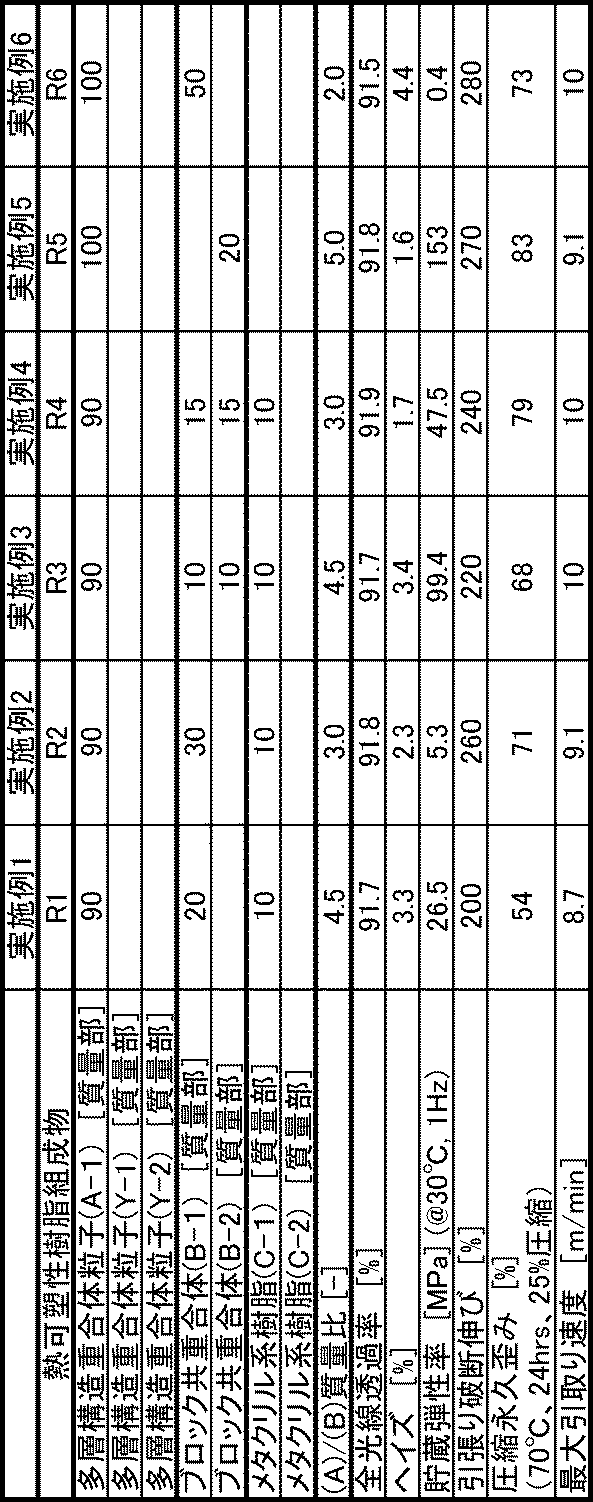

Claims (12)
- 2層以上の多層構造重合体粒子(A)とブロック共重合体(B)とを含むアクリル系熱可塑性樹脂組成物であって、
多層構造重合体粒子(A)は、内部に、アクリル酸エステル単量体単位50~99.99質量%、他の単官能性単量体単位49.99~0質量%、および多官能性単量体単位0.01~10質量%からなる共重合体からなる少なくとも1つのゴム成分層(I)を有すると共に、最外部に、メタクリル酸エステル単量体単位40~100質量%および他の単量体単位60~0質量%からなり、かつ、GPC法で測定される数平均分子量が30,000以下である共重合体からなる少なくとも1つの熱可塑性樹脂成分層(II)を有し、
ゴム成分層(I)の総量と熱可塑性樹脂成分層(II)の総量との質量比(層(I)/層(II))が30/70~90/10であり、平均粒子径が150nm以下であるアクリル系多層構造重合体粒子であり、
ブロック共重合体(B)は、GPC法で測定される重量平均分子量が32,000~300,000のアクリル系ブロック共重合体であり、
多層構造重合体粒子(A)とブロック共重合体(B)との質量比((A)/(B))が1/99~99/1であるアクリル系熱可塑性樹脂組成物。 - 多層構造重合体粒子(A)は、中心から、第1のゴム成分層(I)であるゴム成分層(Ia)と、第2のゴム成分層(I)であるゴム成分層(Ib)と、熱可塑性樹脂成分層(II)との3層構造の多層構造重合体粒子であり、ゴム成分層(Ia)とゴム成分層(Ib)との質量比((Ia)/(Ib))が5/95~95/5であり、
ゴム成分層(Ia)中のアクリル酸エステル単量体単位の含有率(質量%)からゴム成分層(Ib)中のアクリル酸エステル単量体単位の含有率(質量%)を差し引いた量が3質量%以上である、請求項1に記載のアクリル系熱可塑性樹脂組成物。 - ゴム成分層(I)が、前記他の単官能性単量体単位としてスチレン単量体単位を含む、請求項1または2に記載のアクリル系熱可塑性樹脂組成物。
- ブロック共重合体(B)が、メタクリル酸エステル単量体単位を80質量%以上有する重合体ブロック(b1)10~80質量%とアクリル酸エステル単量体単位を45質量%以上有する重合体ブロック(b2)90~20質量%とを含む(但し、重合体ブロック(b1)と重合体ブロック(b2)との合計量を100質量%とする。)、請求項1~3のいずれかに記載のアクリル系熱可塑性樹脂組成物。
- ブロック共重合体(B)がトリブロック共重合体である、請求項1~4のいずれかに記載のアクリル系熱可塑性樹脂組成物。
- 多層構造重合体粒子(A)とブロック共重合体(B)との質量比((A)/(B))が51/49~99/1である、請求項1~5のいずれかに記載のアクリル系熱可塑性樹脂組成物。
- さらにメタクリル系樹脂(C)を含み、多層構造重合体粒子(A)とメタクリル系樹脂(C)との合計量100質量部に対してメタクリル系樹脂(C)の含有量が1~20質量部である、請求項1~6のいずれかに記載のアクリル系熱可塑性樹脂組成物。
- 請求項1~7のいずれかに記載のアクリル系熱可塑性樹脂組成物からなる成形体。
- 請求項1~7のいずれかに記載のアクリル系熱可塑性樹脂組成物からなるフィルム。
- Tダイ法により成膜する、請求項9に記載のフィルムの製造方法。
- 請求項1~7のいずれかに記載のアクリル系熱可塑性樹脂組成物からなるアクリル系熱可塑性樹脂層と、他の樹脂層とを有する積層体。
- 前記他の樹脂層が、メタクリル系樹脂、ポリ塩化ビニル、ABS樹脂、およびポリカーボネートからなる群より選ばれる少なくとも1種の熱可塑性樹脂を含む、請求項11に記載の積層体。
Priority Applications (5)
| Application Number | Priority Date | Filing Date | Title |
|---|---|---|---|
| US16/096,593 US10844213B2 (en) | 2016-04-27 | 2017-04-26 | Acrylic thermoplastic resin composition, molded article, film and method for producing same, and laminate |
| CN201780025513.XA CN109071911B (zh) | 2016-04-27 | 2017-04-26 | 丙烯酸类热塑性树脂组合物、成型体、膜及其制造方法、以及层叠体 |
| EP17789572.9A EP3450498B1 (en) | 2016-04-27 | 2017-04-26 | Acrylic thermoplastic resin composition, molded article, film and method for producing same, and laminate |
| JP2018514649A JP6940490B2 (ja) | 2016-04-27 | 2017-04-26 | アクリル系熱可塑性樹脂組成物、成形体、フィルムとその製造方法、および積層体 |
| KR1020187031208A KR102281963B1 (ko) | 2016-04-27 | 2017-04-26 | 아크릴계 열가소성 수지 조성물, 성형체, 필름과 그 제조 방법, 및 적층체 |
Applications Claiming Priority (2)
| Application Number | Priority Date | Filing Date | Title |
|---|---|---|---|
| JP2016088910 | 2016-04-27 | ||
| JP2016-088910 | 2016-04-27 |
Publications (1)
| Publication Number | Publication Date |
|---|---|
| WO2017188290A1 true WO2017188290A1 (ja) | 2017-11-02 |
Family
ID=60159715
Family Applications (1)
| Application Number | Title | Priority Date | Filing Date |
|---|---|---|---|
| PCT/JP2017/016456 Ceased WO2017188290A1 (ja) | 2016-04-27 | 2017-04-26 | アクリル系熱可塑性樹脂組成物、成形体、フィルムとその製造方法、および積層体 |
Country Status (6)
| Country | Link |
|---|---|
| US (1) | US10844213B2 (ja) |
| EP (1) | EP3450498B1 (ja) |
| JP (1) | JP6940490B2 (ja) |
| KR (1) | KR102281963B1 (ja) |
| CN (1) | CN109071911B (ja) |
| WO (1) | WO2017188290A1 (ja) |
Cited By (3)
| Publication number | Priority date | Publication date | Assignee | Title |
|---|---|---|---|---|
| WO2019131831A1 (ja) * | 2017-12-27 | 2019-07-04 | 株式会社クラレ | アクリル系樹脂フィルムおよびその製造方法 |
| WO2020071477A1 (ja) * | 2018-10-04 | 2020-04-09 | 株式会社クラレ | アクリル系樹脂フィルム |
| JPWO2021015226A1 (ja) * | 2019-07-25 | 2021-01-28 |
Families Citing this family (6)
| Publication number | Priority date | Publication date | Assignee | Title |
|---|---|---|---|---|
| KR102021303B1 (ko) * | 2019-04-03 | 2019-09-16 | 주식회사 에스폴리텍 | 블루라이트 차단용 필름 |
| CN114096608B (zh) * | 2019-06-27 | 2023-10-10 | 株式会社可乐丽 | 甲基丙烯酸类树脂组合物及其成型品、膜的制造方法 |
| JP7561768B2 (ja) * | 2019-12-27 | 2024-10-04 | 株式会社クラレ | メタクリル系樹脂組成物 |
| JP7645876B2 (ja) * | 2020-04-22 | 2025-03-14 | 株式会社クラレ | 積層体 |
| WO2022080458A1 (ja) * | 2020-10-15 | 2022-04-21 | 株式会社クラレ | 多層構造体及びそれを用いた包装材 |
| AU2021410663A1 (en) | 2020-12-21 | 2023-07-13 | Mativ Luxembourg | Thermoplastic polymer structure and methods for making the same |
Citations (4)
| Publication number | Priority date | Publication date | Assignee | Title |
|---|---|---|---|---|
| JP2002060584A (ja) * | 2000-08-11 | 2002-02-26 | Kanegafuchi Chem Ind Co Ltd | ブロック共重合体を含有するエラストマー組成物 |
| JP2005008861A (ja) * | 2003-05-26 | 2005-01-13 | Kaneka Corp | エラストマー組成物 |
| JP2010254849A (ja) * | 2009-04-27 | 2010-11-11 | Kaneka Corp | アクリル系重合体粉体の製造方法 |
| WO2016080124A1 (ja) * | 2014-11-19 | 2016-05-26 | 株式会社クラレ | アクリル系フィルム |
Family Cites Families (15)
| Publication number | Priority date | Publication date | Assignee | Title |
|---|---|---|---|---|
| JPH05271511A (ja) * | 1992-03-27 | 1993-10-19 | Nippon Zeon Co Ltd | プラスチゲル組成物及び該組成物を用いた成形体 |
| DE19638255A1 (de) * | 1996-09-19 | 1998-03-26 | Basf Ag | Thermoplastische Formmassen |
| JPH10338792A (ja) | 1997-06-05 | 1998-12-22 | Kuraray Co Ltd | メタクリル系樹脂組成物およびそれを用いた積層物 |
| CA2313399C (en) * | 1999-07-08 | 2005-02-15 | Kuraray Co., Ltd. | Thermoplastic resin composition and multilayered container using the same |
| JP4707814B2 (ja) | 1999-10-12 | 2011-06-22 | 株式会社クラレ | 多層構造重合体粒子並びにその製造方法及び用途 |
| US6348542B1 (en) * | 1999-10-12 | 2002-02-19 | Kuraray Co., Ltd. | Multiphase structured polymer particles, method of manufacturing same, and uses thereof |
| EP1346722B1 (en) * | 2000-12-01 | 2008-12-10 | Takeda Pharmaceutical Company Limited | Method for producing preparation containing bioactive substance |
| JP4508410B2 (ja) | 2000-12-27 | 2010-07-21 | 株式会社カネカ | 熱可塑性樹脂組成物を成形してなるフィルムまたはシート |
| JP2002317057A (ja) * | 2001-04-20 | 2002-10-31 | Du Pont Toray Co Ltd | 複合成形品 |
| US20030236318A1 (en) * | 2002-04-18 | 2003-12-25 | Kuraray Co., Ltd. | Curable resin composition, method for manufacture of laminate using the composition, transfer material, method for manufacture thereof and transferred product |
| JP4493498B2 (ja) * | 2002-08-02 | 2010-06-30 | 株式会社カネカ | アクリル系ブロック共重合体および熱可塑性樹脂組成物 |
| JP5478266B2 (ja) * | 2008-02-15 | 2014-04-23 | 株式会社クラレ | 硬化性樹脂組成物および樹脂硬化物 |
| JP5544685B2 (ja) * | 2008-03-28 | 2014-07-09 | 住友化学株式会社 | 射出成形同時貼合用多層フィルム |
| CN105102534B (zh) * | 2013-04-05 | 2019-08-23 | 株式会社钟化 | 树脂组合物及其膜 |
| KR20190023051A (ko) * | 2016-06-27 | 2019-03-07 | 주식회사 쿠라레 | 아크릴계 수지 조성물로 이루어지는 성형체 |
-
2017
- 2017-04-26 EP EP17789572.9A patent/EP3450498B1/en active Active
- 2017-04-26 US US16/096,593 patent/US10844213B2/en active Active
- 2017-04-26 CN CN201780025513.XA patent/CN109071911B/zh active Active
- 2017-04-26 KR KR1020187031208A patent/KR102281963B1/ko active Active
- 2017-04-26 WO PCT/JP2017/016456 patent/WO2017188290A1/ja not_active Ceased
- 2017-04-26 JP JP2018514649A patent/JP6940490B2/ja active Active
Patent Citations (4)
| Publication number | Priority date | Publication date | Assignee | Title |
|---|---|---|---|---|
| JP2002060584A (ja) * | 2000-08-11 | 2002-02-26 | Kanegafuchi Chem Ind Co Ltd | ブロック共重合体を含有するエラストマー組成物 |
| JP2005008861A (ja) * | 2003-05-26 | 2005-01-13 | Kaneka Corp | エラストマー組成物 |
| JP2010254849A (ja) * | 2009-04-27 | 2010-11-11 | Kaneka Corp | アクリル系重合体粉体の製造方法 |
| WO2016080124A1 (ja) * | 2014-11-19 | 2016-05-26 | 株式会社クラレ | アクリル系フィルム |
Non-Patent Citations (1)
| Title |
|---|
| See also references of EP3450498A4 * |
Cited By (11)
| Publication number | Priority date | Publication date | Assignee | Title |
|---|---|---|---|---|
| WO2019131831A1 (ja) * | 2017-12-27 | 2019-07-04 | 株式会社クラレ | アクリル系樹脂フィルムおよびその製造方法 |
| JPWO2019131831A1 (ja) * | 2017-12-27 | 2021-01-14 | 株式会社クラレ | アクリル系樹脂フィルムおよびその製造方法 |
| JP7096842B2 (ja) | 2017-12-27 | 2022-07-06 | 株式会社クラレ | アクリル系樹脂フィルムおよびその製造方法 |
| WO2020071477A1 (ja) * | 2018-10-04 | 2020-04-09 | 株式会社クラレ | アクリル系樹脂フィルム |
| KR20210068433A (ko) * | 2018-10-04 | 2021-06-09 | 주식회사 쿠라레 | 아크릴계 수지 필름 |
| JPWO2020071477A1 (ja) * | 2018-10-04 | 2021-09-24 | 株式会社クラレ | アクリル系樹脂フィルム |
| JP7225258B2 (ja) | 2018-10-04 | 2023-02-20 | 株式会社クラレ | アクリル系樹脂フィルム |
| KR102795845B1 (ko) * | 2018-10-04 | 2025-04-14 | 주식회사 쿠라레 | 아크릴계 수지 필름 |
| JPWO2021015226A1 (ja) * | 2019-07-25 | 2021-01-28 | ||
| WO2021015226A1 (ja) * | 2019-07-25 | 2021-01-28 | 株式会社クラレ | メタクリル系溶融押出成形体 |
| JP7693541B2 (ja) | 2019-07-25 | 2025-06-17 | 株式会社クラレ | メタクリル系溶融押出成形体 |
Also Published As
| Publication number | Publication date |
|---|---|
| KR20190003529A (ko) | 2019-01-09 |
| EP3450498A4 (en) | 2020-01-01 |
| US10844213B2 (en) | 2020-11-24 |
| EP3450498A1 (en) | 2019-03-06 |
| EP3450498B1 (en) | 2023-01-11 |
| CN109071911B (zh) | 2021-01-15 |
| JPWO2017188290A1 (ja) | 2019-03-07 |
| US20190136035A1 (en) | 2019-05-09 |
| CN109071911A (zh) | 2018-12-21 |
| KR102281963B1 (ko) | 2021-07-26 |
| JP6940490B2 (ja) | 2021-09-29 |
Similar Documents
| Publication | Publication Date | Title |
|---|---|---|
| US10844213B2 (en) | Acrylic thermoplastic resin composition, molded article, film and method for producing same, and laminate | |
| CN105764981B (zh) | 丙烯酸系树脂膜 | |
| JP6725113B2 (ja) | アクリル系フィルム | |
| JP5997607B2 (ja) | 含フッ素(メタ)アクリル樹脂フィルム、その積層樹脂フィルム、及び、積層成形品 | |
| CN106170514B (zh) | 丙烯酸类树脂组合物、丙烯酸类树脂薄膜及成型体 | |
| JP5260165B2 (ja) | 光学フィルム | |
| CN106103584B (zh) | 丙烯酸类树脂组合物及其制造方法、以及丙烯酸类树脂薄膜 | |
| CN107429032A (zh) | 树脂组合物及其制造方法、成型体、膜以及物品 | |
| CN115315480A (zh) | 丙烯酸类组合物和成形体 | |
| CN115427227A (zh) | 层叠体 | |
| WO2018021449A1 (ja) | メタクリル樹脂組成物とその製造方法、成形体、フィルム、積層フィルム、積層成形体 | |
| WO2012053190A1 (ja) | (メタ)アクリル系樹脂フィルム | |
| JP6650359B2 (ja) | 耐衝撃性改良剤、熱可塑性樹脂組成物およびフィルム | |
| TW201615416A (zh) | 合成樹脂層合體 | |
| CN114829493B (zh) | 甲基丙烯酸类树脂组合物 | |
| EP3992243B1 (en) | Methacrylic resin composition, molded article of same, and method for producing film | |
| JPWO2017115800A1 (ja) | 樹脂フィルム | |
| JP2011063721A (ja) | 電子線照射用アクリル系樹脂フィルム | |
| CN114026171B (zh) | 甲基丙烯酸类熔融挤出成型体 | |
| JP7266474B2 (ja) | メタクリル系樹脂組成物およびその成形品、フィルムの製造方法 | |
| WO2022210806A1 (ja) | 樹脂組成物、フィルム、積層フィルム、および、積層体 | |
| JP7301627B2 (ja) | メタクリル系樹脂組成物およびその成形品、フィルムの製造方法 | |
| JP7301626B2 (ja) | メタクリル系樹脂組成物およびその成形品、フィルムの製造方法 | |
| JP7030691B2 (ja) | 熱可塑性重合体組成物、該組成物を用いた多層フィルム及び成形体 |
Legal Events
| Date | Code | Title | Description |
|---|---|---|---|
| WWE | Wipo information: entry into national phase |
Ref document number: 2018514649 Country of ref document: JP |
|
| ENP | Entry into the national phase |
Ref document number: 20187031208 Country of ref document: KR Kind code of ref document: A |
|
| NENP | Non-entry into the national phase |
Ref country code: DE |
|
| 121 | Ep: the epo has been informed by wipo that ep was designated in this application |
Ref document number: 17789572 Country of ref document: EP Kind code of ref document: A1 |
|
| ENP | Entry into the national phase |
Ref document number: 2017789572 Country of ref document: EP Effective date: 20181127 |