WO2017168912A1 - 歯付ベルト - Google Patents
歯付ベルト Download PDFInfo
- Publication number
- WO2017168912A1 WO2017168912A1 PCT/JP2017/000136 JP2017000136W WO2017168912A1 WO 2017168912 A1 WO2017168912 A1 WO 2017168912A1 JP 2017000136 W JP2017000136 W JP 2017000136W WO 2017168912 A1 WO2017168912 A1 WO 2017168912A1
- Authority
- WO
- WIPO (PCT)
- Prior art keywords
- toothed belt
- rubber
- mass
- adhesive layer
- belt
- Prior art date
- Legal status (The legal status is an assumption and is not a legal conclusion. Google has not performed a legal analysis and makes no representation as to the accuracy of the status listed.)
- Ceased
Links
Images


Classifications
-
- F—MECHANICAL ENGINEERING; LIGHTING; HEATING; WEAPONS; BLASTING
- F16—ENGINEERING ELEMENTS AND UNITS; GENERAL MEASURES FOR PRODUCING AND MAINTAINING EFFECTIVE FUNCTIONING OF MACHINES OR INSTALLATIONS; THERMAL INSULATION IN GENERAL
- F16G—BELTS, CABLES, OR ROPES, PREDOMINANTLY USED FOR DRIVING PURPOSES; CHAINS; FITTINGS PREDOMINANTLY USED THEREFOR
- F16G1/00—Driving-belts
- F16G1/28—Driving-belts with a contact surface of special shape, e.g. toothed
-
- C—CHEMISTRY; METALLURGY
- C08—ORGANIC MACROMOLECULAR COMPOUNDS; THEIR PREPARATION OR CHEMICAL WORKING-UP; COMPOSITIONS BASED THEREON
- C08J—WORKING-UP; GENERAL PROCESSES OF COMPOUNDING; AFTER-TREATMENT NOT COVERED BY SUBCLASSES C08B, C08C, C08F, C08G or C08H
- C08J5/00—Manufacture of articles or shaped materials containing macromolecular substances
- C08J5/24—Impregnating materials with prepolymers which can be polymerised in situ, e.g. manufacture of prepregs
- C08J5/246—Impregnating materials with prepolymers which can be polymerised in situ, e.g. manufacture of prepregs using polymer based synthetic fibres
-
- B—PERFORMING OPERATIONS; TRANSPORTING
- B32—LAYERED PRODUCTS
- B32B—LAYERED PRODUCTS, i.e. PRODUCTS BUILT-UP OF STRATA OF FLAT OR NON-FLAT, e.g. CELLULAR OR HONEYCOMB, FORM
- B32B25/00—Layered products comprising a layer of natural or synthetic rubber
- B32B25/10—Layered products comprising a layer of natural or synthetic rubber next to a fibrous or filamentary layer
-
- B—PERFORMING OPERATIONS; TRANSPORTING
- B32—LAYERED PRODUCTS
- B32B—LAYERED PRODUCTS, i.e. PRODUCTS BUILT-UP OF STRATA OF FLAT OR NON-FLAT, e.g. CELLULAR OR HONEYCOMB, FORM
- B32B3/00—Layered products comprising a layer with external or internal discontinuities or unevennesses, or a layer of non-planar shape; Layered products comprising a layer having particular features of form
- B32B3/26—Layered products comprising a layer with external or internal discontinuities or unevennesses, or a layer of non-planar shape; Layered products comprising a layer having particular features of form characterised by a particular shape of the outline of the cross-section of a continuous layer; characterised by a layer with cavities or internal voids ; characterised by an apertured layer
- B32B3/28—Layered products comprising a layer with external or internal discontinuities or unevennesses, or a layer of non-planar shape; Layered products comprising a layer having particular features of form characterised by a particular shape of the outline of the cross-section of a continuous layer; characterised by a layer with cavities or internal voids ; characterised by an apertured layer characterised by a layer comprising a deformed thin sheet, i.e. the layer having its entire thickness deformed out of the plane, e.g. corrugated, crumpled
-
- B—PERFORMING OPERATIONS; TRANSPORTING
- B32—LAYERED PRODUCTS
- B32B—LAYERED PRODUCTS, i.e. PRODUCTS BUILT-UP OF STRATA OF FLAT OR NON-FLAT, e.g. CELLULAR OR HONEYCOMB, FORM
- B32B3/00—Layered products comprising a layer with external or internal discontinuities or unevennesses, or a layer of non-planar shape; Layered products comprising a layer having particular features of form
- B32B3/26—Layered products comprising a layer with external or internal discontinuities or unevennesses, or a layer of non-planar shape; Layered products comprising a layer having particular features of form characterised by a particular shape of the outline of the cross-section of a continuous layer; characterised by a layer with cavities or internal voids ; characterised by an apertured layer
- B32B3/30—Layered products comprising a layer with external or internal discontinuities or unevennesses, or a layer of non-planar shape; Layered products comprising a layer having particular features of form characterised by a particular shape of the outline of the cross-section of a continuous layer; characterised by a layer with cavities or internal voids ; characterised by an apertured layer characterised by a layer formed with recesses or projections, e.g. hollows, grooves, protuberances, ribs
-
- C—CHEMISTRY; METALLURGY
- C08—ORGANIC MACROMOLECULAR COMPOUNDS; THEIR PREPARATION OR CHEMICAL WORKING-UP; COMPOSITIONS BASED THEREON
- C08J—WORKING-UP; GENERAL PROCESSES OF COMPOUNDING; AFTER-TREATMENT NOT COVERED BY SUBCLASSES C08B, C08C, C08F, C08G or C08H
- C08J5/00—Manufacture of articles or shaped materials containing macromolecular substances
- C08J5/005—Reinforced macromolecular compounds with nanosized materials, e.g. nanoparticles, nanofibres, nanotubes, nanowires, nanorods or nanolayered materials
-
- C—CHEMISTRY; METALLURGY
- C08—ORGANIC MACROMOLECULAR COMPOUNDS; THEIR PREPARATION OR CHEMICAL WORKING-UP; COMPOSITIONS BASED THEREON
- C08J—WORKING-UP; GENERAL PROCESSES OF COMPOUNDING; AFTER-TREATMENT NOT COVERED BY SUBCLASSES C08B, C08C, C08F, C08G or C08H
- C08J5/00—Manufacture of articles or shaped materials containing macromolecular substances
- C08J5/24—Impregnating materials with prepolymers which can be polymerised in situ, e.g. manufacture of prepregs
- C08J5/249—Impregnating materials with prepolymers which can be polymerised in situ, e.g. manufacture of prepregs characterised by the additives used in the prepolymer mixture
-
- C—CHEMISTRY; METALLURGY
- C08—ORGANIC MACROMOLECULAR COMPOUNDS; THEIR PREPARATION OR CHEMICAL WORKING-UP; COMPOSITIONS BASED THEREON
- C08K—Use of inorganic or non-macromolecular organic substances as compounding ingredients
- C08K5/00—Use of organic ingredients
- C08K5/04—Oxygen-containing compounds
- C08K5/09—Carboxylic acids; Metal salts thereof; Anhydrides thereof
- C08K5/098—Metal salts of carboxylic acids
-
- C—CHEMISTRY; METALLURGY
- C08—ORGANIC MACROMOLECULAR COMPOUNDS; THEIR PREPARATION OR CHEMICAL WORKING-UP; COMPOSITIONS BASED THEREON
- C08L—COMPOSITIONS OF MACROMOLECULAR COMPOUNDS
- C08L23/00—Compositions of homopolymers or copolymers of unsaturated aliphatic hydrocarbons having only one carbon-to-carbon double bond; Compositions of derivatives of such polymers
- C08L23/02—Compositions of homopolymers or copolymers of unsaturated aliphatic hydrocarbons having only one carbon-to-carbon double bond; Compositions of derivatives of such polymers not modified by chemical after-treatment
- C08L23/04—Homopolymers or copolymers of ethene
- C08L23/08—Copolymers of ethene
-
- F—MECHANICAL ENGINEERING; LIGHTING; HEATING; WEAPONS; BLASTING
- F16—ENGINEERING ELEMENTS AND UNITS; GENERAL MEASURES FOR PRODUCING AND MAINTAINING EFFECTIVE FUNCTIONING OF MACHINES OR INSTALLATIONS; THERMAL INSULATION IN GENERAL
- F16G—BELTS, CABLES, OR ROPES, PREDOMINANTLY USED FOR DRIVING PURPOSES; CHAINS; FITTINGS PREDOMINANTLY USED THEREFOR
- F16G1/00—Driving-belts
- F16G1/06—Driving-belts made of rubber
- F16G1/08—Driving-belts made of rubber with reinforcement bonded by the rubber
- F16G1/10—Driving-belts made of rubber with reinforcement bonded by the rubber with textile reinforcement
-
- F—MECHANICAL ENGINEERING; LIGHTING; HEATING; WEAPONS; BLASTING
- F16—ENGINEERING ELEMENTS AND UNITS; GENERAL MEASURES FOR PRODUCING AND MAINTAINING EFFECTIVE FUNCTIONING OF MACHINES OR INSTALLATIONS; THERMAL INSULATION IN GENERAL
- F16G—BELTS, CABLES, OR ROPES, PREDOMINANTLY USED FOR DRIVING PURPOSES; CHAINS; FITTINGS PREDOMINANTLY USED THEREFOR
- F16G5/00—V-belts, i.e. belts of tapered cross-section
- F16G5/04—V-belts, i.e. belts of tapered cross-section made of rubber
- F16G5/06—V-belts, i.e. belts of tapered cross-section made of rubber with reinforcement bonded by the rubber
-
- F—MECHANICAL ENGINEERING; LIGHTING; HEATING; WEAPONS; BLASTING
- F16—ENGINEERING ELEMENTS AND UNITS; GENERAL MEASURES FOR PRODUCING AND MAINTAINING EFFECTIVE FUNCTIONING OF MACHINES OR INSTALLATIONS; THERMAL INSULATION IN GENERAL
- F16G—BELTS, CABLES, OR ROPES, PREDOMINANTLY USED FOR DRIVING PURPOSES; CHAINS; FITTINGS PREDOMINANTLY USED THEREFOR
- F16G5/00—V-belts, i.e. belts of tapered cross-section
- F16G5/20—V-belts, i.e. belts of tapered cross-section with a contact surface of special shape, e.g. toothed
-
- B—PERFORMING OPERATIONS; TRANSPORTING
- B32—LAYERED PRODUCTS
- B32B—LAYERED PRODUCTS, i.e. PRODUCTS BUILT-UP OF STRATA OF FLAT OR NON-FLAT, e.g. CELLULAR OR HONEYCOMB, FORM
- B32B2433/00—Closed loop articles
- B32B2433/04—Driving belts
-
- C—CHEMISTRY; METALLURGY
- C08—ORGANIC MACROMOLECULAR COMPOUNDS; THEIR PREPARATION OR CHEMICAL WORKING-UP; COMPOSITIONS BASED THEREON
- C08J—WORKING-UP; GENERAL PROCESSES OF COMPOUNDING; AFTER-TREATMENT NOT COVERED BY SUBCLASSES C08B, C08C, C08F, C08G or C08H
- C08J2309/00—Characterised by the use of homopolymers or copolymers of conjugated diene hydrocarbons
- C08J2309/02—Copolymers with acrylonitrile
-
- C—CHEMISTRY; METALLURGY
- C08—ORGANIC MACROMOLECULAR COMPOUNDS; THEIR PREPARATION OR CHEMICAL WORKING-UP; COMPOSITIONS BASED THEREON
- C08J—WORKING-UP; GENERAL PROCESSES OF COMPOUNDING; AFTER-TREATMENT NOT COVERED BY SUBCLASSES C08B, C08C, C08F, C08G or C08H
- C08J2323/00—Characterised by the use of homopolymers or copolymers of unsaturated aliphatic hydrocarbons having only one carbon-to-carbon double bond; Derivatives of such polymers
- C08J2323/02—Characterised by the use of homopolymers or copolymers of unsaturated aliphatic hydrocarbons having only one carbon-to-carbon double bond; Derivatives of such polymers not modified by chemical after treatment
- C08J2323/16—Ethene-propene or ethene-propene-diene copolymers
-
- C—CHEMISTRY; METALLURGY
- C08—ORGANIC MACROMOLECULAR COMPOUNDS; THEIR PREPARATION OR CHEMICAL WORKING-UP; COMPOSITIONS BASED THEREON
- C08J—WORKING-UP; GENERAL PROCESSES OF COMPOUNDING; AFTER-TREATMENT NOT COVERED BY SUBCLASSES C08B, C08C, C08F, C08G or C08H
- C08J2323/00—Characterised by the use of homopolymers or copolymers of unsaturated aliphatic hydrocarbons having only one carbon-to-carbon double bond; Derivatives of such polymers
- C08J2323/26—Characterised by the use of homopolymers or copolymers of unsaturated aliphatic hydrocarbons having only one carbon-to-carbon double bond; Derivatives of such polymers modified by chemical after-treatment
- C08J2323/28—Characterised by the use of homopolymers or copolymers of unsaturated aliphatic hydrocarbons having only one carbon-to-carbon double bond; Derivatives of such polymers modified by chemical after-treatment by reaction with halogens or halogen-containing compounds
Definitions
- the present invention relates to a toothed belt.
- the belt main body is formed of a rubber composition
- a core wire is embedded in the belt main body
- a reinforcing cloth is stuck on the tooth side surface of the belt main body.
- a core wire adhesive layer and a reinforcing cloth adhesive layer are interposed between the belt main body and the core wires and the reinforcing cloth, respectively.
- a belt body of a toothed belt is formed of a rubber composition containing ethylene propylene diene terpolymer rubber as a rubber component, and the belt body is formed of a rubber composition containing chlorosulfonated polyethylene as a rubber component.
- the reinforcing cloth is embedded through the reinforcing cloth adhesive layer formed of a rubber composition containing hydrogenated nitrile rubber as a rubber component on the tooth side surface of the belt body. It is disclosed that it is pasted.
- the present invention relates to a toothed belt provided with teeth at a constant pitch in the belt length direction, and a rubber composition mainly composed of an ethylene- ⁇ -olefin elastomer having an ethylene content of 44 to 66% by mass.
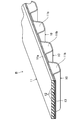
- FIG. 1 shows a toothed belt B according to the embodiment.
- the toothed belt B is an endless meshing transmission belt in which a plurality of tooth portions 10 are provided at a constant pitch at intervals in the belt length direction on the inner peripheral side.
- the tooth portion 10 is a trapezoidal tooth whose side view is a trapezoid and is formed to extend in the belt width direction.
- the tooth portion 10 may be other shapes such as a semicircular round tooth, or may be a helical tooth formed so as to extend in a direction inclined with respect to the belt width direction.
- the toothed belt B according to the embodiment is suitably used as a power transmission member for automobiles and various machines.
- the toothed belt B according to the embodiment has a belt length of 500 to 3000 mm, a belt width of 10 to 200 mm, and a belt thickness of 3 to 20 mm, for example.
- the tooth portion 10 has, for example, a tooth width of 0.63 to 16.46 mm, a tooth height of 0.37 to 9.6 mm, and a tooth pitch of 1.0 to 31.75 mm.
- the toothed belt B includes a belt main body 11, a core wire 12, and a reinforcing cloth 13.
- the belt main body 11 has a flat belt-like back rubber portion 11a on the outer peripheral side and a plurality of tooth rubber portions 11b on the inner peripheral side.
- the core wire 12 is embedded on the inner peripheral side of the back rubber portion 11a of the belt body 11 so as to form a spiral having a pitch in the belt width direction.
- the reinforcing cloth 13 is attached to the tooth side surface of the belt body 11 so as to cover the surface. From the above, each tooth portion 10 is configured by covering the tooth rubber portion 11b of the belt body 11 with the reinforcing cloth 13, and the core wire 12 is reinforced at the tooth bottom portion between the tooth portions 10 adjacent to each other. It is arranged immediately inside the cloth 13.
- the belt body 11 is formed of a rubber composition in which an uncrosslinked rubber composition in which various rubber compounding agents are blended with a rubber component is heated and pressurized to crosslink the rubber component with the crosslinking agent.
- the rubber component of the rubber composition forming the belt body 11 is mainly composed of an ethylene- ⁇ -olefin elastomer.
- the ethylene- ⁇ -olefin elastomer contained in the rubber component include ethylene propylene copolymer (EPR), ethylene propylene diene terpolymer (hereinafter referred to as “EPDM”), ethylene / octene copolymer, and ethylene / butene copolymer. It is done.
- EPR ethylene propylene copolymer
- EPDM ethylene propylene diene terpolymer
- ethylene / octene copolymer ethylene / octene copolymer
- ethylene / butene copolymer ethylene / butene copolymer. It is done.
- the rubber component preferably contains one or more of these ethylene- ⁇ -olefin elastomers.
- the rubber component preferably contains EPDM.
- the content of the ethylene- ⁇ -olefin elastomer in the rubber component is more than 50%, and preferably 90% by mass or more, more preferably 95% or more, and most preferably 100% by mass from the viewpoint of obtaining excellent heat resistance and cold resistance. %.
- the rubber component includes hydrogenated acrylonitrile rubber (hereinafter referred to as “H-NBR”), chlorosulfonated polyethylene rubber (hereinafter referred to as “CSM”), chloroprene rubber (hereinafter referred to as “CR”). Etc.)).
- the ethylene content of the ethylene- ⁇ -olefin elastomer contained in the rubber component is 44 to 66% by mass, but preferably 50% by mass or more, more preferably 55% by mass from the viewpoint of obtaining excellent heat resistance and cold resistance. More preferably, it is 58% by mass or more, preferably 61% by mass or less, more preferably 60% by mass or less, and still more preferably 59% by mass or less.
- the diene component examples include ethylidene nobornene (ENB), dicyclopentadiene, 1,4-hexadiene, and the like.
- the diene component is preferably ethylidene nobornene.
- the ENB content is preferably 4.0% by mass or more, more preferably 4.6% by mass or more, and still more preferably 5% from the viewpoint of obtaining excellent heat resistance and cold resistance. It is 0.0 mass% or more, preferably 6.0 mass% or less, more preferably 5.7 mass% or less, and still more preferably 5.2 mass% or less.
- the Mooney viscosity at 125 ° C. of the ethylene- ⁇ -olefin elastomer contained in the rubber component is preferably 15 ML 1 + 4 (125 ° C.) or more, more preferably 59 ML 1 + 4 (125 ° C.) from the viewpoint of obtaining excellent heat resistance and cold resistance. ) Or more, more preferably 62 ML 1 + 4 (125 ° C.) or more, preferably 90 ML 1 + 4 (125 ° C.) or less, more preferably 70 ML 1 + 4 (125 ° C.) or less, more preferably 64 ML 1 + 4 (125 ° C.) or less. is there.
- the Mooney viscosity is measured based on JISK6300 (hereinafter the same).
- rubber compounding agents include reinforcing materials, softeners, vulcanization acceleration aids, co-crosslinking agents, crosslinking agents, and vulcanization accelerators. From the viewpoint of obtaining excellent heat resistance and cold resistance, the rubber composition forming the belt body 11 preferably contains a co-crosslinking agent.
- a reinforcing material for example, carbon black, channel black; furnace black such as SAF, ISAF, N-339, HAF, N-351, MAF, FEF, SRF, GPF, ECF, N-234; FT, MT, etc. Thermal black; acetylene black and the like.
- Silica is also mentioned as the reinforcing material.
- the reinforcing material preferably contains one or more of these.
- the reinforcing material preferably contains FEF carbon black.
- the content of the reinforcing material is, for example, 50 to 80 parts by mass with respect to 100 parts by mass of the rubber component of the rubber composition.
- the softener examples include paraffin-based, petroleum-based, mineral oil-based and vegetable oil-based ones.
- the softener preferably contains one or more of these.
- the softening agent preferably contains a paraffinic one.
- the content of the softening agent is, for example, 2 to 30 parts by mass with respect to 100 parts by mass of the rubber component.
- the vulcanization acceleration aid examples include metal oxides such as zinc oxide (zinc white) and magnesium oxide, metal carbonates, fatty acids and derivatives thereof.
- the vulcanization acceleration aid preferably contains one or more of these.
- the vulcanization acceleration aid preferably contains zinc oxide.
- the content of the vulcanization acceleration aid is, for example, 3 to 7 parts by mass with respect to 100 parts by mass of the rubber component of the rubber composition.
- co-crosslinking agent examples include trimethylolpropane trimethacrylate, zinc dimethacrylate, triallyl isocyanurate, m-phenylene dimaleimide, and the like.
- the co-crosslinking agent preferably contains one or more of these.
- the co-crosslinking agent preferably contains trimethylolpropane trimethacrylate, zinc dimethacrylate, or trimethylolpropane trimethacrylate and zinc dimethacrylate.
- the content of the co-crosslinking agent is, for example, 1 to 20 parts by mass with respect to 100 parts by mass of the rubber component.
- trimethylolpropane trimethacrylate the content of trimethylolpropane trimethacrylate is preferably 1 to 3 parts by mass with respect to 100 parts by mass of the rubber component.
- zinc dimethacrylate the content of zinc dimethacrylate is preferably 13 to 17 parts by mass with respect to 100 parts by mass of the rubber component.
- crosslinking agent examples include organic oxides and sulfur.
- an organic oxide may be blended, sulfur may be blended, and both of them may be used in combination.
- the cross-linking agent preferably contains an organic oxide.
- the amount of the crosslinking agent is, for example, 1 to 5 parts by mass with respect to 100 parts by mass of the rubber component, and in the case of sulfur, for example, 0.5 to 3 parts by mass with respect to 100 parts by mass of the rubber component. Part.
- the vulcanization accelerator examples include sulfenamide-based, thiuram-based, thiazole-based, dithiocarbamate-based compounds, and the like.
- the vulcanization accelerator preferably contains one or more of these.
- the vulcanization accelerator preferably contains a sulfenamide type and a thiuram type.
- the content of the vulcanization accelerator is, for example, 1 to 5 parts by mass with respect to 100 parts by mass of the rubber component.
- the core wire 12 is composed of a twisted yarn formed of glass fiber, aramid fiber, carbon fiber, metal fiber or the like.
- the core wire may be composed of an S twist yarn, a Z twist yarn, or an S twist yarn and a Z twist yarn so as to form a double helix.
- the diameter of the core wire 12 is, for example, 0.5 to 2.5 mm, and the dimension between adjacent core wire centers in the belt cross section is, for example, 0.05 to 0.20 mm.
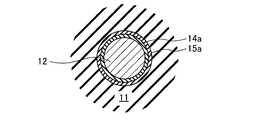
- the core wire 12 is covered with an RFL adhesive layer 14a, and a core wire adhesive layer 15a is provided so as to cover the outside of the core wire 12 covered with the RFL adhesive layer 14a.
- the belt body 11 is embedded through the RFL adhesive layer 14a and the core wire adhesive layer 15a.
- the RFL adhesive layer 14a is formed of a mixture of a condensate (RF) of resorcin and formaldehyde and a rubber component (L) derived from latex.
- RF condensate
- L rubber component
- the R / F (molar ratio) in the RFL adhesive layer 14a is, for example, 1/1 to 1/2.
- RF / L (mass ratio) is, for example, 1/5 to 1/20.
- L include CSM, 2,3-dichloro-1,3-butadiene polymer (hereinafter referred to as “2,3-DCB”), vinylpyridine styrene butadiene copolymer (hereinafter referred to as “Vp-SBR”), CR. Etc. L preferably contains one or more of these.
- L preferably contains CSM or 2,3-DCB from the viewpoint of obtaining excellent adhesion to the belt body 11.
- the core wire adhesive layer 15a is formed of a rubber composition in which an uncrosslinked rubber composition in which various rubber compounding agents are blended with a rubber component is heated and pressurized to crosslink the rubber component with the crosslinking agent.
- the rubber component of the rubber composition forming the core wire adhesive layer 15a is preferably mainly composed of CSM.
- the content of CSM in the rubber component is more than 50 masses, and from the viewpoint of obtaining excellent adhesion to the belt body 11, it is preferably 90 mass% or more, more preferably 95% or more, and most preferably 100 mass%. %.
- the rubber component may contain ethylene- ⁇ -olefin elastomer, H-NBR, CR, etc. in addition to containing CSM.
- the rubber component may be CR other than CSM.
- the chlorine content of the CSM contained in the rubber component is preferably 20% by mass or more, more preferably 24% by mass or more, from the viewpoint of obtaining excellent adhesiveness with the belt body 11. More preferably, it is 25 mass% or more, Preferably it is 45 mass% or less, More preferably, it is 29 mass% or less, More preferably, it is 27 mass% or less.
- the sulfur content of the CSM contained in the rubber component is preferably 0.3% by mass or more, more preferably 0.5% by mass or more, and still more preferably 0, from the viewpoint of obtaining excellent adhesion with the belt body 11.
- 0.6 mass% or more preferably 1.5 mass% or less, more preferably 1.0 mass% or less, and still more preferably 0.8 mass% or less.
- Mooney viscosity at 100 ° C. of CSM contained in the rubber component from the viewpoint of obtaining excellent adhesion between the belt body 11, preferably 30ML 1 + 4 (100 °C) or higher, more preferably 35ML 1 + 4 (100 °C) or higher, More preferably, it is 38ML1 + 4 (100 degreeC) or more, Preferably it is 100ML1 + 4 (100 degreeC) or less, More preferably, it is 50ML1 + 4 (125 degreeC) or less, More preferably, it is 45ML1 + 4 (125 degreeC) or less.
- rubber compounding agents include reinforcing materials, plasticizers, processing aids, vulcanization acceleration aids, co-crosslinking agents, cross-linking agents, and anti-aging agents.
- a reinforcing material for example, carbon black, channel black; furnace black such as SAF, ISAF, N-339, HAF, N-351, MAF, FEF, SRF, GPF, ECF, N-234; FT, MT, etc. Thermal black; acetylene black and the like.
- Silica is also mentioned as the reinforcing material.
- the reinforcing material preferably contains one or more of these.
- the reinforcing material preferably contains FEF carbon black and silica.
- the content of the reinforcing material is, for example, 40 to 60 parts by mass with respect to 100 parts by mass of the rubber component of the rubber composition.
- plasticizer examples include polyether esters, dialkyl sebacates such as dioctyl sebacate (DOS), dialkyl phthalates such as dibutyl phthalate (DBP) and dioctyl phthalate (DOP), and dialkyl adipates such as dioctyl adipate (DOA). Can be mentioned.
- the plasticizer preferably contains one or more of these.
- the plasticizer preferably includes polyetherester and dioctyl sebacate (DOS).
- the plasticizer content is, for example, 5 to 20 parts by mass with respect to 100 parts by mass of the rubber component.
- processing aids include stearic acid, polyethylene wax, and fatty acid metal salts.
- the processing aid preferably contains one or more of these.
- the processing aid preferably contains stearic acid.
- the content of the processing aid is, for example, 0.5 to 2 parts by mass with respect to 100 parts by mass of the rubber component of the rubber composition.
- the vulcanization acceleration aid examples include metal oxides such as zinc oxide (zinc white) and magnesium oxide, metal carbonates, fatty acids and derivatives thereof.
- the vulcanization acceleration aid preferably contains one or more of these.
- the vulcanization acceleration aid preferably contains zinc oxide.
- the content of the vulcanization acceleration aid is, for example, 3 to 7 parts by mass with respect to 100 parts by mass of the rubber component of the rubber composition.
- co-crosslinking agent examples include trimethylolpropane trimethacrylate, triallyl isocyanurate, zinc dimethacrylate, m-phenylene dimaleimide, and the like.
- the co-crosslinking agent preferably contains one or more of these.
- the co-crosslinking agent preferably includes trimethylolpropane trimethacrylate.
- the content of the co-crosslinking agent is, for example, 1 to 3 parts by mass with respect to 100 parts by mass of the rubber component.
- crosslinking agent examples include organic oxides and sulfur.
- an organic oxide may be blended, sulfur may be blended, and both of them may be used in combination.
- the cross-linking agent preferably contains an organic oxide.
- the amount of the crosslinking agent is, for example, 1 to 5 parts by mass with respect to 100 parts by mass of the rubber component, and in the case of sulfur, for example, 0.5 to 3 parts by mass with respect to 100 parts by mass of the rubber component. Part.
- the anti-aging agent examples include benzimidazole type, amine-ketone type, diamine type, phenol type and the like. It is preferable that an anti-aging agent contains 1 type, or 2 or more types of these.
- the anti-aging agent preferably contains a benzimidazole type.
- the content of the anti-aging agent is, for example, 0.5 to 1.5 parts by mass with respect to 100 parts by mass of the rubber component.
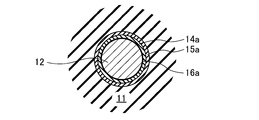
- the core wire 12 is provided with a base adhesive layer 16a between the core wire 12 and the RFL adhesive layer 14a, and the base adhesive layer 16a and the RFL adhesive layer 14a covering the entire core wire 12 and the outside thereof. It may be embedded in the belt main body 11 through a core wire adhesive layer 15a covering the belt.
- Examples of the material for forming the base adhesive layer 16a include epoxy resins and isocyanate resins.
- the reinforcing cloth 13 is made of, for example, a cloth material such as a woven fabric, a knitted fabric, or a non-woven fabric formed of yarns such as nylon fibers (polyamide fibers), polyester fibers, aramid fibers, and cotton.
- the reinforcing cloth 13 is preferably formed of nylon fibers among these.
- the reinforcing cloth 13 preferably has extensibility.
- the thickness of the reinforcing cloth 13 is, for example, 0.3 to 2.0 mm.
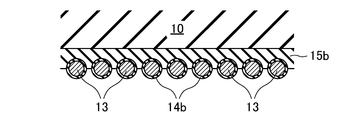
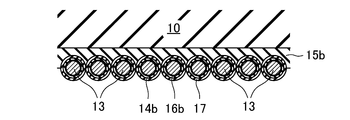
- the reinforcing cloth 13 is covered with an RFL adhesive layer 14b, and a reinforcing cloth adhesive layer 15b is provided so as to cover the belt body 11 side of the reinforcing cloth 13 covered with the RFL adhesive layer 14b.
- the belt main body 11 is pasted through the RFL adhesive layer 14b and the reinforcing cloth adhesive layer 15b.
- the RFL adhesive layer 14b is formed of a mixture of a condensate (RF) of resorcin and formaldehyde and a rubber component (L) derived from latex.
- RF condensate
- L rubber component
- the R / F (molar ratio) in the RFL adhesive layer 14b is, for example, 1/1 to 1/2.
- RF / L (mass ratio) is, for example, 1/5 to 1/20.
- L include CSM, 2,3-DCB, Vp-SBR, CR, and the like. L preferably contains one or more of these. L preferably contains CSM or 2,3-DCB from the viewpoint of obtaining excellent adhesion to the belt body 11.
- the RFL adhesive layer 14b covering the reinforcing cloth 13 may be formed of the same material as the RFL adhesive layer 14a covering the core wire 12.
- the reinforcing cloth adhesive layer 14b is formed of a rubber composition in which an uncrosslinked rubber composition in which various rubber compounding agents are blended with a rubber component is heated and pressurized to crosslink the rubber component with the crosslinking agent.
- the rubber component of the rubber composition forming the reinforcing cloth adhesive layer 14b is mainly H-NBR.
- the content of H-NBR in the rubber component is more than 50%, and preferably 90% by mass or more, more preferably 95% or more, and most preferably 100% by mass from the viewpoint of obtaining excellent adhesion to the belt body 11. It is.
- the rubber component may contain ethylene- ⁇ -olefin elastomer, CSM, CR and the like in addition to containing H-NBR.
- the amount of H-NBR bound acrylonitrile contained in the rubber component is preferably 30% by mass or more, more preferably 33% by mass or more, and still more preferably 35% by mass from the viewpoint of obtaining excellent adhesion to the belt body 11. Further, it is preferably 50% by mass or less, more preferably 45% by mass or less, and still more preferably 40% by mass or less.
- the iodine value of H-NBR contained in the rubber component is preferably 2 mg / 100 mg or more, more preferably 4 mg / 100 mg or more, and even more preferably 6 mg / 100 mg or more from the viewpoint of obtaining excellent adhesion to the belt body 11. Moreover, it is preferably 30 mg / 100 mg or less, more preferably 10 mg / 100 mg or less, and still more preferably 8 mg / 100 mg or less.
- the Mooney viscosity at 100 ° C. of H-NBR contained in the rubber component is preferably 50 ML 1 + 4 (100 ° C.) or more, more preferably 60 ML 1 + 4 (100 ° C.) from the viewpoint of obtaining excellent adhesion to the belt body 11. Or more, more preferably 70 ML 1 + 4 (100 ° C.) or more, preferably 100 ML 1 + 4 (100 ° C.) or less, more preferably 90 ML 1 + 4 (125 ° C.) or less, more preferably 85 ML 1 + 4 (125 ° C.) or less. .
- the rubber component may contain H-NBR reinforced with an unsaturated carboxylic acid metal salt.
- unsaturated carboxylic acid include methacrylic acid and acrylic acid.
- metal include zinc, calcium, magnesium, and aluminum.
- rubber compounding agents include reinforcing materials, plasticizers, processing aids, vulcanization acceleration aids, co-crosslinking agents, cross-linking agents, and anti-aging agents.
- a reinforcing material for example, carbon black, channel black; furnace black such as SAF, ISAF, N-339, HAF, N-351, MAF, FEF, SRF, GPF, ECF, N-234; FT, MT, etc. Thermal black; acetylene black and the like.
- Silica is also mentioned as the reinforcing material.
- the reinforcing material preferably contains one or more of these.
- the reinforcing material preferably contains GPF carbon black and silica.
- the content of the reinforcing material is, for example, 40 to 60 parts by mass with respect to 100 parts by mass of the rubber component of the rubber composition.
- plasticizer examples include polyether esters, dialkyl sebacates such as dioctyl sebacate (DOS), dialkyl phthalates such as dibutyl phthalate (DBP) and dioctyl phthalate (DOP), and dialkyl adipates such as dioctyl adipate (DOA). Can be mentioned.
- the plasticizer preferably contains one or more of these.
- the plasticizer preferably contains a polyether ester.
- the plasticizer content is, for example, 5 to 15 parts by mass with respect to 100 parts by mass of the rubber component.
- processing aids include stearic acid, polyethylene wax, and fatty acid metal salts.
- the processing aid preferably contains one or more of these.
- the processing aid preferably contains stearic acid.
- the content of the processing aid is, for example, 0.5 to 2 parts by mass with respect to 100 parts by mass of the rubber component of the rubber composition.
- the vulcanization acceleration aid examples include metal oxides such as zinc oxide (zinc white) and magnesium oxide, metal carbonates, fatty acids and derivatives thereof.
- the vulcanization acceleration aid preferably contains one or more of these.
- the vulcanization acceleration aid preferably contains zinc oxide.
- the content of the vulcanization acceleration aid is, for example, 3 to 7 parts by mass with respect to 100 parts by mass of the rubber component of the rubber composition.
- co-crosslinking agent examples include trimethylolpropane trimethacrylate, zinc dimethacrylate, triallyl isocyanurate, m-phenylene dimaleimide, and the like.
- the co-crosslinking agent preferably contains one or more of these.
- the co-crosslinking agent preferably includes trimethylolpropane trimethacrylate.
- the content of the co-crosslinking agent is, for example, 1 to 3 parts by mass with respect to 100 parts by mass of the rubber component.
- crosslinking agent examples include organic oxides and sulfur.
- an organic oxide may be blended, sulfur may be blended, and both of them may be used in combination.
- the cross-linking agent preferably contains both an organic oxide and sulfur.
- the amount of the crosslinking agent is, for example, 1 to 5 parts by mass with respect to 100 parts by mass of the rubber component, and in the case of sulfur, for example, 0.5 to 3 parts by mass with respect to 100 parts by mass of the rubber component. Part.
- the anti-aging agent examples include benzimidazole type, amine-ketone type, diamine type, phenol type and the like. It is preferable that an anti-aging agent contains 1 type, or 2 or more types of these.
- the anti-aging agent preferably contains a benzimidazole type.
- the content of the anti-aging agent is, for example, 0.5 to 1.5 parts by mass with respect to 100 parts by mass of the rubber component.
- the reinforcing cloth 13 is provided with a base adhesive layer 16b between the reinforcing cloth 13 and the RFL adhesive layer 14b, and the base adhesive layer 16b and the RFL adhesive layer 14b covering the entire reinforcing cloth 13 and its belt. It may be attached to the belt main body 11 via a reinforcing cloth adhesive layer 15b covering the main body 11 side.
- the material for forming the base adhesive layer 16b include an epoxy resin and an isocyanate resin.
- the reinforcing cloth 13 is provided with an impregnated rubber adhesive layer 17 so as to cover the outside of the RFL adhesive layer 14b, and the RFL adhesive layer 14b and the impregnated rubber adhesive layer 17 covering the entire reinforcing cloth 13 and its belt. It may be attached to the belt main body 11 via a reinforcing cloth adhesive layer 15b covering the main body 11 side.
- the rubber composition forming the impregnated rubber adhesive layer 17 is preferably formed of a rubber composition mainly composed of H-NBR as a rubber component, similar to the reinforcing cloth adhesive layer 15b, and is the same as the reinforcing cloth adhesive layer 15b.
- the rubber composition may be used.
- a base adhesive layer 16b may be provided between the reinforcing cloth 13 and the RFL adhesive layer 14b.
- the belt body 11 is formed of a rubber composition mainly composed of an ethylene- ⁇ -olefin elastomer having an ethylene content of 44 to 66% by mass.
- the reinforcing cloth adhesive layer 15b is formed of a rubber composition containing H-NBR as a main rubber component, excellent heat resistance and cold resistance can be obtained.
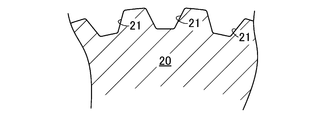
- FIG. 4 shows a belt mold 20 used for manufacturing the toothed belt B according to the embodiment.
- the belt forming die 20 has a cylindrical shape, and tooth portion forming grooves 21 extending in the axial direction are formed on the outer peripheral surface thereof at a constant pitch with intervals in the circumferential direction.
- the manufacturing method of the toothed belt according to the embodiment includes a material preparation process, a molding process, a crosslinking process, and a finishing process.
- ⁇ Material preparation process> Uncrosslinked rubber sheet 11 'for back rubber and tooth rubber-
- An uncrosslinked rubber composition is obtained by kneading a rubber component mainly composed of an ethylene- ⁇ -olefin elastomer and adding various rubber compounding agents thereto and kneading them.
- the obtained uncrosslinked rubber composition is molded into a sheet shape by calendar molding or the like to produce an uncrosslinked rubber sheet 11 'for the back rubber portion and the tooth rubber portion.
- the core wire 12 ' is immersed in this RFL aqueous solution and then heated in a heating furnace. At this time, the core wire 12 ′ is impregnated with the RFL aqueous solution, and the RFL adhesive layer 14 a adheres so as to cover the whole including the inside of the core wire 12 ′.
- This RFL adhesion process may be repeated a plurality of times. In the case of the fiber core 12 made of glass fiber, twisting is performed after the RFL adhesion treatment is performed on the fiber bundle.
- an uncrosslinked rubber composition is obtained by kneading a rubber component, which is preferably composed mainly of CSM, and adding and kneading various rubber compounding agents therein.
- the obtained uncrosslinked rubber composition is dissolved in an organic solvent such as methyl ethyl ketone (hereinafter referred to as “MEK”) to prepare a rubber paste.
- MEK methyl ethyl ketone
- the core wire 12 ′ subjected to RFL adhesion treatment is dipped in the rubber paste and then dried in a drying furnace. At this time, the core wire adhesive layer 15a adheres so as to cover the outside of the core wire 12 'covered with the RFL adhesive layer 14a.
- This rubber paste treatment may be repeated a plurality of times.
- a base adhesive treatment in which the core wire 12 'is immersed in a base adhesive such as an epoxy resin solution or an isocyanate resin solution and heated may be performed before the RFL adhesive treatment.
- the reinforcing cloth 13 ′ is immersed in this RFL aqueous solution, squeezed with a roll, and then heated in a heating furnace. At this time, the reinforcing cloth 13 ′ is impregnated with the RFL aqueous solution, and the RFL adhesive layer 14 b is attached so as to cover the whole including the inside of the reinforcing cloth 13 ′.
- This RFL adhesion process may be repeated a plurality of times.
- a rubber component mainly composed of H-NBR is masticated, and various rubber compounding agents are added thereto and kneaded to obtain an uncrosslinked rubber composition.
- the obtained uncrosslinked rubber composition is dissolved in an organic solvent such as MEK to prepare a rubber paste for coating adhesion treatment.
- This coating adhesive treatment rubber paste is coated on one surface of the reinforcing cloth 13 ′ subjected to the RFL adhesion treatment with a knife coater or the like and then dried in a drying furnace. At this time, the reinforcing cloth adhesive layer 15b adheres so as to cover one surface of the reinforcing cloth 13 'covered with the RFL adhesive layer 14b.
- This coating adhesion treatment may be repeated a plurality of times.
- the base adhesive treatment may be performed in which the reinforcing cloth 13 'is immersed in a base adhesive such as an epoxy resin solution or an isocyanate resin solution and heated before the RFL adhesive processing.
- a soaking adhesion process may be performed between the RFL adhesion process and the coating adhesion process, in which the reinforcing cloth 13 'is dipped in a rubber paste for soaking adhesion treatment and dried.
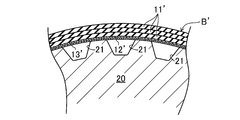
- a cylindrical reinforcing cloth 13 ′ is placed on the outer periphery of the belt mold 20, the core wire 12 ′ is spirally wound from above, and the uncrosslinked rubber sheet 11 ′ is further wound thereon. At this time, a laminated molded body B ′ is formed on the belt mold 20.
- uncrosslinked rubber sheet 11 'so it is preferable to use uncrosslinked rubber sheet 11 'so that the line direction may correspond to the belt length direction.
- ⁇ Finishing process> The inside of the vulcanizing can is depressurized to release the seal, the belt slab S molded between the belt mold 20 and the rubber sleeve 23 is taken out and demolded, and the back side is polished to adjust the thickness. After that, the toothed belt B is manufactured by cutting into a predetermined width.
- Rubber composition The following rubbers 1-1 to 1-5 for the belt body, rubber 2 for the core wire adhesive layer, and rubbers 3-1 to 3-4 for the reinforcing cloth adhesive layer were prepared. Each configuration is also shown in Table 1.
- ⁇ Rubber 1-2> Except for using EPDM2 (trade name: EP21, ethylene content 61 mass%, ENB content 5.8 mass%, Mooney viscosity 26 ML 1 + 4 (125 ° C.)) as rubber component, the same composition as rubber 1-1. An uncrosslinked rubber composition was prepared. This uncrosslinked rubber composition was designated as rubber 1-2.
- EPDM2 trade name: EP21, ethylene content 61 mass%, ENB content 5.8 mass%, Mooney viscosity 26 ML 1 + 4 (125 ° C.)
- EPDM1 (trade name: EP25, manufactured by JSR) as a rubber component is put into a chamber of a closed Banbury mixer and masticated. Next, 100 parts by mass of the rubber component is subjected to FEF carbon black 60 of reinforcing material 1. Part by mass, 8 parts by mass of a softening agent, 5 parts by mass of zinc oxide as a vulcanization accelerator, 1.5 parts by mass of sulfur as a crosslinking agent 4 (manufactured by Hosoi Chemical Co., Ltd.), sulfenamide vulcanization accelerator 1 (large 2 parts by mass of Uchisei Shin Chemical Co., Ltd.
- Rubber 1-4 Uncrosslinked with the same composition as rubber 1-1, except that 15 parts by weight of zinc dimethacrylate (trade name: Actor ZMA, manufactured by Kawaguchi Chemical Industry Co., Ltd.) was added as a co-crosslinking agent 2 to 100 parts by weight of the rubber component. A rubber composition was prepared. This uncrosslinked rubber composition was designated as Rubber 1-4.
- H-NBR1 (trade name: Zetpol2000 bound acrylonitrile amount 36.2% by mass, iodine value 7 mg / 100 mg or less, Mooney viscosity 85 ML 1 + 4 (100 ° C.)) manufactured by Nippon Zeon Co., Ltd. is used as a rubber component in the chamber of a closed Banbury mixer.
- the GPF of the reinforcing material 2 45 parts by mass of carbon black, 10 parts by mass of silica of reinforcing material 3, 8 parts by mass of polyether ester of plasticizer 1, 1 part by mass of stearic acid as processing aid, 5 parts by mass of zinc oxide as vulcanization accelerator, co-crosslinking 2 parts by weight of trimethylolpropane trimethacrylate as agent 1, and organic oxide of crosslinking agent 3 (trade name: Perbutyl P, ⁇ , ⁇ '-di (tri-t-butylperoxy) diisopropylbenzene, manufactured by NOF Corporation) 3.2 mass Parts, 1 part by mass of sulfur of the crosslinking agent 4 and 1 part by mass of benzimidazole anti-aging agent were added and kneaded to prepare an uncrosslinked rubber composition.
- This uncrosslinked rubber composition was designated as rubber 3-1.
- Rubber 3-1 except that H-NBR2 (trade name: Zeoforte ZSC2295, base polymer: Zetpol 2020, Mooney viscosity 85ML 1 + 4 (100 ° C)) reinforced with an unsaturated carboxylic acid metal salt was used as the rubber component
- H-NBR2 trade name: Zeoforte ZSC2295, base polymer: Zetpol 2020, Mooney viscosity 85ML 1 + 4 (100 ° C)
- An uncrosslinked rubber composition having the same composition as that in Example 1 was prepared. This uncrosslinked rubber composition was designated as rubber 3-2.
- ⁇ Rubber 3-3> H-NBR3 (trade name: Zetpol2020 bonded acrylonitrile amount 36.2% by mass, iodine value 28 mg / 100 mg, Mooney viscosity 78ML 1 + 4 (100 ° C)) as a rubber component is charged into the chamber of a closed Banbury mixer.
- EPDM3 (trade name: EP33, made by JSR Co., Ltd., trade name: EP33, ethylene content: 52 mass%, ENB content: 8.1 mass%, Mooney viscosity: 28 ML 1 + 4 (125 ° C.)) as a rubber component is put into a closed Banbury mixer chamber and masticated.
- Toothed belts of Examples 1 to 9 and Comparative Examples 1 and 2 below were produced. Each configuration is also shown in Table 2.
- Rubber 1-1 was formed into an uncrosslinked rubber sheet for a belt body by calendar molding.
- Rubber paste bonding treatment in which the fiber 2 is immersed in rubber paste in which MEF is dissolved in glass fiber core wire that has been subjected to RFL bonding treatment using an RFL aqueous solution whose latex component is CSM latex and then dried in a drying furnace. Then, the core wire adhesive layer was attached so as to cover the outside of the core wire covered with the RFL adhesive layer.
- a toothed belt having the same configuration as that of the above embodiment was manufactured using the uncrosslinked rubber sheet for the belt body having the above configuration, and the core wire and the reinforcing cloth subjected to the adhesion treatment.
- This toothed belt was referred to as Example 1.
- the belt length was 400 mm
- the belt width was 20 mm
- the maximum belt thickness was 2.4 mm.
- the tooth width was 1.5 mm
- the tooth height was 1.2 mm
- the tooth pitch was 2 mm.
- Example 2 A toothed belt having the same configuration as in Example 1 was produced except that rubber 1-2 was used as the uncrosslinked rubber sheet for the belt body. This toothed belt was referred to as Example 2.
- Example 3 A toothed belt having the same configuration as in Example 1 was prepared except that rubber 1-3 was used as the uncrosslinked rubber sheet for the belt body. This toothed belt was referred to as Example 3.
- Example 4 A toothed belt having the same configuration as in Example 1 was prepared except that rubber 1-4 was used as the uncrosslinked rubber sheet for the belt body. This toothed belt was referred to as Example 4.
- Example 5 A toothed belt having the same configuration as that of Example 4 was produced except that rubber paste of rubber 3-2 was used for the coating adhesion treatment of the reinforcing cloth. This toothed belt was referred to as Example 5.
- Example 6 A toothed belt having the same configuration as in Example 1 was produced except that rubber paste of rubber 3-3 was used for coating adhesion treatment of the reinforcing cloth. This toothed belt was referred to as Example 6.
- Example 7 A toothed belt having the same configuration as in Example 1 was prepared except that an RFL aqueous solution having a latex component of 2,3-DCB latex was used for the RFL adhesion treatment of the core wire and the reinforcing cloth. This toothed belt was referred to as Example 7.
- Example 8 A toothed belt having the same configuration as in Example 1 was prepared except that an RFL aqueous solution having a latex component of H-NBR latex was used for RFL adhesion treatment of the core wire and the reinforcing cloth. This toothed belt was referred to as Example 8.
- Example 9 A toothed belt having the same configuration as in Example 1 was prepared except that an RFL aqueous solution having a latex component of Vp-SBR latex was used for RFL adhesion treatment of the core wire and the reinforcing cloth. This toothed belt was referred to as Example 9.
- Comparative Example 1 A toothed belt having the same configuration as in Example 1 was produced except that rubber 1-5 was used as an uncrosslinked rubber sheet for the belt body. This toothed belt was referred to as Comparative Example 1.
- Comparative Example 2 A toothed belt having the same configuration as that of Example 1 was prepared except that rubber paste of rubber 3-4 was used for the coating adhesion treatment of the reinforcing cloth. This toothed belt was referred to as Comparative Example 2.
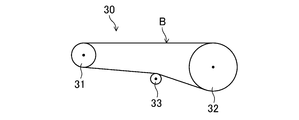
- FIG. 8 shows a pulley layout of the belt running test machine 30.
- the belt running test machine 30 has a drive pulley 31, a driven pulley 32, and an idler pulley 33.
- the driving pulley 31 is provided with 21 tooth meshing grooves on the pulley periphery.
- the driven pulley 32 is provided with 42 tooth-engagement grooves on the periphery of the pulley.
- the idler pulley 33 has a flat pulley periphery for pressing the back surface of the belt.
- the drive pulley 31, the driven pulley 32, and the idler pulley 33 are all made of carbon steel (S45C).
- the belt running test machine 30 was used to evaluate heat resistance and cold resistance as follows.
- the toothed belt B is wound around the belt running test machine 30 so that the tooth portion meshes with the drive pulley 31 and the driven pulley 32 and the back surface of the belt contacts the idler pulley 33, and then the dead weight is applied to the driven pulley 32.
- the load was applied to apply a tension of 200 N to the toothed belt B, and the drive pulley 31 was rotated at a rotational speed of 1000 rpm under the atmospheric temperature of 120 ° C. to run the belt. Then, the belt running was stopped every 50 hours and visually checked for damage.
- the maximum belt running time was 300 hours.
- Test evaluation results The test results are shown in Table 2.
- the present invention is useful in the technical field of toothed belts.
Landscapes
- Chemical & Material Sciences (AREA)
- Engineering & Computer Science (AREA)
- Materials Engineering (AREA)
- Health & Medical Sciences (AREA)
- Chemical Kinetics & Catalysis (AREA)
- Medicinal Chemistry (AREA)
- Polymers & Plastics (AREA)
- Organic Chemistry (AREA)
- General Engineering & Computer Science (AREA)
- Manufacturing & Machinery (AREA)
- Mechanical Engineering (AREA)
- Textile Engineering (AREA)
- Nanotechnology (AREA)
- Compositions Of Macromolecular Compounds (AREA)
Abstract
Description
図1は、実施形態に係る歯付ベルトBを示す。
実施形態に係る歯付ベルトBの製造方法について、図4~7に基づいて説明する。
―背ゴム部及び歯ゴム部用の未架橋ゴムシート11’―
エチレン-α-オレフィンエラストマーを主体とするゴム成分を素練りし、そこに各種のゴム配合剤を投入して混練することにより未架橋ゴム組成物を得る。
レゾルシン(R)とホルムアルデヒド(F)との初期縮合物(RF)とラテックス(L)とを混合してRFL接着処理用のRFL水溶液を調製する。
レゾルシン(R)とホルムアルデヒド(F)との初期縮合物(RF)とラテックス(L)とを混合してRFL接着処理用のRFL水溶液を調製する。
図5に示すように、ベルト成形型20の外周に筒状の補強布13’を被せ、その上から心線12’を螺旋状に巻き付け、更にその上から未架橋ゴムシート11’を巻き付ける。このとき、ベルト成形型20上には積層成形体B’が形成される。なお、未架橋ゴムシート11’は、列理方向がベルト長さ方向に対応するように使用することが好ましい。
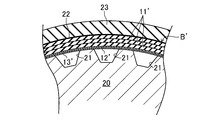
図6に示すように、積層成形体B’の外周に離型紙22を巻き付けた後、その上からゴムスリーブ23を被せ、それを加硫缶内に配置して密閉すると共に、加硫缶内に高温及び高圧の蒸気を充填して所定の成型時間だけ保持する。このとき、積層成形体B’における未架橋ゴムシート11’が補強布13’を押圧しながら流動してベルト成形型20の歯部形成溝21に流入し、また、加熱及び加圧によりその架橋が進行し、且つそれと心線12’及び補強布13’とが心線接着層15a及び補強布接着層15bを介して複合一体化し、最終的に、図7に示すように、円筒状のベルトスラブSが成型される。
加硫缶の内部を減圧して密閉を解き、ベルト成形型20とゴムスリーブ23との間に成型されたベルトスラブSを取り出して脱型し、その背面側を研磨して厚さ調整を行った後、所定幅に輪切りすることにより歯付ベルトBが製造される。
以下のベルト本体用のゴム1-1~1-5、心線接着層用のゴム2、及び補強布接着層用のゴム3-1~3-4を調製した。それぞれの構成は表1にも示す。
<ゴム1-1>
密閉式のバンバリーミキサーのチャンバーにゴム成分としてのEPDM1(JSR社製 商品名:EP25 エチレン含量58.5質量%、ENB含量5.1質量%、ムーニー粘度63ML1+4(125℃))を投入して素練りし、次いで、このゴム成分100質量部に対して、補強材1のFEFカーボンブラック(キャボットジャパン社製)60質量部、軟化剤(日本サン石油社製 商品名:サンパー2280)8質量部、加硫促進助剤の酸化亜鉛(ハクスイテック社製)5質量部、共架橋剤1のトリメチロールプロパントリメタクリレート(精工化学社製 商品名:ハイクロスM)2質量部、及び架橋剤1の有機化酸化物(日油社製 商品名:パークミルD、ジクミルパーオキサイド)3質量部を投入配合して混練して未架橋ゴム組成物を作製した。この未架橋ゴム組成物をゴム1-1とした。
ゴム成分としてEPDM2(JSR社製 商品名:EP21 エチレン含量61質量%、ENB含量5.8質量%、ムーニー粘度26ML1+4(125℃))を用いたことを除いてゴム1-1と同一組成の未架橋ゴム組成物を作製した。この未架橋ゴム組成物をゴム1-2とした。
密閉式のバンバリーミキサーのチャンバーにゴム成分としてのEPDM1(JSR社製 商品名:EP25)を投入して素練りし、次いで、このゴム成分100質量部に対して、補強材1のFEFカーボンブラック60質量部、軟化剤8質量部、加硫促進助剤の酸化亜鉛5質量部、架橋剤4の硫黄(細井化学工業社製)1.5質量部、スルフェンアミド系加硫促進剤1(大内新興化学工業社製 商品名:ノクセラーMSA)2質量部、及びチウラム加硫促進剤2(大内新興化学工業社製 商品名:ノクセラーTET-G)0.7質量部を投入配合して混練して未架橋ゴム組成物を作製した。この未架橋ゴム組成物をゴム1-3とした。
ゴム成分100質量部に対して共架橋剤2として亜鉛ジメタクリレート(川口化学工業社製 商品名:アクターZMA)15質量部を更に投入配合したことを除いてゴム1-1と同一組成の未架橋ゴム組成物を作製した。この未架橋ゴム組成物をゴム1-4とした。
密閉式のバンバリーミキサーのチャンバーにゴム成分としてのH-NBR1(日本ゼオン社製 商品名:Zetpol2000 結合アクリロニトリル量36.2質量%、ヨウ素価7mg/100mg以下、ムーニー粘度85ML1+4(100℃))を投入して素練りし、次いで、このゴム成分100質量部に対して、補強材2のGPFカーボンブラック(キャボットジャパン社製)45質量部、可塑剤1のポリエーテルエステル(ADEKA社製 商品名:アデカサイザーRS700)8質量部、加工助剤のステアリン酸(日油社製)1質量部、加硫促進助剤の酸化亜鉛5質量部、共架橋剤1のトリメチロールプロパントリメタクリレート2質量部、架橋剤2の有機化酸化物(日油社製 商品名:ペロキシモンF40(純度40質量%)、α,α’-ジ(トリt-ブチルペロキシ)ジイソプロピルベンゼン)8質量部(3.2質量部)、架橋剤4の硫黄1質量部、及びベンズイミダゾール系老化防止剤(大内新興化学工業社製 商品名:ノクラックMB)1質量部を投入配合して混練して未架橋ゴム組成物を作製した。この未架橋ゴム組成物をゴム1-5とした。
<ゴム2>
密閉式のバンバリーミキサーのチャンバーにゴム成分としてのCSM(東ソー社製 商品名:ET-8010 塩素含有量26質量%、硫黄含有量0.7質量%、ムーニー粘度40ML1+4(100℃))を投入して素練りし、次いで、このゴム成分100質量部に対して、補強材1のFEFカーボンブラック30質量部、補強材3のシリカ(エボニックジャパン社製 商品名:ウルトラジルVN3)20質量部、可塑剤1のポリエーテルエステル5質量部、可塑剤2のDOS(三建化工社製)5質量部、加工助剤のステアリン酸1質量部、加硫促進助剤の酸化亜鉛5質量部、共架橋剤1のトリメチロールプロパントリメタクリレート2質量部、架橋剤2の有機化酸化物(日油社製 商品名:ペロキシモンF40)8質量部(3.2質量部)、及びベンズイミダゾール系老化防止剤1質量部を投入配合して混練して未架橋ゴム組成物を作製した。この未架橋ゴム組成物をゴム2とした。
<ゴム3-1>
密閉式のバンバリーミキサーのチャンバーにゴム成分としてのH-NBR1(日本ゼオン社製 商品名:Zetpol2000)を投入して素練りし、次いで、このゴム成分100質量部に対して、補強材2のGPFカーボンブラック45質量部、補強材3のシリカ10質量部、可塑剤1のポリエーテルエステル8質量部、加工助剤のステアリン酸1質量部、加硫促進助剤の酸化亜鉛5質量部、共架橋剤1のトリメチロールプロパントリメタクリレート2質量部、架橋剤3の有機化酸化物(日油社製 商品名:パーブチルP、α,α’-ジ(トリt-ブチルペロキシ)ジイソプロピルベンゼン)3.2質量部、架橋剤4の硫黄1質量部、及びベンズイミダゾール系老化防止剤1質量部を投入配合して混練して未架橋ゴム組成物を作製した。この未架橋ゴム組成物をゴム3-1とした。
ゴム成分として不飽和カルボン酸金属塩で強化されたH-NBR2(日本ゼオン社製 商品名:ZeoforteZSC2295 ベースポリマー:Zetpol2020、ムーニー粘度85ML1+4(100℃))を用いたことを除いてゴム3-1と同一組成の未架橋ゴム組成物を作製した。この未架橋ゴム組成物をゴム3-2とした。
密閉式のバンバリーミキサーのチャンバーにゴム成分としてのH-NBR3(日本ゼオン社製 商品名:Zetpol2020 結合アクリロニトリル量36.2質量%、ヨウ素価28mg/100mg、ムーニー粘度78ML1+4(100℃))を投入して素練りし、次いで、このゴム成分100質量部に対して、補強材2のGPFカーボンブラック45質量部、補強材3のシリカ10質量部、可塑剤1のポリエーテルエステル8質量部、加工助剤のステアリン酸1質量部、加硫促進助剤の酸化亜鉛5質量部、架橋剤3の有機化酸化物(日油社製 商品名:パーブチルP)3.2質量部、架橋剤4の硫黄1質量部、及びベンズイミダゾール系老化防止剤1質量部を投入配合して混練して未架橋ゴム組成物を作製した。この未架橋ゴム組成物をゴム3-3とした。
密閉式のバンバリーミキサーのチャンバーにゴム成分としてのEPDM3(JSR社製 商品名:EP33 エチレン含量52質量%、ENB含量8.1質量%、ムーニー粘度28ML1+4(125℃))を投入して素練りし、次いで、このゴム成分100質量部に対して、補強材1のFEFカーボンブラック65質量部、補強材3のシリカ10質量部、軟化剤8質量部、加工助剤のステアリン酸1質量部、加硫促進助剤の酸化亜鉛5質量部、共架橋剤1のトリメチロールプロパントリメタクリレート2質量部、架橋剤1の有機化酸化物(日油社製 商品名:パークミルD)3質量部、及び架橋剤4の硫黄1質量部を投入配合して混練して未架橋ゴム組成物を作製した。この未架橋ゴム組成物をゴム3-4とした。

以下の実施例1~9及び比較例1~2の歯付ベルトを作製した。それぞれの構成は表2にも示す。
ゴム1-1をカレンダー成形によってベルト本体用の未架橋ゴムシートに成形した。
ベルト本体用の未架橋ゴムシートとしてゴム1-2を用いたことを除いて実施例1と同一構成の歯付ベルトを作製した。この歯付ベルトを実施例2とした。
ベルト本体用の未架橋ゴムシートとしてゴム1-3を用いたことを除いて実施例1と同一構成の歯付ベルトを作製した。この歯付ベルトを実施例3とした。
ベルト本体用の未架橋ゴムシートとしてゴム1-4を用いたことを除いて実施例1と同一構成の歯付ベルトを作製した。この歯付ベルトを実施例4とした。
補強布のコーティング接着処理にゴム3-2のゴム糊を用いたことを除いて実施例4と同一構成の歯付ベルトを作製した。この歯付ベルトを実施例5とした。
補強布のコーティング接着処理にゴム3-3のゴム糊を用いたことを除いて実施例1と同一構成の歯付ベルトを作製した。この歯付ベルトを実施例6とした。
心線及び補強布のRFL接着処理にラテックス成分を2,3-DCBラテックスとするRFL水溶液を用いたことを除いて実施例1と同一構成の歯付ベルトを作製した。この歯付ベルトを実施例7とした。
心線及び補強布のRFL接着処理にラテックス成分をH-NBRラテックスとするRFL水溶液を用いたことを除いて実施例1と同一構成の歯付ベルトを作製した。この歯付ベルトを実施例8とした。
心線及び補強布のRFL接着処理にラテックス成分をVp-SBRラテックスとするRFL水溶液を用いたことを除いて実施例1と同一構成の歯付ベルトを作製した。この歯付ベルトを実施例9とした。
ベルト本体用の未架橋ゴムシートとしてゴム1-5を用いたことを除いて実施例1と同一構成の歯付ベルトを作製した。この歯付ベルトを比較例1とした。
補強布のコーティング接着処理にゴム3-4のゴム糊を用いたことを除いて実施例1と同一構成の歯付ベルトを作製した。この歯付ベルトを比較例2とした。
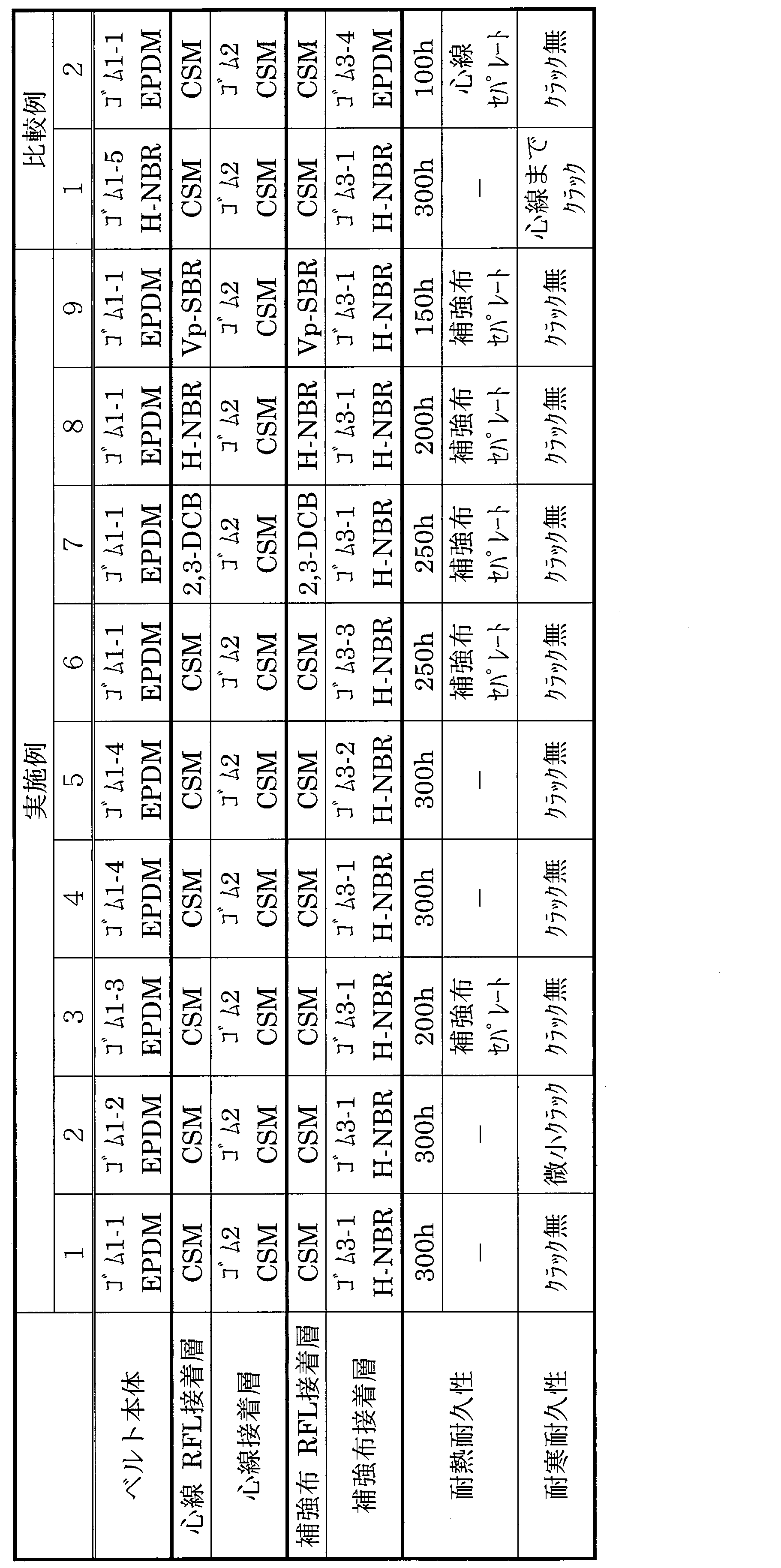
図8はベルト走行試験機30のプーリレイアウトを示す。
歯付ベルトBを、ベルト走行試験機30に、歯部が駆動プーリ31及び従動プーリ32に噛み合うと共に、ベルト背面がアイドラプーリ33に当接するように巻き掛けた後、従動プーリ32にデッドウェイトを負荷して歯付ベルトBに200Nの張力を与え、雰囲気温度120℃の下、駆動プーリ31を1000rpmの回転数で回転させてベルト走行させた。そして、50時間毎にベルト走行を停止して破損の有無を目視確認した。なお、ベルト走行時間の最長を300時間とした。
耐熱耐久性試験と同様に、歯付ベルトBをベルト走行試験機30にセットし、雰囲気温度-40℃の下、駆動プーリ31を1000rpmの回転数で回転させて1分間ベルト走行させた後に30分間停止する操作を1サイクルとし、それを500サイクルした後の破損の有無を目視確認した。
試験結果を表2に示す。
B’ 積層成形体
S ベルトスラブ
10 歯部
11 ベルト本体
11’ 未架橋ゴムシート
11a 背ゴム部
11b 歯ゴム部
12,12’ 心線
13,13’ 補強布
14a,14b RFL接着層
15a 心線接着層
15b 補強布接着層
16a,16b 下地接着層
17 含浸ゴム接着層
20 ベルト成形型
21 歯部形成溝
22 離型紙
23 ゴムスリーブ
30 ベルト走行試験機
31 駆動プーリ
32 従動プーリ
33 アイドラプーリ
Claims (14)
- ベルト長さ方向に一定ピッチで歯部が設けられた歯付ベルトであって、
エチレン含量が44~66質量%であるエチレン-α-オレフィンエラストマーをゴム成分の主体とするゴム組成物で形成されたベルト本体と、
前記ベルト本体の歯部側表面に、水素化ニトリルゴムをゴム成分の主体とするゴム組成物で形成された補強布接着層を介して貼設された補強布と、
を備えた歯付ベルト。 - 請求項1に記載された歯付ベルトにおいて、
前記ベルト本体を形成するゴム組成物のゴム成分に含まれたエチレン-α-オレフィンエラストマーのエチレン含量が60質量%以下である歯付ベルト。 - 請求項1又は2に記載された歯付ベルトにおいて、
前記ベルト本体を形成するゴム組成物が有機化酸化物により架橋している歯付ベルト。 - 請求項1乃至3のいずれかに記載された歯付ベルトにおいて、
前記ベルト本体を形成するゴム組成物が共架橋剤を含む歯付ベルト。 - 請求項4に記載された歯付ベルトにおいて、
前記共架橋剤がトリメチロールプロパントリメタクリレートを含む歯付ベルト。 - 請求項4又は5に記載された歯付ベルトにおいて、
前記共架橋剤が亜鉛ジメタクリレートを含む歯付ベルト。 - 請求項1乃至6のいずれかに記載された歯付ベルトにおいて、
前記補強布接着層を形成するゴム組成物のゴム成分が不飽和カルボン酸金属塩で強化された水素化ニトリルゴムを含む歯付ベルト。 - 請求項1乃至7のいずれかに記載された歯付ベルトにおいて、
前記補強布接着層を形成するゴム組成物のゴム成分に含まれた水素化ニトリルゴムの結合アクリロニトリル量が30~50質量%である歯付ベルト。 - 請求項1乃至8のいずれかに記載された歯付ベルトにおいて、
前記補強布接着層を形成するゴム組成物のゴム成分に含まれた水素化ニトリルゴムのヨウ素価が2~30mg/100mgである歯付ベルト。 - 請求項1乃至9のいずれかに記載された歯付ベルトにおいて、
前記補強布は、レゾルシンとホルムアルデヒドとの縮合物とラテックスに由来するゴム成分との混合物で形成されたRFL接着層で覆われていると共に、前記補強布接着層は、前記RFL接着層で覆われた前記補強布の前記ベルト本体側を覆うように設けられており、且つ前記補強布を覆う前記RFL接着層のゴム成分がクロロスルホン化ポリエチレン又は2,3-ジクロロ-1,3-ブタジエンポリマーを含む歯付ベルト。 - 請求項1乃至10のいずれかに記載された歯付ベルトにおいて、
前記ベルト本体に、クロロスルホン化ポリエチレンをゴム成分の主体とするゴム組成物で形成された心線接着層を介して埋設された心線を更に備えた歯付ベルト。 - 請求項11に記載された歯付ベルトにおいて、
前記心線接着層を形成するゴム組成物のゴム成分に含まれたクロロスルホン化ポリエチレンの塩素含有量が20~45質量%である歯付ベルト。 - 請求項11又は12に記載された歯付ベルトにおいて、
前記心線接着層を形成するゴム組成物のゴム成分に含まれたクロロスルホン化ポリエチレンの硫黄含有量が0.3~1.5質量%である歯付ベルト。 - 請求項11乃至13のいずれかに記載された歯付ベルトにおいて、
前記心線は、レゾルシンとホルムアルデヒドとの縮合物とラテックスに由来するゴム成分との混合物で形成されたRFL接着層で覆われていると共に、前記心線接着層は、前記RFL接着層で覆われた前記心線の外側を覆うように設けられており、且つ前記心線を覆う前記RFL接着層のゴム成分がクロロスルホン化ポリエチレン又は2,3-ジクロロ-1,3-ブタジエンポリマーを含む歯付ベルト。
Priority Applications (5)
| Application Number | Priority Date | Filing Date | Title |
|---|---|---|---|
| JP2017502275A JP6221011B1 (ja) | 2016-03-29 | 2017-01-05 | 歯付ベルト |
| DE112017001725.4T DE112017001725T5 (de) | 2016-03-29 | 2017-01-05 | Zahnriemen |
| CN201780014079.5A CN108700162B (zh) | 2016-03-29 | 2017-01-05 | 齿形带 |
| KR1020187025367A KR102660017B1 (ko) | 2016-03-29 | 2017-01-05 | 이붙이 벨트 |
| US16/118,287 US10767727B2 (en) | 2016-03-29 | 2018-08-30 | Toothed belt |
Applications Claiming Priority (2)
| Application Number | Priority Date | Filing Date | Title |
|---|---|---|---|
| JP2016064796 | 2016-03-29 | ||
| JP2016-064796 | 2016-03-29 |
Related Child Applications (1)
| Application Number | Title | Priority Date | Filing Date |
|---|---|---|---|
| US16/118,287 Continuation US10767727B2 (en) | 2016-03-29 | 2018-08-30 | Toothed belt |
Publications (1)
| Publication Number | Publication Date |
|---|---|
| WO2017168912A1 true WO2017168912A1 (ja) | 2017-10-05 |
Family
ID=59963971
Family Applications (1)
| Application Number | Title | Priority Date | Filing Date |
|---|---|---|---|
| PCT/JP2017/000136 Ceased WO2017168912A1 (ja) | 2016-03-29 | 2017-01-05 | 歯付ベルト |
Country Status (6)
| Country | Link |
|---|---|
| US (1) | US10767727B2 (ja) |
| JP (1) | JP6221011B1 (ja) |
| KR (1) | KR102660017B1 (ja) |
| CN (1) | CN108700162B (ja) |
| DE (1) | DE112017001725T5 (ja) |
| WO (1) | WO2017168912A1 (ja) |
Cited By (5)
| Publication number | Priority date | Publication date | Assignee | Title |
|---|---|---|---|---|
| JP6652688B1 (ja) * | 2018-10-17 | 2020-02-26 | バンドー化学株式会社 | 歯付ベルト |
| WO2020079917A1 (ja) * | 2018-10-17 | 2020-04-23 | バンドー化学株式会社 | 歯付ベルト |
| WO2025013887A1 (ja) * | 2023-07-13 | 2025-01-16 | バンドー化学株式会社 | 伝動ベルト |
| US12222020B2 (en) * | 2018-06-25 | 2025-02-11 | Mitsuboshi Belting Ltd. | Wrapped joined V-belt |
| JP7632722B1 (ja) | 2024-03-26 | 2025-02-19 | 株式会社椿本チエイン | 歯付ベルト |
Families Citing this family (10)
| Publication number | Priority date | Publication date | Assignee | Title |
|---|---|---|---|---|
| WO2015166310A1 (en) * | 2014-05-02 | 2015-11-05 | Dayco Europe S.R.L. | Transmission belt and associated transmission system |
| JP6616793B2 (ja) * | 2016-04-15 | 2019-12-04 | 三ツ星ベルト株式会社 | 摩擦伝動ベルト |
| US10753726B2 (en) | 2017-03-26 | 2020-08-25 | Cognex Corporation | System and method for 3D profile determination using model-based peak selection |
| JP6748131B2 (ja) * | 2017-04-27 | 2020-08-26 | 三ツ星ベルト株式会社 | はす歯ベルト伝動装置 |
| DE102019212077A1 (de) * | 2019-08-13 | 2021-02-18 | Contitech Antriebssysteme Gmbh | Zahnriemen zur Verwendung in Ölumgebung |
| DE102020216256A1 (de) * | 2020-12-18 | 2022-06-23 | Contitech Antriebssysteme Gmbh | Hochleistungszahnriemen aus EPDM |
| JP7323560B2 (ja) * | 2021-01-29 | 2023-08-08 | バンドー化学株式会社 | 摩擦伝動ベルト |
| WO2022249027A1 (en) * | 2021-05-24 | 2022-12-01 | Dayco Europe S.R.L. | Power transmission belt |
| JP7219369B1 (ja) * | 2021-07-07 | 2023-02-07 | バンドー化学株式会社 | 架橋ゴム組成物及びそれを用いた摩擦伝動ベルト |
| JP7406050B1 (ja) * | 2022-07-05 | 2023-12-26 | バンドー化学株式会社 | 歯付ベルト |
Citations (6)
| Publication number | Priority date | Publication date | Assignee | Title |
|---|---|---|---|---|
| JPH11158744A (ja) * | 1997-11-26 | 1999-06-15 | Nippon Glass Fiber Co Ltd | ゴム補強用ガラス繊維コードおよびゴムベルト |
| JP2004245405A (ja) * | 2003-01-21 | 2004-09-02 | Mitsuboshi Belting Ltd | 歯付ベルト |
| US20060148603A1 (en) * | 2004-12-31 | 2006-07-06 | George Burrowes | Fabric adhesion improvement for EPDM based low cost timing belt |
| JP2007009966A (ja) * | 2005-06-29 | 2007-01-18 | Mitsuboshi Belting Ltd | 伝動ベルト |
| JP2011196526A (ja) * | 2010-03-23 | 2011-10-06 | Tsubakimoto Chain Co | 歯付ベルト |
| WO2014064879A1 (ja) * | 2012-10-23 | 2014-05-01 | バンドー化学株式会社 | 伝動ベルト |
Family Cites Families (3)
| Publication number | Priority date | Publication date | Assignee | Title |
|---|---|---|---|---|
| JP2005155682A (ja) * | 2003-11-20 | 2005-06-16 | Bando Chem Ind Ltd | 伝動ベルト帆布用処理液、伝動ベルト用帆布及び伝動ベルト |
| CN102317644B (zh) * | 2009-02-24 | 2012-08-15 | 阪东化学株式会社 | 摩擦传动带、带传动装置和摩擦传动带的制造方法 |
| JP5885240B2 (ja) * | 2011-11-21 | 2016-03-15 | ゲイツ・ユニッタ・アジア株式会社 | 伝動ベルト |
-
2017
- 2017-01-05 JP JP2017502275A patent/JP6221011B1/ja active Active
- 2017-01-05 KR KR1020187025367A patent/KR102660017B1/ko active Active
- 2017-01-05 WO PCT/JP2017/000136 patent/WO2017168912A1/ja not_active Ceased
- 2017-01-05 CN CN201780014079.5A patent/CN108700162B/zh active Active
- 2017-01-05 DE DE112017001725.4T patent/DE112017001725T5/de active Pending
-
2018
- 2018-08-30 US US16/118,287 patent/US10767727B2/en active Active
Patent Citations (6)
| Publication number | Priority date | Publication date | Assignee | Title |
|---|---|---|---|---|
| JPH11158744A (ja) * | 1997-11-26 | 1999-06-15 | Nippon Glass Fiber Co Ltd | ゴム補強用ガラス繊維コードおよびゴムベルト |
| JP2004245405A (ja) * | 2003-01-21 | 2004-09-02 | Mitsuboshi Belting Ltd | 歯付ベルト |
| US20060148603A1 (en) * | 2004-12-31 | 2006-07-06 | George Burrowes | Fabric adhesion improvement for EPDM based low cost timing belt |
| JP2007009966A (ja) * | 2005-06-29 | 2007-01-18 | Mitsuboshi Belting Ltd | 伝動ベルト |
| JP2011196526A (ja) * | 2010-03-23 | 2011-10-06 | Tsubakimoto Chain Co | 歯付ベルト |
| WO2014064879A1 (ja) * | 2012-10-23 | 2014-05-01 | バンドー化学株式会社 | 伝動ベルト |
Cited By (10)
| Publication number | Priority date | Publication date | Assignee | Title |
|---|---|---|---|---|
| US12222020B2 (en) * | 2018-06-25 | 2025-02-11 | Mitsuboshi Belting Ltd. | Wrapped joined V-belt |
| JP6652688B1 (ja) * | 2018-10-17 | 2020-02-26 | バンドー化学株式会社 | 歯付ベルト |
| WO2020079917A1 (ja) * | 2018-10-17 | 2020-04-23 | バンドー化学株式会社 | 歯付ベルト |
| CN111656047A (zh) * | 2018-10-17 | 2020-09-11 | 阪东化学株式会社 | 齿形带 |
| US11085505B2 (en) | 2018-10-17 | 2021-08-10 | Bando Chemical Industries, Ltd. | Toothed belt |
| CN111656047B (zh) * | 2018-10-17 | 2021-10-19 | 阪东化学株式会社 | 齿形带 |
| WO2025013887A1 (ja) * | 2023-07-13 | 2025-01-16 | バンドー化学株式会社 | 伝動ベルト |
| JPWO2025013887A1 (ja) * | 2023-07-13 | 2025-01-16 | ||
| JP7632722B1 (ja) | 2024-03-26 | 2025-02-19 | 株式会社椿本チエイン | 歯付ベルト |
| JP2025149605A (ja) * | 2024-03-26 | 2025-10-08 | 株式会社椿本チエイン | 歯付ベルト |
Also Published As
| Publication number | Publication date |
|---|---|
| JP6221011B1 (ja) | 2017-10-25 |
| JPWO2017168912A1 (ja) | 2018-04-05 |
| US20190011016A1 (en) | 2019-01-10 |
| DE112017001725T5 (de) | 2018-12-20 |
| KR20180123484A (ko) | 2018-11-16 |
| CN108700162B (zh) | 2020-09-15 |
| US10767727B2 (en) | 2020-09-08 |
| CN108700162A (zh) | 2018-10-23 |
| KR102660017B1 (ko) | 2024-04-23 |
Similar Documents
| Publication | Publication Date | Title |
|---|---|---|
| JP6221011B1 (ja) | 歯付ベルト | |
| JP6192641B2 (ja) | 伝動ベルト | |
| KR101516934B1 (ko) | 마찰 전동 벨트 및 그 제조방법 | |
| WO2010109533A1 (ja) | 平ベルト | |
| JP6609395B1 (ja) | 歯付ベルト | |
| WO2018008204A1 (ja) | 歯付ベルト及びその製造方法 | |
| JP2023160903A (ja) | Vリブドベルト | |
| JP6159883B2 (ja) | ゴム繊維複合体 | |
| JP2009115207A (ja) | 平ベルト | |
| JP6227529B2 (ja) | 伝動ベルト及びその製造方法 | |
| JP6598777B2 (ja) | 摩擦伝動ベルト及びその製造方法、並びにベルト伝動装置 | |
| KR102745454B1 (ko) | 마찰 전동 벨트 | |
| WO2024009664A1 (ja) | 歯付ベルト | |
| JP2018165514A (ja) | 歯付ベルト | |
| JP6158465B1 (ja) | 歯付ベルト及びその製造方法 | |
| JP7406050B1 (ja) | 歯付ベルト | |
| JP6383135B1 (ja) | 伝動ベルト及びその製造方法 | |
| JPWO2017033392A1 (ja) | 摩擦伝動ベルト | |
| JP6635753B2 (ja) | ベルト | |
| JP6581892B2 (ja) | 摩擦伝動ベルト |
Legal Events
| Date | Code | Title | Description |
|---|---|---|---|
| ENP | Entry into the national phase |
Ref document number: 2017502275 Country of ref document: JP Kind code of ref document: A |
|
| ENP | Entry into the national phase |
Ref document number: 20187025367 Country of ref document: KR Kind code of ref document: A |
|
| 121 | Ep: the epo has been informed by wipo that ep was designated in this application |
Ref document number: 17773462 Country of ref document: EP Kind code of ref document: A1 |
|
| 122 | Ep: pct application non-entry in european phase |
Ref document number: 17773462 Country of ref document: EP Kind code of ref document: A1 |