WO2017164129A1 - 電子デバイス用基板製造用ポリヒドロキシアミド組成物、及びポリベンゾオキサゾール樹脂フィルム - Google Patents
電子デバイス用基板製造用ポリヒドロキシアミド組成物、及びポリベンゾオキサゾール樹脂フィルム Download PDFInfo
- Publication number
- WO2017164129A1 WO2017164129A1 PCT/JP2017/010970 JP2017010970W WO2017164129A1 WO 2017164129 A1 WO2017164129 A1 WO 2017164129A1 JP 2017010970 W JP2017010970 W JP 2017010970W WO 2017164129 A1 WO2017164129 A1 WO 2017164129A1
- Authority
- WO
- WIPO (PCT)
- Prior art keywords
- group
- carbon atoms
- following formula
- polyhydroxyamide
- represented
- Prior art date
- Legal status (The legal status is an assumption and is not a legal conclusion. Google has not performed a legal analysis and makes no representation as to the accuracy of the status listed.)
- Ceased
Links
- 0 Cc1c(*)c(*)c(C)c(*)c1* Chemical compound Cc1c(*)c(*)c(C)c(*)c1* 0.000 description 2
- GXMIHVHJTLPVKL-UHFFFAOYSA-N CC(C)C(N(C)C)=O Chemical compound CC(C)C(N(C)C)=O GXMIHVHJTLPVKL-UHFFFAOYSA-N 0.000 description 1
- GULMZIHHFLXMOA-UHFFFAOYSA-N CN(C)CC([RnH])=O Chemical compound CN(C)CC([RnH])=O GULMZIHHFLXMOA-UHFFFAOYSA-N 0.000 description 1
Classifications
-
- C—CHEMISTRY; METALLURGY
- C08—ORGANIC MACROMOLECULAR COMPOUNDS; THEIR PREPARATION OR CHEMICAL WORKING-UP; COMPOSITIONS BASED THEREON
- C08G—MACROMOLECULAR COMPOUNDS OBTAINED OTHERWISE THAN BY REACTIONS ONLY INVOLVING UNSATURATED CARBON-TO-CARBON BONDS
- C08G69/00—Macromolecular compounds obtained by reactions forming a carboxylic amide link in the main chain of the macromolecule
- C08G69/02—Polyamides derived from amino-carboxylic acids or from polyamines and polycarboxylic acids
- C08G69/26—Polyamides derived from amino-carboxylic acids or from polyamines and polycarboxylic acids derived from polyamines and polycarboxylic acids
- C08G69/32—Polyamides derived from amino-carboxylic acids or from polyamines and polycarboxylic acids derived from polyamines and polycarboxylic acids from aromatic diamines and aromatic dicarboxylic acids with both amino and carboxylic groups aromatically bound
-
- C—CHEMISTRY; METALLURGY
- C08—ORGANIC MACROMOLECULAR COMPOUNDS; THEIR PREPARATION OR CHEMICAL WORKING-UP; COMPOSITIONS BASED THEREON
- C08G—MACROMOLECULAR COMPOUNDS OBTAINED OTHERWISE THAN BY REACTIONS ONLY INVOLVING UNSATURATED CARBON-TO-CARBON BONDS
- C08G73/00—Macromolecular compounds obtained by reactions forming a linkage containing nitrogen with or without oxygen or carbon in the main chain of the macromolecule, not provided for in groups C08G12/00 - C08G71/00
- C08G73/06—Polycondensates having nitrogen-containing heterocyclic rings in the main chain of the macromolecule
- C08G73/22—Polybenzoxazoles
-
- C—CHEMISTRY; METALLURGY
- C08—ORGANIC MACROMOLECULAR COMPOUNDS; THEIR PREPARATION OR CHEMICAL WORKING-UP; COMPOSITIONS BASED THEREON
- C08J—WORKING-UP; GENERAL PROCESSES OF COMPOUNDING; AFTER-TREATMENT NOT COVERED BY SUBCLASSES C08B, C08C, C08F, C08G or C08H
- C08J5/00—Manufacture of articles or shaped materials containing macromolecular substances
- C08J5/18—Manufacture of films or sheets
-
- C—CHEMISTRY; METALLURGY
- C08—ORGANIC MACROMOLECULAR COMPOUNDS; THEIR PREPARATION OR CHEMICAL WORKING-UP; COMPOSITIONS BASED THEREON
- C08L—COMPOSITIONS OF MACROMOLECULAR COMPOUNDS
- C08L77/00—Compositions of polyamides obtained by reactions forming a carboxylic amide link in the main chain; Compositions of derivatives of such polymers
- C08L77/10—Polyamides derived from aromatically bound amino and carboxyl groups of amino-carboxylic acids or of polyamines and polycarboxylic acids
-
- C—CHEMISTRY; METALLURGY
- C08—ORGANIC MACROMOLECULAR COMPOUNDS; THEIR PREPARATION OR CHEMICAL WORKING-UP; COMPOSITIONS BASED THEREON
- C08L—COMPOSITIONS OF MACROMOLECULAR COMPOUNDS
- C08L79/00—Compositions of macromolecular compounds obtained by reactions forming in the main chain of the macromolecule a linkage containing nitrogen with or without oxygen or carbon only, not provided for in groups C08L61/00 - C08L77/00
- C08L79/04—Polycondensates having nitrogen-containing heterocyclic rings in the main chain; Polyhydrazides; Polyamide acids or similar polyimide precursors
-
- H—ELECTRICITY
- H05—ELECTRIC TECHNIQUES NOT OTHERWISE PROVIDED FOR
- H05K—PRINTED CIRCUITS; CASINGS OR CONSTRUCTIONAL DETAILS OF ELECTRIC APPARATUS; MANUFACTURE OF ASSEMBLAGES OF ELECTRICAL COMPONENTS
- H05K1/00—Printed circuits
- H05K1/02—Details
- H05K1/03—Use of materials for the substrate
Definitions
- the present invention relates to a polyhydroxyamide composition for producing a substrate for an electronic device, and a polybenzoxazole resin film obtained from the composition.
- Glass has excellent heat resistance and low coefficient of linear expansion, so it is used as a member for electronic equipment. Therefore, excellent heat resistance and a low coefficient of linear expansion are also required for new materials replacing glass.
- it is necessary to process at a high temperature of 200 ° C. or higher, and in some cases 400 ° C. or higher while maintaining high dimensional accuracy. It is essential to be excellent in terms of characteristics.
- polyimide resins are attracting attention as candidates for new materials because of their high heat resistance, flame retardancy and excellent electrical insulation.
- generally used polyimide resins do not have a sufficiently low linear expansion coefficient to the extent that high dimensional accuracy can be maintained even under high temperature processing, and therefore, in the display manufacturing process, the resin shrinks (or expands). ) May not be possible at high temperatures.
- Non-patent Document 1 there is polybenzoxazole resin as a material having heat resistance and low linear expansion coefficient equal to or higher than those of polyimide.
- polyhydroxyamide which is a precursor of polybenzoxazole
- polyamic acid which is a precursor of polyimide
- Patent Document 3 a technique for protecting a side chain hydroxy group with a silyl group, using hexamethylphosphoric triamide as a solvent, or performing copolymerization with a polyamic acid has been reported.
- Patent Document 3 Patent Document 3
- silylating agents are expensive, and hexamethylphosphoric triamide is highly toxic and therefore lacks industrial applicability.
- the copolymerization with polyamic acid has a drawback of poor heat resistance.
- the present invention has been made in view of the above circumstances, and provides a polyhydroxyamide composition capable of providing a polybenzoxazole resin film having high heat resistance, and a polybenzoxazole resin film obtained from the composition. Objective.
- the present invention provides the following polyhydroxyamide composition for producing a substrate for an electronic device and a polybenzoxazole resin film.
- a polyhydroxyamide composition for producing a substrate for electronic devices comprising a unit represented by the following formula (1) and a polyhydroxyamide containing a unit represented by the following formula (2), and (B) an organic solvent.
- X 1 represents a biphenyldiyl group having a hydroxy group on the carbon atom adjacent to the carbon atom bonded to the nitrogen atom;
- Y 1 represents a divalent aromatic group having 6 to 14 carbon atoms]
- Y 2 represents a group represented by the following formula (3);
- n and m represent positive numbers satisfying 0 ⁇ n ⁇ 100, 0 ⁇ m ⁇ 100, and 0 ⁇ n + m ⁇ 100.
- Z 1 represents —O—, —NH— or —N (R) —
- R represents an alkyl group having 1 to 10 carbon atoms
- Ar 1 and Ar 2 are independently of each other; Represents a divalent aromatic group having 6 to 14 carbon atoms; a broken line represents a bond.
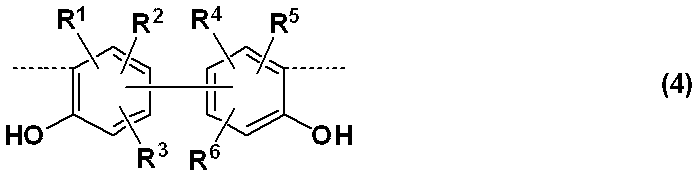
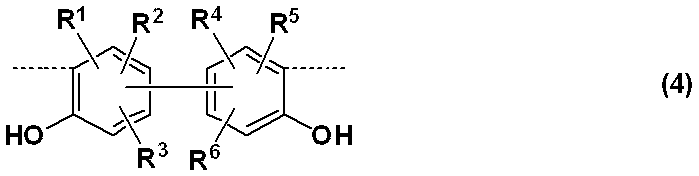
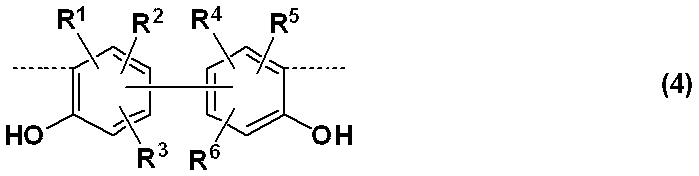
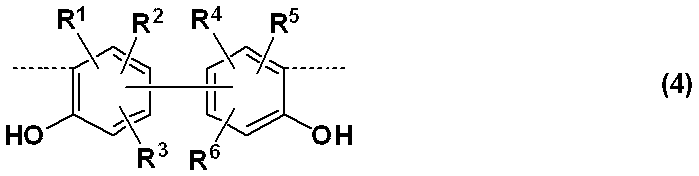
- a polyhydroxyamide composition for producing a substrate for an electronic device wherein X 1 is a group represented by the following formula (4): (Wherein R 1 to R 6 are each independently a hydrogen atom, a halogen atom, a nitro group, a cyano group, or an alkyl group having 1 to 20 carbon atoms which may be substituted with a halogen atom, Represents an alkenyl group having 2 to 20 carbon atoms, an alkynyl group having 2 to 20 carbon atoms, an aryl group having 6 to 20 carbon atoms or a heteroaryl group having 2 to 20 carbon atoms; a broken line represents a bond.) 3.
- Z 1 is as defined above; R 7 to R 18 may be independently of each other substituted with a hydrogen atom, a hydroxy group, a halogen atom, a nitro group, a cyano group, or a halogen atom.
- a broken line represents a bond.) 5.
- R 7 to R 18 are hydrogen atoms. 6).
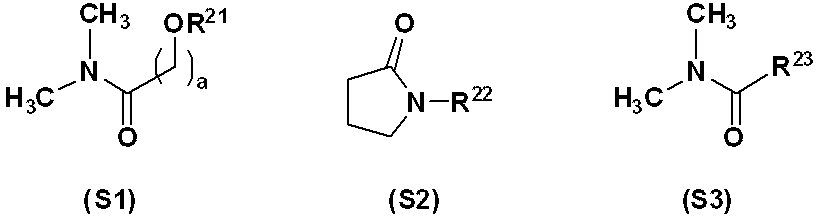
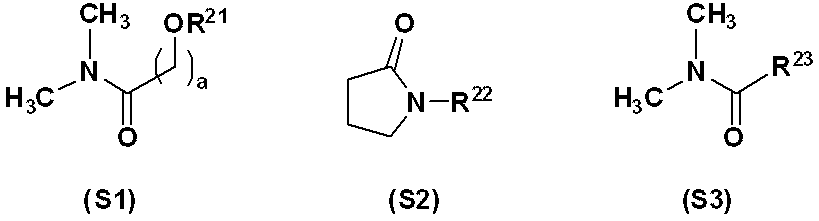
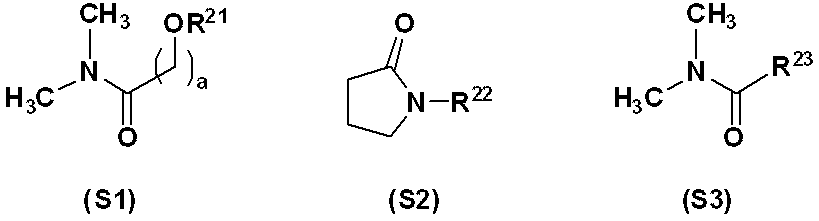
- the organic solvent contains at least one selected from amides represented by the following formula (S1), amides represented by the following formula (S2), and amides represented by the following formula (S3).
- S1 amides represented by the following formula
- S2 amides represented by the following formula (S3).
- R 21 and R 22 each independently represent an alkyl group having 1 to 10 carbon atoms.
- R 23 represents a hydrogen atom or an alkyl group having 1 to 10 carbon atoms.
- A is a natural number.
- An electronic device comprising: a step of applying a polyhydroxyamide composition for producing a substrate for an electronic device according to any one of 1 to 8 on a substrate; and a step of heating to evaporate a solvent and ring-closing the polyhydroxyamide
- a method for producing a polybenzoxazole resin film for a substrate 10.
- a polybenzoxazole resin film for an electronic device substrate obtained from the polyhydroxyamide composition according to any one of 10.1 to 8.
- An electronic device comprising as a substrate the polybenzoxazole resin film for a substrate for electronic devices according to 10.10 or 11. 13. 12 electronic devices which are organic EL elements.
- 14 A polyhydroxyamide containing a unit represented by the following formula (10) and a unit represented by the following formula (11). [Wherein, X 1 represents a biphenyldiyl group having a hydroxy group on the carbon atom adjacent to the carbon atom bonded to the nitrogen atom; Y 1 represents a divalent aromatic group having 6 to 14 carbon atoms] Y 2 represents a group represented by the following formula (3); n and m represent positive numbers satisfying 5 ⁇ n ⁇ 25, 75 ⁇ m ⁇ 95, and 80 ⁇ n + m ⁇ 100.
- R 1 to R 6 are each independently a hydrogen atom, a halogen atom, a nitro group, a cyano group, or an alkyl group having 1 to 20 carbon atoms which may be substituted with a halogen atom, Represents an alkenyl group having 2 to 20 carbon atoms, an alkynyl group having 2 to 20 carbon atoms, an aryl group having 6 to 20 carbon atoms or a heteroaryl group having 2 to 20 carbon atoms; a broken line represents a bond.
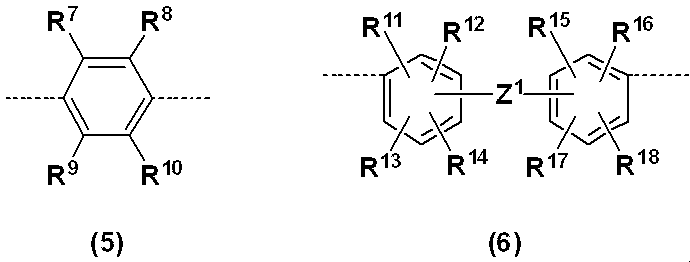
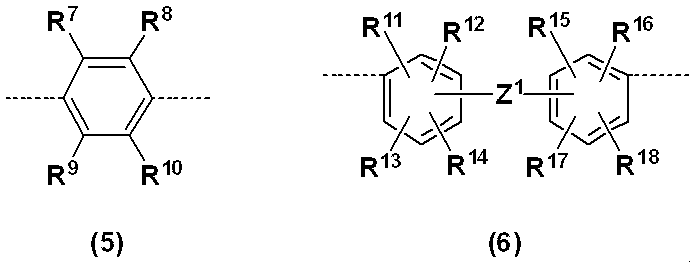
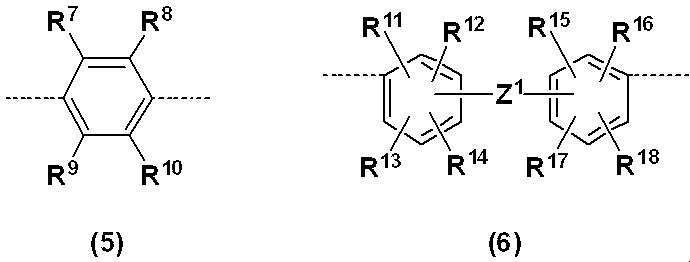
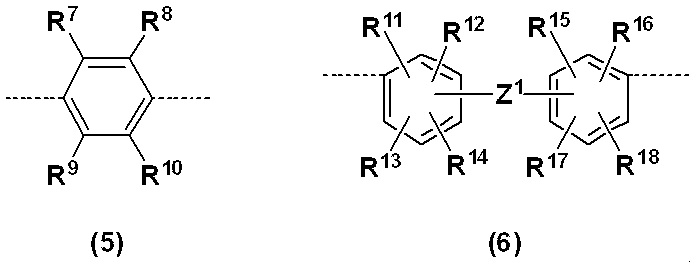
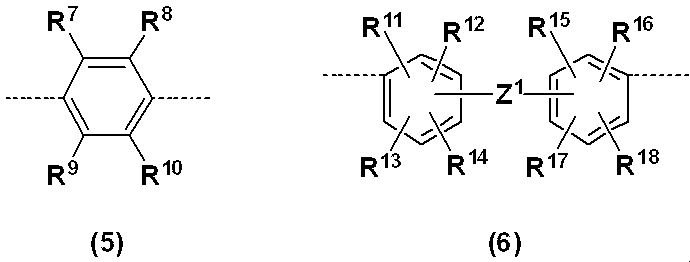
- Y 1 is a group represented by the following formula (5)
- Y 2 is a group represented by the following formula (6).
- Z 1 is as defined above; R 7 to R 18 may be independently of each other substituted with a hydrogen atom, a hydroxy group, a halogen atom, a nitro group, a cyano group, or a halogen atom.
- a broken line represents a bond.
- a method for producing a polyhydroxyamide comprising subjecting a dicarboxylic acid derivative represented by the following formula (14) in an amount of 0.75 to 0.95 mole to the mole to condensation polymerization in a solvent in the presence of a catalyst.
- X 1 represents a biphenyldiyl group having a hydroxy group on the carbon atom adjacent to the carbon atom bonded to the nitrogen atom; Y 1 represents a divalent aromatic group having 6 to 14 carbon atoms] ; Y 2 represents a group represented by the following formula (3).
- Z 1 represents —O—, —NH— or —N (R) —, R represents an alkyl group having 1 to 10 carbon atoms; Ar 1 and Ar 2 are independently of each other; Represents a divalent aromatic group having 6 to 14 carbon atoms; a broken line represents a bond.
- R 1 to R 6 are each independently a hydrogen atom, a halogen atom, a nitro group, a cyano group, or an alkyl group having 1 to 20 carbon atoms which may be substituted with a halogen atom, Represents an alkenyl group having 2 to 20 carbon atoms, an alkynyl group having 2 to 20 carbon atoms, an aryl group having 6 to 20 carbon atoms or a heteroaryl group having 2 to 20 carbon atoms; a broken line represents a bond.
- 22. 21. A method for producing a polyhydroxyamide according to 21, wherein X 1 is a group represented by the following formula (4 ′). (In the formula, a broken line represents a bond.) 23.
- a broken line represents a bond.
- 24. A method for producing a polyhydroxyamide of 23, wherein R 7 to R 18 are hydrogen atoms.
- 25. A process for producing a polyhydroxyamide according to any one of 20 to 24, wherein Y 2 is a group represented by the following formula (7), (8) or (9). (In the formula, a broken line represents a bond.)
- the polybenzoxazole resin film obtained from the polyhydroxyamide composition of the present invention has high heat resistance and a low linear expansion coefficient. Therefore, the polybenzoxazole resin film is useful as a substrate for electronic devices.
- the polyhydroxyamide composition for producing a substrate for an electronic device of the present invention comprises (A) a polyhydroxyamide having a predetermined structure, and (B) an organic solvent.
- the polyhydroxyamide as the component (A) includes a unit represented by the following formula (1) and a unit represented by the following formula (2).
- X 1 is a biphenyldiyl group having a hydroxy group on the carbon atom adjacent to the carbon atom bonded to the nitrogen atom.
- X 1 is preferably a group represented by the following formula (4).
- R 1 to R 6 are each independently a hydrogen atom, a halogen atom, a nitro group, a cyano group, or an alkyl group having 1 to 20 carbon atoms which may be substituted with a halogen atom, or 2 carbon atoms
- a broken line represents a bond.
- the alkyl group may be linear, branched or cyclic, and specific examples thereof include a methyl group, an ethyl group, an n-propyl group, an isopropyl group, a cyclopropyl group, an n-butyl group, an isobutyl group, sec-butyl group, tert-butyl group, cyclobutyl group, 1-methyl-cyclopropyl group, 2-methyl-cyclopropyl group, n-pentyl group, 1-methyl-n-butyl group, 2-methyl-n-butyl Group, 3-methyl-n-butyl group, 1,1-dimethyl-n-propyl group, 1,2-dimethyl-n-propyl group, 2,2-dimethyl-n-propyl group, 1-ethyl-n- Propyl group, cyclopentyl group, 1-methyl-cyclobutyl group, 2-methyl-cyclobutyl group, 3-methyl-cyclobutyl group,
- the alkenyl group may be linear, branched or cyclic, and specific examples thereof include ethenyl group, n-1-propenyl group, n-2-propenyl group, 1-methylethenyl group, n-1- Butenyl group, n-2-butenyl group, n-3-butenyl group, 2-methyl-1-propenyl group, 2-methyl-2-propenyl group, 1-ethylethenyl group, 1-methyl-1-propenyl group, 1 -Methyl-2-propenyl group, n-1-pentenyl group, n-1-decenyl group, n-1-eicocenyl group and the like.
- the alkynyl group may be linear, branched or cyclic, and specific examples thereof include ethynyl group, n-1-propynyl group, n-2-propynyl group, n-1-butynyl group, n- 2-butynyl group, n-3-butynyl group, 1-methyl-2-propynyl group, n-1-pentynyl group, n-2-pentynyl group, n-3-pentynyl group, n-4-pentynyl group, 1 -Methyl-n-butynyl group, 2-methyl-n-butynyl group, 3-methyl-n-butynyl group, 1,1-dimethyl-n-propynyl group, n-1-hexynyl group, n-1-decynyl group N-1-pentadecynyl group, n-1-eicosinyl group and the
- aryl group examples include phenyl group, 1-naphthyl group, 2-naphthyl group, 1-anthryl group, 2-anthryl group, 9-anthryl group, 1-phenanthryl group, 2-phenanthryl group, 3-phenanthryl group. Group, 4-phenanthryl group, 9-phenanthryl group and the like.
- heteroaryl group examples include 2-thienyl group, 3-thienyl group, 2-furanyl group, 3-furanyl group, 2-oxazolyl group, 4-oxazolyl group, 5-oxazolyl group, 3-isoxazolyl group, 4-isoxazolyl group, 5-isoxazolyl group, 2-thiazolyl group, 4-thiazolyl group, 5-thiazolyl group, 3-isothiazolyl group, 4-isothiazolyl group, 5-isothiazolyl group, 2-imidazolyl group, 4-imidazolyl group, Examples include 2-pyridyl group, 3-pyridyl group, 4-pyridyl group and the like.
- R 1 to R 6 are preferably a hydrogen atom, a methyl group, a halogen atom, or a phenyl group, more preferably a hydrogen atom, a methyl group, or a halogen atom, and most preferably a hydrogen atom.
- X 1 is most preferably a group represented by the following formula (4 ′). (In the formula, a broken line represents a bond.)
- Y 1 represents a divalent aromatic group having 6 to 14 carbon atoms.
- Y 2 represents a group represented by the following formula (3).
- Z 1 represents —O—, —NH— or —N (R) —
- R represents an alkyl group having 1 to 10 carbon atoms. Specific examples of the alkyl group represented by R include those described above. Z 1 is preferably —O— or —NH—.
- Ar 1 and Ar 2 each independently represent a divalent aromatic group having 6 to 14 carbon atoms.
- Examples of the divalent aromatic group represented by Y 1 , Ar 1 and Ar 2 include a phenylene group, a naphthylene group, an anthracenediyl group, a phenanthrene diyl group, a biphenyldiyl group, and the like. A part or all of them may be substituted with a substituent.
- Y 1 is preferably a group represented by the following formula (5)
- Y 2 is preferably a group represented by the following formula (6).
- R 7 to R 18 are each independently a hydrogen atom, a hydroxy group, a halogen atom, a nitro group, a cyano group, or an alkyl group having 1 to 20 carbon atoms which may be substituted with a halogen atom, or 2 carbon atoms
- a broken line represents a bond. Examples of the alkyl group, alkenyl group, alkynyl group, aryl group and heteroaryl group are the same as those described above.
- R 7 to R 18 are preferably a hydrogen atom, an alkyl group having 1 to 20 carbon atoms, a halogen atom or a phenyl group, more preferably a hydrogen atom, an alkyl group having 1 to 20 carbon atoms or a halogen atom, a hydrogen atom, methyl A group and a halogen atom are more preferable, and a hydrogen atom is most preferable.
- Y 2 is most preferably a group represented by the following formula (7), (8) or (9). (In the formula, a broken line represents a bond.)
- n and m represent positive numbers that satisfy 0 ⁇ n ⁇ 100, 0 ⁇ m ⁇ 100, and 0 ⁇ n + m ⁇ 100.
- n and m are preferably positive numbers satisfying 5 ⁇ n ⁇ 25, 75 ⁇ m ⁇ 95, and 80 ⁇ n + m ⁇ 100 from the viewpoint of solubility and heat resistance, and 10 ⁇ n ⁇ 25, 75 ⁇ m ⁇ 90.
- positive numbers satisfying 85 ⁇ n + m ⁇ 100 are more preferable, and positive numbers satisfying 20 ⁇ n ⁇ 25, 75 ⁇ m ⁇ 80, and 95 ⁇ n + m ⁇ 100 are even more preferable.
- the polyhydroxyamide may include units other than the unit represented by the formula (1) and the unit represented by the formula (2) (hereinafter also referred to as other units).
- the weight average molecular weight (Mw) of the polyhydroxyamide is preferably 5,000 to 1,000,000, more preferably 10,000 to 100,000, and even more preferably 20,000 to 100,000.
- Mw is an average molecular weight obtained by standard polystyrene conversion by gel permeation chromatography (GPC) analysis.
- the polyhydroxyamide contains a diamine compound represented by the following formula (12), a dicarboxylic acid derivative represented by the following formula (13), and a dicarboxylic acid derivative represented by the following formula (14) in a solvent, If necessary, it can be produced by condensation polymerization in the presence of a base.
- a diamine compound represented by the following formula (12) a dicarboxylic acid derivative represented by the following formula (13), and a dicarboxylic acid derivative represented by the following formula (14) in a solvent, If necessary, it can be produced by condensation polymerization in the presence of a base.
- X 1 , Y 1 and Y 2 are the same as described above.
- Hal represents a halogen atom such as a chlorine atom, a bromine atom or an iodine atom.
- the amount of the dicarboxylic acid derivative represented by the formula (13) is preferably 0.05 to 0.25 mol, based on 1 mol of the diamine compound represented by the formula (12). 0.25 mol is more preferable, and 0.20 to 0.25 mol is even more preferable.
- the amount of the dicarboxylic acid derivative represented by the formula (14) is preferably from 0.75 to 0.95 mol, preferably from 0.75 to 0, per 1 mol of the diamine compound represented by the formula (12). .90 mol is more preferable, and 0.75 to 0.80 mol is even more preferable.
- solvent used in the condensation polymerization reaction examples include N-methyl-2-pyrrolidone (NMP), N-ethyl-2-pyrrolidone, N, N-dimethylformamide, N, N-dimethylacetamide, hexamethylphosphoric triamide, 3 -Methoxy-N, N-dimethylpropanamide, 3-butoxy-N, N-dimethylpropanamide and the like.
- Examples of the base include potassium carbonate, potassium hydroxide, sodium carbonate, sodium hydroxide, sodium hydrogen carbonate, sodium ethoxide, sodium acetate, lithium carbonate, lithium hydroxide, lithium oxide, potassium acetate, magnesium oxide, calcium oxide, water Barium oxide, trilithium phosphate, trisodium phosphate, tripotassium phosphate, cesium fluoride, aluminum oxide, ammonia, n-propylamine, trimethylamine, triethylamine, diisopropylamine, diisopropylethylamine, N-methylpiperidine, 2,2 , 6,6-tetramethyl-N-methylpiperidine, pyridine, 4-dimethylaminopyridine, N-methylmorpholine and the like.
- the amount of the base added is preferably 0.5 to 3.0 mol, more preferably 0.8 to 2.0 mol, relative to 1 mol of the diamine compound.
- the reaction temperature may be appropriately set in the range from the melting point of the solvent to be used to the boiling point of the solvent, and is usually about ⁇ 20 to 100 ° C., preferably about ⁇ 10 to 100 ° C.
- the polymerization reaction time is usually about 1 to 48 hours, preferably about 1 to 24 hours.
- the organic solvent of component (B) is not particularly limited as long as it can dissolve the polyhydroxyamide, but considering that a highly flat polybenzoxazole resin film can be obtained with good reproducibility, the following formula (S1) And those containing at least one selected from amides represented by the following formula (S2) and amides represented by the following formula (S3).
- R 21 and R 22 each independently represent an alkyl group having 1 to 10 carbon atoms.
- R 23 represents a hydrogen atom or an alkyl group having 1 to 10 carbon atoms.
- the alkyl group may be linear, branched or cyclic, and specifically includes a methyl group, an ethyl group, an n-propyl group, an isopropyl group, a cyclopropyl group, an n-butyl group, an isobutyl group, Examples thereof include a sec-butyl group and a tert-butyl group.
- a represents a natural number, preferably a natural number of 1 to 3, more preferably 1 or 2.
- Examples of the organic solvent represented by the formula (S1) include 2-methoxy-N, N-dimethylacetamide, 3-methoxy-N, N-dimethylpropylamide, 3-ethoxy-N, N-dimethylpropylamide, 3- Propoxy-N, N-dimethylpropylamide, 3-isopropoxy-N, N-dimethylpropylamide, 3-butoxy-N, N-dimethylpropylamide, 3-sec-butoxy-N, N-dimethylpropylamide, 3 -Tert-butoxy-N, N-dimethylpropylamide and the like.
- Examples of the organic solvent represented by the formula (S2) include N-methyl-2-pyrrolidone (NMP), N-ethyl-2-pyrrolidone, N-propyl-2-pyrrolidone, N-butyl-2-pyrrolidone and the like. It is done.
- Examples of the organic solvent represented by the formula (S3) include N, N-dimethylformamide, N, N-dimethylacetamide, N, N-dimethylpropionamide, N, N-dimethylisobutyramide and the like.
- the solvent alone does not dissolve the polyhydroxyamide, it can be used in addition to the solvent as long as the solubility is not impaired.
- Specific examples thereof include ethyl cellosolve, butyl cellosolve, ethyl carbitol, butyl carbitol, ethyl carbitol acetate, ethylene glycol, 1-methoxy-2-propanol, 1-ethoxy-2-propanol, and 1-butoxy-2-propanol.
- the concentration of polyhydroxyamide is appropriately set in consideration of the thickness of the resin film to be produced, the viscosity of the composition, etc., but is usually about 1 to 30% by mass, preferably 1 About 20% by mass.
- the polybenzoxazole resin film of the present invention is obtained from the polyhydroxyamide composition.
- the method for producing the polybenzoxazole resin film includes a step of applying the polyhydroxyamide composition onto a substrate, and a step of heating to evaporate the solvent and ring-closing the polyhydroxyamide.
- the substrate examples include glass, plastic (polycarbonate, polymethacrylate, polystyrene, polyester, polyolefin, epoxy resin, melamine resin, triacetyl cellulose, ABS, AS, norbornene resin, etc.), metal (silicon wafer, etc.), SiN, Examples thereof include glass substrates with vapor deposition films such as SiO films, wood, paper, slate, etc. From the viewpoint of productivity, glass, metal (silicon wafer, etc.) are particularly preferable.
- the base material surface may be comprised with the single material and may be comprised with two or more materials.
- the method for applying the polyhydroxyamide composition is not particularly limited, for example, cast coating method, spin coating method, blade coating method, dip coating method, roll coating method, bar coating method, die coating method, inkjet method, Examples of the printing method include relief printing, intaglio printing, planographic printing, and screen printing.
- the heating temperature for evaporating the organic solvent is preferably 50 to 200 ° C, more preferably 50 to 150 ° C.
- the heating time at that time is preferably 5 minutes to 5 hours, and more preferably 5 minutes to 3 hours.
- the heating temperature for ring closure is usually appropriately determined within the range of 50 to 550 ° C., but is preferably 200 ° C. or more, and preferably 500 ° C. or less. By setting the heating temperature in this way, it is possible to sufficiently advance the oxazolation reaction while preventing the obtained film from being weakened.
- the heating time varies depending on the heating temperature, and cannot be generally defined, but is usually 5 minutes to 5 hours.
- the ring closure rate may be in the range of 50 to 100%.
- the heating temperature is gradually raised as it is, and finally heating is performed at a temperature exceeding 375 ° C. to 450 ° C. for 30 minutes to 4 hours.
- the thickness of the resin film is not particularly limited, but when used as a substrate of an electronic device to be described later, it is usually about 1 to 100 ⁇ m, preferably about 5 to 75 ⁇ m from the viewpoint of sufficient self-supporting property and flexibility. The thickness is preferably about 5 to 50 ⁇ m.
- the resin film After the resin film is formed, the resin film can be peeled off from the substrate and recovered.
- the film can be peeled by immersion in water, a laser lift-off method using ultraviolet light having a wavelength of 308 nm, or the like.
- the polybenzoxazole resin film of the present invention thus obtained has high heat resistance and a small linear expansion coefficient.
- the polybenzoxazole resin film of the present invention preferably has a 5% weight loss temperature of 600 ° C. or higher and a linear expansion coefficient of 50 to 400 ° C. of 8 ppm / ° C. or lower.
- the electronic device of the present invention comprises the above-described polybenzoxazole resin film as a substrate.
- the electronic device include an organic EL element, a liquid crystal display, an organic EL display, an optical semiconductor (LED) element, electronic paper, a solid-state imaging element, an organic thin film solar cell, a dye-sensitized solar cell, an organic thin film transistor (TFT), and a 3D display. And a touch panel.
- the polyhydroxyamide composition is applied on a substrate and heated to form a polybenzoxazole resin film fixed to the substrate.
- a desired circuit is formed on the resin film, and then the resin film is cut, and the resin film on which the circuit is formed is peeled off from the substrate to form a circuit.
- an electronic device can be manufactured.
- NMP N-methylpyrrolidone HAB: 4,4′-diamino-3,3′-dihydroxybiphenyl 4BP: 3,3′-diamino-4,4′-dihydroxybiphenyl
- TPC terephthalic acid chloride
- IPC isophthalic acid chloride
- DEDC 4,4'-diphenyl ether dicarboxylic acid chloride
- Mw and Mw / Mn of the polymer are GPC apparatus manufactured by JASCO Corporation (column: Shodex (registered trademark) columns KF803L and KF805L manufactured by Showa Denko KK, elution solvent: dimethylformamide, flow rate: 1.0 mL / min, Column temperature: 50 ° C., Mw: standard polystyrene conversion value).
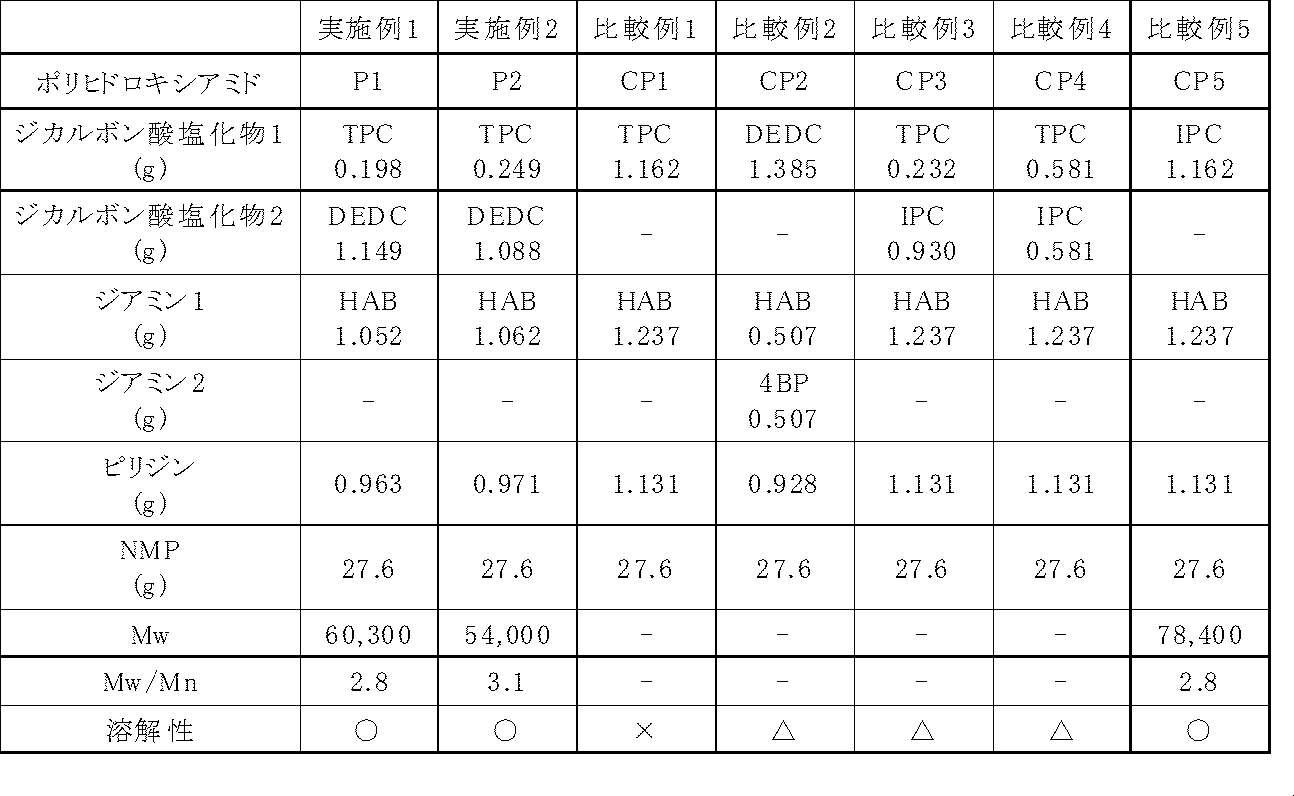
- Example 2 Comparative Examples 1 to 5
- Synthesis of polyhydroxyamide P2 and polyhydroxyamides CP1 to CP5 Polyhydroxyamide P2 and polyhydroxyamides CP1 to CP5 were synthesized in the same manner as in Example 1.
- Table 1 shows the type and amount of dicarboxylic acid chloride used, the type and amount of diamine, the amount of NMP used, Mw, and Mw / Mn.
- the heating temperature was raised to 400 ° C. and heated at 400 ° C. for 60 minutes. During the temperature increase, the film-coated substrate was not removed from the oven but heated in the oven.
- the film thickness of the obtained coating film was measured with a contact-type film thickness measuring device (Dektak 3ST manufactured by ULVAC). Table 2 shows the measurement results of the film thickness. Thereafter, the glass substrate was allowed to stand in 70 ° C. pure water in a 1 L beaker, and the film was peeled off.
Landscapes
- Chemical & Material Sciences (AREA)
- Chemical Kinetics & Catalysis (AREA)
- Polymers & Plastics (AREA)
- Organic Chemistry (AREA)
- Medicinal Chemistry (AREA)
- Health & Medical Sciences (AREA)
- Engineering & Computer Science (AREA)
- Manufacturing & Machinery (AREA)
- Materials Engineering (AREA)
- Microelectronics & Electronic Packaging (AREA)
- Macromolecular Compounds Obtained By Forming Nitrogen-Containing Linkages In General (AREA)
- Manufacture Of Macromolecular Shaped Articles (AREA)
- Compositions Of Macromolecular Compounds (AREA)
- Polyamides (AREA)
- Liquid Crystal (AREA)
Abstract
Description
1.(A)下記式(1)で表される単位及び下記式(2)で表される単位を含むポリヒドロキシアミド、及び(B)有機溶媒を含む電子デバイス用基板製造用ポリヒドロキシアミド組成物。


2.X1が、下記式(4)で表される基である1の電子デバイス用基板製造用ポリヒドロキシアミド組成物。

3.X1が、下記式(4')で表される基である2の電子デバイス用基板製造用ポリヒドロキシアミド組成物。

4.Y1が下記式(5)で表される基であり、Y2が下記式(6)で表される基である1~3のいずれかの電子デバイス用基板製造用ポリヒドロキシアミド組成物。
5.R7~R18が、水素原子である4の電子デバイス用基板製造用ポリヒドロキシアミド組成物。
6.Y2が、下記式(7)、(8)又は(9)で表される基である1~5のいずれかの電子デバイス用基板製造用ポリヒドロキシアミド組成物。

7.n及びmが、5≦n≦25、75≦m≦95、及び80≦n+m≦100を満たす正数である1~6のいずれかの電子デバイス用基板製造用ポリヒドロキシアミド組成物。
8.(B)有機溶媒が、下記式(S1)で表されるアミド類、下記式(S2)で表されるアミド類及び下記式(S3)で表されるアミド類から選ばれる少なくとも1つを含む1~7のいずれかの電子デバイス用基板用ポリヒドロキシアミド組成物。
9.1~8のいずれかの電子デバイス用基板製造用ポリヒドロキシアミド組成物を基材上に塗布する工程、及び加熱して溶媒を蒸発させ、ポリヒドロキシアミドを閉環させる工程を含む電子デバイス用基板用ポリベンゾオキサゾール樹脂フィルムの製造方法。
10.1~8のいずれかのポリヒドロキシアミド組成物から得られる電子デバイス用基板用ポリベンゾオキサゾール樹脂フィルム。
11.5%重量減少温度が600℃以上であり、50~400℃の線膨張係数が8ppm/℃以下である10の電子デバイス用基板用ポリベンゾオキサゾール樹脂フィルム。
12.10又は11の電子デバイス用基板用ポリベンゾオキサゾール樹脂フィルムを基板として備える電子デバイス。
13.有機EL素子である12の電子デバイス。
14.下記式(10)で表される単位及び下記式(11)で表される単位を含むポリヒドロキシアミド。


15.X1が、下記式(4)で表される基である14のポリヒドロキシアミド。
16.X1が、下記式(4')で表される基である15のポリヒドロキシアミド。

17.Y1が下記式(5)で表される基であり、Y2が下記式(6)で表される基である14~16のいずれかのポリヒドロキシアミド。
18.R7~R18が、水素原子である17のポリヒドロキシアミド。
19.Y2が、下記式(7)、(8)又は(9)で表される基である14~18のいずれかのポリヒドロキシアミド。

20.下記式(12)で表されるジアミン化合物、前記ジアミン化合物1モルに対して0.05~0.25モルとなる量の下記式(13)で表されるジカルボン酸誘導体、及び前記ジアミン化合物1モルに対して0.75~0.95モルとなる量の下記式(14)で表されるジカルボン酸誘導体を、溶媒中、触媒の存在下で縮合重合させる、ポリヒドロキシアミドの製造方法。


21.X1が、下記式(4)で表される基である20のポリヒドロキシアミドの製造方法。
22.X1が、下記式(4')で表される基である21のポリヒドロキシアミドの製造方法。

23.Y1が下記式(5)で表される基であり、Y2が下記式(6)で表される基である20~22のいずれかのポリヒドロキシアミドの製造方法。
24.R7~R18が、水素原子である23のポリヒドロキシアミドの製造方法。
25.Y2が、下記式(7)、(8)又は(9)で表される基である20~24のいずれかのポリヒドロキシアミドの製造方法。

本発明の電子デバイス用基板製造用ポリヒドロキシアミド組成物は、(A)所定の構造のポリヒドロキシアミド、及び(B)有機溶媒を含むものである。
(A)成分であるポリヒドロキシアミドは、下記式(1)で表される単位及び下記式(2)で表される単位を含むものである。





前記ポリヒドロキシアミドは、下記式(12)で表されるジアミン化合物、下記式(13)で表されるジカルボン酸誘導体、及び下記式(14)で表されるジカルボン酸誘導体を、溶媒中で、必要に応じて塩基の存在下で縮合重合させることによって製造することができる。

(B)成分の有機溶媒としては、前記ポリヒドロキシアミドを溶解できるものである限り特に限定されないが、平坦性の高いポリベンゾオキサゾール樹脂フィルムを再現性よく得ることを考慮すると、下記式(S1)で表されるアミド類、下記式(S2)で表されるアミド類及び下記式(S3)で表されるアミド類から選ばれる少なくとも1種を含むものが好ましい。
本発明のポリベンゾオキサゾール樹脂フィルムは、前記ポリヒドロキシアミド組成物から得られるものである。前記ポリベンゾオキサゾール樹脂フィルムの製造方法は、前記ポリヒドロキシアミド組成物を基材上に塗布する工程、及び加熱して溶媒を蒸発させ、ポリヒドロキシアミドを閉環させる工程を含むものである。
本発明の電子デバイスは、前述したポリベンゾオキサゾール樹脂フィルムを基板として備えるものである。前記電子デバイスとしては、有機EL素子、液晶ディスプレイ、有機ELディスプレイ、光半導体(LED)素子、電子ペーパー、固体撮像素子、有機薄膜太陽電池、色素増感太陽電池、有機薄膜トランジスタ(TFT)、3Dディスプレイ、タッチパネル等が挙げられる。
HAB:4,4'-ジアミノ-3,3'-ジヒドロキシビフェニル
4BP:3,3'-ジアミノ-4,4'-ジヒドロキシビフェニル
TPC:テレフタル酸クロリド
IPC:イソフタル酸クロリド
DEDC:4,4'-ジフェニルエーテルジカルボン酸クロリド
ポリマーのMwとMw/Mnは、日本分光(株)製GPC装置(カラム:昭和電工(株)製Shodex(登録商標)カラムKF803L及びKF805L、溶出溶媒:ジメチルホルムアミド、流量:1.0mL/分、カラム温度:50℃、Mw:標準ポリスチレン換算値)を用いて測定した。
[実施例1]ポリヒドロキシアミドP1の合成
HAB1.052g(4.87mmol)をNMP27.6gに溶かし、ピリジン0.963g(12.18mmol)を添加した後、DEDC1.149g(3.90mmol)とTPC0.198g(0.97mmol)とを添加し、室温にて24時間攪拌した。その後、得られた溶液を純水500mLへ投入した。得られた沈殿物を濾別後、70℃で24時間減圧乾燥し、目的のポリヒドロキシアミドP1を得た。GPC測定によるポリヒドロキシアミドP1のMwは60,300、Mw/Mnは2.8であった。
実施例1と同様の方法で、ポリヒドロキシアミドP2、ポリヒドロキシアミドCP1~CP5を合成した。使用したジカルボン酸塩化物の種類と使用量、ジアミンの種類と使用量、NMPの使用量、Mw、及びMw/Mnを表1に示す。
作製したポリヒドロキシアミド1gをNMP20gに入れ、室温で48時間攪拌し、再溶解させた。
結果を表1に併記する。なお、溶解性の評価基準は、以下のとおりである。
○:重合中溶解し、精製後も再溶解する。
△:重合中溶解するが、精製後は再溶解しない。
×:重合中析出する。
[キュア前膜厚・剥離方法]
実施例1~2及び比較例5で作製したポリヒドロキシアミド1gを、NMP20mLに溶解させ、ポリヒドロキシアミド組成物を調製した。
得られた各組成物を、100mm×100mmガラス基板上にバーコーターを用いて塗布し、ホットプレート上で80℃30分ベークした。その後、140℃で30分間加熱し、加熱温度を210℃まで昇温(10℃/分、以下同様)し、210℃で30分間、加熱温度を300℃まで昇温し、300℃で30分間、加熱温度を400℃まで昇温し、400℃で60分間加熱した。昇温の間、膜付き基板をオーブンから取り出すことはせず、オーブン内で加熱した。得られた塗布膜の膜厚は、接触式膜厚測定器((株)ULVAC製Dektak 3ST)で測定した。膜厚の測定結果を表2に示す。その後、ガラス基板ごと、1Lビーカー内の70℃の純水中に静置し、フィルムの剥離を行った。
得られたフィルムから20mm×5mmの短冊を作製し、TMA-4000SA(ブルカー・エイエックスエス(株)製)を用いて、50℃から400℃まで、10℃/分の条件で昇温し、線膨張係数を測定した。結果を表2に示す。
得られたフィルムから20mm×3mmの短冊を作製し、TGA-DTA-2000SR(ブルカー・エイエックスエス(株)製)を用いて、50℃から600℃まで重量減少を測定し、5%重量減少温度を確認した。結果を表2に示す。なお、600℃で5%重量減少しない場合は、600℃<と記載した。
作製したフィルムを剥離し、その後、全方向に90°曲げた後、特に変化が無いものを自己支持性があるものとした。
結果を表2に示す。なお、自己支持性の評価基準は、以下のとおりである。
○:自己支持性あり。90度にまげても割れない
△:自己支持性はあるが、曲げて割れる
×:自己支持性なし
××:基板上で分解

Claims (25)
- (A)下記式(1)で表される単位及び下記式(2)で表される単位を含むポリヒドロキシアミド、及び(B)有機溶媒を含む電子デバイス用基板製造用ポリヒドロキシアミド組成物。


- X1が、下記式(4)で表される基である請求項1記載の電子デバイス用基板製造用ポリヒドロキシアミド組成物。

- X1が、下記式(4')で表される基である請求項2記載の電子デバイス用基板製造用ポリヒドロキシアミド組成物。

- Y1が下記式(5)で表される基であり、Y2が下記式(6)で表される基である請求項1~3のいずれか1項記載の電子デバイス用基板製造用ポリヒドロキシアミド組成物。
- R7~R18が、水素原子である請求項4記載の電子デバイス用基板製造用ポリヒドロキシアミド組成物。
- Y2が、下記式(7)、(8)又は(9)で表される基である請求項1~5のいずれか1項記載の電子デバイス用基板製造用ポリヒドロキシアミド組成物。

- n及びmが、5≦n≦25、75≦m≦95、及び80≦n+m≦100を満たす正数である請求項1~6のいずれか1項記載の電子デバイス用基板製造用ポリヒドロキシアミド組成物。
- (B)有機溶媒が、下記式(S1)で表されるアミド類、下記式(S2)で表されるアミド類及び下記式(S3)で表されるアミド類から選ばれる少なくとも1つを含む請求項1~7のいずれか1項記載の電子デバイス用基板用ポリヒドロキシアミド組成物。
- 請求項1~8のいずれか1項記載の電子デバイス用基板製造用ポリヒドロキシアミド組成物を基材上に塗布する工程、及び加熱して溶媒を蒸発させ、ポリヒドロキシアミドを閉環させる工程を含む電子デバイス用基板用ポリベンゾオキサゾール樹脂フィルムの製造方法。
- 請求項1~8のいずれか1項記載のポリヒドロキシアミド組成物から得られる電子デバイス用基板用ポリベンゾオキサゾール樹脂フィルム。
- 5%重量減少温度が600℃以上であり、50~400℃の線膨張係数が8ppm/℃以下である請求項10記載の電子デバイス用基板用ポリベンゾオキサゾール樹脂フィルム。
- 請求項10又は11記載の電子デバイス用基板用ポリベンゾオキサゾール樹脂フィルムを基板として備える電子デバイス。
- 有機エレクトロルミネッセンス素子である請求項12記載の電子デバイス。
- 下記式(10)で表される単位及び下記式(11)で表される単位を含むポリヒドロキシアミド。


- X1が、下記式(4)で表される基である請求項14記載のポリヒドロキシアミド。
- X1が、下記式(4')で表される基である請求項15記載のポリヒドロキシアミド。

- Y1が下記式(5)で表される基であり、Y2が下記式(6)で表される基である請求項14~16のいずれか1項記載のポリヒドロキシアミド。
- R7~R18が、水素原子である請求項17記載のポリヒドロキシアミド。
- Y2が、下記式(7)、(8)又は(9)で表される基である請求項14~18のいずれか1項記載のポリヒドロキシアミド。

- 下記式(12)で表されるジアミン化合物、前記ジアミン化合物1モルに対して0.05~0.25モルとなる量の下記式(13)で表されるジカルボン酸誘導体、及び前記ジアミン化合物1モルに対して0.75~0.95モルとなる量の下記式(14)で表されるジカルボン酸誘導体を、溶媒中、触媒の存在下で縮合重合させる、ポリヒドロキシアミドの製造方法。


- X1が、下記式(4)で表される基である請求項20記載のポリヒドロキシアミドの製造方法。

- X1が、下記式(4')で表される基である請求項21記載のポリヒドロキシアミドの製造方法。

- Y1が下記式(5)で表される基であり、Y2が下記式(6)で表される基である請求項20~22のいずれか1項記載のポリヒドロキシアミドの製造方法。

- R7~R18が、水素原子である請求項23記載のポリヒドロキシアミドの製造方法。
- Y2が、下記式(7)、(8)又は(9)で表される基である請求項20~24のいずれか1項記載のポリヒドロキシアミドの製造方法。

Priority Applications (4)
| Application Number | Priority Date | Filing Date | Title |
|---|---|---|---|
| JP2018507311A JP6904332B2 (ja) | 2016-03-22 | 2017-03-17 | 有機エレクトロルミネッセンス素子 |
| CN201780018985.2A CN108884316B (zh) | 2016-03-22 | 2017-03-17 | 用于制造电子器件用基板的聚羟基酰胺组合物、和聚苯并噁唑树脂膜 |
| KR1020217025205A KR102382236B1 (ko) | 2016-03-22 | 2017-03-17 | 전자 디바이스용 기판 제조용 폴리하이드록시아마이드 조성물 및 폴리벤조옥사졸 수지 필름 |
| KR1020187028067A KR20180127376A (ko) | 2016-03-22 | 2017-03-17 | 전자 디바이스용 기판 제조용 폴리하이드록시아마이드 조성물 및 폴리벤조옥사졸 수지 필름 |
Applications Claiming Priority (2)
| Application Number | Priority Date | Filing Date | Title |
|---|---|---|---|
| JP2016057144 | 2016-03-22 | ||
| JP2016-057144 | 2016-03-22 |
Publications (1)
| Publication Number | Publication Date |
|---|---|
| WO2017164129A1 true WO2017164129A1 (ja) | 2017-09-28 |
Family
ID=59900382
Family Applications (1)
| Application Number | Title | Priority Date | Filing Date |
|---|---|---|---|
| PCT/JP2017/010970 Ceased WO2017164129A1 (ja) | 2016-03-22 | 2017-03-17 | 電子デバイス用基板製造用ポリヒドロキシアミド組成物、及びポリベンゾオキサゾール樹脂フィルム |
Country Status (5)
| Country | Link |
|---|---|
| JP (2) | JP6904332B2 (ja) |
| KR (2) | KR20180127376A (ja) |
| CN (1) | CN108884316B (ja) |
| TW (1) | TWI774667B (ja) |
| WO (1) | WO2017164129A1 (ja) |
Cited By (4)
| Publication number | Priority date | Publication date | Assignee | Title |
|---|---|---|---|---|
| CN108383998A (zh) * | 2018-05-24 | 2018-08-10 | 安徽农业大学 | 一种高强度湿度响应聚羟基酰胺及其制备方法 |
| CN108752580A (zh) * | 2018-05-24 | 2018-11-06 | 安徽农业大学 | 一种双重防伪材料、防伪标签及制备方法与防伪检测方法 |
| CN113651956A (zh) * | 2021-08-23 | 2021-11-16 | 安徽农业大学 | 超高韧性支化聚酰胺共聚物的制备方法、制得的聚酰胺共聚物 |
| US11965072B2 (en) | 2021-03-31 | 2024-04-23 | Unitika Ltd. | Semiaromatic polyamide film and laminate obtained therefrom |
Citations (5)
| Publication number | Priority date | Publication date | Assignee | Title |
|---|---|---|---|---|
| JPS6440530A (en) * | 1987-08-06 | 1989-02-10 | Prod Dev Res Inst | Production of polybenzo-oxy or thio-azole |
| JP2004118123A (ja) * | 2002-09-27 | 2004-04-15 | Sumitomo Bakelite Co Ltd | ポジ型感光性プラスチック光導波路用材料及び光導波路 |
| JP2005242343A (ja) * | 2004-01-27 | 2005-09-08 | Sumitomo Bakelite Co Ltd | ポジ型感光性樹脂組成物、該ポジ型感光性樹脂組成物を用いた半導体装置及び表示素子、並びに半導体装置及び表示素子の製造方法 |
| WO2005114724A1 (ja) * | 2004-05-21 | 2005-12-01 | Jsr Corporation | 積層体および半導体装置 |
| WO2011027866A1 (ja) * | 2009-09-04 | 2011-03-10 | Jsr株式会社 | 基板の製造方法およびそれに用いられる組成物 |
Family Cites Families (11)
| Publication number | Priority date | Publication date | Assignee | Title |
|---|---|---|---|---|
| JP2000128986A (ja) * | 1998-10-28 | 2000-05-09 | Sumitomo Bakelite Co Ltd | ポリベンゾオキサゾール前駆体及びポリベンゾオキサゾール |
| JP3862202B2 (ja) | 2000-06-16 | 2006-12-27 | 共同印刷株式会社 | アクティブマトリックス層および転写方法 |
| JP4550437B2 (ja) * | 2004-01-20 | 2010-09-22 | ポリマテック株式会社 | ポリベンズアゾール成形体およびその製造方法 |
| KR20070022775A (ko) * | 2004-05-21 | 2007-02-27 | 제이에스알 가부시끼가이샤 | 적층체 및 반도체 장치 |
| WO2008047591A1 (en) | 2006-10-04 | 2008-04-24 | Toyo Boseki Kabushiki Kaisha | Polyimide resin, polyimide varnish, and polyimide film |
| JP5121393B2 (ja) | 2007-10-26 | 2013-01-16 | 旭化成イーマテリアルズ株式会社 | ネガ型感光性樹脂組成物 |
| EP2695906B1 (en) * | 2011-04-08 | 2018-12-26 | Mitsubishi Gas Chemical Company, Inc. | Polybenzoxazole resin and precursor thereof |
| US20160053116A1 (en) * | 2013-04-08 | 2016-02-25 | Sumitomo Bakelite Co., Ltd. | Polymer solution, polymer film, stacked composite, display element, optical element, illumination element, and production method therefor |
| TWI658098B (zh) * | 2013-07-26 | 2019-05-01 | Nissan Chemical Industries, Ltd. | 顯示基板用樹脂組成物、顯示基板用樹脂薄膜及顯示基板用樹脂薄膜的製造方法 |
| KR101807630B1 (ko) * | 2013-12-11 | 2017-12-11 | 후지필름 가부시키가이샤 | 감광성 수지 조성물, 경화막의 제조 방법, 경화막, 액정 표시 장치 및 유기 el 표시 장치 |
| KR101813310B1 (ko) * | 2014-06-09 | 2017-12-28 | 주식회사 엘지화학 | 폴리이미드계 필름 형성용 조성물 및 이를 이용하여 제조된 폴리이미드계 필름 |
-
2017
- 2017-03-17 CN CN201780018985.2A patent/CN108884316B/zh active Active
- 2017-03-17 KR KR1020187028067A patent/KR20180127376A/ko not_active Ceased
- 2017-03-17 WO PCT/JP2017/010970 patent/WO2017164129A1/ja not_active Ceased
- 2017-03-17 KR KR1020217025205A patent/KR102382236B1/ko active Active
- 2017-03-17 JP JP2018507311A patent/JP6904332B2/ja active Active
- 2017-03-22 TW TW106109576A patent/TWI774667B/zh active
-
2021
- 2021-06-18 JP JP2021101262A patent/JP7653310B2/ja active Active
Patent Citations (5)
| Publication number | Priority date | Publication date | Assignee | Title |
|---|---|---|---|---|
| JPS6440530A (en) * | 1987-08-06 | 1989-02-10 | Prod Dev Res Inst | Production of polybenzo-oxy or thio-azole |
| JP2004118123A (ja) * | 2002-09-27 | 2004-04-15 | Sumitomo Bakelite Co Ltd | ポジ型感光性プラスチック光導波路用材料及び光導波路 |
| JP2005242343A (ja) * | 2004-01-27 | 2005-09-08 | Sumitomo Bakelite Co Ltd | ポジ型感光性樹脂組成物、該ポジ型感光性樹脂組成物を用いた半導体装置及び表示素子、並びに半導体装置及び表示素子の製造方法 |
| WO2005114724A1 (ja) * | 2004-05-21 | 2005-12-01 | Jsr Corporation | 積層体および半導体装置 |
| WO2011027866A1 (ja) * | 2009-09-04 | 2011-03-10 | Jsr株式会社 | 基板の製造方法およびそれに用いられる組成物 |
Cited By (4)
| Publication number | Priority date | Publication date | Assignee | Title |
|---|---|---|---|---|
| CN108383998A (zh) * | 2018-05-24 | 2018-08-10 | 安徽农业大学 | 一种高强度湿度响应聚羟基酰胺及其制备方法 |
| CN108752580A (zh) * | 2018-05-24 | 2018-11-06 | 安徽农业大学 | 一种双重防伪材料、防伪标签及制备方法与防伪检测方法 |
| US11965072B2 (en) | 2021-03-31 | 2024-04-23 | Unitika Ltd. | Semiaromatic polyamide film and laminate obtained therefrom |
| CN113651956A (zh) * | 2021-08-23 | 2021-11-16 | 安徽农业大学 | 超高韧性支化聚酰胺共聚物的制备方法、制得的聚酰胺共聚物 |
Also Published As
| Publication number | Publication date |
|---|---|
| CN108884316B (zh) | 2021-09-24 |
| JPWO2017164129A1 (ja) | 2019-01-31 |
| KR102382236B1 (ko) | 2022-04-08 |
| JP2021178962A (ja) | 2021-11-18 |
| KR20180127376A (ko) | 2018-11-28 |
| TW201802184A (zh) | 2018-01-16 |
| TWI774667B (zh) | 2022-08-21 |
| JP7653310B2 (ja) | 2025-03-28 |
| JP6904332B2 (ja) | 2021-07-14 |
| CN108884316A (zh) | 2018-11-23 |
| KR20210100761A (ko) | 2021-08-17 |
Similar Documents
| Publication | Publication Date | Title |
|---|---|---|
| JP7653310B2 (ja) | 電子デバイス用基板製造用ポリヒドロキシアミド組成物、及びポリベンゾオキサゾール樹脂フィルム | |
| TWI574993B (zh) | Containing three nitrogen And a film-forming composition containing the same | |
| TWI687456B (zh) | 含三嗪環聚合物及含其之組成物 | |
| TWI686424B (zh) | 含三嗪環之聚合物及含其之組成物 | |
| JP6292221B2 (ja) | 膜形成用組成物 | |
| CN107922614B (zh) | 含有三嗪环的聚合物和包含其的膜形成用组合物 | |
| TW201247779A (en) | Photocurable film-forming composition and manufacturing method for cured film | |
| WO2015098788A1 (ja) | トリアジン系重合体含有組成物 | |
| JPWO2012060286A1 (ja) | 膜形成用組成物 | |
| TWI599595B (zh) | 芳香族聚醯胺及包含此之膜形成用組成物 | |
| TWI885002B (zh) | 含有三嗪環之聚合物及含有其之膜形成用組成物 | |
| WO2015098787A1 (ja) | トリアジン環含有重合体およびそれを含む組成物 | |
| JP6085975B2 (ja) | トリアジン環含有重合体およびそれを含む膜形成用組成物 | |
| JP2018024886A (ja) | 高透明ポリイミド | |
| TWI838589B (zh) | 含有三嗪環之聚合物及含有其之膜形成用組成物 | |
| TW201715008A (zh) | 無溶劑型光硬化性接著劑用組成物 | |
| JP7077622B2 (ja) | トリアジン環含有重合体およびそれを含む膜形成用組成物 | |
| TWI910342B (zh) | 含三嗪環之聚合物,及含有其之膜形成用組成物 | |
| JP2019085492A (ja) | トリアジン環含有重合体を含む膜形成用組成物 | |
| TWI901616B (zh) | 圖型形成用組成物 | |
| TWI756174B (zh) | 噴墨塗佈用膜形成用組成物 | |
| TWI913459B (zh) | 含有三嗪環的聚合物,及含有此的膜形成用組成物 | |
| TW202020019A (zh) | 透明導電膜用保護膜形成組成物 | |
| JP2020015825A (ja) | トリアジン環含有重合体 | |
| CN117222691A (zh) | 含三嗪环的聚合物以及含有该聚合物的膜形成用组合物 |
Legal Events
| Date | Code | Title | Description |
|---|---|---|---|
| WWE | Wipo information: entry into national phase |
Ref document number: 2018507311 Country of ref document: JP |
|
| NENP | Non-entry into the national phase |
Ref country code: DE |
|
| ENP | Entry into the national phase |
Ref document number: 20187028067 Country of ref document: KR Kind code of ref document: A |
|
| 121 | Ep: the epo has been informed by wipo that ep was designated in this application |
Ref document number: 17770171 Country of ref document: EP Kind code of ref document: A1 |
|
| 122 | Ep: pct application non-entry in european phase |
Ref document number: 17770171 Country of ref document: EP Kind code of ref document: A1 |