WO2017138518A1 - 塩化ビニル-酢酸ビニル共重合体粒子及び自動車アンダーボディコート剤 - Google Patents
塩化ビニル-酢酸ビニル共重合体粒子及び自動車アンダーボディコート剤 Download PDFInfo
- Publication number
- WO2017138518A1 WO2017138518A1 PCT/JP2017/004378 JP2017004378W WO2017138518A1 WO 2017138518 A1 WO2017138518 A1 WO 2017138518A1 JP 2017004378 W JP2017004378 W JP 2017004378W WO 2017138518 A1 WO2017138518 A1 WO 2017138518A1
- Authority
- WO
- WIPO (PCT)
- Prior art keywords
- vinyl acetate
- vinyl chloride
- acetate copolymer
- vinyl
- weight
- Prior art date
- Legal status (The legal status is an assumption and is not a legal conclusion. Google has not performed a legal analysis and makes no representation as to the accuracy of the status listed.)
- Ceased
Links
Classifications
-
- C—CHEMISTRY; METALLURGY
- C08—ORGANIC MACROMOLECULAR COMPOUNDS; THEIR PREPARATION OR CHEMICAL WORKING-UP; COMPOSITIONS BASED THEREON
- C08F—MACROMOLECULAR COMPOUNDS OBTAINED BY REACTIONS ONLY INVOLVING CARBON-TO-CARBON UNSATURATED BONDS
- C08F214/00—Copolymers of compounds having one or more unsaturated aliphatic radicals, each having only one carbon-to-carbon double bond, and at least one being terminated by a halogen
- C08F214/02—Monomers containing chlorine
- C08F214/04—Monomers containing two carbon atoms
- C08F214/06—Vinyl chloride
-
- C—CHEMISTRY; METALLURGY
- C08—ORGANIC MACROMOLECULAR COMPOUNDS; THEIR PREPARATION OR CHEMICAL WORKING-UP; COMPOSITIONS BASED THEREON
- C08F—MACROMOLECULAR COMPOUNDS OBTAINED BY REACTIONS ONLY INVOLVING CARBON-TO-CARBON UNSATURATED BONDS
- C08F2/00—Processes of polymerisation
- C08F2/12—Polymerisation in non-solvents
- C08F2/16—Aqueous medium
- C08F2/22—Emulsion polymerisation
- C08F2/24—Emulsion polymerisation with the aid of emulsifying agents
- C08F2/26—Emulsion polymerisation with the aid of emulsifying agents anionic
-
- C—CHEMISTRY; METALLURGY
- C08—ORGANIC MACROMOLECULAR COMPOUNDS; THEIR PREPARATION OR CHEMICAL WORKING-UP; COMPOSITIONS BASED THEREON
- C08F—MACROMOLECULAR COMPOUNDS OBTAINED BY REACTIONS ONLY INVOLVING CARBON-TO-CARBON UNSATURATED BONDS
- C08F218/00—Copolymers of compounds having one or more unsaturated aliphatic radicals, each having only one carbon-to-carbon double bond, and at least one being terminated by an acyloxy radical of a saturated carboxylic acid, of carbonic acid or of a haloformic acid
- C08F218/02—Esters of monocarboxylic acids
- C08F218/04—Vinyl esters
- C08F218/08—Vinyl acetate
-
- C—CHEMISTRY; METALLURGY
- C08—ORGANIC MACROMOLECULAR COMPOUNDS; THEIR PREPARATION OR CHEMICAL WORKING-UP; COMPOSITIONS BASED THEREON
- C08K—Use of inorganic or non-macromolecular organic substances as compounding ingredients
- C08K5/00—Use of organic ingredients
- C08K5/36—Sulfur-, selenium-, or tellurium-containing compounds
- C08K5/41—Compounds containing sulfur bound to oxygen
-
- C—CHEMISTRY; METALLURGY
- C09—DYES; PAINTS; POLISHES; NATURAL RESINS; ADHESIVES; COMPOSITIONS NOT OTHERWISE PROVIDED FOR; APPLICATIONS OF MATERIALS NOT OTHERWISE PROVIDED FOR
- C09D—COATING COMPOSITIONS, e.g. PAINTS, VARNISHES OR LACQUERS; FILLING PASTES; CHEMICAL PAINT OR INK REMOVERS; INKS; CORRECTING FLUIDS; WOODSTAINS; PASTES OR SOLIDS FOR COLOURING OR PRINTING; USE OF MATERIALS THEREFOR
- C09D127/00—Coating compositions based on homopolymers or copolymers of compounds having one or more unsaturated aliphatic radicals, each having only one carbon-to-carbon double bond, and at least one being terminated by a halogen; Coating compositions based on derivatives of such polymers
- C09D127/02—Coating compositions based on homopolymers or copolymers of compounds having one or more unsaturated aliphatic radicals, each having only one carbon-to-carbon double bond, and at least one being terminated by a halogen; Coating compositions based on derivatives of such polymers not modified by chemical after-treatment
- C09D127/04—Coating compositions based on homopolymers or copolymers of compounds having one or more unsaturated aliphatic radicals, each having only one carbon-to-carbon double bond, and at least one being terminated by a halogen; Coating compositions based on derivatives of such polymers not modified by chemical after-treatment containing chlorine atoms
- C09D127/06—Homopolymers or copolymers of vinyl chloride
-
- C—CHEMISTRY; METALLURGY
- C09—DYES; PAINTS; POLISHES; NATURAL RESINS; ADHESIVES; COMPOSITIONS NOT OTHERWISE PROVIDED FOR; APPLICATIONS OF MATERIALS NOT OTHERWISE PROVIDED FOR
- C09D—COATING COMPOSITIONS, e.g. PAINTS, VARNISHES OR LACQUERS; FILLING PASTES; CHEMICAL PAINT OR INK REMOVERS; INKS; CORRECTING FLUIDS; WOODSTAINS; PASTES OR SOLIDS FOR COLOURING OR PRINTING; USE OF MATERIALS THEREFOR
- C09D131/00—Coating compositions based on homopolymers or copolymers of compounds having one or more unsaturated aliphatic radicals, each having only one carbon-to-carbon double bond, and at least one being terminated by an acyloxy radical of a saturated carboxylic acid, of carbonic acid, or of a haloformic acid; Coating compositions based on derivatives of such polymers
- C09D131/02—Homopolymers or copolymers of esters of monocarboxylic acids
- C09D131/04—Homopolymers or copolymers of vinyl acetate
-
- C—CHEMISTRY; METALLURGY
- C08—ORGANIC MACROMOLECULAR COMPOUNDS; THEIR PREPARATION OR CHEMICAL WORKING-UP; COMPOSITIONS BASED THEREON
- C08F—MACROMOLECULAR COMPOUNDS OBTAINED BY REACTIONS ONLY INVOLVING CARBON-TO-CARBON UNSATURATED BONDS
- C08F2500/00—Characteristics or properties of obtained polyolefins; Use thereof
- C08F2500/24—Polymer with special particle form or size
-
- C—CHEMISTRY; METALLURGY
- C08—ORGANIC MACROMOLECULAR COMPOUNDS; THEIR PREPARATION OR CHEMICAL WORKING-UP; COMPOSITIONS BASED THEREON
- C08F—MACROMOLECULAR COMPOUNDS OBTAINED BY REACTIONS ONLY INVOLVING CARBON-TO-CARBON UNSATURATED BONDS
- C08F2800/00—Copolymer characterised by the proportions of the comonomers expressed
- C08F2800/20—Copolymer characterised by the proportions of the comonomers expressed as weight or mass percentages
Definitions
- the present invention relates to vinyl chloride-vinyl acetate copolymer composition particles and uses thereof, and more particularly, vinyl chloride-vinyl acetate copolymer useful as a coating agent, particularly for automobile underbody coating and automotive sealant.
- the present invention relates to polymer composition particles and uses thereof.
- a vinyl chloride resin for paste processing (hereinafter sometimes abbreviated as “paste vinyl chloride”) is generally kneaded with a plasticizer, a filler, a stabilizer or other compounding agent to prepare a paste vinyl chloride sol,
- the paste vinyl chloride sol is used for various molded products such as wallpaper, tile carpet and gloves by various molding methods.
- a vinyl chloride / vinyl acetate copolymer in which vinyl acetate is copolymerized with vinyl chloride is used as a paste vinyl chloride with excellent gel-melting properties that provides mechanical strength even at relatively low temperatures.
- Polymeric resins are known, and further, as a measure against long-term storage stability from the preparation of paste vinyl chloride sol to processing, paste vinyl chloride having a small change in sol viscosity with time is required.
- the present invention has a very small change in sol viscosity with time, excellent mechanical strength during low-temperature processing, and vinyl chloride-acetic acid having excellent properties as a coating agent, particularly for automotive underbody coating and automotive sealant.
- the object is to provide vinyl copolymer composition particles and an automobile underbody coating agent.
- the present inventor has a specific distribution of vinyl acetate residue unit content, a specific degree of polymerization, and a specific amount of average vinyl acetate residue unit content.
- the present inventors have found that vinyl chloride-vinyl acetate copolymer particles having an average primary particle diameter can provide a paste vinyl chloride sol having excellent mechanical strength and having extremely little change in sol viscosity with time, and completed the present invention. It was.
- the present invention resides in the following [1] to [7].
- the vinyl acetate residue unit content is continuously distributed within the range of 0 to 30% by weight, the maximum value of the distribution is one, the average degree of polymerization is 1500 to 3000, and the average vinyl acetate residue unit content is 5-15% by weight vinyl chloride-vinyl acetate copolymer, wherein the vinyl chloride-vinyl acetate copolymer has an average primary particle size of 1-2 ⁇ m. Coalesced particles.
- the vinyl acetate residue unit content is continuously distributed within the range of 0 to 30% by weight, the maximum value of the distribution is one, the average degree of polymerization is 1500 to 3000, and the average vinyl acetate residue unit content is A composition containing 0.5 to 2 parts by weight of an alkyl sulfate ester salt with respect to 100 parts by weight of a vinyl chloride-vinyl acetate copolymer of 5 to 15% by weight of the vinyl chloride-vinyl acetate copolymer.
- An automobile underbody coating agent comprising the vinyl chloride-vinyl acetate copolymer particles according to any one of [1] to [5].
- a method for producing an automobile underbody coat comprising heat-sealing the automobile underbody coat agent according to [6].
- the vinyl chloride-vinyl acetate copolymer particles of the present invention are aggregates of primary particles of a vinyl chloride-vinyl acetate copolymer, and have a particle shape in which the primary particles are aggregated.
- the vinyl chloride-vinyl acetate copolymer particles are continuously distributed with a vinyl acetate residue unit content in the range of 0 to 30% by weight, and the maximum value of the distribution is one, and the average degree of polymerization is 1500.
- a vinyl chloride-vinyl acetate copolymer having an average vinyl acetate residue unit content of 5 to 15% by weight, and the vinyl chloride-vinyl acetate copolymer is preferably particles having an average primary particle size of 1 to 2 ⁇ m.
- a composition comprising 0.5 to 2 parts by weight of an alkyl sulfate salt with respect to 100 parts by weight of a vinyl chloride-vinyl acetate copolymer of ⁇ 15% by weight, the vinyl chloride-vinyl acetate copolymer Coalescence is average primary Particles having a child size 1 ⁇ 2 [mu] m, are those which comprise a.
- the vinyl chloride-vinyl acetate copolymer constituting the vinyl chloride-vinyl acetate copolymer particles of the present invention has an average vinyl acetate residue unit content of 5 to 15% by weight (that is, an average vinyl acetate residue unit content). Corresponds to 5 to 15 parts by weight with respect to 100 parts by weight of the vinyl chloride-vinyl acetate copolymer), and the average degree of polymerization is 1500 to 3000.
- the vinyl chloride-vinyl acetate copolymer has a vinyl acetate residue unit content continuously distributed within a range of 0 to 30%, and the distribution gives one maximum value. The unit content is 5 to 15% by weight.
- the mechanical strength in low temperature processing and the time-dependent change in viscosity when made into a paste vinyl chloride sol are both excellent, especially for automotive underbody coating and automotive sealant, and excellent strength properties. Therefore, the average vinyl acetate residue unit content is 5 to 10% by weight (that is, the average vinyl acetate residue unit content is 5 to 10 parts by weight based on 100 parts by weight of the vinyl chloride-vinyl acetate copolymer). 10 to 9 parts by weight), in particular 6 to 9% by weight (that is, the average vinyl acetate residue unit content corresponds to 6 to 9 parts by weight per 100 parts by weight of the vinyl chloride-vinyl acetate copolymer). .).
- the average vinyl acetate residue unit content is 6 to 8% by weight (that is, the average vinyl acetate residue unit content is 6 to 8 parts by weight based on 100 parts by weight of the vinyl chloride-vinyl acetate copolymer).
- the average vinyl acetate residue unit content is less than 5% by weight, the molded product when the vinyl chloride-vinyl acetate copolymer composition is subjected to low-temperature processing has a low mechanical strength. Therefore, it is not preferable.
- the average vinyl acetate residue unit content is more than 15% by weight, it is not preferable because the change with time of the viscosity of the sol becomes large.
- the average degree of polymerization of the vinyl chloride-vinyl acetate copolymer can be determined, for example, by a method according to JIS-K6721, and the average degree of polymerization is 1500 to 3000.
- the average degree of polymerization is preferably 1800 to 2800, more preferably 1900 to 2500, because it is excellent for use in automobile underbody coating and automobile sealant.
- the average degree of polymerization is less than 1500, the mechanical strength in low temperature processing is inferior, which is not preferable.
- the change with time of viscosity when using a paste vinyl chloride sol becomes large.
- the average degree of polymerization exceeds 3000, the change with time in viscosity of the paste vinyl chloride sol is excellent, but the polymerization time is long, which is not preferable for production.
- the vinyl chloride-vinyl acetate copolymer has a vinyl acetate residue unit content continuously distributed within a range of 0 to 30% by weight, and the maximum value of the distribution is one.
- the vinyl acetate residue unit content is continuously distributed within the range of 0 to 25% by weight, and the maximum value of the distribution is one.
- the vinyl acetate residue unit content is continuously distributed within the range of 0 to 20% by weight, and the maximum value of the distribution is obtained. Is particularly preferably one. More preferably, the vinyl acetate residue unit content is continuously distributed within the range of 0 to 18% by weight, and the maximum value of the distribution is one.
- the distribution measurement of vinyl acetate residue unit content at that time includes, for example, distribution measurement by measuring vinyl acetate residue units with an evaporative light scattering detector using a gradient elution method of liquid chromatography. it can.
- the vinyl acetate residue unit content is not continuously distributed within the range of 0 to 30% by weight, for example, when dispersed over 30% by weight, the resulting vinyl chloride-vinyl acetate copolymer is obtained.
- the particles are inferior in processability.
- the maximum value of the distribution of vinyl acetate residue unit content is not one, for example, the distribution of vinyl acetate residue unit content is continuously distributed in the range of 0 to 30% by weight, and the distribution has two maximum values. When it has a value, it becomes a vinyl chloride-vinyl acetate copolymer composition particle having inferior mechanical strength in low-temperature processing.
- the vinyl acetate residue unit content is continuously distributed within the range of 0 to 30% by weight, and the maximum value of the distribution is the composition distribution of vinyl acetate residue units in the vinyl acetate-vinyl chloride copolymer. Furthermore, it shows the uniformity of the composition distribution, and the distribution range of the vinyl acetate residue unit content is narrow, the maximum value is small, and the strength is more uniform.
- the vinyl chloride-vinyl acetate copolymer particles of the present invention are excellent in the viscosity change with time when made into a paste salt vinyl sol, the alkyl sulfate ester salt is converted into the vinyl chloride-vinyl acetate copolymer 100. It is preferable that the composition particles contain 0.5 to 2 parts by weight with respect to parts by weight. Particularly, the mechanical strength in low temperature processing and the change with time in viscosity when using a paste vinyl chloride sol are extremely excellent.
- the content of the alkyl sulfate ester salt is 0.8 to 1 with respect to 100 parts by weight of the vinyl chloride-vinyl acetate copolymer. 0.5 parts by weight is preferable, and 0.9 to 1.2 parts by weight is more preferable.
- the alkyl sulfate ester salt is preferably an alkyl sulfate ester salt having a total carbon number of 10 to 14 because the change in the sol viscosity with time is small.
- lithium lauryl sulfate, lauryl sulfate Lauryl sulfates such as potassium sulfate, sodium lauryl sulfate, ammonium lauryl sulfate, triethanolammonium lauryl; oleyl sulfates such as lithium oleyl sulfate, potassium oleyl sulfate, sodium oleyl sulfate, ammonium oleyl sulfate, triethanolammonium sulfate; lithium myristyl sulfate , Myristyl sulfate, potassium myristyl sulfate, ammonium myristyl sulfate, myristyl sulfate such as triethanolammonium sulfate, etc.
- Lauryl sulfates such as potassium sulfate, sodium lauryl sulfate, ammonium lauryl sulfate, triethanolammonium la
- Lithium, potassium lauryl sulfate, sodium lauryl sulfate, ammonium lauryl sulfate, is preferably a lauryl sulfate and lauryl triethanolammonium sulfate.
- the vinyl chloride-vinyl acetate copolymer particles of the present invention are formed by agglomeration of primary particles of a vinyl chloride-vinyl acetate copolymer having an average primary particle diameter of 1 to 2 ⁇ m, and are particularly mechanical in low temperature processing.
- the strength and the viscosity of the pasty vinyl chloride sol change little over time, making them extremely excellent, especially for automobile underbody coating agents and automotive sealants, so that it is 1 to 1.7 ⁇ m. Is preferred. Further, it is preferably 1.2 to 1.6 ⁇ m. It is not preferable that the average primary particle size of the vinyl chloride-vinyl acetate copolymer is smaller than 1 ⁇ m because the change in sol viscosity with time increases.
- the average primary particle diameter can be measured as the average primary particle diameter of the primary particles in the vinyl chloride-vinyl acetate copolymer latex before the aggregate of primary particles which are vinyl chloride-vinyl acetate copolymer particles. .
- the vinyl chloride-vinyl acetate copolymer particles of the present invention have extremely excellent changes over time in viscosity, particularly when made into a paste vinyl chloride sol, and are particularly excellent in strength properties. Those having a viscosity of 90% or less are preferable, and those having a thickening ratio of less than 50% are preferable because they are excellent for automobile underbody coating agents and automotive sealants. The measuring method of the thickening rate in that case is mentioned later.
- the vinyl chloride-vinyl acetate copolymer particles of the present invention are excellent in mechanical strength particularly at low temperature processing, and particularly excellent in automotive underbody coating agents and automotive sealants.
- the strength is preferably 4.0 MPa or more.
- 100 parts by weight of vinyl chloride-vinyl acetate copolymer particles 100 parts by weight of diisononyl phthalate, 70 parts by weight of calcium carbonate, and 15 parts by weight of a naphthenic hydrocarbon solvent are used.
- a tensile strength can be obtained by mixing and preparing a paste vinyl chloride sol and measuring it at 23 ° C. and 50 mm / min using a JIS No. 3 dumbbell test piece from a sheet coated to a thickness of 2 mm.
- any method can be used as long as the vinyl chloride-vinyl acetate copolymer composition particles can be produced.
- the alkyl sulfate salt is used in combination, and the alkyl sulfate salt is added to the vinyl chloride-vinyl acetate copolymer particles after production. The method etc. can be mentioned.
- a polymerization initiator In producing vinyl chloride-vinyl acetate copolymer particles, a polymerization initiator, a chain transfer agent, a crosslinking agent, a buffering agent, a water-soluble initiator, a reducing agent, a higher alcohol, and the like can be used as appropriate.
- the additive may be contained in the vinyl chloride-vinyl acetate copolymer particles of the present invention as long as the object of the present invention is achieved.
- Examples of a method for producing vinyl chloride-vinyl acetate copolymer particles include a production method in which a mixed liquid of vinyl chloride monomer and vinyl acetate monomer is polymerized in an aqueous medium in the presence of a polymerization initiator. it can.
- the polymerization initiator may be any as long as it belongs to the category of polymerization initiators, for example, water-soluble polymerization initiators such as potassium persulfate and ammonium persulfate; azo such as azobisisobutyronitrile.
- water-soluble polymerization initiators such as potassium persulfate and ammonium persulfate
- azo such as azobisisobutyronitrile
- oil-soluble polymerization initiators such as compounds, peroxides such as lauroyl peroxide, t-butylperoxypivalate, diacyl peroxide, peroxyester, and peroxydicarbonate.
- seed particles (seed) containing an oil-soluble initiator may be used.
- the vinyl chloride-vinyl acetate copolymer particles of the present invention are composition particles containing an alkyl sulfate ester salt
- a method for incorporating the alkyl sulfate ester salt into the vinyl chloride-vinyl acetate copolymer is as follows.
- the method is not particularly limited, and examples thereof include a method of adding and kneading after the completion of the polymerization reaction, a method of adding before or during the start of the polymerization reaction.
- a vinyl chloride monomer for example, a vinyl chloride monomer, a vinyl acetate monomer, a surfactant, an oil-soluble polymerization initiator, and if necessary, an emulsification aid such as an aliphatic higher alcohol is added to deionized water.
- Suspension polymerization method Emulsion polymerization is carried out using particles obtained by emulsion polymerization method in which vinyl chloride monomer is polymerized with deionized water, surfactant and water-soluble polymerization initiator under gentle stirring as seeds. Seed emulsion polymerization method and the like.
- the polymerization temperature is set to 30 to 80 ° C., and a vinyl chloride-vinyl acetate copolymer latex or a composition latex is obtained. It can be.
- the present invention in which the primary particles of the vinyl chloride-vinyl acetate copolymer are agglomerated by spray-drying the latex of the vinyl chloride-vinyl acetate copolymer or composition latex produced by these polymerizations and pulverizing as necessary.
- the vinyl chloride-vinyl acetate copolymer particles or composition particles can be obtained.
- the dryer used for forming the vinyl chloride-vinyl acetate copolymer particles or the composition particles may be a commonly used one such as a spray dryer (specific examples include “SPRAY DRYING”). HANDBOOK "(K. Masters, 3rd edition, 1979, published by George Godwin Limited), page 121, page 4.10, various spray dryers).
- the drying air inlet temperature and the drying air outlet temperature There is no particular limitation on the drying air inlet temperature and the drying air outlet temperature. Generally, the drying air inlet temperature is 80 to 200 ° C., and the drying air outlet temperature is 45 to 75 ° C. More preferably, the drying air inlet temperature is 100 to 170 ° C., and the drying air outlet temperature is 50 to 70 ° C.
- the vinyl chloride-vinyl acetate copolymer particles or composition particles obtained after drying are aggregates of primary particles constituting the latex, and are usually in the form of granules of 10 to 100 ⁇ m.
- the drying outlet temperature exceeds 55 ° C, it is preferable to grind the obtained granular vinyl chloride-vinyl acetate copolymer or composition from the viewpoint of dispersion in a plasticizer, and the drying outlet temperature is 55 ° C or less. In this case, it may be used in the form of granules or pulverized.
- the vinyl chloride-vinyl acetate copolymer particles of the present invention have little change over time in the viscosity of a paste vinyl chloride sol prepared by dispersing in a plasticizer, have excellent mechanical strength during low-temperature processing, and are used as a coating agent, particularly an automobile underbody. It has excellent properties for coating agents and automotive sealants.
- ⁇ Measurement method of thickening rate 100 parts by weight of vinyl chloride-vinyl acetate copolymer particles, 100 parts by weight of diisononyl phthalate (manufactured by J-Plus Co., Ltd.), 70 parts by weight of fatty acid salt surface-treated calcium carbonate (trade name: Viscolite-OS, manufactured by Shiraishi Kogyo Co., Ltd.) And 15 parts by weight of a naphthenic hydrocarbon solvent ((trade name) Exxsol D40 manufactured by TonenGeneral Sekiyu KK) were kneaded to obtain a paste vinyl chloride sol. After the obtained paste vinyl chloride sol was stored at 23 ° C. for 24 hours, the viscosity measured at 23 ° C.
- Viscosity A and viscosity B were determined by the following formula, and the thickening rate of the obtained paste vinyl chloride sol was determined.
- Thickening rate (%) 100 ⁇ (BA) / A ⁇ Measurement method of tensile strength> 100 parts by weight of vinyl chloride-vinyl acetate copolymer particles, 100 parts by weight of diisononyl phthalate (manufactured by J-Plus Co., Ltd.), 70 parts by weight of fatty acid salt surface-treated calcium carbonate (trade name: Viscolite-OS, manufactured by Shiraishi Kogyo Co., Ltd.) , And 15 parts by weight of a naphthenic hydrocarbon solvent ((trade name) Exxsol D40 manufactured by TonenGeneral Sekiyu KK) were kneaded to produce a paste vinyl chloride sol.
- a naphthenic hydrocarbon solvent (trade name) Exxsol D40 manufactured by TonenGeneral Sekiyu KK) were kneaded to produce a paste vinyl chloride sol.
- the defoamed paste vinyl chloride sol was applied with a release paper to a thickness of 2 mm and heated at 140 ° C. for 30 minutes to prepare a paste vinyl chloride sheet.
- a test piece was prepared from the obtained paste PVC sheet using a JIS No. 3 dumbbell, and the tensile strength of the test piece was measured at 23 ° C. and 50 mm / min.
- the average vinyl acetate residue unit content (% by weight) contained in the vinyl chloride-vinyl acetate copolymer (sometimes referred to as VAc content) is 100 mg of vinyl chloride-vinyl acetate copolymer particles and potassium bromide.
- VAc content 100 mg of vinyl chloride-vinyl acetate copolymer particles and potassium bromide.
- VAc content (3.73 ⁇ B / A + 0.024) ⁇ 1.04
- A Abs. Of absorption peak top due to C—H in-plane deflection angle near 1430 cm ⁇ 1 . value.
- B Abs. Of absorption peak top due to C ⁇ O stretching near 1740 cm ⁇ 1 . value.
- Synthesis Example 1 (Example of producing seed containing initiator, etc.) A 1 m 3 autoclave was charged with 360 kg of deionized water, 300 kg of vinyl chloride monomer, 6 kg of lauroyl peroxide and 30 kg of a 15 wt% sodium dodecylbenzenesulfonate aqueous solution, and the polymerization solution was circulated for 2 hours using a homogenizer, and after homogenization treatment The temperature was raised to 45 ° C. to proceed the polymerization. After the pressure of 0.2 MPa decreased from the saturated vapor pressure of the vinyl chloride monomer at 45 ° C., the unreacted vinyl chloride monomer was recovered.
- the obtained initiator-containing seed latex (hereinafter abbreviated as seed 1) had an average particle size of 0.60 ⁇ m and a solid content concentration of 32%.
- Example 1 A 2.5 liter autoclave is charged with 500 g of deionized water, 715 g of vinyl chloride monomer, 48 g of vinyl acetate monomer, 8.6 g of 5% aqueous sodium lauryl sulfate, 80 g of seed 1, and 4 g of 0.1% aqueous copper sulfate. Thereafter, the temperature of the reaction mixture was raised to 35 ° C. to proceed the polymerization. From the start of polymerization to the end of polymerization, 120 g of 5% aqueous sodium lauryl sulfate and 0.05% aqueous ascorbic acid were continuously added. The polymerization was stopped after the autoclave pressure dropped to 0.22 MPa.
- the resulting vinyl chloride-vinyl acetate copolymer composition particles have an average primary particle size of 1.5 ⁇ m, an average degree of polymerization of 2200, and an average vinyl acetate residue unit content of 6.6% by weight. It contained 0.9 parts by weight of sodium lauryl sulfate with respect to 100 parts by weight of the vinyl copolymer.
- the vinyl chloride-vinyl acetate copolymer had a continuous distribution of vinyl acetate residue unit content in the range of 0 to 22% by weight, and the maximum value of the distribution was one. Further, a paste vinyl chloride sol was prepared using the obtained vinyl chloride-vinyl acetate copolymer composition particles, and the physical properties were evaluated. The results are shown in Table 1.
- Example 2 Vinyl chloride-vinyl acetate copolymer composition particles were obtained in the same manner as in Example 1 except that the polymerization temperature was changed to 30 ° C. and the polymerization was stopped after the autoclave pressure dropped to 0.20 MPa.
- the resulting vinyl chloride-vinyl acetate copolymer composition particles have an average primary particle size of 1.5 ⁇ m, an average degree of polymerization of 2900, and an average vinyl acetate residue unit content of 6.6% by weight. It contained 0.9 parts by weight of sodium lauryl sulfate with respect to 100 parts by weight of the vinyl copolymer.
- the vinyl chloride-vinyl acetate copolymer at that time had a continuous distribution of vinyl acetate residue unit content in the range of 0 to 23% by weight, and the maximum value of the distribution was one. Further, a paste vinyl chloride sol was prepared using the obtained vinyl chloride-vinyl acetate copolymer composition particles, and the physical properties were evaluated. The results are shown in Table 1.
- Example 3 Vinyl chloride-vinyl acetate copolymer composition particles were obtained in the same manner as in Example 1 except that the polymerization temperature was changed to 40 ° C. and the polymerization was stopped after the autoclave pressure dropped to 0.28 MPa.
- the resulting vinyl chloride-vinyl acetate copolymer composition particles have an average primary particle size of 1.5 ⁇ m, an average degree of polymerization of 1800, and an average vinyl acetate residue unit content of 6.7% by weight. It contained 0.9 parts by weight of sodium lauryl sulfate with respect to 100 parts by weight of the vinyl copolymer.
- the vinyl chloride-vinyl acetate copolymer at that time had a continuous distribution of vinyl acetate residue unit content in the range of 0 to 24% by weight, and the maximum value of the distribution was one. Further, a paste vinyl chloride sol was prepared using the obtained vinyl chloride-vinyl acetate copolymer composition particles, and the physical properties were evaluated. The results are shown in Table 1.
- Example 4 Vinyl chloride-vinyl acetate copolymer composition particles were obtained in the same manner as in Example 1 except that 200 g of 5% aqueous sodium lauryl sulfate was used from the start of polymerization to the end of polymerization.
- the resulting vinyl chloride-vinyl acetate copolymer composition particles have an average primary particle size of 1.5 ⁇ m, an average degree of polymerization of 2200, and an average vinyl acetate residue unit content of 6.8% by weight. It contained 1.5 parts by weight of sodium lauryl sulfate with respect to 100 parts by weight of the vinyl copolymer.
- the vinyl chloride-vinyl acetate copolymer at that time had a continuous distribution of vinyl acetate residue unit content in the range of 0 to 25% by weight, and the maximum value of the distribution was one. Further, a paste vinyl chloride sol was prepared using the obtained vinyl chloride-vinyl acetate copolymer composition particles, and the physical properties were evaluated. The results are shown in Table 1.
- Example 5 A vinyl chloride-vinyl acetate copolymer composition particle was obtained in the same manner as in Example 1 except that the amount of seed 1 charged was 130 g.
- the resulting vinyl chloride-vinyl acetate copolymer composition particles have an average primary particle diameter of 1.2 ⁇ m, an average degree of polymerization of 2200, and an average vinyl acetate residue unit content of 6.4% by weight. It contained 0.9 parts by weight of sodium lauryl sulfate with respect to 100 parts by weight of the vinyl copolymer.
- the vinyl chloride-vinyl acetate copolymer at that time had a continuous distribution of vinyl acetate residue unit content in the range of 0 to 24% by weight, and the maximum value of the distribution was one.
- a paste vinyl chloride sol was prepared using the obtained vinyl chloride-vinyl acetate copolymer composition particles, and the physical properties were evaluated. The results are shown in Table 1.
- Example 6 350 kg of deionized water in a 1 m 3 autoclave, 219 kg of vinyl chloride monomer (55% by weight based on the total charge of the mixed monomer) and 34 kg of vinyl acetate monomer (mixed monomer) 9 kg), 25 kg of aqueous sodium lauryl sulfate 0.9 kg, seed 1 42 kg, 10% aqueous copper sulfate 20 g, and then the temperature of the reaction mixture was raised to 40 ° C. While starting the first stage polymerization, a 0.2 wt% aqueous ascorbic acid solution was continuously added throughout the polymerization time so as to maintain the polymerization temperature.
- polyvinyl alcohol having a polymerization degree of 600 and a saponification degree of 93 mol% is a vinyl chloride-vinyl acetate copolymer. It added so that content with respect to may become 5000 ppm.
- Spray drying was performed with a spray dryer at a hot air inlet temperature of 160 ° C. and an outlet temperature of 55 ° C. to obtain vinyl chloride-vinyl acetate copolymer composition particles.
- the resulting vinyl chloride-vinyl acetate copolymer composition particles have an average primary particle size of 1.5 ⁇ m, an average degree of polymerization of 2100, and an average vinyl acetate residue unit content of 6.0% by weight. It contained 0.8 parts by weight of sodium lauryl sulfate with respect to 100 parts by weight of the vinyl copolymer.
- the vinyl chloride-vinyl acetate copolymer had a continuous distribution of vinyl acetate residue unit content in the range of 0 to 22% by weight, and the maximum value of the distribution was one. Further, a paste vinyl chloride sol was prepared using the obtained vinyl chloride-vinyl acetate copolymer composition particles, and the physical properties were evaluated. The results are shown in Table 1.
- Example 7 350 kg of deionized water in a 1 m 3 autoclave, 255 kg of vinyl chloride monomer (64% by weight based on the total charge of the mixed monomer) and 35 kg of vinyl acetate monomer (mixed monomer) 9 kg%), 25 kg of aqueous sodium lauryl sulfate 0.9 kg, seed 1 42 kg, 10% aqueous copper sulfate 20 g, and then the temperature of the reaction mixture was raised to 35 ° C. While starting the first stage polymerization, a 0.2 wt% aqueous ascorbic acid solution was continuously added throughout the polymerization time so as to maintain the polymerization temperature.
- the resulting vinyl chloride-vinyl acetate copolymer composition particles have an average primary particle size of 1.5 ⁇ m, an average degree of polymerization of 2300, and an average vinyl acetate residue unit content of 6.0% by weight. It contained 0.8 parts by weight of sodium lauryl sulfate with respect to 100 parts by weight of the vinyl copolymer.
- the vinyl chloride-vinyl acetate copolymer at that time had a continuous distribution of vinyl acetate residue unit content in the range of 0 to 18% by weight, and the maximum value of the distribution was one. Further, a paste vinyl chloride sol was prepared using the obtained vinyl chloride-vinyl acetate copolymer composition particles, and the physical properties were evaluated. The results are shown in Table 1.
- Example 8 In a 2.5 liter autoclave, 500 g of deionized water, 493 g of vinyl chloride monomer (62% by weight based on the total charge of the mixed monomer) and 96 g of vinyl acetate monomer (mixed single monomer) 9 g of 5% aqueous sodium lauryl sulfate, 85 g of seed 1 and 4 g of 0.1% aqueous copper sulfate were added, and then the temperature of the reaction mixture was raised to 35 ° C. The first stage polymerization was started and 0.05 wt% aqueous ascorbic acid solution was continuously added throughout the polymerization time so as to maintain the polymerization temperature.
- the resulting vinyl chloride-vinyl acetate copolymer composition particles have an average primary particle size of 1.6 ⁇ m, an average degree of polymerization of 2400, and an average vinyl acetate residue unit content of 8.8% by weight. It contained 0.9 parts by weight of sodium lauryl sulfate with respect to 100 parts by weight of the vinyl copolymer.
- the vinyl chloride-vinyl acetate copolymer at that time had a continuous distribution of vinyl acetate residue unit content in the range of 0 to 21% by weight, and the maximum value of the distribution was one. Further, a paste vinyl chloride sol was prepared using the obtained vinyl chloride-vinyl acetate copolymer composition particles, and the physical properties were evaluated. The results are shown in Table 1.
- Example 9 In a 2.5 liter autoclave, 500 g of deionized water, 511 g of vinyl chloride monomer (64% by weight based on the total charge of mixed monomers) and 72 g of vinyl acetate monomer (single mixed monomer) 9 g of 5% aqueous sodium lauryl sulfate, 85 g of seed 1 and 4 g of 0.1% aqueous copper sulfate were charged, and then the temperature of the reaction mixture was raised to 35 ° C. The first stage polymerization was started and 0.05 wt% aqueous ascorbic acid solution was continuously added throughout the polymerization time so as to maintain the polymerization temperature.
- stage charge monomer 36 g of vinyl chloride monomer (5% by weight based on the total charge of mixed monomers) was charged into a 2.5 liter autoclave, and the 5th stage polymerization was continued at a polymerization temperature of 35 ° C. did.
- the polymerization was terminated when the polymerization conversion rate reached 90% with respect to the total of the mixed monomers.
- the resulting vinyl chloride-vinyl acetate copolymer composition particles have an average primary particle size of 1.5 ⁇ m, an average degree of polymerization of 2100, and an average vinyl acetate residue unit content of 6.6% by weight. It contained 0.9 parts by weight of sodium lauryl sulfate with respect to 100 parts by weight of the vinyl copolymer.
- the vinyl chloride-vinyl acetate copolymer at that time had a vinyl acetate residue unit content continuously distributed in the range of 0 to 19% by weight, and the maximum value of the distribution was one. Further, a paste vinyl chloride sol was prepared using the obtained vinyl chloride-vinyl acetate copolymer composition particles, and the physical properties were evaluated. The results are shown in Table 1.
- Example 10 1 m 3 into the autoclave deionized water 350 kg, 1 stage charged monomers as vinyl chloride monomer and 224 kg (monomer mixture of 56% by weight relative to the total charged amount) and 26kg of vinyl acetate monomer, (mixed monomer 1 kg of 20% aqueous sodium dodecylbenzenesulfonate, 42 kg of seed 1 and 20 g of 10% aqueous copper sulfate, and then the temperature of the reaction mixture is raised to 45 ° C. The first stage polymerization was started, and a 0.2 wt% aqueous ascorbic acid solution was continuously added throughout the polymerization time so as to maintain the polymerization temperature.
- Example 11 In a 2.5 liter autoclave, 500 g of deionized water, 493 g of vinyl chloride monomer (62% by weight based on the total charge of the mixed monomer) and 96 g of vinyl acetate monomer (mixed single monomer) 9 g of 5% aqueous sodium lauryl sulfate, 85 g of seed 1 and 4 g of 0.1% aqueous copper sulfate were added, and then the temperature of the reaction mixture was raised to 35 ° C. The first stage polymerization was started and 0.05 wt% aqueous ascorbic acid solution was continuously added throughout the polymerization time so as to maintain the polymerization temperature.
- the resulting vinyl chloride-vinyl acetate copolymer composition particles have an average primary particle size of 1.5 ⁇ m, an average degree of polymerization of 1840, and an average vinyl acetate residue unit content of 8.7% by weight. It contained 0.8 parts by weight of sodium lauryl sulfate with respect to 100 parts by weight of the vinyl copolymer.
- the vinyl chloride-vinyl acetate copolymer had a continuous distribution of vinyl acetate residue unit content in the range of 0 to 20% by weight, and the maximum value of the distribution was one. Further, a paste vinyl chloride sol was prepared using the obtained vinyl chloride-vinyl acetate copolymer composition particles, and the physical properties were evaluated. The results are shown in Table 1.
- Comparative Example 1 In a 2.5 liter autoclave, 500 kg of deionized water, 220 g of vinyl chloride monomer as the first stage charge monomer (27 wt% with respect to the total charge of the mixed monomer) and 71 g of vinyl acetate monomer (mixed unit 9 g of 5% aqueous sodium lauryl sulfate, 80 g of seed 1 and 4 g of 0.1% aqueous copper sulfate were charged, and then the temperature of the reaction mixture was brought to 45 ° C. The first stage polymerization was started and 0.05 wt% aqueous ascorbic acid solution was continuously added throughout the polymerization time so as to maintain the polymerization temperature.
- the resulting vinyl chloride-vinyl acetate copolymer composition particles have an average primary particle size of 1.5 ⁇ m, an average degree of polymerization of 1400, and an average vinyl acetate residue unit content of 7.3% by weight. It contained 0.9 parts by weight of sodium lauryl sulfate with respect to 100 parts by weight of the vinyl copolymer.
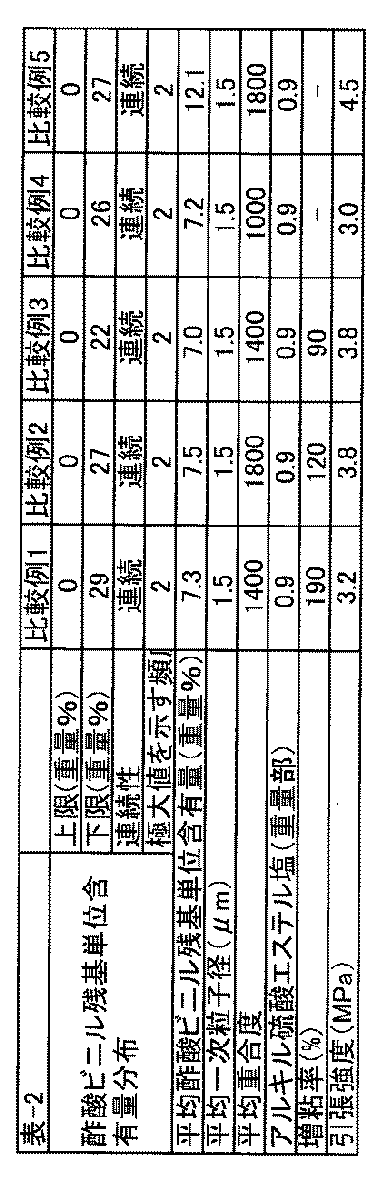
- the vinyl chloride-vinyl acetate copolymer had a continuous distribution of vinyl acetate residue unit content in the range of 0 to 29% by weight, and had two maximum values of the distribution. Further, a paste vinyl chloride sol was prepared using the obtained vinyl chloride-vinyl acetate copolymer composition particles, and the physical properties were evaluated. The results are shown in Table 2.
- Comparative Example 2 Vinyl chloride-vinyl acetate copolymer composition particles were obtained in the same manner as in Comparative Example 1 except that the polymerization temperature in the first, second, and third stages was changed to 40 ° C.
- the resulting vinyl chloride-vinyl acetate copolymer composition particles have an average primary particle size of 1.5 ⁇ m, an average degree of polymerization of 1800, and an average vinyl acetate residue unit content of 7.5% by weight. It contained 0.9 parts by weight of sodium lauryl sulfate with respect to 100 parts by weight of the vinyl copolymer.
- the vinyl chloride-vinyl acetate copolymer at that time had a continuous distribution of vinyl acetate residue unit content in the range of 0 to 27% by weight, and the maximum value of the distribution was two. Further, a paste vinyl chloride sol was prepared using the obtained vinyl chloride-vinyl acetate copolymer composition particles, and the physical properties were evaluated. The results are shown in Table 2.
- Vinyl chloride-vinyl acetate copolymer composition particles were obtained in the same manner as in Example 1 except that the polymerization temperature was changed to 45 ° C. and the polymerization was stopped after the autoclave pressure dropped to 0.33 MPa.
- the resulting vinyl chloride-vinyl acetate copolymer composition particles have an average primary particle size of 1.5 ⁇ m, an average degree of polymerization of 1400, and an average vinyl acetate residue unit content of 7.0% by weight. It contained 0.9 parts by weight of sodium lauryl sulfate with respect to 100 parts by weight of the vinyl copolymer.
- the vinyl chloride-vinyl acetate copolymer had a continuous distribution of vinyl acetate residue unit content in the range of 0 to 22% by weight, and the maximum value of the distribution was two. Further, a paste vinyl chloride sol was prepared using the obtained vinyl chloride-vinyl acetate copolymer composition particles, and the physical properties were evaluated. The results are shown in Table 2.
- Comparative Example 4 Vinyl chloride-vinyl acetate copolymer composition particles were obtained in the same manner as in Comparative Example 1 except that the polymerization temperatures of the first, second, and third stages were changed to 54 ° C.
- the resulting vinyl chloride-vinyl acetate copolymer composition particles have an average primary particle size of 1.5 ⁇ m, an average degree of polymerization of 1000, and an average vinyl acetate residue unit content of 7.2% by weight. It contained 0.9 parts by weight of sodium lauryl sulfate with respect to 100 parts by weight of the vinyl copolymer.
- the vinyl chloride-vinyl acetate copolymer at that time had a continuous distribution of vinyl acetate residue unit content in the range of 0 to 26% by weight, and the maximum value of the distribution was two. Further, a paste vinyl chloride sol was prepared using the obtained vinyl chloride-vinyl acetate copolymer composition particles, and the physical properties were evaluated. The results are shown in Table 2.
- Comparative Example 5 Except that the vinyl acetate monomer was changed to 120 g, the same procedure as in Comparative Example 1 was performed to obtain vinyl chloride-vinyl acetate copolymer composition particles.
- the resulting vinyl chloride-vinyl acetate copolymer composition particles have an average primary particle size of 1.5 ⁇ m, an average degree of polymerization of 1800, and an average vinyl acetate residue unit content of 12.1% by weight. It contained 0.9 parts by weight of sodium lauryl sulfate with respect to 100 parts by weight of the vinyl copolymer.
- the vinyl chloride-vinyl acetate copolymer at that time had a continuous distribution of vinyl acetate residue unit content in the range of 0 to 27% by weight, and the maximum value of the distribution was two.
- a paste vinyl chloride sol was prepared using the obtained vinyl chloride-vinyl acetate copolymer composition particles, and the physical properties were evaluated. The results are shown in Table 2.
- the vinyl chloride-vinyl acetate copolymer particles and vinyl chloride-vinyl acetate copolymer composition particles of the present invention have little change over time in the viscosity of the paste vinyl chloride sol prepared by dispersing in a plasticizer, and when processed at a low temperature. It has excellent mechanical strength, and has excellent properties as a coating agent, particularly an automotive underbody coating agent and an automotive sealant, and its industrial utility value is high.
Landscapes
- Chemical & Material Sciences (AREA)
- Organic Chemistry (AREA)
- Health & Medical Sciences (AREA)
- Chemical Kinetics & Catalysis (AREA)
- Medicinal Chemistry (AREA)
- Polymers & Plastics (AREA)
- Life Sciences & Earth Sciences (AREA)
- Engineering & Computer Science (AREA)
- Materials Engineering (AREA)
- Wood Science & Technology (AREA)
- Addition Polymer Or Copolymer, Post-Treatments, Or Chemical Modifications (AREA)
- Processes Of Treating Macromolecular Substances (AREA)
- Compositions Of Macromolecular Compounds (AREA)
- Paints Or Removers (AREA)
- Sealing Material Composition (AREA)
Abstract
可塑剤と混練した際に、ゾルの粘度経時変化が少なく、低温加工した際の機械的強度に優れる塩化ビニル-酢酸ビニル共重合体粒子、及び、コート剤、特に自動車アンダーボディコート、又は自動車用シーラント等に代表される用途を提供する。 酢酸ビニル残基単位含有量が0~30重量%の範囲内で連続分布し、その分布の極大値が1つであり、平均重合度1500~3000、平均酢酸ビニル残基単位含有量5~15重量%である塩化ビニル-酢酸ビニル共重合体であり、該塩化ビニル-酢酸ビニル共重合体の平均一次粒子径が1~2μmであることを特徴とする塩化ビニル-酢酸ビニル共重合体粒子。
Description
本発明は、塩化ビニル-酢酸ビニル共重合体組成物粒子及びその用途に関するものであり、さらに詳細には、コート剤、特に自動車アンダーボディコート用、自動車シーラント用として有用な塩化ビニル-酢酸ビニル共重合体組成物粒子及びその用途に関するものである。
ペースト加工用塩化ビニル系樹脂(以下、ペースト塩ビと略記する場合もある。)は、一般に可塑剤、充填剤、安定剤又はその他の配合剤などと共に混練することにより、ペースト塩ビゾルを調製し、該ペースト塩ビゾルを使用し種々の成形加工法により壁紙、タイルカーペット、手袋などの様々な成形加工品に用いられている。また、加工温度の低い用途用として、比較的低温でも機械的強度が得られるゲル化溶融性に優れた特性を持つペースト塩ビとして、塩化ビニルに酢酸ビニルを共重合させた塩化ビニル/酢酸ビニル共重合樹脂が知られており、さらに、ペースト塩ビゾル調製後から加工までの長期の保存安定性に対する対策として、ゾル粘度の経時変化が少ないペースト塩ビが求められている。
ゾル粘度の経時変化の少ないペースト塩ビを製造する方法として、特定の界面活性剤を使用したシードミクロ懸濁重合によるペースト加工用ポリ塩化ビニル樹脂の製造方法が提案されている(例えば特許文献1参照。)。
その他に、ペースト塩ビゾルに特定の化合物を配合するポリ塩化ビニル系樹脂組成物が提案されている(例えば特許文献2参照。)。
しかし、特許文献1に提案の方法によって得られるペースト塩ビは、ゾル粘度の経時変化に対する厳しい安定性を要求される用途、例えば自動車用アンダーボディコート、自動車用シーラント等の用途に用いる場合には、市場要求を満足できるものではなかった。
一方、特許文献2に提案の方法においては、粘度の経時変化が比較的少ないペースト塩ビゾルを提供することが可能なものではあるが、ペースト加工用塩化ビニル系樹脂の提供を目的としたものではなく、また長期の粘度安定性については検討されていないものであった。
そこで、本発明は、ゾル粘度の経時変化が極めて少なく、低温加工時の機械的強度にも優れ、コート剤、特に自動車アンダーボディコート用、自動車用シーラント用として優れた特性を有する塩化ビニル-酢酸ビニル共重合体組成物粒子及び自動車アンダーボディコート剤を提供することにある。
本発明者は、上記の課題について鋭意検討を重ねた結果、酢酸ビニル残基単位含有量が特定の分布、特定の重合度と特定量の平均酢酸ビニル残基単位含有量を有し、特定の平均一次粒子径を有する塩化ビニル-酢酸ビニル共重合体粒子が、機械的強度に優れ、ゾル粘度の経時変化が極めて少ないペースト塩ビゾルを提供することができることを見出し、本発明を完成させるに至った。
すなわち、本発明は以下の[1]乃至[7]に存する。
[1] 酢酸ビニル残基単位含有量が0~30重量%の範囲内で連続分布し、その分布の極大値が1つであり、平均重合度1500~3000、平均酢酸ビニル残基単位含有量5~15重量%である塩化ビニル-酢酸ビニル共重合体であり、該塩化ビニル-酢酸ビニル共重合体の平均一次粒子径が1~2μmであることを特徴とする塩化ビニル-酢酸ビニル共重合体粒子。
[2] 酢酸ビニル残基単位含有量が0~30重量%の範囲内で連続分布し、その分布の極大値が1つであり、平均重合度1500~3000、平均酢酸ビニル残基単位含有量5~15重量%である塩化ビニル-酢酸ビニル共重合体100重量部に対して、アルキル硫酸エステル塩0.5~2重量部を含む組成物であり、該塩化ビニル-酢酸ビニル共重合体の平均一次粒子径が1~2μmであることを特徴とする[1]に記載の塩化ビニル-酢酸ビニル共重合体粒子。
[3] アルキル硫酸エステル塩が、ラウリル硫酸リチウム、ラウリル硫酸ナトリウム、ラウリル硫酸アンモニウム及びラウリル硫酸トリエタノールアンモニウムからなる群より選択されるものであることを特徴とする[2]に記載の塩化ビニル-酢酸ビニル共重合体粒子。
[4] 酢酸ビニル残基単位含有量が0~25重量%の範囲内で連続分布し、その分布の極大値が1つである塩化ビニル-酢酸ビニル共重合体であることを特徴とする[1]~[3]のいずれかに記載の塩化ビニル-酢酸ビニル共重合体粒子。
[5] 酢酸ビニル残基単位含有量が0~20重量%の範囲内で連続分布し、その分布の極大値が1つである塩化ビニル-酢酸ビニル共重合体であることを特徴とする[1]~[4]のいずれかに記載の塩化ビニル-酢酸ビニル共重合体粒子。
[6] [1]~[5]のいずれかに記載の塩化ビニル-酢酸ビニル共重合体粒子を含んでなることを特徴とする自動車アンダーボディコート剤。
[7] [6]に記載の自動車アンダーボディコート剤を熱融着することを特徴とする自動車アンダーボディコートの製造方法。
[1] 酢酸ビニル残基単位含有量が0~30重量%の範囲内で連続分布し、その分布の極大値が1つであり、平均重合度1500~3000、平均酢酸ビニル残基単位含有量5~15重量%である塩化ビニル-酢酸ビニル共重合体であり、該塩化ビニル-酢酸ビニル共重合体の平均一次粒子径が1~2μmであることを特徴とする塩化ビニル-酢酸ビニル共重合体粒子。
[2] 酢酸ビニル残基単位含有量が0~30重量%の範囲内で連続分布し、その分布の極大値が1つであり、平均重合度1500~3000、平均酢酸ビニル残基単位含有量5~15重量%である塩化ビニル-酢酸ビニル共重合体100重量部に対して、アルキル硫酸エステル塩0.5~2重量部を含む組成物であり、該塩化ビニル-酢酸ビニル共重合体の平均一次粒子径が1~2μmであることを特徴とする[1]に記載の塩化ビニル-酢酸ビニル共重合体粒子。
[3] アルキル硫酸エステル塩が、ラウリル硫酸リチウム、ラウリル硫酸ナトリウム、ラウリル硫酸アンモニウム及びラウリル硫酸トリエタノールアンモニウムからなる群より選択されるものであることを特徴とする[2]に記載の塩化ビニル-酢酸ビニル共重合体粒子。
[4] 酢酸ビニル残基単位含有量が0~25重量%の範囲内で連続分布し、その分布の極大値が1つである塩化ビニル-酢酸ビニル共重合体であることを特徴とする[1]~[3]のいずれかに記載の塩化ビニル-酢酸ビニル共重合体粒子。
[5] 酢酸ビニル残基単位含有量が0~20重量%の範囲内で連続分布し、その分布の極大値が1つである塩化ビニル-酢酸ビニル共重合体であることを特徴とする[1]~[4]のいずれかに記載の塩化ビニル-酢酸ビニル共重合体粒子。
[6] [1]~[5]のいずれかに記載の塩化ビニル-酢酸ビニル共重合体粒子を含んでなることを特徴とする自動車アンダーボディコート剤。
[7] [6]に記載の自動車アンダーボディコート剤を熱融着することを特徴とする自動車アンダーボディコートの製造方法。
以下、本発明に関し詳細に説明する。
本発明の塩化ビニル-酢酸ビニル共重合体粒子は、塩化ビニル-酢酸ビニル共重合体の一次粒子の集合体であり、該一次粒子を凝集した粒子形状を有するものである。そして、該塩化ビニル-酢酸ビニル共重合体粒子は、酢酸ビニル残基単位含有量が0~30重量%の範囲内で連続分布し、その分布の極大値が1つであり、平均重合度1500~3000、平均酢酸ビニル残基単位含有量5~15重量%の塩化ビニル-酢酸ビニル共重合体であり、該塩化ビニル-酢酸ビニル共重合体は平均一次粒子径1~2μmを有する粒子、好ましくは、酢酸ビニル残基単位含有量が0~30重量%の範囲内で連続分布し、その分布の極大値が1つであり、平均重合度1500~3000、平均酢酸ビニル残基単位含有量5~15重量%である塩化ビニル-酢酸ビニル共重合体100重量部に対して、アルキル硫酸エステル塩0.5~2重量部を含有してなる組成物であり、該塩化ビニル-酢酸ビニル共重合体は平均一次粒子径1~2μmを有する粒子、を含んでなるものである。
本発明の塩化ビニル-酢酸ビニル共重合体粒子を構成する塩化ビニル-酢酸ビニル共重合体は、平均酢酸ビニル残基単位含有量が5~15重量%(すなわち、平均酢酸ビニル残基単位含有量は、塩化ビニル-酢酸ビニル共重合体100重量部に対して5~15重量部に相当する。)、平均重合度が1500~3000のものである。該塩化ビニル-酢酸ビニル共重合体は、酢酸ビニル残基単位含有量が0~30%の範囲内で連続分布し、その分布が1つの極大値を与えるものであり、その平均酢酸ビニル残基単位の含有量が5~15重量%を有するものである。
そして、特に低温加工での機械的強度、ペースト塩ビゾルとした際の粘度の経時変化が共に極めて優れたものとなり、特に自動車アンダーボディコート用、自動車用シーラント用として優れ、強度特性にも優れたものとなることから、当該平均酢酸ビニル残基単位含有量は5~10重量%(すなわち、平均酢酸ビニル残基単位含有量は、塩化ビニル-酢酸ビニル共重合体100重量部に対して5~10重量部に相当する。)、特に6~9重量%(すなわち、平均酢酸ビニル残基単位含有量は、塩化ビニル-酢酸ビニル共重合体100重量部に対して6~9重量部に相当する。)であることが好ましい。さらに好ましくは当該平均酢酸ビニル残基単位含有量は6~8重量%(すなわち、平均酢酸ビニル残基単位含有量は、塩化ビニル-酢酸ビニル共重合体100重量部に対して6~8重量部に相当する。)である。ここで、平均酢酸ビニル残基単位含有量が5重量%未満のものである場合、塩化ビニル-酢酸ビニル共重合体組成物を低温加工に供した際の成形品は機械的強度の低いものとなるため好ましくない。一方、平均酢酸ビニル残基単位含量が15重量%を超えるものである場合、ゾルとした際の粘度の経時変化が大きいものとなるため好ましくない。
また、該塩化ビニル-酢酸ビニル共重合体の平均重合度は、例えばJIS-K6721に準拠した方法で求めることができ、その平均重合度は1500~3000のものである。そして、自動車アンダーボディコート用、自動車用シーラント用として優れたものとなることから、前記平均重合度は1800~2800であることが好ましく、さらに1900~2500であることが好ましい。ここで、平均重合度が、1500未満である場合、低温加工での機械的強度に劣るものとなるため好ましくない。また、ペースト塩ビゾルとした際の粘度の経時変化が大きなものとなる。一方、平均重合度が3000を超える場合、ペースト塩ビゾルとした際の粘度の経時変化は優れたものとなるが、重合時間が長くなるため生産上好ましくない。
該塩化ビニル-酢酸ビニル共重合体は、酢酸ビニル残基単位含有量が0~30重量%の範囲内で連続分布し、その分布の極大値は1つのものである。中でも、酢酸ビニル残基単位含有量が0~25重量%の範囲内で連続分布し、その分布の極大値は1つのものであることが好ましい。また、よりペースト塩ビゾルとした際の粘度の経時変化が小さく、優れたものとなることから、酢酸ビニル残基単位含量が0~20重量%の範囲内で連続分布し、その分布の極大値が1つのものであることが特に好ましい。更に好ましくは酢酸ビニル残基単位含量が0~18重量%の範囲内で連続分布し、その分布の極大値が1つのものである。その際の酢酸ビニル残基単位含有量の分布測定としては、例えば液体クロマトグラフィーのグラジエント溶出法を用い、蒸発型光散乱検出器により酢酸ビニル残基単位を測定することによる分布測定を挙げることができる。そして、酢酸ビニル残基単位含有量が0~30重量%の範囲内で連続に分布していない場合、例えば30重量%を越えて分散している場合、得られる塩化ビニル-酢酸ビニル共重合体粒子は加工性に劣るものとなる。また、酢酸ビニル残基単位含有量の分布の極大値が1つでない場合、例えば酢酸ビニル残基単位含有量の分布が0~30重量%の範囲で連続に分布し、その分布が2つの極大値を持つ場合などは、低温加工での機械強度に劣る塩化ビニル-酢酸ビニル共重合体組成物粒子となる。
なお、酢酸ビニル残基単位含有量が0~30重量%の範囲内で連続分布し、その分布の極大値は1つとは、酢酸ビニル-塩化ビニル共重合体における酢酸ビニル残基単位の組成分布、さらには組成分布の均一性を示すものであり、酢酸ビニル残基単位含有量の分布範囲が狭く、極大値が少なく、その強度が強いほどより均一性を示すものである。
本発明の塩化ビニル-酢酸ビニル共重合体粒子は、ペースト塩ビゾルとした際の粘度の経時変化が少なく、優れたものとなることからアルキル硫酸エステル塩を該塩化ビニル-酢酸ビニル共重合体100重量部に対して0.5~2重量部含有する組成物粒子であることが好ましく、特に低温加工での機械的強度、ペースト塩ビゾルとした際の粘度の経時変化が共に極めて優れたものとなり、特に自動車アンダーボディコート剤、自動車用シーラント用として優れたものとなることから、当該アルキル硫酸エステル塩の含有量は前記塩化ビニル-酢酸ビニル共重合体100重量部に対して0.8~1.5重量部含有するものであることが好ましく、更に0.9~1.2重量部含有するものであることが好ましい。また、この際のアルキル硫酸エステル塩については、ゾル粘度の経時変化が少ないものとなることから、全炭素数が10~14のアルキル硫酸エステル塩であることが好ましく、例えば、ラウリル硫酸リチウム、ラウリル硫酸カリウム、ラウリル硫酸ナトリウム、ラウリル硫酸アンモニウム、ラウリル硫酸トリエタノールアンモニウム等のラウリル硫酸塩;オレイル硫酸リチウム、オレイル硫酸カリウム、オレイル硫酸ナトリウム、オレイル硫酸アンモニウム、オレイル硫酸トリエタノールアンモニウム等のオレイル硫酸塩;ミリスチル硫酸リチウム、ミリスチル硫酸カリウム、ミリスチル硫酸ナトリウム、ミリスチル硫酸アンモニウム、ミリスチル硫酸トリエタノールアンモニウム等のミリスチル硫酸塩、等が挙げられ、特にラウリル硫酸リチウム、ラウリル硫酸カリウム、ラウリル硫酸ナトリウム、ラウリル硫酸アンモニウム、ラウリル硫酸トリエタノールアンモニウム等のラウリル硫酸エステル塩であることが好ましい。
本発明の塩化ビニル-酢酸ビニル共重合体粒子は、平均一次粒子径1~2μmを有する塩化ビニル-酢酸ビニル共重合体の一次粒子が凝集してなるものであり、特に低温加工での機械的強度、ペースト塩ビゾルとした際の粘度の経時変化が少なく共に極めて優れたものとなり、特に自動車アンダーボディコート剤、自動車用シーラント用として優れたものとなることから、1~1.7μmであることが好ましく。更に1.2~1.6μmであることが好ましい。なお、塩化ビニル-酢酸ビニル共重合体の平均一次粒子径が1μmより小さいとゾル粘度の経時変化が大きくなるため好ましくない。また、2μmより大きいと、低温加工での機械強度に劣るため好ましくない。そして、平均一次粒子径は、塩化ビニル-酢酸ビニル共重合体粒子である一次粒子の凝集体とする前の塩化ビニル-酢酸ビニル共重体ラテックスにおける一次粒子の平均一次粒子径として測定することができる。
そして、本発明の塩化ビニル-酢酸ビニル共重合体粒子は、特にペースト塩ビゾルとした際の粘度の経時変化が極めて優れたものとなり、特に強度特性に優れたものとなることから増粘率が90%以下となるものが好ましく、さらに自動車アンダーボディコート剤、自動車用シーラント用として優れたものとなることから、増粘率が50%未満となるものが好ましい。その際の増粘率の測定方法については後述する。
また、本発明の塩化ビニル-酢酸ビニル共重合体粒子は、特に低温加工での機械的強度に優れるものとなり、特に自動車アンダーボディコート剤、自動車用シーラント用として優れたものとなることから、引張強度が4.0MPa以上であることが好ましい。その際の引張強度の測定方法としては、例えば、塩化ビニル-酢酸ビニル共重合体粒子100重量部に対し、フタル酸ジイソノニル100重量部、炭酸カルシウム70重量部、ナフテン系炭化水素溶剤15重量部を配合し、ペースト塩ビゾルを調製し、2mm厚に塗布したシートから、JIS3号ダンベル試験片を用い、23℃、50mm/minの条件で測定し、引張強度を求めることができる。
本発明の塩化ビニル-酢酸ビニル共重合体粒子を組成物粒子として製造する際の製造方法としては、該塩化ビニル-酢酸ビニル共重合体組成物粒子の製造が可能であれば如何なる方法を用いてもよく、例えば塩化ビニル-酢酸ビニル共重合体粒子の製造の際に、該アルキル硫酸エステル塩を併用する方法、製造後の塩化ビニル-酢酸ビニル共重合体粒子に該アルキル硫酸エステル塩を添加する方法等を挙げることができる。
そして、塩化ビニル-酢酸ビニル共重合体粒子を製造する際には、重合開始剤、連鎖移動剤、架橋剤、緩衝剤、水溶性開始剤、還元剤、高級アルコール等を適宜用いることができる。当該添加剤については、本発明の目的を奏する限りにおいて、本発明の塩化ビニル-酢酸ビニル共重合体粒子に含まれていてもよい。また、塩化ビニル-酢酸ビニル共重合体粒子の製造方法としては、例えば、塩化ビニルモノマーと酢酸ビニルモノマーの混合液を、重合開始剤の存在下において水性媒体中で重合する製造方法を挙げることができる。
該製造方法においては、平均酢酸ビニル残基単位含有量を5~15重量%とする塩化ビニル-酢酸ビニル共重合体を効率的に製造することが可能となることから、塩化ビニルモノマー/酢酸ビニルモノマー=94/6~85/15(重量/重量)よりなる混合単量体を用いてなることが好ましく、特に低温加工での機械的強度、ペースト塩ビゾルとした際の粘度の経時変化が共に極めて優れたものとなり、特に自動車アンダーボディコート剤、自動車用シーラント用として優れるものを効率的に製造することが可能となることから、塩化ビニルモノマー/酢酸ビニルモノマー=92/8~85/15(重量/重量)よりなることが好ましい。
重合開始剤としては、重合開始剤の範疇に属するものであれば如何なるものであってもよく、例えば、過硫酸カリウム、過硫酸アンモニウム等の水溶性重合開始剤;アゾビスイソブチロニトリル等のアゾ化合物,ラウロイルパーオキサイド、t-ブチルペルオキシピバレート、ジアシルパーオキサイド、パーオキシエステル、パーオキシジカーボネート等の過酸化物,等の油溶性重合開始剤等を挙げることができる。また、シードミクロ懸濁重合法の際には、油溶性開始剤を含む種粒子(シード)であってもよい。
そして、本発明の塩化ビニル-酢酸ビニル共重合体粒子が、アルキル硫酸エステル塩を含む組成物粒子である場合、該アルキル硫酸エステル塩を塩化ビニル-酢酸ビニル共重合体へ含有させる方法については、特に限定するものではなく、重合反応が完了した後に添加・混練する方法、重合反応開始前又は重合反応中に添加する方法等が挙げられる。該アルキル硫酸エステル塩の添加方法としては、機械的強度、ペースト塩ビゾルとした際の粘度の経時変化の小さい塩化ビニル-酢酸ビニル共重合体組成物粒子を効率よく製造することが可能となることから、重合開始前又は重合開始後の重合反応中に連続又は一括で仕込むことが好ましく、特に低温加工での機械的強度、ペースト塩ビゾルとした際の粘度の経時変化が共に極めて優れたものとなり、特に自動車アンダーボディコート剤、自動車用シーラント用として優れるものを効率的に製造することが可能となることから、重合開始後から重合転化率が85%に達するまでに連続又は一括で仕込むことが好ましい。
そして、該製造方法における重合法としては、例えば塩化ビニルモノマー、酢酸ビニルモノマー、界面活性剤、油溶性重合開始剤、必要に応じて脂肪族高級アルコール等の乳化補助剤を脱イオン水に添加しホモジナイザー等で混合分散した後、緩やかな攪拌下で重合を行うミクロ懸濁重合法;ミクロ懸濁重合法で得られた油溶性重合開始剤を含む種粒子(シード)を用いて行うシードミクロ懸濁重合法;塩化ビニル系単量体を脱イオン水、界面活性剤、水溶性重合開始剤とともに緩やかな攪拌下で重合を行う乳化重合法で得られた粒子をシードとして用いて乳化重合を行うシード乳化重合法等があげられ、その際に、例えば、重合温度は30~80℃とし、塩化ビニル-酢酸ビニル共重合体ラテックス又は組成物ラテックスとして得ることができる。これらの重合により製造された塩化ビニル-酢酸ビニル共重合体ラテックス又は組成物ラテックスを噴霧乾燥し、必要に応じて粉砕することにより、塩化ビニル-酢酸ビニル共重合体の一次粒子が凝集した本発明の塩化ビニル-酢酸ビニル共重合体粒子又は組成物粒子を得ることができる。
塩化ビニル-酢酸ビニル共重合体粒子又は組成物粒子とする際に用いる乾燥機は一般的に使用されているものでよく、例えば、噴霧乾燥機等が挙げられる(具体例としては、「SPRAY DRYING HANDBOOK」(K.Masters著、3版、1979年、GeorgegodwinLimitedより出版)の121頁第4.10図に記載されている各種の噴霧乾燥機)。乾燥用空気入口温度、乾燥用空気出口温度に特に制限はなく、乾燥用空気入口温度は80~200℃、乾燥用空気出口温度は45~75℃が一般的に用いられる。乾燥用空気入口温度は100~170℃、乾燥用空気出口温度は50~70℃が更に好ましい。乾燥後に得られる塩化ビニル-酢酸ビニル共重合体粒子又は組成物粒子は、ラテックスを構成する一次粒子の集合体であり、通常10~100μmの顆粒状である。乾燥出口温度が55℃を超える場合には、得られた顆粒状塩化ビニル-酢酸ビニル共重合体又は組成物を粉砕した方が可塑剤への分散の点から好ましく、乾燥出口温度が55℃ 以下の場合には、顆粒状のままでも粉砕して使用してもどちらでも良い。
本発明の塩化ビニル-酢酸ビニル共重合体粒子は、可塑剤に分散させて調製したペースト塩ビゾルの粘度の経時変化が少なく、低温加工時の機械的強度に優れ、コート剤、特に自動車アンダーボディコート剤、自動車用シーラント用として優れた特性を有するものである。
以下に、本発明を実施例により、さらに詳細に説明するが本発明はこれら実施例に限定されるものではない。
以下に実施例より得られた塩化ビニル-酢酸ビニル共重合体粒子の評価方法を示す。
<増粘率の測定方法>
塩化ビニル-酢酸ビニル共重合体粒子100重量部、フタル酸ジイソノニル100重量部(株式会社ジェイプラス製)、脂肪酸塩表面処理炭酸カルシウム((商品名)Viscolite-OS 白石工業株式会社製)70重量部、及びナフテン系炭化水素溶剤((商品名)Exxsol D40 東燃ゼネラル石油株式会社製)15重量部を混練し、ペースト塩ビゾルを得た。得られたペースト塩ビゾルを23℃にて24時間保管した後、B8H型回転粘度計で23℃、20rpm条件にて測定した粘度を粘度Aとし、該ゾルを、更に40℃にて7日間保管した後、23℃で3時間静置したのち、B8H型回転粘度計で23℃、20rpm条件にて測定した粘度を粘度Bとした。粘度A及び粘度Bを下記式にて、得られたペースト塩ビゾルの増粘率を求めた。
塩化ビニル-酢酸ビニル共重合体粒子100重量部、フタル酸ジイソノニル100重量部(株式会社ジェイプラス製)、脂肪酸塩表面処理炭酸カルシウム((商品名)Viscolite-OS 白石工業株式会社製)70重量部、及びナフテン系炭化水素溶剤((商品名)Exxsol D40 東燃ゼネラル石油株式会社製)15重量部を混練し、ペースト塩ビゾルを得た。得られたペースト塩ビゾルを23℃にて24時間保管した後、B8H型回転粘度計で23℃、20rpm条件にて測定した粘度を粘度Aとし、該ゾルを、更に40℃にて7日間保管した後、23℃で3時間静置したのち、B8H型回転粘度計で23℃、20rpm条件にて測定した粘度を粘度Bとした。粘度A及び粘度Bを下記式にて、得られたペースト塩ビゾルの増粘率を求めた。
増粘率(%)=100×(B-A)/A
<引張強度の測定方法>
塩化ビニル-酢酸ビニル共重合体粒子100重量部、フタル酸ジイソノニル100重量部(株式会社ジェイプラス製)、脂肪酸塩表面処理炭酸カルシウム((商品名)Viscolite-OS 白石工業株式会社製)70重量部、及びナフテン系炭化水素溶剤((商品名)Exxsol D40 東燃ゼネラル石油株式会社製)15重量部を混練してペースト塩ビゾルを製造した。脱泡処理した前記ペースト塩ビゾルを離型紙で2mm厚に塗布し、140℃×30min分間加熱してペースト塩ビシートを作成した。得られたペースト塩ビシートからJIS3号ダンベルを用いて試験片を作成し、23℃で50mm/minの条件で試験片の引張強度を測定した。
<引張強度の測定方法>
塩化ビニル-酢酸ビニル共重合体粒子100重量部、フタル酸ジイソノニル100重量部(株式会社ジェイプラス製)、脂肪酸塩表面処理炭酸カルシウム((商品名)Viscolite-OS 白石工業株式会社製)70重量部、及びナフテン系炭化水素溶剤((商品名)Exxsol D40 東燃ゼネラル石油株式会社製)15重量部を混練してペースト塩ビゾルを製造した。脱泡処理した前記ペースト塩ビゾルを離型紙で2mm厚に塗布し、140℃×30min分間加熱してペースト塩ビシートを作成した。得られたペースト塩ビシートからJIS3号ダンベルを用いて試験片を作成し、23℃で50mm/minの条件で試験片の引張強度を測定した。
<平均重合度の測定>
JIS-K6721に準拠し求めた。
JIS-K6721に準拠し求めた。
<平均酢酸ビニル残基単位含有量の測定方法>
塩化ビニル-酢酸ビニル共重合体中に含有する平均酢酸ビニル残基単位含有量(重量%)(VAc含量と記す場合もある。)は、塩化ビニル-酢酸ビニル共重合体粒子100mgと臭化カリウム10mgを混合し、すりつぶして成形した測定サンプルと、赤外分光光度計(島津社製、(商品名)FTIR-8100A)を用いて、下記式より算出した。
塩化ビニル-酢酸ビニル共重合体中に含有する平均酢酸ビニル残基単位含有量(重量%)(VAc含量と記す場合もある。)は、塩化ビニル-酢酸ビニル共重合体粒子100mgと臭化カリウム10mgを混合し、すりつぶして成形した測定サンプルと、赤外分光光度計(島津社製、(商品名)FTIR-8100A)を用いて、下記式より算出した。
VAc含量=(3.73×B/A+0.024)×1.04
A:1430cm-1付近のC-H面内変角による吸収ピークトップのAbs.値。
B:1740cm-1付近のC=O伸縮による吸収ピークトップのAbs.値。
A:1430cm-1付近のC-H面内変角による吸収ピークトップのAbs.値。
B:1740cm-1付近のC=O伸縮による吸収ピークトップのAbs.値。
<酢酸ビニル残基単位含有量の分布の測定>
高速液体クロマトグラフィー(HPLC)、グラジエント溶出法により、酢酸ビニル残基単位含有量の分布の測定を行った。
装置:HPLC8020シリーズ(東ソー株式会社製)。
検出器:蒸発型光散乱検出器(ELSD) Varian380-LC(Varian製)。
カラム:TSKgel ODS-100V(東ソー株式会社製)。
カラム温度:40℃。
移動相:A液:水/アセトニトリル=5/5
B液:テトラヒドロフラン
流速:1.0ml/min。
濃度:1mg/ml。
注入量:20μm。
高速液体クロマトグラフィー(HPLC)、グラジエント溶出法により、酢酸ビニル残基単位含有量の分布の測定を行った。
装置:HPLC8020シリーズ(東ソー株式会社製)。
検出器:蒸発型光散乱検出器(ELSD) Varian380-LC(Varian製)。
カラム:TSKgel ODS-100V(東ソー株式会社製)。
カラム温度:40℃。
移動相:A液:水/アセトニトリル=5/5
B液:テトラヒドロフラン
流速:1.0ml/min。
濃度:1mg/ml。
注入量:20μm。
合成例1(開始剤等含有シードの製造例)
1m3オートクレーブ中に脱イオン水360kg、塩化ビニルモノマー300kg、過酸化ラウロイル6kg及び15重量%ドデシルベンゼンスルホン酸ナトリウム水溶液30kgを仕込み、該重合液をホモジナイザーを用いて2時間循環し、均質化処理後、温度を45℃に上げて、重合を進めた。45℃における塩化ビニルモノマーの飽和蒸気圧より0.2MPa圧力が低下した後、未反応の塩化ビニルモノマーを回収した。得られた開始剤等含有シードラテックス(以下、シード1と略記する。)の平均粒子径は0.60μm、固形分濃度は32%であった。
1m3オートクレーブ中に脱イオン水360kg、塩化ビニルモノマー300kg、過酸化ラウロイル6kg及び15重量%ドデシルベンゼンスルホン酸ナトリウム水溶液30kgを仕込み、該重合液をホモジナイザーを用いて2時間循環し、均質化処理後、温度を45℃に上げて、重合を進めた。45℃における塩化ビニルモノマーの飽和蒸気圧より0.2MPa圧力が低下した後、未反応の塩化ビニルモノマーを回収した。得られた開始剤等含有シードラテックス(以下、シード1と略記する。)の平均粒子径は0.60μm、固形分濃度は32%であった。
実施例1
2.5リットルオートクレーブ中に脱イオン水500g、塩化ビニルモノマーを715gと酢酸ビニルモノマーを48g、5%水溶液ラウリル硫酸ナトリウムを8.6g、シード1を80g、0.1%水溶液硫酸銅を4g仕込み、その後、この反応混合物の温度を35℃に上げて重合を進めた。重合開始から重合終了までの間、5%水溶液ラウリル硫酸ナトリウム120g、0.05%水溶液アスコルビン酸を連続的に添加した。オートクレーブの圧力が0.22MPaまで低下した後に重合を停止した。
2.5リットルオートクレーブ中に脱イオン水500g、塩化ビニルモノマーを715gと酢酸ビニルモノマーを48g、5%水溶液ラウリル硫酸ナトリウムを8.6g、シード1を80g、0.1%水溶液硫酸銅を4g仕込み、その後、この反応混合物の温度を35℃に上げて重合を進めた。重合開始から重合終了までの間、5%水溶液ラウリル硫酸ナトリウム120g、0.05%水溶液アスコルビン酸を連続的に添加した。オートクレーブの圧力が0.22MPaまで低下した後に重合を停止した。
そして、未反応モノマーを回収してラテックスとし、スプレードライヤーにて、熱風入口温度160℃、出口温度55℃で噴霧乾燥を行って、塩化ビニル-酢酸ビニル共重合体組成物粒子を得た。得られた塩化ビニル-酢酸ビニル共重合体組成物粒子は、平均一次粒子径1.5μmを有し、平均重合度2200、平均酢酸ビニル残基単位含有量6.6重量%の塩化ビニル-酢酸ビニル共重合体100重量部に対し、ラウリル硫酸ナトリウム0.9重量部、を含むものであった。その際の塩化ビニル-酢酸ビニル共重合体は、0~22重量%の範囲で酢酸ビニル残基単位含有量が連続分布し、その分布の極大値が1つのものであった。また、得られた塩化ビニル-酢酸ビニル共重合体組成物粒子を用いてペースト塩ビゾルを作製し、物性を評価した。その結果を表1に示す。
実施例2
重合温度を30℃に変更し、オートクレーブの圧力が0.20MPaまで低下した後に重合を停止した以外は、実施例1と同様に行い、塩化ビニル-酢酸ビニル共重合体組成物粒子を得た。得られた塩化ビニル-酢酸ビニル共重合体組成物粒子は、平均一次粒子径1.5μmを有し、平均重合度2900、平均酢酸ビニル残基単位含有量6.6重量%の塩化ビニル-酢酸ビニル共重合体100重量部に対し、ラウリル硫酸ナトリウム0.9重量部を含むものであった。その際の塩化ビニル-酢酸ビニル共重合体は、0~23重量%の範囲で酢酸ビニル残基単位含有量が連続分布し、その分布の極大値が1つのものであった。また、得られた塩化ビニル-酢酸ビニル共重合体組成物粒子を用いてペースト塩ビゾルを作製し、物性を評価した。その結果を表1に示す。
重合温度を30℃に変更し、オートクレーブの圧力が0.20MPaまで低下した後に重合を停止した以外は、実施例1と同様に行い、塩化ビニル-酢酸ビニル共重合体組成物粒子を得た。得られた塩化ビニル-酢酸ビニル共重合体組成物粒子は、平均一次粒子径1.5μmを有し、平均重合度2900、平均酢酸ビニル残基単位含有量6.6重量%の塩化ビニル-酢酸ビニル共重合体100重量部に対し、ラウリル硫酸ナトリウム0.9重量部を含むものであった。その際の塩化ビニル-酢酸ビニル共重合体は、0~23重量%の範囲で酢酸ビニル残基単位含有量が連続分布し、その分布の極大値が1つのものであった。また、得られた塩化ビニル-酢酸ビニル共重合体組成物粒子を用いてペースト塩ビゾルを作製し、物性を評価した。その結果を表1に示す。
実施例3
重合温度を40℃に変更し、オートクレーブの圧力が0.28MPaまで低下した後に重合を停止した以外は、実施例1と同様に行い、塩化ビニル-酢酸ビニル共重合体組成物粒子を得た。得られた塩化ビニル-酢酸ビニル共重合体組成物粒子は、平均一次粒子径1.5μmを有し、平均重合度1800、平均酢酸ビニル残基単位含有量6.7重量%の塩化ビニル-酢酸ビニル共重合体100重量部に対し、ラウリル硫酸ナトリウム0.9重量部を含むものであった。その際の塩化ビニル-酢酸ビニル共重合体は、0~24重量%の範囲で酢酸ビニル残基単位含有量が連続分布し、その分布の極大値が1つのものであった。また、得られた塩化ビニル-酢酸ビニル共重合体組成物粒子を用いてペースト塩ビゾルを作製し、物性を評価した。その結果を表1に示す。
重合温度を40℃に変更し、オートクレーブの圧力が0.28MPaまで低下した後に重合を停止した以外は、実施例1と同様に行い、塩化ビニル-酢酸ビニル共重合体組成物粒子を得た。得られた塩化ビニル-酢酸ビニル共重合体組成物粒子は、平均一次粒子径1.5μmを有し、平均重合度1800、平均酢酸ビニル残基単位含有量6.7重量%の塩化ビニル-酢酸ビニル共重合体100重量部に対し、ラウリル硫酸ナトリウム0.9重量部を含むものであった。その際の塩化ビニル-酢酸ビニル共重合体は、0~24重量%の範囲で酢酸ビニル残基単位含有量が連続分布し、その分布の極大値が1つのものであった。また、得られた塩化ビニル-酢酸ビニル共重合体組成物粒子を用いてペースト塩ビゾルを作製し、物性を評価した。その結果を表1に示す。
実施例4
重合開始から重合終了までの間、5%水溶液ラウリル硫酸ナトリウムを200gにした以外は、実施例1と同様に行い、塩化ビニル-酢酸ビニル共重合体組成物粒子を得た。得られた塩化ビニル-酢酸ビニル共重合体組成物粒子は、平均一次粒子径1.5μmを有し、平均重合度2200、平均酢酸ビニル残基単位含有量6.8重量%の塩化ビニル-酢酸ビニル共重合体100重量部に対し、ラウリル硫酸ナトリウム1.5重量部を含むものであった。その際の塩化ビニル-酢酸ビニル共重合体は、0~25重量%の範囲で酢酸ビニル残基単位含有量が連続分布し、その分布の極大値が1つのものであった。また、得られた塩化ビニル-酢酸ビニル共重合体組成物粒子を用いてペースト塩ビゾルを作製し、物性を評価した。その結果を表1に示す。
重合開始から重合終了までの間、5%水溶液ラウリル硫酸ナトリウムを200gにした以外は、実施例1と同様に行い、塩化ビニル-酢酸ビニル共重合体組成物粒子を得た。得られた塩化ビニル-酢酸ビニル共重合体組成物粒子は、平均一次粒子径1.5μmを有し、平均重合度2200、平均酢酸ビニル残基単位含有量6.8重量%の塩化ビニル-酢酸ビニル共重合体100重量部に対し、ラウリル硫酸ナトリウム1.5重量部を含むものであった。その際の塩化ビニル-酢酸ビニル共重合体は、0~25重量%の範囲で酢酸ビニル残基単位含有量が連続分布し、その分布の極大値が1つのものであった。また、得られた塩化ビニル-酢酸ビニル共重合体組成物粒子を用いてペースト塩ビゾルを作製し、物性を評価した。その結果を表1に示す。
実施例5
シード1の仕込み量を130gにした以外は、実施例1と同様に行い、塩化ビニル-酢酸ビニル共重合体組成物粒子を得た。得られた塩化ビニル-酢酸ビニル共重合体組成物粒子は、平均一次粒子径1.2μmを有し、平均重合度2200、平均酢酸ビニル残基単位含有量6.4重量%の塩化ビニル-酢酸ビニル共重合体100重量部に対し、ラウリル硫酸ナトリウム0.9重量部を含むものであった。その際の塩化ビニル-酢酸ビニル共重合体は、0~24重量%の範囲で酢酸ビニル残基単位含有量が連続分布し、その分布の極大値が1つのものであった。また、得られた塩化ビニル-酢酸ビニル共重合体組成物粒子を用いてペースト塩ビゾルを作製し、物性を評価した。その結果を表1に示す。
シード1の仕込み量を130gにした以外は、実施例1と同様に行い、塩化ビニル-酢酸ビニル共重合体組成物粒子を得た。得られた塩化ビニル-酢酸ビニル共重合体組成物粒子は、平均一次粒子径1.2μmを有し、平均重合度2200、平均酢酸ビニル残基単位含有量6.4重量%の塩化ビニル-酢酸ビニル共重合体100重量部に対し、ラウリル硫酸ナトリウム0.9重量部を含むものであった。その際の塩化ビニル-酢酸ビニル共重合体は、0~24重量%の範囲で酢酸ビニル残基単位含有量が連続分布し、その分布の極大値が1つのものであった。また、得られた塩化ビニル-酢酸ビニル共重合体組成物粒子を用いてペースト塩ビゾルを作製し、物性を評価した。その結果を表1に示す。
実施例6
1m3オートクレーブ中に脱イオン水350kg、1段目仕込み単量体として塩化ビニルモノマーを219kg(混合単量体の全仕込み量に対して55重量%)と酢酸ビニルモノマーを34kg(混合単量体の全仕込み量に対して9重量%)、25%水溶液ラウリル硫酸ナトリウムを0.9kg、シード1を42kg、10%水溶液硫酸銅を20g仕込み、その後、この反応混合物の温度を40℃に上げて1段目重合を開始するとともに、0.2重量%アスコルビン酸水溶液を全重合時間を通じて、重合温度を維持するように連続的に添加した。重合転化率が85%となったところで、2段目仕込み単量体として、塩化ビニルモノマー146kg(混合単量体の全仕込み量に対して37重量%)を1m3オートクレーブに仕込み、重合温度35℃にて2段目重合を継続した。更に、1段目仕込み単量体と2段目仕込み単量体の合計に対して重合転化率が90%となったところで重合を終了した。
1m3オートクレーブ中に脱イオン水350kg、1段目仕込み単量体として塩化ビニルモノマーを219kg(混合単量体の全仕込み量に対して55重量%)と酢酸ビニルモノマーを34kg(混合単量体の全仕込み量に対して9重量%)、25%水溶液ラウリル硫酸ナトリウムを0.9kg、シード1を42kg、10%水溶液硫酸銅を20g仕込み、その後、この反応混合物の温度を40℃に上げて1段目重合を開始するとともに、0.2重量%アスコルビン酸水溶液を全重合時間を通じて、重合温度を維持するように連続的に添加した。重合転化率が85%となったところで、2段目仕込み単量体として、塩化ビニルモノマー146kg(混合単量体の全仕込み量に対して37重量%)を1m3オートクレーブに仕込み、重合温度35℃にて2段目重合を継続した。更に、1段目仕込み単量体と2段目仕込み単量体の合計に対して重合転化率が90%となったところで重合を終了した。
なお、重合開始してから重合終了までの間、25%水溶液ラウリル硫酸ナトリウム10kgと15%ノニルプロペニルフェノールエチレンオキシド10モル付加体硫酸エステルアンモニウム塩水溶液(第一工業製薬製、(商品名)アクアロンHS-10)3kgを連続的に添加した。
そして、未反応モノマーを回収してラテックスとし、重合度600、ケン化度93モル%のポリビニルアルコール(日本合成株式会社製、(商品名)ゴーセノールAL-06R)を塩化ビニル-酢酸ビニル共重合体に対する含有量が5000ppmとなるように添加した。
スプレードライヤーにて、熱風入口温度160℃、出口温度55℃で噴霧乾燥を行って、塩化ビニル-酢酸ビニル共重合体組成物粒子を得た。得られた塩化ビニル-酢酸ビニル共重合体組成物粒子は、平均一次粒子径1.5μmを有し、平均重合度2100、平均酢酸ビニル残基単位含有量6.0重量%の塩化ビニル-酢酸ビニル共重合体100重量部に対し、ラウリル硫酸ナトリウム0.8重量部、を含むものであった。その際の塩化ビニル-酢酸ビニル共重合体は、0~22重量%の範囲で酢酸ビニル残基単位含有量が連続分布し、その分布の極大値が1つのものであった。また、得られた塩化ビニル-酢酸ビニル共重合体組成物粒子を用いてペースト塩ビゾルを作製し、物性を評価した。その結果を表1に示す。
実施例7
1m3オートクレーブ中に脱イオン水350kg、1段目仕込み単量体として塩化ビニルモノマーを255kg(混合単量体の全仕込み量に対して64重量%)と酢酸ビニルモノマーを35kg(混合単量体の全仕込み量に対して9重量%)、25%水溶液ラウリル硫酸ナトリウムを0.9kg、シード1を42kg、10%水溶液硫酸銅を20g仕込み、その後、この反応混合物の温度を35℃に上げて1段目重合を開始するとともに、0.2重量%アスコルビン酸水溶液を全重合時間を通じて、重合温度を維持するように連続的に添加した。重合転化率が50%となったところで、2段目仕込み単量体として、塩化ビニルモノマー73kg(混合単量体の全仕込み量に対して18重量%)を1m3オートクレーブに仕込み、重合温度35℃にて2段目重合を継続した。
1m3オートクレーブ中に脱イオン水350kg、1段目仕込み単量体として塩化ビニルモノマーを255kg(混合単量体の全仕込み量に対して64重量%)と酢酸ビニルモノマーを35kg(混合単量体の全仕込み量に対して9重量%)、25%水溶液ラウリル硫酸ナトリウムを0.9kg、シード1を42kg、10%水溶液硫酸銅を20g仕込み、その後、この反応混合物の温度を35℃に上げて1段目重合を開始するとともに、0.2重量%アスコルビン酸水溶液を全重合時間を通じて、重合温度を維持するように連続的に添加した。重合転化率が50%となったところで、2段目仕込み単量体として、塩化ビニルモノマー73kg(混合単量体の全仕込み量に対して18重量%)を1m3オートクレーブに仕込み、重合温度35℃にて2段目重合を継続した。
更に、1段目仕込み単量体と2段目仕込み単量体の合計に対して重合転化率が75%となったところで3段目仕込み単量体として、塩化ビニルモノマー36kg(混合単量体の全仕込み量に対して9重量%)を1m3オートクレーブに仕込み、重合温度35℃にて3段目重合を継続し、混合単量体の合計に対して重合転化率が90%となったところで重合を終了した。
なお、重合開始してから重合終了までの間、25%水溶液ラウリル硫酸ナトリウム10kgと15%ノニルプロペニルフェノールエチレンオキシド10モル付加体硫酸エステルアンモニウム塩水溶液(第一工業製薬製、(商品名)アクアロンHS-10)3kgを連続的に添加した。
そして、未反応モノマーを回収してラテックスとし、スプレードライヤーにて、熱風入口温度160℃、出口温度55℃で噴霧乾燥を行って、塩化ビニル-酢酸ビニル共重合体組成物粒子を得た。得られた塩化ビニル-酢酸ビニル共重合体組成物粒子は、平均一次粒子径1.5μmを有し、平均重合度2300、平均酢酸ビニル残基単位含有量6.0重量%の塩化ビニル-酢酸ビニル共重合体100重量部に対し、ラウリル硫酸ナトリウム0.8重量部を含むものであった。その際の塩化ビニル-酢酸ビニル共重合体は、0~18重量%の範囲で酢酸ビニル残基単位含有量が連続分布し、その分布の極大値が1つのものであった。また、得られた塩化ビニル-酢酸ビニル共重合体組成物粒子を用いてペースト塩ビゾルを作製し、物性を評価した。その結果を表1に示す。
実施例8
2.5リットルオートクレーブ中に脱イオン水500g、1段目仕込み単量体として塩化ビニルモノマーを493g(混合単量体の全仕込み量に対して62重量%)と酢酸ビニルモノマーを96g(混合単量体の全仕込み量に対して12重量%)、5%水溶液ラウリル硫酸ナトリウムを9g、シード1を85g、0.1%水溶液硫酸銅を4g仕込み、その後、この反応混合物の温度を35℃に上げて1段目重合を開始するとともに、0.05重量%アスコルビン酸水溶液を全重合時間を通じて、重合温度を維持するように連続的に添加した。重合転化率が50%となったところで、2段目仕込み単量体として、塩化ビニルモノマー141g(混合単量体の全仕込み量に対して17重量%)を2.5リットルオートクレーブに仕込み、重合温度35℃にて2段目重合を継続した。更に、1段目仕込み単量体と2段目仕込み単量体の合計に対して重合転化率が75%となったところで、3段目仕込み単量体として、塩化ビニルモノマー70g(混合単量体の全仕込み量に対して9重量%)を2.5リットルオートクレーブに仕込み、重合温度35℃にて3段目重合を継続し、混合単量体の合計に対して重合転化率が90%となったところで重合を終了した。
2.5リットルオートクレーブ中に脱イオン水500g、1段目仕込み単量体として塩化ビニルモノマーを493g(混合単量体の全仕込み量に対して62重量%)と酢酸ビニルモノマーを96g(混合単量体の全仕込み量に対して12重量%)、5%水溶液ラウリル硫酸ナトリウムを9g、シード1を85g、0.1%水溶液硫酸銅を4g仕込み、その後、この反応混合物の温度を35℃に上げて1段目重合を開始するとともに、0.05重量%アスコルビン酸水溶液を全重合時間を通じて、重合温度を維持するように連続的に添加した。重合転化率が50%となったところで、2段目仕込み単量体として、塩化ビニルモノマー141g(混合単量体の全仕込み量に対して17重量%)を2.5リットルオートクレーブに仕込み、重合温度35℃にて2段目重合を継続した。更に、1段目仕込み単量体と2段目仕込み単量体の合計に対して重合転化率が75%となったところで、3段目仕込み単量体として、塩化ビニルモノマー70g(混合単量体の全仕込み量に対して9重量%)を2.5リットルオートクレーブに仕込み、重合温度35℃にて3段目重合を継続し、混合単量体の合計に対して重合転化率が90%となったところで重合を終了した。
なお、重合開始してから重合終了までの間、5%水溶液ラウリル硫酸ナトリウム120gを連続的に添加した。
そして、未反応モノマーを回収してラテックスとし、スプレードライヤーにて、熱風入口温度160℃、出口温度55℃で噴霧乾燥を行って、塩化ビニル-酢酸ビニル共重合体組成物粒子を得た。得られた塩化ビニル-酢酸ビニル共重合体組成物粒子は、平均一次粒子径1.6μmを有し、平均重合度2400、平均酢酸ビニル残基単位含有量8.8重量%の塩化ビニル-酢酸ビニル共重合体100重量部に対し、ラウリル硫酸ナトリウム0.9重量部を含むものであった。その際の塩化ビニル-酢酸ビニル共重合体は、0~21重量%の範囲で酢酸ビニル残基単位含有量が連続分布し、その分布の極大値が1つのものであった。また、得られた塩化ビニル-酢酸ビニル共重合体組成物粒子を用いてペースト塩ビゾルを作製し、物性を評価した。その結果を表1に示す。
実施例9
2.5リットルオートクレーブ中に脱イオン水500g、1段目仕込み単量体として塩化ビニルモノマーを511g(混合単量体の全仕込み量に対して64重量%)と酢酸ビニルモノマーを72g(混合単量体の全仕込み量に対して9重量%)、5%水溶液ラウリル硫酸ナトリウムを9g、シード1を85g、0.1%水溶液硫酸銅を4g仕込み、その後、この反応混合物の温度を35℃に上げて1段目重合を開始するとともに、0.05重量%アスコルビン酸水溶液を全重合時間を通じて、重合温度を維持するように連続的に添加した。重合転化率が40%となったところで、2段目仕込み単量体として、塩化ビニルモノマー73g(混合単量体の全仕込み量に対して9重量%)を2.5リットルオートクレーブに仕込み、重合温度35℃にて2段目重合を継続した。更に、1段目仕込み単量体と2段目仕込み単量体の合計に対して重合転化率が60%となったところで、3段目仕込み単量体として、塩化ビニルモノマー73g(混合単量体の全仕込み量に対して9重量%)を2.5リットルオートクレーブに仕込み、重合温度35℃にて3段目重合を継続した。
2.5リットルオートクレーブ中に脱イオン水500g、1段目仕込み単量体として塩化ビニルモノマーを511g(混合単量体の全仕込み量に対して64重量%)と酢酸ビニルモノマーを72g(混合単量体の全仕込み量に対して9重量%)、5%水溶液ラウリル硫酸ナトリウムを9g、シード1を85g、0.1%水溶液硫酸銅を4g仕込み、その後、この反応混合物の温度を35℃に上げて1段目重合を開始するとともに、0.05重量%アスコルビン酸水溶液を全重合時間を通じて、重合温度を維持するように連続的に添加した。重合転化率が40%となったところで、2段目仕込み単量体として、塩化ビニルモノマー73g(混合単量体の全仕込み量に対して9重量%)を2.5リットルオートクレーブに仕込み、重合温度35℃にて2段目重合を継続した。更に、1段目仕込み単量体と2段目仕込み単量体の合計に対して重合転化率が60%となったところで、3段目仕込み単量体として、塩化ビニルモノマー73g(混合単量体の全仕込み量に対して9重量%)を2.5リットルオートクレーブに仕込み、重合温度35℃にて3段目重合を継続した。
更に、1段目仕込み単量体と2段目仕込み単量体、3段目仕込み単量体の合計に対して重合転化率が75%となったところで、4段目仕込み単量体として、塩化ビニルモノマー36g(混合単量体の全仕込み量に対して5重量%))を2.5リットルオートクレーブに仕込み、重合温度35℃にて4段目重合を継続した。更に、1段目仕込み単量体と2段目仕込み単量体、3段目仕込み単量体、4段目仕込み単量体の合計に対して重合転化率が85%となったところで、5段目仕込み単量体として、塩化ビニルモノマー36g(混合単量体の全仕込み量に対して5重量%))を2.5リットルオートクレーブに仕込み、重合温度35℃にて5段目重合を継続した。
そして、混合単量体の合計に対して重合転化率が90%となったところで重合を終了した。
なお、重合開始してから重合終了までの間、5%水溶液ラウリル硫酸ナトリウム120gを連続的に添加した。
そして、未反応モノマーを回収してラテックスとし、スプレードライヤーにて、熱風入口温度160℃、出口温度55℃で噴霧乾燥を行って、塩化ビニル-酢酸ビニル共重合体組成物粒子を得た。得られた塩化ビニル-酢酸ビニル共重合体組成物粒子は、平均一次粒子径1.5μmを有し、平均重合度2100、平均酢酸ビニル残基単位含有量6.6重量%の塩化ビニル-酢酸ビニル共重合体100重量部に対し、ラウリル硫酸ナトリウム0.9重量部を含むものであった。その際の塩化ビニル-酢酸ビニル共重合体は、0~19重量%の範囲で酢酸ビニル残基単位含有量が連続分布し、その分布の極大値が1つのものであった。また、得られた塩化ビニル-酢酸ビニル共重合体組成物粒子を用いてペースト塩ビゾルを作製し、物性を評価した。その結果を表1に示す。
実施例10
1m3オートクレーブ中に脱イオン水350kg、1段目仕込み単量体として塩化ビニルモノマーを224kg(混合単量体の全仕込み量に対して56重量%)と酢酸ビニルモノマーを26kg、(混合単量体の全仕込み量に対して7重量%)、20%水溶液ドデシルベンゼンスルホン酸ナトリウムを1kg、シード1を42kg、10%水溶液硫酸銅を20g仕込み、その後、この反応混合物の温度を45℃に上げて1段目重合を開始するとともに、0.2重量%アスコルビン酸水溶液を全重合時間を通じて、重合温度を維持するように連続的に添加した。重合転化率が85%となったところで、2段目仕込み単量体として、塩化ビニルモノマー149kg(混合単量体の全仕込み量に対して37重量%)を1m3オートクレーブに仕込み、重合温度40℃にて2段目重合を継続した。更に、1段目仕込み単量体と2段目仕込み単量体の合計に対して重合転化率が90%となったところで重合を終了した。なお、重合開始してから重合終了までの間、20%水溶液ドデシルベンゼンスルホン酸ナトリウム15kgを連続的に添加した。
1m3オートクレーブ中に脱イオン水350kg、1段目仕込み単量体として塩化ビニルモノマーを224kg(混合単量体の全仕込み量に対して56重量%)と酢酸ビニルモノマーを26kg、(混合単量体の全仕込み量に対して7重量%)、20%水溶液ドデシルベンゼンスルホン酸ナトリウムを1kg、シード1を42kg、10%水溶液硫酸銅を20g仕込み、その後、この反応混合物の温度を45℃に上げて1段目重合を開始するとともに、0.2重量%アスコルビン酸水溶液を全重合時間を通じて、重合温度を維持するように連続的に添加した。重合転化率が85%となったところで、2段目仕込み単量体として、塩化ビニルモノマー149kg(混合単量体の全仕込み量に対して37重量%)を1m3オートクレーブに仕込み、重合温度40℃にて2段目重合を継続した。更に、1段目仕込み単量体と2段目仕込み単量体の合計に対して重合転化率が90%となったところで重合を終了した。なお、重合開始してから重合終了までの間、20%水溶液ドデシルベンゼンスルホン酸ナトリウム15kgを連続的に添加した。
そして、未反応モノマーを回収してラテックスとし、スプレードライヤーにて、熱風入口温度160℃、出口温度55℃で噴霧乾燥を行って、塩化ビニル-酢酸ビニル共重合体粒子を得た。得られた塩化ビニル-酢酸ビニル共重合体粒子は、平均一次粒子径1.2μmを有し、平均重合度1720、平均酢酸ビニル残基単位含有量5.0重量%の塩化ビニル-酢酸ビニル共重合体であった。その際の塩化ビニル-酢酸ビニル共重合体は、0~21重量%の範囲で酢酸ビニル残基単位含有量が連続分布し、その分布の極大値が1つのものであった。また、得られた塩化ビニル-酢酸ビニル共重合体粒子を用いてペースト塩ビゾルを作製し、物性を評価した。その結果を表1に示す。
実施例11
2.5リットルオートクレーブ中に脱イオン水500g、1段目仕込み単量体として塩化ビニルモノマーを493g(混合単量体の全仕込み量に対して62重量%)と酢酸ビニルモノマーを96g(混合単量体の全仕込み量に対して12重量%)、5%水溶液ラウリル硫酸ナトリウムを9g、シード1を85g、0.1%水溶液硫酸銅を4g仕込み、その後、この反応混合物の温度を35℃に上げて1段目重合を開始するとともに、0.05重量%アスコルビン酸水溶液を全重合時間を通じて、重合温度を維持するように連続的に添加した。重合転化率が50%となったところで、2段目仕込み単量体として、塩化ビニルモノマー141g(混合単量体の全仕込み量に対して17重量%)を2.5リットルオートクレーブに仕込み、重合温度35℃にて2段目重合を継続した。
2.5リットルオートクレーブ中に脱イオン水500g、1段目仕込み単量体として塩化ビニルモノマーを493g(混合単量体の全仕込み量に対して62重量%)と酢酸ビニルモノマーを96g(混合単量体の全仕込み量に対して12重量%)、5%水溶液ラウリル硫酸ナトリウムを9g、シード1を85g、0.1%水溶液硫酸銅を4g仕込み、その後、この反応混合物の温度を35℃に上げて1段目重合を開始するとともに、0.05重量%アスコルビン酸水溶液を全重合時間を通じて、重合温度を維持するように連続的に添加した。重合転化率が50%となったところで、2段目仕込み単量体として、塩化ビニルモノマー141g(混合単量体の全仕込み量に対して17重量%)を2.5リットルオートクレーブに仕込み、重合温度35℃にて2段目重合を継続した。
更に、1段目仕込み単量体と2段目仕込み単量体の合計に対して重合転化率が80%となったところで3段目仕込み単量体として、塩化ビニルモノマー70g(混合単量体の全仕込み量に対して9重量%)を2.5リットルオートクレーブに仕込み、重合温度35℃にて3段目重合を継続し、混合単量体の合計に対して重合転化率が90%となったところで重合を終了した。
なお、重合開始してから重合終了までの間、5%水溶液ラウリル硫酸ナトリウム100gと5%ノニルプロペニルフェノールエチレンオキシド10モル付加体硫酸エステルアンモニウム塩水溶液(第一工業製薬製、(商品名)アクアロンHS-10)20gを連続的に添加した。
そして、未反応モノマーを回収してラテックスとし、スプレードライヤーにて、熱風入口温度160℃、出口温度55℃で噴霧乾燥を行って、塩化ビニル-酢酸ビニル共重合体組成物粒子を得た。得られた塩化ビニル-酢酸ビニル共重合体組成物粒子は、平均一次粒子径1.5μmを有し、平均重合度1840、平均酢酸ビニル残基単位含有量8.7重量%の塩化ビニル-酢酸ビニル共重合体100重量部に対し、ラウリル硫酸ナトリウム0.8重量部を含むものであった。その際の塩化ビニル-酢酸ビニル共重合体は、0~20重量%の範囲で酢酸ビニル残基単位含有量が連続分布し、その分布の極大値が1つのものであった。また、得られた塩化ビニル-酢酸ビニル共重合体組成物粒子を用いてペースト塩ビゾルを作製し、物性を評価した。その結果を表1に示す。

比較例1
2.5リットルオートクレーブ中に脱イオン水500kg、1段目仕込み単量体として塩化ビニルモノマーを220g(混合単量体の全仕込み量に対して27重量%)と酢酸ビニルモノマーを71g(混合単量体の全仕込み量に対して9重量%)、5%水溶液ラウリル硫酸ナトリウムを9g、シード1を80g、0.1%水溶液硫酸銅を4g仕込み、その後、この反応混合物の温度を45℃に上げて1段目重合を開始するとともに、0.05重量%アスコルビン酸水溶液を全重合時間を通じて、重合温度を維持するように連続的に添加した。重合転化率が85%となったところで、2段目仕込み単量体として、塩化ビニルモノマー219g(混合単量体の全仕込み量に対して27重量%)を2.5リットルオートクレーブに仕込み、重合温度45℃にて2段目重合を継続した。更に、1段目仕込み単量体と2段目仕込み単量体の合計に対して重合転化率が87%となったところで、3段目仕込み単量体として、塩化ビニルモノマー292g(混合単量体の全仕込み量に対して37重量%)を2.5リットルオートクレーブに仕込み、重合温度45℃にて3段目重合を継続し、混合単量体の合計に対して重合転化率が90%となったところで重合を終了した。
なお、重合開始してから重合終了までの間、5%水溶液ラウリル硫酸ナトリウム120g
を連続的に添加した。
2.5リットルオートクレーブ中に脱イオン水500kg、1段目仕込み単量体として塩化ビニルモノマーを220g(混合単量体の全仕込み量に対して27重量%)と酢酸ビニルモノマーを71g(混合単量体の全仕込み量に対して9重量%)、5%水溶液ラウリル硫酸ナトリウムを9g、シード1を80g、0.1%水溶液硫酸銅を4g仕込み、その後、この反応混合物の温度を45℃に上げて1段目重合を開始するとともに、0.05重量%アスコルビン酸水溶液を全重合時間を通じて、重合温度を維持するように連続的に添加した。重合転化率が85%となったところで、2段目仕込み単量体として、塩化ビニルモノマー219g(混合単量体の全仕込み量に対して27重量%)を2.5リットルオートクレーブに仕込み、重合温度45℃にて2段目重合を継続した。更に、1段目仕込み単量体と2段目仕込み単量体の合計に対して重合転化率が87%となったところで、3段目仕込み単量体として、塩化ビニルモノマー292g(混合単量体の全仕込み量に対して37重量%)を2.5リットルオートクレーブに仕込み、重合温度45℃にて3段目重合を継続し、混合単量体の合計に対して重合転化率が90%となったところで重合を終了した。
なお、重合開始してから重合終了までの間、5%水溶液ラウリル硫酸ナトリウム120g
を連続的に添加した。
そして、未反応モノマーを回収してラテックスとし、スプレードライヤーにて、熱風入口温度160℃、出口温度55℃で噴霧乾燥を行って、塩化ビニル-酢酸ビニル共重合体組成物粒子を得た。得られた塩化ビニル-酢酸ビニル共重合体組成物粒子は、平均一次粒子径1.5μmを有し、平均重合度1400、平均酢酸ビニル残基単位含有量7.3重量%の塩化ビニル-酢酸ビニル共重合体100重量部に対し、ラウリル硫酸ナトリウム0.9重量部を含むものであった。その際の塩化ビニル-酢酸ビニル共重合体は、0~29重量%の範囲で酢酸ビニル残基単位含有量が連続分布し、その分布の極大値2つのものであった。また、得られた塩化ビニル-酢酸ビニル共重合体組成物粒子を用いてペースト塩ビゾルを作製し、物性を評価した。その結果を表2に示す。
比較例2
1段目、2段目、3段目の重合温度を40℃に変更した以外は、比較例1と同様に行い、塩化ビニル-酢酸ビニル共重合体組成物粒子を得た。得られた塩化ビニル-酢酸ビニル共重合体組成物粒子は、平均一次粒子径1.5μmを有し、平均重合度1800、平均酢酸ビニル残基単位含有量7.5重量%の塩化ビニル-酢酸ビニル共重合体100重量部に対し、ラウリル硫酸ナトリウム0.9重量部を含むものであった。その際の塩化ビニル-酢酸ビニル共重合体は、0~27重量%の範囲で酢酸ビニル残基単位含有量が連続分布し、その分布の極大値が2つのものであった。また、得られた塩化ビニル-酢酸ビニル共重合体組成物粒子を用いてペースト塩ビゾルを作製し、物性を評価した。その結果を表2に示す。
1段目、2段目、3段目の重合温度を40℃に変更した以外は、比較例1と同様に行い、塩化ビニル-酢酸ビニル共重合体組成物粒子を得た。得られた塩化ビニル-酢酸ビニル共重合体組成物粒子は、平均一次粒子径1.5μmを有し、平均重合度1800、平均酢酸ビニル残基単位含有量7.5重量%の塩化ビニル-酢酸ビニル共重合体100重量部に対し、ラウリル硫酸ナトリウム0.9重量部を含むものであった。その際の塩化ビニル-酢酸ビニル共重合体は、0~27重量%の範囲で酢酸ビニル残基単位含有量が連続分布し、その分布の極大値が2つのものであった。また、得られた塩化ビニル-酢酸ビニル共重合体組成物粒子を用いてペースト塩ビゾルを作製し、物性を評価した。その結果を表2に示す。
比較例3
重合温度を45℃に変更し、オートクレーブの圧力が0.33MPaまで低下した後に重合を停止した以外は、実施例1と同様に行い、塩化ビニル-酢酸ビニル共重合体組成物粒子を得た。得られた塩化ビニル-酢酸ビニル共重合体組成物粒子は、平均一次粒子径1.5μmを有し、平均重合度1400、平均酢酸ビニル残基単位含有量7.0重量%の塩化ビニル-酢酸ビニル共重合体100重量部に対し、ラウリル硫酸ナトリウム0.9重量部を含むものであった。その際の塩化ビニル-酢酸ビニル共重合体は、0~22重量%の範囲で酢酸ビニル残基単位含有量が連続分布し、その分布の極大値が2つのものであった。また、得られた塩化ビニル-酢酸ビニル共重合体組成物粒子を用いてペースト塩ビゾルを作製し、物性を評価した。その結果を表2に示す。
重合温度を45℃に変更し、オートクレーブの圧力が0.33MPaまで低下した後に重合を停止した以外は、実施例1と同様に行い、塩化ビニル-酢酸ビニル共重合体組成物粒子を得た。得られた塩化ビニル-酢酸ビニル共重合体組成物粒子は、平均一次粒子径1.5μmを有し、平均重合度1400、平均酢酸ビニル残基単位含有量7.0重量%の塩化ビニル-酢酸ビニル共重合体100重量部に対し、ラウリル硫酸ナトリウム0.9重量部を含むものであった。その際の塩化ビニル-酢酸ビニル共重合体は、0~22重量%の範囲で酢酸ビニル残基単位含有量が連続分布し、その分布の極大値が2つのものであった。また、得られた塩化ビニル-酢酸ビニル共重合体組成物粒子を用いてペースト塩ビゾルを作製し、物性を評価した。その結果を表2に示す。
比較例4
1段目、2段目、3段目の重合温度を54℃に変更した以外は、比較例1と同様に行い、塩化ビニル-酢酸ビニル共重合体組成物粒子を得た。得られた塩化ビニル-酢酸ビニル共重合体組成物粒子は、平均一次粒子径1.5μmを有し、平均重合度1000、平均酢酸ビニル残基単位含有量7.2重量%の塩化ビニル-酢酸ビニル共重合体100重量部に対し、ラウリル硫酸ナトリウム0.9重量部を含むものであった。その際の塩化ビニル-酢酸ビニル共重合体は、0~26重量%の範囲で酢酸ビニル残基単位含有量が連続分布し、その分布の極大値が2つのものであった。また、得られた塩化ビニル-酢酸ビニル共重合体組成物粒子を用いてペースト塩ビゾルを作製し、物性を評価した。その結果を表2に示す。
1段目、2段目、3段目の重合温度を54℃に変更した以外は、比較例1と同様に行い、塩化ビニル-酢酸ビニル共重合体組成物粒子を得た。得られた塩化ビニル-酢酸ビニル共重合体組成物粒子は、平均一次粒子径1.5μmを有し、平均重合度1000、平均酢酸ビニル残基単位含有量7.2重量%の塩化ビニル-酢酸ビニル共重合体100重量部に対し、ラウリル硫酸ナトリウム0.9重量部を含むものであった。その際の塩化ビニル-酢酸ビニル共重合体は、0~26重量%の範囲で酢酸ビニル残基単位含有量が連続分布し、その分布の極大値が2つのものであった。また、得られた塩化ビニル-酢酸ビニル共重合体組成物粒子を用いてペースト塩ビゾルを作製し、物性を評価した。その結果を表2に示す。
比較例5
酢酸ビニルモノマーを120gに変更した以外は、比較例1と同様に行い、塩化ビニル-酢酸ビニル共重合体組成物粒子を得た。得られた塩化ビニル-酢酸ビニル共重合体組成物粒子は、平均一次粒子径1.5μmを有し、平均重合度1800、平均酢酸ビニル残基単位含有量12.1重量%の塩化ビニル-酢酸ビニル共重合体100重量部に対し、ラウリル硫酸ナトリウム0.9重量部を含むものであった。その際の塩化ビニル-酢酸ビニル共重合体は、0~27重量%の範囲で酢酸ビニル残基単位含有量が連続分布し、その分布の極大値が2つのものであった。また、得られた塩化ビニル-酢酸ビニル共重合体組成物粒子を用いてペースト塩ビゾルを作製し、物性を評価した。その結果を表2に示す。
酢酸ビニルモノマーを120gに変更した以外は、比較例1と同様に行い、塩化ビニル-酢酸ビニル共重合体組成物粒子を得た。得られた塩化ビニル-酢酸ビニル共重合体組成物粒子は、平均一次粒子径1.5μmを有し、平均重合度1800、平均酢酸ビニル残基単位含有量12.1重量%の塩化ビニル-酢酸ビニル共重合体100重量部に対し、ラウリル硫酸ナトリウム0.9重量部を含むものであった。その際の塩化ビニル-酢酸ビニル共重合体は、0~27重量%の範囲で酢酸ビニル残基単位含有量が連続分布し、その分布の極大値が2つのものであった。また、得られた塩化ビニル-酢酸ビニル共重合体組成物粒子を用いてペースト塩ビゾルを作製し、物性を評価した。その結果を表2に示す。
本発明の塩化ビニル-酢酸ビニル共重合体粒子、塩化ビニル-酢酸ビニル共重合体組成物粒子は、可塑剤に分散させて調製したペースト塩ビゾルの粘度の経時変化が少なく、低温加工した際の機械的強度に優れ、コート剤、特に自動車アンダーボディコート剤、自動車用シーラント用として優れた特性を有するものであり、その産業上の利用価値は高いものである。
Claims (7)
- 酢酸ビニル残基単位含有量が0~30重量%の範囲内で連続分布し、その分布の極大値が1つであり、平均重合度1500~3000、平均酢酸ビニル残基単位含有量5~15重量%である塩化ビニル-酢酸ビニル共重合体であり、該塩化ビニル-酢酸ビニル共重合体の平均一次粒子径が1~2μmであることを特徴とする塩化ビニル-酢酸ビニル共重合体粒子。
- 酢酸ビニル残基単位含有量が0~30重量%の範囲内で連続分布し、その分布の極大値が1つであり、平均重合度1500~3000、平均酢酸ビニル残基単位含有量5~15重量%である塩化ビニル-酢酸ビニル共重合体100重量部に対して、アルキル硫酸エステル塩0.5~2重量部を含む組成物であり、該塩化ビニル-酢酸ビニル共重合体の平均一次粒子径が1~2μmであることを特徴とする請求項1に記載の塩化ビニル-酢酸ビニル共重合体粒子。
- アルキル硫酸エステル塩が、ラウリル硫酸リチウム、ラウリル硫酸ナトリウム、ラウリル硫酸アンモニウム及びラウリル硫酸トリエタノールアンモニウムからなる群より選択されるものであることを特徴とする請求項2に記載の塩化ビニル-酢酸ビニル共重合体粒子。
- 酢酸ビニル残基単位含有量が0~25重量%の範囲内で連続分布し、その分布の極大値が1つである塩化ビニル-酢酸ビニル共重合体であることを特徴とする請求項1~3のいずれかに記載の塩化ビニル-酢酸ビニル共重合体粒子。
- 酢酸ビニル残基単位含有量が0~20重量%の範囲内で連続分布し、その分布の極大値が1つである塩化ビニル-酢酸ビニル共重合体であることを特徴とする請求項1~4のいずれかに記載の塩化ビニル-酢酸ビニル共重合体粒子。
- 請求項1~5のいずれかに記載の塩化ビニル-酢酸ビニル共重合体粒子を含んでなることを特徴とする自動車アンダーボディコート剤。
- 請求項6に記載の自動車アンダーボディコート剤を熱融着することを特徴とする自動車アンダーボディコートの製造方法。
Priority Applications (2)
| Application Number | Priority Date | Filing Date | Title |
|---|---|---|---|
| CN201780009519.8A CN108699188B (zh) | 2016-02-09 | 2017-02-07 | 氯乙烯-乙酸乙烯酯共聚物粒子及汽车下车身涂层剂 |
| US16/076,413 US10696767B2 (en) | 2016-02-09 | 2017-02-07 | Vinyl chloride-vinyl acetate copolymer particles and automobile underbody coating agent |
Applications Claiming Priority (4)
| Application Number | Priority Date | Filing Date | Title |
|---|---|---|---|
| JP2016022420 | 2016-02-09 | ||
| JP2016-022420 | 2016-02-09 | ||
| JP2016-214083 | 2016-11-01 | ||
| JP2016214083 | 2016-11-01 |
Publications (1)
| Publication Number | Publication Date |
|---|---|
| WO2017138518A1 true WO2017138518A1 (ja) | 2017-08-17 |
Family
ID=59563814
Family Applications (1)
| Application Number | Title | Priority Date | Filing Date |
|---|---|---|---|
| PCT/JP2017/004378 Ceased WO2017138518A1 (ja) | 2016-02-09 | 2017-02-07 | 塩化ビニル-酢酸ビニル共重合体粒子及び自動車アンダーボディコート剤 |
Country Status (4)
| Country | Link |
|---|---|
| US (1) | US10696767B2 (ja) |
| JP (1) | JP6828462B2 (ja) |
| CN (1) | CN108699188B (ja) |
| WO (1) | WO2017138518A1 (ja) |
Families Citing this family (5)
| Publication number | Priority date | Publication date | Assignee | Title |
|---|---|---|---|---|
| JP7234665B2 (ja) * | 2019-02-04 | 2023-03-08 | 東ソー株式会社 | 塩化ビニル-酢酸ビニル共重合体樹脂 |
| WO2020234243A1 (de) * | 2019-05-21 | 2020-11-26 | Henkel Ag & Co. Kgaa | Paste zum unterbodenschutz von fahrzeugen |
| JP7219698B2 (ja) * | 2019-12-05 | 2023-02-08 | 信越化学工業株式会社 | 親水性シリコーン粒子の製造方法 |
| JP7851522B2 (ja) * | 2022-07-28 | 2026-04-27 | 株式会社イチネンケミカルズ | 一時防錆塗料組成物、エアゾール製品及び金属防錆塗装方法 |
| WO2025004691A1 (ja) * | 2023-06-28 | 2025-01-02 | 東ソー株式会社 | 合成皮革用ペースト塩化ビニル系樹脂 |
Citations (7)
| Publication number | Priority date | Publication date | Assignee | Title |
|---|---|---|---|---|
| JPS49111990A (ja) * | 1973-02-26 | 1974-10-24 | ||
| JPS4949039B1 (ja) * | 1969-05-19 | 1974-12-25 | ||
| JPS5157792A (en) * | 1974-09-24 | 1976-05-20 | Ugine Kuhlmann | Enkabiniruno nyukajugoho |
| JPH02208307A (ja) * | 1989-02-07 | 1990-08-17 | Mitsubishi Kasei Vinyl Co | 塩化ビニル系共重合体の製造方法 |
| JP2009221335A (ja) * | 2008-03-14 | 2009-10-01 | Tosoh Corp | ペースト加工用塩化ビニル系樹脂の製造方法 |
| CN102417556A (zh) * | 2011-11-22 | 2012-04-18 | 上海氯碱化工股份有限公司 | 制备氯乙烯-醋酸乙烯酯共聚糊树脂的方法 |
| CN102807644A (zh) * | 2012-08-29 | 2012-12-05 | 沈阳化工股份有限公司 | 一种具有高性能共聚糊树脂及其制备方法 |
Family Cites Families (12)
| Publication number | Priority date | Publication date | Assignee | Title |
|---|---|---|---|---|
| US3875130A (en) | 1969-05-19 | 1975-04-01 | Pechiney Saint Gobain | Preparation with seeding of polymers insoluble in their monomeric compositions |
| JPS4949039A (ja) | 1972-09-19 | 1974-05-13 | ||
| JPH0450273A (ja) * | 1990-06-15 | 1992-02-19 | Aisin Chem Co Ltd | アンダーコート組成物 |
| JPH0481477A (ja) * | 1990-07-24 | 1992-03-16 | Honda Motor Co Ltd | 耐チッピング塗料 |
| JP3286675B2 (ja) | 1992-08-10 | 2002-05-27 | 東ソー株式会社 | ペースト加工用ポリ塩化ビニル樹脂の製造方法 |
| JP3390643B2 (ja) * | 1997-09-12 | 2003-03-24 | アサヒゴム株式会社 | 騒音防止用アンダーコート剤 |
| CN100455610C (zh) * | 2002-09-03 | 2009-01-28 | 沈阳化工股份有限公司 | 一种共聚糊树脂及其制备方法 |
| JP2010241977A (ja) | 2009-04-07 | 2010-10-28 | Dai Ichi Kogyo Seiyaku Co Ltd | ポリ塩化ビニル系ペースト樹脂組成物及びその添加剤 |
| JP5866935B2 (ja) * | 2010-10-21 | 2016-02-24 | 東ソー株式会社 | 感熱昇華型転写受像シート用塩化ビニル樹脂ラテックス及びそれを用いた感熱昇華型転写受像シート |
| JP5903856B2 (ja) * | 2010-12-20 | 2016-04-13 | 東ソー株式会社 | 塩化ビニル系共重合体ラテックスおよびその製造方法 |
| WO2012086543A1 (ja) * | 2010-12-20 | 2012-06-28 | 東ソー株式会社 | 塩化ビニル系共重合体ラテックス及びその製造方法 |
| CN102775544A (zh) * | 2012-08-08 | 2012-11-14 | 上海氯碱化工股份有限公司 | 紧密圆球形氯乙烯-醋酸乙烯酯共聚掺混树脂及制备方法 |
-
2017
- 2017-01-27 JP JP2017012617A patent/JP6828462B2/ja active Active
- 2017-02-07 US US16/076,413 patent/US10696767B2/en active Active
- 2017-02-07 WO PCT/JP2017/004378 patent/WO2017138518A1/ja not_active Ceased
- 2017-02-07 CN CN201780009519.8A patent/CN108699188B/zh active Active
Patent Citations (7)
| Publication number | Priority date | Publication date | Assignee | Title |
|---|---|---|---|---|
| JPS4949039B1 (ja) * | 1969-05-19 | 1974-12-25 | ||
| JPS49111990A (ja) * | 1973-02-26 | 1974-10-24 | ||
| JPS5157792A (en) * | 1974-09-24 | 1976-05-20 | Ugine Kuhlmann | Enkabiniruno nyukajugoho |
| JPH02208307A (ja) * | 1989-02-07 | 1990-08-17 | Mitsubishi Kasei Vinyl Co | 塩化ビニル系共重合体の製造方法 |
| JP2009221335A (ja) * | 2008-03-14 | 2009-10-01 | Tosoh Corp | ペースト加工用塩化ビニル系樹脂の製造方法 |
| CN102417556A (zh) * | 2011-11-22 | 2012-04-18 | 上海氯碱化工股份有限公司 | 制备氯乙烯-醋酸乙烯酯共聚糊树脂的方法 |
| CN102807644A (zh) * | 2012-08-29 | 2012-12-05 | 沈阳化工股份有限公司 | 一种具有高性能共聚糊树脂及其制备方法 |
Also Published As
| Publication number | Publication date |
|---|---|
| JP6828462B2 (ja) | 2021-02-10 |
| CN108699188B (zh) | 2020-04-14 |
| CN108699188A (zh) | 2018-10-23 |
| US20190040170A1 (en) | 2019-02-07 |
| JP2018076477A (ja) | 2018-05-17 |
| US10696767B2 (en) | 2020-06-30 |
Similar Documents
| Publication | Publication Date | Title |
|---|---|---|
| WO2017138518A1 (ja) | 塩化ビニル-酢酸ビニル共重合体粒子及び自動車アンダーボディコート剤 | |
| JP3298321B2 (ja) | ビニリデンフルオライド系共重合体水性分散液、ビニリデンフルオライド系シード重合体水性分散液およびそれらの製法 | |
| JP6572591B2 (ja) | ペースト加工用塩化ビニル系樹脂及びその製造方法 | |
| CN104284910B (zh) | 利用加热和氧源减少变色的含氟聚合物树脂处理 | |
| JP2017105966A (ja) | 塩化ビニル−酢酸ビニル共重合体組成物粒子及びその用途 | |
| JP7225578B2 (ja) | 塩化ビニル-酢酸ビニル共重合体粒子及びそれを含んでなる自動車アンダーボディコート剤 | |
| JP7087409B2 (ja) | 塩化ビニル-酢酸ビニル共重合体樹脂及び自動車アンダーボディコート剤 | |
| CN107207669B (zh) | 氯乙烯-乙酸乙烯酯共聚物及其制备方法 | |
| US10703866B2 (en) | Multistage polymer powder composition, its method of preparation and use | |
| JP6638456B2 (ja) | ペースト加工用塩化ビニル系樹脂及びその製造法 | |
| KR101411098B1 (ko) | 부틸 아크릴레이트가 함유된 염화비닐 중합체의 제조방법 | |
| JP6572592B2 (ja) | ペースト加工用塩化ビニル系樹脂及びその製造法 | |
| CN102993346B (zh) | 糊状氯乙烯树脂组合物以及使用该组合物的具有优异的聚合热控制性能的制备糊状氯乙烯树脂的方法 | |
| JP6874154B2 (ja) | 塩化ビニル系樹脂ラテックス組成物およびその製造方法 | |
| JP6848227B2 (ja) | ペースト加工用塩化ビニル系樹脂及びその製造方法 | |
| JP7234665B2 (ja) | 塩化ビニル-酢酸ビニル共重合体樹脂 | |
| JP2021116328A (ja) | 水酸基含有塩化ビニル系共重合体組成物粒子 | |
| JP7234669B2 (ja) | ペースト加工用塩化ビニル系樹脂及びそれを用いたペースト加工用塩化ビニル系樹脂組成物 | |
| JP2855691B2 (ja) | 塩化ビニル系共重合体の製造方法 | |
| JP7556259B2 (ja) | ペースト加工用塩化ビニル系樹脂組成物 | |
| JP6816537B2 (ja) | ペースト加工用塩化ビニル系樹脂の製造方法 | |
| JP6800407B2 (ja) | 塩化ビニル系樹脂シードの製造方法 | |
| JPS5834814A (ja) | フツ化ビニリデンの重合方法 | |
| KR101943473B1 (ko) | 폴리머 입자의 제조방법 | |
| JPH0469644B2 (ja) |
Legal Events
| Date | Code | Title | Description |
|---|---|---|---|
| 121 | Ep: the epo has been informed by wipo that ep was designated in this application |
Ref document number: 17750240 Country of ref document: EP Kind code of ref document: A1 |
|
| NENP | Non-entry into the national phase |
Ref country code: DE |
|
| 122 | Ep: pct application non-entry in european phase |
Ref document number: 17750240 Country of ref document: EP Kind code of ref document: A1 |