WO2017043565A1 - フッ化ビニリデン系樹脂を含む樹脂組成物、成形体、及びフィルム - Google Patents
フッ化ビニリデン系樹脂を含む樹脂組成物、成形体、及びフィルム Download PDFInfo
- Publication number
- WO2017043565A1 WO2017043565A1 PCT/JP2016/076410 JP2016076410W WO2017043565A1 WO 2017043565 A1 WO2017043565 A1 WO 2017043565A1 JP 2016076410 W JP2016076410 W JP 2016076410W WO 2017043565 A1 WO2017043565 A1 WO 2017043565A1
- Authority
- WO
- WIPO (PCT)
- Prior art keywords
- resin
- resin composition
- mass
- domain
- composition according
- Prior art date
- Legal status (The legal status is an assumption and is not a legal conclusion. Google has not performed a legal analysis and makes no representation as to the accuracy of the status listed.)
- Ceased
Links
Classifications
-
- C—CHEMISTRY; METALLURGY
- C08—ORGANIC MACROMOLECULAR COMPOUNDS; THEIR PREPARATION OR CHEMICAL WORKING-UP; COMPOSITIONS BASED THEREON
- C08L—COMPOSITIONS OF MACROMOLECULAR COMPOUNDS
- C08L27/00—Compositions of homopolymers or copolymers of compounds having one or more unsaturated aliphatic radicals, each having only one carbon-to-carbon double bond, and at least one being terminated by a halogen; Compositions of derivatives of such polymers
- C08L27/02—Compositions of homopolymers or copolymers of compounds having one or more unsaturated aliphatic radicals, each having only one carbon-to-carbon double bond, and at least one being terminated by a halogen; Compositions of derivatives of such polymers not modified by chemical after-treatment
- C08L27/12—Compositions of homopolymers or copolymers of compounds having one or more unsaturated aliphatic radicals, each having only one carbon-to-carbon double bond, and at least one being terminated by a halogen; Compositions of derivatives of such polymers not modified by chemical after-treatment containing fluorine atoms
- C08L27/16—Homopolymers or copolymers or vinylidene fluoride
-
- C—CHEMISTRY; METALLURGY
- C08—ORGANIC MACROMOLECULAR COMPOUNDS; THEIR PREPARATION OR CHEMICAL WORKING-UP; COMPOSITIONS BASED THEREON
- C08F—MACROMOLECULAR COMPOUNDS OBTAINED BY REACTIONS ONLY INVOLVING CARBON-TO-CARBON UNSATURATED BONDS
- C08F265/00—Macromolecular compounds obtained by polymerising monomers on to polymers of unsaturated monocarboxylic acids or derivatives thereof as defined in group C08F20/00
- C08F265/04—Macromolecular compounds obtained by polymerising monomers on to polymers of unsaturated monocarboxylic acids or derivatives thereof as defined in group C08F20/00 on to polymers of esters
-
- C—CHEMISTRY; METALLURGY
- C08—ORGANIC MACROMOLECULAR COMPOUNDS; THEIR PREPARATION OR CHEMICAL WORKING-UP; COMPOSITIONS BASED THEREON
- C08F—MACROMOLECULAR COMPOUNDS OBTAINED BY REACTIONS ONLY INVOLVING CARBON-TO-CARBON UNSATURATED BONDS
- C08F285/00—Macromolecular compounds obtained by polymerising monomers on to preformed graft polymers
-
- C—CHEMISTRY; METALLURGY
- C08—ORGANIC MACROMOLECULAR COMPOUNDS; THEIR PREPARATION OR CHEMICAL WORKING-UP; COMPOSITIONS BASED THEREON
- C08F—MACROMOLECULAR COMPOUNDS OBTAINED BY REACTIONS ONLY INVOLVING CARBON-TO-CARBON UNSATURATED BONDS
- C08F299/00—Macromolecular compounds obtained by interreacting polymers involving only carbon-to-carbon unsaturated bond reactions, in the absence of non-macromolecular monomers
-
- C—CHEMISTRY; METALLURGY
- C08—ORGANIC MACROMOLECULAR COMPOUNDS; THEIR PREPARATION OR CHEMICAL WORKING-UP; COMPOSITIONS BASED THEREON
- C08J—WORKING-UP; GENERAL PROCESSES OF COMPOUNDING; AFTER-TREATMENT NOT COVERED BY SUBCLASSES C08B, C08C, C08F, C08G or C08H
- C08J5/00—Manufacture of articles or shaped materials containing macromolecular substances
- C08J5/18—Manufacture of films or sheets
-
- C—CHEMISTRY; METALLURGY
- C08—ORGANIC MACROMOLECULAR COMPOUNDS; THEIR PREPARATION OR CHEMICAL WORKING-UP; COMPOSITIONS BASED THEREON
- C08L—COMPOSITIONS OF MACROMOLECULAR COMPOUNDS
- C08L51/00—Compositions of graft polymers in which the grafted component is obtained by reactions only involving carbon-to-carbon unsaturated bonds; Compositions of derivatives of such polymers
- C08L51/003—Compositions of graft polymers in which the grafted component is obtained by reactions only involving carbon-to-carbon unsaturated bonds; Compositions of derivatives of such polymers grafted on to macromolecular compounds obtained by reactions only involving unsaturated carbon-to-carbon bonds
-
- G—PHYSICS
- G01—MEASURING; TESTING
- G01N—INVESTIGATING OR ANALYSING MATERIALS BY DETERMINING THEIR CHEMICAL OR PHYSICAL PROPERTIES
- G01N25/00—Investigating or analyzing materials by the use of thermal means
- G01N25/20—Investigating or analyzing materials by the use of thermal means by investigating the development of heat, i.e. calorimetry, e.g. by measuring specific heat, by measuring thermal conductivity
- G01N25/48—Investigating or analyzing materials by the use of thermal means by investigating the development of heat, i.e. calorimetry, e.g. by measuring specific heat, by measuring thermal conductivity on solution, sorption, or a chemical reaction not involving combustion or catalytic oxidation
- G01N25/4846—Investigating or analyzing materials by the use of thermal means by investigating the development of heat, i.e. calorimetry, e.g. by measuring specific heat, by measuring thermal conductivity on solution, sorption, or a chemical reaction not involving combustion or catalytic oxidation for a motionless, e.g. solid sample
- G01N25/4866—Investigating or analyzing materials by the use of thermal means by investigating the development of heat, i.e. calorimetry, e.g. by measuring specific heat, by measuring thermal conductivity on solution, sorption, or a chemical reaction not involving combustion or catalytic oxidation for a motionless, e.g. solid sample by using a differential method
-
- C—CHEMISTRY; METALLURGY
- C08—ORGANIC MACROMOLECULAR COMPOUNDS; THEIR PREPARATION OR CHEMICAL WORKING-UP; COMPOSITIONS BASED THEREON
- C08F—MACROMOLECULAR COMPOUNDS OBTAINED BY REACTIONS ONLY INVOLVING CARBON-TO-CARBON UNSATURATED BONDS
- C08F220/00—Copolymers of compounds having one or more unsaturated aliphatic radicals, each having only one carbon-to-carbon double bond, and only one being terminated by only one carboxyl radical or a salt, anhydride ester, amide, imide or nitrile thereof
- C08F220/02—Monocarboxylic acids having less than ten carbon atoms; Derivatives thereof
- C08F220/04—Acids; Metal salts or ammonium salts thereof
- C08F220/06—Acrylic acid; Methacrylic acid; Metal salts or ammonium salts thereof
-
- C—CHEMISTRY; METALLURGY
- C08—ORGANIC MACROMOLECULAR COMPOUNDS; THEIR PREPARATION OR CHEMICAL WORKING-UP; COMPOSITIONS BASED THEREON
- C08J—WORKING-UP; GENERAL PROCESSES OF COMPOUNDING; AFTER-TREATMENT NOT COVERED BY SUBCLASSES C08B, C08C, C08F, C08G or C08H
- C08J2327/00—Characterised by the use of homopolymers or copolymers of compounds having one or more unsaturated aliphatic radicals, each having only one carbon-to-carbon double bond, and at least one being terminated by a halogen; Derivatives of such polymers
- C08J2327/02—Characterised by the use of homopolymers or copolymers of compounds having one or more unsaturated aliphatic radicals, each having only one carbon-to-carbon double bond, and at least one being terminated by a halogen; Derivatives of such polymers not modified by chemical after-treatment
- C08J2327/12—Characterised by the use of homopolymers or copolymers of compounds having one or more unsaturated aliphatic radicals, each having only one carbon-to-carbon double bond, and at least one being terminated by a halogen; Derivatives of such polymers not modified by chemical after-treatment containing fluorine atoms
- C08J2327/16—Homopolymers or copolymers of vinylidene fluoride
-
- C—CHEMISTRY; METALLURGY
- C08—ORGANIC MACROMOLECULAR COMPOUNDS; THEIR PREPARATION OR CHEMICAL WORKING-UP; COMPOSITIONS BASED THEREON
- C08J—WORKING-UP; GENERAL PROCESSES OF COMPOUNDING; AFTER-TREATMENT NOT COVERED BY SUBCLASSES C08B, C08C, C08F, C08G or C08H
- C08J2333/00—Characterised by the use of homopolymers or copolymers of compounds having one or more unsaturated aliphatic radicals, each having only one carbon-to-carbon double bond, and only one being terminated by only one carboxyl radical, or of salts, anhydrides, esters, amides, imides, or nitriles thereof; Derivatives of such polymers
- C08J2333/04—Characterised by the use of homopolymers or copolymers of compounds having one or more unsaturated aliphatic radicals, each having only one carbon-to-carbon double bond, and only one being terminated by only one carboxyl radical, or of salts, anhydrides, esters, amides, imides, or nitriles thereof; Derivatives of such polymers esters
- C08J2333/06—Characterised by the use of homopolymers or copolymers of compounds having one or more unsaturated aliphatic radicals, each having only one carbon-to-carbon double bond, and only one being terminated by only one carboxyl radical, or of salts, anhydrides, esters, amides, imides, or nitriles thereof; Derivatives of such polymers esters of esters containing only carbon, hydrogen, and oxygen, the oxygen atom being present only as part of the carboxyl radical
-
- C—CHEMISTRY; METALLURGY
- C08—ORGANIC MACROMOLECULAR COMPOUNDS; THEIR PREPARATION OR CHEMICAL WORKING-UP; COMPOSITIONS BASED THEREON
- C08J—WORKING-UP; GENERAL PROCESSES OF COMPOUNDING; AFTER-TREATMENT NOT COVERED BY SUBCLASSES C08B, C08C, C08F, C08G or C08H
- C08J2427/00—Characterised by the use of homopolymers or copolymers of compounds having one or more unsaturated aliphatic radicals, each having only one carbon-to-carbon double bond, and at least one being terminated by a halogen; Derivatives of such polymers
- C08J2427/02—Characterised by the use of homopolymers or copolymers of compounds having one or more unsaturated aliphatic radicals, each having only one carbon-to-carbon double bond, and at least one being terminated by a halogen; Derivatives of such polymers not modified by chemical after-treatment
- C08J2427/12—Characterised by the use of homopolymers or copolymers of compounds having one or more unsaturated aliphatic radicals, each having only one carbon-to-carbon double bond, and at least one being terminated by a halogen; Derivatives of such polymers not modified by chemical after-treatment containing fluorine atoms
- C08J2427/16—Homopolymers or copolymers of vinylidene fluoride
-
- C—CHEMISTRY; METALLURGY
- C08—ORGANIC MACROMOLECULAR COMPOUNDS; THEIR PREPARATION OR CHEMICAL WORKING-UP; COMPOSITIONS BASED THEREON
- C08L—COMPOSITIONS OF MACROMOLECULAR COMPOUNDS
- C08L2203/00—Applications
- C08L2203/16—Applications used for films
-
- C—CHEMISTRY; METALLURGY
- C08—ORGANIC MACROMOLECULAR COMPOUNDS; THEIR PREPARATION OR CHEMICAL WORKING-UP; COMPOSITIONS BASED THEREON
- C08L—COMPOSITIONS OF MACROMOLECULAR COMPOUNDS
- C08L33/00—Compositions of homopolymers or copolymers of compounds having one or more unsaturated aliphatic radicals, each having only one carbon-to-carbon double bond, and only one being terminated by only one carboxyl radical, or of salts, anhydrides, esters, amides, imides or nitriles thereof; Compositions of derivatives of such polymers
- C08L33/04—Homopolymers or copolymers of esters
- C08L33/06—Homopolymers or copolymers of esters of esters containing only carbon, hydrogen and oxygen, which oxygen atoms are present only as part of the carboxyl radical
- C08L33/08—Homopolymers or copolymers of acrylic acid esters
-
- C—CHEMISTRY; METALLURGY
- C08—ORGANIC MACROMOLECULAR COMPOUNDS; THEIR PREPARATION OR CHEMICAL WORKING-UP; COMPOSITIONS BASED THEREON
- C08L—COMPOSITIONS OF MACROMOLECULAR COMPOUNDS
- C08L33/00—Compositions of homopolymers or copolymers of compounds having one or more unsaturated aliphatic radicals, each having only one carbon-to-carbon double bond, and only one being terminated by only one carboxyl radical, or of salts, anhydrides, esters, amides, imides or nitriles thereof; Compositions of derivatives of such polymers
- C08L33/04—Homopolymers or copolymers of esters
- C08L33/06—Homopolymers or copolymers of esters of esters containing only carbon, hydrogen and oxygen, which oxygen atoms are present only as part of the carboxyl radical
- C08L33/10—Homopolymers or copolymers of methacrylic acid esters
-
- C—CHEMISTRY; METALLURGY
- C08—ORGANIC MACROMOLECULAR COMPOUNDS; THEIR PREPARATION OR CHEMICAL WORKING-UP; COMPOSITIONS BASED THEREON
- C08L—COMPOSITIONS OF MACROMOLECULAR COMPOUNDS
- C08L33/00—Compositions of homopolymers or copolymers of compounds having one or more unsaturated aliphatic radicals, each having only one carbon-to-carbon double bond, and only one being terminated by only one carboxyl radical, or of salts, anhydrides, esters, amides, imides or nitriles thereof; Compositions of derivatives of such polymers
- C08L33/04—Homopolymers or copolymers of esters
- C08L33/14—Homopolymers or copolymers of esters of esters containing halogen, nitrogen, sulfur, or oxygen atoms in addition to the carboxy oxygen
- C08L33/16—Homopolymers or copolymers of esters containing halogen atoms
Definitions
- the present invention relates to a resin composition, a molded article, and a film containing a vinylidene fluoride resin.
- Fluoropolymer has excellent properties such as weather resistance, flame retardancy, heat resistance, antifouling property, smoothness and chemical resistance, and is suitable as a material for articles exposed to the outdoor environment.
- a vinylidene fluoride resin particularly polyvinylidene fluoride (hereinafter referred to as “PVDF”) is a thermoplastic resin having a large difference between the melting point and the decomposition temperature and suitable for molding.
- PVDF crystals tend to grow to a size larger than the wavelength of visible light, and a portion of visible light is scattered, resulting in low transparency. Therefore, it is difficult to apply PVDF to a transparent material.
- Patent Document 1 a block polymer composed of a block chain and a soft block chain compatible with a vinylidene fluoride resin and a vinylidene fluoride resin are mixed, and the flexibility and impact strength of the vinylidene fluoride resin are mixed. Is reforming.
- Patent Document 2 an ABC triblock polymer is used to achieve both the thermal deformation temperature and impact performance of a crystalline resin.
- acrylic resin (PMMA) is used as a compatible block for vinylidene fluoride resin.
- Example 1 of Patent Document 2 it is described that the appearance becomes transparent by mixing a block polymer and a vinylidene fluoride resin.
- the specific transmittance is not mentioned, and the morphological observation result by a transmission electron microscope only specifies that the matrix is a PVDF + PMMA block mixture. That is, the transparency in Example 1 of Patent Document 2 is not due to the miniaturization of the crystal size, but is due to a decrease in crystallinity itself.
- An object of the present invention is to provide a resin composition having a large number of fine crystals by reducing the crystal size of the crystalline resin in the resin composition in order to suppress light scattering while maintaining high crystallinity. It is in.
- Another object of the present invention is to provide a molded article and a film having high crystallinity and high transparency, using the resin composition, suppressing light scattering.
- the present invention has the following features.
- [1] Contains a vinylidene fluoride resin (A), has a crystal melting enthalpy measured by a differential scanning calorimeter of 10 to 45 J / g, and is obtained by (1) light scattering measurement below (2) I Hv is 60 A resin composition which becomes: (1) Light scattering measurement: A molded product of a resin composition sandwiched between two polarizing plates is irradiated with laser light from the normal direction, the transmitted scattered light is projected onto a screen, and detected by a detector.
- I Hv The amount of light on the screen when the polarization directions of the two polarizing plates are orthogonal to each other in the light scattering measurement of (1) above, and on the screen when the molded body of the resin composition is not sandwiched A value obtained by converting the difference from the light quantity per unit thickness (1 ⁇ m) of the molded body of the resin composition.
- [5] The resin composition according to [3] or [4], comprising 20 to 60% by mass of the vinylidene fluoride resin (A) and 40 to 80% by mass of the acrylic resin (B).
- [6] The resin composition according to any one of [3] to [5], wherein the acrylic resin (B) is a copolymer satisfying the following (3) and (4): (3) having a domain (C) compatible with the vinylidene fluoride resin (A) and a domain (D) different from the domain (C), (4) The difference in solubility parameter between the domain (C) and the domain (D) is 0.010 to 0.270.
- [10] Acrylic modification so that polytetrafluoroethylene is 0.01 to 3.0 parts by mass with respect to 100 parts by mass in total of the vinylidene fluoride resin (A) and the acrylic resin (B).
- the film according to [12], wherein the arithmetic average roughness of the surface is 50 nm or less.
- the resin composition of the present invention suppresses light scattering by controlling the crystal size, and has both high crystallinity and high transparency. Moreover, since the molded object of this invention uses the resin composition which controlled the crystal size, it suppresses light scattering and has high crystallinity and high transparency. Furthermore, since the film of this invention uses the resin composition which suppressed the crystal size, it suppresses light scattering and has high crystallinity and high transparency.
- the resin composition according to the present invention contains a vinylidene fluoride resin (A), has a crystal melting enthalpy measured by a differential scanning calorimeter of 10 to 45 J / g, and is obtained by the following (1) light scattering measurement ( 2) A resin composition having an I Hv of 60 or less; (1) Light scattering measurement: A molded product of a resin composition sandwiched between two polarizing plates is irradiated with laser light from the normal direction, the transmitted scattered light is projected onto a screen, and detected by a detector.
- Vinylidene fluoride resin (A) examples include a copolymer containing 70% by mass or more of a vinylidene fluoride unit or a homopolymer of vinylidene fluoride (PVDF). The higher the vinylidene fluoride resin (A) content, the better the crystallinity and the better.
- PVDF vinylidene fluoride resin
- the “vinylidene fluoride resin (A)” is also simply referred to as “resin (A)”.
- Examples of the monomer copolymerized with vinylidene fluoride when the resin (A) is the copolymer include hexafluoropropylene and tetrafluoroethylene.
- Examples of the polymerization method of the resin (A) include known polymerization methods such as suspension polymerization and emulsion polymerization. Depending on the polymerization method, the crystallinity and mechanical properties of the resulting resin (A) are different.
- the resin (A) is preferable because it has a large difference between the melting point and the decomposition temperature and is suitable for molding. Moreover, as resin (A), what has a high crystalline melting point is preferable.
- the crystal melting point is JIS K7121, 3. It means the crystal melting peak temperature when measured according to (2).
- the crystalline melting point of the resin (A) is preferably 150 ° C. or higher, and more preferably 160 ° C. or higher, from the viewpoint of the thermal stability of the resin composition.
- the upper limit of the crystal melting point is preferably 170 ° C., which is equal to the crystal melting point of PVDF. That is, the crystal melting point of the resin (A) is preferably 150 ° C. or higher and 170 ° C. or lower, and more preferably 160 ° C. or higher and 170 ° C. or lower.
- the mass average molecular weight (Mw) of the resin (A) is preferably 100,000 to 1,000,000, more preferably 150,000 to 800,000, and even more preferably 180,000 to 700,000 in order to obtain a melt viscosity suitable for molding.
- the mass average molecular weight can be measured using gel permeation chromatography (GPC).
- GPC gel permeation chromatography
- the molecular weight in terms of polymethyl methacrylate can be obtained using a solvent such as tetrahydrofuran or water as an eluent.
- Examples of the commercially available resin (A) include, for example, Kynar (registered trademark) 720, Kynar 710, Kynar 740, Kynar 760 manufactured by Arkema Co., Ltd .; KF # 850 manufactured by Kureha Co., Ltd .; Solvay Specialty Polymers Examples include Solef (registered trademark) 1006, Solef 1008, Solef 1015, Solef 6010, Solef 6012, and Solef 6008 manufactured by Co., Ltd. Resin (A) may be used individually by 1 type, and may use 2 or more types together.
- components other than the resin (A) contained in the resin composition of the present invention include polymers containing methyl (meth) acrylate, ethyl (meth) acrylate, vinyl acetate, and vinyl methyl ketone as monomer units.
- acrylic resin (B)” or simply “resin (B)” from the viewpoint of compatibility with resin (A). ").) Is preferred.
- Resin (B) is a polymer containing (meth) acrylate as a monomer unit. From the viewpoint of good compatibility with the resin (A), the resin (B) is preferably a polymer containing a methyl methacrylate unit.
- (meth) acrylate means “acrylate” or “methacrylate”.
- Examples of other monomer units other than methyl methacrylate that may be contained in the resin (B) include methyl acrylate, ethyl (meth) acrylate, n-propyl (meth) acrylate, iso-propyl (meth) acrylate, n-butyl (meth) acrylate, iso-butyl (meth) acrylate, t-butyl (meth) acrylate, n-pentyl (meth) acrylate, n-hexyl (meth) acrylate, cyclohexyl (meth) acrylate, n-octyl ( Alkyl (meth) acrylate, 2-ethylhexyl (meth) acrylate, dodecyl (meth) acrylate, stearyl (meth) acrylate, isobornyl (meth) acrylate, 2-hydroxyethyl (meth) acrylate, benzyl (me
- alkyl (meth) acrylate units are preferable from the viewpoint of polymerizability and compatibility with methyl methacrylate, and from the viewpoint of the glass transition temperature (Tg) of the polymer, methyl acrylate units, More preferred are ethyl (meth) acrylate units, n-propyl (meth) acrylate units, iso-propyl (meth) acrylate units, and n-butyl (meth) acrylate units.
- Resin (B) may contain 1 type of the said other monomer unit, and may contain 2 or more types.
- Resin (B) is preferably one that undergoes microphase separation when molded alone. If the resin (B) has a microphase separation structure, crystallization of the resin (A) proceeds in the vicinity of the microphase separation structure when mixed with the resin (A).
- the resin (B) has a domain (C) compatible with the resin (A) (hereinafter also referred to as “domain (C)”) and a domain (D) different from the domain (C).
- domain (C) compatible with the resin (A)
- domain (D) different from the domain (C).
- the resin (B) is more preferably composed of a domain (C) and a domain (D) different from the domain (C).
- “compatible” means that a single Tg that is not derived from any of the different polymers is observed in a molded product prepared by mixing different polymers.
- the heterogeneous polymer refers to polymers having different compositions from each other.
- domain refers to one phase constituting a phase separation structure.
- Tg time difference
- different domain refers to a domain in which the content of at least one monomer among the monomers constituting the domain differs by 5% or more by mass ratio. The content is preferably different by 10% or more.
- the phase separation structure of the resin (B) is preferably as the domain size is smaller.
- the domain size is small, the resin (A) crystals are likely to be refined, and both high crystallinity and high transparency can be easily achieved. Further, the optical performance is less likely to deteriorate due to the difference in refractive index between the phase domains.
- the size of each domain is preferably 500 nm or less, more preferably 300 nm or less, and even more preferably 100 nm or less.
- the lower limit of the size of each domain is about 20 nm. That is, the size of each domain is preferably 20 to 500 nm, more preferably 20 to 300 nm, and still more preferably 20 to 100 nm.
- the domain size refers to the length of the island phase in the major axis direction in the case of a sea-island structure, and the shortest distance between the interface between domains and the nearest interface in the case of a co-continuous structure.
- the size of the domain refers to an average value obtained by preparing an observation piece having a thickness of 20 to 200 nm from the molded body and observing the specimen with a transmission electron microscope and measuring five arbitrary domains.
- Resin (B) single phase separation structure may be a sea-island structure or a co-continuous structure.
- Various physical properties of the molded body depend on the phase separation structure after the resin (B) is mixed with the resin (A).
- the mass average molecular weight of the resin (B) is preferably 40,000 to 1,000,000, more preferably 50,000 to 750,000, and still more preferably 60,000 to 500,000 from the viewpoint of achieving both mechanical strength and moldability.
- the molecular weight distribution (PDI) of the resin (B) is preferably 1.8 to 10.0. If PDI is 1.8 or more, since it contains a low molecular weight substance, it is easy to ensure fluidity suitable for molding. Moreover, if PDI is 10.0 or less, the quality of a molded object will become easy to be stabilized. From the viewpoint of achieving both a mass average molecular weight and fluidity, the PDI is more preferably 1.8 to 9.0, and still more preferably 2.0 to 8.0.
- the domain (C) is a domain compatible with the vinylidene fluoride resin (A).
- Examples of the polymer or polymer chain constituting the domain (C) include those containing 51% by mass or more of a segment compatible with the resin (A). It is done.
- the content of the segment compatible with the resin (A) is preferably 60% by mass or more, more preferably 80% by mass or more, and still more preferably 90% by mass or more. .
- Examples of the segment include monomer units derived from monomers such as methyl (meth) acrylate, ethyl (meth) acrylate, vinyl acetate, and vinyl methyl ketone.
- the polymer constituting the domain (C) may contain one kind of the above-mentioned segment alone or may contain two or more kinds.
- the polymer constituting the domain (C) has a smaller molecular weight.
- the polymer constituting the domain (C) preferably has a mass average molecular weight (Mw) of 5,000 to 45,000.
- Mw mass average molecular weight
- the mass average molecular weight of the polymer constituting the domain (C) is 5,000 or more, the compatibility between the domain (C) and the domain (D) is lowered and phase separation is facilitated.
- the said mass mean molecular weight is 45,000 or less, the entanglement of a domain (C) and resin (A) will become small, and will not inhibit crystallization of resin (A).
- the mass average molecular weight is more preferably 40,000 or less, and further preferably 36,000 or less. Further, the mass average molecular weight is more preferably 10,000 or more, and further preferably 15,000 or more. That is, the mass average molecular weight is more preferably from 10,000 to 40,000, and even more preferably from 15,000 to 36,000.
- a known method such as a method for forming a block chain of a block copolymer or a graft copolymer or a method for mixing with a mixture thereof can be used.
- a method for synthesizing the block chain of the block copolymer or graft copolymer there are living radical polymerization such as ATRP (Atom Transfer Radical Polymerization), anionic polymerization, polymerization using a macromonomer, and the like.
- ATRP Atom Transfer Radical Polymerization
- anionic polymerization polymerization using a macromonomer
- polymerization using a macromonomer is preferable from the viewpoint of productivity such as polymerization rate and number of steps.
- the macromonomer refers to a polymer compound having a polymerizable functional group.
- the domain (C) preferably contains a macromonomer unit in that it can be easily introduced into the resin (B) by copolymerization and the phase separation structure with the domain size and the domain (D) can be easily prepared. That is, the resin (B) preferably contains a macromonomer unit.
- the content of the macromonomer unit in the domain (C) is preferably 80% by mass or more, and more preferably 90% by mass or more. Further, the content of the macromonomer unit in the resin (B) is preferably 20 to 60% by mass, and more preferably 30 to 50% by mass.
- the macromonomer may be a commercially available product or may be produced from the monomer by a known method.
- Macromonomer production methods include, for example, a method using a cobalt chain transfer agent, a method using an ⁇ -substituted unsaturated compound such as ⁇ -bromomethylstyrene as a chain transfer agent, and chemically bonding a polymerizable group. The method and the method by thermal decomposition are mentioned.
- the macromonomer unit contained in the domain (C) (macromonomer unit contained in the resin (B)) preferably contains a methyl methacrylate unit from the viewpoint of compatibility with the resin (A).
- the content of the methyl methacrylate unit in the macromonomer unit contained in the domain (C) is preferably 50% by mass or more, more preferably 70% by mass or more, and still more preferably 80% by mass or more.
- the domain (D) is a domain different from the domain (C). From the viewpoint of compatibility with the resin (A), the domain (D) preferably contains 30 to 70% by mass of the monomer unit having the maximum mass ratio among the monomer units constituting the domain (C). The monomer unit contained in the domain (D) is more preferably 35 to 65% by mass.
- Examples of other monomer units other than the monomer units constituting the domain (D) include n-propyl (meth) acrylate, iso-propyl (meth) acrylate, n-butyl (meth) acrylate, iso-butyl (meta ) Acrylate, t-butyl (meth) acrylate, n-pentyl (meth) acrylate, n-hexyl (meth) acrylate, cyclohexyl (meth) acrylate, n-octyl (meth) acrylate, 2-ethylhexyl (meth) acrylate, dodecyl Monomer units derived from alkyl (meth) acrylates such as (meth) acrylate, stearyl (meth) acrylate, isobornyl (meth) acrylate, 2-hydroxyethyl (meth) acrylate, benzyl (meth) acrylate and the like;
- alkyl (meth) acrylate is preferable from the viewpoint of polymerizability and compatibility with methyl methacrylate, and ethyl (meth) acrylate and n-propyl (meth) are preferable from the viewpoint of Tg of the polymer.
- Acrylate, iso-propyl (meth) acrylate, and n-butyl (meth) acrylate are more preferable.
- the domain (D) preferably has a solubility parameter (SP) difference of 0.010 to 0.270 from the domain (C), preferably 0.080 to 0.250. More preferably, it is more preferably 0.100 to 0.200.
- the solubility parameter (SP) is a value estimated by the Fedors method.
- the solubility parameter represents a measure of affinity between substances, and substances having a small difference in solubility parameter have a property of being easily mixed.
- ⁇ H represents the heat of molar evaporation (J / mol)
- V represents the molar volume (cm 3 / mol).
- ⁇ H and V are the molar evaporation heat ( ⁇ ei) of the atomic group described in “POLYMER ENGINEERING AND SCIENCE, February, 1974, Vol. 14, No. 2, Robert F. Fedors (pages 147 to 154)”.
- the sum (V) of the sum ( ⁇ H) and the molar volume ( ⁇ vi) was used.
- the solubility parameter of the copolymer was calculated in consideration of the molar ratio of the monomer composition of the copolymer.
- the resin composition of the present invention may contain an additive as necessary within a range that does not impair optical performance and mechanical properties.
- the amount of the additive is preferably as small as possible, preferably 20 parts by mass or less, more preferably 10 parts by mass or less, and still more preferably 5 parts by mass or less with respect to 100 parts by mass of the resin composition.
- additives include ultraviolet absorbers, light stabilizers, heat stabilizers, anti-blocking agents such as synthetic silica and silicon resin powder, plasticizers, antibacterial agents, antifungal agents, bluing agents, and antistatic agents. It is done.
- ultraviolet absorber examples include benzoate compounds, benzophenone compounds, benzotriazole compounds, triazine compounds, salicylate compounds, acrylonitrile compounds, metal complex compounds, hindered amine compounds; Inorganic particles such as ultrafine titanium oxide having a particle size of about 0.06 ⁇ m and ultrafine zinc oxide having a particle size of about 0.01 to 0.04 ⁇ m can be used. These may be used alone or in combination of two or more.
- the light stabilizer examples include hindered amine type or phenol type light stabilizers such as N—H type, N—CH 3 type, N-acyl type, and N—OR type.
- the ultraviolet absorber or antioxidant for example, a polymer type in which the ultraviolet absorber or antioxidant is chemically bonded to the main chain or side chain constituting the polymer can be used.
- the resin composition of the present invention contains the resin (A), has a crystal melting enthalpy measured by a differential scanning calorimeter of 10 to 45 J / g, and (2) I Hv obtained by (1) light scattering measurement.
- the resin composition is 60 or less.
- the resin composition of the present invention further includes the acrylic resin (B).
- the resin (A) and resin (B) content in the resin composition is 20 to 60% by mass for the resin (A) and 40 to 80% by mass for the resin (B). It is preferable that Here, the sum total of resin (A) and resin (B) shall be 100 mass%. That is, the resin composition of the present invention is preferably a resin composition comprising 20 to 60% by mass of the vinylidene fluoride resin (A) and 40 to 80% by mass of the acrylic resin (B). If the content rate of resin (A) in a resin composition is 20 mass% or more, resin (A) will be easy to crystallize.
- the content rate of resin (A) is 60 mass% or less, the molded object produced using this resin composition will be excellent by transparency.
- the content of the resin (A) in the resin composition is more preferably from 30 to 60% by mass, and further preferably from 35 to 55% by mass, from the viewpoint of use in the production of a molded article having both high crystallinity and transparency.
- the content of the resin (B) in the resin composition is 40 to 80% by mass, it becomes easy to suppress the crystal size while maintaining the crystallinity of the resin (A).
- the content of the resin (B) is more preferably 40 to 70% by mass, and further preferably 45 to 65% by mass.
- the resin composition of the present invention is easy to obtain the transparency of the resulting molded product because the crystal is refined regardless of the molding method.
- the higher the transparency of the molded body the wider the range of application to transparent materials such as thick films and sheets.
- high transparency means that the total light transmittance measured in accordance with JIS K7361-1 is 88 to 100%.
- a higher total light transmittance is preferable.
- the total light transmittance is preferably 90% or more, and more preferably 92% or more.
- the haze (HZ) measured in accordance with JIS K7136 is preferably 0 to 10%, more preferably 0 to 7%, still more preferably 0 to 5%.
- the resin composition of the present invention has a crystal melting enthalpy measured by a differential scanning calorimeter in the range of 10 to 45 J / g.
- the crystal melting enthalpy depends on the content of the resin (A) in the resin composition. Therefore, when the content rate of resin (B) is increased in order to obtain the effect of suppressing the crystal size, the value decreases.
- the crystal melting enthalpy is preferably 10 to 35 J / g, more preferably 10 to 30 J / g.
- the crystal melting enthalpy is JIS K7121, 3. It means the crystal melting enthalpy when measured according to (2).
- the light scattering measurement means that a resin composition molded body sandwiched between two polarizing plates is irradiated with laser light from the normal direction, and the transmitted scattered light is projected onto a screen, thereby detecting the detector. It is a measurement to detect by. By this measurement, I Hv described later can be obtained, and the scattered light intensity in the molded body can be estimated.
- a general type of laser such as a YAG laser or a He—Ne laser can be used.
- a He—Ne laser is preferable in terms of safety and cost.
- a laser beam having a wavelength in the visible light region is preferable in that it can be visualized on the screen.
- a laser beam of 400 to 760 nm is preferable, and a laser beam of 460 to 700 nm is more preferable.
- the laser output is preferably 1 mW or more, more preferably 3 mW or more, and even more preferably 5 mW or more.
- the polarizing plate used in this measurement a polarizing plate made of a general material such as glass or resin can be used.
- general types of polarizing plates such as a polarizing film type, a crystal type, and a wire grid type can be used.
- the contrast is preferably 100 or more, more preferably 1,000 or more, and still more preferably 5,000 or more.
- the molded body of the resin composition used in this measurement is preferably smooth because the incident surface and the exit surface are parallel from the viewpoint of preventing reflection and refraction of laser light.
- Examples of the molded body include injection molded products, sheets, and films. In terms of obtaining a smooth and thin molded article, a sheet and a film are preferred, and a film is most preferred.
- Examples of the method for obtaining a molded product of the resin composition used in this measurement include injection molding, calender molding, blow molding, extrusion molding, press molding, and thermoforming. In terms of obtaining a smooth molded body, injection molding, extrusion molding, and press molding are preferable. Further, the thickness of the molded body is preferably thinner in terms of preventing multiple scattering when the laser light passes through the molded body. Specifically, the thickness of the molded body is preferably 3 mm or less, more preferably 1 mm or less, and still more preferably 0.5 mm or less.
- the detector is preferably one that can set the gamma value to 1.0.
- the detector is preferably one that can set the exposure time so that the detected light quantity does not exceed the limit.
- the exposure time is preferably 200 to 50,000 ⁇ s, more preferably 500 to 40,000 ⁇ s, and still more preferably 1,000 to 30,000 ⁇ s.
- the sensitivity is preferably 3 or less, more preferably 1 or less, and still more preferably 0.1 or less.
- the resin composition of the present invention has an IHV of 60 or less, preferably 45 or less, more preferably 30 or less when formed into a molded body.
- I Hv is the amount of light on the screen when the polarization directions of the two polarizing plates are orthogonal in the light scattering measurement, and the amount of light on the screen when the resin composition molded body is not sandwiched.
- Is a value converted per unit thickness (1 ⁇ m) of the molded body of the resin composition, and is obtained by the following formula (2).
- the polarization directions of the two polarizing plates remain orthogonal.
- I Hv the scattering intensity due to the optical anisotropy of the molded product can be estimated. Since optical anisotropy is caused by ordering of crystals and the like, I Hv is an index representing the influence of crystal size and crystal amount.
- I Hv (A Hv ⁇ A Hv0 ) / d (2)
- a Hv is the total light amount calculated by the CCD camera when the molded body is sandwiched
- a Hv0 is the total light amount when the molded body is not sandwiched
- d is the molded body. Thickness ( ⁇ m).
- the crystallization temperature of the resin composition is preferably 95 to 145 ° C, more preferably 105 to 140 ° C, and still more preferably 110 to 140 ° C. If the crystallization temperature is high, a sufficient crystallization rate is exhibited at the time of molding. Therefore, even if the cooling rate is high, the molded product exhibits a sufficient crystallinity. Further, if the crystallization temperature is 140 ° C. or lower, it is difficult to lose fluidity during molding, and treatment such as stretching becomes easy.
- the resin composition of the present invention may further contain polytetrafluoroethylene (PTFE) in addition to the resin (A), the resin (B), and optional components.
- PTFE is obtained by polymerizing a monomer containing tetrafluoroethylene as a main component. Tetrafluoroethylene and other monomers may be copolymerized as long as the properties of PTFE are not impaired.
- Examples of other monomer (copolymerization component) to be copolymerized include fluorine-containing olefins such as hexafluoropropylene, chlorotrifluoroethylene, and fluoroalkylethylene; fluorine-containing olefins such as (meth) acrylic acid perfluoroalkyl ester ( Examples include (meth) acrylic acid alkyl esters.
- the content of the copolymer component is preferably 10% by mass or less with respect to 100% by mass in total of the tetrafluoroethylene and the copolymer component.
- PTFE is preferably not particles but particles having an average particle size of 10 ⁇ m or less. When the particle diameter of PTFE is small and it is not agglomerated, it becomes easy to disperse evenly when blended in the resin composition.
- the resin composition of the present invention contains polytetrafluoroethylene (PTFE)
- the resin composition of the present invention has a PTFE content of 0.01 to 100 parts by mass with respect to a total of 100 parts by mass of the resin (A) and the resin (B). It is preferable to include 3.0 parts by mass.
- PTFE-containing resin composition is also simply referred to as “PTFE-containing resin composition”.
- the PTFE-containing resin composition contains 0.01 part by mass or more of PTFE, PTFE acts as a crystal nucleating agent and increases the crystallization rate.
- PTFE acts as a crystal nucleating agent and increases the crystallization rate.
- PTFE acts as a crystal nucleating agent and increases the crystallization rate.
- the PTFE content is 3.0 parts by mass or less, a melt viscosity suitable for molding is maintained.
- the PTFE content in the PTFE-containing resin composition is 0.05 to 1.0 mass relative to 100 mass parts in total of the resin (A) and the resin (B). Part is more preferable, 0.07 to 0.5 part by weight is still more preferable, and 0.08 to 0.3 part by weight is particularly preferable.
- modified PTFE As PTFE, and it is more preferable to use acrylic modified PTFE from the viewpoint of not impairing the affinity with the resin (A).
- acrylic-modified PTFE examples include a resin in which PTFE and an acrylic resin are dispersed in the same dispersion medium, and then the solid content is dried and modified.
- acrylic modified PTFE it becomes easy to uniformly disperse PTFE in the resin composition.
- the Tg of the acrylic modified PTFE is preferably 40 to 80 ° C. If the Tg of the acrylic modified PTFE is 40 ° C. or higher, the acrylic modified PTFE itself is less likely to be blocked, and the powder handling property is excellent. In addition, when the acrylic modified PTFE has a Tg of 80 ° C. or lower, when the acrylic modified PTFE is obtained by synthesis, it is excellent in powder characteristics such that generation of fine powder is suppressed when the solid content is recovered. Here, Tg is measured by differential scanning calorimetry.
- Acrylic-modified PTFE preferably contains 10% by mass or more, more preferably 30% by mass or more of PTFE in 100% by mass of acrylic-modified PTFE in order to exert a nucleating agent effect that acts as a primary nucleus of crystal. More preferably, the content is 50% by mass or more. Moreover, it is preferable to contain 90 mass% or less of PTFE in 100 mass% of acrylic modified PTFE from the point of ensuring dispersibility. That is, the content of PTFE in 100% by mass of acrylic modified PTFE is preferably 10% by mass or more and 90% by mass or less, more preferably 30% by mass or more and 90% by mass or less, and further preferably 50% by mass or more and 90% by mass or less.
- the acrylic-modified part constituting the acrylic-modified PTFE is preferably a polymer of a monomer that is compatible with the resin (A), for example, from the viewpoint of ensuring the transparency of the molded body.
- the monomer compatible with the resin (A) include methyl (meth) acrylate, ethyl (meth) acrylate, and vinyl acetate. These monomers may be used individually by 1 type, and may use 2 or more types together.
- the acrylic-modified moiety is a polymer of methyl (meth) acrylate alone or a copolymer containing 50% by mass or more of methyl (meth) acrylate units. preferable.
- the mass average molecular weight of the acrylic modified part constituting the acrylic modified PTFE is preferably 20,000 to 100,000, more preferably 20,000 to 50,000. If the mass average molecular weight of the acrylic modified part is 20,000 or more, the mechanical properties of the blended resin composition are not easily impaired. Moreover, if the mass mean molecular weight of an acrylic modified part is 100,000 or less, the fluidity
- acrylic-modified PTFE a synthesized product or a commercially available product may be used.
- examples of the method for synthesizing acrylic-modified PTFE include a latex blend method using an aqueous dispersion of PTFE and an aqueous dispersion of an acrylic resin.
- aqueous dispersions of PTFE include, for example, Fullon (registered trademark) AD-1, Fullon AD-936, Fullon AD-915L, Fullon AD-915E, Fullon AD-939L, and Fullon AD-939E (all trade names are Asahi Glass) Polyflon (registered trademark) D-1 and Polyflon D-2 (both trade names, manufactured by Daikin Industries, Ltd.); Teflon (registered trademark) 30J (trade name, manufactured by Mitsui DuPont Fluorochemical Co., Ltd.) ). These aqueous PTFE dispersions may be used alone or in combination of two or more.
- acrylic-modified PTFE examples include Methbrene (registered trademark) A-3000, Methbrene A-3700, Methbrene A-3750, Methbrene A-3800 (all trade names, manufactured by Mitsubishi Rayon Co., Ltd.).
- the crystallization speed of the PTFE-containing resin composition of the present invention can be judged from the crystallization temperature observed by differential scanning calorimetry.
- a higher crystallization temperature means a faster crystallization rate.
- the crystallization temperature refers to the value of the peak top of the crystallization peak observed in the process of decreasing the temperature from 200 ° C. to 10 ° C./min.
- the crystallization temperature of the PTFE-containing resin composition is preferably 110 to 145 ° C, more preferably 115 to 140 ° C, and still more preferably 120 to 140 ° C.
- the crystallization temperature is 110 ° C. or higher, a sufficient crystallization speed is exhibited during melt molding, so that it quickly solidifies in the cooling process of thermoforming and is easily taken out. Further, if the crystallization temperature is 145 ° C. or lower, it becomes difficult to lose fluidity during the molding, and treatment such as stretching becomes easy.
- the PTFE-containing resin composition is excellent in moldability because the crystallization speed is improved by the nucleating agent action of PTFE. That is, a transparent material incorporating the characteristics of a crystalline resin can be easily realized. Examples of the characteristics of the crystalline resin include heat resistance, chemical resistance, and low water absorption.
- the resin (A) that can be incorporated into the molded body using the PTFE-containing resin composition of the present invention includes flame retardancy and weather resistance.
- the PTFE-containing resin composition of the present invention can easily and relatively inexpensively give a molded article having high crystallinity and transparency.
- the PTFE-containing resin composition is easy to obtain transparency due to the effect of crystal refining regardless of the molding method.
- the resin composition of the present invention can be prepared by blending a predetermined amount of the above-mentioned essential components and optional components and kneading them with an ordinary kneader such as a roll, a Banbury mixer, a single screw extruder, or a twin screw extruder. .
- the resin composition is usually preferably pelletized.
- the resin composition of the present invention thus obtained gives a molded article having high crystallinity and high transparency in a variety of molding methods, easily and relatively inexpensively.
- the molded product of the present invention is obtained by molding the resin composition of the present invention.
- the molding method of the resin composition include injection molding, calendar molding, blow molding, extrusion molding, press molding, thermoforming, and melt spinning.
- molded articles obtained using the resin composition include films, sheets, laminates of multiple films and sheets, injection molded articles, hollow molded articles, pipes, square bars, deformed articles, thermoformed articles, and fibers. Can be mentioned. Among these, a film is particularly preferable from the viewpoint of excellent transparency.
- the thickness of the film of the present invention is preferably 350 ⁇ m or less, more preferably 300 ⁇ m or less, and further preferably 250 ⁇ m or less.
- the film thickness means an average value of measured values measured arbitrarily at three points in a direction (TD direction) perpendicular to the flow direction during film formation.
- the arithmetic average roughness (Ra) of the film is preferably 50 nm or less, and more preferably 40 nm or less.
- Applications of the film of the present invention include, for example, weather strips, bumpers, bumper guards, side mud guards, body panels, spoilers, front grills, strut mounts, wheel caps, center pillars, door mirrors, center ornaments, side moldings, door moldings, windows.
- Automotive exterior applications such as moldings, windows, headlamp covers, taillight covers, windshield parts;
- automotive interior applications such as instrument panels, console boxes, meter covers, door lock pezels, steering wheels, power window switch bases, center clusters, dashboards;
- Applications such as front panels, buttons, emblems, surface cosmetics, etc.
- AV equipment and furniture products applications such as housings for mobile phones, display windows, buttons, etc .
- furniture For exterior materials;
- interior materials for buildings such as walls, ceilings and floors;
- Exterior materials for walls such as siding, fences, roofs, gates, windbreak boards, etc .;
- the value of the peak top of the crystallization peak observed in this process was defined as the crystallization temperature.
- the crystal melting enthalpy was calculated from the area of the crystal melting peak observed in the process of raising the temperature from 30 ° C. to 200 ° C. at 10 ° C./min. In addition, when the crystallization peak was seen during temperature rising, the value which deducted the area was made into the crystal melting enthalpy.
- I Hv For light scattering measurement to determine I Hv , a He-Ne laser (manufactured by JDS Uniphase Corporation, trade name: 1125P-3352, wavelength: 633 nm, output: 10 mW), glass polarizing filter (manufactured by Edmond Optics Japan Ltd.) , Product name: high contrast glass polarizing filter, plate thickness: 2 mm, contrast: 10,000), CCD camera (manufactured by Toshiba Terry Co., Ltd., product name: BU130F, maximum pixel number of video output: 1280 ⁇ 960) was used. . As a measurement sample, a molded body of a resin composition having a thickness (d) of 200 ⁇ m was used.
- the molded product of the resin composition sandwiched between two polarizing plates is irradiated with laser light from the normal direction, and the transmitted scattered light is projected on a screen, exposure time: 15,000 ⁇ s, gamma value: 1 0.0, Sensitivity (Gain): Detected with a CCD camera under the condition of 0.
- the measurement was performed in a state where the polarization directions of the two polarizing plates were orthogonal.
- the obtained light amount data of 1280 ⁇ 960 was compressed to 255 ⁇ 191 and all light amount values were added to obtain A Hv .
- the same measurement was performed for the case where the molded body was not sandwiched, and A Hv0 was obtained.
- I Hv was calculated by substituting these A Hv , A Hv0 , and thickness d into the equation (2).
- a 200 ⁇ m-thick film produced by a press molding machine was used as the molded body of the resin composition used for the IHV measurement. The film forming conditions will be described later.
- MMA methyl methacrylate
- MA methyl acrylate
- Perocta O manufactured by NOF Corporation
- 1,1,3,3-tetramethylbutylperoxy 2-ethylhexanoate trade name
- Resin (B1) had Mw of 252,000, Mn of 40,500, and molecular weight distribution (PDI) of 6.2. Further, the SP value of the domain (D) was calculated based on the formula (1). The results are shown in Table 2.
- the macromonomer (1) is a monomer that forms the domain (C)
- MMA and BA are monomers that form the domain (D).
- Resin (B2) was obtained in the same manner as in Production Example 4 except that 36 parts of methyl methacrylate and 24 parts of n-butyl acrylate were used. Mw of resin (B2) was 143,000, Mn was 49,000, and PDI was 2.9. The results are shown in Table 2.
- Resin (B4) A resin (B4) was obtained in the same manner as in Production Example 4, except that 48 parts of methyl methacrylate and 12 parts of n-butyl acrylate were used. Resin (B4) had a Mw of 65,000, a Mn of 28,500, and a PDI of 2.3. The results are shown in Table 2.
- Example 2 A resin composition and a molded body were obtained in the same manner as in Example 1 except that 50 parts of PVDF was used as the vinylidene fluoride resin (A) and 50 parts of the resin (B1) was used as the acrylic resin (B). The evaluation results are shown in Table 3.
- Example 3 Resin composition and molding in the same manner as in Example 1 except that 50 parts of PVDF was used as the vinylidene fluoride resin (A) and 50 parts of the resin (B2) prepared in Production Example 5 was used as the acrylic resin (B). Got the body. The evaluation results are shown in Table 3.
- Example 4 A resin composition and a molded body were obtained in the same manner as in Example 1 except that 60 parts of the resin (B3) prepared in Production Example 6 was used as the acrylic resin (B). The evaluation results are shown in Table 3.
- Example 5 A resin composition and a molded body were obtained in the same manner as in Example 1 except that 0.1 part of acrylic modified PTFE (trade name: Methbrene A3800, manufactured by Mitsubishi Rayon Co., Ltd.) was added in terms of PTFE amount. The evaluation results are shown in Table 3.
- Example 1 A resin composition and a molded body were obtained in the same manner as in Example 1 except that 70 parts of PVDF was used as the vinylidene fluoride resin (A) and 30 parts of the resin (B1) was used as the acrylic resin (B). The evaluation results are shown in Table 3.
- Example 2 A resin composition and a molded body were obtained in the same manner as in Example 1 except that 100 parts of PVDF was used as the vinylidene fluoride resin (A) and the acrylic resin (B) was not used. The evaluation results are shown in Table 3.
- the molded body containing the vinylidene fluoride resin (A) in which the crystal melting enthalpy and I Hv are values within a predetermined range suppresses light scattering because the crystal size is suppressed. It has both high crystallinity and high transparency.
- the molded body of the present invention can be suitably used for design films, agricultural films, in-vehicle films, exterior films, architectural interior films, packaging materials, and the like.
Landscapes
- Chemical & Material Sciences (AREA)
- Health & Medical Sciences (AREA)
- Chemical Kinetics & Catalysis (AREA)
- Medicinal Chemistry (AREA)
- Polymers & Plastics (AREA)
- Organic Chemistry (AREA)
- Engineering & Computer Science (AREA)
- Manufacturing & Machinery (AREA)
- Materials Engineering (AREA)
- Physics & Mathematics (AREA)
- Combustion & Propulsion (AREA)
- Life Sciences & Earth Sciences (AREA)
- Analytical Chemistry (AREA)
- Biochemistry (AREA)
- General Health & Medical Sciences (AREA)
- General Physics & Mathematics (AREA)
- Immunology (AREA)
- Pathology (AREA)
- Compositions Of Macromolecular Compounds (AREA)
- Manufacture Of Macromolecular Shaped Articles (AREA)
- Laminated Bodies (AREA)
Abstract
本発明では、フッ化ビニリデン系樹脂(A)を含み、示差走査熱量計により測定した結晶融解エンタルピーが10~45J/gであり、下記(1)光散乱測定で得られる(2)IHvが60以下となる、樹脂組成物が提供される; (1)光散乱測定:2枚の偏光板に挟まれた樹脂組成物の成形体に、レーザー光を法線方向から照射し、透過した散乱光をスクリーン上に投影させ、検出器によって検出する測定、 (2)IHv:前記(1)の光散乱測定で2枚の偏光板の偏光の向きが直交するときのスクリーン上の光量と、樹脂組成物の成形体を挟まない場合でのスクリーン上の光量との差を、樹脂組成物の成形体の単位厚さ(1μm)あたりに換算した値。
Description
本発明は、フッ化ビニリデン系樹脂を含む樹脂組成物、成形体、及びフィルムに関する。
フッ素樹脂は、耐候性、難燃性、耐熱性、防汚性、平滑性、耐薬品性等の優れた特性を有し、屋外環境に晒される物品の材料として好適である。フッ素樹脂の中でも、フッ化ビニリデン系樹脂、特にポリフッ化ビニリデン(以下、「PVDF」と記す。)は、融点と分解温度の差が大きく、成形加工に適した熱可塑性樹脂である。しかし、PVDFの結晶は可視光の波長より大きいサイズまで成長しやすく、可視光の一部を散乱するために透明性が低くなる。そのため、PVDFは、透明材料への適用が困難であった。
PVDFの性質を取り込んだ樹脂材料の開発は過去に報告例がある。例えば、特許文献1では、フッ化ビニリデン系樹脂に相溶するブロック鎖と軟質ブロック鎖とからなるブロックポリマーと、フッ化ビニリデン系樹脂とを混合し、フッ化ビニリデン系樹脂の柔軟性や衝撃強度を改質している。また、特許文献2では、ABCトリブロックポリマーを用いて、結晶性樹脂の熱変形温度と衝撃性能の両立を図っている。いずれの文献でも、フッ化ビニリデン系樹脂への相溶性ブロックには、アクリル系樹脂(PMMA)を用いている。
しかし、これらのブロックポリマーとの混合では、化学的性質の異なるドメインの導入により、フッ化ビニリデン系樹脂の機械的性質及び熱的性質を改善する事例が多く、結晶サイズを制御することにより、透明性と結晶性を両立する例は知られていない。
特許文献2の実施例1では、ブロックポリマーとフッ化ビニリデン系樹脂の混合により、外観が透明になる旨が記載されている。しかし、具体的な透過率は言及されておらず、透過型電子顕微鏡による形態観察結果から、マトリクスがPVDF+PMMAブロック混合物であると明記されているのみである。即ち、特許文献2の実施例1における透明化は、結晶サイズの微細化によるものではなく、結晶性自体の低下に起因している。
特許文献2の実施例1では、ブロックポリマーとフッ化ビニリデン系樹脂の混合により、外観が透明になる旨が記載されている。しかし、具体的な透過率は言及されておらず、透過型電子顕微鏡による形態観察結果から、マトリクスがPVDF+PMMAブロック混合物であると明記されているのみである。即ち、特許文献2の実施例1における透明化は、結晶サイズの微細化によるものではなく、結晶性自体の低下に起因している。
本発明の目的は、高い結晶化度を維持しながら、光散乱を抑制するために樹脂組成物中の結晶性樹脂の結晶サイズを微細化し、微細な結晶を多く有する樹脂組成物を提供することにある。また本発明の目的は、該樹脂組成物を用いた、光散乱を抑制し、高い結晶性と高い透明性を有する成形体及びフィルムを提供することにある。
即ち、本発明は以下の特徴を有する。
[1]フッ化ビニリデン系樹脂(A)を含み、示差走査熱量計により測定した結晶融解エンタルピーが10~45J/gであり、下記(1)光散乱測定で得られる(2)IHvが60以下となる、樹脂組成物;
(1)光散乱測定:2枚の偏光板に挟まれた樹脂組成物の成形体に、レーザー光を法線方向から照射し、透過した散乱光をスクリーン上に投影させ、検出器によって検出する測定、
(2)IHv:前記(1)の光散乱測定で2枚の偏光板の偏光の向きが直交するときのスクリーン上の光量と、樹脂組成物の成形体を挟まない場合でのスクリーン上の光量との差を、樹脂組成物の成形体の単位厚さ(1μm)あたりに換算した値。
[2]前記IHvが45以下となる、前記[1]に記載の樹脂組成物。
[3]更にアクリル系樹脂(B)を含む、前記[1]又は[2]に記載の樹脂組成物。
[4]前記アクリル系樹脂(B)がマクロモノマー単位を含む、前記[3]に記載の樹脂組成物。
[5]前記フッ化ビニリデン系樹脂(A)20~60質量%と、前記アクリル系樹脂(B)40~80質量%とからなる、前記[3]又は[4]に記載の樹脂組成物。
[6]前記アクリル系樹脂(B)が下記(3)及び(4)を満たすコポリマーである、前記[3]~[5]のいずれかに記載の樹脂組成物;
(3)前記フッ化ビニリデン系樹脂(A)と相溶なドメイン(C)及び、該ドメイン(C)とは異なるドメイン(D)を有する、
(4)前記ドメイン(C)と前記ドメイン(D)の溶解度パラメータの差が0.010~0.270である。
[7]前記ドメイン(D)は、前記ドメイン(C)を構成するモノマー単位のうちで質量比が最大のモノマー単位を30~70質量%含む、前記[6]に記載の樹脂組成物。
[8]前記ドメイン(C)を構成するポリマー又はポリマー鎖の質量平均分子量が5,000~45,000である、前記[6]又は[7]に記載の樹脂組成物。
[9]前記フッ化ビニリデン系樹脂(A)と前記アクリル系樹脂(B)の合計100質量部に対して、ポリテトラフルオロエチレン0.01~3.0質量部を含む、前記[3]~[8]のいずれかに記載の樹脂組成物。
[10]前記フッ化ビニリデン系樹脂(A)と前記アクリル系樹脂(B)の合計100質量部に対して、ポリテトラフルオロエチレンが0.01~3.0質量部となるように、アクリル変性ポリテトラフルオロエチレンを含む、前記[3]~[9]のいずれかに記載の樹脂組成物。
[11]前記[1]~[10]のいずれかに記載の樹脂組成物を成形してなる成形体。
[12]前記[1]~[10]のいずれかに記載の樹脂組成物を成形してなるフィルム。
[13]厚さが350μm以下である、前記[12]に記載のフィルム。
[14]表面の算術平均粗さが50nm以下である、前記[12]に記載のフィルム。
[1]フッ化ビニリデン系樹脂(A)を含み、示差走査熱量計により測定した結晶融解エンタルピーが10~45J/gであり、下記(1)光散乱測定で得られる(2)IHvが60以下となる、樹脂組成物;
(1)光散乱測定:2枚の偏光板に挟まれた樹脂組成物の成形体に、レーザー光を法線方向から照射し、透過した散乱光をスクリーン上に投影させ、検出器によって検出する測定、
(2)IHv:前記(1)の光散乱測定で2枚の偏光板の偏光の向きが直交するときのスクリーン上の光量と、樹脂組成物の成形体を挟まない場合でのスクリーン上の光量との差を、樹脂組成物の成形体の単位厚さ(1μm)あたりに換算した値。
[2]前記IHvが45以下となる、前記[1]に記載の樹脂組成物。
[3]更にアクリル系樹脂(B)を含む、前記[1]又は[2]に記載の樹脂組成物。
[4]前記アクリル系樹脂(B)がマクロモノマー単位を含む、前記[3]に記載の樹脂組成物。
[5]前記フッ化ビニリデン系樹脂(A)20~60質量%と、前記アクリル系樹脂(B)40~80質量%とからなる、前記[3]又は[4]に記載の樹脂組成物。
[6]前記アクリル系樹脂(B)が下記(3)及び(4)を満たすコポリマーである、前記[3]~[5]のいずれかに記載の樹脂組成物;
(3)前記フッ化ビニリデン系樹脂(A)と相溶なドメイン(C)及び、該ドメイン(C)とは異なるドメイン(D)を有する、
(4)前記ドメイン(C)と前記ドメイン(D)の溶解度パラメータの差が0.010~0.270である。
[7]前記ドメイン(D)は、前記ドメイン(C)を構成するモノマー単位のうちで質量比が最大のモノマー単位を30~70質量%含む、前記[6]に記載の樹脂組成物。
[8]前記ドメイン(C)を構成するポリマー又はポリマー鎖の質量平均分子量が5,000~45,000である、前記[6]又は[7]に記載の樹脂組成物。
[9]前記フッ化ビニリデン系樹脂(A)と前記アクリル系樹脂(B)の合計100質量部に対して、ポリテトラフルオロエチレン0.01~3.0質量部を含む、前記[3]~[8]のいずれかに記載の樹脂組成物。
[10]前記フッ化ビニリデン系樹脂(A)と前記アクリル系樹脂(B)の合計100質量部に対して、ポリテトラフルオロエチレンが0.01~3.0質量部となるように、アクリル変性ポリテトラフルオロエチレンを含む、前記[3]~[9]のいずれかに記載の樹脂組成物。
[11]前記[1]~[10]のいずれかに記載の樹脂組成物を成形してなる成形体。
[12]前記[1]~[10]のいずれかに記載の樹脂組成物を成形してなるフィルム。
[13]厚さが350μm以下である、前記[12]に記載のフィルム。
[14]表面の算術平均粗さが50nm以下である、前記[12]に記載のフィルム。
本発明の樹脂組成物は、結晶サイズを制御することにより、光散乱を抑制し、高い結晶性と高い透明性を併せ持つ。また、本発明の成形体は、結晶サイズを制御した樹脂組成物を用いていることから、光散乱を抑制し、高い結晶性と高い透明性を有する。さらに、本発明のフィルムは、結晶サイズを抑制した樹脂組成物を用いていることから、光散乱を抑制し、高い結晶性と高い透明性を有する。
本発明に係る樹脂組成物は、フッ化ビニリデン系樹脂(A)を含み、示差走査熱量計により測定した結晶融解エンタルピーが10~45J/gであり、下記(1)光散乱測定で得られる(2)IHvが60以下となる樹脂組成物である;
(1)光散乱測定:2枚の偏光板に挟まれた樹脂組成物の成形体に、レーザー光を法線方向から照射し、透過した散乱光をスクリーン上に投影させ、検出器によって検出する測定、
(2)IHv:前記(1)の光散乱測定で2枚の偏光板の偏光の向きが直交するときのスクリーン上の光量と、樹脂組成物の成形体を挟まない場合でのスクリーン上の光量との差を、樹脂組成物の成形体の単位厚さ(1μm)あたりに換算した値。
以下、本発明に係る樹脂組成物を構成する各成分について説明する。
(1)光散乱測定:2枚の偏光板に挟まれた樹脂組成物の成形体に、レーザー光を法線方向から照射し、透過した散乱光をスクリーン上に投影させ、検出器によって検出する測定、
(2)IHv:前記(1)の光散乱測定で2枚の偏光板の偏光の向きが直交するときのスクリーン上の光量と、樹脂組成物の成形体を挟まない場合でのスクリーン上の光量との差を、樹脂組成物の成形体の単位厚さ(1μm)あたりに換算した値。
以下、本発明に係る樹脂組成物を構成する各成分について説明する。
<フッ化ビニリデン系樹脂(A)>
フッ化ビニリデン系樹脂(A)としては、例えば、フッ化ビニリデン単位を70質量%以上含むコポリマー、又は、フッ化ビニリデンのホモポリマー(PVDF)が挙げられる。フッ化ビニリデン系樹脂(A)は、フッ化ビニリデン単位の含有率が高いほど結晶性が良好となり、好ましい。以下、「フッ化ビニリデン系樹脂(A)」を、単に「樹脂(A)」とも記す。
フッ化ビニリデン系樹脂(A)としては、例えば、フッ化ビニリデン単位を70質量%以上含むコポリマー、又は、フッ化ビニリデンのホモポリマー(PVDF)が挙げられる。フッ化ビニリデン系樹脂(A)は、フッ化ビニリデン単位の含有率が高いほど結晶性が良好となり、好ましい。以下、「フッ化ビニリデン系樹脂(A)」を、単に「樹脂(A)」とも記す。
樹脂(A)が前記コポリマーである場合の、フッ化ビニリデンと共重合させる単量体としては、例えば、ヘキサフルオロプロピレン、テトラフルオロエチレンが挙げられる。
樹脂(A)の重合方法としては、懸濁重合、乳化重合等、公知の重合方法が挙げられる。重合方法により、得られる樹脂(A)の結晶化度や力学的性質が異なる。
樹脂(A)の重合方法としては、懸濁重合、乳化重合等、公知の重合方法が挙げられる。重合方法により、得られる樹脂(A)の結晶化度や力学的性質が異なる。
樹脂(A)としては、融点と分解温度の差が大きく、成形加工に適することから、PVDFが好ましい。
また、樹脂(A)としては、高い結晶融点を有するものが好ましい。尚、本発明において、結晶融点は、JIS K7121、3.(2)に準拠して測定したときの結晶融解ピーク温度を意味する。樹脂(A)の結晶融点は、樹脂組成物の熱安定性の点から、150℃以上が好ましく、160℃以上がより好ましい。また、結晶融点の上限は、PVDFの結晶融点に等しい170℃が好ましい。即ち、樹脂(A)の結晶融点は、150℃以上170℃以下が好ましく、160℃以上170℃以下がより好ましい。
また、樹脂(A)としては、高い結晶融点を有するものが好ましい。尚、本発明において、結晶融点は、JIS K7121、3.(2)に準拠して測定したときの結晶融解ピーク温度を意味する。樹脂(A)の結晶融点は、樹脂組成物の熱安定性の点から、150℃以上が好ましく、160℃以上がより好ましい。また、結晶融点の上限は、PVDFの結晶融点に等しい170℃が好ましい。即ち、樹脂(A)の結晶融点は、150℃以上170℃以下が好ましく、160℃以上170℃以下がより好ましい。
樹脂(A)の質量平均分子量(Mw)は、成形加工に適した溶融粘度を得るために、10万~100万が好ましく、15万~80万がより好ましく、18万~70万が更に好ましい。ここで、質量平均分子量は、ゲル浸透クロマトグラフィー(GPC)を用いて測定することができる。具体的には、例えば、テトラヒドロフランや水等の溶媒を溶離液として、ポリメチルメタクリレート換算分子量として求めることができる。
樹脂(A)の市販品(いずれも商品名)としては、例えば、アルケマ(株)製のKynar(登録商標)720、Kynar710、Kynar740、Kynar760;(株)クレハ製のKF#850;ソルベイスペシャリティポリマーズ(株)製のSolef(登録商標)1006、Solef1008、Solef1015、Solef6010、Solef6012、Solef6008が挙げられる。
樹脂(A)は、1種を単独で用いてもよく2種以上を併用してもよい。
樹脂(A)は、1種を単独で用いてもよく2種以上を併用してもよい。
<アクリル系樹脂(B)>
本発明の樹脂組成物が含む樹脂(A)以外の成分としては、例えば、メチル(メタ)アクリレート、エチル(メタ)アクリレート、酢酸ビニル、ビニルメチルケトンを単量体単位として含むポリマーが挙げられる。これらのポリマーの中でも、樹脂(A)との相溶性の点から、(メタ)アクリレートを単量体単位として含むポリマー(以下、「アクリル系樹脂(B)」、または、単に「樹脂(B)」とも記す。)が好ましい。
本発明の樹脂組成物が含む樹脂(A)以外の成分としては、例えば、メチル(メタ)アクリレート、エチル(メタ)アクリレート、酢酸ビニル、ビニルメチルケトンを単量体単位として含むポリマーが挙げられる。これらのポリマーの中でも、樹脂(A)との相溶性の点から、(メタ)アクリレートを単量体単位として含むポリマー(以下、「アクリル系樹脂(B)」、または、単に「樹脂(B)」とも記す。)が好ましい。
樹脂(B)は、単量体単位として(メタ)アクリレートを含む重合体である。樹脂(A)との相溶性が良好な点から、樹脂(B)は、メチルメタクリレート単位を含有するポリマーであることが好ましい。
尚、本明細書において、「(メタ)アクリレート」は、「アクリレート」又は「メタクリレート」を示す。
尚、本明細書において、「(メタ)アクリレート」は、「アクリレート」又は「メタクリレート」を示す。
樹脂(B)が含んでいてもよいメチルメタクリレート以外の他の単量体単位としては、例えば、メチルアクリレート、エチル(メタ)アクリレート、n-プロピル(メタ)アクリレート、iso-プロピル(メタ)アクリレート、n-ブチル(メタ)アクリレート、iso-ブチル(メタ)アクリレート、t-ブチル(メタ)アクリレート、n-ペンチル(メタ)アクリレート、n-ヘキシル(メタ)アクリレート、シクロヘキシル(メタ)アクリレート、n-オクチル(メタ)アクリレート、2-エチルヘキシル(メタ)アクリレート、ドデシル(メタ)アクリレート、ステアリル(メタ)アクリレート、イソボルニル(メタ)アクリレート、2-ヒドロキシエチル(メタ)アクリレート、ベンジル(メタ)アクリレート等のアルキル(メタ)アクリレートを由来源とする単量体単位;スチレン、α-メチルスチレン、p-メチルスチレン、o-メチルスチレン、t-ブチルスチレン等の芳香族ビニル単量体を由来源とする単量体単位;アクリロニトリル、メタクリロニトリル等のシアン化ビニル単量体を由来源とする単量体単位;グリシジル(メタ)アクリレート等のグリシジル基含有単量体を由来源とする単量体単位;酢酸ビニル、酪酸ビニル等のカルボン酸ビニル単量体を由来源とする単量体単位;エチレン、プロピレン、イソブチレン等のオレフィン単量体を由来源とする単量体単位;ブタジエン、イソプレン等のジエン系単量体を由来源とする単量体単位;マレイン酸、無水マレイン酸等の不飽和カルボン酸単量体を由来源とする単量体単位が挙げられる。
これらの他の単量体単位の中でも、メチルメタクリレートとの重合性及び相溶性の点から、アルキル(メタ)アクリレート単位が好ましく、重合体のガラス転移温度(Tg)の点から、メチルアクリレート単位、エチル(メタ)クリレート単位、n-プロピル(メタ)アクリレート単位、iso-プロピル(メタ)アクリレート単位、n-ブチル(メタ)アクリレート単位がより好ましい。
樹脂(B)は、上記他の単量体単位の1種を含んでもよく2種以上を含んでもよい。
樹脂(B)は、上記他の単量体単位の1種を含んでもよく2種以上を含んでもよい。
樹脂(B)は、単独で成形したときにミクロ相分離するものが好ましい。樹脂(B)がミクロ相分離構造を有すれば、樹脂(A)と混合したときに、樹脂(A)の結晶化がミクロ相分離構造の近傍で進行する。
更に、樹脂(B)は、樹脂(A)に相溶なドメイン(C)(以下、「ドメイン(C)」とも記す。)と、ドメイン(C)とは異なるドメイン(D)とを有することが好ましい。また、樹脂(B)は、ドメイン(C)と、ドメイン(C)とは異なるドメイン(D)とからなることがより好ましい。この場合、樹脂(B)と樹脂(A)とを混合したときに、樹脂(A)はドメイン(C)と相溶し、冷却したときにドメイン(C)の近傍で結晶化が進行する。
尚、本発明において「相溶」とは、異種ポリマーを混合して作製した成形体において、各異種ポリマーのいずれにも由来しない単一のTgが観測されることを意味する。また、異種ポリマーとは、互いに組成が異なるポリマーを指す。
尚、本発明において「相溶」とは、異種ポリマーを混合して作製した成形体において、各異種ポリマーのいずれにも由来しない単一のTgが観測されることを意味する。また、異種ポリマーとは、互いに組成が異なるポリマーを指す。
本発明において「ドメイン」とは、相分離構造を構成する一つの相を指す。異種ポリマーを混合して作製した成形体が相分離構造をとる場合、各ドメインに由来するTgが観測される。
本発明において「異なるドメイン」とは、ドメインを構成するモノマーのうち少なくとも1種以上のモノマーの含有量が、質量比で5%以上異なるドメインを指す。前記含有量は、10%以上異なることが好ましい。
本発明において「異なるドメイン」とは、ドメインを構成するモノマーのうち少なくとも1種以上のモノマーの含有量が、質量比で5%以上異なるドメインを指す。前記含有量は、10%以上異なることが好ましい。
但し、Tgの数のみでは相溶/非相溶の判断が困難な場合もある。例えば、ドメイン(C)と樹脂(A)が相溶した後のTgと、ドメイン(D)のTgが偶然同じ温度の時には、混合した成形体は、あたかも単一のTgを持つように見える。そのため、相溶/非相溶は、混合比を変える等して確かめる必要がある。
樹脂(B)の相分離構造は、ドメインサイズが小さいほど好ましい。ドメインサイズが小さい場合には、樹脂(A)の結晶の微細化が起こりやすく、高い結晶性と高い透明性とを容易に両立し得る。更に、相のドメイン間の屈折率差による光学性能の低下も起こりにくくなる。
各ドメインのサイズは500nm以下が好ましく、300nm以下がより好ましく、100nm以下が更に好ましい。ドメインサイズが500nm以下であれば、可視光域の波長が散乱し難く、高い透明性が得られる。各ドメインのサイズの下限は、20nm程度である。即ち、各ドメインのサイズは、20~500nmが好ましく、20~300nmがより好ましく、20~100nmが更に好ましい。
尚、ドメインのサイズとは、海島構造の場合は島相の長軸方向の長さ、共連続構造の場合は、ドメイン間の界面とその最寄りの界面との最短距離を指す。ドメインのサイズは、成形体から厚さ20~200nmの観察片を作製し、透過型電子顕微鏡にて観察し、任意の5個のドメインについて測定した平均値をいう。
尚、ドメインのサイズとは、海島構造の場合は島相の長軸方向の長さ、共連続構造の場合は、ドメイン間の界面とその最寄りの界面との最短距離を指す。ドメインのサイズは、成形体から厚さ20~200nmの観察片を作製し、透過型電子顕微鏡にて観察し、任意の5個のドメインについて測定した平均値をいう。
樹脂(B)単独の相分離構造は、海島構造でもよく、共連続構造でもよい。成形体の諸物性は、樹脂(B)を樹脂(A)と混合した後の相分離構造に左右される。
樹脂(B)の質量平均分子量(Mw)について、成形体としたときの力学強度を保つためには質量平均分子量が高い方が好ましいが、質量平均分子量が高すぎると流動性が低下し、成形性の低下を招く。樹脂(B)の質量平均分子量は、力学強度と成形性を両立する点から、4万~100万が好ましく、5万~75万がより好ましく、6万~50万が更に好ましい。
樹脂(B)の分子量分布(PDI)は、1.8~10.0であることが好ましい。PDIが1.8以上であれば、低分子量体を含むため成形に好適な流動性を確保しやすい。また、PDIが10.0以下であれば、成形体の品質が安定しやすくなる。質量平均分子量と流動性の両立の観点から、PDIは、1.8~9.0であることがより好ましく、2.0~8.0であることが更に好ましい。
[ドメイン(C)]
ドメイン(C)は、フッ化ビニリデン系樹脂(A)に相溶なドメインである。
ドメイン(C)を構成するポリマー又はポリマー鎖(以下、「ドメイン(C)を構成するポリマー」という。)としては、例えば、樹脂(A)と相溶するセグメントを51質量%以上含むものが挙げられる。樹脂(A)との相溶性を確保するため、前記樹脂(A)と相溶するセグメントの含有量は、60質量%以上が好ましく、80質量%以上がより好ましく、90質量%以上が更に好ましい。
前記セグメントとしては、例えば、メチル(メタ)アクリレート、エチル(メタ)アクリレート、酢酸ビニル、ビニルメチルケトン等のモノマーを由来源とするモノマー単位が挙げられる。ドメイン(C)を構成するポリマーは、前記セグメントの1種を単独で含んでもよく2種以上を含んでもよい。
ドメイン(C)は、フッ化ビニリデン系樹脂(A)に相溶なドメインである。
ドメイン(C)を構成するポリマー又はポリマー鎖(以下、「ドメイン(C)を構成するポリマー」という。)としては、例えば、樹脂(A)と相溶するセグメントを51質量%以上含むものが挙げられる。樹脂(A)との相溶性を確保するため、前記樹脂(A)と相溶するセグメントの含有量は、60質量%以上が好ましく、80質量%以上がより好ましく、90質量%以上が更に好ましい。
前記セグメントとしては、例えば、メチル(メタ)アクリレート、エチル(メタ)アクリレート、酢酸ビニル、ビニルメチルケトン等のモノマーを由来源とするモノマー単位が挙げられる。ドメイン(C)を構成するポリマーは、前記セグメントの1種を単独で含んでもよく2種以上を含んでもよい。
樹脂(A)と樹脂(B)を混合したときに、樹脂(A)の結晶化を促す点から、ドメイン(C)を構成するポリマーの分子量は小さい方が好ましい。ドメイン(C)を構成するポリマーの質量平均分子量(Mw)は5,000~45,000が好ましい。ドメイン(C)を構成するポリマーの質量平均分子量が5,000以上であれば、ドメイン(C)とドメイン(D)の相溶性が低下し、相分離しやすくなる。また、前記質量平均分子量が45,000以下であれば、ドメイン(C)と樹脂(A)の絡み合いが小さくなり、樹脂(A)の結晶化を阻害しない。
相分離構造を形成する点から、前記質量平均分子量は40,000以下がより好ましく、36,000以下が更に好ましい。また、前記質量平均分子量は10,000以上がより好ましく、15,000以上が更に好ましい。即ち、前記質量平均分子量は、10,000以上40,000以下がより好ましく、15,000以上36,000以下が更に好ましい。
相分離構造を形成する点から、前記質量平均分子量は40,000以下がより好ましく、36,000以下が更に好ましい。また、前記質量平均分子量は10,000以上がより好ましく、15,000以上が更に好ましい。即ち、前記質量平均分子量は、10,000以上40,000以下がより好ましく、15,000以上36,000以下が更に好ましい。
ドメイン(C)を樹脂(B)に導入する方法としては、ブロック共重合体やグラフト共重合体のブロック鎖とする方法や、それらの混合物と混合する方法等、公知の方法を用いることができる。更に、前記ブロック共重合体やグラフト共重合体のブロック鎖を合成する方法としては、ATRP(原子移動ラジカル重合)等のリビングラジカル重合やアニオン重合、マクロモノマーを用いた重合等がある。これらの中でも、重合速度や工程数等の生産性の点から、マクロモノマーを用いた重合が好ましい。尚、本発明において、マクロモノマーとは、重合可能な官能基を有する高分子化合物をいう。
共重合によって簡単に樹脂(B)に導入でき、ドメインサイズやドメイン(D)との相分離構造を簡便に調製できる点で、ドメイン(C)は、マクロモノマー単位を含有することが好ましい。即ち、樹脂(B)は、マクロモノマー単位を含有することが好ましい。ドメイン(C)中のマクロモノマー単位の含有量は、80質量%以上が好ましく、90質量%以上がより好ましい。また、樹脂(B)中のマクロモノマー単位の含有量は、20~60質量%が好ましく、30~50質量%がより好ましい。
マクロモノマーは、市販品を用いてもよく、公知の方法で単量体から製造してもよい。マクロモノマーの製造方法としては、例えば、コバルト連鎖移動剤を用いて製造する方法、α-ブロモメチルスチレン等のα置換不飽和化合物を連鎖移動剤として用いる方法、重合性基を化学的に結合させる方法、熱分解による方法が挙げられる。
ドメイン(C)が含有するマクロモノマー単位(樹脂(B)が含有するマクロモノマー単位)は、樹脂(A)との相溶性の点から、メチルメタクリレート単位を含有することが好ましい。ドメイン(C)が含有するマクロモノマー単位中のメチルメタクリレート単位の含有率は、50質量%以上が好ましく、70質量%以上がより好ましく、80質量%以上が更に好ましい。
[ドメイン(D)]
ドメイン(D)は、前記ドメイン(C)とは異なるドメインである。
ドメイン(D)は、樹脂(A)との相溶性の観点から、前記ドメイン(C)を構成するモノマー単位のうち、質量比が最大のモノマー単位を30~70質量%含むことが好ましい。ドメイン(D)が含有する前記モノマー単位は、35~65質量%であることがより好ましい。
ドメイン(D)は、前記ドメイン(C)とは異なるドメインである。
ドメイン(D)は、樹脂(A)との相溶性の観点から、前記ドメイン(C)を構成するモノマー単位のうち、質量比が最大のモノマー単位を30~70質量%含むことが好ましい。ドメイン(D)が含有する前記モノマー単位は、35~65質量%であることがより好ましい。
ドメイン(D)を構成する前記モノマー単位以外の他のモノマー単位としては、例えば、n-プロピル(メタ)アクリレート、iso-プロピル(メタ)アクリレート、n-ブチル(メタ)アクリレート、iso-ブチル(メタ)アクリレート、t-ブチル(メタ)アクリレート、n-ペンチル(メタ)アクリレート、n-ヘキシル(メタ)アクリレート、シクロヘキシル(メタ)アクリレート、n-オクチル(メタ)アクリレート、2-エチルヘキシル(メタ)アクリレート、ドデシル(メタ)アクリレート、ステアリル(メタ)アクリレート、イソボルニル(メタ)アクリレート、2-ヒドロキシエチル(メタ)アクリレート、ベンジル(メタ)アクリレート等のアルキル(メタ)アクリレートを由来源とするモノマー単位;スチレン、α-メチルスチレン、p-メチルスチレン、o-メチルスチレン、t-ブチルスチレン等の芳香族ビニル単量体を由来源とするモノマー単位;アクリロニトリル、メタクリロニトリル等のシアン化ビニル単量体を由来源とするモノマー単位;グリシジル(メタ)アクリレート等のグリシジル基含有単量体を由来源とするモノマー単位;酢酸ビニル、酪酸ビニル等のカルボン酸ビニル単量体を由来源とするモノマー単位;エチレン、プロピレン、イソブチレン等のオレフィン単量体を由来源とするモノマー単位;ブタジエン、イソプレン等のジエン系単量体を由来源とするモノマー単位;マレイン酸、無水マレイン酸等の不飽和カルボン酸単量体を由来源とするモノマー単位が挙げられる。ドメイン(D)を構成するポリマーは、上記他のモノマー単位の1種を含んでもよく2種以上を含んでもよい。
これらの他のモノマー単位の中でも、メチルメタクリレートとの重合性及び相溶性の点から、アルキル(メタ)アクリレートが好ましく、重合体のTgの点から、エチル(メタ)クリレート、n-プロピル(メタ)アクリレート、iso-プロピル(メタ)アクリレート、n-ブチル(メタ)アクリレートがより好ましい。
(SP値)
ドメイン(D)は、ミクロ相分離構造のサイズの点から、ドメイン(C)との溶解度パラメータ(SP)の差が0.010~0.270であることが好ましく、0.080~0.250であることがより好ましく、0.100~0.200であることが更に好ましい。
尚、本発明において、溶解度パラメータ(SP)とは、Fedors法により推算した値のことである。溶解度パラメータは、物質間の親和性の尺度を表しており、溶解度パラメータの差が小さい物質同士は混ざりやすい性質を持つ。溶解度パラメータの値は、下式(1)より算出することができる。
SP=(ΔH/V)1/2 (1)
ドメイン(D)は、ミクロ相分離構造のサイズの点から、ドメイン(C)との溶解度パラメータ(SP)の差が0.010~0.270であることが好ましく、0.080~0.250であることがより好ましく、0.100~0.200であることが更に好ましい。
尚、本発明において、溶解度パラメータ(SP)とは、Fedors法により推算した値のことである。溶解度パラメータは、物質間の親和性の尺度を表しており、溶解度パラメータの差が小さい物質同士は混ざりやすい性質を持つ。溶解度パラメータの値は、下式(1)より算出することができる。
SP=(ΔH/V)1/2 (1)
但し、式(1)において、ΔHはモル蒸発熱(J/モル)、Vはモル体積(cm3/モル)を表す。また、ΔH及びVとしては、「POLYMER ENGINEERING AND SCIENCE, February, 1974, Vol.14, No.2, Robert F. Fedors(147~154頁)」に記載の原子団のモル蒸発熱(Δei)の合計(ΔH)とモル体積(Δvi)の合計(V)を用いた。
尚、共重合体の溶解度パラメータは、共重合体のモノマー組成のモル比を考慮して算出した。
尚、共重合体の溶解度パラメータは、共重合体のモノマー組成のモル比を考慮して算出した。
<添加剤>
本発明の樹脂組成物は、光学性能や機械特性を損なわない範囲で、必要に応じて添加剤を含有していてもよい。添加剤の量は少ないほど好ましく、樹脂組成物100質量部に対して20質量部以下が好ましく、10質量部以下がより好ましく、5質量部以下が更に好ましい。添加剤としては、例えば、紫外線吸収剤、光安定剤、耐熱安定剤、合成シリカやシリコン樹脂粉末等のブロッキング防止剤、可塑剤、抗菌剤、防カビ剤、ブルーイング剤、帯電防止剤が挙げられる。
本発明の樹脂組成物は、光学性能や機械特性を損なわない範囲で、必要に応じて添加剤を含有していてもよい。添加剤の量は少ないほど好ましく、樹脂組成物100質量部に対して20質量部以下が好ましく、10質量部以下がより好ましく、5質量部以下が更に好ましい。添加剤としては、例えば、紫外線吸収剤、光安定剤、耐熱安定剤、合成シリカやシリコン樹脂粉末等のブロッキング防止剤、可塑剤、抗菌剤、防カビ剤、ブルーイング剤、帯電防止剤が挙げられる。
紫外線吸収剤としては、例えば、ベンゾエート系化合物、ベンゾフェノン系化合物、ベンゾトリアゾール系化合物、トリアジン系化合物、サリチレート系化合物、アクリロニトリル系化合物、金属錯塩系化合物、ヒンダードアミン系化合物;粒子径が0.01~0.06μm程度の超微粒子酸化チタン、粒子径が0.01~0.04μm程度の超微粒子酸化亜鉛等の無機系粒子が挙げられる。これらは、1種を単独で用いてもよく2種以上を併用してもよい。
光安定剤としては、例えば、N-H型、N-CH3型、N-アシル型、N-OR型等のヒンダードアミン系又はフェノール系の光安定剤が挙げられる。
紫外線吸収剤又は酸化防止剤として、例えば、重合体を構成する主鎖又は側鎖に、前記紫外線吸収剤又は酸化防止剤を化学結合させた重合体型のものを使用することができる。
紫外線吸収剤又は酸化防止剤として、例えば、重合体を構成する主鎖又は側鎖に、前記紫外線吸収剤又は酸化防止剤を化学結合させた重合体型のものを使用することができる。
<樹脂組成物>
本発明の樹脂組成物は、樹脂(A)を含み、示差走査熱量計により測定した結晶融解エンタルピーが10~45J/gであり、前記(1)光散乱測定で得られる(2)IHvが60以下となる樹脂組成物である。
本発明の樹脂組成物は、樹脂(A)を含み、示差走査熱量計により測定した結晶融解エンタルピーが10~45J/gであり、前記(1)光散乱測定で得られる(2)IHvが60以下となる樹脂組成物である。
本発明の樹脂組成物は、前記アクリル系樹脂(B)を更に含むことが好ましい。樹脂(B)を含む場合、樹脂組成物中の樹脂(A)と樹脂(B)の含有率は、樹脂(A)が20~60質量%であり、樹脂(B)が40~80質量%であることが好ましい。ここで、樹脂(A)と樹脂(B)の合計を100質量%とする。即ち、本発明の樹脂組成物は、フッ化ビニリデン系樹脂(A)20~60質量%と、前記アクリル系樹脂(B)40~80質量%とからなる樹脂組成物であることが好ましい。
樹脂組成物中の樹脂(A)の含有率が20質量%以上であれば、樹脂(A)が結晶化しやすい。また、樹脂(A)の含有率が60質量%以下であれば、該樹脂組成物を用いて作製した成形体は透明性により優れる。また、結晶性と透明性が共に高い成形体の製造に用いる点から、樹脂組成物中の樹脂(A)の含有率は30~60質量%がより好ましく、35~55質量%が更に好ましい。
樹脂組成物中の樹脂(B)の含有率が40~80質量%であれば、樹脂(A)の結晶性を維持しつつ結晶サイズを抑制しやすくなる。樹脂(B)の含有率は40~70質量%がより好ましく、45~65質量%が更に好ましい。
樹脂組成物中の樹脂(A)の含有率が20質量%以上であれば、樹脂(A)が結晶化しやすい。また、樹脂(A)の含有率が60質量%以下であれば、該樹脂組成物を用いて作製した成形体は透明性により優れる。また、結晶性と透明性が共に高い成形体の製造に用いる点から、樹脂組成物中の樹脂(A)の含有率は30~60質量%がより好ましく、35~55質量%が更に好ましい。
樹脂組成物中の樹脂(B)の含有率が40~80質量%であれば、樹脂(A)の結晶性を維持しつつ結晶サイズを抑制しやすくなる。樹脂(B)の含有率は40~70質量%がより好ましく、45~65質量%が更に好ましい。
本発明の樹脂組成物は、成形方法によらず結晶が微細化するため、得られる成形体の透明性を得やすい。成形体の透明性が高いほど、厚いフィルムやシート等の透明材料への適用範囲が広がる。
尚、透明性が高いとは、例えば、厚さ200μmの成形体の場合であれば、JIS K7361-1に準拠して測定した全光線透過率が88~100%であることを指す。全光線透過率は高いほど好ましい。具体的には、全光線透過率は90%以上が好ましく、92%以上がより好ましい。
また、厚さ200μmの成形体の場合であれば、JIS K7136に準拠して測定したヘーズ(HZ)は0~10%が好ましく、0~7%がより好ましく、0~5%が更に好ましい。
尚、透明性が高いとは、例えば、厚さ200μmの成形体の場合であれば、JIS K7361-1に準拠して測定した全光線透過率が88~100%であることを指す。全光線透過率は高いほど好ましい。具体的には、全光線透過率は90%以上が好ましく、92%以上がより好ましい。
また、厚さ200μmの成形体の場合であれば、JIS K7136に準拠して測定したヘーズ(HZ)は0~10%が好ましく、0~7%がより好ましく、0~5%が更に好ましい。
(結晶融解エンタルピー)
樹脂(A)の結晶性を取り込むために、本発明の樹脂組成物は、示差走査熱量計により測定した結晶融解エンタルピーが、10~45J/gの範囲である。
結晶融解エンタルピーは、樹脂組成物中の樹脂(A)の含有率に依存する。したがって、結晶サイズを抑制する効果を得るために樹脂(B)の含有率を増やすと、値が低下する。結晶量と結晶サイズの抑制を両立する観点から、結晶融解エンタルピーは、10~35J/gが好ましく、10~30J/gがより好ましい。尚、本発明において、結晶融解エンタルピーは、JIS K7121、3.(2)に準拠して測定したときの結晶融解エンタルピーを意味する。
樹脂(A)の結晶性を取り込むために、本発明の樹脂組成物は、示差走査熱量計により測定した結晶融解エンタルピーが、10~45J/gの範囲である。
結晶融解エンタルピーは、樹脂組成物中の樹脂(A)の含有率に依存する。したがって、結晶サイズを抑制する効果を得るために樹脂(B)の含有率を増やすと、値が低下する。結晶量と結晶サイズの抑制を両立する観点から、結晶融解エンタルピーは、10~35J/gが好ましく、10~30J/gがより好ましい。尚、本発明において、結晶融解エンタルピーは、JIS K7121、3.(2)に準拠して測定したときの結晶融解エンタルピーを意味する。
(光散乱測定)
本発明において、光散乱測定とは、2枚の偏光板に挟まれた樹脂組成物の成形体に、レーザー光を法線方向から照射し、透過した散乱光をスクリーン上に投影させ、検出器によって検出する測定である。この測定によって、後述するIHvを求めることができ、成形体中の散乱光強度を見積もることができる。
本発明において、光散乱測定とは、2枚の偏光板に挟まれた樹脂組成物の成形体に、レーザー光を法線方向から照射し、透過した散乱光をスクリーン上に投影させ、検出器によって検出する測定である。この測定によって、後述するIHvを求めることができ、成形体中の散乱光強度を見積もることができる。
本測定では、YAGレーザーやHe-Neレーザー等、一般的な種類のレーザーが使用できる。安全性やコストといった点で、He-Neレーザーが好ましい。
スクリーン上に可視化できる点において、可視光領域の波長を有するレーザー光が好ましい。具体的には、400~760nmのレーザー光が好ましく、460~700nmのレーザー光がより好ましい。
レーザーの出力は、散乱光を検出するために1mW以上のものが好ましく、3mW以上がより好ましく、5mW以上が更に好ましい。
スクリーン上に可視化できる点において、可視光領域の波長を有するレーザー光が好ましい。具体的には、400~760nmのレーザー光が好ましく、460~700nmのレーザー光がより好ましい。
レーザーの出力は、散乱光を検出するために1mW以上のものが好ましく、3mW以上がより好ましく、5mW以上が更に好ましい。
本測定で使用する偏光板としては、ガラス製や樹脂製等、一般的な材質の偏光板が使用できる。また、偏光膜タイプや結晶タイプ、ワイヤーグリッドタイプ等、一般的な種類の偏光板が使用できる。偏光板のコントラストは高いほど、偏光板が直交時の透過光が減少するため好ましい。コントラストは、具体的には100以上が好ましく、1,000以上がより好ましく、5,000以上が更に好ましい。
本測定で用いる樹脂組成物の成形体は、レーザー光の反射や屈折を防ぐ点から、入射面と出射面が平行で、平滑であることが好ましい。成形体としては、例えば、射出成形品、シート、フィルムが挙げられる。平滑で厚みの小さい成形体が得られる点において、シート、フィルムが好ましく、フィルムが最も好ましい。
本測定で用いる樹脂組成物の成形体を得る方法は、例えば、射出成型、カレンダー成形、ブロー成形、押出成形、プレス成形、熱成形が挙げられる。平滑な成形体を得られる点において、射出成型や押出成形、プレス成形が好ましい。
また成形体の厚さは、レーザー光が成形体を通過する際の多重散乱を防止する点で、薄い方が好ましい。成形体の厚さは、具体的には3mm以下が好ましく、1mm以下がより好ましく、0.5mm以下が更に好ましい。
また成形体の厚さは、レーザー光が成形体を通過する際の多重散乱を防止する点で、薄い方が好ましい。成形体の厚さは、具体的には3mm以下が好ましく、1mm以下がより好ましく、0.5mm以下が更に好ましい。
本測定で使用する検出器としては、CCDカメラや光電子増倍管等が使用できる。検出速度や入手のしやすさといった点から、CCDカメラが好ましい。
散乱光強度値を定量化するために、検出器は、ガンマ値を1.0に設定できるものが好ましい。また、検出器は、検出光量が限界を超えないように、露光時間を設定できるものが好ましい。露光時間は200~50,000μsが好ましく、500~40,000μsがより好ましく、1,000~30,000μsが更に好ましい。感度(ゲイン)は、小さいほど光量が精度よく測れるため好ましい。感度は、具体的には3以下が好ましく、1以下がより好ましく、0.1以下が更に好ましい。
散乱光強度値を定量化するために、検出器は、ガンマ値を1.0に設定できるものが好ましい。また、検出器は、検出光量が限界を超えないように、露光時間を設定できるものが好ましい。露光時間は200~50,000μsが好ましく、500~40,000μsがより好ましく、1,000~30,000μsが更に好ましい。感度(ゲイン)は、小さいほど光量が精度よく測れるため好ましい。感度は、具体的には3以下が好ましく、1以下がより好ましく、0.1以下が更に好ましい。
(IHv)
本発明の樹脂組成物は、成形体としたときのIHVが60以下であり、好ましくは45以下であり、より好ましくは30以下である。
本発明において、IHvとは、光散乱測定で2枚の偏光板の偏光の向きが直交するときのスクリーン上の光量と、樹脂組成物の成形体を挟まない場合でのスクリーン上の光量との差を、樹脂組成物の成形体の単位厚さ(1μm)あたりに換算した値のことであり、下記式(2)で求められる。ここで、成形体を挟まない場合であっても、2枚の偏光板の偏光の向きは直交のままである。IHvの値によって、成形体の光学異方性による散乱強度を見積もることができる。光学異方性は、結晶等の秩序性に起因するため、IHvは、結晶サイズや結晶量の影響を表す指標となる。
本発明の樹脂組成物は、成形体としたときのIHVが60以下であり、好ましくは45以下であり、より好ましくは30以下である。
本発明において、IHvとは、光散乱測定で2枚の偏光板の偏光の向きが直交するときのスクリーン上の光量と、樹脂組成物の成形体を挟まない場合でのスクリーン上の光量との差を、樹脂組成物の成形体の単位厚さ(1μm)あたりに換算した値のことであり、下記式(2)で求められる。ここで、成形体を挟まない場合であっても、2枚の偏光板の偏光の向きは直交のままである。IHvの値によって、成形体の光学異方性による散乱強度を見積もることができる。光学異方性は、結晶等の秩序性に起因するため、IHvは、結晶サイズや結晶量の影響を表す指標となる。
IHv = (AHv-AHv0)/d (2)
但し、式(2)中、AHvは成形体を挟んだ場合のCCDカメラで算出される光量の合計値、AHv0は成形体を挟まない場合での光量の合計値、dは成形体の厚さ(μm)である。
但し、式(2)中、AHvは成形体を挟んだ場合のCCDカメラで算出される光量の合計値、AHv0は成形体を挟まない場合での光量の合計値、dは成形体の厚さ(μm)である。
樹脂組成物の結晶化温度は、95~145℃が好ましく、105~140℃がより好ましく、110~140℃が更に好ましい。結晶化温度が高ければ、成形時に充分な結晶化速度を示すため、冷却速度が速くても、成形体は充分な結晶化度を示す。また、結晶化温度が140℃以下であれば、成形途中で流動性を失いにくくなり、延伸等の処理が容易になる。
<ポリテトラフルオロエチレンを含む樹脂組成物>
本発明の樹脂組成物は、樹脂(A)と樹脂(B)、及び任意成分に加え、更にポリテトラフルオロエチレン(PTFE)を含んでいてもよい。PTFEは、テトラフルオロエチレンを主成分とする単量体を重合して得られるものである。PTFEの特性を損なわない範囲で、テトラフルオロエチレンと他の単量体とを共重合してもよい。
本発明の樹脂組成物は、樹脂(A)と樹脂(B)、及び任意成分に加え、更にポリテトラフルオロエチレン(PTFE)を含んでいてもよい。PTFEは、テトラフルオロエチレンを主成分とする単量体を重合して得られるものである。PTFEの特性を損なわない範囲で、テトラフルオロエチレンと他の単量体とを共重合してもよい。
共重合する他の単量体(共重合成分)としては、例えば、ヘキサフルオロプロピレン、クロロトリフルオロエチレン、フルオロアルキルエチレン等の含フッ素オレフィン;(メタ)アクリル酸パーフルオロアルキルエステル等の含フッ素(メタ)アクリル酸アルキルエステルが挙げられる。
共重合成分の含有量は、テトラフルオロエチレンと共重合成分との合計100質量%に対して、10質量%以下が好ましい。
共重合成分の含有量は、テトラフルオロエチレンと共重合成分との合計100質量%に対して、10質量%以下が好ましい。
PTFEは、凝集体ではなく、平均粒径10μm以下の粒子であることが好ましい。PTFEの粒子径が小さく、かつ凝集していないことにより、樹脂組成物に配合するときに均等に分散させやすくなる。
本発明の樹脂組成物がポリテトラフルオロエチレン(PTFE)を含む場合、本発明の樹脂組成物は、樹脂(A)と樹脂(B)の合計100質量部に対して、PTFEを0.01~3.0質量部含むことが好ましい。
以下、「PTFEを含む場合の樹脂組成物」を、単に「PTFE含有樹脂組成物」とも記す。
以下、「PTFEを含む場合の樹脂組成物」を、単に「PTFE含有樹脂組成物」とも記す。
PTFE含有樹脂組成物に0.01質量部以上のPTFEが含まれている場合、PTFEが結晶核剤として作用し、結晶化速度が増す。一方で、PTFEは溶融成形時に剪断をかけると、溶融張力によりフィブリル化してPTFE含有樹脂組成物の溶融粘度を高める。しかし、PTFEの含有量が3.0質量部以下であれば、成形加工に適した溶融粘度が維持される。
結晶化速度と溶融粘度の両立の点から、PTFE含有樹脂組成物におけるPTFEの含有量は、樹脂(A)と樹脂(B)の合計100質量部に対して、0.05~1.0質量部がより好ましく、0.07~0.5質量部が更に好ましく、0.08~0.3質量部が特に好ましい。
結晶化速度と溶融粘度の両立の点から、PTFE含有樹脂組成物におけるPTFEの含有量は、樹脂(A)と樹脂(B)の合計100質量部に対して、0.05~1.0質量部がより好ましく、0.07~0.5質量部が更に好ましく、0.08~0.3質量部が特に好ましい。
樹脂組成物への分散性を向上させるため、PTFEとしては、変性PTFEを用いることが好ましく、特に樹脂(A)との親和性を損なわない点から、アクリル変性PTFEを用いることがより好ましい。
変性PTFEを用いる場合には、変性PTFEに占めるPTFEの割合をもとにして、樹脂(A)と樹脂(B)の合計100質量部に対して、PTFEが0.01~3.0質量部となるように変性PTFEを含有すればよい。
アクリル変性PTFEとしては、例えば、PTFEとアクリル樹脂を同一分散媒に分散させた後、固形分を乾固して変性させた樹脂が挙げられる。アクリル変性PTFEを用いることで、PTFEを樹脂組成物中に均一に分散させやすくなる。
アクリル変性PTFEのTgは40~80℃が好ましい。アクリル変性PTFEのTgが40℃以上であれば、アクリル変性PTFE自体のブロッキングが生じにくくなり、粉体取扱性に優れる。また、アクリル変性PTFEのTgが80℃以下であれば、合成によりアクリル変性PTFEを得る場合、固形分を回収する際に微粉の発生が抑制される等、粉体特性に優れる。ここで、Tgは、示差走査熱量分析によって測定される。
アクリル変性PTFEは、結晶の一次核として作用する核剤効果を発揮させるために、アクリル変性PTFE100質量%中、PTFEを10質量%以上含有することが好ましく、30質量%以上含有することがより好ましく、50質量%以上含有することが更に好ましい。また、分散性を確保する点から、アクリル変性PTFE100質量%中、PTFEを90質量%以下含有することが好ましい。即ち、アクリル変性PTFE100質量%中のPTFEの含有量は、10質量%以上90質量%以下が好ましく、30質量%以上90質量%以下がより好ましく、50質量%以上90質量%以下が更に好ましい。
アクリル変性PTFEを構成するアクリル変性部分は、成形体の透明性を確保する点から、例えば、樹脂(A)に相溶する単量体の重合体であることが好ましい。
樹脂(A)に相溶する単量体としては、メチル(メタ)アクリレート、エチル(メタ)アクリレート、酢酸ビニル等が挙げられる。これらの単量体は、1種を単独で用いてもよく2種以上を併用してもよい。乳化重合の容易性、PVDFとの相溶性の点から、前記アクリル変性部分としては、メチル(メタ)アクリレート単独の重合体、又は、メチル(メタ)アクリレート単位を50質量%以上含む共重合体が好ましい。
樹脂(A)に相溶する単量体としては、メチル(メタ)アクリレート、エチル(メタ)アクリレート、酢酸ビニル等が挙げられる。これらの単量体は、1種を単独で用いてもよく2種以上を併用してもよい。乳化重合の容易性、PVDFとの相溶性の点から、前記アクリル変性部分としては、メチル(メタ)アクリレート単独の重合体、又は、メチル(メタ)アクリレート単位を50質量%以上含む共重合体が好ましい。
アクリル変性PTFEを構成するアクリル変性部分の質量平均分子量は、2万~10万が好ましく、2万~5万がより好ましい。アクリル変性部分の質量平均分子量が2万以上であれば、配合した樹脂組成物の機械的物性が損なわれにくくなる。また、アクリル変性部分の質量平均分子量が10万以下であれば、配合した樹脂組成物の溶融時の流動性が損なわれにくくなる。
アクリル変性PTFEは、合成したものを用いてもよいし、市販品を用いてもよい。
アクリル変性PTFEを合成する方法としては、例えば、PTFEの水性分散液と、アクリル樹脂の水性分散液とを用いるラテックスブレンド法が挙げられる。
PTFEの水性分散液としては、例えば、フルオン(登録商標)AD-1、フルオンAD-936、フルオンAD-915L、フルオンAD-915E、フルオンAD-939L、フルオンAD-939E(いずれも商品名、旭硝子(株)製);ポリフロン(登録商標)D-1、ポリフロンD-2(いずれも商品名、ダイキン工業(株)製);テフロン(登録商標)30J(商品名、三井・デュポンフロロケミカル社製)が挙げられる。これらのPTFEの水性分散液は、1種を単独で用いてもよく2種以上を併用してもよい。
アクリル変性PTFEを合成する方法としては、例えば、PTFEの水性分散液と、アクリル樹脂の水性分散液とを用いるラテックスブレンド法が挙げられる。
PTFEの水性分散液としては、例えば、フルオン(登録商標)AD-1、フルオンAD-936、フルオンAD-915L、フルオンAD-915E、フルオンAD-939L、フルオンAD-939E(いずれも商品名、旭硝子(株)製);ポリフロン(登録商標)D-1、ポリフロンD-2(いずれも商品名、ダイキン工業(株)製);テフロン(登録商標)30J(商品名、三井・デュポンフロロケミカル社製)が挙げられる。これらのPTFEの水性分散液は、1種を単独で用いてもよく2種以上を併用してもよい。
市販のアクリル変性PTFEとしては、例えば、メタブレン(登録商標)A-3000、メタブレンA-3700、メタブレンA-3750、メタブレンA-3800(いずれも商品名、三菱レイヨン(株)製)が挙げられる。
本発明のPTFE含有樹脂組成物の結晶化速度は、示差走査熱量分析で観測される結晶化温度により判断できる。結晶化温度が高いほど、結晶化速度が速いことを意味する。
尚、本発明において、結晶化温度とは、200℃から10℃/分で降温する過程で観測される結晶化ピークのピークトップの値を指す。
尚、本発明において、結晶化温度とは、200℃から10℃/分で降温する過程で観測される結晶化ピークのピークトップの値を指す。
PTFE含有樹脂組成物の結晶化温度は、110~145℃が好ましく、115~140℃がより好ましく、120~140℃が更に好ましい。結晶化温度が110℃以上であれば、溶融成形時に充分な結晶化速度を示すため、熱成形の冷却過程で速やかに固化し、取出しが容易となる。また、結晶化温度が145℃以下であれば、成形途中で流動性を失いにくくなり、延伸等の処理が容易になる。
PTFE含有樹脂組成物は、PTFEの核剤作用により結晶化速度が向上するため、成形性に優れる。即ち、結晶性樹脂の特性を取り込んだ透明材料が容易に実現できる。結晶性樹脂の特性としては、例えば、耐熱性、耐薬品性、低吸水性が挙げられる。また、本発明のPTFE含有樹脂組成物を用いた成形体が取り込みうる樹脂(A)の特徴としては、前記結晶性樹脂の特性の他に、難燃性や耐候性も挙げられる。
このように、本発明のPTFE含有樹脂組成物は、結晶性及び透明性が高い成形体を、簡便かつ比較的安価に与えることができる。
このように、本発明のPTFE含有樹脂組成物は、結晶性及び透明性が高い成形体を、簡便かつ比較的安価に与えることができる。
PTFE含有樹脂組成物は、成形方法によらず結晶微細化の効果により透明性を得やすい。成形体の透明性が高いほど、厚いフィルムやシート等の透明材料への適用範囲が広がる。
<樹脂組成物の製造方法>
本発明の樹脂組成物は、上記の必須成分及び任意成分を所定量配合し、ロール、バンバリーミキサー、単軸押出機、2軸押出機等の通常の混練機で混練して調製することができる。樹脂組成物は、通常はペレット状にすることが好ましい。このようにして得られる本発明の樹脂組成物は、様々な成形方法において、高い結晶性と高い透明性を有する成形体を、簡便かつ比較的安価に与える。
本発明の樹脂組成物は、上記の必須成分及び任意成分を所定量配合し、ロール、バンバリーミキサー、単軸押出機、2軸押出機等の通常の混練機で混練して調製することができる。樹脂組成物は、通常はペレット状にすることが好ましい。このようにして得られる本発明の樹脂組成物は、様々な成形方法において、高い結晶性と高い透明性を有する成形体を、簡便かつ比較的安価に与える。
<成形体>
本発明の成形体は、本発明の樹脂組成物を成形したものである。樹脂組成物の成形法としては、例えば、射出成形、カレンダー成形、ブロー成形、押出成形、プレス成形、熱成形、溶融紡糸が挙げられる。
樹脂組成物を用いて得られる成形体としては、例えば、フィルム、シート、複数のフィルムやシートの積層体、射出成形品、中空成形体、パイプ、角棒、異形品、熱成形体、繊維が挙げられる。これらの中でも透明性に優れる点から、特にフィルムが好ましい。
本発明の成形体は、本発明の樹脂組成物を成形したものである。樹脂組成物の成形法としては、例えば、射出成形、カレンダー成形、ブロー成形、押出成形、プレス成形、熱成形、溶融紡糸が挙げられる。
樹脂組成物を用いて得られる成形体としては、例えば、フィルム、シート、複数のフィルムやシートの積層体、射出成形品、中空成形体、パイプ、角棒、異形品、熱成形体、繊維が挙げられる。これらの中でも透明性に優れる点から、特にフィルムが好ましい。
<フィルム>
フィルムは通常、厚さが薄い方が透明性の高いものが得られやすい。そのため、本発明のフィルムの厚さは350μm以下が好ましく、300μm以下がより好ましく、250μm以下が更に好ましい。
尚、本発明において、フィルムの厚さとは、製膜時の流れ方向に垂直な方向(TD方向)で任意に三か所測定した測定値の平均値をいう。
フィルムは通常、厚さが薄い方が透明性の高いものが得られやすい。そのため、本発明のフィルムの厚さは350μm以下が好ましく、300μm以下がより好ましく、250μm以下が更に好ましい。
尚、本発明において、フィルムの厚さとは、製膜時の流れ方向に垂直な方向(TD方向)で任意に三か所測定した測定値の平均値をいう。
フィルムの表面が粗い場合には、フィルム表面での光散乱による外部ヘーズが発生し、透明性が低下する。そのため、フィルムの算術平均粗さ(Ra)は、50nm以下が好ましく、40nm以下がより好ましい。
<フィルムの用途>
本発明のフィルムの用途としては、例えば、ウェザーストリップ、バンパー、バンパーガード、サイドマッドガード、ボディーパネル、スポイラー、フロントグリル、ストラットマウント、ホイールキャップ、センターピラー、ドアミラー、センターオーナメント、サイドモール、ドアモール、ウインドモール、窓、ヘッドランプカバー、テールランプカバー、風防部品等の自動車外装用途;インストルメントパネル、コンソールボックス、メーターカバー、ドアロックペゼル、ステアリングホイール、パワーウィンドウスイッチベース、センタークラスター、ダッシュボード等の自動車内装用途;AV機器や家具製品のフロントパネル、ボタン、エンブレム、表面化粧材等の用途;携帯電話等のハウジング、表示窓、ボタン等の用途;家具用外装材用;壁面、天井、床等の建築用内装材用途;サイディング等の外壁、塀、屋根、門扉、破風板等の建築用外装材用途;窓枠、扉、手すり、敷居、鴨居等の家具類の表面化粧材用途;各種ディスプレイ;フレネルレンズ、偏光フィルム、偏光子保護フィルム、位相差フィルム、光拡散フィルム、視野角拡大フィルム、反射フィルム、反射防止フィルム、防眩フィルム、輝度向上フィルム、プリズムシート、マイクロレンズアレイ、タッチパネル用導電フィルム、導光用途フィルム、電子ペーパー用途フィルム等の光学用途;窓ガラス、電車、航空機、船舶等の自動車以外の各種乗り物の内外装用途;瓶、化粧品容器、小物入れ等の各種包装容器及び包装材料;景品や小物等の雑貨等のその他各種用途向けのフィルム;太陽電池表面保護フィルム、太陽電池用封止フィルム、太陽電池用裏面保護フィルム、太陽電池用基盤フィルム、農業用ビニルハウス、高速道路遮音板用保護フィルム並びに交通標識用最表面保護フィルムが挙げられる。
本発明のフィルムの用途としては、例えば、ウェザーストリップ、バンパー、バンパーガード、サイドマッドガード、ボディーパネル、スポイラー、フロントグリル、ストラットマウント、ホイールキャップ、センターピラー、ドアミラー、センターオーナメント、サイドモール、ドアモール、ウインドモール、窓、ヘッドランプカバー、テールランプカバー、風防部品等の自動車外装用途;インストルメントパネル、コンソールボックス、メーターカバー、ドアロックペゼル、ステアリングホイール、パワーウィンドウスイッチベース、センタークラスター、ダッシュボード等の自動車内装用途;AV機器や家具製品のフロントパネル、ボタン、エンブレム、表面化粧材等の用途;携帯電話等のハウジング、表示窓、ボタン等の用途;家具用外装材用;壁面、天井、床等の建築用内装材用途;サイディング等の外壁、塀、屋根、門扉、破風板等の建築用外装材用途;窓枠、扉、手すり、敷居、鴨居等の家具類の表面化粧材用途;各種ディスプレイ;フレネルレンズ、偏光フィルム、偏光子保護フィルム、位相差フィルム、光拡散フィルム、視野角拡大フィルム、反射フィルム、反射防止フィルム、防眩フィルム、輝度向上フィルム、プリズムシート、マイクロレンズアレイ、タッチパネル用導電フィルム、導光用途フィルム、電子ペーパー用途フィルム等の光学用途;窓ガラス、電車、航空機、船舶等の自動車以外の各種乗り物の内外装用途;瓶、化粧品容器、小物入れ等の各種包装容器及び包装材料;景品や小物等の雑貨等のその他各種用途向けのフィルム;太陽電池表面保護フィルム、太陽電池用封止フィルム、太陽電池用裏面保護フィルム、太陽電池用基盤フィルム、農業用ビニルハウス、高速道路遮音板用保護フィルム並びに交通標識用最表面保護フィルムが挙げられる。
以下、実施例により本発明を説明するが、本発明はこれらの実施例に限定されるものではない。尚、実施例中の「部」は「質量部」を、「%」は「質量%」を示す。
[評価方法]
実施例、比較例における各評価は、以下の方法により実施した。
実施例、比較例における各評価は、以下の方法により実施した。
(樹脂組成物の評価方法)
(1)分子量及び分子量分布
質量平均分子量(Mw)、数平均分子量(Mn)及び分子量分布(PDI)は、ゲル浸透クロマトグラフィー(GPC)(東ソー(株)製、商品名:HLC-8220)を使用し、以下の条件にて測定した。
カラム:TSK GUARD COLUMN SUPER HZ-L(4.6×35mm)と2本のTSK-GEL SUPER HZM-N(6.0×150mm)を直列に接続
溶離液:テトラヒドロフラン
測定温度:40℃
流速:0.6mL/分
尚、Mw及びMnは、Polymer Laboratories製のポリメチルメタクリレート(ピークトップ分子量=1,590、10,290、55,600及び141,500の4種)を用いて作成した検量線を使用して求めた。
(1)分子量及び分子量分布
質量平均分子量(Mw)、数平均分子量(Mn)及び分子量分布(PDI)は、ゲル浸透クロマトグラフィー(GPC)(東ソー(株)製、商品名:HLC-8220)を使用し、以下の条件にて測定した。
カラム:TSK GUARD COLUMN SUPER HZ-L(4.6×35mm)と2本のTSK-GEL SUPER HZM-N(6.0×150mm)を直列に接続
溶離液:テトラヒドロフラン
測定温度:40℃
流速:0.6mL/分
尚、Mw及びMnは、Polymer Laboratories製のポリメチルメタクリレート(ピークトップ分子量=1,590、10,290、55,600及び141,500の4種)を用いて作成した検量線を使用して求めた。
(2)結晶融解エンタルピー、結晶化温度
示差走査熱量測定装置((株)日立ハイテクサイエンス、商品名:DSC6200)を用い、JIS-K7121、3.(2)に準拠して、以下のとおり、樹脂組成物の結晶融解エンタルピーを測定した。
樹脂組成物のサンプルを、JIS-K7121、3.(2)に従い、DSCの装置内で融解ピーク終了時より約30℃高い温度(約200℃)まで加熱溶融させて、その温度にて10分間保持した。
その後、出現する転移ピークより少なくとも約50℃低い温度まで、冷却速度10℃/分で冷却した。この過程で観測される結晶化ピークのピークトップの値を結晶化温度とした。
次に、30℃から200℃まで10℃/分で昇温する過程にて観測される結晶融解ピークの面積より、結晶融解エンタルピーを算出した。尚、昇温中に結晶化ピークが見られる場合は、その面積を差し引いた値を結晶融解エンタルピーとした。
示差走査熱量測定装置((株)日立ハイテクサイエンス、商品名:DSC6200)を用い、JIS-K7121、3.(2)に準拠して、以下のとおり、樹脂組成物の結晶融解エンタルピーを測定した。
樹脂組成物のサンプルを、JIS-K7121、3.(2)に従い、DSCの装置内で融解ピーク終了時より約30℃高い温度(約200℃)まで加熱溶融させて、その温度にて10分間保持した。
その後、出現する転移ピークより少なくとも約50℃低い温度まで、冷却速度10℃/分で冷却した。この過程で観測される結晶化ピークのピークトップの値を結晶化温度とした。
次に、30℃から200℃まで10℃/分で昇温する過程にて観測される結晶融解ピークの面積より、結晶融解エンタルピーを算出した。尚、昇温中に結晶化ピークが見られる場合は、その面積を差し引いた値を結晶融解エンタルピーとした。
(3)IHv
IHvを求める光散乱測定には、He-Neレーザー(JDS Uniphase Corporation製、商品名:1125P-3352、波長:633nm、出力:10mW)、ガラス偏光フィルター(エドモンド・オプティックス・ジャパン(株)製、商品名:高コントラストガラス偏光フィルター、板厚:2mm、コントラスト:10,000)、CCDカメラ(東芝テリー(株)製、商品名:BU130F、映像出力最大画素数:1280×960)を使用した。測定サンプルとしては、厚さ(d)200μmの樹脂組成物の成形体を用いた。
2枚の偏光板に挟まれた樹脂組成物の成形体に、レーザー光を法線方向から照射し、透過した散乱光をスクリーン上に投影させて、露光時間:15,000μs、ガンマ値:1.0、感度(ゲイン):0の条件でCCDカメラによって検出した。測定は、2枚の偏光板の偏光の向きが直交する状態で行った。
得られた1280×960の光量データを255×191に圧縮し、全ての光量値を合算して、AHvを得た。同様の測定を、成形体を挟まない場合についても行い、AHv0を得た。これらAHvとAHv0、及び厚さdを、前記式(2)に代入することでIHvを算出した。
尚、IHVの測定に用いる樹脂組成物の成形体には、プレス成形機により作製した厚さ200μmのフィルムを用いた。このフィルムの成形条件については、後述する。
IHvを求める光散乱測定には、He-Neレーザー(JDS Uniphase Corporation製、商品名:1125P-3352、波長:633nm、出力:10mW)、ガラス偏光フィルター(エドモンド・オプティックス・ジャパン(株)製、商品名:高コントラストガラス偏光フィルター、板厚:2mm、コントラスト:10,000)、CCDカメラ(東芝テリー(株)製、商品名:BU130F、映像出力最大画素数:1280×960)を使用した。測定サンプルとしては、厚さ(d)200μmの樹脂組成物の成形体を用いた。
2枚の偏光板に挟まれた樹脂組成物の成形体に、レーザー光を法線方向から照射し、透過した散乱光をスクリーン上に投影させて、露光時間:15,000μs、ガンマ値:1.0、感度(ゲイン):0の条件でCCDカメラによって検出した。測定は、2枚の偏光板の偏光の向きが直交する状態で行った。
得られた1280×960の光量データを255×191に圧縮し、全ての光量値を合算して、AHvを得た。同様の測定を、成形体を挟まない場合についても行い、AHv0を得た。これらAHvとAHv0、及び厚さdを、前記式(2)に代入することでIHvを算出した。
尚、IHVの測定に用いる樹脂組成物の成形体には、プレス成形機により作製した厚さ200μmのフィルムを用いた。このフィルムの成形条件については、後述する。
(成形体の評価方法)
(4)ヘーズ(HZ)
ヘーズメーター(日本電色工業(株)製、商品名:NDH2000)を用いて、JIS-K7136に準拠してヘーズを測定した。
試験片には、前記(3)で使用した測定サンプルと同様にプレス成形機により作製した、厚さ200μmのフィルムを用いた。1つの実施例につきフィルム二枚、各フィルム三点ずつを測定して平均値を求めた。
(4)ヘーズ(HZ)
ヘーズメーター(日本電色工業(株)製、商品名:NDH2000)を用いて、JIS-K7136に準拠してヘーズを測定した。
試験片には、前記(3)で使用した測定サンプルと同様にプレス成形機により作製した、厚さ200μmのフィルムを用いた。1つの実施例につきフィルム二枚、各フィルム三点ずつを測定して平均値を求めた。
<製造例1>
[分散剤]
撹拌機、冷却管及び温度計を備えた容量1200Lの反応容器内に、17%水酸化カリウム水溶液61.6部、メチルメタクリレート(三菱レイヨン(株)製、商品名:アクリエステルM)19.1部及び脱イオン水19.3部を仕込んだ。次いで、反応容器内の液を室温にて撹拌し、発熱ピークを確認した後、更に4時間撹拌した。この後、反応容器内の反応液を室温まで冷却してメタクリル酸カリウム水溶液を得た。
[分散剤]
撹拌機、冷却管及び温度計を備えた容量1200Lの反応容器内に、17%水酸化カリウム水溶液61.6部、メチルメタクリレート(三菱レイヨン(株)製、商品名:アクリエステルM)19.1部及び脱イオン水19.3部を仕込んだ。次いで、反応容器内の液を室温にて撹拌し、発熱ピークを確認した後、更に4時間撹拌した。この後、反応容器内の反応液を室温まで冷却してメタクリル酸カリウム水溶液を得た。
次いで、撹拌機、冷却管及び温度計を備えた容量1050Lの反応容器内に、脱イオン水900部、メタクリル酸2-スルホエチルナトリウム(三菱レイヨン(株)製、商品名:アクリエステルSEM-Na)60部、上記のメタクリル酸カリウム水溶液10部及びメチルメタクリレート12部を入れて撹拌し、反応容器内を窒素置換しながら、50℃に昇温した。その中に、重合開始剤として2,2’-アゾビス(2-メチルプロピオンアミジン)二塩酸塩(和光純薬工業(株)製、商品名:V-50)0.08部を添加し、更に60℃に昇温した。昇温後、滴下ポンプを利用して、メチルメタクリレートを0.24部/分の速度で75分間連続的に滴下した。反応溶液を60℃で6時間保持した後、室温まで冷却して、透明な水溶液である固形分10%の分散剤を得た。
<製造例2>
[マクロモノマー(1)]
(コバルト錯体の合成)
撹拌装置を備えた合成装置中に、窒素雰囲気下で、酢酸コバルト(II)四水和物(和光純薬(株)製、和光特級)2.00g(8.03mmol)、ジフェニルグリオキシム(東京化成(株)製、EPグレード)3.86g(16.1mmol)及び、予め窒素バブリングにより脱酸素したジエチルエーテル100mlを入れて、室温で2時間攪拌した。
次いで、三フッ化ホウ素ジエチルエーテル錯体(東京化成(株)製、EPグレード)20mlを加え、更に6時間攪拌した。得られた反応液を濾過し、固体をジエチルエーテルで洗浄した後、20℃において12時間真空乾燥して、茶褐色固体のコバルト錯体5.02g(7.93mmol、収率99%)を得た。
[マクロモノマー(1)]
(コバルト錯体の合成)
撹拌装置を備えた合成装置中に、窒素雰囲気下で、酢酸コバルト(II)四水和物(和光純薬(株)製、和光特級)2.00g(8.03mmol)、ジフェニルグリオキシム(東京化成(株)製、EPグレード)3.86g(16.1mmol)及び、予め窒素バブリングにより脱酸素したジエチルエーテル100mlを入れて、室温で2時間攪拌した。
次いで、三フッ化ホウ素ジエチルエーテル錯体(東京化成(株)製、EPグレード)20mlを加え、更に6時間攪拌した。得られた反応液を濾過し、固体をジエチルエーテルで洗浄した後、20℃において12時間真空乾燥して、茶褐色固体のコバルト錯体5.02g(7.93mmol、収率99%)を得た。
(マクロモノマーの合成)
撹拌機、冷却管及び温度計を備えた重合装置中に、脱イオン水145部、硫酸ナトリウム0.1部、及び製造例1で製造した分散剤(固形分10%)0.26部を入れて撹拌して、均一な水溶液とした。次に、メチルメタクリレート(MMA)95部、アクリル酸メチル(MA)(三菱化学(株)製)5部、上記コバルト錯体0.0016部及び重合開始剤としてパーオクタO(日油(株)製、1,1,3,3-テトラメチルブチルパーオキシ2-エチルヘキサノエート、商品名)0.1部を加え、水性分散液とした。次いで、重合装置内を充分に窒素置換し、水性分散液を80℃に昇温してから4時間保持した後に、95℃に昇温して1時間保持した。その後、反応液を40℃に冷却して、マクロモノマーの水性懸濁液を得た。この水性懸濁液を濾過布で濾過し、濾過物を脱イオン水で洗浄した後、40℃で12時間乾燥して、マクロモノマー(1)を得た。GPCで分析したところ、マクロモノマー(1)のMwは31,500、Mnは14,000であった。また、マクロモノマー(1)(ドメイン(C))の溶解度パラメータの値(SP値)を、前記式(1)に基づき算出した。結果を表1に示す。
撹拌機、冷却管及び温度計を備えた重合装置中に、脱イオン水145部、硫酸ナトリウム0.1部、及び製造例1で製造した分散剤(固形分10%)0.26部を入れて撹拌して、均一な水溶液とした。次に、メチルメタクリレート(MMA)95部、アクリル酸メチル(MA)(三菱化学(株)製)5部、上記コバルト錯体0.0016部及び重合開始剤としてパーオクタO(日油(株)製、1,1,3,3-テトラメチルブチルパーオキシ2-エチルヘキサノエート、商品名)0.1部を加え、水性分散液とした。次いで、重合装置内を充分に窒素置換し、水性分散液を80℃に昇温してから4時間保持した後に、95℃に昇温して1時間保持した。その後、反応液を40℃に冷却して、マクロモノマーの水性懸濁液を得た。この水性懸濁液を濾過布で濾過し、濾過物を脱イオン水で洗浄した後、40℃で12時間乾燥して、マクロモノマー(1)を得た。GPCで分析したところ、マクロモノマー(1)のMwは31,500、Mnは14,000であった。また、マクロモノマー(1)(ドメイン(C))の溶解度パラメータの値(SP値)を、前記式(1)に基づき算出した。結果を表1に示す。
<製造例3>
[マクロモノマー(2)]
コバルト錯体の添加量を0.0032部とした以外は、製造例2と同様にしてマクロモノマー(2)を得た。GPCで分析したところ、マクロモノマー(2)のMwは16,000、Mnは7,000であった。結果を表1に示す。
[マクロモノマー(2)]
コバルト錯体の添加量を0.0032部とした以外は、製造例2と同様にしてマクロモノマー(2)を得た。GPCで分析したところ、マクロモノマー(2)のMwは16,000、Mnは7,000であった。結果を表1に示す。

<製造例4>
[樹脂(B1)]
脱イオン水145部、硫酸ナトリウム0.1部及び製造例1で製造した分散剤0.26部を混合して、分散剤の水溶液を調製した。
冷却管を備えたセパラブルフラスコに、製造例2で合成したマクロモノマー(1)40部、メチルメタクリレート24部、アクリル酸n-ブチル(BA)(三菱化学(株)製)36部及びn-オクタンチオール(東京化成(株)製)0.1部を入れて、攪拌しながら50℃に加温し、原料シラップを得た。
原料シラップを40℃以下に冷却した後、原料シラップにAMBN(大塚化学(株)製2,2’-アゾビス(2-メチルブチロニトリル)、商品名)0.3部を溶解させ、シラップを得た。
[樹脂(B1)]
脱イオン水145部、硫酸ナトリウム0.1部及び製造例1で製造した分散剤0.26部を混合して、分散剤の水溶液を調製した。
冷却管を備えたセパラブルフラスコに、製造例2で合成したマクロモノマー(1)40部、メチルメタクリレート24部、アクリル酸n-ブチル(BA)(三菱化学(株)製)36部及びn-オクタンチオール(東京化成(株)製)0.1部を入れて、攪拌しながら50℃に加温し、原料シラップを得た。
原料シラップを40℃以下に冷却した後、原料シラップにAMBN(大塚化学(株)製2,2’-アゾビス(2-メチルブチロニトリル)、商品名)0.3部を溶解させ、シラップを得た。
次いで、得られたシラップに、上記分散剤の水溶液を加えた後、窒素バブリングによりセパラブルフラスコ内の雰囲気を窒素置換しながら、攪拌回転数を上げてシラップ分散液を得た。
シラップ分散液を75℃に昇温し、重合発熱ピークが観測されるまでセパラブルフラスコの外温を保持した。重合発熱ピークが観測された後、シラップ分散液が75℃になったところで、シラップ分散液を85℃に昇温し、30分間保持して重合を完結させて、懸濁液を得た。
懸濁液を40℃以下に冷却した後に、懸濁液を濾過布で濾過し、濾過物を脱イオン水で洗浄し、40℃で16時間乾燥して樹脂(B1)を得た。
樹脂(B1)のMwは252,000、Mnは40,500、分子量分布(PDI)は6.2であった。また、ドメイン(D)のSP値を前記式(1)に基づき算出した。結果を表2に示す。尚、樹脂(B1)において、マクロモノマー(1)はドメイン(C)を形成する単量体であり、MMA及びBAは、ドメイン(D)を形成する単量体である。
シラップ分散液を75℃に昇温し、重合発熱ピークが観測されるまでセパラブルフラスコの外温を保持した。重合発熱ピークが観測された後、シラップ分散液が75℃になったところで、シラップ分散液を85℃に昇温し、30分間保持して重合を完結させて、懸濁液を得た。
懸濁液を40℃以下に冷却した後に、懸濁液を濾過布で濾過し、濾過物を脱イオン水で洗浄し、40℃で16時間乾燥して樹脂(B1)を得た。
樹脂(B1)のMwは252,000、Mnは40,500、分子量分布(PDI)は6.2であった。また、ドメイン(D)のSP値を前記式(1)に基づき算出した。結果を表2に示す。尚、樹脂(B1)において、マクロモノマー(1)はドメイン(C)を形成する単量体であり、MMA及びBAは、ドメイン(D)を形成する単量体である。
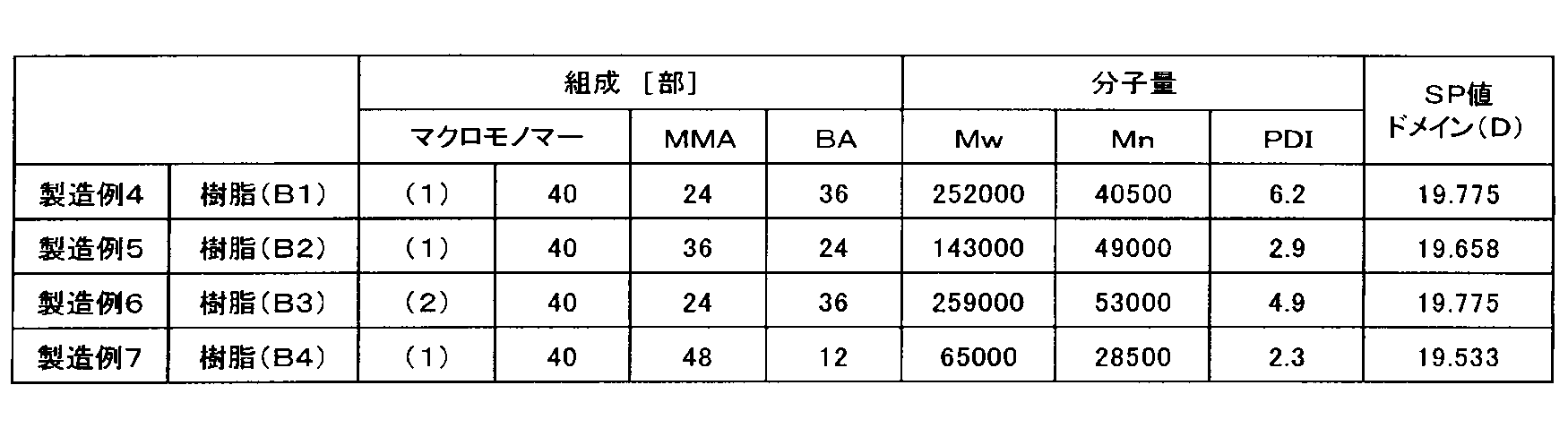
<製造例5>
[樹脂(B2)]
メチルメタクリレート36部及びアクリル酸n-ブチル24部を使用した以外は、製造例4と同様にして樹脂(B2)を得た。
樹脂(B2)のMwは143,000、Mnは49,000、PDIは2.9であった。結果を表2に示す。
[樹脂(B2)]
メチルメタクリレート36部及びアクリル酸n-ブチル24部を使用した以外は、製造例4と同様にして樹脂(B2)を得た。
樹脂(B2)のMwは143,000、Mnは49,000、PDIは2.9であった。結果を表2に示す。
<製造例6>
[樹脂(B3)]
マクロモノマー(2)を用いた以外は、製造例4と同様にして樹脂(B3)を得た。
樹脂(B3)のMwは259,000、Mnは53,000、PDIは4.9であった。結果を表2に示す。
[樹脂(B3)]
マクロモノマー(2)を用いた以外は、製造例4と同様にして樹脂(B3)を得た。
樹脂(B3)のMwは259,000、Mnは53,000、PDIは4.9であった。結果を表2に示す。
<製造例7>
[樹脂(B4)]
メチルメタクリレート48部及びアクリル酸n-ブチル12部を使用した以外は、製造例4と同様にして樹脂(B4)を得た。
樹脂(B4)のMwは65,000、Mnは28,500、PDIは2.3であった。結果を表2に示す。
[樹脂(B4)]
メチルメタクリレート48部及びアクリル酸n-ブチル12部を使用した以外は、製造例4と同様にして樹脂(B4)を得た。
樹脂(B4)のMwは65,000、Mnは28,500、PDIは2.3であった。結果を表2に示す。
<実施例1>
[樹脂組成物の作製]
フッ化ビニリデン系樹脂(A)としてPVDF(アルケマ(株)製、商品名:kynar720)40部と、アクリル系樹脂(B)として製造例4で作製した樹脂(B1)60部をドライブレンドした後、ラボプラストミル(東洋精機(株)製)により220℃で溶融混練し、樹脂組成物(1)を得た。
[樹脂組成物の作製]
フッ化ビニリデン系樹脂(A)としてPVDF(アルケマ(株)製、商品名:kynar720)40部と、アクリル系樹脂(B)として製造例4で作製した樹脂(B1)60部をドライブレンドした後、ラボプラストミル(東洋精機(株)製)により220℃で溶融混練し、樹脂組成物(1)を得た。
[成形体の作製]
上記で得られた樹脂組成物(1)をPTFE製の型に入れて200℃でプレス成形(東洋精機(株)製、商品名:MINI TEST PRESS-10)することで、フィルム状の成形体を得た。冷却は、冷却水を中に流した金属板に成形体を挟むことにより行った。尚、得られたフィルムの厚さは200μm、算術平均粗さ(Ra)は、24nmであった。
得られた成形体の結晶融解エンタルピー、結晶化温度、AHv、IHv及びヘーズ(HZ)を測定した。評価結果を表3に示す。なお、結晶化温度について、「n.d.」は、結晶化ピークが観測されなかったことを意味する。
上記で得られた樹脂組成物(1)をPTFE製の型に入れて200℃でプレス成形(東洋精機(株)製、商品名:MINI TEST PRESS-10)することで、フィルム状の成形体を得た。冷却は、冷却水を中に流した金属板に成形体を挟むことにより行った。尚、得られたフィルムの厚さは200μm、算術平均粗さ(Ra)は、24nmであった。
得られた成形体の結晶融解エンタルピー、結晶化温度、AHv、IHv及びヘーズ(HZ)を測定した。評価結果を表3に示す。なお、結晶化温度について、「n.d.」は、結晶化ピークが観測されなかったことを意味する。

<実施例2>
フッ化ビニリデン系樹脂(A)としてPVDF50部と、アクリル系樹脂(B)として樹脂(B1)50部を使用した以外は、実施例1と同様にして樹脂組成物及び成形体を得た。評価結果を表3に示す。
フッ化ビニリデン系樹脂(A)としてPVDF50部と、アクリル系樹脂(B)として樹脂(B1)50部を使用した以外は、実施例1と同様にして樹脂組成物及び成形体を得た。評価結果を表3に示す。
<実施例3>
フッ化ビニリデン系樹脂(A)としてPVDF50部と、アクリル系樹脂(B)として製造例5で作製した樹脂(B2)50部を使用した以外は、実施例1と同様にして樹脂組成物及び成形体を得た。評価結果を表3に示す。
フッ化ビニリデン系樹脂(A)としてPVDF50部と、アクリル系樹脂(B)として製造例5で作製した樹脂(B2)50部を使用した以外は、実施例1と同様にして樹脂組成物及び成形体を得た。評価結果を表3に示す。
<実施例4>
アクリル系樹脂(B)として製造例6で作製した樹脂(B3)60部を使用した以外は、実施例1と同様にして樹脂組成物及び成形体を得た。評価結果を表3に示す。
アクリル系樹脂(B)として製造例6で作製した樹脂(B3)60部を使用した以外は、実施例1と同様にして樹脂組成物及び成形体を得た。評価結果を表3に示す。
<実施例5>
アクリル変性PTFE(三菱レイヨン(株)製、商品名:メタブレンA3800)をPTFE量に換算して0.1部添加した以外は、実施例1と同様にして樹脂組成物及び成形体を得た。評価結果を表3に示す。
アクリル変性PTFE(三菱レイヨン(株)製、商品名:メタブレンA3800)をPTFE量に換算して0.1部添加した以外は、実施例1と同様にして樹脂組成物及び成形体を得た。評価結果を表3に示す。
<比較例1>
フッ化ビニリデン系樹脂(A)としてPVDF70部と、アクリル系樹脂(B)として樹脂(B1)30部を使用した以外は、実施例1と同様にして樹脂組成物及び成形体を得た。評価結果を表3に示す。
フッ化ビニリデン系樹脂(A)としてPVDF70部と、アクリル系樹脂(B)として樹脂(B1)30部を使用した以外は、実施例1と同様にして樹脂組成物及び成形体を得た。評価結果を表3に示す。
<比較例2>
フッ化ビニリデン系樹脂(A)としてPVDF100部を使用し、アクリル系樹脂(B)を使用しなかった以外は、実施例1と同様にして樹脂組成物及び成形体を得た。評価結果を表3に示す。
フッ化ビニリデン系樹脂(A)としてPVDF100部を使用し、アクリル系樹脂(B)を使用しなかった以外は、実施例1と同様にして樹脂組成物及び成形体を得た。評価結果を表3に示す。
<比較例3>
フッ化ビニリデン系樹脂(A)としてPVDF50部と、アクリル系樹脂(B)としてPMMA(三菱レイヨン(株)製、ポリメチルメタクリレート、商品名:VHK-001)50部を使用した以外は、実施例1と同様にして樹脂組成物及び成形体を得た。評価結果を表3に示す。
フッ化ビニリデン系樹脂(A)としてPVDF50部と、アクリル系樹脂(B)としてPMMA(三菱レイヨン(株)製、ポリメチルメタクリレート、商品名:VHK-001)50部を使用した以外は、実施例1と同様にして樹脂組成物及び成形体を得た。評価結果を表3に示す。
<比較例4>
アクリル系樹脂(B)として製造例7で作製した樹脂(B4)60部を使用した以外は、実施例1と同様にして樹脂組成物及び成形体を得た。評価結果を表3に示す。
アクリル系樹脂(B)として製造例7で作製した樹脂(B4)60部を使用した以外は、実施例1と同様にして樹脂組成物及び成形体を得た。評価結果を表3に示す。
実施例1~5と比較例1及び2との比較から分かるように、結晶融解エンタルピーが10~45(J/g)で、かつIHvが60以下であれば、高い結晶性を維持しつつ、結晶が微細化できて、透明性が良好となる。
実施例1~5と比較例3及び4との比較から分かるように、IHvが60以下であっても、結晶融解エンタルピーが10(J/g)未満の場合は結晶性が不充分であり、加熱時に結晶化によるヘーズが上昇する。具体的に、比較例3及び4に係る成形体を100℃で3時間アニール処理した後に、再度ヘーズを測定したところ、ヘーズが27%まで上昇した。
実施例1~5と比較例3及び4との比較から分かるように、IHvが60以下であっても、結晶融解エンタルピーが10(J/g)未満の場合は結晶性が不充分であり、加熱時に結晶化によるヘーズが上昇する。具体的に、比較例3及び4に係る成形体を100℃で3時間アニール処理した後に、再度ヘーズを測定したところ、ヘーズが27%まで上昇した。
以上に例示したように、結晶融解エンタルピーとIHvが所定の範囲内の値であるフッ化ビニリデン系樹脂(A)を含む成形体は、結晶サイズが抑制されたことから、光散乱を抑制し、高い結晶性と高い透明性を併せ持つ。
本発明の成形体は、意匠用フィルム、農業用フィルム、車載用フィルム、外装用フィルム、建築内装用フィルム、包装材料などに好適に使用できる。
Claims (14)
- フッ化ビニリデン系樹脂(A)を含み、示差走査熱量計により測定した結晶融解エンタルピーが10~45J/gであり、
下記(1)光散乱測定で得られる(2)IHvが60以下となる、樹脂組成物;
(1)光散乱測定:2枚の偏光板に挟まれた樹脂組成物の成形体に、レーザー光を法線方向から照射し、透過した散乱光をスクリーン上に投影させ、検出器によって検出する測定、
(2)IHv:前記(1)の光散乱測定で2枚の偏光板の偏光の向きが直交するときのスクリーン上の光量と、樹脂組成物の成形体を挟まない場合でのスクリーン上の光量との差を、樹脂組成物の成形体の単位厚さ(1μm)あたりに換算した値。 - 前記IHvが45以下となる、請求項1に記載の樹脂組成物。
- 更にアクリル系樹脂(B)を含む、請求項1に記載の樹脂組成物。
- 前記アクリル系樹脂(B)がマクロモノマー単位を含む、請求項3に記載の樹脂組成物。
- 前記フッ化ビニリデン系樹脂(A)20~60質量%と、前記アクリル系樹脂(B)40~80質量%とからなる、請求項3に記載の樹脂組成物。
- 前記アクリル系樹脂(B)が下記(3)及び(4)を満たすコポリマーである、請求項3に記載の樹脂組成物;
(3)前記フッ化ビニリデン系樹脂(A)と相溶なドメイン(C)及び、該ドメイン(C)とは異なるドメイン(D)を有する、
(4)前記ドメイン(C)と前記ドメイン(D)の溶解度パラメータの差が0.010~0.270である。 - 前記ドメイン(D)は、前記ドメイン(C)を構成するモノマー単位のうちで質量比が最大のモノマー単位を30~70質量%含む、請求項6に記載の樹脂組成物。
- 前記ドメイン(C)を構成するポリマー又はポリマー鎖の質量平均分子量が5,000~45,000である、請求項6に記載の樹脂組成物。
- 前記フッ化ビニリデン系樹脂(A)と前記アクリル系樹脂(B)の合計100質量部に対して、ポリテトラフルオロエチレン0.01~3.0質量部を含む、請求項3に記載の樹脂組成物。
- 前記フッ化ビニリデン系樹脂(A)と前記アクリル系樹脂(B)の合計100質量部に対して、ポリテトラフルオロエチレンが0.01~3.0質量部となるように、アクリル変性ポリテトラフルオロエチレンを含む、請求項3に記載の樹脂組成物。
- 請求項1~10のいずれか一項に記載の樹脂組成物を成形してなる成形体。
- 請求項1~10のいずれか一項に記載の樹脂組成物を成形してなるフィルム。
- 厚さが350μm以下である、請求項12に記載のフィルム。
- 表面の算術平均粗さが50nm以下である、請求項12に記載のフィルム。
Priority Applications (3)
| Application Number | Priority Date | Filing Date | Title |
|---|---|---|---|
| CN201680052079.XA CN107949591A (zh) | 2015-09-11 | 2016-09-08 | 含有偏氟乙烯系树脂的树脂组合物、成型体和膜 |
| JP2016559372A JP6233530B2 (ja) | 2015-09-11 | 2016-09-08 | フッ化ビニリデン系樹脂を含む樹脂組成物、成形体、及びフィルム |
| US15/917,025 US10435553B2 (en) | 2015-09-11 | 2018-03-09 | Resin composition, molded article and film including vinylidene fluoride-based resin |
Applications Claiming Priority (8)
| Application Number | Priority Date | Filing Date | Title |
|---|---|---|---|
| JP2015-178994 | 2015-09-11 | ||
| JP2015178994 | 2015-09-11 | ||
| JP2015-180411 | 2015-09-14 | ||
| JP2015180411 | 2015-09-14 | ||
| JP2015182383 | 2015-09-16 | ||
| JP2015-182383 | 2015-09-16 | ||
| JP2015-192417 | 2015-09-30 | ||
| JP2015192417 | 2015-09-30 |
Related Child Applications (1)
| Application Number | Title | Priority Date | Filing Date |
|---|---|---|---|
| US15/917,025 Continuation US10435553B2 (en) | 2015-09-11 | 2018-03-09 | Resin composition, molded article and film including vinylidene fluoride-based resin |
Publications (1)
| Publication Number | Publication Date |
|---|---|
| WO2017043565A1 true WO2017043565A1 (ja) | 2017-03-16 |
Family
ID=58239695
Family Applications (1)
| Application Number | Title | Priority Date | Filing Date |
|---|---|---|---|
| PCT/JP2016/076410 Ceased WO2017043565A1 (ja) | 2015-09-11 | 2016-09-08 | フッ化ビニリデン系樹脂を含む樹脂組成物、成形体、及びフィルム |
Country Status (4)
| Country | Link |
|---|---|
| US (1) | US10435553B2 (ja) |
| JP (1) | JP6233530B2 (ja) |
| CN (1) | CN107949591A (ja) |
| WO (1) | WO2017043565A1 (ja) |
Cited By (1)
| Publication number | Priority date | Publication date | Assignee | Title |
|---|---|---|---|---|
| JP2022069049A (ja) * | 2020-10-23 | 2022-05-11 | 株式会社豊田中央研究所 | 透明樹脂組成物 |
Families Citing this family (1)
| Publication number | Priority date | Publication date | Assignee | Title |
|---|---|---|---|---|
| JP7191681B2 (ja) | 2018-12-27 | 2022-12-19 | 株式会社クレハ | ポリフッ化ビニリデン樹脂組成物および成形体 |
Citations (5)
| Publication number | Priority date | Publication date | Assignee | Title |
|---|---|---|---|---|
| JPS6323949A (ja) * | 1986-07-17 | 1988-02-01 | Mitsubishi Rayon Co Ltd | 樹脂組成物 |
| JPS63308056A (ja) * | 1987-06-09 | 1988-12-15 | Daikin Ind Ltd | フッ化ビニリデン系樹脂組成物 |
| JPS63308055A (ja) * | 1987-06-09 | 1988-12-15 | Mitsubishi Petrochem Co Ltd | ポリフッ化ビニリデン樹脂組成物 |
| JPH037784A (ja) * | 1988-09-20 | 1991-01-14 | Japan Synthetic Rubber Co Ltd | フッ素系重合体水性分散液およびフッ素系重合体含有水性分散液 |
| WO2011142453A1 (ja) * | 2010-05-14 | 2011-11-17 | 三菱レイヨン株式会社 | フィルム、その製造方法、積層フィルムもしくはシート、および積層体 |
Family Cites Families (11)
| Publication number | Priority date | Publication date | Assignee | Title |
|---|---|---|---|---|
| JPH0315005A (ja) * | 1989-03-10 | 1991-01-23 | Kureha Chem Ind Co Ltd | 光学位相差板及びその製造方法 |
| FR2772038B1 (fr) * | 1997-12-05 | 2000-02-18 | Atochem Elf Sa | Compositions a base de resines thermoplastiques semi-cristallines a tenues mecanique et thermique ameliorees, leur procede de preparation et leurs utilisations |
| AU2009309069B2 (en) * | 2008-10-28 | 2014-01-09 | Arkema Inc. | Water flux polymer membranes |
| EP2662394A4 (en) * | 2011-01-06 | 2013-11-27 | Mitsubishi Rayon Co | MODIFYING AGENT FOR POLYVINYLIDENE FLUORIDE, BINDER RESIN COMPOSITION FOR BATTERIES, SECONDARY CELL ELECTRODE AND BATTERY |
| JP5987691B2 (ja) * | 2011-09-12 | 2016-09-07 | 三菱レイヨン株式会社 | 積層フィルム及び積層成形品 |
| JP6078068B2 (ja) * | 2011-09-13 | 2017-02-08 | ソルベイ スペシャルティ ポリマーズ イタリー エス.ピー.エー. | 電極形成組成物 |
| US20160200884A1 (en) * | 2013-08-14 | 2016-07-14 | Mitsubishi Rayon Co., Ltd. | Film comprising vinylidene fluoride resin, laminated film, and laminate |
| JP6365812B2 (ja) * | 2013-09-25 | 2018-08-01 | 三菱ケミカル株式会社 | フッ素系樹脂組成物及びフィルム |
| CN106133065A (zh) * | 2014-03-25 | 2016-11-16 | 三菱丽阳株式会社 | 树脂组合物和由树脂组合物构成的成型体 |
| US20160220903A1 (en) * | 2015-02-02 | 2016-08-04 | Kuato Games (UK) Limited | Systems and Methods for Dynamically Creating Personalized Storybooks based on User Interactions within a Virtual Environment |
| EP3305846B1 (en) * | 2015-05-27 | 2019-07-24 | Mitsubishi Chemical Corporation | Resin composition and film comprising resin composition |
-
2016
- 2016-09-08 JP JP2016559372A patent/JP6233530B2/ja active Active
- 2016-09-08 CN CN201680052079.XA patent/CN107949591A/zh active Pending
- 2016-09-08 WO PCT/JP2016/076410 patent/WO2017043565A1/ja not_active Ceased
-
2018
- 2018-03-09 US US15/917,025 patent/US10435553B2/en active Active
Patent Citations (5)
| Publication number | Priority date | Publication date | Assignee | Title |
|---|---|---|---|---|
| JPS6323949A (ja) * | 1986-07-17 | 1988-02-01 | Mitsubishi Rayon Co Ltd | 樹脂組成物 |
| JPS63308056A (ja) * | 1987-06-09 | 1988-12-15 | Daikin Ind Ltd | フッ化ビニリデン系樹脂組成物 |
| JPS63308055A (ja) * | 1987-06-09 | 1988-12-15 | Mitsubishi Petrochem Co Ltd | ポリフッ化ビニリデン樹脂組成物 |
| JPH037784A (ja) * | 1988-09-20 | 1991-01-14 | Japan Synthetic Rubber Co Ltd | フッ素系重合体水性分散液およびフッ素系重合体含有水性分散液 |
| WO2011142453A1 (ja) * | 2010-05-14 | 2011-11-17 | 三菱レイヨン株式会社 | フィルム、その製造方法、積層フィルムもしくはシート、および積層体 |
Cited By (2)
| Publication number | Priority date | Publication date | Assignee | Title |
|---|---|---|---|---|
| JP2022069049A (ja) * | 2020-10-23 | 2022-05-11 | 株式会社豊田中央研究所 | 透明樹脂組成物 |
| JP7325721B2 (ja) | 2020-10-23 | 2023-08-15 | 株式会社豊田中央研究所 | 透明樹脂組成物 |
Also Published As
| Publication number | Publication date |
|---|---|
| CN107949591A (zh) | 2018-04-20 |
| JPWO2017043565A1 (ja) | 2017-09-07 |
| JP6233530B2 (ja) | 2017-11-22 |
| US20180208758A1 (en) | 2018-07-26 |
| US10435553B2 (en) | 2019-10-08 |
Similar Documents
| Publication | Publication Date | Title |
|---|---|---|
| CN101925653B (zh) | 脂环族环氧树脂组合物、其固化物及其制造方法以及含有橡胶状聚合物的树脂组合物 | |
| KR20150097778A (ko) | 열방성 폴리머 | |
| JP6108036B1 (ja) | 樹脂組成物及び樹脂組成物からなるフィルム | |
| JPWO2017171008A1 (ja) | 樹脂組成物、その成形体及びフィルム | |
| TWI767924B (zh) | 甲基丙烯酸樹脂組成物及其製造方法、成形體、薄膜、積層薄膜、積層成形體 | |
| KR101950119B1 (ko) | 소광용 열가소성 수지 조성물, 불소계 소광 필름 및 불소계 소광 적층 필름 | |
| WO2015098980A1 (ja) | 光学用熱可塑性樹脂、および成形体 | |
| JP5403777B2 (ja) | 光学材料用成形体 | |
| CN119487081A (zh) | 用于电子组件应用的具有高温和高湿度环境稳定性的耐热性pmma共聚物 | |
| JP7322002B2 (ja) | (メタ)アクリル樹脂組成物、フィルムおよびその製造方法 | |
| US20170096553A1 (en) | Resin composition and molded body formed from resin composition | |
| JP6233530B2 (ja) | フッ化ビニリデン系樹脂を含む樹脂組成物、成形体、及びフィルム | |
| JP2016188313A (ja) | アクリル樹脂組成物、該樹脂組成物で形成されたフィルム、該フィルムを備えた偏光板及び該偏光板を備えた画像表示装置 | |
| JP6504434B2 (ja) | フッ化ビニリデン系樹脂組成物製フィルム | |
| JP2018039916A (ja) | 樹脂組成物及び樹脂組成物からなるフィルム | |
| JP2021138831A (ja) | 樹脂微粒子及びその製造方法 | |
| JP2018154678A (ja) | 結晶性樹脂組成物 | |
| JP7495941B2 (ja) | コアシェル架橋ゴム粒子およびメタクリル樹脂組成物 | |
| US20190023828A1 (en) | Graft copolymer and acrylic resin composition containing same | |
| JP7563926B2 (ja) | (メタ)アクリル系樹脂フィルムの製造方法 | |
| JP6787001B2 (ja) | フィルム | |
| JP2018127602A (ja) | 樹脂組成物からなるフィルム | |
| WO2018235532A1 (ja) | 原反フィルム、延伸光学フィルムの製造方法、及び延伸光学フィルム | |
| JP2018059010A (ja) | 結晶性樹脂組成物からなる艶消しフィルム | |
| JP2018048292A (ja) | 結晶性樹脂組成物からなるフィルム |
Legal Events
| Date | Code | Title | Description |
|---|---|---|---|
| ENP | Entry into the national phase |
Ref document number: 2016559372 Country of ref document: JP Kind code of ref document: A |
|
| 121 | Ep: the epo has been informed by wipo that ep was designated in this application |
Ref document number: 16844426 Country of ref document: EP Kind code of ref document: A1 |
|
| NENP | Non-entry into the national phase |
Ref country code: DE |
|
| 122 | Ep: pct application non-entry in european phase |
Ref document number: 16844426 Country of ref document: EP Kind code of ref document: A1 |