WO2017006748A1 - ポリアミド化合物、及びその製造方法 - Google Patents
ポリアミド化合物、及びその製造方法 Download PDFInfo
- Publication number
- WO2017006748A1 WO2017006748A1 PCT/JP2016/068091 JP2016068091W WO2017006748A1 WO 2017006748 A1 WO2017006748 A1 WO 2017006748A1 JP 2016068091 W JP2016068091 W JP 2016068091W WO 2017006748 A1 WO2017006748 A1 WO 2017006748A1
- Authority
- WO
- WIPO (PCT)
- Prior art keywords
- polyamide compound
- carbon atoms
- group
- diamine
- general formula
- Prior art date
- Legal status (The legal status is an assumption and is not a legal conclusion. Google has not performed a legal analysis and makes no representation as to the accuracy of the status listed.)
- Ceased
Links
- RZXMPPFPUUCRFN-UHFFFAOYSA-N Cc(cc1)ccc1N Chemical compound Cc(cc1)ccc1N RZXMPPFPUUCRFN-UHFFFAOYSA-N 0.000 description 1
- CBCKQZAAMUWICA-UHFFFAOYSA-N Nc(cc1)ccc1N Chemical compound Nc(cc1)ccc1N CBCKQZAAMUWICA-UHFFFAOYSA-N 0.000 description 1
Images


Classifications
-
- C—CHEMISTRY; METALLURGY
- C08—ORGANIC MACROMOLECULAR COMPOUNDS; THEIR PREPARATION OR CHEMICAL WORKING-UP; COMPOSITIONS BASED THEREON
- C08G—MACROMOLECULAR COMPOUNDS OBTAINED OTHERWISE THAN BY REACTIONS ONLY INVOLVING UNSATURATED CARBON-TO-CARBON BONDS
- C08G69/00—Macromolecular compounds obtained by reactions forming a carboxylic amide link in the main chain of the macromolecule
- C08G69/02—Polyamides derived from amino-carboxylic acids or from polyamines and polycarboxylic acids
- C08G69/26—Polyamides derived from amino-carboxylic acids or from polyamines and polycarboxylic acids derived from polyamines and polycarboxylic acids
-
- C—CHEMISTRY; METALLURGY
- C08—ORGANIC MACROMOLECULAR COMPOUNDS; THEIR PREPARATION OR CHEMICAL WORKING-UP; COMPOSITIONS BASED THEREON
- C08G—MACROMOLECULAR COMPOUNDS OBTAINED OTHERWISE THAN BY REACTIONS ONLY INVOLVING UNSATURATED CARBON-TO-CARBON BONDS
- C08G69/00—Macromolecular compounds obtained by reactions forming a carboxylic amide link in the main chain of the macromolecule
- C08G69/02—Polyamides derived from amino-carboxylic acids or from polyamines and polycarboxylic acids
- C08G69/26—Polyamides derived from amino-carboxylic acids or from polyamines and polycarboxylic acids derived from polyamines and polycarboxylic acids
- C08G69/265—Polyamides derived from amino-carboxylic acids or from polyamines and polycarboxylic acids derived from polyamines and polycarboxylic acids from at least two different diamines or at least two different dicarboxylic acids
-
- C—CHEMISTRY; METALLURGY
- C08—ORGANIC MACROMOLECULAR COMPOUNDS; THEIR PREPARATION OR CHEMICAL WORKING-UP; COMPOSITIONS BASED THEREON
- C08G—MACROMOLECULAR COMPOUNDS OBTAINED OTHERWISE THAN BY REACTIONS ONLY INVOLVING UNSATURATED CARBON-TO-CARBON BONDS
- C08G69/00—Macromolecular compounds obtained by reactions forming a carboxylic amide link in the main chain of the macromolecule
- C08G69/02—Polyamides derived from amino-carboxylic acids or from polyamines and polycarboxylic acids
- C08G69/26—Polyamides derived from amino-carboxylic acids or from polyamines and polycarboxylic acids derived from polyamines and polycarboxylic acids
- C08G69/34—Polyamides derived from amino-carboxylic acids or from polyamines and polycarboxylic acids derived from polyamines and polycarboxylic acids using polymerised unsaturated fatty acids
-
- C—CHEMISTRY; METALLURGY
- C08—ORGANIC MACROMOLECULAR COMPOUNDS; THEIR PREPARATION OR CHEMICAL WORKING-UP; COMPOSITIONS BASED THEREON
- C08G—MACROMOLECULAR COMPOUNDS OBTAINED OTHERWISE THAN BY REACTIONS ONLY INVOLVING UNSATURATED CARBON-TO-CARBON BONDS
- C08G69/00—Macromolecular compounds obtained by reactions forming a carboxylic amide link in the main chain of the macromolecule
- C08G69/40—Polyamides containing oxygen in the form of ether groups
-
- C—CHEMISTRY; METALLURGY
- C08—ORGANIC MACROMOLECULAR COMPOUNDS; THEIR PREPARATION OR CHEMICAL WORKING-UP; COMPOSITIONS BASED THEREON
- C08G—MACROMOLECULAR COMPOUNDS OBTAINED OTHERWISE THAN BY REACTIONS ONLY INVOLVING UNSATURATED CARBON-TO-CARBON BONDS
- C08G69/00—Macromolecular compounds obtained by reactions forming a carboxylic amide link in the main chain of the macromolecule
- C08G69/42—Polyamides containing atoms other than carbon, hydrogen, oxygen, and nitrogen
Definitions
- the present invention relates to a polyamide compound and a method for producing the same.
- the present invention relates to a polyamide compound excellent in water absorption resistance and the like, and a method for producing the same.
- Non-Patent Documents 1 to 3 From the viewpoint of preventing global warming and reducing resource risks, polymers using plant-derived compounds as starting materials are attracting attention instead of petroleum polymers (see, for example, Non-Patent Documents 1 to 3).
- polylactic acid as a typical example is a plant-derived compound, but has problems in heat resistance and hydrolysis resistance. Therefore, the application range is limited only with polylactic acid. For example, there are automotive parts and the like to which polylactic acid cannot be applied due to the characteristics of polylactic acid. Under such circumstances, development of plant-derived high-performance polymers other than polylactic acid is desired.
- PA6 polymerized with ⁇ -caprolactam
- PA66 PA66
- PA610 PA1010 polymerized with dicarboxylic acid and diamine
- PA11 which is a plant-derived polyamide compound, is obtained by polymerization of 11-aminoundecanoic acid.
- the conventional polyamide compound obtained by polymerization of ⁇ -caprolactam, dicarboxylic acid and diamine, and 11-aminoundecane may not have sufficient characteristics.
- it has characteristics to be improved such as lack of flexibility, high water absorption, low energy absorption, and crystalline resin.
- the present invention has been made in view of the above circumstances, and an object thereof is to provide a polyamide compound having characteristics superior to those of conventional polyamide compounds.
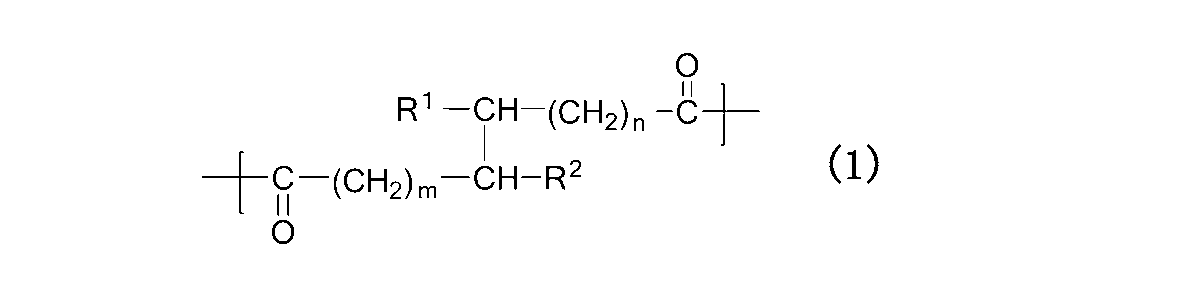
- the gist is a polyamide compound containing a dicarboxylic acid unit represented by the following general formula (1) and a diamine unit represented by the following general formula (2).
- N represents an integer of 6 to 18, and m represents an integer of 6 to 18.
- R 1 is a hydrogen atom, a linear or branched alkyl group having 1 to 18 carbon atoms, a monovalent hydrocarbon group having 3 to 8 carbon atoms having an alicyclic skeleton, or a straight chain having 1 to 18 carbon atoms. Or a branched alkoxyl group is shown.
- R 2 is a hydrogen atom, a linear or branched alkyl group having 1 to 18 carbon atoms, a monovalent hydrocarbon group having 3 to 8 carbon atoms having an alicyclic skeleton, or a straight chain having 1 to 18 carbon atoms. Or a branched alkoxyl group is shown. R 1 and R 2 may be the same as or different from each other. ) (A represents a divalent organic group having 1 to 18 carbon atoms.)
- the invention described in claim 2 Furthermore, it contains the diamine unit represented by following General formula (3), It is a polyamide compound of Claim 1 characterized by the above-mentioned. (B represents a divalent organic group having 1 to 18 carbon atoms, provided that A and B are different.)
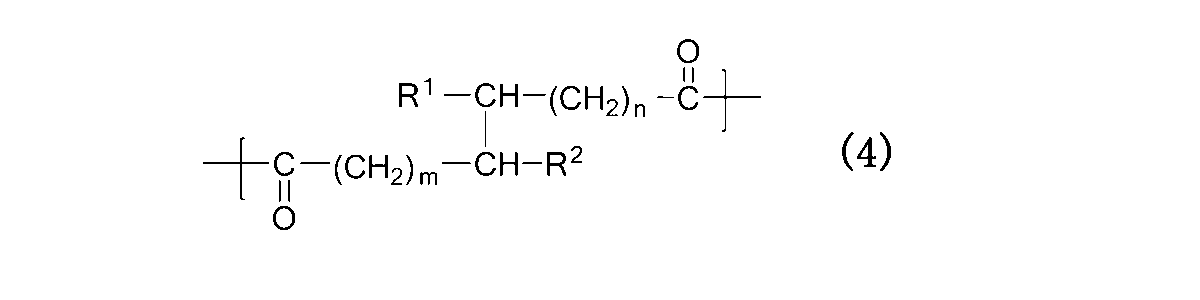
- the invention according to claim 3 The method for producing a polyamide compound according to claim 1 or 2, wherein a dicarboxylic acid compound having a structure represented by the following general formula (4) is reacted with a diamine compound.
- N represents an integer of 6 to 18, and m represents an integer of 6 to 18.
- R 1 is a hydrogen atom, a linear or branched alkyl group having 1 to 18 carbon atoms, a monovalent hydrocarbon group having 3 to 8 carbon atoms having an alicyclic skeleton, or a straight chain having 1 to 18 carbon atoms. Or a branched alkoxyl group is shown.
- R 2 is a hydrogen atom, a linear or branched alkyl group having 1 to 18 carbon atoms, a monovalent hydrocarbon group having 3 to 8 carbon atoms having an alicyclic skeleton, or a straight chain having 1 to 18 carbon atoms. Or a branched alkoxyl group is shown. R 1 and R 2 may be the same as or different from each other. )
- the polyamide compound of the present invention Since the polyamide compound of the present invention has a long chain, it has excellent water absorption resistance.
- a polyamide compound having excellent water absorption resistance can be produced.
- the polyamide compound of the present invention contains a dicarboxylic acid unit represented by the following general formula (1) and a diamine unit represented by the following general formula (2).
- N represents an integer of 6 to 18, and m represents an integer of 6 to 18.
- R 1 is a hydrogen atom, a linear or branched alkyl group having 1 to 18 carbon atoms, a monovalent hydrocarbon group having 3 to 8 carbon atoms having an alicyclic skeleton, or a straight chain having 1 to 18 carbon atoms. Or a branched alkoxyl group is shown.
- R 2 is a hydrogen atom, a linear or branched alkyl group having 1 to 18 carbon atoms, a monovalent hydrocarbon group having 3 to 8 carbon atoms having an alicyclic skeleton, or a straight chain having 1 to 18 carbon atoms. Or a branched alkoxyl group is shown. R 1 and R 2 may be the same as or different from each other. ) (A represents a divalent organic group having 1 to 18 carbon atoms.)
- the polyamide compound of the present invention may further contain structural units other than those described above as long as the effects of the present invention are not impaired.
- the content of the dicarboxylic acid unit is not particularly limited.
- the content of the dicarboxylic acid unit is usually 5 to 50 mol%, preferably 20 to 50 mol%, more preferably 30 to 50 mol%.
- the content of the diamine unit is not particularly limited.
- the content of the diamine unit is usually 5 to 50 mol%, preferably 20 to 50 mol%, more preferably 30 to 50 mol%.
- the proportion of the content of the dicarboxylic acid unit and the diamine unit is preferably substantially the same from the viewpoint of the polymerization reaction, and the content of the dicarboxylic acid unit is ⁇ 1 mol% of the content of the diamine unit. More preferred.
- the polyamide compound of the present invention contains a dicarboxylic acid unit represented by the following general formula (1) as described above.
- N represents an integer of 6 to 18, and m represents an integer of 6 to 18.
- R 1 is a hydrogen atom, a linear or branched alkyl group having 1 to 18 carbon atoms, a monovalent hydrocarbon group having 3 to 8 carbon atoms having an alicyclic skeleton, or a straight chain having 1 to 18 carbon atoms. Or a branched alkoxyl group is shown.
- R 2 is a hydrogen atom, a linear or branched alkyl group having 1 to 18 carbon atoms, a monovalent hydrocarbon group having 3 to 8 carbon atoms having an alicyclic skeleton, or a straight chain having 1 to 18 carbon atoms. Or a branched alkoxyl group is shown. R 1 and R 2 may be the same as or different from each other. )
- substituents R 1 and R 2 constituting the general formula (1) are linear or branched alkyl groups having 1 to 18 carbon atoms, these may be linear or branched. . Examples thereof are methyl group, ethyl group, n-propyl group, i-propyl group, n-butyl group, i-butyl group, sec-butyl group, t-butyl group, n-pentyl group, n-hexyl group. N-heptyl group, n-octyl group, 2-ethylhexyl group, nonyl group, decyl group, dodecyl group and the like.
- substituents R 1 and R 2 are monovalent hydrocarbon groups having 3 to 8 carbon atoms having an alicyclic skeleton, examples thereof include a cyclopropyl group, a cyclobutyl group, a cyclopentyl group, a cycloheptyl group, Examples include a cyclooctyl group and a norbornene group.
- substituents R 1 and R 2 are linear or branched alkoxyl groups having 1 to 18 carbon atoms, examples thereof include a methoxy group, an ethoxy group, a hydroxyethoxy group, a propoxy group, a hydroxypropoxy group, Examples include butoxy group.
- N is preferably an integer of 10 to 14.
- m is preferably an integer of 10 to 14. This is because, when n and m are within this range, the content ratio of hydrogen bonds in the molecule is reduced and water resistance is improved.
- n and m are preferably the same.
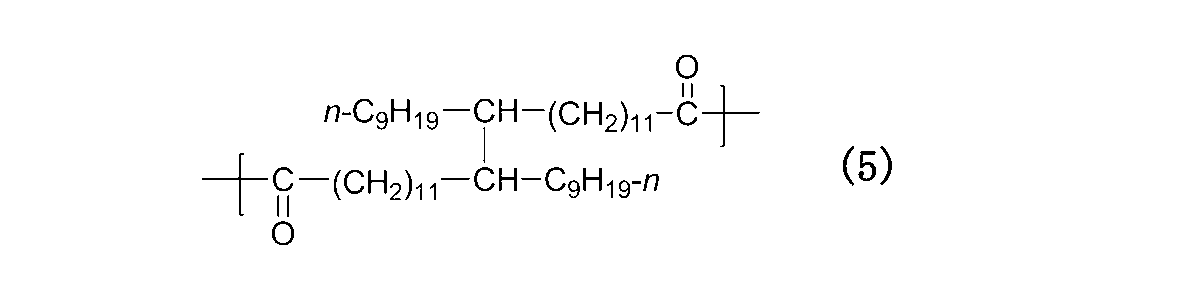
- a unit represented by the following formula (5) is particularly preferable.
- the unit shown in Formula (5) is derived from a plant, and is preferable from the viewpoint of preventing global warming and reducing resource risk.
- the content of the dicarboxylic acid unit represented by the general formula (1) is not particularly limited.
- the dicarboxylic acid unit represented by the general formula (1) is preferably contained in an amount of 30 to 100 mol%, more preferably 50 to 100 mol%, and particularly preferably 70 to 100 mol%. This is because when the content of the dicarboxylic acid unit represented by the general formula (1) is within this range, the water absorption resistance is excellent.
- the compound which can comprise dicarboxylic acid units other than the dicarboxylic acid unit represented by General formula (1) is not specifically limited.
- specific examples of dicarboxylic acid compounds include carbon such as oxalic acid, malonic acid, fumaric acid, maleic acid, succinic acid, glutaric acid, adipic acid, pimelic acid, suberic acid, azelaic acid, sebacic acid, and dodecanedioic acid.
- Aliphatic dicarboxylic acids such as (hydrogenated dimer acid), alicyclic dicarboxylic acids such as 1,4-cyclohexanedicarboxylic acid, and terephthalic acid, isophthalic acid, 1,3-benzenediacetic acid, 1,4-benzenedicarboxylic acid
- An aromatic dicarboxylic acid such as acetic acid can be exemplified.
- derivatives of these dicarboxylic acid compounds may be used.
- the derivatives include carboxylic acid halides. These can be used alone or in combination of two or more.
- the content of dicarboxylic acid units other than the dicarboxylic acid represented by the general formula (1) is not particularly limited.
- the content of dicarboxylic acid units other than the dicarboxylic acid represented by the general formula (1) is preferably less than 50 mol%, more preferably less than 20 mol%, and less than 10 mol%. Particularly preferred. This is because when the content of dicarboxylic acid units other than the dicarboxylic acid unit represented by the general formula (1) is within this range, the water absorption resistance is improved.
- the diamine unit in the polyamide compound of the present invention includes at least a diamine unit represented by the general formula (2).
- A represents a divalent organic group having 1 to 18 carbon atoms.
- the divalent organic group having 1 to 18 carbon atoms is not particularly limited.
- the divalent organic group includes a divalent organic group having no aromatic ring and a divalent organic group having an aromatic ring.
- Examples of the divalent organic group include, but are not limited to, an alkylene group, a cycloalkylene group, an alkenylene group, a cycloalkenylene group, an alkynylene group, a cycloalkynylene group, and an arylene group.
- Examples of the divalent organic group having no aromatic ring include — (CH 2 ) 3 —, — (CH 2 ) 4 —, —CH 2 CH (CH 3 ) —, — (CH 2 ) 6 —, — Examples thereof include linear or branched alkylene groups such as (CH 2 ) 8 —, — (CH 2 ) 10 —, and — (CH 2 ) 12 —.
- divalent organic group having an aromatic ring examples include 1,2-phenylene group, 3-fluoro-1,2-phenylene group, 4-fluoro-1,2-phenylene group, 3-methoxy-1 , 2-phenylene group, 4-methoxy-1,2-phenylene group, 3-methyl-1,2-phenylene group, 4-methyl-1,2-phenylene group, 1,3-phenylene group, 2-fluoro- 1,3-phenylene group, 4-fluoro-1,3-phenylene group, 5-fluoro-1,3-phenylene group, 2-methoxy-1,3-phenylene group, 4-methoxy-1,3-phenylene group 5-methoxy-1,3-phenylene group, 2-methyl-1,3-phenylene group, 4-methyl-1,3-phenylene group, 5-methyl-1,3-phenylene group, 1,4-phenylene Group, 2-fluoro-1,4-fluoro Nylene group, 2-methoxy-1,4-phenylene group, 2-methyl-1,4-phenylene Group, 2-flu
- divalent organic group examples include the organic groups shown below.
- the diamine shown below is illustrated suitably.
- the content of the diamine unit represented by the above general formula (2) is not particularly limited.
- the diamine unit represented by the general formula (2) is preferably contained in an amount of 5 to 100 mol%, more preferably 20 to 100 mol%, and particularly preferably 30 to 100 mol%. This is because when the content of the diamine acid unit represented by the general formula (2) is within this range, the water absorption resistance is excellent.
- the diamine unit in the polyamide compound of the present invention may contain a diamine unit represented by the general formula (3) in addition to the diamine unit represented by the general formula (2).
- B represents a divalent organic group having 1 to 18 carbon atoms, provided that A and B are different.
- the description of A in the general formula (2) can be applied as it is. However, A and B are different.
- the polyamide compound can impart various characteristics.
- Preferable combinations of the compound that can constitute the diamine unit represented by the general formula (2) and the compound that can constitute the diamine unit represented by the general formula (3) include the following combinations. (M-1) (M-2) (M-3) (M-4) (M-5) (M-6)
- the total amount of the diamine units in the polyamide compound is 100 mol%.
- the total of the diamine unit represented by (2) and the diamine unit represented by the general formula (3) is preferably contained in an amount of 50 to 100 mol%, more preferably 60 to 100 mol%, and more preferably 70 to 100 mol%. % Is particularly preferable. This is because if it is within this range, the water absorption resistance is excellent.
- the diamine unit represented by the general formula (2) when the diamine unit represented by the general formula (3) is included, the diamine unit represented by the general formula (2): the general formula (3 ) Is preferably 1: 0.01 to 1: 100, more preferably 1: 0.1 to 1:10, and 1: 0.3 to 1: 100. 3 is more preferable.
- the dicarboxylic acid unit represented by the general formula (1) and the general formula (2) are randomly included in the polyamide compound. May be present.
- the dicarboxylic acid unit represented by General formula (1), and General formula (3) The repeating unit consisting of a diamine unit represented by the formula (1) may be in the form of a block and be present in the polyamide compound. That is, in the case of this block shape, a block in which only repeating units composed of a dicarboxylic acid unit represented by the general formula (1) and a diamine unit represented by the general formula (2) are collected, and the general formula (1 ) And a block in which only repeating units composed of the diamine unit represented by the general formula (3) are gathered.
- the compound which can comprise diamine units other than the diamine unit represented by General Formula (2) (3) is not specifically limited.
- Examples of the diamine other than the diamine unit represented by the general formulas (2) and (3) include known aliphatic diamines, alicyclic diamines, aromatic diamines, diaminoorganosiloxanes, and the like.
- Examples of the aliphatic diamine that can constitute a diamine unit other than the diamine units represented by the general formulas (2) and (3) include 1,1-metaxylylenediamine, 1,3-propanediamine, and pentamethylenediamine. be able to.
- Examples of the alicyclic diamine include 4,4′-methylenebis (cyclohexylamine) and 1,3-bis (aminomethyl) cyclohexane.
- Aromatic diamines such as o-phenylenediamine, m-phenylenediamine, 4,4'-diaminodiphenylmethane, 1,5-diaminonaphthalene, 2,2'-dimethyl-4,4'-diaminobiphenyl, 4,4 '-Diamino-2,2'-bis (trifluoromethyl) biphenyl, 2,7-diaminofluorene, 4,4'-diamino-2,2'-dimethylbiphenyl, 9,9-bis (4-aminophenyl) fluorene 2,2-bis [4- (4-aminophenoxy) phenyl] hexafluoropropane, 2,2-bis (4-aminophenyl) hexafluoropropane, 4,4 ′-(p-phenylenediisopropylidene) bisaniline 4,4 '-(m-phenylenediisopropylidene)
- the content of diamine units other than the diamines represented by the above general formulas (2) and (3) is not particularly limited.
- the content of diamine units other than the diamine represented by the general formulas (2) and (3) is preferably less than 50 mol%, more preferably less than 30 mol%, and less than 10 mol%. Is particularly preferred. This is because when the content of diamine units other than the diamine units represented by the general formulas (2) and (3) is within this range, the water absorption resistance is improved.
- the polyamide compound of the present invention uses a compound having a long chain (dicarboxylic acid component capable of constituting a dicarboxylic acid unit). Therefore, the polyamide compound has excellent water absorption resistance because it contains less hydrogen bonds in the molecule. Further, when the diamine unit has an aromatic ring, this part functions as a hard segment. On the other hand, the — (CH 2 ) n — and — (CH 2 ) m — moieties in the dicarboxylic acid unit function as soft segments that give soft properties. Therefore, a polyamide compound having an aromatic ring in a diamine unit has a structure in which a soft segment and a hard segment are connected by an amide bond.
- this polyamide compound has a hydrophobic structure, has excellent elongation characteristics due to the soft alkyl chain of the soft segment, and has a rigid portion due to the aromatic ring of the hard segment.
- a characteristic of the polyamide compound of the present invention is high energy absorption. Another feature is that the water absorption resistance is high. Another feature is that it is non-crystalline (transparent). These characteristics are not found in conventional polyamides obtained by polymerization of ⁇ -caprolactam, dicarboxylic acid and diamine, and 11-aminoundecane.
- the method for producing a polyamide compound of the present invention is characterized in that a dicarboxylic acid compound having a structure represented by the following general formula (4) is reacted with a diamine compound.
- N represents an integer of 6 to 18, and m represents an integer of 6 to 18.
- R 1 is a hydrogen atom, a linear or branched alkyl group having 1 to 18 carbon atoms, a monovalent hydrocarbon group having 3 to 8 carbon atoms having an alicyclic skeleton, or a straight chain having 1 to 18 carbon atoms. Or a branched alkoxyl group is shown.
- R 2 is a hydrogen atom, a linear or branched alkyl group having 1 to 18 carbon atoms, a monovalent hydrocarbon group having 3 to 8 carbon atoms having an alicyclic skeleton, the number 1 to 18 linear carbon atoms Or a branched alkoxyl group is shown.
- R 1 and R 2 may be the same as or different from each other. )
- the substituents R 1 and R 2 constituting the general formula (4) can be directly applied to the description of the substituents R 1 and R 2 constituting the general formula (1).
- the description of “n” and “m” in the general formula (1) can be applied as they are.
- a carboxylic acid derivative in which the hydroxyl group of the carboxyl group of the dicarboxylic acid is substituted with another heteroatom (atom other than carbon, hydrogen, or metal) can also be used.
- the carboxylic acid derivative include acyl halides (acid halides) in which the hydroxyl group is replaced by halogen.
- the polyamide compound of the present invention can be produced by polycondensation of a diamine component that can constitute a diamine unit and a dicarboxylic acid component that can constitute a dicarboxylic acid unit.
- the degree of polymerization can be controlled by adjusting the polycondensation conditions and the like.
- a method for producing the polyamide compound is not particularly limited.
- As a method for producing a polyamide compound for example, (1) a method using an acid or base catalyst, (2) a method for activating a carboxylic acid, (3) a method using transesterification, (4) using a condensing agent A method for performing the above is preferably used.
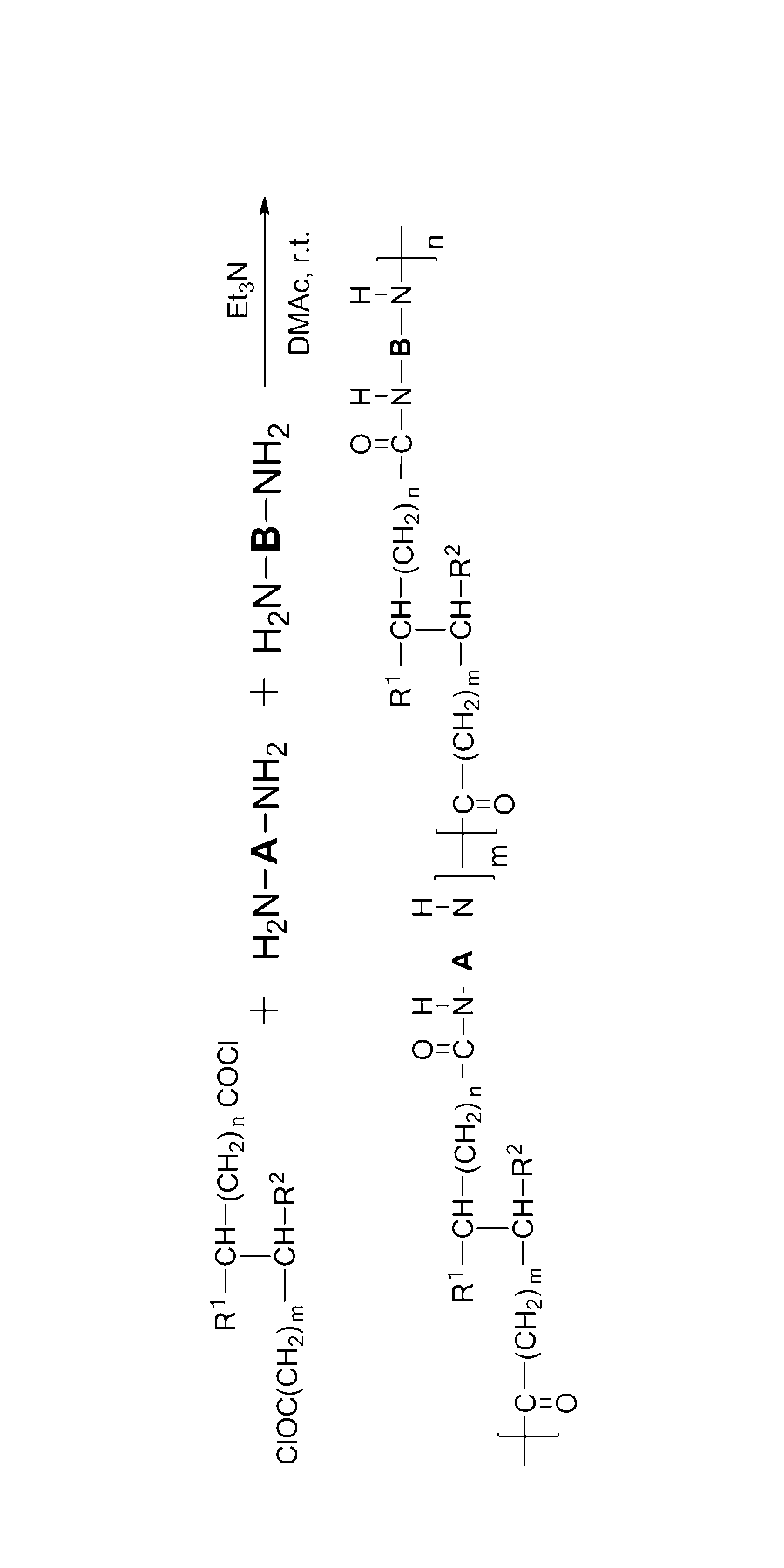
- a suitable production method a production method of a polyamide compound using an acid chloride in which a carboxylic acid is activated is exemplified.
- a three-component polyamide compound comprising a dicarboxylic acid unit represented by the general formula (1), a diamine unit represented by the general formula (2), and a diamine unit represented by the general formula (3) Take synthesis as an example.
- dicarboxylic acid is activated to form acid chloride, and acid chloride and two kinds of diamine are reacted to form a polyamide compound.
- monoamine or monocarboxylic acid may be added as a molecular weight modifier during polycondensation.
- the ratio (molar ratio) between the diamine component and the carboxylic acid component constituting the polyamide compound may be adjusted by shifting from 1.
- reaction solvent is not particularly limited, and known solvents can be widely applied.
- organic polar solvent as the reaction solvent include dimethylacetamide, N-methylpyrrolidone, dimethylsulfone, dimethylformamide, N-methylcaprolactam, tetramethylurea, N, N′-dimethyl-2-imidazolidinone and the like. . These may be used singly or as a mixed solvent of two or more. Further, if necessary, the solubility may be improved by using hydrogen chloride and a metal halide salt such as lithium chloride, calcium chloride, potassium chloride and the like in combination.
- the polyamide compound concentration is not particularly limited, although it varies depending on the solubility of the produced polyamide compound in the solvent and the solution viscosity.
- the concentration of the polyamide compound is preferably 0.1 to 40% by mass from the viewpoint of productivity and the like.
- the concentration of the polyamide compound is determined by comprehensively judging the content and composition ratio of the polyamide compound, the solubility, the solution viscosity, the handleability, and the ease of defoaming.
- the method for adding the raw material is not particularly limited.
- a dicarboxylic acid halide such as acid chloride as one raw material is added.
- an inert atmosphere for example, in a nitrogen atmosphere or an argon gas atmosphere
- the molar ratio of diamine and acid halide should basically be equimolar, but diamine or acid component as one raw material may be added excessively to control the degree of polymerization, or monofunctional
- An appropriate amount of an organic substance such as aniline, naphthylamine, acetic acid chloride, or benzoyl chloride may be added.
- an addition method intended to block the polymer such as reacting a part of diamine or acid chloride and then adding the remaining raw materials. You can do it.
- the polymerization reaction product (polyamide compound) thus obtained requires neutralization in order to accompany the by-product hydrogen halide.
- the neutralizing agent is not particularly limited as long as it is a generally known basic compound.
- the neutralizing agent triethylamine, tripropylamine, benzyldimethylamine, lithium hydroxide, sodium hydroxide, potassium hydroxide, magnesium hydroxide, calcium hydroxide, magnesium oxide, calcium oxide, tetraethylammonium salt, etc. are preferably used. be able to.
- such a neutralizing agent may be added alone in powder form, but it is preferable from the viewpoint of reactivity and operability to use a finely divided powder dispersed in an organic solvent as a slurry. .
- the polyamide compound solution obtained by the above method can be separated in a poor solvent such as water or methanol.
- the solution after the neutralization reaction can also be used as a molding solution as it is.
- the industrial polycondensation method of the polyamide compound of the present invention is not particularly limited, and known methods are widely used. Examples thereof include a pressurized salt method, a normal pressure dropping method, a pressure dropping method, and a reactive extrusion method. Moreover, the one where reaction temperature is as low as possible can suppress the yellowing and gelatinization of a polyamide compound, and the polyamide compound of the stable property is obtained.
- the pressurized salt method is a method of performing melt polycondensation under pressure using nylon salt as a raw material. Specifically, after preparing a nylon salt aqueous solution consisting of a diamine component, a dicarboxylic acid component, and other components as required, the aqueous solution is concentrated, and then heated under pressure to give condensed water. Polycondensation while removing. While the inside of the can is gradually returned to normal pressure, the temperature is raised to about the melting point of the polyamide compound + 10 ° C. and held, and then the pressure is gradually reduced to 0.02 MPaG and kept at the same temperature to continue polycondensation. To do. When a certain stirring torque is reached, the inside of the can is pressurized to about 0.3 MPaG with nitrogen to recover the polyamide compound.
- a diamine component is continuously dropped into a mixture obtained by heating and melting a dicarboxylic acid component and, if necessary, other components under normal pressure, and polycondensation is performed while removing condensed water.
- the polycondensation reaction is performed while raising the temperature of the reaction system so that the reaction temperature does not fall below the melting point of the polyamide compound to be produced.
- a dicarboxylic acid component and, if necessary, other components are charged into a polycondensation can, and the components are stirred and melt mixed to prepare a mixture.
- the diamine component is continuously dropped into the mixture while the inside of the can is preferably pressurized to about 0.3 to 0.4 MPaG, and polycondensation is performed while removing condensed water.
- the polycondensation reaction is performed while raising the temperature of the reaction system so that the reaction temperature does not fall below the melting point of the polyamide compound to be produced.
- the reactive extrusion method is a method of incorporating into a polyamide skeleton by an amide exchange reaction.
- polyamide composition using a polyamide compound The polyamide compound of the present invention can be applied to a lubricant, a crystallization nucleating agent, a whitening inhibitor, a matting agent, a heat stabilizer, a weather stabilizer, an ultraviolet absorber, depending on the application and performance.
- An additive such as an agent, a plasticizer, a flame retardant, an antistatic agent, an anti-coloring agent, an antioxidant, and an impact resistance improving material may be added to form a polyamide composition. These additives can be added as necessary within a range not impairing the effects of the present invention.
- the polyamide compound of the present invention may be mixed with various resins according to required applications and performances to form a polyamide composition.
- polyamide compound of the present invention can be used for any application requiring low water absorption.
- it is used as interior and exterior materials for automobiles, railway vehicles, ships, airplanes, and the like.
- the automobile article include an automobile interior material, an automobile instrument panel, and an automobile exterior material.
- interior materials and exterior materials such as buildings and furniture can be mentioned.
- door covering materials door structural materials, and covering materials for various furniture (desks, chairs, shelves, bags, etc.) can be mentioned.
- a packaging body such as a tray
- a protective member such as a partition member, and the like
- 1,6-diaminohexane (1,6-Diaminohexane, C6) (1.09 g, 7.85 mmol) and DMAc (20 mL) were placed in a flask (100 mL) under a nitrogen atmosphere and stirred at room temperature for a while.
- Triethylamine (1.37 mL, 9.81 mmol) was added, and the mixture was stirred at 0 ° C. for 5 min. Thereafter, acid chloride (2) (5.30 g, 7.85 mmol) was dissolved in DMAc (5 mL) and added dropwise to react for 4 hours.
- 1,12-diaminododecane (C12) (0.5 g, 2.5 mmol), p-phenylenediamine (PD) (0.28 g, 2.5 mmol), triethylamine (1.05 mL, 7.5 mmol), acid chloride (2) (3.38 g, 5.0 mmol), DMAc (20 mL) was carried out in the same manner as the synthesis of PA-C6.
- Pale yellow powder, Yield: 3.4 g, FT-IR (ATR, cm -1 ): 3297.7 (NH, amide), 2918.7, 2854.1, 1645.0 (C O, carbonyl), 1549.5, 1513.8, 1461.8, 719.3.
- a test piece was prepared by the method described later using the synthesized polyamide compound. Molding temperature: 140 to 160 ° C., mold temperature: 16 to 17 ° C.
- TGA Thermogravimetric Analysis
- [2] Water Absorption Test A polyamide compound that had been dried in advance in vacuum was molded using a hot press. A test piece having a length of 43.0 mm, a width of 26.0 mm, and a thickness of 2.0 mm was used. The measurement conditions were as follows. Prior to measuring the water absorption rate, the weight of a test piece that had been dried in advance (temperature: 25 ° C., 6 hours) was accurately measured. Then, it was immersed in a beaker containing ion exchange water (100 mL) for 24 hours. After soaking, the test piece was taken out of the beaker and the water on the surface was wiped off. The weight was accurately measured, and the weight difference between the test pieces was determined.
- each polyamide compound (biopolyamide) was scale-up synthesized and collected samples (about 500 g) were used. It was. It was molded into a flat plate shape using Mini Test Press-10 manufactured by Toyoseiki. The polyamide compound molded into a flat plate shape was cut with scissors into pellets. Test pieces were molded from the obtained pellets using an injection molding machine (small electric injection molding machine SE18DUZ, manufactured by Sumitomo Heavy Industries, Ltd.). As molding conditions, the resin temperature was 140 to 200 ° C., and the mold temperature was 14 to 18 ° C.
- a multipurpose test piece 5A type (dumbbell shape) of JIS K 7162 (t 2 mm), a width 10 mm ⁇ length 80 mm ⁇ thickness 4 mm test piece (strip shape) was molded.
- the dumbbell-shaped test piece was used for the tensile test.
- the strip specimen was processed into a K7110 type 1 specimen and used for the Charpy impact test and bending test.
- Tensile test For tensile properties, a tensile test was performed to evaluate yield stress (tensile strength), tensile modulus, and elongation at break. As the test piece, a multipurpose test piece 5A type (dumbbell shape) of JIS K 7162 was used. In measurement, the width and thickness of the test piece were measured and used. For the measurement, an AGI-50kN type testing machine manufactured by Shimadzu Corporation was used. The measurement conditions were a tensile speed of 1 mm / min, a tensile load of 50 kN, and a measurement temperature of 23 ° C.
- the impact characteristics were evaluated by conducting a Charpy test with a notch and obtaining a Charpy impact value.
- the test piece was prepared by notching the K7110 type 1 test piece prepared in (1) according to K7111. In the test, the width and thickness of the test piece were measured. For the measurement, a Charpy impact tester, Toyo Seiki Seisakusho DG-UB, was used.
- Test results [1] Results of TGA, water absorption test, dynamic viscoelasticity test Table 1 shows the test results of the two-component polyamide compound.
- Table 2 shows the test results of the three-component polyamide compound.
- FIG. 1 the graph of the water absorption rate of the conventional polyamide compound and the polyamide compound of an Example is shown.
- FIG. 2 shows a graph comparing the tan ⁇ of the conventional shock absorbing resin and the polyamide compound of the example.
- FIG. 3 shows the impact absorption rate of the polyamide compound of the example of the present invention estimated from the value of tan ⁇ in FIG.
- the polyamide compounds of all the examples have higher water absorption resistance than the conventional polyamide compounds.
- the polyamide compounds of the examples of the present invention have higher water absorption resistance than conventional polyamide compounds (PA6: 9.0%, PA66: 8.5%, PA11: 1.9%, PA12: 1.6%). confirmed. This is because the polyamide compound of the present invention has long-chain molecules introduced in the molecule, thereby reducing the number of hydrogen bonding portions (portions that absorb water) and reducing the binding of water molecules. Guessed. From FIG. 1, it can be seen that the water absorption resistance of the polyamide compound of the example of the present invention is improved by about 5 to 30 times, in particular, compared with the water absorption rate of the conventional polyamide compound PA12 (1.5%, saturated state).
- Tables 1 and 2 show the storage elastic modulus tan ⁇ of the polyamide determined by dynamic viscoelasticity measurement. Tables 1 and 2 also show the glass transition temperature obtained from the storage elastic modulus at -50 ° C. and the peak of tan ⁇ determined by dynamic viscoelasticity measurement.
- Tables 1 and 2 show the storage elastic modulus tan ⁇ of the polyamide determined by dynamic viscoelasticity measurement. Tables 1 and 2 also show the glass transition temperature obtained from the storage elastic modulus at -50 ° C. and the peak of tan ⁇ determined by dynamic viscoelasticity measurement.
- tan ⁇ of the polyamide compound of the example has a value comparable to that of the conventional shock absorbing resin.
- the impact absorption rate of the polyamide compound of the example of the present invention estimated from the value of tan ⁇ in FIG. 2 has a value comparable to that of the conventional impact absorbing resin.
- the impact absorption rate could be estimated by dynamic viscoelasticity measurement. Generally, as tan ⁇ increases, the energy absorption rate increases.
- test piece obtained by molding was transparent, and it was confirmed that the polyamide compound of the present invention was an amorphous resin.
- Table 3 shows the results of Examples 18, 19, and 20 in order from the left. All of the polyamide compounds were confirmed to have excellent tensile properties, bending properties, and impact properties.
- the polyamide compound of the embodiment of the present invention is a resin in which a soft segment and a hard segment are connected by an amide bond, and has a hydrophobic structure, a flexible alkyl chain, elongation characteristics, and a rigid part. With this polyamide compound, a resin having high strength and high energy absorption performance is realized.
- the characteristics of the polyamide of the embodiment of the present invention are the following three. That is, [1] Energy absorption is high. [2] High water absorption resistance. [3] It is amorphous (transparency).
- the polyamide compounds of Examples 18, 19, and 20 are characterized by excellent tensile properties, bending properties, and impact properties.
- the polyamide compound of the present invention can be used for any application that requires low water absorption.
- it can be used as any member such as an automobile, a railway vehicle, a ship, and an airplane.
- it is used as an interior material and an exterior material.
- examples of the automobile article include an automobile interior material, an automobile instrument panel, and an automobile exterior material.
- interior materials and exterior materials such as buildings and furniture can be mentioned.
- door covering materials door structural materials, and covering materials for various furniture (desks, chairs, shelves, bags, etc.) can be mentioned.
- a packaging body such as a tray
- a protective member such as a partition member, and the like
Landscapes
- Chemical & Material Sciences (AREA)
- Health & Medical Sciences (AREA)
- Chemical Kinetics & Catalysis (AREA)
- Medicinal Chemistry (AREA)
- Polymers & Plastics (AREA)
- Organic Chemistry (AREA)
- Polyamides (AREA)
Abstract
Description
ところが、その代表的例のポリ乳酸は、植物由来の化合物であるが、耐熱性、耐加水分解性に課題がある。よって、ポリ乳酸のみでは、適用範囲が限られてしまう。例えば、ポリ乳酸の特性から、ポリ乳酸を適用できない自動車部品等もある。
このような状況のもと、ポリ乳酸以外の植物由来の高性能ポリマーの開発が望まれている。
そして、この新規なポリアミド化合物は、従来のポリアミド化合物には見られない優れた特性を有するという予想外の事実を見いだした。本発明は、この知見に基づいてなされたものである。
下記一般式(1)で表されるジカルボン酸単位と、下記一般式(2)で表されるジアミン単位と、を含有することを特徴とするポリアミド化合物であることを要旨とする。
(nは6~18の整数を示し、mは6~18の整数を示す。
R1は水素原子、炭素数1~18の直鎖状もしくは分岐状のアルキル基、脂環式骨格を有する炭素数3~8の1価の炭化水素基、炭素数1~18の直鎖状もしくは分岐状のアルコキシル基を示す。
R2は水素原子、炭素数1~18の直鎖状もしくは分岐状のアルキル基、脂環式骨格を有する炭素数3~8の1価の炭化水素基、炭素数1~18の直鎖状もしくは分岐状のアルコキシル基を示す。R1とR2は相互に同一であっても、異なってもよい。)

(Aは、炭素数1~18の2価の有機基を示す。)
更に、下記一般式(3)で表されるジアミン単位、を含有することを特徴とする請求項1に記載のポリアミド化合物である。

(Bは、炭素数1~18の2価の有機基を示す。但し、AとBとは異なるものとする。)
下記一般式(4)で表される構造を有するジカルボン酸化合物と、ジアミン化合物と、を反応させることを特徴とする請求項1又は2に記載のポリアミド化合物の製造方法である。
(nは6~18の整数を示し、mは6~18の整数を示す。
R1は水素原子、炭素数1~18の直鎖状もしくは分岐状のアルキル基、脂環式骨格を有する炭素数3~8の1価の炭化水素基、炭素数1~18の直鎖状もしくは分岐状のアルコキシル基を示す。
R2は水素原子、炭素数1~18の直鎖状もしくは分岐状のアルキル基、脂環式骨格を有する炭素数3~8の1価の炭化水素基、炭素数1~18の直鎖状もしくは分岐状のアルコキシル基を示す。R1とR2は相互に同一であっても、異なってもよい。)
〔1〕ポリアミド化合物
本発明のポリアミド化合物は、下記一般式(1)で表されるジカルボン酸単位と、下記一般式(2)で表されるジアミン単位と、を含有する。

(nは6~18の整数を示し、mは6~18の整数を示す。
R1は水素原子、炭素数1~18の直鎖状もしくは分岐状のアルキル基、脂環式骨格を有する炭素数3~8の1価の炭化水素基、炭素数1~18の直鎖状もしくは分岐状のアルコキシル基を示す。
R2は水素原子、炭素数1~18の直鎖状もしくは分岐状のアルキル基、脂環式骨格を有する炭素数3~8の1価の炭化水素基、炭素数1~18の直鎖状もしくは分岐状のアルコキシル基を示す。R1とR2は相互に同一であっても、異なってもよい。)

(Aは、炭素数1~18の2価の有機基を示す。)
本発明のポリアミド化合物において、ジアミン単位の含有量は、特に限定されない。ジアミン単位の含有量は、通常、5~50モル%であり、好ましくは20~50モル%であり、更に好ましくは30~50モル%である。
ジカルボン酸単位とジアミン単位との含有量の割合は、重合反応の観点から、ほぼ同量であることが好ましく、ジカルボン酸単位の含有量がジアミン単位の含有量の±1モル%であることがより好ましい。
本発明のポリアミド化合物では、上述のように下記一般式(1)で表されるジカルボン酸単位を含有する。

(nは6~18の整数を示し、mは6~18の整数を示す。
R1は水素原子、炭素数1~18の直鎖状もしくは分岐状のアルキル基、脂環式骨格を有する炭素数3~8の1価の炭化水素基、炭素数1~18の直鎖状もしくは分岐状のアルコキシル基を示す。
R2は水素原子、炭素数1~18の直鎖状もしくは分岐状のアルキル基、脂環式骨格を有する炭素数3~8の1価の炭化水素基、炭素数1~18の直鎖状もしくは分岐状のアルコキシル基を示す。R1とR2は相互に同一であっても、異なってもよい。)
置換基R1、R2が、炭素数1~18の直鎖状もしくは分岐状のアルコキシル基である場合、その例としては、メトキシ基、エトキシ基、ヒドロキシエトキシ基、プロポキシ基、ヒドロキシプロポキシ基、ブトキシ基などが挙げられる。
特に、nとmが等しいものが好ましい。
例えば、ジカルボン酸化合物の具体例としては、シュウ酸、マロン酸、フマル酸、マレイン酸、コハク酸、グルタル酸、アジピン酸、ピメリン酸、スベリン酸、アゼライン酸、セバシン酸、ドデカン二酸などの炭素数2~25の直鎖脂肪族ジカルボン酸、又は、トリグリセリドの分留により得られる不飽和脂肪酸を二量化した炭素数14~48の二量化脂肪族ジカルボン酸(ダイマー酸)及びこれらの水素添加物(水添ダイマー酸)などの脂肪族ジカルボン酸、1,4-シクロヘキサンジカルボン酸などの脂環族ジカルボン酸、および、テレフタル酸、イソフタル酸、1,3-ベンゼン二酢酸、1,4-ベンゼン二酢酸などの芳香族ジカルボン酸を例示できる。また、これらのジカルボン酸化合物の誘導体を用いてもよい。誘導体としては、カルボン酸ハロゲン化物等が挙げられる。これらは単独で又は2種以上を組み合わせて用いることができる。
本発明のポリアミド化合物中のジカルボン酸単位の合計を100モル%とした場合に、上述の一般式(1)で表されるジカルボン酸以外のジカルボン酸単位の含有量は特に限定されない。一般式(1)で表されるジカルボン酸以外のジカルボン酸単位の含有量は、50モル%未満であることが好ましく、20モル%未満であることが更に好ましく、10モル%未満であることが特に好ましい。一般式(1)で表されるジカルボン酸単位以外のジカルボン酸単位の含有量をこの範囲とすると、耐吸水特性が向上するからである。
本発明のポリアミド化合物中のジアミン単位には、少なくとも一般式(2)で表されるジアミン単位が含まれる。

(Aは、炭素数1~18の2価の有機基を示す。)
芳香環を有しない二価の有機基としては、例えば、-(CH2)3-、-(CH2)4-、-CH2CH(CH3)-、-(CH2)6-、-(CH2)8-、-(CH2)10-、-(CH2)12-等の直鎖状又は分岐状のアルキレン基が挙げられる。
芳香環を有する2価の有機基としては、具体的に、1,2-フェニレン基、3-フルオロ-1,2-フェニレン基、4-フルオロ-1,2-フェニレン基、3-メトキシ-1,2-フェニレン基、4-メトキシ-1,2-フェニレン基、3-メチル-1,2-フェニレン基、4-メチル-1,2-フェニレン基、1,3-フェニレン基、2-フルオロ-1,3-フェニレン基、4-フルオロ-1,3-フェニレン基、5-フルオロ-1,3-フェニレン基、2-メトキシ-1,3-フェニレン基、4-メトキシ-1,3-フェニレン基、5-メトキシ-1,3-フェニレン基、2-メチル-1,3-フェニレン基、4-メチル-1,3-フェニレン基、5-メチル-1,3-フェニレン基、1,4-フェニレン基、2-フルオロ-1,4-フェニレン基、2-メトキシ-1,4-フェニレン基、2-メチル-1,4-フェニレン基、4,4’-ビフェニレン基、3,4’-ビフェニレン基、3,3’-ビフェニレン基などが挙げられる。
2価の有機基としては、芳香環を1~7有する二価の有機基が好ましい。これらの2価の有機基を有するジアミン単位を有するポリアミド化合物は衝撃吸収率が高くなる傾向にあるからである。


(Bは、炭素数1~18の2価の有機基を示す。但し、AとBとは異なるものとする。)
ポリアミド化合物が、一般式(2)で表されるジアミン単位に加えて、一般式(3)で表されるジアミン単位を含むことによって、種々の特性を付与することが可能となる。

(M-1)

(M-2)

(M-3)

(M-4)

(M-5)

(M-6)
一般式(2)で表されるジアミン単位の他に、一般式(3)で表されるジアミン単位を含んでいる場合には、一般式(2)で表されるジアミン単位:一般式(3)で表されるジアミン単位のモル比が1:0.01~1:100であることが好ましく、1:0.1~1:10であることが更に好ましく、1:0.3~1:3であることが更に好ましい。
また、一般式(1)で表されるジカルボン酸単位及び一般式(2)で表されるジアミン単位からなるくり返し単位と、一般式(1)で表されるジカルボン酸単位及び一般式(3)で表されるジアミン単位からなるくり返し単位とが、それぞれブロック状になってポリアミド化合物中に存在していてもよい。すなわち、このブロック状の場合には、一般式(1)で表されるジカルボン酸単位及び一般式(2)で表されるジアミン単位からなるくり返し単位のみが集まっているブロックと、一般式(1)で表されるジカルボン酸単位及び一般式(3)で表されるジアミン単位からなるくり返し単位のみが集まっているブロックが存在することになる。そして、これらのブロックを有するポリアミド化合物では、一般式(1)で表されるジカルボン酸単位及び一般式(2)で表されるジアミン単位からなるくり返し単位のみからなるポリアミド化合物の性質と、一般式(1)で表されるジカルボン酸単位及び一般式(3)で表されるジアミン単位からなるくり返し単位のみからなるポリアミド化合物の性質とを兼ね備えている。
例えば、一般式(2)(3)で表されるジアミン単位以外のジアミンとしては、公知の脂肪族ジアミン、脂環式ジアミン、芳香族ジアミン、ジアミノオルガノシロキサンなどを挙げることができる。
脂環式ジアミンとして、例えば4,4’-メチレンビス(シクロヘキシルアミン)、1,3-ビス(アミノメチル)シクロヘキサンなどを挙げることができる。
芳香族ジアミンとして、例えばo-フェニレンジアミン、m-フェニレンジアミン、4,4’-ジアミノジフェニルメタン、1,5-ジアミノナフタレン、2,2’-ジメチル-4,4’-ジアミノビフェニル、4,4’-ジアミノ-2,2’-ビス(トリフルオロメチル)ビフェニル、2,7-ジアミノフルオレン、4,4’-ジアミノ-2,2’-ジメチルビフェニル、9,9-ビス(4-アミノフェニル)フルオレン、2,2-ビス[4-(4-アミノフェノキシ)フェニル]ヘキサフルオロプロパン、2,2-ビス(4-アミノフェニル)ヘキサフルオロプロパン、4,4’-(p-フェニレンジイソプロピリデン)ビスアニリン、4,4’-(m-フェニレンジイソプロピリデン)ビスアニリン、1,4-ビス(4-アミノフェノキシ)ベンゼン、4,4’-ビス(4-アミノフェノキシ)ビフェニル、2,6-ジアミノピリジン、3,4-ジアミノピリジン、2,4-ジアミノピリミジン、3,6-ジアミノアクリジン、3,6-ジアミノカルバゾール、N-メチル-3,6-ジアミノカルバゾール、N-エチル-3,6-ジアミノカルバゾール、N-フェニル-3,6-ジアミノカルバゾール、N,N’-ビス(4-アミノフェニル)-ベンジジン、N,N’-ビス(4-アミノフェニル)-N,N’-ジメチルベンジジン、1,4-ビス-(4-アミノフェニル)-ピペラジン、3,5-ジアミノ安息香酸、ドデカノキシ-2,4-ジアミノベンゼン、テトラデカノキシ-2,4-ジアミノベンゼン、ペンタデカノキシ-2,4-ジアミノベンゼン、ヘキサデカノキシ-2,4-ジアミノベンゼン、オクタデカノキシ-2,4-ジアミノベンゼン、ドデカノキシ-2,5-ジアミノベンゼン、テトラデカノキシ-2,5-ジアミノベンゼン、ペンタデカノキシ-2,5-ジアミノベンゼン、ヘキサデカノキシ-2,5-ジアミノベンゼン、オクタデカノキシ-2,5-ジアミノベンゼン、コレスタニルオキシ-3,5-ジアミノベンゼン、コレステニルオキシ-3,5-ジアミノベンゼン、コレスタニルオキシ-2,4-ジアミノベンゼン、コレステニルオキシ-2,4-ジアミノベンゼン、3,5-ジアミノ安息香酸コレスタニル、3,5-ジアミノ安息香酸コレステニル、3,5-ジアミノ安息香酸ラノスタニル、3,6-ビス(4-アミノベンゾイルオキシ)コレスタン、3,6-ビス(4-アミノフェノキシ)コレスタン、4-(4’-トリフルオロメトキシベンゾイロキシ)シクロヘキシル-3,5-ジアミノベンゾエート、4-(4’-トリフルオロメチルベンゾイロキシ)シクロヘキシル-3,5-ジアミノベンゾエート、1,1-ビス(4-((アミノフェニル)メチル)フェニル)-4-ブチルシクロヘキサン、1,1-ビス(4-((アミノフェニル)メチル)フェニル)-4-ヘプチルシクロヘキサン、1,1-ビス(4-((アミノフェノキシ)メチル)フェニル)-4-ヘプチルシクロヘキサン、1,1-ビス(4-((アミノフェニル)メチル)フェニル)-4-(4-ヘプチルシクロヘキシル)シクロヘキサン、2,4-ジアミノーN,N―ジアリルアニリン、4-アミノベンジルアミン、3-アミノベンジルアミン、1-(2,4-ジアミノフェニル)ピペラジン-4-カルボン酸、4-(モルホリン-4-イル)ベンゼン-1,3-ジアミン、1,3-ビス(N-(4-アミノフェニル)ピペリジニル)プロパン、α-アミノ-ω-アミノフェニルアルキレンなどを挙げることができる。
これらは単独で又は2種以上を組み合わせて用いることができる。
本発明のポリアミド化合物の重合度には、特に制限がない。1%の濃硫酸溶液中、25℃で測定した相対粘度が、1.01~5.0の範囲、更に1.01~5.0の範囲、特に2.0~4.0の範囲のものが好ましい。
なお、相対粘度は、ポリアミド化合物1gを96%硫酸100mLに溶解し、キャノンフェンスケ型粘度計にて25℃で測定した落下時間(t)と、同様に測定した96%硫酸そのものの落下時間(t0)の比であり、次式で示される。
相対粘度=t/t0
本発明のポリアミド化合物は、長鎖を有する化合物(ジカルボン酸単位を構成しうるジカルボン酸成分)を用いている。よって、ポリアミド化合物は、分子中に水素結合の含有が少なくなるから、耐吸水特性に優れる。
また、ジアミン単位に、芳香環を有すると、この部分はハードセグメントとして機能する。他方、ジカルボン酸単位における、-(CH2)n-、-(CH2)m-の部分は、柔らかい性質を与えるソフトセグメントとして機能する。よって、ジアミン単位に、芳香環を有するポリアミド化合物では、ソフトセグメントとハードセグメントがアミド結合により連結された構造となる。したがって、このポリアミド化合物は、疎水構造を有するとともに、ソフトセグメントの柔軟なアルキル鎖によって伸び特性が優れ、しかもハードセグメントの芳香環によって剛直性部位をもつ樹脂となる。
本発明のポリアミド化合物の特徴は、エネルギー吸収性が高いことが挙げられる。また、他の特徴としては、耐吸水率が高いことが挙げられる。また、他の特徴としては、非結晶性(透明性)であることが挙げられる。
これらの特徴は、ε‐カプロラクタム、ジカルボン酸とジアミン、11-アミノウンデカンの重合により得られる従来のポリアミドにはない特徴である。
本発明のポリアミド化合物の製造方法は、下記一般式(4)で表される構造を有するジカルボン酸化合物と、ジアミン化合物と、を反応させることを特徴とする。

(nは6~18の整数を示し、mは6~18の整数を示す。
R1は水素原子、炭素数1~18の直鎖状もしくは分岐状のアルキル基、脂環式骨格を有する炭素数3~8の1価の炭化水素基、炭素数1~18の直鎖状もしくは分岐状のアルコキシル基を示す。
R2は水素原子、炭素数1~18の直鎖状もしくは分岐状のアルキル基、脂環式骨格を有する炭素数3~8の1価の炭化水素基、炭素数1~18の直鎖状もしくは分岐状のアルコキシル基を示す。R1とR2は相互に同一であっても、異なってもよい。)
また、上記一般式(4)の「n」「m」については、上記一般式(1)の「n」「m」の説明をそのまま適用する事ができる。
ポリアミド化合物を製造する方法としては、特に限定されない。ポリアミド化合物を製造する方法としては、例えば、(1)酸または塩基触媒を利用する方法、(2)カルボン酸の活性法、(3)トランスエステル化を利用する方法、(4)縮合剤の利用をする方法などが好適に用いられている。ここでは、好適な製造方法として、カルボン酸を活性化した酸クロリドを用いたポリアミド化合物の製造方法を例示する。
この方法では、ジカルボン酸を活性化して酸クロリドとし、酸クロリドとジアミンとを反応させてポリアミド化合物としている。

この方法では、ジカルボン酸を活性化して酸クロリドとし、酸クロリドと2種のジアミンとを反応させてポリアミド化合物としている。
例えば、-10℃~100℃の範囲で行なうことが好ましい。
反応溶媒としては、特に限定されず、公知の溶媒は広く適用できる。例えば、反応溶媒としての有機極性溶媒として、ジメチルアセトアミド、N-メチルピロリドン、ジメチルスルホン、ジメチルホルムアミド、N-メチルカプロラクタム、テトラメチル尿素、N,N′-ジメチル-2-イミダゾリジノン等が挙げられる。これらは単独で用いてもよいし、又は2種以上の混合溶媒として用いてもよい。また、必要に応じて塩化水素、ハロゲン化金属塩、たとえば塩化リチウム、塩化カルシウム、塩化カリウム等を併用して溶解性を向上してもよい。
ポリアミド化合物の濃度は、ポリアミド化合物組成の内容と組成比、溶解度、溶液粘度、取扱性、脱泡の容易性から総合的に判断して決められる。
中和剤としては、トリエチルアミン、トリプロピルアミン、ベンジルジメチルアミン、水酸化リチウム、水酸化ナトリウム、水酸化カリウム、水酸化マグネシウム、水酸化カルシウム、酸化マグネシウム、酸化カルシウム、テトラエチルアンモニウム塩等を好適に用いることができる。また、このような中和剤は、単独に粉体で添加してもよいが、微粉化して有機溶媒中にスラリーとして分散せしめたものを用いるのが、反応性,操作性の上からも好ましい。
反応押出法は、アミド交換反応により、ポリアミドの骨格中に組み込む方法である。
本発明のポリアミド化合物に、用途や性能に応じて、滑剤、結晶化核剤、白化防止剤、艶消剤、耐熱安定剤、耐候安定剤、紫外線吸収剤、可塑剤、難燃剤、帯電防止剤、着色防止剤、酸化防止剤、耐衝撃性改良材等の添加剤を添加させてポリアミド組成物としてもよい。これらの添加剤は、本発明の効果を損なわない範囲で、必要に応じて添加することができる。また、本発明のポリアミド化合物を、要求される用途や性能に応じて、種々の樹脂と混合してポリアミド組成物としてもよい。
本発明のポリアミド化合物は、低吸水性が要求されるあらゆる用途に利用できる。例えば、自動車、鉄道車両、船舶、飛行機等の内装材及び外装材等として用いられる。このうち自動車用品としては、自動車用内装材、自動車用インストルメントパネル、自動車用外装材等が挙げられる。具体的には、ドア基材、パッケージトレー、ピラーガーニッシュ、スイッチベース、クオーターパネル、サイドパネル、アームレスト、自動車用ドアトリム、シート構造材、シートバックボード、天井材、コンソールボックス、自動車用ダッシュボード、各種インストルメントパネル、デッキトリム、バンパー、スポイラー、カウリング等が挙げられる。更に、例えば、建築物、家具等の内装材及び外装材等が挙げられる。即ち、ドア表装材、ドア構造材、各種家具(机、椅子、棚、箪笥など)の表装材等が挙げられる。その他、包装体、収容体(トレイ等)、保護用部材、パーティション部材等が挙げられる。
<実施例1> (PA-C6の合成)
ポリアミド化合物(PA-C6)の合成は、下記のスキームに沿って行った(なお、実施例2~10も同様のスキームに沿って合成した)。


1,8-ジアミノオクタン(1,8-Diaminooctane, C8) (0.72 g, 4.87 mmol), トリエチルアミン(0.85 mL, 6.09 mmol), 酸クロリド (2) (3.29 g, 4.87 mmol), DMAc (25 mL)以外はPA-C6の合成と同様に行った。淡黄色粉末, 収量:3.0 g, FT-IR (ATR, cm-1): 3301.5 (NH, amide), 2918.7, 2846.4, 1641.1 (C=O, carbonyl), 1545.7, 1461.8, 719.3.

1,10-ジアミノデカン(1,10-Diaminodecane, C10) (0.85 g, 4.77 mmol), トリエチルアミン(0.83 mL, 5.96 mmol),酸クロリド (2) (3.22 g, 4.77 mmol), DMAc (20 mL)以外はPA-C6の合成と同様に行った。白色粉末, 収量:3.3 g, FT-IR (ATR, cm-1): 3296.7 (NH, amide), 2918.7, 2846.4, 1641.1 (C=O, carbonyl), 1539.9, 1459.8, 723.2.

1,12-ジアミノドデカン(1,12-Diaminododecane, C12) (0.86 g, 4.3 mmol), トリエチルアミン(0.76 mL, 5.4 mmol), 酸クロリド (2) (2.93 g, 4.3 mmol), DMAc (20 mL)以外はPA-C6の合成と同様に行った。白色粉末, 収量:3.0 g, FT-IR (ATR, cm-1): 3305.4 (NH, amide), 2918.7, 2850.3, 1637.3 (C=O, carbonyl), 1538.0, 1457.9, 719.3.

1,6-ジアミノシクロヘキサン(1,6-Diaminocyclohexane, Cy) (0.58 g, 5.08 mmol), トリエチルアミン(0.89 mL, 6.35 mmol), 酸クロリド (2) (3.43 g, 5.08 mmol), DMAc (25 mL)以外はPA-C6の合成と同様に行った。白色粉末, 収量:3.1 g, FT-IR (ATR, cm-1): 3290.0 (NH, amide), 2916.8, 2850.3, 1637.3 (C=O, carbonyl), 1538.0, 1453.1, 723.2.

p-フェニレンジアミン(p-Phenylenediamine, PD) (0.65 g, 5.85 mmol), トリエチルアミン(1.02 mL, 7.31 mmol), 酸クロリド (2) (3.95 g, 5.85 mmol), DMAc (25 mL)以外はPA-C6の合成と同様に行った。淡黄色粉末, 収量:3.8 g, FT-IR (ATR, cm-1): 3293.8 (NH, amide), 2922.6, 2849.3, 1658.5 (C=O, carbonyl), 1513.8, 1461.6, 1400.1, 835.0, 717.4, 515.9.

4,4'-ジアミノジフェニルエーテル(4,4’-Diaminodiphenyl ether, DPE) (1.01 g, 5.06 mmol), トリエチルアミン(0.89 mL, 6.33 mmol), 酸クロリド (2) (3.42 g, 5.06 mmol), DMAc (25 mL)以外はPA-C6の合成と同様に行った。淡黄色繊維状, 収量:3.8 g, FT-IR (ATR, cm-1): 3290.0 (NH, amide), 2919.7, 2850.3, 1653.7 (C=O, carbonyl), 1497.5, 1226.6, 831.2.

4,4'-ジアミノジフェニルメタン(4,4’-Diaminodiphenyl methane, DPM) (1.0 g, 5.06 mmol), トリエチルアミン(0.71 mL, 5.06 mmol), 酸クロリド (2) (3.42 g, 5.06 mmol), DMAc (20 mL)以外はPA-C6の合成と同様に行った。淡黄色粉末, 収量:3.7 g, FT-IR (ATR, cm-1): 3305.4 (NH, amide), 2919.7, 2850.3, 1658.5 (C=O, carbonyl), 1597.7, 1513.8, 1459.8, 1409.7, 810.9, 715.5, 502.4.

2,2-ビス[4-(4-アミノフェノキシ)フェニル]プロパン(2,2-Bis[4-(4-aminophenoxy) phenyl propane, BPE) (2.94 g, 7.02 mmol), トリエチルアミン(1.23 mL, 8.8 mmol), 酸クロリド (2) (4.74 g, 7.02 mmol), DMAc (25 mL)以外はPA-C6の合成と同様に行った。pale brown fiber, 収量:7.3 g, FT-IR (ATR, cm-1): 3293.8 (NH, amide), 2917.8, 2849.3, 1653.7 (C=O, carbonyl), 1492.6, 1220.7, 831.2, 512.0.

4,4'-ジアミノジフェニルスルホン(Bis(4-aminophenyl) sulfone, BS) (1.36 g, 5.33 mmol), トリエチルアミン(0.93 mL, 6.7 mmol), 酸クロリド (2) (3.6 g, 5.33 mmol), DMAc (25 mL)以外はPA-C6の合成と同様に行った。淡黄色粉末, 収量:3.4 g, FT-IR (ATR, cm-1): 3313.1 (NH, amide), 2919.7, 2846.4, 1666.2 (C=O, carbonyl), 1592.9, 1517.7, 1402.0, 1301.7, 1146.7, 1102.1, 835.0, 551.5.

ポリアミド化合物(PA-C12(0.5)/PD(0.5))の合成は、下記のスキームに沿って行った(なお、実施例12~17も同様のスキームに沿って合成した)。


p-フェニレンジアミン(PD) (0.23 g, 2.1 mmol), 4,4'-ジアミノジフェニルメタン(DPM) (0.43 g, 2.1 mmol), トリエチルアミン(0.74 mL, 5.28 mmol), 酸クロリド (2) (2.85 g, 4.22 mmol), DMAc (20 mL)以外はPA-C6の合成と同様に行った。淡黄色粉末, 収量:3.0 g, FT-IR (ATR, cm-1): 3305.4 (NH, amide), 2917.8, 2849.3, 1657.5 (C=O, carbonyl), 1511.9, 1461.8, 1405.9, 715.5.

p-フェニレンジアミン (PD) (0.29 g, 2.56 mmol), 4,4'-ジアミノジフェニルエーテル(DPE) (0.51 g, 2.56 mmol), トリエチルアミン(0.9 mL, 6.4 mmol), 酸クロリド (2) (3.46 g, 5.12 mmol), DMAc (25 mL)以外はPA-C6の合成と同様に行った。淡黄色粉末, 収量:4.0 g, FT-IR (ATR, cm-1): 3293.8 (NH, amide), 2922.6, 2846.4, 1657.5 (C=O, carbonyl), 1501.3, 1222.6, 831.2, 715.5, 513.9

2,2-ビス[4-(4-アミノフェノキシ)フェニル]プロパン(BPE) (1.07 g, 2.6 mmol), 1,4-ジアミノブタン(1,4-Diaminbutane, C4) (0.23 g, 2.6 mmol), トリエチルアミン(0.73 mL, 6.4 mmol), 酸クロリド (2) (3.51 g, 5.19 mmol), DMAc (25 mL)以外はPA-C6の合成と同様に行った。白色粉末, 収量:3.8 g, FT-IR (ATR, cm-1): 3292.9 (NH, amide), 1657.5 (C=O, carbonyl).

2,2-ビス[4-(4-アミノフェノキシ)フェニル]プロパン(BPE) (1.22 g, 2.92 mmol), p-フェニレンジアミン(PD) (0.32 g, 2.92 mmol), トリエチルアミン(1.02 mL, 7.3 mmol), 酸クロリド (2) (3.94 g, 5.83 mmol), DMAc (25 mL)以外はPA-C6の合成と同様に行った。淡黄色粉末, 収量:4.7 g, FT-IR (ATR, cm-1): 3293.8 (NH, amide), 2923.6, 2854.1, 1653.7 (C=O, carbonyl), 1501.3, 1461.8, 1402.0, 1230.4, 827.3.

2,2-ビス[4-(4-アミノフェノキシ)フェニル]プロパン(BPE) (1.85 g, 4.44 mmol), 4,4'-ジアミノジフェニルメタン(DPM) (0.3 g, 1.48 mmol), トリエチルアミン(1.04 mL, 7.4 mmol), 酸クロリド (2) (4.0 g, 5.92 mmol), DMAc (25 mL)以外はPA-C6の合成と同様に行った。淡黄色粉末, 収量:6.2 g, FT-IR (ATR, cm-1): 3293.8 (NH, amide), 1653.7 (C=O, carbonyl).

2,2-ビス[4-(4-アミノフェノキシ)フェニル]プロパン(BPE) (2.14 g, 5.13 mmol), p-フェニレンジアミン(PD) (0.19 g, 1.71 mmol), トリエチルアミン(1.2 mL, 8.6 mmol), 酸クロリド (2) (4.62 g, 6.84 mmol), DMAc (25 mL)以外はPA-C6の合成と同様に行った。淡黄色粉末, 収量:6.6 g, FT-IR (ATR, cm-1): 3292.9 (NH, amide), 2920.7, 2854.1, 1657.5 (C=O, carbonyl), 1497.5, 1456.0, 1401.0, 1230.4, 827.3.

<実施例18>(PA/BPEの合成)
セパラブルフラスコ(Separable flask (500 mL))に窒素雰囲気下、2,2-ビス[4-(4-アミノフェノキシ)フェニル]プロパン(BPE) (35.7 g, 52.85 mmol)とDMAc (140 mL)を入れ、0℃でしばらくメカニカル攪拌機を用い攪拌後、トリエチルアミン(18.5 mL, 132.0 mmol)加えた後、 0℃で5分間攪拌した。その後、酸クロリド (2) (35.7 g, 52.85 mmol)をDMAc (40 mL)に溶解させ滴下、室温で4時間反応させた。反応終了後、水を用い生成物を再沈殿させ精製し、4回洗浄した。生成物は真空乾燥 (85℃, 8時間)した。白色繊維状、 収量:50.0 g。FT-IR (ATR, cm-1): 3293.8 (NH, amide), 2917.8, 2849.3, 1653.7 (C=O, carbonyl), 1492.6, 1220.7, 831.2, 512.0.
合成されたポリアミド化合物を用いて試験片後述の方法で作製した。成形温度:150~170℃、金型温度:15~17℃とした。
セパラブルフラスコ(Separable flask (500 mL))に窒素雰囲気下、2,2-ビス[4-(4-アミノフェノキシ)フェニル]プロパン(BPE) (27.2 g, 64.9 mmol)、4, 4’-ジアミノジフェニルエーテル(DPE) (3.3 g, 16.2 mmol)とDMAc (180 mL)を入れ、0oCでしばらくメカニカル攪拌機を用い攪拌後、トリエチルアミン(28.4 mL, 202.8 mmol)加えた後、 0℃で5分間攪拌した。その後、酸クロリド (2) (54.8 g, 812.1 mmol)をDMAc (70 mL)に溶解させ滴下、室温で4時間反応させた。反応終了後、水を用い生成物を再沈殿させ精製し、4回洗浄した。生成物は真空乾燥 (90℃, 8時間)した。白色繊維状、収量:80.0 g。FT-IR (ATR, cm-1): 3288.3 (NH, amide), 2914.3, 2846.7, 1657.1 (C=O, carbonyl), 1459.7, 1210.4, 835.9, 706.4, 514.3.
合成されたポリアミド化合物を用いて試験片は後述の方法で作製した。成形温度:150~170℃、金型温度:15~17℃とした。

2,2-ビス[4-(4-アミノフェノキシ)フェニル]プロパン(BPE) (45.4 g, 67.2 mmol)、ビスアミノエチルノルボネン (NB) (2.1 g, 13.4 mmol)とDMAc (170 mL)、トリエチルアミン(23.6 mL, 168.0 mmol), 酸クロリド (2) (45.4 g, 67.2 mmol), DMAc (50 mL)以外はPA/BPE(0.8)/DPE(0.2)の合成(実施例19)と同様に行った。白色繊維状、収量:64.0 g。FT-IR (ATR, cm-1): 3296.7 (NH, amide), 2921.6, 2851.2, 1654.6 (C=O, carbonyl), 1605.4, 1541.8, 1498.4, 1228.4, 830.2, 721.2, 513.0.
合成されたポリアミド化合物を用いて試験片は後述の方法で作製した。成形温度:140~160℃、金型温度:16~17℃とした。

〔1〕TGA (Thermogravimetric Analyse, 熱重量分析)測定)
試料の重さ:10mg、温度範囲: 30 - 550℃で測定し、熱分解温度Td (5%重量減少温度)を求めた。TGA測定にはBRUKER-AXS(株) TG-DTA 2000SAを用いた。
予め真空乾燥したポリアミド化合物を、熱プレスを用いて成形した。長さ43.0mm x幅26.0mm x 厚み2.0mmの試験片を用いた。測定条件は以下のとおりとした。
吸水率測定前に、予め真空乾燥(温度:25℃、6時間)した試験片の重さを正確に測定した。その後、イオン交換水(100 mL)を入れたビーカー中に24時間浸した。浸した後、試験片をビーカーから取り出し表面についた水を拭いた。重量を正確に測定し、試験片の重量差を求めた。
ポリアミド化合物の貯蔵弾性率、tan δの温度依存性について、動的粘弾性測定を行って求めた。試料の幅、厚みを測定して測定パラメータに用いた。測定にはUBM(株)製 動的粘弾性測定装置Rheogel-E4000を用い、測定条件は以下のとおりとした。
測定温度範囲:-100~100℃、昇温速度:4℃/分、測定周波数:5Hz、歪(ε):(貯蔵弾性率)>108Pa:0.05%。試験片は、予め真空乾燥したポリアミドを、熱プレスを用いて成形した。幅5mm x 厚み2.0mm x 長さ30mmの試験片を作成して、これを動的粘弾性測定に用いた。
(1) 試験片作製
射出成形により試験片の作製は、それぞれのポリアミド化合物(バイオポリアミド)をスケールアップ(Scale-up)合成し、集めたサンプル(約500g)を用いた。Toyoseiki社製、Mini Test Press-10を用い、平板状へと成形した。平板状に成形したポリアミド化合物をはさみで切ってペレットとした。得られたペレットを射出成形機(小型電動射出成形機 SE18DUZ、住友重機械工業(株)製)を用いて試験片を成形した。成形条件としては樹脂温度を140~200℃とし、金型温度は14~18℃とした。試験片としてJIS K 7162 (t 2mm)の多目的試験片5A型(ダンベル状)、幅 10 mm x 長さ 80 mm x 厚み4mm試験片(短冊状)を成形した。ダンベル状の試験片は引張試験に用いた。短冊状試験片は、K7110のタイプ1試験片に加工しシャルピー衝撃試験と曲げ試験に用いた。
引張特性は、引張試験を行い、降伏応力(引張強度)、引張弾性率、破断伸びを評価した。試験片はJIS K 7162の多目的試験片5A型(ダンベル状)を用いた。測定に当たっては、試験片の幅、厚みを測定して用いた。測定には島津製作所製のAGI-50kN型 試験機を用いた。測定条件は、引張速度1 mm/min、引張荷重50kN、測定温度23℃とした。
曲げ特性は、曲げ試験を行い、曲げ弾性率、曲げ強さを評価した。試験片は、(1)で作製したK7110のタイプ1試験片について、K7171に準拠して評価を行った。試験に当たっては、試験片の幅、厚みを測定した。測定には島津製作所製のAGS-X 10kNX 5試験機を用いた。測定条件は、試験速度2 mm/min、最大荷重10kN、測定温度23℃とした。
衝撃特性は、ノッチ付シャルピー試験を行い、シャルピー衝撃値を求めて評価した。試験片は、(1)で作製したK7110のタイプ1試験片について、K7111に準拠してノッチを付けて作製した。試験に当たっては、試験片の幅、厚みを測定した。測定にはシャルピー衝撃試験機、株式会社 東洋精機製作所DG-UBを用いた。
〔1〕TGA、吸水率試験、動的粘弾性試験の結果
表1に、2成分ポリアミド化合物の試験結果を示す。
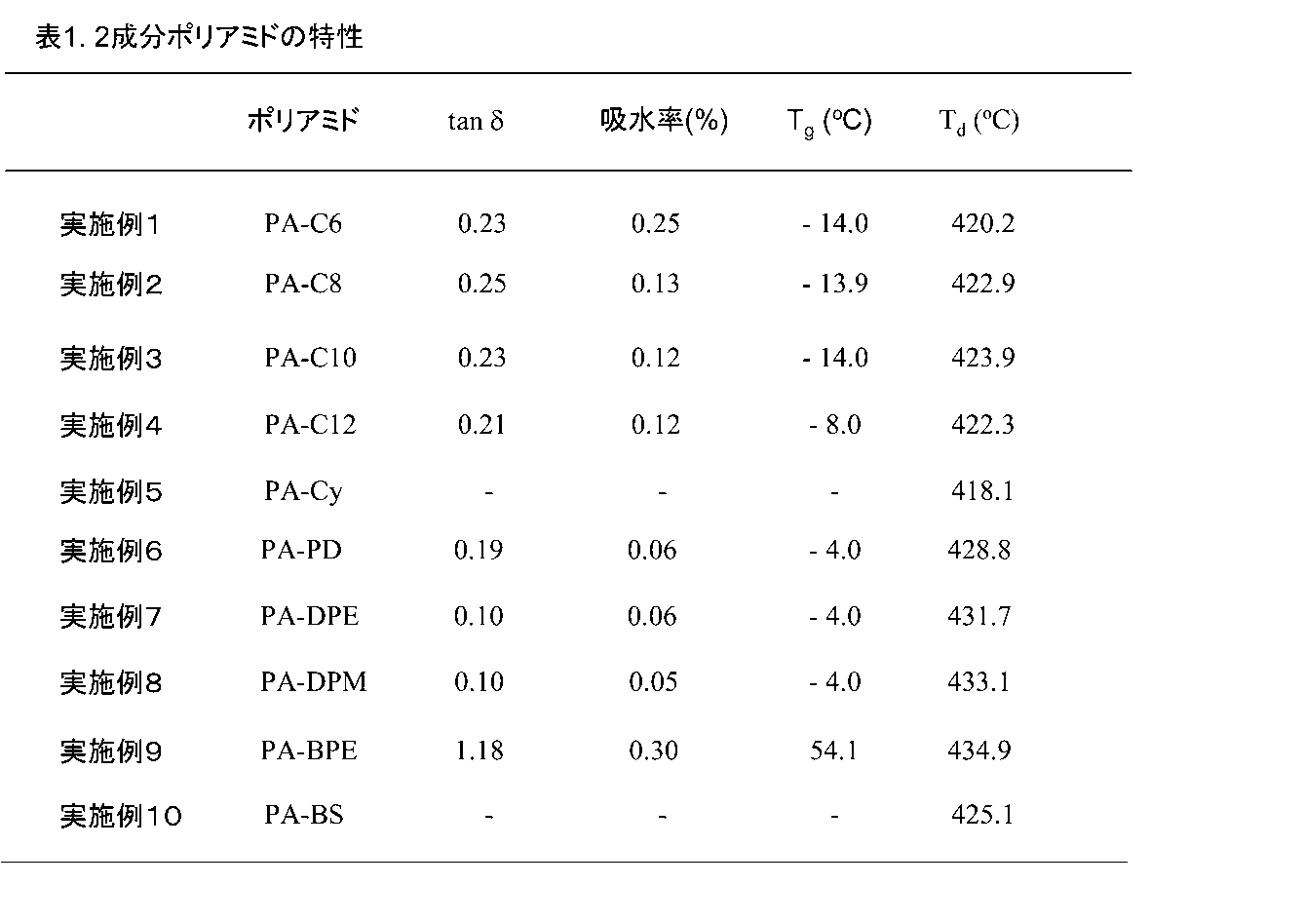
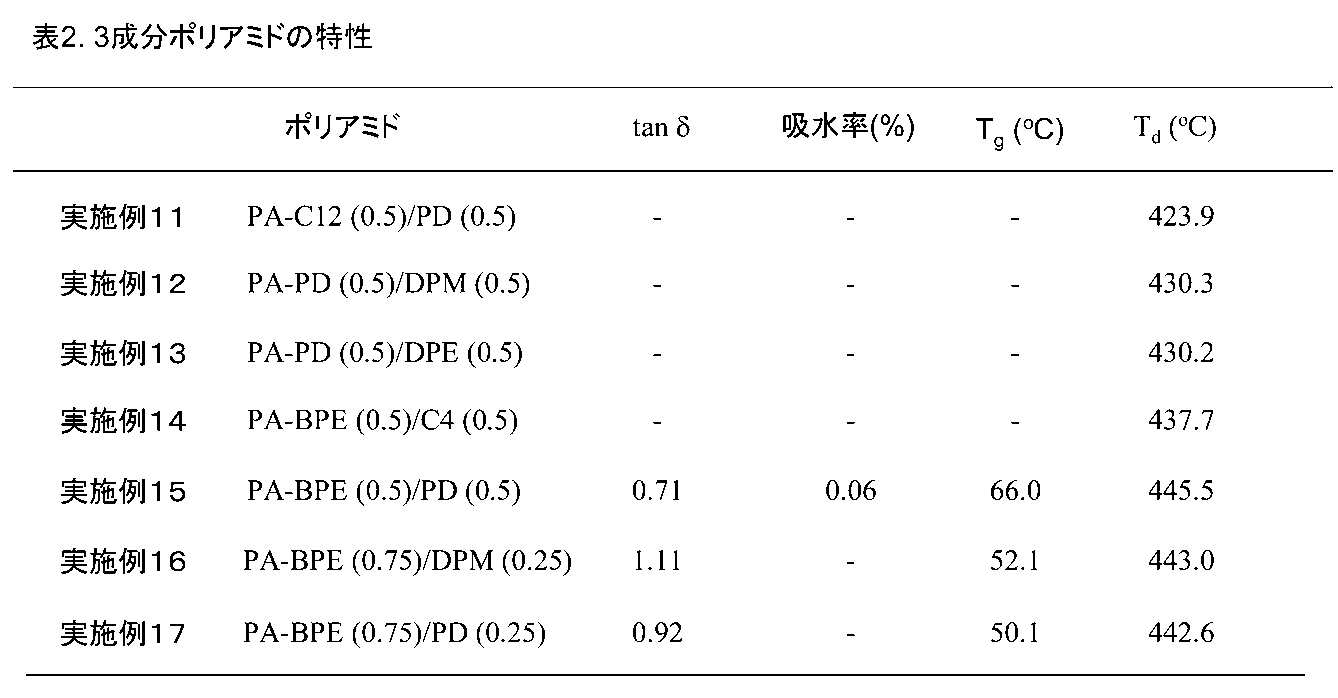
また、図2に従来の衝撃吸収樹脂と実施例のポリアミド化合物のtanδを比較したグラフを示す。
また、図3に図2のtanδの値から推定した本発明の実施例のポリアミド化合物の衝撃吸収率を示す。
詳細には、本発明の実施例のポリアミド化合物は、従来ポリアミド化合物の吸水性(PA6: 9.0%, PA66: 8.5%, PA11: 1.9%, PA12: 1.6%)に比べ耐吸水性が高いことが確認された。これは、本発明のポリアミド化合物は、分子中に長鎖分子が導入されており、これによって水素結合部分(水を吸う部分)を少なくし、水分子の結合を減らすことができたためであると推測される。
図1より、特に、従来ポリアミド化合物であるPA12の吸水率(1.5%、飽和状態)に比べ本発明の実施例のポリアミド化合物の耐吸水率が約5~30倍向上したことが分かる。
粘弾性体に応力を加え変形させると、与えられた力の大部分は内部変形のエネルギーとして貯えられ、応力の除去に際し復元の原動力となる。一方、与えられた力の一部は歪みに伴う内部の分子移動の摩擦のために消費され、最終的に熱に変わる。
内部摩擦の大小を示す値がtanδである。このtanδが大きければ伝達率が小さくエネルギー吸収率が大きくなる。
また、図3に示されるように、図2のtanδの値から推定した本発明の実施例のポリアミド化合物の衝撃吸収率も、従来の衝撃吸収樹脂に匹敵する値を有していることが分かる。
このように、動的粘弾性測定により衝撃吸収率(エネルギー吸収率)を推定できた。一般的に、tanδが高くなるとエネルギー吸収率が高くなる。なお、天然ゴムの衝撃吸収率は25%, tanδ= 0.1であり、シリコンゴムの衝撃吸収率は28%, tanδ= 0.5であり、ブチルゴムの衝撃吸収率は41%, tanδ= 1.0であり、軟質ポリウレタンの衝撃吸収率は58%, tanδ= 1.4である。
表3に、ポリアミド化合物の機械的物性の測定結果を示す。

本発明の実施例のポリアミド化合物は、ソフトセグメントとハードセグメントをアミド結合により連結されており、疎水構造、柔軟なアルキル鎖、伸び特性、剛直性部位をもつ樹脂である。このポリアミド化合物により高強度・高エネルギー吸収性能を兼ね備えた樹脂が実現される。本発明の実施例のポリアミドの特徴は、次の3つである。すなわち、〔1〕エネルギー吸収性が高いこと。〔2〕耐吸水率が高いこと。〔3〕非結晶性(透明性)であること、を特徴とする。
また、本実施例18、19、20のポリアミド化合物では、引張特性、曲げ特性、及び衝撃特性が優れていることを特徴とする。
Claims (3)
- 下記一般式(1)で表されるジカルボン酸単位と、下記一般式(2)で表されるジアミン単位と、を含有することを特徴とするポリアミド化合物。
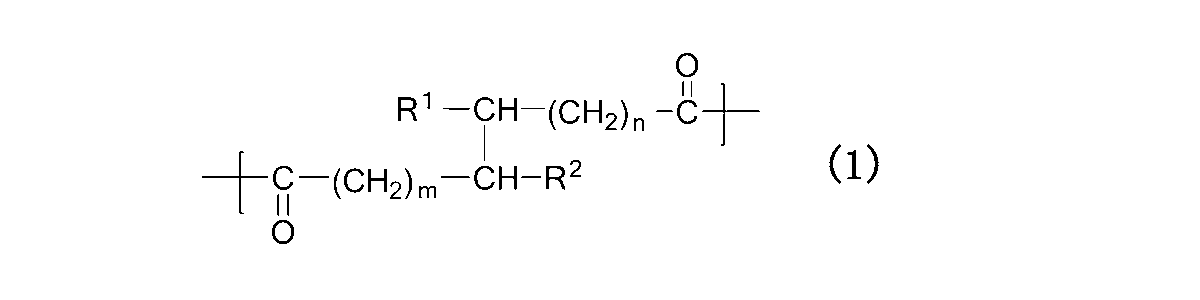
(nは6~18の整数を示し、mは6~18の整数を示す。
R1は水素原子、炭素数1~18の直鎖状もしくは分岐状のアルキル基、脂環式骨格を有する炭素数3~8の1価の炭化水素基、炭素数1~18の直鎖状もしくは分岐状のアルコキシル基を示す。
R2は水素原子、炭素数1~18の直鎖状もしくは分岐状のアルキル基、脂環式骨格を有する炭素数3~8の1価の炭化水素基、炭素数1~18の直鎖状もしくは分岐状のアルコキシル基を示す。R1とR2は相互に同一であっても、異なってもよい。)

(Aは、炭素数1~18の2価の有機基を示す。)
- 更に、下記一般式(3)で表されるジアミン単位、を含有することを特徴とする請求項1に記載のポリアミド化合物。

(Bは、炭素数1~18の2価の有機基を示す。但し、AとBとは異なるものとする。)
- 下記一般式(4)で表される構造を有するジカルボン酸化合物と、ジアミン化合物と、を反応させることを特徴とする請求項1又は2に記載のポリアミド化合物の製造方法。
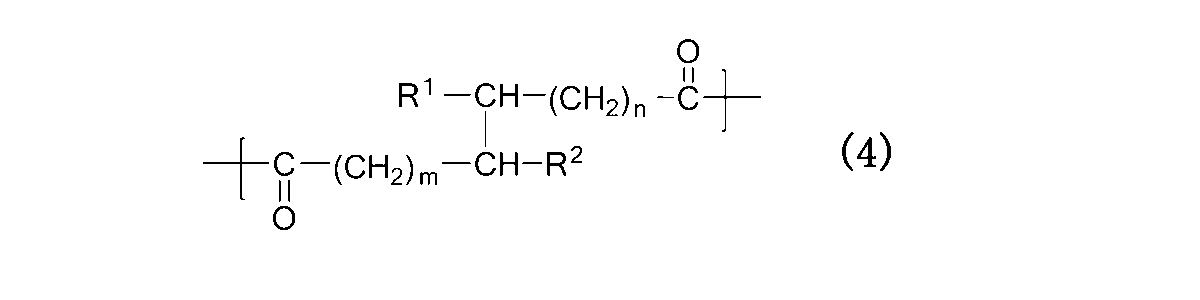
(nは6~18の整数を示し、mは6~18の整数を示す。
R1は水素原子、炭素数1~18の直鎖状もしくは分岐状のアルキル基、脂環式骨格を有する炭素数3~8の1価の炭化水素基、炭素数1~18の直鎖状もしくは分岐状のアルコキシル基を示す。
R2は水素原子、炭素数1~18の直鎖状もしくは分岐状のアルキル基、脂環式骨格を有する炭素数3~8の1価の炭化水素基、炭素数1~18の直鎖状もしくは分岐状のアルコキシル基を示す。R1とR2は相互に同一であっても、異なってもよい。)
Priority Applications (2)
| Application Number | Priority Date | Filing Date | Title |
|---|---|---|---|
| JP2017527160A JP6414640B2 (ja) | 2015-07-06 | 2016-06-17 | ポリアミド化合物、及びその製造方法 |
| US15/742,383 US10450415B2 (en) | 2015-07-06 | 2016-06-17 | Polyamide compound, and method for producing same |
Applications Claiming Priority (2)
| Application Number | Priority Date | Filing Date | Title |
|---|---|---|---|
| JP2015134897 | 2015-07-06 | ||
| JP2015-134897 | 2015-07-06 |
Publications (1)
| Publication Number | Publication Date |
|---|---|
| WO2017006748A1 true WO2017006748A1 (ja) | 2017-01-12 |
Family
ID=57685608
Family Applications (1)
| Application Number | Title | Priority Date | Filing Date |
|---|---|---|---|
| PCT/JP2016/068091 Ceased WO2017006748A1 (ja) | 2015-07-06 | 2016-06-17 | ポリアミド化合物、及びその製造方法 |
Country Status (3)
| Country | Link |
|---|---|
| US (1) | US10450415B2 (ja) |
| JP (1) | JP6414640B2 (ja) |
| WO (1) | WO2017006748A1 (ja) |
Cited By (5)
| Publication number | Priority date | Publication date | Assignee | Title |
|---|---|---|---|---|
| JP2019137788A (ja) * | 2018-02-13 | 2019-08-22 | トヨタ紡織株式会社 | ポリアミド化合物、及びポリアミド化合物の製造方法 |
| JP2020122097A (ja) * | 2019-01-31 | 2020-08-13 | トヨタ紡織株式会社 | ポリアミド化合物 |
| JP2021091781A (ja) * | 2019-12-10 | 2021-06-17 | トヨタ紡織株式会社 | ポリアミド化合物、及びその製造方法 |
| WO2022091987A1 (ja) * | 2020-10-27 | 2022-05-05 | 株式会社クラレ | ポリアミド |
| JP2023077378A (ja) * | 2021-11-24 | 2023-06-05 | 三洋化成工業株式会社 | 樹脂水性分散体及び水性インク |
Families Citing this family (4)
| Publication number | Priority date | Publication date | Assignee | Title |
|---|---|---|---|---|
| JP6414640B2 (ja) * | 2015-07-06 | 2018-11-07 | トヨタ紡織株式会社 | ポリアミド化合物、及びその製造方法 |
| JP6834238B2 (ja) * | 2016-08-11 | 2021-02-24 | トヨタ紡織株式会社 | ポリアミド化合物、及びその製造方法 |
| JP6772649B2 (ja) * | 2016-08-12 | 2020-10-21 | トヨタ紡織株式会社 | ポリアミド化合物 |
| JP7176425B2 (ja) * | 2019-01-31 | 2022-11-22 | トヨタ紡織株式会社 | ポリアミド化合物 |
Citations (9)
| Publication number | Priority date | Publication date | Assignee | Title |
|---|---|---|---|---|
| JPS5949229A (ja) * | 1982-09-13 | 1984-03-21 | Unitika Ltd | 低吸水率ポリアミド組成物 |
| JPH04253727A (ja) * | 1990-07-27 | 1992-09-09 | Ems Inventa Ag | 無定形コポリアミド、その製法及び成形部材の製法 |
| JPH0912716A (ja) * | 1995-06-27 | 1997-01-14 | Lion Corp | ダイマー酸由来のポリアミド樹脂を含有する合成樹脂製光学用材料 |
| JP2009275216A (ja) * | 2008-04-14 | 2009-11-26 | Asahi Kasei Chemicals Corp | ポリアミド組成物 |
| JP2011525558A (ja) * | 2008-06-26 | 2011-09-22 | エーエムエス−パテント アクチェンゲゼルシャフト | 高いノッチ付衝撃強度、低吸水性、及び、優れた耐化学性を有する、高撓み性の透明成形部品を製造するための半結晶透明コポリアミドを含むポリアミド成形物質 |
| JP2012022228A (ja) * | 2010-07-16 | 2012-02-02 | Konica Minolta Business Technologies Inc | 電子写真感光体 |
| JP2012184372A (ja) * | 2011-03-08 | 2012-09-27 | Sumitomo Electric Ind Ltd | 低誘電率押出成形品 |
| JP2013216653A (ja) * | 2012-04-09 | 2013-10-24 | Xerox Corp | イソソルビドを含有する新規アミドゲル化剤組成物 |
| JP2015086396A (ja) * | 2013-10-30 | 2015-05-07 | ゼロックス コーポレイションXerox Corporation | 間接的な印刷のための乳化したuv硬化性インク |
Family Cites Families (8)
| Publication number | Priority date | Publication date | Assignee | Title |
|---|---|---|---|---|
| JPS6222840A (ja) * | 1985-07-22 | 1987-01-31 | Nippon Synthetic Chem Ind Co Ltd:The | 樹脂組成物 |
| US5849376A (en) * | 1995-08-21 | 1998-12-15 | Nippon Gohsei Kagaku Kogyo Kabushiki Kaisha | Multi-layered laminate comprising hydrolyzed EVOH and use thereof |
| JP4126731B2 (ja) * | 1997-03-13 | 2008-07-30 | Jsr株式会社 | 液晶配向剤 |
| JP5031368B2 (ja) * | 2004-09-03 | 2012-09-19 | 株式会社クラレ | 多層ペレットおよび樹脂成形品 |
| US8298747B2 (en) * | 2007-03-12 | 2012-10-30 | Hitachi Chemical Dupont Microsystems, Ltd. | Photosensitive resin composition, process for producing patterned hardened film with use thereof and electronic part |
| US9273225B2 (en) * | 2012-09-12 | 2016-03-01 | Momentive Performance Materials Inc. | Siloxane organic hybrid materials providing flexibility to epoxy-based coating compositions |
| CN106661222A (zh) * | 2014-07-02 | 2017-05-10 | 东洋油墨Sc控股株式会社 | 热硬化性树脂组合物、聚酰胺、接着性片、硬化物及印刷配线板 |
| JP6414640B2 (ja) * | 2015-07-06 | 2018-11-07 | トヨタ紡織株式会社 | ポリアミド化合物、及びその製造方法 |
-
2016
- 2016-06-17 JP JP2017527160A patent/JP6414640B2/ja active Active
- 2016-06-17 WO PCT/JP2016/068091 patent/WO2017006748A1/ja not_active Ceased
- 2016-06-17 US US15/742,383 patent/US10450415B2/en active Active
Patent Citations (9)
| Publication number | Priority date | Publication date | Assignee | Title |
|---|---|---|---|---|
| JPS5949229A (ja) * | 1982-09-13 | 1984-03-21 | Unitika Ltd | 低吸水率ポリアミド組成物 |
| JPH04253727A (ja) * | 1990-07-27 | 1992-09-09 | Ems Inventa Ag | 無定形コポリアミド、その製法及び成形部材の製法 |
| JPH0912716A (ja) * | 1995-06-27 | 1997-01-14 | Lion Corp | ダイマー酸由来のポリアミド樹脂を含有する合成樹脂製光学用材料 |
| JP2009275216A (ja) * | 2008-04-14 | 2009-11-26 | Asahi Kasei Chemicals Corp | ポリアミド組成物 |
| JP2011525558A (ja) * | 2008-06-26 | 2011-09-22 | エーエムエス−パテント アクチェンゲゼルシャフト | 高いノッチ付衝撃強度、低吸水性、及び、優れた耐化学性を有する、高撓み性の透明成形部品を製造するための半結晶透明コポリアミドを含むポリアミド成形物質 |
| JP2012022228A (ja) * | 2010-07-16 | 2012-02-02 | Konica Minolta Business Technologies Inc | 電子写真感光体 |
| JP2012184372A (ja) * | 2011-03-08 | 2012-09-27 | Sumitomo Electric Ind Ltd | 低誘電率押出成形品 |
| JP2013216653A (ja) * | 2012-04-09 | 2013-10-24 | Xerox Corp | イソソルビドを含有する新規アミドゲル化剤組成物 |
| JP2015086396A (ja) * | 2013-10-30 | 2015-05-07 | ゼロックス コーポレイションXerox Corporation | 間接的な印刷のための乳化したuv硬化性インク |
Cited By (11)
| Publication number | Priority date | Publication date | Assignee | Title |
|---|---|---|---|---|
| JP2019137788A (ja) * | 2018-02-13 | 2019-08-22 | トヨタ紡織株式会社 | ポリアミド化合物、及びポリアミド化合物の製造方法 |
| JP2020122097A (ja) * | 2019-01-31 | 2020-08-13 | トヨタ紡織株式会社 | ポリアミド化合物 |
| JP7252510B2 (ja) | 2019-01-31 | 2023-04-05 | トヨタ紡織株式会社 | ポリアミド化合物 |
| US11787905B2 (en) | 2019-01-31 | 2023-10-17 | Toyota Boshoku Kabushiki Kaisha | Polyamide compound |
| JP2021091781A (ja) * | 2019-12-10 | 2021-06-17 | トヨタ紡織株式会社 | ポリアミド化合物、及びその製造方法 |
| JP7352171B2 (ja) | 2019-12-10 | 2023-09-28 | トヨタ紡織株式会社 | ポリアミド化合物、及びその製造方法 |
| WO2022091987A1 (ja) * | 2020-10-27 | 2022-05-05 | 株式会社クラレ | ポリアミド |
| JPWO2022091987A1 (ja) * | 2020-10-27 | 2022-05-05 | ||
| JP7735302B2 (ja) | 2020-10-27 | 2025-09-08 | 株式会社クラレ | ポリアミド |
| JP2023077378A (ja) * | 2021-11-24 | 2023-06-05 | 三洋化成工業株式会社 | 樹脂水性分散体及び水性インク |
| JP7848619B2 (ja) | 2021-11-24 | 2026-04-21 | 三洋化成工業株式会社 | 樹脂水性分散体及び水性インク |
Also Published As
| Publication number | Publication date |
|---|---|
| US10450415B2 (en) | 2019-10-22 |
| JPWO2017006748A1 (ja) | 2017-10-26 |
| JP6414640B2 (ja) | 2018-11-07 |
| US20180127544A1 (en) | 2018-05-10 |
Similar Documents
| Publication | Publication Date | Title |
|---|---|---|
| JP6414640B2 (ja) | ポリアミド化合物、及びその製造方法 | |
| TWI450915B (zh) | 結晶性熱可塑性聚醯亞胺樹脂 | |
| JP6834238B2 (ja) | ポリアミド化合物、及びその製造方法 | |
| JP6838313B2 (ja) | ポリアミド化合物 | |
| TWI901610B (zh) | 樹脂組成物、樹脂成形體、以及其製造方法 | |
| Chen et al. | Synthesis and characterization of low-temperature polyamide 6 (PA6) copolyamides used as hot melt adhesives and derived from the comonomer of novel aliphatic diamine bis (2-aminoethyl) adipamide and adipic acid | |
| JP2019137788A (ja) | ポリアミド化合物、及びポリアミド化合物の製造方法 | |
| JP7643152B2 (ja) | 複合体、及び複合体の製造方法 | |
| JP7176425B2 (ja) | ポリアミド化合物 | |
| JP7252510B2 (ja) | ポリアミド化合物 | |
| JP7352171B2 (ja) | ポリアミド化合物、及びその製造方法 | |
| CN104812802A (zh) | 新型聚酰胺、其制备方法及其用途 | |
| JP6772649B2 (ja) | ポリアミド化合物 | |
| US20250115714A1 (en) | Complex and method for producing complex | |
| CN114096602B (zh) | 用于制备片材、膜、纤维和成型部件的组合物和方法 | |
| JP7268588B2 (ja) | ポリアミド化合物、及びその製造方法 | |
| JP2016166315A (ja) | トルキシン酸系ポリマーおよびその製造中間体 | |
| JP7302461B2 (ja) | ポリアミド化合物、及びその製造方法 | |
| JP2023113400A (ja) | ポリアミド系樹脂、ポリアミド系樹脂組成物、及び成形品 | |
| Shyaa et al. | Synthesis, Characterization and Thermal Properties ofStyrenated Poly (Ester-Amide) Resin | |
| JP2014185326A (ja) | ポリアミドイミド樹脂組成物 |
Legal Events
| Date | Code | Title | Description |
|---|---|---|---|
| 121 | Ep: the epo has been informed by wipo that ep was designated in this application |
Ref document number: 16821218 Country of ref document: EP Kind code of ref document: A1 |
|
| ENP | Entry into the national phase |
Ref document number: 2017527160 Country of ref document: JP Kind code of ref document: A |
|
| WWE | Wipo information: entry into national phase |
Ref document number: 15742383 Country of ref document: US |
|
| NENP | Non-entry into the national phase |
Ref country code: DE |
|
| 122 | Ep: pct application non-entry in european phase |
Ref document number: 16821218 Country of ref document: EP Kind code of ref document: A1 |