WO2016148012A1 - トナー - Google Patents
トナー Download PDFInfo
- Publication number
- WO2016148012A1 WO2016148012A1 PCT/JP2016/057580 JP2016057580W WO2016148012A1 WO 2016148012 A1 WO2016148012 A1 WO 2016148012A1 JP 2016057580 W JP2016057580 W JP 2016057580W WO 2016148012 A1 WO2016148012 A1 WO 2016148012A1
- Authority
- WO
- WIPO (PCT)
- Prior art keywords
- toner
- particles
- resin
- external additive
- metal hydroxide
- Prior art date
- Legal status (The legal status is an assumption and is not a legal conclusion. Google has not performed a legal analysis and makes no representation as to the accuracy of the status listed.)
- Ceased
Links
Images
Classifications
-
- G—PHYSICS
- G03—PHOTOGRAPHY; CINEMATOGRAPHY; ANALOGOUS TECHNIQUES USING WAVES OTHER THAN OPTICAL WAVES; ELECTROGRAPHY; HOLOGRAPHY
- G03G—ELECTROGRAPHY; ELECTROPHOTOGRAPHY; MAGNETOGRAPHY
- G03G9/00—Developers
- G03G9/08—Developers with toner particles
- G03G9/097—Plasticisers; Charge controlling agents
- G03G9/09708—Inorganic compounds
- G03G9/09725—Silicon-oxides; Silicates
-
- G—PHYSICS
- G03—PHOTOGRAPHY; CINEMATOGRAPHY; ANALOGOUS TECHNIQUES USING WAVES OTHER THAN OPTICAL WAVES; ELECTROGRAPHY; HOLOGRAPHY
- G03G—ELECTROGRAPHY; ELECTROPHOTOGRAPHY; MAGNETOGRAPHY
- G03G9/00—Developers
- G03G9/08—Developers with toner particles
-
- G—PHYSICS
- G03—PHOTOGRAPHY; CINEMATOGRAPHY; ANALOGOUS TECHNIQUES USING WAVES OTHER THAN OPTICAL WAVES; ELECTROGRAPHY; HOLOGRAPHY
- G03G—ELECTROGRAPHY; ELECTROPHOTOGRAPHY; MAGNETOGRAPHY
- G03G9/00—Developers
- G03G9/08—Developers with toner particles
- G03G9/087—Binders for toner particles
-
- G—PHYSICS
- G03—PHOTOGRAPHY; CINEMATOGRAPHY; ANALOGOUS TECHNIQUES USING WAVES OTHER THAN OPTICAL WAVES; ELECTROGRAPHY; HOLOGRAPHY
- G03G—ELECTROGRAPHY; ELECTROPHOTOGRAPHY; MAGNETOGRAPHY
- G03G9/00—Developers
- G03G9/08—Developers with toner particles
- G03G9/087—Binders for toner particles
- G03G9/08742—Binders for toner particles comprising macromolecular compounds obtained otherwise than by reactions only involving carbon-to-carbon unsaturated bonds
- G03G9/08755—Polyesters
-
- G—PHYSICS
- G03—PHOTOGRAPHY; CINEMATOGRAPHY; ANALOGOUS TECHNIQUES USING WAVES OTHER THAN OPTICAL WAVES; ELECTROGRAPHY; HOLOGRAPHY
- G03G—ELECTROGRAPHY; ELECTROPHOTOGRAPHY; MAGNETOGRAPHY
- G03G9/00—Developers
- G03G9/08—Developers with toner particles
- G03G9/087—Binders for toner particles
- G03G9/08742—Binders for toner particles comprising macromolecular compounds obtained otherwise than by reactions only involving carbon-to-carbon unsaturated bonds
- G03G9/08768—Other polymers having nitrogen in the main chain, with or without oxygen or carbon only
-
- G—PHYSICS
- G03—PHOTOGRAPHY; CINEMATOGRAPHY; ANALOGOUS TECHNIQUES USING WAVES OTHER THAN OPTICAL WAVES; ELECTROGRAPHY; HOLOGRAPHY
- G03G—ELECTROGRAPHY; ELECTROPHOTOGRAPHY; MAGNETOGRAPHY
- G03G9/00—Developers
- G03G9/08—Developers with toner particles
- G03G9/09—Colouring agents for toner particles
- G03G9/0906—Organic dyes
-
- G—PHYSICS
- G03—PHOTOGRAPHY; CINEMATOGRAPHY; ANALOGOUS TECHNIQUES USING WAVES OTHER THAN OPTICAL WAVES; ELECTROGRAPHY; HOLOGRAPHY
- G03G—ELECTROGRAPHY; ELECTROPHOTOGRAPHY; MAGNETOGRAPHY
- G03G9/00—Developers
- G03G9/08—Developers with toner particles
- G03G9/09—Colouring agents for toner particles
- G03G9/0906—Organic dyes
- G03G9/0924—Dyes characterised by specific substituents
-
- G—PHYSICS
- G03—PHOTOGRAPHY; CINEMATOGRAPHY; ANALOGOUS TECHNIQUES USING WAVES OTHER THAN OPTICAL WAVES; ELECTROGRAPHY; HOLOGRAPHY
- G03G—ELECTROGRAPHY; ELECTROPHOTOGRAPHY; MAGNETOGRAPHY
- G03G9/00—Developers
- G03G9/08—Developers with toner particles
- G03G9/097—Plasticisers; Charge controlling agents
-
- G—PHYSICS
- G03—PHOTOGRAPHY; CINEMATOGRAPHY; ANALOGOUS TECHNIQUES USING WAVES OTHER THAN OPTICAL WAVES; ELECTROGRAPHY; HOLOGRAPHY
- G03G—ELECTROGRAPHY; ELECTROPHOTOGRAPHY; MAGNETOGRAPHY
- G03G9/00—Developers
- G03G9/08—Developers with toner particles
- G03G9/097—Plasticisers; Charge controlling agents
- G03G9/09708—Inorganic compounds
- G03G9/09716—Inorganic compounds treated with organic compounds
-
- G—PHYSICS
- G03—PHOTOGRAPHY; CINEMATOGRAPHY; ANALOGOUS TECHNIQUES USING WAVES OTHER THAN OPTICAL WAVES; ELECTROGRAPHY; HOLOGRAPHY
- G03G—ELECTROGRAPHY; ELECTROPHOTOGRAPHY; MAGNETOGRAPHY
- G03G9/00—Developers
- G03G9/08—Developers with toner particles
- G03G9/097—Plasticisers; Charge controlling agents
- G03G9/09733—Organic compounds
- G03G9/09741—Organic compounds cationic
-
- G—PHYSICS
- G03—PHOTOGRAPHY; CINEMATOGRAPHY; ANALOGOUS TECHNIQUES USING WAVES OTHER THAN OPTICAL WAVES; ELECTROGRAPHY; HOLOGRAPHY
- G03G—ELECTROGRAPHY; ELECTROPHOTOGRAPHY; MAGNETOGRAPHY
- G03G9/00—Developers
- G03G9/08—Developers with toner particles
- G03G9/10—Developers with toner particles characterised by carrier particles
- G03G9/113—Developers with toner particles characterised by carrier particles having coatings applied thereto
- G03G9/1132—Macromolecular components of coatings
Definitions
- the present invention relates to a toner, and more particularly to a toner having an external additive.
- the toner includes a plurality of toner particles.
- an external additive may be used to improve the fluidity, chargeability, or cleaning properties of the toner.
- toner particles generally have toner base particles mainly composed of a binder resin and external additive particles attached to the surface of the toner base particles.
- the external additive particles include silica particles having a particle diameter of several nm to several tens of nm.
- Patent Document 1 discloses a technique for hydrophobizing the surface of silica particles using amino-modified silicone oil.
- the present invention has been made in view of the above problems, and an object thereof is to provide a toner having excellent positive chargeability and charge stability. Another object of the present invention is to provide a toner having excellent durability.
- the toner of the present invention includes a plurality of toner particles each having a toner base particle and a plurality of external additive particles attached to the surface of the toner base particle.
- the external additive particles have silica particles, a metal hydroxide layer, and a coat layer.
- the metal hydroxide layer is formed on the surface of the silica particles. At least a part of the coat layer is formed on the surface of the metal hydroxide layer.
- the coat layer is substantially composed of a nitrogen-containing resin.
- the present invention it is possible to provide a toner having excellent positive chargeability and charge stability. Further, according to the present invention, in addition to this effect or instead of this effect, there may be an effect that it becomes possible to provide a toner having excellent durability.
- FIG. 3 is a diagram illustrating toner particles contained in a toner according to an exemplary embodiment of the present invention.
- the number average particle diameter of the powder is the number average value of the equivalent circle diameter of primary particles (diameter of a circle having the same area as the projected area of the particles) measured using a microscope unless otherwise specified. .
- ⁇ Chargeability means chargeability in frictional charging unless otherwise specified.
- the strength of positive chargeability (or strength of negative chargeability) in frictional charging can be confirmed by a known charge train or the like.
- a compound and its derivatives may be generically named by adding “system” after the compound name.
- the name of a polymer is expressed by adding “system” after the compound name, it means that the repeating unit of the polymer is derived from the compound or a derivative thereof.
- Acrylic and methacrylic are sometimes collectively referred to as “(meth) acrylic”.
- acrylonitrile (CH 2 ⁇ CHCN) and methacrylonitrile (CH 2 ⁇ C (CH 3 ) CN) may be collectively referred to as “(meth) acrylonitrile”.
- the toner according to this embodiment can be suitably used for developing an electrostatic latent image, for example, as a positively chargeable toner.
- the toner of the present exemplary embodiment is a powder that includes a plurality of toner particles (each having a configuration described later).
- the toner may be used as a one-component developer.
- a two-component developer may be prepared by mixing toner and carrier using a mixing device (more specifically, a ball mill or the like).
- a ferrite carrier as a developer carrier.
- the amount of toner in the two-component developer is preferably 5 parts by mass or more and 15 parts by mass or less, and 8 parts by mass or more and 12 parts by mass with respect to 100 parts by mass of the carrier. It is more preferable that the amount is not more than part by mass.
- the positively chargeable toner contained in the two-component developer is positively charged by friction with the carrier.
- the toner particles 10 use a plurality of external additive particles 12 as external additives.
- the toner particles 10 include toner base particles 11 and a plurality of external additive particles 12.
- External additive particles 12 are attached to the surface of the toner base particles 11.
- the external additive particles 12 include silica particles 12a and a coat layer 12b.
- the coat layer 12b is formed on the surface of the silica particles 12a.
- the silica particles 12a are covered with a coat layer 12b.
- a metal hydroxide layer is formed between the silica particles 12a and the coat layer 12b.
- a metal hydroxide layer can be formed on the surface of the silica particles by forming the metal hydroxide in the form of a film on the surface of the silica particles.
- the coat layer 12b is substantially composed of a nitrogen-containing resin.
- the toner particles contained in the toner according to the present embodiment may be toner particles having no shell layer (hereinafter referred to as non-capsule toner particles), or toner particles having a shell layer (hereinafter referred to as capsule). May be referred to as toner particles).
- the capsule toner particles (encapsulated toner base particles) have, for example, a core having the same configuration as the toner base particles 11 shown in FIG. 1 and a shell layer (capsule layer) formed on the surface of the core. .
- a shell layer shell layer formed on the surface of the core.
- the shell layer may consist essentially of a thermosetting resin (more specifically, a melamine resin or the like), or substantially a thermoplastic resin (more specifically, an acrylic resin or styrene resin). Acrylic resin or the like) or may contain both a thermoplastic resin and a thermosetting resin. Additives may be dispersed in the resin constituting the shell layer.
- the toner according to the present embodiment can be used for image formation in, for example, an electrophotographic apparatus (image forming apparatus).
- an electrophotographic apparatus image forming apparatus
- an example of an image forming method using an electrophotographic apparatus will be described.
- an electrostatic latent image is formed on a photoconductor (for example, a surface layer portion of a photoconductor drum) based on image data.
- the formed electrostatic latent image is developed using a developer containing toner.
- toner for example, toner charged by friction with a carrier or blade
- a developing sleeve for example, a surface layer portion of a developing roller in the developing device
- the toner image on the photosensitive member is transferred to an intermediate transfer member (for example, a transfer belt), and then the toner image on the intermediate transfer member is further transferred to a recording medium (for example, paper). Thereafter, the toner is heated to fix the toner on the recording medium. As a result, an image is formed on the recording medium.
- a full color image can be formed by superposing four color toner images of black, yellow, magenta, and cyan.
- the toner according to the exemplary embodiment has the following configurations (1) and (2).
- the toner particles contained in the toner have toner mother particles and a plurality of external additive particles each attached to the surface of the toner mother particles.
- the external additive particles have silica particles, a metal hydroxide layer formed on the surface of the silica particles, and a coat layer formed at least partially on the surface of the metal hydroxide layer. .
- the coat layer is substantially composed of a nitrogen-containing resin.
- the external additive particles defined in the configuration (2) will be referred to as external additive particles of the present embodiment.
- a material for forming the coat layer is referred to as a coat material.
- Configuration (1) is useful for improving the fluidity, chargeability, or cleaning properties of the toner.
- Configuration (2) is useful for improving the positive chargeability, charge stability, and durability of the toner.
- silica particles are acidic substances and have strong negative chargeability. Therefore, the silica particles are difficult to be positively charged.
- Silica particles have a high moisture adsorptivity. For this reason, the charge amount of the silica particles tends to decrease in a high humidity environment.
- the external additive particles have a metal hydroxide layer and a coating layer in addition to the silica particles, whereby the chargeability of the silica particles is improved.
- a metal hydroxide layer is formed on the surface of the silica particles.
- a metal hydroxide layer tends to have a stronger positive charge than silica particles.
- the moisture adsorption property of the metal hydroxide layer tends to be lower than the moisture adsorption property of the silica particles. For this reason, it is considered that the formation of the metal hydroxide layer on the surface of the silica particles facilitates positive charging of the external additive particles and improves the charging stability of the external additive particles.
- a nitrogen-containing resin is a resin containing a nitrogen atom in its chemical structure. Nitrogen-containing resins tend to be positively charged. For this reason, it is considered that the external additive particles are easily positively charged when the silica particles are coated with the coating layer. Further, it is considered that the charging stability of the external additive particles is improved by coating the silica particles with the coating layer. Nitrogen-containing resins tend to have relatively strong hydrophobicity.
- the silica particles are coated with the coating layer, the chargeability of the toner is hardly deteriorated even in a high humidity (for example, 80% RH) environment as compared with the normal humidity environment, and the toner is always used. It is thought that it becomes possible to maintain the chargeability substantially equivalent to that in a wet environment.
- the charge amount of the toner is less likely to fluctuate when the toner is stored for a long period of time in either a normal temperature and normal humidity environment or a high temperature and high humidity environment (described later). (See Table 2 and Table 3). Further, it is considered that the durability of the external additive particles (and hence the durability of the toner) is improved by the silica particles being coated with the coating layer.
- the coating layer preferably contains a nitrogen-containing resin in a proportion of 80% by mass or more, and a nitrogen-containing resin in a proportion of 90% by mass or more. It is more preferable that nitrogen-containing resin is included in the ratio of 100 mass%.
- the area ratio of the area covered with the coat layer (hereinafter referred to as the coat ratio) of the surface area of the silica particles is: It is preferably 50% or more, more preferably 80% or more, and further preferably 90% or more.
- the metal hydroxide layer may completely cover the entire silica particles, or may partially cover the silica particles. When the metal hydroxide layer partially covers the silica particles, the coat layer is formed on the first portion formed on the surface of the silica particles and on the surface of the metal hydroxide layer. By including the second part, it is possible to increase the coating rate of the external additive particles. On the other hand, in order to improve the ease of production of the external additive particles, the coating rate of the external additive particles is preferably 95% or less.
- the intermediate of the nitrogen-containing resin has a methylol group
- the intermediate methylol group forms a bond with the metal hydroxide having a hydroxyl group.
- easy For example, when heated under an acid catalyst, a dehydration condensation reaction occurs between the metal hydroxide and the methylol group, and a covalent bond tends to be formed between the two.
- a bond derived from a methylol group is formed between the metal hydroxide layer and the coat layer.
- the silanol group exists in the area
- the silica particles and the coating layer can be firmly bonded.
- a bond derived from a silanol group is formed between the silica particles and the coat layer (specifically, the first portion described above).
- the coat layer preferably contains a thermosetting resin as a nitrogen-containing resin. It is considered that the strength of the thermosetting resin is improved by the progress of the curing reaction of the thermosetting resin by heating. Thermosetting resins tend to have high strength. For this reason, it becomes possible to increase the stress resistance of the toner because the coating layer of the external additive particles contains the thermosetting resin.
- the coating layer is a nitrogen-containing resin, in addition to a thermosetting resin (more specifically, a melamine resin or a urea resin), a thermoplastic resin (more specifically, , Urethane resin and the like) are particularly preferable.
- aqueous medium acidic or alkaline aqueous solution
- the coating material has water solubility.
- the aqueous medium is a medium containing water as a main component (more specifically, pure water or a mixed liquid of water and a polar medium).
- the aqueous medium may function as a solvent.
- a solute may be dissolved in the aqueous medium.
- the aqueous medium may function as a dispersion medium.
- the dispersoid may be dispersed in the aqueous medium.
- a polar medium in the aqueous medium for example, alcohol (more specifically, methanol or ethanol) can be used.
- the metal hydroxide layer In order to coat the silica particles with a metal hydroxide layer having a uniform thickness, it is preferable to form the metal hydroxide layer in an aqueous medium (acidic or alkaline aqueous solution). Moreover, in order to form a metal hydroxide layer in an aqueous medium, the metal hydroxide layer preferably contains at least one of aluminum hydroxide and magnesium hydroxide. Aluminum hydroxide and magnesium hydroxide are hardly soluble or insoluble in neutral water and soluble in acidic or alkaline aqueous solutions. For this reason, when the metal hydroxide constituting the metal hydroxide layer is aluminum hydroxide or magnesium hydroxide, it is formed by controlling the pH of the aqueous medium containing aluminum hydroxide or magnesium hydroxide. It is possible to easily adjust the film quality or film thickness of the metal hydroxide layer.
- external additive particles other than the external additive particles may adhere to the surface of the toner base particles.
- other external additive particles more specifically, titanium oxide particles and the like
- other external additive particles are attached to the surface of the toner base particles, thereby adjusting the charge amount of the toner. It becomes easy.
- the toner according to the present embodiment includes a plurality of toner particles having both configurations (1) and (2) (hereinafter referred to as toner particles according to the present embodiment).
- the toner containing the toner particles of this embodiment is excellent in positive chargeability, charge stability, and durability (see Tables 2 and 3 described later).
- the toner preferably contains the toner particles of the present embodiment at a rate of 80% by number or more, and a rate of 90% by number or more. It is more preferable that the toner particles of the present embodiment are included, and it is more preferable that the toner particles of the present embodiment are included at a ratio of 100% by number.
- toner base particles binder resin and internal additive
- external additive external additive
- the toner base particles include a binder resin.
- the toner base particles may contain an internal additive (for example, a colorant, a release agent, and a charge control agent).
- unnecessary components for example, a colorant, a release agent, or a charge control agent
- the toner base particles may contain magnetic powder.
- the particle diameter of the toner base particles is preferably 4 ⁇ m or more and 10 ⁇ m or less.
- Binder resin The binder resin often occupies most of the toner base particles (for example, 85% by mass or more). For this reason, it is considered that the properties of the binder resin greatly affect the properties of the entire toner base particles.
- the binder resin has a solubility index (SP value) of preferably 10 or more, more preferably 18 or more and 28 or less.
- the glass transition point (Tg) of the binder resin is preferably 45 ° C. or higher and 65 ° C. or lower, and 50 ° C. or higher and 60 ° C. or lower. It is more preferable that By measuring the endothermic curve (vertical axis: heat flow (DSC signal), horizontal axis: temperature) of the sample (binder resin) using a differential scanning calorimeter, from the change point of the specific heat in the obtained endothermic curve, Tg can be obtained.
- DSC signal heat flow
- horizontal axis temperature
- a sample binder resin
- an empty aluminum pan is used as a reference
- the endotherm of the sample is measured under the conditions of a measurement temperature range of 25 ° C. to 200 ° C. and a heating rate of 10 ° C./min. Find a curve.
- thermoplastic resin examples include a styrene resin, an acrylic acid resin (more specifically, an acrylic acid ester polymer or a methacrylic acid ester polymer, etc.), and an olefinic resin.
- a resin more specifically, polyethylene resin or polypropylene resin
- vinyl chloride resin polyvinyl alcohol, vinyl ether resin, N-vinyl resin, polyester resin, polyamide resin, or urethane resin is preferable.
- a copolymer of these resins that is, a copolymer in which an arbitrary repeating unit is introduced into the resin (specifically, a styrene-acrylic acid resin or a styrene-butadiene resin) is preferable.
- a styrene-acrylic acid resin or a polyester resin is particularly preferable.
- the styrene-acrylic acid resin is a copolymer of one or more styrene monomers and one or more acrylic monomers.
- styrene monomer for preparing the styrene-acrylic acid resin examples include styrene, ⁇ -methylstyrene, p-hydroxystyrene, m-hydroxystyrene, vinyltoluene, ⁇ -chlorostyrene, o-chlorostyrene, m -Chlorostyrene, p-chlorostyrene or p-ethylstyrene is preferred.
- acrylic acid monomer for preparing the styrene-acrylic acid resin for example, (meth) acrylic acid, (meth) acrylonitrile, (meth) acrylic acid alkyl ester, or (meth) acrylic acid hydroxyalkyl ester is preferable.
- examples of the (meth) acrylic acid alkyl ester include methyl (meth) acrylate, ethyl (meth) acrylate, n-propyl (meth) acrylate, iso-propyl (meth) acrylate, and (meth) acrylic acid n.
- -Butyl, iso-butyl (meth) acrylate or 2-ethylhexyl (meth) acrylate are preferred.
- Examples of the (meth) acrylic acid hydroxyalkyl ester include 2-hydroxyethyl (meth) acrylate, 3-hydroxypropyl (meth) acrylate, 2-hydroxypropyl (meth) acrylate, or (meth) acrylic acid 4 -Hydroxybutyl is preferred.
- a monomer having a hydroxyl group (more specifically, p-hydroxystyrene, m-hydroxystyrene, (meth) acrylic acid hydroxyalkyl ester, etc.) is used.
- a hydroxyl group can be introduced into a styrene-acrylic acid resin.
- the hydroxyl value of the styrene-acrylic acid resin to be obtained can be adjusted by adjusting the amount of the monomer having a hydroxyl group.
- a carboxyl group can be introduced into the styrene-acrylic acid resin by using an acrylic acid monomer having a carboxyl group.
- the acid value of the resulting styrene-acrylic acid resin can be adjusted by adjusting the amount of (meth) acrylic acid used.
- the number average molecular weight (Mn) of the styrene-acrylic acid resin is set to improve the strength of the toner mother particles and the fixing property of the toner. It is preferable that it is 2000 or more and 3000 or less.
- the molecular weight distribution (the ratio Mw / Mn of the mass average molecular weight (Mw) to the number average molecular weight (Mn)) of the styrene-acrylic acid resin is preferably 10 or more and 20 or less. Gel permeation chromatography can be used to measure Mn and Mw of the styrene-acrylic acid resin.
- the polyester resin that can be used as the binder resin will be described.
- the polyester resin is obtained by polycondensing one or more alcohols and one or more carboxylic acids.
- a dihydric alcohol such as diols or bisphenols can be used.
- polyester resin for example, ethylene glycol, diethylene glycol, triethylene glycol, 1,2-propanediol, 1,3-propanediol, 1,4-butanediol, neopentyl glycol, 1,4-butenediol, Diols such as 1,5-pentanediol, 1,6-hexanediol, 1,4-cyclohexanedimethanol, dipropylene glycol, polyethylene glycol, polypropylene glycol, or polytetramethylene glycol can be preferably used.
- Diols such as 1,5-pentanediol, 1,6-hexanediol, 1,4-cyclohexanedimethanol, dipropylene glycol, polyethylene glycol, polypropylene glycol, or polytetramethylene glycol can be preferably used.
- polyester resin for example, bisphenols such as bisphenol A, hydrogenated bisphenol A, bisphenol A ethylene oxide adduct, or bisphenol A propylene oxide adduct can be suitably used.
- polyester resin for example, sorbitol, 1,2,3,6-hexanetetrol, 1,4-sorbitan, pentaerythritol, dipentaerythritol, tripentaerythritol, 1,2,4-butanetriol, 1 , 2,5-pentanetriol, glycerol, diglycerol, 2-methylpropanetriol, 2-methyl-1,2,4-butanetriol, trimethylolethane, trimethylolpropane, or 1,3,5-trihydroxymethyl Trihydric or higher alcohols such as benzene can be preferably used.
- Preparation of the polyester resin includes, for example, maleic acid, fumaric acid, citraconic acid, itaconic acid, glutaconic acid, phthalic acid, isophthalic acid, terephthalic acid, cyclohexanedicarboxylic acid, adipic acid, sebacic acid, azelaic acid, malonic acid, succinic acid.
- alkyl succinic acid (more specifically, n-butyl succinic acid, isobutyl succinic acid, n-octyl succinic acid, n-dodecyl succinic acid, isododecyl succinic acid, etc.), or alkenyl succinic acid (more specifically, Are preferably divalent carboxylic acids such as n-butenyl succinic acid, isobutenyl succinic acid, n-octenyl succinic acid, n-dodecenyl succinic acid, or isododecenyl succinic acid).
- 1,2,4-benzenetricarboxylic acid trimellitic acid
- 2,5,7-naphthalenetricarboxylic acid 1,2,4-naphthalenetricarboxylic acid
- 1,2,4-Butanetricarboxylic acid 1,2,5-hexanetricarboxylic acid
- 1,3-dicarboxyl-2-methyl-2-methylenecarboxypropane 1,2,4-cyclohexanetricarboxylic acid
- tetra (methylenecarboxyl) methane 1,
- a trivalent or higher carboxylic acid such as 2,7,8-octanetetracarboxylic acid, pyromellitic acid, or empole trimer acid can be preferably used.
- the above divalent or trivalent or higher carboxylic acid may be transformed into an ester-forming derivative (more specifically, an acid halide, an acid anhydride, or a lower alkyl ester).
- ester-forming derivative more specifically, an acid halide, an acid anhydride, or a lower alkyl ester.
- lower alkyl means an alkyl group having 1 to 6 carbon atoms.
- the acid value and hydroxyl value of the polyester resin can be adjusted by changing the amount of alcohol used and the amount of carboxylic acid used.
- the acid value and hydroxyl value of the polyester resin tend to decrease.
- the number average molecular weight (Mn) of the polyester resin may be 1000 or more and 2000 or less in order to improve the strength of the toner base particles and the toner fixing property. preferable.
- the molecular weight distribution of the polyester resin (the ratio Mw / Mn of the mass average molecular weight (Mw) to the number average molecular weight (Mn)) is preferably 9 or more and 21 or less.
- Gel permeation chromatography can be used to measure Mn and Mw of the polyester resin.
- the binder resin may be only a thermoplastic resin or two kinds of resins (for example, a thermoplastic resin and a thermosetting resin). Moreover, you may add a crosslinking agent to binder resin. By forming a crosslinked structure in the binder resin, it is possible to improve the storage stability, shape retention, or durability of the toner.
- a thermosetting resin such as bisphenol A type epoxy resin, hydrogenated bisphenol A type epoxy resin, novolac type epoxy resin, polyalkylene ether type epoxy resin, cycloaliphatic type epoxy resin, or cyanate resin is bound. It can be used as a resin.
- One kind of thermosetting resin may be used alone, or two or more kinds of thermosetting resins may be used in combination.
- the toner base particles may contain a colorant.
- a colorant a known pigment or dye can be used according to the color of the toner.
- the amount of the colorant is preferably 1 part by mass or more and 20 parts by mass or less with respect to 100 parts by mass of the binder resin. It is more preferable that the amount is not more than part by mass.
- the toner base particles may contain a black colorant.
- a black colorant is carbon black.
- the black colorant may be a colorant that is toned to black using a yellow colorant, a magenta colorant, and a cyan colorant.
- the toner base particles may contain a color colorant such as a yellow colorant, a magenta colorant, or a cyan colorant.
- the yellow colorant for example, one or more compounds selected from the group consisting of condensed azo compounds, isoindolinone compounds, anthraquinone compounds, azo metal complexes, methine compounds, and arylamide compounds can be used.
- the yellow colorant include C.I. I. Pigment Yellow (3, 12, 13, 14, 15, 17, 62, 74, 83, 93, 94, 95, 97, 109, 110, 111, 120, 127, 128, 129, 147, 151, 154, 155 168, 174, 175, 176, 180, 181, 191, or 194), naphthol yellow S, Hansa yellow G, or C.I. I. Vat yellow can be preferably used.
- the magenta colorant is, for example, selected from the group consisting of condensed azo compounds, diketopyrrolopyrrole compounds, anthraquinone compounds, quinacridone compounds, basic dye lake compounds, naphthol compounds, benzimidazolone compounds, thioindigo compounds, and perylene compounds.
- One or more compounds can be used.
- Examples of the magenta colorant include C.I. I. Pigment Red (2, 3, 5, 6, 7, 19, 23, 48: 2, 48: 3, 48: 4, 57: 1, 81: 1, 122, 144, 146, 150, 166, 169, 177 184, 185, 202, 206, 220, 221 or 254) can be preferably used.
- cyan colorant for example, one or more compounds selected from the group consisting of a copper phthalocyanine compound, an anthraquinone compound, and a basic dye lake compound can be used.
- cyan colorant for example, C.I. I. Pigment blue (1, 7, 15, 15: 1, 15: 2, 15: 3, 15: 4, 60, 62, or 66), phthalocyanine blue, C.I. I. Bat Blue, or C.I. I. Acid blue can be preferably used.
- the toner base particles may contain a release agent.
- the release agent is used, for example, for the purpose of improving the fixing property or offset resistance of the toner.
- the amount of the release agent is preferably 1 part by mass or more and 30 parts by mass or less with respect to 100 parts by mass of the binder resin. More preferably, it is 20 parts by mass or less.
- the release agent examples include low molecular weight polyethylene, low molecular weight polypropylene, polyolefin copolymer, polyolefin wax, microcrystalline wax, paraffin wax, or aliphatic hydrocarbon wax such as Fischer-Tropsch wax; oxidized polyethylene wax or a block thereof Oxides of aliphatic hydrocarbon waxes such as copolymers; plant waxes such as candelilla wax, carnauba wax, wood wax, jojoba wax, or rice wax; animal properties such as beeswax, lanolin, or whale wax Waxes; mineral waxes such as ozokerite, ceresin, or petrolatum; waxes based on fatty acid esters such as montanic ester waxes or castor waxes; such as deoxidized carnauba wax; Some or all of the fatty acid ester can be preferably used de oxidized wax.
- One type of release agent may be used alone, or multiple types of release agents may be used in combination.
- a compatibilizer may be added to the toner base particles.
- the toner base particles may contain a charge control agent.
- the charge control agent is used, for example, for the purpose of improving the chargeability or charge rising property of the toner.
- the charge rising characteristic of the toner is an index as to whether or not the toner can be charged to a predetermined charge level in a short time.
- the cationicity of the toner can be increased.
- a negatively chargeable charge control agent to the toner base particles, the anionicity of the toner can be enhanced.
- positively chargeable charge control agents include pyridazine, pyrimidine, pyrazine, 1,2-oxazine, 1,3-oxazine, 1,4-oxazine, 1,2-thiazine, 1,3-thiazine, 1,4- Thiazine, 1,2,3-triazine, 1,2,4-triazine, 1,3,5-triazine, 1,2,4-oxadiazine, 1,3,4-oxadiazine, 1,2,6-oxadiazine, 1,3,4-thiadiazine, 1,3,5-thiadiazine, 1,2,3,4-tetrazine, 1,2,4,5-tetrazine, 1,2,3,5-tetrazine, 1,2, Azine compounds such as 4,6-oxatriazine, 1,3,4,5-oxatriazine, phthalazine, quinazoline, or quinoxaline; Azin Fast Red FC, Azin Fast Red 12BK, Azinba Direct dyes such as O
- an organometallic complex or a chelate compound can be suitably used.
- a negatively chargeable charge control agent for example, an acetylacetone metal complex (more specifically, aluminum acetylacetonate or iron (II) acetylacetonate), salicylic acid type
- a metal complex more specifically, chromium 3,5-di-tert-butylsalicylate or the like
- a salicylic acid metal salt particularly preferably a salicylic acid metal complex or a salicylic acid metal salt.
- One type of charge control agent may be used alone, or two or more types of charge control agents may be used in combination.
- the amount of the charge control agent is preferably 1.5 parts by mass or more and 15 parts by mass or less, and more preferably 3 parts by mass or more and 8 parts by mass or less with respect to 100 parts by mass of the total amount of toner.
- the external additive is a powder containing a plurality of external additive particles.
- the toner according to this embodiment has the above-described configurations (1) and (2).
- the toner particles contained in the toner according to the exemplary embodiment include toner base particles and a plurality of external additive particles attached to the surfaces of the toner base particles.
- the external additive particles of this embodiment have silica particles, a metal hydroxide layer, and a coat layer.
- the coat layer is substantially composed of a nitrogen-containing resin.
- the metal hydroxide layer is formed on the surface of the silica particles. At least a part of the coat layer is formed on the surface of the metal hydroxide layer.
- a metal hydroxide layer having a positive charge property stronger than that of the silica particles is formed on the surface of the silica particles constituting the external additive particles.
- the metal hydroxide constituting the metal hydroxide layer is preferably aluminum hydroxide or magnesium hydroxide.
- the kind of metal hydroxide constituting the metal hydroxide layer is arbitrary, and for example, zinc hydroxide may be used.
- the surface of the coat layer may be hydrophobized. For example, it is considered that the charge stability of the toner is improved by removing hydroxyl groups on the surface of the coating layer using amino-modified silicone oil.
- One type of external additive particles may be used alone, or a plurality of types of external additive particles may be used in combination.
- two or more types of external additive particles of the present embodiment may be attached to the surface of the toner base particles, and other external additive particles may be added to the toner base particles in addition to the external additive particles of the present embodiment. You may make it adhere to the surface of particle
- metal oxide particles more specifically, alumina, titanium oxide, magnesium oxide, zinc oxide, strontium titanate, barium titanate, etc.
- the amount of the external additive (when a plurality of types of external additive particles are used, the total amount of the external additive particles) is 100 masses of toner base particles.
- the amount is preferably 1 part by mass or more and 10 parts by mass or less, and more preferably 1.5 parts by mass or more and 5.0 parts by mass or less.
- the volume median diameter (D 50 ) of the external additive is preferably 10 nm or more and 100 nm or less, and more preferably 15 nm or more and 50 nm or less. .
- the toner base particles are cationic (positively charged), and the silica particles of the external additive are anionic (negatively charged). It is conceivable that the toner is constituted so that the coating layer of the coating layer has a cationic property (positive charging property).
- silica has a silanol group. Therefore, silica particles are easily negatively charged.
- silica particles of the external additive for example, hydrophilic fumed silica particles can be suitably used.
- the toner base particles preferably contain two or more kinds of positively chargeable charge control agents.
- the toner base particles may contain nigrosine and a resin containing a repeating unit derived from a quaternary ammonium salt as a positively chargeable charge control agent.
- the toner base particles can be imparted with a sufficiently strong cationic property. It becomes possible.
- the coat layer may consist essentially of a thermosetting resin, may consist essentially of a thermoplastic resin, or may contain both a thermosetting resin and a thermoplastic resin. .
- the coating layer contains a thermosetting resin, and it is more preferable that the coating layer is substantially composed of a thermosetting resin.
- 80% by mass or more of the resin contained in the coat layer is preferably a thermosetting resin, and 90% by mass or more of the resin is a thermosetting resin. More preferably, 100% by mass of the resin is more preferably a thermosetting resin.
- the nitrogen-containing resin constituting the coating layer examples include a thermosetting resin (more specifically, a melamine resin, a urea resin, a guanamine resin, a polyimide resin, or an aniline resin) or a thermoplastic resin (more specifically, Are preferably a polyamide resin, a urethane resin, or a polyamide-imide resin.
- a thermosetting resin more specifically, a melamine resin, a urea resin, a guanamine resin, a polyimide resin, or an aniline resin
- a thermoplastic resin more specifically, Are preferably a polyamide resin, a urethane resin, or a polyamide-imide resin.
- a thermosetting resin is preferable to use as the nitrogen-containing resin constituting the coat layer.
- nitrogen-containing resin especially thermosetting resin
- Preparation of nitrogen-containing resin (especially thermosetting resin) constituting the coating layer includes methylol melamine, melamine, methylolated urea (for example, dimethylol dihydroxyethylene urea), urea, benzoguanamine, acetoguanamine, and spiroguanamine.
- methylol melamine, melamine, methylolated urea for example, dimethylol dihydroxyethylene urea
- urea for example, benzoguanamine, acetoguanamine, and spiroguanamine.
- each of the melamine resin and urea resin each have a complicated three-dimensional network structure, they have high hardness and high durability. Further, each of the melamine resin and the urea resin is a thermosetting resin and has high heat resistance. Moreover, each of the melamine resin and the urea resin is a nitrogen-containing resin and has a high positive chargeability. Moreover, each superposition
- Melamine resin is obtained by condensation polymerization of melamine and formaldehyde. Specifically, melamine and formaldehyde are subjected to an addition reaction. Thereby, the precursor (methylol melamine) of a melamine resin is obtained. Subsequently, methylol melamine is subjected to a condensation reaction (crosslinking reaction). Thereby, the amino group of one methylol melamine couple
- the solubility of methylol melamine in water can be changed by changing the type or number of functional groups of methylol melamine. For this reason, it is relatively easy to polymerize methylolmelamine in an aqueous medium.
- Urea resin is obtained by condensation polymerization of urea and formaldehyde.
- the urea resin can be synthesized by using urea instead of melamine in the melamine resin synthesis method.
- the toner according to the exemplary embodiment having the above-described configuration is manufactured by, for example, mixing toner base particles and an external additive using a mixing device and attaching the external additive to the surface of the toner base particles. Can do.
- the step of preparing the toner base particles and the step of preparing the external additive will be described.
- the toner base particles are preferably produced by an aggregation method or a pulverization method, and more preferably produced by a pulverization method.
- a binder resin and an internal additive for example, at least one of a colorant, a release agent, a charge control agent, and magnetic powder
- an internal additive for example, at least one of a colorant, a release agent, a charge control agent, and magnetic powder
- the obtained mixture is melt-kneaded.
- the obtained melt-kneaded product is pulverized and classified. As a result, toner base particles having a desired particle diameter are obtained.
- the particles are aggregated in an aqueous medium containing fine particles of a binder resin, a release agent, and a colorant, and the fine particles are aggregated until a desired particle diameter is obtained.
- aggregated particles containing the binder resin, the release agent, and the colorant are formed.
- the obtained aggregated particles are heated to unite the components contained in the aggregated particles.
- unnecessary substances such as a dispersant
- silica particles are prepared.
- a metal hydroxide layer is formed on the surface of the prepared silica particles.
- a coat layer is formed on the surface of the formed metal hydroxide layer.
- the coat layer is substantially composed of a nitrogen-containing resin.
- the coat layer may be entirely formed on the metal hydroxide layer, or only a part of the coat layer may be formed on the metal hydroxide layer.
- Each of the metal hydroxide layer and the coat layer may be formed by a reaction method or a solution coating method.
- a layer metal hydroxide layer or coat layer
- the particle is dispersed in a solvent in which the material of the layer is dissolved, and the material is reacted in the solvent.
- a layer is formed on the surface.
- a layer metal hydroxide layer or coat layer
- the solution of the material is applied to the particle surface, and then the solvent is removed.
- a layer is formed on the surface.
- silica particles are dispersed in an aqueous medium to obtain a dispersion of silica particles.
- a dispersion of silica particles for example, commercially available silica particles can be used as the silica particles.
- the dispersion of the silica particles may be stirred using a mixing device (more specifically, “Hibismix (registered trademark)” manufactured by Primics Co., Ltd.). preferable.
- the temperature of the liquid is set to a first temperature (for example, a temperature selected from 40 ° C. to 90 ° C.), and the pH of the liquid is set to a first pH (for example, a pH selected from 3 to 6 or lower, or 8 or higher). To a pH selected from 11 or less).
- a first temperature and the first pH is such that when a metal hydroxide solution is added to the dispersion of silica particles in a subsequent step, the metal hydroxide precipitates on the surface of the silica particles in the liquid. It is decided. Subsequently, the metal hydroxide solution is dropped into the silica particle dispersion whose temperature and pH are adjusted.
- the surface of the silica particles in the liquid has metallic water.
- An oxide layer is formed.
- a dispersion of silica particles (hereinafter referred to as intermediate particles) at least partially coated with a metal hydroxide layer is obtained.
- the metal hydroxide substantially constituting the metal hydroxide layer is aluminum hydroxide
- the first temperature is 40 ° C. or more and 50 ° C. or less in order to promote the formation of the metal hydroxide layer.
- the first pH is preferably 5.0 or more and 6.5 or less.
- the first temperature is 75 ° C. or higher and 85 ° C. or lower in order to promote the formation of the metal hydroxide layer.
- the first pH is preferably 8.0 or more and 9.5 or less.
- the temperature of the liquid is adjusted to a second temperature (for example, room temperature), and the pH of the liquid is adjusted to a second pH (for example, a pH of 2 to 6). To do.
- a second temperature and the second pH is determined so that the coating material reacts on the surface of the intermediate particles in the liquid when the liquid is heated in a subsequent step.
- a coating material for example, a monomer for synthesizing a nitrogen-containing resin
- the temperature of the liquid is changed from a third temperature (for example, 50 ° C.
- the coating material adheres to the surface of the intermediate particles, and the attached coating material is cured by a polymerization reaction.
- a dispersion of the external additive particles of this embodiment is obtained.
- the coat layer is substantially composed of a melamine resin or a urea resin
- the second temperature is 20 ° C. or more and 40 ° C. or less
- the second pH is 3 or more and 4
- the third temperature is preferably 60 ° C. or higher and 100 ° C. or lower.
- the obtained dispersion of external additive particles is cooled to, for example, room temperature.
- the dispersion of external additive particles is filtered. Thereby, the external additive particles are separated from the liquid (solid-liquid separation).
- the obtained external additive particles are washed.
- the washed external additive particles are dried.
- the preparation method of the said external additive can be arbitrarily changed according to the structure or characteristic of external additive particle
- a material more specifically, a metal hydroxide solution or a coating material
- the material is reacted in the liquid for a while after the material is added to the liquid.
- the material may be added to the liquid over time, and the material may be reacted in the liquid while adding the material to the liquid.
- the coating material may be added to the solvent at a time, or may be added to the solvent in a plurality of times.
- the method for forming the coat layer is arbitrary.
- the coating layer may be formed by using any one of an in-situ polymerization method, a liquid-cured coating method, and a coacervation method. Further, unnecessary steps may be omitted.
- an in-situ polymerization method a liquid-cured coating method
- a coacervation method a coacervation method
- unnecessary steps may be omitted.
- the external additive particles produced at the same time are considered to have substantially the same configuration.
- Table 1 shows toners A-1 to A-4, B-1 to B-3, C, D-1, and D-2 (each toner for developing an electrostatic latent image) according to Examples or Comparative Examples. .
- ⁇ Measurement method of volume median diameter (D 50)> Using a transmission electron microscope (TEM) (“H-7100FA” manufactured by Hitachi High-Technologies Corporation), 100 or more samples (for example, external additives) were photographed at a magnification of 1,000,000 to obtain TEM photographs. Subsequently, the obtained TEM photograph is analyzed using image analysis software (“WinROOF” manufactured by Mitani Corporation), and each of 100 samples arbitrarily selected from the samples included in the TEM photograph. The equivalent circle diameter (the diameter of a circle having the same area as the projected area of the particles) was measured, and the volume median diameter (D 50 ) was determined from 100 measured values (equivalent circle diameter).
- TEM transmission electron microscope
- H-7100FA manufactured by Hitachi High-Technologies Corporation
- toner mother particles were produced by the following procedure. First, using an FM mixer (“FM-10” manufactured by Nippon Coke Industries Co., Ltd.), 87 parts by mass of a polyester resin (“Polyester (registered trademark) HP-313” manufactured by Nippon Synthetic Chemical Industry Co., Ltd.) and carbon black ("MA-100” manufactured by Mitsubishi Chemical Corporation) 3 parts by mass, 4 parts by mass of Carnauba wax (manufactured by Toa Kasei Co., Ltd.), and a charge control agent (Nigrosine: "BONTRON (registered trademark) N” manufactured by Orient Chemical Co., Ltd.
- the obtained mixture was melt-kneaded using a twin-screw extruder (“TEM-26SS” manufactured by Toshiba Machine Co., Ltd.). Thereafter, the obtained kneaded material was cooled. Subsequently, the cooled kneaded material was coarsely pulverized using a pulverizer (“Rotoplex (registered trademark) 16/8 type” manufactured by Hosokawa Micron Corporation) under the condition of a set particle diameter of 2 mm. Further, the obtained coarsely pulverized product was finely pulverized using a pulverizer (“Turbo Mill (RS type)” manufactured by Freund Turbo).
- a pulverizer (“Rotoplex (registered trademark) 16/8 type” manufactured by Hosokawa Micron Corporation) under the condition of a set particle diameter of 2 mm.
- a metal hydroxide layer was formed on the surface of the silica particles by the following procedure.
- the dispersion of silica particles obtained as described above is heated until the temperature reaches 45 ° C., and 50 mL of 50 g / L sodium aluminate aqueous solution is added to the liquid at a temperature of 45 ° C. over 1 hour. It was dripped. Further, together with the sodium aluminate solution, a 0.5N sodium hydroxide aqueous solution was also dropped into the liquid to adjust the pH of the silica particle dispersion to 6.
- the process from the heating of the liquid to the pH adjustment is referred to as a metal hydroxide layer forming process A-1.
- the obtained dispersion of silica particles was cooled so that the temperature became 30 ° C. Subsequently, 0.5N hydrochloric acid (“Wako Grade 1 (087-01076)” manufactured by Wako Pure Chemical Industries, Ltd.) is added to the silica particle dispersion to adjust the pH of the silica particle dispersion to 3.5. Adjusted.
- 0.5N hydrochloric acid (“Wako Grade 1 (087-01076)” manufactured by Wako Pure Chemical Industries, Ltd.) is added to the silica particle dispersion to adjust the pH of the silica particle dispersion to 3.5. Adjusted.
- the stirring device comprises a stirring blade for stirring the contents of the flask (ASONE stirrer blade R-1345 type sold by ASONE CORPORATION) and a motor for rotating the stirring blade (ASONE Tornado Motor 1-sold by ASONE Corporation). 5472-04 ").
- the temperature of the flask contents was raised to 70 ° C. at a rate of 1 ° C./3 minutes.
- the temperature of the flask contents before starting the temperature increase was 35 ° C.
- the flask contents were stirred for 30 minutes under the conditions of a temperature of 70 ° C. and a rotation speed of 90 rpm.
- a metal hydroxide layer and a coat layer were formed on the surface of the silica particles in the flask.
- the contents of the flask were cooled until the temperature reached room temperature to obtain a dispersion of the external additive.
- the external additive dispersion obtained as described above was filtered (solid-liquid separation) using a Buchner funnel to obtain a wet cake-like external additive. Thereafter, the obtained wet cake-like external additive was dispersed in an aqueous ethanol solution having a concentration of 50% by mass. Thereby, a slurry of the external additive was obtained. Subsequently, using a continuous surface reformer (“Coatmizer (registered trademark)” manufactured by Freund Sangyo Co., Ltd.), the external additive in the slurry was added under conditions of a hot air temperature of 45 ° C. and a blower air volume of 2 m 3 / min. Dried. As a result, a coarse powder of the external additive was obtained.
- Coatmizer registered trademark
- the dried coarse powder of the external additive was pulverized using a supersonic jet pulverizer (“Jet Mill IDS-2” manufactured by Nippon Pneumatic Industry Co., Ltd.) under the pulverization pressure of 0.6 MPa. .
- a ceramic flat plate was used as the collision plate.
- an external additive (fine powder) having a volume median diameter (D 50 ) of 20 nm was obtained.
- the obtained external additive (fine powder) is referred to as external additive A-1.
- the external additive particles contained in the external additive A-1 are substantially composed of a metal hydroxide layer substantially composed of aluminum hydroxide (metal hydroxide A) and a melamine resin (resin A). And a coating layer.
- toner base particles External addition was performed on the toner base particles. Specifically, using an FM mixer (“FM-10” manufactured by Nippon Coke Industries, Ltd.), 100 parts by mass of toner base particles, 1.5 parts by mass of external additive A-1, and titanium oxide particles (Taika Co., Ltd.) An external additive (external additive A) is added to the surface of the toner base particles by mixing 1.0 part by mass of “MT-500B” manufactured by the company and untreated titanium oxide fine particles) at a rotational speed of 3500 rpm for 5 minutes. -1 and titanium oxide particles) were deposited. As a result, Toner A-1 containing a large number of toner particles was obtained.
- FM-10 manufactured by Nippon Coke Industries, Ltd.
- the production method of the toner A-2 was the same as the production method of the toner A-1, except that the external additive A-2 was used instead of the external additive A-1.
- the external additive A-2 was prepared by using 50 g of an aqueous solution of methylolated urea (“Milben (registered trademark) Resin SU-100” manufactured by Showa Denko KK, solid content concentration 80% by mass) instead of 50 g of water-soluble methylolmelamine. was the same as the preparation method of the external additive A-1.
- the external additive particles contained in the external additive A-2 include a metal hydroxide layer substantially composed of Al (OH) 3 (metal hydroxide A) and a urea resin (resin B). And a coating layer composed of The volume median diameter (D 50 ) of the external additive A-2 was 20 nm.
- the production method of the toner A-3 was the same as the production method of the toner A-1, except that the external additive A-3 was used instead of the external additive A-1.
- the preparation method of the external additive A-3 was the same as the preparation method of the external additive A-1, except that the metal hydroxide layer formation step A-3 was performed instead of the metal hydroxide layer formation step A-1. It was the same.
- a metal hydroxide layer was formed on the surface of the silica particles by the following procedure. First, 500 mL of magnesium hydroxide slurry having a concentration of 40 g / L was added to the dispersion of silica particles. Moreover, the pH of the dispersion of silica particles was adjusted to 9 by dropping sulfuric acid together with the slurry into the liquid over 1 hour. Subsequently, the dispersion of silica particles was heated, and the liquid temperature was maintained at 80 ° C. for 1 hour. As a result, a metal hydroxide layer was formed on the surface of the silica particles.
- the external additive particles contained in the external additive A-3 are composed of a metal hydroxide layer substantially composed of magnesium hydroxide (metal hydroxide B) and a melamine resin (resin A). And a coating layer.
- the volume median diameter (D 50 ) of the external additive A-3 was 22 nm.
- the production method of the toner A-4 was the same as the production method of the toner A-1, except that the external additive A-4 was used instead of the external additive A-1.
- the external additive A-4 was prepared by using 25 g of water-soluble methylol melamine (“Nikaresin S-260” manufactured by Nippon Carbide Industries Co., Ltd.) instead of 50 g of water-soluble methylol melamine and an aqueous solution of urethane resin (Daiichi Kogyo Seiyaku Co., Ltd.) Except for using 25 g of “Superflex (registered trademark) 170” (solid content concentration of 30% by mass) manufactured by the company, it was the same as the preparation method of the external additive A-1.
- “Superflex (registered trademark) 170” solid content concentration of 30% by mass
- the external additive particles contained in the external additive A-4 include a metal hydroxide layer substantially composed of Al (OH) 3 (metal hydroxide A) and a melamine resin (resin A). And a coat layer composed of urethane resin (resin C).
- the volume median diameter (D 50 ) of the external additive A-4 was 22 nm.
- the production method of the toner B-1 was the same as the production method of the toner A-1, except that the external additive B-1 was used instead of the external additive A-1.
- the method for producing the external additive B-1 was the same as the method for producing the external additive A-1, except that the metal hydroxide layer forming step A-1 was not performed.
- the external additive particles contained in the external additive B-1 had a coat layer substantially composed of a melamine resin (resin A).
- the volume median diameter (D 50 ) of the external additive B-1 was 21 nm.
- the production method of the toner B-2 was the same as the production method of the toner A-1, except that the external additive B-2 was used instead of the external additive A-1.
- the external additive B-2 was used instead of the external additive A-1.
- a method for producing the external additive B-2 will be described.
- AEROSIL200 water-soluble fumed silica
- the stirring device comprises a stirring blade for stirring the contents of the flask (ASONE stirrer blade R-1345 type sold by ASONE CORPORATION) and a motor for rotating the stirring blade (ASONE Tornado Motor 1-sold by ASONE Corporation). 5472-04 ").
- Toluene was distilled off from the flask contents using a rotary evaporator. Thereby, a solid substance was obtained. Subsequently, the solid was dried using a vacuum dryer until the weight was not reduced at a set temperature of 50 ° C. Further, an amino group was introduced into the coat layer on the surface of the silica particles by performing heat treatment for 3 hours under the condition of a set temperature of 200 ° C. in a nitrogen stream using an electric furnace. As a result, a coarse powder of the external additive was obtained.
- the coarse powder of the external additive was pulverized using a supersonic jet pulverizer (“Jet Mill IDS-2” manufactured by Nippon Pneumatic Kogyo Co., Ltd.) under the pulverization pressure of 0.6 MPa.
- a ceramic flat plate was used as the collision plate.
- an external additive B-2 fine powder having a volume median diameter (D 50 ) of 22 nm was obtained.
- the external additive particles contained in the external additive B-2 had a coat layer substantially composed of an organic silane ( ⁇ -aminopropyltriethoxysilane).
- the production method of the toner B-3 was the same as the production method of the toner A-1, except that the external additive B-3 was used instead of the external additive A-1.
- the external additive B-3 was prepared by using 500 mL of n-hexane (“n-hexane first grade” manufactured by Wako Pure Chemical Industries, Ltd.) instead of 500 mL of toluene, and replacing 2 g of ⁇ -aminopropyltriethoxysilane.
- 0.2 g of amino-modified silicone oil (“KF857” manufactured by Shin-Etsu Chemical Co., Ltd.) is used, the coating layer forming temperature is changed from 75 ° C.
- the volume median diameter (D 50 ) of the external additive B-3 was 22 nm.
- the production method of the toner C was the same as the production method of the toner A-1, except that the external additive C was used instead of the external additive A-1.
- the external additive C was prepared by performing a metal hydroxide layer forming step A-1 after preparing a dispersion of silica particles. Further, the temperature of the dispersion of silica particles was 30 ° C. and the pH was 3 5 was the same as the preparation method of the external additive A-1 until each adjustment was made.
- the subsequent steps in the method for producing the external additive C are as follows.
- ⁇ -aminopropyltriethoxysilane 25 g was added to a dispersion of silica particles having a temperature of 30 ° C. and a pH of 3.5, and the dispersion of silica particles was stirred for 4 hours at room temperature and a rotation speed of 90 rpm. Thereafter, the pH of the silica particle dispersion is adjusted to 6.5 by dropwise addition of a 2N sodium hydroxide aqueous solution to the silica particle dispersion, and the silica particles are dispersed at room temperature and a rotation speed of 90 rpm. The solution was stirred for 2 hours.
- the contents of the flask were filtered (solid-liquid separation) to obtain a solid. Thereafter, the obtained solid was redispersed in ion-exchanged water. Furthermore, dispersion and filtration were repeated to wash the solid matter. Subsequently, the solid was dried at a set temperature of 130 ° C. using a vacuum dryer. As a result, a coarse powder of the external additive was obtained.
- the coarse powder of the external additive was pulverized using a supersonic jet pulverizer (“Jet Mill IDS-2” manufactured by Nippon Pneumatic Kogyo Co., Ltd.) under the pulverization pressure of 0.6 MPa.
- a ceramic flat plate was used as the collision plate.
- an external additive C fine powder having a volume median diameter (D 50 ) of 20 nm was obtained.
- the external additive particles contained in the external additive C are composed of a metal hydroxide layer substantially composed of aluminum hydroxide (metal hydroxide A) and an organic silane ( ⁇ -aminopropyltriethoxysilane). ).
- the production method of the toner D-1 was the same as the production method of the toner A-1, except that the external additive D-1 was used instead of the external additive A-1.
- the external additive D-1 was prepared by using 50 g of an aqueous urethane resin solution (“Superflex 170” manufactured by Daiichi Kogyo Seiyaku Co., Ltd., solid content concentration 30 mass%) instead of 50 g of water-soluble methylolmelamine. This was the same as the preparation method of the external additive B-1.
- the external additive particles contained in the external additive D-1 had a coat layer substantially composed of a urethane resin (resin C).
- the volume median diameter (D 50 ) of the external additive D-1 was 21 nm.
- the production method of the toner D-2 was the same as the production method of the toner A-1, except that the external additive D-2 was used instead of the external additive A-1.
- the external additive D-2 was prepared by using 25 g of water-soluble methylol melamine (Nicaridine S-260, manufactured by Nippon Carbide Industries Co., Ltd.) instead of 50 g of water-soluble methylol melamine and an aqueous solution of urethane resin (Daiichi Kogyo Seiyaku Co., Ltd.) Except for using 50 g of “Superflex 170” (solid content concentration 30% by mass) manufactured by the company, it was the same as the preparation method of external additive B-1.
- the external additive particles contained in the external additive D-2 had a coat layer substantially composed of a melamine resin (resin A) and a urethane resin (resin C).
- the volume median diameter (D 50 ) of the external additive D-2 was 20 nm.
- the developer carrier was prepared by the following method.
- ⁇ Method for producing developer carrier > 2 kg of an epoxy resin (“jER (registered trademark) 1004” manufactured by Mitsubishi Chemical Corporation) was dissolved in 20 L of acetone to obtain a solution. Subsequently, 100 g of diethylenetriamine and 150 g of phthalic anhydride were added to the resulting solution to obtain a mixed solution. Subsequently, the obtained mixed solution and 10 kg of a Mn—Mg—Sr ferrite core (“EF-80B2” manufactured by Powder Tech Co., Ltd., number average primary particle size 80 ⁇ m) are mixed with a fluidized bed coating apparatus (Freund Sangyo Co., Ltd.). "Spiraflow (registered trademark) SFC-5").
- the surface of the ferrite core was coated with an epoxy resin using a coating device while sending hot air of 80 ° C. into the coating device.
- the obtained resin-coated particles were heated at 180 ° C. for 1 hour using a dryer. As a result, a developer carrier was obtained.
- the charge amount is 15.0 ⁇ C / g or more and 40.0 ⁇ C / g or less, it is evaluated as “Good”, and the charge amount is 15.0 ⁇ C. If it was less than / g or more than 40.0 ⁇ C / g, it was evaluated as “x (not good)”.
- Toner durability A color printer (“FS-C5250DN” manufactured by Kyocera Document Solutions Inc.) was used as an evaluation machine. The two-component developer prepared as described above was charged into the developing device of the evaluation machine, and the sample (replenishment toner) was charged into the toner container of the evaluation machine. Using the evaluation machine, the durability of the toner in a normal temperature and normal humidity environment and the durability of the toner in a high temperature and high humidity environment were evaluated. Note that a reflection densitometer (“SpectroEye (registered trademark)” manufactured by X-Rite) was used for measurement of image density. Further, a Q / m meter (“MODEL 210HS-1” manufactured by Trek) was used for the measurement of the charge amount.
- a reflection densitometer (“SpectroEye (registered trademark)” manufactured by X-Rite) was used for measurement of image density.
- a Q / m meter (“MODEL 210HS-1” manufactured
- a predetermined durability test (specifically, in a normal temperature and normal humidity (temperature 20 ° C., humidity 60% RH) environment) A 10,000 sheet endurance test or a 100,000 sheet endurance test described later) was performed. Thereafter, a sample image including the solid part was printed on an evaluation sheet, and the image density (ID) of the solid part in the sample image and the charge amount of the toner in the developer in the developing device were measured.
- a predetermined evaluation pattern (image) with a printing rate of 5% was continuously printed on 10,000 recording media (A4 size printing paper).
- a predetermined evaluation pattern (image) with a printing rate of 5% was continuously printed on 100,000 recording media (A4 size printing paper).
- the charge amount is 12.0 ⁇ C / g or more and 27.0 ⁇ C / g or less, it is evaluated as “Good”, and the charge amount is 12.0 ⁇ C / g. If it was less than g or more than 27.0 ⁇ C / g, it was evaluated as “x (not good)”. Further, when the image density was 1.20 or more, it was evaluated as “good”, and when the image density was less than 1.20, “ ⁇ (not good)” was evaluated.
- the charge amount is 8.0 ⁇ C / g or more, it is evaluated as “ ⁇ (good)”, and if the charge amount is less than 8.0 ⁇ C / g, “ X (not good) ". Further, when the image density was 1.10 or more, it was evaluated as “good”, and when the image density was less than 1.10, “ ⁇ (not good)” was evaluated.
- evaluation results The evaluation results for toners A-1 to A-4, B-1 to B-3, C, D-1, and D-2 are as follows.
- Table 2 shows the evaluation results of the charge amount
- Table 3 shows the evaluation results of the image density.
- the toners A-1 to A-4 (toners according to Examples 1 to 4) had the above-described configurations (1) and (2), respectively.
- the toner particles contained in each of the toners according to Examples 1 to 4 each have toner base particles and a plurality of external additive particles attached to the surfaces of the toner base particles.
- the toner particles had first external additive particles having the following configuration and second external additive particles (titanium oxide particles) as external additive particles.
- the first external additive particles had silica particles, a metal hydroxide layer (aluminum hydroxide or magnesium hydroxide layer), and a coat layer. The metal hydroxide layer was formed on the surface of the silica particles.
- the coat layer was substantially composed of a nitrogen-containing resin (specifically, at least one of a thermosetting melamine resin, a thermosetting urea resin, and a thermoplastic urethane resin).
- a nitrogen-containing resin specifically, at least one of a thermosetting melamine resin, a thermosetting urea resin, and a thermoplastic urethane resin.
- the toners according to Examples 1 to 4 were excellent in positive chargeability and charge stability, respectively. Also, any of the toners according to Examples 1 to 4 could form an image having a high image density.
- toners B-1, D-1, and D-2 the toners according to Comparative Examples 1, 5, and 6
- the results of evaluating the durability of the toner in a high temperature and high humidity environment were not good.
- no metal hydroxide layer was formed on the surface of the silica particles. For this reason, it is considered that the coating layer was deteriorated by the durability test, and the surface of the silica particles was exposed.
- toners B-2, B-3, and C the durability evaluation results of the toner in a high-temperature and high-humidity environment were not good. Further, in the developing device of the evaluation machine (image forming apparatus), toner scattering due to reverse charging of the toner occurred. In the toners according to Comparative Examples 2, 3, and 4, the coating layer did not contain a nitrogen-containing resin. It is considered that the durability of the coat layer was insufficient. It is considered that the chargeability of the external additive was deteriorated by the durability test.
- the toner according to the present invention can be used to form an image in, for example, a copying machine, a printer, or a multifunction machine.
Landscapes
- Physics & Mathematics (AREA)
- General Physics & Mathematics (AREA)
- Chemical & Material Sciences (AREA)
- Spectroscopy & Molecular Physics (AREA)
- Inorganic Chemistry (AREA)
- Chemical Kinetics & Catalysis (AREA)
- Developing Agents For Electrophotography (AREA)
Abstract
Description
(1)トナーに含まれるトナー粒子は、トナー母粒子と、それぞれトナー母粒子の表面に付着した複数の外添剤粒子とを有する。
(2)外添剤粒子は、シリカ粒子と、シリカ粒子の表面に形成されている金属水酸化物層と、少なくとも一部が金属水酸化物層の表面に形成されているコート層とを有する。コート層は、実質的に含窒素樹脂から構成される。以下、構成(2)で規定される外添剤粒子を、本実施形態の外添剤粒子と記載する。また、コート層を形成するための材料を、コート材料と記載する。
トナー母粒子は、結着樹脂を含む。また、トナー母粒子は、内添剤(例えば、着色剤、離型剤、及び電荷制御剤)を含んでもよい。ただし、トナーの用途に応じて必要のない成分(例えば、着色剤、離型剤、又は電荷制御剤)を割愛してもよい。また、必要に応じて、トナー母粒子に磁性粉を含ませてもよい。
トナー母粒子の大部分(例えば、85質量%以上)を結着樹脂が占めることが多い。このため、結着樹脂の性質がトナー母粒子全体の性質に大きな影響を与えると考えられる。水性媒体に対するトナー母粒子の濡れ性を向上させるためには、結着樹脂の溶解指数(SP値)が、10以上であることが好ましく、18以上28以下であることがより好ましい。
トナー母粒子は、着色剤を含んでいてもよい。着色剤としては、トナーの色に合わせて公知の顔料又は染料を用いることができる。トナーを用いて高画質の画像を形成するためには、着色剤の量が、結着樹脂100質量部に対して、1質量部以上20質量部以下であることが好ましく、2質量部以上10質量部以下であることがより好ましい。
トナー母粒子は、離型剤を含んでいてもよい。離型剤は、例えば、トナーの定着性又は耐オフセット性を向上させる目的で使用される。トナーの定着性又は耐オフセット性を向上させるためには、離型剤の量が、結着樹脂100質量部に対して、1質量部以上30質量部以下であることが好ましく、3質量部以上20質量部以下であることがより好ましい。
トナー母粒子は、電荷制御剤を含んでいてもよい。電荷制御剤は、例えば、トナーの帯電性又は帯電立ち上がり特性を向上させる目的で使用される。トナーの帯電立ち上がり特性は、短時間で所定の帯電レベルにトナーを帯電可能か否かの指標になる。
外添剤は、複数の外添剤粒子を含む粉体である。例えば、トナー母粒子と外添剤とを一緒に攪拌することで、物理的な力でトナー母粒子の表面に外添剤粒子が付着(物理的結合)する。本実施形態に係るトナーは、前述の構成(1)及び(2)を有する。本実施形態に係るトナーに含まれるトナー粒子は、トナー母粒子と、それぞれトナー母粒子の表面に付着した複数の外添剤粒子とを有する。
上記構成を有する本実施形態に係るトナーは、例えば、混合装置を用いてトナー母粒子と外添剤とを混合して、トナー母粒子の表面に外添剤を付着させることで、製造することができる。以下、トナー母粒子を準備する工程と、外添剤を準備する工程とについて、説明する。
好適なトナー母粒子を容易に得るためには、凝集法又は粉砕法によりトナー母粒子を製造することが好ましく、粉砕法によりトナー母粒子を製造することがより好ましい。
以下、外添剤の作製方法の一例について説明する。まず、シリカ粒子を準備する。続けて、準備されたシリカ粒子の表面に、金属水酸化物層を形成する。続けて、形成された金属水酸化物層の表面に、コート層を形成する。コート層は、実質的に含窒素樹脂から構成される。コート層は、その全部が金属水酸化物層上に形成されてもよいし、その一部のみが金属水酸化物層上に形成されてもよい。金属水酸化物層及びコート層はそれぞれ、反応法により形成してもよいし、溶液塗布法により形成してもよい。反応法により粒子の表面に層(金属水酸化物層又はコート層)を形成する場合には、層の材料を溶かした溶媒に粒子を分散させて、溶媒中で材料を反応させることで、粒子の表面に層を形成する。溶液塗布法により粒子の表面に層(金属水酸化物層又はコート層)を形成する場合には、材料を溶解させた溶液を粒子の表面に塗布した後、溶媒を除去することで、粒子の表面に層を形成する。反応法によって層を形成した場合、層と粒子との間の接着性が長期にわたって強く維持される傾向がある。

透過電子顕微鏡(TEM)(株式会社日立ハイテクノロジーズ製「H-7100FA」)を用いて、倍率1000000倍で、100個以上の試料(例えば、外添剤)を撮影し、TEM写真を得た。続けて、得られたTEM写真を、画像解析ソフトウェア(三谷商事株式会社製「WinROOF」)を用いて解析して、TEM写真に含まれる試料のうち、任意に選ばれた100個の試料の各々の円相当径(粒子の投影面積と同じ面積を有する円の直径)を測定し、100個の測定値(円相当径)から、体積中位径(D50)を求めた。
(トナー母粒子の作製)
トナーA-1の製造方法では、以下の手順でトナー母粒子を作製した。まず、FMミキサー(日本コークス工業株式会社製「FM-10」)を用いて、ポリエステル樹脂(日本合成化学工業株式会社製「ポリエスター(登録商標)HP-313」)87質量部と、カーボンブラック(三菱化学株式会社製「MA-100」)3質量部と、カルナバワックス(東亜化成株式会社製)4質量部と、電荷制御剤(ニグロシン:オリヱント化学工業株式会社製「BONTRON(登録商標)N-71」)2質量部と、ポリマー型正帯電性電荷制御剤(藤倉化成株式会社製「アクリベ-ス(登録商標)FCA-201-PS」、成分:4級アンモニウム塩由来の繰返し単位を含むスチレン-アクリル酸系樹脂)4質量部とを混合した。
イオン交換水500mLとシリカ粒子50gとを、常温かつ回転速度30rpmの条件で、混合装置(プライミクス株式会社製「T.K.ハイビスディスパーミックスHM-3D-5型」)を用いて30分間混合して、シリカ粒子の分散液を調製した。使用したシリカ粒子は、比表面積200m2/gの水溶性フュームドシリカ(日本アエロジル株式会社製「AEROSIL(登録商標)200」)であった。
トナー母粒子に外添を行った。詳しくは、FMミキサー(日本コークス工業株式会社製「FM-10」)を用いて、トナー母粒子100質量部と、1.5質量部の外添剤A-1と、酸化チタン粒子(テイカ株式会社製「MT-500B」、未処理の酸化チタン微粒子)1.0質量部とを、回転速度3500rpmの条件で5分間混合することにより、トナー母粒子の表面に外添剤(外添剤A-1及び酸化チタン粒子)を付着させた。これにより、多数のトナー粒子を含むトナーA-1が得られた。
トナーA-2の製造方法は、外添剤A-1の代わりに外添剤A-2を使用した以外は、トナーA-1の製造方法と同じであった。外添剤A-2の作製方法は、水溶性メチロールメラミン50gの代わりにメチロール化尿素の水溶液(昭和電工株式会社製「ミルベン(登録商標)レジンSU-100」、固形分濃度80質量%)50gを使用した以外は、外添剤A-1の作製方法と同じであった。外添剤A-2に含まれる外添剤粒子は、実質的にAl(OH)3(金属水酸化物A)から構成される金属水酸化物層と、実質的に尿素樹脂(樹脂B)から構成されるコート層とを有していた。外添剤A-2の体積中位径(D50)は20nmであった。
トナーA-3の製造方法は、外添剤A-1の代わりに外添剤A-3を使用した以外は、トナーA-1の製造方法と同じであった。外添剤A-3の作製方法は、金属水酸化物層形成工程A-1に代えて金属水酸化物層形成工程A-3を行った以外は、外添剤A-1の作製方法と同じであった。
トナーA-4の製造方法は、外添剤A-1の代わりに外添剤A-4を使用した以外は、トナーA-1の製造方法と同じであった。外添剤A-4の作製方法は、水溶性メチロールメラミン50gの代わりに、水溶性メチロールメラミン(日本カーバイド工業株式会社製「ニカレヂンS-260」)25g及びウレタン樹脂の水溶液(第一工業製薬株式会社製「スーパーフレックス(登録商標)170」、固形分濃度30質量%)25gを使用した以外は、外添剤A-1の作製方法と同じであった。外添剤A-4に含まれる外添剤粒子は、実質的にAl(OH)3(金属水酸化物A)から構成される金属水酸化物層と、実質的にメラミン樹脂(樹脂A)及びウレタン樹脂(樹脂C)から構成されるコート層とを有していた。外添剤A-4の体積中位径(D50)は22nmであった。
トナーB-1の製造方法は、外添剤A-1の代わりに外添剤B-1を使用した以外は、トナーA-1の製造方法と同じであった。外添剤B-1の作製方法は、金属水酸化物層形成工程A-1を行わなかった以外は、外添剤A-1の作製方法と同じであった。外添剤B-1に含まれる外添剤粒子は、実質的にメラミン樹脂(樹脂A)から構成されるコート層を有していた。外添剤B-1の体積中位径(D50)は21nmであった。
トナーB-2の製造方法は、外添剤A-1の代わりに外添剤B-2を使用した以外は、トナーA-1の製造方法と同じであった。以下、外添剤B-2の作製方法について説明する。
混合装置(プライミクス株式会社製「T.K.ハイビスディスパーミックスHM-3D-5型」)に、トルエン(和光純薬工業株式会社製「トルエン1級」)500mLと、γ-アミノプロピルトリエトキシシラン2gとを投入し、γ-アミノプロピルトリエトキシシランをトルエンに溶解させた。
トナーB-3の製造方法は、外添剤A-1の代わりに外添剤B-3を使用した以外は、トナーA-1の製造方法と同じであった。外添剤B-3の作製方法は、トルエン500mLの代わりにn-ヘキサン(和光純薬工業株式会社製「n-ヘキサン1級」)500mLを使用し、γ-アミノプロピルトリエトキシシラン2gの代わりにアミノ変性シリコーンオイル(信越化学工業株式会社製「KF857」)0.2gを使用し、コート層形成温度を75℃から70℃に変更し、減圧乾燥機の設定温度を50℃から70℃に変更した以外は、外添剤B-2の作製方法と同じであった。外添剤B-3の体積中位径(D50)は22nmであった。
トナーCの製造方法は、外添剤A-1の代わりに外添剤Cを使用した以外は、トナーA-1の製造方法と同じであった。外添剤Cの作製方法は、シリカ粒子の分散液を調製した後、金属水酸化物層形成工程A-1を行い、さらに、シリカ粒子の分散液の、温度を30℃に、pHを3.5に、それぞれ調整するまでは、外添剤A-1の作製方法と同じであった。外添剤Cの作製方法における、それ以降の工程は、以下のとおりである。
トナーD-1の製造方法は、外添剤A-1の代わりに外添剤D-1を使用した以外は、トナーA-1の製造方法と同じであった。外添剤D-1の作製方法は、水溶性メチロールメラミン50gの代わりにウレタン樹脂の水溶液(第一工業製薬株式会社製「スーパーフレックス170」、固形分濃度30質量%)50gを使用した以外は、外添剤B-1の作製方法と同じであった。外添剤D-1に含まれる外添剤粒子は、実質的にウレタン樹脂(樹脂C)から構成されるコート層を有していた。外添剤D-1の体積中位径(D50)は21nmであった。
トナーD-2の製造方法は、外添剤A-1の代わりに外添剤D-2を使用した以外は、トナーA-1の製造方法と同じであった。外添剤D-2の作製方法は、水溶性メチロールメラミン50gの代わりに、水溶性メチロールメラミン(日本カーバイド工業株式会社製「ニカレヂンS-260」)25g及びウレタン樹脂の水溶液(第一工業製薬株式会社製「スーパーフレックス170」、固形分濃度30質量%)50gを使用した以外は、外添剤B-1の作製方法と同じであった。外添剤D-2に含まれる外添剤粒子は、実質的にメラミン樹脂(樹脂A)及びウレタン樹脂(樹脂C)から構成されるコート層を有していた。外添剤D-2の体積中位径(D50)は20nmであった。
各試料(トナーA-1~A-4、B-1~B-3、C、D-1、及びD-2)の評価方法は、以下の通りである。
アセトン20L中にエポキシ樹脂(三菱化学株式会社製「jER(登録商標)1004」)2kgを溶解させて、溶液を得た。続けて、得られた溶液に、ジエチレントリアミン100gと無水フタル酸150gとを添加し、混合液を得た。続けて、得られた混合液と、Mn-Mg-Srフェライトコア(パウダーテック株式会社製「EF-80B2」、個数平均1次粒子径80μm)10kgとを、流動層コーティング装置(フロイント産業株式会社製「スパイラフロー(登録商標)SFC-5」)に投入した。続けて、コ-ティング装置内に80℃の熱風を送り込みながら、コ-ティング装置を用いて、フェライトコアの表面をエポキシ樹脂で被覆した。得られた樹脂被覆粒子を、乾燥機を用いて180℃で1時間加熱した。その結果、現像剤用キャリアが得られた。
常温常湿環境下でのトナーの耐環境性を評価する場合には、上述のようにして調製した2成分現像剤330gを500mLのポリプロピレン製容器に入れて、常温常湿(温度20℃、湿度60%RH)環境下で24時間静置した。その後、容器から現像剤を取り出して、取り出された現像剤中のトナーの帯電量を測定した。帯電量の測定には、Q/mメーター(トレック社製「MODEL 210HS-1」)を用いた。
高温高湿環境でのトナーの帯電量を評価する場合には、上述のようにして調製した2成分現像剤330gを500mLのポリプロピレン製容器に入れて、高温高湿(温度28℃、湿度80%RH)環境下で24時間静置した。その後、容器から現像剤を取り出して、取り出された現像剤中のトナーの帯電量を測定した。帯電量の測定には、Q/mメーター(トレック社製「MODEL 210HS-1」)を用いた。
評価機として、カラープリンター(京セラドキュメントソリューションズ株式会社製「FS-C5250DN」)を用いた。上述のようにして調製した2成分現像剤を評価機の現像装置に投入し、試料(補給用トナー)を評価機のトナーコンテナに投入した。上記評価機を用いて、常温常湿環境下でのトナーの耐久性と高温高湿環境下でのトナーの耐久性とをそれぞれ評価した。なお、画像濃度の測定には、反射濃度計(X-Rite社製「SpectroEye(登録商標)」)を用いた。また、帯電量の測定には、Q/mメーター(トレック社製「MODEL 210HS-1」)を用いた。
トナーA-1~A-4、B-1~B-3、C、D-1、及びD-2の各々についての評価結果は以下のとおりである。表2に帯電量の評価結果を示し、表3に画像濃度の評価結果を示す。
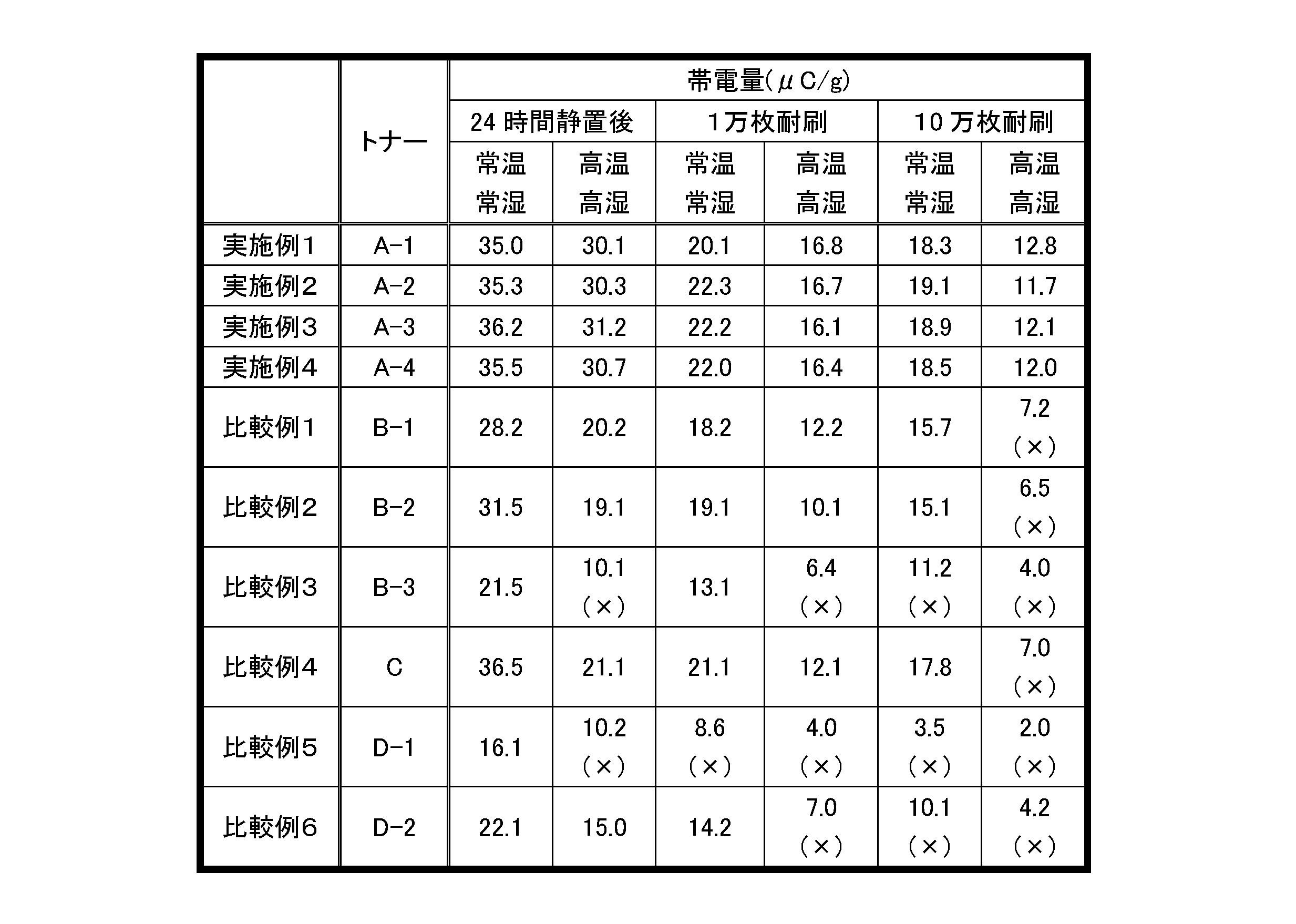
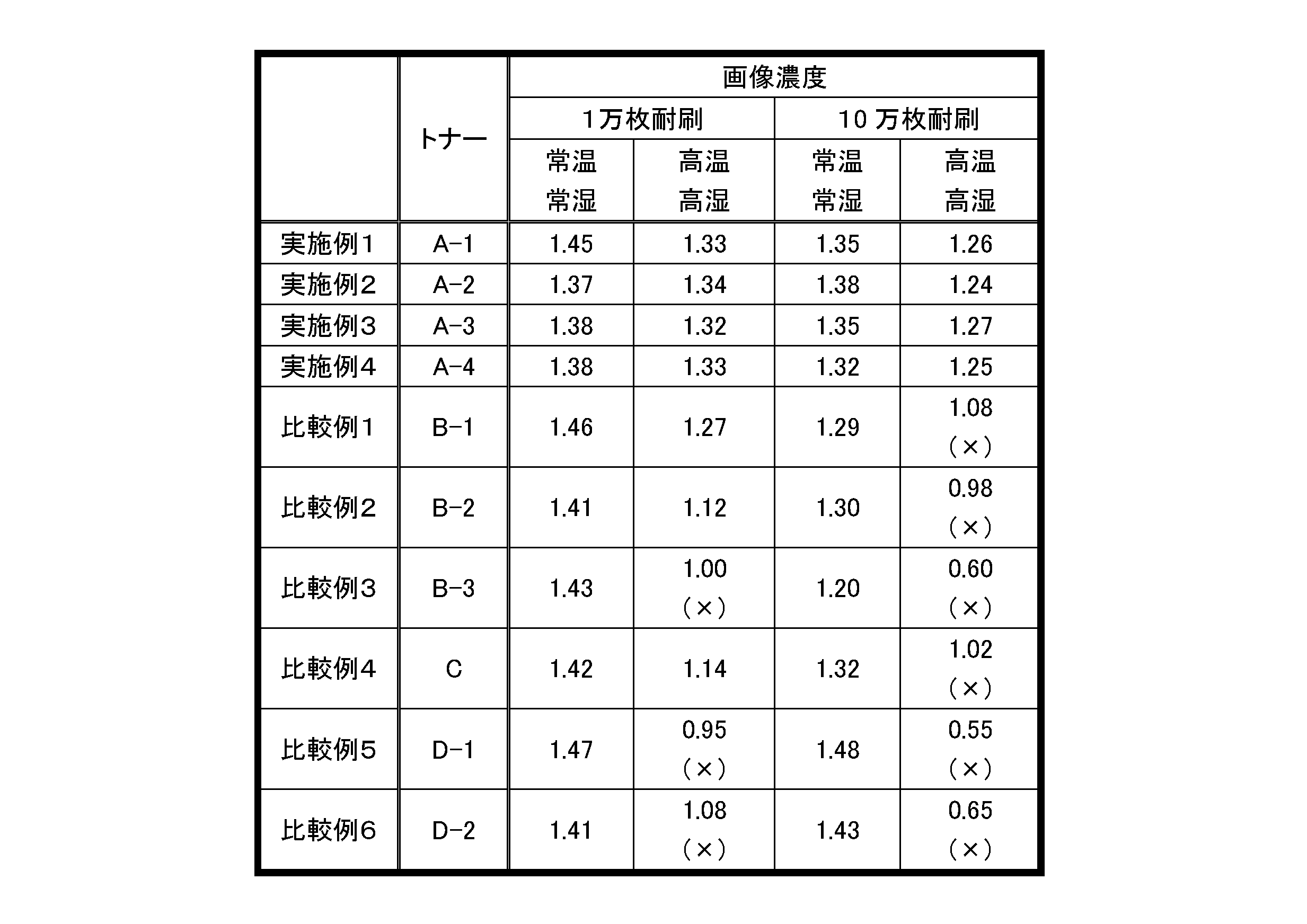
Claims (13)
- トナー母粒子と、それぞれ前記トナー母粒子の表面に付着した複数の外添剤粒子とを有するトナー粒子を、複数含み、
前記外添剤粒子は、シリカ粒子と、前記シリカ粒子の表面に形成されている金属水酸化物層と、少なくとも一部が前記金属水酸化物層の表面に形成されているコート層とを有し、
前記コート層は、実質的に含窒素樹脂から構成される、トナー。 - 前記コート層は、前記含窒素樹脂として熱硬化性樹脂を含む、請求項1に記載のトナー。
- 前記コート層は、前記熱硬化性樹脂としてメラミン樹脂及び尿素樹脂の少なくとも一方を含む、請求項2に記載のトナー。
- 前記コート層は、前記含窒素樹脂として熱可塑性樹脂をさらに含む、請求項2に記載のトナー。
- 前記シリカ粒子の表面領域のうち、前記コート層で覆われている領域の面積割合は、80%以上95%以下である、請求項1に記載のトナー。
- 前記コート層は、前記シリカ粒子の表面に形成されている第1部分と、前記金属水酸化物層の表面に形成されている第2部分とを含み、
前記シリカ粒子と前記コート層の前記第1部分との間には、シラノール基に由来する結合が形成されており、
前記金属水酸化物層と前記コート層の前記第2部分との間には、メチロール基に由来する結合が形成されている、請求項1に記載のトナー。 - 前記金属水酸化物層は、水酸化アルミニウム及び水酸化マグネシウムの少なくとも一方を含む、請求項1に記載のトナー。
- 前記金属水酸化物層は、実質的に水酸化アルミニウムから構成される、請求項1に記載のトナー。
- 前記金属水酸化物層は、実質的に水酸化マグネシウムから構成される、請求項1に記載のトナー。
- 前記トナー母粒子の表面には、前記外添剤粒子に加えて、他の外添剤粒子が付着している、請求項1に記載のトナー。
- 前記トナー母粒子は、2種以上の正帯電性電荷制御剤を含む、請求項1に記載のトナー。
- 前記トナー母粒子は、前記正帯電性電荷制御剤として、ニグロシンと、4級アンモニウム塩由来の繰返し単位を含む樹脂とを含む、請求項11に記載のトナー。
- 前記トナー母粒子は、ポリエステル樹脂をさらに含む、請求項11に記載のトナー。
Priority Applications (2)
| Application Number | Priority Date | Filing Date | Title |
|---|---|---|---|
| US15/554,012 US20180067415A1 (en) | 2015-03-19 | 2016-03-10 | Toner |
| JP2017506498A JP6365764B2 (ja) | 2015-03-19 | 2016-03-10 | トナー |
Applications Claiming Priority (2)
| Application Number | Priority Date | Filing Date | Title |
|---|---|---|---|
| JP2015-056378 | 2015-03-19 | ||
| JP2015056378 | 2015-03-19 |
Publications (1)
| Publication Number | Publication Date |
|---|---|
| WO2016148012A1 true WO2016148012A1 (ja) | 2016-09-22 |
Family
ID=56919662
Family Applications (1)
| Application Number | Title | Priority Date | Filing Date |
|---|---|---|---|
| PCT/JP2016/057580 Ceased WO2016148012A1 (ja) | 2015-03-19 | 2016-03-10 | トナー |
Country Status (3)
| Country | Link |
|---|---|
| US (1) | US20180067415A1 (ja) |
| JP (1) | JP6365764B2 (ja) |
| WO (1) | WO2016148012A1 (ja) |
Cited By (3)
| Publication number | Priority date | Publication date | Assignee | Title |
|---|---|---|---|---|
| JP2018054890A (ja) * | 2016-09-29 | 2018-04-05 | 京セラドキュメントソリューションズ株式会社 | 正帯電性トナー |
| JP2022146467A (ja) * | 2021-03-22 | 2022-10-05 | サカタインクス株式会社 | 静電荷像現像用トナー組成物 |
| US11835920B2 (en) | 2020-02-13 | 2023-12-05 | Sharp Kabushiki Kaisha | Toner and manufacturing method thereof and developer containing the same |
Families Citing this family (3)
| Publication number | Priority date | Publication date | Assignee | Title |
|---|---|---|---|---|
| JP7342490B2 (ja) | 2019-07-25 | 2023-09-12 | 株式会社リコー | トナー、トナー収容容器、現像剤、現像装置、プロセスカートリッジ、画像形成装置および画像形成方法 |
| JP7838317B2 (ja) * | 2022-03-03 | 2026-04-01 | 株式会社リコー | トナー、現像剤、トナー収容ユニット、画像形成装置及び画像形成方法 |
| JP2024163517A (ja) * | 2023-05-12 | 2024-11-22 | 株式会社リコー | トナー、画像形成装置、画像形成方法、及び印刷物の製造方法 |
Citations (4)
| Publication number | Priority date | Publication date | Assignee | Title |
|---|---|---|---|---|
| JP2002029730A (ja) * | 2000-07-17 | 2002-01-29 | Titan Kogyo Kk | 疎水性微粒子及びその応用 |
| JP2003057879A (ja) * | 2001-06-07 | 2003-02-28 | Toda Kogyo Corp | 黒色トナー用黒色複合粒子粉末及び黒色トナー、該黒色トナーを用いた現像方式 |
| JP2004093735A (ja) * | 2002-08-30 | 2004-03-25 | Seiko Epson Corp | トナーおよびそれを用いた画像形成装置 |
| JP2014089322A (ja) * | 2012-10-30 | 2014-05-15 | Kyocera Document Solutions Inc | 静電潜像現像用トナー |
Family Cites Families (1)
| Publication number | Priority date | Publication date | Assignee | Title |
|---|---|---|---|---|
| JP2681814B2 (ja) * | 1988-11-16 | 1997-11-26 | キヤノン株式会社 | 正帯電性磁性トナー |
-
2016
- 2016-03-10 WO PCT/JP2016/057580 patent/WO2016148012A1/ja not_active Ceased
- 2016-03-10 US US15/554,012 patent/US20180067415A1/en not_active Abandoned
- 2016-03-10 JP JP2017506498A patent/JP6365764B2/ja not_active Expired - Fee Related
Patent Citations (4)
| Publication number | Priority date | Publication date | Assignee | Title |
|---|---|---|---|---|
| JP2002029730A (ja) * | 2000-07-17 | 2002-01-29 | Titan Kogyo Kk | 疎水性微粒子及びその応用 |
| JP2003057879A (ja) * | 2001-06-07 | 2003-02-28 | Toda Kogyo Corp | 黒色トナー用黒色複合粒子粉末及び黒色トナー、該黒色トナーを用いた現像方式 |
| JP2004093735A (ja) * | 2002-08-30 | 2004-03-25 | Seiko Epson Corp | トナーおよびそれを用いた画像形成装置 |
| JP2014089322A (ja) * | 2012-10-30 | 2014-05-15 | Kyocera Document Solutions Inc | 静電潜像現像用トナー |
Cited By (4)
| Publication number | Priority date | Publication date | Assignee | Title |
|---|---|---|---|---|
| JP2018054890A (ja) * | 2016-09-29 | 2018-04-05 | 京セラドキュメントソリューションズ株式会社 | 正帯電性トナー |
| US11835920B2 (en) | 2020-02-13 | 2023-12-05 | Sharp Kabushiki Kaisha | Toner and manufacturing method thereof and developer containing the same |
| JP2022146467A (ja) * | 2021-03-22 | 2022-10-05 | サカタインクス株式会社 | 静電荷像現像用トナー組成物 |
| JP7569725B2 (ja) | 2021-03-22 | 2024-10-18 | サカタインクス株式会社 | 静電荷像現像用トナー組成物 |
Also Published As
| Publication number | Publication date |
|---|---|
| JPWO2016148012A1 (ja) | 2017-12-21 |
| US20180067415A1 (en) | 2018-03-08 |
| JP6365764B2 (ja) | 2018-08-01 |
Similar Documents
| Publication | Publication Date | Title |
|---|---|---|
| JP6365764B2 (ja) | トナー | |
| JP6038108B2 (ja) | 静電潜像現像用トナー | |
| US10768542B2 (en) | Positively chargeable toner | |
| US9804517B2 (en) | Electrostatic latent image developing toner | |
| JP2014089322A (ja) | 静電潜像現像用トナー | |
| JP2015075686A (ja) | トナー及びその製造方法 | |
| JP6465045B2 (ja) | 静電潜像現像用トナー | |
| US9465309B2 (en) | Electrostatic latent image developing toner | |
| JP6237677B2 (ja) | 静電潜像現像用トナー | |
| JP6439713B2 (ja) | 静電潜像現像用トナー及び外添剤 | |
| JP6287959B2 (ja) | トナー | |
| JP6269459B2 (ja) | 静電荷像現像用トナー | |
| JP2017151255A (ja) | 正帯電性トナー | |
| JP6458862B2 (ja) | 静電潜像現像用トナー | |
| WO2016104499A1 (ja) | 静電潜像現像用トナー及びその製造方法 | |
| CN106200285B (zh) | 静电潜像显影用调色剂 | |
| WO2016148013A1 (ja) | トナー及びその製造方法 | |
| JP6332007B2 (ja) | トナー | |
| JP6332127B2 (ja) | 静電潜像現像用トナー及びその製造方法 | |
| JP6390634B2 (ja) | 静電潜像現像用トナー及び外添剤 | |
| JP6330696B2 (ja) | トナーの製造方法 | |
| JP2016170328A (ja) | トナー | |
| JP2017116644A (ja) | 正帯電性トナー | |
| JP2016110021A (ja) | トナー |
Legal Events
| Date | Code | Title | Description |
|---|---|---|---|
| 121 | Ep: the epo has been informed by wipo that ep was designated in this application |
Ref document number: 16764842 Country of ref document: EP Kind code of ref document: A1 |
|
| ENP | Entry into the national phase |
Ref document number: 2017506498 Country of ref document: JP Kind code of ref document: A |
|
| WWE | Wipo information: entry into national phase |
Ref document number: 15554012 Country of ref document: US |
|
| NENP | Non-entry into the national phase |
Ref country code: DE |
|
| 122 | Ep: pct application non-entry in european phase |
Ref document number: 16764842 Country of ref document: EP Kind code of ref document: A1 |