WO2016143681A1 - リチウムニッケルマンガン複合酸化物及びその製造方法並びにそれを用いた正極及び蓄電デバイス - Google Patents
リチウムニッケルマンガン複合酸化物及びその製造方法並びにそれを用いた正極及び蓄電デバイス Download PDFInfo
- Publication number
- WO2016143681A1 WO2016143681A1 PCT/JP2016/056705 JP2016056705W WO2016143681A1 WO 2016143681 A1 WO2016143681 A1 WO 2016143681A1 JP 2016056705 W JP2016056705 W JP 2016056705W WO 2016143681 A1 WO2016143681 A1 WO 2016143681A1
- Authority
- WO
- WIPO (PCT)
- Prior art keywords
- nickel
- lithium
- composite oxide
- compound
- manganese composite
- Prior art date
- Legal status (The legal status is an assumption and is not a legal conclusion. Google has not performed a legal analysis and makes no representation as to the accuracy of the status listed.)
- Ceased
Links
Images


Classifications
-
- C—CHEMISTRY; METALLURGY
- C01—INORGANIC CHEMISTRY
- C01G—COMPOUNDS CONTAINING METALS NOT COVERED BY SUBCLASSES C01D OR C01F
- C01G53/00—Compounds of nickel
-
- C—CHEMISTRY; METALLURGY
- C01—INORGANIC CHEMISTRY
- C01G—COMPOUNDS CONTAINING METALS NOT COVERED BY SUBCLASSES C01D OR C01F
- C01G53/00—Compounds of nickel
- C01G53/40—Complex oxides containing nickel and at least one other metal element
- C01G53/42—Complex oxides containing nickel and at least one other metal element containing alkali metals, e.g. LiNiO2
- C01G53/44—Complex oxides containing nickel and at least one other metal element containing alkali metals, e.g. LiNiO2 containing manganese
- C01G53/54—Complex oxides containing nickel and at least one other metal element containing alkali metals, e.g. LiNiO2 containing manganese of the type (Mn2O4)-, e.g. Li(NixMn2-x)O4 or Li(MyNixMn2-x-y)O4
-
- H—ELECTRICITY
- H01—ELECTRIC ELEMENTS
- H01M—PROCESSES OR MEANS, e.g. BATTERIES, FOR THE DIRECT CONVERSION OF CHEMICAL ENERGY INTO ELECTRICAL ENERGY
- H01M10/00—Secondary cells; Manufacture thereof
- H01M10/05—Accumulators with non-aqueous electrolyte
- H01M10/052—Li-accumulators
-
- H—ELECTRICITY
- H01—ELECTRIC ELEMENTS
- H01M—PROCESSES OR MEANS, e.g. BATTERIES, FOR THE DIRECT CONVERSION OF CHEMICAL ENERGY INTO ELECTRICAL ENERGY
- H01M10/00—Secondary cells; Manufacture thereof
- H01M10/05—Accumulators with non-aqueous electrolyte
- H01M10/052—Li-accumulators
- H01M10/0525—Rocking-chair batteries, i.e. batteries with lithium insertion or intercalation in both electrodes; Lithium-ion batteries
-
- H—ELECTRICITY
- H01—ELECTRIC ELEMENTS
- H01M—PROCESSES OR MEANS, e.g. BATTERIES, FOR THE DIRECT CONVERSION OF CHEMICAL ENERGY INTO ELECTRICAL ENERGY
- H01M4/00—Electrodes
- H01M4/02—Electrodes composed of, or comprising, active material
- H01M4/36—Selection of substances as active materials, active masses, active liquids
- H01M4/48—Selection of substances as active materials, active masses, active liquids of inorganic oxides or hydroxides
- H01M4/485—Selection of substances as active materials, active masses, active liquids of inorganic oxides or hydroxides of mixed oxides or hydroxides for inserting or intercalating light metals, e.g. LiTi2O4 or LiTi2OxFy
-
- H—ELECTRICITY
- H01—ELECTRIC ELEMENTS
- H01M—PROCESSES OR MEANS, e.g. BATTERIES, FOR THE DIRECT CONVERSION OF CHEMICAL ENERGY INTO ELECTRICAL ENERGY
- H01M4/00—Electrodes
- H01M4/02—Electrodes composed of, or comprising, active material
- H01M4/36—Selection of substances as active materials, active masses, active liquids
- H01M4/48—Selection of substances as active materials, active masses, active liquids of inorganic oxides or hydroxides
- H01M4/50—Selection of substances as active materials, active masses, active liquids of inorganic oxides or hydroxides of manganese
- H01M4/505—Selection of substances as active materials, active masses, active liquids of inorganic oxides or hydroxides of manganese of mixed oxides or hydroxides containing manganese for inserting or intercalating light metals, e.g. LiMn2O4 or LiMn2OxFy
-
- H—ELECTRICITY
- H01—ELECTRIC ELEMENTS
- H01M—PROCESSES OR MEANS, e.g. BATTERIES, FOR THE DIRECT CONVERSION OF CHEMICAL ENERGY INTO ELECTRICAL ENERGY
- H01M4/00—Electrodes
- H01M4/02—Electrodes composed of, or comprising, active material
- H01M4/36—Selection of substances as active materials, active masses, active liquids
- H01M4/48—Selection of substances as active materials, active masses, active liquids of inorganic oxides or hydroxides
- H01M4/52—Selection of substances as active materials, active masses, active liquids of inorganic oxides or hydroxides of nickel, cobalt or iron
- H01M4/525—Selection of substances as active materials, active masses, active liquids of inorganic oxides or hydroxides of nickel, cobalt or iron of mixed oxides or hydroxides containing iron, cobalt or nickel for inserting or intercalating light metals, e.g. LiNiO2, LiCoO2 or LiCoOxFy
-
- C—CHEMISTRY; METALLURGY
- C01—INORGANIC CHEMISTRY
- C01P—INDEXING SCHEME RELATING TO STRUCTURAL AND PHYSICAL ASPECTS OF SOLID INORGANIC COMPOUNDS
- C01P2002/00—Crystal-structural characteristics
- C01P2002/30—Three-dimensional structures
- C01P2002/32—Three-dimensional structures spinel-type (AB2O4)
-
- C—CHEMISTRY; METALLURGY
- C01—INORGANIC CHEMISTRY
- C01P—INDEXING SCHEME RELATING TO STRUCTURAL AND PHYSICAL ASPECTS OF SOLID INORGANIC COMPOUNDS
- C01P2004/00—Particle morphology
- C01P2004/60—Particles characterised by their size
- C01P2004/62—Submicrometer sized, i.e. from 0.1-1 micrometer
-
- Y—GENERAL TAGGING OF NEW TECHNOLOGICAL DEVELOPMENTS; GENERAL TAGGING OF CROSS-SECTIONAL TECHNOLOGIES SPANNING OVER SEVERAL SECTIONS OF THE IPC; TECHNICAL SUBJECTS COVERED BY FORMER USPC CROSS-REFERENCE ART COLLECTIONS [XRACs] AND DIGESTS
- Y02—TECHNOLOGIES OR APPLICATIONS FOR MITIGATION OR ADAPTATION AGAINST CLIMATE CHANGE
- Y02E—REDUCTION OF GREENHOUSE GAS [GHG] EMISSIONS, RELATED TO ENERGY GENERATION, TRANSMISSION OR DISTRIBUTION
- Y02E60/00—Enabling technologies; Technologies with a potential or indirect contribution to GHG emissions mitigation
- Y02E60/10—Energy storage using batteries
Definitions
- the present invention relates to a method for producing a spinel structure lithium nickel manganese composite oxide. Moreover, it is related with the positive electrode and electrical storage device using the same. More specifically, the present invention relates to a method for producing a 5V class spinel structure lithium nickel manganese composite oxide which is a high potential positive electrode material having a large particle size and a small amount of nickel oxide as a subphase.
- non-aqueous electrolyte batteries particularly lithium batteries
- lithium batteries can be expected to have high electromotive force and high energy density because lithium is a substance having a low atomic weight and high ionization energy.
- a spinel structure lithium manganese composite oxide LiMn 2 O 4 which has abundant resources and is advantageous in terms of cost, has attracted attention.
- a reaction region with lithium ions appears in the 5V region in addition to the 4V region of the conventional LiMn 2 O 4 compound.
- the 5V region is a maximum of 147 mAh / g.
- Patent Document 2 discloses a mixed hydroxide of metal M containing manganese and nickel in a predetermined ratio by a coprecipitation method.
- Patent Document 3 as a raw material of lithium manganese nickel composite oxide, a mixed aqueous solution of manganese salt and nickel salt is reacted with an alkali solution and coprecipitated to obtain a manganese nickel composite hydroxide or composite oxide, which is 850 ° C.
- a method is described in which heat treatment is performed in an air atmosphere and heat treatment is performed again at 600 to 800 ° C.
- a battery using a material obtained by this method as a positive electrode active material is said to exhibit a flat and low polarization charge / discharge characteristic.
- Non-Patent Document 1 discloses lithium manganese nickel with a large amount of nickel solid solution and a small amount of impurities by using a sol-gel method using a lithium source, a manganese source, a nickel source nitrate, a mixed aqueous solution of acetate and citric acid. It is described that a complex oxide can be produced, and a battery using the same exhibits a large 5 V region capacity.
- a material having a large particle size and a small specific surface area is used as a positive electrode material of a lithium transition metal composite oxide. Thereby, elution of the transition metal from the positive electrode material in a high temperature environment is suppressed, and high temperature cycle characteristics and high temperature storage characteristics are improved.
- lithium transition metal composite oxide having a large particle size for example, a method in which the synthesis is performed by high-temperature firing to promote particle growth can be mentioned.
- a method in which the synthesis is performed by high-temperature firing to promote particle growth can be mentioned.
- a manganese compound, a nickel compound, and a lithium compound are mixed at a high temperature.
- oxygen deficiency is likely to occur during the baking process, so that Mn 3+ is generated, substitution of Ni and Mn does not proceed, and a part of it is precipitated as nickel oxide (NiO).
- spinel-structured lithium manganate containing a large amount of nickel is unstable at a high temperature and becomes a mixture of spinel-structure Li (1 + x) Mn (2-xy) Ni y O 4 and nickel oxide.
- Patent Document 2 a mixed hydroxide in which manganese and nickel are uniformly distributed is prepared, and a lithium compound is reacted therewith to obtain a spinel structure lithium manganese nickel composite oxide having no subphase such as nickel oxide.
- a lithium compound is reacted therewith to obtain a spinel structure lithium manganese nickel composite oxide having no subphase such as nickel oxide.
- Patent Document 3 it is described that after baking at 850 ° C. or higher, heating is further performed at 600 to 800 ° C. to recover oxygen deficiency.
- this method it is difficult to suppress the formation of nickel oxide in the first firing, and there is a problem that nickel oxide once formed does not disappear and remains even by reheating at 600 to 800 ° C. .
- Non-Patent Document 1 employs a sol-gel method, a lithium manganese nickel composite oxide having a spinel structure without a secondary phase such as nickel oxide can be produced even though the amount of nickel is high. small. Therefore, when trying to grow particles by heating, there is a problem that it is difficult to suppress the formation of nickel oxide as described above. Moreover, industrial productivity is not high.
- the present inventors have been able to stably exist even at high temperatures, and it is difficult to form a secondary phase nickel oxide.
- the product As a precursor, it is possible to produce a 5V-class spinel structure lithium nickel manganese composite oxide that produces a small amount of nickel oxide as a secondary phase even though it contains a large amount of nickel. It has been found that the present invention can also be applied to the production of a 5V-class spinel structure lithium nickel manganese composite oxide, and has led to the present invention.
- the present invention (2) is the method for producing a 5V class spinel structure lithium nickel manganese composite oxide according to (1), wherein the raw material is a mixture further containing a lithium compound and a nickel compound.
- This invention (3) is a manufacturing method of the 5V class spinel structure lithium nickel manganese complex oxide as described in (1) or (2) in which the said synthesis
- the present invention (4) is the method for producing a 5V class spinel structure lithium nickel manganese composite oxide according to (3), wherein the firing is performed at a temperature in the range of 600 to 750 ° C.
- This invention (5) is the manufacturing method of 5V class spinel structure lithium nickel manganese complex oxide as described in (3) or (4) which performs the said baking in the atmosphere containing oxygen.
- the mixing ratio of the lithium compound to the nickel compound is 0.3 to 0.7 in terms of the molar ratio of lithium to nickel (Li / Ni).
- the present invention (7) provides the 5V class spinel structure lithium nickel manganese composite oxide according to any one of (2) to (6), wherein the melting temperature or decomposition temperature of the lithium compound and nickel compound is less than 750 ° C. It is a manufacturing method.
- the lithium compound is at least one selected from lithium acetate, lithium nitrate, and lithium hydroxide.
- the present invention (9) provides the 5V class spinel structure lithium nickel manganese composite oxide according to any one of (2) to (8), wherein the nickel compound is at least one selected from nickel acetate, nickel nitrate and nickel sulfate It is a manufacturing method.
- the present invention (10) is a 5V class spinel structure lithium nickel manganese composite oxide having an average primary particle diameter of 0.7 ⁇ m or more and a saturation magnetization of 85 emu / g or more.
- the present invention (11) is a 5V class spinel structure lithium nickel manganese composite oxide having an average primary particle diameter of 0.7 ⁇ m or more and a Curie temperature of 110 K or more.
- This invention (12) is a positive electrode containing the 5V class spinel structure lithium nickel manganese complex oxide as described in (10) or (11).
- This invention (13) is an electrical storage device provided with the positive electrode containing the 5V class spinel structure lithium nickel manganese complex oxide as described in (10) or (11), a negative electrode, and electrolyte.
- This invention (14) is an electrical storage device as described in (13) in which the said negative electrode contains lithium titanate.
- a spinel-structure lithium nickel manganese composite oxide is synthesized by synthesis from a precursor containing a nickel content relatively smaller than that of the intended product, a lithium compound, and a nickel compound as a mixture.
- the capacity in the 5 V region near 4.7 V
- the energy density of the electricity storage device can be increased.
- the particle size can be increased and the specific surface area can be decreased, an electricity storage device exhibiting excellent characteristics even at high temperatures can be obtained.
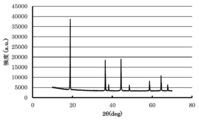
- FIG. 1 is a powder X-ray diffraction pattern of a lithium nickel manganese composite oxide (low Ni spinel LNMO) having a spinel structure manufactured in Example 1.
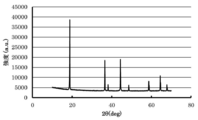
- FIG. 3 is a powder X-ray diffraction pattern of a spinel structure lithium nickel manganese composite oxide (high Ni spinel LNMO) synthesized in Example 1.
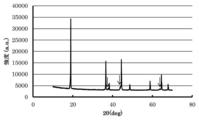
- FIG. 2 is a powder X-ray diffraction pattern of a lithium nickel manganese composite oxide having a spinel structure synthesized in Comparative Example 1.
- FIG. 2 is a discharge curve of a coin cell produced using a lithium nickel manganese composite oxide having a spinel structure (high Ni spinel LNMO) synthesized in Example 1.
- FIG. 2 is a discharge curve of a coin cell manufactured using a lithium nickel manganese composite oxide having a spinel structure synthesized in Comparative Example 1.
- FIG. 1 is a powder X-ray diffraction pattern of a lithium nickel manganese composite oxide (low Ni spinel L
- the 5V class spinel structure lithium nickel manganese composite oxide is a spinel structure lithium nickel manganese composite oxide whose average discharge voltage measured under specific conditions is 4.5 V or more as described later.
- the manufacturing method of 5V class spinel structure lithium nickel manganese composite oxide of this invention is a manufacturing method using spinel structure lithium nickel manganese composite oxide with little nickel content as a precursor.
- 5V class spinel structure lithium nickel using a spinel structure lithium nickel manganese composite oxide having a molar ratio of nickel to manganese (Ra Ni / Mn) of 0.10 ⁇ Ra ⁇ 0.29 as a precursor. It is a manufacturing method of manganese complex oxide.
- 5V class spinel structure lithium nickel manganese composite oxide obtained by the production method of the present invention may be described as “high Ni spinel LNMO”, respectively.
- the crystal structure of the low Ni spinel LNMO can be confirmed by a peak based on the spinel structure using a powder X-ray diffraction method. Specifically, the main peak positions described in PDF # 32-0581 (2 ⁇ is 18.8 °, 36.4 °, 44.3 ° by X-ray diffraction using CuK ⁇ 1 line) are compared and confirmed. In addition, since the position of the peak may vary somewhat depending on the composition or the like, the structure in which each peak position varies by ⁇ 2 ° is included in the same structure.
- the lower limit of Ra is preferably 0.11, more preferably 0.18, even more preferably 0.25, and the upper limit of Ra is preferably 0.28, more preferably 0.27. More preferably, it is 0.26. If Ra is too small, there is a large difference from the amount of nickel in the target high Ni spinel LNMO, so composition deviation tends to occur during the synthesis of high Ni spinel LNMO, and the time required for the synthesis becomes longer.
- Ra nickel oxide is likely to be formed, which is not preferable as a precursor. In particular, it is difficult to obtain a precursor having a large particle size.
- the molar ratio of nickel to manganese is measured by EDX (energy dispersive X-ray spectroscopic analysis), WDX (wavelength dispersive X-ray spectroscopic analysis), or ICP emission spectroscopic analysis.
- the composition of the low Ni spinel LNMO can also be expressed as the following formula 1 using the general formula. Equation 1 can be obtained by measuring the amounts of Li, Mn, and Ni by, for example, ICP emission spectroscopy and determining the amount of oxygen so as to maintain electrical neutrality. You may obtain
- other elements may be contained. Examples of other elements include Na, K, Ca, Mg, Al, Ti, Sc, Ge, V, Cr, Zr, Co, Zn, Cu, La, Ce, Hf, Nb, Ta, Mo, W, Examples include Ru, Ag, Sn, Pb, and Si.
- the average primary particle size of the low Ni spinel LNMO is not particularly limited, and those having an arbitrary average primary particle size can be used.
- the average primary particle diameter of the high Ni spinel LNMO is substantially determined by the average primary particle diameter of the low Ni spinel LNMO, it is used according to the target average primary particle diameter of the high Ni spinel LNMO. It is preferred to determine the average primary particle size of the low Ni spinel LNMO.
- the average primary particle diameter of the low Ni spinel LNMO is 0.7 ⁇ m or more, it is preferable because a high Ni spinel LNMO having a large primary particle diameter of 0.7 ⁇ m or more is preferable, and the average primary particle diameter is preferably 1.0 ⁇ m or more. More preferred.
- the average secondary particle size of the low Ni spinel LNMO is not particularly limited, and those having an arbitrary average secondary particle size can be used.
- the average secondary particle diameter of the high Ni spinel LNMO is substantially determined by the average secondary particle diameter of the low Ni spinel LNMO, the average secondary particle diameter of the high Ni spinel LNMO is adjusted to the target average secondary particle diameter.
- a low Ni spinel LNMO having an average secondary particle diameter of 20 to 30 ⁇ m may be used.
- the average secondary particle diameter is measured by a laser diffraction / scattering method.
- the specific surface area of low Ni spinel LNMO is substantially determined by the specific surface area of the low Ni spinel LNMO, the ratio of the low Ni spinel LNMO used in accordance with the target specific surface area of the high Ni spinel LNMO. It is preferred to determine the surface area.
- the specific surface area is to produce a high-Ni spinel LNMO of 0.1 ⁇ 2.0m 2 / g
- the specific surface area is preferably used a low-Ni spinel LNMO of 0.1 ⁇ 2.0m 2 / g.
- the specific surface area is measured by the BET single point method using nitrogen adsorption.
- the low Ni spinel LNMO is essentially low in nickel oxide content, but the lower the nickel oxide content, the better.
- the content of nickel oxide when producing a high Ni spinel LNMO can be reduced.
- a clear peak of nickel oxide is not observed in powder X-ray diffraction, more preferably the content of nickel oxide determined by Rietveld analysis is 2% by mass or less, and 1.5% by mass More preferably, it is as follows.
- 5V class spinel structure lithium nickel manganese composite oxide (high Ni spinel LNMO) manufactured using such a precursor has a large capacity in the 5V region (near 4.7V), and is a high-potential positive electrode material with a large capacity. Since it can be suitably used, the energy density of the electricity storage device can be increased. In addition, it is possible to manufacture a product having a large particle size and a small specific surface area, and an electricity storage device that exhibits excellent characteristics even at high temperatures can be obtained.
- Examples of a method for producing high Ni spinel LNMO using such a precursor include a method for synthesizing high Ni spinel LNMO using a mixture containing at least the precursor, a lithium compound, and a nickel compound as raw materials. It is done.
- the lithium compound is not particularly limited, and any lithium compound may be used. There is no restriction
- the compounding ratio of the lithium compound, the nickel compound, and the low Ni spinel LNMO is determined as follows.
- the amount corresponding to the amount of Ni that is insufficient with the low Ni spinel LNMO relative to the Ni / Mn molar ratio of the target high Ni spinel LNMO is the amount of nickel compound to be blended.
- the amount of lithium can be appropriately determined within a range where a single-phase high Ni spinel LNMO is obtained.
- Preparation of the mixture of the above-described lithium compound, nickel compound, and low Ni spinel LNMO may be performed by any method. These mixing may be performed either dry or wet, and there is no limitation. These mixing can be performed by a known method using mixing equipment such as a known mixer or pulverizer. For example, in the case of dry mixing, a lithium compound, a nickel compound, and a low Ni spinel LNMO may be charged into a mixing facility and the mixing facility may be operated. Either one or two may be input first and the operation may be started, and then the rest may be input later, or the operation may be started after all of them are input. In the case of wet mixing, the raw materials and the liquid medium may be charged into a mixing facility and the mixing facility may be operated.
- the mixing order there is no particular limitation on the mixing order.
- the liquid medium for example, water or an organic solvent such as alcohol can be used.
- the lithium compound and the nickel compound may be liquid-soluble, for example, water-soluble or insoluble.
- pulverized mixing or wet mixing may be performed.
- a known mixer that can be used for preparing the mixture for example, a Henschel mixer, a V-type mixer, a powder mixer, a double cone blender, a tumbler mixer, and the like are preferably used. What is necessary is just to set suitably the atmosphere at the time of mixing, time, temperature, stirring conditions, etc. according to a raw material, an installation, etc.
- wet mixing drying may be performed by an arbitrary method.
- the mixture may be compressed prior to the synthesis of high Ni spinel LNMO. Moreover, you may pelletize by compression molding. By compressing, the reactivity between raw materials is further improved, and the production of nickel oxide can be further reduced. At this time, high Ni spinel LNMO particles are easily generated by forming a molded body having a molding density of 2 g / cm 3 or more.
- a known pressure (molding) machine or compression (molding) machine can be used for the compression, and examples thereof include a roller compactor, a roller crusher, and a pellet molding machine.
- Examples of a method of synthesizing high Ni spinel LNMO using such a mixture as a raw material include a method of synthesizing high Ni spinel LNMO by firing the raw material.
- the firing temperature may be within a range in which high Ni spinel LNMO can stably exist and sufficient diffusion of lithium and nickel into the low Ni spinel LNMO is possible.
- the firing time there is no particular limitation on the firing time, and any time may be used as long as the raw material reaction occurs sufficiently. Specifically, it may be 5 to 30 hours.
- Firing may be performed at a constant temperature, and the temperature may be changed in several stages along the way.
- baking may be performed only once and may be performed several times.
- the sample may be compressed every time it is fired, or may be subjected to a crushing process using a grinder after firing.
- the rate of temperature increase and the rate of temperature decrease there are no particular restrictions on the rate of temperature increase and the rate of temperature decrease, and they may be set arbitrarily.
- the firing temperature is preferably in the range of 600 to 750 ° C., more preferably in the range of 600 to 700 ° C., and still more preferably in the range of 650 to 700 ° C.
- the high Ni spinel LNMO can exist stably, and the core / shell particles having a coating of a compound containing lithium and nickel on the surface are not formed, and the surface side is rich in nickel. It is easy to obtain high Ni spinel LNMO particles having a high composition homogeneity and suppressing the formation of nickel oxide.
- the atmosphere for firing can be performed in either air or oxygen atmosphere. In any atmosphere, the effect of the production method of the present invention is exhibited. However, when firing in an oxygen atmosphere, oxygen desorption is difficult to occur, and the change of manganese in the spinel LNMO from tetravalent to trivalent can be suppressed. As a result, formation of nickel oxide can be suppressed, which is preferable.
- the blending ratio of the lithium compound and nickel compound to be blended with the low Ni spinel LNMO in the mixture is preferably such that the molar ratio of lithium to nickel (Li / Ni) is 0.3 to 0.7. .
- the spinel structure is easily maintained during diffusion of lithium and nickel into the low Ni spinel LNMO, and the formation of separate phases is easily suppressed.
- core / shell particles with a coating film of a compound containing lithium and nickel on the surface are not formed, and the surface side is not nickel-rich gradient composition particles. It is easier to obtain high Ni spinel LNMO particles with suppressed.
- low Ni spinel LNMO that can exist stably even at high temperatures is used as a precursor.
- Such a low Ni spinel LNMO can be heat-treated at a high temperature, so that it can be easily obtained having a large particle size and few subphases.
- a high Ni spinel LNMO having a large particle size, a small number of subphases, and a uniform composition can be obtained.
- the lithium compound a lithium compound whose melting or decomposition temperature is less than 750 ° C. is preferably used, and more preferably less than 700 ° C.
- the diffusion of lithium into the low Ni spinel LNMO is likely to occur, and a sufficient reaction is possible even in a temperature range in which the desorption of oxygen constituting the spinel LNMO is difficult to occur.
- High Ni spinel LNMO particles with high homogeneity and suppressed nickel oxide formation are further easily obtained.
- Such lithium compounds include lithium acetate (melting point 286 ° C.), lithium nitrate (melting point 261 ° C.), lithium hydroxide (melting point 462 ° C.), lithium chloride (melting point 613 ° C.), lithium bromide (melting point 547 ° C.), It is preferable to use at least one selected from lithium iodide (melting point: 446 ° C.), and it is more preferable to use lithium acetate that melts at a lower temperature and does not generate harmful gases.
- the nickel compound is preferably a nickel compound having a melting or decomposition temperature of less than 750 ° C.
- nickel is easily diffused into the low Ni spinel LNMO, and a sufficient reaction is possible even in a temperature range where desorption of oxygen constituting the spinel LNMO is difficult to occur.
- High Ni spinel LNMO particles with high homogeneity and suppressed nickel oxide formation are further easily obtained.
- a nickel compound it is preferable to use at least one selected from nickel acetate (melting point 250 ° C.), nickel nitrate (melting point 56.7 ° C.), and nickel sulfate (melting point 100 ° C.). It is more preferable to use nickel acetate that does not generate harmful gases.
- the 5V class spinel structure lithium nickel manganese composite oxide refers to a spinel structure lithium nickel manganese composite oxide having an average discharge voltage of 4.5 V or more measured under the following conditions. It contains 88% by mass of lithium nickel manganese composite oxide powder as a positive electrode active material, 5% by mass of acetylene black as a conductive agent, and 7% by mass of polyvinylidene fluoride (PVDF) as a binder, and N-methylpyrrolidone (NMP) as a dispersion medium. ) Is prepared.
- This slurry is applied to a current collector made of aluminum foil having a thickness of 20 ⁇ m on one side so that the amount of active material is 9.1 mg / cm 2 , dried, and the mixture density is 2.8 g / cm 3. Press and then vacuum dry at 130 ° C. for 8 hours to produce a positive electrode.
- dry argon the positive electrode and the lithium metal foil, which have been shaped for coin cells, are opposed to each other with a separator interposed therebetween. These members are put in a coin cell, an electrolyte is poured, and the coin cell is sealed in a state where the separator and the electrode are sufficiently impregnated with the electrolyte.
- an electrolytic solution a solution obtained by dissolving 1.0 mol / liter of LiPF 6 as an electrolyte in a mixed solvent in which ethylene carbonate (EC) and dimethyl carbonate (DMC) are mixed at a volume ratio of 1: 2 is used. .
- the manufactured coin cell was charged at a constant current until the cell voltage reached 4.9 V at 0.2 C in a 25 ° C. environment, and then constant until the cell voltage reached 3.5 V at 0.2 C. Discharge with current.
- the average discharge voltage refers to a voltage corresponding to the middle point of the capacity when a voltage-capacity curve at the time of discharge is drawn in the above-described capacity measurement.
- the crystal structure of the high Ni spinel LNMO can be confirmed by a peak based on the spinel structure using a powder X-ray diffraction method as in the method described above. Specifically, the main peak positions (18.8 °, 36.4 °, 44.3 °) described in PDF # 32-0581 are compared and confirmed. In addition, since the position of the peak may vary somewhat depending on the composition or the like, the structure in which each peak position varies by ⁇ 2 ° is included in the same structure.
- the average primary particle size of the high Ni spinel LNMO of the present invention can be in the range of 0.7 to 2.5 ⁇ m, preferably in the range of 1.0 to 2.3 ⁇ m. Further, the BET specific surface area can be set to 0.1 to 2.0 m 2 / g. By setting it within this range, particles having high temperature characteristics and less cycle deterioration when used as an active material can be obtained. In addition, since the average secondary particle diameter can be set to 20 to 30 ⁇ m, process handling properties such as coating properties at the time of electrode production are good.
- the saturation magnetization can be 85 emu / g or more, or 95 emu / g or more.
- the saturation magnetization reflects the amount of impurities such as nickel oxide in the spinel LNMO, and the larger the saturation magnetization, the smaller the amount of impurities.
- the saturation magnetization is calculated from a value obtained by measuring low-temperature magnetism of a sample using a magnetic balance.
- the high Ni spinel LNMO of the present invention is a large particle having an average primary particle diameter of 0.7 ⁇ m or more, its Curie temperature can be 110 K or more, and can be 120 K or more.
- the Curie temperature reflects the solid solubility of nickel and manganese in the spinel LNMO, and the higher the Curie temperature, the higher the solid solubility of nickel in the spinel LNMO phase.
- the Curie temperature is calculated from the value obtained by measuring the low temperature magnetism of the sample using a magnetic balance. For this reason, the high Ni spinel LNMO of the present invention has a small amount of impurities such as nickel oxide and has a high solid solubility of nickel, and its average primary particle diameter is 0.7 ⁇ m or more and is saturated.
- the magnetization is 85 emu / g or more, and the Curie temperature is preferably 110 K or more, more preferably the average primary particle diameter is 0.7 ⁇ m or more, and the saturation magnetization is 95 emu / g or more. , Curie temperature is 120K or more.
- Rb can be preferably in the range of 0.29 to 1/3, more preferably 0.31 to 1/3, and even more preferably about 1/3.
- the content of nickel oxide in the high Ni spinel LNMO of the present invention is small.
- the content of nickel oxide obtained by Rietveld analysis can be 2% by mass or less, and further 1.5 mass % Or less.
- the composition of the high Ni spinel LNMO can also be expressed as the following formula 2 using the general formula. Equation 2 can be obtained by measuring the amounts of Li, Mn, and Ni by, for example, ICP emission spectroscopy and determining the amount of oxygen so as to maintain electrical neutrality. You may obtain
- other elements may be contained. Examples of other elements include Na, K, Ca, Mg, Al, Ti, Sc, Ge, V, Cr, Zr, Co, Zn, Cu, La, Ce, Hf, Nb, Ta, Mo, W, Examples include Ru, Ag, Sn, Pb, and Si.
- the production method of the present invention is particularly suitable for the production of a spinel-structure lithium nickel manganese composite oxide having a large particle size and a low specific surface area. It is also possible to apply to the manufacture of products, and the production of nickel oxide can be suppressed.
- a manufacturing method (manufacturing method) of the low Ni spinel LNMO as a precursor will be described.
- a well-known manufacturing method can be used.
- a wet method in which a predetermined amount of a lithium compound, a nickel compound, and a manganese compound are mixed in a liquid medium, dried, and fired.
- a method of performing drying by spray drying, a predetermined amount of a lithium compound, and Examples thereof include a dry method in which a nickel compound and a manganese compound are mixed and fired.
- the said method can also be applied.
- an inorganic or organic compound containing a manganese atom can be used, and there is no particular limitation.
- at least one selected from the group consisting of manganese chloride, manganese sulfate, manganese oxide, manganese carbonate, manganese carbonate hydrate, manganese hydroxide, and manganese oxyhydroxide can be used.
- an inorganic or organic compound containing a nickel atom can be used, and there is no particular limitation.
- at least one selected from the group consisting of nickel chloride, nickel sulfate, nickel oxide, nickel hydroxide, nickel carbonate, nickel carbonate hydrate, and nickel oxyhydroxide can be used.
- an inorganic or organic compound containing nickel atoms and manganese atoms in a predetermined ratio can be used, and there is no particular limitation.
- a commercially available product may be obtained, a method of firing the mixture of the nickel compound and the manganese compound, a method of coprecipitation of hydroxide by adding alkali or ammonia to an aqueous solution in which the nickel compound and the manganese compound are dissolved, You may prepare by the method of baking the hydroxide further, and making it into an oxide.
- the average secondary particle diameter (laser diffraction / scattering method) of the oxide containing manganese and nickel thus obtained is preferably in the range of 10 to 30 ⁇ m.
- the specific surface area is preferably 20 to 30 m 2 / g. By setting it as this range, the reactivity with lithium becomes still higher.
- a nickel compound and a manganese compound or a compound containing nickel and manganese and a lithium compound are mixed and fired to obtain a low Ni spinel LNMO.
- lithium compound used for the production of the low Ni spinel LNMO an inorganic or organic compound containing a lithium atom can be used.
- lithium hydroxide, lithium carbonate, lithium nitrate, or lithium acetate can be used.
- the use of at least one selected from the group consisting of lithium acetate, lithium hydroxide and lithium nitrate as the lithium source is preferable because low Ni spinel LNMO is easily formed.
- mixing may be performed either dry or wet, and there is no limitation. These mixing can be performed by a known method using mixing equipment such as a known mixer or pulverizer.
- mixing equipment such as a known mixer or pulverizer.
- each raw material may be put into a mixing facility and the mixing facility may be operated. Either one or two may be input first and the operation may be started, and then the rest may be input later, or the operation may be started after all of them are input.
- wet mixing the raw materials and the liquid medium may be charged into a mixing facility and the mixing facility may be operated. Also in this case, there is no particular limitation on the mixing order.
- the liquid medium for example, water or an organic solvent such as alcohol can be used.
- the lithium compound, nickel, and manganese compound may be liquid-soluble, for example, water-soluble or insoluble.
- a mixing state For example, what is necessary is just to be mixed to such an extent that each raw material is not macroscopically unevenly distributed.
- pulverized mixing or wet mixing may be performed.
- a known mixer that can be used for preparing the mixture for example, a Henschel mixer, a V-type mixer, a powder mixer, a double cone blender, a tumbler mixer, and the like are preferably used. What is necessary is just to set suitably the atmosphere at the time of mixing, time, temperature, stirring conditions, etc. according to a raw material, an installation, etc.
- wet mixing drying may be performed by an arbitrary method.
- the mixture may be subjected to a compression treatment and then subjected to firing described later. Moreover, you may pelletize by compression molding. By compressing, the reactivity between raw materials is further improved, and the production of nickel oxide can be further reduced. At this time, low Ni spinel LNMO particles having a single phase and a large particle diameter are easily generated by forming a molded body having a molding density of 2 g / cm 3 or more.
- a known pressure (molding) machine or compression (molding) machine can be used for the compression, and examples thereof include a roller compactor, a roller crusher, and a pellet molding machine.
- a firing temperature in the range of 700 to 1000 ° C. is preferable because a spinel structure is easily formed.
- the firing time there is no particular limitation on the firing time, and any time may be used as long as the raw material reaction occurs sufficiently. Specifically, it may be 5 to 30 hours.
- Firing may be performed at a constant temperature, and the temperature may be changed in several stages along the way.
- baking may be performed only once and may be performed several times. Baking may be performed once within the above temperature range, and then baking may be performed at a lower temperature.
- the sample may be compressed every time it is fired, or may be subjected to a crushing process using a grinder after firing.
- a low Ni spinel LNMO having a large particle diameter and a small specific surface area can be easily obtained by increasing the firing temperature, increasing the firing time, or increasing the number of firings.
- Calcination atmosphere can be either air or oxygen atmosphere.
- the firing conditions may be appropriately set according to the atmosphere. Firing in an oxygen atmosphere is preferable because oxygen desorption is unlikely to occur and the change in manganese from tetravalent to trivalent in spinel LNMO can be suppressed, and as a result, formation of nickel oxide can be suppressed.
- Step 1 A step of mixing an aqueous solution containing a predetermined ratio of a manganese compound and a nickel compound and an aqueous oxalic acid solution to obtain a precipitate containing an oxalic acid compound containing manganese and nickel.
- Step 2 a step of heat-treating the precipitate at 350 to 500 ° C. to obtain an oxide containing manganese and nickel.
- Step 1 is a step in which an aqueous solution containing a manganese compound and a nickel compound and an aqueous oxalic acid solution are mixed to obtain a precipitate containing an oxalic acid compound containing manganese and nickel.
- the manganese compound may be any water-soluble manganese compound described above, and is not particularly limited. Specific examples include manganese sulfate, manganese nitrate, and manganese chloride.
- the nickel compound is not particularly limited as long as it uses a water-soluble nickel compound. Specific examples include nickel sulfate, nickel nitrate, and nickel chloride.
- An aqueous solution containing a manganese compound and a nickel compound can be prepared by dissolving a manganese compound and a nickel compound in water.
- the concentration of manganese and nickel in the aqueous solution is not particularly limited, but is usually preferably about 20 to 40% by mass from the viewpoints of operability and economy.
- the aqueous oxalic acid solution can be prepared by dissolving oxalic acid in water.
- the concentration of the oxalic acid aqueous solution is usually preferably about 5 to 15% by mass from the viewpoints of operability and economy.
- aqueous solution containing the manganese compound and the nickel compound and the oxalic acid aqueous solution may be mixed in the whole amount, or may be added continuously or intermittently, and there is no particular limitation.
- the pH can be adjusted to the above range by adjusting the oxalic acid aqueous solution to a mixed amount equal to or more than that of the aqueous solution containing the manganese compound and the nickel compound, and it is preferable that the mixed amount is equivalent to 2 equivalents.
- Step 2 is a step in which the precipitate obtained in Step 1 is heat-treated at 350 to 500 ° C. to obtain an oxide containing manganese and nickel.
- the precipitate is mainly composed of an oxalic acid compound containing manganese and nickel.
- An oxide containing manganese and nickel is obtained by heat-treating this in the above temperature range and pyrolyzing. If the thermal decomposition temperature is less than 350 ° C., the thermal decomposition of the oxalic acid compound is insufficient and it is difficult to obtain oxide particle powder having a uniform composition. On the other hand, if the thermal decomposition temperature exceeds 500 ° C., reaction of the obtained oxide particle powder with lithium Sex is reduced.
- the oxide containing manganese and nickel thus obtained is fired together with the lithium compound as described above to obtain low Ni spinel LNMO.
- the use of the oxalic acid method for the production of a compound containing nickel and manganese has the following advantages.
- -The precipitate containing the oxalic acid compound containing manganese and nickel obtained in step 1 is easy to filter and wash. Since it does not become a hard lump like a hydroxide precipitate, it is easy to handle and industrially advantageous.
- -The oxide containing manganese and nickel obtained by heat-treating the precipitate has high reactivity with lithium. Therefore, it is suitable for manufacturing low Ni spinel LNMO. Specifically, it is easy to reduce the amount of nickel oxide present in the low Ni spinel LNMO produced using this, and it is difficult to form separate phases other than spinel. Moreover, since it is easy to grow particles, a low Ni spinel LNMO having a large particle size is easily obtained.
- the positive electrode includes at least a positive electrode current collector and a positive electrode active material layer.
- the positive electrode active material layer is formed on one or both surfaces of the positive electrode current collector, includes at least a positive electrode active material, and may include a conductive agent, a binder, and other materials as necessary.
- the positive electrode current collector for example, aluminum or an aluminum alloy can be used.
- acetylene black, carbon black, graphite or the like can be used as the conductive agent.
- binder for example, polytetrafluoroethylene (PTFE), polyvinylidene fluoride (PVDF), fluorine-based rubber, styrene-butadiene rubber (SBR), carboxymethylcellulose (CMC), or the like can be used.
- PTFE polytetrafluoroethylene
- PVDF polyvinylidene fluoride
- SBR styrene-butadiene rubber
- CMC carboxymethylcellulose
- Examples of other materials that can be included in the positive electrode active material layer include various additives. For example, dinitrile compounds, fluoroethylene carbonate, vinylene carbonate, propane sulfone, and ethylene sulfite can be used.
- the compounding ratio of the positive electrode active material, the conductive agent, and the binder is preferably in the range of 80 to 95% by mass of the positive electrode active material, 3 to 18% by mass of the conductive agent, and 2 to 10% by mass of the binder.
- the positive electrode can be produced by suspending a positive electrode active material, a conductive agent, and a binder in an appropriate solvent to prepare a slurry, applying the slurry to one or both sides of a current collector, and drying the slurry. .
- the capacity in the 5 V region (near 4.7 V) is greatly increased, and can be suitably used as a high-potential positive electrode having a large capacity, thereby increasing the energy density of the electricity storage device. Can be planned. In addition, an electricity storage device that exhibits excellent characteristics even at high temperatures can be obtained.
- the electricity storage device of the present invention includes a positive electrode including an active material containing a spinel-structure lithium nickel manganese composite oxide, a negative electrode, a separator, a non-aqueous electrolyte, and an exterior member.
- the positive electrode described above can be used as the positive electrode.
- the negative electrode includes at least a negative electrode current collector and a negative electrode active material layer.
- the negative electrode active material layer is formed on one side or both sides of the negative electrode current collector.
- the negative electrode active material layer includes at least a negative electrode active material, and may include a conductive agent, a binder, and other materials as necessary.
- aluminum, an aluminum alloy, copper, or a copper alloy can be used.
- the negative electrode active material includes a negative electrode active material capable of occluding and releasing Li ions serving as charge carriers.
- a negative electrode active material capable of occluding and releasing Li ions serving as charge carriers.
- the 1 type (s) or 2 or more types of the substance conventionally used for an electrical storage device can be used.
- Examples of such a negative electrode active material include carbon materials that are generally used in lithium secondary batteries.
- Representative examples of the carbon material include graphite carbon (graphite) and amorphous carbon.
- a particulate carbon material (carbon particles) containing a graphite structure (layered structure) at least partially is preferably used. Of these, the use of a carbon material mainly composed of natural graphite is preferred.
- the natural graphite may be a spheroidized graphite.
- a carbonaceous powder having a graphite surface coated with amorphous carbon may be used.
- oxides such as lithium titanate, simple substances such as silicon materials and tin materials, alloys, compounds, and composite materials using the above materials in combination.
- a titanium oxide having a lithium ion storage potential of 1.2 V (vs. Li / Li + ) or more is also possible.
- lithium titanate such as Li 4 + x Ti 5 O 12 , Li 2 + x Ti 3 O 7 , titanic acid compound represented by the general formula H 2 Ti n O 2n + 1 , titanium oxide selected from bronze type titanium oxide It is preferable to use a product.
- X is a real number satisfying 0 ⁇ x ⁇ 3, and n is an even number of 4 or more.
- titanic acid compounds include H 2 Ti 12 O 25 .
- the cell voltage is compared with a commonly used electric storage device using a carbon material as a negative electrode active material.
- a carbon material as a negative electrode active material.
- the cell voltage of the electric storage device can be increased to the same level as the above general carbon negative electrode electric storage device, High density power storage devices can be expected.
- the LNMO of the present invention has a spinel structure, when a spinel-structured titanium oxide Li 4 + x Ti 5 O 12 is combined as a negative electrode, the safety is dramatically improved compared to a carbon material.
- the conductive agent is used for imparting conductivity to the negative electrode, and any material can be used as long as it is a conductive material that does not cause a chemical change in the power storage device configured.
- any material can be used as long as it is a conductive material that does not cause a chemical change in the power storage device configured.
- natural graphite artificial graphite, carbon black, acetylene black, ketjen black, carbon-based material such as carbon fiber, metal powder such as copper, nickel, aluminum, silver or metal-based material such as metal fiber, polyphenylene derivatives
- a conductive material including a conductive polymer or a mixture thereof can be used.
- binder for example, polytetrafluoroethylene (PTFE), polyvinylidene fluoride (PVDF), fluorine-based rubber, styrene-butadiene rubber (SBR), carboxymethylcellulose (CMC), or the like can be used.
- PTFE polytetrafluoroethylene
- PVDF polyvinylidene fluoride
- SBR styrene-butadiene rubber
- CMC carboxymethylcellulose
- Examples of other materials that can be included in the negative electrode active material layer include various known additives.
- the compounding ratio of the negative electrode active material, the conductive agent and the binder is preferably in the range of 70 to 95% by mass of the negative electrode active material, 0 to 25% by mass of the conductive agent, and 2 to 10% by mass of the binder.
- the negative electrode can be produced by preparing a slurry by suspending a negative electrode active material, a conductive agent, and a binder in an appropriate solvent, applying the slurry to one or both sides of a current collector, and drying the slurry. .
- the separator is disposed between the positive electrode and the negative electrode to prevent the positive electrode and the negative electrode from contacting each other.
- the separator is made of an insulating material.
- the separator has a shape in which the electrolyte can move between the positive electrode and the negative electrode.
- separator examples include a synthetic resin nonwoven fabric, a polyethylene porous film, a polypropylene porous film, and a cellulose separator.
- non-aqueous electrolyte a solution in which a lithium salt is dissolved in a non-aqueous solvent is used.
- a non-aqueous organic solvent is used and serves as a medium through which ions involved in the electrochemical reaction of the electricity storage device can move.
- carbonate-based, ester-based, ether-based, ketone-based, alcohol-based, or other aprotic solvents can be used.
- Examples of the carbonate solvent include dimethyl carbonate (DMC), diethyl carbonate (DEC), dipropyl carbonate (DPC), methyl propyl carbonate (MPC), ethyl propyl carbonate (EPC), ethyl methyl carbonate (EMC), ethylene carbonate ( EC), propylene carbonate (PC), butylene carbonate (BC), and the like can be used.
- DMC dimethyl carbonate
- DEC diethyl carbonate
- DPC dipropyl carbonate
- MPC methyl propyl carbonate
- EPC ethyl propyl carbonate
- EMC ethyl methyl carbonate
- EMC ethyl methyl carbonate
- EC ethylene carbonate
- PC propylene carbonate
- BC butylene carbonate
- ester solvent examples include methyl acetate, ethyl acetate, n-propyl acetate, dimethyl acetate, methyl propionate, ethyl propionate, ⁇ -butyrolactone (GBL), decanolide, valerolactone, mevalonolactone, caprolactone (Caprolactone) or the like can be used.
- ether solvent dibutyl ether, tetraglyme, diglyme, dimethoxyethane, 2-methyltetrahydrofuran, tetrahydrofuran and the like can be used.
- ketone solvent cyclohexanone or the like can be used.
- alcohol solvent ethyl alcohol, isopropyl alcohol or the like can be used.
- Examples of the other aprotic solvents include R—CN (wherein R is a C 2 -C 20 linear, branched, or cyclic hydrocarbon group, which includes a double-bonded aromatic ring or an ether bond.
- R—CN wherein R is a C 2 -C 20 linear, branched, or cyclic hydrocarbon group, which includes a double-bonded aromatic ring or an ether bond.
- Nitriles such as dimethylformamide, amides such as dimethylformamide, dioxolanes such as 1,3-dioxolane, sulfolanes, and the like.
- lithium salt examples include lithium hexafluorophosphate (LiPF 6 ), lithium tetrafluoroborate (LiBF 4 ), lithium hexafluoroarsenide (LiAsF 6 ), lithium perchlorate (LiClO 4 ), lithium bistri Fluoromethanesulfonylimide (LiN (CF 3 SO 2 ) 2 , LiTSFI) and lithium trifluorometasulfonate (LiCF 3 SO 3 ) are included. These may be used alone or in combination of two or more.
- the additive may be included in the non-aqueous electrolyte.
- the additive may be a single substance or a mixture of two or more substances.
- the electrolytic solution is selected from the group consisting of succinonitrile (SCN), vinylene carbonate (VC), fluoroethylene carbonate (FEC), ethylene sulfite (ES), and 1,3-propane sultone (PS).
- SCN succinonitrile
- VC vinylene carbonate
- FEC fluoroethylene carbonate
- ES ethylene sulfite
- PS 1,3-propane sultone
- the content of the additive is preferably 10 parts by mass or less, more preferably 0.1 to 10 parts by mass per 100 parts by mass of the total amount of the non-aqueous organic solvent and the lithium salt. Within this range, battery characteristics in a high temperature environment can be improved.
- the content of the additive is more preferably 1 to 5 parts by mass.
- Known methods can be used to measure the type and concentration of the solvent and lithium salt in the electrolytic solution.
- solvent analysis for example, gas chromatography-mass spectrometry can be used, and for the analysis of the solvent and lithium salt, for example, NMR can be used.
- a laminate film or a metal container can be used.
- the laminate film a multilayer film made of a metal foil covered with a resin film is used.
- the resin forming the resin film polymers such as polypropylene (PP), polyethylene (PE), nylon, and polyethylene terephthalate (PET) can be used.
- the inner surface of the laminate film exterior member is formed of a thermoplastic resin such as PP and PE.
- the thickness of the laminate film is preferably 0.2 mm or less.
- Powder X-ray diffraction Crystal structure was confirmed by a powder X-ray diffraction method.
- Ultimate IV made by Rigaku was used.
- the measurement conditions for X-ray diffraction are as follows: the source is Cu-K ⁇ 1, the step width is 0.02 °, the measurement time is 12.0 ° / min, the current value is 30 mA, the voltage is 40 kV, and the measurement angle is 10.0 to 120. Measurement was carried out at a setting of 0 °.
- Low temperature magnetization measurement Saturation magnetization and Curie temperature were measured from the low temperature magnetization measurement.
- the low-temperature magnetization measurement was performed by measuring the force received by the non-uniform magnetic field on the sample placed between a pair of electromagnets using a self-made measuring device and a magnetic balance. Specifically, while gradually increasing the temperature from 4.2 to 280K, the external magnetic field was changed between 0 and 10 (kOe), and the force acting on the sample in each external magnetic field was measured with a magnetic balance. Separately, the magnetic field gradient was determined by measuring a standard sample (manganese tutton salt) with known magnetization.
- a graph of the magnetization-temperature curve was created from these two, the saturation magnetization at 4.2 K was obtained using the saturation asymptotic rule, and the Curie temperature serving as the boundary between ferromagnetism and paramagnetism was determined using the allot plot.
- Liquid helium was used as the refrigerant in the temperature range of 4.2 to 77 (K), and liquid nitrogen was used as the refrigerant in the temperature range of 77 to 280 (K).
- BET specific surface area was measured by the BET single point method by nitrogen adsorption.
- a specific surface area measuring device (Monosorb: manufactured by Quantachrome) was used for the measurement.
- the average primary particle diameter r was determined from the following formula calculated by regarding the particle shape as a true sphere.
- volume 4 / 3 ⁇ (r / 2) 3
- surface area 4 ⁇ (r / 2) 2 is substituted into the previous equation
- r 6 / (Specific surface area ⁇ true density).
- the lithium nickel manganese composite oxide was calculated with a true density of 4.46 (g / cm 3 ).
- Average secondary particle diameter The average secondary particle diameter was measured by a laser diffraction / scattering method.
- a laser diffraction / scattering particle size distribution measuring apparatus LA-950 manufactured by HORIBA, Ltd. was used for the measurement. Pure water was used as the dispersion medium.
- the refractive index was measured as 1.33 for pure water, 2.7 for nickel manganese oxide produced by the oxalic acid method, and 4.4 for lithium nickel manganese composite oxide.
- Raw material preparation 1 ⁇ Step 1>
- Manganese sulfate pentahydrate 77.15 g and nickel sulfate hexahydrate 21.03 g were weighed and dissolved in 200 mL of water to prepare a manganese sulfate / nickel aqueous solution. Further, 75.64 g of oxalic acid was dissolved in 800 mL of water to prepare an oxalic acid aqueous solution. An aqueous oxalic acid solution was dropped into an aqueous manganese sulfate / nickel solution over 1 hour to produce a precipitate containing an oxalic acid compound containing manganese and nickel at room temperature. The pH at this time was 2.5.
- Manganese: nickel 1.6: 0.4 (mol), and oxalic acid is 1.5 equivalents. This was filtered off, washed and dried to obtain a dry powder.
- Step 2> The obtained dry powder was heated in air at 400 ° C. for 5 hours and thermally decomposed to prepare nickel manganese oxide particle powder. This was designated as oxide A.
- the BET specific surface area and the average secondary particle diameter were measured by the method described above, and were 23 m 2 / g and 16 ⁇ m, respectively.
- Raw material preparation 2 A nickel manganese oxide particle powder was prepared in the same manner as in Raw material preparation 1, except that 86.79 g of manganese sulfate pentahydrate and 10.51 g of nickel sulfate hexahydrate were used. This was designated as oxide B.
- Manganese: nickel 1.8: 0.2 (mol), and oxalic acid is 1.5 equivalents.
- Raw material preparation 3 A nickel manganese oxide particle powder was prepared in the same manner as in Raw material preparation 1, except that 72.32 g of manganese sulfate pentahydrate and 26.28 g of nickel sulfate hexahydrate were used. This was designated as oxide C.
- Manganese: nickel 1.5: 0.5 (mol), and oxalic acid is 1.5 equivalents.
- Nickel manganese oxide particle powder was prepared in the same manner as in Raw material preparation 1 except that 91.61 g of manganese sulfate pentahydrate and 5.26 g of nickel sulfate hexahydrate were used. This was designated as oxide D.
- Manganese: Nickel 1.9: 0.1 (mol), and oxalic acid is 1.5 equivalents.
- step 1 nickel manganese oxide particle powder was prepared in the same manner as in raw material preparation 1 except that water was added to adjust the pH to 4.5 after precipitation of the oxalic acid compound containing manganese and nickel. This was designated as oxide E.
- Manganese: nickel 1.6: 0.4 (mol), and oxalic acid is 1.5 equivalents.
- the obtained mixed powder was fired at 900 ° C. for 10 hours in the air.
- the obtained powder was pulverized in a mortar to obtain a low Ni spinel LNMO powder A1.
- the obtained powder A1 was confirmed to have a spinel structure as shown in the X-ray diffraction diagram of FIG. 1, and no NiO peak was observed.
- Table 2 shows the nickel oxide content measured by BET specific surface area, average secondary particle diameter, and Rietveld analysis.
- Table 3 shows the nickel oxide content of powder A2 measured by Rietveld analysis.
- Table 4 shows the saturation magnetization and the Curie temperature calculated from the low-temperature magnetic measurement of the powder A2.
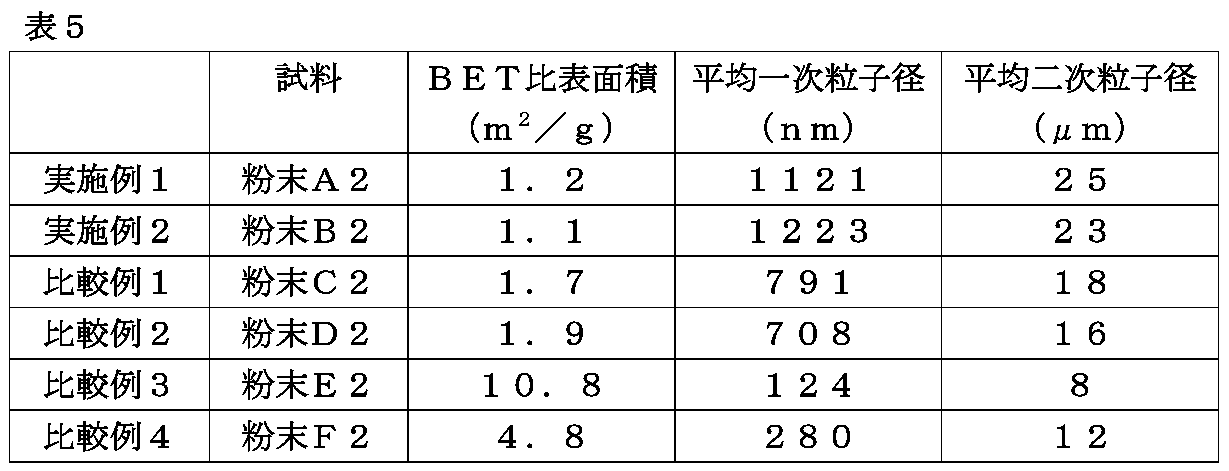
- Table 5 shows the specific surface area, average primary particle diameter, and average secondary particle diameter of the obtained powder A2.
- the obtained mixed powder was fired at 900 ° C. for 10 hours in the air.
- the obtained powder was pulverized in a mortar to obtain a low Ni spinel LNMO powder B1.
- the obtained powder B1 was confirmed to have a spinel structure, and no NiO peak was observed.
- Table 2 shows the nickel oxide content measured by BET specific surface area, average secondary particle diameter, and Rietveld analysis.
- Table 3 shows the nickel oxide content of powder B2 measured by Rietveld analysis.
- Table 4 shows the saturation magnetization and the Curie temperature calculated from the low-temperature magnetism measurement of the powder B2.
- Table 5 shows the specific surface area, the average primary particle diameter, and the average secondary particle diameter of the obtained powder B2.
- Comparative Example 1 Lithium acetate 2.29g was added to 5.00g of oxide C, and it baked at 900 degreeC in air
- Table 3 shows the nickel oxide content of powder C2 measured by Rietveld analysis.
- Table 4 shows the saturation magnetization and the Curie temperature calculated from the low-temperature magnetic measurement of the powder C2.
- Table 5 shows the specific surface area, average primary particle diameter, and average secondary particle diameter of the obtained powder C2.
- Table 3 shows the nickel oxide content of powder D2 measured by Rietveld analysis.
- Table 4 shows the saturation magnetization and the Curie temperature calculated from the low-temperature magnetism measurement of the powder D2.
- Table 5 shows the specific surface area, average primary particle diameter, and average secondary particle diameter of the obtained powder D2.
- the obtained powder E2 was confirmed to have a spinel structure by X-ray diffraction measurement, and a peak of NiO was not observed.
- Table 3 shows the content of nickel oxide in the powder E2 measured by Rietveld analysis.
- Table 4 shows the saturation magnetization and the Curie temperature calculated from the low-temperature magnetism measurement of the powder E2.
- Table 5 shows the specific surface area, average primary particle diameter, and average secondary particle diameter of the obtained powder E2.
- Comparative Example 4 Powder F2 was obtained in the same manner as in Comparative Example 3 except that the firing was carried out at 800 ° C. for 10 hours in an oxygen atmosphere. The obtained powder F2 was confirmed to have a spinel structure by X-ray diffraction measurement, but the presence of a very small peak presumed to be NiO was confirmed. Table 3 shows the content of nickel oxide in the powder F2 measured by Rietveld analysis. Table 4 shows the saturation magnetization and the Curie temperature calculated from the low-temperature magnetism measurement of the powder F2. In addition, Table 5 shows the specific surface area, average primary particle diameter, and average secondary particle diameter of the obtained powder F2.
- the saturation magnetization (emu / g) shown in Table 4 mainly represents impurities. When there are many impurities, the saturation magnetization tends to decrease, and when it is 95 emu / g or more, it tends to approach a single phase.
- Comparative Example 1 As can be seen from the portion indicated by the XRD measurement arrow, it can be seen that impurities considered to be due to NiO were detected, and the saturation magnetization was also lower than that of the Example. In addition, the Curie temperature is lower than that of the example, suggesting that a part of the Curie temperature is NiO. In Comparative Example 2, there was almost no difference even when compared with the Example, but since a single phase was not obtained at the same time as the Example, it took 1.5 times longer from an industrial viewpoint. It is unsuitable. Although the saturation magnetization and the Curie temperature of Comparative Example 3 were not significantly different from those of the Example, this is an industrially unsuitable manufacturing method. Moreover, NiO was detected in Comparative Example 4 in which the firing temperature was 800 ° C. from Comparative Example 3.
- Table 5 shows the BET specific surface area and the average primary particle diameter and average secondary particle diameter calculated from the BET specific surface area. It can be seen that all of the Examples are larger particles than Comparative Example 3. In Comparative Example 3, the particles are fine, and as is clear from Comparative Example 4, it is difficult to produce large particles because NiO is observed when heat treatment is performed at a temperature exceeding 700 ° C. I understood it.
- Electrochemical property evaluation method The electrochemical characteristics as an electrode active material were evaluated for the powder A2 of Example 1 and the powder C2 of Comparative Example 1 obtained as described above.
- a metal lithium foil having a thickness of 0.5 mm formed into a circle was used.
- electrolytic solution a solution in which LiPF 6 was dissolved at a concentration of 1 M in a solvent in which ethylene carbonate and dimethyl carbonate were mixed at a volume ratio of 1: 2 was used.
- a coin-type electrochemical measurement cell was constructed using the above-described positive electrode for measurement, negative electrode, and electrolyte. Using this electrochemical cell, a charge / discharge curve was drawn at a potential range of 3.5 V to 4.9 V with a current of 0.2 mA / cm 2 (equivalent to 0.2 C) based on a metal lithium electrode. As an index of the electrochemical characteristics of this powder, which is an electrode active material, the discharge capacity at 4.5 V or more during the first cycle was determined, and the presence or absence of a shoulder near 4.1 V during discharge was confirmed. A discharge curve of the cell using the powder A2 is shown in FIG.
- the discharge capacity at 4.5 V or higher was 130 mAh / g, and no shoulder near 4.1 V due to Mn 3+ was found, confirming that all Mn was +4.
- a discharge curve of the cell using the powder C2 is shown in FIG.
- the discharge capacity at 4.5 V or higher was 110 mAh / g, and a shoulder due to Mn 3+ was observed near 4.1 V.
- the lithium nickel manganese composite oxide having a spinel structure of the present invention can be suitably used as a high potential positive electrode material having a large capacity in the 5 V region, the energy density of the electricity storage device can be increased. Therefore, the electricity storage device of the present invention can be used for various known applications. Specific examples include notebook computers, pen input computers, mobile computers, electronic book players, mobile phones, mobile faxes, mobile copy, mobile printers, headphone stereos, video movies, LCD TVs, handy cleaners, portable CDs, minidiscs, etc.
- Walkie Talkie Electronic Notebook, Calculator, Memory Card, Portable Tape Recorder, Radio, Backup Power Supply, Motor, Automobile, Motorcycle, Motorbike, Bicycle, Lighting Equipment, Toy, Game Equipment, Clock, Electric Tool, Strobe, Camera, Load Examples include leveling power sources and natural energy storage power sources.
Landscapes
- Chemical & Material Sciences (AREA)
- Chemical Kinetics & Catalysis (AREA)
- Electrochemistry (AREA)
- General Chemical & Material Sciences (AREA)
- Inorganic Chemistry (AREA)
- Organic Chemistry (AREA)
- Engineering & Computer Science (AREA)
- Manufacturing & Machinery (AREA)
- Materials Engineering (AREA)
- Battery Electrode And Active Subsutance (AREA)
- Inorganic Compounds Of Heavy Metals (AREA)
- Secondary Cells (AREA)
Abstract
Description
本発明(15)は、目的とする製造物よりもニッケル含有量が相対的に少ない前駆体、リチウム化合物、及びニッケル化合物を混合物として含む原料からの合成により、スピネル構造リチウムニッケルマンガン複合酸化物を製造する方法であって、前記前駆体は、マンガンに対するニッケルのモル比(Ra=Ni/Mn)が0.10≦Ra≦0.29 であり、前記合成が、前記原料を焼成する工程を含む、5V級スピネル構造リチウムニッケルマンガン複合酸化物の製造方法である。
本発明において、5V級スピネル構造リチウムニッケルマンガン複合酸化物とは、後述するとおり、特定の条件で測定した平均放電電圧が4.5V以上であるようなスピネル構造リチウムニッケルマンガン複合酸化物のことをいう。
本発明の5V級スピネル構造リチウムニッケルマンガン複合酸化物の製造方法は、ニッケル含有量の少ないスピネル構造リチウムニッケルマンガン複合酸化物を前駆体として用いる製造方法である。具体的には、マンガンに対するニッケルのモル比(Ra=Ni/Mn)が0.10≦Ra≦0.29であるスピネル構造のリチウムニッケルマンガン複合酸化物を前駆体として用いる5V級スピネル構造リチウムニッケルマンガン複合酸化物の製造方法である。本明細書において、前駆体である、マンガンに対するニッケルのモル比(Ra=Ni/Mn)が0.10≦Ra≦0.29であるスピネル構造リチウムニッケルマンガン複合酸化物を「低NiスピネルLNMO」と、本発明の製造方法で得られる5V級スピネル構造リチウムニッケルマンガン複合酸化物を「高NiスピネルLNMO」と、それぞれ記載することがある。
(式1):Lia1(Nib1Mnc1)Od1(ただし、式中は、各々0.95≦a1≦1.05、0.2≦b1≦0.45、1.55≦c1≦1.80、b1+c1=2、3.8≦d1≦4、0.10≦b1/c1≦0.29)
正極活物質としてリチウムニッケルマンガン複合酸化物粉末88質量%、導電剤としてアセチレンブラック5質量%、及び結着剤としてポリフッ化ビニリデン(PVDF)7質量%を含み、分散媒にN-メチルピロリドン(NMP)を用いたスラリーを調製する。このスラリーを厚さ20μmのアルミニウム箔からなる集電体に活物質量が9.1mg/cm2となるように片面に塗布し、乾燥、合剤密度が2.8g/cm3になるようにプレスし、その後130℃で8時間減圧乾燥を行って正極を作製する。
乾燥アルゴン中で、コインセル用に形状を合わせた前記正極とリチウム金属箔とをセパレータを介して対向させる。これらの部材をコインセルに入れ、電解液を注ぎ、セパレータと電極に充分に電解液が含浸された状態で、コインセルを密閉する。なお、電解液には、エチレンカーボネート(EC)とジメチルカーボネート(DMC)が体積比率1:2で混合された混合溶媒に電解質としてのLiPF6を1.0モル/リットル溶解させたものを使用する。作製したコインセルに対して、25℃環境下、0.2Cで、セル電圧が4.9Vになるまで定電流で充電した後、0.2Cで、セル電圧が3.5Vに到達するまでの定電流で放電させる。平均放電電圧は、上述の容量測定において放電時の電圧-容量曲線を描いたときに、容量の中点に対応する電圧のことを言う。
このようなことから本発明の高NiスピネルLNMOは、酸化ニッケルなどの不純物量が少なく、しかも、高いニッケルの固溶度を有する観点から、その平均一次粒子径が0.7μm以上であり、飽和磁化が85emu/g以上であり、しかも、キュリー温度が110K以上であるのが好ましく、より好ましくは、その平均一次粒子径が0.7μm以上であり、飽和磁化が95emu/g以上であり、しかも、キュリー温度が120K以上である。
(式2):Lia2(Nib2Mnc2)Od2(ただし、式中は、各々0.95≦a2≦1.05、0.45≦b2≦0.50、1.50≦c2≦1.55、b2+c2=2、3.8≦d2≦4)
また、本発明の製造方法は、ニッケルを多く(Ni/Mn=1/3程度)含むスピネル構造のリチウムニッケルマンガン複合酸化物の製造に特に好適であるが、ニッケル量のそれほど多くないスピネル構造のリチウムニッケルマンガン複合酸化物の製造に適用することも可能であり、酸化ニッケルの生成を抑制することができる。
次に、前駆体である低NiスピネルLNMOの作製方法(製造方法)について説明する。低NiスピネルLNMOの製造方法には特に制限は無く、公知の製造方法を用いることができる。例えば、所定量のリチウム化合物とニッケル化合物とマンガン化合物を媒液中で混合し、乾燥後、焼成する湿式法、前記湿式法の中でも、乾燥を噴霧乾燥により行う方法や、所定量のリチウム化合物とニッケル化合物とマンガン化合物を乾式で混合し、焼成する乾式法などが挙げられる。また、事前にニッケルとマンガンを含む化合物を調製した後、上記方法を適用することもできる。
工程1:所定比のマンガン化合物とニッケル化合物とを含む水溶液と、蓚酸水溶液を混合し、マンガンとニッケルを含むシュウ酸化合物を含む沈澱物を得る工程。
工程2:該沈澱物を350~500℃で熱処理してマンガンとニッケルを含む酸化物を得る工程。
・工程1で得られるマンガンとニッケルを含むシュウ酸化合物を含む沈澱物は、ろ別、洗浄が容易である。水酸化物の沈澱物のような硬い塊状になることがないため、ハンドリングが容易であり、工業的に有利である。
・沈澱物を熱処理して得られるマンガンとニッケルを含む酸化物は、リチウムとの反応性が高い。それため、低NiスピネルLNMOの製造に好適である。具体的には、これを用いて製造される低NiスピネルLNMO中の酸化ニッケルの存在量を低減しやすく、スピネル以外の別相も形成されづらい。また、粒子成長もしやすいため、粒子径の大きい低NiスピネルLNMOが得られやすい。
次に、前述の方法で製造されたスピネル構造のリチウムニッケルマンガン複合酸化物を活物質として含んだ本発明の正極について説明する。正極は、正極集電体と正極活物質層を少なくとも含む。正極活物質層は、正極集電体の片面もしくは両面に形成され、正極活物質を少なくとも含み、必要に応じて導電剤、結着剤、その他の材料も含んでよい。正極集電体には、例えば、アルミニウム又はアルミニウム合金を用いることができる。
次に、前述の方法で製造されたスピネル構造のリチウムニッケルマンガン複合酸化物を含んだ正極を備える本発明の蓄電デバイスについて説明する。本発明の蓄電デバイスは、スピネル構造のリチウムニッケルマンガン複合酸化物を含有する活物質を含む正極と、負極と、セパレータと、非水電解質と、外装部材とを有する。正極は前述の正極を用いることができる。
粉末X線回折法により、結晶構造の確認を行った。測定にはリガク製、UltimaIVを用いた。X線回折の測定条件は、線源はCu-Kα1、ステップ幅が0.02°、計測時間が12.0°/min、電流値は30mA、電圧は40kV、測定角度は10.0~120.0°に設定して測定を行った。
X線回折測定結果に対しリートベルト解析を行うことにより、酸化ニッケルの存在量を測定した。リートベルト解析には、解析用ソフトウエア「RIETAN-2000」を用いた。また、結晶構造は空間群fd-3mとして解析を行った。
低温磁化測定から、飽和磁化及びキュリー温度を測定した。低温磁化測定は、自作の測定装置を用い、磁気天秤を用いて、一対の電磁石間に配置された試料が非一様な磁場によって受ける力を測定することで行った。具体的には、温度を4.2から280Kまで緩やかに上昇させながら、外部磁場を0~10(kOe)の間で変化させ、各々の外部磁場において試料に働く力を磁気天秤で測定した。別途、磁化既知の標準試料(マンガンタットン塩)の測定により磁場勾配を求めた。この2つから磁化-温度曲線のグラフを作成し、飽和漸近則を用いて4.2Kにおける飽和磁化を求め、強磁性と常磁性の境界となるキュリー温度をアロットプロットを用いて決定した。4.2~77(K)の温度範囲では液体ヘリウムを冷媒として用い、77~280(K)の温度範囲では液体窒素を冷媒として用いた。
ニッケルとマンガンのモル比(Ra、Rb)は、EDX(HORIBA製、EMAX ENERGY EX-350)にて、SEM(日立ハイテクノロジーズ製 走査電子顕微鏡S-4800)観察をしながら、3つの粒子をランダムで選び、各粒子のニッケル、マンガンの質量%を測定し、それを平均化してモル比に換算して求めた。EDX測定の加速電圧は20kVとした。
比表面積の測定は、窒素吸着によるBET一点法にて行った。測定には比表面積測定装置(モノソーブ:Quantachrome製)を用いた。
(5)で測定したBET比表面積から、粒子形状を真球と見なして算出した下記式より、平均一次粒子径rを求めた。
比表面積=表面積/質量=表面積/(真密度×体積)であり、体積=4/3π(r/2)3、表面積=4π(r/2)2をそれぞれ前式に代入すると、r=6/(比表面積×真密度)となる。
リチウムニッケルマンガン複合酸化物については、真密度を4.46(g/cm3)として計算を行った。
平均二次粒子径の測定は、レーザー回折/散乱法にて行った。測定には堀場製作所製 レーザー回折/散乱式粒子径分布測定装置LA‐950を用いた。分散媒には純水を使用した。屈折率は、純水については1.33、シュウ酸法で製造したニッケルマンガン酸化物については、2.7、リチウムニッケルマンガン複合酸化物については、4.4として測定を行った。
<工程1>
硫酸マンガン五水和物を77.15g、硫酸ニッケル六水和物を21.03gをそれぞれ秤量し、200mLの水に溶解させて、硫酸マンガン・ニッケル水溶液を調製した。また、75.64gのシュウ酸を800mLの水に溶解させてシュウ酸水溶液を調製した。硫酸マンガン・ニッケル水溶液にシュウ酸水溶液を1時間かけて滴下し、マンガンとニッケルを含むシュウ酸化合物を含む沈澱物を常温にて生成させた。このときのpHは2.5だった。マンガン:ニッケル=1.6:0.4(モル)であり、シュウ酸は1.5当量である。これを濾別、洗浄、乾燥して、乾燥粉末を得た。
得られた乾燥粉末を、空気中、400℃で5時間加熱し、熱分解させて、ニッケルマンガン酸化物粒子粉末を調製した。これを酸化物Aとした。このBET比表面積及び平均二次粒子径を前述の方法で測定したところ、それぞれ23m2/g、16μmであった。
硫酸マンガン五水和物を86.79g、硫酸ニッケル六水和物を10.51gとした以外は、原料準備1と同様の方法でニッケルマンガン酸化物粒子粉末を調製した。これを酸化物Bとした。マンガン:ニッケル=1.8:0.2(モル)であり、シュウ酸は1.5当量である。
硫酸マンガン五水和物を72.32g、硫酸ニッケル六水和物を26.28gとした以外は、原料準備1と同様の方法でニッケルマンガン酸化物粒子粉末を調製した。これを酸化物Cとした。マンガン:ニッケル=1.5:0.5(モル)であり、シュウ酸は1.5当量である。
硫酸マンガン五水和物を91.61g、硫酸ニッケル六水和物を5.26gとした以外は、原料準備1と同様の方法でニッケルマンガン酸化物粒子粉末を調製した。これを酸化物Dとした。マンガン:ニッケル=1.9:0.1(モル)であり、シュウ酸は1.5当量である。
工程1において、マンガンとニッケルを含むシュウ酸化合物の沈澱後、水を添加しpHを4.5とした以外は、原料準備1と同様の方法でニッケルマンガン酸化物粒子粉末を調製した。これを酸化物Eとした。マンガン:ニッケル=1.6:0.4(モル)であり、シュウ酸は1.5当量である。

酸化物Aを5.00gと酢酸リチウムを2.30gとを秤量して、計算上Li:Mn:Ni=1.0:1.6:0.4となるように、機械的に混合した。得られた混合粉末を大気中900℃にて10時間焼成した。得られた粉末を乳鉢にて粉砕し、低NiスピネルLNMO粉末A1を得た。得られた粉末A1は、図1のX線回折図に示すとおり、スピネル構造を有するものであることが確認でき、NiOのピークは観察されなかった。BET比表面積、平均二次粒子径及びリートベルト解析により酸化ニッケルの含有量を測定したものを表2に示す。
酸化物Bを5.00gと酢酸リチウムを2.30gとを秤量して、計算上Li:Mn:Ni=1.0:1.8:0.2となるように、機械的に混合した。得られた混合粉末を大気中900℃にて10時間焼成した。得られた粉末を乳鉢にて粉砕し、低NiスピネルLNMO粉末B1を得た。得られた粉末B1は、スピネル構造を有するものであることが確認でき、NiOのピークは観察されなかった。BET比表面積、平均二次粒子径及びリートベルト解析により酸化ニッケルの含有量を測定したものを表2に示す。
酸化物Cを5.00gに酢酸リチウム2.29gを加えて大気中900℃にて10時間焼成し、次いで大気中650℃にて10時間焼成した。得られた粉末を乳鉢にて粉砕し、粉末C2を得た。
酸化物Dを5.00gと酢酸リチウムを2.30gとを秤量して、計算上Li:Mn:Ni=1.0:1.9:0.1となるように、機械的に混合した。得られた混合粉末を大気中900℃にて15時間反応させた。得られた粉末を乳鉢にて粉砕し、粉末D1を得た。得られた粉末D1は、スピネル構造を有するものであることが確認でき、NiOのピークは観察されなかった。BET比表面積、平均二次粒子径及びリートベルト解析により酸化ニッケルの含有量を測定したものを表2に示す。
非特許文献1に記載のゾルゲル法にてスピネル構造のリチウムニッケルマンガン複合酸化物の合成を行った。具体的には、Li源、Mn源、Ni源を硝酸塩、酢酸塩とクエン酸の混合水溶液を作製した。このとき、計算上Li:Mn:Ni=1.0:1.5:0.5となるように秤量した。この混合水溶液をロータリー・エバポレータを用いて加熱・ゲル化させ、このゲルを大気中300℃にて熱分解し、その後得られた試料を酸素雰囲気中で700℃で10時間焼成し、得られた粉末を乳鉢にて粉砕し、粉末E2を得た。得られた粉末E2は、X線回折測定により、スピネル構造を有するものであることが確認でき、NiOのピークは観察されなかった。リートベルト解析により粉末E2の酸化ニッケルの含有量を測定したものを表3に示す。粉末E2の低温磁性測定から算出した、飽和磁化及びキュリー温度を表4に示す。また、得られた粉末E2の比表面積、平均一次粒子径及び平均二次粒子径を表5に示す。
焼成を、酸素雰囲気で800℃で10時間とした以外は比較例3と同様の方法により粉末F2を得た。得られた粉末F2は、X線回折測定により、スピネル構造を有するものであることが確認できたが、NiOと推測される極微小なピークの存在が確認された。リートベルト解析により粉末F2の酸化ニッケルの含有量を測定したものを表3に示す。粉末F2の低温磁性測定から算出した、飽和磁化及びキュリー温度を表4に示す。また、得られた粉末F2の比表面積、平均一次粒子径及び平均二次粒子径を表5に示す。
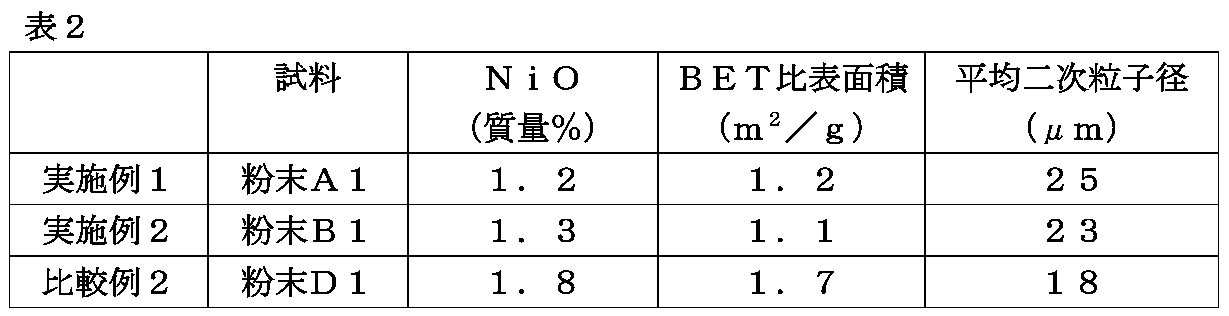
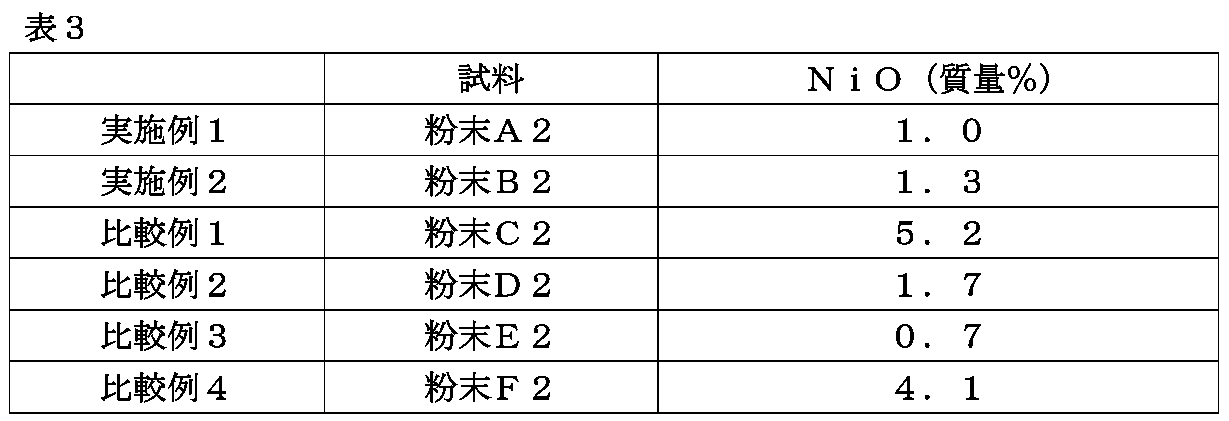
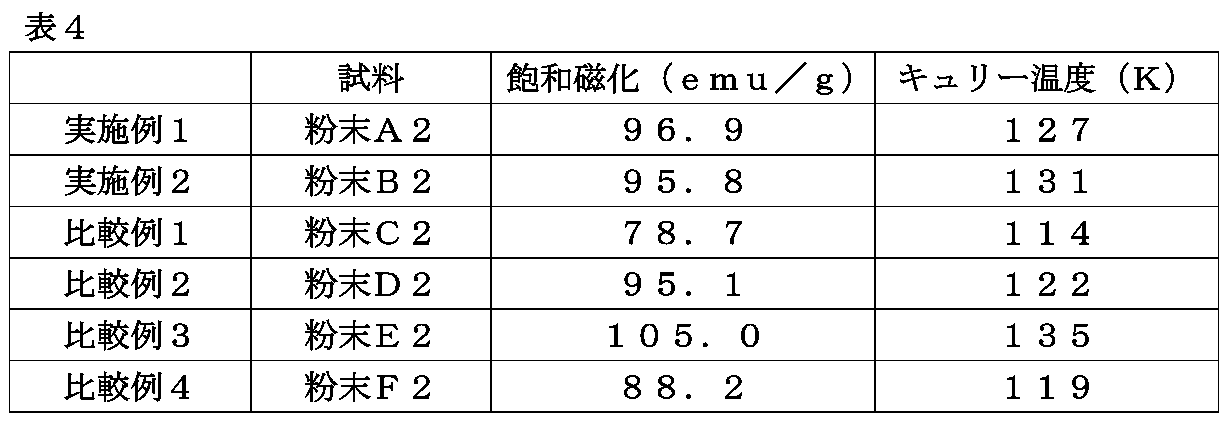
表4から、実施例1、2ではNi/Mn比が特定範囲にある前駆体から合成を行うことにより、不純物が少なく、組成もNi/Mn=0.5/1.5に近くなっていると考えられる。比較例1では、XRD測定の矢印に記載部分からもわかるようにNiOによると思われる不純物が検出され、飽和磁化においても実施例と比較して下がっていることがわかる。また、キュリー温度についても実施例と比較して下がっていることから、一部がNiOとなっていることが示唆される。比較例2では、実施例と比較してもほとんど差がなかったが、焼成時間が実施例と同様の時間では単相が得られず、1.5倍の時間がかかることから工業的には不向きである。比較例3の飽和磁化とキュリー温度は実施例と比較してもほとんど差がなかったが、工業的には不向きな製法である。また、比較例3から焼成温度を800℃とした比較例4ではNiOが検出された。
以上のようにして得られた実施例1の粉末A2と比較例1の粉末C2について、電極活物質としてのその電気化学的特性をそれぞれ評価した。電極活物質として上記粉末を88質量%、結着剤としてPVDFを7質量%、導電材としてアセチレンブラックを5質量%含み、分散媒にNMPを用いた正極合剤スラリーを調製した。このスラリーを厚さが20μmのアルミ箔からなる集電体に活物質量が9.1mg/cm2となるように片面に塗布し、乾燥、プレスして正極とした。負極電極としては、厚さが0.5mmの金属リチウム箔を円形に成形したものを用いた。電解液にはエチレンカーボネートとジメチルカーボネートを体積比で1:2に混合した溶媒中にLiPF6を1Mの濃度で溶解させたものを用いた。
Claims (15)
- 少なくとも前駆体を含む原料からの合成により、5V級スピネル構造リチウムニッケルマンガン複合酸化物を製造する方法であって、
前記前駆体は、マンガンに対するニッケルのモル比(Ra=Ni/Mn)が0.10≦Ra≦0.29のスピネル構造リチウムニッケルマンガン複合酸化物である、上記の製造方法。 - 前記原料が、さらに、リチウム化合物とニッケル化合物とを含む混合物である、請求項1に記載の5V級スピネル構造リチウムニッケルマンガン複合酸化物の製造方法。
- 前記合成が、前記原料を焼成する工程を含む、請求項1又は2に記載の5V級スピネル構造リチウムニッケルマンガン複合酸化物の製造方法。
- 前記焼成を、600~750℃の範囲の温度で行う請求項3に記載の5V級スピネル構造リチウムニッケルマンガン複合酸化物の製造方法。
- 前記焼成を、酸素を含む雰囲気で行う請求項3又は4に記載の5V級スピネル構造リチウムニッケルマンガン複合酸化物の製造方法。
- 前記原料において、ニッケル化合物に対するリチウム化合物の混合比が、ニッケルに対するリチウムのモル比(Li/Ni)で0.3~0.7である、請求項2~5のいずれか一項に記載の5V級スピネル構造リチウムニッケルマンガン複合酸化物の製造方法。
- 前記リチウム化合物及びニッケル化合物の融解温度又は分解温度がそれぞれ750℃未満である、請求項2~6のいずれか一項に記載の5V級スピネル構造リチウムニッケルマンガン複合酸化物の製造方法。
- 前記リチウム化合物が、酢酸リチウム、硝酸リチウム、水酸化リチウムから選ばれる少なくとも一種である請求項2~7のいずれか一項に記載の5V級スピネル構造リチウムニッケルマンガン複合酸化物の製造方法。
- 前記ニッケル化合物が、酢酸ニッケル、硝酸ニッケル、硫酸ニッケルから選ばれる少なくとも一種である請求項2~8のいずれか一項に記載の5V級スピネル構造リチウムニッケルマンガン複合酸化物の製造方法。
- 平均一次粒子径が0.7μm以上であり、飽和磁化が85emu/g以上である5V級スピネル構造リチウムニッケルマンガン複合酸化物。
- 平均一次粒子径が0.7μm以上であり、キュリー温度が110K以上である5V級スピネル構造リチウムニッケルマンガン複合酸化物。
- 請求項10又は11に記載の5V級スピネル構造リチウムニッケルマンガン複合酸化物を含む正極。
- 請求項10又は11に記載の5V級スピネル構造リチウムニッケルマンガン複合酸化物を含む正極、負極及び電解質を備える蓄電デバイス。
- 前記負極がチタン酸リチウムを含む請求項13に記載の蓄電デバイス。
- 目的とする製造物よりもニッケル含有量が相対的に少ない前駆体、リチウム化合物、及びニッケル化合物を混合物として含む原料からの合成により、スピネル構造リチウムニッケルマンガン複合酸化物を製造する方法であって、
前記前駆体は、マンガンに対するニッケルのモル比(Ra=Ni/Mn)が0.10≦Ra≦0.29であり、
前記合成が、前記原料を焼成する工程を含む、上記の製造方法。
Priority Applications (3)
| Application Number | Priority Date | Filing Date | Title |
|---|---|---|---|
| KR1020177022289A KR20170122731A (ko) | 2015-03-06 | 2016-03-04 | 리튬니켈망간 복합 산화물 및 그 제조 방법 그리고 그것을 사용한 정극 및 축전 디바이스 |
| CN201680014101.1A CN107406273A (zh) | 2015-03-06 | 2016-03-04 | 锂镍锰复合氧化物及其制造方法、以及使用其的正极及蓄电装置 |
| JP2017505293A JP6691714B2 (ja) | 2015-03-06 | 2016-03-04 | リチウムニッケルマンガン複合酸化物及びその製造方法並びにそれを用いた正極及び蓄電デバイス |
Applications Claiming Priority (2)
| Application Number | Priority Date | Filing Date | Title |
|---|---|---|---|
| JP2015-044663 | 2015-03-06 | ||
| JP2015044663 | 2015-03-06 |
Publications (1)
| Publication Number | Publication Date |
|---|---|
| WO2016143681A1 true WO2016143681A1 (ja) | 2016-09-15 |
Family
ID=56879467
Family Applications (1)
| Application Number | Title | Priority Date | Filing Date |
|---|---|---|---|
| PCT/JP2016/056705 Ceased WO2016143681A1 (ja) | 2015-03-06 | 2016-03-04 | リチウムニッケルマンガン複合酸化物及びその製造方法並びにそれを用いた正極及び蓄電デバイス |
Country Status (5)
| Country | Link |
|---|---|
| JP (1) | JP6691714B2 (ja) |
| KR (1) | KR20170122731A (ja) |
| CN (1) | CN107406273A (ja) |
| TW (1) | TW201704155A (ja) |
| WO (1) | WO2016143681A1 (ja) |
Cited By (6)
| Publication number | Priority date | Publication date | Assignee | Title |
|---|---|---|---|---|
| JP2019160572A (ja) * | 2018-03-13 | 2019-09-19 | 住友化学株式会社 | リチウム金属複合酸化物粉末、リチウム二次電池用正極活物質、正極及びリチウム二次電池 |
| CN113603157A (zh) * | 2021-08-03 | 2021-11-05 | 天能帅福得能源股份有限公司 | 一种核壳结构的无钴二元正极材料及其制备方法 |
| CN113845150A (zh) * | 2021-08-17 | 2021-12-28 | 桂林理工大学 | 一种镍酸锂正极材料的化学掺杂改性方法 |
| JP2024519759A (ja) * | 2022-04-25 | 2024-05-21 | 寧徳時代新能源科技股▲分▼有限公司 | スピネル型ニッケルマンガン酸リチウム材料及びその製造方法 |
| JP2024541893A (ja) * | 2022-05-10 | 2024-11-13 | エルジー・ケム・リミテッド | 正極活物質の製造方法 |
| EP4230772A4 (en) * | 2020-10-15 | 2024-12-04 | Kyoto University | ANODE FOR ALKALINE WATER ELECTROLYSIS AND ITS PRODUCTION METHOD |
Citations (3)
| Publication number | Priority date | Publication date | Assignee | Title |
|---|---|---|---|---|
| JPH09147867A (ja) * | 1995-09-13 | 1997-06-06 | Moli Energy 1990 Ltd | リチウム電池用高電圧挿入化合物 |
| JP2013082581A (ja) * | 2011-10-11 | 2013-05-09 | Toyota Industries Corp | リチウム含有複合酸化物粉末およびその製造方法 |
| JP2014041835A (ja) * | 2008-11-10 | 2014-03-06 | Equos Research Co Ltd | 二次電池及びその製造方法 |
Family Cites Families (3)
| Publication number | Priority date | Publication date | Assignee | Title |
|---|---|---|---|---|
| FR2890241B1 (fr) * | 2005-08-25 | 2009-05-22 | Commissariat Energie Atomique | Materiau d'electrode positive haute tension de structure spinelle a base de nickel et de manganese pour accumulateurs au lithium |
| CN102664255B (zh) * | 2012-05-28 | 2015-09-23 | 奇瑞汽车股份有限公司 | 锂镍锰氧材料及其制备方法、含该材料的锂离子电池 |
| CN104112845B (zh) * | 2014-07-03 | 2017-06-16 | 奇瑞汽车股份有限公司 | 一种锂离子电池正极材料及其制备方法 |
-
2016
- 2016-03-04 TW TW105106731A patent/TW201704155A/zh unknown
- 2016-03-04 KR KR1020177022289A patent/KR20170122731A/ko not_active Withdrawn
- 2016-03-04 JP JP2017505293A patent/JP6691714B2/ja active Active
- 2016-03-04 CN CN201680014101.1A patent/CN107406273A/zh active Pending
- 2016-03-04 WO PCT/JP2016/056705 patent/WO2016143681A1/ja not_active Ceased
Patent Citations (3)
| Publication number | Priority date | Publication date | Assignee | Title |
|---|---|---|---|---|
| JPH09147867A (ja) * | 1995-09-13 | 1997-06-06 | Moli Energy 1990 Ltd | リチウム電池用高電圧挿入化合物 |
| JP2014041835A (ja) * | 2008-11-10 | 2014-03-06 | Equos Research Co Ltd | 二次電池及びその製造方法 |
| JP2013082581A (ja) * | 2011-10-11 | 2013-05-09 | Toyota Industries Corp | リチウム含有複合酸化物粉末およびその製造方法 |
Cited By (7)
| Publication number | Priority date | Publication date | Assignee | Title |
|---|---|---|---|---|
| JP2019160572A (ja) * | 2018-03-13 | 2019-09-19 | 住友化学株式会社 | リチウム金属複合酸化物粉末、リチウム二次電池用正極活物質、正極及びリチウム二次電池 |
| EP4230772A4 (en) * | 2020-10-15 | 2024-12-04 | Kyoto University | ANODE FOR ALKALINE WATER ELECTROLYSIS AND ITS PRODUCTION METHOD |
| CN113603157A (zh) * | 2021-08-03 | 2021-11-05 | 天能帅福得能源股份有限公司 | 一种核壳结构的无钴二元正极材料及其制备方法 |
| CN113845150A (zh) * | 2021-08-17 | 2021-12-28 | 桂林理工大学 | 一种镍酸锂正极材料的化学掺杂改性方法 |
| JP2024519759A (ja) * | 2022-04-25 | 2024-05-21 | 寧徳時代新能源科技股▲分▼有限公司 | スピネル型ニッケルマンガン酸リチウム材料及びその製造方法 |
| JP7711217B2 (ja) | 2022-04-25 | 2025-07-22 | 香港時代新能源科技有限公司 | スピネル型ニッケルマンガン酸リチウム材料及びその製造方法 |
| JP2024541893A (ja) * | 2022-05-10 | 2024-11-13 | エルジー・ケム・リミテッド | 正極活物質の製造方法 |
Also Published As
| Publication number | Publication date |
|---|---|
| CN107406273A (zh) | 2017-11-28 |
| JP6691714B2 (ja) | 2020-05-13 |
| KR20170122731A (ko) | 2017-11-06 |
| JPWO2016143681A1 (ja) | 2017-12-21 |
| TW201704155A (zh) | 2017-02-01 |
Similar Documents
| Publication | Publication Date | Title |
|---|---|---|
| US8535829B2 (en) | Lithium transition metal-based compound powder for positive electrode material in lithium rechargeable battery, method for manufacturing the powder, spray dried product of the powder, firing precursor of the powder, and positive electrode for lithium rechargeable battery and lithium rechargeable battery using the powder | |
| JP5843046B2 (ja) | 非水系電解質二次電池用正極活物質、かかる非水系電解質二次電池用正極活物質の製造方法およびかかる非水系電解質二次電池用正極活物質を用いた非水系電解質二次電池 | |
| Oh et al. | Effect of calcination temperature on morphology, crystallinity and electrochemical properties of nano-crystalline metal oxides (Co3O4, CuO, and NiO) prepared via ultrasonic spray pyrolysis | |
| JP5359140B2 (ja) | リチウム遷移金属系化合物粉体、その製造方法並びに、それを用いたリチウム二次電池用正極及びリチウム二次電池 | |
| KR102292385B1 (ko) | 리튬 이차 전지용 양극 활물질, 이의 제조 방법 및 이를 포함하는 리튬 이차 전지 | |
| JP5987401B2 (ja) | 非水系電解質二次電池用正極活物質とその製造方法および二次電池 | |
| CN109565045B (zh) | 锂二次电池用正极活性物质、其制造方法和锂二次电池 | |
| JP6691714B2 (ja) | リチウムニッケルマンガン複合酸化物及びその製造方法並びにそれを用いた正極及び蓄電デバイス | |
| JP5777977B2 (ja) | リチウム複合金属酸化物の製造方法 | |
| WO2012011212A1 (ja) | 非水系電解質二次電池用正極活物質とその製造方法および非水系電解質二次電池 | |
| KR100797099B1 (ko) | 리튬 이차 전지용 양극 활물질, 이의 제조방법 및 이를포함하는 리튬 이차 전지 | |
| CN109987648A (zh) | 镍复合氢氧化物粒子、二次电池用正极活性物质、及它们的制造方法以及二次电池 | |
| JP2012038562A (ja) | 前駆体、活物質の製造方法及びリチウムイオン二次電池 | |
| JPWO2013146723A1 (ja) | リチウムイオン二次電池用活物質及びリチウムイオン二次電池 | |
| JP2010135187A (ja) | 正極活物質、正極および非水電解質二次電池 | |
| JP2013054928A (ja) | リチウムイオン二次電池用正極材料、リチウムイオン二次電池用正極部材、及びリチウムイオン二次電池 | |
| JP2012138352A (ja) | リチウム遷移金属系化合物粉体、その製造方法、及びそれを用いたリチウム二次電池用正極及びリチウム二次電池 | |
| WO2018096972A1 (ja) | リチウムマンガン系複合酸化物及びその製造方法 | |
| JP4591716B2 (ja) | リチウム二次電池正極材料用リチウム遷移金属系化合物粉体、その製造方法、噴霧乾燥体、および焼成前駆体、並びにそれを用いたリチウム二次電池用正極及びリチウム二次電池 | |
| JP2013203565A (ja) | 複合金属酸化物、ナトリウム二次電池用正極活物質、ナトリウム二次電池用正極、及びナトリウム二次電池 | |
| Zhang et al. | Synthesis of spherical nanostructured LiMxMn2− xO4 (M= Ni2+, Co3+, and Ti4+; 0≤ x≤ 0.2) via a single-step ultrasonic spray pyrolysis method and their high rate charge–discharge performances | |
| JP6294219B2 (ja) | リチウムコバルト系複合酸化物の製造方法 | |
| JPWO2016132963A1 (ja) | リチウム鉄マンガン系複合酸化物およびそれを用いたリチウムイオン二次電池 | |
| KR101657265B1 (ko) | 다공성 망간계 양극 활물질, 그의 제조방법 및 상기 양극 활물질을 포함하는 리튬이차전지 | |
| KR101479559B1 (ko) | 리튬이차전지용 양극 활물질과 이를 포함하는 리튬이차전지 및 리튬이차전지용 양극 활물질의 제조방법 |
Legal Events
| Date | Code | Title | Description |
|---|---|---|---|
| 121 | Ep: the epo has been informed by wipo that ep was designated in this application |
Ref document number: 16761651 Country of ref document: EP Kind code of ref document: A1 |
|
| ENP | Entry into the national phase |
Ref document number: 2017505293 Country of ref document: JP Kind code of ref document: A |
|
| ENP | Entry into the national phase |
Ref document number: 20177022289 Country of ref document: KR Kind code of ref document: A |
|
| NENP | Non-entry into the national phase |
Ref country code: DE |
|
| 122 | Ep: pct application non-entry in european phase |
Ref document number: 16761651 Country of ref document: EP Kind code of ref document: A1 |