WO2016140305A1 - チタン酸バリウム粒子粉末、該粉末を含有する分散体及び塗膜 - Google Patents
チタン酸バリウム粒子粉末、該粉末を含有する分散体及び塗膜 Download PDFInfo
- Publication number
- WO2016140305A1 WO2016140305A1 PCT/JP2016/056579 JP2016056579W WO2016140305A1 WO 2016140305 A1 WO2016140305 A1 WO 2016140305A1 JP 2016056579 W JP2016056579 W JP 2016056579W WO 2016140305 A1 WO2016140305 A1 WO 2016140305A1
- Authority
- WO
- WIPO (PCT)
- Prior art keywords
- barium titanate
- particle powder
- titanate particle
- powder
- compound
- Prior art date
- Legal status (The legal status is an assumption and is not a legal conclusion. Google has not performed a legal analysis and makes no representation as to the accuracy of the status listed.)
- Ceased
Links
Images
Classifications
-
- C—CHEMISTRY; METALLURGY
- C01—INORGANIC CHEMISTRY
- C01G—COMPOUNDS CONTAINING METALS NOT COVERED BY SUBCLASSES C01D OR C01F
- C01G23/00—Compounds of titanium
-
- C—CHEMISTRY; METALLURGY
- C01—INORGANIC CHEMISTRY
- C01G—COMPOUNDS CONTAINING METALS NOT COVERED BY SUBCLASSES C01D OR C01F
- C01G23/00—Compounds of titanium
- C01G23/003—Titanates
- C01G23/006—Alkaline earth titanates
-
- B—PERFORMING OPERATIONS; TRANSPORTING
- B82—NANOTECHNOLOGY
- B82Y—SPECIFIC USES OR APPLICATIONS OF NANOSTRUCTURES; MEASUREMENT OR ANALYSIS OF NANOSTRUCTURES; MANUFACTURE OR TREATMENT OF NANOSTRUCTURES
- B82Y40/00—Manufacture or treatment of nanostructures
-
- C—CHEMISTRY; METALLURGY
- C09—DYES; PAINTS; POLISHES; NATURAL RESINS; ADHESIVES; COMPOSITIONS NOT OTHERWISE PROVIDED FOR; APPLICATIONS OF MATERIALS NOT OTHERWISE PROVIDED FOR
- C09D—COATING COMPOSITIONS, e.g. PAINTS, VARNISHES OR LACQUERS; FILLING PASTES; CHEMICAL PAINT OR INK REMOVERS; INKS; CORRECTING FLUIDS; WOODSTAINS; PASTES OR SOLIDS FOR COLOURING OR PRINTING; USE OF MATERIALS THEREFOR
- C09D7/00—Features of coating compositions, not provided for in group C09D5/00; Processes for incorporating ingredients in coating compositions
- C09D7/40—Additives
- C09D7/60—Additives non-macromolecular
- C09D7/61—Additives non-macromolecular inorganic
-
- C—CHEMISTRY; METALLURGY
- C01—INORGANIC CHEMISTRY
- C01P—INDEXING SCHEME RELATING TO STRUCTURAL AND PHYSICAL ASPECTS OF SOLID INORGANIC COMPOUNDS
- C01P2004/00—Particle morphology
- C01P2004/60—Particles characterised by their size
- C01P2004/64—Nanometer sized, i.e. from 1-100 nanometer
Definitions
- An object of the present invention is to provide a barium titanate particle powder having high transparency when formed into a film because it is fine, having a sharp particle size distribution, and a small amount of Ba ion elution that inhibits dispersion. To do.
- Barium titanate having a high dielectric constant is widely used as a dielectric material for multilayer ceramic capacitors.
- an inorganic film filler such as zirconia is added to a transparent resin to control dielectric constant and refractive index for optical films used for various displays.
- Liquid crystal display control TFTs are also required to have fine particles and a high dielectric constant as a material such as an insulating film in order to reduce power consumption.
- a TFT may be exposed to a process such as etching for patterning. If there are many Ba ions to be eluted, when the powder and an organic component such as a dispersant having an acidic functional group, a binder, or a resin come into contact with each other, an undesirable reaction occurs, and the function of each organic component is dulled. There is a possibility that a highly transparent coating film cannot be produced.
- barium titanate for the optical application, it is required to obtain a barium titanate particle powder having a small particle size and ensuring transparency, a small Ba ion elution amount, and a large dielectric constant and refractive index. It has been.
- Cited Document 1 describes barium titanate having a narrow particle size distribution, it is still not sufficient for optical use.
- Patent Document 2 coated with silica is coated for the purpose of dispersion stability to the effect of preventing barium elution from silica. There is no mention that there is.
- Patent Documents 3 and 4 There is also a patent document in which an element is added by making the BaTiO 3 particle surface layer Ba-poor by a technique such as etching (Patent Documents 3 and 4), but this is a measure for improving the reactivity with the additive. Even those skilled in the art cannot infer this effect from this document. Further, Patent Document 5 describes that barium titanate exists in a wide stoichiometric ratio, but it is not considered at all that it is preferable to use a Ba poor one.
- the barium titanate particle powder that satisfies the above-mentioned properties is currently most demanded, but has not yet been obtained.
- the present invention provides a barium titanate particle powder that is suitable for the production of a film having high transparency when formed into a film and is small but has a small Ba ion elution amount and a sharp particle size distribution. Is a technical issue.
- the average particle size is 10 nm or more and 60 nm or less
- the value obtained by dividing the standard deviation of the particle size distribution by the average particle size is 0.35 or less
- the amount of Ba ions eluted from the powder into the aqueous solvent is It is a barium titanate particle of 1000 ppm or less (present invention 1).
- the present invention provides the titanium according to the present invention 1, wherein the particle surface is coated with at least one surface coating selected from Si compounds, titanium compounds, zirconium compounds, aluminum compounds, yttrium compounds, sulfur compounds and phosphate compounds. It is barium acid particle powder (Invention 2).
- the coating amount of the surface coating according to the present invention 2 is 0.05 to 5.0% by weight in terms of SiO 2 for the Si compound, in terms of carbon for the titanium compound, and in terms of other elements for the other compounds. It is a certain barium titanate particle powder (Invention 3).
- the present invention is the barium titanate particles according to the first invention obtained by heat treatment in a temperature range of 100 to 500 ° C. (the fifth invention).
- the barium titanate particles according to the present invention are suitable for optical materials because they are fine particles but have a small amount of Ba ion elution and a high dielectric constant.
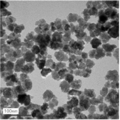
- FIG. 2 is an electron micrograph of barium titanate particle powder obtained in Example 1.
- the average particle diameter (x) of the primary particles of the barium titanate particle powder according to the present invention is 10 to 60 nm. By controlling the average particle size of the primary particles within the above range, it is possible to obtain barium titanate particles having excellent transparency.
- the average primary particle size is preferably 10 to 58 nm, more preferably 10 to 55 nm.
- the amount of Ba ions eluted from the barium titanate particle powder according to the present invention into the aqueous solvent is 1000 ppm or less.
- the amount of Ba ions eluted in the aqueous solvent exceeds 1000 ppm, the function of the dispersant is inhibited in the dispersion containing the barium titanate particles, and as a result, the transparency of the coating film is lowered.
- it is 900 ppm or less, More preferably, it is 800 ppm or less.
- the average particle size of the primary particles of the barium titanate particle powder was decreased, the specific surface area was increased and the crystallinity was also decreased, so that the Ba elution amount was also increased.
- the amount of Ba ions eluted from the barium titanate particle powder into the aqueous solvent was calculated by an evaluation method described later.
- the coefficient of variation (the value obtained by dividing the particle size distribution ( ⁇ ) by the average particle size (x) of the primary particles) of the primary particles of the barium titanate particle powder according to the present invention is 0.35 or less.
- the lower limit value of the coefficient of variation is usually 0.2.
- a barium titanate particle powder having an excellent particle size distribution is obtained. It is preferably 0.20 to 0.348, more preferably 0.20 to 0.30.
- the particle surface of the barium titanate particles according to the present invention may be coated with at least one surface coating selected from Si compounds, titanium compounds, zirconium compounds, aluminum compounds, yttrium compounds, sulfur compounds and phosphate compounds. Good.
- each of the compounds covering the particle surface of the barium titanate particle powder according to the present invention has an effect of suppressing barium elution, it effectively functions to reduce Ba ion elution and improve dispersibility. Further, Ba ion elution can be reduced by washing with water, which will be described later, but by covering the particle surface, Ba ion elution can be reduced even if the washing process is incomplete.
- Si compound water glass and other silicates are preferable as the inorganic compound containing Si, and as the organic compound containing Si, methyltriethoxysilane, dimethyldiethoxysilane, phenyltriethoxysilane, diphenyl Diethoxysilane, methyltrimethoxysilane, dimethyldimethoxysilane, phenyltrimethoxysilane, diphenyldimethoxysilane, ethyltriethoxysilane, propyltriethoxysilane, butyltriethoxysilane, isobutyltrimethoxysilane, hexyltrimethoxysilane, hexyltriethoxy Alkoxysilanes such as silane, octyltriethoxysilane and decyltriethoxysilane, vinyltrimethoxysilane, vinyltriethoxysilane, ⁇ -aminopropyl
- one or more compounds selected from titanium compounds, zirconium compounds, aluminum compounds, and yttrium compounds organic compounds and / or inorganic compounds of each element may be used, and sulfate groups are preferred as the sulfur compounds, and phosphoric acid compounds. As these, various phosphoric acid compounds are preferable.
- the effect which suppresses sintering can also be anticipated with one or more compounds selected from titanium compounds, zirconium compounds, aluminum compounds, yttrium compounds, sulfur compounds, and phosphoric acid compounds.
- Si compound in terms of SiO 2 a titanium compound in the carbon equivalent, aluminum compounds, yttrium compounds, sulfur compounds and phosphoric acid compounds in each element in terms of 0.05-5.0 wt% Is preferred. More preferably, it is 0.1 to 4.5% by weight.
- the barium titanate particle powder according to the present invention has a relative dielectric constant of 300 or more measured by an evaluation method described later.
- the upper limit of the relative dielectric constant is usually 2000.
- a more preferable relative dielectric constant is 350 or more, and even more preferably 350 to 1500.
- the crystallinity of the barium titanate particles according to the present invention is less than 1.003 when the lattice constant ratio c / a is expressed using the lattice constant a-axis length (a) and c-axis length (c). preferable. Barium titanate particles having a lattice constant ratio c / a of 1.003 or more are difficult to produce industrially with the particle size of the present invention.
- the specific surface area of the barium titanate particles according to the present invention is preferably 20 to 80 m 2 / g.
- the particle size is less than 20 m 2 / g, the particle powder becomes coarse and particles are sintered between the particles, and the dispersibility is easily impaired when the binder is mixed. It is difficult to industrially produce a barium titanate particle powder having a specific surface area value exceeding 80 m 2 / g.
- a more preferred BET specific surface area is 25 to 80 m 2 / g, and even more preferred is 30 to 75 m 2 / g.
- the Ba / Ti ratio of the barium titanate particles according to the present invention is preferably 0.750 to 1.000. By controlling the Ba / Ti ratio within the above range, barium titanate particles having high dielectric properties can be obtained. More preferably, it is 0.770 to 0.990, and still more preferably 0.780 to 0.980.
- the particle shape of the barium titanate particle powder according to the present invention is preferably spherical or granular. In shapes other than spherical, the contact between particles does not become point contact, and the dispersibility may decrease, or the edge of the particle may decrease the smoothness of the coating film.
- the barium titanate particle powder according to the present invention the barium titanate particle powder having an average particle diameter of 10 to 60 nm prepared in advance by a hydrothermal reaction is washed with water to remove the eluted Ba content. That is, it is preferable to produce barium titanate particle powder by a hydrothermal method.
- the hydrothermal reaction is not particularly limited.
- a barium hydroxide aqueous solution is dropped and neutralized in a titanium chloride aqueous solution to obtain a titanium hydroxide colloid, and then the titanium hydroxide colloid is converted into water.
- the solution is put into an aqueous barium oxide solution, and the resulting mixed solution is heated to produce barium titanate.
- hydrothermal treatment is performed in a sealed container at a temperature range of 65 to 250 ° C., followed by rinsing, drying and pulverization.
- barium titanate having different sizes can be produced by changing the reaction temperature, concentration, pH, and the like.
- the average particle diameter of barium titanate obtained by hydrothermal reaction is preferably 10 to 60 nm.
- the barium titanate targeted by the present invention is obtained.
- Particle powder can be obtained. More preferably, it is 0.770 to 0.990, and still more preferably 0.780 to 0.980.
- the variation coefficient of the particles (the standard deviation of the particle size distribution is expressed as the average particle size). Can be controlled to 0.35 or less.
- the dispersion medium in the present invention either an aqueous system or a solvent system can be used.
- a dispersion medium of the aqueous dispersion water or alcohol solvents such as methyl alcohol, ethyl alcohol, propyl alcohol, isopropyl alcohol, and butyl alcohol; glycol ether solvents such as methyl cellosolve, ethyl cellosolve, propyl cellosolve, and butyl cellosolve; Oxyethylene or oxypropylene addition polymers such as diethylene glycol, triethylene glycol, polyethylene glycol, dipropylene glycol, tripropylene glycol, and polypropylene glycol; alkylene glycols such as ethylene glycol, propylene glycol, and 1,2,6-hexanetriol; glycerin Water-soluble organic solvents such as 2-pyrrolidone can be used.
- alcohol solvents such as methyl alcohol, ethyl alcohol, propyl alcohol, isopropyl alcohol, and butyl alcohol
- glycol ether solvents such as methyl cellosolve, ethyl
- Dispersion media for solvent-based dispersions include aromatic hydrocarbons such as toluene and xylene; ketones such as methyl ethyl ketone and cyclohexanone; amides such as N, N-dimethylformamide, N, N-dimethylacetamide and N-methylpyrrolidone
- Ether glycols such as ethylene glycol monomethyl ether, ethylene glycol monoethyl ether, diethylene glycol monomethyl ether, propylene glycol monomethyl ether, propylene glycol monoethyl ether; ethylene glycol monomethyl ether acetate, ethylene glycol monoethyl ether acetate, propylene glycol monomethyl Ether acetates such as ether acetate and propylene glycol monoethyl ether acetate; Acetates such as butyl acetate and isobutyl acetate; lactate esters such as lactate methyl ester, lactate ethyl este
- the disperser used for producing the dispersion according to the present invention is not particularly limited, and an apparatus that can apply shearing force, impact force, compressive force, and / or frictional force to the powder layer is preferable.
- a roller mill, a high-speed rotary mill, a high-speed rotary mill with a built-in classifier, a ball mill, a medium agitation mill, an airflow-type pulverizer, a compaction shear mill, a colloid mill, a roll mill and the like can be used.
- the dispersion according to the present invention contains barium titanate particle powder in an amount of 0.1 to 60 parts by weight, preferably 0.5 to 50 parts by weight, more preferably 1 to Contains 40 parts by weight.
- the base material of the dispersion of the barium titanate particle powder includes a dispersion medium in addition to the barium titanate particle powder, and if necessary, a dispersant, an additive (resin, antifoaming agent, auxiliary agent, etc.) Etc. can also be added.
- the dispersant in the present invention can be appropriately selected and used according to the type of barium titanate particle powder and dispersion medium used, and organosilicon compounds such as alkoxysilane, silane coupling agent and organopolysiloxane , Organic titanium compounds such as titanate coupling agents, organic aluminum compounds such as aluminate coupling agents, organic zirconium compounds such as zirconate coupling agents, surfactants or polymer dispersants can be used. These can be used alone or in combination of two or more.
- organosilicon compound examples include methyltrimethoxysilane, methyltriethoxysilane, dimethyldiethoxysilane, phenyltriethoxysilane, ethyltriethoxysilane, propyltriethoxysilane, butyltriethoxysilane, hexyltriethoxysilane, and octyltriethoxy.
- Silanes alkoxysilanes such as tetraethoxysilane and tetramethoxysilane, vinyltrimethoxysilane, vinyltriethoxysilane, ⁇ -aminopropyltriethoxysilane, ⁇ -glycidoxypropyltrimethoxysilane, ⁇ -mercaptopropyltrimethoxysilane, ⁇ -Methacryloyloxypropyltrimethoxysilane, N- ( ⁇ -aminoethyl) - ⁇ -aminopropyltrimethoxysilane, ⁇ -glycidoxypropylmethyldimethoxy Orchids, .gamma.-chloropropyl trimethoxy silane silane coupling agent such as a polysiloxane, methyl hydrogen polysiloxane, organopolysiloxane and the like of the modified polysiloxane.
- alkoxysilanes such as
- organic titanium compound examples include isopropyl triisostearoyl titanate, isopropyl tris (dioctyl pyrophosphate) titanate, bis (dioctyl pyrophosphate) oxyacetate titanate, isopropyl tri (N-aminoethyl / aminoethyl) titanate, tris (dioctyl pyrophosphate).
- organic aluminum compound examples include acetoalkoxy aluminum diisopropylate, aluminum diisopropoxy monoethyl acetoacetate, aluminum trisethyl acetoacetate, aluminum trisacetylacetonate and the like.
- organic zirconium compound examples include zirconium tetrakisacetylacetonate, zirconium dibutoxybisacetylacetonate, zirconium tetrakisethylacetoacetate, zirconium tributoxymonoethylacetoacetate, zirconium tributoxyacetylacetonate and the like.
- surfactant examples include anionic surfactants such as fatty acid salts, sulfate ester salts, sulfonate salts and phosphate ester salts; polyethylene glycol type nonionic surfactants such as polyoxyethylene alkyl ethers and polyoxyethylene aryl ethers Agents, nonionic surfactants such as polyhydric alcohol type nonionic surfactants such as sorbitan fatty acid esters; chaotic surfactants such as amine salt type cationic surfactants and quaternary ammonium salt type cationic surfactants Agents: amphoteric surfactants such as alkylbetaines such as alkyldimethylaminoacetic acid betaine and alkylimidazolines.
- anionic surfactants such as fatty acid salts, sulfate ester salts, sulfonate salts and phosphate ester salts
- polyethylene glycol type nonionic surfactants such as polyoxyethylene alkyl ethers and polyoxy
- styrene-acrylic acid copolymer a styrene-maleic acid copolymer, a polycarboxylic acid, a salt thereof, and the like can be used.
- the amount of the dispersant added depends on the total surface area of the barium titanate particle powder in the dispersion and may be appropriately adjusted according to the use of the barium titanate particle powder dispersion and the type of the dispersant. Specifically, by adding 0.01 to 100% by weight of a dispersant with respect to the barium titanate particle powder in the dispersion medium, the barium titanate particle powder can be uniformly and finely dispersed in the dispersion medium. At the same time, the dispersion stability can be improved. In addition to adding the dispersing agent directly to the dispersion medium, the dispersing agent may be pretreated in the barium titanate particle powder.
- the coating film (or sheet) according to the present invention is formed on a film such as a PET film using a coater such as a bar coater or a spin coater after the resin is added to the dispersion and mixed.
- a coater such as a bar coater or a spin coater
- acrylic resin, silicone resin, epoxy resin, polyester resin, polyimide resin, polymethyl methacrylate (PMMA), polystyrene (PS), polycarbonate (PC) and the like are generally used.
- the total light transmittance of the coating film or sheet according to the present invention is preferably 85% or more, more preferably 88% or more, and the haze is 2% or less, preferably 1% or less.
- barium titanate particles having a very small particle, a small amount of Ba ion elution, a high dielectric constant, and a high acid resistance are obtained.
- Particles used in a film that requires transparency need not only be fine particles but also have a sharp particle size distribution, and the barium titanate particle powder according to the present invention satisfies the conditions.
- Conventional barium titanate particles obtained by a solid phase method, an oxalate method or the like have a broad particle size distribution even if pulverized and become ultrafine, and are not suitable for this application.
- hydrothermal method which is advantageous for fine particle synthesis, it is one method to design particles that cause Ba deficiency from the beginning and to remove unnecessary compounds once with sufficient washing, thereby obtaining desired characteristics. be able to.
- the amount of Ba ions eluted can be further reduced by performing a surface treatment such as silica. Further, even when firing at a temperature at which no grain growth occurs, barium titanate particles having a smaller amount of Ba ion elution and a good refractive index and dielectric constant can be obtained.
- a typical embodiment of the present invention is as follows.
- the average particle size (x) of the primary particles of the barium titanate particle powder is from about 500 particles in a photograph (magnification 50,000 times) observed with a scanning electron microscope (Hitachi, Ltd. S-4300). The diameter was measured and the particle size distribution ( ⁇ ) was determined.
- the variation coefficient is a value obtained by dividing the particle size distribution ( ⁇ ) by the average particle size (x) of the primary particles (the particle size distribution ( ⁇ / x) in Table 1 represents the variation coefficient).
- the barium titanate particle powder was evaluated by powder X-ray diffraction, and the c / a ratio of the lattice constant and the half width (FWHM) of the (111) plane were measured.
- the specific surface area value is a value measured by the BET method.
- the Ba / Ti composition ratio was measured using “fluorescence X-ray analyzer Simultix12” (manufactured by Rigaku Corporation).
- the Ba elution concentration was obtained by dispersing 5 g of barium titanate particles in 100 cc of pure water, boiling for 7 minutes, cooling to room temperature, filtering, and measuring the filtrate with an ICP emission spectroscopic analyzer (Seiko Electronics SPS400). .
- the value obtained by multiplying the obtained Ba concentration by 20 was defined as the amount of Ba ions eluted from the powder into the aqueous solvent, that is, the Ba elution amount.
- the content of the surface coating of the barium titanate particles was quantified by a measuring method according to the type of surface coating element. That is, X-ray fluorescence measurement device (Rigaku SMX6) for Si compounds, ICP emission spectroscopic analysis device (Seiko SPS400) for phosphoric acid compounds, aluminum compounds, and yttrium compounds, and carbon-sulfur analysis device (Horiba EMIA) for sulfur compounds. -920), the content of each coating element was measured. In addition, since the Ti compound cannot be distinguished from the Ti amount of the barium titanate particle powder itself, the carbon amount before and after the surface coating of the barium titanate particle powder is transferred to a carbon-sulfur analyzer (Horiba, EMIA-920). The content of the surface coating was quantified based on the difference in carbon amount (C amount after surface treatment ⁇ C amount before surface treatment).
- the relative dielectric constant of the barium titanate particle powder was measured by the following evaluation method.
- a mixture of 2.5 g of barium titanate particle powder and 0.5 g of a polyvinyl alcohol (PVA) aqueous solution having a concentration of 3 wt% was compacted at a pressure of 100 kg / cm 2 and had a diameter of 25 mm and a thickness of 1 to 2 mm.
- a disc-shaped green compact was prepared. Since the green compact contains water, it was left in a dry air at 50 ° C. for 12 hours or more. From the weight and volume of the green compact after drying, the volume ratio of barium titanate particle powder, PVA and voids was determined.
- the green compact was adjusted so that the barium titanate particle powder was 41 to 55 vol%, the PVA was 0.1 to 3 vol%, and the balance was a void.
- the obtained green compact was measured for dielectric constant at 10 MHz in an environment of room temperature of about 25 ° C. and humidity of about 40% RH using an impedance analyzer E4991A manufactured by Agilent and a dielectric constant measurement fixture 16453A. Since the measurement result of the obtained dielectric constant includes contributions from the respective components of barium titanate particle powder, PVA and voids, the present invention contributes only from barium titanate from the measured values using the logarithmic mixing rule. Estimated. Moreover, the dielectric constant of the surface-coated barium titanate particles was estimated by the logarithmic mixing rule, including the surface treatment component, as the composite particles.
- Example 1 Barium hydroxide octahydrate (manufactured by Kanto Chemical Co., Ltd., 97% Ba (OH) 2 / 8H 2 O reagent special grade) 1.12 kg dissolved in water and purified, dropped into 688 g of titanium chloride aqueous solution and neutralized Thus, a titanium hydroxide colloid was obtained. Next, 1.28 kg of barium hydroxide octahydrate dissolved and purified in water was kept in a hydrothermal reaction vessel in a nitrogen atmosphere at a temperature of 70 ° C. and a pH of 12.5. Next, the titanium hydroxide colloid was charged into the barium hydroxide aqueous solution over 2 minutes.
- the obtained barium titanate particle powder had a Ba / Ti ratio of 0.874 molar ratio and an average particle size of 33 nm.
- An electron micrograph of the obtained barium titanate particle powder is shown in FIG.
- Example 2 In contrast to Example 1, the reaction time of the hydrothermal reaction was changed to 8 hours, the washing pH was set to 6.5, the Ba / Ti ratio was 0.962 molar ratio, and the barium titanate particle powder having an average particle diameter of 52 nm was obtained. Obtained. By increasing the load of the hydrothermal reaction conditions, the average particle size was increased, and it was a barium titanate particle powder having a high Ba / Ti composition ratio. Table 1 shows various characteristics of the obtained barium titanate particle powder.
- Example 3 In contrast to Example 1, the reaction temperature of the hydrothermal reaction was changed to 70 ° C., and the washing pH was set to 6.5 to obtain barium titanate particles having an average particle size of 16 nm. Table 1 shows various characteristics of the obtained barium titanate particle powder.
- Example 4 The barium titanate particle powder obtained in Example 1 was peptized with a small amount of water, and while stirring, No. 3 sodium silicate solution (water glass No. 3) was added at 1% by weight with respect to barium titanate. The pH was adjusted to 6.5 with a Nutsche, washed with water until no Ba ions were observed in the filtrate, filtered and dried to obtain a barium titanate particle powder having a Ba / Ti ratio of 0.790 molar ratio. . The obtained barium titanate particle powder was evaluated in the same manner as in Example 1. Table 1 shows various characteristics of the obtained barium titanate particle powder.
- Example 5 The barium titanate particle powder surface-treated by adding an alkylsilane-based silane coupling agent (trade name: TSL-8241) to the barium titanate particle powder obtained in Example 1 while stirring with a 5 wt% mixer. Obtained. Table 1 shows various characteristics of the obtained barium titanate particle powder.
- an alkylsilane-based silane coupling agent trade name: TSL-8241
- Example 6 The barium titanate particle powder of Example 1 was heat-treated at a temperature of 300 ° C. With respect to the obtained barium titanate particle powder, the dielectric constant, c / a ratio, half width, Ba elution amount and specific surface area were evaluated in the same manner as described in Example 1. Table 1 shows various characteristics of the obtained barium titanate particle powder.
- Example 7 The barium titanate particle powder of Example 2 was heat-treated at a temperature of 500 ° C. With respect to the obtained barium titanate particle powder, the dielectric constant, c / a ratio, half width, Ba elution amount and specific surface area were evaluated in the same manner as described in Example 1. Table 1 shows various characteristics of the obtained barium titanate particle powder.
- Example 9 Barium hydroxide octahydrate (manufactured by Kanto Chemical Co., Ltd., 97% Ba (OH) 2 / 8H 2 O reagent special grade) 1.12 kg dissolved in water and purified, dropped into 688 g of titanium chloride aqueous solution and neutralized Thus, a titanium hydroxide colloid was obtained. Next, 1.28 kg of barium hydroxide octahydrate dissolved and purified in water was kept in a hydrothermal reaction vessel in a nitrogen atmosphere at a temperature of 70 ° C. and a pH of 12.5. Next, the titanium hydroxide colloid was charged into the barium hydroxide aqueous solution over 2 minutes.
- the mixed solution was subjected to a hydrothermal reaction at 100 ° C. for 0.75 hours to produce barium titanate.
- the filtrate was washed with Nutsche to 900 ⁇ S / cm, and then aluminum sulfate was gradually added in an amount of 1% by weight in terms of aluminum for coating. Thereafter, filtration and drying were performed to obtain a barium titanate particle powder coated with an aluminum compound.
- Table 1 shows various characteristics of the obtained barium titanate particle powder.
- Example 10 A barium titanate particle powder coated with an yttrium compound was obtained in the same manner as in Example 9 except that the additive was changed to yttrium chloride. Table 1 shows various characteristics of the obtained barium titanate particle powder.
- Example 11 Barium titanate particle powder coated with sulfate radicals was obtained in the same manner as in Example 9 except that the additive was sodium sulfate and the addition amount was 0.1 wt% in terms of sulfur. Table 1 shows various characteristics of the obtained barium titanate particle powder.
- Example 12 A barium titanate particle powder coated with phosphoric acid was obtained in the same manner as in Example 9 except that the additive was phosphoric acid. Table 1 shows various characteristics of the obtained barium titanate particle powder.
- Example 13 The organotitanium compound tetraisopropylbis (dioctylphosphite) titanate was added to the barium titanate particle powder obtained in Example 1 while stirring with a mixer so that the difference in C amount before and after the surface treatment was 0.5% by weight. Thus, surface-treated barium titanate particles were obtained. Table 1 shows various characteristics of the obtained barium titanate particle powder.
- Example 14 An organotitanium compound tetraisopropylbis (dioctylphosphite) titanate was added to the barium titanate particle powder obtained in Example 1 while stirring with a mixer so that the difference in C amount before and after the surface treatment was 1% by weight. A surface-treated barium titanate particle powder was obtained. Table 1 shows various characteristics of the obtained barium titanate particle powder.
- Example 2 The barium titanate particles having an average particle size of 33 nm obtained in Example 1 were heat-treated at a temperature of 700 ° C., and the dielectric constant, c / a ratio, half width and specific surface area were the same as described in Example 1. Evaluation was performed by the method. Although the relative dielectric constant is greatly increased by the heat treatment at high temperature, the average particle size is also greatly increased. Therefore, as is clear from Comparative Example 5 described later, the total light transmittance and haze in the sheet are deteriorated. Table 1 shows various characteristics of the obtained barium titanate particle powder.
- Example 15 The barium titanate particles obtained in Example 1 were placed in a zirconia 0.5-liter stirring vessel of a vertical bead mill (“Ultra Apex Mill UAM-05” manufactured by Kotobuki Giken Kogyo Co., Ltd.) with zirconia beads (particle size 50 ⁇ m). Add a solution in which ED153 (manufactured by Enomoto Kasei) and PGMEA as a solvent are mixed as a dispersant, and disperse for 1 hour while circulating to disperse the barium titanate particle powder dispersion. Obtained.
- ED153 manufactured by Enomoto Kasei
- PGMEA PGMEA
- an acrylic resin SB-193 manufactured by Gifu Serask
- barium titanate / binder including dispersant
- Lumirror U-46 (Toray Industries, Inc.
- Example 17 The barium titanate particle powder of Example 3 was formed into a sheet according to the methods of Examples 15 and 16. Various properties of the obtained sheet are shown in Table 2.
- Example 18 The barium titanate particle powder of Example 4 was formed into a sheet according to the methods of Examples 15 and 16. Various properties of the obtained sheet are shown in Table 2.
- Example 19 The barium titanate particle powder of Example 6 was formed into a sheet according to the methods of Examples 15 and 16. Various properties of the obtained sheet are shown in Table 2.
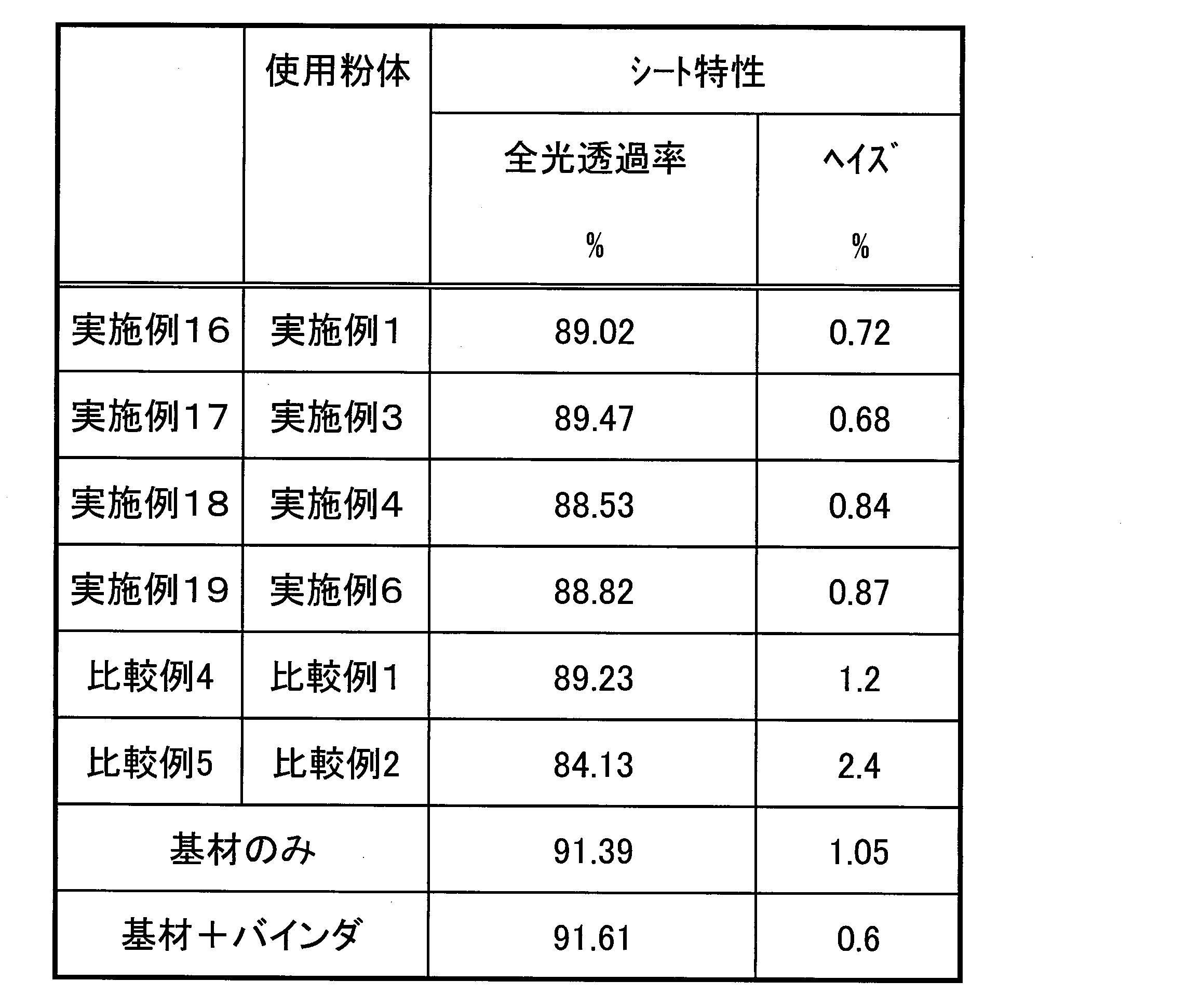
- the coating films (Examples 16 to 19) using the barium titanate particles (Examples) according to the present invention had a total light transmittance of 85% or more and a haze of 1%. It was as follows and it became clear that it was excellent in transparency.
- the barium titanate particle powder according to the present invention can be suitably used for various dielectric materials because aggregation is suppressed and the dispersibility is excellent. Particularly suitable for use as a multilayer ceramic capacitor, it is suitable for a material intended to delay sintering in an internal electrode layer of nickel. Especially when the nickel becomes fine, the barium titanate particle powder according to the present invention is particularly useful. In addition, since the barium titanate particle powder according to the present invention has a high dielectric constant, when the barium titanate particle powder and the transparent resin are mixed, it is considered that the amount of the barium titanate particle powder used can be suppressed more than before. Therefore, it becomes easy to ensure the transparency required for the optical film application.
Landscapes
- Chemical & Material Sciences (AREA)
- Organic Chemistry (AREA)
- Engineering & Computer Science (AREA)
- Inorganic Chemistry (AREA)
- Life Sciences & Earth Sciences (AREA)
- General Life Sciences & Earth Sciences (AREA)
- Environmental & Geological Engineering (AREA)
- Geology (AREA)
- Nanotechnology (AREA)
- Wood Science & Technology (AREA)
- Materials Engineering (AREA)
- Condensed Matter Physics & Semiconductors (AREA)
- Crystallography & Structural Chemistry (AREA)
- Manufacturing & Machinery (AREA)
- General Physics & Mathematics (AREA)
- Physics & Mathematics (AREA)
- Inorganic Compounds Of Heavy Metals (AREA)
- Paints Or Removers (AREA)
Abstract
Description
本発明における分散剤としては、使用するチタン酸バリウム粒子粉末や分散媒体の種類に応じて適宜選択して使用することができ、アルコキシシラン、シラン系カップリング剤及びオルガノポリシロキサン等の有機ケイ素化合物、チタネート系カップリング剤等の有機チタン化合物、アルミネート系カップリング剤等の有機アルミ化合物、ジルコネート系のカップリング剤等の有機ジルコニウム化合物、界面活性剤あるいは高分子分散剤等を用いることができ、これらは1種または2種以上を混合して用いることができる。
使用する樹脂はアクリル樹脂、シリコーン樹脂、エポキシ樹脂、ポリエステル樹脂、ポリイミド樹脂、ポリメチルメタクリレート(PMMA)、ポリスチレン(PS)、ポリカーボネート(PC)等が一般的に用いられる。
本発明では、非常に微細な粒子でありながら、Baイオン溶出量が少なく、高い誘電率を有し、耐酸性が高いチタン酸バリウム粒子粉末が得られている。透明性が求められる膜に用いられる粒子は、微細粒子であることのみならず、粒度分布がシャープである必要があり、本発明に係るチタン酸バリウム粒子粉末は、その条件を満たしている。固相法やシュウ酸塩法等によって得られる従来のチタン酸バリウム粒子では粉砕して超微細になったとしても粒度分布がブロードであり、この用途には不適である。
乾燥後の圧粉体の重量と体積から、チタン酸バリウム粒子粉末、PVAおよび空隙の体積比率を求めた。なお、圧粉体は、チタン酸バリウム粒子粉末が41~55vol%、PVAが0.1~3vol%、残部が空隙となるように調整した。
得られた圧粉体について、Agilent社製インピーダンスアナライザー E4991Aおよび誘電率測定フィクスチャー16453Aにより、室温約25℃、湿度約40%RHの環境下で10MHzにおける誘電率を測定した。得られた誘電率の測定結果には、チタン酸バリウム粒子粉末、PVAおよび空隙の各成分からの寄与を含んでいるため、本発明では対数混合則を用いて測定値からチタン酸バリウムのみの寄与を見積もった。また、表面被覆されたチタン酸バリウム粒子の誘電率は、表面処理成分も含めて複合粒子としての誘電率を対数混合則により見積もった。
水酸化バリウム八水塩(関東化学(株)製、97%Ba(OH)2・8H2O試薬特級)1.12kgを水に溶解、精製したものを、塩化チタン水溶液688gに滴下・中和して水酸化チタンコロイドを得た。次に、水酸化バリウム八水塩1.28kgを水に溶解、精製したものを温度70℃、pH12.5で窒素雰囲気の水熱反応容器中に保持した。次に、前記水酸化チタンコロイドを前記水酸化バリウム水溶液に2分間かけて投入した。該混合溶液を100℃で0.75時間かけて水熱反応を行ってチタン酸バリウムを生成した。室温まで冷却した後、ヌッチェで濾液にBaイオンが認められなくなるまで水洗し、さらに温水でpH=7となるまで洗浄した。その後、濾過、150℃で乾燥を行ってチタン酸バリウム粒子粉末を得た。得られたチタン酸バリウム粒子粉末のBa/Ti比は0.874モル比であり、平均粒径は33nmであった。得られたチタン酸バリウム粒子粉末の電子顕微鏡写真を図1に示す。
実施例1に対し、水熱反応の反応時間を8時間に変更し、洗浄pHを6.5として、Ba/Ti比は0.962モル比で平均粒径が52nmのチタン酸バリウム粒子粉末を得た。水熱反応条件の負荷を高めることで、平均粒径は増加し、高いBa/Ti組成比のチタン酸バリウム粒子粉末であった。得られたチタン酸バリウム粒子粉末の諸特性を表1に示す。
実施例1に対し、水熱反応の反応温度を70℃に変更し、洗浄pHを6.5として平均粒径が16nmのチタン酸バリウム粒子粉末を得た。得られたチタン酸バリウム粒子粉末の諸特性を表1に示す。
実施例1で得られたチタン酸バリウム粒子粉末を少量の水で解膠し、撹拌しながら3号ケイ酸ナトリウム溶液(水ガラス3号)をチタン酸バリウムに対し1重量%で添加し、酢酸でpHを6.5に調整して、ヌッチェで濾液にBaイオンが認められなくなるまで水洗し、濾過、乾燥を行ってBa/Ti比が0.790モル比のチタン酸バリウム粒子粉末を得た。得られたチタン酸バリウム粒子粉末について実施例1と同様にして評価を行った。得られたチタン酸バリウム粒子粉末の諸特性を表1に示す。
実施例1で得られたチタン酸バリウム粒子粉末にアルキルシラン系シランカップリング剤(商品名:TSL-8241)を5重量%混合機で撹拌しながら添加して表面処理したチタン酸バリウム粒子粉末を得た。得られたチタン酸バリウム粒子粉末の諸特性を表1に示す。
実施例1のチタン酸バリウム粒子粉末を300℃の温度下で熱処理した。得られたチタン酸バリウム粒子粉末について、誘電率、c/a比、半値幅、Ba溶出量および比表面積を、実施例1に記載と同様の方法で評価を行った。得られたチタン酸バリウム粒子粉末の諸特性を表1に示す。
実施例2のチタン酸バリウム粒子粉末を500℃の温度下で熱処理した。得られたチタン酸バリウム粒子粉末について、誘電率、c/a比、半値幅、Ba溶出量および比表面積を、実施例1に記載と同様の方法で評価を行った。得られたチタン酸バリウム粒子粉末の諸特性を表1に示す。
実施例1のチタン酸バリウム粒子粉末を500℃の温度下で熱処理し、得られた被処理チタン酸バリウム粒子粉末を15重量%の濃度で純水に解膠し、得られたスラリーをヌッチェで濾液にBaイオンが認められなくなるまで水洗し、さらに温水でpH=7となるまで洗浄した。その後、濾過、乾燥を行ってチタン酸バリウム粒子粉末を得た。得られたチタン酸バリウム粒子粉末の諸特性を表1に示す。
水酸化バリウム八水塩(関東化学(株)製、97%Ba(OH)2・8H2O試薬特級)1.12kgを水に溶解、精製したものを、塩化チタン水溶液688gに滴下・中和して水酸化チタンコロイドを得た。次に、水酸化バリウム八水塩1.28kgを水に溶解、精製したものを温度70℃、pH12.5で窒素雰囲気の水熱反応容器中に保持した。次に、前記水酸化チタンコロイドを前記水酸化バリウム水溶液に2分間かけて投入した。該混合溶液を100℃で0.75時間かけて水熱反応を行ってチタン酸バリウムを生成した。室温まで冷却した後、ヌッチェで濾液を900μS/cmまで水洗した後、硫酸アルミニウムをアルミニウム換算で1重量%、徐々に添加してコーティングした。その後、濾過、乾燥を行ってアルミニウム化合物で被覆したチタン酸バリウム粒子粉末を得た。得られたチタン酸バリウム粒子粉末の諸特性を表1に示す。
添加剤を塩化イットリウムにした以外は実施例9と同様の手法でイットリウム化合物で被覆されたチタン酸バリウム粒子粉末を得た。得られたチタン酸バリウム粒子粉末の諸特性を表1に示す。
添加剤を硫酸ナトリウムにし、添加量を硫黄換算0.1wt%にする以外は実施例9と同様の手法で硫酸根で被覆されたチタン酸バリウム粒子粉末を得た。得られたチタン酸バリウム粒子粉末の諸特性を表1に示す。
添加剤をリン酸にした以外は実施例9と同様の手法でリン酸で被覆されたチタン酸バリウム粒子粉末を得た。得られたチタン酸バリウム粒子粉末の諸特性を表1に示す。
実施例1で得られたチタン酸バリウム粒子粉末に有機チタン化合物 テトライソプロピルビス(ジオクチルホスファイト)チタネートを表面処理前後のC量差が0.5重量%となるように混合機で撹拌しながら添加して表面処理したチタン酸バリウム粒子粉末を得た。得られたチタン酸バリウム粒子粉末の諸特性を表1に示す。
実施例1で得られたチタン酸バリウム粒子粉末に有機チタン化合物 テトライソプロピルビス(ジオクチルホスファイト)チタネートを表面処理前後のC量差が1重量%となるように混合機で撹拌しながら添加して表面処理したチタン酸バリウム粒子粉末を得た。得られたチタン酸バリウム粒子粉末の諸特性を表1に示す。
実施例1の途中の工程で得られた水熱反応後のチタン酸バリウム含有スラリーを少量の水で水洗し、乾燥させてチタン酸バリウム粒子粉末を得た。得られたチタン酸バリウム粒子粉末の諸特性を表1に示す。
実施例1で得られた平均粒径が33nmのチタン酸バリウム粒子粉末を700℃の温度下で熱処理し、誘電率、c/a比、半値幅および比表面積を、実施例1に記載と同様の方法で評価を行った。高温での熱処理により、比誘電率が大きく増加しているが、平均粒径も大きく増加している。そのため、後述する比較例5から明らかなように、シートにおける全光線透過率およびヘイズが悪化する。得られたチタン酸バリウム粒子粉末の諸特性を表1に示す。
固相法により作製されたチタン酸バリウム粒子粉末について、誘電率、c/a比、半値幅、Ba溶出量および比表面積を、実施例1に記載と同様の方法で評価を行った。得られたチタン酸バリウム粒子粉末の諸特性を表1に示す。
実施例1で得られたチタン酸バリウム粒子粉末を縦型ビーズミル(コトブキ技研工業株式会社製「ウルトラアペックスミル UAM-05」)のジルコニア製0.5リットル攪拌容器にジルコニアビーズ(粒径50μm)を攪拌容器の70vol%になるように入れ、分散剤としてED153(楠本化成製)、溶媒のPGMEAを混合した溶液を添加し、循環させながら1時間分散させて、チタン酸バリウム粒子粉末の分散体を得た。
[実施例16]
得られた分散体を、アクリル樹脂(SB-193岐阜セラツク製)と、チタン酸バリウム/バインダ(分散剤含む)=6/4の割合にて混合し、バーコーターにて、ルミラーU-46(東レ製)上に塗布し、膜厚=3μm程度の塗膜を作製した。
実施例3のチタン酸バリウム粒子粉末を実施例15、実施例16の方法に従い、シート化を行った。得られたシートの諸特性を表2に示す。
実施例4のチタン酸バリウム粒子粉末を実施例15、実施例16の方法に従い、シート化を行った。得られたシートの諸特性を表2に示す。
実施例6のチタン酸バリウム粒子粉末を実施例15、実施例16の方法に従い、シート化を行った。得られたシートの諸特性を表2に示す。
比較例1のチタン酸バリウム粒子粉末を実施例15、実施例16の方法に従い、シート化を行った。得られたシートの諸特性を表2に示す。
比較例2のチタン酸バリウム粒子粉末を実施例15、実施例16の方法に従い、シート化を行った。得られたシートの諸特性を表2に示す。

Claims (8)
- 一次粒子の平均粒径が10nm以上60nm以下であって、粒子の変動係数(粒度分布の標準偏差を平均粒径で除した値)が0.35以下かつ粉体から水溶媒に溶出するBaイオンの量が1000ppm以下であることを特徴とするチタン酸バリウム粒子粉末。
- 粒子表面が、Si化合物、チタン化合物、ジルコニウム化合物、アルミニウム化合物、イットリウム化合物、硫黄化合物及びリン酸化合物から選ばれる少なくとも一種の表面被覆物で被覆された請求項1記載のチタン酸バリウム粒子粉末。
- 請求項2記載の表面被覆物の被覆量が、Si化合物はSiO2換算で、チタン化合物は炭素換算で、その他は各元素換算で0.05~5.0重量%であるチタン酸バリウム粒子粉末。
- 比誘電率が300以上である請求項1~3のいずれかに記載のチタン酸バリウム粒子粉末。
- 100~500℃の温度範囲で熱処理して得られた請求項1~4のいずれかに記載のチタン酸バリウム粒子粉末。
- 水熱法で得られる請求項1~5のいずれかに記載のチタン酸バリウム粒子粉末。
- 請求項1~6のいずれかに記載のチタン酸バリウム粒子粉末を含有する分散体。
- 請求項1~6のいずれかに記載のチタン酸バリウム粒子粉末を含有する塗膜。
Priority Applications (2)
| Application Number | Priority Date | Filing Date | Title |
|---|---|---|---|
| KR1020177022226A KR102577491B1 (ko) | 2015-03-05 | 2016-03-03 | 티타늄산바륨 입자 분말, 해당 분말을 함유하는 분산체 및 도막 |
| JP2017503710A JP6825556B2 (ja) | 2015-03-05 | 2016-03-03 | チタン酸バリウム粒子粉末、該粉末を含有する分散体及び塗膜 |
Applications Claiming Priority (2)
| Application Number | Priority Date | Filing Date | Title |
|---|---|---|---|
| JP2015-044070 | 2015-03-05 | ||
| JP2015044070 | 2015-03-05 |
Publications (1)
| Publication Number | Publication Date |
|---|---|
| WO2016140305A1 true WO2016140305A1 (ja) | 2016-09-09 |
Family
ID=56848936
Family Applications (1)
| Application Number | Title | Priority Date | Filing Date |
|---|---|---|---|
| PCT/JP2016/056579 Ceased WO2016140305A1 (ja) | 2015-03-05 | 2016-03-03 | チタン酸バリウム粒子粉末、該粉末を含有する分散体及び塗膜 |
Country Status (4)
| Country | Link |
|---|---|
| JP (1) | JP6825556B2 (ja) |
| KR (1) | KR102577491B1 (ja) |
| TW (1) | TWI713499B (ja) |
| WO (1) | WO2016140305A1 (ja) |
Cited By (4)
| Publication number | Priority date | Publication date | Assignee | Title |
|---|---|---|---|---|
| JP2017024925A (ja) * | 2015-07-16 | 2017-02-02 | デンカ株式会社 | チタン酸バリウム粉末及びその製造方法、用途 |
| JP2018020952A (ja) * | 2017-04-27 | 2018-02-08 | テイカ株式会社 | チタン酸化合物を主成分とする複合酸化物材料 |
| CN108558390A (zh) * | 2018-05-21 | 2018-09-21 | 九江职业技术学院 | 一种刀具用增强纳米复合涂层及其制备方法 |
| JP6564551B1 (ja) * | 2018-11-27 | 2019-08-21 | 株式会社アドマテックス | 表面改質チタン酸バリウム粒子材料、チタン酸バリウム含有樹脂組成物、及びチタン酸バリウム分散液 |
Citations (7)
| Publication number | Priority date | Publication date | Assignee | Title |
|---|---|---|---|---|
| JP2005289668A (ja) * | 2004-03-31 | 2005-10-20 | Toda Kogyo Corp | 正方晶系チタン酸バリウム微粒子粉末及びその製造法 |
| JP2007137759A (ja) * | 2005-10-19 | 2007-06-07 | Toda Kogyo Corp | チタン酸バリウム微粒子粉末及び分散体 |
| JP2008133162A (ja) * | 2006-11-29 | 2008-06-12 | Kyocera Corp | チタン酸バリウム粉末およびその製法、ならびに誘電体磁器 |
| WO2009142254A1 (ja) * | 2008-05-23 | 2009-11-26 | 石原産業株式会社 | 赤外線反射材料及びその製造方法並びにそれを含有した塗料、樹脂組成物 |
| JP2010024094A (ja) * | 2008-07-18 | 2010-02-04 | Nippon Chem Ind Co Ltd | 改質ペロブスカイト型複合酸化物、その製造方法及び複合誘電体材料 |
| JP2010105904A (ja) * | 2008-09-30 | 2010-05-13 | Tdk Corp | 粉体の合成方法及び電子部品の製造方法 |
| WO2015190556A1 (ja) * | 2014-06-13 | 2015-12-17 | 戸田工業株式会社 | チタン酸バリウム微粒子粉末、分散体及び塗膜 |
Family Cites Families (7)
| Publication number | Priority date | Publication date | Assignee | Title |
|---|---|---|---|---|
| JP3881051B2 (ja) | 1996-01-26 | 2007-02-14 | 触媒化成工業株式会社 | 透明被膜形成用塗布液および被膜付基材 |
| JP3550498B2 (ja) | 1998-05-26 | 2004-08-04 | 太陽誘電株式会社 | セラミック粉末の製造方法 |
| JP4057475B2 (ja) | 2003-06-17 | 2008-03-05 | Tdk株式会社 | チタン酸バリウム粉末の製造方法 |
| TW201018647A (en) * | 2008-09-30 | 2010-05-16 | Tdk Corp | Method for synthesizing powder and method for fabricating electronic part and component |
| CN102459083A (zh) * | 2009-06-05 | 2012-05-16 | Cqv株式会社 | 涂敷有氧化物层的钛酸钡粉末及其制备方法 |
| JP5663907B2 (ja) | 2010-03-09 | 2015-02-04 | 株式会社村田製作所 | チタン酸バリウム系セラミックの製造方法 |
| CN104797531B (zh) | 2012-11-13 | 2016-09-21 | 关东电化工业株式会社 | 包覆钛酸钡细颗粒及其制造方法 |
-
2016
- 2016-03-03 KR KR1020177022226A patent/KR102577491B1/ko active Active
- 2016-03-03 WO PCT/JP2016/056579 patent/WO2016140305A1/ja not_active Ceased
- 2016-03-03 JP JP2017503710A patent/JP6825556B2/ja active Active
- 2016-03-04 TW TW105106743A patent/TWI713499B/zh active
Patent Citations (7)
| Publication number | Priority date | Publication date | Assignee | Title |
|---|---|---|---|---|
| JP2005289668A (ja) * | 2004-03-31 | 2005-10-20 | Toda Kogyo Corp | 正方晶系チタン酸バリウム微粒子粉末及びその製造法 |
| JP2007137759A (ja) * | 2005-10-19 | 2007-06-07 | Toda Kogyo Corp | チタン酸バリウム微粒子粉末及び分散体 |
| JP2008133162A (ja) * | 2006-11-29 | 2008-06-12 | Kyocera Corp | チタン酸バリウム粉末およびその製法、ならびに誘電体磁器 |
| WO2009142254A1 (ja) * | 2008-05-23 | 2009-11-26 | 石原産業株式会社 | 赤外線反射材料及びその製造方法並びにそれを含有した塗料、樹脂組成物 |
| JP2010024094A (ja) * | 2008-07-18 | 2010-02-04 | Nippon Chem Ind Co Ltd | 改質ペロブスカイト型複合酸化物、その製造方法及び複合誘電体材料 |
| JP2010105904A (ja) * | 2008-09-30 | 2010-05-13 | Tdk Corp | 粉体の合成方法及び電子部品の製造方法 |
| WO2015190556A1 (ja) * | 2014-06-13 | 2015-12-17 | 戸田工業株式会社 | チタン酸バリウム微粒子粉末、分散体及び塗膜 |
Cited By (5)
| Publication number | Priority date | Publication date | Assignee | Title |
|---|---|---|---|---|
| JP2017024925A (ja) * | 2015-07-16 | 2017-02-02 | デンカ株式会社 | チタン酸バリウム粉末及びその製造方法、用途 |
| JP2018020952A (ja) * | 2017-04-27 | 2018-02-08 | テイカ株式会社 | チタン酸化合物を主成分とする複合酸化物材料 |
| CN108558390A (zh) * | 2018-05-21 | 2018-09-21 | 九江职业技术学院 | 一种刀具用增强纳米复合涂层及其制备方法 |
| JP6564551B1 (ja) * | 2018-11-27 | 2019-08-21 | 株式会社アドマテックス | 表面改質チタン酸バリウム粒子材料、チタン酸バリウム含有樹脂組成物、及びチタン酸バリウム分散液 |
| WO2020110183A1 (ja) * | 2018-11-27 | 2020-06-04 | 株式会社アドマテックス | 表面改質チタン酸バリウム粒子材料、チタン酸バリウム含有樹脂組成物、及びチタン酸バリウム分散液 |
Also Published As
| Publication number | Publication date |
|---|---|
| JP6825556B2 (ja) | 2021-02-03 |
| JPWO2016140305A1 (ja) | 2017-12-21 |
| TWI713499B (zh) | 2020-12-21 |
| KR20170125017A (ko) | 2017-11-13 |
| KR102577491B1 (ko) | 2023-09-12 |
| TW201704188A (zh) | 2017-02-01 |
Similar Documents
| Publication | Publication Date | Title |
|---|---|---|
| TWI343902B (en) | Titania sol, method of preparing the same, and coating composition comprising the same | |
| JP6825556B2 (ja) | チタン酸バリウム粒子粉末、該粉末を含有する分散体及び塗膜 | |
| US9120681B2 (en) | Method for production of zinc oxide particles | |
| JP6388104B2 (ja) | 酸化鉄粒子粉末、該酸化鉄粒子粉末を用いた塗料及び樹脂組成物 | |
| WO2023008395A1 (ja) | チタン酸ストロンチウム微粒子粉末及びその製造方法、分散体並びに樹脂組成物 | |
| JP6635031B2 (ja) | チタン酸バリウム微粒子粉末、分散体及び塗膜 | |
| TW202317477A (zh) | 鈦酸鍶微粒粉末及分散體、樹脂組合物 | |
| JP5267775B2 (ja) | チタン酸バリウム微粒子粉末の分散体及びその製造法 | |
| WO2023190452A1 (ja) | チタン酸バリウム粒子粉末及びその製造方法 | |
| JP6828711B2 (ja) | チタン酸バリウム粒子粉末の製造方法 | |
| EP4660144A1 (en) | Globular-shaped strontium titanate-based fine powder, dispersion, and resin composition | |
| JP7138836B2 (ja) | チタン酸バリウム粒子粉末及びその製造方法、並びに分散体 | |
| EP4660143A1 (en) | Powder of fine barium strontium titanate particles, production method therefor, dispersion, and resin composition | |
| TW202132222A (zh) | 被覆氧化鋯微粒子及其製造方法 | |
| CN120615080A (zh) | 球状钛酸锶系微粒粉末、分散体和树脂组合物 | |
| JP6782088B2 (ja) | 被膜形成用の塗布液、及び該塗布液を用いた被膜付基材 |
Legal Events
| Date | Code | Title | Description |
|---|---|---|---|
| 121 | Ep: the epo has been informed by wipo that ep was designated in this application |
Ref document number: 16758997 Country of ref document: EP Kind code of ref document: A1 |
|
| ENP | Entry into the national phase |
Ref document number: 2017503710 Country of ref document: JP Kind code of ref document: A |
|
| ENP | Entry into the national phase |
Ref document number: 20177022226 Country of ref document: KR Kind code of ref document: A |
|
| NENP | Non-entry into the national phase |
Ref country code: DE |
|
| 122 | Ep: pct application non-entry in european phase |
Ref document number: 16758997 Country of ref document: EP Kind code of ref document: A1 |