WO2016136970A1 - 液体中の含硫黄化合物の除去方法 - Google Patents
液体中の含硫黄化合物の除去方法 Download PDFInfo
- Publication number
- WO2016136970A1 WO2016136970A1 PCT/JP2016/055900 JP2016055900W WO2016136970A1 WO 2016136970 A1 WO2016136970 A1 WO 2016136970A1 JP 2016055900 W JP2016055900 W JP 2016055900W WO 2016136970 A1 WO2016136970 A1 WO 2016136970A1
- Authority
- WO
- WIPO (PCT)
- Prior art keywords
- beverage
- liquid
- adsorbent
- dmts
- gold
- Prior art date
- Legal status (The legal status is an assumption and is not a legal conclusion. Google has not performed a legal analysis and makes no representation as to the accuracy of the status listed.)
- Ceased
Links
Images







Classifications
-
- B—PERFORMING OPERATIONS; TRANSPORTING
- B01—PHYSICAL OR CHEMICAL PROCESSES OR APPARATUS IN GENERAL
- B01D—SEPARATION
- B01D15/00—Separating processes involving the treatment of liquids with solid sorbents; Apparatus therefor
-
- B—PERFORMING OPERATIONS; TRANSPORTING
- B01—PHYSICAL OR CHEMICAL PROCESSES OR APPARATUS IN GENERAL
- B01J—CHEMICAL OR PHYSICAL PROCESSES, e.g. CATALYSIS OR COLLOID CHEMISTRY; THEIR RELEVANT APPARATUS
- B01J20/00—Solid sorbent compositions or filter aid compositions; Sorbents for chromatography; Processes for preparing, regenerating or reactivating thereof
- B01J20/02—Solid sorbent compositions or filter aid compositions; Sorbents for chromatography; Processes for preparing, regenerating or reactivating thereof comprising inorganic material
-
- B—PERFORMING OPERATIONS; TRANSPORTING
- B65—CONVEYING; PACKING; STORING; HANDLING THIN OR FILAMENTARY MATERIAL
- B65D—CONTAINERS FOR STORAGE OR TRANSPORT OF ARTICLES OR MATERIALS, e.g. BAGS, BARRELS, BOTTLES, BOXES, CANS, CARTONS, CRATES, DRUMS, JARS, TANKS, HOPPERS, FORWARDING CONTAINERS; ACCESSORIES, CLOSURES, OR FITTINGS THEREFOR; PACKAGING ELEMENTS; PACKAGES
- B65D81/00—Containers, packaging elements, or packages, for contents presenting particular transport or storage problems, or adapted to be used for non-packaging purposes after removal of contents
- B65D81/24—Adaptations for preventing deterioration or decay of contents; Applications to the container or packaging material of food preservatives, fungicides, pesticides or animal repellants
Definitions
- the present invention relates to a method for removing sulfur-containing compounds in a liquid, and a method for reducing sulfide-like off-flavours in beverages such as scent of sake.
- Dimethyl trisulfide is a substance produced by storage of sake and has a sulfur-like and onion-like odor. It is a main component of scent, which is a deterioration odor of sake (Non-Patent Document 1). Sulfur-containing compounds such as DMTS can cause sulfide-like off-flavors in various beverages other than sake (Non-Patent Documents 2 and 3).
- DMTS Dimethyl trisulfide
- Non-Patent Document 4 low temperature storage and control of dissolved oxygen concentration (Non-Patent Document 4) are known as methods for controlling scent.
- these methods require facilities such as a cooling system and a nitrogen replacement device, and it is costly to perform such aroma control uniformly for all the sake produced.
- Patent Document 1 a method using silica gel as an adsorbent
- Patent Document 2 a method using dealuminated Y-type zeolite as an adsorbent
- Patent Document 2 a method using dealuminated Y-type zeolite as an adsorbent
- a gold nanoparticle catalyst in which gold nanoparticles are supported on a metal oxide support can be used as an adsorptive desulfurization agent for adsorbing and removing sulfur-containing organic compounds in liquid fuel, specifically, organic compounds having a thiophene ring.
- Patent Document 3 there is no disclosure of removal of sulfur-containing compounds such as polysulfide in beverages. There is no specific disclosure about adsorption removal of sulfur-containing organic compounds other than thiophene rings, and utilization of metal nanoparticles other than gold.
- Japanese Patent No. 4908296 Japanese Patent Publication No. 3-29385 Japanese Patent No. 5170591
- the present invention can specifically remove sulfur-containing compounds including polysulfides such as DMTS from various liquids including beverages without damaging other components such as umami components and aroma components. It aims at providing the novel means which can reduce the old perfume of refined sake simply at low cost.
- Adsorbents can adsorb and remove various sulfur-containing compounds that cause sulfide-like off-flavors without compromising the umami and aroma components of various beverages, and can be used not only from aqueous liquids but also from lipophilic organic compound liquids.
- the present invention was completed by finding that adsorption removal of DMTS is possible.
- the present invention provides a method for removing a sulfur-containing compound in a liquid, which comprises bringing fine particles of late transition metal into contact with the liquid. Moreover, this invention provides the method of reducing the sulfide-like off-flavor of a drink including removing the sulfur-containing compound in a drink by the sulfur-containing compound removal method of the said invention. Furthermore, the present invention provides a method for reducing the scent of sake, including removing polysulfides in the sake by the method for removing sulfur-containing compounds of the present invention. Furthermore, the present invention provides a beverage with reduced sulfide-like off-flavor by the above-described method of the present invention, and sake with reduced aroma.
- this invention provides the adsorption agent of the sulfur-containing compound in the liquid containing the fine particle of late period transition metal. Furthermore, the present invention provides a liquid container such as a beverage container in which the adsorbent of the present invention is immobilized. Furthermore, the present invention provides the use of late transition metal particulates for adsorbing sulfur-containing compounds in a liquid.
- the present invention provides means capable of specifically removing sulfur-containing compounds such as polysulfides such as DMTS without impairing the umami and aroma components of the beverage.
- the fine particles of late transition metals such as gold and platinum can adsorb and remove DMTS, which is a major component of scent, without impairing the flavor components of sake such as isoamyl acetate and ethyl caproate. Therefore, according to the present invention, it is possible to provide a beverage such as sake with reduced sulfide-like off-flavour such as scent while maintaining the umami component and the aroma component.
- DMTS can be adsorbed and removed from a liquid of an oleophilic organic compound, so that the sulfur concentration in an organic solvent or liquid fuel can be more strictly reduced than in the prior art.
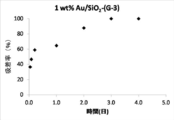
- Gold / glycine complex impregnation method using (standard condition) Au supported silica prepared by (1 wt% Au / SiO 2 - (G-3)) is a result of DMTS examining the adsorption capacity.
- Gold / glycine complex impregnation method using (baking time 30 changes in minutes) Au supported silica prepared by (1 wt% Au / SiO 2 - (G-7)) is the result of DMTS examining the adsorption capacity.
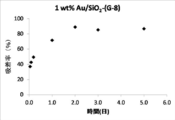
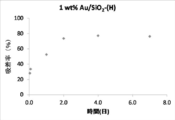
- Gold / glycine complex impregnation method using Au supported silica prepared by (change the firing temperature to 200 °C) (1 wt% Au / SiO 2 - (G-8)) is a result of DMTS examining the adsorption capacity. It is the result of investigating the DMTS adsorption capacity of a commercially available Au-supported silica catalyst (1 wt% Au / SiO 2- (H)).
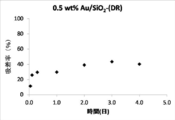
- DMTS adsorption ability of Au-supported silica (1 wt% Au / SiO 2- (G-1)) prepared by impregnation method using gold / glycine complex (using 10 mL of water for dissolution and evaporation drying) was investigated. It is a result.
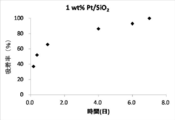
- Gold / 4-aminobutyric acid complex Au supported silica was prepared by impregnation method using (1 wt% Au / SiO 2 - (GABA)) is the result of DMTS examining the adsorption capacity. It is the result of investigating the DMTS adsorption ability of Ag supported silica Ag supported silica (1 wt% Ag / SiO 2 ) prepared by the impregnation method using silver nitrate. It is the result of investigating the DMTS adsorption ability of Pt carrying silica (1 wt% Pt / SiO 2 ) prepared by the impregnation method using chloroplatinic acid.
- fine particles of late transition metal are used as an adsorbent for adsorbing and removing sulfur-containing compounds in a liquid.
- the sulfur-containing compound is a compound containing a sulfur atom in the chemical structure.
- the sulfur-containing compounds that are the subject of the present invention include various sulfur-containing compounds that occur or exist in liquids such as beverages, organic solvents, and liquid fuels, and that can cause sulfide-like off-flavours in beverages. Is included. Specific examples include polysulfides such as dimethyl trisulfide (DMTS) and dimethyl disulfide (DMDS). These polysulfides, especially DMTS, are known to be the main constituents of scent, which is a deodorant odor of sake, and in various beverages including alcoholic beverages other than sake, they are produced during production or storage. It is known to occur and cause sulfide-like off-flavours.
- DMTS dimethyl trisulfide
- DMDS dimethyl disulfide
- the target liquid in the present invention includes various inorganic and organic liquids. It may be a lipophilic liquid or a hydrophilic liquid.
- the liquid of interest is a beverage.
- the liquid of interest is an organic solvent.
- the liquid of interest is a liquid fuel.
- the beverage is not particularly limited, and may be an alcoholic beverage or a non-alcoholic beverage.
- the alcoholic beverage include various alcoholic beverages such as sake, wine, beer, whiskey, brandy, and mixed alcohol. Among them, particularly preferable examples include sake.
- non-alcoholic beverages include juices made from vegetables, fruits and the like, and various beverages such as coffee, tea, Japanese tea, barley tea, Chinese tea, and carbonated beverages.
- organic solvent examples include benzene, toluene, xylene, naphthalene, phenol, cresol, hexane, heptane, octane, cyclohexane, cyclopentane, and substituted products of these alkyl groups, and mixtures of two or more of these. Can be mentioned.
- Liquid fuels include various organic liquid fuels. Specific examples include fossil liquid fuels such as gasoline, kerosene, light oil, and heavy oil, bioethanol, biodiesel, bioethyl tert-butyl ether (bioETBE), and biomethanol. And bioliquid fuels such as biobutanol, and mixtures of two or more thereof.
- fossil liquid fuels such as gasoline, kerosene, light oil, and heavy oil
- bioethanol biodiesel, bioethyl tert-butyl ether (bioETBE), and biomethanol.
- bioliquid fuels such as biobutanol, and mixtures of two or more thereof.
- the late transition metals include gold, silver, platinum, palladium, ruthenium, rhodium, osmium, iridium, iron, cobalt, nickel, copper, and zinc, and at least one of these metals Can be used.
- metals that can be preferably used include at least one selected from the group consisting of gold, silver, platinum, and palladium, in particular, gold, but are not limited thereto.
- the particle size (particle diameter) of the late transition metal fine particles may have an average particle size of 50 nm or less, preferably 30 nm or less, such as 20 nm or less, or 10 nm or less. It has been confirmed by experiments using gold particles that the adsorption capacity of the sulfur-containing compound DMTS tends to be higher as the average particle size of the metal fine particles is smaller (see Examples below). However, since the particle size particularly suitable for adsorption of the sulfur-containing compound can vary depending on the type of metal, the size of the fine particles can be selected as appropriate. The lower limit of the fine particle size is not particularly limited, and even particles consisting of about one to several metal atoms can be used for adsorption of sulfur-containing compounds. The atomic radius of the late transition metal is approximately 1.4 to 1.8 mm.
- the particle size described above is a crystallite size measured by direct observation with a transmission electron microscope (TEM) or by powder X-ray diffraction (XRD).
- TEM transmission electron microscope
- XRD powder X-ray diffraction
- the particle size measured by at least one of the methods may be in the above range.
- the fine particles of the late transition metal may be supported on a carrier.
- the type of the carrier is not particularly limited, and any carrier can be used as long as it can carry the late transition metal in the form of nano-sized particles or less on the surface thereof.
- Specific examples of the carrier that can be used in the present invention include silicon materials (silica, silica-alumina, aluminosilicate, etc.), carbon materials (activated carbon, various porous carbon materials, etc.), metal oxides (iron oxide).
- MOF Metal-Organic Framework
- carriers that are approved for use in beverages under relevant regulatory laws and regulations, such as the Food Sanitation Act and Liquor Tax Act, as necessary. May be.
- Specific examples of such carriers include activated carbon, bentonite, activated clay, diatomaceous earth, silica, silica-alumina, aluminosilicate, chitosan, montmorillonite, phytic acid, agar, gelatin, sodium alginate, carrageenan, and microfibrous cellulose.
- the carrier carrying the late transition metal fine particles may have any shape and form.
- it may be in the form of powder, granules, pellets, or may be a form fixed to at least the inner wall surface of a liquid container such as a beverage container (such as a liquor bottle).
- a liquid container such as a beverage container (such as a liquor bottle).
- it becomes possible to remove sulfur-containing compounds in the distribution process.
- it can adsorb and remove sulfur-containing compounds that are generated in the liquid before consumption or use after production, and can reduce the occurrence of sulfide-like off-flavours in beverages and the occurrence of aroma in sake. .
- the specific surface area of the carrier is not particularly limited, but a porous carrier having a large specific surface area (for example, about 30 m 2 / g or more, particularly about 100 m 2 / g or more) is preferably used to reduce the size of the metal fine particles. Can do.
- the upper limit of the specific surface area is not particularly limited, but is usually about 3000 m 2 / g or less.
- Late transition metal fine particles are particularly well known in the field of catalysts, and various techniques for producing metal fine particle catalysts in a form supported on a carrier are known in the field. Specific examples include a precipitation method, a coprecipitation method, a precipitation reduction method, a sol immobilization method, a solid phase mixing method, a gas phase grafting method, and an impregnation method. With respect to the support of the gold fine particles, for example, the method described in International Publication No. WO 2012/144532 can also be mentioned.
- the metal fine particles used for removing the sulfur-containing compound in the present invention may be produced by any method. A person skilled in the art can produce metal fine particles satisfying the conditions of the present invention by selecting an appropriate production method according to the type of metal used. As examples of commercially available products, there are various commercially available products in which nano-sized metal fine particles are supported on a metal oxide or the like. In the present invention, such commercially available products can also be used.
- the impregnation method is one of the preferable methods for producing a material in which fine particles of a late transition metal are supported on a carrier at a low cost.
- the method described in the above WO 2012/144532 is also an impregnation method, which is a method of preparing a chloride ion-free impregnation solution using gold acetate.
- using a metal / amino acid compound complex in which an amino acid or an amino acid analog (which may be collectively referred to as “amino acid compound”) is coordinated to a late transition metal It is also possible to prepare an impregnation liquid.
- the late transition metal / amino acid compound complex is a complex in which an amino acid or an amino acid analog compound is dissolved in a basic alcohol aqueous solvent, an alcohol aqueous solution of a late transition metal soluble compound is added thereto, and alcohol is further added. It can be prepared by precipitating and recovering it and washing it again after appropriate precipitation with alcohol.
- the late transition metal soluble compound include chloroauric acid in the case of gold, chloroplatinic acid, platinum nitrate in the case of platinum, and palladium chloride and palladium nitrate in the case of palladium.
- As late transition metal / amino acid complexes complexes of gold and glycine, histidine, and tryptophan are known (PharmaceuticaleuChemistry Journal, 1999, vol.33, No.9, p.11-13).
- amino acids that can be used for complex preparation are not particularly limited. Representative examples include 20 ⁇ -amino acids constituting natural proteins, but are not limited to these, and ⁇ -, ⁇ -, and ⁇ -amino acids are also included.
- the amino acid may be D-form or L-form.
- arginine histidine, lysine, aspartic acid, glutamic acid, alanine, glycine, leucine, valine, isoleucine, serine, threonine, phenylalanine, tryptophan, tyrosine, cystine or cysteine, glutamine, asparagine, proline, methionine, ⁇ -Alanine, ⁇ -aminobutyric acid (4-aminobutyric acid), carnitine, ⁇ -aminolevulinic acid, ⁇ -aminovaleric acid, ⁇ -aminovaleric acid (5-aminovaleric acid), ⁇ -aminocaproic acid (6-aminocaproic acid) Etc.
- the amino acid analog compound that can be used for preparing the complex is not particularly limited as long as it has a structure similar to an amino acid.
- Examples of amino acid analogs include A compound in which at least one (for example, all or one or two, or one) amino group of an amino acid molecule is replaced with a sulfhydryl group; A compound in which at least one alkyl group is bonded to at least one (for example, all, one, two, or one) amino group of an amino acid molecule (the carbon number of the alkyl group is, for example, 1 to 5, 1 to 4, 1 to 3, 1 or 2, or 1); At least one (for example, 1 to 5, or 1 to 3, or 1 or 2, or 1) carbon atoms constituting the main chain and side chain of the amino acid molecule are a nitrogen atom, an oxygen atom, and a sulfur atom.
- a compound substituted with at least one selected from: and at least one of carbon atoms constituting the main chain and side chain of the amino acid molecule eg, 1 to 5, 1 to 4, 1 to 3, 1 or A compound in which at least one selected from the group consisting of an alkyl group, a hydroxyl group and a halogen atom is bonded to two or one (the number of carbons in the alkyl group is, for example, 1 to 5, 1 to 4, 1 to 3) Piece, one piece, two pieces, or one piece) Etc.
- amino acid analogs include thiomalic acid (aspartic acid analog in which the —NH 2 group of aspartic acid is replaced with —SH group), p-chlorophenylalanine (phenylalanine in which the para position of the phenyl group is substituted with a chlorine atom) Similar compounds), ⁇ -chloroalanine (Alanine analogs in which the ⁇ carbon is replaced by chlorine atoms), hydroxyproline (hydroxylated proline, collagen component), hydroxylysine (hydroxylated lysine, collagen component) Sarcosine (N-methylglycine, a glycine-like compound in which one methyl group is bonded to the amino group of glycine), and the like, but is not limited thereto.
- the complex is dissolved in a small amount of water, added to the carrier, and stirred and mixed for several minutes to several tens of minutes. It may be carried out by baking for about several minutes to several tens of hours.
- the type of carrier is not limited, and even an acidic carrier which is usually difficult to use can be used.
- the size of the metal fine particles on the support can be reduced by impregnating the support with the complex aqueous solution and impregnating the support with the complex and immediately subjecting the support to a baking treatment without drying.
- the adsorbent of the late transition metal fine particles to be brought into contact with the liquid may be used in combination of plural kinds.
- a material in which a plurality of metal fine particles are simultaneously supported on the same carrier may be used, or a mixture of the same type of metal fine particles supported on different types of carriers may be used.
- different metal fine particles supported on the same type or different types of carriers may be mixed and used.
- the treatment of the liquid product with the adsorbent may be performed in the liquid product manufacturing process (typically the final step).
- the liquid product may be contacted with the adsorbent, and as a result, sulfur-containing compounds generated during transportation and storage of the liquid product. Can also be removed.
- an adsorbent is fixed to at least the inner wall of various liquid containers such as liquor containers such as liquor bottles, it is generated after the liquid is sealed in the container, or Sulfur-containing compounds mixed at the time of encapsulation can also be removed by adsorption.
- the adsorbent as described above, it is possible to remove not only sulfur compounds generated during the manufacturing process but also sulfur compounds generated during transportation and storage, thereby providing a sulfide-like off-flavor. Can be reduced.
- DMTS adsorption experiment 2 using Au supported silica (Au / SiO 2 ) 2 Gold / amino acid compound complexes were prepared using amino acids other than glycine and amino acid analogs, and Au-supported silica was prepared using the gold / amino acid compound complexes, and DMTS adsorption experiments were performed.
- each Au-supported silica was measured by XRD, it was 4.5 nm or 2.6 nm using ⁇ -alanine, 4.1 nm or 7.9 nm using 4-aminobutyric acid, 12.3 nm using lysine, 7.7 nm or 6.9 nm using asparagine.
- ⁇ Impregnation support on silica support> A commercially available metal salt (equivalent to 10 mg of metal) was placed in a mortar, a small amount of water was added to dissolve, 990 mg of SiO 2 was added thereto, and the mixture was stirred and mixed for 30 minutes. Then, it dried overnight and baked with air on the conditions shown in the following Table 2, respectively. Silver and platinum were subjected to hydrogen reduction at 300 ° C. for 4 hours after air firing.
- the silver particles were 3.0 nm (measured by TEM)
- the platinum particles were ⁇ 2.0 nm (measured by XRD)
- the palladium particles were 5.2 nm (measured by XRD).
- Figures 3-1 to 3-3 show the results of DMTS adsorption experiments for silver, platinum, and palladium. All had high adsorption performance.
- ⁇ Aluminum-containing mesoporous silica support> Place gold / amino acid complex (equivalent to 10 mg of gold) in a mortar, add 0.5 mL of water to dissolve, add 990 mg of silica alumina (aluminum-containing mesoporous silica MCM-41, Sigma-Aldrich), and stir and mix for 30 minutes. did. Thereafter, air calcination was carried out at 300 ° C. for 4 hours without drying to obtain Au-supported aluminum-containing mesoporous silica (Au / Al-MCM-41- (A)).
- the average particle diameter of the gold particles calculated from the transmission electron microscope (TEM) image was 2.5 nm, and gold particles having a small particle diameter could be supported as in the case of the silica carrier.
- ⁇ Ketjen black carrier> A gold / ⁇ -alanine complex (equivalent to 5 mg of gold) was placed in a mortar, 0.5 mL of water was added and stirred, 495 mg of Ketjen Black (Lion Corporation) was added thereto, and the mixture was stirred and mixed for 30 minutes. Thereafter, air baking was performed at 300 ° C. for 30 minutes without drying to obtain Au-supported ketjen black (Au / C- (A)).
- the size of the gold particles supported on the ketjen black support was 4.7 nm, and gold particles having a small particle diameter could be supported as in the case of the silica support.
- ⁇ Montmorillonite carrier> A gold / amino acid complex (equivalent to 10 mg of gold) was placed in a mortar, dissolved by adding 0.5 mL of water, 990 mg of montmorillonite (Sigma Aldrich) was added thereto, and the mixture was stirred and mixed for 30 minutes. Thereafter, air baking was performed at 300 ° C. for 4 hours without drying.
- the gold particle size of the obtained Au-supported montmorillonite (Au / Mont) is about 10 nm (calculated from a transmission electron microscope (TEM) image). Gold particles having a small diameter could be supported.
- DMTS removal test in sake using adsorbent ⁇ Method> (1) Put 20mL sake and adsorbent into a 20mL glass vial and seal tightly. (2) Leave at room temperature (about 24 °C) (24h) (3) Remove the adsorbent by centrifugation (4) Measure DMTS concentration of sake (SBSE-GC-MS)
- the performance as an adsorbent was also evaluated for the gold nanoparticle catalyst AuC (made by supporting gold nanoparticles on a ketjen black carrier), activated carbon, and gold foil manufactured by Halta Gold.
- AuC has a very large DMTS removal effect, but activated carbon alone was also effective. There was no effect on the gold leaf.
- the panel was composed of 6 staff members of the Liquor Research Institute who had experience in sensory evaluation of sake (more than 5 years). In order to eliminate the influence of color, amber glass was used as the sample container.
- the scale evaluation was performed as follows for 4 items of fragrance, 4 items of taste, and 9 items of overall evaluation. For each item, the average value of the evaluation results of 6 persons was calculated, and the presence or absence of a significant difference was examined. JMP ver.9 was used for statistical analysis.
- fragrance “Ginjo incense”, “Old incense”, “sulfide-like”, “sweet odor / caramel-like / burn” are almost not felt (0 points) to very strong (4 points). “Tint” (light to dark), “sweet and spicy” (spicy to sweet), “irritant taste and texture” (smooth to arrai), and “aftertaste” (mottle to crisp) are rated on a 5-level scale (both –2) Points to +2) Comprehensive evaluation: Excellent (1 point) to 5 points with difficulty (5 points)
- DMTS removal test in wine and juice with adsorbent ⁇ Method> Sample preparation: The wine sample was prepared by diluting a commercially available wine (Kobayashi Winery Domaine Chardonnay) with ultrapure water so that the alcohol content was 10%, and adding DMTS to 1.3 ⁇ g / L. The vegetable juice sample was prepared by diluting a commercially available vegetable juice (Kagome vegetable one per day) with ultrapure water and adding DMTS to 1.3 ⁇ g / L.
- Adsorbent TN150 and LV430
- Two types of Au / SiO 2 Au-supported silica, Au average particle size TN150: 4.6 nm, LV430: 3.3 nm) with different production lots were used.
- Table 8 shows the measurement results of DMTS concentration of each sample after treatment for 24 hours.
- the DMTS concentration showed the average value of the measured values in two analyses. In either case, 95% or more of DMTS was adsorbed and removed, and the DMTS concentration could be reduced to less than 0.1 ⁇ g / L.
- DMTS removal test in hexane by adsorbent ⁇ Method> (1) Add DMTS and tridecane as internal standard to hexane (2) Dilute the solution of (1) with hexane (DMTS concentration: 6.0 ppm) (3) Add 50.0 mg of Au / SiO 2 (300 °C, calcined for 0.5 h, Au average particle size 5.1 nm) to 4.0 mL of the sample in (2) (4) Measure DMTS remaining amount over time with GC
Landscapes
- Chemical & Material Sciences (AREA)
- Analytical Chemistry (AREA)
- Chemical Kinetics & Catalysis (AREA)
- Engineering & Computer Science (AREA)
- Inorganic Chemistry (AREA)
- Mechanical Engineering (AREA)
- Food Science & Technology (AREA)
- Organic Chemistry (AREA)
- Solid-Sorbent Or Filter-Aiding Compositions (AREA)
- Catalysts (AREA)
- Treatment Of Liquids With Adsorbents In General (AREA)
- Details Of Rigid Or Semi-Rigid Containers (AREA)
- Alcoholic Beverages (AREA)
- Non-Alcoholic Beverages (AREA)
- Distillation Of Fermentation Liquor, Processing Of Alcohols, Vinegar And Beer (AREA)
Abstract
飲料を包含する各種の液体から、うま味成分や香気成分などのその他の成分を損なうことなく、DMTS等のポリスルフィドをはじめとする含硫黄化合物を特異的に除去することができる新規な手段が開示されている。本願発明者らは、鋭意研究の結果、ナノサイズ以下の後周期遷移金属の微粒子を吸着剤として用いることにより、酢酸イソアミルやカプロン酸エチル等の香気成分を損なうことなくDMTSを吸着除去できること、当該吸着剤によれば各種飲料のうま味・香気成分を損なうことなく硫化物様オフフレーバーの原因となる様々な含硫黄化合物を吸着除去できること、水系の液体のみならず親油性の有機化合物の液体からもDMTSを吸着除去できることを見出した。
Description
本発明は、液体中の含硫黄化合物の除去方法、及び清酒の老香をはじめとする飲料の硫化物様のオフフレーバーを低減する方法に関する。
ジメチルトリスルフィド(DMTS)は清酒の貯蔵により生成する物質で、硫黄様、タマネギ様のにおいを呈する。清酒の劣化臭である老香の主要構成成分である(非特許文献1)。DMTSをはじめとする含硫黄化合物は、清酒以外の様々な飲料においても硫化物様のオフフレーバーの原因となりうる(非特許文献2、3)。近年清酒の人気は諸外国においても高まりを見せており、外国への輸出では輸送・貯蔵の期間が長期化することから、貯蔵中の清酒におけるDMTSの発生を抑制することはますます重要な課題となっている。
老香の制御方法としては、例えば、低温貯蔵、溶存酸素濃度の制御(非特許文献4)が知られている。しかし、これらの手法は冷房設備や窒素置換装置といった設備が必要であり、製造した全ての清酒についてこうした老香制御を均一に行なうこととするとコストがかかる。
その他、吸着剤処理による老香の制御方法として、シリカゲルを吸着剤として用いる方法(特許文献1)、脱アルミニウム処理したY型ゼオライトを吸着剤として用いる方法(特許文献2)等が知られている。しかしながら、これらの吸着剤は必ずしも老香の主要構成成分に特化したものではない。
一方、金ナノ粒子を金属酸化物担体上に担持した金ナノ粒子触媒は、吸着脱硫剤として、液体燃料中の硫黄含有有機化合物、具体的にはチオフェン環を有する有機化合物の吸着除去に使用できることが知られている(特許文献3)。しかしながら、飲料中のポリスルフィド等の含硫黄化合物の除去については全く開示されていない。チオフェン環以外の硫黄含有有機化合物の吸着除去や、金以外の金属ナノ粒子の利用についても何ら具体的に開示されていない。
日本醸造協会誌, 101, 125-131, 2006
J. Agric. Food Chem. 48, 6196-6199, 2000
J. Am. Soc. Brew. Chem. 56, 99-103, 1998
日本醸造協会誌, 94, 827-832, 1999
本発明は、飲料を包含する各種の液体から、うま味成分や香気成分などのその他の成分を損なうことなく、DMTS等のポリスルフィドをはじめとする含硫黄化合物を特異的に除去することができ、特に清酒の老香を低コストで簡便に低減できる新規な手段を提供することを目的とする。
本願発明者らは、鋭意研究の結果、ナノサイズ以下の後周期遷移金属の微粒子を吸着剤として用いることにより、酢酸イソアミルやカプロン酸エチル等の香気成分を損なうことなくDMTSを吸着除去できること、当該吸着剤によれば各種飲料のうま味・香気成分を損なうことなく硫化物様オフフレーバーの原因となる様々な含硫黄化合物を吸着除去できること、水系の液体のみならず親油性の有機化合物の液体からもDMTSの吸着除去が可能であることを見出し、本願発明を完成した。
すなわち、本発明は、後周期遷移金属の微粒子を液体と接触させることを含む、液体中の含硫黄化合物の除去方法を提供する。また、本発明は、上記本発明の含硫黄化合物除去方法により、飲料中の含硫黄化合物を除去することを含む、飲料の硫化物様のオフフレーバーを低減する方法を提供する。さらに、本発明は、上記本発明の含硫黄化合物除去方法により、清酒中のポリスルフィドを除去することを含む、清酒の老香を低減する方法を提供する。さらに、本発明は、上記本発明の方法により硫化物様のオフフレーバーが低減された飲料、及び老香が低減された清酒を提供する。さらに、本発明は、後周期遷移金属の微粒子を含む、液体中の含硫黄化合物の吸着剤を提供する。さらに、本発明は、上記本発明の吸着剤が固定化された飲料用容器等の液体用容器を提供する。さらに、本発明は、後周期遷移金属の微粒子の、液体中の含硫黄化合物を吸着するための使用を提供する。
本発明により、飲料のうま味成分や香気成分を損なうことなく、DMTS等のポリスルフィドをはじめとする含硫黄化合物を特異的に除去することができる手段が提供された。金や白金等の後周期遷移金属の微粒子は、酢酸イソアミルやカプロン酸エチル等の清酒の香気成分を損なうことなく、老香の主要構成成分であるDMTSを吸着除去することができる。従って、本発明によれば、うま味成分や香気成分を維持しつつ老香など硫化物様のオフフレーバーが低減された清酒等の飲料を提供することができる。また、本発明によれば、親油性の有機化合物の液体からもDMTSを吸着除去できるので、有機溶媒や液体燃料中の硫黄濃度を従来技術よりもさらに厳密に低減することが可能になる。
本発明では、液体中の含硫黄化合物を吸着除去する吸着剤として、後周期遷移金属の微粒子を用いる。
含硫黄化合物とは、化学構造中に硫黄原子を含む化合物である。本発明で対象となる含硫黄化合物には、飲料や有機溶媒、液体燃料等の液体中に発生ないしは存在して、飲料においては硫化物様のオフフレーバーの原因となり得る、様々な含硫黄化合物が包含される。具体例として、ジメチルトリスルフィド(DMTS)及びジメチルジスルフィド(DMDS)等のポリスルフィドを挙げることができる。これらのポリスルフィド、特にDMTSは、清酒の劣化臭である老香の主要構成成分であることが知られており、また清酒以外のアルコール飲料を包含する様々な飲料においても、製造過程ないしは貯蔵中に発生して硫化物様のオフフレーバーの原因となることが知られている。また、液体燃料のサルファ―フリー化など、親油性の有機化合物の液体においても含硫黄化合物濃度を低減させる技術が求められている。液体を上記吸着剤で処理することで、液体中の含硫黄化合物を吸着除去することができ、飲料においては硫化物様のオフフレーバーを低減することができる。硫化物様オフフレーバー又は老香の低減という語には、これらの発生の防止も含まれる。
本発明で対象となる液体には、無機系及び有機系の各種の液体が包含される。親油性の液体でもよいし、親水性の液体でもよい。1つの態様において、対象となる液体は飲料である。別の態様において、対象となる液体は有機溶媒である。さらなる他の態様において、対象となる液体は液体燃料である。
飲料は特に限定されず、アルコール飲料でも非アルコール飲料でもよい。アルコール飲料としては、清酒、ワイン、ビール、ウイスキー、ブランデー、混成酒等の各種アルコール飲料が挙げられ、中でも特に好ましい例として清酒を挙げることができる。非アルコール飲料としては、野菜、果物等を原料としたジュース類、コーヒー、紅茶、日本茶、麦茶、中国茶、炭酸飲料等の各種の飲料を挙げることができる。
有機溶媒の具体例としては、ベンゼン、トルエン、キシレン、ナフタレン、フェノール、クレゾール、ヘキサン、ヘプタン、オクタン、シクロヘキサン、シクロペンタン、及びこれらのアルキル基等による置換体、並びにこれらの2種以上の混合物を挙げることができる。
液体燃料には、各種の有機液体燃料が包含され、具体例としては、ガソリン、灯油、軽油、重油などの化石液体燃料、バイオエタノール、バイオディーゼル、バイオエチルtert-ブチルエーテル(バイオETBE)、バイオメタノール、バイオブタノールなどのバイオ液体燃料、並びにこれらの2種以上の混合物を挙げることができる。
本発明において、後周期遷移金属には、金、銀、白金、パラジウム、ルテニウム、ロジウム、オスミウム、イリジウム、鉄、コバルト、ニッケル、銅、及び亜鉛が包含され、これらの金属のうちの少なくとも1種を使用可能である。中でも好ましく使用し得る金属として、金、銀、白金、及びパラジウムからなる群より選択される少なくとも1種、特に金を挙げることができるが、これらに限定されない。
後周期遷移金属の微粒子の粒子サイズ(粒子の直径)は、平均粒径が50nm以下、好ましくは30nm以下、例えば20nm以下、又は10nm以下であり得る。金属微粒子の平均粒径が小さいほど、含硫黄化合物DMTSの吸着能が高い傾向があることが、金粒子を用いた実験により確認されている(下記実施例参照)。もっとも、含硫黄化合物の吸着に特に適した粒子サイズは金属の種類に応じて異なり得るので、微粒子のサイズは適宜選択することができる。微粒子サイズの下限値は特に限定されず、金属原子1個~数個程度からなる粒子であっても含硫黄化合物の吸着に使用可能である。なお、後周期遷移金属の原子半径は概ね1.4~1.8Åである。
なお、上記した粒子サイズは、透過型電子顕微鏡(TEM)による直接観察、又は粉末X線回折(XRD)により測定された結晶子径である。本発明においては、少なくともいずれか一方の方法で測定した粒子サイズが上記の範囲内であればよい。
後周期遷移金属の微粒子は、担体上に担持された形態であってよい。担体の種類は特に限定されず、後周期遷移金属をナノサイズ以下の粒子状でその表面に担持することができる担体であればいかなるものであってもよい。本発明において使用可能な担体の具体例を挙げると、ケイ素材料(シリカ、シリカ-アルミナ、アルミノケイ酸塩等)、炭素材料(活性炭、及び各種の多孔性炭素材料等)、金属酸化物(酸化鉄、酸化アルミニウム、酸化チタン、酸化コバルト、酸化ジルコニウム、酸化セリウム、酸化マンガン、酸化亜鉛、酸化ニッケル、酸化マグネシウム、酸化タングステン等)、粘土(ベントナイト、活性白土、珪藻土、モンモリロナイト等)、合成又は天然ポリマー(各種の合成樹脂、ポリビニルピロリドン、キトサン、微小繊維状セルロース、タンニン、寒天、ゼラチン等)、炭酸塩(炭酸マグネシウム、炭酸カルシウム、炭酸バリウム等)、多孔性配位高分子(Porous Coordination Polymer; PCP、金属イオンとそれらを架橋する有機配位子とで構成される結晶性の高分子構造体であり、金属有機構造体(Metal-Organic Framework; MOF)とも呼ばれる)、窒化ホウ素等を挙げることができるが、これらに限定されない。
飲料中の含硫黄化合物の除去ないしはオフフレーバーの低減に用いる場合には、必要に応じて、食品衛生法及び酒税法等の関連のある規制法令において飲料への使用が認められている担体を使用してもよい。そのような担体の具体例を挙げると、活性炭、ベントナイト、活性白土、珪藻土、シリカ、シリカ-アルミナ、アルミノケイ酸塩、キトサン、モンモリロナイト、フィチン酸、寒天、ゼラチン、アルギン酸ナトリウム、カラギナン、微小繊維状セルロース、小麦粉、グルテン、卵白、柿タンニン、タンニン、ポリビニルピロリドン、木材チップ、コラーゲン、パパイン、プロテアーゼ、ペクチナーゼ、ヘミセルラーゼ、エンドウたんぱく、β-グルカナーゼ、及びカゼイン又はカゼインナトリウムが挙げられる。これらの担体も本発明において好ましく使用し得る担体の例であるが、中でも飲料、とりわけ清酒の老香低減において特に好ましく使用し得る担体として、活性炭(ただし清酒に対してはケッチェンブラックを除く)、ベントナイト、活性白土、珪藻土、シリカ、シリカ-アルミナ、アルミノケイ酸塩、キトサン、及びモンモリロナイトから選択される少なくとも1種を挙げることができる。もっとも、清酒等の飲料に対して使用する場合であっても、例えば器具として認められる範囲においては、上記のような食品添加物として認可されている担体に限定されず、様々な担体を採用することができる。
後周期遷移金属微粒子を担持させた担体は、いかなる形状・形態であってもよい。例えば、粉末状、顆粒状、ペレット状でもよいし、また飲料容器(酒瓶など)などの液体用容器の少なくとも内壁面に固定化された形態であってもよい。そのような液体用容器を用いることで、流通過程において含硫黄化合物を除去することも可能になる。例えば、製造後消費ないしは使用されるまでに液体中に発生する含硫黄化合物をも吸着除去し、飲料においては硫化物様のオフフレーバーの発生、清酒においては老香の発生を低減することができる。
担体の比表面積は特に限定されないが、金属微粒子のサイズを小さくするためには比表面積が大きい多孔質の担体(例えば、概ね30m2/g程度以上、特に100m2/g程度以上)を好ましく使用し得る。比表面積の上限も特に限定されないが、通常3000m2/g程度以下である。
後周期遷移金属の微粒子は触媒の分野で特によく知られており、該分野においては、担体上に担持させた形態にある金属微粒子触媒を製造するための様々な手法が知られている。具体的には、析出沈殿法、共同沈殿法、析出還元法、ゾル固定化法、固相混合法、気相グラフティング法、含浸法等を挙げることができる。金微粒子の担持に関しては、例えば国際公開公報WO 2012/144532に記載された方法も挙げることができる。本発明で含硫黄化合物の除去に用いる金属微粒子は、いかなる方法で製造されたものであってもよい。当業者であれば、用いる金属の種類に応じて適当な製造方法を選択し、本発明における条件を満たす金属微粒子を製造することができる。また、市販品の例として、ナノサイズの金属微粒子が金属酸化物などに担持された触媒の市販品が種々存在し、本発明においてはそのような市販品を使用することも可能である。
含浸法は、担体上に後周期遷移金属の微粒子を担持させた材料を低コストで製造する好ましい方法の一つである。上述のWO 2012/144532に記載された方法も含浸法であり、酢酸金を用いて塩化物イオンフリーの含浸液を調製するという手法である。そのほか、下記実施例に記載されるように、後周期遷移金属にアミノ酸又はアミノ酸類似化合物(これらをまとめて「アミノ酸系化合物」ということがある)が配位した金属/アミノ酸系化合物錯体を用いて含浸液を調製することも可能である。
後周期遷移金属/アミノ酸系化合物錯体は、アミノ酸又はアミノ酸類似化合物を塩基性のアルコール水溶液溶媒中に溶解し、これに後周期遷移金属の可溶性化合物のアルコール水溶液を添加し、さらにアルコールを加えて錯体を析出させ、これを回収し適宜アルコールで再沈殿後に洗浄することにより調製することができる。後周期遷移金属の可溶性化合物は、金の場合は塩化金酸、白金の場合は塩化白金酸、硝酸白金、パラジウムの場合は塩化パラジウム、硝酸パラジウム等を挙げることができる。なお、後周期遷移金属/アミノ酸錯体として、金とグリシン、ヒスチジン、及びトリプトファンとの錯体が知られている(Pharmaceutical Chemistry Journal, 1999, vol.33, No.9, p.11-13)。
錯体調製に使用可能なアミノ酸の種類は特に限定されない。代表的な例としては、天然のタンパク質を構成する20種のα-アミノ酸が挙げられるが、これらに限定されず、β-、γ-及びδ-アミノ酸も包含される。また、アミノ酸はD体でもL体でもよい。具体例を挙げると、アルギニン、ヒスチジン、リジン、アスパラギン酸、グルタミン酸、アラニン、グリシン、ロイシン、バリン、イソロイシン、セリン、スレオニン、フェニルアラニン、トリプトファン、チロシン、シスチン又はシステイン、グルタミン、アスパラギン、プロリン、メチオニン、β-アラニン、γ-アミノ酪酸(4-アミノ酪酸)、カルニチン、γ-アミノレブリン酸、γ-アミノ吉草酸、δ-アミノ吉草酸(5-アミノ吉草酸)、ε-アミノカプロン酸(6-アミノカプロン酸)などが挙げられる。
錯体調製に使用可能なアミノ酸類似化合物も、アミノ酸に類似した構造を有する限り特に限定されない。アミノ酸類似化合物の例としては、
アミノ酸分子の少なくとも1個(例えば全部、又は1個若しくは2個、又は1個)のアミノ基がスルフヒドリル基に置き換わった化合物;
アミノ酸分子の少なくとも1個(例えば全部、又は1個若しくは2個、又は1個)のアミノ基に少なくとも1個のアルキル基が結合した化合物(アルキル基の炭素数は例えば1~5個、1~4個、1~3個、1個若しくは2個、又は1個);
アミノ酸分子の主鎖及び側鎖を構成する炭素原子の少なくとも1個(例えば1~5個、又は1~3個、又は1個若しくは2個、又は1個)が窒素原子、酸素原子及び硫黄原子から選択される少なくとも1つに置き換わった化合物;並びに
アミノ酸分子の主鎖及び側鎖を構成する炭素原子の少なくとも1個(例えば1~5個、1~4個、1~3個、1個若しくは2個、又は1個)に、アルキル基、水酸基及びハロゲン原子からなる群より選択される少なくとも1つが結合した化合物(アルキル基の炭素数は例えば1~5個、1~4個、1~3個、1個若しくは2個、又は1個)
等を挙げることができる。
アミノ酸分子の少なくとも1個(例えば全部、又は1個若しくは2個、又は1個)のアミノ基がスルフヒドリル基に置き換わった化合物;
アミノ酸分子の少なくとも1個(例えば全部、又は1個若しくは2個、又は1個)のアミノ基に少なくとも1個のアルキル基が結合した化合物(アルキル基の炭素数は例えば1~5個、1~4個、1~3個、1個若しくは2個、又は1個);
アミノ酸分子の主鎖及び側鎖を構成する炭素原子の少なくとも1個(例えば1~5個、又は1~3個、又は1個若しくは2個、又は1個)が窒素原子、酸素原子及び硫黄原子から選択される少なくとも1つに置き換わった化合物;並びに
アミノ酸分子の主鎖及び側鎖を構成する炭素原子の少なくとも1個(例えば1~5個、1~4個、1~3個、1個若しくは2個、又は1個)に、アルキル基、水酸基及びハロゲン原子からなる群より選択される少なくとも1つが結合した化合物(アルキル基の炭素数は例えば1~5個、1~4個、1~3個、1個若しくは2個、又は1個)
等を挙げることができる。
アミノ酸類似化合物の具体例としては、チオリンゴ酸(アスパラギン酸の-NH2基が-SH基に置き換わったアスパラギン酸類似化合物)、p-クロロフェニルアラニン(フェニル基のパラ位が塩素原子で置換されたフェニルアラニン類似化合物)、β-クロロアラニン(β炭素が塩素原子で置換されたアラニン類似化合物)、ヒドロキシプロリン(ヒドロキシル化されたプロリン、コラーゲン構成成分)、ヒドロキシリジン(ヒドロキシル化されたリジン、コラーゲン構成成分)、サルコシン(Nメチルグリシン、グリシンのアミノ基に1個のメチル基が結合したグリシン類似化合物)などを挙げることができるが、これらに限定されない。
後周期遷移金属/アミノ酸系化合物錯体の担体への含浸担持は、錯体を少量の水に溶解し、これに担体を添加して数分~数十分程度撹拌混和した後、100℃~600℃程度で数分~十数時間程度焼成することにより行なえばよい。錯体を利用した含浸法では、担体の種類は制限されず、通常は使用困難な酸性担体でも使用可能である。担体と錯体水溶液を撹拌混和して担体に錯体を含浸させた後、乾燥させずにすぐに焼成処理に付すことにより、担体上の金属微粒子のサイズを小さくすることができる。
液体と接触させる後周期遷移金属微粒子の吸着剤は、複数種類を組み合わせて用いてもよい。例えば、同一の担体上に複数の金属微粒子が同時に担持されたものを用いてもよいし、同一種類の金属微粒子が異なる種類の担体に担持されたものを混合して用いてもよい。あるいは、異なる金属微粒子が同一種類又は異なる種類の担体に担持されたものを混合して用いてもよい。
吸着剤による液体製品の処理は、液体製品の製造過程(典型的には最終工程)において実施してよい。また、液体製品の製造後、末端消費者に提供するまでの間に、液体製品を吸着剤と接触させる処理をおこなってもよく、これにより、液体製品の輸送・保管中に生じた含硫黄化合物をも除去することができる。さらにまた、上述したように、酒瓶などの飲料容器をはじめとする各種の液体用容器の少なくとも内壁に吸着剤を固定化したものを用いれば、容器内に液体を封入した後に発生した、ないしは封入時に混入した含硫黄化合物も吸着除去することができる。飲料に対しては、上記のように吸着剤を用いることで、製造過程で発生した硫黄化合物の他、輸送・貯蔵中に生じた硫黄化合物も除去することができ、これにより硫化物様オフフレーバーを低減することができる。
以下、本発明を実施例に基づきより具体的に説明する。もっとも、本発明は下記実施例に限定されるものではない。
1.Au担持シリカ(Au/SiO2)を用いたDMTS吸着実験1
市販の金ナノ粒子触媒(ハルタゴールド社製の1wt% Au/SiO2、金粒子サイズ7.1 nm)、析出還元(DR)法により調製した金担持シリカ、及び金/アミノ酸錯体を用いた含浸法により調製したAu担持シリカを用いて、DMTS吸着実験を行なった。
市販の金ナノ粒子触媒(ハルタゴールド社製の1wt% Au/SiO2、金粒子サイズ7.1 nm)、析出還元(DR)法により調製した金担持シリカ、及び金/アミノ酸錯体を用いた含浸法により調製したAu担持シリカを用いて、DMTS吸着実験を行なった。
<Au担持シリカの調製>
(1) DR法
ナスフラスコに水250mL、シリカゲル990 mg、[Au(en)2Cl3]を11 mg加えた。0℃で30分撹拌した後、0.01 MのNaBH4 3.8 mLを10分かけてゆっくり滴下した。1時間撹拌した後、ろ取し、水で洗い、真空乾燥させた。得られたAu担持シリカAu/SiO2-(DR)の平均粒径(XDRにより測定)は11.0 nmであった。
(1) DR法
ナスフラスコに水250mL、シリカゲル990 mg、[Au(en)2Cl3]を11 mg加えた。0℃で30分撹拌した後、0.01 MのNaBH4 3.8 mLを10分かけてゆっくり滴下した。1時間撹拌した後、ろ取し、水で洗い、真空乾燥させた。得られたAu担持シリカAu/SiO2-(DR)の平均粒径(XDRにより測定)は11.0 nmであった。
(2) 金/アミノ酸錯体を用いた含浸法
(2-1) 金/グリシン錯体の調製
ビーカー内で水酸化ナトリウム2.5 mmol、グリシン2.5 mmolを水2 mLに溶かし、エタノール3mLを加えた。フラスコで塩化金酸四水和物0.32 mmolを水1 mLに溶かし、エタノール4mLを加えた。フラスコの塩化金酸溶液をビーカーに加え、エタノール6 mLで洗い出した後、冷凍庫に一晩放置した。透明の上澄みを取り除き、少量の水で沈殿物を溶かし、エタノールで再沈殿させ、遠心分離器で上澄みを捨てた。エタノールで遠心洗浄を2回行った。金/グリシン錯体Au(gly)(OH)2をろ取し、真空乾燥させた。
(2-1) 金/グリシン錯体の調製
ビーカー内で水酸化ナトリウム2.5 mmol、グリシン2.5 mmolを水2 mLに溶かし、エタノール3mLを加えた。フラスコで塩化金酸四水和物0.32 mmolを水1 mLに溶かし、エタノール4mLを加えた。フラスコの塩化金酸溶液をビーカーに加え、エタノール6 mLで洗い出した後、冷凍庫に一晩放置した。透明の上澄みを取り除き、少量の水で沈殿物を溶かし、エタノールで再沈殿させ、遠心分離器で上澄みを捨てた。エタノールで遠心洗浄を2回行った。金/グリシン錯体Au(gly)(OH)2をろ取し、真空乾燥させた。
(2-2) 担体への金の含浸担持
金/グリシン錯体15 mgを乳鉢に入れ、水を0.5mL加えて溶かし、そこに990 mgのSiO2(富士シリシア化学、CARiACT Q-15、比表面積200m2/g)を加えて30分間撹拌混和した。その後、乾燥させずにすぐ空気焼成(300℃、4時間)を行ない、金粒子をSiO2上に担持させた。
金/グリシン錯体15 mgを乳鉢に入れ、水を0.5mL加えて溶かし、そこに990 mgのSiO2(富士シリシア化学、CARiACT Q-15、比表面積200m2/g)を加えて30分間撹拌混和した。その後、乾燥させずにすぐ空気焼成(300℃、4時間)を行ない、金粒子をSiO2上に担持させた。
(2-3) 含浸担持の条件検討
上記(2-2)の条件を基準とし、条件を種々に変更して含浸担持の条件検討を行なった。検討した条件及びその結果(担持された金粒子の平均粒径、XRDにより測定)を併せて下記表1に示す。
上記(2-2)の条件を基準とし、条件を種々に変更して含浸担持の条件検討を行なった。検討した条件及びその結果(担持された金粒子の平均粒径、XRDにより測定)を併せて下記表1に示す。

<DMTS吸着実験方法>
エタノールにDMTS及び内部標準のジエチレングリコールジメチルエーテルを加えて混合した。このうちの10μLをエタノール4 mLで希釈し、DMTS濃度を1.48×10⁻⁴ mmol(4.69 pm)に調整した。この溶液にAu/SiO2を加え、ガスクロマトグラフィー(GC)で吸着の様子を確認した。Au/SiO2の使用量は、Au/DMTS=15~20になるように調整した。
エタノールにDMTS及び内部標準のジエチレングリコールジメチルエーテルを加えて混合した。このうちの10μLをエタノール4 mLで希釈し、DMTS濃度を1.48×10⁻⁴ mmol(4.69 pm)に調整した。この溶液にAu/SiO2を加え、ガスクロマトグラフィー(GC)で吸着の様子を確認した。Au/SiO2の使用量は、Au/DMTS=15~20になるように調整した。
<結果>
金ナノ粒子のサイズが小さい条件[1]、[3]及び[4]のAu/SiO2、並びに市販のAu/SiO2(ハルタゴールド、Au/SiO2-(H))を用いて吸着実験を行なった結果を図1-1~図1-4に示す。また金ナノ粒子がやや大きい条件[2]及び[5]のAu/SiO2、並びにDR法のAu/SiO2を用いて吸着実験を行なった結果を図1-5~図1-7に示す。担体上に担持された金粒子のサイズが小さいほどDMTSの吸着能が高い傾向が認められた。金箔で吸着実験を行なったところ、DMTSは全く吸着されなかった。
金ナノ粒子のサイズが小さい条件[1]、[3]及び[4]のAu/SiO2、並びに市販のAu/SiO2(ハルタゴールド、Au/SiO2-(H))を用いて吸着実験を行なった結果を図1-1~図1-4に示す。また金ナノ粒子がやや大きい条件[2]及び[5]のAu/SiO2、並びにDR法のAu/SiO2を用いて吸着実験を行なった結果を図1-5~図1-7に示す。担体上に担持された金粒子のサイズが小さいほどDMTSの吸着能が高い傾向が認められた。金箔で吸着実験を行なったところ、DMTSは全く吸着されなかった。
2.Au担持シリカ(Au/SiO2)を用いたDMTS吸着実験2
グリシン以外のアミノ酸及びアミノ酸類似化合物を用いて金/アミノ酸系化合物錯体を調製し、これを用いてAu担持シリカを調製し、DMTS吸着実験を行なった。
グリシン以外のアミノ酸及びアミノ酸類似化合物を用いて金/アミノ酸系化合物錯体を調製し、これを用いてAu担持シリカを調製し、DMTS吸着実験を行なった。
<Au担持シリカの調製>
アミノ酸としてβ-アラニン、4-アミノ酪酸、リジン、アスパラギン、D,L-アラニン、5-アミノ吉草酸、6-アミノカプロン酸、メチオニン、グルタミン酸、ヒスチジン、トリプトファンを、アミノ酸類似化合物としてチオリンゴ酸を用いて、上記1(2-1)と同様の手順により金/アミノ酸系化合物錯体を調製した。金/アミノ酸系化合物錯体(金10 mg相当)を乳鉢に入れ、水0.5 mLを加えて溶かし、そこに990 mgのSiO2を加えて30分間撹拌混和した。その後、乾燥させずに300℃で4時間空気焼成を行ない、Au担持シリカを得た。一部のアミノ酸については、錯体の調製及びAu担持シリカの調製を2回実施した。
アミノ酸としてβ-アラニン、4-アミノ酪酸、リジン、アスパラギン、D,L-アラニン、5-アミノ吉草酸、6-アミノカプロン酸、メチオニン、グルタミン酸、ヒスチジン、トリプトファンを、アミノ酸類似化合物としてチオリンゴ酸を用いて、上記1(2-1)と同様の手順により金/アミノ酸系化合物錯体を調製した。金/アミノ酸系化合物錯体(金10 mg相当)を乳鉢に入れ、水0.5 mLを加えて溶かし、そこに990 mgのSiO2を加えて30分間撹拌混和した。その後、乾燥させずに300℃で4時間空気焼成を行ない、Au担持シリカを得た。一部のアミノ酸については、錯体の調製及びAu担持シリカの調製を2回実施した。
各Au担持シリカの平均粒径をXRD測定したところ、β-アラニン使用で4.5nmないしは2.6nm、4-アミノ酪酸使用で4.1nmないしは7.9nm、リジン使用で12.3nm、アスパラギン使用で7.7nmないしは6.9nm、5-アミノ吉草酸使用で7.3nm、6-アミノ酸カプロン酸使用で8.5nm、メチオニン使用で14.0nm、グルタミン酸使用で5.2nm、ヒスチジン使用で6.5nm、トリプトファン使用で5.0nm、チオリンゴ酸使用で3.5nmであった。リジン及びメチオニンでは金の粒径が若干大きくなったが、これは、金/リジン錯体及び金/メチオニン錯体の水への溶解性が他の錯体よりも低く、溶け残りがある状態で含浸担持させたためであると考えられる。
<DMTS吸着実験方法>
上記1と同様の手順により実施した。
上記1と同様の手順により実施した。
<結果>
金/β-アラニン錯体を用いたAu担持シリカAu/SiO2-(A)の結果を図2-1に、金/4-アミノ酪酸錯体を用いたAu担持シリカAu/SiO2-(GABA)の結果を図2-2に示す。いずれも良好なDMTS吸着能を有していた。
金/β-アラニン錯体を用いたAu担持シリカAu/SiO2-(A)の結果を図2-1に、金/4-アミノ酪酸錯体を用いたAu担持シリカAu/SiO2-(GABA)の結果を図2-2に示す。いずれも良好なDMTS吸着能を有していた。
3.金属の検討
金以外の金属として、銀、ルテニウム、白金、パラジウムを検討した。シリカ担体に各金属を含浸担持させ、DMTSの吸着性能を吸着実験により評価した。
金以外の金属として、銀、ルテニウム、白金、パラジウムを検討した。シリカ担体に各金属を含浸担持させ、DMTSの吸着性能を吸着実験により評価した。
<シリカ担体への含浸担持>
市販の金属塩(金属10 mg相当)を乳鉢に入れ、少量の水を加えて溶かし、そこに990 mgのSiO2を加えて30分間撹拌混和した。その後、一晩乾燥させ、それぞれ下記表2に示した条件で空気焼成を行なった。銀、白金に関しては、空気焼成の後、300℃、4時間で水素還元を行った。
市販の金属塩(金属10 mg相当)を乳鉢に入れ、少量の水を加えて溶かし、そこに990 mgのSiO2を加えて30分間撹拌混和した。その後、一晩乾燥させ、それぞれ下記表2に示した条件で空気焼成を行なった。銀、白金に関しては、空気焼成の後、300℃、4時間で水素還元を行った。

<結果>
調製された金属粒子のサイズを測定したところ、銀粒子は3.0 nm(TEMにより測定)、白金粒子は<2.0 nm(XRDにより測定)、パラジウム粒子は5.2 nmであった(XRDにより測定)。
調製された金属粒子のサイズを測定したところ、銀粒子は3.0 nm(TEMにより測定)、白金粒子は<2.0 nm(XRDにより測定)、パラジウム粒子は5.2 nmであった(XRDにより測定)。
銀、白金、パラジウムについてのDMTS吸着実験の結果を図3-1~3-3に示す。いずれも高い吸着性能を有していた。
4.担体の検討
金/β-アラニン錯体を用いて、シリカアルミナ担体、ケッチェンブラック担体及びモンモリロナイト担体上に金粒子を含浸担持させ、DMTSの吸着実験を行なった。
金/β-アラニン錯体を用いて、シリカアルミナ担体、ケッチェンブラック担体及びモンモリロナイト担体上に金粒子を含浸担持させ、DMTSの吸着実験を行なった。
<アルミニウム含有メソポーラスシリカ担体>
金/アミノ酸錯体(金10 mg相当)を乳鉢に入れ、水0.5 mLを加えて溶かし、そこに990 mgのシリカアルミナ(アルミニウム含有メソポーラスシリカMCM-41、シグマアルドリッチ社)を加えて30分間撹拌混和した。その後、乾燥させずに300℃で4時間空気焼成を行なうことで、Au担持アルミニウム含有メソポーラスシリカ(Au/Al-MCM-41-(A))を得た。透過型電子顕微鏡(TEM)画像から算出した金粒子の平均粒径は2.5 nmであり、シリカ担体の場合と同様に粒子径の小さい金粒子を担持させることができた。
金/アミノ酸錯体(金10 mg相当)を乳鉢に入れ、水0.5 mLを加えて溶かし、そこに990 mgのシリカアルミナ(アルミニウム含有メソポーラスシリカMCM-41、シグマアルドリッチ社)を加えて30分間撹拌混和した。その後、乾燥させずに300℃で4時間空気焼成を行なうことで、Au担持アルミニウム含有メソポーラスシリカ(Au/Al-MCM-41-(A))を得た。透過型電子顕微鏡(TEM)画像から算出した金粒子の平均粒径は2.5 nmであり、シリカ担体の場合と同様に粒子径の小さい金粒子を担持させることができた。
<ケッチェンブラック担体>
金/β-アラニン錯体(金5 mg相当)を乳鉢に入れ、水0.5 mLを加えて撹拌し、そこに495 mgのケッチェンブラック(ライオン株式会社)を加えて30分撹拌混和した。その後、乾燥させずに300℃で30分空気焼成を行い、Au担持ケッチェンブラック(Au/C-(A))を得た。ケッチェンブラック担体上に担持された金粒子サイズは4.7nmであり、シリカ担体の場合と同様に粒子径の小さい金粒子を担持させることができた。
金/β-アラニン錯体(金5 mg相当)を乳鉢に入れ、水0.5 mLを加えて撹拌し、そこに495 mgのケッチェンブラック(ライオン株式会社)を加えて30分撹拌混和した。その後、乾燥させずに300℃で30分空気焼成を行い、Au担持ケッチェンブラック(Au/C-(A))を得た。ケッチェンブラック担体上に担持された金粒子サイズは4.7nmであり、シリカ担体の場合と同様に粒子径の小さい金粒子を担持させることができた。
<モンモリロナイト担体>
金/アミノ酸錯体(金10 mg相当)を乳鉢に入れ、水0.5 mLを加えて溶かし、そこに990 mgのモンモリロナイト(シグマアルドリッチ社)を加えて30分間撹拌混和した。その後、乾燥させずに300℃で4時間空気焼成を行なった。得られたAu担持モンモリロナイト(Au/Mont)の金粒子サイズは約10 nmであり(透過型電子顕微鏡(TEM)画像から算出)、シリカ担体の場合と同様にモンモリロナイトを担体として用いた場合も粒子径の小さい金粒子を担持させることができた。
金/アミノ酸錯体(金10 mg相当)を乳鉢に入れ、水0.5 mLを加えて溶かし、そこに990 mgのモンモリロナイト(シグマアルドリッチ社)を加えて30分間撹拌混和した。その後、乾燥させずに300℃で4時間空気焼成を行なった。得られたAu担持モンモリロナイト(Au/Mont)の金粒子サイズは約10 nmであり(透過型電子顕微鏡(TEM)画像から算出)、シリカ担体の場合と同様にモンモリロナイトを担体として用いた場合も粒子径の小さい金粒子を担持させることができた。
Au担持アルミニウム含有メソポーラスシリカ及びAu担持モンモリロナイトを用いたDMTS吸着実験の結果を図4-1及び図4-2にそれぞれ示す。いずれも良好なDMTS吸着能を有していた。
5.吸着剤による清酒中のDMTS除去試験
<方法>
(1) 20mL容ガラスバイアルに清酒20mLと吸着剤を入れ、密栓する
(2) 室温(約24℃)で静置(24h)
(3) 遠心分離により吸着剤を除去
(4) 清酒のDMTS濃度を測定(SBSE-GC-MS)
<方法>
(1) 20mL容ガラスバイアルに清酒20mLと吸着剤を入れ、密栓する
(2) 室温(約24℃)で静置(24h)
(3) 遠心分離により吸着剤を除去
(4) 清酒のDMTS濃度を測定(SBSE-GC-MS)
<結果>
各種の吸着剤(酸化セリウム(第一稀元素、173 m2/g)、金/酸化セリウム(HDP法で調製)、シリカ(フジシリシアQ-15)、金/シリカ(SG法で調製)、酸化チタン(P-25、日本アエロジル)、金/酸化チタン(HDP法で調製)、金/アルミナ(HDP法で調整、アルミナはJRC-ALO-5)を用いた清酒中DMTS除去試験の結果を表3に示す。AuSiO2が最もよくDMTSを吸着した。その他にも効果がみられるものがあり、吸着剤の添加量を増やすとDMTS除去率も増加した。金を担持しない酸化物担体には吸着効果はみられなかった。
各種の吸着剤(酸化セリウム(第一稀元素、173 m2/g)、金/酸化セリウム(HDP法で調製)、シリカ(フジシリシアQ-15)、金/シリカ(SG法で調製)、酸化チタン(P-25、日本アエロジル)、金/酸化チタン(HDP法で調製)、金/アルミナ(HDP法で調整、アルミナはJRC-ALO-5)を用いた清酒中DMTS除去試験の結果を表3に示す。AuSiO2が最もよくDMTSを吸着した。その他にも効果がみられるものがあり、吸着剤の添加量を増やすとDMTS除去率も増加した。金を担持しない酸化物担体には吸着効果はみられなかった。
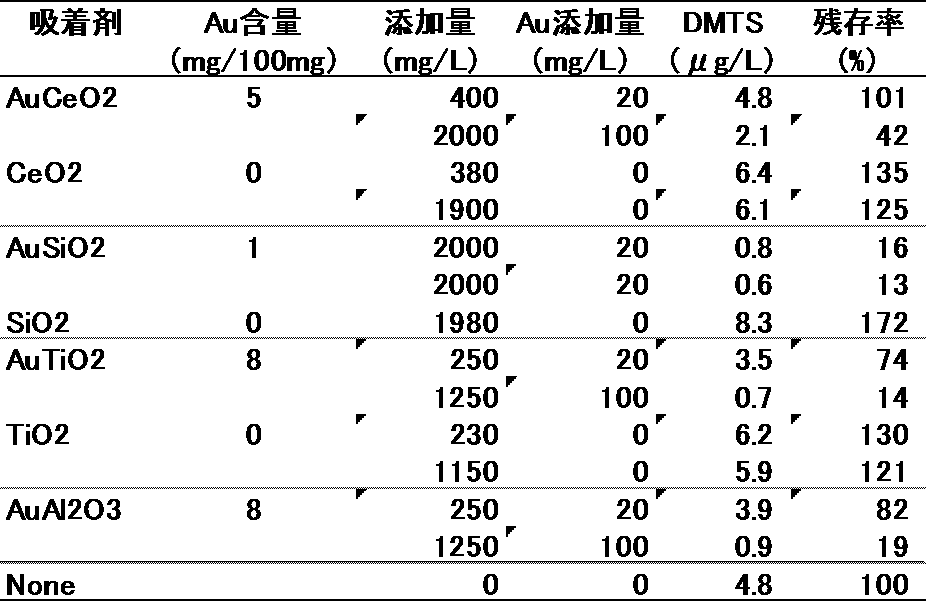
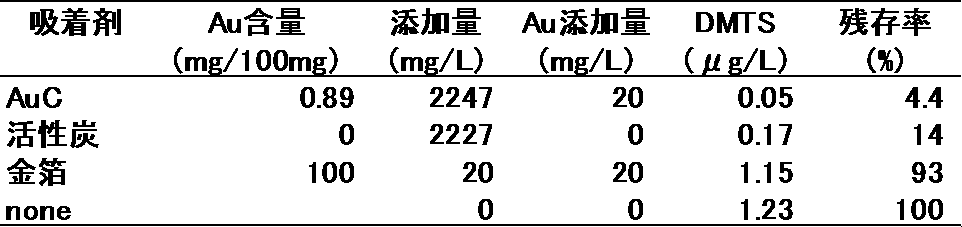
ハルタゴールド社製の金ナノ粒子触媒AuC(ケッチェンブラック担体に金ナノ粒子を担持させたもの)、活性炭、及び金箔についても、上記と同様の方法で吸着剤としての性能を評価した。結果を表4に示す。AuCはDMTS除去効果が非常に大きいが、活性炭のみでも効果があった。金箔には効果がみられなかった。
吸着剤処理が香気成分(吟醸香成分)に及ぼす影響を調べた。結果を表5に示す。AuSiO2は、香気成分をほとんど吸着しなかった。AuCは、酢酸イソアミルとカプロン酸エチルを半分以上吸着してしまった。

6.吸着剤処理した清酒の官能評価
<試験方法>
(1)試料調製
清酒試料は、40℃1か月間貯蔵した清酒に5年前の市販清酒を4:1でブレンドしたものを用いた。この清酒サンプルをR瓶に500mL入れ、金/アミノ酸錯体を用いて調製した金ナノ粒子吸着剤又は活性炭を添加した(表6)。吸着剤処理は室温で約24時間、活性炭処理は室温で約1時間とした。処理後に0.45μmのフィルターで加圧ろ過し、洗浄済みのR瓶に移して官能評価試料とした。同じ清酒試料で、添加物を加えずに0.45μmのフィルターで加圧ろ過したものをコントロールとした。
<試験方法>
(1)試料調製
清酒試料は、40℃1か月間貯蔵した清酒に5年前の市販清酒を4:1でブレンドしたものを用いた。この清酒サンプルをR瓶に500mL入れ、金/アミノ酸錯体を用いて調製した金ナノ粒子吸着剤又は活性炭を添加した(表6)。吸着剤処理は室温で約24時間、活性炭処理は室温で約1時間とした。処理後に0.45μmのフィルターで加圧ろ過し、洗浄済みのR瓶に移して官能評価試料とした。同じ清酒試料で、添加物を加えずに0.45μmのフィルターで加圧ろ過したものをコントロールとした。

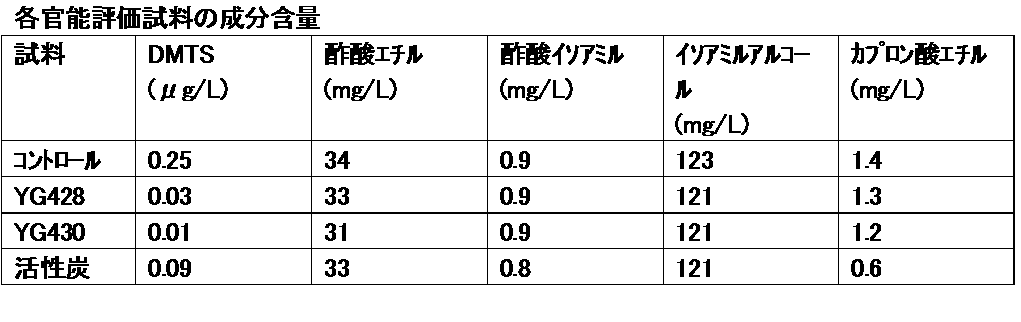
(2)官能評価
清酒官能評価の経験(5年以上)のある酒類総合研究所職員6名をパネルとした。色の影響を排除するため、試料容器はアンバーグラスを用いた。香り4項目、味4項目、及び総合評価の計9項目について、下記の通りに尺度評価を行なった。各項目について、6名の評価結果の平均値を算出し、有意差の有無を調べた。統計解析にはJMP ver.9を用いた。
清酒官能評価の経験(5年以上)のある酒類総合研究所職員6名をパネルとした。色の影響を排除するため、試料容器はアンバーグラスを用いた。香り4項目、味4項目、及び総合評価の計9項目について、下記の通りに尺度評価を行なった。各項目について、6名の評価結果の平均値を算出し、有意差の有無を調べた。統計解析にはJMP ver.9を用いた。
香り:
「吟醸香」、「老香」、「硫化物様」、「甘臭・カラメル様・焦げ」について、ほとんど感じない(0点)~とても強い(4点)の5段階評価
味:
「濃淡」(薄い~濃い)、「甘辛」(辛い~甘い)、「刺激味・きめ」(なめらか~あらい)、「あと味」(もたつく~きれあり)をそれぞれ5段階評価(いずれも-2点~+2点)
総合評価:
すばらしい(1点)~難点あり(5点)の5段階評価
「吟醸香」、「老香」、「硫化物様」、「甘臭・カラメル様・焦げ」について、ほとんど感じない(0点)~とても強い(4点)の5段階評価
味:
「濃淡」(薄い~濃い)、「甘辛」(辛い~甘い)、「刺激味・きめ」(なめらか~あらい)、「あと味」(もたつく~きれあり)をそれぞれ5段階評価(いずれも-2点~+2点)
総合評価:
すばらしい(1点)~難点あり(5点)の5段階評価
結果を図5に示す。老香および硫化物様については、吸着剤および活性炭処理でコントロールに比べて顕著に低減した(p < 0.05)。その他の項目については、試料間で統計的な有意差は見られなかった。総合評価についても統計的な有意差はないものの、吸着剤処理の平均値が最も良かった。
7.吸着剤によるワイン及びジュース中のDMTS除去試験
<方法>
試料調製:
ワイン試料は、市販のワイン(コバヤシワイナリーのドメーヌ シャルドネ)をアルコール度数10%となるように超純水で希釈し、これにDMTSを1.3μg/L添加して調製した。野菜ジュース試料は、市販の野菜ジュース(カゴメの野菜一日これ一本)を超純水で2倍希釈し、これにDMTSを1.3μg/L添加して調製した。
<方法>
試料調製:
ワイン試料は、市販のワイン(コバヤシワイナリーのドメーヌ シャルドネ)をアルコール度数10%となるように超純水で希釈し、これにDMTSを1.3μg/L添加して調製した。野菜ジュース試料は、市販の野菜ジュース(カゴメの野菜一日これ一本)を超純水で2倍希釈し、これにDMTSを1.3μg/L添加して調製した。
吸着剤:TN150およびLV430
製造ロットの異なる2種類のAu/SiO2(Au担持シリカ、Au平均粒径 TN150: 4.6 nm、LV430: 3.3 nm)を用いた。
製造ロットの異なる2種類のAu/SiO2(Au担持シリカ、Au平均粒径 TN150: 4.6 nm、LV430: 3.3 nm)を用いた。
実験手順:
(1) 20mL容ガラスバイアルに試料20mLと吸着剤を入れ、密栓する
(2) 室温(約24℃)で静置(24h)
(3) 遠心分離(2600rpm、10分)
(4) 上清のDMTS濃度を測定(SBSE-GC-MS)
(1) 20mL容ガラスバイアルに試料20mLと吸着剤を入れ、密栓する
(2) 室温(約24℃)で静置(24h)
(3) 遠心分離(2600rpm、10分)
(4) 上清のDMTS濃度を測定(SBSE-GC-MS)
<結果>
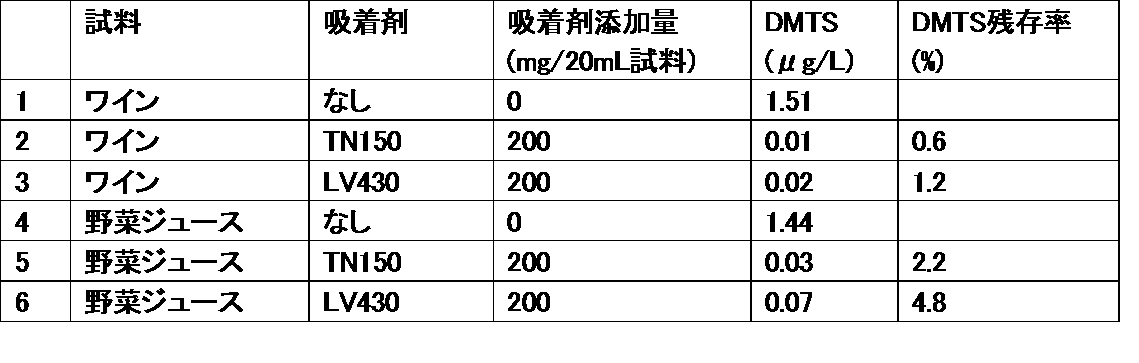
24時間処理後の各試料のDMTS濃度の測定結果を表8に示す。DMTS濃度は、2回の分析における測定値の平均値を示した。いずれも95%以上のDMTSを吸着除去し、0.1μg/L未満までDMTS濃度を低減することができた。
24時間処理後の各試料のDMTS濃度の測定結果を表8に示す。DMTS濃度は、2回の分析における測定値の平均値を示した。いずれも95%以上のDMTSを吸着除去し、0.1μg/L未満までDMTS濃度を低減することができた。
8.吸着剤によるヘキサン中のDMTS除去試験
<方法>
(1) ヘキサンにDMTS及び内部標準としてトリデカンを加える
(2) (1)の溶液をヘキサンで希釈する(DMTS濃度: 6.0 ppm)
(3) (2)の試料4.0 mLにAu/SiO2(300℃, 0.5 h焼成, Au平均粒径5.1 nm)50.0 mgを加える
(4) GCで経時的にDMTS残量を測定する
<方法>
(1) ヘキサンにDMTS及び内部標準としてトリデカンを加える
(2) (1)の溶液をヘキサンで希釈する(DMTS濃度: 6.0 ppm)
(3) (2)の試料4.0 mLにAu/SiO2(300℃, 0.5 h焼成, Au平均粒径5.1 nm)50.0 mgを加える
(4) GCで経時的にDMTS残量を測定する
<結果>
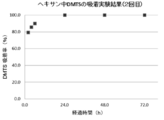
2回の実験の結果を図6-1(1回目)、図6-2(2回目)、及び表9に示す。6時間~24時間でヘキサン中のDMTSを完全に除去できた。これにより、親油性の有機化合物の液体からも後周期遷移金属の微粒子を用いてDMTSを吸着除去できることが確認された。
2回の実験の結果を図6-1(1回目)、図6-2(2回目)、及び表9に示す。6時間~24時間でヘキサン中のDMTSを完全に除去できた。これにより、親油性の有機化合物の液体からも後周期遷移金属の微粒子を用いてDMTSを吸着除去できることが確認された。

Claims (28)
- 後周期遷移金属の微粒子を液体と接触させることを含む、液体中の含硫黄化合物の除去方法。
- 前記微粒子が担体上に担持された形態にある、請求項1記載の方法。
- 前記担体は、ケイ素材料、炭素材料、金属酸化物、粘土、合成又は天然ポリマー、炭酸塩、多孔性配位高分子及び窒化ホウ素からなる群より選択される少なくとも1種である、請求項2記載の方法。
- 前記担体は、活性炭、ベントナイト、活性白土、珪藻土、シリカ、シリカ-アルミナ、アルミノケイ酸塩、キトサン、モンモリロナイト、フィチン酸、寒天、ゼラチン、アルギン酸ナトリウム、カラギナン、微小繊維状セルロース、小麦粉、グルテン、卵白、柿タンニン、タンニン、ポリビニルピロリドン、木材チップ、コラーゲン、パパイン、プロテアーゼ、ペクチナーゼ、ヘミセルラーゼ、エンドウたんぱく、β-グルカナーゼ、及びカゼイン又はカゼインナトリウムからなる群より選択される少なくとも1種である、請求項2記載の方法。
- 前記後周期遷移金属は、金、銀、白金、パラジウム、ルテニウム、ロジウム、オスミウム、イリジウム、鉄、コバルト、ニッケル、銅、及び亜鉛からなる群より選択される少なくとも1種である、請求項1ないし4のいずれか1項に記載の方法。
- 前記微粒子は、平均粒径が50nm以下である、請求項1ないし5のいずれか1項に記載の方法。
- 前記含硫黄化合物がポリスルフィドである、請求項1ないし6のいずれか1項に記載の方法。
- 前記ポリスルフィドがジメチルトリスルフィド又はジメチルジスルフィドである、請求項7記載の方法。
- 前記液体が飲料である、請求項1ないし8のいずれか1項に記載の方法。
- 前記飲料がアルコール飲料である、請求項9記載の方法。
- 前記アルコール飲料が清酒である、請求項10記載の方法。
- 前記液体が有機溶媒又は液体燃料である、請求項1ないし8のいずれか1項に記載の方法。
- 請求項9ないし11のいずれか1項に記載の方法により、飲料中の含硫黄化合物を除去することを含む、飲料の硫化物様のオフフレーバーを低減する方法。
- 請求項11記載の方法により、清酒中のポリスルフィドを除去することを含む、清酒の老香を低減する方法。
- 請求項13記載の方法により硫化物様のオフフレーバーが低減された飲料。
- 前記飲料がアルコール飲料である請求項15記載の飲料。
- 請求項14記載の方法により老香が低減された清酒。
- 後周期遷移金属の微粒子を含む、液体中の含硫黄化合物の吸着剤。
- 前記微粒子が担体上に担持された形態にある、請求項18記載の吸着剤。
- 前記含硫黄化合物がポリスルフィドである、請求項18又は19記載の吸着剤。
- 前記ポリスルフィドがジメチルトリスルフィド又はジメチルジスルフィドである、請求項20記載の吸着剤。
- 前記液体が飲料である、請求項18ないし21のいずれか1項に記載の吸着剤。
- 前記飲料がアルコール飲料である、請求項22記載の吸着剤。
- 前記アルコール飲料が清酒である、請求項23記載の吸着剤。
- 前記液体が有機溶媒又は液体燃料である、請求項18ないし21のいずれか1項に記載の吸着剤。
- 請求項18ないし25のいずれか1項に記載の吸着剤が固定化された液体用容器。
- 請求項22ないし24のいずれか1項に記載の吸着剤が固定化された飲料用容器。
- 後周期遷移金属の微粒子の、液体中の含硫黄化合物を吸着するための使用。
Applications Claiming Priority (2)
| Application Number | Priority Date | Filing Date | Title |
|---|---|---|---|
| JP2015037904 | 2015-02-27 | ||
| JP2015-037904 | 2015-02-27 |
Publications (1)
| Publication Number | Publication Date |
|---|---|
| WO2016136970A1 true WO2016136970A1 (ja) | 2016-09-01 |
Family
ID=56788759
Family Applications (1)
| Application Number | Title | Priority Date | Filing Date |
|---|---|---|---|
| PCT/JP2016/055900 Ceased WO2016136970A1 (ja) | 2015-02-27 | 2016-02-26 | 液体中の含硫黄化合物の除去方法 |
Country Status (2)
| Country | Link |
|---|---|
| JP (1) | JP7036398B2 (ja) |
| WO (1) | WO2016136970A1 (ja) |
Cited By (8)
| Publication number | Priority date | Publication date | Assignee | Title |
|---|---|---|---|---|
| JP2018054618A (ja) * | 2017-10-27 | 2018-04-05 | 月桂冠株式会社 | Dmts発生の予測方法、清酒の劣化予測方法、清酒および清酒の製造方法 |
| JP2020000144A (ja) * | 2018-06-29 | 2020-01-09 | 愛知県 | 清酒の劣化抑制剤、劣化が抑制された清酒及びその製造方法 |
| US20220080382A1 (en) * | 2018-02-26 | 2022-03-17 | Chevron U.S.A. Inc. | Metal nanoparticle-deposited, nitrogen-doped carbon adsorbents for removal of sulfur impurities in fuels |
| WO2022196177A1 (ja) * | 2021-03-16 | 2022-09-22 | 凸版印刷株式会社 | アルコール飲料用容器、及びアルコール飲料入り容器 |
| CN115253623A (zh) * | 2022-08-22 | 2022-11-01 | 哈密市鲁江缘新材料有限公司 | 一种脱硫剂及其制备方法和应用 |
| CN115318446A (zh) * | 2022-08-05 | 2022-11-11 | 中国地质科学院矿产综合利用研究所 | 一种难选低品位镍钴硫化矿浮选药剂制度及其应用 |
| CN117065713A (zh) * | 2023-09-19 | 2023-11-17 | 华东理工大学 | 一种复合氧化铝脱硫吸附剂的制备方法 |
| CN117619393A (zh) * | 2023-11-28 | 2024-03-01 | 安阳金辉环保科技有限公司 | 一种脱硫剂及其制备方法和应用 |
Families Citing this family (5)
| Publication number | Priority date | Publication date | Assignee | Title |
|---|---|---|---|---|
| CN108067193A (zh) * | 2016-11-15 | 2018-05-25 | 辽宁石油化工大学 | 一种以海藻酸钠及聚乙烯醇作为载体的壳聚糖的制备方法 |
| CN108067194A (zh) * | 2016-11-15 | 2018-05-25 | 辽宁石油化工大学 | 一种以海藻酸钠及明胶作为载体的壳聚糖的制备方法 |
| CN110227407B (zh) * | 2018-03-05 | 2022-06-28 | 中国石油化工股份有限公司 | 改性碳化硼氮材料及其制备方法和应用 |
| CN110787773A (zh) * | 2019-09-30 | 2020-02-14 | 南京工业大学 | 一种块状壳聚糖复合改性蒙脱土气凝胶材料的方法 |
| KR102410033B1 (ko) * | 2020-06-30 | 2022-06-15 | 이은영 | 은 금속을 이용한 악취 개선 십자화과 채소 음료 제조 방법 |
Citations (7)
| Publication number | Priority date | Publication date | Assignee | Title |
|---|---|---|---|---|
| JP2002125652A (ja) * | 2000-10-30 | 2002-05-08 | Miura Co Ltd | 飲料の製造方法および精製方法 |
| WO2009113445A1 (ja) * | 2008-03-10 | 2009-09-17 | 独立行政法人産業技術総合研究所 | 液相用吸着脱硫剤 |
| JP2012016321A (ja) * | 2010-07-09 | 2012-01-26 | J Science Nishinihon:Kk | 飲料の悪臭除去装置および悪臭除去方法、蒸留酒の製造方法 |
| JP4908296B2 (ja) * | 2007-04-11 | 2012-04-04 | 山形県 | 清酒の処理方法 |
| JP2014171404A (ja) * | 2013-03-06 | 2014-09-22 | Mitsubishi Gas Chemical Co Inc | アルコール飲料の保存方法 |
| JP2014187910A (ja) * | 2013-03-26 | 2014-10-06 | Toyobo Co Ltd | 芋焼酎を入れる芋焼酎用容器及び芋焼酎の製造方法 |
| JP2014238300A (ja) * | 2013-06-06 | 2014-12-18 | 月桂冠株式会社 | Dmts発生の予測方法、清酒の劣化予測方法、清酒および清酒の製造方法 |
Family Cites Families (5)
| Publication number | Priority date | Publication date | Assignee | Title |
|---|---|---|---|---|
| CN1148164C (zh) * | 1999-08-16 | 2004-05-05 | Pq控股公司 | 降低洋葱或大蒜呼吸气味的硫吸附剂 |
| JP2009178087A (ja) * | 2008-01-30 | 2009-08-13 | Kyoto Univ | 酒類又は発酵調味料の製造方法 |
| WO2009125847A1 (ja) * | 2008-04-11 | 2009-10-15 | 株式会社エルブ | 貴金属担持無機材料及びその製造方法、食品添加剤、並びに食品の製造方法 |
| JP2013169191A (ja) * | 2012-02-22 | 2013-09-02 | National Research Inst Of Brewing | 1,2−ジヒドロキシ−5−メチルスルフィニルペンタン−3−オン生成能が低下した酵母の作出方法 |
| JP6346621B2 (ja) * | 2013-12-25 | 2018-06-20 | 出光興産株式会社 | 酒類用金属担持ゼオライト及び酒類の製造方法 |
-
2016
- 2016-02-26 JP JP2016036069A patent/JP7036398B2/ja active Active
- 2016-02-26 WO PCT/JP2016/055900 patent/WO2016136970A1/ja not_active Ceased
Patent Citations (7)
| Publication number | Priority date | Publication date | Assignee | Title |
|---|---|---|---|---|
| JP2002125652A (ja) * | 2000-10-30 | 2002-05-08 | Miura Co Ltd | 飲料の製造方法および精製方法 |
| JP4908296B2 (ja) * | 2007-04-11 | 2012-04-04 | 山形県 | 清酒の処理方法 |
| WO2009113445A1 (ja) * | 2008-03-10 | 2009-09-17 | 独立行政法人産業技術総合研究所 | 液相用吸着脱硫剤 |
| JP2012016321A (ja) * | 2010-07-09 | 2012-01-26 | J Science Nishinihon:Kk | 飲料の悪臭除去装置および悪臭除去方法、蒸留酒の製造方法 |
| JP2014171404A (ja) * | 2013-03-06 | 2014-09-22 | Mitsubishi Gas Chemical Co Inc | アルコール飲料の保存方法 |
| JP2014187910A (ja) * | 2013-03-26 | 2014-10-06 | Toyobo Co Ltd | 芋焼酎を入れる芋焼酎用容器及び芋焼酎の製造方法 |
| JP2014238300A (ja) * | 2013-06-06 | 2014-12-18 | 月桂冠株式会社 | Dmts発生の予測方法、清酒の劣化予測方法、清酒および清酒の製造方法 |
Cited By (13)
| Publication number | Priority date | Publication date | Assignee | Title |
|---|---|---|---|---|
| JP2018054618A (ja) * | 2017-10-27 | 2018-04-05 | 月桂冠株式会社 | Dmts発生の予測方法、清酒の劣化予測方法、清酒および清酒の製造方法 |
| US20220080382A1 (en) * | 2018-02-26 | 2022-03-17 | Chevron U.S.A. Inc. | Metal nanoparticle-deposited, nitrogen-doped carbon adsorbents for removal of sulfur impurities in fuels |
| US11826721B2 (en) * | 2018-02-26 | 2023-11-28 | Chevron U.S.A. Inc. | Metal nanoparticle-deposited, nitrogen-doped carbon adsorbents for removal of sulfur impurities in fuels |
| JP2020000144A (ja) * | 2018-06-29 | 2020-01-09 | 愛知県 | 清酒の劣化抑制剤、劣化が抑制された清酒及びその製造方法 |
| JP7299573B2 (ja) | 2018-06-29 | 2023-06-28 | 愛知県 | 清酒の劣化抑制剤、劣化が抑制された清酒及びその製造方法 |
| CN117015506A (zh) * | 2021-03-16 | 2023-11-07 | 凸版印刷株式会社 | 酒精饮料用容器以及装有酒精饮料的容器 |
| WO2022196177A1 (ja) * | 2021-03-16 | 2022-09-22 | 凸版印刷株式会社 | アルコール飲料用容器、及びアルコール飲料入り容器 |
| JP2022142292A (ja) * | 2021-03-16 | 2022-09-30 | 凸版印刷株式会社 | アルコール飲料用容器、及びアルコール飲料入り容器 |
| CN115318446A (zh) * | 2022-08-05 | 2022-11-11 | 中国地质科学院矿产综合利用研究所 | 一种难选低品位镍钴硫化矿浮选药剂制度及其应用 |
| CN115318446B (zh) * | 2022-08-05 | 2024-04-12 | 中国地质科学院矿产综合利用研究所 | 一种难选低品位镍钴硫化矿浮选药剂制度及其应用 |
| CN115253623A (zh) * | 2022-08-22 | 2022-11-01 | 哈密市鲁江缘新材料有限公司 | 一种脱硫剂及其制备方法和应用 |
| CN117065713A (zh) * | 2023-09-19 | 2023-11-17 | 华东理工大学 | 一种复合氧化铝脱硫吸附剂的制备方法 |
| CN117619393A (zh) * | 2023-11-28 | 2024-03-01 | 安阳金辉环保科技有限公司 | 一种脱硫剂及其制备方法和应用 |
Also Published As
| Publication number | Publication date |
|---|---|
| JP7036398B2 (ja) | 2022-03-15 |
| JP2016163880A (ja) | 2016-09-08 |
Similar Documents
| Publication | Publication Date | Title |
|---|---|---|
| JP7036398B2 (ja) | 液体中の含硫黄化合物の除去方法 | |
| CN1259842C (zh) | 稳定化的赋香成分及含该成分的食料 | |
| Spagna et al. | Fining treatments of white wines by means of polymeric adjuvants for their stabilization against browning | |
| JP6204067B2 (ja) | カルシウム含有組成物 | |
| US9623401B2 (en) | Exhaust gas purifying catalyst and production method thereof | |
| TW201132297A (en) | Methods for removing heavy metals from aqueous extracts of tobacco | |
| KR100488609B1 (ko) | 양파 및 마늘 입냄새 감소를 위한 황 흡착제 | |
| JP4503244B2 (ja) | 繰り返し使用された食用油の再生に用いるシリカ・マグネシア製剤及びその製造方法 | |
| Kopecka et al. | Adsorption of peptides produced by cyanobacterium Microcystis aeruginosa onto granular activated carbon | |
| TW201527524A (zh) | 去除飲料所含之不要成份之方法及裝置 | |
| WO2017010472A1 (ja) | 臭気低減剤 | |
| JP7285518B2 (ja) | 酸化分解用触媒及びその利用 | |
| JP7005829B2 (ja) | 後周期遷移金属微粒子担持体の製造方法 | |
| Luechinger et al. | Immobilized Complexes of Metals with Amino Acid Ligands− A First Step toward the Development of New Biomimetic Catalysts | |
| KR100476627B1 (ko) | 아로마-함유가스의개질방법 | |
| AU2014222333B2 (en) | Clarification and selective binding of phenolic compounds from liquid foodstuff or beverages using smart polymers | |
| Carvalho et al. | Influence of the presence of NaY zeolite on the activity of horseradish peroxidase in the oxidation of phenol | |
| JP4908296B2 (ja) | 清酒の処理方法 | |
| JP5435578B2 (ja) | ヒスタミン吸着剤およびヒスタミン除去方法 | |
| CN1538874A (zh) | 具有增强活性的掺杂吸附材料 | |
| CN109261118A (zh) | 一种铈、锆双金属改性sba-15脱硫吸附剂的制备方法 | |
| JP4094198B2 (ja) | 臭気の改善された軽質油の製造方法 | |
| JP2012528299A (ja) | 球形吸着炭の吸着試験方法 | |
| RU2173705C1 (ru) | Способ очистки водно-спиртовых растворов | |
| JP6170821B2 (ja) | 固体触媒の製造方法および固体触媒 |
Legal Events
| Date | Code | Title | Description |
|---|---|---|---|
| 121 | Ep: the epo has been informed by wipo that ep was designated in this application |
Ref document number: 16755714 Country of ref document: EP Kind code of ref document: A1 |
|
| NENP | Non-entry into the national phase |
Ref country code: DE |
|
| 122 | Ep: pct application non-entry in european phase |
Ref document number: 16755714 Country of ref document: EP Kind code of ref document: A1 |