WO2016129675A1 - 光学用スチレン系樹脂組成物 - Google Patents
光学用スチレン系樹脂組成物 Download PDFInfo
- Publication number
- WO2016129675A1 WO2016129675A1 PCT/JP2016/054138 JP2016054138W WO2016129675A1 WO 2016129675 A1 WO2016129675 A1 WO 2016129675A1 JP 2016054138 W JP2016054138 W JP 2016054138W WO 2016129675 A1 WO2016129675 A1 WO 2016129675A1
- Authority
- WO
- WIPO (PCT)
- Prior art keywords
- styrene
- meth
- mass
- tert
- content
- Prior art date
- Legal status (The legal status is an assumption and is not a legal conclusion. Google has not performed a legal analysis and makes no representation as to the accuracy of the status listed.)
- Ceased
Links
Classifications
-
- C—CHEMISTRY; METALLURGY
- C08—ORGANIC MACROMOLECULAR COMPOUNDS; THEIR PREPARATION OR CHEMICAL WORKING-UP; COMPOSITIONS BASED THEREON
- C08F—MACROMOLECULAR COMPOUNDS OBTAINED BY REACTIONS ONLY INVOLVING CARBON-TO-CARBON UNSATURATED BONDS
- C08F212/00—Copolymers of compounds having one or more unsaturated aliphatic radicals, each having only one carbon-to-carbon double bond, and at least one being terminated by an aromatic carbocyclic ring
- C08F212/02—Monomers containing only one unsaturated aliphatic radical
- C08F212/04—Monomers containing only one unsaturated aliphatic radical containing one ring
- C08F212/06—Hydrocarbons
- C08F212/08—Styrene
-
- C—CHEMISTRY; METALLURGY
- C08—ORGANIC MACROMOLECULAR COMPOUNDS; THEIR PREPARATION OR CHEMICAL WORKING-UP; COMPOSITIONS BASED THEREON
- C08K—Use of inorganic or non-macromolecular organic substances as compounding ingredients
- C08K5/00—Use of organic ingredients
- C08K5/04—Oxygen-containing compounds
- C08K5/13—Phenols; Phenolates
-
- C—CHEMISTRY; METALLURGY
- C08—ORGANIC MACROMOLECULAR COMPOUNDS; THEIR PREPARATION OR CHEMICAL WORKING-UP; COMPOSITIONS BASED THEREON
- C08K—Use of inorganic or non-macromolecular organic substances as compounding ingredients
- C08K5/00—Use of organic ingredients
- C08K5/49—Phosphorus-containing compounds
-
- C—CHEMISTRY; METALLURGY
- C08—ORGANIC MACROMOLECULAR COMPOUNDS; THEIR PREPARATION OR CHEMICAL WORKING-UP; COMPOSITIONS BASED THEREON
- C08L—COMPOSITIONS OF MACROMOLECULAR COMPOUNDS
- C08L25/00—Compositions of, homopolymers or copolymers of compounds having one or more unsaturated aliphatic radicals, each having only one carbon-to-carbon double bond, and at least one being terminated by an aromatic carbocyclic ring; Compositions of derivatives of such polymers
- C08L25/02—Homopolymers or copolymers of hydrocarbons
- C08L25/04—Homopolymers or copolymers of styrene
- C08L25/08—Copolymers of styrene
- C08L25/14—Copolymers of styrene with unsaturated esters
-
- C—CHEMISTRY; METALLURGY
- C08—ORGANIC MACROMOLECULAR COMPOUNDS; THEIR PREPARATION OR CHEMICAL WORKING-UP; COMPOSITIONS BASED THEREON
- C08L—COMPOSITIONS OF MACROMOLECULAR COMPOUNDS
- C08L33/00—Compositions of homopolymers or copolymers of compounds having one or more unsaturated aliphatic radicals, each having only one carbon-to-carbon double bond, and only one being terminated by only one carboxyl radical, or of salts, anhydrides, esters, amides, imides or nitriles thereof; Compositions of derivatives of such polymers
- C08L33/04—Homopolymers or copolymers of esters
- C08L33/06—Homopolymers or copolymers of esters of esters containing only carbon, hydrogen and oxygen, which oxygen atoms are present only as part of the carboxyl radical
-
- G—PHYSICS
- G02—OPTICS
- G02B—OPTICAL ELEMENTS, SYSTEMS OR APPARATUS
- G02B6/00—Light guides; Structural details of arrangements comprising light guides and other optical elements, e.g. couplings
- G02B6/0001—Light guides; Structural details of arrangements comprising light guides and other optical elements, e.g. couplings specially adapted for lighting devices or systems
- G02B6/0011—Light guides; Structural details of arrangements comprising light guides and other optical elements, e.g. couplings specially adapted for lighting devices or systems the light guides being planar or of plate-like form
-
- C—CHEMISTRY; METALLURGY
- C08—ORGANIC MACROMOLECULAR COMPOUNDS; THEIR PREPARATION OR CHEMICAL WORKING-UP; COMPOSITIONS BASED THEREON
- C08L—COMPOSITIONS OF MACROMOLECULAR COMPOUNDS
- C08L2666/00—Composition of polymers characterized by a further compound in the blend, being organic macromolecular compounds, natural resins, waxes or and bituminous materials, non-macromolecular organic substances, inorganic substances or characterized by their function in the composition
- C08L2666/66—Substances characterised by their function in the composition
- C08L2666/78—Stabilisers against oxidation, heat, light or ozone
Definitions
- the present invention relates to an optical styrenic resin composition excellent in hue and transparency, a molded product thereof, and a light guide plate.
- backlights for liquid crystal display devices: a direct type in which a light source is disposed in front of the display device and an edge light type in which a light source is disposed on a side surface.
- the light guide plate is used for an edge light type backlight and plays a role of guiding light from a light source disposed on a side surface to the front.
- Edge-light type backlights are used in TVs, personal computer monitors, mobile phones, car navigation systems, and other applications where thinness is required. Even in televisions (for example, 32 inches or more), the rate at which edge-light type backlights are used is increasing.
- An acrylic resin typified by PMMA (polymethyl methacrylate) is used for the light guide plate.
- Patent Document 1 has been proposed as a technique for improving water absorption of a styrene-methyl (meth) acrylate copolymer.
- the styrene-methyl (meth) acrylate copolymer has a molded article having a poor hue (yellowish) as compared with PMMA, and when used as a backlight, color unevenness may occur on the surface of the liquid crystal display device. . Therefore, Patent Document 2 has been proposed as a technique for improving the hue of styrene-methyl (meth) acrylate copolymer.
- An object of the present invention is to provide a novel optical styrenic resin composition having good transparency and hue and low water absorption, and a molded product thereof.
- the molded products it can be suitably used particularly for a light guide plate used in a liquid crystal display device or the like.
- the present invention is as follows. (1) a styrene- (meth) acrylate copolymer (A) having 20 to 80% by mass of a styrene monomer unit and 80 to 20% by mass of a (meth) acrylate monomer unit; It consists of a hindered phenol antioxidant (B) and a phosphorus antioxidant (C), and the content of (B) is 0.01 to 0. 0 relative to the total amount of (A) to (C). 3% by mass, the content of (C) is 0.001 to 0.3% by mass, and the styrene- (meth) acrylic acid ester copolymer (A) has a residual polymerization inhibitor content of 10 ppm.
- a styrenic resin composition for optical use wherein (2) The optical styrene resin composition according to (1), wherein the styrene (meth) acrylic acid ester copolymer has a weight average molecular weight of 50,000 to 200,000. (3) The styrene- (meth) acrylic acid ester copolymer (A) contains a styrene monomer containing 0.1 to 20 ppm of 4-tert-butylcatechol, and 6-tert-butyl-2,4.
- optical styrenic resin composition and molded article of the present invention are excellent in transparency and hue, low in water absorption and excellent in warpage resistance and dimensional stability due to moisture absorption, and are therefore suitably used for optical applications such as light guide plates. I can do it.
- a to B means not less than A but not more than B.
- the styrene resin composition of the present invention comprises a styrene- (meth) acrylic acid ester copolymer (A), a hindered phenol antioxidant (B), and a phosphorus antioxidant (C). It is a composition.
- the styrene- (meth) acrylate copolymer (A) is a copolymer having a styrene monomer unit and a (meth) acrylate monomer unit.
- the styrene monomer is an aromatic vinyl monomer. Styrene, ⁇ -methyl styrene, o-methyl styrene, m-methyl styrene, ethyl styrene, pt-butyl styrene and the like are used alone or as a mixture of two or more thereof, and styrene is preferred.
- (Meth) acrylic acid ester monomers are methyl (meth) acrylate, ethyl (meth) acrylate, butyl (meth) acrylate, methacrylic acid ester of 2-ethylhexyl (meth) acrylate, methyl acrylate, ethyl acrylate, n -Butyl acrylate, 2-methylhexyl acrylate, 2-ethylhexyl acrylate, decyl acrylate or the like alone or a mixture of two or more thereof, preferably methyl (meth) acrylate.
- the content of the styrene monomer unit in the styrene- (meth) acrylic acid ester copolymer is 20 to 80% by mass, and the content of the (meth) acrylic acid ester monomer unit is 80 to 20% by mass. is there. More preferably, the content of styrene monomer units is 30 to 60% by mass, and the content of (meth) acrylic acid ester monomer units is 70 to 40% by mass. More preferably, the content of the styrene monomer unit is 45 to 55% by mass, and the content of the (meth) acrylate monomer unit is 55 to 45% by mass.
- the content of the styrene monomer unit is small, warpage and dimensional deformation may increase due to moisture absorption.
- the deterioration of a hue or surface hardness may fall, and it may become easy to be damaged.
- styrene- (meth) acrylic acid ester copolymer those having a small amount of other unit structures can be used.
- the other unit structure is preferably 5% by mass or less.
- Other unit structures include a unit structure derived from a vinyl monomer copolymerizable with a styrene monomer and a (meth) acrylate monomer. Examples of the copolymerizable monomer include acrylonitrile, methacrylic acid, acrylic acid, and maleic anhydride.
- a method for producing a styrene- (meth) acrylic ester copolymer a known method can be employed. For example, it can be produced by bulk polymerization, solution polymerization, suspension polymerization, emulsion polymerization and the like.
- a method for operating the reactor any of a continuous type, a batch type (batch type), and a semibatch type can be applied. In view of quality such as transparency and productivity, bulk polymerization or solution polymerization is preferable, and continuous polymerization is preferable.
- Examples of the bulk polymerization or solution polymerization solvent include alkylbenzenes such as benzene, toluene, ethylbenzene and xylene, ketones such as acetone and methyl ethyl ketone, and aliphatic hydrocarbons such as hexane and cyclohexane.
- alkylbenzenes such as benzene, toluene, ethylbenzene and xylene
- ketones such as acetone and methyl ethyl ketone
- aliphatic hydrocarbons such as hexane and cyclohexane.
- styrene- (meth) acrylic acid ester copolymer As a polymerization method of the styrene- (meth) acrylic acid ester copolymer, a known method can be adopted.
- the radical polymerization method is preferable because it is a simple process and excellent in productivity.
- a polymerization initiator and a chain transfer agent can be used, and the polymerization temperature is preferably in the range of 110 to 170 ° C.
- the conversion rate of the styrene monomer and the (meth) acrylate monomer is 60% or more at the exit of the polymerization step from the viewpoint of productivity. It is preferable to perform polymerization.
- polymerization initiator examples include benzoyl peroxide, t-butylperoxybenzoate, 1,1-di (t-butylperoxy) cyclohexane, 1,1-bis (t-butylperoxy) -3,3,5.
- the addition amount of the polymerization initiator is preferably 0.001 to 0.2% by mass with respect to 100% by mass of the total amount of monomers. More preferably, the content is 0.001 to 0.05% by mass. If the addition amount of the polymerization initiator is too large, the hue may deteriorate.
- chain transfer agent examples include aliphatic mercaptans, aromatic mercaptans, pentaphenylethane, ⁇ -methylstyrene dimer, and terpinolene.
- the addition amount of the chain transfer agent is preferably 0.001 to 0.5% by mass, more preferably 0.005 to 0.2% by mass with respect to 100% by mass in total of the monomers.
- the thermal stability becomes good.
- a devolatilization method for removing volatile components such as unreacted monomers and a solvent used for solution polymerization from the solution after the completion of polymerization of the styrene- (meth) acrylate copolymer a known method can be adopted.
- a vacuum devolatilization tank with a preheater or a vented devolatilization extruder can be used.
- the temperature of the styrene- (meth) acrylic ester copolymer in the devolatilization step is preferably 200 ° C. to 300 ° C., more preferably 220 ° C. to 260 ° C.
- the devolatilized molten styrene- (meth) acrylic acid ester copolymer is transferred to the granulation process and extruded into a strand shape from a porous die for cold cut method, air hot cut method, and underwater hot cut method. Can be processed into a pellet shape.
- Unreacted monomers removed in the devolatilization process and the solvent used for solution polymerization are recovered and purified to remove impurities such as polymerization inhibitors, and then mixed with fresh raw materials for recovery. It is preferable. Since the recovered raw material does not contain a polymerization inhibitor, it is possible to reduce the content of the polymerization inhibitor in the raw material supplied to the polymerization step by using it by mixing it with a fresh raw material.
- the content of the polymerization inhibitor in the raw material supplied to the polymerization step is preferably less than 12 ppm, more preferably less than 9 ppm, even more preferably less than 6 ppm, and most preferably less than 4 ppm.
- the fresh raw material is a raw material newly supplied to the production process of the styrene- (meth) acrylic acid ester copolymer, and is referred to as such in order to distinguish it from the recovered raw material.
- a known method can be adopted as a method for recovering and purifying the unreacted monomer removed in the devolatilization step and the solvent used in the solution polymerization.
- a method in which unreacted monomer and solvent gas removed in the devolatilization step is condensed and liquefied by a condenser and purified by a flash distillation column to separate and remove high-boiling components.
- the high-boiling components are first condensed using a condenser or spray tower, etc., and the remaining gas is completely removed by the condenser.
- the method of condensing is mentioned.
- 4-tert-butylcatechol has a boiling point of 285 ° C.
- 6-tert-butyl-2,4-xylenol has a boiling point of 249 ° C., and is separated and removed from the monomer and solvent as a high-boiling component.
- Boiling point of styrene is 145 ° C
- boiling point of methyl (meth) acrylate is 101 ° C
- boiling point of ethylbenzene is 136 ° C).
- the weight average molecular weight (Mw) of the styrene (meth) acrylic acid ester copolymer is preferably 50,000 to 200,000. More preferably, it is 70,000 to 180,000, more preferably 75,000 to 160,000, and most preferably 80 to 150,000.
- Mw weight average molecular weight
- the weight average molecular weight (Mw) is less than 50,000, the strength of the light guide plate may decrease.
- Mw exceeds 200,000, the fluidity may be lowered and the molding processability may be deteriorated.
- the weight average molecular weight (Mw) can be controlled by the reaction temperature of the polymerization process, the residence time, the type and addition amount of the polymerization initiator, the type and addition amount of the chain transfer agent, the type and amount of the solvent used during the polymerization, and the like. it can.
- the weight average molecular weight (Mw) was measured under the following conditions using gel permeation chromatography (GPC).
- GPC model Shodex GPC-101 manufactured by Showa Denko KK Column: PLgel 10 ⁇ m MIXED-B manufactured by Polymer Laboratories
- Mobile phase Tetrahydrofuran Sample concentration: 0.2% by mass
- Temperature 40 ° C oven, 35 ° C inlet, 35 ° C detector
- Detector Differential refractometer
- the molecular weight of the present invention is calculated as the molecular weight in terms of polystyrene by calculating the molecular weight at each elution time from the elution curve of monodisperse polystyrene.
- the total amount of the residual monomer and the polymerization solvent in the styrene- (meth) acrylic acid ester copolymer is preferably 0.5% by mass or less, and more preferably 0.2% by mass or less. When the total amount of the residual monomer and the polymerization solvent exceeds 0.5% by mass, the heat resistance may be insufficient.
- the residual monomer and polymerization solvent are the amount of monomer and polymerization solvent remaining in the styrene- (meth) acrylic acid ester copolymer, and examples thereof include styrene, methyl (meth) acrylate, and ethylbenzene. .
- the amount of the residual monomer and the polymerization solvent can be adjusted by the constitution of the devolatilization process and the conditions of the devolatilization process.
- the amount of the residual monomer and the polymerization solvent was determined by accurately weighing 0.2 g of a styrene- (meth) acrylate copolymer and dissolving it in 10 ml of tetrahydrofuran containing p-hour ethylbenzene as an internal standard substance.
- Capillary gas chromatograph GC-4000 (manufactured by GL Sciences Inc.) Column: GS Science Co., Ltd.
- InertCap WAX inner diameter 0.25 mm, length 30 m, film thickness 50 ⁇ m
- Injection temperature 180 ° C
- Detector temperature 210 ° C Split ratio: 5/1
- the total amount of dimer or trimer (hereinafter referred to as oligomer) of styrene monomer and (meth) acrylate monomer in the styrene- (meth) acrylate copolymer is 2% by mass. The following is preferable. More preferably, it is 1 mass% or less. When the total amount of oligomers exceeds 1% by mass, heat resistance as a light guide plate may be insufficient.
- the oligomer was measured by dissolving 200 mg of a styrene- (meth) acrylic acid ester copolymer in 2 mL of 1,2-dichloromethane, adding 2 mL of methanol to precipitate the copolymer, allowing it to stand, The liquid was measured under the following conditions using a gas chromatograph.
- Gas chromatograph HP-5890 (manufactured by Hewlett-Packard Company) Column: DB-1 (ht) 0.25 mm ⁇ 30 m, film thickness 0.1 ⁇ m
- Injection temperature 250 ° C
- Detector temperature 300 ° C
- Split ratio 50/1
- Internal reference material n-eicosane Carrier gas: Nitrogen
- the Vicat softening point of the styrene- (meth) acrylic acid ester copolymer is preferably 95 ° C. or higher, and more preferably 98 ° C. or higher. If the Vicat softening point is less than 95 ° C., the heat resistance is insufficient, and the molded product may be deformed depending on the use environment. (The Vicat softening temperature was tested in accordance with JIS K 7206 at a heating rate of 50 ° C./hr and a test load of 50 N.)
- the content of the hindered phenol antioxidant (B) in the styrene resin composition is 0.01 to 0.3% by mass with respect to the total amount of (A) to (C).
- the amount is preferably 0.02 to 0.2% by mass, more preferably 0.03 to 0.15% by mass, and still more preferably 0.04 to 0.1% by mass. If the content of the hindered phenol-based antioxidant (B) is too small, the hue improving effect is not obtained, and if it is too much, the hue may be deteriorated.
- the hindered phenol antioxidant (B) is an antioxidant having a phenolic hydroxyl group in the basic skeleton.
- examples of the hindered phenol antioxidant include octadecyl-3- (3,5-di-t-butyl-4-hydroxyphenyl) propionate, ethylene bis (oxyethylene) bis [3- (5-tert-butyl- 4-hydroxy-m-tolyl) propionate], 3,9-bis [2- [3- (3-tert-butyl-4-hydroxy-5-methylphenyl) propionyloxy] -1,1-dimethylethyl]- 2,4,8,10-tetraoxaspiro [5.5] undecane, pentaerythritol tetrakis [3- (3,5-di-tert-butyl-4-hydroxyphenyl) propionate], 4,6-bis (octyl) Thiomethyl) -o-cresol, 4,6-bis [(dodecylthi
- octadecyl-3- (3,5-di-t-butyl-4-hydroxyphenyl) propionate ethylene bis (oxyethylene) bis [3- (5-tert-butyl-4-hydroxy-m-tolyl) Propionate], pentaerythritol tetrakis [3- (3,5-di-tert-butyl-4-hydroxyphenyl) propionate]. More preferred is octadecyl-3- (3,5-di-t-butyl-4-hydroxyphenyl) propionate.
- Hindered phenolic antioxidants may be used alone or in combination of two or more.
- the content of the phosphorus-based antioxidant (C) in the styrene-based resin composition is 0.001 to 0.3% by mass with respect to the total amount of (A) to (C).
- the content is preferably 0.001 to 0.1% by mass, more preferably 0.001 to 0.05% by mass, and still more preferably 0.001 to 0.02% by mass.
- a hue may deteriorate.
- mold contamination may occur during injection molding or roll contamination may occur during extrusion of a plate-shaped molded product.
- Phosphorous antioxidant (C) is a phosphite that is a trivalent phosphorus compound.
- Phosphorous antioxidants include, for example, 6- [3- (3-t-butyl-4-hydroxy-5-methylphenyl) propoxy] -2,4,8,10-tetra-t-butylbenz [d, f ] [1,3,2] dioxaphosphine, 3,9-bis (2,6-di-tert-butyl-4-methylphenoxy) -2,4,8,10-tetraoxa-3,9- Diphosphaspiro [5.5] undecane, bis (2,4-dicumylphenyl) pentaerythritol diphosphite, 2,2′-methylenebis (4,6-di-tert-butyl-1-phenyloxy) (2-ethylhexyl) Oxy) phosphorus, tris (2,4-di-tert-butylphenyl) phosphite
- the total ⁇ (B) + (C) ⁇ of the content of the hindered phenolic antioxidant (B) and the content of the phosphorus antioxidant (C) in the styrene resin composition is (A) to ( It is 0.011 to 0.6% by mass relative to the total amount of C).
- the content is preferably 0.021 to 0.25% by mass, more preferably 0.031 to 0.2% by mass, and still more preferably 0.041 to 0.12% by mass. If the total amount of the content of the hindered phenolic antioxidant (B) and the content of the phosphorus antioxidant (C) ⁇ (B) + (C) ⁇ is too small, there will be no effect of improving the hue. Hue may deteriorate.
- a method for producing a styrene resin composition from a styrene- (meth) acrylic acid ester copolymer (A), a hindered phenol antioxidant (B) and a phosphorus antioxidant (C) is known.
- the method can be adopted.
- a styrene- (meth) acrylic acid ester copolymer is used in the production step (A) such as polymerization step, devolatilization step, granulation step, etc. in the hindered phenolic antioxidant (B) and phosphorus antioxidant ( There is a method of adding C), which is preferably added after the unreacted monomer and solvent are removed in the devolatilization step.
- a hindered phenol antioxidant (B) and a phosphorus antioxidant (C) in a molten state are added to a styrene- (meth) acrylate ester copolymer extracted from the devolatilization tank.
- a static mixer or when using a vented devolatilizing extruder, add a hindered phenolic antioxidant (B) and a phosphorus antioxidant (C) after the venting zone.
- it can be added directly at the time of molding the styrene- (meth) acrylic acid ester copolymer (A), or it can be added by preparing a master batch.
- the styrene resin composition may contain mineral oil as long as the transparency is not impaired. Also includes additives such as internal lubricants such as stearic acid and ethylene bisstearylamide, sulfur antioxidants, lactone antioxidants, UV absorbers, hindered amine stabilizers, antistatic agents, external lubricants, etc. It may be. As the external lubricant, ethylene bisstearylamide is suitable.
- the ultraviolet absorber has a function of suppressing deterioration and coloring due to ultraviolet rays.
- benzophenone, benzotriazole, triazine, benzoate, salicylate, cyanoacrylate, malonic ester, formamidine UV absorbers such as those of the system.
- a light stabilizer such as a hindered amine may be used in combination.
- the polymerization inhibitor is added to the monomer in order to prevent unintended polymerization from occurring during storage of the monomer.
- the polymerization inhibitor include catechols such as 4-tert-butylcatechol, phenols such as 6-tert-butyl-2,4-xylenol and paramethoxyphenol, hydroquinone, 2,2,6,6, and the like. -Tetramethylpiperidinyl-1-oxyl, 4-hydroxy-2,2,6,6-tetramethylpiperidinyl-1-oxyl and the like.
- the content of the polymerization inhibitor remaining in the styrene- (meth) acrylic acid ester copolymer is preferably less than 10 ppm, more preferably less than 5 ppm, and even more preferably less than 3 ppm.
- the polymerization inhibitor includes a styrene monomer used for copolymerization of a styrene- (meth) acrylate ester copolymer, 4-tert-butylcatechol derived from a (meth) acrylate ester monomer, and 6- tert-butyl-2,4-xylenol and the like.
- the content of 6-tert-butyl-2,4-xylenol remaining in the styrene- (meth) acrylic acid ester copolymer is preferably less than 4 ppm, more preferably less than 2 ppm. If the content of the polymerization inhibitor is too large, the polymerization inhibitor itself may be modified during the polymerization reaction or molding process, becoming a colored substance and deteriorating transparency and hue.
- the content of the polymerization inhibitor remaining in the copolymer can be controlled by the content of the polymerization inhibitor in the monomer used for the copolymerization. Also, in continuous bulk polymerization or solution polymerization, the content of the polymerization inhibitor remaining in the copolymer is efficiently reduced by reusing the recovered and purified unreacted monomer. can do.
- the 4-tert-butylcatechol concentration and 6-tert-butyl-2,4-xylenol concentration in the styrene- (meth) acrylic acid ester copolymer were first dissolved in tetrahydrofuran (adjusted to 50 mg / ml). ) After that, trimethylsilyl derivatization treatment was performed using BSTFA (N, O-bis (trimethylsilyl) trifluoroacetamide), and the supernatant separated by centrifugation was analyzed by gas chromatography mass spectrometry (GC / MS). The measurement was performed under the following conditions. A calibration curve prepared in advance was used to determine the concentration.
- GC / MS measurement conditions GC device: Agilent 6890 Column: DB-1 (0.25 mm id x 30 m) Liquid phase thickness 0.25mm Column temperature: 40 ° C. (5 min hold) ⁇ (20 ° C./min temperature increase) ⁇ 320 ° C (6 min hold) 25 min total Inlet temperature: 320 ° C Injection method: Split method (split ratio 1: 5) Sample volume: 2 ⁇ l MS equipment: Agilent MSD5973 Ion source temperature: 230 ° C Interface temperature: 320 ° C Ionization method: Electron ionization (EI) method Measurement method: SCAN method (scan range m / z 10 to 800)
- the styrenic monomer preferably contains 0.1 to 20 ppm of 4-tert-butylcatechol as a polymerization inhibitor, more preferably 0.1 to 12 ppm, and even more preferably 0.1 to 7 ppm. It is.
- concentration of 4-tert-butylcatechol in the styrene monomer exceeds 20 ppm, the 4-tert-butylcatechol itself is modified and becomes a colored substance. Therefore, a styrene- (meth) acrylate ester copolymer Transparency and hue may deteriorate.
- the (meth) acrylic acid ester monomer preferably contains 0.1 to 20 ppm, more preferably 0.1 to 12 ppm of 6-tert-butyl-2,4-xylenol as a polymerization inhibitor. More preferably, it is 0.1 to 7 ppm.
- concentration of 6-tert-butyl-2,4-xylenol in the (meth) acrylic acid ester monomer exceeds 20 ppm, 6-tert-butyl-2,4-xylenol itself is denatured, Therefore, the transparency and hue of the styrene- (meth) acrylic acid ester copolymer may be deteriorated.
- the polymerization inhibitor of styrene monomer or (meth) acrylic acid ester monomer can be removed or reduced by adsorption removal with activated alumina.
- the 4-tert-butylcatechol in the styrene monomer and the 6-tert-butyl-2,4-xylenol concentration in the (meth) acrylic acid ester monomer were first set to 50 mg / ml for each monomer. After being mixed with tetrahydrofuran so as to be, trimethylsilyl derivatization treatment was performed using BSTFA (N, O-bis (trimethylsilyl) trifluoroacetamide), and gas chromatography / mass spectrometry (GC / MS) was used. It measured on the same conditions as the measurement of a (meth) acrylic acid ester-type copolymer. A calibration curve prepared in advance was used to determine the concentration.
- the styrene resin composition can be formed into a molded product by a known method such as extrusion molding, injection molding, compression molding, or blow molding.
- a plate-shaped molded product can be produced by extrusion molding and processed into a light guide plate or the like.
- the styrenic resin composition of the present invention is excellent in thermal stability, it collects and grinds unfinished parts such as sheet end materials during extrusion molding and spools and runners during injection molding, and mixes them with virgin raw materials. Can be used.
- the light guide plate is a member having a function of guiding light incident from the end face of the plate-shaped molded product to the surface side of the plate-shaped molded product by a reflection pattern formed on one surface of the plate-shaped molded product and emitting light.
- the reflection pattern can be formed by a method such as a screen printing method, a laser processing method, or an ink jet method.
- a prism pattern or the like can be provided on the opposite surface (light emitting surface) of the surface on which the reflection pattern is formed.
- the reflection pattern and prism pattern of the plate-shaped molded product can be formed when the plate-shaped molded product is molded. For example, it can be formed by a mold shape in injection molding, or by roll transfer in extrusion molding.
- Optical use refers to use in products in which components include light sources such as LEDs, fluorescent lamps, and incandescent lamps.
- components include light sources such as LEDs, fluorescent lamps, and incandescent lamps.
- Examples of the product include a television, a desktop personal computer, a notebook personal computer, a mobile phone, a car navigation, indoor lighting, and the like.
- the optical styrene resin composition preferably has an average value of spectral transmittance at a wavelength of 350 nm to 800 nm measured at an optical path length of 115 mm of 87.0% or more, more preferably 87.5% or more, More preferably, it is 88.0% or more, and most preferably 88.5% or more.
- the YI value measured in accordance with JIS K7105 at a visual field of 2 ° with a C light source is 3.5 or less, more preferably 3.0 or less, and even more preferably 2.5 or less. And most preferably 2.0 or less.
- styrene- (meth) acrylic ester copolymer A-1 The styrene- (meth) acrylic acid ester copolymer was produced by continuous solution polymerization by a radical polymerization method. A complete mixing tank type stirring tank was used as the first reactor, a plug flow type reactor with a static mixer was used as the second reactor, and the polymerization process was configured by connecting in series. The capacity of the first reactor was 30L, and the capacity of the second reactor was 12L.
- fresh MMA 6-tert-butyl-2,4-xylenol
- fresh MMA 6-tert-butyl-2,4-xylenol
- TBX concentration of (referred to as TBX) was 4.9 ppm.
- Resh Sty concentration of 4-tert-butylcatechol (hereinafter referred to as “TBC”) was 10.2 ppm.
- fresh EB industrially used ethylbenzene
- gases such as a monomer and a polymerization solvent separated from a vacuum devolatilizer described later were condensed by a condenser and purified by a flash distillation column as a recovered raw material.
- concentrations of TBX and TBC in the recovered raw material were below the lower limit of detection.
- fresh MMA, fresh Sty and the recovered raw material a raw material solution was prepared so as to have the raw material composition shown in Table 1, and continuously supplied to the polymerization step at a feed flow rate shown in Table 1.
- the use ratio of the recovered raw materials is as shown in Table 1, and is balanced with the amount separated and purified in the devolatilization tank.
- t-butylperoxyisopropyl monocarbonate as a polymerization initiator was continuously added to the raw material solution supply line to a concentration of 150 ppm and n-dodecyl mercaptan as a chain transfer agent to a concentration of 500 ppm. .
- the temperature of the first reactor was adjusted to 135 ° C.
- the second reactor was adjusted to have a temperature gradient along the flow direction and adjusted to 130 ° C. at the middle portion and 145 ° C. at the outlet portion.
- the polymer concentration at the outlet of the polymerization process was 65%, and the conversion ratio of methyl (meth) acrylate and styrene was 72%.
- the polymer solution continuously taken out from the reactor was supplied to a vacuum devolatilization tank equipped with a preheater to separate unreacted methyl (meth) acrylate, styrene, ethylbenzene and the like.
- the temperature of the preheater was adjusted so that the polymer temperature in the devolatilization tank was 240 ° C., and the pressure in the devolatilization tank was 1 kPa.
- the polymer was extracted from the vacuum devolatilization tank using a gear pump, extruded into a strand, cooled with cooling water, and then cut to obtain a pellet-shaped styrene- (meth) acrylate copolymer A-1.
- Table 1 shows the composition of A-1 and the content of the polymerization inhibitor.
- Sty is an abbreviation for styrene, MMA for methyl (meth) acrylate, and EB for ethylbenzene.
- the weight average molecular weight of A-1 was 145,000, the total amount of residual monomer and polymerization solvent was 0.07% by mass, and the total amount of residual oligomer was 0.35% by mass.
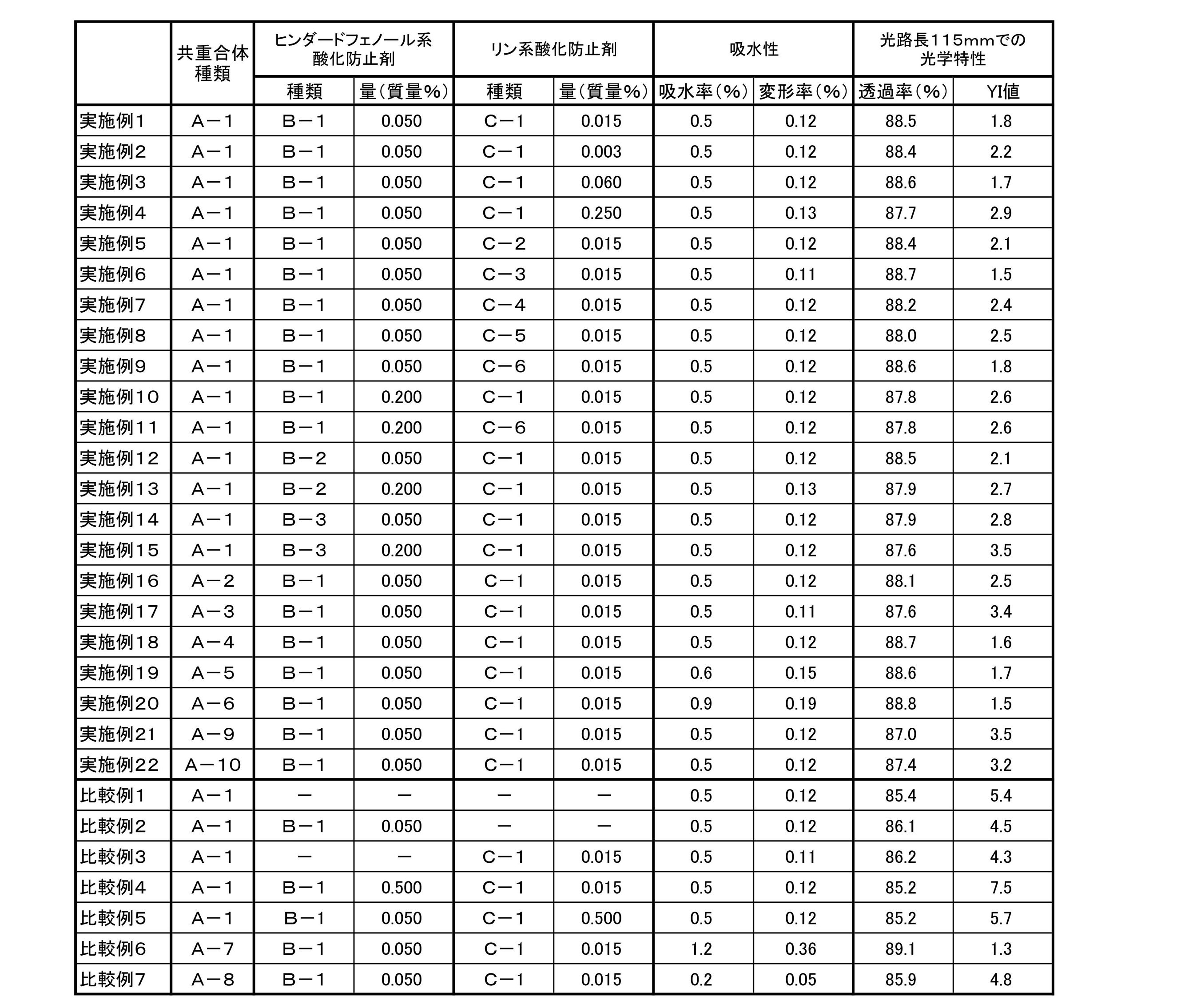
- Examples 1 to 22 and Comparative Examples 1 to 7> The hindered phenolic antioxidants (B-1) to (B-3) and phosphorus antioxidants (C-1) shown below are added to the styrene-methyl (meth) acrylate copolymers obtained in the production examples.
- (C-6) was mixed at the content shown in Table 2, and a sheet molded product of 450 mm ⁇ 500 mm ⁇ 2 mm was obtained while melt-kneading the antioxidant using a sheet extruder manufactured by LEADER.
- the sheet extruder was composed of a 50 mm ⁇ single-screw extruder, a T die, and three mirror rolls, and sheet extrusion was performed at a cylinder temperature of 225 ° C.
- Spectral transmittances from 350 nm to 800 nm were measured, and the YI value at a visual field of 2 ° with a C light source was calculated according to JIS K7105.
- the transmittance shown in Table 1 indicates an average transmittance at a wavelength of 380 nm to 780 nm.
- Table 2 shows the evaluation results.
- the styrene- (meth) acrylic acid ester copolymer and the styrene resin composition of the present invention and the molded product thereof have low water absorption and excellent transparency and hue in a long optical path.
- televisions, desktop personal computers It can be suitably used for light guide plate applications such as notebook personal computers, mobile phones, car navigation systems, and indoor lighting.
Landscapes
- Chemical & Material Sciences (AREA)
- Health & Medical Sciences (AREA)
- Chemical Kinetics & Catalysis (AREA)
- Medicinal Chemistry (AREA)
- Polymers & Plastics (AREA)
- Organic Chemistry (AREA)
- Physics & Mathematics (AREA)
- General Physics & Mathematics (AREA)
- Optics & Photonics (AREA)
- Compositions Of Macromolecular Compounds (AREA)
- Addition Polymer Or Copolymer, Post-Treatments, Or Chemical Modifications (AREA)
Abstract
Description
導光板にはPMMA(ポリメチルメタクリレート)に代表されるアクリル系樹脂が使用されているが、吸水性が高い為、成形品に反りや寸法変化が生じる場合がある。また、成形時の熱分解性が高いため、高温で成形する場合、成形体に外観不良が生じやすいという問題がる。
そのため、これら特性を改善したスチレン-(メタ)アクリル酸メチル共重合体を用いることが提案されている。スチレン-(メタ)アクリル酸メチル共重合体の、吸水性の改良技術としては特許文献1が提案されている。
一方で、スチレン-(メタ)アクリル酸メチル共重合体は成形体の色相がPMMAと比較して悪く(黄色く)、バックライトとして使用した場合、液晶表示装置の面において色むらを生じる場合がある。そのため、スチレン-(メタ)アクリル酸メチル共重合体の色相改善技術として特許文献2が提案されている。
(1)スチレン系単量体単位20~80質量%及び(メタ)アクリル酸エステル系単量体単位80~20質量%を有するスチレン-(メタ)アクリル酸エステル系共重合体(A)と、ヒンダードフェノール系酸化防止剤(B)と、リン系酸化防止剤(C)からなり、(A)~(C)の合計量に対して、(B)の含有量が0.01~0.3質量%、(C)の含有量が0.001~0.3質量%であり、スチレン-(メタ)アクリル酸エステル系共重合体(A)は、残存する重合禁止剤の含有量が10ppm未満であることを特徴とする光学用スチレン系樹脂組成物。
(2)スチレン(メタ)アクリル酸エステル系共重合体の重量平均分子量は、5万~20万である(1)に記載の光学用スチレン系樹脂組成物。
(3)スチレン-(メタ)アクリル酸エステル系共重合体(A)が、4-tert-ブチルカテコールを0.1~20ppm含有するスチレン系単量体と、6-tert-ブチル-2,4-キシレノールを0.1~20ppm含有する(メタ)アクリル酸エステル系単量体とを共重合して得られたものであることを特徴とする(1)又は(2)に記載の光学用スチレン系樹脂組成物。
(4)(1)~(3)のいずれかに記載のスチレン系樹脂組成物からなる成形品。
(5)(4)に記載の成形品からなる導光板。
熱分解炉:PYR-2A(株式会社島津製作所製)
熱分解炉温度設定:525℃
ガスクロマトグラフ:GC-14A(株式会社島津製作所製)
カラム:ガラス製3mm径×3m
充填剤:FFAP Chromsorb WAW 10%
カラム温度:120℃
キャリアーガス:窒素
GPC機種:昭和電工株式会社製Shodex GPC-101
カラム:ポリマーラボラトリーズ社製 PLgel 10μm MIXED-B
移動相:テトラヒドロフラン
試料濃度:0.2質量%
温度:オーブン40℃、注入口35℃、検出器35℃
検出器:示差屈折計
本発明の分子量は単分散ポリスチレンの溶出曲線より各溶出時間における分子量を算出し、ポリスチレン換算の分子量として算出したものである。
キャピラリーガスクロマトグラフ:GC-4000(ジーエルサイエンス株式会社製)
カラム:ジーエスサイエンス株式会社製 InertCap WAX、内径 0.25mm、長さ 30m、膜厚 50μm
インジェクション温度:180℃
カラム温度:60℃~170℃
ディテクター温度:210℃
スプリット比:5/1
ガスクロマトグラフ:HP-5890(ヒューレットパッカード社製)
カラム:DB-1(ht) 0.25mm×30m 膜厚0.1μm
インジェクション温度:250℃
カラム温度:100-300℃
検出器温度:300℃
スプリット比:50/1
内部標準物質:n-エイコサン
キャリアーガス:窒素
GC/MS測定条件:
GC装置 :Agilent 6890
カラム :DB-1(0.25mm i.d.×30m)
液相厚0.25mm
カラム温度 :40℃(5min保持)→(20℃/min昇温)→
320℃(6min保持) 計25min
注入口温度 :320℃
注入法 :スプリット法(スプリット比1:5)
試料量 :2μl
MS装置 :Agilent MSD5973
イオン源温度 :230℃
インターフェイス温度:320℃
イオン化法 :電子イオン化(EI)法
測定法 :SCAN法(スキャンレンジm/z 10~800)
スチレン-(メタ)アクリル酸エステル系共重合体は、ラジカル重合法にて、連続式の溶液重合で製造した。第1反応器として完全混合槽型撹拌槽を使用し、第2反応器として静的混合器付プラグフロー型反応器を使用し、直列に接続して重合工程を構成した。第1反応器の容量は30L、第2反応器の容量は12Lとした。(メタ)アクリル酸エステル系単量体として、工業的に使用されるメチル(メタ)アクリレート(以下、フレッシュMMAと称する)を準備したところ、6-tert-ブチル-2,4-キシレノール(以下、TBXと称する)の濃度は4.9ppmであった。スチレン系単量体として、工業的に使用されるスチレン(以下、フレッシュStyと称する)を準備したところ、4-tert-ブチルカテコール(以下、TBCと称する)の濃度は10.2ppmであった。重合溶媒として、工業的に使用されるエチルベンゼン(以下、フレッシュEBと称する)を準備した。また、後述する真空脱揮槽より分離した単量体及び重合溶媒等のガスはコンデンサーで凝縮し、フラッシュ蒸留塔で精製したものを回収原料として使用した。回収原料中のTBX及びTBCは検出下限以下の濃度であった。フレッシュMMA、フレッシュSty及び回収原料を用い、表1の原料組成になるよう原料溶液を作成し、重合工程に表1に示すフィード流量で連続的に供給した。回収原料の使用割合は表1に示す通りで、脱揮槽で分離され、精製された量とバランスしている。また、原料溶液に対して、重合開始剤としてt-ブチルパーオキシイソプロピルモノカーボネートを150ppm、連鎖移動剤としてn-ドデシルメルカプタンを500ppmの濃度となるよう、原料溶液の供給ラインに連続的に添加した。第1反応器の温度は135℃となるよう調整し、第2反応器では流れの方向に沿って温度勾配をつけ、中間部分で130℃、出口部分で145℃となるよう調整した。重合工程出口でのポリマー濃度は65%で、メチル(メタ)アクリレートとスチレンの転化率は72%であった。反応器から連続的に取り出されたポリマー溶液は、予熱器付き真空脱揮槽に供給され、未反応のメチル(メタ)アクリレート及びスチレン、エチルベンゼン等を分離した。脱揮槽内のポリマー温度が240℃となるように予熱器の温度を調整し、脱揮槽内の圧力は1kPaとした。ギヤーポンプにより真空脱揮槽からポリマーを抜出し、ストランド状に押出して冷却水にて冷却後、切断してペレット状のスチレン-(メタ)アクリル酸エステル系共重合体A-1を得た。A-1の組成と重合禁止剤の含有量を表1に示す。表1においてStyはスチレン、MMAはメチル(メタ)アクリレート、EBはエチルベンゼンを示す略号である。また、A-1の重量平均分子量は14.5万で、残存単量体及び重合溶媒の合計量は0.07質量%、残存オリゴマーの合計量は0.35質量%であった。
工業的に使用されるフレッシュMMAとして、TBXの濃度が11.2ppmであるものを用いた以外はA-1と同様に実施した。A-2の組成と重合禁止剤の含有量を表1に示す。また、A-2の重量平均分子量は14.5万で、残存単量体及び重合溶媒の合計量は0.07質量%、残存オリゴマーの合計量は0.36質量%であった。
回収原料を使用しなかったこと以外はA-1と同様に実施した。A-3の組成と重合禁止剤の含有量を表1に示す。また、A-3の重量平均分子量は14.5万で、残存単量体及び重合溶媒の合計量は0.06質量%、残存オリゴマーの合計量は0.35質量%であった。
フレッシュMMA及びフレッシュStyに活性アルミナを添加し、TBX及びTBC濃度をそれぞれ0.1ppm未満としたこと以外はA-1と同様に実施した。A-4の組成と重合禁止剤の含有量を表1に示す。また、A-4の重量平均分子量は14.5万で、残存単量体及び重合溶媒の合計量は0.07質量%、残存オリゴマーの合計量は0.36質量%であった。
原料組成を表1の内容に変更し、n-ドデシルメルカプタンの濃度を1000ppmとした以外は、A-1と同様に実施した。A-5の組成と重合禁止剤の含有量を表1に示す。また、A-5の重量平均分子量は12万で、残存単量体及び重合溶媒の合計量は0.06質量%、残存オリゴマーの合計量は0.34質量%であった。
原料組成を表1の内容に変更し、フィード流量を5.7kg/hとし、t-ブチルパーオキシイソプロピルモノカーボネートの濃度を100ppm、n-ドデシルメルカプタンの濃度を3000ppmとし、第1反応器の温度を130℃とした以外は、A-1と同様に実施した。A-6の組成と重合禁止剤の含有量を表1に示す。また、A-6の重量平均分子量は8万で、残存単量体及び重合溶媒の合計量は0.05質量%、残存オリゴマーの合計量は0.32質量%であった。
原料組成を表1の内容に変更し、フィード流量を5.7kg/hとし、t-ブチルパーオキシイソプロピルモノカーボネートの濃度を100ppm、n-ドデシルメルカプタンの濃度を3000ppmとし、第1反応器の温度を122℃とし、第2反応器の中間部分の温度を140℃、出口部分の温度を150℃とした以外は、A-1と同様に実施した。A-7の組成と重合禁止剤の含有量を表1に示す。また、A-7の重量平均分子量は8万で、残存単量体及び重合溶媒の合計量は0.06質量%、残存オリゴマーの合計量は0.34質量%であった。
原料組成を表1の内容に変更し、n-ドデシルメルカプタンの添加を停止し、第1反応器の温度を140℃とし、第2反応器の中間部分の温度を140℃、出口部分の温度を160℃とした以外は、A-1と同様に実施した。A-8の組成と重合禁止剤の含有量を表1に示す。また、A-8の重量平均分子量は24万で、残存単量体及び重合溶媒の合計量は0.06質量%、残存オリゴマーの合計量は0.33質量%であった。
工業的に使用される、フレッシュMMAとしてTBXの濃度が13.6ppmであるもの、フレッシュStyとてTBCの濃度が12.2ppmであるものを用いた以外は回収原料を使用しなかったこと以外はA-1と同様に実施した。A-9の組成と重合禁止剤の含有量を表1に示す。また、A-9の重量平均分子量は14.5万で、残存単量体及び重合溶媒の合計量は0.06質量%、残存オリゴマーの合計量は0.35質量%であった。
連鎖移動剤としてn-ドデシルメルカプタンを450ppmの濃度となるよう、原料溶液の供給ラインに連続的に添加したこと以外はA-1と同様に実施した。A-10の組成と重合禁止剤の含有量を表1に示す。また、A-10の重量平均分子量は15万で、残存単量体及び重合溶媒の合計量は0.06質量%、残存オリゴマーの合計量は0.36質量%であった。

製造例で得られたスチレン-メチル(メタ)アクリレート共重合体に以下に示すヒンダードフェノール系酸化防止剤(B-1)~(B-3)及びリン系酸化防止剤(C-1)~(C-6)を表2に示す含有量にて混合し、LEADER社製シート押出機を用いて酸化防止剤を溶融混錬しつつ、450mm×500mm×2mmのシート成形品を得た。シート押出機は、50mmφ単軸押出機とTダイ、鏡面ロール3本より構成され、単軸押出機のシリンダー温度225℃、スクリュー回転数120rpmでシート押出を行った。Tダイの幅は450mm、開度は3mmとした。
(B-1)オクタデシル-3-(3,5-ジ-tert-ブチル-4-ヒドロキシフェニル)プロピオネート (BASFジャパン株式会社製 Irganox 1076)
(B-2)エチレンビス(オキシエチレン)ビス〔3-(5-tert-ブチル-4-ヒドロキシ-m-トリル)プロピオネート〕 (BASFジャパン株式会社製 Irganox 245)
(B-3)ペンタエリスリトールテトラキス[3-(3,5-ジ-tert-ブチル-4-ヒドロキシフェニル)プロピオネート] (BASFジャパン株式会社製 Irganox 1010)
(C-1)6-[3-(3-tert-ブチル-4-ヒドロキシ-5-メチルフェニル)プロポキシ]-2,4,8,10-テトラ-tert-ブチルジベンゾ[d,f][1,3,2]ジオキサホスフェピン (住友化学株式会社製 Sumilizer GP)
(C-2)トリス(2,4-ジ-tert-ブチルフェニル)フォスファイト (BASFジャパン株式会社製 Irgafos 168)
(C-3)ビス(2,4-ジクミルフェニル)ペンタエリスリトールジホスファイト (Dover Chemical Corporation製 Doverphos S-9228)
(C-4)3,9-ビス(2,6-ジ-tert-ブチル-4-メチルフェノキシ)-2,4,8,10-テトラオキサ-3,9-ジホスファスピロ[5,5]ウンデカン (株式会社ADEKA製 アデカスタブ PEP-36)
(C-5)2,2'-メチレンビス(4,6-ジ-tert-ブチル-1-フェニルオキシ)(2-エチルヘキシルオキシ)ホスホラス (株式会社ADEKA製 アデカスタブ HP-10)
(C-6)ビス(2,4-ジ-tert-ブチルフェニル)ペンタエリスリトールジホスファイト (ソンウォンインターナショナルジャパン株式会社製 Songnox 6260)
得られたシート成形品を切削し、200mm × 300mmサイズの成形品を得た。この成形品を温度60℃、湿度90%の条件で500時間保管し、保管前後での質量及び長辺の寸法変化を測定し、吸水性の指標として、下記式により吸水率及び変形率を計算した。
(吸水率)=((保管後の質量)-(保管前の質量))÷(保管前の質量)× 100(%)
(変形率)=((保管後の長辺長さ)-(保管前の長辺長さ))÷(保管前の長辺長さ)× 100(%)
表2に評価結果を示した。
得られたシート成形品より115mm×85mm×2mm厚みの試験片を切り出し、端面をバフ研磨により研磨し、端面に鏡面を有する板状成形品を作成した。研磨後の板状成形品について、日本分光株式会社製の紫外線可視分光光度計V-670を用いて、大きさ20×1.6mm、広がり角度0°の入射光において、光路長115mmでの波長350nm~800nmの分光透過率を測定し、C光源における視野2°でのYI値をJIS K7105に倣い算出した。表1に示す透過率とは波長380nm~780nmの平均透過率を示す。表2に評価結果を示した。
Claims (5)
- スチレン系単量体単位20~80質量%及び(メタ)アクリル酸エステル系単量体単位80~20質量%を有するスチレン-(メタ)アクリル酸エステル系共重合体(A)と、ヒンダードフェノール系酸化防止剤(B)と、リン系酸化防止剤(C)からなり、(A)~(C)の合計量に対して、(B)の含有量が0.01~0.3質量%、(C)の含有量が0.001~0.3質量%であり、スチレン-(メタ)アクリル酸エステル系共重合体(A)は、残存する重合禁止剤の含有量が10ppm未満であることを特徴とする光学用スチレン系樹脂組成物。
- スチレン(メタ)アクリル酸エステル系共重合体の重量平均分子量は、5万~20万である請求項1に記載の光学用スチレン系樹脂組成物。
- スチレン-(メタ)アクリル酸エステル系共重合体(A)が、4-tert-ブチルカテコールを0.1~20ppm含有するスチレン系単量体と、6-tert-ブチル-2,4-キシレノールを0.1~20ppm含有する(メタ)アクリル酸エステル系単量体とを共重合して得られたものであることを特徴とする請求項1又は2に記載の光学用スチレン系樹脂組成物。
- 請求項1~3のいずれか1項に記載のスチレン系樹脂組成物からなる成形品。
- 請求項4に記載の成形品からなる導光板。
Priority Applications (3)
| Application Number | Priority Date | Filing Date | Title |
|---|---|---|---|
| CN201680010023.8A CN107250255B (zh) | 2015-02-12 | 2016-02-12 | 光学用苯乙烯系树脂组合物 |
| KR1020177024901A KR102457996B1 (ko) | 2015-02-12 | 2016-02-12 | 광학용 스티렌계 수지 조성물 |
| JP2016574860A JP6725431B2 (ja) | 2015-02-12 | 2016-02-12 | 光学用スチレン系樹脂組成物 |
Applications Claiming Priority (2)
| Application Number | Priority Date | Filing Date | Title |
|---|---|---|---|
| JP2015024913 | 2015-02-12 | ||
| JP2015-024913 | 2015-02-12 |
Publications (1)
| Publication Number | Publication Date |
|---|---|
| WO2016129675A1 true WO2016129675A1 (ja) | 2016-08-18 |
Family
ID=56614372
Family Applications (1)
| Application Number | Title | Priority Date | Filing Date |
|---|---|---|---|
| PCT/JP2016/054138 Ceased WO2016129675A1 (ja) | 2015-02-12 | 2016-02-12 | 光学用スチレン系樹脂組成物 |
Country Status (5)
| Country | Link |
|---|---|
| JP (1) | JP6725431B2 (ja) |
| KR (1) | KR102457996B1 (ja) |
| CN (1) | CN107250255B (ja) |
| TW (1) | TWI738639B (ja) |
| WO (1) | WO2016129675A1 (ja) |
Cited By (9)
| Publication number | Priority date | Publication date | Assignee | Title |
|---|---|---|---|---|
| WO2019138997A1 (ja) * | 2018-01-09 | 2019-07-18 | デンカ株式会社 | スチレン系樹脂組成物、成形品及び導光板 |
| JPWO2020217718A1 (ja) * | 2019-04-23 | 2020-10-29 | ||
| WO2021132001A1 (ja) * | 2019-12-24 | 2021-07-01 | デンカ株式会社 | 光拡散板及び直下型面光源ユニット |
| WO2021199501A1 (ja) * | 2020-04-01 | 2021-10-07 | デンカ株式会社 | 光学用スチレン系樹脂組成物、導光板及びエッジライト型面光源ユニット |
| JPWO2023190540A1 (ja) * | 2022-03-30 | 2023-10-05 | ||
| JPWO2023218994A1 (ja) * | 2022-05-13 | 2023-11-16 | ||
| JP2024025568A (ja) * | 2022-08-12 | 2024-02-26 | Psジャパン株式会社 | スチレン系樹脂組成物、及び成形品 |
| WO2024204040A1 (ja) * | 2023-03-29 | 2024-10-03 | デンカ株式会社 | 光学用スチレン系樹脂組成物、成形体、導光板及びエッジライト型面光源ユニット |
| KR102952747B1 (ko) * | 2019-12-24 | 2026-04-30 | 덴카 주식회사 | 광확산판 및 직하형 면광원 유닛 |
Families Citing this family (5)
| Publication number | Priority date | Publication date | Assignee | Title |
|---|---|---|---|---|
| TWI596120B (zh) * | 2016-08-30 | 2017-08-21 | 奇美實業股份有限公司 | (甲基)丙烯酸酯系-苯乙烯系共聚物及其組成物以及成型品 |
| CN109575174A (zh) * | 2018-12-20 | 2019-04-05 | 重庆颖锋兴瑞光电科技有限公司 | 一种改性聚苯乙烯树脂 |
| JP7414558B2 (ja) * | 2020-01-30 | 2024-01-16 | 住友化学株式会社 | 重合体組成物、成形体および光学部材 |
| CN115087702B (zh) * | 2020-02-21 | 2024-05-31 | Ps日本株式会社 | 苯乙烯类树脂组合物、阻燃性苯乙烯类树脂组合物和成型体以及贴片天线 |
| PH12022553151A1 (en) * | 2020-05-25 | 2024-02-26 | Dainippon Ink & Chemicals | Recycled styrene monomer, styrene-based resin, styrene-(meth)acrylic acid-based copolymer, polymer alloy, composition, sheet, film, laminate, molded body, and production method for polymer |
Citations (9)
| Publication number | Priority date | Publication date | Assignee | Title |
|---|---|---|---|---|
| JPS61272706A (ja) * | 1985-05-28 | 1986-12-03 | Asahi Chem Ind Co Ltd | 耐熱性プラスチック光ファイバーの製造方法 |
| JPS62158706A (ja) * | 1985-12-30 | 1987-07-14 | Hitachi Chem Co Ltd | 光学用樹脂組成物の製造法 |
| JPH01256551A (ja) * | 1988-04-07 | 1989-10-13 | Nippon Shokubai Kagaku Kogyo Co Ltd | 耐熱性、耐候性に優れたメタクリル酸メチル−スチレン系樹脂組成物 |
| JPH1087738A (ja) * | 1996-09-20 | 1998-04-07 | Asahi Chem Ind Co Ltd | 連続溶液重合法における不純物の除去方法 |
| JP2008189902A (ja) * | 2007-01-10 | 2008-08-21 | Asahi Kasei Chemicals Corp | 光学材料用樹脂組成物 |
| JP2011090341A (ja) * | 2007-12-28 | 2011-05-06 | Sumitomo Electric Fine Polymer Inc | 光学レンズ |
| WO2013094642A1 (ja) * | 2011-12-20 | 2013-06-27 | 東洋スチレン株式会社 | 光学用スチレン系樹脂組成物、成形品および導光板 |
| JP2013154546A (ja) * | 2012-01-30 | 2013-08-15 | Mitsubishi Gas Chemical Co Inc | 積層体およびそれを備えた保護部材 |
| JP2014005335A (ja) * | 2012-06-22 | 2014-01-16 | Mitsubishi Gas Chemical Co Inc | 透明樹脂組成物 |
Family Cites Families (10)
| Publication number | Priority date | Publication date | Assignee | Title |
|---|---|---|---|---|
| JPH0725971B2 (ja) * | 1990-03-30 | 1995-03-22 | 新日鐵化学株式会社 | メタクリル酸メチル‐α‐メチルスチレン共重合樹脂組成物 |
| JP2003075648A (ja) | 2001-09-07 | 2003-03-12 | Denki Kagaku Kogyo Kk | 導光板 |
| KR101050701B1 (ko) * | 2002-06-04 | 2011-07-20 | 덴끼 가가꾸 고교 가부시키가이샤 | 열가소성 수지 조성물 |
| JP4554162B2 (ja) * | 2003-02-21 | 2010-09-29 | 電気化学工業株式会社 | 共重合樹脂及びその製造方法 |
| TWI391244B (zh) * | 2006-07-19 | 2013-04-01 | Denki Kagaku Kogyo Kk | Styrene-based resin composition and molded body |
| TWI471341B (zh) * | 2008-12-17 | 2015-02-01 | Denki Kagaku Kogyo Kk | An optical molded body, a light guide plate and a light diffuser thereof |
| JP2011057604A (ja) * | 2009-09-09 | 2011-03-24 | Hitachi Chem Co Ltd | カルボキシル基含有(メタ)アクリル酸エステル及びその製造方法 |
| JP5785046B2 (ja) | 2011-10-07 | 2015-09-24 | 電気化学工業株式会社 | 導光体用スチレン系樹脂組成物及び導光体 |
| KR102165456B1 (ko) * | 2012-07-13 | 2020-10-14 | 도요 스티렌 가부시키가이샤 | 광학용 스티렌계 수지조성물, 성형품 및 도광판 |
| JP2014105265A (ja) * | 2012-11-27 | 2014-06-09 | Mitsubishi Rayon Co Ltd | (メタ)アクリル酸エステル、およびその(共)重合体 |
-
2016
- 2016-02-12 KR KR1020177024901A patent/KR102457996B1/ko active Active
- 2016-02-12 WO PCT/JP2016/054138 patent/WO2016129675A1/ja not_active Ceased
- 2016-02-12 CN CN201680010023.8A patent/CN107250255B/zh active Active
- 2016-02-12 JP JP2016574860A patent/JP6725431B2/ja active Active
- 2016-02-15 TW TW105104331A patent/TWI738639B/zh active
Patent Citations (9)
| Publication number | Priority date | Publication date | Assignee | Title |
|---|---|---|---|---|
| JPS61272706A (ja) * | 1985-05-28 | 1986-12-03 | Asahi Chem Ind Co Ltd | 耐熱性プラスチック光ファイバーの製造方法 |
| JPS62158706A (ja) * | 1985-12-30 | 1987-07-14 | Hitachi Chem Co Ltd | 光学用樹脂組成物の製造法 |
| JPH01256551A (ja) * | 1988-04-07 | 1989-10-13 | Nippon Shokubai Kagaku Kogyo Co Ltd | 耐熱性、耐候性に優れたメタクリル酸メチル−スチレン系樹脂組成物 |
| JPH1087738A (ja) * | 1996-09-20 | 1998-04-07 | Asahi Chem Ind Co Ltd | 連続溶液重合法における不純物の除去方法 |
| JP2008189902A (ja) * | 2007-01-10 | 2008-08-21 | Asahi Kasei Chemicals Corp | 光学材料用樹脂組成物 |
| JP2011090341A (ja) * | 2007-12-28 | 2011-05-06 | Sumitomo Electric Fine Polymer Inc | 光学レンズ |
| WO2013094642A1 (ja) * | 2011-12-20 | 2013-06-27 | 東洋スチレン株式会社 | 光学用スチレン系樹脂組成物、成形品および導光板 |
| JP2013154546A (ja) * | 2012-01-30 | 2013-08-15 | Mitsubishi Gas Chemical Co Inc | 積層体およびそれを備えた保護部材 |
| JP2014005335A (ja) * | 2012-06-22 | 2014-01-16 | Mitsubishi Gas Chemical Co Inc | 透明樹脂組成物 |
Cited By (27)
| Publication number | Priority date | Publication date | Assignee | Title |
|---|---|---|---|---|
| KR20200103639A (ko) | 2018-01-09 | 2020-09-02 | 덴카 주식회사 | 스티렌계 수지 조성물, 성형품 및 도광판 |
| JPWO2019138997A1 (ja) * | 2018-01-09 | 2020-12-24 | デンカ株式会社 | スチレン系樹脂組成物、成形品及び導光板 |
| JP7129430B2 (ja) | 2018-01-09 | 2022-09-01 | デンカ株式会社 | スチレン系樹脂組成物、成形品及び導光板 |
| WO2019138997A1 (ja) * | 2018-01-09 | 2019-07-18 | デンカ株式会社 | スチレン系樹脂組成物、成形品及び導光板 |
| JP7519348B2 (ja) | 2019-04-23 | 2024-07-19 | デンカ株式会社 | スチレン系樹脂組成物、成形品及び導光板 |
| JPWO2020217718A1 (ja) * | 2019-04-23 | 2020-10-29 | ||
| WO2020217718A1 (ja) * | 2019-04-23 | 2020-10-29 | デンカ株式会社 | スチレン系樹脂組成物、成形品及び導光板 |
| WO2021132001A1 (ja) * | 2019-12-24 | 2021-07-01 | デンカ株式会社 | 光拡散板及び直下型面光源ユニット |
| JPWO2021132001A1 (ja) * | 2019-12-24 | 2021-07-01 | ||
| KR102952747B1 (ko) * | 2019-12-24 | 2026-04-30 | 덴카 주식회사 | 광확산판 및 직하형 면광원 유닛 |
| JP7629868B2 (ja) | 2019-12-24 | 2025-02-14 | デンカ株式会社 | 光拡散板及び直下型面光源ユニット |
| JP7590412B2 (ja) | 2020-04-01 | 2024-11-26 | デンカ株式会社 | 光学用スチレン系樹脂組成物、導光板及びエッジライト型面光源ユニット |
| JPWO2021199501A1 (ja) * | 2020-04-01 | 2021-10-07 | ||
| WO2021199501A1 (ja) * | 2020-04-01 | 2021-10-07 | デンカ株式会社 | 光学用スチレン系樹脂組成物、導光板及びエッジライト型面光源ユニット |
| KR102940857B1 (ko) * | 2020-04-01 | 2026-03-19 | 덴카 주식회사 | 광학용 스티렌계 수지 조성물, 도광판 및 에지라이트형 면 광원 유닛 |
| WO2023190540A1 (ja) * | 2022-03-30 | 2023-10-05 | デンカ株式会社 | 共重合体を含む樹脂組成物、その製造方法および成形体 |
| JPWO2023190540A1 (ja) * | 2022-03-30 | 2023-10-05 | ||
| JP7795615B2 (ja) | 2022-03-30 | 2026-01-07 | デンカ株式会社 | 共重合体を含む樹脂組成物、その製造方法および成形体 |
| JP7606648B2 (ja) | 2022-05-13 | 2024-12-25 | デンカ株式会社 | 光学用スチレン系樹脂組成物、導光板、エッジライト型面光源ユニット、光拡散版、及び直下型面光源ユニット |
| KR20250010660A (ko) | 2022-05-13 | 2025-01-21 | 덴카 주식회사 | 광학용 스티렌계 수지 조성물, 도광판, 엣지 라이트형 면광원 유닛, 광확산판 및 직하형 면광원 유닛 |
| JPWO2023218994A1 (ja) * | 2022-05-13 | 2023-11-16 | ||
| WO2023218994A1 (ja) * | 2022-05-13 | 2023-11-16 | デンカ株式会社 | 光学用スチレン系樹脂組成物、導光板、エッジライト型面光源ユニット、光拡散版、及び直下型面光源ユニット |
| JP2024025568A (ja) * | 2022-08-12 | 2024-02-26 | Psジャパン株式会社 | スチレン系樹脂組成物、及び成形品 |
| WO2024204040A1 (ja) * | 2023-03-29 | 2024-10-03 | デンカ株式会社 | 光学用スチレン系樹脂組成物、成形体、導光板及びエッジライト型面光源ユニット |
| JPWO2024204040A1 (ja) * | 2023-03-29 | 2024-10-03 | ||
| KR20250158799A (ko) | 2023-03-29 | 2025-11-06 | 덴카 주식회사 | 광학용 스티렌계 수지 조성물, 성형체, 도광판 및 엣지 라이트형 면광원 유닛 |
| JP7854108B2 (ja) | 2023-03-29 | 2026-04-30 | デンカ株式会社 | 光学用スチレン系樹脂組成物、成形体、導光板及びエッジライト型面光源ユニット |
Also Published As
| Publication number | Publication date |
|---|---|
| KR102457996B1 (ko) | 2022-10-24 |
| JPWO2016129675A1 (ja) | 2017-11-24 |
| TWI738639B (zh) | 2021-09-11 |
| KR20170117105A (ko) | 2017-10-20 |
| JP6725431B2 (ja) | 2020-07-15 |
| TW201638190A (zh) | 2016-11-01 |
| CN107250255A (zh) | 2017-10-13 |
| CN107250255B (zh) | 2020-12-29 |
Similar Documents
| Publication | Publication Date | Title |
|---|---|---|
| JP6725431B2 (ja) | 光学用スチレン系樹脂組成物 | |
| JP7367114B2 (ja) | 光学用スチレン系樹脂組成物、成形品および導光体 | |
| CN103987780B (zh) | 光学用苯乙烯系树脂组合物,成型品及导光板 | |
| JP7129430B2 (ja) | スチレン系樹脂組成物、成形品及び導光板 | |
| JP6038497B2 (ja) | ポリスチレン系樹脂組成物及び導光板 | |
| KR20250010660A (ko) | 광학용 스티렌계 수지 조성물, 도광판, 엣지 라이트형 면광원 유닛, 광확산판 및 직하형 면광원 유닛 | |
| WO2011162306A1 (ja) | スチレン系導光板 | |
| JP7519348B2 (ja) | スチレン系樹脂組成物、成形品及び導光板 | |
| JP5715829B2 (ja) | 導光板用スチレン系樹脂組成物および導光板 | |
| JP5715830B2 (ja) | 導光板用スチレン系樹脂組成物および導光板 | |
| JP2014173034A (ja) | 導光板用ポリスチレン系樹脂組成物及び導光板 | |
| CN111655784B (zh) | 光学用苯乙烯系树脂组合物以及光学部件 | |
| JP6316067B2 (ja) | 導光板 | |
| KR102952747B1 (ko) | 광확산판 및 직하형 면광원 유닛 | |
| CN114730022A (zh) | 光扩散板以及直下式面光源单元 | |
| JP2016190425A (ja) | 光学用スチレン系多層成形品および導光板 |
Legal Events
| Date | Code | Title | Description |
|---|---|---|---|
| 121 | Ep: the epo has been informed by wipo that ep was designated in this application |
Ref document number: 16749318 Country of ref document: EP Kind code of ref document: A1 |
|
| ENP | Entry into the national phase |
Ref document number: 2016574860 Country of ref document: JP Kind code of ref document: A |
|
| NENP | Non-entry into the national phase |
Ref country code: DE |
|
| ENP | Entry into the national phase |
Ref document number: 20177024901 Country of ref document: KR Kind code of ref document: A |
|
| 122 | Ep: pct application non-entry in european phase |
Ref document number: 16749318 Country of ref document: EP Kind code of ref document: A1 |