WO2016129212A1 - 電池状態推定装置、および電源装置 - Google Patents
電池状態推定装置、および電源装置 Download PDFInfo
- Publication number
- WO2016129212A1 WO2016129212A1 PCT/JP2016/000264 JP2016000264W WO2016129212A1 WO 2016129212 A1 WO2016129212 A1 WO 2016129212A1 JP 2016000264 W JP2016000264 W JP 2016000264W WO 2016129212 A1 WO2016129212 A1 WO 2016129212A1
- Authority
- WO
- WIPO (PCT)
- Prior art keywords
- battery
- soc
- capacity
- discharge
- full charge
- Prior art date
- Legal status (The legal status is an assumption and is not a legal conclusion. Google has not performed a legal analysis and makes no representation as to the accuracy of the status listed.)
- Ceased
Links
Images



Classifications
-
- H—ELECTRICITY
- H01—ELECTRIC ELEMENTS
- H01M—PROCESSES OR MEANS, e.g. BATTERIES, FOR THE DIRECT CONVERSION OF CHEMICAL ENERGY INTO ELECTRICAL ENERGY
- H01M10/00—Secondary cells; Manufacture thereof
- H01M10/42—Methods or arrangements for servicing or maintenance of secondary cells or secondary half-cells
- H01M10/48—Accumulators combined with arrangements for measuring, testing or indicating the condition of cells, e.g. the level or density of the electrolyte
- H01M10/482—Accumulators combined with arrangements for measuring, testing or indicating the condition of cells, e.g. the level or density of the electrolyte for several batteries or cells simultaneously or sequentially
-
- B—PERFORMING OPERATIONS; TRANSPORTING
- B60—VEHICLES IN GENERAL
- B60L—PROPULSION OF ELECTRICALLY-PROPELLED VEHICLES; SUPPLYING ELECTRIC POWER FOR AUXILIARY EQUIPMENT OF ELECTRICALLY-PROPELLED VEHICLES; ELECTRODYNAMIC BRAKE SYSTEMS FOR VEHICLES IN GENERAL; MAGNETIC SUSPENSION OR LEVITATION FOR VEHICLES; MONITORING OPERATING VARIABLES OF ELECTRICALLY-PROPELLED VEHICLES; ELECTRIC SAFETY DEVICES FOR ELECTRICALLY-PROPELLED VEHICLES
- B60L58/00—Methods or circuit arrangements for monitoring or controlling batteries or fuel cells, specially adapted for electric vehicles
- B60L58/10—Methods or circuit arrangements for monitoring or controlling batteries or fuel cells, specially adapted for electric vehicles for monitoring or controlling batteries
-
- B—PERFORMING OPERATIONS; TRANSPORTING
- B60—VEHICLES IN GENERAL
- B60W—CONJOINT CONTROL OF VEHICLE SUB-UNITS OF DIFFERENT TYPE OR DIFFERENT FUNCTION; CONTROL SYSTEMS SPECIALLY ADAPTED FOR HYBRID VEHICLES; ROAD VEHICLE DRIVE CONTROL SYSTEMS FOR PURPOSES NOT RELATED TO THE CONTROL OF A PARTICULAR SUB-UNIT
- B60W10/00—Conjoint control of vehicle sub-units of different type or different function
- B60W10/24—Conjoint control of vehicle sub-units of different type or different function including control of energy storage means
- B60W10/26—Conjoint control of vehicle sub-units of different type or different function including control of energy storage means for electrical energy, e.g. batteries or capacitors
-
- G—PHYSICS
- G01—MEASURING; TESTING
- G01R—MEASURING ELECTRIC VARIABLES; MEASURING MAGNETIC VARIABLES
- G01R31/00—Arrangements for testing electric properties; Arrangements for locating electric faults; Arrangements for electrical testing characterised by what is being tested not provided for elsewhere
- G01R31/36—Arrangements for testing, measuring or monitoring the electrical condition of accumulators or electric batteries, e.g. capacity or state of charge [SoC]
- G01R31/3644—Constructional arrangements
- G01R31/3648—Constructional arrangements comprising digital calculation means, e.g. for performing an algorithm
-
- G—PHYSICS
- G01—MEASURING; TESTING
- G01R—MEASURING ELECTRIC VARIABLES; MEASURING MAGNETIC VARIABLES
- G01R31/00—Arrangements for testing electric properties; Arrangements for locating electric faults; Arrangements for electrical testing characterised by what is being tested not provided for elsewhere
- G01R31/36—Arrangements for testing, measuring or monitoring the electrical condition of accumulators or electric batteries, e.g. capacity or state of charge [SoC]
- G01R31/367—Software therefor, e.g. for battery testing using modelling or look-up tables
-
- G—PHYSICS
- G01—MEASURING; TESTING
- G01R—MEASURING ELECTRIC VARIABLES; MEASURING MAGNETIC VARIABLES
- G01R31/00—Arrangements for testing electric properties; Arrangements for locating electric faults; Arrangements for electrical testing characterised by what is being tested not provided for elsewhere
- G01R31/36—Arrangements for testing, measuring or monitoring the electrical condition of accumulators or electric batteries, e.g. capacity or state of charge [SoC]
- G01R31/382—Arrangements for monitoring battery or accumulator variables, e.g. SoC
- G01R31/3828—Arrangements for monitoring battery or accumulator variables, e.g. SoC using current integration
-
- G—PHYSICS
- G01—MEASURING; TESTING
- G01R—MEASURING ELECTRIC VARIABLES; MEASURING MAGNETIC VARIABLES
- G01R31/00—Arrangements for testing electric properties; Arrangements for locating electric faults; Arrangements for electrical testing characterised by what is being tested not provided for elsewhere
- G01R31/36—Arrangements for testing, measuring or monitoring the electrical condition of accumulators or electric batteries, e.g. capacity or state of charge [SoC]
- G01R31/389—Measuring internal impedance, internal conductance or related variables
-
- H—ELECTRICITY
- H01—ELECTRIC ELEMENTS
- H01M—PROCESSES OR MEANS, e.g. BATTERIES, FOR THE DIRECT CONVERSION OF CHEMICAL ENERGY INTO ELECTRICAL ENERGY
- H01M10/00—Secondary cells; Manufacture thereof
- H01M10/42—Methods or arrangements for servicing or maintenance of secondary cells or secondary half-cells
- H01M10/48—Accumulators combined with arrangements for measuring, testing or indicating the condition of cells, e.g. the level or density of the electrolyte
-
- H—ELECTRICITY
- H02—GENERATION; CONVERSION OR DISTRIBUTION OF ELECTRIC POWER
- H02J—ELECTRIC POWER NETWORKS; CIRCUIT ARRANGEMENTS OR SYSTEMS FOR SUPPLYING OR DISTRIBUTING ELECTRIC POWER; SYSTEMS FOR STORING ELECTRIC ENERGY
- H02J7/00—Circuit arrangements for charging or discharging batteries or for supplying loads from batteries
- H02J7/80—Circuit arrangements for charging or discharging batteries or for supplying loads from batteries including monitoring or indicating arrangements
- H02J7/82—Control of state of charge [SOC]
- H02J7/825—Detection of fully charged condition
-
- G—PHYSICS
- G01—MEASURING; TESTING
- G01R—MEASURING ELECTRIC VARIABLES; MEASURING MAGNETIC VARIABLES
- G01R31/00—Arrangements for testing electric properties; Arrangements for locating electric faults; Arrangements for electrical testing characterised by what is being tested not provided for elsewhere
- G01R31/36—Arrangements for testing, measuring or monitoring the electrical condition of accumulators or electric batteries, e.g. capacity or state of charge [SoC]
- G01R31/374—Arrangements for testing, measuring or monitoring the electrical condition of accumulators or electric batteries, e.g. capacity or state of charge [SoC] with means for correcting the measurement for temperature or ageing
-
- H—ELECTRICITY
- H01—ELECTRIC ELEMENTS
- H01M—PROCESSES OR MEANS, e.g. BATTERIES, FOR THE DIRECT CONVERSION OF CHEMICAL ENERGY INTO ELECTRICAL ENERGY
- H01M2220/00—Batteries for particular applications
- H01M2220/20—Batteries in motive systems, e.g. vehicle, ship, plane
-
- H—ELECTRICITY
- H02—GENERATION; CONVERSION OR DISTRIBUTION OF ELECTRIC POWER
- H02J—ELECTRIC POWER NETWORKS; CIRCUIT ARRANGEMENTS OR SYSTEMS FOR SUPPLYING OR DISTRIBUTING ELECTRIC POWER; SYSTEMS FOR STORING ELECTRIC ENERGY
- H02J7/00—Circuit arrangements for charging or discharging batteries or for supplying loads from batteries
- H02J7/80—Circuit arrangements for charging or discharging batteries or for supplying loads from batteries including monitoring or indicating arrangements
- H02J7/82—Control of state of charge [SOC]
-
- Y—GENERAL TAGGING OF NEW TECHNOLOGICAL DEVELOPMENTS; GENERAL TAGGING OF CROSS-SECTIONAL TECHNOLOGIES SPANNING OVER SEVERAL SECTIONS OF THE IPC; TECHNICAL SUBJECTS COVERED BY FORMER USPC CROSS-REFERENCE ART COLLECTIONS [XRACs] AND DIGESTS
- Y02—TECHNOLOGIES OR APPLICATIONS FOR MITIGATION OR ADAPTATION AGAINST CLIMATE CHANGE
- Y02E—REDUCTION OF GREENHOUSE GAS [GHG] EMISSIONS, RELATED TO ENERGY GENERATION, TRANSMISSION OR DISTRIBUTION
- Y02E60/00—Enabling technologies; Technologies with a potential or indirect contribution to GHG emissions mitigation
- Y02E60/10—Energy storage using batteries
-
- Y—GENERAL TAGGING OF NEW TECHNOLOGICAL DEVELOPMENTS; GENERAL TAGGING OF CROSS-SECTIONAL TECHNOLOGIES SPANNING OVER SEVERAL SECTIONS OF THE IPC; TECHNICAL SUBJECTS COVERED BY FORMER USPC CROSS-REFERENCE ART COLLECTIONS [XRACs] AND DIGESTS
- Y02—TECHNOLOGIES OR APPLICATIONS FOR MITIGATION OR ADAPTATION AGAINST CLIMATE CHANGE
- Y02T—CLIMATE CHANGE MITIGATION TECHNOLOGIES RELATED TO TRANSPORTATION
- Y02T10/00—Road transport of goods or passengers
- Y02T10/60—Other road transportation technologies with climate change mitigation effect
- Y02T10/70—Energy storage systems for electromobility, e.g. batteries
Definitions
- the present disclosure relates to a battery state estimation device and a power supply device.
- HEV Hybrid ; Electric Vehicle
- PHEV Plug-in Hybrid Electric Vehicle
- EV Electric ; Vehicle
- secondary batteries as key devices.
- Nickel metal hydride batteries and lithium ion batteries are mainly used as in-vehicle secondary batteries.
- SOC estimation method include an OCV (Open Circuit) Voltage) method and a current integration method (also referred to as a Coulomb count method) (see, for example, Patent Document 1).
- the SOC becomes 0% at the timing when the terminal voltage of the battery reaches the discharge stop voltage.
- the internal resistance of the battery increases.
- a voltage drop occurs and the battery stops discharging.
- the discharge of the battery is stopped by the voltage drop, but the battery itself has a remaining capacity that could not be discharged, so SOC ⁇ 0%.
- Cited Document 2 describes a method for calculating the dischargeable capacity based on the device stop voltage of the electric load (external device), the ambient temperature of the secondary battery, and the discharge rate.
- Cited Document 2 does not take into consideration that a voltage drop due to deterioration of the secondary battery occurs when calculating the dischargeable capacity of the battery.
- the present disclosure is intended to provide a battery state estimation device and a power supply device that correct the SOC so as to conform to the actual discharge performance of the battery without hindering the power supply to the load.
- the battery state estimation device includes an SOC determination unit that determines whether to estimate a battery charging rate based on a full charge capacity or a dischargeable capacity of the battery, and a full charge capacity estimation that estimates the full charge capacity.
- SOC determination unit that determines whether to estimate a battery charging rate based on a full charge capacity or a dischargeable capacity of the battery
- full charge capacity estimation that estimates the full charge capacity.
- a discharge capacity estimation unit that estimates a dischargeable capacity
- a current integration estimation unit that estimates a charge rate of the battery based on a full charge capacity or a dischargeable capacity.
- the present disclosure it is possible to provide a battery state estimation device and a power supply device that correct the SOC so that it conforms to the actual discharge performance of the battery without hindering the power supply to the load.
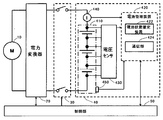
- FIG. 1 is a diagram for explaining a storage battery system according to an embodiment.
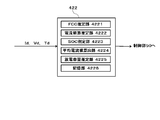
- FIG. 2 is a diagram illustrating a configuration example of the battery state estimation device according to the embodiment.
- FIG. 3 is a diagram illustrating a configuration example of the storage unit according to the embodiment.
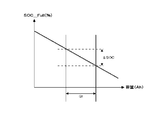
- FIG. 4 is a diagram illustrating the relationship between the discharge section capacity and SOC_FULL during discharge.
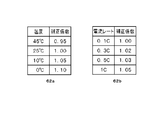
- FIG. 5 shows a temperature correction table and a current correction table according to the embodiment.
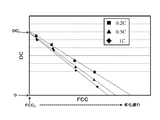
- FIG. 6 is a conceptual diagram showing a correspondence relationship between the FCC, the discharge rate, and the dischargeable capacity according to the embodiment.
- FIG. 7 is a conceptual diagram showing the relationship between voltage drop, SOC_Full, and SOC_Usable.
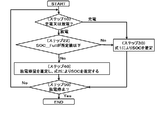
- FIG. 8 is a flowchart of SOC correction processing by the battery state estimation apparatus according to the embodiment.
- FIG. 9 is a flowchart of SOC correction processing by the battery state estimation device according to the embodiment.
- FIG. 1 is a diagram for explaining a storage battery system 40 according to an embodiment.
- FIG. 2 is a diagram illustrating a configuration example of the battery state estimation device 422 according to the embodiment.
- FIG. 3 is a diagram illustrating a configuration example of the storage unit 4226 according to the embodiment.
- the storage battery system 40 is mounted on a vehicle as a power source such as HEV, PHEV, and EV.
- a configuration including the storage battery system 40 and a fuel gauge that displays the remaining capacity of the battery is referred to as a power supply device.
- the traveling motor 10 is, for example, a three-phase AC synchronous motor.
- the power converter 20 is connected to the storage battery system 40 via the relay 30.
- the power converter 20 converts the DC power supplied from the storage battery system 40 into AC and supplies it to the traveling motor 10 during powering. Further, at the time of regeneration, the power converter 20 converts AC power supplied from the traveling motor 10 into DC power and supplies it to the storage battery system 40.
- the relay 30 is controlled to an open state or a closed state by a relay control signal from the control unit 50.
- the relay 30 When the relay 30 is in the closed state, the power converter 20 and the storage battery system 40 are connected to form a charge / discharge path. Moreover, the relay 30 interrupts
- the control unit 50 electronically controls the entire vehicle.
- the control unit 50 sets a torque request value for the travel motor 10 based on the user's accelerator operation amount, vehicle speed, information from the power storage system, and the like.
- the control unit 50 controls the power converter 20 so that the traveling motor 10 operates according to the torque request value. For example, when the torque request value increases, the control unit 50 controls the power converter 20 so as to supply electric power corresponding to the degree to the traveling motor 10. When the torque request value decreases, the control unit 50 controls the power converter 20 so as to supply the storage battery system 40 with the power generated by the traveling motor 10 using deceleration energy as an energy source.
- the storage battery system 40 includes a battery module 410, a battery management device 420, a voltage sensor 430, a current sensor 440, and a temperature sensor 450.
- the battery module 410 is composed of one or more batteries (also called secondary batteries). In the present embodiment, it is assumed that a lithium ion secondary battery is used as the battery included in the battery module 410. In FIG. 1, the battery module 410 is composed of a plurality of batteries connected in series, but the number of batteries constituting the battery module 410 may be one. Some or all of the batteries included in the battery module 410 may be connected in parallel to each other. In the present embodiment, the battery means a single cell unless otherwise specified.
- the battery module 410 is connected to the power converter 20 via the relay 30.
- the battery module 410 can be supplied with charging power via the power converter 20 when the traveling motor 10 operates as a power source (at the time of regeneration).
- the battery module 410 can supply discharge power via the power converter 20 when the traveling motor 10 operates as a load (during power running).
- the battery in the storage battery system 40 is charged and discharged through external charging and power running / regenerative control of the power converter 20.
- the control unit 50 is required to accurately recognize the SOC of the battery. That is, charging / discharging of the battery is controlled by the control unit 50.
- the SOC of the battery grasped by the control unit 50 in order to avoid overcharge and overdischarge is SOC_Full described later.
- the voltage sensor 430 detects the voltage value Vd of each terminal voltage (potential difference between each positive electrode and negative electrode of the battery) of each of the plurality of batteries constituting the battery module 410.
- the voltage sensor 430 outputs the detected voltage value Vd of each battery to the battery management device 420.
- the current sensor 440 is disposed between the battery module 410 and the power converter 20, and measures the current value Id of the current flowing through the battery module 410.
- the current sensor 440 outputs the detected current value Id to the battery management device 420.
- the temperature sensor 450 detects the temperature Td of the battery module 410 (for example, the surface temperature of the battery module 410).
- the battery module 410 outputs the detected temperature Td to the battery management device 420.
- the battery management device 420 includes a battery state estimation device 422 and a communication unit 424.
- the battery state estimation device 422 estimates a battery state such as SOC (State Of Charge, also referred to as a charge rate) using battery state data including the current value Id, the voltage value Vd, and the temperature Td.
- SOC State Of Charge, also referred to as a charge rate
- the communication unit 424 transmits information on the battery state such as the SOC estimated by the battery state estimation device 422 to the control unit 50.
- the battery management device 420 and the control unit 50 are connected by a network such as CAN (Controller Area Network).
- the battery state estimation device 422 includes an FCC estimation unit (also referred to as a full charge estimation unit) 4221, a current integration estimation unit 4222, an SOC determination unit 4223, an average current value calculation unit 4224, a discharge capacity estimation unit 4225, and a storage unit 4226.
- FCC estimation unit also referred to as a full charge estimation unit
- the storage unit 4226 includes an SOC-OCV table 61, a correction table 62, and an FCC holding unit 63.
- the correction table 62 is a table describing correction coefficients used in an SOC correction process described later and / or an FCC (Full Charge Capacity) correction process described later.
- the FCC holding unit 63 temporarily holds the FCC.
- the discharge of the battery may be stopped when the SOC is a low value even though the SOC is not 0%. This is because a voltage drop occurs due to an increase in internal resistance of the battery due to deterioration of the battery.
- a battery whose discharge has been stopped has a remaining capacity that has not been discharged due to a voltage drop. That is, the capacity that can be discharged by a deteriorated battery is not the full charge capacity FCC, but the dischargeable capacity obtained by subtracting the remaining capacity from the full charge capacity FCC (also referred to as discharge capacity, DC).
- a method for correcting the SOC so that SOC is approximately 0% at the timing when the discharge of the battery is stopped due to the voltage drop will be described.
- the current integration estimation unit 4222 estimates the SOC of the battery by integrating the current value Id flowing through the battery detected by the current sensor 440. Specifically, the SOC is estimated using the following (formula 1) or (formula 2).
- SOC_Full is an estimate of SOC using the full charge capacity.
- SOC_Usable is an estimate of SOC using a dischargeable capacity.
- Dischargeable capacity is calculated from FCC and discharge rate (unit C).
- the FCC estimation unit 4221 estimates the FCC of the battery based on the change value of SOC_FULL estimated by the current integration estimation unit 4222 and the current integration value in the period required for the change.
- FCC can be estimated by the following (formula 3).
- FCC (Qt / ⁇ SOC) ⁇ 100 (Formula 3)
- ⁇ SOC represents a change value of SOC_FULL
- Qt represents a section capacity (unit Ah) required for ⁇ SOC.
- the section capacity at the time of discharging is referred to as a discharge section capacity
- the section capacity at the time of charging is referred to as a charging section capacity.
- FIG. 4 is a diagram showing the relationship between the discharge section capacity and SOC_FULL.
- the value of SOC_FULL decreases.
- the value of SOC_FULL increases as the charging interval capacity increases.
- the FCC estimating unit 4221 specifies the discharge section capacity in the section required for the change, and uses the above (Equation 3). To estimate the FCC.
- the discharge section capacity can be specified by the integrated current value.
- the FCC estimation unit 4221 updates the FCC held in the FCC holding unit 63 with the FCC newly estimated along with the FCC estimation.
- the section capacity Qt may be corrected when the FCC is estimated. For example, temperature correction and / or current correction may be performed on the section capacity Qt calculated by time integration of the detected current value.
- the FCC estimation unit 4221 calculates the corrected section capacity Qt ′ using the following (Expression 4) and (Expression 5).
- Qt ′ Qt ⁇ ⁇ t (Formula 4)
- Qt ′ Qt ⁇ ⁇ i (Formula 5)
- ⁇ t represents a temperature correction coefficient
- ⁇ i represents a current correction coefficient.
- FIG. 5 shows the temperature correction table 62a and the current correction table 62b.
- the temperature correction table 62 a and the current correction table 62 b are data included in the correction table 62.
- the temperature correction table 62a is a table describing the correspondence between the temperature Td detected by the temperature sensor 450 and the temperature correction coefficient ⁇ t.
- the current correction table 62b is a table describing the correspondence between the current value Id detected by the current sensor 440 and the current correction coefficient ⁇ i.
- the FCC estimation unit 4221 identifies the temperature correction coefficient ⁇ t with reference to the temperature correction table 62a based on the detected temperature Td. Further, the current correction coefficient ⁇ i is specified with reference to the current correction table 62b based on the detected current value Id.
- the order of multiplying the two correction coefficients by the section capacity Qt may be from either.
- the average current value calculation unit 4224 calculates an average current value when SOC_FULL changes by a set value, and calculates a discharge rate (C) in the period.
- the discharge capacity estimation unit 4225 estimates the dischargeable capacity from the updated FCC and the calculated discharge rate (C).
- FIG. 6 is a conceptual diagram showing a correspondence relationship between FCC, discharge rate (C), and dischargeable capacity.
- the discharge capacity estimation unit 4225 estimates the dischargeable capacity
- the updated FCC and discharge rate (C) are collated with the conceptual diagram of FIG. 6 to estimate the dischargeable capacity.
- the conceptual diagram of FIG. 6 is stored in the storage unit 4226.
- FCC is shown on the X axis
- dischargeable capacity is shown on the Y axis
- discharge rate (C) is plotted inside the graph.
- the intersection of the Y axis and each discharge rate is (X, Y) ⁇ (FCC 0 , DC 0 ).
- (X, Y) ⁇ (FCC 0 , DC 0 ) represents a state where the battery is not deteriorated.
- FCC 0 represents the full charge capacity when the battery is not deteriorated.
- DC 0 represents the dischargeable capacity when the battery is not deteriorated.
- the X-axis represents a state where the deterioration of the battery is progressing toward the right.
- the Y axis represents a state in which the deterioration of the battery progresses as it goes down.
- the conceptual diagram of FIG. 6 shows that the dischargeable capacity decreases as the discharge is performed at a large discharge rate (C) in a certain deterioration state.
- the conceptual diagram of FIG. 6 shows that the dischargeable capacity increases as the battery is deteriorated as the battery is discharged at a lower discharge rate (C).
- FIG. 6 is generated from FCC and dischargeable capacity data acquired when the secondary battery gradually deteriorates from the initial state by a prior experiment or simulation.
- the secondary battery is discharged at a plurality of discharge rates, and the FCC and the dischargeable capacity are acquired for the secondary batteries having various degrees of deterioration.
- the current integration estimation unit 4222 estimates the SOC of the battery according to the above (Formula 1) or (Formula 2).
- the current integration estimation unit 4222 estimates SOC_Usable as the SOC of the battery when deterioration of the battery greatly affects. “Correcting the SOC” means “estimating the SOC_Usable as the SOC of the battery”.
- FIG. 7 is a conceptual diagram showing the relationship between voltage drop, SOC_Full, and SOC_Usable. At the timing when the voltage drop occurs and the discharge of the battery stops, SOC_Full ⁇ 0%, whereas SOC_Usable ⁇ 0%.
- the SOC determination unit 4223 determines whether or not the SOC needs to be corrected. *
- the SOC determination unit 4223 adopts SOC_Full as the SOC when the difference between the SOC_Full calculated by the above (Equation 1) and the SOC_OCV estimated by the OCV method is smaller than a predetermined value.
- the difference between SOC_Full and SOC_OCV is larger than a predetermined value, it is possible to determine to adopt SOC_Usable as the SOC.
- the open circuit voltage (OCV) of the battery is estimated, and the SOC corresponding to the estimated OCV is specified with reference to the SOC-OCV table 61 stored in the storage unit 4226.
- the SOC-OCV table 61 is a table describing the relationship between the SOC of the battery and the OCV (open circuit voltage) of the battery.
- the SOC-OCV table 61 is generated from SOC and OCV data acquired when the battery cells are gradually charged from a state where the charging rate of the battery cells is 0% by a prior experiment or simulation.
- the SOC-OCV table 61 can also be generated from SOC and OCV data acquired when the battery cell is gradually discharged from a state where the charging rate of the battery cell is 100% by a prior experiment or simulation.
- SOC_Full calculated by the above (Equation 1) when SOC_Full calculated by the above (Equation 1) is equal to or less than a predetermined value (for example, SOC_Full is 30% or less) during battery discharge, Can be determined to adopt SOC_Usable as the SOC.
- a predetermined value for example, SOC_Full is 30% or less
- FIG. 8 illustrates a case where the determination as to whether or not SOC_Usable is employed as the SOC performed by the SOC determination unit 4223 is determined based on whether or not the difference between SOC_Full and SOC_OCV is greater than or equal to a predetermined value.
- FIG. 9 illustrates a case where determination as to whether or not SOC_Usable is adopted as the SOC performed by the SOC determination unit 4223 is determined based on whether or not SOC_Full is equal to or less than a predetermined value.
- the battery is controlled to be charged / discharged by the control unit 50 (step 1).
- the current integration estimation unit 4222 estimates SOC_Full by (Equation 1), and estimates the estimated SOC_Full as the SOC of the battery (step 30).
- SOC_Full and SOC_OCV are estimated (step 20).
- the SOC determination unit 4223 calculates the difference between SOC_Full and SOC_OCV (step 21). If the difference between SOC_Full and SOC_OCV is greater than a predetermined value, SOC determination unit 4223 determines to estimate SOC_Usable as the SOC of the battery (step 21). If the difference between SOC_Full and SOC_OCV is less than or equal to a predetermined value, SOC determination unit 4223 determines to estimate SOC_Full as the battery SOC (step 21).
- SOC determination unit 4223 determines that SOC_Full is estimated as the battery SOC
- current integration estimation unit 4222 estimates SOC_Full according to (Equation 1), and estimates the estimated SOC_Full as the battery SOC (step 30). ).
- the discharge capacity estimation unit 4225 estimates the dischargeable capacity (step 40).
- Current integration estimating unit 4222 estimates SOC_Usable by (Equation 2), and estimates the estimated SOC_Usable as the SOC of the battery (step 40).
- step 50 when the battery terminal voltage reaches the discharge stop voltage, the battery discharge ends (step 50). If the battery terminal voltage does not reach the discharge stop voltage after step 30 or step 40, the process returns to step 10 (step 50). The controller 50 determines whether or not the battery terminal voltage has reached the discharge stop voltage.
- the SOC correction process shown in the flowchart of FIG. 9 determines that the SOC determination unit 4223 estimates the SOC_Usable as the battery SOC when SOC_Full is equal to or lower than a predetermined value (for example, 30% or lower) (step 22). Except for the determination by the SOC determination unit 4223 in the processing based on the flowchart of FIG. 9, the same processing as the SOC correction processing shown in the flowchart of FIG. 8 is performed.
- a predetermined value for example, 30% or lower
- the calculation of SOC_Usable by the current integration estimation unit 4222 and the estimation of the dischargeable capacity by the discharge capacity estimation unit 4225 may be performed only when it is determined in step 21 or step 22 that SOC_Usable is estimated as SOC.
- the case where the SOC_Usable is estimated as the SOC is, for example, the case where the fuel gauge displays the remaining capacity of the battery based on the SOC. Since SOC_Usable is a value that considers reaching the discharge stop voltage due to voltage drop, by estimating SOC_Usable as SOC, the remaining battery level is set so that the fuel gauge display becomes zero when the discharge stop voltage is reached. The capacity can be adjusted.
- the calculation of SOC_Full by the current integration estimation unit 4222 and the FCC estimation by the FCC estimation unit 4221 are performed during the period when the battery is being charged / discharged. Regularly at predetermined intervals. This is because the control unit 50 controls charging / discharging of the battery within a range in which overcharging and overdischarging are not caused by SOC_Full which is an actual charging rate.
- the battery state estimation device for a battery used as a power source for driving a motor of an electric vehicle or the like has been described as an example.
- the battery state estimation device for a battery used as a home or industrial power source is described.
- the SOC according to the present disclosure can be corrected.
- the battery state estimation device and the power supply device according to the present disclosure are useful for a power source for driving a motor of an electric vehicle or the like, a backup power source or the like.
Landscapes
- Engineering & Computer Science (AREA)
- General Physics & Mathematics (AREA)
- Physics & Mathematics (AREA)
- Chemical & Material Sciences (AREA)
- Electrochemistry (AREA)
- General Chemical & Material Sciences (AREA)
- Chemical Kinetics & Catalysis (AREA)
- Manufacturing & Machinery (AREA)
- Power Engineering (AREA)
- Mechanical Engineering (AREA)
- Transportation (AREA)
- Sustainable Energy (AREA)
- Sustainable Development (AREA)
- Life Sciences & Earth Sciences (AREA)
- Combustion & Propulsion (AREA)
- Secondary Cells (AREA)
- Tests Of Electric Status Of Batteries (AREA)
- Charge And Discharge Circuits For Batteries Or The Like (AREA)
Abstract
Description
SOC_Usable=SOC0-(Q/DC)×100・・・(式2)
SOC0は充電および放電を開始する前のSOCを、Qは電流積算値(単位Ah)を、FCCは満充電容量を、DCは放電可能容量をそれぞれ示す。+は充電、-は放電を示す。
FCC=(Qt/ΔSOC)×100 …(式3)
ΔSOCはSOC_FULLの変化値、QtはΔSOCに要した区間容量(単位Ah)をそれぞれ示す。以下、放電時の区間容量を放電区間容量と称し、充電時の区間容量を充電区間容量と称する。
Qt’=Qt×αt …(式4)
Qt’=Qt×αi …(式5)
αtは温度補正係数を、αiは電流補正係数をそれぞれ示す。図5は、温度補正テーブル62a及び電流補正テーブル62bを示したものである。温度補正テーブル62a及び電流補正テーブル62bは、補正テーブル62に含まれるデータである。温度補正テーブル62aは、温度センサ450により検出される温度Tdと温度補正係数αtの対応関係を記述したテーブルである。電流補正テーブル62bは、電流センサ440により検出される電流値Idと電流補正係数αiの対応関係を記述したテーブルである。
20 電力変換器
30 リレー
40 蓄電池システム
410 電池モジュール
420 電池管理装置
422 電池状態推定装置
4221 FCC推定部
4222 電流積算推定部
4223 SOC判定部
4224 平均電流値算出部
4225 放電容量推定部
4226 記憶部
424 通信部
430 電圧センサ
440 電流センサ
450 温度センサ
50 制御部
61 SOC-OCVテーブル
62 補正テーブル
62a 温度補正テーブル
62b 電流補正テーブル
63 FCC保持部
Claims (5)
- 電池の充電率を推定する電池状態推定装置であって、
前記電池の満充電容量又は放電可能容量のいずれに基づいて、前記電池の充電率を推定するかを判定するSOC判定部と、
前記満充電容量を推定する満充電容量推定部と、
前記放電可能容量を推定する放電容量推定部と、
前記満充電容量又は前記放電可能容量に基づいて、前記電池の充電率を推定する電流積算推定部と、
を備えた電池状態推定装置。 - 前記SOC判定部は、前記電池が放電されている場合であって、前記満充電容量に基づいて推定された前記電池の充電率が所定値以下に低下した場合に、前記放電可能容量に基づいて前記電池の充電率を推定するように判定する、請求項1に記載の電池状態推定装置。
- 前記SOC判定部は、前記電池が放電されている場合であって、前記満充電容量に基づいて推定された前記電池の充電率と前記電池の開放電圧に基づいて推定された充電率との差を算出し、前記差が所定値よりも大きい場合に、前記放電可能容量に基づいて前記電池の充電率を推定するように判定する、請求項1に記載の電池状態推定装置。
- 前記放電容量推定部は、前記満充電容量推定部により推定された満充電容量と前記電池の放電レートより、前記放電可能容量を推定する、請求項1から3のいずれかに記載の電池状態推定装置。
- 請求項1から4のいずれかに記載の電池状態推定装置と燃料計とを備えた電源装置であって、
前記燃料計は、前記電池状態推定装置により推定された前記電池の充電率に基づいて、前記電池の残容量を表示する、電源装置。
Priority Applications (3)
| Application Number | Priority Date | Filing Date | Title |
|---|---|---|---|
| CN201680002762.2A CN106716162B (zh) | 2015-02-13 | 2016-01-20 | 电池状态推定装置以及电源装置 |
| JP2016574645A JP6572448B2 (ja) | 2015-02-13 | 2016-01-20 | 電池状態推定装置、および電源装置 |
| US15/504,058 US20170274794A1 (en) | 2015-02-13 | 2016-01-20 | Cell status estimation device and power supply device |
Applications Claiming Priority (2)
| Application Number | Priority Date | Filing Date | Title |
|---|---|---|---|
| JP2015025964 | 2015-02-13 | ||
| JP2015-025964 | 2015-02-13 |
Publications (1)
| Publication Number | Publication Date |
|---|---|
| WO2016129212A1 true WO2016129212A1 (ja) | 2016-08-18 |
Family
ID=56615424
Family Applications (1)
| Application Number | Title | Priority Date | Filing Date |
|---|---|---|---|
| PCT/JP2016/000264 Ceased WO2016129212A1 (ja) | 2015-02-13 | 2016-01-20 | 電池状態推定装置、および電源装置 |
Country Status (4)
| Country | Link |
|---|---|
| US (1) | US20170274794A1 (ja) |
| JP (1) | JP6572448B2 (ja) |
| CN (1) | CN106716162B (ja) |
| WO (1) | WO2016129212A1 (ja) |
Cited By (5)
| Publication number | Priority date | Publication date | Assignee | Title |
|---|---|---|---|---|
| JP2019203719A (ja) * | 2018-05-21 | 2019-11-28 | 古河電池株式会社 | 蓄電池の容量把握方法および容量監視装置 |
| JP2020508629A (ja) * | 2017-10-11 | 2020-03-19 | エルジー・ケム・リミテッド | バッテリーの容量の推定装置及び方法、これを備えるバッテリーの管理装置及び方法 |
| JP2021125320A (ja) * | 2020-02-03 | 2021-08-30 | トヨタ自動車株式会社 | バッテリー制御装置、方法、プログラム、及び車両 |
| US11196271B2 (en) * | 2018-10-09 | 2021-12-07 | Toyota Jidosha Kabushiki Kaisha | Full-charge-capacity estimating device for power supply device |
| WO2024177130A1 (ja) | 2023-02-22 | 2024-08-29 | エリーパワー株式会社 | 二次電池ユニット充電状態推定装置、二次電池ユニット充電状態推定方法及び二次電池ユニット充電状態推定プログラム |
Families Citing this family (13)
| Publication number | Priority date | Publication date | Assignee | Title |
|---|---|---|---|---|
| WO2017130258A1 (ja) * | 2016-01-28 | 2017-08-03 | パナソニックIpマネジメント株式会社 | 管理装置、及び蓄電システム |
| KR102639843B1 (ko) * | 2016-12-20 | 2024-02-26 | 현대자동차주식회사 | 차량용 배터리 관리 시스템 및 방법과 이를 위한 차량 |
| JP7063752B2 (ja) * | 2018-07-13 | 2022-05-09 | 日野自動車株式会社 | 充放電制御装置 |
| US11148546B2 (en) * | 2018-08-07 | 2021-10-19 | Toyota Jidosha Kabushiki Kaisha | Power supply control device |
| CN109343689B (zh) * | 2018-09-30 | 2021-12-24 | 联想(北京)有限公司 | 一种信息处理方法及装置 |
| CN112292604B (zh) * | 2018-10-31 | 2021-12-21 | 华为技术有限公司 | 电池电压的补偿方法、装置和终端设备 |
| CN111289902B (zh) * | 2018-12-06 | 2022-02-01 | 新盛力科技股份有限公司 | 电池电量状态的预估方法 |
| WO2020138318A1 (ja) * | 2018-12-28 | 2020-07-02 | 株式会社村田製作所 | 電池、電池パック、電子機器、電動車両および電力システム |
| CN110967647B (zh) * | 2019-06-24 | 2020-11-17 | 宁德时代新能源科技股份有限公司 | 荷电状态修正方法及装置 |
| CN110441692A (zh) * | 2019-07-22 | 2019-11-12 | 南方电网科学研究院有限责任公司 | 一种电池组电量交流测算方法、装置及存储介质 |
| KR102255914B1 (ko) * | 2019-10-18 | 2021-05-26 | 주식회사 티움리서치 | 저온 환경에서의 예측 정확도 향상을 위한 리튬이차전지 잔량 예측방법 및 예측장치 |
| CN113002363B (zh) * | 2021-03-03 | 2023-03-17 | 一汽解放汽车有限公司 | 一种电池荷电量的修正方法、装置、车辆及介质 |
| GB2615509B (en) * | 2021-11-05 | 2024-04-03 | Juuce Ltd | Electric vehicle charging system |
Citations (2)
| Publication number | Priority date | Publication date | Assignee | Title |
|---|---|---|---|---|
| JPH0875833A (ja) * | 1994-07-04 | 1996-03-22 | Nippon Soken Inc | バッテリ充電状態検出方法 |
| JP2012207989A (ja) * | 2011-03-29 | 2012-10-25 | Sanyo Electric Co Ltd | 放電可能容量修正システム及び電力供給システム |
Family Cites Families (15)
| Publication number | Priority date | Publication date | Assignee | Title |
|---|---|---|---|---|
| JP4052418B2 (ja) * | 2000-02-15 | 2008-02-27 | 日立マクセル株式会社 | 電池容量検出方法および装置並びに電池パック |
| US20030184307A1 (en) * | 2002-02-19 | 2003-10-02 | Kozlowski James D. | Model-based predictive diagnostic tool for primary and secondary batteries |
| JP4010288B2 (ja) * | 2003-07-29 | 2007-11-21 | ソニー株式会社 | 二次電池の残容量算出方法およびバッテリパック |
| JP2007121030A (ja) * | 2005-10-26 | 2007-05-17 | Denso Corp | 車両用蓄電装置の内部状態検出装置 |
| JP4967362B2 (ja) * | 2006-02-09 | 2012-07-04 | トヨタ自動車株式会社 | 二次電池の残存容量推定装置 |
| JP4631880B2 (ja) * | 2007-07-30 | 2011-02-16 | ミツミ電機株式会社 | 電池状態検知方法 |
| JP4649682B2 (ja) * | 2008-09-02 | 2011-03-16 | 株式会社豊田中央研究所 | 二次電池の状態推定装置 |
| WO2011007691A1 (ja) * | 2009-07-16 | 2011-01-20 | 株式会社 日立メディコ | 磁気共鳴イメージング装置および磁気共鳴イメージング方法 |
| EP2557428B1 (en) * | 2010-04-09 | 2015-07-01 | Toyota Jidosha Kabushiki Kaisha | Secondary battery degradation determination device and degradation determination method |
| EP2472278A1 (en) * | 2010-10-15 | 2012-07-04 | Sanyo Electric Co., Ltd. | Power management system |
| JPWO2012091077A1 (ja) * | 2010-12-28 | 2014-06-05 | 三洋電機株式会社 | 電池の劣化度の検出方法 |
| US20130311119A1 (en) * | 2011-01-31 | 2013-11-21 | Shigeto Tamezane | Method of detecting battery full-charge capacity |
| CN103392133A (zh) * | 2011-03-07 | 2013-11-13 | 株式会社日立制作所 | 电池状态推定方法和电池管理系统 |
| JP2012247339A (ja) * | 2011-05-30 | 2012-12-13 | Renesas Electronics Corp | 半導体集積回路およびその動作方法 |
| KR102082866B1 (ko) * | 2013-04-18 | 2020-04-14 | 삼성에스디아이 주식회사 | 배터리 관리 시스템 및 그 구동방법 |
-
2016
- 2016-01-20 US US15/504,058 patent/US20170274794A1/en not_active Abandoned
- 2016-01-20 CN CN201680002762.2A patent/CN106716162B/zh active Active
- 2016-01-20 WO PCT/JP2016/000264 patent/WO2016129212A1/ja not_active Ceased
- 2016-01-20 JP JP2016574645A patent/JP6572448B2/ja active Active
Patent Citations (2)
| Publication number | Priority date | Publication date | Assignee | Title |
|---|---|---|---|---|
| JPH0875833A (ja) * | 1994-07-04 | 1996-03-22 | Nippon Soken Inc | バッテリ充電状態検出方法 |
| JP2012207989A (ja) * | 2011-03-29 | 2012-10-25 | Sanyo Electric Co Ltd | 放電可能容量修正システム及び電力供給システム |
Cited By (11)
| Publication number | Priority date | Publication date | Assignee | Title |
|---|---|---|---|---|
| JP2020508629A (ja) * | 2017-10-11 | 2020-03-19 | エルジー・ケム・リミテッド | バッテリーの容量の推定装置及び方法、これを備えるバッテリーの管理装置及び方法 |
| JP7041800B2 (ja) | 2017-10-11 | 2022-03-25 | エルジー エナジー ソリューション リミテッド | バッテリーの容量の推定装置及び方法、これを備えるバッテリーの管理装置及び方法 |
| US11391779B2 (en) | 2017-10-11 | 2022-07-19 | Lg Energy Solution, Ltd. | Battery capacity estimation apparatus and method, and battery management apparatus provided with same and method thereof |
| JP2019203719A (ja) * | 2018-05-21 | 2019-11-28 | 古河電池株式会社 | 蓄電池の容量把握方法および容量監視装置 |
| WO2019225032A1 (ja) * | 2018-05-21 | 2019-11-28 | 古河電池株式会社 | 蓄電池の容量把握方法および容量監視装置 |
| US11196271B2 (en) * | 2018-10-09 | 2021-12-07 | Toyota Jidosha Kabushiki Kaisha | Full-charge-capacity estimating device for power supply device |
| JP2021125320A (ja) * | 2020-02-03 | 2021-08-30 | トヨタ自動車株式会社 | バッテリー制御装置、方法、プログラム、及び車両 |
| JP7234957B2 (ja) | 2020-02-03 | 2023-03-08 | トヨタ自動車株式会社 | バッテリー制御装置、方法、プログラム、及び車両 |
| WO2024177130A1 (ja) | 2023-02-22 | 2024-08-29 | エリーパワー株式会社 | 二次電池ユニット充電状態推定装置、二次電池ユニット充電状態推定方法及び二次電池ユニット充電状態推定プログラム |
| KR20250169535A (ko) | 2023-02-22 | 2025-12-03 | 에리 파워 가부시키가이샤 | 이차전지 유닛 충전 상태 추정 장치, 이차전지 유닛 충전 상태 추정 방법 및 이차전지 유닛 충전 상태 추정 프로그램 |
| EP4671786A1 (en) | 2023-02-22 | 2025-12-31 | Eliiy Power Co., Ltd. | SECONDARY BATTERY UNIT STATE OF CHARGE ESTIMATION DEVICE, METHOD FOR ESTIMATING THE STATE OF CHARGE OF A SECONDARY BATTERY UNIT, AND PROGRAM FOR ESTIMATING THE STATE OF CHARGE OF A SECONDARY BATTERY UNIT |
Also Published As
| Publication number | Publication date |
|---|---|
| JP6572448B2 (ja) | 2019-09-11 |
| US20170274794A1 (en) | 2017-09-28 |
| CN106716162A (zh) | 2017-05-24 |
| JPWO2016129212A1 (ja) | 2017-12-21 |
| CN106716162B (zh) | 2021-01-01 |
Similar Documents
| Publication | Publication Date | Title |
|---|---|---|
| JP6572448B2 (ja) | 電池状態推定装置、および電源装置 | |
| CN106716708B (zh) | 电池管理装置以及电源装置 | |
| JP5621818B2 (ja) | 蓄電システムおよび均等化方法 | |
| CN106030326B (zh) | 二次电池系统 | |
| JPWO2014083856A1 (ja) | 電池管理装置、電源装置およびsoc推定方法 | |
| JP6225340B2 (ja) | 電池状態推定装置 | |
| KR20190000445A (ko) | 전기자동차용 배터리의 열화 발생을 저감하면서 고속충전과 최대방전을 수행하기 위한 방법 및 그 장치 | |
| JP7137760B2 (ja) | 二次電池の充放電制御方法 | |
| JP2018179684A (ja) | 二次電池の劣化状態推定装置並びにそれを備えた電池システム及び電動車両 | |
| CN116264394A (zh) | 电力需求调整装置 | |
| JP2020061823A (ja) | 二次電池制御装置 | |
| JP2018155706A (ja) | 二次電池の劣化状態推定装置並びにそれを備えた電池システム及び電動車両 | |
| TWI472784B (zh) | 用於計算電池荷電狀態的系統及方法 | |
| JP4930434B2 (ja) | 二次電池モジュール制御装置 | |
| US11180051B2 (en) | Display apparatus and vehicle including the same | |
| JP5975925B2 (ja) | 電池制御装置、蓄電装置 | |
| KR20130079751A (ko) | 전지 soc 추정 방법 및 시스템 | |
| JP2016217951A (ja) | 蓄電器管理装置及び蓄電器管理方法 | |
| JP2014017964A (ja) | 車載バッテリの充放電制御装置 | |
| JP2020048312A (ja) | 電動車の電池制御装置 |
Legal Events
| Date | Code | Title | Description |
|---|---|---|---|
| 121 | Ep: the epo has been informed by wipo that ep was designated in this application |
Ref document number: 16748860 Country of ref document: EP Kind code of ref document: A1 |
|
| ENP | Entry into the national phase |
Ref document number: 2016574645 Country of ref document: JP Kind code of ref document: A |
|
| WWE | Wipo information: entry into national phase |
Ref document number: 15504058 Country of ref document: US |
|
| NENP | Non-entry into the national phase |
Ref country code: DE |
|
| 122 | Ep: pct application non-entry in european phase |
Ref document number: 16748860 Country of ref document: EP Kind code of ref document: A1 |