WO2016063685A1 - 粘着剤組成物及び粘着シート - Google Patents
粘着剤組成物及び粘着シート Download PDFInfo
- Publication number
- WO2016063685A1 WO2016063685A1 PCT/JP2015/077473 JP2015077473W WO2016063685A1 WO 2016063685 A1 WO2016063685 A1 WO 2016063685A1 JP 2015077473 W JP2015077473 W JP 2015077473W WO 2016063685 A1 WO2016063685 A1 WO 2016063685A1
- Authority
- WO
- WIPO (PCT)
- Prior art keywords
- mass
- parts
- adhesive composition
- pressure
- sensitive adhesive
- Prior art date
- Legal status (The legal status is an assumption and is not a legal conclusion. Google has not performed a legal analysis and makes no representation as to the accuracy of the status listed.)
- Ceased
Links
Classifications
-
- C—CHEMISTRY; METALLURGY
- C09—DYES; PAINTS; POLISHES; NATURAL RESINS; ADHESIVES; COMPOSITIONS NOT OTHERWISE PROVIDED FOR; APPLICATIONS OF MATERIALS NOT OTHERWISE PROVIDED FOR
- C09J—ADHESIVES; NON-MECHANICAL ASPECTS OF ADHESIVE PROCESSES IN GENERAL; ADHESIVE PROCESSES NOT PROVIDED FOR ELSEWHERE; USE OF MATERIALS AS ADHESIVES
- C09J175/00—Adhesives based on polyureas or polyurethanes; Adhesives based on derivatives of such polymers
- C09J175/04—Polyurethanes
-
- C—CHEMISTRY; METALLURGY
- C09—DYES; PAINTS; POLISHES; NATURAL RESINS; ADHESIVES; COMPOSITIONS NOT OTHERWISE PROVIDED FOR; APPLICATIONS OF MATERIALS NOT OTHERWISE PROVIDED FOR
- C09J—ADHESIVES; NON-MECHANICAL ASPECTS OF ADHESIVE PROCESSES IN GENERAL; ADHESIVE PROCESSES NOT PROVIDED FOR ELSEWHERE; USE OF MATERIALS AS ADHESIVES
- C09J11/00—Features of adhesives not provided for in group C09J9/00, e.g. additives
- C09J11/02—Non-macromolecular additives
- C09J11/06—Non-macromolecular additives organic
-
- C—CHEMISTRY; METALLURGY
- C09—DYES; PAINTS; POLISHES; NATURAL RESINS; ADHESIVES; COMPOSITIONS NOT OTHERWISE PROVIDED FOR; APPLICATIONS OF MATERIALS NOT OTHERWISE PROVIDED FOR
- C09J—ADHESIVES; NON-MECHANICAL ASPECTS OF ADHESIVE PROCESSES IN GENERAL; ADHESIVE PROCESSES NOT PROVIDED FOR ELSEWHERE; USE OF MATERIALS AS ADHESIVES
- C09J7/00—Adhesives in the form of films or foils
- C09J7/20—Adhesives in the form of films or foils characterised by their carriers
Definitions
- This invention relates to the adhesive composition from which the adhesive sheet excellent in oleic acid resistance is obtained.
- Adhesives are widely used in various fields such as manufacturing scenes of various products including electronic devices and automobiles, and medical products represented by surgical tape.
- Examples of the pressure-sensitive adhesive composition for improving the oleic acid resistance include, for example, 50 to 90% by mass of a (meth) acrylic acid alkyl ester having an alkyl group having 4 to 12 carbon atoms, and a carboxyl group-containing monomer 3 to 20 It contains 3 to 20% by mass of a hydroxyl group-containing monomer and 3 to 15% by mass of a (meth) acrylic acid alkyl ester having an alkyl group having 1 to 3 carbon atoms and has a weight average molecular weight of 700,000 to
- a pressure-sensitive adhesive composition containing 2 million, an acrylic copolymer having a hydroxyl group and a carboxyl group having a theoretical Tg of ⁇ 40 ° C. or less and a crosslinking agent is disclosed (see, for example, Patent Document 1) .)
- the problem to be solved by the present invention is to provide a pressure-sensitive adhesive composition capable of obtaining a pressure-sensitive adhesive sheet having excellent resistance to oleic acid with little decrease in adhesive strength even when contacted with oleic acid for a long time.
- the present invention is a reaction product of polycarbonate polyol (a1), polyisocyanate (a2) and chain extender (a3), and a urethane resin having a hydroxyl group having a weight average molecular weight in the range of 5,000 to 40,000 (A pressure-sensitive adhesive composition containing A), a crosslinking agent (B), and an organic solvent (C), and a pressure-sensitive adhesive sheet characterized by having a dry film thereof. .
- the pressure-sensitive adhesive composition of the present invention has good coatability, and the resulting pressure-sensitive adhesive sheet has a good initial adhesive force due to crosslinking, and there is little decrease in the adhesive strength even when contacted with oleic acid for a long time. Excellent oleic acid resistance.
- the pressure-sensitive adhesive composition of the present invention is a double-sided tape used for bonding a casing constituting a portable electronic terminal, a tablet personal computer, etc., a label for imparting designability to the surface of the casing, a waterproof tape, and a clothing It can be suitably used in various fields such as an adhesive tape.
- the pressure-sensitive adhesive composition of the present invention is a reaction product of polycarbonate polyol (a1), polyisocyanate (a2) and chain extender (a3), and has a weight average molecular weight in the range of 5,000 to 40,000.
- the urethane resin (A) having a hydroxyl group, a crosslinking agent (B), and an organic solvent (C) are contained as essential components.
- the polycarbonate polyol (a1) is an essential component for obtaining excellent oleic acid resistance. Unlike an ether structure or an ester structure, a carbonate structure hardly swells or decomposes even when contacted with oleic acid, and can suppress a decrease in adhesive strength.
- As said polycarbonate polyol (a1) what was obtained by making carbonate ester and / or phosgene react with the compound which has a 2 or more hydroxyl group by a well-known method can be used, for example.
- carbonate ester for example, methyl carbonate, dimethyl carbonate, diethyl carbonate, cyclocarbonate, diphenyl carbonate and the like can be used. These compounds may be used alone or in combination of two or more.
- Examples of the compound having two or more hydroxyl groups include ethylene glycol, diethylene glycol, triethylene glycol, 1,2-propylene glycol, 1,3-propylene glycol, dipropylene glycol, 1,4-butanediol, 1, 3-butanediol, 1,5-pentanediol, 1,5-hexanediol, 1,6-hexanediol, 1,7-heptanediol, 1,8-octanediol, 1,9-nonanediol, 1,10 -Decanediol, 3-methyl-1,5-pentanediol, 2-butyl-2-ethylpropanoldiol, neopentyl glycol, 1,4-cyclohexanediol, 1,4-cyclohexanedimethanol, polyethylene glycol, polypropylene glycol, Polytetra Ji glycol, polyhexamethylene adipate
- the obtained polycarbonate polyol can be made into a liquid and the glass transition temperature of the urethane resin (A) can be lowered, so that excellent adhesive strength (particularly initial adhesive strength) can be obtained, and good adhesive strength and olein resistance can be obtained.
- adhesive strength particularly initial adhesive strength
- olein resistance good adhesive strength and olein resistance
- the number average molecular weight of the polycarbonate polyol (a1) is preferably in the range of 700 to 5,000, more preferably in the range of 800 to 3,000, from the viewpoint that adhesion strength and oleic acid resistance can be maintained at a high level. Preferably there is.
- the number average molecular weight of the said polycarbonate polyol (a1) shows the value measured on condition of the following by the gel permeation chromatography (GPC) method.
- Measuring device High-speed GPC device (“HLC-8220GPC” manufactured by Tosoh Corporation) Column: The following columns manufactured by Tosoh Corporation were connected in series. "TSKgel G5000" (7.8 mm ID x 30 cm) x 1 "TSKgel G4000” (7.8 mm ID x 30 cm) x 1 "TSKgel G3000” (7.8 mm ID x 30 cm) x 1 “TSKgel G2000” (7.8 mm ID ⁇ 30 cm) ⁇ 1 detector: RI (differential refractometer) Column temperature: 40 ° C Eluent: Tetrahydrofuran (THF) Flow rate: 1.0 mL / min Injection amount: 100 ⁇ L (tetrahydrofuran solution with a sample concentration of 0.4 mass%) Standard sample: A calibration curve was prepared using the following standard polystyrene.
- the polycarbonate polyol (a1) may be used in combination with other polyols as necessary.
- polyether polyol for example, polyether polyol, polyester polyol, polybutadiene polyol, polycaprolactone polyol, acrylic polyol, dimer diol, polyisoprene polyol and the like can be used. These polyols may be used alone or in combination of two or more.
- polyisocyanate (a2) examples include aromatic polyisocyanates such as xylylene diisocyanate, phenylene diisocyanate, diphenylmethane diisocyanate, toluene diisocyanate, and naphthalene diisocyanate; hexamethylene diisocyanate, lysine diisocyanate, cyclohexane diisocyanate, isophorone diisocyanate, 4,4 ′.
- aromatic polyisocyanates such as xylylene diisocyanate, phenylene diisocyanate, diphenylmethane diisocyanate, toluene diisocyanate, and naphthalene diisocyanate
- hexamethylene diisocyanate lysine diisocyanate
- cyclohexane diisocyanate isophorone diisocyanate
- -Aliphatic or alicyclic polyisocyanates such as dicyclohexylmethane diisocyanate, diisocyanate methylcyclohexane, tetramethylxylylene diisocyanate and the like can be used.
- These polyisocyanates may be used alone or in combination of two or more.
- aromatic polyisocyanate from the viewpoint that swelling and decomposition hardly occur even when contacted with oleic acid, and oleic acid resistance can be further improved, and it is more preferable to use diphenylmethane diisocyanate and / or toluene diisocyanate. preferable.
- the chain extender is used for adjusting the adhesive force, and for example, one having a number average molecular weight in the range of 50 to 400 can be used.
- ethylene glycol, diethylene recall, triethylene glycol, propylene Aliphatic polyol compounds such as glycol, 1,3-propanediol, 1,3-butanediol, 1,4-butanediol, hexamethylene glycol, saccharose, methylene glycol, glycerin, sorbitol; bisphenol A, 4,4′- Aromatic polyol compounds such as dihydroxydiphenyl, 4,4′-dihydroxydiphenyl ether, 4,4′-dihydroxydiphenylsulfone, hydrogenated bisphenol A, hydroquinone, etc .; water; ethylenediamine, 1,2-propanediamine, 1,6-hexame Range amine, piperazine, 2-methylpiperazine, 2,5-dimethylpiperazine, isophoronediamine, 4,
- chain extenders may be used alone or in combination of two or more.
- an aliphatic polyol compound from the viewpoint of suppressing discoloration over time, and by using a relatively short chain extender as a hard segment, excellent cohesive force can be obtained, and adhesive strength can be further improved. Therefore, it is more preferable to use 1,4-butanediol and / or ethylene glycol.
- the urethane resin (A) is cross-linked with a cross-linking agent (B) described later, and has a hydroxyl group for obtaining a good initial adhesive force, preferably 2 or more, more preferably in the range of 2 to 4 It has a hydroxyl group.
- the polyol composition containing the said polycarbonate polyol (a1) with respect to the molar ratio of the isocyanate group which the said polyisocyanate (a2) has, and the said chain extender (a3) are, for example.
- the method of making it react so that the total molar ratio with the hydroxyl group and amino group which it has may become excess is mentioned.
- the polycarbonate polyol (a1) and the chain extender (a3) may be charged all at once or may be charged in two or more times while controlling the reaction.
- a molar ratio (NCO / OH + NH) of the total of the hydroxyl group and amino group of the polyol composition containing the polycarbonate polyol (a1) and the chain extender (a3) and the isocyanate group of the polyisocyanate (a2) Is preferably in the range of 0.3 to 0.99 from the viewpoint that the reaction can be easily controlled and a good initial adhesive force can be obtained by the crosslinking property with the crosslinking agent (B) described later. A range of 0.9 is more preferred.
- an alcohol solvent such as methanol or 1,3-butanediol may be added for the purpose of deactivating the remaining isocyanate groups.
- the weight average molecular weight of the urethane resin (A) obtained by the above method must be in the range of 5,000 to 40,000.
- the weight average molecular weight of the urethane resin (A) is preferably in the range of 7,000 to 35,000 from the viewpoints of olein resistance and adhesive strength.
- the number average molecular weight of the urethane resin (A) is preferably in the range of 3,000 to 20,000 from the viewpoint of further improving the coating property, initial adhesive strength and oleic acid resistance. More preferably, it is in the range of 10,000 to 10,000.
- the weight average molecular weight and number average molecular weight of the said urethane resin (A) show the value obtained by measuring similarly to the number average molecular weight of the said polycarbonate polyol (a1).
- crosslinking agent (B) for example, a known polyisocyanate crosslinking agent, epoxy crosslinking agent, melamine crosslinking agent and the like can be used. These crosslinking agents may be used alone or in combination of two or more. Among these, it is preferable to use a polyisocyanate crosslinking agent from the viewpoint that it exhibits good crosslinkability with the hydroxyl group of the urethane resin (A), and further excellent initial adhesive force and oleic acid resistance can be obtained.
- polyisocyanate crosslinking agent examples include the same polyisocyanate as the polyisocyanate (a2); a compound obtained by reacting the polyisocyanate compound with a polyhydric alcohol such as trimethylolpropane and pentaerythritol; Isocyanurate compounds; burette compounds of the polyisocyanate compounds; adducts thereof; urethane diisocyanate compounds obtained by reacting the polyisocyanates and polyols, and the like can be used.
- These polyisocyanate crosslinking agents may be used alone or in combination of two or more.
- the amount of the crosslinking agent (B) used is in the range of 0.01 to 10 parts by mass with respect to 100 parts by mass of the urethane resin (A) in terms of obtaining good initial adhesive strength and oleic acid resistance.
- the range of 0.1 to 5 parts by mass is more preferable.
- organic solvent (C) examples include ester solvents such as ethyl acetate, methyl acetate, and butyl acetate; ketone solvents such as acetone, methyl ethyl ketone, and methyl isobutyl ketone; and aliphatic hydrocarbons such as heptane, hexane, cyclohexane, and methylcyclohexane. Solvent; aromatic hydrocarbon solvents such as toluene, o-xylene, m-xylene, and p-xylene can be used. These organic solvents may be used alone or in combination of two or more.
- the amount of the organic solvent (C) used is preferably in the range of 20 to 80% by mass, more preferably in the range of 30 to 70% by mass in the pressure-sensitive adhesive composition, from the viewpoint of coating properties and drying properties. .
- the pressure-sensitive adhesive composition of the present invention contains the components (A) to (C) as essential components, but may further contain other additives as necessary.
- additives examples include rust preventives, thixotropic agents, dispersants, sensitizers, urethanization catalysts, polymerization inhibitors, leveling agents, tackifiers, foam stabilizers, and the like. These additives may be used alone or in combination of two or more.
- the method of manufacturing the adhesive sheet which has is mentioned.
- the substrate examples include polyesters such as polyethylene terephthalate, polyethylene naphthalate, and polybutylene terephthalate, polyolefin, polyacrylate, polyvinyl chloride, polyethylene, polypropylene ethylene vinyl alcohol, polyurethane, polyamide, and polyimide. Sheet or film; glass or the like can be used.
- the surface of these base materials may be subjected to mold release treatment, antistatic treatment, corona treatment and the like.
- the thickness of the substrate is determined according to the application for which the pressure-sensitive adhesive sheet is used, and is, for example, in the range of 10 to 100 ⁇ m.
- Examples of the method of applying the pressure-sensitive adhesive composition to the substrate include a method using an applicator, roll coater, gravure coater, reverse coater, spray coater, air knife coater, die coater, and the like.
- the thickness of the coated adhesive composition after drying is determined according to the use for which the adhesive sheet is used, and is, for example, in the range of 5 to 100 ⁇ m.
- Examples of the method of drying the pressure-sensitive adhesive composition after coating the pressure-sensitive adhesive composition on the substrate include a method of drying at 50 to 120 ° C. for 30 seconds to 10 minutes. Further, after the drying, further aging may be performed in the range of 30 ° C. to 50 ° C. in order to accelerate the curing reaction.
- the gel fraction when the dried film is immersed in toluene for 24 hours is preferably in the range of 10 to 60% by mass from the viewpoint of obtaining good adhesive strength (particularly initial adhesive strength). A range of ⁇ 50 mass% is more preferred.
- the initial adhesive strength of the adhesive tape is preferably in the range of 2 to 10 N / 5 mm, more preferably in the range of 2.5 to 8 N / 5 mm.
- the measuring method of the initial adhesive force of the said adhesive tape is described in the Example mentioned later.
- the pressure-sensitive adhesive composition of the present invention has good coatability, and the resulting pressure-sensitive adhesive sheet has a good initial adhesive force due to crosslinking, and the adhesive strength is reduced even when contacted with oleic acid for a long time. Is excellent in oleic acid resistance.
- the pressure-sensitive adhesive composition of the present invention comprises a double-sided tape used for bonding a casing constituting a portable electronic terminal, a tablet personal computer, etc., a label for imparting designability to the surface of the casing, a waterproof tape, a medical use It can be suitably used in various fields such as an adhesive tape.
- a urethane resin (A-2) having 2,850 mPa ⁇ s and a weight average molecular weight of 8,200 was obtained.
- Example 1 1.2 parts by mass of an isocyanurate compound of hexamethylene diisocyanate (hereinafter abbreviated as “HDI nurate”) with respect to 100 parts by mass of the urethane resin (A-1) obtained in Synthesis Example 1. 1 part by mass (“T-81E” manufactured by DIC Corporation) was added to obtain an adhesive composition.
- the pressure-sensitive adhesive composition was applied to the surface of a 38 ⁇ m-thick polyethylene terephthalate (PET) film that had been release-treated on the surface so that the film thickness after drying was 20 ⁇ m, and further at 100 ° C. for 2 minutes. The film was dried at 120 degrees for 1 minute to obtain a dry film. Then, the said dry film was bonded on both surfaces of 12-micrometer-thick PET film, and the adhesive sheet was obtained by making it age at 40 degreeC for 3 days.
- PET polyethylene terephthalate
- Example 2 A pressure-sensitive adhesive sheet was obtained in the same manner as in Example 1 except that the types / and / or amounts of the urethane resin (A) and the crosslinking agent (B) used were changed as shown in Table 1.
- a urethane resin (A′-1) having 1,360 mPa ⁇ s and a weight average molecular weight of 4,000 was obtained.
- a urethane resin (A′-2) having a weight average molecular weight of 42,100 mPa ⁇ s and 60,000 was obtained.
- the 180 degree peel strength was measured in an atmosphere of 23 ° C. and 50% humidity in accordance with JIS K6848-1974, and the adhesive strength after the oleic acid resistance test ( N / 10 mm).
- the oleic acid resistance was evaluated by the difference between the initial adhesive strength and the adhesive strength after the oleic acid resistance test.
- D-101 hexamethylene diisocyanate-based bifunctional polyurethane diisocyanate
- Duranate D-101 manufactured by Asahi Kasei Chemicals Corporation
- the pressure-sensitive adhesive sheet obtained from the pressure-sensitive adhesive composition of the present invention showed little decrease in adhesion even after being immersed in oleic acid for 2 days.
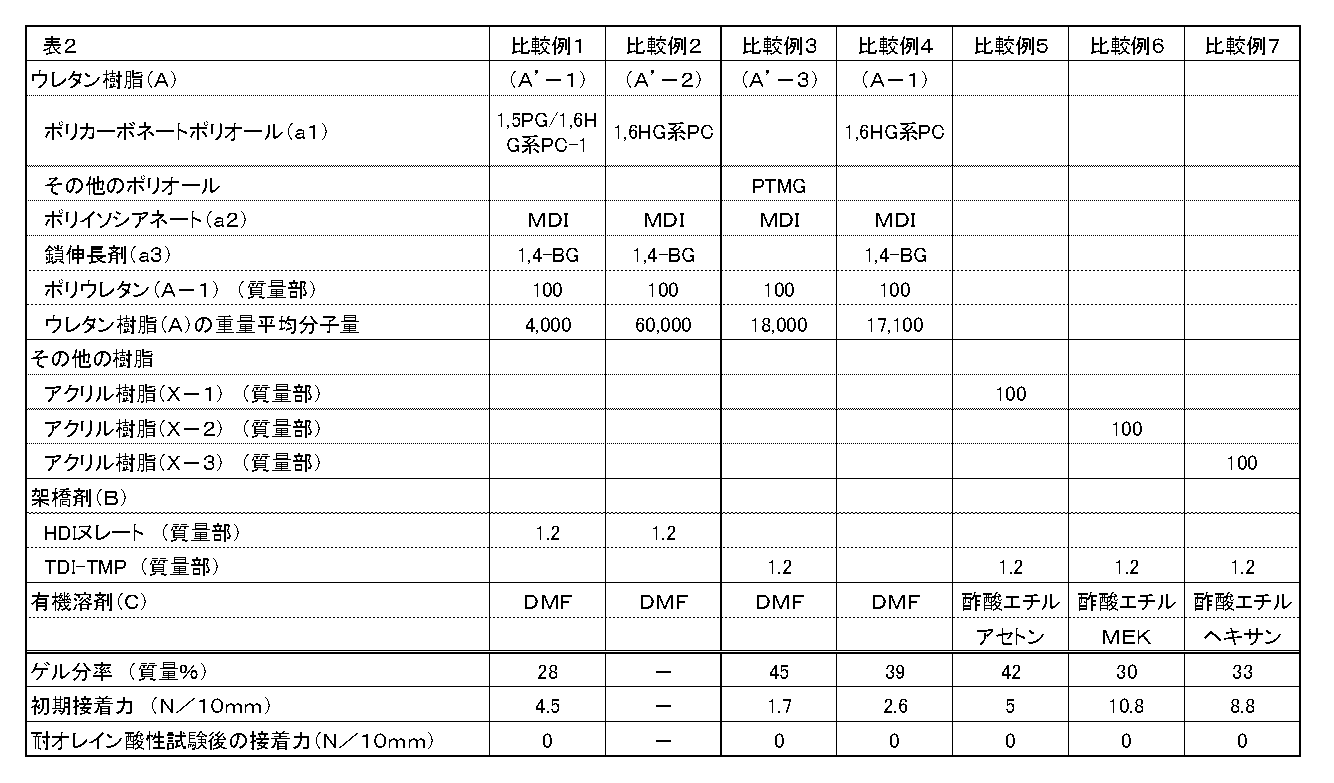
- Comparative Example 1 is an embodiment in which the weight average molecular weight of the urethane resin (A) is below the range specified in the present invention, but the adhesive was dissolved in oleic acid, and the adhesive sheet was peeled off from the adherend. Further, due to the low viscosity, repelling occurred during film coating, and it was difficult to obtain a uniform dry film.
- Comparative Example 2 is an embodiment in which the weight average molecular weight of the urethane resin (A) exceeds the range specified in the present invention, but a uniform dry film having a high viscosity was not obtained.
- Comparative Example 3 is an embodiment using polyether polyol instead of polycarbonate polyol (a1), but the adhesive was dissolved in oleic acid, and the adhesive sheet was peeled off from the adherend.
- Comparative Example 4 is an embodiment in which the cross-linking agent (B) is not used, but the adhesive was dissolved in oleic acid and swelled and decomposed after being immersed in oleic acid for 2 days.
- Comparative Examples 5 to 7 all use an acrylic resin-based pressure-sensitive adhesive composition, but after being immersed in oleic acid for 2 days, they were swollen and decomposed.
Landscapes
- Chemical & Material Sciences (AREA)
- Organic Chemistry (AREA)
- Adhesives Or Adhesive Processes (AREA)
- Polyurethanes Or Polyureas (AREA)
- Adhesive Tapes (AREA)
Abstract
Description
カラム:東ソー株式会社製の下記のカラムを直列に接続して使用した。
「TSKgel G5000」(7.8mmI.D.×30cm)×1本
「TSKgel G4000」(7.8mmI.D.×30cm)×1本
「TSKgel G3000」(7.8mmI.D.×30cm)×1本
「TSKgel G2000」(7.8mmI.D.×30cm)×1本
検出器:RI(示差屈折計)
カラム温度:40℃
溶離液:テトラヒドロフラン(THF)
流速:1.0mL/分
注入量:100μL(試料濃度0.4質量%のテトラヒドロフラン溶液)
標準試料:下記の標準ポリスチレンを用いて検量線を作成した。
東ソー株式会社製「TSKgel 標準ポリスチレン A-500」
東ソー株式会社製「TSKgel 標準ポリスチレン A-1000」
東ソー株式会社製「TSKgel 標準ポリスチレン A-2500」
東ソー株式会社製「TSKgel 標準ポリスチレン A-5000」
東ソー株式会社製「TSKgel 標準ポリスチレン F-1」
東ソー株式会社製「TSKgel 標準ポリスチレン F-2」
東ソー株式会社製「TSKgel 標準ポリスチレン F-4」
東ソー株式会社製「TSKgel 標準ポリスチレン F-10」
東ソー株式会社製「TSKgel 標準ポリスチレン F-20」
東ソー株式会社製「TSKgel 標準ポリスチレン F-40」
東ソー株式会社製「TSKgel 標準ポリスチレン F-80」
東ソー株式会社製「TSKgel 標準ポリスチレン F-128」
東ソー株式会社製「TSKgel 標準ポリスチレン F-288」
東ソー株式会社製「TSKgel 標準ポリスチレン F-550」
<ウレタン樹脂(A-1)の合成>
攪拌機、還流冷却器、窒素導入管、温度計を備えた反応容器に、1,5-ペンタンジオール及び1,6-ヘキサンジオール系ポリカーボネートポリオール(旭化成ケミカルズ株式会社製「デュラノールT5652」、数平均分子量;2,000、以下「1,5PG/1,6HG系PC-1」と略記する。)を558質量部、1,4-ブタンジオール(以下「1,4-BG」と略記する。)を17質量部、ジフェニルメタンジイソシアネート(以下「MDI」と略記する。)を87質量部、トリフェニルホスファイトを0.7質量部、ジメチルホルムアミド(以下、「DMF」と略記する。)を357質量部仕込み、80℃まで加温して反応させた。イソシアネート基含有率が目標値になったことを確認した後、70℃まで冷却した。その後、残存するイソシアネート基を失活させる目的で1,3-ブタンジオールを0.6質量部加えて、70℃で1時間加温し、冷却することにより、固形分;65質量%、粘度;45,000mPa・s、重量平均分子量;17,100のウレタン樹脂(A-1)を得た。
<ウレタン樹脂(A-2)の合成>
攪拌機、還流冷却器、窒素導入管、温度計を備えた反応容器に、1,5PG/1,6HG系PC-1を490質量部、1,4-BGを15質量部、MDIを105質量部、トリフェニルホスファイトを0.7質量部、DMFを610質量部仕込み、80℃まで加温して反応させた。イソシアネート基含有率が目標値になったことを確認した後、70℃まで冷却した。その後、残存するイソシアネート基を失活させる目的で1,3-ブタンジオールを0.6質量部加えて、70℃で1時間加温し、冷却することにより、固形分;50質量%、粘度;2,850mPa・s、重量平均分子量;8,200のウレタン樹脂(A-2)を得た。
<ウレタン樹脂(A-3)の合成>
攪拌機、還流冷却器、窒素導入管、温度計を備えた反応容器に、1,5PG/1,6HG系PC-1を440質量部、エチレングリコール(以下「EG」と略記する。)を10質量部、MDIを92質量部、トリフェニルホスファイトを0.7質量部、DMFを542質量部仕込み、80℃まで加温して反応させた。イソシアネート基含有率が目標値になったことを確認した後、70℃まで冷却した。その後、残存するイソシアネート基を失活させる目的で1,3-ブタンジオールを0.6質量部加えて、70℃で1時間加温し、冷却することにより、固形分;50質量%、粘度;10,320mPa・s、重量平均分子量;29,000のウレタン樹脂(A-3)を得た。
<ウレタン樹脂(A-4)の合成>
攪拌機、還流冷却器、窒素導入管、温度計を備えた反応容器に、1,5-ペンタンジオール及び1,6-ヘキサンジオール系ポリカーボネートポリオール(旭化成ケミカルズ株式会社製「デュラノールT5651」、数平均分子量;1,000、以下「1,5PG/1,6HG系PC-2」)を500質量部、EGを20質量部、トルエンジイソシアネート(以下「TDI」と略記する。)を130質量部、トリフェニルホスファイトを0.7質量部、DMFを650質量部仕込み、80℃まで加温して反応させた。イソシアネート基含有率が目標値になったことを確認した後、70℃まで冷却した。その後、残存するイソシアネート基を失活させる目的で1,3-ブタンジオールを0.6質量部加えて、70℃で1時間加温し、冷却することにより、固形分;50質量%、粘度;8,540mPa・s、重量平均分子量;20,400のウレタン樹脂(A-4)を得た。
<ウレタン樹脂(A-5)の合成>
攪拌機、還流冷却器、窒素導入管、温度計を備えた反応容器に、1,5PG/1,6HG系PC-2を510質量部、1,4-BGを30質量部、MDIを165質量部、トリフェニルホスファイトを0.7質量部、DMFを705質量部仕込み、80℃まで加温して反応させた。イソシアネート基含有率が目標値になったことを確認した後、70℃まで冷却した。その後、残存するイソシアネート基を失活させる目的で1,3-ブタンジオールを0.6質量部加えて、70℃で1時間加温し、冷却することにより、固形分;50質量%、粘度;3,520mPa・s、重量平均分子量;14,600のウレタン樹脂(A-5)を得た。
合成例1で得られたウレタン樹脂(A-1)100質量部に対して、ヘキサメチレンジイソシアネートのイソシアヌレート化合物(以下、「HDIヌレート」と略記する。)を1.2質量部、ウレタン化触媒(DIC株式会社製「T-81E」)を1質量部添加し、粘着剤組成物を得た。表面に離型処理された厚さ38μmのポリエチレンテレフタラート(PET)フィルムの表面に、乾燥後における膜厚が20μmとなるように前記粘着剤組成物を塗工し、100℃で2分間、更に120度で1分間乾燥させ、乾燥皮膜を得た。その後、厚さ12μmのPETフィルムの両面に前記乾燥皮膜を貼り合せ、40℃で3日間エージングさせることにより粘着シートを得た。
用いるウレタン樹脂(A)及び架橋剤(B)の種類/及び又は量を表1に示す通り変更した以外は実施例1と同様にして粘着シートを得た。
<ウレタン樹脂(A’-1)の合成>
攪拌機、還流冷却器、窒素導入管、温度計を備えた反応容器に、1,5PG/1,6HG系PC-1を460質量部、1,4-BGを15質量部、MDIを41質量部、トリフェニルホスファイトを0.7質量部、DMFを516質量部仕込み、80℃まで加温して反応させた。イソシアネート基含有率が目標値になったことを確認した後、70℃まで冷却した。その後、残存するイソシアネート基を失活させる目的で1,3-ブタンジオールを0.6質量部加えて、70℃で1時間加温し、冷却することにより、固形分;50質量%、粘度;1,360mPa・s、重量平均分子量;4,000のウレタン樹脂(A’-1)を得た。
<ウレタン樹脂(A’-2)の合成>
攪拌機、還流冷却器、窒素導入管、温度計を備えた反応容器に、1,5PG/1,6HG系PC-1を440質量部、1,4-BGを30質量部、MDIを197質量部、トリフェニルホスファイトを0.7質量部、DMFを667質量部仕込み、80℃まで加温して反応させた。イソシアネート基含有率が目標値になったことを確認した後、70℃まで冷却した。その後、残存するイソシアネート基を失活させる目的で1,3-ブタンジオールを0.6質量部加えて、70℃で1時間加温し、冷却することにより、固形分;50質量%、粘度;42,100mPa・s、重量平均分子量;60,000のウレタン樹脂(A’-2)を得た。
<ウレタン樹脂(A’-3)の合成>
攪拌機、還流冷却器、窒素導入管、温度計を備えた反応容器に、ポリテトラメチレングリコール(三菱化学株式会社製「PTMG-2000」、数平均分子量;2,000、以下「PTMG」と略記する。)を520質量部、ジフェニルメタンジイソシアネートを105質量部、トリフェニルホスファイトを0.7質量部、DMFを357質量部仕込み、80℃まで加温して反応させた。イソシアネート基含有率が目標値になったことを確認した後、70℃まで冷却した。その後、残存するイソシアネート基を失活させる目的で1,3-ブタンジオールを0.6質量部加えて、70℃で1時間加温し、冷却することにより、固形分;50質量%、粘度;6,320mPa・s、重量平均分子量;18,000のウレタン樹脂(A’-3)を得た。
<アクリル樹脂(X-1)の合成>
攪拌機、還流冷却器、窒素導入管、温度計を備えた反応容器に、ブチルアクリレート89質量部、アクリル酸10質量部、4-ヒドロキシエチルアクリレート0.1質量部、アゾビスイソブチロニトリル0.08質量部、酢酸エチル63質量部、アセトン100質量部を仕込み、撹拌下、窒素を吹き込みながら70度まで昇温した。撹拌下70℃にて14時間ホールドした後、内容物を冷却し、200メッシュ金網にて濾過し、固形分;38質量%、粘度;50,000mPa・s、重量平均分子量;70万のアクリル樹脂(X-1)を得た。
<アクリル樹脂(X-2)の合成>
攪拌機、還流冷却器、窒素導入管、温度計を備えた反応容器に、ブチルアクリレート59質量部、2-エチルヘキシルアクリレート36質量部、アクリル酸質量4部、4-ヒドロキシエチルアクリレート0.1質量部、酢酸エチル90質量部、メチルエチルケトン(以下「MEK」と略記する。)25質量部を仕込み、攪拌下、窒素を吹き込みながら72℃まで昇温した。1時間後に、予め酢酸エチルにて溶解したアゾビスイソブチロニトリル溶液0.25質量部(固形分20質量%)を添加した。その後、攪拌下72℃にて3時間ホールドした後、75℃に昇温し、テトラメチルブチルパーオキシエチルヘキサノエート0.2質量部、t-へキシルパーオキシピバレート0.2質量部を添加し5時間ホールドし反応を終了した。ここに重合ロジンペンタエリスリトールエステル8質量部と不均化ロジングリセリンエステル4質量部、酢酸エチル14質量部を投入し、固形分;50質量%、粘度;10,000mPa・s、重量平均分子量;45万のアクリル樹脂(X-2)を得た。
<アクリル樹脂(X-3)の合成>
攪拌機、還流冷却管、窒素導入管、温度計を備えた反応容器に、2-エチルヘキシルアクリレート96質量部、アクリル酸1質量部、β-カルボキシエチルアクリレート2質量部を予め混合し、その40質量%と酢酸エチル57質量部を攪拌機、還流冷却管、窒素導入管、温度計を備えた反応容器に仕込んだ。攪拌下、窒素を吹き込みながら72℃まで昇温した。1時間後に、予め酢酸エチルにて溶解したアゾビスイソブチロニトリル溶液2質量部(固形分2.5質量%)を添加した。その後、攪拌下72℃にて1時間ホールドした後、75℃に昇温し、残りのアクリルモノマー60質量%とテトラメチルブチルパーオキシエチルヘキサノエート0.2質量部、t-へキシルパーオキシピバレート0.2質量部を添加し10時間ホールドし反応を終了した。ここにテルペン炭化水素樹脂15質量部と重合ロジンペンタエリスリトールエステル5質量部、ヘキサン40質量部を投入し、固形分;50質量%、粘度;4,000mPa・s、重量平均分子量;50万のアクリル樹脂(X-3)を得た。
比較合成例1で得られたウレタン樹脂(A’-1)100質量部に対して、HDIヌレートを1.2質量部、ウレタン化触媒(DIC株式会社製「T-81E」)を1質量部添加し、粘着剤組成物を得た。表面に離型処理された厚さ38μmのポリエチレンテレフタラート(PET)フィルムの表面に、乾燥後における膜厚が20μmとなるように前記粘着剤組成物を塗工し、100℃で2分間、更に120度で1分間乾燥させ、乾燥皮膜を得た。その後、厚さ12μmのPETフィルムの両面に前記乾燥皮膜を貼り合せ、40℃で3日間エージングさせることにより粘着シートを得た。
用いるウレタン樹脂(A)及び架橋剤(B)の種類/及び又は量を表2に示す通り変更した以外は比較例1と同様にして粘着シートを得た。なお、粘着剤組成物の粘度が高く均質な乾燥被膜が得られなかったものは、以下の評価を行わなかったため「-」とした。
比較合成例4で得られたアクリル樹脂(X-1)100質量部に対して、トルエンジイソシアネートとトリメチロールプロパンとのアダクト体(以下、「TDI-TMP」と略記する。)を1.2質量部添加し、粘着剤組成物を得た。表面に離型処理された厚さ38μmのポリエチレンテレフタラート(PET)フィルムの表面に、乾燥後における膜厚が20μmとなるように前記粘着剤組成物を塗工し、80℃で3分間乾燥させ、粘着剤塗工物を得た。その後、厚さ12μmのPETフィルムの両面に前記粘着剤塗工物を貼り合せ、40℃で3日間エージングさせることにより粘着シートを得た。
アクリル樹脂(X-1)の種類を表2に示す通りに変更した以外は、比較例5と同様にして粘着剤組成物及び粘着シートを得た。
実施例及び比較例で得られた粘着シートをトルエン中に24時間浸漬させた前後の粘着剤層の質量からゲル分率を算出した。
実施例及び比較例において、40℃で3日間エージングさせて粘着シートを得た直後に、該粘着シートの片方の離型PETを剥離し、厚さ50μmのPETフィルムに貼り合せ、10mm幅に裁断したものを試験片とした。該試験片の離型PETを剥離し、ステンレス(SUS)板に対し、接着面積が10mm×80mmとなるように貼り合せ、2kgロール×2往復圧着させた。その後、23℃、湿度50%の雰囲気下で24時間放置した後、23℃、湿度50%の雰囲気下でJISK6848-1974に準拠して180度剥離強度を測定し、これを初期接着力(N/10mm)とした。
実施例及び比較例において、40℃で3日間エージングさせて粘着シートを得た直後に、該粘着シートの片方の離型PETを剥離し、厚さ50μmのPETフィルムに貼り合せ、10mm幅に裁断したものを試験片とした。該試験片の離型PETを剥離し、ステンレス(SUS)板に対し、接着面積が10mm×80mmとなるように貼り合せ、2kgロール×2往復圧着させた。その後、23℃、湿度50%の雰囲気下で24時間放置した後、更にオレイン酸中に60℃、湿度90%の雰囲気下で2日間放置した。その後、オレイン酸中から試験体を取り出してから1時間後に、23℃、湿度50%の雰囲気下でJISK6848-1974に準拠して180度剥離強度を測定し、耐オレイン酸性試験後の接着力(N/10mm)とした。前記初期接着力と前記耐オレイン酸性試験後の接着力との差により耐オレイン酸性を評価した。

「D-101」;ヘキサメチレンジイソシアネート系2官能ポリウレタンジイソシアネート(旭化成ケミカルズ株式会社製「デュラネートD-101」
Claims (6)
- ポリカーボネートポリオール(a1)、ポリイソシアネート(a2)及び鎖伸長剤(a3)の反応物であり、重量平均分子量が5,000~40,000の範囲である、水酸基を有するウレタン樹脂(A)と、架橋剤(B)と、有機溶剤(C)とを含有することを特徴とする粘着剤組成物。
- 前記ポリカーボネートポリオール(a1)が、1,5-ペンタンジオール及び1,6-ヘキサンジオールを原料とするものである請求項1記載の粘着剤組成物。
- 前記ポリイソシアネート(a2)が、芳香族ポリイソシアネートである請求項1記載の粘着剤組成物。
- 前記鎖伸長剤(a3)が、1,4-ブタンジオール及び/又はエチレングリコールである請求項1記載の粘着剤組成物。
- 前記架橋剤(B)が、ポリイソシアネート架橋剤である請求項1記載の粘着剤組成物。
- 請求項1~5のいずれか1項記載の粘着剤組成物の乾燥皮膜を有することを特徴とする粘着シート。
Priority Applications (3)
| Application Number | Priority Date | Filing Date | Title |
|---|---|---|---|
| CN201580056798.4A CN107075336B (zh) | 2014-10-20 | 2015-09-29 | 粘合剂组合物及粘合片 |
| JP2016504827A JP5935962B1 (ja) | 2014-10-20 | 2015-09-29 | 粘着剤組成物及び粘着シート |
| KR1020177013344A KR102335832B1 (ko) | 2014-10-20 | 2015-09-29 | 점착제 조성물 및 점착 시트 |
Applications Claiming Priority (2)
| Application Number | Priority Date | Filing Date | Title |
|---|---|---|---|
| JP2014213663 | 2014-10-20 | ||
| JP2014-213663 | 2014-10-20 |
Publications (1)
| Publication Number | Publication Date |
|---|---|
| WO2016063685A1 true WO2016063685A1 (ja) | 2016-04-28 |
Family
ID=55760730
Family Applications (1)
| Application Number | Title | Priority Date | Filing Date |
|---|---|---|---|
| PCT/JP2015/077473 Ceased WO2016063685A1 (ja) | 2014-10-20 | 2015-09-29 | 粘着剤組成物及び粘着シート |
Country Status (5)
| Country | Link |
|---|---|
| JP (1) | JP5935962B1 (ja) |
| KR (1) | KR102335832B1 (ja) |
| CN (1) | CN107075336B (ja) |
| TW (1) | TWI687502B (ja) |
| WO (1) | WO2016063685A1 (ja) |
Cited By (3)
| Publication number | Priority date | Publication date | Assignee | Title |
|---|---|---|---|---|
| JP6014781B1 (ja) * | 2016-03-02 | 2016-10-25 | 積水化学工業株式会社 | 粘着テープ及び電子機器部品固定用の粘着テープ |
| JP2018095807A (ja) * | 2016-12-16 | 2018-06-21 | Dic株式会社 | 粘着剤組成物、及び、粘着シート |
| CN109722918A (zh) * | 2017-10-30 | 2019-05-07 | Dic株式会社 | 聚氨酯树脂组合物、覆膜及合成皮革 |
Families Citing this family (4)
| Publication number | Priority date | Publication date | Assignee | Title |
|---|---|---|---|---|
| CN108084914A (zh) * | 2017-12-18 | 2018-05-29 | 孙祎 | 一种散热片专用双面胶带的制备方法 |
| WO2020095484A1 (ja) * | 2018-11-06 | 2020-05-14 | Dic株式会社 | 粘着剤組成物及び表面保護フィルム |
| TWI851873B (zh) * | 2020-02-06 | 2024-08-11 | 日商東洋紡Mc股份有限公司 | 基材黏接性良好的聚胺甲酸酯樹脂及使用此樹脂之黏接劑、印墨黏結劑或塗佈劑用組成物 |
| KR102873265B1 (ko) * | 2021-02-25 | 2025-10-21 | 디아이씨 가부시끼가이샤 | 합성 피혁 |
Citations (5)
| Publication number | Priority date | Publication date | Assignee | Title |
|---|---|---|---|---|
| JP2002194314A (ja) * | 2000-12-27 | 2002-07-10 | Nitto Denko Corp | 粘着剤組成物とその粘着シート |
| JP2003137963A (ja) * | 2001-11-05 | 2003-05-14 | Toyo Ink Mfg Co Ltd | ポリウレタン樹脂組成物、およびそれを用いた粘着剤 |
| WO2007091643A1 (ja) * | 2006-02-10 | 2007-08-16 | Asahi Glass Co., Ltd. | ウレタン樹脂の製造方法および粘着剤 |
| JP2011162643A (ja) * | 2010-02-09 | 2011-08-25 | Asahi Kasei Chemicals Corp | 水性ポリウレタン組成物 |
| WO2014104134A1 (ja) * | 2012-12-26 | 2014-07-03 | 三菱化学株式会社 | ポリカーボネートジオールおよびそれを用いたポリウレタン |
Family Cites Families (8)
| Publication number | Priority date | Publication date | Assignee | Title |
|---|---|---|---|---|
| JP4144245B2 (ja) * | 2002-04-22 | 2008-09-03 | 旭硝子株式会社 | 湿気硬化型接着剤 |
| EP1873177B1 (en) * | 2005-04-22 | 2010-10-20 | Asahi Glass Company, Limited | Isocyanate-terminated urethane prepolymer, process for producing the same, and adhesive comprising the urethane prepolymer |
| JP5090649B2 (ja) * | 2006-02-22 | 2012-12-05 | タキロン株式会社 | 合成樹脂成形体 |
| EP2072556A1 (de) * | 2007-12-17 | 2009-06-24 | Sika Technology AG | Verfahren zur Herstellung von hydroxyfunktionellen Polymeren, die hieraus gewinnbaren Isocyanatgruppen-endständigen Polyadditionsprodukte sowie deren Verwendung |
| CN102333805B (zh) * | 2009-02-26 | 2014-01-01 | 宇部兴产株式会社 | 水性聚氨酯树脂分散体及其制造方法 |
| CN103764899B (zh) * | 2011-08-22 | 2016-07-06 | Dic株式会社 | 皮革样片材及其制造方法 |
| JP5976110B2 (ja) | 2012-06-27 | 2016-08-23 | 株式会社寺岡製作所 | 粘着剤組成物及びそれを用いた粘着テープ |
| JP6347397B2 (ja) * | 2012-12-26 | 2018-06-27 | 三菱ケミカル株式会社 | ポリカーボネートジオールおよびそれを用いたポリウレタン |
-
2015
- 2015-09-29 JP JP2016504827A patent/JP5935962B1/ja active Active
- 2015-09-29 WO PCT/JP2015/077473 patent/WO2016063685A1/ja not_active Ceased
- 2015-09-29 CN CN201580056798.4A patent/CN107075336B/zh active Active
- 2015-09-29 KR KR1020177013344A patent/KR102335832B1/ko active Active
- 2015-10-14 TW TW104133605A patent/TWI687502B/zh active
Patent Citations (5)
| Publication number | Priority date | Publication date | Assignee | Title |
|---|---|---|---|---|
| JP2002194314A (ja) * | 2000-12-27 | 2002-07-10 | Nitto Denko Corp | 粘着剤組成物とその粘着シート |
| JP2003137963A (ja) * | 2001-11-05 | 2003-05-14 | Toyo Ink Mfg Co Ltd | ポリウレタン樹脂組成物、およびそれを用いた粘着剤 |
| WO2007091643A1 (ja) * | 2006-02-10 | 2007-08-16 | Asahi Glass Co., Ltd. | ウレタン樹脂の製造方法および粘着剤 |
| JP2011162643A (ja) * | 2010-02-09 | 2011-08-25 | Asahi Kasei Chemicals Corp | 水性ポリウレタン組成物 |
| WO2014104134A1 (ja) * | 2012-12-26 | 2014-07-03 | 三菱化学株式会社 | ポリカーボネートジオールおよびそれを用いたポリウレタン |
Cited By (3)
| Publication number | Priority date | Publication date | Assignee | Title |
|---|---|---|---|---|
| JP6014781B1 (ja) * | 2016-03-02 | 2016-10-25 | 積水化学工業株式会社 | 粘着テープ及び電子機器部品固定用の粘着テープ |
| JP2018095807A (ja) * | 2016-12-16 | 2018-06-21 | Dic株式会社 | 粘着剤組成物、及び、粘着シート |
| CN109722918A (zh) * | 2017-10-30 | 2019-05-07 | Dic株式会社 | 聚氨酯树脂组合物、覆膜及合成皮革 |
Also Published As
| Publication number | Publication date |
|---|---|
| CN107075336A (zh) | 2017-08-18 |
| JP5935962B1 (ja) | 2016-06-15 |
| KR20170070207A (ko) | 2017-06-21 |
| JPWO2016063685A1 (ja) | 2017-04-27 |
| CN107075336B (zh) | 2020-10-27 |
| TW201623512A (zh) | 2016-07-01 |
| TWI687502B (zh) | 2020-03-11 |
| KR102335832B1 (ko) | 2021-12-06 |
Similar Documents
| Publication | Publication Date | Title |
|---|---|---|
| JP5935962B1 (ja) | 粘着剤組成物及び粘着シート | |
| JP6660545B2 (ja) | 湿気硬化型ホットメルトウレタン組成物及び接着剤 | |
| TWI851553B (zh) | 濕氣硬化型聚胺基甲酸酯熱熔樹脂組成物 | |
| CN103890032A (zh) | 湿气固化型聚氨酯热熔树脂组合物、胶粘剂及物品 | |
| JP5983904B1 (ja) | 粘着テープ、その製造方法、物品及び携帯電子端末 | |
| JP5835525B1 (ja) | 粘着剤組成物及び粘着フィルム | |
| JP6365000B2 (ja) | 湿気硬化型ポリウレタンホットメルト樹脂組成物、接着剤及び積層体 | |
| JP5935961B1 (ja) | 粘着剤組成物 | |
| JP2017193656A (ja) | 粘着テープ、その製造方法、物品及び携帯電子端末 | |
| CN111491970B (zh) | 湿气固化型聚氨酯热熔树脂组合物和使用了该组合物的物品 | |
| JP2017193609A (ja) | 粘着剤組成物、及び、粘着シート | |
| JP7196435B2 (ja) | 湿気硬化型ポリウレタンホットメルト樹脂組成物 | |
| JP2016138237A (ja) | 粘着剤用ポリオール組成物、粘着剤用キットおよび積層体 | |
| JPWO2019163621A1 (ja) | 湿気硬化型ポリウレタンホットメルト樹脂組成物、及び、その硬化物 | |
| CN110770313A (zh) | 反应性热熔树脂用剥离剂 | |
| TWI851576B (zh) | 濕氣硬化型聚胺酯熱熔樹脂組成物 | |
| JP7183758B2 (ja) | 湿気硬化型ポリウレタンホットメルト樹脂組成物、接着剤、及び、物品 | |
| JP6350764B2 (ja) | ポリウレタン組成物、及び、シート | |
| JP7196434B2 (ja) | 湿気硬化型ポリウレタンホットメルト樹脂組成物 | |
| JP6874356B2 (ja) | 粘着剤組成物、及び、粘着シート |
Legal Events
| Date | Code | Title | Description |
|---|---|---|---|
| ENP | Entry into the national phase |
Ref document number: 2016504827 Country of ref document: JP Kind code of ref document: A |
|
| 121 | Ep: the epo has been informed by wipo that ep was designated in this application |
Ref document number: 15853485 Country of ref document: EP Kind code of ref document: A1 |
|
| NENP | Non-entry into the national phase |
Ref country code: DE |
|
| ENP | Entry into the national phase |
Ref document number: 20177013344 Country of ref document: KR Kind code of ref document: A |
|
| 122 | Ep: pct application non-entry in european phase |
Ref document number: 15853485 Country of ref document: EP Kind code of ref document: A1 |