WO2016017416A1 - ポリエステルフィルム - Google Patents
ポリエステルフィルム Download PDFInfo
- Publication number
- WO2016017416A1 WO2016017416A1 PCT/JP2015/070153 JP2015070153W WO2016017416A1 WO 2016017416 A1 WO2016017416 A1 WO 2016017416A1 JP 2015070153 W JP2015070153 W JP 2015070153W WO 2016017416 A1 WO2016017416 A1 WO 2016017416A1
- Authority
- WO
- WIPO (PCT)
- Prior art keywords
- polyester
- layer
- film
- particles
- less
- Prior art date
- Legal status (The legal status is an assumption and is not a legal conclusion. Google has not performed a legal analysis and makes no representation as to the accuracy of the status listed.)
- Ceased
Links
Classifications
-
- C—CHEMISTRY; METALLURGY
- C08—ORGANIC MACROMOLECULAR COMPOUNDS; THEIR PREPARATION OR CHEMICAL WORKING-UP; COMPOSITIONS BASED THEREON
- C08J—WORKING-UP; GENERAL PROCESSES OF COMPOUNDING; AFTER-TREATMENT NOT COVERED BY SUBCLASSES C08B, C08C, C08F, C08G or C08H
- C08J7/00—Chemical treatment or coating of shaped articles made of macromolecular substances
- C08J7/04—Coating
- C08J7/043—Improving the adhesiveness of the coatings per se, e.g. forming primers
-
- B—PERFORMING OPERATIONS; TRANSPORTING
- B32—LAYERED PRODUCTS
- B32B—LAYERED PRODUCTS, i.e. PRODUCTS BUILT-UP OF STRATA OF FLAT OR NON-FLAT, e.g. CELLULAR OR HONEYCOMB, FORM
- B32B27/00—Layered products comprising a layer of synthetic resin
- B32B27/18—Layered products comprising a layer of synthetic resin characterised by the use of special additives
- B32B27/20—Layered products comprising a layer of synthetic resin characterised by the use of special additives using fillers, pigments, thixotroping agents
-
- B—PERFORMING OPERATIONS; TRANSPORTING
- B32—LAYERED PRODUCTS
- B32B—LAYERED PRODUCTS, i.e. PRODUCTS BUILT-UP OF STRATA OF FLAT OR NON-FLAT, e.g. CELLULAR OR HONEYCOMB, FORM
- B32B27/00—Layered products comprising a layer of synthetic resin
- B32B27/36—Layered products comprising a layer of synthetic resin comprising polyesters
-
- B—PERFORMING OPERATIONS; TRANSPORTING
- B32—LAYERED PRODUCTS
- B32B—LAYERED PRODUCTS, i.e. PRODUCTS BUILT-UP OF STRATA OF FLAT OR NON-FLAT, e.g. CELLULAR OR HONEYCOMB, FORM
- B32B3/00—Layered products comprising a layer with external or internal discontinuities or unevennesses, or a layer of non-planar shape; Layered products comprising a layer having particular features of form
- B32B3/26—Layered products comprising a layer with external or internal discontinuities or unevennesses, or a layer of non-planar shape; Layered products comprising a layer having particular features of form characterised by a particular shape of the outline of the cross-section of a continuous layer; characterised by a layer with cavities or internal voids ; characterised by an apertured layer
- B32B3/30—Layered products comprising a layer with external or internal discontinuities or unevennesses, or a layer of non-planar shape; Layered products comprising a layer having particular features of form characterised by a particular shape of the outline of the cross-section of a continuous layer; characterised by a layer with cavities or internal voids ; characterised by an apertured layer characterised by a layer formed with recesses or projections, e.g. hollows, grooves, protuberances, ribs
-
- C—CHEMISTRY; METALLURGY
- C08—ORGANIC MACROMOLECULAR COMPOUNDS; THEIR PREPARATION OR CHEMICAL WORKING-UP; COMPOSITIONS BASED THEREON
- C08J—WORKING-UP; GENERAL PROCESSES OF COMPOUNDING; AFTER-TREATMENT NOT COVERED BY SUBCLASSES C08B, C08C, C08F, C08G or C08H
- C08J7/00—Chemical treatment or coating of shaped articles made of macromolecular substances
- C08J7/04—Coating
-
- C—CHEMISTRY; METALLURGY
- C08—ORGANIC MACROMOLECULAR COMPOUNDS; THEIR PREPARATION OR CHEMICAL WORKING-UP; COMPOSITIONS BASED THEREON
- C08J—WORKING-UP; GENERAL PROCESSES OF COMPOUNDING; AFTER-TREATMENT NOT COVERED BY SUBCLASSES C08B, C08C, C08F, C08G or C08H
- C08J7/00—Chemical treatment or coating of shaped articles made of macromolecular substances
- C08J7/04—Coating
- C08J7/046—Forming abrasion-resistant coatings; Forming surface-hardening coatings
-
- G—PHYSICS
- G02—OPTICS
- G02B—OPTICAL ELEMENTS, SYSTEMS OR APPARATUS
- G02B5/00—Optical elements other than lenses
- G02B5/02—Diffusing elements; Afocal elements
-
- B—PERFORMING OPERATIONS; TRANSPORTING
- B32—LAYERED PRODUCTS
- B32B—LAYERED PRODUCTS, i.e. PRODUCTS BUILT-UP OF STRATA OF FLAT OR NON-FLAT, e.g. CELLULAR OR HONEYCOMB, FORM
- B32B2305/00—Condition, form or state of the layers or laminate
- B32B2305/30—Fillers, e.g. particles, powders, beads, flakes, spheres, chips
Definitions
- the present invention relates to a polyester film, and more particularly to a film used as a reflector for a liquid crystal display.
- Liquid crystal displays which are widely used in various electronic devices such as TVs, personal computers, and tablet terminals, have a light source called a backlight at the rear of the display for screen display. Moreover, the backlight needs to irradiate the whole screen uniformly.
- a side light type and a direct type there are surface light source structures called a side light type and a direct type.
- a thin type display employs a side-light type backlight, that is, a type of backlight that emits light from the side of the screen.
- a sheet called a light guide plate which has been subjected to various treatments such as halftone printing or embossing on one side of a transparent substrate such as an acrylic plate having a certain thickness, is used.
- the illumination light is evenly distributed upward, and a screen having uniform brightness is obtained. Moreover, since illumination is installed only at the edge portion, the number of light sources can be reduced, the cost and weight can be reduced, and the thickness can be made thinner than the direct type. Furthermore, in order to prevent the illumination light from escaping to the back of the screen, a reflecting plate is provided below the light guide plate, thereby reducing the loss of light from the light source and brightening the liquid crystal screen.
- Such a surface light source for a liquid crystal screen is required to be compatible with a light guide plate as well as a thin film and light weight as well as high reflection performance.
- a reflector white pigment is added to the film, or fine bubbles are included inside, and high reflection performance is achieved by this interfacial reflection, and inorganic particles are added to the surface layer or embossed. Or by applying porous inorganic particles or the like to provide an uneven shape to prevent adhesion with the light guide plate (Patent Documents 1, 2, 3, 4, 5).
- the surface of the light guide plate that has been subjected to various treatments such as halftone printing or embossing tends to be damaged. Or shavings may cause screen unevenness.
- the coating of the reflection film may be crushed or peeled off due to vibration during transportation or strong contact with other members during assembly.
- this invention makes it a subject to provide the white polyester film which combined the high reflectivity which was not able to be achieved by the above-mentioned conventional examination, the outstanding non-uniformity action, and the scratch resistance of a film easily and cheaply stably. To do.
- the present invention has the following configuration. (1) In a polyester film having at least two layers of a polyester layer (A) (hereinafter also referred to as A layer) and a polyester layer (B) (hereinafter also referred to as B layer), the polyester layer (A) is a polyester film. A coating layer (C) containing particles is provided on one of the surface layers, and the particles contained in the coating layer (C) are amorphous porous particles. The volume average particle diameter of the particles is 10 ⁇ m or more and 30 ⁇ m or less, and the distance from the top to the outermost surface of the polyester layer (A) when the SEM cross-sectional photograph is observed for each of the protrusions generated when the particles are applied.
- the average value Dh of dh (hereinafter also referred to as the protrusion height) is 10 ⁇ m or more and 30 ⁇ m or less, and the length of the portion in contact with the polyester layer (A) (hereinafter referred to as “the protrusion height”)
- the average value Dw of dw is 10 ⁇ m or more and 35 ⁇ m or less, and the ratio Dh / Dw of Dh / Dw is 0.7 or more and 1.0 or less, and the outermost surface of the polyester layer (A)
- the average particle length Dv in the direction parallel to the A layer of the particles at a height of dh / 2 (hereinafter also referred to as the width of the central portion of the protrusion) dv is 10 ⁇ m or more and 35 ⁇ m or less, and the ratio of Dh and Dv A certain Dh / Dv is 0.90 or more and 1.00 or less, Dv / Dw which is a ratio of Dv and Dw is 0.80 or more and
- the present invention it is possible to provide a polyester film having both high reflectivity and an excellent surface shape, and particularly when this polyester film is used as a reflector or reflector in a surface light source, the liquid crystal screen is illuminated brightly,
- the liquid crystal image can be made clearer and easier to see, and further, it is possible to suppress adhesion and shaving with the light guide plate, and shaving and scratching of the film itself, which is a problem with a backlight using a sidelight type light source, A screen with no unevenness can be obtained.
- the polyester film of the present invention has a polyester layer (A) and a polyester layer (B). Considering easiness of film formation and effects, a three-layer structure is preferable, and a three-layer structure of polyester layer (A) / polyester layer (B) / polyester layer (A) is more preferable. Further, it is necessary to have a coating layer (C) containing particles on at least one side.
- the thickness of the polyester layer (A) of the present invention is preferably 2 to 20 ⁇ m. If the thickness of the polyester layer (A) is less than 2 ⁇ m, stable film formation may not be possible.
- the thickness of the polyester layer (A) exceeds 20 ⁇ m
- the polyester film is used as a reflective film
- light hardly reaches the polyester layer (B)
- the optical characteristics such as light reflectance and luminance may be reduced due to the decrease.
- polyester layer (A) The polyester layer (A) of the polyester film of the present invention preferably contains the polyester (a) as a main component, and can appropriately contain various additives.
- the polyester (a) constituting the polyester layer (A) comprises 1) polycondensation of a dicarboxylic acid component or an ester-forming derivative thereof (hereinafter collectively referred to as “dicarboxylic acid component”) and a diol component, and 2) within one molecule. It can be obtained by a polycondensation of a compound having a carboxylic acid or carboxylic acid derivative skeleton and a hydroxyl group, and 1) 2).
- dicarboxylic acid component constituting the polyester (a) examples include aliphatic dicarboxylic acids such as malonic acid, succinic acid, glutaric acid, adipic acid, suberic acid, sebacic acid, methylmalonic acid, and ethylmalonic acid, terephthalic acid, and isophthalic acid. , Phthalic acid, 1,4-naphthalenedicarboxylic acid, 1,5-naphthalenedicarboxylic acid, dicarboxylic acid such as 2,6-naphthalenedicarboxylic acid, and the like, but are not limited thereto, for example, polyfunctional acid. Trimellitic acid, pyromellitic acid and the like can also be suitably used. Moreover, these may be used independently or may be used in multiple types as needed.
- aliphatic dicarboxylic acids such as malonic acid, succinic acid, glutaric acid, adipic acid, suberic acid, sebacic acid, methylmalonic acid, and
- diol component constituting the polyester resin examples include ethylene glycol, 1,2-propanediol, 1,3-propanediol, 1,4-butanediol, 1,2-butanediol, and 1,3-butanediol. And the like, and diols such as aromatic diols such as 1,3-benzenedimethanol and 1,4-benzenedimethanol, but are not limited thereto. Moreover, these may be used independently or may be used in multiple types.
- Polyester (a) can be obtained by polycondensation by appropriately combining the above-mentioned compounds.
- the polyester (a) may be crystalline or non-crystalline, but it is preferable to contain at least one non-crystalline polyester for forming the surface shape described later.
- non-crystalline refers to a resin having a heat of crystal fusion of less than 1 cal / g.
- polyester suitably used for the polyester (a) examples include polyethylene terephthalate (hereinafter sometimes abbreviated as PET), polypropylene terephthalate, polybutylene terephthalate, and the like.
- PET is preferable because it is inexpensive and has excellent water resistance, durability, and chemical resistance.
- the content of the polyester (a) is preferably 50% by mass or more based on the polyester layer (A). If the content of the polyester (a) is less than 50% by mass, it may not be possible to form a film, and even if the film can be formed, the strength of the film may decrease, which is not preferable.
- the polyester film layer (B) of the present invention preferably contains a polyester (a), a cell nucleating agent (b), and air bubbles in terms of optical properties such as luminance and reflectance.
- a polyester (c) or a dispersant described later it is more preferable to use a polyester (c) or a dispersant described later as appropriate.
- polyester (a) used for the polyester layer (A) mentioned above gives high mechanical strength when it is set as a film, maintaining a non-coloring property. This is preferable.
- the content of the polyester (a) constituting the polyester layer (B) is at least 30% by mass based on the polyester layer (B), and the film forming property, light reflection performance, heat resistance, and durability are excellent. It is preferable in that a polyester film can be obtained.
- the content of the polyester (a) is less than 30% by mass, bubbles are not sufficiently generated around the bubble nucleating agent (b) described later in the film, and the whiteness and light reflection characteristics may be inferior.
- the upper limit of the polyester (a) is preferably 90% by mass or less from the viewpoint of film formation.
- the polyester film of the present invention preferably has air bubbles inside the polyester layer (B) for whiteness and reflection characteristics, and contains the polyester (a) and the cell nucleating agent (b) constituting the polyester layer (B).
- the bubbles can be formed by biaxial stretching.
- the bubble nucleating agent (b) may be inorganic particles or organic particles, and these may be used in combination.
- the inorganic particles include calcium carbonate, magnesium carbonate, titanium oxide, antimony oxide, magnesium oxide, barium carbonate, zinc carbonate, barium sulfate, calcium sulfate, aluminum oxide, silicon oxide (silica), and the like.
- calcium carbonate, titanium oxide, barium sulfate, and silica are preferable from the viewpoint of long-term film-forming stability and reflection characteristics improvement, and titanium oxide is most preferable in terms of small particle size and easy dispersion.
- titanium oxide is most preferable in terms of small particle size and easy dispersion.
- it may be in the form of a porous or hollow porous material, and may be subjected to a surface treatment in order to improve dispersibility within the range that does not impair the effects of the present invention.
- Silane coupling agents, titanate coupling agents, and siloxanes are preferably used.
- organic particles include linear, branched, or cyclic polyolefins such as polyethylene, polypropylene, polybutene, polymethylpentene, and cyclopentadiene.
- the polyolefin may be a homopolymer or a copolymer, and may be used in combination of two or more.
- polypropylene and polymethylpentene are used as crystalline polyolefins in terms of excellent transparency and heat resistance
- cycloolefin copolymers (COCs) are used as amorphous polyolefins.
- COCs cycloolefin copolymers
- the cycloolefin copolymer is composed of at least one cycloolefin selected from the group consisting of cycloalkene, bicycloalkene, tricycloalkene, tetracycloalkene and pentacycloalkene, and linear olefin such as ethylene and propylene. It is a copolymer.
- the amorphous resin as used herein refers to a resin having a heat of crystal fusion of less than 1 cal / g.
- cycloolefin in the cycloolefin copolymer include bicyclo [2,2,1] hept-2-ene, 6-methylbicyclo [2,2,1] hept-2-ene, and 5,6-dimethyl. Bicyclo [2,2,1] hept-2-ene and the like.
- linear olefins in the cycloolefin copolymer include ethylene, propylene, 1-butene, 1-pentene, 1-hexene, 1-octene and the like.
- the linear olefin component is preferably an ethylene component from the viewpoint of reactivity.
- the cycloolefin component bicyclo [2,2,1] hept-2-ene (norbornene) and its derivatives are preferable from the viewpoint of productivity, transparency, and high Tg.
- the amount of the cell nucleating agent (b) added is preferably 10 to 50% by mass, and more preferably 5 to 30% by mass when the total mass of the polyester layer (B) is 100% by mass. If the content of the cell nucleating agent (b) is less than 10% by mass, sufficient bubbles are not generated inside the film, and the whiteness and light reflection characteristics may be inferior. On the other hand, if the content of the cell nucleating agent (b) exceeds 50% by mass, the strength of the film is lowered, breakage during stretching tends to occur, and inconvenience such as generation of powder may occur during post-processing. is there. By setting the content within this range, sufficient whiteness, reflectivity, and lightness can be exhibited.
- organic particles when organic particles are used as the bubble nucleating agent (b), it is effective to add a dispersing agent to uniformly disperse the particles.
- a dispersing agent in the case of the present invention, polyalkylene glycol, particularly polyethylene glycol is particularly preferable.
- a copolymer of polybutylene terephthalate and polytetramethylene glycol is also preferably used for improving the dispersibility of the organic particles.
- the addition amount is preferably 3% by mass or more and 20% by mass or less, and particularly preferably 5% by mass or more and 15% by mass or less, based on the mass of the polyester layer (B). If the amount of the dispersant added is too small, the effect of the addition is diminished, and if it is too large, the original properties of the film base material may be impaired.
- Such a dispersant can be added to the film base polymer in advance and adjusted as a master polymer (master chip).
- polyester (c) The polyester (c) can be obtained by 1) polycondensation of a dicarboxylic acid component or an ester-forming derivative thereof and a diol component.
- the diol component in this invention is not limited to the component which exists as diol, The case where it contains as a structural component of polyester, for example, a copolymer, or a mixture of these resin is also included.
- polyester resins in the polyester film of the present invention, one or more polyester resins can be used as the polyester (c).
- dicarboxylic acid component constituting the polyester resin examples include malonic acid, succinic acid, glutaric acid, adipic acid, suberic acid, sebacic acid, dodecanedioic acid, dimer acid, eicosandioic acid, pimelic acid, azelaic acid, methylmalon.
- Acids aliphatic dicarboxylic acids such as ethylmalonic acid, terephthalic acid, isophthalic acid, phthalic acid, 1,4-naphthalenedicarboxylic acid, 1,5-naphthalenedicarboxylic acid, 2,6-naphthalenedicarboxylic acid, 1,8-naphthalene Dicarboxylic acid, 4,4'-diphenyldicarboxylic acid, 4,4'-diphenyl ether dicarboxylic acid, 5-sodium sulfoisophthalic acid, anthracene dicarboxylic acid, phenanthrene dicarboxylic acid, 9,9'-bis (4-carboxyphenyl) fluorenic acid Aromatic dicarboxylic acid etc.
- aliphatic dicarboxylic acids such as ethylmalonic acid, terephthalic acid, isophthalic acid, phthalic acid, 1,4-naphthalenedicarboxylic acid, 1,5-
- Such as a dicarboxylic acid or its ester derivative it may be mentioned as a typical example, but not limited to, for example, a polyfunctional acid, trimellitic acid, pyromellitic acid and ester derivatives thereof can also be suitably used. Moreover, these may be used independently or may be used in multiple types as needed.
- dicarboxy compounds obtained by adding oxyacids such as l-lactide, d-lactide, hydroxybenzoic acid and the like, or a combination of a plurality of the oxyacids to the carboxy terminus of the dicarboxylic acid component described above.
- oxyacids such as l-lactide, d-lactide, hydroxybenzoic acid and the like, or a combination of a plurality of the oxyacids to the carboxy terminus of the dicarboxylic acid component described above.
- diol component constituting the polyester resin examples include ethylene glycol, 1,2-propanediol, 1,3-propanediol, 1,4-butanediol, 1,2-butanediol, and 1,3-butanediol.
- Aliphatic diols such as cyclobutanediol, cyclopentanediol, cyclohexanediol, cycloheptanediol, cyclooctanediol, cyclopropanedimethanol, cyclobutanedimethanol, cyclopentanedimethanol, cyclohexanedimethanol, cycloheptanedi Aliphatic diols having 4 to 8 carbon atoms, such as methanol and cyclooctane dimethanol, bisphenol A, 1,3-benzenedimethanol, 1,4-benzenedimethanol, 9,9'-bis (4-hydroxyphenyl) Fluorene, although aromatic diols such as and the like as a typical example, but not limited to. Moreover, these may be used independently or may be used in multiple types as needed.
- 1,4-cyclohexanedimethanol is particularly preferably used as the polyester (c) because it is easy to mix with a monomer price and a polyester resin (particularly PET).
- CHDM 1,4-cyclohexanedimethanol
- the content of the polyester (c) is preferably 1.2 to 36% by mass with respect to the polyester layer (B). More preferably, the content is 2.4 to 26% by mass.
- the content of the polyester (c) is less than 1.2% by mass, the fine dispersion effect of the cell nucleating agent (b) is lowered and the reflection performance is lowered, which is not preferable.
- it exceeds 36 mass% the heat resistance of a polyester film will fall and a dimensional change may become large when exposed to high temperature, and is unpreferable.
- the content of the polyester (c) when the content of the polyester (c) is 1.2 to 36% by mass, a polyester film having more film forming stability, reflectivity and dimensional stability can be obtained.
- the polyester film of the present invention has a coating layer (C) on the surface of the polyester layer (A), and the coating layer needs to contain amorphous porous particles (d).
- amorphous porous particle (d) which can be used for this invention, an organic type particle
- acrylic resin particles, silicone resin particles, nylon resin particles, styrene resin particles, polyethylene resin particles, polyamide resin particles, urethane resin particles, polyester resin particles, or a mixture thereof is used.
- nylon particles are particularly preferred because the hardness can be adjusted appropriately.
- amorphous porous particles refers to particles in which the particles are not fixed in shape and have different shapes depending on the individual particles and have pores.
- the pore is a portion that is recessed concavely toward the inside of the particle.
- it may be a hollow shape, a shape that is recessed toward the inside or center of the particle, such as a needle or a curve, or a shape that penetrates the particle, and the size and volume may vary. It is not limited to.
- the presence or absence of pores and the shape of the particles were obtained by cutting a film sample in a direction perpendicular to the film plane at a knife inclination angle of 3 ° using a rotary microtome manufactured by Nippon Microme Laboratory. Using a scanning electron microscope ABT-32 manufactured by Topcon Corporation, the cross section of the film is used, for example, at an observation magnification of 2500 to 10,000 times so that one particle is projected substantially over the entire field of view. The contrast can be appropriately adjusted and observed, and the presence or absence of pores and the shape of the particles can be confirmed.
- the presence / absence of pores is determined based on whether or not spots or spots are present in the particles in the observed image. No pores.
- Examples of the amorphous porous particles include particles produced by a production method as described in JP-A-2006-328173.
- the polyester film of the present invention has a concavo-convex shape provided on at least one surface layer by coating, and the protrusion is an average value of the distance dh from the top of the protrusion to the outermost surface of the polyester layer (A).
- Dh is less than 10 ⁇ m, other members such as a light guide plate and the film are brought into close contact with each other in the edge light type backlight, resulting in luminance unevenness.
- adhesion to a film main body will become difficult and protrusion will fall off.
- Dw which is an average value of the length (width of the bottom of the protrusion) dw of the portion in contact with the A layer in the protrusion, is required to be 10 ⁇ m or more and 35 ⁇ m or less, and more preferably 10 ⁇ m or more and 20 ⁇ m or less.
- the thickness is less than 10 ⁇ m, the film is brought into close contact with the other member such as a light guide plate in the edge light type backlight, resulting in luminance unevenness.
- the 60 ° gloss change value after the flat surface abrasion test described later cannot be made less than 30%.
- it is larger than 35 ⁇ m it becomes difficult to adhere to the film main body, and the protrusion falls off.
- the average value Dv of the particle length (width of the projection central portion) dv in the direction parallel to the A layer of the particles at a height of dh / 2 from the A layer is 10 ⁇ m or more and 35 ⁇ m or less. More preferably, it is 20 ⁇ m or less.
- the thickness is less than 10 ⁇ m, the film is brought into close contact with the other member such as a light guide plate in the edge light type backlight, resulting in luminance unevenness.
- the 60 ° gloss change value after the flat surface abrasion test described later cannot be made less than 30%.
- it is larger than 35 ⁇ m it becomes difficult to adhere to the film main body, and the protrusion falls off.
- the number of projections N per 1 mm 2 of the film surface needs to be 1000 or more and 2000 or less.
- the number N per 1 mm 2 needs to be in the above range.
- porous particles having an average particle diameter of 10 ⁇ m to 30 ⁇ m, preferably 10 ⁇ m to 20 ⁇ m are used. Furthermore, it is preferable to use a water-based coating agent.
- the average particle diameter is less than 10 ⁇ m, it is difficult to make the glossiness within the above-described range, and thus uneven brightness may occur.
- the thickness is larger than 30 ⁇ m, particles with the binder thickness as described later drop off, and even if the film can be formed, the luminance may be lowered, which is not preferable.
- the aqueous coating agent as used herein means that 50% by mass or more of the components of the coating agent is water.
- the binder component contained in the coating is preferably 5% by mass to 20% by mass in terms of dry concentration. When the dry concentration of the binder component is less than 5% by mass, the particles fall off. On the other hand, when the dry concentration of the binder component exceeds 20% by mass, the protrusions are buried in the binder, so that it may be particularly difficult to make Dh within the above range, and the light reflection characteristics of the film body may be impaired. is there. Moreover, it is preferable to pass through the drying process for 2 second or more at least by the atmospheric temperature of 180 degreeC or more after apply
- the binder resin layer according to the present invention is not particularly limited, but a resin mainly composed of organic components is preferable.
- a resin mainly composed of organic components is preferable.
- the resin include polyvinylidene chloride resin, polystyrene resin, polyvinyl acetate resin, and fluorine resin. These resins may be used alone, or two or more copolymers or a mixture thereof may be used.
- polyester resins, polyurethane resins, acrylic or methacrylic resins are preferable, and polyester resins are particularly preferably used from the viewpoint of heat resistance, particle dispersibility, coatability, and refractive index difference from the substrate.
- the thickness of the binder resin layer is preferably 0.1 ⁇ m or more and 1 ⁇ m or less, and more preferably 0.1 ⁇ m or more and 0.5 ⁇ m or less.
- the thickness of the binder resin layer is less than 0.1 ⁇ m, the particles having the average particle diameter as described above cannot be retained, and the particles may fall off.
- the binder thickness is larger than 1 ⁇ m, it is difficult to make the glossiness within the above-described range, and other optical characteristics such as luminance are adversely affected, which is not preferable.
- the polyester film of the present invention preferably has a 60 ° gloss change value after a plane abrasion test of less than 30%, more preferably less than 10%.
- the plane wear test referred to here is a plane wear tester (PA-300A manufactured by Daiei Kagaku Seiki Seisakusho Co., Ltd.) with a square column with a 1 cm 2 (1 cm ⁇ 1 cm) end face applied with a 1 kg load. Is a test of rubbing 5 cm for 10 reciprocations.
- the glossiness in the present invention refers to the digital variable angle glossiness meter UGV-5B (manufactured by Suga Test Instruments Co., Ltd.). The value measured from the polyester (A) layer side according to JIS Z-8741 (1997).
- Dh / Dw which is a ratio of Dh and Dw, is 0.70 or more and 1.00 or less.
- Dh / Dw is greater than 1.0, the protrusion may be easily dropped due to the force received by the protrusion due to friction with other members. That is, the 60 ° gloss change after rubbing the film surface described above. The value may not be less than 30%.
- Dh / Dw is less than 0.70, the particles may damage the other member or be damaged by the other member. In any case, the 60 ° gloss change value after rubbing the film surface is 30. % May not be less than%.
- Dh / Dv which is a ratio of Dh and Dv
- Dh / Dw is 0.90 or more and less than 1.00.
- Dh / Dw is greater than 1.0
- the protrusion may be easily dropped due to the force received by the protrusion due to friction with other members. That is, the 60 ° gloss change after rubbing the film surface described above.
- the value may not be less than 30%. If Dh / Dv is less than 0.90, the particles may damage the other member or be damaged by the other member. In any case, the 60 ° gloss change value after rubbing the film surface is 30. % May not be less than%.
- Dv / Dw which is ratio of Dv and Dw is 0.80 or more and less than 1.05. If Dh / Dw is greater than 1.05, the protrusion may be easily dropped due to the force received by the protrusion due to friction with other members. That is, the 60 ° gloss change after rubbing the film surface described above. The value may not be less than 30%. When Dv / Dw is less than 0.80, the particles may damage the other member or may be damaged by the other member. In either case, the 60 ° gloss change value after rubbing the film surface is 30. % May not be less than%. If the 60 ° gloss change value is 30% or more, not only can scratches be visually identified, but when the film is incorporated as a backlight, the scratches appear as uneven brightness and appear on the screen. .
- the luminance in the present invention is relative luminance, and the measurement is performed as follows.
- the reflective film pasted in a new Hisense Japan Co., Ltd. 32-inch liquid crystal TV LHD32K15JP backlight was changed to the polyester film of the present invention and turned on.
- the liquid crystal screen was photographed with a CCD camera (DXC-390, manufactured by SONY), and the image was captured using an eye scale manufactured by an image analysis apparatus, Eye System. Thereafter, the brightness level of the photographed image was controlled to 30,000 steps to be automatically detected and converted to brightness.
- Brightness (%) (Brightness of film sample (%)) / (Brightness of reference sample (%)) ⁇ 100.
- the luminance unevenness was obtained by the following formula using the luminance maximum value, luminance minimum value, and luminance average value automatically detected as described above.
- Brightness unevenness (%) (maximum luminance value ⁇ minimum luminance value) / average luminance value ⁇ 100
- the method for forming the coating layer is not particularly limited, but various coating methods such as an in-line coating method, a reverse coating method, a gravure coating method, a rod coating method, a bar coating method, a die coating method, or a spray coating method are used. Can do.
- the inorganic particles can be used in the production of the present invention by preparing polyester (a) master pellets containing inorganic particles.
- the organic particles are obtained by polymerizing the above-described cycloolefin and olefin by a known method (for example, JP-A-61-271308, WO 2007/060723 pamphlet) or a commercial product (for example, “TOPAS” (polyplastics).
- a known method for example, JP-A-61-271308, WO 2007/060723 pamphlet
- a commercial product for example, “TOPAS” (polyplastics).
- the product can be obtained by purchasing
- polyester (c) As an example, a method for obtaining polyester (c) will be described, but the method is not limited to this example.
- a polyester (c) obtained by copolymerizing an alicyclic diol having 4 to 8 carbon atoms and terephthalic acid can be obtained by performing a polycondensation reaction.
- a dispersant that can be preferably used in the present invention is a block copolymer of PBT (polybutylene terephthalate) and PAG (mainly polytetramethylene glycol), and has a melt index (MI) of 14 (2.160 g, 240 ° C.). is there.
- the method for obtaining the porous particles (d) will be described as an example, but is not limited to such an example.
- it can be obtained by the following method. That is, a mixture produced by mixing 15% by weight of nylon 6 pellets with ethylene glycol (solvent) in a mixing tank equipped with a stirrer and replaced with carbon dioxide until the nylon 6 is completely dissolved at 185 ° C. Stir with.
- the obtained uniform solution was cooled on a stainless steel belt conveyor held at a constant temperature as shown in FIG. 1 to granulate nylon 6 porous particles. At this time, the temperature of the stainless steel belt conveyor is maintained at 75 ° C., and the belt speed is 5.0 m / min.
- the uniform solution formed a liquid film of 1 to 1.5 mm on the surface of the belt conveyor.
- the mixture of nylon 6 porous particles and ethylene glycol thus obtained is separated from the belt by a blade, further subjected to a centrifugal separator to roughly separate ethylene glycol, and then dried to obtain nylon 6 porous particle powder. .
- a part of the particle powder is sampled, and one particle is projected over substantially the entire visual field region using a scanning electron microscope ABT-32 manufactured by Topcon Corporation. For example, observation is performed at an observation magnification of 2500 to 10,000 times, and the contrast of the image is appropriately adjusted, and the presence of pores and the shape of the particles are confirmed.
- the presence / absence of pores is determined by whether or not there are spots or spots in the observed image. If there are spots or spots, the pores are present. If none is present and there are pores, the particles are identified as porous particles.
- the polyester (a) and a mixture containing various additives as required are sufficiently vacuum-dried and supplied to a heated extruder.
- the addition of various additives may be performed using a master chip prepared by uniform melt-kneading in advance, or may be directly supplied to a kneading extruder.
- the mixture containing the polyester (a), the cell nucleating agent (b) and, if necessary, the polyester (c) and the dispersing agent is sufficiently vacuum dried and supplied to a heated extruder.
- the addition of the cell nucleating agent (b) may be performed using a master chip prepared by uniform melt kneading in advance, or may be directly supplied to a kneading extruder.
- melt-extrude after filtering through a filter having a mesh of 40 ⁇ m or less, to introduce into a T-die die and obtain a molten sheet by extrusion molding.
- the molten sheet is closely cooled and solidified by static electricity on a drum cooled to a surface temperature of 10 to 60 ° C. to produce a three-layer film of unstretched A / B / A.
- the unstretched three-layer film is led to a roll group heated to 70 to 120 ° C., preferably 70 to 100 ° C., and stretched 2 to 4 times in the longitudinal direction (longitudinal direction, that is, the traveling direction of the film). Cool with rolls at a temperature of ° C.
- the sheet stretched in the longitudinal direction is guided to a coating apparatus, and a coating agent that is a base of the coating layer (C) containing the resin particles and the binder resin is applied by a bar coating method.
- the film is guided to a tenter while holding both ends of the film with clips, and stretched 2 to 4 times in a direction (width direction) perpendicular to the longitudinal direction in an atmosphere heated to a temperature of 90 to 150 ° C.
- the stretching ratio is 2 to 4 times in each of the longitudinal direction and the width direction, but the area ratio (longitudinal stretching ratio ⁇ lateral stretching ratio) is preferably 4 to 16 times, more preferably 8 to 12 times. preferable.
- the area magnification is less than 4 times, the bubbles and the film strength are insufficient, and it is difficult to obtain high reflection characteristics.
- the coating layer (C) may be coated in-line as described above, or may be provided in a later step, but in-line is preferable because the number of protrusions can be easily adjusted to the above range and is inexpensive. .
- polyester film of the present invention can be obtained by cooling to room temperature, and then, if necessary, performing corona discharge treatment or the like in order to further improve the adhesion to other materials and winding.
- the biaxial stretching method may be either sequential or simultaneous. Further, after biaxial stretching, the film may be re-stretched in either the longitudinal direction or the width direction.
- the polyester film of the present invention has a concavo-convex shape provided by coating on the surface layer of at least one side, and has a high reflectance with bubbles formed inside the film, is lightweight, and is a reflector for a liquid crystal display, particularly directly under an LED.
- a reflective plate for a type display compatibility with other members, particularly a light guide plate, is good, and high luminance can be obtained without screen unevenness.
- Measurement Method The physical property value evaluation method and effect evaluation method of the present invention are as follows.
- Luminance and luminance unevenness A new Hisense Japan Co., Ltd. 32-inch liquid crystal TV LHD32K15JP backlight reflecting film was changed to a polyester film to be measured and turned on. At this time, it installed so that the application layer (C) side might become an upper surface. In this state, after waiting for 1 hour to stabilize the light source, the liquid crystal screen was photographed with a CCD camera (DXC-390, manufactured by SONY), and the image was captured using an eye scale manufactured by an image analysis apparatus, Eye System. Thereafter, the brightness level of the photographed image was controlled to 30,000 steps to be automatically detected and converted to brightness.
- CCD camera DXC-390, manufactured by SONY
- the reflection film that had been pasted was used as a reference sample (100%), the relative luminance of the film sample was determined by the following formula, and this value was used as luminance.
- Brightness (%) (Brightness of film sample (%)) / (Brightness of reference sample (%)) ⁇ 100.
- the luminance unevenness was obtained by the following formula using the luminance maximum value, the luminance minimum value, and the luminance average value automatically detected as described above.
- Brightness unevenness (%) (maximum luminance value ⁇ minimum luminance value) / average luminance value ⁇ 100 “AA”: Excellent (less than 2%) “A”: Good (2% or more and less than 5%) “B”: Inferior (5% or more and less than 10%) “C”: very poor (over 10%) The above “AA” and "A” were accepted.
- Protrusion size (dh, Dh, dw, Dw, dv, Dv)
- a microtome was used to cut out a cross section in the direction parallel to the film TD direction (lateral direction), and after depositing platinum-palladium, the coating layer (C) was applied using a field emission scanning electron microscope “JSM-6700F” manufactured by JEOL Ltd.
- the distance (protrusion height) dh from the top to the top surface of the A layer, the A layer in the protrusion The length of the portion in contact with the projection (width at the bottom of the projection) dw and the length of the particle in the direction parallel to the A layer at a height of dh / 2 from the A layer (width at the projection central portion) dv are each 20 projections
- the average value of dh was calculated as Dh, the average value of dw as Dw, and the average value of dv as Dv.
- the film was cut in the cross-sectional direction using the average particle diameter microtome of the particles of the coating layer (C), platinum-palladium was vapor-deposited on the obtained cross-section, and then field emission scanning electron microscope “JSM-” manufactured by JEOL Ltd. From the image obtained by magnifying the vicinity of the film surface on the side of the coating layer (C) at 5000 times with 6700 F ′′, the average particle diameter (D in the formula) was determined by the following procedure. 1) The cross-sectional area S was calculated
- the volume average particle diameter D was determined in the following formula (2).
- D ⁇ [4 / 3 ⁇ ⁇ (d / 2) 3 ⁇ d] / ⁇ [4 / 3 ⁇ ⁇ (d / 2) 3 ] (2) 3)
- the above 1) and 2) are carried out at five different locations, and the average particle diameter is determined by the average value.
- the film was cut in the cross-sectional direction using the binder resin layer thickness microtome of the coating layer (C), platinum-palladium was vapor-deposited on the obtained cross-section, and field emission scanning electron microscope “JSM-6700F manufactured by JEOL Ltd.” "From the image obtained by magnifying the vicinity of the film surface on the side of the coating layer (C) at 20000 times, the binder resin layer thickness observed in the cross section in the image can be arbitrarily determined by using a scale or the like. It measured and calculated
- the 60 ° glossiness of the portion after the flat surface abrasion test and the portion where the test was not performed was measured, and the difference was taken as the glossiness change value.
- polyester (a) Using terephthalic acid as the acid component and ethylene glycol as the diol component, adding to the polyester pellets to obtain antimony trioxide (polymerization catalyst) to 300 ppm in terms of antimony atoms, conducting a polycondensation reaction, limiting viscosity Polyethylene terephthalate pellets (PET) having 0.63 dl / g and carboxyl end group amount of 40 equivalents / ton were obtained.
- antimony trioxide polymerization catalyst
- PET Polyethylene terephthalate pellets
- Titanium oxide and barium sulfate used were titanium oxide or barium sulfate master pellets sold by DIC Corporation (base resin is polyester (a)).
- Bubble nucleating agent (b) Cycloolefin copolymer “TOPAS” (manufactured by Polyplastics Co., Ltd.) having a glass transition temperature of 180 ° C. was used (described as COC in the table).
- Polyester (c) Using terephthalic acid as the acid component and ethylene glycol as the glycol component, adding to the polyester pellets that can obtain antimony trioxide (polymerization catalyst) to 300 ppm in terms of antimony atoms, performing a polycondensation reaction, limiting viscosity Polyethylene terephthalate pellets (PET) having 0.63 dl / g and carboxyl end group amount of 40 equivalents / ton were obtained. Further, CHDM (cyclohexanedimethanol) copolymerized PET was used in combination with PET. This is PET obtained by copolymerizing 60 mol% of cyclohexanedimethanol with the above-described method with respect to the glycol component (abbreviated as TPA / EG / CHDM in the table).
- TPA cyclohexanedimethanol
- a dispersant PBT-PAG (polybutylene terephthalate-polyalkylene glycol) copolymer was used (manufactured by Toray DuPont Co., Ltd., trade name: Hytrel).
- the resin is a block copolymer of PBT (polybutylene terephthalate) and PTMG (mainly polytetramethylene glycol), and has a melt index (MI) of 14 (2.160 g, 240 ° C.).
- Nylon 6 was prepared by mixing a mixture formed by mixing 15 wt% of nylon 6 pellets with porous nylon ethylene glycol (solvent) with carbon dioxide in a mixing tank equipped with a stirrer. The mixture was stirred at 185 ° C. until completely dissolved. The obtained uniform solution was cooled on a stainless steel belt conveyor held at a constant temperature as shown in FIG. 1 to granulate nylon 6 porous particles. At this time, the temperature of the stainless steel belt conveyor is maintained at 75 ° C., and the belt speed is 5.0 m / min. The uniform solution formed a liquid film of 1 to 1.5 mm on the surface of the belt conveyor.
- the mixture of nylon 6 porous particles and ethylene glycol thus obtained is separated from the belt by a blade, further subjected to a centrifugal separator to roughly separate ethylene glycol, and then dried to obtain nylon 6 porous particle powder. .
- a part of the particle powder is sampled, and one particle is projected over substantially the entire visual field region using a scanning electron microscope ABT-32 manufactured by Topcon Corporation. For example, observation is performed at an observation magnification of 2500 to 10,000 times, and the contrast of the image is appropriately adjusted, and the presence of pores and the shape of the particles are confirmed.
- the presence / absence of pores is determined by whether or not there are spots or spots in the observed image. If there are spots or spots, the pores are present. If none is present and there are pores, the particles are identified as porous particles.
- Spherical particles made of PBT-PTMG particles PBT-PAG (polybutylene terephthalate-polyalkylene glycol) copolymer (manufactured by Toray Du Pont Co., Ltd., trade name: Hytrel) were used.
- the resin is a block copolymer of PBT (polybutylene terephthalate) and PTMG (mainly polytetramethylene glycol), and has a melt index (MI) of 14 (2.160 g, 240 ° C.).
- Examples 1 to 15 In a composite film-forming apparatus having a main extruder and a sub-extruder, the raw material mixture shown as the polyester layer (B) in Table 1 is vacuum-dried at a temperature of 180 ° C. for 3 hours, and then supplied to the main extruder side. After melt extrusion at a temperature of 280 ° C., the mixture was filtered through a 30 ⁇ m cut filter and then introduced into a T-die composite die. On the other hand, for the polyester layer (A), a master pellet composed of 99.5% by mass of polyester (a) and 0.5% by mass of SiO 2 particles having an average particle size of 2.0 ⁇ m was vacuum-dried at a temperature of 180 ° C. for 3 hours.
- the mixture was supplied to the sub-extruder, melt-extruded at a temperature of 280 ° C., filtered through a 30 ⁇ m cut filter, and then introduced into a T-die composite die.
- the polyester layer (A) extruded from the sub-extruder is joined (A / B / A) on both sides of the polyester layer (B) extruded from the main extruder in the T-die composite die.
- the sheet was coextruded into a sheet to form a molten laminated sheet, and the molten laminated sheet was closely cooled and solidified by an electrostatic charge method on a drum maintained at a surface temperature of 20 ° C. to obtain an unstretched laminated film.
- the unstretched laminated film is preheated with a roll group heated to 85 ° C. according to a conventional method, and then stretched in the longitudinal direction (longitudinal direction) using a 90 ° C. heated roll, and a roll group at a temperature of 25 ° C. Then, this uniaxially stretched film is guided to a coating apparatus, and a coating liquid is applied using Metabar # 8 by a bar coating method, and the base of the coating layer (C) containing the resin particles and the binder resin is applied. Apply a coating. Then, while holding both ends of the applied uniaxially stretched film with clips, it is guided to a preheating zone at a temperature of 95 ° C.
- the polyester resin aqueous dispersion (It describes as a polyester binder in a table
- Various characteristics are also shown in Table 1.
- the porous nylon particles are present in a dispersed state in the coating liquid, but in the coating liquid, it is assumed that adsorption with water and resin components constituting the coating liquid occurs. It is possible to hold particles having a size exceeding 1 mm with a binder of 1 to 2 ⁇ m.
- heat is applied to the particles in the stretching and heat setting step, the particles are deformed to form amorphous porous particles.
- the polyester film of the present invention was able to be stably formed, and even when scratched, the glossiness change was small, and the surface shape (luminance unevenness reducing effect) was excellent.
- the polyester film of the present invention is excellent in economy, film-forming property, reflectivity, and surface shape, and by using this polyester film, a surface light source excellent in luminance characteristics and compatibility with other members can be provided at low cost. .
- the polyester film of the present invention can be applied to uses that require whiteness, reflectivity, and concealment, and a particularly preferred use is a plate-like material incorporated in a surface light source for light reflection. Specifically, it is preferably used for an edge light reflector for a liquid crystal screen, a reflector for a direct type light, and a cold cathode ray tube or a reflector around LED illumination.
Landscapes
- Chemical & Material Sciences (AREA)
- Health & Medical Sciences (AREA)
- Chemical Kinetics & Catalysis (AREA)
- Medicinal Chemistry (AREA)
- Polymers & Plastics (AREA)
- Organic Chemistry (AREA)
- Physics & Mathematics (AREA)
- General Physics & Mathematics (AREA)
- Optics & Photonics (AREA)
- Laminated Bodies (AREA)
- Optical Elements Other Than Lenses (AREA)
- Coating Of Shaped Articles Made Of Macromolecular Substances (AREA)
Abstract
Description
(1)少なくともポリエステル層(A)(以下、A層とも言う)およびポリエステル層(B)(以下、B層とも言う)の2種類の層を有するポリエステルフィルムにおいて、ポリエステル層(A)はポリエステルフィルムの少なくとも片側の表層を形成し、該表層の一方に粒子を含有する塗布層(C)が設けられ、塗布層(C)中に含有される前記粒子が不定形な多孔質粒子であり、この粒子の体積平均粒子径が10μm以上30μm以下であり、当該粒子を塗布した際に生じる突起のそれぞれに対し、SEM断面写真を観察したとき、その頂部からポリエステル層(A)の最表面までの距離(以下、突起高さとも言う)dhの平均値Dhが10μm以上30μm以下であり、該突起におけるポリエステル層(A)と接する部分の長さ(以下、突起底部の幅とも言う)dwの平均値Dwが10μm以上35μm以下であり、DhとDwの比であるDh/Dwが0.7以上1.0以下であり、ポリエステル層(A)の最表面からdh/2の高さにおける粒子のA層に平行な方向の粒子長さ(以下、突起中央部の幅とも言う)dvの平均値Dvが10μm以上35μm以下であり、DhとDvの比であるDh/Dvが0.90以上1.00以下であり、DvとDwの比であるDv/Dwが0.80以上1.05以下であり、当該粒子がフィルム表面1mm2あたり1000個以上2000個以下である、ポリエステルフィルム。
(2)前記粒子が有機粒子である(1)記載のポリエステルフィルム。
(3)前記粒子が6-ナイロンを主成分とする(1)又は(2)に記載のポリエステルフィルム。
(4)塗布層(C)側表面における、平面磨耗試験後の60°光沢度変化値が30%未満である(1)~(3)のいずれかに記載のポリエステルフィルム。
(1)~(4)のいずれかに記載のポリエステルフィルムを用いた液晶ディスプレイ用反射フィルム。
[ポリエステルフィルムの構成]
本発明のポリエステルフィルムは、ポリエステル層(A)とポリエステル層(B)とを有する。製膜の容易さと効果とを考慮すると、3層構成が好ましく、ポリエステル層(A)/ポリエステル層(B)/ポリエステル層(A)の3層構成であることがより好ましい。また、少なくとも片面に粒子を含有する塗布層(C)を有することが必要である。
本発明のポリエステル層(A)の厚みは2~20μmであることが好ましい。ポリエステル層(A)の厚みが2μm未満であると、安定製膜できないことがある。ポリエステル層(A)の厚みが20μmを超えると、当該ポリエステルフィルムを反射フィルムとして用いた場合に、光がポリエステル層(B)まで届きにくくなり、後述する気泡とポリエステルとの界面で反射する成分が減少するなどにより、光反射率や輝度などの光学特性が低下することがある。
本発明のポリエステルフィルムのポリエステル層(A)は、ポリエステル(a)を主成分とすることが好ましく、適宜各種添加剤を含有させることもできる。
ポリエステル層(A)を構成するポリエステル(a)は、1)ジカルボン酸成分もしくはそのエステル形成性誘導体(以下、「ジカルボン酸成分」と総称する)とジオール成分の重縮合、2)一分子内にカルボン酸もしくはカルボン酸誘導体骨格と水酸基を有する化合物の重縮合、および1)2)の組み合わせにより得ることができる。
本発明のポリエステルフィルム層(B)は、ポリエステル(a)、気泡核剤(b)および気泡を含有することが、輝度や反射率などの光学特性の点で好ましい。これに加えて、後述するポリエステル(c)や分散剤を適宜用いることがより好ましい。ポリエステル(a)と、気泡核剤(b)を用いることにより、後述するような方法により容易に気泡核剤(b)を核とした気泡を含有させやすくなり、さらにポリエステル(c)や分散剤を用いることにより、その気泡がさらに微細かつ多量に生成しやすくなるため、軽量かつ、高い反射特性を有するポリエステルフィルムを製造しやすくなる。
本発明のポリエステルフィルムは、ポリエステル層(B)内部に気泡を有することが白色性、反射特性のために好ましく、ポリエステル層(B)を構成するポリエステル(a)と気泡核剤(b)を含有させ2軸延伸することによって、気泡を形成させることができる。
ポリエステル(c)は、1)ジカルボン酸成分もしくはそのエステル形成性誘導体とジオール成分の重縮合により得ることができる。
なお、本発明におけるジオール成分とは、ジオールとして存在している成分に限定されず、ポリエステルの構成成分、例えば共重合体として含有、またはこれら樹脂の混合物として含有する場合も含まれる。
本発明のポリエステルフィルムにおいて、ポリエステル層(A)の表面に塗布層(C)を有し、該塗布層は不定形な多孔質粒子(d)を含有していることが必要である。本発明に用いることができる多孔質粒子(d)の種類としては、他部材、特に導光板を傷つけにくいという観点から、有機系粒子が好ましい。例えば、アクリル系樹脂粒子、シリコーン系樹脂粒子、ナイロン系樹脂粒子、スチレン系樹脂粒子、ポリエチレン系樹脂粒子、ポリアミド系樹脂粒子、ウレタン系樹脂粒子、ポリエステル系樹脂粒子等、又はこれらの混合物等を用いることができるが、硬さを適宜調整できることから、ナイロン粒子が特に好ましい。
60°光沢度変化値が30%以上であると、目視で傷が判別できるだけでなく、当該フィルムをバックライトとして組み込んだ場合、その傷が輝度ムラとなって画面に現れてしまうため、好ましくない。
輝度(%)=(フィルムサンプルの輝度(%))/(基準サンプルの輝度(%))×100。
輝度ムラ(%)=(輝度最大値-輝度最小値)/輝度平均値×100
前記塗布層を形成する方法として、特に限定されないが、各種の塗布方法、例えばインラインコーティング法、リバースコート法、グラビアコート法、ロッドコート法、バーコート法、ダイコート法、またはスプレーコート法を用いることができる。
一例として、ポリエステル(a)の入手方法を説明するが、かかる例のみに限定されるものではない。ジカルボン酸成分としてテレフタル酸を、ジオール成分としてエチレングリコールを用い、三酸化アンチモン(重合触媒)を、得られるポリエステルペレットに対してアンチモン原子換算で300ppmとなるように添加し、重縮合反応を行って、ポリエチレンテレフタレートペレット(ポリエステル(a))を得ることができる。
測定方法
本発明の物性値の評価方法ならびに効果の評価方法は次の通りである。
新品のハイセンスジャパン株式会社製32型液晶TV LHD32K15JPバックライト内に張り合わせてある反射フィルムを、測定対象のポリエステルフィルムに変更し、点灯させた。このとき、塗布層(C)側が上面になるよう設置した。その状態で1時間待機して光源を安定化させた後、液晶画面部をCCDカメラ(SONY製DXC-390)にて撮影し画像解析装置アイシステム製アイスケールで画像を取り込んだ。その後、撮影した画像の輝度レベルを3万ステップに制御し自動検出させ、輝度に変換した。輝度評価として、張り合わせてあった反射フィルムを基準サンプル(100%)とし、下記の式でフィルムサンプルの相対輝度を求めて、この数値を輝度とした。
輝度(%)=(フィルムサンプルの輝度(%))/(基準サンプルの輝度(%))×100。
また、輝度ムラについては、上記で自動検出した輝度最大値、輝度最小値、輝度平均値を用いて、下記の式で求めた。
輝度ムラ(%)=(輝度最大値-輝度最小値)/輝度平均値×100
“AA”:優良 (2%未満)
“A”:良好 (2%以上5%未満)
“B”:劣る (5%以上10%未満)
“C”:非常に劣る (10%以上)
上記の”AA”および”A”を合格とした。
ミクロトームを用いてフィルムTD方向(横方向)と平行方向の断面を切り出し、白金-パラジウムを蒸着した後、日本電子(株)製電界放射走査型電子顕微鏡”JSM-6700F”で塗布層(C)側のフィルム表面付近を5000倍に拡大観察して得られた画像を用い、該画像上の各突起について、その頂部からA層最表面までの距離(突起高さ)dh、該突起におけるA層と接する部分の長さ(突起底部の幅)dw、A層からdh/2の高さにおける粒子のA層に平行な方向の粒子長さ(突起中央部の幅)dvをそれぞれ20個の突起について計測し、dhの平均値をDh、dwの平均値をDw、dvの平均値をDvとして算出した。
塗布層(C)側のフィルム表面に白金-パラジウムを蒸着した後、日本電子(株)製電界放射走査型電子顕微鏡”JSM-6700F”で2000倍に拡大観察して得られた画像を用い、フィルム表面の突起の個数(N)を計数し、これを画像サイズと倍率を勘案して1mm2に換算した値を導き出した。測定数はn=5とし、その平均値を求めた。塗布されたフィルムの場合は、塗布された面を測定した。
ミクロトームを用いてフィルムを断面方向に切り出し、得られた断面に白金-パラジウムを蒸着した後、日本電子(株)製電界放射走査型電子顕微鏡”JSM-6700F”で塗布層(C)側のフィルム表面付近を5000倍に拡大観察して得られた画像から、以下の手順で粒子の平均粒子径(式中ではDとした)を求めた。
1)該画像中の断面内に観察される粒子全てについて、それぞれその断面積Sを求め、下記式(1)にて求められる粒子径dをそれぞれ求めた。
d=2×(S/π)1/2・・・(1)
(ただしπは円周率)
2)得られた粒子径dを用いて、下記式(2)において体積平均粒子径Dを求めた。
D=Σ[4/3π×(d/2)3×d]/Σ[4/3π×(d/2)3] ・・・(2)
3)上記1)~2)を、5箇所場所を変えて実施し、その平均値でもって、平均粒子径とする。
ミクロトームを用いてフィルムを断面方向に切り出し、得られた断面に白金-パラジウムを蒸着した後、日本電子(株)製電界放射走査型電子顕微鏡”JSM-6700F”で塗布層(C)側のフィルム表面付近を20000倍に拡大観察して得られた画像から、該画像中の断面内に観察されるバインダー樹脂層厚みについて、任意の5箇所をスケール等により測定し、その平均値として求めた。
実施例・比較例において製膜した際に、フィルム破れが1回/日以下しか生じず、かつ粒子脱落などによる工程汚染ないものを”AA”、フィルム破れは1回/日以下しか生じないが、ロール表面への汚れの蓄積が肉眼で確認できるものを”A”、フィルム破れが2回/日以上3回/日以下発生するもの、あるいはロール表面への汚れの蓄積が肉眼で確認できるうえ著しいものを”B”、フィルム破れが4回/日以上発生するものを”C”とした。大量生産には”A”以上の製膜性が必要であり、”AA”であるとさらにコスト低減効果がある。
平面磨耗試験機(株式会社大栄科学精器製作所製 PA-300A)において、1kgの荷重をかけた端面が1cm2(1cm×1cm)の四角柱により当該フィルム表面を5cm、10往復擦る。その後、デジタル変角光沢度計UGV-5B(スガ試験機(株)製)を用いて、光反射フィルムの塗布層(C)がある場合は塗布層(C)側より、ない場合は、ポリエステル(A)層側よりJIS Z-8741(1997)に準じて測定した値である。なお、ここで言う60°光沢度とは、測定条件を入射角=60°、受光角=60°としたときの値である。平面磨耗試験後の部分と試験未実施部分の60°光沢度を測定して、その差を光沢度変化値とした。
・ポリエステル(a)
酸成分としてテレフタル酸を、ジオール成分としてエチレングリコールを用い、三酸化アンチモン(重合触媒)を得られるポリエステルペレットに対してアンチモン原子換算で300ppmとなるように添加し、重縮合反応を行い、極限粘度0.63dl/g、カルボキシル末端基量40当量/トンのポリエチレンテレフタレートペレット(PET)を得た。
酸化チタン及び硫酸バリウムはDIC(株)等が販売している、酸化チタンあるいは硫酸バリウムマスターペレットを使用した(基材樹脂はポリエステル(a)である)。
ガラス転移温度が180℃であるシクロオレフィン系コポリマー“TOPAS”(ポリプラスチックス(株)製)を用いた(表にはCOCと記載した)。
酸成分としてテレフタル酸を、グリコール成分としてエチレングリコールを用い、三酸化アンチモン(重合触媒)を得られるポリエステルペレットに対してアンチモン原子換算で300ppmとなるように添加し、重縮合反応を行い、極限粘度0.63dl/g、カルボキシル末端基量40当量/トンのポリエチレンテレフタレートペレット(PET)を得た。また、PETと併せてCHDM(シクロヘキサンジメタノール)共重合PETを用いた。グリコール成分に対し、シクロヘキサンジメタノール60mol%を前述の方法で共重合したPETである(表にはTPA/EG/CHDMと略記した)。
PBT-PAG(ポリブチレンテレフタレート-ポリアルキレングリコール)共重合体を用いた(東レデュポン(株)製、商品名:ハイトレル)。該樹脂はPBT(ポリブチレンテレフタレート)とPTMG(主としてポリテトラメチレングリコール)のブロック共重合体であり、メルトインデックス(MI)が14(2.160g、240℃)である。なお、共重合比率は、ブチレンテレフタレート:アルキレングリコール=70mol%:30mol%である(表にはPBT/PTMGと記載した)。
エチレングリコール(溶剤)にナイロン6のペレットを15重量%混ぜて生成される混合物を、撹拌機を備え、二酸化炭素で置換した混合槽内にて、ナイロン6が完全に溶解するまで185℃で撹拌した。得られた均一溶液を、図1に示すように一定温度で保持されたステンレススチール製ベルトコンベア上で冷却し、ナイロン6多孔質粒子を造粒した。このときステンレススチール製ベルトコンベアの温度は75℃で保持されており、そのベルトスピードは5.0m/分である。またこのベルトコンベアの表面上に均一溶液が1~1.5mmの液膜を形成するようにした。こうして得られたナイロン6多孔質粒子とエチレングリコールの混合物をブレードによってベルトから分離し、さらに遠心分離機にかけてエチレングリコールを粗分離し、さらに、乾燥してナイロン6多孔質粒子粉末を得ることができる。このように粒子を得た後、その粒子粉末の一部をサンプリングし、トプコン社製走査型電子顕微鏡ABT-32を用いて、1つの粒子が実質的に視野領域全体に亘って写し出されるように、例えば観察倍率2500~10000倍にて、また、画像のコントラストを適宜調節して観察し、細孔の有無及び粒子の形状を確認する。細孔の有無の判断は、観察した画像にて、粒子中に斑点や斑模様が存在するか否かで判断し、斑点や斑模様が存在する場合を細孔有り、存在しない場合を細孔なしとし、細孔有りの場合、該粒子は多孔質粒子であると特定する。
PBT-PAG(ポリブチレンテレフタレート-ポリアルキレングリコール)共重合体(東レデュポン(株)製、商品名:ハイトレル)からなる球状粒子を用いた。該樹脂はPBT(ポリブチレンテレフタレート)とPTMG(主としてポリテトラメチレングリコール)のブロック共重合体であり、メルトインデックス(MI)が14(2.160g、240℃)である。なお、共重合比率は、ブチレンテレフタレート:アルキレングリコール=70mol%:30mol%である。
高松油脂株式会社製のポリエステル樹脂水分散液(ポリエステル樹脂25質量%、t-ブチルセロソルブ5質量%、水70質量%)を使用した。
主押出機と副押出機を有する複合製膜装置において、表1のポリエステル層(B)として示した原料の混合物を180℃の温度で3時間真空乾燥した後、主押出機側に供給し、280℃の温度で溶融押出後、30μmカットフィルターにより濾過を行った後に、Tダイ複合口金に導入した。一方、ポリエステル層(A)については、ポリエステル(a)99.5質量%及び平均粒子径2.0μmのSiO2粒子0.5質量%からなるマスターペレットを180℃の温度で3時間真空乾燥した後、副押出機に供給し、280℃の温度で溶融押出後30μmカットフィルターにより濾過を行った後に、Tダイ複合口金に導入した。次いで、該Tダイ複合口金内で、副押出機より押出されるポリエステル層(A)が主押出機より押出されるポリエステル層(B)の両側に積層(A/B/A)されるよう合流せしめた後、シート状に共押出して溶融積層シートとし、該溶融積層シートを、表面温度20℃に保たれたドラム上に静電荷法で密着冷却固化させて未延伸積層フィルムを得た。続いて、該未延伸積層フィルムを常法に従い85℃に加熱したロール群で予熱した後、90℃の加熱ロールを用いて長手方向(縦方向)に延伸を行い、25℃の温度のロール群で冷却し、この1軸延伸フィルムをコーティング装置に導き、バーコート方式にてメタバー#8を使用して塗液を塗布し、前記樹脂粒子及び前記バインダー樹脂を含む塗布層(C)の元となる塗剤を塗布する。その後、塗布された1軸延伸フィルムの両端をクリップで把持しながらテンター内の95℃の温度の予熱ゾーンに導き、引き続き連続的に105℃の温度の加熱ゾーンで長手方向に直角な方向(幅方向)に延伸した。さらに引き続いて、テンター内の熱処理ゾーンにて200℃で20秒間の熱処理を施し、さらに180℃の温度で4%幅方向に弛緩処理を行った後、更に140℃の温度で1%幅方向に弛緩処理を行った。次いで、均一に徐冷後、巻き取って、ポリエステルフィルムを得た。なお、上述した塗液については、高松油脂株式会社製のポリエステル樹脂水分散液(表にはポリエステルバインダーと記載)、粒子、水を表1に示す比率で混合して作成した。また、各種特性もあわせて表1に示す。この工程において、多孔質ナイロン粒子は、塗液中にて分散された状態で存在するが、塗液中において、塗液を構成する水や樹脂分との吸着が起こると想定され、そのため、10μmを超える大きさの粒子を1~2μmのバインダーで把持することが可能となる。これに、延伸・熱固定の工程において粒子に熱が加わることで、粒子は変形し、不定形の多孔質粒子を形成する。このように本発明のポリエステルフィルムは安定に製膜でき、傷をつけても光沢度変化が小さく、表面形状(輝度ムラ低減効果)に優れた特性を示した。
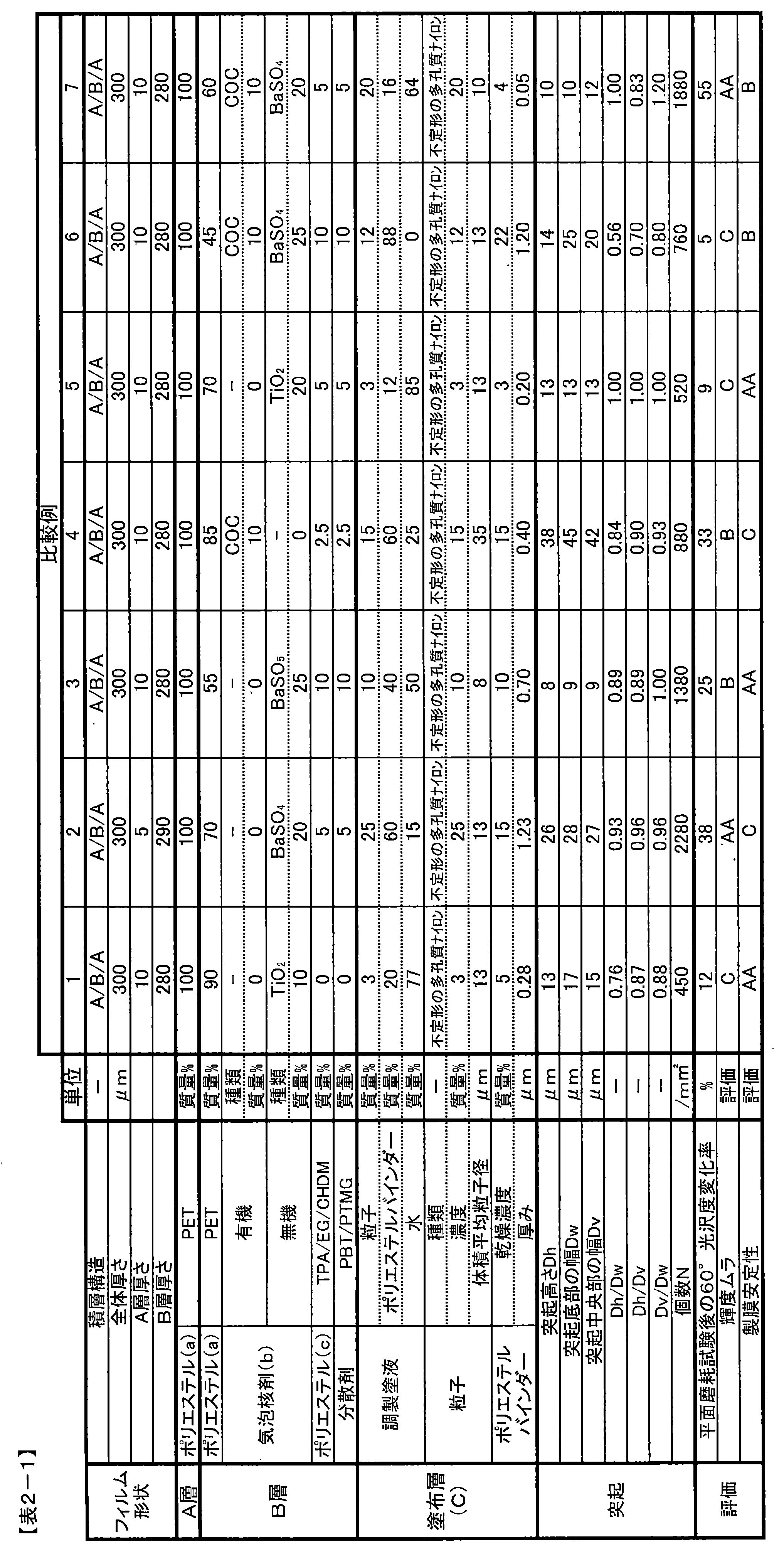
主押出機と副押出機を有する複合製膜装置において、表2に示した原料の混合物と条件にて実施例1~15と同様にポリエステルフィルムの製膜を試みたが、比較例8については、製膜できなかった。各種特性を表2に示す。製膜できた例については、傷つけずにバックライトに組み込んだ場合には輝度ムラが生じなかったとしても、傷つけた後のフィルムをバックライトに組み込むと、その部分の光沢度と周囲の光沢度が異なるため、輝度ムラが生じた。



Claims (5)
- 少なくともポリエステル層(A)およびポリエステル層(B)の2種類の層を有するポリエステルフィルムにおいて、ポリエステル層(A)はポリエステルフィルムの少なくとも片側の表層を形成し、該表層の一方に粒子を含有する塗布層(C)が設けられ、塗布層(C)中に含有される前記粒子が不定形な多孔質粒子であり、この粒子の体積平均粒子径が10μm以上30μm以下であり、当該粒子を塗布した際に生じる突起のそれぞれに対し、SEM断面写真を観察したとき、その頂部からポリエステル層(A)の最表面までの距離(突起高さ)dhの平均値Dhが10μm以上30μm以下であり、該突起におけるポリエステル層(A)と接する部分の長さ(突起底部の幅)dwの平均値Dwが10μm以上35μm以下であり、DhとDwの比であるDh/Dwが0.70以上1.00以下であり、ポリエステル層(A)の最表面からdh/2の高さにおける粒子のA層に平行な方向の粒子長さ(突起中央部の幅)dvの平均値Dvが10μm以上35μm以下であり、DhとDvの比であるDh/Dvが0.90以上1.00以下であり、DvとDwの比であるDv/Dwが0.80以上1.05以下であり、当該粒子がフィルム表面1mm2あたり1000個以上2000個以下である、ポリエステルフィルム。
- 前記多孔質粒子が有機粒子である、請求項1記載のポリエステルフィルム。
- 前記多孔質粒子が6-ナイロンを主成分とする、請求項1又は2に記載のポリエステルフィルム。
- 前記塗布層(C)側表面における、平面磨耗試験後の60°光沢度変化値が30%未満である、請求項1~3のいずれかに記載のポリエステルフィルム。
- 請求項1~4のいずれかに記載のポリエステルフィルムを用いた液晶ディスプレイ用反射フィルム。
Priority Applications (3)
| Application Number | Priority Date | Filing Date | Title |
|---|---|---|---|
| CN201580039515.5A CN106661254B (zh) | 2014-07-31 | 2015-07-14 | 聚酯膜 |
| JP2015537856A JP6597306B2 (ja) | 2014-07-31 | 2015-07-14 | ポリエステルフィルム |
| KR1020167031561A KR20170039618A (ko) | 2014-07-31 | 2015-07-14 | 폴리에스테르 필름 |
Applications Claiming Priority (2)
| Application Number | Priority Date | Filing Date | Title |
|---|---|---|---|
| JP2014155812 | 2014-07-31 | ||
| JP2014-155812 | 2014-07-31 |
Publications (1)
| Publication Number | Publication Date |
|---|---|
| WO2016017416A1 true WO2016017416A1 (ja) | 2016-02-04 |
Family
ID=55217321
Family Applications (1)
| Application Number | Title | Priority Date | Filing Date |
|---|---|---|---|
| PCT/JP2015/070153 Ceased WO2016017416A1 (ja) | 2014-07-31 | 2015-07-14 | ポリエステルフィルム |
Country Status (5)
| Country | Link |
|---|---|
| JP (1) | JP6597306B2 (ja) |
| KR (1) | KR20170039618A (ja) |
| CN (1) | CN106661254B (ja) |
| TW (1) | TWI679119B (ja) |
| WO (1) | WO2016017416A1 (ja) |
Cited By (1)
| Publication number | Priority date | Publication date | Assignee | Title |
|---|---|---|---|---|
| WO2018025663A1 (ja) * | 2016-08-02 | 2018-02-08 | 東レ株式会社 | 成形用白色ポリエステルフィルム及びそれを用いた白色樹脂成形体 |
Families Citing this family (4)
| Publication number | Priority date | Publication date | Assignee | Title |
|---|---|---|---|---|
| CN110997319B (zh) * | 2017-07-24 | 2022-09-09 | 东丽株式会社 | 膜 |
| WO2019073737A1 (ja) * | 2017-10-10 | 2019-04-18 | 東レ株式会社 | フィルム |
| KR102465979B1 (ko) * | 2022-05-09 | 2022-11-10 | 김진성 | 광택도와 이형력 조절이 가능한 페트 필름 |
| KR102465980B1 (ko) * | 2022-05-09 | 2022-11-09 | 김진성 | 광택도와 이형력 조절이 가능한 페트 필름 코팅 방법 |
Citations (8)
| Publication number | Priority date | Publication date | Assignee | Title |
|---|---|---|---|---|
| JP2000075134A (ja) * | 1998-09-01 | 2000-03-14 | Nitto Denko Corp | 光拡散偏光板 |
| WO2010029910A1 (ja) * | 2008-09-09 | 2010-03-18 | Dic株式会社 | モアレ縞抑制フィルム及びモアレ縞抑制機能付きプリズムシート |
| JP2010211027A (ja) * | 2009-03-11 | 2010-09-24 | Dic Corp | モアレ縞抑制フィルム、及びモアレ縞抑制機能付きプリズムシート |
| JP2010211010A (ja) * | 2009-03-11 | 2010-09-24 | Dic Corp | 光拡散フィルム、それらを用いたバックライトユニット及び液晶表示装置 |
| JP2010281986A (ja) * | 2009-06-04 | 2010-12-16 | Ube Ind Ltd | 光拡散フィルム |
| JP2011075779A (ja) * | 2009-09-30 | 2011-04-14 | Toray Ind Inc | 白色反射フィルム |
| WO2011105294A1 (ja) * | 2010-02-24 | 2011-09-01 | 東レ株式会社 | エッジライト型バックライト用白色反射フィルム及びそれを用いたバックライト |
| US20120176812A1 (en) * | 2011-01-10 | 2012-07-12 | Seong-Yong Hwang | Light Guide Plate and Light-Emitting Assembly Having the Same |
Family Cites Families (10)
| Publication number | Priority date | Publication date | Assignee | Title |
|---|---|---|---|---|
| JPS5218931A (en) | 1975-08-04 | 1977-02-12 | Teijin Ltd | Stopping method of yarn winding machine |
| GB9110902D0 (en) * | 1991-05-21 | 1991-07-10 | Ici Plc | Polymeric film |
| JP2004122542A (ja) * | 2002-10-01 | 2004-04-22 | Canon Inc | ラミネートフィルムおよびラミネート印画物 |
| JP3937994B2 (ja) | 2002-10-04 | 2007-06-27 | 東レ株式会社 | 直下型バックライト用光反射フィルムおよびそれを用いた画像表示用直下型バックライト装置 |
| JP2004174965A (ja) * | 2002-11-28 | 2004-06-24 | Canon Inc | ラミネートフィルムおよびラミネート印画物 |
| JP2006328173A (ja) * | 2005-05-25 | 2006-12-07 | Metal Color:Kk | ポリアミド球状粒子粉末の製造方法 |
| JP5391617B2 (ja) | 2007-09-28 | 2014-01-15 | 東レ株式会社 | 白色フィルムおよびそれを用いた面光源 |
| KR101242330B1 (ko) * | 2009-12-30 | 2013-03-12 | (주)엘지하우시스 | 이형필름 및 이의 제조방법 |
| JP5915524B2 (ja) * | 2011-03-18 | 2016-05-11 | 東レ株式会社 | 積層フィルムおよびその製造方法 |
| JP5926512B2 (ja) * | 2011-08-12 | 2016-05-25 | 帝人デュポンフィルム株式会社 | 白色反射フィルム |
-
2015
- 2015-07-14 WO PCT/JP2015/070153 patent/WO2016017416A1/ja not_active Ceased
- 2015-07-14 KR KR1020167031561A patent/KR20170039618A/ko not_active Withdrawn
- 2015-07-14 CN CN201580039515.5A patent/CN106661254B/zh not_active Expired - Fee Related
- 2015-07-14 JP JP2015537856A patent/JP6597306B2/ja not_active Expired - Fee Related
- 2015-07-27 TW TW104124197A patent/TWI679119B/zh not_active IP Right Cessation
Patent Citations (8)
| Publication number | Priority date | Publication date | Assignee | Title |
|---|---|---|---|---|
| JP2000075134A (ja) * | 1998-09-01 | 2000-03-14 | Nitto Denko Corp | 光拡散偏光板 |
| WO2010029910A1 (ja) * | 2008-09-09 | 2010-03-18 | Dic株式会社 | モアレ縞抑制フィルム及びモアレ縞抑制機能付きプリズムシート |
| JP2010211027A (ja) * | 2009-03-11 | 2010-09-24 | Dic Corp | モアレ縞抑制フィルム、及びモアレ縞抑制機能付きプリズムシート |
| JP2010211010A (ja) * | 2009-03-11 | 2010-09-24 | Dic Corp | 光拡散フィルム、それらを用いたバックライトユニット及び液晶表示装置 |
| JP2010281986A (ja) * | 2009-06-04 | 2010-12-16 | Ube Ind Ltd | 光拡散フィルム |
| JP2011075779A (ja) * | 2009-09-30 | 2011-04-14 | Toray Ind Inc | 白色反射フィルム |
| WO2011105294A1 (ja) * | 2010-02-24 | 2011-09-01 | 東レ株式会社 | エッジライト型バックライト用白色反射フィルム及びそれを用いたバックライト |
| US20120176812A1 (en) * | 2011-01-10 | 2012-07-12 | Seong-Yong Hwang | Light Guide Plate and Light-Emitting Assembly Having the Same |
Cited By (1)
| Publication number | Priority date | Publication date | Assignee | Title |
|---|---|---|---|---|
| WO2018025663A1 (ja) * | 2016-08-02 | 2018-02-08 | 東レ株式会社 | 成形用白色ポリエステルフィルム及びそれを用いた白色樹脂成形体 |
Also Published As
| Publication number | Publication date |
|---|---|
| CN106661254A (zh) | 2017-05-10 |
| JPWO2016017416A1 (ja) | 2017-05-18 |
| TWI679119B (zh) | 2019-12-11 |
| CN106661254B (zh) | 2019-04-09 |
| KR20170039618A (ko) | 2017-04-11 |
| JP6597306B2 (ja) | 2019-10-30 |
| TW201609405A (zh) | 2016-03-16 |
Similar Documents
| Publication | Publication Date | Title |
|---|---|---|
| JP5926512B2 (ja) | 白色反射フィルム | |
| TW200829962A (en) | White polyester film for light reflecting plate | |
| JP6756387B2 (ja) | ポリエステルフィルム | |
| JP2011209499A (ja) | 面光源反射板用白色ポリエステルフィルム及びそれを用いた液晶ディスプレイ用面光源反射板 | |
| JP5970815B2 (ja) | 白色積層フィルムの製造方法および白色積層ポリエステルフィルム | |
| JP6597306B2 (ja) | ポリエステルフィルム | |
| JP2011094026A (ja) | 白色単層ポリエステルフィルム及びそれを用いた面光源反射部材 | |
| TWI697698B (zh) | 白色反射薄膜及液晶顯示器用背光 | |
| JPWO2015129500A1 (ja) | 積層フィルム | |
| JP2013120313A (ja) | 白色ポリエステルフィルム | |
| JP2012137618A (ja) | 面光源反射板用白色ポリエステルフィルム | |
| JP5817165B2 (ja) | 反射板用白色積層ポリエステルフィルムおよびバックライト装置 | |
| JP6211923B2 (ja) | 白色反射フィルム | |
| JP2016031486A (ja) | ポリエステルフィルム | |
| JP2014065817A (ja) | 2軸延伸フィルム | |
| JP2018072496A (ja) | エッジライト型バックライト用白色反射フィルム及びそれを用いた液晶ディスプレイ用バックライト | |
| JP2014126638A (ja) | 液晶ディスプレイ用反射フィルム | |
| JP2018125117A (ja) | エッジライト型バックライト用白色反射フィルム及びそれを用いた液晶ディスプレイ用バックライト | |
| JP2019045779A (ja) | エッジライト型バックライト用白色反射フィルム及びそれを用いた液晶ディスプレイ用バックライト | |
| KR101848452B1 (ko) | 다층 백색 다공성 폴리에스테르 필름 | |
| JP2017027035A (ja) | エッジライト型バックライト用白色反射フィルム及び液晶ディスプレイ用バックライト | |
| JP2017027034A (ja) | エッジライト型バックライト用白色反射フィルム及びそれを用いた液晶ディスプレイ用バックライト | |
| JP2018072497A (ja) | エッジライト型バックライト用白色反射フィルム及び液晶ディスプレイ用バックライト | |
| JP2017100288A (ja) | 二軸延伸ポリエステルフィルム | |
| JP2015208864A (ja) | 二軸延伸積層ポリエステルフィルム |
Legal Events
| Date | Code | Title | Description |
|---|---|---|---|
| ENP | Entry into the national phase |
Ref document number: 2015537856 Country of ref document: JP Kind code of ref document: A |
|
| 121 | Ep: the epo has been informed by wipo that ep was designated in this application |
Ref document number: 15827824 Country of ref document: EP Kind code of ref document: A1 |
|
| ENP | Entry into the national phase |
Ref document number: 20167031561 Country of ref document: KR Kind code of ref document: A |
|
| NENP | Non-entry into the national phase |
Ref country code: DE |
|
| 122 | Ep: pct application non-entry in european phase |
Ref document number: 15827824 Country of ref document: EP Kind code of ref document: A1 |