WO2016017187A1 - 架橋剤及びフッ素含有芳香族化合物 - Google Patents
架橋剤及びフッ素含有芳香族化合物 Download PDFInfo
- Publication number
- WO2016017187A1 WO2016017187A1 PCT/JP2015/003888 JP2015003888W WO2016017187A1 WO 2016017187 A1 WO2016017187 A1 WO 2016017187A1 JP 2015003888 W JP2015003888 W JP 2015003888W WO 2016017187 A1 WO2016017187 A1 WO 2016017187A1
- Authority
- WO
- WIPO (PCT)
- Prior art keywords
- formula
- compound
- group
- substituted
- same
- Prior art date
- Legal status (The legal status is an assumption and is not a legal conclusion. Google has not performed a legal analysis and makes no representation as to the accuracy of the status listed.)
- Ceased
Links
- UHOVQNZJYSORNB-UHFFFAOYSA-N c1ccccc1 Chemical compound c1ccccc1 UHOVQNZJYSORNB-UHFFFAOYSA-N 0.000 description 5
- 0 Cc(cc1)ccc1-c1ccc(*)cc1 Chemical compound Cc(cc1)ccc1-c1ccc(*)cc1 0.000 description 4
Classifications
-
- C—CHEMISTRY; METALLURGY
- C08—ORGANIC MACROMOLECULAR COMPOUNDS; THEIR PREPARATION OR CHEMICAL WORKING-UP; COMPOSITIONS BASED THEREON
- C08F—MACROMOLECULAR COMPOUNDS OBTAINED BY REACTIONS ONLY INVOLVING CARBON-TO-CARBON UNSATURATED BONDS
- C08F259/00—Macromolecular compounds obtained by polymerising monomers on to polymers of halogen containing monomers as defined in group C08F14/00
- C08F259/08—Macromolecular compounds obtained by polymerising monomers on to polymers of halogen containing monomers as defined in group C08F14/00 on to polymers containing fluorine
-
- C—CHEMISTRY; METALLURGY
- C07—ORGANIC CHEMISTRY
- C07C—ACYCLIC OR CARBOCYCLIC COMPOUNDS
- C07C22/00—Cyclic compounds containing halogen atoms bound to an acyclic carbon atom
- C07C22/02—Cyclic compounds containing halogen atoms bound to an acyclic carbon atom having unsaturation in the rings
- C07C22/04—Cyclic compounds containing halogen atoms bound to an acyclic carbon atom having unsaturation in the rings containing six-membered aromatic rings
- C07C22/08—Cyclic compounds containing halogen atoms bound to an acyclic carbon atom having unsaturation in the rings containing six-membered aromatic rings containing fluorine
-
- C—CHEMISTRY; METALLURGY
- C07—ORGANIC CHEMISTRY
- C07C—ACYCLIC OR CARBOCYCLIC COMPOUNDS
- C07C43/00—Ethers; Compounds having groups, groups or groups
- C07C43/02—Ethers
- C07C43/257—Ethers having an ether-oxygen atom bound to carbon atoms both belonging to six-membered aromatic rings
- C07C43/29—Ethers having an ether-oxygen atom bound to carbon atoms both belonging to six-membered aromatic rings containing halogen
-
- C—CHEMISTRY; METALLURGY
- C08—ORGANIC MACROMOLECULAR COMPOUNDS; THEIR PREPARATION OR CHEMICAL WORKING-UP; COMPOSITIONS BASED THEREON
- C08F—MACROMOLECULAR COMPOUNDS OBTAINED BY REACTIONS ONLY INVOLVING CARBON-TO-CARBON UNSATURATED BONDS
- C08F14/00—Homopolymers and copolymers of compounds having one or more unsaturated aliphatic radicals, each having only one carbon-to-carbon double bond, and at least one being terminated by a halogen
- C08F14/18—Monomers containing fluorine
-
- C—CHEMISTRY; METALLURGY
- C08—ORGANIC MACROMOLECULAR COMPOUNDS; THEIR PREPARATION OR CHEMICAL WORKING-UP; COMPOSITIONS BASED THEREON
- C08J—WORKING-UP; GENERAL PROCESSES OF COMPOUNDING; AFTER-TREATMENT NOT COVERED BY SUBCLASSES C08B, C08C, C08F, C08G or C08H
- C08J3/00—Processes of treating or compounding macromolecular substances
- C08J3/24—Crosslinking, e.g. vulcanising, of macromolecules
-
- C—CHEMISTRY; METALLURGY
- C08—ORGANIC MACROMOLECULAR COMPOUNDS; THEIR PREPARATION OR CHEMICAL WORKING-UP; COMPOSITIONS BASED THEREON
- C08K—Use of inorganic or non-macromolecular organic substances as compounding ingredients
- C08K5/00—Use of organic ingredients
- C08K5/0008—Organic ingredients according to more than one of the "one dot" groups of C08K5/01 - C08K5/59
- C08K5/0025—Crosslinking or vulcanising agents; including accelerators
-
- C—CHEMISTRY; METALLURGY
- C08—ORGANIC MACROMOLECULAR COMPOUNDS; THEIR PREPARATION OR CHEMICAL WORKING-UP; COMPOSITIONS BASED THEREON
- C08K—Use of inorganic or non-macromolecular organic substances as compounding ingredients
- C08K5/00—Use of organic ingredients
- C08K5/02—Halogenated hydrocarbons
- C08K5/03—Halogenated hydrocarbons aromatic, e.g. C6H5-CH2-Cl
-
- C—CHEMISTRY; METALLURGY
- C08—ORGANIC MACROMOLECULAR COMPOUNDS; THEIR PREPARATION OR CHEMICAL WORKING-UP; COMPOSITIONS BASED THEREON
- C08K—Use of inorganic or non-macromolecular organic substances as compounding ingredients
- C08K5/00—Use of organic ingredients
- C08K5/04—Oxygen-containing compounds
- C08K5/06—Ethers; Acetals; Ketals; Ortho-esters
-
- C—CHEMISTRY; METALLURGY
- C08—ORGANIC MACROMOLECULAR COMPOUNDS; THEIR PREPARATION OR CHEMICAL WORKING-UP; COMPOSITIONS BASED THEREON
- C08K—Use of inorganic or non-macromolecular organic substances as compounding ingredients
- C08K5/00—Use of organic ingredients
- C08K5/04—Oxygen-containing compounds
- C08K5/14—Peroxides
-
- C—CHEMISTRY; METALLURGY
- C08—ORGANIC MACROMOLECULAR COMPOUNDS; THEIR PREPARATION OR CHEMICAL WORKING-UP; COMPOSITIONS BASED THEREON
- C08L—COMPOSITIONS OF MACROMOLECULAR COMPOUNDS
- C08L15/00—Compositions of rubber derivatives
- C08L15/02—Rubber derivatives containing halogen
-
- C—CHEMISTRY; METALLURGY
- C08—ORGANIC MACROMOLECULAR COMPOUNDS; THEIR PREPARATION OR CHEMICAL WORKING-UP; COMPOSITIONS BASED THEREON
- C08L—COMPOSITIONS OF MACROMOLECULAR COMPOUNDS
- C08L27/00—Compositions of homopolymers or copolymers of compounds having one or more unsaturated aliphatic radicals, each having only one carbon-to-carbon double bond, and at least one being terminated by a halogen; Compositions of derivatives of such polymers
- C08L27/02—Compositions of homopolymers or copolymers of compounds having one or more unsaturated aliphatic radicals, each having only one carbon-to-carbon double bond, and at least one being terminated by a halogen; Compositions of derivatives of such polymers not modified by chemical after-treatment
- C08L27/12—Compositions of homopolymers or copolymers of compounds having one or more unsaturated aliphatic radicals, each having only one carbon-to-carbon double bond, and at least one being terminated by a halogen; Compositions of derivatives of such polymers not modified by chemical after-treatment containing fluorine atoms
-
- C—CHEMISTRY; METALLURGY
- C08—ORGANIC MACROMOLECULAR COMPOUNDS; THEIR PREPARATION OR CHEMICAL WORKING-UP; COMPOSITIONS BASED THEREON
- C08J—WORKING-UP; GENERAL PROCESSES OF COMPOUNDING; AFTER-TREATMENT NOT COVERED BY SUBCLASSES C08B, C08C, C08F, C08G or C08H
- C08J2400/00—Characterised by the use of unspecified polymers
- C08J2400/10—Polymers characterised by the presence of specified groups, e.g. terminal or pendant functional groups
- C08J2400/102—Polymers characterised by the presence of specified groups, e.g. terminal or pendant functional groups containing halogen atoms
-
- C—CHEMISTRY; METALLURGY
- C08—ORGANIC MACROMOLECULAR COMPOUNDS; THEIR PREPARATION OR CHEMICAL WORKING-UP; COMPOSITIONS BASED THEREON
- C08J—WORKING-UP; GENERAL PROCESSES OF COMPOUNDING; AFTER-TREATMENT NOT COVERED BY SUBCLASSES C08B, C08C, C08F, C08G or C08H
- C08J2400/00—Characterised by the use of unspecified polymers
- C08J2400/26—Elastomers
-
- C—CHEMISTRY; METALLURGY
- C08—ORGANIC MACROMOLECULAR COMPOUNDS; THEIR PREPARATION OR CHEMICAL WORKING-UP; COMPOSITIONS BASED THEREON
- C08L—COMPOSITIONS OF MACROMOLECULAR COMPOUNDS
- C08L2312/00—Crosslinking
Definitions
- the present invention relates to a crosslinking agent, a composition containing a crosslinking agent, a crosslinked fluoroelastomer, a molded product obtained from the crosslinked fluoroelastomer, and a fluorine-containing aromatic compound.
- Steam is used for various purposes such as sterilization and cleaning in addition to power generation in various industries such as plants, machinery, food, and medicine.
- Sealing materials such as rubber O-rings are used in piping and devices through which these water vapor flows, and play a role in preventing water vapor from flowing out.
- Crosslinking agents are used in the production of crosslinked fluoroelastomers, and various crosslinking agents are known.
- triallyl isocyanurate TAIC
- TAIC triallyl isocyanurate
- Patent Documents 2 to 6 divinylbenzene
- Patent Documents 2 to 5 divinylbiphenyl
- Patent Document 5 there has been a demand for a novel crosslinking agent that can further improve the heat resistance and steam resistance of the crosslinked fluoroelastomer.
- Patent Document 6 describes tetrafluoroethylene and perfluoroalkyl vinyl ether as raw material monomers for a fluorine-containing elastomer.
- Non-Patent Document 1 describes 1,2,2-trifluorostyrene (perfluorovinylbenzene) as a fuel cell separation membrane.
- the present invention has been made in view of the above problems, and one of its purposes is to provide a crosslinking agent that can improve the heat resistance of a crosslinked fluoroelastomer, and a crosslinked fluoroelastomer with improved heat resistance. To do. Another object of the present invention is to provide a novel fluorine-containing aromatic compound that can be used as a crosslinking agent.
- the crosslinking agent which consists of a compound represented by following formula (1).
- R 1, R 2, R 3 are each independently a hydrogen atom, a fluorine atom, an alkyl group, fluorinated alkyl group, or a substituted or unsubstituted aryl group.
- Multiple R 1 The plurality of R 2 may be the same or different, and the plurality of R 3 may be the same or different, provided that at least one of R 1 , R 2 , and R 3 is a hydrogen atom.
- R 1 , R 2 , R 3 is a fluorine atom or a group containing a fluorine atom, m is an integer of 2 to 6, and l is an integer of 0 to 2. May be substituted.) 2.
- a crosslinking agent comprising a compound having two or more structures represented by the following formula (3).
- R 1 , R 2 , and R 3 are each independently a hydrogen atom, a fluorine atom, an alkyl group, a fluorinated alkyl group, or a substituted or unsubstituted aryl group.
- Plural R 1 The plurality of R 2 may be the same or different, and the plurality of R 3 may be the same or different, provided that at least one of R 1 , R 2 , and R 3 is a hydrogen atom.
- R 1 , R 2 , R 3 are each a fluorine atom or a group containing a fluorine atom, and n is an integer of 1 to 5.
- the hydrogen of the benzene ring may be substituted. ) 4). 4.
- the crosslinking agent according to 3, wherein the compound having two or more structures represented by the formula (3) is a compound represented by the following formula (4).
- A represents a single bond, —O—, —S—, a heteroatom-containing group, a linear or branched alkylene group, a cycloalkylene group, or an arylene group. (Part or all may be fluorinated.
- R 1 , R 2 , R 3 , and n are the same as those in formula (3). Hydrogen in the benzene ring may be substituted.
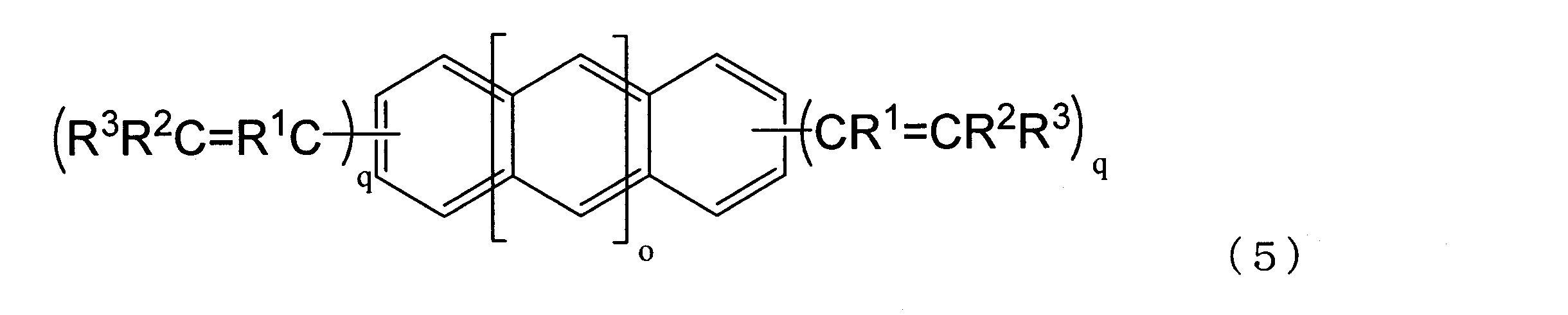
- the crosslinking agent according to 1 or 3, wherein the compound represented by the formula (1) or the compound having two or more structures represented by the formula (3) is a compound represented by the following formula (5).
- R 1 , R 2 and R 3 are the same as those in the formula (1) or (3). ⁇ is 1 or 0, and q is an integer of 1 to 4, respectively. The hydrogen on the benzene ring may be substituted.) 6). 6. The crosslinking agent according to any one of 1 to 5, wherein aryl of R 1 , R 2 and R 3 is phenyl or naphthyl. 7). A composition comprising a fluoroelastomer, a crosslinking initiator, and the crosslinking agent according to any one of 1 to 6. 8). 8. The composition according to 7, wherein the fluoroelastomer is a perfluoroelastomer or a partially fluorinated elastomer. 9.
- composition according to 7 or 8 wherein the crosslinking agent is contained in an amount of 0.5 to 30 mmol with respect to 100 g of the fluoroelastomer. 10. 10. The composition according to any one of 7 to 9, wherein the crosslinking initiator is contained in an amount of 0.3 to 15 mmol with respect to 100 g of the fluoroelastomer.
- a molded article according to 12, which is a sealing material. 14 A compound represented by the following formula (1).
- R 1, R 2, R 3 are each independently a hydrogen atom, a fluorine atom, an alkyl group, fluorinated alkyl group, or a substituted or unsubstituted aryl group.
- Multiple R 1 The plurality of R 2 may be the same or different, and the plurality of R 3 may be the same or different, provided that at least one of R 1 , R 2 , and R 3 is a hydrogen atom.
- R 1 , R 2 , R 3 is a fluorine atom or a group containing a fluorine atom, m is an integer of 2 to 6, and l is an integer of 0 to 2. May be substituted.
- the compound according to 14, wherein the compound represented by the formula (1) is a compound represented by the following formula (2).
- R 1 , R 2 , R 3 and m are the same as in formula (1).
- the hydrogen on the benzene ring may be substituted.
- R 1 , R 2 , and R 3 are each independently a hydrogen atom, a fluorine atom, an alkyl group, a fluorinated alkyl group, or a substituted or unsubstituted aryl group.
- the plurality of R 2 may be the same or different, and the plurality of R 3 may be the same or different, provided that at least one of R 1 , R 2 , and R 3 is a hydrogen atom.
- R 1 , R 2 , R 3 are each a fluorine atom or a group containing a fluorine atom, and n is an integer of 1 to 5.
- the hydrogen of the benzene ring may be substituted.
- the compound according to 16, wherein the compound having two or more structures represented by the formula (3) is a compound represented by the following formula (4).
- A represents a single bond, —O—, —S—, a heteroatom-containing group, a linear or branched alkylene group, a cycloalkylene group, or an arylene group. (Part or all may be fluorinated.
- R 1 , R 2 , R 3 , and n are the same as those in formula (3). Hydrogen in the benzene ring may be substituted.
- the compound of 14 or 16 wherein the compound represented by the formula (1) or the compound having two or more structures represented by the formula (3) is a compound represented by the following formula (5).
- R 1 , R 2 and R 3 are the same as those in the formula (1) or (3).
- R 1 , R 2 , and R 3 each independently represent a hydrogen atom, a fluorine atom, an alkyl group, a fluorinated alkyl group, or a substituted or unsubstituted aryl group.
- R 1 may be the same or different
- a plurality of R 2 may be the same or different
- a plurality of R 3 may be the same or different, provided that at least one of R 1 , R 2 , and R 3 is a hydrogen atom
- at least one of R 1 , R 2 and R 3 is a fluorine atom or a group containing a fluorine atom, each n is an integer of 1 to 5.
- the hydrogen of the benzene ring may be substituted However, the following compounds are excluded.
- iii The compound according to ii, wherein the compound having two or more structures represented by the formula (3 ′) is a compound represented by the following formula (4 ′).
- A is a single bond, —O—, —S—, a heteroatom-containing group, a linear or branched alkylene group, a cycloalkylene group, or an arylene group, and these groups are (Part or all may be fluorinated.
- R 1 , R 2 , R 3 and n are the same as those in formula (3). The hydrogen on the benzene ring may be substituted.
- the crosslinking agent which can improve the heat resistance of crosslinked fluoroelastomer, and the crosslinked fluoroelastomer improved in heat resistance can be provided.
- the novel fluorine-containing aromatic compound which can be used as a crosslinking agent can be provided.
- One form of the crosslinking agent of the present invention comprises a compound represented by the following formula (1).
- R 1 , R 2 and R 3 are each independently a hydrogen atom, a fluorine atom, an alkyl group, a fluorinated alkyl group, or a substituted or unsubstituted aryl group.
- R 1, R 2, R 3 is a hydrogen atom
- at least one of R 1, R 2, R 3 is not a hydrogen atom is a group containing a fluorine atom or a fluorine atom.
- the group containing a fluorine atom include a fluorinated alkyl group or an aryl group substituted with a fluorine atom or a fluorinated alkyl group.
- the alkyl group of the alkyl group or the fluorinated alkyl group may be linear or branched, and preferably has 1 to 15 carbon atoms (more preferably 1 to 6 carbon atoms).
- the alkyl group may be partially or wholly fluorinated with the fluorinated alkyl group.
- a perfluoroalkyl group is preferred.
- the aryl group preferably has 6 to 18 carbon atoms (more preferably 6 to 12 carbon atoms).
- Examples of the aryl group include phenyl and naphthyl.
- the substituent of the aryl group is a fluorine atom, a linear or branched alkyl group, a cycloalkyl group, an aryl group, or the like, and these groups may be partially or wholly fluorinated.
- the linear or branched alkyl group preferably has 1 to 15 carbon atoms (more preferably 1 to 6 carbon atoms).
- the cycloalkyl group preferably has 3 to 8 carbon atoms (more preferably 3 to 6 carbon atoms).
- the aryl group preferably has 6 to 18 carbon atoms (more preferably 6 to 12 carbon atoms).
- R 1 , R 2 , and R 3 are preferably each independently a hydrogen atom, a fluorine atom, an alkyl group, or a fluorinated alkyl group.
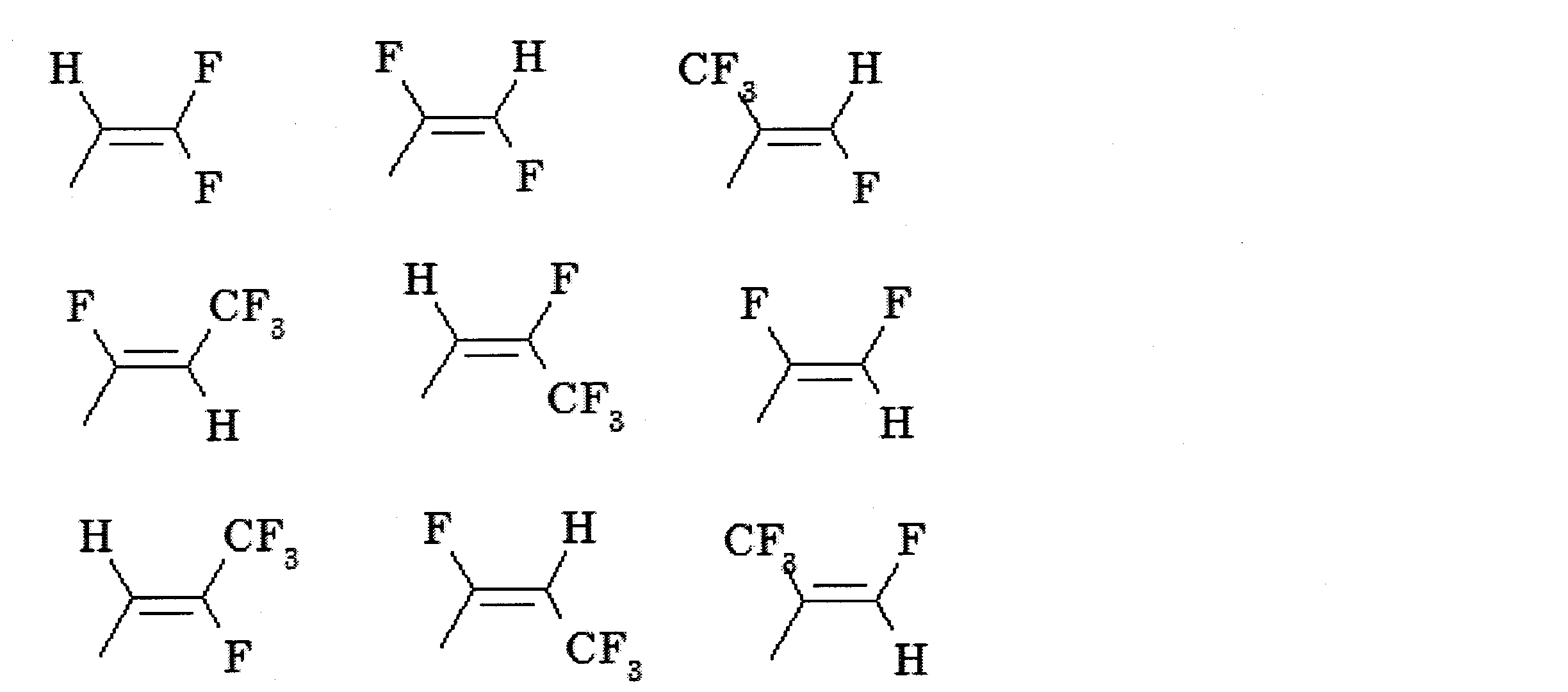
- —CR 1 CR 2 R 3 (fluorine-containing substituted vinyl group).
- m pieces of —CR 1 ⁇ CR 2 R 3 may be the same or different.
- m is 2, 3, 4, 5, or 6, preferably 2.
- l is 0, 1 or 2. Preferably it is 0.
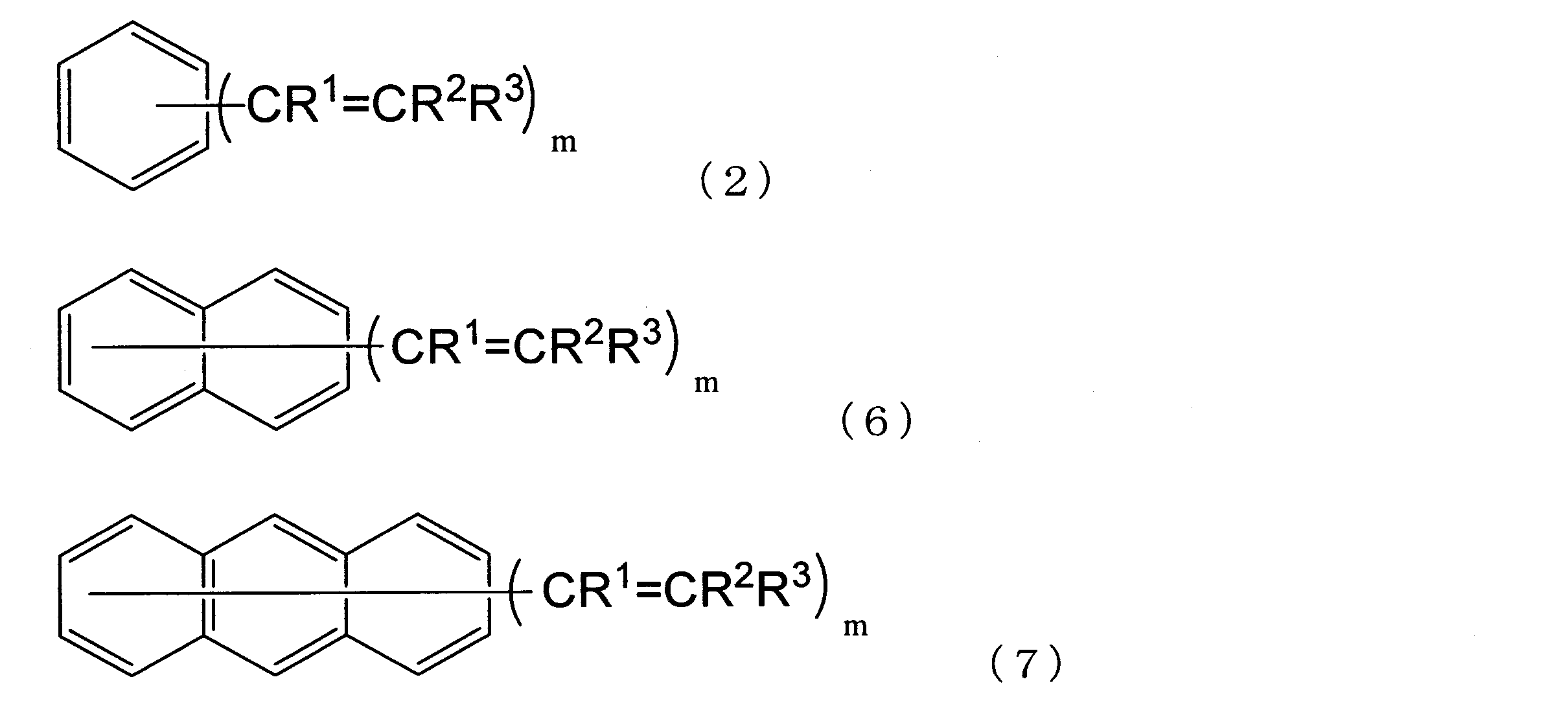
- Examples of the compound represented by the formula (1) include compounds represented by the following formulas (2), (6) and (7).
- R 1 , R 2 , R 3 and m are the same as above.
- the two —CR 1 ⁇ CR 2 R 3 may be in the ortho, meta or para position, but is preferably in the para position.
- crosslinking agent of the present invention comprises a compound having two or more structures represented by the following formula (3).
- the benzene ring contained in the formula (3) may be bonded to another group or ring, or may be condensed with another ring.
- R ⁇ 1 >, R ⁇ 2 >, R ⁇ 3 > is the same as Formula (1).
- n is 1, 2, 3, 4 or 5, respectively.
- A is a single bond, —O—, —S—, a heteroatom-containing group, a linear or branched alkylene group, a cycloalkylene group, or an arylene group, and these groups are partially Alternatively, all may be fluorinated.
- an alkylene group, a cycloalkylene group, and an arylene group are fluorinated.
- the linear or branched alkylene group preferably has 1 to 15 carbon atoms (more preferably 1 to 6 carbon atoms).
- the cycloalkylene group preferably has 3 to 8 carbon atoms (more preferably 3 to 6 carbon atoms).
- the arylene group preferably has 6 to 18 carbon atoms (more preferably 6 to 12 carbon atoms).
- alkylene group examples include a methylene group, an ethylene group, and a propylene group.
- arylene group include phenylene and naphthalenylene.
- R 1 , R 2 , R 3 and n are the same as described above.
- n when n is 1, A and —CR 1 ⁇ CR 2 R 3 may be in the ortho, meta or para position, but are preferably in the para position. More preferably, A and the two —CR 1 ⁇ CR 2 R 3 are both in the para position.
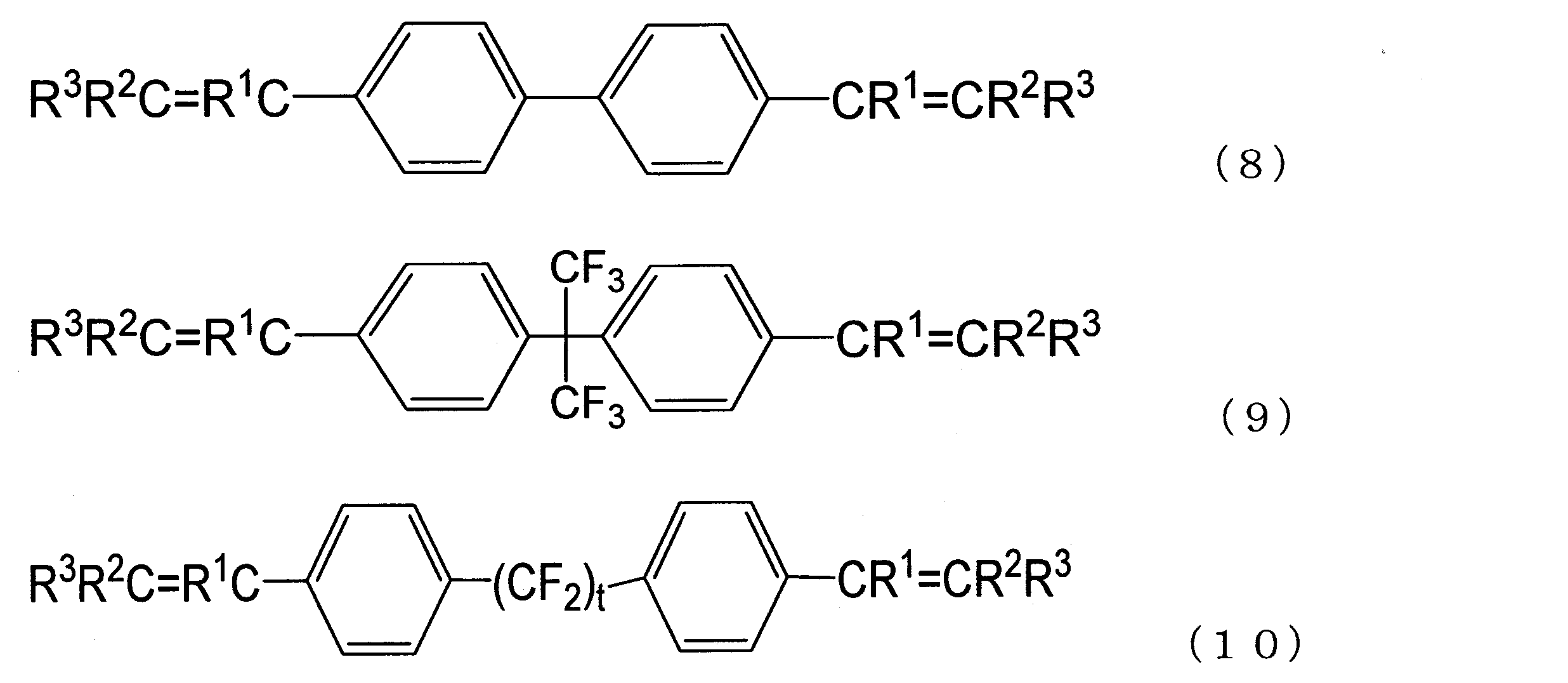
- Specific examples of the compound represented by the formula (4) include compounds represented by the following formulas (8) to (10).
- R 1 , R 2 and R 3 are the same as described above.
- t is preferably 1 to 15 (more preferably 1 to 6 carbon atoms).
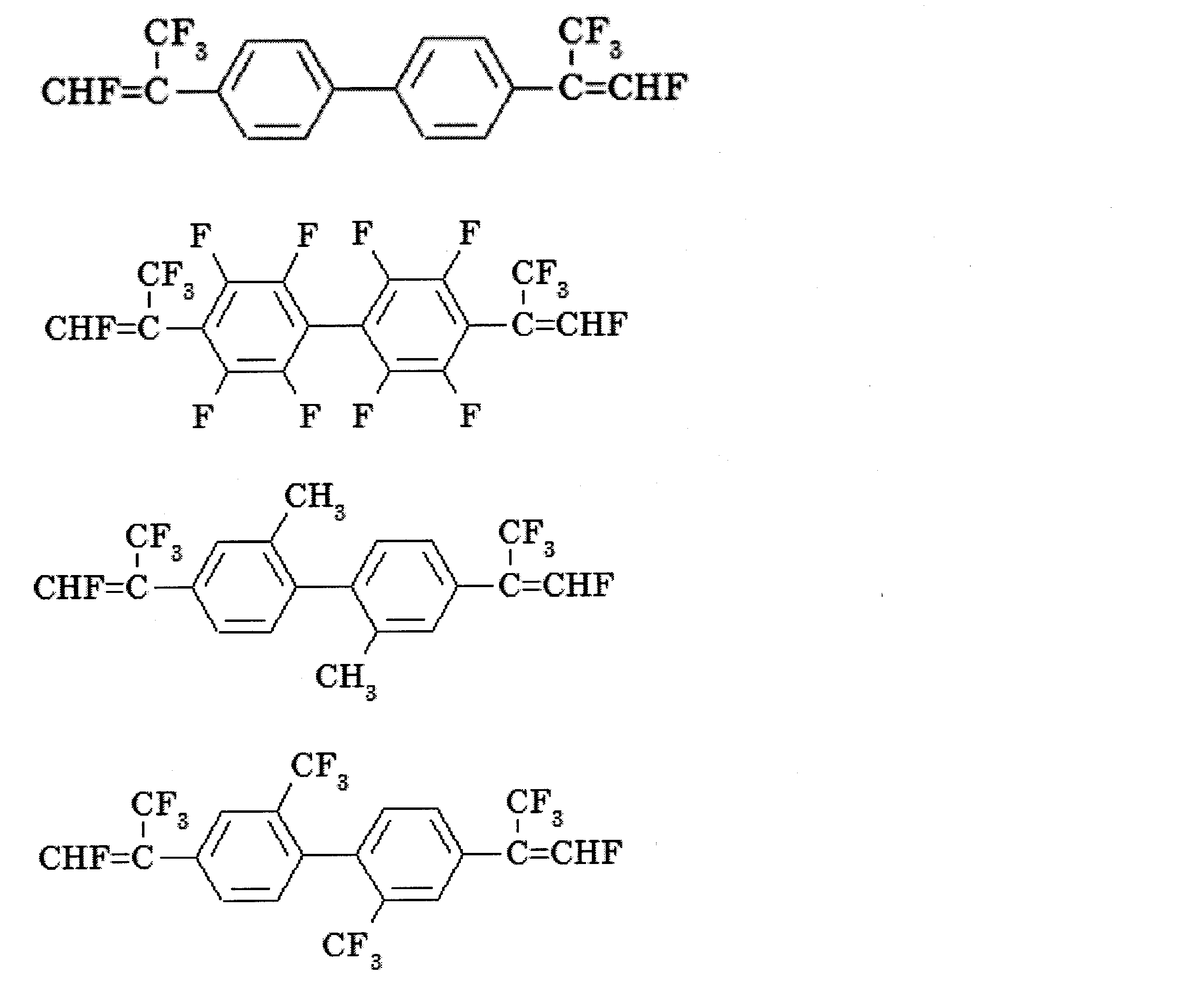
- Specific examples of the compound represented by the above formula (3) include the following compounds (crosslinking agents).
- Examples of the compound represented by the formula (1) or the compound having two or more structures represented by the formula (3) include compounds represented by the following formula (5).
- R 1 , R 2 and R 3 are the same as above.
- ком ⁇ онент (5) ⁇ онент (5), ⁇ ⁇ ⁇ ⁇ ⁇ ⁇ ⁇ ⁇ ⁇ ⁇ ⁇ ⁇ ⁇ ⁇ ⁇ ⁇ ⁇ ⁇ ⁇ ⁇ ⁇ ⁇ ⁇ ⁇ ⁇ ⁇ ⁇ ⁇ ⁇ ⁇ ⁇ ⁇ ⁇ ⁇ ⁇ ⁇ ⁇ ⁇ ⁇ ⁇ ⁇ ⁇ ⁇ ⁇ ⁇ ⁇ ⁇ ⁇ ⁇ ⁇ ⁇ ⁇ ⁇ ⁇ ⁇ ⁇ ⁇ ⁇ ⁇ ⁇ ⁇ ⁇ ⁇ ⁇ ⁇ ⁇ ⁇ ⁇ ⁇ ⁇ ⁇ ⁇ ⁇ ⁇ ⁇ ⁇ ⁇ ⁇ ⁇ ⁇ ⁇ ⁇ ⁇ ⁇ ⁇ ⁇ ⁇ ⁇ ⁇ ⁇ ⁇ ⁇ ⁇ ⁇ ⁇ ⁇ ⁇ ⁇ ⁇ ⁇ ⁇ ⁇ ⁇ ⁇ ⁇ ⁇ ⁇ ⁇ ⁇ ⁇
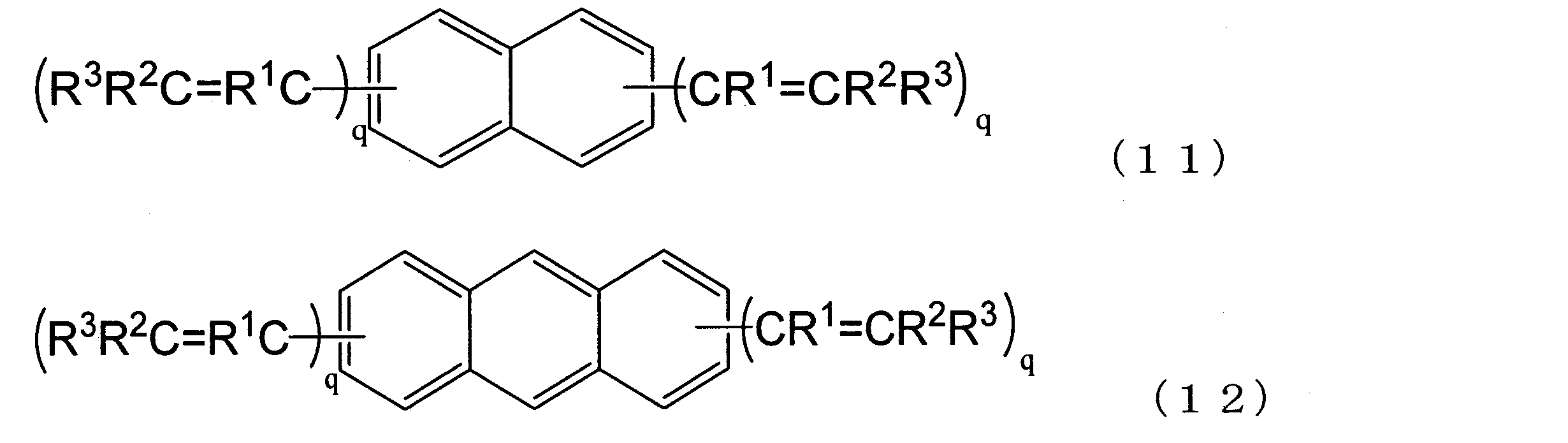
- Specific examples of the compound represented by the formula (5) include a compound represented by the following formula (11) and a compound represented by the following formula (12).
- R 1 , R 2 , R 3 and q are the same as described above.
- both q are 1, it is preferable that the two —CR 1 ⁇ CR 2 R 3 are at the most distant positions from each other because they can be efficiently cross-linked.
- each hydrogen in the benzene ring may be independently substituted.
- “Hydrogen of benzene ring” means a hydrogen atom that substitutes a benzene skeleton, a naphthalene skeleton, or an anthracene skeleton.
- the substituent is a fluorine atom, an alkyl group, a fluorinated alkyl group, a cycloalkyl group, a fluorinated cycloalkyl group, or a substituted or unsubstituted aryl group.
- a part or all of the fluorinated alkyl group and fluorinated cycloalkyl group may be fluorinated.
- the alkyl group may be linear or branched, and preferably has 1 to 15 carbon atoms (more preferably 1 to 6 carbon atoms).
- the cycloalkyl group preferably has 3 to 8 carbon atoms (more preferably 3 to 6 carbon atoms).
- the aryl group preferably has 6 to 18 carbon atoms (more preferably 6 to 12 carbon atoms).
- the substituent of the aryl group is the same as R 1 described above.
- alkyl group examples include a methyl group, an ethyl group, and a propyl group.
- arylene group include phenylene and naphthalenylene.
- composition of the present invention contains the above-mentioned crosslinking agent, fluoroelastomer and initiator.
- the crosslinking agent is preferably 0.5 to 30 mmol, more preferably 0.5 to 15 mmol, more preferably 1 to 13 mmol, more preferably 1 to 8 mmol, still more preferably 2.0 to 7 based on 100 g of the fluoroelastomer. Add 0.0 mmol. There is a tendency for steam resistance and heat resistance to improve as the amount added increases. However, if it is too much, it may become hard.
- the fluoroelastomer may be a perfluoroelastomer or an elastomer partially fluorinated.
- the following monomer-derived repeating units can be exemplified.
- One or more monomer-derived repeating units can be included.
- CF 2 CF 2 (tetrafluoroethylene)
- CF 2 CFCF 3 (hexafluoropropylene)
- CH 2 CH 2
- CH 2 CHCH 3
- the fluoroelastomer used in the present invention preferably contains iodine and / or bromine, more preferably iodine as a radical attack site during crosslinking (curing).
- Perfluoroelastomers curable with peroxide are described in, for example, Patent Document 1 and the like.
- (Per) fluoroelastomers generally contain iodine at 0.001% to 5% by weight, preferably 0.01% to 2.5% by weight, based on the total polymer weight.
- the iodine atom may be present along the chain and / or at the terminal position.
- the (per) fluoroelastomer is preferably made from a copolymer such as a (per) fluorinated olefin having one unsaturation of the ethylene type at the terminal position.
- a copolymer such as a (per) fluorinated olefin having one unsaturation of the ethylene type at the terminal position.
- the following can be illustrated as a comonomer.
- CF 2 CFOR 2f (per) fluoroalkyl vinyl ethers (PAVE) Wherein R 2f is a (per) fluoroalkyl having 1 to 6 carbon atoms, such as trifluoromethyl or pentafluoropropyl.
- CF 2 CFOX o (per) fluorooxyalkyl vinyl ethers (wherein X o is a (per) fluorooxyalkyl having 1 to 12 carbon atoms containing one or more ether groups, such as perfluoro-2-propoxypropyl. is there)
- CFX 2 CX 2 OCF 2 OR ′′ f (IB) Wherein R ′′ f is a linear or branched (per) fluoroalkyl having 2 to 6 carbon atoms, a cyclic (per) fluoroalkyl having 5 or 6 carbon atoms, or carbon containing 1 to 3 oxygen atoms.
- a linear or branched (per) fluorooxyalkyl of the number 2-6, and X 2 is F or H)
- CF 2 CFOCF 2 OCF 2 CF 3 (MOVE1)
- CF 2 CFOCF 2 OCF 2 CF 2 OCF 3 (MOVE2)
- TFE Tetrafluoroethylene
- the fluoroelastomer can also contain units derived from vinylidene fluoride, fluoroolefins having 3 to 8 carbon atoms which may contain chlorine and / or bromine, and non-fluorinated olefins having 3 to 8 carbon atoms.
- crosslinking initiator those usually used can be used.
- a peroxide, an azo compound, etc. can be illustrated.
- the crosslinking initiator is preferably added in an amount of 0.3 to 35 mmol, more preferably 1 to 15 mmol, and still more preferably 1.5 to 10 mmol with respect to 100 g of the fluoroelastomer. As the amount added increases, the steam resistance and heat resistance tend to be improved. However, too much may cause scorch and foaming.
- the composition may contain a crosslinking aid.
- the crosslinking aid include zinc oxide, activated alumina, magnesium oxide, quaternary ammonium salt, quaternary phosphonium salt, amine and the like.
- crosslinking efficiency and heat resistance can be improved.
- the crosslinking aid is usually added in an amount of 0.1 to 10 g with respect to 100 g of the fluoroelastomer.
- a filler in the fluoroelastomer composition, can be blended for the purpose of increasing mechanical strength. Any filler generally known as an elastomer filler can be used as long as the effects of the present invention are not impaired.
- carbon black, silica, barium sulfate, titanium dioxide, semi-crystalline fluoropolymer, perfluoropolymer and the like can be mentioned.
- a thickener e.g., a pigment, a coupling agent, an antioxidant, a stabilizer and the like can be blended.
- the composition of the present invention is crosslinked to obtain a crosslinked fluoroelastomer.
- the crosslinking conditions are preferably 100 to 250 ° C. for 10 minutes to 5 hours.
- the primary crosslinking for example, heating is performed at 150 to 200 ° C. for 5 to 60 minutes. Then, it removes from a metal mold
- the secondary crosslinking for example, heating is performed at 150 to 300 ° C. for 1 to 100 hours.
- Crosslinking can be performed using an electric furnace or the like. By giving a heat history by secondary crosslinking, deformation during use can be prevented.
- Crosslinking may be performed in an inert gas atmosphere or air.
- the inert gas nitrogen, helium, argon or the like can be used, and nitrogen is preferable.
- the oxygen concentration is preferably 10 ppm or less, more preferably 5 ppm or less.
- the crosslinked fluoroelastomer obtained by the above production method can be used as a sealing material, and can be used as a molded body such as a gasket or a seal ring.
- a molded product having a weight swelling change rate of 70% or less before and after being exposed to saturated steam at 300 ° C. for 22 hours, measured by the method described in Examples, is obtained.
- the weight swelling change rate is preferably 65% or less, more preferably 55% or less.
- the above-mentioned crosslinked fluoroelastomer (molded product) has a weight reduction rate (heat resistance) before and after being exposed to an environment of 330 ° C. for 16 hours, preferably 7% or less, more preferably 5% or less.
- Example 1 [Synthesis of Compound 1] Compound 1 was synthesized by the following procedure. A 500 mL four-necked flask equipped with a stirrer was charged with 4,4′-dibromobiphenyl (5.85 g, 18.8 mmol) and tetrahydrofuran (200 mL) under a nitrogen atmosphere and stirred at ⁇ 78 ° C. N-Hexane solution of butyllithium (1,6M, 25.8 mL, 41.3 mmol) was slowly added dropwise.
- triphenylphosphine (26.5 g, 101.0 mmol) and tetrahydrofuran (40 mL) were charged in a nitrogen atmosphere and stirred at 0 ° C. with fluorotribromomethane (A tetrahydrofuran solution (20 mL) in which 19.2 g, 70.9 mmol) was dissolved was slowly added dropwise, and then a tetrahydrofuran solution (40 mL) in which 4,4′-bis (trifluoroacetyl) biphenyl (6.13 g, 17.7 mmol) was dissolved.
- fluorotribromomethane A tetrahydrofuran solution (20 mL) in which 19.2 g, 70.9 mmol) was dissolved was slowly added dropwise, and then a tetrahydrofuran solution (40 mL) in which 4,4′-bis (trifluoroacetyl) biphenyl (6.13 g, 17.7 mmol) was
- GC-MS GCMS-QP2010Plus manufactured by Shimadzu Corporation 1 H-NMR, 19 F-NMR: AVANCE II 400 manufactured by BRUKER
- the above composition was crosslinked to produce a crosslinked fluoroelastomer (molded product).
- the crosslinking conditions were such that the primary crosslinking was 190 ° C. for 30 minutes and the secondary crosslinking was 290 ° C. for 8 hours.
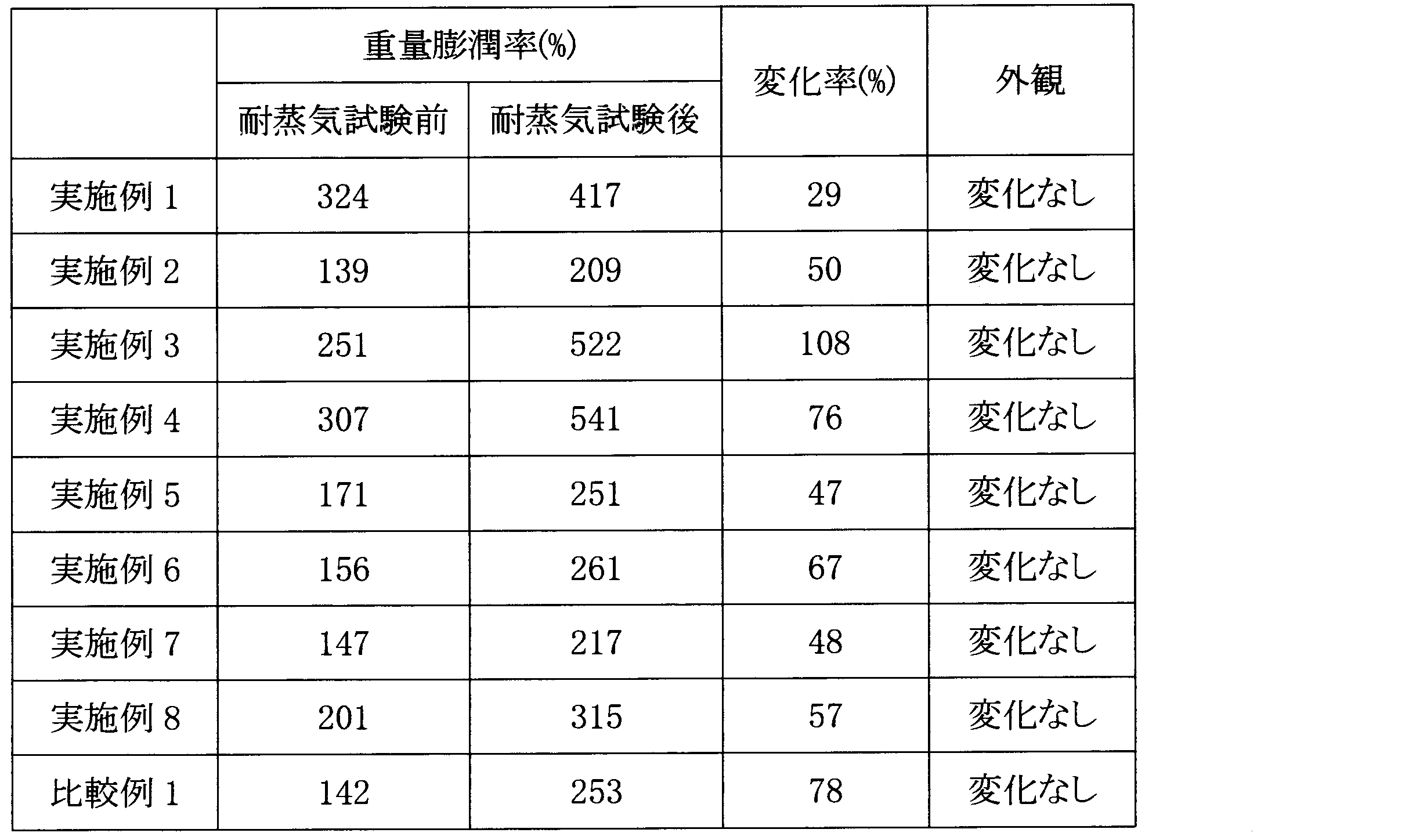
- Weight swelling change rate (steam resistance test) The weight swelling change rate was measured by the following method. In addition, changes in appearance due to the steam resistance test were observed. The results are shown in Table 2.
- the change rate (%) before and after the steam resistance test (300 ° C.) is calculated by the following formula using (weight swelling ratio before the steam resistance test) and (weight swelling ratio after the steam resistance test).
- Example 2 [Synthesis of Compound 2] Compound 2 was synthesized by the following procedure. In a 2 L four-necked flask equipped with a stirrer, 4,4′-biphenyldicarbaldehyde (63.3 g, 0.30 mol), zinc powder (59.2 g, 0.90 mol), triphenylphosphine in a nitrogen atmosphere. (315.8 g, 1.20 mol) and N, N-dimethylacetamide (600 mL) were charged, and difluorodibromomethane (221.2 g, 1.05 mol) was slowly fed while stirring at room temperature to 40 ° C.
- 4,4′-biphenyldicarbaldehyde 63.3 g, 0.30 mol
- zinc powder 59.2 g, 0.90 mol
- triphenylphosphine triphenylphosphine in a nitrogen atmosphere. (315.8 g, 1.20 mol) and N, N-dimethylace
- the melting point of the obtained compound was 88 to 90 ° C. Further, GC-MS, 1 H-NMR and 19 F-NMR were measured in the same manner as in Example 1. The results are shown below.
- Example 3 [Synthesis of Compound 3] Compound 3 was synthesized by the following procedure. A 50 mL four-necked flask equipped with a stirrer was charged with zinc chloride (1.57 g, 11.5 mmol) and tetrahydrofuran (20 mL) under a nitrogen atmosphere, and 1,1,1,3-tetra-tetrahydrofuran at ⁇ 20 ° C. Fluoroethane (1.78 g, 17.4 mmol) was fed, and then a solution of lithium diisopropylamide in n-hexane-tetrahydrofuran (1,0 M, 21.4 mL, 23.4 mmol) was added dropwise.
- Example 4 [Synthesis of Compound 4] Compound 4 was synthesized by the following procedure. A 200 mL four-necked flask equipped with a stirrer was charged with tetrahydrofuran (50 mL) and 1,1,1,2-tetrafluoroethane (4.77 g, 46.8 mmol) under a nitrogen atmosphere, N-Hexane solution of butyllithium (1.6M, 50 mL, 80.7 mmol) was slowly added dropwise, followed by a tetrahydrofuran solution in which 4,4′-biphenyldicarbaldehyde (2.43 g, 11.5 mmol) was dissolved ( 50 mL) was added dropwise. Further, water (0.5 mL) was added at 0 ° C., and the solvent was distilled off to obtain a reaction mixture.
- the melting point of the obtained compound was 156 to 158 ° C. Further, GC-MS, 1 H-NMR and 19 F-NMR were measured in the same manner as in Example 1. The results are shown below.
- Example 5 Synthesis of Compound 5
- Compound 5 was synthesized by the following procedure. In a 500 mL four-necked flask equipped with a stirrer, 1,6-bis (4-bromophenyl) -1,1,2,2,3,3,4,4,5,5,6, under a nitrogen atmosphere 6-dodecafluorohexane (11.51 g, 18.8 mmol) and tetrahydrofuran (370 mL) were charged and stirred, and a solution of n-butyllithium in n-hexane (1.6 M, 26.0 mL, 41. 4 mmol) was slowly added dropwise.
- 6-dodecafluorohexane 11.51 g, 18.8 mmol
- tetrahydrofuran 370 mL
- N, N-dimethylformamide (4.01 g, 54.9 mmol) was slowly added dropwise, the temperature was raised to 0 ° C., an aqueous hydrochloric acid solution was added, and the organic layer was washed with 20% brine (100 mL ⁇ 3 times). The obtained organic layer was dried over anhydrous magnesium sulfate, and the filtrate was concentrated under reduced pressure to obtain 1,6-bis (4-formylphenyl) -1,1,2,2,3,3 as a pale yellow solid. 8.00 g of 4,4,5,5,6,6-dodecafluorohexane was obtained.
- the melting point of the obtained compound was 68 to 70 ° C. Further, GC-MS, 1 H-NMR and 19 F-NMR were measured in the same manner as in Example 1. The results are shown below.
- Example 6 [Synthesis of Compound 6] Compound 6 was synthesized by the following procedure. The reaction was conducted in the same manner as in Example 2 except that 3,4′-biphenyldicarbaldehyde was changed to 3,3′-biphenyldicarbaldehyde, and 3,3′-bis (2,2-difluorovinyl) biphenyl was obtained. (Compound 6) was synthesized. Compound 6 was obtained as a pale yellow solid and the isolated yield was 36%.
- the melting point of the obtained compound was 29-30 ° C. Further, GC-MS, 1 H-NMR and 19 F-NMR were measured in the same manner as in Example 1. The results are shown below.
- Example 7 [Synthesis of Compound 7] Compound 7 was synthesized by the following procedure. A reaction was conducted in the same manner as in Example 2 except that 4,4′-biphenyldicarbaldehyde was changed to 4,4′-diformyldiphenyl ether, and 4,4′-bis (2,2-difluorovinyl) diphenyl ether ( Compound 7) was synthesized. Compound 7 was obtained as a white solid and the isolated yield was 35%.
- the melting point of the obtained compound was 36 ° C to 38 ° C. Further, GC-MS, 1 H-NMR and 19 F-NMR were measured in the same manner as in Example 1. The results are shown below.
- Example 8 [Synthesis of Compound 8] Compound 8 was synthesized by the following procedure. 1,6-bis (4-bromophenyl) -1,1,2,2,3,3,4,4,5,5,6,6-dodecafluorohexane is converted to 1,6-bis (3-bromophenyl) ) -1,1,2,2,3,3,4,4,5,5,6,6-dodecafluorohexane The reaction was conducted in the same manner as in Example 5 to obtain 1,6-bis [3- (2,2-difluorovinyl) phenyl] -1,1,2,2,3,3,4,4,5,5,6,6-dodecafluorohexane (Compound 8) was synthesized. The isolated yield of Compound 8 obtained as a white solid was 22%.
- the melting point of the obtained compound was 23-25 ° C. Further, GC-MS, 1 H-NMR and 19 F-NMR were measured in the same manner as in Example 1. The results are shown below.
- Example 9 Synthesis of Compound 9 was synthesized by the following procedure. In a 500 mL four-necked flask equipped with a stirrer, 1,4-bis (4-bromophenyl) -1,1,2,2,3,3,4,4-octafluorobutane (10. 24 g, 20.0 mmol) and tetrahydrofuran (350 mL) were charged, and an n-hexane solution of n-butyllithium (1.6 M, 25.6 mL, 41 mmol) was slowly added dropwise at ⁇ 78 ° C. with stirring.
- 1,4-bis (4-bromophenyl) -1,1,2,2,3,3,4,4-octafluorobutane 10. 24 g, 20.0 mmol
- tetrahydrofuran 350 mL
- an n-hexane solution of n-butyllithium 1.6 M, 25.6 mL, 41 mmol
- N, N-dimethylformamide (4.39 g, 60.0 mmol) was slowly added dropwise, the temperature was raised to 0 ° C., an aqueous hydrochloric acid solution was added, and the organic layer was washed with 20% brine (100 mL ⁇ 3 times). The obtained organic layer was dried over anhydrous magnesium sulfate, and the filtrate was concentrated under reduced pressure to obtain 1,4-bis (4-formylphenyl) -1,1,2,2,3,3, a pale yellow solid. 4.99 g of 4,4-octafluorobutane was obtained.
- the melting point of the obtained compound was 86 to 88 ° C. Further, GC-MS, 1 H-NMR and 19 F-NMR were measured in the same manner as in Example 1. The results are shown below.
- Comparative Example 1 As comparative compound 1, the following 1,6-divinyl (perfluorohexane) (manufactured by Tosoh F-Tech) was used.
- Comparative Compound 1 A composition and a molded body were prepared and evaluated in the same manner as in Example 1 except that Comparative Compound 1 was used instead of Compound 1 as a crosslinking agent. The results are shown in Tables 1 and 2.
- the fluorine-containing aromatic compound or crosslinking agent of the present invention can be used as a crosslinking agent for fluoroelastomers.
- the crosslinked fluoroelastomer of the present invention can be used as a sealing material that requires heat resistance.
Landscapes
- Chemical & Material Sciences (AREA)
- Organic Chemistry (AREA)
- Health & Medical Sciences (AREA)
- Chemical Kinetics & Catalysis (AREA)
- Medicinal Chemistry (AREA)
- Polymers & Plastics (AREA)
- Compositions Of Macromolecular Compounds (AREA)
- Organic Low-Molecular-Weight Compounds And Preparation Thereof (AREA)
- Addition Polymer Or Copolymer, Post-Treatments, Or Chemical Modifications (AREA)
- Graft Or Block Polymers (AREA)
- Polymerisation Methods In General (AREA)
Abstract
Description
しかしながら、架橋フルオロエラストマーの耐熱性と耐蒸気性を、さらに改善し得る新規な架橋剤が求められていた。
また、非特許文献1には、燃料電池分離膜として1,2,2-トリフルオロスチレン(パーフルオロビニルベンゼン)が記載されている。
また、本発明は、架橋剤として使用できる新規なフッ素含有芳香族化合物を提供することをその目的の一つとする。
1.下記式(1)で表わされる化合物からなる架橋剤。

2.前記式(1)で表わされる化合物が、下記式(2)で表わされる化合物である1記載の架橋剤。

3.下記式(3)で表わされる構造を2以上有する化合物からなる架橋剤。

4.前記式(3)で表わされる構造を2以上有する化合物が、下記式(4)で表わされる化合物である3記載の架橋剤。

5.前記式(1)で表わされる化合物、又は前記式(3)で表わされる構造を2以上有する化合物が、下記式(5)で表わされる化合物である1又は3記載の架橋剤。

6.R1,R2,R3のアリールが、フェニル又はナフチルである1~5のいずれか記載の架橋剤。
7.フルオロエラストマー、架橋開始剤、及び1~6のいずれか記載の架橋剤を含む組成物。
8.前記フルオロエラストマーが、パーフルオロエラストマー又は一部フッ素化エラストマーである7記載の組成物。
9.前記架橋剤が、前記フルオロエラストマー100gに対して、0.5~30mmol含まれる7又は8記載の組成物。
10.前記架橋開始剤が、前記フルオロエラストマー100gに対して、0.3~15mmol含まれる7~9のいずれか記載の組成物。
11.7~10のいずれか記載の組成物を架橋して得られた架橋フルオロエラストマー。
12.11記載の架橋フルオロエラストマーから得られる成形体。
13.シール材である12記載の成形体。
14.下記式(1)で表わされる化合物。

15.前記式(1)で表わされる化合物が、下記式(2)で表わされる化合物である14記載の化合物。

16.下記式(3)で表わされる構造を2以上有する化合物。

17.前記式(3)で表わされる構造を2以上有する化合物が、下記式(4)で表わされる化合物である16記載の化合物。

18.前記式(1)で表わされる化合物、又は前記式(3)で表わされる構造を2以上有する化合物が、下記式(5)で表わされる化合物である14又は16記載の化合物。

19.300℃の飽和水蒸気に22時間晒した前後の、パーフルオロカーボン溶液に21~25℃で72時間浸漬し、取り出した後の重量膨潤率の変化率が、70%以下である、架橋フルオロエラストマー。
20.330℃の大気環境に16時間暴露した前後の重量減少率が7%以下である、架橋フルオロエラストマー。
i.下記式で表される化合物。
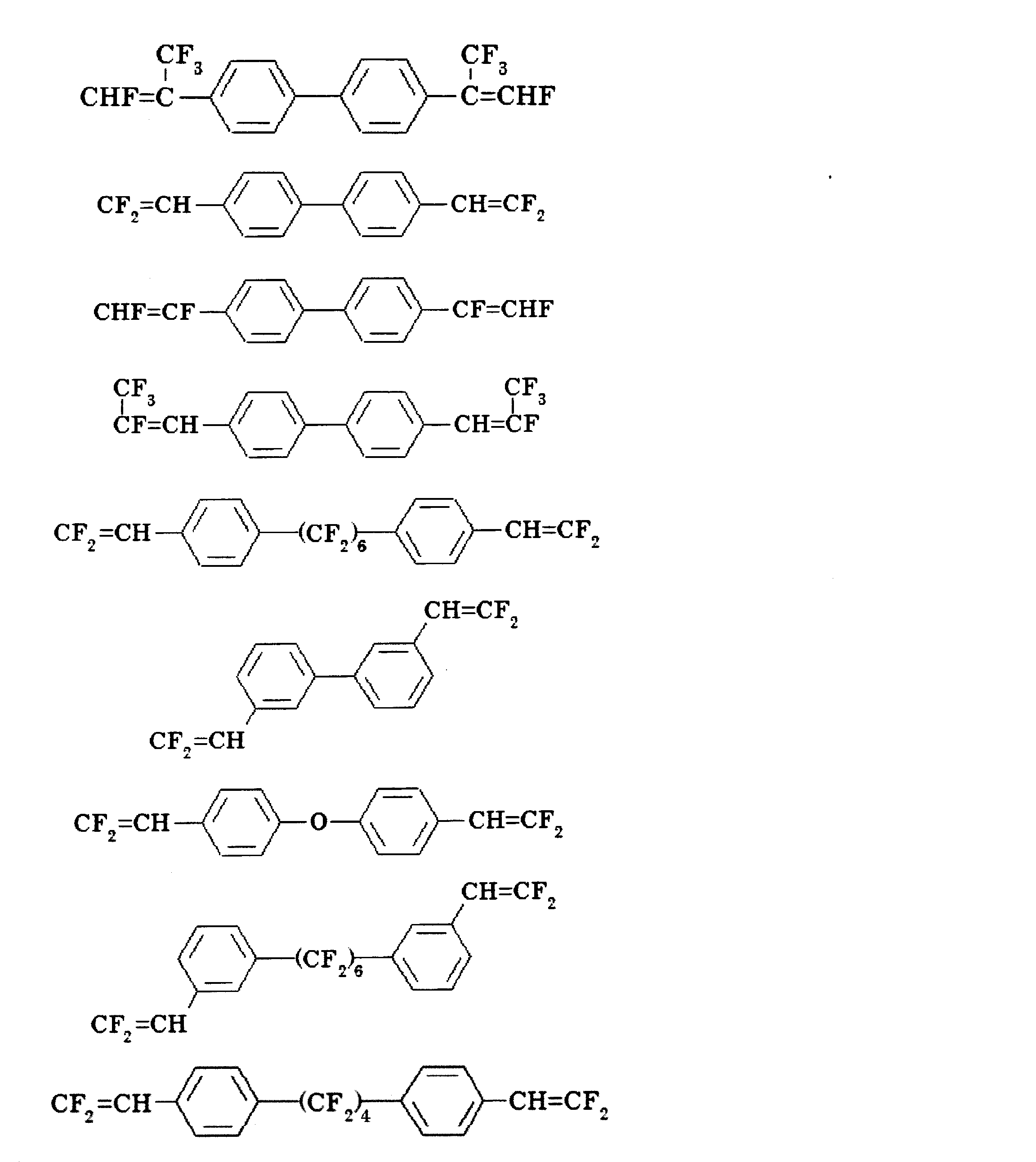

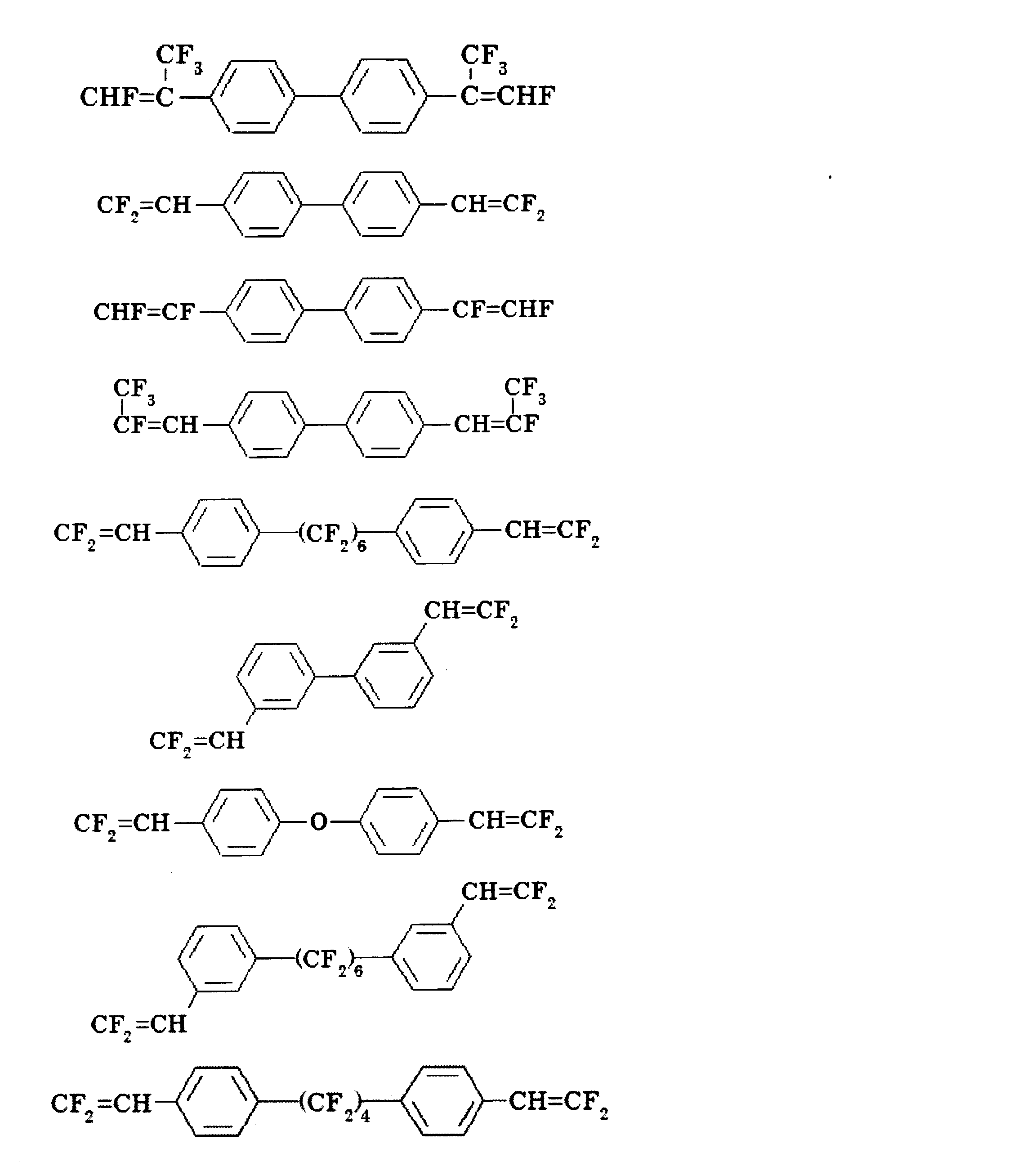
iii.前記式(3’)で表わされる構造を2以上有する化合物が、下記式(4’)で表わされる化合物であるii記載の化合物。

また、本発明によれば、架橋剤として使用できる新規なフッ素含有芳香族化合物を提供することができる。

フッ化アルキル基は、アルキル基が一部又は全部フッ素化されていてよい。好ましくはパーフルオロアルキル基である。
アリール基の置換基は、フッ素原子、直鎖又は分枝のアルキル基、シクロアルキル基、又はアリール基等であり、これらの基は一部又は全部がフッ素化されていてもよい。直鎖又は分枝のアルキル基の炭素数は好ましくは1~15(より好ましくは炭素数1~6)である。シクロアルキル基の炭素数は好ましくは3~8(より好ましくは炭素数3~6)である。アリール基の炭素数は好ましくは6~18(より好ましくは炭素数6~12)である。
上記式(1)中、lは0,1又は2である。好ましくは0である。


直鎖又は分枝のアルキレン基の炭素数は好ましくは1~15(より好ましくは炭素数1~6)である。シクロアルキレン基の炭素数は好ましくは3~8(より好ましくは炭素数3~6)である。アリーレン基の炭素数は好ましくは炭素数が6~18(より好ましくは炭素数6~12)である。
上記式(4)中、nが1である場合、Aと-CR1=CR2R3は、オルト位、メタ位又はパラ位のいずれであってもよいが、パラ位であることが好ましく、Aと2つの-CR1=CR2R3が、ともにパラ位であることがより好ましい。

上記式(5)中、оは1又は0であり、0であることが好ましい。
上記式(5)中、qはそれぞれ、1,2,3,4である。
上記式において、qが共に1のとき、2つの-CR1=CR2R3は互いに最も離れた位置にあると効率的に架橋でき好ましい。
アルキル基は直鎖でも分枝でもよく、炭素数は好ましくは1~15(より好ましくは炭素数1~6)である。シクロアルキル基の炭素数は好ましくは3~8(より好ましくは炭素数3~6)である。アリール基の炭素数は好ましくは6~18(より好ましくは炭素数6~12)である。アリール基の置換基は前述したR1と同じである。
例えば、以下のモノマー由来の繰返し単位を例示できる。1又は2以上のモノマー由来の繰返し単位を含むことができる。
CF2=CH2(ビニリデンフロライド)、
CF2=CF2(テトラフルオロエチレン)、
CF2=CFCF3(ヘキサフルオロプロピレン)、
CH2=CH2、
CH2=CHCH3
コモノマーとして以下を例示できる。
・ CF2=CFOR2f (パー)フルオロアルキルビニルエーテル類(PAVE)
(式中、R2fは炭素数1~6の(パー)フルオロアルキル、例えばトリフルオロメチル又はペンタフルオロプロピルである)
・ CF2=CFOXo (パー)フルオロオキシアルキルビニルエーテル類
(式中、Xoは1以上のエーテル基を含む炭素数1~12の(パー)フルオロオキシアルキル、例えばパーフルオロ-2-プロポキシプロピルである)
・ CFX2=CX2OCF2OR’’f (I-B)
(式中、R’’fは、炭素数2~6の直鎖又は分枝(パー)フルオロアルキル、炭素数5,6の環状(パー)フルオロアルキル、又は酸素原子1~3個を含む炭素数2~6の直鎖又は分枝(パー)フルオロオキシアルキルであり、X2はF又はHである)
CFX2=CX2OCF2OCF2CF2Y (II-B)
(式中、YはF又はOCF3であり、X2は上記で定義した通りである。)
CF2=CFOCF2OCF2CF3 (MOVE1)
CF2=CFOCF2OCF2CF2OCF3 (MOVE2)
テトラフルオロエチレン(TFE) 50~85モル%、PAVE 15~50モル%;
TFE 50~85モル%、MOVE 15~50モル%。
架橋補助剤としては、酸化亜鉛、活性アルミナ、酸化マグネシウム、第四級アンモニウム塩、第四級ホスホニウム塩、アミン等が挙げられる。架橋補助剤を含むことにより、架橋効率、耐熱性を向上できる。架橋補助剤は、フルオロエラストマー100gに対して、通常0.1~10g添加する。
一段階加熱の場合は、架橋条件は、100~250℃で10分~5時間加熱するのが好ましい。
二段階加熱の場合は、通常、一次架橋として、金型に原料を入れプレス加工しながら架橋する。1次架橋は、例えば、150~200℃で5~60分加熱する。その後、金型から外して、2次架橋する。2次架橋は、例えば、150~300℃で1~100時間加熱する。架橋は電気炉等を用いて行うことができる。2次架橋で熱履歴を与えることにより、使用中の変形等を防ぐことができる。
不活性ガスとして、窒素、ヘリウム、アルゴン等を用いることができ、窒素が好ましい。不活性ガス雰囲気下において、酸素濃度は、好ましくは、10ppm以下、より好ましくは、5ppm以下である。
[化合物1の合成]
以下の手順によって化合物1を合成した。
撹拌機を具備した500mL四つ口フラスコに、窒素雰囲気下で4,4’-ジブロモビフェニル(5.85g,18.8mmol)とテトラヒドロフラン(200mL)を仕込み、-78℃下で撹拌しながら、n-ブチルリチウムのn-ヘキサン溶液(1,6M,25.8mL,41.3mmol)をゆっくり滴下した。次いで、トリフルオロ酢酸エチル(11.73g,82.5mmol)をゆっくり滴下し、0℃まで昇温し、塩酸水溶液を加えて、有機層を分取した。得られた有機層を20%食塩水(50mL×3回)で水洗し、無水硫酸マグネシウムで乾燥後に、ろ液を減圧濃縮した。得られた濃縮物をヘキサンで洗浄し、淡黄色固体の4,4’-ビス(トリフルオロアセチル)ビフェニルを6.17g得た。

また、得られた化合物について、GC-MS、1H-NMR及び19F-NMRの測定を行った。結果を以下に示す。これらの結果より、化合物1は3種の異性体(E-E、E-Z、Z-Z)の混合物であることが分かった。混合比は、E-E:E-Z:Z-Z=29:53:18であった。
GC-MS:島津製作所製GCMS-QP2010Plus
1H-NMR、19F-NMR:BRUKER社製AVANCE II 400

19F-NMR(Acetone-d6,376MHz);-111.1ppm(ddd,2F),-57.6ppm(d,6F,CF3)

19F-NMR(Acetone-d6,376MHz);-121.9ppm(ddd,1F),-111.1ppm(ddd,1F),-61.6ppm(d,3F,CF3),-57.6ppm(d,3F,CF3)

19F-NMR(Acetone-d6,376MHz);-121.9ppm(ddd,2F),-61.6ppm(d,6F,CF3)
以下の成分を混合して組成物を調製した。
・フルオロエラストマー(ソルベイ社製、テクノフロンPFR94):100g
・受酸剤(日本アエロジル社製、アエロジルR972):1.0g
・開始剤(日本油脂株式会社製、パークミルD):2.6mmol
・架橋剤(化合物1):6.1mmol
(1)耐熱性
得られた成形体を330℃の大気環境に16時間暴露した前後の重量減少率を測定した。また、外観の変化を観察した。結果を表1に示す。
下記の方法により重量膨潤変化率を測定した。また、耐蒸気試験による外観の変化を観察した。結果を表2に示す。
(i)重量膨潤率の測定
短冊状(長さ20mm、幅10mm、厚さ1mm)の成形体について、耐蒸気試験(300℃)前の重量膨潤率を測定する。
成形体を、パーフルオロカーボン溶液(フロリナートFC-3283(スリーエムジャパン社製))に、室温(21~25℃)で、72時間浸漬させ、浸漬前後の重量膨潤率を、以下の式により、計算にて求める。

続いて、成形体について、耐蒸気試験(300℃)を行う。
成形体を、300℃の飽和水蒸気に22時間晒す。
上記耐蒸気試験(300℃)後の成形体を、(i)と同様に、パーフルオロカーボン溶液に、室温(21~25℃)で72時間浸漬し、耐蒸気試験(300℃)後の重量膨潤率を測定する。

[化合物2の合成]
以下の手順によって化合物2を合成した。
撹拌機を具備した2L四つ口フラスコに、窒素雰囲気下で4,4’-ビフェニルジカルボアルデヒド(63.3g,0.30mol)と亜鉛粉末(59.2g,0.90mol)、トリフェニルホスフィン(315.8g,1.20mol)、N,N-ジメチルアセトアミド(600mL)を仕込み、室温~40℃下で撹拌しながら、ジフルオロジブロモメタン(221.2g,1.05mol)をゆっくりフィードした。室温で一晩撹拌後、ヘキサン(1L×3回)で抽出し、得られたヘキサン層を20%食塩水(200mL×3回)で水洗し、無水硫酸マグネシウムで乾燥後に減圧濃縮した。得られた濃縮物をシリカゲルクロマトグラフィーで精製し、白色固体の4,4’-ビス(2,2-ジフルオロビニル)ビフェニル(化合物2)を33.5g得た(単離収率=40%)。

1H-NMR(Acetone-d6,400MHz);5.30ppm(dd,2H),7.38ppm(d,4H,Ar-H),7.55ppm(d,4H,Ar-H)
19F-NMR(Acetone-d6,376MHz);-84.3ppm(d,2F),-82.4ppm(dd,2F)
架橋剤として化合物1の代わりに化合物2を用いた他は実施例1と同様にして組成物及び成形体を調製し、評価した。結果を表1,2に示す。
[化合物3の合成]
以下の手順によって化合物3を合成した。
撹拌機を具備した50mL四つ口フラスコに、窒素雰囲気下で塩化亜鉛(1.57g,11.5mmol)とテトラヒドロフラン(20mL)を仕込み、-20℃下にて1,1,1,3-テトラフルオロエタン(1.78g,17.4mmol)をフィードし、次いで、リチウムジイソプロピルアミドのn-ヘキサン-テトラヒドロフラン溶液(1,0M,21.4mL,23.4mmol)を滴下した。次いで、4,4’-ジヨードビフェニル(1.33g,3.3mmol)とテトラキストリフェニルホスフィンパラジウム(0.13g,0.11mmol)を加え、室温で一晩撹拌した。その後、溶媒を留去し、得られた濃縮物をシリカゲル処理し、反応混合物を得た。


19F-NMR(Acetone-d6,376MHz);-173.8ppm(ddd,2F),-167.5ppm(dd,2F)

19F-NMR(Acetone-d6,376MHz);-173.8ppm(ddd,1F),-167.5ppm(dd,1F),-164.8ppm(dd,1F),-145.1ppm(d,1F)

19F-NMR(Acetone-d6,376MHz);-164.9ppm(dd,2F),-145.1ppm(d,2F)
架橋剤として化合物1の代わりに化合物3を用いた他は実施例1と同様にして、組成物及び成形体を調製し、評価した。結果を表1,2に示す。
[化合物4の合成]
以下の手順によって化合物4を合成した。
撹拌機を具備した200mL四つ口フラスコに、窒素雰囲気下でテトラヒドロフラン(50mL)と1,1,1,2-テトラフルオロエタン(4.77g,46.8mmol)を仕込み、-78℃下でn-ブチルリチウムのn-ヘキサン溶液(1.6M,50mL,80.7mmol)をゆっくり滴下し、次いで、4,4’-ビフェニルジカルボアルデヒド(2.43g,11.5mmol)を溶かしたテトラヒドロフラン溶液(50mL)を滴下した。更に、0℃で水(0.5mL)を加え、溶媒を留去し、反応混合物を得た。

1H-NMR(Acetone-d6,400MHz);6.84ppm(d,2H),7.80ppm(d,4H,Ar-H),7.83ppm(d,4H,Ar-H)
19F-NMR(Acetone-d6,376MHz);-132.2ppm(ddd,2F),-70.5ppm(d,6F,CF3)
架橋剤として化合物1の代わりに化合物4を用いた他は実施例1と同様にして、組成物及び成形体を調製し、評価した。結果を表1,2に示す。
[化合物5の合成]
以下の手順によって化合物5を合成した。
撹拌機を具備した500mL四つ口フラスコに、窒素雰囲気下で1,6-ビス(4-ブロモフェニル)-1,1,2,2,3,3,4,4,5,5,6,6-ドデカフルオロヘキサン(11.51g,18.8mmol)とテトラヒドロフラン(370mL)を仕込み撹拌しながら、-78℃下でn-ブチルリチウムのn-ヘキサン溶液(1.6M,26.0mL,41.4mmol)をゆっくり滴下した。次いで、N,N-ジメチルホルムアミド(4.01g,54.9mmol)をゆっくり滴下し、0℃まで昇温した後、塩酸水溶液を加え、有機層を20%食塩水(100mL×3回)で水洗し、得られた有機層を無水硫酸マグネシウムで乾燥後に、ろ液を減圧濃縮し、淡黄色固体の1,6-ビス(4-ホルミルフェニル)-1,1,2,2,3,3,4,4,5,5,6,6-ドデカフルオロヘキサンを8.00g得た。

1H-NMR(Acetone-d6,400MHz);5.77ppm(dd,2H),7.64ppm(d,4H,Ar-H),7.69ppm(d,4H,Ar-H)
19F-NMR(Acetone-d6,376MHz);-121.7ppm(s,4F,CF2),-121.2ppm(s,4F,CF2),-110.3ppm(s,4F,CF2),-82.7ppm(d,2F),-80.9ppm(dd,2F)
架橋剤として化合物1の代わりに化合物5を用いた他は実施例1と同様にして、組成物及び成形体を調製し、評価した。結果を表1,2に示す。
[化合物6の合成]
以下の手順によって化合物6を合成した。
4,4’-ビフェニルジカルボアルデヒドを3,3’-ビフェニルジカルボアルデヒドとした以外は、実施例2と同様にして反応を行い、3,3’-ビス(2,2-ジフルオロビニル)ビフェニル(化合物6)を合成した。化合物6は淡黄色固体として得られ、単離収率は36%であった。

1H-NMR(Acetone-d6,400MHz);5.68ppm(dd,2H),7.40-7.68ppm(m,8H,Ar-H)
19F-NMR(Acetone-d6,376MHz);-86.5ppm(d,2F),-83.5ppm(dd,2F)
架橋剤として化合物1の代わりに化合物6を用いた他は実施例1と同様にして、組成物及び成形体を調製し、評価した。結果を表1,2に示す。
[化合物7の合成]
以下の手順によって化合物7を合成した。
4,4’-ビフェニルジカルボアルデヒドを4,4’-ジホルミルジフェニルエーテルとした以外は、実施例2と同様にして反応を行い、4,4’-ビス(2,2-ジフルオロビニル)ジフェニルエーテル(化合物7)を合成した。化合物7は白色固体として得られ、単離収率は35%であった。

1H-NMR(Acetone-d6,400MHz);5.60ppm(dd,2H),7.04ppm(d,4H,Ar-H),7.43ppm(d,4H,Ar-H)
19F-NMR(Acetone-d6,376MHz);-86.9ppm(d,2F),-85.1ppm(dd,2F)
架橋剤として化合物1の代わりに化合物7を用いた他は実施例1と同様にして、組成物及び成形体を調製し、評価した。結果を表1,2に示す。
[化合物8の合成]
以下の手順によって化合物8を合成した。
1,6-ビス(4-ブロモフェニル)-1,1,2,2,3,3,4,4,5,5,6,6-ドデカフルオロヘキサンを1,6-ビス(3-ブロモフェニル)-1,1,2,2,3,3,4,4,5,5,6,6-ドデカフルオロヘキサンとした以外は、実施例5と同様にして反応を行い、1,6-ビス[3-(2,2-ジフルオロビニル)フェニル]-1,1,2,2,3,3,4,4,5,5,6,6-ドデカフルオロヘキサン(化合物8)を合成した。白色固体として得られた化合物8の単離収率は22%であった。
1H-NMR(Acetone-d6,400MHz);5.79ppm(dd,2H),7.57-7.74ppm(m,8H,Ar-H)
19F-NMR(Acetone-d6,376MHz);-121.7ppm(s,4F,CF2),-121.1ppm(s,4F,CF2),-110.5ppm(s,4F,CF2),-83.9ppm(d,2F),-82.3ppm(dd,2F)
架橋剤として化合物1の代わりに化合物8を用いた他は実施例1と同様にして、組成物及び成形体を調製し、評価した。結果を表1,2に示す。
[化合物9の合成]
以下の手順によって化合物9を合成した。
撹拌機を具備した500mL四つ口フラスコに、窒素雰囲気下で1,4-ビス(4-ブロモフェニル)-1,1,2,2,3,3,4,4-オクタフルオロブタン(10.24g,20.0mmol)とテトラヒドロフラン(350mL)を仕込み撹拌しながら、-78℃下でn-ブチルリチウムのn-ヘキサン溶液(1.6M,25.6mL,41mmol)をゆっくり滴下した。次いで、N,N-ジメチルホルムアミド(4.39g,60.0mmol)をゆっくり滴下し、0℃まで昇温した後、塩酸水溶液を加え、有機層を20%食塩水(100mL×3回)で水洗し、得られた有機層を無水硫酸マグネシウムで乾燥後に、ろ液を減圧濃縮し、淡黄色固体の1,4-ビス(4-ホルミルフェニル)-1,1,2,2,3,3,4,4-オクタフルオロブタンを4.99g得た。
次いで、撹拌機を具備した300mL四つ口フラスコに、窒素雰囲気下で前述の1,4-ビス(4-ホルミルフェニル)-1,1,2,2,3,3,4,4-オクタフルオロブタン(4.92g,12.0mmol)と亜鉛粉末(2.35g,36.0mmol)、トリフェニルホスフィン(12.59g,48.0mmol)とN,N-ジメチルアセトアミド(75mL)を仕込み撹拌しながら、室温から40℃下でジフルオロジブロモメタン(8.98g,42.8mmol)を溶かしたN,N-ジメチルアセトアミド溶液(20mL)をゆっくり滴下し、室温で一晩撹拌した。反応後、ヘキサン(150mL)を加え、析出固体を分離し、ろ液を15%食塩水(50mL×3回)で水洗し、無水硫酸マグネシウムで乾燥後に、ろ液を減圧濃縮した。得られた濃縮物をシリカゲルクロマトグラフィーで精製し、白色固体の1,4-ビス[4-(2,2-ジフルオロビニル)フェニル]-1,1,2,2,3,3,4,4-オクタフルオロブタン(化合物9)を2.12g得た(単離収率=22%)。

1H-NMR(Acetone-d6,400MHz);5.75ppm(dd,2H),7.62ppm(d,4H,Ar-H),7.66ppm(d,4H,Ar-H)
19F-NMR(Acetone-d6,376MHz);-121.2ppm(s,4F,CF2),-110.3ppm(s,4F,CF2),-82.9ppm(d,2F),-81.1ppm(dd,2F)
比較化合物1として下記の1,6-ジビニル(パーフルオロヘキサン)(東ソー・エフテック社製)を用いた。

架橋剤として化合物1の代わりに比較化合物1を用いた他は実施例1と同様にして、組成物及び成形体を調製し、評価した。結果を表1,2に示す。

この明細書に記載の文献及び本願のパリ優先の基礎となる日本出願明細書の内容を全てここに援用する。
Claims (20)
- 下記式(1)で表わされる化合物からなる架橋剤。

- 前記式(1)で表わされる化合物が、下記式(2)で表わされる化合物である請求項1記載の架橋剤。

- 下記式(3)で表わされる構造を2以上有する化合物からなる架橋剤。

- 前記式(3)で表わされる構造を2以上有する化合物が、下記式(4)で表わされる化合物である請求項3記載の架橋剤。

- 前記式(1)で表わされる化合物、又は前記式(3)で表わされる構造を2以上有する化合物が、下記式(5)で表わされる化合物である請求項1又は3記載の架橋剤。

- R1,R2,R3のアリール基が、フェニル又はナフチルである請求項1~5のいずれか記載の架橋剤。
- フルオロエラストマー、架橋開始剤、及び請求項1~6のいずれか記載の架橋剤を含む組成物。
- 前記フルオロエラストマーが、パーフルオロエラストマー又は一部フッ素化エラストマーである請求項7記載の組成物。
- 前記架橋剤が、前記フルオロエラストマー100gに対して、0.5~30mmol含まれる請求項7又は8記載の組成物。
- 前記架橋開始剤が、前記フルオロエラストマー100gに対して、0.3~15mmol含まれる請求項7~9のいずれか記載の組成物。
- 請求項7~10のいずれか記載の組成物を架橋して得られた架橋フルオロエラストマー。
- 請求項11記載の架橋フルオロエラストマーから得られる成形体。
- シール材である請求項12記載の成形体。
- 下記式(1)で表わされる化合物。

- 前記式(1)で表わされる化合物が、下記式(2)で表わされる化合物である請求項14記載の化合物。

- 下記式(3)で表わされる構造を2以上有する化合物。

- 前記式(3)で表わされる構造を2以上有する化合物が、下記式(4)で表わされる化合物である請求項16記載の化合物。

- 前記式(1)で表わされる化合物、又は前記式(3)で表わされる構造を2以上有する化合物が、下記式(5)で表わされる化合物である請求項14又は16記載の化合物。

- 300℃の飽和水蒸気に22時間晒した前後の、パーフルオロカーボン溶液に21~25℃で72時間浸漬し、取り出した後の重量膨潤率の変化率が、70%以下である、架橋フルオロエラストマー。
- 330℃の大気環境に16時間暴露した前後の重量減少率が7%以下である、架橋フルオロエラストマー。
Priority Applications (11)
| Application Number | Priority Date | Filing Date | Title |
|---|---|---|---|
| KR1020207018312A KR102230664B1 (ko) | 2014-08-01 | 2015-07-31 | 가교제 및 불소 함유 방향족 화합물 |
| GB1701433.3A GB2543228B (en) | 2014-08-01 | 2015-07-31 | Crosslinking agent and fluorine-containing aromatic compound |
| EP17176209.9A EP3243811B1 (en) | 2014-08-01 | 2015-07-31 | Crosslinking agent and fluorine-containing aromatic compound |
| EP15826584.3A EP3187527B1 (en) | 2014-08-01 | 2015-07-31 | Crosslinking agent and fluorine-containing aromatic compound |
| CN201580041357.7A CN106574074B (zh) | 2014-08-01 | 2015-07-31 | 交联剂和含氟芳香族化合物 |
| JP2015539974A JPWO2016017187A1 (ja) | 2014-08-01 | 2015-07-31 | 架橋剤及びフッ素含有芳香族化合物 |
| US15/501,146 US10344113B2 (en) | 2014-08-01 | 2015-07-31 | Crosslinking agent and fluorine-containing aromatic compound |
| KR1020177002829A KR102128542B1 (ko) | 2014-08-01 | 2015-07-31 | 가교제 및 불소 함유 방향족 화합물 |
| US16/255,276 US10711085B2 (en) | 2014-08-01 | 2019-01-23 | Crosslinking agent and fluorine-containing aromatic compound |
| US16/417,189 US10584197B2 (en) | 2014-08-01 | 2019-05-20 | Crosslinking agent and fluorine-containing aromatic compound |
| US16/738,269 US11767389B2 (en) | 2014-08-01 | 2020-01-09 | Crosslinking agent and fluorine-containing aromatic compound |
Applications Claiming Priority (4)
| Application Number | Priority Date | Filing Date | Title |
|---|---|---|---|
| JP2014157875 | 2014-08-01 | ||
| JP2014-157875 | 2014-08-01 | ||
| JP2015-022365 | 2015-02-06 | ||
| JP2015022365 | 2015-02-06 |
Related Child Applications (3)
| Application Number | Title | Priority Date | Filing Date |
|---|---|---|---|
| US15/501,146 A-371-Of-International US10344113B2 (en) | 2014-08-01 | 2015-07-31 | Crosslinking agent and fluorine-containing aromatic compound |
| US16/255,276 Continuation US10711085B2 (en) | 2014-08-01 | 2019-01-23 | Crosslinking agent and fluorine-containing aromatic compound |
| US16/417,189 Division US10584197B2 (en) | 2014-08-01 | 2019-05-20 | Crosslinking agent and fluorine-containing aromatic compound |
Publications (1)
| Publication Number | Publication Date |
|---|---|
| WO2016017187A1 true WO2016017187A1 (ja) | 2016-02-04 |
Family
ID=55217096
Family Applications (1)
| Application Number | Title | Priority Date | Filing Date |
|---|---|---|---|
| PCT/JP2015/003888 Ceased WO2016017187A1 (ja) | 2014-08-01 | 2015-07-31 | 架橋剤及びフッ素含有芳香族化合物 |
Country Status (7)
| Country | Link |
|---|---|
| US (4) | US10344113B2 (ja) |
| EP (2) | EP3243811B1 (ja) |
| JP (3) | JPWO2016017187A1 (ja) |
| KR (2) | KR102230664B1 (ja) |
| CN (2) | CN107324970B (ja) |
| GB (1) | GB2543228B (ja) |
| WO (1) | WO2016017187A1 (ja) |
Cited By (6)
| Publication number | Priority date | Publication date | Assignee | Title |
|---|---|---|---|---|
| JP2016145166A (ja) * | 2015-02-06 | 2016-08-12 | ニチアス株式会社 | フッ素含有芳香族化合物 |
| WO2018061677A1 (ja) * | 2016-09-27 | 2018-04-05 | 東ソー・ファインケム株式会社 | 置換ビス(トリフルオロビニル)ベンゼン化合物 |
| WO2020129804A1 (ja) * | 2018-12-17 | 2020-06-25 | ニチアス株式会社 | パーフルオロエラストマー組成物、架橋パーフルオロエラストマー及び成形品 |
| WO2021230231A1 (ja) | 2020-05-14 | 2021-11-18 | ニチアス株式会社 | ゴム組成物、含フッ素エラストマー及びシール材 |
| JP2023134549A (ja) * | 2019-12-19 | 2023-09-27 | ニチアス株式会社 | 新規化合物、架橋剤及び架橋フルオロエラストマー |
| WO2026014255A1 (ja) * | 2024-07-10 | 2026-01-15 | ニチアス株式会社 | ゴム組成物、含フッ素エラストマー、シール材およびゴム組成物の保管方法 |
Families Citing this family (2)
| Publication number | Priority date | Publication date | Assignee | Title |
|---|---|---|---|---|
| CN117024711A (zh) * | 2023-09-07 | 2023-11-10 | 广东泰极动力科技有限公司 | 耐自由基低水溶胀的聚合物及其应用 |
| CN119285949B (zh) * | 2024-11-13 | 2025-08-29 | 安徽觅拓材料科技有限公司 | 一种低介电树脂、树脂组合物及其应用 |
Citations (9)
| Publication number | Priority date | Publication date | Assignee | Title |
|---|---|---|---|---|
| JPS5579331A (en) * | 1978-12-11 | 1980-06-14 | Tokuyama Soda Co Ltd | Beta,beta,beta',beta'-tetrafluorodivinylbenzene and its preparation |
| WO1998036901A1 (en) * | 1997-02-19 | 1998-08-27 | Daikin Industries, Ltd. | Rubber laminate and uses thereof |
| WO1999050319A1 (en) * | 1998-03-25 | 1999-10-07 | Daikin Industries, Ltd. | Method of reducing metal content in fluoroelastomer |
| WO2003091357A1 (en) * | 2000-10-30 | 2003-11-06 | Sony Corporation | Organic electroluminescent element |
| JP2006009010A (ja) * | 2004-06-22 | 2006-01-12 | Solvay Solexis Spa | パーフルオロエラストマー組成物 |
| JP2008538651A (ja) * | 2005-04-15 | 2008-10-30 | イー・アイ・デュポン・ドウ・ヌムール・アンド・カンパニー | アリール−エチレン置換芳香族化合物および有機半導体としてのその使用 |
| JP2012119150A (ja) * | 2010-11-30 | 2012-06-21 | Sony Corp | 電解液および電池 |
| WO2014167797A1 (ja) * | 2013-04-09 | 2014-10-16 | ニチアス株式会社 | 架橋フルオロエラストマーの製造方法 |
| WO2015019581A1 (ja) * | 2013-08-07 | 2015-02-12 | ニチアス株式会社 | 架橋剤及びフッ素含有芳香族化合物 |
Family Cites Families (11)
| Publication number | Priority date | Publication date | Assignee | Title |
|---|---|---|---|---|
| EP0428708B1 (en) * | 1989-06-09 | 1994-10-05 | The Dow Chemical Company | Process for preparing a polymer having perfluorocyclobutane rings and polymers containing perfluorocyclobutane rings |
| US5037917A (en) | 1989-06-09 | 1991-08-06 | The Dow Chemical Company | Perfluorocyclobutane ring-containing polymers |
| US5023380A (en) * | 1989-06-09 | 1991-06-11 | The Dow Chemical Company | Perfluorovinyl compounds |
| JP4168189B2 (ja) | 1998-01-14 | 2008-10-22 | ソルバーユ ソレクシス エッセ.ピー.ア. | アクリルゴムとフッ素ゴムとの複合体、その製造方法および加硫性ゴム組成物 |
| JP2000327846A (ja) | 1999-01-28 | 2000-11-28 | Sumitomo Bakelite Co Ltd | 熱可塑性エラストマー組成物 |
| JP2002134276A (ja) | 2000-10-30 | 2002-05-10 | Sony Corp | 有機電界発光素子 |
| JP2003051387A (ja) * | 2001-08-06 | 2003-02-21 | Matsushita Electric Ind Co Ltd | 有機電界発光素子 |
| ATE496968T1 (de) | 2008-03-31 | 2011-02-15 | Freudenberg Carl Kg | Kautschukzusammensetzung |
| JPWO2011046166A1 (ja) * | 2009-10-14 | 2013-03-07 | コニカミノルタホールディングス株式会社 | 有機エレクトロルミネッセンス素子およびこれを用いた照明装置 |
| JP4977222B2 (ja) * | 2010-03-03 | 2012-07-18 | 株式会社東芝 | 通信システムとその通信制御方法および通信装置 |
| WO2013172337A1 (ja) * | 2012-05-14 | 2013-11-21 | 国立大学法人大阪大学 | ハロゲン化含フッ素(シクロ)アルケニル亜鉛化合物の製造方法 |
-
2015
- 2015-07-31 GB GB1701433.3A patent/GB2543228B/en active Active
- 2015-07-31 CN CN201710305388.XA patent/CN107324970B/zh active Active
- 2015-07-31 KR KR1020207018312A patent/KR102230664B1/ko active Active
- 2015-07-31 CN CN201580041357.7A patent/CN106574074B/zh active Active
- 2015-07-31 WO PCT/JP2015/003888 patent/WO2016017187A1/ja not_active Ceased
- 2015-07-31 EP EP17176209.9A patent/EP3243811B1/en active Active
- 2015-07-31 US US15/501,146 patent/US10344113B2/en active Active
- 2015-07-31 JP JP2015539974A patent/JPWO2016017187A1/ja active Pending
- 2015-07-31 KR KR1020177002829A patent/KR102128542B1/ko active Active
- 2015-07-31 EP EP15826584.3A patent/EP3187527B1/en active Active
- 2015-11-11 JP JP2015221618A patent/JP6444290B2/ja active Active
-
2019
- 2019-01-23 US US16/255,276 patent/US10711085B2/en active Active
- 2019-05-20 US US16/417,189 patent/US10584197B2/en active Active
- 2019-09-26 JP JP2019175985A patent/JP6902586B2/ja active Active
-
2020
- 2020-01-09 US US16/738,269 patent/US11767389B2/en active Active
Patent Citations (9)
| Publication number | Priority date | Publication date | Assignee | Title |
|---|---|---|---|---|
| JPS5579331A (en) * | 1978-12-11 | 1980-06-14 | Tokuyama Soda Co Ltd | Beta,beta,beta',beta'-tetrafluorodivinylbenzene and its preparation |
| WO1998036901A1 (en) * | 1997-02-19 | 1998-08-27 | Daikin Industries, Ltd. | Rubber laminate and uses thereof |
| WO1999050319A1 (en) * | 1998-03-25 | 1999-10-07 | Daikin Industries, Ltd. | Method of reducing metal content in fluoroelastomer |
| WO2003091357A1 (en) * | 2000-10-30 | 2003-11-06 | Sony Corporation | Organic electroluminescent element |
| JP2006009010A (ja) * | 2004-06-22 | 2006-01-12 | Solvay Solexis Spa | パーフルオロエラストマー組成物 |
| JP2008538651A (ja) * | 2005-04-15 | 2008-10-30 | イー・アイ・デュポン・ドウ・ヌムール・アンド・カンパニー | アリール−エチレン置換芳香族化合物および有機半導体としてのその使用 |
| JP2012119150A (ja) * | 2010-11-30 | 2012-06-21 | Sony Corp | 電解液および電池 |
| WO2014167797A1 (ja) * | 2013-04-09 | 2014-10-16 | ニチアス株式会社 | 架橋フルオロエラストマーの製造方法 |
| WO2015019581A1 (ja) * | 2013-08-07 | 2015-02-12 | ニチアス株式会社 | 架橋剤及びフッ素含有芳香族化合物 |
Non-Patent Citations (5)
| Title |
|---|
| CHARLES R. DAVIS ET AL.: "Stereoselective Preparation of (Z)-alpha,beta-Difluorostyrenes and Stereospecific Conversion to (E)-alpha,beta-Difluoro- beta-iodostyrenes", J. ORG. CHEM., vol. 62, 1997, pages 9217 - 9222, XP055384179 * |
| CHARLES R. DAVIS ET AL.: "Stereoselective Preparation of (Z)-alpha,beta-Difluorostyrenes", TETRAHEDRON LETTERS, vol. 37, no. 40, 1996, pages 7237 - 7240, XP055384174 * |
| H. GLOWATZKI ET AL.: "Band Gap Tunable N-Type Molecules for Organic Field Effect Transistors", J. PHYS. CHEM. C, vol. 117, 2013, pages 11530 - 11539, XP055384186 * |
| KOHEI SHOJI ET AL.: "Synthesis and FET characteristics of phenylene-vinylene and anthracene-vinylene compounds containing cyano groups", J. MATER. CHEM., vol. 20, 2010, pages 6472 - 6478, XP055148004 * |
| SHINICHI SAITO ET AL.: "Highly Regioselective Cyclotrimerization of 1-Perfluoroalkylenynes Catalyzed by Nickel", J. ORG. CHEM., vol. 66, 2001, pages 796 - 802, XP055384171 * |
Cited By (17)
| Publication number | Priority date | Publication date | Assignee | Title |
|---|---|---|---|---|
| JP2016145166A (ja) * | 2015-02-06 | 2016-08-12 | ニチアス株式会社 | フッ素含有芳香族化合物 |
| WO2018061677A1 (ja) * | 2016-09-27 | 2018-04-05 | 東ソー・ファインケム株式会社 | 置換ビス(トリフルオロビニル)ベンゼン化合物 |
| JPWO2018061677A1 (ja) * | 2016-09-27 | 2019-07-11 | 東ソー・ファインケム株式会社 | 置換ビス(トリフルオロビニル)ベンゼン化合物 |
| US10654779B2 (en) | 2016-09-27 | 2020-05-19 | Tosoh Finechem Corporation | Substituted bis(trifluorovinyl)benzene compound |
| JP7066010B2 (ja) | 2018-12-17 | 2022-05-12 | ニチアス株式会社 | パーフルオロエラストマー組成物、架橋パーフルオロエラストマー及び成形品 |
| JPWO2020129804A1 (ja) * | 2018-12-17 | 2021-10-28 | ニチアス株式会社 | パーフルオロエラストマー組成物、架橋パーフルオロエラストマー及び成形品 |
| WO2020129804A1 (ja) * | 2018-12-17 | 2020-06-25 | ニチアス株式会社 | パーフルオロエラストマー組成物、架橋パーフルオロエラストマー及び成形品 |
| US12305107B2 (en) | 2018-12-17 | 2025-05-20 | Nichias Corporation | Perfluoroelastomer composition, cross-linked perfluoroelastomer and molded article |
| JP2023134549A (ja) * | 2019-12-19 | 2023-09-27 | ニチアス株式会社 | 新規化合物、架橋剤及び架橋フルオロエラストマー |
| JP7603288B2 (ja) | 2019-12-19 | 2024-12-20 | ニチアス株式会社 | 新規化合物、架橋剤及び架橋フルオロエラストマー |
| US12583995B2 (en) | 2019-12-19 | 2026-03-24 | Nichias Corporation | Compound, crosslinking agent and crosslinked fluoroelastomer |
| WO2021230231A1 (ja) | 2020-05-14 | 2021-11-18 | ニチアス株式会社 | ゴム組成物、含フッ素エラストマー及びシール材 |
| JPWO2021230231A1 (ja) * | 2020-05-14 | 2021-11-18 | ||
| KR20230010703A (ko) * | 2020-05-14 | 2023-01-19 | 니찌아스 카부시키카이샤 | 고무 조성물, 불소 함유 엘라스토머 및 밀봉재 |
| JP7571134B2 (ja) | 2020-05-14 | 2024-10-22 | ニチアス株式会社 | ゴム組成物、含フッ素エラストマー及びシール材 |
| KR102846548B1 (ko) | 2020-05-14 | 2025-08-20 | 니찌아스 카부시키카이샤 | 고무 조성물, 불소 함유 엘라스토머 및 밀봉재 |
| WO2026014255A1 (ja) * | 2024-07-10 | 2026-01-15 | ニチアス株式会社 | ゴム組成物、含フッ素エラストマー、シール材およびゴム組成物の保管方法 |
Also Published As
| Publication number | Publication date |
|---|---|
| CN106574074B (zh) | 2020-06-23 |
| US10584197B2 (en) | 2020-03-10 |
| JP6444290B2 (ja) | 2018-12-26 |
| EP3243811B1 (en) | 2019-03-13 |
| JP2017081889A (ja) | 2017-05-18 |
| KR102128542B1 (ko) | 2020-06-30 |
| JPWO2016017187A1 (ja) | 2017-05-18 |
| CN107324970B (zh) | 2021-06-29 |
| GB2543228B (en) | 2021-07-21 |
| KR102230664B1 (ko) | 2021-03-19 |
| JP2020002378A (ja) | 2020-01-09 |
| US11767389B2 (en) | 2023-09-26 |
| EP3187527A1 (en) | 2017-07-05 |
| KR20170036690A (ko) | 2017-04-03 |
| US20170226255A1 (en) | 2017-08-10 |
| EP3243811A1 (en) | 2017-11-15 |
| CN107324970A (zh) | 2017-11-07 |
| GB2543228A (en) | 2017-04-12 |
| KR20200081506A (ko) | 2020-07-07 |
| GB201701433D0 (en) | 2017-03-15 |
| EP3187527B1 (en) | 2019-10-30 |
| CN106574074A (zh) | 2017-04-19 |
| JP6902586B2 (ja) | 2021-07-14 |
| US10711085B2 (en) | 2020-07-14 |
| EP3187527A4 (en) | 2018-07-11 |
| US20190270835A1 (en) | 2019-09-05 |
| US20190153138A1 (en) | 2019-05-23 |
| US20200148805A1 (en) | 2020-05-14 |
| US10344113B2 (en) | 2019-07-09 |
Similar Documents
| Publication | Publication Date | Title |
|---|---|---|
| JP6902586B2 (ja) | 架橋剤及びフッ素含有芳香族化合物 | |
| JP2016145167A (ja) | 架橋剤及びフッ素含有芳香族化合物 | |
| JP6374867B2 (ja) | 架橋剤及びフッ素含有芳香族化合物 | |
| JP2005506391A (ja) | フルオロポリマー組成物 | |
| JP6304253B2 (ja) | 架橋性含フッ素エラストマー組成物及びその架橋物 | |
| CN105121518A (zh) | 交联氟橡胶的制造方法 | |
| JP2016145277A (ja) | 架橋剤 | |
| JP6408927B2 (ja) | フッ素含有芳香族化合物 | |
| JP7603288B2 (ja) | 新規化合物、架橋剤及び架橋フルオロエラストマー | |
| JP2020532615A (ja) | 修飾されたポリアリールエーテルケトン |
Legal Events
| Date | Code | Title | Description |
|---|---|---|---|
| ENP | Entry into the national phase |
Ref document number: 2015539974 Country of ref document: JP Kind code of ref document: A |
|
| 121 | Ep: the epo has been informed by wipo that ep was designated in this application |
Ref document number: 15826584 Country of ref document: EP Kind code of ref document: A1 |
|
| ENP | Entry into the national phase |
Ref document number: 201701433 Country of ref document: GB Kind code of ref document: A Free format text: PCT FILING DATE = 20150731 |
|
| ENP | Entry into the national phase |
Ref document number: 20177002829 Country of ref document: KR Kind code of ref document: A |
|
| NENP | Non-entry into the national phase |
Ref country code: DE |
|
| REEP | Request for entry into the european phase |
Ref document number: 2015826584 Country of ref document: EP |
|
| WWE | Wipo information: entry into national phase |
Ref document number: 2015826584 Country of ref document: EP |