WO2016002523A1 - 耐摩耗添加剤、冷凍機油及び冷凍機用作動流体組成物 - Google Patents
耐摩耗添加剤、冷凍機油及び冷凍機用作動流体組成物 Download PDFInfo
- Publication number
- WO2016002523A1 WO2016002523A1 PCT/JP2015/067497 JP2015067497W WO2016002523A1 WO 2016002523 A1 WO2016002523 A1 WO 2016002523A1 JP 2015067497 W JP2015067497 W JP 2015067497W WO 2016002523 A1 WO2016002523 A1 WO 2016002523A1
- Authority
- WO
- WIPO (PCT)
- Prior art keywords
- oil
- acid
- silicone oil
- ester
- refrigerating machine
- Prior art date
- Legal status (The legal status is an assumption and is not a legal conclusion. Google has not performed a legal analysis and makes no representation as to the accuracy of the status listed.)
- Ceased
Links
Classifications
-
- C—CHEMISTRY; METALLURGY
- C10—PETROLEUM, GAS OR COKE INDUSTRIES; TECHNICAL GASES CONTAINING CARBON MONOXIDE; FUELS; LUBRICANTS; PEAT
- C10M—LUBRICATING COMPOSITIONS; USE OF CHEMICAL SUBSTANCES EITHER ALONE OR AS LUBRICATING INGREDIENTS IN A LUBRICATING COMPOSITION
- C10M155/00—Lubricating compositions characterised by the additive being a macromolecular compound containing atoms of elements not provided for in groups C10M143/00 - C10M153/00
- C10M155/02—Monomer containing silicon
-
- C—CHEMISTRY; METALLURGY
- C10—PETROLEUM, GAS OR COKE INDUSTRIES; TECHNICAL GASES CONTAINING CARBON MONOXIDE; FUELS; LUBRICANTS; PEAT
- C10M—LUBRICATING COMPOSITIONS; USE OF CHEMICAL SUBSTANCES EITHER ALONE OR AS LUBRICATING INGREDIENTS IN A LUBRICATING COMPOSITION
- C10M169/00—Lubricating compositions characterised by containing as components a mixture of at least two types of ingredient selected from base-materials, thickeners or additives, covered by the preceding groups, each of these compounds being essential
- C10M169/04—Mixtures of base-materials and additives
-
- C—CHEMISTRY; METALLURGY
- C10—PETROLEUM, GAS OR COKE INDUSTRIES; TECHNICAL GASES CONTAINING CARBON MONOXIDE; FUELS; LUBRICANTS; PEAT
- C10M—LUBRICATING COMPOSITIONS; USE OF CHEMICAL SUBSTANCES EITHER ALONE OR AS LUBRICATING INGREDIENTS IN A LUBRICATING COMPOSITION
- C10M105/00—Lubricating compositions characterised by the base-material being a non-macromolecular organic compound
- C10M105/08—Lubricating compositions characterised by the base-material being a non-macromolecular organic compound containing oxygen
- C10M105/32—Esters
- C10M105/38—Esters of polyhydroxy compounds
-
- C—CHEMISTRY; METALLURGY
- C10—PETROLEUM, GAS OR COKE INDUSTRIES; TECHNICAL GASES CONTAINING CARBON MONOXIDE; FUELS; LUBRICANTS; PEAT
- C10M—LUBRICATING COMPOSITIONS; USE OF CHEMICAL SUBSTANCES EITHER ALONE OR AS LUBRICATING INGREDIENTS IN A LUBRICATING COMPOSITION
- C10M105/00—Lubricating compositions characterised by the base-material being a non-macromolecular organic compound
- C10M105/08—Lubricating compositions characterised by the base-material being a non-macromolecular organic compound containing oxygen
- C10M105/32—Esters
- C10M105/42—Complex esters, i.e. compounds containing at least three esterified carboxyl groups and derived from the combination of at least three different types of the following five types of compound: monohydroxy compounds, polyhydroxy compounds, monocarboxylic acids, polycarboxylic acids and hydroxy carboxylic acids
Definitions
- the present invention relates to an anti-wear additive, a refrigerating machine oil, and a working fluid composition for a refrigerating machine.
- Refrigerators such as refrigerators, car air conditioners, room air conditioners, and vending machines are equipped with a compressor for circulating the refrigerant in the refrigeration cycle.
- the compressor is filled with refrigerating machine oil for lubricating the sliding member.
- refrigerating machine oil contains a base oil and additives blended according to desired properties.
- additives for example, sulfur-based antiwear agents, phosphorus-based antiwear agents, alcohol-based antiwear agents, polyhydric alcohol partial ester-based wear, which are added to improve the wear resistance of sliding members in refrigerators.
- Inhibitors, polyhydric alcohol partial ether wear inhibitors and the like are known (see Patent Documents 1 to 3).
- JP-A-3-243697 Japanese Patent Laid-Open No. 2001-200285 JP 2011-178990 A
- An object of the present invention is to provide an antiwear additive capable of improving the wear resistance of a sliding member, and a refrigerating machine oil and a refrigerating machine working fluid composition containing the same.
- the present invention provides an antiwear additive containing at least one selected from the group consisting of silicone oil, modified silicone oil in which the terminal of the main chain of silicone oil is modified with polyalkylene glycol, and fluorinated silicone oil.
- the present invention also provides a refrigerating machine oil containing a base oil and the above anti-wear additive.
- the content of the antiwear additive is preferably 0.1 mass ppm or more and 500 mass ppm or less based on the total amount of the refrigerating machine oil.
- the base oil preferably contains an ester of a fatty acid and an alcohol containing a polyhydric alcohol.
- the ester is at least one selected from polyhydric alcohols having 2 to 4 hydroxyl groups, at least one selected from polybasic acids having 6 to 12 carbon atoms, monohydric alcohols having 4 to 18 carbon atoms, and It is preferable to contain an ester synthesized from at least one selected from monovalent fatty acids having 2 to 12 carbon atoms.
- the present invention provides a working fluid composition for a refrigerator that contains the above-described refrigerator oil and a refrigerant.
- an anti-wear additive capable of improving the wear resistance of the sliding member, and a refrigerating machine oil and a refrigerating machine working fluid composition containing the same.
- the antiwear additive according to the present embodiment is at least one selected from the group consisting of silicone oil, modified silicone oil in which the terminal of the main chain of silicone oil is modified with polyalkylene glycol, and fluorinated silicone oil (hereinafter, “ It is also referred to as “predetermined silicone oil”).
- a composition containing at least one selected from the group consisting of silicone oil, modified silicone oil in which the terminal of the main chain of silicone oil is modified with polyalkylene glycol, and fluorinated silicone oil is suitable as an antiwear additive. Used for.
- a composition containing at least one selected from the group consisting of silicone oil, a modified silicone oil in which the terminal of the main chain of the silicone oil is modified with polyalkylene glycol, and a fluorinated silicone oil is produced as an antiwear additive. It is preferably used for.
- silicone oil examples include dimethylpolysiloxane, methylphenylpolysiloxane, and diphenylpolysiloxane.
- dimethylpolysiloxane is particularly preferable because it is highly versatile and easily available.
- the modified silicone oil in which the end of the main chain of the silicone oil is modified with polyalkylene glycol includes a modified silicone oil in which the end of the main chain of dimethylpolysiloxane is modified with polypropylene glycol, and the end of the main chain of dimethylpolysiloxane with polyethylene glycol.
- a modified modified silicone oil is exemplified.
- fluorinated silicone oil examples include a fluorinated silicone oil in which the side chain of dimethylpolysiloxane is modified with a fluoroalkyl group, and a fluorinated silicone oil in which the side chain of dimethylpolysiloxane is modified with a fluoropolyether group.
- the kinematic viscosity of the predetermined silicone oil is not particularly limited.
- the kinematic viscosity at 25 ° C. of the predetermined silicone oil is preferably 50 mm 2 / s or more, more preferably 100 mm 2 / s or more, still more preferably 300 mm 2 / s or more, from the viewpoint of superior wear resistance as an aspect.
- the kinematic viscosity at 25 ° C. of the predetermined silicone oil is preferably 100 mm 2 because, as another aspect, it has a high antiwear effect per added amount and is excellent in dispersibility in a lubricating oil and storage stability over a long period of time.
- / s or higher more preferably 500 mm 2 / s or more, more preferably 5000 mm 2 / s or more, particularly preferably 20000 mm 2 / s or more, and preferably 100,000 mm 2 / s or less, more preferably 80000Mm 2 / s
- it is more preferably 60000 mm 2 / s or less.
- the antiwear additive may be made of a predetermined silicone oil, and may further contain other components in addition to the predetermined silicone oil.
- the antiwear additive according to the present embodiment is suitably used for lubricating oils that require improved wear resistance, and particularly suitably used for refrigerating machine oil.
- the refrigerating machine oil according to this embodiment contains at least one selected from the group consisting of a base oil, silicone oil, modified silicone oil in which the terminal of the main chain of the silicone oil is modified with polyalkylene glycol, and fluorinated silicone oil.
- Anti-wear additive The refrigerating machine oil according to the present embodiment includes a mode containing the base oil and the antiwear additive according to the present embodiment.
- hydrocarbon oil As the base oil, hydrocarbon oil, oxygen-containing oil, or the like can be used.
- hydrocarbon oil include mineral oil-based hydrocarbon oil and synthetic hydrocarbon oil.
- oxygen-containing oil include ester, polyvinyl ether, polyalkylene glycol, carbonate, ketone, polyphenyl ether, silicone, polysiloxane, and perfluoroether.
- the base oil preferably contains an oxygen-containing oil, and more preferably contains an ester.
- Mineral oil-based hydrocarbon oils are obtained by removing solvent oil from solvent oil fractions obtained by atmospheric distillation and vacuum distillation of paraffinic and naphthenic crude oil, solvent refining, hydrorefining, hydrocracking, solvent dewatering. It can be obtained by purification by a method such as wax, hydrodewaxing, clay treatment, or sulfuric acid washing. These purification methods may be used individually by 1 type, and may be used in combination of 2 or more type.
- Synthetic hydrocarbon oils include alkylbenzene, alkylnaphthalene, poly ⁇ -olefin (PAO), polybutene, ethylene- ⁇ -olefin copolymer, and the like.
- esters include aromatic esters, dibasic acid esters, polyol esters, complex esters, carbonate esters, and mixtures thereof.
- the ester is preferably an ester of a fatty acid and an alcohol containing a polyhydric alcohol (polyol ester, complex ester) from the viewpoint of more effectively exhibiting the wear resistance of the antiwear agent according to the present embodiment. Is more preferable.
- the content of the base oil is preferably 80% by mass or more, more preferably 90% by mass or more, and still more preferably 95% by mass or more, based on the total amount of the refrigerating machine base oil.
- the ester content of the fatty acid and the alcohol containing the polyhydric alcohol is preferably 10% by mass or more, more preferably 30% by mass or more, and further preferably 50% by mass or more based on the total amount of the refrigerating machine oil.
- the content of the complex ester is preferably 5% by mass or more, more preferably 10% by mass or more, and further preferably 20% by mass or more, based on the total amount of refrigerating machine oil.
- Polyol ester is an ester synthesized from polyhydric alcohol and fatty acid.
- a saturated fatty acid is preferably used as the fatty acid.
- the number of carbon atoms of the fatty acid is preferably 4 to 20, more preferably 4 to 18, still more preferably 4 to 9, and particularly preferably 5 to 9.
- the polyol ester may be a partial ester in which some of the hydroxyl groups of the polyhydric alcohol are not esterified and remain as hydroxyl groups, or may be a complete ester in which all of the hydroxyl groups are esterified. It may be a mixture of an ester and a complete ester.
- the hydroxyl value of the polyol ester is preferably 10 mgKOH / g or less, more preferably 5 mgKOH / g or less, still more preferably 3 mgKOH / g or less.
- the proportion of fatty acids having 4 to 20 carbon atoms is preferably 20 to 100 mol%, more preferably 50 to 100 mol%, and 70 to 100 mol%. Is more preferable, and 90 to 100 mol% is particularly preferable.
- fatty acid having 4 to 20 carbon atoms include linear or branched butanoic acid, linear or branched pentanoic acid, linear or branched hexanoic acid, linear or branched, and the like.
- Examples thereof include linear heptadecanoic acid, linear or branched octadecanoic acid, linear or branched nonadecanoic acid, and linear or branched icosanoic acid.
- fatty acids having a branch at the ⁇ -position and / or ⁇ -position are preferred, and 2-methylpropanoic acid, 2-methylbutanoic acid, 2-methylpentanoic acid, 2-methylhexanoic acid, 2-ethylpentanoic acid, 2-methylheptanoic acid, 2-ethylhexanoic acid, 3,5,5-trimethylhexanoic acid, 2-ethylhexadecanoic acid and the like are more preferable, among which 2-ethylhexanoic acid and 3,5,5-trimethylhexanoic acid are more preferable. preferable.
- the fatty acid may contain a fatty acid other than a fatty acid having 4 to 20 carbon atoms.
- fatty acids other than fatty acids having 4 to 20 carbon atoms for example, fatty acids having 21 to 24 carbon atoms may be included.
- Specific examples include linear or branched helicoic acid, linear or branched docosanoic acid, linear or branched tricosanoic acid, linear or branched tetracosanoic acid, and the like.
- a polyhydric alcohol having 2 to 6 hydroxyl groups is preferably used as the polyhydric alcohol constituting the polyol ester.
- the number of carbon atoms of the polyhydric alcohol is preferably 4 to 12, and more preferably 5 to 10.
- hindered alcohols such as neopentyl glycol, trimethylol ethane, trimethylol propane, trimethylol butane, di- (trimethylol propane), tri- (trimethylol propane), pentaerythritol, dipentaerythritol are preferable. .
- Pentaerythritol or a mixed ester of pentaerythritol and dipentaerythritol) is more preferred because it is particularly excellent in compatibility with the refrigerant and hydrolytic stability.
- the complex ester is an ester synthesized by the following method (a) or (b), for example.
- Method of esterifying with monohydric alcohol (b) Adjusting the molar ratio between the polyhydric alcohol and the polybasic acid to synthesize an ester intermediate in which a part of the hydroxyl groups of the polyhydric alcohol remain unesterified, Next, a method of esterifying the remaining hydroxyl group with a monovalent fatty acid
- the complex ester obtained by the method (b) is slightly inferior in stability to the complex ester obtained by the method (a) because a relatively strong acid is generated when hydrolyzed during use as a refrigerating machine oil. There is a tendency.
- a complex ester obtained by the method (a) having higher stability is preferable.
- the complex ester is at least one selected from polyhydric alcohols having 2 to 4 hydroxyl groups, at least one selected from polybasic acids having 6 to 12 carbon atoms, and monovalent ones having 4 to 18 carbon atoms.
- An ester synthesized from at least one selected from alcohols and monovalent fatty acids having 2 to 12 carbon atoms is preferable.
- polyhydric alcohol having 2 to 4 hydroxyl groups examples include neopentyl glycol, trimethylol propane, pentaerythritol and the like.
- polyhydric alcohols having 2 to 4 hydroxyl groups neopentyl glycol and trimethylol propane are used from the viewpoint of securing a suitable viscosity when a complex ester is used as a base oil and obtaining good low temperature characteristics.
- neopentyl glycol is more preferable from the viewpoint that viscosity can be widely adjusted.
- the polyhydric alcohol constituting the complex ester has 2 to 10 carbon atoms other than neopentyl glycol in addition to the polyhydric alcohol having 2 to 4 hydroxyl groups.
- the dihydric alcohol is preferably further contained.
- Examples of the dihydric alcohol having 2 to 10 carbon atoms other than neopentyl glycol include ethylene glycol, propanediol, butanediol, pentanediol, hexanediol, 2-methyl-1,3-propanediol, and 3-methyl-1,5.
- butanediol having a well-balanced characteristic of the synthesized base oil is preferable.
- examples of butanediol include 1,2-butanediol, 1,3-butanediol, 1,4-butanediol, and 2,3-butanediol. From the viewpoint of obtaining good characteristics, 1,3-butanediol is preferred. Butanediol and 1,4-butanediol are more preferred.
- the dihydric alcohol having 2 to 10 carbon atoms other than neopentyl glycol is preferably 1.2 mol or less and 0.8 mol or less with respect to 1 mol of the polyhydric alcohol having 2 to 4 hydroxyl groups. It is more preferable that it is 0.4 mol or less.
- polybasic acid having 6 to 12 carbon atoms examples include adipic acid, pimelic acid, suberic acid, azelaic acid, sebacic acid, phthalic acid, trimellitic acid and the like. Among these, adipic acid and sebacic acid are preferable and adipic acid is more preferable from the viewpoint of excellent balance of properties of the synthesized ester and easy availability.
- the polybasic acid having 6 to 12 carbon atoms is preferably 0.4 to 4 mol, more preferably 0.5 to 3 mol per mol of the polyhydric alcohol having 2 to 4 hydroxyl groups. More preferably, it is 0.6 mol to 2.5 mol.
- Examples of the monohydric alcohol having 4 to 18 carbon atoms include linear or branched butanol, linear or branched pentanol, linear or branched hexanol, linear or branched heptanol, linear or branched octanol, linear Alternatively, aliphatic alcohols such as branched nonanol, linear or branched decanol, linear or branched dodecanol, and oleyl alcohol can be used.
- the monohydric alcohol having 4 to 18 carbon atoms is preferably a monohydric alcohol having 6 to 10 carbon atoms, and more preferably a monohydric alcohol having 8 to 10 carbon atoms from the viewpoint of balance of characteristics. Among these, 2-ethylhexanol and 3,5,5-trimethylhexanol are more preferable from the viewpoint of improving the low temperature characteristics of the synthesized complex ester.
- Examples of the monovalent fatty acid having 2 to 12 carbon atoms include linear or branched ethanoic acid, linear or branched propanoic acid, linear or branched butanoic acid, linear or branched pentanoic acid, linear or branched hexane Examples include acid, linear or branched heptanoic acid, linear or branched octanoic acid, linear or branched nonanoic acid, linear or branched decanoic acid, and linear or branched dodecanoic acid.
- the monovalent fatty acid having 2 to 12 carbon atoms is preferably a monovalent fatty acid having 8 to 10 carbon atoms, and among these, 2-ethylhexanoic acid, 3,5,5-trimethyl are more preferable from the viewpoint of low temperature characteristics. Hexanoic acid.
- the content of the antiwear additive is preferably 0.1 ppm by mass or more, more preferably 1 ppm by mass or more, and even more preferably 3% by mass based on the total amount of refrigerating machine oil from the viewpoint of improving lubricity in a refrigerant atmosphere. ppm or more, particularly preferably 5 ppm by mass or more.
- the content of the antiwear additive is preferably 500 ppm by mass or less, more preferably 100 ppm by mass or less, and even more preferably 50 ppm by mass or less, based on the total amount of refrigerating machine oil, from the viewpoint of precipitation in a refrigerant atmosphere. .
- the antiwear additive containing a predetermined silicone oil exhibits excellent wear resistance with a small content compared to conventional antiwear additives (for example, antiwear agents described in Patent Documents 1 to 3).
- the refrigerating machine oil may further contain other additives in addition to the antiwear additive according to the present embodiment.
- additives include antioxidants, friction modifiers, antiwear agents other than antiwear additives according to the present embodiment, extreme pressure agents, rust inhibitors, metal deactivators, and the like.
- Kinematic viscosity at 40 ° C. of the refrigerating machine oil is preferably 3 mm 2 / s or more, more preferably 4 mm 2 / s or more, more preferably at 5 mm 2 / s or more, and preferably not more than 1000 mm 2 / s, more preferably May be 500 mm 2 / s or less, more preferably 400 mm 2 / s or less.
- the kinematic viscosity at 100 ° C. of the refrigerating machine oil is preferably 1 mm 2 / s or more, more preferably 2 mm 2 / s or more, and preferably 100 mm 2 / s or less, more preferably 50 mm 2 / s or less. Can do.
- the pour point of the refrigerating machine oil can be preferably ⁇ 10 ° C. or lower, more preferably ⁇ 20 ° C. or lower.
- the volume resistivity of the refrigerating machine oil is preferably 1.0 ⁇ 10 9 ⁇ ⁇ m or more, more preferably 1.0 ⁇ 10 10 ⁇ ⁇ m or more, and further preferably 1.0 ⁇ 10 11 ⁇ ⁇ m or more. be able to. In particular, when it is used for a hermetic refrigerator, it is preferable that it has high electrical insulation.
- the volume resistivity in this invention means the value in 25 degreeC measured based on JISC2101: 1999 "electrical insulation oil test method".
- the water content of the refrigerating machine oil is preferably 200 ppm or less, more preferably 100 ppm or less, and even more preferably 50 ppm or less, based on the total amount of the refrigerating machine oil.
- the water content is small from the viewpoint of the influence on the thermal / chemical stability and electrical insulation of the refrigerator oil.
- the acid value of the refrigerating machine oil is preferably 1.0 mgKOH / g or less, more preferably 0.1 mgKOH / g or less, from the viewpoint of preventing corrosion to the metal used in the refrigerator or piping.
- the acid value in the present invention means an acid value measured according to JIS K2501: 2003 “Petroleum products and lubricants—neutralization number test method”.
- the ash content of the refrigerating machine oil is preferably 100 ppm or less, more preferably 50 ppm or less, from the viewpoint of increasing the thermal and chemical stability of the refrigerating machine oil and suppressing the generation of sludge and the like.
- the ash content in the present invention means an ash value measured according to JIS K2272: 1998 “Crude oil and petroleum products—Ash and sulfate ash test methods”.
- the working fluid composition for a refrigerator according to this embodiment is selected from the group consisting of a base oil, a silicone oil, a modified silicone oil in which the end of the main chain of the silicone oil is modified with polyalkylene glycol, and a fluorinated silicone oil.
- a refrigerating machine oil containing a wear additive containing at least one kind and a refrigerant are contained.
- the working fluid composition for a refrigerator according to the present embodiment includes an embodiment containing the refrigerator oil according to the present embodiment and a refrigerant.
- refrigerant examples include saturated fluorinated hydrocarbon refrigerants, unsaturated fluorinated hydrocarbon refrigerants, hydrocarbon refrigerants, fluorinated ether refrigerants such as perfluoroethers, bis (trifluoromethyl) sulfide refrigerant, and trifluoroiodomethane.
- refrigerant examples include natural refrigerants such as ammonia and carbon dioxide.
- the saturated fluorinated hydrocarbon refrigerant is preferably a saturated fluorinated hydrocarbon having 1 to 3 carbon atoms, more preferably 1 to 2 carbon atoms.
- the saturated fluorinated hydrocarbon refrigerant is appropriately selected from the above depending on the application and required performance.
- R32 alone; R23 alone; R134a alone; R125 alone; R134a / R32 60 to 80% by mass / 40
- R20 / R125 40-70 wt% / 60-30 wt% mixture
- R125 / R143a 40-60 wt% / 60-40 wt% mixture
- R134a / R32 / R125 60 Mixture of wt% / 30 wt% / 10 wt%
- R134a / R32 / R125 40-70 wt% / 15-35 wt% / 5-40 wt% mixture
- R125 / R134a / R143a 35-55 wt%
- a preferred example is a mixture of 1 to 15% by mass / 40 to 60% by mass.
- HFO unsaturated fluorinated hydrocarbon
- fluoropropene having 3 to 5 fluorine atoms is preferable, and 1,2,3,3,3-pentafluoropropene (HFO-1225ye), 1,3,3, 3-tetrafluoropropene (HFO-1234ze), 2,3,3,3-tetrafluoropropene (HFO-1234yf), 1,2,3,3-tetrafluoropropene (HFO-1234ye), and 3,3,3 It is preferably one or a mixture of two or more of 3-trifluoropropene (HFO-1243zf). From the viewpoint of the physical properties of the refrigerant, one or more selected from HFO-1225ye, HFO-1234ze, and HFO-1234yf are preferable.
- the hydrocarbon refrigerant is preferably a hydrocarbon having 1 to 5 carbon atoms, specifically, for example, methane, ethylene, ethane, propylene, propane (R290), cyclopropane, normal butane, isobutane, cyclobutane, methylcyclopropane, 2-methylbutane, normal pentane or a mixture of two or more of these.
- propane normal butane, isobutane, cyclobutane, methylcyclopropane, 2-methylbutane, normal pentane or a mixture of two or more of these.
- propane normal butane, isobutane, 2-methylbutane or a mixture thereof is preferable.
- the refrigerating machine oil according to the present embodiment is usually present in the form of a working fluid composition for a refrigerating machine mixed with a refrigerant in a refrigerating machine.
- the content of the refrigerating machine oil in the working fluid composition for a refrigerating machine according to the present embodiment is not particularly limited, but is preferably 1 part by mass or more, more preferably 2 parts by mass or more, with respect to 100 parts by mass of the refrigerant. Moreover, Preferably it is 500 mass parts or less, More preferably, it is 400 mass parts or less.
- the refrigerating machine oil and the working fluid composition for the refrigerating machine according to the present embodiment include an air conditioner having a reciprocating or rotating hermetic compressor, a refrigerator, an open type or a sealed car air conditioner, a dehumidifier, a water heater, and a freezer. It is preferably used for a refrigerator having a refrigerator, a refrigerator, a vending machine, a showcase, a chemical plant, a centrifugal compressor, and the like.
- esters (A-1) to (A-5) produced by the following procedure were used.
- an adsorption treatment (white clay treatment) was performed in the final step to remove a small amount of impurities to obtain an ester (kinematic viscosity at 40 ° C. 67.8 mm 2 / s, viscosity index 145, pour point ⁇ 50 ° C.).
- Example 3 Production of ester (A-3)
- adsorption treatment (white clay treatment) was performed in the final step to remove a trace amount of impurities to obtain an ester (kinematic viscosity 71.5 mm 2 / s, viscosity index 114, pour point ⁇ 55 ° C.).
- an adsorption treatment (white clay treatment) was performed in the final step to remove a small amount of impurities to obtain an ester (kinematic viscosity 275.9 mm 2 / s at 40 ° C., viscosity index 117, pour point ⁇ 35 ° C.).
- esters (b-1) to (b-5) were used as base oils.
- the kinematic viscosity and viscosity index of the esters (A-1) to (A-5) and (b-1) to (b-5) were measured according to JIS K2283: 2000.
- the pour point was measured according to JIS K2269: 1987.
- the esters (b-1) to (b-5) were also subjected to adsorption treatment (white clay treatment) in the final step of production to remove a trace amount of impurities.
- additives 1 to 4 were used as antiwear additives. Incidentally, the kinematic viscosity at 25 ° C. Additives 1-4, was in the range of each 100mm 2 / s ⁇ 50000mm 2 / s.
- Additive 1 Dimethylpolysiloxane (kinematic viscosity at 25 ° C .: 30000 mm 2 / s)
- Additive 2 Modified silicone oil additive in which main chain end of dimethylpolysiloxane is modified with polyalkylene glycol
- 3 Modified silicone oil additive in which main chain end of dimethylpolysiloxane is modified with ester 4: Addition of dimethylpolysiloxane Fluorinated silicone oil modified with fluoropolyether side chain
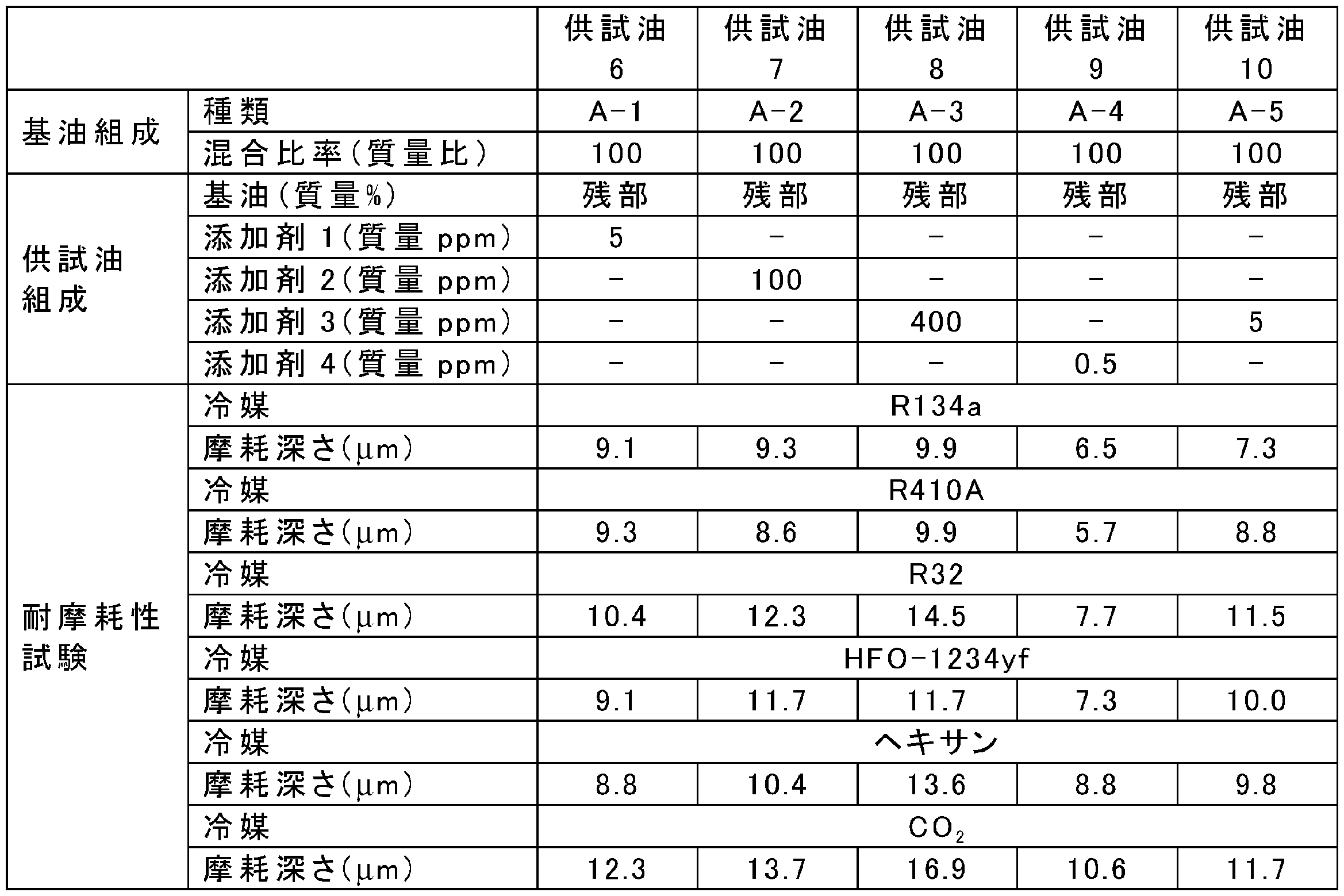
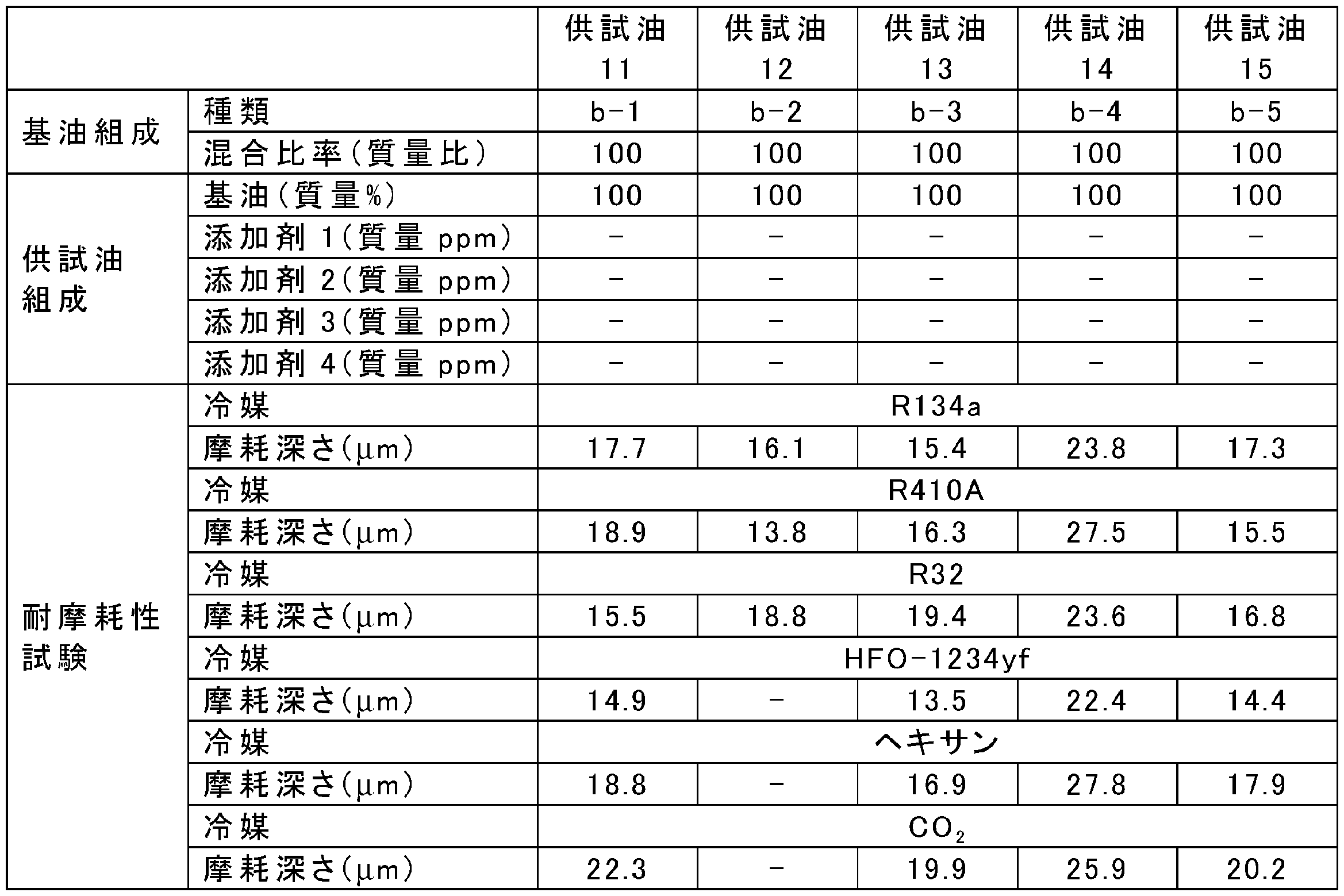
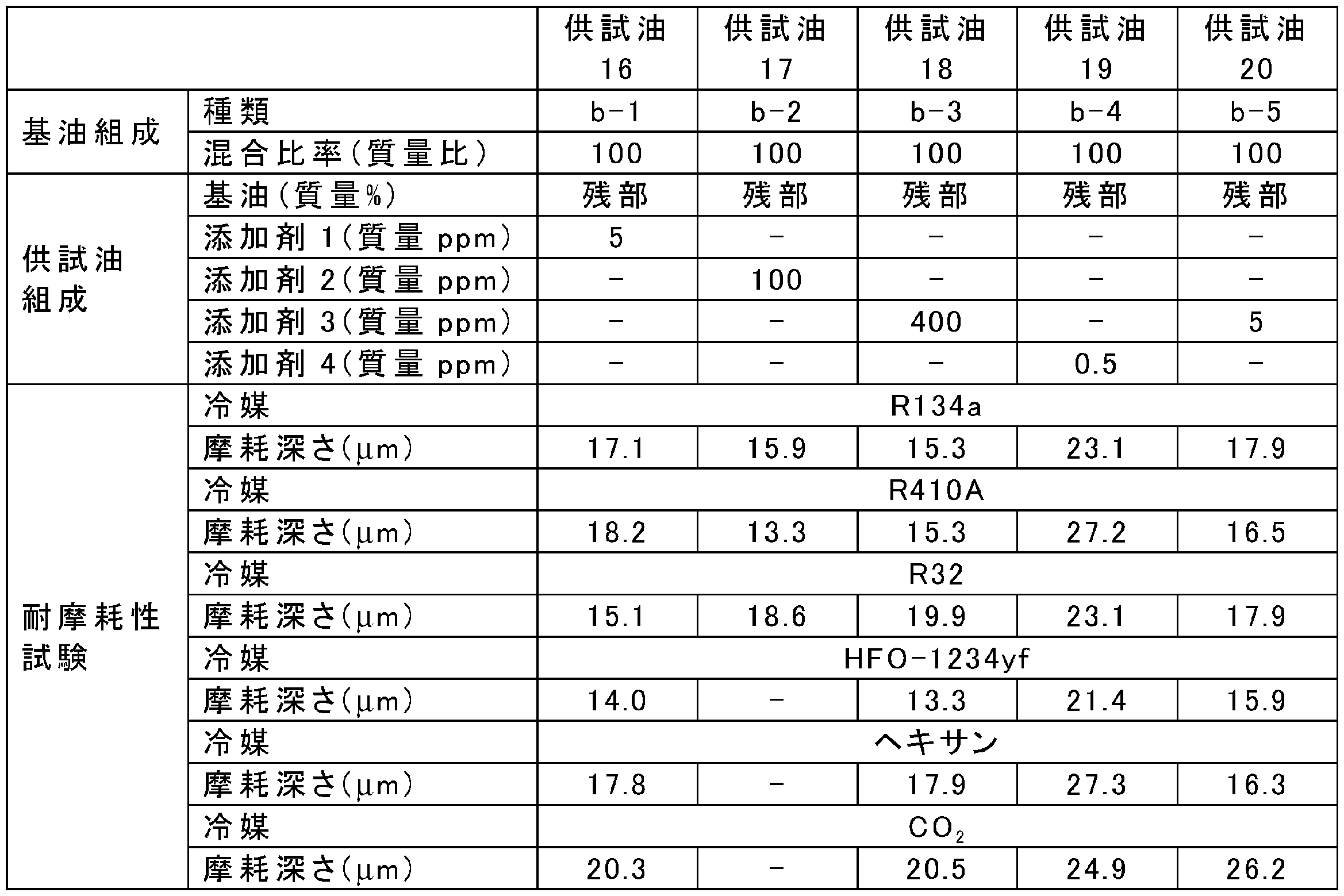
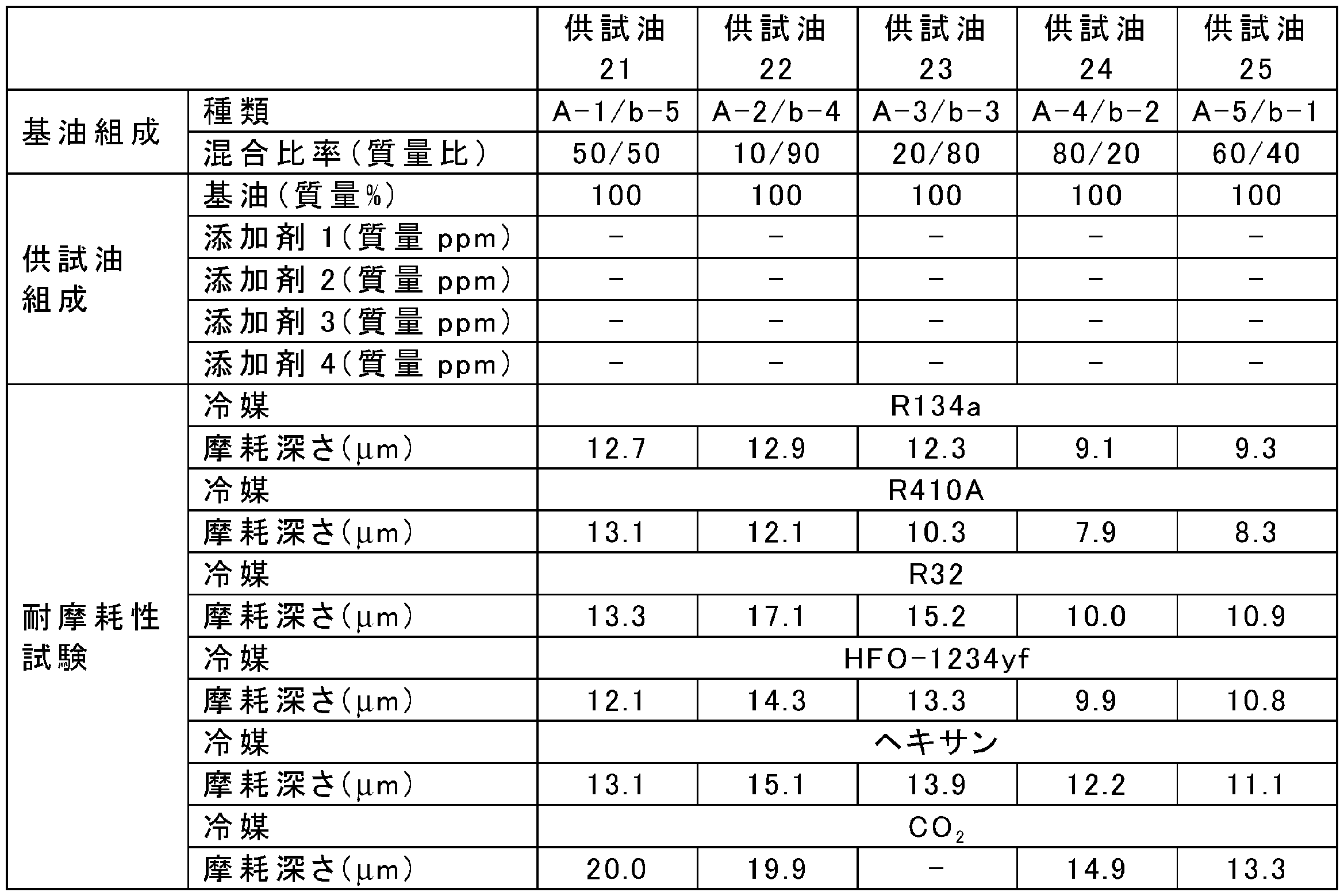
- Sample oils were prepared by blending the above base oils and additives at the blending ratios shown in Tables 1-6. The following wear resistance tests were performed on each sample oil. The results are shown in Tables 1-6. Incidentally, kinematic viscosity of 100 mm 2 / s at 25 °C, 1000mm 2 / s, for even dimethylpolysiloxane 50,000 mm 2 / s, at ranges of content of 1 to 50 mass ppm (sample oil total amount), additives Similar results can be obtained as when 1 is used.
- Abrasion resistance test Using a high-pressure atmosphere friction tester (rotating sliding method of rotating vane material and fixed disk material) manufactured by Shinko Engineering Co., Ltd., which can create a refrigerant atmosphere similar to that of an actual compressor, a refrigerant pressure fluctuation wear resistance test was conducted. It was. The test conditions were any of the following wear resistance tests- (1) to (6) for each type of refrigerant evaluated.
- Abrasion resistance test-(2): R410A is used as a refrigerant, and the pressure in the test container is 1.6 MPa.
- Abrasion resistance test-In any of (1) to (6) the oil amount is 600 ml, the test temperature is 100 ° C., the rotation speed is 650 rpm, the load load is 70 kgf, and the pressure in the test container is 100 L / min 30 minutes after the start of the test. It was decided that the test was continued for another 30 minutes under the reduced atmospheric pressure.
- SKH-51 is used as the vane material and FC250 is used as the disk material.
- the wear resistance was evaluated based on the wear depth of the vane material because the amount of wear of the disk material was extremely small. The results are shown in Tables 1-6.
Landscapes
- Chemical & Material Sciences (AREA)
- Chemical Kinetics & Catalysis (AREA)
- General Chemical & Material Sciences (AREA)
- Oil, Petroleum & Natural Gas (AREA)
- Organic Chemistry (AREA)
- Lubricants (AREA)
Abstract
Description
(a)多価アルコールと多塩基酸とのモル比を調整して、多塩基酸のカルボキシル基の一部がエステル化されずに残存するエステル中間体を合成し、次いでその残存するカルボキシル基を一価アルコールでエステル化する方法
(b)多価アルコールと多塩基酸とのモル比を調整して、多価アルコールの水酸基の一部がエステル化されずに残存するエステル中間体を合成し、次いでその残存する水酸基を一価脂肪酸でエステル化する方法
[エステル(A-1)の製造]
ネオペンチルグリコールと1,4-ブタンジオールとアジピン酸とを、ネオペンチルグリコール/1,4-ブタンジオール/アジピン酸=1/0.3/2.4(モル比)で反応させてエステル中間体を得た。このエステル中間体に、さらに3,5,5-トリメチルヘキサノールを、ネオペンチルグリコール/3,5,5-トリメチルヘキサノール=1/2.5(モル比)で、触媒、溶媒を使用せずに反応させ、残存した未反応物を蒸留で除去した。そして、最終工程で吸着処理(白土処理)を行って微量の不純物を除去し、エステル(40℃における動粘度67.8mm2/s、粘度指数145、流動点-50℃)を得た。
トリメチロールプロパンとアジピン酸とを、トリメチロールプロパン/アジピン酸=1/2.4(モル比)で反応させて、エステル中間体を得た。このエステル中間体に、さらに2-エチルヘキサノールを、トリメチロールプロパン/2-エチルヘキサノール=1/1.9(モル比)となるように反応させ、残存した未反応物を蒸留で除去した。そして、最終工程で吸着処理(白土処理)を行って微量の不純物を除去し、エステル(40℃における動粘度68.8mm2/s、粘度指数120、流動点-55℃)を得た。
ネオペンチルグリコールとアジピン酸とを、ネオペンチルグリコール/アジピン酸=1/0.8(モル比)で反応させて、エステル中間体を得た。このエステル中間体に、さらに3,5,5-トリメチルヘキサン酸を、ネオペンチルグリコール/3,5,5-トリメチルヘキサン酸=1/0.5(モル比)となるように反応させ、残存した未反応物を蒸留で除去した。そして、最終工程で吸着処理(白土処理)を行って微量の不純物を除去し、エステル(動粘度71.5mm2/s、粘度指数114、流動点-55℃)を得た。
ネオペンチルグリコールと1,4-ブタンジオールとアジピン酸とを、ネオペンチルグリコール/1,4-ブタンジオール/アジピン酸=1/0.1/1.2(モル比)で反応させてエステル中間体を得た。このエステル中間体に、さらに3,5,5-トリメチルヘキサノールを、ネオペンチルグリコール/3,5,5-トリメチルヘキサノール=1/0.3(モル比)で、触媒、溶媒を使用せずに反応させ、残存した未反応物を蒸留で除去した。そして、最終工程で吸着処理(白土処理)を行って微量の不純物を除去し、エステル(40℃における動粘度275.9mm2/s、粘度指数117、流動点-35℃)を得た。
ネオペンチルグリコールとアジピン酸とを、ネオペンチルグリコール/アジピン酸=1/0.8(モル比)で反応させてエステル中間体を得た。このエステル中間体に、さらに3,5,5-トリメチルヘキサン酸を、ネオペンチルグリコール/3,5,5-トリメチルヘキサン酸=1/0.3(モル比)で、触媒、溶媒を使用せずに反応させ、残存した未反応物を蒸留で除去した。そして、最終工程で吸着処理(白土処理)を行って微量の不純物を除去し、エステル(40℃における動粘度300mm2/s、粘度指数114、流動点-35℃)を得た。
(b-1)ペンタエリスリトールと、2-メチルプロパン酸及び3,5,5-トリメチルヘキサン酸の混合酸(2-メチルプロパン酸:3,5,5-トリメチルヘキサン酸=1:1(質量比))の混合酸とのエステル(40℃における動粘度69.4mm2/s、粘度指数95、流動点-45℃)
(b-2)ジペンタエリスリトールと、ノルマルブタン酸及び3,5,5-トリメチルヘキサン酸の混合酸(ノルマルブタン酸:3,5,5-トリメチルヘキサン酸=7:3(質量比))の混合酸とのエステル(40℃における動粘度68.1mm2/s、粘度指数90、流動点-45℃)
(b-3)トリメチロールプロパンとオレイン酸とのエステル(40℃における動粘度50.3mm2/s、粘度指数176)
(b-4)ペンタエリスリトールとペンタン酸と3,5,5-トリメチルヘキサン酸とのエステル(40℃における動粘度31.4mm2/s、粘度指数118、流動点-55℃未満)
(b-5)ペンタエリスリトールと2-エチルヘキサン酸と3,5,5-トリメチルヘキサン酸とのエステル(40℃における動粘度68.3mm2/s、粘度指数87、流動点-45℃)
添加剤1:ジメチルポリシロキサン(25℃における動粘度:30000mm2/s)
添加剤2:ジメチルポリシロキサンの主鎖の末端をポリアルキレングリコールで変性した変性シリコーン油
添加剤3:ジメチルポリシロキサンの主鎖の末端をエステルで変性した変性シリコーン油
添加剤4:ジメチルポリシロキサンの側鎖をフルオロポリエーテル基に変性したフッ素化シリコーン油
実コンプレッサと類似の冷媒雰囲気にできる、神鋼造機(株)製の高圧雰囲気摩擦試験機(回転ベーン材と固定ディスク材との回転しゅう動方式)を用いて、冷媒圧力変動耐摩耗性試験を行った。試験条件は、評価冷媒の種類ごとに下記の耐摩耗性試験-(1)~(6)の条件のいずれかとした。
耐摩耗性試験-(1):冷媒にR134aを使用し、試験容器内圧力は1.6MPa。
耐摩耗性試験-(2):冷媒にR410Aを使用し、試験容器内圧力は1.6MPa。
耐摩耗性試験-(3):冷媒にR32を使用し、試験容器内圧力は1.6MPa。
耐摩耗性試験-(4):冷媒にHFO-1234yfを使用し、試験容器内圧力は1.6MPa。
耐摩耗性試験-(5):n-ヘキサン(冷凍機油に対して容積で20%配合。R290等の炭化水素冷媒は安全面での不安があるため代替として使用。)、試験容器内圧力は常圧より若干高い圧力。
耐摩耗性試験-(6):冷媒にCO2を使用し、試験容器内圧力は1.6MPa。


Claims (8)
- シリコーン油、シリコーン油の主鎖の末端をポリアルキレングリコールで変性した変性シリコーン油、及びフッ素化シリコーン油からなる群より選ばれる少なくとも1種を含有する耐摩耗添加剤。
- 基油と、請求項1に記載の耐摩耗添加剤と、を含有する冷凍機油。
- 前記耐摩耗添加剤の含有量が冷凍機油全量基準で0.1質量ppm以上500質量ppm以下である、請求項2に記載の冷凍機油。
- 前記基油が脂肪酸と多価アルコールを含むアルコールとのエステルを含有する、請求項2又は3に記載の冷凍機油。
- 前記エステルが、2~4個のヒドロキシル基を有する多価アルコールから選ばれる少なくとも1種と、炭素数6~12の多塩基酸から選ばれる少なくとも1種と、炭素数4~18の一価アルコール及び炭素数2~12の一価脂肪酸から選ばれる少なくとも1種とから合成されるエステルを含有する、請求項4に記載の冷凍機油。
- 請求項2~5のいずれか一項に記載の冷凍機油と、冷媒と、を含有する冷凍機用作動流体組成物。
- シリコーン油、シリコーン油の主鎖の末端をポリアルキレングリコールで変性した変性シリコーン油、及びフッ素化シリコーン油からなる群より選ばれる少なくとも1種を含有する組成物の耐摩耗添加剤としての応用。
- シリコーン油、シリコーン油の主鎖の末端をポリアルキレングリコールで変性した変性シリコーン油、及びフッ素化シリコーン油からなる群より選ばれる少なくとも1種を含有する組成物の耐摩耗添加剤の製造のための応用。
Priority Applications (1)
| Application Number | Priority Date | Filing Date | Title |
|---|---|---|---|
| JP2016531258A JP6736050B2 (ja) | 2014-07-04 | 2015-06-17 | 耐摩耗添加剤、冷凍機油及び冷凍機用作動流体組成物 |
Applications Claiming Priority (2)
| Application Number | Priority Date | Filing Date | Title |
|---|---|---|---|
| JP2014138364 | 2014-07-04 | ||
| JP2014-138364 | 2014-07-04 |
Publications (1)
| Publication Number | Publication Date |
|---|---|
| WO2016002523A1 true WO2016002523A1 (ja) | 2016-01-07 |
Family
ID=55019069
Family Applications (1)
| Application Number | Title | Priority Date | Filing Date |
|---|---|---|---|
| PCT/JP2015/067497 Ceased WO2016002523A1 (ja) | 2014-07-04 | 2015-06-17 | 耐摩耗添加剤、冷凍機油及び冷凍機用作動流体組成物 |
Country Status (3)
| Country | Link |
|---|---|
| JP (2) | JP6736050B2 (ja) |
| TW (1) | TWI654294B (ja) |
| WO (1) | WO2016002523A1 (ja) |
Cited By (6)
| Publication number | Priority date | Publication date | Assignee | Title |
|---|---|---|---|---|
| JP2020090598A (ja) * | 2018-12-05 | 2020-06-11 | ダイキン工業株式会社 | 熱伝達組成物 |
| KR20220002354A (ko) * | 2019-04-25 | 2022-01-06 | 니치유 가부시키가이샤 | 냉동기유용 에스테르 및 그것을 포함하는 작동 유체 조성물 |
| WO2023157867A1 (ja) * | 2022-02-15 | 2023-08-24 | 出光興産株式会社 | 冷凍機油組成物及び冷凍機用混合組成物 |
| JP2023118564A (ja) * | 2022-02-15 | 2023-08-25 | 出光興産株式会社 | 冷凍機油組成物及び冷凍機用混合組成物 |
| WO2024090504A1 (ja) * | 2022-10-28 | 2024-05-02 | 出光興産株式会社 | 冷凍機油組成物及び冷凍機用混合組成物 |
| WO2025079533A1 (ja) * | 2023-10-12 | 2025-04-17 | Eneos株式会社 | 冷凍機油用コンプレックスエステル及びその製造方法、冷凍機油、作動流体組成物、並びに、コンプレックスエステルの安定性を向上させる方法 |
Families Citing this family (2)
| Publication number | Priority date | Publication date | Assignee | Title |
|---|---|---|---|---|
| TWI626304B (zh) * | 2016-03-23 | 2018-06-11 | 百達精密化學股份有限公司 | 冷凍潤滑油及其組成物 |
| EP4310166A4 (en) * | 2021-03-16 | 2025-01-15 | Idemitsu Kosan Co.,Ltd. | REFRIGERATOR OIL COMPOSITION AND MIXED REFRIGERATOR COMPOSITION |
Citations (8)
| Publication number | Priority date | Publication date | Assignee | Title |
|---|---|---|---|---|
| JPH03217494A (ja) * | 1990-01-22 | 1991-09-25 | Kao Corp | 冷凍機油 |
| JPH07102276A (ja) * | 1993-09-30 | 1995-04-18 | Agency Of Ind Science & Technol | 炭化水素基変性フルオロシリコーン添加潤滑剤 |
| JP2543919B2 (ja) * | 1987-12-11 | 1996-10-16 | 出光興産株式会社 | 冷凍機油組成物 |
| JP2801703B2 (ja) * | 1989-09-01 | 1998-09-21 | 花王株式会社 | 冷凍機油 |
| JP2849155B2 (ja) * | 1989-07-05 | 1999-01-20 | 株式会社ジャパンエナジー | 潤滑油 |
| JP2004339324A (ja) * | 2003-05-14 | 2004-12-02 | Nsk Ltd | 潤滑剤およびこれを使用した転がり支持装置 |
| JP2005008737A (ja) * | 2003-06-18 | 2005-01-13 | Nsk Ltd | 潤滑剤組成物及び転動装置 |
| CN101368127A (zh) * | 2008-07-24 | 2009-02-18 | 吕东江 | 内燃发动机用机油添加剂 |
Family Cites Families (14)
| Publication number | Priority date | Publication date | Assignee | Title |
|---|---|---|---|---|
| JPS6422310A (en) * | 1987-07-17 | 1989-01-25 | Shinetsu Chemical Co | Antifoaming agent |
| JPH11152488A (ja) * | 1997-11-21 | 1999-06-08 | Toshiba Corp | 冷凍機油組成物 |
| JP2009138037A (ja) * | 2007-12-04 | 2009-06-25 | Hitachi Appliances Inc | 冷媒圧縮機およびヒートポンプ式給湯機 |
| JP5248959B2 (ja) * | 2008-09-12 | 2013-07-31 | Jx日鉱日石エネルギー株式会社 | 冷凍機油および冷凍機用作動流体ならびに冷蔵庫 |
| JP5248960B2 (ja) * | 2008-09-12 | 2013-07-31 | Jx日鉱日石エネルギー株式会社 | 冷凍機油および冷凍機用作動流体ならびに冷蔵庫 |
| JP5537999B2 (ja) * | 2010-03-08 | 2014-07-02 | Jx日鉱日石エネルギー株式会社 | 冷媒r32用冷凍機油 |
| JP5550417B2 (ja) * | 2010-03-30 | 2014-07-16 | Jx日鉱日石エネルギー株式会社 | 冷凍機油および冷凍機用作動流体組成物 |
| AU2011294494B2 (en) * | 2010-08-24 | 2015-04-23 | Jx Nippon Oil And Energy Corporation | Refrigerating machine oil and working fluid composition for refrigerating machines |
| JP5482591B2 (ja) * | 2010-09-14 | 2014-05-07 | 信越化学工業株式会社 | 潤滑油組成物及びその製造方法 |
| JP5941056B2 (ja) * | 2011-10-26 | 2016-06-29 | Jxエネルギー株式会社 | 冷凍機用作動流体組成物及び冷凍機油 |
| EP2878652B1 (en) * | 2012-07-26 | 2018-02-28 | JX Nippon Oil & Energy Corporation | Refrigerator oil and working fluid composition for refrigerators |
| JP5882860B2 (ja) * | 2012-08-30 | 2016-03-09 | Jx日鉱日石エネルギー株式会社 | 潤滑油組成物 |
| JP5946755B2 (ja) * | 2012-12-07 | 2016-07-06 | Jxエネルギー株式会社 | 冷凍機油組成物および冷凍機用作動流体組成物 |
| JP5608826B2 (ja) * | 2014-01-24 | 2014-10-15 | Jx日鉱日石エネルギー株式会社 | 冷凍機油 |
-
2015
- 2015-06-17 JP JP2016531258A patent/JP6736050B2/ja active Active
- 2015-06-17 WO PCT/JP2015/067497 patent/WO2016002523A1/ja not_active Ceased
- 2015-06-23 TW TW104120190A patent/TWI654294B/zh active
-
2020
- 2020-07-01 JP JP2020114159A patent/JP7018478B2/ja active Active
Patent Citations (8)
| Publication number | Priority date | Publication date | Assignee | Title |
|---|---|---|---|---|
| JP2543919B2 (ja) * | 1987-12-11 | 1996-10-16 | 出光興産株式会社 | 冷凍機油組成物 |
| JP2849155B2 (ja) * | 1989-07-05 | 1999-01-20 | 株式会社ジャパンエナジー | 潤滑油 |
| JP2801703B2 (ja) * | 1989-09-01 | 1998-09-21 | 花王株式会社 | 冷凍機油 |
| JPH03217494A (ja) * | 1990-01-22 | 1991-09-25 | Kao Corp | 冷凍機油 |
| JPH07102276A (ja) * | 1993-09-30 | 1995-04-18 | Agency Of Ind Science & Technol | 炭化水素基変性フルオロシリコーン添加潤滑剤 |
| JP2004339324A (ja) * | 2003-05-14 | 2004-12-02 | Nsk Ltd | 潤滑剤およびこれを使用した転がり支持装置 |
| JP2005008737A (ja) * | 2003-06-18 | 2005-01-13 | Nsk Ltd | 潤滑剤組成物及び転動装置 |
| CN101368127A (zh) * | 2008-07-24 | 2009-02-18 | 吕东江 | 内燃发动机用机油添加剂 |
Cited By (11)
| Publication number | Priority date | Publication date | Assignee | Title |
|---|---|---|---|---|
| JP2020090598A (ja) * | 2018-12-05 | 2020-06-11 | ダイキン工業株式会社 | 熱伝達組成物 |
| WO2020116189A1 (ja) * | 2018-12-05 | 2020-06-11 | ダイキン工業株式会社 | 熱伝達組成物 |
| US12173220B2 (en) | 2018-12-05 | 2024-12-24 | Daikin Industries, Ltd. | Heat transfer composition |
| KR20220002354A (ko) * | 2019-04-25 | 2022-01-06 | 니치유 가부시키가이샤 | 냉동기유용 에스테르 및 그것을 포함하는 작동 유체 조성물 |
| KR102850909B1 (ko) | 2019-04-25 | 2025-08-26 | 니치유 가부시키가이샤 | 냉동기유용 에스테르 및 그것을 포함하는 작동 유체 조성물 |
| WO2023157867A1 (ja) * | 2022-02-15 | 2023-08-24 | 出光興産株式会社 | 冷凍機油組成物及び冷凍機用混合組成物 |
| JP2023118564A (ja) * | 2022-02-15 | 2023-08-25 | 出光興産株式会社 | 冷凍機油組成物及び冷凍機用混合組成物 |
| JP7717637B2 (ja) | 2022-02-15 | 2025-08-04 | 出光興産株式会社 | 冷凍機油組成物及び冷凍機用混合組成物 |
| US12577448B2 (en) | 2022-02-15 | 2026-03-17 | Idemitsu Kosan Co., Ltd. | Refrigerator oil composition and mixed composition for refrigerator |
| WO2024090504A1 (ja) * | 2022-10-28 | 2024-05-02 | 出光興産株式会社 | 冷凍機油組成物及び冷凍機用混合組成物 |
| WO2025079533A1 (ja) * | 2023-10-12 | 2025-04-17 | Eneos株式会社 | 冷凍機油用コンプレックスエステル及びその製造方法、冷凍機油、作動流体組成物、並びに、コンプレックスエステルの安定性を向上させる方法 |
Also Published As
| Publication number | Publication date |
|---|---|
| JP7018478B2 (ja) | 2022-02-10 |
| JPWO2016002523A1 (ja) | 2017-04-27 |
| TWI654294B (zh) | 2019-03-21 |
| TW201606070A (zh) | 2016-02-16 |
| JP6736050B2 (ja) | 2020-08-05 |
| JP2020158786A (ja) | 2020-10-01 |
Similar Documents
| Publication | Publication Date | Title |
|---|---|---|
| JP7018478B2 (ja) | 耐摩耗添加剤、冷凍機油及び冷凍機用作動流体組成物 | |
| JP6050360B2 (ja) | 潤滑油基油、冷凍機油及び冷凍機用作動流体組成物 | |
| TWI601814B (zh) | Refrigeration oil | |
| JP7488929B2 (ja) | 冷凍機油 | |
| JP6605015B2 (ja) | 冷凍機油及び冷凍機用作動流体組成物 | |
| JP6705834B2 (ja) | 冷凍機油 | |
| JP7543267B2 (ja) | 冷凍機用作動流体組成物及び冷凍機油 | |
| TWI575066B (zh) | Refrigeration oil | |
| JP7674339B2 (ja) | 冷凍機油及び冷凍機用作動流体組成物 | |
| JP7604292B2 (ja) | ポリマー添加剤、潤滑油組成物及び冷凍機用作動流体組成物 | |
| JP6659325B2 (ja) | 冷凍機油及び冷凍機用作動流体組成物 |
Legal Events
| Date | Code | Title | Description |
|---|---|---|---|
| 121 | Ep: the epo has been informed by wipo that ep was designated in this application |
Ref document number: 15815624 Country of ref document: EP Kind code of ref document: A1 |
|
| ENP | Entry into the national phase |
Ref document number: 2016531258 Country of ref document: JP Kind code of ref document: A |
|
| NENP | Non-entry into the national phase |
Ref country code: DE |
|
| 32PN | Ep: public notification in the ep bulletin as address of the adressee cannot be established |
Free format text: NOTING OF LOSS OF RIGHTS PURSUANT TO RULE 112(1) EPC |
|
| 122 | Ep: pct application non-entry in european phase |
Ref document number: 15815624 Country of ref document: EP Kind code of ref document: A1 |