WO2015194657A1 - 共重合体、その製造方法、その導電性ポリマー水溶液、及びその用途 - Google Patents
共重合体、その製造方法、その導電性ポリマー水溶液、及びその用途 Download PDFInfo
- Publication number
- WO2015194657A1 WO2015194657A1 PCT/JP2015/067692 JP2015067692W WO2015194657A1 WO 2015194657 A1 WO2015194657 A1 WO 2015194657A1 JP 2015067692 W JP2015067692 W JP 2015067692W WO 2015194657 A1 WO2015194657 A1 WO 2015194657A1
- Authority
- WO
- WIPO (PCT)
- Prior art keywords
- copolymer
- group
- conductive polymer
- ion
- aqueous solution
- Prior art date
- Legal status (The legal status is an assumption and is not a legal conclusion. Google has not performed a legal analysis and makes no representation as to the accuracy of the status listed.)
- Ceased
Links
- 0 C**(CCOC[C@]1Oc2c[n]cc2*C1)O Chemical compound C**(CCOC[C@]1Oc2c[n]cc2*C1)O 0.000 description 5
- IJAMAMPVPZBIQX-UHFFFAOYSA-N C1Oc2c[nH]cc2OC1 Chemical compound C1Oc2c[nH]cc2OC1 IJAMAMPVPZBIQX-UHFFFAOYSA-N 0.000 description 1
- AYCJXCJVZAYRGE-UHFFFAOYSA-N Nc1c2OCC(CO)Oc2c(N)[s]1 Chemical compound Nc1c2OCC(CO)Oc2c(N)[s]1 AYCJXCJVZAYRGE-UHFFFAOYSA-N 0.000 description 1
- LYKTTYXYFFQVKC-UHFFFAOYSA-N Nc1c2OCCOc2c(N)[s]1 Chemical compound Nc1c2OCCOc2c(N)[s]1 LYKTTYXYFFQVKC-UHFFFAOYSA-N 0.000 description 1
Images

Classifications
-
- C—CHEMISTRY; METALLURGY
- C08—ORGANIC MACROMOLECULAR COMPOUNDS; THEIR PREPARATION OR CHEMICAL WORKING-UP; COMPOSITIONS BASED THEREON
- C08G—MACROMOLECULAR COMPOUNDS OBTAINED OTHERWISE THAN BY REACTIONS ONLY INVOLVING UNSATURATED CARBON-TO-CARBON BONDS
- C08G61/00—Macromolecular compounds obtained by reactions forming a carbon-to-carbon link in the main chain of the macromolecule
- C08G61/12—Macromolecular compounds containing atoms other than carbon in the main chain of the macromolecule
-
- C—CHEMISTRY; METALLURGY
- C08—ORGANIC MACROMOLECULAR COMPOUNDS; THEIR PREPARATION OR CHEMICAL WORKING-UP; COMPOSITIONS BASED THEREON
- C08K—Use of inorganic or non-macromolecular organic substances as compounding ingredients
- C08K5/00—Use of organic ingredients
- C08K5/04—Oxygen-containing compounds
- C08K5/05—Alcohols; Metal alcoholates
-
- C—CHEMISTRY; METALLURGY
- C08—ORGANIC MACROMOLECULAR COMPOUNDS; THEIR PREPARATION OR CHEMICAL WORKING-UP; COMPOSITIONS BASED THEREON
- C08K—Use of inorganic or non-macromolecular organic substances as compounding ingredients
- C08K5/00—Use of organic ingredients
- C08K5/16—Nitrogen-containing compounds
- C08K5/17—Amines; Quaternary ammonium compounds
-
- C—CHEMISTRY; METALLURGY
- C08—ORGANIC MACROMOLECULAR COMPOUNDS; THEIR PREPARATION OR CHEMICAL WORKING-UP; COMPOSITIONS BASED THEREON
- C08L—COMPOSITIONS OF MACROMOLECULAR COMPOUNDS
- C08L65/00—Compositions of macromolecular compounds obtained by reactions forming a carbon-to-carbon link in the main chain; Compositions of derivatives of such polymers
-
- H—ELECTRICITY
- H01—ELECTRIC ELEMENTS
- H01B—CABLES; CONDUCTORS; INSULATORS; SELECTION OF MATERIALS FOR THEIR CONDUCTIVE, INSULATING OR DIELECTRIC PROPERTIES
- H01B1/00—Conductors or conductive bodies characterised by the conductive materials; Selection of materials as conductors
- H01B1/06—Conductors or conductive bodies characterised by the conductive materials; Selection of materials as conductors mainly consisting of other non-metallic substances
-
- H—ELECTRICITY
- H01—ELECTRIC ELEMENTS
- H01B—CABLES; CONDUCTORS; INSULATORS; SELECTION OF MATERIALS FOR THEIR CONDUCTIVE, INSULATING OR DIELECTRIC PROPERTIES
- H01B1/00—Conductors or conductive bodies characterised by the conductive materials; Selection of materials as conductors
- H01B1/06—Conductors or conductive bodies characterised by the conductive materials; Selection of materials as conductors mainly consisting of other non-metallic substances
- H01B1/12—Conductors or conductive bodies characterised by the conductive materials; Selection of materials as conductors mainly consisting of other non-metallic substances organic substances
-
- H—ELECTRICITY
- H01—ELECTRIC ELEMENTS
- H01G—CAPACITORS; CAPACITORS, RECTIFIERS, DETECTORS, SWITCHING DEVICES, LIGHT-SENSITIVE OR TEMPERATURE-SENSITIVE DEVICES OF THE ELECTROLYTIC TYPE
- H01G9/00—Electrolytic capacitors, rectifiers, detectors, switching devices, light-sensitive or temperature-sensitive devices; Processes of their manufacture
- H01G9/004—Details
- H01G9/02—Diaphragms; Separators
-
- H—ELECTRICITY
- H01—ELECTRIC ELEMENTS
- H01G—CAPACITORS; CAPACITORS, RECTIFIERS, DETECTORS, SWITCHING DEVICES, LIGHT-SENSITIVE OR TEMPERATURE-SENSITIVE DEVICES OF THE ELECTROLYTIC TYPE
- H01G9/00—Electrolytic capacitors, rectifiers, detectors, switching devices, light-sensitive or temperature-sensitive devices; Processes of their manufacture
- H01G9/004—Details
- H01G9/022—Electrolytes; Absorbents
- H01G9/025—Solid electrolytes
- H01G9/028—Organic semiconducting electrolytes, e.g. TCNQ
Definitions
- the present invention relates to a copolymer having a novel polythiophene structure, a production method thereof, an aqueous conductive polymer solution thereof, and an application thereof.
- the present invention was made in order to improve the coating property and conductivity of a polymer substrate, and a specific self-doped conductive polymer having a high conductivity and a specific surfactant
- the present invention relates to an aqueous solution of a novel conductive composition including the like, a conductive polymer film obtained by drying them, and a coated article thereof.
- PSS polystyrene sulfonic acid
- the above-mentioned PEDT-S also exhibits a maximum conductivity of about 80 S / cm, particularly in a neutral salt state such as an ammonium salt. In order to satisfy the required performance, there was a problem that higher conductivity was required.
- the present invention has been made in view of the above-described background art, and an object of the present invention is to provide a novel water-soluble solution that sufficiently penetrates pores of several tens to several hundreds of nanometers or less and exhibits excellent high conductivity. It is to provide a sex copolymer and an aqueous solution thereof.
- the present inventors have found that a novel conductive polymer aqueous solution exhibiting remarkably high conductivity that improves applicability to a polymer base material that is difficult to apply due to the occurrence of flipping is found. .
- a repeating unit represented by the following formula (M1) (referred to as “thiophene monomer”) and at least one repeating unit selected from the following formulas (M2), (M3), and (M4) (referred to as “comonomer”)
- M1 A repeating unit represented by the following formula (M1)
- M2 thiophene monomer
- M3 at least one repeating unit selected from the following formulas (M2), (M3), and (M4) (referred to as “comonomer”)
- the thiophene monomer and comonomer may be self-doped and the ratio of thiophene monomer / comonomer (mol / mol) is from 3 to 9999.
- R may be the same or different for each repeating unit, and represents a linear or branched alkyl group having 1 to 6 carbon atoms or a fluorine atom.
- M may be different for each repeating unit and represents an alkali metal ion selected from the group consisting of hydrogen ions, Li ions, Na ions, and K ions, or a conjugate acid of an amine compound.
- a thiophene monomer comprising a repeating unit represented by the following formula (M1) (referred to as “thiophene monomer”) and at least one repeating unit selected from the following formulas (M2) and (M3) (referred to as “comonomer”) And the comonomer may be self-doped, and the copolymer has a thiophene monomer / comonomer (mol / mol) ratio of 3 to 9999.
- R represents a linear or branched alkyl group having 1 to 6 carbon atoms, or a fluorine atom.
- M represents an alkali metal ion selected from the group consisting of hydrogen ion, Li ion, Na ion and K ion, or a conjugate acid of an amine compound.
- [3] A compound in which the amine compound is represented by N (R 1 ) (R 2 ) (R 3 ) (wherein R 1 to R 3 may each independently have a hydrogen atom or a substituent).
- (1 represents an alkyl group having 1 to 6 carbon atoms), C 5 H 5 N (pyridine), or an imidazole compound, the copolymer according to the above [1] or [2].
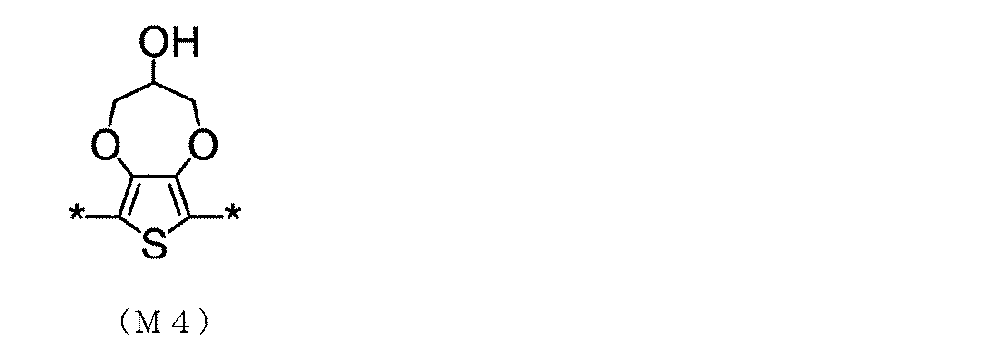
- the copolymer according to the above [2] further comprising a repeating unit represented by the following general formula (M4) as a comonomer.
- R represents a linear or branched alkyl group having 1 to 6 carbon atoms, or a fluorine atom.
- M represents an alkali metal ion selected from the group consisting of hydrogen ion, Li ion, Na ion and K ion, or a conjugate acid of an amine compound.
- [6] Polymerizing a thiophene compound represented by the following formula (1) and at least one thiophene compound selected from the following formulas (2) and (3) in water or an alcohol solvent in the presence of an oxidizing agent.
- R represents a linear or branched alkyl group having 1 to 6 carbon atoms, or a fluorine atom.
- M represents a hydrogen atom, an alkali metal selected from the group consisting of Li, Na and K, or a conjugate acid of an amine compound.
- the conductive polymer aqueous solution as described in [9] above which is at least one selected from the group consisting of: [11]
- the copolymer of the present invention comprises a repeating unit represented by the following formula (M1) (referred to as “thiophene monomer”) and at least one repeating unit selected from the following formulas (M2), (M3), and (M4) (Referred to as “comonomer”), the thiophene monomer and comonomer may be self-doped and the ratio of thiophene monomer / comonomer (mol / mol) is from 3 to 9999.
- M1 referred to as “thiophene monomer”
- M2 a repeating unit represented by the following formulas (M2), (M3), and (M4) (Referred to as “comonomer”)
- the thiophene monomer and comonomer may be self-doped and the ratio of thiophene monomer / comonomer (mol / mol) is from 3 to 9999.
- R may be the same or different for each repeating unit, and represents a linear or branched alkyl group having 1 to 6 carbon atoms or a fluorine atom.
- M may be different for each repeating unit and represents an alkali metal ion selected from the group consisting of hydrogen ions, Li ions, Na ions, and K ions, or a conjugate acid of an amine compound.
- R represents a chain or branched alkyl group having 1 to 6 carbon atoms, or a fluorine atom.
- the chain or branched alkyl group having 1 to 6 carbon atoms is not particularly limited, but is methyl group, ethyl group, n-propyl group, isopropyl group, n-butyl group, isobutyl group, sec-butyl group.
- M represents an alkali metal ion selected from the group consisting of hydrogen ion, Li ion, Na ion and K ion, or a conjugate acid of an amine compound.
- the conjugate acid of the amine compound represents a cationic compound in which a proton is added to the amine compound.
- the amine compound is not particularly limited, and examples thereof include ammonia, methylamine, dimethylamine, trimethylamine, ethylamine, diethylamine, triethylamine, monoethanolamine, diethanolamine, triethanolamine and the like (the general formula N (R 1 ) an amine compound represented by (R 2 ) (R 3 )) having a sp 3 hybrid orbital, pyridine, 2-methylpyridine, 3-methylpyridine, 4-methylpyridinepyridine (and above, pyridines), Amine compounds having sp 2 hybrid orbitals such as imidazole, 2-methylimidazole, 2-ethyl-4-methylimidazole, 2-phenylimidazole, 2-phenyl-4-methylimidazole, 1-methylimidazole (above, imidazoles) Etc. That.
- R 1 to R 3 each independently represent a hydrogen atom or an alkyl group having 1 to 40 carbon atoms which may have a substituent.
- R 1 to R 3 are preferably each independently a hydrogen atom or an alkyl group having 1 to 20 carbon atoms which may have a substituent, and each independently represents a hydrogen atom. More preferably, it is an atom or a linear or branched alkyl group having 1 to 6 carbon atoms.
- the alkyl group having 1 to 40 carbon atoms which may have a substituent is not particularly limited.
- examples of the substituents R 1 to R 3 include the same ones as the substituent R, and more preferably a hydrogen atom or a methyl group.
- examples of the substituent include an alkyl group having 1 to 6 carbon atoms or an alkoxy group, an aryl group having 1 to 20 carbon atoms, a hydroxy group, An amino group, a carboxyl group, and the like can be mentioned, and an alkyl group having a hydroxy group such as a 2-hydroxyethyl group, a 3-hydroxypropyl group, a 2-hydroxypropyl group, or a 2,3-dihydroxypropyl group is more preferable. Can be mentioned.
- the imidazoles are preferably imidazole compounds having 3 to 20 carbon atoms, and are not particularly limited, and examples thereof include imidazole, N-methylimidazole, and 1,2-dimethylimidazole.
- the pyridines are preferably pyridine compounds having a total carbon number of 3 to 20, and are not particularly limited, and examples thereof include pyridine, picoline, lutidine and the like. Of these, imidazole is more preferable.
- the copolymer of the present invention has a thiophene monomer / comonomer (mol / mol) ratio of 3 to 9999.
- the ratio of thiophene monomer / comonomer (mole / mole) is less than 3, the copolymer has a reduced water solubility and cannot exhibit the effects specific to the present invention, so it must be avoided.
- the ratio of thiophene monomer / comonomer (mol / mol) is larger than 9999, a sufficiently high dielectric constant cannot be obtained, and an effect peculiar to the present invention cannot be obtained, so it must be avoided.
- the ratio of thiophene monomer / comonomer is more preferably 3 to 999, and further preferably 3 to 99.
- the copolymer of the present invention is a copolymer of a thiophene compound represented by the following formula (1) and at least one thiophene compound selected from the following formulas (2), (3) and (4). More specifically, the copolymer of the present invention is a self-doped conductive copolymer in which the side chain sulfo group or sulfonate group of the thiophene compound represented by the following formula (1) acts as a p-type dopant. For example, it can be expressed as the following formula (5).
- R and M have the same meanings as the above formula (M1).
- Z represents a substituent moiety of the comonomer represented by the above formula (M2), (M3) or (M4).
- the above formula (C) is derived from at least one thiophene compound selected from the above formulas (2), (3) and (4), and the above formula (D) is Represents a state in which the above formula (C) is oxidized by a sulfo group or a sulfonate group of a side chain.
- the said Formula (A) originates in the thiophene compound represented by the said Formula (1), and the said Formula (B) represents the oxidation state of the said Formula (A).
- the copolymer of the present invention is obtained by oxidizing a thiophene compound represented by the following formula (1) and at least one thiophene compound selected from the following formulas (2), (3) and (4) in water or an alcohol solvent. It can manufacture by polymerizing in presence of an agent.
- the copolymer of the present invention includes a thiophene compound represented by the above formula (1) and at least one thiophene compound selected from the above formula (2) or (3), and further represented by the above formula (4). It can also be produced by adding a thiophene compound to be polymerized.
- the ratio of the thiophene compounds represented by the above formulas (1), (2), (3), and (4) is not particularly limited, but is represented by the above formula (1).
- the amount of the thiophene compound is preferably 0.01 mol% or more and 25 mol% or less with respect to the total amount of the thiophene compounds represented by the above formulas (1) to (4).
- the amount of the thiophene compound represented by the above formula (1) is less than 0.01 mol%, its conductivity is compared with that of a homopolymer synthesized only from the thiophene compound represented by the above formula (1). If there is not much difference and exceeds 25 mol%, the resulting copolymer is hardly soluble in water.
- the weight average molecular weight of the copolymer of the present invention is not particularly limited, but is usually in the range of 1,000 to 1,000,000 in terms of polystyrene sulfonic acid, and preferably 1,000 to 200,000 for water-soluble conductive polymer applications. Range. From the viewpoint of removing unreacted monomers, low-molecular impurities and inorganic salts from the polymer, the range of 1.5000 to 100,000 is more preferable.
- the thiophene compound represented by the above formula (1) and the thiophene compounds represented by the above formulas (2) to (4) are not particularly limited, but [the amount of the thiophene compound represented by the above formula (1) / The total amount of thiophene compounds represented by the above formulas (2) to (4)] is preferably polymerized at a ratio of 3 to 9999 (molar ratio) from the viewpoint of the conductivity and water solubility of the copolymer.
- thiophene compound represented by the above formula (1) examples include 3-[(2,3-dihydrothieno [3,4-b]-[1,4] dioxin-2-yl) methoxy] -1 -Sodium methyl-1-propanesulfonate, 3-[(2,3-dihydrothieno [3,4-b]-[1,4] dioxin-2-yl) methoxy] -1-ethyl-1-propanesulfonic acid Sodium, sodium 3-[(2,3-dihydrothieno [3,4-b]-[1,4] dioxin-2-yl) methoxy] -1-propyl-1-propanesulfonate, 3-[(2, Sodium 3-dihydrothieno [3,4-b]-[1,4] dioxin-2-yl) methoxy] -1-butyl-1-propanesulfonate, 3-[(2,3-dihydrothieno [3,4- b]-[1,4] di
- the thiophene compound exemplified in the above formula (1) is obtained from a sultone compound branched with thieno [3,4-b] -1,4-dioxin-2-methanol according to a known method (for example, cited document 4). Easy to synthesize.
- the solvent used in the polymerization reaction is water or an alcohol solvent.
- water include pure water, and may be distilled water or ion exchange water.
- the alcohol solvent include alcohols such as methanol, ethanol, propanol, and butanol. These alcohol solvents may be used alone or in combination with water. Of these solvents, water or methanol is preferable, and water is more preferable.
- the solvent may be replaced with an inert gas such as degassed or nitrogen.
- the amount of solvent used in the polymerization reaction is, for example, that the thiophene compound represented by the above formula (1) and at least one thiophene compound selected from the above formulas (2), (3), and (4) are dissolved.
- the amount of the thiophene compound represented by the above formula (1) and the total amount of the thiophene compounds represented by the above formulas (2) to (4) is 0.1 to A range of 100 times by weight is preferable, and a range of 1 to 20 times by weight is more preferable.
- the oxidizing agent used in the polymerization reaction is one that promotes oxidative polymerization by oxidative dehydrogenation reaction, and is not particularly limited.
- persulfuric acid, iron salt (III), hydrogen peroxide, hydrogen peroxide, Manganates, dichromates, cerium (IV) sulfate, oxygen and the like can be mentioned, and these may be used alone or in admixture of two or more.
- persulfates include persulfuric acid, ammonium persulfate, sodium persulfate, and potassium persulfate.
- iron salt (III) examples include FeCl 3 , Fe 2 (SO 4 ) 3 , iron perchlorate, iron (III) para-toluenesulfonate, and the like. These may use anhydrides or hydrates.
- permanganate examples include sodium permanganate, potassium permanganate, and magnesium permanganate.
- dichromate examples include ammonium dichromate and potassium dichromate.
- FeCl 3 , Fe 2 (SO 4 ) 3 , or a combined system of persulfate and iron salt (III) is particularly preferable.
- the amount of the oxidizing agent used in the polymerization reaction is not particularly limited, but it is 0.5 to 50 times mol with respect to the charged mole number of the thiophene compound and the comonomer. More preferably, it is 1 to 20 moles. More preferably, it is 1 to 10 times mol.
- the pressure of the polymerization reaction may be normal pressure, reduced pressure, or increased pressure.
- the reaction atmosphere of the polymerization reaction may be in the air or in an inert gas such as nitrogen or argon. More preferably, it is in an inert gas.
- the reaction temperature of the main polymerization reaction is, for example, a temperature at which the thiophene compounds represented by the above formulas (1) to (4) can be subjected to oxidative polymerization, and is not particularly limited, but is preferably in the range of ⁇ 10 to 150 ° C. A range of 5 to 100 ° C. is more preferable.
- the reaction time of the main polymerization reaction is, for example, oxidative polymerization of the thiophene compound represented by the above formula (1) and at least one thiophene compound selected from the above formulas (2), (3), and (4). Although it is a sufficiently long time, it is not particularly limited, but is preferably in the range of 0.5 to 200 hours, more preferably in the range of 0.5 to 80 hours.
- the reaction method of the present polymerization reaction is not particularly limited.
- the thiophene compound may be dissolved in water in advance, and an oxidizing agent may be added dropwise thereto at once or slowly.
- An aqueous solution of at least one thiophene compound selected from (2), (3), and (4) may be dropped at once or slowly.
- the purification method of the copolymer of the present invention obtained by the main polymerization reaction is not particularly limited, and examples thereof include solvent washing, reprecipitation, centrifugal sedimentation, ultrafiltration, dialysis, and ion exchange resin treatment. Can be mentioned. Each may be performed alone or in combination.
- a typical isolation and purification method of the copolymer of the present invention is, for example, as follows.
- the aqueous solution after the polymerization reaction is added to a poor solvent such as acetone to precipitate the copolymer, and then the copolymer obtained by filtration under reduced pressure is washed with the poor solvent until the filtrate becomes colorless and transparent.
- a poor solvent such as acetone
- this copolymer contains an Fe salt that is insoluble in water, it must be added once to an aqueous sodium hydroxide solution, dissolved in water, and converted to a Na salt type copolymer in which M is Na ion. Is preferred.
- the obtained Na salt type copolymer is subsequently converted into an H type copolymer in which M is a hydrogen ion, it is treated with a cation exchange resin.
- the treatment method include a method in which an aqueous solution of the obtained Na salt type copolymer is passed through a column filled with a cation exchange resin, a body feed method in which the cation exchange resin is added to the aqueous solution, and the like. It is done. In this case, it is preferable to remove the cation exchange resin with a filter paper after the treatment.
- the aqueous solution thus obtained was roughly concentrated, added to a poor solvent such as acetone and precipitated, and the solid obtained by filtration under reduced pressure was thoroughly washed with the poor solvent and dried under reduced pressure to obtain an H-type copolymer. can get.
- a salt with various ammonium salts for example, adding various amine compounds or ammonium salt stock solutions or aqueous solutions thereof, or those diluted with an appropriate solvent to an aqueous solution of an H salt copolymer. It can be easily converted into an ammonium salt type copolymer in which M is NH 4 + .
- the reaction solution is roughly concentrated, the aqueous solution is added to a poor solvent such as acetone to precipitate the copolymer, and then the solid obtained by vacuum filtration is added to the poor solvent.
- An ammonium salt copolymer is obtained by washing and drying under reduced pressure.
- centrifugal sedimentation and homogenization treatment may be performed as necessary. Thereby, improvement of filtration efficiency can be aimed at. Further, when persulfate is used as the polymerization oxidant, ultrafiltration, dialysis, and cation / anion exchange resin mixing treatment are performed to remove inorganic salts.
- the method for preparing the aqueous conductive polymer solution is not particularly limited, and can be achieved by mixing and dissolving with water at room temperature or under heating (preferably 100 ° C. or lower). At that time, a general mixing and dissolving operation using a stirrer chip or a stirring blade can be used, and other methods include ultrasonic irradiation and homogenization (for example, use of a mechanical homogenizer, an ultrasonic homogenizer, a high-pressure homogenizer, etc.). You may go. In the case of homogenizing treatment, it is preferable to carry out the treatment while cooling in order to prevent thermal degradation of the polymer.
- the concentration of the copolymer of the present invention in the aqueous conductive polymer solution is not particularly limited, but is usually 50% by weight or less, preferably 20% by weight or less, and more preferably 10% by weight or less from the viewpoint of viscosity. is there.
- a conductive film can be produced using the copolymer of the present invention.
- a conductive film can be easily obtained by applying and drying the above-mentioned aqueous conductive polymer solution on a substrate.
- the substrate include glass, plastic, polyester, polyacrylate, polycarbonate, resist substrate, and the like.
- the coating method include a casting method, a dipping method, a barcode method, a roll coating method, a gravure coating method, a flexographic printing method, a spray coating method, and an inkjet printing method.
- the film thickness is not particularly limited, but is preferably in the range of 10 ⁇ 2 to 10 2 ⁇ m.
- the surface resistance value of the coating film to be obtained is not particularly limited, but is preferably in the range of 1 to 1.0E + 9 ⁇ / ⁇ .
- water solubility sufficient for molding for various uses means that the particle diameter (D50) measured with a particle size distribution analyzer is 10% by weight or less of a polymer aqueous solution prepared at room temperature or under heating. It is water-soluble so that it is 5 nm or less and passes through a 0.02 ⁇ m filter.
- good conductivity means conductivity having a film state conductivity (electrical conductivity) of 50 S / cm or more.
- the conductivity of the copolymer (X) is not particularly limited, but the conductivity (electric conductivity) in the film state is preferably 50 S / cm or more.
- the surfactant (Y) for example, an anionic surfactant, a cationic surfactant, a nonionic surfactant, an amphoteric surfactant and the like can be used, and more preferably, a nonionic surfactant and an amphoteric surfactant. It is at least one selected from the group consisting of surfactants.
- nonionic surfactant For example, a polyethyleneglycol type surfactant, an acetylene glycol type surfactant, a polyhydric alcohol type surfactant, a polymeric nonionic surfactant etc. are mentioned. It is done.
- polyethylene glycol surfactant examples include higher alcohol ethylene oxide adduct, alkylphenol ethylene oxide adduct, fatty acid ethylene oxide adduct, polyhydric alcohol fatty acid ester ethylene oxide adduct, higher alkylamine ethylene oxide adduct, Examples thereof include an ethylene oxide adduct of fats and oils or a polypropylene glycol ethylene oxide adduct.
- acetylene glycol type surfactant examples include 2,4,7,9-tetramethyl-5-decyne-4,7-diol, Surfynol (manufactured by Air Products), orphine (manufactured by Nissin Chemical Industry). Etc.
- polyhydric alcohol surfactants include glycerol fatty acid esters, pentaerythritol fatty acid esters, sorbitol and sorbitan fatty acid esters, sucrose fatty acid esters, higher alcohol alkyl ethers, alkanolamine fatty acid amides, and the like. Can be mentioned.
- the polymer type nonionic surfactant is not particularly limited, and examples thereof include polyvinyl pyrrolidone and polyvinyl pyrrolidone copolymers.
- the average molecular weight of polyvinylpyrrolidone used in the present invention is 1,000 to 2,000,000, preferably 10,000 to 1,500,000.
- the copolymer of polyvinyl pyrrolidone is not particularly limited, but a copolymer having a hydrophilic part and a hydrophobic part in the polymer chain is preferable.
- a copolymer obtained by grafting polyvinyl pyrrolidone to polyvinyl alcohol [vinyl pyrrolidone, -Vinyl acetate block copolymer, [vinyl pyrrolidone-methyl methacrylate] copolymer, [vinyl pyrrolidone-normal butyl methacrylate] copolymer, [vinyl pyrrolidone-acrylamide] copolymer, and the like.
- amphoteric surfactant is not particularly limited, and examples thereof include betaine type amphoteric surfactants.
- the betaine-type amphoteric surfactant is not particularly limited, and examples thereof include alkyldimethylbetaine, lauryldimethylbetaine, stearyldimethylbetaine, and lauryldihydroxyethylbetaine.
- the surfactant (Y) other than the polymeric surfactant is a surfactant having a solubility in water of 0.01% by weight or more and an HLB in the range of 7-20. Is preferred.
- the solubility of the surfactant (Y) in water is a measured value at 80 ° C. or less, preferably a measured value at 10 ° C. to 30 ° C.
- the Griffin method HLB Hydrophilicity of the surfactant. It shows that hydrophilic property is so large that a value is large, and it represents with following Formula.
- HLB of nonionic surfactant is between 0-20.
- the surfactant (Y) is an acetylene glycol type surfactant or a polymer type surfactant.
- the method of adding the surfactant (Y) to the aqueous conductive polymer solution may be added as a solid, or may be added in advance as an aqueous solution. Even if it uses independently, you may mix 2 or more types.
- the aqueous conductive polymer solution of the present invention may further contain at least one water-soluble compound (W) selected from the group consisting of alcohols and water-soluble resins.
- W water-soluble compound
- the alcohol is not particularly limited, and examples thereof include at least one alcohol selected from the group consisting of ethanol, divalent alcohol, trivalent alcohol, and sugar alcohol.
- the dihydric alcohol is not particularly limited, but ethylene glycol is preferable from the viewpoint of availability. Although it does not specifically limit as a trihydric alcohol, For example, glycerol is preferable. Although it does not specifically limit as sugar alcohol, For example, erythritol, sorbitol, arabitol etc. are preferable. More preferred is sorbitol.
- the water-soluble resin is not particularly limited, but for example, polyvinyl alcohol, polyacrylamide, polyvinyl pyrrolidone, poly N vinyl acetamide and the like are preferable.
- the aqueous conductive polymer solution of the present invention contains the water-soluble compound (W)
- the copolymer (X) is 0.1 to 10% by weight
- the surfactant (Y) is 0.001 to 10% by weight
- the method for preparing the aqueous conductive polymer solution of the present invention is not particularly limited.
- the aqueous solution or solid of the copolymer (X) of the present invention, the surfactant (Y), and the necessary Depending on the water-soluble compound (W) or water is used accordingly.
- the conductive polymer aqueous solution of the present invention can be prepared.
- the temperature at the time of mixing is not particularly limited, but can be, for example, 0 ° C. or more and 100 ° C. or less. A room temperature to 60 ° C. or lower is preferable.
- the atmosphere at the time of mixing is not particularly limited, but may be in the air or in an inert gas.
- the pH of the aqueous conductive polymer solution of the present invention is preferably 10 or less, and more preferably 9 or less. Furthermore, the range of 1.5 or more and 9 or less is more preferable.
- the procedure for adjusting the pH is not particularly limited. For example, after mixing the copolymer (X) and the surfactant (Y), the amine compound (V) is added. Can be adjusted. Moreover, after mixing copolymer (X), surfactant (Y), and water-soluble compound (W), it can adjust by adding an amine compound (V). Further, after neutralizing the aqueous solution of the copolymer (X) with the amine compound (V) in advance, the surfactant (Y) and, if necessary, the water-soluble compound (W) may be added.
- the amine compound (V) is not particularly limited. For example, ammonia, methylamine, dimethylamine, ethylamine, triethylamine, normal-propylamine, isopropylamine, normal butylamine, tertiary butylamine, hexylamine, amino Ethanol, dimethylaminoethanol, methylaminoethanol, diethanolamine, N-methyldiethanolamine, triethanolamine, 3-amino-1,2-propanediol, 3-methylamino-1,2-propanediol, 3-dimethylamino-1 2,2-propanediol, 1,4-butanediamine, imidazole, N-methylimidazole, 1,2-dimethylimidazole, pyridine, picoline, lutidine and the like. When added, it may be neat or an aqueous solution.
- aqueous conductive polymer solution of the present invention in addition to general mixing and dissolving operations using a stirrer chip, a stirring blade, etc., ultrasonic irradiation, homogenization treatment (for example, mechanical homogenizer, ultrasonic homogenizer, high-pressure homogenizer) May be used).
- homogenization treatment for example, mechanical homogenizer, ultrasonic homogenizer, high-pressure homogenizer
- the concentration of the aqueous conductive polymer solution of the present invention may be adjusted by the blending ratio, or may be adjusted by concentration after blending.
- the concentration method may be a method of distilling off the solvent under reduced pressure or a method using an ultrafiltration membrane.
- the concentration of the copolymer (X) in the aqueous conductive polymer solution of the present invention is not particularly limited as long as it is 0.001% by weight or more, but is preferably in the range of 0.01% by weight to 10% by weight. It is.
- the particle size of the solid content in the aqueous conductive polymer solution of the present invention is not particularly limited, but the smaller the particle size, the better the water solubility, which is desirable from the viewpoint of conductivity and uniform film formation during film formation. .
- the water solubility is better if the particle size (D50) of the solid content is 0.02 ⁇ m or less. Become.
- the viscosity (20 ° C.) of the aqueous conductive polymer solution of the present invention is not particularly limited as long as it is 500 mPa ⁇ s or less, but is preferably 300 mPa ⁇ s or less, more preferably 100 mPa ⁇ s or less.
- the method for forming the conductive polymer film from the conductive polymer aqueous solution of the present invention is not particularly limited.
- the conductive polymer aqueous solution of the present invention is applied to a support and dried.
- a conductive polymer film can be easily obtained on a support (hereinafter, the support and the conductive polymer film are collectively referred to as “coated article”).
- the support is not particularly limited as long as the conductive polymer aqueous solution of the present invention can be applied, and examples thereof include a polymer substrate and an inorganic substrate.
- the polymer substrate include thermoplastic resins, nonwoven fabrics, paper, resist film substrates, and the like.
- thermoplastic resin examples include polyethylene, polypropylene, polyethylene terephthalate, polyacrylate, polycarbonate, and the like.
- nonwoven fabric any of a natural fiber, a synthetic fiber, or glass fiber may be sufficient, for example.
- the paper may be composed mainly of general cellulose.
- the inorganic base material examples include glass, ceramics, aluminum oxide, and tantalum oxide.
- Examples of the coating method of the conductive polymer aqueous solution include casting method, dipping method, bar coating method, dispenser method, roll coating method, gravure coating method, flexographic printing method, spray coating method, spin coating method, and ink jet method. Can be mentioned. A spin coating method is preferred.
- the drying temperature of the coating film is not particularly limited as long as it is equal to or lower than the temperature at which a uniform conductive polymer film can be obtained and the heat resistance temperature of the substrate, but it is in the range of room temperature to 300 ° C., preferably room temperature to 250. The range is from 0 ° C., more preferably from room temperature to 200 ° C.
- the drying atmosphere may be in the air, in an inert gas, in a vacuum, or under reduced pressure. From the viewpoint of suppressing deterioration of the polymer film, it is preferably in an inert gas such as nitrogen or argon.
- the film thickness of the obtained conductive polymer film is not particularly limited, but is preferably in the range of 10 ⁇ 3 to 10 2 ⁇ m. More preferably, it is 10 ⁇ 3 to 10 ⁇ 1 ⁇ m.
- the conductivity of the conductive polymer film is not particularly limited but is preferably high.
- the surface resistance value of the obtained conductive polymer film is not particularly limited, but is preferably 1.0E + 11 ⁇ / ⁇ or less, more preferably 1.0E + 9 ⁇ / ⁇ or less, and further preferably 1.0E + 7 ⁇ . / ⁇ or less.
- the applied voltage at the time of measuring a surface resistance value is not specifically limited, it measures by 10V or 500V.
- the coating of the present invention is used, for example, as an antistatic film, a solid electrolyte for a solid electrolytic capacitor, or a separator for a wound aluminum solid electrolytic capacitor.
- the copolymer having a polythiophene structure according to the present invention has higher conductivity / water solubility and superior pore permeability as compared with conventional water-soluble conductive polymers.
- the resist used for forming a semiconductor circuit pattern by electron beam lithography is used as a material for forming an antistatic film, or coated with a nonwoven fabric or paper, for example, a solid film or capacitor having an antistatic function. It can be used as an electrolyte and is extremely useful in industry.
- Example 17 and Comparative Example 6 the surface state after the neutral paper is immersed and dried in the aqueous conductive polymer solution containing the copolymer of the present invention is shown.
- the neutral paper itself is shown as a blank.
- a bar coater When a bar coater is used, it is applied to a PET film (Lumirror T60 manufactured by Toray Industries Inc.) at a constant speed using a bar coater (select roller OSP-22 manufactured by OSG System Products Co., Ltd.), and then dried at 90 ° C. The laminate film was obtained by drying for 3 minutes.
- a spin coater When using a spin coater, a conductive polymer aqueous solution is cast so as to spread over the entire PET film (Lumirror T60 / 3.0 cm square manufactured by Toray Industries, Inc.), and then spin-coated (manufactured by MIKASA: MS-A150, conditions: 1000). To 3000 rpm ⁇ 80 seconds ⁇ 100 ° C. ⁇ 60 seconds).
- EDOT 3,4-ethylenedioxythiophene
- 100 g of water 0.159 g (1.05 mmol) of 3,4-ethylenedioxythiophene (hereinafter abbreviated as EDOT) and 100 g of water were added with stirring under a nitrogen atmosphere.
- EDOT 3,4-ethylenedioxythiophene
- 3-[(2,3-dihydrothieno [3,4-b]-[1,4] dioxin-2-yl) methoxy] -1-methyl-1-propane with stirring
- Sodium sulfonate 5.0 g (15.1 mmol) was added and stirred until the reaction solution became homogeneous.
- aqueous solution containing 2% by weight of the ammonium type polymer A2 was prepared into a 0.5% by weight aqueous solution and then cast on a non-alkali glass plate (25 mm square) to prepare a film.
- the surface resistance value, film thickness, and conductivity of the obtained film were 51 ⁇ / ⁇ , 1.7 ⁇ m, and 131 S / cm, respectively.
- An aqueous solution containing 0.80% by weight of H-type polymer B was cast on an alkali-free glass plate (25 mm ⁇ 75 mm), and then annealed at 120 ° C. for 30 minutes to produce a film.
- the surface resistance value, film thickness, and conductivity of the obtained film were 15 ⁇ / ⁇ , 4.4 ⁇ m, and 151 S / cm, respectively.
- aqueous solution containing 2% by weight of ammonium type polymer B was prepared as a 0.5% by weight aqueous solution, then cast on an alkali-free glass plate (25 mm square), and annealed at 120 ° C. for 30 minutes to produce a film.
- the surface resistance value, film thickness, and conductivity of the obtained film were 36 ⁇ / ⁇ , 2.2 ⁇ m, and 126 S / cm, respectively.
- HMEDOT hydroxymethyl-3,4-ethylenedioxythiophene
- 100 g of water 100 g was added to a 100 ml round bottom flask equipped with a mechanical stirrer with stirring.
- HMEDOT hydroxymethyl-3,4-ethylenedioxythiophene
- 3-[(2,3-dihydrothieno [3,4-b]-[1,4] dioxin-2-yl) methoxy] -1-methyl-1-propane was stirred. 3.0 g (9.09 mmol) of sodium sulfonate was added and stirred until the reaction solution became homogeneous.
- An aqueous solution containing 0.69% by weight of H-type polymer C was cast on an alkali-free glass plate (25 mm ⁇ 75 mm), and then annealed at 120 ° C. for 30 minutes to form a film.
- the surface resistance value, film thickness, and conductivity of the obtained film were 20 ⁇ / ⁇ , 4.0 ⁇ m, and 125 S / cm, respectively.
- aqueous solution containing 2% by weight of ammonium type polymer C was prepared as a 0.5% by weight aqueous solution, then cast on an alkali-free glass plate (25 mm square), and annealed at 120 ° C. for 30 minutes to produce a film.
- the surface resistance value, film thickness, and conductivity of the obtained film were 48 ⁇ / ⁇ , 2.0 ⁇ m, and 104 S / cm, respectively.
- Example 6 Thereafter, the same polymerization reaction and purification operation as in Example 6 were performed to obtain 354 g of a dark blue aqueous solution containing 0.55% by weight of H-type polymer D.
- An aqueous solution containing 0.55% by weight of H-type polymer D was cast on an alkali-free glass plate (25 mm ⁇ 75 mm), and then annealed at 120 ° C. for 30 minutes to form a film.
- the surface resistance value, film thickness, and conductivity of the obtained film were 41 ⁇ / ⁇ , 1.8 ⁇ m, and 135 S / cm, respectively.
- the obtained N, N-dimethylethanol salt aqueous solution of polymer A3 was prepared to a 0.5 wt% aqueous solution, then cast on an alkali-free glass plate (25 mm square), and annealed at 120 ° C. for 30 minutes to produce a film. did.
- the surface resistance value, film thickness, and conductivity of the obtained film were 53 ⁇ / ⁇ , 1.4 ⁇ m, and 146 S / cm, respectively.
- Example 12 After preparing 2% by weight aqueous solutions of the copolymers obtained in Examples 2 to 10, particle diameter measurement and filtration examination similar to that in Example 9 were performed. As a result, D 50 are all at 1 nm, also confirmed that both can transmit 20nm filter.
- An aqueous solution containing 2.0% by weight of imidazole type polymer A4 was prepared into a 0.5% by weight aqueous solution and then cast on a non-alkali glass plate (25 mm square) to prepare a film.
- the surface resistance value, film thickness, and conductivity of the obtained film were 53 ⁇ / ⁇ , 2.0 ⁇ m, and 94 S / cm, respectively.
- HMEDOT hydroxymethyl-3,4-ethylenedioxythiophene
- 100 g of water were added to a 100 ml round bottom flask equipped with a mechanical stirrer with stirring.
- HMEDOT hydroxymethyl-3,4-ethylenedioxythiophene
- 3-[(2,3-dihydrothieno [3,4-b]-[1,4] dioxin-2-yl) methoxy] -1-methyl-1-propane was stirred. 3.0 g (9.09 mmol) of sodium sulfonate was added and stirred until the reaction solution became homogeneous.
- Table 1 below shows the charged amounts (mol%) of the thiophene compound and the comonomer during the production of the copolymers in Examples 1 to 10 and Comparative Examples 1 and 2, the conductivity and filterability of the obtained copolymers. Show.
- aqueous conductive polymer solution of the present invention was obtained by adding 2.76 g of an aqueous solution containing 2%, 1.08 g of ethanol as a water-soluble compound (W), and 2.02 g of water and stirring well.
- the composition of this blend solution contains 0.70% by weight of copolymer (Polymer A3) and 0.23% by weight of polyvinylpyrrolidone K90.
- a coating solution was prepared by diluting 10 times with a 7.5% by weight aqueous ethanol solution, and applied to a PET substrate using a bar coater.
- Comparative Example 4 As a result of attempting to form a film by the method shown in Example 14 without adding anything to the aqueous solution containing 1.6% by weight of the polymer A3 obtained in Example 10, conductivity was formed on the PET film substrate by repelling or the like. A polymer film could not be formed.
- Example 16 Polymer surfactant [vinyl pyrrolidone-vinyl acetate] block copolymer as surfactant (Y) in 95.8 g of aqueous solution containing 2.0% by weight of polymer A4 (X) obtained in Example 13 After adding 4.60 g and 7.90 g of water as a 1.0 wt% aqueous solution (Sokalan VA64 manufactured by BASF), the mixture was thoroughly stirred and mixed, and then passed through a 0.45 ⁇ m membrane filter. The composition of this blend solution contains 0.75% by weight of copolymer (Polymer A4) and 0.23% by weight of [vinylpyrrolidone-vinyl acetate] block copolymer.
- a conductive polymer aqueous solution (1.0 g) having a pH of 7.8 thus obtained was spin-coated on a PET film cut to a 3.0 cm square (3000 rpm ⁇ 80 seconds, then 100 ° C. ⁇ Dry on hot plate for 60 seconds).
- the surface resistance value of the obtained film stably showed 6.1E + 5 ⁇ / ⁇ regardless of the measurement location, and it was found that the film had uniformity and good antistatic ability.
- Comparative Example 5 As a result of attempting to form a film by the method shown in Example 15 without adding anything to the aqueous solution containing 1.6% by weight of the polymer A4 obtained in Example 13, the entire liquid was removed from the substrate by repelling or the like during spin coating. The conductive polymer film could not be formed on the PET film substrate.
- Example 17 An acetylene glycol type surfactant (Nissin) which is a kind of nonionic surfactant as a surfactant (Y) was added to 8.0 g of an aqueous solution containing 2.5% by weight of the polymer A2 (X) obtained in Example 2. After adding 1.6 g of Olfine EXP.4200) made by Chemical Industries Co., Ltd. as a 0.5 wt% aqueous solution and stirring and mixing well, 0.1 g of D-sorbitol as a polyhydric alcohol was added and stirring and mixing well. A polymer aqueous solution was obtained. The result of observing the surface state after immersing and drying neutral paper in this aqueous conductive polymer solution is shown in FIG.
- This conductive polymer aqueous solution showed good wettability and was obtained in a uniform state without spots. From this result, in the production of a wound type solid aluminum electrolytic capacitor produced by winding an anode aluminum foil and a cathode aluminum foil through a separator, this conductive polymer aqueous solution has good wettability to a paper separator and is uniform. It is thought that it is possible to evenly penetrate into the formed etched aluminum foil that is in contact with it. As a result, the etching pits can be covered with the conductive polymer film without any spots, so that improvement of capacitor characteristics (capacitance improvement, low ESR) is expected.
- capacitor characteristics capacitor characteristics
- Comparative Example 6 The result of observing the surface state after immersing and drying the neutral paper without adding a surfactant to the aqueous solution containing 2.5% by weight of the polymer A2 obtained in Example 2 is shown in FIG. Insufficient wettability, darkness was observed, and uniform application was not possible.
- novel copolymer and its aqueous solution according to the present invention are expected to be used as an antistatic film forming material for suppressing resist charging during electron beam lithography because of its high conductivity and sufficient water solubility. .
- the polymer particle diameter is very small when an aqueous solution is used, for example, it is considered that the aluminum solid electrolytic capacitor has good permeability to the etched aluminum foil subjected to chemical conversion treatment. It is expected that the area will be improved, and that capacitor performance will be improved, such as increased capacitance and lower ESR.
Landscapes
- Chemical & Material Sciences (AREA)
- Chemical Kinetics & Catalysis (AREA)
- Polymers & Plastics (AREA)
- Health & Medical Sciences (AREA)
- Power Engineering (AREA)
- Medicinal Chemistry (AREA)
- Engineering & Computer Science (AREA)
- Organic Chemistry (AREA)
- Electrochemistry (AREA)
- Microelectronics & Electronic Packaging (AREA)
- Physics & Mathematics (AREA)
- Spectroscopy & Molecular Physics (AREA)
- Polyoxymethylene Polymers And Polymers With Carbon-To-Carbon Bonds (AREA)
Abstract
高導電性を有する新規な水溶性の共重合体、その水溶液、及びその用途を提供する。 下記式(M1)で表される繰り返し単位(「チオフェンモノマー」という)、及び下記式(M2)、(M3)、及び(M4)から選ばれる少なくとも一つの繰り返し単位(「コモノマー」という)を含んでなり、チオフェンモノマー及びコモノマーは自己ドープされていてもよく、且つチオフェンモノマー/コモノマー(モル/モル)の比が3~9999であることを特徴とする共重合体を用いる。 [式中、Rは、繰返し単位ごとに同じでも異なっていてもよく、炭素数1~6の鎖状、分岐状アルキル基、又はフッ素原子を表す。Mは、繰返し単位ごとに異なっていてもよく、水素イオン、Liイオン、Naイオン及びKイオンからなる群より選ばれるアルカリ金属イオン、又はアミン化合物の共役酸を表す。]
Description
本発明は、新規なポリチオフェン構造を有する共重合体、その製造方法、その導電性ポリマー水溶液、及び、その用途に関する。
また、本発明は、高分子基材への塗布性と導電性の付与を改善するためになされたものであり、高い導電性を有する特定の自己ドープ型導電性高分子と特定の界面活性剤等を含む新規な導電性組成物の水溶液、及びそれらを乾燥させて得られる導電性高分子膜、並びにその被覆物品に関する。
水溶性導電性高分子は、電子線リソグラフィーによる半導体の回路パターン形成時に使用されるレジストの帯電防止膜形成材料及びコンデンサの固体電解質等への応用が検討されている。これまでに水溶性導電性高分子として、ポリチオフェンアルカンスルホン酸(例えば、特許文献1参照)、ポリイソチアナフテンスルホン酸(例えば、特許文献2参照)、直鎖のアルキレンスルホン酸基が置換したポリ(4-(2,3-ジヒドロチエノ[3,4-b][1,4]ジオキシン-2-イルメトキシ)-1-ブタンスルホン酸)(PEDT-S)、分岐のアルキレンスルホン酸が置換したポリチオフェン等が報告されている(例えば、特許文献3及び4、非特許文献1及び2参照)。
Chemisty Materials,21,1815-1821(2009)
Advanced Materials,Vol.23(38),4403-4408(2011)
背景技術に記載した固体電解コンデンサの用途においては、ポリスチレンスルホン酸(=PSS)等の水溶性高分子ドーパントの存在下に、3,4-エチレンジオキシチオフェン(EDOT)を重合させた導電性ポリチオフェンであるPEDOT:PSSの適用が検討されている。しかし、当該PEDOT:PSSは、高導電性を示すものの、粒子径が数十nm~数百nmの分散溶液であるため、誘電体である酸化アルミナ及び酸化タンタル等の当該粒子径より小さい細孔に十分浸透することができず、その結果、静電容量、等価直列抵抗等の点で十分な性能が発揮されないという課題があった。
また、上述したPEDT-Sについても、特に、アンモニウム塩のような中性塩状態での導電率が最大で80S/cm程度を示すが、近年の半導体の高集積化に伴う微細なパターン形成の要求性能を満たすには、さらなる高い導電性が求められるという課題があった。
また、導電性高分子材料については、樹脂基板上に成膜するために、通常、水溶性樹脂や界面活性剤等を配合する必要があるが、配合量の増加に伴って成膜後の導電性が低下する傾向がある。このため、従来公知の導電性高分子よりも導電性に優れるものが求められている。
本発明は、上記の背景技術に鑑みてなされたものであり、その目的は、数十nm~数百nm以下の細孔に十分浸透し、尚且つ優れた高導電性を示す、新規な水溶性の共重合体及びその水溶液を提供することである。
本発明者らは、上記課題を解決すべく鋭意検討を重ねた結果、特定の分岐構造のアルキレンスペーサーを有する水溶性のチオフェン化合物から誘導される繰り返し単位と特定のコモノマーから誘導される繰り返し単位との共重合体が高導電性を有することを見出し、本発明を完成するに至った。
また、本発明者らは、弾きが発生して塗布が困難な高分子基材への塗布性を改善する新規な、顕著に高い導電性を示す導電性高分子水溶液を提供することを見出した。
すなわち、本発明は以下の[1]乃至[15]に存する。
[1] 下記式(M1)で表される繰り返し単位(「チオフェンモノマー」という)、及び下記式(M2)、(M3)、及び(M4)から選ばれる少なくとも一つの繰り返し単位(「コモノマー」という)を含んでなり、チオフェンモノマー及びコモノマーは自己ドープされていてもよく、且つチオフェンモノマー/コモノマー(モル/モル)の比が3~9999であることを特徴とする共重合体。
[1] 下記式(M1)で表される繰り返し単位(「チオフェンモノマー」という)、及び下記式(M2)、(M3)、及び(M4)から選ばれる少なくとも一つの繰り返し単位(「コモノマー」という)を含んでなり、チオフェンモノマー及びコモノマーは自己ドープされていてもよく、且つチオフェンモノマー/コモノマー(モル/モル)の比が3~9999であることを特徴とする共重合体。

[式中、Rは、繰返し単位ごとに同じでも異なっていてもよく、炭素数1~6の鎖状、分岐状アルキル基、又はフッ素原子を表す。Mは、繰返し単位ごとに異なっていてもよく、水素イオン、Liイオン、Naイオン及びKイオンからなる群より選ばれるアルカリ金属イオン、又はアミン化合物の共役酸を表す。]
[2] 下記式(M1)で表される繰り返し単位(「チオフェンモノマー」という)と下記式(M2)及び(M3)から選ばれる少なくとも一つの繰り返し単位(「コモノマー」という)を含み、チオフェンモノマー及びコモノマーは自己ドープされていてもよく、且つチオフェンモノマー/コモノマー(モル/モル)の比が3~9999であることを特徴とする共重合体。
[2] 下記式(M1)で表される繰り返し単位(「チオフェンモノマー」という)と下記式(M2)及び(M3)から選ばれる少なくとも一つの繰り返し単位(「コモノマー」という)を含み、チオフェンモノマー及びコモノマーは自己ドープされていてもよく、且つチオフェンモノマー/コモノマー(モル/モル)の比が3~9999であることを特徴とする共重合体。

[式中、Rは炭素数1~6の鎖状、分岐状アルキル基、又はフッ素原子を表す。Mは水素イオン、Liイオン、Naイオン及びKイオンからなる群より選ばれるアルカリ金属イオン、又はアミン化合物の共役酸を表す。]

[3] アミン化合物が、N(R1)(R2)(R3)で表される化合物(当該R1~R3は各々独立して水素原子、又は置換基を有していてもよい炭素数1~6のアルキル基を表す)、C5H5N(ピリジン)、又はイミダゾール化合物であることを特徴とする上記[1]又は[2]に記載の共重合体。
[4] コモノマーとして、下記一般式(M4)で表される繰り返し単位をさらに含むことを特徴とする上記[2]に記載の共重合体。
[4] コモノマーとして、下記一般式(M4)で表される繰り返し単位をさらに含むことを特徴とする上記[2]に記載の共重合体。
[5] 下記式(1)で表されるチオフェン化合物と下記式(2)、(3)及び(4)から選ばれる少なくとも一種のチオフェン化合物を、水又はアルコール溶媒中、酸化剤の存在下に重合させることを特徴とする上記[1]乃至[4]のいずれかに記載の共重合体の製造方法。
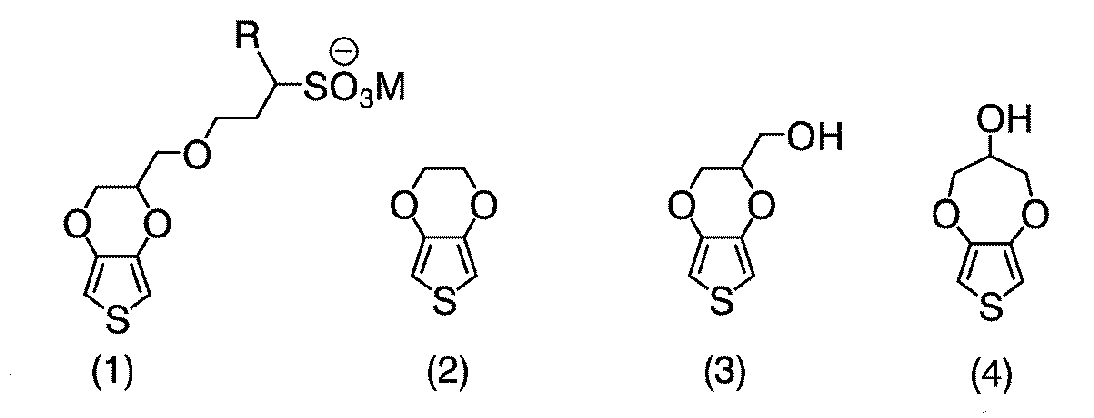
[式中、Rは炭素数1~6の鎖状、分岐状アルキル基、又はフッ素原子を表す。Mは水素イオン、Liイオン、Naイオン及びKイオンからなる群より選ばれるアルカリ金属イオン、又はアミン化合物の共役酸を表す。]
[6] 下記式(1)で表されるチオフェン化合物と下記式(2)及び(3)から選ばれる少なくとも一種のチオフェン化合物を、水又はアルコール溶媒中、酸化剤の存在下に重合させることを特徴とする上記[2]又は[3]に記載の共重合体の製造方法。
[6] 下記式(1)で表されるチオフェン化合物と下記式(2)及び(3)から選ばれる少なくとも一種のチオフェン化合物を、水又はアルコール溶媒中、酸化剤の存在下に重合させることを特徴とする上記[2]又は[3]に記載の共重合体の製造方法。
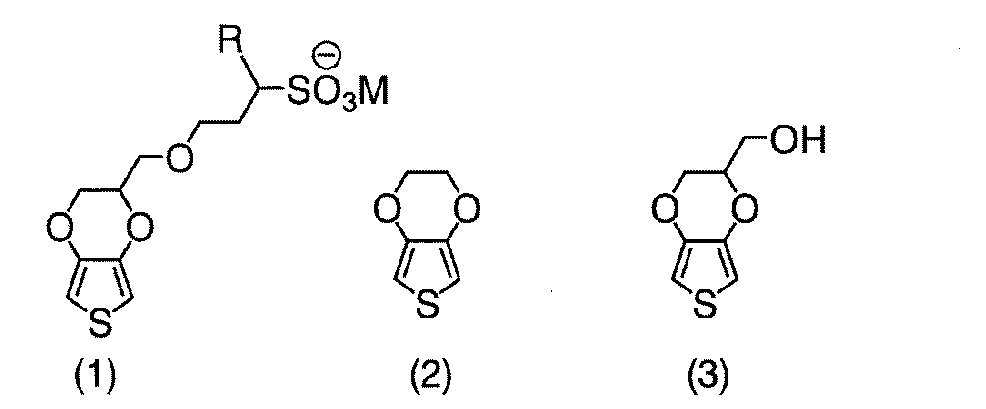
[式中、Rは炭素数1~6の鎖状、分岐状アルキル基、又はフッ素原子を表す。Mは水素原子、Li、Na及びKからなる群より選ばれるアルカリ金属、又はアミン化合物の共役酸を表す。]
[7] 上記[6]の製造方法において、さらに下記式(4)で表されるチオフェン化合物を加えて重合させることを特徴とする上記[4]に記載の共重合体の製造方法。
[7] 上記[6]の製造方法において、さらに下記式(4)で表されるチオフェン化合物を加えて重合させることを特徴とする上記[4]に記載の共重合体の製造方法。
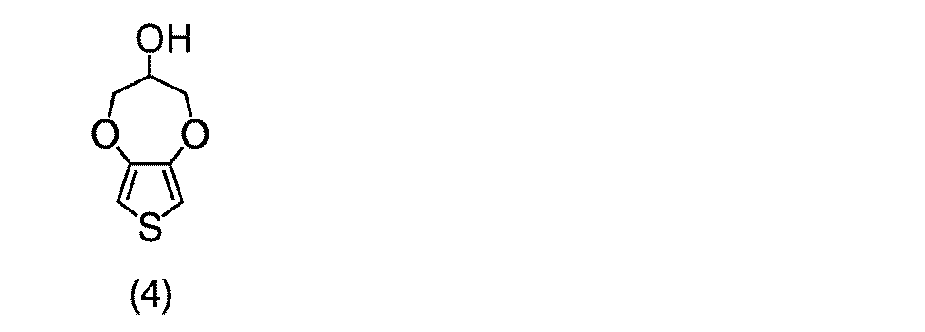
[8] 上記[1]乃至[4]のいずれかに記載の共重合体を含む導電性ポリマー水溶液。
[9] 上記[1]乃至[4]のいずれかに記載の共重合体(X)を0.01~10重量%含み、且つ少なくとも一種の界面活性剤(Y)を0.001~10重量%含むことを特徴とする導電性ポリマー水溶液。
[10] 界面活性剤(Y)が、ポリビニルピロリドン、ポリビニルピロリドンの共重合体、ポリエチレングリコール型界面活性剤、アセチレングリコール型界面活性剤、多価アルコール型界面活性剤、及びベタイン型両性界面活性剤からなる群より選ばれる少なくとも一種であることを特徴とする上記[9]に記載の導電性ポリマー水溶液。
[11] 界面活性剤(Y)が、水への溶解度が0.01重量%以上であり、且つグリフィン法HLB(親水親油バランス)が7~20の範囲であることを特徴とする上記[9]又は[10]に記載の導電性ポリマー水溶液。
[12] さらに、アルコール類及び水溶性樹脂からなる群より選ばれる少なくとも一種の水溶性化合物(W)を0.001~10重量%含むことを特徴とする上記[9]乃至[11]のいずれかに記載の導電性ポリマー水溶液。
[13] pHが10以下であることを特徴とする上記[8]乃至[12]のいずれかに記載の導電性ポリマー水溶液。
[14] さらに、アミン化合物(V)を含み、且つpHが9以下に調整されていることを特徴とする上記[8]乃至[12]のいずれかに記載の導電性ポリマー水溶液。
[15] 上記[8]乃至[14]のいずれかに記載の導電性ポリマー水溶液を乾燥して得られる導電性被膜。
[9] 上記[1]乃至[4]のいずれかに記載の共重合体(X)を0.01~10重量%含み、且つ少なくとも一種の界面活性剤(Y)を0.001~10重量%含むことを特徴とする導電性ポリマー水溶液。
[10] 界面活性剤(Y)が、ポリビニルピロリドン、ポリビニルピロリドンの共重合体、ポリエチレングリコール型界面活性剤、アセチレングリコール型界面活性剤、多価アルコール型界面活性剤、及びベタイン型両性界面活性剤からなる群より選ばれる少なくとも一種であることを特徴とする上記[9]に記載の導電性ポリマー水溶液。
[11] 界面活性剤(Y)が、水への溶解度が0.01重量%以上であり、且つグリフィン法HLB(親水親油バランス)が7~20の範囲であることを特徴とする上記[9]又は[10]に記載の導電性ポリマー水溶液。
[12] さらに、アルコール類及び水溶性樹脂からなる群より選ばれる少なくとも一種の水溶性化合物(W)を0.001~10重量%含むことを特徴とする上記[9]乃至[11]のいずれかに記載の導電性ポリマー水溶液。
[13] pHが10以下であることを特徴とする上記[8]乃至[12]のいずれかに記載の導電性ポリマー水溶液。
[14] さらに、アミン化合物(V)を含み、且つpHが9以下に調整されていることを特徴とする上記[8]乃至[12]のいずれかに記載の導電性ポリマー水溶液。
[15] 上記[8]乃至[14]のいずれかに記載の導電性ポリマー水溶液を乾燥して得られる導電性被膜。
以下、本発明を詳細に説明する。
本発明の共重合体は、下記式(M1)で表される繰り返し単位(「チオフェンモノマー」という)、及び下記式(M2)、(M3)、及び(M4)から選ばれる少なくとも一つの繰り返し単位(「コモノマー」という)を含んでなり、チオフェンモノマー及びコモノマーは自己ドープされていてもよく、且つチオフェンモノマー/コモノマー(モル/モル)の比が3~9999であるものである。
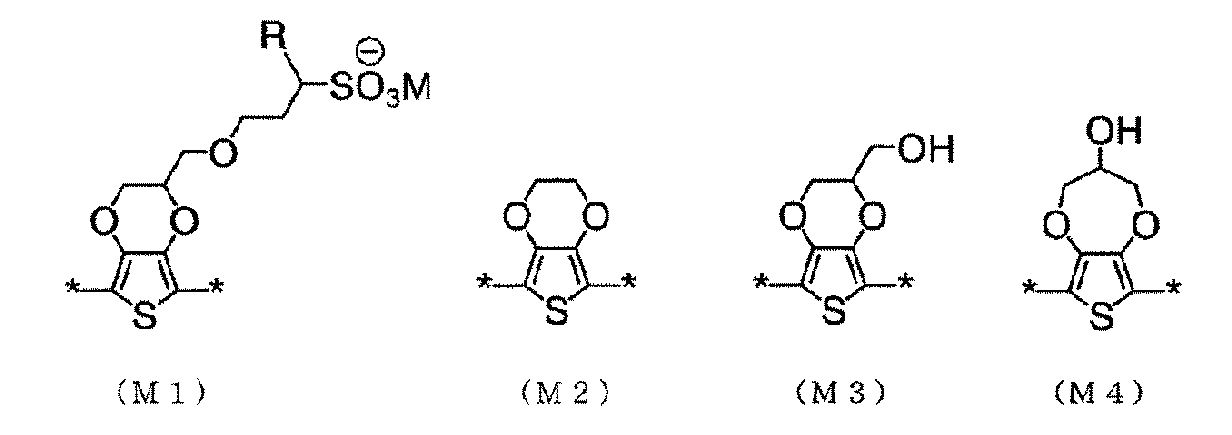
[式中、Rは、繰返し単位ごとに同じでも異なっていてもよく、炭素数1~6の鎖状、分岐状アルキル基、又はフッ素原子を表す。Mは、繰返し単位ごとに異なっていてもよく、水素イオン、Liイオン、Naイオン及びKイオンからなる群より選ばれるアルカリ金属イオン、又はアミン化合物の共役酸を表す。]
上記式中、Rは炭素数1~6の鎖状若しくは分岐状アルキル基、又はフッ素原子を表す。炭素数1~6の鎖状若しくは分岐状アルキル基としては、特に限定するものではないが、メチル基、エチル基、n-プロピル基、イソプロピル基、n-ブチル基、イソブチル基、sec-ブチル基、tert-ブチル基、n-ペンチル基、イソペンチル基、ネオペンチル基、tert-ペンチル基、シクロペンチル基、n-へキシル基、2-エチルブチル基、シクロヘキシル基等が挙げられる。
上記式中、Rは炭素数1~6の鎖状若しくは分岐状アルキル基、又はフッ素原子を表す。炭素数1~6の鎖状若しくは分岐状アルキル基としては、特に限定するものではないが、メチル基、エチル基、n-プロピル基、イソプロピル基、n-ブチル基、イソブチル基、sec-ブチル基、tert-ブチル基、n-ペンチル基、イソペンチル基、ネオペンチル基、tert-ペンチル基、シクロペンチル基、n-へキシル基、2-エチルブチル基、シクロヘキシル基等が挙げられる。
上記式中、Mは水素イオン、Liイオン、Naイオン及びKイオンからなる群より選ばれるアルカリ金属イオン、又はアミン化合物の共役酸を表す。
前記アミン化合物の共役酸は、アミン化合物にプロトンが付加したカチオン化合物を表す。当該アミン化合物としては、特に限定するものではないが、例えば、アンモニア、メチルアミン、ジメチルアミン、トリメチルアミン、エチルアミン、ジエチルアミン、トリエチルアミン、モノエタノールアミン、ジエタノールアミン、トリエタノールアミン等(以上、一般式N(R1)(R2)(R3)で表されるアミン化合物)のsp3混成軌道を有する化合物、ピリジン、2-メチルピリジン、3-メチルピリジン、4-メチルピリジンピリジン(以上、ピリジン類)、イミダゾール、2-メチルイミダゾール、2-エチル-4-メチルイミダゾール、2-フェニルイミダゾール、2-フェニル-4-メチルイミダゾール、1-メチルイミダゾール(以上、イミダゾール類)等のsp2混成軌道を有するアミン化合物等が挙げられる。
なお、当該R1~R3は、各々独立して、水素原子、又は置換基を有していてもよい総炭素数1~40のアルキル基を表わす。このうち、R1~R3は、各々独立して、水素原子、又は置換基を有していてもよい総炭素数1~20のアルキル基であることがより好ましく、各々独立して、水素原子、又は直鎖若しくは分岐の炭素数1~6のアルキル基であることがさらに好ましい。
ここで、置換基を有していてもよい総炭素数1~40のアルキル基、又は置換基を有していてもよい総炭素数1~20のアルキル基としては、特に限定するものではないが、例えば、メチル基、エチル基、n-プロピル基、i-プロピル基、n-ブチル基、t-ブチル基、n-ヘキシル基、シクロヘキシル基、2-ヒドロキシエチル基、3-ヒドロキシプロピル基、2-ヒドロキシプロピル基、2,3-ジヒドロキシプロピル基、メトキシメチル基、エトキシメチル基、ヒドロキシエトキシエチル基、ヒドロキシエトキシエトキシエチル基、ベンジル基、フェネチル基、アミノエチル基等が挙げられる。
このうち、置換基R1~R3としては、上記置換基Rと同じものを例示することができ、より好ましくは水素原子、又はメチル基が挙げられる。また、R1~R3が置換基を有するアルキル基である場合の当該置換基としては、例えば、炭素数1~6のアルキル基又はアルコキシ基、炭素数1~20のアリール基、ヒドロキシ基、アミノ基、カルボキシル基等を挙げることができ、より好ましくは、2-ヒドロキシエチル基、3-ヒドロキシプロピル基、2-ヒドロキシプロピル基、2,3-ジヒドロキシプロピル基等のヒドロキシ基を有するアルキル基が挙げられる。
また、前記のイミダゾール類としては、総炭素数3~20のイミダゾール化合物が好ましく、特に限定するものではないが、例えば、イミダゾール、N-メチルイミダゾール、1,2-ジメチルイミダゾール等が挙げられる。前記のピリジン類としては、総炭素数3~20のピリジン化合物が好ましく、特に限定するものではないが、例えば、ピリジン、ピコリン、ルチジン等を挙げることができる。これらのうち、より好ましくは、イミダゾールである。
本発明の共重合体は、チオフェンモノマー/コモノマー(モル/モル)の比が3~9999である。チオフェンモノマー/コモノマー(モル/モル)の比が3より小さい場合は、共重合体は水溶性が低下し、本発明特有の効果を奏することができないため、避けなければならない。また、チオフェンモノマー/コモノマー(モル/モル)の比が9999より大きい場合は、十分に高い誘電率が得られず、本発明特有の効果を奏することができないため、避けなければならない。
なお、共重合体の水溶性と誘電率の観点から、チオフェンモノマー/コモノマー(モル/モル)の比は3~999であることがより好ましく、3~99であることがさらに好ましい。
本発明の共重合体は、下記式(1)で表されるチオフェン化合物と下記式(2)、(3)及び(4)から選ばれる少なくとも一種のチオフェン化合物との共重合体である。本発明の共重合体は、さらに具体的には、下記式(1)で表されるチオフェン化合物の側鎖のスルホ基又はスルホナート基がp型ドーパントとして作用した自己ドープ型の導電性コポリマーであり、例えば、下記式(5)のように表すことができる。


[式中、R、Mは上記式(M1)と同義を示す。また、Zは、上記式(M2)、(M3)又は(M4)に示したコモノマーの置換基部分を表す。m、nはm+n=100及び3≦m/n≦9999を満たす実数である。]
上記式(5)において、上記式(C)は、夫々、上記式(2)、(3)及び(4)から選ばれる少なくとも一つのチオフェン化合物に由来するものであり、上記式(D)は、側鎖のスルホ基又はスルホナート基により上記式(C)が酸化された状態を表す。また、上記式(A)は、上記式(1)で表されるチオフェン化合物に由来するものであり、上記式(B)は上記式(A)の酸化状態を表す。
上記式(5)において、上記式(C)は、夫々、上記式(2)、(3)及び(4)から選ばれる少なくとも一つのチオフェン化合物に由来するものであり、上記式(D)は、側鎖のスルホ基又はスルホナート基により上記式(C)が酸化された状態を表す。また、上記式(A)は、上記式(1)で表されるチオフェン化合物に由来するものであり、上記式(B)は上記式(A)の酸化状態を表す。
すなわち、上記式(5)において、上記(A)又は(B)で表される繰り返し単位と、(C)又は(D)で表される繰り返し単位とを含む共重合体を表し、必ずしもその単位を連続して含む共重合体に限定されず、所望の導電性を有する限りにおいては、ランダム共重合体のようにπ共役系主鎖に不連続に繰り返し単位を含む共重合体であってもよい。
本発明の共重合体は、下記式(1)で表されるチオフェン化合物と下記式(2)、(3)及び(4)から選ばれる少なくとも一種のチオフェン化合物を、水又はアルコール溶媒中、酸化剤の存在下に重合させることによって製造することができる。
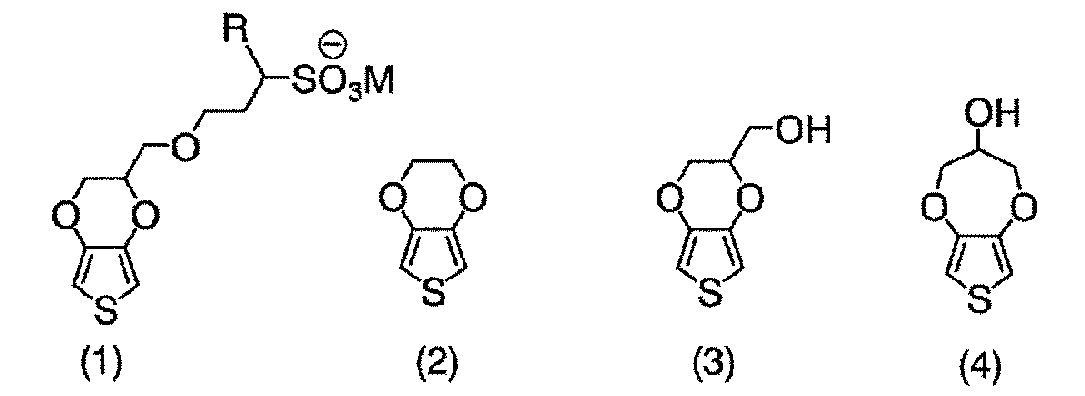
[式中、Rは一般式(M1)のRと同義である。]
また、本発明の共重合体は、上記式(1)で表されるチオフェン化合物と、上記式(2)又は(3)から選ばれる少なくとも一種のチオフェン化合物に、さらに上記式(4)で表されるチオフェン化合物を加えて重合させて製造することもできる。
また、本発明の共重合体は、上記式(1)で表されるチオフェン化合物と、上記式(2)又は(3)から選ばれる少なくとも一種のチオフェン化合物に、さらに上記式(4)で表されるチオフェン化合物を加えて重合させて製造することもできる。
また、本発明の共重合体において、上記式(1)、(2)、(3)、及び(4)で表されるチオフェン化合物の比率は特に限定されないが、上記式(1)で表されるチオフェン化合物の量が、上記式(1)~(4)で表されるチオフェン化合物の総和量に対して、0.01mol%以上25mol%以下であることが好ましい。
上記式(1)で表されるチオフェン化合物の量が0.01mol%未満の場合、その導電率は上記式(1)で表されるチオフェン化合物のみから合成されるホモポリマーのものと比較して大差なく、また、25mol%を超える場合、得られる共重合体は水に対して難溶解性となる。
本発明の共重合体の重量平均分子量は、特に限定するものではないが、ポリスチレンスルホン酸換算で通常1千~100万の範囲であり、水溶性導電性ポリマー用途として好ましくは1千~20万の範囲である。ポリマーから未反応のモノマーや低分子不純物及び無機塩を除去する観点から、より好ましくは1.5千~10万の範囲である。
なお、上記式(1)で表されるチオフェン化合物と上記式(2)~(4)で表されるチオフェン化合物は、特に限定されないが、[上記式(1)で表されるチオフェン化合物の量/上記式(2)~(4)で表されるチオフェン化合物の総量]=3~9999(モル比)の割合で重合させることが、共重合体の導電率及び水溶性の観点から好ましい。
上記式(1)で表されるチオフェン化合物としては、具体的に、3-[(2,3-ジヒドロチエノ[3,4-b]-[1,4]ジオキシン-2-イル)メトキシ]-1-メチル-1-プロパンスルホン酸ナトリウム、3-[(2,3-ジヒドロチエノ[3,4-b]-[1,4]ジオキシン-2-イル)メトキシ]-1-エチル-1-プロパンスルホン酸ナトリウム、3-[(2,3-ジヒドロチエノ[3,4-b]-[1,4]ジオキシン-2-イル)メトキシ]-1-プロピル-1-プロパンスルホン酸ナトリウム、3-[(2,3-ジヒドロチエノ[3,4-b]-[1,4]ジオキシン-2-イル)メトキシ]-1-ブチル-1-プロパンスルホン酸ナトリウム、3-[(2,3-ジヒドロチエノ[3,4-b]-[1,4]ジオキシン-2-イル)メトキシ]-1-ペンチル-1-プロパンスルホン酸ナトリウム、3-[(2,3-ジヒドロチエノ[3,4-b]-[1,4]ジオキシン-2-イル)メトキシ]-1-ヘキシル-1-プロパンスルホン酸ナトリウム、3-[(2,3-ジヒドロチエノ[3,4-b]-[1,4]ジオキシン-2-イル)メトキシ]-1-イソプロピル-1-プロパンスルホン酸ナトリウム、3-[(2,3-ジヒドロチエノ[3,4-b]-[1,4]ジオキシン-2-イル)メトキシ]-1-イソブチル-1-プロパンスルホン酸ナトリウム、3-[(2,3-ジヒドロチエノ[3,4-b]-[1,4]ジオキシン-2-イル)メトキシ]-1-イソペンチル-1-プロパンスルホン酸ナトリウム、3-[(2,3-ジヒドロチエノ[3,4-b]-[1,4]ジオキシン-2-イル)メトキシ]-1-フルオロ-1-プロパンスルホン酸ナトリウム、3-[(2,3-ジヒドロチエノ[3,4-b]-[1,4]ジオキシン-2-イル)メトキシ]-1-メチル-1-プロパンスルホン酸カリウム、3-[(2,3-ジヒドロチエノ[3,4-b]-[1,4]ジオキシン-2-イル)メトキシ]-1-メチル-1-プロパンスルホン酸、3-[(2,3-ジヒドロチエノ[3,4-b]-[1,4]ジオキシン-2-イル)メトキシ]-1-メチル-1-プロパンスルホン酸アンモニウム、3-[(2,3-ジヒドロチエノ[3,4-b]-[1,4]ジオキシン-2-イル)メトキシ]-1-メチル-1-プロパンスルホン酸トリエチルアンモニウム等が挙げられる。
なお、上記式(1)に例示したチオフェン化合物は、公知の方法(例えば、引用文献4)に従い、チエノ[3,4-b]-1,4-ジオキシン-2-メタノールと分岐したスルトン化合物から容易に合成できる。
本重合反応に用いる溶媒は、水又はアルコール溶媒である。水としては、例えば、純水が挙げられ、蒸留水、イオン交換水でもよい。アルコール溶媒としては、例えば、メタノール、エタノール、プロパノール、ブタノール等のアルコール類が挙げられる。これらのアルコール溶媒は、単独で使用しても、水と併用してもよい。これらの溶媒のうち、好ましくは水又はメタノールであり、より好ましくは水である。また、溶媒を脱気や窒素等の不活性ガスで置換してもよい。
本重合反応に用いる溶媒量は、例えば、上記式(1)で表されるチオフェン化合物と、上記式(2)、(3)、及び(4)から選ばれる少なくとも一種のチオフェン化合物とが溶解する量であり、特に限定するものではないが、上記式(1)で表されるチオフェン化合物と上記式(2)~(4)で表されるチオフェン化合物の総仕込量に対して0.1~100重量倍の範囲が好ましく、1~20重量倍の範囲がより好ましい。
本重合反応に用いる酸化剤は、酸化的脱水素化反応による酸化重合を進行させるものであり、特に限定するものではないが、例えば、過硫酸類、鉄塩(III)、過酸化水素、過マンガン酸塩、重クロム酸塩、硫酸セリウム(IV)、酸素等が挙げられ、これらを単独で又は二種以上を混合して使用してもよい。
ここで、過硫酸類としては、具体的には、過硫酸、過硫酸アンモニウム、過硫酸ナトリウム、過硫酸カリウム等が例示される。
また、鉄塩(III)としては、具体的には、FeCl3、Fe2(SO4)3、過塩素酸鉄、パラ-トルエンスルホン酸鉄(III)等が例示される。これらは無水物を使用しても、水和物を使用してもよい。
また、過マンガン酸塩としては、具体的には、過マンガン酸ナトリウム、過マンガン酸カリウム、過マンガン酸マグネシウム等が例示される。
また、重クロム酸塩としては、具体的には、重クロム酸アンモニウム、重クロム酸カリウム等が例示される。
これらの酸化剤のうち、FeCl3、Fe2(SO4)3、又は過硫酸塩と鉄塩(III)との併用系が特に好ましい。
本重合反応に用いる酸化剤の量としては、特に限定するものではないが、上記チオフェン化合物と上記コモノマーの仕込モル数に対して、0.5~50倍モルである。より好ましくは、1~20倍モルである。さらに好ましくは、1~10倍モルである。
本重合反応の圧力は、常圧、減圧、加圧のいずれであってもよい。
本重合反応の反応雰囲気は、大気中であっても、窒素やアルゴン等の不活性ガス中であってもよい。より好ましくは不活性ガス中である。
本重合反応の反応温度は、例えば、上記式(1)~(4)で表されるチオフェン化合物を酸化重合できる温度であり、特に限定するものではないが、-10~150℃の範囲が好ましく、5~100℃の範囲がさらに好ましい。
本重合反応の反応時間は、例えば、上記式(1)で表されるチオフェン化合物と、上記式(2)、(3)、及び(4)から選ばれる少なくとも一種のチオフェン化合物との酸化重合が十分進行する時間であり、特に限定するものではないが、0.5~200時間の範囲が好ましく、0.5~80時間の範囲がさらに好ましい。
本重合反応の反応方法は、特に限定するものではないが、例えば、上記式(1)で表されるチオフェン化合物と、上記式(2)、(3)、及び(4)から選ばれる少なくとも一種のチオフェン化合物をあらかじめ水に溶解させ、これに酸化剤を一度に又はゆっくりと滴下してもよく、逆に酸化剤の固体又は水溶液に上記式(1)で表されるチオフェン化合物と、上記式(2)、(3)、及び(4)から選ばれる少なくとも一種のチオフェン化合物の水溶液を一度に又はゆっくりと滴下してもよい。また、2種以上の酸化剤を用いる場合には、各酸化剤を順次添加してもよい。
本重合反応で得られた本発明の共重合体の精製法としては、特に限定するものではないが、例えば、溶媒洗浄、再沈殿、遠心沈降、限外ろ過、透析、イオン交換樹脂処理等が挙げられる。それぞれ単独で行っても又は組み合わせてもよい。
本発明の共重合体の典型的な単離精製方法は、例えば、以下のとおりである。
まず、重合反応後の水溶液をアセトン等の貧溶媒に添加し、共重合体を沈殿させた後、減圧ろ過で得た共重合体を当該貧溶媒でろ液が無色透明になるまで洗浄する。この共重合体に、水に不溶なFe塩が含まれている場合、一度水酸化ナトリウム水溶液中に添加し、水に溶解し、MがNaイオンであるNa塩型共重合体に変換することが好ましい。
次に、これをアルコール等の貧溶媒に添加して共重合体を沈殿させるとともに、アルカリ分を除去し、減圧濾過により得た固体をアルコール等の貧溶媒で洗浄する。次いでアセトン等の貧溶媒で洗浄し、Na塩型共重合体を得る。
得られたNa塩型共重合体を、引き続き、Mが水素イオンであるH型共重合体に変換する場合には、陽イオン交換樹脂で処理する。処理方法としては、例えば、得られたNa塩型共重合体の水溶液を陽イオン交換樹脂が充填されたカラムに通液させる方法や、陽イオン交換樹脂を水溶液に添加するボディーフィード法等が挙げられる。この場合、処理後にろ紙で陽イオン交換樹脂を除去することが好ましい。このようにして得られた水溶液を粗濃縮し、アセトン等の貧溶媒に添加して沈殿させ、減圧ろ過して得た固体を当該貧溶媒でよく洗い、減圧乾燥してH型共重合体が得られる。
さらに、各種アンモニウム塩との塩を形成させる場合には、例えば、H塩型共重合体の水溶液に、各種アミン化合物又はアンモニウム塩の原液若しくはその水溶液又はその他適当な溶媒で希釈したものを加えることで容易にMがNH4
+であるアンモニウム塩型共重合体に変換することができる。例えば、アンモニア水で処理した場合には、反応液を粗濃縮し、その水溶液をアセトン等の貧溶媒に添加して共重合体を沈殿させた後、減圧濾過により得た固体を当該貧溶媒で洗浄し、減圧乾燥することでアンモニウム塩型共重合体が得られる。
重合後処理の各工程では必要に応じて、遠心沈降、ホモジナイズ処理を行ってもよい。これにより、ろ過効率の改善を図ることができる。さらに、重合酸化剤として過硫酸塩を使用した場合には、無機塩の除去として限外ろ過や透析、陽・陰イオン交換樹脂混合処理を行う。
本発明の共重合体を含む導電性ポリマー水溶液にすることで、各種用途への成型加工が可能となる。
導電性ポリマー水溶液の調製方法は、特に限定するものではないが、室温や加温下(100℃以下が好ましい)で水と混合溶解させることで達成される。その際、スターラーチップや攪拌羽根による一般的な混合溶解操作を用いることもできるし、その他の方法として、超音波照射、ホモジナイズ処理(例えば、メカニカルホモジナイザー、超音波ホモジナイザー、高圧ホモジナイザー等の使用)を行ってもよい。ホモジナイズ処理する場合には、ポリマーの熱劣化を防ぐため、冷温しながら行うことが好ましい。
導電性ポリマー水溶液中の、本発明の共重合体の濃度は、特に限定するものではないが、通常50重量%以下、好ましくは20重量%以下、粘性の観点からより好ましくは10重量%以下である。
本発明の共重合体を用いて導電性被膜を製造することができる。例えば、上記した導電性ポリマー水溶液を、基材に塗布・乾燥することで導電性被膜が簡単に得られる。基材としては、例えば、ガラス、プラスチック、ポリエステル、ポリアクリレート、ポリカーボネート、レジスト基板等が挙げられる。塗布方法としては、例えば、キャスティング法、ディッピング法、バーコード法、ロールコート法、グラビアコート法、フレキソ印刷法、スプレーコート法、インクジェット印刷法等が挙げられる。膜厚としては特に限定するものではないが、10-2~102μmの範囲が好ましい。得られる塗膜の表面抵抗値としては特に限定するものではないが、1~1.0E+9Ω/□の範囲のものが好ましい。
なお、本発明において、各種用途への成型加工に十分な水溶性とは、室温又は加温下で調製した10重量%以下のポリマー水溶液において、粒度分布測定装置で測定した粒子径(D50)が5nm以下であり、且つ0.02μmのフィルターを通液する程度の水溶性をいう。
また、本発明において、良好な導電性とは、フィルム状態での導電率(電気伝導度)が50S/cm以上の導電性をいう。
本発明において共重合体(X)の導電率は、特に限定するものではないが、フィルム状態での導電率(電気伝導度)として、50S/cm以上であることが好ましい。
本発明において界面活性剤(Y)としては、例えば、アニオン界面活性剤、カチオン界面活性剤、非イオン界面活性剤、両性界面活性剤等が使用できるが、より好ましくは非イオン界面活性剤及び両性界面活性剤からなる群より選ばれる少なくとも一種である。
非イオン界面活性剤としては特に限定するものではないが、例えば、ポリエチレングリコール型界面活性剤、アセチレングリコール型界面活性剤、多価アルコール型界面活性剤、高分子型非イオン界面活性剤等が挙げられる。
前記のポリエチレングリコール型界面活性剤としては、例えば、高級アルコールエチレンオキサイド付加物、アルキルフェノールエチレンオキサイド付加物、脂肪酸エチレンオキサイド付加物、多価アルコール脂肪酸エステルエチレンオキサイド付加物、高級アルキルアミンエチレンオキサイド付加物、油脂のエチレンオキサイド付加物、又はポリプロピレングリコールエチレンオキサイド付加物等が挙げられる。
アセチレングリコール型界面活性剤としては、例えば、2,4,7,9-テトラメチル-5-デシン-4,7-ジオール、サーフィノール(エアプロダクツ社製)、オルフィン(日信化学工業社製)等が挙げられる。
多価アルコール型界面活性剤としては、例えば、グリセロールの脂肪酸エステル、ペンタエリスリトールの脂肪酸エステル、ソルビトール及びソルビタンの脂肪酸エステル、ショ糖の脂肪酸エステル、高級アルコールのアルキルエーテル、アルカノールアミン類の脂肪酸アミド等が挙げられる。
高分子型非イオン界面活性剤としては、特に限定するものではないが、ポリビニルピロリドン及びポリビニルピロリドンの共重合体等が挙げられる。本発明に使用されるポリビニルピロリドンの平均分子量は1千~200万であり、好ましくは1万~150万である。ポリビニルピロリドンの共重合体としては、特に限定するものではないが、親水性部と疎水性部をポリマー鎖中に併せ持つものが好ましく、例えば、ポリビニルピロリドンをポリビニルアルコールにグラフトしたコポリマーや、[ビニルピロリドン-酢酸ビニル]ブロック共重合体、[ビニルピロリドン-メチルメタクリレート]共重合体、[ビニルピロリドン-ノルマルブチルメタクリレート]共重合体、[ビニルピロリドン-アクリルアミド]共重合体などが例示できる。
両性界面活性剤としては特に限定するものではないが、例えば、ベタイン型両性界面活性剤が挙げられる。ベタイン型両性界面活性剤としては特に限定するものではないが、例えば、アルキルジメチルベタイン、ラウリルジメチルベタイン、ステアリルジメチルベタイン、ラウリルジヒドロキシエチルベタイン等が挙げられる。
本発明において、高分子型界面活性剤以外の界面活性剤(Y)は、水への溶解度が0.01重量%以上であり、且つHLBが7~20の範囲である界面活性剤であることが好ましい。
ここで、界面活性剤(Y)の水への溶解度は80℃以下での測定値であり、好ましくは10℃~30℃での測定値である。また、グリフィン法HLB(Hydrophile-Lipophile Balance)は界面活性剤の親水性を表す数値である。値が大きいほど親水性が大きいことを示し、次式で表される。
非イオン界面活性剤のグリフィン法HLB
=(親水基部分の分子量)/(界面活性剤の分子量)×100/5
=(親水基重量)/(疎水基重量+親水基重量)×100/5
=(親水基の重量%)/5。
=(親水基部分の分子量)/(界面活性剤の分子量)×100/5
=(親水基重量)/(疎水基重量+親水基重量)×100/5
=(親水基の重量%)/5。
例えば、親水基がないパラフィンではHLB=0、親水基のみで疎水基のないポリエチレングリコールはHLB=20となり、非イオン界面活性剤のHLBは0~20の間にある。
界面活性剤(Y)としてより好ましくは、アセチレングリコール型界面活性剤、又は高分子型界面活性剤である。
界面活性剤(Y)の導電性高分子水溶液への添加方法は、固体で添加してもよく、あらかじめ水溶液として調整したものを添加してもよい。単独で使用しても、2種以上を混合してよい。
本発明の導電性高分子水溶液は、さらにアルコール類及び水溶性樹脂からなる群より選ばれる少なくとも一種の水溶性化合物(W)を含んでもよい。
アルコールとしては、特に限定するものではないが、例えば、エタノール、2価のアルコール、3価のアルコール、及び糖アルコールからなる群より選択される少なくとも一種のアルコールが挙げられる。
2価アルコールとしては特に限定するものではないが、入手の観点から、エチレングリコールが好ましい。3価アルコールとしては、特に限定するものではないが、例えば、グリセロールが好ましい。糖アルコールとしては、特に限定するものではないが、例えば、エリトリトール、ソルビトール、アラビトール等が好ましい。より好ましくはソルビトールである。
また、水溶性樹脂としては、特に限定するものではないが、例えば、ポリビニルアルコール、ポリアクリルアミド、ポリビニルピロリドン、ポリNビニルアセトアミド等が好ましい。
水溶性樹脂の分子量は、水溶性が良好であれば特に制限されないが、好ましくはMw=1千~200万、より好ましくは1千~150万、さらに好ましくは1千~25万、さらにより好ましくは1千~5万の範囲である。
本発明の導電性高分子水溶液が、水溶性化合物(W)を含む場合、共重合体(X)を0.1~10重量%、界面活性剤(Y)を0.001~10重量%、及び水溶性化合物(W)を0.001~10重量%含むことが好ましい。
本発明の導電性高分子水溶液を調製する方法としては、特に限定するものではないが、例えば、本発明の共重合体(X)の水溶液又は固体と、界面活性剤(Y)と、必要に応じて水溶性化合物(W)又は水とを使用する。これらを任意の順で混合することにより本発明の導電性高分子水溶液を調製することができる。
ここで、混合する際の温度は、特に限定するものではないが、例えば、0℃以上100℃以下で行うことができる。好ましくは室温~60℃以下が好ましい。
混合する際の雰囲気は、特に限定するものではないが、大気中でも、不活性ガス中でもよい。
本発明の導電性高分子水溶液のpHは10以下であることが好ましく、9以下であることがより好ましい。さらに、1.5以上9以下の範囲内がより好ましい。ここで、pHを調整する手順としては、特に限定するものではないが、例えば、共重合体(X)と界面活性剤(Y)とを混合した後、アミン化合物(V)を添加することにより調整することができる。また、共重合体(X)、界面活性剤(Y)及び水溶性化合物(W)を混合した後、アミン化合物(V)を添加することにより調整することができる。さらには、共重合体(X)の水溶液を予めアミン化合物(V)で中和した後に、界面活性剤(Y)、必要に応じて水溶性化合物(W)を添加してもよい。
アミン系化合物(V)としては、特に限定するものではないが、例えば、アンモニア、メチルアミン、ジメチルアミン、エチルアミン、トリエチルアミン、ノルマル-プロピルアミン、イソプロピルアミン、ノルマルブチルアミン、ターシャリーブチルアミン、ヘキシルアミン、アミノエタノール、ジメチルアミノエタノール、メチルアミノエタノール、ジエタノールアミン、N-メチルジエタノールアミン、トリエタノールアミン、3-アミノ-1,2-プロパンジオール、3-メチルアミノ-1,2-プロパンジオール、3-ジメチルアミノ-1,2-プロパンジオール、1,4-ブタンジアミン、イミダゾール、N-メチルイミダゾール、1、2-ジメチルイミダゾール、ピリジン、ピコリン、ルチジン等が挙げられる。添加する際には、ニートでも水溶液でもよい。
本発明の導電性高分子水溶液を混合する際には、スターラーチップ、攪拌羽根等による一般的な混合溶解操作に加えて、超音波照射、ホモジナイズ処理(例えば、メカニカルホモジナイザー、超音波ホモジナイザー、高圧ホモジナイザー等の使用)を行ってもよい。ホモジナイズ処理する場合には、ポリマーの熱劣化を防ぐため、冷温しながら行うことが好ましい。
本発明の導電性高分子水溶液の濃度調整は、配合比で調整してもよいし、配合後に濃縮により調整してもよい。濃縮の方法は、減圧下に溶媒を留去する方法であっても、限外ろ過膜を利用する方法であってもよい。
本発明の導電性高分子水溶液の中の共重合体(X)の濃度は0.001重量%以上であれば特に限定するものではないが、好ましくは0.01重量%~10重量%の範囲である。
本発明の導電性高分子水溶液中の固形分の粒径は、特に限定するものではないが、小さいほど水溶性が良好であり、導電性や成膜時の均一な膜形成の観点からも望ましい。例えば、室温又は加温下で調製した導電性高分子水溶液の固形分濃度が10重量%以下の場合、固形分の粒子径(D50)が0.02μm以下であれば、水溶性がより良好となる。
本発明の導電性高分子水溶液の粘度(20℃)は、500mPa・s以下であれば特に限定されないが、好ましくは300mPa・s以下、さらに好ましくは100mPa・s以下である。
本発明の導電性高分子水溶液から導電性高分子膜を形成する方法としては、特に限定するものではないが、例えば、本発明の導電性高分子水溶液を、支持体に塗布し乾燥することで支持体上に導電性高分子膜が簡便に得られる(以下、その支持体と導電性高分子膜を合わせて「被覆物品」と称する。)
支持体としては、本発明の導電性高分子水溶液が塗布可能なものであれば特に限定するものではないが、例えば、高分子基材又は無機基材が挙げられる。高分子基材としては、例えば、熱可塑性樹脂、不織布、紙、レジスト膜基板等が挙げられる。熱可塑性樹脂としては、例えば、ポリエチレン、ポリプロピレン、ポリエチレンテレフタレート、ポリアクリレート、ポリカーボネート等が挙げられる。不織布としては、例えば、天然繊維、合成繊維、又はガラス繊維製のいずれでもよい。紙としては一般的なセルロースを主成分とするものでよい。無機基材としては、ガラス、セラミックス、酸化アルミニウム、酸化タンタル等が挙げられる。
支持体としては、本発明の導電性高分子水溶液が塗布可能なものであれば特に限定するものではないが、例えば、高分子基材又は無機基材が挙げられる。高分子基材としては、例えば、熱可塑性樹脂、不織布、紙、レジスト膜基板等が挙げられる。熱可塑性樹脂としては、例えば、ポリエチレン、ポリプロピレン、ポリエチレンテレフタレート、ポリアクリレート、ポリカーボネート等が挙げられる。不織布としては、例えば、天然繊維、合成繊維、又はガラス繊維製のいずれでもよい。紙としては一般的なセルロースを主成分とするものでよい。無機基材としては、ガラス、セラミックス、酸化アルミニウム、酸化タンタル等が挙げられる。
導電性高分子水溶液の塗布方法としては、例えば、キャスティング法、ディッピング法、バーコート法、ディスペンサ法、ロールコート法、グラビアコート法、フレキソ印刷法、スプレーコート法、スピンコート法、インクジェット法等が挙げられる。好ましくはスピンコート法である。
塗膜の乾燥温度は、均一な導電性高分子膜が得られる温度及び基材の耐熱温度以下であれば特に限定するものではないが、室温~300℃の範囲であり、好ましくは室温~250℃の範囲であり、さらに好ましくは室温~200℃の範囲である。
乾燥雰囲気は大気中、不活性ガス中、真空中、又は減圧下のいずれであってもよい。高分子膜の劣化抑制の観点からは、窒素、アルゴン等の不活性ガス中が好ましい。
得られる導電性高分子膜の膜厚としては特に限定するものではないが、10-3~102μmの範囲が好ましい。より好ましくは10-3~10-1μmである。この導電性高分子膜の導電率としては特に限定するものではないが高い方が好ましい。また、得られる導電性高分子膜の表面抵抗値としては特に限定するものではないが、1.0E+11Ω/□以下が好ましく、より好ましくは1.0E+9Ω/□以下であり、さらに好ましくは1.0E+7Ω/□以下である。表面抵抗値を測定する際の印加電圧は特に限定されないが、10V又は500Vで測定する。
本発明の被覆物は、例えば、帯電防止フィルム、固体電解コンデンサ用の固体電解質、巻回型アルミ固体電解コンデンサ用のセパレータとして使用される。
本発明によるポリチオフェン構造を有する共重合体は、従来の水溶性導電性高分子と比較して、より高い導電性・水溶性、及びより優れた細孔浸透性を有する。このため、電子線リソグラフィーによる半導体の回路パターン形成時に使用されるレジストの帯電防止膜形成材料としての使用や、不織布や紙等に被覆することによって、例えば、帯電防止機能を有するフィルムやコンデンサの固体電解質としての使用が可能であり、産業上極めて有用である。
以下に本発明の共重合体及びチオフェンモノマーに関する実施例を示すが、本発明はこれら実施例に限定して解釈されるものではない。なお、本実施例で用いた分析機器及び測定方法を以下に列記する。
[GPC測定]
装置:東ソー社製,
カラム:TSKGel SuperAW5000+SuperAW3000+SuperAW2500+ガードカラムSuperAW-H
検出器:UV-8020。
[GPC測定]
装置:東ソー社製,
カラム:TSKGel SuperAW5000+SuperAW3000+SuperAW2500+ガードカラムSuperAW-H
検出器:UV-8020。
溶離液:0.2M燐酸緩衝液(pH=7)/CH3CN=9/1
流 速:0.5ml/min
検出器:UV(220nm)
注入量:100μl(約500ppm)
温 度:40℃
[表面抵抗率測定]
装置:三菱化学社製ロレスタGP MCP-T600。
[膜厚測定]
装置:BRUKER社製 DEKTAK XT。
[粒子径測定]
装置:日機装社製 Microtrac Nanotrac UPA-UT151。
流 速:0.5ml/min
検出器:UV(220nm)
注入量:100μl(約500ppm)
温 度:40℃
[表面抵抗率測定]
装置:三菱化学社製ロレスタGP MCP-T600。
[膜厚測定]
装置:BRUKER社製 DEKTAK XT。
[粒子径測定]
装置:日機装社製 Microtrac Nanotrac UPA-UT151。
[GC測定]
装置:Shimadzu製、GC-2014。
装置:Shimadzu製、GC-2014。
[NMR測定]
装置:VARIAN製、Gemini-200。
[粘度測定]
コンプリート型粘度計/BROOKFIELD VISCOMETER DV-1 P
rime。
[導電率算定式]
導電率[S/cm]=104/(表面抵抗率[Ω/□]×膜厚[μm])
[自己ドープ型導電性高分子の導電率測定]
自己ドープ型導電性ポリマーを含む水溶液0.5mlを25mm角の無アルカリガラス板に塗布し、室温で一晩乾燥した後、ホットプレート上で120℃にて20分、さらに160℃にて10分加熱して導電性高分子膜を得た。膜厚及び表面抵抗値から、以下の式に基づき算出した。
装置:VARIAN製、Gemini-200。
[粘度測定]
コンプリート型粘度計/BROOKFIELD VISCOMETER DV-1 P
rime。
[導電率算定式]
導電率[S/cm]=104/(表面抵抗率[Ω/□]×膜厚[μm])
[自己ドープ型導電性高分子の導電率測定]
自己ドープ型導電性ポリマーを含む水溶液0.5mlを25mm角の無アルカリガラス板に塗布し、室温で一晩乾燥した後、ホットプレート上で120℃にて20分、さらに160℃にて10分加熱して導電性高分子膜を得た。膜厚及び表面抵抗値から、以下の式に基づき算出した。
[塗布性&帯電防止評価]
(1)高分子基材(熱可塑性樹脂)への塗布性評価.
本発明の導電性高分子水溶液を各種基材にバーコーター又はスピンコーターを用いて成膜した後、表面抵抗値を測定した。表面抵抗値が安定していれば塗布性良好とし、さらに得られた導電性高分子膜の表面抵抗値が1.0E+9Ω/□以下であれば帯電防止能が良好と判断した。尚、バーコーターを使用する際には、PETフィルム(東レ社製ルミラーT60)にバーコーター(オーエスジーシステムプロダクト社製セレクトローラーOSP-22)を用いて一定速度で塗布した後、乾燥器で90℃3分乾燥して積層フィルムを得た。スピンコーターを使用する場合、導電性高分子水溶液をPETフィルム(東レ社製ルミラーT60/3.0cm角)全体に広がるようにキャストした後、スピンコート(MIKASA社製:MS-A150、条件:1000~3000rpm×80秒→100℃×60秒乾燥)して成膜した。
(1)高分子基材(熱可塑性樹脂)への塗布性評価.
本発明の導電性高分子水溶液を各種基材にバーコーター又はスピンコーターを用いて成膜した後、表面抵抗値を測定した。表面抵抗値が安定していれば塗布性良好とし、さらに得られた導電性高分子膜の表面抵抗値が1.0E+9Ω/□以下であれば帯電防止能が良好と判断した。尚、バーコーターを使用する際には、PETフィルム(東レ社製ルミラーT60)にバーコーター(オーエスジーシステムプロダクト社製セレクトローラーOSP-22)を用いて一定速度で塗布した後、乾燥器で90℃3分乾燥して積層フィルムを得た。スピンコーターを使用する場合、導電性高分子水溶液をPETフィルム(東レ社製ルミラーT60/3.0cm角)全体に広がるようにキャストした後、スピンコート(MIKASA社製:MS-A150、条件:1000~3000rpm×80秒→100℃×60秒乾燥)して成膜した。
(2)高分子基材(紙)への塗布性評価.
横1cm×縦4cmの中性紙を2秒間導電性高分子水溶液に浸漬した。その後、紙を垂直にしたまま引き上げて数秒保持した後、乾燥して状態を目視で観察した。塗布斑(濃淡)がない均一なものを塗布性が良好とし、斑のあるものを塗布性が不良とした。
横1cm×縦4cmの中性紙を2秒間導電性高分子水溶液に浸漬した。その後、紙を垂直にしたまま引き上げて数秒保持した後、乾燥して状態を目視で観察した。塗布斑(濃淡)がない均一なものを塗布性が良好とし、斑のあるものを塗布性が不良とした。
実施例1 下式(6)で表される水溶性導電性高分子(H型ポリマーA1)の合成

メカニカルスターラーを装着した100ml丸底フラスコに、窒素雰囲気下、3,4-エチレンジオキシチオフェン(以下、EDOTと略す)0.159g(1.05mmol)、水 100gを攪拌しながら加えた。EDOTが溶解したことを確認後、攪拌しながら3-[(2,3-ジヒドロチエノ[3,4-b]-[1,4]ジオキシン-2-イル)メトキシ]-1-メチル-1-プロパンスルホン酸ナトリウム 5.0g(15.1mmol)を加え、反応液が均一になるまで攪拌した。
次に、室温下、無水塩化鉄(III)1.49g(9.2mmol)を加えて20分攪拌し、引続き、過硫酸ナトリウム7.21g(30.2mmol)と25gの水からなる混合溶液を反応液温度が30℃以下を保持するように滴下した。滴下終了後3時間攪拌したのち、反応液を400gのアセトンに滴下させて黒色のポリマーを得た。ポリマーを濾過・真空乾燥することで、9.08gのNa型の粗ポリマーを得た。
さらに、Na型の粗ポリマー9.0gは、水を加えて780gとした後、日本精機製US-300T超音波ホモジナイザーを用いて均一溶液とした。得られた均一溶液を、陽イオン交換樹脂Lewatit MonoPlus S100(H型)150mlを充填したカラムに通液(空間速度=1.1)することによりH型に変換し、さらにクロスフロー式限外ろ過(ろ過器=ビバフロー200,分画分子量=10,000、透過倍率=15)により精製することによりH型ポリマーA1を0.3重量%含む1.0kgの濃青色水溶液を得た。
上記H型ポリマーA1の水溶液を無アルカリガラス板(25mm×75mm)にキャスト後、120℃、30分アニール処理して膜を作製した。得られた膜の表面抵抗値、膜厚及び導電率は、夫々41Ω/□、1.5μm、162S/cmであった。
実施例2 M=NH4
+であるポリマーA2の合成
実施例1で得られたH型ポリマーA1を含む水溶液 333gを100gまで減圧濃縮した後、得られた濃縮液に5mlのアンモニア水を加えて一晩攪拌した。次に、反応液を50gまで濃縮後、500mlのアセトンに再沈し、ろ過・乾燥することにより対応するポリマーAのアンモニウム塩を黒色粉末として1.26g得た。
実施例1で得られたH型ポリマーA1を含む水溶液 333gを100gまで減圧濃縮した後、得られた濃縮液に5mlのアンモニア水を加えて一晩攪拌した。次に、反応液を50gまで濃縮後、500mlのアセトンに再沈し、ろ過・乾燥することにより対応するポリマーAのアンモニウム塩を黒色粉末として1.26g得た。
得られたアンモニウム塩 400mgが入った30mlサンプル瓶に水を加えて20gとした。次に、超音波ホモジナイザーを用いて均一化し、2重量%のアンモニウム型のポリマーA2を含む水溶液を合成した。
2重量%のアンモニウム型ポリマーA2を含む水溶液について、0.5重量%水溶液に調製後、無アルカリガラス板(25mm角)にキャストして膜を作製した。得られた膜の表面抵抗値、膜厚及び導電率は、夫々51Ω/□、1.7μm、131S/cmであった。
実施例3 M=HC3H4N2
+(1H-イミダゾール-3-カチオン)であるポリマーA3の合成
実施例1で得られたH型ポリマーA1を0.3重量%含む水溶液に、室温下、水溶液を撹拌しながら、pHが7になるまでイミダゾールを添加した。得られた水溶液を用いて、実施例1記載の方法で膜を作製し、得られた膜の導電率を測定したところ、150S/cmであった。
実施例1で得られたH型ポリマーA1を0.3重量%含む水溶液に、室温下、水溶液を撹拌しながら、pHが7になるまでイミダゾールを添加した。得られた水溶液を用いて、実施例1記載の方法で膜を作製し、得られた膜の導電率を測定したところ、150S/cmであった。
実施例4 下式(7)で表される水溶性導電性高分子(H型ポリマーB)の合成
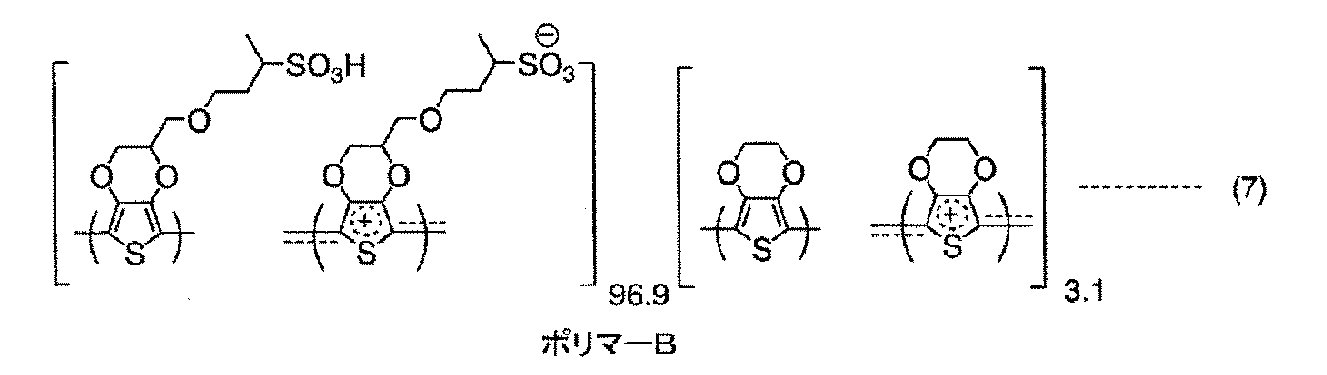
EDOTを0.068g(0.049mmol)に変更して、実施例1と同様な操作を行うことにより、H型ポリマーBを0.80重量%含む濃青色水溶液を444.0g合成した。
H型ポリマーBを0.80重量%含む水溶液を無アルカリガラス板(25mm×75mm)にキャスト後、120℃、30分アニール処理して膜を作製した。得られた膜の表面抵抗値、膜厚及び導電率は、夫々15Ω/□、4.4μm、151S/cmであった。
実施例5 M=NH4
+であるポリマーBの合成
実施例4で得られたH型ポリマーBを0.80重量%含む水溶液125gを50gまで減圧濃縮した後(固形分濃度=2重量%)、得られた濃縮液に5mlのアンモニア水を加えて一晩攪拌した。次に、水を30g添加し攪拌した後、再度、全量が34gになるまで濃縮した。得られた濃縮液を350mlに再沈し、ろ過・乾燥することにより対応するポリマーBのアンモニウム塩を黒色粉末として1.19g合成した。
実施例4で得られたH型ポリマーBを0.80重量%含む水溶液125gを50gまで減圧濃縮した後(固形分濃度=2重量%)、得られた濃縮液に5mlのアンモニア水を加えて一晩攪拌した。次に、水を30g添加し攪拌した後、再度、全量が34gになるまで濃縮した。得られた濃縮液を350mlに再沈し、ろ過・乾燥することにより対応するポリマーBのアンモニウム塩を黒色粉末として1.19g合成した。
得られたアンモニウム塩400mgが入った30mlサンプル瓶に水を加えて20gとした。次に、超音波ホモジナイザーを用いて均一化し、2重量%のアンモニウム型のポリマーBを含む水溶液を合成した。
2重量%のアンモニウム型のポリマーBを含む水溶液を0.5重量%水溶液に調製後、無アルカリガラス板(25mm角)にキャストし、120℃、30分アニール処理して膜を作製した。得られた膜の表面抵抗値、膜厚及び導電率は、夫々36Ω/□、2.2μm、126S/cmであった。
実施例6 下式(8)で表される水溶性導電性高分子(H型ポリマーC)の合成
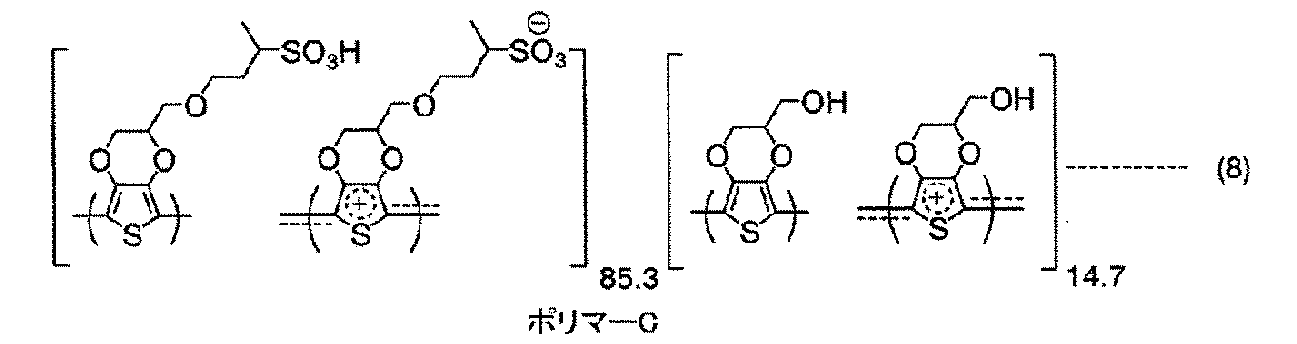
メカニカルスターラーを装着した100ml丸底フラスコに、窒素雰囲気下、ヒドロキシメチル-3,4-エチレンジオキシチオフェン(以下、HMEDOTと略す)0.267g(1.56mmol)、水 100gを攪拌しながら加えた。HMEDOTが溶解したことを確認後、攪拌しながら3-[(2,3-ジヒドロチエノ[3,4-b]-[1,4]ジオキシン-2-イル)メトキシ]-1-メチル-1-プロパンスルホン酸ナトリウム 3.0g(9.09mmol)を加え、反応液が均一になるまで攪拌した。
次に、室温下、無水塩化鉄(III)0.88g(5.4mmol)を加えて20分攪拌し、引続き、過硫酸ナトリウム4.32g(18.1mmol)と15gの水からなる混合溶液を反応液温度が30℃以下を保持するように滴下した。滴下終了後3時間攪拌したのち、反応液を240gのアセトンに滴下させて黒色のポリマーを得た。ポリマーを濾過・真空乾燥することで、5.93のNa型の粗ポリマーを得た。
さらに、Na型の粗ポリマー5.9gに水を加えて500gとした後、日本精機製US-300T超音波ホモジナイザーを用いて均一溶液とした。得られた均一溶液を、陽イオン交換樹脂Imberlite 120(H型)150mlを充填したカラムに通液(空間速度=1.1)することによりH型に変換し、さらにクロスフロー式限外ろ過(ろ過器=ビバフロー200,分画分子量=10,000、透過倍率=15)により精製することによりH型ポリマーCを0.69重量%含む311gの濃青色水溶液を得た。
H型ポリマーCを0.69重量%含む水溶液を無アルカリガラス板(25mm×75mm)にキャスト後、120℃、30分アニール処理して製膜した。得られた膜の表面抵抗値、膜厚及び導電率は、夫々20Ω/□、4.0μm、125S/cmであった。
実施例7 M=NH4
+であるポリマーCの合成
実施例6で得られたH型ポリマーCを0.69重量%含む水溶液 147gを100gまで減圧濃縮した後、得られた濃縮液に5mlのアンモニア水を加えて一晩攪拌した。次に、反応液を50gまで濃縮後、500mlのアセトンに再沈し、ろ過・乾燥することにより対応するポリマーCのアンモニウム塩を黒色粉末として1.26g得た。
実施例6で得られたH型ポリマーCを0.69重量%含む水溶液 147gを100gまで減圧濃縮した後、得られた濃縮液に5mlのアンモニア水を加えて一晩攪拌した。次に、反応液を50gまで濃縮後、500mlのアセトンに再沈し、ろ過・乾燥することにより対応するポリマーCのアンモニウム塩を黒色粉末として1.26g得た。
得られたアンモニウム塩 400mgが入った30mlサンプル瓶に水を加えて20gとした。次に、超音波ホモジナイザーを用いて均一化し、2重量%のアンモニウム型のポリマーCを含む水溶液を合成した。
2重量%のアンモニウム型のポリマーCを含む水溶液を0.5重量%水溶液に調製後、無アルカリガラス板(25mm角)にキャストし、120℃、30分アニール処理して膜を作製した。得られた膜の表面抵抗値、膜厚及び導電率は、夫々48Ω/□、2.0μm、104S/cmであった。
実施例8 下式(9)で表される水溶性導電性高分子(H型ポリマーD)の合成
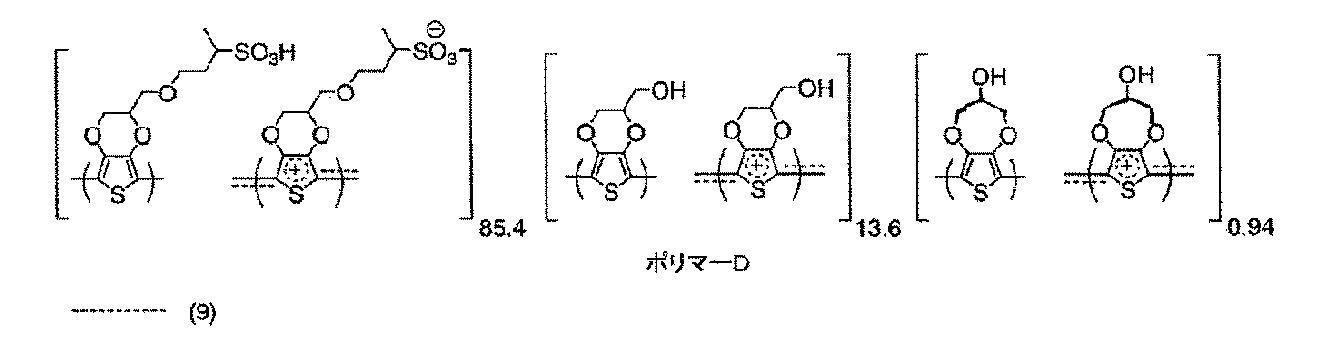
メカニカルスターラーを装着した100ml丸底フラスコに、窒素雰囲気下、HMEDOT 0.249g(1.45mmol)、ヒドロキシ-3,4-プロピレンオキシチオフェン 0.018g(0.10mmol)及び水100gを攪拌しながら加えた。HMEDOT及びヒドロキシ-3,4-プロピレンオキシチオフェンが溶解したことを確認後、攪拌しながら3-[(2,3-ジヒドロチエノ[3,4-b]-[1,4]ジオキシン-2-イル)メトキシ]-1-メチル-1-プロパンスルホン酸ナトリウム 3.0g(9.09mmol)を加え、反応液が均一になるまで攪拌した。
その後、実施例6と同様な重合反応及び精製操作を行い、H型ポリマーDを0.55重量%含む354gの濃青色水溶液を得た。
H型ポリマーDを0.55重量%含む水溶液を無アルカリガラス板(25mm×75mm)にキャスト後、120℃、30分アニール処理して製膜した。得られた膜の表面抵抗値、膜厚及び導電率は、夫々41Ω/□、1.8μm、135S/cmであった。
実施例9 M=NH4
+であるポリマーDの合成
実施例8で得られたH型ポリマーDを0.55重量%含む水溶液を用いて、実施例7の同様の操作を行いに2重量%のアンモニウム型のポリマーDを含む水溶液を合成した。2重量%のアンモニウム型のポリマーDを含む水溶液を0.5重量%水溶液に調製後、無アルカリガラス板(25mm角)にキャストし、120℃、30分アニール処理して膜を作製した。得られた膜の表面抵抗値、膜厚及び導電率は、夫々38Ω/□、2.3μm、11
4S/cmであった。
実施例8で得られたH型ポリマーDを0.55重量%含む水溶液を用いて、実施例7の同様の操作を行いに2重量%のアンモニウム型のポリマーDを含む水溶液を合成した。2重量%のアンモニウム型のポリマーDを含む水溶液を0.5重量%水溶液に調製後、無アルカリガラス板(25mm角)にキャストし、120℃、30分アニール処理して膜を作製した。得られた膜の表面抵抗値、膜厚及び導電率は、夫々38Ω/□、2.3μm、11
4S/cmであった。
実施例10 M=HOCH2CH2NMe3H+であるポリマーA3の合成
実施例1で得られたH型ポリマーA1を0.3重量%含む水溶液 340gを127.5gまで濃縮することにより0.8重量%のH型ポリマーA1水溶液を127.5g得た。その内、72.5gを用いて、攪拌下、50重量%のN,N-ジメチルエタノール水溶液を、水溶液がpH=7.0になるまで加え、ポリマーA3のN,N-ジメチルエタノール塩水溶液を得た。
実施例1で得られたH型ポリマーA1を0.3重量%含む水溶液 340gを127.5gまで濃縮することにより0.8重量%のH型ポリマーA1水溶液を127.5g得た。その内、72.5gを用いて、攪拌下、50重量%のN,N-ジメチルエタノール水溶液を、水溶液がpH=7.0になるまで加え、ポリマーA3のN,N-ジメチルエタノール塩水溶液を得た。
得られたポリマーA3のN,N-ジメチルエタノール塩水溶液について、0.5重量%水溶液に調製後、無アルカリガラス板(25mm角)にキャストし、120℃、30分アニール処理して膜を作製した。得られた膜の表面抵抗値、膜厚及び導電率は、夫々53Ω/□、1.4μm、146S/cmであった。
実施例11
実施例1で得られた共重合体の水に対する溶解性を検討するため、共重合体を2重量%含む水溶液 4mlを日本インデグリシス社製のディスポーザブルフィルター(除粒子径=0.02μm)を装着したシリンジに充填し、フィルター通過が可能かを検討した。その結果、ろ過液の透過液は濃青色を呈していたことから、フィルター通過が可能であることを確認し、共重合体の粒径は20nm以下であることがわかった。また、粒径測定を行ったところ、粒子径(D50)は、1nmであった。
実施例1で得られた共重合体の水に対する溶解性を検討するため、共重合体を2重量%含む水溶液 4mlを日本インデグリシス社製のディスポーザブルフィルター(除粒子径=0.02μm)を装着したシリンジに充填し、フィルター通過が可能かを検討した。その結果、ろ過液の透過液は濃青色を呈していたことから、フィルター通過が可能であることを確認し、共重合体の粒径は20nm以下であることがわかった。また、粒径測定を行ったところ、粒子径(D50)は、1nmであった。
実施例12
実施例2~10で得られた共重合体の2重量%水溶液を調製後、粒子径測定及び実施例9と同様のろ過検討を行った。その結果、D50は全て1nmであり、また、いずれも20nmフィルターを透過できることを確認した。
実施例2~10で得られた共重合体の2重量%水溶液を調製後、粒子径測定及び実施例9と同様のろ過検討を行った。その結果、D50は全て1nmであり、また、いずれも20nmフィルターを透過できることを確認した。
実施例13 M=HC3H4N2
+(1H-イミダゾール-3-カチオン)であるポリマーA4の合成
実施例1で得られたH型ポリマーA1を0.3重量%含む水溶液を2.0重量%まで減圧濃縮した後、得られた濃縮液95.8g(pH1.9)に50重量%のイミダゾール水溶液を(計2.41g)を少しずつ加えてpH7.8に調整し、2.0重量%のイミダゾール型のポリマーA4を含む水溶液を合成した。
実施例1で得られたH型ポリマーA1を0.3重量%含む水溶液を2.0重量%まで減圧濃縮した後、得られた濃縮液95.8g(pH1.9)に50重量%のイミダゾール水溶液を(計2.41g)を少しずつ加えてpH7.8に調整し、2.0重量%のイミダゾール型のポリマーA4を含む水溶液を合成した。
2.0重量%のイミダゾール型のポリマーA4を含む水溶液について、0.5重量%水溶液に調製後、無アルカリガラス板(25mm角)にキャストして膜を作製した。得られた膜の表面抵抗値、膜厚及び導電率は、夫々53Ω/□、2.0μm、94S/cmであった。
比較例1
国際公開第2014/007299号公報に従い、下式(10)で表されるアンモニウム塩型のホモポリマーを合成した。導電率を測定したところ、80S/cmであった。
国際公開第2014/007299号公報に従い、下式(10)で表されるアンモニウム塩型のホモポリマーを合成した。導電率を測定したところ、80S/cmであった。
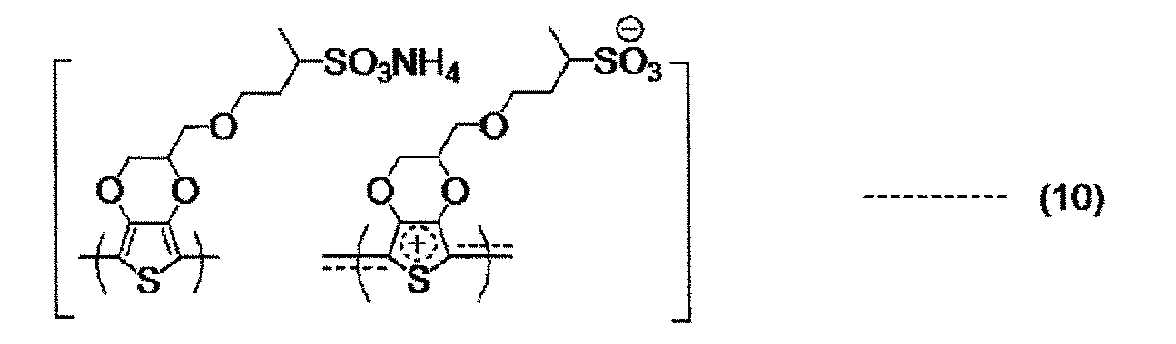
比較例2 下式(11)で表される共重合体の合成

メカニカルスターラーを装着した100ml丸底フラスコに、窒素雰囲気下、ヒドロキシメチル-3,4-エチレンジオキシチオフェン(以下、HMEDOTと略す) 0.536g(3.14mmol)、水 100gを攪拌しながら加えた。HMEDOTが溶解したことを確認後、攪拌しながら3-[(2,3-ジヒドロチエノ[3,4-b]-[1,4]ジオキシン-2-イル)メトキシ]-1-メチル-1-プロパンスルホン酸ナトリウム 3.0g(9.09mmol)を加え、反応液が均一になるまで攪拌した。
次に、室温下、無水塩化鉄(III)0.88g(5.4mmol)を加えて20分攪拌し、引続き、過硫酸ナトリウム4.32g(18.1mmol)と15gの水からなる混合溶液を反応液温度が30℃以下を保持するように滴下した。滴下終了後3時間攪拌したのち、反応液を240gのアセトンに滴下させて黒色のポリマーを得た。ポリマーを濾過・真空乾燥することで、6.40gのNa型の粗ポリマーを得た。
さらに、Na型の粗ポリマー6.4gに水を加えて500gとした後、日本精機製US-300T超音波ホモジナイザーを用いて均一溶液とした。得られた均一溶液を、陽イオン交換樹脂Lewatit MonoPlus S100(H型)150mlを充填したカラムに通液(空間速度=1.1)することによりH型に変換した640gの黒色水溶液を得た(この時点で、固形分濃度は約0.3重量%)。しかし、0.45μmシリンジフィルターを用いたろ過試験では、上記黒色水溶液を通液することができなかった。
また、上記黒色水溶液を一晩放置すると、ゼリー状物質が析出していたことから、下式(11)で示される共重合体は、十分な水溶性がないことがわかった。そのため、導電率の測定は行わなかった。
以下の表1に、実施例1~10及び比較例1~2での共重合体製造時のチオフェン化合物及びコモノマーの仕込み量(mol%)、得られた共重合体の導電率、ろ過性を示す。
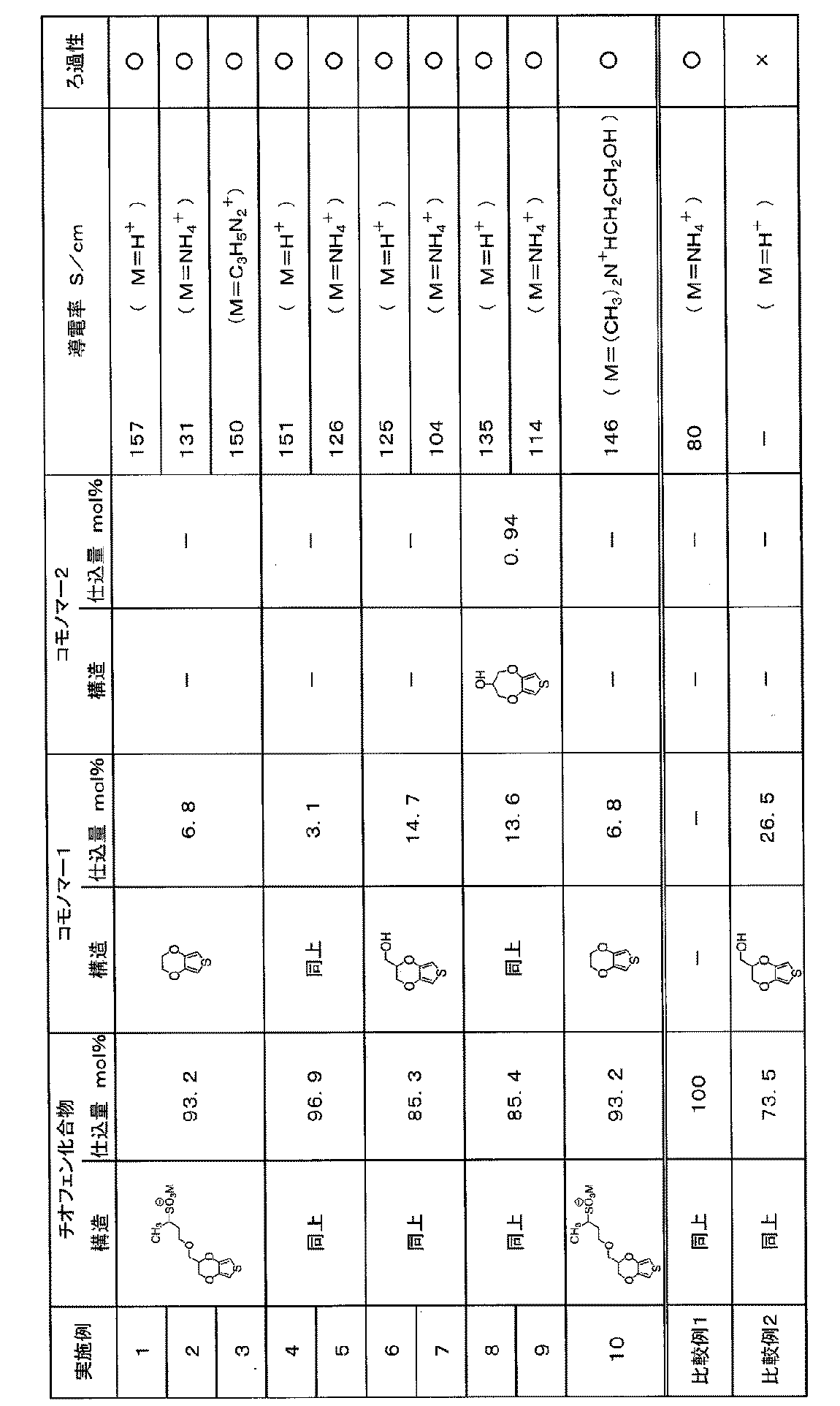
この表1において、比較例1及び比較例2に比較して、実施例1~10の共重合体は、導電率が大きく、且つ、ろ過性が良好なものである。
比較例3
PEDOT:PSS(黒色の水分散性)について、実施例11と同様に、フィルター通過試験を行った。得られたろ液は無色透明であったことから、PEDOT:PSSはフィルター通過できず、PEDOTの粒径は20nm以上であることがわかった。
PEDOT:PSS(黒色の水分散性)について、実施例11と同様に、フィルター通過試験を行った。得られたろ液は無色透明であったことから、PEDOT:PSSはフィルター通過できず、PEDOTの粒径は20nm以上であることがわかった。
実施例14
実施例10で得られたポリマーA3(X)を1.6重量%含む水溶液6.21gに、界面活性剤(Y)として、非イオン界面活性剤の一種であるアセチレングリコール型界面活性剤(日信化学工業社製 オルフィンEXP.4200:HLB=10~13)を0.5重量%水溶液として2.03g、高分子界面活性剤ポリビニルピロリドンK90(BASF社製 SokalanK90 分子量140万)を1.0重量%含む水溶液2.76g、さらに水溶性化合物(W)としてエタノールを1.08g、水2.02gを加えてよく攪拌混合して本発明の導電性高分子水溶液を得た。本配合液の組成は、0.70重量%の共重合体(ポリマーA3)と0.23重量%のポリビニルピロリドンK90を含む。引き続き7.5重量%エタノール水溶液で10倍に希釈してコーティング液を作製し、バーコーターを用いてPET基材に塗布した。乾燥後に得られた積層膜の表面抵抗値を測定した結果、測定箇所によらず安定的に1.8E+5Ω/□を示し、均一性と良好な帯電防止能を有していることが分かった。
実施例10で得られたポリマーA3(X)を1.6重量%含む水溶液6.21gに、界面活性剤(Y)として、非イオン界面活性剤の一種であるアセチレングリコール型界面活性剤(日信化学工業社製 オルフィンEXP.4200:HLB=10~13)を0.5重量%水溶液として2.03g、高分子界面活性剤ポリビニルピロリドンK90(BASF社製 SokalanK90 分子量140万)を1.0重量%含む水溶液2.76g、さらに水溶性化合物(W)としてエタノールを1.08g、水2.02gを加えてよく攪拌混合して本発明の導電性高分子水溶液を得た。本配合液の組成は、0.70重量%の共重合体(ポリマーA3)と0.23重量%のポリビニルピロリドンK90を含む。引き続き7.5重量%エタノール水溶液で10倍に希釈してコーティング液を作製し、バーコーターを用いてPET基材に塗布した。乾燥後に得られた積層膜の表面抵抗値を測定した結果、測定箇所によらず安定的に1.8E+5Ω/□を示し、均一性と良好な帯電防止能を有していることが分かった。
実施例15
実施例14で非イオン界面活性剤の一種であるアセチレングリコール型界面活性剤(日信化学工業社製 オルフィンEXP.4200:HLB=10~13)を添加しなかった以外は、実施例1に準拠して行った結果、得られた塗膜の表面抵抗値は、測定箇所によらず安定的に2.3E+5Ω/□を示し、均一性と良好な帯電防止能を有していることが分かった。
実施例14で非イオン界面活性剤の一種であるアセチレングリコール型界面活性剤(日信化学工業社製 オルフィンEXP.4200:HLB=10~13)を添加しなかった以外は、実施例1に準拠して行った結果、得られた塗膜の表面抵抗値は、測定箇所によらず安定的に2.3E+5Ω/□を示し、均一性と良好な帯電防止能を有していることが分かった。
比較例4
実施例10で得られたポリマーA3を1.6重量%含む水溶液に何も添加せずに実施例14に示した方法で成膜を試みた結果、ハジキ等によりPETフィルム基材上に導電性高分子膜を形成できなかった。
実施例10で得られたポリマーA3を1.6重量%含む水溶液に何も添加せずに実施例14に示した方法で成膜を試みた結果、ハジキ等によりPETフィルム基材上に導電性高分子膜を形成できなかった。
実施例16
実施例13で得られたポリマーA4(X)を2.0重量%含む水溶液95.8gに、界面活性剤(Y)として、高分子型界面活性剤[ビニルピロリドン―酢酸ビニル]ブロック共重合体(BASF社製 SokalanVA64)を1.0重量%水溶液として4.60g、水7.90gを加えてよく攪拌混合した後、0.45μmのメンブレンフィルターに通液した。本配合液の組成は、0.75重量%の共重合体(ポリマーA4)と0.23重量%の[ビニルピロリドン―酢酸ビニル]ブロック共重合体を含む。
実施例13で得られたポリマーA4(X)を2.0重量%含む水溶液95.8gに、界面活性剤(Y)として、高分子型界面活性剤[ビニルピロリドン―酢酸ビニル]ブロック共重合体(BASF社製 SokalanVA64)を1.0重量%水溶液として4.60g、水7.90gを加えてよく攪拌混合した後、0.45μmのメンブレンフィルターに通液した。本配合液の組成は、0.75重量%の共重合体(ポリマーA4)と0.23重量%の[ビニルピロリドン―酢酸ビニル]ブロック共重合体を含む。
このようにして得られたpH=7.8の導電性高分子水溶液1.0gを、3.0cm角にカットしたPETフィルムにスピンコートして成膜した(3000rpm×80秒、次いで100℃×60秒ホットプレート上で乾燥)。
得られた膜の表面抵抗値は、測定箇所によらず安定的に6.1E+5Ω/□を示し、均一性と良好な帯電防止能を有していることが分かった。
比較例5
実施例13で得られたポリマーA4を1.6重量%含む水溶液に何も添加せずに実施例15に示した方法で成膜を試みた結果、スピンコーティング時に液全体が基板からハジキ等により飛散し、PETフィルム基材上に導電性高分子膜を形成できなかった。
実施例13で得られたポリマーA4を1.6重量%含む水溶液に何も添加せずに実施例15に示した方法で成膜を試みた結果、スピンコーティング時に液全体が基板からハジキ等により飛散し、PETフィルム基材上に導電性高分子膜を形成できなかった。
実施例17
実施例2で得られたポリマーA2(X)を2.5重量%含む水溶液8.0gに、界面活性剤(Y)として非イオン界面活性剤の一種であるアセチレングリコール型界面活性剤(日信化学工業社製 オルフィンEXP.4200)を0.5重量%水溶液として1.6gを加えてよく攪拌混合した後、さらに多価アルコールとしてD-ソルビトールを0.1g加えてよく撹拌混合して導電性高分子水溶液を得た。この導電性高分子水溶液中に中性紙を浸漬・乾燥した後の表面状態を観察した結果を図1に示す。
実施例2で得られたポリマーA2(X)を2.5重量%含む水溶液8.0gに、界面活性剤(Y)として非イオン界面活性剤の一種であるアセチレングリコール型界面活性剤(日信化学工業社製 オルフィンEXP.4200)を0.5重量%水溶液として1.6gを加えてよく攪拌混合した後、さらに多価アルコールとしてD-ソルビトールを0.1g加えてよく撹拌混合して導電性高分子水溶液を得た。この導電性高分子水溶液中に中性紙を浸漬・乾燥した後の表面状態を観察した結果を図1に示す。
本導電性高分子水溶液は良好な濡れ性を示し、斑の無い均一状態で得られた。本結果から、セパレータを介して陽極アルミ箔と陰極アルミ箔を巻回して作製する巻回型固体アルミ電解コンデンサの作製において、本導電性高分子水溶液は紙製セパレータへの濡れ性がよく、均一に付着・保持されるため、接する化成済みエッチドアルミ箔にも均一に浸透することができると考えられる。これにより、斑無くエッチングピット内を導電性高分子膜で被覆できるため、コンデンサ特性(静電容量向上、低ESR化)の改善が期待される。
比較例6
実施例2で得られたポリマーA2を2.5重量%含む水溶液に、界面活性剤を添加せずに、中性紙を浸漬・乾燥した後の表面状態を観察した結果を図1に示す。濡れ性が不十分で濃淡が観測され、均一に塗布できなかった。
実施例2で得られたポリマーA2を2.5重量%含む水溶液に、界面活性剤を添加せずに、中性紙を浸漬・乾燥した後の表面状態を観察した結果を図1に示す。濡れ性が不十分で濃淡が観測され、均一に塗布できなかった。
本発明を詳細に、また特定の実施態様を参照して説明したが、本発明の本質と範囲を逸脱することなく様々な変更や修正を加えることができることは当業者にとって明らかである。
なお、2014年6月19日に出願された日本特許出願2014-126572号、2014年11月17日に出願された日本特許出願2014-233152号、及び2015年1月29日に出願された日本特許出願2015-015668号の明細書、特許請求の範囲、図面及び要約書の全内容をここに引用し、本発明の明細書の開示として、取り入れるものである。
本発明による新規な共重合体及びその水溶液は、その高い導電性と十分な水溶性のため、電子線リソグラフィー時に、レジストの帯電を抑制するための帯電防止膜形成材料としての使用が期待される。また、水溶液とした場合にポリマー粒子径が非常に小さいことから、例えば、アルミ固体電解コンデンサの化成処理されたエッチドアルミ箔への浸透性がよいことが考えられ、それにより導電性ポリマーによる被覆面積が向上し、静電容量のアップと低ESR化などのコンデンサの性能改善が期待される。
Claims (15)
- 下記式(M1)で表される繰り返し単位(「チオフェンモノマー」という)、及び下記式(M2)、(M3)、及び(M4)から選ばれる少なくとも一つの繰り返し単位(「コモノマー」という)を含んでなり、チオフェンモノマー及びコモノマーは自己ドープされていてもよく、且つチオフェンモノマー/コモノマー(モル/モル)の比が3~9999であることを特徴とする共重合体。

- 下記式(M1)で表される繰り返し単位(「チオフェンモノマー」という)と下記式(M2)及び(M3)から選ばれる少なくとも一つの繰り返し単位(「コモノマー」という)を含み、チオフェンモノマー及びコモノマーは自己ドープされていてもよく、且つチオフェンモノマー/コモノマー(モル/モル)の比が3~9999であることを特徴とする共重合体。
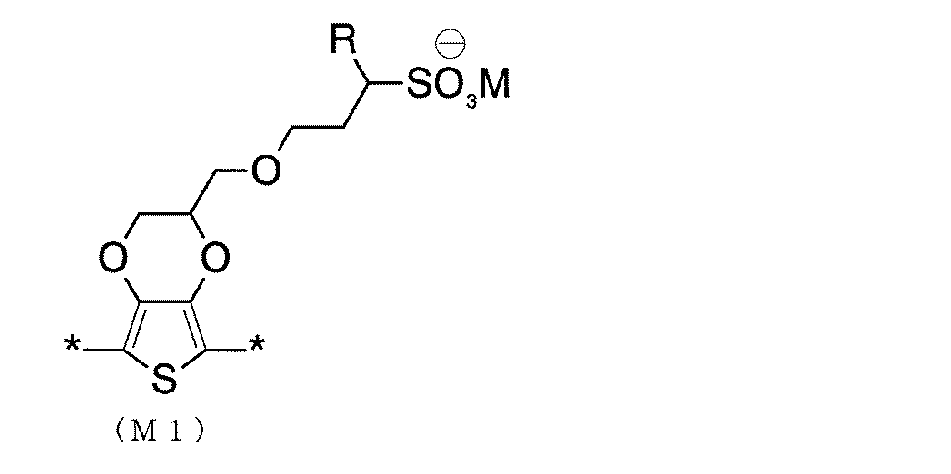

- アミン化合物が、N(R1)(R2)(R3)で表される化合物(当該R1~R3は各々独立して水素原子、又は置換基を有していてもよい炭素数1~6のアルキル基を表す)、C5H5N(ピリジン)、又はイミダゾール化合物であることを特徴とする請求項1又は2に記載の共重合体。
- コモノマーとして、下記一般式(M4)で表される繰り返し単位をさらに含むことを特徴とする請求項2に記載の共重合体。
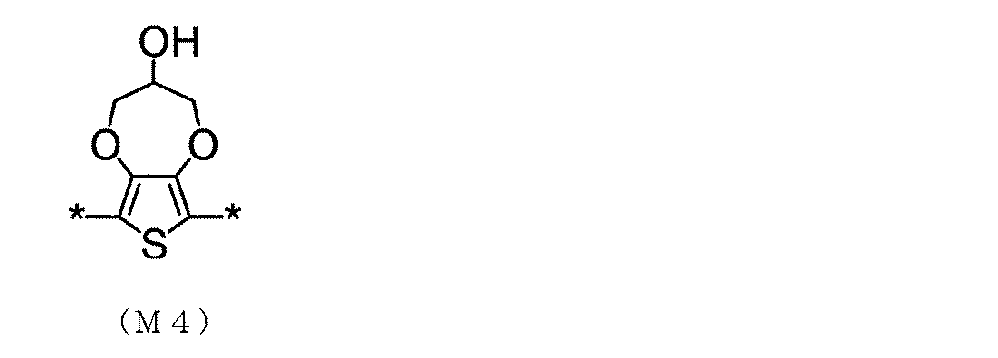
- 下記式(1)で表されるチオフェン化合物と下記式(2)、(3)及び(4)から選ばれる少なくとも一種のチオフェン化合物を、水又はアルコール溶媒中、酸化剤の存在下に重合させることを特徴とする請求項1乃至請求項4のいずれか一項に記載の共重合体の製造方法。

- 下記式(1)で表されるチオフェン化合物と下記式(2)及び(3)から選ばれる少なくとも一種のチオフェン化合物を、水又はアルコール溶媒中、酸化剤の存在下に重合させることを特徴とする請求項2又は3に記載の共重合体の製造方法。
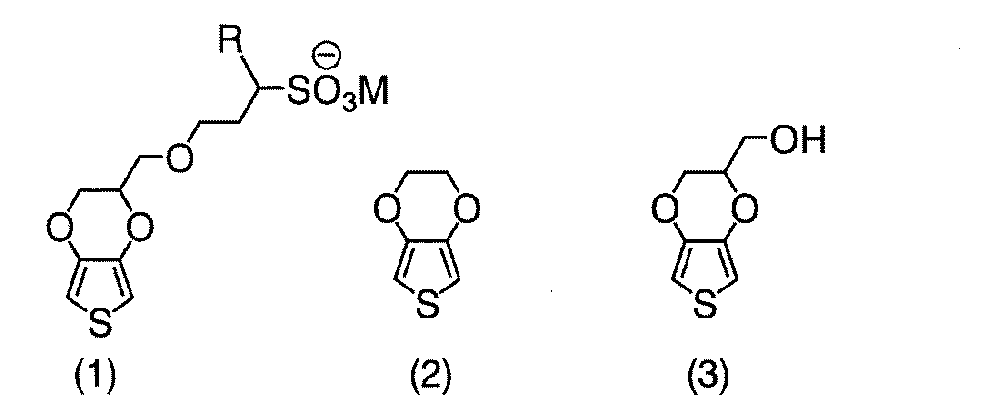
- 請求項6の製造方法において、さらに下記式(4)で表されるチオフェン化合物を加えて重合させることを特徴とする請求項4に記載の共重合体の製造方法。

- 請求項1乃至請求項4のいずれか一項に記載の共重合体を含む導電性ポリマー水溶液。
- 請求項1乃至請求項4のいずれか一項に記載の共重合体(X)を0.01~10重量%含み、且つ少なくとも一種の界面活性剤(Y)を0.001~10重量%含むことを特徴とする導電性ポリマー水溶液。
- 界面活性剤(Y)が、ポリビニルピロリドン、ポリビニルピロリドンの共重合体、ポリエチレングリコール型界面活性剤、アセチレングリコール型界面活性剤、多価アルコール型界面活性剤、及びベタイン型両性界面活性剤からなる群より選ばれる少なくとも一種であることを特徴とする請求項9に記載の導電性ポリマー水溶液。
- 界面活性剤(Y)が、水への溶解度が0.01重量%以上であり、且つグリフィン法HLB(親水親油バランス)が7~20の範囲であることを特徴とする請求項9又は10に記載の導電性ポリマー水溶液。
- さらに、アルコール類及び水溶性樹脂からなる群より選ばれる少なくとも一種の水溶性化合物(W)を0.001~10重量%含むことを特徴とする請求項9乃至請求項11のいずれか一項に記載の導電性ポリマー水溶液。
- pHが10以下であることを特徴とする請求項8乃至請求項12のいずれか一項に記載の導電性ポリマー水溶液。
- さらに、アミン化合物(V)を含み、且つpHが9以下に調整されていることを特徴とする請求項8乃至請求項12のいずれか一項に記載の導電性ポリマー水溶液。
- 請求項8乃至請求項14のいずれか一項に記載の導電性ポリマー水溶液を乾燥して得られる導電性被膜。
Applications Claiming Priority (6)
| Application Number | Priority Date | Filing Date | Title |
|---|---|---|---|
| JP2014126572 | 2014-06-19 | ||
| JP2014-126572 | 2014-06-19 | ||
| JP2014-233152 | 2014-11-17 | ||
| JP2014233152 | 2014-11-17 | ||
| JP2015-015668 | 2015-01-29 | ||
| JP2015015668A JP6485074B2 (ja) | 2014-06-19 | 2015-01-29 | 共重合体、その製造方法、その導電性ポリマー水溶液、及びその用途 |
Publications (1)
| Publication Number | Publication Date |
|---|---|
| WO2015194657A1 true WO2015194657A1 (ja) | 2015-12-23 |
Family
ID=54935633
Family Applications (1)
| Application Number | Title | Priority Date | Filing Date |
|---|---|---|---|
| PCT/JP2015/067692 Ceased WO2015194657A1 (ja) | 2014-06-19 | 2015-06-19 | 共重合体、その製造方法、その導電性ポリマー水溶液、及びその用途 |
Country Status (2)
| Country | Link |
|---|---|
| TW (1) | TW201605926A (ja) |
| WO (1) | WO2015194657A1 (ja) |
Cited By (13)
| Publication number | Priority date | Publication date | Assignee | Title |
|---|---|---|---|---|
| JP2017155399A (ja) * | 2016-02-26 | 2017-09-07 | 東ソー株式会社 | 繊維含浸用導電性高分子水溶液 |
| JP2017171746A (ja) * | 2016-03-22 | 2017-09-28 | 東ソー株式会社 | 水溶性導電性共重合体、その製造方法、及びその水溶液 |
| JP2017179324A (ja) * | 2016-03-25 | 2017-10-05 | 東ソー株式会社 | 導電性高分子水溶液、及び導電性高分子膜並びに該被覆物品 |
| US20180108487A1 (en) * | 2016-10-18 | 2018-04-19 | Avx Corporation | Solid Electrolytic Capacitor with Improved Performance at High Temperatures and Voltages |
| US10622160B2 (en) | 2017-03-06 | 2020-04-14 | Avx Corporation | Solid electrolytic capacitor assembly |
| US10741333B2 (en) | 2016-10-18 | 2020-08-11 | Avx Corporation | Solid electrolytic capacitor with improved leakage current |
| US10763046B2 (en) | 2016-09-15 | 2020-09-01 | Avx Corporation | Solid electrolytic capacitor with improved leakage current |
| US10892095B2 (en) | 2016-10-18 | 2021-01-12 | Avx Corporation | Solid electrolytic capacitor assembly |
| WO2022258501A1 (en) | 2021-06-08 | 2022-12-15 | Agfa-Gevaert Nv | Novel polythiophene/polyanion compositions |
| JP2023514483A (ja) * | 2020-02-13 | 2023-04-06 | キョーセラ・エイブイエックス・コンポーネンツ・コーポレーション | ポリアニリンを含む固体電解キャパシタ |
| US11837415B2 (en) | 2021-01-15 | 2023-12-05 | KYOCERA AVX Components Corpration | Solid electrolytic capacitor |
| US12476052B2 (en) | 2018-06-21 | 2025-11-18 | KYOCERA AVX Components Corporation | Delamination-resistant solid electrolytic capacitor |
| US12548715B2 (en) | 2018-06-21 | 2026-02-10 | KYOCERA AVX Components Corporation | Solid electrolytic capacitor containing an interfacial coating |
Families Citing this family (1)
| Publication number | Priority date | Publication date | Assignee | Title |
|---|---|---|---|---|
| CN119119426A (zh) * | 2023-06-12 | 2024-12-13 | 牛津大学(苏州)科技有限公司 | 导电聚合物前驱体溶液、导电聚合物膜、制备方法、用途 |
Citations (7)
| Publication number | Priority date | Publication date | Assignee | Title |
|---|---|---|---|---|
| JP2008179809A (ja) * | 2006-12-27 | 2008-08-07 | Toray Ind Inc | 帯電防止材料および帯電防止フィルム |
| JP2011228222A (ja) * | 2010-04-23 | 2011-11-10 | Oike Ind Co Ltd | 導電性コーティング組成物 |
| JP2011225690A (ja) * | 2010-04-19 | 2011-11-10 | Nec Tokin Corp | 導電性高分子懸濁水溶液およびその製造方法、導電性高分子材料ならびに電解コンデンサおよびその製造方法 |
| WO2014007299A1 (ja) * | 2012-07-03 | 2014-01-09 | 東ソー株式会社 | ポリチオフェン類、それを用いた水溶性導電性ポリマー、及びその製造方法 |
| JP2014009342A (ja) * | 2012-07-02 | 2014-01-20 | Shin Etsu Polymer Co Ltd | 導電性高分子組成物、該組成物より得られる帯電防止膜が設けられた被覆品、及び前記組成物を用いたパターン形成方法。 |
| JP2015063652A (ja) * | 2013-04-04 | 2015-04-09 | 東ソー株式会社 | 導電性高分子水溶液、及び導電性高分子膜 |
| JP2015147834A (ja) * | 2014-02-05 | 2015-08-20 | 東ソー株式会社 | 導電性高分子水溶液、及び導電性高分子膜 |
-
2015
- 2015-06-18 TW TW104119810A patent/TW201605926A/zh unknown
- 2015-06-19 WO PCT/JP2015/067692 patent/WO2015194657A1/ja not_active Ceased
Patent Citations (7)
| Publication number | Priority date | Publication date | Assignee | Title |
|---|---|---|---|---|
| JP2008179809A (ja) * | 2006-12-27 | 2008-08-07 | Toray Ind Inc | 帯電防止材料および帯電防止フィルム |
| JP2011225690A (ja) * | 2010-04-19 | 2011-11-10 | Nec Tokin Corp | 導電性高分子懸濁水溶液およびその製造方法、導電性高分子材料ならびに電解コンデンサおよびその製造方法 |
| JP2011228222A (ja) * | 2010-04-23 | 2011-11-10 | Oike Ind Co Ltd | 導電性コーティング組成物 |
| JP2014009342A (ja) * | 2012-07-02 | 2014-01-20 | Shin Etsu Polymer Co Ltd | 導電性高分子組成物、該組成物より得られる帯電防止膜が設けられた被覆品、及び前記組成物を用いたパターン形成方法。 |
| WO2014007299A1 (ja) * | 2012-07-03 | 2014-01-09 | 東ソー株式会社 | ポリチオフェン類、それを用いた水溶性導電性ポリマー、及びその製造方法 |
| JP2015063652A (ja) * | 2013-04-04 | 2015-04-09 | 東ソー株式会社 | 導電性高分子水溶液、及び導電性高分子膜 |
| JP2015147834A (ja) * | 2014-02-05 | 2015-08-20 | 東ソー株式会社 | 導電性高分子水溶液、及び導電性高分子膜 |
Cited By (17)
| Publication number | Priority date | Publication date | Assignee | Title |
|---|---|---|---|---|
| JP2017155399A (ja) * | 2016-02-26 | 2017-09-07 | 東ソー株式会社 | 繊維含浸用導電性高分子水溶液 |
| JP2017171746A (ja) * | 2016-03-22 | 2017-09-28 | 東ソー株式会社 | 水溶性導電性共重合体、その製造方法、及びその水溶液 |
| JP2017179324A (ja) * | 2016-03-25 | 2017-10-05 | 東ソー株式会社 | 導電性高分子水溶液、及び導電性高分子膜並びに該被覆物品 |
| US10763046B2 (en) | 2016-09-15 | 2020-09-01 | Avx Corporation | Solid electrolytic capacitor with improved leakage current |
| US11056286B2 (en) | 2016-09-15 | 2021-07-06 | Avx Corporation | Solid electrolytic capacitor with improved leakage current |
| US11387047B2 (en) * | 2016-10-18 | 2022-07-12 | KYOCERA AVX Components Corporation | Solid electrolytic capacitor with improved performance at high temperatures and voltages |
| US20180108487A1 (en) * | 2016-10-18 | 2018-04-19 | Avx Corporation | Solid Electrolytic Capacitor with Improved Performance at High Temperatures and Voltages |
| US10741333B2 (en) | 2016-10-18 | 2020-08-11 | Avx Corporation | Solid electrolytic capacitor with improved leakage current |
| US10892095B2 (en) | 2016-10-18 | 2021-01-12 | Avx Corporation | Solid electrolytic capacitor assembly |
| US11170942B2 (en) | 2016-10-18 | 2021-11-09 | Avx Corporation | Solid electrolytic capacitor with improved leakage current |
| US10622160B2 (en) | 2017-03-06 | 2020-04-14 | Avx Corporation | Solid electrolytic capacitor assembly |
| US12476052B2 (en) | 2018-06-21 | 2025-11-18 | KYOCERA AVX Components Corporation | Delamination-resistant solid electrolytic capacitor |
| US12548715B2 (en) | 2018-06-21 | 2026-02-10 | KYOCERA AVX Components Corporation | Solid electrolytic capacitor containing an interfacial coating |
| JP2023514483A (ja) * | 2020-02-13 | 2023-04-06 | キョーセラ・エイブイエックス・コンポーネンツ・コーポレーション | ポリアニリンを含む固体電解キャパシタ |
| US11837415B2 (en) | 2021-01-15 | 2023-12-05 | KYOCERA AVX Components Corpration | Solid electrolytic capacitor |
| WO2022258501A1 (en) | 2021-06-08 | 2022-12-15 | Agfa-Gevaert Nv | Novel polythiophene/polyanion compositions |
| US12492303B2 (en) | 2021-06-08 | 2025-12-09 | Agfa-Gevaert Nv | Polythiophene/polyanion compositions |
Also Published As
| Publication number | Publication date |
|---|---|
| TW201605926A (zh) | 2016-02-16 |
Similar Documents
| Publication | Publication Date | Title |
|---|---|---|
| JP6485074B2 (ja) | 共重合体、その製造方法、その導電性ポリマー水溶液、及びその用途 | |
| WO2015194657A1 (ja) | 共重合体、その製造方法、その導電性ポリマー水溶液、及びその用途 | |
| JP6131780B2 (ja) | ポリチオフェン及びその水溶液、並びにそのチオフェンモノマー | |
| JP6515609B2 (ja) | 導電性高分子水溶液、及び導電性高分子膜並びに該被覆物品 | |
| JP6645138B2 (ja) | 導電性高分子水溶液、及び導電性高分子膜並びに該被覆物品 | |
| JP6645141B2 (ja) | 導電性高分子水溶液、及び導電性高分子膜並びに該被覆物品 | |
| JP6273917B2 (ja) | チオフェン共重合体及びその水溶液、並びにチオフェンモノマー組成物及びその製造方法 | |
| JP7279488B2 (ja) | 導電性高分子水溶液、及び導電性高分子膜 | |
| JP6902876B2 (ja) | ポリチオフェン及びその組成物、並びにその用途 | |
| JP6911293B2 (ja) | 導電性高分子水溶液、及び導電性高分子膜並びに該被覆物品 | |
| JP2018184586A (ja) | 導電性高分子水溶液 | |
| JP2019131778A (ja) | 導電性高分子水溶液、及び導電性高分子膜 | |
| JP6911467B2 (ja) | 光学活性チオフェン化合物、光学活性ポリチオフェン、及びそれらの製造法 | |
| JP6977246B2 (ja) | 帯電防止薄膜、及び帯電防止用水溶液 | |
| JP7206730B2 (ja) | 導電性高分子水溶液、及び導電性高分子膜 | |
| JP7167570B2 (ja) | 導電性高分子水溶液、導電性高分子膜、及び被覆物品 | |
| JP7003671B2 (ja) | 導電性高分子水溶液、及び導電性高分子膜 | |
| KR20140000339A (ko) | 신규한 폴리비닐 술폰산, 그의 제조 방법 및 그의 용도 | |
| JP6724526B2 (ja) | 水溶性導電性高分子、その製造方法、その導電性高分子水溶液、及びその用途 | |
| JP2025124765A (ja) | 導電性高分子組成物、及び導電性高分子膜 | |
| JP2019196443A (ja) | 導電性高分子水溶液、及び導電性高分子膜 | |
| JP7151065B2 (ja) | 導電性高分子水溶液及びその用途 | |
| JP2021161371A (ja) | 導電性高分子溶液、及び導電性高分子膜並びに該被覆物品 | |
| JP6753092B2 (ja) | 水溶性導電性共重合体、その製造方法、及びその水溶液 | |
| JP7638722B2 (ja) | 導電性高分子分散液、導電性高分子膜および電解コンデンサ |
Legal Events
| Date | Code | Title | Description |
|---|---|---|---|
| 121 | Ep: the epo has been informed by wipo that ep was designated in this application |
Ref document number: 15810015 Country of ref document: EP Kind code of ref document: A1 |
|
| NENP | Non-entry into the national phase |
Ref country code: DE |
|
| 122 | Ep: pct application non-entry in european phase |
Ref document number: 15810015 Country of ref document: EP Kind code of ref document: A1 |