WO2015129489A1 - 環状オレフィン系フィルム、光学フィルム、導電性フィルム、プリンテッドエレクトロニクス用基材フィルム、バリアフィルム、タッチパネル、偏光板および表示装置 - Google Patents
環状オレフィン系フィルム、光学フィルム、導電性フィルム、プリンテッドエレクトロニクス用基材フィルム、バリアフィルム、タッチパネル、偏光板および表示装置 Download PDFInfo
- Publication number
- WO2015129489A1 WO2015129489A1 PCT/JP2015/053988 JP2015053988W WO2015129489A1 WO 2015129489 A1 WO2015129489 A1 WO 2015129489A1 JP 2015053988 W JP2015053988 W JP 2015053988W WO 2015129489 A1 WO2015129489 A1 WO 2015129489A1
- Authority
- WO
- WIPO (PCT)
- Prior art keywords
- film
- cyclic olefin
- mass
- layer
- oxazoline group
- Prior art date
- Legal status (The legal status is an assumption and is not a legal conclusion. Google has not performed a legal analysis and makes no representation as to the accuracy of the status listed.)
- Ceased
Links
- 0 CC*[C@@](C1=Cc2c(CC)[n]nc2C)NNC1=O Chemical compound CC*[C@@](C1=Cc2c(CC)[n]nc2C)NNC1=O 0.000 description 1
Classifications
-
- B—PERFORMING OPERATIONS; TRANSPORTING
- B32—LAYERED PRODUCTS
- B32B—LAYERED PRODUCTS, i.e. PRODUCTS BUILT-UP OF STRATA OF FLAT OR NON-FLAT, e.g. CELLULAR OR HONEYCOMB, FORM
- B32B27/00—Layered products comprising a layer of synthetic resin
- B32B27/06—Layered products comprising a layer of synthetic resin as the main or only constituent of a layer, which is next to another layer of the same or of a different material
- B32B27/08—Layered products comprising a layer of synthetic resin as the main or only constituent of a layer, which is next to another layer of the same or of a different material of synthetic resin
-
- B—PERFORMING OPERATIONS; TRANSPORTING
- B32—LAYERED PRODUCTS
- B32B—LAYERED PRODUCTS, i.e. PRODUCTS BUILT-UP OF STRATA OF FLAT OR NON-FLAT, e.g. CELLULAR OR HONEYCOMB, FORM
- B32B23/00—Layered products comprising a layer of cellulosic plastic substances, i.e. substances obtained by chemical modification of cellulose, e.g. cellulose ethers, cellulose esters, viscose
- B32B23/04—Layered products comprising a layer of cellulosic plastic substances, i.e. substances obtained by chemical modification of cellulose, e.g. cellulose ethers, cellulose esters, viscose comprising such cellulosic plastic substance as the main or only constituent of a layer, which is next to another layer of the same or of a different material
- B32B23/08—Layered products comprising a layer of cellulosic plastic substances, i.e. substances obtained by chemical modification of cellulose, e.g. cellulose ethers, cellulose esters, viscose comprising such cellulosic plastic substance as the main or only constituent of a layer, which is next to another layer of the same or of a different material of synthetic resin
-
- B—PERFORMING OPERATIONS; TRANSPORTING
- B32—LAYERED PRODUCTS
- B32B—LAYERED PRODUCTS, i.e. PRODUCTS BUILT-UP OF STRATA OF FLAT OR NON-FLAT, e.g. CELLULAR OR HONEYCOMB, FORM
- B32B27/00—Layered products comprising a layer of synthetic resin
- B32B27/28—Layered products comprising a layer of synthetic resin comprising synthetic resins not wholly covered by any one of the sub-groups B32B27/30 - B32B27/42
- B32B27/283—Layered products comprising a layer of synthetic resin comprising synthetic resins not wholly covered by any one of the sub-groups B32B27/30 - B32B27/42 comprising polysiloxanes
-
- B—PERFORMING OPERATIONS; TRANSPORTING
- B32—LAYERED PRODUCTS
- B32B—LAYERED PRODUCTS, i.e. PRODUCTS BUILT-UP OF STRATA OF FLAT OR NON-FLAT, e.g. CELLULAR OR HONEYCOMB, FORM
- B32B27/00—Layered products comprising a layer of synthetic resin
- B32B27/30—Layered products comprising a layer of synthetic resin comprising vinyl (co)polymers; comprising acrylic (co)polymers
- B32B27/302—Layered products comprising a layer of synthetic resin comprising vinyl (co)polymers; comprising acrylic (co)polymers comprising aromatic vinyl (co)polymers, e.g. styrenic (co)polymers
-
- B—PERFORMING OPERATIONS; TRANSPORTING
- B32—LAYERED PRODUCTS
- B32B—LAYERED PRODUCTS, i.e. PRODUCTS BUILT-UP OF STRATA OF FLAT OR NON-FLAT, e.g. CELLULAR OR HONEYCOMB, FORM
- B32B27/00—Layered products comprising a layer of synthetic resin
- B32B27/30—Layered products comprising a layer of synthetic resin comprising vinyl (co)polymers; comprising acrylic (co)polymers
- B32B27/308—Layered products comprising a layer of synthetic resin comprising vinyl (co)polymers; comprising acrylic (co)polymers comprising acrylic (co)polymers
-
- B—PERFORMING OPERATIONS; TRANSPORTING
- B32—LAYERED PRODUCTS
- B32B—LAYERED PRODUCTS, i.e. PRODUCTS BUILT-UP OF STRATA OF FLAT OR NON-FLAT, e.g. CELLULAR OR HONEYCOMB, FORM
- B32B27/00—Layered products comprising a layer of synthetic resin
- B32B27/32—Layered products comprising a layer of synthetic resin comprising polyolefins
-
- B—PERFORMING OPERATIONS; TRANSPORTING
- B32—LAYERED PRODUCTS
- B32B—LAYERED PRODUCTS, i.e. PRODUCTS BUILT-UP OF STRATA OF FLAT OR NON-FLAT, e.g. CELLULAR OR HONEYCOMB, FORM
- B32B27/00—Layered products comprising a layer of synthetic resin
- B32B27/32—Layered products comprising a layer of synthetic resin comprising polyolefins
- B32B27/325—Layered products comprising a layer of synthetic resin comprising polyolefins comprising polycycloolefins
-
- B—PERFORMING OPERATIONS; TRANSPORTING
- B32—LAYERED PRODUCTS
- B32B—LAYERED PRODUCTS, i.e. PRODUCTS BUILT-UP OF STRATA OF FLAT OR NON-FLAT, e.g. CELLULAR OR HONEYCOMB, FORM
- B32B27/00—Layered products comprising a layer of synthetic resin
- B32B27/36—Layered products comprising a layer of synthetic resin comprising polyesters
-
- B—PERFORMING OPERATIONS; TRANSPORTING
- B32—LAYERED PRODUCTS
- B32B—LAYERED PRODUCTS, i.e. PRODUCTS BUILT-UP OF STRATA OF FLAT OR NON-FLAT, e.g. CELLULAR OR HONEYCOMB, FORM
- B32B27/00—Layered products comprising a layer of synthetic resin
- B32B27/40—Layered products comprising a layer of synthetic resin comprising polyurethanes
-
- B—PERFORMING OPERATIONS; TRANSPORTING
- B32—LAYERED PRODUCTS
- B32B—LAYERED PRODUCTS, i.e. PRODUCTS BUILT-UP OF STRATA OF FLAT OR NON-FLAT, e.g. CELLULAR OR HONEYCOMB, FORM
- B32B7/00—Layered products characterised by the relation between layers; Layered products characterised by the relative orientation of features between layers, or by the relative values of a measurable parameter between layers, i.e. products comprising layers having different physical, chemical or physicochemical properties; Layered products characterised by the interconnection of layers
- B32B7/04—Interconnection of layers
- B32B7/12—Interconnection of layers using interposed adhesives or interposed materials with bonding properties
-
- G—PHYSICS
- G02—OPTICS
- G02B—OPTICAL ELEMENTS, SYSTEMS OR APPARATUS
- G02B1/00—Optical elements characterised by the material of which they are made; Optical coatings for optical elements
- G02B1/04—Optical elements characterised by the material of which they are made; Optical coatings for optical elements made of organic materials, e.g. plastics
-
- G—PHYSICS
- G02—OPTICS
- G02B—OPTICAL ELEMENTS, SYSTEMS OR APPARATUS
- G02B1/00—Optical elements characterised by the material of which they are made; Optical coatings for optical elements
- G02B1/10—Optical coatings produced by application to, or surface treatment of, optical elements
- G02B1/14—Protective coatings, e.g. hard coatings
-
- G—PHYSICS
- G02—OPTICS
- G02B—OPTICAL ELEMENTS, SYSTEMS OR APPARATUS
- G02B5/00—Optical elements other than lenses
- G02B5/30—Polarising elements
- G02B5/3025—Polarisers, i.e. arrangements capable of producing a definite output polarisation state from an unpolarised input state
-
- G—PHYSICS
- G02—OPTICS
- G02F—OPTICAL DEVICES OR ARRANGEMENTS FOR THE CONTROL OF LIGHT BY MODIFICATION OF THE OPTICAL PROPERTIES OF THE MEDIA OF THE ELEMENTS INVOLVED THEREIN; NON-LINEAR OPTICS; FREQUENCY-CHANGING OF LIGHT; OPTICAL LOGIC ELEMENTS; OPTICAL ANALOGUE/DIGITAL CONVERTERS
- G02F1/00—Devices or arrangements for the control of the intensity, colour, phase, polarisation or direction of light arriving from an independent light source, e.g. switching, gating or modulating; Non-linear optics
- G02F1/01—Devices or arrangements for the control of the intensity, colour, phase, polarisation or direction of light arriving from an independent light source, e.g. switching, gating or modulating; Non-linear optics for the control of the intensity, phase, polarisation or colour
- G02F1/13—Devices or arrangements for the control of the intensity, colour, phase, polarisation or direction of light arriving from an independent light source, e.g. switching, gating or modulating; Non-linear optics for the control of the intensity, phase, polarisation or colour based on liquid crystals, e.g. single liquid crystal display cells
- G02F1/133—Constructional arrangements; Operation of liquid crystal cells; Circuit arrangements
- G02F1/1333—Constructional arrangements; Manufacturing methods
- G02F1/1335—Structural association of cells with optical devices, e.g. polarisers or reflectors
- G02F1/133502—Antiglare, refractive index matching layers
-
- G—PHYSICS
- G02—OPTICS
- G02F—OPTICAL DEVICES OR ARRANGEMENTS FOR THE CONTROL OF LIGHT BY MODIFICATION OF THE OPTICAL PROPERTIES OF THE MEDIA OF THE ELEMENTS INVOLVED THEREIN; NON-LINEAR OPTICS; FREQUENCY-CHANGING OF LIGHT; OPTICAL LOGIC ELEMENTS; OPTICAL ANALOGUE/DIGITAL CONVERTERS
- G02F1/00—Devices or arrangements for the control of the intensity, colour, phase, polarisation or direction of light arriving from an independent light source, e.g. switching, gating or modulating; Non-linear optics
- G02F1/01—Devices or arrangements for the control of the intensity, colour, phase, polarisation or direction of light arriving from an independent light source, e.g. switching, gating or modulating; Non-linear optics for the control of the intensity, phase, polarisation or colour
- G02F1/13—Devices or arrangements for the control of the intensity, colour, phase, polarisation or direction of light arriving from an independent light source, e.g. switching, gating or modulating; Non-linear optics for the control of the intensity, phase, polarisation or colour based on liquid crystals, e.g. single liquid crystal display cells
- G02F1/133—Constructional arrangements; Operation of liquid crystal cells; Circuit arrangements
- G02F1/1333—Constructional arrangements; Manufacturing methods
- G02F1/1335—Structural association of cells with optical devices, e.g. polarisers or reflectors
- G02F1/133528—Polarisers
-
- H—ELECTRICITY
- H10—SEMICONDUCTOR DEVICES; ELECTRIC SOLID-STATE DEVICES NOT OTHERWISE PROVIDED FOR
- H10K—ORGANIC ELECTRIC SOLID-STATE DEVICES
- H10K50/00—Organic light-emitting devices
- H10K50/80—Constructional details
- H10K50/84—Passivation; Containers; Encapsulations
- H10K50/844—Encapsulations
-
- H—ELECTRICITY
- H10—SEMICONDUCTOR DEVICES; ELECTRIC SOLID-STATE DEVICES NOT OTHERWISE PROVIDED FOR
- H10K—ORGANIC ELECTRIC SOLID-STATE DEVICES
- H10K77/00—Constructional details of devices covered by this subclass and not covered by groups H10K10/80, H10K30/80, H10K50/80 or H10K59/80
- H10K77/10—Substrates, e.g. flexible substrates
-
- B—PERFORMING OPERATIONS; TRANSPORTING
- B32—LAYERED PRODUCTS
- B32B—LAYERED PRODUCTS, i.e. PRODUCTS BUILT-UP OF STRATA OF FLAT OR NON-FLAT, e.g. CELLULAR OR HONEYCOMB, FORM
- B32B2255/00—Coating on the layer surface
- B32B2255/10—Coating on the layer surface on synthetic resin layer or on natural or synthetic rubber layer
-
- B—PERFORMING OPERATIONS; TRANSPORTING
- B32—LAYERED PRODUCTS
- B32B—LAYERED PRODUCTS, i.e. PRODUCTS BUILT-UP OF STRATA OF FLAT OR NON-FLAT, e.g. CELLULAR OR HONEYCOMB, FORM
- B32B2307/00—Properties of the layers or laminate
- B32B2307/20—Properties of the layers or laminate having particular electrical or magnetic properties, e.g. piezoelectric
- B32B2307/202—Conductive
-
- B—PERFORMING OPERATIONS; TRANSPORTING
- B32—LAYERED PRODUCTS
- B32B—LAYERED PRODUCTS, i.e. PRODUCTS BUILT-UP OF STRATA OF FLAT OR NON-FLAT, e.g. CELLULAR OR HONEYCOMB, FORM
- B32B2307/00—Properties of the layers or laminate
- B32B2307/40—Properties of the layers or laminate having particular optical properties
- B32B2307/42—Polarizing, birefringent, filtering
-
- B—PERFORMING OPERATIONS; TRANSPORTING
- B32—LAYERED PRODUCTS
- B32B—LAYERED PRODUCTS, i.e. PRODUCTS BUILT-UP OF STRATA OF FLAT OR NON-FLAT, e.g. CELLULAR OR HONEYCOMB, FORM
- B32B2457/00—Electrical equipment
- B32B2457/20—Displays, e.g. liquid crystal displays, plasma displays
-
- B—PERFORMING OPERATIONS; TRANSPORTING
- B32—LAYERED PRODUCTS
- B32B—LAYERED PRODUCTS, i.e. PRODUCTS BUILT-UP OF STRATA OF FLAT OR NON-FLAT, e.g. CELLULAR OR HONEYCOMB, FORM
- B32B2457/00—Electrical equipment
- B32B2457/20—Displays, e.g. liquid crystal displays, plasma displays
- B32B2457/202—LCD, i.e. liquid crystal displays
-
- B—PERFORMING OPERATIONS; TRANSPORTING
- B32—LAYERED PRODUCTS
- B32B—LAYERED PRODUCTS, i.e. PRODUCTS BUILT-UP OF STRATA OF FLAT OR NON-FLAT, e.g. CELLULAR OR HONEYCOMB, FORM
- B32B2457/00—Electrical equipment
- B32B2457/20—Displays, e.g. liquid crystal displays, plasma displays
- B32B2457/208—Touch screens
-
- G—PHYSICS
- G02—OPTICS
- G02F—OPTICAL DEVICES OR ARRANGEMENTS FOR THE CONTROL OF LIGHT BY MODIFICATION OF THE OPTICAL PROPERTIES OF THE MEDIA OF THE ELEMENTS INVOLVED THEREIN; NON-LINEAR OPTICS; FREQUENCY-CHANGING OF LIGHT; OPTICAL LOGIC ELEMENTS; OPTICAL ANALOGUE/DIGITAL CONVERTERS
- G02F1/00—Devices or arrangements for the control of the intensity, colour, phase, polarisation or direction of light arriving from an independent light source, e.g. switching, gating or modulating; Non-linear optics
- G02F1/01—Devices or arrangements for the control of the intensity, colour, phase, polarisation or direction of light arriving from an independent light source, e.g. switching, gating or modulating; Non-linear optics for the control of the intensity, phase, polarisation or colour
- G02F1/13—Devices or arrangements for the control of the intensity, colour, phase, polarisation or direction of light arriving from an independent light source, e.g. switching, gating or modulating; Non-linear optics for the control of the intensity, phase, polarisation or colour based on liquid crystals, e.g. single liquid crystal display cells
- G02F1/133—Constructional arrangements; Operation of liquid crystal cells; Circuit arrangements
- G02F1/1333—Constructional arrangements; Manufacturing methods
- G02F1/1335—Structural association of cells with optical devices, e.g. polarisers or reflectors
-
- G—PHYSICS
- G02—OPTICS
- G02F—OPTICAL DEVICES OR ARRANGEMENTS FOR THE CONTROL OF LIGHT BY MODIFICATION OF THE OPTICAL PROPERTIES OF THE MEDIA OF THE ELEMENTS INVOLVED THEREIN; NON-LINEAR OPTICS; FREQUENCY-CHANGING OF LIGHT; OPTICAL LOGIC ELEMENTS; OPTICAL ANALOGUE/DIGITAL CONVERTERS
- G02F1/00—Devices or arrangements for the control of the intensity, colour, phase, polarisation or direction of light arriving from an independent light source, e.g. switching, gating or modulating; Non-linear optics
- G02F1/01—Devices or arrangements for the control of the intensity, colour, phase, polarisation or direction of light arriving from an independent light source, e.g. switching, gating or modulating; Non-linear optics for the control of the intensity, phase, polarisation or colour
- G02F1/13—Devices or arrangements for the control of the intensity, colour, phase, polarisation or direction of light arriving from an independent light source, e.g. switching, gating or modulating; Non-linear optics for the control of the intensity, phase, polarisation or colour based on liquid crystals, e.g. single liquid crystal display cells
- G02F1/137—Devices or arrangements for the control of the intensity, colour, phase, polarisation or direction of light arriving from an independent light source, e.g. switching, gating or modulating; Non-linear optics for the control of the intensity, phase, polarisation or colour based on liquid crystals, e.g. single liquid crystal display cells characterised by the electro-optical or magneto-optical effect, e.g. field-induced phase transition, orientation effect, guest-host interaction or dynamic scattering
- G02F1/139—Devices or arrangements for the control of the intensity, colour, phase, polarisation or direction of light arriving from an independent light source, e.g. switching, gating or modulating; Non-linear optics for the control of the intensity, phase, polarisation or colour based on liquid crystals, e.g. single liquid crystal display cells characterised by the electro-optical or magneto-optical effect, e.g. field-induced phase transition, orientation effect, guest-host interaction or dynamic scattering based on orientation effects in which the liquid crystal remains transparent
- G02F1/1393—Devices or arrangements for the control of the intensity, colour, phase, polarisation or direction of light arriving from an independent light source, e.g. switching, gating or modulating; Non-linear optics for the control of the intensity, phase, polarisation or colour based on liquid crystals, e.g. single liquid crystal display cells characterised by the electro-optical or magneto-optical effect, e.g. field-induced phase transition, orientation effect, guest-host interaction or dynamic scattering based on orientation effects in which the liquid crystal remains transparent the birefringence of the liquid crystal being electrically controlled, e.g. ECB-, DAP-, HAN-, PI-LC cells
- G02F1/1395—Optically compensated birefringence [OCB]- cells or PI- cells
-
- H—ELECTRICITY
- H05—ELECTRIC TECHNIQUES NOT OTHERWISE PROVIDED FOR
- H05K—PRINTED CIRCUITS; CASINGS OR CONSTRUCTIONAL DETAILS OF ELECTRIC APPARATUS; MANUFACTURE OF ASSEMBLAGES OF ELECTRICAL COMPONENTS
- H05K1/00—Printed circuits
- H05K1/02—Details
- H05K1/03—Use of materials for the substrate
- H05K1/0313—Organic insulating material
- H05K1/0353—Organic insulating material consisting of two or more materials, e.g. two or more polymers, polymer + filler, + reinforcement
- H05K1/036—Multilayers with layers of different types
-
- Y—GENERAL TAGGING OF NEW TECHNOLOGICAL DEVELOPMENTS; GENERAL TAGGING OF CROSS-SECTIONAL TECHNOLOGIES SPANNING OVER SEVERAL SECTIONS OF THE IPC; TECHNICAL SUBJECTS COVERED BY FORMER USPC CROSS-REFERENCE ART COLLECTIONS [XRACs] AND DIGESTS
- Y02—TECHNOLOGIES OR APPLICATIONS FOR MITIGATION OR ADAPTATION AGAINST CLIMATE CHANGE
- Y02E—REDUCTION OF GREENHOUSE GAS [GHG] EMISSIONS, RELATED TO ENERGY GENERATION, TRANSMISSION OR DISTRIBUTION
- Y02E10/00—Energy generation through renewable energy sources
- Y02E10/50—Photovoltaic [PV] energy
- Y02E10/549—Organic PV cells
-
- Y—GENERAL TAGGING OF NEW TECHNOLOGICAL DEVELOPMENTS; GENERAL TAGGING OF CROSS-SECTIONAL TECHNOLOGIES SPANNING OVER SEVERAL SECTIONS OF THE IPC; TECHNICAL SUBJECTS COVERED BY FORMER USPC CROSS-REFERENCE ART COLLECTIONS [XRACs] AND DIGESTS
- Y02—TECHNOLOGIES OR APPLICATIONS FOR MITIGATION OR ADAPTATION AGAINST CLIMATE CHANGE
- Y02P—CLIMATE CHANGE MITIGATION TECHNOLOGIES IN THE PRODUCTION OR PROCESSING OF GOODS
- Y02P20/00—Technologies relating to chemical industry
- Y02P20/50—Improvements relating to the production of bulk chemicals
- Y02P20/582—Recycling of unreacted starting or intermediate materials
-
- Y—GENERAL TAGGING OF NEW TECHNOLOGICAL DEVELOPMENTS; GENERAL TAGGING OF CROSS-SECTIONAL TECHNOLOGIES SPANNING OVER SEVERAL SECTIONS OF THE IPC; TECHNICAL SUBJECTS COVERED BY FORMER USPC CROSS-REFERENCE ART COLLECTIONS [XRACs] AND DIGESTS
- Y02—TECHNOLOGIES OR APPLICATIONS FOR MITIGATION OR ADAPTATION AGAINST CLIMATE CHANGE
- Y02P—CLIMATE CHANGE MITIGATION TECHNOLOGIES IN THE PRODUCTION OR PROCESSING OF GOODS
- Y02P70/00—Climate change mitigation technologies in the production process for final industrial or consumer products
- Y02P70/50—Manufacturing or production processes characterised by the final manufactured product
Definitions
- the present invention relates to a cyclic olefin film, an optical film, a conductive film, a substrate film for printed electronics, a barrier film, a touch panel, a polarizing plate, and a display device.
- the cyclic olefin-based film is preferably used because it has high heat resistance and low water absorption, so that it has excellent dimensional stability and has a low photoelastic coefficient and low birefringence.
- the cyclic olefin film has no polar group or is a nonpolar film having very few polar groups as compared with a polyester film or the like, there is a problem that the adhesion to other members is inferior.
- Patent Document 1 a urethane resin layer that functions as an easy-adhesion layer is provided on the surface of the cyclic olefin film, and the cyclic olefin film is adhered to another member via the urethane resin layer. Proposed.
- patent document 2 it is a polarizing plate containing a polarizer, an adhesive bond layer, and a transparent base film, Comprising: It forms using the primer composition containing an oxazoline crosslinking agent between an adhesive bond layer and a transparent base film.
- a polarizing plate having a prepared primer layer is described.
- Patent Document 2 there is no description of examples using a cyclic olefin film as a transparent substrate film, and the content of the oxazoline crosslinking agent in the primer composition containing the oxazoline crosslinking agent used in the examples is It is as high as 200% by mass.
- Patent Document 2 describes that the adhesive force decreases when the primer layer is 100 nm or less.
- Patent Document 3 describes that an easy-adhesive composition is applied on an optical compensation film, and the easy-adhesive composition contains an oxazoline crosslinking agent.
- manufacture example 16 of patent document 3 describes forming an easily bonding layer using the easily adhesive composition containing polyester urethane and an oxazoline containing polymer, content of the oxazoline containing polymer in an easily bonding layer Is higher than 15% by weight.
- Patent Document 3 describes that it is difficult to obtain sufficient adhesion between the polarizer and the protective film when the thickness of the easy adhesion layer is 0.1 ⁇ m.
- the present invention has been made in order to solve the above-mentioned problems, and it was an object to be solved to provide a cyclic olefin film excellent in dry adhesion and wet adhesion. Furthermore, this invention makes it the subject which should be solved to provide the optical film using the said cyclic olefin type film, an electroconductive film, the base film for printed electronics, a barrier film, a touch panel, a polarizing plate, and a display apparatus.
- the present inventors have provided an undercoat layer containing a predetermined amount of an oxazoline group-containing polymer on at least one surface of a layer made of a cyclic olefin resin.
- the present inventors have found that a cyclic olefin-based film excellent in dry adhesion and wet adhesion can be provided, and have completed the present invention.
- the present invention has the following configuration.
- a cyclic olefin film characterized by having an undercoat layer on at least one surface of a layer made of a cyclic olefin resin and containing 2 to 15% by mass of an oxazoline group-containing polymer in the undercoat layer.
- ⁇ 4> The cyclic olefin film according to any one of ⁇ 1> to ⁇ 3>, wherein the content of the oxazoline group-containing polymer in the undercoat layer is 3 to 12% by mass.
- ⁇ 5> The cyclic olefin film according to any one of ⁇ 1> to ⁇ 4>, wherein the oxazoline group-containing polymer has an oxazoline group and a polyalkylene oxide chain.
- ⁇ 6> The cyclic olefin-based film according to any one of ⁇ 1> to ⁇ 5>, wherein the oxazoline group-containing polymer is an acrylic polymer having an oxazoline group and a polyalkylene oxide chain.
- ⁇ 7> The cyclic olefin film according to any one of ⁇ 1> to ⁇ 6>, wherein the glass transition temperature of the oxazoline group-containing polymer is 50 ° C. or higher.
- ⁇ 8> The undercoat layer according to any one of ⁇ 1> to ⁇ 7>, wherein the undercoat layer includes at least one resin selected from polyolefin resins, acrylic resins, modified silicone resins, polyester resins, polyurethane resins, and styrene butadiene rubber resins. Cyclic olefin film.
- ⁇ 9> Forming an undercoat layer by applying a coating liquid containing at least an oxazoline group-containing polymer and a resin on at least one surface of a layer made of a cyclic olefin-based resin; and The manufacturing method of the cyclic olefin type film in any one of ⁇ 8>.
- ⁇ 11> A conductive film comprising the cyclic olefin-based film according to any one of ⁇ 1> to ⁇ 8> and a conductive layer.
- a substrate film for printed electronics comprising the cyclic olefin-based film according to any one of ⁇ 1> to ⁇ 8>.
- a barrier film having the cyclic olefin-based film according to any one of ⁇ 1> to ⁇ 8>.
- a touch panel having the cyclic olefin-based film according to any one of ⁇ 1> to ⁇ 8> or the conductive film according to ⁇ 11>.
- ⁇ 15> A polarizing plate having the cyclic olefin film according to any one of ⁇ 1> to ⁇ 8> or the optical film according to ⁇ 10>.
- a display device comprising the cyclic olefin film according to any one of ⁇ 1> to ⁇ 8>, the optical film according to ⁇ 10>, or the polarizing plate according to ⁇ 15>.
- a cyclic olefin film excellent in dry adhesion and wet adhesion can be provided. Furthermore, according to this invention, the optical film using the said cyclic olefin type film, an electroconductive film, the base film for printed electronics, a barrier film, a touch panel, a polarizing plate, and a display apparatus can be provided.
- a numerical range expressed using “to” means a range including numerical values described before and after “to” as a lower limit value and an upper limit value.
- the cyclic olefin film of the present invention has an undercoat layer on at least one surface of a layer made of a cyclic olefin resin, and the undercoat layer contains 2 to 15% by mass of an oxazoline group-containing polymer. To do.
- the cyclic olefin film of the present invention is excellent in dry adhesion and wet adhesion.
- the undercoat layer is a layer for providing an overcoat layer, and the overcoat layer and the undercoat layer are not self-supporting because they are formed by coating or vapor deposition.
- the thickness of a commercially available undercoat layer is often 0.5 ⁇ m or less, and when the thickness of the undercoat layer exceeds 0.5 ⁇ m, coating failure (coating unevenness, film roll blocking, winding wrinkles, etc.) is likely to occur.
- the adhesive or pressure-sensitive adhesive refers to a material for bonding or sticking two self-supporting objects, for example, bonding a polyvinyl alcohol (PVA) film and a triacetyl cellulose (TAC) film or Used to stick.
- PVA polyvinyl alcohol
- TAC triacetyl cellulose
- the thickness of commercially available adhesives or pressure-sensitive adhesives is often 1 to 10 ⁇ m in terms of dry film thickness.
- the undercoat layer referred to in the present invention is distinguished from an adhesive layer or an adhesive layer formed by applying an adhesive or an adhesive in terms of film thickness.
- the thickness of the undercoat layer is preferably 500 nm or less, more preferably 20 to 400 nm, further preferably 20 to 120 nm, further preferably 20 to 95 nm, and particularly preferably 50 to 95 nm in terms of dry film thickness.
- the cyclic olefin film of the present invention has a layer made of a cyclic olefin resin.
- Preferred examples of norbornene resins (norbornene units) used as the raw material for the cyclic olefin-based resin include saturated norbornene resin-A and saturated norbornene resin-B described below. Any of these saturated norbornene resins can be formed by a solution film forming method or a melt film forming method, which will be described later, but the saturated norbornene resin-A is more preferably formed by a melt film forming method.
- the resin-B is more preferably formed by melting and solution casting.
- saturated norbornene resin-A As the saturated norbornene resin-A, (1) a ring-opening (co) polymer of a norbornene monomer is subjected to polymer modification such as maleic acid addition or cyclopentadiene addition as necessary, and then further hydrogenated. Obtained resin, (2) resin obtained by addition polymerization of norbornene monomer, and (3) obtained by addition copolymerization of norbornene monomer and olefin monomer such as ethylene and ⁇ -olefin. Examples thereof include resins.
- the polymerization method and the hydrogenation method can be performed by conventional methods.
- norbornene-based monomers include norbornene and alkyl and / or alkylidene substitution products thereof (for example, 5-methyl-2-norbornene, 5-dimethyl-2-norbornene, 5-ethyl-2-norbornene, 5-butyl- 2-norbornene, 5-ethylidene-2-norbornene, etc.), polar group substituents such as halogens thereof; dicyclopentadiene, 2,3-dihydrodicyclopentadiene, etc .; dimethanooctahydronaphthalene, its alkyl and / or alkylidene Substituents and polar group substituents such as halogen (for example, 6-methyl-1,4: 5,8-dimethano-1,4,4a, 5,6,7,8,8a-octahydronaphthalene, 6- Ethyl-1,4: 5,8-dimethano-1,4,4a, 5,6,7
- saturated norbornene resin-B examples include those represented by the following general formulas (1) to (4). Among these, those represented by the following general formula (1) are particularly preferable.
- R 1 to R 12 each independently represent a hydrogen atom or a monovalent substituent (preferably an organic group), and at least one of them is a polar group Is preferred.
- the weight average molecular weight of these saturated norbornene resins is usually preferably 5,000 to 1,000,000, more preferably 8,000 to 200,000.
- Examples of the saturated norbornene resin that can be used in the present invention include, for example, JP-A-60-168708, JP-A-62-252406, JP-A-62-2252407, JP-A-2-133413, Examples thereof include resins described in JP-A-63-145324, JP-A-63-264626, JP-A-1-240517, and JP-B-57-8815.
- a hydrogenated polymer obtained by hydrogenating a ring-opening polymer of a norbornene monomer is particularly preferable.
- the saturated norbornene resin at least one tetracyclododecene derivative represented by the following general formula (5) alone or an unsaturated cyclic copolymerizable with the tetracyclododecene derivative.
- a hydrogenated polymer obtained by hydrogenating a polymer obtained by metathesis polymerization with a compound can also be used.
- R 13 to R 16 each independently represent a hydrogen atom or a monovalent substituent (preferably an organic group), and at least one of these is preferably a polar group. Specific examples and preferred ranges of the substituents and polar groups herein are the same as those described for the general formulas (1) to (4).
- R 13 to R 16 when at least one of R 13 to R 16 is a polar group, a polarizing film excellent in adhesion to other materials, heat resistance, etc. Obtainable.
- the polar group is a group represented by — (CH 2 ) n COOR (where R represents a hydrocarbon group having 1 to 20 carbon atoms, and n represents an integer of 0 to 10).
- R represents a hydrocarbon group having 1 to 20 carbon atoms
- n represents an integer of 0 to 10
- the resulting hydrogenated polymer (polarizing film substrate) is preferred because it has a high glass transition temperature.
- the polar substituent represented by — (CH 2 ) n COOR is preferably contained in one molecule of the tetracyclododecene derivative of the general formula (5) from the viewpoint of reducing the water absorption.
- the hygroscopicity of the obtained hydrogenated polymer decreases as the number of carbon atoms of the hydrocarbon group represented by R increases, but the balance with the glass transition temperature of the obtained hydrogenated polymer is good.
- the hydrocarbon group is preferably a chain alkyl group having 1 to 4 carbon atoms or a (poly) cyclic alkyl group having 5 or more carbon atoms, and in particular, a methyl group, an ethyl group, or a cyclohexyl group. preferable.
- a tetracyclododecene derivative of the general formula (5) in which a hydrocarbon group having 1 to 10 carbon atoms is bonded as a substituent to a carbon atom to which a group represented by — (CH 2 ) n COOR is bonded This is preferable because the resulting hydrogenated polymer has low hygroscopicity.
- the tetracyclododecene derivative of the general formula (5) in which the substituent is a methyl group or an ethyl group is preferable in terms of easy synthesis. Specifically, 8-methyl-8-methoxycarbonyltetracyclo [4,4,0,1 2.5, 1 7.10] dodeca-3-ene are preferred.
- the hydrogenation rate of the hydrogenated polymer is preferably 50% or more, more preferably 90% or more, still more preferably 98% or more, as measured by 60 MHz and 1 H-NMR.
- the gel content contained in the hydrogenated polymer is preferably 5% by mass or less, more preferably 1% by mass or less.
- cycloolefins capable of ring-opening polymerization
- cycloolefins include compounds having one reactive double bond such as cyclopentene, cyclooctene, and 5,6-dihydrodicyclopentadiene.
- the content of these ring-opening polymerizable cycloolefins is preferably 0 mol% to 50 mol%, more preferably 0.1 mol% to 30 mol%, based on the norbornene monomer. Particularly preferred is 0.3 mol% to 10 mol%.
- the cyclic olefin-based resin may be a cyclic olefin copolymer containing an ethylene unit and a norbornene unit.
- the ethylene unit is a repeating unit represented by —CH 2 CH 2 —.
- a cyclic olefin copolymer is obtained by vinyl polymerization of the ethylene unit with the norbornene unit described above.
- the copolymerization molar ratio of norbornene units and ethylene units is preferably 80:20 to 20:80, more preferably 80:20 to 50:50, and more preferably 80:20 to 60:40. preferable.
- the cyclic olefin copolymer may contain a small amount of repeating units composed of other copolymerizable vinyl monomers in addition to the ethylene unit and the norbornene unit.
- the other vinyl monomers include propylene, 1-butene, 1-hexene, 4-methyl-1-pentene, 1-octene, 1-decene, 1-dodecene, 1-tetradecene, 1-hexadecene, Examples thereof include ⁇ -olefins having 3 to 18 carbon atoms such as octadecene, cycloolefins such as cyclobutene, cyclopentene, cyclohexene, 3-methylcyclohexene and cyclooctene.
- Such vinyl monomers may be used alone or in combination of two or more, and the repeating unit is preferably 10 mol% or less, more preferably 5 mol% or less.
- additives can be added to the cyclic olefin resin as long as the object of the present invention is not impaired.
- the additive include an antioxidant, an ultraviolet absorber, a lubricant, and an antistatic agent.
- an ultraviolet absorber when the cyclic olefin-based resin is installed on the surface of various devices, it is preferable to include an ultraviolet absorber.
- the ultraviolet absorber a benzophenone-based ultraviolet absorber, a benzotriazole-based ultraviolet absorber, an acrylonitrile-based ultraviolet absorber, or the like can be used.
- the cyclic olefin-based resin includes an addition polymerization type and a ring-opening polymerization type, and any of them may be used.
- the ring-opening polymerization type cyclic olefin resin include, for example, WO2009 / 041377, WO2008 / 108199, WO2007 / 001020, WO2006 / 112304, JP2008-037932, WO2007 / 043573, WO2007 / 010830, Patents 5233280, WO2007 / 001020, JP2007-063356, JP2009-210756, JP2008-158088, JP2001-356213, JP2004-212848, Special JP 2003-014901, JP 2000-219752, JP 2005-008698, WO 2007/13587, JP 2012-056322, JP 7-19762.
- addition polymerization type cyclic olefin resin examples include, for example, WO2009 / 139293, WO2006 / 0307077, Patent 4493660, JP2007-232874A, JP2007-009010A, WO2013 / 179978, WO2012 / 114608, WO2008 / 078812, JP-A-11-142645, JP-A-10-287713, JP-A-5220616, JP-A-11-142645, JP-A-10-258025, JP-A-2001-2001
- Examples include addition polymerization type cyclic olefin-based resins described in Japanese Patent No. 026682, Japanese Patent Application Laid-Open No. 5-025337, Japanese Patent Application Laid-Open No. 3-27343, and the like.
- a commercially available cyclic olefin film can be used as the layer made of the cyclic olefin resin.
- Commercially available products include ARTON D4540 (manufactured by JSR Corporation).
- the thickness of the layer made of the cyclic olefin resin is preferably 20 to 100 ⁇ m, more preferably 20 to 80 ⁇ m, and further preferably 30 to 50 ⁇ m.
- the cyclic olefin film of the present invention has an undercoat layer on at least one surface of a layer made of a cyclic olefin resin, and the undercoat layer contains an oxazoline group-containing polymer.
- the undercoat layer formed on the surface of the layer made of a cyclic olefin resin contains an oxazoline group-containing polymer, a cyclic olefin film excellent in dry adhesion and wet adhesion can be provided.
- the undercoat layer is not particularly limited as long as it contains an oxazoline group-containing polymer.
- the oxazoline group-containing polymer includes, for example, a polymer having an oxazoline group and a polyalkylene oxide chain, and more preferably an acrylic polymer having an oxazoline group and a polyalkylene oxide chain. May be included.
- An oxazoline group-containing polymer can be easily obtained by polymerizing a monomer component containing at least a monomer having an oxazoline group as an essential component and a monomer copolymerizable with a monomer having an oxazoline group as necessary. Can be prepared.
- Monomers having an oxazoline group include 2-vinyl-2-oxazoline, 2-vinyl-4-methyl-2-oxazoline, 2-vinyl-5-methyl-2-oxazoline, 2-isopropenyl-2-oxazoline, 2 -Isopropenyl-4-methyl-2-oxazoline, 2-isopropenyl-5-methyl-2-oxazoline can be mentioned, and one or a mixture of two or more thereof can be used. Of these, 2-isopropenyl-2-oxazoline is preferred because it is industrially available.
- the oxazoline group-containing polymer is preferably an acrylic polymer having an oxazoline group and a polyalkylene oxide chain.
- acrylic monomer having a polyalkylene oxide chain examples include acrylic acid or methacrylic acid in which polyalkylene oxide is added to an ester part of acrylic acid or methacrylic acid.
- examples of the polyalkylene oxide chain include polymethylene oxide, polyethylene oxide, polypropylene oxide, and polybutylene oxide.
- the number of repeating units of the polyalkylene oxide chain is preferably 3 to 100. When the number of repeating units of the polyalkylene oxide chain is less than 3, the transparency of the undercoat layer is deteriorated, and when it is more than 100, the moisture and heat resistance of the undercoat layer is lowered, and the adhesion is deteriorated at high humidity and high temperature.
- the ratio of the monomer having an oxazoline group and the acrylic monomer having a polyalkylene oxide chain is preferably 1: 1 to 5: 1.
- the amount of the oxazoline group (the amount of the monomer having an oxazoline group) is less than 1: 1, the adhesion is lowered, and when the amount of the oxazoline group is more than 5: 1, the solubility in water is deteriorated. To do.
- alkyl acrylate, alkyl methacrylate (alkyl groups include methyl group, ethyl group, n-propyl group, isopropyl group, n-butyl group, isobutyl group, t-butyl group, 2-ethylhexyl group, cyclohexyl group, etc.); Hydroxy-containing monomers such as 2-hydroxyethyl acrylate, 2-hydroxyethyl methacrylate, 2-hydroxypropyl acrylate and 2-hydroxypropyl methacrylate; Epoxy group-containing monomers such as glycidyl acrylate, glycidyl methacrylate and allyl glycidyl ether; acrylic acid and methacrylic acid , Carboxyls such as itaconic acid, maleic acid, fumaric acid, crotonic acid, styrene
- acrylic polymer having an oxazoline group and a polyalkylene oxide chain commercially available products can be used.
- Epocross K-2010E, Epocross K-2020E, Epocross K-2030E, Epocross WS-700, Epocross WS-300 All Manufactured by Nippon Shokubai Co., Ltd.).
- the content of the oxazoline group-containing polymer in the undercoat layer is 2 to 15% by mass, preferably 3 to 12% by mass, and particularly preferably 5 to 10% by mass.
- the oxazoline group-containing polymer is less than 2% by mass, the cohesive strength of the undercoat layer may be reduced and the adhesion may be insufficient.
- it exceeds 15% by mass the adhesion with the layer made of the cyclic olefin resin is reduced. There is a case.
- the content of the oxazoline group-containing polymer in the undercoat layer is determined by sampling the undercoat layer composition and analyzing it by 1 H-NMR to determine the absorption peak intensity derived from the oxazoline group and the absorption peak intensity derived from other binders.
- the oxazoline group-containing polymer in the undercoat layer is a polymer in which the oxazoline group in the polymer is unreacted and closed, the oxazoline group in the polymer is opened without crosslinking, and the oxazoline group in the polymer is crosslinked. Including those reacted and amide esterified. The content of any of the above polymers can be confirmed by 1 H-NMR as described above.
- the oxazoline group-containing polymer is preferably water-soluble from the viewpoint of environmental burden.
- the glass transition temperature (Tg) of the oxazoline group-containing polymer is preferably 50 ° C. or higher, and more preferably 85 ° C. or higher, from the viewpoint of enhancing the adhesion with the layer made of the cyclic olefin resin. Although there is no restriction
- the glass transition temperature can be measured, for example, by differential scanning calorimetry (DSC).
- the weight average molecular weight of the oxazoline group-containing polymer is not particularly limited, but is preferably 40,000 or more, more preferably 40,000 to 200,000, and even more preferably 70000 to 150,000.
- the weight average molecular weight can be measured, for example, by gel permeation chromatography (GPC).
- a catalyst such as an onium compound or a water-miscible organic solvent may be added in order to promote a crosslinking reaction with the oxazoline group-containing polymer.
- a catalyst such as an onium compound or a water-miscible organic solvent may be added in order to promote a crosslinking reaction with the oxazoline group-containing polymer.
- -Onium compounds The undercoat layer in the present invention contains at least one onium compound.
- the crosslinking reaction between the polymer and the oxazoline group-containing polymer is promoted, and the solvent resistance is improved.
- the crosslinking proceeds well, the adhesion between the undercoat layer and the layer made of the cyclic olefin resin is also excellent.
- Preferred examples of the onium compound include ammonium salts, sulfonium salts, oxonium salts, iodonium salts, phosphonium salts, nitronium salts, nitrosonium salts, diazonium salts, and the like.
- the onium compound examples include monoammonium phosphate, diammonium phosphate, ammonium chloride, ammonium sulfate, ammonium nitrate, ammonium p-toluenesulfonate, ammonium sulfamate, ammonium imidodisulfonate, tetrabutylammonium chloride, benzyltrimethylammonium chloride.
- Ammonium salts such as triethylbenzylammonium chloride, tetrabutylammonium tetrafluoride, tetrabutylammonium hexafluoride, tetrabutylammonium perchlorate, tetrabutylammonium sulfate; trimethylsulfonium iodide, trimethylsulfonium tetrafluoride, Boron tetrafluoride diphenylmethylsulfonium, boron tetrafluoride benzyltetramethylene sulfonium, antimony hexafluoride Sulfonium salts such as 2-butenyltetramethylenesulfonium and antimony hexafluoride 3-methyl-2-butenyltetramethylenesulfonium; oxonium salts such as boron trifluoride trimethyloxonium; diphenyliodon
- an onium compound is more preferably an ammonium salt, a sulfonium salt, an iodonium salt, or a phosphonium salt from the viewpoint of shortening the curing time, and among these, an ammonium salt is more preferable, and from the viewpoints of safety, pH, and cost.
- an ammonium salt is more preferable, and from the viewpoints of safety, pH, and cost.
- phosphoric acid type and benzyl chloride type are preferably phosphoric acid type and benzyl chloride type.
- the content of the onium compound in the undercoat layer is preferably in the range of 0.1% by mass or more and 15% by mass or less, and more preferably in the range of 0.5% by mass or more and 10% by mass or less, with respect to the binder amount in the undercoat layer.
- the range of 1% by mass or more and 5% by mass or less is more preferable.
- content of the onium compound is 0.1% by mass or more, it means that the onium compound is positively contained, and by the inclusion of the onium compound, the crosslinking reaction between the binder and the oxazoline group-containing polymer is further increased. It progresses well and better solvent resistance is obtained.
- content of an onium compound is 15 mass% or less, it is advantageous at the point of solubility, filterability, and contact
- the undercoat layer in the present invention may contain at least one water-miscible organic solvent having a boiling point of 99 ° C. or lower.
- Water miscibility means having water solubility, and refers to the property of being arbitrarily mixed with water.
- a boiling point of 99 ° C. or lower means that it is easier to remove than water, which is the main solvent in a coating solution prepared in an aqueous system, and includes a solvent component that easily exits from the system than water. It is estimated that the reaction will be good.
- the water-miscible organic solvent having a boiling point of 99 ° C. or lower is not particularly limited except for the boiling point.
- alcohol solvents monohydric alcohols and dihydric or higher polyhydric alcohols
- ketone solvents ketone solvents
- ether solvents A solvent an ester solvent, etc.
- examples of the alcohol solvent include methyl alcohol (bp: 65 ° C.), ethyl alcohol (bp: 78 ° C.), n-propyl alcohol (bp: 97 ° C.), i-propyl alcohol (bp: 82 ° C.), t -Butyl alcohol (bp: 82 ° C.) and the like, and monovalent alcohols having 1 to 3 carbon atoms are preferred.
- Examples of the ketone solvent include ketone compounds having 3 to 5 carbon atoms such as acetone (bp: 56 ° C.), methyl ethyl ketone (bp: 80 ° C.), 2-butanone (bp: 79.5 ° C.), and the like.
- Examples of the ether solvent include diethyl ether (bp: 35 ° C.), tetrahydrofuran (bp: 66 ° C.), and the like.
- Examples of the ester solvent include ethyl acetate (bp: 70 ° C.) and isopropyl acetate (bp: 88-91 ° C.). The “bp” indicates a boiling point.
- the water-miscible organic solvent is a monohydric alcohol having 1 to 3 carbon atoms and 3 to 3 carbon atoms from the viewpoint of improving the cross-linking reactivity between the binder and the oxazoline group-containing polymer and thus improving the solvent resistance.
- a solvent selected from 5 ketone compounds is preferable, and methyl alcohol, ethyl alcohol, n-propyl alcohol, i-propyl alcohol, and acetone are more preferable.
- the undercoat layer in the present invention may contain a water-miscible organic solvent, and the content of the water-miscible organic solvent contained in the undercoat layer is 0 with respect to the amount of binder in the polymer layer. It is preferably 0.0001% to 30% by mass, more preferably 0.1 to 5% by mass.
- the storage environment is preferably within a closed container at room temperature for one week.
- the amount of the water-miscible organic solvent contained in the undercoat layer is a value that is detected and quantified by gas chromatography using a nonpolar column as the column.
- the undercoat layer may contain a binder in addition to the oxazoline group-containing polymer.
- Suitable binders for the undercoat layer include, for example, at least one resin selected from polyolefin resins, acrylic resins, modified silicone resins, polyester resins, polyurethane resins, styrene butadiene rubber resins, etc.
- An acrylic resin, a polyester resin, a polyurethane resin, and a styrene butadiene rubber resin are preferable, and a polyurethane resin is particularly preferable.
- the polyolefin resin that can be used in the present invention is a resin having a main chain skeleton such as polyethylene and polypropylene.
- the main chain include ethylene- (meth) acrylic acid copolymer, ethylene- (meth) acrylic acid ester- (meth) acrylic acid copolymer, ethylene-vinyl acetate copolymer, ethylene-vinyl acetate- ( (Meth) acrylic acid copolymer, ethylene-propylene- (meth) acrylic acid copolymer, ethylene-propylene- (meth) acrylic ester- (meth) acrylic acid copolymer, ethylene-maleic anhydride copolymer, Ethylene- (meth) acrylic acid ester-maleic anhydride copolymer, ethylene-butene-maleic anhydride and / or-(meth) acrylic acid copolymer, propylene-butene-maleic anhydride and / or-(meth) Acrylic acid copolymer,
- polyolefin resins include, for example, Arrow Base SE-1010, SE-1013N, SD-1010, TC-4010, TD-4010 (manufactured by Unitika Ltd.), Hitech S3148, S3121, S8512 ( And the like, and Chemipearl S-120, S-75N, V100, EV210H (manufactured by Mitsui Chemicals, Inc.), and the like.
- Arrow Base SE-1013N manufactured by Unitika Ltd.
- the acrylic resin that can be used in the present invention is a polymer obtained by polymerizing acrylic monomers such as polymethyl methacrylate, polyethyl methacrylate, and polymethyl acrylate, and is obtained by copolymerizing acrylic acid, methacrylic acid, or the like as necessary. May be.
- acrylic resins include AS-563A (manufactured by Daicel Einchem Co., Ltd.), Jurimer ET410, Jurimer SEK301, Jurimer FC30 (manufactured by Nippon Pure Chemical Co., Ltd.), and the like.
- Specific examples of commercially available modified silicone resins include Ceranate WSA1060 and WSA1070 (both manufactured by DIC Corporation) and H7620, H7630 and H7650 (both manufactured by Asahi Kasei Chemicals Corporation).
- polyester resin examples include polyesters such as polyethylene terephthalate (PET) and polyethylene-2,6-naphthalate (PEN).
- PET polyethylene terephthalate
- PEN polyethylene-2,6-naphthalate
- Commercially available polyester resins include Vylonal MD1400, MD1480, MD1245 (manufactured by Toyobo Co., Ltd.), Plus Coat Z-221, Z-561, Z-730, RZ-142, Z-687 (Kohyo Chemical Industry ( Etc.).
- polyurethane resin that can be used in the present invention
- carbonate-based, ether-based, and ester-based polyurethane resins can be used, and self-crosslinking polyurethane resins are particularly preferable from the viewpoint of adhesion.
- Commercially available polyurethane resins include Superflex 830, 460, 870, 420, 420NS (Polyurethane from Daiichi Kogyo Seiyaku Co., Ltd.), Hydran AP-40F, WLS-202, HW-140SF (Dainippon Ink) Chemical Industry Co., Ltd. polyurethane), Olester UD500, UD350 (Mitsui Chemicals Co., Ltd.
- Styrene butadiene rubber resins that can be used in the present invention include styrene, butadiene, acrylonitrile, methyl methacrylate, and are commercially available, NIPOL LX415, NIPOL LX407, NIPOL V1004, NIPOL MH8101, SX1105 (Nippon Zeon ( Etc.).
- the content of the binder in the undercoat layer is preferably 70 to 97% by mass, and particularly preferably 75 to 98% by mass.
- the undercoat layer may contain other additives as required in addition to the oxazoline group-containing polymer and the binder.
- other additives include aliphatic wax (slip agent), filler, and surfactant.
- the undercoat layer preferably contains 0.5-30% by weight of aliphatic wax, more preferably 1-10% by weight. If this proportion is less than 0.5% by mass, the film surface may not be slippery. If it exceeds 30% by mass, adhesion to the cyclic olefin-based film substrate and easy adhesion may be insufficient.
- aliphatic wax examples include carnauba wax (commercially available products such as cellosol 524, manufactured by Chukyo Yushi Co., Ltd.), candelilla wax, rice wax, wood wax, jojoba oil, palm wax, rosin modified wax, Plant waxes such as owery curly wax, sugar cane wax, esbalt wax, bark wax, animal waxes such as beeswax, lanolin, whale wax, ibota wax, shellac wax, mineral waxes such as montan wax, ozokerite, ceresin wax, paraffin Petroleum wax such as wax, microcrystalline wax, petrolatum, Fischer-Tropsch wax, polyethylene wax, oxidized polyethylene wax, polypropylene wax, oxidized polypropylene wax, etc.
- carnauba wax commercially available products such as cellosol 524, manufactured by Chukyo Yushi Co., Ltd.
- candelilla wax such as owery curly wax
- sugar cane wax esbalt wax
- hydrocarbon wax It is a hydrocarbon wax. Furthermore, carnauba wax, paraffin wax, and polyethylene wax are more preferable because of easy adhesion and good lubricity. In particular, an aqueous dispersion is more preferable because of environmental problems and ease of handling.
- the undercoat layer it is preferable to contain 0.1 to 20% by mass of a filler having an average particle size in the range of 0.005 to 0.5 ⁇ m. If the content of the filler in the coating layer is less than 0.1% by mass, the slipping property of the film may be insufficient, and it may be difficult to wind the film into a roll. If the content exceeds 20% by mass, the transparency of the undercoat layer may be caused. May not be usable for display purposes.
- the filler examples include colloidal silica (commercially available products such as Snowtex UP, manufactured by Nissan Chemical Co., Ltd.), calcium carbonate, magnesium carbonate, calcium oxide, zinc oxide, magnesium oxide, silicon oxide, and sodium silicate. , Aluminum hydroxide, iron oxide, zirconium oxide, barium sulfate, titanium oxide, tin oxide, antimony trioxide, carbon black, molybdenum disulfide and other inorganic fine particles, acrylic cross-linked polymers, styrenic cross-linked polymers, silicone resins, Examples thereof include organic fine particles such as fluorine resin, benzoguanamine resin, phenol resin, nylon resin, and polyethylene wax. Among these, for the water-insoluble solid substance, it is preferable to select ultrafine particles whose specific gravity does not exceed 3 in order to avoid sedimentation in the aqueous dispersion.
- surfactants may be added to the undercoat layer from the viewpoint of further improving the coatability.
- various surfactants such as a fluorine-based surfactant, a nonionic surfactant, a cationic surfactant, an anionic surfactant, and a silicone-based surfactant can be used.
- fluorosurfactant examples include Megafac F171, F172, F173, F176, F176, F177, F141, F142, F143, F144, R30, F437, F475, F479, F482, F554, F780, F780, F781 (above DIC Corporation), Florard FC430, FC431, FC171 (above, Sumitomo 3M Limited), Surflon S-382, SC-101, Same SC-103, Same SC-104, Same SC-105, Same SC1068, Same SC-381, Same SC-383, Same S393, Same KH-40 (manufactured by Asahi Glass Co., Ltd.), PF636, PF656, PF6320 PF6520, PF7002 (manufactured by OMNOVA), and the like.
- nonionic surfactant examples include glycerol, trimethylolpropane, trimethylolethane, and ethoxylates and propoxylates thereof (for example, glycerol propoxylate, glycerol ethoxylate, etc.), polyoxyethylene lauryl ether, polyoxyethylene Stearyl ether, polyoxyethylene oleyl ether, polyoxyethylene octylphenyl ether, polyoxyethylene nonylphenyl ether, polyethylene glycol dilaurate, polyethylene glycol distearate, sorbitan fatty acid ester (Pluronic L10, L31, L61, L62, manufactured by BASF) 10R5, 17R2, 25R2, Tetronic 304, 701, 704, 901, 904, 150R1, Ionine D-6512, D-6414, D-6112, D-6115, D-6120, D-6131, D-6108-W, D-6112-W, D-6115-W, D-6115-W,
- cationic surfactant examples include phthalocyanine derivatives (trade name: EFKA-745, manufactured by Morishita Sangyo Co., Ltd.), organosiloxane polymer KP341 (manufactured by Shin-Etsu Chemical Co., Ltd.), (meth) acrylic acid ( Co) polymer polyflow no. 75, no. 90, no. 95 (manufactured by Kyoeisha Chemical Co., Ltd.) and W001 (manufactured by Yusho Co., Ltd.).
- phthalocyanine derivatives trade name: EFKA-745, manufactured by Morishita Sangyo Co., Ltd.
- organosiloxane polymer KP341 manufactured by Shin-Etsu Chemical Co., Ltd.
- (meth) acrylic acid ( Co) polymer polyflow no. 75, no. 90, no. 95 manufactured by Kyoeisha Chemical Co., Ltd.
- W001 manufactured by Yusho Co., Ltd.
- anionic surfactant examples include W004, W005, W017 (manufactured by Yusho Co., Ltd.), Sanded BL (manufactured by Sanyo Chemical Industries, Ltd.), and Ravisol A-90 (manufactured by NOF Corporation). Etc.
- silicone surfactant examples include “Toray Silicone DC3PA”, “Toray Silicone SH7PA”, “Toray Silicone DC11PA”, “Tore Silicone SH21PA”, “Tore Silicone SH28PA”, “Toray Silicone” manufactured by Toray Dow Corning Co., Ltd.
- the addition amount of the surfactant is preferably 0.001% by mass to 2.0% by mass with respect to the total mass of the coating solution for forming the undercoat layer (hereinafter also referred to as “coating solution for undercoat layer”).
- the content is 0.005% by mass to 1.0% by mass.
- the cyclic olefin film of the present invention can be produced by preparing a layer made of a cyclic olefin resin and providing an undercoat layer on at least one surface of the layer made of the cyclic olefin resin. More specifically, an undercoat layer can be formed by applying and curing a coating solution containing at least an oxazoline group-containing polymer and a resin on at least one surface of a layer made of a cyclic olefin-based resin.
- the cyclic olefin-based film of the present invention can be formed by either a solution film forming method or a melt film forming method, more preferably a melt film forming method.
- melt film formation method prior to film formation, other additives are added as necessary, and the resin is dried.
- Preferred drying conditions are 80 ° C. or more and Tg or less of the resin, more preferably 100 ° C. or more and Tg ⁇ 5 ° C. or less.
- a preferable drying time is 0.5 hours or more and 24 hours or less, more preferably 1 hour or more and 10 hours or less.
- Extrusion As a type of the extruder, a single screw extruder having a relatively low equipment cost is generally used, and there are screw types such as full flight, madok, and dalmage, but the full flight type is preferable. Further, by changing the screw segment, it is possible to use a twin-screw extruder that can perform extrusion while providing a vent port in the middle to volatilize unnecessary volatile components. Biaxial extruders can be broadly classified into the same direction and different types, and both can be used. However, the type of co-rotation with high self-cleaning performance is preferred because a stagnant portion is hardly generated.
- filtration In order to filter foreign matter in the resin or avoid damage to the gear pump due to foreign matter, it is preferable to perform so-called breaker plate type filtration in which a filter medium is provided at the outlet of the extruder. In order to filter foreign matter with higher accuracy, it is preferable to provide a filtration device incorporating a so-called leaf type disk filter after passing through the gear pump. Filtration can be performed by providing one filtration section, or multistage filtration performed by providing a plurality of places.
- the filtration accuracy of the filter medium is preferably high, but the filtration accuracy is preferably 15 ⁇ m to 3 ⁇ m, more preferably 10 ⁇ m to 3 ⁇ m, because of the pressure resistance of the filter medium and the increase in filtration pressure due to clogging of the filter medium.
- the filtration accuracy is preferably 15 ⁇ m to 3 ⁇ m, more preferably 10 ⁇ m to 3 ⁇ m, because of the pressure resistance of the filter medium and the increase in filtration pressure due to clogging of the filter medium.
- the type of filter medium is preferably a steel material because it is used under high temperature and high pressure. Among steel materials, stainless steel, steel, etc. are particularly preferable, and stainless steel is particularly preferable in terms of corrosion. .
- a sintered filter medium formed by sintering metal long fibers or metal powder can be used in addition to a knitted wire, and a sintered filter medium is preferable from the viewpoint of filtration accuracy and filter life.
- a gear pump is accommodated in a state where a pair of gears consisting of a drive gear and a driven gear are engaged with each other, and the drive gear is driven to engage and rotate the two gears so that a melted state is generated from the suction port formed in the housing. Resin is sucked into the cavity, and a certain amount of the resin is discharged from a discharge port formed in the housing.
- the resin is melted by the extruder configured as described above, and the molten resin is continuously fed to the die via a filter and a gear pump as necessary.
- the die any of a commonly used T die, fishtail die, and hanger coat die can be used.
- the molten resin extruded from the die onto the sheet by the above method is cooled and solidified on the casting drum to obtain an unstretched film.
- a method such as an electrostatic application method, an air knife method, an air chamber method, a vacuum nozzle method, or a touch roll method to increase the adhesion between the casting drum and the melt-extruded sheet.
- Such an adhesion improving method may be performed on the entire surface of the melt-extruded sheet or a part thereof.
- a method called edge pinning in which only both ends of the film are brought into close contact with each other, is often used, but is not limited thereto.
- the roll diameter is preferably 50 mm to 5000 mm, and the interval between the rolls is preferably 0.3 mm to 300 mm between the surfaces.
- the casting drum is preferably Tg ⁇ 70 ° C. to Tg + 20 ° C., more preferably Tg ⁇ 50 ° C. to Tg + 10 ° C., and further preferably Tg ⁇ 30 ° C. to Tg + 5 ° C.
- the surface of the touch roll may be a resin such as rubber or Teflon (registered trademark) or a metal roll. Further, it is possible to use a roll called a flexible roll because the roll surface is slightly dented by the pressure when touched by reducing the thickness of the metal roll, and the crimping area is widened.
- the touch roll temperature is preferably Tg ⁇ 70 ° C. to Tg + 20 ° C., more preferably Tg ⁇ 50 ° C. to Tg + 10 ° C., and further preferably Tg ⁇ 30 ° C. to Tg + 5 ° C.
- the cast film (unstretched original fabric) extruded onto the cast drum as described above may be stretched in at least one axial direction of the machine direction (MD) or the transverse direction (TD). More preferably, it is biaxially stretched longitudinally (MD) and laterally (TD). In the case of biaxial stretching in the vertical and horizontal directions, it may be performed sequentially in the order of vertical ⁇ horizontal, horizontal ⁇ vertical, or may be simultaneously performed in two directions. Furthermore, it is also preferable to stretch in multiple stages, for example, vertical ⁇ vertical ⁇ horizontal, vertical ⁇ horizontal ⁇ vertical, vertical ⁇ horizontal ⁇ horizontal.
- Longitudinal stretching can usually be achieved by installing two or more pairs of nip rolls, and making the peripheral speed of the outlet side nip roll faster than the inlet side while passing the heated raw material between them.
- the transverse stretching is preferably performed using a tenter. That is, it can be performed by expanding the clip in the width direction while conveying the heating zone while holding both ends of the film with the clip.
- the preferred draw ratio is preferably 1.05 to 8 times in the longitudinal and transverse directions, more preferably 1.1 to 6 times, and the drawing temperature is Tg-20 ° C. or higher and Tg + 80 ° C. or lower, more preferably Tg or higher and Tg + 50 ° C. or lower. It is. Thereby, birefringence can be expressed, brittleness can be improved, or a thin film can be formed.
- the film may be preheated before stretching in the vertical and horizontal directions.
- the preheating temperature is preferably Tg-50 to Tg + 30 ° C. of the resin, more preferably Tg-40 to Tg + 15 ° C., and further preferably Tg-30 to Tg.
- Such preheating may be brought into contact with a heating roll, a radiant heat source (IR heater, halogen heater, etc.) may be used, or hot air may be blown.
- the film may be heat-treated after the longitudinal and lateral stretching treatments.
- the heat treatment means heating the film at about Tg + 10 to Tg + 50 ° C. (more preferably Tg + 15 to Tg + 30 ° C.) for 1 to 60 seconds (more preferably 2 to 30 seconds).
- the film may be relaxed by contracting vertically and horizontally.
- a preferable relaxation rate is 0.5% to 10% for one of both the longitudinal and lateral directions.
- the heat treatment means that the film is subjected to a heat treatment of about Tg + 10 to Tg + 50 ° C. (more preferably Tg + 15 to Tg + 30 ° C.) for 1 to 60 seconds (more preferably 2 to 30 seconds).
- the heat setting is preferably carried out in the state of being gripped by the chuck in the tenter after the transverse stretching. In this case, the chuck interval is performed at the width at the end of the transverse stretching, further widened, or reduced in width. May be.
- the undercoat layer in the present invention can be formed by, for example, applying an undercoat layer coating solution containing an oxazoline group-containing polymer and a binder on at least one surface of a layer made of a cyclic olefin resin.
- a coating method for example, a known coating method such as a gravure coater or a bar coater can be used.
- the application timing may be an off-line coating method or an in-line coating method.
- the coating solution may be an aqueous system using water as an application solvent, or a solvent system using an organic solvent such as methyl ethyl ketone. Among these, from the viewpoint of environmental burden, it is preferable to use water as a solvent.
- a coating solvent may be used individually by 1 type, and may mix and use 2 or more types.
- the coating amount of the undercoat layer coating solution is preferably 0.5 g / m 2 or more, and more preferably 3 g / m 2 or more.
- the undercoat layer can be formed by curing the undercoat layer coating solution by heating.
- the heating method is not particularly limited, but the film surface temperature is preferably 50 ° C. to 150 ° C., more preferably 60 ° C. to 120 ° C., preferably 30 seconds to 5 minutes, more preferably 30 seconds to 3 minutes.
- the coating surface of the cyclic olefin film is saponified and corona coated on the film surface for the purpose of improving adhesion. You may perform processes, such as a process, a flame process, and a glow discharge process.
- the trimmed part may be reused as a film raw material of the same kind or as a film raw material of a different kind after being pulverized or subjected to a granulation treatment if necessary.
- the trimming cutter any type of rotary cutter, shear blade, knife, or the like may be used.
- the material either carbon steel or stainless steel may be used. In general, it is preferable to use a cemented carbide blade or a ceramic blade because the blade has a long life.
- a preferable winding tension is 1 kg / m width to 50 kg / m width, more preferably 2 kg / m width to 40 kg / m width, and further preferably 3 kg / m width to 20 kg / m width.
- a winding tension of 1 kg / m width or more is preferable because the film can be easily wound up uniformly. Further, when the winding tension is 50 kg / m width or less, the film does not become tightly wound and the wound appearance can be kept beautiful.
- ⁇ Solution casting process (Film formation)
- a cyclic olefin film is formed by a solution casting method, it is first dissolved in a solvent.
- the total concentration of the resin when dissolved in the solvent is preferably 3 to 50% by mass, more preferably 5 to 40% by mass, and still more preferably 10 to 35% by mass.
- the viscosity of the resulting solution at room temperature is usually 1 to 1,000,000 (mPa ⁇ s), preferably 10 to 100,000 (mPa ⁇ s), more preferably 100 to 50,000 (mPa ⁇ s). Particularly preferred is 1,000 to 40,000 (mPa ⁇ s).
- Solvents used include aromatic solvents such as benzene, toluene, xylene, cellosolve solvents such as methyl cellosolve, ethyl cellosolve, 1-methoxy-2-propanol, diacetone alcohol, acetone, cyclohexanone, methyl ethyl ketone, 4-methyl -2-Petanone, cyclohexanone, ethylcyclohexanone, ketone solvents such as 1,2-dimethylcyclohexane, ester solvents such as methyl lactate and ethyl lactate, 2,2,3,3-tetrafluoro-1-propanol, methylene chloride And halogen-containing solvents such as chloroform, ether solvents such as tetrahydrofuran and dioxane, and alcohol solvents such as 1-pentanol and 1-butanol.
- aromatic solvents such as benzene, toluene,
- the SP value is usually 10 to 30 (MPa 1/2 )
- a range of solvents is used.
- the said solvent can be used individually or in combination of 2 or more types.
- the value of the SP value as a mixture can be determined from the mass ratio.
- the mass fraction of each solvent is W1, W2, and the SP value is SP1, SP2.
- SP value of a mixed solvent can be calculated
- a leveling agent may be added to improve the surface smoothness of the cyclic olefin film.
- Any general leveling agent can be used.
- a fluorine nonionic surfactant, a special acrylic resin leveling agent, a silicone leveling agent, and the like can be used.
- the above solution can be obtained by using a die or a coater to form a metal drum, a steel belt, a polyester film such as polyethylene terephthalate (PET) or polyethylene naphthalate (PEN), polytetra
- PET polyethylene terephthalate
- PEN polyethylene naphthalate
- a method of coating on a substrate such as a fluoroethylene belt, and then drying and removing the solvent to peel the film from the substrate.
- the resin solution can be applied to the substrate by means of spraying, brushing, roll spin coating, dipping, etc., and then the solvent is dried and removed to peel the film from the substrate.
- the thickness and surface smoothness may be controlled by repeating the coating.
- a hydrophilic treatment method generally performed, for example, a method of laminating an acrylic resin or a sulfonate group-containing resin by coating or lamination, or a hydrophilic property of the film surface by corona discharge treatment or the like. The method etc. which improve are mentioned.
- the drying (solvent removal) step of the solvent casting method is not particularly limited and can be carried out by a generally used method, for example, a method of passing through a drying furnace through a large number of rollers. If bubbles are generated as a result of evaporation, the characteristics of the film are remarkably deteriorated. Therefore, in order to avoid this, it is preferable to control the temperature or air volume in each step by making the drying step into a plurality of steps of two or more steps. Further, the amount of residual solvent in the cyclic olefin film is usually 10% by mass or less. By reducing the residual solvent in this way, it is preferable because it can further reduce the adhesion trace failure.
- the cyclic olefin-based film obtained as described above is preferably stretched in at least one axial direction (MD) or lateral (TD), and biaxially stretched in the longitudinal (MD) and lateral (TD) directions. More preferably.
- a stretching method at the time of melt film formation can be employed.
- an undercoat layer can be formed in the same manner as in melt film formation.
- the cyclic olefin film of the present invention can be used as a conductive film.
- the conductive film of the present invention has the cyclic olefin film of the present invention as a transparent resin film and a conductive layer.
- the conductive layer may be formed in a layer shape, but is preferably formed so as to have an intermittent portion.
- An intermittent part means the part in which the conductive layer is not provided, and it is preferable that the outer periphery of an intermittent part is surrounded by the conductive layer.
- forming a conductive layer so as to have an intermittent portion is also referred to as forming a conductive layer in a pattern or mesh.
- Examples of the conductive layer include JP2013-1009A, JP2012-216550A, JP2012-151095A, JP2012-25158A, JP2011-253546A, and JP2011. -197754, JP2011-34806, JP2010-198799, JP2009-277466, JP2012-216550, JP2012-151095, International Publication 2010/140275. No. pamphlet and the conductive layer described in the international publication 2010/114056 pamphlet.
- the conductive layer used in the present invention contains silver and a hydrophilic resin.
- the water-soluble resin include gelatin, polyvinyl alcohol (PVA), polyvinyl pyrrolidone (PVP), starch and other polysaccharides, cellulose and derivatives thereof, polyethylene oxide, polyvinylamine, chitosan, polylysine, polyacrylic acid, polyalginic acid, Examples include polyhyaluronic acid and carboxycellulose. These have neutral, anionic, and cationic properties depending on the ionicity of the functional group. Of these, gelatin is particularly preferred.
- the conductive layer used in the present invention may be an organic (for example, conductive resin such as polythiol) or inorganic (for example, a semiconductor such as ITO, a metal such as gold, silver, or copper).
- organic for example, conductive resin such as polythiol
- inorganic for example, a semiconductor such as ITO, a metal such as gold, silver, or copper.
- highly conductive inorganic properties are preferable, and metals are more preferable.
- a conductive layer using a conductive resin described in WO12 / 061967, WO2012 / 120949, WO2011 / 105148, WO2011 / 093332, WO2010 / 092953, WO2006 / 070801, Patent 53663953, Patent 5298491, etc. Can be used.
- WO2013 / 175807, WO2013 / 111672, WO2013 / 105654, WO2013 / 099736, WO2012 / 074021, WO5213694, Patent5118309, Patent4486715, Patent4066132, etc. Can be used.
- WO2013 / 141275, WO2013 / 099736, WO2012 / 176407, WO2011 / 027583, Patent 5142223, Patent 5124492, Patent 4893588, Patent 4733184, Patent 3960850, Patent 5297711 No. 4, Japanese Patent No. 4914309, Japanese Patent No. 3785086, etc. can be used.
- the conductive layer used in the present invention is particularly preferably formed using a silver halide photosensitive material.
- the method for producing a conductive layer includes the following three forms depending on the photosensitive material and the form of development processing. (1) An embodiment in which a photosensitive silver halide black-and-white photosensitive material that does not contain physical development nuclei is chemically developed or thermally developed to form a metallic silver portion (hereinafter also referred to as “developed silver”) on the photosensitive material. (2) An embodiment in which a photosensitive silver halide black and white photosensitive material containing physical development nuclei in a silver halide emulsion layer is dissolved and physically developed to form a metallic silver portion on the photosensitive material.
- a photosensitive silver halide black-and-white photosensitive material containing no physical development nuclei and an image receiving sheet having a non-photosensitive layer containing physical development nuclei are overlapped and developed by diffusion transfer, and the metallic silver portion is non-photosensitive image-receiving sheet. Form formed on top.
- the aspect (1) is an integrated black-and-white development type, and a light-transmitting conductive film such as a light-transmitting conductive film is formed on the photosensitive material.
- the obtained developed silver is chemically developed silver or heat developed silver, and is highly active in the subsequent plating or physical development process in that it is a filament having a high specific surface area.
- the light-transmitting conductive film such as a light-transmitting conductive film is formed on the photosensitive material by dissolving silver halide grains close to the physical development nucleus and depositing on the development nucleus in the exposed portion. A characteristic film is formed.
- This is also an integrated black-and-white development type.
- the developing action is precipitation on physical development nuclei, it is highly active, but developed silver is a sphere with a small specific surface area.
- the silver halide grains are dissolved and diffused and deposited on the development nuclei on the image receiving sheet, whereby a light transmitting conductive film or the like is transmitted on the image receiving sheet.
- a conductive conductive film is formed. This is a so-called separate type in which the image receiving sheet is peeled off from the photosensitive material.
- Either type can select either negative development processing or reversal development processing.
- negative development processing is possible by using an auto-positive type photosensitive material as the photosensitive material. It becomes.
- the silver salt emulsion layer (layer formed using a silver halide light-sensitive material) serving as a conductive layer may contain additives such as a solvent and a dye in addition to the silver salt and the binder.
- the silver salt include inorganic silver salts such as silver halide and organic silver salts such as silver acetate.
- the solvent used for forming the silver salt emulsion layer is not particularly limited.
- water organic solvents (for example, alcohols such as methanol, ketones such as acetone, amides such as formamide, dimethyl sulfoxide, etc.
- Sulphoxides such as esters, esters such as ethyl acetate, ethers, etc.), ionic liquids, and mixed solvents thereof.
- a protective layer may be provided on the silver salt emulsion layer.
- the protective layer means a layer composed of a binder such as gelatin or a high molecular polymer, and is formed on a silver salt emulsion layer having photosensitivity in order to exhibit an effect of preventing scratches and improving mechanical properties.
- the thickness is preferably 0.5 ⁇ m or less.
- the coating method and the forming method of the protective layer forming composition are not particularly limited, and a known coating method and forming method can be appropriately selected. For example, regarding the protective layer, the description in JP-A-2008-250233 can be referred to.
- the conductive layer may be applied to the entire surface of the cyclic olefin-based film, or may be patterned into a thin line or the like. Patterning is preferable because high transparency is easily obtained, and patterning with Ag is particularly preferable because it is excellent in transparency and conductivity. Ag is more preferable because it is rich in flexibility and hardly breaks even if it is formed on the irregularities. Among the Ag wirings, those formed from silver halide are more preferable. Since it is patterned by exposure, it is easy to make it thin, and it is easy to receive the blur effect due to the surface irregularities, and the transparency can be further improved.
- Examples of the Ag wiring formed from silver halide include, for example, JP 2012-234659 A, JP 2012-230665 A, JP 5347037 A, JP 2012-230664 A, WO 2012/098992, and JP 2012-2012. No. 221891, JP 2012-218402, JP 2012-198879, WO 2012/121064, JP 2012-194877, JP 5345980, JP 2012-6377, JP 2012-4042. No., JP-A 2009-259479, JP-A 2006-352073, and the like.
- the fine line width is preferably 0.1 to 50 ⁇ m, more preferably 0.3 to 30 ⁇ m, and even more preferably 0.515 ⁇ m. If the fine line width is less than 0.1 ⁇ m, the fine line may be easily broken, and if it exceeds 50 ⁇ m, the blur effect due to the surface irregularities may be difficult to develop.
- an undercoat layer those described in paragraphs ⁇ 0021> to ⁇ 0023> of JP-A-2008-250233 can be applied.
- an antistatic layer those described in paragraphs ⁇ 0012> and ⁇ 0014> to ⁇ 0020> of JP-A-2008-250233 can be applied.
- the cyclic olefin film or the conductive film of the present invention can be used in a touch panel.
- the touch panel having the cyclic olefin film or the conductive film of the present invention is not particularly limited and can be appropriately selected depending on the purpose.
- a surface capacitive touch panel, a projected capacitive touch panel, a resistor Examples include membrane touch panels.
- the touch panel includes a so-called touch sensor and a touch pad.
- the layer structure of the touch panel sensor electrode part in the touch panel is a bonding method in which two transparent electrodes are bonded, a method in which transparent electrodes are provided on both surfaces of a single substrate, a single-sided jumper or a through-hole method, or a single-area layer method. But you can.
- the projected capacitive touch panel is preferably AC driven rather than DC driven, and more preferably is a drive system that requires less time to apply voltage to the electrodes.
- the cyclic olefin film of the present invention can be used as a support for an antireflection film.
- a high-definition and high-definition image display device such as a liquid crystal display device (LCD)
- LCD liquid crystal display device
- an antireflection film that is transparent and has antistatic properties for preventing the reflection of an image.
- the cyclic olefin film of the present invention can be used as an optical film.
- an optical film in which a cyclic olefin-based film is used as a support and an optically anisotropic layer, a hard coat layer, or the like is formed on the support an optical film as a protective film for a polarizing film, or the like can be given.
- the optically anisotropic layer and the hard coat layer known optically anisotropic layers and hard coat layers can be used.
- the optically anisotropic layers described in JP2012-215704A and JP2013-231955A can be used.
- An anisotropic layer, a hard-coat layer, etc. are mentioned.
- Printed electronics refers to forming an electronic circuit or the like using a printing technique, and the cyclic olefin-based film of the present invention can be used as a base film for printed electronics.
- an electronic circuit can be formed using a printing technique described in Japanese Patent Application Laid-Open No. 2010-87146.
- the cyclic olefin film of the present invention can be used as a barrier film.
- a barrier film having a cyclic olefin-based film as a support and a barrier layer on the support can be mentioned.
- the barrier layer a known barrier layer can be used, and examples thereof include a barrier layer described in JP2013-202972A.
- the cyclic olefin film or optical film of the present invention can be used in a polarizing plate.
- the polarizing plate of the present invention has a polarizer and protective films provided on both sides of the polarizer, and the cyclic olefin film or the optical film of the present invention is used as at least one of the protective films. Can do.
- the cyclic olefin-based film or the optical film has a contact angle with water of 10 to 50 degrees on the surface of the transparent support opposite to the side having the light scattering layer or antireflection layer, that is, the surface to be bonded to the polarizer. It is preferable to be in the range.
- an adhesive layer may be provided on one side of the cyclic olefin film or optical film of the present invention and disposed on the outermost surface of the display.
- the cyclic olefin-based film, optical film or polarizing plate of the present invention is used for various display devices such as a liquid crystal display device (LCD), a plasma display panel (PDP), an electroluminescence display (ELD), and a cathode ray tube display device (CRT). be able to.
- the cyclic olefin-based film, optical film or polarizing plate of the present invention is preferably disposed on the viewing side of the display screen of the image display device.
- the cyclic olefin-based film, optical film or polarizing plate of the present invention is particularly preferably used for the outermost layer of a display such as a liquid crystal display device.
- the liquid crystal display device has a liquid crystal cell and two polarizing plates arranged on both sides thereof, and the liquid crystal cell carries a liquid crystal between two electrode substrates.
- one optically anisotropic layer may be disposed between the liquid crystal cell and one polarizing plate, or two optically anisotropic layers may be disposed between the liquid crystal cell and both polarizing plates.
- the liquid crystal cell is preferably in TN mode, VA mode, OCB mode, IPS mode or ECB mode.
- the rod-like liquid crystal molecules are substantially horizontally aligned when no voltage is applied, and are twisted and aligned at 60 to 120 °.
- the TN mode liquid crystal cell is most frequently used as a color TFT liquid crystal display device, and is described in many documents.
- VA mode liquid crystal cell rod-like liquid crystalline molecules are aligned substantially vertically when no voltage is applied.
- the VA mode liquid crystal cell includes: (1) a narrowly defined VA mode liquid crystal cell in which rod-like liquid crystalline molecules are aligned substantially vertically when no voltage is applied, and substantially horizontally when a voltage is applied (Japanese Patent Laid-Open No. Hei 2-). 176625) (2) Liquid crystal cell (SID97, Digest of Tech. Papers (Proceedings) 28 (1997) 845 in which the VA mode is converted into a multi-domain (for MVA mode) in order to enlarge the viewing angle.
- a liquid crystal cell in which rod-like liquid crystalline molecules are substantially vertically aligned when no voltage is applied and twisted multi-domain alignment is applied when a voltage is applied (Preliminary collections 58-59 of the Japan Liquid Crystal Society) (1998)) and (4) SURVAVAL mode liquid crystal cells (announced at LCD International 98).
- the OCB mode liquid crystal cell is a bend alignment mode liquid crystal cell in which rod-like liquid crystalline molecules are aligned in substantially opposite directions (symmetrically) at the upper and lower portions of the liquid crystal cell.
- the bend alignment mode liquid crystal display device has an advantage of high response speed.
- IPS mode liquid crystal cell is a type of switching by applying a lateral electric field to nematic liquid crystal.
- Proc. IDRC Alignment Cipheral Component '95
- p. 577-580 p. 707-710
- ECB mode liquid crystal cell
- rod-like liquid crystal molecules are substantially horizontally aligned when no voltage is applied.
- the ECB mode is one of liquid crystal display modes having the simplest structure, and is described in detail in, for example, Japanese Patent Laid-Open No. 5-203946.
- a plasma display panel is generally composed of a gas, a glass substrate, an electrode, an electrode lead material, a thick film printing material, and a phosphor.
- Two glass substrates are a front glass substrate and a rear glass substrate.
- An electrode and an insulating layer are formed on the two glass substrates.
- a phosphor layer is further formed on the rear glass substrate.
- Two glass substrates are assembled and gas is sealed between them.
- As the plasma display panel (PDP) a commercially available one can be used.
- the plasma display panel is described in JP-A-5-205643 and JP-A-9-306366.
- the front plate may be disposed on the front surface of the plasma display panel.
- the front plate preferably has sufficient strength to protect the plasma display panel.
- the front plate can be used with a gap from the plasma display panel, or can be used by directly pasting the front plate to the plasma display body.
- an optical filter can be directly attached to the display surface.
- an optical filter can be attached to the front side (outside) or the back side (display side) of the front plate.
- the cyclic olefin film of the present invention can be used as a substrate (base film) such as an organic EL element or a protective film.
- a substrate such as an organic EL element or a protective film.
- the contents described in each publication can be applied. Further, it is preferably used in combination with the contents described in JP-A Nos. 2001-148291, 2001-221916, and 2001-231443.
- Example 1 ⁇ Preparation of coating solution for undercoat layer formation> The following components were mixed to prepare a coating solution.
- -Urethane binder 3.90 parts by mass (Takelac WS5100, manufactured by Mitsui Takeda Chemical Co., Ltd., concentration 30% by mass)
- Colloidal silica 0.27 parts by mass (Snowtex UP, manufactured by Nissan Chemical Co., Ltd., solid content: 10% by weight water dilution)
- Slip agent Carnauba wax 1.67 parts by mass (Cerosol 524, manufactured by Chukyo Yushi Co., Ltd., solid content: 3% by mass diluted with water)
- Surfactant A Surfactant
- a cyclic olefin layer / undercoat is formed on the prepared cyclic olefin-based film using an antihalation (AH) layer forming coating solution and an emulsion (silver halide photosensitive material) together with a gelatin hardener. Simultaneous multi-layer coating was carried out in the order of layer / AH layer / emulsion layer. At this time, the silver coating amount (coating silver amount) in the emulsion layer is 7 g / m 2 in terms of silver, and the AH layer thickness is 1 ⁇ m. / Gelatin volume ratio was 2/1.
- a circular emulsion layer (conductive layer) was formed by applying 20 m to a cyclic olefin film having a width of 30 cm and cutting off both ends of the cyclic olefin film by 3 cm so as to leave 24 cm in the center of the coating.
- An olefin film (film with a conductive layer) was obtained.
- the obtained film with a conductive layer was used as the film of Example 1.
- Example 4 In Example 1, the binder was changed from urethane binder WS5100 to olefin binder SE1010, and the oxazoline group-containing polymer used was changed from Epocros K-2010E to oxazoline-containing water-soluble polymer WS-700 and mixed with the following components: The film of Example 4 was obtained in the same manner as Example 1 except for the above.
- Example 5 In Example 4, except that the binder was changed from the olefin binder SE1010 to the acrylic binder AS-563A (manufactured by Daicel Einchem Co., Ltd., concentration 40% by mass) and mixed with the following components, Example 4 In the same manner as described above, a film of Example 5 was obtained.
- Example 6 In Example 4, the binder was changed from the olefin-based binder SE1010 to the silicone-based binder Ceranate WSA1070 (manufactured by DIC Corporation, concentration 40% by mass) and mixed in the following components in the same manner as in Example 4. A film of Example 6 was obtained.
- Example 7 In Example 4, except that the binder was changed from the olefin-based binder SE1010 to the polyester-based binder Vylonal MD1245 (manufactured by Toyobo Co., Ltd., concentration 34% by mass) and mixed with the following components, the same as in Example 4 A film of Example 7 was obtained.
- Example 8 In Example 4, the binder was changed from the olefin-based binder SE1010 to the styrene-butadiene-based binder NIPOL LX415 (manufactured by Nippon Zeon Co., Ltd., concentration 43% by mass), and was mixed in the following components, and was the same as in Example 4. Thus, a film of Example 8 was obtained.
- Example 9 In Example 4, except that the binder was changed from the olefin-based binder SE1010 to the urethane-based binder Takelac WS5100 (manufactured by Mitsui Takeda Chemical Co., Ltd., concentration 30% by mass) and mixed with the following components, the same as in Example 4. Thus, a film of Example 9 was obtained.
- Example 9 films of Examples 10 to 14 were obtained in the same manner as in Example 9, except that the contents of the binder and the oxazoline group-containing polymer used were changed to the contents shown in Table 1 below. .
- Example 15 to 20 Films of Examples 15 to 20 were prepared in the same manner as in Example 12 except that the undercoat layer-forming composition was applied so that the film thickness after drying was as shown in Table 1 below. Respectively. In Example 20, winding wrinkles were generated when the film roll was wound after the undercoat layer was applied.
- Example 10 In Example 9, except that the oxazoline group-containing polymer was changed from Epocros WS-700 to epoxy-containing water-soluble polymer Modelix 302 (manufactured by Arakawa Industry Co., Ltd., with a concentration of 33% by mass diluted to 25% by mass). In the same manner as in Example 9, a film of Comparative Example 10 was obtained.
- Example 11 In Example 9, except that the oxazoline group-containing polymer was changed from Epocros WS-700 to the isocyanate-containing water-soluble polymer Elastron E-37 (Daiichi Kogyo Seiyaku Co., Ltd., concentration 25 mass%). In the same manner as described above, a film of Comparative Example 11 was obtained.
- Comparative Example 12 A film of Comparative Example 12 was obtained in the same manner as in Example 9, except that the oxazoline group-containing polymer (crosslinking agent) was not used.
- Example 9 an oxazoline group-containing polymer was obtained from Epocros WS-700 using an oxazoline-containing water-soluble low-molecular compound (low-molecular water-soluble oxazoline monomer VOZO, 2-vinyl-2-oxazoline, manufactured by Kojin Co., Ltd., concentration 25 A film of Comparative Example 13 was obtained in the same manner as in Example 9 except that the dilution was changed to (mass% water dilution). Low molecular weight water-soluble oxazoline monomer VOZO has a molecular weight of 97.
- the peeling which arose in the film of each Example and the comparative example was mainly peeling between the undercoat layer and the antihalation layer.
- the load When the peeled length was 10 cm, the load was 0 g, and when the peeled length was not peeled at all, the load was 200 g. From the length at which the peeling occurred, the load when the peeling occurred was calculated. A load of 60 g or more was judged to be a practical level. The load is preferably 95 g or more, and more preferably 150 g or more.
- the peeling which arose in the film of each Example and the comparative example was mainly peeling between a base material and an undercoat layer, or peeling between an undercoat layer and an antihalation layer.
- Examples 1 to 21 in which the undercoat layer contains an oxazoline group-containing polymer are excellent in both dry adhesion and wet adhesion.
- Comparative Examples 4 to 13 in which the undercoat layer does not contain an oxazoline group-containing polymer are inferior in dry adhesion to Examples, and in some Comparative Examples, wet adhesion is also inferior to Examples.
- a cyclic olefin film excellent in dry adhesion and wet adhesion can be obtained.
- the cyclic olefin film of the present invention is suitably used for an optical film, a conductive film, a substrate film for printed electronics, a barrier film, a touch panel, a polarizing plate, a display device, and the like, and has high industrial applicability.
Landscapes
- Physics & Mathematics (AREA)
- Optics & Photonics (AREA)
- General Physics & Mathematics (AREA)
- Nonlinear Science (AREA)
- Crystallography & Structural Chemistry (AREA)
- Chemical & Material Sciences (AREA)
- Mathematical Physics (AREA)
- Laminated Bodies (AREA)
- Polarising Elements (AREA)
- Liquid Crystal (AREA)
- Coating Of Shaped Articles Made Of Macromolecular Substances (AREA)
- Engineering & Computer Science (AREA)
- Microelectronics & Electronic Packaging (AREA)
Abstract
環状オレフィン系フィルムは、環状オレフィン系樹脂からなる層の少なくとも一方の表面上に下塗り層を有し、前記下塗り層中に、オキサゾリン基含有ポリマーを2~15質量%含む。
Description
本発明は、環状オレフィン系フィルム、並びに光学フィルム、導電性フィルム、プリンテッドエレクトロニクス用基材フィルム、バリアフィルム、タッチパネル、偏光板および表示装置に関する。
近年、液晶表示装置、有機エレクトロルミネッセンス表示装置(有機EL表示装置)、タッチパネル等の用途が拡大している。このようなデバイスでは支持体や保護フィルム等に、各種の樹脂フィルムが用いられている。中でも、環状オレフィン系フィルムは、耐熱性が高く、吸水率が低いために、寸法安定性に優れ、また光弾性係数が低く複屈折を低く抑えることができるため好ましく用いられている。
ところで、環状オレフィン系フィルムは、極性基がない、もしくはポリエステル系フィルム等と比較して極性基が極めて少ない非極性なフィルムであるため、他の部材との接着性が劣るという問題がある。
このため、例えば、特許文献1では、環状オレフィン系フィルムの表面に、易接着層として機能するウレタン樹脂層を設け、前記ウレタン樹脂層を介して環状オレフィン系フィルムを他の部材と接着させることが提案されている。
また、特許文献2では、偏光子、接着剤層及び透明基材フィルムを含む偏光板であって、接着剤層と透明基材フィルムの間に、オキサゾリン架橋剤を含むプライマー組成物を用いて形成されたプライマー層を有する偏光板が記載されている。しかし、特許文献2には、透明基材フィルムとして環状オレフィン系フィルムを使用した実施例の記載はなく、また実施例で用いたオキサゾリン架橋剤を含むプライマー組成物中におけるオキサゾリン架橋剤の含有量は200質量%と高いものである。さらに特許文献2には、プライマー層が100nm以下では接着力が減少することが記載されている。特許文献3には、光学補償フィルム上に易接着剤組成物を塗布し、易接着剤組成物にオキサゾリン架橋剤を含有することが記載されている。特許文献3の製造例16には、ポリエステルウレタン及びオキサゾリン含有ポリマーを含む易接着剤組成物を用いて易接着層を形成することが記載されているが、易接着層におけるオキサゾリン含有ポリマーの含有量は15質量%より高い。さらに特許文献3には、易接着層の厚みが0.1μmであると偏光子と保護フィルムとの十分な接着性が得られにくいことが記載されている。
特許文献1では、塗布膜が乾燥された状態での密着性(ドライ密着性)が十分でなく、さらに加湿状態での密着性(ウェット密着性)も不十分であるという問題がある。
また、特許文献2の実施例では、アクリルフィルムの表面上にオキサゾリン架橋剤を含有するプライマー組成物をコートし、厚さ400nmのプライマー層を有するアクリルフィルムを製造しているが、環状オレフィン系フィルムとプライマー層との密着性(ドライ密着性及びウェット密着性)については何ら検討していない。特許文献3においても環状オレフィン系フィルムと易接着層との密着性(ドライ密着性及びウェット密着性)については検討されていない。また、特許文献3の実施例では、環状オレフィン系フィルム上にオキサゾリン架橋剤を含有する接着組成物を塗布しているが、乾燥後の厚みが0.5μmあるため、塗布故障(塗布ムラ、フィルムロールのブロッキング、巻きシワ等)を生じやすいという問題がある。
また、特許文献2の実施例では、アクリルフィルムの表面上にオキサゾリン架橋剤を含有するプライマー組成物をコートし、厚さ400nmのプライマー層を有するアクリルフィルムを製造しているが、環状オレフィン系フィルムとプライマー層との密着性(ドライ密着性及びウェット密着性)については何ら検討していない。特許文献3においても環状オレフィン系フィルムと易接着層との密着性(ドライ密着性及びウェット密着性)については検討されていない。また、特許文献3の実施例では、環状オレフィン系フィルム上にオキサゾリン架橋剤を含有する接着組成物を塗布しているが、乾燥後の厚みが0.5μmあるため、塗布故障(塗布ムラ、フィルムロールのブロッキング、巻きシワ等)を生じやすいという問題がある。
本発明は、上記の課題を解決するためになされたものであり、ドライ密着性およびウェット密着性に優れた環状オレフィン系フィルムを提供することを解決すべき課題とした。さらに本発明は、前記環状オレフィン系フィルムを用いた光学フィルム、導電性フィルム、プリンテッドエレクトロニクス用基材フィルム、バリアフィルム、タッチパネル、偏光板および表示装置を提供することを解決すべき課題とする。
本発明者らは上記の課題を解決するために鋭意検討を行った結果、オキサゾリン基含有ポリマーを所定の量含む下塗り層を、環状オレフィン系樹脂からなる層の少なくとも一方の表面上に設けることにより、ドライ密着性およびウェット密着性に優れた環状オレフィン系フィルムを提供できることを見出し、本発明を完成させるに至った。
具体的に、本発明は、以下の構成を有する。
具体的に、本発明は、以下の構成を有する。
<1> 環状オレフィン系樹脂からなる層の少なくとも一方の表面上に下塗り層を有し、下塗り層中に、オキサゾリン基含有ポリマーを2~15質量%含むことを特徴とする環状オレフィン系フィルム。
<2> 下塗り層の厚みが、20~400nmである、<1>に記載の環状オレフィン系フィルム。
<3> オキサゾリン基含有ポリマーが、水溶性のオキサゾリン基含有ポリマーである<1>または<2>に記載の環状オレフィン系フィルム。
<4> 下塗り層中のオキサゾリン基含有ポリマーの含有量が3~12質量%である、<1>~<3>のいずれかに記載の環状オレフィン系フィルム。
<5> オキサゾリン基含有ポリマーが、オキサゾリン基およびポリアルキレンオキシド鎖を有する、<1>~<4>のいずれかに記載の環状オレフィン系フィルム。
<6> オキサゾリン基含有ポリマーが、オキサゾリン基およびポリアルキレンオキシド鎖を有するアクリルポリマーである、<1>~<5>のいずれかに記載の環状オレフィン系フィルム。
<7> オキサゾリン基含有ポリマーのガラス転移温度が、50℃以上である、<1>~<6>のいずれかに記載の環状オレフィン系フィルム。
<8> 下塗り層が、ポリオレフィン樹脂、アクリル樹脂、変性シリコーン樹脂、ポリエステル樹脂、ポリウレタン樹脂及びスチレンブタジエンゴム樹脂から選ばれる少なくとも一種の樹脂を含む、<1>~<7>のいずれかに記載の環状オレフィン系フィルム。
<9> 環状オレフィン系樹脂からなる層の少なくとも一方の表面上に、オキサゾリン基含有ポリマー及び樹脂を少なくとも含む塗布液を塗布し、硬化させることにより下塗り層を形成することを含む、<1>~<8>の何れかに記載の環状オレフィン系フィルムの製造方法。
<10> <1>~<8>のいずれかに記載の環状オレフィン系フィルムを有する、光学フィルム。
<11> <1>~<8>のいずれかに記載の環状オレフィン系フィルムと導電層とを有する、導電性フィルム。
<12> <1>~<8>のいずれかに記載の環状オレフィン系フィルムを有する、プリンテッドエレクトロニクス用基材フィルム。
<13> <1>~<8>のいずれかに記載の環状オレフィン系フィルムを有する、バリアフィルム。
<14> <1>~<8>のいずれかに記載の環状オレフィン系フィルムまたは<11>に記載の導電性フィルムを有するタッチパネル。
<15> <1>~<8>のいずれかに記載の環状オレフィン系フィルムまたは<10>に記載の光学フィルムを有する偏光板。
<16> <1>~<8>のいずれかに記載の環状オレフィン系フィルム、<10>に記載の光学フィルムまたは<15>に記載の偏光板を有する表示装置。
<2> 下塗り層の厚みが、20~400nmである、<1>に記載の環状オレフィン系フィルム。
<3> オキサゾリン基含有ポリマーが、水溶性のオキサゾリン基含有ポリマーである<1>または<2>に記載の環状オレフィン系フィルム。
<4> 下塗り層中のオキサゾリン基含有ポリマーの含有量が3~12質量%である、<1>~<3>のいずれかに記載の環状オレフィン系フィルム。
<5> オキサゾリン基含有ポリマーが、オキサゾリン基およびポリアルキレンオキシド鎖を有する、<1>~<4>のいずれかに記載の環状オレフィン系フィルム。
<6> オキサゾリン基含有ポリマーが、オキサゾリン基およびポリアルキレンオキシド鎖を有するアクリルポリマーである、<1>~<5>のいずれかに記載の環状オレフィン系フィルム。
<7> オキサゾリン基含有ポリマーのガラス転移温度が、50℃以上である、<1>~<6>のいずれかに記載の環状オレフィン系フィルム。
<8> 下塗り層が、ポリオレフィン樹脂、アクリル樹脂、変性シリコーン樹脂、ポリエステル樹脂、ポリウレタン樹脂及びスチレンブタジエンゴム樹脂から選ばれる少なくとも一種の樹脂を含む、<1>~<7>のいずれかに記載の環状オレフィン系フィルム。
<9> 環状オレフィン系樹脂からなる層の少なくとも一方の表面上に、オキサゾリン基含有ポリマー及び樹脂を少なくとも含む塗布液を塗布し、硬化させることにより下塗り層を形成することを含む、<1>~<8>の何れかに記載の環状オレフィン系フィルムの製造方法。
<10> <1>~<8>のいずれかに記載の環状オレフィン系フィルムを有する、光学フィルム。
<11> <1>~<8>のいずれかに記載の環状オレフィン系フィルムと導電層とを有する、導電性フィルム。
<12> <1>~<8>のいずれかに記載の環状オレフィン系フィルムを有する、プリンテッドエレクトロニクス用基材フィルム。
<13> <1>~<8>のいずれかに記載の環状オレフィン系フィルムを有する、バリアフィルム。
<14> <1>~<8>のいずれかに記載の環状オレフィン系フィルムまたは<11>に記載の導電性フィルムを有するタッチパネル。
<15> <1>~<8>のいずれかに記載の環状オレフィン系フィルムまたは<10>に記載の光学フィルムを有する偏光板。
<16> <1>~<8>のいずれかに記載の環状オレフィン系フィルム、<10>に記載の光学フィルムまたは<15>に記載の偏光板を有する表示装置。
本発明によれば、ドライ密着性およびウェット密着性に優れた環状オレフィン系フィルムを提供することができる。さらに本発明によれば、上記環状オレフィン系フィルムを用いた光学フィルム、導電性フィルム、プリンテッドエレクトロニクス用基材フィルム、バリアフィルム、タッチパネル、偏光板および表示装置を提供することができる。
以下において、本発明について詳細に説明する。以下に記載する構成要件の説明は、代表的な実施形態や具体例に基づいてなされることがあるが、本発明はそのような実施形態に限定されるものではない。なお、本明細書において「~」を用いて表される数値範囲は「~」前後に記載される数値を下限値および上限値として含む範囲を意味する。
<環状オレフィン系フィルム>
本発明の環状オレフィン系フィルムは、環状オレフィン系樹脂からなる層の少なくとも一方の表面上に下塗り層を有し、前記下塗り層中に、オキサゾリン基含有ポリマーを2~15質量%含むことを特徴とする。本発明の環状オレフィン系フィルムは、ドライ密着性およびウェット密着性に優れる。
本発明の環状オレフィン系フィルムは、環状オレフィン系樹脂からなる層の少なくとも一方の表面上に下塗り層を有し、前記下塗り層中に、オキサゾリン基含有ポリマーを2~15質量%含むことを特徴とする。本発明の環状オレフィン系フィルムは、ドライ密着性およびウェット密着性に優れる。
下塗り層とは、上塗り層を設けるための層であり、上塗り層及び下塗り層は、塗布又は蒸着等で形成されるため、自己支持性はない。市販の下塗り層の厚みは0.5μm以下であることが多く、更に下塗り層の厚みが0.5μmを超える場合は、塗布故障(塗布ムラ、フィルムロールのブロッキング、巻きシワ等)を起こし易い。なお、接着剤または粘着剤とは、2つの自己支持性のある物を接着または粘着するための材料のことを言い、例えば、ポリビニルアルコール(PVA)フィルムとトリアセチルセルロース(TAC)フィルムを接着または粘着させるために使用する。また、市販の接着剤または粘着剤の厚みは、乾燥膜厚で1~10μmであることが多い。本発明で言う下塗り層は、接着剤または粘着剤を塗布して形成される接着層又は粘着層とは、膜厚の観点で区別される。
本発明における下塗り層の厚さは、乾燥膜厚で500nm以下が好ましく、20~400nmがより好ましく、20~120nmがさらに好ましく、20~95nmがさらに好ましく、50~95nmが特に好ましい。
本発明における下塗り層の厚さは、乾燥膜厚で500nm以下が好ましく、20~400nmがより好ましく、20~120nmがさらに好ましく、20~95nmがさらに好ましく、50~95nmが特に好ましい。
以下、本発明の環状オレフィン系フィルムにおける環状オレフィン系樹脂からなる層及び下塗り層についてさらに詳細に説明する。
<<環状オレフィン系フィルムからなる層>>
本発明の環状オレフィン系フィルムは、環状オレフィン系樹脂からなる層を有する。
環状オレフィン系樹脂の原料となるノルボルネン樹脂(ノルボルネン単位)として、以下に記載する飽和ノルボルネン樹脂-Aと飽和ノルボルネン樹脂-Bを好ましい例として挙げることができる。これらの飽和ノルボルネン樹脂は、いずれも後述の溶液製膜法、溶融製膜法により製膜することができるが、飽和ノルボルネン樹脂-Aは溶融製膜法により製膜することがより好ましく、飽和ノルボルネン樹脂-Bは溶融および溶液製膜法により製膜することがより好ましい。
本発明の環状オレフィン系フィルムは、環状オレフィン系樹脂からなる層を有する。
環状オレフィン系樹脂の原料となるノルボルネン樹脂(ノルボルネン単位)として、以下に記載する飽和ノルボルネン樹脂-Aと飽和ノルボルネン樹脂-Bを好ましい例として挙げることができる。これらの飽和ノルボルネン樹脂は、いずれも後述の溶液製膜法、溶融製膜法により製膜することができるが、飽和ノルボルネン樹脂-Aは溶融製膜法により製膜することがより好ましく、飽和ノルボルネン樹脂-Bは溶融および溶液製膜法により製膜することがより好ましい。
(飽和ノルボルネン樹脂-A)
飽和ノルボルネン樹脂-Aとして、(1)ノルボルネン系モノマーの開環(共)重合体に対して、必要に応じてマレイン酸付加、シクロペンタジエン付加のようなポリマー変性を行ない、その後さらに水素添加して得られた樹脂、(2)ノルボルネン系モノマーを付加型重合させて得られた樹脂、(3)ノルボルネン系モノマーとエチレンやα-オレフィンなどのオレフィン系モノマーとを付加型共重合させて得られた樹脂などを挙げることができる。重合方法および水素添加方法は、常法により行なうことができる。
飽和ノルボルネン樹脂-Aとして、(1)ノルボルネン系モノマーの開環(共)重合体に対して、必要に応じてマレイン酸付加、シクロペンタジエン付加のようなポリマー変性を行ない、その後さらに水素添加して得られた樹脂、(2)ノルボルネン系モノマーを付加型重合させて得られた樹脂、(3)ノルボルネン系モノマーとエチレンやα-オレフィンなどのオレフィン系モノマーとを付加型共重合させて得られた樹脂などを挙げることができる。重合方法および水素添加方法は、常法により行なうことができる。
ノルボルネン系モノマーとしては、例えば、ノルボルネン、およびそのアルキルおよび/またはアルキリデン置換体(例えば、5-メチル-2-ノルボルネン、5-ジメチル-2-ノルボルネン、5-エチル-2-ノルボルネン、5-ブチル-2-ノルボルネン、5-エチリデン-2-ノルボルネン等)、これらのハロゲン等の極性基置換体;ジシクロペンタジエン、2,3-ジヒドロジシクロペンタジエン等;ジメタノオクタヒドロナフタレン、そのアルキルおよび/またはアルキリデン置換体、およびハロゲン等の極性基置換体(例えば、6-メチル-1,4:5,8-ジメタノ-1,4,4a,5,6,7,8,8a-オクタヒドロナフタレン、6-エチル-1,4:5,8-ジメタノ-1,4,4a,5,6,7,8,8a-オクタヒドロナフタレン、6-エチリデン-1,4:5,8-ジメタノ-1,4,4a,5,6,7,8,8a-オクタヒドロナフタレン、6-クロロ-1,4:5,8-ジメタノ-1,4,4a,5,6,7,8,8a-オクタヒドロナフタレン、6-シアノ-1,4:5,8-ジメタノ-1,4,4a,5,6,7,8,8a-オクタヒドロナフタレン、6-ピリジル-1,4:5,8-ジメタノ-1,4,4a,5,6,7,8,8a-オクタヒドロナフタレン、6-メトキシカルボニル-1,4:5,8-ジメタノ-1,4,4a,5,6,7,8,8a-オクタヒドロナフタレン等);シクロペンタジエンとテトラヒドロインデン等との付加物;シクロペンタジエンの3~4量体(例えば、4,9:5,8-ジメタノ-3a,4,4a,5,8,8a,9,9a-オクタヒドロ-1H-ベンゾインデン、4,11:5,10:6,9-トリメタノ-3a,4,4a,5,5a,6,9,9a,10,10a,11,11a-ドデカヒドロ-1H-シクロペンタアントラセン)等が挙げられる。これらのノルボルネン系モノマーは単独で用いてもよいし、2種以上を組み合わせて用いてもよい。
(飽和ノルボルネン樹脂-B)
飽和ノルボルネン樹脂-Bとして、下記一般式(1)~(4)で表わされるものを挙げることができる。これらのうち、下記一般式(1)で表されるものが特に好ましい。
飽和ノルボルネン樹脂-Bとして、下記一般式(1)~(4)で表わされるものを挙げることができる。これらのうち、下記一般式(1)で表されるものが特に好ましい。

一般式(1)~(4)中、R1~R12は、各々独立に水素原子または1価の置換基(好ましくは有機基)を示し、これらのうち少なくとも1つは極性基であることが好ましい。これらの飽和ノルボルネン樹脂の重量平均分子量は、通常5,000~1,000,000が好ましく、より好ましくは8,000~200,000である。
上記の置換基としては、特許第5009512号公報の段落<0036>に記載されたものを例示することができる。また、上記の極性基としては、特許第5009512号公報の段落<0037>に記載されたものを例示することができる。
本発明で用いることができる飽和ノルボルネン樹脂としては、例えば、特開昭60-168708号公報、特開昭62-252406号公報、特開昭62-252407号公報、特開平2-133413号公報、特開昭63-145324号公報、特開昭63-264626号公報、特開平1-240517号公報、特公昭57-8815号公報などに記載されている樹脂などを挙げることができる。
これらの樹脂の中でも、ノルボルネン系モノマーの開環重合体を水素添加して得られる水添重合体が特に好ましい。
これらの樹脂の中でも、ノルボルネン系モノマーの開環重合体を水素添加して得られる水添重合体が特に好ましい。
本発明では、飽和ノルボルネン樹脂として、下記一般式(5)で表わされる少なくとも1種のテトラシクロドデセン誘導体を単独で、あるいは、当該テトラシクロドデセン誘導体と、これと共重合可能な不飽和環状化合物とをメタセシス重合して得られる重合体を水素添加して得られる水添重合体を用いることもできる。

一般式(5)中、R13~R16は、各々独立に水素原子または1価の置換基(好ましくは有機基)を示し、これらのうち少なくとも1つは極性基であることが好ましい。ここでいう置換基と極性基の具体例と好ましい範囲については、一般式(1)~(4)について説明したのと同一である。
上記一般式(5)で表わされるテトラシクロドデセン誘導体において、R13~R16のうち少なくとも1つが極性基であることにより、他の材料との密着性、耐熱性などに優れた偏光フィルムを得ることができる。さらに、この極性基が-(CH2)nCOOR(ここで、Rは炭素数1~20の炭化水素基、nは0~10の整数を示す。)で表わされる基であることが、最終的に得られる水添重合体(偏光フィルムの基材)が高いガラス転移温度を有するものとなるので好ましい。特に、この-(CH2)nCOORで表わされる極性置換基は、一般式(5)のテトラシクロドデセン誘導体の1分子あたりに1個含有されることが吸水率を低下させる点から好ましい。上記極性置換基において、Rで示される炭化水素基の炭素数が多くなるほど得られる水添重合体の吸湿性が小さくなる点では好ましいが、得られる水添重合体のガラス転移温度とのバランスの点から、当該炭化水素基は、炭素数1~4の鎖状アルキル基または炭素数5以上の(多)環状アルキル基であることが好ましく、特にメチル基、エチル基、シクロヘキシル基であることが好ましい。
上記一般式(5)で表わされるテトラシクロドデセン誘導体において、R13~R16のうち少なくとも1つが極性基であることにより、他の材料との密着性、耐熱性などに優れた偏光フィルムを得ることができる。さらに、この極性基が-(CH2)nCOOR(ここで、Rは炭素数1~20の炭化水素基、nは0~10の整数を示す。)で表わされる基であることが、最終的に得られる水添重合体(偏光フィルムの基材)が高いガラス転移温度を有するものとなるので好ましい。特に、この-(CH2)nCOORで表わされる極性置換基は、一般式(5)のテトラシクロドデセン誘導体の1分子あたりに1個含有されることが吸水率を低下させる点から好ましい。上記極性置換基において、Rで示される炭化水素基の炭素数が多くなるほど得られる水添重合体の吸湿性が小さくなる点では好ましいが、得られる水添重合体のガラス転移温度とのバランスの点から、当該炭化水素基は、炭素数1~4の鎖状アルキル基または炭素数5以上の(多)環状アルキル基であることが好ましく、特にメチル基、エチル基、シクロヘキシル基であることが好ましい。
さらに、-(CH2)nCOORで表わされる基が結合した炭素原子に、炭素数1~10の炭化水素基が置換基として結合されている一般式(5)のテトラシクロドデセン誘導体は、得られる水添重合体の吸湿性が低いものとなるので好ましい。特に、この置換基がメチル基またはエチル基である一般式(5)のテトラシクロドデセン誘導体は、その合成が容易な点で好ましい。具体的には、8-メチル-8-メトキシカルボニルテトラシクロ〔4,4,0,12.5,17.10〕ドデカ-3-エンが好ましい。これらのテトラシクロドデセン誘導体、およびこれと共重合可能な不飽和環状化合物の混合物は、例えば特開平4-77520号公報第4頁右上欄12行~第6頁右下欄第6行に記載された方法によってメタセシス重合、水素添加することができる。
これらのノルボルネン系樹脂は、クロロホルム中、30℃で測定される固有粘度(ηinh)が、0.1~1.5dl/gであることが好ましく、さらに好ましくは0.4~1.2dl/gである。また、水添重合体の水素添加率は、60MHz、1H-NMRで測定した値が50%以上であることが好ましく、より好ましくは90%以上、さらに好ましくは98%以上である。水素添加率が高いほど、得られる飽和ノルボルネンフィルムは、熱や光に対する安定性が優れたものとなる。前記水添重合体中に含まれるゲル含有量は5質量%以下であることが好ましく、さらに好ましくは1質量%以下である。
これらのノルボルネン系樹脂は、クロロホルム中、30℃で測定される固有粘度(ηinh)が、0.1~1.5dl/gであることが好ましく、さらに好ましくは0.4~1.2dl/gである。また、水添重合体の水素添加率は、60MHz、1H-NMRで測定した値が50%以上であることが好ましく、より好ましくは90%以上、さらに好ましくは98%以上である。水素添加率が高いほど、得られる飽和ノルボルネンフィルムは、熱や光に対する安定性が優れたものとなる。前記水添重合体中に含まれるゲル含有量は5質量%以下であることが好ましく、さらに好ましくは1質量%以下である。
(その他の開環重合可能なシクロオレフィン類)
本発明においては、開環重合可能な他のシクロオレフィン類を併用することができる。このようなシクロオレフィンの具体例としては、例えば、シクロペンテン、シクロオクテン、5,6-ジヒドロジシクロペンタジエンなどのごとき反応性の二重結合を1個有する化合物が例示される。これらの開環重合可能なシクロオレフィン類の含有量は、上記ノルボルネン系モノマーに対して0モル%~50モル%であることが好ましく、0.1モル%~30モル%であることがより好ましく、0.3モル%~10モル%であることが特に好ましい。
本発明においては、開環重合可能な他のシクロオレフィン類を併用することができる。このようなシクロオレフィンの具体例としては、例えば、シクロペンテン、シクロオクテン、5,6-ジヒドロジシクロペンタジエンなどのごとき反応性の二重結合を1個有する化合物が例示される。これらの開環重合可能なシクロオレフィン類の含有量は、上記ノルボルネン系モノマーに対して0モル%~50モル%であることが好ましく、0.1モル%~30モル%であることがより好ましく、0.3モル%~10モル%であることが特に好ましい。
環状オレフィン系樹脂は、エチレン単位とノルボルネン単位を含む環状オレフィン共重合体であってもよい。エチレン単位は、-CH2CH2-で表される繰り返し単位である。エチレン単位が、上述したノルボルネン単位とビニル重合することによって、環状オレフィン共重合体が得られる。ノルボルネン単位とエチレン単位の共重合モル比率が、80:20~20:80であることが好ましく、80:20~50:50であることが好ましく、80:20~60:40であることがより好ましい。
なお、環状オレフィン共重合体は、エチレン単位とノルボルネン単位以外にも他の共重合可能なビニルモノマーからなる繰り返し単位を少量含有していてもよい。他のビニルモノマーとしては、具体的に、プロピレン、1-ブテン、1-ヘキセン、4-メチル-1-ペンテン、1-オクテン、1-デセン、1-ドデセン、1-テトラデセン、1-ヘキサデセン、1-オクタデセンのような炭素数3~18のα-オレフィン、シクロブテン、シクロペンテン、シクロヘキセン、3-メチルシクロヘキセン、シクロオクテンのようなシクロオレフィン等を挙げることができる。このようなビニルモノマーは単独であるいは2種類以上組み合わせて用いてもよく、またその繰り返し単位が全体の10モル%以下であることが好ましく、5モル%以下であることがより好ましい。
(その他添加剤)
環状オレフィン系樹脂には、本発明の目的を損なわない範囲で、他の添加剤を添加することができる。添加剤としては、例えば、酸化防止剤、紫外線吸収剤、易滑剤、帯電防止剤を挙げることができる。特に、環状オレフィン系樹脂が各種デバイスの表面に設置される場合には、紫外線吸収剤を含むことが好ましい。紫外線吸収剤としては、ベンゾフェノン系紫外線吸収剤、ベンゾトリアゾル系紫外線吸収剤、アクリルニトリル系紫外線吸収剤などを用いることができる。
環状オレフィン系樹脂には、本発明の目的を損なわない範囲で、他の添加剤を添加することができる。添加剤としては、例えば、酸化防止剤、紫外線吸収剤、易滑剤、帯電防止剤を挙げることができる。特に、環状オレフィン系樹脂が各種デバイスの表面に設置される場合には、紫外線吸収剤を含むことが好ましい。紫外線吸収剤としては、ベンゾフェノン系紫外線吸収剤、ベンゾトリアゾル系紫外線吸収剤、アクリルニトリル系紫外線吸収剤などを用いることができる。
また、環状オレフィン系樹脂には付加重合型と開環重合型があり、いずれを用いてもよい。開環重合型の環状オレフィン系樹脂としては、例えば、WO2009/041377号、WO2008/108199号、WO2007/001020号、WO2006/112304号、特開2008-037932、WO2007/043573号、WO2007/010830号、特許5233280号、WO2007/001020号、特開2007-063356号公報、特開2009-210756号公報、特開2008-158088号公報、特開2001-356213号公報、特開2004-212848号公報、特開2003-014901号公報、特開2000-219752号公報、特開2005-008698号公報、WO2007/135887号、特開2012-056322号公報、特開平7-197623号公報、特開2006-215333号公報、特開2006-235085号公報、特開2005-173072号公報、特許4292993号、特開2004-258188号公報、特開2003-136635号公報、特開2003-236915号公報、特開平10-130402号公報、特開平9-263627号公報、特開平4-361230号公報、特開平4-363312号公報、特開平4-170425号公報、特開平3-223328号公報等に記載の開環重合型の環状オレフィン系樹脂が挙げられる。
また、付加重合型の環状オレフィン系樹脂としては、例えば、WO2009/139293号、WO2006/030797号、特許4493660号、特開2007-232874号公報、特開2007-009010号公報、WO2013/179781号、WO2012/114608号、WO2008/078812号、特開平11-142645号公報、特開平10-287713号公報、特許5220616号、特開平11-142645号公報、特開平10-258025号公報、特開2001-026682号公報、特開平5-025337号公報、特開平3-273043号公報等に記載の付加重合型の環状オレフィン系樹脂が挙げられる。
環状オレフィン系樹脂からなる層としては、市販の環状オレフィン系フィルムを用いることができる。市販品としては、ARTON D4540(JSR(株)製)などが挙げられる。
環状オレフィン系樹脂からなる層の厚みとしては、20~100μmが好ましく、20~80μmがより好ましく、30~50μmがさらに好ましい。
<<下塗り層>>
本発明の環状オレフィン系フィルムは、環状オレフィン系樹脂からなる層の少なくとも一方の表面上に下塗り層を有し、下塗り層はオキサゾリン基含有ポリマーを含む。
環状オレフィン系樹脂からなる層の表面上に形成された下塗り層がオキサゾリン基含有ポリマーを含むことにより、ドライ密着性およびウェット密着性に優れた環状オレフィン系フィルムを提供することができる。
本発明の環状オレフィン系フィルムは、環状オレフィン系樹脂からなる層の少なくとも一方の表面上に下塗り層を有し、下塗り層はオキサゾリン基含有ポリマーを含む。
環状オレフィン系樹脂からなる層の表面上に形成された下塗り層がオキサゾリン基含有ポリマーを含むことにより、ドライ密着性およびウェット密着性に優れた環状オレフィン系フィルムを提供することができる。
下塗り層は、オキサゾリン基含有ポリマーを含有していれば、材料などは特に制限はない。オキサゾリン基含有ポリマーとしては、例えば、オキサゾリン基およびポリアルキレンオキシド鎖を有するポリマーが挙げられ、さらに好ましくはオキサゾリン基およびポリアルキレンオキシド鎖を有するアクリルポリマーなどが挙げられ、必要に応じて、バインダー等を含んでいてもよい。
(オキサゾリン基含有ポリマー)
オキサゾリン基含有ポリマーは、少なくとも、オキサゾリン基を有するモノマーを必須成分として含み、必要に応じてオキサゾリン基を有するモノマーと共重合可能な単量体を含む単量体成分を重合させさせることにより、容易に調製することができる。
オキサゾリン基含有ポリマーは、少なくとも、オキサゾリン基を有するモノマーを必須成分として含み、必要に応じてオキサゾリン基を有するモノマーと共重合可能な単量体を含む単量体成分を重合させさせることにより、容易に調製することができる。
オキサゾリン基を有するモノマーとしては、2-ビニル-2-オキサゾリン、2-ビニル-4-メチル-2-オキサゾリン、2-ビニル-5-メチル-2-オキサゾリン、2-イソプロペニル-2-オキサゾリン、2-イソプロペニル-4-メチル-2-オキサゾリン、2-イソプロペニル-5-メチル-2-オキサゾリンを挙げることができ、これらの1種または2種以上の混合物を使用することができる。これらの中、2-イソプロペニル-2-オキサゾリンが工業的に入手しやすく好適である。
本発明では、オキサゾリン基を有するモノマーと共重合可能な単量体成分として、ポリアルキレンオキシド鎖を有するアクリルモノマーを使用することが、水(多少の有機溶剤を含有していても良い)への溶解性、下塗り層の凝集力、密着性の観点から好ましい。すなわち、オキサゾリン基含有ポリマーは、オキサゾリン基およびポリアルキレンオキシド鎖を有するアクリルポリマーであることが好ましい。
ポリアルキレンオキシド鎖を有するアクリルモノマーとしては、アクリル酸、またはメタクリル酸のエステル部にポリアルキレンオキシドを付与させたアクリル酸、またはメタクリル酸を挙げることができる。ポリアルキレンオキシド鎖はポリメチレンオキシド、ポリエチレンオキシド、ポリプロピレンオキシド、ポリブチレンオキシド等を挙げることができる。ポリアルキレンオキシド鎖の繰り返し単位は3~100であることが好ましい。ポリアルキレンオキシド鎖の繰り返し単位が3より少ないと下塗り層の透明性が悪くなり、100より大きいと下塗り層の耐湿熱性が下がり、高湿度、高温下で密着性が悪化する。また、オキサゾリン基を有するモノマーとポリアルキレンオキシド鎖を有するアクリルモノマーの比は、1:1~5:1であることが好ましい。オキサゾリン基の量(オキサゾリン基を有するモノマーの量)が、1:1よりも少ないと、密着性が低下し、オキサゾリン基の量が、5:1よりも多いと、水への溶解性が悪化する。
その他の共重合可能な単量体成分として、上記以外のモノマーも、適宜使用することができる。例えば、アルキルアクリレート、アルキルメタクリレート(アルキル基としては、メチル基、エチル基、n-プロピル基、イソプロピル基、n-ブチル基、イソブチル基、t-ブチル基、2-エチルヘキシル基、シクロヘキシル基等);2-ヒドロキシエチルアクリレート、2-ヒドロキシエチルメタクリレート、2-ヒドロキシプロピルアクリレート、2-ヒドロキシプロピルメタクリレート等のヒドロキシ含有モノマー;グリシジルアクリレート、グリシジルメタクリレート、アリルグリシジルエーテル等のエポキシ基含有モノマー;アクリル酸、メタクリル酸、イタコン酸、マレイン酸、フマール酸、クロトン酸、スチレンスルホン酸およびその塩(ナトリウム塩、カリウム塩、アンモニウム塩、第三級アミン塩等)等のカルボキシル基またはその塩を有するモノマー;アクリルアミド、メタクリルアミド、N-アルキルアクリルアミド、N-アルキルメタクリルアミド、N,N-ジアルキルアクリルアミド、N,N-ジアルキルメタクリレート(アルコキシ基としては、メトキシ基、エトキシ基、ブトキシ基、イソブトキシ基等)、アクリロイルモルホリン、N-メチロールアクリルアミド、N-メチロールメタクリルアミド、N-フェニルアクリルアミド、N-フェニルメタクリルアミド等のアミド基を有するモノマー;無水マレイン酸、無水イタコン酸等の酸無水物のモノマー;ビニルイソシアネート、アリルイソシアネート、スチレン、α-メチルスチレン、ビニルメチルエーテル、ビニルエチルエーテル、ビニルトリアルコキシシラン、アルキルマレイン酸モノエステル、アルキルフマール酸モノエステル、アルキルイタコン酸モノエステル、アクリロニトリル、メタクリロニトリル、塩化ビニリデン、エチレン、プロピレン、塩化ビニル、酢酸ビニル、ブタジエン等である。
オキサゾリン基およびポリアルキレンオキシド鎖を有するアクリルポリマーは、市販品を用いることができ、例えば、エポクロスK-2010E、エポクロスK-2020E、エポクロスK-2030E、エポクロスWS-700、エポクロスWS-300(いずれも日本触媒社製)などが挙げられる。
下塗り層中のオキサゾリン基含有ポリマーの含有量は、2~15質量%であり、3~12質量%であることが好ましく、5~10質量%であることが特に好ましい。
オキサゾリン基含有ポリマーが2質量%未満になると下塗り層の凝集力が低下し、密着性が不十分となる場合があり、15質量%を超えると環状オレフィン系樹脂からなる層との密着性が低下する場合がある。
下塗り層中のオキサゾリン基含有ポリマーの含有量は、下塗り層組成物をサンプリングし、これを1H-NMRにて分析し、オキサゾリン基に由来する吸収ピーク強度、その他のバインダーに由来する吸収ピーク強度により求めることができる。
下塗り層中のオキサゾリン基含有ポリマーとは、ポリマー中のオキサゾリン基が未反応で閉環しているもの、ポリマー中のオキサゾリン基が架橋せずに開環したもの、さらに、ポリマー中のオキサゾリン基が架橋反応しアミドエステル化したものを含むものとする。上記の何れのポリマーも上記した1H-NMRによる含有量を確認することができる。
オキサゾリン基含有ポリマーが2質量%未満になると下塗り層の凝集力が低下し、密着性が不十分となる場合があり、15質量%を超えると環状オレフィン系樹脂からなる層との密着性が低下する場合がある。
下塗り層中のオキサゾリン基含有ポリマーの含有量は、下塗り層組成物をサンプリングし、これを1H-NMRにて分析し、オキサゾリン基に由来する吸収ピーク強度、その他のバインダーに由来する吸収ピーク強度により求めることができる。
下塗り層中のオキサゾリン基含有ポリマーとは、ポリマー中のオキサゾリン基が未反応で閉環しているもの、ポリマー中のオキサゾリン基が架橋せずに開環したもの、さらに、ポリマー中のオキサゾリン基が架橋反応しアミドエステル化したものを含むものとする。上記の何れのポリマーも上記した1H-NMRによる含有量を確認することができる。
オキサゾリン基含有ポリマーは、環境負荷の観点から、水溶性であることが好ましい。
オキサゾリン基含有ポリマーのガラス転移温度(Tg)は、環状オレフィン系樹脂からなる層との密着性を高めるという観点から、50℃以上であることが好ましく、85℃以上がより好ましい。上限については特に制限はないが、150℃である。一般的には、接着層は柔らかいほど(即ち、Tgが低いほど)密着力は高まるものと考えられるが、本発明においては50℃以上という比較的高いTgを有するオキサゾリン基含有ポリマーを使用することがより好ましいという知見は、意外なことであった。なお、ガラス転移温度は、例えば、示差走査熱量測定(DSC)により測定することができる。
オキサゾリン基含有ポリマーの重量平均分子量は特に限定されないが、40000以上が好ましく、40000~200000がより好ましく、70000~150000がさらに好ましい。重量平均分子量は、例えば、ゲルパーミエーションクロマトグラフィ(GPC)により測定することができる。
本発明における下塗り層は、オキサゾリン基含有ポリマーとの架橋反応を促進させるため、オニウム化合物や水混和性有機溶剤などの、触媒を添加してもよい。
-オニウム化合物-
本発明における下塗り層は、オニウム化合物の少なくとも一種を含有する。オニウム化合物を含有することで、ポリマーと前記オキサゾリン基含有ポリマーとの架橋反応が促進され、耐溶剤性の向上が図られる。また、架橋が良好に進むことで、下塗り層と環状オレフィン系樹脂からなる層との間の密着性にも優れる。
-オニウム化合物-
本発明における下塗り層は、オニウム化合物の少なくとも一種を含有する。オニウム化合物を含有することで、ポリマーと前記オキサゾリン基含有ポリマーとの架橋反応が促進され、耐溶剤性の向上が図られる。また、架橋が良好に進むことで、下塗り層と環状オレフィン系樹脂からなる層との間の密着性にも優れる。
オニウム化合物としては、アンモニウム塩、スルホニウム塩、オキソニウム塩、ヨードニウム塩、ホスホニウム塩、ニトロニウム塩、ニトロソニウム塩、ジアゾニウム塩等が好適に挙げられる。
オニウム化合物の具体例としては、リン酸一アンモニウム、リン酸二アンモニウム、塩化アンモニウム、硫酸アンモニウム、硝酸アンモニウム、p-トルエンスルホン酸アンモニウム、スルファミン酸アンモニウム、イミドジスルホン酸アンモニウム、塩化テトラブチルアンモニウム、塩化ベンジルトリメチルアンモニウム、塩化トリエチルベンジルアンモニウム、四フッ化ホウ素テトラブチルアンモニウム、六フッ化燐テトラブチルアンモニウム、過塩素酸テトラブチルアンモニウム、硫酸テトラブチルアンモニウム等のアンモニウム塩;ヨウ化トリメチルスルホニウム、四フッ化ホウ素トリメチルスルホニウム、四フッ化ホウ素ジフェニルメチルスルホニウム、四フッ化ホウ素ベンジルテトラメチレンスルホニウム、六フッ化アンチモン2-ブテニルテトラメチレンスルホニウム、六フッ化アンチモン3-メチル-2-ブテニルテトラメチレンスルホニウム等のスルホニウム塩;四フッ化ホウ素トリメチルオキソニウム等のオキソニウム塩;塩化ジフェニルヨードニウム、四フッ化ホウ素ジフェニルヨードニウム等のヨードニウム塩;六フッ化アンチモンシアノメチルトリブチルホスホニウム、四フッ化ホウ素エトキシカルボニルメチルトリブチルホスホニウム等のホスホニウム塩;四フッ化ホウ素ニトロニウム等のニトロニウム塩;四フッ化ホウ素ニトロソニウム等のニトロソニウム塩;塩化4-メトキシベンゼンジアゾニウム等のジアゾニウム塩、等が挙げられる。
これらの中でも、オニウム化合物は、硬化時間の短縮の点で、アンモニウム塩、スルホニウム塩、ヨードニウム塩、ホスホニウム塩がより好ましく、これらの中ではアンモニウム塩が更に好ましく、安全性、pH、及びコストの観点からは、リン酸系、塩化ベンジル系のものが好ましい。
下塗り層におけるオニウム化合物は、1種のみであってもよいし、2種以上を併用してもよい。
下塗り層におけるオニウム化合物の含有量は、下塗り層中のバインダー量に対して、0.1質量%以上15質量%以下の範囲が好ましく、0.5質量%以上10質量%以下の範囲がより好ましく、1質量%以上5質量%以下の範囲がさらに好ましい。オニウム化合物の含有量が0.1質量%以上であることは、オニウム化合物を積極的に含有していることを意味し、オニウム化合物の含有によりバインダーとオキサゾリン基含有ポリマーの間の架橋反応がより良好に進行し、より優れた耐溶剤性が得られる。また、オニウム化合物の含有量が15質量%以下であることで、溶解性、ろ過性、密着の点で有利である。
下塗り層におけるオニウム化合物の含有量は、下塗り層中のバインダー量に対して、0.1質量%以上15質量%以下の範囲が好ましく、0.5質量%以上10質量%以下の範囲がより好ましく、1質量%以上5質量%以下の範囲がさらに好ましい。オニウム化合物の含有量が0.1質量%以上であることは、オニウム化合物を積極的に含有していることを意味し、オニウム化合物の含有によりバインダーとオキサゾリン基含有ポリマーの間の架橋反応がより良好に進行し、より優れた耐溶剤性が得られる。また、オニウム化合物の含有量が15質量%以下であることで、溶解性、ろ過性、密着の点で有利である。
-水混和性有機溶剤-
本発明における下塗り層は、沸点が99℃以下の水混和性有機溶剤の少なくとも一種を含有してもよい。低沸点の有機溶剤を含有することにより、バインダーとオキサゾリン基含有ポリマーとの架橋反応が促進され、耐溶剤性がより向上する。
水混和性とは、水溶性を有することをいい、水と任意に混合する性質をいう。
沸点が99℃以下であることは、水系に調製される塗布液中の主溶媒である水に比べより除去されやすいことを意味し、水よりも系外に出やすい溶媒成分を含むことで架橋反応が良好になると推定される。
本発明における下塗り層は、沸点が99℃以下の水混和性有機溶剤の少なくとも一種を含有してもよい。低沸点の有機溶剤を含有することにより、バインダーとオキサゾリン基含有ポリマーとの架橋反応が促進され、耐溶剤性がより向上する。
水混和性とは、水溶性を有することをいい、水と任意に混合する性質をいう。
沸点が99℃以下であることは、水系に調製される塗布液中の主溶媒である水に比べより除去されやすいことを意味し、水よりも系外に出やすい溶媒成分を含むことで架橋反応が良好になると推定される。
沸点が99℃以下の水混和性有機溶剤としては、沸点以外は特に制限されるものではなく、例えば、アルコール系溶剤(一価アルコール及び二価以上の多価アルコール)、ケトン系溶剤、エーテル系溶剤、エステル系溶剤などを挙げることができる。
前記アルコール系溶剤としては、例えば、メチルアルコール(b.p:65℃)、エチルアルコール(b.p:78℃)、n-プロピルアルコール(b.p:97℃)、i-プロピルアルコール(b.p:82℃)、t-ブチルアルコール(b.p:82℃)等が挙げられ、炭素数1~3の一価アルコール等が好適に挙げられる。前記ケトン系溶剤としては、例えば、アセトン(b.p:56℃)、メチルエチルケトン(b.p:80℃)、2-ブタノン(b.p:79.5℃)等の炭素数3~5のケトン系化合物が挙げられる。前記エーテル系溶剤としては、例えば、ジエチルエーテル(b.p:35℃)、テトラヒドロフラン(b.p:66℃)などが挙げられる。前記エステル系溶剤としては、例えば、酢酸エチル(b.p:70℃)、酢酸イソプロピル(b.p:88~91℃)などが挙げられる。 なお、前記「b.p」は、沸点(boiling point)を示す。
前記アルコール系溶剤としては、例えば、メチルアルコール(b.p:65℃)、エチルアルコール(b.p:78℃)、n-プロピルアルコール(b.p:97℃)、i-プロピルアルコール(b.p:82℃)、t-ブチルアルコール(b.p:82℃)等が挙げられ、炭素数1~3の一価アルコール等が好適に挙げられる。前記ケトン系溶剤としては、例えば、アセトン(b.p:56℃)、メチルエチルケトン(b.p:80℃)、2-ブタノン(b.p:79.5℃)等の炭素数3~5のケトン系化合物が挙げられる。前記エーテル系溶剤としては、例えば、ジエチルエーテル(b.p:35℃)、テトラヒドロフラン(b.p:66℃)などが挙げられる。前記エステル系溶剤としては、例えば、酢酸エチル(b.p:70℃)、酢酸イソプロピル(b.p:88~91℃)などが挙げられる。 なお、前記「b.p」は、沸点(boiling point)を示す。
上記の中では、水混和性有機溶剤としては、バインダーとオキサゾリン基含有ポリマーの間の架橋反応性、ひいては耐溶剤性の向上の観点から、炭素数1~3の一価アルコール及び炭素数3~5のケトン系化合物から選ばれる溶剤が好ましく、更には、メチルアルコール、エチルアルコール、n-プロピルアルコール、i-プロピルアルコール、アセトンがより好ましい。
本発明における下塗り層には、水混和性有機溶剤が含まれていてもよく、下塗り層中に含有されている水混和性有機溶剤の含有量は、ポリマー層中のバインダー量に対して、0.0001質量%~30質量%が好ましく、0.1~5質量%がより好ましい。
水混和性有機溶剤は揮発するため、保存環境は、室温下、1週間以内、密閉容器内が望ましい。
下塗り層中に含まれる水混和性有機溶剤の量は、カラムとして無極性カラムを用いてガスクロマトグラフィ法により検出し、定量される値である。
下塗り層中に含まれる水混和性有機溶剤の量は、カラムとして無極性カラムを用いてガスクロマトグラフィ法により検出し、定量される値である。
(バインダー)
下塗り層は、オキサゾリン基含有ポリマー以外にバインダーを含有していてもよい。
下塗り層に好適なバインダーとしては、例えば、ポリオレフィン樹脂、アクリル樹脂、変性シリコーン樹脂、ポリエステル樹脂、ポリウレタン樹脂、スチレンブタジエンゴム樹脂等から選ばれる少なくとも一種の樹脂が挙げられ、中でも密着性の観点から、アクリル樹脂、ポリエステル樹脂、ポリウレタン樹脂、スチレンブタジエンゴム樹脂が好ましく、特に、ポリウレタン樹脂が好ましい。
下塗り層は、オキサゾリン基含有ポリマー以外にバインダーを含有していてもよい。
下塗り層に好適なバインダーとしては、例えば、ポリオレフィン樹脂、アクリル樹脂、変性シリコーン樹脂、ポリエステル樹脂、ポリウレタン樹脂、スチレンブタジエンゴム樹脂等から選ばれる少なくとも一種の樹脂が挙げられ、中でも密着性の観点から、アクリル樹脂、ポリエステル樹脂、ポリウレタン樹脂、スチレンブタジエンゴム樹脂が好ましく、特に、ポリウレタン樹脂が好ましい。
本発明に用いることができるポリオレフィン樹脂はポリエチレン、ポリプロピレンなどのポリオレフィンを主鎖骨格に持つ樹脂である。主鎖の具体例としてはエチレン-(メタ)アクリル酸共重合体、エチレン-(メタ)アクリル酸エステル-(メタ)アクリル酸共重合体、エチレン-酢酸ビニル共重合体、エチレン-酢酸ビニル-(メタ)アクリル酸共重合体、エチレン-プロピレン-(メタ)アクリル酸共重合体、エチレン-プロピレン-(メタ)アクリル酸エステル-(メタ)アクリル酸共重合体、エチレン-無水マレイン酸共重合体、エチレン-(メタ)アクリル酸エステル-無水マレイン酸共重合体、エチレン-ブテン-無水マレイン酸および/または-(メタ)アクリル酸共重合体、プロピレン-ブテン-無水マレイン酸および/または-(メタ)アクリル酸共重合体、エチレン-塩化ビニル共重合体、エチレン-塩化ビニル共重合体、エチレン-(メタ)アクリル酸共重合体などが挙げられる。商業的に入手できるポリオレフィン系樹脂としては、例えば、アローベースSE-1010、SE-1013N、SD-1010、TC-4010、TD-4010(以上ユニチカ(株)製)、ハイテックS3148、S3121、S8512(以上東邦化学(株)製)、ケミパールS-120、S-75N、V100、EV210H(以上三井化学(株)製)、などを挙げることができる。その中でも、本発明ではアローベースSE-1013N、ユニチカ(株)製を用いることが好ましい。
本発明に用いることができるアクリル樹脂は、ポリメチルメタクリレート、ポリエチルメタクリレート、ポリメチルアクリレート等のアクリルモノマーが重合したポリマーであり、必要に応じてアクリル酸、メタクリル酸などが共重合したものであってもよい。商業的に入手できるアクリル樹脂の例としては、AS-563A(ダイセルフアインケム(株)製)、ジュリマーET410、ジュリマーSEK301、ジュリマーFC30(日本純薬(株)製)などを挙げることができる。
本発明に用いることができる変性シリコーン樹脂としては、アクリルとシリコーンとの複合樹脂が挙げられる。商業的に入手できる変性シリコーン樹脂の具体例として、セラネートWSA1060、WSA1070(ともにDIC(株)製)とH7620、H7630、H7650(ともに旭化成ケミカルズ(株)製)などを挙げることができる。
本発明に用いることができるポリエステル樹脂は、例えば、ポリエチレンテレフタレート(PET)、ポリエチレン-2,6-ナフタレート(PEN)等のポリエステルがある。商業的に入手できるポリエステル樹脂としては、バイロナールMD1400、MD1480、MD1245(東洋紡(株)製)、プラスコートZ-221、Z-561、Z-730、RZ-142、Z-687(互応化学工業(株)製)などが挙げられる。
本発明に用いることができるポリウレタン樹脂は、カーボネート系、エーテル系、エステル系のポリウレタン樹脂を用いることができ、特に、密着性の観点から、自己架橋型のポリウレタン樹脂が好ましい。商業的に入手できる、ポリウレタン樹脂としては、スーパフレックス830、460、870、420、420NS(第一工業製薬(株)製ポリウレタン)、ハイドランAP-40F、WLS-202、HW-140SF(大日本インキ化学工業(株)製ポリウレタン)、オレスターUD500、UD350(三井化学(株)製ポリウレタン)、タケラックW-615、W-6010、W-6020、W-6061、W-405、W-5030、W-5661、W-512A-6、W-635、WPB-6601が挙げられ、特に自己架橋型のWS-6021、WS-5000、WS-5100、WS-4000、WSA-5920、WF-764(三井武田ケミカル(株)製)が挙げられる。
本発明に用いることができるスチレンブタジエンゴム樹脂としては、スチレン、ブタジエン、アクリロニトリル、メタクリル酸メチルが含まれ、商業的に入手できる、NIPOL LX415、NIPOL LX407、NIPOL V1004、NIPOL MH8101、SX1105(日本ゼオン(株)製)等が挙げられる。
下塗り層中のバインダーの含有率は70~97質量%であることが好ましく、特に75~98質量%であることが好ましい。
(その他の添加剤)
下塗り層は、オキサゾリン基含有ポリマー及びバインダーの他に、必要に応じて他の添加剤を含有していてもよい。他の添加剤としては、脂肪族ワックス(滑り剤)、フィラー、界面活性剤等が挙げられる。
下塗り層は、オキサゾリン基含有ポリマー及びバインダーの他に、必要に応じて他の添加剤を含有していてもよい。他の添加剤としては、脂肪族ワックス(滑り剤)、フィラー、界面活性剤等が挙げられる。
下塗り層中には脂肪族ワックスを0.5~30質量%含有させることが好ましく、1質量%~10質量%含有させることが更に好ましい。この割合が0.5質量%より少ないとフィルム表面の滑性が得られないことがあり、30質量%を超えると環状オレフィン系フィルム基材への密着や易接着性が不足する場合がある。
上記の脂肪族ワックスの具体例は、カルナバワックス(市販品としては、例えばセロゾール524、中京油脂(株)製)、キャンデリラワックス、ライスワックス、木ロウ、ホホバ油、パームワックス、ロジン変性ワックス、オウリキュリーワックス、サトウキビワックス、エスバルトワックス、バークワックス等の植物系ワックス、ミツロウ、ラノリン、鯨ロウ、イボタロウ、セラックワックス等の動物系ワックス、モンタンワックス、オゾケライト、セレシンワックス等の鉱物系ワックス、パラフィンワックス、マイクロクリスタリンワックス、ペトロラタム等の石油系ワックス、フィッシャートロプッシュワックス、ポリエチレンワックス、酸化ポリエチレンワックス、ポリプロピレンワックス、酸化ポリフロピレンワックス等の合成炭化水素系ワックス等である。更に、易接着性と滑性が良好なことから、カルナバワックス、パラフィンワックス、ポリエチレンワックスがより好ましい。特に環境問題や取扱のし易さから水分散体がより好ましい。
下塗り層中には、平均粒子径が0.005~0.5μmの範囲のフィラーを0.1~20質量%含有させることが好ましい。塗布層中のフィラーの含有量が0.1質量%より少ないとフィルムの滑り性が不足し、ロール状に巻き取ることが困難になることがあり、20質量%を超えると下塗り層の透明性が不足して、ディスプレイ用途に使用できなくなることがある。
上記のフィラーとしては、例えば、コロイダルシリカ(市販品としては、例えばスノーテックスUP、日産化学(株)製)、炭酸カルシウム、炭酸マグネシウム、酸化カルシウム、酸化亜鉛、酸化マグネシウム、酸化ケイ素、ケイ酸ソーダ、水酸化アルミニウム、酸化鉄、酸化ジルコニウム、硫酸バリウム、酸化チタン、酸化錫、三酸化アンチモン、カーボンブラック、二硫化モリブデン等の無機微粒子、アクリル系架橋重合体、スチレン系架橋重合体、シリコーン樹脂、フッ素樹脂、ベンゾグアナミン樹脂、フェノール樹脂、ナイロン樹脂、ポリエチレンワックス等の有機微粒子等を挙げることができる。これらのうち、水不溶性の固体物質は、水分散液中で沈降するのを避けるため、比重が3を超えない超微粒子を選ぶことが好ましい。
下塗り層には、塗布性をより向上させる観点から、各種の界面活性剤を添加してもよい。界面活性剤としては、フッ素系界面活性剤、ノニオン系界面活性剤、カチオン系界面活性剤、アニオン系界面活性剤、シリコーン系界面活性剤などの各種界面活性剤を使用できる。
フッ素系界面活性剤としては、例えば、メガファックF171、同F172、同F173、同F176、同F177、同F141、同F142、同F143、同F144、同R30、同F437、同F475、同F479、同F482、同F554、同F780、同F781(以上、DIC(株)製)、フロラードFC430、同FC431、同FC171(以上、住友スリーエム(株)製)、サーフロンS-382、同SC-101、同SC-103、同SC-104、同SC-105、同SC1068、同SC-381、同SC-383、同S393、同KH-40(以上、旭硝子(株)製)、PF636、PF656、PF6320、PF6520、PF7002(OMNOVA社製)等が挙げられる。
ノニオン系界面活性剤として具体的には、グリセロール、トリメチロールプロパン、トリメチロールエタン並びにそれらのエトキシレートおよびプロポキシレート(例えば、グリセロールプロポキシレート、グリセリンエトキシレート等)、ポリオキシエチレンラウリルエーテル、ポリオキシエチレンステアリルエーテル、ポリオキシエチレンオレイルエーテル、ポリオキシエチレンオクチルフェニルエーテル、ポリオキシエチレンノニルフェニルエーテル、ポリエチレングリコールジラウレート、ポリエチレングリコールジステアレート、ソルビタン脂肪酸エステル(BASF社製のプルロニックL10、L31、L61、L62、10R5、17R2、25R2、テトロニック304、701、704、901、904、150R1、パイオニンD-6512、D-6414、D-6112、D-6115、D-6120、D-6131、D-6108-W、D-6112-W、D-6115-W、D-6115-X、D-6120-X(竹本油脂(株)製)、ソルスパース20000(日本ルーブリゾール(株)製)、ナロアクティーCL95、HN-100(三洋化成工業(株)製)等が挙げられる。
カチオン系界面活性剤として具体的には、フタロシアニン誘導体(商品名:EFKA-745、森下産業(株)製)、オルガノシロキサンポリマーKP341(信越化学工業(株)製)、(メタ)アクリル酸系(共)重合体ポリフローNo.75、No.90、No.95(共栄社化学(株)製)、W001(裕商(株)製)等が挙げられる。
アニオン系界面活性剤として具体的には、W004、W005、W017(裕商(株)社製)、サンデッドBL(三洋化成工業(株)製)、ラビゾールA-90(日油(株)製)等が挙げられる。
シリコーン系界面活性剤としては、例えば、東レ・ダウコーニング(株)製「トーレシリコーンDC3PA」、「トーレシリコーンSH7PA」、「トーレシリコーンDC11PA」,「トーレシリコーンSH21PA」,「トーレシリコーンSH28PA」、「トーレシリコーンSH29PA」、「トーレシリコーンSH30PA」、「トーレシリコーンSH8400」、モメンティブ・パフォーマンス・マテリアルズ社製「TSF-4440」、「TSF-4300」、「TSF-4445」、「TSF-4460」、「TSF-4452」、信越シリコーン株式会社製「KP341」、「KF6001」、「KF6002」、ビックケミー社製「BYK307」、「BYK323」、「BYK330」等が挙げられる。
界面活性剤は、1種のみを用いてもよいし、2種類以上を組み合わせてもよい。
界面活性剤の添加量は、下塗り層形成用塗布液(以下、「下塗り層用塗布液」ともいう。)の全質量に対して、0.001質量%~2.0質量%が好ましく、より好ましくは0.005質量%~1.0質量%である。
界面活性剤は、1種のみを用いてもよいし、2種類以上を組み合わせてもよい。
界面活性剤の添加量は、下塗り層形成用塗布液(以下、「下塗り層用塗布液」ともいう。)の全質量に対して、0.001質量%~2.0質量%が好ましく、より好ましくは0.005質量%~1.0質量%である。
<環状オレフィン系フィルムの製造>
本発明の環状オレフィン系フィルムは、環状オレフィン系樹脂からなる層を作製し、環状オレフィン系樹脂からなる層の少なくとも一方の表面上に下塗り層を設けることによって製造することができる。より具体的には、環状オレフィン系樹脂からなる層の少なくとも一方の表面上に、オキサゾリン基含有ポリマー及び樹脂を少なくとも含む塗布液を塗布し、硬化させることにより下塗り層を形成することができる。
本発明の環状オレフィン系フィルムは、環状オレフィン系樹脂からなる層を作製し、環状オレフィン系樹脂からなる層の少なくとも一方の表面上に下塗り層を設けることによって製造することができる。より具体的には、環状オレフィン系樹脂からなる層の少なくとも一方の表面上に、オキサゾリン基含有ポリマー及び樹脂を少なくとも含む塗布液を塗布し、硬化させることにより下塗り層を形成することができる。
本発明の環状オレフィン系フィルムは、溶液製膜法、溶融製膜法のいずれの方法でも製膜することができるが、より好ましくは溶融製膜法である。
<<溶融製膜法>>
溶融製膜法では、製膜に先立ち、必要に応じて他の添加剤を添加し、樹脂を乾燥する。好ましい乾燥条件は80℃以上樹脂のTg以下であり、より好ましくは100℃以上Tg-5℃以下である。好ましい乾燥時間は0.5時間以上24時間以下、より好ましくは1時間以上10時間以下である。
溶融製膜法では、製膜に先立ち、必要に応じて他の添加剤を添加し、樹脂を乾燥する。好ましい乾燥条件は80℃以上樹脂のTg以下であり、より好ましくは100℃以上Tg-5℃以下である。好ましい乾燥時間は0.5時間以上24時間以下、より好ましくは1時間以上10時間以下である。
(押出し)
押出し機の種類として、一般的には設備コストの比較的安い単軸押し出し機が用いられることが多く、フルフライト、マドック、ダルメージ等のスクリュータイプがあるが、フルフライトタイプが好ましい。また、スクリューセグメントを変更することにより、途中でベント口を設けて不要な揮発成分を脱揮させながら押出ができる二軸押出機を用いることが可能である。二軸押し出し機には大きく分類して同方向と異方向のタイプがありどちらも用いることが可能であるが、滞留部分が発生し難くセルフクリーニング性能の高い同方向回転のタイプが好ましい。
押出し機の種類として、一般的には設備コストの比較的安い単軸押し出し機が用いられることが多く、フルフライト、マドック、ダルメージ等のスクリュータイプがあるが、フルフライトタイプが好ましい。また、スクリューセグメントを変更することにより、途中でベント口を設けて不要な揮発成分を脱揮させながら押出ができる二軸押出機を用いることが可能である。二軸押し出し機には大きく分類して同方向と異方向のタイプがありどちらも用いることが可能であるが、滞留部分が発生し難くセルフクリーニング性能の高い同方向回転のタイプが好ましい。
(濾過)
樹脂中の異物濾過のためや異物によるギアポンプ損傷を避けるために、押し出し機出口にフィルター濾材を設けるいわゆるブレーカープレート式の濾過を行うことが好ましい。またさらに精度高く異物濾過をするために、ギアポンプ通過後にいわゆるリーフ型ディスクフィルターを組み込んだ濾過装置を設けることが好ましい。濾過は、濾過部を1カ所設けて行うことができ、また複数カ所設けて行う多段濾過でも良い。フィルター濾材の濾過精度は高い方が好ましいが、濾材の耐圧や濾材の目詰まりによる濾圧上昇から、濾過精度は15μm~3μmが好ましく、さらに好ましくは10μm~3μmである。特に最終的に異物濾過を行うリーフ型ディスクフィルター装置を使用する場合では品質の上で濾過精度の高い濾材を使用することが好ましく、耐圧、フィルターライフの適性を確保するために装填枚数にて調整することが可能である。濾材の種類は、高温高圧下で使用される点から鉄鋼材料を用いることが好ましく、鉄鋼材料の中でも特にステンレス鋼、スチールなどを用いることが好ましく、腐食の点から特にステンレス鋼を用いることが望ましい。濾材の構成としては、線材を編んだものの他に、例えば金属長繊維あるいは金属粉末を焼結し形成する焼結濾材が使用でき、濾過精度、フィルターライフの点から焼結濾材が好ましい。
樹脂中の異物濾過のためや異物によるギアポンプ損傷を避けるために、押し出し機出口にフィルター濾材を設けるいわゆるブレーカープレート式の濾過を行うことが好ましい。またさらに精度高く異物濾過をするために、ギアポンプ通過後にいわゆるリーフ型ディスクフィルターを組み込んだ濾過装置を設けることが好ましい。濾過は、濾過部を1カ所設けて行うことができ、また複数カ所設けて行う多段濾過でも良い。フィルター濾材の濾過精度は高い方が好ましいが、濾材の耐圧や濾材の目詰まりによる濾圧上昇から、濾過精度は15μm~3μmが好ましく、さらに好ましくは10μm~3μmである。特に最終的に異物濾過を行うリーフ型ディスクフィルター装置を使用する場合では品質の上で濾過精度の高い濾材を使用することが好ましく、耐圧、フィルターライフの適性を確保するために装填枚数にて調整することが可能である。濾材の種類は、高温高圧下で使用される点から鉄鋼材料を用いることが好ましく、鉄鋼材料の中でも特にステンレス鋼、スチールなどを用いることが好ましく、腐食の点から特にステンレス鋼を用いることが望ましい。濾材の構成としては、線材を編んだものの他に、例えば金属長繊維あるいは金属粉末を焼結し形成する焼結濾材が使用でき、濾過精度、フィルターライフの点から焼結濾材が好ましい。
(ギアポンプ)
押出し機とダイスの間にギアポンプを設けて、ギアポンプから一定量の樹脂を供給することが好ましい。この回転数に変動を与えることで、上記吐出変動を付与できる。ギアポンプとは、ドライブギアとドリブンギアとからなる一対のギアが互いに噛み合った状態で収容され、ドライブギアを駆動して両ギアを噛み合い回転させることにより、ハウジングに形成された吸引口から溶融状態の樹脂をキャビティ内に吸引し、同じくハウジングに形成された吐出口からその樹脂を一定量吐出するものである。
押出し機とダイスの間にギアポンプを設けて、ギアポンプから一定量の樹脂を供給することが好ましい。この回転数に変動を与えることで、上記吐出変動を付与できる。ギアポンプとは、ドライブギアとドリブンギアとからなる一対のギアが互いに噛み合った状態で収容され、ドライブギアを駆動して両ギアを噛み合い回転させることにより、ハウジングに形成された吸引口から溶融状態の樹脂をキャビティ内に吸引し、同じくハウジングに形成された吐出口からその樹脂を一定量吐出するものである。
(ダイ)
上記の如く構成された押出し機によって樹脂が溶融され、必要に応じ濾過機、ギアポンプを経由して溶融樹脂がダイに連続的に送られる。ダイは、一般的に用いられるTダイ、フィッシュテールダイ、ハンガーコートダイの何れのタイプを用いることができる。また、ダイの直前に樹脂温度の均一性アップのためのスタティックミキサーを入れてもよい。
上記の如く構成された押出し機によって樹脂が溶融され、必要に応じ濾過機、ギアポンプを経由して溶融樹脂がダイに連続的に送られる。ダイは、一般的に用いられるTダイ、フィッシュテールダイ、ハンガーコートダイの何れのタイプを用いることができる。また、ダイの直前に樹脂温度の均一性アップのためのスタティックミキサーを入れてもよい。
(キャスト)
上記方法にて、ダイよりシート上に押し出された溶融樹脂をキャスティングドラム上で冷却固化し、未延伸フィルムを得る。この時、静電印加法、エアナイフ法、エアーチャンバー法、バキュームノズル法、タッチロール法等の方法を用い、キャスティングドラムと溶融押出ししたシートの密着を上げることが好ましい。このような密着向上法は、溶融押出しシートの全面に実施してもよく、一部に実施しても良い。特にエッジピニングと呼ばれる、フィルムの両端部にのみを密着させる方法が取られることも多いが、これに限定されるものではない。
キャスティングドラムは複数本用いて徐冷することがより好ましい、特に一般的には3本の冷却ロールを用いることが比較的よく行われているが、この限りではない。ロールの直径は50mm~5000mmが好ましく、複数本あるロールの間隔は、面間で0.3mm~300mmが好ましい。
キャスティングドラムは、樹脂のTg-70℃~Tg+20℃が好ましく、より好ましくはTg-50℃~Tg+10℃、さらに好ましくはTg-30℃~Tg+5℃である。
上記方法にて、ダイよりシート上に押し出された溶融樹脂をキャスティングドラム上で冷却固化し、未延伸フィルムを得る。この時、静電印加法、エアナイフ法、エアーチャンバー法、バキュームノズル法、タッチロール法等の方法を用い、キャスティングドラムと溶融押出ししたシートの密着を上げることが好ましい。このような密着向上法は、溶融押出しシートの全面に実施してもよく、一部に実施しても良い。特にエッジピニングと呼ばれる、フィルムの両端部にのみを密着させる方法が取られることも多いが、これに限定されるものではない。
キャスティングドラムは複数本用いて徐冷することがより好ましい、特に一般的には3本の冷却ロールを用いることが比較的よく行われているが、この限りではない。ロールの直径は50mm~5000mmが好ましく、複数本あるロールの間隔は、面間で0.3mm~300mmが好ましい。
キャスティングドラムは、樹脂のTg-70℃~Tg+20℃が好ましく、より好ましくはTg-50℃~Tg+10℃、さらに好ましくはTg-30℃~Tg+5℃である。
また、いわゆるタッチロール法を用いる場合、タッチロール表面は、ゴム、テフロン(登録商標)等の樹脂でもよく、金属ロールでも良い。さらに、金属ロールの厚みを薄くすることでタッチしたときの圧力によりロール表面が若干くぼみ、圧着面積が広くなりフレキシブルロールと呼ばれる様なロールを用いることも可能である。
タッチロール温度はTg-70℃~Tg+20℃が好ましく、より好ましくはTg-50℃~Tg+10℃、さらに好ましくはTg-30℃~Tg+5℃である。
タッチロール温度はTg-70℃~Tg+20℃が好ましく、より好ましくはTg-50℃~Tg+10℃、さらに好ましくはTg-30℃~Tg+5℃である。
(延伸)
上記のようにキャストドラム上に押し出されたキャストフィルム(未延伸原反)は縦(MD)または横(TD)の少なくとも1軸方向に延伸しても良い。縦(MD)および横(TD)に2軸延伸されることがより好ましい。縦および横に2軸延伸する場合は、縦→横、横→縦のように逐次で行なってもよく、同時に2方向に延伸しても構わない。さらに、例えば縦→縦→横、縦→横→縦、縦→横→横のように多段で延伸することも好ましい。
上記のようにキャストドラム上に押し出されたキャストフィルム(未延伸原反)は縦(MD)または横(TD)の少なくとも1軸方向に延伸しても良い。縦(MD)および横(TD)に2軸延伸されることがより好ましい。縦および横に2軸延伸する場合は、縦→横、横→縦のように逐次で行なってもよく、同時に2方向に延伸しても構わない。さらに、例えば縦→縦→横、縦→横→縦、縦→横→横のように多段で延伸することも好ましい。
縦延伸は、通常2対以上のニップロールを設置、その間を加熱した原反を通しながら、出口側ニップロールの周速を入口側より速くすることで達成できる。
横延伸はテンターを用いて行なうのが好ましい。即ちフィルムの両端をクリップで把持しながら加熱ゾーンを搬送しながら、クリップを幅方向に拡げることで行うことができる。
好ましい延伸倍率は縦、横各々、1.05倍~8倍が好ましく、より好ましくは1.1倍~6倍、延伸温度はTg-20℃以上Tg+80℃以下、より好ましくはTg以上Tg+50℃以下である。これにより複屈折を発現させたり、脆性を改良したり、薄膜化できる。
好ましい延伸倍率は縦、横各々、1.05倍~8倍が好ましく、より好ましくは1.1倍~6倍、延伸温度はTg-20℃以上Tg+80℃以下、より好ましくはTg以上Tg+50℃以下である。これにより複屈折を発現させたり、脆性を改良したり、薄膜化できる。
縦、横の延伸の前にフィルムを予熱しても良い。予熱温度は樹脂のTg-50~Tg+30℃が好ましく、より好ましくはTg-40~Tg+15℃、さらに好ましくはTg-30~Tgである。このような予熱は、加熱ロールと接触させてもよく、放射熱源(IRヒーター、ハロゲンヒーター等)を用いても良く、熱風を吹き込んでも良い。
縦、横の延伸処理後に、フィルムに熱処理を行っても良い。熱処理とは、Tg+10~Tg+50℃程度(更に好ましくは、Tg+15~Tg+30℃)で1~60秒間(更に好ましくは2~30秒間)、フィルムを加熱することをいう。この際、縦、横に収縮させフィルムを緩和させても良い。好ましい緩和率は、縦、横の一方あるは両方に各々0.5%から10%である。
熱処理とは、Tg+10~Tg+50℃程度(更に好ましくは、Tg+15~Tg+30℃)で1~60秒間(更に好ましくは2~30秒間)の熱処理をフィルムに施すことをいう。熱固定は、横延伸に引き続き、テンター内でチャックに把持した状態で行なうのが好ましく、この際チャック間隔は横延伸終了時の幅で行なっても、さらに拡げても、あるいは幅を縮めて行なっても良い。熱処理を施すことによって、Re、Rthを本発明の範囲内に調整することができる。
(下塗り層の形成)
本発明における下塗り層は、例えば、環状オレフィン系樹脂からなる層の少なくとも一方の表面上に、オキサゾリン基含有ポリマー及びバインダー等を含有する下塗り層用塗布液を塗布することにより形成することができる。
本発明における下塗り層は、例えば、環状オレフィン系樹脂からなる層の少なくとも一方の表面上に、オキサゾリン基含有ポリマー及びバインダー等を含有する下塗り層用塗布液を塗布することにより形成することができる。
塗布方法としては、例えば、グラビアコーター、バーコーターなどの公知の塗布方法を利用することができる。 また、塗布するタイミングは、オフラインコート法でもインラインコート法を用いてもよい。
塗布液は、塗布溶媒として水を用いた水系でもよいし、メチルエチルケトン等の有機溶媒を用いた溶剤系でもよい。中でも、環境負荷の観点から、水を溶媒とすることが好ましい。塗布溶媒は、1種類を単独で用いてもよいし、2種類以上を混合して用いてもよい。
下塗り層塗布液の塗布量は、0.5g/m2以上が好ましく、3g/m2以上がより好ましい。上限について特に制限はないが、50g/m2以下である。
下塗り層塗布液を塗布した後、加熱により下塗り層塗布液を硬化させることによって下塗り層を形成することができる。加熱方法は特に限定されないが、好ましくは膜面温度50℃~150℃、より好ましくは60℃~120℃で、好ましくは30秒~5分、より好ましくは30秒~3分加熱すればよい。
塗布液は、塗布溶媒として水を用いた水系でもよいし、メチルエチルケトン等の有機溶媒を用いた溶剤系でもよい。中でも、環境負荷の観点から、水を溶媒とすることが好ましい。塗布溶媒は、1種類を単独で用いてもよいし、2種類以上を混合して用いてもよい。
下塗り層塗布液の塗布量は、0.5g/m2以上が好ましく、3g/m2以上がより好ましい。上限について特に制限はないが、50g/m2以下である。
下塗り層塗布液を塗布した後、加熱により下塗り層塗布液を硬化させることによって下塗り層を形成することができる。加熱方法は特に限定されないが、好ましくは膜面温度50℃~150℃、より好ましくは60℃~120℃で、好ましくは30秒~5分、より好ましくは30秒~3分加熱すればよい。
下塗り層用塗布液を、環状オレフィン系樹脂からなる層の少なくとも一方の表面上に塗布する前に、環状オレフィン系フィルムの塗布面に、密着性を高める目的で、フィルム表面上にケン化、コロナ処理、火炎処理、グロー放電処理等の処理を行ってもよい。
(巻き取り)
製膜後、延伸後に両端をトリミングし、巻き取ることが好ましい。トリミングされた部分は、粉砕処理された後、或いは必要に応じて造粒処理等を行った後、同じ品種のフィルム用原料として、または異なる品種のフィルム用原料として再利用してもよい。トリミングカッターはロータリーカッター、シャー刃、ナイフ等の何れのタイプの物を用いても構わない。材質についても、炭素鋼、ステンレス鋼何れを用いても構わない。一般的には、超硬刃、セラミック刃を用いると刃物の寿命が長く、好ましい。
製膜後、延伸後に両端をトリミングし、巻き取ることが好ましい。トリミングされた部分は、粉砕処理された後、或いは必要に応じて造粒処理等を行った後、同じ品種のフィルム用原料として、または異なる品種のフィルム用原料として再利用してもよい。トリミングカッターはロータリーカッター、シャー刃、ナイフ等の何れのタイプの物を用いても構わない。材質についても、炭素鋼、ステンレス鋼何れを用いても構わない。一般的には、超硬刃、セラミック刃を用いると刃物の寿命が長く、好ましい。
また、巻き取り前に、少なくとも片面にラミフィルムを付けることも、傷防止の観点から好ましい。好ましい巻き取り張力は1kg/m幅~50kg/m幅、より好ましくは2kg/m幅~40kg/m幅、さらに好ましくは3kg/m幅~20kg/m幅である。巻き取り張力が1kg/m幅以上であれば、フィルムを均一に巻き取りやすいため好ましい。また、巻き取り張力が50kg/m幅以下であれば、フィルムが堅巻きになることがなく、巻き外観が美しく保つことができる。
<<溶液製膜法>>
(製膜)
環状オレフィン系フィルムを溶液製膜法により製膜するときには、まず溶媒に溶解させる。溶媒に溶解させる際の樹脂の合計濃度は3~50質量%が好ましく、より好ましくは5~40質量%、さらに好ましくは10~35質量%である。得られる溶液の室温における粘度は、通常は1~1,000,000(mPa・s)、好ましくは10~100,000(mPa・s)、さらに好ましくは100~50,000(mPa・s)、特に好ましくは1,000~40,000(mPa・s)である。
使用する溶媒としては、ベンゼン、トルエン、キシレンなどの芳香族系溶媒、メチルセロソルブ、エチルセロソルブ、1-メトキシ-2-プロパノール等のセロソルブ系溶媒、ジアセトンアルコール、アセトン、シクロヘキサノン、メチルエチルケトン、4-メチル-2-ペンタノン、シクロヘキサノン、エチルシクロヘキサノン、1,2-ジメチルシクロヘキサン等のケトン系溶媒、乳酸メチル、乳酸エチル等のエステル系溶媒、2,2,3,3-テトラフルオロ-1-プロパノール、塩化メチレン、クロロホルム等のハロゲン含有溶媒、テトラヒドロフラン、ジオキサン等のエーテル系溶媒、1-ペンタノール、1-ブタノール等のアルコール系溶媒を挙げることができる。
(製膜)
環状オレフィン系フィルムを溶液製膜法により製膜するときには、まず溶媒に溶解させる。溶媒に溶解させる際の樹脂の合計濃度は3~50質量%が好ましく、より好ましくは5~40質量%、さらに好ましくは10~35質量%である。得られる溶液の室温における粘度は、通常は1~1,000,000(mPa・s)、好ましくは10~100,000(mPa・s)、さらに好ましくは100~50,000(mPa・s)、特に好ましくは1,000~40,000(mPa・s)である。
使用する溶媒としては、ベンゼン、トルエン、キシレンなどの芳香族系溶媒、メチルセロソルブ、エチルセロソルブ、1-メトキシ-2-プロパノール等のセロソルブ系溶媒、ジアセトンアルコール、アセトン、シクロヘキサノン、メチルエチルケトン、4-メチル-2-ペンタノン、シクロヘキサノン、エチルシクロヘキサノン、1,2-ジメチルシクロヘキサン等のケトン系溶媒、乳酸メチル、乳酸エチル等のエステル系溶媒、2,2,3,3-テトラフルオロ-1-プロパノール、塩化メチレン、クロロホルム等のハロゲン含有溶媒、テトラヒドロフラン、ジオキサン等のエーテル系溶媒、1-ペンタノール、1-ブタノール等のアルコール系溶媒を挙げることができる。
また、上記以外でも、SP値(溶解度パラメーター)が通常10~30(MPa1/2)
の範囲の溶媒を使用するのが好ましい。上記溶媒は単独であるいは2種以上併用して使用することができる。溶媒を2種以上併用する場合には、混合物としてのSP値の範囲を上記範囲内とすることが好ましい。このとき、混合物としてのSP値の値は、その質量比から求めることができ、例えば二種の混合物の場合は、各溶媒の質量分率をW1,W2、また、SP値をSP1,SP2とすると混合溶媒のSP値は下記式により計算した値として求めることができる。
SP値=W1・SP1+W2・SP2
さらに環状オレフィン系フィルムの表面平滑性を向上させるためにレベリング剤を添加してもよい。一般的なレベリング剤であれば何れも使用できるが、例えば、フッ素系ノニオン界面活性剤、特殊アクリル樹脂系レベリング剤、シリコーン系レベリング剤などを使用することができる。
の範囲の溶媒を使用するのが好ましい。上記溶媒は単独であるいは2種以上併用して使用することができる。溶媒を2種以上併用する場合には、混合物としてのSP値の範囲を上記範囲内とすることが好ましい。このとき、混合物としてのSP値の値は、その質量比から求めることができ、例えば二種の混合物の場合は、各溶媒の質量分率をW1,W2、また、SP値をSP1,SP2とすると混合溶媒のSP値は下記式により計算した値として求めることができる。
SP値=W1・SP1+W2・SP2
さらに環状オレフィン系フィルムの表面平滑性を向上させるためにレベリング剤を添加してもよい。一般的なレベリング剤であれば何れも使用できるが、例えば、フッ素系ノニオン界面活性剤、特殊アクリル樹脂系レベリング剤、シリコーン系レベリング剤などを使用することができる。
環状オレフィン系フィルムを溶剤キャスト法により製造する方法としては、上記溶液をダイスやコーターを使用して金属ドラム、スチールベルト、ポリエチレンテレフタレート(PET)やポリエチレンナフタレート(PEN)等のポリエステルフィルム、ポリテトラフルオロエチレン製ベルトなどの基材の上に塗布し、その後溶剤を乾燥・除去して基材よりフィルムを剥離する方法が一般に挙げられる。
また、スプレー、ハケ、ロールスピンコート、ディッピングなどの手段を用いて、樹脂溶液を基材に塗布し、その後溶剤を乾燥・除去して基材よりフィルムを剥離することにより製造することもできる。なお、塗布の繰り返しにより厚みや表面平滑性等を制御してもよい。
また、基材としてポリエステルフィルムを使用する場合には、表面処理されたフィルムを使用してもよい。表面処理の方法としては、一般的に行われている親水化処理方法、例えばアクリル系樹脂やスルホン酸塩基含有樹脂をコーテイングやラミネートにより積層する方法、あるいは、コロナ放電処理等によりフィルム表面の親水性を向上させる方法等が挙げられる。
また、スプレー、ハケ、ロールスピンコート、ディッピングなどの手段を用いて、樹脂溶液を基材に塗布し、その後溶剤を乾燥・除去して基材よりフィルムを剥離することにより製造することもできる。なお、塗布の繰り返しにより厚みや表面平滑性等を制御してもよい。
また、基材としてポリエステルフィルムを使用する場合には、表面処理されたフィルムを使用してもよい。表面処理の方法としては、一般的に行われている親水化処理方法、例えばアクリル系樹脂やスルホン酸塩基含有樹脂をコーテイングやラミネートにより積層する方法、あるいは、コロナ放電処理等によりフィルム表面の親水性を向上させる方法等が挙げられる。
(乾燥)
上記溶剤キャスト法の乾燥(溶剤除去)工程については、特に制限はなく一般的に用いられる方法、例えば多数のローラーを介して乾燥炉中を通過させる方法等で実施できるが、乾燥工程において溶媒の蒸発に伴い気泡が発生すると、フィルムの特性を著しく低下させるので、これを避けるために、乾燥工程を2段以上の複数工程とし、各工程での温度あるいは風量を制御することが好ましい。
また、環状オレフィン系フィルム中の残留溶媒量は、通常は10質量%以下である。このように残留溶剤を少なくすることで、より一層粘着跡故障を軽減することができるため、好ましい。
上記溶剤キャスト法の乾燥(溶剤除去)工程については、特に制限はなく一般的に用いられる方法、例えば多数のローラーを介して乾燥炉中を通過させる方法等で実施できるが、乾燥工程において溶媒の蒸発に伴い気泡が発生すると、フィルムの特性を著しく低下させるので、これを避けるために、乾燥工程を2段以上の複数工程とし、各工程での温度あるいは風量を制御することが好ましい。
また、環状オレフィン系フィルム中の残留溶媒量は、通常は10質量%以下である。このように残留溶剤を少なくすることで、より一層粘着跡故障を軽減することができるため、好ましい。
(延伸)
上述のようにして得られた環状オレフィン系フィルムは、縦(MD)又は横(TD)の少なくとも1軸方向に延伸されることが好ましく、縦(MD)及び横(TD)に2軸延伸されることがより好ましい。延伸方法としては、溶融製膜時の延伸方法を採用することができる。
延伸後、溶融製膜時と同様に下塗り層を形成することができる。
上述のようにして得られた環状オレフィン系フィルムは、縦(MD)又は横(TD)の少なくとも1軸方向に延伸されることが好ましく、縦(MD)及び横(TD)に2軸延伸されることがより好ましい。延伸方法としては、溶融製膜時の延伸方法を採用することができる。
延伸後、溶融製膜時と同様に下塗り層を形成することができる。
<導電性フィルム>
本発明の環状オレフィン系フィルムは、導電性フィルムとして用いることができる。本発明の導電性フィルムは、透明樹脂フィルムとしての本発明の環状オレフィン系フィルムと、導電層とを有する。導電層は層状に形成されてもよいが、間欠部を有するように形成されることが好ましい。間欠部とは、導電層が設けられていない部分をいい、間欠部の外周は導電層により囲まれていることが好ましい。本発明では、間欠部を有するように導電層が形成されることを、パターン状やメッシュ状に導電層が形成されるともいう。導電層としては、例えば、特開2013-1009号公報、特開2012-216550号公報、特開2012-151095号公報、特開2012-25158号公報、特開2011-253546号公報、特開2011-197754号公報、特開2011-34806号公報、特開2010-198799号公報、特開2009-277466号公報、特開2012-216550号公報、特開2012-151095号公報、国際公開2010/140275号パンフレット、国際公開2010/114056号パンフレットに記載された導電層を例示することができる。
本発明の環状オレフィン系フィルムは、導電性フィルムとして用いることができる。本発明の導電性フィルムは、透明樹脂フィルムとしての本発明の環状オレフィン系フィルムと、導電層とを有する。導電層は層状に形成されてもよいが、間欠部を有するように形成されることが好ましい。間欠部とは、導電層が設けられていない部分をいい、間欠部の外周は導電層により囲まれていることが好ましい。本発明では、間欠部を有するように導電層が形成されることを、パターン状やメッシュ状に導電層が形成されるともいう。導電層としては、例えば、特開2013-1009号公報、特開2012-216550号公報、特開2012-151095号公報、特開2012-25158号公報、特開2011-253546号公報、特開2011-197754号公報、特開2011-34806号公報、特開2010-198799号公報、特開2009-277466号公報、特開2012-216550号公報、特開2012-151095号公報、国際公開2010/140275号パンフレット、国際公開2010/114056号パンフレットに記載された導電層を例示することができる。
本発明で用いる導電層は、銀と親水性樹脂を含むことがより好ましい。水溶性樹脂としては、例えば、ゼラチン、ポリビニルアルコール(PVA)、ポリビニルピロリドン(PVP)、澱粉等の多糖類、セルロースおよびその誘導体、ポリエチレンオキサイド、ポリビニルアミン、キトサン、ポリリジン、ポリアクリル酸、ポリアルギン酸、ポリヒアルロン酸、カルボキシセルロース等が挙げられる。これらは、官能基のイオン性によって中性、陰イオン性、陽イオン性の性質を有する。これらの中で特に好ましいのが、ゼラチンである。
また、本発明で用いる導電層は、有機性(例えばポリチオール等の導電性樹脂)、無機性(例えばITO等の半導体、金、銀、銅等の金属)の導電層を用いてもよく、これらの中でも、導電性の高い無機性が好ましく、さらに好ましくは金属がより好ましい。
導電性樹脂を用いた導電層として、WO12/061967号、WO2012/120949号、WO2011/105148号、WO2011/093332号、WO2010/092953号、WO2006/070801号、特許53663953号、特許5298491号等に記載のものを用いることができる。
無機半導体を用いた導電層として、WO2013/175807号、WO2013/111672号、WO2013/105654号、WO2013/099736号、WO2012/074021号、特許5213694号、特許5118309号、特許4486715号、特許4066132号等に記載のものを用いることができる。
金属を用いた導電層として、WO2013/141275号、WO2013/099736号、WO2012/176407号、WO2011/027583号、特許5142223号、特許5112492号、特許4893587号、特許4733184号、特許3960850号、特許5129711号、特許4914309号、特許3785086号等に記載のものを用いることができる。
導電性樹脂を用いた導電層として、WO12/061967号、WO2012/120949号、WO2011/105148号、WO2011/093332号、WO2010/092953号、WO2006/070801号、特許53663953号、特許5298491号等に記載のものを用いることができる。
無機半導体を用いた導電層として、WO2013/175807号、WO2013/111672号、WO2013/105654号、WO2013/099736号、WO2012/074021号、特許5213694号、特許5118309号、特許4486715号、特許4066132号等に記載のものを用いることができる。
金属を用いた導電層として、WO2013/141275号、WO2013/099736号、WO2012/176407号、WO2011/027583号、特許5142223号、特許5112492号、特許4893587号、特許4733184号、特許3960850号、特許5129711号、特許4914309号、特許3785086号等に記載のものを用いることができる。
本発明で用いる導電層には、ハロゲン化銀感光材料を用いて形成することが特に好ましい。ハロゲン化銀感光材料を用いる場合、導電層の製造方法には、感光材料と現像処理の形態によって、次の3通りの形態が含まれる。
(1) 物理現像核を含まない感光性ハロゲン化銀黒白感光材料を化学現像または熱現像して金属銀部(以下、「現像銀」ともいう。)を前記感光材料上に形成させる態様。
(2) 物理現像核をハロゲン化銀乳剤層中に含む感光性ハロゲン化銀黒白感光材料を溶解物理現像して金属銀部を前記感光材料上に形成させる態様。
(3) 物理現像核を含まない感光性ハロゲン化銀黒白感光材料と、物理現像核を含む非感光性層を有する受像シートを重ね合わせて拡散転写現像して金属銀部を非感光性受像シート上に形成させる態様。
(1) 物理現像核を含まない感光性ハロゲン化銀黒白感光材料を化学現像または熱現像して金属銀部(以下、「現像銀」ともいう。)を前記感光材料上に形成させる態様。
(2) 物理現像核をハロゲン化銀乳剤層中に含む感光性ハロゲン化銀黒白感光材料を溶解物理現像して金属銀部を前記感光材料上に形成させる態様。
(3) 物理現像核を含まない感光性ハロゲン化銀黒白感光材料と、物理現像核を含む非感光性層を有する受像シートを重ね合わせて拡散転写現像して金属銀部を非感光性受像シート上に形成させる態様。
上記(1)の態様は、一体型黒白現像タイプであり、感光材料上に光透過性導電膜等の透光性導電性膜が形成される。得られる現像銀は化学現像銀または熱現像銀であり、高比表面積のフィラメントである点で後続するめっきまたは物理現像過程で活性が高い。
上記(2)の態様は、露光部では、物理現像核近縁のハロゲン化銀粒子が溶解されて現像核上に沈積することによって感光材料上に光透過性導電性膜等の透光性導電性膜が形成される。これも一体型黒白現像タイプである。現像作用が、物理現像核上への析出であるので高活性であるが、現像銀は比表面積の小さい球形である。
上記(3)の態様は、未露光部において、ハロゲン化銀粒子が溶解されて拡散して受像シート上の現像核上に沈積することによって受像シート上に光透過性導電性膜等の透光性導電性膜が形成される。いわゆるセパレートタイプであって、受像シートを感光材料から剥離して用いる態様である。
上記(2)の態様は、露光部では、物理現像核近縁のハロゲン化銀粒子が溶解されて現像核上に沈積することによって感光材料上に光透過性導電性膜等の透光性導電性膜が形成される。これも一体型黒白現像タイプである。現像作用が、物理現像核上への析出であるので高活性であるが、現像銀は比表面積の小さい球形である。
上記(3)の態様は、未露光部において、ハロゲン化銀粒子が溶解されて拡散して受像シート上の現像核上に沈積することによって受像シート上に光透過性導電性膜等の透光性導電性膜が形成される。いわゆるセパレートタイプであって、受像シートを感光材料から剥離して用いる態様である。
いずれの態様もネガ型現像処理および反転現像処理のいずれの現像を選択することができる、なお、拡散転写現像方式の場合は、感光材料としてオートポジ型感光材料を用いることによってネガ型現像処理が可能となる。
ここでいう化学現像、熱現像、溶解物理現像、拡散転写現像は、当業界で通常用いられている用語どおりの意味であり、写真化学の一般教科書、例えば菊地真一著「写真化学」(共立出版社、1955年刊行)、C.E.K.Mees編「The Theory of Photographic Processes, 4th ed.」(Mcmillan社、1977年刊行)に解説されている。本件は液処理に係る発明であるが、その他の現像方式として熱現像方式を適用する技術も参考にすることができる。例えば、特開2004-184693号、同2004-334077号、同2005-010752号の各公報、特開2006-154700号公報の各明細書に記載された技術を適用することができる。
本発明において導電層となる銀塩乳剤層(ハロゲン化銀感光材料を用いて形成した層)は、銀塩とバインダーの他、溶媒や染料等の添加剤を含有してもよい。銀塩としては、ハロゲン化銀等の無機銀塩および酢酸銀等の有機銀塩が挙げられる。本発明では、光センサーとしての特性に優れるハロゲン化銀を用いることが好ましい。
銀塩乳剤層の形成に用いられる溶媒は、特に限定されるものではないが、例えば、水、有機溶媒(例えば、メタノール等のアルコール類、アセトン等のケトン類、ホルムアミド等のアミド類、ジメチルスルホキシド等のスルホキシド類、酢酸エチル等のエステル類、エーテル類等)、イオン性液体、およびこれらの混合溶媒を挙げることができる。
銀塩乳剤層の上には、保護層を設けてもよい。本発明において保護層とは、ゼラチンや高分子ポリマーといったバインダーからなる層を意味し、擦り傷防止や力学特性を改良する効果を発現するために感光性を有する銀塩乳剤層上に形成される。その厚みは0.5μm以下が好ましい。保護層形成用組成物の塗布方法および形成方法は特に限定されず、公知の塗布方法および形成方法を適宜選択することができる。例えば、保護層に関しては、特開2008-250233号公報等の記載を参照することができる。
導電層は、環状オレフィン系フィルムの全面に付与してもよく、細線等にパターニングしても良い。
パターニングすると高い透明性を得やすくなり好ましく、Agでパターニングするものが、透明性、導電性に優れ、特に好ましい。Agは柔軟性に富み、上記凹凸の上で形成しても断線し難くより好ましい。
Ag配線のなかでも、ハロゲン化銀から形成したものがより好ましい。露光によりパターニングするため細線化しやすく、上記表面凹凸によるボカシ効果を受け易く、より透明性を上げることができる。ハロゲン化銀から形成したAg配線としては、例えば、特開2012-234659号公報、特開2012-230665号公報、特許5347037号、特開2012-230664号公報、WO2012/098992号、特開2012-221891号公報、特開2012-218402号公報、特開2012-198879号公報、WO2012/121064号、特開2012-194887号公報、特許5345980号、特開2012-6377号公報、特開2012-4042号公報、特開2009-259479号公報、特開2006-352073号公報等を挙げることができる。
細線幅としては、0.1~50μmが好ましく、0.3~30μmがより好ましく、0.515μmがさらに好ましい。細線幅が0.1μm未満であると、細線が破断し易くなることがあり、50μmを超えると、上記表面凹凸によるボカシ効果が発現し難いことがある。
パターニングすると高い透明性を得やすくなり好ましく、Agでパターニングするものが、透明性、導電性に優れ、特に好ましい。Agは柔軟性に富み、上記凹凸の上で形成しても断線し難くより好ましい。
Ag配線のなかでも、ハロゲン化銀から形成したものがより好ましい。露光によりパターニングするため細線化しやすく、上記表面凹凸によるボカシ効果を受け易く、より透明性を上げることができる。ハロゲン化銀から形成したAg配線としては、例えば、特開2012-234659号公報、特開2012-230665号公報、特許5347037号、特開2012-230664号公報、WO2012/098992号、特開2012-221891号公報、特開2012-218402号公報、特開2012-198879号公報、WO2012/121064号、特開2012-194887号公報、特許5345980号、特開2012-6377号公報、特開2012-4042号公報、特開2009-259479号公報、特開2006-352073号公報等を挙げることができる。
細線幅としては、0.1~50μmが好ましく、0.3~30μmがより好ましく、0.515μmがさらに好ましい。細線幅が0.1μm未満であると、細線が破断し易くなることがあり、50μmを超えると、上記表面凹凸によるボカシ効果が発現し難いことがある。
さらに、本発明では、下塗り層や帯電防止層といった他の機能層を設けてもよい。下塗り層としては、特開2008-250233号公報の段落<0021>~<0023>のものを適用できる。また、帯電防止層としては、特開2008-250233号公報の段落<0012>、<0014>~<0020>のものを適用できる。
<タッチパネル>
本発明の環状オレフィン系フィルムまたは導電性フィルムは、タッチパネルにおいて用いることができる。
本発明の環状オレフィン系フィルムまたは導電性フィルムを有するタッチパネルは特に制限はなく、目的に応じて適宜選択することができ、例えば、表面型静電容量方式タッチパネル、投影型静電容量方式タッチパネル、抵抗膜式タッチパネルなどが挙げられる。なお、タッチパネルとは、いわゆるタッチセンサおよびタッチパッドを含むものとする。タッチパネルにおけるタッチパネルセンサー電極部の層構成が、2枚の透明電極を貼合する貼合方式、1枚の基板の両面に透明電極を具備する方式、片面ジャンパーあるいはスルーホール方式あるいは片面積層方式のいずれでもよい。また投影型静電容量式タッチパネルは、DC駆動よりAC駆動が好ましく、電極への電圧印加時間が少ない駆動方式がより好ましい。
本発明の環状オレフィン系フィルムまたは導電性フィルムは、タッチパネルにおいて用いることができる。
本発明の環状オレフィン系フィルムまたは導電性フィルムを有するタッチパネルは特に制限はなく、目的に応じて適宜選択することができ、例えば、表面型静電容量方式タッチパネル、投影型静電容量方式タッチパネル、抵抗膜式タッチパネルなどが挙げられる。なお、タッチパネルとは、いわゆるタッチセンサおよびタッチパッドを含むものとする。タッチパネルにおけるタッチパネルセンサー電極部の層構成が、2枚の透明電極を貼合する貼合方式、1枚の基板の両面に透明電極を具備する方式、片面ジャンパーあるいはスルーホール方式あるいは片面積層方式のいずれでもよい。また投影型静電容量式タッチパネルは、DC駆動よりAC駆動が好ましく、電極への電圧印加時間が少ない駆動方式がより好ましい。
<反射防止フィルム>
本発明の環状オレフィン系フィルムは、反射防止フィルムの支持体として用いることができる。液晶表示装置(LCD)のように高精細、高品位化された画像表示装置の場合には、上記の防塵性の他に、表示面での外光の反射によるコントラスト低下を防止するため、あるいは、像の映り込みを防止するための、透明で帯電防止性能を有する反射防止フィルムを用いることが好ましい。
本発明の環状オレフィン系フィルムは、反射防止フィルムの支持体として用いることができる。液晶表示装置(LCD)のように高精細、高品位化された画像表示装置の場合には、上記の防塵性の他に、表示面での外光の反射によるコントラスト低下を防止するため、あるいは、像の映り込みを防止するための、透明で帯電防止性能を有する反射防止フィルムを用いることが好ましい。
<光学フィルム>
本発明の環状オレフィン系フィルムは、光学フィルムとして用いることができる。具体的には、環状オレフィン系フィルムを支持体とし、支持体上に光学異方性層やハードコート層等を形成させた光学フィルムや、偏光膜の保護フィルムとしての光学フィルム等が挙げられる。
光学異方性層やハードコート層は、公知の光学異方性層やハードコート層を用いることができ、例えば、特開2012-215704号公報、特開2013-231955号公報に記載の光学異方性層やハードコート層などが挙げられる。
本発明の環状オレフィン系フィルムは、光学フィルムとして用いることができる。具体的には、環状オレフィン系フィルムを支持体とし、支持体上に光学異方性層やハードコート層等を形成させた光学フィルムや、偏光膜の保護フィルムとしての光学フィルム等が挙げられる。
光学異方性層やハードコート層は、公知の光学異方性層やハードコート層を用いることができ、例えば、特開2012-215704号公報、特開2013-231955号公報に記載の光学異方性層やハードコート層などが挙げられる。
<プリンテッドエレクトロニクス用基材フィルム>
プリンテッドエレクトロニクスとは、印刷技術を利用して電子回路等を形成することであり、本発明の環状オレフィン系フィルムは、プリンテッドエレクトロニクス用基材フィルムとして用いることができる。
例えば特開2010-87146公報に記載の印刷技術を用いて、電子回路を形成することができる。
プリンテッドエレクトロニクスとは、印刷技術を利用して電子回路等を形成することであり、本発明の環状オレフィン系フィルムは、プリンテッドエレクトロニクス用基材フィルムとして用いることができる。
例えば特開2010-87146公報に記載の印刷技術を用いて、電子回路を形成することができる。
<バリアフィルム>
本発明の環状オレフィン系フィルムは、バリアフィルムとして用いることができる。具体的には、環状オレフィン系フィルムを支持体とし、支持体上にバリア層を有するバリアフィルムが挙げられる。
バリア層は、公知のバリア層を用いることができ、例えば特開2013-202972号公報に記載のバリア層などが挙げられる。
本発明の環状オレフィン系フィルムは、バリアフィルムとして用いることができる。具体的には、環状オレフィン系フィルムを支持体とし、支持体上にバリア層を有するバリアフィルムが挙げられる。
バリア層は、公知のバリア層を用いることができ、例えば特開2013-202972号公報に記載のバリア層などが挙げられる。
<偏光板>
本発明の環状オレフィン系フィルムまたは光学フィルムは、偏光板において用いることができる。本発明の偏光板は、偏光子と、前記偏光子の両側に設けられた保護フィルムとを有するものであって、前記保護フィルムの少なくとも一方として本発明の環状オレフィン系フィルムまたは光学フィルムを用いることができる。環状オレフィン系フィルムまたは光学フィルムは、光散乱層や反射防止層を有する側とは反対側の透明支持体の表面、すなわち偏光子と貼り合わせる側の表面の水に対する接触角が10~50度の範囲にあることが好ましい。例えば、本発明の環状オレフィン系フィルムまたは光学フィルムの片面に粘着層を設けてディスプレイの最表面に配置することができる。
本発明の環状オレフィン系フィルムまたは光学フィルムは、偏光板において用いることができる。本発明の偏光板は、偏光子と、前記偏光子の両側に設けられた保護フィルムとを有するものであって、前記保護フィルムの少なくとも一方として本発明の環状オレフィン系フィルムまたは光学フィルムを用いることができる。環状オレフィン系フィルムまたは光学フィルムは、光散乱層や反射防止層を有する側とは反対側の透明支持体の表面、すなわち偏光子と貼り合わせる側の表面の水に対する接触角が10~50度の範囲にあることが好ましい。例えば、本発明の環状オレフィン系フィルムまたは光学フィルムの片面に粘着層を設けてディスプレイの最表面に配置することができる。
<表示装置>
本発明の環状オレフィン系フィルム、光学フィルムまたは偏光板は、液晶表示装置(LCD)、プラズマディスプレイパネル(PDP)、エレクトロルミネッセンスディスプレイ(ELD)や陰極管表示装置(CRT)等の各種表示装置に用いることができる。本発明の環状オレフィン系フィルム、光学フィルムまたは偏光板は、画像表示装置の表示画面の視認側に配置されることが好ましい。
本発明の環状オレフィン系フィルム、光学フィルムまたは偏光板は、液晶表示装置(LCD)、プラズマディスプレイパネル(PDP)、エレクトロルミネッセンスディスプレイ(ELD)や陰極管表示装置(CRT)等の各種表示装置に用いることができる。本発明の環状オレフィン系フィルム、光学フィルムまたは偏光板は、画像表示装置の表示画面の視認側に配置されることが好ましい。
<<液晶表示装置>>
本発明の環状オレフィン系フィルム、光学フィルムまたは偏光板は、特に液晶表示装置等のディスプレイの最表層に用いることが好ましい。液晶表示装置は、液晶セルおよびその両側に配置された二枚の偏光板を有し、液晶セルは、二枚の電極基板の間に液晶を担持している。さらに、光学異方性層が、液晶セルと一方の偏光板との間に一枚配置されるか、あるいは液晶セルと双方の偏光板との間に二枚配置されることもある。
本発明の環状オレフィン系フィルム、光学フィルムまたは偏光板は、特に液晶表示装置等のディスプレイの最表層に用いることが好ましい。液晶表示装置は、液晶セルおよびその両側に配置された二枚の偏光板を有し、液晶セルは、二枚の電極基板の間に液晶を担持している。さらに、光学異方性層が、液晶セルと一方の偏光板との間に一枚配置されるか、あるいは液晶セルと双方の偏光板との間に二枚配置されることもある。
液晶セルは、TNモード、VAモード、OCBモード、IPSモードまたはECBモードであることが好ましい。
TNモードの液晶セルでは、電圧無印加時に棒状液晶性分子が実質的に水平配向し、さらに60~120゜にねじれ配向している。
TNモードの液晶セルは、カラーTFT液晶表示装置として最も多く利用されており、多数の文献に記載がある。
TNモードの液晶セルでは、電圧無印加時に棒状液晶性分子が実質的に水平配向し、さらに60~120゜にねじれ配向している。
TNモードの液晶セルは、カラーTFT液晶表示装置として最も多く利用されており、多数の文献に記載がある。
VAモードの液晶セルでは、電圧無印加時に棒状液晶性分子が実質的に垂直に配向している。
VAモードの液晶セルには、(1)棒状液晶性分子を電圧無印加時に実質的に垂直に配向させ、電圧印加時に実質的に水平に配向させる狭義のVAモードの液晶セル(特開平2-176625号公報記載)に加えて、(2)視野角拡大のため、VAモードをマルチドメイン化した(MVAモードの)液晶セル(SID97、Digest of Tech. Papers(予稿集)28(1997)845記載)、(3)棒状液晶性分子を電圧無印加時に実質的に垂直配向させ、電圧印加時にねじれマルチドメイン配向させるモード(n-ASMモード)の液晶セル(日本液晶討論会の予稿集58~59(1998)記載)および(4)SURVAIVALモードの液晶セル(LCDインターナショナル98で発表)が含まれる。
VAモードの液晶セルには、(1)棒状液晶性分子を電圧無印加時に実質的に垂直に配向させ、電圧印加時に実質的に水平に配向させる狭義のVAモードの液晶セル(特開平2-176625号公報記載)に加えて、(2)視野角拡大のため、VAモードをマルチドメイン化した(MVAモードの)液晶セル(SID97、Digest of Tech. Papers(予稿集)28(1997)845記載)、(3)棒状液晶性分子を電圧無印加時に実質的に垂直配向させ、電圧印加時にねじれマルチドメイン配向させるモード(n-ASMモード)の液晶セル(日本液晶討論会の予稿集58~59(1998)記載)および(4)SURVAIVALモードの液晶セル(LCDインターナショナル98で発表)が含まれる。
OCBモードの液晶セルは、棒状液晶性分子を液晶セルの上部と下部とで実質的に逆の方向に(対称的に)配向させるベンド配向モードの液晶セルであり、米国特許第4583825号、同5410422号の各明細書に開示されている。棒状液晶性分子が液晶セルの上部と下部とで対称的に配向しているため、ベンド配向モードの液晶セルは、自己光学補償機能を有する。そのため、この液晶モードは、OCB(Optically Compensatory Bend)液晶モードと呼ばれる。ベンド配向モードの液晶表示装置は、応答速度が速いとの利点がある。
IPSモードの液晶セルは、ネマチック液晶に横電界をかけてスイッチングする方式であり、詳しくはProc.IDRC(Asia Display ’95),p.577-580および同p.707-710に記載されている。
ECBモードの液晶セルは、電圧無印加時に棒状液晶性分子が実質的に水平配向している。ECBモードは、最も単純な構造を有する液晶表示モードの一つであって、例えば特開平5-203946号公報に詳細が記載されている。
<<プラズマディスプレイパネル(PDP)>>
プラズマディスプレイパネル(PDP)は、一般に、ガス、ガラス基板、電極、電極リード材料、厚膜印刷材料、蛍光体により構成される。ガラス基板は、前面ガラス基板と後面ガラス基板の二枚である。二枚のガラス基板には電極と絶縁層を形成する。後面ガラス基板には、さらに蛍光体層を形成する。二枚のガラス基板を組み立てて、その間にガスを封入する。
プラズマディスプレイパネル(PDP)は、既に市販されているものを用いることできる。プラズマディスプレイパネルについては、特開平5-205643号、同9-306366号の各公報に記載がある。
プラズマディスプレイパネル(PDP)は、一般に、ガス、ガラス基板、電極、電極リード材料、厚膜印刷材料、蛍光体により構成される。ガラス基板は、前面ガラス基板と後面ガラス基板の二枚である。二枚のガラス基板には電極と絶縁層を形成する。後面ガラス基板には、さらに蛍光体層を形成する。二枚のガラス基板を組み立てて、その間にガスを封入する。
プラズマディスプレイパネル(PDP)は、既に市販されているものを用いることできる。プラズマディスプレイパネルについては、特開平5-205643号、同9-306366号の各公報に記載がある。
前面板をプラズマディスプレイパネルの前面に配置することがある。前面板はプラズマディスプレイパネルを保護するために充分な強度を備えていることが好ましい。前面板は、プラズマディスプレイパネルと隙間を置いて使用することもできるし、プラズマディスプレイ本体に直貼りして使用することもできる。
プラズマディスプレイパネルのような画像表示装置では、光学フィルターをディスプレイ表面に直接貼り付けることができる。また、ディスプレイの前に前面板が設けられている場合は、前面板の表側(外側)または裏側(ディスプレイ側)に光学フィルターを貼り付けることもできる。
プラズマディスプレイパネルのような画像表示装置では、光学フィルターをディスプレイ表面に直接貼り付けることができる。また、ディスプレイの前に前面板が設けられている場合は、前面板の表側(外側)または裏側(ディスプレイ側)に光学フィルターを貼り付けることもできる。
<<有機EL素子>>
本発明の環状オレフィン系フィルムは、有機EL素子等の基板(基材フィルム)や保護フィルムとして用いることができる。本発明のフィルムを有機EL素子等に用いる場合には、特開平11-335661号、特開平11-335368号、特開2001-192651号、特開2001-192652号、特開2001-192653号、特開2001-335776号、特開2001-247859号、特開2001-181616号、特開2001-181617号、特開2002-181816号、特開2002-181617号、特開2002-056976号等の各公報記載の内容を応用することができる。また、特開2001-148291号、特開2001-221916号、特開2001-231443号の各公報記載の内容と併せて用いることが好ましい。
本発明の環状オレフィン系フィルムは、有機EL素子等の基板(基材フィルム)や保護フィルムとして用いることができる。本発明のフィルムを有機EL素子等に用いる場合には、特開平11-335661号、特開平11-335368号、特開2001-192651号、特開2001-192652号、特開2001-192653号、特開2001-335776号、特開2001-247859号、特開2001-181616号、特開2001-181617号、特開2002-181816号、特開2002-181617号、特開2002-056976号等の各公報記載の内容を応用することができる。また、特開2001-148291号、特開2001-221916号、特開2001-231443号の各公報記載の内容と併せて用いることが好ましい。
以下に実施例と比較例を挙げて本発明の特徴をさらに具体的に説明する。以下の実施例に示す材料、使用量、割合、処理内容、処理手順等は、本発明の趣旨を逸脱しない限り適宜変更することができる。したがって、本発明の範囲は以下に示す具体例により限定的に解釈されるべきものではない。
[実施例1]
<下塗り層形成用塗布液の調製>
下記の成分を混合し、塗布液を調製した。
・ウレタン系バインダー 3.90質量部
(タケラックWS5100、三井武田ケミカル(株)製、濃度30質量%)
・オキサゾリン基含有水分散性ポリマー 0.32質量部
(エポクロスK-2010E(オキサゾリン基およびポリアルキレンオキシド鎖を有するアクリルポリマー)、Tg=-50℃、日本触媒(株)製、固形分:40質量%)
・コロイダルシリカ 0.27質量部
(スノーテックスUP、日産化学(株)製、固形分:10質量%水希釈)
・滑り剤:カルナバワックス 1.67質量部
(セロゾール524、中京油脂(株)製、固形分:3質量%水希釈)
・界面活性剤A:界面活性剤 1.67質量部
(ナロアクティーCL95、三洋化成工業(株)製、固形分:1質量%水溶液)
・界面活性剤B:界面活性剤 2.67質量部
(ラピゾールA-90、日油(株)製、固形分:1質量%水溶液)
・蒸留水 89.50質量部
<下塗り層形成用塗布液の調製>
下記の成分を混合し、塗布液を調製した。
・ウレタン系バインダー 3.90質量部
(タケラックWS5100、三井武田ケミカル(株)製、濃度30質量%)
・オキサゾリン基含有水分散性ポリマー 0.32質量部
(エポクロスK-2010E(オキサゾリン基およびポリアルキレンオキシド鎖を有するアクリルポリマー)、Tg=-50℃、日本触媒(株)製、固形分:40質量%)
・コロイダルシリカ 0.27質量部
(スノーテックスUP、日産化学(株)製、固形分:10質量%水希釈)
・滑り剤:カルナバワックス 1.67質量部
(セロゾール524、中京油脂(株)製、固形分:3質量%水希釈)
・界面活性剤A:界面活性剤 1.67質量部
(ナロアクティーCL95、三洋化成工業(株)製、固形分:1質量%水溶液)
・界面活性剤B:界面活性剤 2.67質量部
(ラピゾールA-90、日油(株)製、固形分:1質量%水溶液)
・蒸留水 89.50質量部
<下塗り層の積層>
基材として用いた環状オレフィン系フィルムであるARTON D4540(JSR(株)製、膜厚40μm)の一方の表面上に、8kJ/m2の条件でコロナ放電処理を行った。次いで、基材のコロナ放電処理を行った側の表面に、混合した下塗り層用塗布液を、乾燥後の膜厚が90nmになるように塗布し、膜面温度90℃で1分間乾燥させて、下塗り層を形成した環状オレフィン系フィルムを得た。
基材として用いた環状オレフィン系フィルムであるARTON D4540(JSR(株)製、膜厚40μm)の一方の表面上に、8kJ/m2の条件でコロナ放電処理を行った。次いで、基材のコロナ放電処理を行った側の表面に、混合した下塗り層用塗布液を、乾燥後の膜厚が90nmになるように塗布し、膜面温度90℃で1分間乾燥させて、下塗り層を形成した環状オレフィン系フィルムを得た。
<アンチハレーション(AH)層および乳剤層(導電層)の積層>
(アンチハレーション(AH)層)
ゼラチン100gに対して、下記固体分散染料Aを84g含むアンチハレーション(AH)層形成用塗布液を調製した。
・固体分散染料A
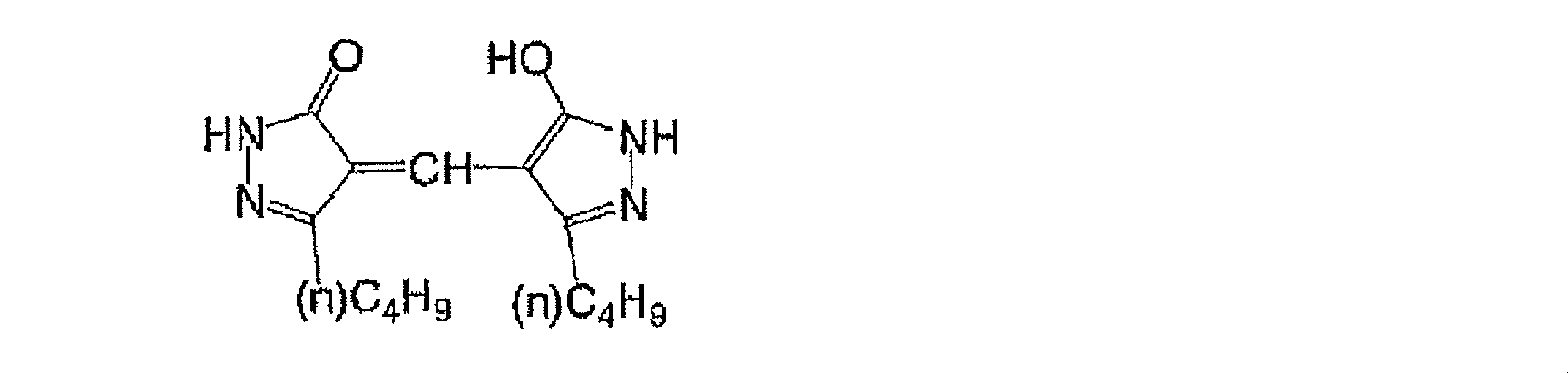
(アンチハレーション(AH)層)
ゼラチン100gに対して、下記固体分散染料Aを84g含むアンチハレーション(AH)層形成用塗布液を調製した。
・固体分散染料A
(ハロゲン化銀感光材料)
水媒体中のAg 150gに対してゼラチン10.0gを含む、球相当径平均0.1μmの沃臭塩化銀粒子(I=0.2モル%、Br=40モル%)を含有する導電層形成用の乳剤(ハロゲン化銀感光材料)を調製した。また、この乳剤中にはK3Rh2Br9およびK2IrCl6を、濃度が10-7(モル/モル銀)になるように添加し、臭化銀粒子にRhイオンとIrイオンをドープした。この乳剤にNa2PdCl4を添加し、さらに塩化金酸とチオ硫酸ナトリウムを用いて金硫黄増感を行った。
水媒体中のAg 150gに対してゼラチン10.0gを含む、球相当径平均0.1μmの沃臭塩化銀粒子(I=0.2モル%、Br=40モル%)を含有する導電層形成用の乳剤(ハロゲン化銀感光材料)を調製した。また、この乳剤中にはK3Rh2Br9およびK2IrCl6を、濃度が10-7(モル/モル銀)になるように添加し、臭化銀粒子にRhイオンとIrイオンをドープした。この乳剤にNa2PdCl4を添加し、さらに塩化金酸とチオ硫酸ナトリウムを用いて金硫黄増感を行った。
(導電層付きフィルム)
作製した下塗り層を形成した環状オレフィン系フィルム上に、ゼラチン硬膜剤と共に、アンチハレーション(AH)層形成用塗布液と、乳剤(ハロゲン化銀感光材料)とを用いて、環状オレフィン層/下塗り層/AH層/乳剤層の順になるよう同時重層塗布を行った。この際、乳剤層中の銀の塗布量(塗布銀量)が銀で換算して7g/m2となるように、また、AH層の膜厚が1μmとなるようにし、乳剤層中のAg/ゼラチン体積比は2/1とした。幅30cmの環状オレフィン系フィルムに25cmの幅で20m塗布を行ない、塗布の中央部24cmを残すように環状オレフィン系フィルムの両端を3cmずつ切り落としてロール状の乳剤層(導電層)を形成した環状オレフィン系フィルム(導電層付きフィルム)を得た。
得られた導電層付きフィルムを、実施例1のフィルムとした。
作製した下塗り層を形成した環状オレフィン系フィルム上に、ゼラチン硬膜剤と共に、アンチハレーション(AH)層形成用塗布液と、乳剤(ハロゲン化銀感光材料)とを用いて、環状オレフィン層/下塗り層/AH層/乳剤層の順になるよう同時重層塗布を行った。この際、乳剤層中の銀の塗布量(塗布銀量)が銀で換算して7g/m2となるように、また、AH層の膜厚が1μmとなるようにし、乳剤層中のAg/ゼラチン体積比は2/1とした。幅30cmの環状オレフィン系フィルムに25cmの幅で20m塗布を行ない、塗布の中央部24cmを残すように環状オレフィン系フィルムの両端を3cmずつ切り落としてロール状の乳剤層(導電層)を形成した環状オレフィン系フィルム(導電層付きフィルム)を得た。
得られた導電層付きフィルムを、実施例1のフィルムとした。
[実施例2及び3]
実施例1において、エポクロスK-2010Eを、エポクロスK-2020E(Tg=0℃、日本触媒(株)製)、またはエポクロスK-2030E(Tg=50℃、日本触媒(株)製)にそれぞれ変更した以外は、実施例1と同様にして、実施例2および3のフィルムを得た。
実施例1において、エポクロスK-2010Eを、エポクロスK-2020E(Tg=0℃、日本触媒(株)製)、またはエポクロスK-2030E(Tg=50℃、日本触媒(株)製)にそれぞれ変更した以外は、実施例1と同様にして、実施例2および3のフィルムを得た。
[実施例4]
実施例1において、バインダーをウレタン系バインダーWS5100からオレフィン系バインダーSE1010に変更し、用いるオキサゾリン基含有ポリマーを、エポクロスK-2010Eから、オキサゾリン含有水溶性ポリマーWS-700に変更し、下記成分で混合した以外は、実施例1と同様にして、実施例4のフィルムを得た。
・オレフィン系バインダー 5.73質量部
(アローベースSE1010、ユニチカ(株)製、濃度20質量%)
・オキサゾリン基含有水溶性ポリマー 0.51質量部
(エポクロスWS-700、Tg=50℃、日本触媒(株)製、固形分:25質量%)
・コロイダルシリカ 0.26質量部
(スノーテックスUP、日産化学(株)製、固形分:10質量%水希釈)
・滑り剤:カルナバワックス 1.63質量部
(セロゾール524、中京油脂(株)製、固形分:3質量%水希釈)
・界面活性剤A:界面活性剤 1.63質量部
(ナロアクティーCL95、三洋化成工業(株)製、固形分:1質量%水溶液)
・界面活性剤B:界面活性剤 2.61質量部
(ラピゾールA-90、日油(株)製、固形分:1質量%水溶液)
・蒸留水 87.62質量部
実施例1において、バインダーをウレタン系バインダーWS5100からオレフィン系バインダーSE1010に変更し、用いるオキサゾリン基含有ポリマーを、エポクロスK-2010Eから、オキサゾリン含有水溶性ポリマーWS-700に変更し、下記成分で混合した以外は、実施例1と同様にして、実施例4のフィルムを得た。
・オレフィン系バインダー 5.73質量部
(アローベースSE1010、ユニチカ(株)製、濃度20質量%)
・オキサゾリン基含有水溶性ポリマー 0.51質量部
(エポクロスWS-700、Tg=50℃、日本触媒(株)製、固形分:25質量%)
・コロイダルシリカ 0.26質量部
(スノーテックスUP、日産化学(株)製、固形分:10質量%水希釈)
・滑り剤:カルナバワックス 1.63質量部
(セロゾール524、中京油脂(株)製、固形分:3質量%水希釈)
・界面活性剤A:界面活性剤 1.63質量部
(ナロアクティーCL95、三洋化成工業(株)製、固形分:1質量%水溶液)
・界面活性剤B:界面活性剤 2.61質量部
(ラピゾールA-90、日油(株)製、固形分:1質量%水溶液)
・蒸留水 87.62質量部
[実施例5]
実施例4において、バインダーを、オレフィン系バインダーSE1010から、アクリル系バインダーAS-563A(ダイセルフアインケム(株)製、濃度40質量%)に変更し、下記成分で混合した以外は、実施例4と同様にして、実施例5のフィルムを得た。
・アクリル系バインダー 2.95質量部
(AS-563A、ダイセルフアインケム(株)製、濃度40質量%)
・オキサゾリン基含有水溶性ポリマー 0.52質量部
(エポクロスWS-700、Tg=50℃、日本触媒(株)製、固形分:25質量%)
・コロイダルシリカ 0.27質量部
(スノーテックスUP、日産化学(株)製、固形分:10質量%水希釈)
・滑り剤:カルナバワックス 1.68質量部
(セロゾール524、中京油脂(株)製、固形分:3質量%水希釈)
・界面活性剤A:界面活性剤 1.68質量部
(ナロアクティーCL95、三洋化成工業(株)製、固形分:1質量%水溶液)
・界面活性剤B:界面活性剤 2.69質量部
(ラピゾールA-90、日油(株)製、固形分:1質量%水溶液)
・蒸留水 90.20質量部
実施例4において、バインダーを、オレフィン系バインダーSE1010から、アクリル系バインダーAS-563A(ダイセルフアインケム(株)製、濃度40質量%)に変更し、下記成分で混合した以外は、実施例4と同様にして、実施例5のフィルムを得た。
・アクリル系バインダー 2.95質量部
(AS-563A、ダイセルフアインケム(株)製、濃度40質量%)
・オキサゾリン基含有水溶性ポリマー 0.52質量部
(エポクロスWS-700、Tg=50℃、日本触媒(株)製、固形分:25質量%)
・コロイダルシリカ 0.27質量部
(スノーテックスUP、日産化学(株)製、固形分:10質量%水希釈)
・滑り剤:カルナバワックス 1.68質量部
(セロゾール524、中京油脂(株)製、固形分:3質量%水希釈)
・界面活性剤A:界面活性剤 1.68質量部
(ナロアクティーCL95、三洋化成工業(株)製、固形分:1質量%水溶液)
・界面活性剤B:界面活性剤 2.69質量部
(ラピゾールA-90、日油(株)製、固形分:1質量%水溶液)
・蒸留水 90.20質量部
[実施例6]
実施例4において、バインダーを、オレフィン系バインダーSE1010から、シリコーン系バインダー セラネートWSA1070(DIC(株)製、濃度40質量%)に変更し、下記成分で混合した以外は、実施例4と同様にして、実施例6のフィルムを得た。
・シリコーン系バインダー 2.95質量部
(セラネートWSA1070、DIC(株)製、濃度40質量%)
・オキサゾリン基含有水溶性ポリマー 0.52質量部
(エポクロスWS-700、Tg=50℃、日本触媒(株)製、固形分:25質量%)
・コロイダルシリカ 0.27質量部
(スノーテックスUP、日産化学(株)製、固形分:10質量%水希釈)
・滑り剤:カルナバワックス 1.68質量部
(セロゾール524、中京油脂(株)製、固形分:3質量%水希釈)
・界面活性剤A:界面活性剤 1.68質量部
(ナロアクティーCL95、三洋化成工業(株)製、固形分:1質量%水溶液)
・界面活性剤B:界面活性剤 2.69質量部
(ラピゾールA-90、日油(株)製、固形分:1質量%水溶液)
・蒸留水 90.20質量部
実施例4において、バインダーを、オレフィン系バインダーSE1010から、シリコーン系バインダー セラネートWSA1070(DIC(株)製、濃度40質量%)に変更し、下記成分で混合した以外は、実施例4と同様にして、実施例6のフィルムを得た。
・シリコーン系バインダー 2.95質量部
(セラネートWSA1070、DIC(株)製、濃度40質量%)
・オキサゾリン基含有水溶性ポリマー 0.52質量部
(エポクロスWS-700、Tg=50℃、日本触媒(株)製、固形分:25質量%)
・コロイダルシリカ 0.27質量部
(スノーテックスUP、日産化学(株)製、固形分:10質量%水希釈)
・滑り剤:カルナバワックス 1.68質量部
(セロゾール524、中京油脂(株)製、固形分:3質量%水希釈)
・界面活性剤A:界面活性剤 1.68質量部
(ナロアクティーCL95、三洋化成工業(株)製、固形分:1質量%水溶液)
・界面活性剤B:界面活性剤 2.69質量部
(ラピゾールA-90、日油(株)製、固形分:1質量%水溶液)
・蒸留水 90.20質量部
[実施例7]
実施例4において、バインダーを、オレフィン系バインダーSE1010から、ポリエステル系バインダー バイロナールMD1245(東洋紡(株)製、濃度34質量%)に変更し、下記成分で混合した以外は、実施例4と同様にして、実施例7のフィルムを得た。
・ポリエステル系バインダー 3.45質量部
(バイロナールMD1245、東洋紡(株)製、濃度34質量%)
・オキサゾリン基含有水溶性ポリマー 0.52質量部
(エポクロスWS-700、Tg=50℃、日本触媒(株)製、固形分:25質量%)
・コロイダルシリカ 0.27質量部
(スノーテックスUP、日産化学(株)製、固形分:10質量%水希釈)
・滑り剤:カルナバワックス 1.67質量部
(セロゾール524、中京油脂(株)製、固形分:3質量%水希釈)
・界面活性剤A:界面活性剤 1.67質量部
(ナロアクティーCL95、三洋化成工業(株)製、固形分:1質量%水溶液)
・界面活性剤B:界面活性剤 2.68質量部
(ラピゾールA-90、日油(株)製、固形分:1質量%水溶液)
・蒸留水 89.74質量部
実施例4において、バインダーを、オレフィン系バインダーSE1010から、ポリエステル系バインダー バイロナールMD1245(東洋紡(株)製、濃度34質量%)に変更し、下記成分で混合した以外は、実施例4と同様にして、実施例7のフィルムを得た。
・ポリエステル系バインダー 3.45質量部
(バイロナールMD1245、東洋紡(株)製、濃度34質量%)
・オキサゾリン基含有水溶性ポリマー 0.52質量部
(エポクロスWS-700、Tg=50℃、日本触媒(株)製、固形分:25質量%)
・コロイダルシリカ 0.27質量部
(スノーテックスUP、日産化学(株)製、固形分:10質量%水希釈)
・滑り剤:カルナバワックス 1.67質量部
(セロゾール524、中京油脂(株)製、固形分:3質量%水希釈)
・界面活性剤A:界面活性剤 1.67質量部
(ナロアクティーCL95、三洋化成工業(株)製、固形分:1質量%水溶液)
・界面活性剤B:界面活性剤 2.68質量部
(ラピゾールA-90、日油(株)製、固形分:1質量%水溶液)
・蒸留水 89.74質量部
[実施例8]
実施例4において、バインダーを、オレフィン系バインダーSE1010から、スチレンブタジエン系バインダー NIPOL LX415(日本ゼオン(株)製、濃度43質量%)に変更し、下記成分で混合した以外は、実施例4と同様にして、実施例8のフィルムを得た。
・スチレンブタジエン系バインダー 2.75質量部
(NIPOL LX415、日本ゼオン(株)製、濃度43質量%)
・オキサゾリン基含有水溶性ポリマー 0.53質量部
(エポクロスWS-700、Tg=50℃、日本触媒(株)製、固形分:25質量%)
・コロイダルシリカ 0.27質量部 (スノーテックスUP、日産化学(株)製、固形分:10質量%水希釈)
・滑り剤:カルナバワックス 1.69質量部
(セロゾール524、中京油脂(株)製、固形分:3質量%水希釈)
・界面活性剤A:界面活性剤 1.69質量部
(ナロアクティーCL95、三洋化成工業(株)製、固形分:1質量%水溶液)
・界面活性剤B:界面活性剤 2.70質量部
(ラピゾールA-90、日油(株)製、固形分:1質量%水溶液)
・蒸留水 90.39質量部
実施例4において、バインダーを、オレフィン系バインダーSE1010から、スチレンブタジエン系バインダー NIPOL LX415(日本ゼオン(株)製、濃度43質量%)に変更し、下記成分で混合した以外は、実施例4と同様にして、実施例8のフィルムを得た。
・スチレンブタジエン系バインダー 2.75質量部
(NIPOL LX415、日本ゼオン(株)製、濃度43質量%)
・オキサゾリン基含有水溶性ポリマー 0.53質量部
(エポクロスWS-700、Tg=50℃、日本触媒(株)製、固形分:25質量%)
・コロイダルシリカ 0.27質量部 (スノーテックスUP、日産化学(株)製、固形分:10質量%水希釈)
・滑り剤:カルナバワックス 1.69質量部
(セロゾール524、中京油脂(株)製、固形分:3質量%水希釈)
・界面活性剤A:界面活性剤 1.69質量部
(ナロアクティーCL95、三洋化成工業(株)製、固形分:1質量%水溶液)
・界面活性剤B:界面活性剤 2.70質量部
(ラピゾールA-90、日油(株)製、固形分:1質量%水溶液)
・蒸留水 90.39質量部
[実施例9]
実施例4において、バインダーを、オレフィン系バインダーSE1010から、ウレタン系バインダー タケラックWS5100(三井武田ケミカル(株)製、濃度30質量%)に変更し、下記成分で混合した以外は、実施例4と同様にして、実施例9のフィルムを得た。
・ウレタン系バインダー 3.89質量部
(タケラックWS5100、三井武田ケミカル(株)製、濃度30質量%)
・オキサゾリン基含有水溶性ポリマー 0.52質量部
(エポクロスWS-700、Tg=50℃、日本触媒(株)製、固形分:25質量%)
・コロイダルシリカ 0.27質量部
(スノーテックスUP、日産化学(株)製、固形分:10質量%水希釈)
・滑り剤:カルナバワックス 1.67質量部
(セロゾール524、中京油脂(株)製、固形分:3質量%水希釈)
・界面活性剤A:界面活性剤 1.67質量部
(ナロアクティーCL95、三洋化成工業(株)製、固形分:1質量%水溶液)
・界面活性剤B:界面活性剤 2.66質量部
(ラピゾールA-90、日油(株)製、固形分:1質量%水溶液)
・蒸留水 89.32質量部
実施例4において、バインダーを、オレフィン系バインダーSE1010から、ウレタン系バインダー タケラックWS5100(三井武田ケミカル(株)製、濃度30質量%)に変更し、下記成分で混合した以外は、実施例4と同様にして、実施例9のフィルムを得た。
・ウレタン系バインダー 3.89質量部
(タケラックWS5100、三井武田ケミカル(株)製、濃度30質量%)
・オキサゾリン基含有水溶性ポリマー 0.52質量部
(エポクロスWS-700、Tg=50℃、日本触媒(株)製、固形分:25質量%)
・コロイダルシリカ 0.27質量部
(スノーテックスUP、日産化学(株)製、固形分:10質量%水希釈)
・滑り剤:カルナバワックス 1.67質量部
(セロゾール524、中京油脂(株)製、固形分:3質量%水希釈)
・界面活性剤A:界面活性剤 1.67質量部
(ナロアクティーCL95、三洋化成工業(株)製、固形分:1質量%水溶液)
・界面活性剤B:界面活性剤 2.66質量部
(ラピゾールA-90、日油(株)製、固形分:1質量%水溶液)
・蒸留水 89.32質量部
[実施例10~14]
実施例9において、用いるバインダーおよびオキサゾリン基含有ポリマーの含有量を、下記表1に記載の含有量に変更した以外は、実施例9と同様にして、実施例10~14のフィルムをそれぞれ得た。
実施例9において、用いるバインダーおよびオキサゾリン基含有ポリマーの含有量を、下記表1に記載の含有量に変更した以外は、実施例9と同様にして、実施例10~14のフィルムをそれぞれ得た。
[実施例15~20]
実施例12において、下塗り層形成用組成物を、乾燥後の膜厚が下記表1に記載の膜厚になるように塗布した以外は実施例12と同様にして、実施例15~20のフィルムをそれぞれ得た。 なお、実施例20は、下塗り層塗布後にフィルムロールとして巻き取る際に、巻きシワが発生した。
実施例12において、下塗り層形成用組成物を、乾燥後の膜厚が下記表1に記載の膜厚になるように塗布した以外は実施例12と同様にして、実施例15~20のフィルムをそれぞれ得た。 なお、実施例20は、下塗り層塗布後にフィルムロールとして巻き取る際に、巻きシワが発生した。
[実施例21]
実施例9において、オキサゾリン基含有ポリマーを、エポクロスWS700から、エポクロスWS300(Tg=90℃)に変更し、下記成分で混合した以外は、実施例9と同様にして実施例15のフィルムを得た。
・ウレタン系バインダー 3.86質量部
(タケラックWS5100、三井武田ケミカル(株)製、濃度30質量%)
・オキサゾリン基含有水溶性ポリマー 1.29質量部
(エポクロスWS-300、Tg=90℃、日本触媒(株)製、固形分:10質量%)
・コロイダルシリカ 0.27質量部
(スノーテックスUP、日産化学(株)製、固形分:10質量%水希釈)
・滑り剤:カルナバワックス 1.65質量部
(セロゾール524、中京油脂(株)製、固形分:3質量%水希釈)
・界面活性剤A:界面活性剤 1.65質量部
(ナロアクティーCL95、三洋化成工業(株)製、固形分:1質量%水溶液)
・界面活性剤B:界面活性剤 2.64質量部
(ラピゾールA-90、日油(株)製、固形分:1質量%水溶液)
・蒸留水 88.63質量部
実施例9において、オキサゾリン基含有ポリマーを、エポクロスWS700から、エポクロスWS300(Tg=90℃)に変更し、下記成分で混合した以外は、実施例9と同様にして実施例15のフィルムを得た。
・ウレタン系バインダー 3.86質量部
(タケラックWS5100、三井武田ケミカル(株)製、濃度30質量%)
・オキサゾリン基含有水溶性ポリマー 1.29質量部
(エポクロスWS-300、Tg=90℃、日本触媒(株)製、固形分:10質量%)
・コロイダルシリカ 0.27質量部
(スノーテックスUP、日産化学(株)製、固形分:10質量%水希釈)
・滑り剤:カルナバワックス 1.65質量部
(セロゾール524、中京油脂(株)製、固形分:3質量%水希釈)
・界面活性剤A:界面活性剤 1.65質量部
(ナロアクティーCL95、三洋化成工業(株)製、固形分:1質量%水溶液)
・界面活性剤B:界面活性剤 2.64質量部
(ラピゾールA-90、日油(株)製、固形分:1質量%水溶液)
・蒸留水 88.63質量部
[比較例1~2]
実施例9において、オキサゾリン基含有ポリマーの含有量を、下記表2に記載の含有量に変更した以外は実施例9と同様にして、比較例1~3のフィルムをそれぞれ得た。
[比較例3]
下塗り層の厚みを下記表2に記載の厚みに変更した以外は、比較例2と同様にして、比較例3のフィルムを得た。
実施例9において、オキサゾリン基含有ポリマーの含有量を、下記表2に記載の含有量に変更した以外は実施例9と同様にして、比較例1~3のフィルムをそれぞれ得た。
[比較例3]
下塗り層の厚みを下記表2に記載の厚みに変更した以外は、比較例2と同様にして、比較例3のフィルムを得た。
[比較例4~9]
実施例4~9において、オキサゾリン基含有ポリマーを、エポクロスWS-700から、水性カルボジイミドカルボジライトV-02-L2(日清紡績(株)製、濃度40質量%を25質量%に水希釈)に変更した以外は、実施例4~9と同様にして、比較例4~9のフィルムをそれぞれ得た。
実施例4~9において、オキサゾリン基含有ポリマーを、エポクロスWS-700から、水性カルボジイミドカルボジライトV-02-L2(日清紡績(株)製、濃度40質量%を25質量%に水希釈)に変更した以外は、実施例4~9と同様にして、比較例4~9のフィルムをそれぞれ得た。
[比較例10]
実施例9において、オキサゾリン基含有ポリマーを、エポクロスWS-700から、エポキシ含有水溶性ポリマー モデピクス302(荒川工業(株)製、濃度33質量%を25質量%に水希釈)に変更した以外は、実施例9と同様にして、比較例10のフィルムを得た。
実施例9において、オキサゾリン基含有ポリマーを、エポクロスWS-700から、エポキシ含有水溶性ポリマー モデピクス302(荒川工業(株)製、濃度33質量%を25質量%に水希釈)に変更した以外は、実施例9と同様にして、比較例10のフィルムを得た。
[比較例11]
実施例9において、オキサゾリン基含有ポリマーを、エポクロスWS-700から、イソシアネート含有水溶性ポリマー エラストロンE-37(第一工業製薬(株)製、濃度25質量%)に変更した以外は、実施例9と同様にして、比較例11のフィルムを得た。
実施例9において、オキサゾリン基含有ポリマーを、エポクロスWS-700から、イソシアネート含有水溶性ポリマー エラストロンE-37(第一工業製薬(株)製、濃度25質量%)に変更した以外は、実施例9と同様にして、比較例11のフィルムを得た。
[比較例12]
オキサゾリン基含有ポリマー(架橋剤)を用いなかったこと以外は、実施例9と同様にして、比較例12のフィルムを得た。
オキサゾリン基含有ポリマー(架橋剤)を用いなかったこと以外は、実施例9と同様にして、比較例12のフィルムを得た。
[比較例13]
実施例9において、オキサゾリン基含有ポリマーを、エポクロスWS-700から、オキサゾリン含有水溶性低分子化合物(低分子水溶性オキサゾリンモノマーVOZO、2-ビニル-2-オキサゾリン、興人(株)製、濃度25質量%水希釈)に変更した以外は、実施例9と同様にして、比較例13のフィルムを得た。低分子水溶性オキサゾリンモノマー VOZOの分子量は97である。
実施例9において、オキサゾリン基含有ポリマーを、エポクロスWS-700から、オキサゾリン含有水溶性低分子化合物(低分子水溶性オキサゾリンモノマーVOZO、2-ビニル-2-オキサゾリン、興人(株)製、濃度25質量%水希釈)に変更した以外は、実施例9と同様にして、比較例13のフィルムを得た。低分子水溶性オキサゾリンモノマー VOZOの分子量は97である。
[評価]
実施例1~21及び比較例1~13の各フィルムのドライ密着性およびウェット密着性を以下の通り評価した。
実施例1~21及び比較例1~13の各フィルムのドライ密着性およびウェット密着性を以下の通り評価した。
(ドライ密着性)
作製した導電層付きフィルムである各実施例および比較例のフィルムを、12cm×3cmのサイズに裁断しサンプルを作製した。作製したサンプルを23℃、相対湿度50%の条件で1時間保持した後、乳剤層の上に、ポリイミドテープ(No.541、住友3M社製)を貼り、次いで、剥離角度が180度となるように手でポリイミドテープを剥離した。フィルムに剥がれが生じた面積を算出することにより、ドライ密着性を下記の5つにランクに基づいて評価した。ランク3以上のフィルムを実用上好ましいレベルと判断した。ランク4以上であることがより好ましく、ランク5であることが特に好ましい。
なお、各実施例および比較例のフィルムに生じた剥がれは、主に、下塗り層とアンチハレーション層との間で剥がれであった。
5:全く剥がれない
4:ポリイミドテープを貼った面積に対して、剥がれた面積が30%未満である。
3:ポリイミドテープを貼った面積に対して、剥がれた面積が30%以上60%未満である。
2:ポリイミドテープを貼った面積に対して、剥がれた面積が60%以上90%未満である。
1:ポリイミドテープを貼った面積に対して、剥がれた面積が90%以上である。
作製した導電層付きフィルムである各実施例および比較例のフィルムを、12cm×3cmのサイズに裁断しサンプルを作製した。作製したサンプルを23℃、相対湿度50%の条件で1時間保持した後、乳剤層の上に、ポリイミドテープ(No.541、住友3M社製)を貼り、次いで、剥離角度が180度となるように手でポリイミドテープを剥離した。フィルムに剥がれが生じた面積を算出することにより、ドライ密着性を下記の5つにランクに基づいて評価した。ランク3以上のフィルムを実用上好ましいレベルと判断した。ランク4以上であることがより好ましく、ランク5であることが特に好ましい。
なお、各実施例および比較例のフィルムに生じた剥がれは、主に、下塗り層とアンチハレーション層との間で剥がれであった。
5:全く剥がれない
4:ポリイミドテープを貼った面積に対して、剥がれた面積が30%未満である。
3:ポリイミドテープを貼った面積に対して、剥がれた面積が30%以上60%未満である。
2:ポリイミドテープを貼った面積に対して、剥がれた面積が60%以上90%未満である。
1:ポリイミドテープを貼った面積に対して、剥がれた面積が90%以上である。
(ウェット密着性(ウェット引掻き))
作製した導電層付きフィルムである各実施例および比較例のフィルムを、50℃のオーブンにて32時間保持した。その後、12cm×3cmのサイズに裁断して、24℃の蒸留水に2分浸し、その直後、フィルムが乾かないうちに、引掻き試験を行った。引掻き試験は、連続加重式引っ掻き強度試験器(HEIDON-18型、新東科学社製)を用いて、サファイヤ針1.0mmφ、加重200gの条件下で長さ10cmを引掻き、剥がれの有無を確認した。剥がれた長さが10cmである場合を荷重0g、全く剥がれなかった場合を荷重200gとし、剥がれが生じた長さから、剥がれが生じたときの荷重を算出した。荷重60g以上を実用可能レベルと判断した。荷重95g以上であることが好ましく、荷重150g以上であることがより好ましい。
なお、各実施例および比較例のフィルムに生じた剥がれは、主に、基材と下塗り層との間の剥がれ、または下塗り層とアンチハレーション層との間の剥がれであった。
作製した導電層付きフィルムである各実施例および比較例のフィルムを、50℃のオーブンにて32時間保持した。その後、12cm×3cmのサイズに裁断して、24℃の蒸留水に2分浸し、その直後、フィルムが乾かないうちに、引掻き試験を行った。引掻き試験は、連続加重式引っ掻き強度試験器(HEIDON-18型、新東科学社製)を用いて、サファイヤ針1.0mmφ、加重200gの条件下で長さ10cmを引掻き、剥がれの有無を確認した。剥がれた長さが10cmである場合を荷重0g、全く剥がれなかった場合を荷重200gとし、剥がれが生じた長さから、剥がれが生じたときの荷重を算出した。荷重60g以上を実用可能レベルと判断した。荷重95g以上であることが好ましく、荷重150g以上であることがより好ましい。
なお、各実施例および比較例のフィルムに生じた剥がれは、主に、基材と下塗り層との間の剥がれ、または下塗り層とアンチハレーション層との間の剥がれであった。
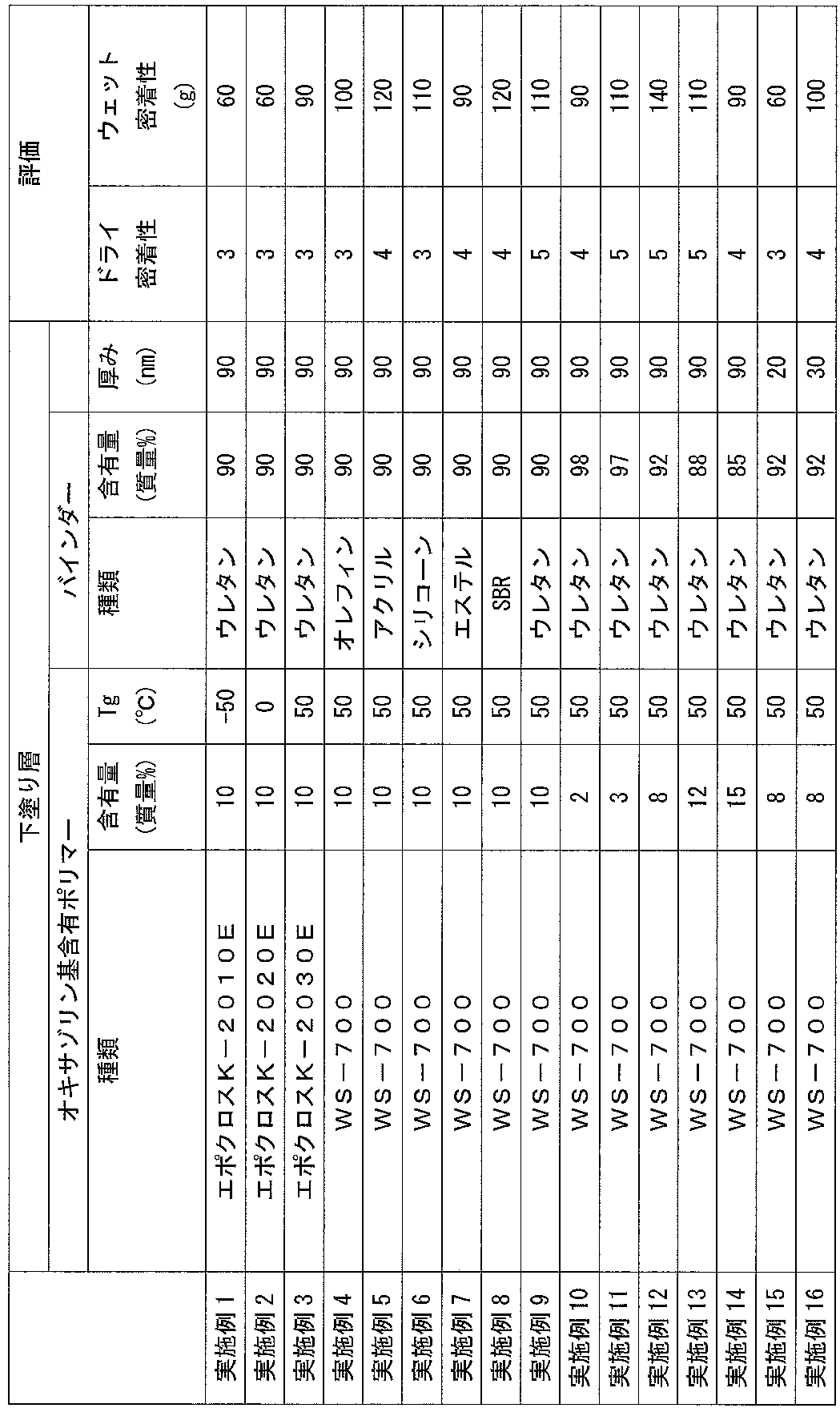
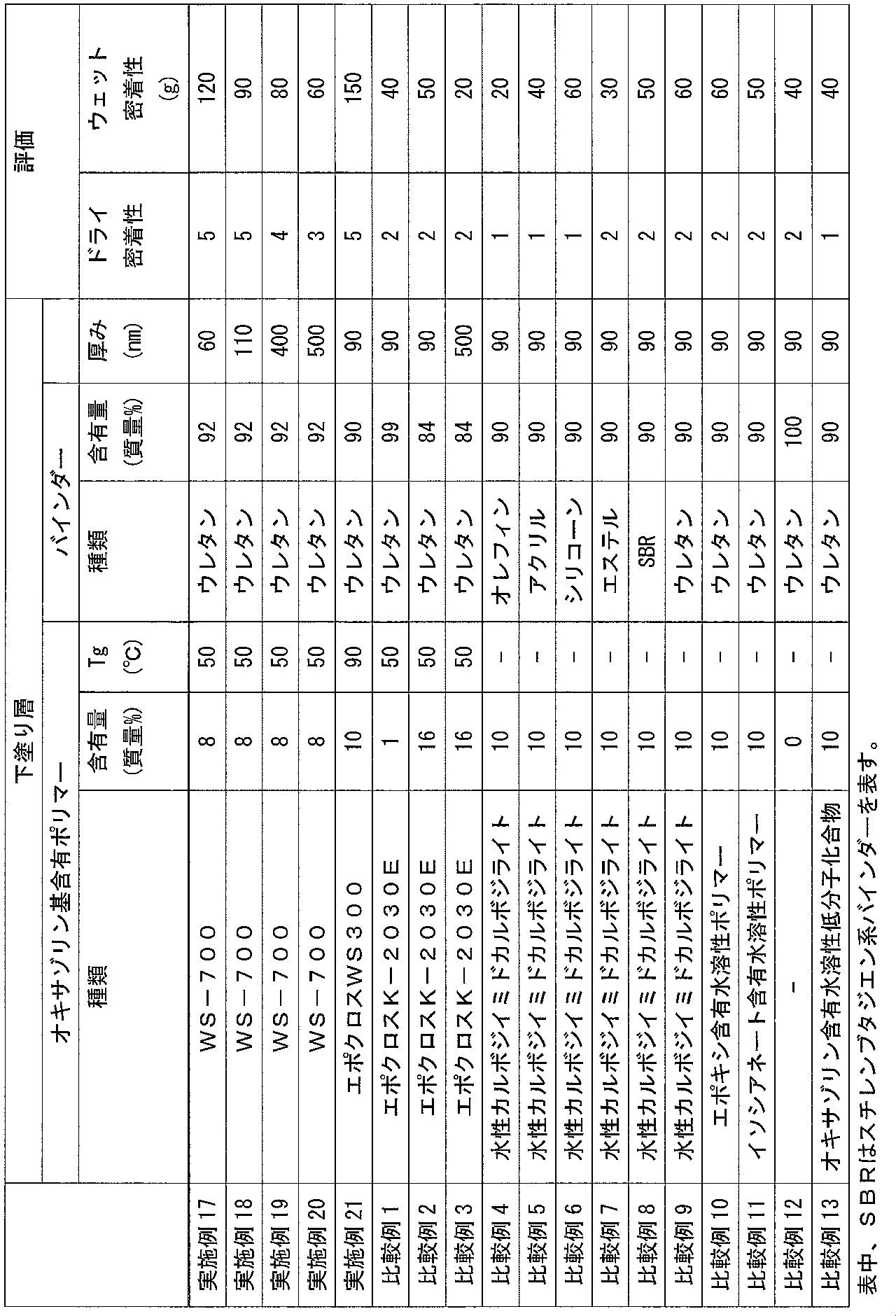
上記表1および表2から、下塗り層がオキサゾリン基含有ポリマーを含む実施例1~21は、ドライ密着性およびウェット密着性の両方とも優れることが分かる。一方、下塗り層にオキサゾリン基含有ポリマーを含まない比較例4~13は、ドライ密着性が実施例よりも劣り、さらに一部の比較例ではウェット密着性も実施例よりも劣ることが分かる。
本発明によれば、ドライ密着性およびウェット密着性に優れた環状オレフィン系フィルムを得ることができる。本発明の環状オレフィン系フィルムは、光学フィルム、導電性フィルム、プリンテッドエレクトロニクス用基材フィルム、バリアフィルム、タッチパネル、偏光板および表示装置等に好適に用いられ、産業上の利用可能性が高い。
Claims (15)
- 環状オレフィン系樹脂からなる層の少なくとも一方の表面上に下塗り層を有し、前記下塗り層中に、オキサゾリン基含有ポリマーを2~15質量%含むことを特徴とする環状オレフィン系フィルム。
- 前記下塗り層の厚みが、20~400nmである、請求項1に記載の環状オレフィン系フィルム。
- 前記オキサゾリン基含有ポリマーが、水溶性のオキサゾリン基含有ポリマーである、請求項1または2に記載の環状オレフィン系フィルム。
- 前記下塗り層中の前記オキサゾリン基含有ポリマーの含有量が3~12質量%である、請求項1~3のいずれか1項に記載の環状オレフィン系フィルム。
- 前記オキサゾリン基含有ポリマーが、オキサゾリン基およびポリアルキレンオキシド鎖を有するアクリルポリマーである、請求項1~4のいずれか1項に記載の環状オレフィン系フィルム。
- 前記オキサゾリン基含有ポリマーのガラス転移温度が、50℃以上である、請求項1~5のいずれか1項に記載の環状オレフィン系フィルム。
- 前記下塗り層が、ポリオレフィン樹脂、アクリル樹脂、変性シリコーン樹脂、ポリエステル樹脂、ポリウレタン樹脂及びスチレンブタジエンゴム樹脂から選ばれる少なくとも一種の樹脂を含む、請求項1~6のいずれか1項に記載の環状オレフィン系フィルム。
- 環状オレフィン系樹脂からなる層の少なくとも一方の表面上に、オキサゾリン基含有ポリマー及び樹脂を少なくとも含む塗布液を塗布し、硬化させることにより下塗り層を形成することを含む、請求項1~7のいずれか1項に記載の環状オレフィン系フィルムの製造方法。
- 請求項1~7のいずれか1項に記載の環状オレフィン系フィルムを有する、光学フィルム。
- 請求項1~7のいずれか1項に記載の環状オレフィン系フィルムと導電層とを有する、導電性フィルム。
- 請求項1~7のいずれか1項に記載の環状オレフィン系フィルムを有する、プリンテッドエレクトロニクス用基材フィルム。
- 請求項1~7のいずれか1項に記載の環状オレフィン系フィルムを有する、バリアフィルム。
- 請求項1~7のいずれか1項に記載の環状オレフィン系フィルムまたは請求項10に記載の導電性フィルムを有するタッチパネル。
- 請求項1~7のいずれか1項に記載の環状オレフィン系フィルムまたは請求項9に記載の光学フィルムを有する偏光板。
- 請求項1~7のいずれか1項に記載の環状オレフィン系フィルム、請求項9に記載の光学フィルムまたは請求項14に記載の偏光板を有する表示装置。
Priority Applications (3)
| Application Number | Priority Date | Filing Date | Title |
|---|---|---|---|
| KR1020167021327A KR20160106654A (ko) | 2014-02-28 | 2015-02-13 | 환상 올레핀계 필름, 광학 필름, 도전성 필름, 프린티드 일렉트로닉스용 기재 필름, 배리어 필름, 터치 패널, 편광판 및 표시 장치 |
| CN201580006919.4A CN105960326A (zh) | 2014-02-28 | 2015-02-13 | 环状烯烃系膜、光学膜、导电性膜、印刷电子用基材膜、阻隔膜、触控面板、偏振片和显示装置 |
| US15/229,223 US20160339678A1 (en) | 2014-02-28 | 2016-08-05 | Cyclic olefin-based film, optical film, conductive film, base film for printed electronics, barrier film, touch panel, polarization plate, and display device |
Applications Claiming Priority (2)
| Application Number | Priority Date | Filing Date | Title |
|---|---|---|---|
| JP2014039225A JP6097236B2 (ja) | 2014-02-28 | 2014-02-28 | 環状オレフィン系フィルム、光学フィルム、導電性フィルム、プリンテッドエレクトロニクス用基材フィルム、バリアフィルム、タッチパネル、偏光板および表示装置 |
| JP2014-039225 | 2014-02-28 |
Related Child Applications (1)
| Application Number | Title | Priority Date | Filing Date |
|---|---|---|---|
| US15/229,223 Continuation US20160339678A1 (en) | 2014-02-28 | 2016-08-05 | Cyclic olefin-based film, optical film, conductive film, base film for printed electronics, barrier film, touch panel, polarization plate, and display device |
Publications (1)
| Publication Number | Publication Date |
|---|---|
| WO2015129489A1 true WO2015129489A1 (ja) | 2015-09-03 |
Family
ID=54008812
Family Applications (1)
| Application Number | Title | Priority Date | Filing Date |
|---|---|---|---|
| PCT/JP2015/053988 Ceased WO2015129489A1 (ja) | 2014-02-28 | 2015-02-13 | 環状オレフィン系フィルム、光学フィルム、導電性フィルム、プリンテッドエレクトロニクス用基材フィルム、バリアフィルム、タッチパネル、偏光板および表示装置 |
Country Status (6)
| Country | Link |
|---|---|
| US (1) | US20160339678A1 (ja) |
| JP (1) | JP6097236B2 (ja) |
| KR (1) | KR20160106654A (ja) |
| CN (1) | CN105960326A (ja) |
| TW (1) | TWI658935B (ja) |
| WO (1) | WO2015129489A1 (ja) |
Families Citing this family (16)
| Publication number | Priority date | Publication date | Assignee | Title |
|---|---|---|---|---|
| JP6709521B2 (ja) * | 2015-09-24 | 2020-06-17 | 大日本印刷株式会社 | 転写シート |
| KR101938882B1 (ko) | 2016-01-08 | 2019-01-16 | 동우 화인켐 주식회사 | 필름 터치 센서 및 이의 제조 방법 |
| KR102640877B1 (ko) * | 2016-12-30 | 2024-02-27 | 주식회사 동진쎄미켐 | 전도성 용액 조성물 및 이를 이용한 전도성 구조체 |
| CN111465657A (zh) * | 2017-12-11 | 2020-07-28 | 住友化学株式会社 | 固化性组合物、光学层叠体及图像显示装置 |
| JP7308758B2 (ja) * | 2017-12-11 | 2023-07-14 | 住友化学株式会社 | 硬化性組成物、光学積層体及び画像表示装置 |
| JP7305306B2 (ja) * | 2018-03-30 | 2023-07-10 | 日東電工株式会社 | 円偏光板 |
| EP3815159A1 (en) * | 2018-06-28 | 2021-05-05 | Merck Patent GmbH | Method for producing an electronic device |
| JP7066869B2 (ja) * | 2018-09-28 | 2022-05-13 | 株式会社ユポ・コーポレーション | インモールドラベル及びインモールドラベル付き容器 |
| TWI727371B (zh) * | 2019-07-16 | 2021-05-11 | 住華科技股份有限公司 | 偏光板結構及其製造方法 |
| JP7336319B2 (ja) * | 2019-09-04 | 2023-08-31 | 日東電工株式会社 | 偏光フィルムの製造方法 |
| JP7347035B2 (ja) * | 2019-09-05 | 2023-09-20 | コニカミノルタ株式会社 | 光学フィルム、偏光板および有機el表示装置 |
| CN111273813A (zh) * | 2020-01-16 | 2020-06-12 | 业成科技(成都)有限公司 | 感应电极膜及显示触控装置 |
| CN114967957A (zh) * | 2021-02-24 | 2022-08-30 | 京东方科技集团股份有限公司 | 显示面板、触控显示面板及显示装置 |
| CN113066372B (zh) * | 2021-03-24 | 2022-10-04 | 武汉华星光电半导体显示技术有限公司 | 可折叠显示模组及可折叠显示装置 |
| CN117581124A (zh) * | 2021-06-29 | 2024-02-20 | 柯尼卡美能达株式会社 | 偏振片用树脂膜、其制造方法、偏振片及显示装置 |
| JP2025033401A (ja) * | 2023-08-29 | 2025-03-13 | 日東電工株式会社 | 易接着フィルムの製造方法 |
Citations (5)
| Publication number | Priority date | Publication date | Assignee | Title |
|---|---|---|---|---|
| JP2006297600A (ja) * | 2005-04-15 | 2006-11-02 | Toyo Ink Mfg Co Ltd | 水性接着剤組成物を用いてなる積層体 |
| JP2007171892A (ja) * | 2005-02-28 | 2007-07-05 | Nitto Denko Corp | 粘着型光学フィルム |
| JP2008066064A (ja) * | 2006-09-06 | 2008-03-21 | Teijin Dupont Films Japan Ltd | 導電性フィルムおよびその製造方法 |
| WO2012086466A1 (ja) * | 2010-12-24 | 2012-06-28 | 日東電工株式会社 | 粘着型光学フィルムの製造方法 |
| JP2013253202A (ja) * | 2012-06-08 | 2013-12-19 | Nitto Denko Corp | アンカー層形成用塗布液、粘着剤層付光学フィルムおよびその製造方法 |
Family Cites Families (15)
| Publication number | Priority date | Publication date | Assignee | Title |
|---|---|---|---|---|
| EP0905174B1 (en) * | 1997-09-25 | 2001-12-19 | Mitsubishi Chemical Corporation | Deposited plastic film |
| WO2003072355A1 (en) * | 2002-02-28 | 2003-09-04 | Mitsubishi Plastics, Inc. | Gas barrier material |
| JP2005023293A (ja) * | 2003-06-09 | 2005-01-27 | Nitto Denko Corp | テープ状絶縁材、テープ状絶縁材が貼合された絶縁物品並びに感圧性接着テープ |
| JP4501544B2 (ja) * | 2004-06-18 | 2010-07-14 | パナソニック電工株式会社 | 分電盤 |
| US7759442B2 (en) * | 2005-01-26 | 2010-07-20 | Nitto Denko Corporation | Adhesive composition, adhesive optical film and image display device |
| JP2011149002A (ja) * | 2009-12-22 | 2011-08-04 | Nitto Denko Corp | 両面接着性粘着シート |
| US9040161B2 (en) * | 2010-03-26 | 2015-05-26 | Lintec Corporation | Protective sheet for solar cell module, and solar cell module |
| JP2012084819A (ja) * | 2010-09-17 | 2012-04-26 | Fujifilm Corp | 太陽電池のバックシート用基材フィルム及びその製造方法 |
| KR20140008525A (ko) * | 2011-03-07 | 2014-01-21 | 후지필름 가부시키가이샤 | 이접착 시트 및 태양 전지용 보호 시트 |
| JP5599348B2 (ja) * | 2011-03-07 | 2014-10-01 | 富士フイルム株式会社 | 太陽電池用保護シートとその製造方法、太陽電池用バックシート部材、太陽電池用バックシート及び太陽電池モジュール |
| JP5587230B2 (ja) * | 2011-03-25 | 2014-09-10 | 富士フイルム株式会社 | 太陽電池用バックシート及びその製造方法、並びに太陽電池モジュール |
| TWI607073B (zh) | 2011-10-14 | 2017-12-01 | Lg化學股份有限公司 | 用於偏光板之黏著劑及包含其之偏光板 |
| JP5845891B2 (ja) | 2011-12-27 | 2016-01-20 | 日本ゼオン株式会社 | 複層フィルムおよびその製造方法 |
| JP5838835B2 (ja) | 2012-02-01 | 2016-01-06 | コニカミノルタ株式会社 | 液晶表示装置 |
| JP6181435B2 (ja) * | 2013-06-12 | 2017-08-16 | ユニチカ株式会社 | 積層体及びその製造方法 |
-
2014
- 2014-02-28 JP JP2014039225A patent/JP6097236B2/ja active Active
-
2015
- 2015-02-13 WO PCT/JP2015/053988 patent/WO2015129489A1/ja not_active Ceased
- 2015-02-13 KR KR1020167021327A patent/KR20160106654A/ko not_active Ceased
- 2015-02-13 CN CN201580006919.4A patent/CN105960326A/zh active Pending
- 2015-02-16 TW TW104105283A patent/TWI658935B/zh active
-
2016
- 2016-08-05 US US15/229,223 patent/US20160339678A1/en not_active Abandoned
Patent Citations (5)
| Publication number | Priority date | Publication date | Assignee | Title |
|---|---|---|---|---|
| JP2007171892A (ja) * | 2005-02-28 | 2007-07-05 | Nitto Denko Corp | 粘着型光学フィルム |
| JP2006297600A (ja) * | 2005-04-15 | 2006-11-02 | Toyo Ink Mfg Co Ltd | 水性接着剤組成物を用いてなる積層体 |
| JP2008066064A (ja) * | 2006-09-06 | 2008-03-21 | Teijin Dupont Films Japan Ltd | 導電性フィルムおよびその製造方法 |
| WO2012086466A1 (ja) * | 2010-12-24 | 2012-06-28 | 日東電工株式会社 | 粘着型光学フィルムの製造方法 |
| JP2013253202A (ja) * | 2012-06-08 | 2013-12-19 | Nitto Denko Corp | アンカー層形成用塗布液、粘着剤層付光学フィルムおよびその製造方法 |
Also Published As
| Publication number | Publication date |
|---|---|
| JP6097236B2 (ja) | 2017-03-15 |
| KR20160106654A (ko) | 2016-09-12 |
| TW201532821A (zh) | 2015-09-01 |
| US20160339678A1 (en) | 2016-11-24 |
| JP2015160434A (ja) | 2015-09-07 |
| TWI658935B (zh) | 2019-05-11 |
| CN105960326A (zh) | 2016-09-21 |
Similar Documents
| Publication | Publication Date | Title |
|---|---|---|
| JP6097236B2 (ja) | 環状オレフィン系フィルム、光学フィルム、導電性フィルム、プリンテッドエレクトロニクス用基材フィルム、バリアフィルム、タッチパネル、偏光板および表示装置 | |
| JP6025694B2 (ja) | フィルムおよびその製造方法、透明導電性フィルムならびにタッチパネル | |
| TWI732231B (zh) | 偏光薄膜、附黏著劑層之偏光薄膜及影像顯示裝置 | |
| CN108885298B (zh) | 光学薄膜、剥离方法以及光学显示面板的制造方法 | |
| WO2013051712A1 (ja) | 基材レス両面粘着シート | |
| CN105378516B (zh) | 保护膜和含有该保护膜的偏光板 | |
| WO2015037456A1 (ja) | 光学フィルム、透明導電性フィルム、タッチパネル、表面保護フィルム及び表示装置 | |
| JP6279374B2 (ja) | タッチパネルおよびその製造方法 | |
| KR20160107112A (ko) | 점착제층 부착 광학 필름 | |
| WO2016047359A1 (ja) | 光学フィルム、導電性フィルム、タッチパネル、表示装置 | |
| CN108780183A (zh) | 偏振膜及图像显示装置 | |
| JP5536379B2 (ja) | 積層ポリエステルフィルム | |
| CN102395908A (zh) | 带粘合剂层的相位差膜、使用了其的椭圆偏振板和液晶显示装置 | |
| JP2017142293A (ja) | 光学フィルム及び光学表示パネル | |
| JP6594915B2 (ja) | 偏光フィルムの製造方法 | |
| KR102874098B1 (ko) | 광학 적층체 및 화상 표시 장치 | |
| JP6387319B2 (ja) | 光学フィルム、フィルムロール、透明導電フィルムおよびタッチパネル | |
| JP5916462B2 (ja) | 積層ポリエステルフィルム | |
| JP2014152278A (ja) | 光学基材用粘着シート | |
| JP5734405B2 (ja) | 積層ポリエステルフィルム | |
| JP6384557B2 (ja) | 両面加工品 | |
| JP2013155314A (ja) | 光学基材用粘着シート | |
| JP2022139376A (ja) | 離型フィルムおよびフィルム積層体 | |
| JP5916461B2 (ja) | 表面保護フィルム用ポリエステルフィルムおよび表面保護フィルム | |
| JP2013155313A (ja) | 光学基材用粘着シート |
Legal Events
| Date | Code | Title | Description |
|---|---|---|---|
| 121 | Ep: the epo has been informed by wipo that ep was designated in this application |
Ref document number: 15754870 Country of ref document: EP Kind code of ref document: A1 |
|
| ENP | Entry into the national phase |
Ref document number: 20167021327 Country of ref document: KR Kind code of ref document: A |
|
| NENP | Non-entry into the national phase |
Ref country code: DE |
|
| 122 | Ep: pct application non-entry in european phase |
Ref document number: 15754870 Country of ref document: EP Kind code of ref document: A1 |