WO2015037142A1 - 帯電防止性に優れる組成物 - Google Patents
帯電防止性に優れる組成物 Download PDFInfo
- Publication number
- WO2015037142A1 WO2015037142A1 PCT/JP2013/074904 JP2013074904W WO2015037142A1 WO 2015037142 A1 WO2015037142 A1 WO 2015037142A1 JP 2013074904 W JP2013074904 W JP 2013074904W WO 2015037142 A1 WO2015037142 A1 WO 2015037142A1
- Authority
- WO
- WIPO (PCT)
- Prior art keywords
- sheet
- ion
- pvb
- potassium
- composition
- Prior art date
- Legal status (The legal status is an assumption and is not a legal conclusion. Google has not performed a legal analysis and makes no representation as to the accuracy of the status listed.)
- Ceased
Links
Classifications
-
- C—CHEMISTRY; METALLURGY
- C08—ORGANIC MACROMOLECULAR COMPOUNDS; THEIR PREPARATION OR CHEMICAL WORKING-UP; COMPOSITIONS BASED THEREON
- C08K—Use of inorganic or non-macromolecular organic substances as compounding ingredients
- C08K5/00—Use of organic ingredients
- C08K5/04—Oxygen-containing compounds
- C08K5/10—Esters; Ether-esters
- C08K5/101—Esters; Ether-esters of monocarboxylic acids
- C08K5/103—Esters; Ether-esters of monocarboxylic acids with polyalcohols
-
- B—PERFORMING OPERATIONS; TRANSPORTING
- B32—LAYERED PRODUCTS
- B32B—LAYERED PRODUCTS, i.e. PRODUCTS BUILT-UP OF STRATA OF FLAT OR NON-FLAT, e.g. CELLULAR OR HONEYCOMB, FORM
- B32B17/00—Layered products essentially comprising sheet glass, or glass, slag, or like fibres
- B32B17/06—Layered products essentially comprising sheet glass, or glass, slag, or like fibres comprising glass as the main or only constituent of a layer, next to another layer of a specific material
- B32B17/10—Layered products essentially comprising sheet glass, or glass, slag, or like fibres comprising glass as the main or only constituent of a layer, next to another layer of a specific material of synthetic resin
- B32B17/10005—Layered products essentially comprising sheet glass, or glass, slag, or like fibres comprising glass as the main or only constituent of a layer, next to another layer of a specific material of synthetic resin laminated safety glass or glazing
- B32B17/1055—Layered products essentially comprising sheet glass, or glass, slag, or like fibres comprising glass as the main or only constituent of a layer, next to another layer of a specific material of synthetic resin laminated safety glass or glazing characterized by the resin layer, i.e. interlayer
- B32B17/10761—Layered products essentially comprising sheet glass, or glass, slag, or like fibres comprising glass as the main or only constituent of a layer, next to another layer of a specific material of synthetic resin laminated safety glass or glazing characterized by the resin layer, i.e. interlayer containing vinyl acetal
-
- C—CHEMISTRY; METALLURGY
- C08—ORGANIC MACROMOLECULAR COMPOUNDS; THEIR PREPARATION OR CHEMICAL WORKING-UP; COMPOSITIONS BASED THEREON
- C08J—WORKING-UP; GENERAL PROCESSES OF COMPOUNDING; AFTER-TREATMENT NOT COVERED BY SUBCLASSES C08B, C08C, C08F, C08G or C08H
- C08J5/00—Manufacture of articles or shaped materials containing macromolecular substances
- C08J5/18—Manufacture of films or sheets
-
- C—CHEMISTRY; METALLURGY
- C08—ORGANIC MACROMOLECULAR COMPOUNDS; THEIR PREPARATION OR CHEMICAL WORKING-UP; COMPOSITIONS BASED THEREON
- C08J—WORKING-UP; GENERAL PROCESSES OF COMPOUNDING; AFTER-TREATMENT NOT COVERED BY SUBCLASSES C08B, C08C, C08F, C08G or C08H
- C08J2329/00—Characterised by the use of homopolymers or copolymers of compounds having one or more unsaturated aliphatic radicals, each having only one carbon-to-carbon double bond, and at least one being terminated by an alcohol, ether, aldehydo, ketonic, acetal, or ketal radical; Hydrolysed polymers of esters of unsaturated alcohols with saturated carboxylic acids; Derivatives of such polymer
- C08J2329/14—Homopolymers or copolymers of acetals or ketals obtained by polymerisation of unsaturated acetals or ketals or by after-treatment of polymers of unsaturated alcohols
Definitions
- the present invention relates to a composition containing polyvinyl acetal, its sheet, and its use.
- a sheet made of polyvinyl acetal and a plasticizer is widely used as an interlayer film for laminated glass because of its excellent adhesion and transparency to glass and mechanical strength.
- the interlayer film for laminated glass has low moisture resistance and high water absorption. If the interlayer film for laminated glass is stored under high humidity, the interlayer film for laminated glass may absorb water and the plasticizer may bleed or the interlayer film for laminated glass may become cloudy. In addition, the interlayer film for laminated glass is generally conditioned so that its water content is about 1% or less, but the interlayer film for laminated glass having high water absorption is stored in an environment where humidity is not adjusted. If so, the moisture content tends to be high, and it takes a long time to adjust the moisture content to about 1% or less, so the handleability is poor.
- a polyvinyl acetal having a high acetalization degree that is, a thing having an acetalization degree of 70 mol% or more is used, and a plasticizer having a low polarity is used.
- the method of using the intermediate film for laminated glasses which consists of an agent is mentioned.
- low-polarity plasticizers diester compounds of ethylene glycol oligomers and carboxylic acids having 8 or more carbon atoms, such as triethylene glycol di-2-ethylhexanoate (3GO), have a high boiling point and are less likely to volatilize the plasticizer.
- the resulting interlayer film for laminated glass is suitable because it is excellent in balance such as transparency, mechanical strength, and adhesion to glass, and further has excellent moisture resistance and low water absorption.
- the interlayer film for laminated glass made of polyvinyl acetal having a high degree of acetalization and a low polarity plasticizer has a problem that its antistatic property is low.
- the interlayer film for laminated glass having low antistatic property is easily charged, and easily adsorbs fine dust or the like existing in a storage environment or a working environment, making it difficult to obtain a laminated glass having an excellent appearance.
- An interlayer film for laminated glass using a nonionic surfactant is known as an interlayer film for laminated glass containing polyvinyl acetal and a plasticizer with improved antistatic properties.
- a nonionic surfactant for example, see Patent Document 1
- 3GO which is a low-polarity plasticizer, is particularly effective in preventing the addition of polyvinyl acetal, 3GO containing a specified amount of triethylene glycol mono-2-ethylhexanoate, and a specific amount of sodium or potassium.
- An interlayer film for laminated glass having excellent properties is known.
- polyvinyl acetal causes a deacetalization reaction in the presence of a trace amount of water and an acid catalyst (acidic component) to generate an aldehyde, which causes a problem of generating an odor.
- an acid catalyst acidic component
- butyraldehyde generated in the case of polyvinyl butyral is a compound having a relatively low boiling point and being defined as a specific malodorous substance by the malodor control method, and the problem of odor tends to be prominent. Therefore, stabilization which suppresses a deacetalization reaction is generally performed by making a composition containing polyvinyl acetal contain an appropriate amount of a basic compound.
- sodium salts and potassium salts such as sodium hydroxide, potassium hydroxide and sodium acetate, which are inexpensive and do not cause the problem of odor, are widely used. Furthermore, in a composition containing polyvinyl acetal and a diester compound as a plasticizer, if the basic compound is too much, the diester compound is hydrolyzed and a carboxylic acid that causes deacetalization is generated. Preparation is carried out so that the amount added does not become excessive.
- the polyvinyl acetal having a high degree of acetalization and a low-polarity plastic are used for the purpose of improving the moisture resistance of the composition and reducing water absorption.
- the agent it becomes difficult for the sodium salt and potassium salt, which are highly polar compounds, to exist in a state of being uniformly dispersed in the composition, and the sodium salt and potassium salt are locally aggregated. To do.
- the diester compound When the interlayer film for laminated glass obtained from such a composition is used for a long period of time, the diester compound is hydrolyzed in the vicinity of the portion where the sodium salt and potassium salt are aggregated and present at a high concentration, and the generated carboxylic acid As a result, the polyvinyl acetal causes a deacetalization reaction, thereby causing a problem that odor is generated.
- the present invention solves such problems, and provides a composition or sheet having excellent moisture resistance, low water absorption, and excellent antistatic properties when used as an interlayer film for laminated glass.
- the present invention provides a composition or sheet that hardly causes the problem of odor due to deacetalization of polyvinyl acetal to generate an aldehyde.
- the above-described problem includes 30 to 75 parts by mass of a diester compound with respect to 100 parts by mass of polyvinyl acetal having an average residual hydroxyl group content of 15 to 29 mol% and an acetalization degree of 70 to 82 mol%.
- a time-of-flight type secondary ion analyzer (150 mm) was applied to the surface of a 0.8 mm thick sheet obtained by applying a pressure of 12 kgf / cm 2 at 150 ° C. and hot pressing for 30 minutes.
- C 4 H 5 O - ion count of ions Against a ratio of the total ion count of the ion count and potassium ions of sodium ions is less than 20% of the total primary ion irradiation point primary ion irradiation point was measured is less than 0.2
- C 4 H Less than 30% of all primary ion irradiation points measured when the primary ion irradiation point where the sum of the ion count number of sodium ions and the ion count number of potassium ions is 1 or more with respect to the ion count number of 5 O ⁇ ions It is suitably achieved by providing a composition that is
- the alkali value of the composition is preferably 0.06 to 10 meq / kg.
- the diester compound is preferably triethylene glycol di-2-ethylhexanoate or tetraethylene glycol di-2-ethylhexanoate.
- the above-mentioned subject is suitably achieved by providing a sheet comprising the composition.
- the above-mentioned problem includes a time-of-flight secondary that contains 30 to 75 parts by mass of a diester compound with respect to 100 parts by mass of polyvinyl acetal having an average residual hydroxyl group content of 15 to 29 mol% and an acetalization degree of 70 to 82 mol%.
- TOF-SIMS ion analyzer
- the primary ion irradiation point that is less than 2 is less than 20% of the total primary ion irradiation points measured, and the ion count number of sodium ions and potassium ions for each ion count number of C 4 H 5 O ⁇ ions Less than 30% of all primary ion irradiation points at which primary ion irradiation points with a total ratio of ion counts of 1 or more were measured It is suitably achieved by providing a sheet that is
- the ten-point average roughness Rz value of the sheet is preferably 10 to 60 ⁇ m.
- the above-mentioned problem can be suitably achieved by providing a sheet storage method in which the moisture content of the sheet is adjusted to 0.3 to 0.7% by mass and stored.
- the storage method is preferably stored in an environment where the concentration of PM10 is 0.3 mg / m 3 or less.
- a value obtained by dividing the volume of the storage place by the sheet mass is preferably 1 ⁇ 10 ⁇ 8 to 1 ⁇ 10 ⁇ 2 m 3 / kg.
- the storage period is preferably 3 to 180 days.
- composition of this invention it is possible to obtain a composition having excellent moisture resistance, low water absorption, excellent antistatic property, and hardly generating aldehyde due to deacetalization.
- composition of this invention in the sheet form is used suitably as an intermediate film for laminated glasses.
- the polyvinyl acetal used in the present invention has an average residual hydroxyl group content of 15 to 29 mol%, preferably 15 to 27 mol%, and optimally 15 to 22 mol%. Those having an average residual hydroxyl group content of less than 15 mol% are difficult to produce industrially due to problems such as production cost, and the antistatic property may be lowered. On the other hand, those having an average residual hydroxyl group content of more than 29 mol% may cause bleeding of the diester compound at the time of water absorption or the sheet may become cloudy. Also, when used as an interlayer film for laminated glass, it is required for humidity control. The time may be increased, and the compatibility with the diester compound which is an essential constituent element of the present invention may be reduced.
- the degree of acetalization of the polyvinyl acetal used in the present invention is 70 to 82 mol%, preferably 70 to 80 mol%, more preferably 70 to 78 mol%, and more preferably 70 to 73 mol%. Is optimal. If the degree of acetalization is lower than 70 mol%, it may cause bleeding of the diester compound at the time of water absorption, or the resulting sheet may become cloudy. It is necessary for humidity control when the sheet is used as an interlayer film for laminated glass. The time may be increased, and the compatibility with the diester compound which is an essential constituent element of the present invention may be reduced.
- the degree of acetalization exceeds 82 mol%, the antistatic property of the resulting composition may be lowered, and further, it tends to be difficult to produce industrially due to problems such as production cost. .
- the degree of acetalization exceeds 82 mol%, an excessive amount of aldehyde is required when synthesizing polyvinyl acetal, and therefore it is difficult to sufficiently remove unreacted aldehyde from the reacted polyvinyl acetal.
- aldehydes are more likely to be generated by deacetalization than those having a low degree of acetalization, odor problems are likely to occur.
- the amount of the vinyl ester residue of the polyvinyl acetal used in the present invention is not particularly limited as long as it does not contradict the purpose of the present invention, and can be appropriately selected.
- the amount of vinyl ester residue is preferably from 0.01 to 5 mol%, more preferably from 0.01 to 3 mol%, still more preferably from 0.1 to 3 mol%.
- the amount of vinyl ester residue is more than 5 mol%, when the obtained sheet is used over a long period of time, the vinyl ester group is hydrolyzed and converted into a hydroxyl group, and the compatibility between the polyvinyl acetal and the diester compound is impaired.
- the carboxylic acid produced by hydrolysis may promote the deacetalization of vinyl acetal. Those having a vinyl ester residue content of less than 0.01 mol% tend to be difficult to produce industrially from the viewpoint of cost.
- the polyvinyl acetal used in the present invention is produced using polyvinyl alcohol as a raw material.
- Polyvinyl alcohol can be obtained by a conventionally known method, that is, by polymerizing a vinyl ester compound and saponifying the obtained polymer.
- a method for polymerizing the vinyl ester compound conventionally known methods such as a solution polymerization method, a bulk polymerization method, a suspension polymerization method, and an emulsion polymerization method can be applied.
- As the polymerization initiator an azo initiator, a peroxide initiator, a redox initiator, or the like is appropriately selected depending on the polymerization method.
- saponification reaction conventionally known alcoholysis or hydrolysis using a known alkali catalyst or acid catalyst can be applied. Among them, a saponification reaction using methanol as a solvent and a sodium hydroxide catalyst is simple and most preferred.
- vinyl ester compound examples include conventionally known carboxylic acid vinyl esters such as vinyl formate, vinyl acetate, vinyl propionate, vinyl butyrate, vinyl stearate, and vinyl benzoate, with vinyl acetate being particularly preferred.
- modified polyvinyl alcohol obtained by copolymerizing a vinyl ester compound and other conventionally known monomers can also be used.
- the monomer is usually used in a proportion of less than 10 mol% with respect to the vinyl ester monomer.
- the viscosity average polymerization degree of polyvinyl alcohol used as a raw material for the polyvinyl acetal used in the present invention is not particularly limited and is appropriately selected according to the use, but is preferably 150 to 3,000, preferably 200 to 2,500. More preferred are those of 1,000 to 2,000. If the viscosity average polymerization degree of polyvinyl alcohol is less than 150, the resulting composition tends to be insufficient in strength, and if the viscosity average polymerization degree of polyvinyl alcohol is greater than 3,000, the resulting composition is obtained. There exists a tendency for the handleability of a thing to worsen.
- the polyvinyl acetal used in the present invention is produced by a conventionally known method.
- it can be produced by a precipitation method under the following reaction conditions.
- the temperature of the aqueous solution decreases to ⁇ 10 to 30 ° C.
- an aldehyde and an acid catalyst are added, and an acetalization reaction is performed for 30 to 300 minutes while keeping the temperature constant. At that time, polyvinyl acetal having a certain degree of acetalization is deposited.
- reaction solution is heated to a temperature of 30 to 80 ° C. over 30 to 300 minutes, and the temperature is maintained for 10 to 500 minutes.
- a basic compound is added to the reaction solution, the acid catalyst is neutralized, washed with water, and dried to obtain polyvinyl acetal.
- the basic compound added in order to neutralize an acid catalyst is not specifically limited, Basic, such as sodium hydroxide, sodium hydrogencarbonate, potassium hydroxide
- Basic such as sodium hydroxide, sodium hydrogencarbonate, potassium hydroxide
- the sodium salt or potassium salt may be used, or an amine such as ammonia or triethylamine may be used.
- an amine is used as a basic compound for neutralizing the acid catalyst, a trace amount of amine remains in the polyvinyl acetal, which may cause an odor problem.
- the acid catalyst is neutralized using a compound selected from basic sodium salts and potassium salts, and then washed with water so that sodium is 0 to 65 ppm, potassium is 0 to 105 ppm, and sodium and potassium are 7 to 105 ppm in total.
- the polyvinyl acetal it is preferable in that the amount of sodium and potassium contained in the composition and the total amount thereof can be easily adjusted to the amount specified in the present invention (for example, sodium and When 100 parts by mass of polyvinyl acetal containing 100 ppm of potassium and 30 parts by mass of a diester compound not containing sodium and potassium are mixed, the content of sodium and potassium in the mixture can be 77 ppm in total).
- the acid catalyst used in the acetalization reaction is not particularly limited, and any of organic acids and inorganic acids can be used. Examples thereof include acetic acid, paratoluenesulfonic acid, nitric acid, sulfuric acid, hydrochloric acid and the like. Among these, hydrochloric acid, sulfuric acid, and nitric acid are preferably used.
- the aldehyde used in the acetalization reaction of the present invention is not particularly limited, but it is preferable to acetalize with a conventionally known aldehyde having 1 to 8 carbon atoms. Of these, aldehydes having 4 to 6 carbon atoms are preferably used. In particular, n-butyraldehyde is preferably used from the viewpoint of transparency and mechanical strength of the resulting composition and compatibility between the polyvinyl acetal and the diester compound. In the present invention, polyvinyl acetal obtained by using two or more aldehydes in combination can also be used.
- the diester compound used in the present invention is not particularly limited as long as it is a diester compound of triethylene glycol or tetraethylene glycol and a carboxylic acid having 8 to 12 carbon atoms.
- Specific examples of such diester compounds include triethylene glycol di-2-ethylhexanoate (3GO), tetraethylene glycol di-2-ethylhexanoate (4GO), triethylene glycol dioctanoate, tetraethylene Examples include glycol dioctanoate, triethylene glycol didecanate, and triethylene glycol didodecanate.
- triethylene glycol di-2-ethylhexanoate and tetraethylene glycol di2-ethylhexate are particularly preferable.
- a plasticizing effect on the polyvinyl acetal, and the resulting composition having high moisture resistance and low water absorption.
- the content of the diester compound is 30 to 75 parts by mass, preferably 32 to 62 parts by mass, and preferably 32 to 49 parts by mass with respect to 100 parts by mass of the polyvinyl acetal. More preferred is 33 to 42 parts by mass.
- content of a diester compound is less than 30 mass parts, the softness
- the content of the diester compound is more than 75 parts by mass, the strength of the composition may be reduced, or the compatibility between the polyvinyl acetal and the diester compound may be insufficient, and the antistatic property of the resulting composition may be reduced. It may be insufficient.
- the composition of the present invention contains 0 to 50 ppm of sodium, 0 to 80 ppm of potassium, and 5 to 80 ppm in total of sodium and potassium.
- the content of sodium is preferably 0 to 40 ppm, and more preferably 0 to 35 ppm. When the content of sodium exceeds 50 ppm, the moisture resistance and low water absorption of the composition of the present invention may be lowered.
- the potassium content is preferably 0 to 70 ppm, more preferably 0 to 60 ppm. If the potassium content exceeds 80 ppm, the moisture resistance and low water absorption of the composition of the present invention may be lowered.
- the total content of sodium and potassium is preferably 5 to 70 ppm, more preferably 7 to 60 ppm.
- the antistatic property of the composition may be lowered, and the polyvinyl acetal in the composition will be insufficiently stabilized, and deacetalization is likely to occur. There is. When the total content of sodium and potassium exceeds 80 ppm, the moisture resistance of the composition is impaired and water absorption is facilitated.
- the total amount of sodium and potassium is too high, will be described later, definitive when performing secondary ion analysis by time-of-flight secondary ion analysis apparatus (TOF-SIMS), C 4 H 5 O - secondary ion
- TOF-SIMS time-of-flight secondary ion analysis apparatus
- C 4 H 5 O - secondary ion There is a tendency that the ratio of primary ion irradiation points where the total ratio of the count number of sodium secondary ions and the count number of potassium secondary ions is 1 or more with respect to the ion count number increases. If the total amount of sodium and potassium is too small, the ratio of the total number of sodium secondary ions and the number of potassium secondary ions to the total number of C 4 H 5 O ⁇ secondary ions There is a tendency that the ratio of primary ion irradiation points that are less than 0.2 increases.
- the composition of the present invention is obtained by using a time-of-flight secondary ion analyzer (TOF-SIMS) for an arbitrary region of a plane of the sheet obtained from the composition (any one of the surfaces having the largest area of the sheet).
- TOF-SIMS time-of-flight secondary ion analyzer
- the total ratio of the sodium secondary ion count and the potassium secondary ion count to the C 4 H 5 O ⁇ secondary ion count was less than 0.2.
- a certain primary ion irradiation point is less than 20% of all the measured primary ion irradiation points, preferably less than 15%, more preferably less than 10%, and further preferably less than 5%. preferable.
- the primary ion irradiation point where the ratio of the total number of sodium secondary ions and the number of potassium secondary ions to the ion count of C 4 H 5 O ⁇ secondary ions is 1 or more is measured.
- the total primary ion irradiation point is less than 30%, preferably less than 20%, more preferably less than 15%, still more preferably less than 10%.
- the ratio of the total number of sodium secondary ions and the number of potassium secondary ions to the number of C 4 H 5 O ⁇ secondary ions is the sodium secondary ion at each primary ion irradiation point.
- the molding method and molding conditions are not particularly limited, and various methods can be used.
- the composition is 150 Whether or not the condition defined by the present invention is satisfied using a sheet obtained by applying a pressure of 12 kgf / cm 2 at 30 ° C., hot pressing for 30 minutes, and forming to a thickness of 0.8 mm. judge.
- TOF-SIMS is a measurement technique that can scan the surface of a measurement object and observe the distribution state of components contained in the measurement object. For example, by dividing a 50-500 ⁇ m square area on the surface of the measurement object into small areas of 0.1-3 ⁇ m square, irradiating primary ions, and observing secondary ions jumping out of the fine areas, It is possible to identify the types of components in the region and to count the number of secondary ions.
- the primary ion irradiation point in the present specification refers to a minute region of 0.1 to 3 ⁇ m square in the measurement by the TOF-SIMS.
- the composition of the present invention has a primary ratio in which the total number of sodium secondary ion counts and potassium secondary ion counts is less than 0.2 with respect to the C 4 H 5 O ⁇ secondary ion counts.
- the ratio (%) to the primary ion irradiation point is in a specific range, the moisture resistance is excellent, the water absorption is low, the antistatic property is excellent, and the generation of aldehyde due to deacetalization hardly occurs. What shape
- molded the composition of this invention in the sheet form is used suitably as an intermediate film for laminated glasses.
- the TOF-SIMS measurement of the composition can be performed by the same method as in Example 1 described later.
- C 4 H 5 O - secondary ions are secondary ions derived from polyvinyl acetal.
- C 4 H 5 O - secondary ions to ion count, primary ion irradiation point is the sum percentage of the ion count of sodium secondary ion count and potassium secondary ions is less than 0.2 for the polyvinyl acetal This is a region where the abundance ratio of sodium and potassium is low, and such a region acts to reduce the antistatic property of the composition and reduce the stabilization of polyvinyl acetal.
- C 4 H 5 O - sodium for the secondary ions to the ionic count, percentage of the total ion count of sodium secondary ion count and potassium secondary ion primary ion irradiation of greater than 1 is polyvinyl acetal This is a region where the abundance ratio of potassium is high, and such a region acts to reduce the moisture resistance of the composition and increase the water absorption. Furthermore, since sodium and potassium present at the primary ion irradiation point are at a high concentration, the ratio of those existing in the state of sodium salt and potassium salt is increased. Since the antistatic property of the composition is improved as the proportion of components present in an ionic state increases, such a region has little effect of improving the antistatic property for the amount of sodium and potassium present.
- the primary ion irradiation point where the ratio of the total number of sodium secondary ions and the number of potassium secondary ions to the ion count of C 4 H 5 O ⁇ secondary ions is less than 0.2;
- composition used in the present invention may contain an antioxidant, an ultraviolet absorber, a plasticizer, an adhesion adjusting agent, and other additives, as long as it is not contrary to the gist of the present invention.
- the kind thereof is not particularly limited.
- conventionally known phenol-based antioxidants, phosphorus-based antioxidants, sulfur-based antioxidants, etc. Is mentioned.
- a phenol-based antioxidant is preferable and an alkyl-substituted phenol-based antioxidant is particularly preferable because it has an excellent antioxidant effect and is inexpensive.
- These antioxidants can be used alone or in combination of two or more.
- the addition amount of the antioxidant is not particularly limited, but is preferably 0.0001 to 5% by mass, more preferably 0.001 to 1% by mass with respect to the composition. If the addition amount of the antioxidant is less than 0.0001% by mass relative to the composition, a sufficient effect may not be obtained, and even if the addition amount of the antioxidant is more than 5% by mass, a remarkable effect is obtained. Can't hope.
- the kind thereof is not particularly limited.
- conventionally known benzotriazole ultraviolet absorber, oxalic anilide ultraviolet absorber, benzoate ultraviolet absorber, etc. Can be used. These ultraviolet absorbers can be used alone or in combination of two or more.
- the addition amount of the ultraviolet absorber is not particularly limited, but is preferably 0.0001 to 5% by mass, more preferably 0.001 to 1% by mass with respect to the composition. If the addition amount of the ultraviolet absorber is less than 0.0001% by mass, a sufficient effect may not be obtained, and even if the addition amount of the ultraviolet absorber is more than 5% by mass, a remarkable effect cannot be expected.
- an adhesive modifier may be added to the polyvinyl acetal composition.
- Absent As the adhesion adjusting agent, conventionally known ones can be used. For example, sodium salt of organic acid such as acetic acid, propionic acid, butanoic acid, hexanoic acid, 2-ethylbutanoic acid, 2-ethylhexanoic acid, potassium A salt, a magnesium salt, or the like is used, and two or more of these may be added.
- the addition amount of the adhesion adjusting agent is preferably 0.0001 to 1% by mass, more preferably 0.0005 to 0.1% by mass, and more preferably 0.001 to 0.00% by mass with respect to the mass of the polyvinyl acetal composition. 03 mass% is still more preferable.
- adding sodium salt and potassium salt you have to add so that the quantity of sodium and potassium in the composition of this invention may become an appropriate value.
- the alkali value of the composition of the present invention is not particularly limited, but is preferably 0.06 to 10 meq / kg, more preferably 0.1 to 8 meq / kg, and 0.3 to 5 More preferably, it is milliequivalent / kg.
- the alkali number is lower than 0.06 meq / kg, the polyvinyl acetal contained in the composition is not sufficiently stabilized and deacetalization tends to occur.
- the alkali number exceeds 10 meq / kg, the diester compound included in the present invention tends to be hydrolyzed to generate carboxylic acid that acts as a catalyst for the deacetalization reaction.
- the alkali value of the composition of the present invention is, for example, increasing the amount of the basic compound used when neutralizing the produced polyvinyl acetal, or adding a basic compound when producing the composition of the present invention. Can be increased. Moreover, it can reduce by fully washing after neutralization of polyvinyl acetal.
- the method for producing the composition of the present invention is not particularly limited, and it can be obtained by mixing polyvinyl acetal, a diester compound, and other components.
- the total amount of sodium and potassium is defined by the present invention.
- a specific example of such a method is a method in which the components contained in the composition of the present invention are dissolved in a suitable organic solvent capable of dissolving them, and then the organic solvent is distilled off (the former method). ), Or a method of adding water at the time of melt kneading using an extruder or the like (referred to as the latter method).
- the polyvinyl acetal and diester compound used in the present invention can be dissolved.
- 12 parts by mass of water is added to 100 parts by mass of the organic solvent, they are mixed uniformly.
- an organic solvent having a boiling point of 95 to 105 ° C. at normal pressure hereinafter referred to as “specific good solvent”.
- specific good solvent an organic solvent having a boiling point of 95 to 105 ° C. at normal pressure
- a solvent in which 5 to 10 parts by mass of pure water hereinafter, also simply referred to as “water”, for example, distilled water or deionized water is added to 100 parts by mass of the specific good solvent.
- a method of distilling off a specific good solvent and water after dissolving the polyvinyl acetal, the diester compound and other components examples include 2-butanol (boiling point 100 ° C.), 1,4-dioxane (boiling point 101 ° C.), and the like.
- the added water prevents aggregation of sodium and potassium in the solution, and as a result, has a function of uniformly dispersing sodium and potassium in the resulting composition.
- the specific good solvent used in this method has a boiling point of 95 to 105 ° C., preferably 97 to 103 ° C. When the boiling point of a specific good solvent is lower than 95 ° C., when the good solvent and water are distilled off, the good solvent is removed before the water, and as a result, water for the good solvent is removed during the process of distilling off the solvent. , And the polyvinyl acetal and the diester compound are phase-separated and a non-uniform composition tends to be obtained.
- the latter method when the latter method is used to produce the composition of the present invention by melt kneading using an extruder or the like, 5 to 8% by mass of pure water is added to the polyvinyl acetal and the diester compound based on the total mass.
- a method of melt-kneading for 1 to 10 minutes after adding is preferable because the composition of the present invention can be easily obtained.
- the water added in this method has the effect of promoting the uniform dispersion of sodium and potassium in the composition, as in the former method.
- the method of adding water is not particularly limited, but when the polyvinyl acetal used in the present invention is a porous particle obtained by a precipitation method, the porous particle has previously absorbed a necessary amount of water.
- the added water may remain at the end of the kneading or may be removed to some extent, but if a large amount of water remains when the composition after the completion of the kneading is cooled,
- the acetal, diester compound and water may be phase-separated without mixing, or the diester compound may bleed. Therefore, when the composition of the present invention is produced by the latter method, the content of water at the end of kneading is 1% by mass or less, preferably 0.7% by mass or less, based on the total amount of polyvinyl acetal and diester compound. It is preferable to gradually remove water during kneading.
- the method for removing water during kneading is not particularly limited, but a method of volatilizing water by heating during melt kneading and volatilizing water under normal pressure or reduced pressure is preferred. If the amount of water added is less than 5% by mass, sodium and potassium may not be uniformly dispersed. On the other hand, if the amount of water added is more than 8 parts by mass, water is removed from the resulting mixture. Polyvinyl acetal and water may phase separate in the mixture during melt kneading.
- the composition of the present invention preferably contains a small amount of water.
- the water content of the composition of the present invention is more preferably 0.3 to 1% by mass. When the water content is less than 0.3% by mass, the antistatic property of the composition may be lowered. On the other hand, when the water content exceeds 1% by mass, hydrolysis of the diester compound and deacetalization of the polyvinyl acetal are likely to occur.
- the composition of the present invention is suitably used for an interlayer film for laminated glass by forming it into a sheet.
- the method for forming the sheet is not particularly limited, and can be performed by a conventionally known method.
- melt kneading is carried out with an extruder, it may be subsequently formed into a sheet by extrusion molding, or the composition after melt kneading can be obtained by film formation by a method such as hot pressing.
- the thickness of the sheet of the present invention is not particularly limited, but is preferably 0.05 to 5.0 mm, more preferably 0.1 to 2.0 mm, and 0.1 to 1.2 mm. Is more preferable. When the sheet thickness is less than 0.05 mm, the mechanical strength may be insufficient, and when the sheet thickness is greater than 5.0 mm, the handleability of the sheet tends to be reduced.
- the glass used in that case is not particularly limited, in addition to inorganic glass such as float plate glass, polished plate glass, mold plate glass, mesh plate glass, heat ray absorbing plate glass, Conventionally known organic glasses such as polymethyl methacrylate and polycarbonate can be used, and these may be colorless, colored, transparent or non-transparent. These glasses may be used alone or in combination of two or more.
- the thickness of the glass is not particularly limited, but is preferably 20 mm or less, and more preferably 10 mm or less.
- the shape of the outermost surface of the sheet is not particularly limited, but considering the handleability (bubble removal property) when laminating with glass, What formed the uneven structure by the conventionally well-known method, such as a melt fracture and embossing, is preferable. From the viewpoint of reducing the surface area of the sheet and suppressing the volatilization amount of aldehyde present in the sheet, it is preferable that the ten-point average roughness Rz value of the uneven structure of the sheet of the present invention does not become too large.
- the ten-point average roughness Rz value of the sheet of the present invention is preferably 10 to 60 ⁇ m, more preferably 15 to 55 ⁇ m, and further preferably 20 to 50 ⁇ m.
- the 10-point average roughness Rz value is smaller than 10 ⁇ m, the bubble-removing property at the time of producing the laminated glass may be lowered.
- the 10-point average roughness Rz value is larger than 60 ⁇ m, the aldehyde present in the sheet There is a tendency that the volatilization amount cannot be sufficiently suppressed.
- the sheet of the present invention is suitable because it has excellent antistatic properties and does not adsorb foreign matter such as dust even when stored for a long period of time.
- the moisture content in the sheet of the present invention is preferably adjusted and stored so as to be 0.3 to 0.7% by mass. More preferably, the moisture content of the sheet is adjusted to 0.4 to 0.6% by mass.
- the water content of the sheet of the present invention is stored at less than 0.3% by mass, the sheet does not exhibit sufficient antistatic properties, and as a result, foreign matter such as dust present in the storage location may be adsorbed.
- the moisture content of the sheet exceeds 0.7% by mass, aldehyde tends to be generated due to deacetalization.
- the degree of cleanliness of the storage place when storing the sheet of the present invention is not particularly limited, but if the PM10 concentration in the storage place is used as an index, it is preferably 0.3 mg / m 3 or less, more preferably from 0.001 ⁇ 0.25mg / m 3, more preferably from 0.005 ⁇ 0.20mg / m 3.
- concentration of PM10 exceeds 0.3 mg / m 3
- dust such as PM10 adheres to the surface of the sheet when stored for a long period of time, and the appearance of the laminated glass obtained using the sheet is impaired. It tends to be easier.
- the value obtained by dividing the volume of the storage place by the mass of the sheet is preferably 1 ⁇ 10 ⁇ 8 to 1 ⁇ 10 ⁇ 2 m 3 / kg, and 5 ⁇ 10 ⁇ 8 to ⁇ 5 ⁇ 10 ⁇ 3 m 3. / Kg is more preferable, and 1 ⁇ 10 ⁇ 7 to 3 ⁇ 10 ⁇ 3 m 3 / kg is more preferable.
- the value obtained by dividing the volume of the storage location by the mass of the sheet means the exposed space (the wall, ceiling, floor, packaging bag, etc. in the storage location) per unit mass of the sheet of the present invention. Represents the volume of space).
- the value When the value is larger than 1 ⁇ 10 ⁇ 2 m 3 / kg, the absolute amount of dust present in the storage location increases, and the amount of dust adsorbed on the sheet during storage may increase. On the other hand, when the value is smaller than 1 ⁇ 10 ⁇ 8 m 3 / kg, the storage place is narrow, and the handleability of the sheet of the present invention tends to be lowered.
- the storage period is preferably 3 to 180 days, more preferably 3 to 90 days, and even more preferably 3 to 30 days. If the storage period is less than 3 days, the effect of the sheet of the present invention having excellent antistatic properties cannot be obtained sufficiently. Further, when the storage period exceeds 180 days, the sheet of the present invention adsorbs foreign matters such as dust, and, for example, when the sheet is used as an interlayer film for laminated glass, the appearance of the obtained laminated glass may be deteriorated. In addition, aldehydes tend to be generated by deacetalization during long-term use.
- the method for producing laminated glass is not particularly limited, and can be produced by a conventionally known method, for example, a method using a vacuum laminator device. , A method using a vacuum bag, a method using a vacuum ring, a method using a nip roll, and the like. Further, after temporary bonding by these methods, a method of putting the obtained temporary bonded body into an autoclave can be additionally performed.
- lamination is performed at a temperature of 100 to 200 ° C., preferably 120 to 150 ° C. under a reduced pressure of 1 ⁇ 10 ⁇ 6 to 3 ⁇ 10 ⁇ 2 MPa.
- a method using a vacuum bag or a vacuum ring is described in, for example, European Patent No. 1235683, and is laminated at 130 to 145 ° C. under a pressure of about 2 ⁇ 10 ⁇ 2 MPa, for example.
- an example of the operating conditions includes a method in which the first pressure bonding is performed at a temperature equal to or lower than the flow start temperature of the plasticized polyvinyl acetal, and then the pressure bonding is further performed under conditions close to the flow start temperature. .
- a method of heating to 30 to 70 ° C. with an infrared heater, degassing with a roll, and further heating to 50 to 120 ° C., followed by pressure bonding with a roll and bonding or temporary bonding may be mentioned.
- the operating conditions of the autoclave process that is additionally performed after the temporary pressure bonding are appropriately selected depending on the thickness and configuration of the module and the laminated glass.
- the temperature is 130 to 145 ° C. under a pressure of 1.0 to 1.5 MPa. For 0.5 to 3 hours.
- the triethylene glycol di-2-ethylhexanoate used in the examples and comparative examples contains 1.1% by mass of triethylene glycol mono-2-ethylhexanoate unless otherwise specified. did.
- the resulting PVB-1 had a butyralization degree (average acetalization degree) of 80 mol%, a residual vinyl acetate group content of 1 mol%, and an average residual hydroxyl group content of 19 mol%.
- the degree of butyralization of PVB-1 and the content of residual vinyl acetate groups were measured according to JIS K6728. Further, when the contents of sodium and potassium in PVB-1 were analyzed by ICP emission analysis, they were 17 ppm and 1 ppm or less, respectively.
- ICP emission analysis is performed by adding sulfuric acid and nitric acid to PVB-1 sample and thermally decomposing, then using a solution with a constant volume of hydrochloric acid and measuring with an ICP emission analyzer (Optima 4300DV manufactured by Perkin Elmer). (Hereinafter the same). The measurement results are shown in Table 1.
- PVB-4 (Preparation of PVB-4)
- PVA-2 viscosity average polymerization degree 1700, saponification degree 90 mol%) 330 g was used instead of PVA-1, and the reaction was conducted in the same manner except that the amount of butyraldehyde used was changed to 220 g.
- PVB-4 was obtained.
- the resulting PVB-4 had a butyralization degree (average acetalization degree) of 74 mol%, a residual vinyl acetate group content of 8 mol%, and an average residual hydroxyl group content of 18 mol%.
- the degree of butyralization of PVB-4 and the content of residual vinyl acetate groups were measured according to JIS K6728. Further, when the contents of sodium and potassium in PVB-4 were analyzed by ICP emission analysis, they were 16 ppm and 1 ppm or less, respectively. The measurement results are shown in Table 1.
- PVB-1 was prepared in the same manner as in the preparation of PVB-1, except that washing with 5000 g of ion-exchanged water was performed four times to obtain PVB-5.
- the resulting PVB-5 had a butyralization degree (average acetalization degree) of 80 mol%, a residual vinyl acetate group content of 1 mol%, and an average residual hydroxyl group content of 19 mol%.
- the degree of butyralization of PVB-5 and the content of residual vinyl acetate groups were measured according to JIS K6728. Further, when the content of sodium and potassium in PVB-5 was analyzed by ICP emission analysis, they were 56 ppm and 1 ppm or less, respectively. The measurement results are shown in Table 1.
- PVB-6 was prepared in the same manner as in the preparation of PVB-2, except that washing with 5000 g of ion-exchanged water was performed four times to obtain PVB-6.
- the resulting PVB-6 had a butyralization degree (average acetalization degree) of 74 mol%, a residual vinyl acetate group content of 1 mol%, and an average residual hydroxyl group content of 25 mol%.
- the degree of butyralization of PVB-6 and the content of residual vinyl acetate groups were measured according to JIS K6728. Further, when the sodium and potassium contents of PVB-6 were analyzed by ICP emission analysis, they were 50 ppm and 1 ppm or less, respectively. The measurement results are shown in Table 1.
- PVB-3 was prepared in the same manner as in the preparation of PVB-3, except that washing with 5000 g of ion-exchanged water was performed four times to obtain PVB-7.
- the resulting PVB-7 had a butyralization degree (average acetalization degree) of 71 mol%, a residual vinyl acetate group content of 1 mol%, and an average residual hydroxyl group content of 28 mol%.
- the degree of butyralization of PVB-7 and the content of residual vinyl acetate groups were measured according to JIS K6728. Further, when the sodium and potassium contents of PVB-7 were analyzed by ICP emission analysis, they were 47 ppm and 1 ppm or less, respectively. The measurement results are shown in Table 1.
- PVB-14 (Preparation of PVB-14) PVB-1 was prepared in the same manner as in the preparation of PVB-1, except that washing with 5000 g of ion-exchanged water was performed 10 times to obtain PVB-14.
- the resulting PVB-14 had a butyralization degree (average acetalization degree) of 80 mol%, a residual vinyl acetate group content of 1 mol%, and an average residual hydroxyl group content of 19 mol%.
- the degree of butyralization of PVB-14 and the content of residual vinyl acetate groups were measured according to JIS K6728.
- the sodium and potassium contents of PVB-14 were analyzed by ICP emission analysis, and found to be 3 ppm and 1 ppm or less, respectively. The measurement results are shown in Table 1.
- PVB-3 was prepared in the same manner as in the preparation of PVB-3 except that washing with 5000 g of ion-exchanged water was performed 10 times to obtain PVB-16.
- the resulting PVB-16 had a butyralization degree (average acetalization degree) of 71 mol%, a residual vinyl acetate group content of 1 mol%, and an average residual hydroxyl group content of 28 mol%.
- the degree of butyralization of PVB-16 and the content of residual vinyl acetate groups were measured according to JIS K6728. Further, when the sodium and potassium contents of PVB-16 were analyzed by ICP emission analysis, they were 2 ppm and 1 ppm or less, respectively. The measurement results are shown in Table 1.
- PVB-17 (Preparation of PVB-17) PVB-1 was obtained in the same manner as in the preparation of PVB-1, except that washing with 5000 g of ion exchange water was performed twice. Thus, PVB-17 was obtained.
- the resulting PVB-17 had a butyralization degree (average acetalization degree) of 80 mol%, a residual vinyl acetate group content of 1 mol%, and an average residual hydroxyl group content of 19 mol%.
- the degree of butyralization of PVB-17 and the content of residual vinyl acetate groups were measured according to JIS K6728.
- the sodium and potassium contents of PVB-17 were analyzed by ICP emission analysis, and found to be 101 ppm and 1 ppm or less, respectively. The measurement results are shown in Table 1.
- Example 1 To 100 parts by mass of PVB-1, 7.5 parts by mass of water (5.5% by mass with respect to the total mass of PVB-1 and triethylene glycol di-2-ethylhexanoate) was added and stirred in a polycup. After completely absorbing water, 36 parts by mass of triethylene glycol di-2-ethylhexanoate and 0.1 parts by mass of BHT (dibutylhydroxytoluene) were added at 200 ° C., 60 rpm, 5 Melted and kneaded for minutes (water gradually volatilized during kneading). The kneaded product was cooled to room temperature (25 ° C.) to obtain Composition-1.
- BHT dibutylhydroxytoluene
- the moisture content of Composition-1 was measured and found to be 0.4% by mass.
- the contents of sodium and potassium were analyzed by ICP emission analysis and found to be 13 ppm and 1 ppm or less, respectively.
- a moisture content of 0.5 g of Composition-1 was used as a Karl Fischer moisture meter (KF-200 (capacitance method moisture meter) and VA-200 (moisture vaporizer) combined) manufactured by Mitsubishi Chemical Analytic Co., Ltd. It was measured by heating at 200 ° C. for 10 minutes and quantifying the water vaporized during that time.
- composition-1 was subjected to hot pressing at 150 ° C. and a pressure of 12 kgf / cm 2 for 30 minutes to obtain a sheet-1 having a thickness of 0.8 mm.
- Sheet-1 is sandwiched between appropriate embossed sheets and hot-pressed to give unevenness with a 10-point average roughness Rz value of 40 ⁇ m on both the front and back surfaces (sheet with unevenness-1), and after humidity conditioning at 23 ° C. and 30% RH
- this uneven sheet-1 was sandwiched between two 3.2 mm thick float glasses, temporarily pressure-bonded in a vacuum bag, and then processed in an autoclave at 140 ° C., 1.2 MPa for 40 minutes to obtain a laminated glass-1. It was. In the laminated glass-1, no bubbles remained, and the bubble-removing property of the uneven sheet-1 was good.
- Sheet-1 was cut into a size of 2 cm ⁇ 3 cm (3 sheets), allowed to stand at 23 ° C. and 60% RH for 1 week, and then allowed to stand in an atmosphere of 23 ° C. and 20% RH to adjust the humidity. After 12 hours from the start of humidity control, the water content of Sheet-1 was measured with a Karl Fischer analyzer. A sheet having a moisture content of 0.6% by mass or less was evaluated as acceptable, and a sheet having a moisture content exceeding 0.6% by mass was evaluated as rejected. The sheet that fails this test absorbs more water (high water absorption) at 23 ° C. and 60% RH (under high humidity), so it is treated at 23 ° C. and 20% RH (under low humidity). It means that it takes a long time to reduce the moisture content. The results are shown in Table 3.
- Sheet-1 Water resistance of sheet: Bleeding of diester compound during water absorption
- Sheet-1 was treated in an atmosphere of 23 ° C. and 70% RH for 72 hours, and then treated at 23 ° C. and 28% RH for 72 hours (this operation is one cycle). After repeating the cycle three times, the state of the sheet was visually observed to evaluate the presence or absence of bleeding of the diester compound. Moreover, the sheet
- the ratio of the total number of ion counts of sodium secondary ions and potassium secondary ions to the number of ion ions of C 4 H 5 O ⁇ secondary ions Calculate the ratio of the total number of primary ion irradiation points to the total number of primary ion irradiation points that are less than 0.2, and the total number of primary ion irradiation points that are 0.2 to less than 1.
- the ratio which occupies and the ratio which occupies for all the primary ion irradiation points of the number of primary ion irradiation points whose total ratio is 1 or more was calculated. The results are shown in Table 2.
- Example 2 to 19 A composition, a sheet, a concavo-convex sheet, and a laminated glass were produced in the same manner as in Example 1 except that the type of polyvinyl acetal to be used, the type and amount of the diester compound were changed as shown in Table 2, and Example 1 was prepared. And evaluated in the same manner. The results are shown in Tables 2 and 3.
- Example 3 the odor was measured as follows. Aluminum after storage for 150 days for 6 panelists selected using the odor bag for the three-point comparative odor bag method test and the standard odor liquid (in this test, the person who judges odor is called the panel) Deliver a total of 3 bags, 1 bag (sample per bag) in which the gas in the evaporation bag is diluted 10 times with odorless air, and 2 bags with odorless air sealed in the odor bag , Which was the winning bag. Among the 6 panelists, the panel that selected the winning bag was filled with a 100-fold diluted sample instead of the 10-fold diluted sample, and one odorless air was sealed in the odor bag.
- the threshold of the panel that could not determine the 10-fold diluted sample was 0.5
- the 10-fold diluted sample could be determined
- the 100-fold diluted sample hit The panel threshold that could not be determined could be determined by the sample diluted by 1.5 or 100 times
- the panel threshold that could not be determined by the sample diluted by 1000 times was diluted by 2.5 or 1000 times.
- the threshold value of the panel that could determine the hit of the sample and could not determine the hit of the sample diluted 10,000 times was set to 3.5, and the threshold value of the panel that could determine the hit of the sample diluted 10,000 times was 4.5.
- Example 20 The embossed sheet used in Example 3 was changed, and irregularities with a 10-point average roughness Rz value of 80 ⁇ m and 120 ⁇ m were made on both the front and back surfaces (recessed sheet -20, uneven sheet 21), and the same as in Example 1 The odor was measured by this method. The results are shown in Tables 2 and 3.
- Example 22 7.5 parts by mass of water in which 8.5 ⁇ 10 ⁇ 3 parts by mass of potassium acetate is dissolved in 100 parts by mass of PVB-14 (based on the total mass of PVB-1 and triethylene glycol di-2-ethylhexanoate) 5.5 wt.%) And stirring in a polycup to completely absorb water, 36 parts by mass of triethylene glycol di-2-ethylhexanoate, 0.1 wt.
- composition-22 was melt-kneaded at 200 ° C., 60 rpm, 5 minutes in a nitrogen atmosphere (water gradually volatilized during the kneading), and then the kneaded product was cooled to room temperature (25 ° C.) to prepare composition-22. Obtained.
- the water content of Composition-22 was measured by a Karl Fischer moisture meter and found to be 0.4% by mass.
- the contents of sodium and potassium were analyzed by ICP emission analysis, and found to be 2 ppm and 25 ppm, respectively.
- Composition-22 was hot-pressed at 150 ° C. and 12 kgf / cm 2 for 30 minutes to obtain a sheet-1 having a thickness of 0.8 mm.
- Sheet-22 is sandwiched between embossed sheets and hot-pressed to give unevenness with a 10-point average roughness Rz value of 40 ⁇ m on both front and back sides (sheet with unevenness-22), and after conditioning at 23 ° C. and 30% RH, thickness
- the glass was sandwiched between two 3.2 mm float glasses and temporarily pressed in a vacuum bag, and then treated in an autoclave at 140 ° C. and 1.2 MPa for 40 minutes to obtain a laminated glass-22. No air bubbles remained in the laminated glass-22, and the bubble-removing property of the uneven sheet-22 was good.
- the composition, the sheet, the uneven sheet, and the laminated glass were evaluated in the same manner as in Example 1. The results are shown in Tables 2 and 3.
- Example 23 A composition, a sheet, a concavo-convex sheet and a laminated glass were prepared in the same manner as in Example 20 except that 100 parts by mass of PVB-16 was used instead of PVB-14, and evaluated in the same manner as in Example 22. did. The results are shown in Tables 2 and 3.
- Example 24 100 parts by weight of PVB-3, 36 parts by weight of triethylene glycol di-2-ethylhexanoate, 0.1 part by weight of BHT (dibutylhydroxytoluene) in a mixed solvent of 2000 parts by weight of 1,4-dioxane and 150 parts by weight of water was added and dissolved. The obtained solution was cast and the solvent was dried under normal pressure to obtain a sheet-24 having a thickness of 0.8 mm. Sheet-24 is sandwiched between embossed sheets and heat-pressed to create irregularities with a 10-point average roughness Rz value of 40 ⁇ m on both front and back surfaces (unevened sheet-24), and after conditioning at 23 ° C.
- BHT dibutylhydroxytoluene
- Example 25 to 27 A composition, a sheet, an uneven sheet, and a laminated glass were obtained in the same manner as in Example 24 except that PVB-5, PVB-7, or PVB-8 was used instead of PVB-3, respectively. And evaluated in the same manner. The results are shown in Tables 2 and 3.
- Example 6 The composition was the same as in Example 5 except that the amount of water used was changed to 4 parts by mass (2.9% by mass with respect to the total mass of PVB-5 and triethylene glycol di-2-ethylhexanoate). An article, a sheet, a sheet with unevenness, and a laminated glass were prepared and evaluated in the same manner as in Example 1. The results are shown in Tables 4 and 5.
- Example 7 A composition, a sheet, a concavo-convex sheet, and a laminated glass were prepared in the same manner as in Example 5 except that the amount of water used was changed to 0 parts by mass (that is, not added). The method was evaluated. The results are shown in Tables 4 and 5.
- Comparative Example 8 A composition, a sheet, a concavo-convex sheet and a laminated glass were produced in the same manner as in Comparative Example 6 except that PVB-5 was changed to PVB-7, and evaluated in the same manner as in Example 1. The results are shown in Tables 4 and 5.
- Comparative Example 9 A composition, a sheet, a concavo-convex sheet and a laminated glass were prepared in the same manner as in Comparative Example 7 except that PVB-5 was changed to PVB-7, and evaluated in the same manner as in Example 1. The results are shown in Tables 4 and 5.
- Example 10 A composition, a sheet, a concavo-convex sheet, and a laminated glass were prepared in the same manner as in Example 1 except that PVB-22 was used instead of PVB-1, and evaluated in the same manner as in Example 1. The results are shown in Tables 4 and 5.
- Example 11 Except having changed the usage-amount of water into 60 mass parts, it carried out similarly to Example 24, and obtained the composition, the sheet
- Example 12 Except not having added water, it carried out similarly to Example 24, obtained the composition, the sheet
- Example 13 A test was conducted in the same manner as in Example 24 except that 2000 parts by mass of ethanol (boiling point 76 ° C.) was used in place of 1,4-dioxane. As a result, ethanol was volatilized before water, and the resulting composition was obtained. The product was a phase-separated polyvinyl acetal and diester compound, and a composition and sheet worthy of the same evaluation as in Example 1 could not be obtained.
- compositions, a sheet, an uneven sheet, and a laminated glass were obtained in the same manner as in Example 24 except that 2000 parts by mass of methyl isobutyl ketone (boiling point 116 ° C.) was used instead of 1,4-dioxane. And evaluated in the same manner. The results are shown in Tables 4 and 5.
Landscapes
- Chemical & Material Sciences (AREA)
- Engineering & Computer Science (AREA)
- Manufacturing & Machinery (AREA)
- Health & Medical Sciences (AREA)
- Chemical Kinetics & Catalysis (AREA)
- Medicinal Chemistry (AREA)
- Polymers & Plastics (AREA)
- Organic Chemistry (AREA)
- Materials Engineering (AREA)
- Compositions Of Macromolecular Compounds (AREA)
- Manufacture Of Macromolecular Shaped Articles (AREA)
- Joining Of Glass To Other Materials (AREA)
Abstract
吸水による可塑剤のブリードや白濁を起こしにくく、また、合わせガラス用中間膜として使用する場合に調湿を容易に行うことができ、かつ帯電防止性に優れる組成物を提供することを目的とする。 平均残存水酸基量15~29モル%であり、アセタール化度70~82モル%であるポリビニルアセタール100質量部に対して、所定のジエステル化合物30~75質量部を含み、ナトリウムを0~50ppm、カリウムを0~80ppm、ナトリウムとカリウムを合計5~80ppm含む組成物であり、該組成物を成形して得られるシートについて、飛行時間型二次イオン分析装置で二次イオン分析を行った際に、各一次イオン照射点におけるC4H5O-イオンのイオンカウント数に対する、ナトリウムイオンとカリウムイオンのイオンカウント数の合計の割合が特定の条件を満たす、組成物を提供する。
Description
本発明はポリビニルアセタールを含有する組成物、そのシート、およびその用途に関する。
ポリビニルアセタール及び可塑剤からなるシートは、ガラスとの接着性や透明性、また力学強度に優れることから合わせガラス用中間膜として広範に利用されている。
合わせガラス用中間膜用途においては、合わせガラス用中間膜の耐湿性が低いこと、また吸水性が高いことが問題になる。合わせガラス用中間膜を高湿度下に保管しておくと、合わせガラス用中間膜が吸水して、可塑剤がブリードしたり、合わせガラス用中間膜が白濁したりすることがある。また、合わせガラス用中間膜は、一般にその含水量が1%程度以下になるように調湿したものを使用するが、吸水性の高い合わせガラス用中間膜は湿度調整されていない環境下で保管しておくと、その含水率が高くなっている傾向にあり、その含水率を1%程度以下に調湿するのに長時間を要するため、取り扱い性が悪い。
このような耐湿性の問題、吸水性の問題を解決する方法として、ポリビニルアセタールとして高アセタール化度のもの、すなわちアセタール化度が70モル%以上のものを使用し、可塑剤として低極性の可塑剤からなる合わせガラス用中間膜を使用する方法が挙げられる。低極性の可塑剤としてはトリエチレングリコールジ2-エチルヘキサノエート(3GO)などの、エチレングリコールオリゴマーと炭素数8以上のカルボン酸とのジエステル化合物が、高沸点で可塑剤の揮発が起こりにくく、得られる合わせガラス用中間膜が透明性や力学強度、ガラスへの接着性などのバランスに優れ、さらに耐湿性に優れ、低吸水性となるため好適である。ところが、高アセタール化度のポリビニルアセタールと、低極性の可塑剤からなる合わせガラス用中間膜は、その帯電防止性が低いという問題がある。帯電防止性が低い合わせガラス用中間膜は容易に帯電し、保管環境下或いは作業環境下に存在する微細なほこり等を吸着しやすくなり、外観に優れる合わせガラスを得ることが困難になる。
帯電防止性を改善した、ポリビニルアセタールおよび可塑剤を含有する合わせガラス用中間膜として、非イオン性界面活性剤を使用する合わせガラス用中間膜(例えば、特許文献1参照)が知られている。また、特に低極性の可塑剤である3GOを使用したものとしては、ポリビニルアセタール、トリエチレングリコールモノ2-エチルヘキサノエートを規定量含む3GO、およびナトリウムまたはカリウムを特定量含むことで、帯電防止性に優れる合わせガラス用中間膜(例えば、特許文献2参照)が知られている。しかしながら、後述する比較例からも明らかなとおり、これらの特許文献で開示されている方法では、高アセタール化度のポリビニルアセタールと、3GOのような低極性の可塑剤とを混合した合わせガラス用中間膜であって、帯電防止性に優れるものを得ることは困難であった。また、特許文献2では、使用されているポリビニルアセタールの平均アセタール化度が十分に高くないため、耐湿性や吸水性の問題も十分に解消できたものではなかった。
ところで、ポリビニルアセタールは微量の水、酸触媒(酸性の成分)の存在下で脱アセタール化反応を起こしてアルデヒドを生成し、臭気が発生する問題が起こる。とりわけ、ポリビニルブチラールの場合に発生するブチルアルデヒドは比較的低沸点で、さらに悪臭防止法で特定悪臭物質として規定される化合物であり、臭気の問題が顕著に現れる傾向にある。したがって、ポリビニルアセタールを含む組成物に適量の塩基性化合物を含有させることで、脱アセタール化反応を抑制する安定化が一般に行われている。添加される塩基性化合物としては、安価で、塩基性化合物そのものが臭気の問題の原因とならない水酸化ナトリウム、水酸化カリウム、酢酸ナトリウムなどのナトリウム塩やカリウム塩が広く用いられている。さらに、ポリビニルアセタールと、可塑剤としてジエステル化合物を含む組成物においては、塩基性化合物が多すぎるとジエステル化合物が加水分解し、脱アセタール化の原因となるカルボン酸が生成するため、塩基性化合物の添加量が過剰にならないように調製が行われる。ところが、ポリビニルアセタール、カルボン酸エステル化合物及びナトリウム塩又はカリウム塩を含む組成物において、組成物の耐湿性を向上させ、吸水性を低下させる目的で、高アセタール化度のポリビニルアセタール及び低極性の可塑剤を使用した場合、高極性の化合物であるナトリウム塩、カリウム塩が組成物中で均一に分散した状態で存在することは困難になり、局所的にナトリウム塩、カリウム塩が凝集した状態で存在する。このような組成物から得られる合わせガラス用中間膜を長期間使用すると、ナトリウム塩、カリウム塩が凝集して高濃度で存在している部分の近傍でジエステル化合物が加水分解し、発生したカルボン酸によりポリビニルアセタールが脱アセタール化反応を起こすことで、臭気が発生するという問題があった。
本発明はこのような課題を解決し、合わせガラス用中間膜として使用する場合において、耐湿性に優れ、低吸水性であり、且つ帯電防止性にも優れる組成物又はシートを提供し、さらに、ポリビニルアセタールが脱アセタール化してアルデヒドを発生することによる、臭気の問題を起こしにくい組成物又はシートを提供するものである。
本発明によると、上記課題は、平均残存水酸基量15~29モル%であり、アセタール化度70~82モル%であるポリビニルアセタール100質量部に対して、ジエステル化合物30~75質量部を含み、ナトリウムを0~50ppm、カリウムを0~80ppm、ナトリウムとカリウムを合計5~80ppm含む組成物であり、ジエステル化合物がトリエチレングリコール又はテトラエチレングリコールと、炭素数8~12のカルボン酸とのジエステル化合物であり、該組成物を150℃で、12kgf/cm2の圧力を加えて、30分間熱プレスをして得られる厚さ0.8mmのシートの表面について、飛行時間型二次イオン分析装置(TOF-SIMS)で二次イオン分析を行った際に、C4H5O-イオンのイオンカウント数に対する、ナトリウムイオンのイオンカウント数とカリウムイオンのイオンカウント数の合計の割合が0.2未満である一次イオン照射点が測定を行った全一次イオン照射点の20%未満であり、C4H5O-イオンのイオンカウント数に対する、ナトリウムイオンのイオンカウント数とカリウムイオンのイオンカウント数の合計の割合が1以上である一次イオン照射点が測定を行った全一次イオン照射点の30%未満である組成物を提供することで好適に達成される。
組成物のアルカリ価は0.06~10ミリ当量/kgであることが好ましい。
ジエステル化合物はトリエチレングリコールジ2-エチルヘキサノエート又はテトラエチレングリコールジ2-エチルヘキサノエートであることが好ましい。
上記課題は、前記組成物からなるシートを提供することで好適に達成される。
上記課題は、平均残存水酸基量15~29モル%であり、アセタール化度70~82モル%であるポリビニルアセタール100質量部に対して、ジエステル化合物30~75質量部を含み、飛行時間型二次イオン分析装置(TOF-SIMS)で二次イオン分析を行った際、C4H5O-イオンのイオンカウント数に対する、ナトリウムイオンのイオンカウント数とカリウムイオンのイオンカウント数の合計の割合が0.2未満である一次イオン照射点が測定を行った全一次イオン照射点の20%未満であり、各C4H5O-イオンのイオンカウント数に対する、ナトリウムイオンのイオンカウント数とカリウムイオンのイオンカウント数の合計の割合が1以上である一次イオン照射点が測定を行った全一次イオン照射点の30%未満であるシートを提供することで好適に達成される。
シートの十点平均粗さRz値は10~60μmであることが好ましい。
上記課題は、前記シートの含水率を0.3~0.7質量%に調湿して保管する、シートの保管方法を提供することで好適に達成される。
前記保管方法は、PM10の濃度が0.3mg/m3以下の環境下で保管することが好ましい。
保管場所の体積をシート質量で除した値が1×10⁻⁸~1×10⁻²m3/kgであることが好ましい。
保管期間が3日~180日であることが好ましい。
上記課題は、前記シートを含む合わせガラスを提供することで好適に達成される。
本発明によれば、耐湿性に優れ、低吸水性で、かつ帯電防止性に優れ、さらに脱アセタール化によるアルデヒドの発生も起こしにくい、組成物を得ることができる。とりわけ、本発明の組成物をシート状に成形したものは、合わせガラス用中間膜として好適に使用される。
まず、本発明で使用するポリビニルアセタールについて説明する。本発明で使用するポリビニルアセタールは、平均残存水酸基量15~29モル%、好ましくは15~27モル%、最適には15~22モル%である。平均残存水酸基量が15モル%より少ないものは、生産コスト等の問題により工業的に生産することが困難であり、また帯電防止性が低下することがある。一方、平均残存水酸基量が29モル%より多いものは、吸水時にジエステル化合物のブリードを起こしたり、シートが白濁を起こすことがあり、また、合わせガラス用中間膜として使用した場合に調湿に要する時間が長くなったり、また、本発明の必須の構成要件であるジエステル化合物との相溶性が低下したりすることがある。
本発明で使用するポリビニルアセタールのアセタール化度は70~82モル%であり、70~80モル%であることが好ましく、70~78モル%であることがさらに好ましく、70~73モル%であることが最適である。アセタール化度が70モル%より低いものは、吸水時にジエステル化合物のブリードを起こしたり、得られるシートが白濁したりすることがあり、シートを合わせガラス用中間膜として使用した場合に調湿に要する時間が長くなったり、また、本発明の必須の構成要件であるジエステル化合物との相溶性が低下することがある。また、アセタール化度が82モル%を超えるものは、得られる組成物の帯電防止性が低下することがあり、さらに、生産コスト等の問題により工業的に生産することが困難となる傾向にある。また、アセタール化度が82モル%を超えると、ポリビニルアセタールを合成する際に過剰量のアルデヒドが必要となるため、反応後のポリビニルアセタールから未反応のアルデヒドを十分に取り除くことが困難であり、また、アセタール化度が低いものに比べて脱アセタール化によるアルデヒドの発生を起こしやすいために、臭気の問題を起こしやすくなる。
本発明で使用するポリビニルアセタールのビニルエステル残基量は、本発明の目的に反しない限り特に限定されず、適宜選択可能である。ビニルエステル残基量は0.01~5モル%であることが好ましく、0.01~3モル%であることがより好ましく、0.1~3モル%であることがさらに好ましい。ビニルエステル残基量が5モル%より多いと、得られるシートを長期間にわたって使用した場合に、ビニルエステル基が加水分解をして水酸基に変換され、ポリビニルアセタールとジエステル化合物との相溶性が損なわれることがあり、また、加水分解により生成するカルボン酸が、ビニルアセタールの脱アセタール化を促進することがある。ビニルエステル残基量が0.01モル%より少ないものは、コストの観点から工業的に生産することが困難となる傾向にある。
本発明で使用するポリビニルアセタールは、ポリビニルアルコールを原料として製造される。ポリビニルアルコールは従来から公知の手法、すなわちビニルエステル化合物を重合し、得られた重合体をけん化することによって得ることができる。ビニルエステル化合物を重合する方法としては、溶液重合法、塊状重合法、懸濁重合法、乳化重合法など、従来から公知の方法を適用することができる。重合開始剤としては、重合方法に応じて、アゾ系開始剤、過酸化物系開始剤、レドックス系開始剤などが適宜選ばれる。けん化反応は、従来から公知のアルカリ触媒または酸触媒を用いる加アルコール分解、加水分解などが適用でき、この中でもメタノールを溶剤とし、水酸化ナトリウム触媒を用いるけん化反応が簡便であり最も好ましい。
ビニルエステル化合物としては、例えばギ酸ビニル、酢酸ビニル、プロピオン酸ビニル、酪酸ビニル、ステアリン酸ビニル、安息香酸ビニルなど、従来から公知のカルボン酸ビニルエステルが挙げられるが、とりわけ酢酸ビニルが好ましい。
また、ポリビニルアルコールは本発明の主旨に反しない限り、ビニルエステル化合物と他の従来から公知の単量体とを共重合させた、変性ポリビニルアルコールを使用することもできる。単量体は通常、ビニルエステル系単量体に対して10モル%未満の割合で用いられる。
本発明に用いられるポリビニルアセタールの原料となるポリビニルアルコールの粘度平均重合度は特に限定されず、用途に応じて適宜選択されるが、150~3,000のものが好ましく、200~2,500のものがより好ましく、1,000~2,000のものがさらに好ましい。ポリビニルアルコールの粘度平均重合度が150より小さいと、得られる組成物を成形品にした場合に強度が不足する傾向があり、ポリビニルアルコールの粘度平均重合度が3,000より大きいと、得られる組成物の取り扱い性が悪くなる傾向にある。
本発明に用いられるポリビニルアセタールは従来から公知の方法で製造されるが、例えば、次のような反応条件下で沈殿法により製造できる。まず、濃度3~40質量%のポリビニルアルコールの水溶液を、80~100℃の温度範囲で保持した後、その温度を10~60分かけて徐々に冷却する。水溶液の温度が-10~30℃まで低下したところで、アルデヒドおよび酸触媒を添加し、温度を一定に保ちながら、30~300分間アセタール化反応を行う。その際、アセタール化度が一定水準に達したポリビニルアセタールが析出する。その後、反応液を30~300分かけて30~80℃の温度まで昇温し、その温度を10~500分保持する。次に反応溶液に塩基性の化合物を添加して酸触媒を中和して水洗し、乾燥することにより、ポリビニルアセタールが得られる。
なお、本発明で使用するポリビニルアセタールを製造する際に、酸触媒を中和するために添加する塩基性の化合物は特に限定されず、水酸化ナトリウム、炭酸水素ナトリウム、水酸化カリウムなどの塩基性のナトリウム塩、カリウム塩を使用してもよく、アンモニア、トリエチルアミンのようなアミンを使用してもよい。ただし、酸触媒を中和するための塩基性の化合物としてアミンを使用すると、ポリビニルアセタール中に微量のアミンが残存し、臭気の問題が発生することがある。特に塩基性のナトリウム塩、カリウム塩から選ばれる化合物を使用して酸触媒を中和し、その後ナトリウムを0~65ppm、カリウムを0~105ppm、ナトリウムとカリウムを合計7~105ppmとなるように水洗したポリビニルアセタールを使用した場合、組成物に含まれるナトリウム量、カリウム量およびその合計量を、本発明で規定される量に容易に調製することができる点で、好適である(例えば、ナトリウムとカリウムを合計100ppm含むポリビニルアセタール100質量部、ナトリウムおよびカリウムを含まないジエステル化合物30質量部を混合すると、その混合物のナトリウムおよびカリウムの含有量を合計77ppmとすることができる)。
アセタール化反応に用いる酸触媒としては特に限定されず、有機酸および無機酸のいずれでも使用可能であり、例えば酢酸、パラトルエンスルホン酸、硝酸、硫酸、塩酸等が挙げられる。これらの中でも、塩酸、硫酸、硝酸が好ましく用いられる。
本発明のアセタール化反応に用いるアルデヒドは特に限定されないが、従来から公知の炭素数1~8のアルデヒドでアセタール化することが好ましい。中でも炭素数4~6のアルデヒドを用いることが好ましく、とりわけ得られる組成物の透明性や力学強度、またポリビニルアセタールとジエステル化合物との相溶性の観点から、n-ブチルアルデヒドを用いることが好ましい。本発明においては、アルデヒドを2種類以上併用して得られるポリビニルアセタールを使用することもできる。
次に、本発明で使用するジエステル化合物について説明する。本発明で使用するジエステル化合物は、トリエチレングリコール又はテトラエチレングリコールと炭素数8~12のカルボン酸とのジエステル化合物であれば特に限定されない。そのようなジエステル化合物を具体的に例示すると、トリエチレングリコールジ2-エチルヘキサノエート(3GO)、テトラエチレングリコールジ2-エチルヘキサノエート(4GO)、トリエチレングリコールジオクタノエート、テトラエチレングリコールジオクタノエート、トリエチレングリコールジデカネート、トリエチレングリコールジドデカネートなどが挙げられるが、これらの中でも特にトリエチレングリコールジ2-エチルヘキサノエート、テトラエチレングリコールジ2-エチルヘキサエートが、本発明で使用するポリビニルアセタールとの相溶性、ポリビニルアセタールへの可塑化効果、および得られる組成物が高耐湿性、低吸水性である観点で好ましい。
本発明の組成物では、ジエステル化合物の含有量は、ポリビニルアセタール100質量部に対して30~75質量部であり、32~62質量部であることが好ましく、32~49質量部であることがより好ましく、33~42質量部であることがさらに好ましい。ジエステル化合物の含有量が30質量部より少ないと、得られる組成物の柔軟性が十分でないことがある。ジエステル化合物の含有量が75質量部より多いと、組成物の強度が低下したり、ポリビニルアセタールとジエステル化合物との相溶性が十分でなくなることがあり、また、得られる組成物の帯電防止性が不十分になることがある。
本発明の組成物はナトリウムを0~50ppm、カリウムを0~80ppm、ナトリウムとカリウムを合計5~80ppm含む。ナトリウムの含有量は0~40ppmであることが好ましく、0~35ppmであることがより好ましい。ナトリウムの含有量が50ppmを超えると、本発明の組成物の耐湿性や低吸水性が低下することがある。カリウムの含有量は0~70ppmであることが好ましく、0~60ppmであることがより好ましい。カリウムの含有量が80ppmを超えると、本発明の組成物の耐湿性や低吸水性が低下することがある。ナトリウムとカリウムの含有量の合計は5~70ppmであることが好ましく、7~60ppmであることがより好ましい。ナトリウムとカリウムの含有量の合計が5ppmより少ないと、組成物の帯電防止性が低下することがあり、また組成物中におけるポリビニルアセタールの安定化が不十分となり、脱アセタール化が起こりやすくなることがある。ナトリウムとカリウムの含有量の合計が80ppmを超えると、組成物の耐湿性が損なわれて吸水しやすくなる。なお、ナトリウムとカリウムの合計量が多すぎると、後述する、飛行時間型二次イオン分析装置(TOF-SIMS)による二次イオン分析を行った際における、C4H5O-二次イオンのイオンカウント数に対する、ナトリウム二次イオンのカウント数とカリウム二次イオンのイオンカウント数の合計の割合が1以上である一次イオン照射点の割合が増加する傾向がある。また、ナトリウムとカリウムの合計量が少なくなりすぎると、C4H5O-二次イオンのイオンカウント数に対する、ナトリウム二次イオンのカウント数とカリウム二次イオンのイオンカウント数の合計の割合が0.2未満である一次イオン照射点の割合が増加する傾向がある。
本発明の組成物は、組成物から得られるシートの平面(シートの最も面積の広い面のいずれか一方の面)の任意の領域について、飛行時間型二次イオン分析装置(TOF-SIMS)による二次イオン分析を行った際、C4H5O-二次イオンのイオンカウント数に対する、ナトリウム二次イオンのカウント数とカリウム二次イオンのイオンカウント数の合計の割合が0.2未満である一次イオン照射点が、測定を行った全一次イオン照射点の20%未満であり、15%未満であることが好ましく、10%未満であることがより好ましく、5%未満であることがさらに好ましい。また、C4H5O-二次イオンのイオンカウント数に対する、ナトリウム二次イオンのカウント数とカリウム二次イオンのイオンカウント数の合計の割合が1以上である一次イオン照射点が測定を行った全一次イオン照射点の30%未満であり、20%未満であることが好ましく、15%未満であることがより好ましく、10%未満であることがさらに好ましい。ここで、C4H5O-二次イオンのイオンカウント数に対する、ナトリウム二次イオンのカウント数とカリウム二次イオンのカウント数の合計の割合とは、各一次イオン照射点におけるナトリウム二次イオンのカウント数とカリウム二次イオンのカウント数の合計を各一次イオン照射点におけるC4H5O-二次イオンのイオンカウント数で除した値である。なお、本発明の組成物をシートに成形する場合、その成形方法や成形条件は特に限定されず、種々の方法を用いることができるが、TOF-SIMSの測定を行う場合は、組成物を150℃で、12kgf/cm2の圧力を加えて、30分間、熱プレスを行い、厚さ0.8mmに成形して得られるシートを用いて、本発明により規定される条件を満たすか否かを判定する。
TOF-SIMSは、測定対象物表面を走査して、測定対象物に含まれる成分の分布状態を観察できる測定手法である。例えば、測定対象物表面の50~500μm四方の領域を0.1~3μm四方の微小な領域に区切って一次イオンを照射し、該微小な領域から飛び出す二次イオンを観測することにより、各微小な領域中の成分の種類の同定および二次イオン数のカウントをすることができる。本明細書でいう一次イオン照射点とは、上記TOF-SIMSによる測定における、0.1~3μm四方の微小な領域を指す。本発明の組成物は、C4H5O-二次イオンのイオンカウント数に対する、ナトリウム二次イオンのカウント数とカリウム二次イオンのイオンカウント数の合計の割合が0.2未満である一次イオン照射点、またC4H5O-二次イオンのイオンカウント数に対する、ナトリウム二次イオンのカウント数とカリウム二次イオンのイオンカウント数の合計の割合が1を超える一次イオン照射点の全一次イオン照射点に対する割合(%)がそれぞれ特定の範囲にあることで、耐湿性に優れ、低吸水性であり、かつ帯電防止性に優れ、さらに脱アセタール化によるアルデヒドの発生が起こりにくい。本発明の組成物をシート状に成形したものは、合わせガラス用中間膜として好適に使用される。
本発明において組成物のTOF-SIMS測定は、後述する実施例1で行っているのと同等の方法で行うことができる。
本発明の効果が奏される原理は明らかでないが、以下のように推定される。TOF-SIMS測定で観測されるC4H5O-二次イオンは、ポリビニルアセタールに由来する二次イオンである。C4H5O-二次イオンのイオンカウント数に対する、ナトリウム二次イオンのカウント数とカリウム二次イオンのイオンカウント数の合計の割合が0.2未満である一次イオン照射点はポリビニルアセタールに対するナトリウムとカリウムの存在割合が低い領域であり、このような領域は組成物の帯電防止性を低下させ、また、ポリビニルアセタールの安定化を低下させる方向に作用する。一方、C4H5O-二次イオンのイオンカウント数に対する、ナトリウム二次イオンのカウント数とカリウム二次イオンのイオンカウント数の合計の割合が1を超える一次イオン照射点はポリビニルアセタールに対するナトリウム、カリウムの存在割合が高い領域であり、このような領域は組成物の耐湿性を低下させ、また吸水性も高くさせる方向に作用する。さらに一次イオン照射点に存在するナトリウムとカリウムが高濃度であるため、それぞれナトリウム塩、カリウム塩の状態で存在するものの割合が高くなる。組成物の帯電防止性は、イオン状態で存在する成分の割合が増加するほど向上するため、このような領域はナトリウムとカリウムの存在量の割には帯電防止性を向上させる作用は少ない。また、このような領域ではジエステル化合物の加水分解によるカルボン酸の発生、カルボン酸を触媒とする脱アセタール化も発生しやすいと推定される。このため、C4H5O-二次イオンのイオンカウント数に対する、ナトリウム二次イオンのカウント数とカリウム二次イオンのイオンカウント数の合計の割合が0.2未満である一次イオン照射点と、1以上の一次イオン照射点の全一次イオン照射点に対する割合(%)を特定範囲とすることにより、本発明の効果が奏されると推定される。
本発明で使用する組成物は、本発明の主旨に反しない限り、酸化防止剤、紫外線吸収剤、可塑剤、接着性調整剤、その他添加剤を含んでいても良い。
本発明で使用するポリビニルアセタール組成物に酸化防止剤を添加する場合、その種類は特に限定されないが、例えば、従来から公知のフェノール系酸化防止剤、リン系酸化防止剤、硫黄系酸化防止剤などが挙げられる。これらの中でも、酸化防止効果に優れ安価である点で、フェノール系酸化防止剤が好ましく、アルキル置換フェノール系酸化防止剤が特に好ましい。これらの酸化防止剤は単独で、あるいは2種以上を組み合わせて用いることができる。酸化防止剤の添加量は特に限定されないが、組成物に対して0.0001~5質量%であることが好ましく、0.001~1質量%であることがより好ましい。酸化防止剤の添加量が組成物に対して0.0001質量%より少ないと十分な効果が得られないことがあり、また酸化防止剤の添加量を5質量%より多くしても格段の効果は望めない。
本発明で使用する組成物に紫外線吸収剤を添加する場合、その種類は特に限定されないが、例えば従来から公知のベンゾトリアゾール系紫外線吸収剤、シュウ酸アニリド系紫外線吸収剤、ベンゾエート系紫外線吸収剤などを使用できる。これらの紫外線吸収剤は、単独であるいは2種以上を組み合わせて用いることができる。紫外線吸収剤の添加量は特に限定されないが、組成物に対して0.0001~5質量%であることが好ましく、0.001~1質量%であることがより好ましい。紫外線吸収剤の添加量が0.0001質量%より少ないと十分な効果が得られないことがあり、また紫外線吸収剤の添加量を5質量%より多くしても格段の効果は望めない。
また、本発明の組成物を合わせガラス用中間膜など、ガラスとの接着性を適切に調整する必要がある用途に使用する場合、ポリビニルアセタール組成物に接着性調整剤が添加されていてもかまわない。接着性調整剤としては、従来から公知のものが使用可能であるが、例えば酢酸、プロピオン酸、ブタン酸、ヘキサン酸、2-エチルブタン酸、2-エチルヘキサン酸などの有機酸のナトリウム塩、カリウム塩、マグネシウム塩などが用いられ、これらは2種類以上を添加してもよい。接着性調整剤の添加量は、ポリビニルアセタール組成物の質量に対して0.0001~1質量%であることが好ましく、0.0005~0.1質量%がより好ましく、0.001~0.03質量%が更に好ましい。なお、ナトリウム塩、カリウム塩を添加する場合には、本発明の組成物におけるナトリウム、カリウムの量が適切な値になるように添加しなければならない。
本発明の組成物のアルカリ価は特に限定されないが、0.06~10ミリ当量/kgであることが好ましく、0.1~8ミリ当量/kgであることがより好ましく、0.3~5ミリ当量/kgであることがさらに好ましい。アルカリ価が0.06ミリ当量/kgより低いと、組成物に含まれるポリビニルアセタールの安定化が不十分となり、脱アセタールが発生しやすくなる傾向にある。また、アルカリ価が10ミリ当量/kgを超えると、本発明に含まれるジエステル化合物が加水分解し、脱アセタール化反応の触媒として作用するカルボン酸が発生する傾向にある。本発明の組成物のアルカリ価は、例えば製造したポリビニルアセタールを中和する際に使用する塩基性の化合物の量を増やす、或いは本発明の組成物を製造する時に塩基性の化合物を添加することで高めることができる。また、ポリビニルアセタール中和後の洗浄を十分に行うことで低下させることができる。
本発明の組成物を製造する方法は特に限定されず、ポリビニルアセタール、ジエステル化合物、その他成分を混合することで得ることができるが、その際、ナトリウムとカリウムの合計量を本発明で規定される量とし、さらにナトリウム、カリウムが均一に分散するように調製することで、本発明の規定を満たす組成物が得られる。そのような方法を具体的に例示すると、本発明の組成物に含まれる成分を、それらを溶解可能で適切な有機溶剤に溶解し、その後この有機溶剤を留去する方法(前者の方法とする)、または押し出し機等を用いて溶融混練する際に、水を添加する方法(後者の方法とする)などが挙げられる。
前者の方法における適切な有機溶剤としては、例えば本発明で使用するポリビニルアセタール及びジエステル化合物を溶解することが可能で、有機溶剤100質量部に対して水12質量部を添加した場合に均一に混和することが可能であり、さらに常圧における沸点が95~105℃である有機溶剤(以下、「特定の良溶剤」とする)を使用すると良い。前者の方法としては、この特定の良溶剤100質量部に対して純水(以下、単に「水」ともいう。例えば、蒸留水や脱イオン水など。)5~10質量部を添加した溶剤に、ポリビニルアセタール、ジエステル化合物及びその他成分を溶解した後、特定の良溶剤と水を留去する方法が挙げられる。このような特定の良溶剤としては、例えば、2-ブタノール(沸点100℃)、1,4-ジオキサン(沸点101℃)などが挙げられる。
前者の方法において、添加した水は、溶液中でナトリウム及びカリウムが凝集することを防ぎ、その結果、得られる組成物中でナトリウムとカリウムを均一に分散させる働きがある。また、この方法において使用する特定の良溶剤は、沸点が95~105℃であるが、97~103℃であることが好ましい。特定の良溶剤の沸点が95℃より低いと、良溶剤と水を留去する際に、良溶剤が水より先に除かれて、結果、溶剤を留去する工程の途中で良溶剤に対する水の割合が高くなり、ポリビニルアセタールとジエステル化合物が相分離して不均一な組成物が得られる傾向にある。また、特定の良溶剤の沸点が105℃を超えると、良溶剤と水を留去する際に、水が良溶剤より先に除かれて、結果、溶剤を留去する工程の途中で良溶剤に対する水の割合が低くなり、ナトリウム及びカリウムが凝集してしまう傾向にある。
一方、後者の方法により、本発明の組成物を押し出し機等を用いて溶融混練する方法で製造する場合には、ポリビニルアセタールとジエステル化合物に、その合計質量に対して純水5~8質量%を添加した後、1~10分間溶融混練する方法が、本発明の組成物を容易に得ることができるため好ましい。この方法において添加される水は、前者の方法と同様、ナトリウムとカリウムが組成物中で均一に分散することを促す効果がある。水を添加する方法は特に限定されないが、本発明で使用するポリビニルアセタールが沈殿法によって得られる多孔質の粒子である場合には、あらかじめ該多孔質の粒子に必要量の水を吸収させたものを使用することが、取り扱い性の観点から好ましい。添加した水は、混練終了時に残存していてもよいし、ある程度除かれていても良いが、混練終了後の組成物を冷却した際に多量の水が残存していると、混合物中でポリビニルアセタール、ジエステル化合物と水が混合せずに相分離したり、ジエステル化合物がブリードしたりすることがある。したがって本発明の組成物を後者の方法で製造する場合、混練終了の時点で水の含有量がポリビニルアセタールとジエステル化合物の合計量に対して1質量%以下、好ましくは0.7質量%以下になるように、混練中に水を徐々に取り除くことが好ましい。混練中に水を取り除く方法は特に限定されないが、溶融混練時の加温により水を揮発させ、常圧下もしくは減圧下に水を揮発させる方法などが好ましい。なお、水の添加量が5質量%より少ないと、ナトリウムとカリウムを均一に分散させることができないことがあり、一方水の添加量が8質量部より多いと、得られる混合物から水を除くことが困難になり、また溶融混練時の混合物中でポリビニルアセタールと水が相分離することがある。
本発明の組成物は少量の水を含んでいることが好ましい。本発明の組成物の含水量は0.3~1質量%であることがより好ましい。含水量が0.3質量%未満であると、組成物の帯電防止性が低下することがある。一方、含水量が1質量%を超えると、ジエステル化合物の加水分解、ポリビニルアセタールの脱アセタール化が起こりやすくなる。
本発明の組成物は、シート状に成形することで合わせガラス用中間膜に好適に使用される。シート状に成形する方法は特に限定されず、従来から公知の方法で行うことができる。例えば、溶融混練を押出機で行う場合には、引き続いて押出成形によりシート状に成形しても良いし、溶融混練後の組成物を熱プレスなどの方法によって製膜して得ることもできる。
本発明のシートの厚さは特に限定されないが、0.05~5.0mmであることが好ましく、0.1~2.0mmであることがより好ましく、0.1~1.2mmであることがさらに好ましい。シートの厚さが0.05mmより薄くなると力学強度が不十分になることがあり、シートの厚さが5.0mmより厚くなるとシートの取り扱い性が低下する傾向にある。
本発明のシートを合わせガラス用中間膜として使用する場合、その際に使用するガラスは特に限定されず、フロート板ガラス、磨き板ガラス、型板ガラス、網入り板ガラス、熱線吸収板ガラスなどの無機ガラスのほか、ポリメタクリル酸メチル、ポリカーボネートなどの従来から公知の有機ガラス等が使用でき、これらは無色、有色、あるいは透明、非透明のいずれであってもよい。これらのガラスは単独で使用してもよく、2種以上を併用してもよい。また、ガラスの厚さは特に限定されないが、20mm以下であることが好ましく、10mm以下であることがより好ましい。
本発明のシートを合わせガラス用中間膜として使用する場合、シートの最表面の形状は特に限定されないが、ガラスとラミネートする際の取り扱い性(泡抜け性)を考慮すると、積層体の最表面にメルトフラクチャー、エンボスなど、従来から公知の方法で凹凸構造を形成したものが好ましい。シートの表面積を少なくして、シート中に存在するアルデヒドの揮発量を抑制する観点から、本発明のシートの凹凸構造はその十点平均粗さRz値が大きくなりすぎないことが好ましい。従って、本発明のシートの十点平均粗さRz値は、10~60μmであることが好ましく、15~55μmであることがより好ましく、20~50μmであることがさらに好ましい。十点平均粗さRz値が10μmよりも小さくなると、合わせガラス作製時の泡抜け性が低下することがあり、十点平均粗さRz値が60μmよりも大きくなると、シート中に存在するアルデヒドの揮発量を十分に抑制できなくなる傾向にある。
本発明のシートは、帯電防止性に優れ、長期間保管をしていた場合でもほこり等の異物を吸着しないため、好適である。そのような帯電防止効果を高いレベルで得るには、本発明のシート中の含水率が0.3~0.7質量%となるように調湿して保管することが好ましい。シートの含水率が0.4~0.6質量%となるように調湿することがより好ましい。本発明のシートの含水率を0.3質量%未満にして保管すると、シートが十分な帯電防止性を発現せず、その結果、保管場所に存在するほこり等の異物を吸着することがある。一方、シートの含水率が0.7質量%を超えると、脱アセタール化によりアルデヒドが発生しやすくなる傾向にある。
本発明のシートを保管する際の保管場所の清浄さの程度は特に限定されないが、保管場所におけるPM10の濃度を指標とするならば、それが0.3mg/m3以下であることが好ましく、0.001~0.25mg/m3であることがより好ましく、0.005~0.20mg/m3であることがさらに好ましい。PM10の濃度が0.3mg/m3を超える環境で保管すると、長期間の保管した時にシート表面にPM10をはじめとするほこりが付着し、当該シートを使用して得られる合わせガラスの外観が損なわれやすくなる傾向にある。
また、保管場所の体積をシートの質量で除した値が1×10⁻⁸~1×10⁻²m3/kgであることが好ましく、5×10-8~×5×10-3m3/kgであることがより好ましく、1×10-7~3×10-3m3/kgであることがさらに好ましい。本発明の保管方法において、保管場所の体積をシートの質量で除した値とは、本発明のシートの単位質量あたりにおける、暴露されている空間(保管場所における壁、天井、床、包装袋等で区切られた空間)の体積量を表す。該値が1×10-2m3/kgより大きいと、保管場所に存在する粉塵の絶対量が多くなり、保管時にシートに吸着される粉塵量が増加することがある。また、該値が1×10-8m3/kgより小さいと、保管場所が狭く、本発明のシートの取り扱い性が低下する傾向にある。
さらに、本発明の保管方法において、その保管期間は3~180日であることが好ましく、3~90日であることがより好ましく、3~30日であることがさらに好ましい。保管期間が3日未満であると、帯電防止性に優れる本発明のシートの効果を十分に得ることができない。また、保管期間が180日を超えると、本発明のシートがほこり等の異物を吸着し、例えば、シートを合わせガラス用中間膜として使用した場合に、得られる合わせガラスの外観が低下することがあり、また、長期使用時に脱アセタール化によりアルデヒドが発生する傾向にある。
本発明のシートを合わせガラス用中間膜として使用する場合に、合わせガラスを生産する方法は特に限定されず、従来から公知の方法で製造することが可能であり、例えば、真空ラミネーター装置を用いる方法、真空バッグを用いる方法、真空リングを用いる方法、ニップロールを用いる方法等が挙げられる。また、これらの方法で仮接着後に、得られた仮接着体をオートクレーブに投入する方法も付加的に行なうことができる。
真空ラミネーター装置を用いる場合、その作製条件の一例を示すと、1×10⁻⁶~3×10⁻²MPaの減圧下、100~200℃、好ましくは120~150℃の温度でラミネートされる。真空バッグまたは真空リングを用いる方法は、例えば、欧州特許第1235683号明細書に記載されており、例えば約2×10⁻²MPaの圧力下、130~145℃でラミネートされる。
ニップロールを用いる場合、その運転条件の一例を示すと、可塑化したポリビニルアセタールの流動開始温度以下の温度で1回目の仮圧着した後、さらに流動開始温度に近い条件で仮圧着する方法が挙げられる。具体的には、例えば赤外線ヒーターなどで30~70℃に加熱した後、ロールで脱気し、さらに50~120℃に加熱した後、ロールで圧着して接着または仮接着させる方法が挙げられる。
仮圧着後に付加的に行なわれるオートクレーブ工程の運転条件は、モジュールや合わせガラスの厚さや構成にもより適宜選択されるが、例えば1.0~1.5MPaの圧力下、130~145℃の温度で0.5~3時間実施される。
以下に実施例を挙げて本発明をさらに詳しく説明するが、本発明はこれらの実施例によって何ら限定されるものではない。なお、実施例、比較例で使用しているトリエチレングリコールジ2-エチルヘキサノエートは、特に説明が無い限り1.1質量%のトリエチレングリコールモノ2-エチルヘキサノエートを含むものを使用した。
(PVB-1の調製)
還流冷却器、温度計、イカリ型攪拌翼を備えた5L(リットル)のガラス製容器に、イオン交換水4050g、ポリビニルアルコール(PVA-1)(粘度平均重合度1700、けん化度99モル%)330gを仕込み(PVA濃度7.5%)、内容物を95℃に昇温して完全に溶解させた。次に、内容物を、120rpmで攪拌しながら、約30分かけて5℃まで徐々に冷却した後、ブチルアルデヒド245gと35%の塩酸200gを添加し、ブチラール化反応を60分間行った。その後、60分かけて60℃まで昇温し、60℃にて120分間保持した後、室温まで冷却した。得られた樹脂をイオン交換水で洗浄し、残存するブチルアルデヒドを十分に取り除いた後、過剰量の0.1質量%水酸化ナトリウム水溶液5000gを添加して残存する酸触媒を中和した。さらに、この樹脂を5000gのイオン交換水で6回水洗した後、脱水、乾燥してポリビニルブチラール(PVB-1)を得た。得られたPVB-1のブチラール化度(平均アセタール化度)は80モル%、残存酢酸ビニル基の含有量は1モル%であり、平均残存水酸基量は19モル%であった。PVB-1のブチラール化度、残存酢酸ビニル基の含有量はJIS K6728にしたがって測定した。また、PVB-1のナトリウム、カリウムの含有量をICP発光分析で分析したところ、それぞれ17ppm、1ppm以下であった。ICP発光分析は、PVB-1サンプルに硫酸、硝酸を添加して加熱分解した後、塩酸水で定容した溶液を使用し、ICP発光分析装置(Perkin Elmer社製Optima4300DV)で測定することにより行った(以下、同様)。測定結果を表1に示す。
還流冷却器、温度計、イカリ型攪拌翼を備えた5L(リットル)のガラス製容器に、イオン交換水4050g、ポリビニルアルコール(PVA-1)(粘度平均重合度1700、けん化度99モル%)330gを仕込み(PVA濃度7.5%)、内容物を95℃に昇温して完全に溶解させた。次に、内容物を、120rpmで攪拌しながら、約30分かけて5℃まで徐々に冷却した後、ブチルアルデヒド245gと35%の塩酸200gを添加し、ブチラール化反応を60分間行った。その後、60分かけて60℃まで昇温し、60℃にて120分間保持した後、室温まで冷却した。得られた樹脂をイオン交換水で洗浄し、残存するブチルアルデヒドを十分に取り除いた後、過剰量の0.1質量%水酸化ナトリウム水溶液5000gを添加して残存する酸触媒を中和した。さらに、この樹脂を5000gのイオン交換水で6回水洗した後、脱水、乾燥してポリビニルブチラール(PVB-1)を得た。得られたPVB-1のブチラール化度(平均アセタール化度)は80モル%、残存酢酸ビニル基の含有量は1モル%であり、平均残存水酸基量は19モル%であった。PVB-1のブチラール化度、残存酢酸ビニル基の含有量はJIS K6728にしたがって測定した。また、PVB-1のナトリウム、カリウムの含有量をICP発光分析で分析したところ、それぞれ17ppm、1ppm以下であった。ICP発光分析は、PVB-1サンプルに硫酸、硝酸を添加して加熱分解した後、塩酸水で定容した溶液を使用し、ICP発光分析装置(Perkin Elmer社製Optima4300DV)で測定することにより行った(以下、同様)。測定結果を表1に示す。
(PVB-2の調製)
PVB-1の調製において、ブチルアルデヒド使用量を215gに変更した以外は同様にして反応を行い、PVB-2を得た。得られたPVB-2のブチラール化度(平均アセタール化度)は74モル%、残存酢酸ビニル基の含有量は1モル%であり、平均残存水酸基量は25モル%であった。PVB-2のブチラール化度、残存酢酸ビニル基の含有量はJIS K6728にしたがって測定した。また、PVB-2のナトリウム及びカリウムの含有量をICP発光分析で分析したところ、それぞれ14ppm、1ppm以下であった。測定結果を表1に示す。
PVB-1の調製において、ブチルアルデヒド使用量を215gに変更した以外は同様にして反応を行い、PVB-2を得た。得られたPVB-2のブチラール化度(平均アセタール化度)は74モル%、残存酢酸ビニル基の含有量は1モル%であり、平均残存水酸基量は25モル%であった。PVB-2のブチラール化度、残存酢酸ビニル基の含有量はJIS K6728にしたがって測定した。また、PVB-2のナトリウム及びカリウムの含有量をICP発光分析で分析したところ、それぞれ14ppm、1ppm以下であった。測定結果を表1に示す。
(PVB-3の調製)
PVB-1の調製において、ブチルアルデヒド使用量を194gに変更した以外は同様にして反応を行い、PVB-3を得た。得られたPVB-3のブチラール化度(平均アセタール化度)は71モル%、残存酢酸ビニル基の含有量は1モル%であり、平均残存水酸基量は28モル%であった。PVB-3のブチラール化度、残存酢酸ビニル基の含有量はJIS K6728にしたがって測定した。またPVB-3のナトリウムおよびカリウムの含有量をICP発光分析で分析したところ、それぞれ12ppm、1ppm以下であった。測定結果を表1に示す。
PVB-1の調製において、ブチルアルデヒド使用量を194gに変更した以外は同様にして反応を行い、PVB-3を得た。得られたPVB-3のブチラール化度(平均アセタール化度)は71モル%、残存酢酸ビニル基の含有量は1モル%であり、平均残存水酸基量は28モル%であった。PVB-3のブチラール化度、残存酢酸ビニル基の含有量はJIS K6728にしたがって測定した。またPVB-3のナトリウムおよびカリウムの含有量をICP発光分析で分析したところ、それぞれ12ppm、1ppm以下であった。測定結果を表1に示す。
(PVB-4の調製)
PVB-1の調製において、PVA-1の代わりにPVA-2(粘度平均重合度1700、けん化度90モル%)330gを使用し、ブチルアルデヒド使用量を220gに変更した以外は同様にして反応を行い、PVB-4を得た。得られたPVB-4のブチラール化度(平均アセタール化度)は74モル%、残存酢酸ビニル基の含有量は8モル%であり、平均残存水酸基量は18モル%であった。PVB-4のブチラール化度、残存酢酸ビニル基の含有量はJIS K6728にしたがって測定した。またPVB-4のナトリウムおよびカリウムの含有量をICP発光分析で分析したところ、それぞれ16ppm、1ppm以下であった。測定結果を表1に示す。
PVB-1の調製において、PVA-1の代わりにPVA-2(粘度平均重合度1700、けん化度90モル%)330gを使用し、ブチルアルデヒド使用量を220gに変更した以外は同様にして反応を行い、PVB-4を得た。得られたPVB-4のブチラール化度(平均アセタール化度)は74モル%、残存酢酸ビニル基の含有量は8モル%であり、平均残存水酸基量は18モル%であった。PVB-4のブチラール化度、残存酢酸ビニル基の含有量はJIS K6728にしたがって測定した。またPVB-4のナトリウムおよびカリウムの含有量をICP発光分析で分析したところ、それぞれ16ppm、1ppm以下であった。測定結果を表1に示す。
(PVB-5の調製)
PVB-1の調製において、5000gのイオン交換水での洗浄を4回にした以外は同様にして反応を行い、PVB-5を得た。得られたPVB-5のブチラール化度(平均アセタール化度)は80モル%、残存酢酸ビニル基の含有量は1モル%であり、平均残存水酸基量は19モル%であった。PVB-5のブチラール化度、残存酢酸ビニル基の含有量はJIS K6728にしたがって測定した。またPVB-5のナトリウムおよびカリウムの含有量をICP発光分析で分析したところ、それぞれ56ppmで、1ppm以下あった。測定結果を表1に示す。
PVB-1の調製において、5000gのイオン交換水での洗浄を4回にした以外は同様にして反応を行い、PVB-5を得た。得られたPVB-5のブチラール化度(平均アセタール化度)は80モル%、残存酢酸ビニル基の含有量は1モル%であり、平均残存水酸基量は19モル%であった。PVB-5のブチラール化度、残存酢酸ビニル基の含有量はJIS K6728にしたがって測定した。またPVB-5のナトリウムおよびカリウムの含有量をICP発光分析で分析したところ、それぞれ56ppmで、1ppm以下あった。測定結果を表1に示す。
(PVB-6の調製)
PVB-2の調製において、5000gのイオン交換水での洗浄を4回にした以外は同様にして反応を行い、PVB-6を得た。得られたPVB-6のブチラール化度(平均アセタール化度)は74モル%、残存酢酸ビニル基の含有量は1モル%であり、平均残存水酸基量は25モル%であった。PVB-6のブチラール化度、残存酢酸ビニル基の含有量はJIS K6728にしたがって測定した。またPVB-6のナトリウムおよびカリウムの含有量をICP発光分析で分析したところ、それぞれ50ppm、1ppm以下であった。測定結果を表1に示す。
PVB-2の調製において、5000gのイオン交換水での洗浄を4回にした以外は同様にして反応を行い、PVB-6を得た。得られたPVB-6のブチラール化度(平均アセタール化度)は74モル%、残存酢酸ビニル基の含有量は1モル%であり、平均残存水酸基量は25モル%であった。PVB-6のブチラール化度、残存酢酸ビニル基の含有量はJIS K6728にしたがって測定した。またPVB-6のナトリウムおよびカリウムの含有量をICP発光分析で分析したところ、それぞれ50ppm、1ppm以下であった。測定結果を表1に示す。
(PVB-7の調製)
PVB-3の調製において、5000gのイオン交換水での洗浄を4回にした以外は同様にして反応を行い、PVB-7を得た。得られたPVB-7のブチラール化度(平均アセタール化度)は71モル%、残存酢酸ビニル基の含有量は1モル%であり、平均残存水酸基量は28モル%であった。PVB-7のブチラール化度、残存酢酸ビニル基の含有量はJIS K6728にしたがって測定した。また、PVB-7のナトリウムおよびカリウム含有量をICP発光分析で分析したところ、それぞれ47ppm、1ppm以下であった。測定結果を表1に示す。
PVB-3の調製において、5000gのイオン交換水での洗浄を4回にした以外は同様にして反応を行い、PVB-7を得た。得られたPVB-7のブチラール化度(平均アセタール化度)は71モル%、残存酢酸ビニル基の含有量は1モル%であり、平均残存水酸基量は28モル%であった。PVB-7のブチラール化度、残存酢酸ビニル基の含有量はJIS K6728にしたがって測定した。また、PVB-7のナトリウムおよびカリウム含有量をICP発光分析で分析したところ、それぞれ47ppm、1ppm以下であった。測定結果を表1に示す。
(PVB-8の調製)
PVB-3の調製において、過剰量の0.1質量%水酸化ナトリウム水溶液の代わりに、過剰量の0.15質量%水酸化カリウム水溶液を添加した以外は同様にして反応を行い、PVB-8を得た。得られたPVB-8のブチラール化度(平均アセタール化度)は71モル%、残存酢酸ビニル基の含有量は1モル%であり、平均残存水酸基量は28モル%であった。PVB-8のブチラール化度、残存酢酸ビニル基の含有量はJIS K6728にしたがって測定した。また、PVB-8のナトリウムおよびカリウムの含有量をICP発光分析で分析したところ、それぞれ1ppm以下、98ppmであった。測定結果を表1に示す。
PVB-3の調製において、過剰量の0.1質量%水酸化ナトリウム水溶液の代わりに、過剰量の0.15質量%水酸化カリウム水溶液を添加した以外は同様にして反応を行い、PVB-8を得た。得られたPVB-8のブチラール化度(平均アセタール化度)は71モル%、残存酢酸ビニル基の含有量は1モル%であり、平均残存水酸基量は28モル%であった。PVB-8のブチラール化度、残存酢酸ビニル基の含有量はJIS K6728にしたがって測定した。また、PVB-8のナトリウムおよびカリウムの含有量をICP発光分析で分析したところ、それぞれ1ppm以下、98ppmであった。測定結果を表1に示す。
(PVB-9の調製)
PVB-2の調製において、過剰量の0.1質量%水酸化ナトリウム水溶液の代わりに、過剰量の0.1質量%水酸化カリウム水溶液を添加した以外は同様にして反応を行い、PVB-9を得た。得られたPVB-9のブチラール化度(平均アセタール化度)は74モル%、残存酢酸ビニル基の含有量は1モル%であり、平均残存水酸基量は25モル%であった。PVB-9のブチラール化度、残存酢酸ビニル基の含有量はJIS K6728にしたがって測定した。またPVB-9のナトリウムおよびカリウムの含有量をICP発光分析で分析したところ、それぞれ1ppm以下、17ppmであった。測定結果を表1に示す。
PVB-2の調製において、過剰量の0.1質量%水酸化ナトリウム水溶液の代わりに、過剰量の0.1質量%水酸化カリウム水溶液を添加した以外は同様にして反応を行い、PVB-9を得た。得られたPVB-9のブチラール化度(平均アセタール化度)は74モル%、残存酢酸ビニル基の含有量は1モル%であり、平均残存水酸基量は25モル%であった。PVB-9のブチラール化度、残存酢酸ビニル基の含有量はJIS K6728にしたがって測定した。またPVB-9のナトリウムおよびカリウムの含有量をICP発光分析で分析したところ、それぞれ1ppm以下、17ppmであった。測定結果を表1に示す。
(PVB-10の調製)
PVB-3の調製において、過剰量の0.1質量%水酸化ナトリウム水溶液の代わりに、過剰量の0.1質量%水酸化カリウム水溶液を添加した以外は同様にして反応を行い、PVB-10を得た。得られたPVB-10のブチラール化度(平均アセタール化度)は71モル%、残存酢酸ビニル基の含有量は1モル%であり、平均残存水酸基量は28モル%であった。PVB-10のブチラール化度、残存酢酸ビニル基の含有量はJIS K6728にしたがって測定した。またPVB-10のナトリウムおよびカリウムの含有量をICP発光分析で分析したところ、それぞれ1ppm以下、14ppmであった。測定結果を表1に示す。
PVB-3の調製において、過剰量の0.1質量%水酸化ナトリウム水溶液の代わりに、過剰量の0.1質量%水酸化カリウム水溶液を添加した以外は同様にして反応を行い、PVB-10を得た。得られたPVB-10のブチラール化度(平均アセタール化度)は71モル%、残存酢酸ビニル基の含有量は1モル%であり、平均残存水酸基量は28モル%であった。PVB-10のブチラール化度、残存酢酸ビニル基の含有量はJIS K6728にしたがって測定した。またPVB-10のナトリウムおよびカリウムの含有量をICP発光分析で分析したところ、それぞれ1ppm以下、14ppmであった。測定結果を表1に示す。
(PVB-11の調製)
PVB-3の調製において、過剰量の0.1質量%水酸化ナトリウム水溶液の代わりに、過剰量の0.1質量%酢酸ナトリウム水溶液を添加した以外は同様にして反応を行い、PVB-11を得た。得られたPVB-11のブチラール化度(平均アセタール化度)は71モル%、残存酢酸ビニル基の含有量は1モル%であり、平均残存水酸基量は28モル%であった。PVB-11のブチラール化度、残存酢酸ビニル基の含有量はJIS K6728にしたがって測定した。またPVB-11のナトリウムおよびカリウムの含有量をICP発光分析で分析したところ、それぞれ28ppm、1ppm以下であった。測定結果を表1に示す。
PVB-3の調製において、過剰量の0.1質量%水酸化ナトリウム水溶液の代わりに、過剰量の0.1質量%酢酸ナトリウム水溶液を添加した以外は同様にして反応を行い、PVB-11を得た。得られたPVB-11のブチラール化度(平均アセタール化度)は71モル%、残存酢酸ビニル基の含有量は1モル%であり、平均残存水酸基量は28モル%であった。PVB-11のブチラール化度、残存酢酸ビニル基の含有量はJIS K6728にしたがって測定した。またPVB-11のナトリウムおよびカリウムの含有量をICP発光分析で分析したところ、それぞれ28ppm、1ppm以下であった。測定結果を表1に示す。
(PVB-12の調製)
PVB-2の調製において、イオン交換水での洗浄後に、ポリビニルアセタールに0.05質量%酢酸カリウム水溶液5000gを添加して、室温で30分攪拌後、さらに5000gのイオン交換水で3回洗浄してPVB-12を得た。得られたPVB-12のブチラール化度(平均アセタール化度)は74モル%、残存酢酸ビニル基の含有量は1モル%であり、平均残存水酸基量は25モル%であった。PVB-12のブチラール化度、残存酢酸ビニル基の含有量はJIS K6728にしたがって測定した。またPVB-12のナトリウムおよびカリウムの含有量をICP発光分析で分析したところ、それぞれ8ppm、49ppmであった。測定結果を表1に示す。
PVB-2の調製において、イオン交換水での洗浄後に、ポリビニルアセタールに0.05質量%酢酸カリウム水溶液5000gを添加して、室温で30分攪拌後、さらに5000gのイオン交換水で3回洗浄してPVB-12を得た。得られたPVB-12のブチラール化度(平均アセタール化度)は74モル%、残存酢酸ビニル基の含有量は1モル%であり、平均残存水酸基量は25モル%であった。PVB-12のブチラール化度、残存酢酸ビニル基の含有量はJIS K6728にしたがって測定した。またPVB-12のナトリウムおよびカリウムの含有量をICP発光分析で分析したところ、それぞれ8ppm、49ppmであった。測定結果を表1に示す。
(PVB-13の調製)
PVB-3の調製において、イオン交換水での洗浄後に、ポリビニルアセタールに0.05質量%酢酸カリウム水溶液5000gを添加して、室温で30分攪拌後、さらに5000gのイオン交換水で3回洗浄してPVB-13を得た。得られたPVB-13のブチラール化度(平均アセタール化度)は71モル%、残存酢酸ビニル基の含有量は1モル%であり、平均残存水酸基量は28モル%であった。PVB-13のブチラール化度、残存酢酸ビニル基の含有量はJIS K6728にしたがって測定した。またPVB-13のナトリウムおよびカリウムの含有量をICP発光分析で分析したところ、それぞれ7ppm、42ppmであった。測定結果を表1に示す。
PVB-3の調製において、イオン交換水での洗浄後に、ポリビニルアセタールに0.05質量%酢酸カリウム水溶液5000gを添加して、室温で30分攪拌後、さらに5000gのイオン交換水で3回洗浄してPVB-13を得た。得られたPVB-13のブチラール化度(平均アセタール化度)は71モル%、残存酢酸ビニル基の含有量は1モル%であり、平均残存水酸基量は28モル%であった。PVB-13のブチラール化度、残存酢酸ビニル基の含有量はJIS K6728にしたがって測定した。またPVB-13のナトリウムおよびカリウムの含有量をICP発光分析で分析したところ、それぞれ7ppm、42ppmであった。測定結果を表1に示す。
(PVB-14の調製)
PVB-1の調製において、5000gのイオン交換水での洗浄を10回にした以外は同様にして反応を行い、PVB-14を得た。得られたPVB-14のブチラール化度(平均アセタール化度)は80モル%、残存酢酸ビニル基の含有量は1モル%であり、平均残存水酸基量は19モル%であった。PVB-14のブチラール化度、残存酢酸ビニル基の含有量はJIS K6728にしたがって測定した。またPVB-14のナトリウムおよびカリウムの含有量をICP発光分析で分析したところ、それぞれ3ppm、1ppm以下あった。測定結果を表1に示す。
PVB-1の調製において、5000gのイオン交換水での洗浄を10回にした以外は同様にして反応を行い、PVB-14を得た。得られたPVB-14のブチラール化度(平均アセタール化度)は80モル%、残存酢酸ビニル基の含有量は1モル%であり、平均残存水酸基量は19モル%であった。PVB-14のブチラール化度、残存酢酸ビニル基の含有量はJIS K6728にしたがって測定した。またPVB-14のナトリウムおよびカリウムの含有量をICP発光分析で分析したところ、それぞれ3ppm、1ppm以下あった。測定結果を表1に示す。
(PVB-15の調製)
PVB-2の調製において、5000gのイオン交換水での洗浄を10回にした以外は同様にして反応を行い、PVB-15を得た。得られたPVB-15のブチラール化度(平均アセタール化度)は74モル%、残存酢酸ビニル基の含有量は1モル%であり、平均残存水酸基量は25モル%であった。PVB-15のブチラール化度、残存酢酸ビニル基の含有量はJIS K6728にしたがって測定した。またPVB-15のナトリウムおよびカリウムの含有量をICP発光分析で分析したところ、それぞれ2ppm、1ppm以下であった。測定結果を表1に示す。
PVB-2の調製において、5000gのイオン交換水での洗浄を10回にした以外は同様にして反応を行い、PVB-15を得た。得られたPVB-15のブチラール化度(平均アセタール化度)は74モル%、残存酢酸ビニル基の含有量は1モル%であり、平均残存水酸基量は25モル%であった。PVB-15のブチラール化度、残存酢酸ビニル基の含有量はJIS K6728にしたがって測定した。またPVB-15のナトリウムおよびカリウムの含有量をICP発光分析で分析したところ、それぞれ2ppm、1ppm以下であった。測定結果を表1に示す。
(PVB-16の調製)
PVB-3の調製において、5000gのイオン交換水での洗浄を10回にした以外は同様にして反応を行い、PVB-16を得た。得られたPVB-16のブチラール化度(平均アセタール化度)は71モル%、残存酢酸ビニル基の含有量は1モル%であり、平均残存水酸基量は28モル%であった。PVB-16のブチラール化度、残存酢酸ビニル基の含有量はJIS K6728にしたがって測定した。またPVB-16のナトリウムおよびカリウム含有量をICP発光分析で分析したところ、それぞれ2ppm、1ppm以下であった。測定結果を表1に示す。
PVB-3の調製において、5000gのイオン交換水での洗浄を10回にした以外は同様にして反応を行い、PVB-16を得た。得られたPVB-16のブチラール化度(平均アセタール化度)は71モル%、残存酢酸ビニル基の含有量は1モル%であり、平均残存水酸基量は28モル%であった。PVB-16のブチラール化度、残存酢酸ビニル基の含有量はJIS K6728にしたがって測定した。またPVB-16のナトリウムおよびカリウム含有量をICP発光分析で分析したところ、それぞれ2ppm、1ppm以下であった。測定結果を表1に示す。
(PVB-17の調製)
PVB-1の調製において、5000gのイオン交換水での洗浄を2回にした以外は同様にして反応を行い、PVB-17を得た。得られたPVB-17のブチラール化度(平均アセタール化度)は80モル%、残存酢酸ビニル基の含有量は1モル%であり、平均残存水酸基量は19モル%であった。PVB-17のブチラール化度、残存酢酸ビニル基の含有量はJIS K6728にしたがって測定した。またPVB-17のナトリウムおよびカリウムの含有量をICP発光分析で分析したところ、それぞれ101ppm、1ppm以下あった。測定結果を表1に示す。
PVB-1の調製において、5000gのイオン交換水での洗浄を2回にした以外は同様にして反応を行い、PVB-17を得た。得られたPVB-17のブチラール化度(平均アセタール化度)は80モル%、残存酢酸ビニル基の含有量は1モル%であり、平均残存水酸基量は19モル%であった。PVB-17のブチラール化度、残存酢酸ビニル基の含有量はJIS K6728にしたがって測定した。またPVB-17のナトリウムおよびカリウムの含有量をICP発光分析で分析したところ、それぞれ101ppm、1ppm以下あった。測定結果を表1に示す。
(PVB-18の調製)
PVB-2の調製において、5000gのイオン交換水での洗浄を2回にした以外は同様にして反応を行い、PVB-18を得た。得られたPVB-18のブチラール化度(平均アセタール化度)は74モル%、残存酢酸ビニル基の含有量は1モル%であり、平均残存水酸基量は25モル%であった。PVB-18のブチラール化度、残存酢酸ビニル基の含有量はJIS K6728にしたがって測定した。またPVB-18のナトリウムおよびカリウムの含有量をICP発光分析で分析したところ、それぞれ98ppm、1ppm以下であった。測定結果を表1に示す。
PVB-2の調製において、5000gのイオン交換水での洗浄を2回にした以外は同様にして反応を行い、PVB-18を得た。得られたPVB-18のブチラール化度(平均アセタール化度)は74モル%、残存酢酸ビニル基の含有量は1モル%であり、平均残存水酸基量は25モル%であった。PVB-18のブチラール化度、残存酢酸ビニル基の含有量はJIS K6728にしたがって測定した。またPVB-18のナトリウムおよびカリウムの含有量をICP発光分析で分析したところ、それぞれ98ppm、1ppm以下であった。測定結果を表1に示す。
(PVB-19の調製)
PVB-3の調製において、5000gのイオン交換水での洗浄を2回にした以外は同様にして反応を行い、PVB-19を得た。得られたPVB-19のブチラール化度(平均アセタール化度)は71モル%、残存酢酸ビニル基の含有量は1モル%であり、平均残存水酸基量は28モル%であった。PVB-19のブチラール化度、残存酢酸ビニル基の含有量はJIS K6728にしたがって測定した。またPVB-19のナトリウムおよびカリウム含有量をICP発光分析で分析したところ、それぞれ113ppm、1ppm以下であった。測定結果を表1に示す。
PVB-3の調製において、5000gのイオン交換水での洗浄を2回にした以外は同様にして反応を行い、PVB-19を得た。得られたPVB-19のブチラール化度(平均アセタール化度)は71モル%、残存酢酸ビニル基の含有量は1モル%であり、平均残存水酸基量は28モル%であった。PVB-19のブチラール化度、残存酢酸ビニル基の含有量はJIS K6728にしたがって測定した。またPVB-19のナトリウムおよびカリウム含有量をICP発光分析で分析したところ、それぞれ113ppm、1ppm以下であった。測定結果を表1に示す。
(PVB-20の調製)
PVB-8の調製において、5000gのイオン交換水での洗浄を2回にした以外は同様にして反応を行い、PVB-20を得た。得られたPVB-20のブチラール化度(平均アセタール化度)は71モル%、残存酢酸ビニル基の含有量は1モル%であり、平均残存水酸基量は28モル%であった。PVB-20のブチラール化度、残存酢酸ビニル基の含有量はJIS K6728にしたがって測定した。またPVB-20のナトリウムおよびカリウム含有量をICP発光分析で分析したところ、1ppm以下、148ppmであった。測定結果を表1に示す。
PVB-8の調製において、5000gのイオン交換水での洗浄を2回にした以外は同様にして反応を行い、PVB-20を得た。得られたPVB-20のブチラール化度(平均アセタール化度)は71モル%、残存酢酸ビニル基の含有量は1モル%であり、平均残存水酸基量は28モル%であった。PVB-20のブチラール化度、残存酢酸ビニル基の含有量はJIS K6728にしたがって測定した。またPVB-20のナトリウムおよびカリウム含有量をICP発光分析で分析したところ、1ppm以下、148ppmであった。測定結果を表1に示す。
(PVB-21の調製)
PVB-2の調製において、過剰量の0.1質量%水酸化ナトリウム水溶液の代わりに、過剰量の0.1質量%水酸化カリウム水溶液を添加し、5000gのイオン交換水での洗浄を2回にした以外は同様にして反応を行い、PVB-21を得た。得られたPVB-21のブチラール化度(平均アセタール化度)は74モル%、残存酢酸ビニル基の含有量は1モル%であり、平均残存水酸基量は25モル%であった。PVB-21のブチラール化度、残存酢酸ビニル基の含有量はJIS K6728にしたがって測定した。またPVB-21のナトリウムおよびカリウム含有量をICP発光分析で分析したところ、1ppm以下、136ppmであった。測定結果を表1に示す。
PVB-2の調製において、過剰量の0.1質量%水酸化ナトリウム水溶液の代わりに、過剰量の0.1質量%水酸化カリウム水溶液を添加し、5000gのイオン交換水での洗浄を2回にした以外は同様にして反応を行い、PVB-21を得た。得られたPVB-21のブチラール化度(平均アセタール化度)は74モル%、残存酢酸ビニル基の含有量は1モル%であり、平均残存水酸基量は25モル%であった。PVB-21のブチラール化度、残存酢酸ビニル基の含有量はJIS K6728にしたがって測定した。またPVB-21のナトリウムおよびカリウム含有量をICP発光分析で分析したところ、1ppm以下、136ppmであった。測定結果を表1に示す。
(PVB-22の調製)
PVB-1の調製において、ブチルアルデヒド使用量を185gに変更した以外は同様にして反応を行い、PVB-22を得た。得られたPVB-22のブチラール化度(平均アセタール化度)は68モル%、残存酢酸ビニル基の含有量は1モル%であり、平均残存水酸基量は31モル%であった。PVB-22のブチラール化度、残存酢酸ビニル基の含有量はJIS K6728にしたがって測定した。またPVB-22のナトリウム及びカリウムの含有量をICP発光分析で分析したところ、それぞれ16ppm、1ppm以下であった。測定結果を表1に示す。
PVB-1の調製において、ブチルアルデヒド使用量を185gに変更した以外は同様にして反応を行い、PVB-22を得た。得られたPVB-22のブチラール化度(平均アセタール化度)は68モル%、残存酢酸ビニル基の含有量は1モル%であり、平均残存水酸基量は31モル%であった。PVB-22のブチラール化度、残存酢酸ビニル基の含有量はJIS K6728にしたがって測定した。またPVB-22のナトリウム及びカリウムの含有量をICP発光分析で分析したところ、それぞれ16ppm、1ppm以下であった。測定結果を表1に示す。

(実施例1)
PVB-1の100質量部に水7.5質量部(PVB-1とトリエチレングリコールジ2-エチルヘキサノエートの合計質量に対して5.5質量%)を添加し、ポリカップ内で撹拌して水を完全に吸収させた後、トリエチレングリコールジ2-エチルヘキサノエート36質量部、BHT(ジブチルヒドロキシトルエン)0.1質量部を窒素雰囲気下、ラボプラストミルで200℃、60rpm、5分間溶融混練した(混練中に水は徐々に揮発した)。混練物を室温(25℃)まで冷却して組成物-1を得た。
PVB-1の100質量部に水7.5質量部(PVB-1とトリエチレングリコールジ2-エチルヘキサノエートの合計質量に対して5.5質量%)を添加し、ポリカップ内で撹拌して水を完全に吸収させた後、トリエチレングリコールジ2-エチルヘキサノエート36質量部、BHT(ジブチルヒドロキシトルエン)0.1質量部を窒素雰囲気下、ラボプラストミルで200℃、60rpm、5分間溶融混練した(混練中に水は徐々に揮発した)。混練物を室温(25℃)まで冷却して組成物-1を得た。
組成物-1の含水率を測定したところ0.4質量%であり、また、ナトリウムおよびカリウムの含有量をICP発光分析で分析したところ、それぞれ13ppm、1ppm以下であった。なお、含水率は0.5gの組成物-1を株式会社三菱化学アナリティック製カールフィッシャー水分計(KF-200(容量法水分計)とVA-200(水分気化装置)を組み合わせて使用)を用いて、200℃で10分間加熱し、その間に気化した水分を定量することで測定した。
次いで、組成物-1を150℃で、12kgf/cm2の圧力を加えて、30分間熱プレスを行い、厚さ0.8mmのシート-1を得た。シート-1を適切なエンボスシートで挟んで熱プレスして、表裏両面に十点平均粗さRz値40μmの凹凸をつけ(凹凸付シート-1)、23℃、30%RHで調湿した後、この凹凸付シート-1を厚さ3.2mmのフロートガラス2枚で挟み、バキュームバック内で仮圧着した後、オートクレーブで140℃、1.2MPa、40分間処理して合わせガラス-1を得た。合わせガラス-1には気泡が残存しておらず、凹凸付シート-1の泡抜け性は良好であった。
(シートのアルカリ価測定)
3gのシート-1をエタノール100gに溶解した。このエタノール溶液に、指示薬であるフェノールフタレインを添加し、0.01モル/L塩酸水溶液で滴定した。また、シートを溶解しないこと以外は同様にしてブランクサンプルの滴定を行い、シート-1のアルカリ価(ミリ当量/kg)を求めたところ、0.8ミリ当量/kgであった。結果を表2に示す。
3gのシート-1をエタノール100gに溶解した。このエタノール溶液に、指示薬であるフェノールフタレインを添加し、0.01モル/L塩酸水溶液で滴定した。また、シートを溶解しないこと以外は同様にしてブランクサンプルの滴定を行い、シート-1のアルカリ価(ミリ当量/kg)を求めたところ、0.8ミリ当量/kgであった。結果を表2に示す。
(シートの表面固有抵抗測定)
シート-1を23℃、50%RHで48時間調湿した後、タケダ理研工業株式会社製の超高抵抗測定用試料箱(TR-42)、および横河ヒューレット・パッカード株式会社製、絶縁抵抗計(4329A)を使用し、JIS K6271(2008)に記載の二重リング法により、23℃、50%RHの雰囲気下で表面固有抵抗を測定したところ、8.8×10⁹Ω/□であった。結果を表3に示す。
シート-1を23℃、50%RHで48時間調湿した後、タケダ理研工業株式会社製の超高抵抗測定用試料箱(TR-42)、および横河ヒューレット・パッカード株式会社製、絶縁抵抗計(4329A)を使用し、JIS K6271(2008)に記載の二重リング法により、23℃、50%RHの雰囲気下で表面固有抵抗を測定したところ、8.8×10⁹Ω/□であった。結果を表3に示す。
(シートの調湿速度評価による、シートの吸水性評価)
シート-1を2cm×3cmの大きさに切断し(3枚)、23℃、60%RHで1週間静置した後、23℃、20%RHの雰囲気下で静置して調湿した。調湿開始から12時間後にシート-1の含水量をカールフィッシャー分析装置で測定した。シートの含水率が0.6質量%以下であるものを合格とし、シートの含水率が0.6%質量%を超えるものを不合格として評価した。本試験で不合格となるシートは、23℃、60%RH(高湿度下)でより多くの水を吸収する(吸水性が高い)ため、23℃、20%RH(低湿度下)で処理して含水率を低下させるのに長時間を要することを表す。結果を表3に示す。
シート-1を2cm×3cmの大きさに切断し(3枚)、23℃、60%RHで1週間静置した後、23℃、20%RHの雰囲気下で静置して調湿した。調湿開始から12時間後にシート-1の含水量をカールフィッシャー分析装置で測定した。シートの含水率が0.6質量%以下であるものを合格とし、シートの含水率が0.6%質量%を超えるものを不合格として評価した。本試験で不合格となるシートは、23℃、60%RH(高湿度下)でより多くの水を吸収する(吸水性が高い)ため、23℃、20%RH(低湿度下)で処理して含水率を低下させるのに長時間を要することを表す。結果を表3に示す。
(シートの耐水性:吸水時のジエステル化合物のブリード)
シート-1を23℃、70%RHの雰囲気下で72時間処理した後、23℃、28%RHで72時間処理した(この操作を1サイクルとする)。前記サイクルを3回繰り返した後、シートの状態を目視で観察してジエステル化合物のブリードの有無を評価した。また、シート表面をティッシュペーパーで1回拭い、ティッシュペーパーにジエステル化合物が付着しているものを不合格とし、それ以外を合格とした。結果を表3に示す。
シート-1を23℃、70%RHの雰囲気下で72時間処理した後、23℃、28%RHで72時間処理した(この操作を1サイクルとする)。前記サイクルを3回繰り返した後、シートの状態を目視で観察してジエステル化合物のブリードの有無を評価した。また、シート表面をティッシュペーパーで1回拭い、ティッシュペーパーにジエステル化合物が付着しているものを不合格とし、それ以外を合格とした。結果を表3に示す。
(飛行時間型二次イオン質量分析(TOF-SIMS)によるシート-1の分析)
ION-TOF社製、TOF-SIMS5を用いて、Bi3 ++イオンガンを一次イオン源とする走査モードを用いて、シート-1の平面(シートの最も面積の広い面のいずれか一方の面)の任意の250μm×250μmの領域を、縦128×横128=16384の微小な領域(すなわち、測定を行った全一次イオン照射点数が16384)に分割し、各一次イオン照射点について分析を行った。各一次イオン照射点(微小な領域)について、C4H5O-二次イオンのイオンイオンカウント数に対する、ナトリウム二次イオンのイオンカウント数とカリウム二次イオンのイオンカウント数の合計の割合を計算し、合計の割合が0.2未満である一次イオン照射点の全一次イオン照射点に占める割合、合計の割合が0.2以上1未満である一次イオン照射点数の全一次イオン照射点数に占める割合、および合計の割合が1以上である一次イオン照射点数の全一次イオン照射点数に占める割合を計算した。結果を表2に示す。
ION-TOF社製、TOF-SIMS5を用いて、Bi3 ++イオンガンを一次イオン源とする走査モードを用いて、シート-1の平面(シートの最も面積の広い面のいずれか一方の面)の任意の250μm×250μmの領域を、縦128×横128=16384の微小な領域(すなわち、測定を行った全一次イオン照射点数が16384)に分割し、各一次イオン照射点について分析を行った。各一次イオン照射点(微小な領域)について、C4H5O-二次イオンのイオンイオンカウント数に対する、ナトリウム二次イオンのイオンカウント数とカリウム二次イオンのイオンカウント数の合計の割合を計算し、合計の割合が0.2未満である一次イオン照射点の全一次イオン照射点に占める割合、合計の割合が0.2以上1未満である一次イオン照射点数の全一次イオン照射点数に占める割合、および合計の割合が1以上である一次イオン照射点数の全一次イオン照射点数に占める割合を計算した。結果を表2に示す。
(シートの保管)
30cm×30cm×0.8mm(0.075kg)の凹凸付シート-1を20℃、28%RH、1~10μmの微粒子の濃度が0.01mg/m3である雰囲気で24時間調湿して、その含水率を0.5%とした後、当該雰囲気で40cm×40cmのアルミ蒸着袋に封入した(保管場所の体積は1.6×10-4m3。すなわち保管場所の体積をシート質量で除した値が2.1×10-3m3/kg)。これを20℃の雰囲気下で150日保管した。
30cm×30cm×0.8mm(0.075kg)の凹凸付シート-1を20℃、28%RH、1~10μmの微粒子の濃度が0.01mg/m3である雰囲気で24時間調湿して、その含水率を0.5%とした後、当該雰囲気で40cm×40cmのアルミ蒸着袋に封入した(保管場所の体積は1.6×10-4m3。すなわち保管場所の体積をシート質量で除した値が2.1×10-3m3/kg)。これを20℃の雰囲気下で150日保管した。
(ほこりの付着性評価)
23℃、28%RHで調湿し、含水率を0.5質量%にした凹凸付きシート-1を、粉塵計(chinaway社製、CW-HAT200)で測定されるPM10の濃度が70μg/m3(0.07mg/m3)の雰囲気で水平に保持して7日間、静置した。静置した後の凹凸付きシート-1の保管時に上側になっていた面を走査型電子顕微鏡で10000倍に拡大した写真を撮影し、1mm×1mmの領域5箇所それぞれに存在する、目視で確認できるほこりの数を数え、それらの平均値を求めた。平均値が2個未満であるものをAとし、2個以上、5個未満であるものをBとし、5個以上であるものをCとして評価した。
23℃、28%RHで調湿し、含水率を0.5質量%にした凹凸付きシート-1を、粉塵計(chinaway社製、CW-HAT200)で測定されるPM10の濃度が70μg/m3(0.07mg/m3)の雰囲気で水平に保持して7日間、静置した。静置した後の凹凸付きシート-1の保管時に上側になっていた面を走査型電子顕微鏡で10000倍に拡大した写真を撮影し、1mm×1mmの領域5箇所それぞれに存在する、目視で確認できるほこりの数を数え、それらの平均値を求めた。平均値が2個未満であるものをAとし、2個以上、5個未満であるものをBとし、5個以上であるものをCとして評価した。
(実施例2~19)
使用するポリビニルアセタールの種類、ジエステル化合物の種類、量を表2に記載のとおり変更した以外は実施例1と同様にして、組成物、シート、凹凸付シート、合わせガラスを作製し、実施例1と同様の方法で評価した。結果を表2及び表3に示す。
使用するポリビニルアセタールの種類、ジエステル化合物の種類、量を表2に記載のとおり変更した以外は実施例1と同様にして、組成物、シート、凹凸付シート、合わせガラスを作製し、実施例1と同様の方法で評価した。結果を表2及び表3に示す。
(臭気の測定)
実施例3においては、以下のようにして臭気の測定を行った。三点比較式臭袋法試験用のにおい袋、基準臭液を使用して選定したパネル(本試験において、臭気を判定する人をパネルと呼ぶ)6人に対し、上記150日保管した後のアルミ蒸着袋内の気体を無臭の空気で10倍に希釈したサンプルをにおい袋に封入したもの1袋(当たりの袋とする)、及び無臭の空気をにおい袋に封入したもの2袋、合計3袋を渡し、どれが当たりの袋であるか判定させた。パネル6人のうち、当たりの袋を選んだパネルに対して、上記10倍に希釈したサンプルの代わりに100倍に希釈したサンプルをにおい袋に封入したもの1袋、及び無臭の空気をにおい袋に封入したもの2袋、合計3袋を渡し、同様に当たりの袋を判定させた。同様の手順で1000倍、10000倍に希釈したサンプルで試験を行った。6人のパネルのうち、10倍に希釈したサンプルの当たりを判定できなかったパネルの閾値を0.5とし、10倍に希釈したサンプルの当たりを判定でき、100倍に希釈したサンプルの当たりを判定できなかったパネルの閾値を1.5、100倍に希釈したサンプルの当たりを判定でき、1000倍に希釈したサンプルの当たりを判定できなかったパネルの閾値を2.5、1000倍に希釈したサンプルの当たりを判定でき、10000倍に希釈したサンプルの当たりを判定できなかったパネルの閾値を3.5、10000倍に希釈したサンプルの当たりを判定できたパネルの閾値を4.5とした。6人のパネルの閾値のうち、最小の値と最小の値をそれぞれ一つ除き(最小の値、また最大の値となったパネルが2人以上いた場合は、1人分だけ除く)、残った4人のパネルの閾値を合計して4で割り、10倍した値を臭気指数として計算したところ18であった。本試験においては、臭気指数が大きいほど臭気が少ないことを表す。なお、実施例7、8、11、13、14、16、17、19及び21、比較例3、6、7、11及び12においても実施例3と同様に評価した。
実施例3においては、以下のようにして臭気の測定を行った。三点比較式臭袋法試験用のにおい袋、基準臭液を使用して選定したパネル(本試験において、臭気を判定する人をパネルと呼ぶ)6人に対し、上記150日保管した後のアルミ蒸着袋内の気体を無臭の空気で10倍に希釈したサンプルをにおい袋に封入したもの1袋(当たりの袋とする)、及び無臭の空気をにおい袋に封入したもの2袋、合計3袋を渡し、どれが当たりの袋であるか判定させた。パネル6人のうち、当たりの袋を選んだパネルに対して、上記10倍に希釈したサンプルの代わりに100倍に希釈したサンプルをにおい袋に封入したもの1袋、及び無臭の空気をにおい袋に封入したもの2袋、合計3袋を渡し、同様に当たりの袋を判定させた。同様の手順で1000倍、10000倍に希釈したサンプルで試験を行った。6人のパネルのうち、10倍に希釈したサンプルの当たりを判定できなかったパネルの閾値を0.5とし、10倍に希釈したサンプルの当たりを判定でき、100倍に希釈したサンプルの当たりを判定できなかったパネルの閾値を1.5、100倍に希釈したサンプルの当たりを判定でき、1000倍に希釈したサンプルの当たりを判定できなかったパネルの閾値を2.5、1000倍に希釈したサンプルの当たりを判定でき、10000倍に希釈したサンプルの当たりを判定できなかったパネルの閾値を3.5、10000倍に希釈したサンプルの当たりを判定できたパネルの閾値を4.5とした。6人のパネルの閾値のうち、最小の値と最小の値をそれぞれ一つ除き(最小の値、また最大の値となったパネルが2人以上いた場合は、1人分だけ除く)、残った4人のパネルの閾値を合計して4で割り、10倍した値を臭気指数として計算したところ18であった。本試験においては、臭気指数が大きいほど臭気が少ないことを表す。なお、実施例7、8、11、13、14、16、17、19及び21、比較例3、6、7、11及び12においても実施例3と同様に評価した。
(実施例20、21)
実施例3で使用するエンボスシートを変更し、表裏両面に十点平均粗さRz値80μm、120μmの凹凸をそれぞれつけ(凹凸付シート-20、凹凸付シート-21)、実施例1と同様の方法で臭気の測定を実施した。結果を表2及び表3に示す。
実施例3で使用するエンボスシートを変更し、表裏両面に十点平均粗さRz値80μm、120μmの凹凸をそれぞれつけ(凹凸付シート-20、凹凸付シート-21)、実施例1と同様の方法で臭気の測定を実施した。結果を表2及び表3に示す。
(実施例22)
PVB-14の100質量部に、8.5×10-3質量部の酢酸カリウムを溶解した水7.5質量部(PVB-1とトリエチレングリコールジ2-エチルヘキサノエートの合計質量に対して5.5質量%)を添加し、ポリカップ内で撹拌して水を完全に吸収させた後、トリエチレングリコールジ2-エチルヘキサノエート36質量部、BHT(ジブチルヒドロキシトルエン)0.1質量部を窒素雰囲気下、ラボプラストミルで200℃、60rpm、5分溶融混練した(混練中に水は徐々に揮発した)後、混練物を室温(25℃)まで冷却して組成物-22を得た。組成物-22の含水率をカールフィッシャー水分計により測定したところ0.4質量%であり、また、ナトリウムおよびカリウムの含有量をICP発光分析で分析したところ、それぞれ2ppm、25ppmであった。組成物-22を150℃、12kgf/cm2で30分熱プレスして、厚さ0.8mmのシート-1を得た。シート-22をエンボスシートで挟んで熱プレスして、表裏両面に十点平均粗さRz値40μmの凹凸をつけ(凹凸付シート-22)、23℃、30%RHで調湿した後、厚さ3.2mmのフロートガラス2枚で挟み、バキュームバック内で仮圧着した後、オートクレーブで140℃、1.2MPa、40分間処理して合わせガラス-22を得た。合わせガラス-22には気泡が残存しておらず、凹凸付シート-22の泡抜け性は良好であった。組成物、シート、凹凸付シート、合わせガラスを、実施例1と同様の方法で評価した。結果を表2及び表3に示す。
PVB-14の100質量部に、8.5×10-3質量部の酢酸カリウムを溶解した水7.5質量部(PVB-1とトリエチレングリコールジ2-エチルヘキサノエートの合計質量に対して5.5質量%)を添加し、ポリカップ内で撹拌して水を完全に吸収させた後、トリエチレングリコールジ2-エチルヘキサノエート36質量部、BHT(ジブチルヒドロキシトルエン)0.1質量部を窒素雰囲気下、ラボプラストミルで200℃、60rpm、5分溶融混練した(混練中に水は徐々に揮発した)後、混練物を室温(25℃)まで冷却して組成物-22を得た。組成物-22の含水率をカールフィッシャー水分計により測定したところ0.4質量%であり、また、ナトリウムおよびカリウムの含有量をICP発光分析で分析したところ、それぞれ2ppm、25ppmであった。組成物-22を150℃、12kgf/cm2で30分熱プレスして、厚さ0.8mmのシート-1を得た。シート-22をエンボスシートで挟んで熱プレスして、表裏両面に十点平均粗さRz値40μmの凹凸をつけ(凹凸付シート-22)、23℃、30%RHで調湿した後、厚さ3.2mmのフロートガラス2枚で挟み、バキュームバック内で仮圧着した後、オートクレーブで140℃、1.2MPa、40分間処理して合わせガラス-22を得た。合わせガラス-22には気泡が残存しておらず、凹凸付シート-22の泡抜け性は良好であった。組成物、シート、凹凸付シート、合わせガラスを、実施例1と同様の方法で評価した。結果を表2及び表3に示す。
(実施例23)
PVB-14の代わりに100質量部のPVB-16を使用した以外は実施例20と同様にして、組成物、シート、凹凸付シート、合わせガラスを作製し、実施例22と同様の方法で評価した。結果を表2及び表3に示す。
PVB-14の代わりに100質量部のPVB-16を使用した以外は実施例20と同様にして、組成物、シート、凹凸付シート、合わせガラスを作製し、実施例22と同様の方法で評価した。結果を表2及び表3に示す。
(実施例24)
1,4-ジオキサン2000質量部と水150質量部の混合溶剤に100質量部のPVB-3、トリエチレングリコールジ2-エチルヘキサノエート36質量部、BHT(ジブチルヒドロキシトルエン)0.1質量部を添加、溶解した。得られた溶液をキャストして常圧下で溶剤を乾燥して、厚さ0.8mmのシート-24を得た。シート-24をエンボスシートで挟んで熱プレスして、表裏両面に十点平均粗さRz値40μmの凹凸をつけ(凹凸付シート-24)、23℃、30%RHで調湿した後、凹凸付シート-24を厚さ3.2mmのフロートガラス2枚で挟み、バキュームバック内で仮圧着した後、オートクレーブで140℃、1.2MPa、40分間、処理して合わせガラス-24を得た。合わせガラス-24には気泡が残存しておらず、凹凸付シート-24の泡抜け性は良好であった。組成物、シート、凹凸付シート、合わせガラスを、実施例1と同様の方法で評価した。結果を表2及び表3に示す。
1,4-ジオキサン2000質量部と水150質量部の混合溶剤に100質量部のPVB-3、トリエチレングリコールジ2-エチルヘキサノエート36質量部、BHT(ジブチルヒドロキシトルエン)0.1質量部を添加、溶解した。得られた溶液をキャストして常圧下で溶剤を乾燥して、厚さ0.8mmのシート-24を得た。シート-24をエンボスシートで挟んで熱プレスして、表裏両面に十点平均粗さRz値40μmの凹凸をつけ(凹凸付シート-24)、23℃、30%RHで調湿した後、凹凸付シート-24を厚さ3.2mmのフロートガラス2枚で挟み、バキュームバック内で仮圧着した後、オートクレーブで140℃、1.2MPa、40分間、処理して合わせガラス-24を得た。合わせガラス-24には気泡が残存しておらず、凹凸付シート-24の泡抜け性は良好であった。組成物、シート、凹凸付シート、合わせガラスを、実施例1と同様の方法で評価した。結果を表2及び表3に示す。
(実施例25~27)
PVB-3の代わりにそれぞれPVB-5、PVB-7又はPVB-8を使用した以外は、実施例24と同様にして、組成物、シート、凹凸付シート、合わせガラスを得て、実施例1と同様の方法で評価した。結果を表2及び表3に示す。
PVB-3の代わりにそれぞれPVB-5、PVB-7又はPVB-8を使用した以外は、実施例24と同様にして、組成物、シート、凹凸付シート、合わせガラスを得て、実施例1と同様の方法で評価した。結果を表2及び表3に示す。

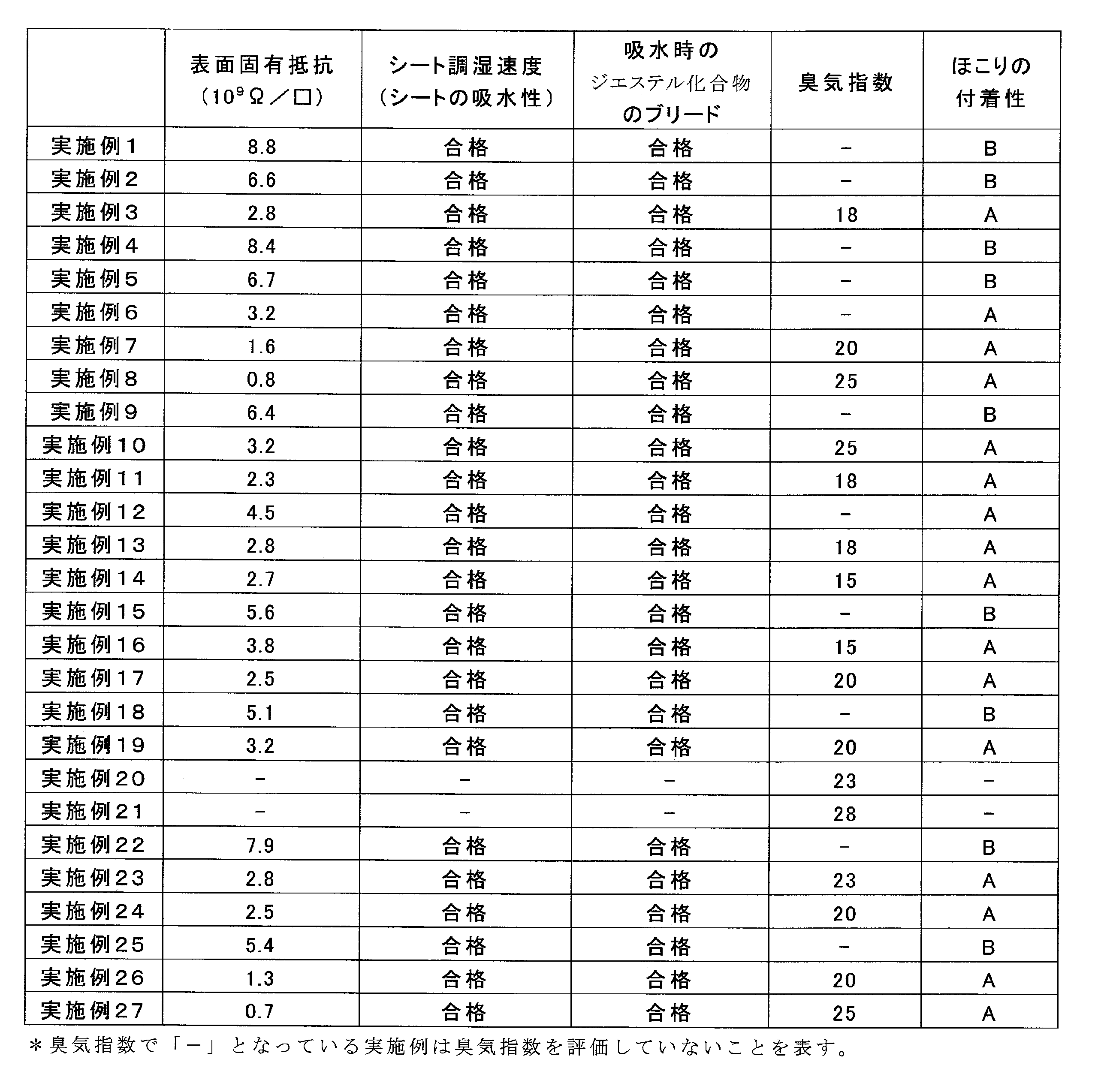
(比較例1~5)
使用するポリビニルアセタールの種類を表4に記載のとおりに変更した以外は、実施例1と同様にして、組成物、シート、凹凸付シート、合わせガラスを作製し、実施例1と同様の方法で評価した。結果を表4及び表5に示す。
使用するポリビニルアセタールの種類を表4に記載のとおりに変更した以外は、実施例1と同様にして、組成物、シート、凹凸付シート、合わせガラスを作製し、実施例1と同様の方法で評価した。結果を表4及び表5に示す。
(比較例6)
使用する水の量を4質量部(PVB-5とトリエチレングリコールジ2-エチルヘキサノエートの合計質量に対して2.9質量%)に変更した以外は実施例5と同様にして、組成物、シート、凹凸付シート、合わせガラスを作製し、実施例1と同様の方法で評価した。結果を表4及び表5に示す。
使用する水の量を4質量部(PVB-5とトリエチレングリコールジ2-エチルヘキサノエートの合計質量に対して2.9質量%)に変更した以外は実施例5と同様にして、組成物、シート、凹凸付シート、合わせガラスを作製し、実施例1と同様の方法で評価した。結果を表4及び表5に示す。
(比較例7)
使用する水の量を0質量部に変更した(すなわち添加しなかった)以外は実施例5と同様にして、組成物、シート、凹凸付シート、合わせガラスを作製し、実施例1と同様の方法で評価した。結果を表4及び表5に示す。
使用する水の量を0質量部に変更した(すなわち添加しなかった)以外は実施例5と同様にして、組成物、シート、凹凸付シート、合わせガラスを作製し、実施例1と同様の方法で評価した。結果を表4及び表5に示す。
(比較例8)
PVB-5をPVB-7に変更した以外は比較例6と同様にして、組成物、シート、凹凸付シート、合わせガラスを作製し、実施例1と同様の方法で評価した。結果を表4及び表5に示す。
PVB-5をPVB-7に変更した以外は比較例6と同様にして、組成物、シート、凹凸付シート、合わせガラスを作製し、実施例1と同様の方法で評価した。結果を表4及び表5に示す。
(比較例9)
PVB-5をPVB-7に変更した以外は比較例7と同様にして、組成物、シート、凹凸付シート、合わせガラスを作製し、実施例1と同様の方法で評価した。結果を表4及び表5に示す。
PVB-5をPVB-7に変更した以外は比較例7と同様にして、組成物、シート、凹凸付シート、合わせガラスを作製し、実施例1と同様の方法で評価した。結果を表4及び表5に示す。
(比較例10)
PVB-1の代わりにPVB-22を使用したこと以外は実施例1と同様にして、組成物、シート、凹凸付シート、合わせガラスを作製し、実施例1と同様の方法で評価した。結果を表4及び表5に示す。
PVB-1の代わりにPVB-22を使用したこと以外は実施例1と同様にして、組成物、シート、凹凸付シート、合わせガラスを作製し、実施例1と同様の方法で評価した。結果を表4及び表5に示す。
(比較例11)
水の使用量を60質量部にした以外は実施例24と同様にして、組成物、シート、凹凸付シート、合わせガラスを得て、実施例1と同様の方法で評価した。結果を表4及び表5に示す。
水の使用量を60質量部にした以外は実施例24と同様にして、組成物、シート、凹凸付シート、合わせガラスを得て、実施例1と同様の方法で評価した。結果を表4及び表5に示す。
(比較例12)
水を添加しなかった以外は実施例24と同様にして、組成物、シート、凹凸付シート、合わせガラスを得て、実施例1と同様の方法で評価した。結果を表4及び表5に示す。
水を添加しなかった以外は実施例24と同様にして、組成物、シート、凹凸付シート、合わせガラスを得て、実施例1と同様の方法で評価した。結果を表4及び表5に示す。
(比較例13)
1,4-ジオキサンの代わりにエタノール(沸点76℃)2000質量部を使用した以外は、実施例24と同様にして試験を行ったところ、水よりも先にエタノールが揮発し、得られた組成物はポリビニルアセタールとジエステル化合物が相分離したものとなり、実施例1と同様の評価を行うに値する組成物、シートを得ることができなかった。
1,4-ジオキサンの代わりにエタノール(沸点76℃)2000質量部を使用した以外は、実施例24と同様にして試験を行ったところ、水よりも先にエタノールが揮発し、得られた組成物はポリビニルアセタールとジエステル化合物が相分離したものとなり、実施例1と同様の評価を行うに値する組成物、シートを得ることができなかった。
(比較例14)
1,4-ジオキサンの代わりにメチルイソブチルケトン(沸点116℃)2000質量部を使用した以外は実施例24と同様にして、組成物、シート、凹凸付シート、合わせガラスを得て、実施例1と同様の方法で評価した。結果を表4及び表5に示す。
1,4-ジオキサンの代わりにメチルイソブチルケトン(沸点116℃)2000質量部を使用した以外は実施例24と同様にして、組成物、シート、凹凸付シート、合わせガラスを得て、実施例1と同様の方法で評価した。結果を表4及び表5に示す。
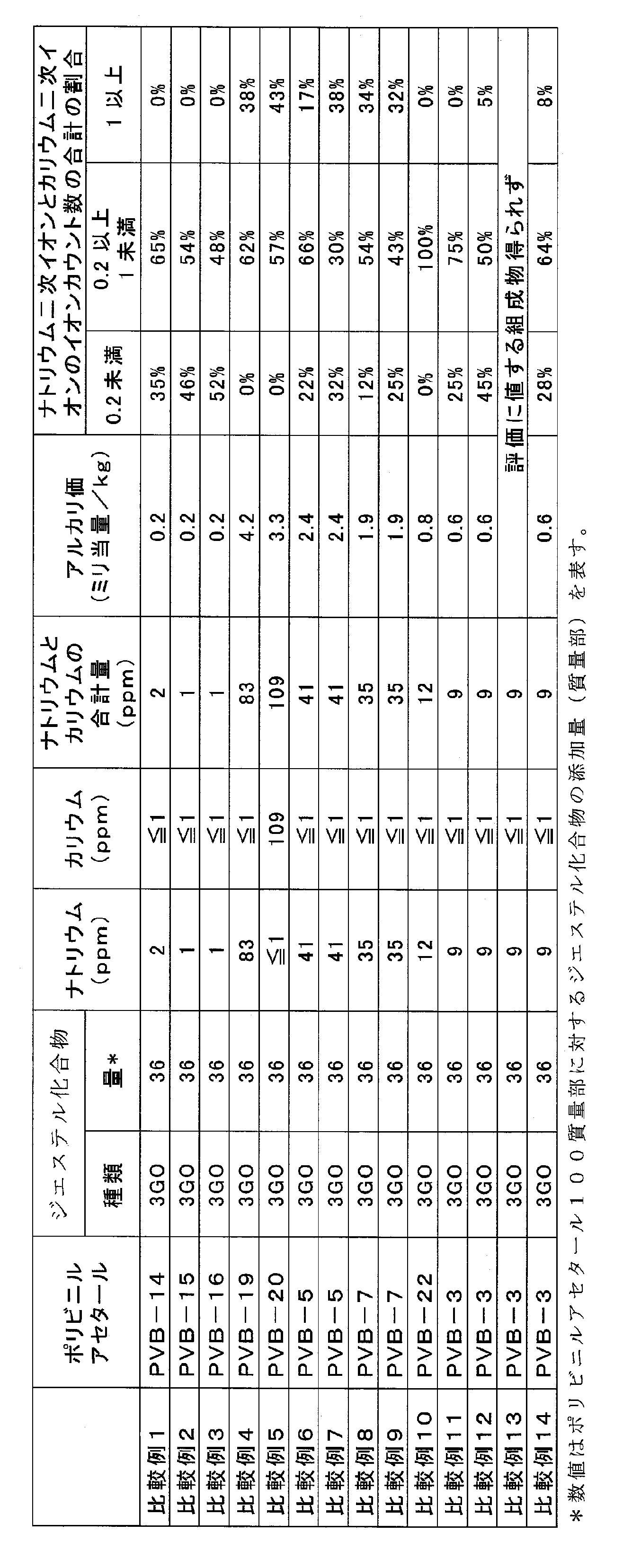
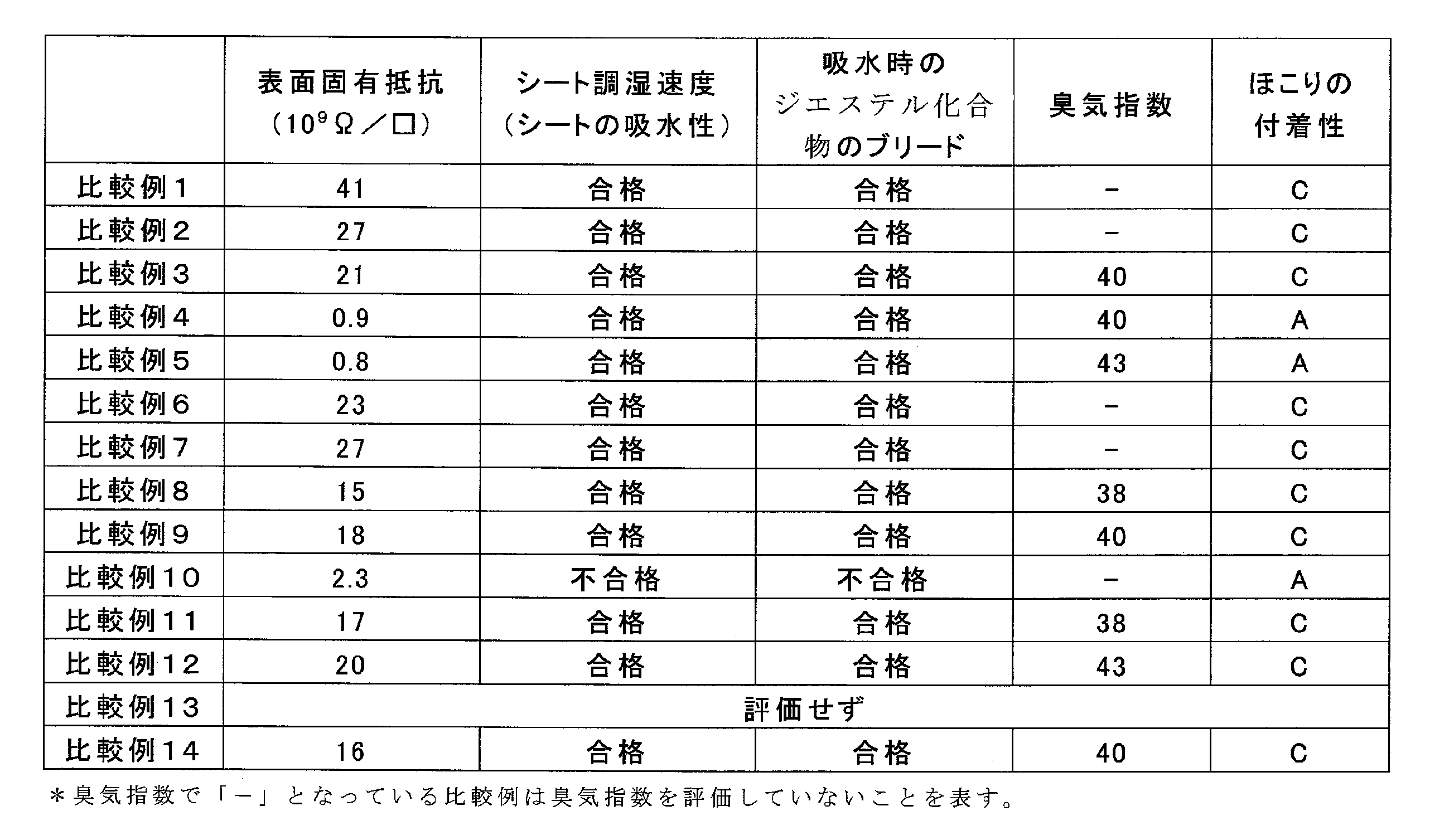
Claims (11)
- 平均残存水酸基量15~29モル%であり、アセタール化度70~82モル%であるポリビニルアセタール100質量部に対して、ジエステル化合物30~75質量部を含み、
ナトリウムを0~50ppm、カリウムを0~80ppm、ナトリウムとカリウムを合計5~80ppm含む組成物であり、
ジエステル化合物がトリエチレングリコール又はテトラエチレングリコールと、炭素数8~12のカルボン酸とのジエステル化合物であり、
該組成物を150℃で、12kgf/cm2の圧力を加えて、30分間熱プレスをして得られる厚さ0.8mmのシートの表面について、飛行時間型二次イオン分析装置(TOF-SIMS)で二次イオン分析を行った際に、C4H5O-イオンのイオンカウント数に対する、ナトリウムイオンのイオンカウント数とカリウムイオンのイオンカウント数の合計の割合が0.2未満である一次イオン照射点が測定を行った全一次イオン照射点の20%未満であり、C4H5O-イオンのイオンカウント数に対する、ナトリウムイオンのイオンカウント数とカリウムイオンのイオンカウント数の合計の割合が1以上である一次イオン照射点が測定を行った全一次イオン照射点の30%未満である組成物。 - アルカリ価が0.06~10ミリ当量/kgである、請求項1記載の組成物。
- ジエステル化合物がトリエチレングリコールジ2-エチルヘキサノエート又はテトラエチレングリコールジ2-エチルヘキサノエートである、請求項1又は2記載の組成物。
- 請求項1~3のいずれかに記載の組成物からなるシート。
- 平均残存水酸基量15~29モル%であり、アセタール化度70~82モル%であるポリビニルアセタール100質量部に対して、ジエステル化合物30~75質量部を含み、
飛行時間型二次イオン分析装置(TOF-SIMS)で二次イオン分析を行った際、C4H5O-イオンのイオンカウント数に対する、ナトリウムイオンのイオンカウント数とカリウムイオンのイオンカウント数の合計の割合が0.2未満である一次イオン照射点が測定を行った全一次イオン照射点の20%未満であり、C4H5O-イオンのイオンカウント数に対する、ナトリウムイオンのイオンカウント数とカリウムイオンのイオンカウント数の合計の割合が1以上である一次イオン照射点が測定を行った全一次イオン照射点の30%未満であるシート。 - 十点平均粗さRz値が10~60μmである、請求項4又は5記載のシート。
- 請求項4~6のいずれかに記載のシートの含水率を0.3~0.7質量%に調湿して保管する、シートの保管方法。
- PM10の濃度が0.3mg/m3以下の環境下で保管する、請求項7記載のシートの保管方法。
- 保管場所の体積をシート質量で除した値が1×10⁻⁸~1×10⁻²m3/kgである、請求項6~8のいずれかに記載のシートの保管方法。
- 保管期間が3日~180日である、請求項6~9のいずれかに記載の保管方法。
- 請求項4~6のいずれかに記載のシートを含む合わせガラス。
Priority Applications (2)
| Application Number | Priority Date | Filing Date | Title |
|---|---|---|---|
| PCT/JP2013/074904 WO2015037142A1 (ja) | 2013-09-13 | 2013-09-13 | 帯電防止性に優れる組成物 |
| JP2013544917A JP5615984B1 (ja) | 2013-09-13 | 2013-09-13 | 帯電防止性に優れる組成物 |
Applications Claiming Priority (1)
| Application Number | Priority Date | Filing Date | Title |
|---|---|---|---|
| PCT/JP2013/074904 WO2015037142A1 (ja) | 2013-09-13 | 2013-09-13 | 帯電防止性に優れる組成物 |
Publications (1)
| Publication Number | Publication Date |
|---|---|
| WO2015037142A1 true WO2015037142A1 (ja) | 2015-03-19 |
Family
ID=52574723
Family Applications (1)
| Application Number | Title | Priority Date | Filing Date |
|---|---|---|---|
| PCT/JP2013/074904 Ceased WO2015037142A1 (ja) | 2013-09-13 | 2013-09-13 | 帯電防止性に優れる組成物 |
Country Status (2)
| Country | Link |
|---|---|
| JP (1) | JP5615984B1 (ja) |
| WO (1) | WO2015037142A1 (ja) |
Cited By (4)
| Publication number | Priority date | Publication date | Assignee | Title |
|---|---|---|---|---|
| WO2016159028A1 (ja) * | 2015-03-30 | 2016-10-06 | 積水化学工業株式会社 | 合わせガラス用中間膜及び合わせガラス |
| JP2018021149A (ja) * | 2016-08-05 | 2018-02-08 | 株式会社クラレ | 臭気を軽減したポリビニルアセタール樹脂及び繊維 |
| JP2019147705A (ja) * | 2018-02-27 | 2019-09-05 | 積水化学工業株式会社 | 合わせガラス用中間膜及び合わせガラス |
| JP2019218449A (ja) * | 2018-06-19 | 2019-12-26 | 日東電工株式会社 | 樹脂フィルム、導電性フィルム及び積層フィルムの製造方法 |
Citations (5)
| Publication number | Priority date | Publication date | Assignee | Title |
|---|---|---|---|---|
| JPH10273345A (ja) * | 1997-01-28 | 1998-10-13 | Sekisui Chem Co Ltd | 合わせガラス用中間膜およびそれを用いた合わせガラス |
| WO1999003793A1 (en) * | 1997-07-17 | 1999-01-28 | Sekisui Chemical Co., Ltd. | Interlayer for laminated glass and laminated glass |
| JP2001097745A (ja) * | 1999-09-30 | 2001-04-10 | Sekisui Chem Co Ltd | 合わせガラス用中間膜及び合わせガラス |
| JP2012025645A (ja) * | 2010-07-28 | 2012-02-09 | Kuraray Co Ltd | 合わせガラス用中間膜、その製造方法およびそれを用いた合わせガラス |
| WO2012077689A1 (ja) * | 2010-12-10 | 2012-06-14 | 株式会社クラレ | 合わせガラス用中間膜、その製造方法およびそれを用いた合わせガラス |
-
2013
- 2013-09-13 JP JP2013544917A patent/JP5615984B1/ja not_active Expired - Fee Related
- 2013-09-13 WO PCT/JP2013/074904 patent/WO2015037142A1/ja not_active Ceased
Patent Citations (5)
| Publication number | Priority date | Publication date | Assignee | Title |
|---|---|---|---|---|
| JPH10273345A (ja) * | 1997-01-28 | 1998-10-13 | Sekisui Chem Co Ltd | 合わせガラス用中間膜およびそれを用いた合わせガラス |
| WO1999003793A1 (en) * | 1997-07-17 | 1999-01-28 | Sekisui Chemical Co., Ltd. | Interlayer for laminated glass and laminated glass |
| JP2001097745A (ja) * | 1999-09-30 | 2001-04-10 | Sekisui Chem Co Ltd | 合わせガラス用中間膜及び合わせガラス |
| JP2012025645A (ja) * | 2010-07-28 | 2012-02-09 | Kuraray Co Ltd | 合わせガラス用中間膜、その製造方法およびそれを用いた合わせガラス |
| WO2012077689A1 (ja) * | 2010-12-10 | 2012-06-14 | 株式会社クラレ | 合わせガラス用中間膜、その製造方法およびそれを用いた合わせガラス |
Cited By (10)
| Publication number | Priority date | Publication date | Assignee | Title |
|---|---|---|---|---|
| WO2016159028A1 (ja) * | 2015-03-30 | 2016-10-06 | 積水化学工業株式会社 | 合わせガラス用中間膜及び合わせガラス |
| WO2016159029A1 (ja) * | 2015-03-30 | 2016-10-06 | 積水化学工業株式会社 | 合わせガラス用中間膜及び合わせガラス |
| US10414127B2 (en) | 2015-03-30 | 2019-09-17 | Sekisui Chemical Co., Ltd. | Interlayer for laminated glass and laminated glass |
| US10414128B2 (en) | 2015-03-30 | 2019-09-17 | Sekisui Chemical Co., Ltd. | Interlayer for laminated glass and laminated glass |
| US10464293B2 (en) | 2015-03-30 | 2019-11-05 | Sekisui Chemical Co., Ltd. | Interlayer for laminated glass and laminated glass |
| JP2018021149A (ja) * | 2016-08-05 | 2018-02-08 | 株式会社クラレ | 臭気を軽減したポリビニルアセタール樹脂及び繊維 |
| JP2019147705A (ja) * | 2018-02-27 | 2019-09-05 | 積水化学工業株式会社 | 合わせガラス用中間膜及び合わせガラス |
| JP7188889B2 (ja) | 2018-02-27 | 2022-12-13 | 積水化学工業株式会社 | 合わせガラス用中間膜及び合わせガラス |
| JP2019218449A (ja) * | 2018-06-19 | 2019-12-26 | 日東電工株式会社 | 樹脂フィルム、導電性フィルム及び積層フィルムの製造方法 |
| JP7129830B2 (ja) | 2018-06-19 | 2022-09-02 | 日東電工株式会社 | 樹脂フィルム、導電性フィルム及び積層フィルムの製造方法 |
Also Published As
| Publication number | Publication date |
|---|---|
| JP5615984B1 (ja) | 2014-10-29 |
| JPWO2015037142A1 (ja) | 2017-03-02 |
Similar Documents
| Publication | Publication Date | Title |
|---|---|---|
| JP5919401B2 (ja) | 合わせガラス用中間膜及び合わせガラス | |
| JP5632077B1 (ja) | 透明性に優れる組成物 | |
| JP6541758B2 (ja) | シート | |
| JP5529345B1 (ja) | ポリビニルアセタール組成物 | |
| JPH11343152A (ja) | 合わせガラス用中間膜及び合わせガラス | |
| BR0117269B1 (pt) | pelÍcula de intercamada para vidro laminado e vidro laminado compreendendo a mesma | |
| JP5615984B1 (ja) | 帯電防止性に優れる組成物 | |
| JPWO2014188545A1 (ja) | 積層体 | |
| JP6392629B2 (ja) | ポリビニルアセタール組成物 | |
| JP6113644B2 (ja) | 積層体 | |
| JP6113645B2 (ja) | 積層体 | |
| JP5503088B1 (ja) | ポリビニルアセタールを含有するシート | |
| JP6113642B2 (ja) | 積層体 | |
| JP5373231B1 (ja) | 遮音性に優れる積層体 | |
| EP3527619B1 (en) | Polyvinyl acetal composition | |
| RU2385300C2 (ru) | Соединительная пленка для многослойного стекла и многослойное стекло | |
| JP6113639B2 (ja) | 積層体 | |
| JP2015117142A (ja) | 遮音性に優れる積層体 | |
| JP6113641B2 (ja) | 積層体 | |
| JP2015059218A (ja) | ポリビニルアセタールを含有するシート | |
| JP2004250254A (ja) | 熱可塑性樹脂シート、合わせガラス用中間膜及び合わせガラス | |
| JP2015116677A (ja) | 積層体 | |
| JP2018172253A (ja) | 合わせガラス用中間膜及び合わせガラス | |
| JP2008038093A (ja) | 合わせガラス用中間膜及び合わせガラス | |
| JP2015117140A (ja) | 遮音性に優れる積層体 |
Legal Events
| Date | Code | Title | Description |
|---|---|---|---|
| ENP | Entry into the national phase |
Ref document number: 2013544917 Country of ref document: JP Kind code of ref document: A |
|
| 121 | Ep: the epo has been informed by wipo that ep was designated in this application |
Ref document number: 13893367 Country of ref document: EP Kind code of ref document: A1 |
|
| NENP | Non-entry into the national phase |
Ref country code: DE |
|
| 122 | Ep: pct application non-entry in european phase |
Ref document number: 13893367 Country of ref document: EP Kind code of ref document: A1 |