WO2015012052A1 - 蛍光体分散ガラス - Google Patents
蛍光体分散ガラス Download PDFInfo
- Publication number
- WO2015012052A1 WO2015012052A1 PCT/JP2014/066786 JP2014066786W WO2015012052A1 WO 2015012052 A1 WO2015012052 A1 WO 2015012052A1 JP 2014066786 W JP2014066786 W JP 2014066786W WO 2015012052 A1 WO2015012052 A1 WO 2015012052A1
- Authority
- WO
- WIPO (PCT)
- Prior art keywords
- phosphor
- glass
- mass
- dispersed
- group
- Prior art date
- Legal status (The legal status is an assumption and is not a legal conclusion. Google has not performed a legal analysis and makes no representation as to the accuracy of the status listed.)
- Ceased
Links
Classifications
-
- C—CHEMISTRY; METALLURGY
- C03—GLASS; MINERAL OR SLAG WOOL
- C03C—CHEMICAL COMPOSITION OF GLASSES, GLAZES OR VITREOUS ENAMELS; SURFACE TREATMENT OF GLASS; SURFACE TREATMENT OF FIBRES OR FILAMENTS MADE FROM GLASS, MINERALS OR SLAGS; JOINING GLASS TO GLASS OR OTHER MATERIALS
- C03C3/00—Glass compositions
- C03C3/04—Glass compositions containing silica
- C03C3/062—Glass compositions containing silica with less than 40% silica by weight
- C03C3/064—Glass compositions containing silica with less than 40% silica by weight containing boron
- C03C3/066—Glass compositions containing silica with less than 40% silica by weight containing boron containing zinc
-
- C—CHEMISTRY; METALLURGY
- C09—DYES; PAINTS; POLISHES; NATURAL RESINS; ADHESIVES; COMPOSITIONS NOT OTHERWISE PROVIDED FOR; APPLICATIONS OF MATERIALS NOT OTHERWISE PROVIDED FOR
- C09K—MATERIALS FOR MISCELLANEOUS APPLICATIONS, NOT PROVIDED FOR ELSEWHERE
- C09K11/00—Luminescent materials, e.g. electroluminescent or chemiluminescent
- C09K11/08—Luminescent materials, e.g. electroluminescent or chemiluminescent containing inorganic luminescent materials
- C09K11/77—Luminescent materials, e.g. electroluminescent or chemiluminescent containing inorganic luminescent materials containing rare earth metals
- C09K11/7766—Luminescent materials, e.g. electroluminescent or chemiluminescent containing inorganic luminescent materials containing rare earth metals containing two or more rare earth metals
- C09K11/7774—Aluminates
-
- C—CHEMISTRY; METALLURGY
- C03—GLASS; MINERAL OR SLAG WOOL
- C03C—CHEMICAL COMPOSITION OF GLASSES, GLAZES OR VITREOUS ENAMELS; SURFACE TREATMENT OF GLASS; SURFACE TREATMENT OF FIBRES OR FILAMENTS MADE FROM GLASS, MINERALS OR SLAGS; JOINING GLASS TO GLASS OR OTHER MATERIALS
- C03C14/00—Glass compositions containing a non-glass component, e.g. compositions containing fibres, filaments, whiskers, platelets, or the like, dispersed in a glass matrix
-
- C—CHEMISTRY; METALLURGY
- C03—GLASS; MINERAL OR SLAG WOOL
- C03C—CHEMICAL COMPOSITION OF GLASSES, GLAZES OR VITREOUS ENAMELS; SURFACE TREATMENT OF GLASS; SURFACE TREATMENT OF FIBRES OR FILAMENTS MADE FROM GLASS, MINERALS OR SLAGS; JOINING GLASS TO GLASS OR OTHER MATERIALS
- C03C3/00—Glass compositions
- C03C3/12—Silica-free oxide glass compositions
- C03C3/14—Silica-free oxide glass compositions containing boron
-
- C—CHEMISTRY; METALLURGY
- C09—DYES; PAINTS; POLISHES; NATURAL RESINS; ADHESIVES; COMPOSITIONS NOT OTHERWISE PROVIDED FOR; APPLICATIONS OF MATERIALS NOT OTHERWISE PROVIDED FOR
- C09K—MATERIALS FOR MISCELLANEOUS APPLICATIONS, NOT PROVIDED FOR ELSEWHERE
- C09K11/00—Luminescent materials, e.g. electroluminescent or chemiluminescent
- C09K11/02—Use of particular materials as binders, particle coatings or suspension media therefor
-
- C—CHEMISTRY; METALLURGY
- C09—DYES; PAINTS; POLISHES; NATURAL RESINS; ADHESIVES; COMPOSITIONS NOT OTHERWISE PROVIDED FOR; APPLICATIONS OF MATERIALS NOT OTHERWISE PROVIDED FOR
- C09K—MATERIALS FOR MISCELLANEOUS APPLICATIONS, NOT PROVIDED FOR ELSEWHERE
- C09K11/00—Luminescent materials, e.g. electroluminescent or chemiluminescent
- C09K11/08—Luminescent materials, e.g. electroluminescent or chemiluminescent containing inorganic luminescent materials
- C09K11/77—Luminescent materials, e.g. electroluminescent or chemiluminescent containing inorganic luminescent materials containing rare earth metals
- C09K11/7728—Luminescent materials, e.g. electroluminescent or chemiluminescent containing inorganic luminescent materials containing rare earth metals containing europium
- C09K11/77348—Silicon Aluminium Nitrides or Silicon Aluminium Oxynitrides
Definitions
- the present invention relates to a phosphor dispersion glass characterized in that a phosphor as a light emitting material is sealed in glass.
- white LEDs have been developed as white light sources, and power-saving and high color rendering white LEDs are required.
- commercially available white LEDs have a configuration in which a blue GaN-based LED is used as a light source and a cerium-doped YAG oxide phosphor that emits yellow fluorescence is excited. Light from the light source and fluorescence are mixed and appear to the human eye as pseudo white light.
- white light (daylight color) having a high color temperature can be obtained because there are few cyan ( ⁇ 500 nm) and red (600 nm) components.
- White light (bulb color) with a low color temperature cannot be obtained. Therefore, a white light source with high color rendering is realized by adding a plurality of phosphors to compensate for a short wavelength component such as red.
- nitride phosphors are known as high-efficiency red phosphors.
- Patent Document 1 a CaAlSiN 3 phosphor powder activated with Eu is produced, and evaporation of contained components during sintering is prevented. Therefore, it has been proposed to sinter raw materials at 1600 to 2000 ° C. in a high-pressure nitrogen atmosphere.
- the phosphor for LED used for illumination was sealed with an epoxy resin, a silicone resin, or a fluororesin.
- the sealing member is susceptible to deterioration due to heat generation of the element, light, and environmental moisture, and has a short life. Due to long-term use, the resin deteriorates due to ultraviolet light or blue light emitted from the LED, causing problems such as discoloration and deterioration of light transmission characteristics.
- Patent Document 2 a low melting point oxide glass as shown in Patent Document 2 has been proposed.
- a highly weather-resistant LED can be realized by encapsulating the phosphor in the glass.
- the mixture of the phosphor and the glass has a glass transition point.
- the temperature needs to be raised to the above temperature and sintered, and the phosphor may be deactivated by the heat at that time.
- the phosphor-dispersed glass described in Patent Document 3 and Patent Document 4 is used for the oxide phosphor, and Patent Document 5 is used for the oxynitride phosphor. Each phosphor-dispersed glass has been reported.
- Japanese Patent No. 5045432 Japanese Patent Laid-Open No. 2008-19109 JP 2005-11933 A Japanese Patent Laid-Open No. 2008-19109 JP 2011-162398 A
- the phosphor when glass is used as a material for sealing the phosphor, the phosphor may be deactivated by heat during sintering.
- Non-Patent Document 1 Sr 2-x Si 5 N 8: Eu 2+ phosphor the presence of oxygen during heating, divalent Eu has been reported to be oxidized to trivalent. That is, when the nitride phosphor and glass containing oxygen are mixed and sintered, the light emission efficiency of the nitride phosphor may be significantly reduced.
- an object of the present invention is to obtain a phosphor-dispersed glass in which phosphor deactivation is suppressed.
- the inventors have confirmed that when the nitride phosphor is mixed with glass containing oxygen and sintered, the resulting phosphor-dispersed glass becomes black or gray and the luminous efficiency is greatly impaired. From the above findings, it has been clarified that, when an oxide glass having a specific composition is used, the above deactivation can be suppressed even if it is mixed with a nitride phosphor powder and sintered. Further, further investigation shows that deactivation occurs due to the reaction between the components constituting the phosphor and the glass composition components. When an oxide glass having the above composition range is used, a wavelength of 350 to 475 nm is used. It has been clarified that inactivation of the luminous efficiency can be suppressed regardless of the type of phosphor if the phosphor has excitation light.
- the phosphor-dispersed glass according to the first aspect of the present invention is a phosphor-dispersed glass in which phosphor particles are dispersed in glass, and the glass contains 1 to 40% by mass of SiO 2 and B 2 O. 3 to 15 to 65% by mass, ZnO to 1 to 50% by mass, RO (total of at least one selected from the group consisting of MgO, CaO, SrO, and BaO) 0 to 40% by mass, R 2 O (Li 2 O, Na 2 O, and K 2 O at least one of total) selected from the group consisting of 0 to 30 wt%, including ZrO 2 0 ⁇ 5 wt% (however, SiO 2 + B 2 O 3 + ZnO + RO + R 2 O + ZrO 2 is 80% by mass or more).
- the phosphor dispersion glass according to the second aspect of the present invention is a phosphor dispersion glass which phosphor particles are dispersed in the glass, the glass is a SiO 2 1 ⁇ 20 wt%, B 2 10 to 40% by mass of O 3 , 20 to 50% by mass of ZnO, 20 to 40% by mass of RO (total of at least one selected from the group consisting of MgO, CaO, SrO, and BaO), R 2 O ( li 2 O, Na 2 O, and K 2 of at least one of total selected from the group consisting of O) 0 to 10 wt%, including ZrO 2 0 ⁇ 5 wt% (however, SiO 2 + B 2 O 3 + ZnO + RO + R 2 O + ZrO 2 is 80% by mass or more).
- Deactivation in the present specification refers to the case where the obtained phosphor-dispersed glass is visually black or gray, or has an internal quantum efficiency of less than 20%. It is not appropriate to use the phosphor-dispersed glass thus deactivated for the white LED.
- the phosphor-dispersed glass of the present invention can be obtained, for example, by preparing the glass powder material of glass described above, mixing the glass powder material and the phosphor powder, and then sintering.
- the present invention it is possible to obtain a phosphor-dispersed glass in which phosphor deactivation is suppressed. Further, the present invention is not limited to the type of phosphor as long as it is a phosphor having excitation light at a wavelength of 350 to 475 nm, and nitride phosphor particles are sealed in glass while suppressing the deactivation of luminous efficiency. Therefore, it is possible to obtain a high color rendering white LED.
- first embodiment is a phosphor-dispersed glass in which phosphor particles are dispersed in glass, and the glass contains 1 to 2 SiO 2.
- R 2 O total of at least one selected from the group consisting of Li 2 O, Na 2 O and K 2 O
- ZrO 2 in an amount of 0 to 5% by mass (provided that SiO 2 2 + B 2 O 3 + ZnO + RO + R 2 O + ZrO 2 is 80 mass% or more).
- said glass has the specific composition shown above, it was possible to suppress the reaction between the glass and the phosphor and to suppress the deactivation of the phosphor. Moreover, said glass is a composition which suppressed the raise of the softening point, and it can suppress that a fluorescent substance deactivates with a heat
- composition of the glass of the first embodiment will be described.
- content of the component contained in glass is represented by “mass%”, and may be described as “%” below.
- SiO 2 is a glass forming component, and can coexist with B 2 O 3 , which is another glass forming component, to form a stable glass, and is contained in the range of 1 to 40%. If it exceeds 40%, the softening point of the glass rises, and formability and workability become difficult. Preferably, it is in the range of 2 to 35%.
- B 2 O 3 is a glass-forming component, facilitates glass melting, suppresses an excessive increase in the linear expansion coefficient of the glass, and imparts moderate fluidity to the glass during baking.
- the glass is contained in the range of 15 to 65%. If it is less than 15%, depending on the relationship with other components, the fluidity of the glass may be insufficient, and the sinterability may be impaired. On the other hand, if it exceeds 65%, the softening point of the glass rises, making it difficult to form and work. Preferably, it is in the range of 20 to 61%. Also, the upper limit value is more preferably 44% or less.
- ZnO lowers the softening point of the glass and adjusts the linear expansion coefficient to an appropriate range, and is contained in the glass in a range of 1 to 50%. If it exceeds 50%, the glass becomes unstable and devitrification tends to occur. More preferably, it is in the range of 3 to 45%.
- the glass used in the present invention contains B 2 O 3 and ZnO in a total of 20 to 80% and contains other components so that the softening point and the coefficient of thermal expansion can be adjusted to suppress devitrification of the glass. It is preferable to do so. More preferably, it may be 30 to 78%. In particular, in order to suppress the deactivation of the phosphor, it is effective to prevent the phosphor from being damaged by heat. Therefore, while containing SiO 2 which stabilizes the glass and raises the softening point, the RO component and R 2 are contained. It is preferable to contain an O component to suppress an excessive increase in the softening point.
- ZrO 2 suppresses devitrification during melting or sintering of the glass and improves the chemical durability of the glass, and is contained in the range of 0 to 5%. If it exceeds 5%, the stability of the glass is lowered. Preferably it is in the range of 1-3%.
- RO total of at least one selected from the group consisting of MgO, CaO, SrO and BaO
- the thermal expansion coefficient of the glass may become too high.
- it is 37% or less of range.
- a lower limit as 0.2 mass% or more preferably.
- R 2 O (total of at least one selected from the group consisting of Li 2 O, Na 2 O, and K 2 O) lowers the softening point of the glass and adjusts the thermal expansion coefficient to an appropriate range. It is made to contain in 30% of range. On the other hand, if it exceeds 30%, the thermal expansion coefficient is excessively increased. Preferably it is 26% or less of range. Moreover, it is good also considering a lower limit as 0.2% or more preferably.
- the glass adjusts the content of each component of the glass so that SiO 2 + B 2 O 3 + ZnO + RO + R 2 O + ZrO 2 is 80% or more.
- an optional third component may be contained. Preferably it is 84% or more of range. Further, the upper limit may be 100%, more preferably 98% or less.
- second embodiment is a phosphor-dispersed glass comprising 1 to 20 mass% of SiO 2 and 10 of B 2 O 3 . -40 mass%, ZnO 20-50 mass%, RO (total of at least one selected from the group consisting of MgO, CaO, SrO, and BaO) 20-40 mass%, R 2 O (Li 2 O, Na 2 O, and K 2 of at least one of total selected from the group consisting of O) 0 to 10 wt%, including ZrO 2 0 ⁇ 5 wt% (however, SiO 2 + B 2 O 3 + ZnO + RO + R 2 O + ZrO 2 is 80% by mass or more).
- RO total of at least one selected from the group consisting of MgO, CaO, SrO, and BaO
- SiO 2 is contained in the range of 1 to 20%. Preferably, it may be 2 to 15%.
- B 2 O 3 is contained in the glass in the range of 10 to 40%. Preferably it may be 15 to 35%, more preferably 20 to 35%.
- ZnO is contained in the glass in a range of 20 to 50%. Preferably, it may be 25 to 45%.
- B 2 O 3 and ZnO are 30 to 70% in total. More preferably, it may be 40 to 65%.
- ZrO 2 is included at a content within a range of 0-5% in the glass. Preferably, it may be 1 to 3%.
- R 2 O (total of at least one selected from the group consisting of Li 2 O, Na 2 O, and K 2 O) is contained in the range of 0 to 10%.
- the lower limit may be 0.2% by mass or more.
- a further preferred embodiment of the present invention is the above phosphor dispersion glass, the glass is a SiO 2 10 ⁇ 40 wt%, B 2 O 3 to 15 to 65% by mass, ZnO to 1 to 40% by mass, RO (total of at least one selected from the group consisting of MgO, CaO, SrO, and BaO) 0 to 20% by mass, R 2 O (Li 2 O, Na 2 O, and K 2 O at least one total selected from the group consisting of) 8 to 30 wt%, including ZrO 2 0 ⁇ 5 wt% (however, SiO 2 + B 2 O 3 + ZnO + RO + R 2 O + ZrO 2 is 80% by mass or more).
- R 2 O (total of at least one selected from the group consisting of Li 2 O, Na 2 O, and K 2 O) is an essential component and is contained in the range of 8 to 30%. Preferably it is 10% or more and 15% or less of range.
- SiO 2 is contained in the range of 10 to 40%. Preferably, it may be 10 to 35%.
- the lower limit is preferably 12% or more, more preferably 20% or more.
- B 2 O 3 is included at a content within a range of 15 to 65% in the glass. Preferably, it may be 20 to 61%.
- ZnO is contained in the glass in the range of 1 to 40%. Preferably, it may be 5 to 35%. Further, the upper limit value may be more preferably 30% or less.
- the total content of B 2 O 3 and ZnO is 20 to 80%, the softening point and the thermal expansion coefficient are adjusted, and other components are contained so that devitrification of the glass can be suppressed. Is preferred. More preferably, it may be 30 to 78%. In particular, in order to suppress the deactivation of the phosphor, it is effective to prevent the phosphor from being damaged by heat. Therefore, while containing SiO 2 which stabilizes the glass and raises the softening point, the RO component and R 2 are contained. It is preferable to contain an O component to suppress an excessive increase in the softening point.
- ZrO 2 is included at a content within a range of 0-5% in the glass. Preferably, it may be 1 to 3%.
- RO total of at least one selected from the group consisting of MgO, CaO, SrO, and BaO
- the glass in an amount of 0 to 20%. Further, it may be preferably 0 to 15%.
- the reaction between the glass and the phosphor can be suppressed by containing specific components. It became clear that the deactivation of the phosphor could be further suppressed.
- One kind of the specific component may be used, or a plurality of kinds may be used.
- the glass preferably contains 0 to 18% by mass of Al 2 O 3 .
- Al 2 O 3 suppresses devitrification at the time of melting and sintering of the glass or suppresses reactivity with the phosphor, and is preferably contained in the range of 0 to 18% by mass. When it exceeds 18 mass%, stability of glass will be reduced. More preferably, it is the range of 16 mass% or less. Moreover, it is good also considering a lower limit as 0.2 mass% or more preferably.
- the glass preferably contains 0 to 10% by mass of antimony oxide.
- Antimony oxide is presumed to be contained in the glass in the form of Sb 2 O 3 and Sb 2 O 5 , and is considered to exist mainly as Sb 2 O 3 .
- Sb 2 O 3 suppresses the reactivity with the phosphor and is preferably contained in the range of 0 to 10% by mass. When it exceeds 10 mass%, stability of glass will be reduced. More preferably, it is the range of 8 mass% or less. Moreover, it is good also considering a lower limit as 0.2 mass% or more preferably.
- the glass preferably contains 0 to 10% by mass of tin oxide.
- Tin oxide is presumed to be contained in the form of SnO (2-x) (where 0 ⁇ x ⁇ 2), and is considered to exist as SnO 2 or SnO, for example.
- the tin oxide suppresses the reactivity with the phosphor and is preferably contained in the range of 0 to 10% by mass. When it exceeds 10 mass%, stability of glass will be reduced. More preferably, it is 8% or less. Moreover, it is good also considering a lower limit as 0.2 mass% or more preferably.
- the glass contains 0.2% by mass or more and 18% by mass or less of a total of at least one selected from the group consisting of Al 2 O 3 , antimony oxide, and tin oxide.
- SiO 2 + B 2 O 3 + ZnO + RO + R 2 O + ZrO 2 + Al 2 O 3 + antimony oxide + tin oxide may be 100% by mass.
- Nb 2 O 5 , TiO 2 , WO 3 , TeO 2 , La 2 O 3 , CeO 2 , P 2 O 5 or the like represented by a general oxide may be added.
- the transmittance of the glass may be lowered, which is not suitable for the purpose of the present invention. Therefore, it is preferable not to contain the said component substantially.
- the content of the above components is preferably 0.01% by mass or less.
- the glass when PbO is contained in the glass, the glass is colored yellow and absorbs excitation light. Therefore, it is preferable that PbO is not substantially contained.
- the content of the above components is preferably 0.01% by mass or less.
- the glass of the present invention preferably has a linear expansion coefficient of 6 to 13 ppm / ° C. and a softening point of 650 ° C. or less at 30 ° C. to 300 ° C.
- a softening point of 650 ° C. or less at 30 ° C. to 300 ° C.
- it is good also as 630 degrees C or less.
- the softening point is too low, the moisture resistance may be lowered, so the lower limit may be preferably 500 ° C. or higher.
- phosphors have different wavelengths for emitting excitation light depending on components constituting the phosphors.
- any phosphor having excitation light at a wavelength of 350 to 475 nm can be used for the phosphor-dispersed glass without any particular limitation on the type of the phosphor. That is, in the present invention, the phosphor particles preferably have excitation light at a wavelength of 350 to 475 nm.
- the present invention since the present invention is particularly suitable for phosphor particles having excitation light at 415 nm to 475 nm, it may be more preferably 415 to 475 nm.
- the present invention can be particularly suitably used for nitrides that are considered to be easily deactivated.
- (SrCa) AlSiN 3 : Eu 2+ which is a nitride phosphor and Lu 3 Al 5 O 12 : Ce 3+ which is an oxide red phosphor are mixed and used. Since the results are obtained, the present invention may include a plurality of types of phosphors.
- the conversion efficiency (excitation light to fluorescence intensity ratio) and light emission efficiency of the phosphor-dispersed glass of the present invention vary depending on the type and content of phosphor particles dispersed in the glass and the thickness of the phosphor-dispersed glass. .
- the content of phosphor particles and the thickness of the phosphor-dispersed glass may be adjusted so as to optimize the luminous efficiency and color rendering properties. There arises a problem that phosphor particles are not efficiently irradiated. Moreover, when there is too little content, it will become difficult to make it fully light-emit. Therefore, it is preferable to mix so that the content of the phosphor particles is 0.01 to 50% by mass with respect to the total mass of the phosphor-dispersed glass. In particular, the content is preferably 0.5 to 40% by mass.
- the phosphor-dispersed glass of the present invention can be obtained by mixing a glass powder material and a phosphor powder and then sintering the mixture.
- the glass powder material and the phosphor powder may be mixed and then melted once and then molded using a mold or the like.
- the phosphor may be deactivated and is not suitable for the purpose of the present invention.
- the phosphor-dispersed glass of the present invention may contain an inorganic filler.
- the inorganic filler By containing the above inorganic filler, it is possible to adjust thermal properties such as a linear expansion coefficient and a softening point when the phosphor-dispersed glass is sintered.
- the inorganic filler examples include zircon, mullite, silica, titania, and alumina.
- content of this inorganic filler suitably, For example, you may mix so that it may become 0.1 mass% or more and 40 mass% or less with respect to the total mass of this fluorescent substance dispersion
- Glass used for phosphor-dispersed glass is a glass powder material pulverized to a size close to the particle diameter (1 to 100 ⁇ m) of the phosphor powder to be mixed Is preferably used.
- the pulverization may be performed using a mortar or a ball mill, but a jet mill type pulverizer with less contamination in the work process may be used.
- the mixture obtained by mixing the glass powder material of the base material and the phosphor powder obtained in the above manner in a desired ratio is molded into a pellet by pressurization, and the pellet is sintered by heating to obtain a phosphor-dispersed glass. It is possible to obtain.
- the phosphor powder content is preferably 0.01 to 50% by mass. When the phosphor powder exceeds 50% by mass, it becomes difficult to sinter, or the excitation light is not efficiently irradiated onto the phosphor particles. On the other hand, when the content is less than 0.01% by mass, the content is too small, and it becomes difficult to emit light sufficiently.
- the pellet When the pellet is formed by pressurization, it is preferably performed in a process in which heat is not applied, and it is preferable to use a press molding method or the like.
- the atmosphere at the time of heating may be in the air or in an inert gas atmosphere such as nitrogen gas or Ar gas, but the air atmosphere is desirable in view of manufacturing costs.
- sintering may be performed under reduced pressure, or pressure may be applied during sintering.
- a phosphor-dispersed glass may be obtained by kneading a glass powder material of a base material and a phosphor powder into an organic vehicle, applying the paste in a paste form, and then sintering. At this time, you may mix the inorganic filler mentioned above according to the objective.
- the organic vehicle can be suitably used as long as it desorbs at the glass sintering temperature.
- the phosphor-dispersed glass of the present invention can be suitably used as a white LED.
- a nitride phosphor useful as a red phosphor can be sealed, a high color rendering white LED can be obtained.
- the remaining glass was formed into flakes with a rapid cooling twin roll molding machine, and sized into glass powder samples having an average particle size of 1 to 30 ⁇ m and a maximum particle size of less than 100 ⁇ m by a pulverizer.
- SnO was used as a raw material for tin oxide.
- Tin oxide in the glass is SnO (2-x) (where 0 ⁇ x ⁇ 2), and it is difficult to measure a clear oxidation state. Therefore, in Tables 1 and 2, SnO (2-x) is used. It was described.
- the above softening point was measured using a thermal analyzer TG-DTA (manufactured by Rigaku Corporation).
- the thermal expansion coefficient was determined from the amount of elongation at 30 to 300 ° C. when the temperature was raised at 5 ° C./min using a thermal dilatometer.
- Nitride red phosphor powder (SrCa) AlSiN 3 : Eu 2+ , emission center wavelength 610 nm) was added to the obtained glass powder material and mixed to obtain a mixed powder (phosphor content: 4 mass%).
- the glass powder material the compositions A to N in Table 1 were used.
- a button-shaped preform having a diameter of 10 mm and a thickness of 2 mm was produced by pressure molding with a mold. Next, it sintered by heating for 30 minutes in air
- Table 3 shows the used glass powder material, phosphor powder, sintering temperature, and color tone of the obtained sintered body.
- Example 2 Example 1 except that the composition of B and I in Table 1 was used for the glass powder material and a nitride red phosphor (CaAlSiN 3 : Eu 2+ , emission center wavelength of 630 nm) powder was used for the phosphor powder. Thus, a sintered body was obtained. The sintering temperature is as described in Table 3.
- Example 1 A sintered body was obtained in the same manner as in Example 1 except that the composition of O to S shown in Table 2 was used for the glass powder material.
- the sintering temperature is as described in Table 3.
- Example 3 Example 1 except that the composition of E in Table 1 was used for the glass powder material, and oxide red phosphor (Y 3 Al 5 O 12 : Ce 3+ , emission center 555 nm) powder was used for the phosphor powder. A sintered body was obtained in the same manner. The sintering temperature is as described in Table 4.
- Example 4 The composition of C, E and J to N in Table 1 was used for the glass powder material, and oxide red phosphor (Lu 3 Al 5 O 12 : Ce 3+ , emission center 540 nm) powder was used for the phosphor powder. Obtained the sintered compact by the same method as Example 1. The sintering temperature is as described in Table 4.
- Example 5 The obtained glass powder material is mixed with an inorganic filler (SiO 2 filler, particle diameter 0.3 ⁇ m) and nitride red phosphor powder ((SrCa) AlSiN 3 : Eu 2+ , emission center wavelength 610 nm). Powder (inorganic filler content: 2 mass%, phosphor content: 4 mass%) was used. In addition, the composition of N of Table 1 was used for the glass powder material. Next, a button-shaped preform having a diameter of 10 mm and a thickness of 2 mm was produced by pressure molding with a mold. Next, it sintered by heating for 30 minutes in air
- an inorganic filler SiO 2 filler, particle diameter 0.3 ⁇ m
- nitride red phosphor powder ((SrCa) AlSiN 3 : Eu 2
- Example 6 A sintered body was obtained in the same manner as in Example 5 except that oxide red phosphor (Y 3 Al 5 O 12 : Ce 3+ , emission center 555 nm) powder was used as the phosphor powder to be used.
- Table 4 shows the glass powder material, inorganic filler, phosphor powder, sintering temperature, and color tone of the obtained sintered body.
- the internal quantum efficiency was 60 to 81%.
- the internal quantum efficiency of the oxide red phosphor before glass sealing was 83% and 81%, respectively, and the internal quantum efficiency did not decrease or the internal quantum efficiency was suppressed from decreasing.
- the color tone of the sintered body was light yellow. From the above, it was shown that the present invention can suppress the deactivation of the oxide red phosphor.
- Examples 5 and 6 in which the inorganic filler was mixed were able to suppress the decrease in internal quantum efficiency and external quantum efficiency as in the other examples in which the inorganic filler was not mixed. Moreover, since there was no big change in the color tone of a sintered compact, it was shown that this invention can utilize an inorganic filler.
- Example 7 Composition of E in Table 1 as a glass powder sample, 5% by weight of (SrCa) AlSiN 3 : Eu 2+ powder as nitride phosphor powder, and Lu 3 Al 5 O 12 : Ce 3+ powder as oxide red phosphor 3% by weight were mixed to make a mixed powder. Next, the mixed powder was pressure-molded with a mold to prepare a button-shaped preform having a diameter of 10 mm and a thickness of 2 mm. Next, it was heated at 610 ° C. for 30 minutes in the air to obtain a sintered body. As a result, the sintered body became bright orange.
- the internal quantum efficiency and the external quantum efficiency of the sintered body obtained in Example 7 were measured using the method described above.
- the internal quantum efficiency was 61% and the external quantum efficiency was 50%. That is, it has been clarified that the deactivation of the phosphor can be suppressed even when the oxide phosphor and the nitride phosphor are used in combination. Therefore, it was confirmed that the present invention can also be used for phosphor-dispersed glass that is sealed by using a plurality of types of phosphors in combination.
Landscapes
- Chemical & Material Sciences (AREA)
- Engineering & Computer Science (AREA)
- Materials Engineering (AREA)
- Organic Chemistry (AREA)
- Inorganic Chemistry (AREA)
- Chemical Kinetics & Catalysis (AREA)
- Life Sciences & Earth Sciences (AREA)
- General Chemical & Material Sciences (AREA)
- Geochemistry & Mineralogy (AREA)
- Ceramic Engineering (AREA)
- Dispersion Chemistry (AREA)
- Glass Compositions (AREA)
- Led Device Packages (AREA)
- Luminescent Compositions (AREA)
Abstract
Description


得られたガラス粉末材料に窒化物赤蛍光体粉末((SrCa)AlSiN3:Eu2+、発光中心波長610nm)を添加、混合して混合粉末(蛍光体含有量;4質量%)とした。なお、ガラス粉末材料は表1のA~Nの組成を用いた。次に、金型で加圧成型して直径10mm、厚み2mmのボタン状予備成型体を作製した。次に、大気中においてそれぞれ30分間加熱することによって焼結し、焼結体を得た。使用したガラス粉末材料、蛍光体粉末、焼結温度、得られた焼結体の色調を表3に示した。
ガラス粉末材料に表1のB及びIの組成を使用し、蛍光体粉末に窒化物赤蛍光体(CaAlSiN3:Eu2+、発光中心波長630nm)粉末を使用した以外は、実施例1と同様の方法で焼結体を得た。なお、焼結温度は表3に記載した通りである。
ガラス粉末材料に表2のO~Sの組成を使用した以外は、実施例1と同様の方法で焼結体を得た。なお、焼結温度は表3に記載した通りである。
ガラス粉末材料に表1のEの組成を使用し、蛍光体粉末に酸化物赤蛍光体(Y3Al5O12:Ce3+、発光中心555nm)粉末を使用した以外は、実施例1と同様の方法で焼結体を得た。なお、焼結温度は表4に記載した通りである。
ガラス粉末材料に表1のC、E及びJ~Nの組成を使用し、蛍光体粉末に酸化物赤蛍光体(Lu3Al5O12:Ce3+、発光中心540nm)粉末を使用した以外は、実施例1と同様の方法で焼結体を得た。なお、焼結温度は表4に記載した通りである。
得られたガラス粉末材料に、無機フィラー(SiO2フィラー、粒子径0.3μm)、及び窒化物赤蛍光体粉末((SrCa)AlSiN3:Eu2+、発光中心波長610nm)を混合して混合粉末(無機フィラー含有量;2質量%、蛍光体含有量;4質量%)とした。なお、ガラス粉末材料は表1のNの組成を用いた。次に、金型で加圧成型して直径10mm、厚み2mmのボタン状予備成型体を作製した。次に、大気中においてそれぞれ30分間加熱することによって焼結し、焼結体を得た。使用したガラス粉末材料、無機フィラー、蛍光体粉末、焼結温度、得られた焼結体の色調を表3に示した。
使用する蛍光体粉末に酸化物赤蛍光体(Y3Al5O12:Ce3+、発光中心555nm)粉末を使用した以外は、実施例5と同様の方法で焼結体を得た。使用したガラス粉末材料、無機フィラー、蛍光体粉末、焼結温度、得られた焼結体の色調を表4に示した。
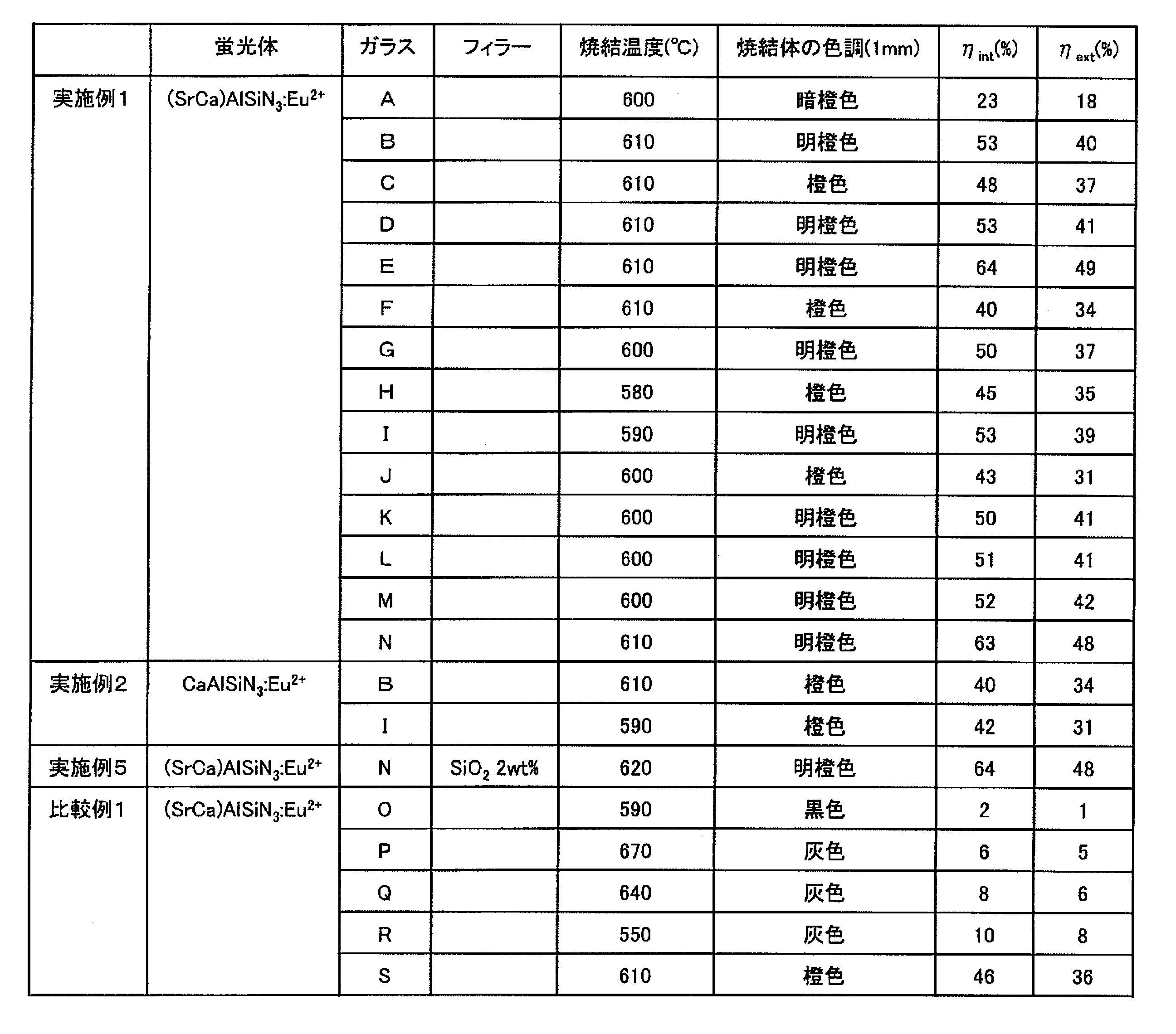
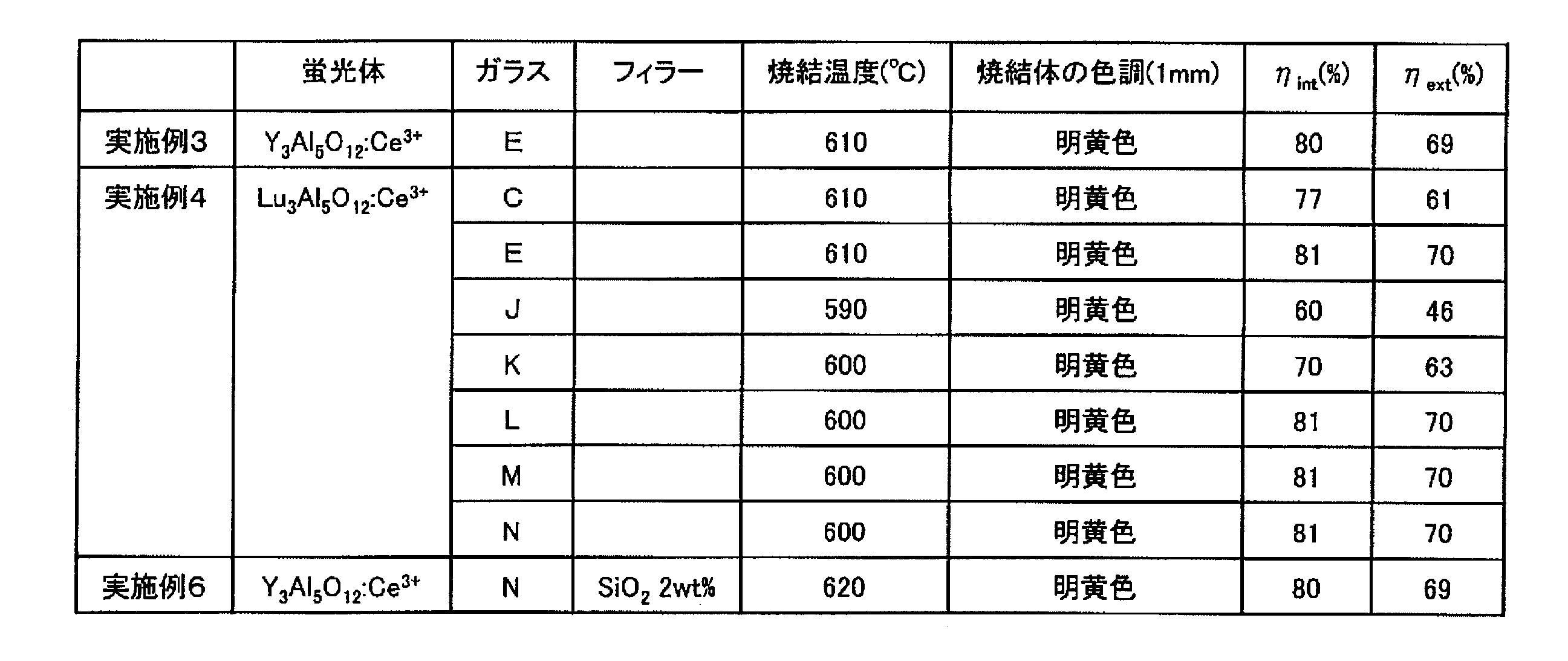
実施例1~6、比較例1で得られたそれぞれの焼結体について内部量子効率(ηint)及び外部量子効率(ηext)を測定し、表3、表4に示した。測定は、積分球(日本分光製ILF-533)が接続された蛍光分光光度計(日本分光製FP-6500)を用いて、積分球内に進入した励起光スペクトルの積分強度をA、サンプルで吸収された励起光スペクトルの積分強度をB、サンプルから放出された蛍光スペクトルの積分強度をCとして、内部量子効率をC/B、外部量子効率をC/Aで求めた。内部量子効率及び外部量子効率が高い程、発光効率が高いと言える。
ガラス粉末試料として表1のEの組成、窒化物蛍光体粉末として(SrCa)AlSiN3:Eu2+粉末を5重量%、及び酸化物赤蛍光体としてLu3Al5O12:Ce3+粉末を3重量%それぞれ混合して混合粉末とした。次に、該混合粉末を金型で加圧成型し、直径10mm、厚み2mmのボタン状予備成型体を作製した。次に、大気中において、610℃で30分間加熱し焼結体を得た。その結果、焼結体は明橙色となった。
Claims (13)
- 蛍光体粒子がガラス内に分散された蛍光体分散ガラスであって、該ガラスは、
SiO2を1~40質量%、
B2O3を15~65質量%、
ZnOを1~50質量%、
RO(MgO、CaO、SrO、及びBaOからなる群から選ばれる少なくとも1種の合計)を0~40質量%、
R2O(Li2O、Na2O、及びK2Oからなる群から選ばれる少なくとも1種の合計)を0~30質量%、
ZrO2を0~5質量%含む(ただし、SiO2+B2O3+ZnO+RO+R2O+ZrO2が80質量%以上)
ことを特徴とする蛍光体分散ガラス。 - 蛍光体粒子がガラス内に分散された蛍光体分散ガラスであって、該ガラスが、
SiO2を1~20質量%、
B2O3を10~40質量%、
ZnOを20~50質量%、
RO(MgO、CaO、SrO、及びBaOからなる群から選ばれる少なくとも1種の合計)を20~40質量%、
R2O(Li2O、Na2O、及びK2Oからなる群から選ばれる少なくとも1種の合計)を0~10質量%、
ZrO2を0~5質量%含む(ただし、SiO2+B2O3+ZnO+RO+R2O+ZrO2が80質量%以上)
ことを特徴とする蛍光体分散ガラス。 - 蛍光体粒子がガラス内に分散された蛍光体分散ガラスであって、該ガラスが、
SiO2を10~40質量%、
B2O3を15~65質量%、
ZnOを1~40質量%、
RO(MgO、CaO、SrO、及びBaOからなる群から選ばれる少なくとも1種の合計)を0~20質量%、
R2O(Li2O、Na2O、及びK2Oからなる群から選ばれる少なくとも1種の合計)を8~30質量%、
ZrO2を0~5質量%含む(ただし、SiO2+B2O3+ZnO+RO+R2O+ZrO2が80質量%以上)
ことを特徴とする蛍光体分散ガラス。 - 前記ガラスにAl2O3を0~18質量%含有することを特徴とする請求項1乃至3のいずれかに記載の蛍光体分散ガラス。
- 前記ガラスに酸化アンチモンを0~10質量%含有することを特徴とする請求項1乃至4のいずれかに記載の蛍光体分散ガラス。
- 前記ガラスに酸化スズを0~10質量%含有することを特徴とする請求項1乃至5のいずれかに記載の蛍光体分散ガラス。
- 前記ガラスにAl2O3、酸化アンチモン、及び酸化スズからなる群から選ばれる少なくとも1種の合計を0.2~18質量%含有することを特徴とする請求項1乃至6のいずれかのいずれかに記載の蛍光体分散ガラス。
- 前記蛍光体粒子が、波長350~475nmに励起光を持つことを特徴とする請求項1乃至請求項3のいずれかに記載の蛍光体分散ガラス。
- 前記ガラスは30℃~300℃における線膨張係数が6~13ppm/℃、軟化点が650℃以下であることを特徴とする請求項1乃至請求項3のいずれかに記載の蛍光体分散ガラス。
- 前記蛍光体粒子が、酸化物、酸窒化物、窒化物、及びYAG系化合物からなる群から選ばれる少なくとも1種であることを特徴とする請求項1乃至請求項3のいずれかに記載の蛍光体分散ガラス。
- 前記蛍光体粒子の含有量が、0.01~50質量%であることを特徴とする請求項1乃至請求項3のいずれかに記載の蛍光体分散ガラス。
- 無機フィラーを含有することを特徴とする請求項1乃至請求項3のいずれかに記載の蛍光体分散ガラス。
- 請求項1乃至請求項3のいずれかに記載の蛍光体分散ガラスを含有することを特徴とする白色LED。
Priority Applications (2)
| Application Number | Priority Date | Filing Date | Title |
|---|---|---|---|
| CN201480021301.0A CN105121375B (zh) | 2013-07-25 | 2014-06-25 | 荧光体分散玻璃 |
| KR1020167004183A KR101806054B1 (ko) | 2013-07-25 | 2014-06-25 | 형광체 분산 유리 |
Applications Claiming Priority (4)
| Application Number | Priority Date | Filing Date | Title |
|---|---|---|---|
| JP2013154274 | 2013-07-25 | ||
| JP2013-154274 | 2013-07-25 | ||
| JP2014121946A JP6398351B2 (ja) | 2013-07-25 | 2014-06-13 | 蛍光体分散ガラス |
| JP2014-121946 | 2014-06-13 |
Publications (1)
| Publication Number | Publication Date |
|---|---|
| WO2015012052A1 true WO2015012052A1 (ja) | 2015-01-29 |
Family
ID=52393104
Family Applications (1)
| Application Number | Title | Priority Date | Filing Date |
|---|---|---|---|
| PCT/JP2014/066786 Ceased WO2015012052A1 (ja) | 2013-07-25 | 2014-06-25 | 蛍光体分散ガラス |
Country Status (4)
| Country | Link |
|---|---|
| JP (1) | JP6398351B2 (ja) |
| KR (1) | KR101806054B1 (ja) |
| CN (1) | CN105121375B (ja) |
| WO (1) | WO2015012052A1 (ja) |
Cited By (1)
| Publication number | Priority date | Publication date | Assignee | Title |
|---|---|---|---|---|
| EP3050857A1 (en) * | 2015-02-02 | 2016-08-03 | Ferro Corporation | Glass compositions and glass frit composites for use in optical applications |
Families Citing this family (15)
| Publication number | Priority date | Publication date | Assignee | Title |
|---|---|---|---|---|
| JP6617948B2 (ja) * | 2015-05-11 | 2019-12-11 | 日本電気硝子株式会社 | 波長変換部材及び発光デバイス |
| JP6450936B2 (ja) * | 2015-07-15 | 2019-01-16 | 岡本硝子株式会社 | 蛍光体分散ガラス |
| JP6740616B2 (ja) * | 2015-09-15 | 2020-08-19 | 日本電気硝子株式会社 | 波長変換部材及び発光デバイス |
| WO2017047412A1 (ja) * | 2015-09-15 | 2017-03-23 | 日本電気硝子株式会社 | 波長変換部材及び発光デバイス |
| KR101729512B1 (ko) * | 2015-10-01 | 2017-04-24 | 한국세라믹기술원 | 백색 발광다이오드 소자의 제조방법 |
| WO2018037760A1 (ja) * | 2016-08-25 | 2018-03-01 | セントラル硝子株式会社 | 波長変換部材 |
| JP6693360B2 (ja) * | 2016-09-14 | 2020-05-13 | Agc株式会社 | 光変換部材、照明光源および光変換部材の製造方法 |
| CN106800371B (zh) * | 2017-01-25 | 2019-12-03 | 上海应用技术大学 | 一种高导热系数硼硅酸盐荧光玻璃材料及其制备方法 |
| CN106746687B (zh) * | 2017-01-25 | 2019-10-01 | 上海应用技术大学 | 一种采用丝网印刷法制备led封装用荧光玻璃片的方法 |
| CN109206009A (zh) * | 2017-07-04 | 2019-01-15 | 白金光学科技(苏州)有限公司 | 发光二极管用荧光玻璃及其制备工艺 |
| CN108249772A (zh) * | 2018-01-19 | 2018-07-06 | 南昌大学 | 基于稀土离子掺杂钒酸钇纳米晶的发光微晶玻璃的制备方法 |
| KR102149988B1 (ko) * | 2018-09-07 | 2020-08-31 | 대주전자재료 주식회사 | 파장 변환 부재 제조용 적층체 및 파장 변환 부재의 제조방법 |
| CN109516694B (zh) * | 2018-11-07 | 2021-11-30 | 深圳市齐尚光科技有限公司 | 一种荧光玻璃及其制备方法和发光装置 |
| CN113272260A (zh) * | 2019-03-08 | 2021-08-17 | 日本电气硝子株式会社 | 波长转换部件和发光设备 |
| KR102215135B1 (ko) * | 2019-04-12 | 2021-02-10 | 주식회사 베이스 | 유리 조성물 및 이를 포함하는 색변환 유리 |
Citations (3)
| Publication number | Priority date | Publication date | Assignee | Title |
|---|---|---|---|---|
| JP2003258308A (ja) * | 2002-03-06 | 2003-09-12 | Nippon Electric Glass Co Ltd | 発光色変換部材 |
| WO2011013505A1 (ja) * | 2009-07-27 | 2011-02-03 | コニカミノルタオプト株式会社 | 蛍光体分散ガラス及びその製造方法 |
| WO2011122369A1 (ja) * | 2010-03-28 | 2011-10-06 | セントラル硝子株式会社 | 低融点ガラス組成物及びそれを用いた導電性ペースト材料 |
Family Cites Families (8)
| Publication number | Priority date | Publication date | Assignee | Title |
|---|---|---|---|---|
| CN101171205A (zh) * | 2005-05-11 | 2008-04-30 | 日本电气硝子株式会社 | 荧光体复合玻璃、荧光体复合玻璃生片和荧光体复合玻璃的制造方法 |
| JP2007191702A (ja) * | 2005-12-22 | 2007-08-02 | Nippon Electric Glass Co Ltd | 発光色変換材料 |
| JP2007314657A (ja) * | 2006-05-25 | 2007-12-06 | Nippon Electric Glass Co Ltd | 蛍光体を用いた波長変換材料 |
| JP4802923B2 (ja) * | 2006-08-03 | 2011-10-26 | 日本電気硝子株式会社 | 波長変換部材 |
| JP5152687B2 (ja) * | 2006-12-07 | 2013-02-27 | 日本電気硝子株式会社 | 発光色変換材料 |
| JP5854367B2 (ja) * | 2011-06-21 | 2016-02-09 | 日本電気硝子株式会社 | 蛍光体複合部材の製造方法 |
| CN103153897A (zh) * | 2010-11-12 | 2013-06-12 | 国立大学法人京都大学 | 发白光玻璃、覆玻璃发光元件及发光装置 |
| JP6168284B2 (ja) * | 2013-04-03 | 2017-07-26 | 日本電気硝子株式会社 | 波長変換材料、波長変換部材及び発光デバイス |
-
2014
- 2014-06-13 JP JP2014121946A patent/JP6398351B2/ja not_active Expired - Fee Related
- 2014-06-25 CN CN201480021301.0A patent/CN105121375B/zh not_active Expired - Fee Related
- 2014-06-25 KR KR1020167004183A patent/KR101806054B1/ko not_active Expired - Fee Related
- 2014-06-25 WO PCT/JP2014/066786 patent/WO2015012052A1/ja not_active Ceased
Patent Citations (3)
| Publication number | Priority date | Publication date | Assignee | Title |
|---|---|---|---|---|
| JP2003258308A (ja) * | 2002-03-06 | 2003-09-12 | Nippon Electric Glass Co Ltd | 発光色変換部材 |
| WO2011013505A1 (ja) * | 2009-07-27 | 2011-02-03 | コニカミノルタオプト株式会社 | 蛍光体分散ガラス及びその製造方法 |
| WO2011122369A1 (ja) * | 2010-03-28 | 2011-10-06 | セントラル硝子株式会社 | 低融点ガラス組成物及びそれを用いた導電性ペースト材料 |
Cited By (1)
| Publication number | Priority date | Publication date | Assignee | Title |
|---|---|---|---|---|
| EP3050857A1 (en) * | 2015-02-02 | 2016-08-03 | Ferro Corporation | Glass compositions and glass frit composites for use in optical applications |
Also Published As
| Publication number | Publication date |
|---|---|
| CN105121375A (zh) | 2015-12-02 |
| KR101806054B1 (ko) | 2017-12-07 |
| KR20160034968A (ko) | 2016-03-30 |
| JP6398351B2 (ja) | 2018-10-03 |
| JP2015042606A (ja) | 2015-03-05 |
| CN105121375B (zh) | 2017-11-24 |
Similar Documents
| Publication | Publication Date | Title |
|---|---|---|
| JP6398351B2 (ja) | 蛍光体分散ガラス | |
| KR102271648B1 (ko) | 파장 변환 부재 및 그것을 사용하여 이루어지는 발광 디바이스 | |
| JP5757238B2 (ja) | 蛍光体分散ガラス及びその製造方法 | |
| KR101785798B1 (ko) | 형광체 분산 유리 | |
| JP4894186B2 (ja) | 蛍光体及び発光ダイオード | |
| JP6311715B2 (ja) | 蛍光体分散ガラス及びその製造方法 | |
| US9434876B2 (en) | Phosphor-dispersed glass | |
| CN105637659B (zh) | 波长转换部件和发光器件 | |
| JP6425001B2 (ja) | 波長変換材料、波長変換部材及び発光デバイス | |
| KR101593582B1 (ko) | 양자점이 형성된 색변환용 유리 복합체, 이의 제조방법 및 백색광 led 소자 | |
| JP2016084269A (ja) | 蛍光体分散ガラス | |
| CN103153897A (zh) | 发白光玻璃、覆玻璃发光元件及发光装置 | |
| JP4873361B2 (ja) | 発光色変換部材 | |
| KR101679682B1 (ko) | 파장변환 소재용 유리 조성물 | |
| JP2018131380A (ja) | 蛍光体分散ガラス | |
| KR20160123144A (ko) | 세라믹 형광체 플레이트 제조용 조성물, 세라믹 형광체 플레이트 및 발광장치 | |
| CN111480098B (zh) | 波长转换部件以及使用该波长转换部件的发光装置 | |
| KR101764241B1 (ko) | 티타니아가 첨가되는 파장변환 소재용 유리 조성물 및 유리의 제조방법 |
Legal Events
| Date | Code | Title | Description |
|---|---|---|---|
| WWE | Wipo information: entry into national phase |
Ref document number: 201480021301.0 Country of ref document: CN |
|
| 121 | Ep: the epo has been informed by wipo that ep was designated in this application |
Ref document number: 14829790 Country of ref document: EP Kind code of ref document: A1 |
|
| NENP | Non-entry into the national phase |
Ref country code: DE |
|
| ENP | Entry into the national phase |
Ref document number: 20167004183 Country of ref document: KR Kind code of ref document: A |
|
| 122 | Ep: pct application non-entry in european phase |
Ref document number: 14829790 Country of ref document: EP Kind code of ref document: A1 |