WO2014196542A1 - 光学活性化合物の製造方法 - Google Patents
光学活性化合物の製造方法 Download PDFInfo
- Publication number
- WO2014196542A1 WO2014196542A1 PCT/JP2014/064770 JP2014064770W WO2014196542A1 WO 2014196542 A1 WO2014196542 A1 WO 2014196542A1 JP 2014064770 W JP2014064770 W JP 2014064770W WO 2014196542 A1 WO2014196542 A1 WO 2014196542A1
- Authority
- WO
- WIPO (PCT)
- Prior art keywords
- proline
- hydroxy
- tert
- trans
- butyloxycarbonyl
- Prior art date
- Legal status (The legal status is an assumption and is not a legal conclusion. Google has not performed a legal analysis and makes no representation as to the accuracy of the status listed.)
- Ceased
Links
Images
Classifications
-
- B—PERFORMING OPERATIONS; TRANSPORTING
- B01—PHYSICAL OR CHEMICAL PROCESSES OR APPARATUS IN GENERAL
- B01J—CHEMICAL OR PHYSICAL PROCESSES, e.g. CATALYSIS OR COLLOID CHEMISTRY; THEIR RELEVANT APPARATUS
- B01J31/00—Catalysts comprising hydrides, coordination complexes or organic compounds
- B01J31/02—Catalysts comprising hydrides, coordination complexes or organic compounds containing organic compounds or metal hydrides
- B01J31/06—Catalysts comprising hydrides, coordination complexes or organic compounds containing organic compounds or metal hydrides containing polymers
- B01J31/061—Chiral polymers
- B01J31/062—Polymeric amino acids
-
- B—PERFORMING OPERATIONS; TRANSPORTING
- B01—PHYSICAL OR CHEMICAL PROCESSES OR APPARATUS IN GENERAL
- B01J—CHEMICAL OR PHYSICAL PROCESSES, e.g. CATALYSIS OR COLLOID CHEMISTRY; THEIR RELEVANT APPARATUS
- B01J31/00—Catalysts comprising hydrides, coordination complexes or organic compounds
- B01J31/02—Catalysts comprising hydrides, coordination complexes or organic compounds containing organic compounds or metal hydrides
- B01J31/06—Catalysts comprising hydrides, coordination complexes or organic compounds containing organic compounds or metal hydrides containing polymers
-
- B—PERFORMING OPERATIONS; TRANSPORTING
- B01—PHYSICAL OR CHEMICAL PROCESSES OR APPARATUS IN GENERAL
- B01J—CHEMICAL OR PHYSICAL PROCESSES, e.g. CATALYSIS OR COLLOID CHEMISTRY; THEIR RELEVANT APPARATUS
- B01J37/00—Processes, in general, for preparing catalysts; Processes, in general, for activation of catalysts
-
- B—PERFORMING OPERATIONS; TRANSPORTING
- B01—PHYSICAL OR CHEMICAL PROCESSES OR APPARATUS IN GENERAL
- B01J—CHEMICAL OR PHYSICAL PROCESSES, e.g. CATALYSIS OR COLLOID CHEMISTRY; THEIR RELEVANT APPARATUS
- B01J8/00—Chemical or physical processes in general, conducted in the presence of fluids and solid particles; Apparatus for such processes
- B01J8/02—Chemical or physical processes in general, conducted in the presence of fluids and solid particles; Apparatus for such processes with stationary particles, e.g. in fixed beds
-
- C—CHEMISTRY; METALLURGY
- C07—ORGANIC CHEMISTRY
- C07B—GENERAL METHODS OF ORGANIC CHEMISTRY; APPARATUS THEREFOR
- C07B53/00—Asymmetric syntheses
-
- C—CHEMISTRY; METALLURGY
- C07—ORGANIC CHEMISTRY
- C07C—ACYCLIC OR CARBOCYCLIC COMPOUNDS
- C07C201/00—Preparation of esters of nitric or nitrous acid or of compounds containing nitro or nitroso groups bound to a carbon skeleton
- C07C201/06—Preparation of nitro compounds
- C07C201/12—Preparation of nitro compounds by reactions not involving the formation of nitro groups
-
- C—CHEMISTRY; METALLURGY
- C07—ORGANIC CHEMISTRY
- C07C—ACYCLIC OR CARBOCYCLIC COMPOUNDS
- C07C201/00—Preparation of esters of nitric or nitrous acid or of compounds containing nitro or nitroso groups bound to a carbon skeleton
- C07C201/06—Preparation of nitro compounds
- C07C201/16—Separation; Purification; Stabilisation; Use of additives
-
- C—CHEMISTRY; METALLURGY
- C07—ORGANIC CHEMISTRY
- C07C—ACYCLIC OR CARBOCYCLIC COMPOUNDS
- C07C205/00—Compounds containing nitro groups bound to a carbon skeleton
- C07C205/45—Compounds containing nitro groups bound to a carbon skeleton the carbon skeleton being further substituted by at least one doubly—bound oxygen atom, not being part of a —CHO group
- C07C205/46—Compounds containing nitro groups bound to a carbon skeleton the carbon skeleton being further substituted by at least one doubly—bound oxygen atom, not being part of a —CHO group the carbon skeleton containing carbon atoms of quinone rings
- C07C205/47—Anthraquinones containing nitro groups
- C07C205/48—Anthraquinones containing nitro groups the carbon skeleton being further substituted by singly-bound oxygen atoms
-
- B—PERFORMING OPERATIONS; TRANSPORTING
- B01—PHYSICAL OR CHEMICAL PROCESSES OR APPARATUS IN GENERAL
- B01J—CHEMICAL OR PHYSICAL PROCESSES, e.g. CATALYSIS OR COLLOID CHEMISTRY; THEIR RELEVANT APPARATUS
- B01J2208/00—Processes carried out in the presence of solid particles; Reactors therefor
- B01J2208/02—Processes carried out in the presence of solid particles; Reactors therefor with stationary particles
-
- B—PERFORMING OPERATIONS; TRANSPORTING
- B01—PHYSICAL OR CHEMICAL PROCESSES OR APPARATUS IN GENERAL
- B01J—CHEMICAL OR PHYSICAL PROCESSES, e.g. CATALYSIS OR COLLOID CHEMISTRY; THEIR RELEVANT APPARATUS
- B01J2231/00—Catalytic reactions performed with catalysts classified in B01J31/00
- B01J2231/30—Addition reactions at carbon centres, i.e. to either C-C or C-X multiple bonds
- B01J2231/34—Other additions, e.g. Monsanto-type carbonylations, addition to 1,2-C=X or 1,2-C-X triplebonds, additions to 1,4-C=C-C=X or 1,4-C=-C-X triple bonds with X, e.g. O, S, NH/N
- B01J2231/341—1,2-additions, e.g. aldol or Knoevenagel condensations
- B01J2231/342—Aldol type reactions, i.e. nucleophilic addition of C-H acidic compounds, their R3Si- or metal complex analogues, to aldehydes or ketones
-
- C—CHEMISTRY; METALLURGY
- C07—ORGANIC CHEMISTRY
- C07B—GENERAL METHODS OF ORGANIC CHEMISTRY; APPARATUS THEREFOR
- C07B2200/00—Indexing scheme relating to specific properties of organic compounds
- C07B2200/07—Optical isomers
-
- C—CHEMISTRY; METALLURGY
- C07—ORGANIC CHEMISTRY
- C07C—ACYCLIC OR CARBOCYCLIC COMPOUNDS
- C07C2601/00—Systems containing only non-condensed rings
- C07C2601/06—Systems containing only non-condensed rings with a five-membered ring
- C07C2601/10—Systems containing only non-condensed rings with a five-membered ring the ring being unsaturated
-
- C—CHEMISTRY; METALLURGY
- C07—ORGANIC CHEMISTRY
- C07C—ACYCLIC OR CARBOCYCLIC COMPOUNDS
- C07C2601/00—Systems containing only non-condensed rings
- C07C2601/12—Systems containing only non-condensed rings with a six-membered ring
- C07C2601/14—The ring being saturated
Definitions
- the present invention relates to a method for producing an optically active compound using a column reactor.
- Proline and its derivatives have been found to act as organic molecular catalysts in organic synthesis.
- the optically active proline skeleton has advantages such as being readily available, not using a metal, and not being limited in use environment. Its catalytic activity is high yield and high enantioselection in reactions that proceed with enamine mechanisms such as aldol reaction and Mannich reaction, which are useful reactions for the synthesis of pharmaceutical raw materials, Michael reaction, Diels Alder reaction, etc. (Non-Patent Document 1).
- a solid-phase catalyst using a proline derivative is also known.
- resin particles obtained by suspension polymerization of a monomer composition containing an acrylate derivative monomer having a proline structure in the molecule, an unsaturated compound such as styrene or divinylbenzene, and a radical polymerization initiator are prepared. It is used as asymmetric solid phase catalyst particles, and it is put into a reaction vessel charged with a solution in which a carbonyl compound having ⁇ -hydrogen is charged, and heated while mixing the reaction mixture uniformly. It has been proposed to obtain an asymmetric aldol reaction product (Non-patent Document 2).
- Non-Patent Document 2 In the batch-type asymmetric aldol reaction using asymmetric catalyst particles of Non-Patent Document 2, it is necessary to individually control the stirring speed, reaction time, reaction temperature, etc., depending on the batch volume (scale) and batch shape. In addition, there is a problem that a complicated separation operation is required when the reaction product is separated from the catalyst.
- An object of the present invention is to solve the above-mentioned problems of the conventional technology, and can easily cope with organic synthesis that is not limited to scale, and without requiring a complicated separation operation of the reaction product from the catalyst.
- An optically active compound is produced using asymmetric catalyst particles that are solid phase catalysts so that they can be separated.
- the present inventors create a column reactor by filling the column for the column reactor with asymmetric catalyst particles, introduce a reaction compound into the column reactor and bring it into contact with the asymmetric catalyst particles, thereby It has been found that the object of the present invention can be achieved by converting a compound into an optically active compound, and the present invention has been completed.
- the present invention is a method for producing an optically active compound using a column reactor, Create a column reactor by filling the column for the column reactor with asymmetric catalyst particles, There is provided a production method comprising introducing a reaction compound into the column reactor and bringing the compound into contact with the asymmetric catalyst particles, thereby converting the reaction compound into an optically active compound.
- the present invention is a column reactor in which a column for a column reactor is filled with asymmetric catalyst particles, the asymmetric catalyst particles containing a proline derivative monomer having an unsaturated bond and a radical polymerization initiator.
- a column reactor which is a resin particle prepared from a monomer composition and used as a catalyst for a reaction (for example, aldol reaction) that proceeds by an enamine mechanism.
- the present invention relates to a method for producing a column reactor, wherein a column for a column reactor is filled with asymmetric catalyst particles, wherein the asymmetric catalyst particles include a proline derivative monomer having an unsaturated bond, a radical
- a production method using resin particles prepared from a monomer composition containing a polymerization initiator and used as a catalyst for a reaction that proceeds by an enamine mechanism is provided.
- a reaction compound is introduced into a column reactor packed with asymmetric catalyst particles, which are solid phase catalysts, and brought into contact with the asymmetric catalyst particles. Since it is converted into an optically active compound, it can easily react to organic synthesis independent of scale, and the generated optically active compound can be separated from the asymmetric catalyst particles without requiring a complicated separation operation.
- the method for producing an optically active compound of the present invention using a column reactor has the following steps (a) and (b). Hereinafter, it demonstrates for every process.
- a column reactor is prepared by filling a column for a column reactor with asymmetric catalyst particles described later.
- the column for the column reactor include a glass column, a ceramic column such as alumina, and a metal column such as stainless steel.
- An HPLC column can also be used.
- one end of these columns is provided with an inlet for introducing a reaction liquid, and the other end is provided with an outlet for discharging the reaction liquid.
- the size of such a column is usually 4.6 to 200 mm in inner diameter and 10 to 10000 mm in length from the viewpoint of handleability and the effect of the invention.
- a known packing method can be employed.
- asymmetric catalyst particles are dispersed in a solvent such as ethanol, and the obtained dispersion is applied to a column at a flow rate of 0.1 to 500 ml / min and a pressure of 10 to 200 MPa at maximum. It is mentioned that it fills so that it may become.
- the particle size of the asymmetric catalyst particle decreases, the surface area per unit mass of the asymmetric catalyst particle increases and the reaction field increases, so the contact frequency between the reaction compound and the asymmetric catalyst particle increases. Can be made.
- Increasing the particle size facilitates the injection of liquid into the column reactor. Therefore, it is preferably 0.5 to 50 ⁇ m, more preferably 1 to 10 ⁇ m, when measured by a flow type particle image imaging analysis method.
- a reaction solution obtained by dissolving a reaction compound in a solvent may be injected into a column reactor according to a conventional method, for example, using an HPLC system.
- the solvent for the press-fitting can be appropriately selected according to the type of the reaction compound.
- a mixed solvent of water and acetonitrile preferably 100: 0 to 20:80 (volume%)
- the pressure is preferably 10 to 200 MPa
- the flow rate is preferably 0.1 to 500 ml / min
- the press-fitting time is preferably 0.5 to 250 hours.
- the produced optically active compound is pushed out together with the solvent from the outlet of the column reactor. Therefore, it is preferable to determine the volume and time for separation. If necessary, the fraction is extracted with an organic solvent such as ethyl acetate, the extract is concentrated, and the concentrate is obtained, for example, from the viewpoint of obtaining the effects of the invention, hexane: isopropyl alcohol (99.9). : 0.1 to 70:30 (volume%)) and the like, and the reaction rate of the photoactive compound can be analyzed using HPLC under conditions of a flow rate of 0.1 to 5 ml / min. As a result of such an analysis, according to the method for producing an optically active compound of the present invention, the enantiomeric excess is preferably 50 to 100% e.e. e. This can be done.
- the reaction compound is selected according to the reaction in which the asymmetric catalyst particles are used as a catalyst.
- the reaction compound contains a carbonyl compound having an ⁇ -position hydrogen and an aldehyde or a ketone.
- aldehydes or ketones themselves correspond to carbonyl compounds having an ⁇ -position hydrogen.
- aldehydes or ketones that react with a carbonyl compound having an ⁇ -position hydrogen may not have an ⁇ -position hydrogen.
- aldehydes examples include acyclic aldehydes such as etanal, propanal, butyral, pentanal (valeraldehyde), hexanal, alicyclic aldehydes such as cyclohexylcarbaldehyde, benzaldehyde, 4-nitrobenzaldehyde, And aromatic aldehydes such as 3-nitrobenzaldehyde and 4-trifluoromethylbenzaldehyde.
- acyclic aldehydes such as etanal, propanal, butyral, pentanal (valeraldehyde), hexanal, alicyclic aldehydes such as cyclohexylcarbaldehyde, benzaldehyde, 4-nitrobenzaldehyde, and aromatic aldehydes such as 3-nitrobenzaldehyde and 4-trifluoromethylbenzaldehyde.
- ketones examples include acyclic ketones such as acetone, methyl ethyl ketone, diethyl ketone, methyl butyl ketone and hydroxyacetone, and alicyclic ketones such as cyclopentanone and cyclohexanone.
- reaction compound for the aldol reaction when cyclohexanone is selected as the carbonyl compound having a hydrogen at the ⁇ -position and 4-nitrobenzaldehyde is selected as the aldehyde to be reacted therewith, 2- (hydroxy ( 4-Nitrophenyl) methyl) cyclohexane-1-one can be obtained.
- This compound has two asymmetric carbons in the molecule. Therefore, this compound has the following four isomers (Anti-1, Anti-2, Syn (2 types)). The production ratio of these isomers can be controlled by selecting the type of asymmetric catalyst particle.
- the reaction compound when the asymmetric catalyst particles serve as a catalyst for the Mannich reaction, the reaction compound includes a carbonyl compound having ⁇ hydrogen (for example, aldehydes and ketones) and a carbonyl compound having no ⁇ hydrogen (for example, formaldehyde). ) And a primary or secondary amine compound.
- the optically active compound obtained from these is a ⁇ -aminocarbonyl compound.
- the generated optically active compound can be further optically resolved in the column reactor by extending the column length, the column diameter or both, or changing the type of the developing solvent. It becomes. Specifically, by extending the column length or column diameter or both, the amount of catalyst used for optical resolution increases, so the number of occurrences of interaction between the product and the catalyst increases, resulting in reaction generation. Optical resolution of the product is possible, and the reaction rate can be improved. In addition, by changing the reaction compound to another developing solvent instead of the dissolved solvent, the interaction between the developing solvent, the product, and the catalyst changes, resulting in a difference in retention time between optical isomers. Therefore, optical resolution of the reaction product becomes possible.
- asymmetric catalyst particles As the asymmetric catalyst particles, a monomer composition containing a monomer having an asymmetric source (for example, BINAP (2,2′-bis (diphenylphosphino) -1,1′-binaphthyl)) is subjected to suspension polymerization by a known technique. Organic compounds (eg, BINAP (2,2'-bis (diphenylphosphino) -1,1'-binaphthyl)) that are asymmetric sources are retained in the pores of porous polymers and porous ceramics. And the like.
- BINAP 2,2′-bis (diphenylphosphino) -1,1′-binaphthyl
- a preferable asymmetric catalyst particle is a resin that is prepared by ordinary suspension polymerization from a monomer composition containing a proline derivative monomer having an unsaturated bond and a radical polymerization initiator, and serves as a catalyst for aldol reaction or Mannich reaction. Particles can be mentioned.
- the monomer composition described above is discharged into a continuous phase, whereby droplets of the monomer composition are formed in the continuous phase, and then the droplets are heated to form unsaturated bonds. Examples thereof include those prepared by a microchannel method in which a proline derivative monomer is radically polymerized. The microchannel method will be described later.
- the monomer composition may contain a unit price or a polyunsaturated compound monomer as necessary.
- the effect of lowering the viscosity of the monomer composition is obtained, and when the polyunsaturated compound monomer is contained, the effect of increasing the hardness of the particles is obtained. It is done.
- the proline derivative monomer having an unsaturated bond constituting the monomer composition has a proline structure (the following structural formulas (A) to (D)) that becomes an asymmetric source even after radical polymerization. It constitutes a part of the resin matrix of the catalyst particles.
- Examples of the proline derivative monomer having such an unsaturated bond include those exemplified below.
- N-tert-butyloxycarbonyl-O- (2-methacryloyloxyethylsuccinoyl) -trans-4-hydroxy-L-proline N-tert-butyloxycarbonyl-O- (2-methacryloyloxyethylsuccinoyl) from the viewpoint of raw material availability and synthesis ease -cis-4-hydroxy-D-proline
- O- (2-methacryloyloxyethylsuccinoyl) -trans-4-hydroxy-L -proline and the like can be preferably used.
- the monomer composition can contain a mono-unsaturated compound monomer or a polyunsaturated compound monomer, if necessary, in addition to the proline derivative monomer having an unsaturated bond.
- the blending amount of the monounsaturated compound monomer or the polyunsaturated compound monomer is preferably 100 to 10,000 parts by mass, more preferably 300 to 1900 parts by mass with respect to 100 parts by mass of the proline derivative monomer having an unsaturated bond.
- Examples of the monovalent unsaturated compound monomer include olefin, monovinyl aromatic, monofunctional (meth) acrylate (where (meth) acrylate includes acrylate and methacrylate), and the like.
- olefins examples include ethylene, propylene, butene, and long chain ⁇ -olefins.
- Monovinyl aromatics include nuclear alkyl-substituted monovinyl aromatic compounds such as styrene, methylstyrene, and ethylstyrene, ⁇ -alkyl-substituted monovinyl aromatic compounds such as ⁇ -methylstyrene, ⁇ -alkyl-substituted styrene, alkoxy-substituted styrene, and indene derivatives. And acenaphthylene derivatives.
- Monofunctional (meth) acrylates include methyl (meth) acrylate, ethyl (meth) acrylate, n-propyl (meth) acrylate, i-propyl (meth) acrylate, n-butyl (meth) acrylate, i-butyl (meth) ) Acrylate, t-butyl (meth) acrylate, 2-methylbutyl (meth) acrylate, n-pentyl (meth) acrylate, n-hexyl (meth) acrylate, n-heptyl (meth) acrylate, 2-methylhexyl (meth) Acrylate, 2-ethylhexyl (meth) acrylate, 2-butylhexyl (meth) acrylate, isooctyl (meth) acrylate, isopentyl (meth) acrylate, isononyl (meth) acrylate, isode
- polyunsaturated compound monomer examples include polyolefins, polyvalent vinyl aromatics, and polyfunctional (meth) acrylates.
- polyvalent olefin examples include isoprene, 1,5-hexadiene, 1,5-cyclooctadiene and the like.
- Multifunctional (meth) acrylates include bisphenol F-EO modified di (meth) acrylate, bisphenol A-EO modified di (meth) acrylate, polypropylene glycol di (meth) acrylate, polyethylene glycol (meth) acrylate, and tricyclodecanedi.
- Bifunctional (meth) acrylates such as methylol di (meth) acrylate and dicyclopentadiene (meth) acrylate, trimethylolpropane tri (meth) acrylate, trimethylolpropane PO-modified (meth) acrylate, isocyanuric acid EO-modified tri (meth) Trifunctional (meth) acrylates such as acrylate, dipentaerythritol penta (meth) acrylate, pentaerythritol hexa (meth) acrylate, pentaerythritol tetra (meth) Acrylate, tetrafunctional or more (meth) acrylate such as ditrimethylolpropane tetraacrylate.
- polyfunctional urethane (meth) acrylates can also be used.
- Specific examples include M1100, M1200, M1210, M1600 (above, Toagosei Co., Ltd.), AH-600, AT-600 (above, Kyoeisha Chemical Co., Ltd.) and the like.
- divinylbenzene can be preferably used from the viewpoint of acid-base resistance, solvent resistance, particle hardness and viscosity.
- the radical polymerization initiator constituting the monomer composition is a compound that generates radicals by heating, and examples thereof include azo compounds and organic peroxides.
- examples of the azo compound include azobisalkanonitrile.
- examples of the organic peroxide include diacyl peroxide, peroxydicarbonate, peroxyester, peroxyketal, dialkyl peroxide, and hydroperoxide.
- “Decomposition temperature” is an important indicator for selecting a radical polymerization initiator from these. As this temperature is lower, the low temperature rapid curability of the monomer composition tends to be improved. In the present specification, the decomposition temperature of the radical polymerization initiator specifically means a 10-hour half-life temperature.
- radical polymerization initiator examples include azobisisobutyronitrile (decomposition temperature: 65 ° C.), diisobutyryl (decomposition temperature: 32.7 ° C.), 1,1,3,3-tetramethylbutylperoxide.
- Oxy-2-ethylhexanoate decomposition temperature 65.3 ° C
- dilauroyl peroxide decomposition temperature 61.6 ° C
- di (3,5,5-trimethylhexanoyl) peroxide decomposition temperature 59.
- the blending amount of the radical polymerization initiator in the monomer composition is necessary with the proline derivative monomer having an unsaturated bond in order to achieve sufficient curing and to avoid a decrease in the mechanical strength by avoiding a decrease in the degree of polymerization.
- the amount is preferably 1 to 40 parts by weight, more preferably 1 to 20 parts by weight based on 100 parts by weight of the total of the monounsaturated compound monomer and the polyunsaturated compound monomer blended according to the above.
- the monomer composition described above is discharged into the continuous phase, thereby forming droplets of the monomer composition in the continuous phase, and then the droplets are heated. And those prepared by a microchannel method in which a proline derivative monomer having an unsaturated bond is radically polymerized.
- This microchannel method has the following steps (a) and (b). Hereinafter, it demonstrates for every process.
- a monomer composition containing a proline derivative monomer having an unsaturated bond and a radical polymerization initiator is discharged from a microchannel to a continuous phase, thereby forming droplets of the monomer composition in the continuous phase.
- This state is usually a liquid / liquid emulsion.
- a known microreactor see Japanese Patent Nos. 2975943, 2981547, 3616909, etc.
- Commercially available microreactor devices can also be used.
- the microchannel applicable to these microreactor devices is not particularly limited, and for example, a microsyringe or a microchannel chip in which a groove is formed by etching on a glass substrate can be used.
- the size of the droplets of the monomer composition can be adjusted.
- the size of the droplet is 1 to 100 ⁇ m. This size becomes the final size of the asymmetric catalyst particle.
- the continuous phase functions as a dispersion medium for the droplets of the monomer composition, and is usually obtained by dissolving a dispersant in water such as ion exchange water.
- the dispersant can be appropriately selected from known cationic, anionic, nonionic, and amphoteric surfactants according to the type of constituent components of the monomer composition, the droplet diameter, and the like.
- anionic surfactant examples include soap (fatty acid sodium), monoalkyl sulfate, alkyl polyoxyethylene sulfate, alkyl benzene sulfonate, monoalkyl phosphate, and the like.
- cationic surfactant examples include alkyl trimethyl ammonium salt, dialkyl dimethyl ammonium salt, alkyl benzyl dimethyl ammonium salt and the like.
- amphoteric surfactants include alkyl dimethylamine oxide and alkyl carboxybetaine.
- nonionic surfactant examples include polyoxyethylene alkyl ether, fatty acid sorbitan ester, alkyl polyglucoside, fatty acid diethanolamide, alkyl monoglyceryl ether and the like.
- the content of such a surfactant in the continuous phase is generally 0.01 to 10% by weight, preferably 0.05 to 5% by weight.
- a stabilizer may be added to the continuous phase in order to stabilize the dispersion state of the monomer composition droplets and the polymerized asymmetric catalyst particles.
- water-soluble polymers such as polyvinyl alcohol, polyvinyl pyrrolidone, carboxymethyl cellulose, hydroxymethyl cellulose, starch, and gelatin, poorly water-soluble inorganic salts such as tricalcium phosphate, and the like can be contained.
- chelating agents glycine, alanine, sodium ethylenediaminetetraacetate, etc.
- pH buffering agents sodium tripolyphosphate, potassium tetrapolyphosphate, etc.
- sensitizers viscosity modifiers, etc. You may make it contain.
- the droplets of the monomer composition in the continuous phase are heated to radically polymerize the proline derivative monomer having an unsaturated bond.
- the droplets of the monomer composition can be heated by microwave irradiation. By changing the output of the microwave irradiation energy or the like, the heating temperature of the droplets of the monomer composition can be controlled, and thereby the mechanical property level of the asymmetric catalyst particles can be adjusted.
- the reason for this is that in the case of heating by microwave irradiation, it is recognized that both polymerization and depolymerization occur, but as the heating temperature rises, polymerization becomes more dominant than depolymerization, and the monomer composition of The mechanical properties of the polymer, for example, the compressive strength (particle hardness) can be changed (in other words, can be controlled) without changing the composition.
- a microwave irradiation apparatus a commercially available apparatus can be used as a microwave irradiation apparatus.
- Asymmetric catalyst particles obtained by the microchannel method are usually suspended in a continuous phase and can be isolated by filtration, centrifugation or the like.
- the average particle size, 50% particle size, and standard deviation of such asymmetric catalyst particles can be measured with a commercially available particle size measuring device.
- the preferred average particle size is 0.5 to 50 ⁇ m
- the preferred 50% particle size is 0.5 to 50 ⁇ m
- the preferred standard deviation is 5 ⁇ 10 ⁇ 4 to 10 ⁇ m.
- the column reactor is a column reactor packed with asymmetric catalyst particles.
- a column reactor particularly preferably applied to the “method for producing an optically active compound” of the present invention is prepared from a monomer composition containing a proline derivative monomer having an unsaturated bond and a radical polymerization initiator as asymmetric catalyst particles.
- the resin composition is used as a catalyst for enamine mechanism reactions such as aldol reaction and Mannich reaction, and in particular as asymmetric catalyst particles, according to the microchannel method, the monomer composition is discharged into a continuous phase, Thereby, droplets of the monomer composition were formed in the continuous phase, and then those prepared by radical polymerization of the proline derivative monomer having an unsaturated bond by heating the droplets were used.
- proline derivative monomers having an unsaturated bond N-tert-butoxycarbonyl-O- (2-methacryloyloxyethylsuccinoyl) -trans-4-hydroxy-L-proline, N-tert-butyne Roxycarbonyl-O- (2-methacryloyloxyethylsuccinoyl) -cis-4-hydroxy-D-proline or N-tert-butyoxycarbonyl-O- (4-vinylbenzyl) -trans-4-hydroxy- L-proline can be preferably used, and the monomer composition preferably further contains a unit price or polyunsaturated compound monomer, preferably divinylbenzene.
- the column reactor described above is also an embodiment of the present invention, and the manufacturing method thereof is also an embodiment of the present invention.
- this column reactor manufacturing method comprises an enamine prepared from a monomer composition containing a proline derivative monomer having an unsaturated bond and a radical polymerization initiator as described above in the column reactor column already described.
- the resin particles serving as a catalyst for the reaction proceeding by the mechanism are filled as asymmetric catalyst particles.
- asymmetric catalyst particles according to the microchannel method, the monomer composition is discharged into a continuous phase, whereby droplets of the monomer composition are formed in the continuous phase, and then the droplets are heated to form an asymmetric catalyst particle. It is preferable to use those prepared by radical polymerization of a proline derivative monomer having a saturated bond.
- Example 1 (Preparation of asymmetric catalyst particles by microchannel method) As a dispersed phase, N-tert-butyloxycarbonyl-O- (2-methacryloyloxyethyl) synthesized with reference to Non-Patent Documents 1 and 2 and J. Org. Chem., 2010, 75 (5), pp1620-1629 Succinoyl) -trans-4-hydroxy-L-proline 10 parts by mass, dilauroyl peroxide (Perroyl L, NOF Corporation) 1 part by mass, divinylbenzene 90 parts by mass, isooctane 10 parts by mass A monomer composition was prepared. Moreover, the aqueous solution (continuous phase liquid) which dissolved surfactant (SSL, Kao Co., Ltd.) in the ratio of 1 mass% in ion-exchange water as a continuous phase was prepared.
- SSL Kao Co., Ltd.
- the prepared dispersed phase and continuous phase are applied to a microreactor (Eptec Co., Ltd.) equipped with a microchannel (width 5 ⁇ m, depth 1 ⁇ m, length 100 ⁇ m), the dispersed phase is extruded into the continuous phase, Droplets of a monomer composition having a diameter of 3 ⁇ m were formed. While mixing the resulting mixture, ion-exchanged water and a surfactant (SSL, Kao Co., Ltd.) were added, and the droplet concentration of the monomer composition was 4% by mass, and the surfactant concentration was 1% by mass. A slurry was prepared.
- a surfactant SSL, Kao Co., Ltd.
- the obtained slurry was heated and stirred at 90 to 100 ° C. for 7 hours, and then collected on a filter and dried under vacuum to obtain asymmetric catalyst particles in which polymerization and deprotection were completed.
- the particle size of the asymmetric catalyst particles was measured using a flow type particle image analyzer (FPIA-3000, Sysmex Corp.). The average particle size was 2.839 ⁇ m, the 50% particle size was 2.841 ⁇ m, the standard The deviation was 0.12 ⁇ m and the CV value was 4.23%.
- This isomer mixture of 2- (hydroxy (4-nitrophenyl) methyl) cyclohexane-1-one was purified by HPLC (LC-20A, Shimadzu Corporation (column: CHIRALPAK AD-H, Daicel Corporation), mobile phase. : Hexane-isopropyl alcohol mixed solvent (85% by volume: 15% by volume))), the enantiomeric excess was 77% e.e. e. Met. The reaction rate based on aldehyde was 16%.
- Example 2 In the production of the optically active compound, a cyclohexanone solution of 4-nitrobenzaldehyde (Tokyo Chemical Industry Co., Ltd.) adjusted to 2.9% by mass was injected at a flow rate of 0.1 ml / min and a pressure of 2.7 MPa. 2- (Hydroxy (4-nitrophenyl) methyl) cyclohexane-1-one was obtained in the same manner as in Example 1 except that the development was performed over time. When this compound was analyzed by HPLC in the same manner as in Example 1, the enantiomeric excess was 74% e.e. e. Met. The reaction rate based on aldehyde was 50%.
- 4-nitrobenzaldehyde Tokyo Chemical Industry Co., Ltd.
- Example 3 In the production of the optically active compound, a cyclohexanone solution of 4-nitrobenzaldehyde (Tokyo Chemical Industry Co., Ltd.) adjusted to 13.7% by mass was injected at a flow rate of 0.4 ml / min and a pressure of 10.7 MPa. 2- (Hydroxy (4-nitrophenyl) methyl) cyclohexane-1-one was obtained in the same manner as in Example 1 except that the development was performed over time. When this compound was analyzed by HPLC in the same manner as in Example 1, the enantiomeric excess was 50% e.e. e. Met. The reaction rate based on aldehyde was 27%.
- 4-nitrobenzaldehyde Tokyo Chemical Industry Co., Ltd.
- Example 4 In the production of the optically active compound, a cyclohexanone solution of 4-nitrobenzaldehyde (Tokyo Chemical Industry Co., Ltd.) adjusted to 13.7% by mass was injected at a flow rate of 0.2 ml / min and a pressure of 5.3 MPa. 2- (Hydroxy (4-nitrophenyl) methyl) cyclohexane-1-one was obtained in the same manner as in Example 1 except that the development was performed over time. When this compound was analyzed by HPLC in the same manner as in Example 1, the enantiomeric excess was 87% e.e. e. Met. The reaction rate based on aldehyde was 28%.
- 4-nitrobenzaldehyde Tokyo Chemical Industry Co., Ltd.
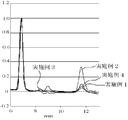
- Table 1 shows the reaction conditions of the column reactors in Examples 1 to 4, the isomers of the product 2- (hydroxy (4-nitrophenyl) methyl) cyclohexane-1-one (Anti-1, Anti-2, Syn) (2 types)) shows the relative intensity, reaction rate, and enantiomeric excess in the HPLC chart (see FIG. 1).
- FIG. 1 shows an HPLC chart.
- Example 5 (Preparation of asymmetric catalyst particles by microchannel method)
- a monomer composition was prepared.
- the aqueous solution continuous phase liquid
- surfactant SSL, Kao Co., Ltd.
- the prepared dispersed phase and continuous phase are applied to a microreactor (Eptec Co., Ltd.) equipped with a microchannel (width 5 ⁇ m, depth 1 ⁇ m, length 100 ⁇ m), the dispersed phase is extruded into the continuous phase, Droplets of a monomer composition having a diameter of 3 ⁇ m were formed. While mixing the resulting mixture, ion-exchanged water and a surfactant (SSL, Kao Co., Ltd.) were added, and the droplet concentration of the monomer composition was 4% by mass, and the surfactant concentration was 1% by mass. A slurry was prepared.
- a surfactant SSL, Kao Co., Ltd.
- the obtained slurry was heated and stirred at 90 to 100 ° C. for 7 hours, and then collected on a filter and dried under vacuum to obtain asymmetric catalyst particles in which polymerization and deprotection were completed.
- the particle size of the asymmetric catalyst particles was measured using a flow type particle image analyzer (FPIA-3000, Sysmex Corp.). The average particle size was 2.839 ⁇ m, the 50% particle size was 2.834 ⁇ m, the standard The deviation was 0.159 ⁇ m, and the CV value was 5.63%.
- This isomer mixture of 2- (hydroxy (4-nitrophenyl) methyl) cyclohexane-1-one was purified by HPLC (LC-20A, Shimadzu Corporation (column: CHIRALPAK AD-H, Daicel Corporation), mobile phase. : Hexane-isopropyl alcohol mixed solvent (85% by volume: 15% by volume))), the enantiomeric excess was 96% e.e. e. Met. The reaction rate based on aldehyde was 7%.
- Example 6 In the production of the optically active compound, a cyclohexanone solution of 4-nitrobenzaldehyde (Tokyo Chemical Industry Co., Ltd.) adjusted to 13.7% by mass was injected at a flow rate of 0.1 ml / min and a pressure of 2.5 MPa. 2- (Hydroxy (4-nitrophenyl) methyl) cyclohexane-1-one was obtained in the same manner as in Example 5 except that the development was performed over time. When this compound was analyzed by HPLC in the same manner as in Example 1, the enantiomeric excess was 97% e.e. e. Met. The reaction rate based on aldehyde was 13%.
- 4-nitrobenzaldehyde Tokyo Chemical Industry Co., Ltd.
- Example 7 N-tert-Butyloxycarbonyl instead of N-tert-Butyloxycarbonyl-O- (2-methacryloyloxyethylsuccinoyl) -trans-4-hydroxy-L-proline in the production of asymmetric catalyst particles
- Asymmetric catalyst particles were obtained in the same manner as in Example 5 except that -O- (4-vinylbenzyl) -trans-4-hydroxy-L-proline was used.
- the particle size of the asymmetric catalyst particles was measured using a flow particle image analyzer (FPIA-3000, Sysmex Corp.). The average particle size was 2.764 ⁇ m, the 50% particle size was 2.739 ⁇ m, the standard The deviation was 0.129 ⁇ m and the CV value was 4.74%.
- a column reactor for producing an optically active compound was obtained in the same manner as in Example 5. At this time, a maximum pressure of 25.7 MPa was applied.
- Example 8 In the production of the optically active compound, cyclohexanone solution of 4-nitrobenzaldehyde (Tokyo Chemical Industry Co., Ltd.) adjusted to 13.7% by mass was injected at a flow rate of 0.1 ml / min and a pressure of 2.4 MPa. 2- (Hydroxy (4-nitrophenyl) methyl) cyclohexane-1-one was obtained in the same manner as in Example 7 except that the time development was performed. When this compound was analyzed by HPLC in the same manner as in Example 1, the enantiomeric excess was 98% e.e. e. Met. The reaction rate based on aldehyde was 22%.
- Example 9 Example 7 except that a stainless steel column (Cat-No. 6010-11076, GL Science Co., Ltd.) having an outer diameter of 3/8 inch, an inner diameter of 7.6 mm, and a length of 300 mm was used for producing the column reactor. In the same manner as described above, a column reactor for producing an optically active compound was obtained. At this time, a maximum pressure of 17.4 MPa was applied.
- a stainless steel column Cat-No. 6010-11076, GL Science Co., Ltd.
- Example 10 In the production of the optically active compound, a cyclohexanone solution of 4-nitrobenzaldehyde (Tokyo Chemical Industry Co., Ltd.) adjusted to 13.7% by mass was injected at a flow rate of 1.0 ml / min and a pressure of 12.9 MPa. 2- (Hydroxy (4-nitrophenyl) methyl) cyclohexane-1-one was obtained in the same manner as in Example 9 except that the time development was performed. When this compound was analyzed by HPLC in the same manner as in Example 1, the enantiomeric excess was 96% e.e. e. Met. The reaction rate based on aldehyde was 13%.
- 4-nitrobenzaldehyde Tokyo Chemical Industry Co., Ltd.
- Example 11 Instead of the cyclohexanone solution of 4-nitrobenzaldehyde (Tokyo Chemical Industry Co., Ltd.) adjusted to 13.7% by mass in the production of the optically active compound, 3-nitrobenzaldehyde (Tokyo) adjusted to 13.7% by mass 2- (hydroxy (3-nitrophenyl) methyl) cyclohexane as in Example 9 except that a cyclohexanone solution from Kasei Kogyo Co., Ltd. was injected at a flow rate of 1.0 ml / min and a pressure of 13 MPa and developed for 5 hours. -1-one was obtained.
- This compound was analyzed by HPLC in the same manner as in Example 1 (provided that 90% by volume: 10% by volume was used as the hexane-isopropyl alcohol mixed solvent for the mobile phase), and the enantiomeric excess was 92% e.e. e. Met.
- the reaction rate based on aldehyde was 6%.
- Example 12 4-trifluoromethylbenzaldehyde adjusted to 13.7% by mass in place of cyclohexanone solution of 4-nitrobenzaldehyde (Tokyo Chemical Industry Co., Ltd.) adjusted to 13.7% by mass in the production of the optically active compound 2- (Hydroxy (4-trifluoro) was prepared in the same manner as in Example 9 except that a cyclohexanone solution (Tokyo Chemical Industry Co., Ltd.) was injected at a flow rate of 1.0 ml / min at a pressure of 13.7 MPa and developed for 5 hours. Methylphenyl) methyl) cyclohexane-1-one was obtained.
- This compound was analyzed by HPLC in the same manner as in Example 1 (provided that 95% by volume: 5% by volume of the hexane-isopropyl alcohol mixed solvent of the mobile phase was used, and Daicel Corporation's CHIRALPAK OD was used as the column. -H), the enantio excess is 95% e.e. e. Met. The reaction rate based on aldehyde was 24%.
- Table 2 shows a list of asymmetric catalyst particle raw materials, column reactor production conditions, optically active compound production conditions (column reactor reaction conditions), and optically active compound analysis conditions / results in Examples 1 to 12.
- the asymmetric catalyst particles are resin particles prepared from a monomer composition containing a monomer having an asymmetric source;
- a production method comprising introducing a reaction compound into the column reactor and bringing the compound into contact with the asymmetric catalyst particles, thereby converting the reaction compound into an optically active compound.
- ⁇ 2> Resin capable of serving as a catalyst for aldol reaction prepared from a monomer composition in which asymmetric catalyst particles contain a proline derivative monomer having an unsaturated bond as a monomer having an asymmetric source and a radical polymerization initiator
- ⁇ 3> The asymmetric catalyst particles discharge the monomer composition into the continuous phase, thereby forming droplets of the monomer composition in the continuous phase, and then heating the droplets to have the unsaturated bond a proline derivative monomer
- the manufacturing method of ⁇ 1> or ⁇ 2> which is the resin particle prepared by the microchannel method of radical-polymerizing.
- a proline derivative monomer having an unsaturated bond is N-tert-butyloxycarbonyl-O- (2-methacryloyloxyethylsuccinoyl) -trans-4-hydroxy-L-proline, N-tert-butyroxycarbonyl-O. -(2-methacryloyloxyethylsuccinoyl) -cis-4-hydroxy-D-proline, or N-tert-butyroxycarbonyl-O- (4-vinylbenzyl) -trans-4-hydroxy-L-proline Any one of ⁇ 1> to ⁇ 3>.
- ⁇ 6> The method according to any one of ⁇ 1> to ⁇ 4>, wherein the monomer composition further contains a unit price or a polyunsaturated compound monomer.
- ⁇ 7> The method according to any one of ⁇ 1> to ⁇ 5>, wherein the monomer composition further contains divinylbenzene as a polyunsaturated compound monomer.
- ⁇ 8> The production method according to any one of ⁇ 1> to ⁇ 7>, wherein the reaction compound comprises a carbonyl compound having an ⁇ -position hydrogen.
- ⁇ 9> The production method according to any one of ⁇ 1> to ⁇ 7>, wherein the reaction compound contains 4-nitrobenzaldehyde, 3-nitrobenzaldehyde or 4-trifluoromethylbenzaldehyde and cyclohexanone as a carbonyl compound having hydrogen at the ⁇ -position.
- the optically active compound is 2- (hydroxy (4-nitrophenyl) methyl) cyclohexane-1-one, 2- (hydroxy (3-nitrophenyl) methyl) cyclohexane-1-one or 2- (hydroxy (4-trifluoro A process for producing ⁇ 9>, which is methylphenyl) methyl) cyclohexane-1-one.
- ⁇ 12> A method for producing an optically active compound using a column reactor in which asymmetric catalyst particles are packed in a column for a column reactor,
- the asymmetric catalyst particles may contain N-tert-butyoxycarbonyl-O- (2-methacryloyloxyethylsuccinoyl) -trans-4-hydroxy-L-proline, N-tert-butyne as a monomer having an asymmetric source.
- a production process comprising introducing into the column reactor a reaction compound containing a carbonyl compound having an ⁇ -position hydrogen and bringing the compound into contact with the asymmetric catalyst particle, thereby converting the reaction compound into an optically active compound Method.
- a method for producing an optically active compound using a column reactor in which asymmetric catalyst particles are packed in a column for a column reactor may contain N-tert-butyoxycarbonyl-O- (2-methacryloyloxyethylsuccinoyl) -trans-4-hydroxy-L-proline, N-tert-butyne as a monomer having an asymmetric source.
- a method for producing an optically active compound using a column reactor in which asymmetric catalyst particles are packed in a column for a column reactor may contain N-tert-butyoxycarbonyl-O- (2-methacryloyloxyethylsuccinoyl) -trans-4-hydroxy-L-proline, N-tert-butyne as a monomer having an asymmetric source.
- a method for producing an optically active compound using a column reactor in which asymmetric catalyst particles are packed in a column for a column reactor may contain N-tert-butyoxycarbonyl-O- (2-methacryloyloxyethylsuccinoyl) -trans-4-hydroxy-L-proline, N-tert-butyne as a monomer having an asymmetric source.
- a monomer composition containing L-proline and further a radical polymerization initiator is discharged into the continuous phase, thereby forming droplets of the monomer composition in the continuous phase, and then the droplets are heated to form a liquid.
- Aldol prepared by microchannel method of radical polymerization of proline derivative monomer with saturated bond A resin particle which can be a catalyst for response, Into the column reactor, a reaction compound containing 4-nitrobenzaldehyde, 3-nitrobenzaldehyde or 4-trifluoromethylbenzaldehyde and cyclohexanone as a carbonyl compound having hydrogen at the ⁇ -position is introduced into the asymmetric catalyst particles.
- a column reactor that is resin particles that can serve as a catalyst for the aldol reaction is filled with asymmetric catalyst particles, wherein the asymmetric catalyst particles are prepared from a monomer composition containing a proline derivative monomer having an unsaturated bond and a radical polymerization initiator.
- Asymmetric catalyst particles discharge the monomer composition to the continuous phase according to the microchannel method, thereby forming droplets of the monomer composition in the continuous phase, and then heating the droplets to unsaturated bonds ⁇ 16>
- the column reactor is prepared by radical polymerization of a proline derivative monomer having the following formula.
- a proline derivative monomer having an unsaturated bond is N-tert-butyloxycarbonyl-O- (2-methacryloyloxyethylsuccinoyl) -trans-4-hydroxy-L-proline, N-tert-butyroxycarbonyl-O. -(2-methacryloyloxyethylsuccinoyl) -cis-4-hydroxy-D-proline, or N-tert-butyroxycarbonyl-O- (4-vinylbenzyl) -trans-4-hydroxy-L-proline
- a column reactor according to any one of ⁇ 16> to ⁇ 18>.
- a monomer composition containing tert-butyroxycarbonyl-O- (4-vinylbenzyl) -trans-4-hydroxy-L-proline and a radical polymerization initiator is discharged into the continuous phase, and thereby into the continuous phase.
- a droplet of monomer composition is formed, and then the droplet is heated to produce a unsaturated bond.
- the emissions derivative monomer has been prepared by radical polymerization, resin particles can be a catalyst for aldol reaction column reactor.
- a method for producing a column reactor wherein a column for a column reactor is filled with asymmetric catalyst particles, comprising a proline derivative monomer having an unsaturated bond and a radical polymerization initiator as the asymmetric catalyst particles.
- the manufacturing method using the resin particle which can be used as an aldol reaction catalyst prepared from the monomer composition to do.
- the monomer composition is discharged into the continuous phase, thereby forming droplets of the monomer composition in the continuous phase, and then the droplets are heated to unsaturated bonds.
- the manufacturing method of ⁇ 23> using what was prepared by radical-polymerizing the proline derivative monomer which has this.
- a method for producing a column reactor wherein a column for a column reactor is filled with asymmetric catalyst particles, wherein the asymmetric catalyst particles are N-tert-butyloxycarbonyl- as a proline derivative monomer having an unsaturated bond.
- an asymmetric catalyst particle is used so that it can easily cope with organic synthesis that is not limited to scale, and can separate the reaction product from the catalyst without requiring a complicated separation operation.
- An optically active compound can be produced.
Landscapes
- Chemical & Material Sciences (AREA)
- Organic Chemistry (AREA)
- Chemical Kinetics & Catalysis (AREA)
- Engineering & Computer Science (AREA)
- Materials Engineering (AREA)
- Life Sciences & Earth Sciences (AREA)
- Proteomics, Peptides & Aminoacids (AREA)
- Organic Low-Molecular-Weight Compounds And Preparation Thereof (AREA)
- Catalysts (AREA)
- Low-Molecular Organic Synthesis Reactions Using Catalysts (AREA)
Abstract
カラムリアクタを用いる光学活性化合物の製造方法においては、カラムリアクタ用のカラムに、不斉触媒粒子を充填してカラムリアクタを作成し、該カラムリアクタ中に反応用化合物を導入して該不斉触媒粒子に接触させ、それにより反応用化合物を光学活性化合物に変換する。不斉触媒粒子としては、不飽和結合を有するプロリン誘導体モノマーと、ラジカル重合開始剤とを含有するモノマー組成物から調製された、アルドール反応又はマンニッヒ反応等のエナミン機構反応の触媒となる樹脂粒子が好ましい。特に好ましい不斉触媒粒子は、モノマー組成物を連続相に吐出し、それにより連続相中にモノマー組成物の液滴を形成させ、その後、その液滴を加熱して不飽和結合を有するプロリン誘導体モノマーをラジカル重合させるというマイクロチャネル法で調製された樹脂粒子である。
Description
本発明は、カラムリアクタを用いる光学活性化合物の製造方法に関する。
プロリン(proline)とその誘導体は、有機合成における有機分子触媒としての作用が見出されている。特に、光学活性なプロリン骨格が容易に入手可能であること、金属を使用しないこと、使用環境が限定されないこと等のメリットを有する。その触媒活性としては、医薬品原料等の合成に有用な反応であるアルドール反応やマンニッヒ反応を始めとするエナミン機構で進行する反応や、マイケル反応、ディールスアルダー反応などにおいて、高収率・高エナンチオ選択的なものである(非特許文献1)。このプロリン誘導体について、プロリン誘導体を用いた固相触媒も知られている。例えば、プロリン(proline)構造を分子中に有するアクリレート誘導体モノマーと、スチレンやジビニルベンゼン等の不飽和化合物と、ラジカル重合開始剤とを含有するモノマー組成物を懸濁重合させて得た樹脂粒子を不斉固相触媒粒子として利用し、それを、α水素を有するカルボニル化合物を溶解した溶液がチャージされた反応容器中に投入し、反応混合液を均一に混合しながら加熱することでバッチ式で不斉アルドール反応生成物を得ることが提案されている(非特許文献2)。
ACC. Chem. Res. 2004, 37, 580-591
ORGANIC LETTERS, 2009, vol.11, No.14, 2968-2971
しかしながら、非特許文献2の不斉触媒粒子を用いるバッチ式の不斉アルドール反応等では、バッチ容積(スケール)やバッチ形状によって、撹拌速度、反応時間、反応温度等を個別に制御する必要があり、また、反応生成物を触媒から分離する際にも煩雑な分離操作が必要となるという問題があった。
本発明の目的は、以上の従来の技術の問題点を解決することであり、スケールにとらわれない有機合成に容易に対応でき、しかも、反応生成物を触媒から煩雑な分離操作を要さずに分離できるように、固相触媒である不斉触媒粒子を用いて光学活性化合物を製造することである。
本発明者らは、不斉触媒粒子をカラムリアクタ用のカラムに充填することによりカラムリアクタを作成し、そのカラムリアクタに反応用化合物を導入して不斉触媒粒子に接触させ、それにより反応用化合物を光学活性化合物に変換することにより本発明の目的を達成できることを見出し、本発明を完成させるに至った。
即ち、本発明は、カラムリアクタを用いる光学活性化合物の製造方法であって、
カラムリアクタ用のカラムに、不斉触媒粒子を充填してカラムリアクタを作成し、
該カラムリアクタ中に反応用化合物を導入して該不斉触媒粒子に接触させ、それにより反応用化合物を光学活性化合物に変換することを特徴とする製造方法を提供する。
カラムリアクタ用のカラムに、不斉触媒粒子を充填してカラムリアクタを作成し、
該カラムリアクタ中に反応用化合物を導入して該不斉触媒粒子に接触させ、それにより反応用化合物を光学活性化合物に変換することを特徴とする製造方法を提供する。
また、本発明は、カラムリアクタ用カラムに、不斉触媒粒子が充填されたカラムリアクタであって、不斉触媒粒子が、不飽和結合を有するプロリン誘導体モノマーと、ラジカル重合開始剤とを含有するモノマー組成物から調製された、エナミン機構で進行する反応(例えば、アルドール反応)の触媒となる樹脂粒子であるカラムリアクタを提供する。
更に、本発明は、カラムリアクタ用カラムに、不斉触媒粒子を充填することを特徴とするカラムリアクタの製造方法であって、不斉触媒粒子として、不飽和結合を有するプロリン誘導体モノマーと、ラジカル重合開始剤とを含有するモノマー組成物から調製された、エナミン機構で進行する反応の触媒となる樹脂粒子を使用する製造方法を提供する。
本発明の光学活性化合物の製造方法によれば、固相触媒である不斉触媒粒子が充填されたカラムリアクタに反応用化合物を導入して不斉触媒粒子に接触させ、それにより反応用化合物を光学活性化合物に変換するので、スケールにとらわれない有機合成に容易に反応でき、しかも、生成した光学活性化合物を不斉触媒粒子から煩雑な分離操作を要さずに分離できる。
カラムリアクタを用いる本発明の光学活性化合物の製造方法は、以下の工程(a)及び(b)を有する。以下、工程毎に説明する。
<工程(a)>
まず、カラムリアクタ用のカラムに、後述する不斉触媒粒子を充填してカラムリアクタを作成する。カラムリアクタ用のカラムとしては、ガラスカラム、アルミナ等のセラミックカラム、ステンレス等の金属カラム等が挙げられる。HPLC用のカラムを転用することもできる。通常、これらのカラムの一端には反応液を導入するための導入口が、他端には反応液を排出するための排出口が設けられている。
まず、カラムリアクタ用のカラムに、後述する不斉触媒粒子を充填してカラムリアクタを作成する。カラムリアクタ用のカラムとしては、ガラスカラム、アルミナ等のセラミックカラム、ステンレス等の金属カラム等が挙げられる。HPLC用のカラムを転用することもできる。通常、これらのカラムの一端には反応液を導入するための導入口が、他端には反応液を排出するための排出口が設けられている。
このようなカラムのサイズは、取扱性と発明の効果という観点から、通常、内径4.6~200mm、長さ10~10000mmである。
不斉触媒粒子をカラムに充填する場合、公知の充填手法を採用することができる。例えば、発明の効果を得るという観点から、不斉触媒粒子をエタノール等の溶媒に分散させ、得られた分散液をカラムに0.1~500ml/分の流速で、圧力が最大10~200MPaとなるように充填することが挙げられる。
不斉触媒粒子の粒径としては、粒径が小さくなると不斉触媒粒子の単位質量当たりの表面積が増大し、反応場が増大するので、反応用化合物と不斉触媒粒子との接触頻度を増大させることができる。粒径を大きくすると、カラムリアクタへの液体の圧入が容易になる。従って、好ましくはフロー式粒子像撮像分析法で測定した場合に0.5~50μm、より好ましくは1~10μmである。
<工程(b)>
次に、カラムリアクタ中に反応用化合物を導入して不斉触媒粒子に接触させ、それにより反応用化合物を光学活性化合物に変換する。この場合、反応用化合物を溶媒に溶解した反応溶液をカラムリアクタに、常法に従って、例えば、HPLCのシステムを利用して圧入すればよい。圧入の際の溶媒としては、反応用化合物の種類などに応じて適宜選択することができる。例えば、発明の効果を得るという観点から、水とアセトニトリルの混合溶媒(好ましくは100:0~20:80(容量%))を挙げることができる。圧としては、好ましくは10~200MPa、流速としては好ましくは0.1~500ml/分、圧入時間としては好ましくは0.5~250時間を挙げることができる。
次に、カラムリアクタ中に反応用化合物を導入して不斉触媒粒子に接触させ、それにより反応用化合物を光学活性化合物に変換する。この場合、反応用化合物を溶媒に溶解した反応溶液をカラムリアクタに、常法に従って、例えば、HPLCのシステムを利用して圧入すればよい。圧入の際の溶媒としては、反応用化合物の種類などに応じて適宜選択することができる。例えば、発明の効果を得るという観点から、水とアセトニトリルの混合溶媒(好ましくは100:0~20:80(容量%))を挙げることができる。圧としては、好ましくは10~200MPa、流速としては好ましくは0.1~500ml/分、圧入時間としては好ましくは0.5~250時間を挙げることができる。
生成した光学活性化合物は、カラムリアクタの排出口から溶媒と共に押し出されてくるので、容量や時間を決めて分取することが好ましい。必要に応じて、分取物を酢酸エチルなどのような有機溶媒で抽出し、抽出物を濃縮し、濃縮物を、例えば、発明の効果を得るという観点から、ヘキサン:イソプロピルアルコール(99.9:0.1~70:30(容量%))等の混合溶媒を用いて、流速0.1~5ml/分という条件でHPLCを使用して光活性化合物の反応率を分析することができる。このような分析の結果、本発明の光学活性化合物の製造方法によれば、エナンチオ過剰率を、好ましくは50~100%e.e.以上とすることができる。
反応用化合物としては、不斉触媒粒子が触媒となる反応等に応じて選択する。例えば、不斉触媒粒子がアルドール反応の触媒となる場合には、反応用化合物は、α位水素を有するカルボニル化合物と、アルデヒド類又はケトン類とを含有する。アルデヒド類又はケトン類そのものがα位水素を有するカルボニル化合物に該当する場合もある。他方、α位水素を有するカルボニル化合物と反応するアルデヒド類又はケトン類は、α位水素を有していなくてもよい。
本発明で使用できるアルデヒド類としては、エタナール、プロパナール、ブチラール、ペンタナール(バレルアルデヒド)、ヘキサナール等の非環式アルデヒド類、シクロヘキシルカルボアルデヒドなどの脂環式アルデヒド類、ベンズアルデヒド、4-ニトロベンズアルデヒド、3-ニトロベンズアルデヒド、4-トリフルオロメチルベンズアルデヒドなどの芳香族アルデヒド類等が挙げられる。また、ケトン類としては、アセトン、メチルエチルケトン、ジエチルケトン、メチルブチルケトン、ヒドロキシアセトン等の非環式ケトン類、シクロペンタノン、シクロヘキサノンなどの脂環式ケトン類等を挙げることができる。
アルドール反応のための反応用化合物に関し、α位水素を有するカルボニル化合物としてシクロヘキサノンを選択し、それと反応させるアルデヒド類として4-ニトロベンズアルデヒドを選択した場合には、光学活性化合物として、2-(ヒドロキシ(4-ニトロフェニル)メチル)シクロヘキサン-1-オンを取得することができる。この化合物は不斉炭素を分子内に二個有する。従って、この化合物には以下の四つの異性体(Anti-1,Anti-2,Syn(2種))が存在する。これら異性体の生成比のコントロールは、不斉触媒粒子の種類の選択により行うことができる。

同様に、シクロヘキサノンと3-ニトロベンズアルデヒドとを選択した場合には、光学活性化合物として、2-(ヒドロキシ(3-ニトロフェニル)メチル)シクロヘキサン-1-オンを取得することができ、また、シクロヘキサノンと4-トリフルオロメチルベンズアルデヒドとを選択した場合には、光学活性化合物として、2-(ヒドロキシ(4-トリフルオロメチルフェニル)メチル)シクロヘキサン-1-オンを取得することができる。これらの化合物には、それぞれ四つの異性体(Anti-1,Anti-2,Syn(2種))が存在する。これら異性体の生成比のコントロールは、不斉触媒粒子の種類の選択により行うことができる。
また、不斉触媒粒子がマンニッヒ反応の触媒となる場合には、反応用化合物は、α水素を有するカルボニル化合物(例えば、アルデヒド類、ケトン類)と、α水素を持たないカルボニル化合物(例えば、ホルムアルデヒド)と、第一級もしくは第二級アミン化合物とを含有する。これらから得られる光学活性化合物は、β-アミノカルボニル化合物である。
なお、本発明の製造方法において、カラム長、カラム径または双方を伸張させたり、展開溶媒の種類を変更させたりすることにより、生成した光学活性化合物をカラムリアクタ中で更に光学分割することが可能となる。具体的には、カラム長もしくはカラム径または双方を伸張させることにより、光学分割に利用される触媒量が増加することで、生成物と触媒間での相互作用の発生回数が増加するので反応生成物の光学分割が可能となり、また、反応率も向上させることができる。また、反応用化合物を溶解した溶媒に代えて他の展開溶媒に変更することにより、展開溶媒、生成物、触媒間での相互作用が変化し、光学異性体間での保持時間に差が生じるので、反応生成物の光学分割が可能となる。
(不斉触媒粒子)
不斉触媒粒子としては、不斉源を有するモノマー(例えば、BINAP(2,2′-bis(diphenylphosphino)-1,1′-binaphthyl))を含むモノマー組成物を公知の手法で懸濁重合させて得たものや、多孔質ポリマーや多孔質セラミックスの孔部分に不斉源となる有機化合物(例えば、BINAP(2,2′-bis(diphenylphosphino)-1,1′-binaphthyl))を保持させたもの等が挙げられる。中でも好ましい不斉触媒粒子としては、不飽和結合を有するプロリン誘導体モノマーとラジカル重合開始剤とを含有するモノマー組成物から通常の懸濁重合により調製された、アルドール反応やマンニッヒ反応の触媒となる樹脂粒子を挙げることができる。特に好ましい不斉触媒粒子としては、前述のモノマー組成物を連続相に吐出し、それにより連続相中にモノマー組成物の液滴を形成させ、その後、その液滴を加熱して不飽和結合を有するプロリン誘導体モノマーをラジカル重合させるというマイクロチャネル法で調製されたものが挙げられる。マイクロチャネル法については後述する。
不斉触媒粒子としては、不斉源を有するモノマー(例えば、BINAP(2,2′-bis(diphenylphosphino)-1,1′-binaphthyl))を含むモノマー組成物を公知の手法で懸濁重合させて得たものや、多孔質ポリマーや多孔質セラミックスの孔部分に不斉源となる有機化合物(例えば、BINAP(2,2′-bis(diphenylphosphino)-1,1′-binaphthyl))を保持させたもの等が挙げられる。中でも好ましい不斉触媒粒子としては、不飽和結合を有するプロリン誘導体モノマーとラジカル重合開始剤とを含有するモノマー組成物から通常の懸濁重合により調製された、アルドール反応やマンニッヒ反応の触媒となる樹脂粒子を挙げることができる。特に好ましい不斉触媒粒子としては、前述のモノマー組成物を連続相に吐出し、それにより連続相中にモノマー組成物の液滴を形成させ、その後、その液滴を加熱して不飽和結合を有するプロリン誘導体モノマーをラジカル重合させるというマイクロチャネル法で調製されたものが挙げられる。マイクロチャネル法については後述する。
なお、このモノマー組成物には、必要に応じ、単価又は多価不飽和化合物モノマーを含有させることができる。単価不飽和化合物モノマーを含有させた場合には、モノマー組成物の低粘度化という効果が得られ、また多価不飽和化合物モノマーを含有させた場合には、粒子の高硬度化という効果が得られる。
モノマー組成物を構成する不飽和結合を有するプロリン誘導体モノマーは、ラジカル重合後にも不斉源となるプロリン構造(以下の構造式(A)~(D))を有するものであり、ラジカル重合して触媒粒子の樹脂マトリックスの一部を構成するものである。このような不飽和結合を有するプロリン誘導体モノマーとしては、以下に例示するものを挙げることができる。

O-acryloyl-trans-4-hydroxy-L-proline
O-acryloyl-cis-4-hydroxy-L-proline
O-methacryloyl-trans-4-hydroxy-L-proline
O-methacryloyl-cis-4-hydroxy-L-proline
O-(2-methacryloyloxyethylsuccinoyl)-trans-4-hydroxy-L-proline
O-(2-methacryloyloxyethylsuccinoyl)-cis-4-hydroxy-L-proline
N-tert-butyloxycarbonyl-O-acryloyl-trans-4-hydroxy-L-proline
N-tert-butyloxycarbonyl-O-acryloyl-cis-4-hydroxy-L-proline
N-tert-butyloxycarbonyl-O-methacryloyl-trans-4-hydroxy-L-proline
N-tert-butyloxycarbonyl-O-methacryloyl-cis-4-hydroxy-L-proline
N-tert-butyloxycarbonyl-O-(2-methacryloyloxyethylsuccinoyl)-trans-4-hydroxy-L-proline
N-tert-butyloxycarbonyl-O-(2-methacryloyloxyethylsuccinoyl)-cis-4-hydroxy-L-proline
O-acryloyl-trans-4-hydroxy-D-proline
O-acryloyl-cis-4-hydroxy-D-proline
O-methacryloyl-trans-4-hydroxy-D-proline
O-methacryloyl-cis-4-hydroxy-D-proline
O-(2-methacryloyloxyethylsuccinoyl)-trans-4-hydroxy-D-proline
O-(2-methacryloyloxyethylsuccinoyl)-cis-4-hydroxy-D-proline
N-tert-butyloxycarbonyl-O-acryloyl-trans-4-hydroxy-D-proline
N-tert-butyloxycarbonyl-O-acryloyl-cis-4-hydroxy-D-proline
N-tert-butyloxycarbonyl-O-methacryloyl-trans-4-hydroxy-D-proline
N-tert-butyloxycarbonyl-O-methacryloyl-cis-4-hydroxy-D-proline
N-tert-butyloxycarbonyl-O-(2-methacryloyloxyethylsuccinoyl)-trans-4-hydroxy-D-proline
N-tert-butyloxycarbonyl-O-(2-methacryloyloxyethylsuccinoyl)-cis-4-hydroxy-D-proline
N-tert-butyloxycarbonyl-O-(4-vinylbenzyl)-trans-4-hydroxy-L-proline
N-tert-butyloxycarbonyl-O-(4-vinylbenzyl)-cis-4-hydroxy-L-proline
N-tert-butyloxycarbonyl-O-(4-vinylbenzyl)-trans-4-hydroxy-D-proline
N-tert-butyloxycarbonyl-O-(4-vinylbenzyl)-cis-4-hydroxy-D-proline
O-acryloyl-cis-4-hydroxy-L-proline
O-methacryloyl-trans-4-hydroxy-L-proline
O-methacryloyl-cis-4-hydroxy-L-proline
O-(2-methacryloyloxyethylsuccinoyl)-trans-4-hydroxy-L-proline
O-(2-methacryloyloxyethylsuccinoyl)-cis-4-hydroxy-L-proline
N-tert-butyloxycarbonyl-O-acryloyl-trans-4-hydroxy-L-proline
N-tert-butyloxycarbonyl-O-acryloyl-cis-4-hydroxy-L-proline
N-tert-butyloxycarbonyl-O-methacryloyl-trans-4-hydroxy-L-proline
N-tert-butyloxycarbonyl-O-methacryloyl-cis-4-hydroxy-L-proline
N-tert-butyloxycarbonyl-O-(2-methacryloyloxyethylsuccinoyl)-trans-4-hydroxy-L-proline
N-tert-butyloxycarbonyl-O-(2-methacryloyloxyethylsuccinoyl)-cis-4-hydroxy-L-proline
O-acryloyl-trans-4-hydroxy-D-proline
O-acryloyl-cis-4-hydroxy-D-proline
O-methacryloyl-trans-4-hydroxy-D-proline
O-methacryloyl-cis-4-hydroxy-D-proline
O-(2-methacryloyloxyethylsuccinoyl)-trans-4-hydroxy-D-proline
O-(2-methacryloyloxyethylsuccinoyl)-cis-4-hydroxy-D-proline
N-tert-butyloxycarbonyl-O-acryloyl-trans-4-hydroxy-D-proline
N-tert-butyloxycarbonyl-O-acryloyl-cis-4-hydroxy-D-proline
N-tert-butyloxycarbonyl-O-methacryloyl-trans-4-hydroxy-D-proline
N-tert-butyloxycarbonyl-O-methacryloyl-cis-4-hydroxy-D-proline
N-tert-butyloxycarbonyl-O-(2-methacryloyloxyethylsuccinoyl)-trans-4-hydroxy-D-proline
N-tert-butyloxycarbonyl-O-(2-methacryloyloxyethylsuccinoyl)-cis-4-hydroxy-D-proline
N-tert-butyloxycarbonyl-O-(4-vinylbenzyl)-trans-4-hydroxy-L-proline
N-tert-butyloxycarbonyl-O-(4-vinylbenzyl)-cis-4-hydroxy-L-proline
N-tert-butyloxycarbonyl-O-(4-vinylbenzyl)-trans-4-hydroxy-D-proline
N-tert-butyloxycarbonyl-O-(4-vinylbenzyl)-cis-4-hydroxy-D-proline
中でも、原料入手や合成の容易性等の観点からN-tert-butyloxycarbonyl-O-(2-methacryloyloxyethylsuccinoyl)-trans-4-hydroxy-L-proline、 N-tert-butyloxycarbonyl-O-(2-methacryloyloxyethylsuccinoyl)-cis-4-hydroxy-D-proline、 N-tert-butyloxycarbonyl-O-(4-vinylbenzyl)-trans-4-hydroxy-L-proline、O-(2-methacryloyloxyethylsuccinoyl)-trans-4-hydroxy-L-proline等を好ましく使用することができる。これらの化合物は、前述の非特許文献1、2やJ.Org. Chem., 2010, 75(5), pp1620-1629、Eur. J.Org. Chem., 2007, pp4688-4698等を参照して調製することができる。
モノマー組成物は、不飽和結合を有するプロリン誘導体モノマーに加えて、必要に応じ、単価不飽和化合物モノマー又は多価不飽和化合物モノマーを含有することができる。不飽和結合を有するプロリン誘導体モノマー100質量部に対し、単価不飽和化合物モノマー又は多価不飽和化合物モノマーの配合量は、好ましくは100~10000質量部、より好ましくは300~1900質量部である。
単価不飽和化合物モノマーとしては、オレフィン、モノビニル芳香族、単官能(メタ)アクリレート(ここで、(メタ)アクリレートにはアクリレートとメタクリレートとが包含される)等を挙げることができる。
オレフィンとしては、エチレン、プロピレン、ブテン、長鎖のα-オレフィン等を挙げることができる。モノビニル芳香族としては、スチレン、メチルスチレン、エチルスチレン等の核アルキル置換モノビニル芳香族化合物、α-メチルスチレン等のα-アルキル置換モノビニル芳香族化合物、β-アルキル置換スチレン、アルコキシ置換スチレン、インデン誘導体及びアセナフチレン誘導体等を挙げることができる。
単官能(メタ)アクリレートとしては、メチル(メタ)アクリレート、エチル(メタ)アクリレート、n-プロピル(メタ)アクリレート、i-プロピル(メタ)アクリレート、n-ブチル(メタ)アクリレート、i-ブチル(メタ)アクリレート、t-ブチル(メタ)アクリレート、2-メチルブチル(メタ)アクリレート、n-ペンチル(メタ)アクリレート、n-ヘキシル(メタ)アクリレート、n-ヘプチル(メタ)アクリレート、2-メチルヘキシル(メタ)アクリレート、2-エチルヘキシル(メタ)アクリレート、2-ブチルヘキシル(メタ)アクリレート、イソオクチル(メタ)アクリレート、イソペンチル(メタ)アクリレート、イソノニル(メタ)アクリレート、イソデシル(メタ)アクリレート、シクロヘキシル(メタ)アクリレート、ベンジル(メタ)アクリレート、フェノキシ(メタ)アクリレート、n-ノニル(メタ)アクリレート、n-デシル(メタ)アクリレート、ラウリル(メタ)アクリレート、ヘキサデシル(メタ)アクリレート、ステアリル(メタ)アクリレート等を挙げることができる。
多価不飽和化合物モノマーとしては、多価オレフィン、多価ビニル芳香族、多官能(メタ)アクリレートなどを挙げることができる。
多価オレフィンとしては、イソプレン、1,5-ヘキサジエン、1,5-シクロオクタジエンなどを挙げることができる。
多価ビニル芳香族としては、m-ジビニルベンゼン、p-ジビニルベンゼン、1,2-ジイソプロペニルベンゼン、1,3-ジイソプロペニルベンゼン、1,4-ジイソプロペニルベンゼン、1,3-ジビニルナフタレン、1,8-ジビニルナフタレン、1,4-ジビニルナフタレン、1,5-ジビニルナフタレン、2,3-ジビニルナフタレン、2,7-ジビニルナフタレン、2,6-ジビニルナフタレン、4,4′-ジビニルビフェニル、4,3′-ジビニルビフェニル、4,2′-ジビニルビフェニル、3,2′-ジビニルビフェニル、3,3′-ジビニルビフェニル、2,2′-ジビニルビフェニル、2,4-ジビニルビフェニル、1,2-ジビニル-3,4-ジメチルベンゼン、1,3-ジビニル-4,5,8-トリブチルナフタレン、2,2′-ジビニル-4-エチル-4′-プロピルビフェニルなどのジビニル芳香族、1,2,4-トリビニルベンゼン、1,3,5-トリビニルベンゼン、1,2,4-トリイソプロペニルベンゼン、1,3,5-トリイソプロペニルベンゼン、1,3,5-トリビニルナフタレン、3,5,4′-トリビニルビフェニルなどのトリビニル芳香族等(トリブチルを挙げることができる。
多官能(メタ)アクリレートとしては、ビスフェノールF―EO変性ジ(メタ)アクリレート、ビスフェノールA―EO変性ジ(メタ)アクリレート、ポリプロピレングリコールジ(メタ)アクリレート、ポリエチレングリコール(メタ)アクリレート、トリシクロデカンジメチロールジ(メタ)アクリレート、ジシクロペンタジエン(メタ)アクリレートなどの二官能(メタ)アクリレート、トリメチロールプロパントリ(メタ)アクリレート、トリメチロールプロパンPO変性(メタ)アクリレート、イソシアヌル酸EO変性トリ(メタ)アクリレートなどの三官能(メタ)アクリレート、ジペンタエリスリトールペンタ(メタ)アクリレート、ペンタエリスリトールヘキサ(メタ)アクリレート、ペンタエリスリトールテトラ(メタ)アクリレート、ジトリメチロールプロパンテトラアクリレートなどの四官能以上の(メタ)アクリレート等を挙げることができる。その他に、多官能ウレタン(メタ)アクリレートも使用することができる。具体的には、M1100、M1200、M1210、M1600(以上、東亞合成(株))、AH-600、AT-600(以上、共栄社化学(株))等が挙げられる。
以上説明した単価不飽和化合物モノマー又は多価不飽和化合物モノマーの中でも、酸塩基耐性、溶媒耐性、粒子硬度と粘度の点から好ましくはジビニルベンゼンを好ましく使用することができる。
モノマー組成物を構成するラジカル重合開始剤は、加熱によりラジカルを発生する化合物であり、アゾ系化合物や有機過酸化物が挙げられる。アゾ系化合物としてはアゾビスアルカノニトリル等を挙げることができる。また、有機過酸化物としては、ジアシルパーオキサイド、パーオキシジカーボネート、パーオキシエステル、パーオキシケタール、ジアルキルパーオキサイド、ハイドロパーオキサイド等が挙げられる。これらの中からラジカル重合開始剤を選び出す際の重要な指標として「分解温度」が挙げられる。この温度が低いほど、モノマー組成物の低温速硬化性が向上する傾向がある。なお、本明細書においてラジカル重合開始剤の分解温度とは、具体的には10時間半減期温度を意味する。
本発明において使用できるラジカル重合開始剤の具体例としては、アゾビスイソブチロニトリル(分解温度 65℃)、ジイソブチリル(分解温度 32.7℃)、1,1,3,3-テトラメチルブチルパーオキシ-2-エチルヘキサノエート(分解温度 65.3℃)、ジラウロイルパーオキサイド(分解温度 61.6℃)、ジ(3,5,5-トリメチルヘキサイノイル)パーオキサイド(分解温度 59.4℃)、t-ブチルパーオキシピバレート(分解温度 54.6℃)、t-ヘキシルパーオキシピバレート(分解温度53.2℃)、t-ブチルパーオキシネオヘプタノエート(分解温度 50.6℃)、t-ブチルパーオキシネオデカノエート(分解温度 40.7℃)、t-ヘキシルパーオキシネオデカノエート(分解温度 44.5℃)、ジ(2-エチルヘキシル)パーオキシジカーボネート(分解温度 43.6℃)、ジ(4-t-ブチルシクロヘキシル)パーオキシジカーボネート(分解温度 40.8℃)、1,1,3,3-テトラメチルブチルパーオキシネオデカノエート(分解温度 40.7℃)、ジ-sec-ブチルパーオキシジカーボネート(分解温度 40.5℃)、ジ-n-プロピルパーオキシジカーボネート(分解温度 40.3℃)、クミルパーオキシネオデカノエート(分解温度 36.5℃)、ジ(4-メチルベンゾイル)パーオキサイド(分解温度 70.6℃)、ジ(3-メチルベンゾイル)パーオキサイド(分解温度 73.1℃)、ジベンゾイルパーオキサイド(分解温度 73.6℃)、1,1-ジ(t-ブチルパーオキシ)-2-メチルシクロヘキサン(分解温度 83.2℃)、1,1-ジ(t-ヘキシルパーオキシ)シクロヘキサン(分解温度 87.1℃)、1,1-ジ(t-ブチルパーオキシ)シクロヘキサン(分解温度 90.7℃)、t-ヘキシルパーオキシベンゾエート(分解温度 99.4℃)、t-ブチルパーオキシベンゾエート(分解温度 104.7℃)、メチルエチルケトンパーオキサイド(分解温度 15~35℃)、シクロヘキサノンパーオキサイド、メチルシクロヘキサノンパーオキサイド、t-ブチルヒドロパーオキサイド、t-アミルヒドロパーオキサイド(分解温度 258℃)、t-ヘキシルヒドロパーオキサイド(分解温度 116.4℃)、t-オクチルヒドロパーオキサイド(分解温度 150℃)、2,5-ジメチル-2,5-ジヒドロパーオキシヘキサン(分解温度 118℃)、クメンヒドロパーオキサイド(分解温度 157.9℃)、ジイソプロピルベンゼンモノヒドロパーオキサイド、ジイソプロピルベンゼンジヒドロパーオキサイド(分解温度 不明)、パラメンタンヒドロパーオキサイド(分解温度 128.0℃)等を挙げることができる。これらは、2種以上を併用することができる。また、分解温度の高い、フェニル環を有する過酸化物を使用することにより、生成ポリマーの凝集力を向上させることができる。
モノマー組成物中のラジカル重合開始剤の配合量は、十分な硬化を実現し、且つ重合度の低減を避けて機械的強度の低下を防止するために、不飽和結合を有するプロリン誘導体モノマーと必要に応じ配合される単価不飽和化合物モノマーと多価不飽和化合物モノマーとの合計100質量部に対し、好ましくは1~40質量部、より好ましくは1~20質量部である。
なお、モノマー組成物には、必要に応じて、非重合性ポリマー、有機フィラー、無機フィラー、顔料などを配合してもよい。
(マイクロチャネル法)
前述したように、特に好ましい不斉触媒粒子としては、前述のモノマー組成物を連続相に吐出し、それにより連続相中にモノマー組成物の液滴を形成させ、その後、その液滴を加熱して不飽和結合を有するプロリン誘導体モノマーをラジカル重合させるというマイクロチャネル法で調製されたものが挙げられる。このマイクロチャネル法は、以下の工程(イ)及び(ロ)を有する。以下、工程毎に説明する。
前述したように、特に好ましい不斉触媒粒子としては、前述のモノマー組成物を連続相に吐出し、それにより連続相中にモノマー組成物の液滴を形成させ、その後、その液滴を加熱して不飽和結合を有するプロリン誘導体モノマーをラジカル重合させるというマイクロチャネル法で調製されたものが挙げられる。このマイクロチャネル法は、以下の工程(イ)及び(ロ)を有する。以下、工程毎に説明する。
<工程(イ)>
まず、不飽和結合を有するプロリン誘導体モノマーとラジカル重合開始剤とを含有するモノマー組成物を、マイクロチャネルから連続相に吐出し、それにより連続相中にモノマー組成物の液滴を形成する。この状態は通常、液/液エマルジョンである。ここで、マイクロチャネルからモノマー組成物を連続相に吐出するために、マイクロチャネルを備えた公知のマイクロリアクタ(特許第2975943号、同2981547号、同3616909号等参照)を使用することができる。また、市販のマイクロリアクタ装置も使用することができる。これらのマイクロリアクタ装置に適用可能なマイクロチャネルとしては、特に制限はなく、例えば、マイクロシリンジや、ガラス基板にエッチングにより溝を形成したマイクロチャネルチップ等を使用することができる。
まず、不飽和結合を有するプロリン誘導体モノマーとラジカル重合開始剤とを含有するモノマー組成物を、マイクロチャネルから連続相に吐出し、それにより連続相中にモノマー組成物の液滴を形成する。この状態は通常、液/液エマルジョンである。ここで、マイクロチャネルからモノマー組成物を連続相に吐出するために、マイクロチャネルを備えた公知のマイクロリアクタ(特許第2975943号、同2981547号、同3616909号等参照)を使用することができる。また、市販のマイクロリアクタ装置も使用することができる。これらのマイクロリアクタ装置に適用可能なマイクロチャネルとしては、特に制限はなく、例えば、マイクロシリンジや、ガラス基板にエッチングにより溝を形成したマイクロチャネルチップ等を使用することができる。
また、マイクロチャネルの溝巾、溝深さ、溝長、溝内壁材料、吐出圧力、連続相を構成する分散媒種類、分散剤等を適宜選択することにより、モノマー組成物の液滴の大きさを調整することができる。通常、液滴の大きさは1~100μmである。この大きさが最終的な不斉触媒粒子の大きさとなる。
連続相は、モノマー組成物の液滴の分散媒として機能するものであり、通常、イオン交換水等の水に分散剤を溶解させたものである。分散剤としては、公知のカチオン性、アニオン性、ノニオン性、両性界面活性剤の中から、モノマー組成物の構成成分の種類や液滴の径などに応じて適宜選択することができる。
アニオン性界面活性剤の例としては、石鹸(脂肪酸ナトリウム)、モノアルキル硫酸塩、アルキルポリオキシエチレン硫酸塩、アルキルベンゼンスルホン酸塩、モノアルキルリン酸塩等が挙げられる。カチオン性界面活性剤の例としては、アルキルトリメチルアンモニウム塩、ジアルキルジメチルアンモニウム塩、アルキルベンジルジメチルアンモニウム塩等が挙げられる。両性界面活性剤の例としては、アルキルジメチルアミンオキシド、アルキルカルボキシベタイン等が挙げられる。ノニオン性界面活性剤の例としては、ポリオキシエチレンアルキルエーテル、脂肪酸ソルビタンエステル、アルキルポリグルコシド、脂肪酸ジエタノールアミド、アルキルモノグリセリルエーテル等が挙げられる。
このような界面活性剤の連続相中の含有量は、一般的に0.01~10重量%、好ましくは0.05~5重量%である。
連続相には、必要に応じて、モノマー組成物の液滴並びにその重合物である不斉触媒粒子の分散状態の安定化のために、安定化剤を添加することもできる。例えば、ポリビニルアルコール、ポリビニルピロリドン、カルボキシメチルセルロース、ヒドロキシメチルセルロース、でんぷん、ゼラチン等の水溶性高分子、リン酸三カルシウム等の難水溶性無機塩等を含有させることができる。
その他、連続相には、キレート剤(グリシン、アラニン、エチレンジアミン四酢酸ナトリウム等)、pH緩衝剤(トリポリリン酸ナトリウム、テトラポリリン酸カリウム等)、増感剤、粘度調製剤等の公知の添加剤を含有させてもよい。
<工程(ロ)>
次に、連続相中のモノマー組成物の液滴を加熱して不飽和結合を有するプロリン誘導体モノマーをラジカル重合させる。モノマー組成物の液滴の加熱をマイクロ波照射により行うことができる。マイクロ波照射エネルギーの出力等を変化させることにより、モノマー組成物の液滴の加熱温度をコントロールすることができ、それにより不斉触媒粒子の機械的特性レベルを調整することができる。この理由は、マイクロ波照射による加熱の場合、重合及び解重合のそれぞれが生じていることが認められるが、加熱温度の上昇に連れて重合の方が解重合よりも優勢となり、モノマー組成物の配合組成を変えることなく、重合物の機械的特性、例えば、圧縮強度(粒子の硬さ)を変化させることができる(換言すればコントロールすることができる)。なお、マイクロ波照射装置としては、市販の装置を使用することができる。
次に、連続相中のモノマー組成物の液滴を加熱して不飽和結合を有するプロリン誘導体モノマーをラジカル重合させる。モノマー組成物の液滴の加熱をマイクロ波照射により行うことができる。マイクロ波照射エネルギーの出力等を変化させることにより、モノマー組成物の液滴の加熱温度をコントロールすることができ、それにより不斉触媒粒子の機械的特性レベルを調整することができる。この理由は、マイクロ波照射による加熱の場合、重合及び解重合のそれぞれが生じていることが認められるが、加熱温度の上昇に連れて重合の方が解重合よりも優勢となり、モノマー組成物の配合組成を変えることなく、重合物の機械的特性、例えば、圧縮強度(粒子の硬さ)を変化させることができる(換言すればコントロールすることができる)。なお、マイクロ波照射装置としては、市販の装置を使用することができる。
マイクロチャネル法により得られた不斉触媒粒子は、通常、連続相中に懸濁しており、濾過、遠心分離等により単離することができる。このような不斉触媒粒子の平均粒径、50%粒径、標準偏差は、市販の粒径測定装置により測定することができる。発明の効果を得るという観点から、好ましい平均粒径は0.5~50μmであり、好ましい50%粒径は0.5~50μmであり、好ましい標準偏差は5×10⁻⁴~10μmであり、好ましいCV値(=標準偏差/平均粒径×100)は0.1~20%である。
<カラムリアクタ>
前述したように、カラムリアクタは、カラムリアクタ用のカラムに不斉触媒粒子を充填したものである。本発明の「光学活性化合物の製造方法」に特に好ましく適用されるカラムリアクタは、不斉触媒粒子として、不飽和結合を有するプロリン誘導体モノマーと、ラジカル重合開始剤とを含有するモノマー組成物から調製された、アルドール反応やマンニッヒ反応等のエナミン機構反応の触媒となる樹脂粒子を使用したものであり、特に、不斉触媒粒子として、マイクロチャネル法に従って、該モノマー組成物を連続相に吐出し、それにより連続相中にモノマー組成物の液滴を形成させ、その後、その液滴を加熱して不飽和結合を有するプロリン誘導体モノマーをラジカル重合させることにより調製されたものを使用したものである。ここで、不飽和結合を有するプロリン誘導体モノマーとしては、N-tert-ブチロキシカルボニル-O-(2-メタクリロイルオキシエチルスクシノイル)-trans-4-ヒドロキシ-L-プロリン、N-tert-ブチロキシカルボニル-O-(2-メタクリロイルオキシエチルスクシノイル)-cis-4-ヒドロキシ-D-プロリン、もしくはN-tert-ブチロキシカルボニル-O-(4-ビニルベンジル)-trans-4-ヒドロキシ-L-プロリンを好ましく使用でき、また、モノマー組成物に、更に単価又は多価不飽和化合物モノマー、好ましくはジビニルベンゼンを含有させることが好ましい。以上説明したカラムリアクタも本発明の一態様であり、その製造方法も本発明の一態様である。
前述したように、カラムリアクタは、カラムリアクタ用のカラムに不斉触媒粒子を充填したものである。本発明の「光学活性化合物の製造方法」に特に好ましく適用されるカラムリアクタは、不斉触媒粒子として、不飽和結合を有するプロリン誘導体モノマーと、ラジカル重合開始剤とを含有するモノマー組成物から調製された、アルドール反応やマンニッヒ反応等のエナミン機構反応の触媒となる樹脂粒子を使用したものであり、特に、不斉触媒粒子として、マイクロチャネル法に従って、該モノマー組成物を連続相に吐出し、それにより連続相中にモノマー組成物の液滴を形成させ、その後、その液滴を加熱して不飽和結合を有するプロリン誘導体モノマーをラジカル重合させることにより調製されたものを使用したものである。ここで、不飽和結合を有するプロリン誘導体モノマーとしては、N-tert-ブチロキシカルボニル-O-(2-メタクリロイルオキシエチルスクシノイル)-trans-4-ヒドロキシ-L-プロリン、N-tert-ブチロキシカルボニル-O-(2-メタクリロイルオキシエチルスクシノイル)-cis-4-ヒドロキシ-D-プロリン、もしくはN-tert-ブチロキシカルボニル-O-(4-ビニルベンジル)-trans-4-ヒドロキシ-L-プロリンを好ましく使用でき、また、モノマー組成物に、更に単価又は多価不飽和化合物モノマー、好ましくはジビニルベンゼンを含有させることが好ましい。以上説明したカラムリアクタも本発明の一態様であり、その製造方法も本発明の一態様である。
即ち、このカラムリアクタの製造方法は、既に説明したカラムリアクタ用カラムに、同じく既に説明した不飽和結合を有するプロリン誘導体モノマーと、ラジカル重合開始剤とを含有するモノマー組成物から調製された、エナミン機構で進行する反応の触媒となる樹脂粒子を不斉触媒粒子として充填することを特徴とするものである。特に、不斉触媒粒子として、マイクロチャネル法に従って、該モノマー組成物を連続相に吐出し、それにより連続相中にモノマー組成物の液滴を形成させ、その後、その液滴を加熱して不飽和結合を有するプロリン誘導体モノマーをラジカル重合させることにより調製されたものを使用することが好ましい。
以下、本発明を実施例により具体的に説明する。
実施例1
(マイクロチャネル法による不斉触媒粒子の調製)
分散相として、非特許文献1、2やJ.Org. Chem., 2010, 75(5), pp1620-1629を参照して合成したN-tert-ブチロキシカルボニル-O-(2-メタクリロイルオキシエチルスクシノイル)-trans-4-ヒドロキシ-L-プロリン10質量部と、ジラウロイルパーオキサイド(パーロイルL、日油(株))1質量部と、ジビニルベンゼン90質量部と、イソオクタン10質量部からなるモノマー組成物を用意した。また、連続相として、イオン交換水に界面活性剤(SSL、花王(株))を1質量%の割合で溶解させた水溶液(連続相液)を用意した。
(マイクロチャネル法による不斉触媒粒子の調製)
分散相として、非特許文献1、2やJ.Org. Chem., 2010, 75(5), pp1620-1629を参照して合成したN-tert-ブチロキシカルボニル-O-(2-メタクリロイルオキシエチルスクシノイル)-trans-4-ヒドロキシ-L-プロリン10質量部と、ジラウロイルパーオキサイド(パーロイルL、日油(株))1質量部と、ジビニルベンゼン90質量部と、イソオクタン10質量部からなるモノマー組成物を用意した。また、連続相として、イオン交換水に界面活性剤(SSL、花王(株))を1質量%の割合で溶解させた水溶液(連続相液)を用意した。
用意した分散相と連続相とを、マイクロチャネル(幅5μm、深さ1μm、長さ100μm)を備えたマイクロリアクタ((株)イーピーテック)に適用し、分散相を連続相中に押し出し、平均粒径3μmのモノマー組成物の液滴を形成した。得られた混合物を混合しながら、イオン交換水と界面活性剤(SSL、花王(株))とを添加し、モノマー組成物の液滴濃度が4質量%、界面活性剤濃度が1質量%となるスラリーを調製した。
得られたスラリーを90~100℃で7時間加熱撹拌した後、フィルタ上に濾取し、真空乾燥することで、重合と脱保護が完了した不斉触媒粒子を得た。この不斉触媒粒子の粒径をフロー式粒子像分析装置(FPIA-3000、Sysmex(株))を用いて測定したところ、平均粒径が2.839μm、50%粒径が2.841μm、標準偏差が0.12μm、CV値が4.23%であった。
(カラムリアクタの作成)
得られた不斉触媒粒子に当質量のエタノールを混合した混合物を超音波分散処理し、得られた分散液を、流速1.0ml/分でステンレススチールカラム(外径1/4インチ、内径4.6mm、長さ150mm、Cat-No.6010-11053、ジーエルサイエンス(株))に充填することにより、光学活性化合物を製造するためのカラムリアクタを得た。このとき、最大30MPaの圧力が加わった。
得られた不斉触媒粒子に当質量のエタノールを混合した混合物を超音波分散処理し、得られた分散液を、流速1.0ml/分でステンレススチールカラム(外径1/4インチ、内径4.6mm、長さ150mm、Cat-No.6010-11053、ジーエルサイエンス(株))に充填することにより、光学活性化合物を製造するためのカラムリアクタを得た。このとき、最大30MPaの圧力が加わった。
(光学活性化合物の製造)
得られたカラムリアクタを移動相(水:アセトニトリル:シクロヘキサノン=83容量%:15容量%:2容量%)で置換し、そのカラムリアクタに2.9質量%に調製した4-ニトロベンズアルデヒド(東京化成工業(株))のシクロヘキサノン溶液を、流速0.4ml/分、圧力10.7MPaで注入し、2時間展開した。カラムリアクタから排出された反応液を酢酸エチルで抽出し、抽出液を濃縮することにより2-(ヒドロキシ(4-ニトロフェニル)メチル)シクロヘキサン-1-オンの異性体混合物を得た。この2-(ヒドロキシ(4-ニトロフェニル)メチル)シクロヘキサン-1-オンの異性体混合物を、HPLC(LC-20A、(株)島津製作所(カラム:(株)ダイセルのCHIRALPAK AD-H、移動相:ヘキサン-イソプロピルアルコール混合溶媒(85容量%:15容量%)))で分析したところ、エナンチオ過剰率は77%e.e.であった。また、アルデヒド基準の反応率は16%であった。
得られたカラムリアクタを移動相(水:アセトニトリル:シクロヘキサノン=83容量%:15容量%:2容量%)で置換し、そのカラムリアクタに2.9質量%に調製した4-ニトロベンズアルデヒド(東京化成工業(株))のシクロヘキサノン溶液を、流速0.4ml/分、圧力10.7MPaで注入し、2時間展開した。カラムリアクタから排出された反応液を酢酸エチルで抽出し、抽出液を濃縮することにより2-(ヒドロキシ(4-ニトロフェニル)メチル)シクロヘキサン-1-オンの異性体混合物を得た。この2-(ヒドロキシ(4-ニトロフェニル)メチル)シクロヘキサン-1-オンの異性体混合物を、HPLC(LC-20A、(株)島津製作所(カラム:(株)ダイセルのCHIRALPAK AD-H、移動相:ヘキサン-イソプロピルアルコール混合溶媒(85容量%:15容量%)))で分析したところ、エナンチオ過剰率は77%e.e.であった。また、アルデヒド基準の反応率は16%であった。
実施例2
光学活性化合物の製造の際に、2.9質量%に調整した4-ニトロベンズアルデヒド(東京化成工業(株))のシクロヘキサノン溶液を、流速0.1ml/分、圧力2.7MPaで注入し、5時間展開したこと以外、実施例1と同様に2-(ヒドロキシ(4-ニトロフェニル)メチル)シクロヘキサン-1-オンを得た。この化合物を、実施例1と同様にHPLCで分析したところ、エナンチオ過剰率は74%e.e.であった。また、アルデヒド基準の反応率は50%であった。
光学活性化合物の製造の際に、2.9質量%に調整した4-ニトロベンズアルデヒド(東京化成工業(株))のシクロヘキサノン溶液を、流速0.1ml/分、圧力2.7MPaで注入し、5時間展開したこと以外、実施例1と同様に2-(ヒドロキシ(4-ニトロフェニル)メチル)シクロヘキサン-1-オンを得た。この化合物を、実施例1と同様にHPLCで分析したところ、エナンチオ過剰率は74%e.e.であった。また、アルデヒド基準の反応率は50%であった。
実施例3
光学活性化合物の製造の際に、13.7質量%に調整した4-ニトロベンズアルデヒド(東京化成工業(株))のシクロヘキサノン溶液を、流速0.4ml/分、圧力10.7MPaで注入し、2時間展開したこと以外、実施例1と同様に2-(ヒドロキシ(4-ニトロフェニル)メチル)シクロヘキサン-1-オンを得た。この化合物を、実施例1と同様にHPLCで分析したところ、エナンチオ過剰率は50%e.e.であった。また、アルデヒド基準の反応率は27%であった。
光学活性化合物の製造の際に、13.7質量%に調整した4-ニトロベンズアルデヒド(東京化成工業(株))のシクロヘキサノン溶液を、流速0.4ml/分、圧力10.7MPaで注入し、2時間展開したこと以外、実施例1と同様に2-(ヒドロキシ(4-ニトロフェニル)メチル)シクロヘキサン-1-オンを得た。この化合物を、実施例1と同様にHPLCで分析したところ、エナンチオ過剰率は50%e.e.であった。また、アルデヒド基準の反応率は27%であった。
実施例4
光学活性化合物の製造の際に、13.7質量%に調整した4-ニトロベンズアルデヒド(東京化成工業(株))のシクロヘキサノン溶液を、流速0.2ml/分、圧力5.3MPaで注入し、4時間展開したこと以外、実施例1と同様に2-(ヒドロキシ(4-ニトロフェニル)メチル)シクロヘキサン-1-オンを得た。この化合物を、実施例1と同様にHPLCで分析したところ、エナンチオ過剰率は87%e.e.であった。また、アルデヒド基準の反応率は28%であった。
光学活性化合物の製造の際に、13.7質量%に調整した4-ニトロベンズアルデヒド(東京化成工業(株))のシクロヘキサノン溶液を、流速0.2ml/分、圧力5.3MPaで注入し、4時間展開したこと以外、実施例1と同様に2-(ヒドロキシ(4-ニトロフェニル)メチル)シクロヘキサン-1-オンを得た。この化合物を、実施例1と同様にHPLCで分析したところ、エナンチオ過剰率は87%e.e.であった。また、アルデヒド基準の反応率は28%であった。
(実施例のまとめ)
表1に、実施例1~4におけるカラムリアクタの反応条件、生成物である2-(ヒドロキシ(4-ニトロフェニル)メチル)シクロヘキサン-1-オンの異性体(Anti-1、Anti-2,Syn(2種))のHPLCチャート(図1参照)における相対強度、反応率、エナンチオ過剰率を示す。また、図1にHPLCチャートを示す。
表1に、実施例1~4におけるカラムリアクタの反応条件、生成物である2-(ヒドロキシ(4-ニトロフェニル)メチル)シクロヘキサン-1-オンの異性体(Anti-1、Anti-2,Syn(2種))のHPLCチャート(図1参照)における相対強度、反応率、エナンチオ過剰率を示す。また、図1にHPLCチャートを示す。
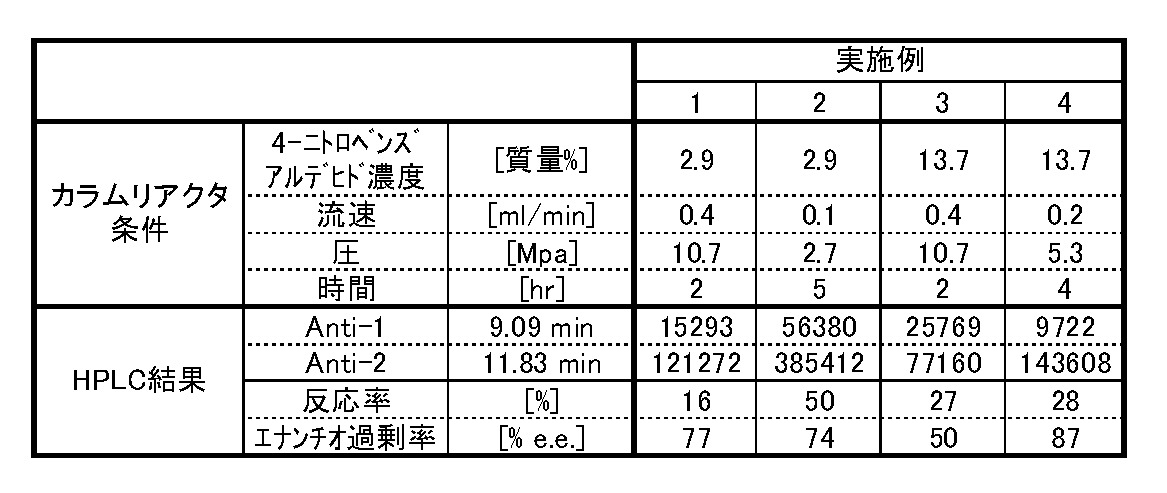
実施例1~4の結果から、不斉触媒粒子が充填されたカラムリアクタに反応用化合物を導入して不斉触媒粒子に接触させると、それにより反応用化合物を光学活性化合物に変換できることがわかる。また、流速を遅くすると、反応率が上昇することがわかる。また、エナンチオ過剰率も上昇させることができる。
実施例5
(マイクロチャネル法による不斉触媒粒子の調製)
分散相として、非特許文献1、2やJ.Org. Chem., 2010, 75(5), pp1620-1629を参照して合成したN-tert-ブチロキシカルボニル-O-(2-メタクリロイルオキシエチルスクシノイル)-cis-4-ヒドロキシ-D-プロリン10質量部と、ジラウロイルパーオキサイド(パーロイルL、日油(株))1質量部と、ジビニルベンゼン90質量部と、イソオクタン30質量部からなるモノマー組成物を用意した。また、連続相として、イオン交換水に界面活性剤(SSL、花王(株))を1質量%の割合で溶解させた水溶液(連続相液)を用意した。
(マイクロチャネル法による不斉触媒粒子の調製)
分散相として、非特許文献1、2やJ.Org. Chem., 2010, 75(5), pp1620-1629を参照して合成したN-tert-ブチロキシカルボニル-O-(2-メタクリロイルオキシエチルスクシノイル)-cis-4-ヒドロキシ-D-プロリン10質量部と、ジラウロイルパーオキサイド(パーロイルL、日油(株))1質量部と、ジビニルベンゼン90質量部と、イソオクタン30質量部からなるモノマー組成物を用意した。また、連続相として、イオン交換水に界面活性剤(SSL、花王(株))を1質量%の割合で溶解させた水溶液(連続相液)を用意した。
用意した分散相と連続相とを、マイクロチャネル(幅5μm、深さ1μm、長さ100μm)を備えたマイクロリアクタ((株)イーピーテック)に適用し、分散相を連続相中に押し出し、平均粒径3μmのモノマー組成物の液滴を形成した。得られた混合物を混合しながら、イオン交換水と界面活性剤(SSL、花王(株))とを添加し、モノマー組成物の液滴濃度が4質量%、界面活性剤濃度が1質量%となるスラリーを調製した。
得られたスラリーを90~100℃で7時間加熱撹拌した後、フィルタ上に濾取し、真空乾燥することで、重合と脱保護が完了した不斉触媒粒子を得た。この不斉触媒粒子の粒径をフロー式粒子像分析装置(FPIA-3000、Sysmex(株))を用いて測定したところ、平均粒径が2.839μm、50%粒径が2.834μm、標準偏差が0.159μm、CV値5.63%であった。
(カラムリアクタの作成)
得られた不斉触媒粒子に質量で2倍のエタノールを混合した混合物を超音波分散処理し、得られた分散液を、流速1.0ml/分でステンレススチールカラム(外径1/4インチ、内径4.6mm、長さ150mm、Cat-No.6010-11053、ジーエルサイエンス(株))に充填することにより、光学活性化合物を製造するためのカラムリアクタを得た。このとき、最大27.6MPaの圧力が加わった。
得られた不斉触媒粒子に質量で2倍のエタノールを混合した混合物を超音波分散処理し、得られた分散液を、流速1.0ml/分でステンレススチールカラム(外径1/4インチ、内径4.6mm、長さ150mm、Cat-No.6010-11053、ジーエルサイエンス(株))に充填することにより、光学活性化合物を製造するためのカラムリアクタを得た。このとき、最大27.6MPaの圧力が加わった。
(光学活性化合物の製造)
得られたカラムリアクタを移動相(水:アセトニトリル:シクロヘキサノン=74容量%:24容量%:2容量%)で置換し、そのカラムリアクタに13.7質量%に調整した4-ニトロベンズアルデヒド(東京化成工業(株))のシクロヘキサノン溶液を、流速0.2ml/分、圧力4.7MPaで注入し、5時間展開した。カラムリアクタから排出された反応液を酢酸エチルで抽出し、抽出液を濃縮することにより2-(ヒドロキシ(4-ニトロフェニル)メチル)シクロヘキサン-1-オンの異性体混合物を得た。この2-(ヒドロキシ(4-ニトロフェニル)メチル)シクロヘキサン-1-オンの異性体混合物を、HPLC(LC-20A、(株)島津製作所(カラム:(株)ダイセルのCHIRALPAK AD-H、移動相:ヘキサン-イソプロピルアルコール混合溶媒(85容量%:15容量%)))で分析したところ、エナンチオ過剰率は96%e.e.であった。また、アルデヒド基準の反応率は7%であった。
得られたカラムリアクタを移動相(水:アセトニトリル:シクロヘキサノン=74容量%:24容量%:2容量%)で置換し、そのカラムリアクタに13.7質量%に調整した4-ニトロベンズアルデヒド(東京化成工業(株))のシクロヘキサノン溶液を、流速0.2ml/分、圧力4.7MPaで注入し、5時間展開した。カラムリアクタから排出された反応液を酢酸エチルで抽出し、抽出液を濃縮することにより2-(ヒドロキシ(4-ニトロフェニル)メチル)シクロヘキサン-1-オンの異性体混合物を得た。この2-(ヒドロキシ(4-ニトロフェニル)メチル)シクロヘキサン-1-オンの異性体混合物を、HPLC(LC-20A、(株)島津製作所(カラム:(株)ダイセルのCHIRALPAK AD-H、移動相:ヘキサン-イソプロピルアルコール混合溶媒(85容量%:15容量%)))で分析したところ、エナンチオ過剰率は96%e.e.であった。また、アルデヒド基準の反応率は7%であった。
実施例6
光学活性化合物の製造の際に、13.7質量%に調整した4-ニトロベンズアルデヒド(東京化成工業(株))のシクロヘキサノン溶液を、流速0.1ml/分、圧力2.5MPaで注入し、12時間展開したこと以外、実施例5と同様にして2-(ヒドロキシ(4-ニトロフェニル)メチル)シクロヘキサン-1-オンを得た。この化合物を、実施例1と同様にHPLCで分析したところ、エナンチオ過剰率は97%e.e.であった。また、アルデヒド基準の反応率は13%であった。
光学活性化合物の製造の際に、13.7質量%に調整した4-ニトロベンズアルデヒド(東京化成工業(株))のシクロヘキサノン溶液を、流速0.1ml/分、圧力2.5MPaで注入し、12時間展開したこと以外、実施例5と同様にして2-(ヒドロキシ(4-ニトロフェニル)メチル)シクロヘキサン-1-オンを得た。この化合物を、実施例1と同様にHPLCで分析したところ、エナンチオ過剰率は97%e.e.であった。また、アルデヒド基準の反応率は13%であった。
実施例7
不斉触媒粒子の製造の際に、N-tert-ブチロキシカルボニル-O-(2-メタクリロイルオキシエチルスクシノイル)-trans-4-ヒドロキシ-L-プロリンに代えてN-tert-ブチロキシカルボニル-O-(4-ビニルベンジル)-trans-4-ヒドロキシ-L-プロリンを使用すること以外、実施例5と同様に不斉触媒粒子を得た。この不斉触媒粒子の粒径をフロー式粒子像分析装置(FPIA-3000、Sysmex(株))を用いて測定したところ、平均粒径が2.764μm、50%粒径が2.739μm、標準偏差が0.129μm、CV値4.74%であった。
不斉触媒粒子の製造の際に、N-tert-ブチロキシカルボニル-O-(2-メタクリロイルオキシエチルスクシノイル)-trans-4-ヒドロキシ-L-プロリンに代えてN-tert-ブチロキシカルボニル-O-(4-ビニルベンジル)-trans-4-ヒドロキシ-L-プロリンを使用すること以外、実施例5と同様に不斉触媒粒子を得た。この不斉触媒粒子の粒径をフロー式粒子像分析装置(FPIA-3000、Sysmex(株))を用いて測定したところ、平均粒径が2.764μm、50%粒径が2.739μm、標準偏差が0.129μm、CV値4.74%であった。
得られた不斉触媒粒子を用いて、実施例5と同様にして光学活性化合物を製造するためのカラムリアクタを得た。このとき、最大25.7MPaの圧力が加わった。
得られたカラムリアクタを用いて光学活性化合物を製造する際に、13.7質量%に調整した4-ニトロベンズアルデヒド(東京化成工業(株))のシクロヘキサノン溶液を、流速0.2ml/分、圧力4.9MPaで注入し、3.5時間展開したこと以外、実施例5と同様にして2-(ヒドロキシ(4-ニトロフェニル)メチル)シクロヘキサン-1-オンを得た。この化合物を、実施例1と同様にHPLCで分析したところ、エナンチオ過剰率は97%e.e.であった。また、アルデヒド基準の反応率は12%であった。
実施例8
光学活性化合物の製造の際に、13.7質量%に調整した4-ニトロベンズアルデヒド(東京化成工業(株))のシクロヘキサノン溶液を、流速0.1ml/分、圧力2.4MPaで注入し、8時間展開したこと以外、実施例7と同様にして2-(ヒドロキシ(4-ニトロフェニル)メチル)シクロヘキサン-1-オンを得た。この化合物を、実施例1と同様にHPLCで分析したところ、エナンチオ過剰率は98%e.e.であった。また、アルデヒド基準の反応率は22%であった。
光学活性化合物の製造の際に、13.7質量%に調整した4-ニトロベンズアルデヒド(東京化成工業(株))のシクロヘキサノン溶液を、流速0.1ml/分、圧力2.4MPaで注入し、8時間展開したこと以外、実施例7と同様にして2-(ヒドロキシ(4-ニトロフェニル)メチル)シクロヘキサン-1-オンを得た。この化合物を、実施例1と同様にHPLCで分析したところ、エナンチオ過剰率は98%e.e.であった。また、アルデヒド基準の反応率は22%であった。
実施例9
カラムリアクタ作製の際に、外径3/8インチ、内径7.6mm、長さ300mmのステンレススチールカラム(Cat-No.6010-11076、ジーエルサイエンス(株))を使用すること以外、実施例7と同様に光学活性化合物を製造するためのカラムリアクタを得た。このとき、最大17.4MPaの圧力が加わった。
カラムリアクタ作製の際に、外径3/8インチ、内径7.6mm、長さ300mmのステンレススチールカラム(Cat-No.6010-11076、ジーエルサイエンス(株))を使用すること以外、実施例7と同様に光学活性化合物を製造するためのカラムリアクタを得た。このとき、最大17.4MPaの圧力が加わった。
得られたカラムリアクタを用いて光学活性化合物を製造する際に、13.7質量%に調整した4-ニトロベンズアルデヒド(東京化成工業(株))のシクロヘキサノン溶液を、流速0.2ml/分、圧力2.8MPaで注入し、24時間展開したこと以外、実施例5と同様にして2-(ヒドロキシ(4-ニトロフェニル)メチル)シクロヘキサン-1-オンを得た。この化合物を、実施例1と同様にHPLCで分析したところ、エナンチオ過剰率は93%e.e.であった。また、アルデヒド基準の反応率は43%であった。
実施例10
光学活性化合物の製造の際に、13.7質量%に調整した4-ニトロベンズアルデヒド(東京化成工業(株))のシクロヘキサノン溶液を、流速1.0ml/分、圧力12.9MPaで注入し、4時間展開したこと以外、実施例9と同様にして2-(ヒドロキシ(4-ニトロフェニル)メチル)シクロヘキサン-1-オンを得た。この化合物を、実施例1と同様にHPLCで分析したところ、エナンチオ過剰率は96%e.e.であった。また、アルデヒド基準の反応率は13%であった。
光学活性化合物の製造の際に、13.7質量%に調整した4-ニトロベンズアルデヒド(東京化成工業(株))のシクロヘキサノン溶液を、流速1.0ml/分、圧力12.9MPaで注入し、4時間展開したこと以外、実施例9と同様にして2-(ヒドロキシ(4-ニトロフェニル)メチル)シクロヘキサン-1-オンを得た。この化合物を、実施例1と同様にHPLCで分析したところ、エナンチオ過剰率は96%e.e.であった。また、アルデヒド基準の反応率は13%であった。
実施例11
光学活性化合物の製造の際に、13.7質量%に調整した4-ニトロベンズアルデヒド(東京化成工業(株))のシクロヘキサノン溶液に代えて、13.7質量%に調整した3-ニトロベンズアルデヒド(東京化成工業(株))のシクロヘキサノン溶液を、流速1.0ml/分、圧力13MPaで注入し、5時間展開したこと以外、実施例9と同様に2-(ヒドロキシ(3-ニトロフェニル)メチル)シクロヘキサン-1-オンを得た。この化合物を、実施例1と同様にHPLCで分析したところ(但し、移動相のヘキサン-イソプロピルアルコール混合溶媒として90容量%:10容量%のものを使用)、エナンチオ過剰率は92%e.e.であった。また、アルデヒド基準の反応率は6%であった。
光学活性化合物の製造の際に、13.7質量%に調整した4-ニトロベンズアルデヒド(東京化成工業(株))のシクロヘキサノン溶液に代えて、13.7質量%に調整した3-ニトロベンズアルデヒド(東京化成工業(株))のシクロヘキサノン溶液を、流速1.0ml/分、圧力13MPaで注入し、5時間展開したこと以外、実施例9と同様に2-(ヒドロキシ(3-ニトロフェニル)メチル)シクロヘキサン-1-オンを得た。この化合物を、実施例1と同様にHPLCで分析したところ(但し、移動相のヘキサン-イソプロピルアルコール混合溶媒として90容量%:10容量%のものを使用)、エナンチオ過剰率は92%e.e.であった。また、アルデヒド基準の反応率は6%であった。
実施例12
光学活性化合物の製造の際に、13.7質量%に調整した4-ニトロベンズアルデヒド(東京化成工業(株))のシクロヘキサノン溶液に代えて、13.7質量%に調整した4-トリフルオロメチルベンズアルデヒド(東京化成工業(株))のシクロヘキサノン溶液を、流速1.0ml/分、圧力13.7MPaで注入し、5時間展開したこと以外、実施例9と同様に2-(ヒドロキシ(4-トリフルオロメチルフェニル)メチル)シクロヘキサン-1-オンを得た。この化合物を、実施例1と同様にHPLCで分析したところ(但し、移動相のヘキサン-イソプロピルアルコール混合溶媒として95容量%:5容量%のものを使用し、カラムとして(株)ダイセルのCHIRALPAK OD-Hを使用)、エナンチオ過剰率は95%e.e.であった。また、アルデヒド基準の反応率は24%であった。
光学活性化合物の製造の際に、13.7質量%に調整した4-ニトロベンズアルデヒド(東京化成工業(株))のシクロヘキサノン溶液に代えて、13.7質量%に調整した4-トリフルオロメチルベンズアルデヒド(東京化成工業(株))のシクロヘキサノン溶液を、流速1.0ml/分、圧力13.7MPaで注入し、5時間展開したこと以外、実施例9と同様に2-(ヒドロキシ(4-トリフルオロメチルフェニル)メチル)シクロヘキサン-1-オンを得た。この化合物を、実施例1と同様にHPLCで分析したところ(但し、移動相のヘキサン-イソプロピルアルコール混合溶媒として95容量%:5容量%のものを使用し、カラムとして(株)ダイセルのCHIRALPAK OD-Hを使用)、エナンチオ過剰率は95%e.e.であった。また、アルデヒド基準の反応率は24%であった。
なお、実施例1~12における不斉触媒粒子原料、カラムリアクタ作製条件、光学活性化合物製造条件(カラムリアクタ反応条件)、及び光学活性化合物の分析条件・結果の一覧を表2に示す。

表2から分かるように、N-tert-ブチロキシカルボニル-O-(2-メタクリロイルオキシエチルスクシノイル)-cis-4-ヒドロキシ-D-プロリン、もしくはN-tert-ブチロキシカルボニル-O-(4-ビニルベンジル)-trans-4-ヒドロキシ-L-プロリンを使用した実施例5~12のエナンチオ過剰率は、N-tert-ブチロキシカルボニル-O-(2-メタクリロイルオキシエチルスクシノイル)-trans-4-ヒドロキシ-L-プロリンを使用した実施例1~4のエナンチオ過剰率よりも高いものであった。
また、実施例5と6との対比、実施例7と8との対比から、光学活性化合物の製造の際の移動相の流速を遅くすると反応率が大きく向上することがわかる。逆に、実施例9と10の対比から、光学活性化合物の製造の際の移動相の流速を速くすると反応率が低下することがわかる。
なお、以下の態様<1>~<25>も本発明に包含される。
<1>
カラムリアクタ用のカラムに不斉触媒粒子が充填されてなるカラムリアクタを用いる光学活性化合物の製造方法であって、
該不斉触媒粒子が、不斉源を有するモノマーを含むモノマー組成物から調製された樹脂粒子であり、
該カラムリアクタ中に反応用化合物を導入して該不斉触媒粒子に接触させ、それにより反応用化合物を光学活性化合物に変換することを特徴とする製造方法。
カラムリアクタ用のカラムに不斉触媒粒子が充填されてなるカラムリアクタを用いる光学活性化合物の製造方法であって、
該不斉触媒粒子が、不斉源を有するモノマーを含むモノマー組成物から調製された樹脂粒子であり、
該カラムリアクタ中に反応用化合物を導入して該不斉触媒粒子に接触させ、それにより反応用化合物を光学活性化合物に変換することを特徴とする製造方法。
<2>
不斉触媒粒子が、不斉源を有するモノマーとして不飽和結合を有するプロリン誘導体モノマーと、更にラジカル重合開始剤とを含有するモノマー組成物から調製された、アルドール反応の触媒となることができる樹脂粒子である<1>の製造方法。
不斉触媒粒子が、不斉源を有するモノマーとして不飽和結合を有するプロリン誘導体モノマーと、更にラジカル重合開始剤とを含有するモノマー組成物から調製された、アルドール反応の触媒となることができる樹脂粒子である<1>の製造方法。
<3>
不斉触媒粒子が、該モノマー組成物を連続相に吐出し、それにより連続相中にモノマー組成物の液滴を形成させ、その後、その液滴を加熱して不飽和結合を有するプロリン誘導体モノマーをラジカル重合させるというマイクロチャネル法で調製された樹脂粒子である<1>又は<2>の製造方法。
不斉触媒粒子が、該モノマー組成物を連続相に吐出し、それにより連続相中にモノマー組成物の液滴を形成させ、その後、その液滴を加熱して不飽和結合を有するプロリン誘導体モノマーをラジカル重合させるというマイクロチャネル法で調製された樹脂粒子である<1>又は<2>の製造方法。
<4>
不飽和結合を有するプロリン誘導体モノマーが、
O-acryloyl-trans-4-hydroxy-L-proline、
O-acryloyl-cis-4-hydroxy-L-proline、
O-methacryloyl-trans-4-hydroxy-L-proline、
O-methacryloyl-cis-4-hydroxy-L-proline、
O-(2-methacryloyloxyethylsuccinoyl)-trans-4-hydroxy-L-proline、
O-(2-methacryloyloxyethylsuccinoyl)-cis-4-hydroxy-L-proline、
N-tert-butyloxycarbonyl-O-acryloyl-trans-4-hydroxy-L-proline、
N-tert-butyloxycarbonyl-O-acryloyl-cis-4-hydroxy-L-proline、
N-tert-butyloxycarbonyl-O-methacryloyl-trans-4-hydroxy-L-proline、
N-tert-butyloxycarbonyl-O-methacryloyl-cis-4-hydroxy-L-proline、
N-tert-butyloxycarbonyl-O-(2-methacryloyloxyethylsuccinoyl)-trans-4-hydroxy-L-proline、
N-tert-butyloxycarbonyl-O-(2-methacryloyloxyethylsuccinoyl)-cis-4-hydroxy-L-proline、
O-acryloyl-trans-4-hydroxy-D-proline、
O-acryloyl-cis-4-hydroxy-D-proline、
O-methacryloyl-trans-4-hydroxy-D-proline、
O-methacryloyl-cis-4-hydroxy-D-proline、
O-(2-methacryloyloxyethylsuccinoyl)-trans-4-hydroxy-D-proline、
O-(2-methacryloyloxyethylsuccinoyl)-cis-4-hydroxy-D-proline、
N-tert-butyloxycarbonyl-O-acryloyl-trans-4-hydroxy-D-proline、
N-tert-butyloxycarbonyl-O-acryloyl-cis-4-hydroxy-D-proline、
N-tert-butyloxycarbonyl-O-methacryloyl-trans-4-hydroxy-D-proline、
N-tert-butyloxycarbonyl-O-methacryloyl-cis-4-hydroxy-D-proline、
N-tert-butyloxycarbonyl-O-(2-methacryloyloxyethylsuccinoyl)-trans-4-hydroxy-D-proline、
N-tert-butyloxycarbonyl-O-(2-methacryloyloxyethylsuccinoyl)-cis-4-hydroxy-D-proline、
N-tert-butyloxycarbonyl-O-(4-vinylbenzyl)-trans-4-hydroxy-L-proline、
N-tert-butyloxycarbonyl-O-(4-vinylbenzyl)-cis-4-hydroxy-L-proline、
N-tert-butyloxycarbonyl-O-(4-vinylbenzyl)-trans-4-hydroxy-D-proline、又は
N-tert-butyloxycarbonyl-O-(4-vinylbenzyl)-cis-4-hydroxy-D-proline
である<1>~<3>のいずれかの製造方法。
不飽和結合を有するプロリン誘導体モノマーが、
O-acryloyl-trans-4-hydroxy-L-proline、
O-acryloyl-cis-4-hydroxy-L-proline、
O-methacryloyl-trans-4-hydroxy-L-proline、
O-methacryloyl-cis-4-hydroxy-L-proline、
O-(2-methacryloyloxyethylsuccinoyl)-trans-4-hydroxy-L-proline、
O-(2-methacryloyloxyethylsuccinoyl)-cis-4-hydroxy-L-proline、
N-tert-butyloxycarbonyl-O-acryloyl-trans-4-hydroxy-L-proline、
N-tert-butyloxycarbonyl-O-acryloyl-cis-4-hydroxy-L-proline、
N-tert-butyloxycarbonyl-O-methacryloyl-trans-4-hydroxy-L-proline、
N-tert-butyloxycarbonyl-O-methacryloyl-cis-4-hydroxy-L-proline、
N-tert-butyloxycarbonyl-O-(2-methacryloyloxyethylsuccinoyl)-trans-4-hydroxy-L-proline、
N-tert-butyloxycarbonyl-O-(2-methacryloyloxyethylsuccinoyl)-cis-4-hydroxy-L-proline、
O-acryloyl-trans-4-hydroxy-D-proline、
O-acryloyl-cis-4-hydroxy-D-proline、
O-methacryloyl-trans-4-hydroxy-D-proline、
O-methacryloyl-cis-4-hydroxy-D-proline、
O-(2-methacryloyloxyethylsuccinoyl)-trans-4-hydroxy-D-proline、
O-(2-methacryloyloxyethylsuccinoyl)-cis-4-hydroxy-D-proline、
N-tert-butyloxycarbonyl-O-acryloyl-trans-4-hydroxy-D-proline、
N-tert-butyloxycarbonyl-O-acryloyl-cis-4-hydroxy-D-proline、
N-tert-butyloxycarbonyl-O-methacryloyl-trans-4-hydroxy-D-proline、
N-tert-butyloxycarbonyl-O-methacryloyl-cis-4-hydroxy-D-proline、
N-tert-butyloxycarbonyl-O-(2-methacryloyloxyethylsuccinoyl)-trans-4-hydroxy-D-proline、
N-tert-butyloxycarbonyl-O-(2-methacryloyloxyethylsuccinoyl)-cis-4-hydroxy-D-proline、
N-tert-butyloxycarbonyl-O-(4-vinylbenzyl)-trans-4-hydroxy-L-proline、
N-tert-butyloxycarbonyl-O-(4-vinylbenzyl)-cis-4-hydroxy-L-proline、
N-tert-butyloxycarbonyl-O-(4-vinylbenzyl)-trans-4-hydroxy-D-proline、又は
N-tert-butyloxycarbonyl-O-(4-vinylbenzyl)-cis-4-hydroxy-D-proline
である<1>~<3>のいずれかの製造方法。
<5>
不飽和結合を有するプロリン誘導体モノマーが、N-tert-ブチロキシカルボニル-O-(2-メタクリロイルオキシエチルスクシノイル)-trans-4-ヒドロキシ-L-プロリン、N-tert-ブチロキシカルボニル-O-(2-メタクリロイルオキシエチルスクシノイル)-cis-4-ヒドロキシ-D-プロリン、又はN-tert-ブチロキシカルボニル-O-(4-ビニルベンジル)-trans-4-ヒドロキシ-L-プロリンである<1>~<3>のいずれかの製造方法。
不飽和結合を有するプロリン誘導体モノマーが、N-tert-ブチロキシカルボニル-O-(2-メタクリロイルオキシエチルスクシノイル)-trans-4-ヒドロキシ-L-プロリン、N-tert-ブチロキシカルボニル-O-(2-メタクリロイルオキシエチルスクシノイル)-cis-4-ヒドロキシ-D-プロリン、又はN-tert-ブチロキシカルボニル-O-(4-ビニルベンジル)-trans-4-ヒドロキシ-L-プロリンである<1>~<3>のいずれかの製造方法。
<6>
該モノマー組成物が、更に単価又は多価不飽和化合物モノマーを含有する<1>~<4>のいずれかの製造方法。
該モノマー組成物が、更に単価又は多価不飽和化合物モノマーを含有する<1>~<4>のいずれかの製造方法。
<7>
該モノマー組成物が、更に多価不飽和化合物モノマーとしてジビニルベンゼンを含有する<1>~<5>のいずれかの製造方法。
該モノマー組成物が、更に多価不飽和化合物モノマーとしてジビニルベンゼンを含有する<1>~<5>のいずれかの製造方法。
<8>
反応用化合物が、α位水素を有するカルボニル化合物を含有する<1>~<7>のいずれかの製造方法。
反応用化合物が、α位水素を有するカルボニル化合物を含有する<1>~<7>のいずれかの製造方法。
<9>
反応用化合物が、4-ニトロベンズアルデヒド、3-ニトロベンズアルデヒド又は4-トリフルオロメチルベンズアルデヒドと、α位水素を有するカルボニル化合物としてシクロヘキサノンとを含有する<1>~<7>のいずれかの製造方法。
反応用化合物が、4-ニトロベンズアルデヒド、3-ニトロベンズアルデヒド又は4-トリフルオロメチルベンズアルデヒドと、α位水素を有するカルボニル化合物としてシクロヘキサノンとを含有する<1>~<7>のいずれかの製造方法。
<10>
光学活性化合物が、2-(ヒドロキシ(4-ニトロフェニル)メチル)シクロヘキサン-1-オン、2-(ヒドロキシ(3-ニトロフェニル)メチル)シクロヘキサン-1-オン又は2-(ヒドロキシ(4-トリフルオロメチルフェニル)メチル)シクロヘキサン-1-オンである<9>の製造方法。
光学活性化合物が、2-(ヒドロキシ(4-ニトロフェニル)メチル)シクロヘキサン-1-オン、2-(ヒドロキシ(3-ニトロフェニル)メチル)シクロヘキサン-1-オン又は2-(ヒドロキシ(4-トリフルオロメチルフェニル)メチル)シクロヘキサン-1-オンである<9>の製造方法。
<11>
該反応用化合物から変換された光学活性化合物が、該カラムリアクタ中で更に光学分割を受ける<1>~<10>のいずれかの製造方法。
該反応用化合物から変換された光学活性化合物が、該カラムリアクタ中で更に光学分割を受ける<1>~<10>のいずれかの製造方法。
<12>
カラムリアクタ用のカラムに不斉触媒粒子が充填されてなるカラムリアクタを用いる光学活性化合物の製造方法であって、
該不斉触媒粒子が、不斉源を有するモノマーとしてN-tert-ブチロキシカルボニル-O-(2-メタクリロイルオキシエチルスクシノイル)-trans-4-ヒドロキシ-L-プロリン、N-tert-ブチロキシカルボニル-O-(2-メタクリロイルオキシエチルスクシノイル)-cis-4-ヒドロキシ-D-プロリン、又はN-tert-ブチロキシカルボニル-O-(4-ビニルベンジル)-trans-4-ヒドロキシ-L-プロリンと、更にラジカル重合開始剤とを含有するモノマー組成物から調製された、アルドール反応の触媒となることができる樹脂粒子であり、
該カラムリアクタ中に、α位水素を有するカルボニル化合物を含有する反応用化合物を導入して該不斉触媒粒子に接触させ、それにより反応用化合物を光学活性化合物に変換することを特徴とする製造方法。
カラムリアクタ用のカラムに不斉触媒粒子が充填されてなるカラムリアクタを用いる光学活性化合物の製造方法であって、
該不斉触媒粒子が、不斉源を有するモノマーとしてN-tert-ブチロキシカルボニル-O-(2-メタクリロイルオキシエチルスクシノイル)-trans-4-ヒドロキシ-L-プロリン、N-tert-ブチロキシカルボニル-O-(2-メタクリロイルオキシエチルスクシノイル)-cis-4-ヒドロキシ-D-プロリン、又はN-tert-ブチロキシカルボニル-O-(4-ビニルベンジル)-trans-4-ヒドロキシ-L-プロリンと、更にラジカル重合開始剤とを含有するモノマー組成物から調製された、アルドール反応の触媒となることができる樹脂粒子であり、
該カラムリアクタ中に、α位水素を有するカルボニル化合物を含有する反応用化合物を導入して該不斉触媒粒子に接触させ、それにより反応用化合物を光学活性化合物に変換することを特徴とする製造方法。
<13>
カラムリアクタ用のカラムに不斉触媒粒子が充填されてなるカラムリアクタを用いる光学活性化合物の製造方法であって、
該不斉触媒粒子が、不斉源を有するモノマーとしてN-tert-ブチロキシカルボニル-O-(2-メタクリロイルオキシエチルスクシノイル)-trans-4-ヒドロキシ-L-プロリン、N-tert-ブチロキシカルボニル-O-(2-メタクリロイルオキシエチルスクシノイル)-cis-4-ヒドロキシ-D-プロリン、又はN-tert-ブチロキシカルボニル-O-(4-ビニルベンジル)-trans-4-ヒドロキシ-L-プロリンと、更にラジカル重合開始剤とを含有するモノマー組成物から調製された、アルドール反応の触媒となることができる樹脂粒子であり、
該カラムリアクタ中に、4-ニトロベンズアルデヒド、3-ニトロベンズアルデヒド又は4-トリフルオロメチルベンズアルデヒドと、α位水素を有するカルボニル化合物としてシクロヘキサノンとを含有する反応用化合物を導入して該不斉触媒粒子に接触させ、それにより反応用化合物を光学活性化合物として2-(ヒドロキシ(4-ニトロフェニル)メチル)シクロヘキサン-1-オン、2-(ヒドロキシ(3-ニトロフェニル)メチル)シクロヘキサン-1-オン又は2-(ヒドロキシ(4-トリフルオロメチルフェニル)メチル)シクロヘキサン-1-オンに変換することを特徴とする製造方法。
カラムリアクタ用のカラムに不斉触媒粒子が充填されてなるカラムリアクタを用いる光学活性化合物の製造方法であって、
該不斉触媒粒子が、不斉源を有するモノマーとしてN-tert-ブチロキシカルボニル-O-(2-メタクリロイルオキシエチルスクシノイル)-trans-4-ヒドロキシ-L-プロリン、N-tert-ブチロキシカルボニル-O-(2-メタクリロイルオキシエチルスクシノイル)-cis-4-ヒドロキシ-D-プロリン、又はN-tert-ブチロキシカルボニル-O-(4-ビニルベンジル)-trans-4-ヒドロキシ-L-プロリンと、更にラジカル重合開始剤とを含有するモノマー組成物から調製された、アルドール反応の触媒となることができる樹脂粒子であり、
該カラムリアクタ中に、4-ニトロベンズアルデヒド、3-ニトロベンズアルデヒド又は4-トリフルオロメチルベンズアルデヒドと、α位水素を有するカルボニル化合物としてシクロヘキサノンとを含有する反応用化合物を導入して該不斉触媒粒子に接触させ、それにより反応用化合物を光学活性化合物として2-(ヒドロキシ(4-ニトロフェニル)メチル)シクロヘキサン-1-オン、2-(ヒドロキシ(3-ニトロフェニル)メチル)シクロヘキサン-1-オン又は2-(ヒドロキシ(4-トリフルオロメチルフェニル)メチル)シクロヘキサン-1-オンに変換することを特徴とする製造方法。
<14>
カラムリアクタ用のカラムに不斉触媒粒子が充填されてなるカラムリアクタを用いる光学活性化合物の製造方法であって、
該不斉触媒粒子が、不斉源を有するモノマーとしてN-tert-ブチロキシカルボニル-O-(2-メタクリロイルオキシエチルスクシノイル)-trans-4-ヒドロキシ-L-プロリン、N-tert-ブチロキシカルボニル-O-(2-メタクリロイルオキシエチルスクシノイル)-cis-4-ヒドロキシ-D-プロリン、又はN-tert-ブチロキシカルボニル-O-(4-ビニルベンジル)-trans-4-ヒドロキシ-L-プロリンと、更にラジカル重合開始剤とを含有するモノマー組成物から調製された、アルドール反応の触媒となることができる樹脂粒子であり、
該カラムリアクタ中に、4-ニトロベンズアルデヒド、3-ニトロベンズアルデヒド又は4-トリフルオロメチルベンズアルデヒドと、α位水素を有するカルボニル化合物としてシクロヘキサノンとを含有する反応用化合物を導入して該不斉触媒粒子に接触させ、それにより反応用化合物を光学活性化合物として2-(ヒドロキシ(4-ニトロフェニル)メチル)シクロヘキサン-1-オン、2-(ヒドロキシ(3-ニトロフェニル)メチル)シクロヘキサン-1-オン又は2-(ヒドロキシ(4-トリフルオロメチルフェニル)メチル)シクロヘキサン-1-オンに変換し、該カラムリアクタ中で更に光学分割をする製造方法。
カラムリアクタ用のカラムに不斉触媒粒子が充填されてなるカラムリアクタを用いる光学活性化合物の製造方法であって、
該不斉触媒粒子が、不斉源を有するモノマーとしてN-tert-ブチロキシカルボニル-O-(2-メタクリロイルオキシエチルスクシノイル)-trans-4-ヒドロキシ-L-プロリン、N-tert-ブチロキシカルボニル-O-(2-メタクリロイルオキシエチルスクシノイル)-cis-4-ヒドロキシ-D-プロリン、又はN-tert-ブチロキシカルボニル-O-(4-ビニルベンジル)-trans-4-ヒドロキシ-L-プロリンと、更にラジカル重合開始剤とを含有するモノマー組成物から調製された、アルドール反応の触媒となることができる樹脂粒子であり、
該カラムリアクタ中に、4-ニトロベンズアルデヒド、3-ニトロベンズアルデヒド又は4-トリフルオロメチルベンズアルデヒドと、α位水素を有するカルボニル化合物としてシクロヘキサノンとを含有する反応用化合物を導入して該不斉触媒粒子に接触させ、それにより反応用化合物を光学活性化合物として2-(ヒドロキシ(4-ニトロフェニル)メチル)シクロヘキサン-1-オン、2-(ヒドロキシ(3-ニトロフェニル)メチル)シクロヘキサン-1-オン又は2-(ヒドロキシ(4-トリフルオロメチルフェニル)メチル)シクロヘキサン-1-オンに変換し、該カラムリアクタ中で更に光学分割をする製造方法。
<15> カラムリアクタ用のカラムに不斉触媒粒子が充填されてなるカラムリアクタを用いる光学活性化合物の製造方法であって、
該不斉触媒粒子が、不斉源を有するモノマーとしてN-tert-ブチロキシカルボニル-O-(2-メタクリロイルオキシエチルスクシノイル)-trans-4-ヒドロキシ-L-プロリン、N-tert-ブチロキシカルボニル-O-(2-メタクリロイルオキシエチルスクシノイル)-cis-4-ヒドロキシ-D-プロリン、又はN-tert-ブチロキシカルボニル-O-(4-ビニルベンジル)-trans-4-ヒドロキシ-L-プロリンと、更にラジカル重合開始剤とを含有するモノマー組成物を連続相に吐出し、それにより連続相中にモノマー組成物の液滴を形成させ、その後、その液滴を加熱して不飽和結合を有するプロリン誘導体モノマーをラジカル重合させるというマイクロチャネル法で調製された、アルドール反応の触媒となることができる樹脂粒子であり、
該カラムリアクタ中に、4-ニトロベンズアルデヒド、3-ニトロベンズアルデヒド又は4-トリフルオロメチルベンズアルデヒドと、α位水素を有するカルボニル化合物としてシクロヘキサノンとを含有する反応用化合物を導入して該不斉触媒粒子に接触させ、それにより反応用化合物を光学活性化合物として2-(ヒドロキシ(4-ニトロフェニル)メチル)シクロヘキサン-1-オン、2-(ヒドロキシ(3-ニトロフェニル)メチル)シクロヘキサン-1-オン又は2-(ヒドロキシ(4-トリフルオロメチルフェニル)メチル)シクロヘキサン-1-オンに変換し、該カラムリアクタ中で更に光学分割をする製造方法。
該不斉触媒粒子が、不斉源を有するモノマーとしてN-tert-ブチロキシカルボニル-O-(2-メタクリロイルオキシエチルスクシノイル)-trans-4-ヒドロキシ-L-プロリン、N-tert-ブチロキシカルボニル-O-(2-メタクリロイルオキシエチルスクシノイル)-cis-4-ヒドロキシ-D-プロリン、又はN-tert-ブチロキシカルボニル-O-(4-ビニルベンジル)-trans-4-ヒドロキシ-L-プロリンと、更にラジカル重合開始剤とを含有するモノマー組成物を連続相に吐出し、それにより連続相中にモノマー組成物の液滴を形成させ、その後、その液滴を加熱して不飽和結合を有するプロリン誘導体モノマーをラジカル重合させるというマイクロチャネル法で調製された、アルドール反応の触媒となることができる樹脂粒子であり、
該カラムリアクタ中に、4-ニトロベンズアルデヒド、3-ニトロベンズアルデヒド又は4-トリフルオロメチルベンズアルデヒドと、α位水素を有するカルボニル化合物としてシクロヘキサノンとを含有する反応用化合物を導入して該不斉触媒粒子に接触させ、それにより反応用化合物を光学活性化合物として2-(ヒドロキシ(4-ニトロフェニル)メチル)シクロヘキサン-1-オン、2-(ヒドロキシ(3-ニトロフェニル)メチル)シクロヘキサン-1-オン又は2-(ヒドロキシ(4-トリフルオロメチルフェニル)メチル)シクロヘキサン-1-オンに変換し、該カラムリアクタ中で更に光学分割をする製造方法。
<16>
カラムリアクタ用カラムに、不斉触媒粒子が充填されたカラムリアクタであって、不斉触媒粒子が、不飽和結合を有するプロリン誘導体モノマーと、ラジカル重合開始剤とを含有するモノマー組成物から調製された、アルドール反応の触媒となることができる樹脂粒子であるカラムリアクタ。
カラムリアクタ用カラムに、不斉触媒粒子が充填されたカラムリアクタであって、不斉触媒粒子が、不飽和結合を有するプロリン誘導体モノマーと、ラジカル重合開始剤とを含有するモノマー組成物から調製された、アルドール反応の触媒となることができる樹脂粒子であるカラムリアクタ。
<17>
不斉触媒粒子が、マイクロチャネル法に従って、該モノマー組成物を連続相に吐出し、それにより連続相中にモノマー組成物の液滴を形成させ、その後、その液滴を加熱して不飽和結合を有するプロリン誘導体モノマーをラジカル重合させることにより調製されたものである<16>のカラムリアクタ。
不斉触媒粒子が、マイクロチャネル法に従って、該モノマー組成物を連続相に吐出し、それにより連続相中にモノマー組成物の液滴を形成させ、その後、その液滴を加熱して不飽和結合を有するプロリン誘導体モノマーをラジカル重合させることにより調製されたものである<16>のカラムリアクタ。
<18>
不飽和結合を有するプロリン誘導体モノマーが、
O-acryloyl-trans-4-hydroxy-L-proline、
O-acryloyl-cis-4-hydroxy-L-proline、
O-methacryloyl-trans-4-hydroxy-L-proline、
O-methacryloyl-cis-4-hydroxy-L-proline、
O-(2-methacryloyloxyethylsuccinoyl)-trans-4-hydroxy-L-proline、
O-(2-methacryloyloxyethylsuccinoyl)-cis-4-hydroxy-L-proline、
N-tert-butyloxycarbonyl-O-acryloyl-trans-4-hydroxy-L-proline、
N-tert-butyloxycarbonyl-O-acryloyl-cis-4-hydroxy-L-proline、
N-tert-butyloxycarbonyl-O-methacryloyl-trans-4-hydroxy-L-proline、
N-tert-butyloxycarbonyl-O-methacryloyl-cis-4-hydroxy-L-proline、
N-tert-butyloxycarbonyl-O-(2-methacryloyloxyethylsuccinoyl)-trans-4-hydroxy-L-proline、
N-tert-butyloxycarbonyl-O-(2-methacryloyloxyethylsuccinoyl)-cis-4-hydroxy-L-proline、
O-acryloyl-trans-4-hydroxy-D-proline、
O-acryloyl-cis-4-hydroxy-D-proline、
O-methacryloyl-trans-4-hydroxy-D-proline、
O-methacryloyl-cis-4-hydroxy-D-proline、
O-(2-methacryloyloxyethylsuccinoyl)-trans-4-hydroxy-D-proline、
O-(2-methacryloyloxyethylsuccinoyl)-cis-4-hydroxy-D-proline、
N-tert-butyloxycarbonyl-O-acryloyl-trans-4-hydroxy-D-proline、
N-tert-butyloxycarbonyl-O-acryloyl-cis-4-hydroxy-D-proline、
N-tert-butyloxycarbonyl-O-methacryloyl-trans-4-hydroxy-D-proline、
N-tert-butyloxycarbonyl-O-methacryloyl-cis-4-hydroxy-D-proline、
N-tert-butyloxycarbonyl-O-(2-methacryloyloxyethylsuccinoyl)-trans-4-hydroxy-D-proline、
N-tert-butyloxycarbonyl-O-(2-methacryloyloxyethylsuccinoyl)-cis-4-hydroxy-D-proline、
N-tert-butyloxycarbonyl-O-(4-vinylbenzyl)-trans-4-hydroxy-L-proline、
N-tert-butyloxycarbonyl-O-(4-vinylbenzyl)-cis-4-hydroxy-L-proline、
N-tert-butyloxycarbonyl-O-(4-vinylbenzyl)-trans-4-hydroxy-D-proline、又は
N-tert-butyloxycarbonyl-O-(4-vinylbenzyl)-cis-4-hydroxy-D-proline
である<16>又は<17>のカラムリアクタ。
不飽和結合を有するプロリン誘導体モノマーが、
O-acryloyl-trans-4-hydroxy-L-proline、
O-acryloyl-cis-4-hydroxy-L-proline、
O-methacryloyl-trans-4-hydroxy-L-proline、
O-methacryloyl-cis-4-hydroxy-L-proline、
O-(2-methacryloyloxyethylsuccinoyl)-trans-4-hydroxy-L-proline、
O-(2-methacryloyloxyethylsuccinoyl)-cis-4-hydroxy-L-proline、
N-tert-butyloxycarbonyl-O-acryloyl-trans-4-hydroxy-L-proline、
N-tert-butyloxycarbonyl-O-acryloyl-cis-4-hydroxy-L-proline、
N-tert-butyloxycarbonyl-O-methacryloyl-trans-4-hydroxy-L-proline、
N-tert-butyloxycarbonyl-O-methacryloyl-cis-4-hydroxy-L-proline、
N-tert-butyloxycarbonyl-O-(2-methacryloyloxyethylsuccinoyl)-trans-4-hydroxy-L-proline、
N-tert-butyloxycarbonyl-O-(2-methacryloyloxyethylsuccinoyl)-cis-4-hydroxy-L-proline、
O-acryloyl-trans-4-hydroxy-D-proline、
O-acryloyl-cis-4-hydroxy-D-proline、
O-methacryloyl-trans-4-hydroxy-D-proline、
O-methacryloyl-cis-4-hydroxy-D-proline、
O-(2-methacryloyloxyethylsuccinoyl)-trans-4-hydroxy-D-proline、
O-(2-methacryloyloxyethylsuccinoyl)-cis-4-hydroxy-D-proline、
N-tert-butyloxycarbonyl-O-acryloyl-trans-4-hydroxy-D-proline、
N-tert-butyloxycarbonyl-O-acryloyl-cis-4-hydroxy-D-proline、
N-tert-butyloxycarbonyl-O-methacryloyl-trans-4-hydroxy-D-proline、
N-tert-butyloxycarbonyl-O-methacryloyl-cis-4-hydroxy-D-proline、
N-tert-butyloxycarbonyl-O-(2-methacryloyloxyethylsuccinoyl)-trans-4-hydroxy-D-proline、
N-tert-butyloxycarbonyl-O-(2-methacryloyloxyethylsuccinoyl)-cis-4-hydroxy-D-proline、
N-tert-butyloxycarbonyl-O-(4-vinylbenzyl)-trans-4-hydroxy-L-proline、
N-tert-butyloxycarbonyl-O-(4-vinylbenzyl)-cis-4-hydroxy-L-proline、
N-tert-butyloxycarbonyl-O-(4-vinylbenzyl)-trans-4-hydroxy-D-proline、又は
N-tert-butyloxycarbonyl-O-(4-vinylbenzyl)-cis-4-hydroxy-D-proline
である<16>又は<17>のカラムリアクタ。
<19>
不飽和結合を有するプロリン誘導体モノマーが、N-tert-ブチロキシカルボニル-O-(2-メタクリロイルオキシエチルスクシノイル)-trans-4-ヒドロキシ-L-プロリン、N-tert-ブチロキシカルボニル-O-(2-メタクリロイルオキシエチルスクシノイル)-cis-4-ヒドロキシ-D-プロリン、又はN-tert-ブチロキシカルボニル-O-(4-ビニルベンジル)-trans-4-ヒドロキシ-L-プロリンである<16>~<18>のいずれかのカラムリアクタ。
不飽和結合を有するプロリン誘導体モノマーが、N-tert-ブチロキシカルボニル-O-(2-メタクリロイルオキシエチルスクシノイル)-trans-4-ヒドロキシ-L-プロリン、N-tert-ブチロキシカルボニル-O-(2-メタクリロイルオキシエチルスクシノイル)-cis-4-ヒドロキシ-D-プロリン、又はN-tert-ブチロキシカルボニル-O-(4-ビニルベンジル)-trans-4-ヒドロキシ-L-プロリンである<16>~<18>のいずれかのカラムリアクタ。
<20>
該モノマー組成物が、更に単価又は多価不飽和化合物モノマーを含有する<16>~<19>のいずれかのカラムリアクタ。
該モノマー組成物が、更に単価又は多価不飽和化合物モノマーを含有する<16>~<19>のいずれかのカラムリアクタ。
<21>
該モノマー組成物が、更に多価不飽和化合物モノマーとしてジビニルベンゼンを含有する<16>~<19>のいずれかのカラムリアクタ。
該モノマー組成物が、更に多価不飽和化合物モノマーとしてジビニルベンゼンを含有する<16>~<19>のいずれかのカラムリアクタ。
<22>
カラムリアクタ用カラムに、不斉触媒粒子が充填されたカラムリアクタであって、不斉触媒粒子が、不飽和結合を有するプロリン誘導体モノマーとしてN-tert-ブチロキシカルボニル-O-(2-メタクリロイルオキシエチルスクシノイル)-trans-4-ヒドロキシ-L-プロリン、N-tert-ブチロキシカルボニル-O-(2-メタクリロイルオキシエチルスクシノイル)-cis-4-ヒドロキシ-D-プロリン、又はN-tert-ブチロキシカルボニル-O-(4-ビニルベンジル)-trans-4-ヒドロキシ-L-プロリンと、ラジカル重合開始剤とを含有するモノマー組成物を連続相に吐出し、それにより連続相中にモノマー組成物の液滴を形成させ、その後、その液滴を加熱して不飽和結合を有するプロリン誘導体モノマーをラジカル重合させることにより調製された、アルドール反応の触媒となることができる樹脂粒子であるカラムリアクタ。
カラムリアクタ用カラムに、不斉触媒粒子が充填されたカラムリアクタであって、不斉触媒粒子が、不飽和結合を有するプロリン誘導体モノマーとしてN-tert-ブチロキシカルボニル-O-(2-メタクリロイルオキシエチルスクシノイル)-trans-4-ヒドロキシ-L-プロリン、N-tert-ブチロキシカルボニル-O-(2-メタクリロイルオキシエチルスクシノイル)-cis-4-ヒドロキシ-D-プロリン、又はN-tert-ブチロキシカルボニル-O-(4-ビニルベンジル)-trans-4-ヒドロキシ-L-プロリンと、ラジカル重合開始剤とを含有するモノマー組成物を連続相に吐出し、それにより連続相中にモノマー組成物の液滴を形成させ、その後、その液滴を加熱して不飽和結合を有するプロリン誘導体モノマーをラジカル重合させることにより調製された、アルドール反応の触媒となることができる樹脂粒子であるカラムリアクタ。
<23>
カラムリアクタ用カラムに、不斉触媒粒子を充填することを特徴とするカラムリアクタの製造方法であって、不斉触媒粒子として、不飽和結合を有するプロリン誘導体モノマーと、ラジカル重合開始剤とを含有するモノマー組成物から調製された、アルドール反応触媒となることができる樹脂粒子を使用する製造方法。
カラムリアクタ用カラムに、不斉触媒粒子を充填することを特徴とするカラムリアクタの製造方法であって、不斉触媒粒子として、不飽和結合を有するプロリン誘導体モノマーと、ラジカル重合開始剤とを含有するモノマー組成物から調製された、アルドール反応触媒となることができる樹脂粒子を使用する製造方法。
<24>
不斉触媒粒子として、マイクロチャネル法に従って、該モノマー組成物を連続相に吐出し、それにより連続相中にモノマー組成物の液滴を形成させ、その後、その液滴を加熱して不飽和結合を有するプロリン誘導体モノマーをラジカル重合させることにより調製されたものを使用する<23>の製造方法。
不斉触媒粒子として、マイクロチャネル法に従って、該モノマー組成物を連続相に吐出し、それにより連続相中にモノマー組成物の液滴を形成させ、その後、その液滴を加熱して不飽和結合を有するプロリン誘導体モノマーをラジカル重合させることにより調製されたものを使用する<23>の製造方法。
<25>
カラムリアクタ用カラムに、不斉触媒粒子を充填することを特徴とするカラムリアクタの製造方法であって、不斉触媒粒子として、不飽和結合を有するプロリン誘導体モノマーとしてN-tert-ブチロキシカルボニル-O-(2-メタクリロイルオキシエチルスクシノイル)-trans-4-ヒドロキシ-L-プロリン、N-tert-ブチロキシカルボニル-O-(2-メタクリロイルオキシエチルスクシノイル)-cis-4-ヒドロキシ-D-プロリン、又はN-tert-ブチロキシカルボニル-O-(4-ビニルベンジル)-trans-4-ヒドロキシ-L-プロリンと、ラジカル重合開始剤とを含有するモノマー組成物を連続相に吐出し、それにより連続相中にモノマー組成物の液滴を形成させ、その後、その液滴を加熱して不飽和結合を有するプロリン誘導体モノマーをラジカル重合させることにより調製された、アルドール反応触媒となることができる樹脂粒子を使用する製造方法。
カラムリアクタ用カラムに、不斉触媒粒子を充填することを特徴とするカラムリアクタの製造方法であって、不斉触媒粒子として、不飽和結合を有するプロリン誘導体モノマーとしてN-tert-ブチロキシカルボニル-O-(2-メタクリロイルオキシエチルスクシノイル)-trans-4-ヒドロキシ-L-プロリン、N-tert-ブチロキシカルボニル-O-(2-メタクリロイルオキシエチルスクシノイル)-cis-4-ヒドロキシ-D-プロリン、又はN-tert-ブチロキシカルボニル-O-(4-ビニルベンジル)-trans-4-ヒドロキシ-L-プロリンと、ラジカル重合開始剤とを含有するモノマー組成物を連続相に吐出し、それにより連続相中にモノマー組成物の液滴を形成させ、その後、その液滴を加熱して不飽和結合を有するプロリン誘導体モノマーをラジカル重合させることにより調製された、アルドール反応触媒となることができる樹脂粒子を使用する製造方法。
本発明の製造方法によれば、スケールにとらわれない有機合成に容易に対応でき、しかも、反応生成物を触媒から煩雑な分離操作を要さずに分離できるように、不斉触媒粒子を用いて光学活性化合物を製造できる。
Claims (25)
- カラムリアクタ用のカラムに不斉触媒粒子が充填されてなるカラムリアクタを用いる光学活性化合物の製造方法であって、
該不斉触媒粒子が、不斉源を有するモノマーを含むモノマー組成物から調製された樹脂粒子であり、
該カラムリアクタ中に反応用化合物を導入して該不斉触媒粒子に接触させ、それにより反応用化合物を光学活性化合物に変換することを特徴とする製造方法。 - 不斉触媒粒子が、不斉源を有するモノマーとして不飽和結合を有するプロリン誘導体モノマーと、更にラジカル重合開始剤とを含有するモノマー組成物から調製された、アルドール反応の触媒となることができる樹脂粒子である請求項1記載の製造方法。
- 不斉触媒粒子が、該モノマー組成物を連続相に吐出し、それにより連続相中にモノマー組成物の液滴を形成させ、その後、その液滴を加熱して不飽和結合を有するプロリン誘導体モノマーをラジカル重合させるというマイクロチャネル法で調製された樹脂粒子である請求項1又は2記載の製造方法。
- 不飽和結合を有するプロリン誘導体モノマーが、
O-acryloyl-trans-4-hydroxy-L-proline、
O-acryloyl-cis-4-hydroxy-L-proline、
O-methacryloyl-trans-4-hydroxy-L-proline、
O-methacryloyl-cis-4-hydroxy-L-proline、
O-(2-methacryloyloxyethylsuccinoyl)-trans-4-hydroxy-L-proline、
O-(2-methacryloyloxyethylsuccinoyl)-cis-4-hydroxy-L-proline、
N-tert-butyloxycarbonyl-O-acryloyl-trans-4-hydroxy-L-proline、
N-tert-butyloxycarbonyl-O-acryloyl-cis-4-hydroxy-L-proline、
N-tert-butyloxycarbonyl-O-methacryloyl-trans-4-hydroxy-L-proline、
N-tert-butyloxycarbonyl-O-methacryloyl-cis-4-hydroxy-L-proline、
N-tert-butyloxycarbonyl-O-(2-methacryloyloxyethylsuccinoyl)-trans-4-hydroxy-L-proline、
N-tert-butyloxycarbonyl-O-(2-methacryloyloxyethylsuccinoyl)-cis-4-hydroxy-L-proline、
O-acryloyl-trans-4-hydroxy-D-proline、
O-acryloyl-cis-4-hydroxy-D-proline、
O-methacryloyl-trans-4-hydroxy-D-proline、
O-methacryloyl-cis-4-hydroxy-D-proline、
O-(2-methacryloyloxyethylsuccinoyl)-trans-4-hydroxy-D-proline、
O-(2-methacryloyloxyethylsuccinoyl)-cis-4-hydroxy-D-proline、
N-tert-butyloxycarbonyl-O-acryloyl-trans-4-hydroxy-D-proline、
N-tert-butyloxycarbonyl-O-acryloyl-cis-4-hydroxy-D-proline、
N-tert-butyloxycarbonyl-O-methacryloyl-trans-4-hydroxy-D-proline、
N-tert-butyloxycarbonyl-O-methacryloyl-cis-4-hydroxy-D-proline、
N-tert-butyloxycarbonyl-O-(2-methacryloyloxyethylsuccinoyl)-trans-4-hydroxy-D-proline、
N-tert-butyloxycarbonyl-O-(2-methacryloyloxyethylsuccinoyl)-cis-4-hydroxy-D-proline、
N-tert-butyloxycarbonyl-O-(4-vinylbenzyl)-trans-4-hydroxy-L-proline、
N-tert-butyloxycarbonyl-O-(4-vinylbenzyl)-cis-4-hydroxy-L-proline、
N-tert-butyloxycarbonyl-O-(4-vinylbenzyl)-trans-4-hydroxy-D-proline、又は
N-tert-butyloxycarbonyl-O-(4-vinylbenzyl)-cis-4-hydroxy-D-proline
である請求項1~3のいずれかに記載の製造方法。 - 不飽和結合を有するプロリン誘導体モノマーが、N-tert-ブチロキシカルボニル-O-(2-メタクリロイルオキシエチルスクシノイル)-trans-4-ヒドロキシ-L-プロリン、N-tert-ブチロキシカルボニル-O-(2-メタクリロイルオキシエチルスクシノイル)-cis-4-ヒドロキシ-D-プロリン、又はN-tert-ブチロキシカルボニル-O-(4-ビニルベンジル)-trans-4-ヒドロキシ-L-プロリンである請求項1~3のいずれかに記載の製造方法。
- 該モノマー組成物が、更に単価又は多価不飽和化合物モノマーを含有する請求項1~5のいずれかに記載の製造方法。
- 該モノマー組成物が、更に多価不飽和化合物モノマーとしてジビニルベンゼンを含有する請求項1~5のいずれかに記載の製造方法。
- 反応用化合物が、α位水素を有するカルボニル化合物を含有する請求項1~7のいずれかに記載の製造方法。
- 反応用化合物が、4-ニトロベンズアルデヒド、3-ニトロベンズアルデヒド又は4-トリフルオロメチルベンズアルデヒドと、α位水素を有するカルボニル化合物としてシクロヘキサノンとを含有する請求項1~7のいずれかに記載の製造方法。
- 光学活性化合物が、2-(ヒドロキシ(4-ニトロフェニル)メチル)シクロヘキサン-1-オン、2-(ヒドロキシ(3-ニトロフェニル)メチル)シクロヘキサン-1-オン又は2-(ヒドロキシ(4-トリフルオロメチルフェニル)メチル)シクロヘキサン-1-オンである請求項9記載の製造方法。
- 該反応用化合物から変換された光学活性化合物が、該カラムリアクタ中で更に光学分割を受ける請求項1~10のいずれかに記載の製造方法。
- カラムリアクタ用のカラムに不斉触媒粒子が充填されてなるカラムリアクタを用いる光学活性化合物の製造方法であって、
該不斉触媒粒子が、不斉源を有するモノマーとしてN-tert-ブチロキシカルボニル-O-(2-メタクリロイルオキシエチルスクシノイル)-trans-4-ヒドロキシ-L-プロリン、N-tert-ブチロキシカルボニル-O-(2-メタクリロイルオキシエチルスクシノイル)-cis-4-ヒドロキシ-D-プロリン、又はN-tert-ブチロキシカルボニル-O-(4-ビニルベンジル)-trans-4-ヒドロキシ-L-プロリンと、更にラジカル重合開始剤とを含有するモノマー組成物から調製された、アルドール反応の触媒となることができる樹脂粒子であり、
該カラムリアクタ中に、α位水素を有するカルボニル化合物を含有する反応用化合物を導入して該不斉触媒粒子に接触させ、それにより反応用化合物を光学活性化合物に変換することを特徴とする製造方法。 - カラムリアクタ用のカラムに不斉触媒粒子が充填されてなるカラムリアクタを用いる光学活性化合物の製造方法であって、
該不斉触媒粒子が、不斉源を有するモノマーとしてN-tert-ブチロキシカルボニル-O-(2-メタクリロイルオキシエチルスクシノイル)-trans-4-ヒドロキシ-L-プロリン、N-tert-ブチロキシカルボニル-O-(2-メタクリロイルオキシエチルスクシノイル)-cis-4-ヒドロキシ-D-プロリン、又はN-tert-ブチロキシカルボニル-O-(4-ビニルベンジル)-trans-4-ヒドロキシ-L-プロリンと、更にラジカル重合開始剤とを含有するモノマー組成物から調製された、アルドール反応の触媒となることができる樹脂粒子であり、
該カラムリアクタ中に、4-ニトロベンズアルデヒド、3-ニトロベンズアルデヒド又は4-トリフルオロメチルベンズアルデヒドと、α位水素を有するカルボニル化合物としてシクロヘキサノンとを含有する反応用化合物を導入して該不斉触媒粒子に接触させ、それにより反応用化合物を光学活性化合物として2-(ヒドロキシ(4-ニトロフェニル)メチル)シクロヘキサン-1-オン、2-(ヒドロキシ(3-ニトロフェニル)メチル)シクロヘキサン-1-オン又は2-(ヒドロキシ(4-トリフルオロメチルフェニル)メチル)シクロヘキサン-1-オンに変換することを特徴とする製造方法。 - カラムリアクタ用のカラムに不斉触媒粒子が充填されてなるカラムリアクタを用いる光学活性化合物の製造方法であって、
該不斉触媒粒子が、不斉源を有するモノマーとしてN-tert-ブチロキシカルボニル-O-(2-メタクリロイルオキシエチルスクシノイル)-trans-4-ヒドロキシ-L-プロリン、N-tert-ブチロキシカルボニル-O-(2-メタクリロイルオキシエチルスクシノイル)-cis-4-ヒドロキシ-D-プロリン、又はN-tert-ブチロキシカルボニル-O-(4-ビニルベンジル)-trans-4-ヒドロキシ-L-プロリンと、更にラジカル重合開始剤とを含有するモノマー組成物から調製された、アルドール反応の触媒となることができる樹脂粒子であり、
該カラムリアクタ中に、4-ニトロベンズアルデヒド、3-ニトロベンズアルデヒド又は4-トリフルオロメチルベンズアルデヒドと、α位水素を有するカルボニル化合物としてシクロヘキサノンとを含有する反応用化合物を導入して該不斉触媒粒子に接触させ、それにより反応用化合物を光学活性化合物として2-(ヒドロキシ(4-ニトロフェニル)メチル)シクロヘキサン-1-オン、2-(ヒドロキシ(3-ニトロフェニル)メチル)シクロヘキサン-1-オン又は2-(ヒドロキシ(4-トリフルオロメチルフェニル)メチル)シクロヘキサン-1-オンに変換し、該カラムリアクタ中で更に光学分割をする製造方法。 - カラムリアクタ用のカラムに不斉触媒粒子が充填されてなるカラムリアクタを用いる光学活性化合物の製造方法であって、
該不斉触媒粒子が、不斉源を有するモノマーとしてN-tert-ブチロキシカルボニル-O-(2-メタクリロイルオキシエチルスクシノイル)-trans-4-ヒドロキシ-L-プロリン、N-tert-ブチロキシカルボニル-O-(2-メタクリロイルオキシエチルスクシノイル)-cis-4-ヒドロキシ-D-プロリン、又はN-tert-ブチロキシカルボニル-O-(4-ビニルベンジル)-trans-4-ヒドロキシ-L-プロリンと、更にラジカル重合開始剤とを含有するモノマー組成物を連続相に吐出し、それにより連続相中にモノマー組成物の液滴を形成させ、その後、その液滴を加熱して不飽和結合を有するプロリン誘導体モノマーをラジカル重合させるというマイクロチャネル法で調製された、アルドール反応の触媒となることができる樹脂粒子であり、
該カラムリアクタ中に、4-ニトロベンズアルデヒド、3-ニトロベンズアルデヒド又は4-トリフルオロメチルベンズアルデヒドと、α位水素を有するカルボニル化合物としてシクロヘキサノンとを含有する反応用化合物を導入して該不斉触媒粒子に接触させ、それにより反応用化合物を光学活性化合物として2-(ヒドロキシ(4-ニトロフェニル)メチル)シクロヘキサン-1-オン、2-(ヒドロキシ(3-ニトロフェニル)メチル)シクロヘキサン-1-オン又は2-(ヒドロキシ(4-トリフルオロメチルフェニル)メチル)シクロヘキサン-1-オンに変換し、該カラムリアクタ中で更に光学分割をする製造方法。 - カラムリアクタ用カラムに、不斉触媒粒子が充填されたカラムリアクタであって、不斉触媒粒子が、不飽和結合を有するプロリン誘導体モノマーと、ラジカル重合開始剤とを含有するモノマー組成物から調製された、アルドール反応の触媒となることができる樹脂粒子であるカラムリアクタ。
- 不斉触媒粒子が、マイクロチャネル法に従って、該モノマー組成物を連続相に吐出し、それにより連続相中にモノマー組成物の液滴を形成させ、その後、その液滴を加熱して不飽和結合を有するプロリン誘導体モノマーをラジカル重合させることにより調製されたものである請求項16記載のカラムリアクタ。
- 不飽和結合を有するプロリン誘導体モノマーが、
O-acryloyl-trans-4-hydroxy-L-proline、
O-acryloyl-cis-4-hydroxy-L-proline、
O-methacryloyl-trans-4-hydroxy-L-proline、
O-methacryloyl-cis-4-hydroxy-L-proline、
O-(2-methacryloyloxyethylsuccinoyl)-trans-4-hydroxy-L-proline、
O-(2-methacryloyloxyethylsuccinoyl)-cis-4-hydroxy-L-proline、
N-tert-butyloxycarbonyl-O-acryloyl-trans-4-hydroxy-L-proline、
N-tert-butyloxycarbonyl-O-acryloyl-cis-4-hydroxy-L-proline、
N-tert-butyloxycarbonyl-O-methacryloyl-trans-4-hydroxy-L-proline、
N-tert-butyloxycarbonyl-O-methacryloyl-cis-4-hydroxy-L-proline、
N-tert-butyloxycarbonyl-O-(2-methacryloyloxyethylsuccinoyl)-trans-4-hydroxy-L-proline、
N-tert-butyloxycarbonyl-O-(2-methacryloyloxyethylsuccinoyl)-cis-4-hydroxy-L-proline、
O-acryloyl-trans-4-hydroxy-D-proline、
O-acryloyl-cis-4-hydroxy-D-proline、
O-methacryloyl-trans-4-hydroxy-D-proline、
O-methacryloyl-cis-4-hydroxy-D-proline、
O-(2-methacryloyloxyethylsuccinoyl)-trans-4-hydroxy-D-proline、
O-(2-methacryloyloxyethylsuccinoyl)-cis-4-hydroxy-D-proline、
N-tert-butyloxycarbonyl-O-acryloyl-trans-4-hydroxy-D-proline、
N-tert-butyloxycarbonyl-O-acryloyl-cis-4-hydroxy-D-proline、
N-tert-butyloxycarbonyl-O-methacryloyl-trans-4-hydroxy-D-proline、
N-tert-butyloxycarbonyl-O-methacryloyl-cis-4-hydroxy-D-proline、
N-tert-butyloxycarbonyl-O-(2-methacryloyloxyethylsuccinoyl)-trans-4-hydroxy-D-proline、
N-tert-butyloxycarbonyl-O-(2-methacryloyloxyethylsuccinoyl)-cis-4-hydroxy-D-proline、
N-tert-butyloxycarbonyl-O-(4-vinylbenzyl)-trans-4-hydroxy-L-proline、
N-tert-butyloxycarbonyl-O-(4-vinylbenzyl)-cis-4-hydroxy-L-proline、
N-tert-butyloxycarbonyl-O-(4-vinylbenzyl)-trans-4-hydroxy-D-proline、又は
N-tert-butyloxycarbonyl-O-(4-vinylbenzyl)-cis-4-hydroxy-D-proline
である請求項16又は17記載のカラムリアクタ。 - 不飽和結合を有するプロリン誘導体モノマーが、N-tert-ブチロキシカルボニル-O-(2-メタクリロイルオキシエチルスクシノイル)-trans-4-ヒドロキシ-L-プロリン、N-tert-ブチロキシカルボニル-O-(2-メタクリロイルオキシエチルスクシノイル)-cis-4-ヒドロキシ-D-プロリン、又はN-tert-ブチロキシカルボニル-O-(4-ビニルベンジル)-trans-4-ヒドロキシ-L-プロリンである請求項16~18のいずれかに記載のカラムリアクタ。
- 該モノマー組成物が、更に単価又は多価不飽和化合物モノマーを含有する請求項16~19のいずれかに記載のカラムリアクタ。
- 該モノマー組成物が、更に多価不飽和化合物モノマーとしてジビニルベンゼンを含有する請求項16~19のいずれかに記載のカラムリアクタ。
- カラムリアクタ用カラムに、不斉触媒粒子が充填されたカラムリアクタであって、不斉触媒粒子が、不飽和結合を有するプロリン誘導体モノマーとしてN-tert-ブチロキシカルボニル-O-(2-メタクリロイルオキシエチルスクシノイル)-trans-4-ヒドロキシ-L-プロリン、N-tert-ブチロキシカルボニル-O-(2-メタクリロイルオキシエチルスクシノイル)-cis-4-ヒドロキシ-D-プロリン、又はN-tert-ブチロキシカルボニル-O-(4-ビニルベンジル)-trans-4-ヒドロキシ-L-プロリンと、ラジカル重合開始剤とを含有するモノマー組成物を連続相に吐出し、それにより連続相中にモノマー組成物の液滴を形成させ、その後、その液滴を加熱して不飽和結合を有するプロリン誘導体モノマーをラジカル重合させることにより調製された、アルドール反応の触媒となることができる樹脂粒子であるカラムリアクタ。
- カラムリアクタ用カラムに、不斉触媒粒子を充填することを特徴とするカラムリアクタの製造方法であって、不斉触媒粒子として、不飽和結合を有するプロリン誘導体モノマーと、ラジカル重合開始剤とを含有するモノマー組成物から調製された、アルドール反応触媒となることができる樹脂粒子を使用する製造方法。
- 不斉触媒粒子として、マイクロチャネル法に従って、該モノマー組成物を連続相に吐出し、それにより連続相中にモノマー組成物の液滴を形成させ、その後、その液滴を加熱して不飽和結合を有するプロリン誘導体モノマーをラジカル重合させることにより調製されたものを使用する請求項23記載の製造方法。
- カラムリアクタ用カラムに、不斉触媒粒子を充填することを特徴とするカラムリアクタの製造方法であって、不斉触媒粒子として、不飽和結合を有するプロリン誘導体モノマーとしてN-tert-ブチロキシカルボニル-O-(2-メタクリロイルオキシエチルスクシノイル)-trans-4-ヒドロキシ-L-プロリン、N-tert-ブチロキシカルボニル-O-(2-メタクリロイルオキシエチルスクシノイル)-cis-4-ヒドロキシ-D-プロリン、又はN-tert-ブチロキシカルボニル-O-(4-ビニルベンジル)-trans-4-ヒドロキシ-L-プロリンと、ラジカル重合開始剤とを含有するモノマー組成物を連続相に吐出し、それにより連続相中にモノマー組成物の液滴を形成させ、その後、その液滴を加熱して不飽和結合を有するプロリン誘導体モノマーをラジカル重合させることにより調製された、アルドール反応触媒となることができる樹脂粒子を使用する製造方法。
Priority Applications (1)
| Application Number | Priority Date | Filing Date | Title |
|---|---|---|---|
| US14/777,649 US9687833B2 (en) | 2013-06-05 | 2014-06-03 | Method of producing optically active compound |
Applications Claiming Priority (4)
| Application Number | Priority Date | Filing Date | Title |
|---|---|---|---|
| JP2013-119029 | 2013-06-05 | ||
| JP2013119029 | 2013-06-05 | ||
| JP2014-003090 | 2014-01-10 | ||
| JP2014003090A JP6233032B2 (ja) | 2013-06-05 | 2014-01-10 | 光学活性化合物の製造方法 |
Publications (1)
| Publication Number | Publication Date |
|---|---|
| WO2014196542A1 true WO2014196542A1 (ja) | 2014-12-11 |
Family
ID=52008180
Family Applications (1)
| Application Number | Title | Priority Date | Filing Date |
|---|---|---|---|
| PCT/JP2014/064770 Ceased WO2014196542A1 (ja) | 2013-06-05 | 2014-06-03 | 光学活性化合物の製造方法 |
Country Status (3)
| Country | Link |
|---|---|
| US (1) | US9687833B2 (ja) |
| JP (1) | JP6233032B2 (ja) |
| WO (1) | WO2014196542A1 (ja) |
Cited By (2)
| Publication number | Priority date | Publication date | Assignee | Title |
|---|---|---|---|---|
| JP2020015853A (ja) * | 2018-07-26 | 2020-01-30 | デクセリアルズ株式会社 | 樹脂粒子、及び樹脂粒子の製造方法 |
| US10730037B2 (en) * | 2015-12-25 | 2020-08-04 | Toyo Gosei Co., Ltd. | Compound and method for manufacturing organic material |
Families Citing this family (5)
| Publication number | Priority date | Publication date | Assignee | Title |
|---|---|---|---|---|
| AU2018224297B2 (en) | 2017-02-24 | 2023-11-30 | Opex Corporation | Automated storage and retrieval system |
| AU2018224834B2 (en) | 2017-02-24 | 2023-04-27 | Opex Corporation | Automated storage and retrieval systems and methods |
| EP3700357B1 (en) | 2017-10-23 | 2024-04-03 | NutriLeads B.V. | Enzymatically hydrolysed pectic polysaccharides for treating or preventing infections |
| CN111683540A (zh) | 2017-10-23 | 2020-09-18 | 纽崔莱公司 | 生产富含鼠李半乳糖醛酸聚糖-i的果胶多糖分离物的方法 |
| AU2017441954A1 (en) | 2017-12-04 | 2020-07-16 | Nutrileads B.V. | Composition for use in the prevention or treatment of salmonellosis |
Citations (2)
| Publication number | Priority date | Publication date | Assignee | Title |
|---|---|---|---|---|
| JP2002513734A (ja) * | 1998-05-01 | 2002-05-14 | プレジデント・アンド・フェロウズ・オブ・ハーバード・カレッジ | 主族金属に基づく不斉触媒、およびその応用 |
| JP2008501689A (ja) * | 2004-06-03 | 2008-01-24 | ブランデイス ユニヴァーシティー | シンコナアルカロイドを基本構造とする二官能触媒を用いた不斉マイケル付加およびアルドール付加反応 |
Family Cites Families (12)
| Publication number | Priority date | Publication date | Assignee | Title |
|---|---|---|---|---|
| DE10029596A1 (de) * | 2000-06-15 | 2002-01-24 | Degussa | Polybetaaminosäuren als Epoxidierungs-Katalysatoren |
| JP2002275118A (ja) | 2001-03-15 | 2002-09-25 | Central Glass Co Ltd | アルドール反応生成物の製造方法 |
| DE10120456A1 (de) | 2001-04-26 | 2002-11-14 | Degussa | Polymergebundener Katalysator für die enantioselektive Aldol-/Mannichreaktion |
| DE10231942A1 (de) * | 2002-07-15 | 2004-01-29 | Basf Ag | Verfahren zur kontinuierlichen Hydrierung von Citronellal zu Citronellol |
| US8765955B2 (en) | 2004-06-03 | 2014-07-01 | Brandeis University | Asymmetric aldol additions using bifunctional cinchona-alkaloid-based catalysts |
| JP4802521B2 (ja) * | 2004-06-25 | 2011-10-26 | 荒川化学工業株式会社 | マイクロリアクターを用いた接触水素化方法 |
| JP4515840B2 (ja) * | 2004-07-13 | 2010-08-04 | 株式会社レボインターナショナル | 脂肪酸アルキルエステルの製造方法 |
| JP2009534719A (ja) * | 2006-01-04 | 2009-09-24 | エヌエックスピー ビー ヴィ | マルチプロセッサシステムにおける割り込み分散方法及びシステム |
| CA2649388A1 (en) | 2006-04-20 | 2007-11-01 | Velocys, Inc. | Process for treating and/or forming a non-newtonian fluid using microchannel process technology |
| WO2008013009A1 (fr) | 2006-07-25 | 2008-01-31 | National University Corporation Hokkaido University | Catalyseur complexe métallique supporté par polymère |
| JP2010248093A (ja) | 2009-04-13 | 2010-11-04 | Osaka Prefecture Univ | 光学活性プロリン誘導体を有機分子触媒として用いる不斉反応 |
| JP2013184973A (ja) | 2012-03-08 | 2013-09-19 | Tokyo Kasei Kogyo Kk | ポリスチレン担持ピリジンビスオキサゾリン誘導体−カルシウム錯体触媒を用いたフロー合成システムによる光学活性化合物の入手方法 |
-
2014
- 2014-01-10 JP JP2014003090A patent/JP6233032B2/ja active Active
- 2014-06-03 US US14/777,649 patent/US9687833B2/en active Active
- 2014-06-03 WO PCT/JP2014/064770 patent/WO2014196542A1/ja not_active Ceased
Patent Citations (2)
| Publication number | Priority date | Publication date | Assignee | Title |
|---|---|---|---|---|
| JP2002513734A (ja) * | 1998-05-01 | 2002-05-14 | プレジデント・アンド・フェロウズ・オブ・ハーバード・カレッジ | 主族金属に基づく不斉触媒、およびその応用 |
| JP2008501689A (ja) * | 2004-06-03 | 2008-01-24 | ブランデイス ユニヴァーシティー | シンコナアルカロイドを基本構造とする二官能触媒を用いた不斉マイケル付加およびアルドール付加反応 |
Non-Patent Citations (1)
| Title |
|---|
| KRISTENSEN T E ET AL, ORGANIC LETTERS, vol. 11, no. 14, 2009, pages 2968 - 2971 * |
Cited By (3)
| Publication number | Priority date | Publication date | Assignee | Title |
|---|---|---|---|---|
| US10730037B2 (en) * | 2015-12-25 | 2020-08-04 | Toyo Gosei Co., Ltd. | Compound and method for manufacturing organic material |
| JP2020015853A (ja) * | 2018-07-26 | 2020-01-30 | デクセリアルズ株式会社 | 樹脂粒子、及び樹脂粒子の製造方法 |
| JP7101070B2 (ja) | 2018-07-26 | 2022-07-14 | デクセリアルズ株式会社 | 樹脂粒子の製造方法 |
Also Published As
| Publication number | Publication date |
|---|---|
| JP6233032B2 (ja) | 2017-11-22 |
| JP2015013848A (ja) | 2015-01-22 |
| US9687833B2 (en) | 2017-06-27 |
| US20160250625A1 (en) | 2016-09-01 |
Similar Documents
| Publication | Publication Date | Title |
|---|---|---|
| JP6233032B2 (ja) | 光学活性化合物の製造方法 | |
| JP5945829B2 (ja) | 連続乳化重合方法 | |
| JP5812306B2 (ja) | リビングラジカル重合法のための触媒 | |
| JP2004506757A (ja) | ハイソリッドアクリル、スチレンおよびldpe型樹脂の製造法におけるトリオキセパンの使用 | |
| Zong et al. | Iron-catalyzed alkoxycarbonylation–peroxidation of alkenes with carbazates and T-Hydro | |
| EP2630163B1 (en) | Ultra fast process for the preparation of polymer nanoparticles | |
| WO2009136510A1 (ja) | アルコールを触媒として用いた新規リビングラジカル重合法 | |
| WO2019164808A1 (en) | Polymerization photoinhibitor | |
| JP6471481B2 (ja) | 光学活性β−アミノカルボニル化合物の製造方法 | |
| Opstal et al. | From atom transfer radical addition to atom transfer radical polymerisation of vinyl monomers mediated by ruthenium indenylidene complexes | |
| JP6331718B2 (ja) | 光学活性化合物の製造方法 | |
| US10239963B2 (en) | Mixed salt suspension polymerization process and resins and catalysts produced thereof | |
| Doohan et al. | A comparative analysis of the functionalisation of unactivated cycloalkanes using alkynes and either sunlight or a photochemical reactor | |
| JP4603371B2 (ja) | ラジカル重合体の製造方法及び微細化学反応装置 | |
| JP2014091092A (ja) | マイクロリアクター及びその製造方法、並びに、合成システム及び合成分離分析システム | |
| JP6219885B2 (ja) | 触媒を調製するためのプロセス | |
| JP2013245344A (ja) | 縮合多環芳香族骨格を有する連鎖移動剤組成物及び該縮合多環芳香族骨格を有するポリマー及びポリマーの製造方法 | |
| JP2017538845A (ja) | N−カルボキシメチルフタルイミド類からアミノメチル化粒状重合体を製造するための方法 | |
| CN107108805A (zh) | 用于生产氨甲基化的珠状聚合产物的方法 | |
| Chang et al. | Preparation of micron-size monodisperse poly (vinyl acetate) microspheres with γ-rays-initiated dispersion polymerization in microreactor | |
| JP5545346B2 (ja) | 有機過酸化物を含有する懸濁重合トナー製造用の重合性単量体組成物、懸濁重合組成物、及び懸濁重合物 | |
| US20050245664A1 (en) | Process for the preparation of silicon-dioxide-containing polymer beads | |
| JPS63175636A (ja) | 重合体により被覆された無機固体物質及びその製造方法 | |
| JP2012177043A (ja) | アクリル系ポリマー粒子の製造方法並びにその機械的特性レベルの調整方法 | |
| JP6220496B2 (ja) | ポリマー粒子の製造方法、ポリマー粒子、クロマトグラフィーカラム用充填剤、及びクロマトグラフィーカラム |
Legal Events
| Date | Code | Title | Description |
|---|---|---|---|
| 121 | Ep: the epo has been informed by wipo that ep was designated in this application |
Ref document number: 14807848 Country of ref document: EP Kind code of ref document: A1 |
|
| DPE1 | Request for preliminary examination filed after expiration of 19th month from priority date (pct application filed from 20040101) | ||
| WWE | Wipo information: entry into national phase |
Ref document number: 14777649 Country of ref document: US |
|
| NENP | Non-entry into the national phase |
Ref country code: DE |
|
| 122 | Ep: pct application non-entry in european phase |
Ref document number: 14807848 Country of ref document: EP Kind code of ref document: A1 |