WO2014185548A1 - リチウム二次電池用正極活物質 - Google Patents
リチウム二次電池用正極活物質 Download PDFInfo
- Publication number
- WO2014185548A1 WO2014185548A1 PCT/JP2014/063191 JP2014063191W WO2014185548A1 WO 2014185548 A1 WO2014185548 A1 WO 2014185548A1 JP 2014063191 W JP2014063191 W JP 2014063191W WO 2014185548 A1 WO2014185548 A1 WO 2014185548A1
- Authority
- WO
- WIPO (PCT)
- Prior art keywords
- positive electrode
- electrode active
- active material
- secondary battery
- lithium secondary
- Prior art date
- Legal status (The legal status is an assumption and is not a legal conclusion. Google has not performed a legal analysis and makes no representation as to the accuracy of the status listed.)
- Ceased
Links
Classifications
-
- H—ELECTRICITY
- H01—ELECTRIC ELEMENTS
- H01M—PROCESSES OR MEANS, e.g. BATTERIES, FOR THE DIRECT CONVERSION OF CHEMICAL ENERGY INTO ELECTRICAL ENERGY
- H01M4/00—Electrodes
- H01M4/02—Electrodes composed of, or comprising, active material
- H01M4/36—Selection of substances as active materials, active masses, active liquids
- H01M4/48—Selection of substances as active materials, active masses, active liquids of inorganic oxides or hydroxides
- H01M4/50—Selection of substances as active materials, active masses, active liquids of inorganic oxides or hydroxides of manganese
- H01M4/505—Selection of substances as active materials, active masses, active liquids of inorganic oxides or hydroxides of manganese of mixed oxides or hydroxides containing manganese for inserting or intercalating light metals, e.g. LiMn2O4 or LiMn2OxFy
-
- H—ELECTRICITY
- H01—ELECTRIC ELEMENTS
- H01M—PROCESSES OR MEANS, e.g. BATTERIES, FOR THE DIRECT CONVERSION OF CHEMICAL ENERGY INTO ELECTRICAL ENERGY
- H01M4/00—Electrodes
- H01M4/02—Electrodes composed of, or comprising, active material
- H01M4/36—Selection of substances as active materials, active masses, active liquids
- H01M4/362—Composites
- H01M4/366—Composites as layered products
-
- H—ELECTRICITY
- H01—ELECTRIC ELEMENTS
- H01M—PROCESSES OR MEANS, e.g. BATTERIES, FOR THE DIRECT CONVERSION OF CHEMICAL ENERGY INTO ELECTRICAL ENERGY
- H01M4/00—Electrodes
- H01M4/02—Electrodes composed of, or comprising, active material
- H01M4/36—Selection of substances as active materials, active masses, active liquids
- H01M4/38—Selection of substances as active materials, active masses, active liquids of elements or alloys
-
- H—ELECTRICITY
- H01—ELECTRIC ELEMENTS
- H01M—PROCESSES OR MEANS, e.g. BATTERIES, FOR THE DIRECT CONVERSION OF CHEMICAL ENERGY INTO ELECTRICAL ENERGY
- H01M4/00—Electrodes
- H01M4/02—Electrodes composed of, or comprising, active material
- H01M4/36—Selection of substances as active materials, active masses, active liquids
- H01M4/58—Selection of substances as active materials, active masses, active liquids of inorganic compounds other than oxides or hydroxides, e.g. sulfides, selenides, tellurides, halogenides or LiCoFy; of polyanionic structures, e.g. phosphates, silicates or borates
- H01M4/583—Carbonaceous material, e.g. graphite-intercalation compounds or CFx
- H01M4/587—Carbonaceous material, e.g. graphite-intercalation compounds or CFx for inserting or intercalating light metals
-
- H—ELECTRICITY
- H01—ELECTRIC ELEMENTS
- H01M—PROCESSES OR MEANS, e.g. BATTERIES, FOR THE DIRECT CONVERSION OF CHEMICAL ENERGY INTO ELECTRICAL ENERGY
- H01M4/00—Electrodes
- H01M4/02—Electrodes composed of, or comprising, active material
- H01M4/62—Selection of inactive substances as ingredients for active masses, e.g. binders, fillers
-
- H—ELECTRICITY
- H01—ELECTRIC ELEMENTS
- H01M—PROCESSES OR MEANS, e.g. BATTERIES, FOR THE DIRECT CONVERSION OF CHEMICAL ENERGY INTO ELECTRICAL ENERGY
- H01M10/00—Secondary cells; Manufacture thereof
- H01M10/05—Accumulators with non-aqueous electrolyte
- H01M10/052—Li-accumulators
-
- H—ELECTRICITY
- H01—ELECTRIC ELEMENTS
- H01M—PROCESSES OR MEANS, e.g. BATTERIES, FOR THE DIRECT CONVERSION OF CHEMICAL ENERGY INTO ELECTRICAL ENERGY
- H01M4/00—Electrodes
- H01M4/02—Electrodes composed of, or comprising, active material
- H01M2004/026—Electrodes composed of, or comprising, active material characterised by the polarity
- H01M2004/028—Positive electrodes
-
- H—ELECTRICITY
- H01—ELECTRIC ELEMENTS
- H01M—PROCESSES OR MEANS, e.g. BATTERIES, FOR THE DIRECT CONVERSION OF CHEMICAL ENERGY INTO ELECTRICAL ENERGY
- H01M2220/00—Batteries for particular applications
- H01M2220/20—Batteries in motive systems, e.g. vehicle, ship, plane
-
- Y—GENERAL TAGGING OF NEW TECHNOLOGICAL DEVELOPMENTS; GENERAL TAGGING OF CROSS-SECTIONAL TECHNOLOGIES SPANNING OVER SEVERAL SECTIONS OF THE IPC; TECHNICAL SUBJECTS COVERED BY FORMER USPC CROSS-REFERENCE ART COLLECTIONS [XRACs] AND DIGESTS
- Y02—TECHNOLOGIES OR APPLICATIONS FOR MITIGATION OR ADAPTATION AGAINST CLIMATE CHANGE
- Y02E—REDUCTION OF GREENHOUSE GAS [GHG] EMISSIONS, RELATED TO ENERGY GENERATION, TRANSMISSION OR DISTRIBUTION
- Y02E60/00—Enabling technologies; Technologies with a potential or indirect contribution to GHG emissions mitigation
- Y02E60/10—Energy storage using batteries
-
- Y—GENERAL TAGGING OF NEW TECHNOLOGICAL DEVELOPMENTS; GENERAL TAGGING OF CROSS-SECTIONAL TECHNOLOGIES SPANNING OVER SEVERAL SECTIONS OF THE IPC; TECHNICAL SUBJECTS COVERED BY FORMER USPC CROSS-REFERENCE ART COLLECTIONS [XRACs] AND DIGESTS
- Y02—TECHNOLOGIES OR APPLICATIONS FOR MITIGATION OR ADAPTATION AGAINST CLIMATE CHANGE
- Y02T—CLIMATE CHANGE MITIGATION TECHNOLOGIES RELATED TO TRANSPORTATION
- Y02T10/00—Road transport of goods or passengers
- Y02T10/60—Other road transportation technologies with climate change mitigation effect
- Y02T10/70—Energy storage systems for electromobility, e.g. batteries
Definitions
- the present invention relates to a positive electrode active material for a lithium secondary battery that can be suitably used as a positive electrode active material for a lithium secondary battery.
- Lithium secondary batteries have features such as high energy density and long life. For this reason, lithium secondary batteries are widely used as power sources for home appliances such as video cameras, portable electronic devices such as notebook computers and mobile phones, and power tools such as power tools. (EV) and hybrid electric vehicles (HEV) are also applied to large batteries.
- EV electric and hybrid electric vehicles (HEV) are also applied to large batteries.
- a lithium secondary battery is a secondary battery that has a structure in which lithium is melted as ions from the positive electrode during charging, moves to the negative electrode and is stored, and reversely, lithium ions return from the negative electrode to the positive electrode during discharge. It is known that the density is caused by the potential of the positive electrode material.
- Examples of the positive electrode active material for this type of lithium secondary battery include lithium transition metal oxides such as LiCoO 2 , LiNiO 2 and LiMnO 2 having a layer structure, and manganese such as LiMn 2 O 4 and LiNi 0.5 Mn 1.5 O 4.
- a spinel-type lithium manganese-containing composite oxide having a spinel structure (Fd-3m) is known.
- LiCoO 2 lithium transition metal oxide
- Patent Document 1 as a positive electrode active material of a lithium secondary battery exhibiting a 5V class electromotive force, high capacity obtained by adding spinel-type lithium manganese composite oxide with chromium as an essential additive component and further adding nickel or cobalt.
- a spinel type lithium manganese composite oxide positive electrode active material is disclosed.
- Patent Document 2 discloses a spinel crystal LiMn 2-yz Ni y M z O 4 that charges and discharges at a potential of 4.5 V or more with respect to Li metal (where M: Fe, Co, Ti, V , Mg, Zn, Ga, Nb, Mo, Cu, at least one selected from the group consisting of 0.25 ⁇ y ⁇ 0.6, 0 ⁇ z ⁇ 0.1) is disclosed.
- Patent Document 3 discloses Li a (M x Mn 2 ⁇ xy A y ) O 4 (wherein, as a positive electrode material for a high energy density lithium ion secondary battery having a high voltage of 4.5 V or higher with respect to Li, wherein 0.4 ⁇ x, 0 ⁇ y, x + y ⁇ 2, 0 ⁇ a ⁇ 1.2 M is selected from the group consisting of Ni, Co, Fe, Cr and Cu, and is at least one or more containing Ni A includes at least one metal element selected from Si and Ti, provided that when A includes only Ti, the value of the ratio y of A is 0.1 ⁇ y. )) Is disclosed.
- Patent Document 4 as a positive electrode active material having a high capacity density because both the tap density of the positive electrode active material and the initial discharge capacity of the secondary battery using the positive electrode active material are both high, the formula (I): Li 1 + x Ni 0.5-1 / 4x-1 / 4y Mn 1.5-3 / 4x-3 / 4y ByO 4 (In the formula (I), x and y are 0 ⁇ x ⁇ 0.025, 0 ⁇ y ⁇ 0.01), a lithium nickel manganese composite oxide having a spinel structure, having a median diameter of 5 to 20 ⁇ m, a particle diameter variation coefficient of 2.0 to 3.5%, and a BET ratio A lithium nickel manganese composite oxide having a surface area of 0.30 to 1.30 m / g is disclosed.
- the present invention relates to a lithium secondary battery using a positive electrode active material that operates at a charging voltage in a region exceeding 4.3 V, in order to provide a lithium secondary battery that can further improve output characteristics as compared with conventional ones.
- a new positive electrode active material for a lithium secondary battery used in such a lithium secondary battery is proposed.
- the present invention provides at least titanium (Ti) on the entire surface or part of the surface of a lithium manganese-containing composite oxide particle (also referred to as “core particle”) that operates at a charging voltage in a region exceeding 4.3 V at a metal Li reference potential. ) Or aluminum (Al), zirconium (Zr), or two or more of these, and a layer containing carbon (C) (referred to as “A layer”), and a lithium secondary containing positive electrode active material particles A positive electrode active material for a battery is proposed.
- the positive electrode active material for a lithium secondary battery proposed by the present invention has at least titanium (Ti), aluminum (Al), or zirconium (Zr) on the entire surface or part of the surface of the lithium manganese-containing composite oxide particles (core particles).
- Ti titanium
- Al aluminum
- Zr zirconium
- the output characteristics of the conventional lithium secondary battery could be further improved.
- the positive electrode active material for a secondary battery according to an example of the present embodiment (hereinafter referred to as “the positive electrode active material”) is formed on the entire surface or a part of the surface of the lithium manganese-containing composite oxide particles (also referred to as “core particles”). And a positive electrode active material comprising a layer (hereinafter referred to as “A layer”) containing at least titanium (Ti), aluminum (Al), zirconium (Zr), or two or more of these, and carbon (C) It is a positive electrode active material for a lithium secondary battery including particles (hereinafter referred to as “present positive electrode active material particles”).
- the positive electrode active material since the positive electrode active material only needs to contain the positive electrode active material particles, the positive electrode active material may contain other components. However, the positive electrode active material particles preferably occupy 70% by mass or more, particularly 90% by mass or more, and more preferably 95% by mass or more (including 100%) in the positive electrode active material.
- the core particles constituting the core part of the present positive electrode active material particles may be any lithium-manganese-containing composite oxide that operates at a charging voltage in a region exceeding 4.3 V at the metal Li reference potential. Since it may be a lithium manganese-containing composite oxide that operates at a charging voltage in the region exceeding 4.3 V, for example, the lithium manganese-containing composite oxide that operates in a region exceeding the charging voltage 4.5 V and is used only in the region. Alternatively, it may be a lithium manganese-containing composite oxide that operates at a charging voltage of 3 to 4.5 V and is used in this region.
- the core particles constituting the core part of the positive electrode active material particles may be a 4V-class lithium manganese-containing composite oxide having an operating potential of 3.5 V or more and less than 4.5 V.
- 5V class lithium manganese containing complex oxide which has an operating potential of 5 V or more may be used.
- the core particle constituting the core part of the positive electrode active material particle is, for example, a spinel type lithium manganese-containing composite oxide having a crystal structure belonging to the space group Fd-3m, the lithium manganese-containing composite oxide having a layered structure Or a lithium manganese-containing composite oxide having an olivine structure, or two or more of these. This is because the effect of providing the A layer can be obtained regardless of the composition of the core particles.
- a 4V-class spinel type lithium manganese-containing composite oxide (also referred to as “the present 4V-class spinel”) having an operating potential of 3.5V or more and less than 4.5V, and a 5V class having an operating potential of 4.5V or more.
- the spinel type lithium manganese-containing composite oxide (referred to as “the present 5V class spinel”) is particularly preferable. Among these, this 5V class spinel is especially preferable.
- present 4V class spinel for example, a spinel-type lithium manganese-containing composite oxide particle containing a crystal phase obtained by substituting a part of Mn sites in LiMn 2 O 4- ⁇ with a metal element (“present 4V class spinel particle”) And the like (referred to as “the present 4V class spinel powder”).
- this 5V class spinel for example, a spinel type lithium manganese containing a crystal phase formed by substituting a part of the Mn site in LiMn 2 O 4 - ⁇ with Li, a metal element M1, and another metal element M2.
- a powder referred to as “the present 5V class spinel powder”
- the present 5V class spinel particles containing the contained complex oxide particles as a main component.
- the metal element M1 is a substitution element that mainly contributes to developing an operating potential of 4.5 V or higher at the metal Li reference potential, and examples thereof include Ni, Co, and Fe. It may be included, and other metal elements may be included as M1.
- the metal element M2 is a substitution element that contributes mainly to stabilizing the crystal structure and enhancing the characteristics. For example, as a substitution element that contributes to improving the capacity retention rate, for example, Mg, Ti, Al, Ba, Cr, Fe , Co, and Nb. It suffices to contain at least one of these Mg, Ti, Al, Ba, Cr, Fe, Co, and Nb, and M2 may contain another metal element.
- a spinel-type lithium manganese-containing composite oxide represented by the formula (1): Li [Li a Mn 2 -ac M1 b M2 c ] O 4 - ⁇ .
- “a” may be 0.00 to 1.0, particularly 0.01 or more and 0.5 or less, and more preferably 0.02 or more and 0.33 or less. Even more preferred.
- “B” indicating the content of M1 may be 0.30 to 0.70, more preferably 0.35 or more and 0.60 or less, and more preferably 0.40 or more and 0.60 or less. Even more preferred.
- C indicating the content of M2 may be 0.001 to 0.400, more preferably 0.002 or more and 0.100 or less, and more preferably 0.005 or more and 0.050 or less. Even more preferred. Note that “4- ⁇ ” in each of the above formulas indicates that oxygen deficiency may be included, and a part of oxygen may be substituted with fluorine.
- the 5V class spinel may contain other components as long as the functions of Li, Mn, M1, M2 and O are not completely hindered.
- other elements may be included as long as they are each 0.5% by mass or less. This is because an amount of this level is considered to have little effect on the performance of the spinel.
- the A layer only needs to contain at least titanium (Ti), aluminum (Al), zirconium (Zr), or two or more of these, and carbon (C).
- the A layer may further contain phosphorus (P).
- P phosphorus
- the A layer may contain other elements in addition to Ti, Al, Zr, P and C.
- the carbon content in the A layer is preferably 0.1 to 0.5% by mass as the carbon content of the present positive electrode active material.
- layer A contains carbon in such a quantitative range, for example, an effect such as playing a role of a conductive additive can be expected.
- the carbon content in the A layer is preferably 0.1 to 0.5% by mass as the carbon content of the present positive electrode active material, among which 0.12% by mass or more or 0.48% by mass. % Or less, preferably 0.15% by mass or more or 0.45% by mass or less.
- the A layer may be present so as to cover the entire surface of the core particle, or may be partially present on the surface of the core particle and there may be a portion where the layer does not exist. Further, another layer may be interposed between the core particle surface and the A layer. For example, a layer containing an oxide of titanium may be interposed. Further, another layer may be present on the surface side of the A layer.
- the thickness of the A layer is preferably from 0.1 nm to 200 nm from the viewpoint of improving output characteristics, more preferably 0.2 nm or more or 190 nm or less, and particularly preferably 0.3 nm or more or 180 nm or less. .
- Such A layer is obtained by, for example, treating the core particles with a surface treatment, for example, mixing titanium (Ti), aluminum (Al), zirconium (Zr), or a coupling agent containing two or more of these in an organic solvent. It can be formed by surface treatment. Specifically, an organic solvent and, for example, titanium (Ti), aluminum (Al), zirconium (Zr), or a coupling agent containing two or more of these are added to the core particles, and stirring is performed. do it.
- a surface treatment for example, mixing titanium (Ti), aluminum (Al), zirconium (Zr), or a coupling agent containing two or more of these in an organic solvent.
- drying is performed to remove the organic solvent, and then, if necessary, in order to fix the layer A, for example, by heating at a temperature higher than the boiling point of the organic solvent and up to 300 ° C., titanium (Ti) or An A layer containing aluminum (Al), zirconium (Zr), or two or more of these, and carbon (C) can be formed.
- the positive electrode active material preferably has a D50 of 3 ⁇ m to 40 ⁇ m, preferably 4 ⁇ m or more, more preferably 5 ⁇ m or more, according to a volume-based particle size distribution obtained by measurement by a laser diffraction / scattering particle size distribution measurement method. Further, among them, it is particularly preferably 10 ⁇ m or more or 40 ⁇ m or less, and particularly preferably 13 ⁇ m or more and 30 ⁇ m or less. If the D50 of the positive electrode active material is 3 ⁇ m to 40 ⁇ m, particularly 5 ⁇ m to 40 ⁇ m, it is advantageous from the viewpoint of electrode production.
- the firing conditions temperature, time, atmosphere, etc.
- the crushing strength after firing the crusher rotation speed, etc.
- the positive electrode active material preferably has a D10 of 1 ⁇ m to 20 ⁇ m based on a volume-based particle size distribution obtained by measurement by a laser diffraction / scattering particle size distribution measurement method, more preferably 2 ⁇ m or more, especially 3 ⁇ m or more or 18 ⁇ m or less. 4 ⁇ m or more or 16 ⁇ m or less is particularly preferable. If D10 of this positive electrode active material is 1 ⁇ m or more, particularly 2 ⁇ m or more, the slurry dispersibility during electrode coating becomes better, and if it is 16 ⁇ m or less, significant viscosity reduction of the slurry during electrode coating is suppressed. This is preferable in that it can be performed.
- the firing conditions temperature, time, atmosphere, etc.
- the crushing strength after firing the crusher rotation speed, etc.
- the positive electrode active material preferably has a Dmin of 10 ⁇ m or less based on a volume-based particle size distribution obtained by measurement by a laser diffraction / scattering particle size distribution measurement method, more preferably 0.1 ⁇ m or more, and more preferably 0.3 ⁇ m or more. In particular, it is particularly preferably 0.5 ⁇ m or more or 8 ⁇ m or less.
- the fact that the Dmin of the present positive electrode active material is 10 ⁇ m or less means that the present spinel particles having a particle size of at least 10 ⁇ m are contained, which is distinguished from those obtained by removing all fine particles by classification. It is what is done.
- the fine particle powder adhering to the surface of the positive electrode active material particle is removed using the difference in sedimentation rate. That's fine.
- it is not limited to these methods.
- the specific surface area of MotoTadashi active material is preferably not more than 0.01 ⁇ 3.00m 2 / g, but preferably not more than inter alia 0.10 m 2 / g or more or 2.00 m 2 / g Among them, it is preferably 1.50 m 2 / g or less, particularly preferably 1.00 m 2 / g or less, and more preferably 0.80 m 2 / g or less.
- this baking for example, and classify
- the method for producing the positive electrode active material for example, after producing lithium manganese-containing composite oxide particles (core particles), for example, titanium (Ti), aluminum (Al), zirconium (Zr), or among these It can manufacture with the manufacturing method which has a process which processes using the coupling agent containing 2 or more types of these, and makes a lithium manganese containing complex oxide particle (core particle) and a coupling agent react then. Under the present circumstances, what is necessary is just to employ
- a method for producing a spinel-type lithium manganese-containing composite oxide powder (referred to as “the present spinel powder”) having a crystal structure belonging to the space group Fd-3m will be described.
- This spinel powder is mixed with raw materials such as lithium compound, manganese compound, M1 metal salt compound, M2 metal compound, pulverized with a wet pulverizer, etc., and then granulated and dried using a thermal spray dryer. And calcined, heat-treated as necessary, and classified as necessary.
- the manufacturing method of this spinel powder is not limited to this manufacturing method.
- the production method before stirring the spinel-type lithium manganese-containing composite oxide in water is arbitrary.
- granulated powder for firing may be produced by a so-called coprecipitation method, or the separation means after firing may be changed to another method.
- lithium compound examples include lithium hydroxide (LiOH), lithium carbonate (Li 2 CO 3 ), lithium nitrate (LiNO 3 ), LiOH ⁇ H 2 O, lithium oxide (Li 2 O), other fatty acid lithium and lithium halide. Etc. Of these, lithium hydroxide salts, carbonates and nitrates are preferred.
- the manganese compound is not particularly limited. For example, manganese carbonate, manganese nitrate, manganese chloride, manganese dioxide, dimanganese trioxide, trimanganese tetroxide and the like can be used, and among these, manganese carbonate and manganese dioxide are preferable. Among these, electrolytic manganese dioxide obtained by an electrolytic method is particularly preferable.
- M1 metal compound and M2 metal compound carbonates, nitrates, chlorides, oxyhydroxides, hydroxides, and the like of M1 or M2 metal can be used.
- boron compound any compound containing boron (B element) may be used.
- boric acid or lithium borate is preferably used.
- lithium borate include lithium metaborate (LiBO 2 ), lithium tetraborate (Li 2 B 4 O 7 ), lithium pentaborate (LiB 5 O 8 ), and lithium perborate (Li 2 B 2 O 5 ).
- Various forms can be used.
- a composite oxide phase containing Ni, Mn and B for example, a crystal phase of Ni 5 MnO 4 (BO 3 ) 2 is generated.
- the mixing of raw materials is preferably carried out by adding a liquid medium such as water or a dispersant and wet mixing to form a slurry, and the obtained slurry is preferably pulverized by a wet pulverizer.
- a liquid medium such as water or a dispersant and wet mixing
- dry pulverization may be performed.
- the granulation method may be wet or dry as long as the various raw materials pulverized in the previous step are dispersed in the granulated particles without being separated, and the extrusion granulation method, rolling granulation method, fluidized granulation method, A mixed granulation method, a spray drying granulation method, a pressure molding granulation method, or a flake granulation method using a roll or the like may be used.
- wet granulation it is necessary to sufficiently dry before firing.
- a drying method it may be dried by a known drying method such as a spray heat drying method, a hot air drying method, a vacuum drying method, a freeze drying method, etc. Among them, the spray heat drying method is preferable.
- the spray heat drying method is preferably performed using a heat spray dryer (spray dryer).
- Firing is performed at a temperature of 800 to 1000 ° C. (in a calcined product in the calcining furnace) in an air atmosphere, an atmosphere in which oxygen partial pressure is adjusted, a carbon dioxide gas atmosphere, or other atmosphere in a calcining furnace. It is preferably fired so as to hold for 0.5 to 300 hours at the temperature when a thermocouple is brought into contact. At this time, it is preferable to select firing conditions in which the transition metal is solid-solved at the atomic level and exhibits a single phase.
- the kind of baking furnace is not specifically limited. For example, it can be fired using a rotary kiln, a stationary furnace, or other firing furnace.
- the heat treatment is preferably performed in an atmosphere of 500 ° C. to 800 ° C., preferably 700 ° C. or higher or 800 ° C. or lower for 0.5 to 300 hours to facilitate oxygen uptake.
- this spinel powder can be obtained by performing crushing and classification as necessary after firing or heat treatment.
- the spinel powder thus obtained is put into water, stirred with stirring means such as a stirrer, and then allowed to stand as appropriate, the supernatant liquid is removed, and the precipitate is collected.
- This spinel powder can be obtained by repeating at least once, preferably twice or more. Next, this separation process will be described.
- the water charged with the spinel-type lithium manganese-containing composite oxide (powder) is 1 to the spinel-type lithium manganese-containing composite oxide (powder) at a pH of 5 to 9 and a temperature of 15 to 25 ° C. It is preferably 2 to 2 times the capacity.
- a liquid such as ethanol.
- the water tank for containing water has a size of 200 mL to 5000 mL.
- any stirring bar such as a stirrer or a magnetic stirrer can be used.
- the stirring speed is such that the powder flows without precipitating, for example, the stirring speed is 200 to 250 rpm. Is preferred.
- the standing time after stirring is preferably set as appropriate so that most of the powder settles and the fine powder is floating.
- As a guideline for example, 1 to 5 minutes is preferable, and 2 minutes or more are preferable. Or it is especially preferable that it is 3 minutes or less.
- the recovered spinel-type lithium manganese-containing composite oxide (powder) is preferably sufficiently removed of H (hydrogen) in the vicinity of the surface, for example, heated to 300 ° C. or higher.
- a surface treatment such as a titanium coupling agent, an aluminum coupling agent, a zirconium coupling agent, a titanium / aluminum coupling agent, or an aluminum / zirconium coupling agent is performed on the spinel powder obtained as described above.
- a surface treatment is performed by mixing the agent with an organic solvent, drying, and reacting the lithium manganese-containing composite oxide particles (core particles) with the coupling agent to form layer A to obtain the present positive electrode active material. it can.
- the titanium coupling agent or aluminum coupling agent or zirconium coupling agent or titanium / aluminum coupling agent or aluminum / zirconium coupling agent may be any compound that has an organic functional group and a hydrolyzable group in the molecule. Of these, those having phosphorus (P) in the side chain are preferred.
- the coupling agent having phosphorus (P) in the side chain is particularly excellent in binding property with the binder because of better compatibility with the binder.
- the surface treatment is performed by mixing such a coupling agent with an organic solvent, it is necessary to heat and dry, for example, at 40 to 120 ° C. in order to volatilize the solvent. After drying, in order to fix the A layer, it is heated to a temperature higher than the boiling point of the organic solvent and not higher than 300 ° C. to react the lithium manganese-containing composite oxide particles (core particles) with the coupling agent (simply “ It is also preferred to carry out the reaction.
- the drying and reaction at this time are preferably performed in an oxygen-existing atmosphere.
- the side chain of most organic solvents and coupling agents is removed by heat during drying and reaction. At that time, oxygen in the active material may also escape.
- the remaining part of the organic solvent and the hydrogen in the side chain of the coupling agent may be replaced with Li in the active material. It is considered that the effect on the active material can be prevented by performing drying and reaction in an oxygen-existing atmosphere. From this point of view, it is preferable to perform in an air atmosphere or an oxygen atmosphere in an oxygen-existing atmosphere. Note that the oxygen atmosphere refers to an atmosphere having a larger oxygen abundance than the air atmosphere.
- the positive electrode active material can be effectively used as a positive electrode active material for various lithium batteries after being crushed and classified as necessary.
- this positive electrode active material is used as a positive electrode active material for various lithium batteries, for example, the positive electrode active material, a conductive material made of carbon black or the like, and a binder made of Teflon (registered trademark) binder or the like are mixed. Thus, a positive electrode mixture can be produced.
- a positive electrode mixture is used for the positive electrode, a material that can occlude and desorb lithium such as lithium or carbon is used for the negative electrode, and lithium such as lithium hexafluorophosphate (LiPF 6 ) is used for the non-aqueous electrolyte.
- a lithium battery can be constituted by using a salt dissolved in a mixed solvent such as ethylene carbonate-dimethyl carbonate.
- Lithium batteries configured in this way are, for example, notebook computers, mobile phones, cordless phones, video movies, LCD TVs, electric shavers, portable radios, headphone stereos, backup power supplies, memory cards and other electronic devices, pacemakers, hearing aids It can be used as a drive power source for medical equipment such as electric vehicles.
- mobile phones that require excellent cycle characteristics
- portable computers such as PDAs (personal digital assistants) and notebook computers
- electric vehicles including hybrid vehicles
- power sources for power storage etc. It is valid.
- each numerical range defined in the present invention includes a range that falls within the range of the upper limit value and the lower limit value when rounded off. However, it is preferably within a range of numerical values obtained by truncating digits below significant digits.
- Table 1 shows the surface treatment conditions.
- a polycarboxylic acid ammonium salt (SN Dispersant 5468 manufactured by San Nopco Co., Ltd.) as a dispersant was added, and pulverized with a wet pulverizer at 1300 rpm for 20 minutes.
- the average particle size (D50) was 0.5 ⁇ m or less.
- the obtained pulverized slurry was granulated and dried using a thermal spray dryer (spray dryer, “i-8” manufactured by Okawara Chemical Co., Ltd.). At this time, a rotating disk was used for spraying, and granulation drying was performed by adjusting the temperature so that the rotation speed was 24,000 rpm, the slurry supply amount was 12 kg / hr, and the outlet temperature of the drying tower was 100 ° C.
- the obtained granulated powder was fired at 950 ° C. for 70 hours in the air using a stationary electric furnace, and then heat-treated at 700 ° C. for 70 hours in the air.
- the fired powder obtained by the heat treatment was classified with a sieve having an opening of 75 ⁇ m, and the powder under the sieve was collected to obtain a spinel-type lithium manganese-containing composite oxide powder.
- the obtained spinel-type lithium manganese-containing composite oxide powder was identified using an X-ray diffractometer (XRD). As a result, the formula (1): Li [Li a Mn 2 -ac M1 b M2 c ] O 4- ⁇ 5V class spinel type lithium manganese containing complex oxide.
- Example 1 100 parts by mass of a spinel-type lithium manganese-containing composite oxide powder obtained in the same manner as in Comparative Example 1, and 0.5 parts by mass of a titanium coupling agent (Ajinomoto Fine Techno Co., Ltd. Preneact (registered trademark) KR-46B) as a surface treatment agent And 0.7 parts by mass of isopropyl alcohol (boiling point 82 ° C.) as a solvent were mixed using a cutter mill (Milcer 720G, manufactured by Iwatani Corporation). Next, the mixed spinel-type lithium manganese-containing composite oxide powder is placed in a drier in the atmosphere at 100 ° C. for 1 hour to dry and react, so that the spinel-type lithium manganese with surface treatment layer is contained. A composite oxide powder (sample) was obtained.
- Example 2 The surface treatment agent of Example 1 was changed to 1.0 part by mass of a titanium coupling agent (Ajinomoto Fine Techno Co., Ltd. Preneact (registered trademark) KR-46B) and 1.4 parts by mass of isopropyl alcohol as a solvent.
- a spinel-type lithium manganese-containing composite oxide powder (sample) with a surface treatment layer was obtained.
- a cross section near the particle surface was observed with a transmission electron microscope (“JEM-ARM200F” manufactured by JEOL Ltd.).
- JEM-ARM200F transmission electron microscope
- this A layer was analyzed by EDS, it turned out that it contains titanium (Ti), phosphorus (P), and carbon (C). Further, the thickness of the A layer was different depending on the location, and the thin part was 0.1 nm and the thick part was 60 nm.
- Example 3 Except that the surface treatment agent of Example 1 was changed to 3.0 parts by mass of a titanium coupling agent (Ajinomoto Fine Techno Co., Ltd. Preneact (registered trademark) KR-46B) and 4.2 parts by mass of isopropyl alcohol as a solvent.
- a spinel-type lithium manganese-containing composite oxide powder (sample) with a surface treatment layer was obtained.
- a cross section near the particle surface was observed with a transmission electron microscope (“JEM-ARM200F” manufactured by JEOL Ltd.). The A layer partially existed on the surface of the core portion made of the composite oxide.
- this A layer was analyzed by EDS, it turned out that it contains titanium (Ti), phosphorus (P), and carbon (C). Further, the thickness of the A layer was different depending on the location, and the thin part was 0.1 nm and the thick part was 70 nm.
- Example 4 In the same manner as in Comparative Example 2, 100 parts by mass of spinel-type lithium manganese-containing composite oxide powder was obtained. Then, the surface treatment agent was changed to an aluminum coupling agent (Ajinomoto Fine Techno Co., Ltd. Preneact (registered trademark) AL-M), and its amount was 3.0 mass relative to the spinel type lithium manganese-containing composite oxide powder. Surface treatment and drying were performed in the same manner as in Example 3 except that the reaction was performed in an oxygen atmosphere (oxygen flow rate 0.5 mL / min) and the reaction temperature was 200 ° C. A spinel-type lithium manganese-containing composite oxide powder (sample) was obtained.
- Example 5 In the same manner as in Comparative Example 2, 100 parts by mass of spinel-type lithium manganese-containing composite oxide powder was obtained. And surface treatment and drying were conducted in the same manner as in Example 4 except that the surface treatment agent was changed to 3.0 parts by mass of a zirconium coupling agent (KEN-React (registered trademark) NZ12 manufactured by Kenrich Petrochemicals Ken React Co., Ltd.). Reaction was performed to obtain a spinel-type lithium manganese-containing composite oxide powder (sample) with a surface treatment layer.
- KEN-React registered trademark
- NZ12 manufactured by Kenrich Petrochemicals Ken React Co., Ltd.
- the spinel-type lithium manganese-containing composite oxide (sample) thus prepared, a cross section near the particle surface was observed with a transmission electron microscope (“JEM-ARM200F” manufactured by JEOL Ltd.).
- JEM-ARM200F transmission electron microscope
- the A layer partially existed on the surface of the core portion made of the composite oxide. Further, when the A layer was analyzed by EDS, it was found to contain zirconium (Zr), phosphorus (P) and carbon (C). Further, the thickness of the A layer was different depending on the location, and the thin part was 0.1 nm and the thick part was 70 nm.
- the specific surface area (BET) of “spinel-type lithium manganese-containing composite oxide powder (sample)” obtained in Examples and Comparative Examples was measured as follows. First, 0.5 g of a sample (powder) is weighed in a glass cell for a flow method gas adsorption specific surface area measuring device MONOSORB LOOP (“Product Name MS-18” manufactured by Yuasa Ionics Co., Ltd.), and the MONOSORB LOOP pretreatment is performed. In the apparatus, the inside of the glass cell was replaced with nitrogen gas for 5 minutes at a gas amount of 30 mL / min, and then heat treatment was performed at 250 ° C. for 10 minutes in the nitrogen gas atmosphere. Thereafter, the sample (powder) was measured by the BET single point method using the MONOSORB LOOP. The adsorbed gas at the time of measurement was a mixed gas of 30% nitrogen: 70% helium.
- the water-soluble solvent used in the measurement was passed through a 60 ⁇ m filter, the solvent refractive index was 1.33, the particle permeability was transmissive, the particle refractive index was 2.46, the shape was non-spherical, and the measurement range was 0.133. ⁇ 704.0 ⁇ m, measurement time was 30 seconds, and average values measured twice were D10, D50, and Dmin.
- the negative electrode current collector As the negative electrode current collector, a copper foil having a thickness of 18 ⁇ m was used. 92 wt% of graphite as an active material and 8 wt% of PVDF as a binder were mixed, and NMP was added to prepare a paste. This paste was uniformly applied to the negative electrode current collector and dried at 100 ° C. Then, it pressed to thickness 80micrometer and produced the negative electrode sheet.
- HZ-3000 Hokuto Denko Corporation AUTOMATIC POLARIZATION SYSTEM
- Table 2 shows a relative value (%) when the voltage change ⁇ V of Comparative Example 1 is 100.0%
- Table 3 shows a relative value when the voltage change ⁇ V of Comparative Example 2 is 100.0%. (%).
- the lithium manganese-containing composite oxide powder is provided with an A layer containing titanium (Ti) and carbon (C) on the entire surface or part of the core particle surface as described above, the output characteristics are It has been found that it can be improved.
- the presence of the A layer is also confirmed by an X-ray photoelectron spectrometer (XPS).
- XPS X-ray photoelectron spectrometer
- the above effect was obtained by forming the A layer containing titanium (Ti) and carbon (C) in this way.
- the same effect as described above was obtained by forming an A layer containing aluminum (Al), zirconium (Zr), and carbon (C) having similar properties to titanium (Ti). Since this has a common property that the density is relatively low, it is considered that the same effect is exhibited.
Landscapes
- Chemical & Material Sciences (AREA)
- Chemical Kinetics & Catalysis (AREA)
- Electrochemistry (AREA)
- General Chemical & Material Sciences (AREA)
- Composite Materials (AREA)
- Inorganic Chemistry (AREA)
- Engineering & Computer Science (AREA)
- Manufacturing & Machinery (AREA)
- Battery Electrode And Active Subsutance (AREA)
Abstract
Description
本実施形態の一例に係る二次電池用正極活物質(以下「本正極活物質」と称する)は、リチウムマンガン含有複合酸化物粒子(「コア粒子」とも称する)の表面の全面又は一部に、少なくともチタン(Ti)又はアルミニウム(Al)又はジルコニウム(Zr)又はこれらのうちの2種類以上と、炭素(C)とを含有する層(以下「A層」と称する)を備えた正極活物質粒子(以下「本正極活物質粒子」と称する)を含むリチウム二次電池用正極活物質である。
本正極活物質粒子のコア部を構成するコア粒子は、金属Li基準電位において、4.3Vを超える領域の充電電圧で作動するリチウムマンガン含有複合酸化物であればよい。
4.3Vを超える領域の充電電圧で作動するリチウムマンガン含有複合酸化物であればよいから、例えば充電電圧4.5Vを超える領域で作動し、当該領域のみで使用するリチウムマンガン含有複合酸化物であってもよいし、又、充電電圧3~4.5Vで作動し、当該領域で使用するリチウムマンガン含有複合酸化物であってもよい。
金属元素M2は、主に結晶構造を安定化させて特性を高めるのに寄与する置換元素であり、例えば容量維持率向上に寄与する置換元素として、例えばMg、Ti、Al、Ba、Cr、Fe、Co及びNbなどを挙げることができる。これらMg、Ti、Al、Ba、Cr、Fe、Co及びNbのうちの少なくとも一種を含んでいればよく、M2として他の金属元素を含んでいてもよい。
上記式(1)において、「a」は、0.00~1.0であればよく、中でも0.01以上或いは0.5以下、その中でも0.02以上或いは0.33以下であるのがより一層好ましい。
M1の含有量を示す「b」は、0.30~0.70であればよく、中でも0.35以上或いは0.60以下、その中でも0.40以上或いは0.60以下であるのがより一層好ましい。
M2の含有量を示す「c」は、0.001~0.400であればよく、中でも0.002以上或いは0.100以下、その中でも0.005以上或いは0.050以下であるのがより一層好ましい。
なお、上記各式における「4-δ」は、酸素欠損を含んでいてもよいことを示しており、酸素の一部がフッ素で置換されていてもよい。
A層は、少なくともチタン(Ti)又はアルミニウム(Al)又はジルコニウム(Zr)又はこれらのうちの2種類以上と、炭素(C)とを含有していればよい。
A層は、さらにリン(P)を含有してもよい。リン(P)を含有したA層としては、例えばTi、C及びPを含有したA層、Al、C及びPを含有したA層、Zr、C及びPを含有したA層、Ti、Al、C及びPを含有したA層、Ti、Zr、C及びPを含有したA層、Al、Zr、C及びPを含有したA層、Ti、Al、Zr、C及びPを含有したA層などを挙げることができる。
なお、A層は、Ti、Al、Zr、P及びC以外に他の元素を含有していてもよい。
かかる観点から、A層における炭素の含有量は、本正極活物質の炭素の含有量として0.1~0.5質量%であるのが好ましく、中でも0.12質量%以上或いは0.48質量%以下、その中でも0.15質量%以上或いは0.45質量%以下であるのが好ましい。
また、コア粒子表面とA層との間に、他の層が介在していてもよい。例えば、チタンの酸化物を含有する層が介在していてもよい。
また、A層の表面側に他の層が存在していてもよい。
なお、A層の厚さは、出力特性を高める観点から、0.1nm~200nmであるのが好ましく、中でも0.2nm以上或いは190nm以下、その中でも0.3nm以上或いは180nm以下であるのが好ましい。
具体的には、コア粒子に対して、有機溶媒と、例えばチタン(Ti)又はアルミニウム(Al)又はジルコニウム(Zr)又はこれらのうちの2種類以上を含有するカップリング剤とを添加し、撹拌すればよい。その後に有機溶媒の除去のため乾燥し、さらにその後、必要に応じてA層を固着するため、例えば有機溶媒の沸点より高温で且つ300℃までの温度で加熱することで、チタン(Ti)又はアルミニウム(Al)又はジルコニウム(Zr)又はこれらのうちの2種類以上と、炭素(C)とを含有するA層を形成することができる。
本正極活物質は、レーザー回折散乱式粒度分布測定法により測定して得られる体積基準粒度分布によるD50が3μm~40μmであるのが好ましく、中でも4μm以上、その中でも5μm以上であるのが好ましく、さらにその中でも10μm以上或いは40μm以下、その中でも13μm以上或いは30μm以下であるのが特に好ましい。
本正極活物質のD50が3μm~40μm、特に5μm~40μmであれば、電極作製上の観点から好都合である。
このように本正極活物質のD50を上記範囲に調整するには、コア粒子の製造における焼成条件(温度、時間、雰囲気など)や焼成後の解砕強度(解砕機回転数など)を調整すればよい。但し、これらの方法に限定するものではない。
本正極活物質は、レーザー回折散乱式粒度分布測定法により測定して得られる体積基準粒度分布によるD10が1μm~20μmであるのが好ましく、中でも2μm以上、その中でも3μm以上或いは18μm以下、その中でも4μm以上或いは16μm以下であるのが特に好ましい。
本正極活物質のD10が1μm以上、特に2μm以上であれば、電極塗工時のスラリー分散性がより良好になり、16μm以下であれば、電極塗工時のスラリーの著しい粘度低下を抑制することができる点で、好ましい。
このように本正極活物質のD10を上記範囲に調整するには、コア粒子の製造における焼成条件(温度、時間、雰囲気など)や焼成後の解砕強度(解砕機回転数など)を調整すればよい。但し、これらの方法に限定するものではない。
本正極活物質は、レーザー回折散乱式粒度分布測定法により測定して得られる体積基準粒度分布によるDminが10μm以下であるのが好ましく、中でも0.1μm以上、その中でも0.3μm以上、その中でも特に0.5μm以上或いは8μm以下であるのが特に好ましい。
本正極活物質のDminが10μm以下であるということは、少なくとも10μmの粒径の本スピネル粒子を含有していることを意味しており、分級によって微粒粉を全て除去してなるものとは区別されるものである。
このように本正極活物質のDminを上記範囲に調整するには、後述するように、沈降速度差を利用して、本正極活物質粒子表面に付着している微粒子粉を削除するようにすればよい。但し、これらの方法に限定するものではない。
本正極活物質の比表面積(BET)は、0.01~3.00m2/g以下であるのが好ましく、中でも0.10m2/g以上或いは2.00m2/g以下であるのが好ましく、その中でも1.50m2/g以下であるのが好ましく、その中でも1.00m2/g以下であるのが特に好ましく、さらにその中でも0.80m2/g以下であるのがさらに好ましい。
このように本正極活物質の比表面積を上記範囲に調整するには、例えば本焼成の温度を調整したり、分級したりするようにすればよい。但し、これらの方法に限定するものではない。
本正極活物質の製造方法の好ましい一例としては、例えば、リチウムマンガン含有複合酸化物粒子(コア粒子)を製造した後、例えばチタン(Ti)又はアルミニウム(Al)又はジルコニウム(Zr)又はこれらのうちの2種類以上を含有するカップリング剤を用いて処理し、次いでリチウムマンガン含有複合酸化物粒子(コア粒子)とカップリング剤とを反応させる工程を有する製造方法にて製造することができる。
この際、リチウムマンガン含有複合酸化物粒子(コア粒子)の製造方法は、公知の方法を適宜採用すればよい。
ここでは、空間群Fd-3mに属する結晶構造を有するスピネル型リチウムマンガン含有複合酸化物の粉末(「本スピネル粉末」と称する)の作製方法について説明する。
本スピネル粉末は、原料、例えばリチウム化合物、マンガン化合物、M1金属塩合物、M2金属化合物などの原料を混合し、湿式粉砕機等で粉砕した後、熱噴霧乾燥機等を用いて造粒乾燥させ、焼成し、必要に応じて熱処理し、さらに必要に応じて分級して得ることができる。ただし、本スピネル粉末の製造方法がかかる製造方法に限定されるものではない。特にスピネル型リチウムマンガン含有複合酸化物を水中に入れて撹拌する前の製造方法は任意である。例えば所謂共沈法によって焼成に供する造粒粉を作製してもよいし、焼成後の分離手段を他の方法に変更してもよい。
マンガン化合物としては、特に限定するものではない。例えば炭酸マンガン、硝酸マンガン、塩化マンガン、二酸化マンガン、三酸化二マンガン、四酸化三マンガンなどを用いることができ、中でも炭酸マンガン、二酸化マンガンが好ましい。その中でも、電解法によって得られる電解二酸化マンガンが特に好ましい。
M1金属化合物及びM2金属化合物としては、M1又はM2金属の炭酸塩、硝酸塩、塩化物、オキシ水酸化塩、水酸化物などを用いることができる。
このようなホウ素化合物を配合すると、本スピネルの結晶相のほかに、Ni、Mn及びBを含む前記複合酸化物相、例えばNi5MnO4(BO3)2の結晶相が生じることになる。
焼成炉の種類は特に限定するものではない。例えばロータリーキルン、静置炉、その他の焼成炉を用いて焼成することができる。
なお、このようにして得られた本スピネル粉末を水中に投入し、撹拌機などの撹拌手段で撹拌し、その後適宜静置し、上澄み液を除去し、沈降物を回収するという一連の分離処理を、少なくとも1回、好ましくは2回以上繰り返すことによって、本スピネル粉末を得ることができる。次にこの分離処理について説明する。
上記分離処理において、スピネル型リチウムマンガン含有複合酸化物(粉体)を投入する水は、pH5~9、温度15~25℃で、スピネル型リチウムマンガン含有複合酸化物(粉体)に対して1.2~2倍容量であるのが好ましい。
水のほかにエタノールなどの液を使用することも可能である。
撹拌手段としては、撹拌機、マグネチックスターラーなどの任意の撹拌子を用いることができ、撹拌速度は、粉が沈殿せずに流動する程度、目安としては例えば回転速度200~250rpmで撹拌するのが好ましい。
撹拌後の静置時間は、粉体の大半が沈降し、且つ微粉が浮遊している状態の適宜時間を設定するのが好ましく、目安としては例えば1分~5分が好ましく、中でも2分以上或いは3分以下であるのが特に好ましい。
回収したスピネル型リチウムマンガン含有複合酸化物(粉体)は、300℃以上に加熱するなど、表面近傍のH(水素)を十分に除去するのが好ましい。
次に、上記のようにして得た本スピネル粉末に対して、例えばチタンカップリング剤又はアルミカップリング剤又はジルコニウムカップリング剤又はチタン・アルミカップリング剤又はアルミ・ジルコニウムカップリング剤などの表面処理剤を有機溶剤と混合して表面処理を行い、乾燥させ、リチウムマンガン含有複合酸化物粒子(コア粒子)とカップリング剤とを反応させてA層を形成して本正極活物質を得ることができる。
この際の乾燥及び反応は、酸素存在雰囲気中で行うのが好ましい。乾燥及び反応時の熱によって大部分の有機溶媒やカップリング剤の側鎖が除去される。その際に、活物質中の酸素も抜けてしまう可能性がある。また、残存した一部分の有機溶媒やカップリング剤の側鎖中の水素は活物質中のLiと置換される可能性がある。乾燥及び反応を、酸素存在雰囲気中で行うことによって、上記の活物質への影響を防ぐことができると考えられる。かかる観点から、酸素存在雰囲気の中でも、大気雰囲気、酸素雰囲気中で行うのが好ましい。
なお、酸素雰囲気とは、大気雰囲気よりも酸素存在量が多い雰囲気を示す。
本正極活物質は、必要に応じて解砕・分級した後、各種リチウム電池の正極活物質として有効に利用することができる。
本明細書において「X~Y」(X,Yは任意の数字)と表現する場合、特にことわらない限り「X以上Y以下」の意と共に、「好ましくはXより大きい」或いは「好ましくはYより小さい」の意も包含する。
また、「X以上」(Xは任意の数字)或いは「Y以下」(Yは任意の数字)と表現した場合、「Xより大きいことが好ましい」或いは「Y未満であることが好ましい」旨の意図も包含する。
炭酸リチウムと、電解二酸化マンガンと、水酸化ニッケルと、酸化チタンと、四硼酸リチウム(Li2B4O7)とを、Li:3.9質量%、Mn:40.1質量%、Ni:15.5質量%、Ti:5.3質量%、B:0.14質量となるように秤量し、水を加えて混合攪拌して固形分濃度10wt%のスラリーを調製した。
得られたスラリー(原料粉500g)に、分散剤としてポリカルボン酸アンモニウム塩(サンノプコ(株)製 SNディスパーサント5468)を前記スラリー固形分の6wt%添加し、湿式粉砕機で1300rpm、20分間粉砕して平均粒径(D50)を0.5μm以下とした。
得られた造粒粉を、静置式電気炉を用いて、大気中950℃で70時間焼成した後、大気中700℃で70時間熱処理した。熱処理して得られた焼成粉を目開き75μmの篩で分級し、篩下粉を回収してスピネル型リチウムマンガン含有複合酸化物粉末を得た。
得られたスピネル型リチウムマンガン含有複合酸化物粉末は、X線回折装置(XRD)を用いて同定したところ、式(1):Li[LiaMn2-a-cM1bM2c]O4-δで示される5V級スピネル型リチウムマンガン含有複合酸化物であった。
比較例1と同様にして得たスピネル型リチウムマンガン含有複合酸化物粉末100質量部と、表面処理剤としてチタンカップリング剤(味の素ファインテクノ株式会社 プレンアクト(登録商標)KR-46B)0.5質量部と、溶媒としてのイソプロピルアルコール(沸点82℃)0.7質量部とをカッターミル(岩谷産業株式会社製ミルサー720G)を用いて混合した。次いで、混合したスピネル型リチウムマンガン含有複合酸化物粉末を、大気中で100℃、1時間の条件で、乾燥器内に置いて乾燥及び反応を行うことで、表面処理層付きスピネル型リチウムマンガン含有複合酸化物粉末(サンプル)を得た。
実施例1の表面処理剤を、チタンカップリング剤(味の素ファインテクノ株式会社 プレンアクト(登録商標)KR-46B)1.0質量部と、溶媒としてのイソプロピルアルコール1.4質量部に変更した以外は、実施例1と同様に表面処理層付きスピネル型リチウムマンガン含有複合酸化物粉末(サンプル)を得た。
このように作製したスピネル型リチウムマンガン含有複合酸化物(サンプル)において、粒子表面付近の断面を透過型電子顕微鏡(日本電子株式会社製「JEM-ARM200F」)で観察したところ、スピネル型リチウムマンガン含有複合酸化物からなるコア部の表面に部分的にA層が存在していた。また、該A層をEDSで分析したところ、チタン(Ti)とリン(P)及び炭素(C)を含有することが分かった。また、該A層の厚さは場所によって異なっており、薄い部分は0.1nm、厚い部分は60nmであった。
実施例1の表面処理剤としてチタンカップリング剤(味の素ファインテクノ株式会社 プレンアクト(登録商標)KR-46B)3.0質量部と、溶媒としてのイソプロピルアルコール4.2質量部に変更した以外は、実施例1と同様に表面処理層付きスピネル型リチウムマンガン含有複合酸化物粉末(サンプル)を得た。
このように作製したスピネル型リチウムマンガン含有複合酸化物(サンプル)において、粒子表面付近の断面を透過型電子顕微鏡(日本電子株式会社製「JEM-ARM200F」)で観察したところ、スピネル型リチウムマンガン含有複合酸化物からなるコア部の表面に部分的にA層が存在していた。また、該A層をEDSで分析したところ、チタン(Ti)とリン(P)及び炭素(C)を含有することが分かった。また、該A層の厚さは場所によって異なっており、薄い部分は0.1nm、厚い部分は70nmであった。
炭酸リチウムと、電解二酸化マンガンと、水酸化ニッケルと、酸化チタンと、四硼酸リチウム(Li2B4O7)とを、Li:3.9質量%、Mn:42.3質量%、Ni:14.3質量%、Ti:3.8質量%、B:0.14質量%となるように秤量して混合した以外は、比較例1と同様にしてスピネル型リチウムマンガン含有複合酸化物粉末(サンプル)を得た。
比較例2と同様にしてスピネル型リチウムマンガン含有複合酸化物粉末を100質量部得た。そして、表面処理剤をアルミカップリング剤(味の素ファインテクノ株式会社 プレンアクト(登録商標)AL-M)に変更すると共に、その量を、スピネル型リチウムマンガン含有複合酸化物粉末に対して3.0質量部としたこと、及び、反応を酸素雰囲気下(酸素流量0.5mL/min)とし、反応温度を200℃とした以外は、実施例3と同様に表面処理、乾燥を行い、表面処理層付きスピネル型リチウムマンガン含有複合酸化物粉末(サンプル)を得た。
このように作製したスピネル型リチウムマンガン含有複合酸化物粉末(サンプル)について、粒子表面付近の断面を透過型電子顕微鏡(日本電子株式会社製「JEM-ARM200F」)で観察したところ、スピネル型リチウムマンガン含有複合酸化物からなるコア部の表面に部分的にA層が存在していた。また、該A層をEDSで分析したところ、アルミニウム(Al)とリン(P)及び炭素(C)を含有することが分かった。また、該A層の厚さは、場所によって異なっており、薄い部分は0.1nm、厚い部分は40nmであった。
比較例2と同様にしてスピネル型リチウムマンガン含有複合酸化物粉末100質量部を得た。そして表面処理剤をジルコニウムカップリング剤(ケンリッチ・ペトロケミカルズケンリアクト株式会社製のKen-React(登録商標)のNZ12)3.0質量部とした以外は、実施例4と同様に表面処理、乾燥反応を行い、表面処理層付きスピネル型リチウムマンガン含有複合酸化物粉末(サンプル)を得た。
このように作製したスピネル型リチウムマンガン含有複合酸化物(サンプル)において、粒子表面付近の断面を透過型電子顕微鏡(日本電子株式会社製「JEM-ARM200F」)で観察したところ、スピネル型リチウムマンガン含有複合酸化物からなるコア部の表面に部分的にA層が存在していた。また、該A層をEDSで分析したところ、ジルコニウム(Zr)とリン(P)及び炭素(C)を含有することが分かった。また、該A層の厚さは場所によって異なっており、薄い部分は0.1nm、厚い部分は70nmであった。
実施例及び比較例で得られた「スピネル型リチウムマンガン含有複合酸化物粉末(サンプル)」の各種物性値を次のように測定した。
実施例及び比較例で得られた「スピネル型リチウムマンガン含有複合酸化物粉末(サンプル)」の比表面積(BET)を次のようにして測定した。
先ず、サンプル(粉体)0.5gを流動方式ガス吸着法比表面積測定装置MONOSORB LOOP(ユアサアイオニクス株式会社製「製品名MS‐18」)用ガラスセルに秤量し、前記MONOSORB LOOP用前処理装置にて、30mL/minのガス量にて5分間窒素ガスでガラスセル内を置換した後、前記窒素ガス雰囲気中で250℃10分間、熱処理を行った。その後、前記MONOSORB LOOPを用い、サンプル(粉体)をBET式一点法にて測定した。
なお、測定時の吸着ガスは、窒素30%:ヘリウム70%の混合ガスを用いた。
実施例及び比較例で得られた「スピネル型リチウムマンガン含有複合酸化物粉末(サンプル)」について、レーザー回折粒子径分布測定装置用自動試料供給機(日機装株式会社製「Microtorac SDC」)を用い、サンプル(粉体)を水溶性溶媒に投入し、40%の流速中、40Wの超音波を360秒間照射した後、日機装株式会社製レーザー回折粒度分布測定機「MT3000II」を用いて粒度分布を測定し、得られた体積基準粒度分布のチャートからD10、D50、Dminを測定した。
なお、測定の際の水溶性溶媒は60μmのフィルターを通し、溶媒屈折率を1.33、粒子透過性条件を透過、粒子屈折率2.46、形状を非球形とし、測定レンジを0.133~704.0μm、測定時間を30秒とし、2回測定した平均値をD10、D50、Dminとした。
測定サンプル「スピネル型リチウムマンガン含有複合酸化物粉末(サンプル)」について、炭素含有率(表中の「C量」)の測定を行った。分析装置及び測定条件下次に示すとおりである。
・分析装置:固体中炭素分析装置(堀場製作所製、EMIA-110)
・キャリアーガス:酸素(純度99.95%以上)、ガス圧0.75±0.05kgf/ cm2
・測定条件:EMIA-110取扱説明書に記載の標準的な設定条件(燃焼設定時間は60秒に変更)
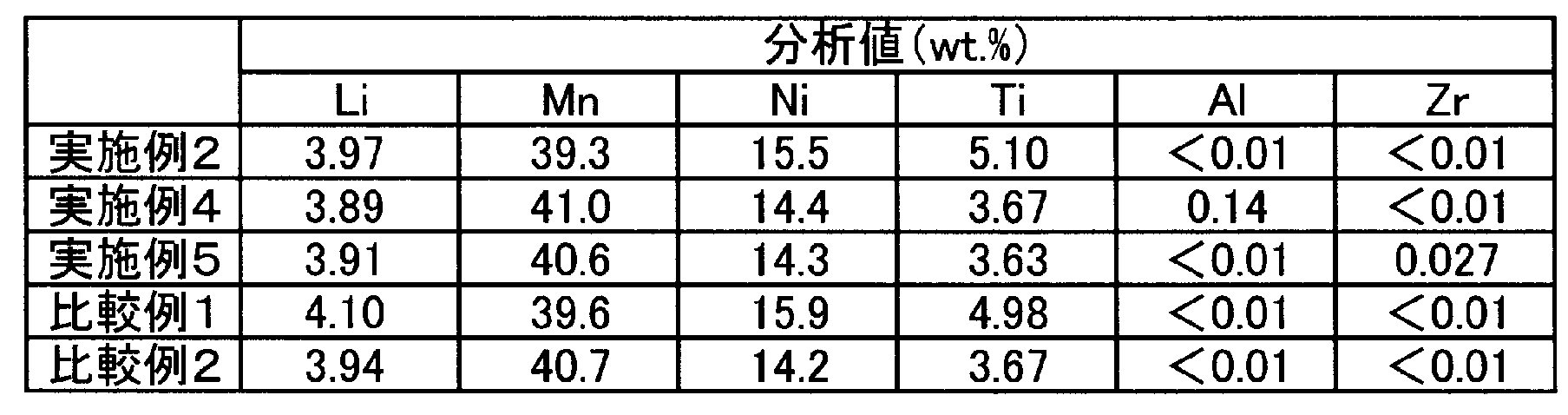
実施例2、4、5・比較例1、2で得たスピネル型リチウム遷移金属酸化物(粉末)のリチウム量、マンガン量、アルミニウム量、ニッケル量、チタン量、およびジルコニウム量を、誘導結合プラズマ(ICP)発光分光分析により測定し、表4に示した。
実施例・比較例で作製した「スピネル型リチウムマンガン含有複合酸化物粉末(サンプル)」を正極活物質として用いて2032型コイン型電池を作製し、これを用いて以下に示す電池性能評価試験を行った。
実施例・比較例で作製した「スピネル型リチウムマンガン含有複合酸化物粉末(サンプル)」89wt%と、導電助材としてのアセチレンブラック5wt%と、結着材としてのPVDF6wt%とを混合し、NMP(N-メチルピロリドン)を加えてペースト状に調整した。このペーストを厚さ15μmのAl箔集電体に塗布し、120℃で乾燥させた。その後、厚さ80μmにプレスして正極シートを作製した。
上記で得られた正極シートをφ13の大きさに切り出して正極とする一方、リチウム金属をφ15の大きさに切り出して負極とし、正極と負極の間に、エチレンカーボネート、エチルメチルカーボネート、ジメチルカーボネートの混合溶媒(容量比=20:20:60)に、LiPF6を1mol/Lになるように溶解させ、更に添加剤としてビニレンカーボネートを2容積%添加した電解液を含浸させたセパレータ(多孔性ポリエチレンフィルム)を置き、2032型コイン電池を作製した。
これらコイン電池を常温で5.0Vまで充電、3.0Vまで放電をし、これを3サイクル繰り返して初期活性を行った。その後、1Cで3サイクル目の放電容量の60%の容量となるところまで充電した状態で出力特性試験を実施した。

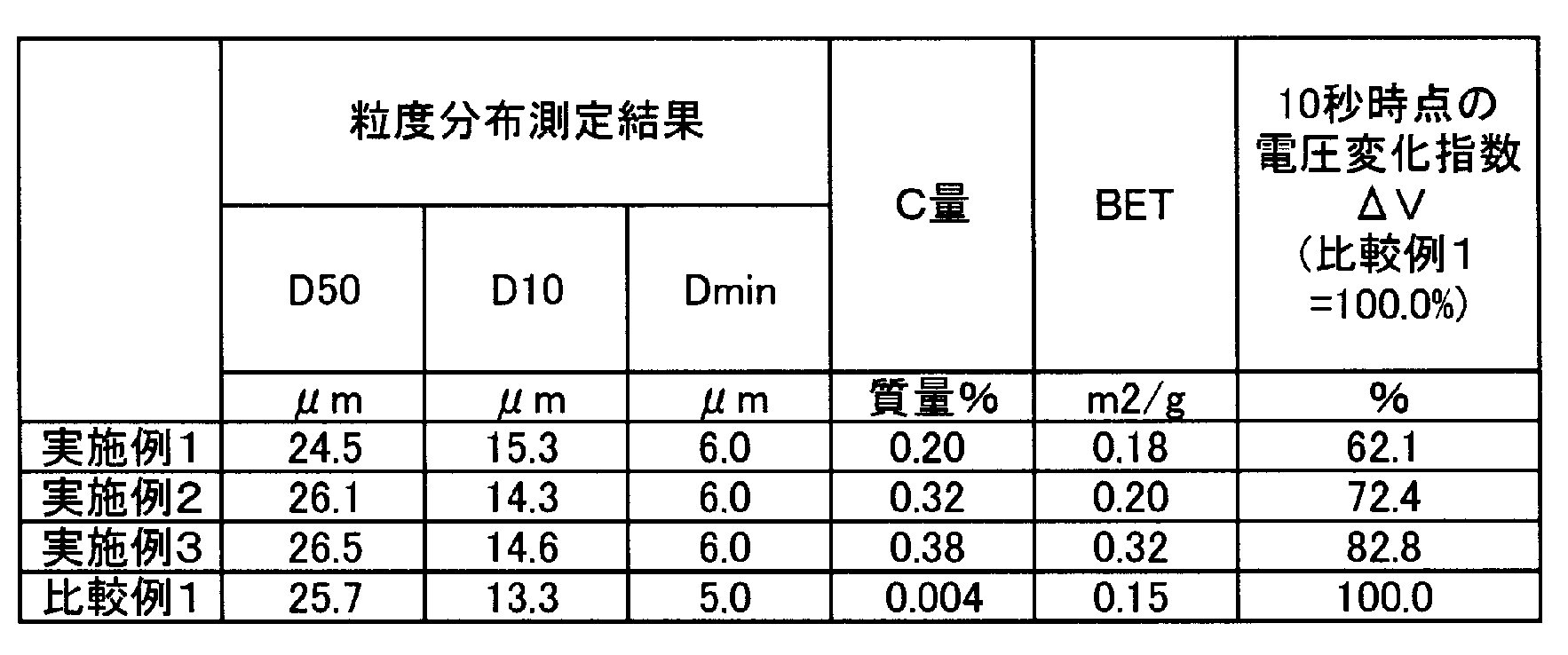
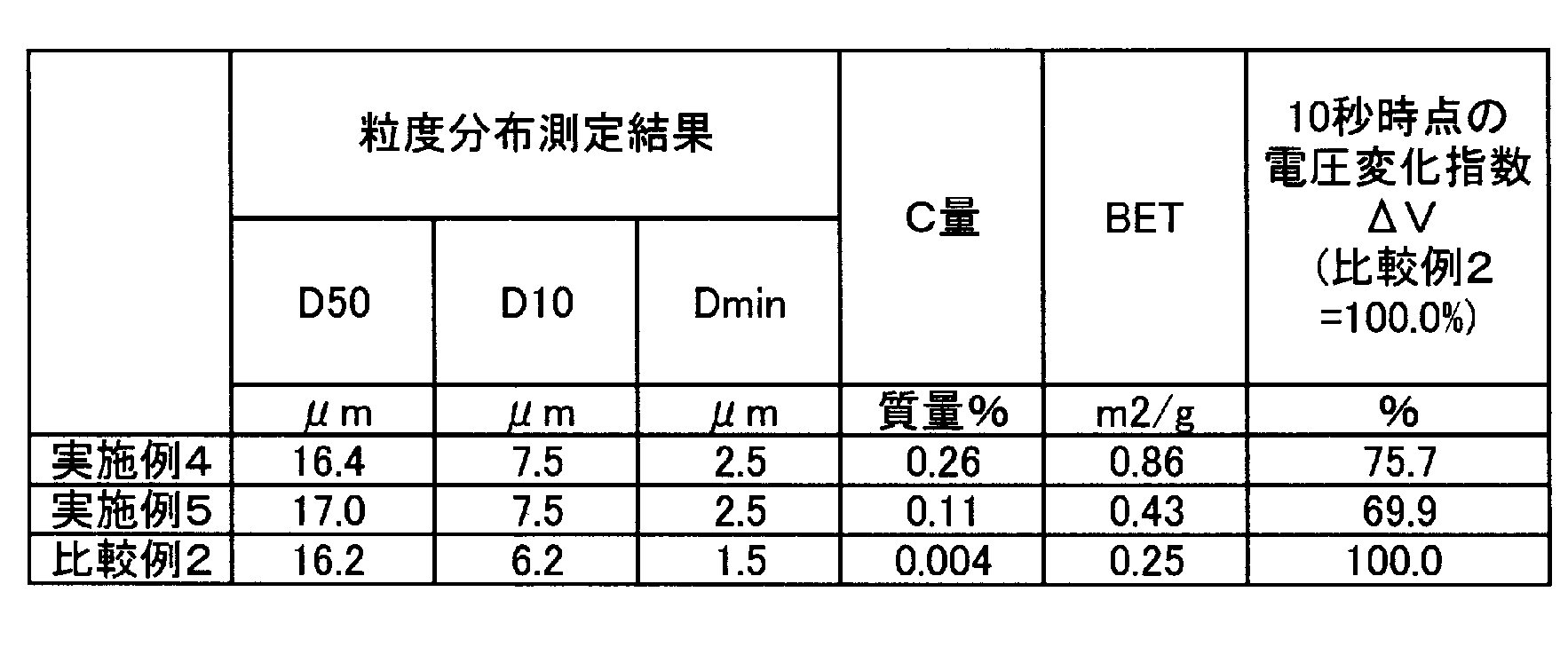
以上の結果、上記のようにコア粒子表面の全面又は一部に、チタン(Ti)と炭素(C)とを含有するA層を備えたリチウムマンガン含有複合酸化物粉末であれば、出力特性を向上させることができることが分かった。
A層の存在についてはX線光電子分光分析装置(XPS)でも確認されている。さらに、表4において、実施例2と比較例1、実施例4、5と比較例2を対比すると、カップリング剤成分由来の組成変化が確認できた。EDSによる分析結果と併せて、コア粒子表面の全面又は一部にA層が形成されたことを示している。
Claims (13)
- 金属Li基準電位において、4.3Vを超える領域の充電電圧で作動するリチウムマンガン含有複合酸化物粒子(「コア粒子」とも称する)の表面の全面又は一部に、少なくともチタン(Ti)又はアルミニウム(Al)又はジルコニウム(Zr)又はこれらのうちの2種類以上と、炭素(C)とを含有する層(「A層」と称する)を備えた正極活物質粒子を含むリチウム二次電池用正極活物質。
- 金属Li基準電位において、4.3Vを超える領域の充電電圧で作動するリチウムマンガン含有複合酸化物粒子(「コア粒子」とも称する)の表面の全面又は一部に、少なくともチタン(Ti)又はアルミニウム(Al)又はこれら両方と、炭素(C)とを含有する層(「A層」と称する)を備えた正極活物質粒子を含むリチウム二次電池用正極活物質。
- 炭素の含有量が0.1~0.5質量%であることを特徴とする請求項1又は2に記載のリチウム二次電池用正極活物質。
- A層は、リン(P)を含有することを特徴とする請求項1~3の何れかに記載のリチウム二次電池用正極活物質。
- A層は、チタン(Ti)又はアルミニウム(Al)又はジルコニウム(Zr)又はこれらのうちの2種類以上を含有するカップリング剤を用いて形成された層であることを特徴とする請求項1~4の何れかに記載のリチウム二次電池用正極活物質。
- A層の厚さは0.1nm~200nmであることを特徴とする請求項1~5の何れかに記載のリチウム二次電池用正極活物質。
- 比表面積が0.01~3.00m2/gであることを特徴とする請求項1~6の何れかに記載のリチウム二次電池用正極活物質。
- レーザー回折散乱式粒度分布測定法により測定して得られる体積基準粒度分布によるD50が5μm~40μmであることを特徴とする請求項1~7の何れかに記載のリチウム二次電池用正極活物質。
- レーザー回折散乱式粒度分布測定法により測定して得られる体積基準粒度分布によるD10が2μm~20μmであることを特徴とする請求項1~8の何れかに記載のリチウム二次電池用正極活物質。
- レーザー回折散乱式粒度分布測定法により測定して得られる体積基準粒度分布によるDminが10μm以下であることを特徴とする請求項1~9の何れかに記載のリチウム二次電池用正極活物質。
- 前記リチウムマンガン含有複合酸化物粒子は、金属Li基準電位で4.5V以上の作動電位を有するスピネル型リチウムマンガン含有複合酸化物粒子であることを特徴とする請求項1~10の何れかに記載のリチウム二次電池用正極活物質。
- 前記リチウムマンガン含有複合酸化物粒子は、LiMn2O4-δにおけるMnサイトの一部を、Liと、金属元素M1と、他の金属元素M2とで置換してなる結晶相を含むスピネル型リチウムマンガン含有複合酸化物粒子であることを特徴とする請求項1~11の何れかに記載のリチウム二次電池用正極活物質。
- 請求項1~12の何れかに記載されたリチウム二次電池用正極活物質を備えたリチウム二次電池。
Priority Applications (4)
| Application Number | Priority Date | Filing Date | Title |
|---|---|---|---|
| GB1519824.5A GB2529106B (en) | 2013-05-17 | 2014-05-19 | Positive electrode active material for lithium secondary battery |
| KR1020157027837A KR102215318B1 (ko) | 2013-05-17 | 2014-05-19 | 리튬 이차전지용 양극 활물질 |
| JP2015504095A JP5898373B2 (ja) | 2013-05-17 | 2014-05-19 | リチウム二次電池用正極活物質 |
| US14/891,445 US10468672B2 (en) | 2013-05-17 | 2014-05-19 | Positive electrode active material for lithium secondary battery |
Applications Claiming Priority (2)
| Application Number | Priority Date | Filing Date | Title |
|---|---|---|---|
| JP2013-105515 | 2013-05-17 | ||
| JP2013105515 | 2013-05-17 |
Publications (1)
| Publication Number | Publication Date |
|---|---|
| WO2014185548A1 true WO2014185548A1 (ja) | 2014-11-20 |
Family
ID=51898517
Family Applications (1)
| Application Number | Title | Priority Date | Filing Date |
|---|---|---|---|
| PCT/JP2014/063191 Ceased WO2014185548A1 (ja) | 2013-05-17 | 2014-05-19 | リチウム二次電池用正極活物質 |
Country Status (5)
| Country | Link |
|---|---|
| US (1) | US10468672B2 (ja) |
| JP (1) | JP5898373B2 (ja) |
| KR (1) | KR102215318B1 (ja) |
| GB (1) | GB2529106B (ja) |
| WO (1) | WO2014185548A1 (ja) |
Cited By (4)
| Publication number | Priority date | Publication date | Assignee | Title |
|---|---|---|---|---|
| WO2017150504A1 (ja) * | 2016-02-29 | 2017-09-08 | 三井金属鉱業株式会社 | スピネル型リチウムマンガン含有複合酸化物 |
| WO2019044733A1 (ja) * | 2017-08-28 | 2019-03-07 | 三井金属鉱業株式会社 | 全固体型リチウム二次電池用正極活物質 |
| US11824188B2 (en) | 2017-08-14 | 2023-11-21 | Mitsui Mining & Smelting Co., Ltd. | Positive electrode active material for all-solid-state lithium secondary batteries |
| US12614723B2 (en) | 2017-08-28 | 2026-04-28 | Mitsui Kinzoku Company, Limited | Positive electrode active substance for all solid-state lithium secondary battery |
Citations (11)
| Publication number | Priority date | Publication date | Assignee | Title |
|---|---|---|---|---|
| JPH04329267A (ja) * | 1991-04-30 | 1992-11-18 | Sony Corp | 有機電解液二次電池 |
| JP2000264636A (ja) * | 1999-03-17 | 2000-09-26 | Toda Kogyo Corp | リチウムマンガンスピネル酸化物粒子粉末及びその製造方法 |
| JP2003109599A (ja) * | 2000-12-27 | 2003-04-11 | Toshiba Corp | 正極活物質およびそれを用いた非水電解液二次電池 |
| JP2004319129A (ja) * | 2003-04-11 | 2004-11-11 | Sony Corp | 正極活物質及びそれを用いた非水電解質二次電池 |
| JP2006036545A (ja) * | 2004-07-22 | 2006-02-09 | Nippon Chem Ind Co Ltd | 改質リチウムマンガンニッケル系複合酸化物、その製造方法、リチウム二次電池正極活物質及びリチウム二次電池 |
| WO2006123572A1 (ja) * | 2005-05-17 | 2006-11-23 | Sony Corporation | 正極活物質およびその製造方法、並びに電池 |
| JP2012089473A (ja) * | 2010-10-15 | 2012-05-10 | Qinghua Univ | 電極用複合材料及びその製造方法、それを採用したリチウムイオン電池 |
| WO2012081348A1 (ja) * | 2010-12-13 | 2012-06-21 | 日本電気株式会社 | 二次電池用正極活物質 |
| WO2012165020A1 (ja) * | 2011-05-30 | 2012-12-06 | 日本電気株式会社 | 二次電池用活物質およびそれを使用した二次電池 |
| WO2013024621A1 (ja) * | 2011-08-17 | 2013-02-21 | 日本電気株式会社 | リチウムイオン電池 |
| WO2014010730A1 (ja) * | 2012-07-12 | 2014-01-16 | 三井金属鉱業株式会社 | リチウム金属複合酸化物 |
Family Cites Families (9)
| Publication number | Priority date | Publication date | Assignee | Title |
|---|---|---|---|---|
| EP0511632B1 (en) | 1991-04-30 | 1997-11-19 | Sony Corporation | Nonaqueous electrolyte secondary battery |
| JP3813001B2 (ja) | 1997-08-29 | 2006-08-23 | 旭化成エレクトロニクス株式会社 | 非水系二次電池 |
| JP3634694B2 (ja) | 1998-12-18 | 2005-03-30 | 三洋電機株式会社 | リチウム二次電池 |
| US6753112B2 (en) | 2000-12-27 | 2004-06-22 | Kabushiki Kaisha Toshiba | Positive electrode active material and non-aqueous secondary battery using the same |
| JP4325167B2 (ja) | 2001-10-18 | 2009-09-02 | 日本電気株式会社 | 非水電解液二次電池用電極材料 |
| US9054374B2 (en) | 2005-05-17 | 2015-06-09 | Sony Corporation | Cathode active material, method of manufacturing the same and battery |
| US8568620B2 (en) | 2010-08-02 | 2013-10-29 | Tsinghua University | Electrode composite material, method for making the same, and lithium ion battery using the same |
| JP5435810B2 (ja) | 2010-12-02 | 2014-03-05 | 日揮触媒化成株式会社 | リチウムニッケルマンガン複合酸化物およびそれを含む二次電池用正極活物質ならびにそれらの製造方法 |
| KR20140012734A (ko) | 2011-03-16 | 2014-02-03 | 지멘스 악티엔게젤샤프트 | 가시광 통신을 위한 시스템 내에서 통지를 위한 방법 및 디바이스 |
-
2014
- 2014-05-19 WO PCT/JP2014/063191 patent/WO2014185548A1/ja not_active Ceased
- 2014-05-19 GB GB1519824.5A patent/GB2529106B/en active Active
- 2014-05-19 KR KR1020157027837A patent/KR102215318B1/ko active Active
- 2014-05-19 US US14/891,445 patent/US10468672B2/en active Active
- 2014-05-19 JP JP2015504095A patent/JP5898373B2/ja active Active
Patent Citations (11)
| Publication number | Priority date | Publication date | Assignee | Title |
|---|---|---|---|---|
| JPH04329267A (ja) * | 1991-04-30 | 1992-11-18 | Sony Corp | 有機電解液二次電池 |
| JP2000264636A (ja) * | 1999-03-17 | 2000-09-26 | Toda Kogyo Corp | リチウムマンガンスピネル酸化物粒子粉末及びその製造方法 |
| JP2003109599A (ja) * | 2000-12-27 | 2003-04-11 | Toshiba Corp | 正極活物質およびそれを用いた非水電解液二次電池 |
| JP2004319129A (ja) * | 2003-04-11 | 2004-11-11 | Sony Corp | 正極活物質及びそれを用いた非水電解質二次電池 |
| JP2006036545A (ja) * | 2004-07-22 | 2006-02-09 | Nippon Chem Ind Co Ltd | 改質リチウムマンガンニッケル系複合酸化物、その製造方法、リチウム二次電池正極活物質及びリチウム二次電池 |
| WO2006123572A1 (ja) * | 2005-05-17 | 2006-11-23 | Sony Corporation | 正極活物質およびその製造方法、並びに電池 |
| JP2012089473A (ja) * | 2010-10-15 | 2012-05-10 | Qinghua Univ | 電極用複合材料及びその製造方法、それを採用したリチウムイオン電池 |
| WO2012081348A1 (ja) * | 2010-12-13 | 2012-06-21 | 日本電気株式会社 | 二次電池用正極活物質 |
| WO2012165020A1 (ja) * | 2011-05-30 | 2012-12-06 | 日本電気株式会社 | 二次電池用活物質およびそれを使用した二次電池 |
| WO2013024621A1 (ja) * | 2011-08-17 | 2013-02-21 | 日本電気株式会社 | リチウムイオン電池 |
| WO2014010730A1 (ja) * | 2012-07-12 | 2014-01-16 | 三井金属鉱業株式会社 | リチウム金属複合酸化物 |
Cited By (12)
| Publication number | Priority date | Publication date | Assignee | Title |
|---|---|---|---|---|
| WO2017150504A1 (ja) * | 2016-02-29 | 2017-09-08 | 三井金属鉱業株式会社 | スピネル型リチウムマンガン含有複合酸化物 |
| JPWO2017150504A1 (ja) * | 2016-02-29 | 2018-03-22 | 三井金属鉱業株式会社 | スピネル型リチウムマンガン含有複合酸化物 |
| CN108352523A (zh) * | 2016-02-29 | 2018-07-31 | 三井金属矿业株式会社 | 尖晶石型含锂锰复合氧化物 |
| JP2018138513A (ja) * | 2016-02-29 | 2018-09-06 | 三井金属鉱業株式会社 | スピネル型リチウムマンガン含有複合酸化物 |
| US10468677B2 (en) | 2016-02-29 | 2019-11-05 | Mitsui Mining & Smelting Co., Ltd. | Spinel-type lithium-manganese-containing complex oxide |
| CN108352523B (zh) * | 2016-02-29 | 2019-11-05 | 三井金属矿业株式会社 | 尖晶石型含锂锰复合氧化物 |
| JP7028701B2 (ja) | 2016-02-29 | 2022-03-02 | 三井金属鉱業株式会社 | スピネル型リチウムマンガン含有複合酸化物 |
| US11824188B2 (en) | 2017-08-14 | 2023-11-21 | Mitsui Mining & Smelting Co., Ltd. | Positive electrode active material for all-solid-state lithium secondary batteries |
| WO2019044733A1 (ja) * | 2017-08-28 | 2019-03-07 | 三井金属鉱業株式会社 | 全固体型リチウム二次電池用正極活物質 |
| JPWO2019044733A1 (ja) * | 2017-08-28 | 2019-12-19 | 三井金属鉱業株式会社 | 全固体型リチウム二次電池用正極活物質 |
| US12347856B2 (en) | 2017-08-28 | 2025-07-01 | Mitsui Mining & Smelting Co., Ltd. | Positive electrode active substance for all solid-state lithium secondary battery |
| US12614723B2 (en) | 2017-08-28 | 2026-04-28 | Mitsui Kinzoku Company, Limited | Positive electrode active substance for all solid-state lithium secondary battery |
Also Published As
| Publication number | Publication date |
|---|---|
| GB2529106B (en) | 2021-05-19 |
| KR20160009016A (ko) | 2016-01-25 |
| US10468672B2 (en) | 2019-11-05 |
| US20160093882A1 (en) | 2016-03-31 |
| JP5898373B2 (ja) | 2016-04-06 |
| JPWO2014185548A1 (ja) | 2017-02-23 |
| KR102215318B1 (ko) | 2021-02-15 |
| GB201519824D0 (en) | 2015-12-23 |
| GB2529106A (en) | 2016-02-10 |
Similar Documents
| Publication | Publication Date | Title |
|---|---|---|
| JP7028701B2 (ja) | スピネル型リチウムマンガン含有複合酸化物 | |
| JP5572268B1 (ja) | スピネル型リチウムマンガンニッケル含有複合酸化物 | |
| JP5828989B2 (ja) | リチウム二次電池用正極活物質 | |
| JP5547855B2 (ja) | スピネル型リチウムマンガン遷移金属酸化物 | |
| JP5523637B2 (ja) | マンガン系スピネル型リチウム遷移金属酸化物 | |
| JP5813277B1 (ja) | スピネル型リチウムコバルトマンガン含有複合酸化物 | |
| JP6754891B2 (ja) | スピネル型リチウムニッケルマンガン含有複合酸化物 | |
| JP5635217B2 (ja) | スピネル型リチウムマンガン含有複合酸化物 | |
| JP6516919B2 (ja) | リチウム二次電池用正極活物質 | |
| JP5898373B2 (ja) | リチウム二次電池用正極活物質 | |
| JP6649369B2 (ja) | 5v級スピネル型リチウムマンガン含有複合酸化物の製造方法 |
Legal Events
| Date | Code | Title | Description |
|---|---|---|---|
| 121 | Ep: the epo has been informed by wipo that ep was designated in this application |
Ref document number: 14798373 Country of ref document: EP Kind code of ref document: A1 |
|
| ENP | Entry into the national phase |
Ref document number: 2015504095 Country of ref document: JP Kind code of ref document: A |
|
| ENP | Entry into the national phase |
Ref document number: 20157027837 Country of ref document: KR Kind code of ref document: A |
|
| ENP | Entry into the national phase |
Ref document number: 1519824 Country of ref document: GB Kind code of ref document: A Free format text: PCT FILING DATE = 20140519 |
|
| WWE | Wipo information: entry into national phase |
Ref document number: 14891445 Country of ref document: US |
|
| NENP | Non-entry into the national phase |
Ref country code: DE |
|
| 122 | Ep: pct application non-entry in european phase |
Ref document number: 14798373 Country of ref document: EP Kind code of ref document: A1 |