WO2014175129A1 - 低極性樹脂用接着剤及びこれを用いてなる成形品 - Google Patents
低極性樹脂用接着剤及びこれを用いてなる成形品 Download PDFInfo
- Publication number
- WO2014175129A1 WO2014175129A1 PCT/JP2014/060779 JP2014060779W WO2014175129A1 WO 2014175129 A1 WO2014175129 A1 WO 2014175129A1 JP 2014060779 W JP2014060779 W JP 2014060779W WO 2014175129 A1 WO2014175129 A1 WO 2014175129A1
- Authority
- WO
- WIPO (PCT)
- Prior art keywords
- low
- adhesive
- resin
- hydrocarbon group
- polarity
- Prior art date
- Legal status (The legal status is an assumption and is not a legal conclusion. Google has not performed a legal analysis and makes no representation as to the accuracy of the status listed.)
- Ceased
Links
Classifications
-
- C—CHEMISTRY; METALLURGY
- C09—DYES; PAINTS; POLISHES; NATURAL RESINS; ADHESIVES; COMPOSITIONS NOT OTHERWISE PROVIDED FOR; APPLICATIONS OF MATERIALS NOT OTHERWISE PROVIDED FOR
- C09J—ADHESIVES; NON-MECHANICAL ASPECTS OF ADHESIVE PROCESSES IN GENERAL; ADHESIVE PROCESSES NOT PROVIDED FOR ELSEWHERE; USE OF MATERIALS AS ADHESIVES
- C09J163/00—Adhesives based on epoxy resins; Adhesives based on derivatives of epoxy resins
-
- C—CHEMISTRY; METALLURGY
- C08—ORGANIC MACROMOLECULAR COMPOUNDS; THEIR PREPARATION OR CHEMICAL WORKING-UP; COMPOSITIONS BASED THEREON
- C08G—MACROMOLECULAR COMPOUNDS OBTAINED OTHERWISE THAN BY REACTIONS ONLY INVOLVING UNSATURATED CARBON-TO-CARBON BONDS
- C08G59/00—Polycondensates containing more than one epoxy group per molecule; Macromolecules obtained by polymerising compounds containing more than one epoxy group per molecule using curing agents or catalysts which react with the epoxy groups
- C08G59/18—Macromolecules obtained by polymerising compounds containing more than one epoxy group per molecule using curing agents or catalysts which react with the epoxy groups ; e.g. general methods of curing
- C08G59/68—Macromolecules obtained by polymerising compounds containing more than one epoxy group per molecule using curing agents or catalysts which react with the epoxy groups ; e.g. general methods of curing characterised by the catalysts used
-
- C—CHEMISTRY; METALLURGY
- C08—ORGANIC MACROMOLECULAR COMPOUNDS; THEIR PREPARATION OR CHEMICAL WORKING-UP; COMPOSITIONS BASED THEREON
- C08L—COMPOSITIONS OF MACROMOLECULAR COMPOUNDS
- C08L33/00—Compositions of homopolymers or copolymers of compounds having one or more unsaturated aliphatic radicals, each having only one carbon-to-carbon double bond, and only one being terminated by only one carboxyl radical, or of salts, anhydrides, esters, amides, imides or nitriles thereof; Compositions of derivatives of such polymers
- C08L33/04—Homopolymers or copolymers of esters
- C08L33/06—Homopolymers or copolymers of esters of esters containing only carbon, hydrogen and oxygen, which oxygen atoms are present only as part of the carboxyl radical
-
- C—CHEMISTRY; METALLURGY
- C08—ORGANIC MACROMOLECULAR COMPOUNDS; THEIR PREPARATION OR CHEMICAL WORKING-UP; COMPOSITIONS BASED THEREON
- C08L—COMPOSITIONS OF MACROMOLECULAR COMPOUNDS
- C08L63/00—Compositions of epoxy resins; Compositions of derivatives of epoxy resins
-
- C—CHEMISTRY; METALLURGY
- C09—DYES; PAINTS; POLISHES; NATURAL RESINS; ADHESIVES; COMPOSITIONS NOT OTHERWISE PROVIDED FOR; APPLICATIONS OF MATERIALS NOT OTHERWISE PROVIDED FOR
- C09J—ADHESIVES; NON-MECHANICAL ASPECTS OF ADHESIVE PROCESSES IN GENERAL; ADHESIVE PROCESSES NOT PROVIDED FOR ELSEWHERE; USE OF MATERIALS AS ADHESIVES
- C09J133/00—Adhesives based on homopolymers or copolymers of compounds having one or more unsaturated aliphatic radicals, each having only one carbon-to-carbon double bond, and at least one being terminated by only one carboxyl radical, or of salts, anhydrides, esters, amides, imides, or nitriles thereof; Adhesives based on derivatives of such polymers
- C09J133/04—Homopolymers or copolymers of esters
- C09J133/06—Homopolymers or copolymers of esters of esters containing only carbon, hydrogen and oxygen, the oxygen atom being present only as part of the carboxyl radical
Definitions
- the present invention relates to an adhesive for low-polarity resin and a molded product using the same.
- various resin adhesives are used for assembling display members such as liquid crystal and organic EL.
- a cationic polymerization type containing an epoxy monomer and a vinyl monomer and a radical polymerization type containing a (meth) acryl monomer are known.
- the adhesive strength is not sufficient in the adhesion of low-polarity resins such as polyolefin resins and silicone resins, particularly in the adhesion of low-polarity resin films.
- radical polymerization type resin adhesive comprising isostearyl (meth) acrylate, thermoplastic elastomer and photoinitiator.
- Patent Document 1 the radical polymerization type resin adhesive has a problem that curing shrinkage is large and adhesiveness is insufficient. Furthermore, since hardening is inhibited by oxygen, there is a problem that facilities such as nitrogen sealing are necessary.
- an adhesive containing an epoxy monomer is generally used, and a specific alicyclic epoxy compound is a highly polar resin such as a PET resin film or an acetylcellulose resin film. It is known that a film can be firmly bonded to glass or aluminum (Patent Document 2). However, it is not known about adhesiveness with a low polarity resin film. Moreover, the resin adhesive containing an epoxy monomer has a problem that the curing speed is slow, and a resin adhesive having a high curing speed is required.
- JP 2005-307082 A Japanese Patent No. 4553572
- An object of the present invention is to provide an adhesive for low polarity resin having high-speed curability, high heat resistance (low linear expansion coefficient, high Tg), low viscosity, and excellent adhesion strength to low polarity resin. It is to provide.
- the adhesive for low polarity resin of the present invention is an adhesive for bonding the low polarity resin (X), and the adhesive contains an alicyclic diepoxy compound (A) having a bridged cyclic hydrocarbon group.
- the content of the bridgehead carbon in the adhesive is 0.01 to 25.0 mmol / g, and the solubility parameter of the resin constituting the low polarity resin (X) is 6.2 to 10.0.
- the low polar resin adhesive of the present invention has high-speed curability and high heat resistance (low linear expansion coefficient, high Tg), low viscosity, and excellent adhesive strength to low polar resin films.
- the adhesive for low polarity resin of the present invention is an adhesive for bonding the low polarity resin (X), and the adhesive contains an alicyclic diepoxy compound (A) having a bridged cyclic hydrocarbon group.
- the content of the bridgehead carbon in the adhesive is 0.01 to 25.0 mmol / g, and the solubility parameter of the resin constituting the low polarity resin (X) is 6.2 to 10.0. It is an adhesive for resin.
- the bridged cyclic hydrocarbon is a saturated alicyclic ring in which two or more rings are bonded by sharing two or more atoms.
- the “alicyclic diepoxy compound having a bridged cyclic hydrocarbon group” is an epoxy compound having the above bridged cyclic hydrocarbon group, in which the oxygen atom of the epoxy group is bridged A compound directly bonded to adjacent carbon atoms forming a ring in a cyclic hydrocarbon.
- the ring includes a 3- to 10-membered ring or more, and from the viewpoint of adhesive strength, a 3- to 10-membered ring is preferable, and a 5- to 7-membered ring is more preferable.
- Bridged cyclic hydrocarbons include those having 6 to 20 carbon atoms, specifically, those having two rings ⁇ hydroindane, decalin, bicyclo [6.3.0] undecane, bicyclo [5 4.0] undecane, bicyclo [5.3.1] undecane, bicyclo [4.4.1] undecane, bicyclo [4.3.2] undecane, etc. ⁇ and having three or more rings ⁇ decahydrocyclo Penta [cd] pentalene, tricyclo [3.3.2.0 2,4 ] decane, tricyclo [5.2.1.0 2,6 ] decane, tricyclo [3.3.2.0 2,8 ] decane , Tricyclo [4.2.1.1 2,5 ] decane, tetrahydrodicyclopenta
- alicyclic diepoxy compound (A) having a bridged cyclic hydrocarbon group from the viewpoint of low viscosity, adhesive strength, high Tg, low linear expansion coefficient and curing shrinkage, the following general formula (1) and / or A compound represented by the following general formula (2) is preferred.
- R 1 to R 14 each represents a hydrogen atom, a halogen atom, a hydrocarbon group having 1 to 18 carbon atoms, or an alkoxy group having 1 to 18 carbon atoms.
- the carbon atom in the hydrocarbon group may be substituted with an oxygen atom, and the hydrogen atom may be substituted with a halogen atom.
- the carbon atom in the alkoxy group may be substituted with an oxygen atom, and the hydrogen atom may be substituted with a halogen atom.
- a, b, c and d are each 0 or an integer of 1 to 4.
- R 15 to R 28 each represents a hydrogen atom, a halogen atom, a hydrocarbon group having 1 to 18 carbon atoms, or an alkoxy group having 1 to 18 carbon atoms.
- the carbon atom in the hydrocarbon group may be substituted with an oxygen atom, and the hydrogen atom may be substituted with a halogen atom.
- the carbon atom in the alkoxy group may be substituted with an oxygen atom, and the hydrogen atom may be substituted with a halogen atom.
- e and h are each an integer of 1 to 4
- f and g are each 0 or an integer of 1 to 4.
- the compound represented by the general formula (1) can be produced by oxidizing an unsaturated compound represented by the following general formula (3) with an oxidizing agent ⁇ hydroperoxide, organic peracid, etc. ⁇ .
- R 1 to R 14 are each a hydrogen atom, a halogen atom, a hydrocarbon group having 1 to 18 carbon atoms, or an alkoxy group having 1 to 18 carbon atoms.
- the carbon atom in the hydrocarbon group may be substituted with an oxygen atom, and the hydrogen atom may be substituted with a halogen atom.
- the carbon atom in the alkoxy group may be substituted with an oxygen atom, and the hydrogen atom may be substituted with a halogen atom.
- a, b, c and d are each 0 or an integer of 1 to 4. ]
- R 1 to R 14 are preferably a hydrogen atom, a halogen atom, or a hydrocarbon group having 1 to 4 carbon atoms, and more preferably a hydrogen atom, from the viewpoint of adhesive strength.
- Specific examples of the compound represented by the general formula (1) include 1,2: 5,6-diepoxyhexahydroindane.
- the compound represented by the general formula (2) can be produced by oxidizing an unsaturated compound represented by the following general formula (4) with an oxidizing agent ⁇ hydroperoxide, organic peracid, etc. ⁇ .
- R 15 to R 28 each represent a hydrogen atom, a halogen atom, a hydrocarbon group having 1 to 18 carbon atoms, or an alkoxy group having 1 to 18 carbon atoms.
- the carbon atom in the hydrocarbon group may be substituted with an oxygen atom, and the hydrogen atom may be substituted with a halogen atom.
- the carbon atom in the alkoxy group may be substituted with an oxygen atom, and the hydrogen atom may be substituted with a halogen atom.
- e and h are each an integer of 1 to 4
- f and g are each 0 or an integer of 1 to 4.
- R 15 to R 28 are preferably a hydrogen atom, a halogen atom, or a hydrocarbon group having 1 to 4 carbon atoms, and more preferably a hydrogen atom, from the viewpoint of adhesive strength.
- Specific examples of the compound represented by the general formula (2) include 1,2: 5,6-diepoxydicyclopentadiene.
- alicyclic diepoxy compound (A) having a bridged cyclic hydrocarbon group one type may be used, or two or more types may be used.
- the above general formula (1) and / or The alicyclic diepoxy compound represented by the above general formula (2) is preferable, and more preferably, the compound in which a, b and d are 1 and c is 0 in the above general formula (1) and the above general formula (2) In which e, h and f are 1 and g is 0, particularly preferably 1,2: 5,6-diepoxyhexahydroindane and 1,2: 5,6-diepoxydicyclopentadiene And most preferably 1,2: 5,6-diepoxydicyclopentadiene.
- the alicyclic diepoxy compound represented by the general formula (1) and / or the general formula (2) is preferable, and more preferably, a, b, and d in the general formula (1) are 1 And a compound in which c is 0 and a compound in which e, h and f are 1 and g is 0 in the above general formula (2), particularly preferably 1,2: 5,6-diepoxyhexahydroindane And 1,2: 5,6-diepoxydicyclopentadiene, most preferably 1,2: 5,6-diepoxyhexahydroindane.
- Examples of the oxidizing agent include hydroperoxide and organic peracid.
- Examples of the hydroperoxide include hydrogen peroxide, tertiary butyl hydroperoxide and cumene hydroperoxide.
- Examples of organic peracids include organic percarboxylic acids having 1 to 20 carbon atoms. Specific examples include performic acid, peracetic acid, perpropionic acid, perbenzoic acid, trifluoroperacetic acid, and perphthalic acid. It is done.
- peracetic acid is preferable from the viewpoint of being industrially usable in large quantities.
- a catalyst can be used as necessary.
- hydroperoxide a catalytic effect is obtained by a combination of a mixture of tungstic acid and caustic soda and hydrogen peroxide, a combination of organic acid and hydrogen peroxide, or a combination of molybdenum hexacarbonyl and tertiary butyl hydroperoxide. be able to.
- an organic peracid an alkali such as sodium carbonate or an acid such as sulfuric acid can be used as a catalyst.
- the oxidation reaction is preferably carried out by adjusting the presence or absence of catalyst and solvent and the reaction temperature.
- the adhesive for low polarity resins of the present invention is an epoxy compound (B) other than the alicyclic diepoxy compound (A) having a bridged cyclic hydrocarbon group (hereinafter also simply referred to as “epoxy compound (B)”). May be contained.
- the epoxy compound (B) includes a compound having one or more epoxy groups in the molecule, and is preferably a compound having 1 to 2 epoxy groups from the viewpoint of low viscosity, adhesive strength and flexibility. .
- Examples of the epoxy compound (B) include a cycloaliphatic epoxy compound (B-1), an aromatic epoxy compound (B-2), an acyclic aliphatic epoxy compound having no bridged cyclic hydrocarbon group in the molecule ( B-3) and a silicon compound (B-4) having an epoxy group are included.
- cycloaliphatic epoxy compound (B-1) having no bridged cyclic hydrocarbon group in the molecule a cycloaliphatic having 5 to 30 carbon atoms having no bridged cyclic hydrocarbon group in the molecule
- Epoxy compounds are included, specifically, those having an alicyclic epoxy group in the molecule ⁇ limonene dioxide, di (3,4-epoxycyclohexyl) adipate, (3,4-epoxycyclohexyl) methyl-3, 4-epoxycyclohexanecarboxylate, (3,4-epoxy-6-methylcyclohexyl) methyl-3,4-epoxy-6-methylcyclohexanecarboxylate and ethylene-1,2-di (3,4-epoxycyclohexanecarboxylic acid ) Ester etc. ⁇ and epoxy compound ⁇ 1 having a cycloaliphatic skeleton having an epoxy group which is not an alicyclic epoxy group in the molecule Diglycidyl
- cycloaliphatic epoxy compound (B-1) having no bridged cyclic hydrocarbon group in the molecule, it has a bridged cyclic hydrocarbon group in the molecule from the viewpoint of adhesive strength and flexibility.
- cyclic aliphatic epoxy compound (B-1) having no bridged cyclic hydrocarbon group in the molecule may be used alone or in combination of two or more.
- bisphenol A type and F type commercially available products are jER828 and 806 (Mitsubishi Chemical Corporation) And YD-128 (manufactured by Nippon Kayaku Epoxy Manufacturing Co., Ltd.)
- polycyclic aromatic glycidyl ethers such as naphthalene ⁇ , aromatic epoxy resins ⁇ glycidyl ethers of novolac type phenolic resins,
- a glycidyl etherified product of an acyclic aliphatic polyhydric alcohol ⁇ ethylene glycol diglycidyl ether, propylene glycol diglycidyl ether, tetramethylene glycol diglycidyl ether, polyethylene glycol diglycidyl ether , Polypropylene glycol diglycidyl ether, trimethylolpropane triglycidyl ether, pentaerythritol tetraglycidyl ether, sorbitol polyglycidyl ether, etc. ⁇ , glycidyl esterified product of acyclic fatty acid polycarboxylic acid ⁇ diglycidyl adipate, etc.), containing an epoxy group ( Polymer having ⁇ meth) acrylate monomer (i1) as essential constituent monomer ⁇ of (meth) acrylate monomer (i1) containing epoxy group] Compound,
- Examples of the (meth) acrylate monomer (i1) containing an epoxy group include a (meth) acrylate monomer containing an epoxy group not containing a cyclic aliphatic group having 5 to 30 carbon atoms, specifically, glycidyl (meth) Examples include acrylate and 2-methyl-glycidyl (meth) acrylate.
- Examples of the (meth) acrylate monomer (i2) containing a hydroxyl group include a (meth) acrylate monomer containing a hydroxyl group not containing a cyclic aliphatic group having 4 to 30 carbon atoms, specifically, hydroxyethyl (meth) acrylate. And hydroxypropyl (meth) acrylate.
- alkyl (meth) acrylate (i3) examples include alkyl (meth) acrylates having no cyclic aliphatic groups having 4 to 30 carbon atoms, specifically, methyl (meth) acrylate, ethyl (meth) acrylate, Examples thereof include n-, i- or t-butyl (meth) acrylate, hexyl (meth) acrylate, octyl (meth) acrylate, lauryl (meth) acrylate, stearyl (meth) acrylate and cyclohexyl (meth) acrylate.
- “(meth) acrylate” means “acrylate or methacrylate”.
- silicon compound (B-4) having an epoxy group examples include 3,4-epoxycyclohexylethyltrimethoxysilane and a silane coupling agent having an epoxy group (for example, A-186 (Nihon Unicar) (Made by Co., Ltd.), KBM303, KBM403, KBM42 (made by Shin-Etsu Chemical Co., Ltd.), etc.).
- A-186 Nihon Unicar
- KBM303, KBM403, KBM42 made by Shin-Etsu Chemical Co., Ltd.
- the epoxy compound (B) is preferably a cyclic aliphatic epoxy compound (B-1) having no bridged cyclic hydrocarbon group in the molecule, more preferably from the viewpoint of low viscosity, adhesive strength and flexibility.
- B-1 a cyclic aliphatic epoxy compound having 5 to 30 carbon atoms which does not have a bridged cyclic hydrocarbon group in the molecule, more preferably an alicyclic epoxy which does not have a bridged cyclic hydrocarbon group in the molecule.
- the adhesive for low-polarity resins of the present invention preferably contains an epoxy compound (B) from the viewpoint of flexibility.
- the content of the alicyclic diepoxy compound (A) having a crosslinked cyclic hydrocarbon group in the low polar resin adhesive of the present invention is low viscosity, adhesive strength, high Tg, From the viewpoint of a low linear expansion coefficient and flexibility, the content is preferably 10 to 99% by weight, more preferably 60 to 90% by weight, and particularly preferably 70 to 80% by weight based on the weight of the adhesive.
- the content of the epoxy compound (B) is preferably 0.9 to 89.9% by weight based on the weight of the adhesive from the viewpoints of low viscosity, adhesive strength, high Tg, low linear expansion coefficient and flexibility. More preferably, it is 9.85 to 39.85% by weight, and particularly preferably 15 to 29.8% by weight.
- the alicyclic diepoxy compound (A) which has a bridged cyclic hydrocarbon group As content of the said alicyclic diepoxy compound (A) which has a bridged cyclic hydrocarbon group, and the said epoxy compound (B), the alicyclic diepoxy compound which has the said bridged cyclic hydrocarbon group (A ) And the total weight of the epoxy compound (B), the content of the alicyclic diepoxy compound (A) having a bridged cyclic hydrocarbon group is 0.1 to 99% by weight, and the epoxy compound (B ) Is preferably 1 to 99.9% by weight.
- a photoacid generator (C) that generates an acid upon irradiation with active energy rays.
- the photoacid generator (C) is a compound that initiates polymerization by generating an acid upon irradiation with active energy rays, and includes a sulfonium salt (C1) and an iodonium salt (C2).
- a photo-acid generator (C) may be used individually by 1 type, and may use 2 or more types together.
- Examples of the sulfonium salt (C1) include triphenylsulfonium tetrafluoroborate, triphenylsulfonium bromide, tri-p-tolylsulfonium hexafluorophosphate, tri-p-tolylsulfonium trifluoromethanesulfonate, [p- (phenyl mercapto) Phenyl] diphenylsulfonium hexafluorophosphate [commercially available products include CPI-100P (manufactured by San Apro Co., Ltd.)] and [p- (phenylmercapto) phenyl] diphenylsulfonium [tri (perfluoroethyl)] trifluorophosphate, etc. Is mentioned.
- Examples of the iodonium salt (C2) include iodonium (4-methylphenyl) ⁇ 4- (2-methylpropyl) phenyl ⁇ -hexafluorophosphate [as a commercial product, DAROCUR 250 (manufactured by BASF Japan Ltd.)], iodonium [Bis (4-t-butylphenyl)] hexafluorophosphate, iodonium [bis (4-t-butylphenyl)] trifluoro [tris (perfluoroethyl)] phosphate, iodonium [bis (4-methoxyphenyl)] And trifluoro [tris (perfluoroethyl)] phosphate and iodonium [bis (4-methoxyphenyl)] [tetrakis (perfluorophenyl)] borate.
- the sulfonium salt (C1) is preferable from the viewpoint of active energy ray curability, and [p- (phenylmercapto) phenyl] diphenylsulfonium hexafluorophosphate is more preferable.
- thermal acid generator (D) examples include a sulfonium salt (D1), an iodonium salt (D2), a benzothiazonium salt (D3), an ammonium salt (D4), and a phosphonium salt (D5).
- a thermal acid generator (D) may be used individually by 1 type, and may use 2 or more types together.
- Examples of the sulfonium salt (D1) include (4-hydroxyphenyl) dimethylsulfonium bis (trifluoromethanesulfonyl) imide, (4-hydroxyphenyl) (2-methylbenzyl) methylsulfonium bis (trifluoromethanesulfonyl) imide, (4 -Hydroxyphenyl) benzylmethylsulfonium bis (trifluoromethanesulfonyl) imide, (4-hydroxyphenyl) dimethylsulfonium hexafluorophosphate, (4-hydroxyphenyl) (2-methylbenzyl) methylsulfonium hexafluorophosphate, (4- Hydroxyphenyl) benzylmethylsulfonium hexafluorophosphate, (4-hydroxyphenyl) (4-methylbenzyl) methylsulfonium hexafluoro Sulfate, (4-hydroxyphenyl) dimethylsulfon
- Examples of the iodonium salt (D2) include diphenyliodonium bis (trifluoromethanesulfonyl) imide and (p-nitrophenyl) phenyliodonium hexafluorophosphate.
- benzothiazonium salt (D3) examples include 3-benzylbenzothiazonium hexafluoroantimonate, 3- (4-methoxybenzyl) benzothiazonium hexafluoroantimonate, 2-methylsulfanyl-3-benzyl.
- Benzothiazonium hexafluoroantimonate, 5-chloro-3-benzylbenzothiazonium hexafluoroantimonate; 3-benzylbenzothiazonium hexafluorophosphate; 3-benzylbenzothiazonium tetrafluoroborate Can be mentioned.
- ammonium salt (D4) for example, tetramethylammonium butyltris (2,6-difluorophenyl) borate, tetramethylammonium hexyltris (p-chlorophenyl) borate, tetramethylammonium hexyltris (3-trifluoromethylphenyl) And borate, benzyldimethylphenylammonium butyltris (2,6-difluorophenyl) borate, benzyldimethylphenylammonium hexyltris (p-chlorophenyl) borate and benzyldimethylphenylammonium hexyltris (3-trifluoromethylphenyl) borate .
- Examples of the phosphonium salt (D5) include (4-methylphenyl) diphenylphosphonium triflate.
- a sulfonium salt (D1) is preferable from the viewpoint of curing speed.
- Examples of the other epoxy curing agent (E) include ordinary curing agents for epoxy resins, such as an amine curing agent (E1), a carboxylic acid curing agent (E2), a basic active hydrogen compound (E3), Examples include imidazoles (E4), polymercaptan curing agents (E5), phenol resins (E6), urea resins (E7), melamine resins (E8), and latent curing agents (E9).
- Other epoxy curing agents (E) may be used alone or in combination of two or more.
- amine curing agent (E1) polymethylenediamine ⁇ ethylenediamine, diethylenetriamine, triethylenetetramine, tetraethylenepentamine, etc. ⁇ ; alicyclic polyamine ⁇ mensendiamine, isophoronediamine, bis (4-amino-3- Methylcyclohexyl) methane, N-aminoethylpiperazine, diaminodicyclohexylmethane, etc. ⁇ ; aliphatic polyamines containing aromatic rings ⁇ metaxylylenediamine, etc. ⁇ ; aromatic polyamines; amine adducts ⁇ polyamine epoxy resin adducts, etc. ⁇ ; and ketimines; Is mentioned.
- Carboxylic acid-based curing agents (E2) include polycarboxylic acid-based curing agents ⁇ adipic acid and the like ⁇ ; and acid anhydride-based curing agents ⁇ phthalic anhydride, tetrahydrophthalic anhydride, methyltetrahydrophthalic anhydride, hexahydrophthalic anhydride Methyl hexahydrophthalic anhydride, methyl hymic anhydride, nadic anhydride, trimellitic anhydride, etc. ⁇ .
- Examples of the basic active hydrogen compound (E3) include dicyandiamide and organic acid dihydrazide.
- Examples of imidazoles (E4) include 2-methylimidazole.
- Examples of the polymercaptan curing agent (E5), polyhydric phenols (E6), and latent curing agent (E7) include those described in JP-A-2007-262204.
- a carboxylic acid curing agent (E2) is preferable from the viewpoint of curing speed.
- the total content of the photoacid generator (C), thermal acid generator (D) and other epoxy curing agent (E) is from the viewpoint of adhesive strength and curing speed. It is preferably 0.1 to 20% by weight, more preferably 0.15 to 10% by weight, and particularly preferably 0.20 to 5% by weight.
- an alicyclic epoxy compound (A) having a crosslinked cyclic hydrocarbon group in the adhesive, a photoacid generator (C), a thermal acid generator (D) and other Weight ratio with total weight of epoxy curing agent (E) [Cycloaliphatic epoxy compound having bridged cyclic hydrocarbon group (A) / ⁇ Photoacid generator (C) + thermal acid generator (D) + others
- the epoxy curing agent (E) ⁇ ] is preferably from 1/2 to 990/1, more preferably from 1/1 to 500/1, from the viewpoint of low viscosity, adhesive strength, and flexibility.
- the content of bridgehead carbon in the adhesive (in 1 g of the adhesive) is 0.01 to 25.0 mmol / g. From the viewpoint of low viscosity, adhesive strength, high Tg, and low linear expansion coefficient, 5 It is preferably ⁇ 20 mmol / g, more preferably 5 to 11 mmol / g.
- the mechanical properties and heat resistance of the adhesive for low polarity resins of the present invention become appropriate, so that the adhesive strength can be increased while the viscosity is low.
- the content of the bridgehead carbon can be increased by increasing the content ratio of the alicyclic epoxy compound (A) having the above-mentioned bridged cyclic hydrocarbon group, or the fat having a bridged cyclic hydrocarbon group having a lot of bridgehead carbon. It can be increased by using the cyclic epoxy compound (A). In addition, the content of bridgehead carbon can be calculated from the structure and preparation amount of each component in the adhesive.
- the low polar resin adhesive of the present invention can contain a sensitizer, a pigment, a pigment dispersant, a modified resin, organic resin fine particles, a solvent, and the like, if necessary.
- the sensitizer examples include anthracene, pyrene, perylene, acridine orange, thioxanthone, 2-chlorothioxanthone, and benzoflavin. These may be used alone or in combination of two or more.
- the addition amount of the sensitizer is preferably 0 to 10% by weight, more preferably 0 to 3% by weight, based on the weight of the low-polarity resin adhesive, from the viewpoint of adhesive strength.
- the pigment examples include yellow lead, zinc yellow, bitumen, barium sulfate, cadmium red, titanium oxide, zinc white, bengara, alumina, calcium carbonate, ultramarine blue, carbon black, graphite, and titanium black. These may be used alone or in combination of two or more.
- the addition amount of the pigment is preferably 0 to 20% by weight, more preferably 0 to 10% by weight, based on the weight of the low-polarity resin adhesive, from the viewpoint of adhesive strength.
- pigment dispersant examples include pigment dispersants manufactured by Big Chemie (Anti-Terra-U, Disperbyk-101, 103, 106, 110, 161, 162, 164, 166, 167, 168, 170, 174, 182, 184 and 2020). Etc.), pigment dispersants (Ajisper PB711, PB821, PB814, PN411, PA111, etc.) manufactured by Ajinomoto Fine Techno Co., and pigment dispersants (Solspers 5000, 12000, 32000, 33000, 39000, etc.) manufactured by Lubrizol. These pigment dispersants may be used alone or in combination of two or more.
- the addition amount of the pigment dispersant is preferably 0 to 20% by weight, more preferably 0 to 10% by weight, based on the weight of the low polar resin adhesive, from the viewpoint of adhesive strength.
- modified resin examples include polyol resin, phenol resin, acrylic resin, polyester resin, polyolefin resin, epoxy resin, and epoxidized polybutadiene resin. These may be used alone or in combination of two or more.
- the amount of the modified resin added to the low-polar resin adhesive is preferably 0 to 50% by weight, more preferably 0 to 20% by weight, based on the weight of the low-polar resin adhesive, from the viewpoint of adhesive strength. is there.
- organic resin fine particles examples include acrylic resin fine particles.
- Organic resin fine particles are obtained by pulverizing an organic polymer into fine particles; those obtained by drying and pulverizing polymer fine particles obtained by emulsion polymerization in water in the presence of an emulsifier; in the presence of a polymer stabilizer. Examples thereof include those obtained by drying and pulverizing polymer fine particles obtained by dispersion polymerization in an organic solvent.
- the organic resin fine particles are preferably organic resin fine particles having a number average particle diameter of 50 to 500 nm from the viewpoint of dispersibility in an adhesive.
- the amount of organic resin fine particles added to the low-polar resin adhesive is preferably 0 to 50% by weight, more preferably 0 to 10% by weight, based on the weight of the low-polar resin adhesive, from the viewpoint of adhesive strength. is there.
- Solvents include glycol ethers (ethylene glycol monoalkyl ether and propylene glycol monoalkyl ether), ketones (acetone, methyl ethyl ketone, methyl isobutyl ketone, cyclohexanone, etc.), esters (ethyl acetate, butyl acetate, ethylene glycol alkyl ether acetate, lactic acid) Methyl and propylene glycol alkyl ether acetates), aromatic hydrocarbons (toluene, xylene, mesitylene, etc.), alcohols (methanol, ethanol, normal propanol, isopropanol, butanol, geraniol, linalool, citronellol, etc.), amides (N, N- Dimethylacetamide and N, N-dimethylformamide, etc.), sulfoxide (dimethylsulfoxide) Fine ether (tetrahydrofuran, 1,3-
- the amount of the solvent added is preferably 0 to 400% by weight, more preferably 3 to 350% by weight, particularly preferably 5 to 300% by weight based on the weight of the low-polar resin adhesive from the viewpoint of viscosity. %.
- the low polar resin adhesive of the present invention is preferably prepared by mixing the above components so as to form a uniform adhesive.
- it can be prepared by mixing each component, stirring at a temperature of 25 to 80 ° C. as necessary, and stirring with a stirrer such as a dissolver.
- the low polar resin adhesive of the present invention can be applied by a method such as roll coating, spray coating, brush coating, bar coating, roller coating, silk screen printing, and the like.
- the adhesive for low-polarity resin of the present invention contains a solvent
- the solvent is removed by heating and then cured by heating and / or active energy ray irradiation, etc.
- the irradiation conditions can be appropriately changed according to the type of adhesive applied, the film thickness, and the like.
- the coating film thickness is preferably 0.5 to 20 ⁇ m, more preferably 1.0 to 5.0 ⁇ m from the viewpoint of adhesive strength and weight reduction as a film thickness after drying and curing.
- Examples of the active energy rays for curing the adhesive for low polarity resins of the present invention by irradiating with active energy rays include actinic rays and electron beams.
- an actinic ray source for curing the adhesive for low polarity resin of the present invention by actinic ray irradiation in addition to a commonly used high pressure mercury lamp, an ultrahigh pressure mercury lamp, a metal halide lamp, a high power metal halide lamp, etc. (UV ⁇ Latest trends in EB curing technology, edited by Radtech Research Association, CM Publishing, 138 pages, 2006) can be used.
- the irradiation apparatus using an LED light source can also be used conveniently.
- the irradiation condition for the coating film is preferably 10 to 1,000 mJ / cm 2 , more preferably 50 to 500 mJ / cm 2 from the viewpoint of promoting curing of the coating film and avoiding photodegradation of the coating film and the adherend. cm 2 .
- the irradiation amount (Mrad) of the electron beam is preferably from 0.5 to 20, more preferably from 1 to 15, from the viewpoint of the curability and flexibility of the adhesive.
- an adhesive agent By heating, unreacted substances in the adhesive can be reduced, and curability of the coating film by irradiation with active energy rays and distortion generated by molding can be reduced.
- the heating can improve the hardness and adhesion of the adhesive.
- the heating is preferably performed at an atmospheric temperature of 150 to 200 ° C. for 1 to 30 minutes from the viewpoint of promoting the reaction of unreacted substances and avoiding thermal deterioration of the adherend.
- the conditions for curing the low-polarity resin adhesive of the present invention by heating include a heating temperature of 60 to 60 from the viewpoint of promoting the curing of the coating film and avoiding thermal deterioration of the coating film and the adherend. It is preferably 200 ° C., more preferably 80 to 150 ° C. Further, the heating time is preferably 30 to 180 minutes, more preferably 60 to 120 minutes.
- the low polar resin adhesive of the present invention has a viscosity at 25 ° C. of preferably 1 to 50 mPa ⁇ s, and more preferably 2 to 30 mPa ⁇ s, from the viewpoint of thin film coatability.
- the viscosity can be measured with a B-type viscometer.
- the low polar resin (X) is a resin having a solubility parameter (hereinafter abbreviated as SP value) of 6.2 to 10.0 (cal / cm 3 ) 1/2 .
- SP value is calculated
- required by following Formula. SP ( ⁇ H / V) 1/2
- ⁇ H represents the heat of molar evaporation (cal / mol)
- V represents the molar volume (cm 3 / mol).
- ⁇ H and V are the heat of molar evaporation ( ⁇ e) of the atomic group described in “POLYMER ENGINEERING AND SCIENCE, February, 1974, Vol. 14, No. 2, Robert F. Fedors. (Pp. 147 to 154)”.
- the total ( ⁇ H) and the total molar volume ( ⁇ v) (V) can be used.
- the SP value ⁇ (cal / cm 3 ) 1/2 ⁇ of the resin is preferably 7.0 to 9.5, more preferably 8.0 to 9.9 from the viewpoint of adhesive strength. 3.
- Examples of the low polar resin (X) include amorphous polyolefin resin, poly (meth) acrylic resin, crystalline polyolefin resin, fluororesin, polydimethylsilicone resin, polyisoprene resin, polybutadiene resin, polystyrene resin, and polycarbonate resin. Is included.
- Examples of the amorphous polyolefin resin include cyclic olefins having 3 to 20 carbon atoms ⁇ cyclopropene, cyclobutene, cyclopentene, cyclohexene, cycloheptene, 1,5-cyclooctadiene, norbornene, tetracyclododecene, and hydrogen atoms thereof.
- a hydrogenated resin is preferable from the viewpoint of oxidation stability.
- a typical example of the amorphous polyolefin resin is a thermoplastic saturated norbornene resin.
- Commercially available amorphous polyolefin resins include “Arton” from JSR Corporation, “ZEONEX” and “ZEONOR” from Nippon Zeon Corporation, “APO” and “Apel” from Mitsui Chemicals, Inc. is there.
- polymer (j1) As the poly (meth) acrylic resin, a polymer (j1) having (meth) acrylic acid ester having 3 to 35 carbon atoms and / or (meth) acrylic acid amide having 3 to 35 carbon atoms as an essential constituent monomer (Hereinafter simply referred to as “polymer (j1)”), specifically, polymethyl methacrylate and the like.
- (Meth) acrylic acid ester and / or (meth) acrylic acid amide which are essential constituent monomers of the polymer (j1), and types and weight fractions of constituent monomers other than these essential constituent monomers Can be freely selected as long as the SP value of the polymer (j1) satisfies 6.2 to 10.0 (cal / cm 3 ) 1/2 , and as a constituent monomer other than the essential constituent monomers Includes (meth) acrylic acid, meth (acrylonitrile), styrene, maleic anhydride, and the like.
- Crystalline polyolefin resins include olefin polymers having 2 to 20 carbon atoms, and specific examples include polyethylene and polypropylene.
- fluororesin examples include polytetrafluoroethylene resin, polychlorotrifluoroethylene resin, polyvinylidene fluoride resin, and polyvinyl fluoride resin.
- Polystyrene resins include, in addition to polystyrene, high impact polystyrene (HIPS) in which rubber particles are dispersed in a polystyrene matrix phase, and a copolymer of styrene and maleic anhydride (k1) (hereinafter simply referred to as “co-polymer”). Also referred to as polymer (k1) ”).
- the weight fraction of maleic anhydride in the copolymer (k1) can be freely selected within the range where the SP value of the copolymer (k1) satisfies 6.2 to 10.0 (cal / cm 3 ) 1/2. Is possible.
- amorphous polyolefin resin poly (meth) acrylic resin and crystalline polyolefin resin are preferable, and amorphous polyolefin resin is more preferable.
- the molded product of the present invention is a molded product in which two members are bonded via an adhesive, at least one of which is a member made of a low polarity resin (X), and the adhesive is the low polarity of the present invention. It is a molded product that is an adhesive for resin.
- the material of the other member is not particularly limited as long as at least one member is made of the low polarity resin (X). Examples of the material of the other member include polyvinyl alcohol resin, PET resin, polyacetal resin, and polyamide resin.
- the two members are preferably both low-polar resins (X) from the viewpoint of adhesive strength.
- the molded product of the present invention from the viewpoint of adhesive strength, it is preferable that at least one of the two members is a film and the molded product is a polarizing plate.
- the two members are both films, and the polarizing plate is formed by bonding the two films via an adhesive, and at least one of the two films.
- the adhesive is preferably the adhesive for a low polarity resin of the present invention.
- the other film may be any film.
- the following resin film (Y) may be sufficient.
- both of the two films are preferably films made of a low polarity resin (X).
- Examples of the resin film (Y) include a polyvinyl alcohol resin film, a PET resin film, a polyacetal resin film, and a polyamide resin film.
- the polyvinyl alcohol resin film includes a conventional polyvinyl alcohol resin film and a polyvinyl alcohol resin film in which a dichroic dye is adsorbed and oriented.
- a polyvinyl alcohol resin film is obtained by saponifying a polyvinyl acetate resin.
- the polyvinyl acetate resin may be a polyvinyl acetate which is a homopolymer of vinyl acetate, or a copolymer of vinyl acetate and other monomers copolymerizable therewith.
- Examples of other monomers copolymerized with vinyl acetate include unsaturated carboxylic acids, olefins, vinyl ethers and unsaturated sulfonic acids.
- the polyvinyl alcohol resin may be further modified, for example, polyvinyl formal or polyvinyl acetal modified with an aldehyde may be used.
- the coating layer of the low-polarity resin adhesive is formed on the bonding surface of the film-like low-polarity resin (X), and One film may be bonded.
- the coating layer of the said adhesive agent for low polar resins may be formed on the bonding surface of the other film, and film-like low polar resin (X) may be bonded together.
- the coating layer of the adhesive agent for low polarity resin is formed on both the bonding surface of the film-like low polarity resin (X) and on the bonding surface of the other film, and the coating layer is formed.
- a film-like low-polarity resin (X) may be bonded to the other film.
- the uncured coating layer thus formed can be cured by irradiation with active energy rays and / or heating to fix both films.
- the coating layer can be formed by the above-described coating method. Also, while continuously supplying the film-like low-polarity resin (X) and the other film so that the bonding surface of both is on the inside, the adhesive for low-polarity resin is cast and applied between them. A method of forming a layer can also be adopted.
- the film thickness of the low-polarity resin adhesive between the two films is preferably 0.5 to 20 ⁇ m from the viewpoint of adhesive strength and weight reduction. More preferably, it is 1.0 to 5.0 ⁇ m.
- Examples 1 to 10 Composition ratios shown in Table 1 for the alicyclic diepoxy compound (A), epoxy compound (B) and photoacid generator (C) having a crosslinked cyclic hydrocarbon group in a 200 mL flask equipped with a stirrer and a thermometer And stirred at 25 ° C. for 30 minutes to obtain active energy ray-curable adhesives for low polarity resins (1) to (10).
- thermosetting low-polarity resin adhesives obtained in Examples 11 to 20 and Comparative Examples 7 to 12 were applied to a glass plate with a thickness of 10 ⁇ m using a bar coater, and then heated with a dryer at 100 ° C.
- the finger touch test was performed every 5 minutes, and the time required for the finger to not adhere to the finger was determined as the time required for curing. The results are shown in Table 2.
- X film-like low-polarity resin
- an ultraviolet irradiation device [belt conveyor type, product name “ECS-151U” ”, Manufactured by Eye Graphics Co., Ltd.], an ultraviolet ray was irradiated from the (x1) side with an integrated light amount of 250 mJ / cm 2 (UV-B), the adhesive was cured, and the films were bonded together to obtain a laminated film .
- TMA thermomechanical analysis
- TMA measurement A 10 mm ⁇ 4 mm ⁇ 4 mm piece was cut out from the cured product obtained in “1. Production of cured product for thermomechanical analysis (TMA)” to obtain a TMA test piece. Each test piece thus obtained was subjected to linear expansion coefficient ( ⁇ 1 ) measurement in accordance with the description of JIS K 7197-1991 (Method of testing linear expansion coefficient by plastic thermomechanical analysis) (increase) (Temperature rate: 5 ° C./min). Further, based on the obtained temperature-linear expansion coefficient curve, Tg was obtained from the intersection of tangent lines before and after the inflection point. The results are shown in Tables 1 and 2.
- ⁇ Curing shrinkage test> (1) Photo-curing system After applying each low-polarity resin adhesive obtained in Examples 1 to 10 and Comparative Examples 1 to 6 on a glass plate to a film thickness of 100 ⁇ m using a bar coater, an ultraviolet irradiation device [ With a belt conveyor type, product name “ECS-151U” manufactured by Eye Graphics Co., Ltd.], 250 mJ / cm 2 (UV-B) ultraviolet rays were irradiated to cure the adhesive coating film, Obtained. A 20 cm ⁇ 5 cm ⁇ 100 ⁇ m small piece was cut out from the cured product obtained as described above to obtain a solid specific gravity test piece.
- an “alicyclic diepoxy compound (P) having no bridged cyclic hydrocarbon group” is obtained.
- the contained adhesives (1 ′) to (12 ′) of Comparative Examples 1 to 12 have high-speed curability, low viscosity capable of thin film coating, high adhesive strength, low linear expansion coefficient, high Tg and low cure shrinkage at the same time. Not achieved.
- the adhesives (1) to (20) for low polarity resins of the present invention containing the alicyclic diepoxy compound (A) having a bridged cyclic hydrocarbon group have low viscosity suitable for thin film coating.
- the adhesive for low-polarity resin of the present invention has high-speed curability and high heat resistance (low linear expansion coefficient, high Tg), low viscosity, and extremely high adhesion to low-polarity resins. It is useful as an adhesive used for laminating various resins of displays such as, particularly useful as an adhesive used for laminating each resin film, and useful as an adhesive for polarizing plates. For example, it is useful for applications such as bonding an acrylic film or an amorphous olefin resin film as a protective film to a polyvinyl alcohol resin film on which a polarizer is adsorbed during the production of a polarizing plate.
Landscapes
- Chemical & Material Sciences (AREA)
- Organic Chemistry (AREA)
- Health & Medical Sciences (AREA)
- Chemical Kinetics & Catalysis (AREA)
- Medicinal Chemistry (AREA)
- Polymers & Plastics (AREA)
- Adhesives Or Adhesive Processes (AREA)
- Polarising Elements (AREA)
- Laminated Bodies (AREA)
- Epoxy Resins (AREA)
Abstract
本発明の目的は、高速硬化性、高耐熱性(低線膨張係数、高Tg)を有し、低粘度であり、低極性樹脂に対して優れた接着強度を有する低極性樹脂用接着剤を提供することである。 本発明の低極性樹脂用接着剤は、低極性樹脂(X)を接着するための接着剤であって、上記接着剤が橋かけ環式炭化水素基を有する脂環式ジエポキシ化合物(A)を含有し、上記接着剤中の橋頭炭素の含有量が0.01~25.0mmol/gであり、上記低極性樹脂(X)を構成する樹脂の溶解度パラメータが6.2~10.0である。
Description
本発明は、低極性樹脂用接着剤及びこれを用いてなる成形品に関する。
従来、液晶や有機ELなどのディスプレイ部材の組み立てには、様々な樹脂用接着剤が用いられている。代表的なものとしては、エポキシモノマーやビニルモノマーを含むカチオン重合型のもの及び(メタ)アクリルモノマーを含むラジカル重合型のものが知られている。しかしながら、ポリオレフィン樹脂やシリコーン樹脂等の低極性樹脂の接着、特に低極性樹脂フィルムの接着においては、接着強度が十分でない問題がある。
そこで、低極性樹脂フィルム(シリコーン樹脂フィルム及びポリエチレン樹脂フィルム等)への接着強度を改良した技術として、イソステアリル(メタ)アクリレート、熱可塑性エラストマー及び光開始剤からなるラジカル重合型の樹脂用接着剤が知られている(特許文献1)。しかしながら、ラジカル重合型の樹脂用接着剤は、硬化収縮が大きく、接着性が不十分である問題がある。さらに、酸素により硬化が阻害されるため、窒素封入などの設備が必要である等の問題もある。
また、カチオン重合型の樹脂用接着剤としては、エポキシモノマーを含む接着剤が一般的に用いられており、特定の脂環式エポキシ化合物が、PET樹脂フィルムやアセチルセルロース樹脂フィルム等の高極性樹脂フィルムをガラスやアルミニウム等に強固に接着させることができることが知られている(特許文献2)。しかしながら、低極性樹脂フィルムとの接着性については知られていない。
また、エポキシモノマーを含む樹脂用接着剤は、硬化速度が遅い問題があり、硬化速度の速い樹脂用接着剤が求められている。
そこで、低極性樹脂フィルム(シリコーン樹脂フィルム及びポリエチレン樹脂フィルム等)への接着強度を改良した技術として、イソステアリル(メタ)アクリレート、熱可塑性エラストマー及び光開始剤からなるラジカル重合型の樹脂用接着剤が知られている(特許文献1)。しかしながら、ラジカル重合型の樹脂用接着剤は、硬化収縮が大きく、接着性が不十分である問題がある。さらに、酸素により硬化が阻害されるため、窒素封入などの設備が必要である等の問題もある。
また、カチオン重合型の樹脂用接着剤としては、エポキシモノマーを含む接着剤が一般的に用いられており、特定の脂環式エポキシ化合物が、PET樹脂フィルムやアセチルセルロース樹脂フィルム等の高極性樹脂フィルムをガラスやアルミニウム等に強固に接着させることができることが知られている(特許文献2)。しかしながら、低極性樹脂フィルムとの接着性については知られていない。
また、エポキシモノマーを含む樹脂用接着剤は、硬化速度が遅い問題があり、硬化速度の速い樹脂用接着剤が求められている。
また、近年、各種デバイスの小型・薄型化、及び軽量化が進むなか、低粘度な薄膜塗工性に優れた接着剤が求められている。接着剤の粘度を低下させるためには、通常、接着剤を有機溶剤で希釈するか、接着剤中の低粘性モノマーの配合比率を増加させるなどの方策が採られている。しかしながら、有機溶剤の使用は、環境への悪影響の問題がある。また、低粘性モノマーは、一般的に芳香環、極性基及びエポキシ基の濃度が低いため、これらの配合比を増加させると接着層の機械強度及び耐熱性が低下したり、接着強度が低くなる問題がある。
本発明の目的は、高速硬化性、高耐熱性(低線膨張係数、高Tg)を有し、低粘度であり、低極性樹脂に対して優れた接着強度を有する低極性樹脂用接着剤を提供することにある。
本発明の低極性樹脂用接着剤は、低極性樹脂(X)を接着するための接着剤であって、接着剤が橋かけ環式炭化水素基を有する脂環式ジエポキシ化合物(A)を含有し、接着剤中の橋頭炭素の含有量が0.01~25.0mmol/gであり、上記低極性樹脂(X)を構成する樹脂の溶解度パラメータが6.2~10.0である低極性樹脂用接着剤;及びこれを用いてなる成形品である。
本発明の低極性樹脂用接着剤は、高速硬化性、高耐熱性(低線膨張係数、高Tg)を有し、低粘度であり、低極性樹脂フィルムに対して優れた接着強度を有する。
本発明の低極性樹脂用接着剤は、低極性樹脂(X)を接着するための接着剤であって、接着剤が橋かけ環式炭化水素基を有する脂環式ジエポキシ化合物(A)を含有し、接着剤中の橋頭炭素の含有量が0.01~25.0mmol/gであり、上記低極性樹脂(X)を構成する樹脂の溶解度パラメータが6.2~10.0である低極性樹脂用接着剤である。
橋かけ環式炭化水素基を有する脂環式ジエポキシ化合物(A)において、橋かけ環式炭化水素とは、2個以上の環が2個以上の原子を共有して結合している飽和脂環式炭化水素であり、「橋かけ環式炭化水素基を有する脂環式ジエポキシ化合物」とは、上記橋かけ環式炭化水素基を有するエポキシ化合物であって、エポキシ基の酸素原子が、橋かけ環式炭化水素中の環を形成する隣接した炭素原子に、直接結合した化合物である。
環としては、3~10員環又はそれ以上のものが含まれ、接着強度の観点から、3~10員環が好ましく、さらに好ましくは5~7員環である。
橋かけ環式炭化水素としては、炭素数6~20のものが含まれ、具体的には、環が2個のもの{ヒドロインダン、デカリン、ビシクロ[6.3.0]ウンデカン、ビシクロ[5.4.0]ウンデカン、ビシクロ[5.3.1]ウンデカン、ビシクロ[4.4.1]ウンデカン及びビシクロ[4.3.2]ウンデカン等}及び環が3個以上のもの{デカヒドロシクロペンタ[cd]ペンタレン、トリシクロ[3.3.2.02,4]デカン、トリシクロ[5.2.1.02,6]デカン、トリシクロ[3.3.2.02,8]デカン、トリシクロ[4.2.1.12,5]デカン、テトラヒドロジシクロペンタジエン及びトリシクロ[4.2.2.01,4]デカン等}等が挙げられる。
橋かけ環式炭化水素の環の数は、低粘度及び接着強度の観点から、2又は3個が好ましい。
環としては、3~10員環又はそれ以上のものが含まれ、接着強度の観点から、3~10員環が好ましく、さらに好ましくは5~7員環である。
橋かけ環式炭化水素としては、炭素数6~20のものが含まれ、具体的には、環が2個のもの{ヒドロインダン、デカリン、ビシクロ[6.3.0]ウンデカン、ビシクロ[5.4.0]ウンデカン、ビシクロ[5.3.1]ウンデカン、ビシクロ[4.4.1]ウンデカン及びビシクロ[4.3.2]ウンデカン等}及び環が3個以上のもの{デカヒドロシクロペンタ[cd]ペンタレン、トリシクロ[3.3.2.02,4]デカン、トリシクロ[5.2.1.02,6]デカン、トリシクロ[3.3.2.02,8]デカン、トリシクロ[4.2.1.12,5]デカン、テトラヒドロジシクロペンタジエン及びトリシクロ[4.2.2.01,4]デカン等}等が挙げられる。
橋かけ環式炭化水素の環の数は、低粘度及び接着強度の観点から、2又は3個が好ましい。
橋かけ環式炭化水素基を有する脂環式ジエポキシ化合物(A)としては、低粘度、接着強度、高Tg、低線膨張係数及び硬化収縮が少ない観点から、下記一般式(1)及び/又は下記一般式(2)で表される化合物が好ましい。
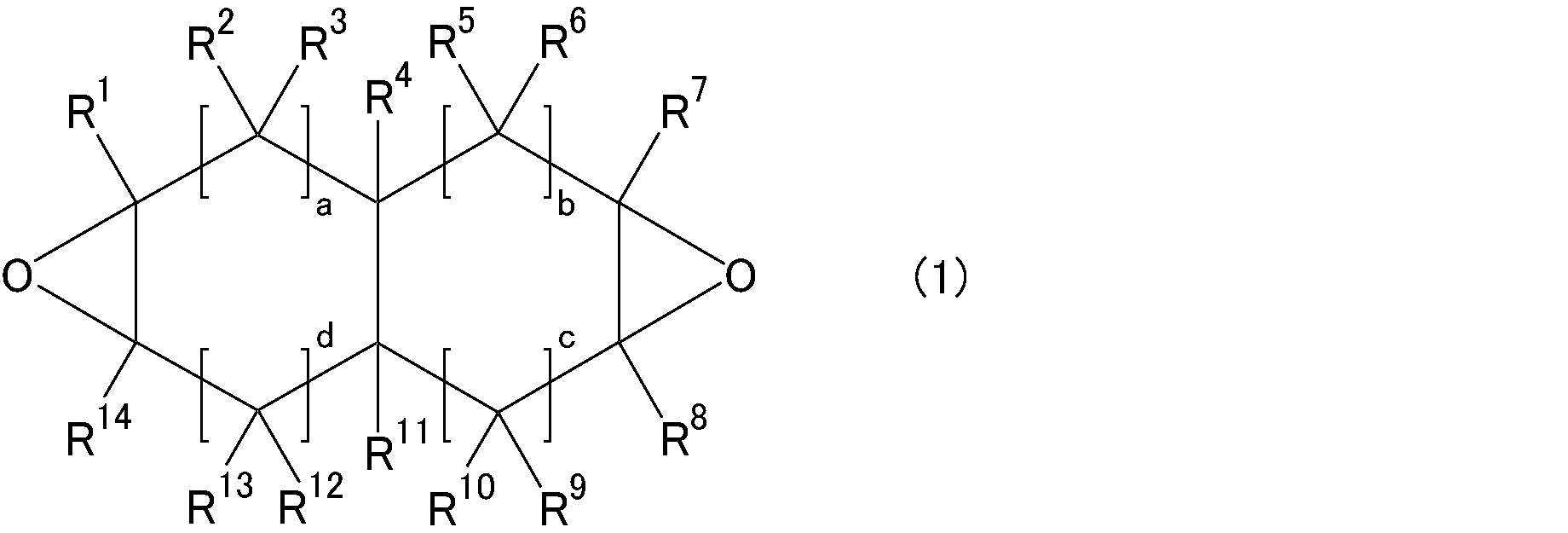
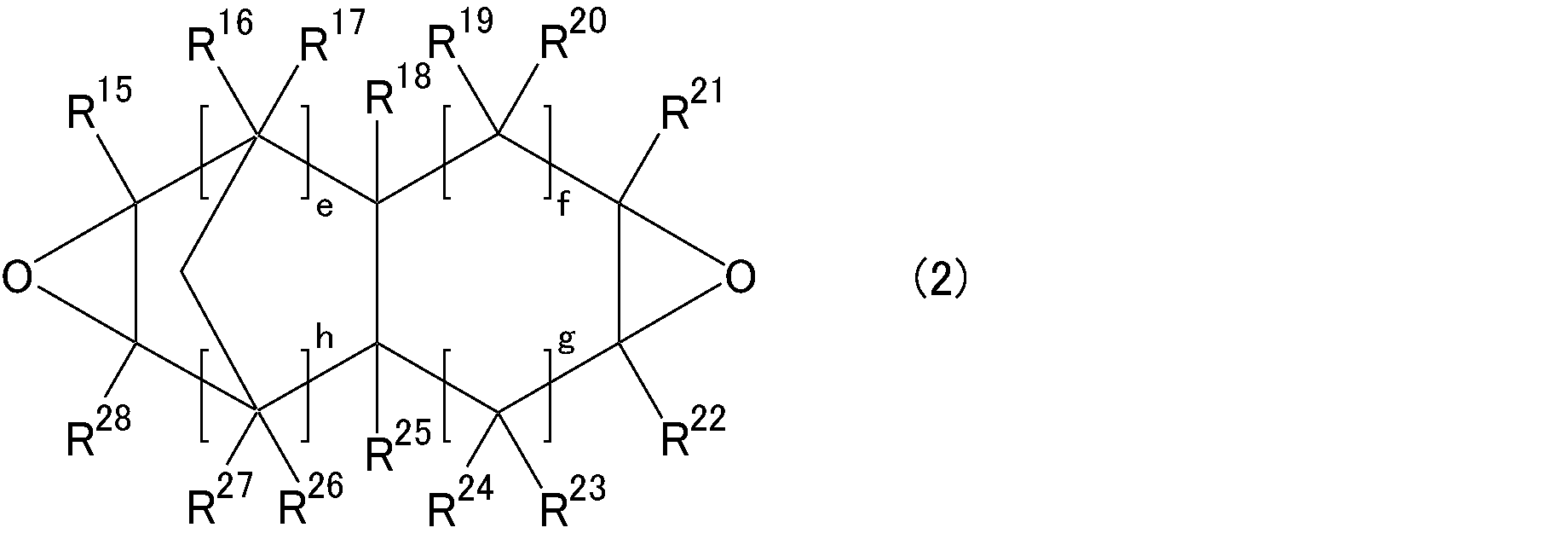
上記一般式(1)で表される化合物は、下記一般式(3)で表される不飽和化合物を、酸化剤{ハイドロパーオキサイド及び有機過酸等}によって酸化させることにより製造できる。

一般式(1)において、R1~R14は、接着強度の観点から、水素原子、ハロゲン原子、炭素数1~4の炭化水素基が好ましく、さらに好ましくは水素原子である。
また、一般式(1)において、接着強度の観点から、好ましいa、b、c及びdの組み合わせは(a=1、b=0、c=1、d=0)、(a=1、b=1、c=1、d=0)、(a=1、b=1、c=2、d=0)、(a=1、b=1、c=1、d=1)又は(a=2、b=1、c=2、d=1)であり、さらに好ましくは(a=1、b=0、c=1、d=0)、(a=1、b=1、c=1、d=0)又は(a=1、b=1、c=1、d=1)であり、最も好ましくは(a=1、b=1、c=1、d=0)である。
また、一般式(1)において、接着強度の観点から、好ましいa、b、c及びdの組み合わせは(a=1、b=0、c=1、d=0)、(a=1、b=1、c=1、d=0)、(a=1、b=1、c=2、d=0)、(a=1、b=1、c=1、d=1)又は(a=2、b=1、c=2、d=1)であり、さらに好ましくは(a=1、b=0、c=1、d=0)、(a=1、b=1、c=1、d=0)又は(a=1、b=1、c=1、d=1)であり、最も好ましくは(a=1、b=1、c=1、d=0)である。
一般式(1)で表される化合物として、具体的には、1,2:5,6-ジエポキシヘキサヒドロインダン等が挙げられる。
上記一般式(2)で表される化合物は、下記一般式(4)で表される不飽和化合物を、酸化剤{ハイドロパーオキサイド及び有機過酸等}によって酸化させることにより製造できる。
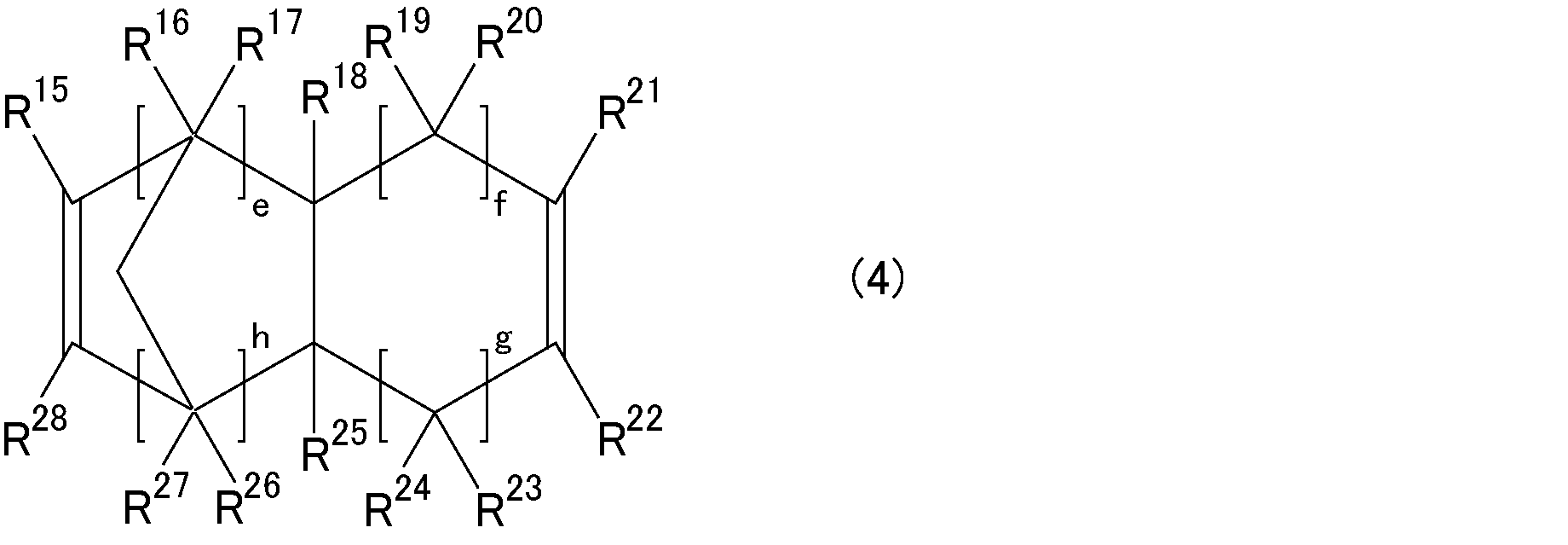
一般式(2)において、R15~R28は、接着強度の観点から、水素原子、ハロゲン原子、炭素数1~4の炭化水素基が好ましく、さらに好ましくは水素原子である。
また、一般式(2)において、接着強度の観点から、好ましいe、f、g及びhの組み合わせは(e=1、f=1、g=0、h=1)、(e=1、f=1、g=1、h=1)又は(e=1、f=2、g=1、h=1)であり、最も好ましくは(e=1、f=1、g=0、h=1)である。
また、一般式(2)において、接着強度の観点から、好ましいe、f、g及びhの組み合わせは(e=1、f=1、g=0、h=1)、(e=1、f=1、g=1、h=1)又は(e=1、f=2、g=1、h=1)であり、最も好ましくは(e=1、f=1、g=0、h=1)である。
一般式(2)で表される化合物として、具体的には、1,2:5,6-ジエポキシジシクロペンタジエン等が挙げられる。
上記橋かけ環式炭化水素基を有する脂環式ジエポキシ化合物(A)としては、1種を用いてもよく、2種以上を用いてもよい。
橋かけ環式炭化水素基を有する脂環式ジエポキシ化合物(A)としては、低粘度、接着強度、高Tg、低線膨張係数及び硬化収縮が少ない観点から、上記一般式(1)及び/又は上記一般式(2)で表される脂環式ジエポキシ化合物が好ましく、さらに好ましくは上記一般式(1)においてa,b及びdが1でありcが0である化合物及び上記一般式(2)においてe、h及びfが1でありgが0である化合物であり、特に好ましくは1,2:5,6-ジエポキシヘキサヒドロインダン及び1,2:5,6-ジエポキシジシクロペンタジエンであり、最も好ましくは1,2:5,6-ジエポキシジシクロペンタジエンである。
硬化速度の観点から、上記一般式(1)及び/又は上記一般式(2)で表される脂環式ジエポキシ化合物が好ましく、さらに好ましくは上記一般式(1)においてa,b及びdが1でありcが0である化合物及び上記一般式(2)においてe、h及びfが1でありgが0である化合物であり、特に好ましくは1,2:5,6-ジエポキシヘキサヒドロインダン及び1,2:5,6-ジエポキシジシクロペンタジエンであり、最も好ましくは1,2:5,6-ジエポキシヘキサヒドロインダンである。
硬化速度の観点から、上記一般式(1)及び/又は上記一般式(2)で表される脂環式ジエポキシ化合物が好ましく、さらに好ましくは上記一般式(1)においてa,b及びdが1でありcが0である化合物及び上記一般式(2)においてe、h及びfが1でありgが0である化合物であり、特に好ましくは1,2:5,6-ジエポキシヘキサヒドロインダン及び1,2:5,6-ジエポキシジシクロペンタジエンであり、最も好ましくは1,2:5,6-ジエポキシヘキサヒドロインダンである。
上記酸化剤としては、ハイドロパーオキサイド及び有機過酸が含まれる。
ハイドロパーオキサイドとしては、過酸化水素、ターシャリブチルハイドロパーオキサイド及びクメンハイドロパーオキサイド等が挙げられる。
有機過酸としては、炭素数1~20の有機過カルボン酸が挙げられ、具体的には、過ギ酸、過酢酸、過プロピオン酸、過安息香酸、トリフルオロ過酢酸及び過フタル酸等が挙げられる。
酸化剤として、工業的に大量に使用できる観点から、過酢酸が好ましい。
ハイドロパーオキサイドとしては、過酸化水素、ターシャリブチルハイドロパーオキサイド及びクメンハイドロパーオキサイド等が挙げられる。
有機過酸としては、炭素数1~20の有機過カルボン酸が挙げられ、具体的には、過ギ酸、過酢酸、過プロピオン酸、過安息香酸、トリフルオロ過酢酸及び過フタル酸等が挙げられる。
酸化剤として、工業的に大量に使用できる観点から、過酢酸が好ましい。
酸化反応の際には必要に応じて触媒を用いることもできる。
ハイドロパーオキサイドの場合、タングステン酸及び苛性ソーダの混合物と過酸化水素との組み合わせ、有機酸と過酸化水素との組み合わせ、又は、モリブデンヘキサカルボニルとターシャリブチルハイドロパーオキサイドとの組み合わせにより触媒効果を得ることができる。
有機過酸の場合、炭酸ソーダ等のアルカリや硫酸等の酸を触媒として用いることができる。
酸化反応は、触媒、溶媒使用の有無や反応温度を調整して行なうことが好ましい。
ハイドロパーオキサイドの場合、タングステン酸及び苛性ソーダの混合物と過酸化水素との組み合わせ、有機酸と過酸化水素との組み合わせ、又は、モリブデンヘキサカルボニルとターシャリブチルハイドロパーオキサイドとの組み合わせにより触媒効果を得ることができる。
有機過酸の場合、炭酸ソーダ等のアルカリや硫酸等の酸を触媒として用いることができる。
酸化反応は、触媒、溶媒使用の有無や反応温度を調整して行なうことが好ましい。
本発明の低極性樹脂用接着剤は、橋かけ環式炭化水素基を有する脂環式ジエポキシ化合物(A)以外のエポキシ化合物(B)(以下、単に「エポキシ化合物(B)」とも記載する)を含有しても良い。
エポキシ化合物(B)としては、分子中に1個以上のエポキシ基を有する化合物が含まれ、低粘度、接着強度及び可とう性の観点から、好ましくはエポキシ基を1~2個有する化合物である。
エポキシ化合物(B)としては、分子中に橋かけ環式炭化水素基を有さない環状脂肪族エポキシ化合物(B-1)、芳香族エポキシ化合物(B-2)、非環状脂肪族エポキシ化合物(B-3)及びエポキシ基を有するシリコン化合物(B-4)が含まれる。
エポキシ化合物(B)としては、分子中に1個以上のエポキシ基を有する化合物が含まれ、低粘度、接着強度及び可とう性の観点から、好ましくはエポキシ基を1~2個有する化合物である。
エポキシ化合物(B)としては、分子中に橋かけ環式炭化水素基を有さない環状脂肪族エポキシ化合物(B-1)、芳香族エポキシ化合物(B-2)、非環状脂肪族エポキシ化合物(B-3)及びエポキシ基を有するシリコン化合物(B-4)が含まれる。
分子中に橋かけ環式炭化水素基を有さない環状脂肪族エポキシ化合物(B-1)としては、分子中に橋かけ環式炭化水素基を有さない炭素数5~30の環状脂肪族エポキシ化合物が含まれ、具体的には、分子中に脂環式エポキシ基を有するもの{リモネンジオキサイド、ジ(3,4-エポキシシクロヘキシル)アジペート、(3,4-エポキシシクロヘキシル)メチル-3,4-エポキシシクロヘキサンカルボキシレート、(3,4-エポキシ-6-メチルシクロヘキシル)メチル-3,4-エポキシ-6-メチルシクロヘキサンカルボキシレート及びエチレン-1,2-ジ(3,4-エポキシシクロヘキサンカルボン酸)エステル等}並びに分子中に脂環式エポキシ基でないエポキシ基を有する環状脂肪族骨格を有するエポキシ化合物{1,4-シクロヘキサンジメタノールのジグリシジルエーテル(市販品としては、DME-100(新日本理化(株)製))、ビスフェノール型エポキシ樹脂の核水添品(市販品としては、HBE-100(新日本理化(株)製)、YX-4000(三菱化学(株)製)等)及びアルコールの1,2-エポキシ-4-(2-オキシラニル)シクロヘキサン付加物(市販品としては、EHPE-3150((株)ダイセル製)等)、等}が挙げられる。
分子中に橋かけ環式炭化水素基を有さない環状脂肪族エポキシ化合物(B-1)のうち、接着強度及び可とう性の観点から、分子中に橋かけ環式炭化水素基を有さない炭素数5~30の環状脂肪族エポキシ化合物が好ましく、さらに好ましくは分子中に橋かけ環式炭化水素基を有さず脂環式エポキシ基を有する炭素数5~30の環状脂肪族エポキシ化合物であり、次にさらに好ましくは3,4-エポキシシクロヘキシルメチル-3,4-エポキシシクロヘキサンカルボキシレート、3,4-エポキシシクロヘキシルメチルアルコール、3,4-エポキシシクロヘキシルエチルトリメトキシシラン及び1,4-シクロヘキサンジメタノールのジグリシジルエーテルである。
なお、分子中に橋かけ環式炭化水素基を有さない環状脂肪族エポキシ化合物(B-1)は1種又は2種以上組合わせて使用してもよい。
分子中に橋かけ環式炭化水素基を有さない環状脂肪族エポキシ化合物(B-1)のうち、接着強度及び可とう性の観点から、分子中に橋かけ環式炭化水素基を有さない炭素数5~30の環状脂肪族エポキシ化合物が好ましく、さらに好ましくは分子中に橋かけ環式炭化水素基を有さず脂環式エポキシ基を有する炭素数5~30の環状脂肪族エポキシ化合物であり、次にさらに好ましくは3,4-エポキシシクロヘキシルメチル-3,4-エポキシシクロヘキサンカルボキシレート、3,4-エポキシシクロヘキシルメチルアルコール、3,4-エポキシシクロヘキシルエチルトリメトキシシラン及び1,4-シクロヘキサンジメタノールのジグリシジルエーテルである。
なお、分子中に橋かけ環式炭化水素基を有さない環状脂肪族エポキシ化合物(B-1)は1種又は2種以上組合わせて使用してもよい。
芳香族エポキシ化合物(B-2)としては、炭素数9~300のもの{ビスフェノールA型及びF型等の各種ビスフェノール型のジグリシジルエーテル(市販品としては、jER828及び806(三菱化学(株)製)並びにYD-128(新日化エポキシ製造(株)製)等)及びナフタレン等の多環芳香族のグリシジルエーテル等}、芳香族エポキシ樹脂{ノボラック型フェノール樹脂のグリシジルエーテル等}等が挙げられる。
非環状脂肪族エポキシ化合物(B-3)としては、非環状脂肪族多価アルコールのグリシジルエーテル化物{エチレングリコールジグリシジルエーテル、プロピレングリコールジグリシジルエーテル、テトラメチレングリコールジグリシジルエーテル、ポリエチレングリコールジグリシジルエーテル、ポリプロピレングリコールジグリシジルエーテル、トリメチロールプロパントリグリシジルエーテル、ペンタエリスリトールテトラグリシジルエーテル及びソルビトールポリグリシジルエーテル等}、非環状脂肪酸多価カルボン酸のグリシジルエステル化物{ジグリシジルアジペート等}、エポキシ基を含む(メタ)アクリレートモノマー(i1)を必須構成単量体とする重合物{エポキシ基を含む(メタ)アクリレートモノマー(i1)の重合物、エポキシ基を含む(メタ)アクリレートモノマー(i1)と水酸基を含む(メタ)アクリレートモノマー(i2)との共重合物、エポキシ基を含む(メタ)アクリレートモノマー(i1)とアルキル(メタ)アクリレート(i3)との共重合物、エポキシ基を含む(メタ)アクリレートモノマー(i1)と水酸基を含む(メタ)アクリレートモノマー(i2)とアルキル(メタ)アクリレート(i3)との共重合物等}等が挙げられる。
エポキシ基を含む(メタ)アクリレートモノマー(i1)としては、炭素数5~30の環状脂肪族基を含まないエポキシ基を含む(メタ)アクリレートモノマーが含まれ、具体的には、グリシジル(メタ)アクリレート及び2-メチル-グリシジル(メタ)アクリレート等が挙げられる。
水酸基を含む(メタ)アクリレートモノマー(i2)としては、炭素数4~30の環状脂肪族基を含まない水酸基を含む(メタ)アクリレートモノマーが含まれ、具体的には、ヒドロキシエチル(メタ)アクリレート及びヒドロキシプロピル(メタ)アクリレート等が挙げられる。
アルキル(メタ)アクリレート(i3)としては、炭素数4~30の環状脂肪族基を含まないアルキル(メタ)アクリレートが含まれ、具体的には、メチル(メタ)アクリレート、エチル(メタ)アクリレート、n-,i-又はt-ブチル(メタ)アクリレート、ヘキシル(メタ)アクリレート、オクチル(メタ)アクリレート、ラウリル(メタ)アクリレート、ステアリル(メタ)アクリレート及びシクロヘキシル(メタ)アクリレート等が挙げられる。
なお、本明細書において、「(メタ)アクリレート」は「アクリレート又はメタクリレート」を意味する。
エポキシ基を含む(メタ)アクリレートモノマー(i1)としては、炭素数5~30の環状脂肪族基を含まないエポキシ基を含む(メタ)アクリレートモノマーが含まれ、具体的には、グリシジル(メタ)アクリレート及び2-メチル-グリシジル(メタ)アクリレート等が挙げられる。
水酸基を含む(メタ)アクリレートモノマー(i2)としては、炭素数4~30の環状脂肪族基を含まない水酸基を含む(メタ)アクリレートモノマーが含まれ、具体的には、ヒドロキシエチル(メタ)アクリレート及びヒドロキシプロピル(メタ)アクリレート等が挙げられる。
アルキル(メタ)アクリレート(i3)としては、炭素数4~30の環状脂肪族基を含まないアルキル(メタ)アクリレートが含まれ、具体的には、メチル(メタ)アクリレート、エチル(メタ)アクリレート、n-,i-又はt-ブチル(メタ)アクリレート、ヘキシル(メタ)アクリレート、オクチル(メタ)アクリレート、ラウリル(メタ)アクリレート、ステアリル(メタ)アクリレート及びシクロヘキシル(メタ)アクリレート等が挙げられる。
なお、本明細書において、「(メタ)アクリレート」は「アクリレート又はメタクリレート」を意味する。
エポキシ基を有するシリコン化合物(B-4)としては、具体的には、3,4-エポキシシクロヘキシルエチルトリメトキシシラン、エポキシ基を有するシランカップリング剤(市販品としては、A-186(日本ユニカー(株)製)、KBM303、KBM403及びKBM42(信越化学工業(株)製)等)等が挙げられる。
エポキシ化合物(B)としては、低粘度、接着強度及び可とう性の観点から、分子中に橋かけ環式炭化水素基を有さない環状脂肪族エポキシ化合物(B-1)が好ましく、さらに好ましくは分子中に橋かけ環式炭化水素基を有さない炭素数5~30の環状脂肪族エポキシ化合物が好ましく、さらに好ましくは分子中に橋かけ環式炭化水素基を有さず脂環式エポキシ基を有する炭素数5~30の環状脂肪族エポキシ化合物であり、特に好ましくは3,4-エポキシシクロヘキシルメチル-3,4-エポキシシクロヘキサンカルボキシレート、3,4-エポキシシクロヘキシルメチルアルコール及び1,4-シクロヘキサンジメタノールのジグリシジルエーテルである。
本発明の低極性樹脂用接着剤は、可とう性の観点から、エポキシ化合物(B)を含有することが好ましい。
エポキシ化合物(B)を含有する場合、本発明の低極性樹脂用接着剤中の橋かけ環式炭化水素基を有する脂環式ジエポキシ化合物(A)の含有量は、低粘度、接着強度、高Tg、低線膨張係数及び可とう性の観点から、接着剤の重量を基準として、10~99重量%が好ましく、さらに好ましくは60~90重量%であり、特に好ましくは70~80重量%である。
エポキシ化合物(B)の含有量は、低粘度、接着強度、高Tg、低線膨張係数及び可とう性の観点から、接着剤の重量を基準として、0.9~89.9重量%が好ましく、さらに好ましくは9.85~39.85重量%であり、特に好ましくは15~29.8重量%である。
なお、上記橋かけ環式炭化水素基を有する脂環式ジエポキシ化合物(A)及び上記エポキシ化合物(B)の含有量としては、上記橋かけ環式炭化水素基を有する脂環式ジエポキシ化合物(A)及び上記エポキシ化合物(B)の合計重量を基準として、上記橋かけ環式炭化水素基を有する脂環式ジエポキシ化合物(A)の含有量が0.1~99重量%、上記エポキシ化合物(B)の含有量が1~99.9重量%であることが好ましい。
エポキシ化合物(B)を含有する場合、本発明の低極性樹脂用接着剤中の橋かけ環式炭化水素基を有する脂環式ジエポキシ化合物(A)の含有量は、低粘度、接着強度、高Tg、低線膨張係数及び可とう性の観点から、接着剤の重量を基準として、10~99重量%が好ましく、さらに好ましくは60~90重量%であり、特に好ましくは70~80重量%である。
エポキシ化合物(B)の含有量は、低粘度、接着強度、高Tg、低線膨張係数及び可とう性の観点から、接着剤の重量を基準として、0.9~89.9重量%が好ましく、さらに好ましくは9.85~39.85重量%であり、特に好ましくは15~29.8重量%である。
なお、上記橋かけ環式炭化水素基を有する脂環式ジエポキシ化合物(A)及び上記エポキシ化合物(B)の含有量としては、上記橋かけ環式炭化水素基を有する脂環式ジエポキシ化合物(A)及び上記エポキシ化合物(B)の合計重量を基準として、上記橋かけ環式炭化水素基を有する脂環式ジエポキシ化合物(A)の含有量が0.1~99重量%、上記エポキシ化合物(B)の含有量が1~99.9重量%であることが好ましい。
本発明の低極性樹脂用接着剤中には、上記橋かけ環式炭化水素基を有する脂環式エポキシ化合物(A)以外に、活性エネルギー線の照射により酸を発生する光酸発生剤(C)、加熱により酸を発生する熱酸発生剤(D)及びその他のエポキシ硬化剤(E)からなる群より選ばれる少なくとも1種を含んでもよい。
光酸発生剤(C)は、活性エネルギー線の照射により酸を発生して重合を開始させる化合物であり、スルホニウム塩(C1)及びヨードニウム塩(C2)が含まれる。光酸発生剤(C)は1種を単独で用いても良いし、2種以上を併用してもよい。
スルホニウム塩(C1)としては、トリフェニルスルホニウムテトラフルオロボラート、トリフェニルスルホニウムブロミド、トリ-p-トリルスルホニウムヘキサフルオロホスファート、トリ-p-トリルスルホニウムトリフルオロメタンスルホナート、[p-(フェニルメルカプト)フェニル]ジフェニルスルホニウムヘキサフルオロホスファート[市販品としては、CPI-100P(サンアプロ(株)製)]及び[p-(フェニルメルカプト)フェニル]ジフェニルスルホニウム[トリ(パーフルオロエチル)]トリフルオロホスファート等が挙げられる。
ヨードニウム塩(C2)としては、ヨードニウム(4-メチルフェニル){4-(2-メチルプロピル)フェニル}-ヘキサフルオロホスファート[市販品としては、DAROCUR 250(BASFジャパン(株)製)]、ヨードニウム[ビス(4-t-ブチルフェニル)]ヘキサフルオロホスファート、ヨードニウム[ビス(4-t-ブチルフェニル)]トリフルオロ[トリス(パーフルオロエチル)]ホスファート、ヨードニウム[ビス(4-メトキシフェニル)]トリフルオロ[トリス(パーフルオロエチル)]ホスファート及びヨードニウム[ビス(4-メトキシフェニル)][テトラキス(パーフルオロフェニル)]ボラート等が挙げられる。
これらの光酸発生剤(C)のうち、活性エネルギー線硬化性の観点から、スルホニウム塩(C1)が好ましく、さらに好ましくは[p-(フェニルメルカプト)フェニル]ジフェニルスルホニウムヘキサフルオロホスファートである。
熱酸発生剤(D)としては、スルホニウム塩(D1)、ヨードニウム塩(D2)、ベンゾチアゾニウム塩(D3)、アンモニウム塩(D4)及びホスホニウム塩(D5)が含まれる。ただし、スルホニウム塩(C1)及びヨードニウム塩(C2)で挙げられた化合物は含まれない。熱酸発生剤(D)は1種を単独で用いても良いし、2種以上を併用してもよい。
スルホニウム塩(D1)としては、例えば、(4-ヒドロキシフェニル)ジメチルスルホニウムビス(トリフルオロメタンスルホニル)イミド、(4-ヒドロキシフェニル)(2-メチルベンジル)メチルスルホニウムビス(トリフルオロメタンスルホニル)イミド、(4-ヒドロキシフェニル)ベンジルメチルスルホニウムビス(トリフルオロメタンスルホニル)イミド、(4-ヒドロキシフェニル)ジメチルスルホニウムヘキサフルオロホスファート、(4-ヒドロキシフェニル)(2-メチルベンジル)メチルスルホニウムヘキサフルオロホスファート、(4-ヒドロキシフェニル)ベンジルメチルスルホニウムヘキサフルオロホスファート、(4-ヒドロキシフェニル)(4-メチルベンジル)メチルスルホニウムヘキサフルオロホスファート、(4-ヒドロキシフェニル)ジメチルスルホニウムトリフルオロメタンスルホナート、(4-ヒドロキシフェニル)(2-メチルベンジル)メチルスルホニウムトリフルオロメタンスルホナート、(4-ヒドロキシフェニル)ベンジルメチルスルホニウムトリフルオロメタンスルホナート、(4-ヒドロキシフェニル)(4-メチルベンジル)メチルスルホニウムトリフルオロメタンスルホナート、(4-ヒドロキシフェニル)(2-メチルベンジル)メチルスルホニウムヘキサフルオロアンチモナート、(4-アセトフェニル)ジメチルスルホニウムヘキサフルオロアンチモナート、(4-ベンジルオキシカルボニルオキシフェニル)ジメチルスルホニウムヘキサフルオロアンチモナート、(4-ベンゾイルオキシフェニル)ジメチルスルホニウムヘキサフルオロアンチモナート、(4-アセトキシフェニル)ジメチルスルホニウムヘキサフルオロアルセナート及び(4-ベンゾイルオキシフェニル)ジメチルスルホニウムヘキサフルオロアルセナート等が挙げられる。
ヨードニウム塩(D2)としては、例えば、ジフェニルヨードニウムビス(トリフルオロメタンスルホニル)イミド及び(p-ニトロフェニル)フェニルヨードニウムヘキサフルオロホスファート等が挙げられる。
ベンゾチアゾニウム塩(D3)としては、例えば、3-ベンジルベンゾチアゾニウムヘキサフルオロアンチモナート、3-(4-メトキシベンジル)ベンゾチアゾニウムヘキサフルオロアンチモナート、2-メチルスルファニル-3-ベンジルベンゾチアゾニウムヘキサフルオロアンチモナート、5-クロロ-3-ベンジルベンゾチアゾニウムヘキサフルオロアンチモナート;3-ベンジルベンゾチアゾニウムヘキサフルオロホスファート;3-ベンジルベンゾチアゾニウムテトラフルオロボラート等が挙げられる。
アンモニウム塩(D4)としては、例えば、テトラメチルアンモニウムブチルトリス(2,6-ジフルオロフェニル)ボラート、テトラメチルアンモニウムヘキシルトリス(p-クロロフェニル)ボラート、テトラメチルアンモニウムヘキシルトリス(3-トリフルオロメチルフェニル)ボラート、ベンジルジメチルフェニルアンモニウムブチルトリス(2,6-ジフルオロフェニル)ボラート、ベンジルジメチルフェニルアンモニウムヘキシルトリス(p-クロロフェニル)ボラート及びベンジルジメチルフェニルアンモニウムヘキシルトリス(3-トリフルオロメチルフェニル)ボラート等が挙げられる。
ホスホニウム塩(D5)としては、例えば、(4-メチルフェニル)ジフェニルホスホニウムトリフレート等が挙げられる。
熱酸発生剤(D)のうち、硬化速度の観点から、スルホニウム塩(D1)が好ましい。
その他のエポキシ硬化剤(E)としては、通常のエポキシ樹脂用硬化剤が挙げられ、例えば、アミン系硬化剤(E1)、カルボン酸系硬化剤(E2)、塩基性活性水素化合物(E3)、イミダゾール類(E4)、ポリメルカプタン系硬化剤(E5)、フェノール樹脂(E6)、ユリア樹脂(E7)、メラミン樹脂(E8)及び潜在性硬化剤(E9)等が含まれる。
その他のエポキシ硬化剤(E)は1種を単独で用いても良いし、2種以上を併用してもよい。
その他のエポキシ硬化剤(E)は1種を単独で用いても良いし、2種以上を併用してもよい。
アミン系硬化剤(E1)としては、ポリメチレンジアミン{エチレンジアミン、ジエチレントリアミン、トリエチレンテトラミン及びテトラエチレンペンタミン等};脂環式ポリアミン{メンセンジアミン、イソフォロンジアミン、ビス(4-アミノ-3-メチルシクロヘキシル)メタン、N-アミノエチルピペラジン及びジアミノジシクロヘキシルメタン等};芳香環を含む脂肪族ポリアミン{メタキシリレンジアミン等};芳香族ポリアミン;アミンアダクト{ポリアミンエポキシ樹脂アダクト等};並びにケチミン;等が挙げられる。
カルボン酸系硬化剤(E2)としては、ポリカルボン酸系硬化剤{アジピン酸等};並びに酸無水物系硬化剤{無水フタル酸、テトラヒドロ無水フタル酸、メチルテトラヒドロ無水フタル酸、ヘキサヒドロ無水フタル酸、メチルヘキサヒドロ無水フタル酸、メチル無水ハイミック酸、無水ナジック酸及び無水トリメリット酸等}等が挙げられる。
塩基性活性水素化合物(E3)としては、ジシアンジアミド及び有機酸ジヒドラジド等が挙げられる。
イミダゾール類(E4)としては、2-メチルイミダゾール等が挙げられる。
ポリメルカプタン系硬化剤(E5)、多価フェノール類(E6)および潜在性硬化剤(E7)としては、例えば特開2007-262204号公報記載のもの等が挙げられる。
これらのその他のエポキシ硬化剤(E)のうち、硬化速度の観点から、カルボン酸系硬化剤(E2)が好ましい。
本発明の低極性樹脂用接着剤において、光酸発生剤(C)、熱酸発生剤(D)及びその他のエポキシ硬化剤(E)の合計含有量は、接着強度及び硬化速度の観点から、0.1~20重量%が好ましく、さらに好ましくは0.15~10重量%であり、特に好ましくは0.20~5重量%である。
本発明の低極性樹脂用接着剤において、接着剤中の橋かけ環式炭化水素基を有する脂環式エポキシ化合物(A)と、光酸発生剤(C)、熱酸発生剤(D)及びその他のエポキシ硬化剤(E)の合計重量との重量比[橋かけ環式炭化水素基を有する脂環式エポキシ化合物(A)/{光酸発生剤(C)+熱酸発生剤(D)+その他のエポキシ硬化剤(E)}]は、低粘度、接着強度及び可とう性の観点から、1/2~990/1が好ましく、さらに好ましくは1/1~500/1である。
本発明の低極性樹脂用接着剤において、接着剤中の橋かけ環式炭化水素基を有する脂環式エポキシ化合物(A)と、光酸発生剤(C)、熱酸発生剤(D)及びその他のエポキシ硬化剤(E)の合計重量との重量比[橋かけ環式炭化水素基を有する脂環式エポキシ化合物(A)/{光酸発生剤(C)+熱酸発生剤(D)+その他のエポキシ硬化剤(E)}]は、低粘度、接着強度及び可とう性の観点から、1/2~990/1が好ましく、さらに好ましくは1/1~500/1である。
本発明において、接着剤中の橋頭炭素の含有量(接着剤1g中)は0.01~25.0mmol/gであり、低粘度、接着強度、高Tg及び低線膨張係数の観点から、5~20mmol/gが好ましく、さらに好ましくは5~11mmol/gである。
橋頭炭素の含有量が上記範囲であることで、本発明の低極性樹脂用接着剤の機械物性及び耐熱性が適度となるので、低粘度でありながら、接着強度を高くすることができる。
橋頭炭素の含有量は、上記橋かけ環式炭化水素基を有する脂環式エポキシ化合物(A)の含有量の割合を増加させることや、橋頭炭素の多い橋かけ環式炭化水素基を有する脂環式エポキシ化合物(A)を用いることによって増加させることができる。
なお、橋頭炭素の含有量は、接着剤中の各成分の構造及び仕込み量から算出することができる。
橋頭炭素の含有量が上記範囲であることで、本発明の低極性樹脂用接着剤の機械物性及び耐熱性が適度となるので、低粘度でありながら、接着強度を高くすることができる。
橋頭炭素の含有量は、上記橋かけ環式炭化水素基を有する脂環式エポキシ化合物(A)の含有量の割合を増加させることや、橋頭炭素の多い橋かけ環式炭化水素基を有する脂環式エポキシ化合物(A)を用いることによって増加させることができる。
なお、橋頭炭素の含有量は、接着剤中の各成分の構造及び仕込み量から算出することができる。
本発明の低極性樹脂用接着剤は、必要に応じて、増感剤、顔料、顔料分散剤、改質樹脂、有機樹脂微粒子及び溶剤等を添加することができる。
増感剤としては、例えば、アントラセン、ピレン、ペリレン、アクリジンオレンジ、チオキサントン、2-クロロチオキサントン及びベンゾフラビン等が挙げられる。これらは、1種を単独で使用しても2種以上を併用してもよい。
増感剤の添加量は、接着強度の観点から、低極性樹脂用接着剤の重量に対して、0~10重量%が好ましく、さらに好ましくは0~3重量%である。
増感剤の添加量は、接着強度の観点から、低極性樹脂用接着剤の重量に対して、0~10重量%が好ましく、さらに好ましくは0~3重量%である。
顔料としては、黄鉛、亜鉛黄、紺青、硫酸バリウム、カドミウムレッド、酸化チタン、亜鉛華、ベンガラ、アルミナ、炭酸カルシウム、群青、カーボンブラック、グラファイト及びチタンブラック等が挙げられる。これらは、1種を単独で使用しても2種以上を併用してもよい。
顔料の添加量は、接着強度の観点から、低極性樹脂用接着剤の重量に対して、0~20重量%が好ましく、さらに好ましくは0~10重量%である。
顔料の添加量は、接着強度の観点から、低極性樹脂用接着剤の重量に対して、0~20重量%が好ましく、さらに好ましくは0~10重量%である。
顔料分散剤としては、ビックケミー社製顔料分散剤(Anti-Terra-U、Disperbyk-101、103、106、110、161、162、164、166、167、168、170、174、182、184及び2020等)、味の素ファインテクノ社製顔料分散剤(アジスパーPB711、PB821、PB814、PN411及びPA111等)並びにルーブリゾール社製顔料分散剤(ソルスパーズ5000、12000、32000、33000及び39000等)が挙げられる。これらの顔料分散剤は1種を単独で用いても2種以上を併用してもよい。
顔料分散剤の添加量は、接着強度の観点から、低極性樹脂用接着剤の重量に対して、0~20重量%が好ましく、さらに好ましくは0~10重量%である。
顔料分散剤の添加量は、接着強度の観点から、低極性樹脂用接着剤の重量に対して、0~20重量%が好ましく、さらに好ましくは0~10重量%である。
改質樹脂としては、ポリオール樹脂、フェノール樹脂、アクリル樹脂、ポリエステル樹脂、ポリオレフィン樹脂、エポキシ樹脂及びエポキシ化ポリブタジエン樹脂等が挙げられる。これらは、1種を単独で使用しても2種以上を併用してもよい。
低極性樹脂用接着剤の改質樹脂の添加量は、接着強度の観点から、低極性樹脂用接着剤の重量に対して、0~50重量%が好ましく、さらに好ましくは0~20重量%である。
低極性樹脂用接着剤の改質樹脂の添加量は、接着強度の観点から、低極性樹脂用接着剤の重量に対して、0~50重量%が好ましく、さらに好ましくは0~20重量%である。
有機樹脂微粒子としては、アクリル樹脂微粒子等が挙げられる。
また、有機樹脂微粒子としては、有機重合体を粉砕して微粒子化したもの;乳化剤の存在下に水中でエマルジョン重合して得られる重合体微粒子を乾燥、粉砕したもの;高分子安定剤の存在下に有機溶剤中でディスパージョン重合して得られる重合体微粒子を乾燥、粉砕したものなどを挙げることができる。
有機樹脂微粒子としては、接着剤への分散性の観点から、数平均粒子径が50~500nmの有機樹脂微粒子が好ましい。
低極性樹脂用接着剤の有機樹脂微粒子の添加量は、接着強度の観点から、低極性樹脂用接着剤の重量に対して、0~50重量%が好ましく、さらに好ましくは0~10重量%である。
また、有機樹脂微粒子としては、有機重合体を粉砕して微粒子化したもの;乳化剤の存在下に水中でエマルジョン重合して得られる重合体微粒子を乾燥、粉砕したもの;高分子安定剤の存在下に有機溶剤中でディスパージョン重合して得られる重合体微粒子を乾燥、粉砕したものなどを挙げることができる。
有機樹脂微粒子としては、接着剤への分散性の観点から、数平均粒子径が50~500nmの有機樹脂微粒子が好ましい。
低極性樹脂用接着剤の有機樹脂微粒子の添加量は、接着強度の観点から、低極性樹脂用接着剤の重量に対して、0~50重量%が好ましく、さらに好ましくは0~10重量%である。
溶剤としては、グリコールエーテル(エチレングリコールモノアルキルエーテル及びプロピレングリコールモノアルキルエーテル等)、ケトン(アセトン、メチルエチルケトン、メチルイソブチルケトン及びシクロヘキサノン等)、エステル(エチルアセテート、ブチルアセテート、エチレングリコールアルキルエーテルアセテート、乳酸メチル及びプロピレングリコールアルキルエーテルアセテート等)、芳香族炭化水素(トルエン、キシレン及びメシチレン等)、アルコール(メタノール、エタノール、ノルマルプロパノール、イソプロパノール、ブタノール、ゲラニオール、リナロール及びシトロネロール等)、アミド(N、N-ジメチルアセトアミド及びN、N-ジメチルホルムアミド等)、スルホキシド(ジメチルスルホキシド)及びエーテル(テトラヒドロフラン、1,3-ジオキサン及び1,8-シネオール等)等が挙げられる。これらは、1種を単独で使用しても2種以上を併用してもよい。
溶剤の添加量は、粘度の観点から、低極性樹脂用接着剤の重量に対して、0~400重量%であることが好ましく、更に好ましくは3~350重量%、特に好ましくは5~300重量%である。
溶剤の添加量は、粘度の観点から、低極性樹脂用接着剤の重量に対して、0~400重量%であることが好ましく、更に好ましくは3~350重量%、特に好ましくは5~300重量%である。
本発明の低極性樹脂用接着剤は、上記各成分を均一な接着剤となるように混合することにより調製することが好ましい。例えば、各成分を混合し、必要に応じて25~80℃の温度にして、ディソルバーなどの撹拌機にて均一になるまで撹拌することにより調製することができる。
本発明の低極性樹脂用接着剤は、例えば、ロールコート塗装、スプレー塗装、ハケ塗り、バーコート塗装、ローラー塗り、シルクスクリーン印刷などの方法によって塗布することができる。
本発明の低極性樹脂用接着剤が溶剤を含有する場合には、接着剤を塗布後、加熱などにより溶剤を除去した後、加熱及び/又は活性エネルギー線照射等によって硬化されるが、加熱条件及び照射条件は塗布された接着剤の種類や膜厚等に応じて適宜変えることができる。
本発明の低極性樹脂用接着剤が溶剤を含有する場合には、接着剤を塗布後、加熱などにより溶剤を除去した後、加熱及び/又は活性エネルギー線照射等によって硬化されるが、加熱条件及び照射条件は塗布された接着剤の種類や膜厚等に応じて適宜変えることができる。
塗工膜厚は、乾燥硬化後の膜厚として、接着強度及び軽量化の観点から、0.5~20μmが好ましく、さらに好ましくは1.0~5.0μmである。
本発明の低極性樹脂用接着剤を、活性エネルギー線を照射することにより硬化させる際の活性エネルギー線としては、活性光線及び電子線等が挙げられる。
本発明の低極性樹脂用接着剤を活性光線照射で硬化させる際の活性光線源としては、一般的に使用されている高圧水銀灯の他、超高圧水銀灯、メタルハライドランプ及びハイパワーメタルハライドランプ等(UV・EB硬化技術の最新動向、ラドテック研究会編、シーエムシー出版、138頁、2006)が使用できる。また、LED光源を使用した照射装置も好適に使用できる。
塗膜への照射条件は、塗膜の硬化促進、並びに、塗膜及び被着体の光劣化回避の観点から、線量が10~1,000mJ/cm2が好ましく、さらに好ましくは50~500mJ/cm2である。
本発明の低極性樹脂用接着剤を活性光線照射で硬化させる際の活性光線源としては、一般的に使用されている高圧水銀灯の他、超高圧水銀灯、メタルハライドランプ及びハイパワーメタルハライドランプ等(UV・EB硬化技術の最新動向、ラドテック研究会編、シーエムシー出版、138頁、2006)が使用できる。また、LED光源を使用した照射装置も好適に使用できる。
塗膜への照射条件は、塗膜の硬化促進、並びに、塗膜及び被着体の光劣化回避の観点から、線量が10~1,000mJ/cm2が好ましく、さらに好ましくは50~500mJ/cm2である。
本発明の低極性樹脂用接着剤を電子線照射で硬化させる際の電子線源としては、一般的に使用されている電子線照射装置を使用することができる。
電子線の照射量(Mrad)は、接着剤の硬化性及び可とう性の観点から、0.5~20が好ましく、さらに好ましくは1~15である。
電子線の照射量(Mrad)は、接着剤の硬化性及び可とう性の観点から、0.5~20が好ましく、さらに好ましくは1~15である。
また、活性エネルギー線照射後、必要に応じて接着剤を加熱してもよい。加熱によって接着剤中の未反応物の低減及び活性エネルギー線照射による塗膜の硬化性や成型加工によって発生した歪みの緩和を行なうことができる。
この加熱によって接着剤の硬度や密着性の向上を行なうことができる場合がある。加熱条件は、未反応物の反応促進及び被着体の熱劣化回避の観点から、150~200℃の雰囲気温度で1~30分間で行なうことが好ましい。
この加熱によって接着剤の硬度や密着性の向上を行なうことができる場合がある。加熱条件は、未反応物の反応促進及び被着体の熱劣化回避の観点から、150~200℃の雰囲気温度で1~30分間で行なうことが好ましい。
本発明の低極性樹脂用接着剤を、加熱することにより硬化させる際の条件としては、塗膜の硬化促進、並びに、塗膜及び被着体の熱劣化回避の観点から、加熱温度が60~200℃であることが好ましく、80~150℃であることがより好ましい。また、加熱時間が30~180分であることが好ましく、60~120分であることがより好ましい。
本発明の低極性樹脂用接着剤は、薄膜塗工性の観点から、25℃における粘度が1~50mPa・sであることが好ましく、2~30mPa・sであることがより好ましい。
なお、粘度は、B型粘度計で測定することができる。
なお、粘度は、B型粘度計で測定することができる。
本明細書において低極性樹脂(X)とは、溶解度パラメータ(以下、SP値と略記する)が6.2~10.0(cal/cm3)1/2である樹脂である。
本明細書において、SP値は次式で求められるものである。
SP=(ΔH/V)1/2
但し、式中、ΔHはモル蒸発熱(cal/mol)、Vはモル体積(cm3/mol)を表す。また、ΔHおよびVは、「POLYMER ENGINEERING AND SCIENCE,February,1974,Vol.14,No.2,Robert F.Fedors.(147~154頁)」に記載の原子団のモル蒸発熱(△e)の合計(ΔH)と、モル体積(△v)の合計(V)を用いることができる。
低極性樹脂(X)において、樹脂のSP値{(cal/cm3)1/2}は、接着強度の観点から、7.0~9.5が好ましく、さらに好ましくは8.0~9.3である。
本明細書において、SP値は次式で求められるものである。
SP=(ΔH/V)1/2
但し、式中、ΔHはモル蒸発熱(cal/mol)、Vはモル体積(cm3/mol)を表す。また、ΔHおよびVは、「POLYMER ENGINEERING AND SCIENCE,February,1974,Vol.14,No.2,Robert F.Fedors.(147~154頁)」に記載の原子団のモル蒸発熱(△e)の合計(ΔH)と、モル体積(△v)の合計(V)を用いることができる。
低極性樹脂(X)において、樹脂のSP値{(cal/cm3)1/2}は、接着強度の観点から、7.0~9.5が好ましく、さらに好ましくは8.0~9.3である。
低極性樹脂(X)としては、非晶性ポリオレフィン樹脂、ポリ(メタ)アクリル系樹脂、結晶性ポリオレフィン樹脂、フッ素樹脂、ポリジメチルシリコーン樹脂、ポリイソプレン樹脂、ポリブタジエン樹脂、ポリスチレン系樹脂及びポリカーボネート樹脂等が含まれる。
非晶性ポリオレフィン樹脂としては、炭素数3~20の環状オレフィン{シクロプロペン、シクロブテン、シクロペンテン、シクロへキセン、シクロヘプテン、1,5-シクロオクタジエン、ノルボルネン、テトラシクロドデセン及びこれらの有する水素原子の少なくとも1つが他の官能基で置換されたもの}を単量体に含む重合体であり、環状オレフィンに鎖状オレフィン及び/又は芳香族ビニル化合物を共重合させた共重合体であってもよい。二重結合が残っている場合は、酸化安定性の観点から、水素添加された樹脂が好ましい。
非晶性ポリオレフィン樹脂としては、熱可塑性飽和ノルボルネン樹脂が代表的である。市販されている非晶性ポリオレフィン樹脂としては、JSR(株)の“アートン”、日本ゼオン(株)の“ZEONEX”及び“ZEONOR”、三井化学(株)の“APO”及び“アペル”などがある。
非晶性ポリオレフィン樹脂としては、炭素数3~20の環状オレフィン{シクロプロペン、シクロブテン、シクロペンテン、シクロへキセン、シクロヘプテン、1,5-シクロオクタジエン、ノルボルネン、テトラシクロドデセン及びこれらの有する水素原子の少なくとも1つが他の官能基で置換されたもの}を単量体に含む重合体であり、環状オレフィンに鎖状オレフィン及び/又は芳香族ビニル化合物を共重合させた共重合体であってもよい。二重結合が残っている場合は、酸化安定性の観点から、水素添加された樹脂が好ましい。
非晶性ポリオレフィン樹脂としては、熱可塑性飽和ノルボルネン樹脂が代表的である。市販されている非晶性ポリオレフィン樹脂としては、JSR(株)の“アートン”、日本ゼオン(株)の“ZEONEX”及び“ZEONOR”、三井化学(株)の“APO”及び“アペル”などがある。
ポリ(メタ)アクリル系樹脂としては、炭素数3~35の(メタ)アクリル酸エステル及び/又は炭素数3~35の(メタ)アクリル酸アミドを必須構成単量体とする重合体(j1)(以下単に「重合体(j1)とも記載する」)が含まれ、具体的にはポリメタクリル酸メチル等が挙げられる。
上記重合体(j1)の必須構成単量体である(メタ)アクリル酸エステル及び/又は(メタ)アクリル酸アミド、並びに、これら必須構成単量体以外の構成単量体の種類及び重量分率は、重合体(j1)のSP値が6.2~10.0(cal/cm3)1/2を満たす範囲で自由に選択可能であり、必須構成単量体以外の構成単量体としては、(メタ)アクリル酸、メタ(アクリロニトリル)、スチレン及び無水マレイン酸等が含まれる。
上記重合体(j1)の必須構成単量体である(メタ)アクリル酸エステル及び/又は(メタ)アクリル酸アミド、並びに、これら必須構成単量体以外の構成単量体の種類及び重量分率は、重合体(j1)のSP値が6.2~10.0(cal/cm3)1/2を満たす範囲で自由に選択可能であり、必須構成単量体以外の構成単量体としては、(メタ)アクリル酸、メタ(アクリロニトリル)、スチレン及び無水マレイン酸等が含まれる。
結晶性ポリオレフィン樹脂としては、炭素数2~20のオレフィンの重合体が含まれ、具体的には、ポリエチレン及びポリプロピレン等が挙げられる。
フッ素樹脂としては、ポリテトラフルオロエチレン樹脂、ポリクロロトリフルオロエチレン樹脂、ポリフッ化ビニリデン樹脂及びポリフッ化ビニル樹脂等が挙げられる。
ポリスチレン系樹脂としては、ポリスチレンの他に、ポリスチレンのマトリクス相の中にゴム粒子が分散した耐衝撃性ポリスチレン(HIPS)及びスチレンと無水マレイン酸との共重合体(k1)(以下、単に「共重合体(k1)とも記載する」)が含まれる。
上記共重合体(k1)における無水マレイン酸の重量分率は、共重合体(k1)のSP値が6.2~10.0(cal/cm3)1/2を満たす範囲で自由に選択可能である。
上記共重合体(k1)における無水マレイン酸の重量分率は、共重合体(k1)のSP値が6.2~10.0(cal/cm3)1/2を満たす範囲で自由に選択可能である。
低極性樹脂(X)としては、接着強度の観点から、非晶性ポリオレフィン樹脂、ポリ(メタ)アクリル系樹脂及び結晶性ポリオレフィン樹脂が好ましく、さらに好ましくは非晶性ポリオレフィン樹脂である。
本発明の成形品は、2つの部材が接着剤を介して接着されてなる成形品であって、少なくとも一方が低極性樹脂(X)からなる部材であり、接着剤が上記本発明の低極性樹脂用接着剤である成形品である。
本発明の成形品において、少なくとも一方が低極性樹脂(X)からなる部材であれば、もう一方の部材の材質は特に限定されない。
もう一方の部材の材質として、例えば、ポリビニルアルコール樹脂、PET樹脂、ポリアセタール樹脂及びポリアミド樹脂等が挙げられる。
2つの部材としては、接着強度の観点から、共に低極性樹脂(X)であることが好ましい。
本発明の成形品において、少なくとも一方が低極性樹脂(X)からなる部材であれば、もう一方の部材の材質は特に限定されない。
もう一方の部材の材質として、例えば、ポリビニルアルコール樹脂、PET樹脂、ポリアセタール樹脂及びポリアミド樹脂等が挙げられる。
2つの部材としては、接着強度の観点から、共に低極性樹脂(X)であることが好ましい。
本発明の成形品において、接着強度の観点から、上記2つの部材のうち少なくとも一方がフィルムであり、成形品が偏光板であることが好ましい。
本発明の成形品が偏光板である場合、上記2つの部材は共にフィルムであり、この2つのフィルムが接着剤を介して貼合されてなる偏光板であって、2つのフィルムのうち少なくとも一方が低極性樹脂(X)であり、接着剤が本発明の低極性樹脂用接着剤であるものであることが好ましい。
このような偏光板において、上記2つのフィルムのうち少なくとも一方が低極性樹脂(X)からなるフィルムであれば、もう一方のフィルムは、どのようなフィルムであってもよく、例えば、下記樹脂フィルム(Y)であってもよい。なお、接着強度の観点から、上記2つのフィルムは共に低極性樹脂(X)からなるフィルムであることが好ましい。
樹脂フィルム(Y)としては、ポリビニルアルコール樹脂フィルム、PET樹脂フィルム、ポリアセタール樹脂フィルム及びポリアミド樹脂フィルム等が挙げられる。
ポリビニルアルコール樹脂フィルムとしては、従来のポリビニルアルコール樹脂フィルム及び二色性色素が吸着配向されたポリビニルアルコール樹脂フィルムが含まれる。
ポリビニルアルコール樹脂フィルムは、ポリ酢酸ビニル樹脂をケン化することにより得られる。ポリ酢酸ビニル樹脂は、酢酸ビニルの単独重合体であるポリ酢酸ビニルのほか、酢酸ビニルおよびこれと共重合可能な他の単量体の共重合体であってもよい。酢酸ビニルに共重合される他の単量体として、たとえば、不飽和カルボン酸、オレフィン、ビニルエーテル及び不飽和スルホン酸等が挙げられる。
ポリビニルアルコール樹脂はさらに変性されていてもよく、例えば、アルデヒドで変性されたポリビニルホルマールやポリビニルアセタールなども使用できる。
ポリビニルアルコール樹脂フィルムとしては、従来のポリビニルアルコール樹脂フィルム及び二色性色素が吸着配向されたポリビニルアルコール樹脂フィルムが含まれる。
ポリビニルアルコール樹脂フィルムは、ポリ酢酸ビニル樹脂をケン化することにより得られる。ポリ酢酸ビニル樹脂は、酢酸ビニルの単独重合体であるポリ酢酸ビニルのほか、酢酸ビニルおよびこれと共重合可能な他の単量体の共重合体であってもよい。酢酸ビニルに共重合される他の単量体として、たとえば、不飽和カルボン酸、オレフィン、ビニルエーテル及び不飽和スルホン酸等が挙げられる。
ポリビニルアルコール樹脂はさらに変性されていてもよく、例えば、アルデヒドで変性されたポリビニルホルマールやポリビニルアセタールなども使用できる。
本発明の成形品の一種である偏光板を作製する場合には、上記低極性樹脂用接着剤の塗布層を、フィルム状の低極性樹脂(X)の貼合面の上に形成し、もう一方のフィルムを貼り合わせてもよい。また、上記低極性樹脂用接着剤の塗布層を、もう一方のフィルムの貼合面の上に形成し、フィルム状の低極性樹脂(X)を貼り合わせてもよい。さらに、上記低極性樹脂用接着剤の塗布層を、フィルム状の低極性樹脂(X)の貼合面の上及びもう一方のフィルムの貼合面の上の両方に形成し、その塗布層を介してフィルム状の低極性樹脂(X)と、もう一方のフィルムとを貼合してもよい。こうして形成される未硬化の塗布層を、活性エネルギー線の照射及び/又は加熱により硬化させ、両フィルムを固着させることができる。
塗布層は、上述の塗布方法により形成することができる。また、フィルム状の低極性樹脂(X)ともう一方のフィルムとを両者の貼合面が内側となるように連続的に供給しながら、その間に上記低極性樹脂用接着剤を流延させ塗布層を形成する方式を採用することもできる。
塗布層は、上述の塗布方法により形成することができる。また、フィルム状の低極性樹脂(X)ともう一方のフィルムとを両者の貼合面が内側となるように連続的に供給しながら、その間に上記低極性樹脂用接着剤を流延させ塗布層を形成する方式を採用することもできる。
このように2つのフィルムを固着させることにより作製した偏光板では、2つのフィルム間の低極性樹脂用接着剤の膜厚は、接着強度及び軽量化の観点から、0.5~20μmが好ましく、さらに好ましくは1.0~5.0μmである。
以下、実施例により本発明を更に説明するが、本発明はこれらに限定されるものではない。以下、特に規定しない限り、%は重量%、部は重量部を示す。
<製造例1>
1,2:5,6-ジエポキシヘキサヒドロインダン(a1)を特許文献2(特許第4553572号公報)の合成例3に記載の方法で製造した。
1,2:5,6-ジエポキシヘキサヒドロインダン(a1)を特許文献2(特許第4553572号公報)の合成例3に記載の方法で製造した。
<製造例2>
「1,2:5,6-ジエポキシヘキサヒドロインダン」に代えて「1,2:5,6-ジシクロペンタジエン」を用いる以外は製造例1と同様の方法で、1,2:5,6-ジエポキシジシクロペンタジエン(a2)を製造した。
「1,2:5,6-ジエポキシヘキサヒドロインダン」に代えて「1,2:5,6-ジシクロペンタジエン」を用いる以外は製造例1と同様の方法で、1,2:5,6-ジエポキシジシクロペンタジエン(a2)を製造した。
<製造例3>
アルミ板上に、ポリビニルアルコール(クラレ(株)製、ポバール117)の15%水溶液を塗布し、100℃の熱風中で乾燥することで、ポリビニルアルコール樹脂フィルム(y1)を得た。
アルミ板上に、ポリビニルアルコール(クラレ(株)製、ポバール117)の15%水溶液を塗布し、100℃の熱風中で乾燥することで、ポリビニルアルコール樹脂フィルム(y1)を得た。
<比較製造例1>
1,2:6,7-ジエポキシシクロオクタン(p1)を特許文献(特許4553572号)に記載の方法で製造した。
1,2:6,7-ジエポキシシクロオクタン(p1)を特許文献(特許4553572号)に記載の方法で製造した。
<比較製造例2>
3,4:3’4’-ジエポキシビシクロヘキサン(p2)を特許文献(特許4553572号)に記載の方法で製造した。
3,4:3’4’-ジエポキシビシクロヘキサン(p2)を特許文献(特許4553572号)に記載の方法で製造した。
<実施例1~10>
攪拌機、温度計を備えた200mLのフラスコに橋かけ環式炭化水素基を有する脂環式ジエポキシ化合物(A)、エポキシ化合物(B)及び光酸発生剤(C)を表1に示した組成比で加え、25℃で30分攪拌して、活性エネルギー線硬化型の低極性樹脂用接着剤(1)~(10)を得た。
攪拌機、温度計を備えた200mLのフラスコに橋かけ環式炭化水素基を有する脂環式ジエポキシ化合物(A)、エポキシ化合物(B)及び光酸発生剤(C)を表1に示した組成比で加え、25℃で30分攪拌して、活性エネルギー線硬化型の低極性樹脂用接着剤(1)~(10)を得た。
<実施例11~20>
攪拌機、温度計を備えた200mLのフラスコに橋かけ環式炭化水素基を有する脂環式ジエポキシ化合物(A)、エポキシ化合物(B)及び熱酸発生剤(D)を表2に示した組成比で加え、25℃で30分攪拌して、熱硬化型の低極性樹脂用接着剤(11)~(20)を得た。
攪拌機、温度計を備えた200mLのフラスコに橋かけ環式炭化水素基を有する脂環式ジエポキシ化合物(A)、エポキシ化合物(B)及び熱酸発生剤(D)を表2に示した組成比で加え、25℃で30分攪拌して、熱硬化型の低極性樹脂用接着剤(11)~(20)を得た。
<比較例1~6>
攪拌機、温度計を備えた200mLのフラスコにエポキシ化合物(B)、光酸発生剤(C)及び橋かけ環式炭化水素基を有しない脂環式ジエポキシ化合物(P)を表1に示した組成比で加え、25℃で30分攪拌して、比較用の活性エネルギー線硬化型の低極性樹脂用接着剤(1’)~(6’)を得た。
攪拌機、温度計を備えた200mLのフラスコにエポキシ化合物(B)、光酸発生剤(C)及び橋かけ環式炭化水素基を有しない脂環式ジエポキシ化合物(P)を表1に示した組成比で加え、25℃で30分攪拌して、比較用の活性エネルギー線硬化型の低極性樹脂用接着剤(1’)~(6’)を得た。
<比較例7~12>
攪拌機、温度計を備えた200mLのフラスコにエポキシ化合物(B)、熱酸発生剤(D)及び橋かけ環式炭化水素基を有しない脂環式ジエポキシ化合物(P)を表2に示した組成比で加え、25℃で30分攪拌して、比較用の熱硬化型の低極性樹脂用接着剤(7’)~(12’)を得た。
攪拌機、温度計を備えた200mLのフラスコにエポキシ化合物(B)、熱酸発生剤(D)及び橋かけ環式炭化水素基を有しない脂環式ジエポキシ化合物(P)を表2に示した組成比で加え、25℃で30分攪拌して、比較用の熱硬化型の低極性樹脂用接着剤(7’)~(12’)を得た。
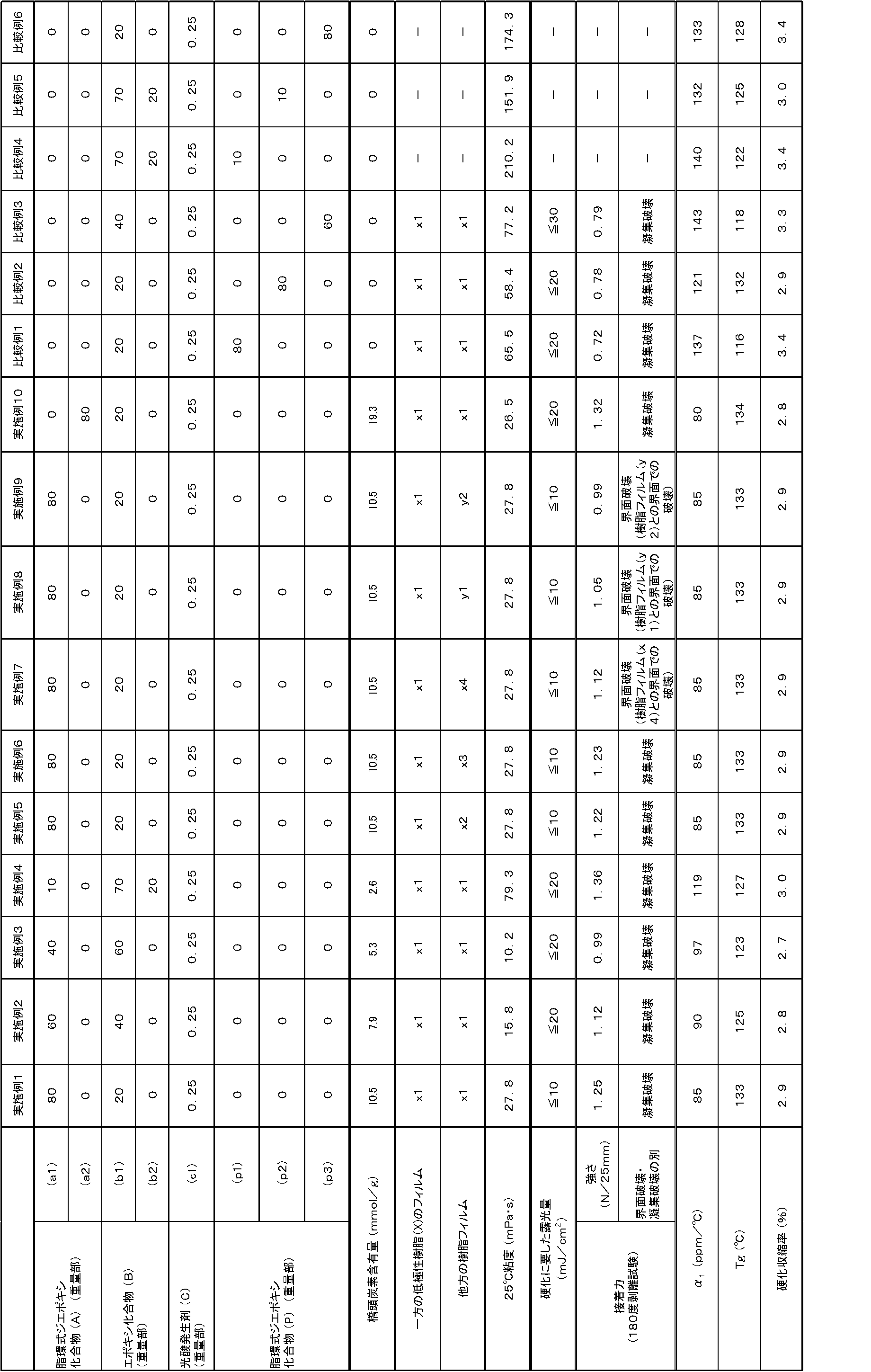
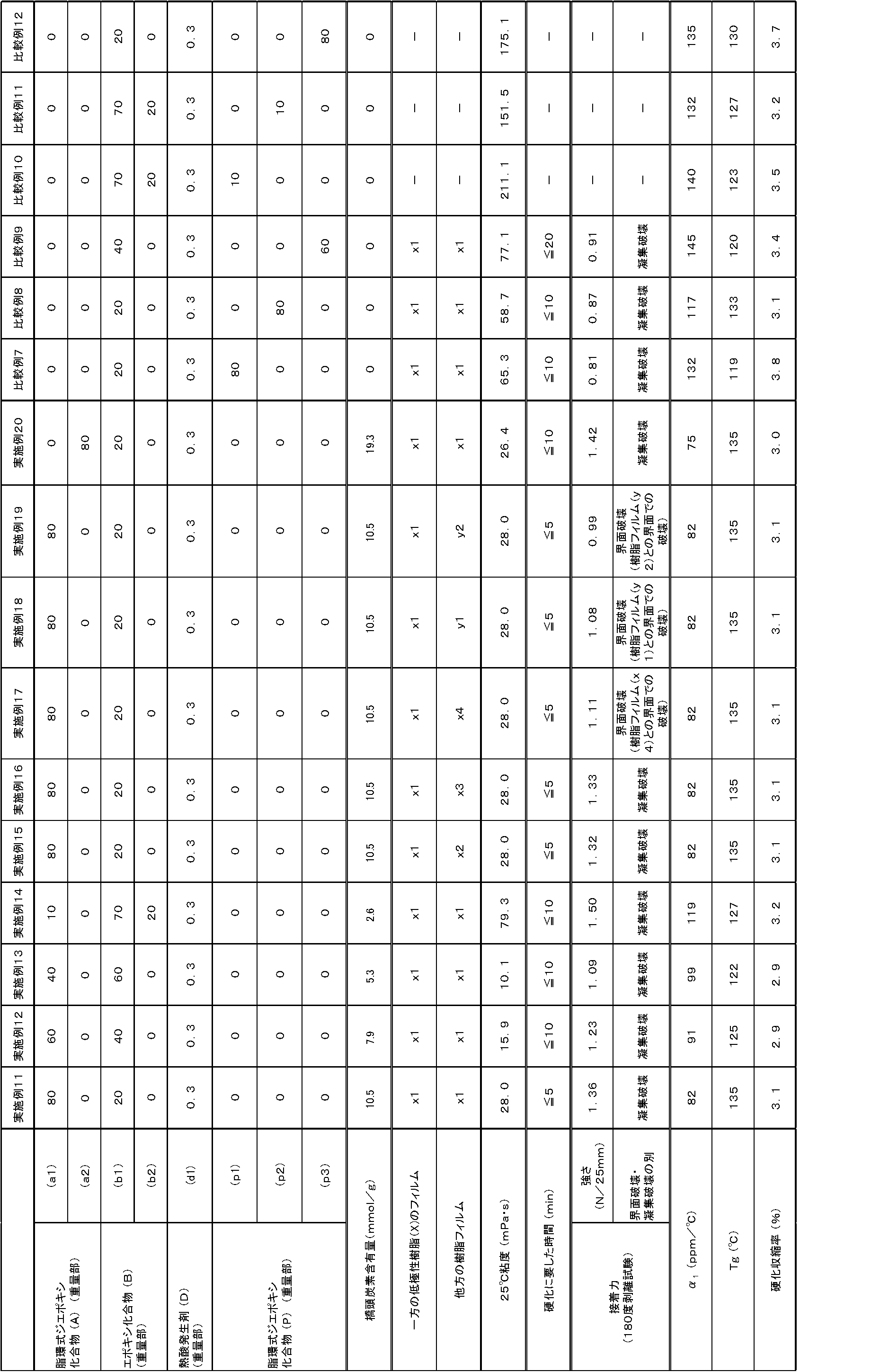
表1及び表2中、各成分は下記を使用した。
(a1);製造例1で得た1,2:5,6-ジエポキシヘキサヒドロインダン
(a2);製造例2で得た1,2:5,6-ジエポキシジシクロペンタジエン
(b1);1,4-シクロヘキサンジメタノールのジグリシジルエーテル[製品名「DME-100」、新日本理化(株)製]
(b2);ビスフェノールAジグリシジルエーテル[製品名「jER828」、三菱化学(株)製]
(c1);光酸発生剤である[p-(フェニルメルカプト)フェニル]ジフェニルスルホニウムヘキサフルオロホスファート[製品名「CPI-100P」、サンアプロ(株)製]
(d1);熱酸発生剤である(4-ヒドロキシフェニル)(2-メチルベンジル)メチルスルホニウムヘキサフルオロアンチモナート
(p1);比較製造例1で得た1,2:6,7-ジエポキシシクロオクタン
(p2);比較製造例2で得た3,4:3’,4’-ジエポキシビシクロヘキサン
(p3):3’,4’-エポキシシクロヘキシルメチル-3,4-エポキシシクロヘキサンカルボキシレート[製品名「セロキサイド2021P」、(株)ダイセル製]
(x1);非晶性ポリオレフィン樹脂フィルム(SP値9.0(cal/cm3)1/2)、[製品名「ゼオノアZF141」、日本ゼオン(株)製、膜厚100μm]
(x2);ポリプロピレン樹脂フィルム(SP値8.1(cal/cm3)1/2)、[製品名「トレファンNL10」、東レ(株)社製、膜厚27.5μm]
(x3);ポリメタクリル酸メチル樹脂フィルム(SP値9.2(cal/cm3)1/2)、[製品名「アクリプレンHBS010P」、三菱レイヨン(株)製、膜厚125μm]
(x4);ポリカーボネート樹脂フィルム(SP値9.8(cal/cm3)1/2)、[製品名「ユーピロンNF-2000」、三菱ガス化学(株)製、膜厚300μm]
(y1);製造例3で得たポリビニルアルコール樹脂フィルム(SP値18.9(cal/cm3)1/2)、[膜厚50μm]
(y2);PET樹脂フィルム(SP値10.7(cal/cm3)1/2)、[製品名「コスモシャインA4300」、東洋紡(株)製、膜厚100μm]
(a1);製造例1で得た1,2:5,6-ジエポキシヘキサヒドロインダン
(a2);製造例2で得た1,2:5,6-ジエポキシジシクロペンタジエン
(b1);1,4-シクロヘキサンジメタノールのジグリシジルエーテル[製品名「DME-100」、新日本理化(株)製]
(b2);ビスフェノールAジグリシジルエーテル[製品名「jER828」、三菱化学(株)製]
(c1);光酸発生剤である[p-(フェニルメルカプト)フェニル]ジフェニルスルホニウムヘキサフルオロホスファート[製品名「CPI-100P」、サンアプロ(株)製]
(d1);熱酸発生剤である(4-ヒドロキシフェニル)(2-メチルベンジル)メチルスルホニウムヘキサフルオロアンチモナート
(p1);比較製造例1で得た1,2:6,7-ジエポキシシクロオクタン
(p2);比較製造例2で得た3,4:3’,4’-ジエポキシビシクロヘキサン
(p3):3’,4’-エポキシシクロヘキシルメチル-3,4-エポキシシクロヘキサンカルボキシレート[製品名「セロキサイド2021P」、(株)ダイセル製]
(x1);非晶性ポリオレフィン樹脂フィルム(SP値9.0(cal/cm3)1/2)、[製品名「ゼオノアZF141」、日本ゼオン(株)製、膜厚100μm]
(x2);ポリプロピレン樹脂フィルム(SP値8.1(cal/cm3)1/2)、[製品名「トレファンNL10」、東レ(株)社製、膜厚27.5μm]
(x3);ポリメタクリル酸メチル樹脂フィルム(SP値9.2(cal/cm3)1/2)、[製品名「アクリプレンHBS010P」、三菱レイヨン(株)製、膜厚125μm]
(x4);ポリカーボネート樹脂フィルム(SP値9.8(cal/cm3)1/2)、[製品名「ユーピロンNF-2000」、三菱ガス化学(株)製、膜厚300μm]
(y1);製造例3で得たポリビニルアルコール樹脂フィルム(SP値18.9(cal/cm3)1/2)、[膜厚50μm]
(y2);PET樹脂フィルム(SP値10.7(cal/cm3)1/2)、[製品名「コスモシャインA4300」、東洋紡(株)製、膜厚100μm]
<接着剤液の粘度測定>
上記、実施例1~20及び比較例1~12で調整した各接着剤について、B型粘度計[製品名「デジタル粘度計DVL-BII型、LCH-400」、アドバンテック東洋(株)製]を用いて、25℃における粘度を測定した。結果を表1及び表2に示す。
上記、実施例1~20及び比較例1~12で調整した各接着剤について、B型粘度計[製品名「デジタル粘度計DVL-BII型、LCH-400」、アドバンテック東洋(株)製]を用いて、25℃における粘度を測定した。結果を表1及び表2に示す。
<光硬化性試験>
実施例1~10及び比較例1~6で得た活性エネルギー線硬化型の低極性樹脂用接着剤を、ガラス板上にバーコータを用いて10μmの膜厚で塗工後、紫外線照射装置[ベルトコンベア式、製品名「ECS-151U」、アイグラフィックス(株)製]により、10mJ/cm2(UV-B)単位で紫外線を照射し、指触試験を行い、指に付着しなくなるまでの積算照射露光量を硬化に要した露光量とした。結果を表1に示す。
実施例1~10及び比較例1~6で得た活性エネルギー線硬化型の低極性樹脂用接着剤を、ガラス板上にバーコータを用いて10μmの膜厚で塗工後、紫外線照射装置[ベルトコンベア式、製品名「ECS-151U」、アイグラフィックス(株)製]により、10mJ/cm2(UV-B)単位で紫外線を照射し、指触試験を行い、指に付着しなくなるまでの積算照射露光量を硬化に要した露光量とした。結果を表1に示す。
<熱硬化性試験>
実施例11~20及び比較例7~12で得た熱硬化型の低極性樹脂用接着剤を、ガラス板上にバーコータを用いて10μmの膜厚で塗工後、100℃の乾燥機で加熱しながら5分ごとに指触試験を行い、指に付着しなくなるまでの時間を硬化に要した時間とした。結果を表2に示す。
実施例11~20及び比較例7~12で得た熱硬化型の低極性樹脂用接着剤を、ガラス板上にバーコータを用いて10μmの膜厚で塗工後、100℃の乾燥機で加熱しながら5分ごとに指触試験を行い、指に付着しなくなるまでの時間を硬化に要した時間とした。結果を表2に示す。
<フィルム接着性試験>
1.フィルムの貼り合わせ
(1)光硬化系
実施例1~10及び比較例1~6で得た各接着剤を、フィルム状の低極性樹脂(X)である(x1)にバーコータを用いて5μmの膜厚で塗工した。なお、比較例4~6で得た接着剤は、高粘度のため5μmの膜厚に塗工できなかった。
次いで、表1に記載の他方の樹脂フィルムを、接着剤が塗工された面にかぶせ、ローラーで2枚のフィルムを貼り合わせた後、紫外線照射装置[ベルトコンベア式、製品名「ECS-151U」、アイグラフィックス(株)製]により、積算光量250mJ/cm2(UV-B)で(x1)側から紫外線を照射し、接着剤を硬化させ、フィルムを貼り合わせ、積層フィルムを得た。
1.フィルムの貼り合わせ
(1)光硬化系
実施例1~10及び比較例1~6で得た各接着剤を、フィルム状の低極性樹脂(X)である(x1)にバーコータを用いて5μmの膜厚で塗工した。なお、比較例4~6で得た接着剤は、高粘度のため5μmの膜厚に塗工できなかった。
次いで、表1に記載の他方の樹脂フィルムを、接着剤が塗工された面にかぶせ、ローラーで2枚のフィルムを貼り合わせた後、紫外線照射装置[ベルトコンベア式、製品名「ECS-151U」、アイグラフィックス(株)製]により、積算光量250mJ/cm2(UV-B)で(x1)側から紫外線を照射し、接着剤を硬化させ、フィルムを貼り合わせ、積層フィルムを得た。
(2)熱硬化系
実施例11~20及び比較例7~12で得た各接着剤を、フィルム状の低極性樹脂(X)である(x1)にバーコータを用いて5μmの膜厚で塗工した。なお、比較例10~12で得た接着剤は、高粘度のため5μmの膜厚に塗工できなかった。
次いで、表2に記載の他方の樹脂フィルムを、接着剤が塗工された面にかぶせ、ローラーで2枚のフィルムを貼り合わせた後、乾燥機で100℃で1時間加熱後、さらに180℃で2時間加熱することで接着剤を硬化させ、フィルムを貼り合わせ、積層フィルムを得た。
実施例11~20及び比較例7~12で得た各接着剤を、フィルム状の低極性樹脂(X)である(x1)にバーコータを用いて5μmの膜厚で塗工した。なお、比較例10~12で得た接着剤は、高粘度のため5μmの膜厚に塗工できなかった。
次いで、表2に記載の他方の樹脂フィルムを、接着剤が塗工された面にかぶせ、ローラーで2枚のフィルムを貼り合わせた後、乾燥機で100℃で1時間加熱後、さらに180℃で2時間加熱することで接着剤を硬化させ、フィルムを貼り合わせ、積層フィルムを得た。
2.180度剥離試験
「1.フィルムの貼り合わせ」で得られた各積層フィルムを、長さ200mm×幅25mmの大きさに裁断した。このようにして得られた各試験片に対してJIS K 6854-2(接着剤-剥離接着強度試験方法-第2部:180度剥離)の記載に準拠し、180度剥離試験を行った(剥離速度:300mm/min)。結果を表1及び表2に示す。
「1.フィルムの貼り合わせ」で得られた各積層フィルムを、長さ200mm×幅25mmの大きさに裁断した。このようにして得られた各試験片に対してJIS K 6854-2(接着剤-剥離接着強度試験方法-第2部:180度剥離)の記載に準拠し、180度剥離試験を行った(剥離速度:300mm/min)。結果を表1及び表2に示す。
<ガラス転移温度(Tg)及び線膨張係数(α1)測定>
1.熱機械分析(TMA)用硬化物の作製
(1)光硬化系
上面が開いたステンレス製の型枠(凹部の寸法:200mm×200mm×5mm)に、実施例1~10及び比較例1~6で得た各接着剤を流し込み、紫外線照射装置[ベルトコンベア式、製品名「ECS-151U」、アイグラフィックス(株)製]により、積算光量250mJ/cm2(UV-B)で上面から紫外線を照射することで接着剤を硬化させ、TMA用硬化物(大きさ:200mm×200mm×約5mm)を作製した。
1.熱機械分析(TMA)用硬化物の作製
(1)光硬化系
上面が開いたステンレス製の型枠(凹部の寸法:200mm×200mm×5mm)に、実施例1~10及び比較例1~6で得た各接着剤を流し込み、紫外線照射装置[ベルトコンベア式、製品名「ECS-151U」、アイグラフィックス(株)製]により、積算光量250mJ/cm2(UV-B)で上面から紫外線を照射することで接着剤を硬化させ、TMA用硬化物(大きさ:200mm×200mm×約5mm)を作製した。
(2)熱硬化系
上面が開いたステンレス製の型枠(凹部の寸法:200mm×200mm×5mm)に、実施例11~20及び比較例7~12で得た各接着剤を流し込み、乾燥機で100℃で1時間加熱後、さらに140℃で2時間加熱することで接着剤を硬化させ、TMA用硬化物(大きさ:200mm×200mm×約5mm)を作製した。
上面が開いたステンレス製の型枠(凹部の寸法:200mm×200mm×5mm)に、実施例11~20及び比較例7~12で得た各接着剤を流し込み、乾燥機で100℃で1時間加熱後、さらに140℃で2時間加熱することで接着剤を硬化させ、TMA用硬化物(大きさ:200mm×200mm×約5mm)を作製した。
2.TMA測定
「1.熱機械分析(TMA)用硬化物の作製」で得られた硬化物から10mm×4mm×4mmの小片を切り出してTMA用試験片を得た。このようにして得られた各試験片に対してJIS K 7197-1991(プラスチックの熱機械分析による線膨張率試験方法)の記載に準拠し、線膨張係数(α1)測定を行った(昇温速度:5℃/min)。また、得られた温度-線膨張係数曲線を基に、変曲点前後の接線の交点からTgを求めた。結果を表1及び表2に示す。
「1.熱機械分析(TMA)用硬化物の作製」で得られた硬化物から10mm×4mm×4mmの小片を切り出してTMA用試験片を得た。このようにして得られた各試験片に対してJIS K 7197-1991(プラスチックの熱機械分析による線膨張率試験方法)の記載に準拠し、線膨張係数(α1)測定を行った(昇温速度:5℃/min)。また、得られた温度-線膨張係数曲線を基に、変曲点前後の接線の交点からTgを求めた。結果を表1及び表2に示す。
<硬化収縮性試験>
(1)光硬化系
実施例1~10及び比較例1~6で得た各低極性樹脂用接着剤を、ガラス板上にバーコータを用いて100μmの膜厚で塗工後、紫外線照射装置[ベルトコンベア式、製品名「ECS-151U」、アイグラフィックス(株)製]により、250mJ/cm2(UV-B)の紫外線を照射し、接着剤の塗工膜を硬化させ、硬化物を得た。
上記のようにして得られた硬化物から20cm×5cm×100μmの小片を切り出して固体比重測定用試験片を得た。
JIS K 7232:1986に記載の比重瓶法で硬化前の低極性樹脂用接着剤及び固体比重測定用試験片の比重測定を行い、得られた値を基に、数式(I)に従って硬化収縮率を求めた。結果を表1に示す。
硬化収縮率(%)={(硬化物の比重-硬化前の低極性樹脂用接着剤の比重)/硬化物の比重}×100 (I)
(1)光硬化系
実施例1~10及び比較例1~6で得た各低極性樹脂用接着剤を、ガラス板上にバーコータを用いて100μmの膜厚で塗工後、紫外線照射装置[ベルトコンベア式、製品名「ECS-151U」、アイグラフィックス(株)製]により、250mJ/cm2(UV-B)の紫外線を照射し、接着剤の塗工膜を硬化させ、硬化物を得た。
上記のようにして得られた硬化物から20cm×5cm×100μmの小片を切り出して固体比重測定用試験片を得た。
JIS K 7232:1986に記載の比重瓶法で硬化前の低極性樹脂用接着剤及び固体比重測定用試験片の比重測定を行い、得られた値を基に、数式(I)に従って硬化収縮率を求めた。結果を表1に示す。
硬化収縮率(%)={(硬化物の比重-硬化前の低極性樹脂用接着剤の比重)/硬化物の比重}×100 (I)
(2)熱硬化系
実施例11~20及び比較例7~12で得た各低極性樹脂用接着剤を、ガラス板上にバーコータを用いて100μmの膜厚で塗工後、乾燥機で100℃で1時間加熱後、さらに140℃で2時間加熱し、接着剤の塗工膜を硬化させ、硬化物を得た。
上記のようにして得られた硬化物から20cm×5cm×100μmの小片を切り出して固体比重測定用試験片を得た。
JIS K 7232:1986に記載の比重瓶法で硬化前の低極性樹脂用接着剤及び固体比重測定用試験片の比重測定を行い、得られた値を基に、数式(I)に従って硬化収縮率を求めた。結果を表2に示す。
硬化収縮率(%)={(硬化物の比重-硬化前の低極性樹脂用接着剤の比重)/硬化物の比重}×100 (I)
実施例11~20及び比較例7~12で得た各低極性樹脂用接着剤を、ガラス板上にバーコータを用いて100μmの膜厚で塗工後、乾燥機で100℃で1時間加熱後、さらに140℃で2時間加熱し、接着剤の塗工膜を硬化させ、硬化物を得た。
上記のようにして得られた硬化物から20cm×5cm×100μmの小片を切り出して固体比重測定用試験片を得た。
JIS K 7232:1986に記載の比重瓶法で硬化前の低極性樹脂用接着剤及び固体比重測定用試験片の比重測定を行い、得られた値を基に、数式(I)に従って硬化収縮率を求めた。結果を表2に示す。
硬化収縮率(%)={(硬化物の比重-硬化前の低極性樹脂用接着剤の比重)/硬化物の比重}×100 (I)
表1及び表2の結果から、橋かけ環式炭化水素基を有する脂環式ジエポキシ化合物(A)に代わって「橋かけ環式炭化水素基を有しない脂環式ジエポキシ化合物(P)」を含有する比較例1~12の接着剤(1’)~(12’)は、高速硬化性、薄膜塗工可能な低粘性、高い接着強度、低線膨張係数、高Tg及び低硬化収縮を同時に達成できていない。
一方、橋かけ環式炭化水素基を有する脂環式ジエポキシ化合物(A)を含有する本発明の低極性樹脂用接着剤(1)~(20)は、薄膜塗工に適した低粘性を有しながら、低極性樹脂(X)に対し、高い接着強度を示すことがわかる。さらに、硬化速度、耐熱性(低線膨張係数、高Tg)も比較例と同等以上であり、硬化収縮率も極めて低いことから、接着剤として極めて優れていることが分かる。
一方、橋かけ環式炭化水素基を有する脂環式ジエポキシ化合物(A)を含有する本発明の低極性樹脂用接着剤(1)~(20)は、薄膜塗工に適した低粘性を有しながら、低極性樹脂(X)に対し、高い接着強度を示すことがわかる。さらに、硬化速度、耐熱性(低線膨張係数、高Tg)も比較例と同等以上であり、硬化収縮率も極めて低いことから、接着剤として極めて優れていることが分かる。
本発明の低極性樹脂用接着剤は、高速硬化性、高耐熱性(低線膨張係数、高Tg)を有し、粘度が低く、低極性樹脂に対する接着性が極めて高いので、液晶や有機ELなどのディスプレイの各種樹脂の貼り合わせに用いる接着剤として有用であり、特に各樹脂フィルムの貼り合わせに用いる接着剤として有用であり、偏光板用の接着剤として有用である。例えば、偏光板製造時、偏光子が吸着されたポリビニルアルコール樹脂フィルムに対し、保護フィルムとしてアクリルフィルムや非晶性オレフィン樹脂フィルムを貼り合わせる用途等に有用である。
Claims (9)
- 低極性樹脂(X)を接着するための接着剤であって、前記接着剤が橋かけ環式炭化水素基を有する脂環式ジエポキシ化合物(A)を含有し、前記接着剤中の橋頭炭素の含有量が0.01~25.0mmol/gであり、前記低極性樹脂(X)を構成する樹脂の溶解度パラメータが6.2~10.0である低極性樹脂用接着剤。
- 前記橋かけ環式炭化水素基を有する脂環式ジエポキシ化合物(A)が下記一般式(1)及び/又は下記一般式(2)で表される化合物である請求項1に記載の低極性樹脂用接着剤。

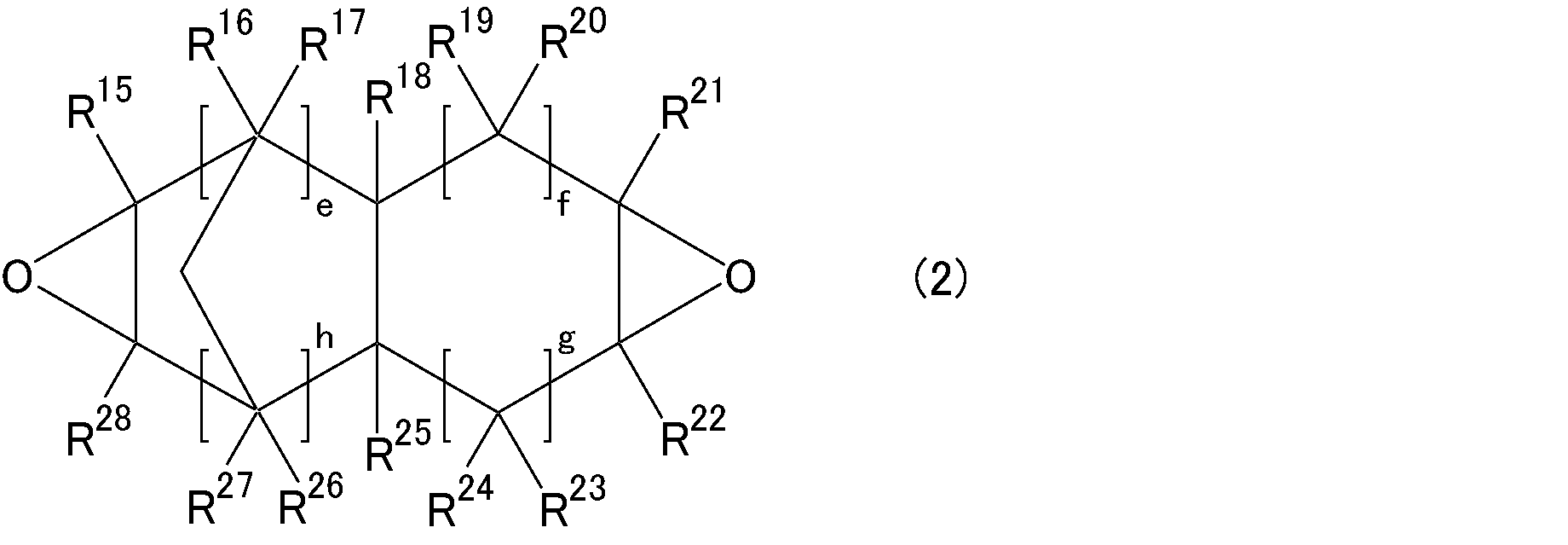
- 前記橋かけ環式炭化水素基を有する脂環式ジエポキシ化合物(A)が、1,2:5,6-ジエポキシヘキサヒドロインダン及び/又は1,2:5,6-ジエポキシジシクロペンタジエンである請求項1又は2に記載の低極性樹脂用接着剤。
- さらに、前記橋かけ環式炭化水素基を有する脂環式ジエポキシ化合物(A)以外のエポキシ化合物(B)を含む請求項1~3のいずれかに記載の低極性樹脂用接着剤。
- 前記橋かけ環式炭化水素基を有する脂環式ジエポキシ化合物(A)及び前記エポキシ化合物(B)の合計重量を基準として、前記橋かけ環式炭化水素基を有する脂環式ジエポキシ化合物(A)の含有量が0.1~99重量%、前記エポキシ化合物(B)の含有量が1~99.9重量%である請求項4に記載の低極性樹脂用接着剤。
- さらに、活性エネルギー線の照射により酸を発生する光酸発生剤(C)、加熱により酸を発生する熱酸発生剤(D)及びその他のエポキシ硬化剤(E)からなる群より選ばれる少なくとも一種を含む請求項1~5のいずれかに記載の低極性樹脂用接着剤。
- 前記低極性樹脂(X)がポリ(メタ)アクリル系樹脂、非晶性ポリオレフィン樹脂及び結晶性ポリオレフィン樹脂からなる群より選ばれる少なくとも一種である請求項1~6のいずれかに記載の低極性樹脂用接着剤。
- 2つの部材が接着剤を介して接着されてなる成形品であって、少なくとも一方が低極性樹脂(X)からなる部材であり、前記接着剤が請求項1~7のいずれかに記載の低極性樹脂用接着剤である成形品。
- 前記2つの部材のうち少なくとも一方がフィルムであって、前記成形品が偏光板である請求項8に記載の成形品。
Priority Applications (1)
| Application Number | Priority Date | Filing Date | Title |
|---|---|---|---|
| JP2015513700A JP6336967B2 (ja) | 2013-04-26 | 2014-04-16 | 低極性樹脂用接着剤及びこれを用いてなる成形品 |
Applications Claiming Priority (2)
| Application Number | Priority Date | Filing Date | Title |
|---|---|---|---|
| JP2013-094432 | 2013-04-26 | ||
| JP2013094432 | 2013-04-26 |
Publications (1)
| Publication Number | Publication Date |
|---|---|
| WO2014175129A1 true WO2014175129A1 (ja) | 2014-10-30 |
Family
ID=51791708
Family Applications (1)
| Application Number | Title | Priority Date | Filing Date |
|---|---|---|---|
| PCT/JP2014/060779 Ceased WO2014175129A1 (ja) | 2013-04-26 | 2014-04-16 | 低極性樹脂用接着剤及びこれを用いてなる成形品 |
Country Status (2)
| Country | Link |
|---|---|
| JP (1) | JP6336967B2 (ja) |
| WO (1) | WO2014175129A1 (ja) |
Cited By (4)
| Publication number | Priority date | Publication date | Assignee | Title |
|---|---|---|---|---|
| JP2018041079A (ja) * | 2016-09-06 | 2018-03-15 | 住友化学株式会社 | 偏光板及びその製造方法 |
| JPWO2017086144A1 (ja) * | 2015-11-19 | 2018-06-07 | 積水化学工業株式会社 | 有機エレクトロルミネッセンス表示素子用封止剤 |
| JP2019131798A (ja) * | 2018-01-30 | 2019-08-08 | 三洋化成工業株式会社 | 粘着剤用活性エネルギー線硬化性組成物及び硬化物 |
| WO2020209241A1 (ja) | 2019-04-09 | 2020-10-15 | Jxtgエネルギー株式会社 | 硬化性組成物およびその硬化物 |
Citations (3)
| Publication number | Priority date | Publication date | Assignee | Title |
|---|---|---|---|---|
| JPS6076578A (ja) * | 1978-03-18 | 1985-05-01 | ヘキスト・アクチエンゲゼルシヤフト | 水で希釈可能な接着剤 |
| JP2005146038A (ja) * | 2003-11-12 | 2005-06-09 | Daicel Chem Ind Ltd | 紫外線硬化型接着剤およびその接着体 |
| JP2013061561A (ja) * | 2011-09-14 | 2013-04-04 | Konica Minolta Advanced Layers Inc | 偏光板およびこれを用いた表示装置 |
Family Cites Families (1)
| Publication number | Priority date | Publication date | Assignee | Title |
|---|---|---|---|---|
| JP2006206672A (ja) * | 2005-01-26 | 2006-08-10 | Mitsubishi Engineering Plastics Corp | ポリアミド樹脂組成物および導電性軸状成形品 |
-
2014
- 2014-04-16 WO PCT/JP2014/060779 patent/WO2014175129A1/ja not_active Ceased
- 2014-04-16 JP JP2015513700A patent/JP6336967B2/ja not_active Expired - Fee Related
Patent Citations (3)
| Publication number | Priority date | Publication date | Assignee | Title |
|---|---|---|---|---|
| JPS6076578A (ja) * | 1978-03-18 | 1985-05-01 | ヘキスト・アクチエンゲゼルシヤフト | 水で希釈可能な接着剤 |
| JP2005146038A (ja) * | 2003-11-12 | 2005-06-09 | Daicel Chem Ind Ltd | 紫外線硬化型接着剤およびその接着体 |
| JP2013061561A (ja) * | 2011-09-14 | 2013-04-04 | Konica Minolta Advanced Layers Inc | 偏光板およびこれを用いた表示装置 |
Cited By (17)
| Publication number | Priority date | Publication date | Assignee | Title |
|---|---|---|---|---|
| KR102679291B1 (ko) | 2015-11-19 | 2024-06-27 | 세키스이가가쿠 고교가부시키가이샤 | 유기 일렉트로 루미네선스 표시 소자용 밀봉제 |
| JPWO2017086144A1 (ja) * | 2015-11-19 | 2018-06-07 | 積水化学工業株式会社 | 有機エレクトロルミネッセンス表示素子用封止剤 |
| KR20180084633A (ko) * | 2015-11-19 | 2018-07-25 | 세키스이가가쿠 고교가부시키가이샤 | 유기 일렉트로 루미네선스 표시 소자용 밀봉제 |
| KR102591351B1 (ko) * | 2016-09-06 | 2023-10-18 | 스미또모 가가꾸 가부시키가이샤 | 편광판 및 그 제조 방법 |
| JP2022153440A (ja) * | 2016-09-06 | 2022-10-12 | 住友化学株式会社 | 偏光板及びその製造方法 |
| KR102757144B1 (ko) * | 2016-09-06 | 2025-01-21 | 스미또모 가가꾸 가부시키가이샤 | 편광판 및 그 제조 방법 |
| CN109661601A (zh) * | 2016-09-06 | 2019-04-19 | 住友化学株式会社 | 偏振板及其制造方法 |
| CN109661601B (zh) * | 2016-09-06 | 2022-02-01 | 住友化学株式会社 | 偏振板及其制造方法 |
| JP7406594B2 (ja) | 2016-09-06 | 2023-12-27 | 住友化学株式会社 | 偏光板及びその製造方法 |
| TWI777973B (zh) * | 2016-09-06 | 2022-09-21 | 日商住友化學股份有限公司 | 偏光板及其製造方法 |
| KR20190044099A (ko) * | 2016-09-06 | 2019-04-29 | 스미또모 가가꾸 가부시키가이샤 | 편광판 및 그 제조 방법 |
| JP7174511B2 (ja) | 2016-09-06 | 2022-11-17 | 住友化学株式会社 | 偏光板及びその製造方法 |
| JP2018041079A (ja) * | 2016-09-06 | 2018-03-15 | 住友化学株式会社 | 偏光板及びその製造方法 |
| KR20230148394A (ko) * | 2016-09-06 | 2023-10-24 | 스미또모 가가꾸 가부시키가이샤 | 편광판 및 그 제조 방법 |
| JP7082582B2 (ja) | 2018-01-30 | 2022-06-08 | 三洋化成工業株式会社 | 粘着剤用活性エネルギー線硬化性組成物及び硬化物 |
| JP2019131798A (ja) * | 2018-01-30 | 2019-08-08 | 三洋化成工業株式会社 | 粘着剤用活性エネルギー線硬化性組成物及び硬化物 |
| WO2020209241A1 (ja) | 2019-04-09 | 2020-10-15 | Jxtgエネルギー株式会社 | 硬化性組成物およびその硬化物 |
Also Published As
| Publication number | Publication date |
|---|---|
| JPWO2014175129A1 (ja) | 2017-02-23 |
| JP6336967B2 (ja) | 2018-06-06 |
Similar Documents
| Publication | Publication Date | Title |
|---|---|---|
| TWI443169B (zh) | 黏著劑組成物以及光學零件 | |
| CN105038622B (zh) | 偏光板的粘性膜及粘着剂组成物、偏光板以及光学显示器 | |
| JP2019025901A (ja) | 積層体、及び前記積層体を備えたフレキシブルデバイス | |
| JP5592733B2 (ja) | 柔軟性にすぐれたカチオン硬化性樹脂組成物 | |
| JP6336967B2 (ja) | 低極性樹脂用接着剤及びこれを用いてなる成形品 | |
| KR20140034820A (ko) | 바이오 칩 형성용 감광성 수지 조성물 및 바이오 칩 | |
| KR20160030068A (ko) | 양이온 중합성 조성물 | |
| JPWO2018168862A1 (ja) | 樹脂組成物、成形体、積層体、コーティング材及び接着剤 | |
| WO2019021557A1 (ja) | 積層体、及び前記積層体を備えたフレキシブルデバイス | |
| JP2014210412A (ja) | ハードコートフィルム及びその製造方法 | |
| JP2005146038A (ja) | 紫外線硬化型接着剤およびその接着体 | |
| TW201116604A (en) | Energy ray-curable epoxy resin composition having excellent fast curing properties | |
| JP6570854B2 (ja) | 繊維強化複合材料用樹脂組成物、繊維強化複合材料用樹脂組成物含浸強化繊維及び繊維強化複合材料 | |
| JP2020116892A (ja) | 積層体、その製造方法及び製造装置 | |
| WO2023021891A1 (ja) | 紫外線硬化性組成物 | |
| JP2023181911A (ja) | 組成物及び硬化物 | |
| JP7088765B2 (ja) | 光硬化性接着剤 | |
| JP7372916B2 (ja) | 硬化性フィルム状接着剤及びデバイスの製造方法 | |
| KR20180013750A (ko) | 편광판 | |
| JP6331013B2 (ja) | カチオン硬化性樹脂組成物 | |
| JP2021024894A (ja) | ガラス用接着剤及び積層体 | |
| JP7806806B2 (ja) | 剥離層形成用組成物、積層体、及び積層体の製造方法 | |
| TW201527465A (zh) | 自由基固化性黏著劑組成物及包含其之偏光板 | |
| JP2012082272A (ja) | 電子線硬化性樹脂組成物及びその硬化物 | |
| JP2012077122A (ja) | 電子線硬化性樹脂組成物及びその硬化物 |
Legal Events
| Date | Code | Title | Description |
|---|---|---|---|
| 121 | Ep: the epo has been informed by wipo that ep was designated in this application |
Ref document number: 14788175 Country of ref document: EP Kind code of ref document: A1 |
|
| ENP | Entry into the national phase |
Ref document number: 2015513700 Country of ref document: JP Kind code of ref document: A |
|
| NENP | Non-entry into the national phase |
Ref country code: DE |
|
| 122 | Ep: pct application non-entry in european phase |
Ref document number: 14788175 Country of ref document: EP Kind code of ref document: A1 |