WO2014157296A1 - 感光性樹脂組成物、硬化膜、画像形成方法、固体撮像素子、カラーフィルタおよび紫外線吸収剤 - Google Patents
感光性樹脂組成物、硬化膜、画像形成方法、固体撮像素子、カラーフィルタおよび紫外線吸収剤 Download PDFInfo
- Publication number
- WO2014157296A1 WO2014157296A1 PCT/JP2014/058444 JP2014058444W WO2014157296A1 WO 2014157296 A1 WO2014157296 A1 WO 2014157296A1 JP 2014058444 W JP2014058444 W JP 2014058444W WO 2014157296 A1 WO2014157296 A1 WO 2014157296A1
- Authority
- WO
- WIPO (PCT)
- Prior art keywords
- photosensitive resin
- resin composition
- general formula
- group
- composition according
- Prior art date
- Legal status (The legal status is an assumption and is not a legal conclusion. Google has not performed a legal analysis and makes no representation as to the accuracy of the status listed.)
- Ceased
Links
- ZQUVDXMUKIVNOW-UHFFFAOYSA-N C(Nc1ccccc1)=N/c1ccccc1 Chemical compound C(Nc1ccccc1)=N/c1ccccc1 ZQUVDXMUKIVNOW-UHFFFAOYSA-N 0.000 description 1
- HZRZMHNRCSIQFT-UHFFFAOYSA-N CC1(C)N=C(C)OC1 Chemical compound CC1(C)N=C(C)OC1 HZRZMHNRCSIQFT-UHFFFAOYSA-N 0.000 description 1
- LLMUTKIEVOBNJX-UHFFFAOYSA-O CC1(C)[N+](C)=C(/C=C\Nc2ccccc2)OC1 Chemical compound CC1(C)[N+](C)=C(/C=C\Nc2ccccc2)OC1 LLMUTKIEVOBNJX-UHFFFAOYSA-O 0.000 description 1
- AJSANKHMDRSKRX-UHFFFAOYSA-N CC1(C)[N+](C)=C(C)OC1 Chemical compound CC1(C)[N+](C)=C(C)OC1 AJSANKHMDRSKRX-UHFFFAOYSA-N 0.000 description 1
Classifications
-
- C—CHEMISTRY; METALLURGY
- C07—ORGANIC CHEMISTRY
- C07D—HETEROCYCLIC COMPOUNDS
- C07D263/00—Heterocyclic compounds containing 1,3-oxazole or hydrogenated 1,3-oxazole rings
- C07D263/02—Heterocyclic compounds containing 1,3-oxazole or hydrogenated 1,3-oxazole rings not condensed with other rings
- C07D263/08—Heterocyclic compounds containing 1,3-oxazole or hydrogenated 1,3-oxazole rings not condensed with other rings having one double bond between ring members or between a ring member and a non-ring member
- C07D263/10—Heterocyclic compounds containing 1,3-oxazole or hydrogenated 1,3-oxazole rings not condensed with other rings having one double bond between ring members or between a ring member and a non-ring member with only hydrogen atoms, hydrocarbon or substituted hydrocarbon radicals, directly attached to ring carbon atoms
- C07D263/14—Heterocyclic compounds containing 1,3-oxazole or hydrogenated 1,3-oxazole rings not condensed with other rings having one double bond between ring members or between a ring member and a non-ring member with only hydrogen atoms, hydrocarbon or substituted hydrocarbon radicals, directly attached to ring carbon atoms with radicals substituted by oxygen atoms
-
- G—PHYSICS
- G02—OPTICS
- G02B—OPTICAL ELEMENTS, SYSTEMS OR APPARATUS
- G02B5/00—Optical elements other than lenses
- G02B5/20—Filters
- G02B5/208—Filters for use with infrared or ultraviolet radiation, e.g. for separating visible light from infrared and/or ultraviolet radiation
-
- G—PHYSICS
- G03—PHOTOGRAPHY; CINEMATOGRAPHY; ANALOGOUS TECHNIQUES USING WAVES OTHER THAN OPTICAL WAVES; ELECTROGRAPHY; HOLOGRAPHY
- G03F—PHOTOMECHANICAL PRODUCTION OF TEXTURED OR PATTERNED SURFACES, e.g. FOR PRINTING, FOR PROCESSING OF SEMICONDUCTOR DEVICES; MATERIALS THEREFOR; ORIGINALS THEREFOR; APPARATUS SPECIALLY ADAPTED THEREFOR
- G03F7/00—Photomechanical, e.g. photolithographic, production of textured or patterned surfaces, e.g. printing surfaces; Materials therefor, e.g. comprising photoresists; Apparatus specially adapted therefor
- G03F7/0005—Production of optical devices or components in so far as characterised by the lithographic processes or materials used therefor
- G03F7/0007—Filters, e.g. additive colour filters; Components for display devices
-
- G—PHYSICS
- G03—PHOTOGRAPHY; CINEMATOGRAPHY; ANALOGOUS TECHNIQUES USING WAVES OTHER THAN OPTICAL WAVES; ELECTROGRAPHY; HOLOGRAPHY
- G03F—PHOTOMECHANICAL PRODUCTION OF TEXTURED OR PATTERNED SURFACES, e.g. FOR PRINTING, FOR PROCESSING OF SEMICONDUCTOR DEVICES; MATERIALS THEREFOR; ORIGINALS THEREFOR; APPARATUS SPECIALLY ADAPTED THEREFOR
- G03F7/00—Photomechanical, e.g. photolithographic, production of textured or patterned surfaces, e.g. printing surfaces; Materials therefor, e.g. comprising photoresists; Apparatus specially adapted therefor
- G03F7/004—Photosensitive materials
-
- G—PHYSICS
- G03—PHOTOGRAPHY; CINEMATOGRAPHY; ANALOGOUS TECHNIQUES USING WAVES OTHER THAN OPTICAL WAVES; ELECTROGRAPHY; HOLOGRAPHY
- G03F—PHOTOMECHANICAL PRODUCTION OF TEXTURED OR PATTERNED SURFACES, e.g. FOR PRINTING, FOR PROCESSING OF SEMICONDUCTOR DEVICES; MATERIALS THEREFOR; ORIGINALS THEREFOR; APPARATUS SPECIALLY ADAPTED THEREFOR
- G03F7/00—Photomechanical, e.g. photolithographic, production of textured or patterned surfaces, e.g. printing surfaces; Materials therefor, e.g. comprising photoresists; Apparatus specially adapted therefor
- G03F7/004—Photosensitive materials
- G03F7/0045—Photosensitive materials with organic non-macromolecular light-sensitive compounds not otherwise provided for, e.g. dissolution inhibitors
-
- G—PHYSICS
- G03—PHOTOGRAPHY; CINEMATOGRAPHY; ANALOGOUS TECHNIQUES USING WAVES OTHER THAN OPTICAL WAVES; ELECTROGRAPHY; HOLOGRAPHY
- G03F—PHOTOMECHANICAL PRODUCTION OF TEXTURED OR PATTERNED SURFACES, e.g. FOR PRINTING, FOR PROCESSING OF SEMICONDUCTOR DEVICES; MATERIALS THEREFOR; ORIGINALS THEREFOR; APPARATUS SPECIALLY ADAPTED THEREFOR
- G03F7/00—Photomechanical, e.g. photolithographic, production of textured or patterned surfaces, e.g. printing surfaces; Materials therefor, e.g. comprising photoresists; Apparatus specially adapted therefor
- G03F7/004—Photosensitive materials
- G03F7/0047—Photosensitive materials characterised by additives for obtaining a metallic or ceramic pattern, e.g. by firing
-
- G—PHYSICS
- G03—PHOTOGRAPHY; CINEMATOGRAPHY; ANALOGOUS TECHNIQUES USING WAVES OTHER THAN OPTICAL WAVES; ELECTROGRAPHY; HOLOGRAPHY
- G03F—PHOTOMECHANICAL PRODUCTION OF TEXTURED OR PATTERNED SURFACES, e.g. FOR PRINTING, FOR PROCESSING OF SEMICONDUCTOR DEVICES; MATERIALS THEREFOR; ORIGINALS THEREFOR; APPARATUS SPECIALLY ADAPTED THEREFOR
- G03F7/00—Photomechanical, e.g. photolithographic, production of textured or patterned surfaces, e.g. printing surfaces; Materials therefor, e.g. comprising photoresists; Apparatus specially adapted therefor
- G03F7/004—Photosensitive materials
- G03F7/027—Non-macromolecular photopolymerisable compounds having carbon-to-carbon double bonds, e.g. ethylenic compounds
-
- G—PHYSICS
- G03—PHOTOGRAPHY; CINEMATOGRAPHY; ANALOGOUS TECHNIQUES USING WAVES OTHER THAN OPTICAL WAVES; ELECTROGRAPHY; HOLOGRAPHY
- G03F—PHOTOMECHANICAL PRODUCTION OF TEXTURED OR PATTERNED SURFACES, e.g. FOR PRINTING, FOR PROCESSING OF SEMICONDUCTOR DEVICES; MATERIALS THEREFOR; ORIGINALS THEREFOR; APPARATUS SPECIALLY ADAPTED THEREFOR
- G03F7/00—Photomechanical, e.g. photolithographic, production of textured or patterned surfaces, e.g. printing surfaces; Materials therefor, e.g. comprising photoresists; Apparatus specially adapted therefor
- G03F7/004—Photosensitive materials
- G03F7/027—Non-macromolecular photopolymerisable compounds having carbon-to-carbon double bonds, e.g. ethylenic compounds
- G03F7/028—Non-macromolecular photopolymerisable compounds having carbon-to-carbon double bonds, e.g. ethylenic compounds with photosensitivity-increasing substances, e.g. photoinitiators
- G03F7/031—Organic compounds not covered by group G03F7/029
-
- G—PHYSICS
- G03—PHOTOGRAPHY; CINEMATOGRAPHY; ANALOGOUS TECHNIQUES USING WAVES OTHER THAN OPTICAL WAVES; ELECTROGRAPHY; HOLOGRAPHY
- G03F—PHOTOMECHANICAL PRODUCTION OF TEXTURED OR PATTERNED SURFACES, e.g. FOR PRINTING, FOR PROCESSING OF SEMICONDUCTOR DEVICES; MATERIALS THEREFOR; ORIGINALS THEREFOR; APPARATUS SPECIALLY ADAPTED THEREFOR
- G03F7/00—Photomechanical, e.g. photolithographic, production of textured or patterned surfaces, e.g. printing surfaces; Materials therefor, e.g. comprising photoresists; Apparatus specially adapted therefor
- G03F7/16—Coating processes; Apparatus therefor
-
- G—PHYSICS
- G03—PHOTOGRAPHY; CINEMATOGRAPHY; ANALOGOUS TECHNIQUES USING WAVES OTHER THAN OPTICAL WAVES; ELECTROGRAPHY; HOLOGRAPHY
- G03F—PHOTOMECHANICAL PRODUCTION OF TEXTURED OR PATTERNED SURFACES, e.g. FOR PRINTING, FOR PROCESSING OF SEMICONDUCTOR DEVICES; MATERIALS THEREFOR; ORIGINALS THEREFOR; APPARATUS SPECIALLY ADAPTED THEREFOR
- G03F7/00—Photomechanical, e.g. photolithographic, production of textured or patterned surfaces, e.g. printing surfaces; Materials therefor, e.g. comprising photoresists; Apparatus specially adapted therefor
- G03F7/20—Exposure; Apparatus therefor
- G03F7/2002—Exposure; Apparatus therefor with visible light or UV light, through an original having an opaque pattern on a transparent support, e.g. film printing, projection printing; by reflection of visible or UV light from an original such as a printed image
-
- G—PHYSICS
- G03—PHOTOGRAPHY; CINEMATOGRAPHY; ANALOGOUS TECHNIQUES USING WAVES OTHER THAN OPTICAL WAVES; ELECTROGRAPHY; HOLOGRAPHY
- G03F—PHOTOMECHANICAL PRODUCTION OF TEXTURED OR PATTERNED SURFACES, e.g. FOR PRINTING, FOR PROCESSING OF SEMICONDUCTOR DEVICES; MATERIALS THEREFOR; ORIGINALS THEREFOR; APPARATUS SPECIALLY ADAPTED THEREFOR
- G03F7/00—Photomechanical, e.g. photolithographic, production of textured or patterned surfaces, e.g. printing surfaces; Materials therefor, e.g. comprising photoresists; Apparatus specially adapted therefor
- G03F7/26—Processing photosensitive materials; Apparatus therefor
- G03F7/30—Imagewise removal using liquid means
- G03F7/32—Liquid compositions therefor, e.g. developers
-
- G—PHYSICS
- G03—PHOTOGRAPHY; CINEMATOGRAPHY; ANALOGOUS TECHNIQUES USING WAVES OTHER THAN OPTICAL WAVES; ELECTROGRAPHY; HOLOGRAPHY
- G03F—PHOTOMECHANICAL PRODUCTION OF TEXTURED OR PATTERNED SURFACES, e.g. FOR PRINTING, FOR PROCESSING OF SEMICONDUCTOR DEVICES; MATERIALS THEREFOR; ORIGINALS THEREFOR; APPARATUS SPECIALLY ADAPTED THEREFOR
- G03F7/00—Photomechanical, e.g. photolithographic, production of textured or patterned surfaces, e.g. printing surfaces; Materials therefor, e.g. comprising photoresists; Apparatus specially adapted therefor
- G03F7/26—Processing photosensitive materials; Apparatus therefor
- G03F7/40—Treatment after imagewise removal, e.g. baking
Definitions
- the present invention relates to a photosensitive resin composition and a cured film, a solid-state imaging device, and a color filter using the same.
- the present invention also relates to an image forming method using the photosensitive resin composition. Furthermore, it is related with the ultraviolet absorber which can be mix
- Patent Document 1 Color filters used for image sensors (CCD, CMOS, etc.) have been widely studied (Patent Document 1). Formation of a color filter pixel using a photosensitive resin composition has been studied (Patent Document 2). Patent Documents 3 and 4 describe compounds having a structure similar to the structure of the compound used in the present invention described later.
- Patent Document 4 Japanese Patent Laid-Open No. 2009-67973
- Patent Document 4 aims to suppress bleeding out of the ultraviolet absorber due to long-term use when the ultraviolet absorber is blended with the polymer material. That is, an object is to allow the ultraviolet absorber to be present in the polymer material for a long time after being processed into a film or the like. Thus, when the ultraviolet absorber remains in the final product, the transparency is inferior.
- the obtained pixel (cured film of the photosensitive resin composition) has high transparency, a high refractive index, and can provide a cured film with little development residue during pixel formation.
- No photosensitive resin composition has been obtained.
- the present invention aims to solve such problems.
- an ultraviolet absorber having a specific structure More specifically, when an image is formed by exposing the photosensitive resin composition with ultraviolet rays of 365 nm, if an ultraviolet absorber is added, ultraviolet rays can be easily absorbed, resolution can be increased, and development residues can be reduced. . Furthermore, although the ultraviolet absorber is decomposed by exposure, since the ultraviolet absorber used in the present invention has high transparency of the compound after decomposition, a cured film having a high refractive index and high transparency can be obtained.
- R 1 , R 2 and R 3 each represent a hydrogen atom or an alkyl group having 1 to 10 carbon atoms.
- R 4 and R 5 represents an electron withdrawing group.
- R 3 represents a hydrogen atom or an alkyl group having 1 to 10 carbon atoms
- R 4 represents —SO 2 R 6 , —CO 2 R 6 , —COR 6 , —CN or —CONR 6 R 7 , where R 6 and R 7 each represent a hydrogen atom, an alkyl group having 1 to 8 carbon atoms, or a phenyl group.
- R 4 in the general formula (I) or the general formula (II) is —SO 2 R 6 or —CO 2 R 6 .
- ⁇ 4> Any one of ⁇ 1> to ⁇ 3>, wherein the blending amount of the ultraviolet absorber represented by the general formula (I) is 2 to 16% by mass with respect to the total solid content of the photosensitive resin composition
- ⁇ 5> The photosensitive resin composition according to any one of ⁇ 1> to ⁇ 4>, wherein the ultraviolet absorbent represented by the general formula (I) has a molecular weight of 150 to 850.
- ⁇ 6> The photosensitive resin composition according to any one of ⁇ 1>, ⁇ 4>, and ⁇ 5>, wherein the general formula (I) is represented by the following general formula (III).
- R 1 , R 2 and R 3 each represent a hydrogen atom or an alkyl group having 1 to 10 carbon atoms.
- R 41 and R 51 represent secondary or tertiary alkyl, respectively. Represents an ester group.
- the ultraviolet absorber represented by the general formula (I) is a compound represented by any one of the following compounds (1) to (8), according to any one of ⁇ 1> to ⁇ 6> Photosensitive resin composition.
- the photosensitive resin composition according to any one of ⁇ 1> to ⁇ 7>, which contains an oxime compound as a photopolymerization initiator.
- ⁇ 9> The photosensitive resin composition according to any one of ⁇ 1> to ⁇ 8>, further comprising particles having a refractive index of 1.80 to 2.80 at a wavelength of 500 nm.
- the photosensitive resin composition according to ⁇ 9> wherein the particles are titanium dioxide and / or zirconium oxide.
- ⁇ 11> The photosensitive resin composition according to any one of ⁇ 1> to ⁇ 10>, which contains a dye and / or a pigment.
- ⁇ 12> The photosensitive resin composition according to any one of ⁇ 1> to ⁇ 11>, further comprising an alkali-soluble resin.
- ⁇ 13> The photosensitive resin composition according to any one of ⁇ 1> to ⁇ 12>, wherein the photosensitive resin composition is used for forming a pixel of a solid-state imaging device or a liquid crystal display device.
- ⁇ 14> A cured film obtained by curing the photosensitive resin composition according to any one of ⁇ 1> to ⁇ 13>.
- ⁇ 15> The cured film according to ⁇ 15>, wherein the content of the ultraviolet absorber represented by the general formula (I) is 0.01% by mass or less of the cured film.
- ⁇ 16> The photosensitive resin composition according to any one of ⁇ 1> to ⁇ 13> is applied, and a pattern is formed by exposing and developing the formed layer with at least ultraviolet rays through a photomask, A pixel forming method including post-baking a formed pattern.
- ⁇ 17> A color filter having pixels produced by the pixel formation method according to ⁇ 16>.
- ⁇ 18> A solid-state imaging device or a liquid crystal display device having the color filter according to ⁇ 17>.
- Formula (III) (In the general formula (III), R 1 , R 2 and R 3 each represent a hydrogen atom or an alkyl group having 1 to 10 carbon atoms.
- R 41 and R 51 represent secondary or tertiary alkyl, respectively. Represents an ester group.)
- a numerical range expressed using “to” means a range including numerical values described before and after “to” as a lower limit value and an upper limit value.
- (meth) acrylate represents acrylate and methacrylate
- (meth) acryl represents acryl and methacryl
- (meth) acryloyl” represents acryloyl and methacryloyl.
- “monomer” and “monomer” are synonymous.
- the monomer in the present invention is distinguished from an oligomer and a polymer and refers to a compound having a weight average molecular weight of 2,000 or less.
- the polymerizable compound means a compound having a polymerizable functional group, and may be a monomer or a polymer.
- the polymerizable functional group refers to a group that participates in a polymerization reaction.
- the group (atomic group) in this specification the description which does not describe substitution and unsubstituted includes what has a substituent with what does not have a substituent.
- the “alkyl group” includes not only an alkyl group having no substituent (unsubstituted alkyl group) but also an alkyl group having a substituent (substituted alkyl group).
- the photosensitive resin composition the color filter and the manufacturing method thereof, the solid-state imaging device, and the liquid crystal display device of the present invention will be described in detail.
- the description of the constituent elements described below may be made based on typical embodiments of the present invention, but the present invention is not limited to such embodiments.
- the photosensitive resin composition of the present invention (hereinafter sometimes simply referred to as “the composition of the present invention”) includes an ultraviolet absorber represented by the above general formula (I), a photopolymerization initiator, and a polymerizable property. And a monomer. By setting it as such a structure, the photosensitive resin composition suitable for pixel formation of a color filter is obtained.
- the pixel may be a color pixel such as red, green, or blue, or may be a white pixel (white pixel), and is particularly suitable for a white pixel in the present invention.
- the details of the composition of the present invention will be described.
- the ultraviolet absorber represented by general formula (I) is mix
- the ultraviolet absorber represented by the general formula (I) is preferably a compound having an absorption maximum between 250 nm and 400 nm. By blending such components, it is possible to obtain a cured film having a small development residue at the time of development, a high refractive index, and high transparency.
- Formula (I) (In the general formula (I), R 1 , R 2 and R 3 each represent a hydrogen atom or an alkyl group having 1 to 10 carbon atoms. One of R 4 and R 5 represents an electron withdrawing group.
- the other represents —SO 2 R 6 , —CO 2 R 6 , —COR 6 , —CN or —CONR 6 R 7 , where R 6 and R 7 are each a hydrogen atom or a carbon atom having 1 to 8 carbon atoms.
- R 6 and R 7 are each a hydrogen atom or a carbon atom having 1 to 8 carbon atoms.
- the alkyl group is an unsubstituted alkyl group
- the aryl group is an unsubstituted aryl group.
- R 1 , R 2 and R 3 each represent a hydrogen atom or an alkyl group having 1 to 10 carbon atoms, preferably an alkyl group having 1 to 10 carbon atoms.
- the alkyl group may be a linear, branched or cyclic alkyl group, but is preferably a linear or branched alkyl group, more preferably a linear alkyl group.
- R 1 and R 2 are each preferably an alkyl group having 1 to 4 carbon atoms, more preferably a methyl group, an ethyl group, an isopropyl group, a butyl group, a sec-butyl group, and a tert-butyl group.
- a methyl group is more preferable.
- R 4 and R 5 represents an electron withdrawing group, and the other represents —SO 2 R 6 , —CO 2 R 6 , —COR 6 , —CN or —CONR 6 R 7 .
- the electron withdrawing group is preferably —SO 2 NR 6 R 7 , —NO 2 , —CN, —SO 2 R 6 , —CO 2 R 6 , —COR 6 , —CN or —CONR 6 R 7 , —CN, —SO 2 R 6 , —CO 2 R 6 , —COR 6 , —CN or —CONR 6 R 7 are more preferred, —SO 2 R 6 or —CO 2 R 6 is more preferred, and —CO 2 R 6 is particularly preferred preferable.
- R 4 and R 5 is —SO 2 R 6 , —CO 2 R 6 , —COR 6 , —CN or —CONR 6 R 7 , and —SO 2 R 6 or —CO 2 R 6 is More preferred is —CO 2 R 6 .
- R 6 and R 7 each represent a hydrogen atom, an alkyl group having 1 to 8 carbon atoms or an aryl group, preferably a hydrogen atom, an alkyl group having 1 to 8 carbon atoms or a phenyl group, 1-4 alkyl groups or phenyl groups are more preferred.
- the alkyl group may be a linear, branched or cyclic alkyl group, but is preferably a linear or branched alkyl group, more preferably a linear alkyl group.
- the alkyl group having 1 to 8 carbon atoms includes methyl group, ethyl group, isopropyl group, butyl group, sec-butyl group, tert-butyl group, pentyl group, tert-pentyl group, hexyl group, octyl group.
- Group, 2-ethylhexyl group and tert-octyl group are preferable, and methyl group, ethyl group, isopropyl group, butyl group, sec-butyl group and tert-butyl group are more preferable.
- R 6 and R 7 are secondary or tertiary alkyl groups having 3 or 4 carbon atoms (for example, isopropyl group, sec-butyl group, tert-butyl group). ) Is preferred.
- the general formula (I) is preferably represented by the following general formula (II).
- Formula (II) (In the general formula (II), R 3 represents a hydrogen atom or an alkyl group having 1 to 10 carbon atoms, and R 4 represents —SO 2 R 6 , —CO 2 R 6 , —COR 6 , —CN or —CONR 6 R 7 , where R 6 and R 7 each represent a hydrogen atom, an alkyl group having 1 to 8 carbon atoms, or a phenyl group.
- R 3 R 4, R 6 and R 7, respectively, in formula (I) has the same meaning as R 3, R 4, R 6 and R 7, the same preferable ranges It is.
- a particularly preferred embodiment is an embodiment in which R 4 in the general formula (II) is —SO 2 R 6 or —CO 2 R 6 .
- the general formula (I) is also preferably represented by the following general formula (III).
- the ultraviolet absorber represented by the general formula (III) is also preferably used as an ultraviolet absorber in applications other than the photosensitive resin composition.
- Formula (III) (In the general formula (III), R 1 , R 2 and R 3 each represent a hydrogen atom or an alkyl group having 1 to 10 carbon atoms. R 41 and R 51 represent secondary or tertiary alkyl, respectively. Represents an ester group.)
- the molecular weight of the ultraviolet absorber represented by the general formula (I) is preferably 150 to 850, more preferably 150 to 650, and further preferably 150 to 450. By setting it as such a range, the effect of this invention is exhibited more effectively.
- the ultraviolet absorber represented by general formula (I) is shown.
- Me represents a methyl group
- Ph represents a phenyl group
- Et represents an ethyl group
- Bu represents a butyl group
- Pr represents a propyl group.
- the following compounds 1 to 8 are particularly preferable.
- the blending amount of the ultraviolet absorber represented by the general formula (I) with respect to the total solid content of the photosensitive resin composition of the present invention is preferably 0.01% by mass to 30% by mass, and 0.1% by mass to 20%. % By mass is more preferable, 2 to 16% by mass is further preferable, and 2 to 10% by mass is even more preferable.
- the effect of the present invention is remarkably effectively exhibited by setting the blending amount of the general formula (I) ultraviolet absorber to 2 to 16% by mass with respect to the total solid content.
- Only one type of ultraviolet absorber represented by the general formula (I) used in the present invention may be used, or two or more types may be used. When using 2 or more types, it is preferable that a total amount becomes the said compounding quantity.
- the ultraviolet absorbers represented by the general formula (I) are disclosed in JP-B-44-29620, JP-A-53-128333, JP-A-61-169831, JP-A-63-53543, JP-A-63-53544, The compounds can be synthesized by referring to the methods described in JP-A 63-56651, JP-A 2009-96973, and the references cited therein.
- the photosensitive resin composition of this invention may contain ultraviolet absorbers other than the ultraviolet absorber represented by the said general formula (I), other than the ultraviolet absorber represented by general formula (I) It is preferable that the ultraviolet absorber is not substantially contained. “Substantially free” means, for example, that it is 10% by mass or less, and further 1% by mass or less of the blending amount of the ultraviolet absorber represented by the general formula (I).
- the photosensitive resin composition of the present invention contains at least one photopolymerization initiator.
- the photopolymerization initiator include oxime compounds, organic halogenated compounds, oxydiazole compounds, carbonyl compounds, ketal compounds, benzoin compounds, acridine compounds, organic peroxide compounds, azo compounds, coumarin compounds, azide compounds, metallocene compounds. , Hexaarylbiimidazole compounds, organic borate compounds, disulfone compounds, onium salt compounds, and acylphosphine (oxide) compounds.
- An oxime compound is preferable from the viewpoint of high light absorption and high sensitivity.
- Examples of the oxime compound include those represented by the formula (OX-1), (OX-2) or the following paragraph No. 0513 of JP2012-208494A (corresponding to [0632] of US 2012/235099).
- the description of the compound represented by (OX-3) can be referred to, and the contents thereof are incorporated in the present specification.
- oxime compound examples include 2- (O-benzoyloxime) -1- [4- (phenylthio) phenyl] -1,2-butanedione, 2- (O-benzoyloxime) -1- [4- (phenylthio).
- oxime compound examples include 2- (o-benzoyloxime) -1- [4- (phenylthio) phenyl] -1,2-octanedione, 1- (o-acetyloxime) -1- [9 -Ethyl-6- (2-methylbenzoyl) -9H-carbazol-3-yl] ethanone.
- IRGACURE OXE 01 1.2-octanedione, 1- [4- (phenylthio)-, 2- (o-benzoyloxime)]
- IRGACURE OXE 02 Ethanone, 1- [9] manufactured by BASF -Ethyl-6- (2-methylbenzoyl) -9H-carbazol-3-yl]-, 1- (o-acetyloxime)
- TR-PBG-304 manufactured by Changzhou Power Electronics New Materials Co., Ltd. It is mentioned as a suitable thing.
- organic halogenated compound examples include Wakabayashi et al., “Bull Chem. Soc Japan” 42, 2924 (1969), US Pat. No. 3,905,815, Japanese Examined Patent Publication No. 46-4605, Japanese Laid-Open Patent Publication No. 48-36281, Japanese Laid-Open Patent Publication No. 55-32070, Japanese Laid-Open Patent Publication No. 60-239736, Japanese Laid-Open Patent Publication No. 61-169835, Japanese Laid-Open Patent Publication No. 61-169837, Japanese Laid-Open Patent Publication No. 62-58241 No.
- s-triazine compound include s-triazine derivatives in which at least one mono, di, or trihalogen-substituted methyl group is bonded to the s-triazine ring.
- a halomethyltriazine compound is exemplified, and further, a compound of paragraph number 0132 of JP2012-255148A is exemplified, and the contents thereof are incorporated in the present specification.
- oxydiazole compound for example, the compound of paragraph number 0133 of JP2012-255148A is exemplified, and the contents thereof are incorporated in the present specification.
- carbonyl compound for example, the compound of paragraph number 0134 of JP2012-255148A is exemplified, and the contents thereof are incorporated in the present specification.
- ketal compound examples include benzyl methyl ketal and benzyl- ⁇ -methoxyethyl ethyl acetal.
- benzoin compound for example, the compound of paragraph No. 0136 of JP2012-255148A is exemplified, and the contents thereof are incorporated in the present specification.
- acridine compound examples include 9-phenylacridine, 1,7-bis (9-acridinyl) heptane, and the like.
- organic peroxide compound examples include the compound of paragraph number 0138 of JP2012-255148A, the contents of which are incorporated herein.
- Examples of the azo compound include azo compounds described in JP-A-8-108621.
- Examples of coumarin compounds include 3-methyl-5-amino-((s-triazin-2-yl) amino) -3-phenylcoumarin, 3-chloro-5-diethylamino-((s-triazin-2-yl). ) Amino) -3-phenylcoumarin, 3-butyl-5-dimethylamino-((s-triazin-2-yl) amino) -3-phenylcoumarin, and the like.
- azide compound examples include organic azide compounds described in US Pat. No. 2,848,328, US Pat. No. 2,852,379 and US Pat. No. 2,940,553, 2,6-bis (4-azidobenzylidene) -4 -Ethylcyclohexanone (BAC-E) and the like.
- metallocene compound for example, the compound of paragraph number 0142 of JP2012-255148A is exemplified, and the contents thereof are incorporated in the present specification.
- hexaarylbiimidazole compound for example, the compound of paragraph No. 0143 of JP2012-255148A is exemplified, and the contents thereof are incorporated in the present specification.
- organic borate compound examples include JP-A-62-143044, JP-A-62-1050242, JP-A-9-188865, JP-A-9-188686, JP-A-9-188710, JP-A-2000. -131837, Japanese Patent Application Laid-Open No. 2002-107916, Japanese Patent No. 2764769, Japanese Patent Application No. 2000-310808, etc., and Kunz, Martin “Rad Tech '98. Proceeding April 19-22, 1998, Chicago”, etc.
- disulfone compound examples include compounds described in JP-A Nos. 61-166544 and 2002-328465 (Japanese Patent Application No. 2001-132318).
- onium salt compounds examples include S.I. I. Schlesinger, Photogr. Sci. Eng. , 18, 387 (1974), T.A. S. Diazonium salts described in Bal et al, Polymer, 21, 423 (1980), ammonium salts described in US Pat. No. 4,069,055, JP-A-4-365049, etc., US Pat. No. 4,069 , 055 and 4,069,056, phosphonium salts described in European Patent Nos. 104 and 143, U.S. Pat. Nos. 339,049 and 410,201, Examples thereof include iodonium salts described in JP-A-2-150848 and JP-A-2-296514.
- the iodonium salt is a diaryl iodonium salt and is preferably substituted with two or more electron donating groups such as an alkyl group, an alkoxy group, and an aryloxy group from the viewpoint of stability.
- an iodonium salt in which one substituent of the triarylsulfonium salt has a coumarin or anthraquinone structure and absorption at 300 nm or more is preferable.
- Examples of the sulfonium salt include European Patent Nos. 370,693, 390,214, 233,567, 297,443, 297,442, U.S. Pat. Nos. 4,933,377 and 161. , 811, 410,201, 339,049, 4,760,013, 4,734,444, 2,833,827, German Patent 2,904,626 And sulfonium salts described in the specifications of U.S. Pat. No. 3,604,580 and U.S. Pat. No. 3,604,581. From the viewpoint of stability, it is preferably substituted with an electron-withdrawing group.
- the electron withdrawing group preferably has a Hammett value greater than zero.
- Preferred electron-withdrawing groups include halogen atoms and carboxylic acids.
- Other preferable sulfonium salts include sulfonium salts in which one substituent of the triarylsulfonium salt has a coumarin or anthraquinone structure and absorbs at 300 nm or more.
- a sulfonium salt in which the triarylsulfonium salt has an allyloxy group or an arylthio group as a substituent and has absorption at 300 nm or more can be mentioned.
- onium salt compounds include J. V. Crivello et al, Macromolecules, 10 (6), 1307 (1977), J. MoI. V. Crivello et al, J.A. Polymer Sci. , Polymer Chem. Ed. , 17, 1047 (1979), a selenonium salt described in C.I. S. Wen et al, Teh, Proc. Conf. Rad. Curing ASIA, p478 Tokyo, Oct (1988) and onium salts such as arsonium salts.
- acylphosphine (oxide) compound examples include BASF Corporation Irgacure 819, Darocur 4265, Darocur TPO, and the like.
- a photoinitiator may be used individually by 1 type and may use 2 or more types together.
- the total content of the photopolymerization initiator based on the total solid content of the photosensitive resin composition is preferably 0.1 to 30% by mass, more preferably 0.5 to 20% by mass. More preferably, it is more preferably 1% by mass, and even more preferably 1-5% by mass.
- the content of the photopolymerization initiator is 0.1% by mass or more, a pattern can be formed satisfactorily. Moreover, if it is 30 mass% or less, generation
- the photosensitive resin composition of the present invention contains at least one polymerizable monomer.
- the polymerizable monomer is preferably a compound having at least one addition-polymerizable ethylenic double bond and having a boiling point of 100 ° C. or higher under normal pressure, and is a (meth) acrylate monomer having a boiling point of 100 under normal pressure.
- a compound having a boiling point of 0 ° C. or higher is more preferable.
- a monomer having a hydrogen bonding group (hereinafter, also referred to as “hydrogen bonding group-containing monomer”) is more preferable.
- the hydrogen bonding group include a hydroxyl group, a carboxyl group, an amino group, a ureido group, an alkoxycarbonylamino group, a sulfo group, a sulfonamide group, and an amide group.
- the hydrogen bonding group is more preferably at least one selected from a carboxyl group, an alkoxycarbonylamino group, and a ureido group.
- the hydrogen bonding group-containing monomer is preferably a polyfunctional monomer (hereinafter also referred to as “polyfunctional polymerizable monomer”).
- polyfunctional polymerizable monomer include pentaerythritol triacrylate, dipentaerythritol hexaacrylate, ECH-modified ethylene glycol diacrylate, ECH-modified glycerol triacrylate, ECH-modified phthalic acid diacrylate, triglycerol diacrylate, ECH Examples thereof include modified trimethylolpropane triacrylate.
- Examples of the polyfunctional polymerizable monomer containing a carboxyl group include compounds represented by the following general formula (III-1) or general formula (III-2). However, the present invention is not limited to these.
- T or G is an oxyalkylene group, the terminal on the carbon atom side is bonded to R, X and W.
- n is an integer from 0 to 14, and m is an integer from 1 to 8.
- W is R or X as defined in the general formula (III-1), and 3 or more and 5 or less Ws are R among 6 Ws.
- p is an integer of 0 to 14, and q is an integer of 1 to 8.
- a plurality of R, X, T, and G existing in one molecule may be the same or different.
- the combination of the above-described polyfunctional polymerizable monomer containing a carboxyl group and other monomers described later includes TO-2359, TO-2360, TO-2348, or TO manufactured by Toagosei Chemical Co., Ltd. -756 is commercially available.
- Examples of the polyfunctional monomer having an alkoxycarbonylamino group include U-6LHA, U-6LYXA and U-12LMA manufactured by Shin-Nakamura Chemical Co., Ltd.
- Examples of the polyfunctional monomer having an amide group include monomers M-315 and M-215 manufactured by Toa Gosei.
- Examples of other polyfunctional monomers containing a hydrogen bonding group the description of paragraph numbers 0178 to 0182 in JP 2010-049029 A can be referred to, and the contents thereof are incorporated in the present specification.
- carboxyl group-containing monomers preferred are carboxyl group-containing monomers, alkoxycarbonylamino group-containing monomers, and ureido group-containing monomers, and particularly preferred are carboxyl group-containing monomers.
- the photosensitive resin composition of the present invention can suppress deterioration of pattern rectangularity due to post-baking by containing the above-mentioned hydrogen bonding group-containing monomer in an amount of 30% by mass or more based on the total solid content.
- the content of the hydrogen bonding group-containing monomer in the total solid content of the photosensitive resin composition of the present invention is more preferably 33% by mass or more, and most preferably 35% by mass or more.
- the polymerizable monomer described in paragraph No. 0186 of JP2010-049029A can be blended as a monomer other than the polymerizable monomer, the contents of which are incorporated herein.
- a polyfunctional (meth) acrylic compound is particularly preferable, and a polyfunctional (meth) acrylate having no hydrogen bonding group is most preferable.
- the content of the polymerizable monomer in the photosensitive resin composition is preferably 10 to 80% by mass, more preferably 10 to 70% by mass, and most preferably 10 to 60% by mass with respect to the total solid content of the composition. .
- the content of all monomers is 10% by mass or more, a good cured film can be obtained, and when the content is 80% by mass or less, development residue can be more effectively suppressed.
- Only one type of polymerizable monomer may be used, or two or more types may be used. When using 2 or more types, it is preferable that a total amount becomes the said compounding quantity.
- the polymerizable monomer is a polyfunctional monomer containing at least one hydrogen bonding group selected from a carboxyl group, an alkoxycarbonylamino group, and a ureido group
- the ultraviolet absorber is represented by the general formula (I).
- Combination forms that are the compounds represented are preferred.
- the form in which the photosensitive resin composition of the present invention further contains a polyfunctional (meth) acrylate having no hydrogen bonding group as a monomer is particularly preferable.
- the photosensitive resin composition of the present invention preferably contains at least one resin within a range not impairing the effects of the present invention, and the resin is preferably a linear organic high molecular polymer.
- the linear organic polymer known ones can be arbitrarily used.
- a linear organic polymer that is soluble or swellable in water or weak alkaline water is selected in order to enable water development or weak alkaline water development.
- the linear organic polymer is selected and used depending on the use as water, weak alkaline water or an organic solvent developer.
- alkali-soluble resins are more preferable.
- the alkali-soluble resin is not particularly limited as long as it is alkali-soluble, but is preferably selected from the viewpoints of heat resistance, developability, availability, and the like.
- the alkali-soluble resin is preferably a linear organic polymer and soluble in a solvent and developable with a weak alkaline aqueous solution.
- linear organic high molecular polymers include polymers having a carboxylic acid in the side chain, such as JP-A-59-44615, JP-B-54-34327, JP-B-58-12777, and JP-B-54-25957.
- examples thereof include a polymer, a maleic acid copolymer, and a partially esterified maleic acid copolymer.
- acidic cellulose derivatives having a carboxylic acid in the side chain are useful.
- the alkali-soluble resin includes a polymer having a hydroxyl group with an acid anhydride added, a polyhydroxystyrene resin, a polysiloxane resin, poly (2-hydroxyethyl (meth) acrylate), Polyvinyl pyrrolidone, polyethylene oxide, polyvinyl alcohol, etc. are also useful.
- the linear organic polymer may be a copolymer of hydrophilic monomers.
- examples include alkoxyalkyl (meth) acrylate, hydroxyalkyl (meth) acrylate, glycerol (meth) acrylate, (meth) acrylamide, N-methylol acrylamide, secondary or tertiary alkyl acrylamide, dialkylaminoalkyl (meth) Acrylate, morpholine (meth) acrylate, N-vinylpyrrolidone, N-vinylcaprolactam, vinylimidazole, vinyltriazole, methyl (meth) acrylate, ethyl (meth) acrylate, branched or linear propyl (meth) acrylate, branched or straight Examples include chain butyl (meth) acrylate, phenoxyhydroxypropyl (meth) acrylate, and the like.
- (meth) acrylate represents acrylate or methacrylate
- hydrophilic monomers include tetrahydrofurfuryl group, phosphoric acid group, phosphoric acid ester group, quaternary ammonium base, ethyleneoxy chain, propyleneoxy chain, group derived from sulfonic acid and its salt, morpholinoethyl group, etc. Including monomers are also useful.
- the alkali-soluble resin is particularly preferably one having a polymerizable group in the side chain in order to improve the crosslinking efficiency.
- a polymer containing an allyl group, a (meth) acryl group, an allyloxyalkyl group or the like in the side chain is useful.
- polymers having a polymerizable group examples include commercially available KS resist-106 (manufactured by Osaka Organic Chemical Industry Co., Ltd.), cyclomer P series (cyclomer P-ACA, etc., Daicel Chemical Industries, Ltd.), etc. Is mentioned.
- KS resist-106 manufactured by Osaka Organic Chemical Industry Co., Ltd.
- cyclomer P series cyclomer P-ACA, etc., Daicel Chemical Industries, Ltd.
- alcohol-soluble nylon, polyether of 2,2-bis- (4-hydroxyphenyl) -propane and epichlorohydrin are also useful.
- polyhydroxystyrene resins, polysiloxane resins, acrylic resins, acrylamide resins, and acrylic / acrylamide copolymer resins are preferable, and from the viewpoint of development control.
- acrylic resins, acrylamide resins, and acrylic / acrylamide copolymer resins are preferable, and from the viewpoint of development control.
- acrylic resins, acrylamide resins, and acrylic / acrylamide copolymer resins are preferably acrylic resins, acrylamide resins, and acrylic / acrylamide copolymer resins.
- acrylic resin examples include a copolymer obtained by polymerization of a monomer selected from benzyl (meth) acrylate, (meth) acrylic acid, hydroxyethyl (meth) acrylate, and (meth) acrylamide, and a commercially available product.
- KS resist-106 manufactured by Osaka Organic Chemical Industry Co., Ltd.
- cyclomer P series manufactured by Daicel Chemical Industries, Ltd.
- acrylic base FF-187 manufactured by Fujikura Kasei Co., Ltd.
- a polymer having a weight average molecular weight (polystyrene equivalent value measured by GPC method) of 1000 to 2 ⁇ 10 5 is preferable from the viewpoint of developability, liquid viscosity, etc., and 2000 to 1 ⁇ 10 5 .
- a polymer is more preferred, and a polymer of 5000 to 5 ⁇ 10 4 is particularly preferred.
- the content of the resin in the photosensitive resin composition is preferably 10 to 90% by mass, and preferably 20 to 60% by mass with respect to the total solid content of the photosensitive resin composition from the viewpoint of developability and the like. Is more preferable, and 25 to 50% by mass is particularly preferable. Only one type of resin may be used, or two or more types of resins may be used. When using 2 or more types, it is preferable that a total amount becomes the said compounding quantity.
- the photosensitive resin composition of the present invention may contain particles.
- the particles used in the present invention are preferably particles having a refractive index of 1.64 or more at a wavelength of 500 nm (hereinafter sometimes referred to as “high refractive index particles”), and particles having a refractive index of 1.80 to 3.0. Is more preferable, and particles of 1.80 to 2.80 are more preferable.
- the refractive index of the highly refractive particles By setting the refractive index of the highly refractive particles to the upper limit value or less, the refractive index can be increased while keeping the transmittance of the cured film within a specific range with a variation rate.
- it is preferable to set the lower limit value to be equal to or higher than the above value because interference with pixels of other colors can be suppressed and prevented.
- the weight average diameter of the primary particles of the high refractive index particles is preferably 150 nm or less, more preferably 100 nm or less, and particularly preferably 80 nm or less. Although there is no lower limit in particular, it is practical that it is 1 nm or more.
- the weight average diameter of the high refractive index particles in the layer is preferably 200 nm or less, more preferably 150 nm or less, still more preferably 100 nm or less, and particularly preferably 80 nm or less. Although there is no lower limit in particular, 1 nm or more is preferable, 5 nm or more is more preferable, and 10 nm or more is further more preferable.
- the particle size range of the primary particles is defined as a range different from the particle size range in the layer is that the primary particles are aggregated in the layer.
- grains applies to Japanese Industrial Standard (JIS K0062: 1992).
- the high refractive index particles include at least one selected from Ti, Zr, Sn, Sb, Cu, Fe, Mn, Pb, Cd, As, Cr, Hg, Zn, Al, Mg, Si, P, and S.
- particles containing a metal oxide having the above element include titanium dioxide, tin oxide, indium oxide, zinc oxide, or zirconium oxide particles. Among these, particles of titanium dioxide, tin oxide, indium oxide, or zirconium oxide are particularly preferable, and particles of titanium dioxide and zirconium oxide are more preferable.
- the metal oxide particles are mainly composed of oxides of these metals and can further contain other elements.
- the main component means a component having the largest content (mass%) among the components constituting the particles.
- the crystal structure of the inorganic fine particles containing titanium dioxide as a main component is preferably a rutile, rutile / anatase mixed crystal, anatase or amorphous structure, particularly preferably a rutile structure.
- the high refractive index particles are preferably surface-treated.
- the surface treatment can be performed using an inorganic compound or an organic compound.
- inorganic compounds used for the surface treatment include alumina, silica, zirconium oxide and iron oxide. Of these, alumina and silica are preferable.
- organic compound used for the surface treatment include polyols, alkanolamines, stearic acid, silane coupling agents, and titanate coupling agents.
- an inorganic fine particle mainly composed of titanium dioxide contains at least one element selected from Co (cobalt), Al (aluminum), and Zr (zirconium).
- the high refractive index particles may be treated by combining two or more kinds of surface treatments.
- the shape of the metal oxide particles is preferably a rice grain shape, a spherical shape, a cubic shape, a spindle shape or an indefinite shape. Two or more kinds of metal oxide particles may be used in combination in the high refractive index layer and the middle refractive index layer.
- the total content of the high refractive index particles in the composition is preferably 10% by mass or more, more preferably 15% by mass or more, and still more preferably 15% by mass or more in the total solid content.
- 50 mass% or less is preferable, 40 mass% or less is more preferable, and 35 mass% or less is especially preferable.
- the high refractive index particles in the present invention are preferably blended into the photosensitive resin composition as a dispersion composition. Details of these can be referred to the description in JP-A-2007-277514. It is particularly preferable to disperse using the dispersion resin described in Examples of JP-A-2007-277514.
- the photosensitive resin composition of the present invention may not contain a colorant (known dyes and pigments, black agents such as carbon black and titanium black), but red,
- a dye and / or a pigment is included. Only one type of dye and / or pigment may be used, or two or more types may be used in combination. Examples of the pigment include pigments described in paragraph numbers [0030] to [0044] of JP-A-2008-224982, and C.I. I. Pigment Green 58, C.I. I. Pigment Blue 79 in which the Cl substituent is changed to OH, and the like.
- pigments that can be preferably used include the following. However, the present invention is not limited to these.
- dye there is no restriction
- JP-A-8-62416 JP-A-2002-14220, JP-A-2002-14221, JP-A-2002-14222, JP-A-2002-14223, JP-A-8-302224
- the chemical structure includes pyrazole azo, anilino azo, triphenyl methane, anthraquinone, anthrapyridone, benzylidene, oxonol, pyrazolotriazole azo, pyridone azo, cyanine, phenothiazine, pyrrolopyrazole azomethine, A dye such as xanthene, phthalocyanine, benzopyran, or indigo can be used.
- the total amount of the dye and the pigment is preferably 0.1 to 20% by mass based on the total solid content of the composition, and 1 to 18% by mass. It is more preferable that
- the photosensitive resin composition of this invention can be comprised using a solvent.
- the solvent is basically not particularly limited as long as it satisfies the solubility of each component and the applicability of the photosensitive resin composition, but is usually an organic solvent, and in particular, the solubility of the UV absorber and the binder, applicability. In view of safety, it is preferably selected.
- one type of solvent may be used and two or more types of solvents may be used.
- a solvent selected from cyclohexanone, ethyl carbitol acetate, butyl carbitol acetate, propylene glycol methyl ether, and propylene glycol monomethyl ether acetate is preferred.
- the content of the solvent in the photosensitive resin composition is preferably such that the total solid concentration of the composition is 5 to 90% by mass, more preferably 5 to 87% by mass, from the viewpoint of applicability. 10 to 85% by mass is particularly preferable.
- ⁇ Other additives In the photosensitive resin composition of the present invention, various additives such as a sensitizer, a polymerization inhibitor, an adhesion improver, a surfactant, a filler, a polymer compound other than those described above, and an antioxidant are added as necessary. An agent, an anti-agglomeration agent, etc. can be blended. Each of these additives may be used alone or in combination of two or more.
- the composition of the present invention may contain a sensitizer for the purpose of improving the radical generation efficiency of the polymerization initiator and increasing the photosensitive wavelength.
- a sensitizer for the purpose of improving the radical generation efficiency of the polymerization initiator and increasing the photosensitive wavelength.
- the sensitizer those that are sensitized by an electron transfer mechanism or an energy transfer mechanism with respect to the polymerization initiator used in combination are preferable.
- the sensitizer include compounds described in paragraph numbers [0085] to [0098] of JP-A-2008-214395.
- the content of the sensitizer is preferably in the range of 0.1 to 30% by mass and more preferably in the range of 1 to 20% by mass with respect to the mass of the total solid content of the composition from the viewpoint of sensitivity and storage stability. The range of 2 to 15% by mass is more preferable.
- ⁇ Polymerization inhibitor During the production or storage of the composition of the present invention, it is desirable to add a small amount of a polymerization inhibitor in order to prevent unnecessary thermal polymerization of the polymerizable compound.
- a polymerization inhibitor known thermal polymerization inhibitors can be used. Specifically, hydroquinone, p-methoxyphenol, di-t-butyl-p-cresol, pyrogallol, t-butylcatechol, benzoquinone, 4 , 4′-thiobis (3-methyl-6-tert-butylphenol), 2,2′-methylenebis (4-methyl-6-tert-butylphenol), N-nitrosophenylhydroxyamine primary cerium salt and the like.
- the addition amount of the thermal polymerization inhibitor is preferably about 0.01 to about 5% by mass with respect to the total solid content of the composition. If necessary, higher fatty acid derivatives such as behenic acid and behenic acid amide may be added to prevent polymerization inhibition due to oxygen, and may be unevenly distributed on the surface of the coating film during the drying process after coating. . The amount of the higher fatty acid derivative added is preferably from about 0.5 to about 10% by mass of the total composition.
- an adhesion improver can be added to the composition of the present invention.
- the adhesion improver include a silane coupling agent and a titanium coupling agent.
- Silane coupling agents include ⁇ -methacryloxypropyltrimethoxysilane, ⁇ -methacryloxypropyltriethoxysilane, ⁇ -acryloxypropyltrimethoxysilane, ⁇ -acryloxypropyltriethoxysilane, and ⁇ -mercaptopropyltrimethoxy.
- Silane, 3-methacryloxypropyldimethoxymethylsilane, ⁇ -aminopropyltriethoxysilane, and phenyltrimethoxysilane are preferable, and ⁇ -methacryloxypropyltrimethoxysilane and 3-methacryloxypropyldimethoxymethylsilane are preferable.
- the addition amount of the adhesion improver is preferably 0.5 to 30% by mass, more preferably 0.7 to 20% by mass in the total solid content of the composition.
- surfactant Various surfactants may be added to the composition of the present invention from the viewpoint of further improving coatability.
- various surfactants such as a fluorine-based surfactant, a nonionic surfactant, a cationic surfactant, an anionic surfactant, and a silicone-based surfactant can be used.
- the composition according to a preferred embodiment of the present invention contains a fluorosurfactant, so that liquid properties (particularly fluidity) when prepared as a coating solution are further improved. Uniformity and liquid-saving properties can be further improved. That is, when a film is formed using a coating liquid to which a composition containing a fluorosurfactant is applied, the wettability to the coated surface is reduced by reducing the interfacial tension between the coated surface and the coating liquid. Is improved, and the coating property to the coated surface is improved. For this reason, even when a thin film of about several ⁇ m is formed with a small amount of liquid, it is effective in that it is possible to more suitably form a film having a uniform thickness with small thickness unevenness.
- the fluorine content in the fluorosurfactant is preferably 3% by mass to 40% by mass, more preferably 5% by mass to 30% by mass, and particularly preferably 7% by mass to 25% by mass.
- a fluorine-based surfactant having a fluorine content within this range is effective in terms of uniformity of coating film thickness and liquid-saving properties, and has good solubility in the composition.
- fluorosurfactant examples include MegaFuck F171, F172, F173, F176, F177, F141, F142, F143, F144, R30, F437, F475, F479, F482, F554, F780, F780, F781 (above DIC Corporation), Florard FC430, FC431, FC171 (above, Sumitomo 3M Limited), Surflon S-382, SC-101, Same SC-103, Same SC-104, Same SC-105, Same SC1068, Same SC-381, Same SC-383, Same S393, Same KH-40 (above, manufactured by Asahi Glass Co., Ltd.), Solsperse 20000 (Japan Lubris) Zole Co., Ltd.).
- the description in paragraph numbers 0485 to 0489 of JP2013-045088A can be referred to, and the contents thereof are incorporated in the present specification. Only one type of surfactant may be used, or two or more types may be combined.
- the addition amount of the surfactant is preferably 0.001% by mass to 2.0% by mass, and more preferably 0.005% by mass to 1.0% by mass with respect to the total solid mass of the composition.
- Image forming method> the photosensitive resin composition of the present invention is applied, the formed layer is exposed with at least ultraviolet rays through a photomask, and developed to form a pattern. Includes post-baking.
- the thickness of the layer made of the photosensitive resin composition is preferably 0.1 ⁇ m to 10 ⁇ m, more preferably 0.2 ⁇ m to 5 ⁇ m, and further preferably 0.2 ⁇ m to 3 ⁇ m.
- Drying (prebaking) of the layer made of the photosensitive resin composition can be performed at a temperature of 50 ° C. to 140 ° C. for 10 seconds to 300 seconds using a hot plate, an oven or the like.
- an exposure apparatus such as a stepper is used to perform pattern exposure through a mask having a predetermined mask pattern.
- radiation light
- ultraviolet rays such as g-line and i-line are particularly preferable, and i-line is more preferable.
- Irradiation dose is more preferably 30 ⁇ 1500mJ / cm 2 is preferably 50 ⁇ 1000mJ / cm 2, particularly preferably 80 ⁇ 500mJ / cm 2.
- the step of forming a pattern by developing is preferably performed by alkali development.
- the developer is preferably an organic alkali developer that does not cause damage to the underlying image sensor or circuit.
- the development temperature is usually 20 ° C. to 30 ° C., and the development time is conventionally 20 seconds to 90 seconds. In order to remove the residue more, in recent years, it may be carried out for 120 seconds to 180 seconds. Furthermore, in order to further improve residue removability, the process of shaking off the developer every 60 seconds and further supplying a new developer may be repeated several times.
- alkaline agent used in the developer examples include ammonia water, ethylamine, diethylamine, dimethylethanolamine, tetramethylammonium hydroxide, tetraethylammonium hydroxide, choline, pyrrole, piperidine, 1,8-diazabicyclo- [5,4, 0] -7-undecene and the like, and an alkaline aqueous solution obtained by diluting these alkaline agents with pure water so as to have a concentration of 0.001 to 10% by mass, preferably 0.01 to 1% by mass. Is preferably used as a developer.
- an inorganic alkali may be used for the developer, and as the inorganic alkali, for example, sodium hydroxide, potassium hydroxide, sodium carbonate, sodium hydrogencarbonate, sodium oxalate, sodium metaoxalate and the like are preferable.
- a developer composed of such an alkaline aqueous solution it is generally washed (rinsed) with pure water after development.
- post-bake heat treatment after drying. If a multicolor coloring pattern is to be formed, a cured film can be produced by sequentially repeating the above steps for each color. Thereby, a color filter is obtained.
- the post-baking is a heat treatment after development for complete curing, and is usually a heat curing treatment at 100 ° C. to 350 ° C., preferably 200 ° C. to 340 ° C.
- This post-bake treatment is performed continuously or batchwise using a heating means such as a hot plate, a convection oven (hot air circulation dryer), a high-frequency heater, or the like so that the coating film after development is in the above-described condition. be able to.
- the color filter of the present invention is a color filter having pixels produced by the pixel forming method.
- color in the color filter of the present invention refers to “color” in a broad sense, and is a concept that includes chromatic colors such as red, blue, and green as well as achromatic colors such as transparency. That is, the pattern of the color filter of the present invention may be a chromatic pattern such as red, blue, or green, or an achromatic pattern such as transparency.
- the color filter of the present invention may be a combination of at least one chromatic color pattern such as red, blue, and green and at least one achromatic color pattern such as transparency. Examples of such a color filter include a red pattern (red pixel), a blue pattern (blue pixel), a green pattern (green pixel), and a transparent pattern (transparent pixel).
- the photosensitive resin composition of this invention demonstrated above is used for the use of the pixel formation (especially transparent pixel which is a transparent pattern) of a solid-state image sensor.
- the photosensitive resin composition of the present invention has a transmittance of 80% or more over the entire wavelength range of 400 nm to 700 nm (more preferably, when the film thickness is 1 ⁇ m) (more preferably 85% or more).
- the ultraviolet absorbent represented by the general formula (I) is decomposed.
- the content of the ultraviolet absorbent represented by the general formula (I) is 0.01 mass of the cured film. % Or less, and further, it can be in a state not substantially contained.
- the solid-state imaging device of the present invention has the color filter of the present invention.
- the solid-state imaging device of the present invention is excellent in color reproducibility because the color filter of the present invention having excellent rectangularity of pixels (pattern) is provided.
- the configuration of the solid-state imaging device of the present invention is a configuration provided with the color filter of the present invention, and is not particularly limited as long as it is a configuration that functions as a solid-state imaging device. .
- a transfer electrode made of a plurality of photodiodes and polysilicon constituting a light receiving area of a solid-state imaging device (for example, a CCD image sensor, a CMOS image sensor) is provided on the support, and the transfer electrodes are formed on the photodiodes and the transfer electrodes.
- the color filter of the present invention is provided on the device protective film.
- a configuration having light collecting means for example, a microlens, etc., the same applies hereinafter
- a structure having the light collecting means on the color filter Etc is provided on the device protective film.
- the liquid crystal display device of the present invention has the color filter of the present invention.
- the description of paragraphs 0399 to 0403 in JP 2012-215806 A can be referred to, and the contents thereof are incorporated in the present specification.
- Example 1 Formation of transparent pattern of color filter for solid-state imaging device ⁇ Preparation of flattening film resist solution >>> The following components were mixed and stirred with a homogenizer stirrer to prepare a flattening film resist solution.
- the flattening film resist solution obtained above was applied onto a 6-inch silicon wafer by spin coating. Subsequently, heat treatment was performed on a hot plate at a surface temperature of 100 ° C. for 120 seconds to obtain a uniform coating film having a thickness of about 0.1 ⁇ m on the silicon wafer. Next, the coating film was cured in an oven at 230 ° C. for 1 hour to obtain a flattened film.
- ⁇ Preparation of titanium dioxide dispersion> Dispersion treatment is performed as follows using a Ultra Apex mill (trade name) manufactured by Kotobuki Kogyo Co., Ltd. as a circulation type dispersion device (bead mill) for a mixed liquid having the following composition, and titanium dioxide dispersion as a dispersion composition A liquid was obtained.
- -Titanium dioxide dispersion composition- ⁇ Titanium dioxide (Ishihara Sangyo Co., Ltd., trade name: TTO-51 (C)) 212.5 parts
- the dispersing device was operated under the following conditions. ⁇ Bead diameter: ⁇ 0.05mm ⁇ Bead filling rate: 75% by volume ⁇ Peripheral speed: 8m / sec ⁇ Pump supply amount: 10Kg / hour ⁇ Cooling water: Tap water ⁇ Bead mill annular passage volume: 0.15L ⁇ Amount of liquid mixture to be dispersed: 0.44 Kg
- ⁇ Preparation of photosensitive resin composition The following components were stirred and mixed using a magnetic stirrer to prepare a photosensitive resin composition.
- the photosensitive resin composition obtained above was applied by spin coating on the planarized film of the silicon wafer, and then dried by heat treatment on a hot plate at a surface temperature of 100 ° C. for 120 seconds, A coating film having a thickness of about 0.8 ⁇ m after drying was formed.
- an i-line stepper (FPA-3000i5 + manufactured by Canon Inc.) is passed through a mask pattern in which 1.2 ⁇ m square pixels are arranged in a 4 mm ⁇ 3 mm region on the substrate with respect to the dried coating film. ) At an exposure amount of 200 mJ / cm 2 .
- the pattern-exposed coating film was subjected to paddle development for 60 seconds at room temperature using a 60% aqueous solution of organic alkaline developer CD-2000 (Fuji Film Electronics Materials Co., Ltd.), and then spin shower for another 20 seconds. And rinsed with pure water. Thereafter, it was further washed with pure water. Thereafter, water droplets were blown with high-pressure air, the substrate was naturally dried, and post-baked with a hot plate at 200 ° C. for 300 seconds to form a transparent pattern on the silicon wafer. As described above, a 1.2 ⁇ m square transparent pattern was produced on the flattened film of the silicon wafer, and a transparent pattern of a color filter for a solid-state imaging device was obtained.
- organic alkaline developer CD-2000 Fluji Film Electronics Materials Co., Ltd.
- the photosensitive resin composition is applied onto Corning 1737 (manufactured by Corning) under the same conditions as those for producing a transparent pattern on the planarized film of the silicon wafer to form a coated film.
- the whole surface exposure, development, rinsing, washing with water, and post-baking were performed in this order to form a transparent film with a thickness of 1 ⁇ m, which was used as a transmittance measurement sample.
- Example 2 to 9 Formation of transparent pattern of color filter for solid-state imaging device
- the type of the ultraviolet absorber of the photosensitive resin composition was changed as shown in the following table
- the photosensitivity was the same as in Example 1.
- a resin composition was prepared to produce a color filter. The same evaluation as in Example 1 was performed. The results of evaluation and measurement are shown in the following table.
- Example 10 Formation of transparent pattern of color filter for solid-state imaging device
- the type of the ultraviolet absorber of the photosensitive resin composition was changed as shown in the following table, and the photopolymerization initiator was changed to 2.5 parts
- a photosensitive resin composition was prepared and a color filter was produced.
- the same evaluation as in Example 1 was performed. The results of evaluation and measurement are shown in the following table.
- Example 11 Formation of transparent pattern of color filter for solid-state imaging device
- a photosensitive resin composition was prepared in the same manner as in Example 2, except that 0.5 part of Irgacure 369 manufactured by BASF was used as the photopolymerization initiator.
- a color filter was prepared in the same manner as in Example 2, except that 0.5 part of Irgacure 369 manufactured by BASF was used as the photopolymerization initiator.
- a color filter To prepare a color filter. The same evaluation as in Example 1 was performed. The results of evaluation and measurement are shown in the following table.
- Example 1 Formation of transparent pattern of color filter for solid-state imaging device
- the type of the ultraviolet absorber of the photosensitive resin composition was changed as shown in the following table
- the photosensitivity was the same as in Example 1.
- a resin composition was prepared to produce a color filter. The same evaluation as in Example 1 was performed. The results of evaluation and measurement are shown in the following table.
- the photosensitive resin composition of the present invention has high refraction, coloration after post-baking is suppressed (high transmittance), and development residue is suppressed. Furthermore, when an oxime compound is used as the photopolymerization initiator, and the blending amount of the photopolymerization initiator is in the range of 1 to 5% by mass of the photosensitive resin composition, development residue is more effectively suppressed. I found out that
- a light shielding film made of tungsten having an opening only in the light receiving portion of the photodiode is formed, and the entire surface of the formed light shielding film and the photodiode light receiving portion (openings in the light shielding film)
- a device protective layer made of silicon nitride is formed so as to cover the portion.
- a transparent pattern transparent pixel
- a red pixel, a blue pixel, and a green pixel are formed by a known method. To do.
- a solid-state imaging device CCD, CMOS, etc.
Landscapes
- Physics & Mathematics (AREA)
- General Physics & Mathematics (AREA)
- Chemical & Material Sciences (AREA)
- Organic Chemistry (AREA)
- Spectroscopy & Molecular Physics (AREA)
- Optics & Photonics (AREA)
- Health & Medical Sciences (AREA)
- Toxicology (AREA)
- Ceramic Engineering (AREA)
- Engineering & Computer Science (AREA)
- Materials For Photolithography (AREA)
- Optical Filters (AREA)
- Heterocyclic Carbon Compounds Containing A Hetero Ring Having Nitrogen And Oxygen As The Only Ring Hetero Atoms (AREA)
Abstract
得られる画素(感光性樹脂組成物の硬化膜)の透明性が高く、屈折率が高く、さらに、画素形成の際に、現像残渣が少ない感光性組成物の提供。 下記一般式(I)で表される紫外線吸収剤と、光重合開始剤と、重合性モノマーとを含有する感光性樹脂組成物(一般式(I)において、R1、R2およびR3は、それぞれ、水素原子または炭素原子数1~10のアルキル基を表す。R4およびR5は、一方は、電子吸引基を表し、他方は、-SO2R6、-CO2R6、-COR6、-CNまたは-CONR6R7を表す。R6およびR7は、それぞれ、水素原子、炭素原子数1~8のアルキル基またはアリール基を表す。)。
Description
本発明は、感光性樹脂組成物およびこれを用いてなる、硬化膜、固体撮像素子およびカラーフィルタに関する。また、前記感光性樹脂組成物を用いる画像形成方法に関する。さらに、本発明の感光性樹脂組成物等に配合可能な紫外線吸収剤に関する。
イメージセンサ(CCD、CMOS等)に用いられるカラーフィルタが広く検討されている(特許文献1)。カラーフィルタの画素形成には、感光性樹脂組成物を用いて形成することが検討されている(特許文献2)。
また、特許文献3および4には、後述する本発明で用いる化合物の構造に近似する構造を有する化合物が記載されている。
また、特許文献3および4には、後述する本発明で用いる化合物の構造に近似する構造を有する化合物が記載されている。
ここで、イメージセンサ(以下、「固体撮像素子」ともいう)や液晶表示装置用カラーフィルタを形成するために、感光性樹脂組成物を用いる場合、得られる画素(感光性樹脂組成物の硬化膜)の透明性が高く、屈折率が高く、さらに、画素形成の際に、現像残渣が少ないことが求められる。
一方、特許文献3(特開2011-73214号公報)の段落番号0097に記載の化合物VIII-7は、本発明で用いる紫外線吸収剤の構造に近似している。しかしながら、化合物VIII-7は、一般式(I)におけるR5部分がアルキレンオキシ鎖を有している。このようなアルキレンオキシ鎖は、紫外線吸収剤自体を揮発しにくくし、また、分解しにくくする。これは、化合物VIII-7にはエーテル結合が含まれており、R5に対応する部分が極性基として働くからである。そのため、化合物VIII-7を配合しても、得られる硬化膜の透明度が劣ってしまう。この点については、後述する本願実施例でその効果の差を示す。
また、特許文献4(特開2009-67973号公報)では、高分子材料に紫外線吸収剤を配合している。しかしながら、特許文献4では高分子材料に紫外線吸収剤を配合する場合において、長期使用による紫外線吸収剤のブリードアウト等を抑制することを目的としている。すなわち、フィルム等に加工成形した後、長時間にわたって、紫外線吸収剤が高分子材料内に存在させることを課題としている。このように最終製品に紫外線吸収剤が残っていると透明度が劣ってしまう。
一方、特許文献3(特開2011-73214号公報)の段落番号0097に記載の化合物VIII-7は、本発明で用いる紫外線吸収剤の構造に近似している。しかしながら、化合物VIII-7は、一般式(I)におけるR5部分がアルキレンオキシ鎖を有している。このようなアルキレンオキシ鎖は、紫外線吸収剤自体を揮発しにくくし、また、分解しにくくする。これは、化合物VIII-7にはエーテル結合が含まれており、R5に対応する部分が極性基として働くからである。そのため、化合物VIII-7を配合しても、得られる硬化膜の透明度が劣ってしまう。この点については、後述する本願実施例でその効果の差を示す。
また、特許文献4(特開2009-67973号公報)では、高分子材料に紫外線吸収剤を配合している。しかしながら、特許文献4では高分子材料に紫外線吸収剤を配合する場合において、長期使用による紫外線吸収剤のブリードアウト等を抑制することを目的としている。すなわち、フィルム等に加工成形した後、長時間にわたって、紫外線吸収剤が高分子材料内に存在させることを課題としている。このように最終製品に紫外線吸収剤が残っていると透明度が劣ってしまう。
以上述べたとおり、従来技術では、得られる画素(感光性樹脂組成物の硬化膜)の透明性が高く、屈折率が高く、さらに、画素形成の際に、現像残渣が少ない硬化膜を提供可能な感光性樹脂組成物は得られていない。本発明は、かかる課題を解決することを目的とするものである。
かかる状況のもと、本発明者が検討を行った結果、特定の構造を有する紫外線吸収剤を配合することにより、上記問題点を解決しうることを見出した。より具体的には、感光性樹脂組成物を紫外線365nmで露光して画像を形成する際、紫外線吸収剤を配合すると、紫外線を吸収しやすくなり、解像度を高めることができ、現像残渣を少なくできる。さらに、紫外線吸収剤は露光によって分解するが、本発明で用いる紫外線吸収剤は、分解後の化合物の透明度が高いため、屈折率が高く、透明度の高い硬化膜を得ることができる。
具体的には、下記手段<1>により、より好ましくは<2>~<19>により、上記課題は解決された。
<1>下記一般式(I)で表される紫外線吸収剤と、光重合開始剤と、重合性モノマーとを含有する感光性樹脂組成物。
一般式(I)

(一般式(I)において、R1、R2およびR3は、それぞれ、水素原子または炭素原子数1~10のアルキル基を表す。R4およびR5は、一方は、電子吸引基を表し、他方は、-SO2R6、-CO2R6、-COR6、-CNまたは-CONR6R7を表す。R6およびR7は、それぞれ、水素原子、炭素原子数1~8のアルキル基またはアリール基を表す。)
<2>前記一般式(I)が、下記一般式(II)で表される、請求項1に記載の感光性樹脂組成物。
一般式(II)

(一般式(II)において、R3は、水素原子または炭素原子数1~10のアルキル基を表し、R4は、-SO2R6、-CO2R6、-COR6、-CNまたは-CONR6R7を表す。R6およびR7は、それぞれ、水素原子、炭素原子数1~8のアルキル基またはフェニル基を表す。)
<3>前記一般式(I)または一般式(II)におけるR4が-SO2R6または-CO2R6である、<1>または<2>に記載の感光性樹脂組成物。
<4>前記感光性樹脂組成物の全固形分に対する、一般式(I)で表される紫外線吸収剤の配合量が、2~16質量%である、<1>~<3>のいずれかに記載の感光性樹脂組成物。
<5>一般式(I)で表される紫外線吸収剤の分子量が150~850である、<1>~<4>のいずれかに記載の感光性樹脂組成物。
<6>前記一般式(I)が、下記一般式(III)で表される、<1>、<4>および<5>のいずれかに記載の感光性樹脂組成物。
一般式(III)

(一般式(III)において、R1、R2およびR3は、それぞれ、水素原子または炭素原子数1~10のアルキル基を表す。R41およびR51は、それぞれ、2級または3級アルキルエステル基を表わす。)
<7>一般式(I)で表される紫外線吸収剤が、下記化合物(1)~(8)のいずれかで表される化合物である、<1>~<6>のいずれかに記載の感光性樹脂組成物。
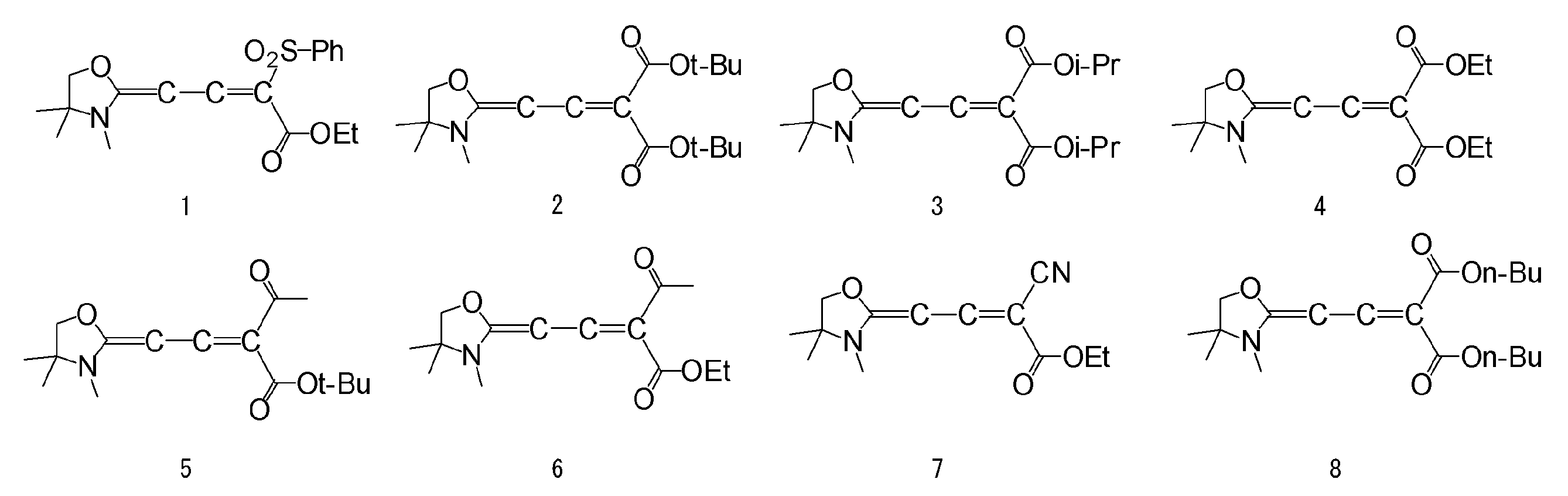
<8>光重合開始剤としてオキシム化合物を含む、<1>~<7>のいずれかに記載の感光性樹脂組成物。
<9>さらに、波長500nmにおける屈折率1.80~2.80の粒子を含む、<1>~<8>のいずれかに記載の感光性樹脂組成物。
<10>前記粒子が、二酸化チタンおよび/または酸化ジルコニウムである、<9>に記載の感光性樹脂組成物。
<11>染料および/または顔料を含有する、<1>~<10>のいずれかに記載の感光性樹脂組成物。
<12>さらに、アルカリ可溶性樹脂を含む、<1>~<11>のいずれかに記載の感光性樹脂組成物。
<13>前記感光性樹脂組成物が、固体撮像素子または液晶表示装置の画素形成に用いられる、<1>~<12>のいずれかに記載の感光性樹脂組成物。
<14><1>~<13>のいずれかに記載の感光性樹脂組成物を硬化してなる硬化膜。
<15>一般式(I)で表される紫外線吸収剤の含有量が硬化膜の0.01質量%以下である、<15>に記載の硬化膜。
<16><1>~<13>のいずれかに記載の感光性樹脂組成物を塗布し、形成された層を少なくとも紫外線でフォトマスクを介して露光し、現像することによりパターンを形成し、形成されたパターンをポストベークすることを含む画素形成方法。
<17><16>に記載の画素形成方法により作製された画素を有するカラーフィルタ。
<18><17>に記載のカラーフィルタを有する固体撮像素子または液晶表示装置。
<19>一般式(III)で表される紫外線吸収剤。
一般式(III)

(一般式(III)において、R1、R2およびR3は、それぞれ、水素原子または炭素原子数1~10のアルキル基を表す。R41およびR51は、それぞれ、2級または3級アルキルエステル基を表わす。)
<1>下記一般式(I)で表される紫外線吸収剤と、光重合開始剤と、重合性モノマーとを含有する感光性樹脂組成物。
一般式(I)
<2>前記一般式(I)が、下記一般式(II)で表される、請求項1に記載の感光性樹脂組成物。
一般式(II)
<3>前記一般式(I)または一般式(II)におけるR4が-SO2R6または-CO2R6である、<1>または<2>に記載の感光性樹脂組成物。
<4>前記感光性樹脂組成物の全固形分に対する、一般式(I)で表される紫外線吸収剤の配合量が、2~16質量%である、<1>~<3>のいずれかに記載の感光性樹脂組成物。
<5>一般式(I)で表される紫外線吸収剤の分子量が150~850である、<1>~<4>のいずれかに記載の感光性樹脂組成物。
<6>前記一般式(I)が、下記一般式(III)で表される、<1>、<4>および<5>のいずれかに記載の感光性樹脂組成物。
一般式(III)
<7>一般式(I)で表される紫外線吸収剤が、下記化合物(1)~(8)のいずれかで表される化合物である、<1>~<6>のいずれかに記載の感光性樹脂組成物。
<9>さらに、波長500nmにおける屈折率1.80~2.80の粒子を含む、<1>~<8>のいずれかに記載の感光性樹脂組成物。
<10>前記粒子が、二酸化チタンおよび/または酸化ジルコニウムである、<9>に記載の感光性樹脂組成物。
<11>染料および/または顔料を含有する、<1>~<10>のいずれかに記載の感光性樹脂組成物。
<12>さらに、アルカリ可溶性樹脂を含む、<1>~<11>のいずれかに記載の感光性樹脂組成物。
<13>前記感光性樹脂組成物が、固体撮像素子または液晶表示装置の画素形成に用いられる、<1>~<12>のいずれかに記載の感光性樹脂組成物。
<14><1>~<13>のいずれかに記載の感光性樹脂組成物を硬化してなる硬化膜。
<15>一般式(I)で表される紫外線吸収剤の含有量が硬化膜の0.01質量%以下である、<15>に記載の硬化膜。
<16><1>~<13>のいずれかに記載の感光性樹脂組成物を塗布し、形成された層を少なくとも紫外線でフォトマスクを介して露光し、現像することによりパターンを形成し、形成されたパターンをポストベークすることを含む画素形成方法。
<17><16>に記載の画素形成方法により作製された画素を有するカラーフィルタ。
<18><17>に記載のカラーフィルタを有する固体撮像素子または液晶表示装置。
<19>一般式(III)で表される紫外線吸収剤。
一般式(III)
得られる画素(感光性樹脂組成物の硬化膜)の透明性が高く、屈折率が高く、さらに、画素形成の際に、現像残渣が少ない感光性組成物を提供可能になった。
以下において、本発明の内容について詳細に説明する。以下に記載する構成要件の説明は、本発明の代表的な実施態様に基づいてなされることがあるが、本発明はそのような実施態様に限定されるものではない。なお、本明細書において「~」を用いて表される数値範囲は、「~」の前後に記載される数値を下限値及び上限値として含む範囲を意味する。
なお、本明細書中において、“(メタ)アクリレート”はアクリレートおよびメタクリレートを表し、“(メタ)アクリル”はアクリルおよびメタクリルを表し、“(メタ)アクリロイル”はアクリロイルおよびメタクリロイルを表す。また、本明細書中において、“単量体”と“モノマー”とは同義である。本発明における単量体は、オリゴマーおよびポリマーと区別され、重量平均分子量が2,000以下の化合物をいう。本明細書中において、重合性化合物とは、重合性官能基を有する化合物のことをいい、単量体であっても、ポリマーであってもよい。重合性官能基とは、重合反応に関与する基を言う。
本明細書における基(原子団)の表記において、置換及び無置換を記していない表記は置換基を有さないものと共に置換基を有するものをも包含するものである。例えば「アルキル基」とは、置換基を有さないアルキル基(無置換アルキル基)のみならず、置換基を有するアルキル基(置換アルキル基)をも包含するものである。
なお、本明細書中において、“(メタ)アクリレート”はアクリレートおよびメタクリレートを表し、“(メタ)アクリル”はアクリルおよびメタクリルを表し、“(メタ)アクリロイル”はアクリロイルおよびメタクリロイルを表す。また、本明細書中において、“単量体”と“モノマー”とは同義である。本発明における単量体は、オリゴマーおよびポリマーと区別され、重量平均分子量が2,000以下の化合物をいう。本明細書中において、重合性化合物とは、重合性官能基を有する化合物のことをいい、単量体であっても、ポリマーであってもよい。重合性官能基とは、重合反応に関与する基を言う。
本明細書における基(原子団)の表記において、置換及び無置換を記していない表記は置換基を有さないものと共に置換基を有するものをも包含するものである。例えば「アルキル基」とは、置換基を有さないアルキル基(無置換アルキル基)のみならず、置換基を有するアルキル基(置換アルキル基)をも包含するものである。
以下、本発明の感光性樹脂組成物、カラーフィルタ及びその製造方法、固体撮像素子および液晶表示装置について詳述する。以下に記載する構成要件の説明は、本発明の代表的な実施態様に基づいてなされることがあるが、本発明はそのような実施態様に限定されるものではない。
本発明の感光性樹脂組成物(以下、単に、「本発明の組成物」ということがある)は、上記一般式(I)で表される紫外線吸収剤と、光重合開始剤と、重合性モノマーとを含有することと特徴とする。このような構成とすることにより、カラーフィルタの画素形成に適した感光性樹脂組成物が得られる。画素は、赤、緑、青等のカラーの画素であってもよく、白の画素(ホワイトピクセル)であってもよく、本発明では白の画素に特に適している。
以下、本発明の組成物の詳細について説明する。
以下、本発明の組成物の詳細について説明する。
<一般式(I)で表される紫外線吸収剤>
本発明では一般式(I)で表される紫外線吸収剤を配合する。一般式(I)で表される紫外線吸収剤は、250nmから400nmの間に吸収極大を有する化合物であることが好ましい。このような成分を配合することにより、現像した際の現像残渣が小さく、屈折率が高く、透明度の高い硬化膜を得ることができる。
一般式(I)

(一般式(I)において、R1、R2およびR3は、それぞれ、水素原子または炭素原子数1~10のアルキル基を表す。R4およびR5は、一方は、電子吸引基を表し、他方は、-SO2R6、-CO2R6、-COR6、-CNまたは-CONR6R7を表す。R6およびR7は、それぞれ、水素原子、炭素原子数1~8のアルキル基またはアリール基を表す。)
一般式(I)における、アルキル基は、無置換のアルキル基であり、アリール基は無置換のアリール基である。
本発明では一般式(I)で表される紫外線吸収剤を配合する。一般式(I)で表される紫外線吸収剤は、250nmから400nmの間に吸収極大を有する化合物であることが好ましい。このような成分を配合することにより、現像した際の現像残渣が小さく、屈折率が高く、透明度の高い硬化膜を得ることができる。
一般式(I)
一般式(I)における、アルキル基は、無置換のアルキル基であり、アリール基は無置換のアリール基である。
R1、R2およびR3は、それぞれ、水素原子または炭素原子数1~10のアルキル基を表し、炭素数1~10のアルキル基が好ましい。ここで、アルキル基は、直鎖、分岐および環状のいずれのアルキル基でもよいが、直鎖または分岐のアルキル基であることが好ましく、直鎖のアルキル基であることがより好ましい。より具体的には、R1およびR2は、それぞれ、炭素数1~4のアルキル基が好ましく、メチル基、エチル基、イソプロピル基、ブチル基、sec-ブチル基およびtert-ブチル基がより好ましく、メチル基がさらに好ましい。
R4およびR5は、一方は、電子吸引基を表し、他方は、-SO2R6、-CO2R6、-COR6、-CNまたは-CONR6R7を表す。
電子吸引基は、-SO2NR6R7、-NO2、-CN、-SO2R6、-CO2R6、-COR6、-CNまたは-CONR6R7が好ましく、-CN、-SO2R6、-CO2R6、-COR6、-CNまたは-CONR6R7がより好ましく、-SO2R6または-CO2R6がさらに好ましく、-CO2R6が特に好ましい。
R4およびR5のうち、他方は、-SO2R6、-CO2R6、-COR6、-CNまたは-CONR6R7であり、-SO2R6または-CO2R6がさらに好ましく、-CO2R6が特に好ましい。
電子吸引基は、-SO2NR6R7、-NO2、-CN、-SO2R6、-CO2R6、-COR6、-CNまたは-CONR6R7が好ましく、-CN、-SO2R6、-CO2R6、-COR6、-CNまたは-CONR6R7がより好ましく、-SO2R6または-CO2R6がさらに好ましく、-CO2R6が特に好ましい。
R4およびR5のうち、他方は、-SO2R6、-CO2R6、-COR6、-CNまたは-CONR6R7であり、-SO2R6または-CO2R6がさらに好ましく、-CO2R6が特に好ましい。
R6およびR7は、それぞれ、水素原子、炭素原子数1~8のアルキル基またはアリール基を表し、水素原子、炭素原子数1~8のアルキル基またはフェニル基が好ましく、水素原子、炭素数1~4のアルキル基またはフェニル基がより好ましい。ここで、アルキル基は、直鎖、分岐および環状のいずれのアルキル基でもよいが、直鎖または分岐のアルキル基であることが好ましく、直鎖のアルキル基であることがより好ましい。具体的には、炭素数1~8のアルキル基としては、メチル基、エチル基、イソプロピル基、ブチル基、sec-ブチル基、tert-ブチル基、ペンチル基、tert-ペンチル基、ヘキシル基、オクチル基、2-エチルヘキシル基、tert-オクチル基が好ましく、メチル基、エチル基、イソプロピル基、ブチル基、sec-ブチル基、tert-ブチル基がより好ましい。
ポストベーク後の透過率をより向上させるという観点からは、R6およびR7は、炭素数3もしくは4の2級もしくは3級アルキル基(例えば、イソプロピル基、sec-ブチル基、tert-ブチル基)が好ましい。
ポストベーク後の透過率をより向上させるという観点からは、R6およびR7は、炭素数3もしくは4の2級もしくは3級アルキル基(例えば、イソプロピル基、sec-ブチル基、tert-ブチル基)が好ましい。
一般式(I)は、下記一般式(II)で表されることが好ましい。
一般式(II)

(一般式(II)において、R3は、水素原子または炭素原子数1~10のアルキル基を表し、R4は、-SO2R6、-CO2R6、-COR6、-CNまたは-CONR6R7を表す。R6およびR7は、それぞれ、水素原子、炭素原子数1~8のアルキル基またはフェニル基を表す。)
一般式(II)
上記一般式(II)における、R3、R4、R6およびR7は、それぞれ、一般式(I)における、R3、R4、R6およびR7と同義であり、好ましい範囲も同様である。特に好ましい態様として、前記一般式(II)におけるR4が-SO2R6または-CO2R6である態様が例示される。
一般式(I)は下記一般式(III)で表されることも好ましい。一般式(III)で表される紫外線吸収剤は、感光性樹脂組成物以外の用途における紫外線吸収剤としても好ましく用いられる。
一般式(III)

(一般式(III)において、R1、R2およびR3は、それぞれ、水素原子または炭素原子数1~10のアルキル基を表す。R41およびR51は、それぞれ、2級または3級アルキルエステル基を表わす。)
一般式(III)
上記一般式(III)における、R3、R4、R6およびR7は、それぞれ、一般式(I)における、R3、R4、R6およびR7と同義であり、好ましい範囲も同様である。
一般式(I)で表される紫外線吸収剤の分子量は150~850であることが好ましく、150~650であることがより好ましく、150~450であることがさらに好ましい。このような範囲とすることにより、本発明の効果がより効果的に発揮される。
以下に、一般式(I)で表される紫外線吸収剤の好ましい具体例を示す。但し、本発明においては、これらに制限されるものではない。下記表における、Meはメチル基を、Phはフェニル基を、Etはエチル基を、Buはブチル基を、Prはプロピル基を、それぞれ示している。本発明では、特に、下記化合物1~8が好ましい。

本発明の感光性樹脂組成物の全固形分に対する、一般式(I)で表される紫外線吸収剤の配合量は、0.01質量%~30質量%が好ましく、0.1質量%~20質量%がより好ましく、2~16質量%であることがさらに好ましく、2~10質量%であることがよりさらに好ましい。一般式(I)で表される紫外線吸収剤の含有量を0.01質量%以上とすることにより、露光時の光遮蔽能力が良好で重合の進み過ぎによるパターン線幅の太りを防止して所期の線幅をより得やすく、周辺残渣(現像残渣)の発生もより抑えられる。また、30質量%以下とすると、露光時の光遮蔽能力が強過ぎず重合がより良好に進行する。特に本発明では、一般式(I)紫外線吸収剤の配合量を、全固形分に対し、2~16質量%とすることにより、本発明の効果が顕著に効果的に発揮される。
本発明で用いる一般式(I)で表される紫外線吸収剤は、1種類のみを用いても良いし、2種類以上を用いても良い。2種類以上用いる場合、合計量が上記配合量となることが好ましい。
本発明で用いる一般式(I)で表される紫外線吸収剤は、1種類のみを用いても良いし、2種類以上を用いても良い。2種類以上用いる場合、合計量が上記配合量となることが好ましい。
一般式(I)で示される紫外線吸収剤は、特公昭44-29620号、特開53-128333号、特開昭61-169831、特開昭63-53543、特開昭63-53544号、特開昭63-56651号、特開2009-96973号の各公報、およびこれらの引用文献に記載の方法などを参考にすることにより合成することができる。
本発明の感光性樹脂組成物は、上記一般式(I)で表される紫外線吸収剤以外の紫外線吸収剤を含んでいても良いが、一般式(I)で表される紫外線吸収剤以外の紫外線吸収剤を実質的に含まない方が好ましい。実質的に含まないとは、例えば、一般式(I)で表される紫外線吸収剤の配合量の10質量%以下であることをいい、さらには、1質量%以下であることをいう。
<光重合開始剤>
本発明の感光性樹脂組成物は、光重合開始剤の少なくとも1種を含有する。光重合開始剤としては、例えば、オキシム化合物、有機ハロゲン化化合物、オキシジアゾール化合物、カルボニル化合物、ケタール化合物、ベンゾイン化合物、アクリジン化合物、有機過酸化化合物、アゾ化合物、クマリン化合物、アジド化合物、メタロセン化合物、ヘキサアリールビイミダゾール化合物、有機ホウ酸塩化合物、ジスルホン化合物、オニウム塩化合物、アシルホスフィン(オキシド)化合物が挙げられる。高い光吸収性を有し高感度化の観点からオキシム化合物が好ましい。
本発明の感光性樹脂組成物は、光重合開始剤の少なくとも1種を含有する。光重合開始剤としては、例えば、オキシム化合物、有機ハロゲン化化合物、オキシジアゾール化合物、カルボニル化合物、ケタール化合物、ベンゾイン化合物、アクリジン化合物、有機過酸化化合物、アゾ化合物、クマリン化合物、アジド化合物、メタロセン化合物、ヘキサアリールビイミダゾール化合物、有機ホウ酸塩化合物、ジスルホン化合物、オニウム塩化合物、アシルホスフィン(オキシド)化合物が挙げられる。高い光吸収性を有し高感度化の観点からオキシム化合物が好ましい。
オキシム化合物としては、特開2012-208494号公報の段落番号0513(対応する米国特許出願公開第2012/235099号明細書の[0632])以降の式(OX-1)、(OX-2)または(OX-3)で表される化合物の説明を参酌でき、これらの内容は本願明細書に組み込まれる。
オキシム化合物の具体例としては、2-(O-ベンゾイルオキシム)-1-[4-(フェニルチオ)フェニル]-1,2-ブタンジオン、2-(O-ベンゾイルオキシム)-1-[4-(フェニルチオ)フェニル]-1,2-ペンタンジオン、2-(O-ベンゾイルオキシム)-1-[4-(フェニルチオ)フェニル]-1,2-ヘキサンジオン、2-(O-ベンゾイルオキシム)-1-[4-(フェニルチオ)フェニル]-1,2-ヘプタンジオン、2-(O-ベンゾイルオキシム)-1-[4-(フェニルチオ)フェニル]-1,2-オクタンジオン、2-(O-ベンゾイルオキシム)-1-[4-(メチルフェニルチオ)フェニル]-1,2-ブタンジオン、2-(O-ベンゾイルオキシム)-1-[4-(エチルフェニルチオ)フェニル]-1,2-ブタンジオン、2-(O-ベンゾイルオキシム)-1-[4-(ブチルフェニルチオ)フェニル]-1,2-ブタンジオン、1-(O-アセチルオキシム)-1-[9-エチル-6-(2-メチルベンゾイル)-9H-カルバゾール-3-イル]エタノン、1-(O-アセチルオキシム)-1-[9-メチル-6-(2-メチルベンゾイル)-9H-カルバゾール-3-イル]エタノン、1-(O-アセチルオキシム)-1-[9-プロピル-6-(2-メチルベンゾイル)-9H-カルバゾール-3-イル]エタノン、1-(O-アセチルオキシム)-1-[9-エチル-6-(2-エチルベンゾイル)-9H-カルバゾール-3-イル]エタノン、1-(O-アセチルオキシム)-1-[9-エチル-6-(2-ブチルベンゾイル)-9H-カルバゾール-3-イル]エタノンなどが挙げられる。但し、これらに限定されない。
オキシム化合物の特に好ましい具体例としては、2-(o-ベンゾイルオキシム)-1-[4-(フェニルチオ)フェニル]-1,2-オクタンジオン、1-(o-アセチルオキシム)-1-[9-エチル-6-(2-メチルベンゾイル)-9H-カルバゾール-3-イル]エタノンが挙げられる。市販品としては、BASF社製 IRGACURE OXE 01(1.2-オクタンジオン,1-[4-(フェニルチオ)-,2-(o-ベンゾイルオキシム)])、IRGACURE OXE 02(エタノン,1-[9-エチル-6-(2-メチルベンゾイル)-9H-カルバゾール-3-イル]-,1-(o-アセチルオキシム))、TR-PBG-304(常州強力電子新材料有限公司社製)等が好適なものとして挙げられる。
有機ハロゲン化化合物としては、具体的には、若林等、「Bull Chem.Soc Japan」42、2924(1969)、米国特許第3,905,815号明細書、特公昭46-4605号公報、特開昭48-36281号公報、特開昭55-32070号公報、特開昭60-239736号公報、特開昭61-169835号公報、特開昭61-169837号公報、特開昭62-58241号公報、特開昭62-212401号公報、特開昭63-70243号公報、特開昭63-298339号公報、M.P.Hutt"Jurnal of Heterocyclic Chemistry"1(No3),(1970)」に記載の化合物が挙げられ、これらの内容は本願明細書に組み込まれる。特に、トリハロメチル基が置換したオキサゾール化合物、s-トリアジン化合物が挙げられる。
前記s-トリアジン化合物としてより好ましくは、少なくとも1つのモノ、ジ、またはトリハロゲン置換メチル基がs-トリアジン環に結合したs-トリアジン誘導体が挙げられる。例えば、ハロメチルトリアジン化合物が例示され、さらには、特開2012-255148号公報の段落番号0132の化合物が例示され、これらの内容は本願明細書に組み込まれる。
オキシジアゾール化合物としては、例えば、特開2012-255148号公報の段落番号0133の化合物が例示され、これらの内容は本願明細書に組み込まれる。
カルボニル化合物としては、例えば、特開2012-255148号公報の段落番号0134の化合物が例示され、これらの内容は本願明細書に組み込まれる。
ケタール化合物としては、例えば、ベンジルメチルケタール、ベンジル-β-メトキシエチルエチルアセタールなどを挙げることができる。
ベンゾイン化合物としては、例えば、特開2012-255148号公報の段落番号0136の化合物が例示され、これらの内容は本願明細書に組み込まれる。
アクリジン化合物としては、例えば、9-フェニルアクリジン、1,7-ビス(9-アクリジニル)ヘプタンなどを挙げることができる。
有機過酸化化合物としては、例えば、特開2012-255148号公報の段落番号0138の化合物が例示され、これらの内容は本願明細書に組み込まれる。
アゾ化合物としては、例えば、特開平8-108621号公報に記載のアゾ化合物等を挙げることができる。
クマリン化合物としては、例えば、3-メチル-5-アミノ-((s-トリアジン-2-イル)アミノ)-3-フェニルクマリン、3-クロロ-5-ジエチルアミノ-((s-トリアジン-2-イル)アミノ)-3-フェニルクマリン、3-ブチル-5-ジメチルアミノ-((s-トリアジン-2-イル)アミノ)-3-フェニルクマリン等を挙げることができる。
アジド化合物としては、例えば、米国特許第2848328号明細書、米国特許第2852379号明細書並びに米国特許第2940853号明細書に記載の有機アジド化合物、2,6-ビス(4-アジドベンジリデン)-4-エチルシクロヘキサノン(BAC-E)等が挙げられる。
メタロセン化合物としては、例えば、特開2012-255148号公報の段落番号0142の化合物が例示され、これらの内容は本願明細書に組み込まれる。
ヘキサアリールビイミダゾール化合物としては、例えば、特開2012-255148号公報の段落番号0143の化合物が例示され、これらの内容は本願明細書に組み込まれる。
有機ホウ酸塩化合物としては、例えば、特開昭62-143044号、特開昭62-150242号、特開平9-188685号、特開平9-188686号、特開平9-188710号、特開2000-131837、特開2002-107916、特許第2764769号、特願2000-310808号、等の各公報、および、Kunz,Martin“Rad Tech’98.Proceeding April 19-22,1998,Chicago”等に記載の有機ホウ酸塩、特開平6-157623号公報、特開平6-175564号公報、特開平6-175561号公報に記載の有機ホウ素スルホニウム錯体あるいは有機ホウ素オキソスルホニウム錯体、特開平6-175554号公報、特開平6-175553号公報に記載の有機ホウ素ヨードニウム錯体、特開平9-188710号公報に記載の有機ホウ素ホスホニウム錯体、特開平6-348011号公報、特開平7-128785号公報、特開平7-140589号公報、特開平7-306527号公報、特開平7-292014号公報等に記載の有機ホウ素遷移金属配位錯体等が具体例として挙げられる。
ジスルホン化合物としては、例えば、特開昭61-166544号公報、特開2002-328465号公報(特願2001-132318号)等に記載の化合物等が挙げられる。
オニウム塩化合物としては、例えば、S.I.Schlesinger,Photogr.Sci.Eng.,18,387(1974)、T.S.Bal et al,Polymer,21,423(1980)に記載のジアゾニウム塩、米国特許第4,069,055号明細書、特開平4-365049号公報等に記載のアンモニウム塩、米国特許第4,069,055号、同4,069,056号の各明細書に記載のホスホニウム塩、欧州特許第104、143号、米国特許第339,049号、同第410,201号の各明細書、特開平2-150848号、特開平2-296514号の各公報に記載のヨードニウム塩などが挙げられる。
前記ヨードニウム塩は、ジアリールヨードニウム塩であり、安定性の観点から、アルキル基、アルコキシ基、アリーロキシ基等の電子供与性基で2つ以上置換されていることが好ましい。
また、スルホニウム塩の形態として、トリアリールスルホニウム塩の1つの置換基がクマリン、アントラキノン構造を有し、300nm以上に吸収を有するヨードニウム塩などが好ましい。
また、スルホニウム塩の形態として、トリアリールスルホニウム塩の1つの置換基がクマリン、アントラキノン構造を有し、300nm以上に吸収を有するヨードニウム塩などが好ましい。
前記スルホニウム塩としては、欧州特許第370,693号、同390,214号、同233,567号、同297,443号、同297,442号、米国特許第4,933,377号、同161,811号、同410,201号、同339,049号、同4,760,013号、同4,734,444号、同2,833,827号、独国特許第2,904,626号、同3,604,580号、同3,604,581号の各明細書に記載のスルホニウム塩が挙げられ、安定性の感度点から好ましくは電子吸引性基で置換されていることが好ましい。電子吸引性基としては、ハメット値が0より大きいことが好ましい。好ましい電子吸引性基としては、ハロゲン原子、カルボン酸などが挙げられる。
また、その他の好ましいスルホニウム塩としては、トリアリールスルホニウム塩の1つの置換基がクマリン、アントラキノン構造を有し、300nm以上に吸収を有するスルホニウム塩が挙げられる。別の好ましいスルホニウム塩としては、トリアリールスルホニウム塩が、アリロキシ基、アリールチオ基を置換基に有する300nm以上に吸収を有するスルホニウム塩が挙げられる。
また、その他の好ましいスルホニウム塩としては、トリアリールスルホニウム塩の1つの置換基がクマリン、アントラキノン構造を有し、300nm以上に吸収を有するスルホニウム塩が挙げられる。別の好ましいスルホニウム塩としては、トリアリールスルホニウム塩が、アリロキシ基、アリールチオ基を置換基に有する300nm以上に吸収を有するスルホニウム塩が挙げられる。
また、オニウム塩化合物としては、例えば、J.V.Crivello et al,Macromolecules,10(6),1307(1977)、J.V.Crivello et al,J.Polymer Sci.,Polymer Chem.Ed.,17,1047(1979)に記載のセレノニウム塩、C.S.Wen et al,Teh,Proc.Conf.Rad.Curing ASIA,p478 Tokyo,Oct(1988)に記載のアルソニウム塩等のオニウム塩等が挙げられる。
アシルホスフィン(オキシド)化合物としては、例えば、BASF社製のイルガキュア819、ダロキュア4265、ダロキュアTPOなどが挙げられる。
光重合開始剤は、1種類単独で使用してもよく、2種類以上を併用してもよい。感光性樹脂組成物の全固形分に対する光重合開始剤の合計含有量は、0.1~30質量%であることが好ましく、0.5~20質量%であることがより好ましく、1~8質量%であることがさらに好ましく、1~5質量%であることがよりさらに好ましい。
この光重合開始剤の含有量は、0.1質量%以上であるとパターンを良好に形成することができる。また、30質量%以下であれば現像残渣の発生もより抑えられる。
この光重合開始剤の含有量は、0.1質量%以上であるとパターンを良好に形成することができる。また、30質量%以下であれば現像残渣の発生もより抑えられる。
<重合性モノマー>
本発明の感光性樹脂組成物は、重合性モノマーを少なくとも1種含有する。重合性モノマーとしては、少なくとも1つの付加重合可能なエチレン性二重結合を有し、かつ常圧下で100℃以上の沸点を持つ化合物が好ましく、(メタ)アクリレートモノマーであって、常圧下で100℃以上の沸点を持つ化合物がより好ましい。
重合性モノマーは、前記光重合開始剤等と共に含有することにより、本発明の感光性樹脂組成物をネガ型に構成することができる。
本発明の感光性樹脂組成物は、重合性モノマーを少なくとも1種含有する。重合性モノマーとしては、少なくとも1つの付加重合可能なエチレン性二重結合を有し、かつ常圧下で100℃以上の沸点を持つ化合物が好ましく、(メタ)アクリレートモノマーであって、常圧下で100℃以上の沸点を持つ化合物がより好ましい。
重合性モノマーは、前記光重合開始剤等と共に含有することにより、本発明の感光性樹脂組成物をネガ型に構成することができる。
水素結合性基を有するモノマー(以下、「水素結合性基含有モノマー」ともいう)がより好ましい。
具体的には、前記水素結合性基としては、ヒドロキシル基、カルボキシル基、アミノ基、ウレイド基、アルコキシカルボニルアミノ基、スルホ基、スルホンアミド基、アミド基等が挙げられる。これらの中でも、水素結合に供与する水素と、水素結合を受容する置換基の双方を持つものが好ましい。
パターンの矩形性の観点からは、前記水素結合性基としては、カルボキシル基、アルコキシカルボニルアミノ基、およびウレイド基から選ばれる少なくとも1種であることがより好ましい。
具体的には、前記水素結合性基としては、ヒドロキシル基、カルボキシル基、アミノ基、ウレイド基、アルコキシカルボニルアミノ基、スルホ基、スルホンアミド基、アミド基等が挙げられる。これらの中でも、水素結合に供与する水素と、水素結合を受容する置換基の双方を持つものが好ましい。
パターンの矩形性の観点からは、前記水素結合性基としては、カルボキシル基、アルコキシカルボニルアミノ基、およびウレイド基から選ばれる少なくとも1種であることがより好ましい。
また、前記水素結合性基含有モノマーは、多官能モノマー(以下、「多官能重合性モノマー」ともいう)であることが好ましい。
以下、水素結合性基を含有する多官能重合性モノマーの具体例について説明する。
ヒドロキシル基を含有する多官能重合性モノマーとしては、ペンタエリスリトールトリアクリレート、ジペンタエリスリトールヘキサアクリレート、ECH変性エチレングリコールジアクリレート、ECH変性グリセロールトリアクリレート、ECH変性フタル酸ジアクリレート、トリグリセロールジアクリレート、ECH変性トリメチロールプロパントリアクリレート等が挙げられる。
以下、水素結合性基を含有する多官能重合性モノマーの具体例について説明する。
ヒドロキシル基を含有する多官能重合性モノマーとしては、ペンタエリスリトールトリアクリレート、ジペンタエリスリトールヘキサアクリレート、ECH変性エチレングリコールジアクリレート、ECH変性グリセロールトリアクリレート、ECH変性フタル酸ジアクリレート、トリグリセロールジアクリレート、ECH変性トリメチロールプロパントリアクリレート等が挙げられる。
カルボキシル基を含有する多官能重合性モノマーとしては、下記一般式(III-1)または一般式(III-2)で表される化合物が挙げられる。但し、本発明においては、これらに制限されるものではない。
なお、下記一般式において、TまたはGがオキシアルキレン基の場合には、炭素原子側の末端がR、XおよびWに結合する。
なお、下記一般式において、TまたはGがオキシアルキレン基の場合には、炭素原子側の末端がR、XおよびWに結合する。

一般式(III-1)において、nは0~14の整数であり、mは1~8の整数である。一般式(III-2)において、Wは一般式(III-1)と同義のRまたはXであり、6個のWのうち、3個以上5個以下のWがRである。pは0~14の整数であり、qは1~8の整数である。一分子内に複数存在するR、X、T、Gは、それぞれ、同一であっても、異なっていてもよい。
以下、前記一般式(III-1)または一般式(III-2)で表される化合物の具体例としては、特開2010-049029号公報の段落番号0175~0179の記載を参酌でき、これらの内容は本願明細書に組み込まれる。
以上で説明したカルボキシル基を含有する多官能重合性モノマーと、後述する他のモノマーと、の組み合わせとしては、東亜合成化学(株)製のTO-2359、TO-2360、TO-2348、またはTO-756が市販されている。
アルコキシカルボニルアミノ基を有する多官能モノマーとしては、新中村化学工業(株)製のU-6LHA、U-6LYXA、U-12LMA等が挙げられる。
アミド基を有する多官能モノマーとしては、東亜合成製モノマーM-315、M-215等が挙げられる。
その他の水素結合性基を含有する多官能モノマーの具体的な例としては、特開2010-049029号公報の段落番号0178~0182の記載を参酌でき、これらの内容は本願明細書に組み込まれる。
アミド基を有する多官能モノマーとしては、東亜合成製モノマーM-315、M-215等が挙げられる。
その他の水素結合性基を含有する多官能モノマーの具体的な例としては、特開2010-049029号公報の段落番号0178~0182の記載を参酌でき、これらの内容は本願明細書に組み込まれる。
上記水素結合性基含有モノマーの中でも好ましくはカルボキシル基含有モノマー、アルコキシカルボニルアミノ基含有モノマー、ウレイド基含有モノマーであり、特に好ましくはカルボキシル基含有モノマーである。
本発明の感光性樹脂組成物は、上記の水素結合性基含有モノマーを全固形分中30質量%以上含有することにより、ポストベークによるパターン矩形性劣化を抑制することができる。本発明の感光性樹脂組成物の全固形分中における水素結合性基含有モノマーの含有量は、33質量%以上であることがより好ましく、35質量%以上であることが最も好ましい。
本発明では、上記重合性モノマー以外のモノマーとして、特開2010-049029号公報の段落番号0186に記載の重合性モノマーを配合することができ、これらの内容は本願明細書に組み込まれる。
中でも、重合性モノマーとしては、多官能(メタ)アクリル化合物が特に好ましく、水素結合性基を有しない多官能(メタ)アクリレートが最も好ましい。
中でも、重合性モノマーとしては、多官能(メタ)アクリル化合物が特に好ましく、水素結合性基を有しない多官能(メタ)アクリレートが最も好ましい。
重合性モノマーの、感光性樹脂組成物における含有量は、組成物の全固形分に対して、10~80質量%が好ましく、10~70質量%がより好ましく、10~60質量%が最も好ましい。全モノマーの含有量は、10質量%以上とすることにより良好な硬化膜が得られ、80質量%以下とすることにより現像残渣の発生をより効果的に抑制できる。
重合性モノマーは、1種類のみを用いても良いし、2種類以上を用いても良い。2種類以上用いる場合、合計量が上記配合量となることが好ましい。
重合性モノマーは、1種類のみを用いても良いし、2種類以上を用いても良い。2種類以上用いる場合、合計量が上記配合量となることが好ましい。
本発明の感光性樹脂組成物における重合性モノマーと一般式(I)で表される紫外線吸収剤との組み合わせとしては、現像残渣低減とパターン矩形性向上との両立の観点からは、以下の組み合わせが好ましい。
即ち、重合性モノマーが、カルボキシル基、アルコキシカルボニルアミノ基、およびウレイド基から選ばれる少なくとも1種の水素結合性基を含有する多官能モノマーであって、紫外線吸収剤が前記一般式(I)で表される化合物である組み合わせの形態が好ましい。
上記形態の中でも、本発明の感光性樹脂組成物が、モノマーとしてさらに、水素結合性基を有しない多官能(メタ)アクリレートを含む形態が特に好ましい。
即ち、重合性モノマーが、カルボキシル基、アルコキシカルボニルアミノ基、およびウレイド基から選ばれる少なくとも1種の水素結合性基を含有する多官能モノマーであって、紫外線吸収剤が前記一般式(I)で表される化合物である組み合わせの形態が好ましい。
上記形態の中でも、本発明の感光性樹脂組成物が、モノマーとしてさらに、水素結合性基を有しない多官能(メタ)アクリレートを含む形態が特に好ましい。
<樹脂>
本発明の感光性樹脂組成物は、必要に応じて、本発明の効果を損なわない範囲で樹脂を少なくとも1種含むことが好ましく、樹脂としては線状有機高分子重合体であることが好ましい。
線状有機高分子重合体としては、公知のものを任意に使用できる。好ましくは水現像或いは弱アルカリ水現像を可能とするために、水或いは弱アルカリ水に可溶性又は膨潤性である線状有機ポリマーが選択される。線状有機ポリマーは、水、弱アルカリ水或いは有機溶剤現像剤としての用途に応じて選択使用される。これらの中でも、アルカリ可溶性樹脂がより好ましい。
前記アルカリ可溶性樹脂は、アルカリ可溶性であれば特に限定はないが、耐熱性、現像性、入手性等の観点から選ばれることが好ましい。
本発明の感光性樹脂組成物は、必要に応じて、本発明の効果を損なわない範囲で樹脂を少なくとも1種含むことが好ましく、樹脂としては線状有機高分子重合体であることが好ましい。
線状有機高分子重合体としては、公知のものを任意に使用できる。好ましくは水現像或いは弱アルカリ水現像を可能とするために、水或いは弱アルカリ水に可溶性又は膨潤性である線状有機ポリマーが選択される。線状有機ポリマーは、水、弱アルカリ水或いは有機溶剤現像剤としての用途に応じて選択使用される。これらの中でも、アルカリ可溶性樹脂がより好ましい。
前記アルカリ可溶性樹脂は、アルカリ可溶性であれば特に限定はないが、耐熱性、現像性、入手性等の観点から選ばれることが好ましい。
前記アルカリ可溶性樹脂としては、線状有機高分子重合体であり、かつ溶剤に可溶で弱アルカリ水溶液で現像できるものが好ましい。このような線状有機高分子重合体としては、側鎖にカルボン酸を有するポリマー、例えば特開昭59-44615号、特公昭54-34327号、特公昭58-12577号、特公昭54-25957号、特開昭59-53836号、特開昭59-71048号の各公報に記載されているような、メタクリル酸共重合体、アクリル酸共重合体、イタコン酸共重合体、クロトン酸共重合体、マレイン酸共重合体、部分エステル化マレイン酸共重合体等が挙げられ、同様に側鎖にカルボン酸を有する酸性セルロース誘導体が有用である。
上記のほか、前記アルカリ可溶性樹脂としては、水酸基を有するポリマーに酸無水物を付加させたもの等や、ポリヒドロキシスチレン系樹脂、ポリシロキサン系樹脂、ポリ(2-ヒドロキシエチル(メタ)アクリレート)、ポリビニルピロリドンやポリエチレンオキサイド、ポリビニルアルコール、等も有用である。
また、前記線状有機高分子重合体は、親水性を有するモノマーを共重合したものであってもよい。この例としては、アルコキシアルキル(メタ)アクリレート、ヒドロキシアルキル(メタ)アクリレート、グリセロール(メタ)アクリレート、(メタ)アクリルアミド、N-メチロールアクリルアミド、2級若しくは3級のアルキルアクリルアミド、ジアルキルアミノアルキル(メタ)アクリレート、モルホリン(メタ)アクリレート、N-ビニルピロリドン、N-ビニルカプロラクタム、ビニルイミダゾール、ビニルトリアゾール、メチル(メタ)アクリレート、エチル(メタ)アクリレート、分岐若しくは直鎖のプロピル(メタ)アクリレート、分岐若しくは直鎖のブチル(メタ)アクリレート、または、フェノキシヒドロキシプロピル(メタ)アクリレート、等が挙げられる。
なお、本明細書中において、(メタ)アクリレートはアクリレートまたはメタクリレートを表し、(メタ)アクリルはアクリルまたはメタクリルを表し、(メタ)アクリルアミドはアクリルアミドまたはメタクリルアミドを表す。
なお、本明細書中において、(メタ)アクリレートはアクリレートまたはメタクリレートを表し、(メタ)アクリルはアクリルまたはメタクリルを表し、(メタ)アクリルアミドはアクリルアミドまたはメタクリルアミドを表す。
その他、親水性を有するモノマーとしては、テトラヒドロフルフリル基、燐酸基、燐酸エステル基、4級アンモニウム塩基、エチレンオキシ鎖、プロピレンオキシ鎖、スルホン酸およびその塩に由来の基、モルホリノエチル基等を含むモノマー等も有用である。
また、アルカリ可溶性樹脂は、架橋効率を向上させるために、重合性基を側鎖に有しているものが特に好ましい。例えば、アリル基、(メタ)アクリル基、アリルオキシアルキル基等を側鎖に含有するポリマー等が有用である。
重合性基を有するポリマーの例としては、市販品のKSレジスト-106(大阪有機化学工業(株)製)、サイクロマーPシリーズ(サイクロマーP-ACAなど、ダイセル化学工業(株)製)等が挙げられる。また、硬化皮膜の強度を高めるために、アルコール可溶性ナイロンや2,2-ビス-(4-ヒドロキシフェニル)-プロパンとエピクロロヒドリンとのポリエーテル等も有用である。
これら各種アルカリ可溶性樹脂の中でも、耐熱性の観点からは、ポリヒドロキシスチレン系樹脂、ポリシロキサン系樹脂、アクリル系樹脂、アクリルアミド系樹脂、アクリル/アクリルアミド共重合体樹脂が好ましく、現像性制御の観点からは、アクリル系樹脂、アクリルアミド系樹脂、アクリル/アクリルアミド共重合体樹脂が好ましい。
前記アクリル系樹脂としては、例えば、ベンジル(メタ)アクリレート、(メタ)アクリル酸、ヒドロキシエチル(メタ)アクリレート、および(メタ)アクリルアミド等から選ばれるモノマーの重合により得られる共重合体や、市販品のKSレジスト-106(大阪有機化学工業(株)製)、サイクロマーPシリーズ(ダイセル化学工業(株)製)、アクリベースFF-187(藤倉化成(株)製)等が好ましい。
アルカリ可溶性樹脂としては、現像性、液粘度等の観点から、重量平均分子量(GPC法で測定されたポリスチレン換算値)が1000~2×10⁵の重合体が好ましく、2000~1×10⁵の重合体がより好ましく、5000~5×10⁴の重合体が特に好ましい。
本発明において、感光性樹脂組成物中における樹脂の含有量は、現像性等の観点から、感光性樹脂組成物の全固形分に対して、10~90質量%が好ましく、20~60質量%がさらに好ましく、25~50質量%が特に好ましい。
樹脂は、1種類のみを用いても良いし、2種類以上を用いても良い。2種類以上用いる場合、合計量が上記配合量となることが好ましい。
樹脂は、1種類のみを用いても良いし、2種類以上を用いても良い。2種類以上用いる場合、合計量が上記配合量となることが好ましい。
<粒子>
本発明の感光性樹脂組成物は、粒子を含んでいても良い。本発明で用いる粒子は、波長500nmにおける屈折率1.64以上の粒子(以下、「高屈折率粒子」ということがある)であることが好ましく、1.80~3.0の粒子であることがより好ましく、1.80~2.80の粒子であることがさらに好ましい。高屈折粒子の屈折率を上記上限値以下とすることにより硬化膜の透過率を変動率で特定の範囲内に保ちつつ、屈折率増加することができ好ましい。一方、その下限値を上記の値以上にすることで、他の色の画素との干渉を抑制・防止することができ好ましい。
本発明の感光性樹脂組成物は、粒子を含んでいても良い。本発明で用いる粒子は、波長500nmにおける屈折率1.64以上の粒子(以下、「高屈折率粒子」ということがある)であることが好ましく、1.80~3.0の粒子であることがより好ましく、1.80~2.80の粒子であることがさらに好ましい。高屈折粒子の屈折率を上記上限値以下とすることにより硬化膜の透過率を変動率で特定の範囲内に保ちつつ、屈折率増加することができ好ましい。一方、その下限値を上記の値以上にすることで、他の色の画素との干渉を抑制・防止することができ好ましい。
高屈折率粒子の1次粒子の重量平均径は、150nm以下であることが好ましく、100nm以下であることが更に好ましく、80nm以下であることが特に好ましい。下限値は特にないが、1nm以上であることが実際的である。層中での高屈折率粒子の重量平均径は、200nm以下であることが好ましく、150nm以下であることがより好ましく、100nm以下であることが更に好ましく、80nm以下であることが特に好ましい。下限は特にないが、1nm以上が好ましく、5nm以上がより好ましく、10nm以上がさらに好ましい。このように一次粒子の粒径範囲を層中での粒径範囲と異なる範囲として規定したのは、層中で一次粒子が凝集することを考慮したものである。なお、高屈折率粒子の重量平均径については、特に断らない限り、高屈折率粒子を構成する物質の屈折率測定方法は日本工業規格(JIS K 0062:1992)に準ずる。
高屈折率粒子の例としては、Ti、Zr、Sn、Sb、Cu、Fe、Mn、Pb、Cd、As、Cr、Hg、Zn、Al、Mg、Si、P及びSから選択される少なくとも一種の元素を有する金属酸化物を含む粒子が挙げられる。具体的には二酸化チタン、酸化錫、酸化インジウム、酸化亜鉛、または酸化ジルコニウムの粒子が挙げられる。中でも、二酸化チタン、酸化錫、酸化インジウム、または酸化ジルコニウムの粒子が特に好ましく、二酸化チタンおよび酸化ジルコニウムの粒子がより好ましい。
金属酸化物粒子は、これらの金属の酸化物を主成分とし、更に他の元素を含むことができる。主成分とは、粒子を構成する成分の中で最も含有量(質量%)が多い成分を意味する。他の元素の例としては、Ti、Zr、Sn、Sb、Cu、Fe、Mn、Pb、Cd、As、Cr、Hg、Zn、Al、Mg、Si、P及びS等が挙げられる。二酸化チタンを主成分とする無機微粒子の結晶構造は、ルチル、ルチル/アナターゼの混晶、アナターゼ、アモルファス構造が主成分であることが好ましく、特にルチル構造が主成分であることが好ましい。
金属酸化物粒子は、これらの金属の酸化物を主成分とし、更に他の元素を含むことができる。主成分とは、粒子を構成する成分の中で最も含有量(質量%)が多い成分を意味する。他の元素の例としては、Ti、Zr、Sn、Sb、Cu、Fe、Mn、Pb、Cd、As、Cr、Hg、Zn、Al、Mg、Si、P及びS等が挙げられる。二酸化チタンを主成分とする無機微粒子の結晶構造は、ルチル、ルチル/アナターゼの混晶、アナターゼ、アモルファス構造が主成分であることが好ましく、特にルチル構造が主成分であることが好ましい。
高屈折率粒子は表面処理されていることが好ましい。表面処理は、無機化合物又は有機化合物を用いて実施することができる。表面処理に用いる無機化合物の例としては、アルミナ、シリカ、酸化ジルコニウム及び酸化鉄が挙げられる。中でもアルミナ及びシリカが好ましい。表面処理に用いる有機化合物の例としては、ポリオール、アルカノールアミン、ステアリン酸、シランカップリング剤及びチタネートカップリング剤が挙げられる。
本発明の実施形態の一例として、二酸化チタンを主成分とする無機微粒子に、Co(コバルト)、Al(アルミニウム)及びZr(ジルコニウム)から選ばれる少なくとも1つの元素を含有するものが挙げられる。これにより、二酸化チタンが有する光触媒活性を抑えることができ、高屈折率層の耐候性をより効果的に改良することができる。
高屈折率粒子は2種類以上の表面処理を組み合わせて処理されていても構わない。金属酸化物粒子の形状は、米粒状、球形状、立方体状、紡錘形状或いは不定形状であることが好ましい。2種類以上の金属酸化物粒子を高屈折率層及び中屈折率層に併用してもよい。
高屈折率粒子は2種類以上の表面処理を組み合わせて処理されていても構わない。金属酸化物粒子の形状は、米粒状、球形状、立方体状、紡錘形状或いは不定形状であることが好ましい。2種類以上の金属酸化物粒子を高屈折率層及び中屈折率層に併用してもよい。
高屈折率粒子の組成物中の合計含有量は、全固形分中で、10質量%以上が好ましく、15質量%以上がより好ましく、15質量%以上が更に好ましい。上限としては、50質量%以下が好ましく、40質量%以下がより好ましく、35質量%以下が特に好ましい。
本発明における高屈折率粒子は分散物組成物として、感光性樹脂組成物に配合することが好ましい。これらの詳細は、特開2007-277514号公報の記載を参酌できる。特に好ましくは、特開2007-277514号公報の実施例に記載の分散樹脂を用いて分散することが好ましい。
<染料および/または顔料>
本発明の感光性樹脂組成物は、白(透明)パターンを形成する場合は、着色剤(公知の染料や顔料、カーボンブラックやチタンブラック等の黒色剤)を含まなくても良いが、赤、青、緑等のパターンを形成する場合は、染料および/または顔料を含む。染料および/顔料は1種のみでもよいし、2種類以上を併用してもよい。
顔料としては、例えば、特開2008-224982号公報段落番号〔0030〕~〔0044〕に記載の顔料や、C.I.Pigment Green 58、C.I.Pigment Blue 79のCl置換基をOHに変更したものなどが挙げられ、これらのなかでも、好ましく用いることができる顔料として、以下のものを挙げることができる。但し、本発明においてはこれらに限定されるものではない。
C.I.Pigment Yellow 11,24,108,109,110,138,139,150,151,154,167,180,185,
C.I.Pigment Orange 36,
C.I.Pigment Red 122,150,171,175,177,209,224,242,254、255
C.I.Pigment Violet 19,23,29、32,
C.I.Pigment Blue 15:1,15:3,15:6,16,22,60,66,
C.I.Pigment Green 7,36,37、58
C.I.Pigment Black 1
本発明の感光性樹脂組成物は、白(透明)パターンを形成する場合は、着色剤(公知の染料や顔料、カーボンブラックやチタンブラック等の黒色剤)を含まなくても良いが、赤、青、緑等のパターンを形成する場合は、染料および/または顔料を含む。染料および/顔料は1種のみでもよいし、2種類以上を併用してもよい。
顔料としては、例えば、特開2008-224982号公報段落番号〔0030〕~〔0044〕に記載の顔料や、C.I.Pigment Green 58、C.I.Pigment Blue 79のCl置換基をOHに変更したものなどが挙げられ、これらのなかでも、好ましく用いることができる顔料として、以下のものを挙げることができる。但し、本発明においてはこれらに限定されるものではない。
C.I.Pigment Yellow 11,24,108,109,110,138,139,150,151,154,167,180,185,
C.I.Pigment Orange 36,
C.I.Pigment Red 122,150,171,175,177,209,224,242,254、255
C.I.Pigment Violet 19,23,29、32,
C.I.Pigment Blue 15:1,15:3,15:6,16,22,60,66,
C.I.Pigment Green 7,36,37、58
C.I.Pigment Black 1
染料としては、特に制限はなく、公知の染料を適宜選択して使用できる。例えば、特開昭64-90403号公報、特開昭64-91102号公報、特開平1-94301号公報、特開平6-11614号公報、特登2592207号、米国特許第4,808,501号明細書、米国特許第5,667,920号明細書、米国特許第5,059,500号明細書、特開平5-333207号公報、特開平6-35183号公報、特開平6-51115号公報、特開平6-194828号公報、特開平8-211599号公報、特開平4-249549号公報、特開平10-123316号公報、特開平11-302283号公報、特開平7-286107号公報、特開2001-4823号公報、特開平8-15522号公報、特開平8-29771号公報、特開平8-146215号公報、特開平11-343437号公報、特開平8-62416号公報、特開2002-14220号公報、特開2002-14221号公報、特開2002-14222号公報、特開2002-14223号公報、特開平8-302224号公報、特開平8-73758号公報、特開平8-179120号公報、特開平8-151531号公報等に記載の色素である。
化学構造としては、ピラゾールアゾ系、アニリノアゾ系、トリフェニルメタン系、アントラキノン系、アンスラピリドン系、ベンジリデン系、オキソノール系、ピラゾロトリアゾールアゾ系、ピリドンアゾ系、シアニン系、フェノチアジン系、ピロロピラゾールアゾメチン系、キサンテン系、フタロシアニン系、ベンゾピラン系、インジゴ系等の染料が使用できる。
化学構造としては、ピラゾールアゾ系、アニリノアゾ系、トリフェニルメタン系、アントラキノン系、アンスラピリドン系、ベンジリデン系、オキソノール系、ピラゾロトリアゾールアゾ系、ピリドンアゾ系、シアニン系、フェノチアジン系、ピロロピラゾールアゾメチン系、キサンテン系、フタロシアニン系、ベンゾピラン系、インジゴ系等の染料が使用できる。
本発明の感光性組成物が染料および/または顔料を含む場合、染料および顔料の合計量は、組成物の全固形分の0.1~20質量%であることが好ましく、1~18質量%であることがより好ましい。
<溶剤>
本発明の感光性樹脂組成物は、一般には、溶剤を用いて構成することができる。
溶剤は、各成分の溶解性や感光性樹脂組成物の塗布性を満足すれば基本的には特に制限はないが、通常、有機溶剤であり、特に紫外線吸収剤、バインダーの溶解性、塗布性、安全性を考慮して選ばれることが好ましい。また、本発明の感光性樹脂組成物を調製する際には、1種類の溶剤でもよいし、2種類以上の溶剤を用いても良い。
本発明の感光性樹脂組成物は、一般には、溶剤を用いて構成することができる。
溶剤は、各成分の溶解性や感光性樹脂組成物の塗布性を満足すれば基本的には特に制限はないが、通常、有機溶剤であり、特に紫外線吸収剤、バインダーの溶解性、塗布性、安全性を考慮して選ばれることが好ましい。また、本発明の感光性樹脂組成物を調製する際には、1種類の溶剤でもよいし、2種類以上の溶剤を用いても良い。
溶剤としては、特開2010-049029号公報の段落番号0190~0194の記載が参酌でき、これらの内容は本願明細書に組み込まれる。
特に、本発明では、3-エトキシプロピオン酸メチル、3-エトキシプロピオン酸エチル(エトキシプロピオネート)、エチルセロソルブアセテート、乳酸エチル、ジエチレングリコールジメチルエーテル、酢酸ブチル、3-メトキシプロピオン酸メチル、2-ヘプタノン、シクロヘキサノン、エチルカルビトールアセテート、ブチルカルビトールアセテート、プロピレングリコールメチルエーテル、およびプロピレングリコールモノメチルエーテルアセテートから選択される溶剤が好ましい。
溶剤の感光性樹脂組成物中における含有量は、塗布性の観点から、組成物の全固形分濃度が5~90質量%になる量とすることが好ましく、5~87質量%がさらに好ましく、10~85質量%が特に好ましい。
<その他の添加物>
本発明の感光性樹脂組成物には、必要に応じて、各種添加物、例えば、増感剤、重合禁止剤、密着向上剤、界面活性剤、充填剤、上記以外の高分子化合物、酸化防止剤、凝集防止剤等を配合することかできる。これらの添加剤は、それぞれ、1種類のみを用いても良いし、2種類以上を用いても良い。
本発明の感光性樹脂組成物には、必要に応じて、各種添加物、例えば、増感剤、重合禁止剤、密着向上剤、界面活性剤、充填剤、上記以外の高分子化合物、酸化防止剤、凝集防止剤等を配合することかできる。これらの添加剤は、それぞれ、1種類のみを用いても良いし、2種類以上を用いても良い。
<<増感剤>>
本発明の組成物には、重合開始剤のラジカル発生効率の向上、感光波長の長波長化の目的で、増感剤を含有していてもよい。増感剤としては、併用する重合開始剤に対し、電子移動機構又はエネルギー移動機構で増感させるものが好ましい。増感剤の好ましい例としては、特開2008-214395号公報の段落番号〔0085〕~〔0098〕に記載された化合物を挙げることができる。増感剤の含有量は、感度と保存安定性の観点から、組成物の全固形分の質量に対し、0.1~30質量%の範囲が好ましく、1~20質量%の範囲がより好ましく、2~15質量%の範囲が更に好ましい。
本発明の組成物には、重合開始剤のラジカル発生効率の向上、感光波長の長波長化の目的で、増感剤を含有していてもよい。増感剤としては、併用する重合開始剤に対し、電子移動機構又はエネルギー移動機構で増感させるものが好ましい。増感剤の好ましい例としては、特開2008-214395号公報の段落番号〔0085〕~〔0098〕に記載された化合物を挙げることができる。増感剤の含有量は、感度と保存安定性の観点から、組成物の全固形分の質量に対し、0.1~30質量%の範囲が好ましく、1~20質量%の範囲がより好ましく、2~15質量%の範囲が更に好ましい。
<<重合禁止剤>>
本発明の組成物の製造中或いは保存中において、重合性化合物の不要な熱重合を阻止するために少量の重合禁止剤を添加することが望ましい。重合禁止剤としては、公知の熱重合防止剤を用いることができ、具体的には、ハイドロキノン、p-メトキシフェノール、ジ-t-ブチル-p-クレゾール、ピロガロール、t-ブチルカテコール、ベンゾキノン、4,4’-チオビス(3-メチル-6-t-ブチルフェノール)、2,2’-メチレンビス(4-メチル-6-t-ブチルフェノール)、N-ニトロソフェニルヒドロキシアミン第一セリウム塩等が挙げられる。
熱重合防止剤の添加量は、組成物の全固形分に対し約0.01~約5質量%が好ましい。
また必要に応じて、酸素による重合阻害を防止するためにベヘン酸やベヘン酸アミドのような高級脂肪酸誘導体等を添加して、塗布後の乾燥の過程で塗布膜の表面に偏在させてもよい。高級脂肪酸誘導体の添加量は、全組成物の約0.5~約10質量%が好ましい。
本発明の組成物の製造中或いは保存中において、重合性化合物の不要な熱重合を阻止するために少量の重合禁止剤を添加することが望ましい。重合禁止剤としては、公知の熱重合防止剤を用いることができ、具体的には、ハイドロキノン、p-メトキシフェノール、ジ-t-ブチル-p-クレゾール、ピロガロール、t-ブチルカテコール、ベンゾキノン、4,4’-チオビス(3-メチル-6-t-ブチルフェノール)、2,2’-メチレンビス(4-メチル-6-t-ブチルフェノール)、N-ニトロソフェニルヒドロキシアミン第一セリウム塩等が挙げられる。
熱重合防止剤の添加量は、組成物の全固形分に対し約0.01~約5質量%が好ましい。
また必要に応じて、酸素による重合阻害を防止するためにベヘン酸やベヘン酸アミドのような高級脂肪酸誘導体等を添加して、塗布後の乾燥の過程で塗布膜の表面に偏在させてもよい。高級脂肪酸誘導体の添加量は、全組成物の約0.5~約10質量%が好ましい。
<<密着向上剤>>
本発明の組成物には、支持体などの硬質表面との密着性を向上させるために、密着向上剤を添加することができる。密着向上剤としては、シラン系カップリング剤、チタンカップリング剤等が挙げられる。
シラン系カップリング剤としては、γ-メタクリロキシプロピルトリメトキシシラン、γ-メタクリロキシプロピルトリエトキシシラン、γ-アクリロキシプロピルトリメトキシシラン、γ-アクリロキシプロピルトリエトキシシラン、γ-メルカプトプロピルトリメトキシシラン、3-メタクリロキシプロピルジメトキシメチルシラン、γ-アミノプロピルトリエトキシシラン、フェニルトリメトキシシラン、が好ましく、γ-メタクリロキシプロピルトリメトキシシラン、3-メタクリロキシプロピルジメトキシメチルシラン、が好ましく挙げられる。
密着向上剤の添加量は、組成物の全固形分中0.5~30質量%が好ましく、0.7~20質量%がより好ましい。
本発明の組成物には、支持体などの硬質表面との密着性を向上させるために、密着向上剤を添加することができる。密着向上剤としては、シラン系カップリング剤、チタンカップリング剤等が挙げられる。
シラン系カップリング剤としては、γ-メタクリロキシプロピルトリメトキシシラン、γ-メタクリロキシプロピルトリエトキシシラン、γ-アクリロキシプロピルトリメトキシシラン、γ-アクリロキシプロピルトリエトキシシラン、γ-メルカプトプロピルトリメトキシシラン、3-メタクリロキシプロピルジメトキシメチルシラン、γ-アミノプロピルトリエトキシシラン、フェニルトリメトキシシラン、が好ましく、γ-メタクリロキシプロピルトリメトキシシラン、3-メタクリロキシプロピルジメトキシメチルシラン、が好ましく挙げられる。
密着向上剤の添加量は、組成物の全固形分中0.5~30質量%が好ましく、0.7~20質量%がより好ましい。
<<界面活性剤>>
本発明の組成物には、塗布性をより向上させる観点から、各種の界面活性剤を添加してもよい。界面活性剤としては、フッ素系界面活性剤、ノニオン系界面活性剤、カチオン系界面活性剤、アニオン系界面活性剤、シリコーン系界面活性剤などの各種界面活性剤を使用できる。
本発明の組成物には、塗布性をより向上させる観点から、各種の界面活性剤を添加してもよい。界面活性剤としては、フッ素系界面活性剤、ノニオン系界面活性剤、カチオン系界面活性剤、アニオン系界面活性剤、シリコーン系界面活性剤などの各種界面活性剤を使用できる。
特に、本発明の好ましい実施形態に係る組成物は、フッ素系界面活性剤を含有することで、塗布液として調製したときの液特性(特に、流動性)がより向上することから、塗布厚の均一性や省液性をより改善することができる。
即ち、フッ素系界面活性剤を含有する組成物を適用した塗布液を用いて膜形成する場合においては、被塗布面と塗布液との界面張力を低下させることにより、被塗布面への濡れ性が改善され、被塗布面への塗布性が向上する。このため、少量の液量で数μm程度の薄膜を形成した場合であっても、厚みムラの小さい均一厚の膜形成をより好適に行える点で有効である。
即ち、フッ素系界面活性剤を含有する組成物を適用した塗布液を用いて膜形成する場合においては、被塗布面と塗布液との界面張力を低下させることにより、被塗布面への濡れ性が改善され、被塗布面への塗布性が向上する。このため、少量の液量で数μm程度の薄膜を形成した場合であっても、厚みムラの小さい均一厚の膜形成をより好適に行える点で有効である。
フッ素系界面活性剤中のフッ素含有率は、3質量%~40質量%が好適であり、より好ましくは5質量%~30質量%であり、特に好ましくは7質量%~25質量%である。フッ素含有率がこの範囲内であるフッ素系界面活性剤は、塗布膜の厚さの均一性や省液性の点で効果的であり、組成物中における溶解性も良好である。
フッ素系界面活性剤としては、例えば、メガファックF171、同F172、同F173、同F176、同F177、同F141、同F142、同F143、同F144、同R30、同F437、同F475、同F479、同F482、同F554、同F780、同F781(以上、DIC(株)製)、フロラードFC430、同FC431、同FC171(以上、住友スリーエム(株)製)、サーフロンS-382、同SC-101、同SC-103、同SC-104、同SC-105、同SC1068、同SC-381、同SC-383、同S393、同KH-40(以上、旭硝子(株)製)、ソルスパース20000(日本ルーブリゾール(株)製)等が挙げられる。
その他、界面活性剤の例としては、特開2013-045088号公報の段落番号0485~0489の記載を参酌でき、これらの内容は本願明細書に組み込まれる。
界面活性剤は、1種のみを用いてもよいし、2種類以上を組み合わせてもよい。界面活性剤の添加量は、組成物の全固形分質量に対して、0.001質量%~2.0質量%が好ましく、より好ましくは0.005質量%~1.0質量%である。
界面活性剤は、1種のみを用いてもよいし、2種類以上を組み合わせてもよい。界面活性剤の添加量は、組成物の全固形分質量に対して、0.001質量%~2.0質量%が好ましく、より好ましくは0.005質量%~1.0質量%である。
その他の添加剤としては、特開2012-215806号公報の段落番号0382、0383に記載のものを配合でき、これらの内容は本願明細書に組み込まれる。
<画像形成方法>
本発明の画像形成方法は、本発明の感光性樹脂組成物を塗布し、形成された層を少なくとも紫外線でフォトマスクを介して露光し、現像することによりパターンを形成し、形成されたパターンをポストベークすることを含む。
本発明の画像形成方法は、本発明の感光性樹脂組成物を塗布し、形成された層を少なくとも紫外線でフォトマスクを介して露光し、現像することによりパターンを形成し、形成されたパターンをポストベークすることを含む。
本発明の感光性樹脂組成物を塗布し層を形成する工程は、スリット塗布、インクジェット法、回転塗布、流延塗布、ロール塗布、スクリーン印刷法等の各種の塗布方法を適用することができる。
感光性樹脂組成物からなる層の膜厚としては、0.1μm~10μmが好ましく、0.2μm~5μmがより好ましく、0.2μm~3μmがさらに好ましい。
感光性樹脂組成物からなる層の膜厚としては、0.1μm~10μmが好ましく、0.2μm~5μmがより好ましく、0.2μm~3μmがさらに好ましい。
感光性樹脂組成物からなる層の乾燥(プリベーク)は、ホットプレート、オーブン等で50℃~140℃の温度で10秒~300秒で行うことができる。
形成された層を少なくとも紫外線でフォトマスクを介して露光する工程は、例えば、ステッパー等の露光装置を用い、所定のマスクパターンを有するマスクを介してパターン露光する。
露光に際して用いることができる放射線(光)としては、特に、g線、i線等の紫外線が好ましく、i線がより好ましい。照射量(露光量)は30~1500mJ/cm2が好ましく50~1000mJ/cm2がより好ましく、80~500mJ/cm2が特に好ましい。
露光に際して用いることができる放射線(光)としては、特に、g線、i線等の紫外線が好ましく、i線がより好ましい。照射量(露光量)は30~1500mJ/cm2が好ましく50~1000mJ/cm2がより好ましく、80~500mJ/cm2が特に好ましい。
現像することによりパターンを形成する工程は、好ましくは、アルカリ現像処理によって行うことが好ましい。この工程により、露光工程における光未照射部分の感光性樹脂組成物層がアルカリ水溶液に溶出し、光硬化した部分だけが残る。
現像液としては、下地の撮像素子や回路などにダメージを起さない、有機アルカリ現像液が望ましい。現像温度としては通常20℃~30℃であり、現像時間は、従来は20秒~90秒であった。より残渣を除去するため、近年では120秒~180秒実施する場合もある。さらには、より残渣除去性を向上するため、現像液を60秒ごとに振り切り、さらに新たに現像液を供給する工程を数回繰り返す場合もある。
現像液としては、下地の撮像素子や回路などにダメージを起さない、有機アルカリ現像液が望ましい。現像温度としては通常20℃~30℃であり、現像時間は、従来は20秒~90秒であった。より残渣を除去するため、近年では120秒~180秒実施する場合もある。さらには、より残渣除去性を向上するため、現像液を60秒ごとに振り切り、さらに新たに現像液を供給する工程を数回繰り返す場合もある。
現像液に用いるアルカリ剤としては、例えば、アンモニア水、エチルアミン、ジエチルアミン、ジメチルエタノールアミン、テトラメチルアンモニウムヒドロキシド、テトラエチルアンモニウムヒドロキシド、コリン、ピロール、ピペリジン、1,8-ジアザビシクロ-[5,4,0]-7-ウンデセンなどの有機アルカリ性化合物が挙げられ、これらのアルカリ剤を濃度が0.001~10質量%、好ましくは0.01~1質量%となるように純水で希釈したアルカリ性水溶液が現像液として好ましく使用される。
なお、現像液には無機アルカリを用いてもよく、無機アルカリとしては、例えば、水酸化ナトリウム、水酸化カリウム、炭酸ナトリウム、炭酸水素ナトリウム、硅酸ナトリウム、メタ硅酸ナトリウムなどが好ましい。
なお、このようなアルカリ性水溶液からなる現像液を使用した場合には、一般に現像後純水で洗浄(リンス)する。
なお、現像液には無機アルカリを用いてもよく、無機アルカリとしては、例えば、水酸化ナトリウム、水酸化カリウム、炭酸ナトリウム、炭酸水素ナトリウム、硅酸ナトリウム、メタ硅酸ナトリウムなどが好ましい。
なお、このようなアルカリ性水溶液からなる現像液を使用した場合には、一般に現像後純水で洗浄(リンス)する。
次いで、乾燥を施した後に加熱処理(ポストベーク)を行うことが好ましい。多色の着色パターンを形成するのであれば、各色ごとに前記工程を順次繰り返して硬化皮膜を製造することができる。これによりカラーフィルタが得られる。
ポストベークは、硬化を完全なものとするための現像後の加熱処理であり、通常100℃~350℃、好ましくは200℃~340℃の熱硬化処理を行う。
このポストベーク処理は、現像後の塗布膜を、上記条件になるようにホットプレートやコンベクションオーブン(熱風循環式乾燥機)、高周波加熱機等の加熱手段を用いて、連続式あるいはバッチ式で行うことができる。
ポストベークは、硬化を完全なものとするための現像後の加熱処理であり、通常100℃~350℃、好ましくは200℃~340℃の熱硬化処理を行う。
このポストベーク処理は、現像後の塗布膜を、上記条件になるようにホットプレートやコンベクションオーブン(熱風循環式乾燥機)、高周波加熱機等の加熱手段を用いて、連続式あるいはバッチ式で行うことができる。
<カラーフィルタ>
本発明のカラーフィルタは、上記画素形成方法により作製された画素を有するカラーフィルタである。
本発明のカラーフィルタは、上記画素形成方法により作製された画素を有するカラーフィルタである。
本発明のカラーフィルタにおける「カラー」の語は、広義の「色」を指し、赤色、青色、緑色等の有彩色の他、透明等の無彩色をも含む概念である。即ち、本発明のカラーフィルタのパターンは、赤色、青色、緑色等の有彩色パターンであってもよいし、透明等の無彩色パターンであってもよい。
また、本発明のカラーフィルタは、赤色、青色、緑色等の有彩色パターンの少なくとも1種と透明等の無彩色パターンの少なくとも1種とが組み合わされたものであってもよい。このような例としては、赤色パターン(赤色画素)、青色パターン(青色画素)、緑色パターン(緑色画素)、および透明パターン(透明画素)を備えたカラーフィルタが挙げられる。
また、本発明のカラーフィルタは、赤色、青色、緑色等の有彩色パターンの少なくとも1種と透明等の無彩色パターンの少なくとも1種とが組み合わされたものであってもよい。このような例としては、赤色パターン(赤色画素)、青色パターン(青色画素)、緑色パターン(緑色画素)、および透明パターン(透明画素)を備えたカラーフィルタが挙げられる。
以上で説明した本発明の感光性樹脂組成物は、固体撮像素子の画素形成(特に、透明パターンである透明画素)の用途に用いられるものである。
このような用途に好適に用いる観点より、本発明の感光性樹脂組成物は、膜厚1μmの膜としたときに、400nm~700nmの波長領域全域に渡り透過率が80%以上(より好ましくは85%以上)であることが好ましい。本発明の硬化膜は、一般式(I)で表される紫外線吸収剤が分解しており、例えば、一般式(I)で表される紫外線吸収剤の含有量を硬化膜の0.01質量%以下とすることができ、さらには、実質的に含まれない状態とすることができる。
このような用途に好適に用いる観点より、本発明の感光性樹脂組成物は、膜厚1μmの膜としたときに、400nm~700nmの波長領域全域に渡り透過率が80%以上(より好ましくは85%以上)であることが好ましい。本発明の硬化膜は、一般式(I)で表される紫外線吸収剤が分解しており、例えば、一般式(I)で表される紫外線吸収剤の含有量を硬化膜の0.01質量%以下とすることができ、さらには、実質的に含まれない状態とすることができる。
<固体撮像素子>
本発明の固体撮像素子は本発明のカラーフィルタを有する。
本発明の固体撮像素子は、画素(パターン)の矩形性に優れた本発明のカラーフィルタが備えられているため、色再現性に優れる。
本発明の固体撮像素子の構成としては、本発明のカラーフィルタが備えられた構成であり、固体撮像素子として機能する構成であれば特に限定はないが、例えば、以下のような構成が挙げられる。
支持体上に、固体撮像素子(例えば、CCDイメージセンサー、CMOSイメージセンサー)の受光エリアを構成する複数のフォトダイオードおよびポリシリコン等からなる転送電極を有し、前記フォトダイオードおよび前記転送電極上にフォトダイオードの受光部のみ開口したタングステン等からなる遮光膜を有し、遮光膜上に遮光膜全面およびフォトダイオード受光部を覆うように形成された窒化シリコン等からなるデバイス保護膜を有し、前記デバイス保護膜上に、本発明のカラーフィルタを有する構成である。
さらに、前記デバイス保護層上であってカラーフィルタの下(支持体に近い側)に集光手段(例えば、マイクロレンズ等。以下同じ)を有する構成や、カラーフィルタ上に集光手段を有する構成等であってもよい。
本発明の固体撮像素子は本発明のカラーフィルタを有する。
本発明の固体撮像素子は、画素(パターン)の矩形性に優れた本発明のカラーフィルタが備えられているため、色再現性に優れる。
本発明の固体撮像素子の構成としては、本発明のカラーフィルタが備えられた構成であり、固体撮像素子として機能する構成であれば特に限定はないが、例えば、以下のような構成が挙げられる。
支持体上に、固体撮像素子(例えば、CCDイメージセンサー、CMOSイメージセンサー)の受光エリアを構成する複数のフォトダイオードおよびポリシリコン等からなる転送電極を有し、前記フォトダイオードおよび前記転送電極上にフォトダイオードの受光部のみ開口したタングステン等からなる遮光膜を有し、遮光膜上に遮光膜全面およびフォトダイオード受光部を覆うように形成された窒化シリコン等からなるデバイス保護膜を有し、前記デバイス保護膜上に、本発明のカラーフィルタを有する構成である。
さらに、前記デバイス保護層上であってカラーフィルタの下(支持体に近い側)に集光手段(例えば、マイクロレンズ等。以下同じ)を有する構成や、カラーフィルタ上に集光手段を有する構成等であってもよい。
<液晶表示装置>
本発明の液晶表示装置は、本発明のカラーフィルタを有する。液晶表示装置の詳細については、特開2012-215806号公報の段落番号0399~0403の記載を参酌でき、これらの内容は本願明細書に組み込まれる。
本発明の液晶表示装置は、本発明のカラーフィルタを有する。液晶表示装置の詳細については、特開2012-215806号公報の段落番号0399~0403の記載を参酌でき、これらの内容は本願明細書に組み込まれる。
以下、本発明を実施例により更に具体的に説明するが、本発明はその主旨を越えない限り、以下の実施例に限定されるものではない。なお、特に断りのない限り、「部」及び「%」は質量基準である。
<合成例1>
-例示化合物1の合成法-

2,2,2-トリメチル-2-オキサゾリン(70.8g)と、トリヨードメタン(118g)、THF(80ml)をフラスコに入れ、15時間攪拌した。反応溶液から析出した結晶を濾取した。この結晶を50℃で送風乾燥することで、中間体1を126g得た。

中間体1(133g)と、N,N’-ジフェニルホルムアミジン(103g)、IPA(350ml)をフラスコに入れ、90℃で6時間攪拌した。反応溶液から析出した結晶を濾取した。この結晶を50℃で送風乾燥することで、中間体2を151g得た。
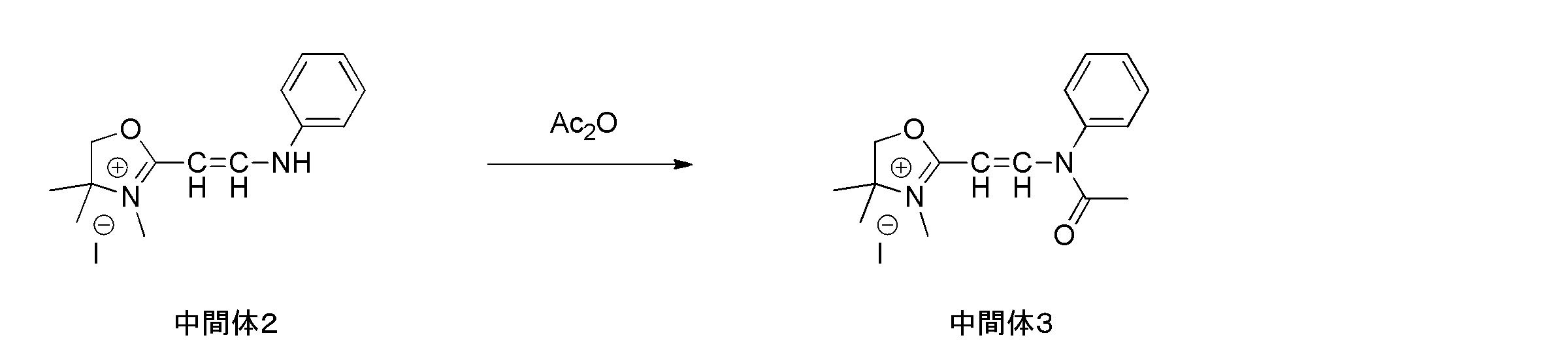
中間体2(151g)と、無水酢酸(400ml)をフラスコに入れ、120℃で2時間攪拌した。反応溶液から析出した結晶を濾取した。この結晶を50℃で送風乾燥することで、中間体3を149g得た。

中間体3(5.0g)と、フェニルスルホニル酢酸エチル(3.0g)、トリエチルアミン(1.2g)、アセトニトリル(20ml)をフラスコに入れ、60℃で5時間攪拌した。アセトニトリルを除去し、残渣をカラムクロマトにかけ、精製し、エタノールより再結晶すると目的物が得られる。この結晶を50℃で送風乾燥することで、例示化合物1を3.0g得た。
λmax=367nm(酢酸エチル(AcOEt))
1H-NMR(CDCl3)δ:8.50(d、1H)、7.91(d、2H)、7.44(m、3H)、6.00(d、1H)、4.26(s、2H)、4.06(q、2H)、2.89(s、3H)、1.37(s、6H)、1.07(t、3H)
-例示化合物1の合成法-
λmax=367nm(酢酸エチル(AcOEt))
1H-NMR(CDCl3)δ:8.50(d、1H)、7.91(d、2H)、7.44(m、3H)、6.00(d、1H)、4.26(s、2H)、4.06(q、2H)、2.89(s、3H)、1.37(s、6H)、1.07(t、3H)
<合成例2>
-例示化合物2の合成法-

中間体3(16g)と、マロン酸ジtertブチル(17g)、トリエチルアミン(7.9g)、アセトニトリル(60ml)をフラスコに入れ、100℃で5時間攪拌した。アセトニトリルを除去し、残渣をカラムクロマトにかけ、精製し、エタノールより再結晶すると目的物が得られた。この結晶を50℃で送風乾燥することで、例示化合物2を3.7g得た。
λmax=371nm(AcOEt)
1H-NMR(CDCl3)δ:7.96(d、1H)、5,32(d、1H)、4.09(s、2H)、2.76(s、3H)、1.53(s、9H)、1.59(s、9H)、1.27(s、6H)
-例示化合物2の合成法-
λmax=371nm(AcOEt)
1H-NMR(CDCl3)δ:7.96(d、1H)、5,32(d、1H)、4.09(s、2H)、2.76(s、3H)、1.53(s、9H)、1.59(s、9H)、1.27(s、6H)
<合成例3>
-例示化合物3の合成法-

中間体3(15g)と、マロン酸ジイソプロピル(7.2g)、トリエチルアミン(3.6g)、アセトニトリル(60ml)をフラスコに入れ、65℃で2時間攪拌した。アセトニトリルを除去し、残渣をカラムクロマトにかけ、精製し、エタノールより再結晶すると目的物が得られた。この結晶を50℃で送風乾燥することで、例示化合物3を6.0g得た。
λmax=365nm(AcOEt)
1H-NMR(CDCl3)δ:8.14(d、1H)、5,63(d、1H)、5.11(m、2H)、4.14(s、2H)、2.80(s、3H)、1.25(m、18H)
-例示化合物3の合成法-
λmax=365nm(AcOEt)
1H-NMR(CDCl3)δ:8.14(d、1H)、5,63(d、1H)、5.11(m、2H)、4.14(s、2H)、2.80(s、3H)、1.25(m、18H)
<合成例4>
-例示化合物4の合成法-

中間体3(5.0g)と、マロン酸ジエチル(2.1g)、トリエチルアミン(1.2g)、アセトニトリル(20ml)をフラスコに入れ、50℃で7時間攪拌した。アセトニトリルを除去し、残渣をカラムクロマトにかけ、精製し、エタノールより再結晶すると目的物が得られた。この結晶を50℃で送風乾燥することで、例示化合物4を1.8g得た。
λmax=364nm(AcOEt)
1H-NMR(CDCl3)δ:8.24(d、1H)、5,74(d、1H)、4.17(s、2H)、4.23(m、4H)、2.83(s、3H)、1.31(s、6H)、1.32(m、6H)
-例示化合物4の合成法-
λmax=364nm(AcOEt)
1H-NMR(CDCl3)δ:8.24(d、1H)、5,74(d、1H)、4.17(s、2H)、4.23(m、4H)、2.83(s、3H)、1.31(s、6H)、1.32(m、6H)
<合成例5>
-例示化合物5の合成法-

中間体3(5.0g)と、アセト酢酸tertブチル(2.1g)、トリエチルアミン(1.2g)、アセトニトリル(20ml)をフラスコに入れ、50℃で7時間攪拌した。アセトニトリルを除去し、残渣をカラムクロマトにかけ、精製し、エタノールより再結晶すると目的物が得られた。この結晶を50℃で送風乾燥することで、例示化合物5を2.8g得た。
λmax=386nm(AcOEt)
1H-NMR(DMSO)δ:8.28(d、1H)、6.38(d、1H)、4.19(s、2H)、2.86(s、3H)、2.43(s、3H)、1.52(s、9H)、1.32(s、6H)、δ:8.12(d、1H)、5.68(d、1H)、4.18(s、2H)、2.85(s、3H)、2.38(s、3H)、1.52(s、9H)、1.32(s、3H)(幾何異性体交じり)。
-例示化合物5の合成法-
λmax=386nm(AcOEt)
1H-NMR(DMSO)δ:8.28(d、1H)、6.38(d、1H)、4.19(s、2H)、2.86(s、3H)、2.43(s、3H)、1.52(s、9H)、1.32(s、6H)、δ:8.12(d、1H)、5.68(d、1H)、4.18(s、2H)、2.85(s、3H)、2.38(s、3H)、1.52(s、9H)、1.32(s、3H)(幾何異性体交じり)。
<合成例6>
-例示化合物6の合成法-

中間体3(5.0g)と、アセト酢酸エチル(1.6g)、トリエチルアミン(1.3g)、アセトニトリル(50ml)をフラスコに入れ、50℃で2時間攪拌した。アセトニトリルを除去し、残渣をカラムクロマトにかけ、精製し、エタノールより再結晶すると目的物が得られた。この結晶を50℃で送風乾燥することで、例示化合物6を0.7g得た。
λmax=386nm(AcOEt)
1H-NMR(DMSO)δ:8.15(d、1H)、5.64(d、1H)、4.36(s、2H)、4.08(q、2H)、2.88(s、3H)、2.23(s、3H)、1.31(s、6H)、1.20(t、3H)、δ:8.02(d、1H)、6.47(d、1H)、4.35(s、2H)、4.08(q、2H)、2.88(s、3H)、2.26(s、3H)、1.31(s、6H)、1.20(t、3H)(幾何異性体交じり)。
-例示化合物6の合成法-
λmax=386nm(AcOEt)
1H-NMR(DMSO)δ:8.15(d、1H)、5.64(d、1H)、4.36(s、2H)、4.08(q、2H)、2.88(s、3H)、2.23(s、3H)、1.31(s、6H)、1.20(t、3H)、δ:8.02(d、1H)、6.47(d、1H)、4.35(s、2H)、4.08(q、2H)、2.88(s、3H)、2.26(s、3H)、1.31(s、6H)、1.20(t、3H)(幾何異性体交じり)。
<合成例7>
-例示化合物7の合成法-

中間体3(5.0g)と、シアノ酢酸エチル(1.5g)、トリエチルアミン(1.3g)、アセトニトリル(20ml)をフラスコに入れ、50℃で3時間攪拌した。アセトニトリルを除去し、残渣をカラムクロマトにかけ、精製し、エタノールより再結晶すると目的物が得られた。この結晶を50℃で送風乾燥することで、例示化合物7を2.0g得た。
λmax=372nm(AcOEt)
1H-NMR(CDCl3)δ:8.01(d、1H)、4,90(d、1H)、4.38(s、2H)、4.10(q、4H)、2.93(s、3H)、1.32(s、6H)、1.19(t、6H)
-例示化合物7の合成法-
λmax=372nm(AcOEt)
1H-NMR(CDCl3)δ:8.01(d、1H)、4,90(d、1H)、4.38(s、2H)、4.10(q、4H)、2.93(s、3H)、1.32(s、6H)、1.19(t、6H)
<合成例8>
-例示化合物8の合成法-

中間体3(16g)と、マロン酸ジブチル(17g)、トリエチルアミン(7.9g)、アセトニトリル(60ml)をフラスコに入れ、100℃で4時間攪拌した。アセトニトリルを除去し、残渣をカラムクロマトにかけ、精製し、エタノールより再結晶すると目的物が得られた。この結晶を50℃で送風乾燥することで、例示化合物8を3.2g得た。
λmax=370nm(AcOEt)
1H-NMR(CDCl3)δ:7.95(d、1H)、5,31(d、1H)、4.07(s、2H)、4.22(s、4H)、2.74(s、3H)、1.62~1.35(m、8H)、1.27(s、6H)、1.02~0.83(m、6H)
-例示化合物8の合成法-
λmax=370nm(AcOEt)
1H-NMR(CDCl3)δ:7.95(d、1H)、5,31(d、1H)、4.07(s、2H)、4.22(s、4H)、2.74(s、3H)、1.62~1.35(m、8H)、1.27(s、6H)、1.02~0.83(m、6H)
<合成例9>
-例示化合物9の合成法-

中間体3(5.0g)と、N-ブチル-2-シアノアセトアミド(2.1g)、トリエチルアミン(1.3g)、アセトニトリル(50ml)をフラスコに入れ、50℃で5時間攪拌した。アセトニトリルを除去し、残渣をカラムクロマトにかけ、精製し、エタノールより再結晶すると目的物が得られた。この結晶を50℃で送風乾燥することで、例示化合物9を1.4g得た。
λmax=369nm(AcOEt)
1H-NMR(CDCl3)δ:8.30(d、1H)、5.96(s、1H)、4.84(d、2H)、4.18(s、2H)、3.32(q、2H)、2.83(s、3H)、1.51(m、2H)、1.36(m、2H)、1.33(s、6H)、0.92(t、3H)
-例示化合物9の合成法-
λmax=369nm(AcOEt)
1H-NMR(CDCl3)δ:8.30(d、1H)、5.96(s、1H)、4.84(d、2H)、4.18(s、2H)、3.32(q、2H)、2.83(s、3H)、1.51(m、2H)、1.36(m、2H)、1.33(s、6H)、0.92(t、3H)
<実施例1>
固体撮像素子用カラーフィルタの透明パターンの形成
<<平坦化膜レジスト液の調製>>
下記各成分をホモジナイザー攪拌機で混合・攪拌して、平坦化膜用レジスト液を調製した。
~ 平坦化膜用レジスト液組成 ~
・ベンジルメタアクリレート/メタアクリル酸(=70/30[モル比])共重合体のプロピレングリコールモノメチルエーテルアセテート溶液(20%、重量平均分子量30000、藤倉化成(株)製、製品名アクリベースFF-187) … 22部
・ジペンタエリスリトールヘキサアクリレート … 6.5部
(日本化薬社製、製品名KAYARAD DPHA)
・プロピレングリコールモノメチルエーテルアセテート(ダイセル化学(株)製、製品名MMPGAC) …13.8部
・エチル-3-エトキシプロピオネート(長瀬産業(株)製、製品名エチル-3エトキシプロピオネート) …12.3部
・ハロメチルトリアジン化合物(下記化合物A)(PANCHIM社製、製品名トリアジンPP) … 0.3部
固体撮像素子用カラーフィルタの透明パターンの形成
<<平坦化膜レジスト液の調製>>
下記各成分をホモジナイザー攪拌機で混合・攪拌して、平坦化膜用レジスト液を調製した。
~ 平坦化膜用レジスト液組成 ~
・ベンジルメタアクリレート/メタアクリル酸(=70/30[モル比])共重合体のプロピレングリコールモノメチルエーテルアセテート溶液(20%、重量平均分子量30000、藤倉化成(株)製、製品名アクリベースFF-187) … 22部
・ジペンタエリスリトールヘキサアクリレート … 6.5部
(日本化薬社製、製品名KAYARAD DPHA)
・プロピレングリコールモノメチルエーテルアセテート(ダイセル化学(株)製、製品名MMPGAC) …13.8部
・エチル-3-エトキシプロピオネート(長瀬産業(株)製、製品名エチル-3エトキシプロピオネート) …12.3部
・ハロメチルトリアジン化合物(下記化合物A)(PANCHIM社製、製品名トリアジンPP) … 0.3部
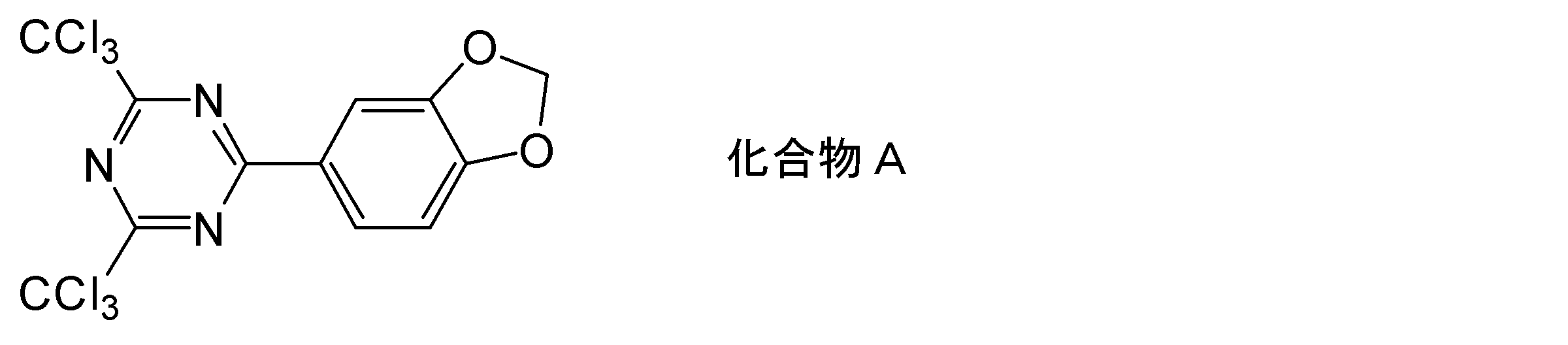
<平坦化膜の作製>
上記で得られた平坦化膜用レジスト液を、6インチシリコンウエハー上にスピンコートで塗布した。次いで、表面温度100℃×120秒、ホットプレート上で加熱処理し、前記シリコンウエハー上に約0.1μmの膜厚の均一な塗布膜を得た。次いで、230℃の条件下で1時間、オーブンにてその塗布膜を硬化処理して、平坦化膜を得た。
上記で得られた平坦化膜用レジスト液を、6インチシリコンウエハー上にスピンコートで塗布した。次いで、表面温度100℃×120秒、ホットプレート上で加熱処理し、前記シリコンウエハー上に約0.1μmの膜厚の均一な塗布膜を得た。次いで、230℃の条件下で1時間、オーブンにてその塗布膜を硬化処理して、平坦化膜を得た。
<二酸化チタン分散液の調製>
下記組成の混合液に対し、循環型分散装置(ビーズミル)として、寿工業株式会社製ウルトラアペックスミル(商品名)を用いて、以下のようにして分散処理を行い、分散組成物として二酸化チタン分散液を得た。
~二酸化チタン分散液組成~
・二酸化チタン(石原産業(株)製、商品名:TTO-51(C))
:212.5部
・下記特定分散樹脂(A)(20%プロピレングリコールモノメチルエーテルアセテート(以下、「PGMEA」と略称する。)溶液):286.9部
・PGMEA :350.6部
下記組成の混合液に対し、循環型分散装置(ビーズミル)として、寿工業株式会社製ウルトラアペックスミル(商品名)を用いて、以下のようにして分散処理を行い、分散組成物として二酸化チタン分散液を得た。
~二酸化チタン分散液組成~
・二酸化チタン(石原産業(株)製、商品名:TTO-51(C))
:212.5部
・下記特定分散樹脂(A)(20%プロピレングリコールモノメチルエーテルアセテート(以下、「PGMEA」と略称する。)溶液):286.9部
・PGMEA :350.6部

特定分散樹脂(A)において、k:l:m:n=25:40:5:30(重合モル比)、p=60、q=60、重量平均分子量は10,000である。特定分散樹脂(A)は、特開2007-277514号公報の記載に従って調製した。
また分散装置は以下の条件で運転した。
・ビーズ径:φ0.05mm
・ビーズ充填率:75体積%
・周速:8m/sec
・ポンプ供給量:10Kg/hour
・冷却水:水道水
・ビーズミル環状通路内容積:0.15L
・分散処理する混合液量:0.44Kg
・ビーズ径:φ0.05mm
・ビーズ充填率:75体積%
・周速:8m/sec
・ポンプ供給量:10Kg/hour
・冷却水:水道水
・ビーズミル環状通路内容積:0.15L
・分散処理する混合液量:0.44Kg
<感光性樹脂組成物の調製>
下記成分をマグネチックスターラーを用いて攪拌、混合し、感光性樹脂組成物を調製した。
下記成分をマグネチックスターラーを用いて攪拌、混合し、感光性樹脂組成物を調製した。
~感光性樹脂組成物の組成~
・上記で調製した二酸化チタン分散液(分散組成物) …20.9部
・サイクロマーP-ACA(固形分50質量%、重量平均分子量30000、ダイセル(株)製) …13.66部
・TO-2349(東亜合成(株)製、下記化合物Bとジペンタエリスリトールヘキサアクリレートの7:3混合物) …10.25部
・重合開始剤(下記化合物C;BASF製、製品名IRGACURE OXE01) … 0.50部
・下記化合物(1)(紫外線吸収剤) … 1.03部
・溶剤(溶剤) …69.82部
(プロピレングリコールモノメチルエーテルアセテート;ダイセル化学(株)製、製品名MMPGAC)
・界面活性剤 … 0.01部
(フッ素系界面活性剤;大日本インキ化学工業(株)製、製品名メガファックF144)
・重合禁止剤 …0.0051部
(p-メトキシフェノール;関東化学(株)製、製品名p-メトキシフェノール)
・上記で調製した二酸化チタン分散液(分散組成物) …20.9部
・サイクロマーP-ACA(固形分50質量%、重量平均分子量30000、ダイセル(株)製) …13.66部
・TO-2349(東亜合成(株)製、下記化合物Bとジペンタエリスリトールヘキサアクリレートの7:3混合物) …10.25部
・重合開始剤(下記化合物C;BASF製、製品名IRGACURE OXE01) … 0.50部
・下記化合物(1)(紫外線吸収剤) … 1.03部
・溶剤(溶剤) …69.82部
(プロピレングリコールモノメチルエーテルアセテート;ダイセル化学(株)製、製品名MMPGAC)
・界面活性剤 … 0.01部
(フッ素系界面活性剤;大日本インキ化学工業(株)製、製品名メガファックF144)
・重合禁止剤 …0.0051部
(p-メトキシフェノール;関東化学(株)製、製品名p-メトキシフェノール)
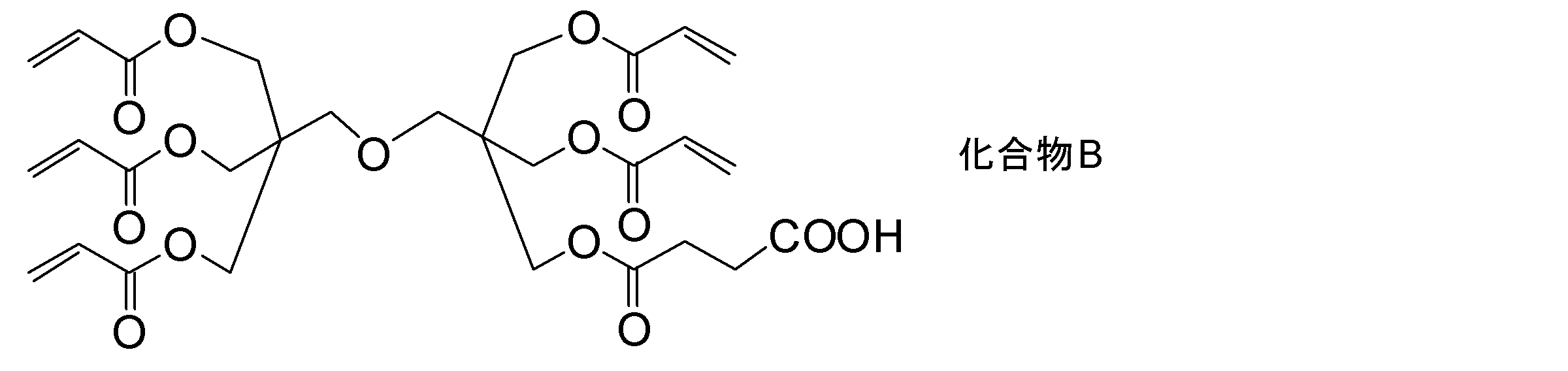


<塗布膜の作製>
上記より得られた感光性樹脂組成物を、前記シリコンウエハーの平坦化膜上にスピンコートにより塗布した後、塗布膜面の表面温度100℃で120秒間、ホットプレートで加熱処理して乾燥させ、乾燥後の膜厚が約0.8μmの塗布膜を形成した。
上記より得られた感光性樹脂組成物を、前記シリコンウエハーの平坦化膜上にスピンコートにより塗布した後、塗布膜面の表面温度100℃で120秒間、ホットプレートで加熱処理して乾燥させ、乾燥後の膜厚が約0.8μmの塗布膜を形成した。
<固体撮像素子用カラーフィルタの透明パターンの形成>
次に、乾燥後の塗布膜に対して、1.2μmの正方ピクセルがそれぞれ基板上の4mm×3mmの領域に配列されたマスクパターンを介してi線ステッパー(キャノン(株)製のFPA-3000i5+)により、露光量200mJ/cm2にて露光した。
次に、乾燥後の塗布膜に対して、1.2μmの正方ピクセルがそれぞれ基板上の4mm×3mmの領域に配列されたマスクパターンを介してi線ステッパー(キャノン(株)製のFPA-3000i5+)により、露光量200mJ/cm2にて露光した。
パターン露光された塗布膜は、有機アルカリ性現像液CD-2000(富士フィルムエレクトロニクスマテリアルズ(株)製)の60%水溶液を用いて、室温にて60秒間、パドル現像した後、さらに20秒間スピンシャワーにて純水でリンスを行なった。その後さらに、純水にて水洗を行なった。その後、水滴を高圧のエアーで飛ばし、基板を自然乾燥させ、200℃で300秒間、ホットプレートでポストベーク処理し、シリコンウエハー上に透明パターンを形成した。
以上のようにして、前記シリコンウエハーの平坦化膜上に1.2μm四方の透明パターンを作製し、固体撮像素子用カラーフィルタの透明パターンを得た。
以上のようにして、前記シリコンウエハーの平坦化膜上に1.2μm四方の透明パターンを作製し、固体撮像素子用カラーフィルタの透明パターンを得た。
次に、上記シリコンウエハーの平坦化膜上に透明パターンを作製と同様の条件で、上記感光性樹脂組成物をコーニング1737(コーニング社製)上に塗布して塗布膜を形成し、該塗布膜に、全面露光、現像、リンス、水洗、およびポストベークの各処理をこの順で施して、膜厚1μmの透明膜を形成し、透過率測定サンプルとした。
<評価>
上記より得られた前記シリコンウエハーの平坦化膜上の1.2μm四方の透明パターンについて、下記の測定を行なった。評価、測定の結果は、下記表に示す。
上記より得られた前記シリコンウエハーの平坦化膜上の1.2μm四方の透明パターンについて、下記の測定を行なった。評価、測定の結果は、下記表に示す。
(1)透過率
得られた透明膜の波長400nmにける透過率を、UV測定器(UV-1800)を用いて測定した。400nmにおける透過率が高い程、透明性が優れている。
~ 評価基準 ~
5:透過率>85%
4:85%≧透過率>80%
3:80%≧透過率>70%
2:70%≧透過率>60%
1:60%≧透過率
得られた透明膜の波長400nmにける透過率を、UV測定器(UV-1800)を用いて測定した。400nmにおける透過率が高い程、透明性が優れている。
~ 評価基準 ~
5:透過率>85%
4:85%≧透過率>80%
3:80%≧透過率>70%
2:70%≧透過率>60%
1:60%≧透過率
(2)屈折率評価
得られた透明膜に対して、エリプソメトリー VUV-VASE(ジェー・エー・ウーラム・ジャパン社製)を用いて、屈折率を測定した。
~判定基準~
3:3.00>500nm屈折率≧1.64
2:1.64>500nm屈折率≧1.50
1:500nm屈折率<1.50
得られた透明膜に対して、エリプソメトリー VUV-VASE(ジェー・エー・ウーラム・ジャパン社製)を用いて、屈折率を測定した。
~判定基準~
3:3.00>500nm屈折率≧1.64
2:1.64>500nm屈折率≧1.50
1:500nm屈折率<1.50
(3)現像残渣
ポストベーク後のカラーフィルタの画素パターンを、測長SEM(S-7800H、(株)日立製作所製)を用いて、シリコンウエハー上のカラーフィルタのさらに上方から3万倍で観察し、目測で残渣の発生の有無を下記の評価基準にしたがって評価した。現像残渣が少ない程、パターンの解像性が優れている。
~ 評価基準 ~
3:現像残渣はなかった。
2:現像残渣が僅かにみられたが、実用上許容できる程度であった。
1:残渣の発生が顕著であった。
ポストベーク後のカラーフィルタの画素パターンを、測長SEM(S-7800H、(株)日立製作所製)を用いて、シリコンウエハー上のカラーフィルタのさらに上方から3万倍で観察し、目測で残渣の発生の有無を下記の評価基準にしたがって評価した。現像残渣が少ない程、パターンの解像性が優れている。
~ 評価基準 ~
3:現像残渣はなかった。
2:現像残渣が僅かにみられたが、実用上許容できる程度であった。
1:残渣の発生が顕著であった。
<実施例2~9>
固体撮像素子用カラーフィルタの透明パターンの形成
実施例1において、感光性樹脂組成物の紫外線吸収剤の種類を下記表に示すように変更したこと以外は、実施例1と同様にして、感光性樹脂組成物を調製し、カラーフィルタを作製した。また、実施例1と同様の評価を行なった。評価、測定の結果は下記表に示す。
固体撮像素子用カラーフィルタの透明パターンの形成
実施例1において、感光性樹脂組成物の紫外線吸収剤の種類を下記表に示すように変更したこと以外は、実施例1と同様にして、感光性樹脂組成物を調製し、カラーフィルタを作製した。また、実施例1と同様の評価を行なった。評価、測定の結果は下記表に示す。
<実施例10>
固体撮像素子用カラーフィルタの透明パターンの形成
実施例2において、感光性樹脂組成物の紫外線吸収剤の種類を下記表に示すように変更し、光重合開始剤を2.5部にしたこと以外は、実施例1と同様にして、感光性樹脂組成物を調製し、カラーフィルタを作製した。また、実施例1と同様の評価を行なった。評価、測定の結果は下記表に示す。
固体撮像素子用カラーフィルタの透明パターンの形成
実施例2において、感光性樹脂組成物の紫外線吸収剤の種類を下記表に示すように変更し、光重合開始剤を2.5部にしたこと以外は、実施例1と同様にして、感光性樹脂組成物を調製し、カラーフィルタを作製した。また、実施例1と同様の評価を行なった。評価、測定の結果は下記表に示す。
<実施例11>
固体撮像素子用カラーフィルタの透明パターンの形成
実施例2において、光重合開始剤をBASF社製イルガキュア 369を0.5部にしたこと以外は、実施例2と同様にして、感光性樹脂組成物を調製し、カラーフィルタを作製した。また、実施例1と同様の評価を行なった。評価、測定の結果は下記表に示す。
固体撮像素子用カラーフィルタの透明パターンの形成
実施例2において、光重合開始剤をBASF社製イルガキュア 369を0.5部にしたこと以外は、実施例2と同様にして、感光性樹脂組成物を調製し、カラーフィルタを作製した。また、実施例1と同様の評価を行なった。評価、測定の結果は下記表に示す。
<比較例1~3>
固体撮像素子用カラーフィルタの透明パターンの形成
実施例1において、感光性樹脂組成物の紫外線吸収剤の種類を下記表に示すように変更したこと以外は、実施例1と同様にして、感光性樹脂組成物を調製し、カラーフィルタを作製した。また、実施例1と同様の評価を行なった。評価、測定の結果は下記表に示す。
固体撮像素子用カラーフィルタの透明パターンの形成
実施例1において、感光性樹脂組成物の紫外線吸収剤の種類を下記表に示すように変更したこと以外は、実施例1と同様にして、感光性樹脂組成物を調製し、カラーフィルタを作製した。また、実施例1と同様の評価を行なった。評価、測定の結果は下記表に示す。

化合物29は、特開2011-73214号公報記載の紫外線吸収剤VIII-7を用いた。
化合物30は、特開2009-96973号公報記載の紫外線吸収剤47を用いた。
上記表から明らかなように、本発明の感光性樹脂組成物では、高屈折であり、ポストベーク後の着色が抑制され(透過率が高く)、かつ、現像残渣が抑えられていた。さらに、光重合開始剤としてオキシム化合物を用いた場合、および、光重合開始剤の配合量を感光性樹脂組成物の1~5質量%の範囲とすることにより、現像残渣がより効果的に抑制されることが分かった。
以上の実施例では、シリコンウエハー上にカラーフィルタの透明パターンを形成する例について説明したが、固体撮像素子を作製する場合には、前記シリコンウエハーを、フォトダイオード、遮光膜、およびデバイス保護膜などが形成された固体撮像素子用基板に置き換えればよい。
例えば、フォトダイオードおよび転送電極が形成されたシリコンウエハー上に、フォトダイオードの受光部のみ開口したタングステンからなる遮光膜を形成し、形成された遮光膜全面およびフォトダイオード受光部(遮光膜中の開口部)を覆うようにして窒化シリコンからなるデバイス保護層を形成する。次に、形成されたデバイス保護層上に、上記実施例と同様の方法により透明パターン(透明画素)を、公知の方法により赤色画素、青色画素、および緑色画素を、それぞれ形成し、カラーフィルタとする。次に、得られたカラーフィルタ上に集光手段であるマイクロレンズを形成することにより、色再現性が良好な固体撮像素子(CCD、CMOS等)を作製することができる。
例えば、フォトダイオードおよび転送電極が形成されたシリコンウエハー上に、フォトダイオードの受光部のみ開口したタングステンからなる遮光膜を形成し、形成された遮光膜全面およびフォトダイオード受光部(遮光膜中の開口部)を覆うようにして窒化シリコンからなるデバイス保護層を形成する。次に、形成されたデバイス保護層上に、上記実施例と同様の方法により透明パターン(透明画素)を、公知の方法により赤色画素、青色画素、および緑色画素を、それぞれ形成し、カラーフィルタとする。次に、得られたカラーフィルタ上に集光手段であるマイクロレンズを形成することにより、色再現性が良好な固体撮像素子(CCD、CMOS等)を作製することができる。
また、本発明の紫外線吸収剤を含むフィルムを製膜したところ、該フィルムは紫外線吸収性に優れることを確認した。
Claims (19)
- 下記一般式(I)で表される紫外線吸収剤と、光重合開始剤と、重合性モノマーとを含有する感光性樹脂組成物。
一般式(I)

- 前記一般式(I)が、下記一般式(II)で表される、請求項1に記載の感光性樹脂組成物。
一般式(II)

- 前記一般式(I)または一般式(II)におけるR4が-SO2R6または-CO2R6である、請求項1または2に記載の感光性樹脂組成物。
- 前記感光性樹脂組成物の全固形分に対する、一般式(I)で表される紫外線吸収剤の配合量が、2~16質量%である、請求項1~3のいずれか1項に記載の感光性樹脂組成物。
- 一般式(I)で表される紫外線吸収剤の分子量が150~850である、請求項1~4のいずれか1項に記載の感光性樹脂組成物。
- 前記一般式(I)が、下記一般式(III)で表される、請求項1、4および5のいずれか1項に記載の感光性樹脂組成物。
一般式(III)

- 一般式(I)で表される紫外線吸収剤が、下記化合物(1)~(8)のいずれかで表される化合物である、請求項1~6のいずれか1項に記載の感光性樹脂組成物。

- 光重合開始剤としてオキシム化合物を含む、請求項1~7のいずれか1項に記載の感光性樹脂組成物。
- さらに、波長500nmにおける屈折率1.80~2.80の粒子を含む、請求項1~8のいずれか1項に記載の感光性樹脂組成物。
- 前記粒子が、二酸化チタンおよび/または酸化ジルコニウムである、請求項9に記載の感光性樹脂組成物。
- 染料および/または顔料を含有する、請求項1~10のいずれか1項に記載の感光性樹脂組成物。
- さらに、アルカリ可溶性樹脂を含む、請求項1~11のいずれか1項に記載の感光性樹脂組成物。
- 前記感光性樹脂組成物が、固体撮像素子または液晶表示装置の画素形成に用いられる、請求項1~12のいずれか1項に記載の感光性樹脂組成物。
- 請求項1~13のいずれか1項に記載の感光性樹脂組成物を硬化してなる硬化膜。
- 一般式(I)で表される紫外線吸収剤の含有量が硬化膜の0.01質量%以下である、請求項14に記載の硬化膜。
- 請求項1~13のいずれか1項に記載の感光性樹脂組成物を塗布し、形成された層を少なくとも紫外線でフォトマスクを介して露光し、現像することによりパターンを形成し、形成されたパターンをポストベークすることを含む画素形成方法。
- 請求項16に記載の画素形成方法により作製された画素を有するカラーフィルタ。
- 請求項17に記載のカラーフィルタを有する固体撮像素子または液晶表示装置。
- 一般式(III)で表される紫外線吸収剤。
一般式(III)

Priority Applications (2)
| Application Number | Priority Date | Filing Date | Title |
|---|---|---|---|
| KR1020157026482A KR101800226B1 (ko) | 2013-03-29 | 2014-03-26 | 감광성 수지 조성물, 경화막, 화상 형성 방법, 고체 촬상 소자, 컬러 필터 및 자외선 흡수제 |
| US14/867,796 US9518031B2 (en) | 2013-03-29 | 2015-09-28 | Photo-sensitive resin composition, cured film, method for forming a pixel, solid state image sensor, color filter and ultraviolet absorber |
Applications Claiming Priority (2)
| Application Number | Priority Date | Filing Date | Title |
|---|---|---|---|
| JP2013-071374 | 2013-03-29 | ||
| JP2013071374A JP6049521B2 (ja) | 2013-03-29 | 2013-03-29 | 感光性樹脂組成物、硬化膜、画像形成方法、固体撮像素子、カラーフィルタおよび紫外線吸収剤 |
Related Child Applications (1)
| Application Number | Title | Priority Date | Filing Date |
|---|---|---|---|
| US14/867,796 Continuation US9518031B2 (en) | 2013-03-29 | 2015-09-28 | Photo-sensitive resin composition, cured film, method for forming a pixel, solid state image sensor, color filter and ultraviolet absorber |
Publications (1)
| Publication Number | Publication Date |
|---|---|
| WO2014157296A1 true WO2014157296A1 (ja) | 2014-10-02 |
Family
ID=51624261
Family Applications (1)
| Application Number | Title | Priority Date | Filing Date |
|---|---|---|---|
| PCT/JP2014/058444 Ceased WO2014157296A1 (ja) | 2013-03-29 | 2014-03-26 | 感光性樹脂組成物、硬化膜、画像形成方法、固体撮像素子、カラーフィルタおよび紫外線吸収剤 |
Country Status (5)
| Country | Link |
|---|---|
| US (1) | US9518031B2 (ja) |
| JP (1) | JP6049521B2 (ja) |
| KR (1) | KR101800226B1 (ja) |
| TW (1) | TW201437752A (ja) |
| WO (1) | WO2014157296A1 (ja) |
Cited By (5)
| Publication number | Priority date | Publication date | Assignee | Title |
|---|---|---|---|---|
| WO2016052113A1 (ja) * | 2014-10-03 | 2016-04-07 | 富士フイルム株式会社 | シロキサン樹脂組成物、これを用いた透明硬化物、透明画素、マイクロレンズ、固体撮像素子 |
| JP2016074797A (ja) * | 2014-10-03 | 2016-05-12 | 富士フイルム株式会社 | シロキサン樹脂組成物、これを用いた透明硬化物、透明画素、マイクロレンズ、固体撮像素子 |
| JP2016074867A (ja) * | 2014-10-03 | 2016-05-12 | 富士フイルム株式会社 | シロキサン樹脂組成物、これを用いた透明硬化物、透明画素、マイクロレンズ、固体撮像素子 |
| WO2022230327A1 (ja) | 2021-04-28 | 2022-11-03 | 住友化学株式会社 | 硬化膜及び表示装置 |
| WO2023189203A1 (ja) | 2022-03-31 | 2023-10-05 | 住友化学株式会社 | 組成物、膜及び表示装置 |
Families Citing this family (15)
| Publication number | Priority date | Publication date | Assignee | Title |
|---|---|---|---|---|
| CN106415393B (zh) * | 2014-01-24 | 2020-04-07 | 东丽株式会社 | 负型感光性树脂组合物、使其固化而成的固化膜及其制造方法、以及具有其的光学设备及背面照射型cmos图像传感器 |
| WO2016199868A1 (ja) * | 2015-06-09 | 2016-12-15 | 旭化成株式会社 | タッチパネル用水性樹脂組成物、転写フィルム及び硬化膜積層体、並びに樹脂パターンの製造方法及びタッチパネル表示装置 |
| WO2017170183A1 (ja) | 2016-03-31 | 2017-10-05 | 株式会社Adeka | 組成物及び新規化合物 |
| KR102316645B1 (ko) | 2016-03-31 | 2021-10-25 | 가부시키가이샤 아데카 | 감광성 조성물 및 신규 화합물 |
| JP6740705B2 (ja) * | 2016-05-20 | 2020-08-19 | Jsr株式会社 | カラーフィルタ材料用着色組成物、カラーフィルタ材料用着色硬化膜、カラーフィルタ、表示素子及び受光素子 |
| WO2017208905A1 (ja) * | 2016-05-31 | 2017-12-07 | 住友化学株式会社 | ポリメチン化合物の製造方法 |
| WO2018043218A1 (ja) * | 2016-08-30 | 2018-03-08 | 富士フイルム株式会社 | 感光性組成物、硬化膜、光学フィルタ、積層体、パターン形成方法、固体撮像素子、画像表示装置および赤外線センサ |
| JP6870005B2 (ja) * | 2017-02-01 | 2021-05-12 | 富士フイルム株式会社 | 硬化性組成物、膜、光学フィルタ、固体撮像素子、画像表示装置および赤外線センサ |
| JPWO2018173570A1 (ja) * | 2017-03-24 | 2020-05-14 | 富士フイルム株式会社 | 感光性着色組成物、硬化膜、カラーフィルタ、固体撮像素子および画像表示装置 |
| JP7236386B2 (ja) | 2017-10-04 | 2023-03-09 | 株式会社Adeka | 組成物、硬化物及び硬化物の製造方法 |
| JP7293119B2 (ja) | 2017-10-05 | 2023-06-19 | 株式会社Adeka | 化合物、潜在性酸化防止剤、組成物、硬化物及び硬化物の製造方法 |
| WO2019069960A1 (ja) | 2017-10-05 | 2019-04-11 | 株式会社Adeka | 化合物、潜在性紫外線吸収剤、組成物、硬化物及び硬化物の製造方法 |
| KR102793841B1 (ko) | 2018-05-08 | 2025-04-11 | 가부시키가이샤 아데카 | 화합물, 잠재성 첨가제, 조성물, 경화물, 경화물의 제조 방법 및 조성물의 제조 방법 |
| JP7659249B2 (ja) | 2020-09-15 | 2025-04-09 | 山田化学工業株式会社 | 化合物 |
| KR102821664B1 (ko) * | 2022-06-22 | 2025-06-18 | 강한근 | 의료용 폐기물 수거장치 |
Citations (9)
| Publication number | Priority date | Publication date | Assignee | Title |
|---|---|---|---|---|
| JPS5397425A (en) * | 1977-02-04 | 1978-08-25 | Fuji Photo Film Co Ltd | Silver halide color photographic material |
| JPS5627146A (en) * | 1979-08-14 | 1981-03-16 | Konishiroku Photo Ind Co Ltd | Silver halide photographic sensitive material |
| JPS61239246A (ja) * | 1985-04-16 | 1986-10-24 | Konishiroku Photo Ind Co Ltd | ハロゲン化銀写真感光材料 |
| JPH04159538A (ja) * | 1990-10-24 | 1992-06-02 | Fuji Photo Film Co Ltd | ハロゲン化銀写真感光材料 |
| JP2008509906A (ja) * | 2004-08-11 | 2008-04-03 | フジフィルム マニュファクチャリング ユーロプ ビー.ブイ. | アミノブタジエン系uvスクリーン |
| JP2011073213A (ja) * | 2009-09-29 | 2011-04-14 | Fujifilm Corp | 平版印刷版原版及び平版印刷版の製版方法 |
| JP2011073214A (ja) * | 2009-09-29 | 2011-04-14 | Fujifilm Corp | 平版印刷版原版及び平版印刷版の製版方法 |
| JP2011127096A (ja) * | 2009-11-20 | 2011-06-30 | Fujifilm Corp | 分散組成物及び感光性樹脂組成物、並びに固体撮像素子 |
| JP2012137564A (ja) * | 2010-12-24 | 2012-07-19 | Fujifilm Corp | 固体撮像素子のカラーフィルタ用感光性透明組成物、並びに、これを用いた固体撮像素子のカラーフィルタの製造方法、固体撮像素子のカラーフィルタ、及び、固体撮像素子 |
Family Cites Families (4)
| Publication number | Priority date | Publication date | Assignee | Title |
|---|---|---|---|---|
| JP2007053153A (ja) | 2005-08-16 | 2007-03-01 | Toppan Printing Co Ltd | 固体撮像素子及びその製造方法 |
| JP2009067973A (ja) | 2006-09-29 | 2009-04-02 | Fujifilm Corp | 紫外線吸収剤を含む高分子材料 |
| JP5147499B2 (ja) | 2008-02-13 | 2013-02-20 | 富士フイルム株式会社 | 感光性着色組成物、並びにカラーフィルタ及びその製造方法 |
| JP5669009B2 (ja) | 2010-12-15 | 2015-02-12 | 株式会社デンソー | 車両用携帯機の電池残量低下報知システム |
-
2013
- 2013-03-29 JP JP2013071374A patent/JP6049521B2/ja active Active
-
2014
- 2014-03-26 KR KR1020157026482A patent/KR101800226B1/ko active Active
- 2014-03-26 WO PCT/JP2014/058444 patent/WO2014157296A1/ja not_active Ceased
- 2014-03-28 TW TW103111581A patent/TW201437752A/zh unknown
-
2015
- 2015-09-28 US US14/867,796 patent/US9518031B2/en active Active
Patent Citations (9)
| Publication number | Priority date | Publication date | Assignee | Title |
|---|---|---|---|---|
| JPS5397425A (en) * | 1977-02-04 | 1978-08-25 | Fuji Photo Film Co Ltd | Silver halide color photographic material |
| JPS5627146A (en) * | 1979-08-14 | 1981-03-16 | Konishiroku Photo Ind Co Ltd | Silver halide photographic sensitive material |
| JPS61239246A (ja) * | 1985-04-16 | 1986-10-24 | Konishiroku Photo Ind Co Ltd | ハロゲン化銀写真感光材料 |
| JPH04159538A (ja) * | 1990-10-24 | 1992-06-02 | Fuji Photo Film Co Ltd | ハロゲン化銀写真感光材料 |
| JP2008509906A (ja) * | 2004-08-11 | 2008-04-03 | フジフィルム マニュファクチャリング ユーロプ ビー.ブイ. | アミノブタジエン系uvスクリーン |
| JP2011073213A (ja) * | 2009-09-29 | 2011-04-14 | Fujifilm Corp | 平版印刷版原版及び平版印刷版の製版方法 |
| JP2011073214A (ja) * | 2009-09-29 | 2011-04-14 | Fujifilm Corp | 平版印刷版原版及び平版印刷版の製版方法 |
| JP2011127096A (ja) * | 2009-11-20 | 2011-06-30 | Fujifilm Corp | 分散組成物及び感光性樹脂組成物、並びに固体撮像素子 |
| JP2012137564A (ja) * | 2010-12-24 | 2012-07-19 | Fujifilm Corp | 固体撮像素子のカラーフィルタ用感光性透明組成物、並びに、これを用いた固体撮像素子のカラーフィルタの製造方法、固体撮像素子のカラーフィルタ、及び、固体撮像素子 |
Cited By (7)
| Publication number | Priority date | Publication date | Assignee | Title |
|---|---|---|---|---|
| WO2016052113A1 (ja) * | 2014-10-03 | 2016-04-07 | 富士フイルム株式会社 | シロキサン樹脂組成物、これを用いた透明硬化物、透明画素、マイクロレンズ、固体撮像素子 |
| JP2016074797A (ja) * | 2014-10-03 | 2016-05-12 | 富士フイルム株式会社 | シロキサン樹脂組成物、これを用いた透明硬化物、透明画素、マイクロレンズ、固体撮像素子 |
| JP2016074867A (ja) * | 2014-10-03 | 2016-05-12 | 富士フイルム株式会社 | シロキサン樹脂組成物、これを用いた透明硬化物、透明画素、マイクロレンズ、固体撮像素子 |
| WO2022230327A1 (ja) | 2021-04-28 | 2022-11-03 | 住友化学株式会社 | 硬化膜及び表示装置 |
| KR20240004522A (ko) | 2021-04-28 | 2024-01-11 | 스미또모 가가꾸 가부시키가이샤 | 경화막 및 표시 장치 |
| WO2023189203A1 (ja) | 2022-03-31 | 2023-10-05 | 住友化学株式会社 | 組成物、膜及び表示装置 |
| KR20240167911A (ko) | 2022-03-31 | 2024-11-28 | 스미또모 가가꾸 가부시키가이샤 | 조성물, 막 및 표시 장치 |
Also Published As
| Publication number | Publication date |
|---|---|
| US9518031B2 (en) | 2016-12-13 |
| JP6049521B2 (ja) | 2016-12-21 |
| KR20150123878A (ko) | 2015-11-04 |
| TW201437752A (zh) | 2014-10-01 |
| US20160016919A1 (en) | 2016-01-21 |
| JP2014194508A (ja) | 2014-10-09 |
| KR101800226B1 (ko) | 2017-11-22 |
Similar Documents
| Publication | Publication Date | Title |
|---|---|---|
| JP6049521B2 (ja) | 感光性樹脂組成物、硬化膜、画像形成方法、固体撮像素子、カラーフィルタおよび紫外線吸収剤 | |
| JP6711866B2 (ja) | 着色感光性組成物、硬化膜、パターン形成方法、遮光膜付き赤外光カットフィルタ、固体撮像素子、画像表示装置および赤外線センサ | |
| KR101587074B1 (ko) | 착색 조성물, 잉크젯 잉크, 컬러필터, 그 제조방법, 고체촬상소자, 및 표시장치 | |
| US8778575B2 (en) | Curable composition, color filter using the same and manufacturing method therefor, and solid image pickup element | |
| JP5623874B2 (ja) | 着色硬化性組成物、カラーフィルタ、その製造方法及びカラーフィルタを備えた固体撮像素子並びに液晶表示装置 | |
| JP6339208B2 (ja) | 着色組成物、硬化膜、カラーフィルタ、カラーフィルタの製造方法、固体撮像素子、および画像表示装置 | |
| JP5836326B2 (ja) | 着色硬化性組成物およびカラーフィルタ | |
| JP5606868B2 (ja) | 光重合性組成物、カラーフィルタ、その製造方法、及び、固体撮像素子 | |
| KR20120082413A (ko) | 색소 다량체, 착색 경화성 조성물, 컬러필터 및 그 제조방법, 및 컬러필터를 구비한 고체촬상소자, 화상 표시 장치, 액정 표시 장치 및 유기 el 디스플레이 | |
| JP5583396B2 (ja) | 顔料分散組成物、着色感光性組成物、カラーフィルタ、カラーフィルタの製造方法、液晶表示装置、及び、固体撮像素子 | |
| US20120202154A1 (en) | Black curable composition for wafer level lens and wafer level lens | |
| JP7016891B2 (ja) | 組成物、膜、カラーフィルタ、固体撮像素子、画像表示装置および化合物の製造方法 | |
| JP5813325B2 (ja) | 黒色重合性組成物、及び、黒色層の作製方法 | |
| JP6793799B2 (ja) | ネガ型硬化性着色組成物、硬化膜、カラーフィルタ、パターン形成方法及び装置 | |
| JP6226820B2 (ja) | 色素多量体の製造方法、および着色組成物の製造方法 | |
| JP2009244802A (ja) | 感光性着色組成物及びカラーフィルタの製造方法 | |
| JP2010015056A (ja) | カラーフィルタ用着色組成物、そのセット、カラーフィルタ、およびカラーフィルタの製造方法 | |
| JP5986671B2 (ja) | 着色組成物、インクジェット用インク、カラーフィルタ及びその製造方法、固体撮像素子、並びに表示装置 | |
| JP5642402B2 (ja) | カラーフィルタ及びその製造方法、並びに固体撮像素子 | |
| JP5235582B2 (ja) | 着色硬化性組成物、カラーフィルタ及びその製造方法、並びに固体撮像素子 | |
| JP6054894B2 (ja) | 着色組成物、パターン形成方法、カラーフィルタの製造方法、カラーフィルタ、固体撮像素子、画像表示装置および着色組成物の製造方法 | |
| JP5823547B2 (ja) | 着色組成物、インクジェット用インク、カラーフィルタ及びその製造方法、固体撮像素子、並びに表示装置 | |
| JP5566919B2 (ja) | 着色硬化性組成物、カラーフィルタ及びその製造方法、固体撮像素子、液晶表示装置、並びに有機el表示装置 |
Legal Events
| Date | Code | Title | Description |
|---|---|---|---|
| 121 | Ep: the epo has been informed by wipo that ep was designated in this application |
Ref document number: 14773526 Country of ref document: EP Kind code of ref document: A1 |
|
| ENP | Entry into the national phase |
Ref document number: 20157026482 Country of ref document: KR Kind code of ref document: A |
|
| NENP | Non-entry into the national phase |
Ref country code: DE |
|
| 122 | Ep: pct application non-entry in european phase |
Ref document number: 14773526 Country of ref document: EP Kind code of ref document: A1 |