WO2014156364A1 - タッチパネル及び表示装置 - Google Patents
タッチパネル及び表示装置 Download PDFInfo
- Publication number
- WO2014156364A1 WO2014156364A1 PCT/JP2014/053585 JP2014053585W WO2014156364A1 WO 2014156364 A1 WO2014156364 A1 WO 2014156364A1 JP 2014053585 W JP2014053585 W JP 2014053585W WO 2014156364 A1 WO2014156364 A1 WO 2014156364A1
- Authority
- WO
- WIPO (PCT)
- Prior art keywords
- touch panel
- electrode
- meth
- less
- acrylate
- Prior art date
- Legal status (The legal status is an assumption and is not a legal conclusion. Google has not performed a legal analysis and makes no representation as to the accuracy of the status listed.)
- Ceased
Links
Images




Classifications
-
- G—PHYSICS
- G06—COMPUTING OR CALCULATING; COUNTING
- G06F—ELECTRIC DIGITAL DATA PROCESSING
- G06F3/00—Input arrangements for transferring data to be processed into a form capable of being handled by the computer; Output arrangements for transferring data from processing unit to output unit, e.g. interface arrangements
- G06F3/01—Input arrangements or combined input and output arrangements for interaction between user and computer
- G06F3/03—Arrangements for converting the position or the displacement of a member into a coded form
- G06F3/041—Digitisers, e.g. for touch screens or touch pads, characterised by the transducing means
- G06F3/044—Digitisers, e.g. for touch screens or touch pads, characterised by the transducing means by capacitive means
- G06F3/0446—Digitisers, e.g. for touch screens or touch pads, characterised by the transducing means by capacitive means using a grid-like structure of electrodes in at least two directions, e.g. using row and column electrodes
-
- G—PHYSICS
- G06—COMPUTING OR CALCULATING; COUNTING
- G06F—ELECTRIC DIGITAL DATA PROCESSING
- G06F3/00—Input arrangements for transferring data to be processed into a form capable of being handled by the computer; Output arrangements for transferring data from processing unit to output unit, e.g. interface arrangements
- G06F3/01—Input arrangements or combined input and output arrangements for interaction between user and computer
- G06F3/03—Arrangements for converting the position or the displacement of a member into a coded form
- G06F3/041—Digitisers, e.g. for touch screens or touch pads, characterised by the transducing means
-
- G—PHYSICS
- G06—COMPUTING OR CALCULATING; COUNTING
- G06F—ELECTRIC DIGITAL DATA PROCESSING
- G06F3/00—Input arrangements for transferring data to be processed into a form capable of being handled by the computer; Output arrangements for transferring data from processing unit to output unit, e.g. interface arrangements
- G06F3/01—Input arrangements or combined input and output arrangements for interaction between user and computer
- G06F3/03—Arrangements for converting the position or the displacement of a member into a coded form
- G06F3/041—Digitisers, e.g. for touch screens or touch pads, characterised by the transducing means
- G06F3/0412—Digitisers structurally integrated in a display
-
- G—PHYSICS
- G06—COMPUTING OR CALCULATING; COUNTING
- G06F—ELECTRIC DIGITAL DATA PROCESSING
- G06F3/00—Input arrangements for transferring data to be processed into a form capable of being handled by the computer; Output arrangements for transferring data from processing unit to output unit, e.g. interface arrangements
- G06F3/01—Input arrangements or combined input and output arrangements for interaction between user and computer
- G06F3/03—Arrangements for converting the position or the displacement of a member into a coded form
- G06F3/041—Digitisers, e.g. for touch screens or touch pads, characterised by the transducing means
- G06F3/044—Digitisers, e.g. for touch screens or touch pads, characterised by the transducing means by capacitive means
- G06F3/0445—Digitisers, e.g. for touch screens or touch pads, characterised by the transducing means by capacitive means using two or more layers of sensing electrodes, e.g. using two layers of electrodes separated by a dielectric layer
-
- G—PHYSICS
- G06—COMPUTING OR CALCULATING; COUNTING
- G06F—ELECTRIC DIGITAL DATA PROCESSING
- G06F3/00—Input arrangements for transferring data to be processed into a form capable of being handled by the computer; Output arrangements for transferring data from processing unit to output unit, e.g. interface arrangements
- G06F3/01—Input arrangements or combined input and output arrangements for interaction between user and computer
- G06F3/03—Arrangements for converting the position or the displacement of a member into a coded form
- G06F3/041—Digitisers, e.g. for touch screens or touch pads, characterised by the transducing means
- G06F3/047—Digitisers, e.g. for touch screens or touch pads, characterised by the transducing means using sets of wires, e.g. crossed wires
-
- G—PHYSICS
- G06—COMPUTING OR CALCULATING; COUNTING
- G06F—ELECTRIC DIGITAL DATA PROCESSING
- G06F2203/00—Indexing scheme relating to G06F3/00 - G06F3/048
- G06F2203/041—Indexing scheme relating to G06F3/041 - G06F3/045
- G06F2203/04103—Manufacturing, i.e. details related to manufacturing processes specially suited for touch sensitive devices
-
- G—PHYSICS
- G06—COMPUTING OR CALCULATING; COUNTING
- G06F—ELECTRIC DIGITAL DATA PROCESSING
- G06F2203/00—Indexing scheme relating to G06F3/00 - G06F3/048
- G06F2203/041—Indexing scheme relating to G06F3/041 - G06F3/045
- G06F2203/04112—Electrode mesh in capacitive digitiser: electrode for touch sensing is formed of a mesh of very fine, normally metallic, interconnected lines that are almost invisible to see. This provides a quite large but transparent electrode surface, without need for ITO or similar transparent conductive material
Definitions
- the present invention relates to a touch panel and a display device, and more particularly, to a touch panel and a display device including electrodes including cells having a parallelogram shape by crossing thin silver wires.
- the touch panel includes a sensor for detecting the pressed position when the surface is pressed from an object (for example, a finger).
- the sensor includes a first electrode and a second electrode that extend in directions orthogonal to each other.
- an insulating layer is interposed between the first electrode and the second electrode.
- the first electrode and the second electrode are made of a mesh formed by intersecting thin metal wires so as to be orthogonal to each other (refer to Japanese Unexamined Patent Publication No. 2011-517355).
- the space surrounded by the intersecting fine metal wires is also called a cell. Since the fine metal wires intersect so as to be orthogonal to each other, the cell has a square shape.
- a silver (Ag) fine wire is frequently used from the balance of electrical conductivity, cost, color, and the like.
- the first electrode layer including the first electrode configured as described above or the second electrode layer including the second electrode is formed by an optical adhesive (OCA) as described in JP2011-074308A. Affixed to a display device, a substrate, an optical sheet, or the like. Since the first electrode layer or the second electrode layer is convex with respect to the insulating layer as the base material, a step is formed between the insulating layer and the first electrode layer or the second electrode layer. The OCA is required to be able to satisfactorily cover both the insulating layer and the first electrode layer or the second electrode layer regardless of the step (good step following ability).
- OCA optical adhesive
- the main object of the present invention is to provide a touch panel that employs OCA that has a good penetration into the acute angle portion of the cell, and can avoid the occurrence of ion migration in the silver thin wire.
- Another object of the present invention is to provide a display device having the above touch panel.
- a touch panel having a first electrode layer and a second electrode layer facing each other through an insulating layer
- first electrode layer a plurality of first electrodes extending along a first direction are juxtaposed along a second direction orthogonal to the first direction
- second electrode layer a plurality of second electrodes extending along the second direction are juxtaposed along the first direction
- At least one of the first electrode and the second electrode is made of a mesh formed of silver thin wires having a width direction dimension of 4 ⁇ m or less
- the mesh includes a plurality of cells formed by crossing the silver thin wires, At least one of the cells has a parallelogram shape having an obtuse angle and an acute angle formed by the intersection of the silver thin wires, and an acute angle
- At least one of the first electrode and the second electrode made of the mesh and the insulating layer have a loss coefficient tan ⁇ at 140 ° C. and 1 Hz of 0.13 or more, and a storage elasticity at 25 ° C. and 1 Hz.
- an adhesive having predetermined physical properties is adopted. Since this OCA is excellent in penetration into an acute angle portion and the cell forms a parallelogram having an acute angle, the electrode is satisfactorily covered. Therefore, a gap is hardly generated between the electrode and the OCA. Therefore, it can be avoided that moisture enters between the two. For this reason, it can prevent that the silver which makes a silver thin wire raise
- the resistance value of the silver fine wire tends to change significantly due to ion migration. According to the above, even when the electrode is formed with such an extra fine wire, it is possible to prevent the resistance value of the electrode from changing.
- intersection angle between the silver thin wires is 70 ° or less in the acute diagonal in the cell having the parallelogram shape.
- the cell which makes a parallelogram shape is a rhombus shape.
- the interval between adjacent cells in other words, the cell pitch is 300 ⁇ m or less.
- the width direction dimension of the silver thin wire is preferably 2 ⁇ m or less.
- the pressure-sensitive adhesive include those containing the components shown in the following (A) to (C).
- the adhesive may contain a migration inhibitor composed of a phenolic compound.
- An electrode made of a mesh in the first electrode or the second electrode can be formed by a microcontact printing patterning method or a silver salt method.
- the present invention is a display device including the touch panel described above.
- the touch panel since an adhesive having a predetermined physical property is used, in the touch panel, it is possible to avoid occurrence of ion migration in silver of a silver fine wire forming an electrode having excellent visibility. It is possible to provide a touch panel that can suppress a change in resistance value and that has excellent visibility.
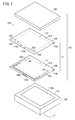
- FIG. 1 is an exploded perspective view of a main part of the touch panel according to the present embodiment.
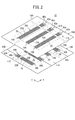
- FIG. 2 is an exploded perspective view of a main part of the laminated conductive sheet constituting the touch panel.
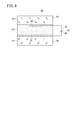
- FIG. 3 is a schematic longitudinal sectional view of the laminated conductive sheet.
- FIG. 4 is a schematic plan view showing cells of the first electrode formed on the laminated conductive sheet.
- FIG. 5 is a schematic longitudinal sectional view of a laminated conductive sheet according to another embodiment different from FIG.
- FIG. 6 is a schematic longitudinal sectional view of a V-mode evaluation base material.
- FIG. 7 is a schematic plan view of a V-mode evaluation base material.
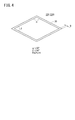
- FIG. 8 is a schematic plan view of an H-mode evaluation base material.
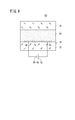
- FIG. 9 is a schematic longitudinal cross-sectional view of an H-mode evaluation base material.
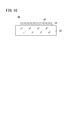
- FIG. 10 is a schematic side view of a base material for a whitening evaluation test.
- FIG. 1 is an exploded perspective view of a main part of a touch panel 100 according to the present embodiment.
- the touch panel 100 includes a sensor body 102 and a control circuit (IC circuit or the like) (not shown).
- the sensor body 102 includes a laminated conductive sheet 12 formed by laminating the first conductive sheet 10A and the second conductive sheet 10B, and a protective layer 106 laminated on the first conductive sheet 10A.
- the sensor main body 102 (the laminated conductive sheet 12 and the protective layer 106) is disposed on the display panel 110 in the display device 108 such as a liquid crystal display, for example.
- the sensor main body 102 includes a sensor unit 112 at a touch position arranged in a region corresponding to the display screen 110 a of the display panel 110 and a terminal arranged in a region corresponding to the outer peripheral portion of the display panel 110.
- a wiring portion 114 (so-called frame).
- the laminated conductive sheet 12 is configured by laminating a first conductive sheet 10A and a second conductive sheet 10B as shown in FIG.
- the first conductive sheet 10A has a first conductive portion 16A as a first electrode layer formed on one main surface of the first transparent base 14A (see FIG. 3), which is an insulating layer.
- a second conductive portion 16B (second) formed on one main surface of the second transparent base 14B (see FIG. 3), which is an insulating layer. Electrode layer).
- the thickness of the first transparent substrate 14A and the second transparent substrate 14B is preferably 50 to 350 ⁇ m or less, more preferably 80 to 250 ⁇ m, and particularly preferably 100 to 200 ⁇ m.
- Examples of the first transparent substrate 14A and the second transparent substrate 14B include a plastic film, a plastic plate, and a glass plate.
- polyesters such as polyethylene terephthalate (PET) and polyethylene naphthalate (PEN); polyolefins such as polyethylene (PE), polypropylene (PP), polystyrene, and EVA; Resin;
- polycarbonate (PC) polyamide, polyimide, acrylic resin, triacetyl cellulose (TAC) and the like can be used.
- PET melting point: 258 ° C.
- PEN melting point: 269 ° C.
- PE melting point: 135 ° C.
- PP melting point: 163 ° C.
- polystyrene melting point: 230 ° C.
- polyvinyl chloride melting point: 180 ° C.
- polyvinylidene chloride melting point: 212 ° C.
- TAC melting point: 290 ° C.
- PET is preferable from the viewpoints of light transmittance and processability. Since the conductive films such as the first conductive sheet 10A and the second conductive sheet 10B used for the laminated conductive sheet 12 are required to be transparent, the transparency of the first transparent base 14A and the second transparent base 14B is high. Is preferred.
- one first conductive portion 16A has a plurality of strip-shaped first conductive patterns 18A (first electrodes) each extending in the first direction (x direction).
- the plurality of first conductive patterns 18A are arranged along a second direction (direction orthogonal to the first direction: y direction).
- Each of the first conductive patterns 18A is formed by the silver thin wires 20 intersecting each other. Along with this intersection, a space (opening) surrounded by the thin silver wire 20, that is, a cell 22A is formed.
- At least one of the cells 22A has a parallelogram shape as shown in FIG. 4, but preferably has a rhombus shape in which the lengths of the four sides are equal.
- the width direction dimension (line width) W of the silver thin wire 20 is 4 ⁇ m or less, and more preferably 2 ⁇ m or less. Thereby, the moire of the conductive pattern by the silver thin wire 20 and the silver thin wire appearance are improved, and the visibility is improved.
- the width direction dimension W of the silver fine wire 20 is 0.5 micrometer or more.
- the rhombus cell 22A shown in FIG. 4 has two obtuse angles and two acute angles.
- the obtuse crossing angle ⁇ in a diagonal relationship is the same angle exceeding 90 °
- the acute crossing angle ⁇ is the same angle less than 90 °.
- the acute angle ⁇ is preferably 70 ° or less. In this case, it is effective in reducing moire. However, moire tends to occur even when ⁇ is excessively small. In order to avoid this, ⁇ is preferably in the range of 30 ° to 70 °, more preferably in the range of 45 ° to 70 °.
- the distance between adjacent cells 22A is preferably 300 ⁇ m or less. This case is also effective in reducing the appearance of moire and silver thin lines.
- each first conductive pattern 18A is electrically connected to a first terminal wiring pattern 42a formed by silver thin wires 20 via a first connection portion 40a.
- the second conductive portions 16B formed on one main surface of the second transparent substrate 14B (see FIG. 3) constituting the second conductive sheet 10B are each in the second direction (y direction) as shown in FIG. ) Extending in a plurality of strip-like second conductive patterns 18B (second electrodes).
- the plurality of second conductive patterns 18B are arranged along the first direction (x direction). That is, in the laminated conductive sheet 12, as shown in FIG. 3, the first conductive pattern 18A and the second conductive pattern 18B face each other through the first transparent base 14A that is an insulating layer.
- Each second conductive pattern 18B is also formed by crossing the silver thin wires 20 in the same manner as described above. Along with this intersection, a cell 22B surrounded by the thin silver wire 20 is formed.
- At least one of the cells 22B is a parallelogram like the cell 22A, and preferably has a rhombus shape in which the lengths of the four sides are equal (see FIG. 4).
- Preferred numerical ranges such as the width direction dimension W of the silver thin wire 20 in the cell 22B, the crossing angle ⁇ , and the cell pitch are the same as those in the cell 22A, and therefore detailed description thereof is omitted.
- each second conductive pattern 18B is electrically connected to the second terminal wiring pattern 42b by the silver thin wire 20 through the second connection portion 40b.
- the first conductive sheet 10 ⁇ / b> A applied to the touch panel 100 has a large number of the first conductive patterns 18 ⁇ / b> A arranged at portions corresponding to the sensor portions 112.
- a plurality of first terminal wiring patterns 42a by the silver thin wires 20 led out from the connection portion 40a are arranged.
- the outer shape of the first conductive sheet 10A has a rectangular shape when viewed from above, and the outer shape of the sensor unit 112 also has a rectangular shape.
- a plurality of first terminals 116a are arranged in the lengthwise central portion at the peripheral portion on the one long side of the first conductive sheet 10A in the length direction of the one long side. Is formed.
- a plurality of first connection portions 40a are linearly arranged along one long side of sensor portion 112 (long side closest to one long side of first conductive sheet 10A: y direction).
- the first terminal wiring pattern 42a led out from each first connection portion 40a is routed toward a substantially central portion on one long side of the first conductive sheet 10A, and is electrically connected to the corresponding first terminal 116a. It is connected.
- the first terminal wiring patterns 42a connected to the first connection portions 40a corresponding to both sides of one long side of the sensor unit 112 are routed with substantially the same length. Thereby, the delay of local signal transmission can be suppressed. This leads to an increase in response speed.
- a large number of second conductive patterns 18B are arranged in a portion corresponding to the sensor portion 112, and the terminal wiring portion 114 is led out from each second connection portion 40b.
- a plurality of second terminal wiring patterns 42b are arranged.
- a plurality of second terminals 116 b are arranged on the one long side of the second conductive sheet 10 ⁇ / b> B at the central portion in the longitudinal direction.
- An array is formed in the length direction of the side.
- a plurality of second connection portions 40b (for example, odd-numbered second connection portions 40b) along one short side of the sensor unit 112 (short side closest to one short side of the second conductive sheet 10B: x direction).
- Second connection portions 40b (for example, even-numbered ones) along the other short side of sensor portion 112 (short side closest to the other short side of second conductive sheet 10B: x direction) Are connected in a straight line.
- odd-numbered second conductive patterns 18B are connected to the corresponding odd-numbered second connection portions 40b, and even-numbered second conductive patterns 18B are respectively corresponding even-numbered even numbers. It is connected to the second second connection part 40b.
- the second terminal wiring pattern 42b derived from the odd-numbered second connection portion 40b and the second terminal wiring pattern 42b derived from the even-numbered second connection portion 40b are arranged on one long side of the second conductive sheet 10B. They are routed toward the substantially central portion and are electrically connected to the corresponding second terminals 116b. Accordingly, for example, the first and second second terminal wiring patterns 42b are routed with substantially the same length.
- the 2n-1th and 2nth second terminal wiring patterns 42b are , Each will be routed with approximately the same length.
- the second terminal 116b in the central portion in the length direction of one long side of the second conductive sheet 10B, it is possible to suppress a local signal transmission delay as described above. This also contributes to an increase in response speed.
- the derivation form of the first terminal wiring pattern 42a may be the same as the second terminal wiring pattern 42b described above. Conversely, the derivation form of the second terminal wiring pattern 42b is the same as the first terminal wiring pattern 42a described above. The same may be applied.
- the protective layer 106 is formed on the first conductive sheet 10A, and the first terminals derived from the multiple first conductive patterns 18A of the first conductive sheet 10A.
- the wiring pattern 42a and the second terminal wiring pattern 42b derived from the multiple second conductive patterns 18B of the second conductive sheet 10B are connected to, for example, a control circuit that controls scanning.
- a self-capacitance method or a mutual capacitance method can be preferably employed. That is, in the case of the self-capacitance method, voltage signals for touch position detection are sequentially supplied to the first conductive pattern 18A, and voltage signals for touch position detection are sequentially supplied to the second conductive pattern 18B. Supply. Since the fingertip is in contact with or close to the upper surface of the protective layer 106, the capacitance between the first conductive pattern 18A and the second conductive pattern 18B facing the touch position and the GND (ground) increases, so that the first conductive pattern The waveforms of the transmission signals from 18A and the second conductive pattern 18B are different from the waveforms of the transmission signals from the other conductive patterns. Therefore, the control circuit calculates the touch position based on the transmission signal supplied from the first conductive pattern 18A and the second conductive pattern 18B.
- a voltage signal for touch position detection is sequentially supplied to the first conductive pattern 18A, and sensing (detection of a transmission signal) is sequentially performed on the second conductive pattern 18B.
- sensing detection of a transmission signal
- the stray capacitance of the finger is added in parallel to the parasitic capacitance between the first conductive pattern 18A and the second conductive pattern 18B facing the touch position.
- the waveform of the transmission signal from the second conductive pattern 18B is different from the waveform of the transmission signal from the other second conductive pattern 18B. Therefore, in the control circuit, the touch position is calculated based on the order of the first conductive pattern 18A that supplies the voltage signal and the transmission signal from the supplied second conductive pattern 18B.
- the first conductive pattern 18A and the second conductive pattern 18B can be preferably formed by a microcontact printing patterning method or a silver salt method in order to obtain a pattern having a narrow line width. In order to repeatedly obtain a large amount of random patterns, a silver salt method that does not use a worn stamp is more preferable.
- the microcontact printing patterning method is a method for obtaining a pattern having a narrow line width by using the microcontact printing method.
- the microcontact printing method is a method for producing a monomolecular film pattern by using an elastic polydimethylsiloxane stamp and bringing a thiol solution into contact with a gold base material as an ink (Whitedesed, Angew. Chem. Int. Ed., 1998, volume 37, page 550).
- a typical process of the microcontact printing patterning method is, for example, as follows. That is, first, the substrate is coated with a metal (eg, silver is sputter coated onto a PET substrate).
- a metal eg, silver is sputter coated onto a PET substrate.
- the masking of the monomolecular film is stamped using a microcontact printing method on a metal-coated substrate. Thereafter, the metal coated on the substrate is removed by etching except for the pattern under masking.
- a pattern of silver fine wires 20 having a mesh shape is obtained by exposing and developing a photosensitive material having a photosensitive silver salt-containing layer.
- the specific work and the like are described in detail in paragraphs [0163] to [0241] of Japanese Patent Laid-Open No. 2009-4348.
- the upper end surface of the second conductive sheet 10B that is, on the second conductive pattern 18B and the second transparent substrate 14B
- the upper end surface of the first conductive sheet 10A that is, the first conductive sheet 18B
- the OCA 30 as an adhesive is disposed by being attached as an adhesive sheet.
- This OCA30 has a loss coefficient tan ⁇ of 0.13 or more at 140 ° C. and 1 Hz.
- a loss coefficient is calculated
- Loss coefficient (tan ⁇ ) loss elastic modulus / storage elastic modulus ... (1)
- the storage elastic modulus of OCA30 at 25 ° C. and 1 Hz is 8.9 ⁇ 10 4 Pa or less.
- Such dynamic viscoelastic properties are important from the viewpoint of soaking into the acute angle part of the cell and following the uneven surface (step following ability).
- tan ⁇ which is an index of stress relaxation
- the OCA 30 is excellent in stress relaxation, and the OCA 30 penetrates into the acute angle portion of the cell following the acute angle shape of the cell.
- a more preferable tan ⁇ is 0.15 or more, more preferably 0.20 or more.
- tan ⁇ is preferably 0.60 or less.
- the storage elastic modulus is an index of the residual stress (initial residual stress) of the OCA 30 that is deformed when bonded. If this value is 8.9 ⁇ 10 4 Pa or less, it is possible to improve the followability (step followability) to the uneven surface. For example, even when bonded with a fine silver cell line with an acute cell shape pattern having an uneven surface of about 1 ⁇ m through the OCA 30, it is possible to completely soak into the acute angle part of the cell and prevent water from entering from the outside air. It becomes possible to suppress ion migration.
- a more preferable storage elastic modulus is 8.0 ⁇ 10 4 Pa or less.
- the storage elastic modulus decreases, the adhesiveness of the OCA 30 tends to decrease.
- the storage elastic modulus is preferably 2.5 ⁇ 10 4 Pa or more.
- Particularly preferred dynamic viscoelastic properties of OCA30 are tan ⁇ of 0.20 or more and 0.60 or less, and a storage elastic modulus of 2.5 ⁇ 10 4 Pa or more and 8.0 ⁇ 10 4 Pa or less. By setting within this range, it is possible to enhance the penetration of OCA 30 at the acute angle portion of the cell, the followability to the concavo-convex shape surface (step followability), and the adhesion, and the ion migration preventing effect can be further enhanced.
- the component (A) that is, the alkyl (meth) acrylate monomer having an alkyl group having 4 to 18 carbon atoms, from the viewpoint of imparting sufficient tackiness (flexibility) to the OCA 30 with the component (A) alone.
- the glass transition temperature of the polymer composed of one or a plurality of monomers is preferably 25 ° C. or lower. Specifically, monomers having a homopolymer glass transition temperature of 25 ° C.
- n-butyl acrylate such as isobutyl acrylate, isobutyl acrylate, isoamyl acrylate, hexyl acrylate, cyclohexyl acrylate, 2-ethylhexyl (meth) acrylate, isooctyl (meth) Acrylate, isononyl (meth) acrylate, n-decyl (meth) acrylate, isodecyl (meth) acrylate, lauryl (meth) acrylate, isomyristyl (meth) acrylate, isocetyl (meth) acrylate, 2-octyldecyl (meth) acrylate, Alkyl (meth) acrylates such as isostearyl (meth) acrylate and 2-methylbutyl acrylate, and mixtures thereof can be used.
- the preferred component (A) is an alkyl acrylate because it has excellent polymerizability in both thermal polymerization and photopolymerization methods, and specifically includes n-butyl acrylate, isobutyl acrylate, 2-ethylhexyl.
- examples include acrylate, isooctyl acrylate, isononyl acrylate, isodecyl acrylate, lauryl acrylate, isomyristyl acrylate, isocetyl acrylate, 2-octyl decyl acrylate, isostearyl acrylate, 2-methylbutyl acrylate, and the like. From the viewpoint of tackiness, 2-ethylhexyl acrylate, isooctyl acrylate, and 2-methylbutyl acrylate are particularly preferable.
- the “glass transition temperature (Tg)” of the homopolymer is a value measured according to JIS K 7121. That is, when the polymer melted by heating is cooled under a certain condition, it becomes a glass state through a supercooled liquid, which means a temperature at which this state changes.
- the component (B) that is, an ester of a (meth) acrylate monomer having a glass transition point Tg exceeding 25 ° C., methyl (meth) acrylate, ethyl (meth) acrylate, t-butyl (meth) acrylate, n -Linear or branched alkyl (meth) acrylates such as butyl methacrylate and isobutyl methacrylate, cyclohexyl methacrylate, alicyclic alkyl (meth) acrylates such as 4-t-butylcyclohexyl (meth) acrylate, isobornyl (meth) acrylate, etc. .
- methyl (meth) acrylate, ethyl (meth) acrylate, and isobornyl (meth) acrylate are particularly preferable.
- the component (C) is a component that improves the cohesive strength of the OCA 30 and imparts adhesiveness. That is, in the touch panel 100, foaming and peeling particularly at high temperatures are prevented.
- Examples of this type of monomer include 2-hydroxyethyl (meth) acrylate, 3-hydroxypropyl (meth) acrylate, N, N-dimethyl (meth) acrylamide, N, N-diethyl (meth) acrylamide, and NT.
- the tan ⁇ and storage elastic modulus of OCA30 can be adjusted by appropriately changing the type, molecular weight, and composition of each monomer component. For example, when a large amount of the component (C) is used, the storage elastic modulus increases, and when the amount of the component (A) and the component (B) is increased, the storage elastic modulus can be decreased. Moreover, when the molecular weight in the copolymer of the monomer containing (A) component, (B) component, and (C) component is raised, there exists a tendency for a storage elastic modulus to become high. In general, the proportion of component (A) is 45 to 95 parts by weight, component (B) is 20 to 50 parts by weight, and component (C) is 1 to 40 parts by weight. This is preferable in terms of compatibility with whitening prevention.
- tan ⁇ of OCA 30 can be adjusted by the amount of a crosslinking agent described later. Specifically, when the amount of the crosslinking agent is increased, the value of tan ⁇ is decreased, and when the amount of the crosslinking agent is decreased, the value of tan ⁇ is increased.
- OCA30 having the above-described physical properties has good penetration into the acute angle portion of the cell, concave step following property and adhesiveness. Accordingly, since the first conductive pattern 18A and the second conductive pattern 18B are satisfactorily covered, it is difficult for a gap to be formed between the OCA 30 and the first conductive pattern 18A and the second conductive pattern 18B.
- the cell pitch is small, the width direction dimension W of the silver thin wire 20 is small, and the cells 22A and 22B have a rhombus shape having acute corners. Even in this case, it is possible to effectively prevent the resistance value of the silver thin wire 20 from changing or being disconnected.
- the OCA 30 may further contain a migration inhibitor composed of a phenolic compound. In this case, silver migration can be further prevented.
- the phenol compound means a compound containing a phenol group in the molecule. This compound suppresses ion migration by reducing silver ions to metallic silver.
- the phenolic compound preferably has an oxidation-reduction potential of 0.40 to 1.30 V, and more preferably 0.50 to 1.20 V in terms of more excellent ion migration suppression ability.
- a voltage of 55 to 1.1 V is more preferable, and a voltage of 0.55 to 1.0 V is particularly preferable.
- the redox potential of the reducing compound is less than 0.40 V or more than 1.30 V, the ion migration suppressing ability is poor.
- the type of the phenolic compound is not particularly limited, but is preferably one having an oxidation-reduction potential of 0.1 to 1.0 V, more preferably 0.1 to 0.9 V in terms of more excellent ion migration suppressing ability. More preferred is 0.15 to 0.7V.
- the oxidation-reduction potential can be measured by methods described in many documents.
- a value measured by the following method is defined as the oxidation-reduction potential.
- phenolic compound examples include compounds represented by the following formulas (1) to (3).
- R 11 to R 15 each independently represents a hydrogen atom, a hydroxyl group, or a hydrocarbon group having 1 to 20 carbon atoms which may contain a hetero atom.
- R 31 represents a hydrocarbon group having 1 to 20 carbon atoms which may contain a hetero atom. When there are a plurality of —O—R 31 , they may be the same or different.
- the number of carbon atoms of the hydrocarbon group is preferably 1 to 12 and more preferably 1 to 10 in terms of excellent compatibility with the insulating resin.
- examples of the hydrocarbon group include an aliphatic hydrocarbon group, an aromatic hydrocarbon group, and a group obtained by combining these.
- the aliphatic hydrocarbon group may be linear, branched or cyclic.
- the total molecular weight of each group of R 11 to R 15 is 21 or more. Especially, 35 or more are preferable.
- the upper limit is not particularly limited, but is preferably 1000 or less, more preferably 500 or less, and even more preferably 300 or less.
- any two of R 11 to R 15 may be bonded to each other to form a ring.
- two adjacent groups such as R 11 and R 12 , R 12 and R 13 , R 13 and R 14 , or R 14 and R 15 may be bonded to form a ring.
- the type of ring formed is not particularly limited, and examples thereof include a 5- to 6-membered ring structure.
- R 16 to R 23 each independently represents a hydrogen atom, a hydroxyl group, or a hydrocarbon group having 1 to 20 carbon atoms which may contain a hetero atom.
- the preferred range of the hydrocarbon group represented by R 16 to R 23 is synonymous with the preferred range of the hydrocarbon group represented by R 11 to R 15 described above.
- the total molecular weight of each group of R 16 to R 23 is 24 or more. Especially, 35 or more are preferable.
- the upper limit is not particularly limited, but is preferably 1000 or less, more preferably 500 or less, and even more preferably 300 or less. Further, any two of R 16 to R 23 may be bonded to each other to form a ring.
- R 24 represents a hydrogen atom or a hydrocarbon group having 1 to 20 carbon atoms which may contain a hetero atom.
- R 25 to R 28 each independently represent a hydrogen atom, a hydroxyl group, or a hydrocarbon group having 1 to 20 carbon atoms that may contain a hetero atom.
- the preferred range of the hydrocarbon group represented by R 25 to R 28 is the same as the preferred range of the hydrocarbon group represented by R 11 to R 15 described above.
- the total molecular weight of each group of R 25 to R 28 is 40 or more. Especially, 50 or more are preferable.
- the upper limit is not particularly limited, but is preferably 1000 or less, more preferably 500 or less, and even more preferably 300 or less.
- any two of R 25 to R 28 may be bonded to each other to form a ring.
- L represents a divalent or trivalent hydrocarbon group which may have a hetero atom, —S—, or a group obtained by combining these.
- the number of carbon atoms of the divalent hydrocarbon group is preferably 1 to 12 and more preferably 1 to 10 in terms of excellent compatibility with the insulating resin.
- m represents an integer of 2 or 3.
- R 13 in formula (1), R 18 and R 21 in formula (2) includes a group represented by formula (4).
- R 34 represents a hydrogen atom or a hydrocarbon group having 1 to 19 carbon atoms.
- the number of carbon atoms of the hydrocarbon group represented by R 34 is preferably 1 to 12 and more preferably 1 to 10 in terms of excellent compatibility with the insulating resin. * Represents a bonding position.
- a compound represented by the formula (5) is mentioned in that the ion migration suppressing ability is more excellent.
- R 50 and R 51 each independently represent a hydrogen atom, a hydroxyl group, an aliphatic hydrocarbon group that may contain an oxygen atom, or an aromatic hydrocarbon group that may contain an oxygen atom.
- R 50 and R 51 is an alkyl group containing a tertiary or quaternary carbon atom.
- the number of carbon atoms contained in the aliphatic hydrocarbon group or aromatic hydrocarbon group is not particularly limited, but is preferably 1-20.
- R 50 is preferably an alkyl group having 1 to 5 carbon atoms
- R 51 is preferably an alkyl group having 10 to 20 carbon atoms.
- the total molecular weight of the hydrocarbon groups contained in each group of R 50 and R 51 is preferably 30 or more, and more preferably 50 or more. If the total number of carbon atoms is in this range, the silver ion migration suppressing ability is further improved.
- Examples of the phenol compound include the following compounds.
- the OCA 30 may include a heterocyclic compound having a mercapto group (—SH) group (SH group-containing heterocyclic compound) as a migration inhibitor.
- the heterocyclic compound captures silver ions by a hetero atom contained in a mercapto group and a heterocyclic portion, thereby suppressing ion migration.
- the heterocyclic compound is a cyclic compound having at least one hetero atom.
- a heteroatom means an atom other than a carbon atom and a hydrogen atom.
- a heteroatom means only those atoms that form part of a heterocyclic ring system, either external to the ring system, separated from the ring system by at least one non-conjugated single bond, Atoms that are part of a further substituent of are not meant.
- the upper limit of the number of heteroatoms is not particularly limited, but is preferably 10 or less, more preferably 6 or less, and particularly preferably 4 or less.
- Any SH group-containing heterocyclic compound satisfying these requirements may be used, and preferably a hetero atom, a nitrogen atom, a sulfur atom, an oxygen atom, a selenium atom, a tellurium atom, a phosphorus atom, a silicon atom or a boron atom More preferably a nitrogen atom, a sulfur atom or an oxygen atom, and particularly preferably a nitrogen atom or a sulfur atom.
- the number of members of the heterocyclic ring is not particularly limited, but is preferably a 4 to 10 membered ring, more preferably a 5 to 9 membered ring, and further preferably a 5 to 6 membered ring.
- the heterocyclic ring may be either aromatic or non-aromatic, but is preferably an aromatic heterocyclic ring.
- the constitution of the heterocyclic ring may be either a monocyclic ring or a condensed ring, but is preferably a monocyclic ring or a heterocyclic ring composed of two aromatic rings.
- heterocyclic rings include pyrrole ring, thiophene ring, furan ring, imidazole ring, pyrazole ring, thiazole ring, isothiazole ring, oxazole ring, isoxazole ring, pyridine ring, pyrazine ring, pyrimidine ring, pyridazine ring.
- Indolizine ring triazole ring, oxadiazole ring, thiadiazole ring, triazaindene ring, tetraazaindene ring, pentaazaindene ring, hexaazaindene ring, purine ring, tetrazole ring, pyrazolotriazole ring, pyrrolotriazole ring Benzo-fused indole, benzofuran, benzothiophene, isobenzofuran, quinolidine, quinoline, phthalazine, quinoxaline, isoquinoline, carbazole, phenanthridine, phenanthroline Down ring, acridine ring, benzotriazole ring, and a pyrrolidine ring to which they are saturated in part or whole pyrroline ring, but imidazoline ring, and the like, but is not limited thereto.
- the SH group-containing heterocyclic compound has a mercapto group.
- Mercapto groups are highly reactive to form covalent bonds with silver. This mercapto group is bonded to the heterocyclic moiety.
- the amount of the mercapto group in the SH group-containing heterocyclic compound is not particularly limited, but the mercapto group has a higher dispersibility in the insulating resin of the SH group-containing heterocyclic compound than in the total molecular weight of the compound.
- the proportion of the total atomic weight is preferably 50% or less, particularly preferably 40% or less.
- the mercapto group may contain not only one but multiple.
- the SH group-containing heterocyclic compound may have a substituent other than a mercapto group.
- substituents include halogen atoms, alkyl groups, alkenyl groups, alkynyl groups, aryl groups, cyano groups, hydroxyl groups, nitro groups, carboxyl groups, alkoxy groups, aryloxy groups, silyloxy groups, acyloxy groups, Carbamoyloxy group, alkoxycarbonyloxy group, aryloxycarbonyloxy group, amino group, ammonio group, acylamino group, aminocarbonylamino group, alkoxycarbonylamino group, aryloxycarbonylamino group, sulfamoylamino group, alkyl and arylsulfonyl Amino group, mercapto group, alkylthio group, arylthio group, sulfamoyl group, sulfo group, alkyl and arylsulfony
- the present invention is not particularly limited to the above-described embodiment, and various modifications can be made without departing from the gist of the present invention.
- the laminated conductive sheet 12 has a first conductive portion 16A formed on one main surface of the first transparent base 14A and a second conductive surface formed on one main surface of the second transparent base 14B.
- the portion 16B is formed and laminated, as shown in FIG. 5, the first conductive portion 16A is formed on one main surface of the first transparent substrate 14A, and the first transparent substrate 14A is formed on the other main surface.
- Two conductive portions 16B may be formed.
- the second transparent base 14B does not exist, the first transparent base 14A is stacked on the second conductive portion 16B, and the first conductive portion 16A is stacked on the first transparent base 14A.
- first conductive sheet 10A and the second conductive sheet 10B may be present between the first conductive sheet 10A and the second conductive sheet 10B, so that the first conductive portion 16A and the second conductive portion 16B are kept insulated.
- first conductive portion 16A and the second conductive portion 16B may be kept insulated.
- they may be arranged to face each other.
- the cells 22A and 22B are not limited to the rhombus shape, and may be a parallelogram. Of course, also in this case, in the cells 22A and 22B, there are a diagonal where the crossing angle of the silver thin wires 20 is an obtuse angle and a diagonal which is an acute angle.
- Irgacure 651 (trademark of 2,2-dimethoxy-2-phenylacetophenone manufactured by Ciba Japan Co., Ltd., hereinafter referred to as “Irg651”) is used as each main component and photopolymerization initiator. .04 parts by weight, thoroughly mixed in a glass container, and after replacing the dissolved oxygen with nitrogen gas, irradiated with ultraviolet light for several minutes with a low-pressure mercury lamp to partially polymerize a viscous liquid having a viscosity of about 1500 cP Obtained. To the obtained composition, 0.15 part by mass of an additional polymerization initiator (Irg651) was added and sufficiently stirred.
- Irg651 additional polymerization initiator
- This mixture is vacuum degassed and then applied onto a 50 ⁇ m-thick polyester film (peeled film) that has been subjected to a release treatment so that the film thickness after drying becomes 100 ⁇ m, thereby removing oxygen that inhibits polymerization.
- peeling film was further covered, and a low-pressure mercury lamp was irradiated from both sides for about 4 minutes to obtain a transparent adhesive sheet.
- tan ⁇ and storage elastic modulus of the obtained sheet were measured. The measurement results are shown in Table 1.
- Table 1 summarizes the specific substance names of the main component, initiator or cross-linking agent, and migration inhibitor, their blending ratio, loss coefficient tan ⁇ , and storage modulus.
- 2EHA, IOA, BA, ICA, IBXA, AA, DAAM, V # 190, HEA, HPA are respectively 2-ethylhexyl acrylate, isooctyl acrylate, n-butyl acrylate, isocetyl acrylate, isobornyl acrylate, Represents acrylic acid, diacetone acrylamide, ethoxyethoxyethyl acrylate, 2-hydroxyethyl acrylate, 2-hydroxypropyl acrylate.
- Irg651 and V-65 are polymerization initiators manufactured by BASF Japan and Wako Pure Chemical Industries, Ltd.
- HDDA (1,6-hexanediol acrylate) and L-45 (isocyanate) are crosslinking agents.
- compound a is DL- ⁇ -tocopherol, and its reduction potential is 0.56V.
- Compound b and compound c are substances whose structural formulas are represented by the following formulas (6) and (7), respectively, and the reduction potentials are 1.09 V and 1.17 V, respectively.
- a long mesh is formed on each of the PET substrates 50 and 52 shown in FIG. 6 by patterning silver fine lines by a microcontact printing patterning method according to the procedure described in paragraph [0104] of JP-T-2012-519329.
- a shaped anode 54 and cathode 56 were formed, and conductive sheets 58 and 60 were produced.
- the cell was diamond shaped.
- the synthesis example No. shown in Table 1 is used for one main surface of the conductive sheet 58 (surface on which the cathode 56 is formed).
- the conductive sheet 60 was placed on the OCA 62 so that the cathode 56 and the anode 54 face each other in a state of being orthogonal to each other, as shown in FIG. This obtained the base material 64 for V mode evaluation.
- a negative electrode 68 and a positive electrode 70 of a DC power supply 66 (voltage 15 V) were electrically connected to the cathode 56 and the anode 54, respectively.
- the silver fine lines are patterned by the microcontact printing patterning method according to the procedure described in paragraph [0104] of JP-T-2012-519329, so that they are long and parallel to each other.
- a mesh-like anode 54, dummy electrode 74, and cathode 56 arranged in parallel were formed, and a conductive sheet 76 was produced.
- the cell was diamond shaped. Further, the width direction dimension of the anode 54 and the cathode 56 is 3 mm, the width direction dimension of the dummy electrode 74 is 2 mm, the clearance (space interval) between the anode 54 and the dummy electrode 74, and the space between the dummy electrode 74 and the cathode 56.
- the clearance (space interval) was 50 ⁇ m.
- FIG. 1-No With respect to one main surface of the conductive sheet 76 (surface on which the anode 54, the dummy electrode 74, and the cathode 56 are formed), as shown in FIG. 1-No.
- a PET substrate 78 was placed on the OCA 62. This obtained the base material 80 for H mode evaluation.
- the negative electrode 68 and the positive electrode 70 of the DC power source 66 (voltage 15V) were electrically connected to the cathode 56 and the anode 54, respectively.
- the evaluation substrate is prepared by the microcontact printing patterning method, but it can also be prepared by the silver salt method. That is, Example 36 to be described later was obtained in the same manner as Example 30 except that the mesh electrode was produced by the silver salt method.
- the degree of silver migration was evaluated by the change in the resistance value between the cathode 56 and the anode 54. Specifically, the time until the resistance value decreases to 1 ⁇ 10 5 ⁇ in an environment of 80 ° C., relative humidity of 85%, and 1 atmosphere is measured. Those not less than 40 hours and not more than 40 hours were evaluated as acceptable (B), and those less than 30 hours were evaluated as insufficient (C).
- the degree of silver migration was evaluated by the resistance change rate of the anode 54. That is, the resistance change rate of the anode 54 is measured when 100 hours have elapsed after the H-mode evaluation base material 80 is driven in an environment of 80 ° C., relative humidity 85%, and 1 atm. Those with less than 5% were evaluated as good (A), those with 5% or more but less than 10% were acceptable (B), and those with 10% or more were evaluated as insufficient (C).
- the synthesis example No. 1 in Table 1 is formed on one main surface of the glass substrate 82.
- a base material 86 for whitening evaluation test was obtained by placing a PET substrate 84 having a thickness of 50 ⁇ m through one of the 24 OCA 62. Thereafter, the film was exposed to an environment of 65 ° C. and a relative humidity of 95% for 72 hours, further exposed to an environment of 23 ° C. and a relative humidity of 50%, and the time until the haze reached 3% or less was measured. For this measurement, HR-100 manufactured by Murakami Color Research Laboratory was used.
- haze (%) peels off the peeling PET film on one side of the transparent double-sided pressure-sensitive adhesive sheet obtained as described above, and the optical PET film (Toray Cosmo Shine) on one surface showing adhesiveness After peeling off the other peeled PET film and pasting it onto glass (EAGLE XG manufactured by Dow Corning), after exposing it to 50 ° C. and 5 atm for 30 minutes, it was allowed to stand at 25 ° C. and 50% for 24 hours. The measurement was performed using a haze meter MODEL TC-H3 manufactured by Tokyo Denshoku.
- Table 4 shows the evaluation results when only the cell pitch is changed (Examples 23 to 26), and Table 5 shows the evaluation results when only the line width is changed (Examples 27 to 29). From these Table 4 and Table 5, even in the range where the cell pitch excellent in visibility is 300 ⁇ m or less, and in the range where the line width excellent in visibility is 2 ⁇ m or less, the migration, visibility and whitening are good or acceptable. It turns out that a certain touch panel is obtained.
- Table 6 shows the evaluation results of Examples 30 to 36 in which OCA 62 further contains a migration inhibitor composed of a phenolic compound and the acute angle, cell pitch, and line width are variously changed. From Table 6, it is clear that the use of OCA62 containing a migration inhibitor made of a phenolic compound can provide a touch panel having a particularly high migration prevention effect and excellent visibility.
- Example 36 it is clear that even when the mesh electrode is formed by the silver salt method, the same effect as that obtained by the microcontact printing patterning method can be obtained.
Landscapes
- Engineering & Computer Science (AREA)
- General Engineering & Computer Science (AREA)
- Theoretical Computer Science (AREA)
- Human Computer Interaction (AREA)
- Physics & Mathematics (AREA)
- General Physics & Mathematics (AREA)
- Position Input By Displaying (AREA)
Priority Applications (2)
| Application Number | Priority Date | Filing Date | Title |
|---|---|---|---|
| CN201480017837.5A CN105074636B (zh) | 2013-03-26 | 2014-02-17 | 触摸屏及显示装置 |
| US14/864,872 US9395863B2 (en) | 2013-03-26 | 2015-09-25 | Touch panel and display device |
Applications Claiming Priority (2)
| Application Number | Priority Date | Filing Date | Title |
|---|---|---|---|
| JP2013064316A JP5805127B2 (ja) | 2013-03-26 | 2013-03-26 | タッチパネル及び表示装置 |
| JP2013-064316 | 2013-03-26 |
Related Child Applications (1)
| Application Number | Title | Priority Date | Filing Date |
|---|---|---|---|
| US14/864,872 Continuation US9395863B2 (en) | 2013-03-26 | 2015-09-25 | Touch panel and display device |
Publications (1)
| Publication Number | Publication Date |
|---|---|
| WO2014156364A1 true WO2014156364A1 (ja) | 2014-10-02 |
Family
ID=51623365
Family Applications (1)
| Application Number | Title | Priority Date | Filing Date |
|---|---|---|---|
| PCT/JP2014/053585 Ceased WO2014156364A1 (ja) | 2013-03-26 | 2014-02-17 | タッチパネル及び表示装置 |
Country Status (5)
| Country | Link |
|---|---|
| US (1) | US9395863B2 (enExample) |
| JP (1) | JP5805127B2 (enExample) |
| CN (1) | CN105074636B (enExample) |
| TW (1) | TWI601041B (enExample) |
| WO (1) | WO2014156364A1 (enExample) |
Cited By (3)
| Publication number | Priority date | Publication date | Assignee | Title |
|---|---|---|---|---|
| EP3026536A1 (en) * | 2014-11-25 | 2016-06-01 | LG Innotek Co., Ltd. | Touch window comprising mesh electrode |
| WO2016170943A1 (ja) * | 2015-04-21 | 2016-10-27 | 東レ株式会社 | 積層部材及びタッチパネル |
| WO2018029750A1 (ja) * | 2016-08-08 | 2018-02-15 | 東レ株式会社 | 積層部材及びタッチパネル |
Families Citing this family (14)
| Publication number | Priority date | Publication date | Assignee | Title |
|---|---|---|---|---|
| JP2016126480A (ja) * | 2014-12-26 | 2016-07-11 | 大日本印刷株式会社 | タッチパネルセンサ |
| CN104656987A (zh) * | 2015-01-21 | 2015-05-27 | 业成光电(深圳)有限公司 | 具有金属网格的透明导电结构 |
| JPWO2016136971A1 (ja) * | 2015-02-27 | 2017-06-29 | 株式会社フジクラ | タッチセンサ用配線体、タッチセンサ用配線基板及びタッチセンサ |
| EP3361358B1 (en) * | 2015-10-07 | 2020-09-16 | Sekisui Chemical Co., Ltd. | Interlayer filler material for touch panels, and touch panel laminate |
| JP6116773B1 (ja) * | 2015-10-07 | 2017-04-19 | 積水化学工業株式会社 | タッチパネル用層間充填材料及びタッチパネル積層体 |
| US20170269728A1 (en) * | 2016-03-15 | 2017-09-21 | Microsoft Technology Licensing, Llc | Rhombic mesh electrode matrix having periodic electrodes |
| JPWO2018047608A1 (ja) * | 2016-09-08 | 2019-07-18 | 富士フイルム株式会社 | 導電性フィルムの製造方法、導電性フィルム、タッチパネルセンサー、アンテナ、指紋認証部、および、タッチパネル |
| JP6888077B2 (ja) * | 2017-03-06 | 2021-06-16 | 富士フイルム株式会社 | 導電性部材およびタッチパネル |
| KR102419557B1 (ko) * | 2017-08-28 | 2022-07-08 | 엘지디스플레이 주식회사 | 터치 스크린 패널 및 이를 포함하는 표시 장치 |
| CN110751902B (zh) | 2018-07-24 | 2021-01-26 | 京东方科技集团股份有限公司 | 显示装置及其制备方法 |
| CN109375801B (zh) * | 2018-09-27 | 2021-06-22 | 广西中沛光电科技有限公司 | 一种触摸屏的贴合方法 |
| WO2020255816A1 (ja) * | 2019-06-19 | 2020-12-24 | Nissha株式会社 | タッチパネル |
| US11603343B2 (en) | 2020-09-02 | 2023-03-14 | Ankh Life Sciences Limited | Inhibition of DYRK1A kinase |
| US11327619B2 (en) * | 2020-09-22 | 2022-05-10 | Elo Touch Solutions, Inc. | Touchscreen device with non-orthogonal electrodes |
Citations (1)
| Publication number | Priority date | Publication date | Assignee | Title |
|---|---|---|---|---|
| WO2013008827A1 (ja) * | 2011-07-11 | 2013-01-17 | 富士フイルム株式会社 | 導電性積層体、タッチパネル及び表示装置 |
Family Cites Families (11)
| Publication number | Priority date | Publication date | Assignee | Title |
|---|---|---|---|---|
| CN102016766B (zh) | 2008-02-28 | 2014-05-14 | 3M创新有限公司 | 具有低可见度导体的触屏传感器 |
| TWI490303B (zh) * | 2008-12-01 | 2015-07-01 | Furukawa Electric Co Ltd | Wafer adhesive tape and wafer processing methods |
| US20100156811A1 (en) * | 2008-12-22 | 2010-06-24 | Ding Hua Long | New pattern design for a capacitive touch screen |
| JP2011074308A (ja) | 2009-10-01 | 2011-04-14 | Three M Innovative Properties Co | 透明粘着シート及びそれを含む画像表示装置 |
| JP5740124B2 (ja) * | 2010-09-29 | 2015-06-24 | リンテック株式会社 | 両面粘着テープ及びタッチパネル付き表示装置 |
| WO2012111819A1 (ja) * | 2011-02-18 | 2012-08-23 | 富士フイルム株式会社 | 導電シート及びタッチパネル |
| WO2012141131A1 (ja) * | 2011-04-11 | 2012-10-18 | グンゼ株式会社 | タッチパネル装置 |
| JP5779535B2 (ja) * | 2012-03-30 | 2015-09-16 | 富士フイルム株式会社 | 導電性フイルム、それを備える表示装置及び導電性フイルムのパターンの決定方法 |
| US20140041999A1 (en) * | 2012-08-13 | 2014-02-13 | Samsung Electro-Mechanics Co., Ltd. | Touch panel |
| CN202854787U (zh) * | 2012-10-15 | 2013-04-03 | 深圳市帝晶光电股份有限公司 | 单面双层菱形结构电容式触摸屏 |
| JP2014191445A (ja) * | 2013-03-26 | 2014-10-06 | Fujifilm Corp | タッチパネル及び表示装置 |
-
2013
- 2013-03-26 JP JP2013064316A patent/JP5805127B2/ja active Active
-
2014
- 2014-02-17 WO PCT/JP2014/053585 patent/WO2014156364A1/ja not_active Ceased
- 2014-02-17 CN CN201480017837.5A patent/CN105074636B/zh active Active
- 2014-02-21 TW TW103105755A patent/TWI601041B/zh not_active IP Right Cessation
-
2015
- 2015-09-25 US US14/864,872 patent/US9395863B2/en active Active
Patent Citations (1)
| Publication number | Priority date | Publication date | Assignee | Title |
|---|---|---|---|---|
| WO2013008827A1 (ja) * | 2011-07-11 | 2013-01-17 | 富士フイルム株式会社 | 導電性積層体、タッチパネル及び表示装置 |
Cited By (8)
| Publication number | Priority date | Publication date | Assignee | Title |
|---|---|---|---|---|
| EP3026536A1 (en) * | 2014-11-25 | 2016-06-01 | LG Innotek Co., Ltd. | Touch window comprising mesh electrode |
| US9891769B2 (en) | 2014-11-25 | 2018-02-13 | Lg Innotek Co., Ltd. | Touch window |
| US10139980B2 (en) | 2014-11-25 | 2018-11-27 | Lg Innotek Co., Ltd. | Touch window |
| US10474305B2 (en) | 2014-11-25 | 2019-11-12 | Lg Innotek Co., Ltd. | Touch window |
| WO2016170943A1 (ja) * | 2015-04-21 | 2016-10-27 | 東レ株式会社 | 積層部材及びタッチパネル |
| JP6090537B1 (ja) * | 2015-04-21 | 2017-03-08 | 東レ株式会社 | 積層部材及びタッチパネル |
| US10275104B2 (en) | 2015-04-21 | 2019-04-30 | Toray Industries, Inc. | Laminate member and touch panel |
| WO2018029750A1 (ja) * | 2016-08-08 | 2018-02-15 | 東レ株式会社 | 積層部材及びタッチパネル |
Also Published As
| Publication number | Publication date |
|---|---|
| CN105074636A (zh) | 2015-11-18 |
| JP2014191441A (ja) | 2014-10-06 |
| CN105074636B (zh) | 2016-11-09 |
| US20160018932A1 (en) | 2016-01-21 |
| JP5805127B2 (ja) | 2015-11-04 |
| US9395863B2 (en) | 2016-07-19 |
| TWI601041B (zh) | 2017-10-01 |
| TW201443737A (zh) | 2014-11-16 |
Similar Documents
| Publication | Publication Date | Title |
|---|---|---|
| JP5805127B2 (ja) | タッチパネル及び表示装置 | |
| CN105122189B (zh) | 触摸屏及显示装置 | |
| US10464290B2 (en) | Pressure-sensitive adhesive sheet for touch panel, laminate for touch panel, and capacitance-type touch panel | |
| KR102528043B1 (ko) | 코팅층이 형성된 편광 필름, 점착제층이 형성된 편광 필름, 및 화상 표시 장치 | |
| CN105733476B (zh) | 带有粘合剂层的偏振薄膜及图像显示装置 | |
| CN102510888B (zh) | 双面粘合片、带剥离片的双面粘合片、其制造方法以及透明层叠体 | |
| CN103619977A (zh) | 粘合剂组合物、粘合剂层以及粘合片 | |
| JP6511659B2 (ja) | 光学フィルム用粘着剤層、及び光学フィルム用粘着フィルム | |
| US11090902B2 (en) | Pressure-sensitive adhesive composition, pressure-sensitive adhesive layer, pressure-sensitive adhesive-layer—attached polarizing film, and image display device | |
| CN102971806A (zh) | 导电层转印材料及触控式面板 | |
| TWI636713B (zh) | 配線基板 | |
| CN103038305B (zh) | 结晶性金属氧化物导电膜用粘合剂以及使用该粘合剂的结晶性金属氧化物导电膜用粘合片 | |
| KR20160104613A (ko) | 광학용 점착제, 광학용 점착 테이프 및 적층체 | |
| CN103703089B (zh) | 用于电子纸显示装置的介电结合膜 | |
| CN102863911A (zh) | 粘合片及层叠体 | |
| JP2015013925A (ja) | 光学用粘着剤、光学用粘着シート及びそれを用いた画像表示装置 | |
| JP2019038947A (ja) | 粘着剤組成物、粘着シートおよび積層体 | |
| JP6424180B2 (ja) | タッチパネル及び表示装置 | |
| DE102019203286A1 (de) | Haftklebmasse | |
| CN103455191A (zh) | 复合式胶片结构及具有复合式胶片结构的触控面板 | |
| JP2019038946A (ja) | 粘着剤組成物、粘着シートおよび積層体 | |
| TWM434990U (en) | Composite plastic film structure and touch panel comprising such structure | |
| TW202338043A (zh) | 雙面黏著片、積層體及積層體的製造方法 | |
| JP2017200974A (ja) | 粘着シート及び積層体 |
Legal Events
| Date | Code | Title | Description |
|---|---|---|---|
| WWE | Wipo information: entry into national phase |
Ref document number: 201480017837.5 Country of ref document: CN |
|
| 121 | Ep: the epo has been informed by wipo that ep was designated in this application |
Ref document number: 14773091 Country of ref document: EP Kind code of ref document: A1 |
|
| NENP | Non-entry into the national phase |
Ref country code: DE |
|
| 122 | Ep: pct application non-entry in european phase |
Ref document number: 14773091 Country of ref document: EP Kind code of ref document: A1 |