WO2014156307A1 - 自動変速機用潤滑油組成物 - Google Patents
自動変速機用潤滑油組成物 Download PDFInfo
- Publication number
- WO2014156307A1 WO2014156307A1 PCT/JP2014/052503 JP2014052503W WO2014156307A1 WO 2014156307 A1 WO2014156307 A1 WO 2014156307A1 JP 2014052503 W JP2014052503 W JP 2014052503W WO 2014156307 A1 WO2014156307 A1 WO 2014156307A1
- Authority
- WO
- WIPO (PCT)
- Prior art keywords
- lubricating oil
- mass
- oil composition
- less
- ppm
- Prior art date
- Legal status (The legal status is an assumption and is not a legal conclusion. Google has not performed a legal analysis and makes no representation as to the accuracy of the status listed.)
- Ceased
Links
Classifications
-
- C—CHEMISTRY; METALLURGY
- C10—PETROLEUM, GAS OR COKE INDUSTRIES; TECHNICAL GASES CONTAINING CARBON MONOXIDE; FUELS; LUBRICANTS; PEAT
- C10M—LUBRICATING COMPOSITIONS; USE OF CHEMICAL SUBSTANCES EITHER ALONE OR AS LUBRICATING INGREDIENTS IN A LUBRICATING COMPOSITION
- C10M141/00—Lubricating compositions characterised by the additive being a mixture of two or more compounds covered by more than one of the main groups C10M125/00 - C10M139/00, each of these compounds being essential
- C10M141/12—Lubricating compositions characterised by the additive being a mixture of two or more compounds covered by more than one of the main groups C10M125/00 - C10M139/00, each of these compounds being essential at least one of them being an organic compound containing atoms of elements not provided for in groups C10M141/02 - C10M141/10
-
- C—CHEMISTRY; METALLURGY
- C10—PETROLEUM, GAS OR COKE INDUSTRIES; TECHNICAL GASES CONTAINING CARBON MONOXIDE; FUELS; LUBRICANTS; PEAT
- C10M—LUBRICATING COMPOSITIONS; USE OF CHEMICAL SUBSTANCES EITHER ALONE OR AS LUBRICATING INGREDIENTS IN A LUBRICATING COMPOSITION
- C10M163/00—Lubricating compositions characterised by the additive being a mixture of a compound of unknown or incompletely defined constitution and a non-macromolecular compound, each of these compounds being essential
-
- C—CHEMISTRY; METALLURGY
- C10—PETROLEUM, GAS OR COKE INDUSTRIES; TECHNICAL GASES CONTAINING CARBON MONOXIDE; FUELS; LUBRICANTS; PEAT
- C10M—LUBRICATING COMPOSITIONS; USE OF CHEMICAL SUBSTANCES EITHER ALONE OR AS LUBRICATING INGREDIENTS IN A LUBRICATING COMPOSITION
- C10M2203/00—Organic non-macromolecular hydrocarbon compounds and hydrocarbon fractions as ingredients in lubricant compositions
- C10M2203/10—Petroleum or coal fractions, e.g. tars, solvents, bitumen
- C10M2203/1006—Petroleum or coal fractions, e.g. tars, solvents, bitumen used as base material
-
- C—CHEMISTRY; METALLURGY
- C10—PETROLEUM, GAS OR COKE INDUSTRIES; TECHNICAL GASES CONTAINING CARBON MONOXIDE; FUELS; LUBRICANTS; PEAT
- C10M—LUBRICATING COMPOSITIONS; USE OF CHEMICAL SUBSTANCES EITHER ALONE OR AS LUBRICATING INGREDIENTS IN A LUBRICATING COMPOSITION
- C10M2215/00—Organic non-macromolecular compounds containing nitrogen as ingredients in lubricant Compositions
- C10M2215/24—Organic non-macromolecular compounds containing nitrogen as ingredients in lubricant Compositions having hydrocarbon substituents containing thirty or more carbon atoms, e.g. nitrogen derivatives of substituted succinic acid
- C10M2215/28—Amides; Imides
-
- C—CHEMISTRY; METALLURGY
- C10—PETROLEUM, GAS OR COKE INDUSTRIES; TECHNICAL GASES CONTAINING CARBON MONOXIDE; FUELS; LUBRICANTS; PEAT
- C10M—LUBRICATING COMPOSITIONS; USE OF CHEMICAL SUBSTANCES EITHER ALONE OR AS LUBRICATING INGREDIENTS IN A LUBRICATING COMPOSITION
- C10M2219/00—Organic non-macromolecular compounds containing sulfur, selenium or tellurium as ingredients in lubricant compositions
- C10M2219/04—Organic non-macromolecular compounds containing sulfur, selenium or tellurium as ingredients in lubricant compositions containing sulfur-to-oxygen bonds, i.e. sulfones, sulfoxides
- C10M2219/046—Overbased sulfonic acid salts
-
- C—CHEMISTRY; METALLURGY
- C10—PETROLEUM, GAS OR COKE INDUSTRIES; TECHNICAL GASES CONTAINING CARBON MONOXIDE; FUELS; LUBRICANTS; PEAT
- C10M—LUBRICATING COMPOSITIONS; USE OF CHEMICAL SUBSTANCES EITHER ALONE OR AS LUBRICATING INGREDIENTS IN A LUBRICATING COMPOSITION
- C10M2223/00—Organic non-macromolecular compounds containing phosphorus as ingredients in lubricant compositions
- C10M2223/02—Organic non-macromolecular compounds containing phosphorus as ingredients in lubricant compositions having no phosphorus-to-carbon bonds
-
- C—CHEMISTRY; METALLURGY
- C10—PETROLEUM, GAS OR COKE INDUSTRIES; TECHNICAL GASES CONTAINING CARBON MONOXIDE; FUELS; LUBRICANTS; PEAT
- C10M—LUBRICATING COMPOSITIONS; USE OF CHEMICAL SUBSTANCES EITHER ALONE OR AS LUBRICATING INGREDIENTS IN A LUBRICATING COMPOSITION
- C10M2223/00—Organic non-macromolecular compounds containing phosphorus as ingredients in lubricant compositions
- C10M2223/02—Organic non-macromolecular compounds containing phosphorus as ingredients in lubricant compositions having no phosphorus-to-carbon bonds
- C10M2223/04—Phosphate esters
-
- C—CHEMISTRY; METALLURGY
- C10—PETROLEUM, GAS OR COKE INDUSTRIES; TECHNICAL GASES CONTAINING CARBON MONOXIDE; FUELS; LUBRICANTS; PEAT
- C10N—INDEXING SCHEME ASSOCIATED WITH SUBCLASS C10M RELATING TO LUBRICATING COMPOSITIONS
- C10N2020/00—Specified physical or chemical properties or characteristics, i.e. function, of component of lubricating compositions
- C10N2020/01—Physico-chemical properties
- C10N2020/02—Viscosity; Viscosity index
-
- C—CHEMISTRY; METALLURGY
- C10—PETROLEUM, GAS OR COKE INDUSTRIES; TECHNICAL GASES CONTAINING CARBON MONOXIDE; FUELS; LUBRICANTS; PEAT
- C10N—INDEXING SCHEME ASSOCIATED WITH SUBCLASS C10M RELATING TO LUBRICATING COMPOSITIONS
- C10N2030/00—Specified physical or chemical properties which is improved by the additive characterising the lubricating composition, e.g. multifunctional additives
- C10N2030/06—Oiliness; Film-strength; Anti-wear; Resistance to extreme pressure
-
- C—CHEMISTRY; METALLURGY
- C10—PETROLEUM, GAS OR COKE INDUSTRIES; TECHNICAL GASES CONTAINING CARBON MONOXIDE; FUELS; LUBRICANTS; PEAT
- C10N—INDEXING SCHEME ASSOCIATED WITH SUBCLASS C10M RELATING TO LUBRICATING COMPOSITIONS
- C10N2030/00—Specified physical or chemical properties which is improved by the additive characterising the lubricating composition, e.g. multifunctional additives
- C10N2030/76—Reduction of noise, shudder, or vibrations
-
- C—CHEMISTRY; METALLURGY
- C10—PETROLEUM, GAS OR COKE INDUSTRIES; TECHNICAL GASES CONTAINING CARBON MONOXIDE; FUELS; LUBRICANTS; PEAT
- C10N—INDEXING SCHEME ASSOCIATED WITH SUBCLASS C10M RELATING TO LUBRICATING COMPOSITIONS
- C10N2040/00—Specified use or application for which the lubricating composition is intended
- C10N2040/04—Oil-bath; Gear-boxes; Automatic transmissions; Traction drives
- C10N2040/042—Oil-bath; Gear-boxes; Automatic transmissions; Traction drives for automatic transmissions
-
- C—CHEMISTRY; METALLURGY
- C10—PETROLEUM, GAS OR COKE INDUSTRIES; TECHNICAL GASES CONTAINING CARBON MONOXIDE; FUELS; LUBRICANTS; PEAT
- C10N—INDEXING SCHEME ASSOCIATED WITH SUBCLASS C10M RELATING TO LUBRICATING COMPOSITIONS
- C10N2040/00—Specified use or application for which the lubricating composition is intended
- C10N2040/04—Oil-bath; Gear-boxes; Automatic transmissions; Traction drives
- C10N2040/045—Oil-bath; Gear-boxes; Automatic transmissions; Traction drives for continuous variable transmission [CVT]
Definitions
- the present invention relates to a lubricating oil composition for an automatic transmission, and more particularly to a lubricating oil composition for a metal belt type continuously variable transmission.
- Recent automatic transmissions and continuously variable transmissions are desired to be lighter and smaller, and with the increase in the output of the combined engine, improvement in power transmission capability is being pursued.
- the purpose of reducing the weight and size is to improve the fuel consumption of a vehicle to be mounted.
- the size can be reduced, so that the lubricating oil used there has a characteristic of maintaining a high coefficient of friction between metals. Those are preferred.
- the fuel consumption reduction by these lubricating oil is also calculated
- Patent Document 1 includes a specific calcium salicylate and SP-based extreme pressure agent, a specific amount of a specific succinimide and a boron-containing ashless dispersant, excellent anti-shudder life, and excellent fatigue life.
- a lubricating oil composition for a transmission having performance has a high intermetal friction coefficient, in which an organic acid metal salt having a specific structure, an antiwear agent, and a boron-containing succinimide are blended as essential components in Patent Document 2.
- Patent Document 2 contains calcium salicylate, phosphorus-based antiwear agent, friction modifier, and dispersion type viscosity index improver.
- Patent Literature Contains a dithiocarbamate compound, a condensate of a branched fatty acid having 8 to 30 carbon atoms and an amine, and further contains an amine antioxidant, and has a superior anti-shudder performance and a long anti-shudder life.
- the composition of Patent Document 5 has anti-shudder performance for a slip lock-up device containing calcium sulfonate and phosphites, and also a sarcosine derivative or a reaction product of a carboxylic acid and an amine.
- Patent Document 6 An automatic transmission oil composition having a long life performance with respect to a belt-type CVT device is disclosed in Patent Document 6, which includes a specific amount of a specific alkaline earth metal sulfonate. It has excellent oxidation stability for machine use, and it can also be used for anti-shudder vibration prevention and long-term use. Automatic transmission fluid composition having long-term durability to be continued is disclosed. Further, Patent Document 7 discloses an automatic transmission oil having excellent anti-shudder properties and a constant transmission torque capacity, which includes specific amounts of calcium salicylate and magnesium salicylate, specific friction modifiers and boric acid-modified succinimide. ing.
- a lubricating oil composition containing a specific boron-containing ashless dispersant and a metal-based detergent in a specific amount and a specific amount ratio can improve the above problems.
- the headline and the present invention were completed.
- the present invention relates to a lubricating base oil based on the total amount of the lubricating oil composition (A) boron-containing ashless dispersant in an amount of 300 to 1000 ppm by mass in terms of boron atoms, and (B) a total base number of 200 mgKOH / g or more.
- the lubricating oil composition of the present invention is a lubricating oil composition for an automatic transmission that can maintain a high coefficient of friction between metals and is excellent in seizure resistance, and is particularly suitable for a belt-type continuously variable transmission. It is a thing.
- the lubricating oil composition of the present invention is also excellent in performance as a transmission oil other than the above, and is used for automatic transmissions such as automobiles, construction machines, and agricultural machines, manual transmissions, and differential gears. Can also be suitably used. In addition, it can be suitably used for industrial gear oils, automobiles such as motorcycles and automobiles, gasoline engines for power generation and marine use, diesel engines, lubricating oils for gas engines, turbine oils, compressor oils, etc. it can.
- a boron-containing ashless dispersant as the component (A), a metallic detergent as the component (B), and a friction modifier as the component (C) are added to the lubricating base oil. It contains.
- the lubricating base oil in the lubricating oil composition for automatic transmissions of the present invention (hereinafter simply referred to as “lubricating oil composition”) is not particularly limited, and is a mineral base oil used for ordinary lubricating oil. Synthetic oil base oils can be used.
- the lubricating oil fraction obtained by subjecting the crude oil to atmospheric distillation obtained under reduced pressure is subjected to solvent removal, solvent extraction, hydrocracking, Refined by performing one or more treatments such as hydroisomerization, solvent dewaxing, hydrorefining, etc., or base oil produced by isomerizing wax isomerized mineral oil, GTL WAX (gas-tuly wax) Can be illustrated.
- GTL WAX gas-tuly wax
- a hydrocracked mineral oil base oil is preferable.
- a wax isomerized isoparaffin base oil obtained by isomerizing a raw material containing 50% by mass or more of a wax such as petroleum-based or Fischer-Tropsch synthetic oil is more preferably used. These can be used alone or in any mixture, but it is preferable to use a wax isomerized base oil alone.
- the synthetic base oil include polybutene or hydrides thereof; poly- ⁇ -olefins such as 1-octene oligomers, 1-decene oligomers and 1-dene oligomers or hydrides thereof; ditridecyl glutarate, Diesters such as di-2-ethylhexyl adipate, diisodecyl adipate, ditridecyl adipate, and di-2-ethylhexyl sebacate; neopentyl glycol ester, trimethylolpropane caprylate, trimethylolpropane pelargonate, pentaerythritol-2-ethylhexa
- polyol esters such as noate and pentaerythritol pelargonate
- aromatic synthetic oils such as alkylnaphthalene, alkylbenzene, and aromatic esters, or mixtures thereof.
- the kinematic viscosity at 100 ° C. of the lubricating base oil used in the present invention is not particularly limited, but is preferably 2 mm 2 / s or more, more preferably 2.5 mm 2 / s or more, and particularly preferably 3 mm 2 / s or more. Further, it is preferably adjusted to 8 mm 2 / s or less, more preferably 6 mm 2 / s or less, further preferably 4.5 mm 2 / s or less, and particularly preferably 4 mm 2 / s or less.
- the kinematic viscosity at 100 ° C. refers to the kinematic viscosity at 100 ° C. defined in ASTM D-445.
- the kinematic viscosity at 40 ° C. of the lubricating base oil used in the present invention is not particularly limited, but is preferably 8.0 mm 2 / s or more, more preferably 8.5 mm 2 / s or more, and particularly preferably 9.0 mm 2. / S or more. Further, it is preferably adjusted to 40 mm 2 / s or less, more preferably 30 mm 2 / s or less, further preferably 25 mm 2 / s or less, and particularly preferably 20 mm 2 / s or less.
- the kinematic viscosity at 40 ° C. here refers to the kinematic viscosity at 40 ° C. as defined in ASTM D-445.
- the viscosity index of the lubricating base oil is not particularly limited, but is preferably 100 or more, more preferably 120 or more, further preferably 130 or more, particularly preferably 140 or more, usually 200 or less, preferably 160 or less.
- the viscosity index is not particularly limited, but is preferably 100 or more, more preferably 120 or more, further preferably 130 or more, particularly preferably 140 or more, usually 200 or less, preferably 160 or less.
- the mineral oil base oil As the lubricating base oil in the present invention, the mineral oil base oil, the synthetic base oil, or an arbitrary mixture of two or more selected from these can be used. Examples thereof include one or more mineral oil base oils, one or more synthetic oil base oils, a mixed oil of one or more mineral oil base oils and one or more synthetic oil base oils, and the like.
- 40 low-viscosity base oil having kinematic viscosity of 8 ⁇ 14mm 2 / s at ° C., or 40 kinematic viscosity 8 ⁇ 14 mm at ° C. 2 A mixed base oil composed of a combination of a low-viscosity base oil of / s and a base oil having a relatively high viscosity and two or more base oils is preferably used.
- the blending ratio of the base oil having a kinematic viscosity at 40 ° C. of 8 to 14 mm 2 / s is preferably at least 20% by mass, preferably 40% by mass or more.
- the low viscosity base oil has a kinematic viscosity at 40 ° C. of 8 to 14 mm 2 / s, preferably 9 to 12 mm 2 / s, and a kinematic viscosity at 100 ° C. of 2 mm 2 / s to 3.5 mm 2 / s. Is less than.
- a base oil having a relatively high viscosity has a kinematic viscosity at 40 ° C. of 15 to 25 mm 2 / s and a kinematic viscosity at 100 ° C. of 3.5 mm 2 / s to 4.5 mm 2 / s.
- the viscosity index can be improved by mixing the low viscosity base oil and the relatively high viscosity base oil.
- the viscosity index of the aforementioned low-viscosity base oil is preferably 110 or more, more preferably 120 or more, and further preferably 125 or more.
- the viscosity index of the base oil having a relatively high viscosity is preferably 125 or more, more preferably 130 or more, and further preferably 135 or more.
- the sulfur content of the lubricating base oil used in the present invention is not particularly limited, but is preferably 0.1% by mass or less, more preferably 0.01% by mass or less, and 0.005% by mass. % Or less is more preferable, 0.001% by mass or less is particularly preferable, and substantially 0 is most preferable.
- a composition superior in oxidation stability can be obtained by reducing the sulfur content of the lubricating base oil.
- the lubricating oil composition of the present invention contains a boron-containing ashless dispersant as the component (A).
- a boron-containing ashless dispersant examples include a boronated ashless dispersant obtained by boronating an ashless dispersant.
- Examples of the ashless dispersant include the following nitrogen compounds. These can be used alone or in combination of two or more.
- a succinimide having at least one linear or branched alkyl group or alkenyl group having 40 to 400 carbon atoms in the molecule, or a derivative thereof
- A2 a linear or branched group having 40 to 400 carbon atoms
- Benzylamine having at least one alkyl group or alkenyl group in the molecule, or a derivative thereof
- A3 having at least one linear or branched alkyl group or alkenyl group having 40 to 400 carbon atoms in the molecule
- the alkyl group or alkenyl group has 40 to 400 carbon atoms, preferably 60 to 350 carbon atoms.
- the alkyl group or alkenyl group may be linear or branched, but specific examples thereof are derived from olefin oligomers such as propylene, 1-butene and isobutylene, and ethylene and propylene co-oligomers. And a branched alkyl group and a branched alkenyl group.
- examples of (A1) succinimide include compounds represented by the following general formula (1) or (2).
- R 1 represents an alkyl or alkenyl group having 40 to 400 carbon atoms, preferably 60 to 350 carbon atoms, and a represents an integer of 1 to 5, preferably 2 to 4.
- R 2 and R 3 each independently represents an alkyl or alkenyl group having 40 to 400 carbon atoms, preferably 60 to 350 carbon atoms, and b is 0 to 4, preferably 1 to 3. Indicates an integer.
- succinimide a so-called monotype succinimide represented by the general formula (1) in which succinic anhydride is added to one end of the polyamine is added by imidization, and succinic anhydride is added to both ends of the polyamine.
- a so-called bis-type succinimide represented by the general formula (2) in the form is included, and any of them or a mixture thereof can be used in the composition of the present invention.
- alkyl succinic acid or alkenyl succinic acid obtained by reacting a compound having an alkyl group or alkenyl group having 40 to 400 carbon atoms with maleic anhydride at 100 to 200 ° C. It can be obtained by reacting an acid with a polyamine.
- the polyamine include diethylenetriamine, triethylenetetramine, tetraethylenepentamine, and pentaethylenehexamine.
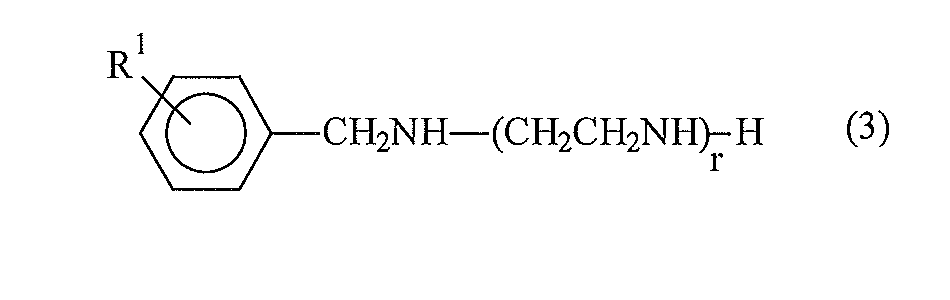
- examples of (A2) benzylamine include compounds represented by the following general formula (3).
- R 1 represents an alkyl group or alkenyl group having 40 to 400 carbon atoms, preferably 60 to 350 carbon atoms, and r represents an integer of 1 to 5, preferably 2 to 4.
- the method for producing this benzylamine is not limited in any way.
- a polyolefin such as propylene oligomer, polybutene, and ethylene- ⁇ -olefin copolymer with phenol to form alkylphenol, formaldehyde and It can be obtained by reacting polyamines such as diethylenetriamine, triethylenetetramine, tetraethylenepentamine, and pentaethylenehexamine by Mannich reaction.
- examples of (A3) polyamine include compounds represented by the following general formula (4).
- R represents 1 , an alkyl group or an alkenyl group having 40 to 400 carbon atoms, preferably 60 to 350, and k represents an integer of 1 to 5, preferably 2 to 4.
- the production method of this polyamine is not limited in any way.
- a polyolefin such as propylene oligomer, polybutene, and ethylene- ⁇ -olefin copolymer
- ammonia ethylenediamine, diethylenetriamine, triethylene are added thereto. It can be obtained by reacting polyamines such as tetramine, tetraethylenepentamine, and pentaethylenehexamine.
- Boronation of the ashless dispersant is generally performed by allowing boric acid or the like to act on the above-mentioned nitrogen-containing compound and neutralizing a part or all of the remaining amino group and / or imino group.
- boric acid-modified succinimide methods for producing boric acid-modified succinimide are disclosed in JP-B-42-8013 and JP-A-42-8014, JP-A-51-52381, JP-A-51-130408, and the like. And the like.
- organic compounds such as alcohols, hexane, xylene, etc., light lubricating oil base oil, polyamine and polyalkenyl succinic acid (anhydride), boric acid, boric acid ester, or boron compounds such as borate can be obtained by mixing and heat-treating under appropriate conditions.
- the boron-containing ashless dispersant contains the amount of boron required in the present invention as a lubricating oil composition
- the boron-containing ashless dispersant is a non-borated ashless dispersant for improving stability as a composition. You may use together.
- a boron-containing ashless dispersant alone is preferable.
- the boron-containing ashless dispersant is preferably a boronated succinimide in terms of stability as a compound thereof.
- the molecular weight of the hydrocarbon group of the boronated succinimide is preferably 500 or more, more preferably 700 or more, and still more preferably 900 or more in terms of weight average molecular weight.
- 2000 or less is preferable and 1500 or less is more preferable. If it is less than 500, the friction coefficient is high and the fuel saving effect is small. On the other hand, if it exceeds 2000, it is substantially difficult to synthesize.
- the boron content of the boron-containing ashless dispersant is preferably 1.0% by weight or more, and more preferably 1.5% by weight or more. Further, it is preferably 3% by weight or less, more preferably 2.5% by weight or less, and particularly preferably 2.4% by weight or less. If the boron content is less than 1.0% by weight, the wear resistance and seizure resistance, which are the objects of the present invention, may not be achieved. On the other hand, if the amount exceeds 3% by weight, the composition may be precipitated and the stability may be lost.
- the nitrogen content of the boron-containing ashless dispersant is preferably 1.0% by weight or more, and more preferably 1.5% by weight or more. Further, it is preferably 3% by weight or less, more preferably 2.5% by weight or less, and particularly preferably 2.0% by weight or less.
- the nitrogen content is less than 1.0% by weight, there is a possibility that the boronation which is the object of the present invention cannot be sufficiently performed.
- it exceeds 3% by weight there is a possibility that the composition will rather deteriorate the abrasion resistance.
- the content of the component (A) in the present invention needs to be 300 mass ppm or more, preferably 400 mass ppm or more, more preferably 600 mass ppm, in terms of boron atom, based on the total amount of the lubricating oil composition. That's it.
- the upper limit is 1000 mass ppm or less, it is preferable that it is 900 mass ppm or less, 850 mass ppm or less is more preferable, and 800 mass ppm or less is the most preferable. If it is less than 300 mass ppm, the extreme pressure property is poor, and if it exceeds 1000 mass ppm, the friction material is adversely affected, and the shudder prevention life is shortened. In addition, there is concern about the occurrence of precipitation and the like, and there is a risk of lack of stability.
- the lubricating oil composition of the present invention contains a metallic detergent having a total base number of 200 mgKOH / g or more as the component (B).
- the total base number referred to here is JIS K2501 “Petroleum products and lubricating oils—Test method for neutralization number”. It means the total base number measured by the perchloric acid method based on
- metallic detergent examples include alkaline earth metal sulfonate, alkaline earth metal phenate and alkaline earth metal salicylate, and one or more kinds of metallic detergents selected from these can be mentioned.
- An agent can be used. Of these, calcium salts are preferred in terms of friction characteristics.
- the alkaline earth metal sulfonate includes, for example, an alkaline earth metal salt of an alkyl aromatic sulfonic acid obtained by sulfonating an alkyl aromatic compound having a molecular weight of 100 to 1500, preferably 200 to 700.
- an alkaline earth metal salt of an alkyl aromatic sulfonic acid obtained by sulfonating an alkyl aromatic compound having a molecular weight of 100 to 1500, preferably 200 to 700.
- magnesium salts and / or calcium salts are particularly preferred in terms of friction characteristics.
- Specific examples of the alkyl aromatic sulfonic acid include so-called petroleum sulfonic acid and synthetic sulfonic acid.
- the alkaline earth metal phenate is an alkylphenol having at least one linear or branched alkyl group having 4 to 30 carbon atoms, preferably 6 to 18 carbon atoms, and reacting the alkylphenol with sulfur.
- an alkaline earth metal salt of a Mannich reaction product of alkylphenol obtained by reacting the alkylphenol with formaldehyde Particularly preferred are magnesium salt and / or calcium salt or calcium salt.
- the alkaline earth metal salicylate is an alkaline earth metal salt of an alkyl salicylic acid having at least one linear or branched alkyl group having 4 to 30 carbon atoms, preferably 6 to 18 carbon atoms.
- Particularly preferred are magnesium salts and / or calcium salts.
- alkaline earth metal sulfonate alkaline earth metal phenate, and alkaline earth metal salicylate
- alkaline earth metal bases such as magnesium and / or calcium alkaline earth metal oxides and hydroxides, or once alkali metal salts such as sodium salts and potassium salts
- alkaline earth metal bases such as magnesium and / or calcium alkaline earth metal oxides and hydroxides
- alkali metal salts such as sodium salts and potassium salts
- neutral salts (normal salts) obtained by substituting with alkaline earth metal salts, etc.
- these neutral salts (normal salts) and excess alkaline earth metal salts or alkaline earth metal bases Alkaline earth metal hydroxides and oxides
- a basic salt obtained by heating in the presence, or an overbased salt obtained by reacting a neutral salt (normal salt) with an alkaline earth metal base in the presence of carbon dioxide (superbasic salt) ) Is also included.
- the metal detergent used in the present invention is preferably an overbased salt.
- the content of the component (B) in the present invention is required to be 100 ppm by mass or more, preferably 200 ppm by mass or more, more preferably 300 ppm by mass in terms of metal element, based on the total amount of the lubricating oil composition. As mentioned above, More preferably, it is 350 mass ppm or more. Preferably, it is 1200 mass ppm or less, more preferably 1000 mass ppm or less, still more preferably 800 mass ppm or less, particularly preferably 600 mass ppm or less, and most preferably 450 mass ppm or less. If it is less than 100 ppm by mass, the effect of improving the friction characteristics tends to be insufficient. On the other hand, if it exceeds 1200 ppm by mass, there is a concern that the friction characteristics may be deteriorated due to the adverse effect of the wet clutch on the friction material.
- the metal detergent of the present invention is preferably calcium sulfonate. It is preferable to use calcium sulfonate alone. This is because the friction properties of calcium sulfonate are the best match with the friction properties required for the present invention.
- the content of the component (A) and the content of the component (B) are in a specific range. That is, based on the total amount of the lubricating oil composition, the ratio of the content of the component (A) in terms of boron atom (Bo: mass ppm) / the content in terms of metal atom of the component (B) (M: mass ppm) (Bo / M) must be 0.5-4.
- the lower limit of Bo / M is 0.5 or more, preferably 0.6 or more, more preferably 0.7 or more, and particularly preferably 1.0 or more.
- the upper limit is 4 or less, preferably 3.5 or less, more preferably 3 or less, further preferably 2.5 or less, and particularly preferably 2 or less.
- Bo / M is less than 0.5, the effect of improving the coefficient of friction between metals becomes insufficient.
- it exceeds 4 the effect of improving the coefficient of friction between metals becomes insufficient.
- the lubricating oil composition of the present invention contains a friction modifier as the component (C).
- a friction modifier any compound usually used as a friction modifier in the field of lubricating oils can be used, but an alkyl group or alkenyl group having 6 to 30 carbon atoms, particularly a linear alkyl group having 6 to 30 carbon atoms.
- amine compounds, imide compounds, fatty acid esters, fatty acid amides, fatty acid metal salts, and the like having at least one linear alkenyl group in the molecule are preferably used.
- Examples of the amine compound include linear or branched, preferably linear aliphatic monoamines having 6 to 30 carbon atoms, linear or branched, preferably linear aliphatic polyamines, or fatty acids thereof.
- An alkylene oxide adduct of a group amine can be exemplified.
- imide compounds examples include succinimides having a linear or branched alkyl group or alkenyl group having 6 to 30 carbon atoms and / or modified compounds thereof with carboxylic acid, boric acid, phosphoric acid, sulfuric acid, and the like. .
- fatty acid ester examples include esters of linear or branched, preferably linear fatty acids having 7 to 31 carbon atoms with aliphatic monohydric alcohols or aliphatic polyhydric alcohols.
- fatty acid amide examples include amides of linear or branched, preferably linear fatty acids having 7 to 31 carbon atoms, and aliphatic monoamines or aliphatic polyamines.
- fatty acid metal salt examples include alkaline earth metal salts (magnesium salts, calcium salts, etc.) and zinc salts of linear or branched, preferably linear fatty acids having 7 to 31 carbon atoms.
- amine-based friction modifiers it is preferable to contain one or two selected from amine-based friction modifiers, ester-based friction modifiers, amide-based friction modifiers, fatty acid-based friction modifiers, and fatigue. It is particularly preferable to contain one or more selected from amine-based friction modifiers, fatty acid-based friction modifiers, and amide-based friction modifiers in that the life can be further improved. Further, when the lubricating oil composition for a drive transmission device of the present invention is used as a lubricating oil for an automatic transmission or a continuously variable transmission, an imide-based friction modifier can be remarkably improved in a shudder prevention life. It is particularly preferable to contain.
- the content of the friction modifier is 0.01% by mass or more based on the total amount of the composition, preferably 0.05% by mass or more, more preferably 0.1% by mass or more, and most preferably 0.3% by mass or more. . Moreover, it is 5 mass% or less, Preferably it is 3 mass% or less, More preferably, it is 1 mass%, More preferably, it is 0.5 mass% or less. If it is less than 0.01% by mass, it will be difficult to ensure the necessary anti-shudder properties. If it exceeds 5% by mass, the necessary coefficient of friction between metals may not be ensured.
- the lubricating oil composition of the present invention preferably further contains a phosphorus additive as component (D).
- a phosphorus additive as component (D).
- component (D) for example, zinc alkyldithiophosphate, phosphoric acid, phosphorous acid, phosphoric acid monoesters, phosphoric acid diesters, phosphoric acid triesters, phosphorous acid monoesters, Phosphite diesters, phosphite triesters, salts of (phosphite) esters, and mixtures thereof.
- those other than phosphoric acid and phosphorous acid are usually compounds containing a hydrocarbon group having 2 to 30 carbon atoms, preferably 3 to 20 carbon atoms.
- the hydrocarbon group having 2 to 30 carbon atoms include the following alkyl groups, cycloalkyl groups, alkyl-substituted cycloalkyl groups, alkenyl groups, aryl groups, alkyl-substituted aryl groups, and aryl-substituted alkyl groups.
- the group can be mentioned.
- These alkyl groups may be linear or branched.
- salts of the (phosphite) phosphates described above include phosphoric acid monoesters, phosphoric acid diesters, phosphorous acid monoesters, phosphorous acid diesters, and the like, and ammonia and carbon atoms having 1 to 8 carbon atoms.
- a nitrogen-containing compound such as an amine compound containing only a hydrocarbon group or a hydroxyl group-containing hydrocarbon group in the molecule.
- One type or two or more types of these components (D) can be arbitrarily blended.
- alkyl or alkenyl phosphite is preferable.
- alkyl phosphate esters having 8 or less carbon atoms, more preferably 5 or less carbon atoms are preferred.
- the ratio of phosphorous acid: alkyl or alkenyl phosphite is 1: 0.2 to 1: 3.5 in the ratio of phosphorus amount.
- the ratio of phosphorous acid is less than 0.2 or exceeds 10, there is a concern that the balance between the coefficient of friction between metals and the anti-shudder performance deteriorates.
- the blending amount is not particularly limited, but in order to obtain the effect of improving the friction coefficient of the wet clutch and the excellent oxidation stability of the lubricating oil composition, lubrication
- the phosphorus amount is preferably 50 ppm by mass or more, more preferably 100 ppm by mass or more, further preferably 200 ppm by mass or more, and most preferably 400 ppm by mass or more.
- it is preferably 2000 ppm by mass or less, more preferably 1500 ppm by mass or less, further preferably 1000 ppm by mass or less, particularly preferably 800 ppm by mass or less, and most preferably 600 ppm by mass or less.
- the amount of phosphorus is less than 50 ppm by mass, the wear resistance and the friction coefficient between metals are not sufficient, and the anti-shudder characteristics are insufficient.
- it exceeds 2000 ppm by mass there is a concern about oxidation stability and adverse effects on the sealing material.
- an extreme pressure additive other than the phosphorus additive of component (D) can be used in combination.
- the extreme pressure additive that can be used in combination any compound that is usually used as an extreme pressure additive for lubricating oils can be used. Examples of these include sulfur compounds such as disulfides, sulfurized olefins, and sulfurized fats and oils.
- sulfur compounds such as disulfides, sulfurized olefins, and sulfurized fats and oils.
- One or two or more compounds arbitrarily selected from these extreme pressure additives can be blended in any amount. The amount of these extreme pressure additives is usually 0.01 to 5.0% by mass based on the total amount of the lubricating oil composition.
- the lubricating oil composition of the present invention preferably contains a viscosity index improver as the component (E).
- a viscosity index improver specifically, a so-called non-dispersion type viscosity index improvement such as a polymer of one or more monomers selected from various methacrylic esters, a copolymer, or a hydrogenated product thereof is used. Examples thereof include so-called dispersion-type viscosity index improvers obtained by copolymerization of various methacrylic acid esters containing a nitrogen compound.
- the other viscosity index improvers include non-dispersed or dispersed ethylene- ⁇ -olefin copolymers (examples of ⁇ -olefin include propylene, 1-butene, 1-pentene, etc.) and hydrogen And hydrogenated product of styrene-diene copolymer, styrene-maleic anhydride copolymer, polyalkylstyrene, and the like.
- the molecular weight of these viscosity index improvers is selected in consideration of shear stability.
- the number average molecular weight of the viscosity index improver is, for example, 5,000 to 150,000, preferably 5,000 to 35,000 in the case of dispersed and non-dispersed polymethacrylates.
- isobutylene or a hydride thereof those of 800 to 5,000, preferably 1,000 to 4,000, and in the case of an ethylene- ⁇ -olefin copolymer or a hydride thereof, 800 to 150,000, preferably Those of 3,000 to 12,000 are preferred.
- viscosity index improvers when an ethylene- ⁇ -olefin copolymer or a hydride thereof is used, a lubricating oil composition having particularly excellent shear stability can be obtained.
- one or two or more compounds arbitrarily selected from these viscosity index improvers can be blended in any amount.
- the blending amount of the viscosity index improver is usually in the range of 0.1 to 40% by mass based on the total amount of the lubricating oil composition.
- the viscosity index improver in the present invention is preferably a methacrylate polymer or copolymer, that is, polymethacrylate. This is because polymethacrylate as a viscosity index improver has a high low temperature viscosity characteristic and a high viscosity index improvement effect.
- the molecular weight is preferably 5,000 to 100,000, more preferably 10,000 or more, and more preferably 70,000 or less as the weight average molecular weight. Furthermore, it is preferable to combine those having a weight average molecular weight of 5,000 or more and less than 30,000 with those having a weight average molecular weight of 30,000 or more and 70,000 or less. Those of 30,000 to 70,000 are preferably 60,000 or less. When a weight average molecular weight of 5,000 or more and less than 30,000 is combined with one having a weight average molecular weight of 30,000 or more and 70,000 or less, the weight ratio as an additive is 5,000 or more and less than 30,000: 30, It is preferable that the number of 000 to 70,000 is 1: 0.02 to 1: 1.
- an antioxidant in addition to the above additives, an antioxidant, a corrosion inhibitor, a rust inhibitor, a demulsifier, and a metal deactivator, if necessary, for the purpose of further improving the performance.
- an antioxidant in addition to the above additives, an antioxidant, a corrosion inhibitor, a rust inhibitor, a demulsifier, and a metal deactivator, if necessary, for the purpose of further improving the performance.
- antioxidants that can be used in combination with the lubricating oil composition of the present invention include those commonly used in lubricating oils, such as phenolic compounds and amine compounds. Specifically, for example, alkylphenols such as 2,6-di-tert-butyl-4-methylphenol; methylene-4,4-bisphenol (2,6-di-tert-butyl-4-methylphenol) and the like Bisphenols; naphthylamines such as phenyl- ⁇ -naphthylamine; dialkyldiphenylamines; zinc dialkyldithiophosphates such as zinc di-2-ethylhexyldithiophosphate; and (3,5-di-tert-butyl-4-hydroxyphenyl) ) Esters of fatty acids (propionic acid etc.) and mono- or polyhydric alcohols such as methanol, octadecanol, 1,6 hexadiol, neopentyl
- corrosion inhibitor examples include benzotriazole, tolyltriazole, thiadiazole, and imidazole compounds.
- rust preventive examples include petroleum sulfonate, alkylbenzene sulfonate, dinonylnaphthalene sulfonate, alkenyl succinate, and polyhydric alcohol ester.
- demulsifier examples include polyalkylene glycol nonionic surfactants such as polyoxyethylene alkyl ether, polyoxyethylene alkyl phenyl ether, and polyoxyethylene alkyl naphthyl ether.
- metal deactivators include imidazoline, pyrimidine derivatives, alkylthiadiazoles, mercaptobenzothiazoles, benzotriazoles or derivatives thereof, 1,3,4-thiadiazole polysulfide, 1,3,4-thiadiazolyl-2,5-bis.
- metal deactivators include imidazoline, pyrimidine derivatives, alkylthiadiazoles, mercaptobenzothiazoles, benzotriazoles or derivatives thereof, 1,3,4-thiadiazole polysulfide, 1,3,4-thiadiazolyl-2,5-bis.
- Examples thereof include dialkyldithiocarbamate, 2- (alkyldithio) benzimidazole, and ⁇ - (o-carboxybenzylthio) propiononitrile.
- a known pour point depressant can be arbitrarily selected according to the lubricant base oil.
- the pour point depressant for example, a poly (meth) acrylate pour point having a weight average molecular weight of 50,000 to 300,000, preferably 60,000 to 300,000, particularly preferably 100,000 to 250,000.
- a depressant is preferably used.
- any compound usually used as an antifoaming agent in the lubricating oil field can be used, and examples thereof include silicones such as dimethyl silicone and fluorosilicone.
- silicones such as dimethyl silicone and fluorosilicone.
- One or two or more compounds arbitrarily selected from these can be blended in any amount.
- the colorant any compound that is usually used can be used, and any amount can be blended.
- the blending amount is 0.001 to 1.0% by mass based on the total amount of the composition. is there.
- the content is 0.005 to 5 for each of the antioxidant, corrosion inhibitor, rust inhibitor, and demulsifier, based on the total amount of the composition.
- % By weight, 0.005 to 1% by weight for metal deactivators, 0.05 to 1% by weight for pour point depressants, 0.0005 to 1% by weight for antifoaming agents, 0.001 to 1% for colorants. It is usually selected in the range of 1% by mass.
- the kinematic viscosity at 100 ° C. of the lubricating oil composition of the present invention is preferably 4 mm 2 / s or more, more preferably 4.5 mm 2 / s or more, further preferably 5 mm 2 / s or more, and particularly preferably 5. 5 mm 2 s or more, most preferably 6 mm 2 / s or more. Further, it is preferably 9 mm 2 / s or less, more preferably 8 mm 2 / s or less, further preferably 7.5 mm 2 / s or less, particularly preferably 7 mm 2 / s or less, and most preferably 6.5 mm 2 / s or less. .
- kinematic viscosity is less than 4 mm 2 / s, a sufficient oil film thickness may not be formed, and the wear resistance may be insufficient. If it exceeds 9 mm 2 / s, a sufficient fuel saving effect is obtained. Not only is this not possible, but the startability at low temperatures may be insufficient.
- the kinematic viscosity at 40 ° C. of the lubricating oil composition of the present invention is preferably 10 mm 2 / s or more, more preferably 12 mm 2 / s or more, and further preferably 15 mm 2 / s or more.
- it is 30 mm ⁇ 2 > / s or less, More preferably, it is 25 mm ⁇ 2 > / s or less, More preferably, it is 20 mm ⁇ 2 > / s or less.
- kinematic viscosity is less than 10 mm 2 / s, a sufficient oil film thickness may not be formed, and abrasion resistance may be insufficient, and if it exceeds 30 mm 2 / s, fuel economy is significantly reduced. Each is not preferred.
- the BF viscosity at ⁇ 40 ° C. of the lubricating oil composition of the present invention is preferably 20,000 mPa ⁇ s or less, more preferably 15,000 mPa ⁇ s or less, still more preferably 10,000 mPa ⁇ s or less, particularly preferably. It is 8,000 mPa ⁇ s or less, and most preferably 7,000 mPa ⁇ s or less.
- the startability at low temperatures tends to be insufficient.
- the viscosity index of the lubricating oil composition of the present invention is preferably 160 or more, more preferably 180 or more, still more preferably 200 or more, and most preferably 210 or more. Further, it is preferably 300 or less, more preferably 250 or less, and still more preferably 230 or less. If the viscosity index is less than 160, fuel economy tends to be insufficient. Moreover, the composition exceeding 300 has too much content of the poly (meth) acrylate viscosity index improver, and tends to have insufficient shear stability.
- the lubricating oil composition for an automatic transmission according to the present invention is suitably used for a continuously variable transmission using a metal belt. It is particularly suitable for a continuously variable transmission using a chain belt type metal belt.
- Example 1 to 18 and Comparative Examples 1 to 7 The lubricating oil compositions shown in Examples 1 to 18 and Comparative Examples 1 to 7 in Table 1 were prepared, the tests shown below were performed, and the evaluation results are also shown in Table 1.
- Table 1 the ratio of the base oil is based on the total amount of the base oil, and the amount of each additive added is based on the total amount of the composition.
- Comparative Example 1 in which the boron / metal (Bo / M) ratio is 7.0 and Comparative Example 7 in which 5.0 is present are compared with the Examples in comparison with the intermetallic friction of LFW-1. The coefficient is low. Further, Comparative Example 2 in which the boron / metal (Bo / M) ratio is 0.4 has a lower coefficient of friction between metals of LFW-1 than the Example. Further, Comparative Example 3 using calcium sulfonate having a base number of 70 mgKOH / g has a lower intermetallic friction coefficient of LFW-1 than that of the Example. In addition, wear resistance and seizure resistance are insufficient.
- Comparative Example 4 and Comparative Example 5 in which the boron content is 200 ppm by mass, and Comparative Example 6 in which the boron content is 1200 ppm by mass are compared with the Examples.
- LFW-1 has a low coefficient of friction between metals. In addition, wear resistance and seizure resistance are insufficient. In addition, the coefficient of friction between metals of LFW-1 is low, which affects the transmission torque capacity.
Landscapes
- Chemical & Material Sciences (AREA)
- Chemical Kinetics & Catalysis (AREA)
- General Chemical & Material Sciences (AREA)
- Oil, Petroleum & Natural Gas (AREA)
- Organic Chemistry (AREA)
- Lubricants (AREA)
Abstract
Description
特に金属ベルト式無段変速機の場合、ベルトとプーリー間の摩擦係数を向上することができれば、小型化が可能になるため、そこに使用される潤滑油は金属間摩擦係数を高く保つ特性のものが好ましい。
またさらに、これらの潤滑油による燃費低減も求められている。具体的には潤滑油の低粘度化による、攪拌抵抗の低減や、湿式クラッチパックの空転時や流体潤滑時の粘性抵抗の低減による動力損失の軽減によって、燃費の改善に寄与するものである。
また、本発明の潤滑油組成物は、上記以外の変速機油としての性能にも優れており、自動車、建設機械、農業機械等の自動変速機用あるいは手動変速機用、ディファレンシャルギヤ用の潤滑油としても好適に用いることができる。その他、工業用ギヤ油、二輪車、四輪車等の自動車用、発電用、舶用等のガソリンエンジン、ディーゼルエンジン、ガスエンジン用の潤滑油、タービン油、圧縮機油等にも好適に使用することができる。
なお、ここでいう100℃における動粘度とは、ASTM D-445に規定される100℃での動粘度を示す。
なお、ここでいう40℃における動粘度とは、ASTM D-445に規定される40℃での動粘度を示す。
一方、相対的に高粘度の基油は、40℃における動粘度が15~25mm2/sであり、100℃における動粘度は3.5mm2/s以上4.5mm2/s以下である。
上記低粘度基油と相対的に高粘度の基油を混合することにより粘度指数を向上させることができる。
ホウ素含有無灰分散剤としては、無灰分散剤をホウ素化して得られるホウ素化無灰分散剤を挙げることができる。
(A1)炭素数40~400の直鎖若しくは分枝状のアルキル基又はアルケニル基を分子中に少なくとも1個有するコハク酸イミド、あるいはその誘導体
(A2)炭素数40~400の直鎖若しくは分枝状のアルキル基又はアルケニル基を分子中に少なくとも1個有するベンジルアミン、あるいはその誘導体
(A3)炭素数40~400の直鎖若しくは分枝状のアルキル基又はアルケニル基を分子中に少なくとも1個有するポリアミン、あるいはその誘導体
このアルキル基又はアルケニル基は、直鎖状でも分枝状でもよいが、好ましいものとしては、具体的には、プロピレン、1-ブテン、イソブチレン等のオレフィンのオリゴマーやエチレンとプロピレンのコオリゴマーから誘導される分枝状アルキル基や分枝状アルケニル基等が挙げられる。

一般式(2)において、R2及びR3は、それぞれ個別に、炭素数40~400、好ましくは60~350のアルキル基又はアルケニル基を示し、bは0~4、好ましくは1~3の整数を示す。
R1‐NH-(CH2CH2NH)k‐H (4)
例えば、ホウ酸変性コハク酸イミドの製造方法としては、特公昭42-8013号公報及び同42-8014号公報、特開昭51-52381号公報及び特開昭51-130408号公報等に開示されている方法等が挙げられる。具体的には例えば、アルコール類やヘキサン、キシレン等の有機溶媒、軽質潤滑油基油等にポリアミンとポリアルケニルコハク酸(無水物)にホウ酸、ホウ酸エステル、又はホウ酸塩等のホウ素化合物を混合し、適当な条件で加熱処理することにより得ることができる。
ただし、本発明の目的である耐摩耗性や耐焼き付き性を達成するにはホウ素含有無灰分散剤単独であることが好ましい。
ホウ素化コハク酸イミドの炭化水素基の分子量は、重量平均分子量で500以上が好ましく、より好ましくは700以上、さらに好ましくは900以上である。また2000以下が好ましく、1500以下がより好ましい。500未満の場合は摩擦係数が高くなり、また省燃費効果が小さく、一方、2000を超えると実質的に合成が困難である。
ホウ素含有量が1.0重量%未満であると、本発明の目的である耐摩耗性や耐焼き付き性を達成できない恐れがある。また3重量%を超えると組成物として、沈殿等の発生が懸念され、安定性に欠ける恐れがある。
窒素含有量が1.0重量%未満であると、本発明の目的であるホウ素化が十分にできない恐れがある。また3重量%を超えると組成物として、むしろ耐摩耗性の低下を引き起こす可能性がある。
なお、ここでいう全塩基価とは、JIS K2501「石油製品及び潤滑油-中和価試験法」の7.に準拠して測定される過塩素酸法による全塩基価を意味する。
なお、これらの反応は、通常溶媒(ヘキサン等の脂肪族炭化水素溶剤、キシレン等の芳香族炭化水素溶剤、軽質潤滑油基油等)中で行われる。また、金属系清浄剤は通常軽質潤滑油基油等で希釈された状態で市販されており、また、入手可能であるが、一般的に、その金属含有量が1.0~20質量% 、好ましくは2.0~16質量%のものを用いるのが望ましい。
本発明に使用される金属系清浄剤は過塩基性塩が好ましい。
摩擦調整剤としては、潤滑油分野で摩擦調整剤として通常用いられる任意の化合物が使用可能であるが、炭素数6~30のアルキル基又はアルケニル基、特に炭素数6~30の直鎖アルキル基又は直鎖アルケニル基を分子中に少なくとも1個有する、アミン化合物、イミド化合物、脂肪酸エステル、脂肪酸アミド、脂肪酸金属塩等が好ましく用いられる。
これらの(D)成分は、1種類あるいは2種類以上を任意に配合することができる。
亜リン酸とアルキル又はアルケニル亜リン酸エステルを併用する場合は、リン量の比率で、亜リン酸:アルキル又はアルケニル亜リン酸エステルが1:0.2~1:3.5であることが好ましい。より好ましくは1:0.5~1:3、さらに好ましくは1:1~1:2である。亜リン酸の比が0.2未満、あるいは10を超えるとでは金属間摩擦係数とシャダー防止性の性能のバランスが悪化する懸念がある。
リン量として50質量ppm未満では耐摩耗性や金属間摩擦係数が十分ではなく、また耐シャダー特性が不十分となる。また2000質量ppmを超えると、酸化安定性やシール材への悪影響が懸念される。
またその他の粘度指数向上剤の具体例としては、非分散型又は分散型エチレン-α-オレフィン共重合体(α-オレフィンとしてはプロピレン、1-ブテン、1-ペンテン等が例示できる)及びその水素化物、ポリイソブチレン及びその水添物、スチレン-ジエン共重合体の水素化物、スチレン-無水マレイン酸エステル共重合体、及びポリアルキルスチレン等を挙げることができる。
重量平均分子量が5,000以上30,000未満のものと、30,000以上70,000以下のものを組み合わせる場合は、添加剤としての質量率で、5,000以上30,000未満:30,000以上70,000以下のものが1:0.02~1:1であることが好ましい。より好ましくは1:0.05~1:0.8、さらに好ましくは1:0.1~1:0.5である。
また2種類のポリメタクリレートを組み合わせる理由は、剪断安定性と低温粘度特性ならびに粘度指数向上効果のバランスが本発明において最も良いからである。
当該動粘度が4mm2/s未満では、十分な油膜厚さが形成されず、耐摩耗性が不十分になる可能性があり、また9mm2/sを超えると、十分な省燃費効果が得られないばかりか、低温時始動性が不十分となる可能性がある。
当該動粘度が10mm2/s未満では十分な油膜厚さが形成されず、耐摩耗性が不十分になる可能性がある、また30mm2/sを超えると省燃費性が著しく低下するため、それぞれ好ましくない。
表1の実施例1~18及び比較例1~7に示す各潤滑油組成物を調製し、以下に示す試験を行い、その評価結果を表1に併記した。なお、表1中、基油の割合は基油全量基準、各添加剤の添加量は組成物全量基準である。
(2)ASTM D4172に準拠した高速四球試験法による摩耗痕径
(3)ASTM D3233に準拠したファレックス焼き付き試験法による焼き付き荷重
(4)JASO法(高荷重法)M358:2005に準拠したLFW-1試験による金属間摩擦係数
(5)JASO法 M349:2010に準拠したLVFA寿命試験法に基づくシャダー寿命試験
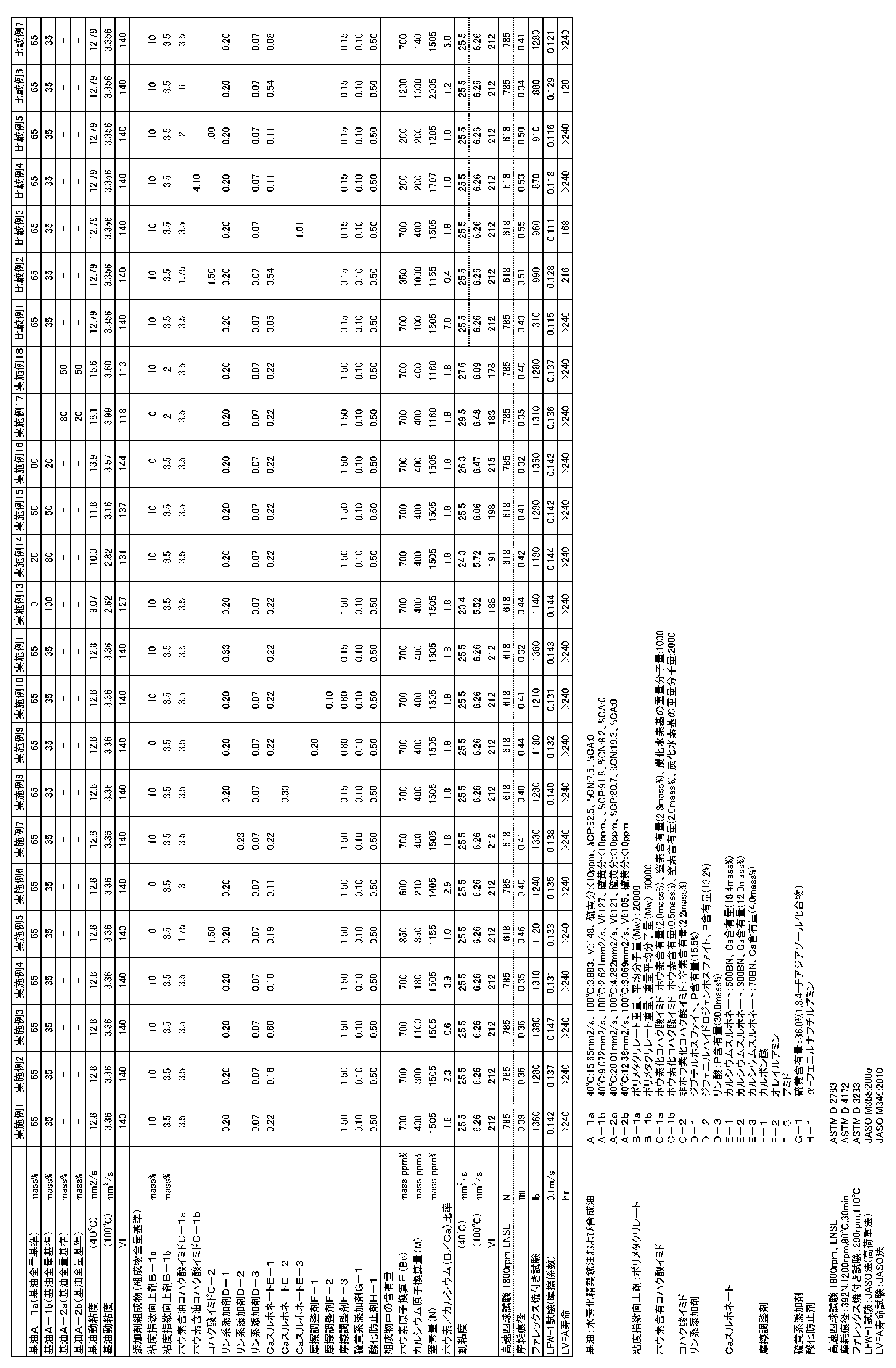
また、ホウ素/金属(Bo/M)比率が0.4である比較例2は、実施例に比較し、LFW-1の金属間摩擦係数が低い。
また、塩基価が70mgKOH/gのカルシウムスルホネートを使用した比較例3は、実施例に比較し、LFW-1の金属間摩擦係数が低い。また耐摩耗性や耐焼付性も不十分である。
また、ホウ素を含む無灰分散剤を使用しても、ホウ素量が200質量ppmである比較例4および比較例5、またホウ素量が1200質量ppmである比較例6は、実施例に比較し、LFW-1の金属間摩擦係数が低い。また耐摩耗性や耐焼付性も不十分である。またLFW-1の金属間摩擦係数も低く、伝達トルク容量に影響している。
Claims (6)
- 潤滑油基油に、潤滑油組成物全量を基準として、(A)ホウ素含有無灰分散剤をホウ素原子換算で300~1000質量ppm、(B)全塩基価が200mgKOH/g以上の金属系清浄剤を金属原子換算で100~1200質量ppm、及び(C)摩擦調整剤を0.01~5質量%含有し、かつ(A)成分のホウ素原子換算の含有量(Bo:質量ppm)/(B)成分の金属原子換算の含有量(M:質量ppm)の比率(Bo/M)が0.5~4であることを特徴とする自動変速機用潤滑油組成物。
- 前記潤滑油基油は、1種または2種以上の混合物からなり、少なくとも1種が40℃における動粘度8~14mm2/sの鉱油系基油または合成油で、かつ基油配合率が20質量%以上であり、組成物の40℃における動粘度が10~30mm2/s、粘度指数が160以上であることを特徴とする請求項1に記載の自動変速機用潤滑油組成物。
- さらに、(D)リン系添加剤を潤滑油組成物全量基準でリン量として50~2000質量ppm、および(E)粘度指数向上剤を潤滑油組成物全量基準で0.1~40質量%含有することを特徴とする請求項1または2に記載の自動変速機用潤滑油組成物。
- 前記(A)ホウ素含有無灰分散剤が、ホウ素を1重量%以上含み、窒素を3重量%以下含むことを特徴とする請求項1~3のいずれかに記載の自動変速機用潤滑油組成物。
- 前記(B)金属系清浄剤が、カルシウムスルホネートのみからなることを特徴とする請求項1~4のいずれかに記載の自動変速機用潤滑油組成物。
- 金属ベルトを使用する無段変速機に用いることを特徴とする請求項1~5のいずれかに記載の自動変速機用潤滑油組成物。
Priority Applications (2)
| Application Number | Priority Date | Filing Date | Title |
|---|---|---|---|
| CN201480019490.8A CN105073963A (zh) | 2013-03-29 | 2014-02-04 | 自动变速机用润滑油组合物 |
| US14/780,747 US20160075964A1 (en) | 2013-03-29 | 2014-02-04 | Lubricating oil composition for automatic transmission |
Applications Claiming Priority (2)
| Application Number | Priority Date | Filing Date | Title |
|---|---|---|---|
| JP2013-072327 | 2013-03-29 | ||
| JP2013072327A JP6016692B2 (ja) | 2013-03-29 | 2013-03-29 | 自動変速機用潤滑油組成物 |
Publications (1)
| Publication Number | Publication Date |
|---|---|
| WO2014156307A1 true WO2014156307A1 (ja) | 2014-10-02 |
Family
ID=51623308
Family Applications (1)
| Application Number | Title | Priority Date | Filing Date |
|---|---|---|---|
| PCT/JP2014/052503 Ceased WO2014156307A1 (ja) | 2013-03-29 | 2014-02-04 | 自動変速機用潤滑油組成物 |
Country Status (4)
| Country | Link |
|---|---|
| US (1) | US20160075964A1 (ja) |
| JP (1) | JP6016692B2 (ja) |
| CN (1) | CN105073963A (ja) |
| WO (1) | WO2014156307A1 (ja) |
Cited By (6)
| Publication number | Priority date | Publication date | Assignee | Title |
|---|---|---|---|---|
| WO2016158999A1 (ja) * | 2015-03-31 | 2016-10-06 | 出光興産株式会社 | 潤滑油組成物 |
| WO2016157955A1 (ja) * | 2015-03-31 | 2016-10-06 | Jxエネルギー株式会社 | 潤滑油組成物 |
| JP2016176066A (ja) * | 2015-03-12 | 2016-10-06 | アフトン・ケミカル・コーポレーションAfton Chemical Corporation | 自動変速機用の潤滑剤組成物 |
| WO2016170813A1 (ja) * | 2015-04-22 | 2016-10-27 | 出光興産株式会社 | 自動変速機油 |
| JP2018065924A (ja) * | 2016-10-19 | 2018-04-26 | 出光興産株式会社 | 潤滑油組成物、潤滑方法、及び変速機 |
| WO2019177125A1 (ja) * | 2018-03-14 | 2019-09-19 | 出光興産株式会社 | 潤滑油組成物 |
Families Citing this family (11)
| Publication number | Priority date | Publication date | Assignee | Title |
|---|---|---|---|---|
| EP2997119B1 (en) * | 2013-05-14 | 2021-08-04 | The Lubrizol Corporation | Lubricating composition and method of lubricating a transmission |
| JP6500271B2 (ja) * | 2015-03-30 | 2019-04-17 | 出光興産株式会社 | 潤滑油組成物 |
| JP6940274B2 (ja) | 2016-01-21 | 2021-09-22 | Emgルブリカンツ合同会社 | 潤滑油組成物 |
| WO2017126706A1 (ja) * | 2016-01-21 | 2017-07-27 | エクソンモービル リサーチ アンド エンジニアリング カンパニー | 潤滑油組成物 |
| JP6907461B2 (ja) | 2016-02-29 | 2021-07-21 | 出光興産株式会社 | 潤滑油組成物、潤滑方法、及び変速機 |
| JP6962677B2 (ja) * | 2016-10-27 | 2021-11-05 | Emgルブリカンツ合同会社 | 潤滑油組成物 |
| EP3572485A4 (en) * | 2017-01-19 | 2020-11-04 | Idemitsu Kosan Co.,Ltd. | LUBRICANT COMPOSITION |
| JP6927488B2 (ja) * | 2017-03-30 | 2021-09-01 | 出光興産株式会社 | 二輪車用潤滑油組成物、該潤滑油組成物を用いた二輪車の燃費向上方法、及び該潤滑油組成物の製造方法 |
| JP6879809B2 (ja) * | 2017-04-13 | 2021-06-02 | Eneos株式会社 | 潤滑油組成物 |
| CN110699155B (zh) * | 2018-07-10 | 2022-04-08 | 中国石油化工股份有限公司 | 一种低粘度8at自动变速箱专用油组合物 |
| CN119639501B (zh) * | 2023-09-15 | 2026-04-10 | 中国石油化工股份有限公司 | 一种高剪切稳定性的液力传动油组合物及其制备方法 |
Citations (8)
| Publication number | Priority date | Publication date | Assignee | Title |
|---|---|---|---|---|
| JP2000109875A (ja) * | 1998-10-07 | 2000-04-18 | Nippon Mitsubishi Oil Corp | 金属ベルト式無段変速機用潤滑油組成物 |
| JP2000109867A (ja) * | 1998-10-07 | 2000-04-18 | Nippon Mitsubishi Oil Corp | 金属ベルト式無段変速機用潤滑油組成物 |
| JP2001323292A (ja) * | 2000-05-17 | 2001-11-22 | Tonengeneral Sekiyu Kk | 潤滑油組成物 |
| JP2005139446A (ja) * | 2003-11-10 | 2005-06-02 | Afton Chemical Corp | 動力伝達流体用潤滑剤組成物 |
| WO2005093024A1 (ja) * | 2004-03-29 | 2005-10-06 | Idemitsu Kosan Co., Ltd. | 無段変速機用潤滑油組成物 |
| WO2007052833A1 (ja) * | 2005-11-02 | 2007-05-10 | Nippon Oil Corporation | 潤滑油組成物 |
| WO2009101847A1 (ja) * | 2008-02-13 | 2009-08-20 | Idemitsu Kosan Co., Ltd. | 無段変速機用潤滑油組成物 |
| WO2009113234A1 (ja) * | 2008-03-10 | 2009-09-17 | 新日本石油株式会社 | 潤滑油組成物 |
Family Cites Families (1)
| Publication number | Priority date | Publication date | Assignee | Title |
|---|---|---|---|---|
| JP5019738B2 (ja) * | 2005-11-02 | 2012-09-05 | Jx日鉱日石エネルギー株式会社 | 潤滑油組成物 |
-
2013
- 2013-03-29 JP JP2013072327A patent/JP6016692B2/ja active Active
-
2014
- 2014-02-04 US US14/780,747 patent/US20160075964A1/en not_active Abandoned
- 2014-02-04 CN CN201480019490.8A patent/CN105073963A/zh active Pending
- 2014-02-04 WO PCT/JP2014/052503 patent/WO2014156307A1/ja not_active Ceased
Patent Citations (8)
| Publication number | Priority date | Publication date | Assignee | Title |
|---|---|---|---|---|
| JP2000109875A (ja) * | 1998-10-07 | 2000-04-18 | Nippon Mitsubishi Oil Corp | 金属ベルト式無段変速機用潤滑油組成物 |
| JP2000109867A (ja) * | 1998-10-07 | 2000-04-18 | Nippon Mitsubishi Oil Corp | 金属ベルト式無段変速機用潤滑油組成物 |
| JP2001323292A (ja) * | 2000-05-17 | 2001-11-22 | Tonengeneral Sekiyu Kk | 潤滑油組成物 |
| JP2005139446A (ja) * | 2003-11-10 | 2005-06-02 | Afton Chemical Corp | 動力伝達流体用潤滑剤組成物 |
| WO2005093024A1 (ja) * | 2004-03-29 | 2005-10-06 | Idemitsu Kosan Co., Ltd. | 無段変速機用潤滑油組成物 |
| WO2007052833A1 (ja) * | 2005-11-02 | 2007-05-10 | Nippon Oil Corporation | 潤滑油組成物 |
| WO2009101847A1 (ja) * | 2008-02-13 | 2009-08-20 | Idemitsu Kosan Co., Ltd. | 無段変速機用潤滑油組成物 |
| WO2009113234A1 (ja) * | 2008-03-10 | 2009-09-17 | 新日本石油株式会社 | 潤滑油組成物 |
Cited By (16)
| Publication number | Priority date | Publication date | Assignee | Title |
|---|---|---|---|---|
| JP2016176066A (ja) * | 2015-03-12 | 2016-10-06 | アフトン・ケミカル・コーポレーションAfton Chemical Corporation | 自動変速機用の潤滑剤組成物 |
| WO2016158999A1 (ja) * | 2015-03-31 | 2016-10-06 | 出光興産株式会社 | 潤滑油組成物 |
| WO2016157955A1 (ja) * | 2015-03-31 | 2016-10-06 | Jxエネルギー株式会社 | 潤滑油組成物 |
| JP2016193997A (ja) * | 2015-03-31 | 2016-11-17 | 出光興産株式会社 | 潤滑油組成物 |
| JPWO2016157955A1 (ja) * | 2015-03-31 | 2018-01-25 | Jxtgエネルギー株式会社 | 潤滑油組成物 |
| US10407642B2 (en) | 2015-03-31 | 2019-09-10 | Idemitsu Kosan Co., Ltd. | Lubricant composition |
| WO2016170813A1 (ja) * | 2015-04-22 | 2016-10-27 | 出光興産株式会社 | 自動変速機油 |
| JP2016204519A (ja) * | 2015-04-22 | 2016-12-08 | 出光興産株式会社 | 自動変速機油 |
| WO2018074557A1 (ja) * | 2016-10-19 | 2018-04-26 | 出光興産株式会社 | 潤滑油組成物、潤滑方法、及び変速機 |
| CN109563431A (zh) * | 2016-10-19 | 2019-04-02 | 出光兴产株式会社 | 润滑油组合物、润滑方法、和变速器 |
| JP2018065924A (ja) * | 2016-10-19 | 2018-04-26 | 出光興産株式会社 | 潤滑油組成物、潤滑方法、及び変速機 |
| US10920162B2 (en) | 2016-10-19 | 2021-02-16 | Idemitsu Kosan Co., Ltd. | Lubricant composition, lubricating method and transmission |
| JP2021143348A (ja) * | 2016-10-19 | 2021-09-24 | 出光興産株式会社 | 潤滑油組成物、潤滑方法、及び変速機 |
| CN109563431B (zh) * | 2016-10-19 | 2022-05-03 | 出光兴产株式会社 | 润滑油组合物、润滑方法、和变速器 |
| WO2019177125A1 (ja) * | 2018-03-14 | 2019-09-19 | 出光興産株式会社 | 潤滑油組成物 |
| JPWO2019177125A1 (ja) * | 2018-03-14 | 2021-02-25 | 出光興産株式会社 | 潤滑油組成物 |
Also Published As
| Publication number | Publication date |
|---|---|
| JP6016692B2 (ja) | 2016-10-26 |
| JP2014196396A (ja) | 2014-10-16 |
| CN105073963A (zh) | 2015-11-18 |
| US20160075964A1 (en) | 2016-03-17 |
Similar Documents
| Publication | Publication Date | Title |
|---|---|---|
| JP6016692B2 (ja) | 自動変速機用潤滑油組成物 | |
| JP5207599B2 (ja) | 潤滑油組成物 | |
| JP6031461B2 (ja) | 潤滑油組成物 | |
| US8921287B2 (en) | Lubricating oil composition | |
| JP5941316B2 (ja) | 潤滑油組成物 | |
| EP3409751B1 (en) | Lubricant composition | |
| WO2010092912A1 (ja) | 無段変速機油組成物 | |
| JP2016193997A (ja) | 潤滑油組成物 | |
| JP6259511B2 (ja) | 潤滑油組成物 | |
| JP5889695B2 (ja) | 潤滑油組成物 | |
| JP6126024B2 (ja) | 変速機用潤滑油組成物 | |
| KR102270368B1 (ko) | 트렁크 피스톤형 디젤 기관용 윤활유 조성물 | |
| JP5030402B2 (ja) | 潤滑油組成物 | |
| JP5188019B2 (ja) | 潤滑油組成物 | |
| JP5019738B2 (ja) | 潤滑油組成物 | |
| JP5473236B2 (ja) | 潤滑油組成物 | |
| JP2007126542A (ja) | 潤滑油組成物 | |
| JP2003082376A (ja) | 潤滑油組成物 | |
| CN110229710A (zh) | 变速器用润滑油组合物 | |
| JP2017101151A (ja) | 潤滑油組成物 | |
| WO2016152230A1 (ja) | 自動変速機用潤滑油組成物 |
Legal Events
| Date | Code | Title | Description |
|---|---|---|---|
| WWE | Wipo information: entry into national phase |
Ref document number: 201480019490.8 Country of ref document: CN |
|
| 121 | Ep: the epo has been informed by wipo that ep was designated in this application |
Ref document number: 14776317 Country of ref document: EP Kind code of ref document: A1 |
|
| WWE | Wipo information: entry into national phase |
Ref document number: 14780747 Country of ref document: US |
|
| NENP | Non-entry into the national phase |
Ref country code: DE |
|
| 122 | Ep: pct application non-entry in european phase |
Ref document number: 14776317 Country of ref document: EP Kind code of ref document: A1 |