WO2014065145A1 - アルカリ二次電池正極活物質用被覆水酸化ニッケル粉末及び被覆水酸化ニッケル粉末の被覆密着性の評価方法 - Google Patents
アルカリ二次電池正極活物質用被覆水酸化ニッケル粉末及び被覆水酸化ニッケル粉末の被覆密着性の評価方法 Download PDFInfo
- Publication number
- WO2014065145A1 WO2014065145A1 PCT/JP2013/077866 JP2013077866W WO2014065145A1 WO 2014065145 A1 WO2014065145 A1 WO 2014065145A1 JP 2013077866 W JP2013077866 W JP 2013077866W WO 2014065145 A1 WO2014065145 A1 WO 2014065145A1
- Authority
- WO
- WIPO (PCT)
- Prior art keywords
- nickel hydroxide
- cobalt
- transmittance
- hydroxide powder
- coating
- Prior art date
- Legal status (The legal status is an assumption and is not a legal conclusion. Google has not performed a legal analysis and makes no representation as to the accuracy of the status listed.)
- Ceased
Links
Images

Classifications
-
- G—PHYSICS
- G01—MEASURING; TESTING
- G01N—INVESTIGATING OR ANALYSING MATERIALS BY DETERMINING THEIR CHEMICAL OR PHYSICAL PROPERTIES
- G01N21/00—Investigating or analysing materials by the use of optical means, i.e. using sub-millimetre waves, infrared, visible or ultraviolet light
- G01N21/17—Systems in which incident light is modified in accordance with the properties of the material investigated
- G01N21/59—Transmissivity
-
- H—ELECTRICITY
- H01—ELECTRIC ELEMENTS
- H01M—PROCESSES OR MEANS, e.g. BATTERIES, FOR THE DIRECT CONVERSION OF CHEMICAL ENERGY INTO ELECTRICAL ENERGY
- H01M10/00—Secondary cells; Manufacture thereof
- H01M10/24—Alkaline accumulators
- H01M10/30—Nickel accumulators
-
- H—ELECTRICITY
- H01—ELECTRIC ELEMENTS
- H01M—PROCESSES OR MEANS, e.g. BATTERIES, FOR THE DIRECT CONVERSION OF CHEMICAL ENERGY INTO ELECTRICAL ENERGY
- H01M4/00—Electrodes
- H01M4/02—Electrodes composed of, or comprising, active material
- H01M4/24—Electrodes for alkaline accumulators
- H01M4/26—Processes of manufacture
-
- H—ELECTRICITY
- H01—ELECTRIC ELEMENTS
- H01M—PROCESSES OR MEANS, e.g. BATTERIES, FOR THE DIRECT CONVERSION OF CHEMICAL ENERGY INTO ELECTRICAL ENERGY
- H01M4/00—Electrodes
- H01M4/02—Electrodes composed of, or comprising, active material
- H01M4/24—Electrodes for alkaline accumulators
- H01M4/32—Nickel oxide or hydroxide electrodes
-
- H—ELECTRICITY
- H01—ELECTRIC ELEMENTS
- H01M—PROCESSES OR MEANS, e.g. BATTERIES, FOR THE DIRECT CONVERSION OF CHEMICAL ENERGY INTO ELECTRICAL ENERGY
- H01M4/00—Electrodes
- H01M4/02—Electrodes composed of, or comprising, active material
- H01M4/36—Selection of substances as active materials, active masses, active liquids
- H01M4/362—Composites
- H01M4/366—Composites as layered products
-
- H—ELECTRICITY
- H01—ELECTRIC ELEMENTS
- H01M—PROCESSES OR MEANS, e.g. BATTERIES, FOR THE DIRECT CONVERSION OF CHEMICAL ENERGY INTO ELECTRICAL ENERGY
- H01M4/00—Electrodes
- H01M4/02—Electrodes composed of, or comprising, active material
- H01M4/36—Selection of substances as active materials, active masses, active liquids
- H01M4/48—Selection of substances as active materials, active masses, active liquids of inorganic oxides or hydroxides
- H01M4/52—Selection of substances as active materials, active masses, active liquids of inorganic oxides or hydroxides of nickel, cobalt or iron
-
- G—PHYSICS
- G01—MEASURING; TESTING
- G01N—INVESTIGATING OR ANALYSING MATERIALS BY DETERMINING THEIR CHEMICAL OR PHYSICAL PROPERTIES
- G01N19/00—Investigating materials by mechanical methods
- G01N19/04—Measuring adhesive force between materials, e.g. of sealing tape, of coating
-
- G—PHYSICS
- G01—MEASURING; TESTING
- G01N—INVESTIGATING OR ANALYSING MATERIALS BY DETERMINING THEIR CHEMICAL OR PHYSICAL PROPERTIES
- G01N2201/00—Features of devices classified in G01N21/00
- G01N2201/02—Mechanical
- G01N2201/022—Casings
-
- G—PHYSICS
- G01—MEASURING; TESTING
- G01N—INVESTIGATING OR ANALYSING MATERIALS BY DETERMINING THEIR CHEMICAL OR PHYSICAL PROPERTIES
- G01N2203/00—Investigating strength properties of solid materials by application of mechanical stress
- G01N2203/02—Details not specific for a particular testing method
- G01N2203/026—Specifications of the specimen
- G01N2203/0284—Bulk material, e.g. powders
-
- G—PHYSICS
- G01—MEASURING; TESTING
- G01N—INVESTIGATING OR ANALYSING MATERIALS BY DETERMINING THEIR CHEMICAL OR PHYSICAL PROPERTIES
- G01N2203/00—Investigating strength properties of solid materials by application of mechanical stress
- G01N2203/02—Details not specific for a particular testing method
- G01N2203/06—Indicating or recording means; Sensing means
- G01N2203/0641—Indicating or recording means; Sensing means using optical, X-ray, ultraviolet, infrared or similar detectors
-
- H—ELECTRICITY
- H01—ELECTRIC ELEMENTS
- H01M—PROCESSES OR MEANS, e.g. BATTERIES, FOR THE DIRECT CONVERSION OF CHEMICAL ENERGY INTO ELECTRICAL ENERGY
- H01M2220/00—Batteries for particular applications
- H01M2220/30—Batteries in portable systems, e.g. mobile phone, laptop
-
- Y—GENERAL TAGGING OF NEW TECHNOLOGICAL DEVELOPMENTS; GENERAL TAGGING OF CROSS-SECTIONAL TECHNOLOGIES SPANNING OVER SEVERAL SECTIONS OF THE IPC; TECHNICAL SUBJECTS COVERED BY FORMER USPC CROSS-REFERENCE ART COLLECTIONS [XRACs] AND DIGESTS
- Y02—TECHNOLOGIES OR APPLICATIONS FOR MITIGATION OR ADAPTATION AGAINST CLIMATE CHANGE
- Y02E—REDUCTION OF GREENHOUSE GAS [GHG] EMISSIONS, RELATED TO ENERGY GENERATION, TRANSMISSION OR DISTRIBUTION
- Y02E60/00—Enabling technologies; Technologies with a potential or indirect contribution to GHG emissions mitigation
- Y02E60/10—Energy storage using batteries
Definitions
- the present invention relates to a coated nickel hydroxide powder for an alkaline secondary battery positive electrode active material coated with a cobalt compound, in order to ensure conductivity between particles and improve battery utilization, life characteristics, and output characteristics,
- the present invention relates to a method for evaluating the adhesion of a cobalt compound coating.
- nickel hydroxide powder for alkaline secondary battery cathode materials cobalt is dissolved in nickel hydroxide powder to improve utilization at high temperatures, and zinc and magnesium are dissolved in order to improve life characteristics. Improvements such as letting go.
- alkaline secondary batteries have been adopted as power sources for high-power applications such as power sources for hybrid vehicles, and there is a strong demand for improved output characteristics as well as improved utilization at high temperatures and improved life characteristics. It has been.
- nickel hydroxide powder for alkaline secondary battery positive electrode active materials is an electrical insulator, so it has poor conductivity, and the current does not reach nickel hydroxide sufficiently. There was a problem that the rate would be low.
- a cobalt compound such as cobalt oxide or cobalt hydroxide is added as a conductive material to ensure conductivity between nickel hydroxide particles.
- These added cobalt compounds are dissolved in a high-concentration alkali metal hydroxide solution, which is an electrolyte for alkaline secondary batteries, and are oxidized during charging to form cobalt oxyhydroxide on the surface of the nickel hydroxide particles. By precipitating, electrical conductivity is expressed and a conductive network is formed between the nickel hydroxide particles.
- the nickel hydroxide powder-added positive electrode to which the cobalt compound is added is generally formed by mixing nickel hydroxide powder and cobalt compound powder together with a binder into a paste, which is three-dimensional such as foam metal (material is nickel metal).
- the metal porous body is filled and manufactured through processes such as drying and pressing.
- the cobalt compound powder mixed with the binder is not necessarily sufficiently dispersed in the nickel hydroxide powder, there is a problem in that the utilization rate of the positive electrode is greatly reduced under use conditions during high load charging. there were.
- Patent Document 1 proposes a nickel active material for a storage battery in which a thin layer of ⁇ -type cobalt hydroxide is formed on particles whose main component is nickel hydroxide.
- This nickel active material is obtained by precipitating nickel hydroxide powder from a nickel salt in an alkaline aqueous solution, immersing the nickel hydroxide powder in an aqueous solution of cobalt sulfate or cobalt nitrate, and then neutralizing with an alkaline aqueous solution. It is supposed to be obtained by doing.
- Patent Document 2 discloses that an aqueous solution containing nickel hydroxide powder and adjusted to pH 11 to 13 with caustic alkali, an aqueous solution containing cobalt and ammonium ions. It is described that the supply is continuously and quantitatively supplied simultaneously.
- Patent Document 3 discloses that the nickel ion concentration is 10 to 50 mg / l and the cobalt ion concentration is 5 to 40 mg while maintaining the pH, temperature, and ammonium ion concentration of the nickel hydroxide raw material powder suspension at predetermined values.
- an aqueous solution containing cobalt ions is supplied at a supply rate of 0.7 g / min or less in terms of cobalt, and an aqueous solution containing ammonium ions is added to the suspension.
- a supply method has been proposed.
- JP-A-63-152866 Japanese Unexamined Patent Publication No. 07-133115 JP 2000-149941 A
- the coating layer is peeled off during the paste preparation process, dense and sparse portions of the coating material are formed in the prepared electrode plate, and the formation of a conductive network between the nickel hydroxide particles is not performed uniformly.
- the utilization rate of the positive electrode may be significantly reduced under use conditions during high load charging. Therefore, it is important in evaluating the product of cobalt hydroxide-coated nickel hydroxide to evaluate the adhesiveness of the coating layer of cobalt hydroxide and to know in advance the difficulty of peeling off the coating layer in the process from paste preparation to electrode plate preparation. It is.
- the present invention has been made in view of such conventional circumstances, and provides a method for easily and reliably evaluating the adhesion of a cobalt compound coating in a coated nickel hydroxide powder for a positive electrode active material for an alkaline secondary battery. In addition, it is excellent in the uniformity and adhesion of the cobalt compound coating when evaluated by the method, and can suppress the peeling of the coating layer in the process from paste preparation to electrode plate preparation.
- the object is to provide a coated nickel hydroxide powder for a substance.
- the present inventors have conducted extensive research on the adhesion of the cobalt compound-coated nickel hydroxide powder, and as a result, the coated nickel hydroxide powder was placed in a cylindrical transparent cell and shaken. It was found that the adhesiveness of the coating can be evaluated by the transmittance of the cell after this. Furthermore, the coated nickel hydroxide powder whose transmittance ratio calculated from this transmittance is not less than a specific value has high adhesion to the cobalt compound coating, suppresses peeling of the coating in the paste preparation process, and is electrically conductive in the positive electrode. The present invention has been completed with the knowledge that the uniformity of the cobalt compound can be ensured.
- the coated nickel hydroxide powder for an alkaline secondary battery positive electrode active material is a coated nickel hydroxide powder for an alkaline secondary battery positive electrode active material in which the surface of nickel hydroxide particles is coated with a cobalt compound
- the transmittance ratio (%) (A ⁇ B max ) / (B 0 ⁇ B max ) ⁇ 100 is 30% or more. It is characterized by that.
- Transmittance A The transmittance of the cylindrical transparent cell in which the coated nickel hydroxide powder was charged into the cylindrical transparent cell and shaken for a predetermined time, and then the contents were taken out.
- Transmittance B 0 The transmittance of the cylindrical transparent cell in which the content was taken out after charging nickel hydroxide powder into the cylindrical transparent cell and shaking for a predetermined time.
- Transmittance B max A nickel hydroxide powder and a cobalt compound powder corresponding to the cobalt content in the coated nickel hydroxide powder are placed in a cylindrical transparent cell and shaken for a predetermined time, and then the contents are taken out. Permeability of cylindrical transparent cells.
- the cobalt compound constituting the coating is composed mainly of cobalt oxyhydroxide or a mixture of cobalt oxyhydroxide and cobalt hydroxide, It is preferable that the cobalt content in the cobalt compound constituting is 90% by mass or more based on the entire metal element in the coating. In addition, the cobalt content in the cobalt compound covering the particle surface is preferably 1 to 10% by mass with respect to the entire coated nickel hydroxide powder.
- the coating adhesion evaluation method of the coated nickel hydroxide powder according to the present invention is the coating adhesion in the coated nickel hydroxide powder for the positive electrode active material of an alkaline secondary battery in which the surface of the nickel hydroxide particles is coated with a cobalt compound.
- Transmittance A The transmittance of the cylindrical transparent cell in which the coated nickel hydroxide powder was charged into the cylindrical transparent cell and shaken for a predetermined time, and then the contents were taken out.
- Transmittance B 0 The transmittance of the cylindrical transparent cell in which the content was taken out after charging nickel hydroxide powder into the cylindrical transparent cell and shaking for a predetermined time.
- Transmittance B max A nickel hydroxide powder and a cobalt compound powder corresponding to the cobalt content in the coated nickel hydroxide powder are placed in a cylindrical transparent cell and shaken for a predetermined time, and then the contents are taken out. Permeability of cylindrical transparent cells.
- a cylindrical or square cylindrical transparent cell is preferably used as the cylindrical transparent cell, and the material thereof is quartz or hard glass. It is preferable that Further, the shaking of the cylindrical transparent cell may be due to a reciprocating motion in a direction parallel to the central axis of the cell, or due to a rotational motion or a semi-rotational motion with the central axis of the cell as a rotational axis simultaneously with the reciprocating motion. preferable.
- the coated nickel hydroxide powder according to the present invention is uniform in the cobalt compound covering the particle surface, and can prevent the coating from peeling off in the process of mixing with a binder or the like to form a paste, It is very excellent as a positive electrode active material for alkaline secondary batteries.
- the coated nickel hydroxide powder of the present invention not only prevents peeling of the coating of cobalt hydroxide and cobalt oxyhydroxide during paste preparation, but also has high conductivity, so high output characteristics are required. It is suitable for use as a power source for electric vehicles and hybrid vehicles. Furthermore, since the utilization factor is improved by improving the conductivity, it is extremely effective as a power source for portable electronic devices requiring a high capacity.
- the coating adhesion evaluation method of the present invention is based on the following permeation in evaluating the coating adhesion in the coated nickel hydroxide powder for an alkaline secondary battery positive electrode active material in which the surface of nickel hydroxide particles is coated with a cobalt compound.
- the transmittances A, B 0 and B max according to the definition of the rate are measured, and the transmittance ratio (%) is calculated by (A ⁇ B max ) / (B 0 ⁇ B max ) ⁇ 100, and the obtained transmittance ratio Based on (%), the adhesion of the coated nickel hydroxide powder coating is evaluated.
- Transmittance A The transmittance of the cylindrical transparent cell in which the coated nickel hydroxide powder was charged into the cylindrical transparent cell and shaken for a predetermined time, and then the contents were taken out.
- Transmittance B 0 The transmittance of the cylindrical transparent cell in which the content was taken out after charging nickel hydroxide powder into the cylindrical transparent cell and shaking for a predetermined time.
- Transmittance B max A nickel hydroxide powder and a cobalt compound powder corresponding to the cobalt content in the coated nickel hydroxide powder are placed in a cylindrical transparent cell and shaken for a predetermined time, and then the contents are taken out. Permeability of cylindrical transparent cells.
- the coated nickel hydroxide powder is mixed with a solvent such as water in a sealed container and shaken for a certain period of time.
- a method is used in which the amount of peeling of the cobalt hydroxide coating is measured and the amount of peeling with respect to the total coating amount is evaluated.
- the above method has a problem in that it is difficult to accurately separate and quantify each of the peeled coating and the remaining coating, resulting in a large error in measurement values.
- after mixing and shaking with a solvent in a closed container it was necessary to separate the coating that had been allowed to stand and peel as a supernatant, and to dry the collected measurement sample, which required a long time to obtain a measurement value.
- a measurement sample such as a coated nickel hydroxide powder necessary for measurement of each transmittance according to the above definition is placed in a cylindrical transparent cell and shaken for a predetermined time, and then mounted as a measurement sample. Take out the powdered contents. Since the peeled coating remains attached to the inner wall of the cylindrical transparent cell, it is only necessary to measure the transmittance of the cylindrical transparent cell from which the contents have been removed. Therefore, it is not necessary to forcibly separate the peeled coating from the remaining coating, so that errors in measured values can be reduced, and the adhesion of the coating can be evaluated without producing a paste or electrode plate. It is. Further, since the transmittance is measured by the dry method over the whole process, the measurement time can be greatly shortened.
- the method for evaluating the adhesion of the cobalt compound coating according to the present invention will be specifically described.
- a coated transparent nickel hydroxide powder is charged into a cylindrical transparent cell and sealed, and after shaking for a predetermined time, the coated nickel hydroxide powder inside is taken out and the transmittance A of the cylindrical transparent cell is measured. Due to the shaking, the coated nickel hydroxide powder comes into contact with the inner wall of the cylindrical transparent cell, thereby causing a stress to peel off the coating on the particle surface. For this reason, since the coating having low adhesion peels off from the particle surface of the nickel hydroxide powder and adheres to the cell inner wall, the transmittance of the cylindrical transparent cell is lowered.
- the transmittance A of the coated nickel hydroxide powder only by measuring the transmittance A of the coated nickel hydroxide powder, it is possible to qualitatively evaluate the adhesion of the coating, but it is difficult to quantitatively judge the quality of the adhesion. Therefore, in the present invention, in addition to the measurement of the transmittance A of the coated nickel hydroxide powder, the transmittance B 0 of the core nickel hydroxide powder without the cobalt compound coating, and the core nickel hydroxide powder And the transmittance B max of the mixture of the cobalt compound powder corresponding to the cobalt content in the coating when it is coated like the above-described coated nickel hydroxide powder.
- the transmittance ratio (%) is calculated from the transmittances A, B 0 and B max obtained by the above measurement by the formula (A ⁇ B max ) / (B 0 ⁇ B max ) ⁇ 100, It is possible to obtain an index from which the quality of adhesion can be determined.
- the transmittance A thus determined is considered to be equal to the transmittance B 0 when there is no peeling of the coating, and is equal to the transmittance B max when the entire amount of the coating is peeled off. Therefore, the transmittance ratio is in the range of 0 to 100%. The higher the adhesion of the coating to the nickel hydroxide particles that are the core material, the larger the transmittance ratio becomes, so that quantitative evaluation is possible.
- the device used for the measurement of the transmittance may be any device that can measure the transmittance of the cylindrical transparent cell, but it is easy to measure using a general absorptiometer or spectral color difference meter. preferable. Further, the measurement conditions for the transmittance may be normal measurement conditions.
- the transmittance ratio can be obtained by converting the absorbance obtained with a photometer into a permeability.
- the cobalt compound powder charged into the cylindrical transparent cell is composed of cobalt hydroxide powder or cobalt oxyhydroxide powder, which is a main component forming the coating of the coated nickel hydroxide powder. It is preferable to use a powder, and it is more preferable to use a powder having the same composition as the coating to be measured. By using these cobalt compound powders, it is possible to approximate the state of adhesion of the coating peeled off from the coated nickel hydroxide powder to the inner wall of the cell, so that the measurement accuracy can be improved.
- the cobalt compound powder having an average particle size of 0.3 to 5 ⁇ m.
- the cobalt compound powder preferably has the same particle size as the cobalt compound forming the coating of the coated nickel hydroxide powder for measurement accuracy, but the particles are crushed during shaking. Therefore, sufficient measurement accuracy can be obtained by using the cobalt compound powder having the above average particle diameter.
- the average particle size of the cobalt compound powder is less than 0.3 ⁇ m, handling is difficult, and when the average particle size exceeds 5 ⁇ m, the powder particles are not reduced even by pulverization during shaking, and the measurement accuracy may be lowered.
- the cylindrical transparent cell is used for the measurement of the transmittance.
- the contact area between the coated nickel hydroxide powder and the inner wall of the transparent cell can be made relatively large, and the contact time during shaking can be made large.
- the shape of the cylindrical transparent cell any shape can be used as long as it can be sealed and the same shape is used throughout all transmittance measurements.
- a transparent cell is preferable because it is easily available.
- the cylindrical transparent cell is made of a material such as styrene, hard glass, or quartz, and is preferably made of a transparent material that is difficult to be wrinkled due to contact with the coated nickel hydroxide powder particles during shaking. In particular, those made of hard glass or quartz are preferred. If the inner wall of the cylindrical transparent cell is wrinkled during shaking, the transmittance may decrease and the measurement error may increase.
- the volume of the cylindrical transparent cell may be any volume that can be shaken by loading the sample powder and can be used in the measuring apparatus.
- a standard optical path length of 10 mm is a cell or circle.
- a cell having a diameter of 10 mm can be used.
- the amount of powder such as coated nickel hydroxide powder charged into the cylindrical transparent cell can be arbitrarily selected depending on the measurement conditions, but it should be about 30 to 55% in volume ratio to the cell volume. preferable. For example, when the amount of the coated nickel hydroxide powder is too small, the amount of the coating adhering to the inner wall of the cell due to peeling may decrease, and the measurement accuracy may decrease.
- the amount of the coated nickel hydroxide powder is too large, the coated nickel hydroxide powder cannot be sufficiently shaken in the cell, and the amount of coating peeling is reduced compared to the original, so the measurement accuracy also decreases. There are things to do. Further, the amount of powder charged into the cell is the same in all three types of transmittance measurements in order to suppress errors due to the difference in the amount of powder.
- the coating adhesion evaluation method of the present invention it is necessary to shake the transparent cell for a predetermined period of time after the sample is loaded into the cylindrical transparent cell in the transmittance measurement, and to bring the sample into frictional contact with the inner wall of the transparent cell. is there.
- the contact between the sample and the inner wall of the cell is only on the surface where the inner wall of the cell is biased depending on the position and direction of the transparent cell to the measuring device
- the measurement value is biased during the transmittance measurement, which may reduce the measurement accuracy.
- the sample and the cylindrical transparent cell are brought into contact with the entire surface of the inner wall of the cell, so that the reciprocation in the direction parallel to the central axis indicated by the arrow a and the arrow b in FIG. It is preferable to shake using a rotational motion or a semi-rotational motion with the central axis as a rotational axis at the same time.
- the amplitude of the reciprocating motion is preferably set to a size that allows sufficient frictional contact, specifically 50 to 250 mm.
- the reciprocating speed is preferably in the range of 25 to 250 cm / sec. Further, the speed in the rotational motion or the semi-rotational motion is preferably in the range of 180 to 360 ° / second.
- the reciprocating motion in the direction parallel to the central axis the rotational motion about the central axis as the rotational axis, and the oscillation about the central point of the cell. It is preferable to shake at a reciprocating length of 50 to 250 mm and a period of 30 to 60 times / min. Specifically, for example, it may be shaken with a tumbler shaker mixer apparatus (container capacity 2L, for example, TURBULA Type T2C, manufactured by Willy et Bacofen (WAB)).
- WAB Willy et Bacofen
- the shaking time is set to a fixed time that is determined so that a transmissivity that can be measured in a preliminary test or the like is stably obtained.
- the shaking time is too short, the peeling of the coating is not completed. Since the peeled coating is not sufficiently adhered to the inner wall of the cell, a correct evaluation on the adhesion of the coating cannot be obtained.
- the shaking time is longer than necessary, not only the coating is peeled off, but also the nickel hydroxide particles of the core material are destroyed, and the fragments may adhere to the inner wall of the cell together with the peeled coating. The correct evaluation of the adhesion of the coated nickel hydroxide powder cannot be obtained.
- the reduction rate per minute (%) of the transmittance A measured experimentally for each shaking for 10 minutes in advance. / Min), and the total time of shaking until the decreasing rate becomes 0.3% or less of the initial transmittance is preferably used as the shaking time.
- the transmittance A is measured every 10 minutes of shaking, and the rate of decrease in the transmittance A per minute for each 10 minutes (% / min) is obtained.
- the decrease rate per 10 minutes is 0.3% or less of the initial transmittance (transmittance at the start of shaking for each 10 minutes)
- the end point of shaking is defined as the shaking time. To do.
- the coated nickel hydroxide powder of the present invention is a coated nickel hydroxide powder for an alkaline secondary battery positive electrode active material in which the surface of nickel hydroxide particles is coated with a cobalt compound, and has transmittance A, transmittance B 0 and transmission.
- the transmittance ratio (%) (A ⁇ B max ) / (B 0 ⁇ B max ) ⁇ 100 is 30% or more, preferably 50% or more. It is characterized by that.
- Transmittance A The transmittance of the cylindrical transparent cell in which the coated nickel hydroxide powder was charged into the cylindrical transparent cell and shaken for a predetermined time, and then the contents were taken out.
- Transmittance B 0 The transmittance of the cylindrical transparent cell in which the content was taken out after charging nickel hydroxide powder into the cylindrical transparent cell and shaking for a predetermined time.
- Transmittance B max A nickel hydroxide powder and a cobalt compound powder corresponding to the cobalt content in the coated nickel hydroxide powder are placed in a cylindrical transparent cell and shaken for a predetermined time, and then the contents are taken out. Permeability of cylindrical transparent cells.
- the transmittance ratio (%) (A ⁇ B max ) / (B 0 ⁇ B max ) ⁇ 100 can be determined by the above-described coating adhesion evaluation method of the present invention. By setting the transmittance ratio to 30% or more, peeling of the coating made of a cobalt compound is remarkably suppressed, and a coated nickel hydroxide powder suitable for an alkaline secondary battery positive electrode active material is obtained.
- the transmittance ratio does not exceed 100% from the definition, but the practical upper limit of the transmittance ratio in the present invention is about 90%.
- the transmittance ratio is less than 30%
- the adhesion of the nickel hydroxide particle surface is inferior, and the cobalt compound coating is easily peeled off.
- the coated nickel hydroxide powder having poor coating adhesion often undergoes peeling of the coating when it is made into a paste in the battery production process or in the electrode plate.
- the alkaline secondary battery produced using the coated nickel hydroxide powder with poor coating adhesion deteriorates its battery characteristics, particularly the positive electrode utilization rate and output characteristics during high-load charging.
- Nickel hydroxide particles of the core material to be coated with the cobalt compound preferably has a composition of general formula: Ni 1-x-y Co x M y (OH) 2, (wherein, x is 0.005-0.05 , Y is preferably 0.005 to 0.05, and M is at least one element selected from Ca, Mg, and Zn.
- the amount of cobalt contained in the cobalt compound constituting the coating is preferably 1 to 10% by mass relative to the entire coated nickel hydroxide powder, and 3 to 7% by mass. It is more preferable that When the cobalt content in the coating is less than 1% by mass, the coating amount as the cobalt compound is insufficient, and the coating effect on the surface of the cobalt hydroxide particles may not be sufficiently exhibited. On the other hand, even if the amount of cobalt in the coating exceeds 10% by mass, only the amount of coating of the cobalt compound increases, and no further improvement in the coating effect is observed.
- the coating of the cobalt compound is preferably one in which the nickel hydroxide particles that are the core material are uniformly coated, and may be a fine island-shaped coating as long as it is uniform. What coat
- the cobalt compound constituting the coating is composed mainly of cobalt oxyhydroxide or a mixture of cobalt oxyhydroxide and cobalt hydroxide, and the cobalt content in the coating is It is preferably 90% by mass or more, and more preferably 95% by mass or more, based on the entire metal element contained in the coating.
- the cobalt content is 90% by mass. If it is less than this, the conductivity may not be sufficiently improved by the coating.
- the coated nickel hydroxide powder is obtained by coating nickel hydroxide particles as a core material with a cobalt compound by a wet method.
- a nickel salt powder dispersed in water is supplied with a cobalt salt aqueous solution and an alkaline aqueous solution while stirring the suspension, and the nickel hydroxide particles are coated with a neutralized and crystallized cobalt compound.
- a cobalt salt aqueous solution and an alkaline aqueous solution are supplied to a suspension obtained by dispersing nickel hydroxide powder in water while stirring the suspension.
- the pH of the suspension solution obtained by mixing the cobalt salt aqueous solution and the alkaline aqueous solution is maintained at 8 or more based on 25 ° C.
- the ratio ⁇ / (d ⁇ v) of the supply rate ⁇ (mol / sec) of the cobalt salt aqueous solution to the product of the flow velocity v (cm / sec) of the above is controlled to 3.5 ⁇ 10 ⁇ 4 mol / cm 2 or less.
- an aqueous solution of cobalt salt and an aqueous alkali solution are added to a suspension obtained by dispersing nickel hydroxide powder in water while stirring the suspension, and nickel hydroxide powder is obtained by neutralization crystallization reaction.
- cobalt hydroxide is coated on the surface of the suspension, cobalt is present in an ionic state in the region where the pH value of the suspension is low, but as the pH value increases, precipitation of cobalt hydroxide begins gradually. .
- nickel hydroxide particles are present nearby, cobalt hydroxide precipitates on the surface of the nickel hydroxide particles that are more energetically stable.
- the pH value of the suspension in which the cobalt ions are present is 8 or more
- the critical supersaturation degree of the cobalt ion concentration is lowered, so that the critical supersaturation degree is easily exceeded when the cobalt ion concentration is increased.
- the cobalt hydroxide does not adhere to the surface of the nickel hydroxide particles and precipitates alone.
- Cobalt hydroxide precipitated in this way adheres to the surface of the nickel hydroxide particles when the nickel hydroxide slurry is filtered, but it adheres sparsely and has poor uniformity and is simply attached by filtration. The adhesion is extremely poor.
- the pH (25 ° C. standard) of the suspension of nickel hydroxide particles is controlled to 8 or more, and the pH range.
- the cobalt ion concentration in the liquid was kept below the concentration at which no single precipitation of cobalt hydroxide occurred.
- Cobalt hydroxide deposited on the surface of the nickel hydroxide particles by this method is deposited according to the surface structure of nickel hydroxide, so that it is uniformly formed on the particle surface and has extremely high adhesion.
- the ratio of the supply rate of the cobalt salt aqueous solution to the amount of the suspension flowing into and mixed with the supply unit may be reduced.
- the amount of suspension to be mixed may be considered as the amount of suspension flowing into the portion to be mixed in contact with the supplied aqueous solution of cobalt salt on the surface of the suspension. Therefore, if the flow rate of the suspension is sufficient, it can be considered as a suspension surface that contacts the cobalt salt aqueous solution per unit time. That is, the amount of the suspension to be mixed is determined by the supply width (d) of the cobalt salt aqueous solution in a direction perpendicular to the flow direction of the suspension at the contact portion between the liquid level of the suspension and the cobalt salt aqueous solution. It can be considered as the product of the flow velocity (v) of the suspension surface.
- the supply width (d) of the cobalt salt aqueous solution in the direction perpendicular to the flow direction of the suspension surface is the circular contact. Equal to the diameter of the part.
- the flow velocity on the suspension surface can be easily obtained by simulation when actual measurement is difficult.
- the supply width (d) of the cobalt salt aqueous solution in the direction perpendicular to the flow direction of the suspension and the flow velocity of the suspension at the contact portion between the liquid level of the suspension and the cobalt salt aqueous solution is decreased.
- ⁇ / (d ⁇ v) is set to 3.5 ⁇ 10 ⁇ 4.
- the mol / cm 2 or less is required, and it is preferably 2.0 ⁇ 10 ⁇ 4 mol / cm 2 or less.
- ⁇ / (d ⁇ v) exceeds 3.5 ⁇ 10 ⁇ 4 mol / cm 2 , a high concentration region of cobalt ions appears and single precipitation of cobalt hydroxide occurs.
- the lower limit of ⁇ / (d ⁇ v) is not particularly limited. However, when the feed rate ( ⁇ ) is lowered, productivity is lowered. Therefore, 0.01 ⁇ 10 ⁇ 4 mol / cm 2 The above is preferable.
- the area of the contact portion that is, the portion where the aqueous solution of cobalt salt supplied from the supply port toward the liquid surface of the suspension first comes into contact with the liquid surface of the suspension
- the area coincides with the projected area of the supply port on the suspension surface. That is, when the supply port of the cobalt salt aqueous solution is small as described above, the area of the contact portion between the liquid surface of the suspension and the cobalt salt aqueous solution may be the projected area of the supply port on the suspension surface.
- the opening area of the supply port is preferably set to 0.01 to 1.0 cm 2 .
- the opening area is less than 0.01 cm 2 , the supply rate of the cobalt salt aqueous solution becomes slow, and sufficient productivity may not be obtained.
- the cross-sectional area of the supply port exceeds 1.0 cm 2 , it is difficult to uniformly supply the cobalt salt aqueous solution from the supply port, and the cobalt salt aqueous solution is within the projected area on the suspension surface of the supply port. Since the supply amount of the water fluctuates and is easily concentrated and supplied to a specific portion, the cobalt salt aqueous solution may not be sufficiently diffused.
- the contact area with the suspension surface of the cobalt salt aqueous solution is that the cobalt salt aqueous solution is the suspension surface.
- the area to be sprayed on is that the cobalt salt aqueous solution is the suspension surface.
- a plurality of supply ports are provided. May be installed. The number of supply ports is not particularly limited, and may be determined in consideration of the supply rate of the cobalt salt aqueous solution at each supply port and the product of the supply width of the cobalt salt aqueous solution and the flow rate of the suspension.
- the alkaline aqueous solution supplied at the same time is diffused at a sufficient rate to suppress the formation of a high pH region due to a rapid increase in the concentration of the alkaline aqueous solution.
- the supply of the cobalt salt aqueous solution to the ratio ⁇ / (d ⁇ v) ⁇ of the supply rate ⁇ of the cobalt salt aqueous solution to the product of the supply width d of the cobalt salt aqueous solution and the flow velocity v of the suspension is preferably 0.5 ⁇ 10 5 cm 3 / mol or more. More preferably, it is 0 ⁇ 10 5 cm 3 / mol or more.
- the upper limit in the normal range is 100 ⁇ 10 5 cm 3 / mol. Degree.
- the manufacturing method of this invention can improve productivity by implementing by a continuous system, in order to implement
- the nickel hydroxide powder as the core material preferably has an average particle size of 6 to 12 ⁇ m in order to obtain good battery characteristics when used as a positive electrode material of a battery.
- the concentration of the nickel hydroxide powder in the suspension is preferably 400 to 1200 g / l. When the concentration of the nickel hydroxide powder is less than 400 g / l, the active sites on the surface of the nickel hydroxide particles, where the cobalt hydroxide is deposited, are insufficient, and the cobalt hydroxide may precipitate alone in the liquid. On the other hand, when the concentration of the nickel hydroxide powder exceeds 1200 g / l, the viscosity of the suspension rises and stirring cannot be performed sufficiently, and the coating of cobalt hydroxide may become uneven.
- the cobalt salt is not particularly limited as long as it is a water-soluble cobalt compound in which cobalt hydroxide is generated by pH control. Specifically, cobalt sulfate and cobalt chloride are preferred, and cobalt sulfate free from halogen contamination is more preferred.
- the alkali is not particularly limited, but water-soluble sodium hydroxide or potassium hydroxide is preferable, and sodium hydroxide is particularly preferable from the viewpoint of cost.
- the suspension of nickel hydroxide powder is preferably one in which particles are dispersed in pure water or the like in order to prevent impurities from being mixed.
- the cobalt salt aqueous solution and the alkali aqueous solution are preferably those obtained by dissolving a cobalt salt or an alkali in pure water.
- the concentration of the cobalt salt aqueous solution and the alkaline aqueous solution may be within a range that does not reprecipitate in equipment piping or the like and can be suppressed to a level that does not hinder the change in nickel hydroxide concentration of the suspension.
- the one having a predetermined concentration can be used.
- a cobalt salt aqueous solution and an alkaline aqueous solution forming a coating are continuously stirred into a reaction vessel containing a suspension of nickel hydroxide powder as a core material while stirring the suspension.
- Cobalt hydroxide-coated nickel hydroxide powder is produced by supplying and coating the surface of nickel hydroxide particles with cobalt hydroxide that is neutralized and crystallized.
- the batch reaction tank is not particularly limited, but a reactor having a stirring device and a liquid temperature adjusting mechanism is desirable in order to uniformly coat the particle surface of the nickel hydroxide powder.
- the cobalt salt aqueous solution and the alkaline aqueous solution must be supplied separately. These may be supplied at the same time, or a part of the suspension may be put in the reaction tank, and the aqueous cobalt salt solution, the alkaline aqueous solution and the remaining suspension may be supplied to this suspension. However, when all these liquids are mixed in advance and supplied to the reaction vessel as a mixed liquid, the reaction may occur in the mixed liquid and cobalt hydroxide may be deposited alone. Further, when the cobalt salt aqueous solution and the alkaline aqueous solution are not separately supplied to the suspension, the coating amount of cobalt hydroxide formed on the nickel hydroxide particle surface may not be uniform among the particles.
- the pH of the suspension when the supplied cobalt salt aqueous solution and alkaline aqueous solution are mixed to an equilibrium state is preferably maintained in the range of 8 to 11.5 on a 25 ° C. basis, and 9.5 to 10.5. It is still more preferable to hold
- the pH value of the above suspension is less than 8, the precipitation of cobalt hydroxide is too slow, and thus the productivity is lowered.
- the pH value exceeds 11.5 the generated cobalt hydroxide tends to be in a gel state, which is good. Coating can be difficult.
- the pH of the suspension is preferably maintained at a constant value within a range of 8 to 11.5 on the basis of 25 ° C. and controlled within a range of fluctuation range of ⁇ 0.2. If the fluctuation range of the pH exceeds the above range, the coating amount with cobalt hydroxide may vary.
- the pH of the suspension is continuously measured by, for example, a pH controller using a glass electrode method, and the flow rate of the alkaline aqueous solution is continuously feedback-controlled by the pH controller so that the pH becomes constant within the fluctuation range. It is desirable.
- the temperature of the suspension is preferably in the range of 30 to 60 ° C. before and after the addition of the cobalt salt aqueous solution and the alkaline aqueous solution. If the temperature is less than 30 ° C, the reaction rate decreases, so the precipitation of cobalt hydroxide is slow. Conversely, if the temperature exceeds 60 ° C, the reaction rate is too fast, so the precipitation of cobalt hydroxide on the nickel hydroxide particle surface is uneven. It is because it is easy to become. Further, the temperature of the suspension is preferably maintained at a constant value within the above temperature range and controlled within a range of fluctuation range ⁇ 1 ° C. If the temperature exceeds the above fluctuation range, the impurity concentration in the precipitated cobalt hydroxide varies, so that the characteristics when used in the battery may not be stable.
- nickel hydroxide powder having a uniform and strong coating of cobalt hydroxide on the particle surface can be obtained.
- air or oxygen is supplied while the suspension is further stirred, or an oxidizing agent is added.
- oxidizing agent is added.
- Example 1 Into a reaction vessel having a diameter of 25 cm and a depth of 30 cm, 6 kg of nickel hydroxide powder having a spherical shape and an average particle diameter of 8 ⁇ m was added, water was added so that the total amount became 10 liters, and then the rotation speed was 500 rpm using a stirring propeller. The mixture was dispersed by stirring to prepare a nickel hydroxide powder suspension.
- the flow rate of the suspension is the same as described above, and the pH of the suspension is 10.2 ⁇ on the basis of 25 ° C. 24 mass% sodium hydroxide aqueous solution was added, controlling using the roller pump linked with the pH controller so that it might be in the range of 0.2.
- the supply width d (cm) of the cobalt salt aqueous solution in the direction perpendicular to the flow direction of the suspension at the contact portion between the liquid level of the suspension and the cobalt salt aqueous solution supplied toward the surface The ratio of the feed rate ⁇ (mol / sec) of the cobalt salt aqueous solution to the product of the flow velocity v (cm / sec) of the suspension, ie, ⁇ / (d ⁇ v) is 1.42 ⁇ 10 ⁇ 4 mol / cm 2 .
- the distance D (cm) between the supply position of the cobalt salt aqueous solution and the supply position of the alkaline aqueous solution relative to the ratio of the supply rate ⁇ of the cobalt salt aqueous solution to the product of the supply width d of the cobalt salt aqueous solution and the flow velocity v of the suspension.
- the ratio, D / ⁇ / (d ⁇ v) ⁇ was 1.06 ⁇ 10 5 cm 3 / mol.
- the temperature of the suspension during this reaction was controlled at 50 ° C.
- the transmittance of the remaining cylindrical transparent cell was measured at a measurement wavelength of 380 to 780 nm using a spectrocolorimeter (Nippon Denshoku Industries Co., Ltd., SE6000).
- the transmittance A of the obtained cobalt oxyhydroxide-coated nickel hydroxide powder was 45%.
- the transmittance B 0 was 92% when the transmittance was measured by the same method as described above using a nickel hydroxide powder not coated with the same volume as the cobalt oxyhydroxide-coated nickel hydroxide powder. there were. Further, cobalt hydroxide powder (average particle diameter of primary particles by SEM of 0.8 ⁇ m) prepared without adding nickel hydroxide powder by the above method and nickel hydroxide powder not coated are coated with the core material. When the mixture was mixed at a mass ratio and the transmittance was measured by the same method as described above, the transmittance B max was 23%.
- Example 2 Using a reaction vessel with a diameter of 84 cm and a depth of 100 cm, 240 kg of the same nickel hydroxide powder as in Example 1 above was added, water was added to a total volume of 350 liters, and then stirred with a stirring propeller at 350 rpm. To obtain a suspension of nickel hydroxide powder.
- the supply width d (cm) of the cobalt salt aqueous solution in the direction perpendicular to the flow direction of the suspension is suspended.
- the ratio of the feed rate ⁇ (mol / sec) of the cobalt salt aqueous solution to the product of the flow rate v (cm / sec) of the turbid liquid, that is, ⁇ / (d ⁇ v) is 1.80 ⁇ 10 ⁇ 4 mol / cm 2 .
- the cobalt salt aqueous solution supply port closest to the sodium hydroxide supply position is the ratio of the cobalt salt aqueous solution supply rate ⁇ to the product of the cobalt salt aqueous solution supply width d and the suspension flow velocity v.
- the ratio of the distance D (cm) between the supply position and the supply position of the alkaline aqueous solution, that is, D / ⁇ / (d ⁇ v) ⁇ was 1.11 ⁇ 10 5 cm 3 / mol.
- the temperature of the suspension during this reaction was controlled at 50 ° C.
- the transmittances A, B 0 and B max were determined in the same manner as in Example 1, and the transmittance ratio (%) was determined as (A ⁇ B max ) / (B 0 ⁇ It was 31.2% when computed by Bmax ) * 100.
- Example 3 Using a reaction vessel having a diameter of 190 cm and a depth of 220 cm, 2880 kg of the same nickel hydroxide powder as in Example 1 above was added, water was added to a total volume of 3000 liters, and the mixture was stirred at a rotation speed of 150 rpm using a stirring propeller. To obtain a suspension of nickel hydroxide powder.
- the supply width d (cm) of the cobalt salt aqueous solution in the direction perpendicular to the flow direction of the suspension is suspended.
- the ratio of the feed rate (mol / sec) ⁇ of the cobalt salt aqueous solution to the product of the flow rate v (cm / sec) of the turbid liquid, ie, ⁇ / (d ⁇ v) is 1.70 ⁇ 10 ⁇ 5 mol / cm 2 .
- the supply of the cobalt salt aqueous solution to the ratio of the supply rate ⁇ of the cobalt salt aqueous solution to the product of the supply width d of the cobalt salt aqueous solution and the flow velocity v of the suspension with respect to the nozzle of the cobalt salt aqueous solution closest to the sodium hydroxide supply position The ratio between the position and the distance D (cm) between the supply position of the aqueous alkali solution, that is, D / ⁇ / (d ⁇ v) ⁇ was 11.8 ⁇ 10 5 cm 3 / mol.
- the temperature of the suspension during this reaction was controlled at 50 ° C.
- the transmittances A, B 0 and B max were determined in the same manner as in Example 1, and the transmittance ratio (%) was determined as (A ⁇ B max ) / (B 0 ⁇ It was 33.5% when computed by Bmax ) * 100.
- the ratio of the supply rate ⁇ of the cobalt salt aqueous solution to the product of the supply width d of the cobalt salt aqueous solution supplied to the suspension and the flow velocity v of the suspension that is, ⁇ / (d ⁇ v) is 4.48 ⁇ .
- the obtained cobalt oxyhydroxide-coated nickel hydroxide powder had a dark brown color.
- SEM scaly cobalt oxyhydroxide is observed on the surface as shown in FIG. 5, and it is confirmed that the coating state is non-uniform particles. It was done.
- the transmittances A, B 0 and B max were determined in the same manner as in Example 1, and the transmittance ratio (%) was determined as (A ⁇ B max ) / (B 0 ⁇ It was 25.6% when computed by Bmax ) * 100.
- Cobalt oxyhydroxide coating was carried out in the same manner as in Example 2 above, except that a cobalt sulfate aqueous solution was added from a single feed port having a diameter of 8 mm using a roller pump at an addition rate of 672.4 ml / min over 2 hours. Nickel hydroxide powder was obtained. Further, the cobalt hydroxide precipitated on the surface of the nickel hydroxide particles was oxidized in the same manner as in Example 1 to obtain a cobalt oxyhydroxide-coated nickel hydroxide powder.
- the ratio of the supply rate ⁇ of the cobalt salt aqueous solution to the product of the supply width d of the cobalt salt aqueous solution supplied to the suspension and the flow velocity v of the suspension, ie, ⁇ / (d ⁇ v) is 4.51 ⁇ .
- the obtained cobalt oxyhydroxide-coated nickel hydroxide powder had a dark brown color.
- SEM scaly cobalt oxyhydroxide was observed on the surface as in Comparative Example 1, and it was confirmed that the particles were non-uniformly coated. It was done.
- the transmittances A, B 0 and B max were determined in the same manner as in Example 1, and the transmittance ratio (%) was determined as (A ⁇ B max ) / (B 0 ⁇ It was 19.7% when computed by Bmax ) * 100.
- ⁇ / (d ⁇ v) is 3.5 ⁇ 10 ⁇ 4 mol / cm 2 or less and D / ⁇ / (d ⁇ v) ⁇ is 0.5 ⁇ 10 5 cm.
- the coated nickel hydroxide powder of Example prepared at 3 / mol or more has a uniform particle surface coating and high adhesion.
- ⁇ / (d ⁇ v) is made larger than 3.5 ⁇ 10 ⁇ 4 mol / cm 2 and D / ⁇ / (d ⁇ v) ⁇ is made smaller than 0.5 ⁇ 10 5 cm 3 / mol.
- the adhesion of the coating is low.
- the coated nickel hydroxide powder after shaking was slurried, the peeled coating and the coated nickel hydroxide powder were separated, and the compaction resistance of the coated nickel hydroxide powder was measured. It was confirmed that it has sex. From this, it can be seen that the coated nickel hydroxide powder of the example is suitable for the positive electrode active material of the alkaline secondary battery.
- the coated nickel hydroxide powder of the present invention has high conductivity, it is suitable as a power source for portable electronic devices that require high utilization as a positive electrode active material and high capacity. Further, it is suitable for use as a power source for electric vehicles and hybrid vehicles that require high output characteristics.
Landscapes
- Chemical & Material Sciences (AREA)
- Chemical Kinetics & Catalysis (AREA)
- Electrochemistry (AREA)
- General Chemical & Material Sciences (AREA)
- Composite Materials (AREA)
- Engineering & Computer Science (AREA)
- Manufacturing & Machinery (AREA)
- Life Sciences & Earth Sciences (AREA)
- Health & Medical Sciences (AREA)
- Analytical Chemistry (AREA)
- Biochemistry (AREA)
- General Health & Medical Sciences (AREA)
- General Physics & Mathematics (AREA)
- Immunology (AREA)
- Pathology (AREA)
- Physics & Mathematics (AREA)
- Inorganic Chemistry (AREA)
- Battery Electrode And Active Subsutance (AREA)
- Inorganic Compounds Of Heavy Metals (AREA)
Abstract
粒子表面のコバルト化合物被覆の均一性と密着性を向上させ、アルカリ二次電池正極活物質用として好適な被覆水酸化ニッケル粉末、及び該被覆の密着性の評価方法を提供する。 水酸化ニッケル粒子の表面をコバルト化合物で被覆したアルカリ二次電池正極活物質用被覆水酸化ニッケル粉末の透過率比(A-Bmax)/(B0-Bmax)を30%以上とする。透過率A(被覆水酸化ニッケル粉末)、B0(水酸化ニッケル粉末)、Bmax(水酸化ニッケル粉末と被覆中のコバルト含有量に相当するコバルト化合物)は、筒状透明セルに各粉末を装入して密閉し、一定時間振盪した後、内容物を取り出し、透明セルの透過率を測定することにより求められる。
Description
本発明は、粒子間の導電性を確保し、電池の利用率、寿命特性、及び出力特性を高めるために、コバルト化合物で被覆されたアルカリ二次電池正極活物質用被覆水酸化ニッケル粉末及び該コバルト化合物被覆の密着性の評価方法に関する。
近年のポータブル機器の発展に伴い、その機器に使用される二次電池の高容量化が強く求められている。アルカリ二次電池正極材料用の水酸化ニッケル粉末においても、高温での利用率を改善するために水酸化ニッケル粉末にコバルトを固溶させたり、寿命特性を改善するために亜鉛やマグネシウムを固溶させたりする等の改善が行われている。
また、アルカリ二次電池はハイブリッド自動車用電源等のハイパワー用途の電源として採用されるに至り、上述した高温での利用率の向上や寿命特性の改善のみならず、出力特性の改善も強く求められてきている。しかしながら、アルカリ二次電池正極活物質用の水酸化ニッケル粉末は、電気的に絶縁体であるため導電性に乏しく、電流が水酸化ニッケルに十分行き渡らないために、水酸化ニッケルの電気化学的利用率が低くなってしまうという問題があった。
このような問題を解決するために、導電材として酸化コバルトや水酸化コバルトなどのコバルト化合物を添加して、水酸化ニッケル粒子間の導電性を確保することが行われている。これらの添加されたコバルト化合物は、アルカリ二次電池の電解液である高濃度のアルカリ金属水酸化物溶液に溶解し、充電時に酸化されてオキシ水酸化コバルトとなって水酸化ニッケル粒子の表面に析出することで電気導電性が発現され、水酸化ニッケル粒子間の導電ネットワークを形成する。
上記コバルト化合物を添加した水酸化ニッケル粉末の正極は、一般的に、水酸化ニッケル粉末とコバルト化合物粉末とをバインダーと共に混合してペースト化し、これを発泡メタル(材質はニッケルメタル)等の三次元金属多孔体に充填し、乾燥、プレス等の工程を経て製造されている。しかしながら、バインダーと共に混合されたコバルト化合物粉末は、水酸化ニッケル粉末中での分散状態が必ずしも十分なものではないため、高負荷充電時の使用条件では正極の利用率が大きく低下するという問題点があった。
この問題点を解決するための手段として、水酸化ニッケル粉末の粒子表面をコバルト化合物で被覆する方法が提案されている。例えば、特許文献1には、主成分が水酸化ニッケルの粒子にβ型水酸化コバルトの薄層を形成した蓄電池用ニッケル活物質が提案されている。このニッケル活物質は、アルカリ水溶液中でニッケル塩から水酸化ニッケル粉末を析出させた後、この水酸化ニッケル粉末を硫酸コバルト塩あるいは硝酸コバルト塩の水溶液中に浸漬し、次にアルカリ水溶液で中和することで得られるとされている。
また、水酸化コバルトで被覆した水酸化ニッケル粉末の製造方法として、特許文献2には、水酸化ニッケル粉末を含有し苛性アルカリでpH11~13に調整された水溶液に、コバルトを含む水溶液とアンモニウムイオン供給体とを同時に連続的に定量供給することが記載されている。
更に、特許文献3には、水酸化ニッケル原料粉末の懸濁液のpH、温度、アンモニウムイオン濃度を所定値に維持しながら、ニッケルイオン濃度が10~50mg/l及びコバルトイオン濃度が5~40mg/lとなるように、水酸化ニッケル原料粉末1kgに対してコバルト換算で0.7g/分以下の供給速度でコバルトイオンを含む水溶液を供給すると共に、アンモニウムイオンを含む水溶液を該懸濁液に供給する方法が提案されている。
上記した特許文献1~3の方法は、いずれも、予め水酸化コバルトで水酸化ニッケル粉末の粒子表面を被覆しておくことによって、導電性のコバルト化合物の分散性ないし均一性を確保しようとするものである。しかし、上記した従来の各方法では、水酸化コバルトの被覆が水酸化ニッケル粒子表面に不均一に形成されたり、被覆がペースト作製工程で剥がれてしまったりするため、導電性のコバルト化合物の均一性を確保することが難しいという問題点を有していた。
特に、被覆層がペースト作製工程で剥がれてしまうと、作製した極板中に被覆物質の密な部分と疎な部分が出来てしまい、水酸化ニッケル粒子間の導電ネットワークの形成が均一に行われず、高負荷充電時の使用条件では正極の利用率が大きく低下する可能性があった。そのため、被覆層である水酸化コバルトの密着性を評価し、ペースト作製から極板作製までの工程における被覆層の剥がれ難さを予め知ることは、水酸化コバルト被覆水酸化ニッケルの製品評価において重要である。
本発明は、このような従来の事情に鑑みてなされたものであり、アルカリ二次電池正極活物質用の被覆水酸化ニッケル粉末におけるコバルト化合物被覆の密着性を簡単且つ確実に評価する方法を提供すること、並びに、その方法で評価したときコバルト化合物被覆の均一性と密着性に優れ、ペースト作製から極板作製までの工程での被覆層の剥がれを抑制することができるアルカリ二次電池正極活物質用の被覆水酸化ニッケル粉末を提供することを目的とする。
本発明者らは、上記目的を達成するため、コバルト化合物被覆水酸化ニッケル粉末の被覆の密着性について鋭意研究を進めた結果、筒状透明セルに被覆水酸化ニッケル粉末を装入して振盪させた後のセルの透過率により被覆の密着性の評価が可能であることが分かった。更に、この透過率から算出される透過率比が特定値以上である被覆水酸化ニッケル粉末は、コバルト化合物被覆の密着性が高く、ペースト作製工程における被覆の剥離が抑制され、正極中において導電性のコバルト化合物の均一性を確保することが可能であるとの知見を得て、本発明を完成させたものである。
即ち、本発明によるアルカリ二次電池正極活物質用被覆水酸化ニッケル粉末は、水酸化ニッケル粒子の表面をコバルト化合物で被覆したアルカリ二次電池正極活物質用の被覆水酸化ニッケル粉末であって、透過率A、透過率B0及び透過率Bmaxが下記によって定義されるとき、透過率比(%)=(A-Bmax)/(B0-Bmax)×100が30%以上であることを特徴とする。
透過率A:被覆水酸化ニッケル粉末を筒状透明セルに装入して所定時間振盪させた後、内容物を取り出した筒状透明セルの透過率。
透過率B0:水酸化ニッケル粉末を筒状透明セルに装入して所定時間振盪させた後、内容物を取り出した筒状透明セルの透過率。
透過率Bmax:水酸化ニッケル粉末と被覆水酸化ニッケル粉末の被覆中のコバルト含有量に相当するコバルト化合物粉末とを筒状透明セルに装入して所定時間振盪させた後、内容物を取り出した筒状透明セルの透過率。
透過率A:被覆水酸化ニッケル粉末を筒状透明セルに装入して所定時間振盪させた後、内容物を取り出した筒状透明セルの透過率。
透過率B0:水酸化ニッケル粉末を筒状透明セルに装入して所定時間振盪させた後、内容物を取り出した筒状透明セルの透過率。
透過率Bmax:水酸化ニッケル粉末と被覆水酸化ニッケル粉末の被覆中のコバルト含有量に相当するコバルト化合物粉末とを筒状透明セルに装入して所定時間振盪させた後、内容物を取り出した筒状透明セルの透過率。
上記本発明のアルカリ二次電池正極活物質用被覆水酸化ニッケル粉末においては、被覆を構成するコバルト化合物がオキシ水酸化コバルト又はオシキ水酸化コバルトと水酸化コバルトとの混合物を主成分とし、該被覆を構成するコバルト化合物中のコバルト含有量が被覆中の金属元素全体に対し90質量%以上であることが好ましい。また、上記粒子表面を被覆したコバルト化合物中のコバルト含有量が、被覆水酸化ニッケル粉末全体に対して1~10質量%であることが好ましい。
また、本発明による被覆水酸化ニッケル粉末の被覆密着性の評価方法は、水酸化ニッケル粒子の表面をコバルト化合物で被覆したアルカリ二次電池正極活物質用の被覆水酸化ニッケル粉末における被覆の密着性を評価する方法であって、下記によって定義される透過率A、B0及びBmaxを測定し、透過率比(%)=(A-Bmax)/(B0-Bmax)×100により被覆水酸化ニッケル粉末の被覆の密着性を評価することを特徴とする。
透過率A:被覆水酸化ニッケル粉末を筒状透明セルに装入して所定時間振盪させた後、内容物を取り出した筒状透明セルの透過率。
透過率B0:水酸化ニッケル粉末を筒状透明セルに装入して所定時間振盪させた後、内容物を取り出した筒状透明セルの透過率。
透過率Bmax:水酸化ニッケル粉末と被覆水酸化ニッケル粉末の被覆中のコバルト含有量に相当するコバルト化合物粉末とを筒状透明セルに装入して所定時間振盪させた後、内容物を取り出した筒状透明セルの透過率。
透過率A:被覆水酸化ニッケル粉末を筒状透明セルに装入して所定時間振盪させた後、内容物を取り出した筒状透明セルの透過率。
透過率B0:水酸化ニッケル粉末を筒状透明セルに装入して所定時間振盪させた後、内容物を取り出した筒状透明セルの透過率。
透過率Bmax:水酸化ニッケル粉末と被覆水酸化ニッケル粉末の被覆中のコバルト含有量に相当するコバルト化合物粉末とを筒状透明セルに装入して所定時間振盪させた後、内容物を取り出した筒状透明セルの透過率。
また、上記本発明による被覆水酸化ニッケル粉末の被覆密着性の評価方法においては、前記筒状透明セルとして、円筒状又は四角筒状の透明セルを用いることが好ましく、その材質は石英又は硬質ガラスであることが好ましい。更に、前記筒状透明セルの振盪は、セルの中心軸と平行な方向への往復運動によるか、若しくは該往復運動と同時にセルの中心軸を回転軸とする回転運動若しくは半回転運動によることが好ましい。
本発明によれば、被覆水酸化ニッケル粉末におけるコバルト化合物被覆の密着性を、極板ペーストや極板を作製することなく、また水や溶剤などを用いることなく、簡単に評価することが可能である。また、本発明による被覆水酸化ニッケル粉末は、その粒子表面を被覆しているコバルト化合物が均一であり、且つその被覆がバインダー等と混合してペースト化する過程で剥離することを防止できるため、アルカリ二次電池正極活物質用として非常に優れている。
また、本発明の被覆水酸化ニッケル粉末は、ペースト作製時に水酸化コバルトやオキシ水酸化コバルトの被覆の剥離を防止できるだけでなく、高い導電性を有していることから、高出力特性が要求される電気自動車用やハイブリッド車用の電源としての用途に好適である。更に、導電性が改善されることにより利用率が向上することになるので、高容量を要求されるポータブル電子機器用の電源としても極めて有効である。
まず、本発明による被覆水酸化ニッケル粉末のコバルト化合物被覆の密着性評価方法について説明する。本発明の被覆密着性の評価方法は、水酸化ニッケル粒子の表面をコバルト化合物で被覆したアルカリ二次電池正極活物質用の被覆水酸化ニッケル粉末における被覆の密着性を評価するにあたって、下記する透過率の定義による透過率A、B0及びBmaxを測定し、(A-Bmax)/(B0-Bmax)×100により透過率比(%)を算出し、得られた透過率比(%)に基づいて被覆水酸化ニッケル粉末の被覆の密着性を評価する。
[透過率の定義]
透過率A:被覆水酸化ニッケル粉末を筒状透明セルに装入して所定時間振盪させた後、内容物を取り出した筒状透明セルの透過率。
透過率B0:水酸化ニッケル粉末を筒状透明セルに装入して所定時間振盪させた後、内容物を取り出した筒状透明セルの透過率。
透過率Bmax:水酸化ニッケル粉末と被覆水酸化ニッケル粉末の被覆中のコバルト含有量に相当するコバルト化合物粉末とを筒状透明セルに装入して所定時間振盪させた後、内容物を取り出した筒状透明セルの透過率。
透過率A:被覆水酸化ニッケル粉末を筒状透明セルに装入して所定時間振盪させた後、内容物を取り出した筒状透明セルの透過率。
透過率B0:水酸化ニッケル粉末を筒状透明セルに装入して所定時間振盪させた後、内容物を取り出した筒状透明セルの透過率。
透過率Bmax:水酸化ニッケル粉末と被覆水酸化ニッケル粉末の被覆中のコバルト含有量に相当するコバルト化合物粉末とを筒状透明セルに装入して所定時間振盪させた後、内容物を取り出した筒状透明セルの透過率。
従来、被覆水酸化ニッケル粉末における水酸化コバルトあるいはオキシ水酸化コバルトなどの被覆の密着性を評価する方法としては、被覆水酸化ニッケル粉末を水などの溶媒と共に密閉容器中で混合し、一定時間振盪したときの水酸化コバルト被覆の剥離量を測定し、全被覆量に対しての剥離量を評価する方法が用いられている。しかしながら、上記方法では剥離した被覆と、残存している被覆のそれぞれを正確に分離して定量することが難しく、測定値の誤差が大きくなってしまうという問題があった。また、溶媒と共に密閉容器中で混合振盪した後、静置して剥離した被覆を上澄みとして分離し、回収した測定試料を乾燥する必要があり、測定値を得るまでに長い時間を必要としていた。
一方、本発明による評価方法では、上記定義による各透過率の測定に必要な被覆水酸化ニッケル粉末などの測定試料を筒状透明セルに装入して所定時間振盪させた後、測定試料として装入した粉末状の内容物を取り出す。剥離した被覆は筒状透明セルの内壁に付着して残るので、内容物を取りだした筒状透明セルの透過率を測定するだけでよい。従って、剥離した被覆と残存している被覆を無理に分離する必要がないため測定値の誤差を小さくすることができ、被覆の密着性をペーストや極板を作製することなく評価することが可能である。また、透過率の測定は全行程に渡り乾式で行われているため、測定時間も大幅に短縮することが可能である。
上記本発明によるコバルト化合物被覆の密着性評価方法を具体的に説明する。まず、筒状透明セルに被覆水酸化ニッケル粉末を装入して密閉し、所定時間振盪した後、内部の被覆水酸化ニッケル粉末を取り出し、筒状透明セルの透過率Aを測定する。上記振盪により被覆水酸化ニッケル粉末は筒状透明セルの内壁と接触することで、粒子表面の被覆に剥離させる応力が働く。このため密着性が低い被覆は水酸化ニッケル粉末の粒子表面から剥離し、セル内壁に付着するため、筒状透明セルの透過率が低下する。一方、被覆の密着性が高い場合には、剥離が抑制されるため、セル内壁に付着する被覆の量が少なくなり、高い透過率となる。従って、上記振盪後の筒状透明セルの透過率を測定することによって、被覆水酸化ニッケル粉末の被覆の密着性評価が可能となる。
しかしながら、上記被覆水酸化ニッケル粉末の透過率Aの測定のみでは、被覆の密着性の定性的な評価は可能であるが、密着性の良否を定量的に判断することは困難である。そのため、本発明では、上記被覆水酸化ニッケル粉末の透過率Aの測定に加えて、コバルト化合物被覆を有しない芯材の水酸化ニッケル粉末についての透過率B0、及び芯材の水酸化ニッケル粉末とこれを上記した被覆水酸化ニッケル粉末のように被覆した時の該被覆中のコバルト含有量に相当するコバルト化合物粉末との混合物についての透過率Bmaxを測定する。
そのうえで、上記測定により得られた透過率A、B0及びBmaxから、計算式(A-Bmax)/(B0-Bmax)×100により透過率比(%)を算出することにより、密着性の良否が判断可能な指標を得ることができる。このようにして求めた透過率Aは、被覆の剥離が全くない場合は透過率B0と等しくなり、また被覆の全量が剥離した場合は透過率Bmaxと等しくなると考えられる。従って、上記透過率比は0~100%の範囲となり、芯材である水酸化ニッケル粒子への被覆の密着性が高いほど透過率比も大きくなるので、定量的な評価が可能となる。
上記評価方法はB0-Bmaxを標準値としたA-Bmaxの透過率比で評価するため、測定条件による変動が少なく安定した結果が得られるが、測定条件について分光色差計による測定方法を具体例として以下に詳細に説明する。
上記透過率の測定に用いる装置は、筒状透明セルの透過率の測定が可能な装置であればよいが、一般的な吸光光度計あるいは分光色差計を用いて測定することが容易であるため好ましい。また、透過率の測定条件は、通常の測定条件でよい。吸光光度計によって得られる測定値は、透過率ではなく吸光度であるが、吸光度は計算式H=-log10T(但し、吸光度:H、透過率:T)により透過率と換算可能であるため、光度計で得られた吸光度を透化率に換算して、上記透過率比を求めることができる。
また、上記透過率Bmaxを測定する場合に筒状透明セルに装入するコバルト化合物粉末は、被覆水酸化ニッケル粉末の被覆を形成する主成分である水酸化コバルトの粉末若しくはオキシ水酸化コバルトの粉末を用いることが好ましく、測定すべき被覆と同組成のものを用いることが更に好ましい。これらのコバルト化合物粉末を用いることにより、被覆水酸化ニッケル粉末から剥離した被覆のセル内壁への付着状況に近似させることができるため、測定精度を向上させることができる。
更に、上記透過率Bmaxの測定においては、平均粒径0.3~5μmのコバルト化合物粉末を用いることが好ましい。上記コバルト化合物粉末の粒径は、被覆水酸化ニッケル粉末の被覆を形成しているコバルト化合物と同程度の粒径であることが測定精度のためには好ましいが、振盪中に粒子が粉砕されるため、上記平均粒径のコバルト化合物粉末を用いることで十分な測定精度が得られる。コバルト化合物粉末の平均粒径が0.3μm未満では取り扱いが難しく、平均粒径が5μmを超えると振盪中の粉砕によっても粉末粒子が小さくならず、測定精度が低下する場合があるため好ましくない。
上記透過率の測定に筒状透明セルを用いるのは、被覆水酸化ニッケル粉末と透明セル内壁との接触面積を比較的大きく取れることと、振盪時の接触時間を大きく取れることによる。筒状透明セルの形状としては、密閉可能であって、全ての透過率測定を通して同一形状のものを使用すれば、どのような形状のものを用いてもよいが、円筒状若しくは四角筒状の透明セルが入手しやすいため好ましい。また、筒状透明セルは、スチレン、硬質ガラス、石英などの材質のものが用いられるが、振盪中に被覆水酸化ニッケル粉末粒子との接触により疵が付き難い透明な材質からなることが好ましく、特に硬質ガラス又は石英からなるものが好ましい。振盪の際に筒状透明セルの内壁に疵が付くと透過率が低下し、測定誤差が大きくなることがある。
筒状透明セルの容積は、試料の粉末を装入して振盪でき、測定装置に使用可能な容積であればよいが、角柱状のセルの場合は標準的な光路長が10mmのセル、円柱状のセルの場合は直径10mmのセルを用いることができる。また、筒状透明セルに装入する被覆水酸化ニッケル粉末などの粉末の量は、測定条件により任意に選択することができるが、セルの容積に対する体積比で30~55%程度とすることが好ましい。例えば被覆水酸化ニッケル粉末の量が少な過ぎる場合は、剥離によってセル内壁に付着する被覆の量が少なくなり、測定精度が低下することがある。また、被覆水酸化ニッケル粉末の量が多過ぎる場合には、セル内での被覆水酸化ニッケル粉末の振盪が十分にできず、本来よりも被覆の剥離量が減少するため、やはり測定精度が低下することがある。更に、セルに装入する粉末の量は、粉末量の差による誤差を抑制するために、上記3種の透過率の測定全てにおいて同量とする。
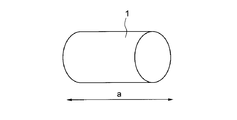
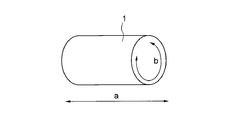
本発明の被覆密着性の評価方法では、透過率の測定において筒状透明セルに試料を装入した後、透明セルを所定の一定時間振盪して、試料を透明セル内壁に摩擦接触させる必要がある。その際の振盪は、図1に矢印aで示すように、少なくとも筒状透明セル1の中心軸と平行な方向の往復運動を用いることが好ましい。この中心軸と平行な方向の往復運動によって、試料とセル内壁の接触時間、言い換えれば接触距離を最大にすることができ、効率よく摩擦接触させることができるためである。
ただし、上記透明セルの中心軸と平行な方向への往復運動のみの場合には、測定装置への透明セルの設置位置や方向によって、試料とセル内壁の接触がセル内壁の偏った面でのみ行われることがあり、透過率測定の際に測定値に偏りが生じて測定精度が低下する恐れがある。このような場合、試料と筒状透明セルの接触をセル内壁の全面に対して行わせるため、上記矢印aで示す中心軸と平行な方向の往復運動と、図2に矢印bで示すように中心軸を回転軸とする回転運動若しくは半回転運動とを、同時に用いて振盪させることが好ましい。上記回転運動若しくは半回転運動を同時に行うことによって、剥離した被覆をセル内壁の全面に均一に付着させ、測定装置へのセルの設置状態による透過率の誤差を低減することができるため特に好ましい。
上記振盪の際の条件は、全ての透過率の測定において同一とする。例えば、上記往復運動の振幅は、摩擦接触が十分に行われる大きさ、具体的には50~250mmとすることが好ましい。また、往復運動の速度は、25~250cm/秒の範囲が好ましい。更に、上記回転運動若しくは半回転運動における速度は、180~360°/秒の範囲が好ましい。
更に、試料とセルの接触をセル内壁全面に対して行わせるためには、中心軸と平行な方向の往復運動、中心軸を回転軸とする回転運動と、セルの中心点を軸とした揺動を組み合わせ、往復長50~250mm、周期30~60回/分で振盪させることが好ましい。具体的には、例えば、ターブラー・シェーカー・ミキサー装置(容器容量2L、例えば、ウィリー・エ・バッコーフェン(WAB)社製、TURBULA Type T2C)で振盪させればよい。上記セルの振盪は上記に例示した装置のみでなく、同様に振盪させることが可能な装置を用いることができる。
上記振盪の時間は、予備試験等で測定可能な透過率が安定して得られる程度に決定された一定時間とするが、振盪時間が短すぎる場合には、被覆の剥離が完了せず、また剥離した被覆のセル内壁への付着が十分に行われないため、被覆の密着性に対する正しい評価が得られない。一方、振盪時間が必要以上に長時間に及ぶと、被覆の剥離のみでなく、芯材の水酸化ニッケル粒子も破壊され、その破片が剥離した被覆と共にセル内壁に付着してしまうことがあるため、被覆水酸化ニッケル粉末の密着性に対する正しい評価が得られない。
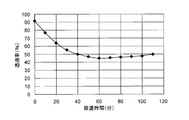
このような事態を避け、被覆水酸化コバルト粉末の被覆の密着性に対する正しい評価を得るためには、予め実験的に10分間の振盪毎に測定した透過率Aの1分間あたりの減少割合(%/分)を求め、この減少割合が初期透過率の0.3%以下となるまでの振盪の合計時間を振盪時間とすることが好ましい。具体的には、透過率Aを測定する際に、10分間の振盪毎に透過率Aを測定して、各10分間における透過率Aの1分間あたりの減少割合(%/分)を求め、その10分間あたりの減少割合が初期透過率(各10分間の振盪開始時の透過率)の0.3%以下となったときを振盪の終点とし、それまでの振盪の合計時間をもって振動時間とする。この減少割合が初期透過率の0.3%を超える時点で振盪を終了すると、透過率測定値のバラツキが大きくなり、正確な透過率比が得られないことがある。尚、本発明者らの実験により得られた振盪時間に対する透過率の変化の一例を図3に示すが、この場合の振盪時間は60分である。
次に、本発明のアルカリ二次電池正極活物質用被覆水酸化ニッケル粉末について説明する。本発明の被覆水酸化ニッケル粉末は、水酸化ニッケル粒子の表面をコバルト化合物で被覆したアルカリ二次電池正極活物質用の被覆水酸化ニッケル粉末であって、透過率A、透過率B0及び透過率Bmaxが上記した透過率の定義によるとき、透過率比(%)=(A-Bmax)/(B0-Bmax)×100が30%以上であり、好ましくは50%以上であることを特徴とする。
上記透過率の定義は、念のため再度記載すると以下のとおりである。
透過率A:被覆水酸化ニッケル粉末を筒状透明セルに装入して所定時間振盪させた後、内容物を取り出した筒状透明セルの透過率。
透過率B0:水酸化ニッケル粉末を筒状透明セルに装入して所定時間振盪させた後、内容物を取り出した筒状透明セルの透過率。
透過率Bmax:水酸化ニッケル粉末と被覆水酸化ニッケル粉末の被覆中のコバルト含有量に相当するコバルト化合物粉末とを筒状透明セルに装入して所定時間振盪させた後、内容物を取り出した筒状透明セルの透過率。
透過率A:被覆水酸化ニッケル粉末を筒状透明セルに装入して所定時間振盪させた後、内容物を取り出した筒状透明セルの透過率。
透過率B0:水酸化ニッケル粉末を筒状透明セルに装入して所定時間振盪させた後、内容物を取り出した筒状透明セルの透過率。
透過率Bmax:水酸化ニッケル粉末と被覆水酸化ニッケル粉末の被覆中のコバルト含有量に相当するコバルト化合物粉末とを筒状透明セルに装入して所定時間振盪させた後、内容物を取り出した筒状透明セルの透過率。
上記透過率比(%)=(A-Bmax)/(B0-Bmax)×100は、上述した本発明の被覆密着性の評価方法により求めることができるものである。この透過率比を30%以上とすることで、コバルト化合物からなる被覆の剥離が著しく抑制され、アルカリ二次電池正極活物質用として好適な被覆水酸化ニッケル粉末となる。尚、上記透過率比は、その定義から100%を超えることはないが、本発明における現実的な透過率比の上限は90%程度である。
一方、上記透過率比が30%未満になると、水酸化ニッケル粒子表面の被覆の密着性が劣り、コバルト化合物被覆が剥離しやすくなる。被覆密着性が劣る被覆水酸化ニッケル粉末は、電池作製の過程でペースト化する際や極板中での被覆の剥離が多なる。その結果、被覆密着性が劣る被覆水酸化ニッケル粉末を用いて作製されたアルカリ二次電池は、その電池特性、特に高負荷充電時の正極利用率や出力特性が低下してしまう。
上記コバルト化合物で被覆される芯材の水酸化ニッケル粒子は、その組成が一般式:Ni1-x-yCoxMy(OH)2、(式中、xは0.005~0.05、yは0.005~0.05、MはCa、Mg、及びZnのうちの少なくとも1種の元素)で表されるものが好ましい。
上記一般式において、コバルトの含有量を表す式中のxが0.005未満ではコバルトの添加により達成される充電効率の向上効果が得られず、逆に0.05を超えると放電電圧の低下が発生して電池性能が低下する。また、添加元素を表すMの含有量については、式中のyが0.005未満では元素Mの添加効果である充放電時における水酸化ニッケルの体積変化の低減効果が発揮されず、逆に0.05を超えると体積変化の低減効果以上に電池容量の低下を招き、電池性能が悪化するため好ましくない。
また、上記被覆水酸化ニッケル粉末では、その被覆を構成するコバルト化合物中に含有されるコバルト量は被覆水酸化ニッケル粉末全体に対して1~10質量%であることが好ましく、3~7質量%であることがより好ましい。上記被覆中のコバルト含有量が1質量%未満では、コバルト化合物としての被覆量が不足するため、水酸化コバルト粒子表面の被覆効果が十分に発揮されないことがある。一方、上記被覆中のコバルト量が10質量%を超えても、コバルト化合物の被覆量が増えるだけであり、被覆効果の更なる向上は認められない。尚、上記コバルト化合物の被覆は、芯材である水酸化ニッケル粒子を均一に被覆しているものが好ましく、均一であれば細かい島状の被覆であってもよいが、層状であることがより好ましく、全面を被覆しているものがさらに好ましい。
また、上記被覆を構成するコバルト化合物は、オキシ水酸化コバルトを主成分とするか、若しくはオキシ水酸化コバルトと水酸化コバルトの混合物を主成分とするものであり、被覆中のコバルト含有量は該被覆中に含有される金属元素全体に対して90質量%以上であることが好ましく、95質量%以上であることがより好ましい。尚、上記被覆には、電池の正極に用いられた場合の電池特性を改善するため、添加元素としてCa、Mg、Znなどを添加することが可能であるが、コバルトの含有量が90質量%未満になると被覆による導電性の改善が十分に得られないことがある。
上記被覆水酸化ニッケル粉末は、湿式法により芯材である水酸化ニッケル粒子をコバルト化合物で被覆することにより得られるものである。例えば、水酸化ニッケル粉末を水に分散させた懸濁液にコバルト塩水溶液とアルカリ水溶液とを該懸濁液を撹拌しながら供給し、中和晶析させたコバルト化合物で水酸化ニッケル粒子を被覆することにより製造することができる。以下に製造方法を具体的に説明する。
即ち、水酸化ニッケル粉末を水に分散させた懸濁液にコバルト塩水溶液とアルカリ水溶液とを該懸濁液を撹拌しながら供給する。その際、コバルト塩水溶液とアルカリ水溶液とを混合した懸濁溶液の25℃基準でのpHを8以上に保持する。また、懸濁液の液面と、そこに供給されるコバルト塩水溶液との接触部において、懸濁液の流れ方向に対し垂直な方向のコバルト塩水溶液の供給幅d(cm)と懸濁液の流速v(cm/秒)の積に対するコバルト塩水溶液の供給速度ρ(mol/秒)の比ρ/(d×v)を3.5×10-4mol/cm2以下に制御する。これにより、粒子表面がコバルト化合物で被覆された被覆水酸化ニッケル粉末を得ることができる。
上記のように、水酸化ニッケル粉末を水に分散させた懸濁液に、コバルト塩水溶液とアルカリ水溶液とを該懸濁液を撹拌しながら添加して、中和晶析反応により水酸化ニッケル粉末の表面に水酸化コバルトを被覆する場合、該懸濁液のpH値が低い領域ではコバルトがイオン状態で存在しているが、このpH値の上昇に伴って徐々に水酸化コバルトの析出が始まる。このとき、近くに水酸化ニッケル粒子が存在していれば、よりエネルギー的に安定な水酸化ニッケル粒子の表面に水酸化コバルトが析出する。
急激にコバルトイオン濃度が増大して、コバルトイオンが存在する懸濁液のpH領域における臨界過飽和度を超える場合には、近くに水酸化ニッケル粒子が存在していなくても、水中において単独で水酸化コバルトが析出する。ただし、上記懸濁液のpH値が低い場合、具体的にはpHが8未満の場合には、水酸化コバルトの析出速度が遅いために、コバルトイオン濃度が臨界過飽和度を超えていても、単独で水酸化コバルトが析出することはない。
一方、上記コバルトイオンが存在する懸濁液のpH値が8以上の場合には、コバルトイオン濃度の臨界過飽和度が低下するため、コバルトイオン濃度が増加すると容易に臨界過飽和度を超えることになり、その結果水酸化コバルトが水酸化ニッケル粒子の表面に付着せずに単独で析出してしまう。このように単独で析出した水酸化コバルトは、水酸化ニッケルスラリーを濾過したときに水酸化ニッケル粒子の表面に付着するが、まばらに付着するため均一性が悪いうえ、単に濾過によって付着しただけであるため密着性も極めて悪い。
従って、水酸化ニッケル粒子の表面に密着性の高い水酸化コバルトを均一に形成するため、水酸化ニッケル粒子の懸濁液のpH(25℃基準)を8以上の領域に制御し、そのpH領域における液中のコバルトイオン濃度を水酸化コバルトの単独析出が発生しない濃度以下に維持することとした。この方法により水酸化ニッケル粒子表面に析出した水酸化コバルトは、水酸化ニッケルの表面構造に準じて析出するため、粒子表面上に均一に形成され且つ密着性が極めて高くなる。
このように均一性及び密着性の高い水酸化コバルトの析出を確実にするためには、高コバルトイオン濃度域の形成を避けることが重要である。そのためには、コバルト塩水溶液の供給速度の該供給部へ流入し混合される懸濁液量に対する比を小さくすればよい。即ち、コバルト塩水溶液の供給速度を低下させて、混合される懸濁液量が少ない場合でも十分にコバルト塩濃度を低くするか、あるいは、混合される懸濁液量を多くし、懸濁液中に供給したコバルト塩水溶液をできるだけ速く懸濁液中に拡散させて希釈して、懸濁液中に極端にコバルトイオン濃度の高い領域が出現する状態を防止する必要がある。
上記混合される懸濁液量とは、供給されるコバルト塩水溶液と懸濁液面で接触して混合される部分に流入する懸濁液量と考えてよく、初期の混合は極短時間で行われるので、懸濁液の流速が十分である場合は単位時間にコバルト塩水溶液と接触する懸濁液面と考えることができる。即ち、上記混合される懸濁液量は、懸濁液の液面とコバルト塩水溶液との接触部での懸濁液の流れ方向に対し垂直な方向のコバルト塩水溶液の供給幅(d)と懸濁液面の流速(v)との積と考えることができる。尚、懸濁液の液面とコバルト塩水溶液との接触部が円形の場合には、懸濁液面の流れ方向に対し垂直な方向のコバルト塩水溶液の供給幅(d)は該円形の接触部の直径に等しくなる。また、懸濁液面の流速は、実測が困難な場合には、シミュレーションにより容易に求めることができる。
従って、本発明においては、懸濁液の液面とコバルト塩水溶液との接触部において、懸濁液の流れ方向に対し垂直な方向のコバルト塩水溶液の供給幅(d)と懸濁液の流速(v)の積に対するコバルト塩水溶液の供給速度(ρ)の比、即ちρ/(d×v)を小さくする、具体的には、ρ/(d×v)を3.5×10-4mol/cm2以下とすることが必要であり、2.0×10-4mol/cm2以下とすることが好ましい。上記ρ/(d×v)が3.5×10-4mol/cm2を超えると、コバルトイオンの高濃度領域が出現して水酸化コバルトの単独析出が発生する。尚、上記ρ/(d×v)の下限は、特に限定されるものではないが、供給速度(ρ)を低下させると生産性が低下するため、0.01×10-4mol/cm2以上とすることが好ましい。
ここで、上記接触部、即ち懸濁液の液面に向けて供給口から供給されるコバルト塩水溶液が該懸濁液の液面と最初に接触する部分の面積は、コバルト塩水溶液を供給口の開口サイズと略同じサイズの断面を有する1本の安定した液流れとして供給できる程度に供給口が小さい場合には、供給口の懸濁液面への投影面積と一致する。即ち、コバルト塩水溶液の供給口が上記した程度に小さい場合は、上記懸濁液の液面とコバルト塩水溶液との接触部の面積は、その供給口の懸濁液面への投影面積としてよい。一方、コバルト塩水溶液の供給口が上記した程度よりも大きい場合には、一般的に供給口から放出されるコバルト塩水溶液の流速が遅くなるため、供給口から一様にコバルト塩水溶液を供給することができず、上記懸濁液の液面とコバルト塩水溶液との接触部の面積を制御することが困難となる。
従って、上記コバルト塩水溶液を供給口から1本の安定した液流れとして供給するためには供給口の開口面積を0.01~1.0cm2とすることが好ましい。この開口面積が0.01cm2未満では、コバルト塩水溶液の供給速度が遅くなり、十分な生産性が得られないことがある。また、供給口の断面積が1.0cm2を超えると、供給口から一様にコバルト塩水溶液が供給され難くなり、供給口の懸濁液面への投影面積内であってもコバルト塩水溶液の供給量が変動してしまい、特定部分に集中して供給されやすくなるため、コバルト塩水溶液が十分に拡散されないことがある。
尚、コバルト塩水溶液を供給口からスプレーノズル等により懸濁液面に噴霧することによって供給する場合には、上記コバルト塩水溶液の懸濁液面との接触面積はコバルト塩水溶液が懸濁液面に噴霧される面積とすることができる。また、上記のごとく供給口から懸濁液面に均一にコバルト塩水溶液を供給できる範囲内であれば、コバルト塩水溶液の全供給量を増大させて生産性を上げるために、複数の供給口を設置してもよい。供給口の数については、特に制限されるものではなく、各供給口でのコバルト塩水溶液の供給速度や、コバルト塩水溶液の供給幅と懸濁液の流速の積を考慮して決めればよい。
更に、コバルト塩水溶液の供給部で急激にpH値が上昇したときも、その高pH域内において上記水酸化コバルトの単独析出が発生しない濃度、即ち臨界飽和濃度が低下して、水酸化コバルトの単独析出が容易になる。その結果、近くに水酸化ニッケル粒子が存在していなくても水酸化コバルトの単独析出が始まり、密着性と均一性の悪い水酸化コバルトが水酸化ニッケル表面粒子に付着しやすくなる。これを防ぐため、同時に供給するアルカリ水溶液も十分な速度で拡散させ、アルカリ水溶液の急激な濃度上昇による高pH域の形成を抑制することが好ましい。
例えば、懸濁液の流速が十分に速くても、特に懸濁液表面への単位面積あたりのコバルト塩供給速度が0.01mol/cm2・分を超える場合には、添加するコバルト塩水溶液の供給位置とアルカリ水溶液の供給位置との距離が近いと、懸濁液中でアルカリ水溶液が十分に拡散される前に高pH域がコバルト塩水溶液と接して反応が起きてしまうため、密着性や均一性の悪い水酸化コバルトが析出する可能性が高くなる。
これを避けるためには、上記コバルト塩水溶液の供給幅dと懸濁液の流速vの積に対するコバルト塩水溶液の供給速度ρの比{ρ/(d×v)}に対する、コバルト塩水溶液の供給位置とアルカリ水溶液の供給位置との離間距離D(cm)の比、即ちD/{ρ/(d×v)}を0.5×105cm3/mol以上とすることが好ましく、1.0×105cm3/mol以上とすることが更に好ましい。尚、上記D/{ρ/(d×v)}の上限は、供給速度(ρ)や反応槽の大きさから制限を受けるため、通常の範囲における上限としては100×105cm3/mol程度である。
次に、本発明の水酸化コバルト被覆水酸化ニッケル粉末の製造方法について、更に具体的に説明する。尚、本発明の製造方法は、連続方式にて実施することで生産性を向上できるが、水酸化ニッケル粒子への均一な被覆を実現するためにはバッチ方式で実施することが好ましい。従って、以下の説明はバッチ方式による製造方法を例にして説明する。
まず、水酸化ニッケル粉末の懸濁液、コバルト塩水溶液、及びアルカリ水溶液を準備する。芯材となる水酸化ニッケル粉末は、電池の正極材として用いられたとき良好な電池特性を得るため、平均粒径が6~12μmのものが好ましい。また、懸濁液の水酸化ニッケル粉末の濃度は400~1200g/lが好ましい。水酸化ニッケル粉末の濃度が400g/l未満では、水酸化コバルトの析出場所となる水酸化ニッケル粒子表面の活性点が不足し、液中で水酸化コバルトが単独で析出することがある。一方、水酸化ニッケル粉末の濃度が1200g/lを超えると、懸濁液の粘度が上昇して撹拌が十分行えなくなり、水酸化コバルトの被覆が不均一になることがある。
上記コバルト塩は、特に限定されるものではなく、pH制御により水酸化コバルトが生成される水溶性のコバルト化合物であればよい。具体的には、硫酸コバルトや塩化コバルトが好ましく、ハロゲンによる汚染のない硫酸コバルトがより好ましい。また、上記アルカリとしては、特に限定されるものではないが、水溶性の水酸化ナトリウムや水酸化カリウムなどが好ましく、コストの観点から水酸化ナトリウムが特に好ましい。
上記水酸化ニッケル粉末の懸濁液は、不純物の混入を防止するため、純水等に粒子を分散させたものが好ましい。また、コバルト塩水溶液及びアルカリ水溶液についても、コバルト塩あるいはアルカリをそれぞれ純水に溶解したものが好ましい。尚、コバルト塩水溶液及びアルカリ水溶液の濃度は、装置の配管等に再析出せず、懸濁液の水酸化ニッケル濃度変化に支障のない程度に抑制できる範囲であればよく、懸濁液の濃度などに応じて所定の濃度のものを使用できる。
上記バッチ方式の製造方法においては、芯材となる水酸化ニッケル粉末の懸濁液の入った反応槽に、被覆を形成するコバルト塩水溶液とアルカリ水溶液とを懸濁液を撹拌しながら連続的に供給して、中和晶析する水酸化コバルトで水酸化ニッケル粒子の表面を被覆させることにより、水酸化コバルト被覆水酸化ニッケル粉末を製造する。上記バッチ式での反応槽は、特に限定されないが、水酸化ニッケル粉末の粒子表面に均一な被覆を行うため、撹拌装置と液温調整機構を有するものが望ましい。
上記コバルト塩水溶液及びアルカリ水溶液は、それぞれ個別に供給する必要がある。これらは同時に供給してもよいし、反応槽に懸濁液の一部を入れておき、この懸濁液にコバルト塩水溶液及びアルカリ水溶液と残りの懸濁液を供給してもよい。ただし、これら全ての液を予め混合し、混合液として反応槽に供給すると、混合液中で反応を起こして水酸化コバルトが単独で析出することがある。また、懸濁液に対してコバルト塩水溶液及びアルカリ水溶液を個別に供給しない場合には、水酸化ニッケルの粒子表面に形成される水酸化コバルトの被覆量が粒子間で均一にならないことがある。
供給されたコバルト塩水溶液とアルカリ水溶液が平衡状態まで混合されたときの懸濁液のpHは、25℃基準で8~11.5の範囲に保持することが好ましく、9.5~10.5の範囲に保持することが更に好ましい。上記の懸濁液のpH値が8未満では水酸化コバルトの析出が遅すぎるため生産性が低下し、逆にpH値が11.5を超えると生成する水酸化コバルトがゲル状となりやすいため良好な被覆が困難になることがある。
また、上記した懸濁液のpHは、25℃基準で8~11.5の範囲内で一定値に保持し、変動幅±0.2の範囲内で制御することが好ましい。pHの変動幅が上記範囲を超えると、水酸化コバルトによる被覆量が変動する恐れがある。尚、上記懸濁液のpHは、例えば、ガラス電極法を用いたpHコントローラーで連続測定され、pHが上記変動幅で一定となるようにアルカリ水溶液の流量をpHコントローラーにより連続的にフィードバック制御することが望ましい。
懸濁液の温度は、コバルト塩水溶液及びアルカリ水溶液の添加前後において、30~60℃の範囲であることが好ましい。温度が30℃未満では反応速度が低下するため水酸化コバルトの析出が遅くなり、逆に60℃を超えると反応速度が速すぎるため、水酸化ニッケル粒子表面への水酸化コバルトの析出が不均一になりやすいからである。また、懸濁液の温度は、上記温度範囲内の一定値に保持し、変動幅±1℃の範囲内に制御されることが好ましい。温度が上記変動幅を超えると、析出する水酸化コバルト中の不純物濃度に変動が生じるため、電池に用いられたときの特性が安定しない恐れがある。
上記した本発明の製造方法によって、粒子表面に水酸化コバルトの被覆が均一且つ強固に形成された水酸化ニッケル粉末が得られる。また、上記のごとく懸濁液中で水酸化ニッケル粒子の表面に水酸化コバルトを被覆した後、更に懸濁液を撹拌しながら空気や酸素を供給するか若しくは酸化剤を添加するなどの方法により、粒子表面を被覆している水酸化コバルトを酸化させてオキシ水酸化コバルトにすることも可能である。特に空気や酸素で酸化する場合、懸濁液のpHを25℃基準で12.5~13.5に保持することによって、空気や酸素でも効率よく酸化させることができるため好ましい。
[実施例1]
直径25cmで深さ30cmの反応槽内に、球状で平均粒径が8μmの水酸化ニッケル粉末6kgを入れ、総量10リットルとなるように水を加えた後、撹拌プロペラを用いて回転数500rpmで撹拌することにより分散させて、水酸化ニッケル粉末の懸濁液を作製した。
直径25cmで深さ30cmの反応槽内に、球状で平均粒径が8μmの水酸化ニッケル粉末6kgを入れ、総量10リットルとなるように水を加えた後、撹拌プロペラを用いて回転数500rpmで撹拌することにより分散させて、水酸化ニッケル粉末の懸濁液を作製した。
この懸濁液を撹拌しながら懸濁液の液面において下記硫酸コバルト水溶液が添加される部分の流速が15.8cm/秒の定常状態となったところで、ローラーポンプを用いて直径2mmの供給口1箇所から、コバルト塩水溶液として濃度1.6mol/lの硫酸コバルト水溶液2.017リットルを16.8ml/秒の供給速度で2時間かけて添加した。同時に、硫酸コバルト水溶液の供給口から水平方向に15cm離れた同じ直径の供給口1箇所から、懸濁液の流速が上記と同じところに、懸濁液のpHが25℃基準で10.2±0.2の範囲内となるようにpHコントローラーと連動したローラーポンプを用いて制御しながら、24質量%の水酸化ナトリウム水溶液を添加した。
このとき、懸濁液の液面と、そこに向けて供給されるコバルト塩水溶液との接触部において、懸濁液の流れ方向に垂直な方向でのコバルト塩水溶液の供給幅d(cm)と懸濁液の流速v(cm/秒)の積に対するコバルト塩水溶液の供給速度ρ(mol/秒)の比、即ちρ/(d×v)は1.42×10-4mol/cm2であり、上記コバルト塩水溶液の供給幅dと懸濁液の流速vの積に対するコバルト塩水溶液の供給速度ρの比に対するコバルト塩水溶液の供給位置とアルカリ水溶液の供給位置の距離D(cm)との比、即ちD/{ρ/(d×v)}は1.06×105cm3/molであった。尚、この反応中における懸濁液の温度は50℃に制御した。
上記の操作により、懸濁液中において水酸化ニッケル粉末の粒子表面に水酸化コバルトが析出し、粒子表面に水酸化コバルトの被覆を有する水酸化コバルト被覆水酸化ニッケル粉末が得られた。上記操作で硫酸コバルト水溶液と水酸化ナトリウム水溶液を全量添加した後、更に懸濁液を撹拌しながら水酸化ナトリウム水溶液の添加によりpHを25℃基準で12.8に保持し、4時間空気を吹き込むことにより、水酸化ニッケル粒子表面に析出した水酸化コバルトを酸化させてオキシ水酸化コバルトとした。
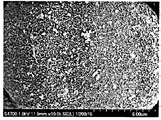
その後、フィルタープレスを用いて固液分離し、回収した粉末を水洗し、再び濾過した。引き続き、得られた粉末を真空乾燥機にて120℃で20時間乾燥して、6.3kgのオキシ水酸化コバルト被覆水酸化ニッケル粉末を得た。得られたオキシ水酸化コバルト被覆水酸化ニッケル粉末は、こげ茶色を呈していた。この粉末のオキシ水酸化コバルトによる被覆状態をSEMで観察すると、図4に示すように、均一な被覆層を有する粒子であることが確認できた。
次に、このオキシ水酸化コバルト被覆水酸化ニッケル粉末10.0gを、石英ガラス製の円筒状透明セル(内径1cm×長さ12cm、内容積12ml)に装入して密封した。オキシ水酸化コバルト被覆水酸化ニッケル粉末の量は、円筒状透明セルの容積に対する体積比で46%である。この円筒状透明セルを、シェーカーミキサー(ウィリー・エ・バッコーフェン(WAB)社製、TURBULA Type T2C)を用いて1時間振盪した。尚、振盪の際には、透明セルの中心軸と平行な方向への往復運動(距離220cm、速度154cm/秒)と、中心軸を回転軸とする回転運動(速度250°/秒)と、透明セルの中心点を軸とする揺動とを同時に行った。
振盪が終了した後、円筒状透明セルから内容物を取り出した。残った円筒状透明セルの透過率を、分光色度計(日本電色工業(株)製、SE6000)を用いて、測定波長380~780nmで測定した。得られたオキシ水酸化コバルト被覆水酸化ニッケル粉末での透過率Aは45%であった。
一方、上記オキシ水酸化コバルト被覆水酸化ニッケル粉末と同容積の被覆を行っていない水酸化ニッケル粉末を用いて、上記と同様の方法で透過率を測定したところ、透過率B0は92%であった。更に、上記方法で水酸化ニッケル粉末を入れずに調製した水酸化コバルト粉末(SEMによる一次粒子の平均粒径0.8μm)と、被覆を行っていない水酸化ニッケル粉末とを被覆と芯材の質量比で混合して、上記と同様の方法で透過率を測定したところ、透過率Bmaxは23%であった。
上記の透過率A、透過率B0及び透過率Bmaxから、上記オキシ水酸化コバルト被覆水酸化ニッケル粉末の透過率比(%)を(A-Bmax)/(B0-Bmax)×100により算出すると、(45-23)/(92-23)=31.8%であった。
[実施例2]
直径84cmで深さ100cmの反応槽を用い、上記実施例1と同じ水酸化ニッケル粉末240kgを入れ、総量350リットルとなるように水を加えた後、撹拌プロペラを用いて回転数350rpmで撹拌することにより分散させて、水酸化ニッケル粉末の懸濁液を作製した。
直径84cmで深さ100cmの反応槽を用い、上記実施例1と同じ水酸化ニッケル粉末240kgを入れ、総量350リットルとなるように水を加えた後、撹拌プロペラを用いて回転数350rpmで撹拌することにより分散させて、水酸化ニッケル粉末の懸濁液を作製した。
この懸濁液の液面の流速が49.7cm/秒のところに、1.6mol/lの濃度に調整した硫酸コバルト水溶液80.7リットルを、ローラーポンプを用いて直径2mmの供給口10箇所から1箇所あたり67.2ml/分の添加速度で2時間かけて添加した。同時に、これら10箇所からの硫酸コバルト水溶液と懸濁液の液面とのそれぞれの接触部のうち最も近い位置から20cm離れ且つ懸濁液の流速が同じところに、懸濁液のpHが25℃基準で10.2±0.2の範囲内となるようにpHコントローラーと連動したローラーポンプを用いて制御しながら、24質量%の水酸化ナトリウム水溶液を添加して、水酸化ニッケル粒子表面に水酸化コバルトを析出させた。
このとき、懸濁液の液面とそこに向けて供給されるコバルト塩水溶液との各接触部において、懸濁液の流れ方向に垂直な方向のコバルト塩水溶液の供給幅d(cm)と懸濁液の流速v(cm/秒)の積に対するコバルト塩水溶液の供給速度ρ(mol/秒)の比、即ちρ/(d×v)は1.80×10-4mol/cm2であり、水酸化ナトリウムの供給位置に最も近いコバルト塩水溶液の供給口に関して、上記コバルト塩水溶液の供給幅dと懸濁液の流速vの積に対するコバルト塩水溶液の供給速度ρの比に対するコバルト塩水溶液の供給位置とアルカリ水溶液の供給位置の距離D(cm)との比、即ちD/{ρ/(d×v)}は1.11×105cm3/molであった。尚、この反応中における懸濁液の温度は50℃に制御した。
上記の操作により水酸化ニッケル粉末の粒子表面に水酸化コバルトが析出し、粒子表面に水酸化コバルトの被覆を有する水酸化コバルト被覆水酸化ニッケル粉末が得られた。更に、上記実施例1と同様の方法により、水酸化ニッケル粒子表面に析出した水酸化コバルトを酸化させてオキシ水酸化コバルトとした。
その後、フィルタープレスを用いて固液分離し、回収した粉末を水洗し、再び濾過した。引き続き、得られた粉末を真空乾燥機にて120℃で20時間乾燥して、252kgのオキシ水酸化コバルト被覆水酸化ニッケル粉末を得た。得られたオキシ水酸化コバルト被覆水酸化ニッケル粉末は、こげ茶色を呈していた。この粉末のオキシ水酸化コバルトによる被覆状態をSEMで観察すると、均一な被覆層を有する粒子であることが確認できた。
上記オキシ水酸化コバルト被覆水酸化ニッケル粉末について、上記実施例1と同様にして透過率A、B0、Bmaxを求め、透過率比(%)を(A-Bmax)/(B0-Bmax)×100により算出したところ31.2%であった。
[実施例3]
直径190cmで深さ220cmの反応槽を用い、上記実施例1と同じ水酸化ニッケル粉末2880kgを入れ、総量3000リットルとなるように水を加えた後、撹拌プロペラを用いて回転数150rpmで撹拌することにより分散させて、水酸化ニッケル粉末の懸濁液を作製した。
直径190cmで深さ220cmの反応槽を用い、上記実施例1と同じ水酸化ニッケル粉末2880kgを入れ、総量3000リットルとなるように水を加えた後、撹拌プロペラを用いて回転数150rpmで撹拌することにより分散させて、水酸化ニッケル粉末の懸濁液を作製した。
この懸濁液の表面の流速が126.5cm/秒のところに、1.6mol/lの濃度に調整した硫酸コバルト水溶液968.3リットルを、ローラーポンプを用いて1箇所あたり4035ml/分の添加速度で、懸濁液面上での噴霧面積が直径500mmとなるノズル2箇所から2時間かけて添加した。同時に、これら2箇所からの硫酸コバルト水溶液と懸濁液の液面とのそれぞれの接触部のうち最も近い位置から20cm離れ且つ懸濁液の流速が同じところに、懸濁液のpHが25℃基準で10.2±0.2の範囲内となるように、pHコントローラーと連動したローラーポンプを用いて制御しながら、24質量%の水酸化ナトリウム水溶液を添加して、水酸化ニッケル粒子表面に水酸化コバルトを析出させた。
このとき、懸濁液の液面とそこに向けて供給されるコバルト塩水溶液との各接触部において、懸濁液の流れ方向に垂直な方向のコバルト塩水溶液の供給幅d(cm)と懸濁液の流速v(cm/秒)の積に対するコバルト塩水溶液の供給速度(mol/秒)ρの比、即ちρ/(d×v)は1.70×10-5mol/cm2であり、水酸化ナトリウムの供給位置に最も近いコバルト塩水溶液のノズルに関して、上記コバルト塩水溶液の供給幅dと懸濁液の流速vの積に対するコバルト塩水溶液の供給速度ρの比に対するコバルト塩水溶液の供給位置とアルカリ水溶液の供給位置の距離D(cm)との比、即ちD/{ρ/(d×v)}は11.8×105cm3/molであった。尚、この反応中における懸濁液の温度は50℃に制御した。
上記の操作により水酸化ニッケル粉末の粒子表面に水酸化コバルトが析出し、粒子表面に水酸化コバルトの被覆を有する水酸化コバルト被覆水酸化ニッケル粉末が得られた。更に、上記実施例1と同様の方法により、水酸化ニッケル粒子表面に析出した水酸化コバルトを酸化させてオキシ水酸化コバルトとした。
その後、フィルタープレスを用いて固液分離し、回収した粉末を水洗し、再び濾過した。引き続き、得られた粉末を真空乾燥機にて120℃で20時間乾燥して、252kgのオキシ水酸化コバルト被覆水酸化ニッケル粉末を得た。得られたオキシ水酸化コバルト被覆水酸化ニッケル粉末は、こげ茶色を呈していた。この粉末のオキシ水酸化コバルトによる被覆状態をSEMで観察すると、均一な被覆層を有する粒子であることが確認できた。
上記オキシ水酸化コバルト被覆水酸化ニッケル粉末について、上記実施例1と同様にして透過率A、B0、Bmaxを求め、透過率比(%)を(A-Bmax)/(B0-Bmax)×100により算出したところ33.5%であった。
[比較例1]
撹拌プロペラの回転数を300rpmとし、懸濁液の液面において下記硫酸コバルト水溶液が添加される部分の流速が5cm/秒の定常状態となったところで硫酸コバルト水溶液と水酸化ナトリウム水溶液を添加した以外は上記実施例1と同様にして、水酸化コバルト被覆水酸化ニッケル粉末を得た。更に、上記実施例1と同様にして水酸化ニッケル粒子表面に析出した水酸化コバルトを酸化させ、オキシ水酸化コバルト被覆水酸化ニッケル粉末を得た。
撹拌プロペラの回転数を300rpmとし、懸濁液の液面において下記硫酸コバルト水溶液が添加される部分の流速が5cm/秒の定常状態となったところで硫酸コバルト水溶液と水酸化ナトリウム水溶液を添加した以外は上記実施例1と同様にして、水酸化コバルト被覆水酸化ニッケル粉末を得た。更に、上記実施例1と同様にして水酸化ニッケル粒子表面に析出した水酸化コバルトを酸化させ、オキシ水酸化コバルト被覆水酸化ニッケル粉末を得た。
このとき、懸濁液に供給されるコバルト塩水溶液の供給幅dと懸濁液の流速vの積に対するコバルト塩水溶液の供給速度ρの比、即ちρ/(d×v)は4.48×10-4mol/cm2であり、上記コバルト塩水溶液の供給幅dと懸濁液の流速vの積に対するコバルト塩水溶液の供給速度ρの比に対するコバルト塩水溶液の供給位置とアルカリ水溶液の供給位置の距離Dとの比、即ち、D/{ρ/(d×v)}は0.335×105cm3/molであった。尚、この反応中における懸濁液の温度は50℃に制御した。
得られたオキシ水酸化コバルト被覆水酸化ニッケル粉末は、こげ茶色を呈していた。この粉末のオキシ水酸化コバルトによる被覆状態をSEMで観察すると、図5に示すように表面のところどころに燐片状のオキシ水酸化コバルトが観察され、被覆状態が不均一な粒子であることが確認された。
上記オキシ水酸化コバルト被覆水酸化ニッケル粉末について、上記実施例1と同様にして透過率A、B0、Bmaxを求め、透過率比(%)を(A-Bmax)/(B0-Bmax)×100により算出したところ25.6%であった。
[比較例2]
硫酸コバルト水溶液を、ローラーポンプを用いて直径8mmの供給口1箇所から、672.4ml/分の添加速度で2時間かけて添加した以外は上記実施例2と同様にして、オキシ水酸化コバルト被覆水酸化ニッケル粉末を得た。更に、上記実施例1と同様にして水酸化ニッケル粒子表面に析出した水酸化コバルトを酸化させ、オキシ水酸化コバルト被覆水酸化ニッケル粉末を得た。
硫酸コバルト水溶液を、ローラーポンプを用いて直径8mmの供給口1箇所から、672.4ml/分の添加速度で2時間かけて添加した以外は上記実施例2と同様にして、オキシ水酸化コバルト被覆水酸化ニッケル粉末を得た。更に、上記実施例1と同様にして水酸化ニッケル粒子表面に析出した水酸化コバルトを酸化させ、オキシ水酸化コバルト被覆水酸化ニッケル粉末を得た。
このとき、懸濁液に供給されるコバルト塩水溶液の供給幅dと懸濁液の流速vの積に対するコバルト塩水溶液の供給速度ρの比、即ちρ/(d×v)は4.51×10-4mol/cm2であり、上記コバルト塩水溶液の供給幅dと懸濁液の流速vの積に対するコバルト塩水溶液の供給速度ρの比に対するコバルト塩水溶液の供給位置とアルカリ水溶液の供給位置の距離Dとの比、即ちD/{ρ/(d×v)}は0.443×105cm3/molであった。尚、この反応中における懸濁液の温度は50℃に制御した。
得られたオキシ水酸化コバルト被覆水酸化ニッケル粉末は、こげ茶色を呈していた。この粉末のオキシ水酸化コバルトによる被覆状態をSEMで観察すると、比較例1と同様に表面のところどころに燐片状のオキシ水酸化コバルトが観察され、被覆状態が不均一な粒子であることが確認された。
上記オキシ水酸化コバルト被覆水酸化ニッケル粉末について、上記実施例1と同様にして透過率A、B0、Bmaxを求め、透過率比(%)を(A-Bmax)/(B0-Bmax)×100により算出したところ19.7%であった。
以上の実施例及び比較例から、ρ/(d×v)を3.5×10-4mol/cm2以下にし且つD/{ρ/(d×v)}を0.5×105cm3/mol以上にして作製した実施例の被覆水酸化ニッケル粉末は、粒子表面の被覆が均一で密着性が高いことが分かる。一方、ρ/(d×v)を3.5×10-4mol/cm2より大きく且つD/{ρ/(d×v)}を0.5×105cm3/molより小さくして作製した比較例の被覆水酸化ニッケル粉末では、被覆の密着性が低くなっている。更に、振盪後の被覆水酸化ニッケル粉末をスラリー化して、剥離した被覆と被覆水酸化ニッケル粉末を分離し、被覆水酸化ニッケル粉末の圧粉抵抗を測定したところ、実施例では比較例より高い導電性を有していることが確認された。このことから、実施例の被覆水酸化ニッケル粉末は、アルカリ二次電池正極活物質用として好適であることが分かる。
本発明の被覆水酸化ニッケル粉末は、高い導電性を有していることから、正極活物質としての利用率高く、高容量を要求されるポータブル電子機器用の電源として好適である。また、高出力特性が要求される電気自動車用やハイブリッド車用の電源としての用途に好適である。
1 筒状透明セル
Claims (9)
- 水酸化ニッケル粒子の表面をコバルト化合物で被覆したアルカリ二次電池正極活物質用の被覆水酸化ニッケル粉末であって、透過率A、透過率B0及び透過率Bmaxが下記によって定義されるとき、透過率比(%)=(A-Bmax)/(B0-Bmax)×100が30%以上であるアルカリ二次電池正極活物質用被覆水酸化ニッケル粉末。
透過率A:被覆水酸化ニッケル粉末を筒状透明セルに装入して所定時間振盪させた後、内容物を取り出した筒状透明セルの透過率。
透過率B0:水酸化ニッケル粉末を筒状透明セルに装入して所定時間振盪させた後、内容物を取り出した筒状透明セルの透過率。
透過率Bmax:水酸化ニッケル粉末と被覆水酸化ニッケル粉末の被覆中のコバルト含有量に相当するコバルト化合物粉末とを筒状透明セルに装入して所定時間振盪させた後、内容物を取り出した筒状透明セルの透過率。 - 前記被覆を構成するコバルト化合物がオキシ水酸化コバルト又はオシキ水酸化コバルトと水酸化コバルトとの混合物を主成分とし、該被覆を構成するコバルト化合物中のコバルト含有量が被覆中の金属元素全体に対し90質量%以上である、請求項1に記載のアルカリ二次電池正極活物質用被覆水酸化ニッケル粉末。
- 前記被覆を構成するコバルト化合物中のコバルト含有量が被覆水酸化ニッケル粉末全体に対して1~10質量%である、請求項1又は2に記載のアルカリ二次電池正極活物質用被覆水酸化ニッケル粉末。
- 前記コバルト化合物で被覆される芯材の水酸化ニッケル粒子の組成が、一般式:Ni1-x-yCoxMy(OH)2、(式中、xは0.005~0.05、yは0.005~0.05、MはCa、Mg、及びZnのうちの少なくとも1種の元素)で表される、請求項1~3のいずれかに記載のアルカリ二次電池正極活物質用被覆水酸化ニッケル粉末。
- 水酸化ニッケル粒子の表面をコバルト化合物で被覆したアルカリ二次電池正極活物質用の被覆水酸化ニッケル粉末における被覆の密着性を評価する方法であって、下記によって定義される透過率A、B0及びBmaxを測定し、透過率比(%)=(A-Bmax)/(B0-Bmax)×100により被覆水酸化ニッケル粉末の被覆の密着性を評価する被覆水酸化ニッケル粉末の被覆密着性の評価方法。
透過率A:被覆水酸化ニッケル粉末を筒状透明セルに装入して所定時間振盪させた後、内容物を取り出した筒状透明セルの透過率。
透過率B0:水酸化ニッケル粉末を筒状透明セルに装入して所定時間振盪させた後、内容物を取り出した筒状透明セルの透過率。
透過率Bmax:水酸化ニッケル粉末と被覆水酸化ニッケル粉末の被覆中のコバルト含有量に相当するコバルト化合物粉末とを筒状透明セルに装入して所定時間振盪させた後、内容物を取り出した筒状透明セルの透過率。 - 前記筒状透明セルとして、円筒状又は四角筒状の透明セルを用いる、請求項5に記載の被覆水酸化ニッケル粉末の被覆密着性の評価方法。
- 前記筒状透明セルとして、石英又は硬質ガラスからなる透明セルを用いる、請求項5又は6に記載の被覆水酸化ニッケル粉末の被覆密着性の評価方法。
- 前記筒状透明セルの振盪は、セルの中心軸と平行な方向への往復運動によるか、若しくは該往復運動と同時にセルの中心軸を回転軸とする回転運動若しくは半回転運動による、請求項5~7のいずれかに記載の被覆水酸化ニッケル粉末の被覆密着性の評価方法。
- 前記筒状透明セルの振盪時間は、10分間の振盪毎に測定した透過率Aの1分間あたりの減少割合(%/分)が初期透過率の0.3%以下となるまでの振盪の合計時間とする、請求項5~8のいずれかに記載の被覆水酸化ニッケル粉末の被覆密着性の評価方法。
Priority Applications (2)
| Application Number | Priority Date | Filing Date | Title |
|---|---|---|---|
| CN201380061486.3A CN104813524B (zh) | 2012-10-25 | 2013-10-12 | 碱性二次电池正极活性物质用的带包覆的氢氧化镍粉末和带包覆的氢氧化镍粉末的包覆粘附性的评价方法 |
| US14/438,527 US9768444B2 (en) | 2012-10-25 | 2013-10-12 | Coated nickel hydroxide powder for positive electrode active material of alkaline secondary battery, and evaluation method for coating adhesion properties of coated nickel hydroxide powder |
Applications Claiming Priority (4)
| Application Number | Priority Date | Filing Date | Title |
|---|---|---|---|
| JP2012235467 | 2012-10-25 | ||
| JP2012-235467 | 2012-10-25 | ||
| JP2013-038331 | 2013-02-28 | ||
| JP2013038331A JP5626387B2 (ja) | 2012-10-25 | 2013-02-28 | アルカリ二次電池正極活物質用被覆水酸化ニッケル粉末及び被覆水酸化ニッケル粉末の被覆密着性の評価方法。 |
Publications (1)
| Publication Number | Publication Date |
|---|---|
| WO2014065145A1 true WO2014065145A1 (ja) | 2014-05-01 |
Family
ID=50544525
Family Applications (1)
| Application Number | Title | Priority Date | Filing Date |
|---|---|---|---|
| PCT/JP2013/077866 Ceased WO2014065145A1 (ja) | 2012-10-25 | 2013-10-12 | アルカリ二次電池正極活物質用被覆水酸化ニッケル粉末及び被覆水酸化ニッケル粉末の被覆密着性の評価方法 |
Country Status (4)
| Country | Link |
|---|---|
| US (1) | US9768444B2 (ja) |
| JP (1) | JP5626387B2 (ja) |
| CN (2) | CN107516728B (ja) |
| WO (1) | WO2014065145A1 (ja) |
Families Citing this family (3)
| Publication number | Priority date | Publication date | Assignee | Title |
|---|---|---|---|---|
| CN109709086A (zh) * | 2018-11-20 | 2019-05-03 | 北京泰丰先行新能源科技有限公司 | 一种评价锂离子电池材料不同包覆工艺之间优劣的方法 |
| CN109959645B (zh) * | 2019-03-11 | 2020-09-22 | 清华大学 | 锂离子电池壳核结构材料包覆完全性的评价方法和装置 |
| CN114735764B (zh) * | 2022-04-21 | 2023-03-24 | 福州大学 | 一种α相氢氧化镍及其制备方法和应用 |
Citations (3)
| Publication number | Priority date | Publication date | Assignee | Title |
|---|---|---|---|---|
| JPH09210941A (ja) * | 1996-02-06 | 1997-08-15 | Sanyo Electric Co Ltd | 非焼結式ニッケル極用活物質粉末の利用率の推定・評価方法 |
| JP2002025553A (ja) * | 2000-07-11 | 2002-01-25 | Toshiba Battery Co Ltd | アルカリ二次電池用正極活物質 |
| JP2010277821A (ja) * | 2009-05-28 | 2010-12-09 | Toyota Motor Corp | 電極スラリーの検査方法 |
Family Cites Families (20)
| Publication number | Priority date | Publication date | Assignee | Title |
|---|---|---|---|---|
| JPS63152866A (ja) | 1986-12-16 | 1988-06-25 | Yuasa Battery Co Ltd | 蓄電池用ニツケル活物質及びその製造法 |
| JP3367152B2 (ja) | 1993-06-30 | 2003-01-14 | 住友金属鉱山株式会社 | 水酸化コバルトを被覆した水酸化ニッケル粉末の製造方法 |
| US6040007A (en) * | 1996-06-19 | 2000-03-21 | Tanaka Chemical Corporation | Nickel hydroxide particles having an α- or β-cobalt hydroxide coating layer for use in alkali batteries and a process for producing the nickel hydroxide |
| JP3296754B2 (ja) * | 1997-07-04 | 2002-07-02 | 三洋電機株式会社 | アルカリ蓄電池用ニッケル電極活物質およびその製造方法 |
| JP2000077070A (ja) * | 1998-08-31 | 2000-03-14 | Sumitomo Metal Mining Co Ltd | 水酸化ニッケル粉末およびその製造方法 |
| JP2000113904A (ja) * | 1998-10-07 | 2000-04-21 | Matsushita Electric Ind Co Ltd | アルカリ蓄電池 |
| JP2000149941A (ja) | 1998-11-16 | 2000-05-30 | Sumitomo Metal Mining Co Ltd | アルカリ二次電池用水酸化ニッケル粉末の製造方法 |
| JP2002029755A (ja) * | 2000-07-14 | 2002-01-29 | Sumitomo Metal Mining Co Ltd | アルカリ二次電池用水酸化ニッケル粉末の製造方法 |
| JP3558590B2 (ja) * | 2000-07-14 | 2004-08-25 | 松下電器産業株式会社 | アルカリ蓄電池用正極活物質の製造方法 |
| AU2002223126A1 (en) * | 2000-11-17 | 2002-05-27 | Toshiba Battery Co., Ltd. | Enclosed nickel-zinc primary battery, its anode and production methods for them |
| JP2002175804A (ja) * | 2000-12-08 | 2002-06-21 | Sumitomo Metal Mining Co Ltd | アルカリ二次電池用水酸化ニッケル粉末の製造方法 |
| JP2003151545A (ja) * | 2001-11-08 | 2003-05-23 | Matsushita Electric Ind Co Ltd | アルカリ蓄電池用正極活物質およびそれを用いたアルカリ蓄電池用正極 |
| JP4307864B2 (ja) * | 2003-02-24 | 2009-08-05 | 東芝電池株式会社 | 密閉形アルカリ亜鉛一次電池 |
| CN100423329C (zh) * | 2004-03-01 | 2008-10-01 | 长沙矿冶研究院 | 球形氢氧化镍表面修饰方法 |
| CN101117243B (zh) * | 2006-08-04 | 2010-10-13 | 比亚迪股份有限公司 | 碱性二次电池正极活性物质的制备方法 |
| CN100448074C (zh) * | 2007-07-09 | 2008-12-31 | 金天能源材料有限公司 | 表面包覆γ羟基氧化钴的氢氧化镍的制备方法 |
| CN101332509B (zh) * | 2008-07-02 | 2010-09-29 | 武汉大学 | 一种在粉末状氢氧化镍电极材料颗粒表面均匀包覆CoOOH的方法 |
| JP5621506B2 (ja) * | 2010-10-26 | 2014-11-12 | 住友金属鉱山株式会社 | オキシ水酸化コバルトコート水酸化ニッケルの製造方法。 |
| JP5213989B2 (ja) * | 2011-04-27 | 2013-06-19 | 住友金属鉱山株式会社 | アルカリ二次電池正極活物質用被覆水酸化ニッケル粉末及びその製造方法 |
| JP5610010B2 (ja) * | 2012-10-25 | 2014-10-22 | 住友金属鉱山株式会社 | アルカリ二次電池正極活物質用被覆水酸化ニッケル粉末及びその製造方法 |
-
2013
- 2013-02-28 JP JP2013038331A patent/JP5626387B2/ja active Active
- 2013-10-12 CN CN201710635926.1A patent/CN107516728B/zh active Active
- 2013-10-12 WO PCT/JP2013/077866 patent/WO2014065145A1/ja not_active Ceased
- 2013-10-12 US US14/438,527 patent/US9768444B2/en active Active
- 2013-10-12 CN CN201380061486.3A patent/CN104813524B/zh active Active
Patent Citations (3)
| Publication number | Priority date | Publication date | Assignee | Title |
|---|---|---|---|---|
| JPH09210941A (ja) * | 1996-02-06 | 1997-08-15 | Sanyo Electric Co Ltd | 非焼結式ニッケル極用活物質粉末の利用率の推定・評価方法 |
| JP2002025553A (ja) * | 2000-07-11 | 2002-01-25 | Toshiba Battery Co Ltd | アルカリ二次電池用正極活物質 |
| JP2010277821A (ja) * | 2009-05-28 | 2010-12-09 | Toyota Motor Corp | 電極スラリーの検査方法 |
Also Published As
| Publication number | Publication date |
|---|---|
| CN107516728B (zh) | 2020-09-08 |
| JP2014103089A (ja) | 2014-06-05 |
| CN104813524A (zh) | 2015-07-29 |
| JP5626387B2 (ja) | 2014-11-19 |
| CN107516728A (zh) | 2017-12-26 |
| CN104813524B (zh) | 2017-12-08 |
| US9768444B2 (en) | 2017-09-19 |
| US20150295231A1 (en) | 2015-10-15 |
Similar Documents
| Publication | Publication Date | Title |
|---|---|---|
| KR101554081B1 (ko) | 가용성 염기 함량이 낮은 고 니켈 캐소드 재료 | |
| TW201817074A (zh) | 硫化物固體電解質 | |
| US20180287147A1 (en) | Coated Nickel Hydroxide Powder for Positive Electrode Active Material of Alkaline Secondary Battery, and Production Method Therefor | |
| EP3846262A1 (en) | Positive electrode active material particles for secondary batteries, and method for producing positive electrode active material particles for secondary batteries | |
| CN104798230B (zh) | 碱性二次电池正极活性物质用的包覆氢氧化镍粉末及其制造方法 | |
| JP5213989B2 (ja) | アルカリ二次電池正極活物質用被覆水酸化ニッケル粉末及びその製造方法 | |
| EP3584862A1 (en) | Positive electrode active material, method for producing same, positive electrode, and lithium ion battery | |
| EP3879609A1 (en) | Oxide-based positive electrode active material for solid-state lithium-ion batteries, method for producing precursor of oxide-based positive electrode active material for solid-state lithium-ion batteries, method for producing oxide-based positive electrode active material for solid-state lithium-ion batteries, and solid-state lithium-ion battery | |
| JP2019140093A (ja) | リチウムイオン二次電池用の被覆正極活物質及びその製造方法並びに該被覆正極活物質の評価方法 | |
| JP5626387B2 (ja) | アルカリ二次電池正極活物質用被覆水酸化ニッケル粉末及び被覆水酸化ニッケル粉末の被覆密着性の評価方法。 | |
| JP5858067B2 (ja) | アルカリ二次電池正極活物質用被覆水酸化ニッケル粉末 | |
| JP6435885B2 (ja) | アルカリ二次電池正極活物質用被覆水酸化ニッケル粉末及びその製造方法 | |
| WO2024176499A1 (ja) | 全固体リチウムイオン電池用正極活物質、全固体リチウムイオン電池用正極、全固体リチウムイオン電池及び全固体リチウムイオン電池用正極活物質の製造方法 | |
| JP6269391B2 (ja) | アルカリ二次電池正極活物質用被覆水酸化ニッケル粉末の被覆密着性の評価方法。 | |
| JP5532081B2 (ja) | アルカリ二次電池正極活物質用被覆水酸化ニッケル粉末及びその製造方法 | |
| CN111868976B (zh) | 正极用化合物 | |
| EP1837938A1 (en) | Alkaline dry cell | |
| JP2008251392A (ja) | ニッケル正極用活物質及びその製造方法 | |
| WO2025141914A1 (ja) | 全固体リチウムイオン電池用正極活物質、全固体リチウムイオン電池用正極、全固体リチウムイオン電池及び全固体リチウムイオン電池用正極活物質の製造方法 | |
| WO2024218923A1 (ja) | リチウム金属複合酸化物粉末、固体二次電池用正極活物質、固体二次電池用正極及び固体二次電池 |
Legal Events
| Date | Code | Title | Description |
|---|---|---|---|
| 121 | Ep: the epo has been informed by wipo that ep was designated in this application |
Ref document number: 13848186 Country of ref document: EP Kind code of ref document: A1 |
|
| WWE | Wipo information: entry into national phase |
Ref document number: 14438527 Country of ref document: US |
|
| NENP | Non-entry into the national phase |
Ref country code: DE |
|
| 122 | Ep: pct application non-entry in european phase |
Ref document number: 13848186 Country of ref document: EP Kind code of ref document: A1 |