WO2014049931A1 - 非水電解質二次電池 - Google Patents
非水電解質二次電池 Download PDFInfo
- Publication number
- WO2014049931A1 WO2014049931A1 PCT/JP2013/004695 JP2013004695W WO2014049931A1 WO 2014049931 A1 WO2014049931 A1 WO 2014049931A1 JP 2013004695 W JP2013004695 W JP 2013004695W WO 2014049931 A1 WO2014049931 A1 WO 2014049931A1
- Authority
- WO
- WIPO (PCT)
- Prior art keywords
- compound
- secondary battery
- electrolyte secondary
- active material
- battery
- Prior art date
- Legal status (The legal status is an assumption and is not a legal conclusion. Google has not performed a legal analysis and makes no representation as to the accuracy of the status listed.)
- Ceased
Links
Images

Classifications
-
- H—ELECTRICITY
- H01—ELECTRIC ELEMENTS
- H01M—PROCESSES OR MEANS, e.g. BATTERIES, FOR THE DIRECT CONVERSION OF CHEMICAL ENERGY INTO ELECTRICAL ENERGY
- H01M4/00—Electrodes
- H01M4/02—Electrodes composed of, or comprising, active material
- H01M4/36—Selection of substances as active materials, active masses, active liquids
- H01M4/48—Selection of substances as active materials, active masses, active liquids of inorganic oxides or hydroxides
- H01M4/483—Selection of substances as active materials, active masses, active liquids of inorganic oxides or hydroxides for non-aqueous cells
-
- H—ELECTRICITY
- H01—ELECTRIC ELEMENTS
- H01M—PROCESSES OR MEANS, e.g. BATTERIES, FOR THE DIRECT CONVERSION OF CHEMICAL ENERGY INTO ELECTRICAL ENERGY
- H01M10/00—Secondary cells; Manufacture thereof
- H01M10/05—Accumulators with non-aqueous electrolyte
- H01M10/052—Li-accumulators
-
- H—ELECTRICITY
- H01—ELECTRIC ELEMENTS
- H01M—PROCESSES OR MEANS, e.g. BATTERIES, FOR THE DIRECT CONVERSION OF CHEMICAL ENERGY INTO ELECTRICAL ENERGY
- H01M10/00—Secondary cells; Manufacture thereof
- H01M10/05—Accumulators with non-aqueous electrolyte
- H01M10/052—Li-accumulators
- H01M10/0525—Rocking-chair batteries, i.e. batteries with lithium insertion or intercalation in both electrodes; Lithium-ion batteries
-
- H—ELECTRICITY
- H01—ELECTRIC ELEMENTS
- H01M—PROCESSES OR MEANS, e.g. BATTERIES, FOR THE DIRECT CONVERSION OF CHEMICAL ENERGY INTO ELECTRICAL ENERGY
- H01M10/00—Secondary cells; Manufacture thereof
- H01M10/05—Accumulators with non-aqueous electrolyte
- H01M10/056—Accumulators with non-aqueous electrolyte characterised by the materials used as electrolytes, e.g. mixed inorganic/organic electrolytes
- H01M10/0564—Accumulators with non-aqueous electrolyte characterised by the materials used as electrolytes, e.g. mixed inorganic/organic electrolytes the electrolyte being constituted of organic materials only
- H01M10/0566—Liquid materials
- H01M10/0567—Liquid materials characterised by the additives
-
- H—ELECTRICITY
- H01—ELECTRIC ELEMENTS
- H01M—PROCESSES OR MEANS, e.g. BATTERIES, FOR THE DIRECT CONVERSION OF CHEMICAL ENERGY INTO ELECTRICAL ENERGY
- H01M4/00—Electrodes
- H01M4/02—Electrodes composed of, or comprising, active material
- H01M4/36—Selection of substances as active materials, active masses, active liquids
- H01M4/362—Composites
- H01M4/364—Composites as mixtures
-
- H—ELECTRICITY
- H01—ELECTRIC ELEMENTS
- H01M—PROCESSES OR MEANS, e.g. BATTERIES, FOR THE DIRECT CONVERSION OF CHEMICAL ENERGY INTO ELECTRICAL ENERGY
- H01M4/00—Electrodes
- H01M4/02—Electrodes composed of, or comprising, active material
- H01M4/36—Selection of substances as active materials, active masses, active liquids
- H01M4/362—Composites
- H01M4/366—Composites as layered products
-
- H—ELECTRICITY
- H01—ELECTRIC ELEMENTS
- H01M—PROCESSES OR MEANS, e.g. BATTERIES, FOR THE DIRECT CONVERSION OF CHEMICAL ENERGY INTO ELECTRICAL ENERGY
- H01M4/00—Electrodes
- H01M4/02—Electrodes composed of, or comprising, active material
- H01M4/36—Selection of substances as active materials, active masses, active liquids
- H01M4/48—Selection of substances as active materials, active masses, active liquids of inorganic oxides or hydroxides
- H01M4/485—Selection of substances as active materials, active masses, active liquids of inorganic oxides or hydroxides of mixed oxides or hydroxides for inserting or intercalating light metals, e.g. LiTi2O4 or LiTi2OxFy
-
- H—ELECTRICITY
- H01—ELECTRIC ELEMENTS
- H01M—PROCESSES OR MEANS, e.g. BATTERIES, FOR THE DIRECT CONVERSION OF CHEMICAL ENERGY INTO ELECTRICAL ENERGY
- H01M4/00—Electrodes
- H01M4/02—Electrodes composed of, or comprising, active material
- H01M4/36—Selection of substances as active materials, active masses, active liquids
- H01M4/48—Selection of substances as active materials, active masses, active liquids of inorganic oxides or hydroxides
- H01M4/52—Selection of substances as active materials, active masses, active liquids of inorganic oxides or hydroxides of nickel, cobalt or iron
- H01M4/525—Selection of substances as active materials, active masses, active liquids of inorganic oxides or hydroxides of nickel, cobalt or iron of mixed oxides or hydroxides containing iron, cobalt or nickel for inserting or intercalating light metals, e.g. LiNiO2, LiCoO2 or LiCoOxFy
-
- H—ELECTRICITY
- H01—ELECTRIC ELEMENTS
- H01M—PROCESSES OR MEANS, e.g. BATTERIES, FOR THE DIRECT CONVERSION OF CHEMICAL ENERGY INTO ELECTRICAL ENERGY
- H01M4/00—Electrodes
- H01M4/02—Electrodes composed of, or comprising, active material
- H01M4/36—Selection of substances as active materials, active masses, active liquids
- H01M4/58—Selection of substances as active materials, active masses, active liquids of inorganic compounds other than oxides or hydroxides, e.g. sulfides, selenides, tellurides, halogenides or LiCoFy; of polyanionic structures, e.g. phosphates, silicates or borates
- H01M4/583—Carbonaceous material, e.g. graphite-intercalation compounds or CFx
- H01M4/587—Carbonaceous material, e.g. graphite-intercalation compounds or CFx for inserting or intercalating light metals
-
- H—ELECTRICITY
- H01—ELECTRIC ELEMENTS
- H01M—PROCESSES OR MEANS, e.g. BATTERIES, FOR THE DIRECT CONVERSION OF CHEMICAL ENERGY INTO ELECTRICAL ENERGY
- H01M4/00—Electrodes
- H01M4/02—Electrodes composed of, or comprising, active material
- H01M4/62—Selection of inactive substances as ingredients for active masses, e.g. binders, fillers
-
- H—ELECTRICITY
- H01—ELECTRIC ELEMENTS
- H01M—PROCESSES OR MEANS, e.g. BATTERIES, FOR THE DIRECT CONVERSION OF CHEMICAL ENERGY INTO ELECTRICAL ENERGY
- H01M2220/00—Batteries for particular applications
- H01M2220/30—Batteries in portable systems, e.g. mobile phone, laptop
-
- H—ELECTRICITY
- H01—ELECTRIC ELEMENTS
- H01M—PROCESSES OR MEANS, e.g. BATTERIES, FOR THE DIRECT CONVERSION OF CHEMICAL ENERGY INTO ELECTRICAL ENERGY
- H01M2300/00—Electrolytes
- H01M2300/0017—Non-aqueous electrolytes
- H01M2300/0025—Organic electrolyte
-
- H—ELECTRICITY
- H01—ELECTRIC ELEMENTS
- H01M—PROCESSES OR MEANS, e.g. BATTERIES, FOR THE DIRECT CONVERSION OF CHEMICAL ENERGY INTO ELECTRICAL ENERGY
- H01M4/00—Electrodes
- H01M4/02—Electrodes composed of, or comprising, active material
- H01M4/36—Selection of substances as active materials, active masses, active liquids
- H01M4/48—Selection of substances as active materials, active masses, active liquids of inorganic oxides or hydroxides
- H01M4/50—Selection of substances as active materials, active masses, active liquids of inorganic oxides or hydroxides of manganese
- H01M4/505—Selection of substances as active materials, active masses, active liquids of inorganic oxides or hydroxides of manganese of mixed oxides or hydroxides containing manganese for inserting or intercalating light metals, e.g. LiMn2O4 or LiMn2OxFy
-
- Y—GENERAL TAGGING OF NEW TECHNOLOGICAL DEVELOPMENTS; GENERAL TAGGING OF CROSS-SECTIONAL TECHNOLOGIES SPANNING OVER SEVERAL SECTIONS OF THE IPC; TECHNICAL SUBJECTS COVERED BY FORMER USPC CROSS-REFERENCE ART COLLECTIONS [XRACs] AND DIGESTS
- Y02—TECHNOLOGIES OR APPLICATIONS FOR MITIGATION OR ADAPTATION AGAINST CLIMATE CHANGE
- Y02E—REDUCTION OF GREENHOUSE GAS [GHG] EMISSIONS, RELATED TO ENERGY GENERATION, TRANSMISSION OR DISTRIBUTION
- Y02E60/00—Enabling technologies; Technologies with a potential or indirect contribution to GHG emissions mitigation
- Y02E60/10—Energy storage using batteries
Definitions
- the present invention relates to a non-aqueous electrolyte secondary battery.
- Patent Document 1 a positive electrode active material in which rare earth hydroxide or rare earth oxyhydroxide fine particles are dispersed on the surface of a lithium-containing transition metal oxide is used.
- Patent Document 2 it has been proposed to improve high-temperature storage characteristics and cycle characteristics by using a nonaqueous electrolytic solution to which 1,3-dioxane is added.
- One aspect of the present invention is a positive electrode having a positive electrode active material containing a lithium-containing transition metal oxide with a rare earth compound attached to the surface thereof, and an oxidation represented by SiO X (0.8 ⁇ X ⁇ 1.2).
- the graph which shows the relationship between the discharge time at the time of battery discharge, and electric potential.
- Lithium-containing transition metal oxide As the lithium-containing transition metal oxide in one aspect of the present invention, the general formula Li y M 1 O 2 (0.9 ⁇ y ⁇ 1.5, M 1 is at least one selected from Co, Ni, and Mn).
- olivine type lithium-containing transition metal oxides As the lithium-containing transition metal oxide in one aspect of the present invention, the general formula Li y M 1 O 2 (0.9 ⁇ y ⁇ 1.5, M 1 is at least one selected from Co, Ni, and Mn).
- the above-mentioned rock salt layered lithium-containing transition metal oxide capable of high operating voltage and high energy density is preferable, and in particular, the general formula Li b Co c M 4 1-c O 2 (0.9 ⁇ b ⁇ 1.1, 0.8 ⁇ c ⁇ 1.0, and M 4 is preferably lithium cobalt oxide represented by Zr, Mg, Ti, Al, Ni, and an element including at least one selected from Mn). .
- (Rare earth compound) In one aspect of the present invention, fine particles of a rare earth compound are attached to the surface of the lithium-containing transition metal oxide in a dispersed state. With such a configuration, the contact area between the lithium-containing transition metal oxide and the non-aqueous electrolyte is reduced, so that the non-aqueous electrolyte is difficult to decompose even when stored at a high temperature. Therefore, since generation
- the average particle size of the rare earth compound is preferably 100 nm or less, particularly preferably 1 nm or more and 100 nm or less, and more preferably 10 nm or more and 100 nm or less.
- the average particle diameter of the rare earth compound is less than 1 nm, the surface of the lithium-containing transition metal oxide is too densely covered with the rare earth compound, so that it may be difficult to insert and remove lithium.
- the average particle diameter of the rare earth compound exceeds 100 nm, the surface of the lithium-containing transition metal oxide is not sufficiently covered with the rare earth compound, and the above-described effects may not be sufficiently exhibited.
- the positive electrode active material having a structure in which rare earth compound fine particles are attached in a dispersed state on the surface of a lithium-containing transition metal oxide is, for example, a rare earth element hydroxide in a solution in which a lithium-containing transition metal oxide is dispersed. It can be obtained by a production method including a step of depositing and attaching the hydroxide to the surface of the lithium-containing transition metal oxide. After the rare earth element hydroxide is deposited, drying and heat treatment are generally performed.
- the heat treatment temperature is generally preferably 80 ° C. or higher and 600 ° C. or lower, and particularly preferably 80 ° C. or higher and 400 ° C. or lower.
- the heat treatment temperature is preferably regulated to 600 ° C. or lower.
- the heat treatment temperature is less than 80 ° C., moisture may remain on the surface of the lithium-containing transition metal oxide.
- the hydroxide deposited on the surface becomes a form of hydroxide, oxyhydroxide, or oxide by the subsequent heat treatment. Therefore, the rare earth compound attached to the surface of the positive electrode active material in one aspect of the present invention is attached in the form of hydroxide, oxyhydroxide, oxide, or the like.
- the state is mainly a hydroxide or oxyhydroxide
- the heat treatment time is preferably 3 to 7 hours.
- the ratio of the rare earth compound to the lithium-containing transition metal oxide is preferably 0.005% by mass or more and 1.0% by mass or less in terms of rare earth element, It is preferable that it is 0.01 mass% or more and 0.3 mass% or less.
- the adhesion amount of the rare earth compound is less than 0.005% by mass, the high temperature charge storage characteristics may not be sufficiently improved.
- the adhesion amount of the rare earth compound exceeds 1.0% by mass, the polarization may increase and the battery characteristics may deteriorate.
- the rare earth element in the rare earth compound is not particularly limited, and examples thereof include erbium, samarium, neodymium, ytterbium, terbium, dysprosium, holmium, thulium, lutetium, and lanthanum. Among these, samarium, neodymium, and erbium that have a large effect of improving the charge storage characteristics are preferable.
- the non-aqueous electrolyte used in one aspect of the present invention contains a cyclic ether compound.
- the cyclic ether compound is preferentially decomposed on the positive electrode side during initial charging, and a film is formed on the surface of the positive electrode active material.
- this film functions as a protective film which suppresses decomposition
- the ratio of the cyclic ether compound to the solvent of the nonaqueous electrolytic solution is preferably 0.1% by mass or more and 10% by mass or less, and particularly preferably 0.5% by mass or more and 2% by mass or less. .
- the amount of the cyclic ether compound is less than 0.1% by mass, the amount of the cyclic ether compound that is oxidatively decomposed on the surface of the positive electrode active material is reduced, and the protective function of the positive electrode active material is not sufficiently exhibited. Therefore, battery swelling may not be sufficiently suppressed during high-temperature charge storage.
- the cyclic ether compound exceeds 10% by mass, even when SiO X is added to the negative electrode, the amount of reductive decomposition on the surface of the positive electrode active material increases during high-temperature overdischarge storage, and battery swelling occurs during high-temperature overdischarge storage. It may not be sufficiently suppressed.
- Examples of the cyclic ether compound include 1,3-dioxane, 1,4-dioxane, 4-methyl-1,3-dioxolane, tetrahydrofuran, 2-methyltetrahydrofuran, propylene oxide, 1,2-butylene oxide, 1, 3,5-trioxane, furan, 2-methylfuran, 1,8-cineol, crown ether and the like.
- 1,3-dioxane and 1,4-dioxane are particularly preferable.
- the non-aqueous electrolyte preferably contains a compound containing a sulfonyl group.
- the ratio of the compound containing the sulfonyl group to the solvent of the non-aqueous electrolyte is preferably 0.1% by mass or more and 10% by mass or less, and particularly preferably 0.5% by mass or more and 2% by mass or less. .
- the compound containing a sulfonyl group is less than 0.1% by mass, the amount of film formation on the surface of the positive electrode active material is reduced, and the effect of improving the high temperature charge storage characteristics is reduced.
- the compound containing the sulfonyl group exceeds 10% by mass or more, the coating amount on the surface of the positive electrode active material increases, and thus the discharge performance is deteriorated.
- Examples of the compound containing a sulfonyl group include 1,3-propane sultone, 1,3-propene sultone, 1,4-butane sultone, dimethyl sulfone, ethyl methyl sulfone, diethyl sulfone, ethyl vinyl sulfone, ethylene glycol dimethane sulfonate, Examples include 1,3-propanediol dimethanesulfonate, 1,5-pentanediol dimethanesulfonate, 1,4-butanediol diethanesulfonate, and the like. Among these, 1,3-propane sultone, 1,3-propene sultone, and 1,4-butane sultone are particularly preferable.
- the solvent and solute of the nonaqueous electrolyte solution are not particularly limited as long as they can be used for the nonaqueous electrolyte secondary battery.
- lithium salt having the oxalato complex as an anion examples include LiBOB [lithium-bisoxalate borate] and a lithium salt having an anion in which C 2 O 4 2 ⁇ is coordinated to the central atom, for example, Li [M (C 2 O 4 ) x R y ] (wherein M is a transition metal, an element selected from groups IIIb, IVb, and Vb of the periodic table, R is selected from a halogen, an alkyl group, and a halogen-substituted alkyl group) Group, x is a positive integer, and y is 0 or a positive integer).
- M is a transition metal, an element selected from groups IIIb, IVb, and Vb of the periodic table
- R is selected from a halogen, an alkyl group, and a halogen-substituted alkyl group
- x is a positive integer
- y is 0 or a positive integer
- Li [B (C 2 O 4 ) F 2 ] Li [P (C 2 O 4 ) F 4 ] Li [P (C 2 O 4 ) 2 F 2 ]
- LiBOB it is most preferable to use LiBOB in order to form a stable film on the surface of the negative electrode even in a high temperature environment.
- the said solute may be used not only independently but in mixture of 2 or more types.
- the concentration of the solute is not particularly limited, but is preferably 0.8 to 1.7 mol per liter of the electrolyte.
- the concentration of the solute is desirably 1.0 to 1.6 mol per liter of the electrolyte.
- carbonate solvents such as ethylene carbonate, propylene carbonate, ⁇ -butyl lactone, diethylene carbonate, ethyl methyl carbonate, dimethyl carbonate, and a part of hydrogen in these solvents are F.
- Substituted carbonate solvents are preferably used.
- the solvent it is preferable to use a combination of a cyclic carbonate and a chain carbonate.
- Niobium electrode active material As the negative electrode active material in one aspect of the present invention, a mixture of graphite and SiO X (0.8 ⁇ X ⁇ 1.2) is used. With such a configuration, it is possible to suppress battery swelling caused by gas generation not only during high-temperature charge storage but also during overdischarge storage (particularly during high-temperature overcharge storage). This is considered to be due to the following reasons.
- a line segment A is a positive electrode discharge curve
- a line segment B is a negative electrode discharge curve when the negative electrode active material is composed of only graphite (when the negative electrode active material does not contain SiO X ). It is.
- the line segment C is the discharge curve of the negative electrode case where the anode active material and a graphite and SiO X
- the line segment D is constitutes a negative electrode active material and a graphite and SiO X, SiO It is a discharge curve of a negative electrode in case the ratio of X is slight.
- the cyclic ether compound is reductively decomposed on the surface of the positive electrode active material.
- the negative electrode active material is composed of graphite and SiO 2 X , the reductive decomposition of the cyclic ether compound can be suppressed, so that the overcharge storage characteristics are improved.
- the graphite is not particularly limited as long as it can be used for a non-aqueous electrolyte secondary battery.
- artificial graphite, natural graphite, or graphite whose surface is coated with amorphous carbon can be used.
- the value of X in SiO X is restricted to 0.8 ⁇ X ⁇ 1.2 because the Si ratio in SiO X increases when the value of X is less than 0.8.
- the amount of expansion and contraction of the negative electrode active material during discharge increases, and charge / discharge cycle characteristics deteriorate.
- X exceeds 1.2, the irreversible capacity at the first charge / discharge increases, and the initial charge / discharge efficiency decreases, so the battery capacity decreases.
- the surface of SiO X may be coated with carbon. However, the effect of one aspect of the present invention is exhibited even if the surface of SiO X is not coated with carbon.
- Example 1 [Production of positive electrode] (1) Production of lithium-containing transition metal oxide Lithium cobalt oxide containing 1.5 mol% of Mg and Al and 0.05 mol% of Zr was produced. Specifically, Li 2 CO 3 , Co 3 O 4 , MgO, Al 2 O 3 , and ZrO 2 as raw materials are mixed at a predetermined ratio and heat-treated at 850 ° C. for 24 hours in an air atmosphere. It was produced by.
- lithium cobalt oxide to which erbium hydroxide was adhered was heat-treated in air at 300 ° C. for 5 hours to obtain a positive electrode active material.
- a positive electrode active material was observed with a scanning electron microscope (SEM), an erbium compound having an average particle diameter of 100 nm or less was uniformly attached in a state of being uniformly dispersed on the surface of lithium cobaltate. .
- the adhesion amount of the erbium compound was 0.12 mass% with respect to lithium cobaltate in terms of erbium element.
- the adhesion amount of the erbium compound was measured by ICP (Inductivity Coupled Plasma).
- a negative electrode active material was produced by mixing graphite (artificial graphite) and the above SiO X. At this time, it was regulated so the proportion of SiO X is 2 mass% to the total amount of the anode active material (the sum of graphite and SiO X). Next, this negative electrode active material, CMC as a dispersant, and SBR as a binder, the mass ratio of the negative electrode active material, the dispersant, and the binder is 97: 1.5: 1.5. The mixture was stirred in an aqueous solution to prepare a negative electrode mixture slurry. Then, using the doctor blade method, the negative electrode mixture slurry is applied to both sides of the negative electrode current collector made of copper foil and dried, and the packing density of the negative electrode active material is 1.70 g / cm 3. To produce a negative electrode.
- Ethylene carbonate (EC), ethyl methyl carbonate (EMC), and diethyl carbonate (DEC) were mixed at a volume ratio of 3: 6: 1 to prepare a mixed solvent.
- Ethylene carbonate (EC), ethyl methyl carbonate (EMC), and diethyl carbonate (DEC) were mixed at a volume ratio of 3: 6: 1 to prepare a mixed solvent.
- 0.5% by mass of 1,3-dioxane (cyclic ether compound) is added to the mixed solvent, and lithium hexafluorophosphate (LiPF 6 ) is dissolved at a rate of 1 mol / liter.
- LiPF 6 lithium hexafluorophosphate
- Example 2 A battery was fabricated in the same manner as in Example 1, except that the ratio of 1,3-dioxane to the mixed solvent was 1.0% by mass and 2.0% by mass, respectively, at the time of preparing the nonaqueous electrolytic solution. did.
- the batteries thus produced are hereinafter referred to as batteries A2 and A3, respectively.
- Example 4 A battery was fabricated in the same manner as in Example 2 above, except that 1,4-dioxane was used in place of 1,3-dioxane as the cyclic ether compound added during preparation of the non-aqueous electrolyte.
- the battery thus produced is hereinafter referred to as battery A4.
- Example 5 A battery was fabricated in the same manner as in Example 2 except that the ratio of SiO x to the total amount of the negative electrode active material was 0.5% by mass and 5.0% by mass when the negative electrode active material was mixed. .
- the batteries thus produced are hereinafter referred to as batteries A5 and A6, respectively.
- Example 7 Except for adding 1,3-propane sultone, 1,3-propene sultone, and 1,4-butane sultone in addition to 1,3-dioxane, respectively, in the preparation of the non-aqueous electrolyte, A battery was produced in the same manner.
- the ratios of 1,3-propane sultone, 1,3-propene sultone, and 1,4-butane sultone to the mixed solvent are all 1.0% by mass.
- the batteries thus produced are hereinafter referred to as batteries A7 to A9, respectively.
- Example 10 A battery was fabricated in the same manner as in Example 2 above, except that a neodymium compound was used instead of the erbium compound as the rare earth compound attached to the surface of lithium cobalt oxide. Specifically, when producing the positive electrode active material, the difference was that an aqueous solution in which 3.65 g of neodymium nitrate hexahydrate was dissolved was used instead of the aqueous solution in which 3.18 g of erbium nitrate pentahydrate was dissolved. .
- neodymium compound having an average particle diameter of 100 nm or less was uniformly attached in a state of being uniformly dispersed on the surface of the positive electrode active material.
- the adhesion amount of the neodymium compound was 0.12% by mass with respect to lithium cobaltate in terms of neodymium element.
- the adhesion amount of the neodymium compound was measured by ICP.
- the battery thus produced is hereinafter referred to as battery A10.
- Example 11 A battery was fabricated in the same manner as in Example 2 except that a samarium compound was used in place of the erbium compound as the rare earth compound attached to the surface of lithium cobalt oxide. Specifically, when producing the positive electrode active material, an aqueous solution in which 3.54 g of samarium nitrate hexahydrate is dissolved is used instead of an aqueous solution in which 3.18 g of erbium nitrate pentahydrate is dissolved. . When the obtained positive electrode active material was observed with an SEM, a samarium compound having an average particle diameter of 100 nm or less was uniformly attached in a state of being uniformly dispersed on the surface of the positive electrode active material.
- the adhesion amount of the samarium compound was 0.12% by mass with respect to lithium cobaltate in terms of samarium element.
- the adhesion amount of the samarium compound was measured by ICP.
- the battery thus produced is hereinafter referred to as battery A11.
- Example 12 A battery was fabricated in the same manner as in Example 2 except that a lanthanum compound was used in place of the erbium compound as the rare earth compound attached to the surface of lithium cobalt oxide. Specifically, when producing the positive electrode active material, an aqueous solution in which 3.75 g of lanthanum nitrate hexahydrate was dissolved was used instead of an aqueous solution in which 3.18 g of erbium nitrate pentahydrate was dissolved. . When the obtained positive electrode active material was observed with an SEM, a lanthanum compound having an average particle diameter of 100 nm or less was uniformly attached in a state of being uniformly dispersed on the surface of the positive electrode active material.
- the adhesion amount of the lanthanum compound was 0.12% by mass with respect to lithium cobaltate in terms of lanthanum element.
- the adhesion amount of the lanthanum compound was measured by ICP.
- the battery thus produced is hereinafter referred to as battery A12.
- Example 2 A battery was fabricated in the same manner as in Example 2 except that diethyl ether was added instead of 1,3-dioxane when preparing the non-aqueous electrolyte.
- the battery thus produced is hereinafter referred to as battery Z2.
- Example 3 A battery was fabricated in the same manner as in Example 2 except that only graphite was used as the negative electrode active material and no 1,3-dioxane was added when preparing the non-aqueous electrolyte.
- the battery thus produced is hereinafter referred to as battery Z3.
- Example 4 A battery was fabricated in the same manner as in Example 2 except that a zirconium compound was used instead of the erbium compound as the rare earth compound attached to the surface of lithium cobalt oxide. Specifically, when producing the positive electrode active material, an aqueous solution in which 3.51 g of zirconium oxynitrate dihydrate was dissolved was used instead of the aqueous solution in which 3.18 g of erbium nitrate pentahydrate was dissolved. Is different. When the obtained positive electrode active material was observed with an SEM, a zirconium compound having an average particle diameter of 100 nm or less was uniformly attached in a state of being uniformly dispersed on the surface of the positive electrode active material.
- the adhesion amount of the zirconium compound was 0.12% by mass with respect to lithium cobaltate in terms of zirconium element.
- the adhesion amount of the zirconium compound was measured by ICP.
- the battery thus produced is hereinafter referred to as battery Z4.
- Comparative Example 5 As an anode active material, except using only graphite (SiO X is not included) is a battery was fabricated in the same manner as in Comparative Example 4. The battery thus produced is hereinafter referred to as battery Z5.
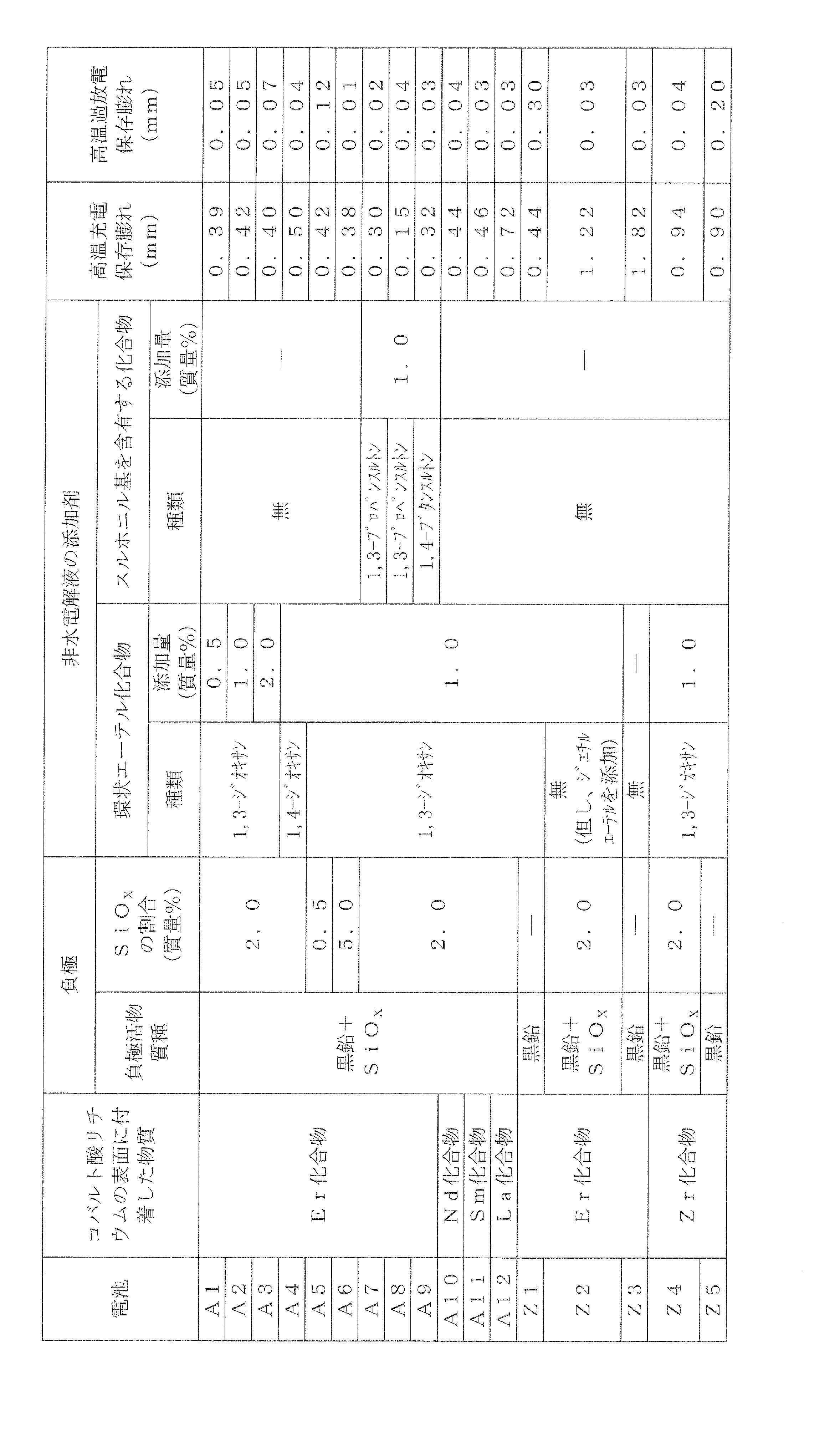
- the batteries A1 to A12 have small high-temperature charge storage blisters and excellent high-temperature charge storage characteristics, and small high-temperature overdischarge storage blisters and excellent high-temperature overdischarge storage characteristics. It is done. This is because a rare earth compound is attached to the surface of lithium cobalt oxide, a cyclic ether compound is added to the non-aqueous electrolyte, and SiO X is included in the negative electrode active material.
- the battery Z1 is excellent in high temperature charge storage characteristics, but is inferior in high temperature overdischarge storage characteristics.
- the battery Z1 since the rare earth compound is attached to the surface of the lithium cobalt oxide and the cyclic ether compound is added to the non-aqueous electrolyte, the battery Z1 has excellent high-temperature charge storage characteristics.
- SiO X is not included in the negative electrode active material, the high-temperature overdischarge storage characteristics are inferior.
- the battery Z2 is inferior in high temperature charge storage characteristics but is excellent in high temperature overdischarge storage characteristics.
- the rare earth compound is attached to the surface of the lithium cobalt oxide, but since the cyclic ether compound is not added to the non-aqueous electrolyte, the high temperature charge storage characteristics are inferior. However, since the cyclic ether compound is not added as described above, the high temperature overdischarge storage characteristics are excellent.
- the battery Z3 is inferior in high temperature charge storage characteristics but is excellent in high temperature overdischarge storage characteristics.
- the rare earth compound is adhered to the surface of the lithium cobalt oxide, but since the cyclic ether compound is not added to the non-aqueous electrolyte, the high temperature charge storage characteristics are inferior. However, since no cyclic ether compound is added, the high temperature overdischarge storage characteristics are excellent.
- the battery Z4 is inferior in high-temperature charge storage characteristics, but it is recognized that it is excellent in high-temperature overdischarge storage characteristics.
- the cyclic ether compound is added to the non-aqueous electrolyte, but since the rare earth compound is not attached to the surface of the lithium cobaltate (since only the Zr compound is attached), the high temperature charge storage characteristics are inferior. However, since the negative electrode active material contains SiO X , the high temperature overdischarge storage characteristics are excellent.
- the battery Z5 is inferior in high temperature charge storage characteristics and inferior in high temperature overdischarge storage characteristics.
- the cyclic ether compound is added to the nonaqueous electrolytic solution, but the rare earth compound is not attached to the surface of the lithium cobaltate, so that the high temperature charge storage characteristics are inferior.
- the negative electrode active material does not contain SiO X , the high temperature overdischarge storage characteristics are poor.
- batteries A1 to A3 that differ only in the amount of 1,3-dioxane added are compared, it is recognized that they all have equivalent characteristics. Therefore, when the amount of 1,3-dioxane added is 0.5% by mass or more and 2% by mass or less, the effect of one aspect of the present invention can be sufficiently exerted.
- batteries A2 and A4 that differ only in the type of cyclic ether compound are compared, it is recognized that both batteries have equivalent characteristics. Therefore, if it is a cyclic ether compound, the effect of 1 aspect of this invention can fully be exhibited.
- the batteries A7 to A9 to which the compound containing the sulfonyl group is added are not added with the compound.
- the rare earth compound attached to the surface of the lithium cobaltate can sufficiently exhibit the action and effect of one aspect of the present invention regardless of the type.
- the rare earth compound is samarium, neodymium or erbium, it is recognized that the high temperature charge storage blister is further suppressed.
Landscapes
- Chemical & Material Sciences (AREA)
- Chemical Kinetics & Catalysis (AREA)
- Electrochemistry (AREA)
- General Chemical & Material Sciences (AREA)
- Inorganic Chemistry (AREA)
- Composite Materials (AREA)
- Engineering & Computer Science (AREA)
- Manufacturing & Machinery (AREA)
- Physics & Mathematics (AREA)
- Condensed Matter Physics & Semiconductors (AREA)
- General Physics & Mathematics (AREA)
- Materials Engineering (AREA)
- Battery Electrode And Active Subsutance (AREA)
- Secondary Cells (AREA)
Description
しかしながら、今日では、移動情報端末における動画再生、ゲーム機能といった娯楽機能の充実が進み、消費電力はさらに上昇する傾向にあるため、上記非水電解質二次電池の更なる高容量化が求められている。
しかし、(2)の方法を用いた場合(特に、充電電圧を4.3Vよりも高くした場合)には、非水電解液が分解し易くなる。このため、高温で保存したり、連続充電した場合に、非水電解液が分解して、ガス発生する結果、電池が膨らんだり、電池の内部圧力が高くなるという問題を生じる。
また、特許文献2に示されるように、1,3-ジオキサンを添加した非水電解液を用いることで、高温保存特性とサイクル特性を改善することが提案されている。
本発明の一の局面におけるリチウム含有遷移金属酸化物としては、一般式LiyM1O2(0.9≦y≦1.5、M1はCo、Ni及びMnから選ばれる少なくとも1種を含む元素)で表される岩塩層状型リチウム含有遷移金属酸化物、一般式LizM2 2O4(0.9≦z≦1.1、M2は少なくともMnを含む元素)で表されるスピネル型リチウム含有遷移金属酸化物、及び一般式LiaM3PO4(0.9≦a≦1.1、M3はFe、Co及びMnから選ばれる少なくとも1種を含む元素)で表されるオリビン型リチウム含有遷移金属酸化物等が例示される。
本発明の一の局面において、リチウム含有遷移金属酸化物の表面には希土類化合物の微粒子が分散した状態で付着している。このような構成であれば、リチウム含有遷移金属酸化物と非水電解液との接触面積が小さくなるので、高温充電保存した場合であっても非水電解液が分解し難くなる。したがって、電池内でガスが発生するのを抑制できるので、電池が膨らんだり、電池の内部圧力が高くなるのを抑えることができる。
表面に析出した水酸化物は、その後の熱処理により、水酸化物、オキシ水酸化物、又は酸化物などの形態となる。したがって、本発明の一の局面における正極活物質表面に付着する希土類化合物は、水酸化物、オキシ水酸化物、又は酸化物などの形態で付着している。
ここで、400℃以下で熱処理した場合には、主に水酸化物や、オキシ水酸化物の状態となり、400℃を超える温度で熱処理した場合には、主に酸化物の状態となる。尚、熱処理時間は、一般に、3~7時間であることが好ましい。
本発明の一の局面に用いる非水電解液には、環状エーテル化合物が含有されている。このような構成であれば、初期充電時に環状エーテル化合物が正極側で優先的に分解されて、正極活物質表面に被膜が形成される。そして、この被膜が非水電解液の分解を抑制する保護被膜として機能するので、高温充電保存した場合であっても非水電解液が分解し難くなる。したがって、電池内でガスが発生するのを抑制できるので、電池が膨らんだり、電池の内部圧力が高くなるのを抑えることができる。
に抑制できないことがある。
上記非水電解液の溶質としては、LiBF4,LiPF6,LiN(SO2CF3)2,LiN(SO2C2F5)2,LiPF6-x(CnF2n+1)x[但し、1<x<6,n=1または2]、或いは、オキサラト錯体をアニオンとするリチウム塩を用いることもできる。このオキサラト錯体をアニオンとするリチウム塩としては、LiBOB〔リチウム-ビスオキサレートボレート〕の他、中心原子にC2O4 2-が配位したアニオンを有するリチウム塩、例えば、Li[M(C2O4)xRy](式中、Mは遷移金属,周期律表のIIIb族,IVb族,Vb族から選択される元素、Rはハロゲン、アルキル基、ハロゲン置換アルキル基から選択される基、xは正の整数、yは0又は正の整数である。)で表わされるものを用いることができる。具体的には、Li[B(C2O4)F2]、Li[P(C2O4)F4]、Li[P(C2O4)2F2]等がある。但し、高温環境下においても負極の表面に安定な被膜を形成するためには、LiBOBを用いることが最も好ましい。
本発明の一の局面における負極活物質としては、黒鉛とSiOX(0.8≦X≦1.2)とが混合されたものを用いる。このような構成とすれば、高温充電保存時のみならず過放電保存時(特に、高温過充電保存時)であっても、ガス発生に起因する電池膨れを抑制できる。これは、以下に示す理由によると考えられる。
ら構成すれば、環状エーテル化合物の還元分解を抑制できるので、過充電保存特性が向上する。
一方、負極活物質の総量に対するSiOXの割合の上限は、10質量%以下であることが望ましく、特に、5質量%以下であることが望ましい。SiOXの割合が10質量%を超える場合には、充放電時における負極活物質の膨張収縮量が増加し、充放電サイクル特性が低下することがある。
また、SiOXにおけるXの値を、0.8≦X≦1.2に規制するのは、Xの値が0.8未満の場合には、SiOX中のSi比率が増加するため、充放電時における負極活物質の膨張収縮量が増加し、充放電サイクル特性が低下する。一方、Xが1.2を超えた場合には、初回充放電時の不可逆容量が増加し、初期充放電効率が低下するため、電池容量が低下する。
尚、SiOXの表面を炭素被覆しても良い。但し、SiOXの表面を炭素被覆しなくても本発明の一の局面の効果は発揮される。
[正極の作製]
(1)リチウム含有遷移金属酸化物の作製
Mg及びAlをそれぞれ1.5mol%固溶し、かつZrを0.05mol%含有したコバルト酸リチウムを作製した。具体的には、原料としてのLi2CO3、Co3O4、MgO、Al2O3、及びZrO2を所定の比率で混合し、空気雰囲気中にて、850℃で24時間熱処理することにより作製した。
上記コバルト酸リチウム1000gを、3リットルの純水に添加し、攪拌して、コバルト酸リチウムが分散した懸濁液を調製した。次に、この懸濁液に、硝酸エルビウム5水和物3.18gを溶解した溶液を添加した。硝酸エルビウム5水和物を溶解した液を懸濁液に添加する際には、10質量%の水酸化物ナトリウム水溶液を添加し、コバルト酸リチウムを含む溶液のpHを9に保った。次いで、これを吸引濾過し、水洗して、得られた粉末を120℃で乾燥した。これにより、コバルト酸リチウムの表面に水酸化エルビウムが均一に付着したものが得られた。
上記正極活物質と、導電剤であるアセチレンブラックと、結着剤であるポリフッ化ビニリデンを溶解させたN-メチル-2-ピロリドン溶液とを混合して、正極合剤スラリーを調製した。尚、正極活物質と、導電剤と、結着剤との割合は、質量比で、95:2.5:2.5のなるように規定した。最後に、この正極合剤スラリーを正極集電体であるアルミ箔の両面に塗布した後、乾燥し、更に、正極活物質の充填密度が3.60g/cm3となるように圧延して、正極を作製した。
(1)負極活物質としての酸化ケイ素の作製
先ず、SiOX(X=0.93)粒子の表面に、SiOXに対する割合が10質量%となるように炭素をコーティングした。尚、炭素のコーティングはアルゴンガス雰囲気中において、CVD法を用いて行った。次に、炭素被覆されたSiOX粒子をアルゴンガス雰囲気下1000℃で不均化処理を行った後、解砕・分級を行って、負極活物質としてのSiOXを得た。
黒鉛(人造黒鉛)と上記SiOXとを混合して負極活物質を作製した。この際、負極活物質の総量(黒鉛とSiOXとの合計)に対するSiOXの割合が2質量%となるように規制した。次に、この負極活物質と、分散剤としてのCMCと、結着剤としてのSBRとを、負極活物質と分散剤と結着剤との質量比が97:1.5:1.5となるように水溶液中で攪拌し、負極合剤スラリーを調製した。次いで、ドクターブレード法を用いて、上記負極合剤スラリーを、銅箔から成る負極集電体の両面に塗布、乾燥し、更に、負極活物質の充填密度が1.70g/cm3となるように圧延して、負極を作製した。
エチレンカーボネート(EC)とエチルメチルカーボネート(EMC)とジエチルカーボネート(DEC)とを体積比3:6:1の割合で混合して、混合溶媒を調製した。次に、この混合溶媒に対し、1,3-ジオキサン(環状エーテル化合物)を0.5質量%添加し、更に、ヘキサフルオロリン酸リチウム(LiPF6)を1モル/リットルの割合で溶解させて、非水電解質液を調製した。
上記正極と上記負極とを、セパレータを介して対向するように巻取って巻取り体を作製した後、アルゴン雰囲気下のグローボックス中にて、該巻取り体を非水電解液とともにアルミニウムラミネート内に封入することにより、電池容量が800mAhの非水電解質二次電池を得た。尚、電池サイズは、厚み3.6mm、幅3.5cm、長さ6.2cmである。
このようにして作製した電池を、以下、電池A1と称する。
非水電解液の調製時に、混合溶媒に対する1,3-ジオキサンの割合を、それぞれ、1.0質量%、2.0質量%としたこと以外は、上記実施例1と同様にして電池を作製した。
このようにして作製した電池を、以下それぞれ、電池A2、A3と称する。
非水電解液の調製時に添加する環状エーテル化合物として、1,3-ジオキサンに代えて1,4-ジオキサンを用いたこと以外は、上記実施例2と同様にして電池を作製した。
このようにして作製した電池を、以下、電池A4と称する。
負極活物質の混合時に、負極活物質の総量に対するSiOXの割合を、それぞれ、0.5質量%、5.0質量%としたこと以外は、上記実施例2と同様にして電池を作製した。
このようにして作製した電池を、以下それぞれ、電池A5、A6と称する。
非水電解液の調製時に、1,3-ジオキサンに加えて、それぞれ、1,3-プロパンスルトン、1,3-プロペンスルトン、1,4-ブタンスルトンを添加したこと以外は、上記実施例2と同様にして電池を作製した。尚、混合溶媒に対する1,3-プロパンスルトン、1,3-プロペンスルトン、1,4-ブタンスルトンの割合は、全て1.0質量%である。
このようにして作製した電池を、以下それぞれ、電池A7~A9と称する。
コバルト酸リチウムの表面に付着した希土類化合物として、エルビウム化合物に代えてネオジム化合物を用いたこと以外は、上記実施例2と同様にして電池を作製した。具体的には、正極活物質を作製する際に、硝酸エルビウム5水和物3.18gを溶解した水溶液に代えて、硝酸ネオジム6水和物3.65gを溶解した水溶液を用いた点が異なる。
得られた正極活物質について、SEMにて観察したところ、正極活物質の表面に均一に分散された状態で、平均粒子径100nm以下のネオジム化合物が均一に付着していた。
ネオジム化合物の付着量は、ネオジム元素換算で、コバルト酸リチウムに対して、0.12質量%であった。尚、ネオジム化合物の付着量は、ICPにより測定した。
このようにして作製した電池を、以下、電池A10と称する。
コバルト酸リチウムの表面に付着した希土類化合物として、エルビウム化合物に代えてサマリウム化合物を用いたこと以外は、上記実施例2と同様にして電池を作製した。具体的には、正極活物質を作製する際に、硝酸エルビウム5水和物3.18gを溶解した水溶液に代えて、硝酸サマリウム6水和物3.54gを溶解した水溶液を用いた点が異なる。
得られた正極活物質について、SEMにて観察したところ、正極活物質の表面に均一に分散された状態で、平均粒子径100nm以下のサマリウム化合物が均一に付着していた。サマリウム化合物の付着量は、サマリウム元素換算で、コバルト酸リチウムに対して、0.12質量%であった。尚、サマリウム化合物の付着量は、ICPにより測定した。
このようにして作製した電池を、以下、電池A11と称する。
コバルト酸リチウムの表面に付着した希土類化合物として、エルビウム化合物に代えてランタン化合物を用いたこと以外は、上記実施例2と同様にして電池を作製した。具体的には、正極活物質を作製する際に、硝酸エルビウム5水和物3.18gを溶解した水溶液に代えて、硝酸ランタン6水和物3.75gを溶解した水溶液を用いた点が異なる。
得られた正極活物質について、SEMにて観察したところ、正極活物質の表面に均一に分散された状態で、平均粒子径100nm以下のランタン化合物が均一に付着していた。
ランタン化合物の付着量は、ランタン元素換算で、コバルト酸リチウムに対して、0.12質量%であった。尚、ランタン化合物の付着量は、ICPにより測定した。
このようにして作製した電池を、以下、電池A12と称する。
負極活物質として、黒鉛のみを用いた(SiOXは含まれていない)以外は、上記実施例2と同様にして電池を作製した。
このようにして作製した電池を、以下、電池Z1と称する。
非水電解液を調製する際、1,3-ジオキサンに代えてジエチルエーテルを添加したこと以外は、上記実施例2と同様にして電池を作製した。
このようにして作製した電池を、以下、電池Z2と称する。
負極活物質として黒鉛のみを用いると共に、非水電解液を調製する際、1,3-ジオキサンを添加しなかったこと以外は、上記実施例2と同様にして電池を作製した。
このようにして作製した電池を、以下、電池Z3と称する。
コバルト酸リチウムの表面に付着した希土類化合物として、エルビウム化合物に代えてジルコニウム化合物を用いたこと以外は、上記実施例2と同様にして電池を作製した。具体的には、正極活物質を作製する際に、硝酸エルビウム5水和物3.18gを溶解した水溶液に代えて、ジルコニウムオキシナイトレート2水和物3.51gを溶解した水溶液を用いた点が異なる。
得られた正極活物質について、SEMにて観察したところ、正極活物質の表面に均一に分散された状態で、平均粒子径100nm以下のジルコニウム化合物が均一に付着していた。ジルコニウム化合物の付着量は、ジルコニウム元素換算で、コバルト酸リチウムに対して、0.12質量%であった。尚、ジルコニウム化合物の付着量は、ICPにより測定した。
このようにして作製した電池を、以下、電池Z4と称する。
負極活物質として、黒鉛のみを用いた(SiOXは含まれていない)以外は、上記比較例4と同様にして電池を作製した。
このようにして作製した電池を、以下、電池Z5と称する。
上記電池A1~A12、Z1~Z5を下記条件で充放電し、高温充電保存特性(高温充電保存膨れ)及び高温過放電保存特性(高温過放電保存膨れ)を調べたので、それらの結果を表1に示す。
1.0It(800mA)の電流で電池電圧4.4Vまで定電流充電を行った後、4.4Vの定電圧で電流0.05It(40mA)になるまで定電圧充電した。この充電終了後に、保存前電池厚みTaを測定した。次に、上記充電した電池を80℃の恒温槽内で2日間保存した後、恒温槽から電池を取り出した。次いで、室温にて電池を1時間放置した後、保存後電池厚みTbを測定し、下記(1)式から、高温充電保存膨れを算出した。
高温充電保存膨れ=(保存後電池厚みTb)-(保存前後電池厚みTa)・・・(1)
0.2It(160mA)の電流で電池電圧2.0Vまで定電流放電を行った後、保存前電池厚みTcを測定した。次に、上記過放電した電池を60℃の恒温槽内で20日間保存した後、恒温槽から電池を取り出した。次いで、電池を室温で1時間放置した後、保存後電池厚みTdを測定し、下記(2)式から、高温過放電保存膨れを算出した。
高温過放電保存膨れ=(保存後電池厚みTd)-(保存前後電池厚みTc)・・・(2)
また、電池Z2では、高温充電保存特性に劣るが、高温過放電保存特性に優れることが認められる。電池Z2では、コバルト酸リチウムの表面に希土類化合物が付着されているが、非水電解液に環状エーテル化合物が添加されていないので高温充電保存特性に劣る。但し、このように環状エーテル化合物が添加されていないので、高温過放電保存特性に優れる。
但し、環状エーテル化合物が添加されていないので、高温過放電保存特性に優れる。また、電池Z4では、高温充電保存特性に劣るが、高温過放電保存特性に優れることが認められる。電池Z4では、非水電解液に環状エーテル化合物が添加されているが、コバルト酸リチウムの表面に希土類化合物が付着されていないので(Zr化合物が付着されるのみなので)高温充電保存特性に劣る。但し、負極活物質にSiOXを含んでいるので、高温過放電保存特性に優れる。
Claims (11)
- 希土類化合物が表面に付着されたリチウム含有遷移金属酸化物を含む正極活物質を有する正極と、
SiOX(0.8≦X≦1.2)で表される酸化ケイ素と黒鉛とを含む負極活物質を有する負極と、
溶媒と溶質とを有し、且つ、環状エーテル化合物が添加された非水電解質と、を備える非水電解質二次電池。 - 上記リチウム含有遷移金属酸化物が、一般式LiyM1O2(0.9≦y≦1.5、M1はCo、Ni及びMnから選ばれる少なくとも1種を含む元素)で表される岩塩層状型リチウム含有遷移金属酸化物、一般式LizM2 2O4(0.9≦z≦1.1、M2は少なくともMnを含む元素)で表されるスピネル型リチウム含有遷移金属酸化物、及び一般式LiaM3PO4(0.9≦a≦1.1、M3はFe、Co及びMnから選ばれる少なくとも1種を含む元素)で表されるオリビン型リチウム含有遷移金属酸化物から成る群から選択される少なくとも1種である、請求項1に記載の非水電解質二次電池。
- 上記リチウム含有遷移金属酸化物が、一般式LibCocM4 1-cO2(0.9≦b≦1.1、0.8≦c≦1.0、M4はZr、Mg、Ti、Al、Ni及びMnから選ばれる少なくとも一種を含む元素)で表されるコバルト酸リチウムである、請求項2に記載の非水電解質二次電池。
- 上記希土類化合物が、希土類のオキシ水酸化物、希土類の水酸化物、又は希土類の酸化物である、請求項1~3の何れか1項に記載の非水電解質二次電池。
- 希土類化合物における希土類元素が、サマリウム、ネオジム、又はエルビウムである、請求項1~4の何れか1項に記載の非水電解質二次電池。
- 上記非水電解質の溶媒に対する上記環状エーテル化合物の割合が0.1質量%以上10質量%以下である、請求項1~5の何れか1項に記載の非水電解質二次電池。
- 上記環状エーテル化合物が、1,3-ジオキサン及び/又は1,4-ジオキサンである、請求項1~6の何れか1項に記載の非水電解質二次電池。
- 上記負極活物質の総量に対する上記酸化ケイ素の割合が、0.5質量%以上10質量%以下である、請求項1~7の何れか1項に記載の非水電解質二
次電池。 - 上記酸化ケイ素の表面には炭素がコーティングされている、請求項1~8の何れか1項に記載の非水電解質二次電池。
- 上記非水電解質には、更にスルホニル基を含有する化合物が添加されており、上記非水電解質の溶媒に対する上記スルホニル基を含有する化合物の割合が0.1質量%以上10質量%以下である、請求項1~9の何れか1項に記載の非水電解質二次電池。
- 上記スルホニル基を含有する化合物が、1,3-プロパンスルトン、1,3-プロペンスルトン、及び1,4-ブタンスルトンから成る群から選択される少なくとも1種である、請求項10に記載の非水電解質二次電池。
Priority Applications (3)
| Application Number | Priority Date | Filing Date | Title |
|---|---|---|---|
| JP2014538103A JP6193243B2 (ja) | 2012-09-26 | 2013-08-02 | 非水電解質二次電池 |
| CN201380046796.8A CN104620434B (zh) | 2012-09-26 | 2013-08-02 | 非水电解质二次电池 |
| US14/425,149 US20150214545A1 (en) | 2012-09-26 | 2013-08-02 | Nonaqueous electrolyte secondary battery |
Applications Claiming Priority (2)
| Application Number | Priority Date | Filing Date | Title |
|---|---|---|---|
| JP2012211874 | 2012-09-26 | ||
| JP2012-211874 | 2012-09-26 |
Publications (1)
| Publication Number | Publication Date |
|---|---|
| WO2014049931A1 true WO2014049931A1 (ja) | 2014-04-03 |
Family
ID=50387383
Family Applications (1)
| Application Number | Title | Priority Date | Filing Date |
|---|---|---|---|
| PCT/JP2013/004695 Ceased WO2014049931A1 (ja) | 2012-09-26 | 2013-08-02 | 非水電解質二次電池 |
Country Status (4)
| Country | Link |
|---|---|
| US (1) | US20150214545A1 (ja) |
| JP (1) | JP6193243B2 (ja) |
| CN (1) | CN104620434B (ja) |
| WO (1) | WO2014049931A1 (ja) |
Cited By (9)
| Publication number | Priority date | Publication date | Assignee | Title |
|---|---|---|---|---|
| JP2016062760A (ja) * | 2014-09-18 | 2016-04-25 | 日立マクセル株式会社 | リチウム二次電池 |
| JP2016096069A (ja) * | 2014-11-14 | 2016-05-26 | 株式会社Gsユアサ | 非水電解質二次電池 |
| WO2019156160A1 (ja) * | 2018-02-09 | 2019-08-15 | 株式会社村田製作所 | リチウムイオン二次電池用電解液およびリチウムイオン二次電池 |
| WO2019156161A1 (ja) * | 2018-02-09 | 2019-08-15 | 株式会社村田製作所 | リチウムイオン二次電池 |
| JP2020021684A (ja) * | 2018-08-02 | 2020-02-06 | 住友金属鉱山株式会社 | リチウムイオン二次電池用正極活物質およびリチウムイオン二次電池 |
| WO2020026687A1 (ja) * | 2018-08-02 | 2020-02-06 | 住友金属鉱山株式会社 | リチウムイオン二次電池用正極活物質の製造方法 |
| JP2022551315A (ja) * | 2019-10-09 | 2022-12-08 | メキシケム フロー エセ・ア・デ・セ・ヴェ | 非水性電解質組成物およびその使用 |
| WO2023054060A1 (ja) | 2021-09-30 | 2023-04-06 | パナソニックIpマネジメント株式会社 | 非水電解質二次電池 |
| JP2024526659A (ja) * | 2022-06-21 | 2024-07-19 | エルジー エナジー ソリューション リミテッド | リチウム二次電池およびその製造方法 |
Families Citing this family (4)
| Publication number | Priority date | Publication date | Assignee | Title |
|---|---|---|---|---|
| CN112204794B (zh) * | 2018-05-31 | 2024-03-19 | 株式会社村田制作所 | 非水电解质二次电池 |
| WO2020088169A1 (zh) | 2018-10-30 | 2020-05-07 | 北京北方华创微电子装备有限公司 | 感应线圈组及反应腔室 |
| CN112886050B (zh) | 2019-11-29 | 2022-07-05 | 宁德时代新能源科技股份有限公司 | 二次电池及含有该二次电池的装置 |
| CN114784253B (zh) * | 2022-05-20 | 2024-05-10 | 电子科技大学 | 用于二次电池的氧化亚硅碳复合负极材料及制备和应用 |
Citations (7)
| Publication number | Priority date | Publication date | Assignee | Title |
|---|---|---|---|---|
| JP2005196992A (ja) * | 2003-12-26 | 2005-07-21 | Hitachi Ltd | リチウム二次電池用正極材料及び電池 |
| WO2007139130A1 (ja) * | 2006-05-31 | 2007-12-06 | Sanyo Electric Co., Ltd. | 高電圧充電型非水電解質二次電池 |
| WO2010004973A1 (ja) * | 2008-07-09 | 2010-01-14 | 三洋電機株式会社 | 非水電解質二次電池用正極活物質、非水電解質二次電池用正極活物質の製造方法、非水電解質二次電池用正極及び非水電解質二次電池 |
| WO2011040443A1 (ja) * | 2009-09-29 | 2011-04-07 | Necエナジーデバイス株式会社 | 二次電池 |
| JP2011159619A (ja) * | 2010-01-06 | 2011-08-18 | Sanyo Electric Co Ltd | リチウム二次電池 |
| WO2012086277A1 (ja) * | 2010-12-20 | 2012-06-28 | 三洋電機株式会社 | 非水電解質二次電池用正極及びその正極を用いた非水電解質二次電池 |
| WO2012099265A1 (ja) * | 2011-01-21 | 2012-07-26 | 三洋電機株式会社 | 非水電解質二次電池用正極活物質、その正極活物質を用いた非水電解質二次電池用正極及びその正極を用いた非水電解質二次電池 |
Family Cites Families (2)
| Publication number | Priority date | Publication date | Assignee | Title |
|---|---|---|---|---|
| JP5094084B2 (ja) * | 2006-09-28 | 2012-12-12 | 三洋電機株式会社 | 非水電解質二次電池 |
| US20130230770A1 (en) * | 2010-11-16 | 2013-09-05 | Hitachi Maxell, Ltd. | Non-aqueous secondary battery |
-
2013
- 2013-08-02 JP JP2014538103A patent/JP6193243B2/ja active Active
- 2013-08-02 CN CN201380046796.8A patent/CN104620434B/zh active Active
- 2013-08-02 WO PCT/JP2013/004695 patent/WO2014049931A1/ja not_active Ceased
- 2013-08-02 US US14/425,149 patent/US20150214545A1/en not_active Abandoned
Patent Citations (7)
| Publication number | Priority date | Publication date | Assignee | Title |
|---|---|---|---|---|
| JP2005196992A (ja) * | 2003-12-26 | 2005-07-21 | Hitachi Ltd | リチウム二次電池用正極材料及び電池 |
| WO2007139130A1 (ja) * | 2006-05-31 | 2007-12-06 | Sanyo Electric Co., Ltd. | 高電圧充電型非水電解質二次電池 |
| WO2010004973A1 (ja) * | 2008-07-09 | 2010-01-14 | 三洋電機株式会社 | 非水電解質二次電池用正極活物質、非水電解質二次電池用正極活物質の製造方法、非水電解質二次電池用正極及び非水電解質二次電池 |
| WO2011040443A1 (ja) * | 2009-09-29 | 2011-04-07 | Necエナジーデバイス株式会社 | 二次電池 |
| JP2011159619A (ja) * | 2010-01-06 | 2011-08-18 | Sanyo Electric Co Ltd | リチウム二次電池 |
| WO2012086277A1 (ja) * | 2010-12-20 | 2012-06-28 | 三洋電機株式会社 | 非水電解質二次電池用正極及びその正極を用いた非水電解質二次電池 |
| WO2012099265A1 (ja) * | 2011-01-21 | 2012-07-26 | 三洋電機株式会社 | 非水電解質二次電池用正極活物質、その正極活物質を用いた非水電解質二次電池用正極及びその正極を用いた非水電解質二次電池 |
Cited By (14)
| Publication number | Priority date | Publication date | Assignee | Title |
|---|---|---|---|---|
| JP2016062760A (ja) * | 2014-09-18 | 2016-04-25 | 日立マクセル株式会社 | リチウム二次電池 |
| JP2016096069A (ja) * | 2014-11-14 | 2016-05-26 | 株式会社Gsユアサ | 非水電解質二次電池 |
| WO2019156160A1 (ja) * | 2018-02-09 | 2019-08-15 | 株式会社村田製作所 | リチウムイオン二次電池用電解液およびリチウムイオン二次電池 |
| WO2019156161A1 (ja) * | 2018-02-09 | 2019-08-15 | 株式会社村田製作所 | リチウムイオン二次電池 |
| JPWO2019156161A1 (ja) * | 2018-02-09 | 2021-01-28 | 株式会社村田製作所 | リチウムイオン二次電池 |
| WO2020026687A1 (ja) * | 2018-08-02 | 2020-02-06 | 住友金属鉱山株式会社 | リチウムイオン二次電池用正極活物質の製造方法 |
| WO2020026686A1 (ja) * | 2018-08-02 | 2020-02-06 | 住友金属鉱山株式会社 | リチウムイオン二次電池用正極活物質およびリチウムイオン二次電池 |
| JP2020021684A (ja) * | 2018-08-02 | 2020-02-06 | 住友金属鉱山株式会社 | リチウムイオン二次電池用正極活物質およびリチウムイオン二次電池 |
| JP7030030B2 (ja) | 2018-08-02 | 2022-03-04 | 住友金属鉱山株式会社 | リチウムイオン二次電池用正極活物質およびリチウムイオン二次電池 |
| US11695116B2 (en) | 2018-08-02 | 2023-07-04 | Sumitomo Metal Mining Co., Ltd. | Method for manufacturing cathode active material for lithium ion secondary battery |
| US12015154B2 (en) | 2018-08-02 | 2024-06-18 | Sumitomo Metal Mining Co., Ltd. | Cathode active material for lithium ion secondary battery and lithium ion secondary battery |
| JP2022551315A (ja) * | 2019-10-09 | 2022-12-08 | メキシケム フロー エセ・ア・デ・セ・ヴェ | 非水性電解質組成物およびその使用 |
| WO2023054060A1 (ja) | 2021-09-30 | 2023-04-06 | パナソニックIpマネジメント株式会社 | 非水電解質二次電池 |
| JP2024526659A (ja) * | 2022-06-21 | 2024-07-19 | エルジー エナジー ソリューション リミテッド | リチウム二次電池およびその製造方法 |
Also Published As
| Publication number | Publication date |
|---|---|
| JP6193243B2 (ja) | 2017-09-06 |
| US20150214545A1 (en) | 2015-07-30 |
| JPWO2014049931A1 (ja) | 2016-08-22 |
| CN104620434A (zh) | 2015-05-13 |
| CN104620434B (zh) | 2017-06-27 |
Similar Documents
| Publication | Publication Date | Title |
|---|---|---|
| JP6193243B2 (ja) | 非水電解質二次電池 | |
| JP6399388B2 (ja) | 非水電解質二次電池 | |
| JP5116329B2 (ja) | 非水電解質二次電池 | |
| JP5128018B1 (ja) | 非水電解質二次電池 | |
| JP2009224307A (ja) | 非水電解質二次電池及びその製造方法 | |
| JPWO2012099265A1 (ja) | 非水電解質二次電池用正極活物質、その正極活物質を用いた非水電解質二次電池用正極及びその正極を用いた非水電解質二次電池 | |
| WO2015129188A1 (ja) | 非水電解質二次電池 | |
| JP2009217981A (ja) | 非水電解質二次電池 | |
| KR20110103320A (ko) | 비수 전해질 이차 전지 및 그 제조 방법 | |
| JP2015232923A (ja) | 非水電解質二次電池 | |
| JP2009129721A (ja) | 非水電解質二次電池 | |
| WO2016017092A1 (ja) | 非水電解質二次電池 | |
| JP2007200821A (ja) | 非水電解質二次電池 | |
| JP2011071100A (ja) | 非水電解質二次電池用正極及びそれを用いた非水電解質二次電池 | |
| JP4530822B2 (ja) | 非水電解質二次電池及びその充電方法 | |
| JP2009266791A (ja) | 非水電解質二次電池 | |
| JP6122014B2 (ja) | 非水電解質二次電池用負極、その製造方法及び非水電解質二次電池 | |
| JP6158307B2 (ja) | 非水電解質二次電池用正極、非水電解質二次電池用正極の製造方法および非水電解質二次電池 | |
| JP2008251212A (ja) | 非水電解質二次電池 | |
| JP2014049287A (ja) | 非水電解質二次電池及び非水電解質二次電池スタック | |
| US7704640B2 (en) | Non-aqueous electrolyte secondary cell | |
| JP2005183116A (ja) | 非水電解質二次電池 | |
| JP2009176528A (ja) | 非水電解質二次電池及びその製造方法 | |
| JP5089097B2 (ja) | 非水電解質二次電池及びその充放電方法 | |
| JP4841125B2 (ja) | リチウム二次電池の製造方法 |
Legal Events
| Date | Code | Title | Description |
|---|---|---|---|
| 121 | Ep: the epo has been informed by wipo that ep was designated in this application |
Ref document number: 13840784 Country of ref document: EP Kind code of ref document: A1 |
|
| ENP | Entry into the national phase |
Ref document number: 2014538103 Country of ref document: JP Kind code of ref document: A |
|
| WWE | Wipo information: entry into national phase |
Ref document number: 14425149 Country of ref document: US |
|
| NENP | Non-entry into the national phase |
Ref country code: DE |
|
| 122 | Ep: pct application non-entry in european phase |
Ref document number: 13840784 Country of ref document: EP Kind code of ref document: A1 |