WO2014013977A1 - 合金材料研磨用組成物及びそれを用いた合金材料の製造方法 - Google Patents
合金材料研磨用組成物及びそれを用いた合金材料の製造方法 Download PDFInfo
- Publication number
- WO2014013977A1 WO2014013977A1 PCT/JP2013/069273 JP2013069273W WO2014013977A1 WO 2014013977 A1 WO2014013977 A1 WO 2014013977A1 JP 2013069273 W JP2013069273 W JP 2013069273W WO 2014013977 A1 WO2014013977 A1 WO 2014013977A1
- Authority
- WO
- WIPO (PCT)
- Prior art keywords
- alloy material
- polishing
- polishing composition
- metal species
- alloy
- Prior art date
- Legal status (The legal status is an assumption and is not a legal conclusion. Google has not performed a legal analysis and makes no representation as to the accuracy of the status listed.)
- Ceased
Links
Classifications
-
- C—CHEMISTRY; METALLURGY
- C09—DYES; PAINTS; POLISHES; NATURAL RESINS; ADHESIVES; COMPOSITIONS NOT OTHERWISE PROVIDED FOR; APPLICATIONS OF MATERIALS NOT OTHERWISE PROVIDED FOR
- C09K—MATERIALS FOR MISCELLANEOUS APPLICATIONS, NOT PROVIDED FOR ELSEWHERE
- C09K3/00—Materials not provided for elsewhere
- C09K3/14—Anti-slip materials; Abrasives
- C09K3/1436—Composite particles, e.g. coated particles
-
- B—PERFORMING OPERATIONS; TRANSPORTING
- B24—GRINDING; POLISHING
- B24B—MACHINES, DEVICES, OR PROCESSES FOR GRINDING OR POLISHING; DRESSING OR CONDITIONING OF ABRADING SURFACES; FEEDING OF GRINDING, POLISHING, OR LAPPING AGENTS
- B24B37/00—Lapping machines or devices; Accessories
-
- C—CHEMISTRY; METALLURGY
- C09—DYES; PAINTS; POLISHES; NATURAL RESINS; ADHESIVES; COMPOSITIONS NOT OTHERWISE PROVIDED FOR; APPLICATIONS OF MATERIALS NOT OTHERWISE PROVIDED FOR
- C09K—MATERIALS FOR MISCELLANEOUS APPLICATIONS, NOT PROVIDED FOR ELSEWHERE
- C09K3/00—Materials not provided for elsewhere
- C09K3/14—Anti-slip materials; Abrasives
- C09K3/1454—Abrasive powders, suspensions and pastes for polishing
-
- G—PHYSICS
- G11—INFORMATION STORAGE
- G11B—INFORMATION STORAGE BASED ON RELATIVE MOVEMENT BETWEEN RECORD CARRIER AND TRANSDUCER
- G11B5/00—Recording by magnetisation or demagnetisation of a record carrier; Reproducing by magnetic means; Record carriers therefor
- G11B5/84—Processes or apparatus specially adapted for manufacturing record carriers
- G11B5/8404—Processes or apparatus specially adapted for manufacturing record carriers manufacturing base layers
-
- C—CHEMISTRY; METALLURGY
- C09—DYES; PAINTS; POLISHES; NATURAL RESINS; ADHESIVES; COMPOSITIONS NOT OTHERWISE PROVIDED FOR; APPLICATIONS OF MATERIALS NOT OTHERWISE PROVIDED FOR
- C09K—MATERIALS FOR MISCELLANEOUS APPLICATIONS, NOT PROVIDED FOR ELSEWHERE
- C09K3/00—Materials not provided for elsewhere
- C09K3/14—Anti-slip materials; Abrasives
- C09K3/1409—Abrasive particles per se
Definitions
- the present invention relates to a composition for polishing an alloy material and a method for producing an alloy material using the same.
- Alloy materials are used in various applications because they have better mechanical strength, chemical resistance, corrosion resistance, and heat resistance than pure metal materials.
- the alloy material is subjected to processing such as polishing (see Patent Documents 1 and 2).
- An object of the present invention is to provide an alloy material polishing composition capable of suppressing surface roughness and defects on a polished surface of an alloy material, and a method for producing an alloy material using the same.
- an alloy material polishing composition for use in polishing an alloy material, wherein the alloy material comprises a first metal species as a main component.
- a second metal species that is different from the first metal species and has a standard electrode potential higher than the standard electrode potential of the first metal species, and the alloy material polishing composition is bonded to carbon
- An alloy material polishing composition containing a compound having a functional group capable of capturing the second metal species is provided.
- the alloy material polishing composition may further contain abrasive grains, in which case the compound is preferably immobilized on the abrasive grains.
- the main component of the alloy material is preferably any one of magnesium, aluminum, titanium, chromium and iron.
- the main component of the alloy material is preferably aluminum, and the alloy material preferably contains 1.0% by mass or more of at least one metal element selected from iron, copper and zinc.
- the alloy material polishing composition of the present embodiment is used for polishing an alloy material.
- the alloy material contains a first metal species as a main component and a second metal species that is different from the first metal species and has a standard electrode potential higher than the standard electrode potential of the first metal species.
- alloy materials include aluminum alloys, titanium alloys, stainless steel, nickel alloys, and copper alloys.
- the aluminum alloy contains aluminum as a main component and further contains at least one selected from, for example, silicon, iron, copper, manganese, magnesium, zinc, and chromium.
- the content of metals other than aluminum in the aluminum alloy is, for example, 0.1 to 10% by mass.
- Examples of aluminum alloys include alloy numbers 2000, 3000, 4000, 5000, 6000, 7000, and 8000 as described in Japanese Industrial Standard (JIS) H4000: 2006, for example. Things.
- the titanium alloy is mainly composed of titanium, and further contains, for example, aluminum, iron, and vanadium.
- the content of metals other than titanium in the titanium alloy is, for example, 3.5 to 30% by mass.
- Examples of titanium alloys include those of 11 to 23 types, 50 types, 60 types, 61 types, and 80 types described in JIS H4600: 2012.
- Stainless steel contains iron as a main component and further contains at least one selected from, for example, chromium, nickel, molybdenum, and manganese.
- the content of metals other than iron in the stainless steel is, for example, 10 to 50% by mass.
- Examples of stainless steel include SUS201, SUS303, SUS303Se, SUS304, SUS304L, SUS304NI, SUS305, SUS305JI, SUS309S, SUS310S, SUS316, SUS316L, SUS347, and SUS347, SUS384, as described in JIS G4303: 2005.
- the nickel alloy contains nickel as a main component and further contains at least one selected from, for example, iron, chromium, molybdenum, and cobalt.
- the content of metals other than nickel in the nickel alloy is, for example, 20 to 75% by mass.
- Examples of the nickel alloy include those of alloy numbers NCF600, NCF601, NCF625, NCF750, NCF800, NCF800H, NCF825, NW0276, NW4400, NW6002, and NW6022, as described in JIS H4551: 2000.
- the copper alloy contains copper as a main component and further contains at least one selected from, for example, iron, lead, zinc, and tin.
- the content of metals other than copper in the copper alloy is, for example, 3 to 50% by mass.
- Examples of copper alloys include alloy numbers C2100, C2200, C2300, C2400, C2600, C2680, C2720, C2801, C3560, C3561, C3710, C3713, C4250, C4430, as described in JIS H3100: 2006, for example. , C4621, C4640, C6140, C6161, C6280, C6301, C7060, C7150, C1401, C2051, C6711, and C6712.
- the main component of the alloy material is preferably any one of magnesium, aluminum, titanium, chromium and iron, more preferably aluminum.
- the alloy material preferably contains 1.0% by mass or more of at least one metal element selected from iron, copper, and zinc.
- the alloy material polishing composition can capture a metal other than the main component having a standard electrode potential higher than the standard electrode potential of the second metal species, that is, the main component metal in the alloy material, in the functional group bonded to carbon Contains compounds. This compound is used for the purpose of suppressing surface roughness and defects on the polished surface of the alloy material.
- the functional group of the compound can capture at least the metal species having the highest standard electrode potential among the second metal species.
- the standard electrode potential is expressed by the following equation when all chemical species involved in the oxidation reaction are in the standard state.
- E0 is the standard electrode potential
- ⁇ G0 is the standard Gibbs energy change of the oxidation reaction
- K is its parallel constant
- F is the Faraday constant
- T is the absolute temperature
- n is the number of electrons involved in the oxidation reaction. Accordingly, since the standard electrode potential varies depending on the temperature, the standard electrode potential at 25 ° C. is adopted in this specification.
- the standard electrode potential of the aqueous solution system is described in, for example, the revised 4th edition chemical handbook (basic edition) II, pp 464-468 (edited by the Chemical Society of Japan).
- the functional group of the compound is preferably an anionic group, more preferably has a higher ability to capture the second metal species than the hydroxyl group, and is stable in the state of capturing the second metal species.
- the functional group is preferably a sulfo group or two or more carboxyl groups. That is, the compound in the alloy material polishing composition is preferably a compound having a sulfo group bonded to carbon or a compound having two or more carboxyl groups bonded to carbon.
- the compound may have only one type of functional group or may have multiple types of functional groups.
- the compound in which the functional group bonded to carbon can capture the second metal species may be used singly or in combination of two or more.
- Examples of the compound in the alloy material polishing composition include alkali metal salts such as sodium salt and potassium salt, and ammonium salt.
- the compound in the alloy material polishing composition include, for example, polystyrene sulfonic acid and its salt, polyacrylic acid and its salt, iminodiacetic acid (iminodiacetic acid) and its salt, and citric acid and its salt Is mentioned.
- Polystyrene sulfonic acid and its salt are preferably water-soluble.
- the solubility of polystyrene sulfonic acid and its salt is preferably 20 [g / 100 g-H 2 O] or more at 20 ° C., for example.
- the weight average molecular weight of polystyrene sulfonic acid and its salt is preferably in the range of 5000 to 1200000, for example.
- the polystyrene sulfonic acid and its salt may be, for example, those having a hydrophilic group such as a hydroxyl group or a carboxyl group introduced therein, or a copolymer of styrene sulfonic acid or its salt and other vinyl monomers. It may be.
- polyacrylic acid and its salt have water solubility.
- the solubility of polyacrylic acid and its salt is preferably 40 [g / 100 g-H 2 O] or more at 20 ° C., for example.
- the weight average molecular weight of the polyacrylic acid and its salt is preferably in the range of 2000 to 200000, for example.
- the polyacrylic acid and its salt may be, for example, those having a hydrophilic group such as a hydroxyl group or a sulfo group introduced therein, or a copolymer of polyacrylic acid or its salt and other vinyl monomers. It may be.
- the compound in the alloy material polishing composition is polystyrenesulfonic acid and its salt, polyacrylic acid and its salt, iminodiacetic acid and its It is preferable that the salt is at least one selected from citric acid and salts thereof.
- the content of the compound in the alloy material polishing composition is preferably 0.01% by mass or more, and more preferably 0.1% by mass or more. As this content increases, it becomes possible to further suppress surface roughness and defects on the polished surface of the alloy material.
- the content of the compound in the alloy material polishing composition is preferably 10% by mass or less, more preferably 5% by mass or less. As this content decreases, the polishing rate of the alloy material improves.
- the alloy material polishing composition may contain abrasive grains.
- the abrasive grains improve the polishing rate of the alloy material by physically polishing the surface of the alloy material.
- abrasive grains include, for example, silicon oxide, aluminum oxide, cerium oxide, zirconium oxide, titanium oxide, manganese oxide, silicon carbide, and silicon nitride.
- An abrasive grain may be used individually by 1 type and may be used in combination of 2 or more types.
- silicon oxide or aluminum oxide is preferable as the abrasive, more preferably silicon oxide, still more preferably colloidal silica or fumed silica, and particularly preferably colloidal silica. When these are used, it becomes easy to obtain a smoother and better polished surface.
- the compound capable of capturing the second metal species by the functional group bonded to carbon is immobilized on the abrasive grains. In this case, the dispersibility of the abrasive grains is improved.
- the compound is fixed to the abrasive grains by chemically bonding the compound to the surface of the abrasive grains.
- a method for immobilizing the compound on colloidal silica will be described as an example. If the compound having a sulfo group is immobilized on colloidal silica, for example, the method described in “Sulfonic acid-functionalized silica through quantitative oxidation of thiol groups”, Chem. Commun. 246-247 (2003) it can. Specifically, a silane coupling agent having a thiol group such as 3-mercaptopropyltrimethoxysilane is coupled to colloidal silica, and then the thiol group is oxidized with hydrogen peroxide so that the compound having a sulfo group is exposed to the surface. Colloidal silica immobilized on the silica can be obtained.
- colloidal silica for example, “Novel Silane Coupling Agents Containing a Photolabile 2-Nitrobenzyl Ester for Introduction of a Carboxy Group on the Surface of Silica Gel”, Chemistry Letters, 3 -229 (2000).
- a silane coupling agent containing a photoreactive 2-nitrobenzyl ester is coupled to colloidal silica and then irradiated with light to obtain colloidal silica having a carboxyl group-containing compound immobilized on the surface. be able to.
- the pH of the alloy material polishing composition is preferably 7.0 or more. In this case, it is easy to obtain a good polished surface by improving the stability of the abrasive grains in the alloy material polishing composition.
- the average primary particle diameter of the abrasive grains contained in the alloy material polishing composition is preferably 5 nm or more, more preferably 10 nm or more, and further preferably 15 nm or more. As the average primary particle diameter of the abrasive grains increases, the polishing rate of the alloy material improves.
- the average primary particle diameter of the abrasive grains contained in the alloy material polishing composition is preferably 400 nm or less, more preferably 300 nm or less, and even more preferably 200 nm or less. As the average primary particle diameter of the abrasive grains decreases, it is easy to obtain a surface with less surface roughness and low defects and low roughness.
- the measurement of the average primary particle diameter of an abrasive grain can be calculated from the measured value of the specific surface area by a nitrogen adsorption method (BET method).
- the content of abrasive grains in the alloy material polishing composition is preferably 1% by mass or more, more preferably 2% by mass or more. As the abrasive grain content increases, the polishing rate of the alloy material increases.
- the content of abrasive grains in the alloy material polishing composition is preferably 50% by mass or less, more preferably 40% by mass or less. As the content of the abrasive grains decreases, it is easy to obtain a polished surface with less scratches in addition to a reduction in the manufacturing cost of the alloy material polishing composition. Further, as the content of abrasive grains decreases, the amount of abrasive grains remaining on the surface of the alloy material after polishing decreases, so that the alloy material after polishing can be easily cleaned.
- the manufacturing method of the alloy material includes a polishing step of polishing the alloy material using the alloy material polishing composition.
- the alloy material polishing composition can be used in the same apparatus and conditions as those normally used for polishing metal materials. When a polishing pad is used, the alloy material is physically polished by friction between the polishing pad and the alloy material and friction between the alloy material polishing composition and the alloy material.
- Examples of the polishing apparatus include a single-side polishing apparatus and a double-side polishing apparatus.
- a holding plate called a carrier is used to hold the alloy material, and while supplying the alloy material polishing composition, the surface plate with the polishing pad is pressed against one side of the alloy material to rotate the surface plate. . Thereby, one side of the alloy material is polished.
- the carrier material is used to hold the alloy material, and while supplying the alloy material polishing composition from above, the surface plate with the polishing pad attached is pressed against both surfaces of the alloy material to rotate the surface plate. Thereby, both surfaces of the alloy material are polished.
- the polishing conditions include a polishing load and a polishing linear velocity.
- the polishing load increases because the mechanical processing characteristics improve.
- the polishing load decreases, surface roughness of the polished surface is suppressed.
- the polishing load applied during polishing using the alloy material polishing composition is, for example, preferably 20 to 1,000 g / cm 2 , more preferably 50 to 500 g / cm 2 .
- the polishing linear velocity is generally affected by the number of rotations of the polishing pad, the number of rotations of the carrier, the size of the alloy material, the number of alloy materials, and the like.
- the polishing linear velocity is preferably, for example, 10 to 300 m / min, and more preferably 30 to 200 m / min.
- a sufficiently high polishing rate can be obtained, and an appropriate frictional force can be imparted to the alloy material.
- the polishing pad is not particularly limited, and for example, any of non-woven fabric type, suede type, those containing abrasive grains, and those not containing abrasive grains may be used.
- the metal species in the alloy material is eluted in the alloy material polishing composition.
- the second metal species having a standard electrode potential higher than the standard electrode potential of the first metal species are likely to precipitate. Due to the precipitation of the second metal species, fine scratches may be formed on the polished surface of the alloy material. Further, the precipitate itself may form defects on the polished surface or cause surface roughness.
- the composition for polishing an alloy material of the present embodiment contains a compound in which the functional group bonded to carbon can capture the second metal species, so that the precipitation of the second metal species is suppressed. Thus, the adverse effect on the polished surface of the alloy material due to the precipitate of the second metal species is reduced.
- the alloy material polishing composition contains a second metal species, that is, a compound capable of capturing a metal other than the main component having a standard electrode potential higher than the standard electrode potential of the main component metal in the alloy material. ing. Thereby, surface roughness and defects of the polished surface of the alloy material can be suppressed.
- a second metal species that is, a compound capable of capturing a metal other than the main component having a standard electrode potential higher than the standard electrode potential of the main component metal in the alloy material.
- the alloy material polishing composition may further contain abrasive grains, in which case the compound is preferably immobilized on the abrasive grains. Thereby, the dispersibility of an abrasive grain improves.
- the alloy material polishing composition of the present embodiment contains 1.0% by mass or more of such an alloy material, more specifically, aluminum as a main component and at least one metal element selected from iron, copper, and zinc. It is particularly effective to use for polishing the alloy material.
- the embodiment may be modified as follows.
- the alloy material polishing composition may further contain a compound capable of capturing the second metal species, in addition to the compound capable of capturing the second metal species by the functional group bonded to carbon.
- a compound capable of capturing the second metal species include, for example, polycarboxylic acids, polyphosphonic acids, polysaccharides, cellulose derivatives, water-soluble polymers such as ethylene oxide polymers and vinyl polymers, water-soluble copolymers, and salts and derivatives thereof. Is mentioned. These compounds are also used for the purpose of imparting hydrophilicity to the surface of the alloy material or improving the dispersibility of the components in the composition.
- the alloy material polishing composition may further contain an additive such as a dispersant for improving the dispersibility of the abrasive grains or a dispersion aid for improving the redispersibility of the aggregates of the abrasive grains, if necessary.
- an additive such as a dispersant for improving the dispersibility of the abrasive grains or a dispersion aid for improving the redispersibility of the aggregates of the abrasive grains, if necessary.
- the composition for polishing an alloy material may further contain a preservative, an antifungal agent, a rust preventive agent and the like as necessary.
- the alloy material polishing composition may be a one-part type or a multi-part type composed of two or more parts.
- Each component contained in the alloy material polishing composition may be filtered through a filter immediately before production.
- the alloy material polishing composition may be used after being filtered through a filter immediately before use. By performing the filtration treatment, coarse foreign substances in the alloy material polishing composition are removed, and the quality is improved.
- the material and structure of the filter used for the above filtration process are not particularly limited.
- the filter material include cellulose, nylon, polysulfone, polyethersulfone, polypropylene, polytetrafluoroethylene (PTFE), polycarbonate, and glass.
- any type of filter such as a depth filter, a pleated filter, and a membrane filter may be used.
- a used alloy material polishing composition used for polishing an alloy material may be collected and reused (circulated). More specifically, the used alloy material polishing composition discharged from the polishing apparatus may be once collected in a tank and supplied from the tank to the polishing apparatus again. In this case, since it is less necessary to treat the used polishing composition as a waste liquid, it is possible to reduce the environmental load. Further, the cost for polishing the alloy material can be reduced by reducing the amount of the alloy material polishing composition used.
- the reduced amount of at least one of the components in the alloy material polishing composition consumed or lost by being used for polishing the alloy material is replenished.
- the components to be replenished may be added individually to the used alloy material polishing composition, or may be added to the used alloy material polishing composition in the form of a mixture containing two or more components in any concentration. It may be added.
- the alloy material polishing composition may be prepared by diluting a stock solution of the alloy material polishing composition with water.
- a preliminary polishing step may be performed before polishing of the alloy material using the alloy material polishing composition.
- a finish polishing step may be performed after polishing of the alloy material using the alloy material polishing composition.
- an alloy material polishing composition was prepared by diluting abrasive grains with water.
- an alloy material polishing composition was prepared by further adding a specific compound.
- “Silica A (surface modified product)” described in the “Type” column in the “Abrasive” column of Table 1 is colloidal silica to which a compound having a sulfo group is immobilized, and “Silica B (untreated product)” ””” Indicates colloidal silica that is not surface-modified.
- the “primary particle diameter” column in the “abrasive grain” column of Table 1 shows the average primary particle diameter of the abrasive grains in each alloy material polishing composition.
- the “content” column in the “abrasive” column of Table 1 shows the content of abrasive grains in each alloy material polishing composition.
- the “Compound” column of Table 1 the type and content of a specific compound in each alloy material polishing composition are shown.
- the “pH” column of Table 1 shows the pH of each alloy material polishing composition.
- Aluminum alloy having the following composition was prepared as an alloy material.
- the above aluminum alloy was polished under the conditions shown in Table 2 using the alloy material polishing compositions of Examples 1 to 6 and Comparative Examples 1 to 3. And while calculating
- polishing rate was calculated from the difference in the weight of the alloy material before and after polishing. The results are shown in the “Polishing rate” column of Table 1.
- the surface roughness Ra of the alloy material after polishing was measured using a surface shape measuring instrument (trade name: ZYGO New View 5000 5032, manufactured by Zygo).
- the surface roughness Ra is a parameter indicating the average amplitude in the height direction of the roughness curve, and indicates the arithmetic average of the height of the alloy material surface within a fixed visual field.
- the measurement range by the surface roughness shape measuring machine was 1.4 mm ⁇ 1.1 mm. The results are shown in the “Surface roughness Ra” column of Table 1.
- the surface roughness Ra in Examples 1 to 6 was smaller than that in Comparative Examples 1 to 3. From these results, by using the alloy material polishing compositions of Examples 1 to 6, an alloy material having a polished surface with a smaller surface roughness Ra, that is, an alloy material in which the surface roughness of the polished surface is small and defects are suppressed. It can be seen that can be obtained.
Landscapes
- Chemical & Material Sciences (AREA)
- Engineering & Computer Science (AREA)
- Materials Engineering (AREA)
- Organic Chemistry (AREA)
- Composite Materials (AREA)
- Mechanical Engineering (AREA)
- Manufacturing & Machinery (AREA)
- Finish Polishing, Edge Sharpening, And Grinding By Specific Grinding Devices (AREA)
Description
ここで、E0は標準電極電位、△G0は酸化反応の標準ギブスエネルギー変化、Kはその平行定数、Fはファラデー定数、Tは絶対温度、nは酸化反応に関与する電子数である。従って、標準電極電位は温度により変動するので、本明細書中においては25℃における標準電極電位を採用している。なお、水溶液系の標準電極電位は、例えば改訂4版化学便覧(基礎編)II、pp464-468(日本化学会編)等に記載されている。
Fe 0.22%、Feの標準電極電位:-0.440V
Cu 0.9%、Cuの標準電極電位:+0.340V
Mn 0.27%、Mnの標準電極電位:-1.180V
Mg 3.3%、Mgの標準電極電位:-2.356V
Zn 4.8%、Znの標準電極電位:-0.763V
Cr 0.13%、Crの標準電極電位:-0.740V
Ti 0.08%、Tiの標準電極電位:-1.630V
Al≧90%(残部)、Alの標準電極電位:-1.676V
表1中の“化合物”欄に記載した“イミノジ酢酸”、“クエン酸”、及び“ポリスチレンスルホン酸”は、上記アルミニウム合金中の少なくともCuを捕捉する能力を有し、“リン酸系界面活性剤”は上記アルミニウム合金に含有される金属種を捕捉する能力を有していない。
研磨前後の合金材料の重量の差から研磨速度を算出した。その結果を表1の“研磨速度”欄に示す。
研磨後の合金材料の表面粗さRaを表面形状測定機(商品名:ZYGO New View 5000 5032、Zygo社製)を用いて測定した。なお、表面粗さRaは、粗さ曲線の高さ方向の振幅の平均を示すパラメータであって、一定視野内での合金材料表面の高さの算術平均を示す。表面粗さ形状測定機による測定範囲は1.4mm×1.1mmとした。その結果を表1の“表面粗さRa”欄に示す。

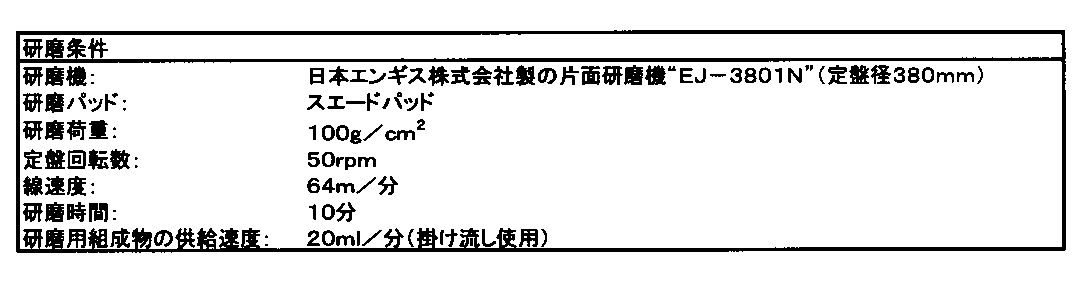
Claims (5)
- 合金材料を研磨する用途に用いられる合金材料研磨用組成物であって、前記合金材料は、主成分の第1金属種と、前記第1金属種とは異なる種類でかつ前記第1金属種の標準電極電位よりも高い標準電極電位を有する第2金属種とを含有し、
前記合金材料研磨用組成物は、炭素に結合した官能基が前記第2金属種を捕捉可能である化合物を含有することを特徴とする合金材料研磨用組成物。 - 更に砥粒を含有し、前記化合物が前記砥粒に固定化されている、請求項1に記載の合金材料研磨用組成物。
- 前記合金材料の主成分がマグネシウム、アルミニウム、チタン、クロム及び鉄のいずれか一種である、請求項1又は請求項2に記載の合金材料研磨用組成物。
- 前記合金材料の主成分がアルミニウムであり、
前記合金材料は、鉄、銅及び亜鉛から選ばれる少なくとも一種の金属元素を1.0質量%以上含有する、請求項1から請求項3のいずれか一項に記載の合金材料研磨用組成物。 - 請求項1から請求項4のいずれか一項に記載の合金材料研磨用組成物を用いて合金材料を研磨する研磨工程を有することを特徴とする合金材料の製造方法。
Priority Applications (4)
| Application Number | Priority Date | Filing Date | Title |
|---|---|---|---|
| JP2014525819A JP6325441B2 (ja) | 2012-07-17 | 2013-07-16 | 合金材料研磨用組成物及びそれを用いた合金材料の製造方法 |
| CN201380037667.2A CN104471016B (zh) | 2012-07-17 | 2013-07-16 | 合金材料研磨用组合物及使用其的合金材料的制造方法 |
| US14/414,639 US20150166862A1 (en) | 2012-07-17 | 2013-07-16 | Composition for polishing alloy material and method for producing alloy material using same |
| KR1020157003551A KR20150036518A (ko) | 2012-07-17 | 2013-07-16 | 합금 재료 연마용 조성물 및 그것을 사용한 합금 재료의 제조 방법 |
Applications Claiming Priority (2)
| Application Number | Priority Date | Filing Date | Title |
|---|---|---|---|
| JP2012-159057 | 2012-07-17 | ||
| JP2012159057 | 2012-07-17 |
Publications (1)
| Publication Number | Publication Date |
|---|---|
| WO2014013977A1 true WO2014013977A1 (ja) | 2014-01-23 |
Family
ID=49948803
Family Applications (1)
| Application Number | Title | Priority Date | Filing Date |
|---|---|---|---|
| PCT/JP2013/069273 Ceased WO2014013977A1 (ja) | 2012-07-17 | 2013-07-16 | 合金材料研磨用組成物及びそれを用いた合金材料の製造方法 |
Country Status (6)
| Country | Link |
|---|---|
| US (1) | US20150166862A1 (ja) |
| JP (1) | JP6325441B2 (ja) |
| KR (1) | KR20150036518A (ja) |
| CN (1) | CN104471016B (ja) |
| TW (1) | TWI629347B (ja) |
| WO (1) | WO2014013977A1 (ja) |
Cited By (2)
| Publication number | Priority date | Publication date | Assignee | Title |
|---|---|---|---|---|
| WO2016021254A1 (ja) * | 2014-08-07 | 2016-02-11 | 株式会社フジミインコーポレーテッド | チタン合金材料研磨用組成物 |
| CN108300331A (zh) * | 2018-02-10 | 2018-07-20 | 雷春生 | 一种金属抛光液 |
Families Citing this family (2)
| Publication number | Priority date | Publication date | Assignee | Title |
|---|---|---|---|---|
| FR2621679B1 (fr) | 1987-10-13 | 1990-02-09 | Cibie Projecteurs | Projecteur de route de faible hauteur a grande recuperation de flux pour vehicule automobile |
| CN111534232A (zh) * | 2020-04-07 | 2020-08-14 | 海门市森达装饰材料有限公司 | 一种研磨抛光浆料及镜面板制备方法 |
Citations (15)
| Publication number | Priority date | Publication date | Assignee | Title |
|---|---|---|---|---|
| JP2002538284A (ja) * | 1999-03-10 | 2002-11-12 | スリーエム イノベイティブ プロパティズ カンパニー | 半導体の製造に適した構造化ウェハを修正するための加工液およびその方法 |
| JP2004300348A (ja) * | 2003-03-31 | 2004-10-28 | Fujimi Inc | 研磨用組成物 |
| JP2004331886A (ja) * | 2003-05-09 | 2004-11-25 | Fujimi Inc | 研磨用組成物 |
| JP2004331887A (ja) * | 2003-05-09 | 2004-11-25 | Fujimi Inc | 研磨用組成物 |
| JP2005109257A (ja) * | 2003-09-30 | 2005-04-21 | Fujimi Inc | 研磨用組成物 |
| JP2005116987A (ja) * | 2003-10-10 | 2005-04-28 | Fujimi Inc | 研磨用組成物 |
| JP2005123482A (ja) * | 2003-10-17 | 2005-05-12 | Fujimi Inc | 研磨方法 |
| JP2005518669A (ja) * | 2002-02-22 | 2005-06-23 | ユニバーシティ オブ フロリダ | 銅または銀の膜を研磨するための改良された化学機械的研磨スラリー |
| JP2005187664A (ja) * | 2003-12-25 | 2005-07-14 | Fujimi Inc | 研磨用組成物及びそれを用いた研磨方法 |
| JP2005268667A (ja) * | 2004-03-19 | 2005-09-29 | Fujimi Inc | 研磨用組成物 |
| JP2007243206A (ja) * | 2007-04-12 | 2007-09-20 | Hitachi Ltd | 半導体装置の製造方法 |
| WO2008004534A1 (fr) * | 2006-07-04 | 2008-01-10 | Hitachi Chemical Co., Ltd. | Liquide de polissage pour le polissage mécano-chimique |
| WO2009008431A1 (ja) * | 2007-07-10 | 2009-01-15 | Hitachi Chemical Co., Ltd. | 金属膜用研磨液及び研磨方法 |
| JP2011020208A (ja) * | 2009-07-15 | 2011-02-03 | Hitachi Chem Co Ltd | Cmp研磨液及びこのcmp研磨液を用いた研磨方法 |
| JP2011181884A (ja) * | 2010-02-05 | 2011-09-15 | Hitachi Chem Co Ltd | Cmp研磨液及びこのcmp研磨液を用いた研磨方法 |
Family Cites Families (26)
| Publication number | Priority date | Publication date | Assignee | Title |
|---|---|---|---|---|
| JPH02185365A (ja) * | 1989-01-12 | 1990-07-19 | Kobe Steel Ltd | アルミニウム合金平板基盤の研磨方法 |
| US5443995A (en) * | 1993-09-17 | 1995-08-22 | Applied Materials, Inc. | Method for metallizing a semiconductor wafer |
| JP3556978B2 (ja) * | 1993-12-14 | 2004-08-25 | 株式会社東芝 | 銅系金属の研磨方法 |
| US6039891A (en) * | 1996-09-24 | 2000-03-21 | Cabot Corporation | Multi-oxidizer precursor for chemical mechanical polishing |
| JPH11233464A (ja) * | 1997-12-12 | 1999-08-27 | Sumitomo Chem Co Ltd | 半導体基板上の金属膜研磨用組成物及びそれを用いてなる半導体基板上の金属膜の平坦化方法ならびに半導体基板の製造方法 |
| JP2000212776A (ja) * | 1999-01-18 | 2000-08-02 | Jsr Corp | 化学機械研磨用水系分散体 |
| EP1108743B1 (en) * | 1999-12-08 | 2006-11-15 | JSR Corporation | Separation of viruses and detection of viruses |
| US6638143B2 (en) * | 1999-12-22 | 2003-10-28 | Applied Materials, Inc. | Ion exchange materials for chemical mechanical polishing |
| JP2001192645A (ja) * | 2000-01-14 | 2001-07-17 | Asahi Kasei Corp | 半導体装置製造用の研磨用組成物 |
| US6506678B1 (en) * | 2000-05-19 | 2003-01-14 | Lsi Logic Corporation | Integrated circuit structures having low k porous aluminum oxide dielectric material separating aluminum lines, and method of making same |
| US6531039B2 (en) * | 2001-02-21 | 2003-03-11 | Nikko Materials Usa, Inc. | Anode for plating a semiconductor wafer |
| JP2005079119A (ja) * | 2003-08-29 | 2005-03-24 | Toshiba Corp | 銅系金属用研磨組成物および半導体装置の製造方法 |
| EP1670047B1 (en) * | 2003-09-30 | 2010-04-07 | Fujimi Incorporated | Polishing composition and polishing method |
| JP4342918B2 (ja) * | 2003-11-28 | 2009-10-14 | 株式会社東芝 | 研磨布および半導体装置の製造方法 |
| WO2007004674A1 (ja) * | 2005-07-05 | 2007-01-11 | Autonetworks Technologies, Ltd. | シールド導電体 |
| JP5391516B2 (ja) * | 2005-11-02 | 2014-01-15 | 日立化成株式会社 | 複合材料膜用研磨材および研磨方法 |
| US9343330B2 (en) * | 2006-12-06 | 2016-05-17 | Cabot Microelectronics Corporation | Compositions for polishing aluminum/copper and titanium in damascene structures |
| JP5121273B2 (ja) * | 2007-03-29 | 2013-01-16 | 富士フイルム株式会社 | 金属用研磨液及び研磨方法 |
| US9633865B2 (en) * | 2008-02-22 | 2017-04-25 | Rohm And Haas Electronic Materials Cmp Holdings, Inc. | Low-stain polishing composition |
| US8425797B2 (en) * | 2008-03-21 | 2013-04-23 | Cabot Microelectronics Corporation | Compositions for polishing aluminum/copper and titanium in damascene structures |
| JP5202258B2 (ja) * | 2008-03-25 | 2013-06-05 | 富士フイルム株式会社 | 金属研磨用組成物、及び化学的機械的研磨方法 |
| US20100038584A1 (en) * | 2008-08-13 | 2010-02-18 | Fujimi Incorporated | Polishing Composition and Polishing Method Using the Same |
| JP2011014840A (ja) * | 2009-07-06 | 2011-01-20 | Adeka Corp | Cmp用研磨組成物 |
| JP5695367B2 (ja) * | 2010-08-23 | 2015-04-01 | 株式会社フジミインコーポレーテッド | 研磨用組成物及びそれを用いた研磨方法 |
| JP6015931B2 (ja) * | 2011-12-15 | 2016-10-26 | Jsr株式会社 | 化学機械研磨用水系分散体および化学機械研磨方法 |
| JP5953766B2 (ja) * | 2012-01-24 | 2016-07-20 | 日立化成株式会社 | 研磨液及び基体の研磨方法 |
-
2013
- 2013-07-16 WO PCT/JP2013/069273 patent/WO2014013977A1/ja not_active Ceased
- 2013-07-16 CN CN201380037667.2A patent/CN104471016B/zh not_active Expired - Fee Related
- 2013-07-16 KR KR1020157003551A patent/KR20150036518A/ko not_active Withdrawn
- 2013-07-16 TW TW102125377A patent/TWI629347B/zh not_active IP Right Cessation
- 2013-07-16 JP JP2014525819A patent/JP6325441B2/ja active Active
- 2013-07-16 US US14/414,639 patent/US20150166862A1/en not_active Abandoned
Patent Citations (15)
| Publication number | Priority date | Publication date | Assignee | Title |
|---|---|---|---|---|
| JP2002538284A (ja) * | 1999-03-10 | 2002-11-12 | スリーエム イノベイティブ プロパティズ カンパニー | 半導体の製造に適した構造化ウェハを修正するための加工液およびその方法 |
| JP2005518669A (ja) * | 2002-02-22 | 2005-06-23 | ユニバーシティ オブ フロリダ | 銅または銀の膜を研磨するための改良された化学機械的研磨スラリー |
| JP2004300348A (ja) * | 2003-03-31 | 2004-10-28 | Fujimi Inc | 研磨用組成物 |
| JP2004331886A (ja) * | 2003-05-09 | 2004-11-25 | Fujimi Inc | 研磨用組成物 |
| JP2004331887A (ja) * | 2003-05-09 | 2004-11-25 | Fujimi Inc | 研磨用組成物 |
| JP2005109257A (ja) * | 2003-09-30 | 2005-04-21 | Fujimi Inc | 研磨用組成物 |
| JP2005116987A (ja) * | 2003-10-10 | 2005-04-28 | Fujimi Inc | 研磨用組成物 |
| JP2005123482A (ja) * | 2003-10-17 | 2005-05-12 | Fujimi Inc | 研磨方法 |
| JP2005187664A (ja) * | 2003-12-25 | 2005-07-14 | Fujimi Inc | 研磨用組成物及びそれを用いた研磨方法 |
| JP2005268667A (ja) * | 2004-03-19 | 2005-09-29 | Fujimi Inc | 研磨用組成物 |
| WO2008004534A1 (fr) * | 2006-07-04 | 2008-01-10 | Hitachi Chemical Co., Ltd. | Liquide de polissage pour le polissage mécano-chimique |
| JP2007243206A (ja) * | 2007-04-12 | 2007-09-20 | Hitachi Ltd | 半導体装置の製造方法 |
| WO2009008431A1 (ja) * | 2007-07-10 | 2009-01-15 | Hitachi Chemical Co., Ltd. | 金属膜用研磨液及び研磨方法 |
| JP2011020208A (ja) * | 2009-07-15 | 2011-02-03 | Hitachi Chem Co Ltd | Cmp研磨液及びこのcmp研磨液を用いた研磨方法 |
| JP2011181884A (ja) * | 2010-02-05 | 2011-09-15 | Hitachi Chem Co Ltd | Cmp研磨液及びこのcmp研磨液を用いた研磨方法 |
Cited By (4)
| Publication number | Priority date | Publication date | Assignee | Title |
|---|---|---|---|---|
| WO2016021254A1 (ja) * | 2014-08-07 | 2016-02-11 | 株式会社フジミインコーポレーテッド | チタン合金材料研磨用組成物 |
| CN106574170A (zh) * | 2014-08-07 | 2017-04-19 | 福吉米株式会社 | 钛合金材料研磨用组合物 |
| JPWO2016021254A1 (ja) * | 2014-08-07 | 2017-05-25 | 株式会社フジミインコーポレーテッド | チタン合金材料研磨用組成物 |
| CN108300331A (zh) * | 2018-02-10 | 2018-07-20 | 雷春生 | 一种金属抛光液 |
Also Published As
| Publication number | Publication date |
|---|---|
| JPWO2014013977A1 (ja) | 2016-06-30 |
| KR20150036518A (ko) | 2015-04-07 |
| TW201418433A (zh) | 2014-05-16 |
| CN104471016B (zh) | 2018-06-22 |
| CN104471016A (zh) | 2015-03-25 |
| TWI629347B (zh) | 2018-07-11 |
| US20150166862A1 (en) | 2015-06-18 |
| JP6325441B2 (ja) | 2018-05-16 |
Similar Documents
| Publication | Publication Date | Title |
|---|---|---|
| JP5095228B2 (ja) | 研磨用組成物 | |
| JP6099067B1 (ja) | 研磨用組成物 | |
| Speed et al. | Physical, chemical, and in vitro toxicological characterization of nanoparticles in chemical mechanical planarization suspensions used in the semiconductor industry: towards environmental health and safety assessments | |
| US20140308155A1 (en) | Method for polishing alloy material and method for producing alloy material | |
| JP6325441B2 (ja) | 合金材料研磨用組成物及びそれを用いた合金材料の製造方法 | |
| KR102589681B1 (ko) | 연마용 조성물 및 연마 방법 | |
| CN104769073B (zh) | 研磨用组合物 | |
| TWI433903B (zh) | 用於鎳-磷記憶碟之拋光組合物 | |
| WO2014077107A1 (ja) | 研磨用組成物 | |
| JP2016183212A (ja) | 研磨用組成物 | |
| TW201422739A (zh) | 一種化學機械拋光液的應用 | |
| GB2420122A (en) | Abrasive polishing composition | |
| TW201425557A (zh) | Cmp用硏磨液、儲存液及硏磨方法 | |
| TWI566884B (zh) | 硏磨用組成物、及使用該硏磨用組成物之化合物半導體基板之製造方法 | |
| TWI614093B (zh) | 研磨用組成物、合金材料、合金材料之硏磨方法及合金材料之製造方法 | |
| CN106281220B (zh) | 合金材料用研磨组合物及合金材料的研磨方法 | |
| JP5396047B2 (ja) | ガラス用研摩材スラリー | |
| WO2006126432A1 (ja) | シリコンウェハー用研磨組成物 | |
| JP4640981B2 (ja) | 基板の製造方法 | |
| JP5073998B2 (ja) | 銀器類の改良方法 | |
| CN119842322A (zh) | 一种抛光液及其制备方法、碳化硅衬底的研磨方法 | |
| JP2014201699A (ja) | Cmp用研磨液、貯蔵液及び研磨方法 |
Legal Events
| Date | Code | Title | Description |
|---|---|---|---|
| 121 | Ep: the epo has been informed by wipo that ep was designated in this application |
Ref document number: 13819449 Country of ref document: EP Kind code of ref document: A1 |
|
| ENP | Entry into the national phase |
Ref document number: 2014525819 Country of ref document: JP Kind code of ref document: A |
|
| WWE | Wipo information: entry into national phase |
Ref document number: 14414639 Country of ref document: US |
|
| NENP | Non-entry into the national phase |
Ref country code: DE |
|
| ENP | Entry into the national phase |
Ref document number: 20157003551 Country of ref document: KR Kind code of ref document: A |
|
| 122 | Ep: pct application non-entry in european phase |
Ref document number: 13819449 Country of ref document: EP Kind code of ref document: A1 |