WO2014007112A1 - ポリアミド酸、ポリイミド、ポリアミド酸溶液、およびポリイミドの利用 - Google Patents
ポリアミド酸、ポリイミド、ポリアミド酸溶液、およびポリイミドの利用 Download PDFInfo
- Publication number
- WO2014007112A1 WO2014007112A1 PCT/JP2013/067370 JP2013067370W WO2014007112A1 WO 2014007112 A1 WO2014007112 A1 WO 2014007112A1 JP 2013067370 W JP2013067370 W JP 2013067370W WO 2014007112 A1 WO2014007112 A1 WO 2014007112A1
- Authority
- WO
- WIPO (PCT)
- Prior art keywords
- structural unit
- unit represented
- polyamic acid
- polyimide
- formula
- Prior art date
- Legal status (The legal status is an assumption and is not a legal conclusion. Google has not performed a legal analysis and makes no representation as to the accuracy of the status listed.)
- Ceased
Links
Images
Classifications
-
- C—CHEMISTRY; METALLURGY
- C08—ORGANIC MACROMOLECULAR COMPOUNDS; THEIR PREPARATION OR CHEMICAL WORKING-UP; COMPOSITIONS BASED THEREON
- C08G—MACROMOLECULAR COMPOUNDS OBTAINED OTHERWISE THAN BY REACTIONS ONLY INVOLVING UNSATURATED CARBON-TO-CARBON BONDS
- C08G73/00—Macromolecular compounds obtained by reactions forming a linkage containing nitrogen with or without oxygen or carbon in the main chain of the macromolecule, not provided for in groups C08G12/00 - C08G71/00
- C08G73/06—Polycondensates having nitrogen-containing heterocyclic rings in the main chain of the macromolecule
- C08G73/10—Polyimides; Polyester-imides; Polyamide-imides; Polyamide acids or similar polyimide precursors
- C08G73/1003—Preparatory processes
- C08G73/1007—Preparatory processes from tetracarboxylic acids or derivatives and diamines
-
- C—CHEMISTRY; METALLURGY
- C08—ORGANIC MACROMOLECULAR COMPOUNDS; THEIR PREPARATION OR CHEMICAL WORKING-UP; COMPOSITIONS BASED THEREON
- C08G—MACROMOLECULAR COMPOUNDS OBTAINED OTHERWISE THAN BY REACTIONS ONLY INVOLVING UNSATURATED CARBON-TO-CARBON BONDS
- C08G69/00—Macromolecular compounds obtained by reactions forming a carboxylic amide link in the main chain of the macromolecule
-
- C—CHEMISTRY; METALLURGY
- C08—ORGANIC MACROMOLECULAR COMPOUNDS; THEIR PREPARATION OR CHEMICAL WORKING-UP; COMPOSITIONS BASED THEREON
- C08G—MACROMOLECULAR COMPOUNDS OBTAINED OTHERWISE THAN BY REACTIONS ONLY INVOLVING UNSATURATED CARBON-TO-CARBON BONDS
- C08G73/00—Macromolecular compounds obtained by reactions forming a linkage containing nitrogen with or without oxygen or carbon in the main chain of the macromolecule, not provided for in groups C08G12/00 - C08G71/00
- C08G73/06—Polycondensates having nitrogen-containing heterocyclic rings in the main chain of the macromolecule
- C08G73/10—Polyimides; Polyester-imides; Polyamide-imides; Polyamide acids or similar polyimide precursors
- C08G73/1042—Copolyimides derived from at least two different tetracarboxylic compounds or two different diamino compounds
-
- C—CHEMISTRY; METALLURGY
- C08—ORGANIC MACROMOLECULAR COMPOUNDS; THEIR PREPARATION OR CHEMICAL WORKING-UP; COMPOSITIONS BASED THEREON
- C08G—MACROMOLECULAR COMPOUNDS OBTAINED OTHERWISE THAN BY REACTIONS ONLY INVOLVING UNSATURATED CARBON-TO-CARBON BONDS
- C08G73/00—Macromolecular compounds obtained by reactions forming a linkage containing nitrogen with or without oxygen or carbon in the main chain of the macromolecule, not provided for in groups C08G12/00 - C08G71/00
- C08G73/06—Polycondensates having nitrogen-containing heterocyclic rings in the main chain of the macromolecule
- C08G73/10—Polyimides; Polyester-imides; Polyamide-imides; Polyamide acids or similar polyimide precursors
- C08G73/1046—Polyimides containing oxygen in the form of ether bonds in the main chain
- C08G73/1053—Polyimides containing oxygen in the form of ether bonds in the main chain with oxygen only in the tetracarboxylic moiety
-
- C—CHEMISTRY; METALLURGY
- C08—ORGANIC MACROMOLECULAR COMPOUNDS; THEIR PREPARATION OR CHEMICAL WORKING-UP; COMPOSITIONS BASED THEREON
- C08G—MACROMOLECULAR COMPOUNDS OBTAINED OTHERWISE THAN BY REACTIONS ONLY INVOLVING UNSATURATED CARBON-TO-CARBON BONDS
- C08G73/00—Macromolecular compounds obtained by reactions forming a linkage containing nitrogen with or without oxygen or carbon in the main chain of the macromolecule, not provided for in groups C08G12/00 - C08G71/00
- C08G73/06—Polycondensates having nitrogen-containing heterocyclic rings in the main chain of the macromolecule
- C08G73/10—Polyimides; Polyester-imides; Polyamide-imides; Polyamide acids or similar polyimide precursors
- C08G73/1075—Partially aromatic polyimides
- C08G73/1082—Partially aromatic polyimides wholly aromatic in the tetracarboxylic moiety
-
- C—CHEMISTRY; METALLURGY
- C08—ORGANIC MACROMOLECULAR COMPOUNDS; THEIR PREPARATION OR CHEMICAL WORKING-UP; COMPOSITIONS BASED THEREON
- C08G—MACROMOLECULAR COMPOUNDS OBTAINED OTHERWISE THAN BY REACTIONS ONLY INVOLVING UNSATURATED CARBON-TO-CARBON BONDS
- C08G73/00—Macromolecular compounds obtained by reactions forming a linkage containing nitrogen with or without oxygen or carbon in the main chain of the macromolecule, not provided for in groups C08G12/00 - C08G71/00
- C08G73/06—Polycondensates having nitrogen-containing heterocyclic rings in the main chain of the macromolecule
- C08G73/10—Polyimides; Polyester-imides; Polyamide-imides; Polyamide acids or similar polyimide precursors
- C08G73/16—Polyester-imides
-
- C—CHEMISTRY; METALLURGY
- C09—DYES; PAINTS; POLISHES; NATURAL RESINS; ADHESIVES; COMPOSITIONS NOT OTHERWISE PROVIDED FOR; APPLICATIONS OF MATERIALS NOT OTHERWISE PROVIDED FOR
- C09D—COATING COMPOSITIONS, e.g. PAINTS, VARNISHES OR LACQUERS; FILLING PASTES; CHEMICAL PAINT OR INK REMOVERS; INKS; CORRECTING FLUIDS; WOODSTAINS; PASTES OR SOLIDS FOR COLOURING OR PRINTING; USE OF MATERIALS THEREFOR
- C09D179/00—Coating compositions based on macromolecular compounds obtained by reactions forming in the main chain of the macromolecule a linkage containing nitrogen, with or without oxygen, or carbon only, not provided for in groups C09D161/00 - C09D177/00
- C09D179/04—Polycondensates having nitrogen-containing heterocyclic rings in the main chain; Polyhydrazides; Polyamide acids or similar polyimide precursors
- C09D179/08—Polyimides; Polyester-imides; Polyamide-imides; Polyamide acids or similar polyimide precursors
-
- G—PHYSICS
- G02—OPTICS
- G02F—OPTICAL DEVICES OR ARRANGEMENTS FOR THE CONTROL OF LIGHT BY MODIFICATION OF THE OPTICAL PROPERTIES OF THE MEDIA OF THE ELEMENTS INVOLVED THEREIN; NON-LINEAR OPTICS; FREQUENCY-CHANGING OF LIGHT; OPTICAL LOGIC ELEMENTS; OPTICAL ANALOGUE/DIGITAL CONVERTERS
- G02F1/00—Devices or arrangements for the control of the intensity, colour, phase, polarisation or direction of light arriving from an independent light source, e.g. switching, gating or modulating; Non-linear optics
- G02F1/01—Devices or arrangements for the control of the intensity, colour, phase, polarisation or direction of light arriving from an independent light source, e.g. switching, gating or modulating; Non-linear optics for the control of the intensity, phase, polarisation or colour
- G02F1/13—Devices or arrangements for the control of the intensity, colour, phase, polarisation or direction of light arriving from an independent light source, e.g. switching, gating or modulating; Non-linear optics for the control of the intensity, phase, polarisation or colour based on liquid crystals, e.g. single liquid crystal display cells
- G02F1/133—Constructional arrangements; Operation of liquid crystal cells; Circuit arrangements
Definitions
- the present invention relates to a polyamic acid, a polyimide, and a polyamic acid solution.
- the present invention further includes electronic device materials using polyimide, TFT substrates, flexible display substrates, color filters, printed materials, optical materials, liquid crystal display devices, organic EL, electronic paper and other image display devices, 3-D displays, solar
- the present invention relates to an alternative material for a battery, a touch panel, a transparent conductive film substrate, and a portion where glass is currently used.
- various electronic elements such as thin film transistors and transparent electrodes are formed on a substrate, and a high temperature process is required for forming these electronic elements. Therefore, the plastic film substrate is required to have sufficient heat resistance that can be adapted to a high temperature process.
- the film is warped after the formation of the inorganic element due to the difference in linear thermal expansion coefficient between the inorganic material and the film, and further, the inorganic element is destroyed. There was a fear. For this reason, a material having a linear thermal expansion coefficient equivalent to that of an inorganic material while having heat resistance has been desired.
- the plastic film substrate when light emitted from a display element (liquid crystal, organic EL, etc.) is emitted through a plastic film substrate (for example, bottom emission type organic EL, etc.), the plastic film substrate needs to be transparent. Become. In particular, the light transmittance is required to be high in a wavelength region of 400 nm or less that is a visible light region. When light passes through a retardation film or a polarizing plate (for example, a liquid crystal display, a touch panel, etc.), the plastic film substrate is required to have high optical isotropy in addition to transparency. .
- the batch type is a process in which a coating resin solution is applied on a glass substrate, dried, a substrate is formed, and then peeled off. Therefore, the batch type is advantageous in terms of cost because it can use the current glass substrate process equipment such as TFT.
- Patent Documents 1 and 2 As a material that satisfies the above requirements, a polyimide material known as a material having excellent heat resistance has been studied. In order to obtain a polyimide having high transparency and low thermal expansion, a monomer having a rigid structure or an alicyclic monomer is generally used (Patent Documents 1 and 2). On the other hand, it is known that polyimide containing a fluorene structure exhibits heat resistance and low water absorption (Patent Document 3).
- JP 2002-161136 A Japanese Patent Publication “Japanese Patent Laid-Open No. 2012-41530 (published on March 1, 2012)” Japanese Patent Publication “JP 2009-079165 (April 16, 2009)”
- Patent Document 1 The polyimide described in Patent Document 1 is excellent in heat resistance and low thermal expansion, but is not sufficiently transparent, and there is no description about birefringence. Moreover, although the polyimide of patent document 2 is excellent in transparency and a low thermal expansion characteristic, there is no description regarding birefringence.
- the polyimide containing a fluorene structure described in Patent Document 3 is excellent in heat resistance and low thermal expansion, but has insufficient transparency and no description on birefringence.
- the present invention has been accomplished in view of the above circumstances, and is to obtain polyimide having excellent heat resistance, low thermal expansion, transparency, low birefringence, and polyamic acid as a precursor thereof. Objective. Furthermore, it aims at providing the product or member with a high request
- the inventors of the present invention introduced a rigid structure and an alicyclic structure in the skeleton in order to obtain a polyimide having excellent heat resistance, low thermal expansion, and transparency, which are the above-mentioned problems, and exhibiting low birefringence. Furthermore, it has been found that it is effective to use a monomer having a fluorene skeleton in combination.
- the polyamic acid according to the present invention is characterized by containing a structural unit represented by the general formula (1) and a structural unit represented by the general formula (2):
- R 1 and R 2 are groups selected from a hydrogen atom, an alkyl group, a halogen atom, a hydroxyl group, a carboxyl group, and an alkoxyl group, which may be the same or different
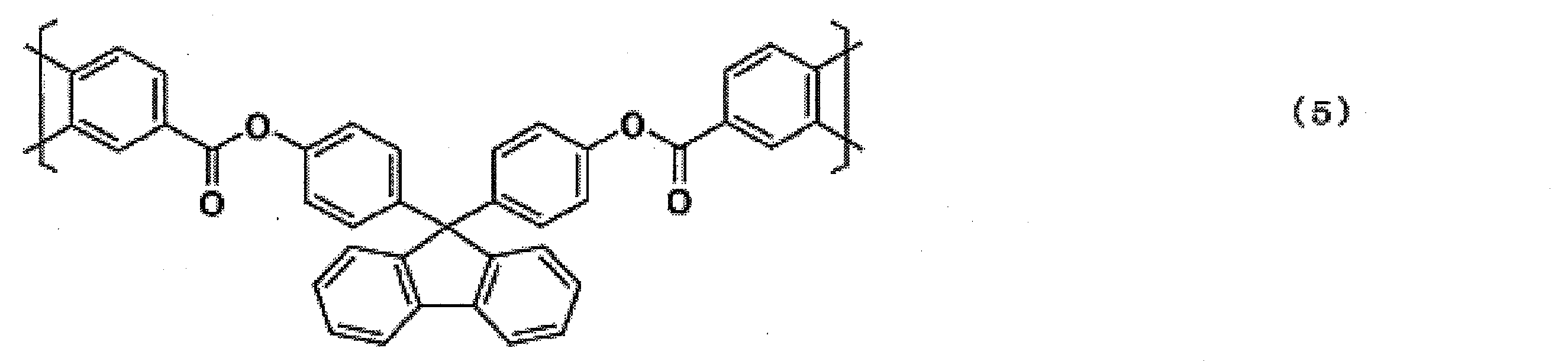
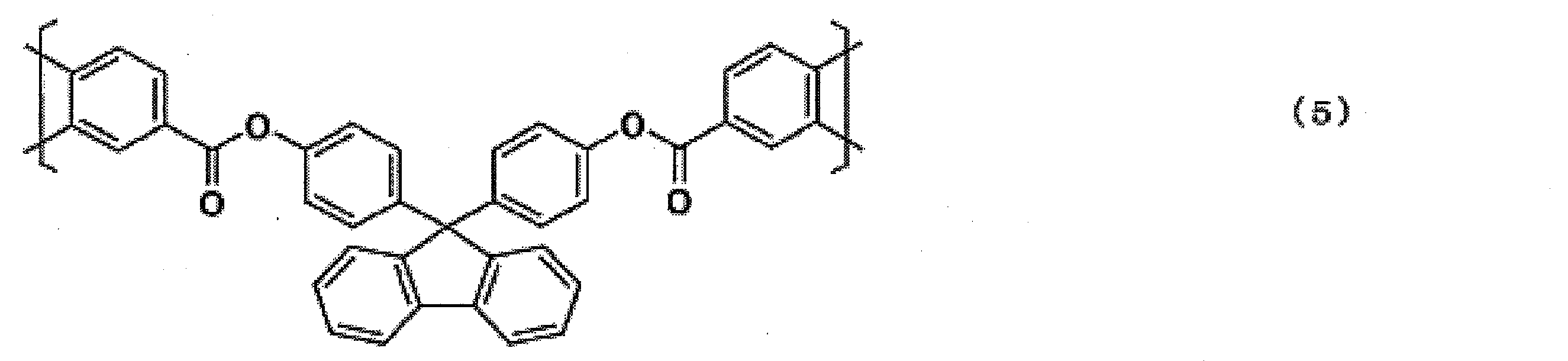
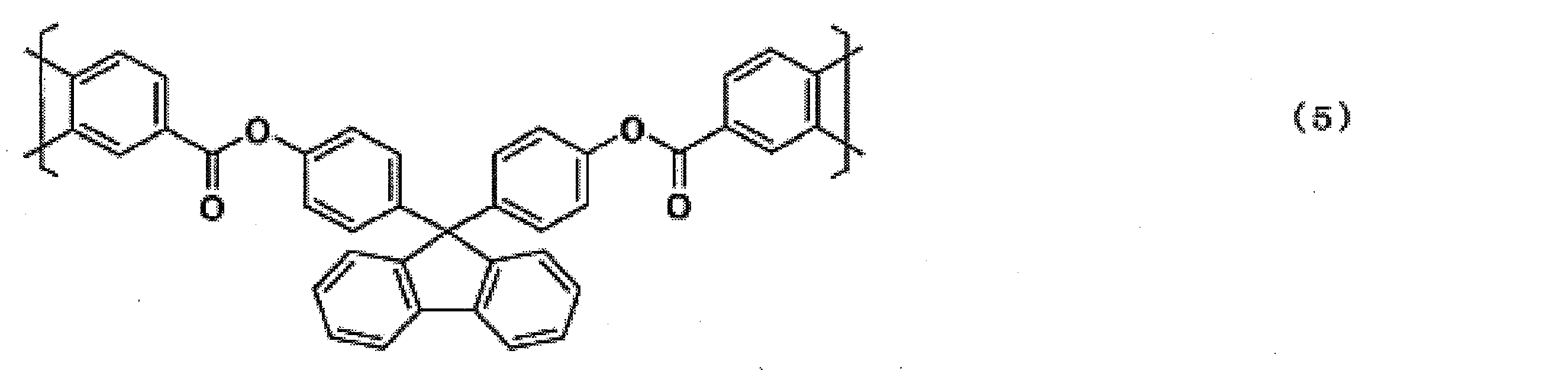
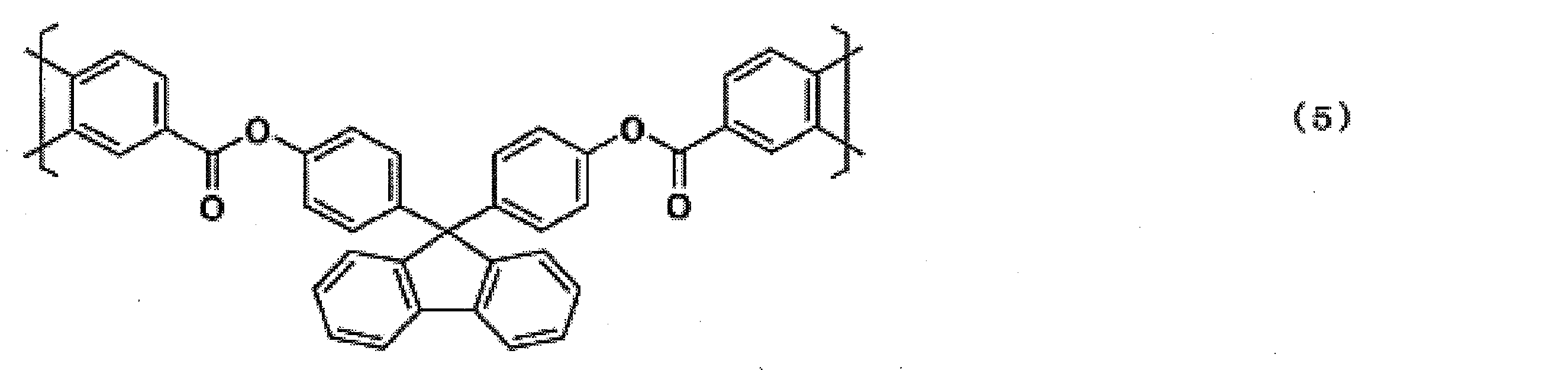
- a in the general formula (2) is a formula The component derived from acid dianhydride, which is any one selected from the structural unit represented by (3), the structural unit represented by formula (4), and the structural unit represented by formula (5) It is.
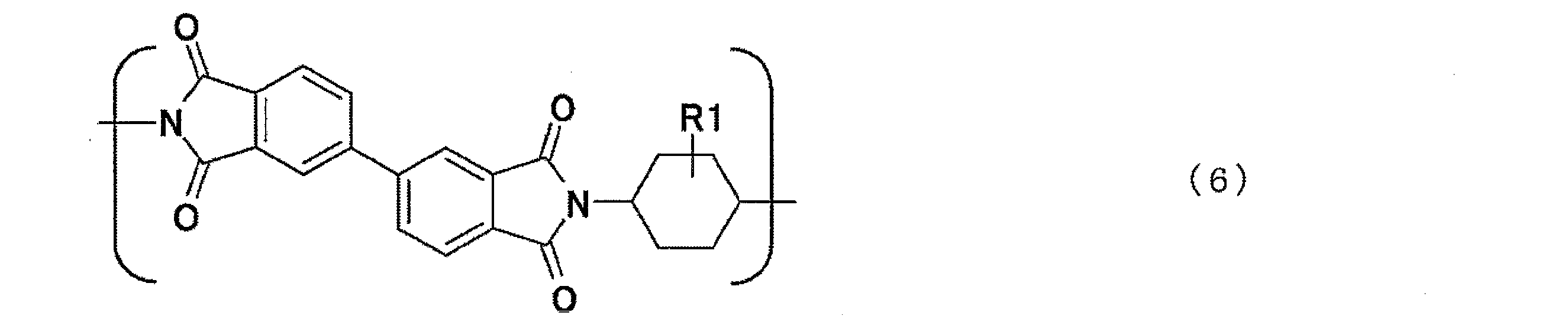
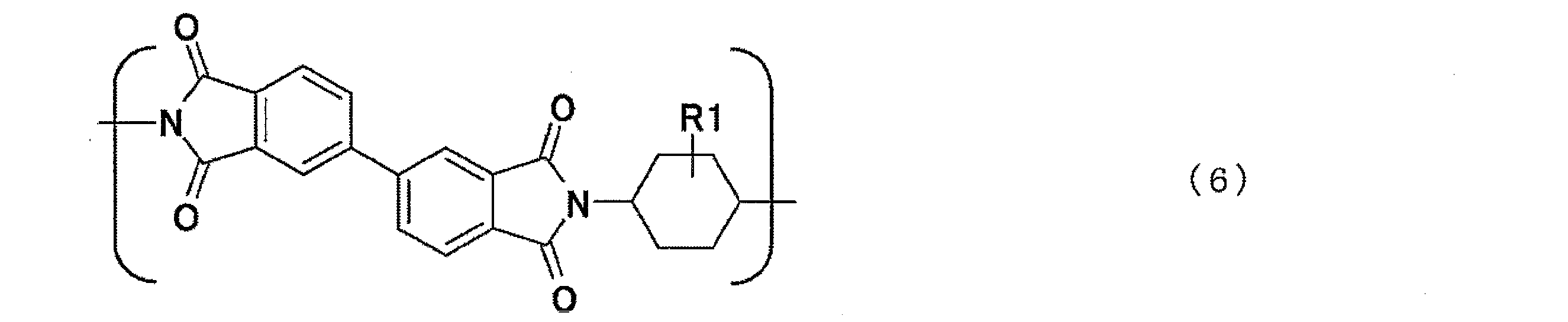
- polyimide according to the present invention is characterized by containing a structural unit represented by the general formula (6) and a structural unit represented by the general formula (7):
- R1 and R2 are groups selected from a hydrogen atom, an alkyl group, a halogen atom, a hydroxyl group, a carboxyl group, and an alkoxyl group, which may be the same or different, and A in the general formula (7) is represented by the formula (3 ), A structural unit represented by formula (4), and a structural unit represented by formula (5), which is a component derived from acid dianhydride. .
- the polyimide produced using the polyimide according to the present invention and the polyamic acid according to the present invention has low birefringence in addition to heat resistance, low thermal expansion and transparency. Therefore, the polyimide according to the present invention and the polyamic acid according to the present invention are used as a film or a coating film for a member required to have low birefringence in addition to heat resistance, low thermal expansion and transparency. Is preferred.
- the polyamic acid produced in the present invention includes a structural unit represented by the general formula (1) and a structural unit represented by the general formula (2).
- R 1 and R 2 in the formula are groups selected from a hydrogen atom, an alkyl group, a halogen atom, a hydroxyl group, a carboxyl group, and an alkoxyl group, and these may be the same or different.
- R 1 and R 2 are preferably each independently a hydrogen atom or an alkyl group, and from the viewpoint of heat resistance, R 1 and R 2 are preferably a hydrogen atom.
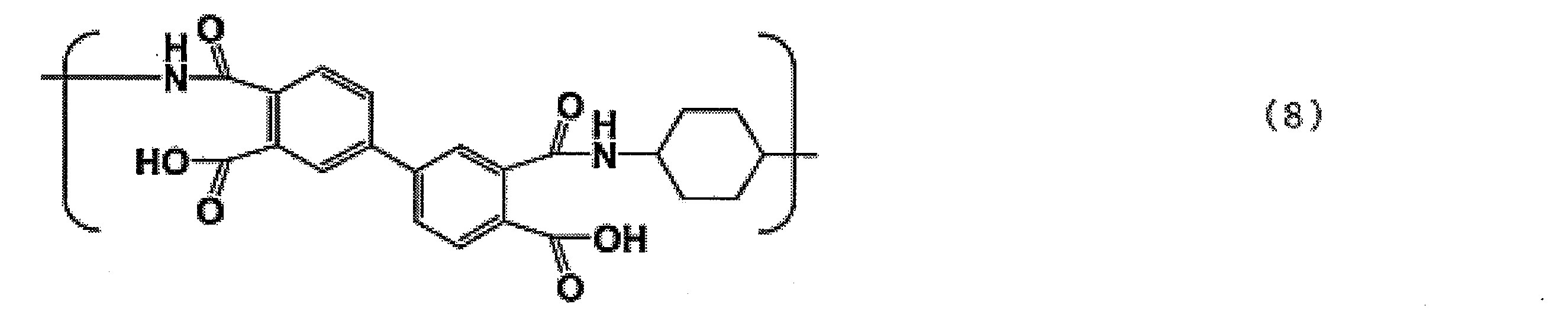
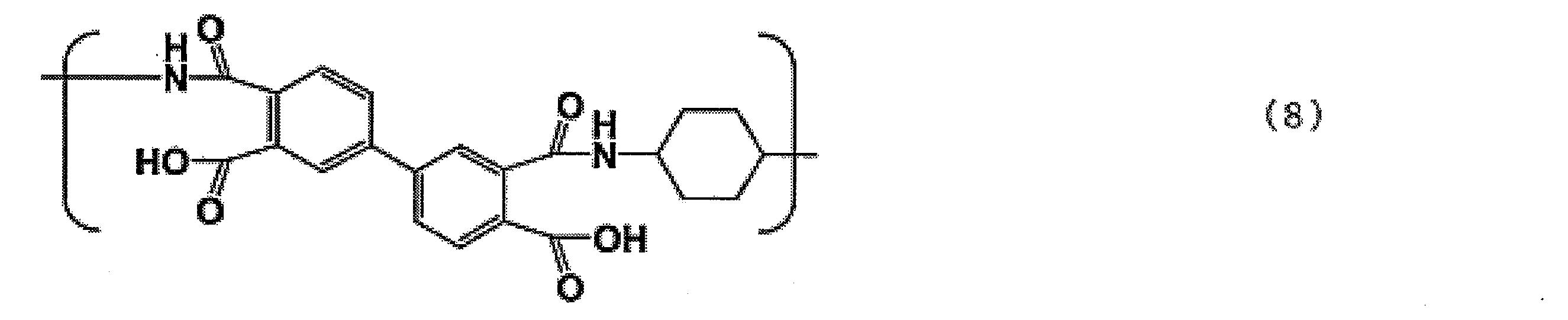
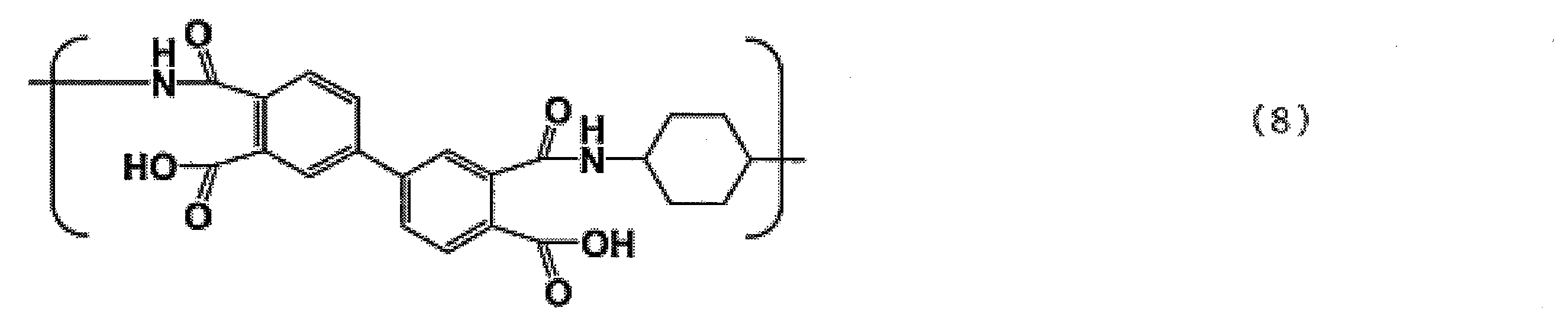
- the structural unit represented by the formula (1) is a polyamic acid represented by the formula (8) obtained from 3,3 ′, 4,4′-biphenyltetracarboxylic dianhydride and 1,4-cyclohexanediamine. Most preferably, it is a structural unit.
- a in the general formula (2) is a structural unit containing a fluorene skeleton, and from the viewpoint of reducing birefringence, the structural unit represented by the formula (3), the structural unit represented by the formula (4), and One is preferably selected from the structural units represented by the formula (5), and the structural unit represented by the formula (3) is particularly preferable from the viewpoint of heat resistance.
- the structural unit represented by the formula (2) includes the structural unit represented by the following formula (9), the structural unit represented by the following formula (12), and the structural unit represented by the following formula (13). It is preferable to select one, and from the viewpoint of heat resistance, the structural unit represented by the formula (9) is most preferable.
- the constitutional unit represented by the general formula (1) and the constitution represented by the general formula (2) in the polyamic acid is preferably 70% or more, more preferably 80% or more, and particularly preferably 90% or more with respect to the number of moles of the polyamic acid.
- the number of moles of the polyamic acid is the number of moles of the structural units derived from all diamines constituting the polyamic acid or the number of moles of structural units derived from all the acid dianhydrides constituting the polyamic acid.
- the polyamic acid of the present invention is characterized by containing a structural unit represented by the general formula (1) and a structural unit represented by the general formula (2), and is represented by the formula (1) of the present invention.
- the number of moles of the structural unit represented by the formula (1) / the number of moles of the structural unit represented by the formula (2) is preferably 30/70 or more, and more preferably 50/50 or more, from the viewpoint of expression of low thermal expansion.
- the molar ratio represented by the number of moles of the structural unit represented by the formula (1) / the number of moles of the structural unit represented by the formula (2) is a low birefringence viewpoint and a polyamide on the support. From the viewpoint of adhesion between the support and the polyimide when the acid solution is applied and imidized, it is preferably 99/1 or less, more preferably 98/2 or less, and 97/3 or less. Is more preferably 95/5 or less, and most preferably 80/20 or less.
- the polyamic acid of the present invention is characterized by containing a structural unit represented by the general formula (1) and a structural unit represented by the general formula (2).
- the general formula (1) The structural unit represented by the formula (8) is particularly preferred, and the structural unit represented by the general formula (2) is particularly preferably a structural unit represented by the formula (9).
- the number of moles of the structural unit represented by the formula (8) / the formula (9) The molar ratio represented by the number of moles of the structural unit is preferably 30/70 or more, and more preferably 50/50 or more, from the viewpoint of expression of low thermal expansion.
- the molar ratio represented by the number of moles of the structural unit represented by the formula (8) / the number of moles of the structural unit represented by the formula (9) is a low birefringence viewpoint and a polyamide on the support. From the viewpoint of adhesion between the support and the polyimide when the acid solution is applied and imidized, it is preferably 99/1 or less, more preferably 98/2 or less, and 97/3 or less. Is more preferably 95/5 or less, and most preferably 80/20 or less.
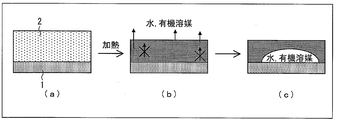
- adhesion does not mean adhesion strength, but means the degree of peeling or floating between the polyimide and the support when a polyamic acid solution is applied onto a support such as glass and imidized. . That is, it can be said that the smaller the peeling or floating between the polyimide and the support, the better the adhesion.
- FIG. 1 shows that, for example, when a polyamic acid solution 2 is applied to a support 1 such as glass and heated to imidize the polyamic acid, peeling or floating between the polyimide and the support is formed. The state of being done is shown schematically. When the polyamic acid solution 2 is applied to a support 1 such as glass ((a) in FIG. 1) and heated, imidization of the polyamic acid starts.
- the water and / or organic solvent of the polyamic acid solution 2 exits from the polyamic acid being imidized to the outside as indicated by arrows in FIG. However, at this time, a part of water and / or organic solvent is not discharged from the polyamic acid during imidation as shown by the arrow marked with x in FIG. Stays with the polyamic acid inside. And the water and / or organic solvent which remained between this support body and the polyamic acid in imidation is foamy between the obtained polyimide and support body, as shown in (c) of FIG. To form peeling or floating.
- the water and / or the organic solvent is then discharged from the foam-like peeling or floating through the polyimide or the support, and finally, the foamed portion of the peeling or floating becomes a space composed of air.
- the polyimide substrate on which the electronic element or the like is formed is peeled from the support.
- an electronic element or the like can be formed or mounted more accurately.
- reduction of the peeling or floating is important.
- the molar ratio represented by the number of moles of the structural unit / number of moles of the structural unit represented by the formula (9) is 99/1 or less, the adhesion between the support and the polyimide is improved.
- the molar ratio represented by the number of moles of the structural unit represented by the formula (9) is 99/1 or less, low birefringence and a polyamic acid solution are coated on the support to form an imide. In this case, excellent adhesion between the support and the polyimide is realized.
- the viewpoint of satisfying low birefringence and excellent adhesion between the support and the polyimide when imidizing by applying a polyamic acid solution on the support, and achieving particularly low thermal expansion From Number of moles of structural unit represented by formula (2) / (number of moles of structural unit represented by formula (1) + number of moles of structural unit represented by formula (2)), Is more preferably 0.01 or more and less than 0.05, and further preferably 0.02 or more and less than 0.05. From the same viewpoint, the number of moles of the structural unit represented by formula (9) / (number of moles of the structural unit represented by formula (8) + number of moles of the structural unit represented by formula (9)). Is more preferably 0.01 or more and less than 0.05, and further preferably 0.02 or more and less than 0.05.
- the polyimide produced by the present invention includes a structural unit represented by the general formula (6) and a structural unit represented by the general formula (7).
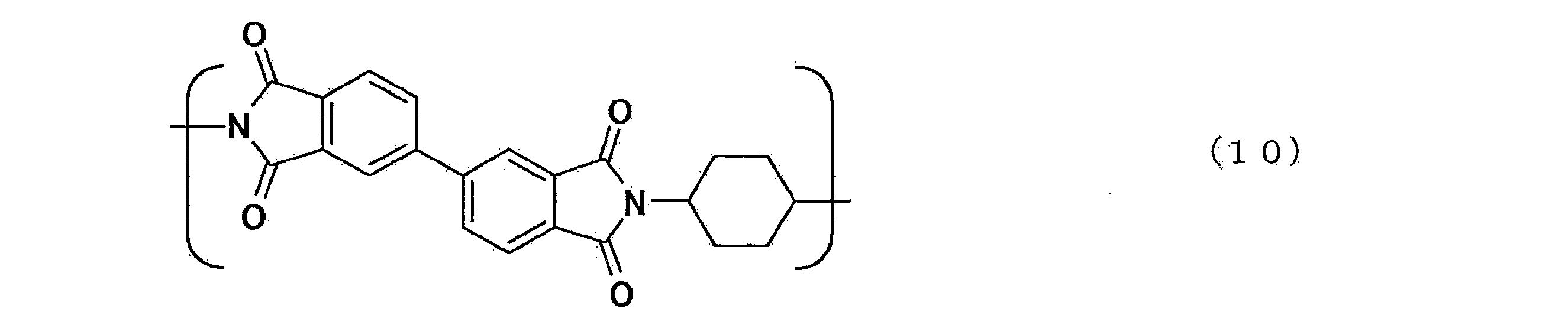
- R1, R2 and A in the formula are respectively the same as R 1, R 2 and A in the general formula (1) and general formula (2). That is, the general formula (6) is a polyimide structural unit represented by the formula (10) obtained from 3,3 ′, 4,4′-biphenyltetracarboxylic dianhydride and 1,4-cyclohexanediamine. Most preferred.
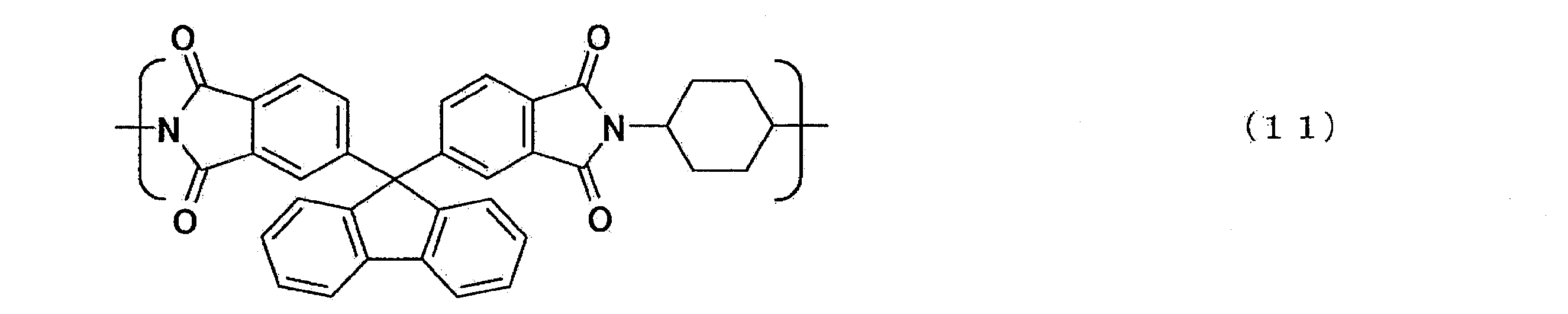
- a in the general formula (7) is a structural unit containing a fluorene skeleton, and from the viewpoint of reducing birefringence, the structural unit represented by the formula (3), the structural unit represented by (4), and (5 Is preferably selected from the structural units represented by formula (3), and is particularly preferably a structural unit represented by the formula (3) from the viewpoint of heat resistance. That is, the structural unit represented by the general formula (7) includes the structural unit represented by the following formula (11), the structural unit represented by the following formula (14), and the structural unit represented by the following formula (15). One unit is preferably selected, and from the viewpoint of heat resistance, the structural unit represented by the formula (11) is most preferable.
- the total of the structural unit represented by the general formula (6) and the structural unit represented by the general formula (7) in polyimide is preferably 70% or more, more preferably 80% or more, and particularly preferably 90% or more with respect to the number of moles of polyimide.
- the number of moles of polyimide is the number of moles of all diamine-derived constituent units constituting polyimide or the number of moles of all acid dianhydride-derived constituent units constituting polyimide.
- the polyimide of the present invention is characterized by containing a structural unit represented by the general formula (6) and a structural unit represented by the general formula (7), and is represented by the formula (6) of the present invention.
- the number of moles of the structural unit represented by the formula (6) / the number of moles of the structural unit represented by the formula (7) is preferably 30/70 or more, and more preferably 50/50 or more, from the viewpoint of expression of low thermal expansion.
- the molar ratio represented by the number of moles of the structural unit represented by the formula (6) / the number of moles of the structural unit represented by the formula (7) is a low birefringence viewpoint and a polyamide on the support. From the viewpoint of adhesion between the support and the polyimide when the acid solution is applied and imidized, it is preferably 99/1 or less, more preferably 98/2 or less, and 97/3 or less. Is more preferably 95/5 or less, and most preferably 80/20 or less.
- the polyimide of the present invention is characterized by containing a structural unit represented by the general formula (6) and a structural unit represented by the general formula (7). It is particularly preferable that the structural unit represented is a structural unit represented by the formula (10), and the structural unit represented by the general formula (7) is a structural unit represented by the formula (11).
- the number of moles of the structural unit represented by the formula (10) / the formula (11) is preferably 30/70 or more, and more preferably 50/50 or more, from the viewpoint of expression of low thermal expansion.
- the molar ratio represented by the number of moles of the structural unit represented by the formula (10) / the number of moles of the structural unit represented by the formula (11) is a low birefringence viewpoint and a polyamide on the support. From the viewpoint of adhesion between the support and the polyimide when the acid solution is applied and imidized, it is preferably 99/1 or less, more preferably 98/2 or less, and 97/3 or less. Is more preferably 95/5 or less, and most preferably 80/20 or less.
- the viewpoint of satisfying low birefringence and excellent adhesion between the support and the polyimide when imidizing by applying a polyamic acid solution on the support, and achieving particularly low thermal expansion From Number of moles of structural unit represented by formula (7) / (number of moles of structural unit represented by formula (6) + number of moles of structural unit represented by formula (7)), Is more preferably 0.01 or more and less than 0.05, and further preferably 0.02 or more and less than 0.05. From the same viewpoint, the number of moles of the structural unit represented by formula (11) / (number of moles of the structural unit represented by formula (10) + number of moles of the structural unit represented by formula (11)). Is more preferably 0.01 or more and less than 0.05, and further preferably 0.02 or more and less than 0.05.
- the polyimide of the present invention can be obtained by imidizing a polyamic acid containing a structural unit represented by the general formula (1) and a structural unit represented by the general formula (2).
- the polyimide of the present invention may be synthesized from a generally known precursor such as a polyamic acid ester, or may be produced without going through the precursor.
- the polyamic acid of the present invention can be synthesized by a known general method, and can be obtained by reacting diamine and tetracarboxylic dianhydride in an organic solvent. Specifically, for example, in an inert atmosphere such as argon or nitrogen, the diamine is dissolved in an organic solvent or dispersed in a slurry to obtain a diamine solution.
- tetracarboxylic dianhydride may be added to the diamine solution after being dissolved or dispersed in an organic solvent or in a solid state.
- the number of moles of the total amount of one or more diamine components and the number of moles of the total amount of one or more tetracarboxylic dianhydride components are substantially By adjusting to an equimolar ratio, a polyamic acid copolymer can be arbitrarily obtained. Moreover, the polyamic acid containing several tetracarboxylic dianhydride and diamine can also be obtained by blending 2 types of polyamic acids.
- the temperature conditions for the reaction between the diamine and tetracarboxylic dianhydride, that is, the polyamic acid synthesis reaction, are not particularly limited.
- the temperature of the polyamic acid synthesis reaction may be adjusted to a range of 50 ° C. to 150 ° C. as necessary, and the salt dissolves and the polymerization reaction proceeds. If it starts, in order to suppress the molecular weight fall of a polyamic acid, it is preferable that the temperature of the synthesis reaction of a polyamic acid shall be 80 degrees C or less, and it is more preferable to set it as 0 to 50 degreeC.
- the reaction time may be arbitrarily set in the range of 10 minutes to 30 hours.
- the organic solvent used for the synthesis reaction of the polyamic acid is not particularly limited as long as it is an organic polar solvent. As the reaction between the diamine and tetracarboxylic dianhydride proceeds, polyamic acid is generated, and the viscosity of the reaction solution increases.
- the organic solvent used for the polymerization of the polyamic acid is preferably one that can dissolve the tetracarboxylic dianhydride and diamines to be used, and more preferably one that can dissolve the produced polyamic acid.
- Examples of the organic solvent used in the polyamic acid synthesis reaction include urea solvents such as tetramethylurea and N, N-dimethylethylurea, sulfoxides such as dimethylsulfoxide, diphenylsulfone, and tetramethylsulfone, and sulfone solvents.
- DMAC N, N-dimethylacetamide
- DMF N, N-dimethylformamide
- NMP N-methyl-2-pyrrolidone
- the organic solvent used for the polyamic acid synthesis reaction is preferably selected from amide solvents, ketone solvents, ester solvents, and ether solvents.
- Amide solvents such as DMF, DMAC and NMP are preferred.
- the polyimide of the present invention can be obtained by a known method, and its production method is not particularly limited. From the viewpoint of availability of monomers and ease of polymerization, the polyimide of the present invention is preferably obtained from polyamic acid which is a precursor thereof. A method for imidizing the above polyamic acid to obtain a polyimide using the polyamic acid will be described. Imidization is performed by dehydrating and ring-closing the polyamic acid. This dehydration ring closure can be performed by an azeotropic method using an azeotropic solvent, a thermal method, or a chemical method. Further, imidation from polyamic acid to polyimide can take an arbitrary ratio of 1 to 100%.
- a polyamic acid partially imidized may be synthesized.
- a solution containing a polyamic acid and an organic solvent is referred to as a polyamic acid solution.
- the organic solvent contained in the polyamic acid solution an organic solvent similar to the organic solvent used for the polyamic acid synthesis reaction can be used, and among them, an amide solvent, a ketone solvent, and an ester solvent.
- an organic solvent selected from ether solvents can be used more preferably, and amide solvents such as DMF, DMAC, and NMP can be particularly preferably used.
- the synthesized reaction solution itself may be expressed as a polyamic acid solution.
- Dehydration ring closure may be performed by heating polyamic acid.
- the method for heating the polyamic acid is not particularly limited.
- the polyamic acid solution is cast or coated on a support such as a glass plate, a metal plate, or PET (polyethylene terephthalate), and then within a range of 80 ° C. to 500 ° C. Heat treatment may be performed.
- the polyamic acid solution can be directly dehydrated and closed by placing the polyamic acid solution directly into a container that has been subjected to a release treatment such as coating with a fluororesin, and heating and drying the polyamic acid solution under reduced pressure.
- Polyimide can be obtained by dehydration ring closure of polyamic acid by such a method.
- the heating time for each of the above treatments varies depending on the treatment amount and heating temperature of the polyamic acid solution to be dehydrated and closed, but is generally in the range of 1 minute to 5 hours after the treatment temperature reaches the maximum temperature. It is preferable. Further, in order to shorten the heating time and develop the characteristics, an imidizing agent and / or a dehydration catalyst are added to the polyamic acid solution, and the polyamic acid solution to which the imidizing agent and / or the dehydration catalyst is added is treated as described above. May be imidized by heating.
- the imidizing agent is not particularly limited, and a tertiary amine can be used.
- a tertiary amine As the tertiary amine, a heterocyclic tertiary amine is more preferable.
- the heterocyclic tertiary amine include pyridine, picoline, quinoline, isoquinoline and the like.
- Specific examples of the dehydration catalyst include acetic anhydride, propionic anhydride, n-butyric anhydride, benzoic anhydride, trifluoroacetic anhydride and the like.
- the amount of the imidizing agent and the dehydration catalyst added is 0.5 to 5.0 times molar equivalent, more preferably 0.7 to 2.5 times molar equivalent, especially about the amide group of the polyamic acid. Is preferably 0.8 to 2.0 times molar equivalent.
- the dehydration catalyst is 0.5 to 10.0 times molar equivalent, more preferably 0.7 to 5.0 times molar equivalent, and particularly 0.8 to 3.0 times molar equivalent, relative to the amide group of the polyamic acid. Is preferred.
- the imidizing agent and / or dehydration catalyst is added to the polyamic acid solution, it may be added directly without being dissolved in the organic solvent, or a solution dissolved in the organic solvent may be added.
- the reaction may proceed rapidly before the imidizing agent and / or dehydration catalyst diffuses, and a gel may be formed. More preferably, a solution obtained by dissolving the imidizing agent and / or dehydration catalyst in an organic solvent is mixed with the polyamic acid solution.
- the weight average molecular weight of the polyamic acid and polyimide of the present invention is preferably in the range of 10,000 to 500,000, more preferably in the range of 20,000 to 300,000, although it depends on the use. Preferably, the range is from 30,000 to 200,000. If the weight average molecular weight is 10,000 or more, it becomes possible to use polyamic acid and polyimide as a coating film or film. On the other hand, when the weight average molecular weight is 500,000 or less, sufficient solubility in a solvent is exhibited, so that a coating film or film having a smooth surface and a uniform film thickness can be obtained from a polyamic acid solution described later.
- the molecular weight used here refers to a value in terms of polyethylene glycol as measured by gel permeation chromatography (GPC).
- the polyimide of the present invention can be produced by applying a polyamic acid solution to a support and drying or heating.
- the film-like polyimide obtained by the method described above may be expressed as a polyimide film.
- the polyamic acid solution may be a partially imidized solution. Drying or heating may be performed under air, or may be performed under a nitrogen atmosphere. It is particularly preferable to dry or heat in a nitrogen atmosphere from the viewpoint of transparency.
- a glass substrate As the support on which the polyamic acid solution is applied, a glass substrate; a metal substrate such as SUS or a metal belt; a plastic film such as polyethylene terephthalate, polycarbonate, polyacrylate, polyethylene naphthalate, or triacetyl cellulose is used. It is not limited to. In order to adapt to the current batch type device manufacturing process, it is preferable to use a glass substrate.
- drying temperature or heating temperature at the time of producing the polyimide film it is possible to select conditions according to the process, and there is no particular limitation as long as the characteristics are not affected.
- the transparency of polyimide is expressed by, for example, the total light transmittance or haze according to JIS K7105-1981.
- the total light transmittance of the polyimide is preferably 80% or more, and more preferably 85% or more.
- the haze is preferably 2.0% or less, and more preferably 1.0% or less.
- polyimide is required to have high transmittance in the entire wavelength range, but polyimide tends to absorb light on the short wavelength side, and the film itself is often colored yellow.
- the light transmittance at a wavelength of 400 nm is preferably 50% or more, more preferably 60% or more, and 70%. More preferably, it is larger.
- the light transmittance at a wavelength of 400 nm is measured by an ultraviolet-visible spectrophotometer.
- a polyimide film can be used as transparent substrates, such as a glass alternative use.
- the polyimide of the present invention has low linear thermal expansion characteristics and dimensional stability before and after heating as film characteristics. For example, when these values are measured by thermomechanical analysis (TMA), TMA120C manufactured by Seiko Electronics Co., Ltd. is used (sample size: width 3 mm, length 10 mm, film thickness is measured, and the cross-sectional area of the film is calculated) When the temperature was raised from 10 ° C. to 340 ° C. at 10 ° C./min with a load of 3 gf, cooled to 10 ° C., and further heated to 340 ° C. at 10 ° C./min.
- TMA thermomechanical analysis
- the glass transition temperature when measured at a temperature rising rate of 10 ° C./min is preferably 250 ° C. or higher. From the viewpoint of being able to cope with a high process temperature, it is more preferably 300 ° C. or higher.
- the birefringence is small. Since polyimide is easily oriented in the plane, the difference in refractive index between the in-plane direction and the thickness direction (birefringence) is large. In particular, in the case of polyimide exhibiting low thermal expansion characteristics, the birefringence often increases.
- nx ⁇ ny ⁇ 0.0010 and (nx + ny) / 2 ⁇ nz ⁇ 0.160 Preferably satisfying nx ⁇ ny ⁇ 0.0010 and (nx + ny) /2 ⁇ nz ⁇ 0.120 More preferably, nx ⁇ ny ⁇ 0.0010 and (nx + ny) / 2 ⁇ nz ⁇ 0.100 It is more preferable that nx ⁇ ny ⁇ 0.0010 and (nx + ny) / 2 ⁇ nz ⁇ 0.050 because it is preferable that the optical isotropy is higher.
- nx + ny) / 2-nz represents the difference in refractive index between the in-plane direction and the thickness direction, that is, birefringence. The lower this value, the better the optical isotropy and the better.
- nx-ny is more preferably less than 0.0002, and still more preferably less than 0.0001.
- the polyamic acid and polyimide according to the present invention may be used as they are for coating and molding processes for producing products and members as they are, but a laminate for further processing such as coating on a molded product formed into a film shape It can also be used as In order to provide a coating or molding process, the polyamic acid and polyimide are dissolved or dispersed in an organic solvent as necessary, and further, a light or thermosetting component, a non-polymerizable binder other than the polyamic acid and polyimide according to the present invention.
- a polyamic acid and a polyimide resin composition may be prepared by blending a resin and other components.
- various other organic or inorganic low-molecular or high-molecular compounds may be blended.
- dyes, surfactants, leveling agents, plasticizers, fine particles, sensitizers, and the like can be used.
- the fine particles include organic fine particles such as polystyrene and polytetrafluoroethylene, inorganic fine particles such as colloidal silica, carbon, and layered silicate, and these may have a porous or hollow structure.
- the function or form includes pigments, fillers, fibers, and the like.
- the polyamic acid and polyimide according to the present invention include the polyamic acid represented by the general formulas (1) and (2) or the polyimide represented by the formulas (6) and (7) with respect to the entire solid content of the composition. Usually, it is contained in the range of 60 to 99.9% by weight.
- the polyamic acid and the polyimide according to the present invention are represented by the polyamic acid containing the structural unit represented by the general formula (1) and the structural unit represented by the general formula (2), or represented by the general formula (6).
- the polyimide containing the structural unit and the structural unit represented by the general formula (7) is usually contained in the range of 60 to 99.9% by weight based on the total solid content of the composition.
- the polyamic acid and the polyimide according to the present invention are a polyamic acid containing a structural unit represented by the formula (8) and a structural unit represented by the formula (9), or a general formula (10).
- the polyimide containing the structural unit represented and the structural unit represented by the general formula (11) is usually contained in the range of 60 to 99.9% by weight with respect to the total solid content of the composition. 99.9% by weight means substantially all of them.
- the blending ratio of other optional components is preferably in the range of 0.1 wt% to 95 wt% with respect to the total solid content of the polyimide. When the blending ratio is 0.1% by weight or more, the effect of adding the additive is easily exhibited. When the blending ratio is 95% by weight or less, the characteristics of the resin composition are easily reflected in the final product.
- solid content of a composition is all components other than an organic solvent, and a liquid monomer component is also contained in solid content.
- the polyimide film according to the present invention may have various inorganic thin films such as metal oxides and transparent electrodes formed on the surface thereof.
- the method for producing these inorganic thin films is not particularly limited, and examples thereof include PVD methods such as CVD, sputtering, vacuum deposition, and ion plating.
- the polyimide according to the present invention has low birefringence in addition to heat resistance, low thermal expansibility, and transparency, and also has good adhesion between the support and the polyimide, so these characteristics are effective.
- printed products color filters, flexible displays, optical films, liquid crystal display devices, organic EL, electronic paper and other image display devices, 3-D displays, touch panels, transparent conductive film substrates or solar cells. It is preferably used, and more preferably an alternative material for the part where glass is currently used.
- the polyamic acid containing the structural unit represented by the general formula (1) and the structural unit represented by the general formula (2) according to the present invention preferably the structural unit represented by the general formula (1) is represented by the formula
- the polyimide whose structural unit is the structural unit represented by (11) can be suitably used particularly for substrates, image display devices, optical materials, and electronic device materials.
- This substrate refers to a TFT substrate, an ITO substrate, a flexible display substrate, or the like.
- This image display device refers to organic EL, electronic paper, a touch panel, and the like.
- This optical material refers to a color filter or the like.
- the polyimide of the present invention is also expected to be used as an antireflection film, hologram, optical member, building material or structure.
- the polyamic acid, polyimide and polyamic acid solution according to the present invention is a batch type in which a polyamic acid solution is applied on a support, imidized by heating, a substrate is formed by forming an electronic device or the like, and then peeled off. It can be suitably used for the device manufacturing process. Therefore, in the present invention, a method for producing an electronic device includes a substrate forming step of applying a polyamic acid solution on a support, heating to imidize, and forming an electronic element or the like on a polyimide film formed on the support Is also included. Moreover, the manufacturing method of this electronic device may further include the process of peeling the polyimide substrate in which the electronic element etc. were formed from the support body after the board
- the present invention has the following configuration.
- R 1 and R 2 are groups selected from a hydrogen atom, an alkyl group, a halogen atom, a hydroxyl group, a carboxyl group, and an alkoxyl group, which may be the same or different
- a in the general formula (2) is a formula The component derived from acid dianhydride, which is any one selected from the structural unit represented by (3), the structural unit represented by formula (4), and the structural unit represented by formula (5) It is.
- the molar ratio represented by the number of moles of the structural unit represented by the formula (1) / the number of moles of the structural unit represented by the formula (2) is in the range of 30/70 to 99/1. 2.
- the structural unit represented by the general formula (1) is a structural unit represented by the following formula (8), and the structural unit represented by the general formula (2) is represented by the following formula (9). 3.
- the polyamic acid according to 1 or 2 which is
- Polyimide comprising the structural unit represented by the general formula (6) and the structural unit represented by the general formula (7):
- R1 and R2 are groups selected from a hydrogen atom, an alkyl group, a halogen atom, a hydroxyl group, a carboxyl group, and an alkoxyl group, which may be the same or different, and A in the general formula (7) is represented by the formula (3 ), A structural unit represented by formula (4), and a structural unit represented by formula (5), which is a component derived from acid dianhydride. .
- the molar ratio represented by the number of moles of the structural unit represented by the formula (6) / the number of moles of the structural unit represented by the formula (7) is in the range of 30/70 to 99/1. 8.
- the structural unit represented by the general formula (6) is a structural unit represented by the following formula (10), and the structural unit represented by the general formula (7) is represented by the following formula (11).
- nx is the maximum and ny is the minimum, and nz is the refractive index in the thickness direction, and nx ⁇ ny ⁇ 0.0010 and (nx + ny) / 2 ⁇ nz ⁇ 0.
- a substrate containing the polyimide according to any one of 15.6 to 14.
- CTE Coefficient of linear thermal expansion
- the linear thermal expansion coefficient was measured using a TMA120C manufactured by Seiko Electronics Co., Ltd. (sample size: width 3 mm, length 10 mm, film thickness was measured to calculate the cross-sectional area of the film), and the load was 3 gf and 10 ° C./min.
- Per unit temperature at 100 to 300 ° C. at the time of the second temperature increase when the temperature is once raised from 10 ° C. to 340 ° C., cooled to 10 ° C., and further heated to 340 ° C. at 10 ° C./min.
- the linear expansion coefficient was determined from the amount of change in strain of the sample.
- Tg Glass transition temperature of polyimide film Using TMA120C manufactured by Seiko Electronics Co., Ltd. (sample size width 3 mm, length 10 mm, measuring film thickness, calculating cross-sectional area of the film), heating up to 10-400 ° C. at 10 ° C./min with a load of 3 g The amount of change in strain of the film when measured was measured, and the temperature at the inflection point of this amount of change was taken as the glass transition temperature.
- Total light transmittance of polyimide film Measured by an integrating sphere haze meter 300A manufactured by Nippon Denshoku Industries Co., Ltd. according to the method described in JIS K7105-1981.
- Phase difference measurement A phase difference meter manufactured by Shintech Co., Ltd .: The values of front phase difference and thickness phase difference at a measurement wavelength of 590 nm were measured with OPTIPRO. Using the values, nx-ny and (nx + ny) / 2-nz were calculated.
- nx, ny, and nz are defined as nx, the smallest one in the in-plane refractive index, ny, and the refractive index in the thickness direction as nz.
- N-dimethylacetamide hereinafter sometimes referred to as DMAC
- DMAC N-dimethylacetamide
- 3 ′, 4,4′-biphenyltetracarboxylic acid was added to this solution.
- 16.0 g of an anhydride (hereinafter sometimes referred to as BPDA) and 6.2 g of 9,9-bis (3,4-dicarboxyphenyl) fluoric acid dianhydride (hereinafter also referred to as BPAF) Simultaneously added, heated at 120 ° C. for 5 minutes, then cooled, and stirred at room temperature (23 ° C.) for 5 hours to obtain polyamic acid.
- BPDA anhydride
- BPAF 9,9-bis (3,4-dicarboxyphenyl) fluoric acid dianhydride
- the charging ratio of each monomer was BPDA: 80 mol% and BPAF: 20 mol% when CHDA was 100 mol%.
- concentration of the diamine compound and tetracarboxylic dianhydride in this reaction solution was 20 weight% with respect to all the reaction liquids.
- the weight average molecular weight (Mw) of the polyamic acid was 30,000.
- Example 2 ⁇ Polymerization of polyamic acid> After stirring 7.2 kg of CHDA in a 500 mL glass separable flask equipped with a stirrer with a stainless steel stir bar and a nitrogen introduction tube and dehydrating DMAC as an organic solvent for polymerization, this solution was stirred. 11.2 g of BPDA and 11.6 g of BPAF were simultaneously added, heated at 120 ° C. for 5 minutes, then cooled, and stirred at room temperature (23 ° C.) for 5 hours to obtain polyamic acid. The charging ratio of each monomer was BPDA: 60 mol% and BPAF: 40 mol%, when CHDA was 100 mol%.
- concentration of the diamine compound and tetracarboxylic dianhydride in this reaction solution was 20 weight% with respect to all the reaction liquids.
- the weight average molecular weight (Mw) of the polyamic acid was 32,000.
- Example 3 ⁇ Polymerization of polyamic acid> A stirrer equipped with a stirrer made of stainless steel, a nitrogen separable flask equipped with a nitrogen introducing tube, 7.0 g of CHDA were charged, and 120.0 g of dehydrated DMAC as an organic solvent for polymerization was charged and stirred. BPDA 9.0g and BPAF 14.0g were added, and it heated at 120 degreeC for 5 minutes, cooled after that, and stirred at room temperature (23 degreeC) for 5 hours, and polyamic acid was obtained. The charging ratio of each monomer was BPDA: 50 mol% and BPAF: 50 mol%, when CHDA was 100 mol%.
- concentration of the diamine compound and tetracarboxylic dianhydride in this reaction solution was 20 weight% with respect to all the reaction liquids.
- the weight average molecular weight (Mw) of the polyamic acid was 40,000.
- Example 4 ⁇ Polymerization of polyamic acid> After putting 6.2 g of CHDA into a 500 mL glass separable flask equipped with a stirrer equipped with a stainless steel stir bar and a nitrogen introduction tube, 170.0 g of DMAC as an organic solvent for polymerization and stirring, BPDA 16 was added to this solution. 0.0 g was added, heated at 100 ° C. for 30 minutes, and then stirred at room temperature for 1 hour. Thereafter, 1.5 g of CHDA was added to this solution, and 6.2 g of BPAF was further added. The mixture was again heated at 100 ° C. for 20 minutes, then cooled, and stirred at room temperature (23 ° C.) for 5 hours to obtain polyamic acid.
- the charging ratio of each monomer was BPDA: 80 mol% and BPAF: 20 mol% when CHDA was 100 mol%.
- concentration of the diamine compound and tetracarboxylic dianhydride in this reaction solution was 15 weight% with respect to all the reaction liquids.
- the weight average molecular weight (Mw) of the polyamic acid was 45,000.
- the polymerized polyamic acid solution is diluted with DMAC so that the solid content concentration becomes 10%, and the diluted solution is coated on a glass plate with a bar coater, and is heated in air at 60 ° C. for 30 minutes and 350% in a nitrogen atmosphere. It was dried at 0 ° C. for 1 hour to obtain a polyimide film having a thickness of 10 ⁇ m.
- the transmittance of the obtained polyimide film at 400 nm was 78%, (nx + ny) / 2-nz was 0.073, CTE was 27 ppm / K, and the glass transition temperature was 365 ° C.
- the result of glass adhesion evaluation of the polyimide film performed using the polyamic acid solution diluted with DMAC so that the solid content concentration becomes 10% was 5. Table 2 shows the evaluation results of the polyimide film.
- Example 5 ⁇ Polymerization of polyamic acid> A 500 mL glass separable flask equipped with a stirrer equipped with a stainless steel stir bar and a nitrogen inlet tube was charged with 3.5 g of CHDA, and 170.0 g of DMAC was charged as an organic solvent for polymerization and stirred, and then BPDA 9 0.0 g was added, heated at 100 ° C. for 30 minutes, and then stirred at room temperature for 1 hour. Thereafter, 3.5 g of CHDA was added to this solution, and 14.0 g of BPAF was further added, and again heated at 100 ° C. for 20 minutes, then cooled, and stirred at room temperature (23 ° C.) for 5 hours to obtain polyamic acid.
- the charging ratio of each monomer was BPDA: 50 mol% and BPAF: 50 mol%, when CHDA was 100 mol%.
- concentration of the diamine compound and tetracarboxylic dianhydride in this reaction solution was 15 weight% with respect to all the reaction liquids.
- the weight average molecular weight (Mw) of the polyamic acid was 45,000.
- the polymerized polyamic acid solution is diluted with DMAC so that the solid content concentration becomes 10%, and the diluted solution is coated on a glass plate with a bar coater, and is heated in air at 60 ° C. for 30 minutes and 350% in a nitrogen atmosphere. It was dried at 0 ° C. for 1 hour to obtain a polyimide film having a thickness of 10 ⁇ m.
- the transmittance of the obtained polyimide film at 400 nm was 79%, (nx + ny) / 2-nz was 0.044, CTE was 36 ppm / K, and the glass transition temperature was 365 ° C.
- the result of glass adhesion evaluation of the polyimide film performed using the polyamic acid solution diluted with DMAC so that the solid content concentration becomes 10% was 5. Table 2 shows the evaluation results of the polyimide film.
- Example 6 ⁇ Polymerization of polyamic acid> After stirring 8.3 g of CHDA into a 500 mL glass separable flask equipped with a stirrer with a stainless steel stir bar and a nitrogen introduction tube, and dehydrating 170.0 g of DMAC as an organic solvent for polymerization, this solution was stirred. 21.3 g of BPDA and 0.3 g of BPAF were added, heated at 100 ° C. for 5 minutes, then cooled, and stirred at room temperature (23 ° C.) for 5 hours to obtain polyamic acid. The charging ratio of each monomer was BPDA: 99 mol% and BPAF: 1 mol% when CHDA was 100 mol%.
- concentration of the diamine compound and tetracarboxylic dianhydride in this reaction solution was 15 weight% with respect to all the reaction liquids.
- the weight average molecular weight (Mw) of the polyamic acid was 50,000.
- the polymerized polyamic acid solution is diluted with DMAC so that the solid content concentration becomes 10%, and the diluted solution is coated on a glass plate with a bar coater, and is heated in air at 60 ° C. for 30 minutes and 350% in a nitrogen atmosphere. It was dried at 0 ° C. for 1 hour to obtain a polyimide film having a thickness of 10 ⁇ m.
- the transmittance of the obtained polyimide film at 400 nm was 74%, (nx + ny) / 2-nz was 0.120, CTE was 11 ppm / K, and the glass transition temperature was 360 ° C.
- the result of the glass adhesiveness evaluation of the polyimide film performed using the polyamic acid solution diluted with DMAC so that the solid content concentration becomes 10% was 3. Table 2 shows the evaluation results of the polyimide film.
- Example 7 ⁇ Polymerization of polyamic acid> After stirring 8.3 g of CHDA into a 500 mL glass separable flask equipped with a stirrer with a stainless steel stir bar and a nitrogen introduction tube, and dehydrating 170.0 g of DMAC as an organic solvent for polymerization, this solution was stirred. 20.7 g of BPDA and 1.0 g of BPAF were added, heated at 100 ° C. for 5 minutes, then cooled, and stirred at room temperature (23 ° C.) for 5 hours to obtain polyamic acid. The charging ratio of each monomer was BPDA: 97 mol% and BPAF: 3 mol% when CHDA was 100 mol%.
- concentration of the diamine compound and tetracarboxylic dianhydride in this reaction solution was 15 weight% with respect to all the reaction liquids.
- the weight average molecular weight (Mw) of the polyamic acid was 50,000.
- the polymerized polyamic acid solution is diluted with DMAC so that the solid content concentration becomes 10%, and the diluted solution is coated on a glass plate with a bar coater, and is heated in air at 60 ° C. for 30 minutes and 350% in a nitrogen atmosphere. It was dried at 0 ° C. for 1 hour to obtain a polyimide film having a thickness of 10 ⁇ m.
- the transmittance of the obtained polyimide film at 400 nm was 77%, (nx + ny) / 2-nz was 0.120, CTE was 13 ppm / K, and the glass transition temperature was 360 ° C.
- the result of glass adhesion evaluation of the polyimide film performed using the polyamic acid solution diluted with DMAC so that the solid content concentration becomes 10% was 5. Table 2 shows the evaluation results of the polyimide film.
- Example 8 ⁇ Polymerization of polyamic acid> A stirrer equipped with a stirrer made of stainless steel, and a 500 mL glass separable flask equipped with a nitrogen inlet tube were charged with 8.2 g of CHDA, and 170.0 g of dehydrated DMAC as an organic solvent for polymerization were charged and stirred. 20.1 g of BPDA and 1.7 g of BPAF were added, heated at 100 ° C. for 5 minutes, then cooled, and stirred at room temperature (23 ° C.) for 5 hours to obtain polyamic acid. The charging ratio of each monomer was BPDA: 95 mol% and BPAF: 5 mol% when CHDA was 100 mol%.
- concentration of the diamine compound and tetracarboxylic dianhydride in this reaction solution was 15 weight% with respect to all the reaction liquids.
- the weight average molecular weight (Mw) of the polyamic acid was 50,000.
- the polymerized polyamic acid solution is diluted with DMAC so that the solid content concentration becomes 10%, and the diluted solution is coated on a glass plate with a bar coater, and is heated in air at 60 ° C. for 30 minutes and 350% in a nitrogen atmosphere. It was dried at 0 ° C. for 1 hour to obtain a polyimide film having a thickness of 10 ⁇ m.
- the transmittance of the obtained polyimide film at 400 nm was 78%, (nx + ny) / 2-nz was 0.115, CTE was 15 ppm / K, and the glass transition temperature was 362 ° C.
- the result of glass adhesion evaluation of the polyimide film performed using the polyamic acid solution diluted with DMAC so that the solid content concentration becomes 10% was 5. Table 2 shows the evaluation results of the polyimide film.
- the polymerized polyamic acid solution was applied on a glass plate with a bar coater and dried in air at 60 ° C. for 30 minutes and in a nitrogen atmosphere at 350 ° C. for 1 hour to obtain a polyimide film having a thickness of 10 ⁇ m.
- the transmittance of the obtained polyimide film at 400 nm was 70%, (nx + ny) / 2-nz was 0.120, CTE was 11 ppm / K, and the glass transition temperature was 360 ° C.
- the result of the glass adhesiveness evaluation of the polyimide film performed using the polymerized polyamic acid solution was 2. Table 2 shows the evaluation results of the polyimide film.
- the charging ratio of each monomer was PMDA: 90 mol% and BPAF: 10 mol%, when 4,4′-ODA was 100 mol%.
- concentration of the diamine compound and tetracarboxylic dianhydride in this reaction solution was 20 weight% with respect to all the reaction liquids.
- the weight average molecular weight (Mw) of the polyamic acid was 50,000.
- the polyimides described in Examples 1 to 8 have a transmittance of more than 70% at 400 nm compared to the polyimides of Comparative Examples 1, 2, 4, and 5, and are highly transparent. It was good to be 3 or more, and it had a low birefringence value of (nx + ny) / 2 ⁇ nz ⁇ 0.120. Further, the polyimides described in Examples 1 to 8 had a low thermal expansion coefficient of 50 ppm / K or less as compared with the polyimide of Comparative Example 3.
- the polyamic acid, the polyimide, and the polyamic acid solution according to the present invention have low birefringence in addition to heat resistance, low thermal expansion, and transparency.
- the adhesion between the support and the polyimide is good, the fields and products in which these characteristics are effective, for example, printed matter, color filters, flexible displays, optical films, liquid crystal display devices, organic It is expected to be used for image display devices such as EL and electronic paper, 3-D displays, touch panels, transparent conductive film substrates or solar cells, and as an alternative material for parts where glass is currently used.
Landscapes
- Chemical & Material Sciences (AREA)
- Chemical Kinetics & Catalysis (AREA)
- Organic Chemistry (AREA)
- Health & Medical Sciences (AREA)
- Medicinal Chemistry (AREA)
- Polymers & Plastics (AREA)
- Physics & Mathematics (AREA)
- Materials Engineering (AREA)
- Engineering & Computer Science (AREA)
- Wood Science & Technology (AREA)
- Life Sciences & Earth Sciences (AREA)
- Nonlinear Science (AREA)
- Mathematical Physics (AREA)
- Crystallography & Structural Chemistry (AREA)
- General Physics & Mathematics (AREA)
- Optics & Photonics (AREA)
- Macromolecular Compounds Obtained By Forming Nitrogen-Containing Linkages In General (AREA)
- Manufacture Of Macromolecular Shaped Articles (AREA)
Description













式(2)で表される構成単位のモル数/(式(1)で表される構成単位のモル数+式(2)で表される構成単位のモル数)、
は、0.01以上0.05未満であることがより好ましく、0.02以上0.05未満であることがさらに好ましい。
また、同様の観点から、式(9)で表される構成単位のモル数/(式(8)で表される構成単位のモル数+式(9)で表される構成単位のモル数)
は、0.01以上0.05未満であることがより好ましく、0.02以上0.05未満であることがさらに好ましい。






式(7)で表される構成単位のモル数/(式(6)で表される構成単位のモル数+式(7)で表される構成単位のモル数)、
は、0.01以上0.05未満であることがより好ましく、0.02以上0.05未満であることがさらに好ましい。
また、同様の観点から、式(11)で表される構成単位のモル数/(式(10)で表される構成単位のモル数+式(11)で表される構成単位のモル数)
は、0.01以上0.05未満であることがより好ましく、0.02以上0.05未満であることがさらに好ましい。
nx-ny<0.0010、且つ、(nx+ny)/2-nz<0.160
を満たすことが好ましく、
nx-ny<0.0010、且つ、(nx+ny)/2-nz≦0.120
を満たすことがより好ましく、
nx-ny<0.0010、且つ、(nx+ny)/2-nz<0.100
を満たすことがさらに好ましく、より光学的等方性が高い方が好ましいために
nx-ny<0.0010、且つ、(nx+ny)/2-nz<0.050
を満たすことが特に好ましい。ここで、(nx+ny)/2-nzは面内方向と厚み方向の屈折率の差、すなわち複屈折を表しており、この値が低いほど光学的に等方性が優れ好ましい。また、ここで、nx-nyは、より好ましくは0.0002未満であり、さらに好ましくは0.0001未満である。










本明細書中に記載の材料特性値等は以下の評価法によって得られたものである。
表1の条件にて重量平均分子量(Mw)を求めた。評価結果を表2に示す。

日本分光社製紫外可視近赤外分光光度計(V-650)を用いて、ポリイミド膜の200-800nmにおける光透過率を測定し、400nmの波長における光透過率を指標として用いた。また、透過率が0.5%以下となる波長(カットオフ波長)も求めた。
線熱膨張係数の測定は、セイコー電子(株)社製TMA120Cを用いて(サンプルサイズ 幅3mm、長さ10mm、膜厚を測定し、フィルムの断面積を算出)、荷重3gfとし10℃/minで10℃から340℃まで一旦昇温させた後、10℃まで冷却し、さらに340℃まで10℃/minで昇温したときの、2回目の昇温時の100~300℃における単位温度あたりの試料の歪の変化量から線膨張係数を求めた。
セイコー電子(株)社製TMA120Cを用いて(サンプルサイズ 幅3mm、長さ10mm、膜厚を測定し、フィルムの断面積を算出)、荷重3gとし10℃/minで10~400℃まで昇温させたたときのフィルムの歪の変化量を測定し、この変化量の変曲点の温度をガラス転移温度とした。
日本電色工業製積分球式ヘイズメーター300Aにより、JIS K7105-1981記載の方法により測定した。
日本電色工業製積分球式ヘイズメーター300Aにより、JIS K7105-1981記載の方法により測定した。
シンテック社製位相差計:OPTIPROにて、測定波長590nmにおける正面位相差および厚み位相差の値を測定した。その値を用いて、nx-nyおよび(nx+ny)/2-nzを算出した。ここで、nx、ny、nzは、面内の屈折率のうち最大のものをnx、最小のものをny、厚み方向の屈折率をnzと定義した。
ポリアミド酸溶液を150×150×0.7mmの無アルカリガラスに塗工し、空気中60℃で30分乾燥後、窒素雰囲気下で6.5℃/minの速度で350℃まで昇温し、さらに350℃で2時間乾燥することによってポリイミド膜を製膜した。なお、ポリイミド膜の膜厚は10μmとなるようにした。このときのポリイミド膜のガラスからの剥離または浮きの様子を観察した。ポリイミド膜のガラスからの剥離または浮きの様子の観察は、150×150mmのポリイミド膜に存在する、泡状の、ガラスからの剥離箇所が何点あるかを数えることにより行った。なお、ここで、上記剥離箇所としては、長辺が5mm以上のもののみを数えるものとする。支持体とポリイミドとの間の密着性の評価基準は以下のようにした。
5:剥離箇所無
4:剥離箇所が1~2点
3:剥離箇所が3~5点
2:剥離箇所が5点以上または塗工面積の25%以上が剥離
1:塗工面積の50%以上が剥離
(実施例1)
<ポリアミド酸の重合>
ステンレス製撹拌棒を備えた撹拌機、窒素導入管を備えた、500mLのガラス製セパラブルフラスコにトランス-1,4-シクロヘキサンジアミン(以下、CHDAと称することもある)7.8gを入れ、重合用の有機溶媒として脱水したN,N-ジメチルアセトアミド(以下、DMACと称することもある)120.0gを仕込み攪拌した後、この溶液に、3,3’、4,4‘-ビフェニルテトラカルボン酸無水物(以下、BPDAと称することもある)16.0gと、9,9-ビス(3,4-ジカルボキシフェニル)フルオレン酸二無水物(以下、BPAFと称することがある)6.2gを同時に加え、120℃で5分加熱し、その後冷却し、室温(23℃)で5時間攪拌し、ポリアミド酸を得た。各モノマーの仕込み比率は、CHDAを100mol%としたとき、BPDA:80mol%、BPAF:20mol%となっていた。なお、この反応溶液におけるジアミン化合物及びテトラカルボン酸二無水物の仕込み濃度は、全反応液に対して20重量%となっていた。またポリアミド酸の重量平均分子量(Mw)は30,000であった。
重合したポリアミド酸溶液をバーコーターでガラス板上にて塗布し、空気中で60℃で30分、窒素雰囲気下で350℃で1時間乾燥させ、膜厚10μmのポリイミド膜を得た。得られたポリイミド膜の400nmにおける透過率は80%、(nx+ny)/2-nzは0.043、CTEは33ppm/K、ガラス転移温度は367℃であった。また、重合したポリアミド酸溶液を用いて行ったポリイミド膜のガラス密着性評価の結果は5であった。ポリイミド膜の評価結果を表2に示す。

<ポリアミド酸の重合>
ステンレス製撹拌棒を備えた撹拌機、窒素導入管を備えた、500mLのガラス製セパラブルフラスコにCHDA7.2gを入れ、重合用の有機溶媒として脱水したDMAC120.0gを仕込み攪拌した後、この溶液に、BPDA11.2gとBPAF11.6gを同時に加え、120℃で5分加熱し、その後冷却し、室温(23℃)で5時間攪拌し、ポリアミド酸を得た。各モノマーの仕込み比率は、CHDAを100mol%としたとき、BPDA:60mol%、BPAF:40mol%となっていた。なお、この反応溶液におけるジアミン化合物及びテトラカルボン酸二無水物の仕込み濃度は、全反応液に対して20重量%となっていた。またポリアミド酸の重量平均分子量(Mw)は32,000であった。
重合したポリアミド酸溶液をバーコーターでガラス板上にて塗布し、空気中で60℃で30分、窒素雰囲気下で350℃で1時間乾燥させ、膜厚10μmのポリイミド膜を得た。得られたポリイミド膜の400nmにおける透過率は82%、(nx+ny)/2-nzは0.018、CTEは46ppm/K、ガラス転移温度は365℃であった。また、重合したポリアミド酸溶液を用いて行ったポリイミド膜のガラス密着性評価の結果は5であった。ポリイミド膜の評価結果を表2に示す。
<ポリアミド酸の重合>
ステンレス製撹拌棒を備えた撹拌機、窒素導入管を備えた、500mLのガラス製セパラブルフラスコにCHDA7.0gを入れ、重合用の有機溶媒として脱水したDMAC120.0gを仕込み攪拌した後、この溶液に、BPDA9.0g、BPAF14.0gを加え、120℃で5分加熱し、その後冷却し、室温(23℃)で5時間攪拌し、ポリアミド酸を得た。各モノマーの仕込み比率は、CHDAを100mol%としたとき、BPDA:50mol%、BPAF:50mol%となっていた。なお、この反応溶液におけるジアミン化合物及びテトラカルボン酸二無水物の仕込み濃度は、全反応液に対して20重量%となっていた。またポリアミド酸の重量平均分子量(Mw)は40,000であった。
重合したポリアミド酸溶液をバーコーターでガラス板上にて塗布し、空気中で60℃で30分、窒素雰囲気下で350℃で1時間乾燥させ、膜厚10μmのポリイミド膜を得た。得られたポリイミド膜の400nmにおける透過率は82%、(nx+ny)/2-nzは0.011、CTEは47ppm/K、ガラス転移温度は365℃であった。また、重合したポリアミド酸溶液を用いて行ったポリイミド膜のガラス密着性評価の結果は5であった。ポリイミド膜の評価結果を表2に示す。
<ポリアミド酸の重合>
ステンレス製撹拌棒を備えた撹拌機、窒素導入管を備えた、500mLのガラス製セパラブルフラスコにCHDA6.2gを入れ、重合用の有機溶媒としてDMAC170.0gを仕込み攪拌した後、この溶液にBPDA16.0gを加え、100℃で30分加熱し、その後室温で1時間撹拌した。その後、この溶液にCHDAを1.5g加え、さらにBPAF6.2gを加え、再度100℃で20分加熱し、その後冷却し、室温(23℃)で5時間攪拌し、ポリアミド酸を得た。各モノマーの仕込み比率は、CHDAを100mol%としたとき、BPDA:80mol%、BPAF:20mol%となっていた。なお、この反応溶液におけるジアミン化合物及びテトラカルボン酸二無水物の仕込み濃度は、全反応液に対して15重量%となっていた。またポリアミド酸の重量平均分子量(Mw)は45,000であった。
重合したポリアミド酸溶液を固形分濃度が10%になるようにDMACで希釈し、希釈した溶液をバーコーターでガラス板上にて塗布し、空気中で60℃で30分、窒素雰囲気下で350℃で1時間乾燥させ、膜厚10μmのポリイミド膜を得た。得られたポリイミド膜の400nmにおける透過率は78%、(nx+ny)/2-nzは0.073、CTEは27ppm/K、ガラス転移温度は365℃であった。また、固形分濃度が10%になるようにDMACで希釈したポリアミド酸溶液を用いて行ったポリイミド膜のガラス密着性評価の結果は5であった。ポリイミド膜の評価結果を表2に示す。
<ポリアミド酸の重合>
ステンレス製撹拌棒を備えた撹拌機、窒素導入管を備えた、500mLのガラス製セパラブルフラスコにCHDA3.5gを入れ、重合用の有機溶媒としてDMAC170.0gを仕込み攪拌した後、この溶液にBPDA9.0gを加え、100℃で30分加熱し、その後室温で1時間撹拌した。その後、この溶液にCHDAを3.5g加え、さらにBPAF14.0gを加え、再度100℃で20分加熱し、その後冷却し、室温(23℃)で5時間攪拌し、ポリアミド酸を得た。各モノマーの仕込み比率は、CHDAを100mol%としたとき、BPDA:50mol%、BPAF:50mol%となっていた。なお、この反応溶液におけるジアミン化合物及びテトラカルボン酸二無水物の仕込み濃度は、全反応液に対して15重量%となっていた。またポリアミド酸の重量平均分子量(Mw)は45,000であった。
重合したポリアミド酸溶液を固形分濃度が10%になるようにDMACで希釈し、希釈した溶液をバーコーターでガラス板上にて塗布し、空気中で60℃で30分、窒素雰囲気下で350℃で1時間乾燥させ、膜厚10μmのポリイミド膜を得た。得られたポリイミド膜の400nmにおける透過率は79%、(nx+ny)/2-nzは0.044、CTEは36ppm/K、ガラス転移温度は365℃であった。また、固形分濃度が10%になるようにDMACで希釈したポリアミド酸溶液を用いて行ったポリイミド膜のガラス密着性評価の結果は5であった。ポリイミド膜の評価結果を表2に示す。
<ポリアミド酸の重合>
ステンレス製撹拌棒を備えた撹拌機、窒素導入管を備えた、500mLのガラス製セパラブルフラスコにCHDA8.3gを入れ、重合用の有機溶媒として脱水したDMAC170.0gを仕込み攪拌した後、この溶液に、BPDA21.3g、BPAF0.3gを加え、100℃で5分加熱し、その後冷却し、室温(23℃)で5時間攪拌し、ポリアミド酸を得た。各モノマーの仕込み比率は、CHDAを100mol%としたとき、BPDA:99mol%、BPAF:1mol%となっていた。なお、この反応溶液におけるジアミン化合物及びテトラカルボン酸二無水物の仕込み濃度は、全反応液に対して15重量%となっていた。またポリアミド酸の重量平均分子量(Mw)は50,000であった。
重合したポリアミド酸溶液を固形分濃度が10%になるようにDMACで希釈し、希釈した溶液をバーコーターでガラス板上にて塗布し、空気中で60℃で30分、窒素雰囲気下で350℃で1時間乾燥させ、膜厚10μmのポリイミド膜を得た。得られたポリイミド膜の400nmにおける透過率は74%、(nx+ny)/2-nzは0.120、CTEは11ppm/K、ガラス転移温度は360℃であった。また、固形分濃度が10%になるようにDMACで希釈したポリアミド酸溶液を用いて行ったポリイミド膜のガラス密着性評価の結果は3であった。ポリイミド膜の評価結果を表2に示す。
<ポリアミド酸の重合>
ステンレス製撹拌棒を備えた撹拌機、窒素導入管を備えた、500mLのガラス製セパラブルフラスコにCHDA8.3gを入れ、重合用の有機溶媒として脱水したDMAC170.0gを仕込み攪拌した後、この溶液に、BPDA20.7g、BPAF1.0gを加え、100℃で5分加熱し、その後冷却し、室温(23℃)で5時間攪拌し、ポリアミド酸を得た。各モノマーの仕込み比率は、CHDAを100mol%としたとき、BPDA:97mol%、BPAF:3mol%となっていた。なお、この反応溶液におけるジアミン化合物及びテトラカルボン酸二無水物の仕込み濃度は、全反応液に対して15重量%となっていた。またポリアミド酸の重量平均分子量(Mw)は50,000であった。
重合したポリアミド酸溶液を固形分濃度が10%になるようにDMACで希釈し、希釈した溶液をバーコーターでガラス板上にて塗布し、空気中で60℃で30分、窒素雰囲気下で350℃で1時間乾燥させ、膜厚10μmのポリイミド膜を得た。得られたポリイミド膜の400nmにおける透過率は77%、(nx+ny)/2-nzは0.120、CTEは13ppm/K、ガラス転移温度は360℃であった。また、固形分濃度が10%になるようにDMACで希釈したポリアミド酸溶液を用いて行ったポリイミド膜のガラス密着性評価の結果は5であった。ポリイミド膜の評価結果を表2に示す。
<ポリアミド酸の重合>
ステンレス製撹拌棒を備えた撹拌機、窒素導入管を備えた、500mLのガラス製セパラブルフラスコにCHDA8.2gを入れ、重合用の有機溶媒として脱水したDMAC170.0gを仕込み攪拌した後、この溶液に、BPDA20.1g、BPAF1.7gを加え、100℃で5分加熱し、その後冷却し、室温(23℃)で5時間攪拌し、ポリアミド酸を得た。各モノマーの仕込み比率は、CHDAを100mol%としたとき、BPDA:95mol%、BPAF:5mol%となっていた。なお、この反応溶液におけるジアミン化合物及びテトラカルボン酸二無水物の仕込み濃度は、全反応液に対して15重量%となっていた。またポリアミド酸の重量平均分子量(Mw)は50,000であった。
重合したポリアミド酸溶液を固形分濃度が10%になるようにDMACで希釈し、希釈した溶液をバーコーターでガラス板上にて塗布し、空気中で60℃で30分、窒素雰囲気下で350℃で1時間乾燥させ、膜厚10μmのポリイミド膜を得た。得られたポリイミド膜の400nmにおける透過率は78%、(nx+ny)/2-nzは0.115、CTEは15ppm/K、ガラス転移温度は362℃であった。また、固形分濃度が10%になるようにDMACで希釈したポリアミド酸溶液を用いて行ったポリイミド膜のガラス密着性評価の結果は5であった。ポリイミド膜の評価結果を表2に示す。
<ポリアミド酸の重合>
ステンレス製撹拌棒を備えた撹拌機、窒素導入管を備えた、500mLのガラス製セパラブルフラスコにCHDA8.3gを入れ、重合用の有機溶媒として脱水したDMAC120.0gを仕込み攪拌した後、この溶液に、BPDA21.6g、を加え、120℃で5分加熱し、その後冷却し、室温(23℃)で5時間攪拌し、ポリアミド酸を得た。なお、この反応溶液におけるジアミン化合物及びテトラカルボン酸二無水物の仕込み濃度は、全反応液に対して20重量%となっていた。またポリアミド酸の重量平均分子量(Mw)は45,000であった。
重合したポリアミド酸溶液をバーコーターでガラス板上にて塗布し、空気中で60℃で30分、窒素雰囲気下で350℃で1時間乾燥させ、膜厚10μmのポリイミド膜を得た。得られたポリイミド膜の400nmにおける透過率は70%、(nx+ny)/2-nzは0.120、CTEは11ppm/K、ガラス転移温度は360℃であった。また、重合したポリアミド酸溶液を用いて行ったポリイミド膜のガラス密着性評価の結果は2であった。ポリイミド膜の評価結果を表2に示す。
<ポリアミド酸の重合>
ステンレス製撹拌棒を備えた撹拌機、窒素導入管を備えた、500mLのガラス製セパラブルフラスコにCHDA8.3gを入れ、重合用の有機溶媒として脱水したNMP120.0gを仕込み攪拌した後、この溶液に、BPDA21.6g、を加え、120℃で5分加熱し、その後冷却し、室温(23℃)で5時間攪拌し、ポリアミド酸を得た。なお、この反応溶液におけるジアミン化合物及びテトラカルボン酸二無水物の仕込み濃度は、全反応液に対して20重量%となっていた。またポリアミド酸の重量平均分子量(Mw)は45,000であった。
重合したポリアミド酸溶液をバーコーターでガラス板上にて塗布し、空気中で60℃で30分、窒素雰囲気下で350℃で1時間乾燥させ、膜厚10μmのポリイミド膜を得た。得られたポリイミド膜の400nmにおける透過率は49%、(nx+ny)/2-nzは0.160、CTEは7ppm/K、ガラス転移温度は360℃であった。また、重合したポリアミド酸溶液を用いて行ったポリイミド膜のガラス密着性評価の結果は2であった。ポリイミド膜の評価結果を表2に示す。
<ポリアミド酸の重合>
ステンレス製撹拌棒を備えた撹拌機、窒素導入管を備えた、500mLのガラス製セパラブルフラスコにCHDA6.0gを入れ、重合用の有機溶媒として脱水したDMAC120.0gを仕込み攪拌した後、この溶液に、BPAF24.0gを加え、室温(23℃)で5時間攪拌し、ポリアミド酸を得た。なお、この反応溶液におけるジアミン化合物及びテトラカルボン酸二無水物の仕込み濃度は、全反応液に対して20重量%となっていた。またポリアミド酸の重量平均分子量(Mw)は62,000であった。
重合したポリアミド酸溶液をバーコーターでガラス板上にて塗布し、空気中で60℃で30分、窒素雰囲気下で350℃で1時間乾燥させ、膜厚10μmのポリイミド膜を得た。得られたポリイミド膜の400nmにおける透過率は83%、(nx+ny)/2-nzは0.001、CTEは52ppm/K、ガラス転移温度は376℃であった。また、重合したポリアミド酸溶液を用いて行ったポリイミド膜のガラス密着性評価の結果は5であった。ポリイミド膜の評価結果を表2に示す。
<ポリアミド酸の重合>
ステンレス製撹拌棒を備えた撹拌機、窒素導入管を備えた、500mLのガラス製セパラブルフラスコに4,4´-ジアミノジフェニルエーテル(以下、4,4´-ODAと称することがある)13.6gを入れ、重合用の有機溶媒として脱水したDMAC120.0gを仕込み攪拌した後、この溶液に、BPAF3.1g、ピロメリット酸無水物(以下、PMDAと称することがある)13.3gを加え、室温(23℃)で5時間攪拌し、ポリアミド酸を得た。各モノマーの仕込み比率は、4,4´-ODAを100mol%としたとき、PMDA:90mol%、BPAF:10mol%となっていた。なお、この反応溶液におけるジアミン化合物及びテトラカルボン酸二無水物の仕込み濃度は、全反応液に対して20重量%となっていた。またポリアミド酸の重量平均分子量(Mw)は50,000であった。
重合したポリアミド酸溶液をバーコーターでガラス板上にて塗布し、空気中で60℃で30分、窒素雰囲気下で350℃で1時間乾燥させ、膜厚10μmのポリイミド膜を得た。得られたポリイミド膜の400nmにおける透過率は0%、(nx+ny)/2-nzは0.048、CTEは41ppm/K、ガラス転移温度は375℃であった。また、重合したポリアミド酸溶液を用いて行ったポリイミド膜のガラス密着性評価の結果は5であった。ポリイミド膜の評価結果を表2に示す。
<ポリアミド酸の重合>
ステンレス製撹拌棒を備えた撹拌機、窒素導入管を備えた、500mLのガラス製セパラブルフラスコにp-フェニレンジアミン(以下、PDAと称することがある)1.1gを入れ、重合用の有機溶媒として脱水したDMAC120.0gを仕込み攪拌した後、この溶液に、PMDA2.2gを加え、1時間撹拌した。その後、4,4´-ODA11.9gを加えて撹拌し、さらにPMDA9.1g、BPDA4.1g、BPAF1.6gを加えて室温(23℃)で5時間攪拌し、ポリアミド酸を得た。PDAと4,4´-ODAを合わせて100mol%としたとき、PMDA:75mol%、BPDA:20mol%、BPAF:5mol%となっていた。なお、この反応溶液におけるジアミン化合物及びテトラカルボン酸二無水物の仕込み濃度は、全反応液に対して20重量%となっていた。またポリアミド酸の重量平均分子量(Mw)は50,000であった。
重合したポリアミド酸溶液をバーコーターでガラス板上にて塗布し、空気中で60℃で30分、窒素雰囲気下で350℃で1時間乾燥させ、膜厚10μmのポリイミド膜を得た。得られたポリイミド膜の400nmにおける透過率は0%、(nx+ny)/2-nzは0.060、CTEは36ppm/K、ガラス転移温度は357℃であった。ポリイミド膜の評価結果を表2に示す。
2 ポリアミド酸溶液
Claims (18)
- 一般式(1)で表される構成単位および一般式(2)で表される構成単位を含有することを特徴とするポリアミド酸:




- 前記式(1)で表される構成単位のモル数/前記式(2)で表される構成単位のモル数
で表されるモル比が30/70~99/1の範囲であることを特徴とする請求項1に記載のポリアミド酸。 - 前記一般式(1)で表される構成単位が下記式(8)で表される構成単位であり、前記一般式(2)で表される構成単位が下記式(9)で表される構成単位であることを特徴とする請求項1または2に記載のポリアミド酸。

- 請求項1~3のいずれか一項に記載のポリアミド酸と有機溶媒とを含有するポリアミド酸溶液。
- 前記有機溶媒が、アミド系溶媒、ケトン系溶媒、エステル系溶媒及びエーテル系溶媒から選択される少なくとも1つを含んでいることを特徴とする請求項4に記載のポリアミド酸溶液。
- 請求項4または5に記載のポリアミド酸溶液を支持体に塗工して得られたことを特徴とするポリイミド。
- 請求項1~3のいずれか一項に記載のポリアミド酸をイミド化することにより得られることを特徴とするポリイミド。
- 一般式(6)で表される構成単位および一般式(7)で表される構成単位を含有することを特徴とするポリイミド:




- 前記式(6)で表わされる構成単位のモル数/前記式(7)で表される構成単位のモル数
で表されるモル比が30/70~99/1の範囲であることを特徴とする請求項8に記載のポリイミド。 - 前記一般式(6)で表される構成単位が下記式(10)で表される構成単位であり、前記一般式(7)で表される構成単位が下記式(11)で表される構成単位であることを特徴とする請求項8または9に記載のポリイミド。
- 膜厚が10μmのときの波長400nmの光透過率が50%以上であることを特徴とする請求項6~10のいずれか一項に記載のポリイミド。
- 膜厚が10μmのときの100~300℃における熱膨張係数が50ppm/K以下であることを特徴とする請求項6~11のいずれか一項に記載のポリイミド。
- 面内の屈折率のうち最大のものをnx、最小のものをnyとし、厚み方向の屈折率をnzとしたとき、nx-ny<0.0010、且つ、(nx+ny)/2-nz<0.160の関係を満たすことを特徴とする請求項6~12のいずれか一項に記載のポリイミド。
- ガラス転移温度が250℃以上であることを特徴とする請求項6~13のいずれか一項に記載のポリイミド。
- 請求項6~14のいずれか一項に記載のポリイミドを含有する基板。
- 請求項6~14のいずれか一項に記載のポリイミドを含有する光学材料。
- 請求項6~14のいずれか一項に記載のポリイミドを含有する画像表示装置。
- 請求項6~14のいずれか一項に記載のポリイミドを含有する電子デバイス材料。
Priority Applications (4)
| Application Number | Priority Date | Filing Date | Title |
|---|---|---|---|
| CN201380032165.0A CN104395376B (zh) | 2012-07-02 | 2013-06-25 | 聚酰胺酸、聚酰亚胺、聚酰胺酸溶液、及聚酰亚胺的利用 |
| JP2014523689A JP5695276B2 (ja) | 2012-07-02 | 2013-06-25 | ポリアミド酸、ポリイミド、ポリアミド酸溶液、およびポリイミドの利用 |
| KR1020157000351A KR102009067B1 (ko) | 2012-07-02 | 2013-06-25 | 폴리아미드산, 폴리이미드, 폴리아미드산 용액 및 폴리이미드의 이용 |
| US14/409,126 US9353223B2 (en) | 2012-07-02 | 2013-06-25 | Polyamic acid, polyimide, polyamic acid solution, and use of polyimide |
Applications Claiming Priority (2)
| Application Number | Priority Date | Filing Date | Title |
|---|---|---|---|
| JP2012148588 | 2012-07-02 | ||
| JP2012-148588 | 2012-07-02 |
Publications (1)
| Publication Number | Publication Date |
|---|---|
| WO2014007112A1 true WO2014007112A1 (ja) | 2014-01-09 |
Family
ID=49881869
Family Applications (1)
| Application Number | Title | Priority Date | Filing Date |
|---|---|---|---|
| PCT/JP2013/067370 Ceased WO2014007112A1 (ja) | 2012-07-02 | 2013-06-25 | ポリアミド酸、ポリイミド、ポリアミド酸溶液、およびポリイミドの利用 |
Country Status (6)
| Country | Link |
|---|---|
| US (1) | US9353223B2 (ja) |
| JP (1) | JP5695276B2 (ja) |
| KR (1) | KR102009067B1 (ja) |
| CN (1) | CN104395376B (ja) |
| TW (1) | TWI549991B (ja) |
| WO (1) | WO2014007112A1 (ja) |
Cited By (8)
| Publication number | Priority date | Publication date | Assignee | Title |
|---|---|---|---|---|
| JP5773090B1 (ja) * | 2013-09-27 | 2015-09-02 | 東レ株式会社 | ポリイミド前駆体、それから得られるポリイミド樹脂膜、ならびにそれを含む表示素子、光学素子、受光素子、タッチパネル、回路基板、有機elディスプレイ、および、有機el素子ならびにカラーフィルタの製造方法 |
| JP2015187987A (ja) * | 2014-03-12 | 2015-10-29 | 新日鉄住金化学株式会社 | 表示装置及びその製造方法、並びに表示装置用のポリイミドフィルム |
| WO2016136597A1 (ja) * | 2015-02-24 | 2016-09-01 | 株式会社カネカ | ポリイミド積層体の製造方法およびその利用 |
| KR20200001994A (ko) | 2018-06-28 | 2020-01-07 | 아사히 가세이 가부시키가이샤 | 폴리이미드 전구체 수지 조성물 |
| KR20210013188A (ko) | 2018-06-22 | 2021-02-03 | 미쯔비시 케미컬 주식회사 | 제올라이트 함유 폴리이미드 수지 복합재, 제올라이트 함유 폴리이미드 수지 전구체 조성물, 필름, 및 전자 디바이스 |
| JPWO2019244988A1 (ja) * | 2018-06-22 | 2021-03-11 | 三井化学株式会社 | ポリアミド酸およびこれを含むワニス、フィルム、タッチパネルディスプレイ、液晶ディスプレイ、ならびに有機elディスプレイ |
| JP2021521305A (ja) * | 2019-02-01 | 2021-08-26 | エルジー・ケム・リミテッド | ポリイミドフィルム、それを用いたフレキシブル基板及びフレキシブル基板を含むフレキシブルディスプレイ |
| JP2023129411A (ja) * | 2018-03-30 | 2023-09-14 | 株式会社カネカ | ポリアミド酸、ポリアミド酸溶液、ポリイミド、ポリイミド膜、積層体およびフレキシブルデバイス |
Families Citing this family (7)
| Publication number | Priority date | Publication date | Assignee | Title |
|---|---|---|---|---|
| EP3363865B1 (en) * | 2015-10-16 | 2020-06-17 | Sumitomo Chemical Company Limited | Resin solution composition |
| KR101939822B1 (ko) * | 2016-12-19 | 2019-01-18 | 경희대학교 산학협력단 | 신경전극의 제조방법 |
| JP7248394B2 (ja) * | 2017-09-29 | 2023-03-29 | 日鉄ケミカル&マテリアル株式会社 | ポリイミドフィルム及び金属張積層体 |
| KR102350095B1 (ko) | 2018-01-03 | 2022-01-11 | 주식회사 엘지화학 | 방향족 폴리(아미드-이미드) 공중합체 필름과 이의 제조 방법 |
| CN116583553A (zh) * | 2021-12-08 | 2023-08-11 | 株式会社Lg化学 | 基于聚酰亚胺的树脂膜、使用其的用于显示装置的基底和光学装置 |
| WO2023106571A1 (ko) * | 2021-12-08 | 2023-06-15 | 주식회사 엘지화학 | 폴리이미드계 수지 필름 및 이를 이용한 디스플레이 장치용 기판, 및 광학 장치 |
| KR20240023948A (ko) * | 2022-08-16 | 2024-02-23 | 에스케이이노베이션 주식회사 | 폴리이미드 조성물, 플렉시블 스마트 윈도우 및 플렉시블 스마트 윈도우의 제조 방법 |
Citations (5)
| Publication number | Priority date | Publication date | Assignee | Title |
|---|---|---|---|---|
| JP2005306983A (ja) * | 2004-04-21 | 2005-11-04 | Fuji Photo Film Co Ltd | 光学フィルムおよび画像表示装置 |
| JP2006206825A (ja) * | 2005-01-31 | 2006-08-10 | Jfe Chemical Corp | 芳香族ポリイミド樹脂前駆体及び芳香族ポリイミド樹脂 |
| JP2007091701A (ja) * | 2005-08-31 | 2007-04-12 | Jfe Chemical Corp | フルオレニル基およびエステル基を含有するテトラカルボン酸類、フルオレニル基含有ポリエステルイミド前駆体、およびフルオレニル基含有ポリエステルイミド、ならびにこれらの製造方法 |
| JP2010235641A (ja) * | 2009-03-30 | 2010-10-21 | Sony Chemical & Information Device Corp | ポリアミック酸溶液、ポリイミド及び光学装置 |
| WO2012011590A1 (ja) * | 2010-07-22 | 2012-01-26 | 宇部興産株式会社 | ポリイミド前駆体、ポリイミドおよびその製造に使用される材料 |
Family Cites Families (4)
| Publication number | Priority date | Publication date | Assignee | Title |
|---|---|---|---|---|
| JP3972600B2 (ja) * | 2000-09-14 | 2007-09-05 | ソニーケミカル&インフォメーションデバイス株式会社 | ポリイミド前駆体、その製造方法及び感光性樹脂組成物 |
| JP2009079165A (ja) | 2007-09-27 | 2009-04-16 | Du Pont Toray Co Ltd | ポリイミドフィルム |
| JP5332456B2 (ja) | 2008-09-29 | 2013-11-06 | デクセリアルズ株式会社 | プリント配線板およびその製造方法 |
| JP5903789B2 (ja) | 2010-07-22 | 2016-04-13 | 宇部興産株式会社 | 共重合ポリイミド前駆体及び共重合ポリイミド |
-
2013
- 2013-06-25 WO PCT/JP2013/067370 patent/WO2014007112A1/ja not_active Ceased
- 2013-06-25 US US14/409,126 patent/US9353223B2/en not_active Expired - Fee Related
- 2013-06-25 CN CN201380032165.0A patent/CN104395376B/zh active Active
- 2013-06-25 KR KR1020157000351A patent/KR102009067B1/ko active Active
- 2013-06-25 JP JP2014523689A patent/JP5695276B2/ja active Active
- 2013-06-27 TW TW102123045A patent/TWI549991B/zh not_active IP Right Cessation
Patent Citations (5)
| Publication number | Priority date | Publication date | Assignee | Title |
|---|---|---|---|---|
| JP2005306983A (ja) * | 2004-04-21 | 2005-11-04 | Fuji Photo Film Co Ltd | 光学フィルムおよび画像表示装置 |
| JP2006206825A (ja) * | 2005-01-31 | 2006-08-10 | Jfe Chemical Corp | 芳香族ポリイミド樹脂前駆体及び芳香族ポリイミド樹脂 |
| JP2007091701A (ja) * | 2005-08-31 | 2007-04-12 | Jfe Chemical Corp | フルオレニル基およびエステル基を含有するテトラカルボン酸類、フルオレニル基含有ポリエステルイミド前駆体、およびフルオレニル基含有ポリエステルイミド、ならびにこれらの製造方法 |
| JP2010235641A (ja) * | 2009-03-30 | 2010-10-21 | Sony Chemical & Information Device Corp | ポリアミック酸溶液、ポリイミド及び光学装置 |
| WO2012011590A1 (ja) * | 2010-07-22 | 2012-01-26 | 宇部興産株式会社 | ポリイミド前駆体、ポリイミドおよびその製造に使用される材料 |
Cited By (14)
| Publication number | Priority date | Publication date | Assignee | Title |
|---|---|---|---|---|
| KR20160062006A (ko) | 2013-09-27 | 2016-06-01 | 도레이 카부시키가이샤 | 폴리이미드 전구체, 그것으로부터 얻어지는 폴리이미드 수지막, 및 그것을 포함하는 표시 소자, 광학 소자, 수광 소자, 터치 패널, 회로 기판, 유기 el 디스플레이, 및 유기 el 소자 및 컬러 필터의 제조 방법 |
| US9828469B2 (en) | 2013-09-27 | 2017-11-28 | Toray Industries, Inc. | Polyimide precursor, polyimide resin film produced from said polyimide precursor, display element, optical element, light-receiving element, touch panel and circuit board each equipped with said polyimide resin film, organic EL display, and methods respectively for producing organic EL element and color filter |
| JP5773090B1 (ja) * | 2013-09-27 | 2015-09-02 | 東レ株式会社 | ポリイミド前駆体、それから得られるポリイミド樹脂膜、ならびにそれを含む表示素子、光学素子、受光素子、タッチパネル、回路基板、有機elディスプレイ、および、有機el素子ならびにカラーフィルタの製造方法 |
| JP2015187987A (ja) * | 2014-03-12 | 2015-10-29 | 新日鉄住金化学株式会社 | 表示装置及びその製造方法、並びに表示装置用のポリイミドフィルム |
| WO2016136597A1 (ja) * | 2015-02-24 | 2016-09-01 | 株式会社カネカ | ポリイミド積層体の製造方法およびその利用 |
| JPWO2016136597A1 (ja) * | 2015-02-24 | 2017-08-10 | 株式会社カネカ | ポリイミド積層体の製造方法およびその利用 |
| JP2023129411A (ja) * | 2018-03-30 | 2023-09-14 | 株式会社カネカ | ポリアミド酸、ポリアミド酸溶液、ポリイミド、ポリイミド膜、積層体およびフレキシブルデバイス |
| JP7514369B2 (ja) | 2018-03-30 | 2024-07-10 | 株式会社カネカ | ポリアミド酸、ポリアミド酸溶液、ポリイミド、ポリイミド膜、積層体およびフレキシブルデバイス |
| US11993678B2 (en) | 2018-03-30 | 2024-05-28 | Kaneka Corporation | Polyamic acid, polyamic acid solution, polyimide, polyimide film, laminate and flexible device, and method for producing polyimide film |
| KR20210013188A (ko) | 2018-06-22 | 2021-02-03 | 미쯔비시 케미컬 주식회사 | 제올라이트 함유 폴리이미드 수지 복합재, 제올라이트 함유 폴리이미드 수지 전구체 조성물, 필름, 및 전자 디바이스 |
| JPWO2019244988A1 (ja) * | 2018-06-22 | 2021-03-11 | 三井化学株式会社 | ポリアミド酸およびこれを含むワニス、フィルム、タッチパネルディスプレイ、液晶ディスプレイ、ならびに有機elディスプレイ |
| KR20200001994A (ko) | 2018-06-28 | 2020-01-07 | 아사히 가세이 가부시키가이샤 | 폴리이미드 전구체 수지 조성물 |
| JP7125017B2 (ja) | 2019-02-01 | 2022-08-24 | エルジー・ケム・リミテッド | ポリイミドフィルム、それを用いたフレキシブル基板及びフレキシブル基板を含むフレキシブルディスプレイ |
| JP2021521305A (ja) * | 2019-02-01 | 2021-08-26 | エルジー・ケム・リミテッド | ポリイミドフィルム、それを用いたフレキシブル基板及びフレキシブル基板を含むフレキシブルディスプレイ |
Also Published As
| Publication number | Publication date |
|---|---|
| US9353223B2 (en) | 2016-05-31 |
| JP5695276B2 (ja) | 2015-04-01 |
| CN104395376A (zh) | 2015-03-04 |
| CN104395376B (zh) | 2016-09-14 |
| TW201410738A (zh) | 2014-03-16 |
| JPWO2014007112A1 (ja) | 2016-06-02 |
| KR20150031434A (ko) | 2015-03-24 |
| KR102009067B1 (ko) | 2019-08-08 |
| TWI549991B (zh) | 2016-09-21 |
| US20150183931A1 (en) | 2015-07-02 |
Similar Documents
| Publication | Publication Date | Title |
|---|---|---|
| JP5695276B2 (ja) | ポリアミド酸、ポリイミド、ポリアミド酸溶液、およびポリイミドの利用 | |
| JP6010533B2 (ja) | ポリアミド酸、ポリイミド、ポリアミド酸溶液、ポリイミド溶液、およびこれらの溶液から得られるポリイミド膜、ならびにポリイミド膜の利用 | |
| JP7122437B2 (ja) | ポリイミド、ポリイミド積層体及びフレキシブルデバイス基板 | |
| US10745519B2 (en) | Polyimide resin, polyimide solution, film, and method for producing same | |
| JP7157859B2 (ja) | 電子デバイスの製造方法 | |
| JP2008297360A (ja) | 溶剤可溶性ポリイミド樹脂 | |
| CN111212868B (zh) | 聚酰亚胺树脂及其制造方法、聚酰亚胺溶液、以及聚酰亚胺薄膜及其制造方法 | |
| JP2012077144A (ja) | ポリアミドイミド樹脂およびその製造方法、ポリアミドイミド樹脂溶液、ポリアミドイミド膜およびその利用 | |
| WO2019073972A1 (ja) | ポリイミド樹脂およびその製造方法、ポリイミド溶液、ならびにポリイミドフィルムおよびその製造方法 | |
| JP2020029486A (ja) | ポリイミド粉体、ポリイミドワニス、ポリイミドフィルムおよびポリイミド多孔質膜 | |
| JP2019172746A (ja) | ポリアミド酸、ポリアミド酸溶液、ポリイミド、ポリイミド膜、積層体およびフレキシブルデバイス、ならびにポリイミド膜の製造方法。 | |
| JP6687442B2 (ja) | ポリアミド酸、ポリイミド、ポリアミド酸溶液、およびポリイミドの利用 | |
| JP2008031268A (ja) | ポリイミド樹脂、及びこれを用いたポリイミド樹脂層、光学部材 | |
| JP2007291151A (ja) | ポリイミド樹脂、又はこれを使用したポリイミド樹脂層、光学部材 | |
| JP2009096967A (ja) | コーティング用ポリイミド樹脂溶液、及びこれを用いたポリイミド樹脂層、光学補償部材、偏光板、液晶表示装置 |
Legal Events
| Date | Code | Title | Description |
|---|---|---|---|
| 121 | Ep: the epo has been informed by wipo that ep was designated in this application |
Ref document number: 13813330 Country of ref document: EP Kind code of ref document: A1 |
|
| ENP | Entry into the national phase |
Ref document number: 2014523689 Country of ref document: JP Kind code of ref document: A |
|
| WWE | Wipo information: entry into national phase |
Ref document number: 14409126 Country of ref document: US |
|
| NENP | Non-entry into the national phase |
Ref country code: DE |
|
| ENP | Entry into the national phase |
Ref document number: 20157000351 Country of ref document: KR Kind code of ref document: A |
|
| 122 | Ep: pct application non-entry in european phase |
Ref document number: 13813330 Country of ref document: EP Kind code of ref document: A1 |