WO2014003180A1 - 液体柔軟剤組成物 - Google Patents
液体柔軟剤組成物 Download PDFInfo
- Publication number
- WO2014003180A1 WO2014003180A1 PCT/JP2013/067887 JP2013067887W WO2014003180A1 WO 2014003180 A1 WO2014003180 A1 WO 2014003180A1 JP 2013067887 W JP2013067887 W JP 2013067887W WO 2014003180 A1 WO2014003180 A1 WO 2014003180A1
- Authority
- WO
- WIPO (PCT)
- Prior art keywords
- component
- group
- mass
- softener composition
- liquid
- Prior art date
- Legal status (The legal status is an assumption and is not a legal conclusion. Google has not performed a legal analysis and makes no representation as to the accuracy of the status listed.)
- Ceased
Links
Classifications
-
- D—TEXTILES; PAPER
- D06—TREATMENT OF TEXTILES OR THE LIKE; LAUNDERING; FLEXIBLE MATERIALS NOT OTHERWISE PROVIDED FOR
- D06M—TREATMENT, NOT PROVIDED FOR ELSEWHERE IN CLASS D06, OF FIBRES, THREADS, YARNS, FABRICS, FEATHERS OR FIBROUS GOODS MADE FROM SUCH MATERIALS
- D06M13/00—Treating fibres, threads, yarns, fabrics or fibrous goods made from such materials, with non-macromolecular organic compounds; Such treatment combined with mechanical treatment
- D06M13/322—Treating fibres, threads, yarns, fabrics or fibrous goods made from such materials, with non-macromolecular organic compounds; Such treatment combined with mechanical treatment with compounds containing nitrogen
- D06M13/325—Amines
-
- D—TEXTILES; PAPER
- D06—TREATMENT OF TEXTILES OR THE LIKE; LAUNDERING; FLEXIBLE MATERIALS NOT OTHERWISE PROVIDED FOR
- D06M—TREATMENT, NOT PROVIDED FOR ELSEWHERE IN CLASS D06, OF FIBRES, THREADS, YARNS, FABRICS, FEATHERS OR FIBROUS GOODS MADE FROM SUCH MATERIALS
- D06M13/00—Treating fibres, threads, yarns, fabrics or fibrous goods made from such materials, with non-macromolecular organic compounds; Such treatment combined with mechanical treatment
- D06M13/322—Treating fibres, threads, yarns, fabrics or fibrous goods made from such materials, with non-macromolecular organic compounds; Such treatment combined with mechanical treatment with compounds containing nitrogen
- D06M13/402—Amides imides, sulfamic acids
- D06M13/432—Urea, thiourea or derivatives thereof, e.g. biurets; Urea-inclusion compounds; Dicyanamides; Carbodiimides; Guanidines, e.g. dicyandiamides
-
- D—TEXTILES; PAPER
- D06—TREATMENT OF TEXTILES OR THE LIKE; LAUNDERING; FLEXIBLE MATERIALS NOT OTHERWISE PROVIDED FOR
- D06M—TREATMENT, NOT PROVIDED FOR ELSEWHERE IN CLASS D06, OF FIBRES, THREADS, YARNS, FABRICS, FEATHERS OR FIBROUS GOODS MADE FROM SUCH MATERIALS
- D06M13/00—Treating fibres, threads, yarns, fabrics or fibrous goods made from such materials, with non-macromolecular organic compounds; Such treatment combined with mechanical treatment
- D06M13/322—Treating fibres, threads, yarns, fabrics or fibrous goods made from such materials, with non-macromolecular organic compounds; Such treatment combined with mechanical treatment with compounds containing nitrogen
- D06M13/46—Compounds containing quaternary nitrogen atoms
- D06M13/463—Compounds containing quaternary nitrogen atoms derived from monoamines
-
- D—TEXTILES; PAPER
- D06—TREATMENT OF TEXTILES OR THE LIKE; LAUNDERING; FLEXIBLE MATERIALS NOT OTHERWISE PROVIDED FOR
- D06M—TREATMENT, NOT PROVIDED FOR ELSEWHERE IN CLASS D06, OF FIBRES, THREADS, YARNS, FABRICS, FEATHERS OR FIBROUS GOODS MADE FROM SUCH MATERIALS
- D06M15/00—Treating fibres, threads, yarns, fabrics, or fibrous goods made from such materials, with macromolecular compounds; Such treatment combined with mechanical treatment
- D06M15/19—Treating fibres, threads, yarns, fabrics, or fibrous goods made from such materials, with macromolecular compounds; Such treatment combined with mechanical treatment with synthetic macromolecular compounds
- D06M15/37—Macromolecular compounds obtained otherwise than by reactions only involving carbon-to-carbon unsaturated bonds
- D06M15/643—Macromolecular compounds obtained otherwise than by reactions only involving carbon-to-carbon unsaturated bonds containing silicon in the main chain
-
- D—TEXTILES; PAPER
- D06—TREATMENT OF TEXTILES OR THE LIKE; LAUNDERING; FLEXIBLE MATERIALS NOT OTHERWISE PROVIDED FOR
- D06M—TREATMENT, NOT PROVIDED FOR ELSEWHERE IN CLASS D06, OF FIBRES, THREADS, YARNS, FABRICS, FEATHERS OR FIBROUS GOODS MADE FROM SUCH MATERIALS
- D06M15/00—Treating fibres, threads, yarns, fabrics, or fibrous goods made from such materials, with macromolecular compounds; Such treatment combined with mechanical treatment
- D06M15/19—Treating fibres, threads, yarns, fabrics, or fibrous goods made from such materials, with macromolecular compounds; Such treatment combined with mechanical treatment with synthetic macromolecular compounds
- D06M15/37—Macromolecular compounds obtained otherwise than by reactions only involving carbon-to-carbon unsaturated bonds
- D06M15/643—Macromolecular compounds obtained otherwise than by reactions only involving carbon-to-carbon unsaturated bonds containing silicon in the main chain
- D06M15/6436—Macromolecular compounds obtained otherwise than by reactions only involving carbon-to-carbon unsaturated bonds containing silicon in the main chain containing amino groups
Definitions
- the present invention relates to a liquid softener composition. Specifically, the present invention relates to a liquid softener composition having excellent storage stability.
- Cationic surfactants are known to be useful as softeners because they have the effect of imparting a texture to the fibers. It is also known that when silicone is combined with a cationic surfactant, the texture-imparting effect is further improved.
- silicones amino-modified silicones are known to act on wet articles after dehydration during washing and to provide excellent texture imparting effects (Patent Documents 1 to 3). .
- softeners containing silicone are known to have insufficient storage stability.
- Patent Document 3 blending urea
- Patent Document 4 blending a compound capable of generating hydrogen peroxide
- Patent Document 5 blending a compound capable of generating hydrogen peroxide
- Patent Document 6 blending a compound capable of generating hydrogen peroxide
- Nonionic surfactant and carboxylic acid type amphoteric surfactant
- blend urea is known.
- softening agent containing ester quaternary ammonium it is known to mix
- JP 2008-150756 A JP 2000-110077 A Japanese Patent Laid-Open No. 4-50373 JP 2007-284843 A Japanese Patent Laid-Open No. 2003-3378 JP 2002-515551 A JP 2004-211230 A Japanese Patent Laid-Open No. 2004-21112 JP 2012-202000 A JP 2007-284843 A
- the inventors combined amino-modified silicone, a specific type of cationic surfactant, and urea at a specific ratio, and preserved the function as a softening agent. It has been found that stability can be improved (especially, changes in scent formation, scent quality, yellowing, viscosity and fluidity during storage) can be suppressed, and the present invention has been completed. That is, the present invention relates to the following 1 to 7.
- A one or more cationic surfactants selected from the group consisting of an amine compound containing at least one hydrocarbon group having 10 to 24 carbon atoms in the molecule, a neutralized product thereof, and a quaternized product thereof.
- the hydrocarbon group may be separated by one or more groups selected from the group consisting of an ester group, an ether group and an amide group, (B) amino-modified silicone, and (C) urea, its double salt, and general formula (C):
- R a is a methyl group, an ethyl group or a hydroxyalkyl group having 1 to 2 carbon atoms
- R b , R c and R d are each independently a hydrogen atom, a methyl group or an ethyl group.
- (A) is represented by the following general formulas (A-III), (A-IV) and (A-V): (In each of the general formulas, R 1 is a hydrocarbon group having 15 to 17 carbon atoms which may be the same or different.) Agent composition.
- liquid softener composition as described in any one of 1 to 3 above, wherein (B) is an emulsion obtained by emulsion polymerization of an amino-modified silicone having a —H group and / or —OH group at a terminal with a surfactant. .
- liquid softener composition as described in any one of 1 to 5 above, further comprising (L) trehalose.
- liquid softener composition as described in any one of 1 to 6 above, further comprising (N) a highly branched cyclic dextrin.
- the liquid softener composition as described in any one of 1 to 7 above.
- the liquid softener composition of the present invention improves the storage stability while maintaining the function as a softener (especially the fragrance during storage, the quality of the fragrance, the yellowing, The change in viscosity and fluidity can be sufficiently suppressed). Furthermore, as shown in the examples described later, the liquid softener composition of the present invention has the above-mentioned storage stability and is washed at a low bath ratio (particularly, drying using a dryer is used in combination). In this case, it is possible to suppress the deterioration of the texture of the object to be washed and the generation of odor. Therefore, the present invention is useful as a softener having an added value not found in conventional liquid softener compositions.
- the component (A) contained in the liquid softener composition of the present invention, together with the component (B) described later, has an effect of imparting a texture (including smoothness) to the fibers (that is, the original function of the softener). Is added to the liquid softener composition.
- the component (A) is selected from the group consisting of an amine compound containing one or more hydrocarbon groups having 10 to 24 carbon atoms in the molecule, a neutralized product thereof, and a quaternized product thereof, and as a cationic surfactant. It functions. In the amine compound, the hydrocarbon group is bonded to a nitrogen atom, and the number of hydrocarbon groups bonded to the nitrogen atom is 1 to 3.
- the hydrocarbon group has 10 to 24 carbon atoms, preferably 12 to 22 carbon atoms, and particularly preferably 14 to 18 carbon atoms. Further, the hydrocarbon group may be separated by one or more groups selected from the group consisting of an ester group, an ether group and an amide group. Among ester groups, ether groups and amide groups, ester groups are particularly preferred. When the group to be split is an ester group or an amide group, the number of groups to be split is one for each hydrocarbon group. In the case where the group to be split is an ether group, the number is one per hydrocarbon group.
- the neutralized product is a compound obtained by neutralizing the above amine compound with an acid.
- the acid used for neutralization examples include hydrochloric acid, sulfuric acid, methyl sulfuric acid, and paratoluenesulfonic acid.
- the neutralized product is preferably in the form of an amine salt.
- the neutralized product is produced by dispersing an amine compound that has been neutralized with an acid in advance, adding a liquid or solid amine compound into an aqueous acid solution, or simultaneously adding an amine compound and an acid into water, etc. Can be performed.
- a quaternized product is a compound obtained by treating a compound having 3 hydrocarbon groups bonded to a nitrogen atom (tertiary amine) with a quaternizing agent among the above amine compounds.
- a quaternizing agent examples include methyl chloride and dimethyl sulfate.
- Examples of the amine compound of component (A) include compounds represented by any one of the following general formulas (AI) to (A-VII), neutralized products thereof, or quaternized products thereof.
- R 1 may be the same or different from a hydrocarbon group having 15 to 17 carbon atoms (in other words, from a fatty acid having 16 to 18 carbon atoms). Residue derived by removing the carboxyl group).
- Preferred fatty acids for inducing R 1 include stearic acid, palmitic acid, oleic acid, elaidic acid, linoleic acid, linolenic acid, partially hydrogenated palm oil fatty acid (iodine value 10-60), and partially hydrogenated beef tallow fatty acid (iodine). Valence 10-60) and the like.
- it is a mixture of stearic acid, palmitic acid, oleic acid, elaidic acid, linoleic acid and linolenic acid, and the mass ratio of saturated fatty acid / unsaturated fatty acid is 95/5 to 50/50, cis isomer / trans isomer Is 40/60 to 80/20, iodine value is 10 to 50, and the fatty acid content of 18 carbon atoms is 80% by mass or more based on the total mass of the mixture, and the total amount of linoleic acid and linolenic acid is the total amount of the mixture
- the mixture is 2% by mass or less based on the mass.
- the said composition is said fatty acid mixture or
- the methyl esterified product can be synthesized by a condensation reaction of methyldiethanolamine.
- methyl chloride or the like is used as the quaternizing agent.
- dimethyl sulfate can be used, methyl chloride is preferred because it has a low molecular weight and can reduce the amount required for quaternization.
- the quaternized product in which the mass ratio of each quaternized product is (A-II) / quaternary product in (AI) 99 / It is preferable to synthesize so as to be 1 to 50/50.
- the component (A) a composition comprising a compound represented by the general formula (A-III), a compound represented by the general formula (A-IV), and a compound represented by the general formula (A-V)
- the composition can be synthesized by subjecting the fatty acid composition or its methyl esterified product to a condensation reaction with triethanolamine.
- a composition containing dimethylsulfate, methyl chloride, dimethyl sulfate, or the like can be used as the quaternizing agent, but dimethyl sulfate is preferred from the viewpoint of the reactivity of the quaternization reaction.
- an unreacted product that is, a compound represented by the general formula (A-III), a compound represented by the general formula (A-IV), and a general formula (A-V) The compound represented
- A-III a compound represented by the general formula (A-IV)
- A-V general formula
- the said composition is the said fatty acid composition, N- (2-hydroxyethyl) -N-methyl-1,3-propylenediamine (Adduct of N-methylethanolamine and acrylonitrile according to the method described in J. Org. Chem., 26, 3409 (1960)) Can be synthesized by a condensation reaction.
- compositions a quaternized product of the compound represented by the general formula (A-III), a quaternized product of the compound represented by the general formula (A-IV), and the general formula (A-V).
- a composition containing a quaternized product of the compound represented by is such that the quaternized product of the compound represented by (A-III) is based on the total mass of the composition.
- the quaternized product of the compound represented by (A-III) is 10 to 55% by mass with respect to the total mass of the composition, and the quaternized product of the compound represented by (A-IV) is 30%.
- the quaternized product of the compound represented by (A-V) is 5 to 35% by mass.
- a component may be used individually by 1 type and may be used as a mixture which consists of 2 or more types. When used as a mixture, if the content of the amine compound having 2 or 3 hydrocarbon groups bonded to the nitrogen atom is 50% by mass or more based on the total mass of the mixture, the function as a softener is further enhanced. This is preferable.
- the blending amount of the component (A) is not particularly limited, but is preferably 10 to 30% by mass, more preferably 10 to 25% by mass with respect to the total mass of the liquid softening agent composition.
- (B) component contained in the liquid softening composition of this invention is mix
- the amino-modified silicone as component (B) is a compound formed by introducing amino groups at both ends or side chains of the dimethyl silicone skeleton.
- Preferred amino-modified silicones have the following general formula (B):
- R is independently selected from the group consisting of —H, —OH, —CH 3 and —Si (CH 3 ) 3
- X is — (CH 2 ) a —NH 2 , or , — (CH 2 ) a —NH (CH 2 ) b NH 2 (a is an integer from 0 to 3, b is an integer from 1 to 3), n is from 1 to 1500, and m is 1 to 20, and a compound obtained by introducing an amino group into the side chain X.
- the amino-modified silicone may be in the form of oil (silicone oil), or may be in the form of an emulsion (silicone emulsion) emulsified by using a nonionic surfactant or a cationic surfactant as an emulsifier.
- the kinematic viscosity at 25 ° C. is preferably 50 to 20000 mm 2 / s, and more preferably 500 to 10,000 mm 2 / s.
- the kinematic viscosity can be measured with an Ostwald viscometer.
- the amino equivalent of the silicone oil is preferably 100 to 10,000 g / mol, more preferably 1200 to 4000 g / mol. An amino equivalent within this range is preferable because the function as a softening agent is good.
- the amino equivalent can be determined by dividing the weight average molecular weight of the amino-modified silicone by the number of nitrogen atoms contained in the amino-modified silicone. The number of nitrogen atoms can be determined by elemental analysis.
- the viscosity of the base silicone oil is 1,000 mm 2 / s or more, more preferably 10,000 mm 2 / s or more.
- the emulsifier in the emulsion include a cationic surfactant and a nonionic surfactant, and a cationic surfactant is preferable.
- a particularly preferred component (B) is an emulsion obtained by emulsion polymerization of an amino-modified silicone having a —H group and / or —OH group at the terminal with a surfactant.
- This emulsion is preferable because the degree of yellowing during storage of the liquid softening agent composition is the smallest and the effect of improving the texture is excellent.
- This emulsion preferably has a kinematic viscosity at 25 ° C. of 100 to 20,000 mm 2 / s and an amino equivalent of 400 to 8000 g / mol.
- a commercially available amino-modified silicone can be used.
- silicone oils are those sold under the trade names: SF-8417, BY16-849, BY16-892, FZ-3785, or BY16-890 from Toray Dow Corning Co., Ltd., or from Shin-Etsu Chemical Co., Ltd.
- Product names: KF-864, KF-860, KF-880, KF-8004, KF-8002, KF-8005, KF-867 or those sold under KF-869, KF-861, KF-8010, etc. can give. Silicone emulsions sold by Toray Dow Corning Co., Ltd.
- PolonMF- 14 Polon MF-29
- Polon MF-14D Polon MF-44
- Polon MF-14EC Polon MF-52
- a component may be used individually by 1 type and may be used as a mixture which consists of 2 or more types.
- the blending amount of the component (B) is 0.1 to 15% by mass, preferably 0.5 to 15% by mass with respect to the total mass of the liquid softening agent composition. When it is 0.1% by mass or more, the blending effect of the component (B) can be sufficiently exhibited. When it is 15% by mass or less, yellowing during storage of the liquid softening agent composition can be sufficiently suppressed, and an increase in production cost can be suppressed.
- the component (C) contained in the liquid softening composition of the present invention is yellowing, fragrance and fragrance quality during storage of the liquid softening composition resulting from the blending of the components (A) and (B). It is blended in order to suppress the deterioration.
- Urea is a compound represented by the chemical formula: (NH 2 ) 2 C ⁇ O.
- urea HNO 3 ⁇ CO (NH 2 ) 2, H 3 PO 4 ⁇ CO (NH 2) 2, H 2 C 2 O 4 ⁇ 2 CO (NH 2) 2, Ca (NO 3) 2 ⁇ 4CO (NH 2) 2, CaSO 4 ⁇ 4CO (NH 2) 2, Mg (NO 3) 2 ⁇ CO (NH 2) 2 ⁇ 2H 2 O, CaSO 4 ⁇ (5 ⁇ 6) 4CO (NH 2) 2 -2H 2 O and the like.
- urea is particularly preferred.
- the urea derivative is the following general formula (C):
- R a is a methyl group, an ethyl group or a hydroxyalkyl group having 1 to 2 carbon atoms
- R b , R c and R d are each independently a hydrogen atom, a methyl group or an ethyl group. .
- Specific examples include 1,3-dimethylurea and N- (2-hydroxyethyl) urea. Of these, 1,3-dimethylurea is preferred.
- component (C) is particularly preferable.
- the urea, the double salt of urea and the urea derivative of the general formula (C) are all readily available on the market or can be synthesized.
- a component may be used individually by 1 type, and may be used as a mixture which consists of 2 or more types.
- the blending amount of the component (C) is 0.5 to 10% by mass, preferably 1 to 10% by mass, and more preferably 1 to 5% by mass with respect to the total mass of the liquid softening agent composition.
- it is 0.5% by mass or more, yellowing, storage of fragrance, and deterioration of fragrance quality during storage of the liquid softening agent composition can be sufficiently suppressed.
- it is 10% by mass or less, deterioration in usability due to an increase in viscosity during storage of the liquid softening agent composition can be suppressed.
- the yellowing that occurs during storage of the liquid softening agent composition occurs because the amine group and amino group contained in the component (A) and the component (B) are thermally oxidized to form an azo bond and turn yellow. It is considered a phenomenon. Although yellowing involves both the component (A) and the component (B), it is thought that the component (B) is more involved.
- the fragrance standing and the deterioration of the scent quality that occur during storage of the liquid softener composition are phenomena that occur because the (A) component and the (B) component decompose at a high temperature, and the (A) component and the (B) component. All of these are considered to be involved. Although both the component (A) and the component (B) are involved in the fragrance standing and the deterioration of the quality of the scent, it is considered that the component (A) is more involved.
- the mass ratio is preferably 1 to 20, and more preferably 1 to 5.
- the mass ratio is preferably 20 or less, and more preferably 0.2 to 5.
- (L) component which is a trehalose can be mix
- Component (L) is for improving the decrease in texture and odor generation (especially the decrease in texture and generation of odor that occurs when a dryer is used after washing at a low bath ratio). Blended.
- the component (L) can be added to further suppress an increase in viscosity after storage of the liquid softening agent composition and increase usability.
- Trehalose used in the present invention is a non-reducing disaccharide in which two molecules of glucose are linked by 1,1.
- Trehalose having an ⁇ , ⁇ structure ( ⁇ -D-glucopyranosyl ⁇ -D-glucopyranoside), ⁇ , ⁇ type (neotrehalose), and ⁇ , ⁇ type (isotrehalose).
- any type may be used, and one type may be used alone, or two or more types may be used in appropriate combination, and ⁇ and ⁇ types are particularly preferable.
- Trehalose may be a commercially available product, and examples of the commercially available product include Treha (manufactured by Hayashibara Co., Ltd.).
- the blending amount of the component (L) is not particularly limited as long as the blending effect of the component (L) can be sufficiently obtained, but is 0.01 to 10.0 with respect to the total mass of the liquid softener composition of the present invention. % By mass is preferable, 0.1 to 5% by mass is more preferable, and 1 to 5% by mass is still more preferable. When the blending amount is 0.01% by mass or more, it is possible to sufficiently obtain an effect of suppressing the odor generated in the clothes when the clothes that are repeatedly worn and washed are dried with a dryer of a drum type washing machine. Furthermore, a sufficient inhibitory effect on viscosity increase after storage of the liquid softening agent composition can also be obtained.
- the mass ratio of the (L) component to the sum of the (A) component and the (B) component is within such a range, in addition to the above blending effect, the viscosity stability of the liquid softener composition after storage is increased. It can be improved further.
- the liquid softening agent composition of the present invention can contain an (M) component that is an antibacterial agent as an optional component.
- Component (M) imparts a good deodorizing property to the object to be washed (inhibition of the growth of unpleasant odor-producing bacteria in the object to be washed. In particular, the washing that occurs when a dryer is used after washing at a low bath ratio. For the purpose of suppressing the generation of odors.
- Component (M) is one or more antibacterial agents selected from the group consisting of biguanide antibacterial agents and N, N-bis (3-aminoalkyl) alkylamines.
- the biguanide antibacterial agent has the following structure: Or a compound derived from a biguanide having antibacterial action.
- the biguanide antibacterial agent includes the following general formula (M-1): -[R 11 -NH-C (NH) -NH-C (NH) -NH] n -n.HY (M-1) (Wherein R 11 is an alkylene group having 2 to 8 carbon atoms, n is 2 to 14, and HY is an organic acid or an inorganic acid). R 11 is preferably an alkylene group having 4 to 8 carbon atoms, and particularly preferably a hexamethylene group. n is preferably 10 to 14, more preferably 11 to 13, and particularly preferably 12. HY is preferably hydrochloric acid, gluconic acid or acetic acid, and particularly preferably hydrochloric acid.
- the component (M) is preferably a compound in which R 11 is a hexamethylene group in the general formula (M-1), n is 10 to 14, and HY is hydrochloric acid. Particularly preferred are compounds in which R 11 is a hexamethylene group, n is 11 to 13, and HY is hydrochloric acid.
- a compound (poly (hexamethylene biguanide) hydrochloride in which R 11 is a hexamethylene group in the general formula (M-1), n is 12, and HY is hydrochloric acid trade name: Proxel IB ( Registered trademark) (Lonza).
- biguanide antibacterial agents include the following structures: And chlorohexidine hydrochloride (1,1′-Hexamethylene bis [5- (4-chlorophenyl) biguanide] dihydrochloride).
- a biguanide antibacterial agent may be used alone or as a mixture of two or more.
- R 12 As the component (M), the following general formula (M-2): R 12 —N [(CH 2 ) n —NH 2 ] 2 (M-2) (Wherein R 12 represents an alkyl group having 8 to 18 carbon atoms and n is a number of 1 to 4) (N, N-bis (3-aminoalkyl) alkylamine) Can also be used.
- R 12 may be linear or branched, but is preferably linear. When R 12 is a straight chain, the deodorizing property of the article to be washed can be further improved.
- R 12 has 8 to 18 carbon atoms, preferably 8 to 14 carbon atoms, and more preferably 12 carbon atoms.
- R 12 has 8 or more carbon atoms, an excellent antibacterial action can be exhibited.
- the number of carbon atoms in R 12 is 14 or less, it is possible to avoid a decrease in compoundability in the softener composition due to a decrease in water solubility.
- n is 1 to 4, preferably 2 to 4, and more preferably 3. When n is 1 to 4, an excellent antibacterial action can be exhibited.
- N N-bis (3-amino) such as N, N-bis (3-aminomethyl) octylamine, N, N-bis (3-aminomethyl) decylamine, N, N-bis (3-aminomethyl) dodecylamine, etc.
- Aminomethyl) alkylamine N, N-bis (3-aminoethyl) octylamine, N, N-bis (3-aminoethyl) decylamine, N, N-bis (3-aminoethyl) dodecylamine, etc.
- Aminoethyl) alkylamine N, N-bis (3-amino) such as N, N-bis (3-aminopropyl) octylamine, N, N-bis (3-aminopropyl) decylamine, N, N-bis (3-aminopropyl) dodecylamine, etc.
- Aminopropyl) alkylamines N, N-bis (3-amino (butylamino) octylamine, N, N-bis (3-aminobutyl) decylamine, N, N-bis (3-aminobutyl) dodecylamine, etc. Aminobutyl) alkylamine and the like.
- N, N-bis (3-aminopropyl) alkylamine is preferable, and N, N-bis (3-aminopropyl) dodecylamine is more preferable.
- M-2 the compound represented by the general formula (M-2), one type may be used alone, or a mixture of two or more types may be used.
- the above component (M) is easily available on the market or can be synthesized.
- component (M) one kind selected from the group consisting of a biguanide antibacterial agent and a compound represented by the above general formula (M-2) may be used alone, or a mixture of two or more kinds may be used. Also good.
- the blending amount of the component (M) is not particularly limited as long as the blending effect of the component (M) can be sufficiently obtained.
- the liquid softening agent composition can be further improved in the deodorizing property of the washing object.
- the amount is preferably 0.01 to 3% by mass, more preferably 0.05 to 2% by mass, and still more preferably 0.1 to 1% by mass with respect to the total mass.
- the mass ratio of the component (B) to the component (M) is 1/1 to 100/1, preferably 2/1. ⁇ 50/1.
- mass of (B) / (M) is 1/1 to 100/1, the deodorizing property can be imparted to the article to be washed at a higher level.
- (N) component which is a highly branched cyclic dextrin can further be mix
- Highly branched cyclic dextrin is a substance also called cluster dextrin.
- the component (N) includes the odor that could not be suppressed by the component (L) (trehalose), thereby further enhancing the deodorizing and deodorizing effects of the liquid softening agent composition, It is blended to further improve odor and deodorization properties (particularly, deodorization and deodorization of sebum oxidation odor).
- the highly branched cyclic dextrin is a glucan having an inner branched cyclic structure portion and an outer branched structure portion and having a polymerization degree in the range of 50 to 10,000.
- the inner branched cyclic structure portion refers to a cyclic structure portion formed by an ⁇ -1,4-glucoside bond and an ⁇ -1,6-glucoside bond.
- the outer branched structure portion means an acyclic structure portion bonded to the inner branched cyclic structure portion.
- the highly branched cyclic dextrin has a specific structure as described above and has a high degree of polymerization (molecular weight).
- Specific examples of the highly branched cyclic dextrin of component (N) include an inner branched cyclic structure portion and an outer branched structure portion described in JP-A-8-134104, and the degree of polymerization is in the range of 50 to 10,000. Glucan is mentioned. In the present specification, the highly branched cyclic dextrin can be understood in consideration of the description in JP-A-8-134104.
- the molecular weight is about 30,000 to 1,000,000 and the molecule has one cyclic structure (inner branched cyclic structure portion) composed of about 10 to 100 glucoses, and the cyclic structure.
- the degree of polymerization of glucose in the highly branched cyclic dextrin is, for example, in the range of 50 to 5000.
- the degree of polymerization of glucose in the inner branched cyclic structure portion of the highly branched cyclic dextrin is, for example, in the range of 10-100.
- the degree of polymerization of glucose in the outer branched structure portion of the highly branched cyclic dextrin is, for example, 40 or more.
- the average polymerization degree of glucose in each unit chain constituting the outer branched structure portion is 10 to 20.
- the highly branched cyclic dextrin of component (N) is produced, for example, using starch as a raw material and an enzyme called branching enzyme.
- Starch which is a raw material, is composed of amylose in which glucose is linearly linked by ⁇ -1,4-glucoside bonds and amylopectin having a structure that is complicatedly branched by ⁇ -1,6-glucoside bonds. It is a macromolecule with many connected structures.
- Branching enzyme an enzyme used, is a glucan chain transferase widely distributed in animals and plants and microorganisms, and acts on the seam portion of the cluster structure of amylopectin to catalyze the reaction of cyclizing it.
- (N) component is easily available in the market or can be synthesized. Specific examples include “Cluster Dextrin” (registered trademark) of Glico Nutrition Foods, Inc.
- one highly branched cyclic dextrin may be used alone, or a mixture of two or more may be used.
- the blending amount of the component (N) is not particularly limited as long as the blending effect of the component (N) can be sufficiently obtained, but is preferably 0.01 to 10% by mass with respect to the total mass of the liquid softening agent composition, More preferably, it is 0.05 to 5% by mass, and still more preferably 0.1 to 2% by mass.
- the blending amount of the component (N) is 0.01% by mass or more, an excellent deodorizing effect and deodorizing effect can be exhibited.
- the blending amount of the component (N) is 10% by mass or less, while suppressing the increase in the viscosity of the liquid softening agent composition while obtaining the blending effect, the dischargeability from the container and the insertion into the inlet of the washing machine Usability such as ease can be maintained.
- the pH of the liquid softening agent composition of the present invention is not particularly limited, but the pH is set in the range of 1 to 6 for the purpose of suppressing hydrolysis of the ester group contained in the molecule of the component (A) accompanying storage aging. It is preferable to adjust, and more preferably in the range of 2 to 4.
- a regulator can be used.
- the viscosity of the liquid softening agent composition of the present invention is preferably less than 1000 mPa ⁇ s. Considering the increase in viscosity due to storage aging, the viscosity immediately after blending is more preferably less than 800 mPa ⁇ s, and even more preferably less than 500 mPa ⁇ s. When it is in such a range, it is preferable because the usability such as handling property when being put into a washing machine is good. From the viewpoint of usability, the lower limit of the viscosity is not particularly limited.
- the viscosity of the liquid softening agent composition in the present invention refers to a value measured at 25 ° C. using a B-type viscometer (for example, an analog viscometer T manufactured by Brookfield).
- the component normally used for a liquid softening agent composition can be arbitrarily mix
- the optional component include those shown below.
- nonionic active agent (D) component is mix
- the component (D) is a nonionic surfactant obtained by adding an alkylene oxide to a primary or secondary alcohol. Specifically, a nonionic interface obtained by adding an average of 5 to 100 moles of alkylene oxide to a primary or secondary alcohol having a branched alkyl group or branched alkenyl group having 8 to 20, preferably 10 to 14 carbon atoms. It is an activator.
- ethylene oxide is preferably used alone, but propylene oxide may be added together with ethylene oxide. When both are added, any order may be added first.
- the average number of moles of alkylene oxide added is preferably 10 to 80 moles, particularly preferably 20 to 60 moles.
- the average number of moles of propylene oxide added can be 1 to 5 moles, preferably 1 to 3 moles.
- Specific examples of the component (D) include those obtained by adding an average of 60 mol of ethylene oxide (EO) to primary isotridecyl alcohol, those obtained by adding an average of 40 mol of ethylene oxide (EO) to primary isotridecyl alcohol, and alkyl group carbon. Examples include those obtained by adding 50 moles of EO to an average of 10 to 14 linear secondary alcohols.
- the component (D) is prepared, for example, by using propylene or butylene as a raw material and preparing an n-mer thereof (3 to 6-mer in the case of propylene, 2 to 4-mer in the case of butylene, etc.) Then, it can be prepared by adding alkylene oxide to a primary or secondary alcohol obtained by hydrogenation by a conventional method known to those skilled in the art.
- the blending amount of the component (D) is preferably 0.1% by mass to 15% by mass, more preferably 0.5% by mass to 10% by mass, and most preferably 1% with respect to the total mass of the liquid softening agent composition. 0.0 mass% to 7 mass%.
- the stability with respect to freezing of a liquid softening agent composition can be improved as it is 0.1 mass% or more. When it is 15% by mass or less, the stability of the liquid softening agent composition during high-temperature storage can be improved.
- component fragrance
- a component is mix
- a general perfume can be used in the technical field and is not particularly limited.
- a list of perfume raw materials that can be used is various documents such as “Perfume and Flavor Chemicals”, Vol. Iand II, Steffen Arctander, Allured Pub. Co. (1994) and “Synthetic fragrance chemistry and commercial knowledge”, Motoichi Into, Kagaku Kogyo Nipposha (1996) and “Perfume and Flavor Materials of Natural Origin", Stephen Arctander, Allred Pub. Co.
- the blending of the component (C) sufficiently suppresses fragrance formation and deterioration of the fragrance quality during storage of the liquid softening agent composition, so that the scenting effect by the component (E) is higher. It becomes.
- the amount of component (E) is preferably 0.1 to 5% by mass relative to the total mass of the liquid softening agent composition.
- (F) component A solvent (F) component is mix
- the component (F) is one or more aqueous solvents selected from the group consisting of alcohols having 1 to 4 carbon atoms, glycol ether solvents and polyhydric alcohols.
- ethanol isopropanol, glycerin, ethylene glycol, propylene glycol, diethylene glycol, dipropylene glycol, hexylene glycol, polyoxyethylene phenyl ether, and the following general formula (X): R—O— (C 2 H 4 O) y — (C 3 H 6 O) z —H (X) (Wherein R is an alkyl or alkenyl group having 1 to 6 carbon atoms, preferably 2 to 4 carbon atoms, y and z are average added mole numbers, and y is 1 to 10, preferably 2 to 5, z represents a number of 0 to 5, preferably 0 to 2.)
- the solvent component chosen from the water-soluble solvent represented by these is mention
- Preferable examples include ethylene glycol, butyl carbitol, propylene glycol, glycerin and the like, and glycerin is particularly preferable from the viewpoint of viscosity stabilization at a low temperature.
- the amount of component (F) is 0 to 10% by mass, preferably 0.1 to 10% by mass, more preferably 0.5 to 5% by mass, based on the total mass of the liquid softening agent composition.
- the function as a solvent can be effectively exhibited as the mass is 0.1% or more. When it is 10% by mass or less, stability can be secured effectively and efficiently.
- (G) component antiseptic
- the preservative is blended in order to maintain the antiseptic property of the liquid softener composition during long-term storage.
- preservative those known in the art can be used and are not particularly limited. Specific examples include isothiazolone-based organic sulfur compounds, benzisothiazolone-based organic sulfur compounds, benzoic acids, alcohol-based 2-bromo-2-nitropropane-1,3-diol, and iodine-based compounds.
- isothiazolone-based organic sulfur compounds include 5-chloro-2-methyl-4-isothiazolin-3-one, 2-n-butyl-3-isothiazolone, 2-benzyl-3-isothiazolone, 2-phenyl-3 -Isothiazolone, 2-methyl-4,5-dichloroisothiazolone, 5-chloro-2-methyl-3-isothiazolone, 2-methyl-4-isothiazoline-3-one, and mixtures thereof.
- a more preferred preservative is a water-soluble mixture of 5-chloro-2-methyl-4-isothiazolin-3-one and 2-methyl-4-isothiazolin-3-one, more preferably about 77% by weight of 5
- a water-soluble mixture of chloro-2-methyl-4-isothiazolin-3-one and about 23% by weight of 2-methyl-4-isothiazolin-3-one examples include benzisothiazoline-based organic sulfur compounds include 1,2-benzisothiazolin-3-one, 2-methyl-4,5-trimethylene-4-isothiazolin-3-one, and dithio- 2,2-bis (benzmethylamide) and the like can also be used. Of these, 1,2-benzisothiazolin-3-one is particularly preferred.
- benzisothiazoline-based organic sulfur compounds When a plurality of types of benzisothiazoline-based organic sulfur compounds are used, they can be used in any mixing ratio.
- An example of an iodine compound is 3-iodo-2-propynyl N-butylcarbamate.
- the benzoic acids include benzoic acid or a salt thereof, parahydroxybenzoic acid or a salt thereof, methyl paraoxybenzoate, ethyl paraoxybenzoate, propyl paraoxybenzoate, butyl paraoxybenzoate, benzyl paraoxybenzoate, and the like. it can.
- the compounding amount of the preservative is preferably 0.0001 to 1% by mass with respect to the total mass of the liquid softening agent composition.
- the function as a preservative can be exhibited as it is 0.0001 mass% or more. When the content is 1% by mass or less, it is possible to suppress a decrease in storage stability of the liquid softening agent composition
- Inorganic or organic water-soluble salts can be used for the purpose of controlling the viscosity of the composition.
- inorganic or organic water-soluble salts include sodium chloride, potassium chloride, calcium chloride, magnesium chloride, etc., alkali metal salts or alkaline earth metal salts of sulfuric acid or nitric acid, p-toluenesulfonic acid, glycolic acid, lactic acid, etc.
- alkali metal salts of organic acids Preferably, they are calcium chloride, magnesium chloride, and sodium chloride.
- the amount of the inorganic or organic water-soluble salt is 0 to 3% by mass, preferably 0.01 to 2% by mass, more preferably 0.05 to 1% by mass, based on the total amount of the composition.
- the addition of inorganic or organic water-soluble salts may be added at any step in the production of the composition.
- antioxidant other than the aforementioned component (L) (trehalose) can be blended as the component (I). Antioxidant is mix
- antioxidant both natural antioxidants and synthetic antioxidants known in the art can be used.
- ascorbic acid ascorbyl palmitate, propyl gallate, BHT (butylated hydroxytoluene), particularly dibutylhydroxytoluene, BHA (butylated hydroxyanisole), a mixture of propyl gallate and citric acid, hydroquinone, three Grade butyl hydroquinone, natural tocopherol compounds, long chain esters of gallic acid (C8 to C22) such as dodecyl gallate, irganox compounds available from Ciba Specialty Chemicals, citric acid and / or isopropyl citrate 4,5-dihydroxy-m-benzenesulfonic acid / sodium salt, dimethoxyphenol, catechol, methoxyphenol, carotenoid, furans, amino acids and the like.
- BHT butylated hydroxytoluene
- BHA butylated hydroxyanisole
- the blending amount of the antioxidant is preferably 0.01 to 1% by mass with respect to the total mass of the liquid softening agent composition.
- the function as an antioxidant can be exhibited as it is 0.01 mass% or more. When the content is 1% by mass or less, it is possible to suppress a decrease in storage stability of the liquid softening agent composition due to excessive blending.
- the dye those known in the technical field can be used and are not particularly limited.
- a water-soluble dye is preferable from the viewpoint of ease of blending, and among these, one or more water-soluble dyes selected from acidic dyes and direct dyes are more preferable.
- Specific examples of dyes that can be added include, for example, the Dye Handbook (edited by the Society of Synthetic Organic Chemistry, issued July 20, 1970, Maruzen Co., Ltd.), Dye Note 22nd Edition (Color Dye Co., Ltd.), Legal Dye Handbook (Edited by the Japan Cosmetic Industry Association, published on November 28, 1988, Yakuho Nippo Co., Ltd.).
- the compounding amount of the dye is preferably 0.01 to 50 ppm, more preferably 0.1 to 30 ppm, based on the mass, with respect to the liquid softening agent composition. By setting it as such a compounding quantity, it can prevent that the color colored by the liquid softening agent composition becomes very thin, and can make a coloring effect sufficient, On the other hand, in a liquid softening agent composition It is possible to prevent the colored color from becoming too dark.
- Component (K) Other additives
- enzymes such as cellulase, amylase, protease, lipase, keratinase, foam suppressor, and the like can be blended.
- the liquid softener composition of the present invention is preferably an aqueous composition.
- water is mix
- water to be mixed tap water, ion exchange water, pure water, distilled water, etc. can be used. In view of cost, ion exchange water is most preferable.
- the liquid softener composition of the present invention can be produced using various methods generally used for the production of liquid softener compositions.
- the methods described in JP-A-68137, JP-A-10-237762, JP-A-5-310660, JP-A-5-310661, and JP-A-5-310661 are preferred.
- (C) component dissolved in water add a part of the mixture consisting of other aqueous phase components, or add the oil phase to a part of the aqueous phase to form a liquid crystal phase of a cationic surfactant, Next, the liquid crystal phase and the remaining aqueous phase are mixed to invert the liquid crystal phase, or 2)
- the oil phase and the aqueous phase of 1) above are mixed together and emulsified and dispersed. be able to.
- blend (B) component when (B) component is an emulsion, you may mix
- those having high water solubility are preferably added to the aqueous phase, and those having low water solubility are preferably added to the oil phase.
- the water-soluble (M) component is preferably blended in the aqueous phase or at the end of production, and the oil-soluble (M) component is blended in the oil phase.
- Component (N) may be blended at the end of production.
- the stirring force and shearing force of the mixing apparatus are such that the average particle size of the oil phase of the obtained liquid softening agent composition is preferably 0.01 ⁇ m to 10 ⁇ m, more preferably 0.05 to 5 ⁇ m, still more preferably.
- the thickness is preferably set to 0.1 to 1 ⁇ m. When in such a range, the dispersion stability of the oil phase becomes good.
- liquid softener composition of the present invention can be used in the same manner as a general liquid softener composition.
- a method of softening a washing object by dissolving the liquid softener composition of the present invention in rinse water at the stage of rinsing or water in a container such as a tub with the liquid softener composition of the present invention.
- a method in which the product is dissolved, and further, an article to be cleaned is put in and immersed.
- the bath ratio (mass ratio of the liquid softener composition to the article to be washed) is preferably 3 to 100 times, particularly preferably 5 to 50 times. Specifically, it is preferably used in such an amount that the concentration of the component (A) is 5 ppm to 1000 ppm, more preferably 10 ppm to 300 ppm, with respect to the total amount of water used.
- a Cationic surfactant (component (A))
- (A-1) A cationic surfactant synthesized according to the procedure described in Example 4 of JP-A-2003-12471.
- Amino-modified silicone (component (B))
- (B-1) An emulsion obtained by emulsion polymerization of an amino-modified silicone having a —H group and / or —OH group at its terminal, obtained from Toray Dow Corning Co., Ltd. under the trade name: SM8904.
- (B-7) was obtained as a component to be blended into the comparative example not containing amino-modified silicone.
- (B-7) A polyether-modified silicone described as (B-2) in Example 2 of JP-A-2005-187987.
- (C-1) Urea obtained as a product name: urea (special grade) manufactured by Pure Chemical Co., Ltd. Urea is a compound represented by the chemical formula: (NH 2 ) 2 C ⁇ O, and corresponds to urea which is the component (C) of the present invention.
- Dimethylurea is a compound represented by the general formula (C) (wherein R a is a methyl group, R b and R c are hydrogen atoms, and R d is a methyl group), and the present invention This corresponds to the urea derivative which is the component (C).
- Nonionic activator (component (D))
- (D-1) and (D-2) were obtained as nonionic active agents.
- component B is an emulsion (use (B-1), (B-2), (B-3) as component (B))
- the liquid softening agent composition was prepared by the following procedure using a glass container having an inner diameter of 100 mm and a height of 150 mm and a stirrer (Agitator SJ type, manufactured by Shimadzu Corporation). First, (A) component, (D) component, (E) component, (G) component, and (I) component were mixed and stirred, and the oil phase mixture was obtained. On the other hand, component (C) and component (J) were dissolved in ion-exchange water for balance to obtain an aqueous phase mixture.
- the mass of ion-exchange water for balance corresponded to the balance obtained by subtracting the total mass of the oil phase mixture, the components (B), (F), (H), and hydrochloric acid from 980 g.
- the oil phase mixture heated above the melting point of component (A) is placed in a glass container and stirred, and the aqueous phase mixture heated above the melting point of component (A) is added in two portions. And stirred.
- the division ratio of the aqueous phase mixture was 30:70 (mass ratio), and the stirring was performed at a rotational speed of 1,000 rpm for 3 minutes after the first aqueous phase mixture addition and for 2 minutes after the second aqueous phase mixture addition. It was.
- component (H) is added, and thereafter component (B) and component (F) are added, and hydrochloric acid (reagent 1 mol / L, Kanto Chemical) or sodium hydroxide (reagent 1 mol / L) as necessary.
- Kanto Chemical was added in an appropriate amount to adjust the pH to 2.5, and ion exchange water was added so that the total mass became 1,000 g to obtain a target liquid softener composition.
- component B is oil (use component (B-4), (B-5), (B-6) or (B-7) as component (B))
- the liquid softening agent composition was prepared by the following procedure using a glass container having an inner diameter of 100 mm and a height of 150 mm and a stirrer (Agitator SJ type, manufactured by Shimadzu Corporation). First, (A) component, (B) component, (D) component, (E) component, (G) component, and (I) component were mixed and stirred, and the oil phase mixture was obtained. On the other hand, component (C) and component (J) were dissolved in ion-exchange water for balance to obtain an aqueous phase mixture.
- the mass of ion-exchange water for balance corresponded to the balance obtained by subtracting the total mass of the oil phase mixture, the component (F) and the component (H) from 980 g.
- the oil phase mixture heated above the melting point of component (A) is placed in a glass container and stirred, and the aqueous phase mixture heated above the melting point of component (A) is added in two portions. And stirred.
- the division ratio of the aqueous phase mixture was 30:70 (mass ratio), and the stirring was performed at a rotational speed of 1,000 rpm for 3 minutes after the first aqueous phase mixture addition and for 2 minutes after the second aqueous phase mixture addition. It was.
- the average score of 10 panelists was taken, and an average score of 3.0 or more was determined to be acceptable in terms of commercial value as a softener.
- the average score of each liquid softener composition is shown in the “smoothness” column of Table 2.
- the fragrance and quality of the scent 100 mL of each liquid softener composition was placed in a lightweight PS glass bottle (PS-No. 11, manufactured by Tanuma Glass Industrial Co., Ltd.), sealed, and stored at 50 ° C. for 4 weeks.
- the scent was evaluated.
- As a control those stored under the same conditions except that the temperature during storage was 5 ° C. were used.
- the scent of the control and the quality of the scent after storage were the same as the scent and quality of the scent before storage (immediately after preparation). Evaluation was performed by 10 professional panelists in accordance with the following evaluation criteria.
- the average score of 10 panelists was taken, and an average score of 3.0 or more was determined to be acceptable in terms of commercial value as a softener.
- the average score of each liquid softening agent composition is shown in the column of “scent after storage” in Table 2.
- ⁇ Evaluation criteria> 5 Equivalent to the control 4: Very slightly yellow compared to the control 3: Slightly yellow compared to the control 2: Very yellow compared to the control 1: Very yellow compared to the control
- the average score of 10 panelists was taken, and an average score of 3.0 or more was determined to be acceptable in terms of commercial value as a softener.
- the average score of each liquid softening agent composition is shown in the column “Appearance after storage” in Table 2.
- Viscosity and flowability after storage 100 mL of each liquid softener composition was put into a lightweight PS glass bottle (PS-No. 11, manufactured by Tanuma Glass Industrial Co., Ltd.), sealed, and stored at 40 ° C. for 6 months. The fluidity was evaluated from the appearance. As a control, those stored under the same conditions except that the temperature during storage was room temperature were used. In addition, the viscosity and fluidity of the control after storage were the same (invariable) as the viscosity and fluidity before storage (immediately after preparation). Evaluation was carried out by five expert panelists in accordance with the following evaluation criteria.
- (A-1) A cationic surfactant synthesized according to the procedure described in Example 4 of JP-A-2003-12471.
- Amino-modified silicone (component (B))
- (B-1) An emulsion obtained by emulsion polymerization of an amino-modified silicone having a —H group and / or —OH group at its terminal, obtained from Toray Dow Corning Co., Ltd. under the trade name: SM8904.
- (B-7) was obtained as a component to be blended into the comparative example not containing amino-modified silicone.
- (B-7) A polyether-modified silicone described as (B-2) in Example 2 of JP-A-2005-187987.
- (C-1) Urea obtained as a product name: urea (special grade) manufactured by Pure Chemical Co., Ltd. Urea is a compound represented by the chemical formula: (NH 2 ) 2 C ⁇ O, and corresponds to urea which is the component (C) of the present invention.
- Dimethylurea is a compound represented by the general formula (C) (wherein R a is a methyl group, R b and R c are hydrogen atoms, and R d is a methyl group), and the present invention This corresponds to the urea derivative which is the component (C).
- Nonionic activator (component (D))
- (D-1) and (D-2) were obtained as nonionic active agents.
- Trehalose (L) component)
- L Trehalose (manufactured by Hayashibara Co., Ltd.)
- Antibacterial agent component (M))
- M-1 A compound obtained from Lonza Corporation under the trade name: Proxel IB (registered trademark), in which R 11 is a hexamethylene group, n is 12, and HY is hydrochloric acid in the general formula (M-1).
- the main component of Cluster Dextrin (Registered Trademark) has a molecular weight of about 30,000 to 1,000,000, and has one cyclic structure (inner branched cyclic structure) composed of about 10 to 100 glucose in the molecule. Furthermore, it was a dextrin having a weight average degree of polymerization of about 2500, in which a large number of acyclic glucan chains (outer branched structure portions) were bonded to the cyclic structure portion.
- Liquid softener compositions of Examples 26 to 55 and Comparative Examples 5 to 8 having the compositions shown in Table 4 to be described later were prepared according to the following procedure.
- the numerical units of the components (A) to (N) are mass% with respect to the total mass of the liquid softener composition, and the numerical unit of the component (J) is ppm (based on the liquid softener composition). Mass basis).
- component B is an emulsion (use (B-1), (B-2), (B-3) as component (B))
- the liquid softening agent composition was prepared by the following procedure using a glass container having an inner diameter of 100 mm and a height of 150 mm and a stirrer (Agitator SJ type, manufactured by Shimadzu Corporation). First, (A) component, (D) component, (E) component, (G) component, and (I) component were mixed and stirred, and the oil phase mixture was obtained. On the other hand, the component (C), the component (J) and, if necessary, the component (L) were dissolved in ion-exchange water for balance to obtain an aqueous phase mixture.
- the mass of ion-exchange water for balance was obtained by subtracting the total mass of the oil phase mixture, the component (B) and the component (F), the component (H), the component (M), the component (N) and hydrochloric acid from 900 g. It was equivalent to the rest.
- the oil phase mixture heated above the melting point of component (A) is placed in a glass container and stirred, and the aqueous phase mixture heated above the melting point of component (A) is added in two portions. And stirred.
- the division ratio of the aqueous phase mixture was 30:70 (mass ratio), and the stirring was performed at a rotational speed of 1,000 rpm for 3 minutes after the first aqueous phase mixture addition and for 2 minutes after the second aqueous phase mixture addition. It was. Thereafter, the component (H) is added, and then the components (B) and (F) are added. If necessary, the components (M) and (N) are added, and hydrochloric acid (reagent 1 mol / L, Kanto Chemical) or sodium hydroxide (reagent 1 mol / L, Kanto Chemical) is added to adjust the pH to 2.5, and ion exchange water is added so that the total mass becomes 1,000 g. A liquid softener composition was obtained.
- component B is oil (use component (B-4), (B-5), (B-6) or (B-7) as component (B))
- the liquid softening agent composition was prepared by the following procedure using a glass container having an inner diameter of 100 mm and a height of 150 mm and a stirrer (Agitator SJ type, manufactured by Shimadzu Corporation). First, (A) component, (B) component, (D) component, (E) component, (G) component, and (I) component were mixed and stirred, and the oil phase mixture was obtained. On the other hand, the component (C), the component (J) and, if necessary, the component (L) were dissolved in balance ion-exchanged water to obtain an aqueous phase mixture.
- the mass of ion-exchange water for balance corresponded to the balance obtained by subtracting the total mass of the oil phase mixture, the component (F) and the component (H) from 950 g.
- the oil phase mixture heated above the melting point of component (A) is placed in a glass container and stirred, and the aqueous phase mixture heated above the melting point of component (A) is added in two portions. And stirred.
- the division ratio of the aqueous phase mixture was 30:70 (mass ratio), and the stirring was performed at a rotational speed of 1,000 rpm for 3 minutes after the first aqueous phase mixture addition and for 2 minutes after the second aqueous phase mixture addition. It was.
- (F) component and (H) component are added, and then (M) component and (N) component are added as necessary, hydrochloric acid (reagent 1 mol / L, Kanto Chemical), or sodium hydroxide.
- (Reagent 1 mol / L, Kanto Chemical) was added in an appropriate amount to adjust the pH to 2.5, and ion-exchanged water was further added so that the total mass became 1,000 g to obtain the target liquid softener composition. .
- the average score of 10 panelists was taken, and an average score of 3.0 or more was determined to be acceptable in terms of commercial value as a softener.
- the average score of each liquid softener composition is shown in the “Smoothness” column of Table 4.
- the fragrance and quality of the scent 100 mL of each liquid softener composition was placed in a lightweight PS glass bottle (PS-No. 11, manufactured by Tanuma Glass Industrial Co., Ltd.), sealed, and stored at 50 ° C. for 4 weeks.
- the scent was evaluated.
- As a control those stored under the same conditions except that the temperature during storage was 5 ° C. were used.
- the scent of the control and the quality of the scent after storage were the same as the scent and quality of the scent before storage (immediately after preparation). Evaluation was performed by 10 professional panelists in accordance with the following evaluation criteria.
- the average score of 10 panelists was taken, and an average score of 3.0 or more was determined to be acceptable in terms of commercial value as a softener.
- the average score of each liquid softening agent composition is shown in the column of “scent after storage” in Table 4.
- ⁇ Evaluation criteria> 5 Equivalent to the control 4: Very slightly yellow compared to the control 3: Slightly yellow compared to the control 2: Very yellow compared to the control 1: Very yellow compared to the control
- the average score of 10 panelists was taken, and an average score of 3.0 or more was determined to be acceptable in terms of commercial value as a softener.
- the average score of each liquid softener composition is shown in the column “Appearance after storage” in Table 4.
- PS-No. 11, manufactured by Tanuma Glass Industrial Co., Ltd. The viscosity increase of the agent composition and the ease of pouring of the liquid softener composition when weighed into the measuring cap were evaluated. Evaluation was performed by 10 professional panelists in accordance with the following evaluation criteria.
- Deodorant evaluation 1 of sebum odor of skin shirts worn repeatedly 1. Washing treatment after wearing After wearing a commercially available cotton shirt (BVD) for 9 hours, it was washed using a drum-type washing machine (Toshiba TW-4000VFL) at the course / setting (use detergent “Top NANOX” (Lion Corporation), 15 minutes of washing, 1 rinse, 5 minutes of dehydration, 1.5 kg of items to be washed). At the time of rinsing, each liquid softener composition was charged from an automatic charging port. The amount of detergent used was 10 mL, and the amount of liquid softener composition used was 5.0 mL. After washing, the cotton-skin shirt was dried at the left setting. This cycle of wearing, washing (softener treatment) and drying was repeated 5 times under the same conditions. A cotton skin shirt after the fifth cycle was used as a test cloth.
- Deodorant evaluation of sebum odor of skin shirts worn repeatedly 2 Washing treatment after wearing The cotton shirt after completion of the above-mentioned deodorant evaluation 1 was further subjected to each step of wearing and washing described in the column of deodorant evaluation 1. After the washing process, a cotton skin shirt was put in a plastic bag and left at 30 ° C. for 12 hours to obtain a test cloth for evaluating deodorization.
- the present invention can be used in the field of liquid softeners for clothing.
Landscapes
- Engineering & Computer Science (AREA)
- Textile Engineering (AREA)
- Chemical & Material Sciences (AREA)
- Chemical Kinetics & Catalysis (AREA)
- Treatments For Attaching Organic Compounds To Fibrous Goods (AREA)
Description
他方で、シリコーンを含む柔軟剤は保存安定性が十分でないことが知られている。保存安定性を改善するための技術として、尿素の配合(特許文献3)、過酸化水素を生成可能な化合物の配合(特許文献4)や、ノニオン界面活性剤とカルボン酸型両性界面活性剤との混合物の配合(特許文献5)が知られている。
また、エステル第四級アンモニウムを含む柔軟剤については、その不安定性を改善するために尿素を配合することが知られている(特許文献6)。
不快臭の課題を解決する試みとして特許文献7及び8の技術が知られている。
また、柔軟剤組成物として特許文献9の技術が知られている。
また、衣類等の被洗物の洗濯を低浴比で行い、その後、乾燥機等を使用して乾燥させた場合、被洗物の風合いが悪くなることや、洗浄力の低下から被洗物に残る皮脂汚れ由来の臭気が発生することも知られている。
被洗物の風合い低下に対しては、従来より、カチオン性界面活性剤や、シリコーン化合物、例えば、アミノ変性シリコーンを組み合わせた柔軟剤によりその低下の抑制をしているものがある(特許文献10)。
臭気発生に対しては、従来より、感覚的消臭、物理的消臭、化学的消臭や、生物的消臭等によって、悪臭を減らす試みがなされている。例えば、衣類の消臭や防臭として、従来より、シリカやシクロデキストリンを用いて、分子中もしくは基材中に存在する孔の中に悪臭分子を取り込むことによって、臭気を発生させないようにする方法がとられているが、悪臭成分によっては、孔の中に取り込むことができない場合がある。
また、(1)上記の保存安定性を備えつつ、(2)低浴比で洗濯を行った場合(特に乾燥機を用いた乾燥を併用した場合)に起こる被洗物の風合いの低下や臭気発生を抑制することができる液体柔軟剤組成物も存在していなかった。
すなわち、本発明は下記1~7に関するものである。
(B)アミノ変性シリコーン、及び
(C)尿素、その複塩、及び、一般式(C):
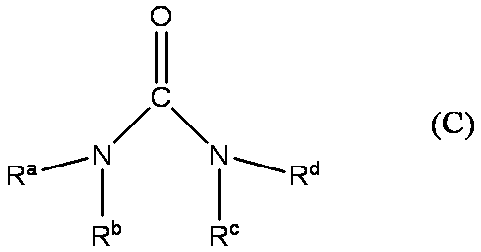
(式中、Raは、メチル基、エチル基又は炭素数1~2のヒドロキシアルキル基であり、Rb、Rc及びRdは、それぞれ独立に、水素原子、メチル基又はエチル基である。)で表される尿素誘導体からなる群より選ばれる1種以上の化合物
を含む液体柔軟剤組成物であって、
[(A)の質量+(B)の質量]/(C)の質量=1~40である
ことを特徴とする液体柔軟剤組成物。

R12-N[(CH2)n-NH2]2 (M-2)
(式中、R12は、炭素数8~18のアルキル基を表し、nは1~4の数である。)で表される化合物からなる群より選ばれる1種以上の抗菌剤を含有することを特徴とする、前記1~7のいずれかに記載の液体柔軟剤組成物。
更に後述の実施例で示されるように、本発明の液体柔軟剤組成物は、上記の保存安定性を備えつつ、低浴比で洗濯を行った場合(特に乾燥機を用いた乾燥を併用した場合)に起こる被洗物の風合いの低下や臭気発生を抑制することもできる。
したがって、本発明は従来の液体柔軟剤組成物にはない付加価値を有する柔軟剤として有用である。
(A)成分は、炭素数10~24の炭化水素基を分子内に1個以上含有するアミン化合物、その中和物及びその4級化物からなる群より選ばれ、かつ、カチオン界面活性剤として機能するものである。
アミン化合物中、炭化水素基は窒素原子に結合しており、窒素原子へ結合している炭化水素基の数は1~3である。
炭化水素基の炭素数は、10~24、好ましくは12~22、特に好ましくは14~18である。
また炭化水素基は、エステル基、エーテル基及びアミド基からなる群より選ばれる1種以上の基により分断されていてもよい。エステル基、エーテル基及びアミド基の中ではエステル基が特に好ましい。分断する基の数は、分断する基がエステル基又はアミド基である場合は、炭化水素基1つにつき1つである。分断する基がエーテル基である場合は、炭化水素基1つにつき1つである。
中和物とは、上述のアミン化合物を酸で中和することによって得られる化合物である。中和に用いる酸としては、塩酸、硫酸、メチル硫酸や、パラトルエンスルホン酸などが挙げられる。中和物はアミン塩の形であることが好ましい。
中和物の製造は、予め酸で中和したアミン化合物を水で分散させる、液状若しくは固体状のアミン化合物の酸水溶液中への投入、又は、アミン化合物と酸との水中への同時投入等により行うことができる。

R1を誘導する好ましい脂肪酸としては、ステアリン酸、パルミチン酸、オレイン酸、エライジン酸、リノール酸、リノレン酸、部分水添パーム油脂肪酸(ヨウ素価10~60)や、部分水添牛脂脂肪酸(ヨウ素価10~60)などが挙げられる。より好ましくは、ステアリン酸、パルミチン酸、オレイン酸、エライジン酸、リノール酸及びリノレン酸の混合物であって、飽和脂肪酸/不飽和脂肪酸の質量比が95/5~50/50、シス体/トランス体の質量比が40/60~80/20、ヨウ素価が10~50、炭素数18の脂肪酸含量が混合物総質量に対して80質量%以上、かつ、リノール酸及びリノレン酸の合計量が混合物総質量に対して2質量%以下である混合物である。
一般式(A-I)で表される化合物の4級化物と一般式(A-II)で表される化合物の4級化物とを含む組成物を用いる場合、4級化剤として塩化メチルやジメチル硫酸を用いることができるが、分子量が小さく4級化のために必要な量を少なくできる塩化メチルが好ましい。その際、液体柔軟剤組成物中における分散安定性を良好にする観点から、各4級化物の質量比が(A-II)の4級化物/(A-I)の4級化物=99/1~50/50となる様に合成することが好ましい。
上記の4級化反応では、未反応物(すなわち、(A-I)で表される化合物と(A-II)で表される化合物)が残留する。その際、4級化物に含まれるエステル基の加水分解に対する安定性の観点から、4級化物((A-I)の4級化物+(A-II)の4級化物)と未反応物((A-I)で表される化合物+(A-II)で表される化合物)の質量比が4級化物/未反応物=99/1~70/30となる様に合成することが好ましい。
一般式(A-III)で表される化合物の4級化物と一般式(A-IV)で表される化合物の4級化物と一般式(A-V)で表される化合物の4級化物とを含む組成物を用いる場合、4級化剤として塩化メチルやジメチル硫酸などを用いることができるが、4級化反応の反応性の観点からジメチル硫酸が好ましい。その際、液体柔軟剤組成物中における分散安定性を良好にする観点から、各4級化物の質量比が[(A-IV)+(A-V)]/(A-III)=99/1~50/50となる様に合成することが好ましい。
上記の4級化反応では、未反応物(すなわち、一般式(A-III)で表される化合物と、一般式(A-IV)で表される化合物と、一般式(A-V)で表される化合物)が残留する。その際、4級化物に含まれるエステル基の加水分解に対する安定性の観点から、4級化物((A-III)の4級化物+(A-IV)の4級化物+(A-V)の4級化物)と未反応物((A-III)で表される化合物+(A-IV)で表される化合物+(A-V)で表される化合物)の質量比が4級化物/未反応物=99/1~70/30となる様に合成することが好ましい。
一般式(A-VI)で表される化合物の4級化物と一般式(A-VII)で表される化合物の4級化物とを含む組成物を用いる場合、4級化剤として塩化メチルを用いることができる。その際、風合い付与効果を良好にする観点から、各4級化物の質量比が(A-VII)の4級化物/(A-VI)の4級化物=99/1~50/50となる様に合成することが好ましい。
上記の4級化反応では、未反応物(すなわち、(A-VI)で表される化合物と(A-VII)で表される化合物)が残留する。その際、4級化物に含まれるエステル基の加水分解に対する安定性の観点から、4級化物((A-VI)の4級化物+(A-VII)の4級化物)と未反応物((A-VI)で表される化合物+(A-VII)で表される化合物)の質量比が4級化物/未反応物=99/1~70/30となる様に合成することが好ましい。
この場合、柔軟剤としての機能をより高める観点から、組成物中における各4級化物の含量は、組成物の総質量に対して、(A-III)で表される化合物の4級化物が5~98質量%、(A-IV)で表される化合物の4級化物が1~60質量%、(A-V)で表される化合物の4級化物が0.1~40質量%であることが好ましい。より好ましくは、組成物の総質量に対して、(A-III)で表される化合物の4級化物が10~55質量%、(A-IV)で表される化合物の4級化物が30~60質量%、(A-V)で表される化合物の4級化物が5~35質量%である。
(B)成分であるアミノ変性シリコーンは、ジメチルシリコーン骨格の両末端あるいは側鎖にアミノ基を導入してなる化合物である。
好ましいアミノ変性シリコーンは次の一般式(B):

アミノ変性シリコーンは、オイルの形態(シリコーンオイル)であってもよく、ノニオン界面活性剤やカチオン界面活性剤を乳化剤として用いることで乳化させたエマルジョン(シリコーンエマルジョン)の形態であってもよい。
シリコーンオイルとしては、例えば、東レ・ダウコーニング株式会社から商品名:SF―8417、BY16-849、BY16-892、FZ-3785又はBY16-890で販売されているものや、信越化学工業株式会社から商品名:KF-864、KF-860、KF-880、KF-8004、KF-8002、KF-8005、KF-867又はKF-869、KF-861、KF-8010で販売されているものなどがあげられる。
シリコーンエマルジョンとしては、東レ・ダウコーニング株式会社から商品名:SM8904、BY22-079、FZ-4671又はFZ-4672で販売されているものや、信越化学工業株式会社からPolonシリーズとして商品名:PolonMF-14、PolonMF-29、PolonMF-14D、PolonMF-44、PolonMF-14ECやPolonMF-52で販売されているもの、旭化成ワッカーシリコーン株式会社からWACKER FC201で販売されているものなどがあげられる。
尿素とは、化学式:(NH2)2C=Oで表される化合物である。
尿素の複塩としては、HNO3・CO(NH2)2、H3PO4・CO(NH2)2、H2C2O4・2CO(NH2)2、Ca(NO3)2・4CO(NH2)2、CaSO4・4CO(NH2)2、Mg(NO3)2・CO(NH2)2・2H2O、CaSO4・(5~6)4CO(NH2)2・2H2O等があげられる。これらの中では尿素が特に好ましい。
尿素誘導体とは、下記一般式(C):
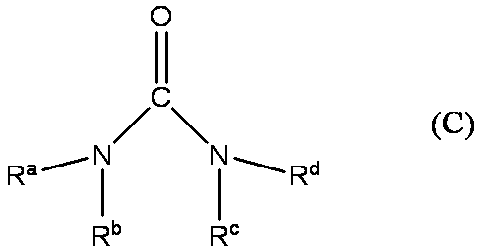
で表される化合物である。具体例としては、1,3-ジメチル尿素、N-(2-ヒドロキシエチル)尿素などが挙げられる。中でも1,3-ジメチル尿素が好ましい。
(C)成分としては尿素が特に好ましい。
液体柔軟剤組成物の保存時に生じる香り立ち及び香りの質の劣化とは、(A)成分及び(B)成分が高温で分解するために生ずる現象であり、(A)成分と(B)成分のいずれもが関与していると考えられる。香り立ち及び香りの質の劣化には(A)成分と(B)成分のいずれもが関与しているが、(A)成分の関与がより大きいと考えられる。
(L)成分は、被洗物の風合い低下及び臭気の発生(特に、低浴比での洗濯後に乾燥機を使用した場合に起こる被洗物の風合い低下及び臭気の発生)を改善するために配合される。(L)成分は、前記の改善効果に加え、液体柔軟剤組成物の保存後における粘度上昇を更に抑制し、使用性を高めるために配合することもできる。
本発明において用いるトレハロースは、2分子のグルコースが1,1結合した非還元性の二糖である。α,α型構造のトレハロース(α-D-グルコピラノシルα-D-グルコピラノシド)、α,β型(ネオトレハロース)、β,β型(イソトレハロース)の3種の異性体が存在している。本発明においてはいずれの型を用いてもよく、1種単独で又は2種以上を適宜組み合わせて用いることができ、特にα,α型が好ましい。また、トレハロースは市販品を用いることができ、市販品としては、トレハ((株)林原社製)等が挙げられる。
本発明の液体柔軟剤組成物において、(A)成分と(B)成分との和に対する(L)成分の質量比は、特に限定されるものではないが、(L)/((A)+(B))=0.002~0.50が好ましく、より好ましくは、0.03~0.25である。(A)成分と(B)成分との和に対する(L)成分の質量比がこのような範囲内にあると、上記の配合効果に加え、保存後の液体柔軟剤組成物の粘度安定性をより改善することができる。
(M)成分は、被洗物へ良好な防臭性を付与する(不快臭発生菌の被洗物での繁殖抑制。特に、低浴比での洗濯後に乾燥機を使用した場合に起こる被洗物の臭気発生の抑制)ために配合される。
(M)成分は、ビグアニド系抗菌剤及びN,N-ビス(3-アミノアルキル)アルキルアミンからなる群より選ばれる1種以上の抗菌剤である。

-[R11-NH-C(NH)-NH-C(NH)-NH]n-n・HY (M-1)
(式中、R11は炭素数2~8のアルキレン基であり、nは2~14であり、HYは有機酸又は無機酸である。)で表される化合物が好ましい。
R11は、好ましくは炭素数4~8のアルキレン基であり、特に好ましくはヘキサメチレン基である。
nは、好ましくは10~14であり、より好ましくは11~13であり、特に好ましくは12である。
HYは、好ましくは塩酸、グルコン酸又は酢酸であり、特に好ましくは塩酸である。
具体例としては、一般式(M-1)においてR11がヘキサメチレン基であり、nが12であり、HYが塩酸である化合物(ポリ(ヘキサメチレンビグアニド)塩酸塩、商品名:Proxel IB(登録商標)(ロンザ社))が挙げられる。

ビグアニド系抗菌剤は、1種類を単独で用いてもよく、2種類以上からなる混合物として用いてもよい。
R12-N[(CH2)n-NH2]2 (M-2)
(式中、R12は、炭素数8~18のアルキル基を表し、nは1~4の数である。)で表される化合物(N,N-ビス(3-アミノアルキル)アルキルアミン)を用いることもできる。
一般式(M-2)中、R12は、直鎖であってもよいし、分岐鎖であってもよいが、直鎖であることが好ましい。R12が直鎖であると、被洗物の防臭性をより高めることができる。
R12の炭素数は、8~18であり、好ましくは8~14であり、より好ましくは12である。R12の炭素数が8以上であると優れた抗菌作用を発揮することができる。R12の炭素数が14以下であると、水溶性低下に起因する柔軟剤組成物への配合性低下を回避することができる。
一般式(M-2)中、nは1~4、好ましくは2~4であり、より好ましくは3である。nが1~4であると優れた抗菌作用を発揮することができる。
N,N-ビス(3-アミノメチル)オクチルアミン、N,N-ビス(3-アミノメチル)デシルアミン、N,N-ビス(3-アミノメチル)ドデシルアミン等のN,N-ビス(3-アミノメチル)アルキルアミン;
N,N-ビス(3-アミノエチル)オクチルアミン、N,N-ビス(3-アミノエチル)デシルアミン、N,N-ビス(3-アミノエチル)ドデシルアミン等のN,N-ビス(3-アミノエチル)アルキルアミン;
N,N-ビス(3-アミノプロピル)オクチルアミン、N,N-ビス(3-アミノプロピル)デシルアミン、N,N-ビス(3-アミノプロピル)ドデシルアミン等のN,N-ビス(3-アミノプロピル)アルキルアミンや;
N,N-ビス(3-アミノブチル)オクチルアミン、N,N-ビス(3-アミノブチル)デシルアミン、N,N-ビス(3-アミノブチル)ドデシルアミン等のN,N-ビス(3-アミノブチル)アルキルアミン等が挙げられる。
なかでも、N,N-ビス(3-アミノプロピル)アルキルアミンが好ましく、N,N-ビス(3-アミノプロピル)ドデシルアミンがより好ましい。
一般式(M-2)で表される化合物は、1種類を単独で用いてもよく、2種類以上からなる混合物として用いてもよい。
(N)成分は、(L)成分(トレハロース)で酸化抑制できなかった臭気を包摂することで、液体柔軟剤組成物の消臭性及び防臭性付与効果をより高めて、被洗物の消臭性及び防臭性(特に、皮脂酸化臭の消臭性及び防臭性)をより高めるために配合される。
高度分岐環状デキストリンとは、内分岐環状構造部分と外分岐構造部分とを有する、重合度が50から10000の範囲にあるグルカンをいう。ここで、内分岐環状構造部分とは、α-1,4-グルコシド結合とα-1,6-グルコシド結合とで形成される環状構造部分をいう。外分岐構造部分とは、該内分岐環状構造部分に結合した非環状構造部分をいう。
高度分岐環状デキストリンは、上記の通り特定の構造を有し、かつ重合度(分子量)が大きいものであり、α-シクロデキストリン(n=6)、β-シクロデキストリン(n=7)、γ-シクロデキストリン(n=8)などのグルコースが6~8個結合した一般的なシクロデキストリンとは異なる物質である。
(N)成分の高度分岐環状デキストリンの具体的としては、特開平8-134104号公報に記載の、内分岐環状構造部分と外分岐構造部分とを有する、重合度が50から10000の範囲にあるグルカンが挙げられる。本明細書において、高度分岐環状デキストリンは、特開平8-134104号公報の記載を参酌して理解され得る。
より具体的には、分子量が3万から100万程度であり、分子内に10~100個程度のグルコースで構成された環状構造(内分岐環状構造部分)を1つ有し、さらにその環状構造部分に多数の非環状のグルカン鎖(外分岐構造部分)が結合した、重量平均重合度2500程度のデキストリンが挙げられる。
高度分岐環状デキストリンにおけるグルコースの重合度は、例えば、50~5000の範囲にある。
高度分岐環状デキストリンの内分岐環状構造部分におけるグルコースの重合度は、例えば、10~100の範囲である。
高度分岐環状デキストリンの外分岐構造部分におけるグルコースの重合度は、例えば、40以上である。外分岐構造部分を構成する各単位鎖におけるグルコースの重合度は、平均で10~20である。
pH調整には、塩酸、硫酸、リン酸、アルキル硫酸、安息香酸、パラトルエンスルホン酸、クエン酸、リンゴ酸、コハク酸、乳酸、グリコール酸、ヒドロキシエタンジホスホン酸、フィチン酸、エチレンジアミン四酢酸、トリエタノールアミン、ジエタノールアミン、ジメチルアミン、N-メチルエタノールアミン、N-メチルジエタノールアミン等の短鎖アミン化合物、水酸化ナトリウム等のアルカリ金属水酸化物、アルカリ金属炭酸塩や、アルカリ金属珪酸塩などのpH調整剤を用いることができる。
使用性の観点からは粘度の下限は特に制限されない。
本発明における液体柔軟剤組成物の粘度とは、B型粘度計(例えば、ブルックフィールド社のアナログ粘度計T)を用いて25℃にて測定される値をいう。
(D)成分は、本発明の液体柔軟剤組成物の保存安定性をより向上させるために配合される。
(D)成分とは、一級又は二級アルコールにアルキレンオキシドを付加することにより得られる非イオン界面活性剤である。具体的には、炭素数が8~20、好ましくは10~14の分岐アルキル基または分岐アルケニル基を有する一級又は二級アルコールに、アルキレンオキシドを平均で5~100モル付加させてなる非イオン界面活性剤である。
アルキレンオキシドとしては、エチレンオキシドを単独で使用するのが好ましいが、エチレンオキシドとともにプロピレンオキシドを付加してもよい。両者を付加させる場合、付加する順序はいずれが先であってもよい。
アルキレンオキシドの平均付加モル数は、好ましくは10~80モルであり、特に好ましくは20~60モルである。また、プロピレンオキシドをエチレンオキシドとともに付加する場合、プロピレンオキシドの平均付加モル数は1~5モルとすることができ、好ましくは1~3モルである。
(D)成分の具体例としては、一級イソトリデシルアルコールにエチレンオキシド(EO)を平均60モル付加したもの、一級イソトリデシルアルコールにエチレンオキシド(EO)を平均40モル付加したものや、アルキル基炭素数10~14の直鎖型第2級アルコールにEOを平均50モル付加したもの等が挙げられる。
(D)成分は、例えば、プロピレンあるいはブチレンを原料とし、そのn量体(プロピレンの場合は3~6量体、ブチレンの場合は2~4量体など)を調製した後、オキソ反応によりアルデヒドとし、水添して得た一級又は二級アルコールに、当業者に知られた通常の方法で酸化アルキレンを付加することにより、調製することができる。
(D)成分の配合量は、液体柔軟剤組成物の総質量に対して、好ましくは0.1質量%~15質量%、より好ましくは0.5質量%~10質量%、最も好ましくは1.0質量%~7質量%である。0.1質量%以上であると、液体柔軟剤組成物の凍結に対する安定性を向上させることができる。15質量%以下であると、液体柔軟剤組成物の高温保存時の安定性を向上させることができる。
(E)成分は、液体柔軟剤組成物への香りつけ、更には同組成物による処理後の衣類への香りつけのために配合される。
(E)成分としては当該技術分野で汎用の香料を使用可能であり特に限定されないが、使用できる香料原料のリストは、様々な文献、例えば「Perfume and Flavor Chemicals」,Vol.Iand II,Steffen Arctander,Allured Pub.Co.(1994)および「合成香料 化学と商品知識」、印藤元一著、化学工業日報社(1996)および「Perfume and Flavor Materials of Natural Origin」,Steffen Arctander,Allured Pub.Co.(1994)および「香りの百科」、日本香料協会編、朝倉書店(1989)および「Perfumery Material Performance V.3.3」,Boelens Aroma Chemical Information Service(1996)および「Flower oils and Floral Compounds In Perfumery」,Danute Lajaujis Anonis,Allured Pub.Co.(1993)等に記載されている。
本発明では(C)成分を配合することで液体柔軟剤組成物の保存時の香り立ち及び香りの質の劣化が十分に抑制されているので、(E)成分による香り付け効果はより高いものとなる。
(E)成分の配合量は、液体柔軟剤組成物の総質量に対して、好ましくは0.1~5質量%である。
(F)成分:溶剤
(F)成分は、液体柔軟剤組成物を長期で保存する際の粘度を安定化するために配合される。
(F)成分は、炭素数1~4のアルコール、グリコールエーテル系溶剤及び多価アルコールからなる群から選ばれる1種又は2種以上の水性溶剤である。具体例としては、エタノール、イソプロパノール、グリセリン、エチレングリコール、プロピレングリコール、ジエチレングリコール、ジプロピレングリコール、ヘキシレングリコール、ポリオキシエチレンフェニルエーテル、及び下記一般式(X):
R-O-(C2H4O)y-(C3H6O)z-H (X)
(式中、Rは、炭素数1~6、好ましくは2~4のアルキル基又はアルケニル基であり、yおよびzは平均付加モル数であり、yは1~10、好ましくは2~5、zは0~5、好ましくは0~2の数を示す。)
で表わされる水溶性溶剤から選ばれる溶媒成分があげられる。
好ましい例としてはエチレングリコール、ブチルカルビトール、プロピレングリコール、グリセリン等が挙げられ、低温での粘度安定化の観点から、グリセリンが特に好ましい。
(F)成分の配合量は、液体柔軟剤組成物の総質量に対して0~10質量%、好ましくは0.1~10質量%、より好ましくは0.5~5質量%である。質量0.1%以上であると、溶剤としての機能を効果的に発揮することができる。10質量%以下であると、効果的効率的に安定性を確保することができる。
前述の(M)成分(抗菌剤)以外の防腐剤を(G)成分として配合することができる。
防腐剤は、液体柔軟剤組成物の長期保存中の防腐性を保つために配合される。
防腐剤としては当該技術分野で知られているものを使用可能であり特に限定されない。具体的は、イソチアゾロン系の有機硫黄化合物、ベンズイソチアゾロン系の有機硫黄化合物、安息香酸類、アルコール系の2-ブロモ-2-ニトロプロパン-1,3-ジオール、ヨウ素系化合物などが挙げられる。
イソチアゾロン系の有機硫黄化合物の例としては、5-クロロ-2-メチル-4-イソチアゾリン-3-オン、2-n-ブチル-3-イソチアゾロン、2-ベンジル-3-イソチアゾロン、2-フェニル-3-イソチアゾロン、2-メチル-4,5-ジクロロイソチアゾロン、5-クロロ-2-メチル-3-イソチアゾロン、2-メチル-4-イソチアゾリン-3-オンや、それらの混合物があげられる。より好ましい防腐剤は、5-クロロ-2-メチル-4-イソチアゾリン-3-オンと2-メチル-4-イソチアゾリン-3-オンとの水溶性混合物であり、さらに好ましくは約77質量%の5-クロロ-2-メチル-4-イソチアゾリン-3-オンと約23質量%の2-メチル-4-イソチアゾリン-3-オンとの水溶性混合物である。
ベンズイソチアゾリン系の有機硫黄化合物の例としては、1,2-ベンズイソチアゾリン-3-オン、2-メチル-4,5-トリメチレン-4-イソチアゾリン-3-オンなどがあげられ、類縁化合物としてジチオ-2,2-ビス(ベンズメチルアミド)なども使用できる。このうち1,2-ベンズイソチアゾリン-3-オンが特に好ましい。複数種類のベンズイソチアゾリン系の有機硫黄化合物を用いる場合、それらを任意の混合比で使用することができる。
ヨウ素系化合物の例としては、3-ヨード-2-プロピニルN-ブチルカルバマートがあげられる。
安息香酸類の例としては、安息香酸又はその塩、パラヒドロキシ安息香酸又はその塩、パラオキシ安息香酸メチル、パラオキシ安息香酸エチル、パラオキシ安息香酸プロピル、パラオキシ安息香酸ブチル、パラオキシ安息香酸ベンジル等を挙げることができる。
防腐剤の配合量は、液体柔軟剤組成物の総質量に対して、好ましくは0.0001~1質量%である。0.0001質量%以上であると防腐剤としての機能を発揮することができる。1質量%以下であると、配合過多による液体柔軟剤組成物の保存安定性の低下を抑制することができる。
無機又は有機の水溶性塩類は、組成物の粘度をコントロールする目的で用いることができる。無機又は有機の水溶性塩類としては、塩化ナトリウム、塩化カリウム、塩化カルシウム、塩化マグネシウムなどの他、硫酸又は硝酸のアルカリ金属塩又はアルカリ土類金属塩、p-トルエンスルホン酸、グリコール酸、乳酸などの有機酸のアルカリ金属塩などが挙げられる。好ましくは、塩化カルシウム、塩化マグネシウム、塩化ナトリウムである。無機又は有機の水溶性塩類の配合量は、組成物全量に対し0~3質量%、好ましくは0.01~2質量%、より好ましくは0.05~1質量%である。無機又は有機の水溶性塩類の添加は組成物製造のどの工程で入れてもよい。
前述の(L)成分(トレハロース)以外の酸化防止剤を(I)成分として配合することができる。
酸化防止剤は、液体柔軟剤組成物の香気安定性や色調安定性をより向上させるために配合される。
酸化防止剤としては、当該技術分野で知られている天然系酸化防止剤、合成系酸化防止剤ともに使用できる。具体的には、アスコルビン酸、アスコルビン酸パルミテート、没食子酸プロピル、BHT(ブチル化ヒドロキシトルエン)、特にジブチルヒドロキシトルエン、BHA(ブチル化ヒドロキシアニソール)、没食子酸プロピルとクエン酸との混合物、ハイドロキノン、三級ブチルハイドロキノン、天然のトコフェロール系化合物、没食子酸の長鎖エステル(C8~C22)、例えば没食子酸ドデシル、チバスペシャルティケミカル(株)から入手可能なイルガノックス系化合物、クエン酸及び/またはクエン酸イソプロピル、4,5-ジヒドロキシ-m-ベンゼンスルホン酸/ナトリウム塩、ジメトキシフェノール、カテコール、メトキシフェノール、カロチノイド、フラン類、アミノ酸類等が挙げられる。これらのなかでは、液体柔軟剤組成物の保存安定性の向上の観点から、BHT、メトキシフェノール、トコフェロール系化合物が好ましい。
酸化防止剤の配合量は、液体柔軟剤組成物の総質量に対して、好ましくは0.01~1質量%である。0.01質量%以上であると、酸化防止剤としての機能を発揮することができる。1質量%以下であると、配合過多による液体柔軟剤組成物の保存安定性の低下を抑制することができる。
染料としては当該技術分野で知られているものを使用可能であり特に限定されない。配合の容易さから水溶性染料が好ましく、中でも酸性染料、直接染料から選ばれる水溶性染料の1種又は2種以上であることがより好ましい。添加できる染料の具体例は、例えば染料便覧(有機合成化学協会編,昭和45年7月20日発行,丸善(株))、染料ノート第22版((株)色染社)、法定色素ハンドブック(日本化粧品工業連合会編、1988年11月28日発行、(株)薬事日報社)等に記載されている。
染料の配合量は、液体柔軟剤組成物に対して、質量基準で好ましくは0.01~50ppm、より好ましくは0.1~30ppmである。このような配合量とすることにより、液体柔軟剤組成物に着色された色が非常に薄くなるのを防止でき、着色効果を充分なものとすることができる一方で、液体柔軟剤組成物に着色された色が濃くなりすぎるのを防止することができる。
その他の添加剤として、前記の化合物以外に、炭化水素、非イオン性セルロース誘導体、紫外線吸収剤、ポリスチレンエマルジョンなどの乳濁剤、不透明剤、縮み防止剤、洗濯じわ防止剤、形状保持剤、ドレープ性保持剤、アイロン性向上剤、酸素漂白防止剤、増白剤、白化剤、抗菌剤、布地柔軟化クレイ、帯電防止剤、4,4-ビス(2-スルホスチリル)ビフェニルジナトリウム(チバスペシャルティケミカルズ製チノパールCBS-X)などの蛍光増白剤、染料固定剤、1,4-ビス(3-アミノプロピル)ピペラジンなどの退色防止剤、染み抜き剤、繊維表面改質剤としてセルラーゼ、アミラーゼ、プロテアーゼ、リパーゼ、ケラチナーゼなどの酵素、抑泡剤などを配合することができる。
本発明の液体柔軟剤組成物は、液体柔軟剤組成物の製造に一般的に用いられている種々の方法を用いて製造することができるが、特に特開平2-68137号公報、特開平10-237762号公報、特開平5-310660号公報、特開平5-310661号公報、特開平5-310662号公報に記載されている方法が好ましい。
具体的には、
1)本発明の(A)成分、(B)成分(オイルの場合)、(D)成分、(E)成分の油溶性成分をプレミックスしてから油相を作成し、この油相に、水に溶かした(C)成分、その他水相成分からなる混合物の一部を添加するか、あるいは水相の一部に該油相を添加して、カチオン界面活性剤の液晶相を形成させ、次いで該液晶相と残りの水相とを混合して液晶相を転相させる方法、又は
2)上記1)の油相と水相とを一括で混合し、乳化、分散する方法
などにより製造することができる。
また(B)成分がエマルジョンの場合、(B)成分は製造過程の最後に配合しても良い。
その他の任意成分は、水溶性の高いものは水相、水溶性の低いものは油相に入れることが好ましい。粘度コントロール剤((H)成分)は、製造過程の任意のタイミングで複数回に分けて配合してもよい。
また、(M)成分を用いる場合、水溶性の(M)成分は水相あるいは製造の最後に配合し、油溶性の(M)成分は油相に配合することが好ましい。
(N)成分は製造の最後に配合しても良い。
製造の際、混合装置の攪拌力及び剪断力は、得られる液体柔軟剤組成物の油相の平均粒径が、好ましくは0.01μm~10μm、より好ましくは0.05~5μm、更に好ましくは0.1~1μmとなるように設定することが好ましい。このような範囲にあると、油相の分散安定性が良好となる。
本発明の液体柔軟剤組成物の使用方法に特に制限はなく、一般の液体柔軟剤組成物と同様の方法で使用することができる。例えば、洗濯のすすぎの段階ですすぎ水へ本発明の液体柔軟剤組成物を溶解させて被洗物を柔軟処理する方法や、本発明の液体柔軟剤組成物をたらいのような容器中の水に溶解させ、更に被洗物を入れて浸漬処理する方法がある。
本発明の液体柔軟剤組成物が希釈して使用される場合、浴比(被洗物に対する液体柔軟剤組成物の質量比)は3~100倍、特に5~50倍であることが好ましい。具体的には、全使用水量に対して、(A)成分の濃度が5ppm~1000ppmとなるような量で使用するのが好ましく、10ppm~300ppmとなるような量で使用するのがさらに好ましい。
カチオン界面活性剤((A)成分)
カチオン界面活性剤として、下記(A-1)及び(A-2)を合成した。
(A-1)
特開2003-12471号公報の実施例4に記載の手順に従って合成したカチオン性界面活性剤。
(A-1)は、一般式(A-III)、(A-IV)及び(A-V)で表される各化合物(各式中、R1は炭素数15又は17のアルキル基及びアルケニル基であり、不飽和部分のシス体/トランス体=75/25(質量比)である)をジメチル硫酸で4級化したものを含む組成物であった。
特開2002-167366号公報の実施例1に記載の手順に従って合成したカチオン性界面活性剤。
(A-2)は、(A-III)、(A-IV)及び(A-V)で表される各化合物(各式中、R1は炭素数15又は17のアルキル基及びアルケニル基であり、不飽和部分のシス体/トランス体=75/25(質量比)である)をジメチル硫酸で4級化したものを含む組成物であった。
アミノ変性シリコーンとして、下記の(B-1)~(B-6)を入手した。
(B-1)
東レダウコーニング(株)より商品名:SM8904として入手した、末端に-H基及び/又は-OH基を有するアミノ変性シリコーンを界面活性剤で乳化重合してなるエマルジョン。
信越化学工業(株)より商品名:PlonMF-52として入手した、アミノ変性シリコーンのエマルジョン。
旭化成ワッカーシリコーン(株)より商品名:WACKER FC201として入手した、アミノ変性シリコーンのエマルジョン。
信越化学工業(株)より商品名:KF-880として入手した、側鎖変性タイプのアミノ変性シリコーンのオイル。(25℃における動粘度650mm2/s、アミノ当量1800g/mol)
信越化学工業(株)より商品名:KF-864として入手した、側鎖変性タイプのアミノ変性シリコーンのオイル。(25℃における動粘度1700mm2/s、アミノ当量1800g/mol)
信越化学工業(株)より商品名:KF-8010として入手した、両末端変性タイプのアミノ変性シリコーンのオイル。(25℃における動粘度12mm2/s、アミノ当量430g/mol)
(B-7)
特開2005-187987号公報の実施例2の(B-2)として記載のポリエーテル変性シリコーン。

尿素及び尿素誘導体として、下記の(C-1)及び(C-2)を入手した。
純正化学(株)製の商品名:尿素(特級)として入手した尿素。尿素は化学式:(NH2)2C=Oで表される化合物であり、本発明の(C)成分である尿素に該当するものである。
東京化成工業(株)製の商品名:1、3-ジメチル尿素として入手したジメチル尿素。ジメチル尿素は、一般式(C)(式中、Raはメチル基であり、Rb及びRcは水素原子であり、Rdはメチル基である)で表される化合物であり、本発明の(C)成分である尿素誘導体に該当するものである。
非イオン活性剤として、下記の(D-1)及び(D-2)を入手した。
ライオン(株)より商品名:TA600-75として入手した、1級イソトリデシルアルコール(炭素数:13)のエチレンオキシド(以下、EO)60モル付加物
ライオン(株)より商品名:レオコールTDA-400-75として入手した、1級イソトリデシルアルコールのエチレンオキシド(以下、EO)40モル付加物
下記の組成を有する香料E-1及びE-2を調製した。表中の各香料の数値は質量部である
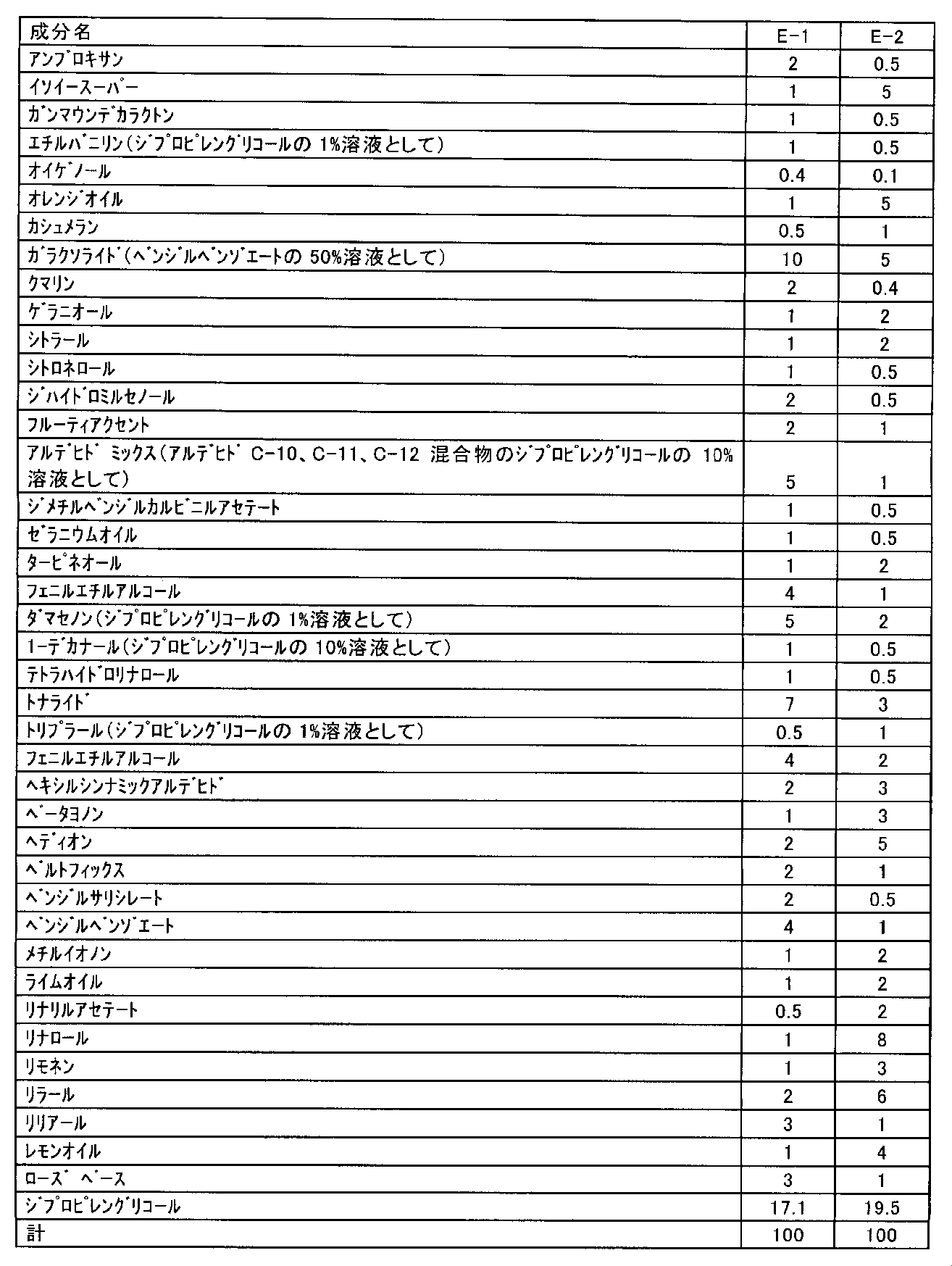

後述の表2に示す組成を有する実施例1~25及び比較例1~4の液体柔軟剤組成物を以下の手順にしたがって調製した。表2中、(A)~(I)成分の数値の単位は、液体柔軟剤組成物の総質量に対する質量%であり、(J)成分の数値の単位は、液体柔軟剤組成物に対するppm(質量基準)である。
液体柔軟剤組成物は、内径100mm、高さ150mmのガラス容器と、攪拌機(アジターSJ型、島津製作所製)を用い、次の手順により調製した。まず、(A)成分、(D)成分、(E)成分、(G)成分及び(I)成分を混合攪拌して、油相混合物を得た。他方、(C)成分及び(J)成分をバランス用イオン交換水に溶解させて水相混合物を得た。ここで、バランス用イオン交換水の質量は、980gから油相混合物と(B)成分及び(F)成分、(H)成分、及び塩酸の合計質量を差し引いた残部に相当するものであった。次に、(A)成分の融点以上に加温した油相混合物をガラス容器に収納して攪拌しながら、(A)成分の融点以上に加温した水相混合物を2回に分割して添加し、攪拌した。ここで、水相混合物の分割比率は30:70(質量比)とし、攪拌は回転速度1,000rpmで、1回目の水相混合物添加後に3分間、2回目の水相混合物添加後に2分間行った。その後、(H)成分を添加し、その後、(B)成分、(F)成分を添加し、必要に応じて、塩酸(試薬1mol/L、関東化学)、または水酸化ナトリウム(試薬1mol/L、関東化学)を適量添加してpH2.5に調整し、更に全体質量が1,000gになるようにイオン交換水を添加して、目的の液体柔軟剤組成物を得た。
液体柔軟剤組成物は、内径100mm、高さ150mmのガラス容器と、攪拌機(アジターSJ型、島津製作所製)を用い、次の手順により調製した。まず、(A)成分、(B)成分、(D)成分、(E)成分、(G)成分及び(I)成分を混合攪拌して、油相混合物を得た。他方、(C)成分及び(J)成分をバランス用イオン交換水に溶解させて水相混合物を得た。ここで、バランス用イオン交換水の質量は、980gから油相混合物と(F)成分及び(H)成分の合計質量を差し引いた残部に相当するものであった。次に、(A)成分の融点以上に加温した油相混合物をガラス容器に収納して攪拌しながら、(A)成分の融点以上に加温した水相混合物を2回に分割して添加し、攪拌した。ここで、水相混合物の分割比率は30:70(質量比)とし、攪拌は回転速度1,000rpmで、1回目の水相混合物添加後に3分間、2回目の水相混合物添加後に2分間行った。その後、(F)成分及び(H)成分を添加し、その後、必要に応じて、塩酸(試薬1mol/L、関東化学)、または水酸化ナトリウム(試薬1mol/L、関東化学)を適量添加してpH2.5に調整し、更に全体質量が1,000gになるようにイオン交換水を添加して、目的の液体柔軟剤組成物を得た。
1.評価用布の前処理方法
市販の綿肌シャツ(BVD製)を市販洗剤「トップ」(ライオン社製)により二槽式洗濯機(三菱電機製CW-C30A1-H)を用いて3回前処理を行なった(洗剤標準使用量:浴比30倍。45℃の水道水。10分間の洗浄後、10分間の注水すすぎ2回)。
前処理洗浄した綿肌シャツ1.5kgを、二槽式洗濯機(三菱電機製CW-C30A1-H)を用いて、市販洗剤「トップ」(ライオン社製)で10分間洗浄した(標準使用量:浴比20倍。標準コース。25℃の水道水使用)。洗浄工程後、1分間の脱水を行った。脱水工程後、はじめに3分間のすすぎを行い、続く2回目のすすぎの際に液体柔軟剤組成物を投入して3分間の柔軟処理を行った(液体柔軟剤組成物の使用量:10mL。浴比20倍。25℃の水道水使用)。柔軟処理後、20℃、45%RHの恒温恒湿条件下で綿肌シャツ20時間乾燥させ、下記に示す評価試験に供した。
柔軟剤組成物の柔軟性を、処理後の被洗物の滑らかさを指標に評価した。具体的には、各柔軟剤組成物での処理により綿肌シャツへもたらされた滑らかさを、市販柔軟剤「ふんわりソフラン」(ライオン社製)を用いたこと以外は同条件で処理した綿肌シャツを対照として官能一対比較を行った。
評価は、下記の評価基準に従い、専門パネラー10人により行った。
5:対照よりも非常に滑らか
4:対照よりもかなり滑らか
3:対照よりもやや滑らか
2:対照と同等
1:対照よりも滑らかでない
各液体柔軟剤組成物100mLを軽量PSガラスビン(PS-No.11、田沼硝子工業所製)へ入れて密栓して、50℃で4週間保存した後に、その香り立ちを評価した。対照として、保存時の温度が5℃であったことを以外は同条件で保存したものを用いた。なお、保存後の対照の香り立ち及び香りの質は、保存前(調製直後)の香り立ち及び香りの質と同じ(不変)であった。
評価は、下記の評価基準に従い、専門パネラー10人により行った。
5:香り立ちが良く、香りの質が対照と比べて同等
4:香り立ちが良く、香りの質は対照と比べてごくわずかな違いが認められるが、異臭は感じられない
3:香り立ちが良いが、対照と比べてわずかに異臭が感じられる
2:香り立ちが若干悪く、対照と比べて香りの質にかなり違いがあり、異臭が感じられる1:香り立ちが悪く、対照と比べて香りの質に非常に違いがある
各液体柔軟剤組成物100mLを軽量PSガラスビン(PS-No.11、田沼硝子工業所製)へ入れて密栓して、50℃で2週間保存した後に、その黄変色度合いを評価した。対照として、保存時の温度が5℃であったことを以外は同条件で保存したものを用いた。なお、保存後の対照の外観は、保存前(調製直後)の外観と同じ(不変)であった。
評価は、下記の評価基準に従い、専門パネラー10人により行った。
5:対照と比べて同等
4:対照と比べてごくわずかに黄色く変化
3:対照と比べてわずかに黄色く変化
2:対照と比べてかなり黄色く変化
1:対照と比べて非常に黄色く変化
各液体柔軟剤組成物100mLを軽量PSガラスビン(PS-No.11、田沼硝子工業所製)へ入れて密栓して、40℃で6ヶ月間保存した後に、その粘度及び流動性を外観より評価した。対照として、保存時の温度が室温であったことを以外は同条件で保存したものを用いた。なお、保存後の対照の粘度及び流動性は、保存前(調製直後)の粘度及び流動性と同じ(不変)であった。
評価は、下記の評価基準に従い、専門パネラー5人により行った。
3:対照と比較して粘度及び流動性の双方において変化がほとんど認められない
2:対照と比較して粘度の上昇が認められるが、流動性は充分にある
1:対照と比較して粘度が著しく上昇し、あまり流動性がない
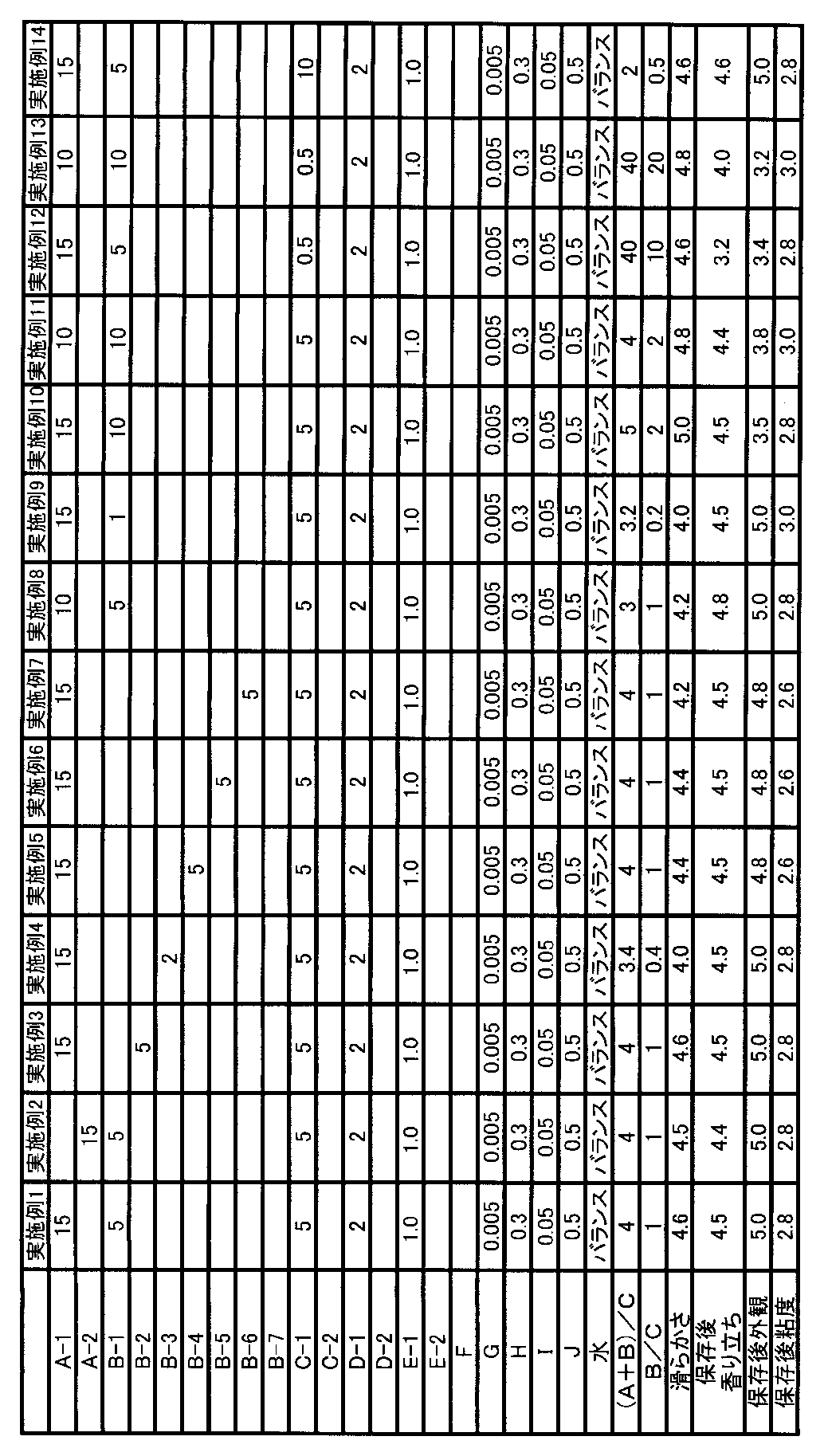
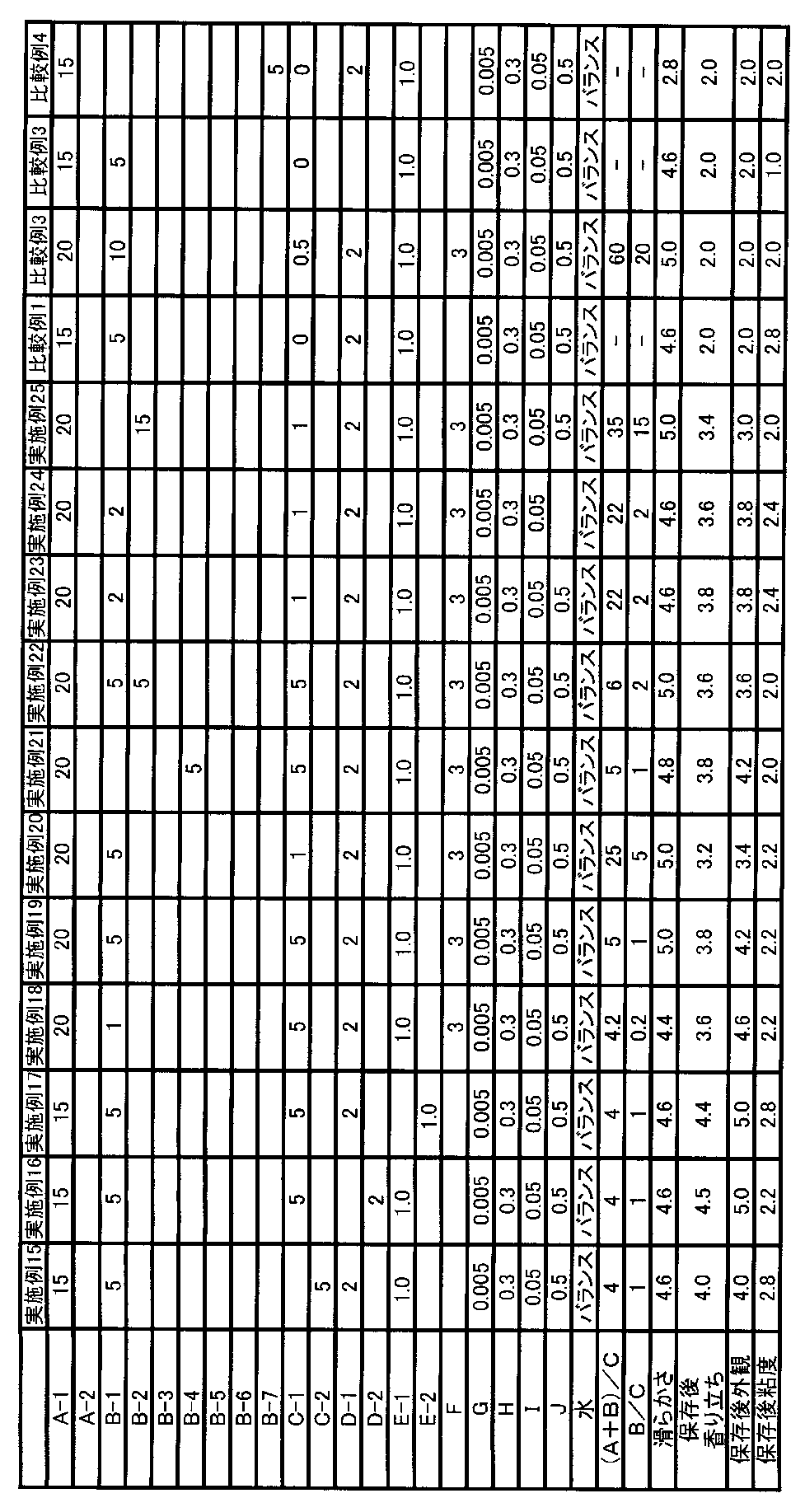
カチオン界面活性剤((A)成分)
カチオン界面活性剤として、下記(A-1)及び(A-2)を合成した。
(A-1)
特開2003-12471号公報の実施例4に記載の手順に従って合成したカチオン性界面活性剤。
(A-1)は、一般式(A-III)、(A-IV)及び(A-V)で表される各化合物(各式中、R1は炭素数15又は17のアルキル基及びアルケニル基であり、不飽和部分のシス体/トランス体=75/25(質量比)である)をジメチル硫酸で4級化したものを含む組成物であった。
特開2002-167366号公報の実施例1に記載の手順に従って合成したカチオン性界面活性剤。
(A-2)は、(A-III)、(A-IV)及び(A-V)で表される各化合物(各式中、R1は炭素数15又は17のアルキル基及びアルケニル基であり、不飽和部分のシス体/トランス体=75/25(質量比)である)をジメチル硫酸で4級化したものを含む組成物であった。
アミノ変性シリコーンとして、下記の(B-1)~(B-6)を入手した。
(B-1)
東レダウコーニング(株)より商品名:SM8904として入手した、末端に-H基及び/又は-OH基を有するアミノ変性シリコーンを界面活性剤で乳化重合してなるエマルジョン。
信越化学工業(株)より商品名:PlonMF-52として入手した、アミノ変性シリコーンのエマルジョン。
旭化成ワッカーシリコーン(株)より商品名:WACKER FC201として入手した、アミノ変性シリコーンのエマルジョン。
信越化学工業(株)より商品名:KF-880として入手した、側鎖変性タイプのアミノ変性シリコーンのオイル。(25℃における動粘度650mm2/s、アミノ当量1800g/mol)
信越化学工業(株)より商品名:KF-864として入手した、側鎖変性タイプのアミノ変性シリコーンのオイル。(25℃における動粘度1700mm2/s、アミノ当量1800g/mol)
信越化学工業(株)より商品名:KF-8010として入手した、両末端変性タイプのアミノ変性シリコーンのオイル。(25℃における動粘度12mm2/s、アミノ当量430g/mol)
(B-7)
特開2005-187987号公報の実施例2の(B-2)として記載のポリエーテル変性シリコーン。

尿素及び尿素誘導体として、下記の(C-1)及び(C-2)を入手した。
純正化学(株)製の商品名:尿素(特級)として入手した尿素。尿素は化学式:(NH2)2C=Oで表される化合物であり、本発明の(C)成分である尿素に該当するものである。
東京化成工業(株)製の商品名:1、3-ジメチル尿素として入手したジメチル尿素。ジメチル尿素は、一般式(C)(式中、Raはメチル基であり、Rb及びRcは水素原子であり、Rdはメチル基である)で表される化合物であり、本発明の(C)成分である尿素誘導体に該当するものである。
非イオン活性剤として、下記の(D-1)及び(D-2)を入手した。
ライオン(株)より商品名:TA600-75として入手した、1級イソトリデシルアルコール(炭素数:13)のエチレンオキシド(以下、EO)60モル付加物
ライオン(株)より商品名:レオコールTDA-400-75として入手した、1級イソトリデシルアルコールのエチレンオキシド(以下、EO)40モル付加物
下記の組成を有する香料E-1及びE-2を調製した。表中の各香料の数値は質量部である
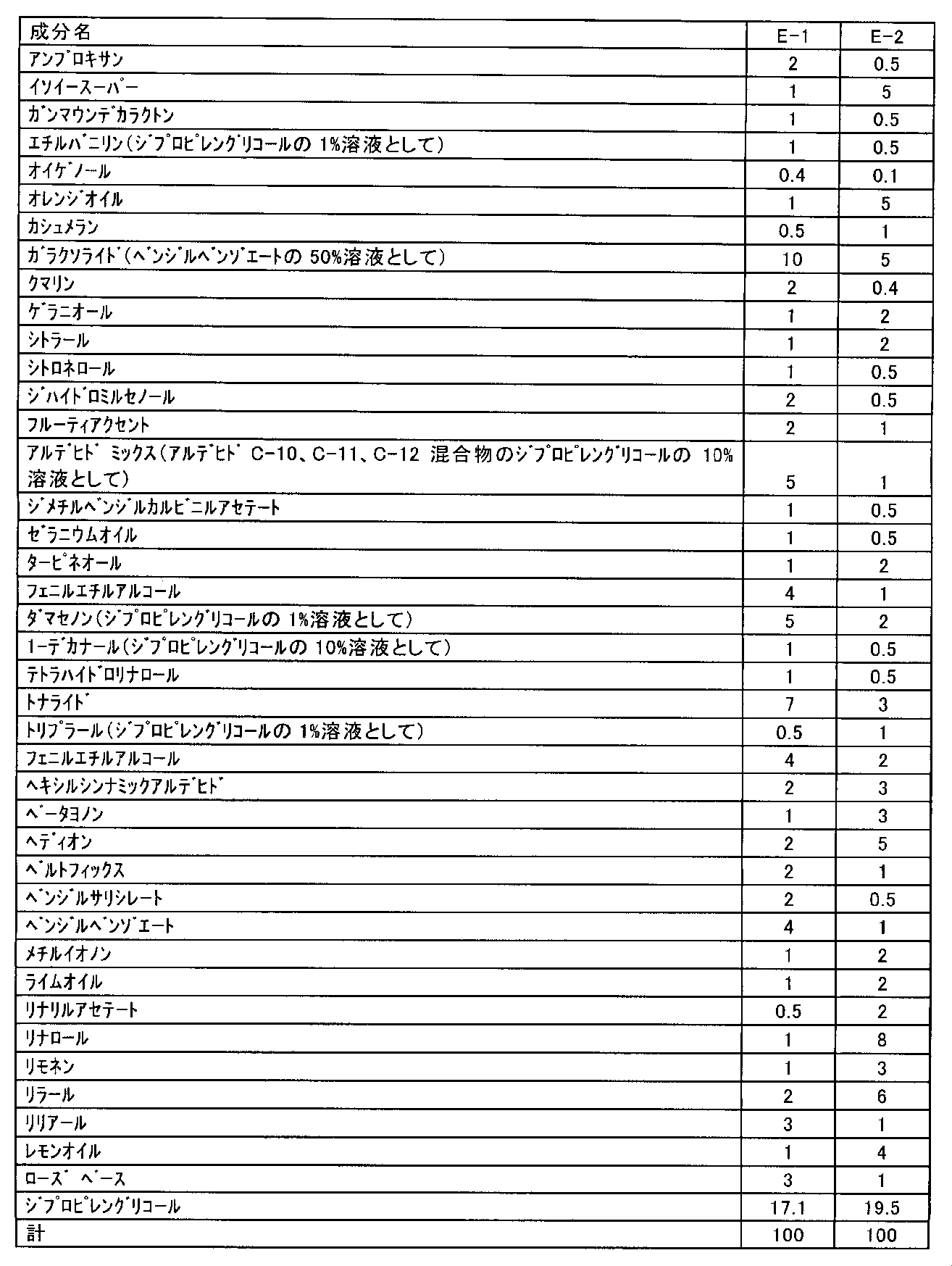

トレハロース((L)成分)
(L)トレハロース(株式会社林原社製)
抗菌剤((M)成分)
(M-1)
ロンザ社より商品名:Proxel IB(登録商標)として入手した、一般式(M-1)においてR11がヘキサメチレン基であり、nが12であり、HYが塩酸である化合物。
(M-2)
ライオンアクゾ社より商品名:トリアミンY12Dとして入手したN,N-ビス(3-アミノプロピル)ドデシルアミン(一般式(M-2)において、R12がドデシル基(炭素数12)であり、nが3である化合物)
高度分岐環状デキストリン((N)成分)
(N-1)
クラスターデキストリン(登録商標)(グリコ栄養食品株式会社製)
クラスターデキストリン(登録商標)の主成分は、分子量が3万から100万程度であり、分子内に10~100個程度のグルコースで構成された環状構造(内分岐環状構造部分)を1つ有し、さらにその環状構造部分に多数の非環状のグルカン鎖(外分岐構造部分)が結合した、重量平均重合度2500程度のデキストリンであった。
後述の表4に示す組成を有する実施例26~55及び比較例5~8の液体柔軟剤組成物を以下の手順にしたがって調製した。表4中、(A)~(N)成分の数値の単位は、液体柔軟剤組成物の総質量に対する質量%であり、(J)成分の数値の単位は、液体柔軟剤組成物に対するppm(質量基準)である。
液体柔軟剤組成物は、内径100mm、高さ150mmのガラス容器と、攪拌機(アジターSJ型、島津製作所製)を用い、次の手順により調製した。まず、(A)成分、(D)成分、(E)成分、(G)成分及び(I)成分を混合攪拌して、油相混合物を得た。他方、(C)成分、(J)成分及び必要に応じて(L)成分をバランス用イオン交換水に溶解させて水相混合物を得た。ここで、バランス用イオン交換水の質量は、900gから油相混合物と(B)成分及び(F)成分、(H)成分、(M)成分、(N)成分及び塩酸の合計質量を差し引いた残部に相当するものであった。次に、(A)成分の融点以上に加温した油相混合物をガラス容器に収納して攪拌しながら、(A)成分の融点以上に加温した水相混合物を2回に分割して添加し、攪拌した。ここで、水相混合物の分割比率は30:70(質量比)とし、攪拌は回転速度1,000rpmで、1回目の水相混合物添加後に3分間、2回目の水相混合物添加後に2分間行った。その後、(H)成分を添加し、その後、(B)成分、(F)成分を添加し、必要に応じて、(M)成分、(N)成分を添加し、塩酸(試薬1mol/L、関東化学)、または水酸化ナトリウム(試薬1mol/L、関東化学)を適量添加してpH2.5に調整し、更に全体質量が1,000gになるようにイオン交換水を添加して、目的の液体柔軟剤組成物を得た。
液体柔軟剤組成物は、内径100mm、高さ150mmのガラス容器と、攪拌機(アジターSJ型、島津製作所製)を用い、次の手順により調製した。まず、(A)成分、(B)成分、(D)成分、(E)成分、(G)成分及び(I)成分を混合攪拌して、油相混合物を得た。他方、(C)成分、(J)成分及び必要に応じて(L)成分をバランス用イオン交換水に溶解させて水相混合物を得た。ここで、バランス用イオン交換水の質量は、950gから油相混合物と(F)成分及び(H)成分の合計質量を差し引いた残部に相当するものであった。次に、(A)成分の融点以上に加温した油相混合物をガラス容器に収納して攪拌しながら、(A)成分の融点以上に加温した水相混合物を2回に分割して添加し、攪拌した。ここで、水相混合物の分割比率は30:70(質量比)とし、攪拌は回転速度1,000rpmで、1回目の水相混合物添加後に3分間、2回目の水相混合物添加後に2分間行った。その後、(F)成分及び(H)成分を添加し、その後、必要に応じて、(M)成分、(N)成分を添加し、塩酸(試薬1mol/L、関東化学)、または水酸化ナトリウム(試薬1mol/L、関東化学)を適量添加してpH2.5に調整し、更に全体質量が1,000gになるようにイオン交換水を添加して、目的の液体柔軟剤組成物を得た。
1.評価用布の前処理方法
市販の綿肌シャツ(BVD製)を市販洗剤「トップ」(ライオン社製)により二槽式洗濯機(三菱電機製CW-C30A1-H)を用いて3回前処理を行なった(洗剤標準使用量:浴比30倍。45℃の水道水。10分間の洗浄後、10分間の注水すすぎ2回)。
前処理洗浄した綿肌シャツ1.5kgを、二槽式洗濯機(三菱電機製CW-C30A1-H)を用いて、市販洗剤「トップ」(ライオン社製)で10分間洗浄した(標準使用量:浴比20倍。標準コース。25℃の水道水使用)。洗浄工程後、1分間の脱水を行った。脱水工程後、はじめに3分間のすすぎを行い、続く2回目のすすぎの際に液体柔軟剤組成物を投入して3分間の柔軟処理を行った(液体柔軟剤組成物の使用量:10mL。浴比20倍。25℃の水道水使用)。柔軟処理後、20℃、45%RHの恒温恒湿条件下で綿肌シャツ20時間乾燥させ、下記に示す評価試験に供した。
柔軟剤組成物の柔軟性を、処理後の被洗物の滑らかさを指標に評価した。具体的には、各柔軟剤組成物での処理により綿肌シャツへもたらされた滑らかさを、市販柔軟剤「ふんわりソフラン」(ライオン社製)を用いたこと以外は同条件で処理した綿肌シャツを対照として官能一対比較を行った。
評価は、下記の評価基準に従い、専門パネラー10人により行った。
5:対照よりも非常に滑らか
4:対照よりもかなり滑らか
3:対照よりもやや滑らか
2:対照と同等
1:対照よりも滑らかでない
各液体柔軟剤組成物100mLを軽量PSガラスビン(PS-No.11、田沼硝子工業所製)へ入れて密栓して、50℃で4週間保存した後に、その香り立ちを評価した。対照として、保存時の温度が5℃であったことを以外は同条件で保存したものを用いた。なお、保存後の対照の香り立ち及び香りの質は、保存前(調製直後)の香り立ち及び香りの質と同じ(不変)であった。
評価は、下記の評価基準に従い、専門パネラー10人により行った。
5:香り立ちが良く、香りの質が対照と比べて同等
4:香り立ちが良く、香りの質は対照と比べてごくわずかな違いが認められるが、異臭は感じられない
3:香り立ちが良いが、対照と比べてわずかに異臭が感じられる
2:香り立ちが若干悪く、対照と比べて香りの質にかなり違いがあり、異臭が感じられる1:香り立ちが悪く、対照と比べて香りの質に非常に違いがある
各液体柔軟剤組成物100mLを軽量PSガラスビン(PS-No.11、田沼硝子工業所製)へ入れて密栓して、50℃で2週間保存した後に、その黄変色度合いを評価した。対照として、保存時の温度が5℃であったことを以外は同条件で保存したものを用いた。なお、保存後の対照の外観は、保存前(調製直後)の外観と同じ(不変)であった。
評価は、下記の評価基準に従い、専門パネラー10人により行った。
5:対照と比べて同等
4:対照と比べてごくわずかに黄色く変化
3:対照と比べてわずかに黄色く変化
2:対照と比べてかなり黄色く変化
1:対照と比べて非常に黄色く変化
各液体柔軟剤組成物100mLを軽量PSガラスビン(PS-No.11、田沼硝子工業所製)へ入れて密栓して、40℃で4ヶ月間保存した後に、液体柔軟剤組成物の粘度上昇と計量キャップに計量する際の液体柔軟剤組成物の注ぎやすさについて評価した。
評価は、下記の評価基準に従い、専門パネラー10人により行った。
3: 問題なく計量できる
2: 粘度上昇はみられるが、問題なく計量できる
1: 粘度上昇がみられ、計量しにくい又は計量できない
1.着用後の洗浄処理
市販の綿肌シャツ(BVD製)を9時間着用後、ドラム式洗濯機(東芝製TW-4000VFL)を用いてお任せコース/設定にて洗濯をした(使用洗剤「トップNANOX」(ライオン社製)、洗浄15分、すすぎ1回、脱水5分、被洗物1.5kg)。すすぎ時に各液体柔軟剤組成物を自動投入口より投入した。洗剤使用量は10mL、液体柔軟剤組成物の使用量は5.0mLであった。洗濯後、そのままお任せ設定にて綿肌シャツを乾燥させた。
この着用と洗濯(柔軟剤処理)と乾燥とからなるサイクルを、同条件で5回繰り返した。5回目のサイクル実施後の綿肌シャツを試験布として供した。
試験布の胸部の皮脂のニオイの評価を、下記の6段階臭気強度の基準に従い、専門パネラー10名により行った。
5点:強烈なニオイ
4点:強いニオイ
3点:楽にわかるニオイ
2点:弱いニオイ
1点:何のニオイであるかわからない弱いニオイ(閾値)
0点:無臭
1.着用後の洗浄処理
上記の防臭性評価1の終了後の綿肌シャツを、防臭性評価1の欄に記載の着用と洗濯の各工程に更に付した。洗濯工程後、綿肌シャツをビニール袋に入れ30℃で12時間放置して、防臭性評価用の試験布とした。
試験布の胸部の皮脂のニオイの評価を、下記の6段階臭気強度の基準に従い、専門パネラー10名により行った。
5点:強烈なニオイ
4点:強いニオイ
3点:楽にわかるニオイ
2点:弱いニオイ
1点:何のニオイであるかわからない弱いニオイ(閾値)
0点:無臭


Claims (8)
- (A)炭素数10~24の炭化水素基を分子内に1個以上含有するアミン化合物、その中和物及びその4級化物からなる群より選ばれる1種以上のカチオン界面活性剤であって、 該炭化水素基は、エステル基、エーテル基及びアミド基からなる群より選ばれる1種以上の基により分断されていてもよい、カチオン界面活性剤、
(B)アミノ変性シリコーン、及び
(C)尿素、その複塩、及び、一般式(C):
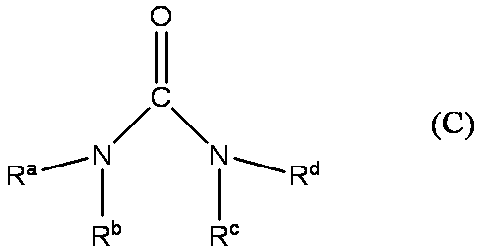
(式中、Raは、メチル基、エチル基又は炭素数1~2のヒドロキシアルキル基であり、Rb、Rc及びRdは、それぞれ独立に、水素原子、メチル基又はエチル基である。)で表される尿素誘導体からなる群より選ばれる1種以上の化合物
を含む液体柔軟剤組成物であって、
[(A)の質量+(B)の質量]/(C)の質量=1~40である
ことを特徴とする液体柔軟剤組成物。 - (A)が、下記一般式(A-III)、(A-IV)及び(A-V):
(各一般式中、R1は同一又は異なっていてもよい炭素数15~17の炭化水素基である。)で表される化合物の4級化物の混合物である、請求項1に記載の液体柔軟剤組成物。
- [(A)の質量+(B)の質量]/(C)の質量=1~5である、請求項1又は2に記載の液体柔軟剤組成物。
- (B)が、末端に-H基及び/又は-OH基を有するアミノ変性シリコーンを界面活性剤で乳化重合してなるエマルジョンである、請求項1~3のいずれかに記載の液体柔軟剤組成物。
- (C)が、尿素又はジメチル尿素である、請求項1~4のいずれかに記載の液体柔軟剤組成物。
- 更に、(L)トレハロースを含有することを特徴とする、請求項1~5のいずれかに記載の液体柔軟剤組成物。
- 更に、(N)高度分岐環状デキストリンを含有することを特徴とする、請求項1~6のいずれかに記載の液体柔軟剤組成物。
- 更に、(M)ビグアニド系抗菌剤及び下記一般式(M-2):
R12-N[(CH2)n-NH2]2 (M-2)
(式中、R12は、炭素数8~18のアルキル基を表し、nは1~4の数である。)で表される化合物からなる群より選ばれる1種以上の抗菌剤を含有することを特徴とする、請求項1~7のいずれかに記載の液体柔軟剤組成物。
Priority Applications (2)
| Application Number | Priority Date | Filing Date | Title |
|---|---|---|---|
| KR1020147031979A KR101988072B1 (ko) | 2012-06-29 | 2013-06-28 | 액체 유연제 조성물 |
| JP2014522707A JP5995294B2 (ja) | 2012-06-29 | 2013-06-28 | 液体柔軟剤組成物 |
Applications Claiming Priority (2)
| Application Number | Priority Date | Filing Date | Title |
|---|---|---|---|
| JP2012147487 | 2012-06-29 | ||
| JP2012-147487 | 2012-06-29 |
Publications (1)
| Publication Number | Publication Date |
|---|---|
| WO2014003180A1 true WO2014003180A1 (ja) | 2014-01-03 |
Family
ID=49783314
Family Applications (1)
| Application Number | Title | Priority Date | Filing Date |
|---|---|---|---|
| PCT/JP2013/067887 Ceased WO2014003180A1 (ja) | 2012-06-29 | 2013-06-28 | 液体柔軟剤組成物 |
Country Status (4)
| Country | Link |
|---|---|
| JP (1) | JP5995294B2 (ja) |
| KR (1) | KR101988072B1 (ja) |
| MY (1) | MY171472A (ja) |
| WO (1) | WO2014003180A1 (ja) |
Cited By (12)
| Publication number | Priority date | Publication date | Assignee | Title |
|---|---|---|---|---|
| JP2014118640A (ja) * | 2012-12-13 | 2014-06-30 | Lion Corp | 液体柔軟剤組成物 |
| JP2016113705A (ja) * | 2014-12-11 | 2016-06-23 | ライオン株式会社 | 液体柔軟剤組成物 |
| JP2017031520A (ja) * | 2015-07-31 | 2017-02-09 | 高砂香料工業株式会社 | 柔軟剤組成物 |
| JP2018507845A (ja) * | 2015-02-27 | 2018-03-22 | ダウ グローバル テクノロジーズ エルエルシー | 相乗的抗微生物組成物 |
| JP2018095975A (ja) * | 2016-12-08 | 2018-06-21 | ライオン株式会社 | 液体柔軟剤組成物 |
| CN111212894A (zh) * | 2017-10-13 | 2020-05-29 | 荷兰联合利华有限公司 | 水性喷雾组合物 |
| CN113529424A (zh) * | 2021-07-27 | 2021-10-22 | 浙江万福染整有限公司 | 一种纬编超柔的柔软剂配方、制备方法及装置 |
| JP2022182311A (ja) * | 2021-05-28 | 2022-12-08 | 花王株式会社 | 着香剤組成物 |
| US11649416B2 (en) | 2017-10-13 | 2023-05-16 | Conopco, Inc. | Aqueous spray composition comprising silicone and perfume microemulsions |
| US11725163B2 (en) | 2017-10-13 | 2023-08-15 | Conopco, Inc. | Aqueous spray composition |
| US11987771B2 (en) | 2017-10-13 | 2024-05-21 | Conopco, Inc. | Fabric spray composition comprising a non-functionalized silicone nanoemulsion and peg-40 hydrogenated castor oil |
| WO2025068507A1 (en) * | 2023-09-29 | 2025-04-03 | Byk-Chemie Gmbh | Rheology control agent |
Citations (6)
| Publication number | Priority date | Publication date | Assignee | Title |
|---|---|---|---|---|
| EP0547723A1 (en) * | 1991-12-18 | 1993-06-23 | Colgate-Palmolive Company | Free-flowing powder fabric softening composition and process for its manufacture |
| JP2002515551A (ja) * | 1998-05-18 | 2002-05-28 | ユニリーバー・ナームローゼ・ベンノートシヤープ | 安定化された第四級アンモニウム組成物 |
| WO2006023853A1 (en) * | 2004-08-23 | 2006-03-02 | Nano-Tex, Inc. | Compositions and methods for treating textiles to impart wrinkle resistance, softness and hydrophilicity |
| JP2007284843A (ja) * | 2006-04-20 | 2007-11-01 | Kao Corp | 繊維製品処理剤組成物 |
| JP2008150756A (ja) * | 2006-12-20 | 2008-07-03 | Lion Corp | 乳濁型液体柔軟剤組成物及びその製造方法 |
| JP2013057011A (ja) * | 2011-09-08 | 2013-03-28 | Lion Corp | 衣料用液体洗剤組成物 |
Family Cites Families (9)
| Publication number | Priority date | Publication date | Assignee | Title |
|---|---|---|---|---|
| JPS5684797A (en) * | 1979-11-08 | 1981-07-10 | Lion Corp | Liquid detergent composition |
| JP2763654B2 (ja) | 1990-06-13 | 1998-06-11 | 花王株式会社 | 液体柔軟仕上剤 |
| JP2622926B2 (ja) * | 1993-03-10 | 1997-06-25 | 資生堂ホネケーキ工業株式会社 | 透明状固型洗浄剤 |
| JP4039750B2 (ja) * | 1998-10-05 | 2008-01-30 | ライオン株式会社 | 繊維製品用液体仕上げ剤組成物 |
| JP2003003378A (ja) | 2001-06-20 | 2003-01-08 | Ge Toshiba Silicones Co Ltd | 繊維処理剤 |
| JP4055574B2 (ja) | 2002-12-27 | 2008-03-05 | ライオン株式会社 | 液体柔軟剤組成物 |
| JP4055575B2 (ja) | 2002-12-27 | 2008-03-05 | ライオン株式会社 | 液体柔軟剤組成物 |
| KR101358540B1 (ko) * | 2006-08-07 | 2014-02-05 | 라이온 가부시키가이샤 | 액체 유연제 조성물 |
| JP2012202000A (ja) | 2011-03-25 | 2012-10-22 | Lion Corp | 繊維処理剤組成物 |
-
2013
- 2013-06-28 JP JP2014522707A patent/JP5995294B2/ja active Active
- 2013-06-28 KR KR1020147031979A patent/KR101988072B1/ko not_active Expired - Fee Related
- 2013-06-28 MY MYPI2014003557A patent/MY171472A/en unknown
- 2013-06-28 WO PCT/JP2013/067887 patent/WO2014003180A1/ja not_active Ceased
Patent Citations (6)
| Publication number | Priority date | Publication date | Assignee | Title |
|---|---|---|---|---|
| EP0547723A1 (en) * | 1991-12-18 | 1993-06-23 | Colgate-Palmolive Company | Free-flowing powder fabric softening composition and process for its manufacture |
| JP2002515551A (ja) * | 1998-05-18 | 2002-05-28 | ユニリーバー・ナームローゼ・ベンノートシヤープ | 安定化された第四級アンモニウム組成物 |
| WO2006023853A1 (en) * | 2004-08-23 | 2006-03-02 | Nano-Tex, Inc. | Compositions and methods for treating textiles to impart wrinkle resistance, softness and hydrophilicity |
| JP2007284843A (ja) * | 2006-04-20 | 2007-11-01 | Kao Corp | 繊維製品処理剤組成物 |
| JP2008150756A (ja) * | 2006-12-20 | 2008-07-03 | Lion Corp | 乳濁型液体柔軟剤組成物及びその製造方法 |
| JP2013057011A (ja) * | 2011-09-08 | 2013-03-28 | Lion Corp | 衣料用液体洗剤組成物 |
Cited By (13)
| Publication number | Priority date | Publication date | Assignee | Title |
|---|---|---|---|---|
| JP2014118640A (ja) * | 2012-12-13 | 2014-06-30 | Lion Corp | 液体柔軟剤組成物 |
| JP2016113705A (ja) * | 2014-12-11 | 2016-06-23 | ライオン株式会社 | 液体柔軟剤組成物 |
| JP2018507845A (ja) * | 2015-02-27 | 2018-03-22 | ダウ グローバル テクノロジーズ エルエルシー | 相乗的抗微生物組成物 |
| JP2017031520A (ja) * | 2015-07-31 | 2017-02-09 | 高砂香料工業株式会社 | 柔軟剤組成物 |
| JP2018095975A (ja) * | 2016-12-08 | 2018-06-21 | ライオン株式会社 | 液体柔軟剤組成物 |
| US11725163B2 (en) | 2017-10-13 | 2023-08-15 | Conopco, Inc. | Aqueous spray composition |
| US11649416B2 (en) | 2017-10-13 | 2023-05-16 | Conopco, Inc. | Aqueous spray composition comprising silicone and perfume microemulsions |
| CN111212894A (zh) * | 2017-10-13 | 2020-05-29 | 荷兰联合利华有限公司 | 水性喷雾组合物 |
| US11807834B2 (en) | 2017-10-13 | 2023-11-07 | Conopco, Inc. | Aqueous spray composition |
| US11987771B2 (en) | 2017-10-13 | 2024-05-21 | Conopco, Inc. | Fabric spray composition comprising a non-functionalized silicone nanoemulsion and peg-40 hydrogenated castor oil |
| JP2022182311A (ja) * | 2021-05-28 | 2022-12-08 | 花王株式会社 | 着香剤組成物 |
| CN113529424A (zh) * | 2021-07-27 | 2021-10-22 | 浙江万福染整有限公司 | 一种纬编超柔的柔软剂配方、制备方法及装置 |
| WO2025068507A1 (en) * | 2023-09-29 | 2025-04-03 | Byk-Chemie Gmbh | Rheology control agent |
Also Published As
| Publication number | Publication date |
|---|---|
| JP5995294B2 (ja) | 2016-09-21 |
| MY171472A (en) | 2019-10-15 |
| JPWO2014003180A1 (ja) | 2016-06-02 |
| KR20150027052A (ko) | 2015-03-11 |
| KR101988072B1 (ko) | 2019-06-11 |
Similar Documents
| Publication | Publication Date | Title |
|---|---|---|
| JP5995294B2 (ja) | 液体柔軟剤組成物 | |
| JP6159988B2 (ja) | 繊維製品用処理剤組成物 | |
| JP2009161866A (ja) | 液体仕上げ剤組成物 | |
| US9157183B2 (en) | Treatment composition for textile goods | |
| JP5906523B2 (ja) | 繊維製品用処理剤組成物 | |
| JP5863114B2 (ja) | 繊維製品用液体処理剤組成物 | |
| JP5953580B2 (ja) | 液体柔軟剤組成物 | |
| JP6444300B2 (ja) | 繊維製品用液体処理剤組成物 | |
| JP5396642B2 (ja) | 繊維製品用液体仕上げ剤組成物 | |
| JP6429393B2 (ja) | 繊維処理剤組成物 | |
| JP5961872B2 (ja) | 液体柔軟剤組成物 | |
| JP2019214799A (ja) | 液体柔軟剤組成物 | |
| JP6171202B2 (ja) | 繊維製品の処理方法 | |
| JP5853337B2 (ja) | 液体柔軟剤組成物 | |
| JP4956822B2 (ja) | 液体仕上げ剤組成物 | |
| JP4706816B2 (ja) | 液体柔軟剤組成物 | |
| JP2005187973A (ja) | 液体柔軟剤組成物 | |
| JP6171200B2 (ja) | 繊維製品用処理剤組成物 | |
| JP6929118B2 (ja) | 繊維製品用処理剤組成物 | |
| JP5245148B2 (ja) | 液体柔軟剤組成物 | |
| JP2017101343A (ja) | 液体柔軟剤組成物 | |
| JP4841275B2 (ja) | 仕上げ剤組成物 | |
| JP4956821B2 (ja) | 液体柔軟剤組成物 |
Legal Events
| Date | Code | Title | Description |
|---|---|---|---|
| 121 | Ep: the epo has been informed by wipo that ep was designated in this application |
Ref document number: 13808678 Country of ref document: EP Kind code of ref document: A1 |
|
| ENP | Entry into the national phase |
Ref document number: 2014522707 Country of ref document: JP Kind code of ref document: A |
|
| ENP | Entry into the national phase |
Ref document number: 20147031979 Country of ref document: KR Kind code of ref document: A |
|
| NENP | Non-entry into the national phase |
Ref country code: DE |
|
| 122 | Ep: pct application non-entry in european phase |
Ref document number: 13808678 Country of ref document: EP Kind code of ref document: A1 |