WO2014002994A1 - 高分子化合物の製造方法、および高分子化合物 - Google Patents
高分子化合物の製造方法、および高分子化合物 Download PDFInfo
- Publication number
- WO2014002994A1 WO2014002994A1 PCT/JP2013/067368 JP2013067368W WO2014002994A1 WO 2014002994 A1 WO2014002994 A1 WO 2014002994A1 JP 2013067368 W JP2013067368 W JP 2013067368W WO 2014002994 A1 WO2014002994 A1 WO 2014002994A1
- Authority
- WO
- WIPO (PCT)
- Prior art keywords
- polymer compound
- exchange resin
- acid
- concentration
- molecular weight
- Prior art date
- Legal status (The legal status is an assumption and is not a legal conclusion. Google has not performed a legal analysis and makes no representation as to the accuracy of the status listed.)
- Ceased
Links
Images


Classifications
-
- C—CHEMISTRY; METALLURGY
- C08—ORGANIC MACROMOLECULAR COMPOUNDS; THEIR PREPARATION OR CHEMICAL WORKING-UP; COMPOSITIONS BASED THEREON
- C08G—MACROMOLECULAR COMPOUNDS OBTAINED OTHERWISE THAN BY REACTIONS ONLY INVOLVING UNSATURATED CARBON-TO-CARBON BONDS
- C08G63/00—Macromolecular compounds obtained by reactions forming a carboxylic ester link in the main chain of the macromolecule
- C08G63/88—Post-polymerisation treatment
- C08G63/90—Purification; Drying
-
- B—PERFORMING OPERATIONS; TRANSPORTING
- B01—PHYSICAL OR CHEMICAL PROCESSES OR APPARATUS IN GENERAL
- B01J—CHEMICAL OR PHYSICAL PROCESSES, e.g. CATALYSIS OR COLLOID CHEMISTRY; THEIR RELEVANT APPARATUS
- B01J41/00—Anion exchange; Use of material as anion exchangers; Treatment of material for improving the anion exchange properties
- B01J41/08—Use of material as anion exchangers; Treatment of material for improving the anion exchange properties
- B01J41/12—Macromolecular compounds
-
- B—PERFORMING OPERATIONS; TRANSPORTING
- B01—PHYSICAL OR CHEMICAL PROCESSES OR APPARATUS IN GENERAL
- B01J—CHEMICAL OR PHYSICAL PROCESSES, e.g. CATALYSIS OR COLLOID CHEMISTRY; THEIR RELEVANT APPARATUS
- B01J39/00—Cation exchange; Use of material as cation exchangers; Treatment of material for improving the cation exchange properties
- B01J39/08—Use of material as cation exchangers; Treatment of material for improving the cation exchange properties
- B01J39/16—Organic material
- B01J39/18—Macromolecular compounds
-
- C—CHEMISTRY; METALLURGY
- C08—ORGANIC MACROMOLECULAR COMPOUNDS; THEIR PREPARATION OR CHEMICAL WORKING-UP; COMPOSITIONS BASED THEREON
- C08G—MACROMOLECULAR COMPOUNDS OBTAINED OTHERWISE THAN BY REACTIONS ONLY INVOLVING UNSATURATED CARBON-TO-CARBON BONDS
- C08G63/00—Macromolecular compounds obtained by reactions forming a carboxylic ester link in the main chain of the macromolecule
- C08G63/68—Polyesters containing atoms other than carbon, hydrogen and oxygen
- C08G63/685—Polyesters containing atoms other than carbon, hydrogen and oxygen containing nitrogen
- C08G63/6854—Polyesters containing atoms other than carbon, hydrogen and oxygen containing nitrogen derived from polycarboxylic acids and polyhydroxy compounds
- C08G63/6856—Dicarboxylic acids and dihydroxy compounds
-
- C—CHEMISTRY; METALLURGY
- C08—ORGANIC MACROMOLECULAR COMPOUNDS; THEIR PREPARATION OR CHEMICAL WORKING-UP; COMPOSITIONS BASED THEREON
- C08G—MACROMOLECULAR COMPOUNDS OBTAINED OTHERWISE THAN BY REACTIONS ONLY INVOLVING UNSATURATED CARBON-TO-CARBON BONDS
- C08G63/00—Macromolecular compounds obtained by reactions forming a carboxylic ester link in the main chain of the macromolecule
- C08G63/78—Preparation processes
- C08G63/82—Preparation processes characterised by the catalyst used
-
- C—CHEMISTRY; METALLURGY
- C08—ORGANIC MACROMOLECULAR COMPOUNDS; THEIR PREPARATION OR CHEMICAL WORKING-UP; COMPOSITIONS BASED THEREON
- C08G—MACROMOLECULAR COMPOUNDS OBTAINED OTHERWISE THAN BY REACTIONS ONLY INVOLVING UNSATURATED CARBON-TO-CARBON BONDS
- C08G63/00—Macromolecular compounds obtained by reactions forming a carboxylic ester link in the main chain of the macromolecule
- C08G63/91—Polymers modified by chemical after-treatment
- C08G63/914—Polymers modified by chemical after-treatment derived from polycarboxylic acids and polyhydroxy compounds
- C08G63/916—Dicarboxylic acids and dihydroxy compounds
-
- C—CHEMISTRY; METALLURGY
- C08—ORGANIC MACROMOLECULAR COMPOUNDS; THEIR PREPARATION OR CHEMICAL WORKING-UP; COMPOSITIONS BASED THEREON
- C08G—MACROMOLECULAR COMPOUNDS OBTAINED OTHERWISE THAN BY REACTIONS ONLY INVOLVING UNSATURATED CARBON-TO-CARBON BONDS
- C08G2140/00—Compositions for moulding powders
Definitions
- the present invention relates to a method for producing a polymer compound, and a polymer compound.
- This application claims priority based on Japanese Patent Application No. 2012-142968 filed in Japan on June 26, 2012 and Japanese Patent Application No. 2012-264382 filed on Japan on December 3, 2012 And the contents thereof are incorporated herein.
- a resist film is formed on a substrate, and the resist film is exposed and developed to form a resist pattern.
- resist patterns have been rapidly miniaturized due to advances in lithography technology.
- As a technique for miniaturization there is a reduction in wavelength of irradiation light. Specifically, the irradiation light has been shortened from g-line (wavelength: 438 nm) or i-line (wavelength: 365 nm) to DUV (Deep Ultra Violet) having a wavelength of 300 nm or less.
- KrF excimer laser (wavelength: 248 nm) lithography technology and ArF excimer laser (wavelength: 193 nm) lithography technology are introduced.
- studies have been made on shorter-wavelength EUV (wavelength: 13.5 nm) lithography technology.
- intensive research has been conducted on electron beam lithography technology and immersion lithography technology in which exposure is performed in a liquid such as water.
- various thin films such as an antireflection film, a gap fill film, and a top coat film are used.
- those containing a polymer compound are generally used.
- metal contamination occurs in the manufacture of high-density integrated circuits, computer chips, computer hard drives, and the like, it often leads to an increase in defects and a loss in yield, which is a major factor causing performance degradation.
- a metal impurity such as sodium or iron (for example, a metal ion, a metal powder, or a transition complex) is present in a polymer compound used in a lithography process, there is a risk of causing metal contamination during plasma peeling. .
- metal impurities reduces the performance and stability of semiconductor devices. It has been confirmed that these main factors are light metals such as sodium and heavy metals such as iron contained in the polymer compound used in the lithography process. Furthermore, it has also been found that metal impurity concentrations of less than 100 ppb in the polymer compound adversely affect the performance and stability of such electronic devices.
- the metal impurity concentration in a polymer compound is controlled by selecting raw materials that meet strict impurity concentration standards, or by performing thorough process management so that metal impurities do not enter the polymer compound at the production stage. ing. However, with the strict standardization of the metal impurity concentration, it is necessary to produce a polymer compound by a method in which drastic mixing of metal impurities is controlled.
- a method for reducing metal impurities in a polymer compound a method is proposed in which a polymer compound solution is passed through a filter that does not contain a strongly acidic ion exchange group and contains a charge control agent that generates a zeta potential (patent). Reference 1). Also, the step of bringing the polymer compound solution into contact with the cation exchange resin (T1), the step of bringing the polymer compound solution into contact with the mixed resin of the cation exchange resin and the anion exchange resin (T2), and the polymer compound solution into the positive zeta potential. There has been proposed a method in which the step (T3) of passing through a filter containing a substance having a liquid is combined (PTL 2).
- an acid catalyst or a base catalyst remains as an impurity in addition to metal impurities in the resulting polymer compound.
- the acid catalyst or base catalyst impurity affects the performance and stability of the semiconductor device as well as the metal impurity.
- the polymerization reaction is stopped using a basic compound as a reaction terminator.
- the polymerization reaction is stopped using an acidic compound as a reaction terminator.
- reaction terminators also become impurities and remain in the polymer compound, affecting the performance and stability of the semiconductor device.
- the polymer compound when obtaining a polymer compound in the presence of an acid catalyst, the polymer compound contains impurities derived from an acid catalyst and impurities derived from a reaction terminator (basic compound).
- the polymer compound when a polymer compound is obtained in the presence of a base catalyst, the polymer compound contains impurities derived from the base catalyst and impurities derived from the reaction terminator (acidic compound). Therefore, it is also required to reduce the concentration of these impurities in the polymer compound.
- the impurities derived from the acid catalyst and the reaction terminator are collectively referred to as “acid impurities”, and the impurities derived from the base catalyst and the reaction terminator (basic compound) are collectively referred to as basic impurities.
- Patent Document 2 relates to a method for producing a (meth) acrylic copolymer, and there is no description that the concentration of acid and base impurities can be reduced.
- the present invention has been made in view of the above circumstances, a production method capable of producing a polymer compound having a low metal impurity concentration and a sufficiently reduced acid and base impurity concentration with high productivity, and a low metal impurity concentration.
- Another object of the present invention is to provide a polymer compound in which the concentration of acid and base impurities is sufficiently reduced.
- a solution containing a polymer compound obtained in the presence of an acid catalyst or a base catalyst, or a solution containing a polymer compound obtained by purifying the polymer compound by a reprecipitation method is used as an anion exchange resin and a cation exchange resin. It has been found that a polymer compound in which not only the metal impurity concentration but also the acid and base impurity concentrations are sufficiently reduced can be produced with good productivity by contacting with the mixed resin.
- the present inventors have found that the metal impurity concentration and the acid and base impurity concentrations can be further reduced if the solution containing the polymer compound is brought into contact with the mixed resin and then passed through a specific filter, thereby completing the present invention. .
- a method for producing a polymer compound comprising the following steps (a) and (b).
- a mass ratio of the anion exchange resin to the cation exchange resin is 60/40 to 99/1.
- ⁇ 3> The method for producing a polymer compound according to ⁇ 1> or ⁇ 2>, wherein the polymer compound is obtained by adding a crosslinking agent to a side chain.
- ⁇ 4> The method for producing a polymer compound according to any one of ⁇ 1> to ⁇ 3>, wherein the polymer compound is a polyester polymer compound.
- ⁇ 5> The method for producing a polymer compound according to any one of ⁇ 1> to ⁇ 4>, wherein the acid catalyst is a sulfonic acid.
- ⁇ 6> The method for producing a polymer compound according to any one of ⁇ 1> to ⁇ 4>, wherein the base catalyst is a tertiary amine.
- the total concentration of acid and base impurities is 50 ppm or less, and each metal impurity concentration of sodium, potassium, calcium, and iron is 80 ppb or less, and when the film thickness is reduced to 400 nm or less, the wavelength is 193 nm.
- n value refractive index
- k value attenuation coefficient
- ⁇ 12> The polymer compound according to any one of ⁇ 9> to ⁇ 11>, wherein a crosslinking agent is added to the side chain.
- ⁇ 13> The polymer compound according to any one of ⁇ 9> to ⁇ 12>, which is a polyester polymer compound.
- a polymer compound having a low metal impurity concentration and a sufficiently reduced acid and base impurity concentration can be produced with high productivity.
- the polymer compound of the present invention has a low metal impurity concentration and a sufficiently reduced acid and base impurity concentration.
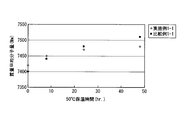
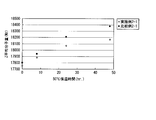
- 6 is a graph showing the storage stability test results of Example 1-1 and Comparative example 1-1. 6 is a graph showing the storage stability test results of Example 1-1 and Comparative example 1-1. 6 is a graph showing the storage stability test results of Example 2-1 and Comparative Example 2-1. 6 is a graph showing the storage stability test results of Example 2-1 and Comparative Example 2-1.
- (meth) acryl is a general term for acrylic and methacrylic.
- mass average molecular weight (Mw) and the Z average molecular weight (Mz) of the polymer compound in the present invention are values obtained in terms of polystyrene by gel permeation chromatography (GPC).
- the method for producing a polymer compound of the present invention includes the following steps (a) and (b).
- the production method preferably further includes the following steps (c) and (d).
- Step (b) A step of bringing the solution containing the polymer compound obtained in the step (a) into contact with a mixed resin obtained by mixing an anion exchange resin and a cation exchange resin.
- Step (d) A step of mixing the solution containing the polymer compound obtained in step (c) with a poor solvent for the polymer compound to precipitate the polymer compound to obtain a powdery polymer compound.
- Step (a) is a step of obtaining a polymer compound in the presence of an acid catalyst or a base catalyst.
- the step (a) is specifically the following step (a-1) or step (a-2).
- Step (a-1) A step of polymerizing a monomer in the presence of an acid catalyst, and using a basic compound to stop the polymerization reaction to obtain a polymer compound.
- Step (a-2) A step of polymerizing a monomer in the presence of a base catalyst and stopping the polymerization reaction using an acidic compound to obtain a polymer compound.
- carboxylic acid such as oxalic acid, maleic anhydride, maleic acid, or its anhydride
- Sulphonic acid such as p-toluenesulfonic acid, methanesulfonic acid, naphthalenesulfonic acid, or its anhydride
- Sulfuric acid hydrochloric acid, nitric acid and the like.
- sulfonic acid or its anhydride is preferable, and sulfonic acid is more preferable. Since sulfonic acid or its anhydride is strongly acidic, has high reactivity, and has a low water content that inhibits condensation polymerization, it is suitable as an acid catalyst.
- These acid catalysts may be used alone or in combination of two or more.
- the base catalyst is not particularly limited, and examples thereof include amines such as diethylamine, triethylamine, and pyridine; and hydroxides such as sodium hydroxide, sodium carbonate, potassium hydroxide, and potassium carbonate.
- amines are preferable in terms of low metal content, and among them, tertiary amines (for example, triethylamine) are more preferable.
- Tertiary amines are suitable as basic catalysts because they are strongly basic, have high reactivity, and do not contain active hydrogen that tends to cause side reactions.
- an acidic compound used as a reaction terminator the same acid catalyst as described above can be used.
- sulfonic acid or its anhydride is preferable in terms of low water content, and sulfonic acid is more preferable.
- a basic compound used as a reaction terminator the same thing as the basic catalyst mentioned above can be used.
- amines are preferable in that the metal content is low.
- tertiary amines for example, triethylamine
- the polymer compound obtained in the presence of the acid catalyst is not particularly limited, and examples thereof include polyester polymer compounds, polyether polymer compounds, and acrylic polymer compounds.
- the polymer compound obtained in the presence of a base catalyst is not particularly limited, and examples thereof include acrylic polymer compounds and siloxane polymer compounds.
- limit especially as a preferable high molecular compound A polyester type high molecular compound is preferable at the point which is excellent in an etching rate etc. and is optimal for application to a semiconductor lithography technique.
- a method for obtaining the polymer compound is not particularly limited, and a known polymerization method such as a solution polymerization method, an emulsion polymerization method, a suspension polymerization method, or a bulk polymerization method can be employed.
- a solution polymerization method is preferably used.
- the step (a) will be described in detail, taking as an example the case of obtaining a polyester polymer compound.
- Polyester polymer compounds are prepared by, for example, dissolving a dicarboxylic acid and a diol as monomers in a polymerization solvent, heating to an appropriate temperature for the polymerization reaction in the presence of an acid catalyst, and then performing a condensation polymerization reaction, and then cooling to an appropriate temperature. Then, a basic compound can be added as a reaction terminator to stop the polycondensation reaction. From the viewpoint of shortening the reaction time until the target molecular weight is reached and precise control of the molecular weight, the polycondensation reaction is preferably carried out at 100 to 150 ° C, more preferably 120 to 145 ° C.
- the polymerization solvent used for the polymerization of the polyester polymer compound is not particularly limited, but a solvent that can dissolve any of the monomer, the acid catalyst, and the resulting polymer (polyester polymer compound) is preferable.
- examples of such an organic solvent include anisole, 1,4-dioxane, acetone, tetrahydrofuran (THF), methyl ethyl ketone (MEK), methyl isobutyl ketone (MIBK), toluene, xylene and the like.
- condensation polymerization reaction it is preferable to control the dehydration and dealcoholization reaction using a monomer in which the functional group (carboxyl group) of dicarboxylic acid is protected with an alkyl group.
- a monomer in which the functional group (carboxyl group) of dicarboxylic acid is protected with an alkyl group As a result, gelation and the like can be suppressed, so that it is possible to obtain a polyester polymer compound suitable for use in a polymer compound for lithography, particularly a polymer compound for an antireflection film.
- the polymer compound obtained in the step (a) preferably has a crosslinking agent added to the side chain.
- a crosslinking agent added to the side chain.
- a compound having a site that absorbs actinic rays used in the lithography process can be used.
- glycoluril, methylated glycoluril, butylated glycoluril, tetramethoxyglycoluril, methylated melamine resin , N-methoxymethyl-melamine, urethane urea, amino group or vinyl ether are preferable in that a polymer compound having excellent antireflection film performance can be obtained.
- the etching rate can be improved.
- the crosslinking agent may be added to the (reaction) solution containing the polymer compound to allow further reaction, thereby crosslinking the functional group contained in the polymer compound.
- a polymer compound in which an agent is added and a crosslinking agent is added to the side chain is obtained.
- the crosslinking agent addition reaction is preferably performed at 50 ° C. or less, more preferably 15 to 30 ° C., and still more preferably. 18-22 ° C.
- the polyester polymer compound has been described as an example, but the present invention is not limited to this.
- a monomer is polymerized using a polymerization initiator in the presence of a polymerization solvent, and a polymer compound such as a (meth) acrylic polymer compound, a polyether polymer compound, or a polyamide polymer compound.
- a polymer compound such as a (meth) acrylic polymer compound, a polyether polymer compound, or a polyamide polymer compound.
- an acid catalyst and a crosslinking agent are added to a solution containing these polymer compounds to carry out a crosslinking agent addition reaction, whereby a polymer compound having a crosslinking agent added to the side chain can be obtained.
- step (a) often contains metal impurities, acid and base impurities in the raw material or manufacturing process, and it is also clear that these impurities adversely affect the performance and stability of electronic devices. It has become. Therefore, it is necessary to remove impurities to a low concentration by the following step (b). Further, if step (c) and step (d) are further performed after step (b), impurities can be removed to a lower concentration.
- Step (b) is a step of bringing the solution containing the polymer compound obtained in step (a) into contact with a mixed resin obtained by mixing an anion exchange resin and a cation exchange resin.
- the solution containing the polymer compound may be brought into contact with the mixed resin as it is, or a solution obtained by re-dissolving the polymer compound precipitated by mixing the solution containing the polymer compound and the poor solvent. You may make it contact with mixed resin. In particular, it is preferable to contact a mixed resin with a solution in which a polymer compound precipitated by a poor solvent is redissolved.
- the polymerization reaction solution can be used as it is as a solution containing the polymer compound.
- the polymerization reaction solution may be diluted to an appropriate solution viscosity with a diluting solvent as necessary.
- Diluting solvents include anisole, 1,4-dioxane, acetone, THF, MEK, MIBK, ⁇ -butyrolactone, propylene glycol monomethyl ether acetate (PGMEA), propylene glycol monomethyl ether (PGME), ethyl lactate, toluene, xylene, 2 -Methyl hydroxyisobutyrate (HBM) and the like. These may use 1 type and may use 2 or more types together.
- the solubility parameter (hereinafter also referred to as “SP value”) of the solvent (a mixture of the polymerization solvent and the dilution solvent) in the polymerization reaction solution after dilution, and the SP value of the poor solvent used for reprecipitation purification The difference is preferably smaller in that good dispersibility of the polymer compound can be obtained and the monomer can be efficiently removed.
- the SP value of the solvent can be determined, for example, by the method described in “Polymer Handbook”, 4th edition, pages VII-675 to VII-711. Specific examples are described in Table 1 (pages VII-683) and Tables 7 to 8 (pages VII-688 to VII-711).
- the SP value in a mixed solvent of a plurality of solvents can be determined by a known method.
- the SP value of the mixed solvent can be obtained as the sum of products of the SP value of each solvent and the volume fraction, assuming that additivity is established.
- the poor solvent used for reprecipitation purification of the polymer compound is a solvent that has a small ability to dissolve the target polymer compound and can precipitate the polymer compound, and varies depending on the polymer compound.
- a known solvent can be appropriately selected and used according to the composition of the target polymer compound. For example, when the polymer compound is used for lithography, unreacted monomers and the like can be efficiently removed.
- the poor solvent methanol, 2-propanol, diisopropyl ether, methyl tertiary butyl ether (MTBE), hexane, heptane Water is preferred.
- a poor solvent may be used individually by 1 type, and may use 2 or more types together.
- the reprecipitation-purified polymer compound is obtained in the form of a wet powder.
- a solution obtained by re-dissolving the polymer compound in a solvent is brought into contact with the mixed resin.
- the solvent used for redissolving the polymer compound is not particularly limited as long as it can dissolve the polymer compound, and examples thereof include the above-described dilution solvents.
- the mixed resin used in the step (b) is a mixture of an anion exchange resin and a cation exchange resin.
- the anion exchange resin mainly serves to adsorb and remove the acid catalyst used in step (a) and the acidic compound that is a reaction terminator.
- the monomer remaining in the polymer compound can be removed by an anion exchange resin.
- the anion exchange resin include strongly basic anion exchange resins (type I and type II) and weakly basic anion exchange resins.
- the total exchange capacity of the strongly basic anion exchange resin is preferably 0.8 mg equivalent or more, more preferably 1.0 mg equivalent or more with respect to 1 mL of the swelling resin.
- the water content of the strongly basic anion exchange resin is preferably 75% or less, more preferably 70% or less.
- the apparent density of the strongly basic anion exchange resin is preferably 650 to 750 g / L.
- the total exchange capacity of the weakly basic anion exchange resin is preferably 1.2 mg equivalent or more, more preferably 1.5 mg equivalent or more with respect to 1 mL of the swelling resin. Moreover, it is preferable that it is 4.6 mg equivalent or more with respect to 1 g of dry resins.
- the water content of the weakly basic anion exchange resin is preferably 70% or less, more preferably 60% or less.
- the apparent density of the weakly basic anion exchange resin is preferably 300 to 700 g / L.
- a commercial item can be used as an anion exchange resin.
- strong base anion exchange resins include “Amberlite IRA400”, “Allite DS-2” and “Allite DS-5” manufactured by Organo Corporation; “Dawex” manufactured by Wako Pure Chemical Industries, Ltd. Examples thereof include “SBR-PC (OH)”, “Dowex MSA-2”, “Diaion PA series”, “Diaion HPA25”, “Diaion SA series” manufactured by Mitsubishi Chemical Corporation.
- Commercially available weakly basic anion exchange resins include, for example, “Amberlyst B20-HG ⁇ Dry”, “Amberlite IRA96”, “Allite DS-6” manufactured by Organo Corporation; Wako Pure Chemical Industries, Ltd. “Diaion WA10”, “Diaion WA20 series”, “Diaion WA30” manufactured by Mitsubishi Chemical Corporation.
- the cation exchange resin adsorbs metal impurities contained in the polymer compound, particularly light metals such as sodium, potassium and calcium, and the basic catalyst used in the step (a) and the basic compound as a reaction terminator. It plays the role of removing mainly.
- the cation exchange resin include strong acid cation exchange resins and weak acid cation exchange resins.
- the total exchange capacity of the strongly acidic cation exchange resin is preferably 1.2 mg equivalent or more, more preferably 1.5 mg equivalent or more with respect to 1 mL of the swelling resin. Moreover, it is preferable that it is 4.7 mg equivalent or more with respect to 1 g of dry resin.
- the water content of the strongly acidic cation exchange resin is preferably 70% or less, more preferably 60% or less.
- the apparent density of the strongly acidic cation exchange resin is preferably 550 to 900 g / L.
- a commercial item can be used as a cation exchange resin.
- strong acid cation exchange resins include “Amberlyst 15JS-HG ⁇ Dry”, “Amberlite IR120B”, “Allite DS-1”, “Allite DS-4” manufactured by Organo Corporation; Wako Jun “Dawex HCR-S” and “Dawex HCR-W2 (H)” manufactured by Yakuhin Co., Ltd .; “Diaion SK series”, “Diaion UBK series” and “Diaion PK series” manufactured by Mitsubishi Chemical Corporation Etc.
- Examples of commercially available weak acid cation exchange resins include “Amberlite IRC76” manufactured by Organo Corporation, “Diaion WK Series”, “Diaion WK40L” manufactured by Mitsubishi Chemical Corporation, and the like.
- the mass ratio of the anion exchange resin to the cation exchange resin is preferably within the above range.
- a mixed resin may be used when the polymer compound has a structure capable of causing a chemical reaction with an acid, for example, by adding a crosslinking agent to the side chain of the polymer compound. The cross-linking reaction is likely to proceed due to contact with.
- the chemical structure or molecular weight of the polymer compound changes after step (a) and after step (b), or after reprecipitation purification in step (b) and after contact with the mixed resin
- the polymer compound solution may become cloudy.
- the ratio of the anion exchange resin is too small, when the acid catalyst is used in the step (a), the acid catalyst may not be sufficiently removed in the step (b).
- the crosslinking reaction proceeds in the subsequent steps, and the chemical structure and molecular weight of the polymer compound may change.
- step (b) as described above, the acid and base impurities in the polymer compound are removed.
- step (b) metal impurities, particularly light metals, are generally removed. Furthermore, if the following step (c) is performed, light metals and heavy metals that could not be removed in step (b) can be removed, and the metal impurity concentration can be further reduced.
- Step (c)> the solution containing the polymer compound obtained in the step (b) is passed through a filter that does not contain a strongly acidic ion exchange group and contains a charge adjusting agent that generates a zeta potential. It is the process of obtaining the solution containing.
- metal impurities (light metals and heavy metals) contained in the polymer compound are efficiently removed without causing changes in the chemical structure of the polymer compound due to the reaction with the strongly acidic ion-exchange group. can do. Therefore, by performing the step (c), light metals and heavy metals that could not be removed in the step (b) can be removed by the filter.
- the strongly acidic ion exchange group examples include a sulfonic acid group.
- the polymer compound has a structure capable of causing a chemical reaction with an acid by adding a crosslinking agent to the side chain of the polymer compound, the polymer compound is added to a filter containing a strongly acidic ion exchange group.
- the crosslinking reaction proceeds, and the chemical structure and molecular weight of the polymer compound change. Therefore, the progress of the crosslinking reaction as described above can be suppressed by filtering the solution containing the polymer compound using a filter that does not contain a strongly acidic ion exchange group.
- Examples of the charge control agent that generates a zeta potential include polyamide-amine epichlorohydrin cation resins as described in JP-B-63-17486 and N-type as described in JP-B 36-20045. Resin reacted with N, N'-diethanolpiperazine, melamine, formalin and glycerin phthalate, melamine-formaldehyde cation resin as described in US Pat. No. 4,0071,13, described in US Pat. No. 2,802,820 Reactions of dicyandiamide, monoethanolamine and formaldehyde as described above, aminotriazine resins as described in US Pat. No. 2,839,506, etc. are generally used. Among these, polyamide-amine epichlorohydrin cationic resin is particularly preferably used because it gives a stable cationic charge to the filter.
- zeta potential is a value representing the surface potential of particles dispersed in a liquid phase.
- a common method for measuring zeta potential is a combination of electrophoresis and light scattering.
- the zeta potential is calculated by moving (electrophoresis) the particles by applying an electric field to the particles, irradiating the moving particles with a laser, and calculating the migration speed from the change in the frequency of the irradiated light and scattered light.
- the zeta potential in the present embodiment is a value obtained by preparing a dilute aqueous solution in which a charge adjusting agent is dispersed and obtaining by an electrophoretic light scattering measurement method (laser Doppler method).
- the zeta potential can be measured by a commercially available zeta potential measuring instrument, for example, “ELS800” manufactured by Otsuka Electronics Co., Ltd .; “DT-1200” manufactured by Dispersion Technology, etc.
- the shape of the filter used in step (c) is not particularly limited, but is preferably a sheet.
- the average pore size and the number of filter sheets can be appropriately selected in the production process.
- the average pore size is preferably about 0.5 to 10 ⁇ m.
- the filter used in step (c) may include a self-supporting fiber matrix.
- the self-supporting fiber matrix can contain a particulate filter aid immobilized therein and, if necessary, a binder resin. Furthermore, it is preferable that the particulate filter aid and the binder resin are uniformly distributed in the cross section of the self-supporting fiber matrix.
- the self-supporting fibrous matrix examples include a matrix made of polyacrylonitrile fiber, nylon fiber, rayon fiber, polyvinyl chloride fiber, cellulose fiber (for example, wood pulp and cotton), and cellulose acetate fiber.
- a matrix made of cellulose fibers is preferable.
- the cellulose fibers are preferably unbeaten cellulose pulp having a Canadian standard freeness of about +400 to about +800 mL, and a Canadian standard of about +100 to about ⁇ 600 mL, as disclosed in US Pat. No. 4,606,824. Derived from a cellulose pulp mixture containing highly beaten cellulose pulp with shape freeness.
- particulate filter aid examples include diatomaceous earth, magnesium oxide, pearlite, talc, colloidal silica, polymeric particulates, polystyrene, polyacrylate, polyvinyl acetate, polyethylene, activated carbon, clay, and the like.
- binder resins examples include melamine formaldehyde colloids disclosed in US Pat. Nos. 4,0071, and 4,007114, polyamide-polyamine epichlorohydrin resins disclosed in US Pat. No. 4,859,340, US Pat. And polyalkylene oxides disclosed in Japanese Patent No. 4596660.
- CUNO TM Zeta Plus TM filter cartridge EC GN grade manufactured by Sumitomo 3M Limited is suitable.
- the pH of the solution when the solution containing the polymer compound is passed through the filter is preferably 3.5 to 11.0, and the temperature of the solution is preferably 0 to 40 ° C., more preferably 10 to 30 ° C.
- the pH and temperature of the solution are within the above ranges, the progress of the crosslinking reaction and the decomposition of the ester bond can be suppressed, and the optimum viscosity for filtration can be maintained.
- the solution containing the polymer compound obtained in the step (c) may be used as it is for forming a resist film, an antireflection film or the like. However, in the point that a higher-purity polymer compound is obtained, the solution of the step (c) It is preferable to perform the following step (d) later.
- Step (d) is a step of obtaining a powdery polymer compound by mixing the solution containing the polymer compound obtained in step (c) and a poor solvent for the polymer compound to precipitate the polymer compound. is there.
- the solution containing the polymer compound that has passed through the filter in step (c) may be mixed with a poor solvent as it is, or the solution containing the polymer compound is diluted to an appropriate solution viscosity with a diluent solvent. Then, it may be mixed with a poor solvent.
- the poor solvent and dilution solvent used in step (d) the same solvent as the poor solvent and dilution solvent used in step (b) can be used.
- the reprecipitation-purified polymer compound is obtained in the form of a wet powder.
- a powdery polymer compound is obtained. Any drying method may be used as long as the polymer compound in the form of a wet powder can be dried so as to have a desired liquid content, and a known drying method can be used. From the viewpoint of drying in a shorter time, a reduced pressure drying method in which the pressure is reduced under a dry atmosphere, a heat drying method in which the pressure is reduced in a dry atmosphere, or a reduced pressure heat drying method in which the pressure is reduced and heated in a dry atmosphere is preferable.
- the liquid content in the powdery polymer compound obtained by drying is preferably 5% by mass or less, more preferably 3% by mass or less, and particularly preferably 1% by mass or less from the viewpoint of lithography performance.
- ⁇ Effect> According to the method for producing a polymer compound of the present invention described above, after obtaining a polymer compound in the presence of an acid catalyst or a base catalyst (step (a)), a solution containing the polymer compound or reprecipitation purification Since the solution containing the polymer compound is brought into contact with a mixed resin of an anion exchange resin and a cation exchange resin (step (b)), metal impurities (mainly light metals) contained in the polymer compound, acid and base Impurities can be removed.
- step (a) a solution containing the polymer compound or reprecipitation purification purification Since the solution containing the polymer compound is brought into contact with a mixed resin of an anion exchange resin and a cation exchange resin (step (b)), metal impurities (mainly light metals) contained in the polymer compound, acid and base Impurities can be removed.
- step (b) if a solution containing the polymer compound in contact with the mixed resin is passed through a specific filter (step (c)), metal impurities contained in the polymer compound (step (b)) Can remove light metals and heavy metals that could not be removed in step 1). Further, if the polymer compound is reprecipitated and purified in step (b) or step (d), unreacted monomers and the like can be removed.
- a polymer compound having a low metal impurity concentration and a sufficiently reduced acid and base impurity concentration can be produced.
- the concentration of metal impurities present in the polymer compound is 80 ppb or less, preferably 50 ppb or less for each metal, and the concentration of acid and base impurities present in the polymer compound is 50 ppm or less in total.
- a high-purity polymer compound is obtained.
- the filter used in step (c) can remove light metals as well as heavy metals. Therefore, it is possible to reduce the metal impurity concentration without performing the step (b) or performing the step (c) before the step (b). However, if the step (b) is not performed, or if the step (c) is performed before the step (b), the light metal is also removed by the filter, which increases the load on the filter. In addition, since the solution containing the acid catalyst or base catalyst used in step (a) or the polymer compound in which the reaction terminator remains is passed through the filter, the ion exchange capacity of the filter is reduced, and as a result The amount of metal adsorption decreases.
- the solution containing the polymer compound before the solution containing the polymer compound is passed through the filter, it is brought into contact with a relatively inexpensive mixed resin of an anion exchange resin and a cation exchange resin. Most of the acid and base impurities are removed.
- the solution containing the light metal and the polymer compound from which most of the acid and base impurities are removed is passed through the filter, so that the burden on the filter is reduced and the number of sheets used can be reduced. Therefore, according to the method for producing a polymer compound of the present invention, a polymer compound having a low metal impurity concentration and a sufficiently reduced acid and base impurity concentration can be produced with high productivity.
- the total concentration of acid and base impurities present in the polymer compound of the present invention is 50 ppm or less.
- the total concentration of acid and base impurities is 50 ppm or less, an effect such as excellent storage stability due to suppression of an increase in molecular weight or the like can be obtained.
- the lower the acid and base impurity concentrations the better.
- acid impurities and base impurities may cause crosslinking during film formation. May act as a catalyst. Therefore, a small amount of acid impurities or base impurities may be contained in the polymer compound depending on the application.
- the total acid and base impurity concentration may be 2 ppm or more.
- the concentration of each metal impurity present in the polymer compound (specifically, the concentration of each metal impurity of sodium, potassium, calcium, and iron) is 80 ppb or less, preferably 50 ppb or less.
- concentration of each metal impurity is 80 ppb or less, and preferably 50 ppb or less, sufficient performance can be exhibited as a polymer compound for lithography used in the lithography process.
- the refractive index (n value) at a wavelength of 193 nm when the film thickness is reduced to 400 nm or less is 1.5 to 2.1
- the attenuation coefficient (k value) is 0.1 to 0.7.
- a polymer compound having a refractive index and an attenuation coefficient within the above ranges is suitable for an antireflection film used for forming an antireflection film (BARC) formed under the resist film.
- the refractive index and the attenuation coefficient can be measured as follows. First, a polymer compound solution is prepared by dissolving a polymer compound in a solvent.
- the polymer compound solution is applied onto a silicon wafer so that the film thickness after drying is 400 nm or less, dried by baking to remove the solvent, and a thin film is formed.
- the refractive index and attenuation coefficient of the obtained thin film at a wavelength of 193 nm are measured.
- the film thickness at the time of thinning is 400 nm or less, even if a refractive index and an attenuation coefficient are measured by any film thickness, the difference in a measured value is small. Therefore, the film thickness is not particularly limited as long as it is 400 nm or less, but is preferably 20 to 100 nm.
- the polymer compound preferably has a crosslinking agent added to the side chain. If a cross-linking agent is added to the side chain, sublimation of the cross-linking agent that may cause foreign substances can be prevented.
- the polymer compound is preferably a polyester polymer compound because it is excellent in etching rate and the like and is optimal for application to semiconductor lithography technology.
- the polymer compound is suitable as a polymer compound for lithography used in the lithography process.
- the polymer compound for lithography include a resist polymer compound used for forming a resist film, an antireflection film (TARC) formed on the upper layer of the resist film, or an antireflection film (BARC) formed on the lower layer of the resist film.
- TARC antireflection film
- BARC antireflection film
- the mass average molecular weight (Mw) of the polymer compound for lithography is preferably from 1,000 to 200,000, more preferably from 2,000 to 40,000.
- the Z average molecular weight (Mz) is preferably from 1,000 to 400,000, more preferably from 2,000 to 100,000.
- the polymer compound is usually used for forming a resist film or an antireflection film in a solution state.
- the solution containing the high molecular compound obtained at the process (c) can be used for various uses as it is as a high molecular compound solution.
- a polymer compound solution obtained by dissolving the powdery polymer compound obtained in the step (d) in a solvent may be used for various applications.
- dissolves a high molecular compound For example, the dilution solvent etc. which were illustrated in description of a process (b) are mentioned.
- the metal impurity concentration is low, and the acid and base impurity concentrations are sufficiently reduced.
- the concentration of the metal impurities present in the polymer compound solution is 80 ppb or less, preferably 50 ppb or less for each metal with respect to the solid content of the polymer compound, and is present in the polymer compound solution.
- the concentration of the acid and base impurities is 50 ppm or less with respect to the solid content of the polymer compound.
- Measurement sample dry powder 50 mg / eluent 5 mL, Eluent: 1.7 mM phosphoric acid / THF, Separation column: “Shodex GPC K-805L” manufactured by Showa Denko KK -Measurement temperature: 40 ° C -Detector: A differential refractive index detector.
- the refractive index and attenuation coefficient of the polymer compound at a wavelength of 193 nm were determined as follows. First, 0.40 g of the dry powder of the polymer compound was dissolved in 9.60 g of methyl 2-hydroxyisobutyrate (HBM) to prepare a polymer compound solution. The obtained polymer compound solution was applied onto a silicon wafer so that the film thickness after drying was 40 nm, dried by baking to remove the solvent, and a thin film was formed.
- HBM methyl 2-hydroxyisobutyrate
- the refractive index and attenuation coefficient of the obtained thin film at a wavelength of 193 nm were measured using a spectroscopic ellipsometer (manufactured by JA Woollam, “VUV-VASE VU-302”).
- the concentration of each metal impurity in the polymer compound was determined as follows. First, a sample was prepared by diluting 1.5 g of a dry powder of a polymer compound 100-fold with distilled purified N-methyl-2-pyrrolidone. About the obtained sample, sodium (Na), potassium (K), calcium (Ca), using an inductively coupled plasma mass spectrometer (ICP-MS (Inductively Coupled Plasma Mass Spectrometer): “7500cs” manufactured by Agilent Technologies) Metal analysis of iron (Fe) was performed to determine the concentration of each metal impurity.
- ICP-MS Inductively Coupled Plasma Mass Spectrometer
- the concentration of acid impurities (solid content conversion, unit: ppm) derived from the acid catalyst (pTSA) in the polymer compound was determined as follows. First, 1.0 g of the dry powder of the polymer compound was dissolved in a mixed solution of 21 mL of acetonitrile and 9 mL of water to prepare a sample. The obtained sample was subjected to acid impurity (residual pTSA) concentration by high performance liquid chromatography (HPLC: Shimadzu Rika Co., Ltd., “LC-20A”, separation column: GL Sciences Inc., “Intersil ODS-2”). Asked.
- the concentration of base impurities (in terms of solid content, unit: ppm) derived from the reaction terminator (basic compound: triethylamine) in the polymer compound was determined as follows. First, 1.0 g of the dry powder of the polymer compound was dissolved in a mixed solution of 21 mL of acetonitrile and 9 mL of water to prepare a sample. The obtained sample was subjected to basic impurities (residual triethylamine) by gas chromatography (GC: Agilent Technologies, Inc., “Agilent 7890A GC System”, separation column: Agilent Technologies, Inc., “Agilent HP-INNOWAX”). ) The concentration was determined.
- GC Agilent Technologies, Inc., “Agilent 7890A GC System”
- separation column Agilent Technologies, Inc., “Agilent HP-INNOWAX”.
- ⁇ Storage stability test method> The storage stability test was conducted as follows. First, a sample was prepared by adding 8.0 g of HBM to 2.0 g of a dry powder of a polymer compound and diluting it 5 times. The obtained sample was kept at 50 ° C., and samples were taken after 8 hours, 24 hours, and 48 hours, respectively, and each molecular weight was obtained in the same manner as the measurement of the mass average molecular weight (Mw) and Z average molecular weight (Mz). It was.
- Mw mass average molecular weight
- Mz Z average molecular weight
- “Synthesis Example 1” 1,3,5-tris (2-hydroxyethyl) isocyanurate (67.12 g, 0.258 mol), dimethyl 2,3-naphthalenedicarboxylate (63.01 g, 0.258 mol), p-toluenesulfonic acid-water A three-necked flask was charged with a hydrate (pTSA) (2.606 g, 13.7 mmol) and anisole (79.60 g), and polymerized at 130 ° C. for 8 hours while performing dehydration and demethanol reaction using a Dean-Stark trap. did.
- pTSA hydrate
- anisole 79.60 g
- polyester polymer compound 1 (mass average molecular weight (Mw): 6300, Z average molecular weight (Mz): 12500, yield: about 50%) was obtained.
- the obtained polymerization solution was added to a mixture (poor solvent) of hexane (580.0 g) and IPA (1740.0 g) and reprecipitated (reprecipitation purification in step (b)), and the following formulas (2) and (3 )
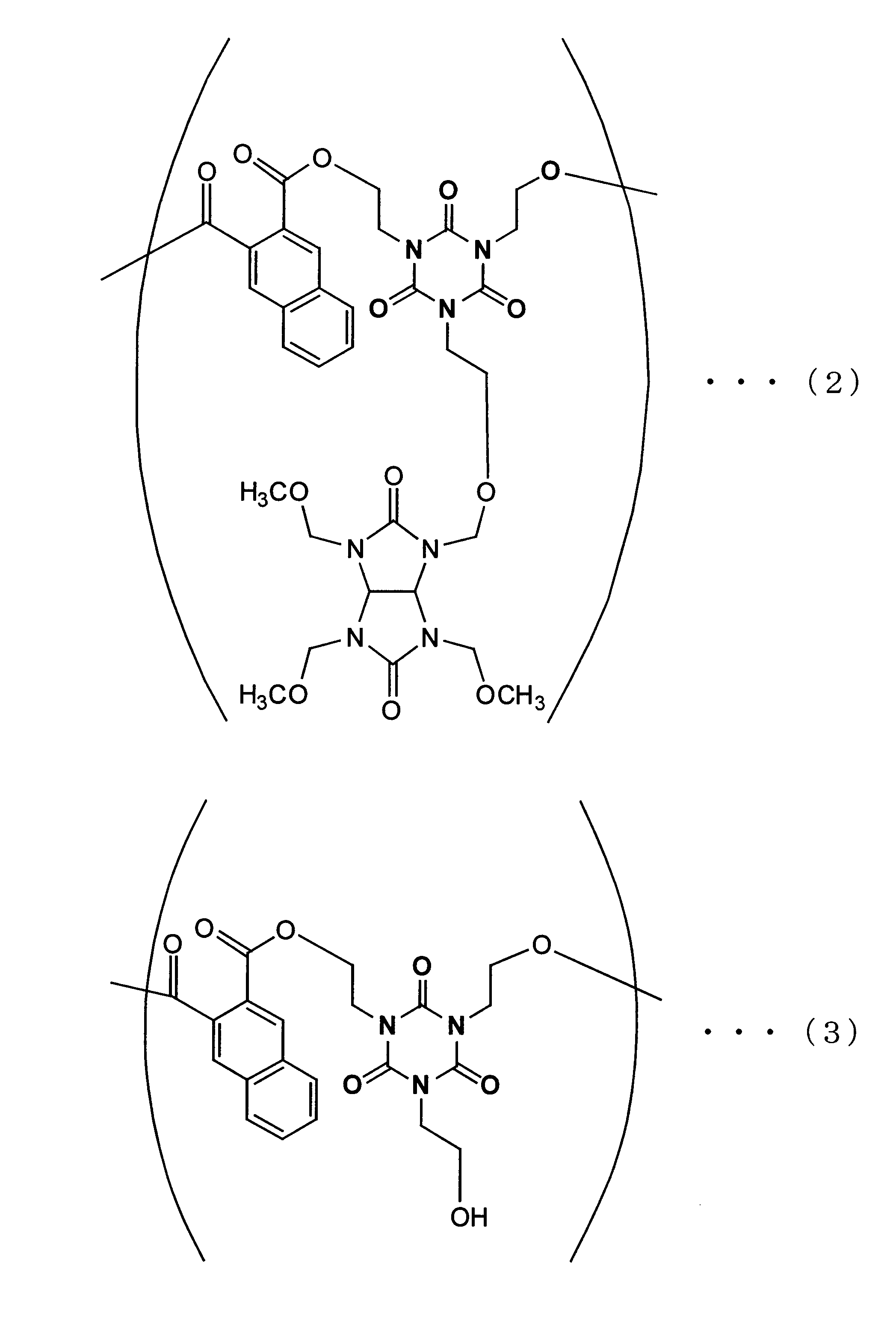
- a polyester polymer compound 2 having a side chain added with a crosslinking agent mass average molecular weight (Mw): 7100, Z average molecular weight (Mz): 14000, yield: about 40%
- Example 1-1 Anion exchange resin (manufactured by Organo Corporation, “Amberlyst B20-HG ⁇ Dry”, total exchange capacity 4.6 mg equivalent / g or more, water content 10% or less, apparent density 400 g / L) (33.25 g), Cation exchange resin (manufactured by Organo Corporation, “Amberlyst 15JS-HG ⁇ Dry”, total exchange capacity 4.7 mg equivalent / g or more, moisture content 2% or less, apparent density 590 g / L) (1.75 g) The mixed resin mixed was washed with THF and dried.
- One filter sheet (Sumitomo 3M Co., Ltd., “CUNO TM Zeta Plus TM filter cartridge EC GN grade ⁇ 90 mm disc”) previously cleaned with ultrapure water (5000 mL) and THF (1000 mL) is brought into contact with the mixed resin.
- step (c) the solution containing the polymer compound was passed through to further remove metal impurities.
- the solution containing the polymer compound after passing through the filter was added to a mixture (poor solvent) of hexane (580.0 g) and IPA (1740.0 g) to reprecipitate.
- the precipitate was taken out and dried under reduced pressure at 40 ° C. for 60 hours to obtain a powdered polyester polymer compound (step (d)).
- step (d) mass average molecular weight (Mw) and Z average molecular weight (Mz), refractive index and attenuation coefficient, each metal impurity concentration, residual pTSA concentration, and residual triethylamine concentration were measured.
- Table 1 mass average molecular weight
- Mz Z average molecular weight
- Example 1-2 A powdery polyester polymer compound was obtained in the same manner as in Example 1-1 except that the step (c) was not performed. About the obtained polyester polymer compound, mass average molecular weight (Mw) and Z average molecular weight (Mz), refractive index and attenuation coefficient, each metal impurity concentration, residual pTSA concentration, and residual triethylamine concentration were measured. The results are shown in Table 1. Furthermore, based on the storage stability test method, the mass average molecular weight (Mw) and the Z average molecular weight (Mz) were measured. The results are shown in Table 3.
- Example 2-1 Steps (b) to (d) were carried out in the same manner as in Example 1-1 except that the polyester polymer compound 2 obtained in Synthesis Example 2 was used to obtain a powdery polyester polymer compound. It was. About the obtained polyester polymer compound, mass average molecular weight (Mw) and Z average molecular weight (Mz), refractive index and attenuation coefficient, each metal impurity concentration, residual pTSA concentration, and residual triethylamine concentration were measured. The results are shown in Table 2. Furthermore, based on the storage stability test method, the mass average molecular weight (Mw) and the Z average molecular weight (Mz) were measured. The results are shown in Table 4 and FIGS.
- Example 2-2 A powdery polyester polymer compound was obtained in the same manner as in Example 1-1 except that the polyester polymer compound 2 obtained in Synthesis Example 2 was used and the step (c) was not performed. About the obtained polyester polymer compound, mass average molecular weight (Mw) and Z average molecular weight (Mz), refractive index and attenuation coefficient, each metal impurity concentration, residual pTSA concentration, and residual triethylamine concentration were measured. The results are shown in Table 2. Furthermore, based on the storage stability test method, the mass average molecular weight (Mw) and the Z average molecular weight (Mz) were measured. The results are shown in Table 4.
- Example 1-1 A powdery polyester polymer compound was obtained in the same manner as in Example 1-1 except that the cation exchange resin was not used in step (b) and step (c) was not performed. About the obtained polyester polymer compound, mass average molecular weight (Mw) and Z average molecular weight (Mz), refractive index and attenuation coefficient, each metal impurity concentration, residual pTSA concentration, and residual triethylamine concentration were measured. The results are shown in Table 1. Furthermore, based on the storage stability test method, the mass average molecular weight (Mw) and the Z average molecular weight (Mz) were measured. The results are shown in Table 3 and FIGS.
- Comparative Example 1-2 A powdery polyester polymer compound was obtained in the same manner as in Example 1-1 except that the cation exchange resin was not used in step (b). About the obtained polyester polymer compound, mass average molecular weight (Mw) and Z average molecular weight (Mz), refractive index and attenuation coefficient, each metal impurity concentration, residual pTSA concentration, and residual triethylamine concentration were measured. The results are shown in Table 1. Furthermore, based on the storage stability test method, the mass average molecular weight (Mw) and the Z average molecular weight (Mz) were measured. The results are shown in Table 3.
- Example 2-1 The same procedure as in Example 1-1 was performed except that the polyester polymer compound 2 obtained in Synthesis Example 2 was used, no cation exchange resin was used in Step (b), and Step (c) was not performed. Thus, a powdery polyester polymer compound was obtained. About the obtained polyester polymer compound, mass average molecular weight (Mw) and Z average molecular weight (Mz), refractive index and attenuation coefficient, each metal impurity concentration, residual pTSA concentration, and residual triethylamine concentration were measured. The results are shown in Table 2. Furthermore, based on the storage stability test method, the mass average molecular weight (Mw) and the Z average molecular weight (Mz) were measured. The results are shown in Table 4 and FIGS.
- Comparative Example 2-2 A powdery polyester polymer compound as in Example 1-1, except that the polyester polymer compound 2 obtained in Synthesis Example 2 was used and no cation exchange resin was used in step (b). Got. About the obtained polyester polymer compound, mass average molecular weight (Mw) and Z average molecular weight (Mz), refractive index and attenuation coefficient, each metal impurity concentration, residual pTSA concentration, and residual triethylamine concentration were measured. The results are shown in Table 2. Furthermore, based on the storage stability test method, the mass average molecular weight (Mw) and the Z average molecular weight (Mz) were measured. The results are shown in Table 4.
- step (b) In the table, the case where no cation exchange resin is used in step (b) is described as “(b ′)”.
- Examples 1-1 and 2-1 each had a metal impurity concentration of 50 ppb or less, and the total of the residual pTSA concentration and the residual triethylamine concentration was 50 ppm or less. A molecular compound could be obtained.
- the metal impurity concentration was slightly higher than those in Examples 1-1 and 2-1.
- Comparative Examples 1-1 and 2-1 which did not use a cation exchange resin in step (b) and did not perform step (c), had a metal impurity concentration higher than those in Examples 1-2 and 2-2.
- the concentration of sodium, which is a light metal was high.
- the residual triethylamine concentration was also high.
- Comparative Examples 1-2 and 2-2 in which no cation exchange resin was used in step (b), the concentration of sodium, which is a light metal, was higher than those in Examples 1-1 and 2-1.
- the residual triethylamine concentration was also high.
- Comparative Examples 1-2 and 2-2 since the step (c) was performed, the concentration of iron, which is a heavy metal, could be reduced.
- step (b) acid impurities were removed by the anion exchange resin, and base impurities and metal impurities (mainly light metals) were removed by the cation exchange resin.
- step (c) metal impurities (light metal and heavy metal that could not be removed in the step (b)) were removed by a specific filter.
- step (c) is performed before the step (b)
- the ion exchange ability of the filter used in the step (c) decreases due to the acid impurities, and it is difficult to sufficiently remove the metal impurities. It was done.
- step (a) The obtained polymerization solution was added to a mixture (poor solvent) of hexane (290.0 g) and IPA (870.0 g) and reprecipitated (reprecipitation purification in step (b)), and the following formulas (4) and (5) )
- a polyester polymer compound 3 having a side chain added with a crosslinking agent mass average molecular weight (Mw): 7500, Z average molecular weight (Mz): 14200, yield: about 40%
- Example 3-1 A powdery polyester polymer compound was obtained in the same manner as in Example 1-1 except that the polyester polymer compound 3 obtained in Synthesis Example 3 was used and the step (c) was not performed. About the obtained polyester type polymer compound, mass average molecular weight (Mw) and Z average molecular weight (Mz), each metal impurity concentration, residual pTSA concentration, and residual triethylamine concentration were measured. The results are shown in Table 5.
- “Comparative Example 3-1” Cation exchange resin (manufactured by Organo Corporation, “Amberlyst 15JS-HG ⁇ Dry”, total exchange capacity 4.7 mg equivalent / g or more, moisture content 2% or less, apparent density 590 g / L) (1.75 g), A solution obtained by dissolving the polyester polymer compound 3 (63.00 g) obtained in Synthesis Example 3 in THF (147.0 g) was added and stirred for 5 hours.
- an anion exchange resin manufactured by Organo Corporation, “Amberlyst B20-HG ⁇ Dry”, total exchange capacity 4.6 mg equivalent / g or more, water content 10% or less, apparent density 400 g / L) (33.25 g) was added and stirred for 5 hours.
- the same step as step (d) of Example 1-1 was performed to obtain a powdery polyester polymer compound.
- Mw mass average molecular weight
- Mz Z average molecular weight
- each metal impurity concentration residual pTSA concentration
- residual triethylamine concentration were measured. The results are shown in Table 5.
- Example 3-1 has a metal impurity concentration of 50 ppb or less, and the total of the residual pTSA concentration and the residual triethylamine concentration is 50 ppm or less, so that a high-purity polyester polymer compound can be obtained. did it.
- the molecular weight of the polymer compound obtained in Comparative Example 3-1 greatly changed between after reprecipitation purification in step (b) and after contact with the ion exchange resin. If the molecular weight changes, it becomes difficult to obtain desired performance, so that it is not suitable as a polymer compound for lithography used in, for example, a lithography process.
- the method for producing a polymer compound of the present invention can efficiently reduce the metal impurity concentration and the acid and base impurity concentrations simultaneously.
- the polymer compound obtained by the present invention is at a level that can exhibit sufficient performance as a polymer compound for lithography used in the lithography process. Furthermore, control of the refractive index and the attenuation coefficient that affect the lithography performance can be realized at the same time.
Landscapes
- Chemical & Material Sciences (AREA)
- Chemical Kinetics & Catalysis (AREA)
- Organic Chemistry (AREA)
- Health & Medical Sciences (AREA)
- Medicinal Chemistry (AREA)
- Polymers & Plastics (AREA)
- General Chemical & Material Sciences (AREA)
- Materials For Photolithography (AREA)
- Polyesters Or Polycarbonates (AREA)
- Addition Polymer Or Copolymer, Post-Treatments, Or Chemical Modifications (AREA)
- Processes Of Treating Macromolecular Substances (AREA)
- Polyamides (AREA)
Description
本願は、2012年6月26日に、日本に出願された特願2012-142968号、および2012年12月3日に、日本に出願された特願2012-264381号、に基づき優先権を主張し、その内容をここに援用する。
近年、リソグラフィー技術の進歩により急速にレジストパターンの微細化が進んでいる。微細化の手法としては、照射光の短波長化がある。具体的には、照射光がg線(波長:438nm)やi線(波長:365nm)から波長300nm以下のDUV(Deep Ultra Violet)へと短波長化してきている。現在では、KrFエキシマレーザー(波長:248nm)リソグラフィー技術やArFエキシマレーザー(波長:193nm)リソグラフィー技術が導入されている。
また、より短波長のEUV(波長:13.5nm)リソグラフィー技術についても研究されている。その他、電子線リソグラフィー技術や、露光を水等の液中で行う液浸リソグラフィー技術についても精力的に研究されている。
例えばプラズマプロセスでは、リソグラフィー工程に用いられる高分子化合物中にナトリウムや鉄等の金属不純物(例えば金属イオン、金属紛体、遷移錯体など)が存在すると、プラズマ剥離の際に金属汚染を生じる恐れがある。
従来、高分子化合物中の金属不純物濃度は、厳しい不純物濃度規格を満たす原料を選択することや、高分子化合物の製造段階で金属不純物が混入しないように徹底したプロセス管理を行うことで、管理されている。しかし、金属不純物濃度の厳格な規格化に伴い、抜本的な金属不純物の混入を管理した方法による高分子化合物の製造が行なわれる必要がある。
また、高分子化合物溶液をカチオン交換樹脂と接触させる工程(T1)、高分子化合物溶液をカチオン交換樹脂とアニオン交換樹脂の混合樹脂と接触させる工程(T2)、高分子化合物溶液を正のゼータ電位を有する物質を含むフィルターに通液させる工程(T3)を組み合わせて実施する方法が提案されている(特許文献2)。
また、通常、酸触媒の存在下でモノマーを重合した場合は、反応停止剤として塩基性化合物を用いて重合反応を停止する。一方、塩基触媒の存在下でモノマーを重合した場合は、反応停止剤として酸性化合物を用いて重合反応を停止する。これら反応停止剤も不純物となって高分子化合物中に残存し、半導体デバイスの性能および安定性に影響する。
このように、酸触媒の存在下で高分子化合物を得る場合、高分子化合物には酸触媒由来の不純物と反応停止剤(塩基性化合物)由来の不純物とが含まれる。一方、塩基触媒の存在下で高分子化合物を得る場合、高分子化合物には塩基触媒由来の不純物と、反応停止剤(酸性化合物)由来の不純物とが含まれる。よって、高分子化合物中のこれらの不純物濃度を低減することも求められる。
なお、酸触媒および反応停止剤(酸性化合物)由来の不純物を総称して「酸不純物」といい、塩基触媒および反応停止剤(塩基性化合物)由来の不純物を総称して塩基不純物という。
特許文献2は、(メタ)アクリル系共重合体の製法に関するものであり、酸および塩基不純物濃度を低減できる旨の記載はない。
<1> 下記工程(a)、(b)を含む、高分子化合物の製造方法。
工程(a):酸触媒または塩基触媒の存在下で高分子化合物を得る工程。
工程(b):工程(a)で得られた高分子化合物を含む溶液を、陰イオン交換樹脂と陽イオン交換樹脂を混合した混合樹脂に接触させる工程。
<2> 前記陰イオン交換樹脂と陽イオン交換樹脂との質量比(陰イオン交換樹脂/陽イオン交換樹脂)が60/40~99/1である、<1>に記載の高分子化合物の製造方法。
<3> 前記高分子化合物が側鎖に架橋剤が付加されたものである、<1>または<2>に記載の高分子化合物の製造方法。
<4> 前記高分子化合物がポリエステル系高分子化合物である、<1>~<3>のいずれか一項に記載の高分子化合物の製造方法。
<5> 前記酸触媒がスルホン酸である、<1>~<4>のいずれか一項に記載の高分子化合物の製造方法。
<6> 前記塩基触媒が3級アミンである、<1>~<4>のいずれか一項に記載の高分子化合物の製造方法。
<7> 下記工程(c)をさらに含む、<1>~<6>のいずれか一項に記載の高分子化合物の製造方法。
工程(c):工程(b)で得られた高分子化合物を含む溶液を、強酸性イオン交換基を含まず、かつゼータ電位を生じる電荷調整剤を含むフィルターに通過させ、高分子化合物を含む溶液を得る工程。
<8> 下記工程(d)をさらに含む、<7>に記載の高分子化合物の製造方法。
工程(d):工程(c)で得られた高分子化合物を含む溶液と高分子化合物の貧溶媒とを混合して高分子化合物を析出させ、粉体状の高分子化合物を得る工程。
<10> 各金属不純物濃度が50ppb以下である、<9>に記載の高分子化合物。
<11> 酸および塩基不純物濃度の合計が2ppm以上である、<9>または<10>に記載の高分子化合物。
<12> 側鎖に架橋剤が付加されている、<9>~<11>のいずれか一項に記載の高分子化合物。
<13> ポリエステル系高分子化合物である、<9>~<12>のいずれか一項に記載の高分子化合物。
また、本発明の高分子化合物は、金属不純物濃度が低く、かつ酸および塩基不純物濃度も十分に低減されている。
なお、本明細書において「(メタ)アクリル」とは、アクリルとメタクリルの総称である。
また、本発明における高分子化合物の質量平均分子量(Mw)およびZ平均分子量(Mz)は、ゲル・パーミエイション・クロマトグラフィー(GPC)により、ポリスチレン換算で求めた値である。
工程(a):酸触媒または塩基触媒の存在下で高分子化合物を得る工程。
工程(b):工程(a)で得られた高分子化合物を含む溶液を、陰イオン交換樹脂と陽イオン交換樹脂を混合した混合樹脂に接触させる工程。
工程(c):工程(b)で得られた高分子化合物を含む溶液を、強酸性イオン交換基を含まず、かつゼータ電位を生じる電荷調整剤を含むフィルターに通過させ、高分子化合物を含む溶液を得る工程。
工程(d):工程(c)で得られた高分子化合物を含む溶液と高分子化合物の貧溶媒とを混合して高分子化合物を析出させ、粉体状の高分子化合物を得る工程。
工程(a)は、酸触媒または塩基触媒の存在下で高分子化合物を得る工程である。
上述したように、通常、酸触媒の存在下でモノマーを重合した場合は、反応停止剤として塩基性化合物を用いて重合反応を停止する。一方、塩基触媒の存在下でモノマーを重合した場合は、反応停止剤として酸性化合物を用いて重合反応を停止する。従って、工程(a)は具体的に、下記工程(a-1)または工程(a-2)である。
工程(a-1):酸触媒の存在下でモノマーを重合し、塩基性化合物を用いて重合反応を停止させて高分子化合物を得る工程。
工程(a-2):塩基触媒の存在下でモノマーを重合し、酸性化合物を用いて重合反応を停止させて高分子化合物を得る工程。
これら酸触媒は1種単独で用いてもよいし、2種以上を併用してもよい。
一方、反応停止剤として用いる塩基性化合物としては、上述した塩基触媒と同じものを使用できる。特に、金属含有量が少ない点でアミン類が好ましい。その中でも特に、副反応が起き易い活性水素を含まない点で、3級アミン(例えばトリエチルアミンなど)がより好ましい。
一方、塩基触媒の存在下で得られる高分子化合物としては特に制限されないが、例えばアクリル系高分子化合物、シロキサン系高分子化合物などが挙げられる。
これらの中でも、好ましい高分子化合物としては特に制限されないが、エッチング速度等に優れ、半導体リソグラフィー技術への適用に最適である点で、ポリエステル系高分子化合物が好ましい。
以下、ポリエステル系高分子化合物を得る場合を例に挙げて、工程(a)について具体的に説明する。
特に、反射防止膜性能に優れる高分子化合物が得られる点で、グリコールウリル、テトラメトキシグリコールウリルが好ましい。また、これらは非芳香族の特徴を併せ持つので、エッチングレートを向上させることができる。
架橋剤付加反応の効率的な進行と分子量の精密な制御の両方の観点から、架橋剤付加反応は、50℃以下で行われるのが好ましく、より好ましくは15~30℃であり、さらに好ましくは18~22℃である。
工程(b)は、工程(a)で得られた高分子化合物を含む溶液を、陰イオン交換樹脂と陽イオン交換樹脂を混合した混合樹脂に接触させる工程である。
工程(b)では、高分子化合物を含む溶液をそのまま混合樹脂に接触させてもよいし、高分子化合物を含む溶液と貧溶媒とを混合して析出させた高分子化合物を再溶解した溶液を混合樹脂に接触させてもよい。特に、貧溶媒により析出させた高分子化合物を再溶解した溶液を混合樹脂に接触させるのが好ましい。貧溶媒により高分子化合物を析出させることで、高分子化合物中に残存する未反応のモノマー、酸触媒または塩基触媒、重合開始剤、反応停止剤などを除去でき、高分子化合物を再沈殿精製できる。
また、高分子化合物を再沈殿精製する場合には、必要に応じて重合反応液を希釈溶媒で適当な溶液粘度に希釈してもよい。希釈溶媒としては、アニソール、1,4-ジオキサン、アセトン、THF、MEK、MIBK、γ-ブチロラクトン、プロピレングリコールモノメチルエーテルアセテート(PGMEA)、プロピレングリコールモノメチルエーテル(PGME)、乳酸エチル、トルエン、キシレン、2-ヒドロキシイソ酪酸メチル(HBM)等が挙げられる。これらは1種を用いてもよく、2種以上を併用してもよい。
溶媒のSP値は、例えば、「ポリマーハンドブック(Polymer Handbook)」、第4版、VII-675頁~VII-711頁に記載の方法により求めることができる。具体的には、表1(VII-683頁)、表7~8(VII-688頁~VII-711頁)に記載されている。また、複数の溶媒の混合溶媒におけるSP値は、公知の方法により求めることができる。例えば、混合溶媒のSP値は、加成性が成立するとして、各溶媒のSP値と体積分率との積の総和として求めることができる。
例えば、高分子化合物がリソグラフィー用である場合、未反応のモノマー等を効率的に除去できる点で、貧溶媒としてはメタノール、2-プロパノール、ジイソプロピルエーテル、メチルターシャリーブチルエーテル(MTBE)、ヘキサン、ヘプタン、水が好ましい。
貧溶媒は、1種を単独で用いてもよく、2種以上を併用してもよい。
高分子化合物の再溶解に用いる溶媒としては、高分子化合物を溶解できるものであれば特に制限されず、例えば上述した希釈溶媒などが挙げられる。
陰イオン交換樹脂は、工程(a)で用いた酸触媒や、反応停止剤である酸性化合物を吸着し、除去する役割を主に果たす。また、陰イオン交換樹脂によって、高分子化合物中に残存するモノマーを除去できる場合もある。例えば、モノマーとしてジカルボン酸を用いてポリエステル系高分子化合物を得る場合には、陰イオン交換樹脂によってジカルボン酸をある程度除去することができる。
陰イオン交換樹脂としては、強塩基性陰イオン交換樹脂(I型、II型)、弱塩基性陰イオン交換樹脂が挙げられる。
強塩基性陰イオン交換樹脂の含水率は75%以下であることが好ましく、より好ましくは70%以下である。
強塩基性陰イオン交換樹脂の見掛け密度は650~750g/Lであることが好ましい。
弱塩基性陰イオン交換樹脂の含水率は70%以下であることが好ましく、より好ましくは60%以下である。
弱塩基性陰イオン交換樹脂の見掛け密度は300~700g/Lであることが好ましい。
弱塩基性陰イオン交換樹脂の市販品としては、例えばオルガノ株式会社製の「アンバーリスト B20-HG・Dry」、「アンバーライトIRA96」、「オルライト DS-6」、;和光純薬工業株式会社製の「ダウエックス 66」;三菱化学株式会社製の「ダイヤイオン WA10」、「ダイヤイオン WA20シリーズ」、「ダイヤイオン WA30」などが挙げられる。
陽イオン交換樹脂としては、強酸性陽イオン交換樹脂、弱酸性陽イオン交換樹脂が挙げられる。
強酸性陽イオン交換樹脂の含水率は70%以下であることが好ましく、より好ましくは60%以下である。
強酸性陽イオン交換樹脂の見掛け密度は550~900g/Lであることが好ましい。
弱酸性陽イオン交換樹脂の含水率は70%以下であることが好ましく、より好ましくは60%以下である。
弱酸性陽イオン交換樹脂の見掛け密度は600~700g/Lであることが好ましい。
弱酸性陽イオン交換樹脂の市販品としては、例えばオルガノ株式会社製の「アンバーライトIRC76」三菱化学株式会社製の「ダイヤイオン WKシリーズ」、「ダイヤイオン WK40L」などが挙げられる。
なお、陽イオン交換樹脂の割合が多すぎると、高分子化合物の側鎖に架橋剤が付加するなどして、高分子化合物が酸と化学反応を生じうる構造を有している場合、混合樹脂との接触により架橋反応が進行しやすくなる。その結果、高分子化合物の化学構造や分子量が、工程(a)後と工程(b)後とで、または工程(b)における再沈殿精製後と混合樹脂への接触後とで、変化する場合があり、例えば、高分子化合物溶液の白濁等が生じる場合がある。一方、陰イオン交換樹脂の割合が少なすぎると、工程(a)で酸触媒を用いた場合、工程(b)にて酸触媒が十分に除去しきれないことがある。その結果、その後の工程で架橋反応が進行し、高分子化合物の化学構造や分子量が変化することがある。
さらに、以下の工程(c)を行えば、工程(b)において除去しきれなかった軽金属や重金属などを除去することができ、金属不純物濃度をより低減することができる。
工程(c)は、工程(b)で得られた高分子化合物を含む溶液を、強酸性イオン交換基を含まず、かつゼータ電位を生じる電荷調整剤を含むフィルターに通過させ、高分子化合物を含む溶液を得る工程である。
上記フィルターを用いることにより、高分子化合物を強酸性イオン交換性基との反応による化学構造等の変化を生じることなく、効率的に高分子化合物中に含まれる金属不純物(軽金属および重金属)を除去することができる。よって、工程(c)を行うことで、工程(b)で除去しきれなかった軽金属や重金属をフィルターによって除去できる。
例えば、高分子化合物の側鎖に架橋剤が付加するなどして、高分子化合物が酸と化学反応を生じうる構造を有している場合、強酸性イオン交換基を含むフィルターに高分子化合物を含む溶液を通過させると、架橋反応が進行し、高分子化合物の化学構造や分子量が変化する。従って、強酸性イオン交換基を含まないフィルターを用いて高分子化合物を含む溶液を濾過することにより、上述したような架橋反応の進行等を抑制することができる。
ゼータ電位の測定は市販のゼータ電位測定機器により行うことができ、例えば、大塚電子株式会社製の「ELS800」;Dispersion Technology社製の「DT-1200」などを用いることができる。
セルロース繊維は、好ましくは、米国特許第4606824号明細書に開示されるように、約+400~約+800mLのカナダ標準形ろ水度を有する未叩解セルロースパルプ、および約+100~約-600mLのカナダ標準形ろ水度を有する高度に叩解されたセルロースパルプを含むセルロースパルプ混合物から誘導される。
また、高分子化合物を含む溶液を通過させる前に、超純水および高分子化合物を溶解している溶媒でフィルターを洗浄しておくことが好ましい。洗浄後のフィルターに高分子化合物を含む溶液を通過させることで、フィルターに含まれる粒状濾過助剤に金属不純物が電位吸着されやすくなり、金属不純物を非常に低い濃度にまで除去できる。
工程(d)は、工程(c)で得られた高分子化合物を含む溶液と高分子化合物の貧溶媒とを混合して高分子化合物を析出させ、粉体状の高分子化合物を得る工程である。
工程(d)では、工程(c)においてフィルターを通過した高分子化合物を含む溶液をそのまま貧溶媒と混合してもよいし、高分子化合物を含む溶液を希釈溶媒で適度な溶液粘度に希釈してから貧溶媒と混合してもよい。
工程(d)で用いる貧溶媒や希釈溶媒は、工程(b)で用いる貧溶媒や希釈溶媒と同じ溶媒を使用できる。
乾燥方法は、湿粉の状態の高分子化合物を、所望の含液率になるように乾燥できればよく、公知の乾燥方法を用いることができる。より短い時間で乾燥できる点で、乾燥雰囲気下で減圧する減圧乾燥法、乾燥雰囲気下で加熱する加熱乾燥法、または乾燥雰囲気下で減圧および加熱を行う減圧加熱乾燥法が好ましい。
乾燥により得られる粉体状の高分子化合物中の含液率は、リソグラフィー性能の観点から、5質量%以下が好ましく、3%質量%以下がより好ましく、1質量%以下が特に好ましい。
以上説明した本発明の高分子化合物の製造方法によれば、酸触媒または塩基触媒の存在下で高分子化合物を得た後(工程(a))、該高分子化合物を含む溶液または再沈殿精製した高分子化合物を含む溶液を陰イオン交換樹脂と陽イオン交換樹脂の混合樹脂に接触させるので(工程(b))、高分子化合物中に含まれる金属不純物(主に軽金属)と、酸および塩基不純物を除去できる。
さらに、工程(b)の後に、混合樹脂に接触した高分子化合物を含む溶液を特定のフィルターに通過させれば(工程(c))、高分子化合物中に含まれる金属不純物(工程(b)で除去しきれなかった軽金属と、重金属)を除去できる。
また、工程(b)や工程(d)において高分子化合物を再沈殿精製すれば、未反応のモノマーなどを除去することができる。
しかし、工程(b)を行わないと、あるいは工程(b)の前に工程(c)を行うと、フィルターで軽金属も除去することになるため、フィルターへの負担が増える。その上、工程(a)で用いた酸触媒または塩基触媒や、反応停止剤が残存する高分子化合物を含む溶液をフィルターに通過させることになるため、フィルターのイオン交換能が低下し、その結果、金属吸着量が低下する。よって、工程(b)を行わずに、あるいは工程(b)の前に工程(c)を行うことで金属不純物濃度を十分に低減させるためには、フィルターの使用枚数を増やす必要がある。しかし、フィルターの使用枚数が増えるほど、フィルター1枚当たりに換算したときの高分子化合物の生産性が低下する。また、金属不純物の除去に用いられるフィルターは高価であるため、複数のフィルターを用いることは製造コストの上昇にもつながる。
従って、本発明の高分子化合物の製造方法によれば、金属不純物濃度が低く、かつ酸および塩基不純物濃度も十分に低減された高分子化合物を生産性よく製造できる。
本発明の高分子化合物中に存在する酸および塩基不純物濃度の合計は、50ppm以下である。酸および塩基不純物濃度の合計が50ppm以下であれば、分子量の増加が抑制される等により保存安定性に優れる等の効果を奏する。酸および塩基不純物濃度は少ないほど好ましい。ただし、例えば高分子化合物をレジスト膜の下層に形成される反射防止膜(BARC)の形成に用いられる反射防止膜用として用いるなどの場合には、酸不純物や塩基不純物が膜形成時の架橋の触媒として作用することがある。そのため、用途によっては、高分子化合物中に少量の酸不純物や塩基不純物が含まれていてもよい。具体的には、酸および塩基不純物濃度の合計が2ppm以上であってもよい。
屈折率および減衰係数は、以下のようにして測定できる。
まず、高分子化合物を溶媒に溶解させて高分子化合物溶液を調製する。該高分子化合物溶液を乾燥後の膜厚が400nm以下になるようにシリコンウエハー上に塗布し、ベークにより乾燥させて溶媒を除去し、薄膜を形成する。分光エリプソメーターを用いて、得られた薄膜の波長193nmでの屈折率および減衰係数を測定する。
なお、薄膜化する際の膜厚が400nm以下であれば、いずれの膜厚で屈折率および減衰係数を測定しても測定値の差は小さい。よって、膜厚は400nm以下であれば特に制限されないが、20~100nmが好ましい。
また、エッチング速度等に優れ、半導体リソグラフィー技術への適用に最適である点で、高分子化合物はポリエステル系高分子化合物であることが好ましい。
高分子化合物は、リソグラフィー工程に用いられるリソグラフィー用高分子化合物として好適である。リソグラフィー用高分子化合物としては、レジスト膜の形成に用いられるレジスト用高分子化合物、レジスト膜の上層に形成される反射防止膜(TARC)、またはレジスト膜の下層に形成される反射防止膜(BARC)の形成に用いられる反射防止膜用高分子化合物、ギャップフィル膜の形成に用いられるギャップフィル膜用高分子化合物、トップコート膜の形成に用いられるトップコート膜用高分子化合物が挙げられる。
上述した工程(d)を行わない場合は、工程(c)で得られた高分子化合物を含む溶液をそのまま高分子化合物溶液として各種用途に用いることができる。また、工程(c)で得られた高分子化合物を含む溶液を所望の濃度になるまで濃縮したり、工程(b)の説明において例示した希釈溶媒などで希釈したりしてから、各種用途に用いてもよい。
一方、上述した工程(d)を行う場合は、工程(d)で得られた粉体状の高分子化合物を溶媒に溶解させた高分子化合物溶液を各種用途に用いればよい。高分子化合物を溶解させる溶媒としては特に制限されないが、例えば工程(b)の説明において例示した希釈溶媒などが挙げられる。
<質量平均分子量(Mw)、Z平均分子量(Mz)の測定>
高分子化合物の質量平均分子量(Mw)およびZ平均分子量(Mz)は、GPC(Gel Permeation Chromatography:東ソー株式会社製、「HLC8220GPC」)により、ポリスチレン換算で求めた。測定条件は以下の通りである。
・測定サンプル:乾粉50mg/溶離液5mL、
・溶離液:1.7mMリン酸/THF、
・分離カラム:昭和電工株式会社製の「Shodex GPC K-805L」、
・測定温度:40℃、
・検出器:示差屈折率検出器。
高分子化合物の波長193nmでの屈折率および減衰係数は、次のようにして求めた。
まず、高分子化合物の乾粉0.40gを2-ヒドロキシイソ酪酸メチル(HBM)9.60gに溶解し、高分子化合物溶液を調製した。
得られた高分子化合物溶液を乾燥後の膜厚が40nmになるようにシリコンウエハー上に塗布し、ベークにより乾燥させて溶媒を除去し、薄膜を形成した。分光エリプソメーター(J.A.Woollam社製、「VUV-VASE VU-302」)を用いて、得られた薄膜の波長193nmでの屈折率および減衰係数を測定した。
高分子化合物中の各金属不純物の濃度(固形分換算、単位:ppb)は、次のようにして求めた。
まず、高分子化合物の乾粉1.5gを、蒸留精製したN-メチル-2-ピロリドンで100倍希釈したサンプルを調製した。
得られたサンプルについて、高周波誘導結合プラズマ質量分析計(ICP-MS(Inductively Coupled Plasma Mass Spectrometer):Agilent Technologies社製、「7500cs」)によりナトリウム(Na)、カリウム(K)、カルシウム(Ca)、鉄(Fe)の金属分析を行い、各金属不純物濃度を求めた。
高分子化合物中の酸触媒(pTSA)に由来する酸不純物の濃度(固形分換算、単位:ppm)は、次のようにして求めた。
まず、高分子化合物の乾粉1.0gをアセトニトリル21mL、水9mLの混合溶液に溶解しサンプルを調製した。
得られたサンプルについて、高速液体クロマトグラフィー(HPLC:株式会社島津理化製、「LC-20A」、分離カラム:ジーエルサイエンス株式会社製、「Intersil ODS-2」)により、酸不純物(残pTSA)濃度を求めた。
高分子化合物中の反応停止剤(塩基性化合物:トリエチルアミン)に由来する塩基不純物の濃度(固形分換算、単位:ppm)は、次のようにして求めた。
まず、高分子化合物の乾粉1.0gをアセトニトリル21mL、水9mLの混合溶液に溶解しサンプルを調製した。
得られたサンプルについて、ガスクロマトグラフィー(GC:アジレント・テクノロジー株式会社製、「Agilent 7890A GCシステム」、分離カラム:アジレント・テクノロジー株式会社製、「Agilent HP-INNOWAX」)により、塩基不純物(残トリエチルアミン)濃度を求めた。
保存安定性試験は、次のようにして実施した。
まず、高分子化合物の乾粉2.0gに、HBMを8.0g加えて5倍希釈したサンプルを調製した。
得られたサンプルを50℃にて保温し、8時間、24時間、48時間後にそれぞれサンプル採取し、上記質量平均分子量(Mw)、Z平均分子量(Mz)の測定と同様にして各分子量を求めた。
1,3,5-トリス(2-ヒドロキシエチル)イソシアヌレート(67.12g,0.258mol)、2,3-ナフタレンジカルボン酸ジメチル(63.01g,0.258mol)、p-トルエンスルホン酸-水和物(pTSA)(2.606g,13.7mmol)、およびアニソール(79.60g)を三口フラスコに充填し、Dean-Starkトラップを用いて脱水および脱メタノール反応を行いながら130℃で8時間重合した。その後、50℃まで冷却し、トリエチルアミン(1.386g,13.7mmol)を加えて反応を停止させた(工程(a))。
得られた重合溶液をテトラヒドロフラン(THF)(89.4g)で希釈し、希釈液を得た。この希釈液をヘキサン(580.0g)と2-プロパノール(IPA)(1740.0g)の混合物(貧溶媒)に加えて再沈殿し(工程(b)の再沈殿精製)、下記式(1)を構造単位とするポリエステル系高分子化合物1(質量平均分子量(Mw):6300、Z平均分子量(Mz):12500、収率:約50%)を得た。

1,3,5-トリス(2-ヒドロキシエチル)イソシアヌレート(67.12g,0.258mol)、2,3-ナフタレンジカルボン酸ジメチル(63.01g,0.258mol)、pTSA(2.606g,13.7mmol)、およびアニソール(79.60g)を三口フラスコに充填し、Dean-Starkトラップを用いて脱水および脱メタノール反応を行いながら130℃で8時間重合した。その後、THF(89.4g)で希釈し、テトラメトキシグリコールウリル(TMGU)(25.64g,80.55mmol)を添加し、20℃で6時間反応させて後、トリエチルアミン(1.386g,13.7mmol)を加えて反応を停止させた(工程(a))。
得られた重合溶液をヘキサン(580.0g)とIPA(1740.0g)の混合物(貧溶媒)に加えて再沈殿し(工程(b)の再沈殿精製)、下記式(2)、(3)を構造単位とする、側鎖に架橋剤が付加されたポリエステル系高分子化合物2(質量平均分子量(Mw):7100、Z平均分子量(Mz):14000、収率:約40%)を得た。
陰イオン交換樹脂(オルガノ株式会社製、「アンバーリスト B20-HG・Dry」、総交換容量4.6mg当量/g以上、含水率10%以下、見掛け密度400g/L)(33.25g)と、陽イオン交換樹脂(オルガノ株式会社製、「アンバーリスト 15JS-HG・Dry」、総交換容量4.7mg当量/g以上、含水率2%以下、見掛け密度590g/L)(1.75g)とを混合した混合樹脂をTHFにて洗浄し、乾燥した。乾燥後の混合樹脂に、合成例1で得られたポリエステル系高分子化合物1(63.00g)をTHF(147.0g)に溶解した溶液を加えて5時間攪拌し、酸触媒(pTSA)と反応停止剤(トリエチルアミン)と金属不純物の除去を行った後、混合樹脂を除去した。(工程(b))。
あらかじめ超純水(5000mL)、THF(1000mL)で洗浄を行ったフィルターシート(住友スリーエム株式会社製、「CUNOTMゼータプラスTMフィルターカートリッジEC GNグレード φ90mmディスク」)1枚に、混合樹脂に接触させた後の高分子化合物を含む溶液を通過させ、金属不純物をさらに除去した(工程(c))。
フィルターを通過した後の高分子化合物を含む溶液を、ヘキサン(580.0g)とIPA(1740.0g)の混合物(貧溶媒)に加えて再沈殿した。ついで、析出物を取り出し、40℃で60時間減圧乾燥し、粉体状のポリエステル系高分子化合物を得た(工程(d))。
得られたポリエステル系高分子化合物について、質量平均分子量(Mw)およびZ平均分子量(Mz)、屈折率および減衰係数、各金属不純物濃度、残pTSA濃度、残トリエチルアミン濃度を測定した。結果を表1に示す。
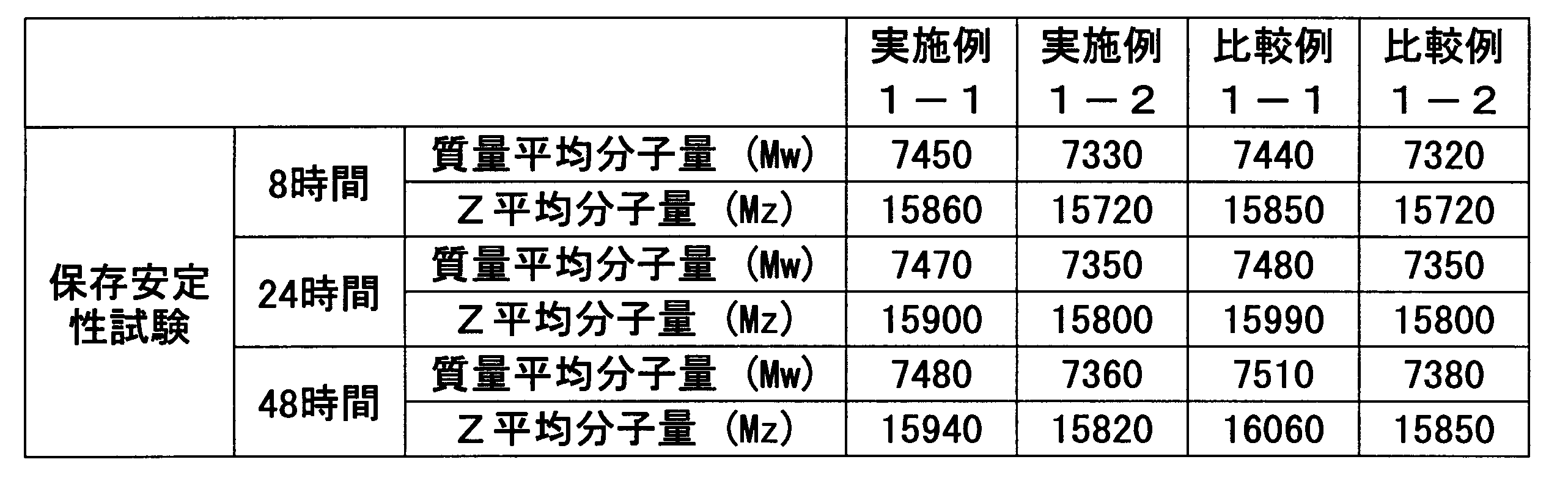
さらに、上記保存安定性試験方法に基づき、質量平均分子量(Mw)およびZ平均分子量(Mz)を測定した。結果を表3、図1、2に示す。
工程(c)を行わなかった以外は、実施例1-1と同様にして粉体状のポリエステル系高分子化合物を得た。
得られたポリエステル系高分子化合物について、質量平均分子量(Mw)およびZ平均分子量(Mz)、屈折率および減衰係数、各金属不純物濃度、残pTSA濃度、残トリエチルアミン濃度を測定した。結果を表1に示す。
さらに、上記保存安定性試験方法に基づき、質量平均分子量(Mw)およびZ平均分子量(Mz)を測定した。結果を表3に示す。
合成例2で得られたポリエステル系高分子化合物2を用いた以外は、実施例1-1と同様にして工程(b)~(d)を行い、粉体状のポリエステル系高分子化合物を得た。
得られたポリエステル系高分子化合物について、質量平均分子量(Mw)およびZ平均分子量(Mz)、屈折率および減衰係数、各金属不純物濃度、残pTSA濃度、残トリエチルアミン濃度を測定した。結果を表2に示す。
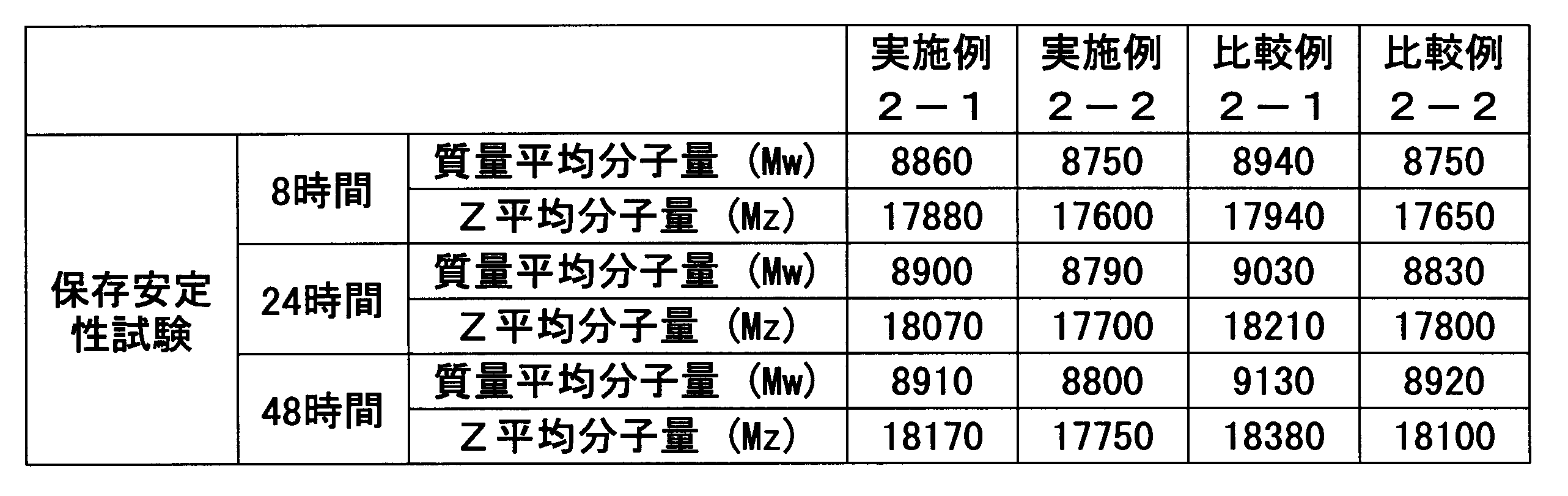
さらに、上記保存安定性試験方法に基づき、質量平均分子量(Mw)およびZ平均分子量(Mz)を測定した。結果を表4、図3、4に示す。
合成例2で得られたポリエステル系高分子化合物2を用い、工程(c)を行わなかった以外は、実施例1-1と同様にして粉体状のポリエステル系高分子化合物を得た。
得られたポリエステル系高分子化合物について、質量平均分子量(Mw)およびZ平均分子量(Mz)、屈折率および減衰係数、各金属不純物濃度、残pTSA濃度、残トリエチルアミン濃度を測定した。結果を表2に示す。
さらに、上記保存安定性試験方法に基づき、質量平均分子量(Mw)およびZ平均分子量(Mz)を測定した。結果を表4に示す。
工程(b)において陽イオン交換樹脂を用いず、かつ、工程(c)を行わなかった以外は、実施例1-1と同様にして粉体状のポリエステル系高分子化合物を得た。
得られたポリエステル系高分子化合物について、質量平均分子量(Mw)およびZ平均分子量(Mz)、屈折率および減衰係数、各金属不純物濃度、残pTSA濃度、残トリエチルアミン濃度を測定した。結果を表1に示す。
さらに、上記保存安定性試験方法に基づき、質量平均分子量(Mw)およびZ平均分子量(Mz)を測定した。結果を表3、図1、2に示す。
工程(b)において陽イオン交換樹脂を用いなかった以外は、実施例1-1と同様にして粉体状のポリエステル系高分子化合物を得た。
得られたポリエステル系高分子化合物について、質量平均分子量(Mw)およびZ平均分子量(Mz)、屈折率および減衰係数、各金属不純物濃度、残pTSA濃度、残トリエチルアミン濃度を測定した。結果を表1に示す。
さらに、上記保存安定性試験方法に基づき、質量平均分子量(Mw)およびZ平均分子量(Mz)を測定した。結果を表3に示す。
合成例2で得られたポリエステル系高分子化合物2を用い、工程(b)において陽イオン交換樹脂を用いず、かつ、工程(c)を行わなかった以外は、実施例1-1と同様にして粉体状のポリエステル系高分子化合物を得た。
得られたポリエステル系高分子化合物について、質量平均分子量(Mw)およびZ平均分子量(Mz)、屈折率および減衰係数、各金属不純物濃度、残pTSA濃度、残トリエチルアミン濃度を測定した。結果を表2に示す。
さらに、上記保存安定性試験方法に基づき、質量平均分子量(Mw)およびZ平均分子量(Mz)を測定した。結果を表4、図3、4に示す。
合成例2で得られたポリエステル系高分子化合物2を用い、工程(b)において陽イオン交換樹脂を用いなかった以外は、実施例1-1と同様にして粉体状のポリエステル系高分子化合物を得た。
得られたポリエステル系高分子化合物について、質量平均分子量(Mw)およびZ平均分子量(Mz)、屈折率および減衰係数、各金属不純物濃度、残pTSA濃度、残トリエチルアミン濃度を測定した。結果を表2に示す。
さらに、上記保存安定性試験方法に基づき、質量平均分子量(Mw)およびZ平均分子量(Mz)を測定した。結果を表4に示す。
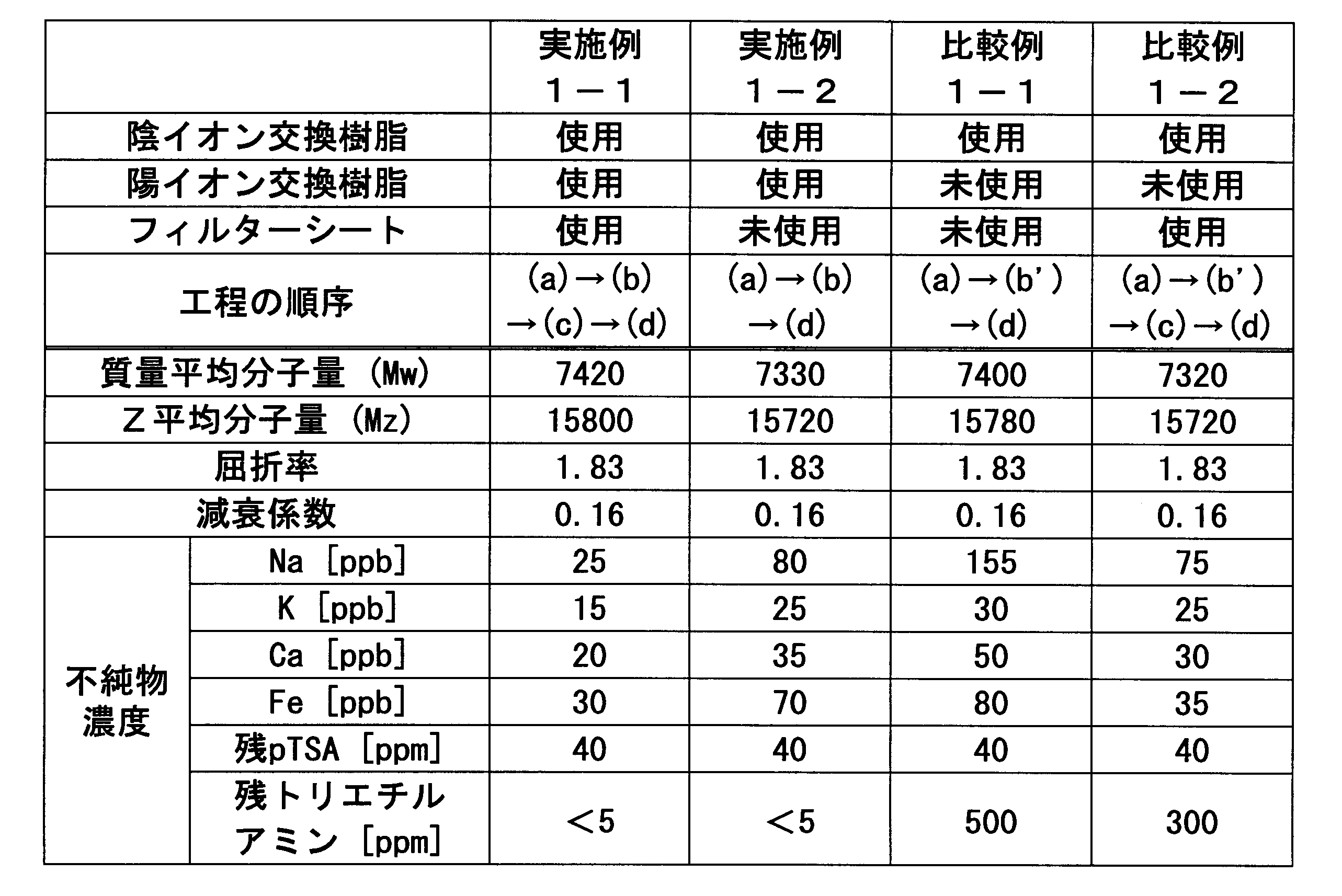
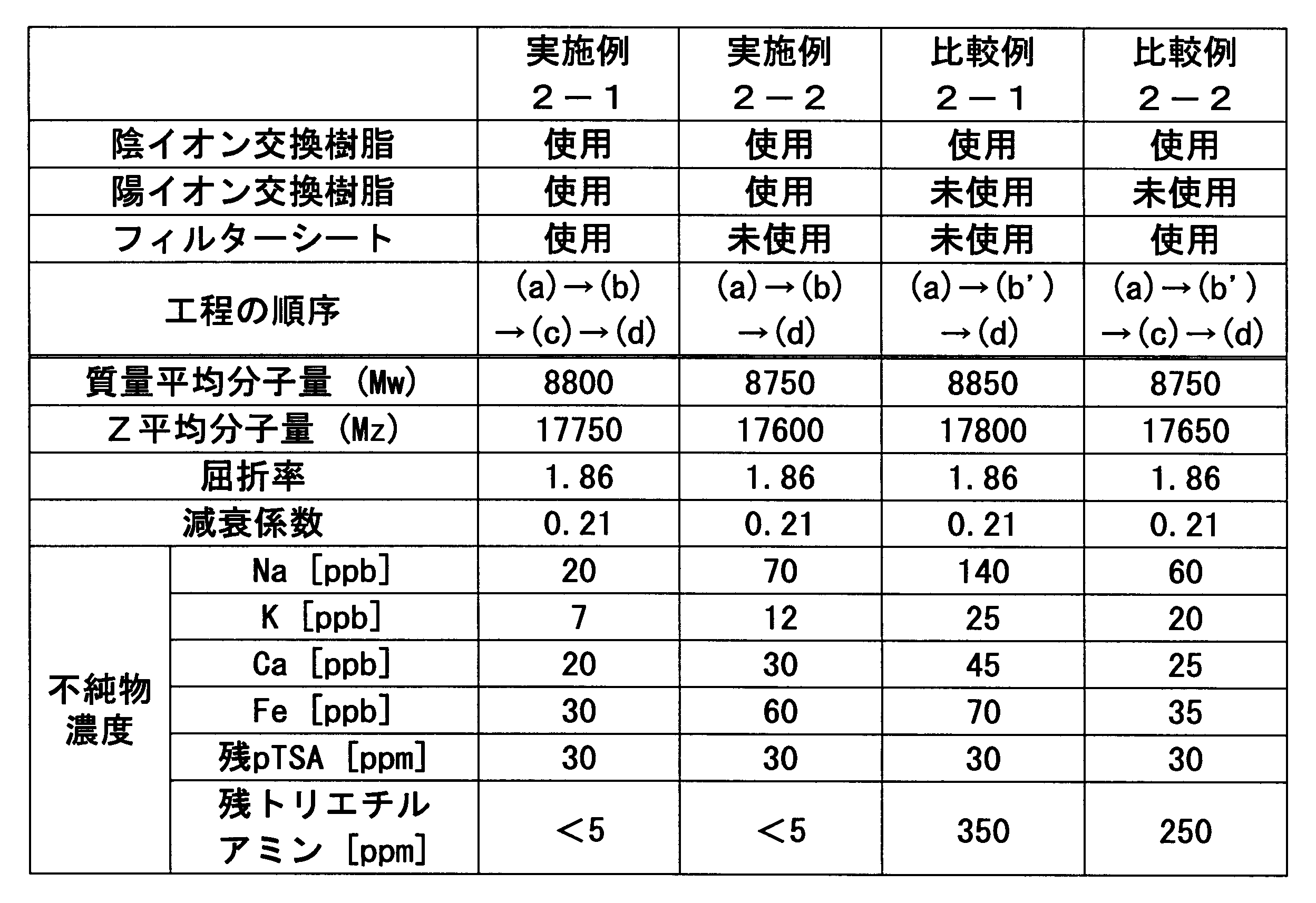
工程(c)を行わなかった実施例1-2、2-2は、実施例1-1、2-1に比べると金属不純物濃度がやや高かった。
工程(b)において陽イオン交換樹脂を用いなかった比較例1-2、2-2は、実施例1-1、2-1に比べて軽金属であるナトリウムの濃度が高かった。また、残トリエチルアミン濃度も高かった。なお、比較例1-2、2-2は、工程(c)を行ったので、重金属である鉄の濃度を低減することはできた。
また、工程(c)において、特定のフィルターにより金属不純物(工程(b)で除去しきれなかった軽金属や重金属)が除去されることが示された。
また、工程(b)の前に工程(c)を行うと、酸不純物によって工程(c)で用いるフィルターのイオン交換能が低下し、金属不純物を十分に除去することが困難となることが示された。
一方、比較例1-1、2-1は、高分子化合物中に酸触媒および塩基性化合物が多く残存していることにより、保存中に分子量が増加しやすく、保存安定性に劣ることが示された。
1,3,5-トリス(2-ヒドロキシエチル)イソシアヌレート(33.56g,0.129mol)、1,2-シクロヘキサンジカルボン酸ジエチル(29.45g,0.129mol)、pTSA(1.303g,6.85mmol)、およびアニソール(39.80g)を三口フラスコに充填し、Dean-Starkトラップを用いて脱水および脱エタノール反応を行いながら135℃で10時間重合した。その後、THF(44.7g)で希釈して、TMGU(12.81g,40.24mmol)添加し、20℃で5.5時間反応させた後、トリエチルアミン(0.6932g,6.85mmol)を加えて反応を停止させた(工程(a))。
得られた重合溶液をヘキサン(290.0g)とIPA(870.0g)の混合物(貧溶媒)に加えて再沈殿し(工程(b)の再沈殿精製)、下記式(4)、(5)を構造単位とする、側鎖に架橋剤が付加されたポリエステル系高分子化合物3(質量平均分子量(Mw):7500、Z平均分子量(Mz):14200、収率:約40%)を得た。

合成例3で得られたポリエステル系高分子化合物3を用い、工程(c)を行わなかった以外は、実施例1-1と同様にして粉体状のポリエステル系高分子化合物を得た。
得られたポリエステル系高分子化合物について、質量平均分子量(Mw)およびZ平均分子量(Mz)、各金属不純物濃度、残pTSA濃度、残トリエチルアミン濃度を測定した。結果を表5に示す。
また、合成例3で得られたポリエステル系高分子化合物3(すなわち、工程(b)の再沈殿精製後)の質量平均分子量(Mw)およびZ平均分子量(Mz)、各金属不純物濃度、残pTSA濃度、残トリエチルアミン濃度の測定結果も表5に示す。
陽イオン交換樹脂(オルガノ株式会社製、「アンバーリスト 15JS-HG・Dry」、総交換容量4.7mg当量/g以上、含水率2%以下、見掛け密度590g/L)(1.75g)に、合成例3で得られたポリエステル系高分子化合物3(63.00g)をTHF(147.0g)に溶解した溶液を加えて5時間攪拌した。陽イオン交換樹脂を除去した後、陰イオン交換樹脂(オルガノ株式会社製、「アンバーリスト B20-HG・Dry」、総交換容量4.6mg当量/g以上、含水率10%以下、見掛け密度400g/L)(33.25g)を加えて5時間攪拌した。陰イオン交換樹脂を除去した後、実施例1-1の工程(d)と同様の工程を行い、粉体状のポリエステル系高分子化合物を得た。
得られたポリエステル系高分子化合物について、質量平均分子量(Mw)およびZ平均分子量(Mz)、各金属不純物濃度、残pTSA濃度、残トリエチルアミン濃度を測定した。結果を表5に示す。
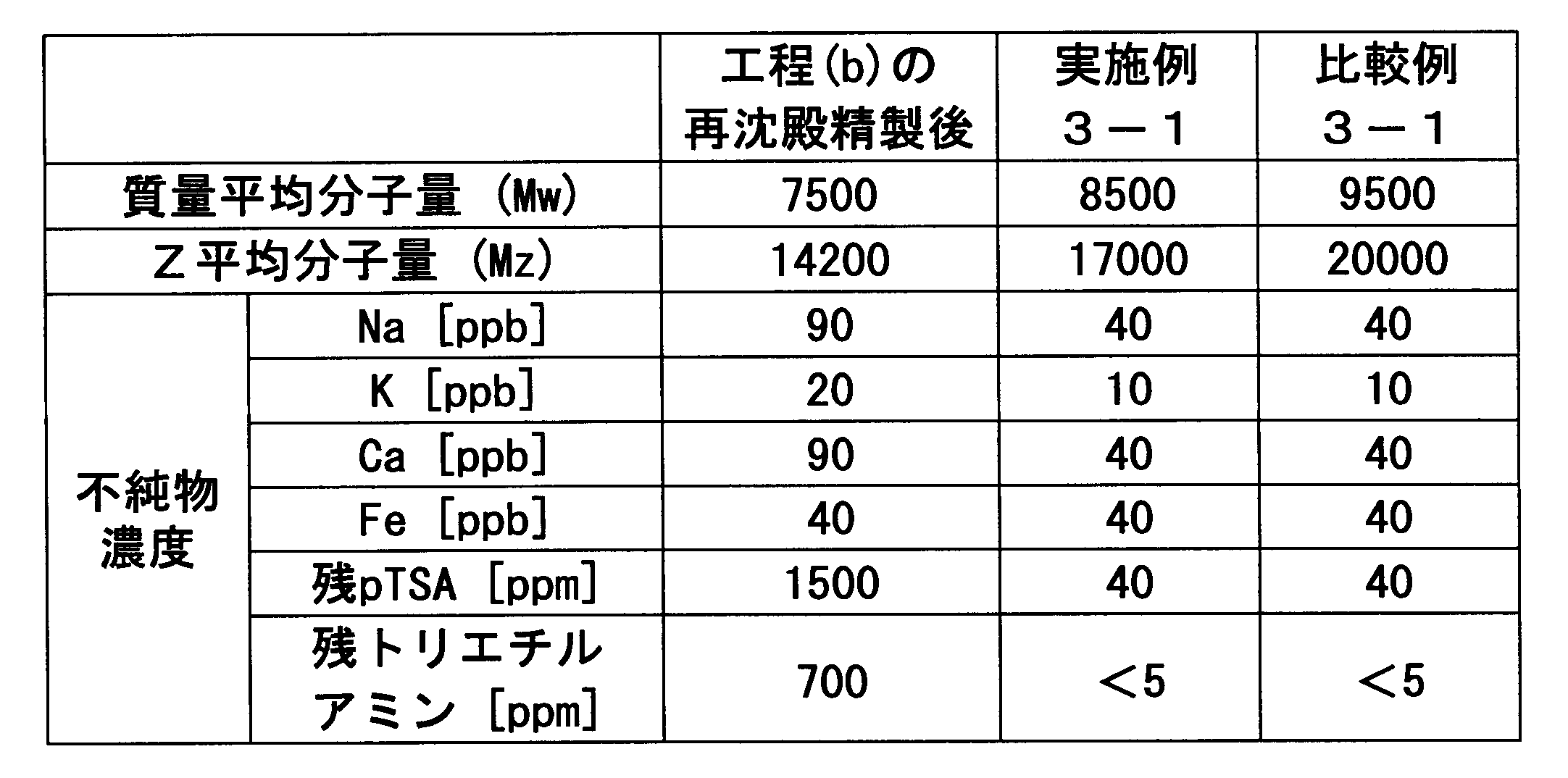
一方、比較例3-1で得られた高分子化合物は、工程(b)における再沈殿精製後とイオン交換樹脂への接触後とで、分子量が大きく変化した。分子量が変化すると所望の性能が得られにくくなるため、例えばリソグラフィー工程に用いられるリソグラフィー用高分子化合物としては不向きである。
Claims (13)
- 下記工程(a)、(b)を含む、高分子化合物の製造方法。
工程(a):酸触媒または塩基触媒の存在下で高分子化合物を得る工程。
工程(b):工程(a)で得られた高分子化合物を含む溶液を、陰イオン交換樹脂と陽イオン交換樹脂を混合した混合樹脂に接触させる工程。 - 前記陰イオン交換樹脂と陽イオン交換樹脂との質量比(陰イオン交換樹脂/陽イオン交換樹脂)が60/40~99/1である、請求項1に記載の高分子化合物の製造方法。
- 前記高分子化合物が側鎖に架橋剤が付加されたものである、請求項1または2に記載の高分子化合物の製造方法。
- 前記高分子化合物がポリエステル系高分子化合物である、請求項1または2に記載の高分子化合物の製造方法。
- 前記酸触媒がスルホン酸である、請求項1または2に記載の高分子化合物の製造方法。
- 前記塩基触媒が3級アミンである、請求項1または2に記載の高分子化合物の製造方法。
- 下記工程(c)をさらに含む、請求項1または2に記載の高分子化合物の製造方法。
工程(c):工程(b)で得られた高分子化合物を含む溶液を、強酸性イオン交換基を含まず、かつゼータ電位を生じる電荷調整剤を含むフィルターに通過させ、高分子化合物を含む溶液を得る工程。 - 下記工程(d)をさらに含む、請求項7に記載の高分子化合物の製造方法。
工程(d):工程(c)で得られた高分子化合物を含む溶液と高分子化合物の貧溶媒とを混合して高分子化合物を析出させ、粉体状の高分子化合物を得る工程。 - 酸および塩基不純物濃度の合計が50ppm以下であり、かつ、ナトリウム、カリウム、カルシウム、鉄の各金属不純物濃度が80ppb以下であり、膜厚400nm以下に薄膜化した際の波長193nmでの屈折率が1.5~2.1であり、減衰係数が0.1~0.7である、高分子化合物。
- 各金属不純物濃度が50ppb以下である、請求項9に記載の高分子化合物。
- 酸および塩基不純物濃度の合計が2ppm以上である、請求項9に記載の高分子化合物。
- 側鎖に架橋剤が付加されている、請求項9~11のいずれか一項に記載の高分子化合物。
- ポリエステル系高分子化合物である、請求項9~12のいずれか一項に記載の高分子化合物。
Priority Applications (5)
| Application Number | Priority Date | Filing Date | Title |
|---|---|---|---|
| KR1020177020742A KR101925740B1 (ko) | 2012-06-26 | 2013-06-25 | 고분자 화합물의 제조 방법 및 고분자 화합물 |
| CN201380034210.6A CN104487484B (zh) | 2012-06-26 | 2013-06-25 | 高分子化合物的制造方法及高分子化合物 |
| US14/409,827 US10307752B2 (en) | 2012-06-26 | 2013-06-25 | Method for producing polymer, and polymer |
| JP2013530467A JP6379487B2 (ja) | 2012-06-26 | 2013-06-25 | 高分子化合物の製造方法 |
| KR1020147030503A KR20150002720A (ko) | 2012-06-26 | 2013-06-25 | 고분자 화합물의 제조 방법 및 고분자 화합물 |
Applications Claiming Priority (4)
| Application Number | Priority Date | Filing Date | Title |
|---|---|---|---|
| JP2012-142968 | 2012-06-26 | ||
| JP2012142968 | 2012-06-26 | ||
| JP2012264381 | 2012-12-03 | ||
| JP2012-264381 | 2012-12-03 |
Publications (1)
| Publication Number | Publication Date |
|---|---|
| WO2014002994A1 true WO2014002994A1 (ja) | 2014-01-03 |
Family
ID=49783140
Family Applications (1)
| Application Number | Title | Priority Date | Filing Date |
|---|---|---|---|
| PCT/JP2013/067368 Ceased WO2014002994A1 (ja) | 2012-06-26 | 2013-06-25 | 高分子化合物の製造方法、および高分子化合物 |
Country Status (6)
| Country | Link |
|---|---|
| US (1) | US10307752B2 (ja) |
| JP (1) | JP6379487B2 (ja) |
| KR (2) | KR20150002720A (ja) |
| CN (1) | CN104487484B (ja) |
| TW (1) | TWI625342B (ja) |
| WO (1) | WO2014002994A1 (ja) |
Cited By (3)
| Publication number | Priority date | Publication date | Assignee | Title |
|---|---|---|---|---|
| JP2015129937A (ja) * | 2013-12-27 | 2015-07-16 | ローム・アンド・ハース・エレクトロニック・マテリアルズ・コリア・リミテッド | ナノリソグラフィのための有機底部反射防止コーティング組成物 |
| JP2015214521A (ja) * | 2014-05-13 | 2015-12-03 | 三菱レイヨン株式会社 | 化合物の精製方法、高分子化合物の製造方法、及びフォトリソグラフィー材料 |
| US9873797B2 (en) | 2011-10-24 | 2018-01-23 | Aditya Birla Nuvo Limited | Process for the production of carbon black |
Families Citing this family (2)
| Publication number | Priority date | Publication date | Assignee | Title |
|---|---|---|---|---|
| CN121522958A (zh) * | 2024-09-29 | 2026-02-13 | 国科天骥(山东)新材料有限责任公司 | 一种用于电子束光刻工艺的层状结构及其光刻工艺 |
| CN119179230A (zh) * | 2024-09-29 | 2024-12-24 | 国科天骥(山东)新材料有限责任公司 | 一种含自交联树脂的电子束光刻胶组合物及其制备方法和应用 |
Citations (9)
| Publication number | Priority date | Publication date | Assignee | Title |
|---|---|---|---|---|
| JPS60181124A (ja) * | 1984-02-29 | 1985-09-14 | Mitsui Toatsu Chem Inc | 芳香族ポリエステルの精製法 |
| JP2000516133A (ja) * | 1996-07-30 | 2000-12-05 | キュノ インコーポレーテッド | フィルターシート及び該フィルターシート使用のホトレジスト組成物精製法 |
| JP2001350266A (ja) * | 2000-06-09 | 2001-12-21 | Sumitomo Chem Co Ltd | レジスト組成物の製造方法 |
| JP2004212975A (ja) * | 2002-12-19 | 2004-07-29 | Tokyo Ohka Kogyo Co Ltd | ホトレジスト組成物の製造方法、ろ過装置、塗布装置及びホトレジスト組成物 |
| JP2005346051A (ja) * | 2004-05-18 | 2005-12-15 | Rohm & Haas Electronic Materials Llc | オーバーコートされるフォトレジストと共に使用するコーティング組成物 |
| JP2006328223A (ja) * | 2005-05-26 | 2006-12-07 | Fuji Xerox Co Ltd | 高分子有機電子材料の製造方法、高分子有機電子材料及び有機電界発光素子 |
| WO2007148627A1 (ja) * | 2006-06-19 | 2007-12-27 | Nissan Chemical Industries, Ltd. | 水酸基含有縮合系樹脂を含有するレジスト下層膜形成組成物 |
| JP2010189563A (ja) * | 2009-02-19 | 2010-09-02 | Mitsubishi Rayon Co Ltd | フォトリソグラフィ用高分子化合物の金属イオン不純物除去方法 |
| JP2012207058A (ja) * | 2011-03-29 | 2012-10-25 | Mitsubishi Rayon Co Ltd | 半導体リソグラフィー用高分子化合物の製造方法 |
Family Cites Families (24)
| Publication number | Priority date | Publication date | Assignee | Title |
|---|---|---|---|---|
| US2802820A (en) | 1953-02-18 | 1957-08-13 | Atlas Powder Co | Condensation products of secondary hexityl amines, formaldehyde and phenols |
| US2839506A (en) | 1953-11-16 | 1958-06-17 | American Cyanamid Co | Antistatic treatment for hydrophobic synthetic fiber-containing materials |
| CA1044537A (en) | 1973-05-09 | 1978-12-19 | Amf Incorporated | Filter medium and process |
| JPS5944300B2 (ja) | 1976-02-12 | 1984-10-29 | 三菱瓦斯化学株式会社 | 芳香族ジカルボン酸とアルキレンオキシドの付加物の製造法 |
| US4859340A (en) | 1976-03-15 | 1989-08-22 | Cuno, Incorporated | Filter sheet |
| GB2043734B (en) | 1979-03-01 | 1983-08-17 | Amf Inc | Filter and method of making same |
| US4596660A (en) | 1982-07-23 | 1986-06-24 | Amf Inc. | Fibrous media containing millimicron-sized particulates |
| US4606824A (en) | 1984-10-26 | 1986-08-19 | Chaokang Chu | Modified cellulose separation matrix |
| JPS61188417A (ja) * | 1985-02-16 | 1986-08-22 | Konishiroku Photo Ind Co Ltd | 静電荷像現像用トナ− |
| US5238776A (en) * | 1986-12-23 | 1993-08-24 | Shipley Company Inc. | Photoresist composition containing block copolymer resin and positive-working o-quinone diazide or negative-working azide sensitizer compound |
| JPH01228560A (ja) * | 1988-03-08 | 1989-09-12 | Hitachi Chem Co Ltd | 不純金属成分の低減された溶液の製造法 |
| TW363999B (en) | 1991-06-04 | 1999-07-11 | Vantico Ag | Photosensitive compositions |
| US5500127A (en) * | 1994-03-14 | 1996-03-19 | Rohm And Haas Company | Purification process |
| KR100677782B1 (ko) * | 2000-01-17 | 2007-02-05 | 제이에스알 가부시끼가이샤 | 절연막 형성용 재료의 제조 방법 |
| TW591341B (en) | 2001-09-26 | 2004-06-11 | Shipley Co Llc | Coating compositions for use with an overcoated photoresist |
| JP2003321545A (ja) | 2002-04-26 | 2003-11-14 | Toagosei Co Ltd | 光カチオン硬化性樹脂の製造方法 |
| JP2004184842A (ja) * | 2002-12-05 | 2004-07-02 | Sharp Corp | 静電荷像現像用トナーの製造方法及びトナー |
| DE10317646A1 (de) | 2003-04-17 | 2004-11-04 | Cognis Deutschland Gmbh & Co. Kg | Strahlungshärtbare Massen |
| JP5030474B2 (ja) * | 2006-05-18 | 2012-09-19 | 丸善石油化学株式会社 | 半導体リソグラフィー用樹脂組成物 |
| JP2008106084A (ja) * | 2006-10-23 | 2008-05-08 | Maruzen Petrochem Co Ltd | 半導体リソグラフィー用共重合体、組成物並びに該共重合体の製造方法 |
| KR20100058591A (ko) | 2007-08-27 | 2010-06-03 | 닛산 가가쿠 고교 가부시키 가이샤 | 리소그래피용 레지스트 하층막 형성 조성물 및 반도체 장치의 제조방법 |
| KR101274369B1 (ko) * | 2008-06-20 | 2013-06-13 | 아사히 가세이 케미칼즈 가부시키가이샤 | α-히드록시산의 제조 방법 |
| JP5384421B2 (ja) | 2010-04-16 | 2014-01-08 | 丸善石油化学株式会社 | 半導体リソグラフィー用共重合体の製造方法 |
| JP5858273B2 (ja) | 2011-04-06 | 2016-02-10 | 三菱レイヨン株式会社 | 半導体リソグラフィー用高分子化合物の製造方法 |
-
2013
- 2013-06-25 WO PCT/JP2013/067368 patent/WO2014002994A1/ja not_active Ceased
- 2013-06-25 TW TW102122591A patent/TWI625342B/zh active
- 2013-06-25 JP JP2013530467A patent/JP6379487B2/ja active Active
- 2013-06-25 KR KR1020147030503A patent/KR20150002720A/ko not_active Ceased
- 2013-06-25 KR KR1020177020742A patent/KR101925740B1/ko active Active
- 2013-06-25 CN CN201380034210.6A patent/CN104487484B/zh active Active
- 2013-06-25 US US14/409,827 patent/US10307752B2/en active Active
Patent Citations (9)
| Publication number | Priority date | Publication date | Assignee | Title |
|---|---|---|---|---|
| JPS60181124A (ja) * | 1984-02-29 | 1985-09-14 | Mitsui Toatsu Chem Inc | 芳香族ポリエステルの精製法 |
| JP2000516133A (ja) * | 1996-07-30 | 2000-12-05 | キュノ インコーポレーテッド | フィルターシート及び該フィルターシート使用のホトレジスト組成物精製法 |
| JP2001350266A (ja) * | 2000-06-09 | 2001-12-21 | Sumitomo Chem Co Ltd | レジスト組成物の製造方法 |
| JP2004212975A (ja) * | 2002-12-19 | 2004-07-29 | Tokyo Ohka Kogyo Co Ltd | ホトレジスト組成物の製造方法、ろ過装置、塗布装置及びホトレジスト組成物 |
| JP2005346051A (ja) * | 2004-05-18 | 2005-12-15 | Rohm & Haas Electronic Materials Llc | オーバーコートされるフォトレジストと共に使用するコーティング組成物 |
| JP2006328223A (ja) * | 2005-05-26 | 2006-12-07 | Fuji Xerox Co Ltd | 高分子有機電子材料の製造方法、高分子有機電子材料及び有機電界発光素子 |
| WO2007148627A1 (ja) * | 2006-06-19 | 2007-12-27 | Nissan Chemical Industries, Ltd. | 水酸基含有縮合系樹脂を含有するレジスト下層膜形成組成物 |
| JP2010189563A (ja) * | 2009-02-19 | 2010-09-02 | Mitsubishi Rayon Co Ltd | フォトリソグラフィ用高分子化合物の金属イオン不純物除去方法 |
| JP2012207058A (ja) * | 2011-03-29 | 2012-10-25 | Mitsubishi Rayon Co Ltd | 半導体リソグラフィー用高分子化合物の製造方法 |
Cited By (4)
| Publication number | Priority date | Publication date | Assignee | Title |
|---|---|---|---|---|
| US9873797B2 (en) | 2011-10-24 | 2018-01-23 | Aditya Birla Nuvo Limited | Process for the production of carbon black |
| JP2015129937A (ja) * | 2013-12-27 | 2015-07-16 | ローム・アンド・ハース・エレクトロニック・マテリアルズ・コリア・リミテッド | ナノリソグラフィのための有機底部反射防止コーティング組成物 |
| US11493845B2 (en) | 2013-12-27 | 2022-11-08 | Rohm And Haas Electronic Materials Korea Ltd. | Organic bottom antireflective coating composition for nanolithography |
| JP2015214521A (ja) * | 2014-05-13 | 2015-12-03 | 三菱レイヨン株式会社 | 化合物の精製方法、高分子化合物の製造方法、及びフォトリソグラフィー材料 |
Also Published As
| Publication number | Publication date |
|---|---|
| KR101925740B1 (ko) | 2018-12-05 |
| TWI625342B (zh) | 2018-06-01 |
| JPWO2014002994A1 (ja) | 2016-06-02 |
| KR20170089956A (ko) | 2017-08-04 |
| TW201402630A (zh) | 2014-01-16 |
| US20150190800A1 (en) | 2015-07-09 |
| CN104487484A (zh) | 2015-04-01 |
| KR20150002720A (ko) | 2015-01-07 |
| CN104487484B (zh) | 2020-07-31 |
| US10307752B2 (en) | 2019-06-04 |
| JP6379487B2 (ja) | 2018-08-29 |
Similar Documents
| Publication | Publication Date | Title |
|---|---|---|
| JP5225139B2 (ja) | フォトリソグラフィ用高分子化合物の金属イオン不純物除去方法 | |
| JP6379487B2 (ja) | 高分子化合物の製造方法 | |
| JP3920537B2 (ja) | 有機反射防止重合体およびその製造方法 | |
| US20150221500A1 (en) | Method for cleaning and drying semiconductor substrate | |
| EP2781550A1 (en) | Self-organization composition for pattern formation and pattern formation method | |
| WO2013191130A1 (ja) | タングステン酸及び/又はモリブデン酸と高分子との複合体 | |
| JP2008231170A (ja) | 感光性多分岐ポリイミド系ハイブリッド前駆体 | |
| TW202010790A (zh) | 抗蝕劑墊層組合物和使用所述組合物形成圖案的方法 | |
| JP2005187801A (ja) | 有機反射防止膜用架橋剤重合体、これを含む有機反射防止膜組成物及びこれを利用したフォトレジストのパターン形成方法 | |
| TW201808812A (zh) | 經膦酸酯基改質之金屬氧化物粒子 | |
| JP5418268B2 (ja) | 感放射線性樹脂組成物 | |
| JP7192779B2 (ja) | 共重合体およびポジ型レジスト組成物 | |
| WO2017115622A1 (ja) | レジストパターン形成方法および現像条件の決定方法 | |
| JP5854253B2 (ja) | 半導体リソグラフィー用高分子化合物の製造方法 | |
| JP6680292B2 (ja) | 重合体およびポジ型レジスト組成物、並びに、レジストパターン形成方法 | |
| JP5923227B1 (ja) | 着色硬化性樹脂組成物 | |
| JP2009235185A (ja) | 重合体の精製方法および重合体溶液 | |
| CN119931382B (zh) | 颜料组合物、图案化组合物、图案化基底、彩色滤光片、半导体器件 | |
| TW202222765A (zh) | 金屬錯合物、組成物、抗蝕材料、圖案形成方法及電子裝置之製造方法 | |
| JP6750317B2 (ja) | 共重合体およびポジ型レジスト組成物 | |
| JP2010168434A (ja) | メタクリル系ラクトン共重合体の重合方法及び共重合体 | |
| JP5167609B2 (ja) | オキセタニル基を有するシリコーン共重合体 | |
| TW201937292A (zh) | 正型光阻組成物、光阻膜形成方法及堆疊體之製造方法 | |
| CA3285945A1 (en) | Method for producing polymer | |
| JP2010139845A (ja) | レジストパターンの形成方法 |
Legal Events
| Date | Code | Title | Description |
|---|---|---|---|
| ENP | Entry into the national phase |
Ref document number: 2013530467 Country of ref document: JP Kind code of ref document: A |
|
| 121 | Ep: the epo has been informed by wipo that ep was designated in this application |
Ref document number: 13808615 Country of ref document: EP Kind code of ref document: A1 |
|
| ENP | Entry into the national phase |
Ref document number: 20147030503 Country of ref document: KR Kind code of ref document: A |
|
| WWE | Wipo information: entry into national phase |
Ref document number: 14409827 Country of ref document: US |
|
| NENP | Non-entry into the national phase |
Ref country code: DE |
|
| 122 | Ep: pct application non-entry in european phase |
Ref document number: 13808615 Country of ref document: EP Kind code of ref document: A1 |