WO2014002602A1 - 二次電池用負極活物質及びその製造方法、それを用いた負極並びにリチウムイオン電池 - Google Patents
二次電池用負極活物質及びその製造方法、それを用いた負極並びにリチウムイオン電池 Download PDFInfo
- Publication number
- WO2014002602A1 WO2014002602A1 PCT/JP2013/062173 JP2013062173W WO2014002602A1 WO 2014002602 A1 WO2014002602 A1 WO 2014002602A1 JP 2013062173 W JP2013062173 W JP 2013062173W WO 2014002602 A1 WO2014002602 A1 WO 2014002602A1
- Authority
- WO
- WIPO (PCT)
- Prior art keywords
- substituted
- group
- replaced
- negative electrode
- hydrogen
- Prior art date
- Legal status (The legal status is an assumption and is not a legal conclusion. Google has not performed a legal analysis and makes no representation as to the accuracy of the status listed.)
- Ceased
Links
Images


Classifications
-
- H—ELECTRICITY
- H01—ELECTRIC ELEMENTS
- H01M—PROCESSES OR MEANS, e.g. BATTERIES, FOR THE DIRECT CONVERSION OF CHEMICAL ENERGY INTO ELECTRICAL ENERGY
- H01M4/00—Electrodes
- H01M4/02—Electrodes composed of, or comprising, active material
- H01M4/36—Selection of substances as active materials, active masses, active liquids
- H01M4/48—Selection of substances as active materials, active masses, active liquids of inorganic oxides or hydroxides
- H01M4/485—Selection of substances as active materials, active masses, active liquids of inorganic oxides or hydroxides of mixed oxides or hydroxides for inserting or intercalating light metals, e.g. LiTi2O4 or LiTi2OxFy
-
- H—ELECTRICITY
- H01—ELECTRIC ELEMENTS
- H01M—PROCESSES OR MEANS, e.g. BATTERIES, FOR THE DIRECT CONVERSION OF CHEMICAL ENERGY INTO ELECTRICAL ENERGY
- H01M4/00—Electrodes
- H01M4/02—Electrodes composed of, or comprising, active material
- H01M4/36—Selection of substances as active materials, active masses, active liquids
- H01M4/58—Selection of substances as active materials, active masses, active liquids of inorganic compounds other than oxides or hydroxides, e.g. sulfides, selenides, tellurides, halogenides or LiCoFy; of polyanionic structures, e.g. phosphates, silicates or borates
-
- H—ELECTRICITY
- H01—ELECTRIC ELEMENTS
- H01M—PROCESSES OR MEANS, e.g. BATTERIES, FOR THE DIRECT CONVERSION OF CHEMICAL ENERGY INTO ELECTRICAL ENERGY
- H01M10/00—Secondary cells; Manufacture thereof
- H01M10/05—Accumulators with non-aqueous electrolyte
- H01M10/052—Li-accumulators
- H01M10/0525—Rocking-chair batteries, i.e. batteries with lithium insertion or intercalation in both electrodes; Lithium-ion batteries
-
- H—ELECTRICITY
- H01—ELECTRIC ELEMENTS
- H01M—PROCESSES OR MEANS, e.g. BATTERIES, FOR THE DIRECT CONVERSION OF CHEMICAL ENERGY INTO ELECTRICAL ENERGY
- H01M4/00—Electrodes
- H01M4/02—Electrodes composed of, or comprising, active material
- H01M4/13—Electrodes for accumulators with non-aqueous electrolyte, e.g. for lithium-accumulators; Processes of manufacture thereof
- H01M4/133—Electrodes based on carbonaceous material, e.g. graphite-intercalation compounds or CFx
-
- H—ELECTRICITY
- H01—ELECTRIC ELEMENTS
- H01M—PROCESSES OR MEANS, e.g. BATTERIES, FOR THE DIRECT CONVERSION OF CHEMICAL ENERGY INTO ELECTRICAL ENERGY
- H01M4/00—Electrodes
- H01M4/02—Electrodes composed of, or comprising, active material
- H01M4/13—Electrodes for accumulators with non-aqueous electrolyte, e.g. for lithium-accumulators; Processes of manufacture thereof
- H01M4/134—Electrodes based on metals, Si or alloys
-
- H—ELECTRICITY
- H01—ELECTRIC ELEMENTS
- H01M—PROCESSES OR MEANS, e.g. BATTERIES, FOR THE DIRECT CONVERSION OF CHEMICAL ENERGY INTO ELECTRICAL ENERGY
- H01M4/00—Electrodes
- H01M4/02—Electrodes composed of, or comprising, active material
- H01M4/36—Selection of substances as active materials, active masses, active liquids
- H01M4/362—Composites
-
- H—ELECTRICITY
- H01—ELECTRIC ELEMENTS
- H01M—PROCESSES OR MEANS, e.g. BATTERIES, FOR THE DIRECT CONVERSION OF CHEMICAL ENERGY INTO ELECTRICAL ENERGY
- H01M4/00—Electrodes
- H01M4/02—Electrodes composed of, or comprising, active material
- H01M4/36—Selection of substances as active materials, active masses, active liquids
- H01M4/362—Composites
- H01M4/364—Composites as mixtures
-
- H—ELECTRICITY
- H01—ELECTRIC ELEMENTS
- H01M—PROCESSES OR MEANS, e.g. BATTERIES, FOR THE DIRECT CONVERSION OF CHEMICAL ENERGY INTO ELECTRICAL ENERGY
- H01M4/00—Electrodes
- H01M4/02—Electrodes composed of, or comprising, active material
- H01M4/36—Selection of substances as active materials, active masses, active liquids
- H01M4/362—Composites
- H01M4/366—Composites as layered products
-
- H—ELECTRICITY
- H01—ELECTRIC ELEMENTS
- H01M—PROCESSES OR MEANS, e.g. BATTERIES, FOR THE DIRECT CONVERSION OF CHEMICAL ENERGY INTO ELECTRICAL ENERGY
- H01M4/00—Electrodes
- H01M4/02—Electrodes composed of, or comprising, active material
- H01M4/36—Selection of substances as active materials, active masses, active liquids
- H01M4/58—Selection of substances as active materials, active masses, active liquids of inorganic compounds other than oxides or hydroxides, e.g. sulfides, selenides, tellurides, halogenides or LiCoFy; of polyanionic structures, e.g. phosphates, silicates or borates
- H01M4/583—Carbonaceous material, e.g. graphite-intercalation compounds or CFx
-
- H—ELECTRICITY
- H01—ELECTRIC ELEMENTS
- H01M—PROCESSES OR MEANS, e.g. BATTERIES, FOR THE DIRECT CONVERSION OF CHEMICAL ENERGY INTO ELECTRICAL ENERGY
- H01M4/00—Electrodes
- H01M4/02—Electrodes composed of, or comprising, active material
- H01M4/36—Selection of substances as active materials, active masses, active liquids
- H01M4/58—Selection of substances as active materials, active masses, active liquids of inorganic compounds other than oxides or hydroxides, e.g. sulfides, selenides, tellurides, halogenides or LiCoFy; of polyanionic structures, e.g. phosphates, silicates or borates
- H01M4/583—Carbonaceous material, e.g. graphite-intercalation compounds or CFx
- H01M4/587—Carbonaceous material, e.g. graphite-intercalation compounds or CFx for inserting or intercalating light metals
-
- H—ELECTRICITY
- H01—ELECTRIC ELEMENTS
- H01M—PROCESSES OR MEANS, e.g. BATTERIES, FOR THE DIRECT CONVERSION OF CHEMICAL ENERGY INTO ELECTRICAL ENERGY
- H01M4/00—Electrodes
- H01M4/02—Electrodes composed of, or comprising, active material
- H01M4/62—Selection of inactive substances as ingredients for active masses, e.g. binders, fillers
- H01M4/624—Electric conductive fillers
- H01M4/625—Carbon or graphite
-
- H—ELECTRICITY
- H01—ELECTRIC ELEMENTS
- H01M—PROCESSES OR MEANS, e.g. BATTERIES, FOR THE DIRECT CONVERSION OF CHEMICAL ENERGY INTO ELECTRICAL ENERGY
- H01M10/00—Secondary cells; Manufacture thereof
- H01M10/05—Accumulators with non-aqueous electrolyte
- H01M10/052—Li-accumulators
-
- H—ELECTRICITY
- H01—ELECTRIC ELEMENTS
- H01M—PROCESSES OR MEANS, e.g. BATTERIES, FOR THE DIRECT CONVERSION OF CHEMICAL ENERGY INTO ELECTRICAL ENERGY
- H01M4/00—Electrodes
- H01M4/02—Electrodes composed of, or comprising, active material
- H01M4/36—Selection of substances as active materials, active masses, active liquids
- H01M4/48—Selection of substances as active materials, active masses, active liquids of inorganic oxides or hydroxides
- H01M4/483—Selection of substances as active materials, active masses, active liquids of inorganic oxides or hydroxides for non-aqueous cells
-
- Y—GENERAL TAGGING OF NEW TECHNOLOGICAL DEVELOPMENTS; GENERAL TAGGING OF CROSS-SECTIONAL TECHNOLOGIES SPANNING OVER SEVERAL SECTIONS OF THE IPC; TECHNICAL SUBJECTS COVERED BY FORMER USPC CROSS-REFERENCE ART COLLECTIONS [XRACs] AND DIGESTS
- Y02—TECHNOLOGIES OR APPLICATIONS FOR MITIGATION OR ADAPTATION AGAINST CLIMATE CHANGE
- Y02E—REDUCTION OF GREENHOUSE GAS [GHG] EMISSIONS, RELATED TO ENERGY GENERATION, TRANSMISSION OR DISTRIBUTION
- Y02E60/00—Enabling technologies; Technologies with a potential or indirect contribution to GHG emissions mitigation
- Y02E60/10—Energy storage using batteries
Definitions
- the present invention when used as a negative electrode active material for a lithium ion secondary battery, exhibits a high capacity, excellent charge / discharge characteristics and cycle characteristics, a negative electrode active material for a secondary battery, a method for producing the same, a negative electrode using the same, and
- the present invention relates to a lithium ion battery.
- a negative electrode active material containing a silicon oxide-based composite material obtained by heat-treating polysilsesquioxane in an inert gas atmosphere, and contains Si, C and O by elemental analysis, in the spectrum measured by X-ray small angle scattering method, observed scattering in 0.02 ⁇ -1 ⁇ q ⁇ 0.2 ⁇ -1, carbon - a nano-domain structure of silicon oxide, in the spectrum measured by Raman spectroscopy , 1590 cm ⁇ 1 (G band / graphite structure) and 1325 cm ⁇ 1 (D band / amorphous carbon) are scattered, and the peak intensity ratio between crystalline carbon and amorphous carbon (I D / I G ratio)
- Non-aqueous electrolyte secondary batteries that use lithium compounds as negative electrodes have high voltage and high energy density.
- lithium metal is the subject of many researches as an active material for negative electrode due to its abundant battery capacity. Became.
- a lot of dendritic lithium is deposited on the surface of the negative electrode lithium during charging, so that the charge / discharge efficiency is reduced, or the dendritic lithium grows, causing a short circuit with the positive electrode.
- the instability of lithium itself that is, high reactivity, is sensitive to heat and shock, and there is a risk of explosion, which has been an obstacle to commercialization. Therefore, a carbon-based negative electrode that occludes and releases lithium has been used as a negative electrode active material instead of lithium metal.
- the carbon-based negative electrode has greatly contributed to the widespread use of lithium ion batteries by solving various problems of lithium metal.
- a lithium ion secondary battery using a carbon-based negative electrode has a substantially low battery capacity due to the porous structure of carbon.
- the theoretical capacity is about 372 mAh / g when the composition is LiC 6 . This is only about 10% compared to the theoretical capacity of lithium metal being 3860 mAh / g. Therefore, in spite of the existing problems of the metal negative electrode, research has been actively conducted to improve the battery capacity by introducing a metal such as lithium again into the negative electrode.
- the use of a material mainly composed of a metal that can be alloyed with lithium, such as Si, Sn, or Al, as the negative electrode active material has been studied.
- substances that can be alloyed with lithium, such as Si and Sn are accompanied by volume expansion during the alloying reaction with lithium, so that the metal material particles are pulverized, so that the contact between the metal material particles decreases.
- an electrically isolated active material is generated in the electrode, or metal material particles are detached from the electrode, resulting in an increase in internal resistance and a decrease in capacity. It has problems such as increasing the electrolyte decomposition reaction due to expansion.
- a metal oxide having a relatively low volume expansion coefficient as a material for the negative electrode active material as compared with a metal.
- An amorphous Sn-based oxide has been proposed that actually minimizes the size of Sn and prevents the aggregation of Sn that occurs during charge and discharge and exhibits an excellent capacity retention rate (for example, see Non-Patent Document 1). reference).
- the Sn-based oxide has a problem in that a reaction between lithium and an oxygen atom inevitably occurs and irreversible capacity exists.
- an electrode having a high capacity is obtained by using silicon oxide as a negative electrode material of a lithium ion secondary battery (see, for example, Patent Document 1).
- silicon oxide as a negative electrode material of a lithium ion secondary battery
- the present invention has been made in view of the above problems, and the object of the present invention is an X-ray small angle scattering pattern effective as a negative electrode for a secondary battery with improved charge / discharge capacity and capacity retention rate.
- An object is to provide a negative electrode and a lithium ion secondary battery.
- the present invention provides a negative electrode active material containing a silicon oxide composite material obtained by heat-treating polysilsesquioxane (hereinafter sometimes referred to as PSQ) in an inert gas atmosphere.
- PSQ polysilsesquioxane
- the silicon oxide composite material contains Si, C and O by elemental analysis, and scattering is 0.02 -1 ⁇ q ⁇ 0.2 -1
- Raman spectroscopy scattering was observed at 1590 cm ⁇ 1 (G band / graphite structure) and 1325 cm ⁇ 1 (D band / amorphous carbon).
- crystalline carbon and the peak intensity ratio of the amorphous carbon is in the range of 2.0 5.0, having graphitic carbon, the general formula SiOxCy (0.5 ⁇ x ⁇ Provided is a negative electrode active material containing a silicon oxide-based composite material represented by 1.8, 1 ⁇ y ⁇ 5).
- the present invention provides a negative electrode employing a negative electrode active material containing the silicon oxide-based composite material to achieve the object, and in the present invention, at least a positive electrode, a negative electrode, and a lithium ion conductive non-aqueous electrolyte
- a lithium ion secondary battery having improved charge / discharge capacity and capacity retention rate by using a negative electrode using the negative electrode active material for the negative electrode is provided.
- the present invention includes a step of heat-treating polysilsesquioxane in a temperature range of 200 to 2,000 ° C. in an inert atmosphere, so that the surface of the silicon oxide is electrically conductive.
- the negative electrode active material according to the present invention is a negative electrode active material containing a silicon oxide composite material having a new structure, unlike a silicon oxide negative electrode active material obtained from conventional silicon dioxide or the like.
- a negative electrode and a lithium ion secondary battery including such a negative electrode active material are excellent in charge / discharge capacity and cycle characteristics.
- a negative electrode active material containing a silicon oxide composite material having a new structure obtained directly from a fired product obtained by heat treatment of polysilsesquioxane it is possible to provide a negative electrode active material containing a silicon oxide composite material having a new structure obtained directly from a fired product obtained by heat treatment of polysilsesquioxane.
- FIG. 2A is an X-ray small angle scattering pattern of octaphenylsilsesquioxane subjected to heat treatment (firing) by an X-ray small angle scattering measurement method.
- FIG. 2B is an X-ray small angle scattering pattern of a mixture of SiO 2 and carbon (C) and octaphenylsilsesquioxane heat-treated at 1200 ° C. by X-ray small angle scattering measurement.
- the negative electrode active material containing the silicon oxide composite material of the present invention is manufactured by baking polysilsesquioxane by heat treatment.
- the negative electrode active material is shown in FIG. According to the crystal structure analysis by the XRD (X-ray diffraction measurement method) shown, it is an amorphous phase having no crystalline peak.
- the silicon oxide composite material of the present invention when measured by elemental analysis, it contains at least silicon (Si), carbon (C) and oxygen (O).
- Si silicon
- C carbon
- O oxygen
- FIG. 2 in the spectrum measured in the low angle region of 2 ⁇ ⁇ 10 ° or less by the X-ray small angle scattering method, scattering is in the range of 0.02 ⁇ -1 ⁇ q ⁇ 0.2 ⁇ -1. It is estimated that it has a carbon-silicon oxide nanodomain structure with an inertia diameter of 1 to 3 nm. If the scattering q is in the range of 0.02 ⁇ -1 to 0.2 ⁇ -1 , a desired nanodomain structure can be obtained, and the good characteristics of the present invention are exhibited.
- the peak intensity ratio (I D / I G ratio) is in the range of 2.0 to 5.0, the amount of crystalline carbon will increase and the graphitic carbon material will develop, and anisotropy will develop in the conductivity Therefore, a desired nanodomain structure can be obtained and good conductivity can be obtained.
- the silicon oxide composite material of the present invention is a composite material represented by the composition formula SiOxCy (0.5 ⁇ x ⁇ 1.8, 1 ⁇ y ⁇ 5).
- SiOxCy 0.5 ⁇ x ⁇ 1.8, 1 ⁇ y ⁇ 5
- x is in the range of 0.5 to 1.8
- y is in the range of 1 to 5
- graphite develops moderately, the balance between conductivity and battery capacity is good, and sufficient conductivity and high battery capacity can be obtained.
- the silicon oxide composite material of the present invention is desirably in the spectrum measured by X-ray small angle scattering method, the scattering is observed to 0.02 ⁇ -1 ⁇ q ⁇ 0.2 ⁇ -1. If the scattering q is within this range, a nano-domain structure having a desired size can be obtained, and sufficient cycle characteristics can be obtained when the battery is used.
- the peak of the crystalline carbon and amorphous carbon It has a general formula SiOxCy (0.5 ⁇ x ⁇ 1.8, 1 ⁇ , characterized by having graphitic carbon with an intensity ratio (I D / I G ratio) in the range of 2.0 to 5.0. It is more desirable to display y ⁇ 5).
- a negative electrode active material containing a silicon oxide composite material having a nanodomain structure coated with graphitic carbon formed by baking the PSQ by heat treatment can be obtained.
- the silicon oxide-based composite material can be manufactured by including a step of baking polysilsesquioxane directly in an inert atmosphere by heat treatment at a temperature range of 200 ° C. to 2,000 ° C.
- Polysilsesquioxane can be represented by the following general formula (1).
- R 1 and R 4 are each selected from the group of substituted or unsubstituted alkyl having 1 to 45 carbon atoms, the group of substituted or unsubstituted aryl, and the group of substituted or unsubstituted arylalkyl
- any hydrogen may be replaced by halogen, and any —CH 2 — may be —O—, —CH ⁇ CH—, cycloalkylene, or cyclo .
- R 2 , R 3 , R 5 and R 6 are each a hydrogen atom, a substituted or unsubstituted alkyl group having 1 to 45 carbon atoms, a substituted or unsubstituted aryl group, and a substituted or unsubstituted arylalkyl group.
- any hydrogen may be replaced by halogen, and any —CH 2 — represents —O—, —CH ⁇ CH—, cycloalkylene , Cycloalkenylene, or —SiR 1 2 —.
- any hydrogen may be replaced by halogen, and any —CH 2 — may be —O—, —CH ⁇ CH—, cycloalkylene, cycloalkenylene, or — It may be replaced by SiR 1 2- .
- n represents an integer of 1 or more.
- halogen represents fluorine, chlorine, bromine, iodine, etc., among which fluorine or chlorine is preferred.
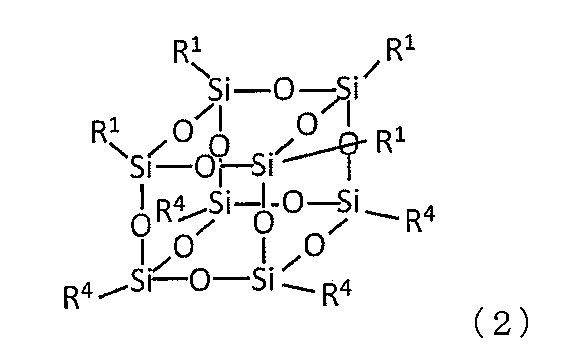
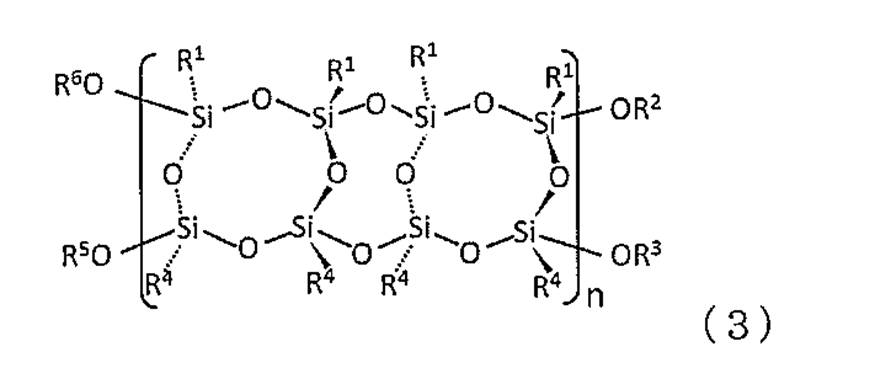
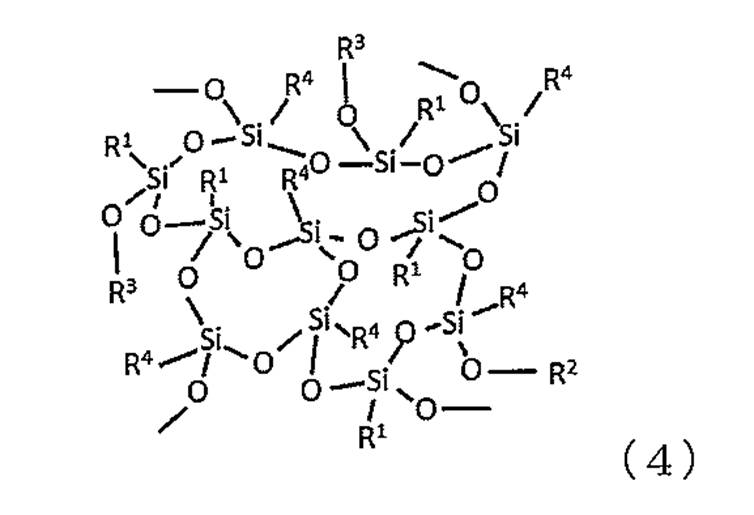
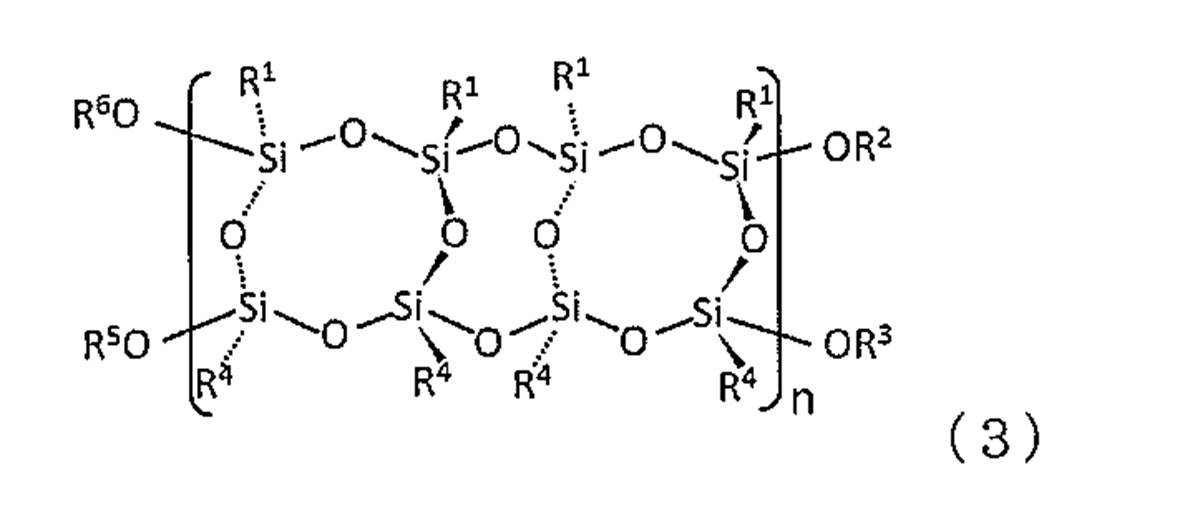
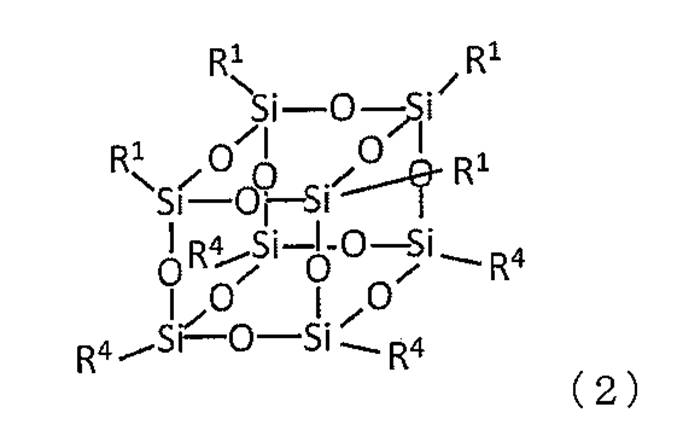
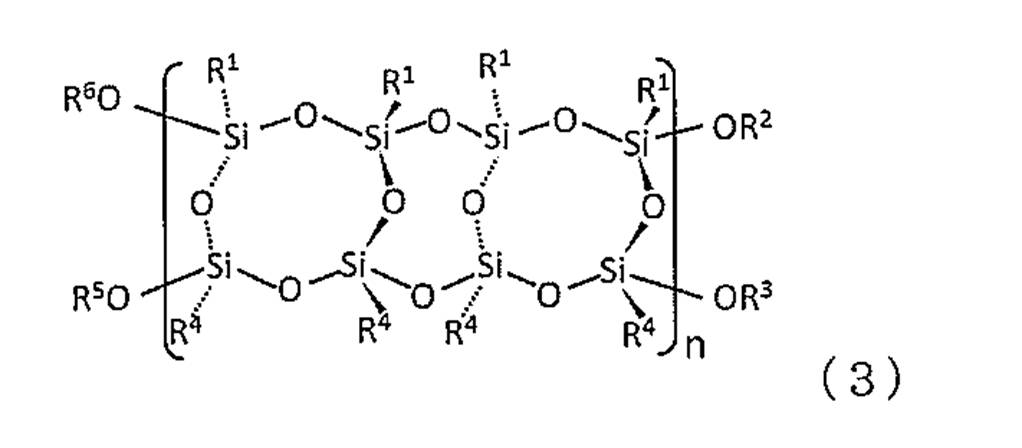
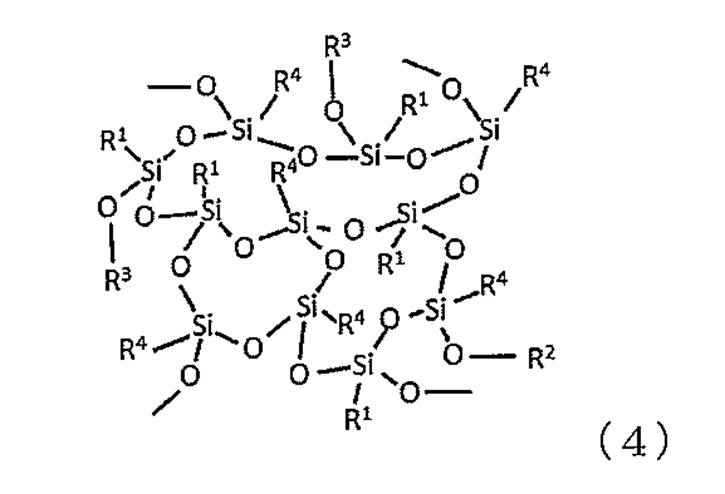
- the polysilsesquioxane preferably has at least one structure selected from the following chemical formula (2), chemical formula (3), chemical formula (4), or a composite structure thereof. More specifically, the polysilsesquioxane has the following cage structure (2), ladder structure (3), random structure (4), or a mixed structure thereof. However, the polysilsesquioxane is converted into a nano-domain structure of a silicon oxide composite material coated with carbon after heat treatment.
- the polysilsesquioxane having a cage structure of the general formula compound (2) is as follows.
- R 1 and R 4 are each selected from the group of substituted or unsubstituted alkyl having 1 to 45 carbon atoms, the group of substituted or unsubstituted aryl, and the group of substituted or unsubstituted arylalkyl
- any hydrogen may be replaced by halogen
- any —CH 2 — may be —O—, —CH ⁇ CH—, cycloalkylene, or cyclo
- any hydrogen may be replaced by halogen
- any —CH 2 — is —O—, —CH ⁇ CH—, It may be replaced by cycloalkylene or cycloalkenylene.
- the polysilsesquioxane having a ladder structure of the general formula compound (3) is as follows.
- R 1 and R 4 are each selected from the group of substituted or unsubstituted alkyl having 1 to 45 carbon atoms, the group of substituted or unsubstituted aryl, and the group of substituted or unsubstituted arylalkyl
- any hydrogen may be replaced by halogen
- any —CH 2 — may be —O—, —CH ⁇ CH—, cycloalkylene, or cyclo
- any hydrogen may be replaced by halogen
- any —CH 2 — is —O—, —CH ⁇ CH—, It may be replaced with cycloalkylene or cycloalkenylene.
- R 2 , R 3 , R 5 and R 6 are each a hydrogen atom, a substituted or unsubstituted alkyl group having 1 to 45 carbon atoms, a substituted or unsubstituted aryl group, and a substituted or unsubstituted arylalkyl group.
- any hydrogen may be replaced by halogen, and any —CH 2 — represents —O—, —CH ⁇ CH—, cycloalkylene , Cycloalkenylene, or —SiR 1 2 —.
- any hydrogen may be replaced by halogen, and any —CH 2 — may be —O—, —CH ⁇ CH—, cycloalkylene, cycloalkenylene, or — SiR 1 2 - may be replaced by.
- n represents an integer of 1 or more.
- Examples of the general formula compound (3) include compounds described in pamphlets of International Publication Nos. 2003/024870 and 2004/081084. Preferred specific examples (12) to (14) are shown below. The present invention is not limited to these compounds.
- Me represents a methyl group
- Ph represents a phenyl group.
- the polysilsesquioxane having a random structure of the general formula compound (4) is as follows.
- R 1 and R 4 are each selected from the group of substituted or unsubstituted alkyl having 1 to 45 carbon atoms, the group of substituted or unsubstituted aryl, and the group of substituted or unsubstituted arylalkyl
- any hydrogen may be replaced by halogen
- any —CH 2 — may be —O—, —CH ⁇ CH—, cycloalkylene, or cyclo
- any hydrogen may be replaced by halogen
- any —CH 2 — is —O—, —CH ⁇ CH—, It may be replaced with cycloalkylene or cycloalkenylene.
- R 2 , R 3 , R 5 and R 6 are each a hydrogen atom, a substituted or unsubstituted alkyl group having 1 to 45 carbon atoms, a substituted or unsubstituted aryl group, and a substituted or unsubstituted arylalkyl group.
- any hydrogen may be replaced by halogen, and any —CH 2 — represents —O—, —CH ⁇ CH—, cycloalkylene , Cycloalkenylene, or —SiR 1 2 —.
- any hydrogen may be replaced by halogen, and any —CH 2 — may be —O—, —CH ⁇ CH—, cycloalkylene, cycloalkenylene, or — It may be replaced by SiR 1 2- . )
- the polysilsesquioxane used in the present invention is a substance having a low dielectric constant.
- a sol-gel reaction it is possible to produce a mesoporous substance having a microporous structure of a certain size.
- a negative electrode active material containing a new silicon oxide-based composite material obtained directly by heat-treating the polysesquioxane in an inert atmosphere at a temperature in the range of 200 ° C. to 2,000 ° C. can also be produced. .
- the polysilsesquioxane used in the production of the negative electrode active material containing the silicon oxide composite material is obtained by sol-gel reaction of a silane compound.
- the sol-gel reaction of the silane compound yields a sol in which low-molecular-weight silane compounds are very stable by hydrolysis and condensation reactions under appropriate conditions, and inorganic particles having a uniform structure are dispersed. Reaction.
- a polysilsesquioxane represented by the general formula (1) is obtained by a sol-gel reaction of a silane compound.
- R 1 and R 4 are each selected from the group of substituted or unsubstituted alkyl having 1 to 45 carbon atoms, the group of substituted or unsubstituted aryl, and the group of substituted or unsubstituted arylalkyl
- any hydrogen may be replaced by halogen
- any —CH 2 — may be —O—, —CH ⁇ CH—, cycloalkylene, or cyclo
- any hydrogen may be replaced by halogen
- any —CH 2 — is —O—, —CH ⁇ CH—, It may be replaced with cycloalkylene or cycloalkenylene.
- R 2 , R 3 , R 5 and R 6 are each a hydrogen atom, a substituted or unsubstituted alkyl group having 1 to 45 carbon atoms, a substituted or unsubstituted aryl group, and a substituted or unsubstituted arylalkyl group.
- any hydrogen may be replaced by halogen, and any —CH 2 — represents —O—, —CH ⁇ CH—, cycloalkylene , Cycloalkenylene, or —SiR 1 2 —.
- any hydrogen may be replaced by halogen, and any —CH 2 — may be —O—, —CH ⁇ CH—, cycloalkylene, cycloalkenylene, or — It may be replaced by SiR 1 2- .
- n represents an integer of 1 or more.
- R 1 and R 4 are each a substituted or unsubstituted alkyl group having 1 to 45 carbon atoms, a substituted or unsubstituted aryl group, and Selected from the group of substituted or unsubstituted arylalkyl, specifically, aromatic such as phenyl group and naphthyl group, halogen and C1-C5 alkyl group are preferred, more preferably aromatic such as phenyl group and naphthyl group. A tribe.
- the said polysilsesquioxane can use what is obtained by carrying out sol-gel reaction of the silane compound represented by following General chemical formula (5) under an acid catalyst.
- R 10 Si (R 7 ) (R 8 ) (R 9 ) (5) (In the above formula (5), R 7 , R 8 and R 9 are each independently hydrogen, halogen, hydroxyl group or alkyloxy group having 1 to 4 carbon atoms. Methyl group, ethyl group, etc. are particularly preferred.
- R 10 represents a hydrogen atom, a substituted or unsubstituted alkyl group having 1 to 45 carbon atoms, a substituted or unsubstituted aryl group, and a substituted group.
- any hydrogen may be replaced by halogen, and any —CH 2 — may be —O—, —CH ⁇ CH—, cycloalkylene, or cycloalkenylene may be substituted, and in the alkylene in the substituted or unsubstituted arylalkyl, any hydrogen is And may be replaced by halogen, and any —CH 2 — may be replaced by —O—, —CH ⁇ CH—, cycloalkylene, or cycloalkenylene.
- the substituent of the substituted alkyl group in the general chemical formula (5) is preferably a halogen, a C1-C10 alkyl group, a C2-C10 alkenyl group, a C1-C5 alkoxy group, a phenyl group, a naphthyl group, or the like.
- the silicon oxide surface in the silicon oxide-based composite material is carbon formed by carbon sources (R 1 to R 10 ) contained in the polysilsesquioxane. Since it is coated with components, it is not necessary to newly add a carbon precursor as a conductive auxiliary, but within a range not losing the effect of the present invention, the carbon precursor is mixed with the polysilsesquioxane, By performing the heat treatment, the amount of the carbon-based coating covering the silicon oxide-based composite material can be adjusted and controlled. When mixing the carbon precursor, 10-90% by weight of the total weight of the mixture can be added. Within this range, the energy density is good, the amount of carbon remaining after the carbonization reaction is sufficient, and good characteristics are obtained.
- carbon precursor petroleum pitch, coal tar pitch, sucrose, phenol resin, epoxy resin, furfuryl alcohol, polyvinyl chloride, polyvinyl alcohol and the like are preferable.
- carbon precursors which are used as electrode active materials or conductive materials in conventional lithium ion secondary batteries such as graphite powder and carbon black (acetylene black, furnace black, ketjen black, etc.), are used as a carbon precursor. Can be used instead of the body.
- the present invention provides a negative electrode and a lithium ion secondary battery employing the negative electrode active material.
- the negative electrode of the present invention is manufactured including a negative electrode active material containing the silicon oxide-based composite material.
- the negative electrode may be formed by, for example, heat-treating and firing the various PSQs of the present invention, and forming a negative electrode mixed material containing the formed negative electrode active material and binder into a certain shape. May be manufactured by a method of applying to a current collector such as copper foil.
- the method for forming the negative electrode is not particularly limited, and a known method can be used.
- a negative electrode active material containing a silicon oxide composite material of the present invention, a binder, and a negative electrode material composition such as a conductive material as necessary are prepared as usual, and this is prepared using copper, nickel, stainless steel.
- a current collector such as a rod-like body, plate-like body, foil-like body, or net-like body mainly, or cast a negative electrode material composition on a support separately, and peel it from the support.
- the negative electrode active material film is laminated on a current collector to obtain a negative electrode plate.
- the negative electrode of the present invention is not limited to the above-listed forms, and forms other than the listed forms are possible.
- a battery is required to charge and discharge a large amount of current in order to increase the capacity.
- a material having a low electric resistance of an electrode is required. Therefore, in order to reduce the resistance of the electrode, various conductive materials are generally added, and conductive materials such as carbon black and graphite fine particles are mainly used as conductive aids.
- Any binder can be used as long as it is generally used in secondary batteries.
- the lithium ion secondary battery of the present invention is manufactured including the negative electrode.
- the lithium ion secondary battery of the present invention can be manufactured as follows. First, a positive electrode active material capable of reversibly inserting and extracting Li, a conductive additive, a binder and a solvent are mixed to prepare a positive electrode active material composition. Similarly to the negative electrode, the positive electrode active material composition is directly coated and dried on a metal current collector as usual, to prepare a positive electrode plate. It is also possible to produce a positive electrode by separately casting the positive electrode active material composition on a support and then laminating the film obtained by peeling from the support on a metal current collector.
- the method for forming the positive electrode is not particularly limited, and a known method can be used.
- any lithium-containing composite metal oxide that is generally used in the field of the secondary battery can be used.
- Specific examples of the complex oxide include LiMn 2 O 4 , LiCoO 2 , LiNiO 2 , and LiFeO 2 .
- V 2 O 5 , TiS, MoS, etc., which are compounds capable of oxidation / reduction of lithium, can also be used.
- Carbon black, graphite fine particles, etc. are used as the conductive additive, and vinylidene fluoride / hexafluoropropylene copolymer, polyvinylidene fluoride (PVDF), polyacrylonitrile, polymethyl methacrylate, poly quaternary are used as the binder.
- PVDF polyvinylidene fluoride
- Fluorinated ethylene and a mixture thereof, styrene butadiene rubber-based polymer can be used, and N-methylpyrrolidone, acetone, water, etc. are used as a solvent.
- the content of the cathode active material, the conductive additive, the binder, and the solvent is set to an amount that can be generally used in a lithium ion secondary battery.
- any separator that is generally used in lithium ion secondary batteries can be used.
- those that have low resistance to ion migration of the electrolyte or that have excellent electrolyte solution impregnation ability are preferred.
- it is a material selected from glass fiber, polyester, Teflon (registered trademark), polyethylene, polypropylene, polytetrafluoroethylene (PTFE), and a compound thereof, and may be a nonwoven fabric or a woven fabric.
- a rollable separator made of a material such as polyethylene or polypropylene is used.
- the ability to impregnate an organic electrolyte is used.
- a method for forming the separator is not particularly limited, and a known method can be used. For example, it can be manufactured by the following method.
- the separator composition is directly coated on the electrode and dried to form a separator film, or the separator composition is supported.
- the separator film peeled off from the support after casting and drying on the body can be laminated on the electrode.
- the polymer resin is not particularly limited, and any material used for the binder of the electrode plate can be used.
- a vinylidene fluoride / hexafluoropropylene copolymer, polyvinylidene fluoride, polyacrylonitrile, polymethyl methacrylate and a mixture thereof can be used.
- electrolyte examples include propylene carbonate, ethylene carbonate, diethylene carbonate, ethyl methyl carbonate, methyl propyl carbonate, butylene carbonate, benzonitrile, acetonitrile, tetrahydrofuran, 2-methyltetrahydrofuran, ⁇ -butyrolactone, dioxolane, 4-methyldioxolane, N, N-dimethylformamide, dimethylacetamide, dimethyl sulfoxide, dioxane, 1,2-dimethoxyethane, sulfolane, dichloroethane, chlorobenzene, nitrobenzene, dimethyl carbonate, methyl isopropyl carbonate, ethyl propyl carbonate, dipropyl carbonate, dibutyl carbonate, diethylene glycol or diethyl ether Or a mixed solvent thereof such as LIPF 6 , LiBF 4 , LiSb 6 , LiAsF 6 , LiCl
- a separator is disposed between the positive electrode plate and the negative electrode plate as described above to form a battery structure.
- the battery structure is wound or folded and placed in a cylindrical battery case or a rectangular battery case, and then the organic electrolyte solution of the present invention is injected to complete a lithium ion secondary battery.
- the battery structure is laminated in a bicell structure, it is impregnated with an organic electrolyte, and the obtained product is put in a pouch and sealed to complete a lithium ion polymer battery.
- the silicon oxide composite material formed by baking the polysilsesquioxane of the present invention by heat treatment is compared with the conventional general silicon oxide, as shown in FIG. in a higher crystallinity peak is amorphous phase is not present, scattering as shown in FIG. 2, in the spectrum measured by X-ray small angle scattering method, the 0.02 ⁇ -1 ⁇ q ⁇ 0.2 ⁇ -1 In the spectrum measured by Raman spectroscopy as shown in FIG. 3, the graphitic carbon contained in the silicon oxide was estimated to include a nanodomain structure having an inertia diameter of 1 to 3 nm.
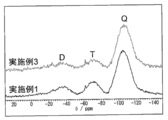
- SiOxCy (0.5 ⁇ x ⁇ 1.8,1 ⁇ y ⁇ 5) elemental analysis values, further, as shown in FIG. 5, 29 Si-NMR spectrum -3 ppm (SiO 2 C 2), - 70ppm than the absorption based on Si-C bond (SiO 3 C) is observed, relative by diameter coated carbon having a nano-domain structure of about 1 ⁇ 3 nm Can exhibit excellent lithium storage / release characteristics.
- X-ray diffraction measurement X-ray diffraction is performed by using a D8 Discover manufactured by Bruker AXS Co., Ltd. as an X-ray diffractometer, and by capillary method.
- Raman spectroscopic analysis uses NRS-3100 manufactured by JASCO Corporation as a laser Raman spectroscopic analyzer, laser wavelength: 532 nm, objective lens: 50 times (long focal type), laser intensity: 0.1-1 mW, Measurement was performed under the conditions of an exposure time of 100 seconds and an integration count of 1 time.
- 29 Si solid state NMR measurement As a 29 Si solid state NMR measurement apparatus, DDMAS measurement was performed using a 500 MHz NMR apparatus (VARIAN NMR SYSTEM) manufactured by Varian Technologies Japan Limited. The rotation speed was 8 kHz, the pulse waiting time was 10 seconds, and polydimethylsilane ( ⁇ 34.44 ppm) was used as an external reference.
- the charge / discharge characteristics of a lithium ion secondary battery including a negative electrode using a negative electrode active material containing the silicon oxide composite material of the present invention were measured as follows. Using HJR-110mSM, HJ1001SM8A or HJ1010mSM8A manufactured by Hokuto Denko, both charging and discharging were measured at a constant current. At that time, the current value was set to 0.05 C so as to be 1/20 of 370 mAh which is the theoretical capacity of graphite per 1 g weight of the silicon oxide composite material. In addition, charging was a capacity until the battery voltage decreased to 0V, and discharging was a capacity until the battery voltage reached 3V. When switching between charge and discharge, the battery was discharged in an open circuit for 30 minutes.
- the cycle characteristics were also measured under the same conditions. However, when the negative electrode active material containing the silicon oxide composite material of the present invention is used, the current value has a long time in one cycle. Therefore, in some examples, the current value was gradually increased from 0.05C to 3.0C.
- the reversible capacity is the initial discharge capacity
- the initial charge / discharge rate is the ratio of the discharge capacity to the charge capacity in the first cycle
- the capacity maintenance rate after the cycle test is the charge after the cycle with respect to the initial charge amount. Displayed by capacity.
- Example 1 Preparation of silicon oxide composites
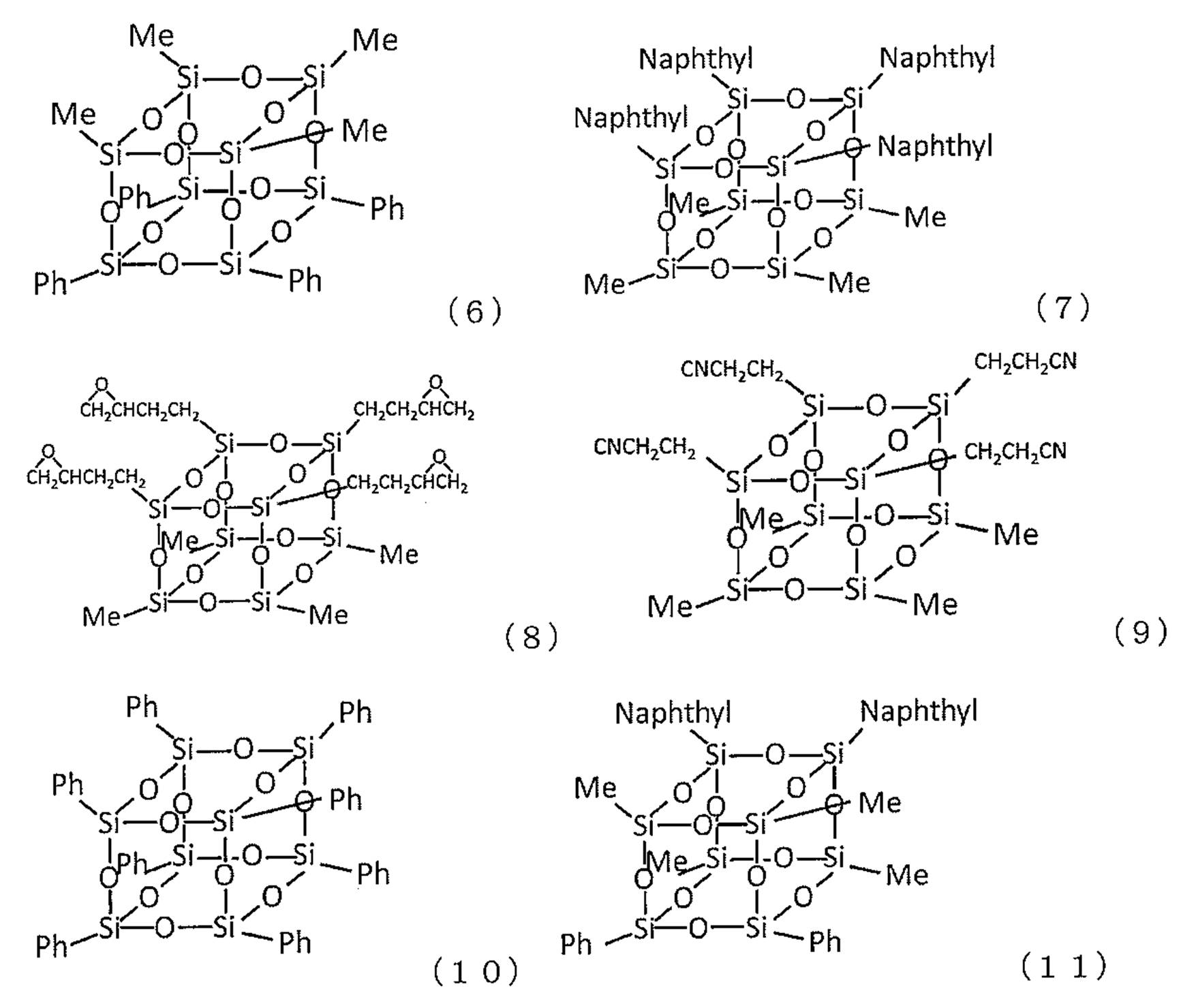
- octaphenylsilsesquioxane (10) was placed on an SSA-S grade alumina boat
- the boat was set in a vacuum purge tube furnace KTF43N1-VPS (manufactured by Koyo Thermo Systems Co., Ltd.)
- Ar is supplied at a flow rate of 200 ml / min
- the temperature is raised at a rate of 4 ° C./min and fired at 1000 ° C. for 1 hour.
- a silicon oxide composite material was obtained.
- the obtained silicon oxide composite material is pulverized in the atmosphere for about 3 hours using a ball mill made of zirconia and classified using a 32 ⁇ m stainless steel sieve, whereby the maximum particle size is 32 ⁇ m.
- a silicon oxide composite material (15) was obtained.
- the results of the X-ray diffraction pattern, X-ray small angle scattering pattern, and laser Raman spectroscopic measurement of the obtained silicon oxide-based composite material are shown in FIGS. 1, 2, and 3, respectively.
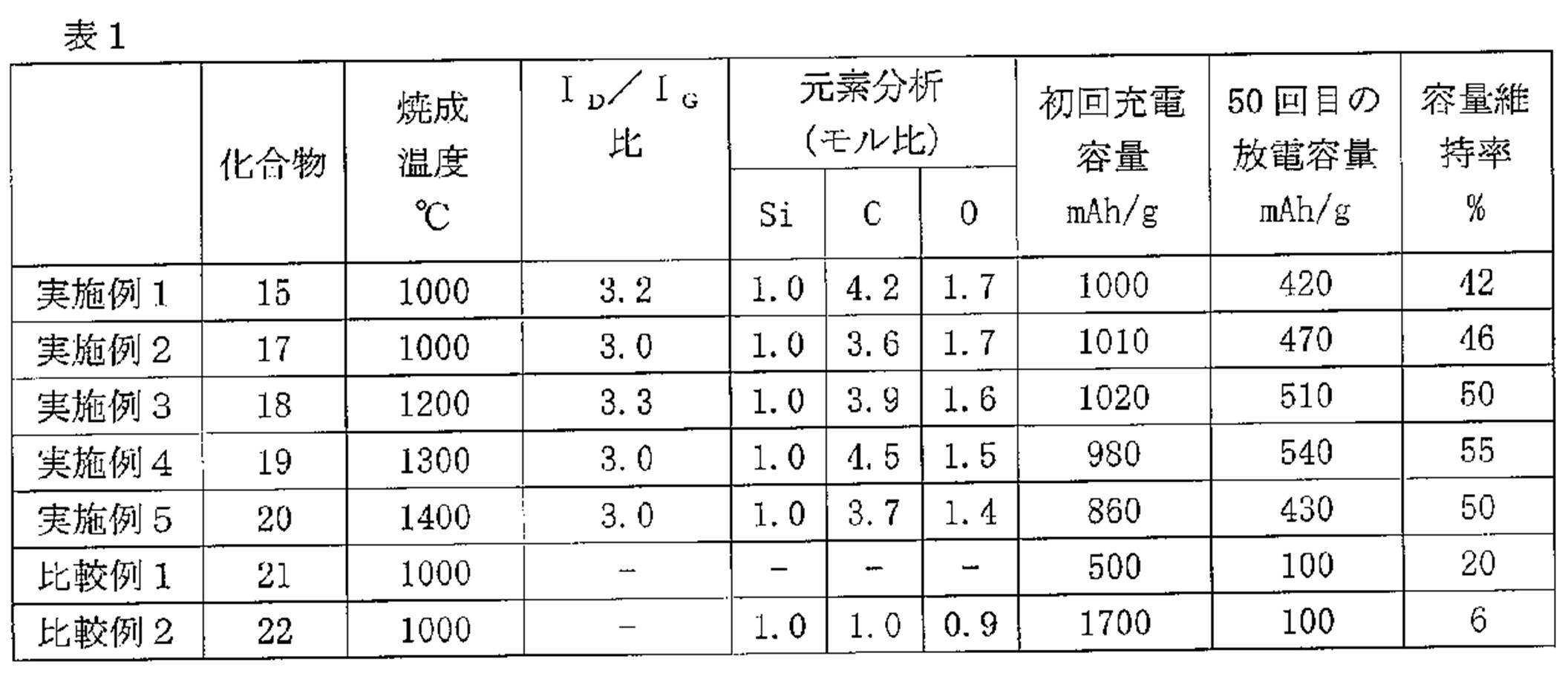
- Table 1 shows the results of elemental analysis of the obtained silicon oxide composite material.
- acetylene black is added to 100 parts by weight of the silicon oxide-based composite material (15), mixed for 15 minutes using a stirrer in the flask, and then 12.5 parts by weight of polyvinylidene fluoride. In addition, mixed for another 15 minutes. Thereafter, N-methyl-2-pyrrolidone was mixed as a solvent to form a slurry. Thereafter, the slurry was applied to a thickness of 100 ⁇ m on a copper foil roll by a doctor blade method. After coating, the coating was air-dried for 30 minutes and then dried on an 80 ° C. hot plate for 90 minutes.
- the negative electrode sheet was pressed with a 2t small precision roll press (manufactured by Sank Metal). After pressing, the electrode was punched with an electrode punching punch HSNG-EP with a diameter of 14.50 mm, and dried under reduced pressure at 80 ° C. for 12 hours or more in a glass tube oven GTO-200 (SIBATA) to prepare a negative electrode body.
- a 2t small precision roll press manufactured by Sank Metal.
- the electrode was punched with an electrode punching punch HSNG-EP with a diameter of 14.50 mm, and dried under reduced pressure at 80 ° C. for 12 hours or more in a glass tube oven GTO-200 (SIBATA) to prepare a negative electrode body.
- a 2032 type coin battery having the structure shown in FIG. 4 was prepared.
- Metallic lithium as the positive electrode 3, a microporous polypropylene film as the separator 2, the negative electrode body as the negative electrode 1, and ethylene carbonate and diethyl carbonate in which LiPF 6 was dissolved at a rate of 1 mol / L as the electrolyte solution 1: 1 (volume ratio) mixed solvent was used.
- BTS2005W manufactured by Nagano Co., Ltd. was used as the charge / discharge tester.
- As charging / discharging conditions both charging and discharging were performed at a constant current of 0.05 C, the discharge end voltage was 1 mV, and the charge end voltage was 1500 mV. The results are shown in Table 1.
- Example 2 In the preparation of the silicon oxide composite material, the same procedure as in Example 1 was conducted except that the silicon oxide composite material precursor obtained in Synthesis Example 2 was used instead of octaphenylsilsesquioxane. An oxide composite material (17) was obtained. The results of X-ray diffraction pattern, X-ray small angle scattering pattern, and laser Raman spectroscopic measurement of the obtained silicon oxide composite material (17) are shown in FIGS. 1, 2, and 3, respectively. In addition, Table 1 shows the elemental analysis results of the silicon oxide composite material (17) obtained.
- Example 3 Preparation of the silicon oxide composite material was performed in the same manner as in Example 1 except that the firing temperature in the heat treatment was 1200 ° C., to obtain a silicon oxide composite material (18).
- the results of X-ray diffraction pattern, X-ray small angle scattering pattern, and laser Raman spectroscopic measurement of the obtained silicon oxide composite material (18) are shown in FIGS. 1, 2, and 3, respectively.
- Table 1 shows the elemental analysis results of the silicon oxide composite material (18) obtained.
- Example 4 In the preparation of the silicon oxide composite material, a silicon oxide composite material (19) was obtained in the same manner as in Example 1 except that the firing temperature of the heat treatment was 1300 ° C. The X-ray diffraction pattern, X-ray small angle scattering pattern, and laser Raman spectroscopic measurement result of the obtained silicon oxide composite material (19) are shown in FIGS. 1, 2, and 3, respectively. In addition, Table 1 shows the elemental analysis results of the silicon oxide composite material (19) obtained.
- Example 5 Preparation of the silicon oxide composite material was performed in the same manner as in Example 1 except that the firing temperature of the heat treatment was set to 1400 ° C., to obtain a silicon oxide composite material (20).
- the results of X-ray diffraction pattern, X-ray small angle scattering pattern, and laser Raman spectroscopic measurement of the obtained silicon oxide composite material (20) are shown in FIGS. 1, 2, and 3, respectively.
- Table 1 shows the results of elemental analysis of the obtained silicon oxide composite material (20).
- the silicon oxide composite material produced from the polysilsesquioxane-based organic silicon compound used in the present invention has a conventional carbon-based negative electrode active material in both initial capacity and 50th discharge capacity. Therefore, it can be evaluated that the negative electrode active material of the present invention can withstand practical use as a negative electrode material.
- the battery characteristics using the negative electrode using the conventional silicon oxide negative electrode active material shown in Comparative Examples 1 and 2 are the same as those of the negative electrode using the negative electrode active material of the present invention.
- the initial discharge capacity shows a high value, but the capacity decreases rapidly, and the capacity becomes lower than that using the carbon-based negative electrode active material. It is a negative electrode active material that cannot exhibit excellent characteristics.
- the examples in which the silicon oxide composite material obtained by firing the polysilsesquioxane of the present invention was used as the negative electrode active material were composed of silicon oxide and carbon having a composition similar to that of the present invention.
- a battery having an initial capacity of 1.5 times or more can be formed, and as seen in the 50th discharge capacity,
- the negative electrode active material of the present invention shows a high capacity even when the capacity is reduced, and an excellent result is also obtained in the capacity maintenance rate, indicating that a battery with a high capacity and a stable battery life can be obtained. .
- the negative electrode active materials of the present invention have almost the same excellent capacity, have a high capacity retention rate, and are simply a silicon oxide and a carbon material. Unlike the negative electrode active material in which the silicon oxide is uniformly mixed, the negative electrode active material of the present invention does not separate the silicon oxide and the carbonaceous material due to the volume expansion due to occlusion and release of lithium, and the carbon derived from silicon oxide and PSQ. It can be presumed that this is due to the presence of a silicon oxide composite material in which the surface of the silicon oxide is uniformly coated with the carbonaceous material.
- Lithium ion secondary battery negative electrode active material of the present invention and lithium having the capacity and excellent charge / discharge characteristics and cycle characteristics by forming a negative electrode using the negative electrode active material and using it in a lithium ion secondary battery An ion secondary battery can be obtained.
- the present invention is a technique useful in the field of batteries, particularly in the field of secondary batteries.
- Negative electrode material 2 Separator 3: Positive electrode material Q:-(SiO 4 ) -unit T: -SiO 3 C-unit D: -SiO 2 C 2 -unit
Landscapes
- Chemical & Material Sciences (AREA)
- Chemical Kinetics & Catalysis (AREA)
- Electrochemistry (AREA)
- General Chemical & Material Sciences (AREA)
- Composite Materials (AREA)
- Inorganic Chemistry (AREA)
- Engineering & Computer Science (AREA)
- Materials Engineering (AREA)
- Manufacturing & Machinery (AREA)
- Battery Electrode And Active Subsutance (AREA)
Description
さらに詳細には、ポリシルセスキオキサンを不活性ガス雰囲気下で熱処理して得られるシリコン酸化物系複合材料を含有する負極活物質であって、元素分析によりSi、C及びOを含有し、X線小角散乱法により測定したスペクトルにおいて、0.02Å-1<q<0.2Å-1に散乱がみとめられ、炭素-酸化ケイ素のナノドメイン構造を有し、ラマン分光法により測定したスペクトルにおいて、1590cm-1(Gバンド/グラファイト構造)と1325cm-1(Dバンド/非晶性炭素)に散乱がみとめられ、結晶性炭素と非晶性炭素のピーク強度比(ID/IG比)が2.0から5.0の範囲にある、黒鉛質炭素を有する、一般式SiOxCy(0.5<x<1.8、1<y<5)で表示されるシリコン酸化物系複合材料を含有する負極活物質及びその製造方法、それを用いた負極並びにその負極活物質を含んで電池容量及び寿命特性が向上した負極とリチウムイオン電池に関する。
このような小型、軽量な高容量の二次電池としては、今日、リチウムイオンを層間から放出するリチウムインターカレーション化合物を正極物質に、リチウムイオンを結晶面間の層間に充放電時に吸蔵放出(インターカレート)できる黒鉛などに代表される炭素質材料を負極物質に用いた、ロッキングチェア-型のリチウムイオン電池の開発が進み、実用化されて一般的に使用されている。
そこで、かかるリチウム金属に代わる負極活物質として、リチウムを吸蔵、放出する炭素系負極が用いられるようになった。
炭素系負極を使用するリチウムイオン二次電池は、炭素の多孔性構造のため、本質的に低い電池容量を有する。例えば、使用されている炭素として最も結晶性の高い黒鉛の場合にも、理論的な容量は、LiC6の組成であるとき、372mAh/gほどである。これは、リチウム金属の理論的な容量が3860mAh/gであることに比べれば、僅か10%ほどに過ぎない。そこで、金属負極が有する既存の問題点にもかかわらず、再びリチウムのような金属を負極に導入し、電池の容量を向上させようという研究が活発に試みられている。
実際にSnの大きさを最小化し、充放電時に発生するSnの凝集を防止して優れた容量維持率を示す、非晶質Sn系酸化物を提案している(例えば、非特許文献1を参照)。しかし、Sn系酸化物は、リチウムと酸素原子との間の反応が必然的に発生し、非可逆容量が存在するという問題点があった。
従来の負極材料の有するかかる問題点を解決し、さらに高容量、かつ優れた充放電特性及びサイクル特性を示す負極活物質の開発及び生産性に優れた製造方法が、依然として求められている。
(負極活物質)
本発明のシリコン酸化物系複合材料を含有する負極活物質は、ポリシルセスキオキサンを熱処理により焼成して製造されるものであって、本発明のシリコン酸化物系複合材料では、図1に示したXRD(X線回折測定法)による結晶構造解析によれば、結晶性ピークが存在しない非晶質相であることを示している。
散乱qが0.02Å-1~0.2Å-1の範囲にあれば、所望のナノドメイン構造をとることができ、本発明の良好な特性を発現する。
ピーク強度比(ID/IG比)が、2.0~5.0の範囲にあれば、結晶性炭素が多くなり黒鉛質炭素材料が発達し、導電性に異方性が発現することもなく、所望のナノドメイン構造が得られ、良好な導電性が得られる。
xが0.5~1.8の範囲であれば、シリコン酸化物系複合材料としてナノドメイン構造が得られる非晶質シリコン酸化物成分を製造し易く、十分な電池容量が得られる。yが1~5の範囲であれば、グラファイトが適度に発達し、導電性と電池容量のバランスがよく、十分な導電性と高い電池容量が得られる。
しかも、ラマン分光法により測定したスペクトルにおいて、1590cm-1(Gバンド/グラファイト構造)と1325cm-1(Dバンド/非晶性炭素)に散乱がみとめられ、結晶性炭素と非晶性炭素のピーク強度比(ID/IG比)が2.0から5.0の範囲にある、黒鉛質炭素を有することを特徴とする、一般式SiOxCy(0.5<x<1.8、1<y<5)で表示されるものがさらに望ましい。
本発明は、前記PSQを熱処理により焼成し、形成された黒鉛炭素で被覆されたナノドメイン構造を有するシリコン酸化物系複合材料を含有する負極活物質が得られる。
前記シリコン酸化物系複合材料は、ポリシルセスキオキサンを、直接、不活性雰囲気下で200℃~2,000℃の温度範囲で熱処理により焼成する工程を含むことにより製造できる。
ポリシルセスキオキサンは、下記一般式(1)で示すことができる。
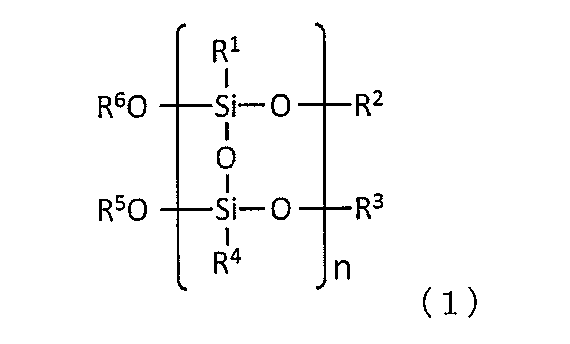
R2、R3、R5およびR6は、水素原子、炭素数1~45の置換または非置換のアルキルの群、置換または非置換のアリールの群、および置換または非置換のアリールアルキルの群から選択される基、但し、炭素数の1~45のアルキルにおいて、任意の水素はハロゲンで置き換えられてもよく、任意の-CH2-は、-O-、-CH=CH-、シクロアルキレン、シクロアルケニレン、または-SiR1 2-で置き換えられてもよい。置換または非置換のアリールアルキル中のアルキレンにおいて、任意の水素はハロゲンで置き換えられてもよく、任意の-CH2-は、-O-、-CH=CH-、シクロアルキレン、シクロアルケニレン、または-SiR1 2-で置き換えられてもよい。nは1以上の整数を示す。)
本件明細書において、「ハロゲン」はフッ素、塩素、臭素、ヨウ素などを示すが、中でもフッ素または塩素が好ましい。
前記ポリシルセスキオキサンは、より詳しくは、以下のようなケージ構造(2)、梯子型構造(3)、ランダム構造(4)又はそれらの混合構造を有するものである。
しかし、該ポリシルセスキオキサンは、熱処理後には、炭素に被覆されたシリコン酸化物系複合材料のナノドメイン構造に変換される。
R2、R3、R5およびR6は、水素原子、炭素数1~45の置換または非置換のアルキルの群、置換または非置換のアリールの群、および置換または非置換のアリールアルキルの群から選択される基、但し、炭素数の1~45のアルキルにおいて、任意の水素はハロゲンで置き換えられてもよく、任意の-CH2-は、-O-、-CH=CH-、シクロアルキレン、シクロアルケニレン、または-SiR1 2-で置き換えられてもよい。置換または非置換のアリールアルキル中のアルキレンにおいて、任意の水素はハロゲンで置き換えられてもよく、任意の-CH2-は、-O-、-CH=CH-、シクロアルキレン、シクロアルケニレン、または-SiR1 2-で置き換えられてもよい。nは1以上の整数を示す。)
以下に、好ましい具体的な例(12)~(14)を示す。本発明は、これらの化合物に限定されない。ここで、これらの式中で、Meはメチル基を、Phはフェニル基を表す。

R2、R3、R5およびR6は、水素原子、炭素数1~45の置換または非置換のアルキルの群、置換または非置換のアリールの群、および置換または非置換のアリールアルキルの群から選択される基、但し、炭素数の1~45のアルキルにおいて、任意の水素はハロゲンで置き換えられてもよく、任意の-CH2-は、-O-、-CH=CH-、シクロアルキレン、シクロアルケニレン、または-SiR1 2-で置き換えられてもよい。置換または非置換のアリールアルキル中のアルキレンにおいて、任意の水素はハロゲンで置き換えられてもよく、任意の-CH2-は、-O-、-CH=CH-、シクロアルキレン、シクロアルケニレン、または-SiR1 2-で置き換えられてもよい。)

R2、R3、R5およびR6は、水素原子、炭素数1~45の置換または非置換のアルキルの群、置換または非置換のアリールの群、および置換または非置換のアリールアルキルの群から選択される基、但し、炭素数の1~45のアルキルにおいて、任意の水素はハロゲンで置き換えられてもよく、任意の-CH2-は、-O-、-CH=CH-、シクロアルキレン、シクロアルケニレン、または-SiR1 2-で置き換えられてもよい。置換または非置換のアリールアルキル中のアルキレンにおいて、任意の水素はハロゲンで置き換えられてもよく、任意の-CH2-は、-O-、-CH=CH-、シクロアルキレン、シクロアルケニレン、または-SiR1 2-で置き換えられてもよい。nは1以上の整数を示す。)
R10Si(R7)(R8)(R9) (5)
(前記式(5)で、R7、R8及びR9は、それぞれ独立して水素、ハロゲン、水酸基または炭素数1~4のアルキルオキシ基である。メチル基、エチル基などが特に好ましい。このうち、トリクロロシラン、トリメトキシシラン、トリエトキシシランが特に望ましい。R10は、水素原子、炭素数1~45の置換または非置換のアルキルの群、置換または非置換のアリールの群、および置換または非置換のアリールアルキルの群から選択される基、但し、炭素数の1~45のアルキルにおいて、任意の水素はハロゲンで置き換えられてもよく、任意の-CH2-は、-O-、-CH=CH-、シクロアルキレン、またはシクロアルケニレンで置き換えられてもよい。置換または非置換のアリールアルキル中のアルキレンにおいて、任意の水素はハロゲンで置き換えられてもよく、任意の-CH2-は、-O-、-CH=CH-、シクロアルキレン、またはシクロアルケニレンで置き換えられてもよい。)
この含有量の範囲であれば、エネルギー密度が良好であり、炭化反応後に残存する炭素の量が十分となり、良好な特性が得られる。
また、グラファイト粉末やカーボンブラック(アセチレンブラック、ファーネスブラック、ケッチェンブラックなど)の従来のリチウムイオン二次電池において電極活物質又は導電性材料として使用されている炭素質材料を単独又は組み合わせて炭素前駆体の代わりに使用することができる。
本発明は、前記負極活物質を採用した負極及びリチウムイオン二次電池を提供する。
具体的には、本発明の負極は、前記シリコン酸化物系複合材料を含有する負極活物質を含んで製造される。
前記負極は、例えば、本発明の前記各種PSQを熱処理して焼成し、形成された負極活物質及び結着剤を含む負極混合材料を一定の形状に成形してもよく、前記の負極混合材料を銅箔などの集電体に塗布させる方法で製造されたものでもよい。負極の成形方法は、特に限定されず、公知の方法を用いることができる。
結着剤としては、二次電池において一般的に使われるものならば何れでも使用可能であり、フッ化ビニリデン/六フッ化プロピレン共重合体、フッ化ポリビニリデン(PVDF)、ポリアクリロニトリル、ポリメチルメタクリレート、ポリ四フッ化エチレン及びその混合物、スチレンブタジエン・ゴム系ポリマーなどが例示される。
本発明のリチウムイオン二次電池は、前記負極を含んで製造されることを特徴とする。本発明のリチウムイオン二次電池は、次のように製造できる。
まず、Liを可逆的に吸蔵及び放出可能な正極活物質、導電助材、結着剤及び溶媒を混合して正極活物質組成物を準備する。前記正極活物質組成物を負極と同様、通常に行われているとおり、金属集電体上に直接コーティング及び乾燥し、正極板を準備する。
前記正極活物質組成物を別途、支持体上にキャスティングした後、この支持体から剥離して得たフィルムを金属集電体上にラミネートして正極を製造することも可能である。正極の成形方法は、特に限定されず、公知の方法を用いることができる。
この時、カソード活物質、導電助材、結着剤及び溶媒の含有量は、リチウムイオン二次電池で一般的に使用することができる量とする。
より具体的には、リチウムイオン二次電池の場合には、ポリエチレン、ポリプロピレンのような材料からなる巻き取り可能なセパレータを使用し、:リチウムイオンポリマー電池の場合には、有機電解液含浸能に優れたセパレータを使用するが、かかるセパレータの成形方法は、特に限定されず、公知の方法を用いることができる。例えば、下記方法によって製造可能である。
前記高分子樹脂は、特に限定されず、電極板の結着剤に使われる物質が何れも使用可能である。例えば、フッ化ビニリデン/六フッ化プロピレン共重合体、フッ化ポリビニリデン、ポリアクリロニトリル、ポリメチルメタクリレート及びその混合物などが使用できる。
なお、式中、Phはフェニル基を示し、Meはメチル基を示す。
また、各実施例及び比較例における「X線回折法測定」、「元素分析測定」、「レーザーラマン分光測定」及び「X線小角散乱法測定」の測定装置及び測定方法並びに「電池特性の評価」は、以下のとおりである。
X線回折は、X線回折装置として、ブルカー・エイエックスエス(株)製D8 Discoverを用いて、キャピラリー法により、X線:CuKα線(λ=1.54Å)、管電圧:45kV、管電流:360mA、2Θ=5-80、入射側:0.4mmスリット、受光側:ソラースリット条件下、測定した。
CHN元素分析については、酸素循環燃焼・TCD検出方式により炭素・水素・窒素元素分析装置として、(株)住化分析センター製NCH-21型を用いて、また、酸素元素分析については、高温炭素反応・NDIR検出方式により酸素元素分析装置として、(株)堀場製作所EMGA-2800を用いて、さらに、Si元素分析については、灰化-アルカリ溶融-酸溶解・ICP発光分析法によりケイ素元素分析装置として、セイコー電子工業(株)製SPS4000を用いて、それぞれ、元素分析を行った。
ラマン分光分析は、レーザーラマン分光分析装置として、日本分光(株)製NRS-3100を用いて、レーザー波長:532nm、対物レンズ:50倍(長焦点型)、レーザー強度:0.1~1mW、露光時間:100秒、積算回数:1回の条件下で測定した。
X線小角回折装置として、ブルカー・エイエックスエス(株)製D8 Discoverを用いて、キャピラリー法により、測定条件:X線発生装置:ターゲットCu、管電圧:45kV、管電流:360mA、2Θ=0-7°、入射側:0.4mmスリット、受光側:0.1mmスリット+Niフィルター+0.05mmスリットの条件下で測定した。
29Si固体NMR測定装置として、バリアンテクノロジーズジャパンリミテッド製500MHzNMR装置(VARIAN NMR SYSTEM)を用いてDDMAS測定を行った。回転数は8kHz、パルス待ち時間は10秒とし、外部基準としてポリジメチルシラン(-34.44ppm)を用いた。
本発明のシリコン酸化物系複合材料を含有する負極活物質を用いた負極を含むリチウムイオン二次電池等の充放電特性は、次のようにして測定した。
北斗電工製HJR-110mSM、HJ1001SM8AもしくはHJ1010mSM8Aを用い、充電・放電ともに測定は、定電流で行った。その際、シリコン酸化物系複合材料1g重量あたり、黒鉛の理論容量である370mAh対して20分の1となるような電流値0.05Cとした。
また、充電は、電池電圧が0Vまで低下するまでの容量とし、放電は、電池電圧が3Vに到達するまでの容量とした。各充放電の切り替え時には、30分間、開回路で放電した。
また、可逆容量は、初回の放電容量とし、初回充放電率は、第1サイクルにおいて、充電容量に対する放電容量の比率とし、サイクル試験後の容量維持率は、初回の充電量に対するサイクル後の充電容量で表示した。
(合成例1)
オクタフェニルシルセスキオキサン(10)の合成
1000mlの四つ口フラスコにトルエン(和光純薬工業)360ml、テトラブチルアンモニウムヒドロキシド(東京化成工業)42.2g(37%TBAH in MeOH)、純水16.2gを入れ、氷浴中で撹拌し冷却した。500mlの滴下ロートにジエチルエーテル(和光純薬工業)360ml、フェニルトリメトキシシラン(東京化成工業)118.9gを仕込み、5min掛けて滴下した。滴下後、氷浴をはずし、室温にて70時間撹拌した。70時間後、加圧濾過機にて濾過を行った。
得られた粉体をビーカーに移して、トルエンにて洗浄し、再度、加圧濾過をした。濾過後、減圧乾 燥器にて120℃、6時間減圧乾燥し、14.3gオクタフェニルシルセスキオキサン(10)を得た。
(PhSiO3/2)nの合成
500ml四つ口フラスコに、フェニルトリメトキシシラン(東京化成)99.1g、メタノール(和光純薬工業)16gを入れる。室温で撹拌しながら、滴下ロートにて1NHCl.36gを、30分掛けてゆっくり滴下した。滴下終了後、60℃にて2時間加熱撹拌した。2時間後、冷却し、トルエン(和光純薬工業)200gを滴下した。
その後、反応液を500mlの分液ロートに移し換えた。飽和の食塩水にて水洗した後、飽和の重曹水にて水洗し、更に飽和の食塩水にて2回水洗し、最後に2回純水にて水洗した。水洗後、硫酸マグネシウム(和光純薬工業)にて脱水した。その液をセパラブルフラスコに移し、溶媒を留去し、減圧加熱して(PhSiO3/2)nを得た。
(シリコン酸化物系複合材料の調製)
SSA-Sグレードのアルミナ製ボートにオクタフェニルシルセスキオキサン(10)15.0重量部をのせた後、該ボートを真空パージ式チューブ炉 KTF43N1-VPS(光洋サーモシステム社製)にセットし、熱処理条件として、アルゴン雰囲気下(高純度アルゴン99.999%)にて、Arを200ml/分の流量で供給しつつ、4℃/分の割合で昇温し、1000℃で1時間焼成することで、シリコン酸化物系複合材料を得た。
次いで、得られたシリコン酸化物系複合材料料をジルコニア製ボールミルを用いて約3時間大気中にて粉砕し、32μmのステンレス製篩を用いて分級することにより最大粒子径が32μmである粉粒状のシリコン酸化物系複合材料(15)を得た。
得られたシリコン酸化物系複合材料のX線回析パターン、X線小角散乱パターン、レーザーラマン分光測定の結果を、それぞれ、図1、2及び図3に示す。また、得られたシリコン酸化物系複合材料の元素分析結果を表1に示す。
前記シリコン酸化物系複合材料(15)100重量部に、12.5重量部のアセチレンブラックを加え、フラスコ内で攪拌子を用いて15分混合した後、12.5重量部のポリフッ化ビニリデンを加え、さらに15分混合した。その後、溶媒としてN-メチル-2-ピロリドンを混合することにより、スラリー状にした。その後、ドクターブレード法により、銅箔ロール上にスラリーを100μmの厚さにて塗工した。
塗工後30分風乾した後、80℃のホットプレートにて90分乾燥した。乾燥後、負極シートを2t小型精密ロールプレス(サンクメタル社製)にてプレスした。プレス後、φ14.50mmの電極打ち抜きパンチHSNG-EPにて電極を打ち抜き、ガラスチューブオーブンGTO―200(SIBATA)にて、80℃で、12時間以上減圧乾燥を行い、負極体を作成した。
図4に示す構造の2032型コイン電池を作成した。正極3として金属リチウム、セパレータ2として微多孔性のポリプロピレン製フィルム、負極1として上記負極体を使用し、電解液としてLiPF6を1モル/Lの割合で溶解させたエチレンカーボネートとジエチルカーボネート1:1(体積比)混合溶媒を使用した。
次いで、リチウムイオン二次電池の電池特性の評価を実施した。充放電試験機としては、(株)ナガノ製BTS2005Wを用いた。充放電条件としては、充電・放電共に0.05Cにて定電流で行い、放電終止電圧1mV、充電終止電圧は1500mVとした。
結果を表1に示す。
シリコン酸化物系複合材料料の調製において、オクタフェニルシルセスキオキサンの代わりに合成例2で得た、シリコン酸化物系複合材料前駆体を用いた以外は、実施例1と同様に行い、シリコン酸化物系複合材料(17)を得た。
得られたシリコン酸化物系複合材料(17)のX線回析パターン、X線小角散乱パターン、レーザーラマン分光測定の結果を、それぞれ、図1、2及び図3に示す。また、得られたシリコン酸化物系複合材料(17)の元素分析結果を表1に示す。
シリコン酸化物系複合材料の調製において、熱処理における焼成温度を1200℃にしたこと以外は、実施例1と同様に行い、シリコン酸化物系複合材料(18)を得た。
得られたシリコン酸化物系複合材料(18)のX線回析パターン、X線小角散乱パターン、レーザーラマン分光測定の結果を、それぞれ、図1、2及び図3に示す。また、得られたシリコン酸化物系複合材料(18)の元素分析結果を表1に示す。
シリコン酸化物系複合材料の調製において、熱処理の焼成温度を1300℃にしたこと以外は、実施例1と同様に行い、シリコン酸化物系複合材料(19)を得た。
得られたシリコン酸化物系複合材料(19)のX線回析パターン、X線小角散乱パターン、レーザーラマン分光測定の結果を、それぞれ、図1、2及び図3に示す。また、得られたシリコン酸化物系複合材料(19)の元素分析結果を表1に示す。
シリコン酸化物系複合材料の調製において、熱処理の焼成温度を1400℃にしたこと以外は、実施例1と同様に行い、シリコン酸化物系複合材料(20)を得た。
得られたシリコン酸化物系複合材料(20)のX線回析パターン、X線小角散乱パターン、レーザーラマン分光測定の結果を、それぞれ、図1、2及び図3に示す。また、得られたシリコン酸化物系複合材料(20)の元素分析結果を表1に示す。
(シリコン酸化物(SiOx)の調製)
オクタヒドロキシシルセスキオキサンの合成
トリエトキシシラン10.5gをエタノール100mlに入れた後、30分間撹拌した。ここに、0.5M HCl溶液6gを入れてさらに6時間撹拌した。撹拌が終わった後、前記溶液を常温で二日間外気の接触をさせないまま、ゲル化させた。
次に、前記ゲル化された溶液を80℃オーブンに二日間放置し、エタノール及び水分が蒸発して白色粉末を得た。前記白色粉末を900℃のアルゴン雰囲気(流量=100ml/min)で1時間焼成し、シリコン酸化物(SiOx)を得た。
前記比較例1で得られたシリコン酸化物粉末1gと石油ピッチ(三菱化学(株)、軟化点250℃)0.4gをテトラヒドロフラン(THF)20mlに入れた後で30分間撹拌した。次に、前記溶液を続けて撹拌し、THFを蒸発させて粉末を得た。
前記粉末を900℃のアルゴン雰囲気(流量=100ml/min)で1時間焼成し、炭素系物質でコーティングされたシリコン酸化物炭素材料(21)を得た。
前記シリコン酸化物炭素複合材料の調製で得られたシリコン酸化物炭素複合材料(15)~(20)及びシリコン酸化物(21)を用いた以外は、実施例1と同様に行った。
(SiO2の調製)
200mlフラスコにエタノール(和光純薬製・特級試薬)30.0gとテトラエトキシシラン(関東化学製・3N)48.4gを仕込み、室温で撹拌した。そこへ1mol/L塩酸水溶液16.8gを滴下した後、60℃のオイルバス中でゲル化するまで撹拌した。得られたゲルを薬さじで砕き、減圧乾燥してSiO2を13.8g得た。
SiO2の調製で得られたSiO21.0gと黒鉛(CGB-10・日本黒鉛製)1.0gをメノウ鉢にとり、乳棒により混合した。混合物を、実施例1と同様に処理し、SiO2/黒鉛複合材料(22)を得た。
該複合材料の図2にX線小角散乱パターンの結果を示す。
本発明の実施例1~5及び比較例1、2の元素分析の結果及び各負極活物質を用いて作製した負極を採用した電池特性の評価結果は、表1に示すとおりである。
2:セパレータ
3:正極材
Q:-(SiO4)-ユニット
T:-SiO3C-ユニット
D:-SiO2C2-ユニット
Claims (12)
- 下式(1)で示されるポリシルセスキオキサン構造を有する有機ケイ素化合物を、不活性ガス雰囲気下で、熱処理して得られるシリコン酸化物系複合材料を含有する負極活物質であって、前記シリコン酸化物系複合材料が、元素分析によりケイ素(Si)、炭素(C)及び酸素(O)を含有し、X線小角散乱法により測定したスペクトルにおいて、0.02Å-1<q<0.2Å-1に散乱がみとめられる炭素-酸化ケイ素のナノドメイン構造を有し、ラマン分光法により測定したスペクトルにおいて、1590cm-1(Gバンド/グラファイト構造)と1325cm-1(Dバンド/非晶性炭素)に散乱がみとめられ、結晶性炭素と非晶性炭素のピーク強度比(ID/IG比)が2.0から5.0の範囲にある、黒鉛質炭素を有する、一般式SiOxCy(0.5<x<1.8、1<y<5)で表示されるシリコン酸化物系複合材料を含有する負極活物質。

R2、R3、R5およびR6は、水素原子、炭素数1~45の置換または非置換のアルキルの群、置換または非置換のアリールの群、および置換または非置換のアリールアルキルの群から選択される基、但し、炭素数の1~45のアルキルにおいて、任意の水素はハロゲンで置き換えられてもよく、任意の-CH2-は、-O-、-CH=CH-、シクロアルキレン、シクロアルケニレン、または-SiR1 2-で置き換えられてもよい。置換または非置換のアリールアルキル中のアルキレンにおいて、任意の水素はハロゲンで置き換えられてもよく、任意の-CH2-は、-O-、-CH=CH-、シクロアルキレン、シクロアルケニレン、または-SiR1 2-で置き換えられてもよい。nは1以上の整数を示す。) - 前記シリコン酸化物系複合材料が、下記式(2)で示されるポリシルセスキオキサンを窒素もしくはアルゴンガス雰囲気中、200℃~2,000℃の範囲で熱処理して得られることを特徴とする、請求項1に記載の負極活物質。

- 前記シリコン酸化物系複合材料が、下記式(3)で示されるポリシルセスキオキサンを窒素もしくはアルゴンガス雰囲気中、200℃~2,000℃の範囲で熱処理して得られることを特徴とする、請求項1に記載の負極活物質。
R2、R3、R5およびR6は、水素原子、炭素数1~45の置換または非置換のアルキルの群、置換または非置換のアリールの群、および置換または非置換のアリールアルキルの群から選択される基、但し、炭素数の1~45のアルキルにおいて、任意の水素はハロゲンで置き換えられてもよく、任意の-CH2-は、-O-、-CH=CH-、シクロアルキレン、シクロアルケニレン、または-SiR1 2-で置き換えられてもよい。置換または非置換のアリールアルキル中のアルキレンにおいて、任意の水素はハロゲンで置き換えられてもよく、任意の-CH2-は、-O-、-CH=CH-、シクロアルキレン、シクロアルケニレン、または-SiR1 2-で置き換えられてもよい。nは1以上の整数を示す。) - 前記シリコン酸化物系複合材料が、下記式(4)で示されるポリシルセスキオキサンを窒素もしくはアルゴンガス雰囲気中、200℃~2,000℃の範囲で熱処理して得られることを特徴とする、請求項1に記載の負極活物質。
R2、R3、R5およびR6は、水素原子、炭素数1~45の置換または非置換のアルキルの群、置換または非置換のアリールの群、および置換または非置換のアリールアルキルの群から選択される基、但し、炭素数の1~45のアルキルにおいて、任意の水素はハロゲンで置き換えられてもよく、任意の-CH2-は、-O-、-CH=CH-、シクロアルキレン、シクロアルケニレン、または-SiR1 2-で置き換えられてもよい。置換または非置換のアリールアルキル中のアルキレンにおいて、任意の水素はハロゲンで置き換えられてもよく、任意の-CH2-は、-O-、-CH=CH-、シクロアルキレン、シクロアルケニレン、または-SiR1 2-で置き換えられてもよい。nは1以上の整数を示す。) - 前記シリコン酸化物系複合材料が、上記式(2)、(3)及び(4)で示されるポリシルセスキオキサンの混合物を窒素もしくはアルゴンガス雰囲気中、200℃~2,000℃の範囲で熱処理して得られることを特徴とする、請求項1に記載の負極活物質。
- 前記負極活物質が、前記シリコン酸化物系複合材料上に形成された炭素系コーティング層をさらに含むことを特徴とする請求項1に記載の負極活物質。
- 前記負極活物質が、前記シリコン酸化物系複合材料内に分散された炭素系粒子をさらに含むことを特徴とする請求項1に記載のシリコン酸化物系複合負極活物質。
- 請求項1~請求項7のうちいずれか1項に記載の負極活物質を含むことを特徴とする負極。
- 請求項8に記載の負極を採用したことを特徴とするリチウム電池。
- 請求項1~請求項7のうちいずれか1項に記載のシリコン酸化物系複合材料を含有する負極活物質を製造する方法であって、ポリシルセスキオキサンを不活性雰囲気下で、200~2,000℃の温度範囲で熱処理する工程を含むことを特徴とするシリコン酸化物系複合材料を含有する負極活物質の製造方法。
- 前記ポリシルセスキオキサンが、下記式(2)、(3)、(4)またはそれらの誘導体およびそれらの混合物のうちから選択された一つの構造を有することを特徴とする請求項10に記載の負極活物質の製造方法。
R2、R3、R5およびR6は、水素原子、炭素数1~45の置換または非置換のアルキルの群、置換または非置換のアリールの群、および置換または非置換のアリールアルキルの群から選択される基、但し、炭素数の1~45のアルキルにおいて、任意の水素はハロゲンで置き換えられてもよく、任意の-CH2-は、-O-、-CH=CH-、シクロアルキレン、シクロアルケニレン、または-SiR1 2-で置き換えられてもよい。置換または非置換のアリールアルキル中のアルキレンにおいて、任意の水素はハロゲンで置換えられてもよく、任意の-CH2-は、-O-、-CH=CH-、シクロアルキレン、シクロアルケニレン、または-SiR1 2-で置き換えられてもよい。nは1以上の整数を示す。) - 前記ポリシルセスキオキサンが、下記化学式5で表示されるシラン化合物を酸触媒下でゾル・ゲル反応させて得られることを特徴とする請求項10に記載の負極活物質の製造方法。
R10Si(R7)(R8)(R9) (5)
(式中、R7、R8及びR9は、それぞれ独立して水素、ハロゲン、水酸基または炭素数1~4のアルキルオキシ基であり、式R10は、炭素数1~45の置換または非置換のアルキルの群、置換または非置換のアリールの群、および置換または非置換のアリールアルキルの群から選択される基、但し、炭素数の1~45のアルキルにおいて、任意の水素はハロゲンで置き換えられてもよく、任意の-CH2-は、-O-、-CH=CH-、シクロアルキレン、またはシクロアルケニレンで置き換えられてもよい。置換または非置換のアリールアルキル中のアルキレンにおいて、任意の水素はハロゲンで置き換えられてもよく、任意の-CH2-は、-O-、-CH=CH-、シクロアルキレン、またはシクロアルケニレンで置き換えられてもよい。)
Priority Applications (5)
| Application Number | Priority Date | Filing Date | Title |
|---|---|---|---|
| US14/411,396 US20150214548A1 (en) | 2012-06-27 | 2013-04-25 | Anode active material for secondary battery and method for producing the same, anode and lithium ion battery using the same |
| KR1020157001696A KR102075639B1 (ko) | 2012-06-27 | 2013-04-25 | 이차 전지용 부극 활성 물질과 그 제조 방법, 이를 이용한 부극 및 리튬 이온 전지 |
| JP2014522468A JP6183362B2 (ja) | 2012-06-27 | 2013-04-25 | 二次電池用負極活物質及びその製造方法、それを用いた負極並びにリチウムイオン電池 |
| CN201380033830.8A CN104412423B (zh) | 2012-06-27 | 2013-04-25 | 二次电池用负极活性物质及其制造方法、使用其的负极以及锂离子电池 |
| EP13808929.7A EP2869367A4 (en) | 2012-06-27 | 2013-04-25 | NEGATIVE ACTIVE MATERIAL FOR SECONDARY BATTERY, METHOD OF MANUFACTURING THEREOF, AND NEGATIVE ELECTRODE AND LITHIUMION BATTERY MADE THEREFOR |
Applications Claiming Priority (2)
| Application Number | Priority Date | Filing Date | Title |
|---|---|---|---|
| JP2012-144213 | 2012-06-27 | ||
| JP2012144213 | 2012-06-27 |
Publications (1)
| Publication Number | Publication Date |
|---|---|
| WO2014002602A1 true WO2014002602A1 (ja) | 2014-01-03 |
Family
ID=49782777
Family Applications (1)
| Application Number | Title | Priority Date | Filing Date |
|---|---|---|---|
| PCT/JP2013/062173 Ceased WO2014002602A1 (ja) | 2012-06-27 | 2013-04-25 | 二次電池用負極活物質及びその製造方法、それを用いた負極並びにリチウムイオン電池 |
Country Status (7)
| Country | Link |
|---|---|
| US (1) | US20150214548A1 (ja) |
| EP (1) | EP2869367A4 (ja) |
| JP (1) | JP6183362B2 (ja) |
| KR (1) | KR102075639B1 (ja) |
| CN (2) | CN107256957B (ja) |
| TW (1) | TWI584518B (ja) |
| WO (1) | WO2014002602A1 (ja) |
Cited By (7)
| Publication number | Priority date | Publication date | Assignee | Title |
|---|---|---|---|---|
| WO2017010365A1 (ja) * | 2015-07-10 | 2017-01-19 | Jnc株式会社 | リチウムイオン二次電池用負極活物質およびその製造方法 |
| WO2017104414A1 (ja) * | 2015-12-16 | 2017-06-22 | Jnc株式会社 | リチウムイオン二次電池用負極活物質の製造方法 |
| WO2017175812A1 (ja) * | 2016-04-08 | 2017-10-12 | Jnc株式会社 | リチウムイオン二次電池用負極活物質の製造方法 |
| WO2018003150A1 (ja) * | 2016-06-30 | 2018-01-04 | Jnc株式会社 | シリコンナノ粒子含有水素ポリシルセスキオキサン、その焼成物、及びそれらの製造方法 |
| JP2020001941A (ja) * | 2018-06-25 | 2020-01-09 | Jnc株式会社 | コアシェル構造体及びその製造方法並びに該コアシェル構造体を負極活物質として用いた負極用組成物、負極及び二次電池 |
| JPWO2022009572A1 (ja) * | 2020-07-07 | 2022-01-13 | ||
| WO2023017694A1 (ja) | 2021-08-11 | 2023-02-16 | Dic株式会社 | 二次電池用材料、負極活物質および二次電池 |
Families Citing this family (22)
| Publication number | Priority date | Publication date | Assignee | Title |
|---|---|---|---|---|
| JP6548959B2 (ja) * | 2015-06-02 | 2019-07-24 | 信越化学工業株式会社 | 非水電解質二次電池用負極活物質、非水電解質二次電池用負極、及び非水電解質二次電池、並びに負極活物質粒子の製造方法 |
| JP6403638B2 (ja) * | 2015-06-15 | 2018-10-10 | 信越化学工業株式会社 | 非水電解質二次電池用負極活物質、非水電解質二次電池用負極、及び非水電解質二次電池、並びに非水電解質二次電池用負極材の製造方法 |
| JP6407804B2 (ja) * | 2015-06-17 | 2018-10-17 | 信越化学工業株式会社 | 非水電解質二次電池用負極活物質及び非水電解質二次電池、並びに非水電解質二次電池用負極材の製造方法 |
| KR102662841B1 (ko) * | 2015-06-22 | 2024-05-03 | 일진전기 주식회사 | 이차전지용 음극활물질 및 이를 포함한 이차전지 |
| DE102016203352A1 (de) * | 2016-03-01 | 2017-09-07 | Wacker Chemie Ag | Verfahren zur Verarbeitung von Elektrodenmaterialien für Batterien |
| WO2018131608A1 (ja) * | 2017-01-11 | 2018-07-19 | Jnc株式会社 | ポリシルセスキオキサン被覆シリコンナノ粒子又はその焼成物及びその製造方法、リチウムイオン電池用負極活物質、リチウムイオン電池用負極、及びリチウムイオン電池 |
| WO2018138865A1 (en) * | 2017-01-27 | 2018-08-02 | Nec Corporation | Silicone ball containing electrode and lithium ion battery including the same |
| CN111406334A (zh) * | 2017-12-01 | 2020-07-10 | Dic株式会社 | 负极活性物质及其制造方法 |
| EP3597597A1 (en) * | 2018-07-17 | 2020-01-22 | Commissariat à l'Energie Atomique et aux Energies Alternatives | Spherical sioc particulate electrode material |
| WO2020018945A1 (en) * | 2018-07-19 | 2020-01-23 | Dynamic Material Systems Llc | Electrically conductive composite material and method |
| CN111029543B (zh) * | 2019-11-28 | 2022-02-15 | 宁德新能源科技有限公司 | 负极材料及包含其的电化学装置和电子装置 |
| WO2021102847A1 (zh) | 2019-11-28 | 2021-06-03 | 宁德新能源科技有限公司 | 负极材料及包含其的电化学装置和电子装置 |
| EP3965190B1 (en) * | 2020-04-27 | 2025-12-31 | Ningde Amperex Technology Limited | NEGATIVE ELECTRODE COMPOSITE MATERIAL AND ASSOCIATED USE |
| KR102423912B1 (ko) * | 2020-06-29 | 2022-07-20 | 한양대학교 산학협력단 | 다공성 실리콘옥시카바이드 제조용 중간체, 이의 제조방법, 이로부터 제조된 다공성 실리콘옥시카바이드를 음극활물질로 포함하는 리튬 이차전지 |
| CN112768654B (zh) * | 2021-01-08 | 2022-02-01 | 武汉大学 | 一种石墨烯-Si-O-C复合负极材料的制备方法 |
| CN114556621A (zh) * | 2021-03-30 | 2022-05-27 | 宁德新能源科技有限公司 | 负极材料及其制备方法、负极极片、电化学装置和电子装置 |
| CN114175309A (zh) * | 2021-03-31 | 2022-03-11 | 宁德新能源科技有限公司 | 硅氧碳复合材料及其制备方法和应用 |
| CN113248257B (zh) * | 2021-05-12 | 2022-09-30 | 浙江大学 | 锂离子电池共连续大孔SiOC负极材料及其制备方法 |
| KR102951296B1 (ko) * | 2021-08-10 | 2026-04-09 | 삼성에스디아이 주식회사 | 전고체 이차전지용 음극층 및 이를 포함하는 전고체 이차전지 |
| CN117397064A (zh) * | 2021-11-26 | 2024-01-12 | 株式会社Lg新能源 | 负极活性材料、包含其的负极、包含其的二次电池以及制备负极活性材料的方法 |
| CN118136791B (zh) * | 2023-10-18 | 2026-01-16 | 宁德新能源科技有限公司 | 一种硅碳复合材料、负极极片、电化学装置以及电子装置 |
| CN119738729B (zh) * | 2024-11-22 | 2025-11-14 | 中国矿业大学 | 一种由沥青结构预测钠离子电池性能的预测方法及装置 |
Citations (6)
| Publication number | Priority date | Publication date | Assignee | Title |
|---|---|---|---|---|
| JPH06325765A (ja) | 1992-07-29 | 1994-11-25 | Seiko Instr Inc | 非水電解質二次電池及びその製造方法 |
| WO2003024870A1 (fr) | 2001-09-18 | 2003-03-27 | Chisso Corporation | Derives silsesquioxane et procede de fabrication |
| WO2004081084A1 (ja) | 2003-03-12 | 2004-09-23 | Chisso Corporation | シルセスキオキサン誘導体を用いて得られる重合体 |
| WO2008081883A1 (ja) | 2006-12-28 | 2008-07-10 | Dow Corning Toray Co., Ltd. | 多孔性ケイ素含有炭素系複合材料並びにそれからなる電極及び電池 |
| JP2008171813A (ja) | 2007-01-05 | 2008-07-24 | Samsung Sdi Co Ltd | アノード活物質、その製造方法及びこれを採用したアノードとリチウム電池 |
| WO2008123311A1 (ja) * | 2007-03-27 | 2008-10-16 | Tokyo Institute Of Technology | 二次電池用正極材料の製造方法 |
Family Cites Families (5)
| Publication number | Priority date | Publication date | Assignee | Title |
|---|---|---|---|---|
| JP2001216961A (ja) * | 2000-02-04 | 2001-08-10 | Shin Etsu Chem Co Ltd | リチウムイオン二次電池用ケイ素酸化物及びリチウムイオン二次電池 |
| US8119287B2 (en) * | 2005-05-16 | 2012-02-21 | Mitsubishi Chemical Corporation | Nonaqueous electrolyte rechargeable battery, and negative electrode and material thereof |
| KR20080074157A (ko) * | 2005-12-02 | 2008-08-12 | 마쯔시다덴기산교 가부시키가이샤 | 음극 활물질, 이것을 이용한 음극 및 리튬이온 이차전지 |
| KR100893524B1 (ko) * | 2008-06-10 | 2009-04-17 | 삼성에스디아이 주식회사 | 음극 활물질, 그 제조 방법 및 이를 채용한 음극과 리튬전지 |
| WO2010024119A1 (ja) * | 2008-08-26 | 2010-03-04 | 関西ペイント株式会社 | 重合性官能基を有するシルセスキオキサン化合物 |
-
2013
- 2013-04-25 EP EP13808929.7A patent/EP2869367A4/en not_active Withdrawn
- 2013-04-25 CN CN201710511075.XA patent/CN107256957B/zh not_active Expired - Fee Related
- 2013-04-25 JP JP2014522468A patent/JP6183362B2/ja not_active Expired - Fee Related
- 2013-04-25 WO PCT/JP2013/062173 patent/WO2014002602A1/ja not_active Ceased
- 2013-04-25 KR KR1020157001696A patent/KR102075639B1/ko not_active Expired - Fee Related
- 2013-04-25 CN CN201380033830.8A patent/CN104412423B/zh not_active Expired - Fee Related
- 2013-04-25 US US14/411,396 patent/US20150214548A1/en not_active Abandoned
- 2013-05-23 TW TW102118143A patent/TWI584518B/zh not_active IP Right Cessation
Patent Citations (6)
| Publication number | Priority date | Publication date | Assignee | Title |
|---|---|---|---|---|
| JPH06325765A (ja) | 1992-07-29 | 1994-11-25 | Seiko Instr Inc | 非水電解質二次電池及びその製造方法 |
| WO2003024870A1 (fr) | 2001-09-18 | 2003-03-27 | Chisso Corporation | Derives silsesquioxane et procede de fabrication |
| WO2004081084A1 (ja) | 2003-03-12 | 2004-09-23 | Chisso Corporation | シルセスキオキサン誘導体を用いて得られる重合体 |
| WO2008081883A1 (ja) | 2006-12-28 | 2008-07-10 | Dow Corning Toray Co., Ltd. | 多孔性ケイ素含有炭素系複合材料並びにそれからなる電極及び電池 |
| JP2008171813A (ja) | 2007-01-05 | 2008-07-24 | Samsung Sdi Co Ltd | アノード活物質、その製造方法及びこれを採用したアノードとリチウム電池 |
| WO2008123311A1 (ja) * | 2007-03-27 | 2008-10-16 | Tokyo Institute Of Technology | 二次電池用正極材料の製造方法 |
Non-Patent Citations (2)
| Title |
|---|
| J. AM. CERAM. SOC., vol. 89, no. 7, 2006, pages 2188 |
| See also references of EP2869367A4 |
Cited By (18)
| Publication number | Priority date | Publication date | Assignee | Title |
|---|---|---|---|---|
| JPWO2017010365A1 (ja) * | 2015-07-10 | 2018-05-24 | Jnc株式会社 | リチウムイオン二次電池用負極活物質およびその製造方法 |
| WO2017010365A1 (ja) * | 2015-07-10 | 2017-01-19 | Jnc株式会社 | リチウムイオン二次電池用負極活物質およびその製造方法 |
| US10847784B2 (en) | 2015-07-10 | 2020-11-24 | Jnc Corporation | Negative electrode active material for lithium ion secondary battery and method for producing same |
| WO2017104414A1 (ja) * | 2015-12-16 | 2017-06-22 | Jnc株式会社 | リチウムイオン二次電池用負極活物質の製造方法 |
| JPWO2017104414A1 (ja) * | 2015-12-16 | 2018-10-04 | Jnc株式会社 | リチウムイオン二次電池用負極活物質の製造方法 |
| WO2017175812A1 (ja) * | 2016-04-08 | 2017-10-12 | Jnc株式会社 | リチウムイオン二次電池用負極活物質の製造方法 |
| JPWO2017175812A1 (ja) * | 2016-04-08 | 2019-06-27 | Jnc株式会社 | リチウムイオン二次電池用負極活物質の製造方法 |
| US10777809B2 (en) | 2016-04-08 | 2020-09-15 | Jnc Corporation | Method for producing negative electrode active material for lithium ion secondary batteries |
| US11027978B2 (en) | 2016-06-30 | 2021-06-08 | Jnc Corporation | Silicon nanoparticle-containing hydrogen polysilsesquioxane, calcined product thereof, production method therefor, active material, negative electrode, and lithium ion battery |
| WO2018003150A1 (ja) * | 2016-06-30 | 2018-01-04 | Jnc株式会社 | シリコンナノ粒子含有水素ポリシルセスキオキサン、その焼成物、及びそれらの製造方法 |
| JPWO2018003150A1 (ja) * | 2016-06-30 | 2019-04-18 | Jnc株式会社 | シリコンナノ粒子含有水素ポリシルセスキオキサン、その焼成物、及びそれらの製造方法 |
| JP2020001941A (ja) * | 2018-06-25 | 2020-01-09 | Jnc株式会社 | コアシェル構造体及びその製造方法並びに該コアシェル構造体を負極活物質として用いた負極用組成物、負極及び二次電池 |
| US11127952B2 (en) | 2018-06-25 | 2021-09-21 | Jnc Corporation | Core-shell structure and production method therefof, composition for negative electrode using the core-shell structure as negative electrode active material, negative electrode and secondary battery |
| JPWO2022009572A1 (ja) * | 2020-07-07 | 2022-01-13 | ||
| WO2022009572A1 (ja) * | 2020-07-07 | 2022-01-13 | Dic株式会社 | 電池用活物質、電池用複合活物質、及び二次電池 |
| JP7201133B2 (ja) | 2020-07-07 | 2023-01-10 | Dic株式会社 | 電池用活物質、電池用複合活物質、及び二次電池 |
| WO2023017694A1 (ja) | 2021-08-11 | 2023-02-16 | Dic株式会社 | 二次電池用材料、負極活物質および二次電池 |
| KR20240042054A (ko) | 2021-08-11 | 2024-04-01 | 디아이씨 가부시끼가이샤 | 이차 전지용 재료, 음극 활물질 및 이차 전지 |
Also Published As
| Publication number | Publication date |
|---|---|
| EP2869367A4 (en) | 2016-02-24 |
| EP2869367A1 (en) | 2015-05-06 |
| JPWO2014002602A1 (ja) | 2016-05-30 |
| CN104412423B (zh) | 2018-01-30 |
| TW201403929A (zh) | 2014-01-16 |
| CN107256957A (zh) | 2017-10-17 |
| US20150214548A1 (en) | 2015-07-30 |
| JP6183362B2 (ja) | 2017-08-23 |
| TWI584518B (zh) | 2017-05-21 |
| KR102075639B1 (ko) | 2020-02-10 |
| CN107256957B (zh) | 2020-05-19 |
| KR20150027236A (ko) | 2015-03-11 |
| CN104412423A (zh) | 2015-03-11 |
Similar Documents
| Publication | Publication Date | Title |
|---|---|---|
| JP6183362B2 (ja) | 二次電池用負極活物質及びその製造方法、それを用いた負極並びにリチウムイオン電池 | |
| US8309252B2 (en) | Anode active material, method of preparing the same, and anode and lithium battery containing the material | |
| JP5642918B2 (ja) | 金属ナノ結晶複合体を含む負極活物質、その製造方法及びそれを採用した負極とリチウム電池 | |
| KR101451801B1 (ko) | 음극 활물질, 그 제조 방법 및 이를 채용한 음극과 리튬전지 | |
| JP5082207B2 (ja) | リチウム二次電池用負極材料の製造方法、並びにそれを用いたリチウム二次電池用負極及びリチウム二次電池 | |
| US10777809B2 (en) | Method for producing negative electrode active material for lithium ion secondary batteries | |
| KR100893524B1 (ko) | 음극 활물질, 그 제조 방법 및 이를 채용한 음극과 리튬전지 | |
| JP6645514B2 (ja) | リチウムイオン二次電池用負極活物質の製造方法 | |
| JP6620812B2 (ja) | リチウムイオン二次電池用負極活物質およびその製造方法 |
Legal Events
| Date | Code | Title | Description |
|---|---|---|---|
| 121 | Ep: the epo has been informed by wipo that ep was designated in this application |
Ref document number: 13808929 Country of ref document: EP Kind code of ref document: A1 |
|
| ENP | Entry into the national phase |
Ref document number: 2014522468 Country of ref document: JP Kind code of ref document: A |
|
| WWE | Wipo information: entry into national phase |
Ref document number: 14411396 Country of ref document: US |
|
| NENP | Non-entry into the national phase |
Ref country code: DE |
|
| WWE | Wipo information: entry into national phase |
Ref document number: 2013808929 Country of ref document: EP |
|
| ENP | Entry into the national phase |
Ref document number: 20157001696 Country of ref document: KR Kind code of ref document: A |