WO2013161968A1 - 感光性樹脂組成物、硬化物、層間絶縁膜、tftアクティブマトリックス基板及び液晶表示装置 - Google Patents
感光性樹脂組成物、硬化物、層間絶縁膜、tftアクティブマトリックス基板及び液晶表示装置 Download PDFInfo
- Publication number
- WO2013161968A1 WO2013161968A1 PCT/JP2013/062296 JP2013062296W WO2013161968A1 WO 2013161968 A1 WO2013161968 A1 WO 2013161968A1 JP 2013062296 W JP2013062296 W JP 2013062296W WO 2013161968 A1 WO2013161968 A1 WO 2013161968A1
- Authority
- WO
- WIPO (PCT)
- Prior art keywords
- meth
- resin composition
- photosensitive resin
- acrylate
- compound
- Prior art date
- Legal status (The legal status is an assumption and is not a legal conclusion. Google has not performed a legal analysis and makes no representation as to the accuracy of the status listed.)
- Ceased
Links
Classifications
-
- H—ELECTRICITY
- H10—SEMICONDUCTOR DEVICES; ELECTRIC SOLID-STATE DEVICES NOT OTHERWISE PROVIDED FOR
- H10P—GENERIC PROCESSES OR APPARATUS FOR THE MANUFACTURE OR TREATMENT OF DEVICES COVERED BY CLASS H10
- H10P14/00—Formation of materials, e.g. in the shape of layers or pillars
- H10P14/60—Formation of materials, e.g. in the shape of layers or pillars of insulating materials
- H10P14/68—Organic materials, e.g. photoresists
- H10P14/683—Organic materials, e.g. photoresists carbon-based polymeric organic materials, e.g. polyimides, poly cyclobutene or PVC
-
- C—CHEMISTRY; METALLURGY
- C08—ORGANIC MACROMOLECULAR COMPOUNDS; THEIR PREPARATION OR CHEMICAL WORKING-UP; COMPOSITIONS BASED THEREON
- C08G—MACROMOLECULAR COMPOUNDS OBTAINED OTHERWISE THAN BY REACTIONS ONLY INVOLVING UNSATURATED CARBON-TO-CARBON BONDS
- C08G18/00—Polymeric products of isocyanates or isothiocyanates
- C08G18/06—Polymeric products of isocyanates or isothiocyanates with compounds having active hydrogen
- C08G18/28—Polymeric products of isocyanates or isothiocyanates with compounds having active hydrogen characterised by the compounds used containing active hydrogen
- C08G18/67—Unsaturated compounds having active hydrogen
- C08G18/671—Unsaturated compounds having only one group containing active hydrogen
- C08G18/672—Esters of acrylic or alkyl acrylic acid having only one group containing active hydrogen
-
- C—CHEMISTRY; METALLURGY
- C08—ORGANIC MACROMOLECULAR COMPOUNDS; THEIR PREPARATION OR CHEMICAL WORKING-UP; COMPOSITIONS BASED THEREON
- C08G—MACROMOLECULAR COMPOUNDS OBTAINED OTHERWISE THAN BY REACTIONS ONLY INVOLVING UNSATURATED CARBON-TO-CARBON BONDS
- C08G18/00—Polymeric products of isocyanates or isothiocyanates
- C08G18/06—Polymeric products of isocyanates or isothiocyanates with compounds having active hydrogen
- C08G18/70—Polymeric products of isocyanates or isothiocyanates with compounds having active hydrogen characterised by the isocyanates or isothiocyanates used
- C08G18/72—Polyisocyanates or polyisothiocyanates
- C08G18/77—Polyisocyanates or polyisothiocyanates having heteroatoms in addition to the isocyanate or isothiocyanate nitrogen and oxygen or sulfur
- C08G18/78—Nitrogen
- C08G18/79—Nitrogen characterised by the polyisocyanates used, these having groups formed by oligomerisation of isocyanates or isothiocyanates
- C08G18/791—Nitrogen characterised by the polyisocyanates used, these having groups formed by oligomerisation of isocyanates or isothiocyanates containing isocyanurate groups
-
- G—PHYSICS
- G03—PHOTOGRAPHY; CINEMATOGRAPHY; ANALOGOUS TECHNIQUES USING WAVES OTHER THAN OPTICAL WAVES; ELECTROGRAPHY; HOLOGRAPHY
- G03F—PHOTOMECHANICAL PRODUCTION OF TEXTURED OR PATTERNED SURFACES, e.g. FOR PRINTING, FOR PROCESSING OF SEMICONDUCTOR DEVICES; MATERIALS THEREFOR; ORIGINALS THEREFOR; APPARATUS SPECIALLY ADAPTED THEREFOR
- G03F7/00—Photomechanical, e.g. photolithographic, production of textured or patterned surfaces, e.g. printing surfaces; Materials therefor, e.g. comprising photoresists; Apparatus specially adapted therefor
- G03F7/004—Photosensitive materials
- G03F7/0047—Photosensitive materials characterised by additives for obtaining a metallic or ceramic pattern, e.g. by firing
-
- G—PHYSICS
- G03—PHOTOGRAPHY; CINEMATOGRAPHY; ANALOGOUS TECHNIQUES USING WAVES OTHER THAN OPTICAL WAVES; ELECTROGRAPHY; HOLOGRAPHY
- G03F—PHOTOMECHANICAL PRODUCTION OF TEXTURED OR PATTERNED SURFACES, e.g. FOR PRINTING, FOR PROCESSING OF SEMICONDUCTOR DEVICES; MATERIALS THEREFOR; ORIGINALS THEREFOR; APPARATUS SPECIALLY ADAPTED THEREFOR
- G03F7/00—Photomechanical, e.g. photolithographic, production of textured or patterned surfaces, e.g. printing surfaces; Materials therefor, e.g. comprising photoresists; Apparatus specially adapted therefor
- G03F7/004—Photosensitive materials
- G03F7/027—Non-macromolecular photopolymerisable compounds having carbon-to-carbon double bonds, e.g. ethylenic compounds
-
- G—PHYSICS
- G03—PHOTOGRAPHY; CINEMATOGRAPHY; ANALOGOUS TECHNIQUES USING WAVES OTHER THAN OPTICAL WAVES; ELECTROGRAPHY; HOLOGRAPHY
- G03F—PHOTOMECHANICAL PRODUCTION OF TEXTURED OR PATTERNED SURFACES, e.g. FOR PRINTING, FOR PROCESSING OF SEMICONDUCTOR DEVICES; MATERIALS THEREFOR; ORIGINALS THEREFOR; APPARATUS SPECIALLY ADAPTED THEREFOR
- G03F7/00—Photomechanical, e.g. photolithographic, production of textured or patterned surfaces, e.g. printing surfaces; Materials therefor, e.g. comprising photoresists; Apparatus specially adapted therefor
- G03F7/004—Photosensitive materials
- G03F7/027—Non-macromolecular photopolymerisable compounds having carbon-to-carbon double bonds, e.g. ethylenic compounds
- G03F7/028—Non-macromolecular photopolymerisable compounds having carbon-to-carbon double bonds, e.g. ethylenic compounds with photosensitivity-increasing substances, e.g. photoinitiators
-
- H—ELECTRICITY
- H10—SEMICONDUCTOR DEVICES; ELECTRIC SOLID-STATE DEVICES NOT OTHERWISE PROVIDED FOR
- H10K—ORGANIC ELECTRIC SOLID-STATE DEVICES
- H10K59/00—Integrated devices, or assemblies of multiple devices, comprising at least one organic light-emitting element covered by group H10K50/00
- H10K59/10—OLED displays
- H10K59/12—Active-matrix OLED [AMOLED] displays
- H10K59/124—Insulating layers formed between TFT elements and OLED elements
Definitions
- the present invention relates to a photosensitive resin composition. More specifically, for example, printed circuit boards, liquid crystal display elements, plasma displays, large-scale integrated circuits, thin transistors, semiconductor packages, color filters, solder resist films and coverlay films in organic electroluminescence, and various electronic component layers
- the present invention relates to a photosensitive resin composition useful for forming an insulating film.
- the present invention also relates to a photosensitive resin composition useful for a color filter, a black matrix, an overcoat, a rib and a spacer used in a liquid crystal panel such as a liquid crystal display.
- an interlayer insulating film is formed between a gate electrode and a source / drain electrode.
- an inorganic material having a high dielectric constant such as silicon nitride is used for the interlayer insulating film.
- silicon nitride is used for the interlayer insulating film.
- these inorganic materials are used as an interlayer insulating film, there is a problem in terms of an increase in manufacturing cost and throughput because a vacuum film forming apparatus is required for film formation.
- it is necessary to remove the etching resist after a photolithography process using an etching resist it is necessary to remove the etching resist after a photolithography process using an etching resist, and the number of processes increases. There was a problem that the manufacturing cost was high.
- an interlayer insulating film having a high dielectric constant capable of forming a film by coating without using a vacuum apparatus and capable of forming a contact hole only by exposure and development has been demanded.
- a photosensitive resin composition having a high dielectric constant a photosensitive resin composition containing inorganic fine particles is known (see, for example, Patent Documents 1 to 3).
- the photosensitive resin compositions described in Patent Documents 1 to 3 satisfy all of the required performance of high resolution, high transmittance, and high sensitivity required for TFT active matrix substrate applications in addition to high dielectric constant. There was no case.
- the present inventors have to increase the content of inorganic fine particles in order to achieve a higher dielectric constant, but as the content increases, the alkali developability of the photosensitive resin composition increases. It was found that the resolution deteriorated, resulting in a decrease in resolution. That is, there is a trade-off relationship between the increase in dielectric constant and the resolving power due to the inorganic fine particles.
- the present invention has been made in view of the above circumstances, and provides a photosensitive resin composition having both a dielectric constant and a high resolving power that are in a trade-off relationship, and having high transmittance and high sensitivity. Let it be an issue.
- Another object of the present invention is to provide a cured product formed using the photosensitive resin composition, an interlayer insulating film including the cured product, a TFT active matrix substrate including the interlayer insulating film, and a liquid crystal display device.
- the present invention resides in the following photosensitive resin composition, cured product, interlayer insulating film, TFT active matrix substrate, and liquid crystal display device.
- a photosensitive resin composition containing (A) barium titanate fine particles, (B) zirconium oxide fine particles, and (C) an alkali-soluble resin.
- the present invention has been made in view of the above circumstances, and provides a photosensitive resin composition having both a dielectric constant and a high resolving power, which are trade-off relationships, and having high transmittance and high sensitivity. It becomes possible.
- the present invention can provide a cured product formed using the photosensitive resin composition, an interlayer insulating film including the cured product, a TFT active matrix substrate including the interlayer insulating film, and a liquid crystal display device. It becomes.
- (meth) acryl means “at least one of acrylic and methacrylic”.
- total solid content means the total amount of the components of the photosensitive resin composition excluding the solvent.
- the molecular weight in the present invention means a polystyrene-reduced weight average molecular weight (Mw) measured using a gel permeation chromatography method (GPC method).
- the photosensitive resin composition of the present invention contains (A) barium titanate fine particles, (B) zirconium oxide fine particles, and (C) an alkali-soluble resin.
- the photosensitive resin composition of the present invention may be a negative photosensitive resin composition or a positive photosensitive resin composition. Next, each component used for the photosensitive resin composition of this invention is demonstrated.
- the (A) barium titanate fine particles in the present invention can be used either as a single particle or as a fine particle whose surface has been modified in order to improve dispersion stability in a solvent.
- the average primary particle diameter of the barium titanate fine particles is usually 1 nm or more, preferably 10 nm or more, more preferably 20 nm or more, and usually by the method described in the section below (Method for measuring average primary particle diameter). 1000 nm or less, preferably 500 nm or less, more preferably 200 nm or less. Aggregation is less likely to occur when it is above the lower limit (A) because the dielectric constant of the barium titanate fine particles is high, and when it is below the upper limit, the transmittance in the visible light region of the obtained interlayer insulating film is good. Therefore, it is preferable.
- the blending ratio of (A) barium titanate fine particles to (C) alkali-soluble resin described later is usually 10 parts by weight or more, preferably 20 parts by weight or more, and more preferably with respect to 100 parts by weight of (C) alkali-soluble resin. Is 50 parts by weight or more, usually 400 parts by weight or less, preferably 300 parts by weight or less, more preferably 200 parts by weight or less.
- the dielectric constant of the interlayer insulating film obtained when it is not less than the above lower limit is favorable, and it is preferable that it is not more than the above upper limit because the resolution of the interlayer insulating film is satisfactory.
- the zirconium oxide fine particles may be single particles or fine particles whose surface is modified in order to improve dispersion stability in a solvent.
- Zirconium oxide fine particles in the present invention are stabilized with yttria (yttrium oxide) added by, for example, about 5 to 10% by weight with respect to zirconium oxide to suppress the phase transition of zirconium oxide in a high temperature region.
- yttria yttrium oxide
- Zirconia or the like may be used.
- the average primary particle diameter of the zirconium oxide fine particles is usually 1 nm or more, preferably 10 nm or more, more preferably 20 nm or more, and usually 1000 nm or less, preferably 500 nm or less, more preferably 200 nm or less.
- the dielectric constant of the zirconium oxide fine particles is good, and when it is not more than the upper limit, the light transmittance in the visible light region of the obtained interlayer insulating film is good. .
- the blending ratio of (B) zirconium oxide fine particles to (C) alkali-soluble resin described later is usually 10 parts by weight or more, preferably 20 parts by weight or more, and more preferably with respect to 100 parts by weight of (C) alkali-soluble resin. 50 parts by weight or more, usually 400 parts by weight or less, preferably 300 parts by weight or less, more preferably 200 parts by weight or less.
- the dielectric constant of the interlayer insulating film obtained when it is not less than the above lower limit value is preferable, and it is preferable in that the resolution of the interlayer insulating film obtained is not more than the above upper limit value.
- the blending ratio of (B) zirconium oxide fine particles to (A) barium titanate fine particles is usually 5 parts by weight or more, preferably 10 parts by weight or more, more preferably 15 parts per 100 parts by weight of (A) barium titanate fine particles. It is at least 400 parts by weight, preferably at most 300 parts by weight, more preferably at most 270 parts by weight.
- the resolution of the interlayer insulating film obtained when it is not less than the above lower limit is favorable, and it is preferable in that the dielectric constant of the interlayer insulating film obtained is not more than the above upper limit.
- the average primary particle size of (A) barium titanate fine particles and (B) zirconium oxide fine particles (hereinafter sometimes referred to simply as “inorganic fine particles”) contained in the photosensitive resin composition of the present invention can be performed by the following method.
- a film is formed using a photosensitive resin composition, and X-ray microanalyzer (XMA) measurement and transmission electron microscope (TEM) are performed on an ultrathin section obtained by cutting a film section in the film thickness direction of the thin film. It can be measured by observation. Since the transmittance with respect to the electron beam is different between the inorganic fine particles and the resin, the inorganic fine particles and the resin can be identified by the difference in contrast in the TEM observation image. When a plurality of types of inorganic fine particles are used, each inorganic fine particle can be identified by elemental analysis based on XMA measurement and crystal structure analysis by electron diffraction image observation.
- XMA X-ray microanalyzer
- TEM transmission electron microscope
- the distribution of the area of the inorganic fine particles and the resin thus obtained is obtained by image analysis, and the particle diameter can be calculated from the area by approximating the cross section of the inorganic fine particles to be circular.
- the particle diameter may be evaluated for TEM images with a magnification of 5000 times and 40000 times.
- the calculated particle size distribution is represented by a histogram in increments of 0.1 ⁇ m in a TEM image with a magnification of 5000 times and a histogram in 0.01 ⁇ m increments in a TEM image with a magnification of 40000 times. Is the average particle size.
- a scanning electron microscope (SEM) may be used instead of TEM in the above method.
- the (A) barium titanate fine particles and (B) zirconium oxide fine particles in the present invention can be prepared using a known method, for example, a solid phase reaction method, a hydrothermal synthesis method, a supercritical hydrothermal synthesis method, Atomization may be performed by a sol-gel method, an oxalate method, or the like.
- the shape of (A) barium titanate fine particles and (B) zirconium oxide fine particles in the present invention is not particularly limited, but shapes such as a spherical shape, a granular shape, a plate shape, a scale shape, a whisker shape, a rod shape, and a filament shape are used. Is mentioned. Of these shapes, spherical, granular, flaky, and scaly shapes are preferred in that the fine particles are less likely to aggregate.
- (A) barium titanate fine particles and (B) zirconium oxide fine particles may be added with a dispersant in order to improve dispersibility.
- a dispersant there are no particular limitations on the dispersant, and known ones can be used.
- Methods for adding the dispersant that is, methods for dispersing, such as a bead mill, a kneading method, and a high-pressure homogenizer can be used.
- the (C) alkali-soluble resin (hereinafter sometimes referred to as “component (C)”) contained in the photosensitive resin composition of the present invention is not particularly limited as long as it is a resin soluble in an alkaline solvent.
- a resin containing a carboxyl group or a hydroxyl group is preferred.
- Examples of such an alkali-soluble resin include an epoxy resin (a) and at least one of ⁇ , ⁇ -unsaturated monocarboxylic acid and ⁇ , ⁇ -unsaturated monocarboxylic acid ester having a carboxyl group in the ester portion (b).
- (C-1) carboxyl group-containing epoxy acrylate resins and (C-2) carboxyl group-containing vinyl resins are preferred from the viewpoints of alkali developability and image formability.
- the epoxy acrylate resin comprises an ⁇ , ⁇ -unsaturated monocarboxylic acid in the epoxy resin (a) and an ⁇ , ⁇ -unsaturated monocarboxylic acid having a carboxyl group in the ester moiety. It is synthesized by adding at least one of the esters (b) and further reacting with the polybasic acid anhydride (c). Such a reaction product has substantially no epoxy group in terms of chemical structure and is not limited to “acrylate”, but epoxy resin is a raw material, and “acrylate” is a representative example. It is named like this according to common usage.
- p and q each independently represent an integer of 0 to 4, and R 24 and R 25 each independently represent an alkyl group or a halogen group.
- R 26 and R 27 each independently represent an alkylene group, and m and n each independently represent an integer of 0 or more.
- a novolak type epoxy resin or an epoxy resin represented by the above formula (I) is preferable. Particularly, from the viewpoint of balance between resistance to alkali developer and developability, the unsaturated bond concentration is high.
- a resin having a suitable acid concentration and a solid mother core is preferred, and an epoxy resin represented by the above formula (I) is particularly preferred.
- the alkyl group in R 24 and R 25 is preferably an alkyl group having 1 to 10 carbon atoms, and examples of the halogen group include F, Cl, Br and the like.
- R 24 and R 25 are particularly preferably each independently an alkyl group having 1 to 5 carbon atoms.
- the details of the mechanism of action of the alkyl groups and halogen groups of R 24 and R 25 are not clear, but it is assumed that they affect the three-dimensional structure and control the ease of dissolution in the developer. . Therefore, from the above viewpoint, p and q in the formula (I) are each independently preferably 1 or 2.
- the bonding position of R 24 and R 25 to the benzene ring is not particularly limited.
- R 24 and R 25 may be the same group or different groups, but are preferably the same group from the viewpoint of easy production.
- R 24 and R 25 contained in one molecule may be the same or different from each other, but are preferably the same in terms of easy production.
- Examples of the alkylene group for R 26 and R 27 include alkylene groups having 1 to 10 carbon atoms. Especially, the case where it is an ethylene group or a propylene group is preferable. m and n are each independently an integer of usually 0 or more and usually 6 or less, preferably 3 or less. Within the above range, it is preferable in terms of high solubility in a developing solution and good sensitivity. R 26 and R 27 may be the same group or different groups, but are preferably the same group from the viewpoint of easy production.
- the molecular weight of these epoxy resins (a) is usually 200 or more, preferably 300 or more, and usually 200,000 or less, preferably 100,000 as a weight average molecular weight in terms of polystyrene as measured by gel permeation chromatography (GPC). 000 or less.
- GPC gel permeation chromatography
- Examples of the ⁇ , ⁇ -unsaturated monocarboxylic acid include itaconic acid, crotonic acid, cinnamic acid, acrylic acid, methacrylic acid and the like, preferably acrylic acid and methacrylic acid, and particularly acrylic acid is highly reactive. Therefore, it is preferable.
- Examples of the ⁇ , ⁇ -unsaturated monocarboxylic acid ester having a carboxyl group in the ester moiety include 2-succinoyloxyethyl acrylate, 2-malenoyloxyethyl acrylate, 2-phthaloyloxyethyl acrylate, Acrylic acid-2-hexahydrophthaloyloxyethyl, methacrylic acid-2-succinoyloxyethyl, methacrylic acid-2-malenoyloxyethyl, methacrylic acid-2-phthaloyloxyethyl, methacrylic acid-2-hexahydrophthalo Yloxyethyl, crotonic acid-2-succinoyloxyethyl, and the like.
- Preferred are 2-maleoyloxyethyl acrylate and 2-phthaloyloxyethyl acrylate, and in particular, 2-maleic acrylate. Noyloxyethyl is preferred.
- a known method can be used for the addition reaction between at least one of ⁇ , ⁇ -unsaturated monocarboxylic acid and its ester (b) and epoxy resin (a).
- at least one of ⁇ , ⁇ -unsaturated monocarboxylic acid and its ester (b) and the epoxy resin (a) can be reacted at a temperature of 50 to 150 ° C. in the presence of an esterification catalyst.
- esterification catalyst used here tertiary amines such as triethylamine, trimethylamine, benzyldimethylamine, and benzyldiethylamine, quaternary ammonium salts such as tetramethylammonium chloride, tetraethylammonium chloride, dodecyltrimethylammonium chloride, and the like can be used. .
- the esterification catalyst is all 1 type may be used independently and 2 or more types may be mixed and used for it.
- the amount used of at least one (b) is preferably 0.5 equivalents or more, more preferably 0.8 equivalents per 1 equivalent of the epoxy group of the raw material epoxy resin (a). It is 7 equivalents or more, preferably 1.2 equivalents or less, more preferably 1.0 equivalents or less.
- the amount of at least one of ⁇ , ⁇ -unsaturated monocarboxylic acid and its ester (b) is small, the amount of unsaturated groups introduced is insufficient and the subsequent reaction with polybasic acid anhydride (c) is also insufficient. It becomes. Also, it is not advantageous that a large amount of epoxy groups remain. On the other hand, if the amount used is large, at least one of ⁇ , ⁇ -unsaturated monocarboxylic acid and its ester remains as an unreacted product. In either case, there is a tendency for the curing properties to deteriorate.
- the polybasic acid anhydride (c) to be further added to the epoxy resin (a) to which at least one (b) of ⁇ , ⁇ -unsaturated carboxylic acid and its ester is added includes maleic anhydride, succinic anhydride, Itaconic anhydride, phthalic anhydride, tetrahydrophthalic anhydride, hexahydrophthalic anhydride, pyromellitic anhydride, trimellitic anhydride, benzophenonetetracarboxylic dianhydride, methylhexahydrophthalic anhydride, endomethylenetetrahydrophthalic anhydride , Chlorendic anhydride, methyltetrahydrophthalic anhydride, biphenyltetracarboxylic dianhydride or the like, preferably maleic anhydride, succinic anhydride, itaconic anhydride, phthalic anhydride, anhydrous Tetrahydrophthalic acid, hexahydrophthal
- a known method can also be used for the addition reaction of the polybasic acid anhydride (c), and the addition reaction of at least one of the ⁇ , ⁇ -unsaturated carboxylic acid and its ester (b) to the epoxy resin (a). Can be obtained by continuing the reaction under the same conditions.
- the addition amount of the polybasic acid anhydride (c) is preferably such that the acid value of the resulting epoxy acrylate resin is in the range of 10 to 150 mg-KOH / g, more preferably 20 to 140 mg-KOH / g. Is particularly preferred. When the resin acid value is less than the above range, alkali developability is poor, and when it exceeds the above range, a tendency to be inferior in curing performance is recognized.
- transduced polyfunctional alcohol such as a trimethylol propane, a pentaerythritol, a dipentaerythritol, and introduce
- the weight average molecular weight in terms of polystyrene by GPC measurement of the carboxyl group-containing epoxy acrylate resin used as the alkali-soluble resin is usually 1,000 or more, preferably 1,500 or more, and usually 30,000 or less, preferably It is 20,000 or less, more preferably 10,000 or less, and particularly preferably 8,000 or less.
- the developability of the photosensitive resin composition is good when it is not more than the above upper limit value, and it is preferable in that the alkali resistance is good if it is not less than the above lower limit value.
- the carboxyl group-containing vinyl resin include a copolymer of an unsaturated carboxylic acid and a vinyl compound.
- the unsaturated carboxylic acid include (meth) acrylic acid, crotonic acid, isocrotonic acid, maleic acid, maleic anhydride, itaconic acid, citraconic acid and the like. These may be used alone or in combination of two or more.
- vinyl compounds include styrene, ⁇ -methylstyrene, hydroxystyrene, methyl (meth) acrylate, ethyl (meth) acrylate, propyl (meth) acrylate, butyl (meth) acrylate, pentyl (meth) acrylate, hexyl (meta ) Acrylate, dodecyl (meth) acrylate, 2-ethylhexyl (meth) acrylate, hydroxymethyl (meth) acrylate, hydroxyethyl (meth) acrylate, glycidyl (meth) acrylate, isobornyl (meth) acrylate, dicyclopentanyl (meth) Acrylate, benzyl (meth) acrylate, N, N-dimethylaminoethyl (meth) acrylate, N- (meth) acryloylmorpholine, (meth) acrylonitrile
- dicyclopentanyl (meth) acrylate is preferable in that it provides a wide latitude for development time and developer deterioration.
- dicyclopentanyl (meth) acrylate include compounds described in Japanese Patent Application Laid-Open No. 2001-89533, such as dicyclopentadiene skeleton, dicyclopentanyl skeleton, dicyclopentenyl skeleton, dicyclopentenyloxy. Examples thereof include (meth) acrylate having an alkyl skeleton.
- the copolymer comprises 60 mol%, (meth) acrylate 10 to 70 mol%, (meth) acrylic acid 10 to 60 mol%, styrene 5 to 50 mol%, (meth) acrylate 20 to 60 mol%, A copolymer comprising 15 to 55 mol% of (meth) acrylic acid is particularly preferred.
- a carboxyl group-containing polymer may be allyl glycidyl ether, glycidyl (meth) acrylate, ⁇ -ethyl glycidyl (meth) acrylate, glycidyl crotonate, glycidyl isocrotonate, crotonyl glycidyl ether, itaconic acid monoalkyl monoglycidyl ester, Aliphatic epoxy group-containing unsaturated compounds such as monoalkyl monoglycidyl ester of fumarate and monoalkyl monoglycidyl maleate, or 3,4-epoxycyclohexylmethyl (meth) acrylate, 2,3-epoxy
- the acid value of these carboxyl group-containing vinyl resins is usually 10 to 250 mg-KOH / g, preferably 20 to 200 mg-KOH / g, and more preferably 30 to 150 mg-KOH / g.
- the molecular weight of these carboxyl group-containing vinyl resins is usually 1,000 or more, preferably 1,500 or more, more preferably 2,000 or more, and usually 100,000 or less, preferably 50,000 or less, More preferably, it is 30,000 or less, Most preferably, it is 20,000 or less. It is preferable for it to be within the above range since the high resolution of the photosensitive resin composition is good.
- the content of the (C) alkali-soluble resin in the photosensitive resin composition of the present invention is usually 10% by weight or more, preferably 20% by weight or more, and usually 60% by weight or less, preferably with respect to the total solid content. Is 50% by weight or less. It is preferable because the reproducibility and heat resistance of the image cross-sectional shape is good when it is above the lower limit, and it is preferred because the sensitivity and development dissolution rate of the photosensitive resin composition are good when it is below the upper limit. .
- a photosensitive resin composition having both a high permittivity and a high sensitivity can be provided as well as a dielectric constant and a high resolving power, which are trade-off relationships, is estimated as follows.
- the photosensitive resin composition there are two different types of fine particles, (A) barium titanate fine particles and (B) zirconium oxide fine particles, so that it is easier to polarize compared to the case of using a single fine particle. Orient. Thereby, a dielectric constant becomes high compared with the case where it is a single fine particle.
- (A) barium titanate fine particles and (B) zirconium oxide fine particles do not have photocatalytic activity, and therefore do not suppress photoreaction, and thus the sensitivity and resolution of the photosensitive resin composition are sufficient.
- (A) barium titanate fine particles and (B) zirconium oxide fine particles can be easily dispersed in the polymer film, and higher transmittance can be achieved.
- the photosensitive resin composition of the present invention may further contain other components in addition to the (A) barium titanate fine particles, (B) zirconium oxide fine particles, and (C) alkali-soluble resins. Other components are different between the negative photosensitive resin composition and the positive photosensitive resin composition. Hereinafter, the components contained in each composition will be described in detail.
- the negative photosensitive resin composition of the present invention comprises (D) an ethylenically unsaturated group-containing compound (hereinafter referred to as (A) barium titanate fine particles, (B) zirconium oxide fine particles and (C) alkali-soluble resin). , Sometimes referred to as “component (D)”) and (E) a photopolymerization initiator (hereinafter also referred to as “component (E)”), and if necessary, the following (F) Contains the component (H). (F) Thermal crosslinking agent (G) Other components (H) Organic solvent
- the photosensitive resin composition of the present invention is a negative photosensitive resin composition
- it contains (D) a compound having an ethylenically unsaturated group.
- the (D) ethylenically unsaturated group-containing compound in the present invention means a compound having at least one ethylenically unsaturated bond in the molecule.
- the negative photosensitive resin composition of this invention contains the compound which has 2 or more of ethylenically unsaturated groups as an essential component.
- Examples of the compound having one ethylenically unsaturated group include unsaturated carboxylic acids such as (meth) acrylic acid, crotonic acid, isocrotonic acid, maleic acid, itaconic acid, citraconic acid, and alkyl esters thereof, (meth) Examples include acrylonitrile, (meth) acrylamide, and styrene. Examples of compounds having two or more ethylenically unsaturated bonds in the molecule include esters of unsaturated carboxylic acids and polyhydroxy compounds, (meth) acryloyloxy group-containing phosphates, and hydroxy (meth) acrylate compounds.
- unsaturated carboxylic acids such as (meth) acrylic acid, crotonic acid, isocrotonic acid, maleic acid, itaconic acid, citraconic acid, and alkyl esters thereof
- (meth) Examples include acrylonitrile, (meth) acrylamide, and styrene.
- urethane (meth) acrylates of polyisocyanate compounds and epoxy (meth) acrylates of (meth) acrylic acid or hydroxy (meth) acrylate compounds and polyepoxy compounds can be used alone or in combination of two or more.
- esters of Unsaturated Carboxylic Acid and Polyhydroxy Compound Esters of Unsaturated Carboxylic Acid and Polyhydroxy Compound (hereinafter may be abbreviated as “ester (meth) acrylates”). Specifically, the following compounds can be exemplified.
- Reaction product of unsaturated carboxylic acid and sugar alcohol examples include ethylene glycol, polyethylene glycol (addition number 2 to 14), propylene glycol, polypropylene glycol (addition number 2 to 14), trimethylene glycol, Examples include tetramethylene glycol, hexamethylene glycol, trimethylolpropane, glycerol, pentaerythritol, dipentaerythritol and the like.
- Reaction product of unsaturated carboxylic acid and alkylene alcohol adduct of sugar alcohol examples include the same as described above. Examples of the alkylene oxide adduct include an ethylene oxide adduct and a propylene oxide adduct.
- Reaction product of unsaturated carboxylic acid and alcoholamine examples include diethanolamine and triethanolamine.
- ester of the unsaturated carboxylic acid and the polyhydroxy compound include the following compounds. Ethylene glycol di (meth) acrylate, diethylene glycol di (meth) acrylate, propylene glycol di (meth) acrylate, trimethylolpropane di (meth) acrylate, trimethylolpropane tri (meth) acrylate, trimethylolpropane ethylene oxide addition tri (meta) ) Acrylate, glycerol di (meth) acrylate, glycerol tri (meth) acrylate, glycerol propylene oxide addition tri (meth) acrylate, pentaerythritol di (meth) acrylate, pentaerythritol tri (meth) acrylate, pentaerythritol tetra (meth) acrylate , Dipentaerythritol penta (meth) acrylate, dipentaerythritol penta
- esters of the unsaturated carboxylic acid and the polyhydroxy compound the unsaturated carboxylic acid and an aromatic polyhydroxy compound such as hydroquinone, resorcin, pyrogallol, bisphenol F, bisphenol A, or addition of ethylene oxide thereof.
- an aromatic polyhydroxy compound such as hydroquinone, resorcin, pyrogallol, bisphenol F, bisphenol A, or addition of ethylene oxide thereof.
- a reaction product with the product include bisphenol A di (meth) acrylate, bisphenol A bis [oxyethylene (meth) acrylate], bisphenol A bis [glycidyl ether (meth) acrylate], and the like.
- examples of the ester of the unsaturated carboxylic acid and the polyhydroxy compound include a reaction product of the unsaturated carboxylic acid and a heterocyclic polyhydroxy compound such as tris (2-hydroxyethyl) isocyanurate.
- a heterocyclic polyhydroxy compound such as tris (2-hydroxyethyl) isocyanurate.
- Specific examples include tris (2-hydroxyethyl) isocyanurate di (meth) acrylate and tri (meth) acrylate.
- examples of the ester of the unsaturated carboxylic acid and the polyhydroxy compound include a reaction product of the unsaturated carboxylic acid, the polyvalent carboxylic acid, and the polyhydroxy compound.
- a condensate of (meth) acrylic acid, phthalic acid and ethylene glycol a condensate of (meth) acrylic acid, maleic acid and diethylene glycol, (meth) acrylic acid, terephthalic acid and pentaerythritol
- (D-2) (Meth) acryloyloxy group-containing phosphates
- (meth) acryloyloxy group-containing phosphates are not particularly limited as long as they are phosphate compounds containing (meth) acryloyloxy groups. Those represented by IIa) to (IIc) are preferred.
- R 11 represents a hydrogen atom or a methyl group
- p and p ′ each independently represents an integer of 1 to 25
- q represents an integer of 1 to 3.
- p and p ′ are each independently preferably 1 to 10, particularly preferably 1 to 4.
- Specific examples of such compounds include, for example, (meth) acryloyloxyethyl phosphate, bis [(meth) acryloyloxyethyl] phosphate, (meth) acryloyloxyethylene glycol phosphate, and these are used alone. Or may be used as a mixture.
- (D-3) Urethane (meth) acrylates of a hydroxy (meth) acrylate compound and a polyisocyanate compound
- hydroxy (meth) acrylate compounds include hydroxymethyl (meth) acrylate, hydroxyethyl (meth) acrylate, and tetramethylol.
- examples include hydroxy (meth) acrylate compounds such as ethanetri (meth) acrylate.
- polyisocyanate compound examples include aliphatic polyisocyanates such as hexamethylene diisocyanate and 1,8-diisocyanate-4-isocyanate methyloctane; cyclohexane diisocyanate, dimethylcyclohexane diisocyanate, 4,4-methylenebis (cyclohexyl isocyanate), isophorone.
- Alicyclic polyisocyanates such as diisocyanate and bicycloheptane triisocyanate; Aromatic polyisocyanates such as 4,4-diphenylmethane diisocyanate and tris (isocyanatephenyl) thiophosphate; Heterocyclic polyisocyanates such as isocyanurate; -Allophanate-modified polyisocyanurate produced by the method described in JP-A-260261; Isocyanate compounds and the like.
- urethane (meth) acrylates of a hydroxy (meth) acrylate compound and a polyisocyanate compound urethane (meth) acrylates containing the above allophanate-modified polyisocyanurate are preferable.
- Urethane (meth) acrylates containing allophanate-modified polyisocyanurate have low viscosity, excellent solubility in solvents, and are effective in improving adhesion to the substrate and film strength by at least one of photocuring and thermal curing. It is preferable in that there is.
- the urethane (meth) acrylates in the present invention include 4 or more (preferably 6 or more, more preferably 8 or more) urethane bonds [—NH—CO—O— in one molecule. And a compound having 4 or more (preferably 6 or more, more preferably 8 or more) (meth) acryloyloxy groups.
- a compound having 4 or more (preferably 6 or more, more preferably 8 or more) (meth) acryloyloxy groups can be obtained, for example, by reacting the following compound (i) with the following compound (ii).
- (I) Compound having four or more urethane bonds in one molecule
- hexamethylene diisocyanate, trimethylhexamethylene diisocyanate, isophorone diisocyanate is added to a compound having four or more hydroxyl groups in one molecule such as pentaerythritol and polyglycerol.
- Compound (i-1) obtained by reacting a diisocyanate compound such as tolylene diisocyanate; or a compound having two or more hydroxyl groups in one molecule, such as ethylene glycol, “Duranate 24A- Biuret type such as “100”, “Duranate 22A-75PX”, “Duranate 21S-75E”, “Duranate 18H-70B”, “Duranate P-301-75E”, “Duranate E-402-90T”, “Duranai” Compound (i-2) obtained by reacting a compound having three or more isocyanate groups in one molecule, such as adduct type such as “E-405-80T”; or isocyanate ethyl (meth) acrylate, etc.
- a diisocyanate compound such as tolylene diisocyanate
- a compound having two or more hydroxyl groups in one molecule such as ethylene glycol
- “Duranate 24A- Biuret type such as “100”, “Du
- (Ii) Compounds having three or more (meth) acryloyloxy groups in one molecule
- examples thereof include compounds having three or more (meth) acryloyloxy groups in one molecule, such as pentaerythritol hexa (meth) acrylate.
- the weight average molecular weight of the compound (i) is preferably 500 to 200,000, particularly preferably 1,000 to 150,000.
- the molecular weight of the urethane (meth) acrylates is preferably 600 to 150,000.
- Such urethane (meth) acrylates include, for example, the above compound (i) and the above compound (ii) in an organic solvent such as toluene and ethyl acetate at 10 to 150 ° C. for 5 minutes to It can be produced by a method of reacting for about 3 hours.
- an organic solvent such as toluene and ethyl acetate at 10 to 150 ° C. for 5 minutes to It can be produced by a method of reacting for about 3 hours.
- the molar ratio of the former isocyanate group and the latter hydroxyl group is 1/10 to 10/1, and a catalyst such as n-butyltin dilaurate is used if necessary.
- (D-4) Epoxy (meth) acrylates of (meth) acrylic acid or hydroxy (meth) acrylate compounds and polyepoxy compounds
- polyepoxy compounds include (poly) ethylene glycol polyglycidyl ether, (poly) propylene Glycol polyglycidyl ether, (poly) tetramethylene glycol polyglycidyl ether, (poly) pentamethylene glycol polyglycidyl ether, (poly) neopentyl glycol polyglycidyl ether, (poly) hexamethylene glycol polyglycidyl ether, (poly) trimethylol Aliphatic polyepoxy compounds such as propane polyglycidyl ether, (poly) glycerol polyglycidyl ether, (poly) sorbitol polyglycidyl ether; Aromatic polyepoxy compounds such as lac polyepoxy compounds, brominated phenol novolac polyep
- epoxy (meth) acrylates which are a reaction product of a (meth) acrylic acid or hydroxy (meth) acrylate compound and a polyepoxy compound, such a polyepoxy compound and (meth) acrylic acid or the above hydroxy
- examples include a reaction product with a (meth) acrylate compound.
- ethylenically unsaturated compounds include, for example, (meth) acrylamides such as ethylenebis (meth) acrylamide, and allyl esters such as diallyl phthalate. And vinyl group-containing compounds such as divinyl phthalate, and thioether bond-containing compounds whose crosslinking rate is improved by sulfurizing ether bonds of ether-containing ethylenically unsaturated compounds with phosphorus pentasulfide to convert them into thioether bonds. It is done.
- a polyfunctional (meth) acrylate compound described in Japanese Patent Application Laid-Open No. 2003-221833, Japanese Patent Application Laid-Open No. 9-100111, etc., and a silica sol having a particle size of 5 to 30 nm for example, isopropanol-dispersed organosilica sol (“IPA-ST” manufactured by Nissan Chemical Co., Ltd.), methyl ethyl ketone-dispersed organosilica sol (“MEK-ST” manufactured by Nissan Chemical Co., Ltd.), methyl isobutyl ketone-dispersed organosilica sol (“MIBK-ST” manufactured by Nissan Chemical Co., Ltd.), etc.]
- IPA-ST isopropanol-dispersed organosilica sol
- MEK-ST methyl ethyl ketone-dispersed organosilica sol
- MIBK-ST methyl isobutyl ketone-dispersed organosilica sol manufactured by Nissan Chemical Co., Ltd.
- the ethylenically unsaturated compound preferably includes a compound having two or more ethylenically unsaturated groups in the molecule from the viewpoints of polymerizability and crosslinkability.
- ester (meth) acrylates, (meth) acryloyloxy group-containing phosphates, or urethane (meth) acrylates are preferable, and ester (meth) acrylates are more preferable.
- ester (meth) acrylates one molecule such as dipentaerythritol tri (meth) acrylate, dipentaerythritol tetra (meth) acrylate, dipentaerythritol penta (meth) acrylate, dipentaerythritol hexa (meth) acrylate, etc.
- Fragrances such as compounds having 3 or more (meth) acryloyloxy groups, bisphenol A di (meth) acrylate, bisphenol A bis [oxyethylene (meth) acrylate], bisphenol A bis [glycidyl ether (meth) acrylate]
- aromatic polyhydroxy compounds or their reactants with ethylene oxide adducts are particularly preferred.
- ethylenically unsaturated compound in the present invention those which do not contain an aromatic ring or those which contain an unsubstituted or phenyl group having a substituent at the p (para) position depend on the heat treatment of the interlayer insulating film. This is preferable because discoloration (red coloring) can be suppressed.
- ethylenically unsaturated compounds include aliphatic polyfunctional (meth) acrylates and polyhydric alcohol (meth) acrylate compounds having a bisphenol A or fluorene skeleton.
- the content of the ethylenically unsaturated compound in the photosensitive resin composition of the present invention is usually 10% by weight or more, preferably 20% by weight or more, and usually 60% by weight or less, preferably 50%, based on the total solid content. % By weight or less.
- the compounding ratio of component (D) in the present invention is usually 200 parts by weight or less, preferably 170 parts by weight or less, more preferably 150 parts by weight or less, as the compounding amount of component (D) with respect to 100 parts by weight of component (C). It is usually 40 parts by weight or more, preferably 50 parts by weight or more, more preferably 70 parts by weight or more.
- the photosensitive resin composition of the present invention is a negative photosensitive resin composition
- it contains (E) a photopolymerization initiator.
- the (E) photopolymerization initiator any known one can be used as long as the effects of the present invention are not impaired, and it can generate radicals that polymerize ethylenically unsaturated groups from ultraviolet rays to visible rays. The compound which can be mentioned is mentioned.
- Benzoin and benzoin alkyl ethers such as benzoin methyl ether, benzoin phenyl ether, benzoin isobutyl ether, and benzoin isopropyl ether.
- Anthraquinone derivatives such as 2-methylanthraquinone, 2-ethylanthraquinone, 2-t-butylanthraquinone and 1-chloroanthraquinone.
- V A benzanthrone derivative.
- Benzophenone derivatives such as benzophenone, Michler ketone, 2-methylbenzophenone, 3-methylbenzophenone, 4-methylbenzophenone, 2-chlorobenzophenone, 4-bromobenzophenone, 2-carboxybenzophenone.
- (Viii) Thioxanthone derivatives such as thioxanthone, 2-ethylthioxanthone, 2-isopropylthioxanthone, 2-chlorothioxanthone, 2,4-dimethylthioxanthone, 2,4-diethylthioxanthone, 2,4-diisopropylthioxanthone.
- (X) Acridine derivatives such as 9-phenylacridine and 9- (p-methoxyphenyl) acridine.
- Phenazine derivatives such as 9,10-dimethylbenzphenazine.
- acylphosphine oxide compounds such as 2,4,6-trimethylbenzoyl-diphenyl-phosphine oxide and bis (2,4,6-trimethylbenzoyl) -phenylphosphine oxide.
- acylphosphine oxide compounds such as 2,4,6-trimethylbenzoyl-diphenyl-phosphine oxide and bis (2,4,6-trimethylbenzoyl) -phenylphosphine oxide.
- 1,2-octanedione 1- [4- (phenylthio) phenyl]-, 2- (O-benzoyloxime), ethanone, 1- [9-ethyl-6- (2-methylbenzoyl) -9H -Carbazol-3-yl]-, 1- (O-acetyloxime), Japanese Unexamined Patent Publication No. 2000-80068, Japanese Unexamined Patent Publication No. 2001-233842, Japanese Unexamined Patent Publication No. 2001-235858, Japan The oxi
- photopolymerization initiators are used alone or in combination.
- the above-described photopolymerization initiators may be combined.
- Japanese Patent Publication No. 53-12802 Japanese Patent Application Laid-Open No. 1-227903
- Japanese Patent Application Laid-Open No. 2-48664 Examples thereof include combinations of polymerization initiators described in JP-A-4-164902 and JP-A-6-75373.
- (xiv) acylphosphine oxide compounds and (xv) oxime ester compounds are preferable because they are highly sensitive to i-line of a mercury lamp, and (xv) oxime ester compounds are visible light of the thermosetting film after image formation. This is particularly preferable because the light transmittance in the region is high.
- the content of the photopolymerization initiator in the photosensitive resin composition of the present invention is usually 0.1% by weight or more, preferably 0.5% by weight or more, and usually 40% by weight, based on the total solid content. Hereinafter, it is preferably 30% by weight or less. When it is at least the above lower limit value, the sensitivity of the photosensitive resin composition is good, and when it is at most the above upper limit value, it is preferable in that the generation of a residue hardly occurs.
- the compounding ratio of component (E) to component (C) is usually 100 parts by weight or less, preferably 70 parts by weight or less, and usually 5 parts by weight, as the compounding amount of component (E) with respect to 100 parts by weight of component (C). Part or more, preferably 10 parts by weight or more.
- the photosensitive resin composition of this invention may contain the thermal crosslinking agent in order to improve the heat resistance and chemical resistance of the film
- Any known thermal crosslinking agent can be used as long as it undergoes a crosslinking reaction by baking after image formation by exposure and development. Specific examples include the following.
- (F-1) Compound having epoxy group in molecule (F-1) Compound having epoxy group in molecule used in the present invention (hereinafter sometimes referred to as “component (F-1)”)
- component (F-1) Compound having epoxy group in molecule used in the present invention
- (poly) glycidyl ether compound obtained by reacting a monohydroxy compound or polyhydroxy compound with epichlorohydrin a polyglycidyl ester compound obtained by reacting (poly) carboxylic acid compound with epichlorohydrin
- Examples include compounds ranging from low molecular weight substances to high molecular weight substances such as (poly) glycidylamine compounds obtained by reacting a poly) amine compound with epichlorohydrin.
- polyglycidyl ether compound examples include diglycidyl ether type epoxy of polyethylene glycol, diglycidyl ether type epoxy of bis (4-hydroxyphenyl), and bis (3,5-dimethyl).
- diglycidyl ether type epoxy bisphenol F diglycidyl ether type epoxy, bisphenol A diglycidyl ether type epoxy, tetramethylbisphenol A diglycidyl ether type epoxy, ethylene oxide added bisphenol A diglycidyl ether Type epoxy, dihydroxyoxyfluorene type epoxy, dihydroxyalkyleneoxylfluorene type epoxy, bisphenol A / aldehyde novolac type epoxy And phenol novolac type epoxy and cresol novolac type epoxy.
- the polyglycidyl ether compound includes polyglycidyl ether resin.
- Polyglycidyl ether resins include bisphenol S epoxy resin, phenol novolac epoxy resin, cresol novolac epoxy resin, trisphenol epoxy resin, phenol and dicyclopentadiene polymerized epoxy resin, phenol and naphthalene polymerized epoxy resin, etc. A type epoxy resin is mentioned.
- These (poly) glycidyl ether compounds may be those obtained by reacting a remaining hydroxyl group with an acid anhydride, a divalent acid compound or the like to introduce a carboxyl group.
- polyglycidyl ester compound examples include a diglycidyl ester type epoxy of hexahydrophthalic acid, a diglycidyl ester type epoxy of phthalic acid, and the like.
- polyglycidylamine compound examples include diglycidylamine type epoxy of bis (4-aminophenyl) methane, triglycidylamine type epoxy of isocyanuric acid, and the like.
- (F-1-4) Others include glycidyl (meth) acrylate, glycidyl ⁇ -ethyl acrylate, glycidyl ⁇ -n-propyl acrylate, glycidyl ⁇ -n-butyl acrylate, (meth ) Acrylic acid-3,4-epoxybutyl, (meth) acrylic acid-4,5-epoxypentyl, (meth) acrylic acid-6,7-epoxyheptyl, ⁇ -ethylacrylic acid-6,7-epoxyheptyl, etc.
- the polymer which reacted (meth) acrylate etc. which have the epoxy group of 1 type individually by 1 type or 2 or more types of combination is mentioned.
- polymers in which (meth) acrylate structural units having an epoxy group contain other copolymerization monomers in an amount of usually 10 to 70 mol%, preferably 15 to 60 mol%.
- Examples of the monomer for copolymerization include (meth) acrylic acid, methyl (meth) acrylate, ethyl (meth) acrylate, butyl (meth) acrylate, 2-ethylhexyl (meth) acrylate, (meth) (Meth) acrylic acid esters such as phenyl acrylate, cyclohexyl (meth) acrylate, dicyclopentanyl (meth) acrylate, dicyclopentanyloxyethyl (meth) acrylate, isobornyl (meth) acrylate, and And vinyl aromatic compounds such as styrene, ⁇ -methylstyrene, p-methylstyrene, and vinylnaphthalene.
- Preferred examples of the (meth) acrylate having an epoxy group include glycidyl (meth) acrylate.
- Preferred examples of the monomer for copolymerization include dicyclopentanyl (meth) acrylate and ⁇ -styrene.
- component (F-1) is a resin (sometimes abbreviated as “epoxy resin”)
- the preferred molecular weight is that the photosensitive resin composition of the present invention can be uniformly applied in a solution state. It does not specifically limit as long as it selects suitably according to the thickness of the coating film to form, application
- the molecular weight is usually preferably in the range of 2,000 to 300,000, preferably 3,000 to 100,000, more preferably 4,000 to 50,000.
- the epoxy group used in the component (F-1) used in the present invention is usually a 1,2 epoxy group, but for the purpose of improving the stability over time or imparting flexibility, 1,3 An epoxy group (oxetane) or a 4,3-epoxycyclohexyl group can also be used.
- the component (F-1) in the present invention does not contain an aromatic ring or contains a phenyl group that is unsubstituted or has a substituent at the p (para) position. This is preferable because discoloration (red coloring) due to the treatment can be suppressed.
- an epoxy compound include a bisphenol A type epoxy compound and an epoxy resin, an epoxy compound and an epoxy resin having a fluorene skeleton which may have a substituent, and a copolymer of glycidyl (meth) acrylate. Can do.
- the content thereof when a compound having an epoxy group in the molecule is contained, the content thereof is usually 60% by weight or less, preferably 50% by weight or less, based on the total solid content.
- the amount is preferably 30% by weight or less, and usually 1% by weight or more.
- the nitrogen-containing thermally crosslinkable compound used in the present invention includes a compound obtained by allowing formalin to act on melamine, benzoguanamine, glycoluril, or urea, or an alkyl-modified compound thereof. Can be mentioned.
- Cymel registered trademark 300, 301, 303, 350, 736, 738, 370, 771 manufactured by Cytec Industries, Ltd. 325, 327, 703, 701, 266, 267, 285, 232, 235, 238, 1141, 272, 254, 202, 1156, 1158, “Nikarak” (registered trademark) E-2151, Sanwa Chemical Co., MW -100LM, MX-750LM, etc.
- Examples of a compound obtained by allowing formalin to act on benzoguanamine or an alkyl-modified product thereof include “Cymel” (registered trademarks) 1123, 1125, 1128, and the like.
- Examples of a compound obtained by allowing formalin to act on glycoluril or an alkyl modified product thereof include “Cymel” (registered trademark) 1170, 1171, 1174, 1172, “Nicalac” (registered trademark) MX-270, and the like. Can do.
- examples of a compound obtained by allowing formalin to act on urea or an alkyl-modified product thereof include “UFR” (registered trademark) 65 and 300, “Nicarak” (registered trademark) MX-290 manufactured by Cytec Industries, and the like. be able to.
- (F) thermal crosslinking agent in the present invention a compound having —N (CH 2 OR) 2 group (wherein R represents an alkyl group or a hydrogen atom) in the molecule is preferable.
- a compound obtained by allowing formalin to act on urea or melamine or an alkyl-modified product thereof is particularly preferable.
- the content of the nitrogen-containing thermally crosslinkable compound is usually 40% by weight or less, preferably 30%, based on the total solid content. % Or less, more preferably 20% by weight or less. If the amount of the nitrogen-containing thermally crosslinkable compound is excessively large, the remaining film ratio during development and the resolution are liable to be reduced.
- compounds particularly preferred as the (F) thermal crosslinking agent include compounds having —N (CH 2 OR) 2 groups in the molecule (wherein R represents an alkyl group or a hydrogen atom).
- R represents an alkyl group or a hydrogen atom.
- a compound obtained by allowing formalin to act on urea or melamine or an alkyl-modified product thereof is particularly preferable.
- Adhesion aid can be added to the photosensitive resin composition of the present invention for the purpose of improving the adhesion to the substrate.
- the adhesion assistant include a silane coupling agent. More specifically, for example, trimethoxysilylbenzoic acid, ⁇ -methacryloxypropyltrimethoxysilane, vinyltriacetoxysilane, vinyltrimethoxysilane, ⁇ -glycidoxypropyltrimethoxysilane, ⁇ -isocyanatopropyltriethoxy Examples thereof include silane and ⁇ - (3,4-epoxycyclohexyl) ethyltrimethoxysilane. These silane coupling agents may be used alone or in combination of two or more.
- the silane coupling agent has not only a function as an adhesion assistant, but also a function of imparting appropriate heat melting (thermal fluidity) to the interlayer insulating film in heat treatment to improve flatness.
- blended for such a purpose the silane coupling agent which has an epoxy group is mentioned, for example. More specifically, examples include ⁇ -glycidoxypropyltrimethoxysilane, ⁇ - (3,4-epoxycyclohexyl) ethyltrimethoxysilane, and the like.
- the said adhesion assistant as the compounding quantity, it is 0.1 weight% or more normally with respect to the total solid, Usually 20 weight% or less, Preferably it is 10 weight% or less.
- the photosensitive resin composition of the present invention is used for the purpose of improving the coating property of the composition as a coating solution and the developability of a film obtained using the photosensitive resin composition.
- Nonionic, anionic, cationic, amphoteric surfactants, or fluorine or silicone surfactants may be contained.
- nonionic surfactant examples include polyoxyethylene alkyl ethers, polyoxyethylene polyoxypropylene alkyl ethers, polyoxyethylene alkylphenyl ethers, polyoxyethylene alkyl esters, polyoxyethylene fatty acid esters, Glycerin fatty acid esters, polyoxyethylene glycerin fatty acid esters, pentaerythritol fatty acid esters, polyoxyethylene pentaerythritol fatty acid esters, sorbitan fatty acid esters, polyoxyethylene sorbitan fatty acid esters, sorbit fatty acid esters, polyoxy And ethylene sorbite fatty acid esters.
- examples of these commercially available products include polyoxyethylene surfactants such as “Emulgen 104P” and “Emulgen A60” manufactured by Kao Corporation.
- anionic surfactant examples include alkyl sulfonates, alkyl benzene sulfonates, alkyl naphthalene sulfonates, polyoxyethylene alkyl ether sulfonates, alkyl sulfates, alkyl sulfate esters, and higher alcohol sulfates.
- anionic surfactants such as “Emar 10” manufactured by Kao Co., Ltd. for alkyl sulfates, and “Perex NB-L” manufactured by Kao Co., Ltd. for alkyl naphthalene sulfonates.
- anionic surfactants such as “Emar 10” manufactured by Kao Co., Ltd. for alkyl sulfates, and “Perex NB-L” manufactured by Kao Co., Ltd. for alkyl naphthalene sulfonates.
- special polymer surfactants include “Homogenol L-18” and “Homogenol L-100” manufactured by Kao Corporation.
- the cationic surfactants include quaternary ammonium salts, imidazoline derivatives, amine salts, and the like
- the amphoteric surfactants include betaine-type compounds, imidazolium salts, imidazolines, amino acids, and the like. Is mentioned. Of these, quaternary ammonium salts are preferred, and stearyltrimethylammonium salts are more preferred. Examples of commercially available products include “Acetamine 24” manufactured by Kao Corporation for alkylamine salts, and “Cotamine 24P” and “Cotamin 86W” manufactured by Kao Corporation for quaternary ammonium salts.
- a compound having a fluoroalkyl group or a fluoroalkylene group in at least one of the terminal, main chain and side chain is suitable.
- 1,1,2,2-tetrafluorooctyl (1,1,2,2-tetrafluoropropyl) ether, 1,1,2,2-tetrafluorooctyl hexyl ether, octaethylene glycol Di (1,1,2,2-tetrafluorobutyl) ether, hexaethylene glycol di (1,1,2,2,3,3-hexafluoropentyl) ether, octapropylene glycol di (1,1,2, 2-tetrafluorobutyl) ether, hexapropylene glycol di (1,1,2,2,3,3-hexafluoropentyl) ether, sodium perfluorododecylsulfonate, 1,1,2,2,8,8, Examples include
- BM-1000 and “BM-1100” manufactured by BM Chemie, “Megafuck F142D”, “Megafuck F172”, “Megafuck F173”, “Megafac” manufactured by Dainippon Ink and Chemicals, Inc. "Fuck F183”, “Mega Fuck F470”, “Mega Fuck F475", Sumitomo 3M “FC430”, Neos “DFX-18”, and the like.
- silicone-based surfactant include “Toray Silicone DC3PA”, “Same SH7PA”, “Same DC11PA”, “ShiSH21PA”, “Shi28 PA”, “Shi29PA”, “Shi30PA” manufactured by Toresilicon Corporation.
- a fluorine-based surfactant and a silicone-based surfactant are preferable from the viewpoint of coating film thickness uniformity.
- Silicone surfactant / fluorine surfactant, silicone surfactant / special polymer surfactant, fluorine surfactant / special polymer surfactant Examples include combinations of agents. Of these, silicone surfactants / fluorine surfactants are preferred. In this silicone surfactant / fluorine surfactant combination, for example, “TSF4460” manufactured by GE Toshiba Silicone / “DFX-18” manufactured by Neos, “BYK-300” or “BYK-330” manufactured by BYK Chemie. / "S-393” manufactured by Seimi Chemical Co., Ltd. "KP340” manufactured by Shin-Etsu Silicone Co., Ltd.
- the surfactant content is preferably 10% by weight or less, more preferably 0.1 to 5% by weight, based on the total solid content.
- the photosensitive resin composition of the present invention further contains a curing agent for shortening the time under heat curing conditions and changing the set temperature, and different curing conditions are appropriate depending on the manufacturing process of each element. Can be selected.
- a curing agent is not particularly limited as long as it does not impair the required function.
- it contains a benzoic acid compound, a polyvalent carboxylic acid (anhydride), and a polyvalent carboxylic acid (anhydride).
- examples include polymers, thermal acid generators, amine compounds, polyamine compounds, and block carboxylic acids.
- the epoxy group-containing compound is contained as a thermal crosslinking agent, it is preferable to use a thermosetting agent.
- (G-3-1) Benzoic acid-based compound
- a hydroxyl group, a halogen group, an alkyl group, an acyl group, an acyloxyl group are located at positions 2 to 6 on the benzene ring of benzoic acid or benzoic acid.
- those having a substituent such as an alkoxyl group, an aryl group, and an allyl group.
- those having a hydroxyl group having high curing ability for epoxy as a substituent are preferable, and those having two or more hydroxyl groups are particularly preferable.
- benzoic acid compounds include 3,4,5-trihydroxybenzoic acid, 2,5-dihydroxybenzoic acid, 2,6-dihydroxybenzoic acid, 3,4-dihydroxybenzoic acid, 2,4 , 6-trihydroxybenzoic acid and the like.
- polyvalent carboxylic acid examples include alicyclic polyvalent carboxylic acids such as methyl hymic anhydride, hexahydrophthalic anhydride, tetrahydrophthalic anhydride, trialkyltetrahydrophthalic anhydride, and methylcyclohexene dicarboxylic acid anhydride.
- aromatic polycarboxylic acid anhydrides such as phthalic anhydride, trimellitic anhydride, pyromellitic anhydride, benzophenone tricarboxylic anhydride, benzophenone tetracarboxylic anhydride; succinic acid, trimellitic acid, Examples thereof include alicyclic acid anhydrides such as maleic acid and cyclopentanetetracarboxylic acid; hydrolysates of aromatic acid anhydrides and the like.
- trimellitic acid (anhydride) and phthalic anhydride are preferable.
- the polymer containing polyvalent carboxylic acid (anhydride) includes (anhydrous) polyvalent carboxylic acid such as (anhydrous) maleic acid. And a polymer with a compound having one or more ethylenically unsaturated bonds in the molecule, a partial half ester modified polymer of a polyvalent carboxylic acid (anhydride) portion in such a polymer, and the like. .
- Examples of the compound having one or more ethylenically unsaturated bonds in the molecule include (meth) acrylic acid and alkyl esters thereof, (meth) acrylonitrile, (meth) acrylamide, styrene, (poly) alkyleneoxy groups or alkyls. And alkylene having a substituent such as.
- a polymer containing a polyvalent carboxylic acid (anhydride) a copolymer of maleic anhydride and an alkylene having a substituent such as (poly) alkyleneoxy or alkyl is particularly preferable from the viewpoint of light transmittance and cured film strength. Polymers are preferred.
- thermal acid generator examples include various oniums such as aromatic diazonium salts, diaryliodonium salts, monophenylsulfonium salts, triallylsulfonium salts, triallyl selenium salts, and the like. Examples thereof include salt compounds, sulfonate esters, halogen compounds, and the like.
- aromatic diazonium salt examples include chlorobenzene diazonium hexafluorophosphate, dimethylaminobenzenediazonium hexafluoroantimonate, naphthyldiazonium hexafluorophosphate, dimethylaminonaphthyldiazonium tetrafluoroborate, and the like.
- diaryl iodonium salt examples include diphenyl iodonium tetrafluoroborate, diphenyl iodonium hexafluoroantimonate, diphenyl iodonium hexafluorophosphate, diphenyl iodonium triflate, 4,4′-di-t-butyl-diphenyl iodonium triflate, 4 4,4′-di-t-butyl-diphenyliodonium tetrafluoroborate, 4,4′-di-t-butyl-diphenyliodonium hexafluorophosphate, and the like.
- monophenylsulfonium salts include benzyl-p-hydroxyphenylmethylsulfonium hexafluorophosphate, p-hydroxyphenyldimethylsulfonium hexafluoroantimonate, p-acetoxyphenyldimethylsulfonium hexafluoroantimony.
- benzyl-p-hydroxyphenylmethylsulfonium hexafluoroantimonate compounds represented by the following formula (II), monophenylsulfonium salt type, and benzylphenylsulfonium salt type.
- triallylsulfonium salt triphenylsulfonium tetrafluoroborate, triphenylsulfonium hexafluorophosphate, triphenylsulfonium hexafluoroantimonate, tri (p-chlorophenyl) sulfonium tetrafluoroborate And tri (p-chlorophenyl) sulfonium hexafluorophosphate, tri (p-chlorophenyl) sulfonium hexafluoroantimonate, 4-t-butyltriphenylsulfonium hexafluorophosphate, and the like.
- Triaryl selenium salts include triallyl selenium tetrafluoroborate, triallyl selenium hexafluorophosphate, triallyl selenium hexafluoroantimonate, di (chlorophenyl) phenyl selenium tetrafluoroborate, di (chlorophenyl) phenyl selenium hexafluorophosphate , Di (chlorophenyl) phenyl selenium hexafluoroantimonate and the like.
- sulfonate esters examples include benzoin tosylate, p-nitrobenzyl-9,10-ethoxyanthracene-2-sulfonate, 2-nitrobenzyl tosylate, 2,6-dinitrobenzyl tosylate, and 2,4-dinitrobenzyl. And tosylate.
- halogen compounds include 2-chloro-2-phenylacetophenone, 2,2 ′, 4′-trichloroacetophenone, 2,4,6-tris (trichloromethyl) -s-triazine, 2- (p-methoxystyryl)- 4,6-bis (trichloromethyl) -s-triazine, 2-phenyl-4,6-bis (trichloromethyl) -s-triazine, 2- (p-methoxyphenyl) -4,6-bis (trichloromethyl) -S-triazine, 2- (4'-methoxy-1'-naphthyl) -4,6-bis (trichloromethyl) -s-triazine, bis-2- (4-chlorophenyl) -1,1,1-trichloroethane Bis-1- (4-chlorophenyl) -2,2,2-trichloroethanol, bis-2- (4-methoxyphenyl) -1,1,1
- the monophenylsulfonium salt type or the benzylphenylsulfonium salt type is preferable from the viewpoints of light transmittance and cured film strength.
- amine compound examples include ethylenediamine, 1,3-diaminopropane, 1,4-diaminobutane, hexamethylenediamine, 2,5-dimethylhexamethylenediamine, piperidine, pyrrolidine, Ethylenediamine, trimethylhexamethylenediamine, dimethylcyclohexylamine, tetramethylguanidine, triethanolamine, N, N′-dimethylpiperazine, dicyanamide, or derivatives thereof; DBU (1,8-diazabiscyclo (5,4,0) undecene-1 ), Aliphatic amines such as DBU tetraphenylborate salts (first, second, third); metaphenylenediamine, diaminodiphenylmethane, diaminodiphenylsulfone, diaminodiethyldiphenylmethane, benzyldimethyl Min, dimethylamino-
- polyamine compound examples include triethyltetramine, tetraethylenepentamine, pentaethylenehexamine, dimethylaminopropylamine, diethylaminopropylamine, N-aminoethylpiperazine, mensendiamine, isofluorodiamine, Aliphatic polyamines such as bis (4-amino-3-methylcyclohexyl) methane, diaminodicyclohexylamine, N, N-dimethylcyclohexylamine, m-xylenediamine, xylylenediamine, xylylenediamine derivatives, xylylenediamine trimer And aromatic polyamines such as Among these, N, N-dimethylcyclohexylamine is preferable.
- Block Carboxylic Acid for example, the above-mentioned (polyvalent) carboxylic acids and polymer carboxylic acids containing them are disclosed in JP-A-4-218561, JP Examples thereof include block carboxylic acids to which vinyl ether is added by the methods described in JP 2003-66223 A, JP 2004-339332 A, JP 2004-339333 A, and the like.
- polymers containing polyvalent carboxylic acids (anhydrides), onium salt compounds, block carboxylic acid compounds, and benzoic acid compounds are excellent in curing reaction activity and have high hardness and support. It is preferable at the point that adhesiveness of this is obtained.
- polyvalent carboxylic acid copolymers and benzoic acid compounds are excellent in improving the adhesion to the support, and monosulfonium salts are excellent in improving the hardness.
- a benzoic acid compound is preferable because it is excellent in thermosetting, has high light transmittance, and is less affected by color change due to heat.
- the content of the curing agent in the photosensitive resin composition is usually 0.05% by weight or more, preferably 0, based on the total solid content. .1% by weight or more, usually 20% by weight or less, preferably 10% by weight or less.
- the amount of the curing agent is excessively small, adhesion to the support and hardness are liable to be reduced.
- the amount is excessively large, decrease in thermal weight is likely to be increased.
- thermal Polymerization Inhibitor A thermal polymerization inhibitor can be added to the photosensitive resin composition of the present invention in order to improve storage stability and resolution.
- the thermal polymerization inhibitor include o-hydroxybenzophenone, hydroquinone, p-methoxyphenol, 2,6-di-t-butyl-p-cresol, which may have a substituent. Can do.
- the compounding ratio of these compounds is usually 10% by weight or less, preferably 2% by weight or less, based on the total solid content.
- a polymerization accelerator can be added to the photosensitive resin composition of the present invention to improve sensitivity.
- Specific examples of the polymerization accelerator include, for example, esters of amino acids such as N-phenylglycine or dipolar compounds thereof, 2-mercaptobenzothiazole, 2-mercaptobenzimidazole, 2-mercaptobenzoxazole, 3-mercapto-1, Contains mercapto groups such as 2,4-triazole, 2-mercapto-4 (3H) -quinazoline, ⁇ -mercaptonaphthalene, ethylene glycol dithiopropionate, trimethylolpropane tristhiopropionate, pentaerythritol tetrakisthiopropionate Compounds, polyfunctional thiol compounds such as hexanedithiol, trimethylolpropane tristhioglyconate, pentaerythritol tetrakisthiopropionate, N, N-
- the photosensitive resin composition of the present invention may contain an ultraviolet absorber as necessary.
- the ultraviolet absorber controls the photocuring rate when the film of the photosensitive resin composition of the present invention formed on the substrate is exposed by absorbing the specific wavelength of the light source used for exposure by the ultraviolet absorber. It is added for the purpose. By adding an ultraviolet absorber, it is possible to improve the pattern shape after exposure / development and to eliminate residues remaining in the non-exposed areas after development.
- the ultraviolet absorber for example, a compound having an absorption maximum between 250 nm and 400 nm can be used. More specifically, for example, Sumisorb 130 (manufactured by Sumitomo Chemical), EVERSORB10, EVERSORB11, EVERSORB12 (manufactured by Yongkou Chemical Industries, Taiwan), Tomissorb 800 (manufactured by API Corporation), SESORB100, SESORB101, SESORB101S, SEESORB102, SEESORB103, SEESORB103, SEESORB103, SEESORB103, SEESORB103 Benzophenone compounds such as SEESORB106, SEESORB107, SEESORB151 (manufactured by Sipro Kasei); Sumisorb 200, Sumisorb 250, Sumisorb 300, Sumisorb 340, Sumisorb 350 (Sumitomo Chemical), JF77, JF78, JF79, JF80, JF83 (Johoku Chemical Industries) ,
- the blending ratio is usually 0.01% to 15% by weight, preferably 0.05% to 10% by weight, based on the total solid content.
- it is at least the above lower limit it is easy to obtain effects such as improvement of the pattern shape and elimination of at least one of the residues, and when it is at most the upper limit, the sensitivity and the remaining film ratio are preferable.
- (H) Organic solvent Each of the above-mentioned components is usually prepared by using an organic solvent so that the solid concentration is 5 to 60% by weight, preferably 10 to 50% by weight.
- the organic solvent is not particularly limited as long as it can dissolve and disperse the above-described components and has good handleability.
- organic solvent can be used alone, but two or more types may be used in combination.
- a combination of organic solvents used by mixing for example, PGMAc mixed with one or more organic solvents selected from diethylene glycol dimethyl ether, diethylene glycol monobutyl ether acetate, methoxybutyl acetate, sorbeso, and carbitol can be given.
- the blending ratio of one or more organic solvents selected from diethylene glycol dimethyl ether, diethylene glycol monobutyl ether acetate, methoxybutyl acetate, sorbeso, carbitol is usually 10% by weight or more, preferably It is 30% by weight or more, usually 80% by weight or less, preferably 70% by weight or less.
- the mixed solvent of PGMAc and methoxybutyl acetate induces appropriate fluidity of the coating film in the coating and drying process, and is therefore suitable for flattening the unevenness of the substrate.
- the positive photosensitive resin composition of the present invention contains (I) a photoacid generator in addition to (A) the barium titanate fine particles, (B) the zirconium oxide fine particles and (C) the alkali-soluble resin. If necessary, it contains (F) a thermal cross-linking agent, (G) other components, and (H) an organic solvent described in the section of ⁇ Negative photosensitive resin composition>.
- the (I) photoacid generator in the present invention is a compound that generates an acidic group upon exposure and improves the solubility in an alkali developer.
- 1,2-naphthoquinonediazide compound, 1,2-benzoquinonediazide compound, etc. Can be mentioned.
- 1,3,4-trihydroxybenzophenone 1,2-naphthoquinonediazide-5-sulfonic acid ester 2,3,4-trihydroxybenzophenone 1,2-naphthoquinonediazide-4-sulfonic acid ester, 1,2, benzoquinonediazide-4-sulfonic acid ester of 2,3,4-trihydroxybenzophenone, 1,2-naphthoquinonediazide-5-sulfonic acid ester of 2,3,4,4′-tetrahydroxybenzophenone, 2 , 3,4,4′-Tetrahydroxybenzophenone 1,2-naphthoquinonediazide-4-sulfonic acid ester, 2,3,4,4′-tetrahydroxybenzophenone 1,2-benzoquinonediazide-4-sulfonic acid ester Etc.
- the compounding ratio of the component (I) to the component (C) is usually 100 parts by weight or less, preferably as the compounding amount of the component (I) with respect to 100 parts by weight of the component (C), preferably 70 parts by weight or less, usually 20 parts by weight or more, preferably 30 parts by weight or more.
- the photosensitive resin composition of the present invention described above is coated on a substrate using a coating device such as a spinner, a wire bar, a flow coater, a die coater, a slit coater, a roll coater, or a spray.
- a coating device such as a spinner, a wire bar, a flow coater, a die coater, a slit coater, a roll coater, or a spray.
- the coating thickness of the photosensitive resin composition is usually 0.2 to 5 ⁇ m.
- Drying step A volatile component is removed (dried) from the coating film to form a dry coating film.
- drying vacuum drying, hot plate, IR oven, convection oven or the like can be used.
- Preferred drying conditions are a temperature of 40 to 150 ° C. and a drying time of 10 seconds to 60 minutes.
- Exposure / Development Step a photomask is placed on the dried coating film of the photosensitive resin composition layer, and image exposure is performed through the photomask. After the exposure, an unexposed uncured portion is removed by development to form an image.
- post-exposure baking may be performed after exposure for the purpose of improving sensitivity before development. In this case, a hot plate, an IR oven, a convection oven or the like can be used for baking. Post-exposure baking conditions are usually in the range of 40 to 150 ° C. and drying time of 10 seconds to 60 minutes.
- a fine line reproducibility of 20 ⁇ m width is required for an image obtained after development.
- higher fine line reproducibility tends to be required.
- a rectangular shape with a clear contrast between the non-image and the image area as the cross-sectional shape of the fine line image after development is developed such as development time, developer aging, development shower physical stimulation, etc. A wide margin is preferable.
- Examples of the light source used in the exposure process of the dried coating film include a xenon lamp, a halogen lamp, a tungsten lamp, a high-pressure mercury lamp, an ultra-high pressure mercury lamp, a metal halide lamp, a medium-pressure mercury lamp, a low-pressure mercury lamp, and the like, an argon ion laser, and a YAG laser.
- laser light sources such as excimer laser and nitrogen laser. When only light of a specific wavelength is used, an optical filter can be used.
- an alkaline developer for example, inorganic carbonate such as sodium carbonate, sodium hydrogen carbonate, potassium carbonate, potassium hydrogen carbonate, sodium silicate, potassium silicate, sodium hydroxide, potassium hydroxide and the like.
- An aqueous solution containing an alkali compound or an organic alkali compound such as diethanolamine, triethylamine, triethanolamine, or tetramethylammonium hydroxide can be used.
- the alkaline developer may contain a surfactant, a water-soluble organic solvent, a wetting agent, a low molecular compound having a hydroxyl group or a carboxylic acid group, etc., if necessary.
- a surfactant since many surfactants have an improving effect on developability, resolution, residue and the like.
- the surfactant used in the developer include an anionic surfactant having a sodium naphthalenesulfonate group, a sodium benzenesulfonate group, a nonionic surfactant having a polyalkyleneoxy group, and a tetraalkylammonium group.
- cationic surfactants cationic surfactants.
- development processing method There is no particular limitation on the development processing method, but it is usually carried out by a method such as immersion development, paddle development, spray development, brush development, ultrasonic development at a development temperature of 10 to 50 ° C., preferably 15 to 45 ° C. Is called.
- Heat treatment step The photosensitive resin composition film on which an image has been formed by the exposure / development step is then subjected to a heat treatment (hard baking) step to become a cured product (thermosetting film).
- a heat treatment hard baking
- the entire surface exposure may be performed for the purpose of suppressing the generation of outgas during the hard baking before the hard baking.
- ultraviolet light or visible light is used as the light source.
- lamp light sources such as argon ion laser, YAG laser, excimer laser, nitrogen laser and the like.
- a hot plate, an IR oven, a convection oven, or the like can be used for hard baking.
- the hard baking conditions are usually in the range of 100 to 250 ° C. and drying time of 30 seconds to 90 minutes.
- TFT active matrix substrate and liquid crystal display device (panel) including the interlayer insulating film (film containing the cured product) formed as described above will be described.
- the liquid crystal display device of the present invention usually includes a TFT active matrix substrate.
- the above-mentioned cured product is formed as an interlayer insulating film on the substrate on which the TFT element array is formed, an ITO film is formed thereon, and then an ITO wiring is formed using a photolithography method. Is formed.
- the liquid crystal display device of the present invention can be completed by bonding the TFT active matrix substrate to the counter substrate to form a liquid crystal cell, injecting liquid crystal into the formed liquid crystal cell, and further connecting the counter electrode.
- a color filter substrate having an alignment film is preferably used as the counter substrate.
- the alignment film a resin film such as polyimide is suitable.
- a gravure printing method and a flexographic printing method is usually employed, and the thickness of the alignment film is several tens of nm.
- the alignment film is surface-treated by irradiation with ultraviolet rays or a rubbing cloth to form a surface state in which the tilt of the liquid crystal can be adjusted.
- an interlayer insulating film similar to the above may be further formed on the alignment film.
- the bonding gap between the TFT active matrix substrate and the counter substrate varies depending on the use of the liquid crystal display device, but is usually selected in the range of 2 ⁇ m or more and 8 ⁇ m or less. After bonding to the counter substrate, the portion other than the liquid crystal injection port is sealed with a sealing material such as an epoxy resin.
- a sealing material a material that can be cured by at least one of UV irradiation and heating is usually used, and the periphery of the liquid crystal cell is sealed. After the liquid crystal cell whose periphery is sealed is cut into panels, the pressure is reduced in a vacuum chamber, the liquid crystal injection port is immersed in liquid crystal, and the liquid crystal is injected into the liquid crystal cell by leaking in the chamber. Can do.
- the degree of decompression in the liquid crystal cell is usually 1 ⁇ 10 ⁇ 2 Pa or more, preferably 1 ⁇ 10 ⁇ 3 Pa or more, and usually 1 ⁇ 10 ⁇ 7 Pa or less, preferably 1 ⁇ 10 ⁇ 6 Pa or less. It is. Moreover, it is preferable to heat a liquid crystal cell at the time of pressure reduction.
- the heating temperature in this case is usually 30 ° C. or higher, preferably 50 ° C. or higher, and is usually 100 ° C. or lower, preferably 90 ° C. or lower.
- the heating and holding condition during decompression is usually in the range of 10 minutes to 60 minutes.
- the liquid crystal cell is immersed in the liquid crystal.
- the liquid crystal cell into which the liquid crystal is injected cures the UV curable resin and seals the liquid crystal injection port. In this way, a liquid crystal display device (panel) can be completed.
- a liquid crystal conventionally known, such as an aromatic type, an aliphatic type, a polycyclic compound, etc. can be used, Any of a lyotropic liquid crystal, a thermotropic liquid crystal, etc. may be sufficient.
- the thermotropic liquid crystal nematic liquid crystal, smectic liquid crystal, cholesteric liquid crystal, and the like are known, but any of them may be used.
- a photosensitive resin composition was prepared according to the formulation shown in Table 1 below.
- the obtained photosensitive resin composition is applied on a glass substrate of a color filter glass plate AN100 (Asahi Glass Co., Ltd.) and dried on a hot plate at 130 ° C. for 60 seconds to form a coating film having a dry film thickness of 1 ⁇ m. Obtained. Thereafter, exposure was performed from the coating film side using a 3 kW high pressure mercury lamp through a mask having a fine line pattern having a line width of 5 ⁇ m to 50 ⁇ m.
- the image plane illuminance measured with an illuminometer having a wavelength of 365 nm was 20 mW / cm 2 , and the exposure amount was the optimum exposure amount described later.
- a 2.38 wt% tetramethylammonium hydroxide aqueous solution was used as a developing solution, and the substrate was immersed in the developing solution at 25 ° C. for 90 seconds, followed by development, followed by rinsing with pure water to form an exposed film. Obtained.
- the obtained exposure film was heated in a convection oven at 230 ° C. for 30 minutes to obtain a thermosetting film.
- Various evaluation was performed about the said photosensitive resin composition, an exposure film
- Barium titanate fine particles A1 Dispersion (barium titanate fine particles) prepared by a method of preparing the barium titanate fine particle dispersion of high-purity perovskite YKT-50 (manufactured by Sakai Chemical Industry Co., Ltd., average primary particle size 50 nm) 23.0% by weight).
- B Zirconium oxide fine particles B1: Nano-use OZ-S30K-AC (manufactured by Nissan Chemical Industries) Methyl ethyl ketone solution containing 30.0% by weight of zirconium oxide fine particles (average primary particle size 10 nm)
- Alkali-soluble resin C1 Styrene / methyl methacrylate / methacrylic acid (molar ratio 45/35/20) copolymer
- Epoxy ester 3000A (manufactured by Kyoeisha Chemical Co., Ltd.)
- the alkali-soluble resin was measured according to JIS-K0070 (standard oil and fat test method).
- the photosensitive resin composition of the present invention was applied onto a glass substrate so that the dry film thickness was 1 ⁇ m, and the thermosetting films obtained in the above (Examples 1 to 7, Comparative Examples 1 to 3) were used.
- the light transmittance was measured with a spectrophotometer UV3100PC (manufactured by Shimadzu Corporation), and the minimum transmittance (%) in the wavelength range of 600 nm to 400 nm was determined.
- the photosensitive resin composition of the present invention was applied on a glass substrate so that the dry film thickness was about 1 ⁇ m, and baked on a hot plate at 130 ° C. for 60 seconds. Then, it exposed with the illumination intensity of 20 mW / cm ⁇ 2 > with the high pressure mercury lamp. As exposure conditions, the exposure energy amount was set in the range of 10 mJ / cm 2 to 100 mJ / cm 2 and the exposure energy amount was set at intervals of 2 1/2 times. After exposure, the film was immersed in a 2.38 wt% tetramethylammonium hydroxide aqueous solution at 25 ° C. for 90 seconds, rinsed with pure water, and the film thickness of the remaining cured film (exposure film) was measured. The film thickness of the obtained exposure film is plotted against the exposure dose, and the minimum exposure dose at which the difference in exposure film thickness between a certain exposure dose and the exposure dose that is 21/2 times is within 10%. Was defined as sensitivity (mJ / cm 2 ).
- thermosetting film obtained by the procedure for forming the thermosetting film was observed with an optical microscope, and the minimum line width ( ⁇ m) resolved was defined as the resolution.
- thermosetting film A line-and-space pattern having a line width of 20 ⁇ m of the thermosetting film obtained by the procedure for forming the thermosetting film was observed with an optical microscope, and the residue in the space portion was evaluated according to the following criteria.
- thermosetting film was formed on the substrate on which chromium was vapor-deposited on glass by the procedure for forming the thermosetting film.
- gold was deposited to a thickness of 100 nm by an ion coater to form a circular electrode having a diameter of 6 mm.
- a dielectric constant was determined by applying an AC voltage of 1 kHz between the lower chromium film and the upper gold film and measuring the capacitance of the thermosetting film with an LCR meter.
- the interlayer insulating film formed using the photosensitive resin composition of the present invention has both a dielectric constant and a high resolving power, which are trade-off relationships, and has a high transmittance and high sensitivity. is there. Furthermore, the photosensitive resin composition of the present invention has good pattern shape and residue.
- the cured product formed using the photosensitive resin composition, the interlayer insulating film including the cured product, and the TFT active matrix substrate including the interlayer insulating film are all high quality. .
Landscapes
- Physics & Mathematics (AREA)
- Chemical & Material Sciences (AREA)
- General Physics & Mathematics (AREA)
- Spectroscopy & Molecular Physics (AREA)
- Medicinal Chemistry (AREA)
- Chemical Kinetics & Catalysis (AREA)
- Health & Medical Sciences (AREA)
- Polymers & Plastics (AREA)
- Organic Chemistry (AREA)
- Engineering & Computer Science (AREA)
- Ceramic Engineering (AREA)
- Materials For Photolithography (AREA)
- Liquid Crystal (AREA)
- Polymerisation Methods In General (AREA)
Abstract
Description
また、本発明は、液晶ディスプレイ等の液晶パネルに用いられる、カラーフィルタ用、ブラックマトリックス用、オーバーコート用、リブ用及びスペーサー用として有用な感光性樹脂組成物に関する。
これらの問題点を解決するために、真空装置を用いずに塗布によって膜形成が可能でありかつ、露光・現像のみでコンタクトホール形成が可能な高誘電率の層間絶縁膜が求められていた。
高誘電率の感光性樹脂組成物としては、無機微粒子を感光性樹脂組成物に含有させたものが知られている(例えば、特許文献1~3参照)。
本発明者等は、鋭意検討を行った結果、より高誘電率化するためには無機微粒子の含有量を増やさなければいけないが、該含有量が増えると感光性樹脂組成物のアルカリ現像性が悪くなり、結果的に解像力が低下することを見出した。
つまり、無機微粒子による高誘電率化と解像力は、トレードオフの関係にある。
本発明は、上記事情に鑑みてなされたものであり、トレードオフの関係にある誘電率と高解像力が両立し、更に、高透過率及び高感度である感光性樹脂組成物を提供することを課題とする。
また、本発明は、上記感光性樹脂組成物を用いて形成された硬化物、該硬化物を含む層間絶縁膜、該層間絶縁膜を含むTFTアクティブマトリックス基板及び液晶表示装置を提供することを課題とする。
即ち、本発明は、下記の感光性樹脂組成物、硬化物、層間絶縁膜、TFTアクティブマトリックス基板及び液晶表示装置に存する。
〔1〕 (A)チタン酸バリウム微粒子、(B)酸化ジルコニウム微粒子、及び(C)アルカリ可溶性樹脂を含有する、感光性樹脂組成物。
〔2〕 (A)チタン酸バリウム微粒子及び(B)酸化ジルコニウム微粒子の平均一次粒子径が、各々独立に、1nm以上、1000nm以下である、上記〔1〕に記載の感光性樹脂組成物。
〔3〕 更に、(D)エチレン性不飽和基を有する化合物及び(E)光重合開始剤を含有する、上記〔1〕又は〔2〕に記載の感光性樹脂組成物。
〔4〕 上記〔1〕~〔3〕のいずれか一に記載の感光性樹脂組成物を用いて形成される、硬化物。
〔5〕 上記〔4〕に記載の硬化物を含む、層間絶縁膜。
〔6〕 上記〔5〕に記載の層間絶縁膜を有する、TFTアクティブマトリックス基板。
〔7〕 上記〔6〕に記載のTFTアクティブマトリックス基板を有する、液晶表示装置。
また、本発明は、上記感光性樹脂組成物を用いて形成された硬化物、該硬化物を含む層間絶縁膜、該層間絶縁膜を含むTFTアクティブマトリックス基板及び液晶表示装置を提供することが可能となる。
本発明において、「(メタ)アクリル」とは、「アクリル及びメタクリルのうち少なくとも一方」を意味するものとする。
尚、「全固形分」とは、溶剤を除く感光性樹脂組成物の成分の全量を意味するものとする。
また、特に断りのない限り、本発明における分子量とは、ゲルパーミュエーションクロマトグラフィー法(GPC法)を用いて測定したポリスチレン換算の重量平均分子量(Mw)を意味する。
本発明の感光性樹脂組成物は、(A)チタン酸バリウム微粒子、(B)酸化ジルコニウム微粒子、及び(C)アルカリ可溶性樹脂を含有する。
本発明の感光性樹脂組成物は、ネガ型感光性樹脂組成物であっても、ポジ型感光性樹脂組成物であってもよい。
次に、本発明の感光性樹脂組成物に用いられる各成分について説明する。
本発明における(A)チタン酸バリウム微粒子は、微粒子単体でも、溶剤中への分散安定性を向上させるために表面を変性した微粒子でも用いることができる。
上記下限値以上であると、凝集が起き難く(A)チタン酸バリウム微粒子の誘電率が高いため好ましく、また上記上限値以下であると、得られる層間絶縁膜の可視光領域における透過率が良好であるため好ましい。
上記下限値以上であると得られる層間絶縁膜の誘電率が良好であり、また上記上限値以下であると層間絶縁膜の解像力が良好である点で好ましい。
(B)酸化ジルコニウム微粒子は、微粒子単体でも、溶剤中への分散安定性を向上させるために表面を変性した微粒子でもよい。
上記下限値以上であると、(B)酸化ジルコニウム微粒子の誘電率が良好であり、また上記上限値以下であると得られる層間絶縁膜の可視光領域における光透過率が良好である点で好ましい。
上記下限値以上であると得られる層間絶縁膜の誘電率が良好であり、また上記上限値以下であると得られる層間絶縁膜の解像力が良好である点で好ましい。
上記下限値以上であると得られる層間絶縁膜の解像力が良好であり、また上記上限値以下であると得られる層間絶縁膜の誘電率が良好である点で好ましい。
本発明の感光性樹脂組成物に含有される、(A)チタン酸バリウム微粒子及び(B)酸化ジルコニウム微粒子(以下、併せて、単に「無機微粒子」と称する場合がある)の平均一次粒子径の測定は、例えば、下記の方法で測定することができる。
先ず、感光性樹脂組成物を用いて膜を形成し、その薄膜の膜厚方向に膜断面を切り出した超薄切片に対してX線マイクロアナライザー(XMA)測定、および透過型電子顕微鏡(TEM)観察を行うことにより測定できる。無機微粒子と樹脂で電子線に対する透過率が異なるので、TEM観察像中で無機微粒子と樹脂はコントラストの違いにより識別できる。複数種の無機微粒子が使用されている場合の各無機微粒子の同定はXMA測定に基づく元素分析および電子線回折像観察による結晶構造解析を行うことにより可能である。このようにして得られた無機微粒子と樹脂の面積の分布を画像解析により求め、無機微粒子の断面を円形と近似して面積から粒子径を算出できる。粒子径の評価は倍率5000倍と40000倍のTEM画像について行えばよい。算出された粒子径の分布を倍率が5000倍のTEM画像において0.1μm刻みのヒストグラム、倍率が40000倍のTEM画像において0.01μm刻みのヒストグラムで表し、度数が極大値となる級の中心値を平均粒子径とする。なお、粒子径分布の評価法としては上記の方法でTEMの代わりに走査型電子顕微鏡(SEM)を用いてもよい。
分散剤としては特に制限はなく公知のものを用いることができ、また分散剤の添加方法、つまり分散方法も公知の方法、例えば、ビーズミル、混練法、高圧ホモジナイザーなどの方法が挙げられる。
本発明の感光性樹脂組成物に含有される(C)アルカリ可溶性樹脂(以下、「成分(C)」と称する場合がある)は、アルカリ性の溶剤に可溶な樹脂であれば特に限定されないが、カルボキシル基又は水酸基を含む樹脂であることが好適である。
上記エポキシアクリレート樹脂は、エポキシ樹脂(a)に、α,β-不飽和モノカルボン酸及びエステル部分にカルボキシル基を有するα,β-不飽和モノカルボン酸エステルのうち少なくとも一方(b)を付加させ、さらに、多塩基酸無水物(c)を反応させることにより合成される。かかる反応生成物は化学構造上、実質的にエポキシ基を有さず、かつ「アクリレート」に限定されるものではないが、エポキシ樹脂が原料であり、かつ「アクリレート」が代表例であるので、慣用に従いこのように命名したものである。
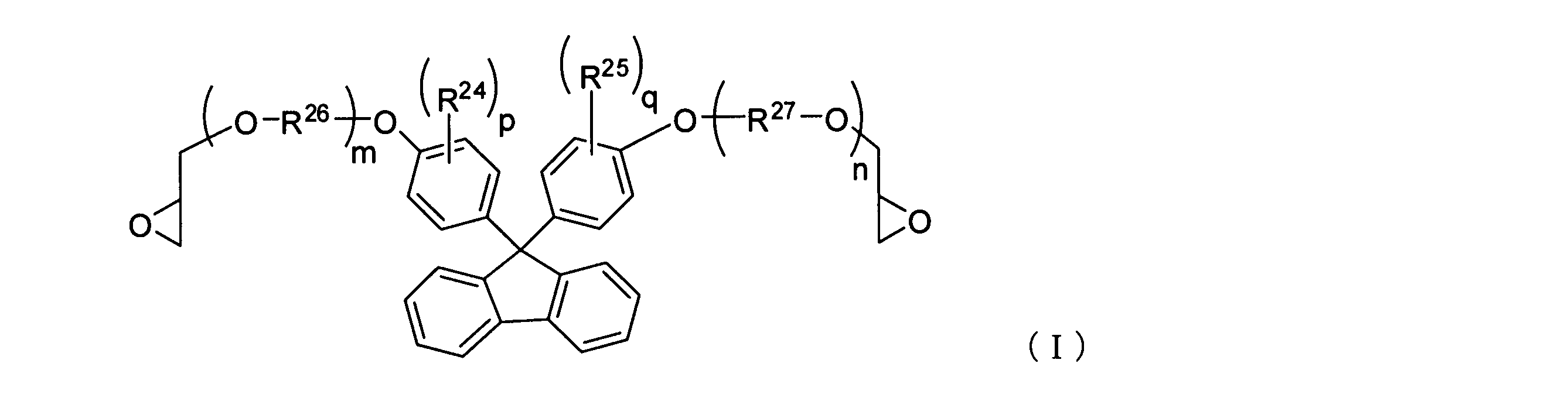
R26及びR27は、各々独立して、アルキレン基を表し、m及びnは、各々独立して、0以上の整数を表す。)
R24及びR25としては、各々独立に炭素数1~5のアルキル基が特に好ましい。
R24及びR25のアルキル基、ハロゲン基の作用機構の詳細は明らかではないが、3次元構造に影響を与え、現像液に対しての溶解しやすさを制御しているものと推測される。従って上記観点からは、前記式(I)におけるp及びqは、各々独立して、1又は2が好ましい。
R24及びR25のベンゼン環への結合位置は、特に制限は無いが、下記置換基


なお、R24及びR25は、同じ基であっても異なる基であってもよいが、製造が容易である点から、同じ基であることが好ましい。
m及びnは、各々独立して、通常0以上、また通常6以下、好ましくは3以下の整数である。
上記範囲内であると、現像液に対する溶解性が高く、また感度が良好である点で好ましい。
尚、R26及びR27は、同じ基であっても異なる基であってもよいが、製造が容易である点から、同じ基であることが好ましい。
上記下限値以上であると被膜形成性が良好であり、また上記上限値以下であるとα,β-不飽和モノカルボン酸の付加反応時にゲル化が起こり難く製造が容易である点で好ましい。
エステル部分にカルボキシル基を有するα,β-不飽和モノカルボン酸エステルとしては、アクリル酸-2-サクシノイルオキシエチル、アクリル酸-2-マレイノイルオキシエチル、アクリル酸-2-フタロイルオキシエチル、アクリル酸-2-ヘキサヒドロフタロイルオキシエチル、メタクリル酸-2-サクシノイルオキシエチル、メタクリル酸-2-マレイノイルオキシエチル、メタクリル酸-2-フタロイルオキシエチル、メタクリル酸-2-ヘキサヒドロフタロイルオキシエチル、クロトン酸-2-サクシノイルオキシエチル等を挙げられ、好ましくは、アクリル酸-2-マレイノイルオキシエチル及びアクリル酸-2-フタロイルオキシエチルであり、特にアクリル酸-2-マレイノイルオキシエチルが好ましい。
なお、この多塩基酸無水物の付加反応時に、トリメチロールプロパン、ペンタエリスリトール、ジペンタエリスリトールなどの多官能アルコールを添加し、多分岐構造を導入したものとしてもよい。
上記上限値以下であると感光性樹脂組成物の現像性が良好であり、また上記下限値以上であると耐アルカリ性が良好である点で好ましい。
カルボキシル基含有ビニル系樹脂としては、例えば、不飽和カルボン酸とビニル化合物との共重合体等が挙げられる。
不飽和カルボン酸としては、例えば(メタ)アクリル酸、クロトン酸、イソクロトン酸、マレイン酸、無水マレイン酸、イタコン酸、シトラコン酸等が挙げられる。これらは1種を単独で用いてもよく、2種以上を混合して用いてもよい。
また、ビニル化合物としては、スチレン、α-メチルスチレン、ヒドロキシスチレン、メチル(メタ)アクリレート、エチル(メタ)アクリレート、プロピル(メタ)アクリレート、ブチル(メタ)アクリレート、ペンチル(メタ)アクリレート、ヘキシル(メタ)アクリレート、ドデシル(メタ)アクリレート、2-エチルヘキシル(メタ)アクリレート、ヒドロキシメチル(メタ)アクリレート、ヒドロキシエチル(メタ)アクリレート、グリシジル(メタ)アクリレート、イソボルニル(メタ)アクリレート、ジシクロペンタニル(メタ)アクリレート、ベンジル(メタ)アクリレート、N,N-ジメチルアミノエチル(メタ)アクリレート、N-(メタ)アクリロイルモルホリン、(メタ)アクリロニトリル、(メタ)アクリルアミド、N-メチロール(メタ)アクリルアミド、N,N-ジメチル(メタ)アクリルアミド、N,N-ジメチルアミノエチル(メタ)アクリルアミド、酢酸ビニル等のビニル化合物との共重合体等が挙げられる。これらは1種を単独で用いてもよく、2種以上を混合して用いてもよい。
上記の共重合体(カルボキシル基含有ビニル系樹脂)の中では、画像形状、感度、硬化膜強度の観点から、スチレン-(メタ)アクリレート-(メタ)アクリル酸共重合体が好ましく、スチレン3~60モル%、(メタ)アクリレート10~70モル%、(メタ)アクリル酸10~60モル%からなる共重合体がさらに好ましく、スチレン5~50モル%、(メタ)アクリレート20~60モル%、(メタ)アクリル酸15~55モル%からなる共重合体が特に好ましい。
上記範囲内であると、感光性樹脂組成物の高解像力が良好である為好ましい。
上記下限値以上であると、画像断面形状の再現性及び耐熱性が良好であるため好ましく、また上記上限値以下であると、感光性樹脂組成物の感度及び現像溶解速度が良好であるため好ましい。
本発明の構成とすることで、トレードオフの関係である誘電率と高解像力が両立し、更に、高透過率及び高感度である感光性樹脂組成物を提供しうる理由について下記の通り推測する。
感光性樹脂組成物に、(A)チタン酸バリウム微粒子と(B)酸化ジルコニウム微粒子という異なる2種の微粒子が存在することで、単一の微粒子を用いた場合に比べ、より分極し易い形で配向する。これにより、単一の微粒子である場合に比べて誘電率が高くなる。
また、(A)チタン酸バリウム微粒子や(B)酸化ジルコニウム微粒子は、光触媒活性を有さないため、光反応を抑制することがなく、これより感光性樹脂組成物の感度や解像力が十分である。
更に、(A)チタン酸バリウム微粒子や(B)酸化ジルコニウム微粒子は、ポリマー膜中における分散が容易であり、これより高透過率が達成しうる。
本発明の感光性樹脂組成物は、前記(A)チタン酸バリウム微粒子、(B)酸化ジルコニウム微粒子及び(C)アルカリ可溶性樹脂の他に、更にその他の成分を含有していてもよい。
その他の成分は、ネガ型感光性樹脂組成物とポジ型感光性樹脂組成物とで各々異なる。以下、各組成物に含有される成分について詳説する。
本発明のネガ型感光性樹脂組成物は、前記(A)チタン酸バリウム微粒子、(B)酸化ジルコニウム微粒子及び(C)アルカリ可溶性樹脂の他に、(D)エチレン性不飽和基含有化合物(以下、「成分(D)」と称する場合がある)及び(E)光重合開始剤(以下、「成分(E)」と称する場合がある)を含有し、更に必要に応じて、下記(F)~(H)成分を含有する。
(F)熱架橋剤
(G)その他成分
(H)有機溶剤
本発明の感光性樹脂組成物が、ネガ型感光性樹脂組成物である場合、(D)エチレン性不飽和基を有する化合物を含有する。
本発明における(D)エチレン性不飽和基含有化合物としては、エチレン性不飽和結合を分子内に1個以上有する化合物を意味する。そして、本発明のネガ型感光性樹脂組成物は、エチレン性不飽和基を2個以上有する化合物を必須成分として含有するものである。
エチレン性不飽和基を1個有する化合物としては、例えば、(メタ)アクリル酸、クロトン酸、イソクロトン酸、マレイン酸、イタコン酸、シトラコン酸等の不飽和カルボン酸、及びそのアルキルエステル、(メタ)アクリロニトリル、(メタ)アクリルアミド、スチレン等が挙げられる。
また、エチレン性不飽和結合を分子内に2個以上有する化合物としては、例えば、不飽和カルボン酸とポリヒドロキシ化合物とのエステル類、(メタ)アクリロイルオキシ基含有ホスフェート類、ヒドロキシ(メタ)アクリレート化合物とポリイソシアネート化合物とのウレタン(メタ)アクリレート類、及び、(メタ)アクリル酸又はヒドロキシ(メタ)アクリレート化合物とポリエポキシ化合物とのエポキシ(メタ)アクリレート類等が挙げられる。これらは1種を単独で、又は2種以上を併用することができる。
不飽和カルボン酸とポリヒドロキシ化合物とのエステル類(以下、「エステル(メタ)アクリレート類」と略記することがある。)としては、具体的には以下の化合物が例示できる。
上記不飽和カルボン酸と糖アルコールとの反応物:糖アルコールとしては、例えば、エチレングリコール、ポリエチレングリコール(付加数2~14)、プロピレングリコール、ポリプロピレングリコール(付加数2~14)、トリメチレングリコール、テトラメチレングリコール、ヘキサメチレングリコール、トリメチロールプロパン、グリセロール、ペンタエリスリトール、ジペンタエリスリトール等が挙げられる。
上記不飽和カルボン酸と糖アルコールのアルキレンオキサイド付加物との反応物:糖アルコールは上記と同じものが挙げられる。アルキレンオキサイド付加物としては、例えば、エチレンオキサイド付加物、又はプロピレンオキサイド付加物等が挙げられる。
上記不飽和カルボン酸とアルコールアミンとの反応物:アルコールアミン類としては、例えば、ジエタノールアミン、トリエタノールアミン等が挙げられる。
エチレングリコールジ(メタ)アクリレート、ジエチレングリコールジ(メタ)アクリレート、プロピレングリコールジ(メタ)アクリレート、トリメチロールプロパンジ(メタ)アクリレート、トリメチロールプロパントリ(メタ)アクリレート、トリメチロールプロパンエチレンオキサイド付加トリ(メタ)アクリレート、グリセロールジ(メタ)アクリレート、グリセロールトリ(メタ)アクリレート、グリセロールプロピレンオキサイド付加トリ(メタ)アクリレート、ペンタエリスリトールジ(メタ)アクリレート、ペンタエリスリトールトリ(メタ)アクリレート、ペンタエリスリトールテトラ(メタ)アクリレート、ジペンタエリスリトールペンタ(メタ)アクリレート、ジペンタエリスリトールヘキサ(メタ)アクリレート等、及び同様のクロトネート、イソクロトネート、マレエート、イタコネート、シトラコネート等。
(メタ)アクリロイルオキシ基含有ホスフェート類としては、(メタ)アクリロイルオキシ基を含有するホスフェート化合物であれば特に限定されないが、中でも、下記式(IIa)~(IIc)で表されるものが好ましい。
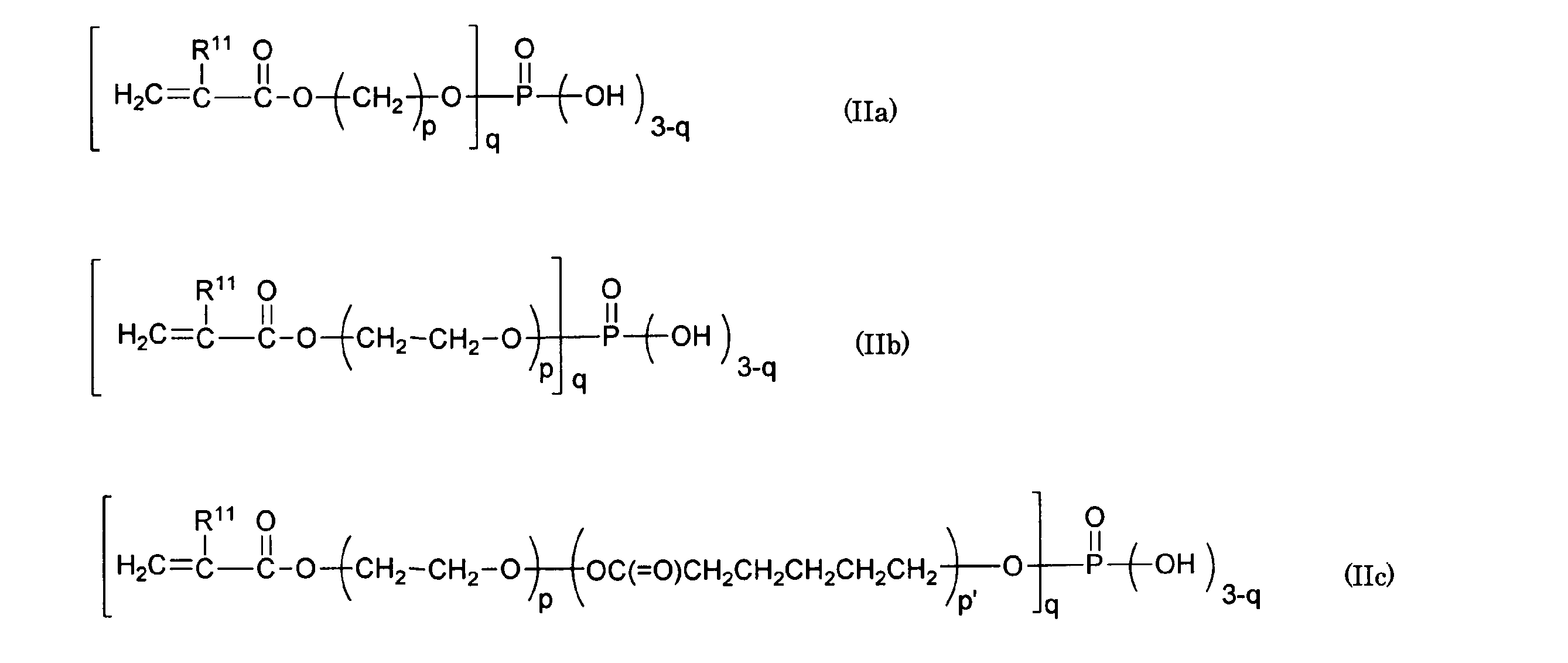
p及びp’は、各々独立に、1~25の整数を表し、
qは、1~3の整数を表す。)
ここで、p及びp’は、各々独立に、好ましくは1~10、特に好ましくは1~4である。
このような化合物の具体例としては、例えば、(メタ)アクリロイルオキシエチルホスフェート、ビス〔(メタ)アクリロイルオキシエチル〕ホスフェート、(メタ)アクリロイルオキシエチレングリコールホスフェート等が挙げられ、これらはそれぞれ単独で用いられても混合物として用いられてもよい。
ヒドロキシ(メタ)アクリレート化合物としては、例えば、ヒドロキシメチル(メタ)アクリレート、ヒドロキシエチル(メタ)アクリレート、テトラメチロールエタントリ(メタ)アクリレート等のヒドロキシ(メタ)アクリレート化合物が挙げられる。
また、ポリイソシアネート化合物としては、例えば、ヘキサメチレンジイソシアネート、1,8-ジイソシアネート-4-イソシアネートメチルオクタン等の脂肪族ポリイソシアネート;シクロヘキサンジイソシアネート、ジメチルシクロヘキサンジイソシアネート、4,4-メチレンビス(シクロヘキシルイソシアネート)、イソホロンジイソシアネート、ビシクロヘプタントリイソシアネート等の脂環式ポリイソシアネート;4,4-ジフェニルメタンジイソシアネート、トリス(イソシアネートフェニル)チオホスフェート等の芳香族ポリイソシアネート;イソシアヌレート等の複素環式ポリイソシアネート;日本国特開2001-260261号公報に記載の方法により製造されるアロファネート変性ポリイソシアヌレート;等のポリイソシアネート化合物が挙げられる。
例えば、ペンタエリスリトール、ポリグリセリン等の1分子中に4個以上の水酸基を有する化合物に、ヘキサメチレンジイソシアネート、トリメチルヘキサメチレンジイソシアネート、イソホロンジイソシアネート、トリレンジイソシアネート等のジイソシアネート化合物を反応させて得られた化合物(i-1);或いは、エチレングリコール等の1分子中に2個以上の水酸基を有する化合物に、旭化成工業社製「デュラネート24A-100」、同「デュラネート22A-75PX」、同「デュラネート21S-75E」、同「デュラネート18H-70B」等ビウレットタイプ、同「デュラネートP-301-75E」、同「デュラネートE-402-90T」、同「デュラネートE-405-80T」等のアダクトタイプ、等の1分子中に3個以上のイソシアネート基を有する化合物を反応させて得られた化合物(i-2);或いは、イソシアネートエチル(メタ)アクリレート等を重合若しくは共重合させて得られた化合物(i-3)等;が挙げられる。
このような化合物としては市販品を用いることができ、例えば、旭化成工業社製「デュラネートME20-100」が挙げられる。
例えば、ジペンタエリスリトールトリ(メタ)アクリレート、ジペンタエリスリトールテトラ(メタ)アクリレート、ジペンタエリスリトールペンタ(メタ)アクリレート、ジペンタエリスリトールヘキサ(メタ)アクリレート等の、1分子中に3個以上の(メタ)アクリロイルオキシ基を有する化合物が挙げられる。
ポリエポキシ化合物としては、例えば、(ポリ)エチレングリコールポリグリシジルエーテル、(ポリ)プロピレングリコールポリグリシジルエーテル、(ポリ)テトラメチレングリコールポリグリシジルエーテル、(ポリ)ペンタメチレングリコールポリグリシジルエーテル、(ポリ)ネオペンチルグリコールポリグリシジルエーテル、(ポリ)ヘキサメチレングリコールポリグリシジルエーテル、(ポリ)トリメチロールプロパンポリグリシジルエーテル、(ポリ)グリセロールポリグリシジルエーテル、(ポリ)ソルビトールポリグリシジルエーテル等の脂肪族ポリエポキシ化合物;フェノールノボラックポリエポキシ化合物、ブロム化フェノールノボラックポリエポキシ化合物、(o-,m-,p-)クレゾールノボラックポリエポキシ化合物、ビスフェノールAポリエポキシ化合物、ビスフェノールFポリエポキシ化合物等の芳香族ポリエポキシ化合物;ソルビタンポリグリシジルエーテル、トリグリシジルイソシアヌレート、トリグリシジルトリス(2-ヒドロキシエチル)イソシアヌレート等の複素環式ポリエポキシ化合物;等のポリエポキシ化合物が挙げられる。
その他のエチレン性不飽和化合物としては、前記以外に、例えば、エチレンビス(メタ)アクリルアミド等の(メタ)アクリルアミド類、フタル酸ジアリル等のアリルエステル類、ジビニルフタレート等のビニル基含有化合物類、エーテル結合含有エチレン性不飽和化合物のエーテル結合を5硫化燐等により硫化してチオエーテル結合に変えることにより架橋速度を向上せしめたチオエーテル結合含有化合物類が挙げられる。
当該化合物は、エチレン性不飽和化合物にシランカップリング剤を介してシリカゾルを反応させ結合させることにより硬化物としての強度や耐熱性を向上せしめた化合物類である。
本発明において、エチレン性不飽和化合物としては、重合性、架橋性等の点から、エチレン性不飽和基を分子内に2個以上有する化合物が含まれることが好ましい。中でも、エステル(メタ)アクリレート類、(メタ)アクリロイルオキシ基含有ホスフェート類、又は、ウレタン(メタ)アクリレート類が好ましく、エステル(メタ)アクリレート類が更に好ましい。そのエステル(メタ)アクリレート類の中でも、ジペンタエリスリトールトリ(メタ)アクリレート、ジペンタエリスリトールテトラ(メタ)アクリレート、ジペンタエリスリトールペンタ(メタ)アクリレート、ジペンタエリスリトールヘキサ(メタ)アクリレート等の、1分子中に3個以上の(メタ)アクリロイルオキシ基を有する化合物、ビスフェノールAジ(メタ)アクリレート、ビスフェノールAビス〔オキシエチレン(メタ)アクリレート〕、ビスフェノールAビス〔グリシジルエーテル(メタ)アクリレート〕等の芳香族ポリヒドロキシ化合物、或いはそれらのエチレンオキサイド付加物との反応物が特に好ましい。
上記範囲内であると、感度や現像溶解速度が低下し難く、また画像面形状の再現性の低下も起こりにくく、レジストの膜べりなども生じ難い。
本発明の感光性樹脂組成物は、ネガ型感光性樹脂組成物である場合、(E)光重合開始剤を含有する。
該(E)光重合開始剤としては、本発明の効果を損なわない限り、公知のいずれのものも用いることができ、紫外線から可視光線によりエチレン性不飽和基を重合させるラジカルを発生させることのできる化合物が挙げられる。
(i)2-(4-メトキシフェニル)-4,6-ビス(トリクロロメチル)-s-トリアジン、2-(4-メトキシナフチル)-4,6-ビス(トリクロロメチル)-s-トリアジン、2-(4-エトキシナフチル)-4,6-ビス(トリクロロメチル)-s-トリアジン、2-(4-エトキシカルボニルナフチル)-4,6-ビス(トリクロロメチル)-s-トリアジンなどのハロメチル化トリアジン誘導体。
(ii)ハロメチル化オキサジアゾール誘導体、2-(o-クロロフェニル)-4,5-ジフェニルイミダゾール2量体、2-(o-クロロフェニル)-4,5-ビス(3’-メトキシフェニル)イミダゾール2量体、2-(o-フルオロフェニル)-4,5-ジフェニルイミダゾール2量体、2-(o-メチルフェニル)-4,5-ジフェニルイミダゾール2量体、2-(o-メトキシフェニル)-4,5-ジフェニルイミダゾール2量体などのイミダゾール誘導体。
(iii)ベンゾインメチルエーテル、ベンゾインフェニルエーテル、ベンゾインイソブチルエーテル、ベンゾインイソプロピルエーテルなどのベンゾイン、ベンゾインアルキルエーテル類。
(iv)2-メチルアントラキノン、2-エチルアントラキノン、2-t-ブチルアントラキノン、1-クロロアントラキノンなどのアントラキノン誘導体。
(v)ベンズアンスロン誘導体。
(vi)ベンゾフェノン、ミヒラーケトン、2-メチルベンゾフェノン、3-メチルベンゾフェノン、4-メチルベンゾフェノン、2-クロロベンゾフェノン、4-ブロモベンゾフェノン、2-カルボキシベンゾフェノンなどのベンゾフェノン誘導体。
(vii)2,2-ジメトキシ-2-フェニルアセトフェノン、2,2-ジエトキシアセトフェノン、1-ヒドロキシシクロヘキシルフェニルケトン、α-ヒドロキシ-2-メチルフェニルプロパノン、1-ヒドロキシ-1-メチルエチル-(p-イソプロピルフェニル)ケトン、1-ヒドロキシ-1-(p-ドデシルフェニル)ケトン、2-メチル-〔4’-(メチルチオ)フェニル〕-2-モルホリノ-1-プロパノン、1,1,1-トリクロロメチル-(p-ブチルフェニル)ケトンなどのアセトフェノン誘導体。
(viii)チオキサントン、2-エチルチオキサントン、2-イソプロピルチオキサントン、2-クロロチオキサントン、2,4-ジメチルチオキサントン、2,4-ジエチルチオキサントン、2,4-ジイソプロピルチオキサントンなどのチオキサントン誘導体。
(ix)p-ジメチルアミノ安息香酸エチル、p-ジエチルアミノ安息香酸エチルなどの安息香酸エステル誘導体。
(x)9-フェニルアクリジン、9-(p-メトキシフェニル)アクリジンなどのアクリジン誘導体。
(xi)9,10-ジメチルベンズフェナジンなどのフェナジン誘導体。
(xii)ジ-シクロペンタジエニル-Ti-ジ-クロライド、ジ-シクロペンタジエニル-Ti-ビス-フェニル、ジ-シクロペンタジエニル-Ti-ビス-2,3,4,5,6-ペンタフルオロフェニ-1-イル、ジ-シクロペンタジエニル-Ti-ビス-2,3,5,6-テトラフルオロフェニ-1-イル、ジ-シクロペンタジエニル-Ti-ビス-2,4,6-トリフルオロフェニ-1-イル、ジ-シクロペンタジエニル-Ti-2,6-ジ-フルオロフェニ-1-イル、ジ-シクロペンタジエニル-Ti-2,4-ジ-フルオロフェニ-1-イル、ジ-メチルシクロペンタジエニル-Ti-ビス-2,3,4,5,6-ペンタフルオロフェニ-1-イル、ジ-メチルシクロペンタジエニル-Ti-ビス-2,6-ジ-フルオロフェニ-1-イル、ジ-シクロペンタジエニル-Ti-2,6-ジ-フルオロ-3-(ピル-1-イル)-フェニ-1-イルなどのチタノセン誘導体。
(xiii)2-メチル-1-[4-(メチルチオ)フェニル]-2-モルフォリノプロパン-1-オン、2-ベンジル-2-ジメチルアミノ-1-(4-モルフォリノフェニル)ブタノン-1-オン、2-ベンジル-2-ジメチルアミノ-1-(4-モルフォリノフェニル)ブタン-1-オン、4-ジメチルアミノエチルベンゾエート、4-ジメチルアミノイソアミルベンゾエート、4-ジエチルアミノアセトフェノン、4-ジメチルアミノプロピオフェノン、2-エチルヘキシル-1,4-ジメチルアミノベンゾエート、2,5-ビス(4-ジエチルアミノベンザル)シクロヘキサノン、7-ジエチルアミノ-3-(4-ジエチルアミノベンゾイル)クマリン、4-(ジエチルアミノ)カルコン等のα-アミノアルキルフェノン系化合物。
(xiv)2,4,6-トリメチルベンゾイル-ジフェニル-フォスフィンオキサイド、ビス(2,4,6-トリメチルベンゾイル)-フェニルフォスフィンオキサイド等のアシルホスフィンオキサイド系化合物。
(xv)1,2-オクタンジオン,1-[4-(フェニルチオ)フェニル]-,2-(O-ベンゾイルオキシム)、エタノン,1-[9-エチル-6-(2-メチルベンゾイル)-9H-カルバゾール-3-イル]-,1-(O-アセチルオキシム)及び、日本国特開2000-80068号公報、日本国特開2001-233842号公報、日本国特開2001-235858号公報、日本国特開2005-182004号公報、国際公開第2002/00903号、及び日本国特開2007-41493号公報に記載のオキシムエステル化合物等。

上記下限値以上であると、感光性樹脂組成物の感度が良好であり、また上記上限値以下であると残渣の発生が起き難い点で好ましい。
本発明の感光性樹脂組成物は、熱硬化後の膜の耐熱性及び耐薬品性を向上させる目的で、熱架橋剤を含有していてもよい。
熱架橋剤としては、露光・現像による画像形成後のベークにより、架橋反応をするものであれば、公知のものを用いることができる。具体的には、下記のものが挙げられる。
本発明に使用される、(F-1)分子内にエポキシ基を有する化合物(以下、「成分(F-1)」と称する場合がある)としては、例えば、モノヒドロキシ化合物あるいはポリヒドロキシ化合物とエピクロルヒドリンとを反応させて得られる(ポリ)グリシジルエーテル化合物、(ポリ)カルボン酸化合物とエピクロルヒドリンとを反応させて得られるポリグリシジルエステル化合物、及び(ポリ)アミン化合物とエピクロルヒドリンを反応させて得られる(ポリ)グリシジルアミン化合物等の、低分子量物から高分子量物にわたる化合物が挙げられる。
ポリグリシジルエーテル化合物としては、例えば、ポリエチレングリコールのジグリシジルエーテル型エポキシ、ビス(4-ヒドロキシフェニル)のジグリシジルエーテル型エポキシ、ビス(3,5-ジメチル-4-ヒドロキシフェニル)のジグリシジルエーテル型エポキシ、ビスフェノールFのジグリシジルエーテル型エポキシ、ビスフェノールAのジグリシジルエーテル型エポキシ、テトラメチルビスフェノールAのジグリシジルエーテル型エポキシ、エチレンオキシド付加ビスフェノールAのジグリシジルエーテル型エポキシ、ジハイドロオキシルフルオレン型エポキシ、ジハイドロオキシルアルキレンオキシルフルオレン型エポキシ、ビスフェノールA/アルデヒドノボラック型エポキシ、フェノールノボラック型エポキシ、クレゾールノボラック型エポキシが挙げられる。
ポリグリシジルエステル化合物としては、例えば、ヘキサヒドロフタル酸のジグリシジルエステル型エポキシ、フタル酸のジグリシジルエステル型エポキシ等が挙げられる。
ポリグリシジルアミン化合物としては、例えば、ビス(4-アミノフェニル)メタンのジグリシジルアミン型エポキシ、イソシアヌル酸のトリグリシジルアミン型エポキシ等が、それぞれ挙げられる。
また、その他の例として、例えば(メタ)アクリル酸グリシジル、α-エチルアクリル酸グリシジル、α-n-プロピルアクリル酸グリシジル、α-n-ブチルアクリル酸グリシジル、(メタ)アクリル酸-3,4-エポキシブチル、(メタ)アクリル酸-4,5-エポキシペンチル、(メタ)アクリル酸-6,7-エポキシヘプチル、α-エチルアクリル酸-6,7-エポキシヘプチル等のエポキシ基を有する(メタ)アクリレート等を1種単独又は2種以上の組み合わせで反応させた重合体が挙げられる。あるいは、エポキシ基を有する(メタ)アクリレート構成単位に他の共重合用単量体を通常10~70モル%、好ましくは15~60モル%含有させた重合体が挙げられる。
本発明の感光性樹脂組成物において、分子内にエポキシ基を有する化合物を含有する場合、その含有量としては、全固形分に対して、通常60重量%以下、好ましくは50重量%以下、更に好ましくは30重量%以下であり、通常1重量%以上である。分子内にエポキシ基を有する化合物の含有量が過度に多いと、感光性樹脂組成物の保存安定性の低下、及び露光・現像後の剥離性の低下を招き易い。
本発明に使用される含窒素熱架橋性化合物としては、メラミン、ベンゾグアナミン、グリコールウリル、若しくは尿素にホルマリンを作用させた化合物、又はそれらのアルキル変性化合物を挙げることができる。
また、ベンゾグアナミンにホルマリンを作用させた化合物又はそのアルキル変性物の例として、「サイメル」(登録商標)1123、1125、1128、等を挙げることができる。
また、グリコールウリルにホルマリンを作用させた化合物又はそのアルキル変性物の例として、「サイメル」(登録商標)1170、1171、1174、1172、「ニカラック」(登録商標)MX-270、等を挙げることができる。
また、尿素にホルマリンを作用させた化合物又はそのアルキル変性物の例として、サイテック・インダストリーズ社製の「UFR」(登録商標)65、300、「ニカラック」(登録商標)MX-290、等を挙げることができる。
(G-1)接着助剤
本発明の感光性樹脂組成物には、基板との密着性を向上させる目的で、接着助剤を配合することができる。接着助剤としては、例えばシランカップリング剤を挙げることができる。
より具体的には、例えば、トリメトキシシリル安息香酸、γ-メタクリロキシプロピルトリメトキシシラン、ビニルトリアセトキシシラン、ビニルトリメトキシシラン、γ-グリシドキシプロピルトリメトキシシラン、γ-イソシアナトプロピルトリエトキシシラン、β-(3,4-エポキシシクロヘキシル)エチルトリメトキシシランなどが挙げられる。これらのシランカップリング剤は、1種単独でも2種以上混合して用いてもよい。
なお、上記接着助剤を含有する場合、その配合量としては、全固形分に対して通常0.1重量%以上であり、通常20重量%以下、好ましくは10重量%以下である。
本発明の感光性樹脂組成物は、組成物の塗布液としての塗布性、及び感光性樹脂組成物を用いて得られた膜の現像性の向上等を目的として、ノニオン性、アニオン性、カチオン性、両性界面活性剤、或いは、フッ素系やシリコーン系等の界面活性剤を含有していてもよい。
上記ノニオン性界面活性剤としては、例えば、ポリオキシエチレンアルキルエーテル類、ポリオキシエチレンポリオキシプロピレンアルキルエーテル類、ポリオキシエチレンアルキルフェニルエーテル類、ポリオキシエチレンアルキルエステル類、ポリオキシエチレン脂肪酸エステル類、グリセリン脂肪酸エステル類、ポリオキシエチレングリセリン脂肪酸エステル類、ペンタエリスリット脂肪酸エステル類、ポリオキシエチレンペンタエリスリット脂肪酸エステル類、ソルビタン脂肪酸エステル類、ポリオキシエチレンソルビタン脂肪酸エステル類、ソルビット脂肪酸エステル類、ポリオキシエチレンソルビット脂肪酸エステル類等が挙げられる。これらの市販品としては、花王社製の「エマルゲン104P」、「エマルゲンA60」等のポリオキシエチレン系界面活性剤等が挙げられる。
具体的には、例えば、1,1,2,2-テトラフロロオクチル(1,1,2,2-テトラフロロプロピル)エーテル、1,1,2,2-テトラフロロオクチルヘキシルエーテル、オクタエチレングリコールジ(1,1,2,2-テトラフロロブチル)エーテル、ヘキサエチレングリコールジ(1,1,2,2,3,3-ヘキサフロロペンチル)エーテル、オクタプロピレングリコールジ(1,1,2,2-テトラフロロブチル)エーテル、ヘキサプロピレングリコールジ(1,1,2,2,3,3-ヘキサフロロペンチル)エーテル、パーフロロドデシルスルホン酸ナトリウム、1,1,2,2,8,8,9,9,10,10-デカフロロドデカン、1,1,2,2,3,3-ヘキサフロロデカン等を挙げることができる。
また、シリコーン系界面活性剤としては、例えば、トーレシリコーン社製「トーレシリコーンDC3PA」、「同SH7PA」、「同DC11PA」、「同SH21PA」、「同SH28PA」、「同SH29PA」、「同SH30PA」、「同SH8400」、東芝シリコーン社製「TSF-4440」、「TSF-4300」、「TSF-4445」、「TSF-444(4)(5)(6)(7)6」、「TSF-4460」、「TSF-4452」、シリコーン社製「KP341」、ビックケミー社製「BYK323」、「BYK330」等の市販品を挙げることができる。
このシリコーン系界面活性剤/弗素系界面活性剤の組み合わせでは、例えば、ジーイー東芝シリコーン社製「TSF4460」/ネオス社製「DFX-18」、ビックケミー社製「BYK-300」又は「BYK-330」/セイミケミカル社製「S-393」、信越シリコーン社製「KP340」/大日本インキ社製「F-478」又は「F-475」、トーレシリコーン社製「SH7PA」/ダイキン社製「DS-401」、日本ユニカー社製「L-77」/住友3M社製「FC4430」等が挙げられる。
本発明の感光性樹脂組成物は、熱硬化条件における時間の短縮や設定温度の変更のためさらに硬化剤を含有し、各々の素子の製造プロセスにより異なる硬化条件を適正に選択することができる。
そのような硬化剤としては、要求機能を損ねるものでない限り特に限定するものではないが、例えば、安息香酸系化合物、多価カルボン酸(無水物)、多価カルボン酸(無水物)を含有する重合体、熱酸発生剤、アミン化合物、ポリアミン化合物、及びブロックカルボン酸等が挙げられる。特に、熱架橋剤として前記エポキシ基含有化合物を含有する場合には、熱硬化剤を用いることが好ましい。
安息香酸系化合物としては、安息香酸、安息香酸のベンゼン環上の2位から6位の位置に水酸基、ハロゲン基、アルキル基、アシル基、アシルオキシル基、アルコキシル基、アリール基、アリル基等の置換基を有するものを挙げることができる。中でも、エポキシに対する硬化能力の高い水酸基を置換基として有するものが好ましく、特には水酸基を2つ以上有するものが好ましい。このような安息香酸系化合物としては、例えば、3,4,5-トリヒドロキシ安息香酸、2,5-ジヒドロキシ安息香酸、2,6-ジヒドロキシ安息香酸、3,4-ジヒドロキシ安息香酸、2,4,6-トリヒドロキシ安息香酸等があげられる。
多価カルボン酸(無水物)としては、例えば、無水メチルハイミック酸、ヘキサヒドロ無水フタル酸、テトラヒドロ無水フタル酸、トリアルキルテトラヒドロ無水フタル酸、メチルシクロヘキセンジカルボン酸無水物等の脂環式多価カルボン酸(無水物);無水フタル酸、無水トリメリット酸、無水ピロメリット酸、ベンゾフェノントリカルボン酸無水物、ベンゾフェノンテトラカルボン酸無水物等の芳香族多価カルボン酸無水物;コハク酸、トリメリット酸、マレイン酸、シクロペンタンテトラカルボン酸等の脂環式酸無水物;芳香族酸無水物の加水分解物等が挙げられる。これらの中でも、トリメリット酸(無水物)、無水フタル酸が好ましい。
多価カルボン酸(無水物)を含有する重合体としては、(無水)マレイン酸等の(無水)多価カルボン酸と、エチレン性不飽和結合を分子内に1個以上有する化合物との重合体や、そのような重合体中の多価カルボン酸(無水物)部分の部分ハーフエステル変成重合体、等が挙げられる。
エチレン性不飽和結合を分子内に1個以上有する化合物としては、例えば、(メタ)アクリル酸、及びそのアルキルエステル、(メタ)アクリロニトリル、(メタ)アクリルアミド、スチレン、(ポリ)アルキレンオキシ基あるいはアルキルなどの置換基を有するアルキレン等が挙げられる。
多価カルボン酸(無水物)を含有する重合体としては、中でも、光透過性、硬化膜強度の観点から、無水マレイン酸と(ポリ)アルキレンオキシあるいはアルキルなどの置換基を有するアルキレンとの共重合体が好ましい。
熱酸発生剤としては、例えば芳香族ジアゾニウム塩、ジアリールヨードニウム塩、モノフェニルスルフォニウム塩、トリアリルスルフォニウム塩、トリアリルセレニウム塩等の各種オニウム塩系化合物、スルフォン酸エステル、ハロゲン化合物等が挙げられる。
具体例として、芳香族ジアゾニウム塩としては、クロロベンゼンジアゾニウムヘキサフルオロフォスフェイト、ジメチルアミノベンゼンジアゾニウムヘキサフルオロアンチモネート、ナフチルジアゾニウムヘキサフルオロフォスフェイト、ジメチルアミノナフチルジアゾニウムテトラフルオロボレート等が挙げられる。
更に、モノフェニルスルフォニウム塩としては、ベンジル-p-ヒドロキシフェニルメチルスルフォニウムヘキサフルオロフォスフェート、p-ヒドロキシフェニルジメチルスルフォニウムヘキサフルオロアンチモネート、p-アセトキシフェニルジメチルスルフォニウムヘキサフルオロアンチモネート、ベンジル-p-ヒドロキシフェニルメチルスルフォニウムヘキサフルオロアンチモネート、下記式(II)に示す化合物等、モノフェニルスルフォニウム塩タイプ、又はベンジルフェニルスルフォニウム塩タイプ等が挙げられる。

アミン化合物としては、例えば、エチレジアミン、1,3-ジアミノプロパン、1,4-ジアミノブタン、ヘキサメチレンジアミン、2,5-ジメチルヘキサメチレンジアミン、ピペリジン、ピロリジン、トリエチレンジアミン、トリメチルヘキサメチレンジアミン、ジメチルシクロヘキシルアミン、テトラメチルグアニジン、トリエタノールアミン、N,N’-ジメチルピペラジン、ジシアンアミド、又はその誘導体;DBU(1,8-ジアザビスシクロ(5,4,0)ウンデセン-1),DBU系テトラフェニルボレート塩等の脂肪族アミン(第1、第2、第3);メタフェニレンジアミン、ジアミノジフェニルメタン、ジアミノジフェニルスルホン、ジアミノジエチルジフェニルメタン、ベンジルジメチルアミン、ジメチルアミノ-p-クレゾール、2-(ジメチルアミンジメチル)フェノール、2,4,6-トリス(ジメチルアミノメチル)フェノール、ピリジン、ピコリン、DBU(1,8-ジアザビスシクロ(5,4,0)ウンデセン-1)、2,4,6-トリス(ジメチルアミノメチル)フェノールのトリ-2-エチルヘキシル酸塩等の芳香族アミン(第1、第2、第3);2-メチルイミダゾール、2-エチル-4-メチルイミダゾール、2-エチル-4-メチルイミダゾール、2-ウンデシルイミダゾール、2-ヘプタデシルイミダゾール、2-フェニルイミダゾール、1-ベンジル-2-メチルイミダゾール、1-シアノエチル-2-メチルイミダゾール、1-シアノエチル-2-エチル-4-メチルイミダゾール、1-シアノエチル-2-ウンデシルイミダゾール、1-シアノエチル-2-ウンデシルイミダゾリウム・トリメリテート、2-メチルイミダゾリウム・イソシアヌレート、2-フェニルイミダゾリウム・イソシアヌレート、2,4-ジアミノ-6-[2-メチルイミダゾリル-(1)]-エチル-S-トリアジン、2,4-ジアミノ-6-[2-エチルイミダゾリル-(1)]-エチル-S-トリアジン、2,4-ジアミノ-6-[2-ウンデシルイミダゾリル-(1)]-エチル-S-トリアジン、2-フェニル-4,5-ジヒドキシメチルイミダゾール、2-フェニル-4-メチル-5-ヒドロキシメチルイミダゾール、1-シアノエチル-2-フェニル-4,5-ジ(シアノエトキシメチル)イミダゾール等のイミダゾール化合物;ジエチレントリアミン、イミノビスプロピルアミン、ビス(ヘキサメチレン)トリアミン等が挙げられる。
これらの中でも、硬化膜強度の観点から、ジシアンアミド、DBU系テトラフェニルボレート塩が好ましい。
ポリアミン化合物としては、例えばトリエチルテトラミン、テトラエチレンペンタミン、ペンタエチレンヘキサミン、ジメチルアミノプロピルアミン、ジエチルアミノプロピルアミン、N-アミノエチルピペラジン、メンセンジアミン、イソフルオロジアミン、ビス(4-アミノ-3-メチルシクロヘキシル)メタン、ジアミノジシクロヘキシルアミン、N,N-ジメチルシクロヘキシルアミン等の脂肪族ポリアミン、m-キシレンジアミン、キシリレンジアミン、キシリレンジアミン誘導体、キシリレンジアミン三量体等の芳香族ポリアミンが挙げられる。これらの中でも、N,N-ジメチルシクロヘキシルアミンが好ましい。
ブロックカルボン酸としては、例えば前記(多価)カルボン酸及びそれらを含有する重合体のカルボン酸を、日本国特開平4-218561号公報、日本国特開2003-66223号公報、日本国特開2004-339332号公報、日本国特開2004-339333号公報などに記載の方法によりビニルエーテルを付加させたブロックカルボン酸等が挙げられる。

特に安息香酸系化合物は、熱硬化性に優れ、光透過性が高く、熱による色変化の影響が低い為、好ましい。
本発明の感光性樹脂組成物には、保存安定性の改善、及び解像力の向上のために熱重合防止剤を配合することができる。熱重合防止剤として具体的には、例えば、置換基を有していてもよいo-ハイドロキシベンゾフェノン、ハイドロキノン、p-メトキシフェノール、2,6-ジ-t-ブチル-p-クレゾール等の挙げることができる。これら化合物の配合割合としては、全固形分に対して、通常10重量%以下、好ましくは2重量%以下である。
本発明の感光性樹脂組成物には、感度向上のために重合加速剤を添加することができる。重合加速剤として具体的には、例えば、N-フェニルグリシンなどのアミノ酸のエステル又はその双極イオン化合物、2-メルカプトベンゾチアゾール、2-メルカプトベンゾイミダゾール、2-メルカプトベンゾオキサゾール、3-メルカプト-1,2,4-トリアゾール、2-メルカプト-4(3H)-キナゾリン、β-メルカプトナフタレン、エチレングリコールジチオプロピオネート、トリメチロールプロパントリスチオプロピオネート、ペンタエリスリトールテトラキスチオプロピオネート等のメルカプト基含有化合物類、ヘキサンジチオール、トリメチロールプロパントリスチオグリコネート、ペンタエリスリトールテトラキスチオプロピオネート等の多官能チオール化合物類、N,N-ジアルキルアミノ安息香酸エステル、N-フェニルグリシン又はそのアンモニウム塩やナトリウム塩等の誘導体、フェニルアラニン、又はそのアンモニウムやナトリウム塩等の塩、エステル等の誘導体等の芳香族環を有するアミノ酸又はその誘導体類等が挙げられる。
本発明の感光性樹脂組成物において、重合加速剤を添加する場合、その含有量としては、全固形分に対して、20重量%以下であることが好ましく、1~10重量%であることが更に好ましい。
本発明の感光性樹脂組成物には、必要に応じて、紫外線吸収剤を含有していてもよい。紫外線吸収剤は、露光に用いられる光源の特定の波長を該紫外線吸収剤によって吸収させることにより、基板上に形成した本発明の感光性樹脂組成物の膜を露光したときの光硬化速度を制御する目的で添加されるものである。紫外線吸収剤の添加により、露光・現像後のパターン形状を改善したり、現像後に非露光部に残る残渣をなくしたりするなどの効果が得られる。
中でも、ベンゾトリアゾール化合物、ヒドロキシフェニルトリアジン化合物が好ましく、ベンゾトリアゾール化合物が特に好ましい。
上記下限値以上であるとパターン形状の改善及び残渣のうち少なくとも一方の解消などの効果が得られ易く、また上記上限値以下であると感度及び残膜率が良好である点で好ましい。
上述した各成分は、通常、有機溶剤を用いて、固形分濃度が5~60重量%、好ましくは10~50重量%の範囲となるように調液して使用される。
有機溶剤としては前述の各成分を溶解・分散させることができ、取り扱い性がよいものであれば特に限定されない。具体的には、例えば、メチルセロソルブ、エチルセロソルブ、ブチルセロソルブ、ジエチレングリコールモノメチルエーテル、プロピレングリコールモノアセテート、プロピレングリコールジアセテート、ジエチレングリコールモノブチルエーテルアセテート、プロピレングリコールモノメチルエーテルアセテート(以下、「PGMAc」と略記することがある。)、メチルエチルケトン、メチルイソブチルケトン、シクロヘキサノン、トルエン、クロロホルム、ジクロロメタン、酢酸エチル、乳酸メチル、乳酸エチル、3-メトキシメチルプロピオネート、3-エトキシエチルプロピオネート、プロピレングリコールモノメチルエーテル、メタノール、エタノール、プロパノール、ブタノール、テトラハイドロフラン、ジエチレングリコールジメチルエーテル、メトキシブチル酢酸エステル、ソルベッソ、カルビトール等が挙げられる。
上記有機溶剤の沸点としては、100~200℃の範囲が好ましく、より好ましくは120~170℃の範囲のものである。
本発明のポジ型感光性樹脂組成物は、前記(A)チタン酸バリウム微粒子、(B)酸化ジルコニウム微粒子及び(C)アルカリ可溶性樹脂のほかに、(I)光酸発生剤を含有し、更に必要に応じて前記<ネガ型感光性樹脂組成物>の項に記載の(F)熱架橋剤、(G)その他成分、(H)有機溶剤を含有する。
本発明における(I)光酸発生剤は、露光により酸性基を生成しアルカリ現像液に対する溶解性を向上させる化合物であり、例えば1,2-ナフトキノンジアジド化合物、1,2-ベンゾキノンジアジド化合物等を挙げることができる。
具体的には2,3,4-トリヒドロキシベンゾフェノンの1,2-ナフトキノンジアジド-5-スルホン酸エステル、2,3,4-トリヒドロキシベンゾフェノンの1,2-ナフトキノンジアジド-4-スルホン酸エステル、2,3,4-トリヒドロキシベンゾフェノンの1,2-ベンゾキノンジアジド-4-スルホン酸エステル、2,3,4,4’-テトラヒドロキシベンゾフェノンの1,2-ナフトキノンジアジド-5-スルホン酸エステル、2,3,4,4’-テトラヒドロキシベンゾフェノンの1,2-ナフトキノンジアジド-4-スルホン酸エステル、2,3,4,4’-テトラヒドロキシベンゾフェノンの1,2-ベンゾキノンジアジド-4-スルホン酸エステル等を挙げることができる。
次に、本発明の感光性樹脂組成物において、特にネガ型感光性樹脂組成物を用いる層間絶縁膜の形成方法について説明する。
まず、基板上に、上述した本発明の感光性樹脂組成物をスピナー、ワイヤーバー、フローコーター、ダイコーター、スリットコーター、ロールコーター、スプレー等の塗布装置を用いて塗布する。感光性樹脂組成物の塗布膜厚は通常0.2~5μmである。
上記塗布膜から揮発成分を除去(乾燥)して乾燥塗膜を形成する。乾燥には、真空乾燥、ホットプレート、IRオーブン、コンベクションオーブン等を用いることができる。好ましい乾燥条件は温度40~150℃、乾燥時間10秒~60分の範囲である。
次いで、感光性樹脂組成物層の乾燥塗膜上にフォトマスクを置き、該フォトマスクを介して画像露光する。露光後、未露光の未硬化部分を現像にて除去することにより、画像を形成する。なお、露光後、現像前に感度向上の目的でポスト・エクスポージャ・ベークを行う場合もある。この場合のベークには、ホットプレート、IRオーブン、コンベクションオーブン等を用いることができる。ポスト・エクスポージャ・ベーク条件は通常、40~150℃、乾燥時間10秒~60分の範囲である。
現像液に使用する界面活性剤としては、例えば、ナフタレンスルホン酸ナトリウム基、ベンゼンスルホン酸ナトリウム基を有するアニオン性界面活性剤、ポリアルキレンオキシ基を有するノニオン性界面活性剤、テトラアルキルアンモニウム基を有するカチオン性界面活性剤等を挙げることができる。
現像処理の方法については特に制限は無いが、通常、10~50℃、好ましくは15~45℃の現像温度で、浸漬現像、パドル現像、スプレー現像、ブラシ現像、超音波現像等の方法により行われる。
露光・現像工程により画像形成された感光性樹脂組成物膜は、次いで、熱処理(ハードベーク)工程を経て硬化物(熱硬化膜)となる。なお、現像後、ハードベーク前にハードベーク時のアウトガスの発生を抑制する目的で、全面露光を行う場合もある。
又はハードベークにはホットプレート、IRオーブン、コンベクションオーブン等を用いることができる。ハードベーク条件としては通常、100~250℃、乾燥時間30秒~90分の範囲である。
次に、上述のようにして形成された層間絶縁膜(前記硬化物を含む膜)を含む本発明に係るTFTアクティブマトリックス基板、及び液晶表示装置(パネル)について説明する。
まず、TFTアクティブマトリックス基板は、TFT素子アレイが形成された基板上に前述の硬化物を層間絶縁膜として形成し、その上にITO膜を形成後、フォトリソグラフィ法を用いてITO配線を形成することにより形成される。
対向基板としては、通常、配向膜を備えるカラーフィルタ基板が好適に用いられる。
配向膜の形成には、通常、グラビア印刷法及びフレキソ印刷法のうち少なくとも一方が採用され、配向膜の厚さは数10nmとされる。熱焼成によって配向膜の硬化処理を行なった後、紫外線の照射やラビング布による処理によって表面処理し、液晶の傾きを調整しうる表面状態に加工される。なお、配向膜上に更に上記と同様の層間絶縁膜を形成してもよい。
上記TFTアクティブマトリックス基板と対向基板との貼り合わせギャップとしては、液晶表示装置の用途によって異なるが、通常2μm以上、8μm以下の範囲で選ばれる。対向基板と貼り合わせた後、液晶注入口以外の部分は、エポキシ樹脂等のシール材によって封止する。
なお、液晶の種類には特に制限がなく、芳香族系、脂肪族系、多環状化合物等、従来から知られている液晶を用いることができ、リオトロピック液晶、サーモトロピック液晶等の何れでもよい。サーモトロピック液晶には、ネマティック液晶、スメクティック液晶及びコレステリック液晶等が知られているが、何れであってもよい。
分子量約5000を有するポリエチレンイミン50重量部、及びn=5のポリカプロラクトン40重量部をPGMAc210重量部と混合し、150℃で3時間、窒素雰囲気下にて攪拌した。得られた樹脂Aの重量平均分子量(Mw)は9000であった。
高純度ペロブスカイトYKT-50(堺化学工業社製、平均一次粒子径50nm)を23重量部、分散剤として上記参考合成例1で合成した樹脂Aを7.5重量部、PGMAc69.5重量部を調製した。調製した液を0.5mmφのジルコニアビーズを用いビーズミル装置にて周速10m/s、滞留時間3時間で分散処理を施しチタン酸バリウム微粒子分散液(A1)を得た。
下記表1に示す配合にて感光性樹脂組成物を調製した。
得られた感光性樹脂組成物を、カラーフィルタ用ガラス板AN100(旭硝子社製)のガラス基板上に塗布し、ホットプレート上で130℃にて60秒間乾燥し、乾燥膜厚1μmの塗布膜を得た。その後、塗布膜側から線幅5μm~50μmの細線パターンを有するマスクを介して3kW高圧水銀灯を用いて露光した。露光条件としては、波長365nmの照度計で測定した像面照度が20mW/cm2で、後述の最適露光量となる露光量とした。
次に2.38重量%のテトラメチルアンモニウムヒドロキシド水溶液を現像液として用い、25℃で90秒間、現像液に基板を浸漬することにより現像を施し、更に純水にてリンスして露光膜を得た。得られた露光膜をコンベクションオーブンで230℃、30分間加熱することにより、熱硬化膜を得た。
上記感光性樹脂組成物、露光膜、及び熱硬化膜について、各種評価を行なった。結果を表1に併記した。
以下に、実施例及び比較例で用いた、各成分の詳細及び評価方法について記載した。
(A)チタン酸バリウム微粒子
A1:高純度ペロブスカイトYKT-50(堺化学工業社製、平均一次粒子径50nm)を前記チタン酸バリウム微粒子分散液の調製の方法で調製した分散液(チタン酸バリウム微粒子23.0重量%含有)。
(B)酸化ジルコニウム微粒子
B1:ナノユースOZ-S30K-AC(日産化学工業社製)
酸化ジルコニウム微粒子(平均一次粒子径10nm)30.0重量%含有メチルエチルケトン溶液
C1:スチレン/メタクリル酸メチル/メタクリル酸(モル比45/35/20)共重合物
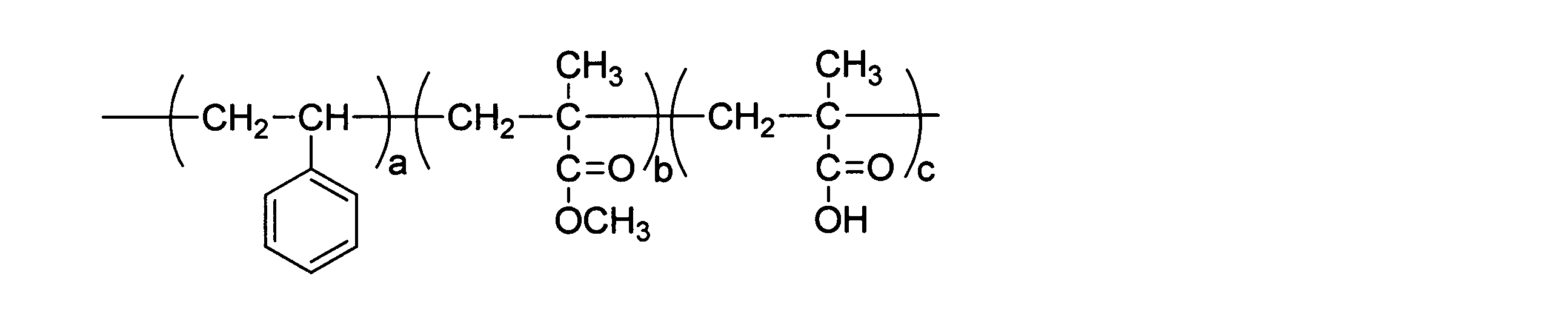
分子量(Mw):6600
37重量%PGMAc溶液
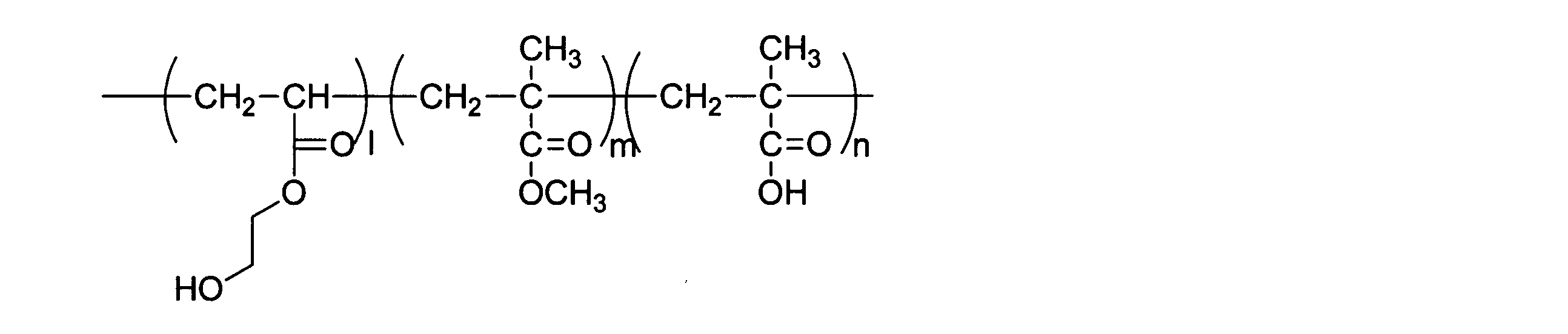
分子量(Mw):11000
30重量%PGMAc溶液
D1:KAYARAD DPHA(日本化薬社製)
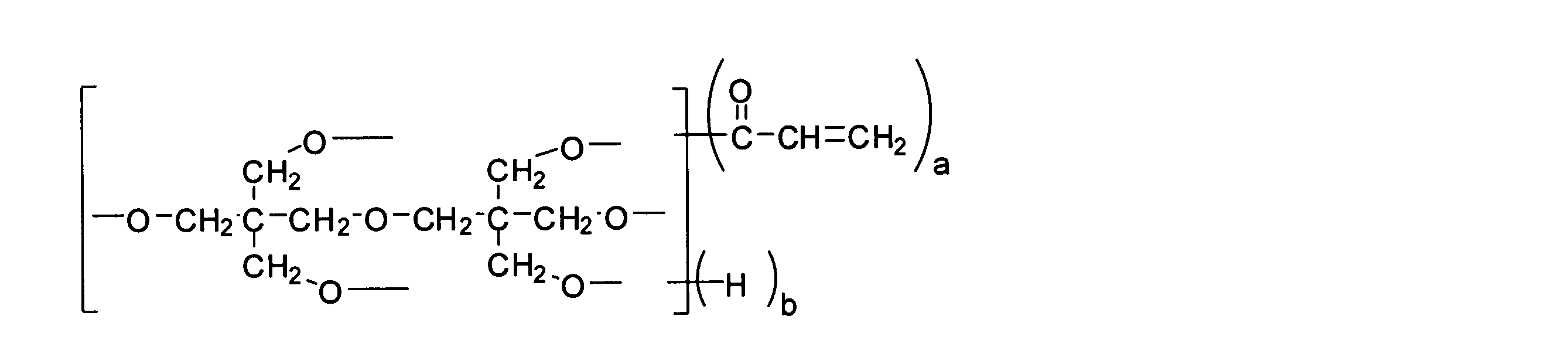

E1:IRGACURE OXE02(BASF社製)

(G-4)熱重合防止剤
G1:メチルヒドロキノン
(G-6)紫外線吸収剤
G2:TINUVIN384-2(BASF社製)

H1:プロピレングリコールモノメチルエーテルアセテート(PGMAc)
(酸価)
アルカリ可溶性樹脂につき、JIS-K0070(基準油脂試験法)に準拠して測定した。
(光透過率)
本発明の感光性樹脂組成物をガラス基板上に、乾燥膜厚が1μmとなるように塗布し、前記(実施例1~7、比較例1~3)の項で得られた熱硬化膜の光透過率を、分光光度計UV3100PC(島津製作所製)にて測定し、波長600nm~400nmの範囲における最少の透過率(%)を求めた。
(感度)
本発明の感光性樹脂組成物をガラス基板上に、乾燥膜厚がほぼ1μmとなるように塗布し、ホットプレート上で130℃、60秒間の条件でベークした。その後、高圧水銀灯により20mW/cm2の照度で露光した。露光条件としては、露光エネルギー量として10mJ/cm2から100mJ/cm2までの範囲で、21/2倍毎の間隔で露光エネルギー量を設定して露光した。露光後、25℃の2.38wt%テトラメチルアンモニウムヒドロキシド水溶液に90秒間浸漬し、純水でリンスし、残存する硬化膜(露光膜)の膜厚を測定した。
得られた露光膜の膜厚を、露光量に対してプロットし、ある露光量と、その21/2倍の露光量とにおける露光膜の膜厚差が、10%以内となる最小露光量を、感度(mJ/cm2)と定義した。
前記熱硬化膜の形成手順にて得られた熱硬化膜の画像を光学顕微鏡により観察し、解像している最小の線幅(μm)を解像性とした。
前記熱硬化膜の形成手順にて得られた熱硬化膜の20μmの線幅のラインパターン形状を走査電子顕微鏡にて観察することにより、そのパターン形状を下記基準にて評価した。
A:矩形性が良好であり、裾引き無し
B:矩形性は良好であるが、少し裾引き有り
C:矩形性不良、又は解像せず
前記熱硬化膜の形成手順にて得られた熱硬化膜の20μmの線幅のライン・アンド・スペースパターンを光学顕微鏡により観察し、そのスペース部分の残渣を下記基準にて評価した。
A:残渣無し
B:わずかにレジスト周辺部に残渣が見られる
C:スペース部分中央部にも残渣が見られる
ガラス上にクロムを蒸着した基板上に前記熱硬化膜の形成手順にて、熱硬化膜を形成した。得られた熱硬化膜上にイオンコーターによって金を100nmの厚さに蒸着し、直径6mmの円形電極を形成した。下層のクロム膜と上層の金膜との間に1kHzの交流電圧をかけ、LCRメータで熱硬化膜の静電容量を測定することによって、誘電率を求めた。

更に、本発明の感光性樹脂組成物は、パターン形状及び残渣も良好である。
これより、本発明は、上記感光性樹脂組成物を用いて形成された硬化物、該硬化物を含む層間絶縁膜、並びに該層間絶縁膜を含むTFTアクティブマトリックス基板は、いずれも高品質である。
Claims (7)
- (A)チタン酸バリウム微粒子、(B)酸化ジルコニウム微粒子、及び(C)アルカリ可溶性樹脂を含有する、感光性樹脂組成物。
- (A)チタン酸バリウム微粒子及び(B)酸化ジルコニウム微粒子の平均一次粒子径が、各々独立に、1nm以上、1000nm以下である、請求項1に記載の感光性樹脂組成物。
- 更に、(D)エチレン性不飽和基を有する化合物及び(E)光重合開始剤を含有する、請求項1又は2に記載の感光性樹脂組成物。
- 請求項1~3のいずれか一項に記載の感光性樹脂組成物を用いて形成される、硬化物。
- 請求項4に記載の硬化物を含む、層間絶縁膜。
- 請求項5に記載の層間絶縁膜を有する、TFTアクティブマトリックス基板。
- 請求項6に記載のTFTアクティブマトリックス基板を有する、液晶表示装置。
Priority Applications (3)
| Application Number | Priority Date | Filing Date | Title |
|---|---|---|---|
| KR1020147029296A KR102006046B1 (ko) | 2012-04-26 | 2013-04-25 | 감광성 수지 조성물, 경화물, 층간 절연막, tft 액티브 매트릭스 기판 및 액정 표시 장치 |
| JP2014512695A JP6304026B2 (ja) | 2012-04-26 | 2013-04-25 | 感光性樹脂組成物、硬化物、層間絶縁膜、tftアクティブマトリックス基板及び液晶表示装置 |
| CN201380021084.0A CN104246609A (zh) | 2012-04-26 | 2013-04-25 | 感光性树脂组合物、固化物、层间绝缘膜、tft 有源阵列基板及液晶显示装置 |
Applications Claiming Priority (2)
| Application Number | Priority Date | Filing Date | Title |
|---|---|---|---|
| JP2012101699 | 2012-04-26 | ||
| JP2012-101699 | 2012-04-26 |
Publications (1)
| Publication Number | Publication Date |
|---|---|
| WO2013161968A1 true WO2013161968A1 (ja) | 2013-10-31 |
Family
ID=49483267
Family Applications (1)
| Application Number | Title | Priority Date | Filing Date |
|---|---|---|---|
| PCT/JP2013/062296 Ceased WO2013161968A1 (ja) | 2012-04-26 | 2013-04-25 | 感光性樹脂組成物、硬化物、層間絶縁膜、tftアクティブマトリックス基板及び液晶表示装置 |
Country Status (4)
| Country | Link |
|---|---|
| JP (1) | JP6304026B2 (ja) |
| KR (1) | KR102006046B1 (ja) |
| CN (1) | CN104246609A (ja) |
| WO (1) | WO2013161968A1 (ja) |
Cited By (4)
| Publication number | Priority date | Publication date | Assignee | Title |
|---|---|---|---|---|
| JP2016014849A (ja) * | 2014-06-12 | 2016-01-28 | Jsr株式会社 | 感放射線性樹脂組成物、絶縁膜および表示素子 |
| JP2016071379A (ja) * | 2014-09-30 | 2016-05-09 | 富士フイルム株式会社 | 感光性組成物、硬化膜の製造方法、硬化膜、液晶表示装置、有機エレクトロルミネッセンス表示装置、タッチパネル及びタッチパネル表示装置 |
| JP2017090588A (ja) * | 2015-11-06 | 2017-05-25 | Jsr株式会社 | 液晶表示素子および感放射線性樹脂組成物 |
| JP2018502327A (ja) * | 2014-12-23 | 2018-01-25 | エーエスエムエル ネザーランズ ビー.ブイ. | レジスト組成物、レジストパターン形成方法、レジスト組成物の製造方法、ペロブスカイト材料のリソグラフィプロセスへの使用およびレジスト組成物で被覆された基板 |
Families Citing this family (5)
| Publication number | Priority date | Publication date | Assignee | Title |
|---|---|---|---|---|
| JP6742785B2 (ja) * | 2015-08-13 | 2020-08-19 | 太陽インキ製造株式会社 | 感光性樹脂組成物、ドライフィルムおよびプリント配線板 |
| CN107272342B (zh) * | 2016-03-30 | 2021-03-05 | 东友精细化工有限公司 | 负型感光树脂组合物 |
| JP6954273B2 (ja) * | 2017-03-29 | 2021-10-27 | 東レ株式会社 | 感光性組成物、硬化膜および有機el表示装置 |
| KR20190043303A (ko) * | 2017-10-18 | 2019-04-26 | 동우 화인켐 주식회사 | 착색 감광성 수지 조성물의 전기적 특성을 측정하기 위한 평가 셀의 제조방법 |
| JP7314550B2 (ja) * | 2019-03-20 | 2023-07-26 | 富士フイルムビジネスイノベーション株式会社 | 電子写真感光体、プロセスカートリッジ及び画像形成装置 |
Citations (5)
| Publication number | Priority date | Publication date | Assignee | Title |
|---|---|---|---|---|
| JPH05213669A (ja) * | 1992-01-31 | 1993-08-24 | Asahi Chem Ind Co Ltd | 誘電性磁器組成物 |
| WO2005093763A1 (ja) * | 2004-03-29 | 2005-10-06 | Nippon Chemical Industrial Co., Ltd. | 複合誘電体材料用無機誘電体粉末及び複合誘電体材料 |
| JP2006210044A (ja) * | 2005-01-26 | 2006-08-10 | Toray Ind Inc | 感光性誘電体ペーストおよびそれを用いた電子回路部品の製造方法 |
| JP2008026430A (ja) * | 2006-07-19 | 2008-02-07 | Hitachi Displays Ltd | 液晶表示装置及びその製造方法 |
| WO2008117710A1 (ja) * | 2007-03-26 | 2008-10-02 | Murata Manufacturing Co., Ltd. | 感光性誘電体ペーストおよびそれを用いた電子部品 |
Family Cites Families (6)
| Publication number | Priority date | Publication date | Assignee | Title |
|---|---|---|---|---|
| JPS52109197A (en) * | 1976-03-09 | 1977-09-13 | Nichicon Capacitor Ltd | Highhdielectric ceramic composition |
| JP4565211B2 (ja) | 2001-06-05 | 2010-10-20 | Jsr株式会社 | 感光性誘電体形成用組成物、誘電体および電子部品 |
| JP4565212B2 (ja) | 2001-06-05 | 2010-10-20 | Jsr株式会社 | 感光性転写フィルム、誘電体および電子部品 |
| JP4565213B2 (ja) | 2001-08-13 | 2010-10-20 | Jsr株式会社 | 感光性誘電体形成用組成物、転写フィルム、誘電体および電子部品 |
| JP5256646B2 (ja) * | 2006-05-31 | 2013-08-07 | 三菱化学株式会社 | 液晶表示装置 |
| JP5256645B2 (ja) | 2006-05-31 | 2013-08-07 | 三菱化学株式会社 | 保護膜用熱硬化性組成物、硬化物、及び液晶表示装置 |
-
2013
- 2013-04-25 KR KR1020147029296A patent/KR102006046B1/ko active Active
- 2013-04-25 CN CN201380021084.0A patent/CN104246609A/zh active Pending
- 2013-04-25 JP JP2014512695A patent/JP6304026B2/ja active Active
- 2013-04-25 WO PCT/JP2013/062296 patent/WO2013161968A1/ja not_active Ceased
Patent Citations (5)
| Publication number | Priority date | Publication date | Assignee | Title |
|---|---|---|---|---|
| JPH05213669A (ja) * | 1992-01-31 | 1993-08-24 | Asahi Chem Ind Co Ltd | 誘電性磁器組成物 |
| WO2005093763A1 (ja) * | 2004-03-29 | 2005-10-06 | Nippon Chemical Industrial Co., Ltd. | 複合誘電体材料用無機誘電体粉末及び複合誘電体材料 |
| JP2006210044A (ja) * | 2005-01-26 | 2006-08-10 | Toray Ind Inc | 感光性誘電体ペーストおよびそれを用いた電子回路部品の製造方法 |
| JP2008026430A (ja) * | 2006-07-19 | 2008-02-07 | Hitachi Displays Ltd | 液晶表示装置及びその製造方法 |
| WO2008117710A1 (ja) * | 2007-03-26 | 2008-10-02 | Murata Manufacturing Co., Ltd. | 感光性誘電体ペーストおよびそれを用いた電子部品 |
Cited By (5)
| Publication number | Priority date | Publication date | Assignee | Title |
|---|---|---|---|---|
| JP2016014849A (ja) * | 2014-06-12 | 2016-01-28 | Jsr株式会社 | 感放射線性樹脂組成物、絶縁膜および表示素子 |
| JP2016071379A (ja) * | 2014-09-30 | 2016-05-09 | 富士フイルム株式会社 | 感光性組成物、硬化膜の製造方法、硬化膜、液晶表示装置、有機エレクトロルミネッセンス表示装置、タッチパネル及びタッチパネル表示装置 |
| JP2018502327A (ja) * | 2014-12-23 | 2018-01-25 | エーエスエムエル ネザーランズ ビー.ブイ. | レジスト組成物、レジストパターン形成方法、レジスト組成物の製造方法、ペロブスカイト材料のリソグラフィプロセスへの使用およびレジスト組成物で被覆された基板 |
| US11415886B2 (en) | 2014-12-23 | 2022-08-16 | Asml Netherlands B.V. | Lithographic patterning process and resists to use therein |
| JP2017090588A (ja) * | 2015-11-06 | 2017-05-25 | Jsr株式会社 | 液晶表示素子および感放射線性樹脂組成物 |
Also Published As
| Publication number | Publication date |
|---|---|
| CN104246609A (zh) | 2014-12-24 |
| KR102006046B1 (ko) | 2019-07-31 |
| JPWO2013161968A1 (ja) | 2015-12-24 |
| KR20150003744A (ko) | 2015-01-09 |
| JP6304026B2 (ja) | 2018-04-04 |
Similar Documents
| Publication | Publication Date | Title |
|---|---|---|
| JP5256645B2 (ja) | 保護膜用熱硬化性組成物、硬化物、及び液晶表示装置 | |
| JP4826918B2 (ja) | 光重合性組成物 | |
| JP6304026B2 (ja) | 感光性樹脂組成物、硬化物、層間絶縁膜、tftアクティブマトリックス基板及び液晶表示装置 | |
| JP5256646B2 (ja) | 液晶表示装置 | |
| JP5067146B2 (ja) | 保護膜用熱硬化性組成物、硬化物、tftアクティブマトリックス基板、及び液晶表示装置 | |
| JP5256647B2 (ja) | 保護膜用熱硬化性組成物、硬化物、及び液晶表示装置 | |
| JP2008007640A (ja) | シロキサン樹脂、熱硬化性組成物、硬化物、tftアクティブマトリックス基板、カラーフィルタ基板及び液晶表示装置 | |
| JP4992518B2 (ja) | 光重合性組成物 | |
| JP4992534B2 (ja) | 光重合性組成物 | |
| JP2013167786A (ja) | 有機絶縁膜用硬化性樹脂組成物、硬化物、tftアクティブマトリックス基板及び液晶表示装置 | |
| CN109564385B (zh) | 感光性树脂组合物、固化物、层间绝缘膜、tft有源矩阵基板及图像显示装置 | |
| JP2013249269A (ja) | ケトオキシムエステル化合物、硬化性樹脂組成物、硬化物、層間絶縁膜、tetアクティブマトリックス基板及び液晶表示装置 | |
| JP6853493B2 (ja) | 光重合性組成物、硬化物、画像表示装置及びオキシムエステル系化合物 | |
| JP2006251536A (ja) | 保護膜用熱硬化性組成物、カラーフィルタ及び液晶表示装置 | |
| JP2007241084A (ja) | 保護膜用熱硬化性組成物、カラーフィルタ及び液晶表示装置 | |
| JP6547330B2 (ja) | 硬化性樹脂組成物、硬化物、tftアクティブマトリックス基板、及び液晶表示装置 | |
| JP2017116659A (ja) | 保護膜用硬化性組成物、保護膜、tftアクティブマトリックス基板、及び画像表示装置 |
Legal Events
| Date | Code | Title | Description |
|---|---|---|---|
| 121 | Ep: the epo has been informed by wipo that ep was designated in this application |
Ref document number: 13781232 Country of ref document: EP Kind code of ref document: A1 |
|
| ENP | Entry into the national phase |
Ref document number: 2014512695 Country of ref document: JP Kind code of ref document: A |
|
| ENP | Entry into the national phase |
Ref document number: 20147029296 Country of ref document: KR Kind code of ref document: A |
|
| NENP | Non-entry into the national phase |
Ref country code: DE |
|
| 122 | Ep: pct application non-entry in european phase |
Ref document number: 13781232 Country of ref document: EP Kind code of ref document: A1 |