WO2013150751A1 - ケイ素化合物及びその製造方法、並びにその利用 - Google Patents
ケイ素化合物及びその製造方法、並びにその利用 Download PDFInfo
- Publication number
- WO2013150751A1 WO2013150751A1 PCT/JP2013/002136 JP2013002136W WO2013150751A1 WO 2013150751 A1 WO2013150751 A1 WO 2013150751A1 JP 2013002136 W JP2013002136 W JP 2013002136W WO 2013150751 A1 WO2013150751 A1 WO 2013150751A1
- Authority
- WO
- WIPO (PCT)
- Prior art keywords
- group
- polymer
- formula
- mass
- radical polymerization
- Prior art date
- Legal status (The legal status is an assumption and is not a legal conclusion. Google has not performed a legal analysis and makes no representation as to the accuracy of the status listed.)
- Ceased
Links
Classifications
-
- C—CHEMISTRY; METALLURGY
- C08—ORGANIC MACROMOLECULAR COMPOUNDS; THEIR PREPARATION OR CHEMICAL WORKING-UP; COMPOSITIONS BASED THEREON
- C08F—MACROMOLECULAR COMPOUNDS OBTAINED BY REACTIONS ONLY INVOLVING CARBON-TO-CARBON UNSATURATED BONDS
- C08F292/00—Macromolecular compounds obtained by polymerising monomers on to inorganic materials
-
- C—CHEMISTRY; METALLURGY
- C07—ORGANIC CHEMISTRY
- C07F—ACYCLIC, CARBOCYCLIC OR HETEROCYCLIC COMPOUNDS CONTAINING ELEMENTS OTHER THAN CARBON, HYDROGEN, HALOGEN, OXYGEN, NITROGEN, SULFUR, SELENIUM OR TELLURIUM
- C07F7/00—Compounds containing elements of Groups 4 or 14 of the Periodic Table
- C07F7/02—Silicon compounds
- C07F7/08—Compounds having one or more C—Si linkages
- C07F7/18—Compounds having one or more C—Si linkages as well as one or more C—O—Si linkages
- C07F7/1804—Compounds having Si-O-C linkages
-
- C—CHEMISTRY; METALLURGY
- C07—ORGANIC CHEMISTRY
- C07F—ACYCLIC, CARBOCYCLIC OR HETEROCYCLIC COMPOUNDS CONTAINING ELEMENTS OTHER THAN CARBON, HYDROGEN, HALOGEN, OXYGEN, NITROGEN, SULFUR, SELENIUM OR TELLURIUM
- C07F7/00—Compounds containing elements of Groups 4 or 14 of the Periodic Table
- C07F7/02—Silicon compounds
- C07F7/08—Compounds having one or more C—Si linkages
- C07F7/18—Compounds having one or more C—Si linkages as well as one or more C—O—Si linkages
- C07F7/1804—Compounds having Si-O-C linkages
- C07F7/1872—Preparation; Treatments not provided for in C07F7/20
- C07F7/1892—Preparation; Treatments not provided for in C07F7/20 by reactions not provided for in C07F7/1876 - C07F7/1888
-
- C—CHEMISTRY; METALLURGY
- C08—ORGANIC MACROMOLECULAR COMPOUNDS; THEIR PREPARATION OR CHEMICAL WORKING-UP; COMPOSITIONS BASED THEREON
- C08F—MACROMOLECULAR COMPOUNDS OBTAINED BY REACTIONS ONLY INVOLVING CARBON-TO-CARBON UNSATURATED BONDS
- C08F2/00—Processes of polymerisation
- C08F2/38—Polymerisation using regulators, e.g. chain terminating agents, e.g. telomerisation
-
- C—CHEMISTRY; METALLURGY
- C08—ORGANIC MACROMOLECULAR COMPOUNDS; THEIR PREPARATION OR CHEMICAL WORKING-UP; COMPOSITIONS BASED THEREON
- C08F—MACROMOLECULAR COMPOUNDS OBTAINED BY REACTIONS ONLY INVOLVING CARBON-TO-CARBON UNSATURATED BONDS
- C08F4/00—Polymerisation catalysts
-
- C—CHEMISTRY; METALLURGY
- C08—ORGANIC MACROMOLECULAR COMPOUNDS; THEIR PREPARATION OR CHEMICAL WORKING-UP; COMPOSITIONS BASED THEREON
- C08F—MACROMOLECULAR COMPOUNDS OBTAINED BY REACTIONS ONLY INVOLVING CARBON-TO-CARBON UNSATURATED BONDS
- C08F4/00—Polymerisation catalysts
- C08F4/42—Metals; Metal hydrides; Metallo-organic compounds; Use thereof as catalyst precursors
- C08F4/44—Metals; Metal hydrides; Metallo-organic compounds; Use thereof as catalyst precursors selected from light metals, zinc, cadmium, mercury, copper, silver, gold, boron, gallium, indium, thallium, rare earths or actinides
- C08F4/58—Metals; Metal hydrides; Metallo-organic compounds; Use thereof as catalyst precursors selected from light metals, zinc, cadmium, mercury, copper, silver, gold, boron, gallium, indium, thallium, rare earths or actinides together with silicon, germanium, tin, lead, antimony, bismuth or compounds thereof
-
- C—CHEMISTRY; METALLURGY
- C08—ORGANIC MACROMOLECULAR COMPOUNDS; THEIR PREPARATION OR CHEMICAL WORKING-UP; COMPOSITIONS BASED THEREON
- C08F—MACROMOLECULAR COMPOUNDS OBTAINED BY REACTIONS ONLY INVOLVING CARBON-TO-CARBON UNSATURATED BONDS
- C08F4/00—Polymerisation catalysts
- C08F4/42—Metals; Metal hydrides; Metallo-organic compounds; Use thereof as catalyst precursors
- C08F4/72—Metals; Metal hydrides; Metallo-organic compounds; Use thereof as catalyst precursors selected from metals not provided for in group C08F4/44
-
- C—CHEMISTRY; METALLURGY
- C08—ORGANIC MACROMOLECULAR COMPOUNDS; THEIR PREPARATION OR CHEMICAL WORKING-UP; COMPOSITIONS BASED THEREON
- C08K—Use of inorganic or non-macromolecular organic substances as compounding ingredients
- C08K9/00—Use of pretreated ingredients
- C08K9/04—Ingredients treated with organic substances
- C08K9/06—Ingredients treated with organic substances with silicon-containing compounds
-
- C—CHEMISTRY; METALLURGY
- C08—ORGANIC MACROMOLECULAR COMPOUNDS; THEIR PREPARATION OR CHEMICAL WORKING-UP; COMPOSITIONS BASED THEREON
- C08L—COMPOSITIONS OF MACROMOLECULAR COMPOUNDS
- C08L51/00—Compositions of graft polymers in which the grafted component is obtained by reactions only involving carbon-to-carbon unsaturated bonds; Compositions of derivatives of such polymers
- C08L51/04—Compositions of graft polymers in which the grafted component is obtained by reactions only involving carbon-to-carbon unsaturated bonds; Compositions of derivatives of such polymers grafted on to rubbers
-
- C—CHEMISTRY; METALLURGY
- C08—ORGANIC MACROMOLECULAR COMPOUNDS; THEIR PREPARATION OR CHEMICAL WORKING-UP; COMPOSITIONS BASED THEREON
- C08L—COMPOSITIONS OF MACROMOLECULAR COMPOUNDS
- C08L51/00—Compositions of graft polymers in which the grafted component is obtained by reactions only involving carbon-to-carbon unsaturated bonds; Compositions of derivatives of such polymers
- C08L51/10—Compositions of graft polymers in which the grafted component is obtained by reactions only involving carbon-to-carbon unsaturated bonds; Compositions of derivatives of such polymers grafted on to inorganic materials
-
- C—CHEMISTRY; METALLURGY
- C08—ORGANIC MACROMOLECULAR COMPOUNDS; THEIR PREPARATION OR CHEMICAL WORKING-UP; COMPOSITIONS BASED THEREON
- C08L—COMPOSITIONS OF MACROMOLECULAR COMPOUNDS
- C08L9/00—Compositions of homopolymers or copolymers of conjugated diene hydrocarbons
- C08L9/06—Copolymers with styrene
-
- C—CHEMISTRY; METALLURGY
- C09—DYES; PAINTS; POLISHES; NATURAL RESINS; ADHESIVES; COMPOSITIONS NOT OTHERWISE PROVIDED FOR; APPLICATIONS OF MATERIALS NOT OTHERWISE PROVIDED FOR
- C09C—TREATMENT OF INORGANIC MATERIALS, OTHER THAN FIBROUS FILLERS, TO ENHANCE THEIR PIGMENTING OR FILLING PROPERTIES ; PREPARATION OF CARBON BLACK ; PREPARATION OF INORGANIC MATERIALS WHICH ARE NO SINGLE CHEMICAL COMPOUNDS AND WHICH ARE MAINLY USED AS PIGMENTS OR FILLERS
- C09C1/00—Treatment of specific inorganic materials other than fibrous fillers; Preparation of carbon black
- C09C1/04—Compounds of zinc
- C09C1/043—Zinc oxide
-
- C—CHEMISTRY; METALLURGY
- C09—DYES; PAINTS; POLISHES; NATURAL RESINS; ADHESIVES; COMPOSITIONS NOT OTHERWISE PROVIDED FOR; APPLICATIONS OF MATERIALS NOT OTHERWISE PROVIDED FOR
- C09C—TREATMENT OF INORGANIC MATERIALS, OTHER THAN FIBROUS FILLERS, TO ENHANCE THEIR PIGMENTING OR FILLING PROPERTIES ; PREPARATION OF CARBON BLACK ; PREPARATION OF INORGANIC MATERIALS WHICH ARE NO SINGLE CHEMICAL COMPOUNDS AND WHICH ARE MAINLY USED AS PIGMENTS OR FILLERS
- C09C1/00—Treatment of specific inorganic materials other than fibrous fillers; Preparation of carbon black
- C09C1/28—Compounds of silicon
- C09C1/30—Silicic acid
- C09C1/3081—Treatment with organo-silicon compounds
-
- C—CHEMISTRY; METALLURGY
- C09—DYES; PAINTS; POLISHES; NATURAL RESINS; ADHESIVES; COMPOSITIONS NOT OTHERWISE PROVIDED FOR; APPLICATIONS OF MATERIALS NOT OTHERWISE PROVIDED FOR
- C09C—TREATMENT OF INORGANIC MATERIALS, OTHER THAN FIBROUS FILLERS, TO ENHANCE THEIR PIGMENTING OR FILLING PROPERTIES ; PREPARATION OF CARBON BLACK ; PREPARATION OF INORGANIC MATERIALS WHICH ARE NO SINGLE CHEMICAL COMPOUNDS AND WHICH ARE MAINLY USED AS PIGMENTS OR FILLERS
- C09C1/00—Treatment of specific inorganic materials other than fibrous fillers; Preparation of carbon black
- C09C1/36—Compounds of titanium
-
- C—CHEMISTRY; METALLURGY
- C08—ORGANIC MACROMOLECULAR COMPOUNDS; THEIR PREPARATION OR CHEMICAL WORKING-UP; COMPOSITIONS BASED THEREON
- C08F—MACROMOLECULAR COMPOUNDS OBTAINED BY REACTIONS ONLY INVOLVING CARBON-TO-CARBON UNSATURATED BONDS
- C08F220/00—Copolymers of compounds having one or more unsaturated aliphatic radicals, each having only one carbon-to-carbon double bond, and only one being terminated by only one carboxyl radical or a salt, anhydride ester, amide, imide or nitrile thereof
- C08F220/02—Monocarboxylic acids having less than ten carbon atoms; Derivatives thereof
- C08F220/10—Esters
- C08F220/12—Esters of monohydric alcohols or phenols
- C08F220/16—Esters of monohydric alcohols or phenols of phenols or of alcohols containing two or more carbon atoms
- C08F220/18—Esters of monohydric alcohols or phenols of phenols or of alcohols containing two or more carbon atoms with acrylic or methacrylic acids
- C08F220/1807—C7-(meth)acrylate, e.g. heptyl (meth)acrylate or benzyl (meth)acrylate
-
- C—CHEMISTRY; METALLURGY
- C08—ORGANIC MACROMOLECULAR COMPOUNDS; THEIR PREPARATION OR CHEMICAL WORKING-UP; COMPOSITIONS BASED THEREON
- C08F—MACROMOLECULAR COMPOUNDS OBTAINED BY REACTIONS ONLY INVOLVING CARBON-TO-CARBON UNSATURATED BONDS
- C08F2438/00—Living radical polymerisation
- C08F2438/01—Atom Transfer Radical Polymerization [ATRP] or reverse ATRP
Definitions
- the present invention relates to a novel silicon compound and a method for producing the same.
- the present invention also relates to a radical polymerization initiator comprising the silicon compound, a method for producing a polymer using the same, and a rubber composition containing the obtained polymer.
- the present invention also relates to a composite in which a polymer graft chain is formed on a solid substance using the silicon compound, a method for producing the composite, and a molded body made of the composite.
- the present invention relates to a reinforcing agent blended in a rubber composition or a plastic composition, a method for producing the same, and a rubber composition and a plastic composition blended with the reinforcing agent.
- Patent Document 1 and Non-Patent Document 1 disclose the use of a polymerization initiator capable of silane coupling treatment on the surface of a solid substance.
- a polymerization initiator capable of silane coupling treatment on the surface of a solid substance.
- (2-bromo-2-methyl) propionyloxyhexyltriethoxysilane (BHE) is disclosed as a polymerization initiator.
- BHE (2-bromo-2-methyl) propionyloxyhexyltriethoxysilane
- BHE (2-bromo-2-methyl) propionyloxyhexyltriethoxysilane
- BHE (2-bromo-2-methyl) propionyloxyhexyltriethoxysilane
- BHE (2-bromo-2-methyl) propionyloxyhexyltriethoxysilane
- BHE is synthesized by subjecting a compound having a radical polymerization initiating group in one of the molecular chains and
- Patent Documents 2 and 3 disclose, as a method for producing a silicon compound having living radical polymerization initiating ability, a method of introducing an alkoxy group by reacting orthoformate ester or alcohol after hydrosilylation reaction of chlorosilane. Yes. Although this method can improve the reaction efficiency, it has a problem that the hydrosilylation catalyst is water-inhibiting.
- reinforcing agents also referred to as reinforcing fillers
- rubber compositions and plastic compositions For example, in the rubber composition for tires, the development of a low heat-generating rubber composition is required due to the increasing demand for low fuel consumption performance.
- silica is compounded as a reinforcing agent.
- Patent Document 4 discloses a method of impregnating silica with a vinyl monomer and then coating the silica with a polymer by radical polymerization in order to improve the dispersibility of the silica.
- An object of the present invention is to provide a novel silicon compound having radical polymerization initiating ability, a method for producing the same, and various utilization modes using the same.
- the silicon compound according to the first embodiment is represented by the following general formula (1).
- A is a group having radical polymerization initiating ability
- Z 1 and Z 2 are each independently a divalent group containing at least carbon
- R 1 and R 2 are each independently a group having 1 to 3 carbon atoms. It is an alkyl group.
- n is an integer of 1 to 3.
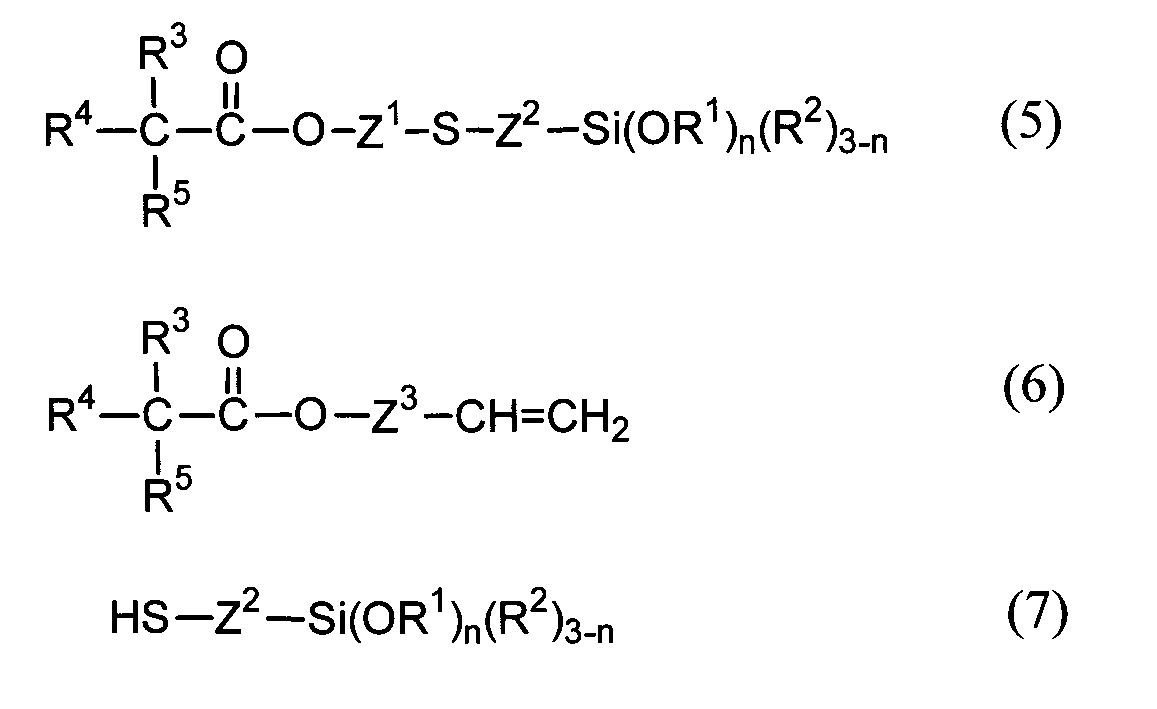
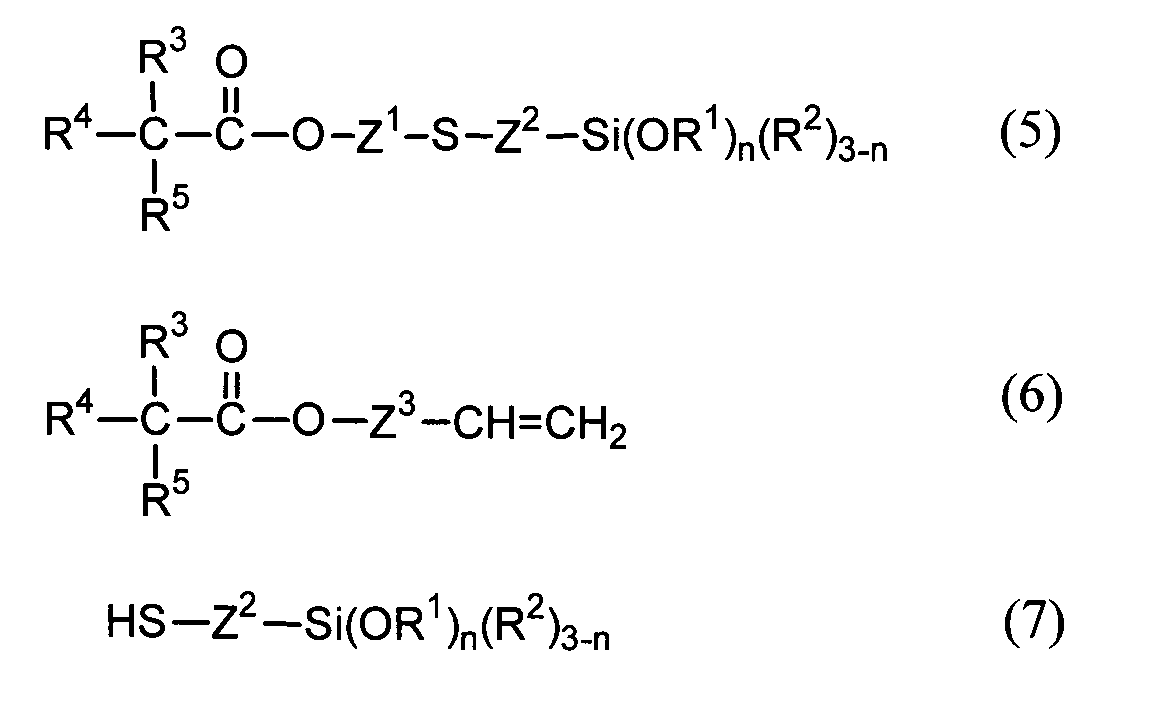
- 2nd Embodiment is a manufacturing method of the silicon compound represented by following General formula (5), Comprising: The compound represented by the following general formula (6) and the compound represented by the following general formula (7) are shown. It includes a step of reacting.
- R 1 and R 2 are each independently an alkyl group having 1 to 3 carbon atoms.
- R 3 , R 4 and R 5 are each independently a structure composed of at least one selected from the group consisting of carbon, hydrogen, oxygen, nitrogen, halogen and sulfur, and R 3 , R 4 and R 5 At least one of them is halogen.
- Z 1 , Z 2 and Z 3 are each independently a divalent group containing at least a carbon atom.
- n is an integer of 1 to 3.
- the third embodiment is a radical polymerization initiator composed of the silicon compound according to the first embodiment.
- the fourth embodiment is a method for producing a polymer, in which a radical polymerization initiator according to the third embodiment is used to perform radical polymerization or living radical polymerization of a monomer.
- the fifth embodiment is a polymer having an alkoxysilyl group at the terminal obtained by the method according to the fourth embodiment.
- the sixth embodiment is a rubber composition containing the polymer according to the fifth embodiment in an amount of 0.1 to 100 parts by mass with respect to 100 parts by mass of the rubber component.
- the seventh embodiment is a method for producing a composite in which the silicon compound according to the first embodiment is fixed to the surface of a solid substance, and a monomer is living radically polymerized from the fixed silicon compound to form a polymer graft chain. .
- the eighth embodiment is a complex obtained by the method according to the seventh embodiment.
- the ninth embodiment is a molded body made of the composite according to the eighth embodiment.
- the silicon compound according to the first embodiment is fixed to the surface of a solid substance, and a radical-polymerizable monomer is used as a living radical from a group having radical polymerization initiation ability of the fixed silicon compound.
- the eleventh embodiment is obtained by the production method according to the tenth embodiment, and the amount of the polymer graft chain on the surface of the solid substance is 5 to 1000 parts by mass with respect to 100 parts by mass of the solid substance. Or it is a reinforcing agent for plastics.
- the twelfth embodiment is a rubber composition containing 1 to 200 parts by mass of the reinforcing agent according to the eleventh embodiment with respect to 100 parts by mass of the rubber component.
- the thirteenth embodiment is a plastic composition containing 1 to 200 parts by mass of the reinforcing agent according to the eleventh embodiment with respect to 100 parts by mass of the plastic component.
- a novel silicon compound having radical polymerization initiating ability is provided.
- This silicon compound is suitably used as a radical polymerization initiator.
- it can be used as a polymerization initiator that can be immobilized on various materials.
- this silicon compound can be manufactured by a simple method.
- the silicon compound according to this embodiment is represented by the general formula (1).
- This silicon compound has an unpaired electron in the sulfur atom of the thioether group in the structure. Therefore, it has high affinity with metals, inorganic substances, and polymer substances, and has higher adhesion to the surface of solid substances than when it does not have a thioether group. Is thought to improve.
- A is a group having radical polymerization initiating ability (hereinafter sometimes simply referred to as radical polymerization initiating group).
- A is more preferably a group having a living radical polymerization initiating ability (that is, a living radical polymerization initiating group).
- Examples of the reaction mode of the living radical polymerization include atom transfer radical polymerization (ATRP), reversible addition-fragmentation chain transfer polymerization (RAFT), a method using iniferter, reversible chain transfer catalytic polymerization (RTCP), and the like. There is no particular limitation.
- Examples of the group having an atom transfer radical polymerization initiating ability include a haloalkyl group, a haloester group, a haloalkylphenyl group, a haloketone group, a halonitrile group, a halogenated sulfonyl group, or a dithiocarbamate group.
- it is a haloester group or a haloalkylphenyl group.
- radicals are generated in the presence of a transition metal complex such as a copper chloride / amine complex, and the polymerization reaction proceeds.
- Examples of the group having reversible addition-cleavage chain transfer polymerization ability include a dithioester group, a trithiocarbonate group, a xanthate group, or a dithiocarbonate group.
- an azo compound or an organic peroxide is used as a polymerization catalyst.
- examples of iniferters include dithiocarbamate groups.
- An example of reversible chain transfer catalytic polymerization is an alkyl iodide group. In this case, radicals are generated in the presence of a radical generator and an iodide catalyst, and the polymerization reaction proceeds.
- Examples of the haloalkyl group include trichloromethyl and bromodichloromethyl.
- Examples of the haloalkylphenyl group include chloromethylphenyl, bromomethylphenyl, iodomethylphenyl, (1-chloroethyl) phenyl, (1-bromoethyl) phenyl, (1-iodoethyl) phenyl, and the like.
- Examples of the haloketone group include trichloroethanoyl, dichloroethanoyl, and the like.
- Examples of the halonitrile group include chlorocyanomethyl, bromocyanomethyl, and iodocyanomethyl.
- Examples of the halogenated sulfonyl group include chlorosulfonyl and the like.
- the radical polymerization initiating group for A is preferably an ⁇ -haloester group represented by the following general formula (2).
- R 3 , R 4 and R 5 are each independently composed of at least one selected from the group consisting of a carbon atom, a hydrogen atom, an oxygen atom, a nitrogen atom, a halogen atom and a sulfur atom. And at least one of R 3 , R 4 and R 5 is a halogen atom. As the halogen, chlorine, bromine or iodine is preferable, and bromine is more preferable.
- R 3 , R 4 and R 5 are each basically a hydrogen atom, a hydrocarbon group or a halogen atom, but are selected from the group consisting of oxygen, nitrogen and sulfur as long as the radical polymerization initiating ability is not impaired.
- R 3 is a halogen atom
- R 4 and R 5 are each independently a hydrogen atom, an alkyl group having 1 to 20 carbon atoms, an aryl group having 6 to 20 carbon atoms, or 7 to 7 carbon atoms.
- 20 arylalkyl groups provided that R 4 and R 5 are not both hydrogen.
- the alkyl group is more preferably an alkyl group having 1 to 4 carbon atoms.
- the aryl group is more preferably a phenyl group or a methylphenyl group.
- the arylalkyl group is more preferably a benzyl group or a phenethyl group.
- a particularly preferred example of R 4 and R 5 is a methyl group.
- radical polymerization initiating group of A is a thiocarbonylthio group represented by the following general formula (3).
- R 6 is a structure composed of at least one selected from the group consisting of a carbon atom, a hydrogen atom, an oxygen atom, a nitrogen atom, a halogen atom and a sulfur atom.
- R 6 when R 6 is a hydrocarbon group, it is a dithioester group.
- R 9 —S— (wherein R 9 is a hydrocarbon), it is a trithiocarbonate group.
- R 6 is R 10 —O— (where R 10 is a hydrocarbon), it is a xanthate group.
- R 6 is R 11 R 12 N— (wherein R 11 and R 12 are each independently a hydrogen atom or a hydrocarbon group), it is a dithiocarbamate group.
- thiocarbonylthio groups may have a substituent containing at least one heteroatom selected from the group consisting of oxygen, nitrogen and halogen as long as radical polymerization initiation ability is not impaired. More preferably, in the case of a dithioester group, R 6 is an alkyl group having 1 to 20 carbon atoms, an aryl group having 6 to 20 carbon atoms, or an arylalkyl group having 7 to 20 carbon atoms, and particularly preferably a phenyl group. is there.
- R 9 and R 10 are each an alkyl group having 1 to 20 carbon atoms, an aryl group having 6 to 20 carbon atoms, or an arylalkyl group having 7 to 20 carbon atoms.
- An alkyl group having 1 to 12 carbon atoms is particularly preferable.
- R 11 and R 12 are preferably each independently hydrogen, an alkyl group having 1 to 12 carbon atoms, or an aryl group having 6 to 10 carbon atoms, and more preferably R 11 is an alkyl group.
- the group R 12 is an aryl group.
- R 11 and R 12 may combine with each other to form a ring with N.
- Z 1 is a divalent group that bonds the radical polymerization initiating group of A and a thioether group represented by —S—.
- Z 1 is, in one embodiment, a divalent organic group having 1 to 20 carbon atoms, the organic group may include an ether bond, and is selected from the group consisting of oxygen, nitrogen, halogen, and sulfur. And may have a substituent containing at least one heteroatom. More preferably, Z 1 is an alkylene group having 3 to 11 carbon atoms.
- Z 2 is a divalent group that bonds a thioether group to an alkoxysilyl group represented by —Si (0R 1 ) n (R 2 ) 3-n .
- Z 2 is, in one embodiment, a divalent organic group having 1 to 20 carbon atoms, and the organic group may contain an ether bond and is selected from the group consisting of oxygen, nitrogen, halogen, and sulfur. And may have a substituent containing at least one heteroatom. More preferably, Z 2 is an alkylene group having 1 to 3 carbon atoms.
- R 1 is an alkyl group having 1 to 3 carbon atoms, preferably a methyl group or an ethyl group. When a plurality of R 1 are present in one molecule, they may be the same or different.
- R 2 is an alkyl group having 1 to 3 carbon atoms, preferably a methyl group or an ethyl group. When two or more R 2 are present in one molecule, they may be the same or different.
- the alkoxysilyl group represented by —Si (OR 1 ) n (R 2 ) 3-n is preferably a trialkoxysilyl group, more preferably a triethoxysilyl group or a trimethoxysilyl group.
- the silicon compound may be represented by the following general formula (4).
- X is a halogen atom, preferably chlorine, bromine or iodine, more preferably bromine.
- R 1 and R 2 are each independently an alkyl group having 1 to 3 carbon atoms, preferably each independently a methyl group or an ethyl group.
- R 7 and R 8 are each independently a hydrogen atom or an alkyl group having 1 to 3 carbon atoms, but are not both hydrogen atoms.
- R 7 and R 8 are each preferably a methyl group or an ethyl group, more preferably a methyl group.
- a is an integer of 3 to 11
- m is an integer of 1 to 3.
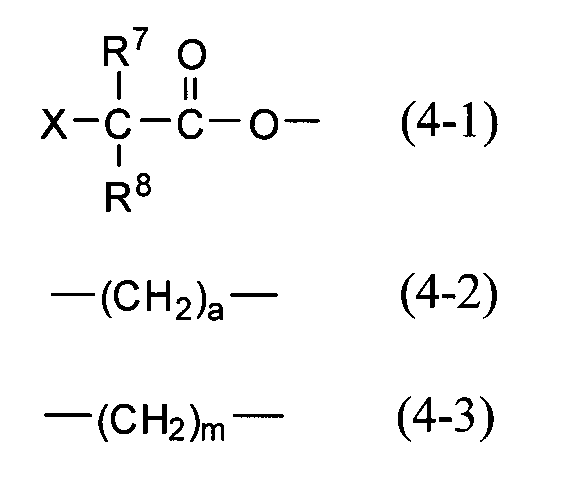
- the silicon compound of the formula (4) has an ⁇ -haloester group as a radical polymerization initiating group.
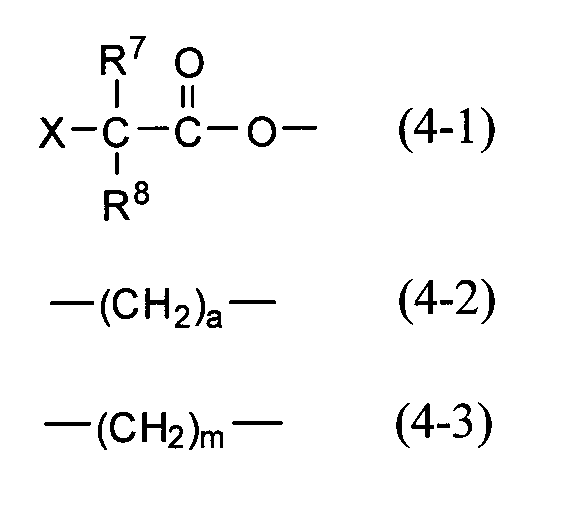
- A is represented by the following formula (4-1)
- Z 1 is represented by the following formula ( 4-2)
- Z 2 is represented by the following formula (4-3).
- X, R 7 , R 8 , a and m are the same as in formula (4).
- the silicon compound according to the embodiment as described above can be synthesized by reacting a compound having a radical polymerization initiating group and a carbon-carbon double bond in the molecule with a silane coupling agent having a mercapto group. .
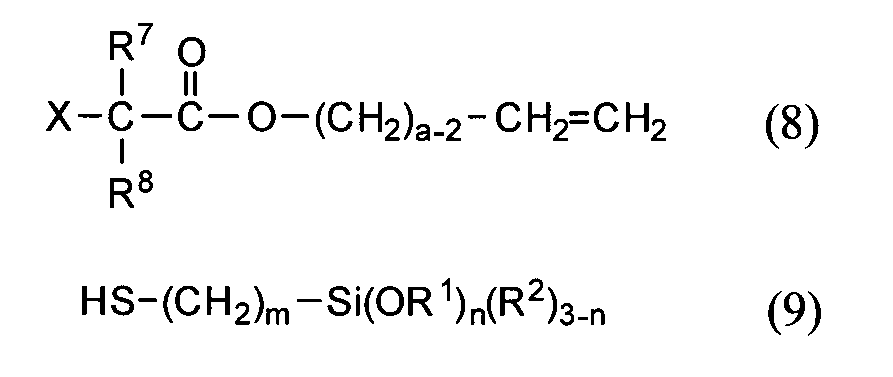
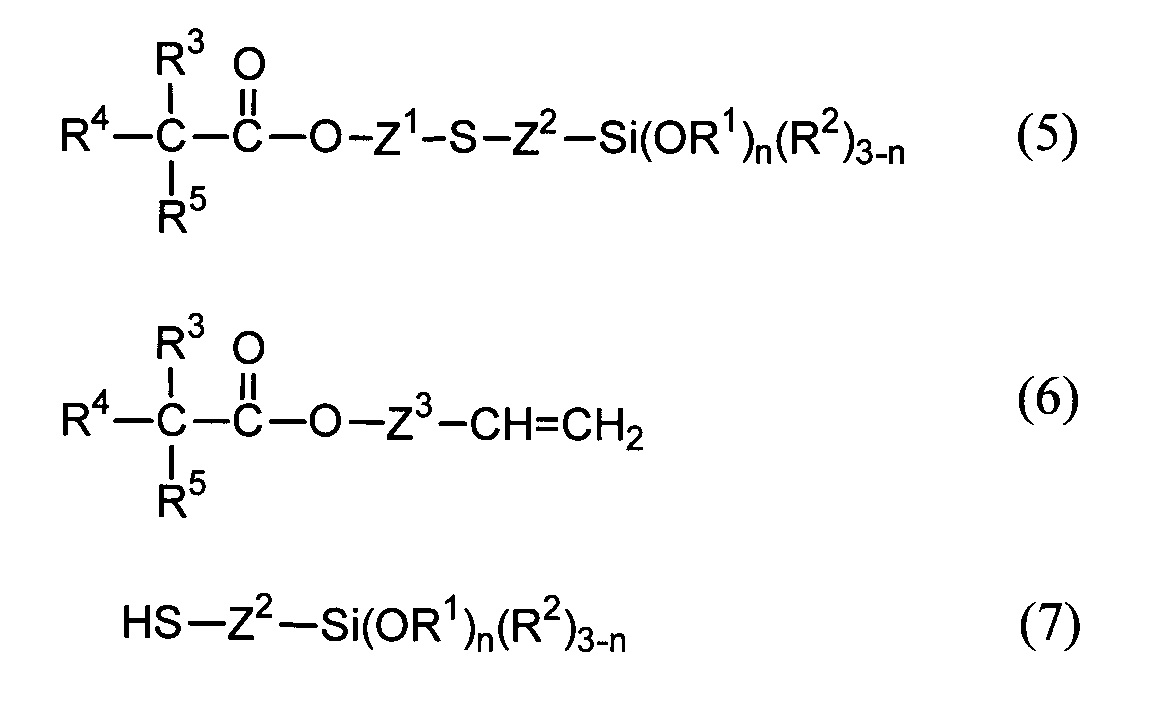
- a silicon compound represented by the following general formula (5) can be produced by reacting a compound represented by the following general formula (6) with a compound represented by the following general formula (7). it can.
- the silicon compound represented by the formula (5) has an ⁇ -haloester group represented by the above general formula (2) as a radical polymerization initiating group in the above general formula (1).
- the manufacturing method will be described in detail. However, this production method should be carried out in the same manner even when the radical polymerization initiator has the thiocarbonylthio group represented by the general formula (3) as described above, and even when it has another radical polymerization initiator. Can do.
- R 1 , R 2 , Z 1 , Z 2 and n are the same as those in the above formula (1).
- R 3 , R 4 and R 5 are the same as in the above formula (2).
- Z 3 is a divalent group containing a carbon atom.
- Z 3 is, in one embodiment, a divalent organic group having 1 to 18 carbon atoms, the organic group may include an ether bond, and is selected from the group consisting of oxygen, nitrogen, halogen, and sulfur. It may have a substituent containing at least one selected heteroatom. More preferably, Z 3 is an alkylene group having 1 to 9 carbon atoms, and is a group having 2 fewer carbon atoms than Z 1 .
- the compound represented by the formula (6) is a compound having a radical polymerization initiating group and a double bond in the molecule
- the compound represented by the formula (7) is a silane coupling agent having a mercapto group.
- the mercapto group of the compound of formula (7) is bonded to the double bond of the compound of formula (6) by an ene-thiol reaction.
- a radical generator is used as a reaction catalyst.
- the radical generator include azo compounds or organic peroxides, and those that generate radicals by heat and those that generate radicals by light irradiation are included.
- the azo compound include azobisisobutyronitrile (AIBN), 1,1'-azobis (cyclohexanecarbonitrile) (ABCN), and the like.
- the organic oxide include di-tert-butyl peroxide, tert-butyl hydroperoxide, benzoyl peroxide, and methyl ethyl ketone peroxide.
- the reaction is performed by mixing a compound represented by the formula (6), a compound represented by the formula (7), and a radical generator together with an organic solvent such as toluene to generate radicals. It is possible to carry out by holding.
- the reaction temperature is preferably 50 to 120 ° C.
- the method for synthesizing the compound represented by the formula (6) is not particularly limited, and the compound can be synthesized by the methods disclosed in Patent Documents 2 and 3 above. That is, for example, for a compound having a hydroxyl group at one end of the molecular chain and an addition polymerizable double bond at the other end, an acid halide in which a halogen is bonded to the carbon at the ⁇ -position is obtained in the presence of triethylamine. What is necessary is just to make it react.
- the compound represented by the formula (7) is not particularly limited, but a silane coupling agent having a mercapto group is commercially available. Of course, you may synthesize
- the silicon compound according to this embodiment has a radical polymerization initiating group in the molecule, it can be used as a radical polymerization initiator, more preferably as a living radical polymerization initiator. That is, a polymer can be produced by radical polymerization or living radical polymerization of at least one monomer selected from the group consisting of vinyl monomers and diene monomers using a radical polymerization initiator made of the silicon compound.
- the obtained polymer has an alkoxysilyl group by the silicon compound at the molecular end, it can be said that it is a modified polymer. Since the alkoxysilyl group can react with an inorganic substance such as silica, the affinity of the polymer for the inorganic substance can be increased.
- the modified polymer has a polymer chain formed by living radical polymerization of a monomer (preferably a vinyl polymer chain) and a structure represented by the following formula (1-1) at one end of the polymer chain. Have.
- R 1 , R 2 , Z 1 , Z 2 and n are the same as those in formula (1).
- R 4 and R 5 are the same as in the above formula (2).
- the structure represented by the formula (1-1) is obtained by polymerization using an initiator (R 3 is halogen) represented by the formula (2) having a living radical polymerization initiating ability by ATRP.
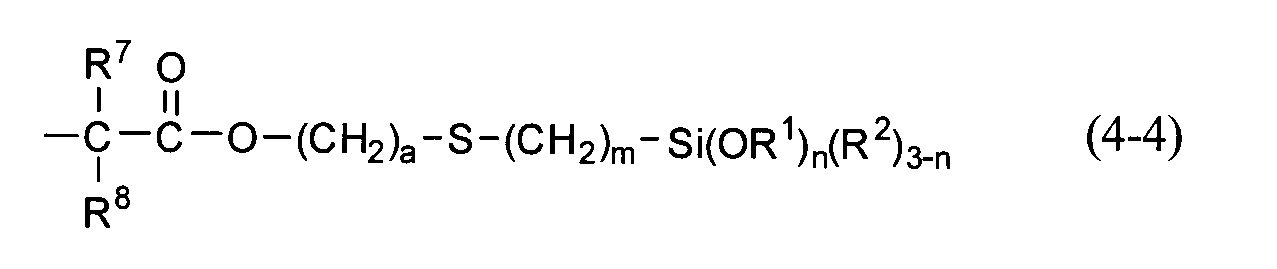
- the obtained modified polymer has a structure represented by the formula (1-1) at one end of the molecular chain, and has halogen (R 3 ) at the other end. More preferably, a modified polymer having a structure represented by the following formula (4-4) at one end of the polymer chain is obtained by polymerization using an initiator represented by the formula (4). Again, the resulting modified polymer has a halogen (X) at the other end.
- R 1 , R 2 , R 7 , R 8 , a, m, and n are the same as those in formula (4).
- the vinyl monomer is, for example, selected from the group consisting of (meth) acrylic acid monomers, (meth) acrylamide monomers, styrene monomers, vinyl ester monomers, nitrile vinyl monomers, vinyl ether monomers, and monoolefin monomers.
- (meth) acrylic acid means either or both of acrylic acid and methacrylic acid
- (meth) acrylamide means either or both of acrylamide and methacrylamide.
- Examples of the (meth) acrylic acid monomer include (meth) acrylic acid or derivatives thereof, such as acrylic acid, methyl acrylate, ethyl acrylate, 2-carboxyethyl acrylate, 2- (dimethylamino) ethyl acrylate, 1, 1,1,3,3,3-hexafluoroisopropyl acrylate, butyl acrylate, sodium acrylate, isobornyl acrylate, propargyl acrylate, ethylene glycol methyl ether acrylate, hexyl acrylate, lauryl acrylate, isobutyl acrylate, 2-hydroxyethyl acrylate Tert-butyl acrylate, isooctyl acrylate, tetrahydrofurfuryl acrylate, isodecyl acrylate, 4-hydroxybutyl acrylate 2-naphthyl acrylate, 2-ethylhexyl acrylate, trimethylsilyl acryl
- Examples of (meth) acrylamide monomers include (meth) acrylamide or derivatives thereof, such as acrylamide, 6-acrylamidehexanoic acid, 2-acrylamido-2-methylpropanesulfonic acid, and (3-acrylamidopropyl) trimethylammonium chloride.
- styrenic monomer examples include styrene and derivatives thereof.
- styrene 4-aminostyrene, 4-bromo- ⁇ , ⁇ -difluorostyrene, 2-bromostyrene, 3-bromostyrene, 4-bromostyrene, 4 -Tert-butylstyrene, 4- (chloromethyl) styrene, 4-chloro- ⁇ -methylstyrene, chloromethylstyrene, 2-chlorostyrene, 3-chlorostyrene, 4-chlorostyrene, 2,6-dichlorostyrene, 4 -Fluoro- ⁇ -methylstyrene, 3-fluorostyrene, 4-fluorostyrene, 4-isopropenyltoluene, 4-methoxystyrene, 2-methylstyrene, 3-methylstyrene, 4-methylstyrene, ⁇ -methylstyren
- vinyl ester monomers examples include vinyl acetate, vinyl propionate, and vinyl benzoate.
- nitrile vinyl monomers examples include acrylonitrile and methacrylonitrile.
- vinyl ether monomers examples include vinyl methyl ether, vinyl ethyl ether, vinyl isobutyl ether, and vinyl phenyl ether.
- Examples of the monoolefin monomer include ethylene, propylene, isobutylene, 1-butene, 1-pentene, and 4-methyl-1-pentene.
- diene monomer examples include 1,3-butadiene, isoprene, chloroprene, 2,3-dimethyl-1,3-butadiene, 2-methyl-1,3-pentadiene, and 1,3-hexadiene. It is done.
- the monomers exemplified above may be used alone or in combination of two or more.
- a transition metal complex can be used as a catalyst.
- a metal complex having an element as a central metal of Group 7, Group 8, Group 9, Group 10, or Group 11 of the periodic table is preferable, and more preferably zero-valent copper, monovalent Copper, divalent ruthenium, divalent iron, or divalent nickel complexes.
- a monovalent copper complex is preferable, and a copper (I) complex having an amine / imine polydentate ligand, for example, a copper halide (for example, copper chloride) / amine complex is preferably used.
- a copper (I) complex having an amine / imine polydentate ligand for example, a copper halide (for example, copper chloride) / amine complex is preferably used.
- azo compounds such as azobisisobutyronitrile (AIBN) and 1,1′-azobis (cyclohexanecarbonitrile) (ABCN)
- AIBN azobisisobutyronitrile
- ABCN 1,1′-azobis (cyclohexanecarbonitrile)
- Organic peroxides such as di-tert-butyl peroxide, tert-butyl hydroperoxide, benzoyl peroxide, and methyl ethyl ketone peroxide can be used as the polymerization catalyst.
- the molecular weight of the resulting modified polymer is not particularly limited, and may be set to various molecular weights depending on the application.
- the number average molecular weight of a polymer obtained by living radical polymerization of the vinyl monomer is preferably 1000 to 500000, more preferably 5000 to 100000.
- the modified polymer can be added to other polymer components such as a rubber component and a plastic component to change the characteristics of various molded products.
- 0.1 to 100 parts by mass can be blended with 100 parts by mass of other polymer components.
- the rubber composition contains 0.1 to 100 parts by mass of the modified polymer (preferably having a vinyl polymer chain as the polymer chain) with respect to 100 parts by mass of the rubber component. Since the modified polymer has an alkoxysilyl group at the terminal as described above, for example, when silica is added as a filler to the rubber composition, it can be reacted with a silanol group on the silica surface, thereby improving the characteristics. Can contribute. Further, since the modified polymer has a thioether group by the silicon compound at the terminal, it is considered that the modified polymer is excellent in dispersibility in the matrix rubber.
- Examples of rubber components in the rubber composition include natural rubber (NR), isoprene rubber (IR), butadiene rubber (BR), styrene-butadiene rubber (SBR), acrylonitrile-butadiene rubber (NBR), chloroprene rubber (CR ), Butyl rubber (IIR), halogenated butyl rubber (for example, brominated butyl rubber, chlorinated butyl rubber), and ethylene propylene rubber (EPDM), etc., and these may be used alone or in combination of two or more. Can be used.
- a diene rubber is preferably used as the rubber component.
- the blending amount of the modified polymer is preferably 0.1 to 100 parts by weight, more preferably 1 to 70 parts by weight, and still more preferably 5 to 50 parts by weight with respect to 100 parts by weight of the rubber component. Particularly preferred is 10 to 30 parts by mass.
- the rubber composition includes fillers such as silica and carbon black, silane coupling agents, oil, zinc white, stearic acid, anti-aging agents, waxes, vulcanizing agents, and vulcanization accelerators.
- various additives generally used in rubber compositions can be blended.
- the blending amount of the filler is not particularly limited, but is preferably 10 to 150 parts by mass, more preferably 30 to 100 parts by mass with respect to 100 parts by mass of the rubber component.
- silica is preferably used, and the amount of the filler is preferably 50% by mass or more in terms of the ratio to the filler.
- the vulcanizing agent examples include sulfur and sulfur-containing compounds (for example, sulfur chloride, sulfur dichloride, polymer polysulfide, morpholine disulfide, alkylphenol disulfide, etc.). It can be used in combination of more than one species.
- the blending amount of the vulcanizing agent is not particularly limited, but is preferably 0.1 to 10 parts by mass, more preferably 0.5 to 5 parts by mass with respect to 100 parts by mass of the rubber component.
- vulcanization accelerator for example, various vulcanization accelerators such as sulfenamide-based, thiuram-based, thiazole-based, and guanidine-based compounds can be used, and any one of them can be used alone or in combination of two or more. Can do.
- the blending amount of the vulcanization accelerator is not particularly limited, but is preferably 0.1 to 7 parts by mass, more preferably 0.5 to 5 parts by mass with respect to 100 parts by mass of the rubber component. .
- the rubber composition can be prepared by kneading according to a conventional method using a commonly used mixer such as a Banbury mixer, a kneader, or a roll.
- a commonly used mixer such as a Banbury mixer, a kneader, or a roll.
- the use of the rubber composition thus obtained is not particularly limited, but can be used for various rubber compositions such as tires such as treads and sidewalls, conveyor belts, and vibration-proof rubbers.
- the rubber composition can be vulcanized and molded at 140 to 200 ° C. according to a conventional method to obtain various molded products.
- the silicon compound according to this embodiment also has a function as a silane coupling agent because it has an alkoxysilyl group in the molecule, and thus can be said to be a polymerization initiator that can be immobilized on various materials. Therefore, after the silicon compound is fixed on the surface of the solid substance, the radical of the monomer is living radically polymerized using the fixed silicon compound as a polymerization starting point, so that a complex of the polymer and the solid substance, that is, the polymer graft chain on the surface of the solid substance is obtained. Can be obtained.
- solid substances include metals, metal compounds, inorganic substances (including inorganic compounds), and polymer compounds, and any shape can be used. Forging, casting, extrusion molding, press molding, injection molding In addition to various molded products such as, spherical, fibrous, film-like, woven fabric, knitted fabric, non-woven fabric, etc., fine particles and microfibers are also included.
- the average particle diameter of the fine particles is in the range of 0.1 nm to 1 mm, preferably 1 nm to 100 ⁇ m, more preferably 1 nm to 1 ⁇ m.
- the particle diameter of the fine particles is an average particle diameter (50% integrated value particle diameter) obtained from a laser diffraction / scattering method.
- the specific surface area may be evaluated by the BET method (JIS K6217-7) when taking the form of an aggregate structure such as an aggregate. In this case, the BET specific surface area is in the range of 1 to 1000 m 2 / g, preferably 20 to 1000 m 2 / g, more preferably 40 to 250 m 2 / g.
- the fine fibers have an average fiber diameter of 0.1 nm to 100 ⁇ m and an average fiber length of 100 nm to 10 mm, preferably an average fiber diameter of 1 nm to 10 ⁇ m and an average fiber length of 100 nm to 1 mm. More preferably, the average fiber diameter is in the range of 1 nm to 1 ⁇ m, and the average fiber length is in the range of 100 nm to 100 ⁇ m.
- the average fiber diameter is obtained by randomly extracting 10 microfibers from a scanning electron microscope observation (SEM) image, measuring the short diameter, and taking the arithmetic average as the average fiber diameter.
- the average fiber length is measured according to JIS P8121 using a fiber length measuring machine (FS-200) manufactured by KAJANI.
- the solid substance includes inorganic fine particles having a hydroxyl group on the particle surface, such as silica fine particles, zinc oxide fine particles, titanium oxide fine particles, and barium titanate fine particles.
- inorganic fine particles having a hydroxyl group on the particle surface, such as silica fine particles, zinc oxide fine particles, titanium oxide fine particles, and barium titanate fine particles.
- the method for fixing the silicon compound to the surface of the solid substance is not particularly limited, and for example, a surface treatment method usually used for a silane coupling agent can be applied.
- the silicon compound dissolved or dissolved in an appropriate solvent may be applied to the surface of the solid material.
- the surface treatment may be performed by mixing the silicon compound with the solid material as it is or together with a suitable solvent. More specifically, a dry treatment in which a silicon compound is dissolved as it is or in an appropriate solvent may be sprayed and mixed on a solid material, or a slurry is prepared by adding water or the like to the solid material. In addition, a wet process of stirring may be used.
- the fixation means that the silicon compound may be chemically bonded to the surface of the solid substance by hydrolysis of an alkoxy group, or may be a physical bond such as a hydrogen bond, or may be trapped in the pores of the solid surface.
- EDX energy dispersive X-ray spectroscopy
- XPS X-ray electron spectroscopy
- living radical polymerization of a monomer from the silicon compound is performed using a solid substance to which a silicon compound is fixed, a vinyl monomer, a diene monomer, etc. using a transition metal complex, an azo compound, or an organic peroxide as a catalyst as described above
- the living monomer may be subjected to living radical polymerization. Examples of the vinyl monomer and diene monomer are as described above.
- the amount of the polymer graft chain formed by living radical polymerization of the above monomer is 5 to 1000 parts by mass with respect to 100 parts by mass of the solid substance (particularly preferably inorganic fine particles).
- the amount of the polymer graft chain is more preferably 30 to 500 parts by mass, still more preferably 50 to 300 parts by mass with respect to 100 parts by mass of the solid substance.
- the molded body according to the present embodiment is made of the composite.
- a solid material as a raw material is composed of fine particles, and composite fine particles obtained by forming a thermoplastic polymer graft chain thereon are used.
- the composite fine particles are formed into a predetermined shape by powder molding, injection molding, or the like. By molding into a compact, a compact comprising composite fine particles can be obtained.
- the use of the composite or molded product is not particularly limited.
- a reinforcing agent blended in a rubber composition or a plastic composition nano optics in the field of optical communication, color video equipment, high-power laser, etc.
- the polymer colloidal crystal used for the material it can be used as an electrolyte film or a dielectric material of a lithium ion battery.
- the reinforcing agent for rubber or plastic is obtained by fixing the silicon compound to the surface of a solid substance and living radical polymerizing a radical polymerizable monomer using the living radical polymerization initiating group as a polymerization initiation point. Is.
- the solid substance for fixing the silicon compound is preferably fine particles or fine fibers in order to disperse in a rubber matrix or plastic matrix and reinforce them.
- the material of the solid substance include metals, metal compounds, inorganic substances (including inorganic compounds), and polymer compounds, and those having a hydroxyl group on the surface are preferable. This is because the silicon compound has an alkoxysilyl group in the molecule, and therefore, it is easy to realize stronger fixation by reacting with a hydroxyl group on the surface of the solid substance by hydrolysis of the alkoxy group or the like.
- the average particle diameter of fine particles as a solid substance, the BET specific surface area when taking the form of an aggregated structure, the average fiber diameter and average fiber length of the microfibers are the same as the solid substance used in the above composite It is.
- inorganic fine particles having a hydroxyl group on the particle surface such as silica fine particles, zinc oxide fine particles, titanium oxide fine particles, and barium titanate fine particles, can be cited as preferable examples, as in the case of the composite.
- silica may be used as the solid material.
- the polymer graft silica in which the polymer phase is formed by performing graft polymerization from the silica surface is blended in the rubber composition, it is considered that the dispersibility in the rubber matrix is improved by the presence of the polymer phase. Further, it is considered that the polymer chain is directly bonded to silica, whereby a hard resin phase is formed even after mixing with rubber, and the reinforcing property is increased. Therefore, it is possible to achieve high elasticity while suppressing an increase in heat generation.
- the method for fixing the silicon compound to the surface of the solid substance, the mode of fixing, and the method for confirming the fixing are the same as in the case of the composite.
- a reinforcing agent as a composite in which a polymer graft chain is formed on the surface of a solid material (hereinafter sometimes referred to as a polymer graft reinforcing agent) is obtained.
- living radical polymerization of the monomer from the silicon compound using at least one monomer selected from the group consisting of a vinyl monomer and a diene monomer using a transition metal complex, an azo compound, or an organic peroxide as a catalyst as described above. Living radical polymerization may be performed. Examples of the vinyl monomer and diene monomer are as described above.
- the amount of the polymer graft chain is preferably 5 to 1000 parts by mass with respect to 100 parts by mass of the solid substance.
- the amount of the polymer graft chain is more preferably 30 to 500 parts by mass, still more preferably 50 to 300 parts by mass with respect to 100 parts by mass of the solid substance.
- the glass transition temperature (Tg) of the polymer graft chain is not particularly limited, and can be appropriately set within a range of, for example, ⁇ 100 ° C. to 150 ° C.
- Tg glass transition temperature
- the Tg of the polymer graft chain is in the vicinity of 10 ° C. to 70 ° C., tan ⁇ in the vicinity of 60 ° C. can be effectively increased. It is suitable for energy absorbing rubber such as rubber or vibration-proof rubber.
- the Tg of the polymer graft chain is in a high temperature region of 80 ° C. or higher, it is possible to suppress an increase in tan ⁇ near room temperature while increasing the elastic modulus.
- the Tg of the polymer graft chain when the Tg of the polymer graft chain is in a low temperature region of ⁇ 10 ° C. or lower, tan ⁇ can be increased while suppressing an increase in the elastic modulus at around 0 ° C. Therefore, a tire rubber with high grip properties can be obtained. It is also suitable as rubber for winter tires.
- the Tg of these polymer graft chains can be set depending on the type of monomer constituting the polymer graft chain.
- the polymer graft reinforcing agent is added to a rubber component or a plastic component and used to reinforce a rubber composition or a plastic composition.
- the dispersibility of the reinforcing agent (solid substance) in the rubber matrix or the plastic matrix can be improved, and the properties of the rubber composition and the plastic composition can be improved.
- the graft polymer chain is fixed on the surface of the solid material, so that the polymer graft chain can be retained even after mixing with the rubber matrix or plastic matrix, and the effect of increasing the elasticity is exhibited. Easy to be.
- the polymer graft reinforcing agent can be blended at 1 to 200 parts by mass with respect to 100 parts by mass of the rubber component.
- the blending amount of the polymer graft reinforcing agent is more preferably 10 to 150 parts by mass, still more preferably 20 to 100 parts by mass.
- Examples of the rubber component are the same as those listed in the rubber composition as the application mode of the modified polymer, and preferably a diene rubber is used.
- the rubber composition includes reinforcing fillers such as untreated silica and carbon black, silane coupling agents, oil, zinc white, stearic acid, anti-aging agent, wax, vulcanized
- Various additives generally used in rubber compositions such as an agent and a vulcanization accelerator, can be blended. Examples of vulcanizing agents and blending amounts, examples and blending amounts of vulcanization accelerators, methods and uses of rubber compositions, and methods for producing rubber molded articles using the rubber compositions, It is the same as the rubber composition as a utilization mode.
- the polymer graft reinforcing agent can be blended at 1 to 200 parts by mass with respect to 100 parts by mass of the plastic component.
- the blending amount of the polymer graft reinforcing agent is more preferably 10 to 150 parts by mass, still more preferably 20 to 100 parts by mass.
- plastic component in the plastic composition examples include polyolefin, polystyrene, polyacrylate, polymethacrylate, polyester, polyamide, polyurethane, polycarbonate, polyimide, and the like, and these are one kind alone or two kinds. These can be used in combination.
- the plastic composition is blended with various additives generally used in plastic compositions such as antioxidants, plasticizers, crosslinking agents, inorganic particles, glass fibers, and organic fibers. be able to.
- the plastic composition can be prepared by kneading according to a conventional method using a mixer such as a commonly used mixer or kneader.
- a mixer such as a commonly used mixer or kneader.
- the use of the plastic composition thus obtained is not particularly limited, but can be used for various plastic compositions of films, containers, coating agents, adhesives, automobile parts, and heat insulating materials.
- Various plastic moldings can be obtained by compression molding or the like.
- Example 2 3- (3- (triethoxysilyl) propylthio) propyl 2-bromo-2-methylpropanate: Allyl 2- (2-bromo-2-methyl) propionate (1.5 g: Sigma-Aldrich), 3-mercaptopropyltriethoxysilane (1.73 g), AIBN (0.036 g), and toluene (20 g) And then bubbling with nitrogen gas for 30 minutes, the reaction solution was kept at 70 ° C.
- Example 3 11- (3- (triethoxysilyl) propylthio) undecyl 2-bromo-2-methylpropanoate: Using 10-undecen-1-ol instead of 5-hexen-1-ol in Example 1, 10-undecenyl 2-bromo-2-methylpropanate represented by the following chemical formula (compound) 4) was obtained.
- Example 9 The type of monomer was changed from benzyl methacrylate to methyl methacrylate, and the others were polymer grafted silica as reinforcing agent 5 in the same manner as in the synthesis of reinforcing agent 1.
- Example 10 The type of monomer was changed from benzyl methacrylate to tridecyl methacrylate, and polymer graft silica was obtained as the reinforcing agent 6 in the same manner as in the synthesis of the reinforcing agent 1 except for the above.
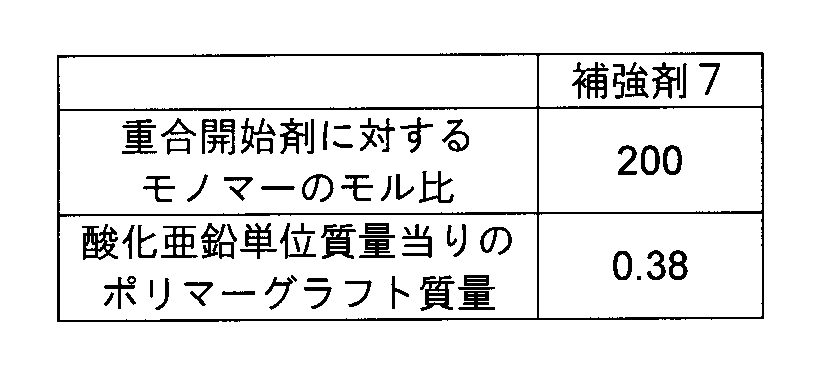
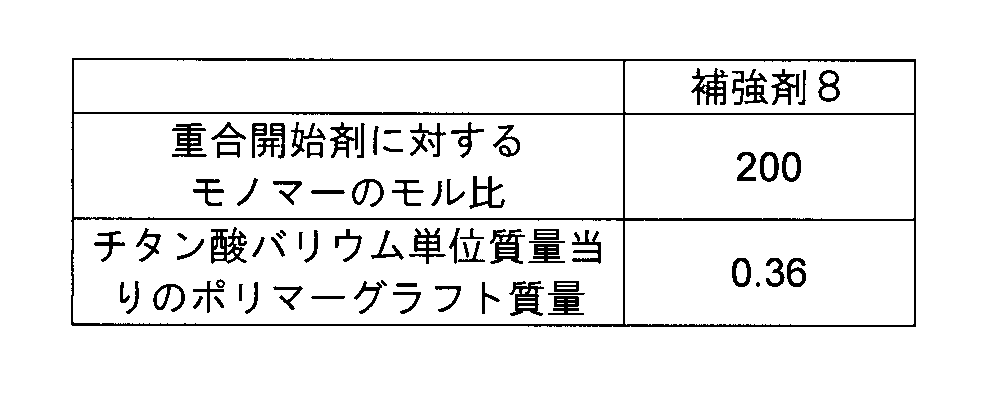
- the presence of the graft polymer chain was confirmed by TGA measurement of the obtained composite fine particles. Further, as shown in Table 1, the monomer charge ratio and the amount of the polymer graft chain were in a proportional relationship, indicating that the polymerization was performed in a living manner from the silica surface.
- Example 11 Zinc oxide composite
- Zinc oxide 100 g: “FINEX-30” manufactured by Sakai Chemical Industry Co., Ltd.
- 28 mass% ammonia water (66 g) 28 mass% ammonia water (66 g)
- ethanol 1000 mL ethanol 1000 mL
- compound 2 6- (3- (Triethoxysilyl) propylthio) hexyl 2-bromo-2-methylpropanoate (10 g) was added dropwise and stirred at room temperature for 16 hours.
- Zinc oxide was recovered from the obtained solution by a centrifugal separator and washed with ethanol and anisole to obtain 82 g of zinc oxide (polymerization initiator-introduced zinc oxide) in which compound 2 was fixed to the particle surface.
- Example 12 Barium titanate composite Barium titanate (100 g: “BT01” manufactured by Sakai Chemical Industry Co., Ltd.), 28 mass% ammonia water (66 g), and ethanol 1000 mL were mixed and stirred for 1 hour, and then compound 2: 6- (3- (3- ( Triethoxysilyl) propylthio) hexyl 2-bromo-2-methylpropanoate (10 g) was added dropwise and stirred at room temperature for 16 hours.
- Barium titanate was collected from the obtained solution by a centrifugal separator and washed with ethanol and anisole to obtain 85 g of barium titanate (polymerization initiator-introduced barium titanate) in which compound 2 was fixed to the particle surface. .
- the number average molecular weight was 19000, the weight average molecular weight was 23000, and the molecular weight distribution was 1.24.
- the number average molecular weight (Mn), the weight average molecular weight (Mw) and the molecular weight distribution (Mw / Mn) were determined in terms of polystyrene by measurement with gel permeation chromatography (GPC). Specifically, the measurement sample used was 0.2 mg dissolved in 1 mL of THF. “LC-20DA” manufactured by Shimadzu Corporation was used, and the sample was passed through a filter and passed through a column (“PL Gel 3 ⁇ m Guard ⁇ 2” manufactured by Polymer Laboratories) at a temperature of 40 ° C. and a flow rate of 0.7 mL / min. Detected by “RI Detector” manufactured by System.
- Polymethyl methacrylate (polymer E2), which is a modified polymer having an alkoxysilyl group and a thioether group at the molecular end, was obtained in the same manner as for polymer E1, except that the type of monomer was changed from benzyl methacrylate to methyl methacrylate.
- the polymer E2 had a number average molecular weight of 15000, a weight average molecular weight of 18000, and a molecular weight distribution of 1.2.
- Polymer E3 which is a modified polymer having an alkoxysilyl group and a thioether group at the molecular end, was obtained in the same manner as polymer E1, except that the monomer type was changed from benzyl methacrylate to tridecyl methacrylate. .
- the polymer E3 had a number average molecular weight of 23,000, a weight average molecular weight of 29000, and a molecular weight distribution of 1.26.
- SBR Styrene butadiene rubber
- SBR1502 manufactured by JSR Corporation
- Silica “Nip Seal AQ” manufactured by Tosoh Silica Co., Ltd.
- Silane coupling agent bis (3-triethoxysilylpropyl) tetrasulfide, “Si69” manufactured by Evonik Degussa ⁇
- Zinc flower “Zinc flower 1” manufactured by Mitsui Mining & Smelting Co., Ltd.
- Anti-aging agent “NOCRACK 6C” manufactured by Ouchi Shinsei Chemical Industry Co., Ltd.
- Stearic acid “Lunac S-20” manufactured by Kao Corporation
- Sulfur Hosoi Chemical Co., Ltd.
- the test piece of a predetermined shape is produced by vulcanizing at 160 ° C. for 20 minutes, and using the obtained test piece, the dynamic elastic modulus E * and tan ⁇ at 25 ° C.
- the dynamic elastic modulus E * and tan ⁇ at 60 ° C. were measured.
- Each measuring method is as follows.
- Dynamic elastic modulus E * was measured on the conditions of frequency 50Hz, static strain 10%, dynamic strain 2%, and temperature 25 degreeC using the rheometer E4000 by UBM.
- Loss coefficient tan-delta was measured on the conditions of frequency 50Hz, static strain 10%, dynamic strain 2%, and temperature 25 degreeC using the rheometer E4000 by UBM.
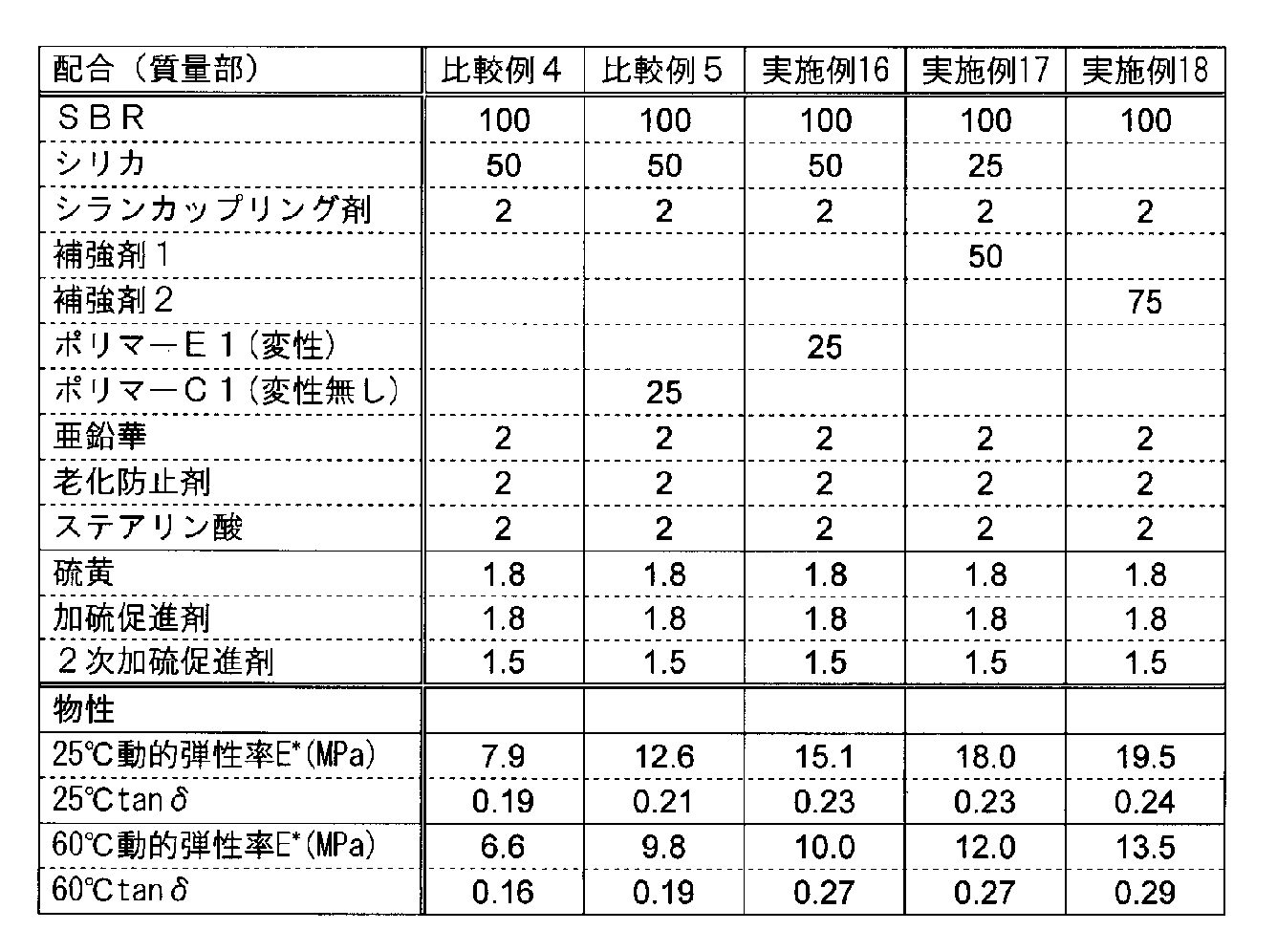
- Example 4 Compared with Comparative Example 4 as a control, in Comparative Example 5, the dynamic elastic modulus and tan ⁇ value increased by adding the polymer C1 without modification.
- Example 16 in which the modified polymer E1 was blended, the dynamic elastic modulus and tan ⁇ value significantly increased as compared with Comparative Example 4.
- Example 17 in which the reinforcing agent 1 which is polymer graft silica was blended, the dynamic elastic modulus further increased compared to Example 16.
- Example 18 in which the total amount of the reinforcing filler was the reinforcing agent 2 that was polymer-grafted silica, the dynamic elastic modulus further increased compared to Example 17.
- Example 16 since an ethoxysilyl group capable of reacting with a silanol group on the silica surface is present at the end of the polybenzyl methacrylate component, the polybenzyl methacrylate component is present more in the periphery of the silica than in Comparative Example 5, and The elastic modulus and tan ⁇ are efficiently increased.
- Such a rubber exhibiting a large energy loss at around 60 ° C. is suitable as a tread rubber blend that requires high grip properties and as an energy absorbing rubber.
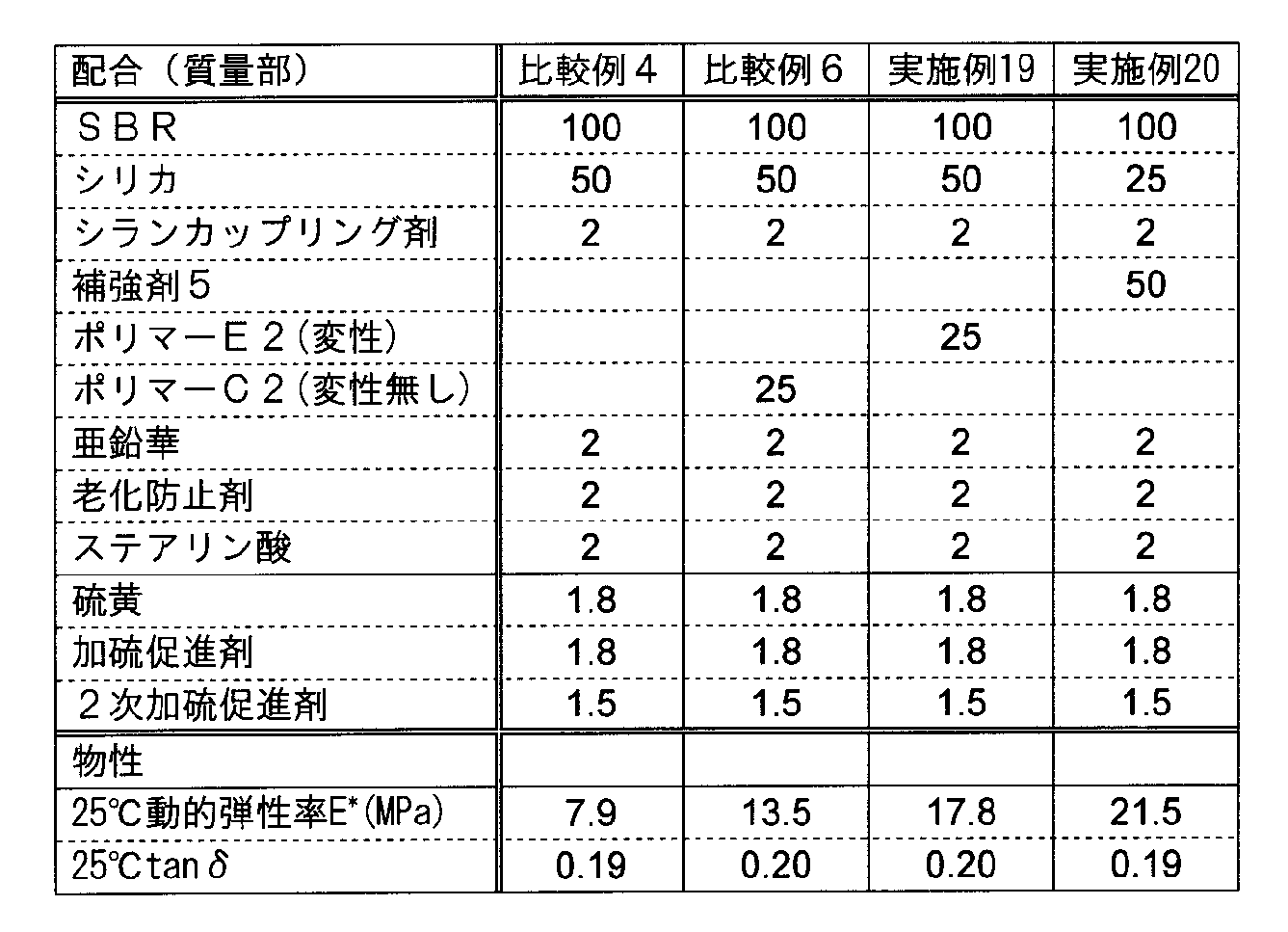
- Example 19 and 20 and Comparative Example 6 Using a Banbury mixer, a rubber composition was prepared in the same manner as in Example 16 according to the composition (parts by mass) shown in Table 5 below, and a test piece prepared from each of the obtained rubber compositions was used at 25 ° C. The dynamic elastic modulus E * and tan ⁇ were measured.
- Example 19 in which the polymer E2 which is a modified polymethyl methacrylate was blended, the dynamic elastic modulus further increased.
- Example 20 which mix
- the tan ⁇ value since the glass transition temperature of polymethyl methacrylate is in a high temperature region, an increase in the tan ⁇ value near room temperature was suppressed. Therefore, the rubber compositions of Examples 19 and 20 are suitable for low fuel consumption tire rubber and the like.
- Examples 21 and 22 and Comparative Example 7 Using a Banbury mixer, according to the composition (parts by mass) shown in Table 6 below, a rubber composition was prepared in the same manner as in Example 16, and a test piece prepared from each of the obtained rubber compositions was used at 0 ° C. The dynamic elastic modulus E * and tan ⁇ at 25 ° C. and the dynamic elastic modulus E * and tan ⁇ at 25 ° C. were measured. The dynamic elastic modulus E * and tan ⁇ at 0 ° C. were measured in the same manner as the 25 ° C. dynamic elastic modulus E * and 25 ° C. tan ⁇ except that the temperature was changed to 0 ° C.
- the rubber compositions of Examples 21 and 22 are suitable as high-grip tire rubber, winter tire rubber, and the like.
- the difference in dynamic viscoelasticity due to the addition of the polymer can be controlled by changing the type of polymer.
- the above results are obtained by polymerizing the monomer using the silicon compound of the present embodiment as a polymerization initiator to obtain a modified polymer having an alkoxysilyl group introduced at the terminal, and by appropriately selecting the monomer, the rubber composition It shows that the dynamic viscoelasticity of an object can be controlled efficiently and arbitrarily. It also shows that the dynamic viscoelasticity of the rubber composition can be controlled efficiently and arbitrarily by selecting the polymer (monomer to be used) to be grafted to the reinforcing agent.
- the modified polymer or graft polymer may be a copolymer or block copolymer composed of two or more kinds, and two or more kinds of modified polymers and reinforcing agents may be blended in the rubber component.
- Air permeability coefficient In accordance with JIS K7126-1, using a gas permeability measuring device “BT-3” manufactured by Toyo Seiki Seisakusho Co., Ltd., test gas: air, test temperature: 80 ° C. was measured and displayed as an index with the air permeability coefficient of the film of Comparative Example 8 as 100. The smaller the index, the smaller the air permeability coefficient and the better the gas barrier property.
- Example 23 Compared with Comparative Example 9 in which silica and polymer C1 were mixed in polyester, the air permeability coefficient was lowered in Example 23 in which reinforcing agent 1 was added. This is because, in the reinforcing agent 1, since the polymer is grafted on the silica, it is highly dispersed in the polyester matrix, so that the permeation path of the air molecules is effectively lengthened. On the other hand, in Comparative Example 9 in which silica was added alone, there was an effect of lengthening the permeation path of air molecules, but the dispersibility reached Example 23, and the effect was considered to be limited. Such a plastic composition can be applied to containers, packaging materials, and the like.
- the silicon compound according to the present embodiment can be used as, for example, a radical polymerization initiator, and the radical polymerization initiating ability can be used to produce a polymer, a solid substance such as a reinforcing agent for rubber or plastic, and a polymer graft. It can be used for the production of a complex composed of chains.
Landscapes
- Chemical & Material Sciences (AREA)
- Organic Chemistry (AREA)
- Chemical Kinetics & Catalysis (AREA)
- Medicinal Chemistry (AREA)
- Polymers & Plastics (AREA)
- Health & Medical Sciences (AREA)
- Materials Engineering (AREA)
- Engineering & Computer Science (AREA)
- Inorganic Chemistry (AREA)
- Compositions Of Macromolecular Compounds (AREA)
- Graft Or Block Polymers (AREA)
- Polymerisation Methods In General (AREA)
- Addition Polymer Or Copolymer, Post-Treatments, Or Chemical Modifications (AREA)
Description

本実施形態に係るケイ素化合物は、上記一般式(1)で表されるものである。このケイ素化合物は、構造中に有するチオエーテル基の硫黄原子に不対電子を有している。そのため、金属や無機物質、高分子物質との親和性が高く、チオエーテル基を有していない場合と比べて、固体物質表面への固着性が高く、また高分子やゴムといったマトリックスへの分散性が向上すると考えられる。
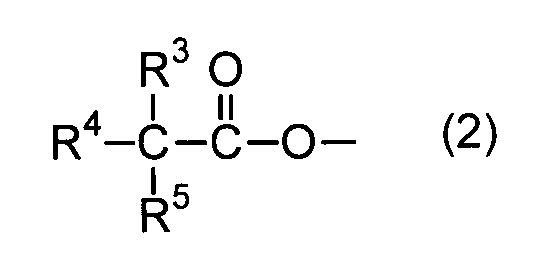


以上のような実施形態に係るケイ素化合物は、分子内にラジカル重合開始基及び炭素-炭素二重結合を有する化合物と、メルカプト基を有するシランカップリング剤とを反応させることにより合成することができる。詳細には、下記一般式(6)で表される化合物と下記一般式(7)で表される化合物を反応させることにより、下記一般式(5)で表されるケイ素化合物を製造することができる。式(5)で表されるケイ素化合物は、上記一般式(1)においてラジカル重合開始基として上記一般式(2)で表されるα-ハロエステル基を有するものであり、以下では、これについて製造方法を詳細に説明する。但し、該製造方法は、ラジカル重合開始基として、上記一般式(3)で表されるチオカルボニルチオ基を有する場合でも、更には、他のラジカル重合開始基を有する場合でも、同様に行うことができる。
本実施形態に係るケイ素化合物は、分子内にラジカル重合開始基を有するため、ラジカル重合開始剤として、より好ましくはリビングラジカル重合開始剤として用いることができる。すなわち、該ケイ素化合物からなるラジカル重合開始剤を用いて、ビニルモノマー及びジエンモノマーからなる群から選択される少なくとも一種のモノマーを、ラジカル重合またはリビングラジカル重合することによりポリマーを製造することができる。

本実施形態に係るケイ素化合物は、また、分子内にアルコキシシリル基を有するためシランカップリング剤としての機能も有し、従って、各種材料への固定化が可能な重合開始剤であるといえる。そのため、固体物質表面に該ケイ素化合物を固着させた後、固着したケイ素化合物を重合開始点としてモノマーをリビングラジカル重合することにより、ポリマーと固体物質との複合体、すなわち固体物質表面にポリマーグラフト鎖が形成された複合体を得ることができる。
本実施形態に係るゴム又はプラスチック用補強剤は、上記ケイ素化合物を固体物質表面に固着させ、そのリビングラジカル重合開始基を重合開始点として、ラジカル重合可能なモノマーをリビングラジカル重合することにより得られるものである。
[実施例1]
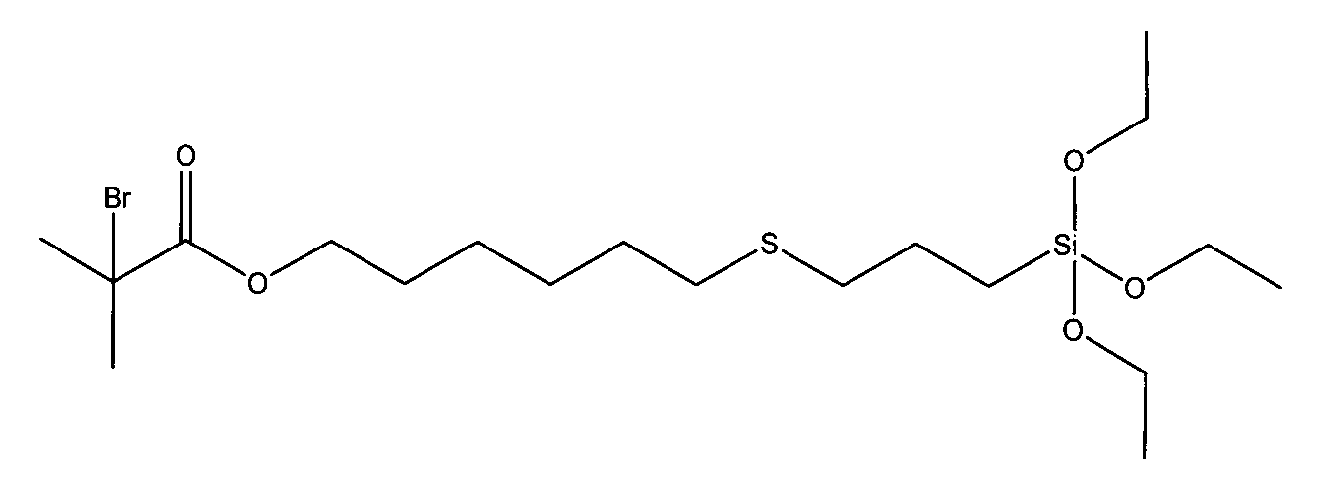
・6-(3-(トリエトキシシリル)プロピルチオ)ヘキシル 2-ブロモ-2-メチルプロパネートの合成:
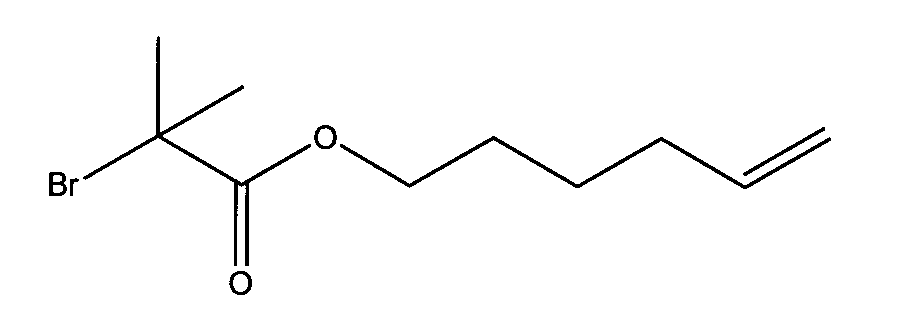
5-ヘキセン-1-オール(42.6g)とトリエチルアミン(45.8g)とテトラヒドロフラン(0.8L)を混合後、氷冷し、2-ブロモイソブチリルブロミド(100g)を滴下した。その後、反応液を4℃、3時間攪拌し、室温で15時間攪拌した。反応液をろ過し、エバポレーターで濃縮後、ジエチルエーテル(300mL)に溶解させ、それを1Nの塩酸溶液(2×300mL)、飽和炭酸水素ナトリウム溶液(2×300mL)、及び蒸留水(2×300mL)の順で洗浄した。その後、有機層を硫酸ナトリウムで乾燥し、ろ過後、エバポレーターにて濃縮させ、シリカゲルカラム(展開溶媒:ヘキサン/酢酸エチル=15/1)により精製し、濃縮後、下記化学式で表される5-ヘキセニル 2-ブロモ-2-メチルプロパネート(化合物1)を74.2g得た。
13C-NMR(400MHz, TMS標準=0.0ppm):30.9((CH3)2BrC-)、55.9((CH3)2BrC-)、171.5(-(O=C)-O-CH2-)、65.9(-(O=C)-O-CH2-)、28.3(-(O=C)-O-CH2-CH2-)、25.9(-(O=C)-O-CH2-CH2-CH2-)、28.4(-(O=C)-O-CH2-CH2-CH2-CH2-)、29.6(-(O=C)-O-CH2-CH2-CH2-CH2-CH2-)、32.0(-CH2-S-CH2-)、35.3(-CH2-S-CH2-)、23.2(-CH2-S-CH2-CH2-)、10.3(-CH2-Si-(O-CH2-CH3)3)、58.4(-CH2-Si-(O-CH2-CH3)3)、18.3(-CH2-Si-(O-CH2-CH3)3).
・3-(3-(トリエトキシシリル)プロピルチオ)プロピル 2―ブロモ-2-メチルプロパネート:
2-(2-ブロモ-2-メチル)プロピオン酸アリル(1.5g:シグマアルドリッチ社製)、3-メルカプトプロピルトリエトキシシラン(1.73g)、AIBN(0.036g)、及びトルエン(20g)を混合し、窒素ガスで30分バブリングした後、反応溶液を70℃、3時間保持し、エバポレーターにて濃縮後、下記化学式で表される3-(3-(トリエトキシシリル)プロピルチオ)プロピル 2-ブロモ-2-メチルプロパネート(化合物3)を2.95g得た(収率:91%)。
13C-NMR(400MHz, TMS標準=0.0ppm):30.8((CH3)2BrC-)、55.9((CH3)2BrC-)、171.5(-(O=C)-O-CH2-)、64.6(-(O=C)-O-CH2-)、28.6(-(O=C)-O-CH2-CH2-)、28.3(-CH2-S-CH2-)、35.2(-CH2-S-CH2-)、23.2(-CH2-S-CH2-CH2-)、9.94(-CH2-Si-(O-CH2-CH3)3)、58.4(-CH2-Si-(O-CH2-CH3)3)、18.4(-CH2-Si-(O-CH2-CH3)3).

・11-(3-(トリエトキシシリル)プロピルチオ)ウンデシル 2-ブロモ-2-メチルプロパネート:
実施例1の5-ヘキセン-1-オールの代わりに、10-ウンデセン-1-オールを用い、同様の手順で、下記化学式で表される10-ウンデセニル 2-ブロモ-2-メチルプロパネート(化合物4)を得た。

13C-NMR(400MHz, TMS標準=0.0ppm):30.8((CH3)2BrC-)、56.4((CH3)2BrC-)、172.1(-(O=C)-O-CH2-)、66.2(-(O=C)-O-CH2-)、29.0~29.5(-(O=C)-O-CH2-(CH2)8-)、29.8(-(O=C)-O-CH2-(CH2)8-CH2)、32.0(-CH2-S-CH2-)、35.3(-CH2-S-CH2-)、23.3(-CH2-S-CH2-CH2-)、9.7(-CH2-Si-(O-CH2-CH3)3)、58.4(-CH2-Si-(O-CH2-CH3)3)、18.4(-CH2-Si-(O-CH2-CH3)3).
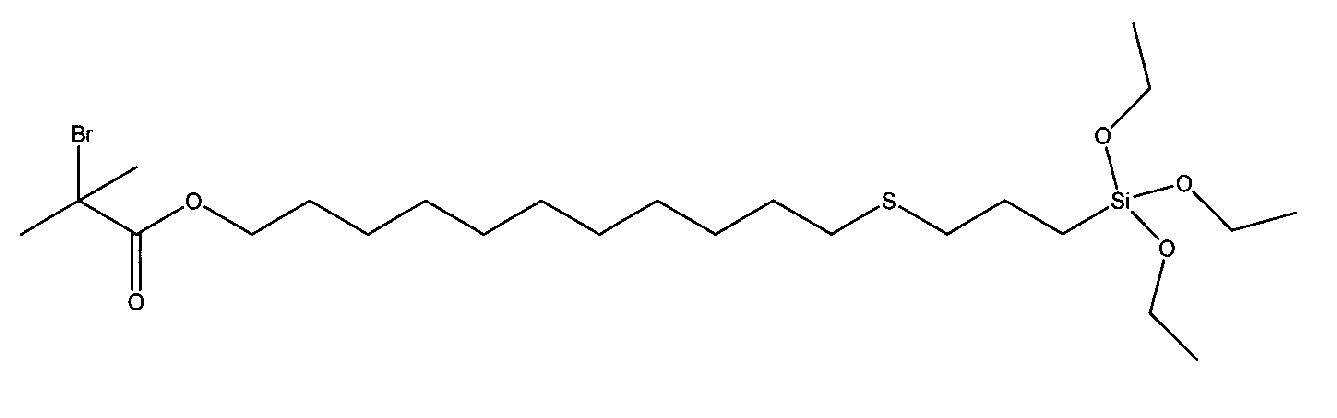
・6-(3-(トリエトキシシリル)プロピルチオ)ヘキシル 2-ヨード-2-メチルプロパネートの合成:
実施例1の操作により得られた6-(3-(トリエトキシシリル)プロピルチオ)ヘキシル 2-ブロモ-2-メチルプロパネート(5g)とヨウ化ナトリウム(20g)とドライアセトン100mLを混合し、窒素雰囲気下にて75℃で10時間反応させた。反応後、抽出操作を行い、下記化学式で表される6-(3-(トリエトキシシリル)プロピルチオ)ヘキシル 2-ヨード-2-メチルプロパネート(化合物6)を得た。
13C-NMR(400MHz, TMS標準=0.0ppm):27.5((CH3)2IC-)、57.4((CH3)2IC-)、171.5(-(O=C)-O-CH2-)、65.9(-(O=C)-O-CH2-)、28.3(-(O=C)-O-CH2-CH2-)、25.9(-(O=C)-O-CH2-CH2-CH2-)、28.4(-(O=C)-O-CH2-CH2-CH2-CH2-)、29.6(-(O=C)-O-CH2-CH2-CH2-CH2-CH2-)、32.0(-CH2-S-CH2-)、35.3(-CH2-S-CH2-)、23.2(-CH2-S-CH2-CH2-)、10.3(-CH2-Si-(O-CH2-CH3)3)、58.4(-CH2-Si-(O-CH2-CH3)3)、18.3(-CH2-Si-(O-CH2-CH3)3).

[実施例5]
シリカ(35g:東ソー・シリカ(株)製「ニップシールAQ」、BET比表面積=205m2/g)、28質量%のアンモニア水(66g)、及びエタノール1000mLを混合し、1時間攪拌した後、化合物2:6-(3-(トリエトキシシリル)プロピルチオ)ヘキシル2-ブロモ-2-メチルプロパネート(10g)を滴下し、室温で16時間攪拌した。得られた溶液から遠心分離機によりシリカを回収し、エタノールおよびアニソールにて洗浄することにより、化合物2が粒子表面に固着したシリカ(重合開始剤導入シリカ)28gを得た。
重合開始剤に対するモノマー(ベンジルメタクリレート)の仕込み比(モル比)を、下記表1に示すように変更し、その他は実施例5と同様の手順により、補強剤2~4をそれぞれ得た。
モノマーの種類をベンジルメタクリレートからメチルメタクリレートに変更し、その他は、補強剤1の合成と同様の方法で補強剤5としてポリマーグラフトシリカを得た。
モノマーの種類をベンジルメタクリレートからトリデシルメタクリレートに変更し、その他は、補強剤1の合成と同様の方法で補強剤6としてポリマーグラフトシリカを得た。
TGA(昇温速度5℃/分、温度範囲50℃~500℃)による測定結果から、下記式(A)に基づき、表1の通りポリマーグラフト量を算出した。
式(A): P=(W初期-W500℃/0.9)/(W500℃/0.9)
P:シリカ単位質量当りのポリマーグラフト質量
W初期:TGA測定仕込み質量(mg)
W500℃:500℃における残渣の質量(mg)
補強剤を、-100℃~150℃の範囲で、昇温速度20℃/分の条件で、DSC測定を行い、ポリマーグラフト鎖のガラス転移温度(Tg)を求めた。

酸化亜鉛(100g:堺化学工業(株)製「FINEX-30」)、28質量%のアンモニア水(66g)、及びエタノール1000mLを混合し、1時間攪拌した後、化合物2:6-(3-(トリエトキシシリル)プロピルチオ)ヘキシル2-ブロモ-2-メチルプロパネート(10g)を滴下し、室温で16時間攪拌した。得られた溶液から遠心分離機により酸化亜鉛を回収し、エタノールおよびアニソールにて洗浄することにより、化合物2が粒子表面に固着した酸化亜鉛(重合開始剤導入酸化亜鉛)82gを得た。
チタン酸バリウム(100g:堺化学工業(株)製「BT01」)、28質量%のアンモニア水(66g)、及びエタノール1000mLを混合し、1時間攪拌した後、化合物2:6-(3-(トリエトキシシリル)プロピルチオ)ヘキシル2-ブロモ-2-メチルプロパネート(10g)を滴下し、室温で16時間攪拌した。得られた溶液から遠心分離機によりチタン酸バリウムを回収し、エタノールおよびアニソールにて洗浄することにより、化合物2が粒子表面に固着したチタン酸バリウム(重合開始剤導入チタン酸バリウム)85gを得た。
[実施例13]
ベンジルメタクリレート(30g)、化合物2:6-(3-(トリエトキシシリル)プロピルチオ)ヘキシル2-ブロモ-2-メチルプロパネート(0.415g)、4,4’-ジノニル-2,2’-ビピリジル(0.70g)、及びアニソール(30g)を混合し、1.5時間窒素バブリングした後、反応溶液に塩化銅(I)(0.081g)を添加し、50℃で5時間保持した。得られた溶液を、エタノールへ再沈精製後、ポリベンジルメタクリレート(ポリマーE1)を得た。
モノマーの種類をベンジルメタクリレートからメチルメタクリレートに代え、その他は、ポリマーE1と同様の方法で、分子末端にアルコキシシリル基及びチオエーテル基を有する変性ポリマーであるポリメチルメタクリレート(ポリマーE2)を得た。該ポリマーE2は、数平均分子量が15000、重量平均分子量が18000、分子量分布が1.2であった。
モノマーの種類をベンジルメタクリレートからトリデシルメタクリレートに代え、その他は、ポリマーE1と同様の方法で、分子末端にアルコキシシリル基及びチオエーテル基を有する変性ポリマーであるポリトリデシルメタクリレート(ポリマーE3)を得た。該ポリマーE3は、数平均分子量が23000、重量平均分子量が29000、分子量分布が1.26であった。
ベンジルメタクリレート(30g)、2-ブロモ酪酸エチル(0.66g)、4,4’-ジノニル-2,2’-ビピリジル(1.4g)、及びアニソール(30g)を混合し、1.5時間窒素バブリングした後、反応溶液に塩化銅(I)(0.17g)を添加し、50℃で5時間保持した。得られた溶液を、エタノールへ再沈精製後、変性されてないポリベンジルメタクリレート(ポリマーC1)を得た。該ポリマーC1は、数平均分子量が19000、重量平均分子量が23000、分子量分布が1.24であった。
モノマーの種類をベンジルメタクリレートからメチルメタクリレートに代え、その他は、ポリマーC1と同様の方法で、変性されていないポリメチルメタクリレート(ポリマーC2)を得た。該ポリマーC2は、数平均分子量が16000 、重量平均分子量が19000、分子量分布が1.2であった。
モノマーの種類をベンジルメタクリレートからトリデシルメタクリレートに代え、その他は、ポリマーC1と同様の方法で、変性されていないポリトリデシルメタクリレート(ポリマーC3)を得た。該ポリマーC3は、数平均分子量が24000、重量平均分子量が30000、分子量分布が1.25であった。
[実施例16~18及び比較例4,5]
バンバリーミキサーを使用し、下記表4に示す配合(質量部)に従って、まず、第一混合段階で、ゴム成分に対し硫黄及び加硫促進剤を除く他の配合剤を添加し混練し(排出温度=160℃)、次いで、得られた混練物に、最終混合段階で、硫黄と加硫促進剤を添加し混練して(排出温度=90℃)、ゴム組成物を調製した。表4中の各成分の詳細は、以下の通りである。
・シリカ:東ソー・シリカ(株)製「ニップシールAQ」
・シランカップリング剤:ビス(3-トリエトキシシリルプロピル)テトラスルフィド、エボニック・デグサ社製「Si69」
・亜鉛華:三井金属鉱業(株)製「亜鉛華1種」
・老化防止剤:大内新興化学工業(株)製「ノクラック6C」
・ステアリン酸:花王(株)製「ルナックS-20」
・硫黄:細井化学工業(株)製「ゴム用粉末硫黄150メッシュ」
・加硫促進剤:大内新興化学工業(株)製「ノクセラーCZ」
・2次加硫促進剤:大内新興化学工業(株)製「ノクセラーD」
バンバリーミキサーを使用し、下記表5に示す配合(質量部)に従って、実施例16と同様にしてゴム組成物を調製し、得られた各ゴム組成物から作製した試験片を用いて、25℃での動的弾性率E*及びtanδを測定した。
バンバリーミキサーを使用し、下記表6に示す配合(質量部)に従って、実施例16と同様にしてゴム組成物を調製し、得られた各ゴム組成物から作製した試験片を用いて、0℃での動的弾性率E*及びtanδ、25℃での動的弾性率E*及びtanδを測定した。0℃での動的弾性率E*及びtanδの測定方法は、温度を0℃に変え、その他は25℃動的弾性率E*及び25℃tanδと同様にして測定した。

[実施例23及び比較例8,9]
2軸混練機(プラスチック工学研究所製)を使用して、表7に示す配合(質量部)に従って、溶融混練してペレット化した。得られたペレットを単軸押出機で幅350mm、厚み0.2mmのフィルムにTダイ成形した。表7中の成分の詳細は以下の通りである。
・シリカ:東ソー・シリカ(株)製「ニップシールAQ」
得られた各フィルムについて、以下の方法により、空気透過係数を測定した。

Claims (22)
- 下記一般式(1)で表されるケイ素化合物。

- 前記Aが下記一般式(2)又は一般式(3)で表される請求項1記載のケイ素化合物。


- 前記Aが下記式(4-1)で表され、前記Z1が下記式(4-2)で表され、前記Z2が下記式(4-3)で表される請求項1記載のケイ素化合物。
- 下記一般式(6)で表される化合物と下記一般式(7)で表される化合物を反応させる工程を含むことを特徴とする、下記一般式(5)で表されるケイ素化合物の製造方法。
- 前記一般式(6)で表される化合物が下記一般式(8)で表され、前記一般式(7)で表される化合物が下記一般式(9)で表され、前記一般式(5)で表されるケイ素化合物が下記一般式(4)で表される請求項4記載の製造方法。

- ラジカル発生剤を反応触媒として用いて前記一般式(6)で表される化合物と前記一般式(7)で表される化合物を反応させることを特徴とする請求項4記載の製造方法。
- 請求項1~3のいずれか1項に記載のケイ素化合物からなるラジカル重合開始剤。
- 請求項7記載のラジカル重合開始剤を用いて、モノマーをラジカル重合またはリビングラジカル重合することを特徴とするポリマーの製造方法。
- 請求項8記載の方法により得られた末端にアルコキシシリル基を有するポリマー。
- モノマーをリビングラジカル重合してなるポリマー鎖と、前記ポリマー鎖の一末端に下記式(1-1)で表される構造を有する請求項9記載のポリマー。

- 請求項9又は10記載のポリマーを、ゴム成分100質量部に対して0.1~100質量部含有することを特徴とするゴム組成物。
- 固体物質表面に請求項1~3のいずれか1項に記載のケイ素化合物を固着させ、固着したケイ素化合物からモノマーをリビングラジカル重合してポリマーグラフト鎖を形成することを特徴とする複合体の製造方法。
- 前記固体物質が、シリカ微粒子、酸化亜鉛微粒子、酸化チタン微粒子及びチタン酸バリウム微粒子からなる群から選択される少なくとも一種であることを特徴とする請求項12記載の複合体の製造方法。
- 前記モノマーが、ビニルモノマー及びジエンモノマーからなる群から選択される少なくとも一種であることを特徴とする請求項12記載の複合体の製造方法。
- 前記モノマーのリビングラジカル重合により形成されたポリマーグラフト鎖の量が、前記固体物質100質量部に対して5~1000質量部であることを特徴とする請求項12記載の複合体の製造方法。
- 請求項12~15のいずれか1項に記載の方法により得られる複合体。
- 請求項16に記載の複合体からなる成形体。
- 固体物質表面に請求項1~3のいずれか1項に記載のケイ素化合物を固着させ、固着したケイ素化合物のラジカル重合開始能を有する基を重合開始点として、ラジカル重合可能なモノマーをリビングラジカル重合することを特徴とするゴム又はプラスチック用補強剤の製造方法。
- 請求項18に記載の製造方法により得られ、前記固体物質表面のポリマーグラフト鎖の量が、前記固体物質100質量部に対して5~1000質量部であることを特徴とするゴム又はプラスチック用補強剤。
- 前記固体物質がシリカ微粒子、酸化亜鉛微粒子、酸化チタン微粒子及びチタン酸バリウム微粒子からなる群から選択される少なくとも一種であることを特徴とする請求項19記載のゴム又はプラスチック用補強剤。
- ゴム成分100質量部に対して、請求項19又は20に記載の補強剤を1~200質量部含有することを特徴とするゴム組成物。
- プラスチック成分100質量部に対して、請求項19又は20に記載の補強剤を1~200質量部含有することを特徴とするプラスチック組成物。
Priority Applications (3)
| Application Number | Priority Date | Filing Date | Title |
|---|---|---|---|
| CN201380018898.9A CN104220447B (zh) | 2012-04-02 | 2013-03-28 | 硅化合物及其制造方法以及其应用 |
| US14/384,012 US9434794B2 (en) | 2012-04-02 | 2013-03-28 | Silicon compound and method for producing same, and use thereof |
| DE112013001523.4T DE112013001523B4 (de) | 2012-04-02 | 2013-03-28 | Siliziumverbindung und Verfahren zur Herstellung derselben und Verwendung derselben |
Applications Claiming Priority (4)
| Application Number | Priority Date | Filing Date | Title |
|---|---|---|---|
| JP2012-084289 | 2012-04-02 | ||
| JP2012084290A JP5881059B2 (ja) | 2012-04-02 | 2012-04-02 | ゴム又はプラスチック用補強剤、ゴム組成物及びプラスチック組成物の製造方法 |
| JP2012084289A JP5924647B2 (ja) | 2012-04-02 | 2012-04-02 | ケイ素化合物及びその製造方法、並びにその利用 |
| JP2012-084290 | 2012-04-02 |
Publications (1)
| Publication Number | Publication Date |
|---|---|
| WO2013150751A1 true WO2013150751A1 (ja) | 2013-10-10 |
Family
ID=49300254
Family Applications (1)
| Application Number | Title | Priority Date | Filing Date |
|---|---|---|---|
| PCT/JP2013/002136 Ceased WO2013150751A1 (ja) | 2012-04-02 | 2013-03-28 | ケイ素化合物及びその製造方法、並びにその利用 |
Country Status (4)
| Country | Link |
|---|---|
| US (1) | US9434794B2 (ja) |
| CN (1) | CN104220447B (ja) |
| DE (1) | DE112013001523B4 (ja) |
| WO (1) | WO2013150751A1 (ja) |
Cited By (1)
| Publication number | Priority date | Publication date | Assignee | Title |
|---|---|---|---|---|
| JP2015078156A (ja) * | 2013-10-17 | 2015-04-23 | 東洋ゴム工業株式会社 | 有機シラン及びそれを用いたゴム組成物 |
Families Citing this family (9)
| Publication number | Priority date | Publication date | Assignee | Title |
|---|---|---|---|---|
| WO2013150751A1 (ja) * | 2012-04-02 | 2013-10-10 | 東洋ゴム工業株式会社 | ケイ素化合物及びその製造方法、並びにその利用 |
| FR3062075B1 (fr) * | 2017-01-25 | 2021-09-10 | Commissariat Energie Atomique | Particules inorganiques conductrices de protons, procede de preparation de celles-ci et utilisation de celles-ci pour constituer une membrane de pile a combustible |
| FR3062122B1 (fr) * | 2017-01-25 | 2019-04-19 | Commissariat A L'energie Atomique Et Aux Energies Alternatives | Particules inorganiques conductrices de protons fluorees et utilisation de ces particules dans des membranes conductrices de protons |
| JP6924434B2 (ja) | 2017-03-02 | 2021-08-25 | 国立大学法人京都大学 | グラフトポリマーの開始剤 |
| KR102028018B1 (ko) | 2017-03-27 | 2019-10-02 | 주식회사 엘지화학 | 고무 보강용 유-무기 복합체의 고무 보강 효과를 예측하는 방법 |
| EP3653667B1 (en) | 2017-07-12 | 2023-08-30 | Otsuka Chemical Co., Ltd. | Rubber composition and tire |
| JP2020196877A (ja) * | 2019-05-29 | 2020-12-10 | 花王株式会社 | 熱可塑性樹脂組成物 |
| JP2023157712A (ja) * | 2022-04-15 | 2023-10-26 | Toyo Tire株式会社 | タイヤトレッド用ゴム組成物、及びそれを用いた空気入りタイヤ |
| US12522021B2 (en) * | 2022-04-15 | 2026-01-13 | Toyo Tire Corporation | Rubber composition for tire tread and pneumatic tire using the same |
Citations (5)
| Publication number | Priority date | Publication date | Assignee | Title |
|---|---|---|---|---|
| JP2006113389A (ja) * | 2004-10-15 | 2006-04-27 | Canon Inc | 電気泳動粒子及びその製造方法とそれを用いた電気泳動表示素子 |
| JP2006213661A (ja) * | 2005-02-04 | 2006-08-17 | Chisso Corp | ケイ素化合物の製造方法 |
| JP2009299044A (ja) * | 2008-05-13 | 2009-12-24 | Sumitomo Chemical Co Ltd | アルミナ複合材 |
| US20100222504A1 (en) * | 2007-10-08 | 2010-09-02 | Wacker Chemie Ag | Silane-substituted raft-reagents and silane-cross-linkable polymers |
| WO2010135481A1 (en) * | 2009-05-22 | 2010-11-25 | Novartis Ag | Actinically-crosslinkable siloxane-containing copolymers |
Family Cites Families (10)
| Publication number | Priority date | Publication date | Assignee | Title |
|---|---|---|---|---|
| JP2510345B2 (ja) | 1990-08-30 | 1996-06-26 | 積水化学工業株式会社 | アルコキシシリル基含有アゾ化合物及びその製造方法 |
| JPH08104710A (ja) | 1994-10-06 | 1996-04-23 | Nippon Steel Chem Co Ltd | ケイ素系ハイブリッド材料の製造方法 |
| WO2005108451A1 (ja) | 2004-05-07 | 2005-11-17 | Kyoto University | 高分子グラフト微粒子によるコロイド結晶の製造方法 |
| JP4773117B2 (ja) | 2005-03-25 | 2011-09-14 | 東洋ゴム工業株式会社 | 表面改質シリカ、それを含むゴム組成物及びシリカの改質方法 |
| JP2007008859A (ja) | 2005-06-30 | 2007-01-18 | Chisso Corp | ケイ素化合物の製造方法 |
| US7294731B1 (en) * | 2006-08-28 | 2007-11-13 | 3M Innovative Properties Company | Perfluoropolyether silanes and use thereof |
| US7553514B2 (en) | 2006-08-28 | 2009-06-30 | 3M Innovative Properties Company | Antireflective article |
| JP5336051B2 (ja) | 2007-04-16 | 2013-11-06 | スリーエム イノベイティブ プロパティズ カンパニー | パーフルオロエラストマー組成物及びシール材 |
| WO2013150751A1 (ja) * | 2012-04-02 | 2013-10-10 | 東洋ゴム工業株式会社 | ケイ素化合物及びその製造方法、並びにその利用 |
| US8741994B1 (en) * | 2012-12-13 | 2014-06-03 | Toyo Tire & Rubber Co., Ltd. | Alkoxysilyl group-containing azo compound and rubber composition using the same |
-
2013
- 2013-03-28 WO PCT/JP2013/002136 patent/WO2013150751A1/ja not_active Ceased
- 2013-03-28 CN CN201380018898.9A patent/CN104220447B/zh not_active Expired - Fee Related
- 2013-03-28 US US14/384,012 patent/US9434794B2/en active Active
- 2013-03-28 DE DE112013001523.4T patent/DE112013001523B4/de not_active Expired - Fee Related
Patent Citations (5)
| Publication number | Priority date | Publication date | Assignee | Title |
|---|---|---|---|---|
| JP2006113389A (ja) * | 2004-10-15 | 2006-04-27 | Canon Inc | 電気泳動粒子及びその製造方法とそれを用いた電気泳動表示素子 |
| JP2006213661A (ja) * | 2005-02-04 | 2006-08-17 | Chisso Corp | ケイ素化合物の製造方法 |
| US20100222504A1 (en) * | 2007-10-08 | 2010-09-02 | Wacker Chemie Ag | Silane-substituted raft-reagents and silane-cross-linkable polymers |
| JP2009299044A (ja) * | 2008-05-13 | 2009-12-24 | Sumitomo Chemical Co Ltd | アルミナ複合材 |
| WO2010135481A1 (en) * | 2009-05-22 | 2010-11-25 | Novartis Ag | Actinically-crosslinkable siloxane-containing copolymers |
Non-Patent Citations (2)
| Title |
|---|
| R.ROTZOLL ET AL.: "I. Controlled Radical Polimerization Trithiocarbonates Containing Trimethoxysilyl Functionalities as Mediating Agents in Reversible Addition-Fragmentation Chain Transfer (RAFT) Polymerization of Methyl Acrylate", MACROMOLECULAR SYMPOSIA, vol. 275-276, no. 1, 2009, pages 1 - 12 * |
| Y.LI. ET AL.: "Synthesis of Shape Amphiphiles Based on POSS Tethered with Two Symmetric/ Asymmetric Polymer Tails via Sequential ''Grafting-form'' and Thiol-Ene ''Click'' Chemistry", ACS MACRO LETTERS, vol. 1, no. 7, 19 June 2012 (2012-06-19), pages 834 - 839 * |
Cited By (1)
| Publication number | Priority date | Publication date | Assignee | Title |
|---|---|---|---|---|
| JP2015078156A (ja) * | 2013-10-17 | 2015-04-23 | 東洋ゴム工業株式会社 | 有機シラン及びそれを用いたゴム組成物 |
Also Published As
| Publication number | Publication date |
|---|---|
| DE112013001523T5 (de) | 2015-04-16 |
| CN104220447B (zh) | 2017-09-01 |
| US9434794B2 (en) | 2016-09-06 |
| US20150038643A1 (en) | 2015-02-05 |
| DE112013001523B4 (de) | 2018-12-13 |
| CN104220447A (zh) | 2014-12-17 |
Similar Documents
| Publication | Publication Date | Title |
|---|---|---|
| CN104220447B (zh) | 硅化合物及其制造方法以及其应用 | |
| TWI637962B (zh) | 用於官能化彈性聚合物中之乙烯基矽烷 | |
| KR20110079634A (ko) | 그래프트 공중합체의 제조 방법, 그 방법으로 얻어진 그래프트 공중합체, 및 상기 그래프트 공중합체를 포함하는 고무 조성물과 타이어 | |
| JP5881059B2 (ja) | ゴム又はプラスチック用補強剤、ゴム組成物及びプラスチック組成物の製造方法 | |
| CN103221490B (zh) | 用于生产聚合物官能化的填料颗粒的方法 | |
| CN108026222B (zh) | 聚合物化合物、使用其制备改性共轭二烯类聚合物的方法以及改性共轭二烯类聚合物 | |
| JP5924647B2 (ja) | ケイ素化合物及びその製造方法、並びにその利用 | |
| JP6141077B2 (ja) | 物性改良剤、その製造方法及びゴム組成物 | |
| JP2017039821A (ja) | タイヤ用ゴム組成物及び空気入りタイヤ | |
| JP2017110069A (ja) | ゴム組成物及び空気入りタイヤ | |
| JP6141078B2 (ja) | ゴム又はプラスチック用物性改良剤及びその製造方法並びにゴム組成物 | |
| JP6129624B2 (ja) | ゴム又はプラスチック用補強剤及びその製造方法、並びにゴム組成物及びプラスチック組成物 | |
| JP2018507282A (ja) | 機能化弾性ポリマー組成物、その製造方法及びその架橋ゴム組成物 | |
| CN103864836B (zh) | 含有烷氧基甲硅烷基的偶氮化合物以及使用该偶氮化合物的橡胶组合物 | |
| JP7365877B2 (ja) | ゴム組成物、及びそれを用いた空気入りタイヤ | |
| JP6943754B2 (ja) | タイヤ用ゴム組成物、及びそれを用いた空気入りタイヤ | |
| JP2014172958A (ja) | ゴム組成物及び空気入りタイヤ | |
| JP2006273588A (ja) | 表面改質シリカ、それを含むゴム組成物及びシリカの改質方法 | |
| JP6742203B2 (ja) | ゴム組成物及び空気入りタイヤ | |
| JP6026269B2 (ja) | ゴム組成物及び空気入りタイヤ | |
| JP7365876B2 (ja) | ゴム組成物、及びそれを用いた空気入りタイヤ | |
| JP6047460B2 (ja) | タイヤ用ゴム組成物及び空気入りタイヤ | |
| JP7129289B2 (ja) | ゴム組成物及び空気入りタイヤ | |
| JP6826875B2 (ja) | ゴム組成物及び空気入りタイヤ | |
| JP6062772B2 (ja) | 変性ポリマー組成物 |
Legal Events
| Date | Code | Title | Description |
|---|---|---|---|
| 121 | Ep: the epo has been informed by wipo that ep was designated in this application |
Ref document number: 13772151 Country of ref document: EP Kind code of ref document: A1 |
|
| WWE | Wipo information: entry into national phase |
Ref document number: 112013001523 Country of ref document: DE Ref document number: 1120130015234 Country of ref document: DE |
|
| WWE | Wipo information: entry into national phase |
Ref document number: 14384012 Country of ref document: US |
|
| 122 | Ep: pct application non-entry in european phase |
Ref document number: 13772151 Country of ref document: EP Kind code of ref document: A1 |