WO2013136941A1 - スカンジウム抽出方法 - Google Patents
スカンジウム抽出方法 Download PDFInfo
- Publication number
- WO2013136941A1 WO2013136941A1 PCT/JP2013/054419 JP2013054419W WO2013136941A1 WO 2013136941 A1 WO2013136941 A1 WO 2013136941A1 JP 2013054419 W JP2013054419 W JP 2013054419W WO 2013136941 A1 WO2013136941 A1 WO 2013136941A1
- Authority
- WO
- WIPO (PCT)
- Prior art keywords
- scandium
- acidic solution
- magnesium
- extraction
- amide derivative
- Prior art date
- Legal status (The legal status is an assumption and is not a legal conclusion. Google has not performed a legal analysis and makes no representation as to the accuracy of the status listed.)
- Ceased
Links
Images

Classifications
-
- C—CHEMISTRY; METALLURGY
- C07—ORGANIC CHEMISTRY
- C07C—ACYCLIC OR CARBOCYCLIC COMPOUNDS
- C07C237/00—Carboxylic acid amides, the carbon skeleton of the acid part being further substituted by amino groups
- C07C237/02—Carboxylic acid amides, the carbon skeleton of the acid part being further substituted by amino groups having the carbon atoms of the carboxamide groups bound to acyclic carbon atoms of the carbon skeleton
- C07C237/04—Carboxylic acid amides, the carbon skeleton of the acid part being further substituted by amino groups having the carbon atoms of the carboxamide groups bound to acyclic carbon atoms of the carbon skeleton the carbon skeleton being acyclic and saturated
- C07C237/06—Carboxylic acid amides, the carbon skeleton of the acid part being further substituted by amino groups having the carbon atoms of the carboxamide groups bound to acyclic carbon atoms of the carbon skeleton the carbon skeleton being acyclic and saturated having the nitrogen atoms of the carboxamide groups bound to hydrogen atoms or to acyclic carbon atoms
-
- C—CHEMISTRY; METALLURGY
- C22—METALLURGY; FERROUS OR NON-FERROUS ALLOYS; TREATMENT OF ALLOYS OR NON-FERROUS METALS
- C22B—PRODUCTION AND REFINING OF METALS; PRETREATMENT OF RAW MATERIALS
- C22B3/00—Extraction of metal compounds from ores or concentrates by wet processes
- C22B3/20—Treatment or purification of solutions, e.g. obtained by leaching
- C22B3/26—Treatment or purification of solutions, e.g. obtained by leaching by liquid-liquid extraction using organic compounds
-
- C—CHEMISTRY; METALLURGY
- C22—METALLURGY; FERROUS OR NON-FERROUS ALLOYS; TREATMENT OF ALLOYS OR NON-FERROUS METALS
- C22B—PRODUCTION AND REFINING OF METALS; PRETREATMENT OF RAW MATERIALS
- C22B3/00—Extraction of metal compounds from ores or concentrates by wet processes
- C22B3/20—Treatment or purification of solutions, e.g. obtained by leaching
- C22B3/26—Treatment or purification of solutions, e.g. obtained by leaching by liquid-liquid extraction using organic compounds
- C22B3/28—Amines
-
- C—CHEMISTRY; METALLURGY
- C22—METALLURGY; FERROUS OR NON-FERROUS ALLOYS; TREATMENT OF ALLOYS OR NON-FERROUS METALS
- C22B—PRODUCTION AND REFINING OF METALS; PRETREATMENT OF RAW MATERIALS
- C22B3/00—Extraction of metal compounds from ores or concentrates by wet processes
- C22B3/20—Treatment or purification of solutions, e.g. obtained by leaching
- C22B3/26—Treatment or purification of solutions, e.g. obtained by leaching by liquid-liquid extraction using organic compounds
- C22B3/32—Carboxylic acids
-
- C—CHEMISTRY; METALLURGY
- C22—METALLURGY; FERROUS OR NON-FERROUS ALLOYS; TREATMENT OF ALLOYS OR NON-FERROUS METALS
- C22B—PRODUCTION AND REFINING OF METALS; PRETREATMENT OF RAW MATERIALS
- C22B3/00—Extraction of metal compounds from ores or concentrates by wet processes
- C22B3/20—Treatment or purification of solutions, e.g. obtained by leaching
- C22B3/26—Treatment or purification of solutions, e.g. obtained by leaching by liquid-liquid extraction using organic compounds
- C22B3/40—Mixtures
- C22B3/402—Mixtures of acyclic or carbocyclic compounds of different types
-
- C—CHEMISTRY; METALLURGY
- C22—METALLURGY; FERROUS OR NON-FERROUS ALLOYS; TREATMENT OF ALLOYS OR NON-FERROUS METALS
- C22B—PRODUCTION AND REFINING OF METALS; PRETREATMENT OF RAW MATERIALS
- C22B59/00—Obtaining rare earth metals
-
- Y—GENERAL TAGGING OF NEW TECHNOLOGICAL DEVELOPMENTS; GENERAL TAGGING OF CROSS-SECTIONAL TECHNOLOGIES SPANNING OVER SEVERAL SECTIONS OF THE IPC; TECHNICAL SUBJECTS COVERED BY FORMER USPC CROSS-REFERENCE ART COLLECTIONS [XRACs] AND DIGESTS
- Y02—TECHNOLOGIES OR APPLICATIONS FOR MITIGATION OR ADAPTATION AGAINST CLIMATE CHANGE
- Y02P—CLIMATE CHANGE MITIGATION TECHNOLOGIES IN THE PRODUCTION OR PROCESSING OF GOODS
- Y02P10/00—Technologies related to metal processing
- Y02P10/20—Recycling
Definitions
- the present invention relates to a method for extracting scandium, and more particularly, to a method for efficiently separating and extracting scandium from an acidic solution containing calcium, magnesium and scandium.
- Scandium with the smallest atomic number among rare earth elements is used as a material for metal halide lamps, an additive element for alloys, an additive element for catalyst ceramics, and the like.
- scandium is expensive, its production is limited, and separation and purification is difficult, so scandium is limited in its use.
- nickel oxide ores such as laterite ores contain a trace amount of scandium. Scandium contained in the nickel oxide ore can be recovered from the leaching solution obtained by adding sulfuric acid to the nickel oxide ore and leaching under pressure.
- Patent Document 1 includes (a) a leaching step of leaching oxide ore with an acid under high temperature and high pressure to obtain a leachate containing nickel and scandium, and (a) adding a neutralizing agent to the leachate to adjust the pH to 2 By adjusting to the range of ⁇ 4, the first neutralization step of removing iron and aluminum in the leachate as precipitates, and (c) neutralizing the solution after removing the precipitates in the first neutralization step A second neutralization step of recovering scandium in the solution as a precipitate by adjusting the pH to a range of more than 4 to 7.5 by adding an agent, and (d) adding a neutralizing agent to adjust the pH to 7. It has been shown that nickel and scandium can be recovered from the oxide ore by performing a third neutralization step of recovering nickel in the solution as a precipitate by adjusting to more than 5.
- an organic solvent is added to a scandium-containing solution in an aqueous phase containing at least one of iron, aluminum, calcium, yttrium, manganese, chromium, and magnesium in addition to scandium, and the scandium component is added to the organic solvent. Then, in order to separate the trace components extracted together with scandium in the organic solvent, scrubbing by adding an aqueous hydrochloric acid solution, removing the trace components, and then adding an aqueous sodium hydroxide solution in the organic solvent.
- Patent Document 3 discloses an extractant called DODGAA having a diglycolamide acid skeleton. According to this extractant, the solubility in water is very low, complete incineration is possible, and it has excellent rare earth metal extraction ability and selective separation ability comparable to existing phosphorus compounds, as well as the synthesis cost. Is low.
- the present invention intends to provide a method for selectively extracting scandium from an acidic solution containing calcium, magnesium and scandium and recovering it at a low cost.
- the present invention provides the following.
- an acidic solution containing calcium, magnesium and scandium is subjected to solvent extraction with an extractant composed of an amide derivative represented by the following general formula (I), and the scandium is extracted from the acidic solution.
- an extractant composed of an amide derivative represented by the following general formula (I) is extracted from the acidic solution. Scandium extraction method.
- the present invention is the scandium extraction method according to (1), wherein the amide derivative is any one or more of a glycinamide derivative, a histidine amide derivative, a lysine amide derivative, and an aspartic acid amide derivative.
- this invention is a scandium extraction method as described in (1) or (2) which attach
- the present invention is the scandium extraction method according to any one of (1) to (3), wherein the acidic solution is a solution obtained by mixing nickel oxide ore with sulfuric acid and leaching nickel.
- scandium can be extracted in a high yield even in a low pH range, and therefore can be efficiently separated from calcium and magnesium. Moreover, since the number of extraction stages in actual operation is small and the equipment scale can be reduced, scandium can be recovered at low cost.
- an acidic solution containing calcium, magnesium and scandium is subjected to solvent extraction with an extractant composed of amide or an amide derivative, and the scandium is extracted from the acidic solution.
- the extractant consists of an amide derivative represented by the following general formula (I).
- the substituents R 1 and R 2 each represent the same or different alkyl group.
- the alkyl group may be linear or branched.
- R 3 represents a hydrogen atom or an alkyl group.
- the amide derivative is at least one of a glycinamide derivative, a histidine amide derivative, a lysine amide derivative, and an aspartic acid amide derivative.
- the amide derivative is a glycinamide derivative
- the above glycinamide derivative can be synthesized by the following method. First, 2-halogenated acetyl halide is added to an alkylamine having a structure represented by NHR 1 R 2 (R 1 and R 2 are the same as the above substituents R 1 and R 2 ), and an amine is obtained by nucleophilic substitution reaction. Is substituted with 2-halogenated acetyl to give 2-halogenated (N, N-di) alkylacetamide.
- histidine amide derivatives, lysine amide derivatives, and aspartic acid amide derivatives can be synthesized by replacing glycine with histidine, lysine, and aspartic acid.
- this acidic aqueous solution is added to the organic solution of the extractant and mixed while adjusting the acidic aqueous solution containing the target scandium ion. Thereby, the target scandium ion can be selectively extracted into the organic phase.
- the organic solvent after extraction of scandium ions is separated, and by adding a reverse extraction starting solution adjusted to a pH lower than that of the acidic aqueous solution and stirring, the target scandium ions are extracted and separated into the organic solvent. Furthermore, the target scandium ion can be recovered in the aqueous solution by back extracting the target scandium ion from the organic solvent.
- a back extraction solution for example, an aqueous solution in which nitric acid, hydrochloric acid, or sulfuric acid is diluted is preferably used.
- scandium ions can be concentrated by appropriately changing the ratio of the organic phase and the aqueous phase.
- the organic solvent may be any solvent as long as the extractant and the metal extraction species are dissolved, for example, a chlorinated solvent such as chloroform and dichloromethane, an aromatic hydrocarbon such as benzene, toluene, and xylene, Examples thereof include aliphatic hydrocarbons such as hexane. These organic solvents may be used alone or in combination, and alcohols such as 1-octanol may be mixed.
- a chlorinated solvent such as chloroform and dichloromethane
- an aromatic hydrocarbon such as benzene, toluene, and xylene
- aliphatic hydrocarbons such as hexane.
- the concentration of the extractant can be appropriately set depending on the concentration of scandium. Moreover, what is necessary is just to set stirring time and extraction temperature suitably with the conditions of the acidic aqueous solution of a scandium ion, and the organic solution of an extracting agent.
- an organic solution of the extractant is added while adjusting the pH of the acidic aqueous solution containing calcium, magnesium and scandium to 1 to 4 It is preferable to add an organic solution of the extractant while adjusting the pH to 1.5 or more and 3.5 or less.
- a pH of less than 1 is not preferable because scandium may not be sufficiently extracted. If the pH exceeds 4, not only scandium but also calcium and magnesium are extracted, which is not preferable.
- D2EHAG was synthesized as follows. First, as shown in the following reaction formula (II), 2.41 g (0.1 mol) of commercially available di (2-ethylhexyl) amine and 1.01 g (0.1 mol) of triethylamine were separated into chloroform. Then, the mixture was stirred while maintaining the temperature in an ice bath, and 13.5 g (0.12 mol) of 2-chloroacetyl chloride was slowly added dropwise. After completion of dropping, the mixture was stirred at room temperature for 3 hours. After completion of the stirring, the mixture was washed once with 1 mol / l hydrochloric acid and then washed several times with ion-exchanged water to separate the chloroform phase.
- reaction formula (II) 2.41 g (0.1 mol) of commercially available di (2-ethylhexyl) amine and 1.01 g (0.1 mol) of triethylamine were separated into chloroform. Then, the mixture was
- reaction formula (III) methanol is added to and dissolved in 8.0 g (0.2 mol) of sodium hydroxide, and a solution in which 15.01 g (0.2 mol) of glycine is further added at room temperature. While stirring, 12.72 g (0.04 mol) of the above CDEHAA was slowly added dropwise. After completion of dropping, the mixture was stirred for 15 hours while maintaining at 60 ° C. After completion of the stirring, the solvent in the reaction solution was distilled off using an evaporator, and the residue was dissolved by adding chloroform.
- the aqueous phase was separated and the scandium concentration, calcium concentration and magnesium concentration were measured using ICP-AES.
- the organic phase was back extracted with 2 mol / l nitric acid. Then, the scandium concentration, calcium concentration and magnesium concentration in the back extraction phase were measured using ICP-AES. From these measurement results, the extraction rate of scandium, calcium and magnesium was defined by the quantity in the organic phase / (the quantity in the organic phase + the quantity in the aqueous phase).
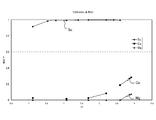
- the horizontal axis in FIG. 1 is the pH of the sulfuric acid acidic solution, and the vertical axis is the extraction rate of scandium, calcium, or magnesium.
- diamond indicates the scandium extraction rate
- the square indicates the calcium extraction rate
- the triangle indicates the magnesium extraction rate.
- DODGAA N, N-dioctyl-3-oxapentane-1,5-amidic acid
- DODGAA DODGAA synthesis was performed as follows. First, as shown in the following reaction formula (IV), 4.2 g of diglycolic anhydride was placed in a round bottom flask and suspended in 40 ml of dichloromethane. Thereafter, 7 g of dioctylamine (purity 98%) was dissolved in 10 ml of dichloromethane and slowly added with a dropping funnel. While stirring at room temperature, it was confirmed that diglycolic anhydride reacted and the solution became transparent, and the reaction was terminated.
- reaction formula (IV) 4.2 g of diglycolic anhydride was placed in a round bottom flask and suspended in 40 ml of dichloromethane. Thereafter, 7 g of dioctylamine (purity 98%) was dissolved in 10 ml of dichloromethane and slowly added with a dropping funnel. While stirring at room temperature, it was confirmed that diglycolic anhydride reacted and the solution became transparent, and the reaction was terminate
- the solution was washed with water to remove water-soluble impurities. Then, sodium sulfate was added as a dehydrating agent to the solution after washing with water. Then, the solution was suction filtered, and then the solvent was evaporated using an evaporator. And after recrystallizing (three times) using hexane, it vacuum-dried. The yield of the obtained substance was 9.57 g, and the yield based on the above diglycolic anhydride was 94.3%. And when the structure of the obtained substance was identified by NMR and elemental analysis, it was confirmed that it was DODGAA having a purity of 99% or more.
- [Extraction of scandium] Scandium was extracted in the same manner as in the examples except that the extractant was DODGAA.
- the results are shown in FIG.
- the horizontal axis in FIG. 2 is the pH of the sulfuric acid acidic solution, and the vertical axis is the extraction rate of scandium, calcium, or magnesium.
- diamond indicates the scandium extraction rate
- the square indicates the calcium extraction rate
- the triangle indicates the magnesium extraction rate.
Landscapes
- Chemical & Material Sciences (AREA)
- Engineering & Computer Science (AREA)
- Organic Chemistry (AREA)
- Mechanical Engineering (AREA)
- Geology (AREA)
- Manufacturing & Machinery (AREA)
- General Life Sciences & Earth Sciences (AREA)
- Materials Engineering (AREA)
- Life Sciences & Earth Sciences (AREA)
- Metallurgy (AREA)
- Environmental & Geological Engineering (AREA)
- Geochemistry & Mineralogy (AREA)
- Manufacture And Refinement Of Metals (AREA)
- Extraction Or Liquid Replacement (AREA)
Priority Applications (6)
| Application Number | Priority Date | Filing Date | Title |
|---|---|---|---|
| PH1/2013/502500A PH12013502500A1 (en) | 2012-03-13 | 2013-02-21 | Scandium extraction method |
| EP13761717.1A EP2712940B1 (en) | 2012-03-13 | 2013-02-21 | Scandium extraction method |
| CN201380002904.1A CN103764857B (zh) | 2012-03-13 | 2013-02-21 | 钪萃取方法 |
| US14/130,283 US9481638B2 (en) | 2012-03-13 | 2013-02-21 | Scandium extraction method |
| CA2837834A CA2837834C (en) | 2012-03-13 | 2013-02-21 | Scandium extraction method |
| AU2013233618A AU2013233618B2 (en) | 2012-03-13 | 2013-02-21 | Scandium extraction method |
Applications Claiming Priority (2)
| Application Number | Priority Date | Filing Date | Title |
|---|---|---|---|
| JP2012056134A JP5367862B2 (ja) | 2012-03-13 | 2012-03-13 | スカンジウム抽出剤およびこの抽出剤を用いたスカンジウム抽出方法 |
| JP2012-056134 | 2012-03-13 |
Publications (1)
| Publication Number | Publication Date |
|---|---|
| WO2013136941A1 true WO2013136941A1 (ja) | 2013-09-19 |
Family
ID=49160859
Family Applications (1)
| Application Number | Title | Priority Date | Filing Date |
|---|---|---|---|
| PCT/JP2013/054419 Ceased WO2013136941A1 (ja) | 2012-03-13 | 2013-02-21 | スカンジウム抽出方法 |
Country Status (8)
| Country | Link |
|---|---|
| US (1) | US9481638B2 (enExample) |
| EP (1) | EP2712940B1 (enExample) |
| JP (1) | JP5367862B2 (enExample) |
| CN (1) | CN103764857B (enExample) |
| AU (1) | AU2013233618B2 (enExample) |
| CA (1) | CA2837834C (enExample) |
| PH (1) | PH12013502500A1 (enExample) |
| WO (1) | WO2013136941A1 (enExample) |
Cited By (7)
| Publication number | Priority date | Publication date | Assignee | Title |
|---|---|---|---|---|
| US9458526B2 (en) | 2013-03-18 | 2016-10-04 | Kyushu University, National University Corporation | Method for separating impurities from an acidic solution containing nickel and cobalt and/or scandium |
| US9725786B2 (en) | 2012-12-12 | 2017-08-08 | Kyushu University, National University Corporation | Nickel extraction method |
| US9803262B2 (en) | 2012-08-20 | 2017-10-31 | Kyushu University, National University Corporation | Gallium extraction agent and gallium extraction method |
| US10030286B1 (en) * | 2013-11-13 | 2018-07-24 | Ii-Vi Incorporated | Method of direct solvent extraction of rare earth metals from an aqueous acid-leached ore slurry |
| US10036082B2 (en) | 2015-01-20 | 2018-07-31 | Kyushu University, National University Corporation | Zirconium extractant and method for extracting zirconium |
| US10808296B2 (en) | 2015-10-30 | 2020-10-20 | Ii-Vi Delaware, Inc. | Selective recovery of rare earth metals from an acidic slurry or acidic solution |
| US10933410B2 (en) | 2015-10-30 | 2021-03-02 | Ii-Vi Delaware, Inc. | Composite extractant-enhanced polymer resin, method of making the same, and its usage for extraction of valuable metal(s) |
Families Citing this family (12)
| Publication number | Priority date | Publication date | Assignee | Title |
|---|---|---|---|---|
| JP5367862B2 (ja) | 2012-03-13 | 2013-12-11 | 国立大学法人九州大学 | スカンジウム抽出剤およびこの抽出剤を用いたスカンジウム抽出方法 |
| JP2015166303A (ja) * | 2014-02-17 | 2015-09-24 | 学校法人 関西大学 | スカンジウムの分離方法 |
| JP6053724B2 (ja) | 2014-06-26 | 2016-12-27 | 国立大学法人九州大学 | イオン交換樹脂及び金属の吸着分離方法 |
| AU2015310078A1 (en) * | 2014-08-26 | 2017-02-02 | Ishihara Sangyo Kaisha, Ltd. | Method for separating scandium |
| JP6194867B2 (ja) * | 2014-09-10 | 2017-09-13 | 信越化学工業株式会社 | 抽出分離方法 |
| JP6693647B2 (ja) * | 2015-11-25 | 2020-05-13 | 国立研究開発法人日本原子力研究開発機構 | 金属元素の分離方法 |
| JP6406234B2 (ja) * | 2015-12-16 | 2018-10-17 | 住友金属鉱山株式会社 | スカンジウムの回収方法 |
| JP6409791B2 (ja) * | 2016-02-05 | 2018-10-24 | 住友金属鉱山株式会社 | スカンジウム回収方法 |
| JP6528707B2 (ja) * | 2016-03-14 | 2019-06-12 | 住友金属鉱山株式会社 | スカンジウム精製方法 |
| AU2018370142A1 (en) * | 2017-11-17 | 2020-05-14 | Ii-Vi Delaware, Inc. | Selective recovery of rare earth metals from an acidic slurry or acidic solution |
| CN114957029B (zh) * | 2022-04-11 | 2024-08-09 | 厦门稀土材料研究所 | 一种萃取剂的制备方法及应用 |
| CN115677528B (zh) * | 2022-11-03 | 2025-02-25 | 厦门稀土材料研究所 | 一种分离铼和锝的方法 |
Citations (5)
| Publication number | Priority date | Publication date | Assignee | Title |
|---|---|---|---|---|
| JPH0474711A (ja) * | 1990-06-19 | 1992-03-10 | Mitsui Cyanamid Co | 希土類金属の分離精製法 |
| JPH09291320A (ja) | 1996-04-26 | 1997-11-11 | Taiheiyo Kinzoku Kk | レアアース金属の回収方法 |
| JP2000313928A (ja) | 1999-04-26 | 2000-11-14 | Taiheiyo Kinzoku Kk | 酸化鉱石からニッケルとスカンジウムを回収する方法 |
| JP2007327085A (ja) | 2006-06-06 | 2007-12-20 | Japan Atomic Energy Agency | 希土類金属の抽出剤と抽出方法 |
| WO2012005183A1 (ja) * | 2010-07-05 | 2012-01-12 | 信越化学工業株式会社 | 希土類金属抽出剤の合成方法 |
Family Cites Families (18)
| Publication number | Priority date | Publication date | Assignee | Title |
|---|---|---|---|---|
| JP2514588B2 (ja) | 1992-10-05 | 1996-07-10 | 日本ポットクリーナー販売株式会社 | 換気用フィルタ |
| JP3307204B2 (ja) | 1995-11-22 | 2002-07-24 | 大平洋金属株式会社 | レアーアースメタルの濃縮分離回収方法 |
| EP0834581A1 (en) | 1996-09-30 | 1998-04-08 | Basf Aktiengesellschaft | Use of hydrocarbon-soluble aminomethylenephosphonic acid derivatives for the solvent extraction of metal ions from aqueous solutions |
| JP3806258B2 (ja) | 1999-01-21 | 2006-08-09 | 同和鉱業株式会社 | Ga,Inの溶媒抽出方法 |
| JP3385997B2 (ja) | 1999-02-12 | 2003-03-10 | 大平洋金属株式会社 | 酸化鉱石から有価金属を回収する方法 |
| US20050124765A1 (en) | 2003-11-25 | 2005-06-09 | Japan Atomic Energy Research Institute | Adsorbent for recovering useful rare metals by adsorption |
| CN101519427B (zh) | 2008-02-29 | 2015-02-25 | 中国人民解放军军事医学科学院毒物药物研究所 | 具有内皮素受体拮抗活性的肽类衍生物及其药物组合物和用途 |
| JP5504575B2 (ja) | 2008-04-21 | 2014-05-28 | 国立大学法人 宮崎大学 | ホスフィン酸を配位子とするキレート抽出剤 |
| JP5326610B2 (ja) | 2009-02-02 | 2013-10-30 | 住友金属鉱山株式会社 | 使用済みニッケル水素電池からの金属の回収方法 |
| AU2010202408B2 (en) * | 2009-06-17 | 2014-12-18 | Shin-Etsu Chemical Co., Ltd. | Method for extracting and separating rare earth elements |
| JP5487506B2 (ja) * | 2010-07-05 | 2014-05-07 | 信越化学工業株式会社 | 希土類金属抽出剤の合成方法 |
| JP5761663B2 (ja) | 2010-11-12 | 2015-08-12 | 国立大学法人 宮崎大学 | アルキルアミノリン化合物及び金属抽出剤 |
| PH12013501714A1 (en) | 2011-11-09 | 2015-10-16 | Univ Kyushu Nat Univ Corp | Cobalt extraction method |
| JP5279942B1 (ja) | 2011-11-09 | 2013-09-04 | 国立大学法人九州大学 | コバルト抽出方法 |
| JP5279938B1 (ja) * | 2011-11-09 | 2013-09-04 | 国立大学法人九州大学 | 有価金属抽出剤及びこの抽出剤を用いた有価金属抽出方法 |
| JP5367862B2 (ja) | 2012-03-13 | 2013-12-11 | 国立大学法人九州大学 | スカンジウム抽出剤およびこの抽出剤を用いたスカンジウム抽出方法 |
| JP5734268B2 (ja) | 2012-12-12 | 2015-06-17 | 国立大学法人九州大学 | ニッケル抽出方法 |
| JP5595554B1 (ja) | 2013-03-18 | 2014-09-24 | 国立大学法人九州大学 | ニッケル、コバルト及び/又はスカンジウムを含有する酸性溶液から不純物を分離する方法 |
-
2012
- 2012-03-13 JP JP2012056134A patent/JP5367862B2/ja active Active
-
2013
- 2013-02-21 WO PCT/JP2013/054419 patent/WO2013136941A1/ja not_active Ceased
- 2013-02-21 CN CN201380002904.1A patent/CN103764857B/zh not_active Expired - Fee Related
- 2013-02-21 AU AU2013233618A patent/AU2013233618B2/en not_active Ceased
- 2013-02-21 CA CA2837834A patent/CA2837834C/en not_active Expired - Fee Related
- 2013-02-21 PH PH1/2013/502500A patent/PH12013502500A1/en unknown
- 2013-02-21 US US14/130,283 patent/US9481638B2/en not_active Expired - Fee Related
- 2013-02-21 EP EP13761717.1A patent/EP2712940B1/en not_active Not-in-force
Patent Citations (5)
| Publication number | Priority date | Publication date | Assignee | Title |
|---|---|---|---|---|
| JPH0474711A (ja) * | 1990-06-19 | 1992-03-10 | Mitsui Cyanamid Co | 希土類金属の分離精製法 |
| JPH09291320A (ja) | 1996-04-26 | 1997-11-11 | Taiheiyo Kinzoku Kk | レアアース金属の回収方法 |
| JP2000313928A (ja) | 1999-04-26 | 2000-11-14 | Taiheiyo Kinzoku Kk | 酸化鉱石からニッケルとスカンジウムを回収する方法 |
| JP2007327085A (ja) | 2006-06-06 | 2007-12-20 | Japan Atomic Energy Agency | 希土類金属の抽出剤と抽出方法 |
| WO2012005183A1 (ja) * | 2010-07-05 | 2012-01-12 | 信越化学工業株式会社 | 希土類金属抽出剤の合成方法 |
Non-Patent Citations (1)
| Title |
|---|
| See also references of EP2712940A4 |
Cited By (7)
| Publication number | Priority date | Publication date | Assignee | Title |
|---|---|---|---|---|
| US9803262B2 (en) | 2012-08-20 | 2017-10-31 | Kyushu University, National University Corporation | Gallium extraction agent and gallium extraction method |
| US9725786B2 (en) | 2012-12-12 | 2017-08-08 | Kyushu University, National University Corporation | Nickel extraction method |
| US9458526B2 (en) | 2013-03-18 | 2016-10-04 | Kyushu University, National University Corporation | Method for separating impurities from an acidic solution containing nickel and cobalt and/or scandium |
| US10030286B1 (en) * | 2013-11-13 | 2018-07-24 | Ii-Vi Incorporated | Method of direct solvent extraction of rare earth metals from an aqueous acid-leached ore slurry |
| US10036082B2 (en) | 2015-01-20 | 2018-07-31 | Kyushu University, National University Corporation | Zirconium extractant and method for extracting zirconium |
| US10808296B2 (en) | 2015-10-30 | 2020-10-20 | Ii-Vi Delaware, Inc. | Selective recovery of rare earth metals from an acidic slurry or acidic solution |
| US10933410B2 (en) | 2015-10-30 | 2021-03-02 | Ii-Vi Delaware, Inc. | Composite extractant-enhanced polymer resin, method of making the same, and its usage for extraction of valuable metal(s) |
Also Published As
| Publication number | Publication date |
|---|---|
| AU2013233618A1 (en) | 2014-01-30 |
| CA2837834C (en) | 2015-02-17 |
| CA2837834A1 (en) | 2013-09-19 |
| PH12013502500A1 (en) | 2014-01-20 |
| US9481638B2 (en) | 2016-11-01 |
| EP2712940A4 (en) | 2014-11-12 |
| EP2712940B1 (en) | 2016-02-17 |
| EP2712940A1 (en) | 2014-04-02 |
| AU2013233618B2 (en) | 2016-03-03 |
| CN103764857B (zh) | 2016-05-18 |
| JP5367862B2 (ja) | 2013-12-11 |
| CN103764857A (zh) | 2014-04-30 |
| JP2013189675A (ja) | 2013-09-26 |
| US20140377150A1 (en) | 2014-12-25 |
Similar Documents
| Publication | Publication Date | Title |
|---|---|---|
| JP5367862B2 (ja) | スカンジウム抽出剤およびこの抽出剤を用いたスカンジウム抽出方法 | |
| CA2804239C (en) | Method for synthesizing rare earth metal extractant | |
| CA2745229C (en) | Synthesis of rare earth metal extractant | |
| JP5279942B1 (ja) | コバルト抽出方法 | |
| CA2804237C (en) | Method for synthesizing rare earth metal extractant | |
| JP5619238B1 (ja) | スカンジウム回収方法 | |
| CA2745228C (en) | Synthesis of rare earth metal extractant | |
| JP5398885B1 (ja) | ガリウム抽出方法 | |
| WO2014091805A1 (ja) | ニッケル抽出方法 | |
| WO2013069563A1 (ja) | コバルト抽出方法 | |
| JP5420033B1 (ja) | インジウム抽出剤およびこの抽出剤を用いたインジウム抽出方法 | |
| JP5442080B2 (ja) | 有価金属分離方法 |
Legal Events
| Date | Code | Title | Description |
|---|---|---|---|
| 121 | Ep: the epo has been informed by wipo that ep was designated in this application |
Ref document number: 13761717 Country of ref document: EP Kind code of ref document: A1 |
|
| ENP | Entry into the national phase |
Ref document number: 2837834 Country of ref document: CA |
|
| WWE | Wipo information: entry into national phase |
Ref document number: 2013761717 Country of ref document: EP |
|
| WWE | Wipo information: entry into national phase |
Ref document number: 14130283 Country of ref document: US |
|
| ENP | Entry into the national phase |
Ref document number: 2013233618 Country of ref document: AU Date of ref document: 20130221 Kind code of ref document: A |
|
| NENP | Non-entry into the national phase |
Ref country code: DE |