WO2013094652A1 - 球状黒鉛鋳鉄の製造方法および該球状黒鉛鋳鉄を用いた球状黒鉛鋳鉄部材 - Google Patents
球状黒鉛鋳鉄の製造方法および該球状黒鉛鋳鉄を用いた球状黒鉛鋳鉄部材 Download PDFInfo
- Publication number
- WO2013094652A1 WO2013094652A1 PCT/JP2012/082962 JP2012082962W WO2013094652A1 WO 2013094652 A1 WO2013094652 A1 WO 2013094652A1 JP 2012082962 W JP2012082962 W JP 2012082962W WO 2013094652 A1 WO2013094652 A1 WO 2013094652A1
- Authority
- WO
- WIPO (PCT)
- Prior art keywords
- cast iron
- graphite cast
- spheroidal graphite
- spheroidal
- spheroidizing
- Prior art date
- Legal status (The legal status is an assumption and is not a legal conclusion. Google has not performed a legal analysis and makes no representation as to the accuracy of the status listed.)
- Ceased
Links
Images










Classifications
-
- C—CHEMISTRY; METALLURGY
- C21—METALLURGY OF IRON
- C21C—PROCESSING OF PIG-IRON, e.g. REFINING, MANUFACTURE OF WROUGHT-IRON OR STEEL; TREATMENT IN MOLTEN STATE OF FERROUS ALLOYS
- C21C1/00—Refining of pig-iron; Cast iron
- C21C1/10—Making spheroidal graphite cast-iron
-
- B—PERFORMING OPERATIONS; TRANSPORTING
- B22—CASTING; POWDER METALLURGY
- B22D—CASTING OF METALS; CASTING OF OTHER SUBSTANCES BY THE SAME PROCESSES OR DEVICES
- B22D27/00—Treating the metal in the mould while it is molten or ductile ; Pressure or vacuum casting
- B22D27/20—Measures not previously mentioned for influencing the grain structure or texture; Selection of compositions therefor
-
- B—PERFORMING OPERATIONS; TRANSPORTING
- B22—CASTING; POWDER METALLURGY
- B22D—CASTING OF METALS; CASTING OF OTHER SUBSTANCES BY THE SAME PROCESSES OR DEVICES
- B22D1/00—Treatment of fused masses in the ladle or the supply runners before casting
-
- C—CHEMISTRY; METALLURGY
- C21—METALLURGY OF IRON
- C21C—PROCESSING OF PIG-IRON, e.g. REFINING, MANUFACTURE OF WROUGHT-IRON OR STEEL; TREATMENT IN MOLTEN STATE OF FERROUS ALLOYS
- C21C1/00—Refining of pig-iron; Cast iron
- C21C1/10—Making spheroidal graphite cast-iron
- C21C1/105—Nodularising additive agents
-
- C—CHEMISTRY; METALLURGY
- C22—METALLURGY; FERROUS OR NON-FERROUS ALLOYS; TREATMENT OF ALLOYS OR NON-FERROUS METALS
- C22C—ALLOYS
- C22C28/00—Alloys based on a metal not provided for in groups C22C5/00 - C22C27/00
-
- C—CHEMISTRY; METALLURGY
- C22—METALLURGY; FERROUS OR NON-FERROUS ALLOYS; TREATMENT OF ALLOYS OR NON-FERROUS METALS
- C22C—ALLOYS
- C22C33/00—Making ferrous alloys
- C22C33/08—Making cast-iron alloys
-
- C—CHEMISTRY; METALLURGY
- C22—METALLURGY; FERROUS OR NON-FERROUS ALLOYS; TREATMENT OF ALLOYS OR NON-FERROUS METALS
- C22C—ALLOYS
- C22C37/00—Cast-iron alloys
- C22C37/04—Cast-iron alloys containing spheroidal graphite
-
- C—CHEMISTRY; METALLURGY
- C22—METALLURGY; FERROUS OR NON-FERROUS ALLOYS; TREATMENT OF ALLOYS OR NON-FERROUS METALS
- C22C—ALLOYS
- C22C37/00—Cast-iron alloys
- C22C37/10—Cast-iron alloys containing aluminium or silicon
-
- C—CHEMISTRY; METALLURGY
- C22—METALLURGY; FERROUS OR NON-FERROUS ALLOYS; TREATMENT OF ALLOYS OR NON-FERROUS METALS
- C22C—ALLOYS
- C22C38/00—Ferrous alloys, e.g. steel alloys
- C22C38/002—Ferrous alloys, e.g. steel alloys containing In, Mg, or other elements not provided for in one single group C22C38/001 - C22C38/60
-
- C—CHEMISTRY; METALLURGY
- C22—METALLURGY; FERROUS OR NON-FERROUS ALLOYS; TREATMENT OF ALLOYS OR NON-FERROUS METALS
- C22C—ALLOYS
- C22C38/00—Ferrous alloys, e.g. steel alloys
- C22C38/02—Ferrous alloys, e.g. steel alloys containing silicon
-
- C—CHEMISTRY; METALLURGY
- C22—METALLURGY; FERROUS OR NON-FERROUS ALLOYS; TREATMENT OF ALLOYS OR NON-FERROUS METALS
- C22C—ALLOYS
- C22C38/00—Ferrous alloys, e.g. steel alloys
- C22C38/06—Ferrous alloys, e.g. steel alloys containing aluminium
-
- C—CHEMISTRY; METALLURGY
- C22—METALLURGY; FERROUS OR NON-FERROUS ALLOYS; TREATMENT OF ALLOYS OR NON-FERROUS METALS
- C22C—ALLOYS
- C22C43/00—Alloys containing radioactive materials
Definitions
- the present invention relates to a method for producing spheroidal graphite cast iron and a spheroidal graphite cast iron member using the spheroidal graphite cast iron, such as a vehicle part having a particularly thin portion.
- Spheroidal graphite cast iron is widely used for vehicle parts such as automobiles and machine parts because it has excellent tensile strength and ductility. Particularly, brake calipers important as safety parts for vehicles such as automobiles use this spheroidal graphite cast iron in order to ensure the quality. In recent years, since these parts have been requested to be lighter and smaller, the spheroidal graphite cast iron member used is also required to be thinner. When the spheroidal graphite cast iron member is thinned, a chill phase (abnormal structure) is generated due to an increase in the cooling rate in the thin portion. Since this chill phase is a very hard structure, the machinability (machinability) of the spheroidal graphite cast iron member is lowered.
- machinability machinability
- spheroidal graphite cast iron members having a thin wall portion, particularly automobile parts are often required to suppress the chill structure while maintaining a balance between tensile strength and ductility at a high level.
- a spheroidizing process and a plurality of inoculation processes are performed on the cast iron melt.
- a spheroidizing agent containing a rare earth element (rare earth) is generally used in order to more reliably perform spheroidization and graphitization.
- Patent Documents 1 to 4 disclose a spheroidizing agent containing a predetermined amount (about 0.5 to 9% by mass) of rare earth and a spheroidal graphite cast iron produced using the spheroidizing agent.
- rare earth promotes graphitization, chilling prevention, chunky graphite generation and It has a very useful element for spheroidal graphite cast iron because it has a function of suppressing dipping.
- Japanese Unexamined Patent Publication No. 10-237528 Japanese Unexamined Patent Publication No. 2000-303113 Japanese Unexamined Patent Publication No. 2007-182620 Japanese Unexamined Patent Publication No. 9-125125 Japanese Unexamined Patent Publication No. 6-279917 Japanese Unexamined Patent Publication No. 10-317093 Japanese Unexamined Patent Application Publication No. 2004-339577
- rare earths are unevenly distributed in a limited area on the earth, and the price and production volume often change greatly due to the convenience of the producing country and the manufacturing company.
- rare earth has become an indispensable resource not only in the casting field, but also in the electronic equipment and magnet fields, and the price has been rising rapidly. Therefore, in order to avoid such supply obstacles and price increases, a method for producing a spheroidal graphite cast iron member using a spheroidizing agent that does not contain a rare earth is established, and the spheroidal graphite cast iron member can be supplied inexpensively and stably. There is a strong demand.
- An object of the present invention is to provide a method for producing spheroidal graphite cast iron having excellent machinability, vibration damping properties, castability and economy, and having no chill phase and internal defects, and a spheroidal graphite cast iron member using the spheroidal graphite cast iron. .
- the present invention relates to the following (1) and (2).
- the Fe-Si-Mg-Ca alloy spheroidizing agent substantially free of rare earth elements is added to the molten metal in an amount of 0.8 to 2.0% by mass, and the molten metal is spheroidized in a ladle.
- the process of performing the conversion process (B) performing the inoculation treatment with the first Fe—Si—Ca inoculum or the Ca—Si inoculum simultaneously with the step (a) or after the step (a), and (C) After the step (b), before casting the molten metal into the mold, the second Fe—Si— containing Si: 45 to 75% and Ca: 1.0 to 3.0% by mass
- the composition of the resulting spheroidal graphite cast iron is, by mass, C: 3.0 to 4.5%, Si: 3.0 to 4.0%, Mn: 0.2 to 0.4%, S: 0.006 to 0.020%, Cu: 0.08 to 0.30%, Sn: 0.020 to 0.040%, Mg: 0.015 to 0.050%, Al: 0.03% or less, Zn: 0.0
- the chill area ratio in the thin wall portion where the thickness of the cast iron member is 6 mm or less is 1% or less,
- the spheroidal graphite cast iron according to the present invention contains rare earth in the spheroidizing agent by adding a predetermined amount of Ba to the spheroidizing agent instead of the pouring inoculum or the secondary inoculant in the production process. Even if not, it has tensile strength, ductility, rigidity, vibration damping and machinability equivalent to or better than conventional spheroidized graphite cast iron. Moreover, the spheroidal graphite cast iron member containing the spheroidal graphite cast iron can be evaluated as having no internal defects inside the member even under stricter requirements as compared with the prior art.
- the member containing cast iron according to the present invention can be suitably used for manufacturing a small-sized vehicle component having a thin wall portion, particularly a brake caliper that is a safety component important for vehicle safety.
- the present invention makes it possible to inexpensively and stably supply a spheroidal graphite cast iron member without using an expensive and unstable supply material such as rare earth as a manufacturing material. For this reason, it can be widely applied to products (members) using spheroidal graphite cast iron for which stable supply is always required, including not only vehicle parts but also other vehicle parts and general industrial machine parts. It is possible and its industrial significance is very great.
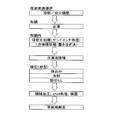
- FIG. 1 is a schematic flowchart showing steps from melting of raw materials to completion of vehicle parts.
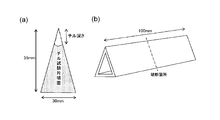
- 2 (a) and 2 (b) are diagrams showing a wedge-type chill test piece used in the preliminary test of the present invention
- FIG. 2 (a) is a schematic view showing a mold of the wedge-type chill test piece.
- FIG. 2B is a schematic perspective view of the fracture surface of the wedge-shaped chill test piece.
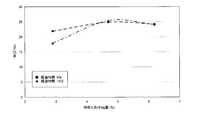
- FIG. 3 is a diagram showing the relationship between the Mg content in the spheroidizing agent and the chill depth.
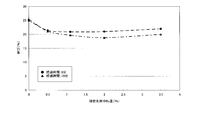
- FIG. 4 is a diagram showing the relationship between the Mg content in the spheroidizing agent and the spheroidization rate.
- FIG. 1 is a schematic flowchart showing steps from melting of raw materials to completion of vehicle parts.
- 2 (a) and 2 (b) are diagrams showing a wedge-type chill test piece used in the preliminary test of the present invention
- FIG. 2 (a) is a schematic view showing a mold of the wedge-type chill test
- FIG. 5 is a graph showing the relationship between the Mg content in the spheroidizing agent and the tensile strength.
- FIG. 6 is a diagram showing the relationship between the Mg content in the spheroidizing agent and the elongation.
- FIG. 7 is a diagram showing the relationship between the Ca content in the spheroidizing agent and the chill depth.
- FIG. 8 is a diagram showing the relationship between the Ca content in the spheroidizing agent and the spheroidization rate.
- FIG. 9 is a diagram showing the relationship between the Ca content in the spheroidizing agent and the tensile strength.
- FIG. 10 is a diagram showing the relationship between the Ca content in the spheroidizing agent and the elongation.
- FIG. 10 is a diagram showing the relationship between the Ca content in the spheroidizing agent and the elongation.
- FIG. 11 is a diagram showing the relationship between the Ba content in the spheroidizing agent and the chill depth.
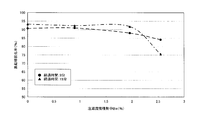
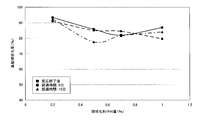
- FIG. 12 is a diagram showing the relationship between the Ba content in the spheroidizing agent and the spheroidization rate.
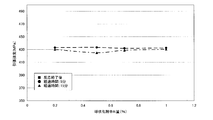
- FIG. 13 is a diagram showing the relationship between the Ba content in the spheroidizing agent and the tensile strength.
- FIG. 14 is a diagram showing the relationship between the Ba content in the spheroidizing agent and the elongation.
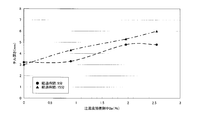
- FIG. 15 is a diagram showing the relationship between the Ba content in the spheroidizing agent and the number of graphite grains.
- FIG. 16 is a diagram showing the relationship between the Ba content in the spheroidizing agent and the graphite particle size.
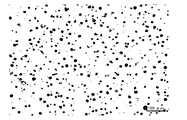
- FIG. 17 is a photomicrograph showing the microstructure of spheroidal graphite cast iron obtained using a spheroidizing agent not containing Ba.
- FIG. 18 is a photomicrograph showing the microstructure of spheroidal graphite cast iron obtained using a spheroidizing agent to which Ba is added.
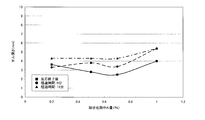
- FIG. 19 is a diagram showing the relationship between the Ba content in the pouring inoculant and the tensile strength.
- FIG. 20 is a diagram showing the relationship between the Ba content in the pouring inoculant and the chill depth.
- FIG. 21 is a diagram showing the relationship between the Ba content in the pouring inoculant and the spheroidization rate.
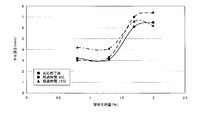
- FIG. 22 is a diagram showing the relationship between the Al content in the spheroidizing agent and the chill depth.
- FIG. 23 is a diagram showing the relationship between the Al content in the spheroidizing agent and the spheroidization rate.
- FIG. 24 is a diagram showing the relationship between the Al content in the spheroidizing agent and the tensile strength.
- FIG. 25 is a diagram showing the relationship between the Al content in the spheroidizing agent and the elongation.
- FIG. 26 is a diagram showing the relationship between the amount of spheroidizing agent added and the chill depth.
- FIG. 27 is a diagram showing the relationship between the amount of spheroidizing agent added and the spheroidization rate.
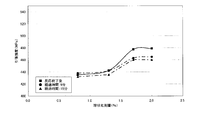
- FIG. 28 is a diagram showing the relationship between the addition amount of the spheroidizing agent and the tensile strength.
- FIG. 29 is a diagram showing the relationship between the amount of spheroidizing agent added and elongation.
- spheroidization rate Decrease in graphite spheroidization rate (hereinafter referred to as “spheroidization rate”) and accompanying reduction in tensile strength, ductility, rigidity, (2) Decrease in machinability (machinability) due to generation of chill phase (abnormal structure) and increase in chilling tendency, (3) Increase in fading (shortening fading start time), (4) Increase in internal defects such as shrinkage nests.
- fading means that the elements added for the spheroidizing treatment and the inoculation treatment are reduced as they are consumed by oxidation or reaction with other elements with the passage of time. This is a phenomenon that prevents inoculation and inoculation.
- the present inventors have so far described (1) to (1) above without using an expensive additive element.
- the balance and balance of tensile strength and ductility, rigidity, machinability even in the as-cast state can be achieved by controlling the amount and amount of the dissolved component, spheroidizing agent and inoculum simultaneously and accurately.
- a method for producing graphite cast iron has been developed.
- the present inventors attach importance to an economical viewpoint, and as a result of intensive studies focusing on the reduction in the amount of coagulation shrinkage (a), a predetermined amount of Ba was added to the spheroidizing agent, Furthermore, it was discovered that by adjusting the amounts of Mg, Ca, and Al in the spheroidizing agent accurately, the tendency of shrinkage nests to be generated can be significantly suppressed, and the present invention has been completed. The details of this study will be described in detail below.
- Ba generally becomes an oxide or sulfide in the molten metal, which acts as a graphite nucleus and promotes the graphite formation reaction during solidification, which is effective in increasing the number of graphite grains and making the graphite grain size finer. It is said that there is.
- Ba is conventionally added mainly to the inoculant of spheroidal graphite cast iron, and used as a component for promoting the inoculation effect due to the effect of increasing the number of graphite grains or reducing the graphite particle size.
- Patent Document 5 discloses that 10% or less of Ba is added to an inoculum in order to refine graphite and promote graphitization.
- Patent Document 6 0.0015 to 0.02% of Ba is added to the molten metal at the time of inoculation or after inoculation in order to improve the rigidity of the product by increasing the number of graphite particles and decreasing the graphite particle size. It is disclosed.
- Patent Document 7 in an inoculant containing 90 to 99% of Si, any one or more elements of Ca, Sr and Ba are added in a total amount of 0.5 to 6.0% to promote graphitization. The addition is disclosed.
- the present inventors focused on the suppression of the amount of solidification shrinkage due to the graphitization promoting effect of Ba, and as a result of various studies in anticipation of the effect of suppressing the shrinkage nest tendency by the suppression, Even if it exists, it discovered that graphitization was accelerated
- the present inventors have been able to sufficiently suppress the increase in the amount of slag generated by adding Ba, which has been feared in the past, by accurately adjusting the amounts of Mg, Ca and Al in the spheroidizing agent, and these It has been found that the occurrence of inclusions can be significantly reduced by controlling the amount of Al below a predetermined value among the components, and the present invention has been completed.
- an Fe—Si cover agent is placed on the top of the spheroidizing agent and the Fe—Si—Ca inoculum placed in the pocket at the bottom of the ladle to completely cover the same as in the actual machine. These treatments were performed. Furthermore, immediately before casting into the mold (shell mold), pouring flow inoculation in which the inoculum was introduced into the molten metal was manually performed. In addition, the basic process was performed along the flowchart shown in FIG.
- cast iron was prepared using two types of molds, a wedge chill test piece and a knock-off (Kb) type test piece (25 mm ⁇ ).
- the internal dimensions of the wedge-shaped test piece are as shown in FIG.
- a test piece in which the time from spheroidizing treatment to casting was changed from immediately after the treatment to a maximum of 15 minutes was measured, and each characteristic was measured.
- the wedge-shaped test piece was broken at room temperature to form a chill test piece, and the depth (chill depth) at which the chill phase was present was measured from the front end of the fracture surface with a digital scope (see FIGS. 2 (a) and 2 (b)). ).
- the chilling tendency is suppressed as the chill depth is smaller.
- the spheroidization rate, the number of graphite grains, and the like were measured by cutting the end of a round bar (25 mm ⁇ ) of a knock-off (Kb) type test piece and observing the central portion with an optical microscope.
- Tensile strength was measured by collecting two JIS No. 4 specimens from a 25 mm ⁇ round bar.
- [Influence of Mg, Ca, Ba, Al content in spheroidizing agent] 3 to 6 show the contents of Mg as a basic component of the spheroidizing agent, the chill depth (FIG. 3), the spheroidization rate (FIG. 4), the tensile strength (FIG. 5), and the elongation (FIG. 6). Each relationship is shown. Differences in various characteristics are also shown when the elapsed time from spheroidizing treatment to casting is changed from immediately after treatment (after completion of the reaction) to 9 minutes and 15 minutes.
- Mg is an element that increases the tendency to chill. It was confirmed. For this reason, it is necessary to determine the appropriate range of the Mg content by comprehensively judging the influence on each characteristic.
- FIGS. 7 to 10 show the content of Ca as a basic component of the spheroidizing agent, the chill depth (FIG. 7), the spheroidization rate (FIG. 8), the tensile strength (FIG. 9) and the elongation (FIG. 10). The relationship is shown respectively. Differences in various characteristics are also shown when the elapsed time from spheroidizing treatment to casting is changed from immediately after treatment (after completion of the reaction) to 9 minutes and 15 minutes. It is confirmed that the chill depth is the best when the Ca content in the spheroidizing agent is about 2%, and the tensile strength and elongation tend to improve little by little as the Ca content increases. It was. Moreover, although the spheroidization rate was improved up to about 1.3% of the Ca content, it was confirmed that the spheroidization rate was decreased after that and increased again when it exceeded 2%.
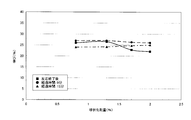
- FIG. 11 to 16 show the Ba content in the spheroidizing agent, the chill depth (FIG. 11), the spheroidization rate (FIG. 12), the tensile strength (FIG. 13), the elongation (FIG. 14), the number of graphite grains ( FIG. 15) shows the relationship with the graphite particle size (FIG. 16). Differences in various characteristics are also shown when the elapsed time from spheroidizing treatment to casting is changed immediately after treatment (after completion of the reaction) to 9 minutes and 15 minutes.
- FIGS. 22 to 25 show the relationship between the content of Al in the spheroidizing agent and the chill depth (FIG. 22), spheroidization rate (FIG. 23), tensile strength (FIG. 24), and elongation (FIG. 25), respectively. Show. Differences in various characteristics are also shown when the elapsed time from spheroidizing treatment to casting is changed from immediately after treatment (after completion of the reaction) to 9 minutes and 15 minutes. As a result, no significant change was observed in any of the properties when the Al content was in the range of 0.2 to 1.0%, but the chill depth, spheroidization rate, and tensile strength were not affected by the Al content. It was confirmed that the lower the value, the better the characteristics.
- [Amount of spheroidizing agent] 26 to 29 show the amount of spheroidizing agent within the scope of the present invention (0.8 to 2.0% by mass based on the molten metal), chill depth (FIG. 26), spheroidization rate (FIG. 27). ), Tensile strength (FIG. 28), and elongation (FIG. 29).
- the composition of the spheroidizing agent used here is the spheroidizing agent No. 1 is the same as the spheroidizing agent.
- the amount of spheroidizing agent added is in the range of 0.8 to 2.0% by mass with respect to the molten metal, the spheroidizing rate and elongation hardly change even when the amount added is increased. It was confirmed that the strength increased. Therefore, the amount of spheroidizing agent must be comprehensively determined in consideration of changes in each characteristic.
- the present inventors used a device similar to a mass production line to manufacture a brake caliper for automobiles as a spheroidal graphite cast iron member containing the spheroidal graphite cast iron according to the present invention under the production conditions considering the result of the preliminary test. Manufactured and tested with actual products. As a result, even when using a spheroidizing agent that does not contain rare earths, the amount of dissolved components and inoculum basic components and the amount added are accurately controlled, and after adding a predetermined amount of Ba to the spheroidizing agent, It was found that by controlling the contents of Mg, Ca, and Al within a predetermined range, excellent characteristics were exhibited even in an as-cast state.
- the said characteristic is that there is no internal defect such as a shrinkage nest in the product (member), it is economical, the tensile strength according to JIS Z 2241 is 450 MPa or more, and the elongation according to JIS Z 2241 is 15% or more.
- the spheroidization rate according to JIS G 5502 is 85% or more, the Young's modulus according to JIS Z 2280 is 170 GPa or more, and the logarithmic attenuation rate according to JIS G 0602 is 1.0 ⁇ 10 ⁇ 3 or more.
- the thin member where the thickness of the member including the cast iron is 6 mm or less has no chill phase.
- the present inventors can manufacture a spheroidal graphite cast iron member such as a vehicle part in which internal defects are suppressed more strictly than conventional products by using cast iron manufactured by the manufacturing method according to the present invention. Obtaining knowledge, the present invention has been completed.
- a melting raw material of the molten metal used in the present invention hot rolled steel plate-type or cold-rolled steel plate-type scrap, pig iron, return material, etc. can be used, but materials with a small amount of impurities such as O, S, P, etc. Is preferably used. However, even when the amount of these impurities is large, if the amount of impurities is reduced by desulfurization treatment or flux treatment, it can be used without any problem. Although it does not specifically limit as a melting furnace, It is preferable to use an electric furnace, especially a high frequency induction furnace. After melting the raw material, C, Si, Mn, S, Cu, and Sn are added as appropriate to adjust the molten metal components. Detachment from the melting furnace before tapping and the ladle after spheronization is important for removing slag such as inclusions floating on the surface of the molten metal, and it is desirable to carry it out reliably.
- the composition of the molten metal is C: 3.0 to 4.5% by mass%, Si: 2.0 to 3.0% from the viewpoint of easy preparation so that the obtained spheroidal graphite cast iron has a preferable composition.
- the melt temperature during melting and component preparation is preferably 1480 to 1580 ° C.
- the melting furnace is tilted and the molten metal is poured into the ladle.
- the spheroidizing agent, the first inoculant and the cover agent are used to perform the graphite spheroidizing treatment and the primary inoculating treatment.
- a sandwich method or other known means can be used.
- Mg concentration in the spheroidizing agent and the yield of Mg no special equipment is required, and the graphite sphere can be stably formed.
- the sandwich method is adopted.
- Mg-based spheroidizing agents such as Fe-Si-Mg-Ca-based alloys containing Ba can be used from the results of the preliminary test described above. It is preferable to use those containing up to 6.0%, Ca: 1.0 to 2.0%, Ba: 0.5 to 3.5%, and Al: 0.3% or less. Below, each element which comprises a spheroidizing agent is explained in full detail.
- Mg is an element added to spheroidize graphite, and remains in the molten metal after the spheronization treatment.
- the Mg content must be 3.0 to 6.0% by mass in the spheroidizing agent. If it is less than 3.0%, the spheroidization of graphite does not proceed sufficiently, so that the intended strength and rigidity cannot be obtained.
- Mg is an element that is very easily oxidized, when the Mg content exceeds 6.0%, the shrinkage cavities and Mg oxide in the matrix tend to increase and the strength tends to decrease. In addition, as described above, a chill phase is easily generated, and the machinability is deteriorated.
- Ca is generally added to suppress the reaction of Mg, but also exhibits an effect of increasing the chilling tendency as shown in the preliminary test.
- the Ca content in the spheroidizing agent needs to be 1.0 to 2.0% by mass%. If the amount is less than 1.0%, the effect of addition cannot be sufficiently expected. If the amount exceeds 2.0%, the tendency to chill is increased and a chill phase is generated, so that slag increases.
- Ba is added mainly for suppressing shrinkage nest generation.
- the mechanism for suppressing the occurrence of internal defects such as shrinkage cavities due to the addition of Ba is considered as follows.
- nuclei composed of Ba oxide are generated.
- the nucleation and generation frequency of graphite in the molten metal are promoted, and the graphitization reaction is completed in a relatively short time as compared with the case where no Ba is contained.
- the amount of graphite produced at the end of solidification where shrinkage cavities and the like are generated is reduced, the deformation of the mold due to volume expansion is greatly suppressed, and the cause of solidification defects (voids) is reduced. It is considered to be suppressed.
- the content of Ba in the spheroidizing agent is preferably 0.5 to 3.5% by mass. If the addition is in this range, no decrease in tensile strength due to accelerated graphitization is observed as shown in the preliminary test. If it is less than 0.5%, the effect of addition is not clearly recognized, and internal defects such as shrinkage can occur depending on the product shape. On the other hand, if it exceeds 3.5%, the generation of slag increases, internal defects occur, and not only the tensile strength and elongation decrease, but also the workability decreases.
- Al has mainly effects of deoxidation and chilling suppression. However, since it is also a spheronization inhibiting element, if it contains more than a certain value, the tensile strength and rigidity are reduced. Further, alumina, which is an oxide of Al, may remain in the product and become inclusions, resulting in casting defects. Also in the preliminary test results described above, when the Al content in the spheroidizing agent was 0.3% or more, no significant effect was observed for the improvement of each property. Considering the above, the Al content is set to 0.3% or less.
- the amount of spheroidizing agent added to the molten metal must be 0.8% to 2.0% by mass. If it is less than 0.8%, a sufficient spheroidizing rate cannot be obtained, and if it exceeds 2.0%, the chill tendency becomes stronger as suggested in the preliminary test, and the spheroidizing agent remains undissolved in the molten metal. May occur.
- the particle size of the spheroidizing agent is preferably about 0.05 to 5 mm from the viewpoint of preventing unmelting and uniform mixing with the molten metal.
- a cover agent is put on the spheroidizing agent and the inoculant and is not in direct contact with the molten metal Like that.
- the cover agent an Fe—Si system is used.
- an Fe-Si-Ca or Ca-Si inoculum can be used as an inoculum used for the primary inoculation treatment in the ladle. Fe-Si-Ca inoculum is used.
- the particle size of the inoculant is preferably about 0.05 to 5 mm from the viewpoint of uniform mixing of the unmelted material and the molten metal.
- the inoculum used for the primary inoculation process is placed with the spheroidizing agent in the bottom pocket of the ladle. The spheroidizing process and the primary inoculation process do not have to be performed at the same time, and the above inoculum may be put into the ladle alone after the spheronizing process.
- the primary inoculation treatment is preferably performed immediately after the spheroidization treatment in order to sufficiently exhibit the inoculation effect of the pouring flow inoculation performed immediately before casting into the mold.
- the molten metal after the spheroidizing process is poured into the mold before pouring the molten metal.
- the second Fe—Si—Ca inoculum is used as the pouring inoculum. Specifically, it is necessary to use each component containing Si: 45 to 75% and Ca: 1.0 to 3.0% by mass.
- Si is the main element of the pouring inoculum, and its content is about 45 to 75%, which is the standard amount when using ferrosilicon-based materials. If it is less than 45%, the generation of slag will increase, and if it exceeds 75%, the solubility of the inoculum will decrease.
- Ca has the effect of suppressing chilling and improving the spheroidization rate by promoting graphitization of the matrix and spheroidization of graphite.
- the Ca content in the pouring inoculant needs to be 1.0 to 3.0%, preferably 1.2 to 2.2%. If it is less than 1.0%, the inoculation effect cannot be exhibited, and the refinement and spheroidization of graphite does not proceed. If it exceeds 3.0%, hard CaO increases, leading to slag generation and machinability deterioration. .
- the amount of the molten pouring inoculant added to the molten metal before the spheroidizing treatment is 0.2 to 0.4% by mass in terms of suppressing the chilling tendency and improving the spheroidizing rate and elongation. It is necessary to be 0.25 to 0.30%. If the input amount exceeds 0.4%, the undissolved increase and slag increase, and if it is less than 0.2%, a sufficient effect due to inoculation cannot be obtained, and the desired characteristics cannot be improved, and the input yield is also low. descend.
- the pouring inoculum usually contains 0.5 to 4.0% Al. This is added mainly for the purpose of suppressing chilling and improving the base structure, and in the present invention, there is almost no influence on each characteristic as long as it is within this range. However, if the added amount exceeds the above range, the oxide may cause internal defects such as pinholes, so the Al content in the composition of the spheroidal graphite cast iron is 0.03%. It is necessary to fully consider the composition of the pouring inoculum so as not to exceed.
- the pouring inoculation is performed immediately before casting into the mold, but it is preferable to use an automatic cutting device or the like at a uniform speed and to ensure uniform mixing in the molten metal. It is also possible to carry out by in-mold inoculation method in which the inoculant is placed in the mold, but in that case there is no undissolved residue of the inoculant and the mold plan etc. should be sufficiently mixed with the molten metal. It is necessary to devise. In addition, in order to satisfy all the desired material properties, the final pouring flow inoculation treatment has a great influence, so that the injected inoculum must be surely mixed with the molten metal to exert its effect. From this viewpoint, the particle size of the pouring inoculant is preferably 0.05 to 5 mm.
- the obtained spheroidal graphite cast iron contains substantially no rare earth, and its composition is, by mass, C: 3.0 to 4.5%, Si: 3.0 to 4.0%, Mn: 0.2 to 0.4%, S: 0.006 to 0.020%, Al: 0.03% or less, Cu: 0.08 to 0.30%, Sn: 0.020 to 0.040 %, Mg: 0.015 to 0.050% and Zn: 0.01% or less, with the balance being made of Fe and inevitable impurities.
- “substantially not contained” means that intentional addition is not performed, but inclusion of 0.001% or less as an inevitable impurity is allowed.
- C content is required to be 3.0 to 4.5% in the cast iron, and preferably 3.2 to 4.2%. If it is less than 3.0%, the graphite amount of the spheroidal graphite cast iron is insufficient, the tendency to chill increases, and the fluidity of the molten metal deteriorates. On the other hand, if it exceeds 4.5%, C becomes excessive and cash graphite tends to be produced, so that the cast iron material itself becomes brittle and a predetermined strength cannot be obtained.
- the Si content needs to be 3.0 to 4.0% in the cast iron, and is preferably 3.2 to 4.0%. If it is less than 3.0%, not only does the fluidity of the spheroidal graphite cast iron melt deteriorate, but the chill structure increases, and cementite tends to precipitate in the matrix structure, and the desired elongation cannot be obtained. On the other hand, if it exceeds 4.0%, the homogeneity of the material is deteriorated, the amount of silicoferrite is increased, the material becomes brittle, and the elongation is remarkably lowered.
- Mn is a pearlite-promoting element and its influence on strength is important.
- the Mn content needs to be 0.2 to 0.4% in the cast iron, and is preferably 0.25 to 0.35%. If it is less than 0.2%, the amount of pearlite in the microscopic tissue decreases and ferrite increases, so that a predetermined strength cannot be obtained. On the other hand, when it exceeds 0.4%, structures such as cementite and pearlite increase in the matrix, and chill is likely to occur, which adversely affects machinability.
- the S content needs to be 0.006 to 0.020% in the cast iron, and is preferably 0.008 to 0.014%. If it is less than 0.006%, inoculation and spheroidizing effects are suppressed. On the other hand, if it exceeds 0.020%, Mg and Ca and sulfides are produced and these elements are consumed, so the spheroidization rate and the inoculation effect are reduced.
- Cu and Sn are pearlite elements added for the purpose of strengthening the matrix and improving the tensile strength, but are also elements that inhibit the spheroidization of graphite. Further, Cu is said to have an effect of improving the strength compared to Sn, about 1/10 of Sn, and in terms of price, Cu is about 1/10 of Sn. Therefore, the Cu content may be 0.08 to 0.30% in the cast iron from the viewpoint of improving the strength, decreasing the elongation, decreasing the spheroidizing ratio, increasing the chilling tendency, and economically. It is necessary and is preferably 0.10 to 0.20%. Similarly, the Sn content must be 0.020 to 0.040% in the cast iron, and preferably 0.025 to 0.035%.
- Al is added to the molten metal as a deoxidizing agent, and is always included in the spheroidizing agent and the inoculant together with Si.
- Al is effective in promoting deoxidation and graphitization, but on the other hand, it is also an element for inhibiting spheroidization, and when the content in the cast iron exceeds 0.03%, strength and toughness are reduced.
- alumina (Al 2 O 3 ) which is an oxide, is very hard and exists as inclusions in the spherical graphite, which may cause internal defects such as hard spots. In such a case, the cutting tool is damaged or worn, and the productivity is greatly reduced. Accordingly, the Al content in the composition of the cast iron needs to be 0.03% or less. For this purpose, not only the Al content at the initial dissolution is as low as possible, but also a spheroidizing agent and It is preferable to manage Al contained in the inoculum at a low concentration.
- Zn is an adhering component such as a plated steel sheet in iron scrap, and may be mixed as an impurity. When this content exceeds 0.01%, the spheroidization ratio is lowered, which often causes casting defects such as a drop in tensile strength and ductility and pinholes. Therefore, the Zn content needs to be 0.01% or less.
- the spheroidal graphite cast iron obtained by the manufacturing method of the present invention is applied to vehicle parts such as a brake caliper.
- the spheroidal graphite cast iron obtained by the production method of the present invention can be applied regardless of the thickness or size of the product, but in the following description, it is assumed that a general passenger car or commercial vehicle is 3 to 40 mm.
- a case where the present invention is applied to an automobile brake caliper having a wall thickness of about a certain degree will be described as an example.
- the strength level required for the brake caliper parts for automobiles varies depending on the application, the present invention can be suitably used particularly for a caliper defined by JIS FCD400-FCD500.
- the casting temperature at this time is preferably 1300 to 1450 ° C.
- the time from the spheroidizing treatment to casting is preferably 15 minutes or less, and more preferably 12 minutes or less.
- the brake caliper for automobiles obtained by the present invention is premised on using as cast without removing heat gates and hot water, and in this case, dimensional accuracy, structure and hardness. From the viewpoint of maintaining a constant value, it is necessary to make the time from casting to mold release constant.
- the matrix of the spheroidal graphite cast iron member (automobile brake caliper) containing the spheroidal graphite cast iron of the present invention finally obtained is a mixed structure of pearlite and ferrite.
- the pearlite ratio in the matrix (removal of the graphite part) is generally 20 to 60% in terms of area ratio.
- the brake caliper has a tensile strength in accordance with JIS Z 2241 of 450 MPa or more, an elongation in accordance with JIS Z 2241 of 15% or more, a spheroidization ratio in accordance with JIS G 5502 of 85% or more, and conforms to JIS Z 2280.
- the Young's modulus is 170 GPa or more, and the logarithmic decay rate in accordance with JIS G 0602 is 1.0 ⁇ 10 ⁇ 3 or more, and the chill phase has a chill phase even in the thin part where the thickness of the caliper containing cast iron is 6 mm or less. It is characterized by the absence of internal defects. Note that the absence of the chill phase means that the area ratio of the chill phase is less than 1% by observation of the structure near the surface layer.
- the absence of internal defects means that in the macro inspection of the cross-section of the thin part including the corners of the member, a hollow defect such as a shrinkage nest whose diameter or major axis is 1 mm or more, and other pinholes This means that there are no hole defects such as vacancies.
- FCD450 the component corresponding to FCD450, that is, the composition of the molten metal in mass%, C: 3.0 to 4.5%, Si: 2.0 to 3.0%, Mn: 0.2 to 0.4%, S: 0.006 to 0.020%, Cu: 0.08 to In the range of 0.30%, Sn: 0.020 to 0.040%, Al: 0.03% or less, and Zn: 0.01% or less, the balance was adjusted to be Fe and inevitable impurities. Thereafter, the hot water temperature was 1500-1550 ° C. and the hot water was poured into the ladle.
- Fe-Si-Mg-Ca spheroidizing agents having various compositions of 1.3% with respect to the molten metal poured into the bottom pocket of the ladle (spheroidizing agents No. 1 to 11 and reference) was placed on the top, 0.45% of a commercially available Fe—Si cover material was placed on the molten metal to be poured, spheroidized by the sandwich method, and then removed.
- the primary inoculation treatment was performed by the pouring method, and then the scab was removed.
- the primary inoculum the first commonly used Fe—Si—Ca alloy was used.
- the second Fe—Si—Ca inoculums (various pouring inoculum Nos. 12 to 16) having various compositions are used by an automatic injection device.
- a pouring flow inoculation treatment was performed to obtain spheroidal graphitized cast iron (Examples 1 to 15 and Comparative Examples 1 to 14).
- Table 1 shows the composition of the spheroidal graphite cast iron after inoculation of the pouring of Examples 1 to 15 and Comparative Examples 1 to 14 and the spheroidizing agent No. used. And pouring inoculum No. Indicates.
- Table 2 the spheroidizing agent No. And pouring inoculum No.
- Each component composition and input amount are shown.
- Fe and unavoidable impurities that occupy the remainder of the constituent components are omitted.
- Each of the spheroidal graphitized cast irons obtained above was cast into a mold made of green sand, and then sufficiently cooled until the eutectoid transformation point or lower, and the mold was released.
- the time from the spheroidizing treatment to casting was within 12 minutes. Thereafter, finish processing such as shot blasting and gates, weirs, deburring, etc. were performed to produce automobile brake calipers (Examples 1 to 15 and Comparative Examples 1 to 14).
- a tensile test piece (60 mm in total length) is collected from the obtained brake caliper for an automobile, and a tensile test (according to JIS Z 2241) is performed at room temperature to evaluate the tensile strength and elongation.
- Rigidity Young's modulus
- logarithmic damping rate were measured (based on JIS G 0602) by a free vibration method using a test piece.
- specimens for metallographic observation were collected from various parts of the product, and the spheroidization rate and others were measured (based on JIS G5502).
- a test piece was also collected from each thin-walled portion where the chill phase was likely to appear, and the structure near the surface layer was observed to confirm the presence or absence of the chill phase. Furthermore, in order to evaluate internal defects such as shrinkage nests present in the product, appearance inspection, cross-sectional macro inspection, PT inspection (conforming to JIS Z 2343) and the like were performed. The chill phase was evaluated as “present” when the chill area ratio exceeded 1%, and “less” when less than 1%. If the internal defects are macroscopic cross-sectional inspections, shrinkage cavities (cavity defects) are 1 mm ⁇ or more, and other defects such as pinholes and vacancies have an ellipse with a major axis of 1 mm ⁇ or more. “ ⁇ ”.
- Examples 1 to 9 are the respective components at the time of dissolution
- Examples 10 to 14 are spheroidizing conditions (spheroidizing agent components and input amount)
- Example 15 is a pouring inoculation condition (components of the pouring inoculant and The input amount was varied within the scope of the present invention.
- Comparative Examples 1 to 5 when at least one component is outside the range of the cast iron composition defined in the present invention, Comparative Examples 6 to 10 are the conditions for the spheroidizing agent, and Comparative Examples 11 to 13 are the pouring inoculum. This condition is outside the scope of the present invention.
- Comparative Example 14 is an example in which a spheronizing agent without rare earth and Ba addition was used.
- Example 1 that satisfies the conditions of the present invention and Example 2 in which the amount of Zn was changed within the scope of the present invention had all of the tensile strength, elongation, rigidity, and logarithmic decay rate exceeded the target values. Achieved.
- the internal defect no defect larger than the target value of 1 mm ⁇ was found, and the effect of the present invention was recognized.
- the amount of S in the molten metal was changed, in Examples 5 and 6, the Cu amount was changed, in Examples 7 and 8, the Sn amount was changed, and in Example 9, the Al amount was changed within the range of the present invention.
- Example 15 the Ca amount and the input amount of the pouring inoculant were changed, but there were no internal defects of 1 mm ⁇ or more, and all of the tensile strength, the spheroidization rate, and the chilling tendency were good. It was confirmed that there was no problem as caliper parts.
- Examples 1 to 15 by appropriately adjusting the amounts of Mg, Al, and Ca in the spheroidizing agent, slag generation was sufficiently suppressed despite the addition of Ba, In comparison, the amount of slag generated was comparable.
- Comparative Examples 1 to 5 at least one of the molten metal components is out of the scope of the present invention, but none of the characteristics such as the occurrence of internal defects and tensile strength reach the target value. confirmed.
- Comparative Example 1 since the amount of S in the molten metal was too small, a chill phase was generated and the spheroidization rate and elongation were insufficient.
- Comparative Example 2 since the amount of Cu added to the molten metal was too large, the spheroidization rate and the tensile strength were greatly reduced.
- Comparative Example 3 since the amount of S and the amount of Zn in the molten metal were too large, internal defects and chill phases were generated, and the tensile strength and spheroidization ratio were also reduced. In Comparative Example 4, the tensile strength was significantly reduced because the amount of Cu added for strength improvement was too small. In Comparative Example 5, since the amount of Al was too large, internal defects were generated, the spheroidization rate was lowered, and the tensile strength and Young's modulus were also lowered.
- the Ba amount of the spheroidizing agent is outside the range of the present invention.
- Comparative Example 6 since the amount of Ba in the spheroidizing agent was too small, graphitization did not progress and the amount of shrinkage at the time of solidification increased, and although it was slightly, a shrinkage nest having a size of about 1 to 2 mm ⁇ at the maximum, etc. The internal defect was generated and the elongation and Young's modulus decreased due to this.
- Comparative Example 10 since the amount of Ba in the spheroidizing agent was too large, an internal defect having a maximum size of about 1 to 2 mm ⁇ was generated although it was slightly small. Strength and elongation decreased.
- Comparative Examples 8 and 9 are examples in which at least one of the Ca content, Mg content or Al content in the spheroidizing agent is outside the scope of the present invention. In both cases, the increase in the amount of slag produced by the addition of Ba could not be suppressed, so not only internal defects occurred, but the tendency to chill increased and the elongation also decreased.
- Comparative Examples 11 to 13 are examples in which the Ca amount of the pouring inoculant or its input amount is outside the scope of the present invention.
- Comparative Example 11 since the amount of Ca in the pouring inoculant was too large, internal defects and a chill phase were generated, and the tensile elongation and attenuation rate were also reduced.
- Comparative Example 12 since the injection amount of the pouring inoculant was too small, internal defects and a chill phase occurred, and the spheroidization rate and tensile elongation decreased.
- Comparative Example 13 since the pouring amount of pouring was too large, internal defects occurred, and the strength and Young's modulus did not reach the target values.
- Comparative Example 14 is an example in which Ba is not added to the spheroidizing agent, although dissolved components and inoculation conditions are adjusted within the scope of the present invention. For this reason, no internal defects of 2 mm ⁇ or more were confirmed, but it was confirmed that internal defects of 1 mm ⁇ or more and less than 2 mm ⁇ occurred in several places. The characteristics other than the internal defects almost reached the target values.
Landscapes
- Chemical & Material Sciences (AREA)
- Engineering & Computer Science (AREA)
- Materials Engineering (AREA)
- Mechanical Engineering (AREA)
- Metallurgy (AREA)
- Organic Chemistry (AREA)
- Refinement Of Pig-Iron, Manufacture Of Cast Iron, And Steel Manufacture Other Than In Revolving Furnaces (AREA)
Priority Applications (3)
| Application Number | Priority Date | Filing Date | Title |
|---|---|---|---|
| US14/364,453 US9512498B2 (en) | 2011-12-22 | 2012-12-19 | Process for producing spheroidal-graphite cast iron, and spheroidal-graphite cast iron member obtained from said spheroidal-graphite cast iron |
| EP12860324.8A EP2796568B1 (en) | 2011-12-22 | 2012-12-19 | Process for producing spheroidal-graphite cast iron, and spheroidal-graphite cast iron member obtained from said spheroidal-graphite cast iron |
| CN201280064121.1A CN104066854B (zh) | 2011-12-22 | 2012-12-19 | 生产球墨铸铁的方法和由该球墨铸铁获得的球墨铸铁构件 |
Applications Claiming Priority (2)
| Application Number | Priority Date | Filing Date | Title |
|---|---|---|---|
| JP2011282407A JP5839465B2 (ja) | 2011-12-22 | 2011-12-22 | 球状黒鉛鋳鉄の製造方法および球状黒鉛鋳鉄部材の製造方法 |
| JP2011-282407 | 2011-12-22 |
Publications (1)
| Publication Number | Publication Date |
|---|---|
| WO2013094652A1 true WO2013094652A1 (ja) | 2013-06-27 |
Family
ID=48668536
Family Applications (1)
| Application Number | Title | Priority Date | Filing Date |
|---|---|---|---|
| PCT/JP2012/082962 Ceased WO2013094652A1 (ja) | 2011-12-22 | 2012-12-19 | 球状黒鉛鋳鉄の製造方法および該球状黒鉛鋳鉄を用いた球状黒鉛鋳鉄部材 |
Country Status (5)
| Country | Link |
|---|---|
| US (1) | US9512498B2 (https=) |
| EP (1) | EP2796568B1 (https=) |
| JP (1) | JP5839465B2 (https=) |
| CN (1) | CN104066854B (https=) |
| WO (1) | WO2013094652A1 (https=) |
Cited By (4)
| Publication number | Priority date | Publication date | Assignee | Title |
|---|---|---|---|---|
| CN104128564A (zh) * | 2014-08-20 | 2014-11-05 | 侯马市晋烽机械铸造有限公司 | 一种铁型覆砂铸造球墨铸铁铰耳的铸造工艺 |
| CN111940680A (zh) * | 2020-07-14 | 2020-11-17 | 陕西柴油机重工有限公司 | 一种中高速大功率柴油机球墨铸铁飞轮的成型方法 |
| CN113523205A (zh) * | 2021-07-06 | 2021-10-22 | 武汉武重铸锻有限公司 | 一种新型球化孕育处理方法 |
| CN117737569A (zh) * | 2023-12-07 | 2024-03-22 | 桐乡合德机械有限公司 | 一种防止碎块状石墨产生的大断面铁素体基球铁制备工艺 |
Families Citing this family (21)
| Publication number | Priority date | Publication date | Assignee | Title |
|---|---|---|---|---|
| JP5839461B2 (ja) * | 2011-10-07 | 2016-01-06 | 曙ブレーキ工業株式会社 | 球状黒鉛鋳鉄の製造方法、および、球状黒鉛鋳鉄を用いた車両用部品の製造方法 |
| KR101708583B1 (ko) * | 2013-09-06 | 2017-02-20 | 도시바 기카이 가부시키가이샤 | 구상 흑연 주철의 용탕의 구상화 처리 방법 |
| US9938611B2 (en) | 2014-07-28 | 2018-04-10 | Pei Yu | High strength nodular cast iron pole and preparation technology thereof |
| CN104087820B (zh) * | 2014-07-28 | 2016-07-06 | 于佩 | 高强度球墨铸铁电杆及其制备工艺 |
| CN105316564B (zh) * | 2015-06-08 | 2017-05-17 | 天津达祥精密工业有限公司 | 采用喂丝球化处理的高镍奥氏体球墨铸铁生产工艺 |
| CN106244904A (zh) * | 2016-07-14 | 2016-12-21 | 安徽樵森电气科技股份有限公司 | 一种耐腐蚀延长环 |
| CN106319338B (zh) * | 2016-08-31 | 2018-03-20 | 西安理工大学 | 一种自润滑滚动轴承及其制备方法 |
| CN106756574A (zh) * | 2016-12-05 | 2017-05-31 | 佛山新瑞科创金属材料有限公司 | 一种用于Fe‑Mn高阻尼合金提高其耐腐蚀性能的添加剂及其使用方法 |
| CN108950370A (zh) * | 2018-07-26 | 2018-12-07 | 含山县兴达球墨铸铁厂 | 一种耐磨耐低温的球墨铸铁 |
| CN111621689A (zh) * | 2020-04-16 | 2020-09-04 | 江苏力源金河铸造有限公司 | 一种消除球墨铸铁反白口现象的熔炼工艺方法 |
| CN111607678B (zh) * | 2020-07-01 | 2022-03-25 | 广西玉柴机器配件制造有限公司 | 球墨铸铁石墨形态改善的生产方法 |
| CN114054683B (zh) * | 2021-11-30 | 2023-06-02 | 山西汤荣机械制造股份有限公司 | 高强度耐磨灰铸铁制动鼓制备方法 |
| CN114182055A (zh) * | 2021-12-13 | 2022-03-15 | 东港市辽成机械有限公司 | 球墨铸铁件的生产方法及采用该方法制得的球墨铸铁件 |
| CN114438273B (zh) * | 2022-01-25 | 2024-03-08 | 苏州中央可锻有限公司 | 球化孕育复合剂及其制备方法和应用以及球墨铸铁的制备工艺 |
| CN114592152B (zh) * | 2022-03-14 | 2022-11-25 | 常熟市精工模具制造有限公司 | 珠光体球墨铸铁的制备方法及采用该方法制备的球墨铸铁 |
| CN115041634B (zh) * | 2022-03-27 | 2023-07-18 | 宁波拓铁机械有限公司 | 风电行星架铸件的铸造方法 |
| CN115094182A (zh) * | 2022-06-07 | 2022-09-23 | 聊城新泺机械有限公司 | 无缩孔缩松倾向球墨铸铁铁水的熔炼技术与应用 |
| CN116254455A (zh) * | 2022-12-22 | 2023-06-13 | 济南二机床铸造有限公司 | 一种高强度低应力qt600-3铸铁件的制备方法 |
| CN116970858A (zh) * | 2023-08-11 | 2023-10-31 | 马鞍山市三川机械制造有限公司 | 一种铸铁轮芯的铸造生产方法 |
| CN120138494B (zh) * | 2025-03-24 | 2025-09-19 | 广东中天创展球铁有限公司 | 一种低温球墨铸铁、制备方法及qt400-18l蜗壳铸件 |
| CN120350292B (zh) * | 2025-06-25 | 2025-09-05 | 湖北三祥铸业股份有限公司 | 一种球墨铸铁及生产工艺 |
Citations (11)
| Publication number | Priority date | Publication date | Assignee | Title |
|---|---|---|---|---|
| JPS5943844A (ja) * | 1982-09-06 | 1984-03-12 | Mazda Motor Corp | 車両用デイフアレンシヤル部材 |
| JPS61223116A (ja) * | 1985-03-29 | 1986-10-03 | Toshiba Corp | 接種剤およびその製造方法 |
| JPH06279917A (ja) | 1993-03-26 | 1994-10-04 | Hitachi Metals Ltd | 球状黒鉛鋳鉄用接種剤 |
| JPH08188812A (ja) * | 1995-01-10 | 1996-07-23 | Japan Trading Service:Kk | 高強度ダクタイル鋳鉄の製造方法 |
| JPH08333650A (ja) * | 1994-10-26 | 1996-12-17 | Hitachi Metals Ltd | 薄肉球状黒鉛鋳鉄及びこれを用いた自動車用部品並びに薄肉球状黒鉛鋳鉄の製造方法 |
| JPH09125125A (ja) | 1995-10-27 | 1997-05-13 | Ube Ind Ltd | 球状黒鉛鋳鉄のチャンキィ黒鉛晶出防止方法 |
| JPH10237528A (ja) | 1997-02-25 | 1998-09-08 | Aisin Takaoka Ltd | 球状黒鉛鋳鉄用球状化処理剤及び球状化処理方法 |
| JPH10317093A (ja) | 1997-05-19 | 1998-12-02 | Toyota Motor Corp | 高剛性球状黒鉛鋳鉄及びその製造方法 |
| JP2000303113A (ja) | 1999-04-16 | 2000-10-31 | Osaka Special Alloy Co Ltd | 鋳鉄製造用黒鉛球状化合金 |
| JP2004339577A (ja) | 2003-05-16 | 2004-12-02 | Kimura Chuzosho:Kk | 鋳鉄用接種剤 |
| JP2007182620A (ja) | 2005-12-07 | 2007-07-19 | Asahi Tec Corp | 黒鉛球状化剤 |
Family Cites Families (4)
| Publication number | Priority date | Publication date | Assignee | Title |
|---|---|---|---|---|
| JPS61223166A (ja) | 1985-03-29 | 1986-10-03 | Sumitomo Metal Ind Ltd | 耐硫化物応力腐食割れ性に優れた高強度鋼 |
| NL1014394C2 (nl) * | 2000-02-16 | 2001-08-20 | Corus Technology B V | Werkwijze voor het vervaardigen van nodulair gietijzer, en gietstuk vervaardigd met deze werkwijze. |
| CN101775532B (zh) * | 2009-12-29 | 2012-11-28 | 江苏一汽铸造股份有限公司 | 一种无稀土铁素体球铁及其制备方法 |
| ES2362241B1 (es) | 2010-12-27 | 2012-07-02 | Frenos Iruña, S.A.L. | Procedimiento de fabricación de piezas de fundición esferoidal. |
-
2011
- 2011-12-22 JP JP2011282407A patent/JP5839465B2/ja active Active
-
2012
- 2012-12-19 EP EP12860324.8A patent/EP2796568B1/en active Active
- 2012-12-19 US US14/364,453 patent/US9512498B2/en active Active
- 2012-12-19 CN CN201280064121.1A patent/CN104066854B/zh active Active
- 2012-12-19 WO PCT/JP2012/082962 patent/WO2013094652A1/ja not_active Ceased
Patent Citations (11)
| Publication number | Priority date | Publication date | Assignee | Title |
|---|---|---|---|---|
| JPS5943844A (ja) * | 1982-09-06 | 1984-03-12 | Mazda Motor Corp | 車両用デイフアレンシヤル部材 |
| JPS61223116A (ja) * | 1985-03-29 | 1986-10-03 | Toshiba Corp | 接種剤およびその製造方法 |
| JPH06279917A (ja) | 1993-03-26 | 1994-10-04 | Hitachi Metals Ltd | 球状黒鉛鋳鉄用接種剤 |
| JPH08333650A (ja) * | 1994-10-26 | 1996-12-17 | Hitachi Metals Ltd | 薄肉球状黒鉛鋳鉄及びこれを用いた自動車用部品並びに薄肉球状黒鉛鋳鉄の製造方法 |
| JPH08188812A (ja) * | 1995-01-10 | 1996-07-23 | Japan Trading Service:Kk | 高強度ダクタイル鋳鉄の製造方法 |
| JPH09125125A (ja) | 1995-10-27 | 1997-05-13 | Ube Ind Ltd | 球状黒鉛鋳鉄のチャンキィ黒鉛晶出防止方法 |
| JPH10237528A (ja) | 1997-02-25 | 1998-09-08 | Aisin Takaoka Ltd | 球状黒鉛鋳鉄用球状化処理剤及び球状化処理方法 |
| JPH10317093A (ja) | 1997-05-19 | 1998-12-02 | Toyota Motor Corp | 高剛性球状黒鉛鋳鉄及びその製造方法 |
| JP2000303113A (ja) | 1999-04-16 | 2000-10-31 | Osaka Special Alloy Co Ltd | 鋳鉄製造用黒鉛球状化合金 |
| JP2004339577A (ja) | 2003-05-16 | 2004-12-02 | Kimura Chuzosho:Kk | 鋳鉄用接種剤 |
| JP2007182620A (ja) | 2005-12-07 | 2007-07-19 | Asahi Tec Corp | 黒鉛球状化剤 |
Non-Patent Citations (1)
| Title |
|---|
| See also references of EP2796568A4 |
Cited By (6)
| Publication number | Priority date | Publication date | Assignee | Title |
|---|---|---|---|---|
| CN104128564A (zh) * | 2014-08-20 | 2014-11-05 | 侯马市晋烽机械铸造有限公司 | 一种铁型覆砂铸造球墨铸铁铰耳的铸造工艺 |
| CN111940680A (zh) * | 2020-07-14 | 2020-11-17 | 陕西柴油机重工有限公司 | 一种中高速大功率柴油机球墨铸铁飞轮的成型方法 |
| CN111940680B (zh) * | 2020-07-14 | 2024-05-24 | 陕西柴油机重工有限公司 | 一种中高速大功率柴油机球墨铸铁飞轮的成型方法 |
| CN113523205A (zh) * | 2021-07-06 | 2021-10-22 | 武汉武重铸锻有限公司 | 一种新型球化孕育处理方法 |
| CN113523205B (zh) * | 2021-07-06 | 2023-10-13 | 武汉武重铸锻有限公司 | 一种球化孕育处理方法 |
| CN117737569A (zh) * | 2023-12-07 | 2024-03-22 | 桐乡合德机械有限公司 | 一种防止碎块状石墨产生的大断面铁素体基球铁制备工艺 |
Also Published As
| Publication number | Publication date |
|---|---|
| JP2013133474A (ja) | 2013-07-08 |
| EP2796568A1 (en) | 2014-10-29 |
| EP2796568A4 (en) | 2015-11-18 |
| EP2796568B1 (en) | 2019-04-03 |
| CN104066854B (zh) | 2016-02-24 |
| JP5839465B2 (ja) | 2016-01-06 |
| US9512498B2 (en) | 2016-12-06 |
| CN104066854A (zh) | 2014-09-24 |
| US20140348694A1 (en) | 2014-11-27 |
Similar Documents
| Publication | Publication Date | Title |
|---|---|---|
| JP5839465B2 (ja) | 球状黒鉛鋳鉄の製造方法および球状黒鉛鋳鉄部材の製造方法 | |
| JP5839461B2 (ja) | 球状黒鉛鋳鉄の製造方法、および、球状黒鉛鋳鉄を用いた車両用部品の製造方法 | |
| JP5812832B2 (ja) | 薄肉球状黒鉛鋳鉄部材およびその製造方法、並びに、車両用部品 | |
| JP5158272B2 (ja) | 伸びフランジ性と曲げ加工性に優れた高強度鋼板およびその溶鋼の溶製方法 | |
| WO2014208240A1 (ja) | 球状黒鉛鋳鉄 | |
| JP7443502B2 (ja) | 合金構造用鋼及びその製造方法 | |
| JP2009108409A (ja) | 靭性に優れた鋳造用Al−Mg系アルミニウム合金及びそれからなる鋳造部材 | |
| CN101400814B (zh) | 低碳硫磺易切削钢 | |
| JP2002146473A (ja) | 切屑処理性および機械的特性に優れた機械構造用鋼 | |
| JP5282546B2 (ja) | 耐摩耗性に優れた高強度厚肉球状黒鉛鋳鉄品 | |
| WO2010029564A1 (en) | Nodulizer for the production of spheroidal graphite iron | |
| JP5282547B2 (ja) | 耐摩耗性に優れた高強度厚肉球状黒鉛鋳鉄品 | |
| JP3964675B2 (ja) | 非オーステンパー処理球状黒鉛鋳鉄 | |
| JP4565301B2 (ja) | 高強度球状黒鉛鋳鉄及びその製造方法 | |
| JP4963444B2 (ja) | 球状黒鉛鋳鉄部材 | |
| CN117385268B (zh) | 一种铸态球墨铸铁及其制备方法 | |
| RU2312161C2 (ru) | Полуфабрикат литейного чугуна и способ его получения | |
| CN119372558A (zh) | 一种铸钢的制备方法 | |
| CN121104022A (zh) | 一种汽车冲压机床铸件消失模铸造方法 | |
| JP2006152444A (ja) | 含Ti極低炭素鋼の溶製方法 | |
| JP2002194479A (ja) | 球状黒鉛鋳鉄 |
Legal Events
| Date | Code | Title | Description |
|---|---|---|---|
| WWE | Wipo information: entry into national phase |
Ref document number: 201280064121.1 Country of ref document: CN |
|
| 121 | Ep: the epo has been informed by wipo that ep was designated in this application |
Ref document number: 12860324 Country of ref document: EP Kind code of ref document: A1 |
|
| WWE | Wipo information: entry into national phase |
Ref document number: 14364453 Country of ref document: US |
|
| NENP | Non-entry into the national phase |
Ref country code: DE |