WO2012176778A1 - 熱可塑性樹脂組成物及び成形体 - Google Patents
熱可塑性樹脂組成物及び成形体 Download PDFInfo
- Publication number
- WO2012176778A1 WO2012176778A1 PCT/JP2012/065656 JP2012065656W WO2012176778A1 WO 2012176778 A1 WO2012176778 A1 WO 2012176778A1 JP 2012065656 W JP2012065656 W JP 2012065656W WO 2012176778 A1 WO2012176778 A1 WO 2012176778A1
- Authority
- WO
- WIPO (PCT)
- Prior art keywords
- group
- thermoplastic resin
- resin composition
- lignophenol
- mass
- Prior art date
- Legal status (The legal status is an assumption and is not a legal conclusion. Google has not performed a legal analysis and makes no representation as to the accuracy of the status listed.)
- Ceased
Links
- 0 Cc(cc1)ccc1OC(*)C(*)c(cc1)ccc1OC Chemical compound Cc(cc1)ccc1OC(*)C(*)c(cc1)ccc1OC 0.000 description 1
Classifications
-
- C—CHEMISTRY; METALLURGY
- C08—ORGANIC MACROMOLECULAR COMPOUNDS; THEIR PREPARATION OR CHEMICAL WORKING-UP; COMPOSITIONS BASED THEREON
- C08L—COMPOSITIONS OF MACROMOLECULAR COMPOUNDS
- C08L69/00—Compositions of polycarbonates; Compositions of derivatives of polycarbonates
-
- C—CHEMISTRY; METALLURGY
- C08—ORGANIC MACROMOLECULAR COMPOUNDS; THEIR PREPARATION OR CHEMICAL WORKING-UP; COMPOSITIONS BASED THEREON
- C08L—COMPOSITIONS OF MACROMOLECULAR COMPOUNDS
- C08L101/00—Compositions of unspecified macromolecular compounds
-
- C—CHEMISTRY; METALLURGY
- C08—ORGANIC MACROMOLECULAR COMPOUNDS; THEIR PREPARATION OR CHEMICAL WORKING-UP; COMPOSITIONS BASED THEREON
- C08L—COMPOSITIONS OF MACROMOLECULAR COMPOUNDS
- C08L25/00—Compositions of, homopolymers or copolymers of compounds having one or more unsaturated aliphatic radicals, each having only one carbon-to-carbon double bond, and at least one being terminated by an aromatic carbocyclic ring; Compositions of derivatives of such polymers
- C08L25/02—Homopolymers or copolymers of hydrocarbons
- C08L25/04—Homopolymers or copolymers of styrene
- C08L25/08—Copolymers of styrene
- C08L25/12—Copolymers of styrene with unsaturated nitriles
-
- C—CHEMISTRY; METALLURGY
- C08—ORGANIC MACROMOLECULAR COMPOUNDS; THEIR PREPARATION OR CHEMICAL WORKING-UP; COMPOSITIONS BASED THEREON
- C08L—COMPOSITIONS OF MACROMOLECULAR COMPOUNDS
- C08L67/00—Compositions of polyesters obtained by reactions forming a carboxylic ester link in the main chain; Compositions of derivatives of such polymers
- C08L67/04—Polyesters derived from hydroxycarboxylic acids, e.g. lactones
-
- C—CHEMISTRY; METALLURGY
- C08—ORGANIC MACROMOLECULAR COMPOUNDS; THEIR PREPARATION OR CHEMICAL WORKING-UP; COMPOSITIONS BASED THEREON
- C08L—COMPOSITIONS OF MACROMOLECULAR COMPOUNDS
- C08L97/00—Compositions of lignin-containing materials
-
- C—CHEMISTRY; METALLURGY
- C08—ORGANIC MACROMOLECULAR COMPOUNDS; THEIR PREPARATION OR CHEMICAL WORKING-UP; COMPOSITIONS BASED THEREON
- C08K—Use of inorganic or non-macromolecular organic substances as compounding ingredients
- C08K5/00—Use of organic ingredients
- C08K5/49—Phosphorus-containing compounds
- C08K5/51—Phosphorus bound to oxygen
- C08K5/52—Phosphorus bound to oxygen only
- C08K5/521—Esters of phosphoric acids, e.g. of H3PO4
Definitions
- the present invention relates to a thermoplastic resin composition and a molded body using the same. More specifically, the present invention relates to a thermoplastic resin composition that is excellent in environmental performance by using a biomass material, is excellent in heat resistance and flame retardancy, and is also excellent in molding appearance and moisture and heat resistance, and a molded body using the same.
- biomass materials such as biodegradable polyester resins have attracted attention from the viewpoint of environmental protection.
- a typical biodegradable polyester resin is polylactic acid.
- biomass materials generally have lower mechanical strength than petroleum-based general-purpose plastics and are inferior in heat resistance, so that their use is limited to a very narrow range. Therefore, in order to expand the application range of biomass materials, by blending petroleum-based polymers such as aromatic polycarbonate resins with polylactic acid, or by blending plant fiber materials that have been delignified to biodegradable resins, Attempts have been made to increase the mechanical strength of resin molded bodies (see, for example, Patent Document 1 or 2).
- the present invention provides a thermoplastic resin composition excellent in environmental performance, suppressing coloring during molding, excellent in fluidity, molding appearance, moisture and heat resistance, and extremely excellent in flame retardancy, and a molded body using the same.
- the purpose is to do.
- thermoplastic resin composition excellent in fluidity, molding appearance, moisture and heat resistance, and extremely excellent in flame retardancy and a molded body using the same can be obtained, and the present invention has been completed. That is, the present invention provides the following thermoplastic resin composition and molded article.
- thermoplastic resin composition comprising a part.
- R 1 and R 4 represent an alkyl group, an aryl group, an alkoxy group, an aralkyl group or a phenoxy group
- R 2 represents a hydroxyaryl group or an alkyl-substituted hydroxyaryl group
- R 3 represents a hydroxyalkyl group or an alkyl group.
- Group, an aryl group, an alkyl-substituted aryl group or —OR 5 R 5 represents a hydrogen atom, an alkyl group or an aryl group
- R 1 to R 5 other than a hydrogen atom may have a substituent.
- p and q are integers from 0 to 4.
- thermoplastic resin composition as described in 1 above wherein the thermoplastic resin as component (A) comprises 40 to 100% by mass of a polycarbonate resin and 60 to 0% by mass of a thermoplastic resin other than the polycarbonate resin.
- thermoplastic resin composition according to 1 or 2 above wherein the phosphorus-based flame retardant as a component does not contain a halogen. 4).
- thermoplastic resin composition by using lignophenol and a phosphorus-based flame retardant, which are environmentally friendly biomass materials, coloring during molding is suppressed and fluidity, molding appearance, moisture and heat resistance are excellent, and flame retardancy is extremely high.
- An excellent thermoplastic resin composition and a molded body using the same can be obtained.
- a polycarbonate resin is used as the thermoplastic resin, excellent heat resistance and impact resistance can be obtained, and the polycarbonate resin has good affinity with lignophenol, so that the molded product such as an incompatible polymer alloy can be used. No surface peeling or poor appearance is observed.
- the biomass degree vegetable degree
- thermoplastic resin composition of the present invention is a thermoplastic resin composition comprising (A) a thermoplastic resin, (B) lignophenol having a specific structure, and (C) a phosphorus flame retardant.
- A a thermoplastic resin
- B lignophenol having a specific structure
- C a phosphorus flame retardant
- thermoplastic resin (A) examples include polycarbonate resin, styrene resin, polyethylene resin, polypropylene resin, polymethyl methacrylate resin, polyvinyl chloride resin, cellulose acetate resin, polyamide resin, polyester resin (PET, PBT).
- polylactic acid and / or a copolymer containing polylactic acid polyacrylonitrile resin, acrylonitrile-butadiene-styrene resin (ABS resin), polyphenylene oxide resin (PPO), polyketone resin, polysulfone resin, polyphenylene sulfide resin (PPS) , Fluororesins, silicon resins, polyimide resins, polybenzimidazole resins, polyamide elastomers, and the like, and copolymers of these with other monomers.
- ABS resin acrylonitrile resin
- PPO polyphenylene oxide resin
- PPS polyketone resin
- PES polysulfone resin
- PPS polyphenylene sulfide resin
- Fluororesins silicon resins, polyimide resins, polybenzimidazole resins, polyamide elastomers, and the like, and copolymers of these with other monomers.
- thermoplastic resin used in the present invention a thermoplastic resin having an aromatic group in the molecular structure from the viewpoint of affinity with lignophenol as the component (B), for example, an aromatic polycarbonate resin, Styrenic resins, aromatic polyamide resins, aromatic polyester resins and the like are preferable.
- a polycarbonate resin as the thermoplastic resin (A)
- the excellent impact resistance and heat resistance of the polycarbonate resin can be imparted to the resulting composition. Therefore, it is preferable to use a polycarbonate resin or a mixture of a polycarbonate resin and another thermoplastic resin as the thermoplastic resin.
- a polycarbonate resin preferable as the thermoplastic resin will be described.
- the polycarbonate resin as the thermoplastic resin may be an aromatic polycarbonate resin or an aliphatic polycarbonate resin, but as described above, from the viewpoint of affinity with the component (B) and impact resistance, It is preferable to use an aromatic polycarbonate resin from the viewpoint of heat resistance.
- an aromatic polycarbonate resin As the aromatic polycarbonate resin, an aromatic polycarbonate resin usually produced by a reaction between a dihydric phenol and a carbonate precursor can be used.
- the aromatic polycarbonate resin can be a main component of the resin composition because it has better heat resistance, flame retardancy, and impact resistance than other thermoplastic resins.
- Dihydric phenols include 4,4′-dihydroxydiphenyl; 1,1-bis (4-hydroxyphenyl) methane, 1,1-bis (4-hydroxyphenyl) ethane, and 2,2-bis (4-hydroxy).
- Bis (4-hydroxyphenyl) alkane such as phenyl) propane [bisphenol A]; bis (4-hydroxyphenyl) cycloalkane; bis (4-hydroxyphenyl) oxide; bis (4-hydroxyphenyl) sulfide; Hydroxyphenyl) sulfone; bis (4-hydroxyphenyl) sulfoxide; bis (4-hydroxyphenyl) ketone and the like. Of these, bisphenol A is preferred.
- the dihydric phenol may be a homopolymer using one of these dihydric phenols or a copolymer using two or more. Further, it may be a thermoplastic random branched polycarbonate resin obtained by using a polyfunctional aromatic compound in combination with a dihydric phenol.
- the carbonate precursor include carbonyl halide, haloformate, carbonate ester and the like, and specifically, phosgene, dihaloformate of dihydric phenol, diphenyl carbonate, dimethyl carbonate, diethyl carbonate and the like.
- a terminal terminator can be used as necessary, and examples thereof include a monohydric phenol compound represented by the following general formula (II).
- R 10 represents an alkyl group having 1 to 35 carbon atoms, and a represents an integer of 0 to 5
- a para-substituted product is preferable.
- monohydric phenol compounds include phenol, p-cresol, p-tert-butylphenol, p-tert-octylphenol, p-cumylphenol, p-nonylphenol, and p-tert-amylphenol. it can. These monohydric phenols may be used alone or in combination of two or more.
- the aromatic polycarbonate resin used in the present invention may have a branched structure.
- a branching agent may be used.
- the viscosity average molecular weight of the aromatic polycarbonate resin used in the present invention is preferably 10,000 to 40,000, more preferably 13,000 to 30,000, from the viewpoint of physical properties of the resin composition.
- the aromatic polycarbonate resin is an aromatic polycarbonate-polyorganosiloxane copolymer or contains an aromatic polycarbonate-polyorganosiloxane copolymer
- flame retardancy and resistance at low temperatures are used.
- the impact property can be further improved.
- the polyorganosiloxane constituting the copolymer is more preferably polydimethylsiloxane from the viewpoint of flame retardancy.
- thermoplastic resin preferably an aromatic polycarbonate resin
- the mechanical strength by using the polycarbonate resin to be 40% by mass or more, preferably 50% by mass
- Impact resistance, heat resistance, etc. can be maintained.
- the other thermoplastic resin used by mixing with the polycarbonate resin, preferably the aromatic polycarbonate resin is arbitrarily selected from the above-mentioned (A) thermoplastic resins, but is polyester from the viewpoint of compatibility with the polycarbonate resin.
- a resin (PET, PBT, etc.), polylactic acid and / or a copolymer containing polylactic acid, and a styrene resin such as acrylonitrile-butadiene-styrene resin are preferable.
- (B) lignophenol has a structure represented by the following general formula (I).
- R 1 and R 4 are alkyl groups (preferably alkyl groups having 1 to 4 carbon atoms, specifically methyl group, ethyl group, propyl group, etc.), aryl groups (preferably carbon atoms).
- an alkoxy group preferably an alkoxy group having 1 to 4 carbon atoms, specifically a methoxy group, an ethoxy group, a propoxy group, etc.
- An aralkyl group preferably an aralkyl group having 12 to 20 carbon atoms, specifically a benzyl group or the like) or a phenoxy group is shown.
- R 2 is a hydroxyaryl group (preferably a hydroxyaryl group having 6 to 14 carbon atoms, specifically 2-hydroxyphenyl group, 3-hydroxyphenyl group, 4-hydroxyphenyl group, etc.) or alkyl-substituted hydroxyaryl Group (preferably a hydroxyaryl group having 7 to 18 carbon atoms, specifically 2-hydroxy-5-methylphenyl group, 3-hydroxy-5-methylphenyl group, 4-hydroxy-5-methylphenyl group, etc.
- R 3 represents a hydroxyalkyl group (preferably a hydroxyalkyl group having 1 to 4 carbon atoms, specifically hydroxymethyl group, hydroxyethyl group, etc.), an alkyl group (preferably having 1 to 4 carbon atoms).
- An alkyl group specifically a methyl group, an ethyl group, a propyl group, or the like) or an aryl group (preferably having 6 to 1 carbon atoms)
- R 5 represents a hydrogen atom, an alkyl group, preferably an alkyl group having 1 to 10 carbon atoms or an aryl group, preferably an aryl group having 6 to 10 carbon atoms).
- R 1 to R 5 other than a hydrogen atom may each have a substituent, and p and q each represents an integer of 0 to 4. However, when p is 2 or more, the plurality of R 1 may be the same or different, and when q is 2 or more, the plurality of R 4 are the same or different. May be.
- the structure represented by the general formula (I) is preferably a naturally derived structure.
- R 1 and R 4 in the above general formula (I) are determined by the tree species, the substituent represented by R 1 and R 4 is a methoxy group, and p and q are each 1 or 2
- R 1 and R 4 are determined by the tree species
- the substituent represented by R 1 and R 4 is a methoxy group
- p and q are each 1 or 2
- softwood is a 3-substituted product with one methoxy group
- broad-leaved trees and herbs are 1: 1 with a 3-substituted product with one methoxy group and two 3,5-substituted products with two methoxy groups.
- a structure that does not have a part of the substituent that is a methoxy group may be included.
- R 3 is a hydroxymethyl group in the naturally derived structure.
- R 2 is a hydroxyaryl group (preferably a hydroxyaryl group having 6 to 14 carbon atoms, specifically 2-hydroxyphenyl group, 3-hydroxyphenyl group, 4 -Hydroxyphenyl group or the like) or alkyl-substituted hydroxyaryl group (preferably a hydroxyaryl group having 7 to 18 carbon atoms, specifically 2-hydroxy-5-methylphenyl group, 3-hydroxy-5-methylphenyl group) , 4-hydroxy-5-methylphenyl group and the like.
- the variation as (B) lignophenol can be increased by freely controlling R 2 of the naturally derived structure.
- the weight average molecular weight of the lignophenol represented by the general formula (I) is preferably 1,000 to 200,000, more preferably 3,000 to 100,000, in terms of polystyrene. And it is desirable that both terminal groups of the lignophenol represented by the general formula (I) are phenolic hydroxyl groups.
- the lignocresol structure represented, for example by following formula (III) is mentioned.
- Lignophenol is a compound derived from lignin contained in timber, paper, etc., and lignin, for example, acts as an intercellular adhesion substance filled in the gaps of carbohydrates that form the cytoskeleton of trees. is there. Since the structure of lignin is very complex and difficult to use as it is, it is useful to convert it to lignophenol.
- the component (B) of the present invention can be obtained by adding a phenol derivative to a lignocellulosic material such as wood or paper and then hydrolyzing it with an acid to separate it into lignophenol and a carbohydrate.
- the component (B) includes an alkali-treated derivative of the above lignophenol, or a derivative in which the hydroxyl group in the above-mentioned lignophenol or the above-mentioned alkali-treated derivative of lignophenol is protected.
- lignocellulosic substances include wooded materials, various materials mainly wood, such as wood flour, chips, waste materials, and mill ends. Moreover, as wood to be used, any kind of wood such as conifers and hardwoods can be used. Furthermore, various herbaceous plants and related samples such as agricultural wastes can be used. When lignophenol is separated using these materials, those obtained without heating and pressurization in the separation process are preferably used.
- a monovalent phenol derivative a divalent phenol derivative, a trivalent phenol derivative, or the like
- the monovalent phenol derivative include phenol, naphthol, anthrol, anthroquinoneol and the like, and each may have one or more substituents.
- the divalent phenol derivative include resorcinol, hydroquinone and the like, each of which may have one or more substituents.
- the trivalent phenol derivative include pyrogallol and the like, which may have one or more substituents.
- those including those other than those mentioned above such as hydroxyanthracene, methoxyphenol (mono-di-tri), methylcatechol, biphenyl, dimethylhydroxyaryl, trimethylhydroxyaryl, etc. can also be used as the phenol derivative.
- the type of substituent that the phenol derivative may have is not particularly limited, and may have any substituent, but is preferably a group other than an electron-withdrawing group (such as a halogen atom),
- an alkyl group methyl group, ethyl group, propyl group, etc.
- an alkoxy group methoxy group, ethoxy group, propoxy group, etc.
- an aryl group phenyl group etc.
- Particularly preferred examples of phenol derivatives are cresol, in particular m-cresol or p-cresol.
- an acid having swelling property with respect to cellulose is preferable.
- the acid include sulfuric acid having a concentration of 65% by mass or more (for example, 72% by mass sulfuric acid), 85% by mass or more of phosphoric acid, 38% by mass or more of hydrochloric acid, p-toluenesulfonic acid, trifluoroacetic acid, Examples thereof include trichloroacetic acid and formic acid.
- Examples of the method for extracting and separating lignophenol obtained as described above include the following two methods.
- the first method is the method described in Japanese Patent No. 2895087. Specifically, lignin is solvated into a phenol derivative by infiltrating a lignocellulosic material such as wood flour, and then concentrated acid is added to dissolve the lignocellulosic material. At this time, the cation at the side chain ⁇ -position of the lignin basic structural unit is attacked by the phenol derivative, and lignophenol in which the phenol derivative is introduced at the benzyl position is generated in the phenol derivative phase. And it is the method of extracting lignophenol from a phenol derivative phase.
- the precipitate obtained by adding the phenol derivative phase to a large excess of ethyl ether is collected and dissolved in acetone.
- the acetone insoluble part is removed by centrifugation, and the acetone soluble part is concentrated.
- the acetone soluble part is dropped into a large excess of ethyl ether, and the precipitate section is collected.
- the crude lignophenol can be obtained by simply removing the phenol derivative phase by distillation under reduced pressure.
- an acetone soluble part can also be used for a derivatization process (alkali process) as a lignophenol solution as it is.
- the second method is a method described in Japanese Patent Laid-Open No. 2001-64494. Specifically, a lignocellulosic material is infiltrated with a solvent in which a solid or liquid phenol derivative is dissolved, and then the solvent is distilled off (phenol derivative sorption step). Next, a concentrated acid is added to this lignocellulosic material to dissolve the cellulose component, and lignophenol is produced in the phenol derivative phase and the lignophenol is extracted as in the first method. Extraction of lignophenol can be performed in the same manner as in the first method. Alternatively, as another extraction method, the entire reaction solution after the concentrated acid treatment is put into excess water, insoluble sections are collected by centrifugation, deoxidized and dried. Acetone or alcohol is added to the dried product to extract lignophenol. Further, as in the first method, this soluble segment is dropped into excess ethyl ether or the like to obtain lignophenol as an insoluble segment.
- the second method is the latter extraction method, in particular, the method of extracting and separating lignophenol with acetone or alcohol, the amount of phenol derivative used is It is economical because it requires less. Moreover, since this method can process many lignocellulosic materials with a small amount of a phenol derivative, it is suitable for large-scale synthesis of lignophenol.
- the component (B) of the present invention obtained by the above method generally has the following characteristics.
- the characteristics of the component (B) used in the present invention are not limited to the following.
- the weight average molecular weight is about 1,000 to 200,000.
- a diphenylmethane type structure is formed by the aromatic nucleus of the lignin constituent unit and the aromatic nucleus of the phenol derivative grafted at the side chain ⁇ -position, and self-condensation is suppressed.
- (6) easily dissolved in various solvents such as methanol, ethanol, acetone, dioxane, pyridine, THF (tetrahydrofuran), DMF (dimethylformamide) and the like.
- the component (B) obtained by the above method can be used after being derivatized by further alkali treatment.
- Lignophenol obtained from natural lignin by a phase separation process is stable as a whole because the ⁇ -position of the activated carbon is blocked with a phenol derivative.
- the phenolic hydroxyl group readily dissociates under alkaline conditions, and the resulting phenoxide ion attacks the ⁇ -position of the adjacent carbon when it is sterically possible.
- the ⁇ -position aryl ether bond is cleaved, the lignophenol is reduced in molecular weight, and the phenolic hydroxyl group in the introduced phenol nucleus moves to the lignin matrix.
- the alkali-treated derivative is expected to have improved hydrophobicity compared to lignophenol before the alkali treatment.
- the alkoxide ion present in the carbon at the ⁇ -position or the carbanion of the lignin aromatic nucleus is also expected to attack the ⁇ -position, but this requires much higher energy than the phenoxide ion. Therefore, the adjacent group effect of the phenolic hydroxyl group of the introduced phenol nucleus preferentially appears under mild alkaline conditions, and further reaction occurs under more severe conditions, and the phenolic hydroxyl group of the once etherified cresol nucleus is regenerated. As a result, it is expected that lignophenol is further reduced in molecular weight and hydrophilicity is increased by increasing the number of hydroxyl groups.
- lignophenol and lignophenol derivatives obtained by alkali treatment thereof have various characteristics due to the presence of phenolic and alcoholic hydroxyl groups.
- a derivative having different characteristics can be obtained.
- the method for protecting the hydroxyl group include protecting the hydroxyl group with a protecting group such as an acyl group (for example, an acetyl group, a propionyl group, a benzyl group, and preferably an acyl group).
- an acyl group for example, an acetyl group, a propionyl group, a benzyl group, and preferably an acyl group.
- the phosphorus flame retardant (C) is preferably a phosphorus flame retardant containing no halogen. If halogen is contained, harmful gases may be generated during molding, mold corrosion may occur, and harmful substances may be discharged during incineration of molded products, which is not preferable from the viewpoint of environmental pollution and safety.
- the phosphorus-based flame retardant containing no halogen include a halogen-free organic phosphorus-based flame retardant.
- the organic phosphorus flame retardant any organic compound having a phosphorus atom and not containing a halogen can be used without particular limitation. Of these, phosphate ester compounds having at least one ester oxygen atom directly bonded to a phosphorus atom are preferably used.
- halogen-free phosphorus flame retardants other than organic phosphorus compounds include red phosphorus.
- the phosphate ester compound is not particularly limited, and preferably does not contain halogen.
- the following general formula (IV) is not particularly limited, and preferably does not contain halogen.
- R 11 , R 12 , R 13 and R 14 each independently represents a hydrogen atom or an organic group
- X represents a divalent or higher valent organic group
- m is 0 or 1
- n Is an integer of 1 or more
- r represents an integer of 0 or more.
- the organic group is an alkyl group, a cycloalkyl group, an aryl group or the like, which may or may not be substituted. Examples of the substituent when substituted include an alkyl group, an alkoxy group, an aryl group, an aryloxy group, and an arylthio group.
- an arylalkoxyalkyl group that is a combination of these substituents, or an arylsulfonylaryl group that is a combination of these substituents bonded by an oxygen atom, nitrogen atom, sulfur atom, or the like is used as a substituent.
- the divalent or higher organic group X means a divalent or higher valent group formed by removing one or more hydrogen atoms bonded to a carbon atom from the above organic group.
- it is derived from an alkylene group, a (substituted) phenylene group, or a bisphenol that is a polynuclear phenol.
- Preferable examples include bisphenol A, hydroquinone, resorcinol, diphenylmethane, dihydroxydiphenyl and dihydroxynaphthalene.
- the phosphate ester compound may be a monomer, dimer, oligomer, polymer or a mixture thereof. Specifically, trimethyl phosphate, triethyl phosphate, tributyl phosphate, trioctyl phosphate, tributoxyethyl phosphate, triphenyl phosphate, tricresyl phosphate, cresyl diphenyl phosphate, octyl diphenyl phosphate, tris (2-ethylhexyl) phosphate, diisopropyl Phenyl phosphate, trixylenyl phosphate, tris (isopropylphenyl) phosphate, trinaphthyl phosphate, bisphenol A bisphosphate, hydroquinone bisphosphate, resorcin bisphosphate, resorcinol-diphenyl phosphate, trioxybenzene triphosphate, cresyl diphenyl phosphate, or
- halogen-free phosphate ester compounds for example, TPP [triphenyl phosphate], TXP [trixylenyl phosphate], CR-733S [resorcinol bis (diphenyl phosphate) manufactured by Daihachi Chemical Industry Co., Ltd.
- a blending ratio of (A) thermoplastic resin, (B) lignophenol and (C) phosphorus flame retardant is 1 to 40 parts by mass of component (B) with respect to 100 parts by mass of component (A).
- Component (C) is 0.5 to 30 parts by mass.
- the component (B) is less than 1 part by mass, the effect of improving the flame retardancy cannot be obtained, and when it exceeds 40 parts by mass, the effect of suppressing coloring during molding is undesirably reduced.
- the component (B) is 2 to 30 parts by mass.
- component (C) when the component (C) is less than 0.5 parts by mass, the effect of suppressing coloring during molding is lowered, silver is likely to occur in the molded product, which is not preferable, and flame retardancy is further enhanced. I can't. And when (C) component exceeds 30 mass parts, since heat resistance, impact resistance, etc. fall, it is unpreferable. Preferably, the component (C) is 2 to 20 parts by mass.
- the thermoplastic resin composition of the present invention may contain an additive component as necessary together with the component (A), the component (B) and the component (C).
- an additive component for example, phenol-based, phosphorus-based, sulfur-based antioxidants, antistatic agents, polyamide polyether block copolymers (permanent antistatic performance imparted), benzotriazole-based or benzophenone-based UV absorbers, hindered amine-based light stabilizers (Weathering agent), antibacterial agent, compatibilizer, colorant (dye, pigment) and the like.
- the compounding amount of the additive component is not particularly limited as long as the characteristics of the thermoplastic resin composition of the present invention are maintained.
- thermoplastic resin composition of the present invention the above-mentioned components (A), (B) and (C) are blended in the proportions described above, and additive components used as necessary are blended in an appropriate proportion, and kneaded. Can be obtained. Mixing and kneading at this time are premixed with a commonly used equipment such as a ribbon blender, a drum tumbler, etc., then a Henschel mixer, a Banbury mixer, a single screw extruder, a twin screw extruder, a multi screw extruder. This method can be performed by a method using a machine and a conider.
- the heating temperature at the time of kneading is appropriately selected in the range of usually 200 to 350 ° C. depending on the type of the thermoplastic resin, but when the polycarbonate resin is used as the thermoplastic resin, it is selected in the range of 240 to 300 ° C.
- the thermoplastic resin composition of the present invention is obtained by using the above-described melt-kneading molding machine or the obtained pellets as an injection molding method, injection compression molding method, extrusion molding method, blow molding method, press molding method, vacuum molding method.
- Various molded products can be manufactured by the method and the foam molding method.
- a pellet-shaped molding raw material can be produced, and then this pellet can be used suitably for the production of an injection molded product by injection molding or injection compression molding.
- the present invention also provides a molded article obtained by molding the above-described thermoplastic resin composition of the present invention.
- a molded article formed by molding the thermoplastic resin composition of the present invention, preferably an injection molded article (including injection compression) is a copier, fax machine, television, radio, tape recorder, video deck, personal computer, printer, telephone, Used for OA equipment such as information terminals, refrigerators, microwave ovens, home appliances, housings and various parts of electrical / electronic equipment.
- Moisture and heat resistance The moisture and heat resistance was determined by visually observing the presence or absence of surface deformation after leaving a flat test piece (80 mm ⁇ 80 mm ⁇ 1 mm) in an environment of 60 ° C. and 80% humidity for 300 hours. ⁇ indicates no deformation of the surface. In x, surface swelling and deformation are recognized.
- each component used in each example is as follows.
- Polylactic acid Trade name Lacia H100, manufactured by Mitsui Chemicals, Inc.
- ABS Amorphous styrene resin (acrylonitrile-styrene-butadiene copolymer, trade name: AT-05, manufactured by Nippon A & L Co., Ltd.)
- the precipitate in the container was dried, acetone was added thereto to extract lignocresol having the structure of formula (III), and then acetone was distilled off. Specifically, it was performed in the same manner as in Example 1 of JP-A-2001-64494.
- Examples 1 to 7 and Comparative Examples 1 to 9 The above components were blended at the ratio shown in Table 1, supplied to an extruder (model name: VS40, manufactured by Tanabe Plastic Machinery Co., Ltd.), melt-kneaded at 240 ° C., and pelletized.
- 0.2 parts by mass of Irganox 1076 manufactured by BASF
- Adekastab C manufactured by ADEKA
- the obtained pellets were dried at 120 ° C.
- Table 1 shows the following. Examples 1 to 7 (A) When (B) lignophenol and (C) phosphorus flame retardant are added to a polycarbonate resin which is a thermoplastic resin, YI and flame retardancy can be improved, and the molded appearance and moisture heat resistance are also excellent. Comparative examples 1 to 9 When (B) lignophenol and (C) phosphorus flame retardant are not used in combination, YI decreases (Comparative Example 1, Comparative Example 3, Comparative Example 5, Comparative Example 7, Comparative Example 9), or high flame retardancy. May not be obtained (Comparative Example 1, Comparative Example 2, Comparative Example 4), heat resistance may be reduced (Comparative Example 4, Comparative Example 6, Comparative Example 8), and molding appearance and wet heat resistance may not be sufficient. (Comparative Example 1, Comparative Example 3, Comparative Example 4, Comparative Example 7).
- thermoplastic resin composition of the present invention can prevent coloring at the time of molding processing that occurs when using lignophenol by using lignophenol and a phosphorus-based flame retardant, which are environmentally friendly biomass materials, and is excellent. It has flame resistance and heat resistance. And it is excellent also in a shaping
Landscapes
- Chemical & Material Sciences (AREA)
- Health & Medical Sciences (AREA)
- Chemical Kinetics & Catalysis (AREA)
- Medicinal Chemistry (AREA)
- Polymers & Plastics (AREA)
- Organic Chemistry (AREA)
- Engineering & Computer Science (AREA)
- Materials Engineering (AREA)
- Compositions Of Macromolecular Compounds (AREA)
- Injection Moulding Of Plastics Or The Like (AREA)
Abstract
(A)熱可塑性樹脂100質量部に対して、(B)特定構造を有するリグノフェノール1~40質量部及び(C)リン系難燃剤0.5~30質量部を含む熱可塑性樹脂組成物及びそれを成形してなる成形体である。
Description
本発明は、熱可塑性樹脂組成物及びそれを用いた成形体に関する。さらに詳しくは、バイオマス材料を用いることにより環境性能に優れ、かつ耐熱性及び難燃性に優れ、さらには成形外観及び耐湿熱性にも優れる熱可塑性樹脂組成物及びそれを用いた成形体に関する。
近年、環境保護の観点から生分解性ポリエステル樹脂等のバイオマス材料が注目されている。代表的な生分解性ポリエステル樹脂としてポリ乳酸が挙げられる。しかし、バイオマス材料は、一般的に石油系の汎用プラスチックに比べて機械的強度が低く、また耐熱性も劣るため、その用途は非常に狭い範囲に制限される。
そこで、バイオマス材料の適用範囲を拡大すべく、ポリ乳酸に芳香族ポリカーボネート樹脂等の石油系ポリマーを配合することで、あるいは生分解樹脂に脱リグニン処理を施した植物繊維材料を配合することで、樹脂成形体の機械的強度を高める試みがなされている(例えば、特許文献1又は2参照)。しかしながら、これらの樹脂成形体は耐衝撃強度及び耐熱性が必ずしも十分とはいえず、家電製品や事務機器の筐体及び部品に要求される特性を十分満足するものではない。
先に本発明者等は、ポリカーボネート樹脂又はポリ乳酸を含むポリカーボネート樹脂に特定構造を有するリグノフェノールを配合することにより、環境性能に優れるとともに、高い流動性及び高い耐衝撃性を有し、難燃性及び耐熱性に優れるポリカーボネート樹脂組成物を見出している(特許文献3及び4参照)。しかしながら、リグノフェノールを配合した樹脂組成物を成形する際、成形品が着色しやすく、さらに成形品外観にシルバーが発生しやすいという問題点があった。
そこで、バイオマス材料の適用範囲を拡大すべく、ポリ乳酸に芳香族ポリカーボネート樹脂等の石油系ポリマーを配合することで、あるいは生分解樹脂に脱リグニン処理を施した植物繊維材料を配合することで、樹脂成形体の機械的強度を高める試みがなされている(例えば、特許文献1又は2参照)。しかしながら、これらの樹脂成形体は耐衝撃強度及び耐熱性が必ずしも十分とはいえず、家電製品や事務機器の筐体及び部品に要求される特性を十分満足するものではない。
先に本発明者等は、ポリカーボネート樹脂又はポリ乳酸を含むポリカーボネート樹脂に特定構造を有するリグノフェノールを配合することにより、環境性能に優れるとともに、高い流動性及び高い耐衝撃性を有し、難燃性及び耐熱性に優れるポリカーボネート樹脂組成物を見出している(特許文献3及び4参照)。しかしながら、リグノフェノールを配合した樹脂組成物を成形する際、成形品が着色しやすく、さらに成形品外観にシルバーが発生しやすいという問題点があった。
本発明は、環境性能に優れ、成形時の着色を抑制するとともに流動性、成形外観、耐湿熱性に優れ、かつ難燃性に極めて優れた熱可塑性樹脂組成物及びそれを用いた成形体を提供することを目的とする。
本発明者等は、鋭意検討を進めた結果、(A)熱可塑性樹脂、(B)リグノフェノール、及び(C)リン系難燃剤を特定量配合することにより、成形時の着色を抑制するとともに流動性、成形外観、耐湿熱性に優れ、さらには難燃性にも極めて優れる熱可塑性樹脂組成物及びそれを用いた成形体が得られることを見出し、本発明を完成させた。
すなわち、本発明は、下記の熱可塑性樹脂組成物及び成形体を提供するものである。
すなわち、本発明は、下記の熱可塑性樹脂組成物及び成形体を提供するものである。
1.(A)熱可塑性樹脂100質量部に対して、(B)下記一般式(I)で表される構造を有するリグノフェノール1~40質量部及び(C)リン系難燃剤0.5~30質量部を含むことを特徴とする熱可塑性樹脂組成物。
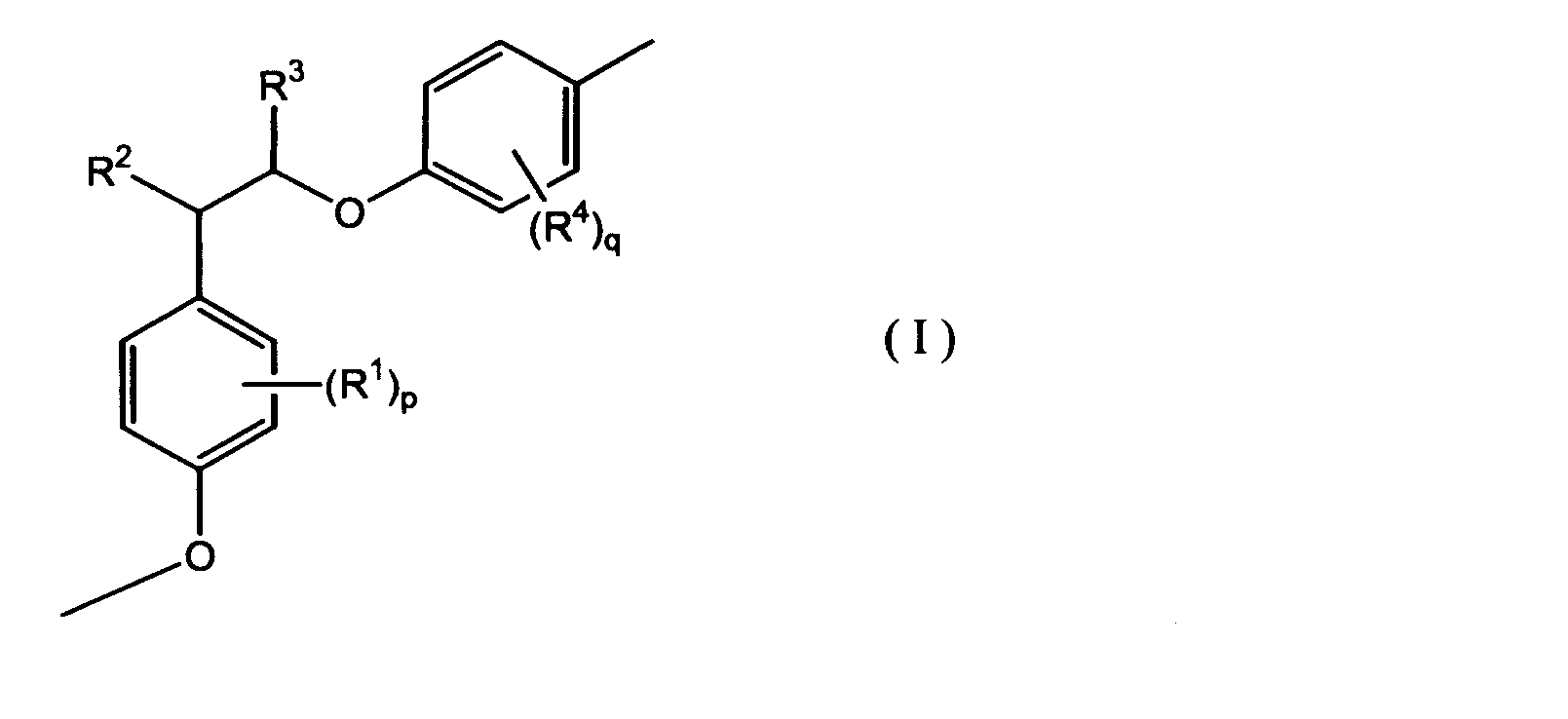
〔式中、R1及びR4はアルキル基、アリール基、アルコキシ基、アラルキル基又はフェノキシ基を示し、R2はヒドロキシアリール基又はアルキル置換ヒドロキシアリール基を示し、R3はヒドロキシアルキル基、アルキル基、アリール基、アルキル置換アリール基又は-OR5(R5は水素原子、アルキル基又はアリール基を示す)を示し、水素原子以外のR1~R5はそれぞれ置換基を有していてもよく、p及びqは0~4の整数を示す。ただし、pが2以上である場合、複数のR1はそれぞれ同じであっても異なっていてもよく、また、qが2以上である場合、複数のR4はそれぞれ同じであっても異なっていてもよい。〕
2.(A)成分の熱可塑性樹脂がポリカーボネート樹脂40~100質量%及びポリカーボネート樹脂以外の熱可塑性樹脂60~0質量%からなる上記1に記載の熱可塑性樹脂組成物。
3.(C)成分のリン系難燃剤がハロゲンを含まないものである上記1又は2に記載の熱可塑性樹脂組成物。
4.(C)成分のリン系難燃剤がリン酸エステルである上記1~3のいずれかに記載の熱可塑性樹脂組成物。
5.上記1~4のいずれかに記載の熱可塑性樹脂組成物を成形してなる成形体。
2.(A)成分の熱可塑性樹脂がポリカーボネート樹脂40~100質量%及びポリカーボネート樹脂以外の熱可塑性樹脂60~0質量%からなる上記1に記載の熱可塑性樹脂組成物。
3.(C)成分のリン系難燃剤がハロゲンを含まないものである上記1又は2に記載の熱可塑性樹脂組成物。
4.(C)成分のリン系難燃剤がリン酸エステルである上記1~3のいずれかに記載の熱可塑性樹脂組成物。
5.上記1~4のいずれかに記載の熱可塑性樹脂組成物を成形してなる成形体。
本発明によれば、環境にやさしいバイオマス原料であるリグノフェノール及びリン系難燃剤を用いることにより、成形時の着色を抑制するとともに流動性、成形外観、耐湿熱性に優れ、かつ難燃性に極めて優れた熱可塑性樹脂組成物及びそれを用いた成形体を得ることができる。特に熱可塑性樹脂としてポリカーボネート樹脂を用いれば、優れた耐熱性及び耐衝撃性を得ることができるとともに、ポリカーボネート樹脂はリグノフェノールとの親和性がよいため、非相溶ポリマーアロイのような成形品の表層剥離や外観不良が見られない。さらに、バイオマス度(植物化度)を高めることにより、二酸化炭素排出量削減や化石原料低減等環境対応に優れた熱可塑性樹脂組成物及びそれを用いた成形体を提供することができる。
本発明の熱可塑性樹脂組成物は、(A)熱可塑性樹脂と(B)特定構造を有するリグノフェノール及び(C)リン系難燃剤を含む熱可塑性樹脂組成物である。以下、各成分及びその他添加し得る成分について説明する。
[(A)熱可塑性樹脂]
本発明において(A)熱可塑性樹脂としては、例えば、ポリカーボネート樹脂、スチレン系樹脂、ポリエチレン樹脂、ポリプロピレン樹脂、ポリメチルメタクリレート樹脂、ポリ塩化ビニル樹脂、酢酸セルロース樹脂、ポリアミド樹脂、ポリエステル樹脂(PET、PBT等)、ポリ乳酸及び/又はポリ乳酸を含む共重合体、ポリアクリロニトリル樹脂、アクリロニトリル-ブタジエン-スチレン樹脂(ABS樹脂)、ポリフェニレンオキサイド樹脂(PPO)、ポリケトン樹脂、ポリスルホン樹脂、ポリフェニレンスルフィド樹脂(PPS)、フッ素樹脂、ケイ素樹脂、ポリイミド樹脂、ポリベンズイミダゾール樹脂、ポリアミドエラストマー等、及びこれらと他のモノマーとの共重合体が挙げられる。
本発明に用いられる、(A)熱可塑性樹脂としては、(B)成分であるリグノフェノールとの親和性の観点から分子構造中に芳香族基を有する熱可塑性樹脂、例えば、芳香族ポリカーボネート樹脂、スチレン系樹脂、芳香族ポリアミド樹脂、芳香族ポリエステル樹脂等が好ましい。
さらに、(A)熱可塑性樹脂として、ポリカーボネート樹脂を用いることにより、ポリカーボネート樹脂が有する優れた耐衝撃性及び耐熱性を、得られる組成物に付与することができる。従って、熱可塑性樹脂としてポリカーボネート樹脂又はポリカーボネート樹脂とその他の熱可塑性樹脂との混合物を用いることが好ましい。
以下、(A)熱可塑性樹脂として好ましいポリカーボネート樹脂について説明する。
本発明において(A)熱可塑性樹脂としては、例えば、ポリカーボネート樹脂、スチレン系樹脂、ポリエチレン樹脂、ポリプロピレン樹脂、ポリメチルメタクリレート樹脂、ポリ塩化ビニル樹脂、酢酸セルロース樹脂、ポリアミド樹脂、ポリエステル樹脂(PET、PBT等)、ポリ乳酸及び/又はポリ乳酸を含む共重合体、ポリアクリロニトリル樹脂、アクリロニトリル-ブタジエン-スチレン樹脂(ABS樹脂)、ポリフェニレンオキサイド樹脂(PPO)、ポリケトン樹脂、ポリスルホン樹脂、ポリフェニレンスルフィド樹脂(PPS)、フッ素樹脂、ケイ素樹脂、ポリイミド樹脂、ポリベンズイミダゾール樹脂、ポリアミドエラストマー等、及びこれらと他のモノマーとの共重合体が挙げられる。
本発明に用いられる、(A)熱可塑性樹脂としては、(B)成分であるリグノフェノールとの親和性の観点から分子構造中に芳香族基を有する熱可塑性樹脂、例えば、芳香族ポリカーボネート樹脂、スチレン系樹脂、芳香族ポリアミド樹脂、芳香族ポリエステル樹脂等が好ましい。
さらに、(A)熱可塑性樹脂として、ポリカーボネート樹脂を用いることにより、ポリカーボネート樹脂が有する優れた耐衝撃性及び耐熱性を、得られる組成物に付与することができる。従って、熱可塑性樹脂としてポリカーボネート樹脂又はポリカーボネート樹脂とその他の熱可塑性樹脂との混合物を用いることが好ましい。
以下、(A)熱可塑性樹脂として好ましいポリカーボネート樹脂について説明する。
(ポリカーボネート樹脂)
(A)熱可塑性樹脂としてのポリカーボネート樹脂は、芳香族ポリカーボネート樹脂であっても脂肪族ポリカーボネート樹脂であってもよいが、前述したように(B)成分との親和性の観点及び耐衝撃性と耐熱性の観点から芳香族ポリカーボネート樹脂を用いることが好ましい。
〈芳香族ポリカーボネート樹脂〉
芳香族ポリカーボネート樹脂としては、通常、二価フェノールとカーボネート前駆体との反応により製造される芳香族ポリカーボネート樹脂を用いることができる。芳香族ポリカーボネート樹脂は、他の熱可塑性樹脂に比べて、耐熱性、難燃性及び耐衝撃性が良好であるため樹脂組成物の主成分とすることができる。
(A)熱可塑性樹脂としてのポリカーボネート樹脂は、芳香族ポリカーボネート樹脂であっても脂肪族ポリカーボネート樹脂であってもよいが、前述したように(B)成分との親和性の観点及び耐衝撃性と耐熱性の観点から芳香族ポリカーボネート樹脂を用いることが好ましい。
〈芳香族ポリカーボネート樹脂〉
芳香族ポリカーボネート樹脂としては、通常、二価フェノールとカーボネート前駆体との反応により製造される芳香族ポリカーボネート樹脂を用いることができる。芳香族ポリカーボネート樹脂は、他の熱可塑性樹脂に比べて、耐熱性、難燃性及び耐衝撃性が良好であるため樹脂組成物の主成分とすることができる。
二価フェノールとしては、4,4’-ジヒドロキシジフェニル;1,1-ビス(4-ヒドロキシフェニル)メタン、1,1-ビス(4-ヒドロキシフェニル)エタン、及び2,2-ビス(4-ヒドロキシフェニル)プロパン〔ビスフェノールA〕等のビス(4-ヒドロキシフェニル)アルカン;ビス(4-ヒドロキシフェニル)シクロアルカン;ビス(4-ヒドロキシフェニル)オキシド;ビス(4-ヒドロキシフェニル)スルフィド;ビス(4-ヒドロキシフェニル)スルホン;ビス(4-ヒドロキシフェニル)スルホキシド;ビス(4-ヒドロキシフェニル)ケトン等を挙げることができる。なかでも、ビスフェノールAが好ましい。二価フェノールとしては、これらの二価フェノールの一種を用いたホモポリマーでも、二種以上を用いたコポリマーであってもよい。さらに、多官能性芳香族化合物を二価フェノールと併用して得られる熱可塑性ランダム分岐ポリカーボネート樹脂であってもよい。
カーボネート前駆体としては、カルボニルハライド、ハロホーメート、炭酸エステル等が挙げられ、具体的にはホスゲン、二価フェノールのジハロホーメート、ジフェニルカーボネート、ジメチルカーボネート、及びジエチルカーボネート等が挙げられる。
カーボネート前駆体としては、カルボニルハライド、ハロホーメート、炭酸エステル等が挙げられ、具体的にはホスゲン、二価フェノールのジハロホーメート、ジフェニルカーボネート、ジメチルカーボネート、及びジエチルカーボネート等が挙げられる。
本発明で用いる芳香族ポリカーボネート樹脂の製造においては、必要に応じて末端停止剤を用いることができ、例えば、下記一般式(II)で表される一価フェノール化合物が挙げられる。
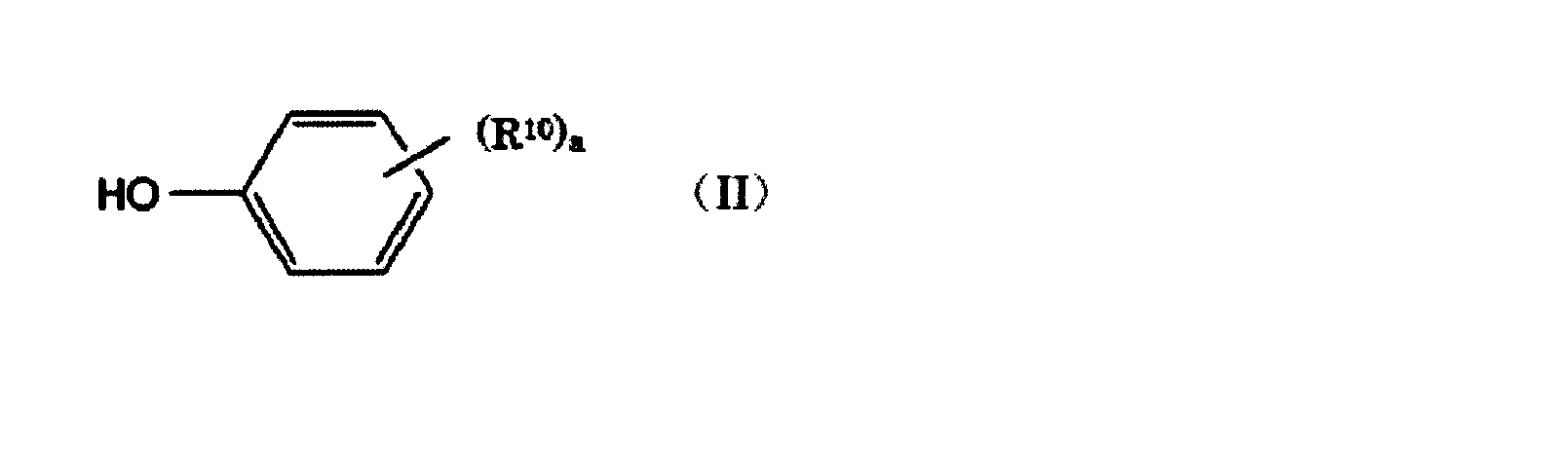
(式中、R10は炭素数1~35のアルキル基を示し、aは0~5の整数を示す。)
一般式(II)で表される一価フェノール化合物としてはパラ置換体が好ましい。一価フェノール化合物の具体例としては、フェノール、p-クレゾール、p-tert-ブチルフェノール、p-tert-オクチルフェノール、p-クミルフェノール、p-ノニルフェノール、及びp-tert-アミルフェノール等を挙げることができる。これらの一価フェノールはそれぞれ単独で用いてもよいし、二種以上を組み合わせて用いてもよい。
一般式(II)で表される一価フェノール化合物としてはパラ置換体が好ましい。一価フェノール化合物の具体例としては、フェノール、p-クレゾール、p-tert-ブチルフェノール、p-tert-オクチルフェノール、p-クミルフェノール、p-ノニルフェノール、及びp-tert-アミルフェノール等を挙げることができる。これらの一価フェノールはそれぞれ単独で用いてもよいし、二種以上を組み合わせて用いてもよい。
本発明で用いる芳香族ポリカーボネート樹脂は、分岐構造を有していてもよい。分岐構造を導入するためには分岐剤を用いればよく、例えば1,1,1-トリス(4-ヒドキシフェニル)エタン;α,α’,α”-トリス(4-ヒドロキシフェニル)-1,3,5-トリイソプロピルベンゼン;1-〔α-メチル-α-(4’-ヒドロキシフェニル)エチル〕-4-〔α’,α’-ビス(4”-ヒドロキシフェニル)エチル〕ベンゼン;フロログルシン、トリメリット酸、及びイサチンビス(o-クレゾール)等の官能基を三個以上有する化合物等を用いることができる。
本発明で用いる芳香族ポリカーボネート樹脂の粘度平均分子量は、樹脂組成物の物性面から、10,000~40,000であることが好ましく、13,000~30,000であることがより好ましい。
本発明で用いる芳香族ポリカーボネート樹脂の粘度平均分子量は、樹脂組成物の物性面から、10,000~40,000であることが好ましく、13,000~30,000であることがより好ましい。
また、本発明において、芳香族ポリカーボネート樹脂として、芳香族ポリカーボネート-ポリオルガノシロキサン共重合体であるか又は芳香族ポリカーボネート-ポリオルガノシロキサン共重合体を含むものを用いる場合、難燃性及び低温における耐衝撃性をさらに向上することができる。該共重合体を構成するポリオルガノシロキサンは、ポリジメチルシロキサンであることが難燃性の点からより好ましい。
本発明において、ポリカーボネート樹脂、好ましくは芳香族ポリカーボネート樹脂をその他の熱可塑性樹脂と混合して用いる場合、ポリカーボネート樹脂を40質量%以上、好ましくは50質量%となるように用いることにより機械的強度(耐衝撃性、耐熱性等)を維持できる。ポリカーボネート樹脂、好ましくは芳香族ポリカーボネート樹脂と混合して用いられるその他の熱可塑性樹脂は、前述した(A)熱可塑性樹脂の中から任意に選択されるが、ポリカーボネート樹脂との相溶性の観点からポリエステル樹脂(PET、PBT等)、ポリ乳酸及び/又はポリ乳酸を含む共重合体、アクリロニトリル-ブタジエン-スチレン樹脂等のスチレン系樹脂が好ましい。
[(B)リグノフェノール]
本発明において(B)リグノフェノールは、下記一般式(I)で表される構造を有する。
本発明において(B)リグノフェノールは、下記一般式(I)で表される構造を有する。

一般式(I)中、R1及びR4はアルキル基(好ましくは炭素数1~4のアルキル基であり、具体的にはメチル基、エチル基、プロピル基等)、アリール基(好ましくは炭素数6~10のアリール基であり、具体的にはフェニル基等)、アルコキシ基(好ましくは炭素数1~4のアルコキシ基であり、具体的にはメトキシ基、エトキシ基、プロポキシ基等)、アラルキル基(好ましくは炭素数12~20のアラルキル基であり、具体的にはベンジル基等)又はフェノキシ基を示す。
R2は、ヒドロキシアリール基(好ましくは炭素数6~14のヒドロキシアリール基であり、具体的には2-ヒドロキシフェニル基、3-ヒドロキシフェニル基、4-ヒドロキシフェニル基等)又はアルキル置換ヒドロキシアリール基(好ましくは炭素数7~18のヒドロキシアリール基であり、具体的には2-ヒドロキシ-5-メチルフェニル基、3-ヒドロキシ-5-メチルフェニル基、4-ヒドロキシ-5-メチルフェニル基等)を示し、R3はヒドロキシアルキル基(好ましくは炭素数1~4のヒドロキシアルキル基であり、具体的にはヒドロキシメチル基、ヒドロキシエチル基等)、アルキル基(好ましくは炭素数1~4のアルキル基であり、具体的にはメチル基、エチル基、プロピル基等)、アリール基(好ましくは炭素数6~10のアリール基であり、具体的にはフェニル基等)、アルキル置換アリール基(好ましくは炭素数1~10のアルキル基で置換されたアリール基であり、具体的にはトルイル基、キシリル基等)又は-OR5(R5は水素原子、アルキル基、好ましくは炭素数1~10のアルキル基又はアリール基、好ましくは炭素数6~10のアリール基を示す)を示す。
水素原子以外のR1~R5はそれぞれ置換基を有していてもよく、p及びqは0~4の整数を示す。
ただし、pが2以上である場合、複数のR1はそれぞれ同じであっても異なっていてもよく、また、qが2以上である場合、複数のR4はそれぞれ同じであっても異なっていてもよい。
ただし、pが2以上である場合、複数のR1はそれぞれ同じであっても異なっていてもよく、また、qが2以上である場合、複数のR4はそれぞれ同じであっても異なっていてもよい。
本発明において上記一般式(I)で表される構造は、天然由来の構造が好ましい。
天然由来構造の場合、上記一般式(I)中のR1及びR4は樹種によって決まり、R1及びR4で示される置換基はメトキシ基であって、p及びqがそれぞれ1又は2の構造、あるいはR1及びR4で示される置換基の一方又は両方を有さない構造のみが存在する。
例えば、一般に針葉樹はメトキシ基が1つの3-置換体であり、広葉樹・草本類はメトキシ基が1つの3-置換体と、メトキシ基が2つの3,5-置換体とが1:1で存在する。また、いずれの樹種も幼樹の場合、メトキシ基である上記置換基を一部有さない構造が含まれることがある。
天然由来構造の場合、上記一般式(I)中のR1及びR4は樹種によって決まり、R1及びR4で示される置換基はメトキシ基であって、p及びqがそれぞれ1又は2の構造、あるいはR1及びR4で示される置換基の一方又は両方を有さない構造のみが存在する。
例えば、一般に針葉樹はメトキシ基が1つの3-置換体であり、広葉樹・草本類はメトキシ基が1つの3-置換体と、メトキシ基が2つの3,5-置換体とが1:1で存在する。また、いずれの樹種も幼樹の場合、メトキシ基である上記置換基を一部有さない構造が含まれることがある。
R3は、天然由来構造においてヒドロキシメチル基である。
R2は、天然由来構造であっても上述と同じく、ヒドロキシアリール基(好ましくは炭素数6~14のヒドロキシアリール基であり、具体的には2-ヒドロキシフェニル基、3-ヒドロキシフェニル基、4-ヒドロキシフェニル基等)又はアルキル置換ヒドロキシアリール基(好ましくは炭素数7~18のヒドロキシアリール基であり、具体的には2-ヒドロキシ-5-メチルフェニル基、3-ヒドロキシ-5-メチルフェニル基、4-ヒドロキシ-5-メチルフェニル基等)等を示す。
本発明において、天然由来構造のR2を自在に制御することにより、(B)リグノフェノールとしてのバリエーションを増やすことができる。
R2は、天然由来構造であっても上述と同じく、ヒドロキシアリール基(好ましくは炭素数6~14のヒドロキシアリール基であり、具体的には2-ヒドロキシフェニル基、3-ヒドロキシフェニル基、4-ヒドロキシフェニル基等)又はアルキル置換ヒドロキシアリール基(好ましくは炭素数7~18のヒドロキシアリール基であり、具体的には2-ヒドロキシ-5-メチルフェニル基、3-ヒドロキシ-5-メチルフェニル基、4-ヒドロキシ-5-メチルフェニル基等)等を示す。
本発明において、天然由来構造のR2を自在に制御することにより、(B)リグノフェノールとしてのバリエーションを増やすことができる。
上記一般式(I)で示されるリグノフェノールの重量平均分子量は、ポリスチレン換算で1,000~200,000であることが好ましく、より好ましくは3,000~100,000である。そして、上記一般式(I)で示されるリグノフェノールの両末端基はフェノール性水酸基であることが望ましい。
また、本発明において用いることができる(B)成分の上記一般式(I)で表される具体的な構造としては、例えば下記式(III)で表すリグノクレゾール構造が挙げられる。
また、本発明において用いることができる(B)成分の上記一般式(I)で表される具体的な構造としては、例えば下記式(III)で表すリグノクレゾール構造が挙げられる。
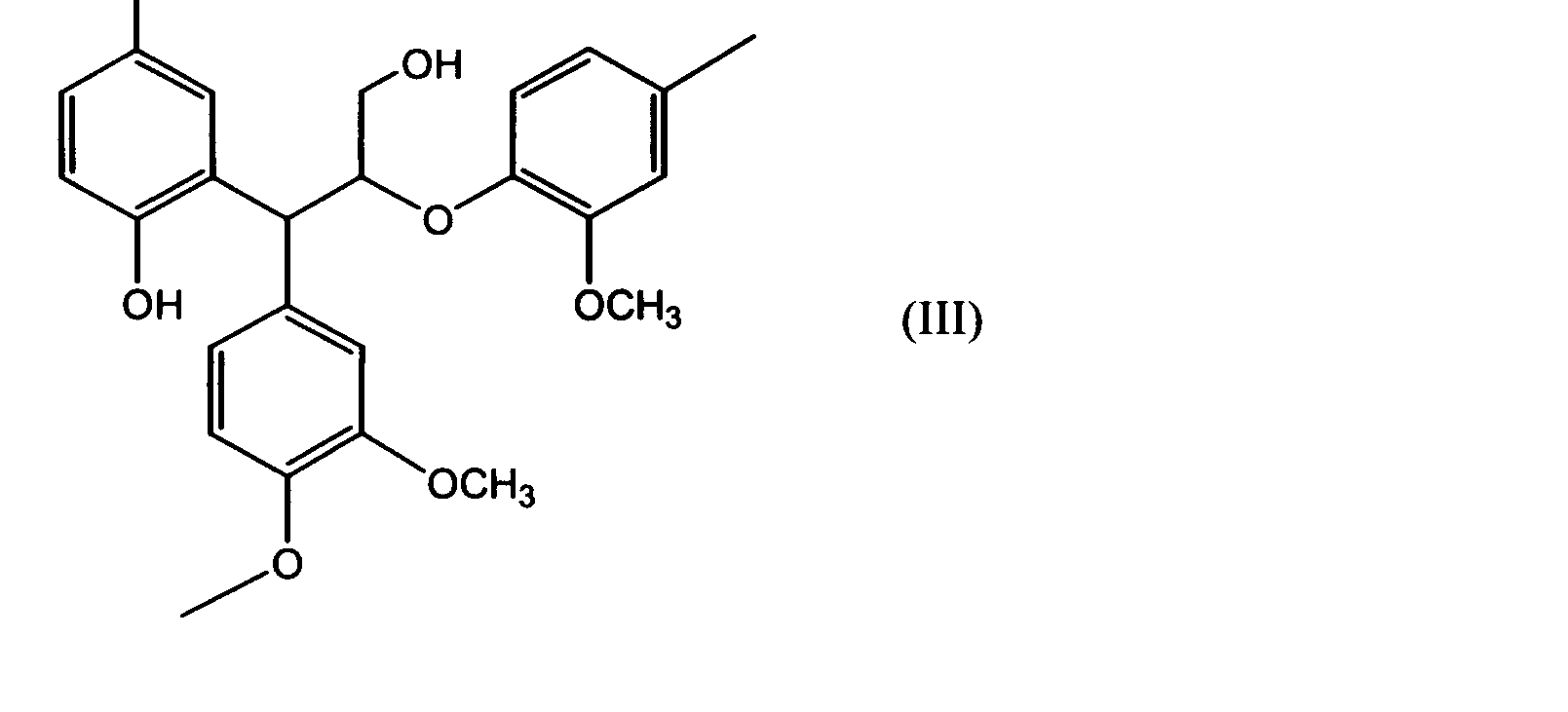
(リグノフェノール)
リグノフェノールとは、材木や紙等に含まれるリグニンから誘導される化合物であり、リグニンは、例えば木の細胞骨格を形成する炭水化物の隙間に充填されている、細胞間の接着物質として働くものである。リグニンの構造は非常に複雑であり、そのまま使用することは困難であるため、リグノフェノールに変換して用いることが有用である。
リグノフェノールとは、材木や紙等に含まれるリグニンから誘導される化合物であり、リグニンは、例えば木の細胞骨格を形成する炭水化物の隙間に充填されている、細胞間の接着物質として働くものである。リグニンの構造は非常に複雑であり、そのまま使用することは困難であるため、リグノフェノールに変換して用いることが有用である。
((B)リグノフェノールの製造方法)
本発明の(B)成分は、木材や紙等のリグノセルロース系物質にフェノール誘導体を添加した後、酸で加水分解してリグノフェノールと炭水化物とに分離することにより得ることができる。また、(B)成分は上記リグノフェノールのアルカリ処理誘導体、あるいは上記リグノフェノール又は上記リグノフェノールのアルカリ処理誘導体における水酸基を保護した誘導体を含むものである。
本発明の(B)成分は、木材や紙等のリグノセルロース系物質にフェノール誘導体を添加した後、酸で加水分解してリグノフェノールと炭水化物とに分離することにより得ることができる。また、(B)成分は上記リグノフェノールのアルカリ処理誘導体、あるいは上記リグノフェノール又は上記リグノフェノールのアルカリ処理誘導体における水酸基を保護した誘導体を含むものである。
リグノセルロース系物質としては、木質化した材料、主として木材である各種材料、例えば、木粉、チップ、廃材、及び端材等を挙げることができる。また用いる木材としては、針葉樹や広葉樹等任意の種類のものを使用するこができる。さらに、各種草本植物、それに関連する試料、例えば、農産廃棄物等も使用できる。
これらの材料を用いてリグノフェノールを分離する際、分離過程において加熱及び加圧しないで得られたものが好ましく用いられる。
これらの材料を用いてリグノフェノールを分離する際、分離過程において加熱及び加圧しないで得られたものが好ましく用いられる。
フェノール誘導体としては、1価のフェノール誘導体、2価のフェノール誘導体又は3価のフェノール誘導体等を用いることができる。1価のフェノール誘導体の具体例としては、フェノール、ナフトール、アントロール、アントロキノンオール等が挙げられ、それぞれ1以上の置換基を有していてもよい。2価のフェノール誘導体の具体例としては、レゾルシノール、ヒドロキノン等が挙げられ、それぞれ1以上の置換基を有していてもよい。3価のフェノール誘導体の具体例としては、ピロガロール等が挙げられ、1以上の置換基を有していてもよい。
例えば、ヒドロキシアントラセン、メトキシフェノール(モノ・ジ・トリ)、メチルカテコール、ビフェニル、ジメチルヒドロキシアリール、トリメチルヒドロキシアリール等の上記に挙げた以外を含むものもフェノール誘導体として用いることができる。
例えば、ヒドロキシアントラセン、メトキシフェノール(モノ・ジ・トリ)、メチルカテコール、ビフェニル、ジメチルヒドロキシアリール、トリメチルヒドロキシアリール等の上記に挙げた以外を含むものもフェノール誘導体として用いることができる。
フェノール誘導体が有していてもよい置換基の種類は特に限定されず、任意の置換基を有していてもよいが、好ましくは電子吸引性の基(ハロゲン原子等)以外の基であり、例えば、アルキル基(メチル基、エチル基、プロピル基等)、アルコキシ基(メトキシ基、エトキシ基、プロポキシ基等)、及びアリール基(フェニル基等)等が挙げられる。また、フェノール誘導体上のフェノール性水酸基の2つあるオルト位のうちの少なくとも片方は無置換であることが好ましい。フェノール誘導体の特に好ましい例は、クレゾール、特にm-クレゾール又はp-クレゾールである。
酸としては、セルロースに対する膨潤性を有する酸が好ましい。酸の具体例としては、例えば濃度65質量%以上の硫酸(例えば、72質量%の硫酸)、85質量%以上のリン酸、38質量%以上の塩酸、p-トルエンスルホン酸、トリフルオロ酢酸、トリクロロ酢酸、及びギ酸等を挙げることができる。
上記のようにして得られたリグノフェノールの抽出分離方法としては、例えば、次の2種類の方法が挙げられる。
第1の方法は、特許第2895087号公報に記載されている方法である。具体的には、木粉等のリグノセルロース系物質に液状のフェノール誘導体を浸透させることによりリグニンをフェノール誘導体に溶媒和させ、次に濃酸を添加してリグノセルロース系材料を溶解させる。このとき、リグニン基本構成単位の側鎖α位のカチオンが、フェノール誘導体により攻撃され、ベンジル位にフェノール誘導体が導入されたリグノフェノールがフェノール誘導体相に生成される。そして、フェノール誘導体相からリグノフェノールを抽出する方法である。
フェノール誘導体相からのリグノフェノールの抽出は、フェノール誘導体相を、大過剰のエチルエーテルに加えて得た沈殿物を集めて、アセトンに溶解する。アセトン不溶部を遠心分離により除去し、アセトン可溶部を濃縮する。このアセトン可溶部を、大過剰のエチルエーテルに滴下し、沈殿区分を集める。この沈殿区分から溶媒を留去した後、乾燥処理し、乾燥物としてリグノフェノールを得る。なお、粗リグノフェノールは、フェノール誘導体相を単に減圧蒸留により除去することで得られる。また、アセトン可溶部を、そのままリグノフェノール溶液として、誘導体化処理(アルカリ処理)に用いることもできる。
第1の方法は、特許第2895087号公報に記載されている方法である。具体的には、木粉等のリグノセルロース系物質に液状のフェノール誘導体を浸透させることによりリグニンをフェノール誘導体に溶媒和させ、次に濃酸を添加してリグノセルロース系材料を溶解させる。このとき、リグニン基本構成単位の側鎖α位のカチオンが、フェノール誘導体により攻撃され、ベンジル位にフェノール誘導体が導入されたリグノフェノールがフェノール誘導体相に生成される。そして、フェノール誘導体相からリグノフェノールを抽出する方法である。
フェノール誘導体相からのリグノフェノールの抽出は、フェノール誘導体相を、大過剰のエチルエーテルに加えて得た沈殿物を集めて、アセトンに溶解する。アセトン不溶部を遠心分離により除去し、アセトン可溶部を濃縮する。このアセトン可溶部を、大過剰のエチルエーテルに滴下し、沈殿区分を集める。この沈殿区分から溶媒を留去した後、乾燥処理し、乾燥物としてリグノフェノールを得る。なお、粗リグノフェノールは、フェノール誘導体相を単に減圧蒸留により除去することで得られる。また、アセトン可溶部を、そのままリグノフェノール溶液として、誘導体化処理(アルカリ処理)に用いることもできる。
第2の方法は、特開2001-64494号公報に記載されている方法である。具体的には、リグノセルロース系物質に、固体状あるいは液体状のフェノール誘導体を溶解した溶媒を浸透させた後、溶媒を留去する(フェノール誘導体の収着工程)。次に、このリグノセルロース系材料に濃酸を添加してセルロース成分を溶解させ、第1の方法と同様リグノフェノールがフェノール誘導体相に生成され、リグノフェノールを抽出する方法である。
リグノフェノールの抽出は、第1の方法と同様にして行うことができる。あるいは、他の抽出方法として、濃酸処理後の全反応液を過剰の水中に投入し、不溶区分を遠心分離にて集め、脱酸後、乾燥する。この乾燥物にアセトンあるいはアルコールを加えてリグノフェノールを抽出する。さらに、この可溶区分を第1の方法と同様に、過剰のエチルエーテル等に滴下して、リグノフェノールを不溶区分として得る方法である。
リグノフェノールの抽出は、第1の方法と同様にして行うことができる。あるいは、他の抽出方法として、濃酸処理後の全反応液を過剰の水中に投入し、不溶区分を遠心分離にて集め、脱酸後、乾燥する。この乾燥物にアセトンあるいはアルコールを加えてリグノフェノールを抽出する。さらに、この可溶区分を第1の方法と同様に、過剰のエチルエーテル等に滴下して、リグノフェノールを不溶区分として得る方法である。
これら第1又は第2の2種類の方法においては、第2の方法が、なかでも特に後者の抽出方法、すなわち、リグノフェノールをアセトンあるいはアルコールにて抽出分離する方法が、フェノール誘導体の使用量が少なくてすむため経済的である。また、この方法が、少量のフェノール誘導体で、多くのリグノセルロース系材料を処理できるため、リグノフェノールの大量合成に適している。
上記方法で得られた本発明の(B)成分は、一般的には以下のような特徴を有する。ただし、本発明で用いる(B)成分の特徴は以下のものに限定されることはない。
(1)重量平均分子量は約1,000~200,000程度である。
(2)分子内に共役系をほとんど有さず、その色調は極めて淡色である。
(3)針葉樹由来のもので約170℃、広葉樹由来のもので約130℃に融点を有する。
(4)側鎖α位へのフェノール誘導体の選択的グラフティングの結果、フェノール性水酸基量が非常に多く、高いフェノール特性が付与されたリグニン誘導体である。
(5)リグニン構成単位の芳香核と側鎖α位にグラフティングされたフェノール誘導体の芳香核とでジフェニルメタン型構造を形成し、自己縮合は抑制されている。
(6)メタノール、エタノール、アセトン、ジオキサン、ピリジン、THF(テトラヒドロフラン)、DMF(ジメチルホルムアミド)等各種溶媒に容易に溶解する。
(1)重量平均分子量は約1,000~200,000程度である。
(2)分子内に共役系をほとんど有さず、その色調は極めて淡色である。
(3)針葉樹由来のもので約170℃、広葉樹由来のもので約130℃に融点を有する。
(4)側鎖α位へのフェノール誘導体の選択的グラフティングの結果、フェノール性水酸基量が非常に多く、高いフェノール特性が付与されたリグニン誘導体である。
(5)リグニン構成単位の芳香核と側鎖α位にグラフティングされたフェノール誘導体の芳香核とでジフェニルメタン型構造を形成し、自己縮合は抑制されている。
(6)メタノール、エタノール、アセトン、ジオキサン、ピリジン、THF(テトラヒドロフラン)、DMF(ジメチルホルムアミド)等各種溶媒に容易に溶解する。
また、上記方法で得られた(B)成分は、さらにアルカリ処理することにより誘導体化してから用いることができる。
天然リグニンより相分離プロセスにより得られたリグノフェノールは、その活性炭素のα位がフェノール誘導体でブロックされているので、総体として安定である。しかし、アルカリ性条件下ではそのフェノール性水酸基は容易に解離し、生じたフェノキシドイオンは立体的に可能な場合には隣接炭素のβ位を攻撃する。これによりβ位のアリールエーテル結合は開裂し、リグノフェノールは低分子化され、さらに導入フェノール核にあったフェノール性水酸基がリグニン母体へと移動する。したがって、アルカリ処理された誘導体はアルカリ処理する前のリグノフェノールよりも疎水性が向上することが期待される。
このときγ位の炭素に存在するアルコキシドイオンあるいはリグニン芳香核のカルバニオンがβ位を攻撃することも期待されるが、これはフェノキシドイオンに比べはるかに高いエネルギーを必要とする。したがって、緩和なアルカリ性条件下では導入フェノール核のフェノール性水酸基の隣接基効果が優先的に発現し、より厳しい条件下ではさらなる反応が起こり、いったんエーテル化されたクレゾール核のフェノール性水酸基が再生し、これによりリグノフェノールはさらに低分子化されるとともに水酸基が増えることにより親水性が上がることが期待される。
天然リグニンより相分離プロセスにより得られたリグノフェノールは、その活性炭素のα位がフェノール誘導体でブロックされているので、総体として安定である。しかし、アルカリ性条件下ではそのフェノール性水酸基は容易に解離し、生じたフェノキシドイオンは立体的に可能な場合には隣接炭素のβ位を攻撃する。これによりβ位のアリールエーテル結合は開裂し、リグノフェノールは低分子化され、さらに導入フェノール核にあったフェノール性水酸基がリグニン母体へと移動する。したがって、アルカリ処理された誘導体はアルカリ処理する前のリグノフェノールよりも疎水性が向上することが期待される。
このときγ位の炭素に存在するアルコキシドイオンあるいはリグニン芳香核のカルバニオンがβ位を攻撃することも期待されるが、これはフェノキシドイオンに比べはるかに高いエネルギーを必要とする。したがって、緩和なアルカリ性条件下では導入フェノール核のフェノール性水酸基の隣接基効果が優先的に発現し、より厳しい条件下ではさらなる反応が起こり、いったんエーテル化されたクレゾール核のフェノール性水酸基が再生し、これによりリグノフェノールはさらに低分子化されるとともに水酸基が増えることにより親水性が上がることが期待される。
さらに、リグノフェノール及びそれをアルカリ処理したリグノフェノール誘導体には、フェノール性及びアルコール性水酸基が存在するため多様な特性を示すことになる。この水酸基を保護することにより異なる別の特性を示す誘導体を得ることができる。水酸基を保護する方法としては、例えば、アシル基(例えば、アセチル基、プロピオニル基、ベンジル基等が挙げられ、好ましくはアシル基)等の保護基で水酸基を保護することが挙げられる。また、ハイドロキシメチル化を行うことにより、新たなベンジル構造が生じ、よりバリエーションが広げることができる。
[(C)リン系難燃剤]
本発明において、(C)リン系難燃剤は、ハロゲンを含まないリン系難燃剤が好ましい。ハロゲンを含むと、成形時の有害ガスの発生、金型腐食の恐れや成形品の焼却時に有害物質を排出する恐れがあり、環境汚染、安全性の観点から好ましくない。
ハロゲンを含まないリン系難燃剤としては、ハロゲン非含有有機リン系難燃剤がある。有機リン系難燃剤としては、リン原子を有し、ハロゲンを含まない有機化合物であれば特に制限なく用いることができる。中でも、リン原子に直接結合するエステル性酸素原子を1つ以上有するリン酸エステル化合物が好ましく用いられる。有機リン系化合物以外のハロゲン非含有リン系難燃剤としては、赤リン等がある。
本発明において、(C)リン系難燃剤は、ハロゲンを含まないリン系難燃剤が好ましい。ハロゲンを含むと、成形時の有害ガスの発生、金型腐食の恐れや成形品の焼却時に有害物質を排出する恐れがあり、環境汚染、安全性の観点から好ましくない。
ハロゲンを含まないリン系難燃剤としては、ハロゲン非含有有機リン系難燃剤がある。有機リン系難燃剤としては、リン原子を有し、ハロゲンを含まない有機化合物であれば特に制限なく用いることができる。中でも、リン原子に直接結合するエステル性酸素原子を1つ以上有するリン酸エステル化合物が好ましく用いられる。有機リン系化合物以外のハロゲン非含有リン系難燃剤としては、赤リン等がある。
また、リン酸エステル化合物としては、特に制限はなく、ハロゲンを含まないものが好ましく、例えば、下記一般式(IV)
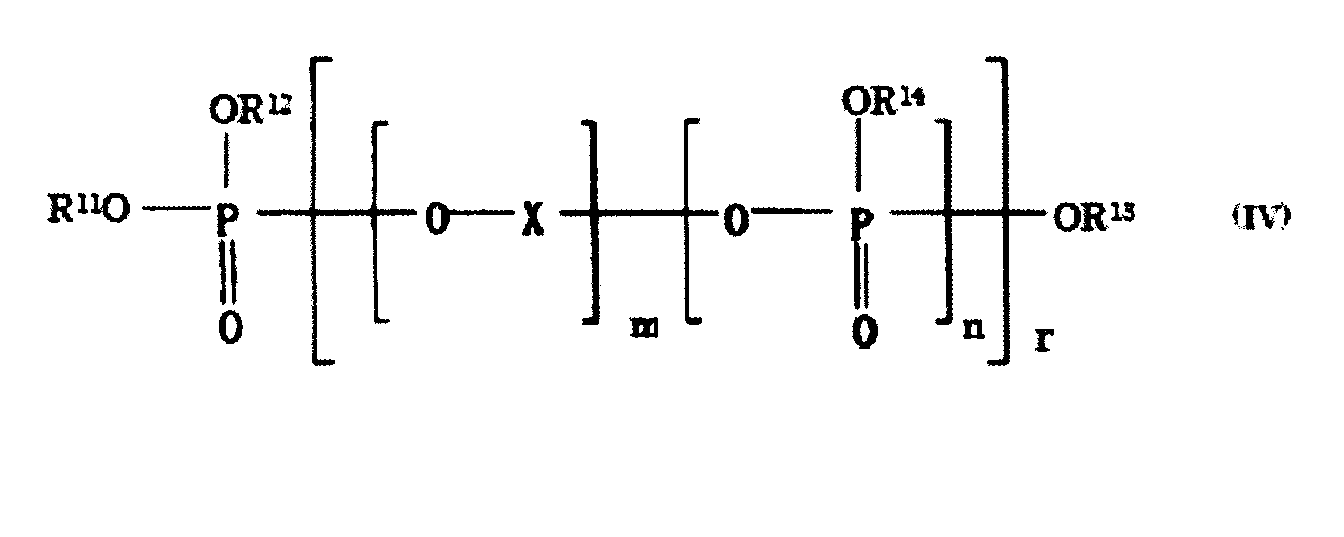
(式中、R11、R12、R13及びR14は、それぞれ独立して、水素原子又は有機基を示し、Xは2価以上の有機基を示し、mは0又は1であり、nは1以上の整数であり、rは0以上の整数を示す。)で表されるリン酸エステル化合物である。
式(IV)において、有機基とは、置換されていても、いなくてもよいアルキル基、シクロアルキル基、アリール基等である。また置換されている場合の置換基としては、アルキル基、アルコキシ基、アリール基、アリールオキシ基、アリールチオ基等がある。さらに、これらの置換基を組み合わせた基であるアリールアルコキシアルキル基等、又はこれらの置換基を酸素原子、窒素原子、イオウ原子等により結合して組み合わせたアリールスルホニルアリール基等を置換基としたもの等がある。
式(IV)において、有機基とは、置換されていても、いなくてもよいアルキル基、シクロアルキル基、アリール基等である。また置換されている場合の置換基としては、アルキル基、アルコキシ基、アリール基、アリールオキシ基、アリールチオ基等がある。さらに、これらの置換基を組み合わせた基であるアリールアルコキシアルキル基等、又はこれらの置換基を酸素原子、窒素原子、イオウ原子等により結合して組み合わせたアリールスルホニルアリール基等を置換基としたもの等がある。
また、式(IV)において、2価以上の有機基Xとしては、上記した有機基から、炭素原子に結合している水素原子の1個以上を除いてできる2価以上の基を意味する。例えば、アルキレン基、(置換)フェニレン基、多核フェノール類であるビスフェノール類から誘導されるものである。好ましいものとしては、ビスフェノールA、ヒドロキノン、レゾルシノール、ジフェニルメタン、ジヒドロキシジフェニル及びジヒドロキシナフタレン等が挙げられる。
リン酸エステル化合物は、モノマー、ダイマー、オリゴマー、ポリマーあるいはこれらの混合物であってもよい。具体的には、トリメチルホスフェート、トリエチルホスフェート、トリブチルホスフェート、トリオクチルホスフェート、トリブトキシエチルホスフェート、トリフェニルホスフェート、トリクレジルホスフェート、クレジルジフェニルホスフェート、オクチルジフェニルホスフェート、トリス(2-エチルヘキシル)ホスフェート、ジイソプロピルフェニルホスフェート、トリキシレニルホスフェート、トリス(イソプロピルフェニル)ホスフェート、トリナフチルホスフェート、ビスフェノールAビスホスフェート、ヒドロキノンビスホスフェート、レゾルシンビスホスフェート、レゾルシノール-ジフェニルホスフェート、トリオキシベンゼントリホスフェート、クレジルジフェニルホスフェート、あるいはこれらの置換体、縮合物等が挙げられる。
ここで、市販のハロゲン非含有リン酸エステル化合物としては、例えば、大八化学工業株式会社製の、TPP〔トリフェニルホスフェート〕、TXP〔トリキシレニルホスフェート〕、CR-733S〔レゾルシノールビス(ジフェニルホスフェート)〕、CR-741〔フェノールAビス(ジフェニルホスフェート)〕、PX-200〔1,3-フェニレン-テスラキス(2,6-ジメチルフェニル)リン酸エステル〕、PX-201〔1,4-フェニレン-テトラキス(2,6-ジメチルフェニル)リン酸エステル〕、PX-202〔4,4’-ビフェニレン-テスラキス(2,6-ジメチルフェニル)リン酸エステル〕等を挙げることができる。
[(A)熱可塑性樹脂、(B)リグノフェノール及び(C)リン系難燃剤との配合割合]
(A)熱可塑性樹脂、(B)リグノフェノール及び(C)リン系難燃剤との配合割合は、(A)成分100質量部に対して、(B)成分は1~40質量部であり、(C)成分は0.5~30質量部である。(B)成分が1質量部未満であると難燃性向上の効果を得ることがでず、40質量部を超えると成形時の着色を抑制する効果が低くなり好ましくない。好ましくは、(B)成分は、2~30質量部である。また、(C)成分が0.5質量部未満であると成形時の着色を抑制する効果が低くなり、成形品にシルバーが発生しやすくなり好ましくなく、また難燃性をより高度に高めることができない。そして、(C)成分が30質量部を超えると耐熱性や耐衝撃性等が低下することから好ましくない。好ましくは、(C)成分は、2~20質量部である。
(A)熱可塑性樹脂、(B)リグノフェノール及び(C)リン系難燃剤との配合割合は、(A)成分100質量部に対して、(B)成分は1~40質量部であり、(C)成分は0.5~30質量部である。(B)成分が1質量部未満であると難燃性向上の効果を得ることがでず、40質量部を超えると成形時の着色を抑制する効果が低くなり好ましくない。好ましくは、(B)成分は、2~30質量部である。また、(C)成分が0.5質量部未満であると成形時の着色を抑制する効果が低くなり、成形品にシルバーが発生しやすくなり好ましくなく、また難燃性をより高度に高めることができない。そして、(C)成分が30質量部を超えると耐熱性や耐衝撃性等が低下することから好ましくない。好ましくは、(C)成分は、2~20質量部である。
[添加剤成分]
本発明の熱可塑性樹脂組成物は、(A)成分、(B)成分及び(C)成分とともに、添加剤成分を必要により添加含有させることができる。例えば、フェノール系、リン系、イオウ系酸化防止剤、帯電防止剤、ポリアミドポリエーテルブロック共重合体(永久帯電防止性能付与)、ベンゾトリアゾール系やベンゾフェノン系の紫外線吸収剤、ヒンダードアミン系の光安定剤(耐候剤)、抗菌剤、相溶化剤、着色剤(染料、顔料)等が挙げられる。添加剤成分の配合量は、本発明の熱可塑性樹脂組成物の特性が維持される範囲であれば特に制限はない。
本発明の熱可塑性樹脂組成物は、(A)成分、(B)成分及び(C)成分とともに、添加剤成分を必要により添加含有させることができる。例えば、フェノール系、リン系、イオウ系酸化防止剤、帯電防止剤、ポリアミドポリエーテルブロック共重合体(永久帯電防止性能付与)、ベンゾトリアゾール系やベンゾフェノン系の紫外線吸収剤、ヒンダードアミン系の光安定剤(耐候剤)、抗菌剤、相溶化剤、着色剤(染料、顔料)等が挙げられる。添加剤成分の配合量は、本発明の熱可塑性樹脂組成物の特性が維持される範囲であれば特に制限はない。
[混練・成形]
本発明の熱可塑性樹脂組成物は、前記の(A)成分、(B)成分及び(C)成分を前記割合で、さらに必要に応じて用いられる添加剤成分を適当な割合で配合し、混練することにより得られる。このときの配合及び混練は、通常用いられている機器、例えばリボンブレンダー、ドラムタンブラー等で予備混合して、ヘンシェルミキサー、バンバリーミキサー、単軸スクリュー押出機、二軸スクリュー押出機、多軸スクリュー押出機、及びコニーダ等を用いる方法で行うことができる。
混練の際の加熱温度は、熱可塑性樹脂の種類により通常200~350℃の範囲で適宜選択されるが、熱可塑性樹脂としてポリカーボネート樹脂を用いる場合は240~300℃の範囲で選択される。
本発明の熱可塑性樹脂組成物は、上記の溶融混練成形機、あるいは、得られたペレットを原料として、射出成形法、射出圧縮成形法、押出成形法、ブロー成形法、プレス成形法、真空成形法、及び発泡成形法等により各種成形品を製造することができる。特に、上記溶融混練方法により、ペレット状の成形原料を製造し、次いでこのペレットを用いて、射出成形あるいは射出圧縮成形による射出成形品の製造に好適に用いることができる。
本発明の熱可塑性樹脂組成物は、前記の(A)成分、(B)成分及び(C)成分を前記割合で、さらに必要に応じて用いられる添加剤成分を適当な割合で配合し、混練することにより得られる。このときの配合及び混練は、通常用いられている機器、例えばリボンブレンダー、ドラムタンブラー等で予備混合して、ヘンシェルミキサー、バンバリーミキサー、単軸スクリュー押出機、二軸スクリュー押出機、多軸スクリュー押出機、及びコニーダ等を用いる方法で行うことができる。
混練の際の加熱温度は、熱可塑性樹脂の種類により通常200~350℃の範囲で適宜選択されるが、熱可塑性樹脂としてポリカーボネート樹脂を用いる場合は240~300℃の範囲で選択される。
本発明の熱可塑性樹脂組成物は、上記の溶融混練成形機、あるいは、得られたペレットを原料として、射出成形法、射出圧縮成形法、押出成形法、ブロー成形法、プレス成形法、真空成形法、及び発泡成形法等により各種成形品を製造することができる。特に、上記溶融混練方法により、ペレット状の成形原料を製造し、次いでこのペレットを用いて、射出成形あるいは射出圧縮成形による射出成形品の製造に好適に用いることができる。
本発明は、また前述した本発明の熱可塑性樹脂組成物を成形してなる成形体をも提供する。
本発明の熱可塑性樹脂組成物を成形してなる成形体、好ましくは射出成形体(射出圧縮を含む)は、複写機、ファックス、テレビ、ラジオ、テープレコーダー、ビデオデッキ、パソコン、プリンター、電話機、情報端末機、冷蔵庫、電子レンジ等のOA機器、家庭電化製品、電気・電子機器のハウジングや各種部品等に用いられる。
本発明の熱可塑性樹脂組成物を成形してなる成形体、好ましくは射出成形体(射出圧縮を含む)は、複写機、ファックス、テレビ、ラジオ、テープレコーダー、ビデオデッキ、パソコン、プリンター、電話機、情報端末機、冷蔵庫、電子レンジ等のOA機器、家庭電化製品、電気・電子機器のハウジングや各種部品等に用いられる。
本発明を実施例によりさらに詳しく説明するが、本発明はこれらにより何ら限定されるものではない。
各例で得られた樹脂組成物の性能試験は、次のとおり行った。
(1)メルトインデックス(MI):流動性
測定条件樹脂温260℃、荷重21.18Nにおいて、ASTM規格D-1238に準拠し測定した。
(2)熱変形温度(荷重たわみ温度):耐熱性
ASTM規格D-648に準拠し、荷重1.8MPaで測定した。熱変形温度は、耐熱性の目安を示すものである。
(3)酸素指数(LOI):難燃性
ASTM規格D-2863に準拠し測定した。酸素指数とは、試験片が燃焼を維持するのに必要な最低酸素濃度を空気中の容量%で示した値である。
(4)イエローインデックス(YI):着色性
13ショット目以降の成形品を5枚作製し、日本電色工業株式会社製の分光測色計Σ90で測定面積30φ、C2光源の透過法で測定しその平均値を求めた。成形品の着色性を示すものである。
(5)成形外観
成形外観は、成形温度260℃で射出成形した平板状試験片(80mm×80mm×1mm)を目視によりシルバー発生の有無を判定した。
○は、シルバーの発生が認められない。
×は、シルバーの発生が認められる。
(6)耐湿熱性
耐湿熱性は、60℃、湿度80%の環境下に300時間、平板状試験片(80mm×80mm×1mm)を放置した後、目視により表面変形の有無を判定した。
○は、表面の変形が認められない。
×は、表面のふくれ、変形が認められる。
(7)アイゾット衝撃強度(IZOD):耐衝撃性
厚さ1/8インチの試験片を用いて、ASTM規格D-256に準拠し、測定温度23℃にて測定した。
各例で得られた樹脂組成物の性能試験は、次のとおり行った。
(1)メルトインデックス(MI):流動性
測定条件樹脂温260℃、荷重21.18Nにおいて、ASTM規格D-1238に準拠し測定した。
(2)熱変形温度(荷重たわみ温度):耐熱性
ASTM規格D-648に準拠し、荷重1.8MPaで測定した。熱変形温度は、耐熱性の目安を示すものである。
(3)酸素指数(LOI):難燃性
ASTM規格D-2863に準拠し測定した。酸素指数とは、試験片が燃焼を維持するのに必要な最低酸素濃度を空気中の容量%で示した値である。
(4)イエローインデックス(YI):着色性
13ショット目以降の成形品を5枚作製し、日本電色工業株式会社製の分光測色計Σ90で測定面積30φ、C2光源の透過法で測定しその平均値を求めた。成形品の着色性を示すものである。
(5)成形外観
成形外観は、成形温度260℃で射出成形した平板状試験片(80mm×80mm×1mm)を目視によりシルバー発生の有無を判定した。
○は、シルバーの発生が認められない。
×は、シルバーの発生が認められる。
(6)耐湿熱性
耐湿熱性は、60℃、湿度80%の環境下に300時間、平板状試験片(80mm×80mm×1mm)を放置した後、目視により表面変形の有無を判定した。
○は、表面の変形が認められない。
×は、表面のふくれ、変形が認められる。
(7)アイゾット衝撃強度(IZOD):耐衝撃性
厚さ1/8インチの試験片を用いて、ASTM規格D-256に準拠し、測定温度23℃にて測定した。
また、各例で用いた各成分は次のとおりである。
(A)熱可塑性樹脂
ポリカーボネート樹脂:芳香族ポリカーボネート樹脂(商品名 タフロンA1700、出光興産株式会社製、粘度平均分子量=17,800)
ポリ乳酸:商品名 レイシアH100、三井化学株式会社製
ABS:非晶質スチレン系樹脂(アクリロニトリル-スチレン-ブタジエン共重合体、商品名 AT-05、日本エイアンドエル株式会社製)
(B)リグノフェノール
前記式(III)に示すリグノクレゾール:
ブナの木粉をp-クレゾールを含むアセトン溶液に浸漬して、木粉にp-クレゾールを収着させた。収着後の木粉に72質量%の硫酸を添加し激しく攪拌した。攪拌停止後浄水を加え放置し、上澄みをデカンテーションする操作を6回繰り返して酸と過剰のp-クレゾールを取り除いた。容器内の沈殿物を乾燥し、これにアセトンを加え、式(III)の構造を有するリグノクレゾールを抽出した後、アセトンを留去した。具体的には、特開2001-64494号公報の実施例1と同様に行った。
(A)熱可塑性樹脂
ポリカーボネート樹脂:芳香族ポリカーボネート樹脂(商品名 タフロンA1700、出光興産株式会社製、粘度平均分子量=17,800)
ポリ乳酸:商品名 レイシアH100、三井化学株式会社製
ABS:非晶質スチレン系樹脂(アクリロニトリル-スチレン-ブタジエン共重合体、商品名 AT-05、日本エイアンドエル株式会社製)
(B)リグノフェノール
前記式(III)に示すリグノクレゾール:
ブナの木粉をp-クレゾールを含むアセトン溶液に浸漬して、木粉にp-クレゾールを収着させた。収着後の木粉に72質量%の硫酸を添加し激しく攪拌した。攪拌停止後浄水を加え放置し、上澄みをデカンテーションする操作を6回繰り返して酸と過剰のp-クレゾールを取り除いた。容器内の沈殿物を乾燥し、これにアセトンを加え、式(III)の構造を有するリグノクレゾールを抽出した後、アセトンを留去した。具体的には、特開2001-64494号公報の実施例1と同様に行った。
(C)リン系難燃剤
ビスフェノールAビスジフェニルホスフェート(商品名 PX-200、大八化学工業株式会社製)
トリフェニルホスフェート(商品名 TPP、大八化学工業株式会社製)
ビスフェノールAビスジフェニルホスフェート(商品名 PX-200、大八化学工業株式会社製)
トリフェニルホスフェート(商品名 TPP、大八化学工業株式会社製)
[実施例1~7及び比較例1~9]
表1に示す割合で上記各成分を配合し、押出機(機種名:VS40、田辺プラスチック機械株式会社製)に供給し、240℃で溶融混練し、ペレット化した。なお、すべての実施例及び比較例において、フェノール系酸化防止剤としてイルガノックス1076(BASF社製)0.2質量部及びリン系酸化防止剤としてアデカスタブC(株式会社ADEKA製)0.1質量部をそれぞれ配合した。得られたペレットを、120℃で12時間乾燥させ後、射出成形機(東芝機械株式会社製、型式:IS100N)シリンダー温度260℃、金型温度80℃の条件で射出成形して試験片を得た。得られた試験片を用いて性能を上記性能試験によって評価し、その結果を表1に示した。
表1に示す割合で上記各成分を配合し、押出機(機種名:VS40、田辺プラスチック機械株式会社製)に供給し、240℃で溶融混練し、ペレット化した。なお、すべての実施例及び比較例において、フェノール系酸化防止剤としてイルガノックス1076(BASF社製)0.2質量部及びリン系酸化防止剤としてアデカスタブC(株式会社ADEKA製)0.1質量部をそれぞれ配合した。得られたペレットを、120℃で12時間乾燥させ後、射出成形機(東芝機械株式会社製、型式:IS100N)シリンダー温度260℃、金型温度80℃の条件で射出成形して試験片を得た。得られた試験片を用いて性能を上記性能試験によって評価し、その結果を表1に示した。

表1より次のことが分った。
・実施例1~7
(A)熱可塑性樹脂であるポリカーボネート樹脂に(B)リグノフェノール及び(C)リン系難燃剤を添加するとYI及び難燃性向上できるとともに、成形外観及び耐湿熱性にも優れる。
・比較例1~9
(B)リグノフェノールと(C)リン系難燃剤を併用しないと、YIが低下したり(比較例1、比較例3、比較例5、比較例7、比較例9)、高度の難燃性が得られなかったり(比較例1、比較例2、比較例4)、耐熱性が低下(比較例4、比較例6、比較例8)したりし、また成形外観及び耐湿熱性も十分ではない(比較例1、比較例3、比較例4、比較例7)。
・実施例1~7
(A)熱可塑性樹脂であるポリカーボネート樹脂に(B)リグノフェノール及び(C)リン系難燃剤を添加するとYI及び難燃性向上できるとともに、成形外観及び耐湿熱性にも優れる。
・比較例1~9
(B)リグノフェノールと(C)リン系難燃剤を併用しないと、YIが低下したり(比較例1、比較例3、比較例5、比較例7、比較例9)、高度の難燃性が得られなかったり(比較例1、比較例2、比較例4)、耐熱性が低下(比較例4、比較例6、比較例8)したりし、また成形外観及び耐湿熱性も十分ではない(比較例1、比較例3、比較例4、比較例7)。
本発明の熱可塑性樹脂組成物は、環境にやさしいバイオマス原料であるリグノフェノール及びリン系難燃剤を使用することにより、リグノフェノールを用いた際に生じる成形加工時の着色を防止できるとともに、優れた難燃性及び耐熱性を有するものである。そして、成形外観や耐湿熱性にも優れる。さらに、リグノフェノールを使うことで、二酸化炭素排出量削減や化石原料低減等環境対応に優れた熱可塑性樹脂組成物を提供することができるので、本発明の熱可塑性樹脂組成物は、これらの特性を必要とする分野、とりわけ電子・電気機器、情報・通信機器、OA機器や、自動車分野、建材分野等に好適に使用することができる。
Claims (5)
- (A)熱可塑性樹脂100質量部に対して、(B)下記一般式(I)で表される構造を有するリグノフェノール1~40質量部及び(C)リン系難燃剤0.5~30質量部を含むことを特徴とする熱可塑性樹脂組成物。

- (A)成分の熱可塑性樹脂がポリカーボネート樹脂40~100質量%及びポリカーボネート樹脂以外の熱可塑性樹脂60~0質量%からなる請求項1に記載の熱可塑性樹脂組成物。
- (C)成分のリン系難燃剤がハロゲンを含まないものである請求項1又は2に記載の熱可塑性樹脂組成物。
- (C)成分のリン系難燃剤がリン酸エステルである請求項1~3のいずれかに記載の熱可塑性樹脂組成物。
- 請求項1~4のいずれかに記載の熱可塑性樹脂組成物を成形してなる成形体。
Priority Applications (1)
| Application Number | Priority Date | Filing Date | Title |
|---|---|---|---|
| CN201280040012.6A CN103842443B (zh) | 2011-06-22 | 2012-06-19 | 热塑性树脂组合物及成型体 |
Applications Claiming Priority (2)
| Application Number | Priority Date | Filing Date | Title |
|---|---|---|---|
| JP2011-138874 | 2011-06-22 | ||
| JP2011138874A JP5843310B2 (ja) | 2011-06-22 | 2011-06-22 | 熱可塑性樹脂組成物及び成形体 |
Publications (1)
| Publication Number | Publication Date |
|---|---|
| WO2012176778A1 true WO2012176778A1 (ja) | 2012-12-27 |
Family
ID=47422611
Family Applications (1)
| Application Number | Title | Priority Date | Filing Date |
|---|---|---|---|
| PCT/JP2012/065656 Ceased WO2012176778A1 (ja) | 2011-06-22 | 2012-06-19 | 熱可塑性樹脂組成物及び成形体 |
Country Status (4)
| Country | Link |
|---|---|
| JP (1) | JP5843310B2 (ja) |
| CN (1) | CN103842443B (ja) |
| TW (1) | TW201300455A (ja) |
| WO (1) | WO2012176778A1 (ja) |
Cited By (2)
| Publication number | Priority date | Publication date | Assignee | Title |
|---|---|---|---|---|
| WO2017006986A1 (ja) * | 2015-07-09 | 2017-01-12 | 出光ライオンコンポジット株式会社 | 樹脂組成物及びその製造方法、並びに成形体 |
| WO2024231457A1 (en) * | 2023-05-08 | 2024-11-14 | Ab Karl Hedin Bio Innovation | Functionalized lignin, a method for preparation thereof as well as uses thereof |
Families Citing this family (6)
| Publication number | Priority date | Publication date | Assignee | Title |
|---|---|---|---|---|
| JP5942451B2 (ja) * | 2012-02-06 | 2016-06-29 | 富士ゼロックス株式会社 | リグノフェノール誘導体、樹脂組成物、樹脂成形体 |
| US9346922B2 (en) | 2013-11-26 | 2016-05-24 | International Business Machines Corporation | Flame retardant block copolymers from renewable feeds |
| US9284414B2 (en) | 2013-11-26 | 2016-03-15 | Globalfoundries Inc. | Flame retardant polymers containing renewable content |
| JP6813486B2 (ja) * | 2015-07-29 | 2021-01-13 | 出光ライオンコンポジット株式会社 | 高反射難燃熱可塑性樹脂組成物、成形体及び照明機器用反射板 |
| JP2020176213A (ja) * | 2019-04-18 | 2020-10-29 | 清水建設株式会社 | 難燃性樹脂組成物、成形体及び樹脂繊維 |
| CN113897023A (zh) * | 2021-09-18 | 2022-01-07 | 北京嘉诚瑞鑫科技有限公司 | 一种非金属汽车车身环保覆盖件及其制作方法 |
Citations (4)
| Publication number | Priority date | Publication date | Assignee | Title |
|---|---|---|---|---|
| JPH04258672A (ja) * | 1991-02-08 | 1992-09-14 | Oji Paper Co Ltd | 難燃性樹脂組成物 |
| JPH07179654A (ja) * | 1993-12-22 | 1995-07-18 | Takenaka Komuten Co Ltd | 生分解性樹脂組成物 |
| JP2008050446A (ja) * | 2006-08-23 | 2008-03-06 | Fuji Xerox Co Ltd | 樹脂組成物、樹脂成形体及び筐体、並びに樹脂成形体の製造方法及びリサイクル方法 |
| JP2010150424A (ja) * | 2008-12-25 | 2010-07-08 | Idemitsu Kosan Co Ltd | ポリカーボネート樹脂組成物 |
Family Cites Families (3)
| Publication number | Priority date | Publication date | Assignee | Title |
|---|---|---|---|---|
| CN100347216C (zh) * | 2005-01-05 | 2007-11-07 | 福州大学 | 高沸醇木质素聚氨酯的制备 |
| CN100387667C (zh) * | 2006-02-07 | 2008-05-14 | 福州大学 | 高沸醇木质素或其衍生物的松香改性树脂及其制备方法 |
| WO2010074228A1 (ja) * | 2008-12-25 | 2010-07-01 | 出光興産株式会社 | ポリカーボネート樹脂組成物 |
-
2011
- 2011-06-22 JP JP2011138874A patent/JP5843310B2/ja not_active Expired - Fee Related
-
2012
- 2012-06-19 CN CN201280040012.6A patent/CN103842443B/zh not_active Expired - Fee Related
- 2012-06-19 WO PCT/JP2012/065656 patent/WO2012176778A1/ja not_active Ceased
- 2012-06-21 TW TW101122284A patent/TW201300455A/zh unknown
Patent Citations (4)
| Publication number | Priority date | Publication date | Assignee | Title |
|---|---|---|---|---|
| JPH04258672A (ja) * | 1991-02-08 | 1992-09-14 | Oji Paper Co Ltd | 難燃性樹脂組成物 |
| JPH07179654A (ja) * | 1993-12-22 | 1995-07-18 | Takenaka Komuten Co Ltd | 生分解性樹脂組成物 |
| JP2008050446A (ja) * | 2006-08-23 | 2008-03-06 | Fuji Xerox Co Ltd | 樹脂組成物、樹脂成形体及び筐体、並びに樹脂成形体の製造方法及びリサイクル方法 |
| JP2010150424A (ja) * | 2008-12-25 | 2010-07-08 | Idemitsu Kosan Co Ltd | ポリカーボネート樹脂組成物 |
Cited By (3)
| Publication number | Priority date | Publication date | Assignee | Title |
|---|---|---|---|---|
| WO2017006986A1 (ja) * | 2015-07-09 | 2017-01-12 | 出光ライオンコンポジット株式会社 | 樹脂組成物及びその製造方法、並びに成形体 |
| JPWO2017006986A1 (ja) * | 2015-07-09 | 2018-06-28 | 出光ライオンコンポジット株式会社 | 樹脂組成物及びその製造方法、並びに成形体 |
| WO2024231457A1 (en) * | 2023-05-08 | 2024-11-14 | Ab Karl Hedin Bio Innovation | Functionalized lignin, a method for preparation thereof as well as uses thereof |
Also Published As
| Publication number | Publication date |
|---|---|
| CN103842443A (zh) | 2014-06-04 |
| JP5843310B2 (ja) | 2016-01-13 |
| TW201300455A (zh) | 2013-01-01 |
| JP2013006911A (ja) | 2013-01-10 |
| CN103842443B (zh) | 2016-04-20 |
Similar Documents
| Publication | Publication Date | Title |
|---|---|---|
| JP5843310B2 (ja) | 熱可塑性樹脂組成物及び成形体 | |
| WO2010074228A1 (ja) | ポリカーボネート樹脂組成物 | |
| JP5572864B2 (ja) | ポリカーボネート樹脂組成物 | |
| JP2014015579A (ja) | 熱可塑性樹脂組成物 | |
| JP2018028016A (ja) | リン酸エステル化リグノフェノール、樹脂組成物及び成形体 | |
| JP2016186025A (ja) | ポリオレフィン系樹脂組成物およびその成形体 | |
| JP5885291B2 (ja) | 熱可塑性樹脂組成物及び成形体 | |
| JP5599017B2 (ja) | ポリカーボネート樹脂組成物 | |
| KR101316581B1 (ko) | 폴리카보네이트 수지 조성물 및 이의 성형품 | |
| JP5942451B2 (ja) | リグノフェノール誘導体、樹脂組成物、樹脂成形体 | |
| JP2013185039A (ja) | 熱可塑性樹脂組成物及び成形体 | |
| KR20230168719A (ko) | 폴리카보네이트 수지 조성물, 이의 제조방법 및 이를 포함하는 성형품 | |
| JP5812473B2 (ja) | ポリカーボネート樹脂組成物及び成形体 | |
| JP5787354B2 (ja) | ポリカーボネート樹脂組成物及び成形体 | |
| JP6191998B2 (ja) | ポリカーボネート樹脂組成物及び成形体 | |
| JP5769247B2 (ja) | ポリカーボネート樹脂組成物及び成形体 | |
| JP2022040551A (ja) | 難燃性樹脂組成物及び成形体 | |
| JP3626028B2 (ja) | 難燃性ポリカーボネート樹脂組成物および成形品 | |
| JP2018172577A (ja) | リン酸エステル変性フェノール化リグニンの製造方法、リン酸エステル変性フェノール化リグニン、樹脂組成物及び成形体 | |
| WO2013133228A1 (ja) | ポリカーボネート樹脂組成物 | |
| JP2013194201A (ja) | 熱可塑性樹脂組成物及び成形体 | |
| KR20230163616A (ko) | 폴리카보네이트 수지 조성물, 이의 제조방법 및 이를 포함하는 성형품 |
Legal Events
| Date | Code | Title | Description |
|---|---|---|---|
| WWE | Wipo information: entry into national phase |
Ref document number: 201280040012.6 Country of ref document: CN |
|
| 121 | Ep: the epo has been informed by wipo that ep was designated in this application |
Ref document number: 12802268 Country of ref document: EP Kind code of ref document: A1 |
|
| NENP | Non-entry into the national phase |
Ref country code: DE |
|
| 122 | Ep: pct application non-entry in european phase |
Ref document number: 12802268 Country of ref document: EP Kind code of ref document: A1 |