WO2012147860A1 - 表面処理金属材及び水系金属表面処理剤 - Google Patents
表面処理金属材及び水系金属表面処理剤 Download PDFInfo
- Publication number
- WO2012147860A1 WO2012147860A1 PCT/JP2012/061233 JP2012061233W WO2012147860A1 WO 2012147860 A1 WO2012147860 A1 WO 2012147860A1 JP 2012061233 W JP2012061233 W JP 2012061233W WO 2012147860 A1 WO2012147860 A1 WO 2012147860A1
- Authority
- WO
- WIPO (PCT)
- Prior art keywords
- compound
- solid content
- group
- metal material
- derived
- Prior art date
- Legal status (The legal status is an assumption and is not a legal conclusion. Google has not performed a legal analysis and makes no representation as to the accuracy of the status listed.)
- Ceased
Links
Classifications
-
- C—CHEMISTRY; METALLURGY
- C09—DYES; PAINTS; POLISHES; NATURAL RESINS; ADHESIVES; COMPOSITIONS NOT OTHERWISE PROVIDED FOR; APPLICATIONS OF MATERIALS NOT OTHERWISE PROVIDED FOR
- C09D—COATING COMPOSITIONS, e.g. PAINTS, VARNISHES OR LACQUERS; FILLING PASTES; CHEMICAL PAINT OR INK REMOVERS; INKS; CORRECTING FLUIDS; WOODSTAINS; PASTES OR SOLIDS FOR COLOURING OR PRINTING; USE OF MATERIALS THEREFOR
- C09D7/00—Features of coating compositions, not provided for in group C09D5/00; Processes for incorporating ingredients in coating compositions
- C09D7/40—Additives
- C09D7/60—Additives non-macromolecular
- C09D7/63—Additives non-macromolecular organic
-
- C—CHEMISTRY; METALLURGY
- C23—COATING METALLIC MATERIAL; COATING MATERIAL WITH METALLIC MATERIAL; CHEMICAL SURFACE TREATMENT; DIFFUSION TREATMENT OF METALLIC MATERIAL; COATING BY VACUUM EVAPORATION, BY SPUTTERING, BY ION IMPLANTATION OR BY CHEMICAL VAPOUR DEPOSITION, IN GENERAL; INHIBITING CORROSION OF METALLIC MATERIAL OR INCRUSTATION IN GENERAL
- C23C—COATING METALLIC MATERIAL; COATING MATERIAL WITH METALLIC MATERIAL; SURFACE TREATMENT OF METALLIC MATERIAL BY DIFFUSION INTO THE SURFACE, BY CHEMICAL CONVERSION OR SUBSTITUTION; COATING BY VACUUM EVAPORATION, BY SPUTTERING, BY ION IMPLANTATION OR BY CHEMICAL VAPOUR DEPOSITION, IN GENERAL
- C23C22/00—Chemical surface treatment of metallic material by reaction of the surface with a reactive liquid, leaving reaction products of surface material in the coating, e.g. conversion coatings, passivation of metals
- C23C22/05—Chemical surface treatment of metallic material by reaction of the surface with a reactive liquid, leaving reaction products of surface material in the coating, e.g. conversion coatings, passivation of metals using aqueous solutions
- C23C22/06—Chemical surface treatment of metallic material by reaction of the surface with a reactive liquid, leaving reaction products of surface material in the coating, e.g. conversion coatings, passivation of metals using aqueous solutions using aqueous acidic solutions with pH less than 6
- C23C22/34—Chemical surface treatment of metallic material by reaction of the surface with a reactive liquid, leaving reaction products of surface material in the coating, e.g. conversion coatings, passivation of metals using aqueous solutions using aqueous acidic solutions with pH less than 6 containing fluorides or complex fluorides
- C23C22/36—Chemical surface treatment of metallic material by reaction of the surface with a reactive liquid, leaving reaction products of surface material in the coating, e.g. conversion coatings, passivation of metals using aqueous solutions using aqueous acidic solutions with pH less than 6 containing fluorides or complex fluorides containing also phosphates
-
- B—PERFORMING OPERATIONS; TRANSPORTING
- B05—SPRAYING OR ATOMISING IN GENERAL; APPLYING FLUENT MATERIALS TO SURFACES, IN GENERAL
- B05D—PROCESSES FOR APPLYING FLUENT MATERIALS TO SURFACES, IN GENERAL
- B05D7/00—Processes, other than flocking, specially adapted for applying liquids or other fluent materials to particular surfaces or for applying particular liquids or other fluent materials
- B05D7/14—Processes, other than flocking, specially adapted for applying liquids or other fluent materials to particular surfaces or for applying particular liquids or other fluent materials to metal, e.g. car bodies
-
- B—PERFORMING OPERATIONS; TRANSPORTING
- B32—LAYERED PRODUCTS
- B32B—LAYERED PRODUCTS, i.e. PRODUCTS BUILT-UP OF STRATA OF FLAT OR NON-FLAT, e.g. CELLULAR OR HONEYCOMB, FORM
- B32B9/00—Layered products comprising a layer of a particular substance not covered by groups B32B11/00 - B32B29/00
-
- C—CHEMISTRY; METALLURGY
- C23—COATING METALLIC MATERIAL; COATING MATERIAL WITH METALLIC MATERIAL; CHEMICAL SURFACE TREATMENT; DIFFUSION TREATMENT OF METALLIC MATERIAL; COATING BY VACUUM EVAPORATION, BY SPUTTERING, BY ION IMPLANTATION OR BY CHEMICAL VAPOUR DEPOSITION, IN GENERAL; INHIBITING CORROSION OF METALLIC MATERIAL OR INCRUSTATION IN GENERAL
- C23C—COATING METALLIC MATERIAL; COATING MATERIAL WITH METALLIC MATERIAL; SURFACE TREATMENT OF METALLIC MATERIAL BY DIFFUSION INTO THE SURFACE, BY CHEMICAL CONVERSION OR SUBSTITUTION; COATING BY VACUUM EVAPORATION, BY SPUTTERING, BY ION IMPLANTATION OR BY CHEMICAL VAPOUR DEPOSITION, IN GENERAL
- C23C22/00—Chemical surface treatment of metallic material by reaction of the surface with a reactive liquid, leaving reaction products of surface material in the coating, e.g. conversion coatings, passivation of metals
- C23C22/05—Chemical surface treatment of metallic material by reaction of the surface with a reactive liquid, leaving reaction products of surface material in the coating, e.g. conversion coatings, passivation of metals using aqueous solutions
- C23C22/06—Chemical surface treatment of metallic material by reaction of the surface with a reactive liquid, leaving reaction products of surface material in the coating, e.g. conversion coatings, passivation of metals using aqueous solutions using aqueous acidic solutions with pH less than 6
- C23C22/34—Chemical surface treatment of metallic material by reaction of the surface with a reactive liquid, leaving reaction products of surface material in the coating, e.g. conversion coatings, passivation of metals using aqueous solutions using aqueous acidic solutions with pH less than 6 containing fluorides or complex fluorides
- C23C22/36—Chemical surface treatment of metallic material by reaction of the surface with a reactive liquid, leaving reaction products of surface material in the coating, e.g. conversion coatings, passivation of metals using aqueous solutions using aqueous acidic solutions with pH less than 6 containing fluorides or complex fluorides containing also phosphates
- C23C22/361—Chemical surface treatment of metallic material by reaction of the surface with a reactive liquid, leaving reaction products of surface material in the coating, e.g. conversion coatings, passivation of metals using aqueous solutions using aqueous acidic solutions with pH less than 6 containing fluorides or complex fluorides containing also phosphates containing titanium, zirconium or hafnium compounds
-
- C—CHEMISTRY; METALLURGY
- C23—COATING METALLIC MATERIAL; COATING MATERIAL WITH METALLIC MATERIAL; CHEMICAL SURFACE TREATMENT; DIFFUSION TREATMENT OF METALLIC MATERIAL; COATING BY VACUUM EVAPORATION, BY SPUTTERING, BY ION IMPLANTATION OR BY CHEMICAL VAPOUR DEPOSITION, IN GENERAL; INHIBITING CORROSION OF METALLIC MATERIAL OR INCRUSTATION IN GENERAL
- C23C—COATING METALLIC MATERIAL; COATING MATERIAL WITH METALLIC MATERIAL; SURFACE TREATMENT OF METALLIC MATERIAL BY DIFFUSION INTO THE SURFACE, BY CHEMICAL CONVERSION OR SUBSTITUTION; COATING BY VACUUM EVAPORATION, BY SPUTTERING, BY ION IMPLANTATION OR BY CHEMICAL VAPOUR DEPOSITION, IN GENERAL
- C23C22/00—Chemical surface treatment of metallic material by reaction of the surface with a reactive liquid, leaving reaction products of surface material in the coating, e.g. conversion coatings, passivation of metals
- C23C22/05—Chemical surface treatment of metallic material by reaction of the surface with a reactive liquid, leaving reaction products of surface material in the coating, e.g. conversion coatings, passivation of metals using aqueous solutions
- C23C22/06—Chemical surface treatment of metallic material by reaction of the surface with a reactive liquid, leaving reaction products of surface material in the coating, e.g. conversion coatings, passivation of metals using aqueous solutions using aqueous acidic solutions with pH less than 6
- C23C22/40—Chemical surface treatment of metallic material by reaction of the surface with a reactive liquid, leaving reaction products of surface material in the coating, e.g. conversion coatings, passivation of metals using aqueous solutions using aqueous acidic solutions with pH less than 6 containing molybdates, tungstates or vanadates
- C23C22/44—Chemical surface treatment of metallic material by reaction of the surface with a reactive liquid, leaving reaction products of surface material in the coating, e.g. conversion coatings, passivation of metals using aqueous solutions using aqueous acidic solutions with pH less than 6 containing molybdates, tungstates or vanadates containing also fluorides or complex fluorides
-
- C—CHEMISTRY; METALLURGY
- C23—COATING METALLIC MATERIAL; COATING MATERIAL WITH METALLIC MATERIAL; CHEMICAL SURFACE TREATMENT; DIFFUSION TREATMENT OF METALLIC MATERIAL; COATING BY VACUUM EVAPORATION, BY SPUTTERING, BY ION IMPLANTATION OR BY CHEMICAL VAPOUR DEPOSITION, IN GENERAL; INHIBITING CORROSION OF METALLIC MATERIAL OR INCRUSTATION IN GENERAL
- C23C—COATING METALLIC MATERIAL; COATING MATERIAL WITH METALLIC MATERIAL; SURFACE TREATMENT OF METALLIC MATERIAL BY DIFFUSION INTO THE SURFACE, BY CHEMICAL CONVERSION OR SUBSTITUTION; COATING BY VACUUM EVAPORATION, BY SPUTTERING, BY ION IMPLANTATION OR BY CHEMICAL VAPOUR DEPOSITION, IN GENERAL
- C23C2222/00—Aspects relating to chemical surface treatment of metallic material by reaction of the surface with a reactive medium
- C23C2222/20—Use of solutions containing silanes
-
- Y—GENERAL TAGGING OF NEW TECHNOLOGICAL DEVELOPMENTS; GENERAL TAGGING OF CROSS-SECTIONAL TECHNOLOGIES SPANNING OVER SEVERAL SECTIONS OF THE IPC; TECHNICAL SUBJECTS COVERED BY FORMER USPC CROSS-REFERENCE ART COLLECTIONS [XRACs] AND DIGESTS
- Y10—TECHNICAL SUBJECTS COVERED BY FORMER USPC
- Y10T—TECHNICAL SUBJECTS COVERED BY FORMER US CLASSIFICATION
- Y10T428/00—Stock material or miscellaneous articles
- Y10T428/12—All metal or with adjacent metals
- Y10T428/12493—Composite; i.e., plural, adjacent, spatially distinct metal components [e.g., layers, joint, etc.]
- Y10T428/12535—Composite; i.e., plural, adjacent, spatially distinct metal components [e.g., layers, joint, etc.] with additional, spatially distinct nonmetal component
- Y10T428/12556—Organic component
- Y10T428/12569—Synthetic resin
-
- Y—GENERAL TAGGING OF NEW TECHNOLOGICAL DEVELOPMENTS; GENERAL TAGGING OF CROSS-SECTIONAL TECHNOLOGIES SPANNING OVER SEVERAL SECTIONS OF THE IPC; TECHNICAL SUBJECTS COVERED BY FORMER USPC CROSS-REFERENCE ART COLLECTIONS [XRACs] AND DIGESTS
- Y10—TECHNICAL SUBJECTS COVERED BY FORMER USPC
- Y10T—TECHNICAL SUBJECTS COVERED BY FORMER US CLASSIFICATION
- Y10T428/00—Stock material or miscellaneous articles
- Y10T428/27—Web or sheet containing structurally defined element or component, the element or component having a specified weight per unit area [e.g., gms/sq cm, lbs/sq ft, etc.]
- Y10T428/273—Web or sheet containing structurally defined element or component, the element or component having a specified weight per unit area [e.g., gms/sq cm, lbs/sq ft, etc.] of coating
-
- Y—GENERAL TAGGING OF NEW TECHNOLOGICAL DEVELOPMENTS; GENERAL TAGGING OF CROSS-SECTIONAL TECHNOLOGIES SPANNING OVER SEVERAL SECTIONS OF THE IPC; TECHNICAL SUBJECTS COVERED BY FORMER USPC CROSS-REFERENCE ART COLLECTIONS [XRACs] AND DIGESTS
- Y10—TECHNICAL SUBJECTS COVERED BY FORMER USPC
- Y10T—TECHNICAL SUBJECTS COVERED BY FORMER US CLASSIFICATION
- Y10T428/00—Stock material or miscellaneous articles
- Y10T428/31504—Composite [nonstructural laminate]
- Y10T428/31652—Of asbestos
- Y10T428/31663—As siloxane, silicone or silane
Definitions
- the present invention relates to a metal material subjected to a chromate-free surface treatment excellent in corrosion resistance, heat resistance, fingerprint resistance, conductivity, paintability and black residue resistance during processing, and an aqueous metal surface treatment for use in such surface treatment. It relates to the agent. More specifically, it is possible to maintain excellent corrosion resistance without being affected by alkali degreasing, bending, and punching performed when the surface-treated metal material is processed into a molded product.
- the present invention relates to a metal material subjected to a chromate-free surface treatment excellent in heat resistance, fingerprint resistance, conductivity, paintability and black residue resistance during processing, and an aqueous metal surface treatment agent for use in such surface treatment. This application claims priority based on Japanese Patent Application No. 2011-100126 for which it applied to Japan on April 27, 2011, and uses the content here.
- a treatment liquid containing chromic acid, dichromic acid or a salt thereof as a main component on the metal material surface As a technology that provides excellent adhesion to the metal material surface and imparts corrosion resistance, fingerprint resistance, etc. to the metal material surface, a treatment liquid containing chromic acid, dichromic acid or a salt thereof as a main component on the metal material surface.
- a method of performing a chromate treatment, a method of performing a phosphate treatment, a method of performing a treatment with a silane coupling agent alone, a method of performing an organic resin film treatment, and the like are generally known and put into practical use.
- Patent Document 1 discloses a metal surface containing a vanadium compound and a metal compound containing at least one metal selected from the group consisting of zirconium, titanium, molybdenum, tungsten, manganese, and cerium. Treatment agents are mentioned.
- Patent Document 2 teaches treatment of a metal plate with an aqueous solution containing a low concentration of an organofunctional silane and a crosslinking agent in order to obtain a temporary anticorrosive effect. Yes.
- a method is disclosed in which a crosslinker crosslinks an organofunctional silane to form a dense siloxane film.
- Patent Document 3 discloses a specific resin compound (A) and a cationic urethane resin having at least one cationic functional group selected from the group consisting of primary to tertiary amino groups and quaternary ammonium bases ( B), one or more silane coupling agents (C) having a specific reactive functional group, and a specific acid compound (E), and a cationic urethane resin (B) and a silane coupling agent
- a surface treatment agent having a content of (C) within a predetermined range there is provided a non-chromium surface-treated steel sheet excellent in corrosion resistance, and excellent in fingerprint resistance, blackening resistance and paint adhesion, and a method for producing the same. It is disclosed.
- Patent Document 4 discloses a silane coupling agent I having a specific functional group A and a silane cup having a different functional group B capable of reacting with the functional group A.
- a coating solution containing a reaction product of the silane coupling agents I and II is prepared by preparing a treatment solution having a specific pH from the treatment agent containing the ring agent II, applying the treatment solution to the surface of the metal material, and drying by heating.
- a forming technique is disclosed.
- Patent Document 5 discloses at least one selected from the group consisting of a compound having two or more functional groups having a specific structure as component (a) and an organic acid, phosphoric acid and complex fluoride as component (b).
- a technique using a surface treatment agent for a metal material excellent in corrosion resistance, characterized by containing a compound and having a molecular weight of 100 to 30000 per functional group in the component (a) is disclosed.
- Patent Documents 1 to 3 do not satisfy all of corrosion resistance, heat resistance, fingerprint resistance, conductivity, paintability, and black residue resistance during processing, and still have problems until practical use.
- the techniques of Patent Documents 4 to 5 are techniques that use a silane coupling agent as a main component, and use a mixture of a plurality of silane coupling agents.
- the hydrolyzability and condensability of silane coupling agents, the reactivity of organic functional groups, and the effects obtained thereby have not been fully studied, and the properties of multiple silane coupling agents have been well controlled. There is no disclosure of technology.
- Patent Document 6 discloses an aqueous system containing an organosilicon compound (W) obtained by blending two kinds of silane coupling agents having a specific structure on a metal material surface at a specific mass ratio, and a specific inhibitor.
- a chromate-free surface-treated metal material is disclosed in which a composite film containing each component is formed by applying and drying a metal surface treatment agent.
- This technology is an excellent technology that has been put into practical use as a surface-treated steel sheet with a chromate-free surface treatment that has excellent corrosion resistance, heat resistance, fingerprint resistance, conductivity, paintability, and black residue resistance during processing.
- a surface-treated steel sheet having a higher performance composite film there is a need for a surface-treated steel sheet having a higher performance composite film.
- the present invention solves the above-mentioned problems of the prior art, and provides an excellent chromate-free surface treatment for each element of corrosion resistance, heat resistance, fingerprint resistance, conductivity, paintability, and black residue resistance during processing.
- An object of the present invention is to provide a metal material and an aqueous metal surface treatment agent for use in such surface treatment. More specifically, the present invention is not affected by alkali degreasing, bending and punching performed when a surface-treated metal material is processed into a molded product, and can maintain excellent corrosion resistance.
- a metal material subjected to a chromate-free surface treatment excellent in heat resistance, fingerprint resistance, electrical conductivity, paintability and black residue resistance during processing, and an aqueous metal surface treatment for use in such surface treatment It relates to the agent.
- the present inventors have been selected from the group consisting of an organosilicon compound (W) having a specific structure as a film-forming component and a titanium compound and a zirconium compound as an inhibitor component.
- a composite film containing at least one metal compound (X), a phosphoric acid compound (Y), and a fluorine compound (Z) as essential components is formed on the surface of the metal material, and each component of the composite film is specific Surface-treated metal material with chromate-free surface treatment characterized by satisfying the ratio is excellent in corrosion resistance, heat resistance, fingerprint resistance, conductivity, paintability and black residue resistance during processing, and surface treatment It can be seen that it is able to maintain extremely excellent corrosion resistance without being affected by alkali degreasing, bending and punching performed when the metal material subjected to the treatment is processed into a molded product. And it has led to the completion of the present invention.
- one aspect of the present invention is a film-forming component, (i) Organosilicon compound having a cyclic siloxane bond in the structure (W) Including As an inhibitor component, (ii) at least one metal compound (X) selected from the group consisting of a titanium compound and a zirconium compound; (iii) a phosphoric acid compound (Y); (iv) a fluorine compound (Z); A surface-treated metal material having a composite film containing In each component of the composite film, The solid content mass W s of Si derived from the organosilicon compound (W), and the solid content mass X s of at least one metal component selected from the group consisting of Ti and Zr contained in the metal compound (X), The ratio X s / W s is 0.06 to 0.16, The ratio Y s / W s of the solid content mass W s of Si derived from the organosilicon compound (W) and the solid content mass Y s of P derived from the phosphate compound
- the ratio of the cyclic siloxane bond and the chain siloxane bond in the organosilicon compound (W) is such that the absorbance W 1 of 1090 to 1100 cm ⁇ 1 showing the cyclic siloxane bond by FT-IR reflection method and the chain siloxane bond.
- the ratio W 1 / W 2 to the absorbance W 2 of 1030 to 1040 cm ⁇ 1 showing the binding is preferably 1.0 to 2.0.
- the film forming component of the composite film preferably does not contain an organic resin having an average molecular weight of 3000 or more.
- the film-forming component of the composite film is preferably composed of only the organosilicon compound (W).
- the metal compound (X) and the fluorine compound (Z) are preferably at least one fluoro compound selected from the group consisting of titanium hydrofluoric acid and zirconium hydrofluoric acid.
- the component (C) at least one cobalt compound selected from the group consisting of cobalt sulfate, cobalt nitrate, and cobalt carbonate in the composite film, and the solid content mass of Si derived from the organosilicon compound (W) it is preferable that W s and the cobalt compound (C) the ratio C s / W s of the solid mass C s from the Co is contained in an amount of 0.03-0.08.
- the metal material is preferably a zinc-based plated steel sheet.
- Another aspect of the present invention is as follows: (i) an organosilicon compound (W) having a cyclic siloxane bond in the structure; (ii) at least one metal compound (X) selected from the group consisting of a titanium compound and a zirconium compound; (iii) a phosphoric acid compound (Y); (iv) a fluorine compound (Z);
- a water-based metal surface treatment agent comprising: In each component of the aqueous metal surface treatment agent, The solid content mass W s of Si derived from the organosilicon compound (W), and the solid content mass X s of at least one metal component selected from the group consisting of Ti and Zr contained in the metal compound (X), The ratio X s / W s is 0.06 to 0.16, The ratio Y s / W s of the solid content mass W s of Si derived from the organosilicon compound (W) and the solid content mass Y s of P derived from the phosphate compound (Y) is 0.
- the organosilicon compound (W) of the aqueous metal surface treatment agent includes a silane coupling agent A containing at least one amino group in the molecule, and a silane coupling agent B containing at least one glycidyl group in the molecule; Are blended at a solid content mass ratio A / B at a ratio of 0.5 to 1.7,
- the organosilicon compound (W) has two or more functional groups (a) represented by the formula —SiR 1 R 2 R 3 in the molecule and a hydroxyl group (provided that the functional group (a) contains a hydroxyl group).
- the average molecular weight of the organosilicon compound (W) is preferably 1000 to 10,000.
- the metal compound (X) and the fluorine compound (Z) are preferably at least one fluoro compound selected from the group consisting of titanium hydrofluoric acid and zirconium hydrofluoric acid.
- the water-based metal surface treatment agent to the surface of the metal material and dry it to obtain a surface-treated metal material having a composite film weight of 0.05 to 2.0 g / m 2 after drying. .
- the surface-treated metal material and water-based metal surface treatment agent of the present invention are excellent in that they are not affected by alkaline degreasing, bending and punching performed when the surface-treated metal material is processed into a molded product. Corrosion resistance can be maintained, and in addition to this, it is excellent in each element of heat resistance, fingerprint resistance, conductivity, paintability, and black residue resistance during processing.
- the metal material applicable in the present invention is not particularly limited, and examples thereof include iron, iron-based alloy, aluminum, aluminum-based alloy, copper, copper-based alloy, and the like on the metal material as necessary.
- a plated metal material can also be used.
- the most preferable one in the present invention is a galvanized steel sheet.
- Zinc-based plated steel sheets include galvanized steel sheet, zinc-nickel plated steel sheet, zinc-iron plated steel sheet, zinc-chromium plated steel sheet, zinc-aluminum plated steel sheet, zinc-titanium plated steel sheet, zinc-magnesium plated steel sheet, zinc-manganese Examples include zinc-plated steel sheets such as plated steel sheets, zinc-aluminum-magnesium-plated steel sheets, and zinc-aluminum-magnesium-silicon-plated steel sheets. Furthermore, cobalt, molybdenum, tungsten, nickel, titanium, chromium, aluminum, manganese, iron, magnesium, lead, bismuth, antimony, tin, copper, cadmium, arsenic, etc.
- the above plating can be combined with other types of plating, and for example, multi-layer plating in combination with iron plating, iron-phosphorus plating, nickel plating, cobalt plating and the like is also applicable.
- the plating method is not particularly limited, and any known method such as an electroplating method, a hot dipping method, a vapor deposition plating method, a dispersion plating method, and a vacuum plating method may be used.
- the organosilicon compound (W), which is an essential component as a film forming component of the aqueous metal surface treatment agent used in the chromate-free surface treatment metal material of the present invention, has a cyclic siloxane bond in the structure.
- the “cyclic siloxane bond” refers to a cyclic structure having a structure in which Si—O—Si bonds are continuous, is composed of only Si and O bonds, and has a Si—O repeat number of 3 to 8.
- the “chain siloxane bond” has a structure in which Si—O—Si bonds are continuous, is composed of only Si and O bonds, and the number of Si—O repeats is between 3 and 8. It refers to those that do not have a ring structure.
- the organosilicon compound (W) does not contain a cyclic siloxane bond in the structure, the apparent cross-linking degree of the film is lowered, and the film is decomposed by alkali or heat generated during processing, and the film is cohesively broken due to processing load. Since it cannot be suppressed and a sparse film is formed, the excellent corrosion resistance of the present invention cannot be maintained. Moreover, the heat resistance which is the effect of this invention and the black residue resistance at the time of a process are inferior.
- black residue resistance during processing means that when a metal material is subjected to press processing or the like, the metal material surface is subjected to strong sliding by a press die or the like, and the metal material surface is covered. This refers to the resistance to the appearance from being lost due to the formation of a black residue from the applied film.
- the organosilicon compound (W) which is an essential component as a film-forming component of the aqueous metal surface treatment agent used for the chromate-free surface treatment metal material of the present invention, is a silane coupling agent (A) containing at least one amino group in the molecule. ) And a silane coupling agent (B) containing at least one glycidyl group in the molecule at a solid content mass ratio [(A) / (B)] of 0.5 to 1.7. can get.
- the organosilicon compound (W) thus obtained has the formula —SiR 1 R 2 R 3 (wherein R 1 , R 2 and R 3 each independently represents an alkoxy group or a hydroxyl group, R 1 , R 2 and at least one of R 3 represents an alkoxy group) and two or more functional groups (a) and a hydroxyl group (provided that the functional group (a) contains a hydroxyl group, the hydroxyl group is separated from the hydroxyl group). And at least one hydrophilic functional group (b) selected from the group consisting of amino groups and an average molecular weight of 1000 to 10,000.
- Solid content mass ratio of the silane coupling agent (A) containing at least one amino group in the molecule and the silane coupling agent (B) containing at least one glycidyl group in the molecule [(A) / ( B)] is preferably from 0.5 to 1.7, more preferably from 0.6 to 1.5.
- the solid content mass ratio [(A) / (B)] is 0.5 to 1.7, the organosilicon compound of the present invention is efficiently and stably produced, and has corrosion resistance, heat resistance, and fingerprint resistance. It is possible to form a film excellent in conductivity, paintability and black residue resistance during processing. Further, when the ratio [(A) / (B)] is in the preferred range of 0.6 to 1.5, the corrosion resistance can be further improved.
- the silane coupling agent (A) is not particularly limited, and examples thereof include 3-aminopropyltriethoxysilane and 3-aminopropyltrimethoxysilane.
- Examples of the silane coupling agent (B) include 3-glycidoxypropyltrimethoxysilane and 3-glycidoxypropyltriethoxysilane.
- the organosilicon compound of the present invention has a formula —SiR 1 R 2 R 3 (wherein R 1 , R 2 and R 3 each independently represents an alkoxy group or a hydroxyl group, and R 1 , R 2 And at least one of R 3 represents an alkoxy group) and preferably contains two or more functional groups (a).
- R 1 , R 2 and R 3 each independently represents an alkoxy group or a hydroxyl group, and R 1 , R 2 And at least one of R 3 represents an alkoxy group
- the silicon-containing part and the organic part can be regularly and densely arranged in the film, and the heat resistance, conductivity and It is possible to obtain an excellent film having black residue resistance during processing and having the fingerprint resistance and paintability that are usually possessed by organic films.
- the organosilicon compound of the present invention has at least one hydrophilic functional group selected from the group consisting of a hydroxyl group (however, when the functional group (a) contains a hydroxyl group, it is different from the hydroxyl group) and an amino group. It is preferable to contain one or more groups (b), and the average molecular weight is preferably from 1000 to 10,000, more preferably from 1300 to 6000.
- the molecular weight here is not particularly limited, but can be measured by either direct measurement by TOF-MS method or conversion measurement by chromatography method. When the average molecular weight is in the range of 1000 to 10,000, the water resistance of the formed film and the dissolution stability or dispersion stability of the organosilicon compound are well-balanced.
- the abundance ratio of the cyclic siloxane bond and the chain siloxane bond in the organosilicon compound (W) can be measured by a reflection method using a Fourier transform infrared spectrophotometer (FT-IR).
- FT-IR Fourier transform infrared spectrophotometer
- the ratio [W 1 / W 2 ] is in the range of 1.0 to 2.0, in addition to the excellent barrier property exhibited by the cyclic siloxane bond and the resistance to alkali and heat, the chain siloxane bond is flexible. Sex is imparted. As a result, it is possible to maintain excellent corrosion resistance without being affected by alkali degreasing, bending and punching performed when the surface-treated metal material is processed into a molded product. It is possible to form a film excellent in fingerprint resistance, conductivity, paintability, and black residue resistance during processing.
- the method for producing the organosilicon compound (W) of the present invention is not particularly limited, but the silane coupling agent (A) and the silane coupling agent (B) are sequentially added to water adjusted to pH 4. And a method of stirring for a predetermined time.
- the silane coupling agent (A) is added, the aqueous solution generates heat.
- the cyclic siloxane bond in the organosilicon compound (W) is obtained by cooling the water in advance and continuing to cool for a predetermined time to produce the organosilicon compound (W) in a certain temperature range.
- the abundance ratio of the chain siloxane bond can be controlled. Specifically, it is preferable to control the temperature range to 15 to 30 ° C.
- the ratio [W 1 / W 2 ] becomes 1.0 to 2.0.
- the temperature is raised to higher than 30 ° C., the ratio of formation of cyclic siloxane bonds is insufficient, and the ratio [W 1 / W 2 ] is less than 1.0, and the corrosion resistance is lowered as the barrier property is lowered. It is not preferable.
- the temperature is lower than 15 ° C., the generation ratio of the cyclic siloxane bond is excessive, the ratio [W 1 / W 2 ] is larger than 2.0, the film becomes too brittle, and the workability is lowered. Absent.
- the aqueous metal surface treatment agent of the present invention needs to contain at least one metal compound (X) selected from the group consisting of a titanium compound and a zirconium compound as an inhibitor component.
- the titanium compound is not particularly limited, and examples thereof include titanium hydrofluoric acid, titanium ammonium fluoride, titanium sulfate, titanium oxysulfate, and potassium potassium oxyoxalate. Among these, titanium hydrofluoric acid is more preferable. When titanium hydrofluoric acid is used, more excellent corrosion resistance and paintability can be obtained.
- the zirconium compound is not particularly limited, and examples thereof include zirconium hydrofluoric acid, zirconium ammonium fluoride, zirconium sulfate, zirconium oxychloride, zirconium nitrate, and zirconium acetate. Among these, zirconium hydrofluoric acid is more preferable. When zirconium hydrofluoric acid is used, more excellent corrosion resistance and paintability can be obtained.
- the compounding amount of the metal compound (X), which is an essential component of the present invention, is at least one selected from the group consisting of Si derived from the organosilicon compound (W) and Ti and Zr contained in the metal compound (X).
- the solid mass ratio [(X s ) / (W s )] with the metal component of the seed must be 0.06 to 0.16, preferably 0.07 to 0.14, More preferably, it is 08 to 0.13.
- Solid content mass ratio [(X s ) / (W s ) between Si derived from the organosilicon compound (W) and at least one metal component selected from the group consisting of Ti and Zr contained in the metal compound (X) )] Is less than 0.06, the effect of the metal compound (X) does not appear, the effect of removing the oxide film on the metal surface, and the reactivity of the organosilicon compound (W) of the present invention with the surface of the metal material to be treated. This is not preferable because all the performance becomes insufficient due to a decrease in the adhesion and barrier effect of the formed composite film. On the other hand, if it exceeds 0.16, the reaction film made of the metal compound (X) is excessively formed on the surface of the metal material to be treated, which is not preferable because the conductivity is remarkably lowered.
- the aqueous metal surface treatment agent of the present invention needs to contain a phosphoric acid compound (Y) as an inhibitor component.
- a phosphoric acid compound (Y) A phosphoric acid, ammonium phosphate salt, potassium phosphate salt, sodium phosphate salt etc. can be illustrated. Among these, phosphoric acid is more preferable. When phosphoric acid is used, better corrosion resistance can be obtained.
- the solid content mass ratio of Si derived from the organosilicon compound (W) and P derived from the phosphoric acid compound (Y) [(Y s ) / ( W s )] must be 0.15 to 0.31, preferably 0.16 to 0.28, and more preferably 0.18 to 0.25.
- the solid content mass ratio [(Y s ) / (W s )] of Si derived from the organosilicon compound (W) and P derived from the phosphoric acid compound (Y) is less than 0.15, the phosphoric acid compound ( Since the effect of Y) as an elution inhibitor cannot be obtained, it is not preferable. On the other hand, if it exceeds 0.31, the film becomes so water-soluble that it is not preferable.
- the aqueous metal surface treatment agent of the present invention needs to contain a fluorine compound (Z) as an inhibitor component.
- the fluorine compound (Z) include, but are not limited to, hydrofluoric acid, borohydrofluoric acid, silicohydrofluoric acid, fluorides such as water-soluble salts thereof, and complex fluoride salts. be able to.
- hydrofluoric acid is more preferable. When hydrofluoric acid is used, more excellent corrosion resistance and paintability can be obtained.
- hydrofluoric acid it is more preferable to use titanium hydrofluoric acid or zirconium hydrofluoric acid as the metal compound (X). In this case, further excellent corrosion resistance and paintability can be obtained.
- the solid content mass ratio of Si derived from the organosilicon compound (W) and F derived from the fluorine compound (Z) [(Z s ) / (W s )] Must be 0.08 to 0.50, preferably 0.10 to 0.40, and more preferably 0.15 to 0.30. Sufficient corrosion resistance is obtained when the solid content mass ratio [(Z s ) / (W s )] of Si derived from the organosilicon compound (W) and F derived from the fluorine compound (Z) is less than 0.08. This is not preferable because it cannot be obtained. On the other hand, if it exceeds 0.50, the film becomes so water-soluble that it is not preferable.
- an organic resin having an average molecular weight of 3000 or more as a film-forming component is less than 10% by mass based on the total solid content of the aqueous metal surface treatment agent (that is, the total film weight).
- the “organic resin” refers to both a natural resin and a synthetic resin, and is not particularly limited. Specific examples of natural resins include rosin and natural rubber taken from plants, and synthetic resins include phenolic resins, epoxy resins, melamine resins, urea resins, unsaturated polyester resins, alkyd resins, polyurethane resins, thermal resins.
- Examples thereof include curable polyimide resins and acrylic resins, and the state of these resins in an aqueous system includes both dispersion and water solubilization.
- the organosilicon compound (W) in this invention is not contained in the said organic resin.
- the reason why the "average molecular weight is 3000 or more" is because the molecular weight of the above-mentioned natural resins such as rosin and natural rubber, and synthetic resins such as phenol resins is generally 3000 or more.
- the average molecular weight of the resin is not particularly limited, but can be measured using either direct measurement by TOF-MS method or conversion measurement by chromatography method.
- the aqueous metal surface treatment agent of the present invention contains an organic resin having an average molecular weight of 3000 or more in an amount of 10% by mass or more based on the total solid content of the aqueous metal surface treatment agent. This is not preferable because it causes extremely large performance degradation. Further, these organic resins do not improve the excellent corrosion resistance, which is the performance of the aqueous metal surface treatment agent of the present invention, so there is no need to add them.
- the aqueous metal surface treatment agent of the present invention preferably contains as a component (C) at least one cobalt compound selected from the group consisting of cobalt sulfate, cobalt nitrate and cobalt carbonate in the film.
- the component (C) has a solid content mass ratio [(C s ) / (W s )] of Si derived from the organosilicon compound (W) and Co derived from the cobalt compound (C) of 0.03 to 0.08.
- the content is preferably 0.04 to 0.07, more preferably 0.05 to 0.06.
- the aqueous surface treatment agent of the present invention can contain a vanadium compound.
- the vanadium compound (V) but are not limited to, vanadium pentoxide V 2 O 5, metavanadate HVO 3, ammonium metavanadate, sodium metavanadate, vanadium oxytrichloride VOCl 3, vanadium trioxide V 2 O 3, dioxide Vanadium VO 2 , vanadium oxysulfate VOSO 4 , vanadium oxyacetylacetonate VO (OC ( ⁇ CH 2 ) CH 2 COCH 3 ) 2 , vanadium acetylacetonate V (OC ( ⁇ CH 2 ) CH 2 COCH 3 ) 3 , three Examples thereof include vanadium chloride VCl 3 and phosphovanadomolybdic acid.
- a pentavalent vanadium compound comprising an organic compound having at least one functional group selected from the group consisting of a hydroxyl group, a carbonyl group, a carboxyl group, a primary to tertiary amino group, an amide group, a phosphoric acid group, and a phosphonic acid group. It is also possible to use a product obtained by reducing the tetravalent to tetravalent.
- the solid content mass ratio [(V s ) / (W s )] of Si derived from the organosilicon compound (W) and V derived from the vanadium compound is 0.12 to 0.25. Is preferable, 0.14 to 0.22 is more preferable, and 0.15 to 0.20 is most preferable.
- the vanadium compound is not only an improvement in corrosion resistance, but also a film obtained by the aqueous metal surface treatment agent of the present invention by reaction with the organosilicon compound (W), compound formation with the phosphoric acid compound (Y), etc. There is an effect to raise the performance of.
- the surface-treated metal material of the present invention is coated with the water-based metal surface treatment agent and dried at a temperature higher than 50 ° C. and lower than 250 ° C., and the film mass after drying is 0.05 to 2.0 g / m 2. It is preferable that The drying temperature is preferably higher than 50 ° C. and lower than 250 ° C., more preferably 70 ° C. to 150 ° C., and most preferably 100 ° C. to 140 ° C. An ultimate temperature of 50 ° C. or lower is not preferable because the solvent for the aqueous metal surface treatment agent does not completely evaporate. Conversely, when the temperature is 250 ° C.
- the film mass is preferably 0.05 to 2.0 g / m 2 , more preferably 0.2 to 1.0 g / m 2 , and 0.3 to 0.6 g / m 2 . Most preferred. When the film mass is less than 0.05 g / m 2 , the surface of the metal material cannot be coated, and thus the corrosion resistance is remarkably lowered. Conversely, if it is larger than 2.0 g / m 2 , the black residue resistance at the time of processing is lowered, which is not preferable.
- the water-based metal surface treatment agent used in the present invention includes a leveling agent, a water-soluble solvent, a metal stabilizer, an etching inhibitor, a pH adjuster, and the like for improving the coatability within a range not impairing the effects of the present invention. It is possible to use.
- leveling agents include nonionic or cationic surfactants such as polyethylene oxide or polypropylene oxide adducts and acetylene glycol compounds.
- water-soluble solvents include alcohols such as ethanol, isopropyl alcohol, t-butyl alcohol, and propylene glycol.
- Cellosolves such as ethylene glycol monobutyl ether and ethylene glycol monoethyl ether, esters such as ethyl acetate and butyl acetate, and ketones such as acetone, methyl ethyl ketone and methyl isobutyl ketone.
- the metal stabilizer include chelate compounds such as EDTA and DTPA
- the etching inhibitor include amine compounds such as ethylenediamine, triethylenepentamine, guanidine, and pyrimidine. In particular, those having two or more amino groups in one molecule are more preferable because they are effective as metal stabilizers.
- the pH adjuster include organic acids such as acetic acid and lactic acid, inorganic acids such as hydrofluoric acid, ammonium salts and amines.
- the surface-treated metal material of the present invention is not affected by alkali degreasing, bending and punching performed when the surface-treated metal material is processed into a molded product, and can maintain excellent corrosion resistance. In addition to this, it is excellent in heat resistance, fingerprint resistance, conductivity, paintability and black residue resistance during processing. The reason is presumed as follows, but the present invention is not limited to such presumption.
- the film formed using the aqueous metal surface treatment agent used in the present invention is mainly composed of an organosilicon compound.
- the corrosion resistance means that when a part of the organosilicon compound is concentrated by drying or the like, the organosilicon compound reacts with each other to form a continuous film, and a part of the organosilicon compound is hydrolyzed. It is presumed that the generated —Si—OH group is obtained by forming a Si—OM bond (M: metal element on the surface of the object to be coated) with the metal surface and exerting a remarkable barrier effect. . In addition, since a dense film can be formed, the film can be thinned and the conductivity is improved.
- the film using the aqueous metal surface treatment agent of the present invention is formed on the basis of silicon, and the arrangement of silicon and organic chains is regular in the structure.
- the organic chain is relatively short, the silicon-containing portion and the organic matter portion, that is, the inorganic matter and the organic matter are regularly and densely arranged in a very small area in the film. Therefore, it is estimated that it is possible to form a new film that combines the heat resistance, conductivity, and black residue resistance at the time of workability that inorganic coatings usually have with fingerprint resistance and paintability that organic coatings usually have.
- the Such a film can control the distribution of cyclic / chain siloxane bonds as a surface treatment film while adjusting the proportion of cyclic siloxane bonds and chain siloxane bonds, while maintaining a regular arrangement of silicon and organic chains. It is presumed that an extremely excellent film performance can be obtained by arranging the cyclic siloxane bond portion and the chain siloxane bond portion in a sea-island shape.
- At least one metal compound (X), phosphoric acid compound (Y), and fluorine compound (Z) selected from the group consisting of a titanium compound and a zirconium compound as an inhibitor component are added to the base film as such a film-forming component.
- X metal compound
- Y phosphoric acid compound
- Z fluorine compound
- these compounds exist as a dense precipitation film at the interface between the base film and the metal to be treated, and the precipitation film exhibits an excellent barrier effect against corrosion factors. Further, some of these compounds remain in the base film as an eluting inhibitor, and also have an action of repairing the film defect portion.
- both the at least one metal compound (X) selected from the group consisting of a titanium compound and a zirconium compound, and the fluorine compound (Z) are used.
- the use of the corresponding titanium hydrofluoric acid and / or zirconium hydrofluoric acid is particularly suitable from the viewpoint of corrosion resistance.
- the corrosion resistance expression mechanism is estimated as follows.
- a part of F is dissociated due to an increase in pH in the vicinity of the surface of the metal material to be treated by an etching reaction, and a dense metal oxide film or / and A metal hydroxide film (at least one compound selected from the group consisting of titanium compounds and zirconium compounds) is formed.
- the dissociated F forms a composite compound film (F compound) with the organosilicon compound and the metal to be treated. These films exhibit the excellent barrier effect of corrosion factors as described above.
- the composite film of the present invention invented based on such a corrosion resistance expression mechanism is presumed to exhibit excellent corrosion resistance in addition to heat resistance, fingerprint resistance, conductivity, paintability, and black residue during processing.
- “weight per unit area” refers to mass (g) per unit area (1 m 2 ).
- Table 1 shows silane coupling agents used in Examples and Comparative Examples
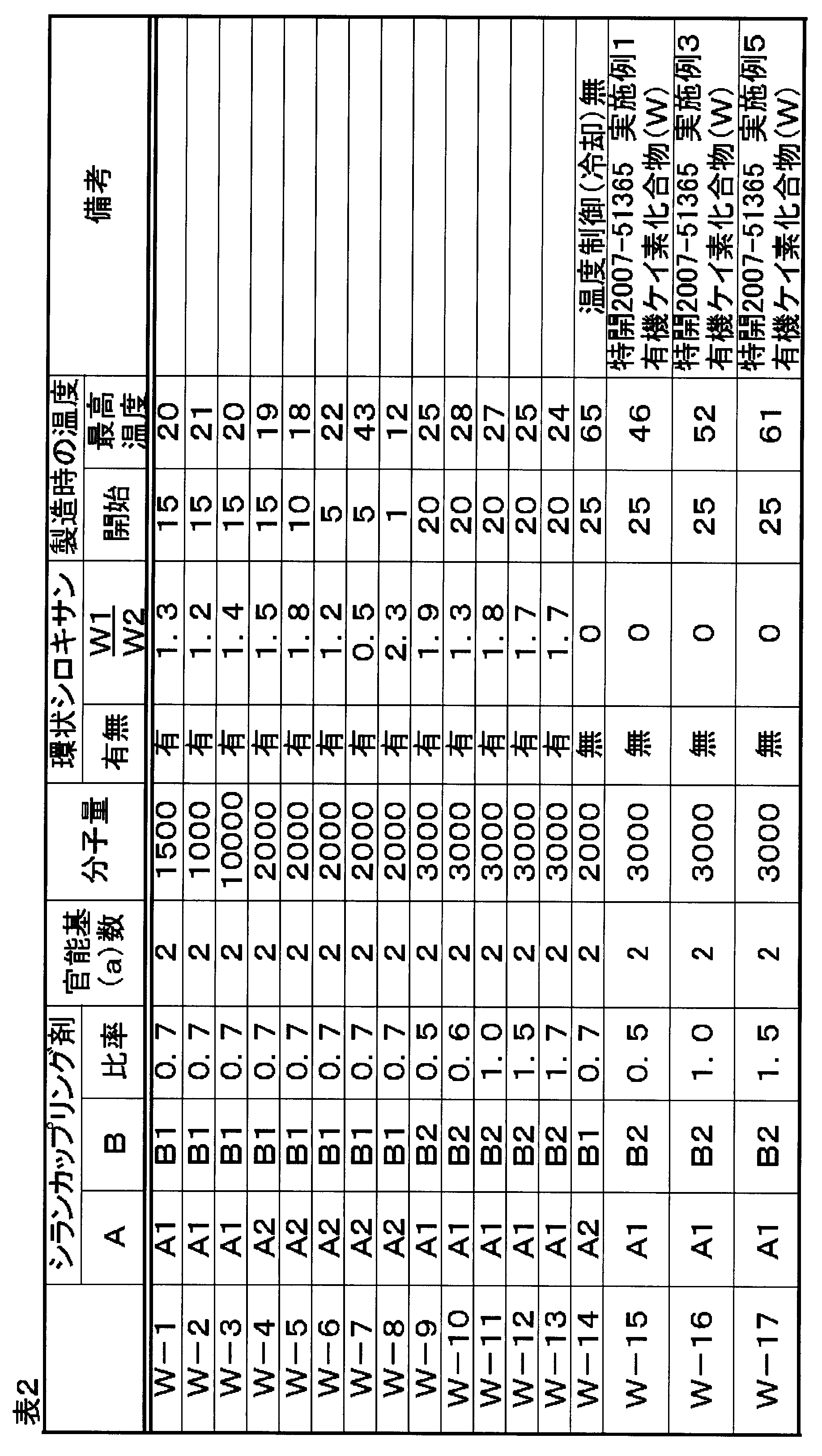
- Table 2 shows synthesized organosilicon compounds (W)
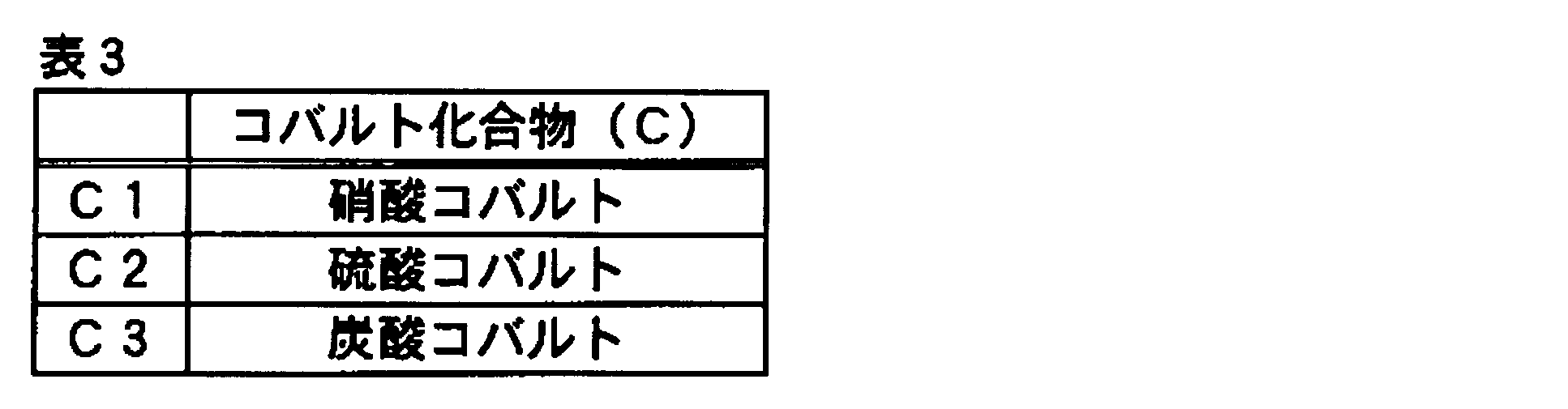
- Table 3 shows cobalt compounds (C)
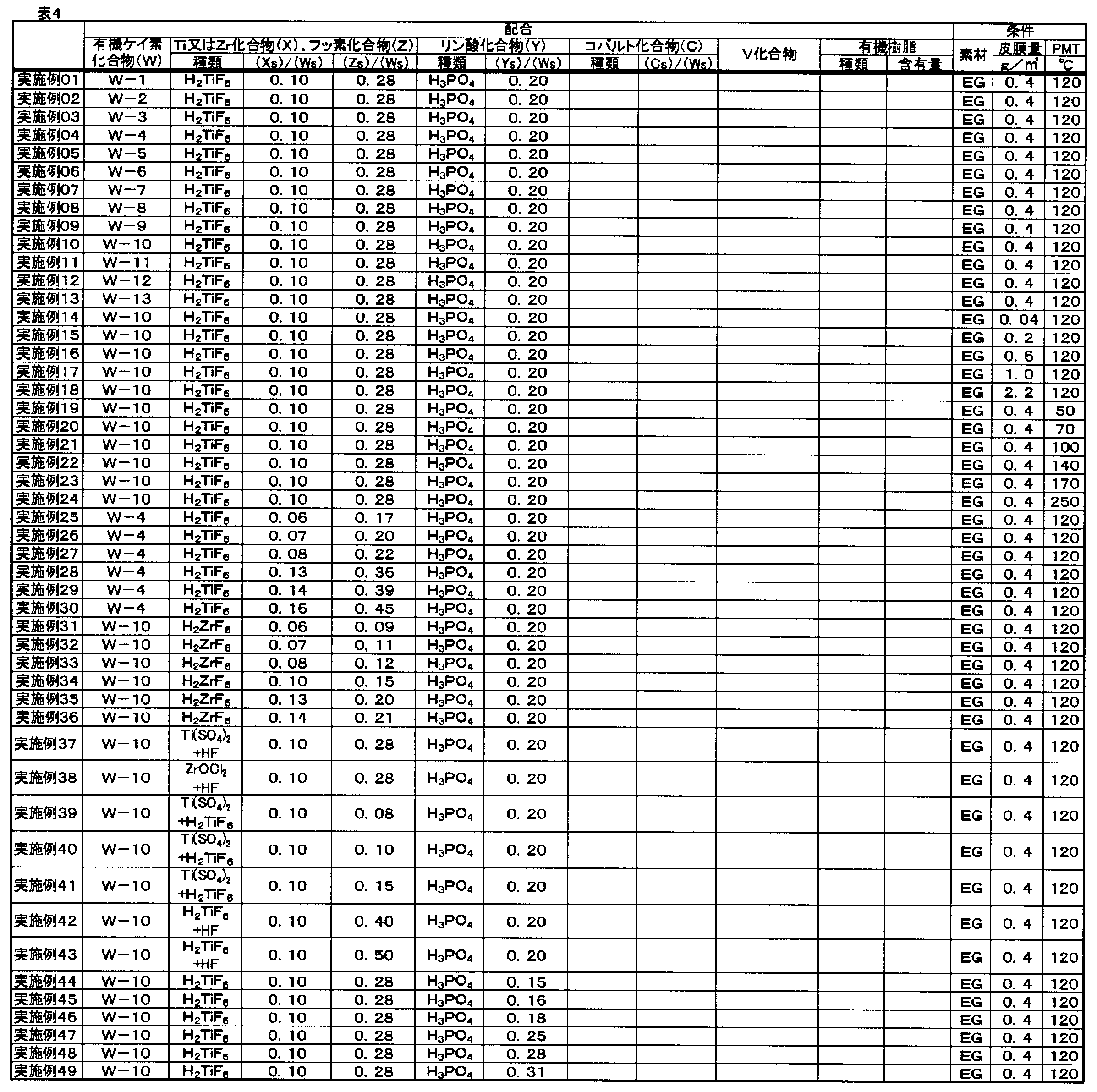
- the formulations are shown in Tables 4-5.
- [Comparison urethane resin] 150 parts by mass of polyether polyol (synthesis components: tetramethylene glycol and ethylene glycol, molecular weight 1500), 6 parts by mass of trimethylolpropane, 24 parts by mass of N-methyl-N, N-diethanolamine, 94 parts by mass of isophorone diisocyanate and 135 parts by mass of methyl ethyl ketone The portion was placed in a reaction vessel and reacted for 1 hour while maintaining at 70 ° C. to 75 ° C. to produce a urethane prepolymer. Next, 15 parts by mass of dimethyl sulfuric acid was placed in the reaction vessel and reacted at 50 to 60 ° C.
- a cationic urethane prepolymer for 30 to 60 minutes to produce a cationic urethane prepolymer.
- 576 parts by mass of water was placed in the reaction vessel to uniformly emulsify the mixture, and then methyl ethyl ketone was recovered to obtain a water-soluble cationic urethane resin.
- the average molecular weight of the obtained urethane resin was measured by a chromatography method using TOF-MS and found to be 100,000.
- the boron trifluoride ethyl ether complex was deactivated with 3 parts by mass of 48% by mass sodium hydroxide. 370 parts by mass of epichlorohydrin and 1.4 parts by mass of tetramethylammonium chloride were added to the generated hydroxyl group, and epichlorohydrin was refluxed at 50 to 60 ° C. under reduced pressure, and 109 parts by mass of 48% by mass sodium hydroxide was added dropwise. Dehydrated. After the dropwise addition, the mixture was refluxed and dehydrated for 3 hours to proceed the dehydration reaction. The resulting sodium chloride was removed by filtration.
- the obtained resin had an epoxy equivalent of 283, a viscosity of 1725 mPa ⁇ s (25 ° C.), and a total chlorine content of 0.4 mass%.
- 300 parts by mass of the obtained epoxy resin and 700 parts by mass of water were mixed, 3.0 parts by mass of a polyoxyethylene emulsifier was added, and the mixture was forcibly emulsified with a stirrer.
- the average molecular weight of the obtained epoxy resin was measured by a chromatography method using TOF-MS and found to be 12,000.
- Black residue test A disc-shaped test piece having a diameter of 70 mm coated with press oil (PG 3080 manufactured by Nippon Tool Oil Co., Ltd.) was subjected to three-stage cylindrical drawing under the following press conditions to obtain a molded product. After removing the press oil adhering to the molded product with hexane, cellophane tape was applied to the side surface portion of the molded product and peeled to recover black residue adhering to the side surface portion of the molded product. Using a spectrocolorimeter (SC-T45 manufactured by Suga Test Instruments Co., Ltd.), the L value (blank value) of white paper with cellophane tape and the L of white paper with cellophane tape collected from the side of the molded product.
- SC-T45 manufactured by Suga Test Instruments Co., Ltd.
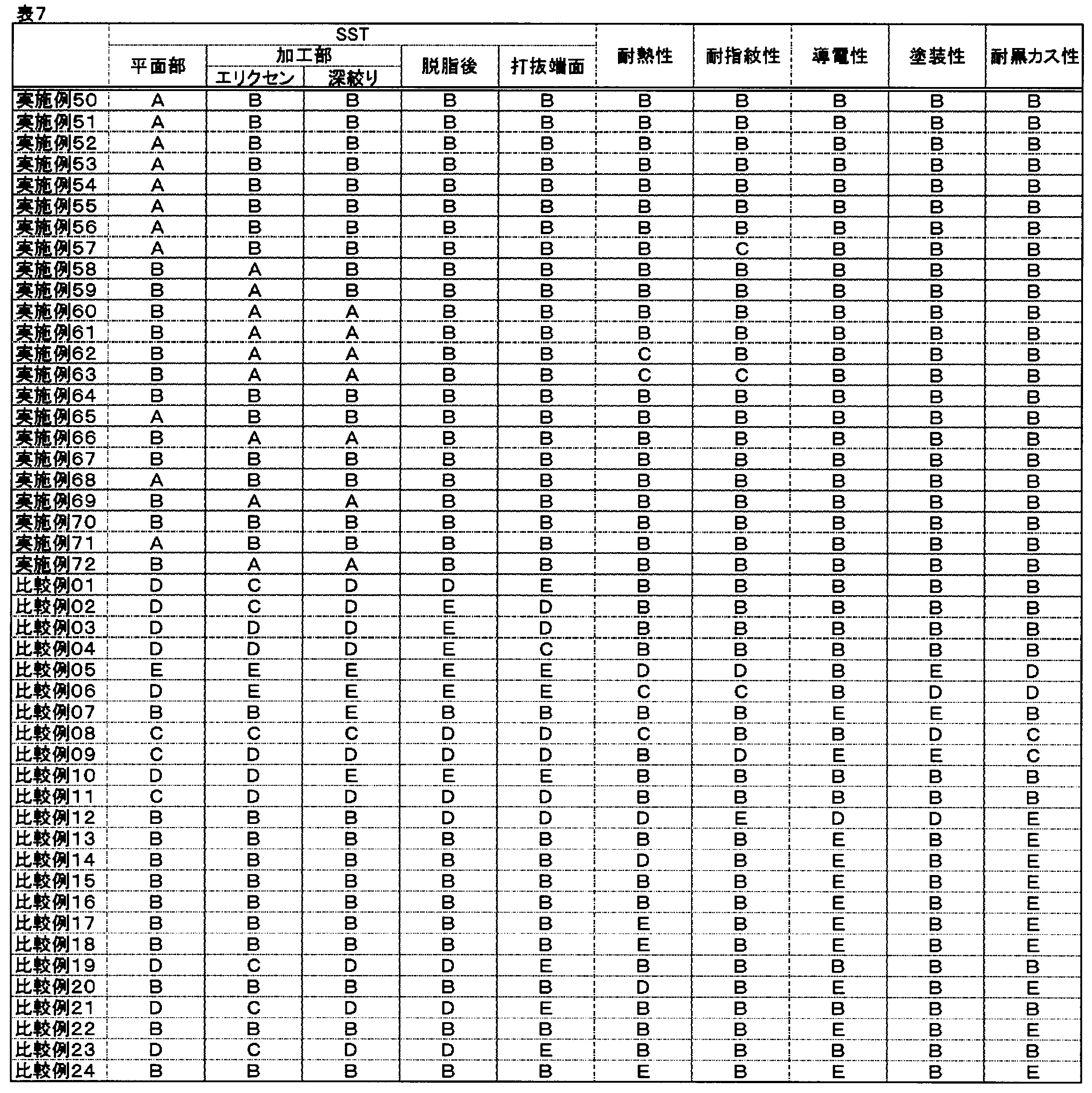
- Examples 01 to 13 and Comparative Examples 01 to 04 are compared, Examples 01 to 13 in which the organosilicon compound (W) is a substance used in the present invention are compared with Comparative Example 01 (without temperature control during production). And does not contain a cyclic siloxane bond) and compared with Comparative Examples 02 to 04 (Examples of Japanese Patent Application Laid-Open No. 2007-51365), the corrosion resistance after flat drawing, the corrosion resistance after deep drawing, the corrosion resistance after degreasing, It can be seen that the punched end face has excellent corrosion resistance.
- Examples 01 to 06 in which the ratio of the cyclic siloxane bond of the organosilicon compound (W) is more suitable, are superior in any or all of the corrosion resistance compared to Examples 07 to 08. Further, from Examples 14 to 24, it can be seen that the surface-treated steel sheet of the present invention exhibits excellent performance regardless of the coating amount and PMT (Peak Metal Metal Temperature).
- the composite coating of the present invention is not affected by the material within the scope of the present invention, and is not affected by electrogalvanized steel sheet (EG), molten Good performance in any of the following materials: galvanized steel sheet (GI), electrogalvanized-12% nickel plated (ZL), hot dip zinc-11% aluminum-3% magnesium-0.2% silicon plated (SD) I understand.
- EG electrogalvanized steel sheet
- GI galvanized steel sheet
- ZL electrogalvanized-12% nickel plated
- SD hot dip zinc-11% aluminum-3% magnesium-0.2% silicon plated
- the metal material subjected to the chromate-free surface treatment formed with the composite film of the present invention has the corrosion resistance, heat resistance, fingerprint resistance, conductivity, paintability, and black residue resistance during processing. It can be seen that excellent corrosion resistance can be maintained without being affected by alkali degreasing, bending, and punching performed when the metal material subjected to is processed into a molded product.
- the surface-treated metal material and water-based metal surface treatment agent of the present invention are excellent in that they are not affected by alkaline degreasing, bending and punching performed when the surface-treated metal material is processed into a molded product. Corrosion resistance can be maintained, and in addition to this, it is excellent in each element of heat resistance, fingerprint resistance, conductivity, paintability, and black residue resistance during processing. Therefore, this invention can be used suitably as a surface treatment metal material and a water-system metal surface treatment agent.
Landscapes
- Chemical & Material Sciences (AREA)
- Engineering & Computer Science (AREA)
- Materials Engineering (AREA)
- Organic Chemistry (AREA)
- General Chemical & Material Sciences (AREA)
- Chemical Kinetics & Catalysis (AREA)
- Mechanical Engineering (AREA)
- Metallurgy (AREA)
- Life Sciences & Earth Sciences (AREA)
- Wood Science & Technology (AREA)
- Chemical Treatment Of Metals (AREA)
- Other Surface Treatments For Metallic Materials (AREA)
Abstract
Description
本願は、2011年4月27日に日本に出願された特願2011-100126号に基づき優先権を主張し、その内容をここに援用する。
(i) 構造中に環状シロキサン結合を有する有機ケイ素化合物(W)
を含み、
インヒビター成分として、
(ii) チタン化合物及びジルコニウム化合物からなる群から選ばれる少なくとも1種の金属化合物(X)と、
(iii) リン酸化合物(Y)と、
(iv) フッ素化合物(Z)と、
を含む複合皮膜を金属材の表面に有する表面処理金属材であって、
前記複合皮膜の前記各成分において、
前記有機ケイ素化合物(W)由来のSiの固形分質量Wsと、前記金属化合物(X)中に含まれるTi及びZrからなる群から選ばれる少なくとも1種の金属成分の固形分質量Xsとの比Xs/Wsが、0.06~0.16であり、
前記有機ケイ素化合物(W)由来のSiの前記固形分質量Wsと、前記リン酸化合物(Y)由来のPの固形分質量Ysとの比Ys/Wsが、0.15~0.31であり、
前記有機ケイ素化合物(W)由来のSiの前記固形分質量Wsと、前記フッ素化合物(Z)由来のFの固形分質量Zsとの比Zs/Wsが、0.08~0.50であり、かつ、前記複合皮膜において、平均分子量が3000以上の有機樹脂の含有量を、全皮膜重量の10質量%未満に制限する。
(i) 構造中に環状シロキサン結合を有する有機ケイ素化合物(W)と、
(ii) チタン化合物及びジルコニウム化合物からなる群から選ばれる少なくとも1種の金属化合物(X)と、
(iii) リン酸化合物(Y)と、
(iv) フッ素化合物(Z)と、
を含む水系金属表面処理剤であって、
前記水系金属表面処理剤の前記各成分において、
前記有機ケイ素化合物(W)由来のSiの固形分質量Wsと、前記金属化合物(X)中に含まれるTi及びZrからなる群から選ばれる少なくとも1種の金属成分の固形分質量Xsとの比Xs/Wsが、0.06~0.16であり、
前記有機ケイ素化合物(W)由来のSiの前記固形分質量Wsと、前記リン酸化合物(Y)由来のPの固形分質量Ysとの比Ys/Wsが、0.15~0.31であり、
前記有機ケイ素化合物(W)由来のSiの前記固形分質量Wsと、前記フッ素化合物(Z)由来のFの固形分質量Zsとの比Zs/Wsが、0.08~0.50であり、かつ、平均分子量が3000以上の有機樹脂の含有量を、全固形分質量の10質量%未満に制限する水系金属表面処理剤である。
前記有機ケイ素化合物(W)は、分子内に式-SiR1R2R3で表される官能基(a)を2個以上と、水酸基(但し、官能基(a)が水酸基を含む場合は、それとは別個のもの)及びアミノ基からなる群から選ばれる少なくとも1種の親水性官能基(b)を1個以上含有し、
前記R1、R2及びR3は、互いに独立に、アルコキシ基又は水酸基であり、
前記R1、R2及びR3の少なくとも1つはアルコキシ基であり、
前記有機ケイ素化合物(W)の平均の分子量が1000~10000であることが好ましい。
また、弗化水素酸を用いる場合には、上述の金属化合物(X)として、チタン弗化水素酸又はジルコニウム弗化水素酸を用いることがさらに好ましい。この場合、さらに優れた耐食性や塗装性を得ることができる。
一方、本発明の水系金属表面処理剤を用いた皮膜はケイ素を基盤として形成され、その構造については、ケイ素と有機鎖の配列が規則的である。また有機鎖が比較的短いことから、皮膜中の極めて微小な区域に、規則的かつ緻密にケイ素含有部と有機物部、すなわち無機物と有機物が配列している。そのため、無機系皮膜が通常有する耐熱性、導電性及び加工性時の耐黒カス性と、有機系皮膜が通常有する耐指紋性や塗装性などを併せ持つ新規な皮膜の形成が可能になると推定される。このような皮膜は、環状シロキサン結合と鎖状シロキサン結合の存在割合を調整することにより、規則的なケイ素と有機鎖の配列を保ちつつ、表面処理皮膜として環状/鎖状シロキサン結合の分布制御が行われ、かつ環状シロキサン結合部と鎖状シロキサン結合部が海島状に配置することで、極めて優れた皮膜性能を有することができるものと推定される。
特に本願発明の実施形態のように水系金属表面処理剤に添加するインヒビター成分として、チタン化合物及びジルコニウム化合物からなる群から選ばれる少なくとも1種の金属化合物(X)、フッ素化合物(Z)の両者に該当するチタン弗化水素酸又は/及びジルコニウム弗化水素酸を用いた場合には、耐食性の観点から特に好適である。その耐食性発現機構は次のように推定される。水系金属表面処理剤が金属材表面に塗布された際、エッチング反応により被処理金属材表面の極近傍においてpHが上昇することによって一部のFが解離し、緻密な金属酸化物皮膜又は/及び金属水酸化物皮膜(チタン化合物及びジルコニウム化合物からなる群から選ばれる少なくとも1種の化合物)が形成される。それと共に解離したFが前記有機ケイ素化合物や被処理金属との複合化合物皮膜(F化合物)を形成する。これらの皮膜が前述した通りの優れた腐食因子のバリア効果を発揮する。このような耐食性発現機構に基づいて発明された本発明の複合皮膜は耐熱性、耐指紋性、導電性、塗装性及び加工時の耐黒カス性に加え優れた耐食性を発現するものと推定される。
(1)試験素材
下記に示した市販の素材を用いた。
・電気亜鉛めっき鋼板(EG):板厚=0.8mm、目付量=20/20(g/m2)
・溶融亜鉛めっき鋼板(GI):板厚=0.8mm、目付量=90/90(g/m2)
・電気亜鉛-12%ニッケルめっき(ZL):板厚=0.8mm、目付量=20/20(g/m2)
・溶融亜鉛-11%アルミニウム-3%マグネシウム-0.2%シリコンめっき(SD):板厚=0.8mm、目付量=60/60(g/m2)
ここで、「目付量」とは、単位面積(1m2)当たりの質量(g)をいう。
素材を、シリケート系アルカリ脱脂剤のファインクリーナー4336(日本パーカライジング(株)製)を用いて、濃度20g/L、温度60℃の条件で2分間スプレー処理し、純水で30秒間水洗したのちに乾燥したものを試験板とした。
pH4に調整し、所定の温度に調整したイオン交換水に、表1に示すシランカップリング剤(A)と、シランカップリング剤(B)を順次添加し、所定の温度に制御しながら所定時間攪拌して、表2に示す有機ケイ素化合物W1~W13を得た。
pH4に調整したイオン交換水に、表1に示すシランカップリング剤(A)と、シランカップリング剤(B)を順次添加し、温度制御(冷却)せずに所定時間攪拌して、表2に示す比較用有機ケイ素化合物W14を得た。
特開2007-51365の実施例1、3及び5に記載の有機ケイ素化合物を、当該公開公報に記載の調整方法にて調整し、比較用有機ケイ素化合物W15~W17を得た。
ポリエーテルポリオール(合成成分:テトラメチレングリコール及びエチレングリコール、分子量1500)150質量部、トリメチロールプロパン6質量部、N-メチル-N,N-ジエタノールアミン24質量部、イソホロンジイソシアネート94質量部及びメチルエチルケトン135質量部を反応容器に入れ、70℃~75℃に保ちながら1時間反応させてウレタンプレポリマーを生成させた。ついで該反応容器にジメチル硫酸15質量部を入れ、50~60℃で30分~60分間反応させて、カチオン性ウレタンプレポリマーを生成させた。ついで該反応容器に水576質量部入れ、混合物を均一に乳化させた後、メチルエチルケトンを回収して水溶性のカチオン性ウレタン樹脂を得た。得られたウレタン樹脂の平均分子量をTOF-MSによるクロマトグラフィー法にて測定した結果、100000であった。
スチレン25質量部、ブチルアクリレート25質量部、アクリルニトリル20質量部、アクリル酸15質量部、ヒドロキシエチルアクリレート10質量部、N-メチロールアクリルアミド5質量部を反応容器内にて共重合させ、生成したアクリル樹脂300質量部と水700質量部とポリオキシエチレン系乳化剤0.5質量部とを混合し、攪拌機にて強制乳化した。得られたアクリル樹脂の平均分子量をTOF-MSによるクロマトグラフィー法にて測定した結果、50000であった。
還流冷却機を備えた1000mlのフラスコ内に、フェノール1モル及び触媒としてp-トルエンスルホン酸0.3gを仕込み、内部温度を100℃まで上げ、ホルムアルデヒド水溶液0.85モルを1時間かけて添加し、100℃で2時間還流下にて反応させた。その後、反応容器を水冷静置し、上層に分離する水層の濁りがなくなってから、デカンテーションして水層を除去し、さらに170~175℃になるまで加熱攪拌して未反応分及び水分を除去した。次に100℃まで温度を下げ、ブチルセロソルブ234gを添加して重縮合物を完全に溶解させた後、純水234gを加え、系内の温度が50℃まで下がったところで、ジエタノールアミン1モルを添加し、これにホルムアルデヒド水溶液1モルを50℃で約1時間かけて滴下した。さらに80℃まで温度を上げ、約3時間攪拌しながら反応を続け、カチオン性フェノール系重縮合物を得た。得られたフェノール樹脂の平均分子量をTOF-MSによるクロマトグラフィー法にて測定した結果、6000であった。
反応容器に、ビスフェノールAポリプロピレンオキシド2モル付加物180質量部を仕込み、攪拌加熱を行った。触媒として三フッ化ホウ素ジエチルエーテル錯体0.9質量部を添加し、そこに2-エチルヘキシルモノグリシジルエーテル(エポキシ当量198)27質量部を60~70℃で1時間かけて滴下し、そのまま1.5時間熟成し、付加反応を行った。系内のオキシラン環の消滅を塩酸吸収量により確認した後、48質量%水酸化ナトリウム3質量部で三フッ化ホウ素エチルエーテル錯体を失活させた。生成した水酸基をエピクロルヒドリン370質量部とテトラメチルアンモニウムクロリド1.4質量部投入し、減圧下、50~60℃でエピクロロヒドリンを還流させ48質量%水酸化ナトリウム109質量部を滴下しながら還流脱水した。滴下後、3時間還流脱水させて脱水反応を進行させた。生じた塩化ナトリウムをろ過により除去した。過剰のエピクロロヒドリンを減圧下で留去した。得られた樹脂はエポキシ当量283、粘度1725mPa・s(25℃)、全塩素含有量0.4質量%であった。得られたエポキシ樹脂300質量部と水700質量部とを混合し、ポリオキシエチレン系乳化剤を3.0質量部添加し、攪拌機にて強制乳化した。得られたエポキシ樹脂の平均分子量をTOF-MSによるクロマトグラフィー法にて測定した結果、12000であった。


1.SST平面部試験
端面をテープでシールした70mm×150mmの長方形状の試験片(平板)について、JISZ 2371による塩水噴霧試験(SST)を192時間行い、白錆及び黒錆発生状況を観察した。
<評価基準>
A=白錆が全面積の3%未満であり、黒錆が発生していない
B=白錆及び黒錆発生が全面積の3%未満
C=白錆及び黒錆発生が全面積の3%以上10%未満
D=白錆及び黒錆発生が全面積の10%以上30%未満
E=白錆及び黒錆発生が全面積の30%以上
端面をテープでシールした70mm×150mmの長方形状の試験片(平板)の中央部をエリクセン試験(7mm押し出し)に供した後、JISZ 2371による塩水噴霧試験を72時間行い、押し出し加工部の錆発生状況を観察した。
<評価基準>
A=錆発生が全面積の5%未満
B=錆発生が全面積の5%以上10%未満
C=錆発生が全面積の10%以上20%未満
D=錆発生が全面積の20%以上30%未満
E=錆発生が全面積の30%以上
苛性ソーダ系アルカリ脱脂剤のファインクリーナーL4460(日本パーカライジング(株)製)を用いて、濃度ファインクリーナーL4460A剤:20g/L、ファインクリーナーL4460B剤:12g/L、温度60℃の条件で2分間浸漬処理し、純水で30秒間水洗したのちに乾燥した70mm×150mmの長方形状の試験片について、端面をテープでシールした後、JISZ 2371による塩水噴霧試験を72時間行い、錆発生状況を観察した。
<評価基準>
B=錆発生が全面積の10%未満
C=錆発生が全面積の10%以上20%未満
D=錆発生が全面積の20%以上30%未満
E=錆発生が全面積の30%以上
70mm×150mmの長方形状の試験片の中央に、打ち抜き機にて直径が10mmの穴を5つ開けた後、JISZ 2371による塩水噴霧試験を72時間行い、5つの端面の錆幅を測定した。
B=錆幅(5点の最大)が1mm未満
C=錆幅(5点の最大)が1mm以上2mm未満
D=錆幅(5点の最大)が2mm以上3mm未満
E=錆幅(5点の最大)が3mm以上
70mm×150mmの長方形状の試験片をオーブンにて200℃で2時間加熱後、試験片の端面をテープでシールし、JISZ 2371による塩水噴霧試験を48時間行い、錆発生状況を観察した。
<評価基準>
B=錆発生が全面積の3%未満
C=錆発生が全面積の3%以上10%未満
D=錆発生が全面積の10%以上30%未満
E=錆発生が全面積の30%以上
試験片にワセリンを塗布し、その前後のL値(明度)を分光測色計(スガ試験機社製SC-T45)を用いて測定し、増減(△L)を算出した。
<評価基準>
B=△Lが0.5未満
C=△Lが0.5以上1.0未満
D=△Lが1.0以上2.0未満
E=△Lが2.0以上
JIS C2550-4:2011のA法を用いて、10個の接触子電極の合計面積が1000mm2の条件で層間抵抗係数を測定した。
<評価基準>
B=層間抵抗が100Ω・mm2未満
C=層間抵抗が100Ω・mm2以上200Ω・mm2未満
D=層間抵抗が200Ω・mm2以上300Ω・mm2未満
E=層間抵抗が300Ω・mm2以上
メラミンアルキッド系塗料(関西ペイント社製アミラック#1000ホワイト)を焼付け乾燥後の膜厚が25μmとなるようにバーコートで塗布し、120℃で20分焼付けた後、1mm碁盤目にカットし、テープ剥離試験を行った。密着性の評価を残個数割合(残個数/カット数:100個)にて行った。
<評価基準>
B=100%
C=95%以上
D=90%以上95%未満
E=90%未満
プレス油(日本工作油社製PG3080)を塗油した直径70mmの円板状の試験片について、下記プレス条件の3段円筒絞り成形を行い、成形品を得た。成形品に付着しているプレス油をヘキサンにより除去した後、成形品側面部にセロハンテープを貼付、剥離することにより、成形品側面部に付着している黒カスを回収した。分光測色計(スガ試験機社製SC-T45)を用いて、セロハンテープを貼付した白紙のL値(ブランク値)と成形品側面部より黒カスを回収したセロハンテープを貼付した白紙のL値を各々測定し、それらのL値(明度)差(△L)を算出した。
[プレス条件]
成形速度:450mm/s、しわ押さえ圧:9.8kN
(一段目)ポンチ径:33.4mm、ポンチ肩半径:5mm、ダイス径:35.3mm、ダイス肩半径:5mm、成形深さ:35mm
(二段目)ポンチ径:26.4mm、ポンチ肩半径:3mm、ダイス径:28.2mm、ダイス肩半径:3mm、成形深さ:42mm
(三段目)ポンチ径:26.4mm、ポンチ肩半径:3mm、ダイス径:27.7mm、ダイス肩半径:3mm、成形深さ:42mm
<評価基準>
B=△Lが0.5未満
C=△Lが0.5以上1.0未満
D=△Lが1.0以上2.0未満
E=△Lが2.0以上
前記9で得た成形品について、その成形品に付着しているプレス油をヘキサンにより除去した後、塩水噴霧試験を72時間行い、側面の錆発生状況を観察した。
<評価基準>
A=錆発生が全面積の5%未満
B=錆発生が全面積の5%以上10%未満
C=錆発生が全面積の10%以上20%未満
D=錆発生が全面積の20%以上30%未満
E=錆発生が全面積の30%以上

Claims (12)
- 造膜成分として、
(i) 構造中に環状シロキサン結合を有する有機ケイ素化合物(W)
を含み、
インヒビター成分として、
(ii) チタン化合物及びジルコニウム化合物からなる群から選ばれる少なくとも1種の金属化合物(X)と、
(iii) リン酸化合物(Y)と、
(iv) フッ素化合物(Z)と、
を含む複合皮膜を金属材の表面に有する表面処理金属材であって、
前記複合皮膜の前記各成分において、
前記有機ケイ素化合物(W)由来のSiの固形分質量Wsと、前記金属化合物(X)中に含まれるTi及びZrからなる群から選ばれる少なくとも1種の金属成分の固形分質量Xsとの比Xs/Wsが、0.06~0.16であり、
前記有機ケイ素化合物(W)由来のSiの前記固形分質量Wsと、前記リン酸化合物(Y)由来のPの固形分質量Ysとの比Ys/Wsが、0.15~0.31であり、
前記有機ケイ素化合物(W)由来のSiの前記固形分質量Wsと、前記フッ素化合物(Z)由来のFの固形分質量Zsとの比Zs/Wsが、0.08~0.50であり、かつ、前記複合皮膜において、平均分子量が3000以上の有機樹脂の含有量を、全皮膜重量の10質量%未満に制限する
ことを特徴とする表面処理金属材。 - 前記有機ケイ素化合物(W)における環状シロキサン結合と鎖状シロキサン結合との存在割合が、FT-IR反射法による前記環状シロキサン結合を示す1090~1100cm-1の吸光度W1と前記鎖状シロキサン結合を示す1030~1040cm-1の吸光度W2との比W1/W2で1.0~2.0であることを特徴とする、請求項1に記載の表面処理金属材。
- 前記造膜成分が、平均の分子量が3000以上の有機樹脂を含有しないものであることを特徴とする、請求項1又は2に記載の表面処理金属材。
- 前記造膜成分が、前記有機ケイ素化合物(W)のみからなることを特徴とする、請求項1又は2に記載の表面処理金属材。
- 前記金属化合物(X)及び前記フッ素化合物(Z)が、チタン弗化水素酸及びジルコニウム弗化水素酸からなる群から選ばれる少なくとも1種のフルオロ化合物であることを特徴とする、請求項1又は2に記載の表面処理金属材。
- JIS C2550-4:2011のA法により、10個の接触子電極の合計面積が1000mm2の条件で測定した層間抵抗係数が200Ω・mm2未満であることを特徴とする、請求項1又は2に記載の表面処理金属材。
- さらに、前記複合皮膜中にコバルト化合物(C)を、前記有機ケイ素化合物(W)由来のSiの前記固形分質量Wsと前記コバルト化合物(C)由来のCoの固形分質量Csとの比Cs/Wsで0.03~0.08の割合で含有することを特徴とする、請求項1又は2に記載の表面処理金属材。
- 前記金属材が亜鉛系めっき鋼板であることを特徴とする、請求項1又は2に記載の表面処理金属材。
- (i) 構造中に環状シロキサン結合を有する有機ケイ素化合物(W)と、
(ii) チタン化合物及びジルコニウム化合物からなる群から選ばれる少なくとも1種の金属化合物(X)と、
(iii) リン酸化合物(Y)と、
(iv) フッ素化合物(Z)と、
を含む水系金属表面処理剤であって、
前記水系金属表面処理剤の前記各成分において、
前記有機ケイ素化合物(W)由来のSiの固形分質量Wsと、前記金属化合物(X)中に含まれるTi及びZrからなる群から選ばれる少なくとも1種の金属成分の固形分質量Xsとの比Xs/Wsが、0.06~0.16であり、
前記有機ケイ素化合物(W)由来のSiの前記固形分質量Wsと、前記リン酸化合物(Y)由来のPの固形分質量Ysとの比Ys/Wsが、0.15~0.31であり、
前記有機ケイ素化合物(W)由来のSiの前記固形分質量Wsと、前記フッ素化合物(Z)由来のFの固形分質量Zsとの比Zs/Wsが、0.08~0.50であり、かつ、平均分子量が3000以上の有機樹脂の含有量を、全固形分質量の10質量%未満に制限することを特徴とする、水系金属表面処理剤。 - 前記有機ケイ素化合物(W)が、分子中にアミノ基を少なくとも1つ含有するシランカップリング剤Aと分子中にグリシジル基を少なくとも1つ含有するシランカップリング剤Bとを、固形分質量比A/Bで、0.5~1.7の割合で配合して得られるものであり、
前記有機ケイ素化合物(W)は、分子内に一般式-SiR1R2R3で表される官能基(a)を2個以上と、水酸基及びアミノ基からなる群から選ばれる少なくとも1種の親水性官能基(b)を1個以上含有し、
前記R1、R2及びR3は、互いに独立に、アルコキシ基又は水酸基であり、
前記R1、R2及びR3の少なくとも1つはアルコキシ基であり、
前記有機ケイ素化合物(W)の平均分子量が1000~10000である
ことを特徴とする、請求項9に記載の水系金属表面処理剤。 - 前記金属化合物(X)及び前記フッ素化合物(Z)が、チタン弗化水素酸及びジルコニウム弗化水素酸からなる群から選ばれる少なくとも1種のフルオロ化合物であることを特徴とする、請求項9又は10に記載の水系金属表面処理剤。
- 金属材の表面に、請求項8又は9に記載の水系金属表面処理剤を塗布し、乾燥を行い、乾燥後の複合皮膜重量が0.05~2.0g/m2であることを特徴とする表面処理金属材。
Priority Applications (8)
| Application Number | Priority Date | Filing Date | Title |
|---|---|---|---|
| KR1020137028525A KR101449359B1 (ko) | 2011-04-27 | 2012-04-26 | 표면 처리 금속재 및 수계 금속 표면 처리제 |
| MX2013012423A MX336752B (es) | 2011-04-27 | 2012-04-26 | Material de metal tratado en la superficie y agente acuoso de tratamiento de superficie de metal. |
| CN201280020105.2A CN103635607B (zh) | 2011-04-27 | 2012-04-26 | 表面处理金属材料及水系金属表面处理剂 |
| AU2012248254A AU2012248254B2 (en) | 2011-04-27 | 2012-04-26 | Surface-treated metal material and aqueous metal surface treatment agent |
| BR112013027461-1A BR112013027461B1 (pt) | 2011-04-27 | 2012-04-26 | Material metálico de superfície tratada e agente de tratamento de superfície metálica aquoso |
| JP2012542051A JP5336002B2 (ja) | 2011-04-27 | 2012-04-26 | 表面処理金属材及び水系金属表面処理剤 |
| CA2833367A CA2833367C (en) | 2011-04-27 | 2012-04-26 | Surface-treated metal material and aqueous metal surface-treatment agent |
| US14/113,502 US20140050939A1 (en) | 2011-04-27 | 2012-04-26 | Surface-treated metal material and aqueous metal surface-treatment agent |
Applications Claiming Priority (2)
| Application Number | Priority Date | Filing Date | Title |
|---|---|---|---|
| JP2011100126 | 2011-04-27 | ||
| JP2011-100126 | 2011-04-27 |
Publications (1)
| Publication Number | Publication Date |
|---|---|
| WO2012147860A1 true WO2012147860A1 (ja) | 2012-11-01 |
Family
ID=47072375
Family Applications (1)
| Application Number | Title | Priority Date | Filing Date |
|---|---|---|---|
| PCT/JP2012/061233 Ceased WO2012147860A1 (ja) | 2011-04-27 | 2012-04-26 | 表面処理金属材及び水系金属表面処理剤 |
Country Status (10)
| Country | Link |
|---|---|
| US (1) | US20140050939A1 (ja) |
| JP (1) | JP5336002B2 (ja) |
| KR (1) | KR101449359B1 (ja) |
| CN (1) | CN103635607B (ja) |
| AU (1) | AU2012248254B2 (ja) |
| BR (1) | BR112013027461B1 (ja) |
| CA (1) | CA2833367C (ja) |
| MX (1) | MX336752B (ja) |
| MY (1) | MY165503A (ja) |
| WO (1) | WO2012147860A1 (ja) |
Cited By (5)
| Publication number | Priority date | Publication date | Assignee | Title |
|---|---|---|---|---|
| JP2014180849A (ja) * | 2013-03-21 | 2014-09-29 | Nisshin Steel Co Ltd | 耐熱性塗装鋼板 |
| JP2017141485A (ja) * | 2016-02-09 | 2017-08-17 | 日本パーカライジング株式会社 | 表面処理剤、表面処理皮膜の製造方法、及び表面処理皮膜を有するアルミニウム材又はアルミニウム合金材 |
| JPWO2022185849A1 (ja) * | 2021-03-01 | 2022-09-09 | ||
| JPWO2022210650A1 (ja) * | 2021-03-29 | 2022-10-06 | ||
| WO2022244569A1 (ja) * | 2021-05-20 | 2022-11-24 | 日本製鉄株式会社 | 冷却構造、バッテリーユニット、及び冷却構造の製造方法 |
Families Citing this family (13)
| Publication number | Priority date | Publication date | Assignee | Title |
|---|---|---|---|---|
| DE102013215440A1 (de) * | 2013-08-06 | 2015-02-12 | Henkel Ag & Co. Kgaa | Metallvorbehandlung mit sauren wasserhaltigen Zusammensetzungen umfassend Silane |
| DE102013215441A1 (de) | 2013-08-06 | 2015-02-12 | Henkel Ag & Co. Kgaa | Metallvorbehandlungszusammensetzungen umfassend Silane und Organophosphonsäuren |
| CN104448999A (zh) * | 2014-11-18 | 2015-03-25 | 厦门建霖工业有限公司 | 一种耐指纹表面处理剂及其使用方法 |
| BR112018072454B1 (pt) * | 2016-05-10 | 2023-05-16 | Hoden Seimitsu Kako Kenkyusyo Co., Ltd | Composição de tratamento de superfície antiferrugem aquosa e membro de metal com superfície revestida |
| CN105951085B (zh) * | 2016-06-27 | 2018-12-14 | 重庆新美鱼博洋铝业有限公司 | 航空铝合金防腐钝化剂及其制备方法 |
| CN108330478B (zh) * | 2018-03-06 | 2020-02-07 | 上海耀岩化学品有限公司 | 一种水性金属表面处理剂 |
| US11965249B2 (en) | 2019-03-19 | 2024-04-23 | Nippon Steel Corporation | Surface-treated metal material |
| JP7641726B2 (ja) | 2020-11-13 | 2025-03-07 | 日本製鉄株式会社 | 表面処理金属板 |
| KR20230134552A (ko) | 2021-03-01 | 2023-09-21 | 닛폰세이테츠 가부시키가이샤 | 배터리 유닛 |
| JP7795117B2 (ja) | 2021-05-20 | 2026-01-07 | 日本製鉄株式会社 | 冷却構造、バッテリーユニット、及び冷却構造の製造方法 |
| EP4343921B1 (en) | 2021-05-20 | 2025-01-29 | Nippon Steel Corporation | Cooling structure, battery unit, and manufacturing method for cooling structure |
| TWI864496B (zh) * | 2021-11-22 | 2024-12-01 | 日商日本製鐵股份有限公司 | 表面處理鋼材 |
| AU2022444558B2 (en) * | 2022-03-03 | 2025-11-13 | Nippon Steel Corporation | Surface-treated steel sheet |
Citations (4)
| Publication number | Priority date | Publication date | Assignee | Title |
|---|---|---|---|---|
| JPH09295988A (ja) * | 1996-04-30 | 1997-11-18 | Japan Energy Corp | 新規有機ケイ素化合物およびその製造方法並びにそれを用いる表面処理剤および樹脂添加剤 |
| WO2008059890A1 (fr) * | 2006-11-15 | 2008-05-22 | Nippon Steel Corporation | Materiau métallique traité en surface et procédé de production de celui-ci |
| JP2008133510A (ja) * | 2006-11-28 | 2008-06-12 | Nippon Steel Corp | 表面処理金属材 |
| JP2008184659A (ja) * | 2007-01-30 | 2008-08-14 | Nippon Steel Corp | 表面処理金属材 |
Family Cites Families (7)
| Publication number | Priority date | Publication date | Assignee | Title |
|---|---|---|---|---|
| KR100382702B1 (ko) * | 2000-09-18 | 2003-05-09 | 주식회사 엘지화학 | 유기실리케이트 중합체의 제조방법 |
| JP2002234755A (ja) * | 2001-01-31 | 2002-08-23 | Dow Corning Toray Silicone Co Ltd | ガラス繊維基材用表面処理剤、ガラス繊維基材、プリプレグ、およびガラス繊維強化熱硬化性樹脂成形物 |
| AU2003282988A1 (en) * | 2002-10-21 | 2004-05-13 | Massachusetts Institute Of Technology | Pecvd of organosilicate thin films |
| JP2006328445A (ja) * | 2005-05-23 | 2006-12-07 | Nippon Parkerizing Co Ltd | プレコート金属材料用水系表面処理剤、表面処理方法及びプレコート金属材料の製造方法 |
| TW200716710A (en) * | 2005-09-30 | 2007-05-01 | Dow Corning Toray Co Ltd | Multi-component room-temperature curable silicone rubber composition |
| CN101747361B (zh) * | 2008-12-04 | 2012-06-13 | 中国科学院化学研究所 | 一种桥联聚倍半硅氧烷及其单体与它们的制备方法 |
| TWI433898B (zh) * | 2009-10-20 | 2014-04-11 | Nippon Steel & Sumitomo Metal Corp | Chromium - free surface treatment of zinc - plated steel sheet |
-
2012
- 2012-04-26 AU AU2012248254A patent/AU2012248254B2/en active Active
- 2012-04-26 JP JP2012542051A patent/JP5336002B2/ja active Active
- 2012-04-26 KR KR1020137028525A patent/KR101449359B1/ko active Active
- 2012-04-26 US US14/113,502 patent/US20140050939A1/en not_active Abandoned
- 2012-04-26 BR BR112013027461-1A patent/BR112013027461B1/pt active IP Right Grant
- 2012-04-26 MY MYPI2013701990A patent/MY165503A/en unknown
- 2012-04-26 MX MX2013012423A patent/MX336752B/es unknown
- 2012-04-26 WO PCT/JP2012/061233 patent/WO2012147860A1/ja not_active Ceased
- 2012-04-26 CA CA2833367A patent/CA2833367C/en active Active
- 2012-04-26 CN CN201280020105.2A patent/CN103635607B/zh active Active
Patent Citations (4)
| Publication number | Priority date | Publication date | Assignee | Title |
|---|---|---|---|---|
| JPH09295988A (ja) * | 1996-04-30 | 1997-11-18 | Japan Energy Corp | 新規有機ケイ素化合物およびその製造方法並びにそれを用いる表面処理剤および樹脂添加剤 |
| WO2008059890A1 (fr) * | 2006-11-15 | 2008-05-22 | Nippon Steel Corporation | Materiau métallique traité en surface et procédé de production de celui-ci |
| JP2008133510A (ja) * | 2006-11-28 | 2008-06-12 | Nippon Steel Corp | 表面処理金属材 |
| JP2008184659A (ja) * | 2007-01-30 | 2008-08-14 | Nippon Steel Corp | 表面処理金属材 |
Cited By (16)
| Publication number | Priority date | Publication date | Assignee | Title |
|---|---|---|---|---|
| JP2014180849A (ja) * | 2013-03-21 | 2014-09-29 | Nisshin Steel Co Ltd | 耐熱性塗装鋼板 |
| JP2017141485A (ja) * | 2016-02-09 | 2017-08-17 | 日本パーカライジング株式会社 | 表面処理剤、表面処理皮膜の製造方法、及び表面処理皮膜を有するアルミニウム材又はアルミニウム合金材 |
| WO2017138464A1 (ja) * | 2016-02-09 | 2017-08-17 | 日本パーカライジング株式会社 | 表面処理剤、表面処理皮膜の製造方法、及び表面処理皮膜を有するアルミニウム材又はアルミニウム合金材 |
| CN108713072A (zh) * | 2016-02-09 | 2018-10-26 | 日本帕卡濑精株式会社 | 表面处理剂、表面处理皮膜的制造方法、以及具有表面处理皮膜的铝材或铝合金材 |
| JPWO2022185849A1 (ja) * | 2021-03-01 | 2022-09-09 | ||
| WO2022185849A1 (ja) * | 2021-03-01 | 2022-09-09 | 日本製鉄株式会社 | バッテリーユニット |
| JP7587183B2 (ja) | 2021-03-01 | 2024-11-20 | 日本製鉄株式会社 | バッテリーユニット |
| JP7453599B2 (ja) | 2021-03-29 | 2024-03-21 | 日本製鉄株式会社 | 表面処理鋼板 |
| KR20230147712A (ko) | 2021-03-29 | 2023-10-23 | 닛폰세이테츠 가부시키가이샤 | 표면 처리 강판 |
| WO2022210650A1 (ja) | 2021-03-29 | 2022-10-06 | 日本製鉄株式会社 | 表面処理鋼板 |
| JPWO2022210650A1 (ja) * | 2021-03-29 | 2022-10-06 | ||
| US12509777B2 (en) | 2021-03-29 | 2025-12-30 | Nippon Steel Corporation | Surface-treated steel sheet |
| WO2022244569A1 (ja) * | 2021-05-20 | 2022-11-24 | 日本製鉄株式会社 | 冷却構造、バッテリーユニット、及び冷却構造の製造方法 |
| JPWO2022244569A1 (ja) * | 2021-05-20 | 2022-11-24 | ||
| CN117321838A (zh) * | 2021-05-20 | 2023-12-29 | 日本制铁株式会社 | 冷却结构、电池装置及冷却结构的制造方法 |
| JP7568983B2 (ja) | 2021-05-20 | 2024-10-17 | 日本製鉄株式会社 | 冷却構造、バッテリーユニット、及び冷却構造の製造方法 |
Also Published As
| Publication number | Publication date |
|---|---|
| CA2833367C (en) | 2015-08-18 |
| AU2012248254A1 (en) | 2013-11-07 |
| JPWO2012147860A1 (ja) | 2014-07-28 |
| US20140050939A1 (en) | 2014-02-20 |
| KR101449359B1 (ko) | 2014-10-08 |
| BR112013027461B1 (pt) | 2021-04-06 |
| CN103635607A (zh) | 2014-03-12 |
| MX2013012423A (es) | 2013-12-06 |
| JP5336002B2 (ja) | 2013-11-06 |
| MY165503A (en) | 2018-03-27 |
| KR20130136568A (ko) | 2013-12-12 |
| CA2833367A1 (en) | 2012-11-01 |
| AU2012248254B2 (en) | 2014-09-04 |
| CN103635607B (zh) | 2015-12-02 |
| MX336752B (es) | 2016-01-29 |
Similar Documents
| Publication | Publication Date | Title |
|---|---|---|
| JP5336002B2 (ja) | 表面処理金属材及び水系金属表面処理剤 | |
| CN102884225B (zh) | 镀锌系钢板用表面处理液及镀锌系钢板及其制造方法 | |
| JP5335434B2 (ja) | 表面処理金属材およびその製造方法 | |
| JP4776458B2 (ja) | 耐食性、耐熱性、耐指紋性、導電性、塗装性および加工時の耐黒カス性に優れたクロメートフリー表面処理金属材 | |
| CN109804102B (zh) | 表面处理溶液组合物、利用该组合物进行表面处理的镀锌系钢板及其制造方法 | |
| JP5446390B2 (ja) | 表面処理剤、該表面処理剤を用いためっき鋼板の製造方法およびめっき鋼板 | |
| TWI500814B (zh) | 金屬表面處理用組成物、金屬表面處理方法及金屬材料之塗裝方法 | |
| TWI522493B (zh) | Metal surface treatment agent, surface treatment steel material and surface treatment method thereof, and coating steel material and manufacturing method thereof | |
| KR20130051997A (ko) | 아연계 도금 강판용의 표면 처리액 그리고 아연계 도금 강판 및 그의 제조 방법 | |
| JP6242010B2 (ja) | 水性金属表面処理組成物 | |
| JPWO2006082951A1 (ja) | 水系金属材料表面処理剤、表面処理方法及び表面処理金属材料 | |
| EP2037003B1 (en) | Coated steel sheet | |
| JP7063298B2 (ja) | 溶融亜鉛系めっき鋼板用の表面処理液ならびに亜鉛系めっき鋼板およびその製造方法 | |
| JP7099424B2 (ja) | 表面処理皮膜付き亜鉛系めっき鋼板及びその製造方法 | |
| JP2008184659A (ja) | 表面処理金属材 | |
| JP4907315B2 (ja) | 表面処理金属材 | |
| JP4968992B2 (ja) | 表面処理金属板および表面処理剤 | |
| KR20230061517A (ko) | 유기 수지 피복용 표면 처리 강판 및 그의 제조 방법, 그리고 유기 수지 피복 강판 및 그의 제조 방법 | |
| HK1134943B (en) | Surface-treated metal material and producing method thereof |
Legal Events
| Date | Code | Title | Description |
|---|---|---|---|
| ENP | Entry into the national phase |
Ref document number: 2012542051 Country of ref document: JP Kind code of ref document: A |
|
| 121 | Ep: the epo has been informed by wipo that ep was designated in this application |
Ref document number: 12776893 Country of ref document: EP Kind code of ref document: A1 |
|
| ENP | Entry into the national phase |
Ref document number: 2833367 Country of ref document: CA |
|
| WWE | Wipo information: entry into national phase |
Ref document number: 14113502 Country of ref document: US |
|
| WWE | Wipo information: entry into national phase |
Ref document number: MX/A/2013/012423 Country of ref document: MX |
|
| NENP | Non-entry into the national phase |
Ref country code: DE |
|
| ENP | Entry into the national phase |
Ref document number: 20137028525 Country of ref document: KR Kind code of ref document: A |
|
| ENP | Entry into the national phase |
Ref document number: 2012248254 Country of ref document: AU Date of ref document: 20120426 Kind code of ref document: A |
|
| REG | Reference to national code |
Ref country code: BR Ref legal event code: B01A Ref document number: 112013027461 Country of ref document: BR |
|
| 122 | Ep: pct application non-entry in european phase |
Ref document number: 12776893 Country of ref document: EP Kind code of ref document: A1 |
|
| ENP | Entry into the national phase |
Ref document number: 112013027461 Country of ref document: BR Kind code of ref document: A2 Effective date: 20131024 |