WO2012144510A1 - 光学積層体 - Google Patents
光学積層体 Download PDFInfo
- Publication number
- WO2012144510A1 WO2012144510A1 PCT/JP2012/060422 JP2012060422W WO2012144510A1 WO 2012144510 A1 WO2012144510 A1 WO 2012144510A1 JP 2012060422 W JP2012060422 W JP 2012060422W WO 2012144510 A1 WO2012144510 A1 WO 2012144510A1
- Authority
- WO
- WIPO (PCT)
- Prior art keywords
- meth
- coat layer
- hard coat
- acrylic resin
- optical laminate
- Prior art date
- Legal status (The legal status is an assumption and is not a legal conclusion. Google has not performed a legal analysis and makes no representation as to the accuracy of the status listed.)
- Ceased
Links
Images


Classifications
-
- B—PERFORMING OPERATIONS; TRANSPORTING
- B32—LAYERED PRODUCTS
- B32B—LAYERED PRODUCTS, i.e. PRODUCTS BUILT-UP OF STRATA OF FLAT OR NON-FLAT, e.g. CELLULAR OR HONEYCOMB, FORM
- B32B27/00—Layered products comprising a layer of synthetic resin
- B32B27/30—Layered products comprising a layer of synthetic resin comprising vinyl (co)polymers; comprising acrylic (co)polymers
-
- G—PHYSICS
- G02—OPTICS
- G02B—OPTICAL ELEMENTS, SYSTEMS OR APPARATUS
- G02B1/00—Optical elements characterised by the material of which they are made; Optical coatings for optical elements
- G02B1/08—Optical elements characterised by the material of which they are made; Optical coatings for optical elements made of polarising materials
-
- B—PERFORMING OPERATIONS; TRANSPORTING
- B32—LAYERED PRODUCTS
- B32B—LAYERED PRODUCTS, i.e. PRODUCTS BUILT-UP OF STRATA OF FLAT OR NON-FLAT, e.g. CELLULAR OR HONEYCOMB, FORM
- B32B7/00—Layered products characterised by the relation between layers; Layered products characterised by the relative orientation of features between layers, or by the relative values of a measurable parameter between layers, i.e. products comprising layers having different physical, chemical or physicochemical properties; Layered products characterised by the interconnection of layers
- B32B7/02—Physical, chemical or physicochemical properties
-
- G—PHYSICS
- G02—OPTICS
- G02B—OPTICAL ELEMENTS, SYSTEMS OR APPARATUS
- G02B1/00—Optical elements characterised by the material of which they are made; Optical coatings for optical elements
- G02B1/04—Optical elements characterised by the material of which they are made; Optical coatings for optical elements made of organic materials, e.g. plastics
-
- G—PHYSICS
- G02—OPTICS
- G02B—OPTICAL ELEMENTS, SYSTEMS OR APPARATUS
- G02B1/00—Optical elements characterised by the material of which they are made; Optical coatings for optical elements
- G02B1/10—Optical coatings produced by application to, or surface treatment of, optical elements
-
- G—PHYSICS
- G02—OPTICS
- G02B—OPTICAL ELEMENTS, SYSTEMS OR APPARATUS
- G02B1/00—Optical elements characterised by the material of which they are made; Optical coatings for optical elements
- G02B1/10—Optical coatings produced by application to, or surface treatment of, optical elements
- G02B1/14—Protective coatings, e.g. hard coatings
-
- G—PHYSICS
- G02—OPTICS
- G02B—OPTICAL ELEMENTS, SYSTEMS OR APPARATUS
- G02B5/00—Optical elements other than lenses
- G02B5/30—Polarising elements
-
- G—PHYSICS
- G02—OPTICS
- G02B—OPTICAL ELEMENTS, SYSTEMS OR APPARATUS
- G02B5/00—Optical elements other than lenses
- G02B5/30—Polarising elements
- G02B5/3083—Birefringent or phase retarding elements
-
- G—PHYSICS
- G02—OPTICS
- G02F—OPTICAL DEVICES OR ARRANGEMENTS FOR THE CONTROL OF LIGHT BY MODIFICATION OF THE OPTICAL PROPERTIES OF THE MEDIA OF THE ELEMENTS INVOLVED THEREIN; NON-LINEAR OPTICS; FREQUENCY-CHANGING OF LIGHT; OPTICAL LOGIC ELEMENTS; OPTICAL ANALOGUE/DIGITAL CONVERTERS
- G02F1/00—Devices or arrangements for the control of the intensity, colour, phase, polarisation or direction of light arriving from an independent light source, e.g. switching, gating or modulating; Non-linear optics
- G02F1/01—Devices or arrangements for the control of the intensity, colour, phase, polarisation or direction of light arriving from an independent light source, e.g. switching, gating or modulating; Non-linear optics for the control of the intensity, phase, polarisation or colour
- G02F1/13—Devices or arrangements for the control of the intensity, colour, phase, polarisation or direction of light arriving from an independent light source, e.g. switching, gating or modulating; Non-linear optics for the control of the intensity, phase, polarisation or colour based on liquid crystals, e.g. single liquid crystal display cells
- G02F1/133—Constructional arrangements; Operation of liquid crystal cells; Circuit arrangements
- G02F1/1333—Constructional arrangements; Manufacturing methods
- G02F1/1335—Structural association of cells with optical devices, e.g. polarisers or reflectors
-
- G—PHYSICS
- G09—EDUCATION; CRYPTOGRAPHY; DISPLAY; ADVERTISING; SEALS
- G09F—DISPLAYING; ADVERTISING; SIGNS; LABELS OR NAME-PLATES; SEALS
- G09F9/00—Indicating arrangements for variable information in which the information is built-up on a support by selection or combination of individual elements
-
- C—CHEMISTRY; METALLURGY
- C09—DYES; PAINTS; POLISHES; NATURAL RESINS; ADHESIVES; COMPOSITIONS NOT OTHERWISE PROVIDED FOR; APPLICATIONS OF MATERIALS NOT OTHERWISE PROVIDED FOR
- C09K—MATERIALS FOR MISCELLANEOUS APPLICATIONS, NOT PROVIDED FOR ELSEWHERE
- C09K2323/00—Functional layers of liquid crystal optical display excluding electroactive liquid crystal layer characterised by chemical composition
- C09K2323/03—Viewing layer characterised by chemical composition
- C09K2323/031—Polarizer or dye
-
- Y—GENERAL TAGGING OF NEW TECHNOLOGICAL DEVELOPMENTS; GENERAL TAGGING OF CROSS-SECTIONAL TECHNOLOGIES SPANNING OVER SEVERAL SECTIONS OF THE IPC; TECHNICAL SUBJECTS COVERED BY FORMER USPC CROSS-REFERENCE ART COLLECTIONS [XRACs] AND DIGESTS
- Y10—TECHNICAL SUBJECTS COVERED BY FORMER USPC
- Y10T—TECHNICAL SUBJECTS COVERED BY FORMER US CLASSIFICATION
- Y10T428/00—Stock material or miscellaneous articles
- Y10T428/24—Structurally defined web or sheet [e.g., overall dimension, etc.]
- Y10T428/24355—Continuous and nonuniform or irregular surface on layer or component [e.g., roofing, etc.]
-
- Y—GENERAL TAGGING OF NEW TECHNOLOGICAL DEVELOPMENTS; GENERAL TAGGING OF CROSS-SECTIONAL TECHNOLOGIES SPANNING OVER SEVERAL SECTIONS OF THE IPC; TECHNICAL SUBJECTS COVERED BY FORMER USPC CROSS-REFERENCE ART COLLECTIONS [XRACs] AND DIGESTS
- Y10—TECHNICAL SUBJECTS COVERED BY FORMER USPC
- Y10T—TECHNICAL SUBJECTS COVERED BY FORMER US CLASSIFICATION
- Y10T428/00—Stock material or miscellaneous articles
- Y10T428/31504—Composite [nonstructural laminate]
- Y10T428/31855—Of addition polymer from unsaturated monomers
- Y10T428/31909—Next to second addition polymer from unsaturated monomers
- Y10T428/31928—Ester, halide or nitrile of addition polymer
Definitions
- the present invention relates to an optical laminate.
- Image display devices such as liquid crystal display (LCD), cathode ray tube display device (CRT), plasma display (PDP), electroluminescence display (ELD), etc. are visible when the surface is damaged by external contact. May decrease. For this reason, an optical laminate including a base film and a hard coat layer is used for the purpose of protecting the surface of the image display device.
- a base film of the optical laminate triacetyl cellulose (TAC) is typically used (Patent Document 1).
- TAC triacetyl cellulose
- the base film made of TAC has high moisture permeability. Therefore, when an optical laminate including such a substrate film is used in an LCD, moisture is transmitted through the optical laminate under high temperature and high humidity, resulting in a problem that the optical characteristics of the polarizer are deteriorated.
- LCDs are also frequently used for outdoor use devices such as car navigation systems and personal digital assistants. Even under severe conditions such as high temperature and high humidity, There is a need for a reliable LCD that does not cause problems.
- Patent Literature an optical laminate having a hard coat layer formed by applying and drying a hard coat layer forming composition on a low moisture-permeable acrylic base film.
- Patent Literature 2 an optical laminate having a hard coat layer formed by applying and drying a hard coat layer forming composition on a low moisture-permeable acrylic base film.
- the inventors of the present invention have examined the adhesion between the acrylic base film and the hard coat layer by the anchor effect, and try to improve the adhesion (typically for forming a hard coat layer).
- the base film component was eluted into the hard coat layer, and a new problem was found that the scratch resistance was lowered.
- This invention is made
- the place made into the objective uses the (meth) acrylic-type resin film (base film) containing the (meth) acrylic-type resin of low moisture permeability.
- Another object of the present invention is to provide an optical laminate capable of ensuring adhesion between a (meth) acrylic resin film (base film) and a hard coat layer and preventing a decrease in scratch resistance.
- the optical layered body of the present invention includes a base layer formed from a (meth) acrylic resin film, and a hard coat formed by coating the (meth) acrylic resin film with a composition for forming a hard coat layer A hard coat layer forming composition comprising a compound (A) having 9 or more radically polymerizable unsaturated groups, and the content ratio of the compound (A) in the hard coat layer forming composition It is 15 to 100% by weight based on the total curable compound.
- further comprising a permeation layer formed between the base material layer and the hard coat layer by penetrating the composition for forming a hard coat layer into the (meth) acrylic resin film The thickness of the permeation layer is 1.2 ⁇ m or more.
- the compound (A) has a weight average molecular weight of 1000 or more.
- the composition for forming a hard coat layer further contains a compound (B1) having 2 to 8 radical polymerizable unsaturated groups, and the weight average molecular weight of the compound (A) is 2000 or more. It is.
- the content ratio of the compound (B1) is 15% by weight to 85% by weight with respect to the total curable compound in the hard coat layer forming composition.
- permeability of the light in wavelength 380nm of the said (meth) acrylic-type resin film is 15% or less.
- the (meth) acrylic resin forming the (meth) acrylic resin film has a structural unit that exhibits positive birefringence and a structural unit that exhibits negative birefringence.
- the (meth) acrylic resin forming the (meth) acrylic resin film has a weight average molecular weight of 10,000 to 500,000.
- the hard coat layer forming composition further contains a monofunctional monomer (B2).
- the monofunctional monomer (B2) has a weight average molecular weight of 500 or less.
- the monofunctional monomer (B2) has a hydroxyl group.
- the monofunctional monomer (B2) is hydroxyalkyl (meth) acrylate and / or N- (2-hydroxyalkyl) (meth) acrylamide.
- the surface on the opposite side to the said base material layer of the said hard-coat layer has an uneven structure.
- the optical layered body of the present invention further includes an antireflection layer on the opposite side of the hard coat layer from the base material layer.
- a polarizing film is provided. This polarizing film includes the optical laminate.
- an image display device is provided. This image display device includes the optical laminate.
- a hard coat layer using a composition for forming a hard coat layer containing a compound (A) having 9 or more radically polymerizable unsaturated groups, (meth) having low moisture permeability. Even if an acrylic resin film (base film) is used, an optical laminate excellent in both the adhesion between the (meth) acrylic resin film (base film) and the hard coat layer and the scratch resistance of the hard coat layer Obtainable.
- (A) is a schematic sectional drawing of the optical laminated body by preferable embodiment of this invention
- (b) is a schematic sectional drawing of the optical laminated body by another embodiment of this invention. It is a schematic sectional drawing of the optical laminated body by another embodiment of this invention.
- FIG. 1A is a schematic cross-sectional view of an optical laminate according to a preferred embodiment of the present invention
- FIG. 1B is a schematic cross-sectional view of an optical laminate according to another embodiment of the present invention.
- the optical laminates 100 and 200 shown in FIG. 1A and FIG. 1B include a base material layer 10 formed from a (meth) acrylic resin film and a hard coat layer 20.
- the hard coat layer 20 is formed by applying a hard coat layer forming composition to a (meth) acrylic resin film.
- an osmotic layer 30 is formed between the base material layer 10 and the hard coat layer 20.
- the permeation layer 30 is formed by permeating the (meth) acrylic resin film with the hard coat layer forming composition. If the osmosis
- the boundary A is a boundary between the penetrating layer 30 and the hard coat layer 20 in the optical laminate 100, and the base layer 10 (that is, (meth) acrylic in the optical laminate 200 in which the penetrating layer is not formed. This is the boundary between the resin-based resin film) and the hard coat layer 20.
- (meth) acryl means acryl and / or methacryl.
- the penetration layer 30 is formed by penetrating the (meth) acrylic resin film into the hard coat layer forming composition in the optical laminate 100. That is, the osmotic layer 30 is a portion where a hard coat layer component is present in the (meth) acrylic resin film.
- the thickness of the osmotic layer 30 is preferably 1.2 ⁇ m or more.
- the thickness of the permeation layer 30 is the thickness of the portion where the hard coat layer component is present in the (meth) acrylic resin film, and specifically, the hard coat layer in the (meth) acrylic resin film. The distance between the boundary A and the boundary A between the portion where the component is present (penetrating layer) and the portion where the component is not present (base material layer).
- any appropriate other layer may be disposed outside the hard coat layer 20 as necessary.
- the other layers are typically disposed via an adhesive layer (not shown).
- the (meth) acrylic resin forming the base film may be eluted into the hard coat layer forming composition, and the (meth) acrylic resin may be present in the hard coat layer. According to the present invention, an optical laminate having excellent scratch resistance can be obtained even when the (meth) acrylic resin is present in the hard coat layer.
- FIG. 2 is a schematic cross-sectional view of an optical laminate according to another embodiment of the present invention.
- the optical laminate 300 further includes a block layer 40 on the opposite side of the hard coat layer 20 from the osmotic layer 30.
- the (meth) acrylic resin forming the (meth) acrylic resin film elutes in the hardcoat layer forming composition, and the hardcoat layer forming composition is the (meth) acrylic resin. And by causing phase separation.
- the optical laminate including the block layer 40 is excellent in scratch resistance.
- the amplitude of the reflection spectrum of the hard coat layer in the wavelength region of 500 nm to 600 nm of the optical layered body of the present invention is preferably 1.0% or less, more preferably 0.8% or less, and still more preferably 0.8. 5% or less. According to the present invention, it is possible to obtain an optical laminated body having a small reflection spectrum amplitude, that is, having little interference unevenness.
- the optical laminate of the present invention is applied to, for example, a polarizing film (also referred to as a polarizing plate).
- a polarizing film also referred to as a polarizing plate.
- the optical laminate of the present invention is provided on one or both sides of a polarizer in a polarizing film, and can be suitably used as a protective material for the polarizer.
- the base material layer is formed of a (meth) acrylic resin film. More specifically, as described above, when the base layer is coated with the composition for forming a hard coat layer on the (meth) acrylic resin film, in the (meth) acrylic resin film, This is the part where the forming composition did not reach (penetrate).
- the (meth) acrylic resin film includes a (meth) acrylic resin.
- the (meth) acrylic resin film is obtained, for example, by extruding a molding material containing a resin component containing a (meth) acrylic resin as a main component.
- the moisture permeability of the (meth) acrylic resin film is preferably 200 g / m 2 ⁇ 24 hr or less, and more preferably 80 g / m 2 ⁇ 24 hr or less. According to the present invention, even when a (meth) acrylic resin film having such a high moisture permeability is used, the adhesion between the (meth) acrylic resin film and the hard coat layer is excellent, and interference unevenness is suppressed. An optical laminate can be obtained.
- the moisture permeability can be measured under the test conditions of 40 ° C. and a relative humidity of 92%, for example, by a method according to JIS Z 0208.
- the light transmittance at a wavelength of 380 nm of the (meth) acrylic resin film is preferably 15% or less, more preferably 12% or less, and further preferably 9% or less. If the transmittance of light having a wavelength of 380 nm is in such a range, an excellent ultraviolet absorbing ability is exhibited, so that deterioration of ultraviolet rays due to external light or the like of the optical laminate can be prevented.
- the in-plane retardation Re of the (meth) acrylic resin film is preferably 10 nm or less, more preferably 7 nm or less, still more preferably 5 nm or less, particularly preferably 3 nm or less, and most preferably 1 nm or less.
- the thickness direction retardation Rth of the (meth) acrylic resin film is preferably 15 nm or less, more preferably 10 nm or less, further preferably 5 nm or less, particularly preferably 3 nm or less, and most preferably 1 nm. It is as follows. If the in-plane retardation and the thickness direction retardation are within such ranges, the adverse effect on the display characteristics of the image display apparatus due to the phase difference can be remarkably suppressed.
- a (meth) acrylic resin film having in-plane retardation and thickness direction retardation in such a range can be obtained by using, for example, a (meth) acrylic resin having a glutarimide structure described later.
- nx is the refractive index in the slow axis direction of the (meth) acrylic resin film
- ny is the refractive index in the fast axis direction of the (meth) acrylic resin film
- nz is the (meth) acrylic system. It is the refractive index in the thickness direction of the resin film
- d (nm) is the thickness of the (meth) acrylic resin film.
- the slow axis refers to the direction in which the in-plane refractive index is maximized
- the fast axis refers to the direction perpendicular to the slow axis in the plane.
- Re and Rth are measured using light having a wavelength of 590 nm.
- any appropriate (meth) acrylic resin can be adopted as the (meth) acrylic resin.
- poly (meth) acrylate such as polymethyl methacrylate, methyl methacrylate- (meth) acrylic acid copolymer, methyl methacrylate- (meth) acrylic acid ester copolymer, methyl methacrylate-acrylic acid ester -(Meth) acrylic acid copolymer, (meth) acrylic acid methyl-styrene copolymer (MS resin, etc.), polymer having alicyclic hydrocarbon group (for example, methyl methacrylate-cyclohexyl methacrylate copolymer) And methyl methacrylate- (meth) acrylate norbornyl copolymer).
- poly (meth) acrylate such as polymethyl methacrylate, methyl methacrylate- (meth) acrylic acid copolymer, methyl methacrylate- (meth) acrylic acid ester copolymer, methyl methacrylate-acrylic acid
- poly (meth) acrylate C 1-6 alkyl such as poly (meth) acrylate methyl is used. More preferred is a methyl methacrylate resin containing methyl methacrylate as a main component (50 to 100% by weight, preferably 70 to 100% by weight).
- the weight average molecular weight of the (meth) acrylic resin is preferably 10,000 to 500,000, more preferably 30,000 to 500,000. According to the present invention, even if a (meth) acrylic resin having a small weight average molecular weight is used, that is, even if a (meth) acrylic resin that is relatively easily dissolved in the hard coat layer is used, the optical laminate has excellent scratch resistance. You can get a body. If a (meth) acrylic resin having a small weight average molecular weight is used, a permeation layer having a sufficient thickness is formed in the base film, and the adhesion between the base film and the hard coat layer is excellent. A suppressed optical laminate can be obtained.
- the glass transition temperature of the (meth) acrylic resin is preferably 110 ° C. or higher, more preferably 120 ° C. or higher. When the glass transition temperature is in such a range, a (meth) acrylic resin film excellent in durability and heat resistance can be obtained.
- the upper limit of the glass transition temperature is not particularly limited, but is preferably 170 ° C. or less from the viewpoint of moldability and the like.
- the (meth) acrylic resin preferably has a structural unit that exhibits positive birefringence and a structural unit that exhibits negative birefringence. If these structural units are included, the abundance ratio can be adjusted to control the retardation of the (meth) acrylic resin film, and a (meth) acrylic resin film having a low retardation can be obtained. it can.
- the structural unit exhibiting positive birefringence include a structural unit constituting a lactone ring, polycarbonate, polyvinyl alcohol, cellulose acetate, polyester, polyarylate, polyimide, polyolefin, etc., and a general formula (1) described later. Examples include structural units.
- Examples of the structural unit exhibiting negative birefringence include a structural unit derived from a styrene monomer, a maleimide monomer, a structural unit of polymethyl methacrylate, and a structural unit represented by the general formula (3) described later. It is done.
- a structural unit that exhibits positive birefringence is a case where a resin having only the structural unit exhibits positive birefringence characteristics (that is, a slow axis appears in the stretching direction of the resin).
- a structural unit that develops negative birefringence is when a resin having only the structural unit exhibits negative birefringence characteristics (that is, when a slow axis appears in a direction perpendicular to the stretching direction of the resin).
- a (meth) acrylic resin having a lactone ring structure or a glutarimide structure is preferably used as the (meth) acrylic resin.
- a (meth) acrylic resin having a lactone ring structure or a glutarimide structure is excellent in heat resistance. More preferred is a (meth) acrylic resin having a glutarimide structure. If a (meth) acrylic resin having a glutarimide structure is used, a (meth) acrylic resin film having low moisture permeability and a small retardation and ultraviolet transmittance can be obtained as described above.
- Examples of (meth) acrylic resins having a glutarimide structure include, for example, JP-A-2006-309033, JP-A-2006-317560, JP-A-2006-328329, and JP-A-2006-328329.
- the glutarimide resin includes a structural unit represented by the following general formula (1) (hereinafter also referred to as a glutarimide unit) and a structural unit represented by the following general formula (2) (hereinafter referred to as (meta)). Also referred to as an acrylate unit).
- R 1 and R 2 are each independently hydrogen or an alkyl group having 1 to 8 carbon atoms
- R 3 is hydrogen, an alkyl group having 1 to 18 carbon atoms, or 3 to 3 carbon atoms.
- 12 a cycloalkyl group or a substituent containing an aromatic ring having 5 to 15 carbon atoms.
- R 4 and R 5 are each independently hydrogen or an alkyl group having 1 to 8 carbon atoms
- R 6 is hydrogen, an alkyl group having 1 to 18 carbon atoms, or 3 to 3 carbon atoms.
- 12 a cycloalkyl group or a substituent containing an aromatic ring having 5 to 15 carbon atoms.
- the glutarimide resin may further contain a structural unit represented by the following general formula (3) (hereinafter also referred to as an aromatic vinyl unit) as necessary.
- R 7 is hydrogen or an alkyl group having 1 to 8 carbon atoms
- R 8 is an aryl group having 6 to 10 carbon atoms.
- R 1 and R 2 are each independently hydrogen or a methyl group
- R 3 is hydrogen, a methyl group, a butyl group, or a cyclohexyl group, and more preferably , R 1 is a methyl group, R 2 is hydrogen, and R 3 is a methyl group.
- the glutarimide resin may include only a single type as a glutarimide unit, or may include a plurality of types in which R 1 , R 2 , and R 3 in the general formula (1) are different. Good.
- the glutarimide unit can be formed by imidizing the (meth) acrylic acid ester unit represented by the general formula (2).
- the glutarimide unit may be an acid anhydride such as maleic anhydride, or a half ester of such an acid anhydride and a linear or branched alcohol having 1 to 20 carbon atoms; acrylic acid, methacrylic acid, maleic acid It can also be formed by imidizing an ⁇ , ⁇ -ethylenically unsaturated carboxylic acid such as maleic anhydride, itaconic acid, itaconic anhydride, crotonic acid, fumaric acid and citraconic acid.
- R 4 and R 5 are each independently hydrogen or a methyl group
- R 6 is hydrogen or a methyl group
- R 4 is hydrogen
- R 5 is a methyl group
- R 6 is a methyl group
- the glutarimide resin may contain only a single type as a (meth) acrylic acid ester unit, or a plurality of types in which R 4 , R 5 and R 6 in the general formula (2) are different. May be included.
- the glutarimide resin preferably contains styrene, ⁇ -methylstyrene, etc., more preferably styrene as the aromatic vinyl structural unit represented by the general formula (3).
- the positive birefringence of the glutarimide structure can be reduced, and a (meth) acrylic resin film having a lower retardation can be obtained.
- the glutarimide resin may include only a single type as an aromatic vinyl structural unit, or may include a plurality of types in which R 7 and R 8 are different.
- the content of the glutarimide unit in the glutarimide resin is preferably changed depending on, for example, the structure of R 3 .
- the content of the glutarimide unit is preferably 1% by weight to 80% by weight, more preferably 1% by weight to 70% by weight, even more preferably 1% by weight, based on the total structural unit of the glutarimide resin. -60% by weight, particularly preferably 1-50% by weight.
- a (meth) acrylic resin film having a low retardation excellent in heat resistance can be obtained.
- the content of the aromatic vinyl unit in the glutarimide resin can be appropriately set according to the purpose and desired characteristics. Depending on the application, the content of the aromatic vinyl unit may be zero.
- the content thereof is preferably 10% by weight to 80% by weight, more preferably 20% by weight to 80% by weight, based on the glutarimide unit of the glutarimide resin. More preferably, it is 20% by weight to 60% by weight, and particularly preferably 20% by weight to 50% by weight.
- a (meth) acrylic resin film having a low retardation, excellent heat resistance and mechanical strength can be obtained.
- the glutarimide resin may be further copolymerized with other structural units other than the glutarimide unit, the (meth) acrylic acid ester unit, and the aromatic vinyl unit, if necessary.
- other structural units include structures composed of nitrile monomers such as acrylonitrile and methacrylonitrile, and maleimide monomers such as maleimide, N-methylmaleimide, N-phenylmaleimide, and N-cyclohexylmaleimide. Units are listed. These other structural units may be directly copolymerized or graft copolymerized in the glutarimide resin.
- the (meth) acrylic resin film contains an ultraviolet absorber.
- the ultraviolet absorber any appropriate ultraviolet absorber can be adopted as long as the desired characteristics are obtained.
- Representative examples of the above UV absorbers include triazine UV absorbers, benzotriazole UV absorbers, benzophenone UV absorbers, cyanoacrylate UV absorbers, benzoxazine UV absorbers, and oxadiazole UV absorbers. Agents. These ultraviolet absorbers may be used alone or in combination.
- the content of the ultraviolet absorber is preferably 0.1 to 5 parts by weight, more preferably 0.2 to 3 parts by weight with respect to 100 parts by weight of the (meth) acrylic resin. .
- the content of the ultraviolet absorber is in such a range, ultraviolet rays can be absorbed effectively and the transparency of the film during film formation does not deteriorate.
- the content of the ultraviolet absorber is less than 0.1 parts by weight, the ultraviolet blocking effect tends to be insufficient.
- there is more content of a ultraviolet absorber than 5 weight part there exists a tendency for coloring to become intense or the haze of the film after shaping
- the (meth) acrylic resin film may contain any appropriate additive depending on the purpose.
- additives include hindered phenol-based, phosphorus-based and sulfur-based antioxidants; light-resistant stabilizers, weather-resistant stabilizers, heat stabilizers and other stabilizers; reinforcing materials such as glass fibers and carbon fibers; Infrared absorbers; flame retardants such as tris (dibromopropyl) phosphate, triallyl phosphate, antimony oxide; antistatic agents such as anionic, cationic and nonionic surfactants; coloring of inorganic pigments, organic pigments, dyes, etc.
- organic fillers and inorganic fillers resin modifiers; organic fillers and inorganic fillers; plasticizers; lubricants; antistatic agents; flame retardants;
- the kind, combination, content, and the like of the additive to be contained can be appropriately set according to the purpose and desired characteristics.
- (meth) acrylic-type resin film Although it does not specifically limit as a manufacturing method of the said (meth) acrylic-type resin film,
- (meth) acrylic-type resin, an ultraviolet absorber, and other polymers, additives, etc. as needed are sufficiently mixed by any appropriate mixing method to obtain a thermoplastic resin composition in advance, and then this can be formed into a film.
- a (meth) acrylic resin, an ultraviolet absorber, and if necessary, other polymers and additives are mixed in separate solutions to form a uniform mixed solution, and then film forming May be.
- the film raw material is pre-blended with any suitable mixer such as an omni mixer, and then the obtained mixture is extruded and kneaded.
- the mixer used for extrusion kneading is not particularly limited, and for example, any suitable mixer such as an extruder such as a single screw extruder or a twin screw extruder or a pressure kneader may be used. Can do.
- the film forming method examples include any appropriate film forming methods such as a solution casting method (solution casting method), a melt extrusion method, a calendar method, and a compression molding method.
- a melt extrusion method is preferred. Since the melt extrusion method does not use a solvent, it is possible to reduce the manufacturing cost and the burden on the global environment and work environment due to the solvent.
- melt extrusion method examples include a T-die method and an inflation method.
- the molding temperature is preferably 150 to 350 ° C, more preferably 200 to 300 ° C.
- a T-die is attached to the tip of a known single-screw extruder or twin-screw extruder, and the film extruded into a film is wound to obtain a roll-shaped film Can do.
- simultaneous biaxial stretching, sequential biaxial stretching, and the like can be performed by stretching the film in a direction perpendicular to the extrusion direction.
- the (meth) acrylic resin film may be either an unstretched film or a stretched film as long as the desired retardation is obtained.
- a stretched film either a uniaxially stretched film or a biaxially stretched film may be used.
- a biaxially stretched film either a simultaneous biaxially stretched film or a sequential biaxially stretched film may be used.
- the stretching temperature is preferably in the vicinity of the glass transition temperature of the thermoplastic resin composition which is a film raw material, and more preferably, (glass transition temperature ⁇ 30 ° C.) to (glass transition temperature + 30 ° C.) Preferably, it is within the range of (glass transition temperature ⁇ 20 ° C.) to (glass transition temperature + 20 ° C.). If the stretching temperature is less than (glass transition temperature ⁇ 30 ° C.), the haze of the resulting film may increase, or the film may be torn or cracked, resulting in failure to obtain a predetermined stretching ratio.
- the stretching ratio is preferably 1.1 to 3 times, more preferably 1.3 to 2.5 times.
- the mechanical properties such as the film elongation, tear propagation strength, and fatigue resistance can be greatly improved.
- the above (meth) acrylic resin film can be subjected to a heat treatment (annealing) or the like after the stretching treatment in order to stabilize its optical isotropy and mechanical properties.
- Arbitrary appropriate conditions can be employ
- the thickness of the (meth) acrylic resin film is preferably 10 ⁇ m to 200 ⁇ m, more preferably 20 ⁇ m to 100 ⁇ m. There exists a possibility that intensity
- the surface tension of the (meth) acrylic resin film is preferably 40 mN / m or more, more preferably 50 mN / m or more, and further preferably 55 mN / m or more.
- the surface wetting tension is at least 40 mN / m or more, the adhesion between the (meth) acrylic resin film and the hard coat layer is further improved.
- Any suitable surface treatment can be applied to adjust the surface wetting tension. Examples of the surface treatment include corona discharge treatment, plasma treatment, ozone spraying, ultraviolet irradiation, flame treatment, and chemical treatment. Of these, corona discharge treatment and plasma treatment are preferable.
- the hard coat layer is formed by coating the composition for forming a hard coat layer on the (meth) acrylic resin film.
- the composition for forming a hard coat layer includes, for example, a curable compound that can be cured by heat, light (such as ultraviolet rays), or an electron beam.
- the composition for forming a hard coat layer contains a photocurable curable compound.
- the curable compound may be any of a monomer, an oligomer and a prepolymer.
- the hard coat layer forming composition contains a compound (A) having 9 or more radically polymerizable unsaturated groups as a curable compound.
- a hard coat layer forming composition containing the compound (A) is applied to form a hard coat layer, the components in the (meth) acrylic resin film eluted into the hard coat layer forming composition (typically Prevents the resin component in the (meth) acrylic resin film) from diffusing to the air interface of the hard coat layer when the hard coat layer is formed, and an optical laminate having excellent scratch resistance can be obtained.
- a block layer made of the compound (A) is formed on the hard coat layer. If the block layer is formed, an optical laminate having better scratch resistance can be obtained.
- the number of radically polymerizable unsaturated groups possessed by the compound (A) is preferably 10 or more, more preferably 20 or more, and further preferably 20 to 100. The more the number of radically polymerizable unsaturated groups that the compound (A) has, the more the scratch resistance of the hard coat layer itself can be improved.
- Examples of the radical polymerizable unsaturated group include a (meth) acryloyl group and a (meth) acryloyloxy group.
- Examples of the compound (A) include urethane (meth) acrylate, polyester (meth) acrylate, epoxy (meth) acrylate, melamine (meth) acrylate, triazine (meth) acrylate, silicone (meth) acrylate, and other oligomers or pre-polymers.
- Polymers Methacrylate polymers having unsaturated groups, and the like. Among these, urethane (meth) acrylate oligomers or prepolymers are preferable from the viewpoint of reactivity and transparency.
- a compound (A) may be used independently and may be used in combination of multiple.
- “(meth) acryloyl” means methacryloyl and / or acryloyl
- “(meth) acrylate” means acrylate and / or methacrylate.
- the urethane (meth) acrylate can be obtained, for example, by reacting hydroxy (meth) acrylate obtained from (meth) acrylic acid or (meth) acrylic acid ester and polyol with diisocyanate.
- Examples of the (meth) acrylic acid ester include methyl (meth) acrylate, ethyl (meth) acrylate, isopropyl (meth) acrylate, butyl (meth) acrylate, cyclohexyl (meth) acrylate, and the like.
- polyol examples include ethylene glycol, 1,3-propylene glycol, 1,2-propylene glycol, diethylene glycol, dipropylene glycol, neopentyl glycol, 1,3-butanediol, 1,4-butanediol, 1, 6-hexanediol, 1,9-nonanediol, 1,10-decanediol, 2,2,4-trimethyl-1,3-pentanediol, 3-methyl-1,5-pentanediol, neopentyl hydroxypivalate Glycol ester, tricyclodecane dimethylol, 1,4-cyclohexanediol, spiroglycol, hydrogenated bisphenol A, ethylene oxide added bisphenol A, propylene oxide added bisphenol A, trimethylol ethane, trimethylol Propane, glycerin, 3-methylpentane-1,3,5-triol, pentaeryth
- diisocyanate for example, various aromatic, aliphatic or alicyclic diisocyanates can be used. Specific examples of the diisocyanate include tetramethylene diisocyanate, hexamethylene diisocyanate, isophorone diisocyanate, 2,4-tolylene diisocyanate, 4,4-diphenyl diisocyanate, 1,5-naphthalene diisocyanate, 3,3-dimethyl-4,4. -Diphenyl diisocyanate, xylene diisocyanate, trimethylhexamethylene diisocyanate, 4,4-diphenylmethane diisocyanate, and hydrogenated products thereof.
- the content ratio of the compound (A) is 15% by weight to 100% by weight, preferably 15% by weight to 85% by weight, based on the total curable compound in the composition for forming a hard coat layer. Preferably, it is 20 to 80% by weight.
- the component typically, the resin component in the (meth) acrylic resin film
- the hardcoat layer forming composition is a hardcoat.
- An optical laminate having excellent scratch resistance can be obtained by preventing diffusion to the air interface of the hard coat layer during layer formation.
- the weight average molecular weight of the compound (A) is preferably 1000 or more, more preferably 2000 or more, and further preferably 3000 to 50000. According to the present invention, since the compound (A) has 9 or more radical polymerizable unsaturated groups, even if the compound (A) has a relatively small weight average molecular weight, the (meth) acrylic resin It is possible to prevent the components in the film from diffusing to the air interface of the hard coat layer and to obtain an optical laminate having excellent scratch resistance. Of course, a compound (A) having a higher weight average molecular weight may be used for the purpose of obtaining an optical layered body having more excellent scratch resistance.
- the hard coat layer forming composition may further include a compound (B) having 8 or less radical polymerizable unsaturated groups as a curable compound. If the composition for forming a hard coat layer contains the compound (B), a permeation layer having a sufficient thickness is formed, the adhesion between the (meth) acrylic resin film and the hard coat layer is excellent, and interference occurs. An optical laminated body in which unevenness is suppressed can be obtained. Moreover, if the composition for forming a hard coat layer contains the compound (B), a permeation layer can be formed even if the heating temperature at the time of forming the hard coat layer is lowered, and the glass transition temperature is low (meta). Even when an acrylic resin film is used, an optical laminate having excellent adhesion between the (meth) acrylic resin film and the hard coat layer and suppressing interference unevenness can be obtained without deforming the film. .
- a compound (B) having 8 or less radical polymerizable unsaturated groups as a curable compound.
- the compound (B) is a compound (B1) having 2 to 8 radically polymerizable unsaturated groups.
- the compound (B1) has 2 to 4 radically polymerizable unsaturated groups. If the composition for forming a hard coat layer contains a compound (B1) having 2 to 4 radically polymerizable unsaturated groups, the heating temperature (described later) of the coating layer during the formation of the hard coat layer is set low. However, the optical laminated body which is excellent in the adhesiveness of a (meth) acrylic-type resin film and a hard-coat layer can be obtained.
- Examples of the compound (B1) include polyethylene glycol di (meth) acrylate, tricyclodecane dimethanol diacrylate, 1,10-decanediol diacrylate, 1,6-hexanediol diacrylate, and 1,9-nonanediol.
- the compound (B1) preferably has a hydroxyl group. If the composition for forming a hard coat layer contains such a compound (B1), the heating temperature at the time of forming the hard coat layer can be set lower, the heating time can be set shorter, and deformation due to heating can be prevented. A suppressed optical laminate can be produced efficiently. Moreover, the optical laminated body excellent in the adhesiveness of a (meth) acrylic-type resin film and a hard-coat layer can be obtained.
- the compound (B1) having a hydroxyl group include pentaerythritol tri (meth) acrylate and dipentaerythritol pentaacrylate.
- the content ratio of the compound (B1) is preferably 90% by weight or less with respect to the total curable compound in the composition for forming a hard coat layer. More preferably, it is 85% by weight or less, more preferably 15% by weight to 85% by weight, and particularly preferably 20% by weight to 80% by weight.
- the content ratio of the compound (B1) can be determined according to the desired adhesion between the (meth) acrylic resin film and the hard coat layer, the scratch resistance, and the heating temperature when forming the hard coat layer. .
- the weight average molecular weight of the compound (B1) is preferably 3000 or less, more preferably 2000 or less, still more preferably 1500 or less, particularly preferably 1000 or less, and most preferably less than 500.
- An optical laminate can be obtained.
- the weight average molecular weight of the compound (A) is preferably 2000 or more, and more Preferably it is 3000 or more, more preferably 3000 to 50000.
- a compound (B1) having 2 to 8 radically polymerizable unsaturated groups and a compound (A) having a weight average molecular weight within the range are used in combination, a (meth) acrylic resin film and a hard coat layer It is possible to obtain an optical laminate that is excellent in adhesiveness and scratch resistance, and in which interference unevenness is suppressed.
- the weight average molecular weight of the compound (B1) is preferably smaller than the weight average molecular weight of the compound (A).
- the compound (B) is a monofunctional monomer (B2). Since the monofunctional monomer (B2) easily penetrates into the (meth) acrylic resin film, if the monofunctional monomer is contained, the adhesiveness between the (meth) acrylic resin film and the hard coat layer is excellent, and Thus, an optical layered body in which uneven interference is suppressed can be obtained. Moreover, if the composition for forming the hard coat layer contains the monofunctional monomer (B2), the heating temperature at the time of forming the hard coat layer can be set low and the heating time can be set short, and deformation due to heating is suppressed. An optical laminate can be produced efficiently.
- the compound (B1) and the monofunctional monomer (B2) may be used in combination.
- the content rate of a monofunctional monomer (B2) is 40 with respect to all the curable compounds in the composition for hard-coat layer formation. % By weight or less, more preferably 30% by weight or less, and particularly preferably 20% by weight or less. When the content ratio of the monofunctional monomer is more than 40% by weight, desired hardness and scratch resistance may not be obtained.
- the weight average molecular weight of the monofunctional monomer is preferably 500 or less. With such a monofunctional monomer, it easily penetrates and diffuses into the (meth) acrylic resin film.
- monofunctional monomers include ethoxylated o-phenylphenol (meth) acrylate, methoxypolyethylene glycol (meth) acrylate, phenoxypolyethylene glycol (meth) acrylate, 2-ethylhexyl acrylate, lauryl acrylate, isooctyl acrylate, Isostearyl acrylate, cyclohexyl acrylate, isophoryl acrylate, benzyl acrylate, 2-hydroxy-3-phenoxy acrylate, acryloylmorpholine, 2-hydroxyethyl (meth) acrylate, 4-hydroxybutyl (meth) acrylate, dimethylaminopropylacrylamide, N- (2-hydroxyethyl) (meth) acrylamide and the like can be mentioned
- the monofunctional monomer preferably has a hydroxyl group.
- the heating temperature at the time of forming the hard coat layer can be set lower, the heating time can be set shorter, and an optical laminate in which deformation due to heating is suppressed can be efficiently produced. it can.
- the said composition for hard-coat layer formation contains the monofunctional monomer which has a hydroxyl group, the optical laminated body excellent in the adhesiveness of a (meth) acrylic-type resin film and a hard-coat layer can be obtained.
- Examples of such monofunctional monomers include 2-hydroxyethyl (meth) acrylate, 2-hydroxypropyl (meth) acrylate, 4-hydroxybutyl (meth) acrylate, 2-hydroxy-3-phenoxy acrylate, 1,4 -Hydroxyalkyl (meth) acrylates such as cyclohexane methanol monoacrylate; N- (2-hydroxyalkyl) (meth) acrylamides such as N- (2-hydroxyethyl) (meth) acrylamide, N-methylol (meth) acrylamide, etc. Can be mentioned. Of these, 4-hydroxybutyl acrylate and N- (2-hydroxyethyl) acrylamide are preferable.
- the boiling point of the monofunctional monomer (B2) is preferably higher than the heating temperature (described later) of the coating layer when forming the hard coat layer.
- the boiling point of the monofunctional monomer is, for example, preferably 150 ° C. or higher, more preferably 180 ° C. or higher, and particularly preferably 200 ° C. or higher. If it is such a range, it can prevent that a monofunctional monomer volatilizes by the heating at the time of hard-coat layer formation, and a monofunctional monomer can fully osmose
- the weight average molecular weight of the compound (A) is preferably 2000 or more, more preferably 3000 or more, and further preferably 3000 to 50000. If the monofunctional monomer (B2) is used in combination with the compound (A) having a weight average molecular weight within the range, the adhesion between the (meth) acrylic resin film and the hard coat layer is excellent and the scratch resistance is excellent. Thus, an optical layered body in which uneven interference is suppressed can be obtained.
- the hard coat layer forming composition preferably contains any appropriate photopolymerization initiator.
- the photopolymerization initiator include 2,2-dimethoxy-2-phenylacetophenone, acetophenone, benzophenone, xanthone, 3-methylacetophenone, 4-chlorobenzophenone, 4,4′-dimethoxybenzophenone, benzoinpropyl ether, benzyldimethyl Ketals, N, N, N ′, N′-tetramethyl-4,4′-diaminobenzophenone, 1- (4-isopropylphenyl) -2-hydroxy-2-methylpropan-1-one, thioxanthone compounds, etc. Can be mentioned.
- the surface of the hard coat layer opposite to the base material layer has an uneven structure. If the surface of the hard coat layer has a concavo-convex structure, antiglare properties can be imparted to the optical laminate.
- Examples of a method for forming such a concavo-convex structure include a method in which fine particles are contained in the hard coat layer forming composition.
- the fine particles may be inorganic fine particles or organic fine particles.
- Examples of the inorganic fine particles include silicon oxide fine particles, titanium oxide fine particles, aluminum oxide fine particles, zinc oxide fine particles, tin oxide fine particles, calcium carbonate fine particles, barium sulfate fine particles, talc fine particles, kaolin fine particles, and calcium sulfate fine particles.
- organic fine particles examples include polymethyl methacrylate resin powder (PMMA fine particles), silicone resin powder, polystyrene resin powder, polycarbonate resin powder, acrylic styrene resin powder, benzoguanamine resin powder, melamine resin powder, polyolefin resin powder, and polyester resin powder. , Polyamide resin powder, polyimide resin powder, polyfluorinated ethylene resin powder, and the like. These fine particles may be used alone or in combination.
- any appropriate shape can be adopted as the shape of the fine particles. It is preferably a substantially spherical shape, more preferably a substantially spherical shape having an aspect ratio of 1.5 or less.
- the weight average particle diameter of the fine particles is preferably 1 ⁇ m to 30 ⁇ m, more preferably 2 ⁇ m to 20 ⁇ m.
- the weight average particle diameter of the fine particles can be measured by, for example, a Coulter count method.
- the content ratio of the fine particles is preferably 1% by weight to the total amount of the monomer, oligomer and prepolymer in the hard coat layer forming composition. 60% by weight, more preferably 2% to 50% by weight.
- the hard coat layer forming composition may further contain any appropriate additive.
- additives include leveling agents, anti-blocking agents, dispersion stabilizers, thixotropic agents, antioxidants, UV absorbers, antifoaming agents, thickeners, dispersants, surfactants, catalysts, fillers, and lubricants. And antistatic agents.
- the leveling agent examples include a fluorine-based or silicone-based leveling agent, and a silicone-based leveling agent is preferable.
- the silicone leveling agent examples include reactive silicone, polydimethylsiloxane, polyether-modified polydimethylsiloxane, and polymethylalkylsiloxane. Of these, reactive silicone is preferable. If reactive silicone is added, the surface of the hard coat layer is provided with slipperiness and the scratch resistance is maintained for a long period of time.
- the content of the leveling agent is preferably 5% by weight or less, more preferably 0.01% by weight to 5% by weight with respect to the total amount of monomers, oligomers and prepolymers in the hard coat layer forming composition. %.
- the hard coat layer forming composition may or may not contain a solvent.
- the solvent include dibutyl ether, dimethoxymethane, dimethoxyethane, diethoxyethane, propylene oxide, 1,4-dioxane, 1,3-dioxolane, 1,3,5-trioxane, tetrahydrofuran, acetone, methyl ethyl ketone (MEK).
- a hard coat layer-forming composition containing no solvent, or a hard coat layer-forming composition containing only a poor solvent for the (meth) acrylic resin film-forming material as a solvent can be used.
- the forming composition can permeate the (meth) acrylic resin film to form a permeation layer having a desired thickness.
- the thickness of the hard coat layer is preferably 1 ⁇ m or more, more preferably 3 ⁇ m or more, and further preferably 4 ⁇ m to 10 ⁇ m. If it is such a range, the optical laminated body excellent in hardness can be obtained. Moreover, since the optical laminated body of this invention suppresses the spreading
- the (meth) acrylic resin forming the (meth) acrylic resin film is eluted in the hard coat layer forming composition, and the (meth) acrylic resin is present in the hard coat layer. May be.
- the hard coat layer is formed by the composition for forming a hard coat layer containing the compound (A) having 9 or more radically polymerizable unsaturated groups, the (meth) acrylic resin is hard. It can suppress moving to the surface side of a coat layer.
- concentration of the said (meth) acrylic-type resin becomes low continuously from the base material layer side of a osmosis
- the interface reflection is suppressed by the fact that the concentration of the (meth) acrylic resin continuously changes, that is, the interface resulting from the concentration change of the (meth) acrylic resin is not formed. And an optical laminated body with less interference unevenness can be obtained.
- the (meth) acrylic resin and the composition for forming a hard coat layer are phase-separated, and a block layer is formed on the opposite side of the hard coat layer from the osmotic layer.
- concentration of the said (meth) acrylic-type resin becomes low continuously from the base material layer side of a osmosis
- the thickness of the block layer is preferably 1 ⁇ m to 10 ⁇ m, more preferably 2 ⁇ m to 5 ⁇ m.
- the thickness of a block layer can be measured by observation with electron microscopes, such as a reflection spectrum of a hard-coat layer, or SEM and TEM.
- the penetration layer is formed by the penetration of the composition for forming a hard coat layer into the (meth) acrylic resin film as described above.
- the osmotic layer can correspond to a part of the compatibilized region between the (meth) acrylic resin forming the (meth) acrylic resin film and the compound forming the hard coat layer.
- the concentration of the (meth) acrylic resin forming the (meth) acrylic resin film is preferably continuously increased from the hard coat layer side to the base material layer side. Since the concentration of the (meth) acrylic resin continuously changes, that is, the interface resulting from the concentration change of the (meth) acrylic resin is not formed, interface reflection can be suppressed, and interference unevenness is small. This is because an optical laminate can be obtained.
- the lower limit of the thickness of the permeation layer is preferably 1.2 ⁇ m, more preferably 1.5 ⁇ m, still more preferably 2 ⁇ m, and particularly preferably 3 ⁇ m.
- the upper limit of the thickness of the permeation layer is preferably ((meth) acrylic resin film thickness ⁇ 70%) ⁇ m, more preferably ((meth) acrylic resin film thickness ⁇ 40%) ⁇ m,
- the thickness is preferably (thickness of (meth) acrylic resin film ⁇ 30%) ⁇ m, and particularly preferably (thickness of (meth) acrylic resin film ⁇ 20%) ⁇ m.
- the thickness of the permeation layer is in such a range, an optical laminate having excellent adhesion between the (meth) acrylic resin film and the hard coat layer and suppressing interference unevenness can be obtained.
- the thickness of the osmotic layer can be measured by the reflection spectrum of the hard coat layer.
- permeation layer can be measured by observation with electron microscopes, such as a reflection spectrum of a hard-coat layer, or SEM and TEM. Details of the method for measuring the thickness of the osmotic layer based on the reflection spectrum will be described later as an evaluation method in Examples.
- any appropriate other layer may be disposed outside the hard coat layer as necessary.
- Typical examples include an antireflection layer and an antiglare layer.
- an antireflection layer and an antiglare layer usually used in the art can be adopted.
- the optical laminate of the present invention is obtained by forming the hard coat layer on the (meth) acrylic resin film.
- the formation method of a hard-coat layer includes apply
- the hard coat layer is formed by curing the coating layer after heating.
- Arbitrary appropriate methods can be employ
- examples thereof include a bar coating method, a roll coating method, a gravure coating method, a rod coating method, a slot orifice coating method, a curtain coating method, a fountain coating method, and a comma coating method.
- the heating temperature of the coating layer can be set to an appropriate temperature according to the composition of the hard coat layer forming composition, and preferably set to be equal to or lower than the glass transition temperature of the resin contained in the (meth) acrylic resin film. Is done. When heated at a temperature not higher than the glass transition temperature of the resin contained in the (meth) acrylic resin film, an optical layered body in which deformation due to heating is suppressed can be obtained.
- the heating temperature of the coating layer is, for example, 80 ° C. to 140 ° C. When heated at such a temperature, the monomer, oligomer and / or prepolymer in the composition for forming a hard coat layer penetrates and diffuses well into the (meth) acrylic resin film.
- the permeation layer described in the above section D is formed by the hard coat layer forming composition and the (meth) acrylic resin film forming material that has permeated through the heating and subsequent curing treatment.
- an optical laminate having excellent adhesion between the (meth) acrylic resin film and the hard coat layer and having suppressed interference unevenness can be obtained.
- the composition for forming a hard coat layer contains the compound (A)
- the resin component in the (meth) acrylic resin film remains at the air interface of the hard coat layer even when the coating layer is heated at the above temperature. Can be prevented, and an optical laminate having excellent scratch resistance can be obtained.
- the present invention it is possible to obtain an optical layered body excellent in scratch resistance of the hard coat layer even if the penetration layer having a sufficient thickness is formed by heating at the above temperature.
- coated composition for hard-coat layer formation can be dried by the said heating.
- the heating temperature may be set according to the content ratio of the compound (B).
- a lower heating temperature for example, 80 ° C. to 100 ° C.
- a heating temperature can be made low, it becomes possible to use a (meth) acrylic-type resin film with a low glass transition temperature.
- the compound (B) is compatible with the resin component forming the (meth) acrylic resin film, and the scratch resistance may be reduced.
- the curing process is performed by ultraviolet irradiation.
- the integrated light quantity of ultraviolet irradiation is preferably 200 mJ to 400 mJ.
- the refractive index was measured using an Abbe refractometer (trade name: DR-M2 / 1550) manufactured by Atago Co., Ltd., selecting monobromonaphthalene as an intermediate solution.
- Reflection spectrum measurement conditions Reference: Mirror Algorithm: FFT method Calculation wavelength: 450 nm to 850 nm ⁇ Detection conditions Exposure time: 20 ms Lamp gain: Normal Integration count: 10 times / FFT method Film thickness range: 2 to 15 ⁇ m Film thickness resolution: 24nm Moreover, the thickness of the hard coat layer was evaluated by measuring the reflection spectrum of the laminate (R) below.
- Laminate (R) Implemented except that a PET base material (trade name: U48-3, refractive index: 1.60) manufactured by Toray Industries, Inc. was used as the base film, and the heating temperature of the coating layer was set to 60 ° C. Obtained in the same manner as in Example 1.
- the thickness of only the hard coat layer is measured from the peak position of the FFT spectrum obtained from the laminate (R). Is done. As a result of the evaluation, the thickness of the hard coat layer was 5.3 ⁇ m. A positive value calculated from (thickness of (hard coat layer + penetration layer)) ⁇ (thickness of (hard coat layer)) was taken as the thickness of the permeation layer.
- the base film A thus obtained had a light transmittance of 8.5% at a wavelength of 380 nm, an in-plane retardation Re of 0.4 nm, and a thickness direction retardation Rth of 0.78 nm.
- the moisture permeability of the obtained base film A was 61 g / m 2 ⁇ 24 hr.
- the light transmittance was measured by measuring a transmittance spectrum in a wavelength range of 200 nm to 800 nm using a spectrophotometer (device name: U-4100) manufactured by Hitachi High-Tech Co., Ltd., and reading the transmittance at a wavelength of 380 nm. .
- the phase difference value was measured at a wavelength of 590 nm and 23 ° C. using a trade name “KOBRA21-ADH” manufactured by Oji Scientific Instruments.
- the moisture permeability was measured by a method according to JIS K 0208 under conditions of a temperature of 40 ° C. and a relative humidity of 92%.
- Example 1 Nine-functional urethane acrylic oligomer (manufactured by Daicel-Cytec, trade name: KRM7804, weight average molecular weight: 3000) 100 parts, leveling agent (manufactured by DIC, trade name: GRANDIC PC-4100), 5 parts, photopolymerization initiator (Ciba -Japan company make, brand name: Irgacure 907) 3 parts were mixed, and it diluted with methyl isobutyl ketone so that solid content concentration might be 50%, and the composition for hard-coat layer formation was prepared.
- leveling agent manufactured by DIC, trade name: GRANDIC PC-4100
- photopolymerization initiator Ciba -Japan company make, brand name: Irgacure 907
- the obtained composition for forming a hard coat layer was applied to form a coating layer, and the coating layer was heated at 110 ° C. for 1 minute.
- the coated layer after heating was irradiated with ultraviolet light having an accumulated light amount of 300 mJ / cm 2 with a high-pressure mercury lamp to cure the coated layer to form a base layer, a hard coat layer, and a penetrating layer, thereby obtaining an optical laminate.
- This optical laminate was subjected to the evaluations (1) to (5) above. The results are shown in Table 1 below.
- Example 2 Instead of a 9-functional urethane acrylic oligomer (Daicel Cytec, trade name: KRM7804, weight average molecular weight: 3000), a 10-functional urethane acrylic oligomer (Daicel Cytec, trade name: KRM8452, weight average molecular weight: 1200) An optical laminate was obtained in the same manner as in Example 1 except that was used. This optical laminate was subjected to the evaluations (1) to (5) above. The results are shown in Table 1 below.
- Example 3> Instead of a 9-functional urethane acrylic oligomer (manufactured by Daicel-Cytec Corp., trade name: KRM7804, weight average molecular weight: 3000), a 10-functional urethane acrylic oligomer (manufactured by Nippon Synthetic Chemical Industry, trade name: UV-1700B, weight average molecular weight: 2000), and the heating temperature of the coating layer was 115 ° C., and an optical laminate was obtained in the same manner as in Example 1. This optical laminate was subjected to the evaluations (1) to (5) above. The results are shown in Table 1 below.
- Example 4 Instead of the 9-functional urethane acrylic oligomer (manufactured by Daicel-Cytec Corp., trade name: KRM7804, weight average molecular weight: 3000), the 9-functional urethane acrylic oligomer (manufactured by Nippon Synthetic Chemical Co., Ltd., trade name: purple light UV-7610B, weight average molecular weight : 11000) was used in the same manner as in Example 1 to obtain an optical laminate. This optical laminate was subjected to the evaluations (1) to (5) above. The results are shown in Table 1 below.
- Example 5 Instead of 9-functional urethane acrylic oligomer (manufactured by Daicel-Cytec Corp., trade name: KRM7804, weight average molecular weight: 3000), 15-functional urethane acrylic oligomer (manufactured by Shin-Nakamura Chemical Co., Ltd., trade name: NK Oligo UA-53H, weight average) An optical laminate was obtained in the same manner as in Example 1 except that molecular weight: 2300) was used. This optical laminate was subjected to the evaluations (1) to (5) above. The results are shown in Table 1 below.
- Example 6 An optical laminate was obtained in the same manner as in Example 1 except that 100 parts of dipentaerythritol hexaacrylate (manufactured by Shin-Nakamura Chemical Co., Ltd., trade name: A-DPH) was further added to prepare a composition for forming a hard coat layer. It was. This optical laminate was subjected to the evaluations (1) to (5) above. The results are shown in Table 2 below.
- Example 7 A composition for forming a hard coat layer was prepared by further adding 25 parts of pentaerythritol triacrylate (PETA) (trade name: Biscoat # 300, manufactured by Osaka Organic Chemical Industry Co., Ltd.), except that the heating temperature of the coating layer was 100 ° C. Obtained an optical laminate in the same manner as in Example 1. This optical laminate was subjected to the evaluations (1) to (5) above. The results are shown in Table 2 below.
- PETA pentaerythritol triacrylate
- UV curable resin (trade name: PC1070, solid content: 66%, solvent: ethyl acetate, butyl acetate) and leveling agent (trade name: GRANDIC PC-4100, manufactured by DIC) having the following composition 5 parts were mixed and diluted with methyl isobutyl ketone so that the solid content concentration was 50% to prepare a composition for forming a hard coat layer.
- the obtained composition for forming a hard coat layer was applied to form a coating layer, and the coating layer was heated at 110 ° C. for 1 minute.
- the coated layer after heating was irradiated with ultraviolet light having an accumulated light amount of 300 mJ / cm 2 with a high-pressure mercury lamp to cure the coated layer to form a base layer, a hard coat layer, and a penetrating layer, thereby obtaining an optical laminate.
- This optical laminate was subjected to the evaluations (1) to (5) above. The results are shown in Table 2 below.
- UV curable resin composition 100 parts urethane acrylate obtained from pentaerythritol acrylate and hydrogenated xylene diisocyanate, 49 parts of dipentaerythritol hexaacrylate, 41 parts of pentaerythritol tetraacrylate, 24 parts of pentaerythritol triacrylate, 58 parts of a (meth) acrylic polymer having a 2-hydroxyethyl group and a 2,3-dihydroxypropyl group (weight average molecular weight: 3000, number of functional groups: 10 or more), Photoinitiator (Ciba Japan, trade name: Irgacure 184; BASF, trade name: Lucillin TPO)
- Example 10> Instead of 100 parts of a 9-functional urethane acrylic oligomer (manufactured by Daicel-Cytec Corp., trade name: KRM7804, weight average molecular weight: 3000), pentaerythritol triacrylate (PETA) (manufactured by Osaka Organic Chemical Industry Co., Ltd., trade name: Biscote # 300) )
- PETA pentaerythritol triacrylate
- An optical laminate was obtained in the same manner as in Example 1 except that 30 parts and 100 parts of the above ultraviolet curable resin (manufactured by DIC, trade name: PC1070) were used, and the heating temperature of the coating layer was changed to 100 ° C. .
- This optical laminate was subjected to the evaluations (1) to (5) above. The results are shown in Table 2 below.
- Example 11> Instead of 100 parts of a 9-functional urethane acrylic oligomer (manufactured by Daicel-Cytec Corp., trade name: KRM7804, weight average molecular weight: 3000), 25 parts of acryloylmorpholine (ACMO) (manufactured by Kojin Co., Ltd.) and the above ultraviolet curable resin (DIC) An optical laminate was obtained in the same manner as in Example 1 except that 100 parts of a product manufactured by the company, product name: PC1070) were used and the heating temperature of the coating layer was set to 100 ° C. This optical laminate was subjected to the evaluations (1) to (5) above. The results are shown in Table 2 below.
- Example 12 Instead of 100 parts of a 9-functional urethane acrylic oligomer (manufactured by Daicel-Cytec, trade name: KRM7804, weight average molecular weight: 3000), an epoxy acrylate polymer (weight average molecular weight: 100 parts of urethane acrylate and 50 or more functional groups) 40,000)
- An optical laminate is obtained in the same manner as in Example 1 except that 100 parts of resin (made by Arakawa Chemical Co., Ltd., trade name: beam set 371, solid content 66%: ethyl acetate / butyl acetate) is used. It was.
- This optical laminate was subjected to the evaluations (1) to (5) above. The results are shown in Table 2 below.
- Example 13> Instead of 100 parts of a 9-functional urethane acrylic oligomer (manufactured by Daicel-Cytec Corp., trade name: KRM7804, weight average molecular weight: 3000), pentaerythritol triacrylate (PETA) (manufactured by Osaka Organic Chemical Industry Co., Ltd., trade name: Biscote # 300) )
- PETA pentaerythritol triacrylate
- An optical laminate was obtained in the same manner as in Example 1, except that 70 parts and 45 parts of “Beam Set 371” manufactured by Arakawa Chemical Co., Ltd. were used. This optical laminate was subjected to the evaluations (1) to (5) above. The results are shown in Table 2 below.
- Example 14> Instead of 100 parts of a 9-functional urethane acrylic oligomer (manufactured by Daicel-Cytec Corp., trade name: KRM7804, weight average molecular weight: 3000), pentaerythritol triacrylate (PETA) (manufactured by Osaka Organic Chemical Industry Co., Ltd., trade name: Biscote # 300)
- PETA pentaerythritol triacrylate
- An optical laminate was obtained in the same manner as in Example 1 except that 70 parts and 45 parts of “Beam Set 371” manufactured by Arakawa Chemical Co., Ltd. were used and the heating temperature of the coating layer was 100 ° C. This optical laminate was subjected to the evaluations (1) to (5) above. The results are shown in Table 2 below.
- Example 15 15 functional urethane acrylic oligomer (manufactured by Shin-Nakamura Chemical Co., Ltd., trade name: NK Oligo UA-53H, weight average molecular weight: 2300), 60 parts, pentaerythritol triacrylate (PETA) (manufactured by Osaka Organic Chemical Industry Co., Ltd., trade name: Biscote #) 300) 25 parts, 15 parts of acryloylmorpholine (ACMO) (manufactured by Kojin Co., Ltd.), 5 parts of leveling agent (manufactured by DIC, trade name: GRANDIC PC-4100), photopolymerization initiator (trade name, manufactured by Ciba Japan) : Irgacure 907)
- a hard coat layer forming composition prepared by mixing 3 parts and diluting with methyl isobutyl ketone so that the solid content concentration is 50%, and the heating temperature of the coating layer was 95 ° C. Except for the above, an optical laminate
- An optical laminate was obtained in the same manner as in Example 1 except that the same procedure
- Example 17 15 functional urethane acrylic oligomer (manufactured by Shin-Nakamura Chemical Co., Ltd., trade name: NK Oligo UA-53H, weight average molecular weight: 2300), 50 parts, pentaerythritol triacrylate (PETA) (manufactured by Osaka Organic Chemical Industry Co., Ltd., trade name: Biscote #) 300) 25 parts, 4-hydroxybutyl acrylate (4-HBA) (manufactured by Osaka Organic Chemical Co., Ltd.) 25 parts, leveling agent (manufactured by DIC, trade name: GRANDIC PC-4100), photopolymerization initiator (Ciba -Japan Co., Ltd., trade name: Irgacure 907) 3 parts are mixed and the composition for hard coat layer formation prepared by diluting with methyl isobutyl ketone so that the solid content concentration is 50% is used.
- An optical laminate was obtained in the same manner as in Example 1
- Example 18 15 functional urethane acrylic oligomer (manufactured by Shin-Nakamura Chemical Co., Ltd., trade name: NK Oligo UA-53H, weight average molecular weight: 2300), 60 parts, pentaerythritol triacrylate (PETA) (manufactured by Osaka Organic Chemical Industry Co., Ltd., trade name: Biscote #) 300) 25 parts, N- (2-hydroxyethyl) acrylamide (HEAA) (manufactured by Kojin) 15 parts, leveling agent (manufactured by DIC, trade name: GRANDIC PC-4100), photopolymerization initiator (Ciba) -Japan Co., Ltd., trade name: Irgacure 907) 3 parts are mixed and the composition for hard coat layer formation prepared by diluting with methyl isobutyl ketone so that the solid content concentration is 50% is used.
- An optical laminate was obtained in the same manner as in Example 1 except that
- Example 19 Nine functional urethane acrylic oligomer (manufactured by Daicel-Cytec, Inc., trade name: KRM7804, weight average molecular weight: 3000) 60 parts, pentaerythritol triacrylate (PETA) (produced by Osaka Organic Chemical Industry Co., Ltd., trade name: Biscote # 300) 25 parts , 4-hydroxybutyl acrylate (4-HBA) (manufactured by Osaka Organic Chemical Industry) 15 parts, leveling agent (manufactured by DIC, trade name: GRANDIC PC-4100), photopolymerization initiator (manufactured by Ciba Japan) , Trade name: Irgacure 907) A hard coat layer forming composition prepared by mixing 3 parts and diluting with methyl isobutyl ketone so that the solid content concentration is 50%, and heating the coating layer to 90 ° C. An optical laminate was obtained in the same manner as in Example 1 except that the temperature was changed to °
- Example 20 50 parts of 9-functional urethane acrylic oligomer (manufactured by Daicel-Cytec, trade name: KRM7804, weight average molecular weight: 3000), 25 parts of pentaerythritol triacrylate (PETA) (trade name: Biscoat # 300, manufactured by Osaka Organic Chemical Industry Co., Ltd.) , 25 parts of 4-hydroxybutyl acrylate (4-HBA) (manufactured by Osaka Organic Chemical Industry), 5 parts of leveling agent (manufactured by DIC, trade name: GRANDIC PC-4100), photopolymerization initiator (manufactured by Ciba Japan) , Trade name: Irgacure 907)
- a hard coat layer forming composition prepared by mixing 3 parts and diluting with methyl isobutyl ketone so that the solid content concentration is 50%, and heating the coating layer to 90 ° C.
- An optical laminate was obtained in the same manner as in Example 1 except that the temperature was changed to
- Example 21 Nine functional urethane acrylic oligomer (manufactured by Daicel-Cytec, Inc., trade name: KRM7804, weight average molecular weight: 3000) 60 parts, pentaerythritol triacrylate (PETA) (produced by Osaka Organic Chemical Industry Co., Ltd., trade name: Biscote # 300) 25 parts N- (2-hydroxyethyl) acrylamide (HEAA) (manufactured by Kojin Co., Ltd.), 15 parts, leveling agent (manufactured by DIC, trade name: GRANDIC PC-4100), photopolymerization initiator (manufactured by Ciba Japan) , Trade name: Irgacure 907) A hard coat layer forming composition prepared by mixing 3 parts and diluting with methyl isobutyl ketone so that the solid content concentration is 50%, and heating the coating layer to 90 ° C. An optical laminate was obtained in the same manner as in Example 1 except that the temperature was
- Example 22 100 parts of the above ultraviolet curable resin (manufactured by DIC, trade name: PC1070, solid content: 66%, solvent: ethyl acetate, butyl acetate), pentaerythritol triacrylate (PETA) (trade name, manufactured by Osaka Organic Chemical Industry Co., Ltd.) : Viscoat # 300 15 parts, 4-hydroxybutyl acrylate (4-HBA) (Osaka Organic Chemical Co., Ltd.) 15 parts, leveling agent (DIC, trade name: GRANDIC PC-4100) 5 parts, photopolymerization started A hard coat layer forming composition prepared by mixing 3 parts of an agent (trade name: Irgacure 907, manufactured by Ciba Japan Co., Ltd.) and diluted with methyl isobutyl ketone so that the solid content concentration is 50%, An optical laminate was obtained in the same manner as in Example 1 except that the heating temperature of the coating layer was 90 ° C. The results are shown in Table 3.
- Example 23 100 parts of the above ultraviolet curable resin (manufactured by DIC, trade name: PC1070, solid content: 66%, solvent: ethyl acetate, butyl acetate), pentaerythritol triacrylate (PETA) (trade name, manufactured by Osaka Organic Chemical Industry Co., Ltd.) : Viscoat # 300) 15 parts, N- (2-hydroxyethyl) acrylamide (HEAA) (made by Kojin Co., Ltd.) 15 parts, leveling agent (made by DIC, trade name: GRANDIC PC-4100), photopolymerization started A hard coat layer forming composition prepared by mixing 3 parts of an agent (trade name: Irgacure 907, manufactured by Ciba Japan Co., Ltd.) and diluted with methyl isobutyl ketone so that the solid content concentration is 50%, An optical laminate was obtained in the same manner as in Example 1 except that the heating temperature of the coating layer was 90 ° C. The results are shown in Table
- Example 24 100 parts of the above ultraviolet curable resin (manufactured by DIC, trade name: PC1070, solid content: 66%, solvent: ethyl acetate, butyl acetate), ethoxylated glycerin triacrylate (trade name: NK Ester A-, manufactured by Shin-Nakamura Chemical Co., Ltd.) 15 parts of GLY-9E), 15 parts of 4-hydroxybutyl acrylate (4-HBA) (manufactured by Osaka Organic Chemical Industry), 5 parts of leveling agent (manufactured by DIC, trade name: GRANDIC PC-4100), photopolymerization initiator (Ciba Japan Co., Ltd., trade name: Irgacure 907) 3 parts are mixed and applied using a hard coat layer forming composition prepared by diluting with methyl isobutyl ketone so that the solid content concentration is 50%.
- An optical laminate was obtained in the same manner as in Example 1 except that the heating temperature of the layer was 90
- Pentaerythritol triacrylate (trade name: Viscoat # 300, manufactured by Osaka Organic Chemical Industry Co., Ltd.) was used instead of the 9-functional urethane acrylic oligomer (manufactured by Daicel Cytec Co., Ltd., trade name: KRM7804, weight average molecular weight: 3000).
- An optical laminate was obtained in the same manner as in Example 1 except that it was used. This optical laminate was subjected to the evaluations (1) to (5) above. The results are shown in Table 1 above.
- UV curable resin containing 13 parts of isocyanuric acid triacrylate, 16 parts of pentaerythritol triacrylate, 62 parts of dipentaerythritol hexaacrylate, and 9 parts of isophorone diisocyanate polyurethane (trade name: Unidic 17-806, solid content: 80%, solvent: butyl acetate 100 parts, leveling agent (manufactured by DIC, trade name: GRANDIC PC-4100) 5 parts, photopolymerization initiator (manufactured by Ciba Japan, trade name: Irgacure 907) 3 parts And it diluted with methyl isobutyl ketone so that solid content concentration might be 50%, and the composition for hard-coat layer formation was prepared.
- leveling agent manufactured by DIC, trade name: GRANDIC PC-4100
- photopolymerization initiator manufactured by Ciba Japan, trade name: Irgacure 907
- the obtained composition for forming a hard coat layer was applied to form a coating layer, and the coating layer was heated at 110 ° C. for 1 minute.
- the coating layer after heating was irradiated with ultraviolet rays having an integrated light quantity of 300 mJ / cm 2 with a high-pressure mercury lamp to cure the coating layer to form a hard coat layer and a penetrating layer, thereby obtaining an optical laminate.
- This optical laminate was subjected to the evaluations (1) to (5) above. The results are shown in Table 1 above.
- ⁇ Reference Example 1> Instead of 100 parts of functional urethane acrylic oligomer (manufactured by Daicel Cytec Co., Ltd., trade name: KRM7804, weight average molecular weight: 3000), 60 parts of hexafunctional urethane acrylic oligomer, 30 parts of pentaerythritol tetraacrylate and 10 parts of pentaerythritol triacrylate An optical laminate was obtained in the same manner as in Example 1 except that a mixture (manufactured by Nippon Synthetic Chemical Co., Ltd., trade name: Violet UV-7600B, weight average molecular weight: 1400) was used and the heating temperature was 80 ° C. This optical laminate was subjected to the evaluations (1) to (5) above. The results are shown in Table 1 above.
- ⁇ Reference Example 2> Instead of 9-functional urethane acrylic oligomer (Daicel Cytec, trade name: KRM7804, weight average molecular weight: 3000), dipentaerythritol hexaacrylate (Shin-Nakamura Chemical Co., trade name: A-DPH) is used for heating.
- An optical laminate was obtained in the same manner as in Example 1 except that the temperature was 80 ° C. This optical laminate was subjected to the evaluations (1) to (5) above. The results are shown in Table 1 above.
- the optical laminate of the present invention is excellent in adhesion between the (meth) acrylic resin film (base film) and the hard coat layer, and interference unevenness is suppressed. Yes.
- the optical layered body of the present invention is excellent in scratch resistance while having excellent effects on adhesion and interference unevenness.
- the optical layered body of the present invention can be suitably used for an image display device.
- the optical layered body of the present invention can be suitably used as a front plate of an image display device or a protective material for a polarizer, and particularly suitably used as a front plate of a liquid crystal display device (in particular, a three-dimensional liquid crystal display device). obtain.
Landscapes
- Physics & Mathematics (AREA)
- General Physics & Mathematics (AREA)
- Optics & Photonics (AREA)
- Nonlinear Science (AREA)
- Mathematical Physics (AREA)
- Crystallography & Structural Chemistry (AREA)
- Chemical & Material Sciences (AREA)
- Engineering & Computer Science (AREA)
- Theoretical Computer Science (AREA)
- Polarising Elements (AREA)
- Laminated Bodies (AREA)
- Surface Treatment Of Optical Elements (AREA)
- Optical Elements Other Than Lenses (AREA)
Abstract
Description
好ましい実施形態においては、上記基材層と上記ハードコート層との間に、上記ハードコート層形成用組成物が上記(メタ)アクリル系樹脂フィルムに浸透して形成された浸透層をさらに備え、該浸透層の厚みが1.2μm以上である。
好ましい実施形態においては、上記化合物(A)の重量平均分子量が、1000以上である。
好ましい実施形態においては、上記ハードコート層形成用組成物が、2個~8個のラジカル重合性不飽和基を有する化合物(B1)をさらに含み、上記化合物(A)の重量平均分子量が2000以上である。
好ましい実施形態においては、上記化合物(B1)の含有割合が、前記ハードコート層形成用組成物中の全硬化性化合物に対して、15重量%~85重量%である。
好ましい実施形態においては、上記(メタ)アクリル系樹脂フィルムの波長380nmにおける光の透過率が、15%以下である。
好ましい実施形態においては、上記(メタ)アクリル系樹脂フィルムを形成する(メタ)アクリル系樹脂が、正の複屈折を発現する構造単位と負の複屈折を発現する構造単位とを有する。
好ましい実施形態においては、上記(メタ)アクリル系樹脂フィルムを形成する(メタ)アクリル系樹脂の重量平均分子量が、10000~500000である。
好ましい実施形態においては、上記ハードコート層形成用組成物が、単官能モノマー(B2)をさらに含む。
好ましい実施形態においては、上記単官能モノマー(B2)の重量平均分子量が500以下である。
好ましい実施形態においては、上記単官能モノマー(B2)が、水酸基を有する。
好ましい実施形態においては、上記単官能モノマー(B2)が、ヒドロキシアルキル(メタ)アクリレートおよび/またはN-(2-ヒドロキシアルキル)(メタ)アクリルアミドである。
好ましい実施形態においては、上記ハードコート層の上記基材層とは反対側の表面が、凹凸構造を有する。
好ましい実施形態においては、本発明の光学積層体は、上記ハードコート層の上記基材層とは反対側に、反射防止層をさらに備える。
本発明の別の局面によれば、偏光フィルムが提供される。この偏光フィルムは上記光学積層体を含む。
本発明のさらに別の局面によれば、画像表示装置が提供される。この画像表示装置は上記光学積層体を含む。
A.光学積層体の全体構成
図1(a)は本発明の好ましい実施形態による光学積層体の概略断面図であり、図1(b)は本発明の別の実施形態による光学積層体の概略断面図である。図1(a)および図1(b)に示す光学積層体100、200は、(メタ)アクリル系樹脂フィルムから形成される基材層10と、ハードコート層20とを備える。ハードコート層20は、(メタ)アクリル系樹脂フィルムにハードコート層形成用組成物を塗工して形成される。好ましくは、図1(a)に示すように、基材層10とハードコート層20との間に、浸透層30が形成されている。浸透層30はハードコート層形成用組成物が(メタ)アクリル系樹脂フィルムに浸透して形成される。浸透層30が形成されていれば、基材フィルムとハードコート層との密着性に優れ、かつ、干渉ムラの抑制された光学積層体を得ることができる。基材層10は、このようにハードコート層形成用組成物が(メタ)アクリル系樹脂フィルムに浸透した際に、(メタ)アクリル系樹脂フィルムにおいてハードコート層形成用組成物が到達(浸透)しなかった部分である。一方、図1(b)に示す光学積層体200は、浸透層が形成されていない。図1(a)および(b)に示す境界Aは、(メタ)アクリル系樹脂フィルムのハードコート層形成用組成物塗工面により規定される境界である。したがって、境界Aは、光学積層体100においては浸透層30とハードコート層20との境界であり、浸透層が形成されていない光学積層体200においては基材層10(すなわち、(メタ)アクリル系樹脂フィルム)とハードコート層20との境界である。なお、本明細書において、「(メタ)アクリル」とはアクリルおよび/またはメタクリルを意味する。
上記基材層は、(メタ)アクリル系樹脂フィルムから形成される。より詳細には、上記のように、基材層は、(メタ)アクリル系樹脂フィルムにハードコート層形成用組成物を塗工した際に、(メタ)アクリル系樹脂フィルムにおいて、当該ハードコート層形成用組成物が到達(浸透)しなかった部分である。
Re=(nx-ny)×d
Rth=(nx-nz)×d
ここで、nxは(メタ)アクリル系樹脂フィルムの遅相軸方向の屈折率であり、nyは(メタ)アクリル系樹脂フィルムの進相軸方向の屈折率であり、nzは(メタ)アクリル系樹脂フィルムの厚み方向の屈折率であり、d(nm)は(メタ)アクリル系樹脂フィルムの厚みである。遅相軸は、フィルム面内の屈折率が最大になる方向をいい、進相軸は、面内で遅相軸に垂直な方向をいう。代表的には、ReおよびRthは、波長590nmの光を用いて測定される。

式(1)において、R1およびR2は、それぞれ独立して、水素または炭素数1~8のアルキル基であり、R3は、水素、炭素数1~18のアルキル基、炭素数3~12のシクロアルキル基、または炭素数5~15の芳香環を含む置換基である。式(2)において、R4およびR5は、それぞれ独立して、水素または炭素数1~8のアルキル基であり、R6は、水素、炭素数1~18のアルキル基、炭素数3~12のシクロアルキル基、または炭素数5~15の芳香環を含む置換基である。
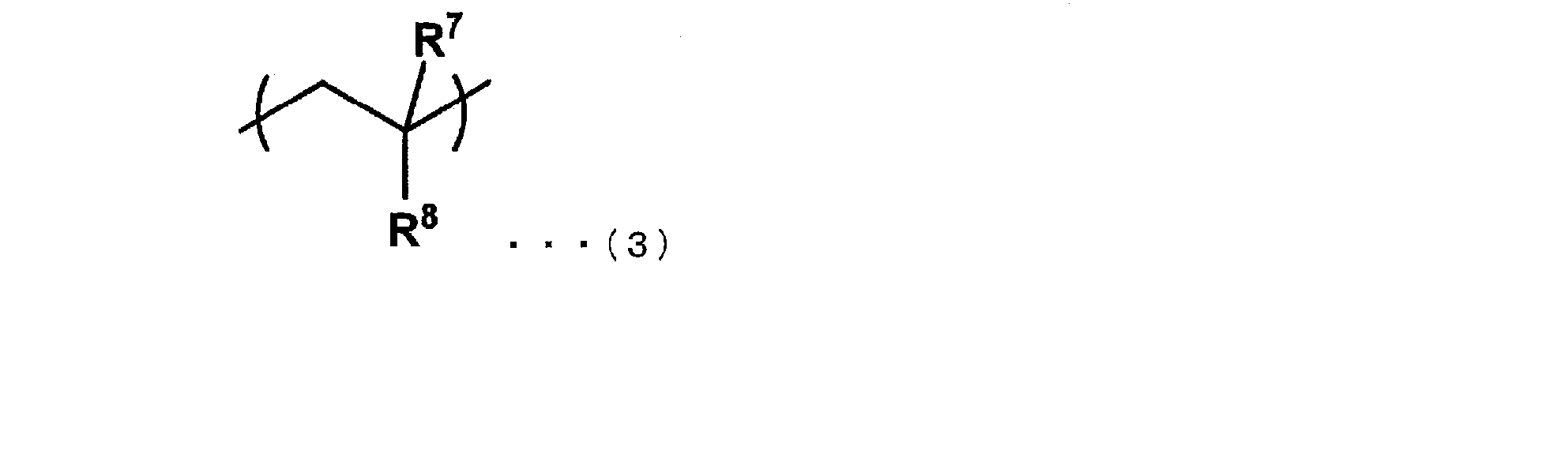
式(3)において、R7は、水素または炭素数1~8のアルキル基であり、R8は、炭素数6~10のアリール基である。
ハードコート層は、上記のとおり、上記(メタ)アクリル系樹脂フィルム上にハードコート層形成用組成物を塗工して形成される。ハードコート層形成用組成物は、例えば、熱、光(紫外線等)または電子線等により硬化し得る硬化性化合物を含む。好ましくは、ハードコート層形成用組成物は、光硬化型の硬化性化合物を含む。硬化性化合物は、モノマー、オリゴマーおよびプレポリマーのいずれであってもよい。
なお、ブロック層の厚みは、ハードコート層の反射スペクトル、またはSEM、TEM等の電子顕微鏡による観察により測定することができる。
浸透層は、上記のとおり、(メタ)アクリル系樹脂フィルムにハードコート層形成用組成物が浸透することにより形成される。言い換えれば、浸透層は(メタ)アクリル系樹脂フィルムを形成する(メタ)アクリル系樹脂とハードコート層を形成する化合物との相溶化領域の一部に対応し得る。
本発明の光学積層体は、必要に応じて、ハードコート層の外側に任意の適切なその他の層が配置され得る。代表例としては、反射防止層およびアンチグレア層が挙げられる。反射防止層およびアンチグレア層としては、当業界で通常用いられている反射防止層およびアンチグレア層が採用され得る。
本発明の光学積層体は、上記(メタ)アクリル系樹脂フィルム上に上記ハードコート層を形成して得られる。ハードコート層の形成方法は、(メタ)アクリル系樹脂フィルム上にハードコート層形成用組成物を塗布して塗布層を形成し、該塗布層を加熱することを含む。好ましくは、ハードコート層は、加熱後の塗布層を硬化処理して形成される。
実施例および比較例で得られた光学積層体を幅11mm、長さ100mmの大きさに切断し、基材フィルムを下にしてガラス板に載せた。次いで、当該光学積層体のハードコート層側表面上で、直径11mmの円柱の断面に取り付けたスチールウール#0000を、荷重400g、100mm/secで10往復させた。その後のハードコート層側表面を目視観察し、以下の基準で評価した。
また、荷重を600gとした以外は、上記と同様の評価を行った。
4:傷が全くない
3:わずかに傷がつく
2:細かい傷が残る
1:傷が著しい
(2)鉛筆硬度
実施例および比較例で得られた光学積層体のハードコート層側表面について、JIS K 5400に準じて(荷重500g)、鉛筆硬度を評価した。
(3)ハードコート層の密着性
ハードコート層の基材フィルムに対する密着性を、JIS K-5400の碁盤目剥離試験(基板目数:100個)に準じて評価した。
(4)干渉ムラ
実施例および比較例で得られた光学積層体の基材フィルム側に、黒色アクリル板(三菱レイヨン社製、厚み2mm)をアクリル系粘着剤を介して貼着した後、3波長蛍光灯下で、干渉ムラを目視観察し、以下の基準で評価した。
4:干渉ムラの発生無し
3:少し干渉ムラの発生が認められるが、実用上の問題はない
2:多くの干渉ムラの発生が認められる
1:顕著な干渉ムラの発生が認められる
(5)浸透層の厚み
実施例および比較例で得られた光学積層体の基材層側に、黒色アクリル板(三菱レイヨン社製、厚み2mm)を、厚み20μmのアクリル系粘着剤を介して貼着した。次いで、ハードコート層の反射スペクトルを、瞬間マルチ測光システム(大塚電子社製、商品名:MCPD3700)を用いて以下の条件で測定し、FFTスペクトルのピーク位置から、(ハードコート層+浸透層)の厚みを評価した。なお屈折率は、アタゴ社製のアッベ屈折率計(商品名:DR-M2/1550)を用い、中間液としてモノブロモナフタレンを選択して測定した。
・反射スペクトル測定条件
リファレンス:ミラー
アルゴリズム:FFT法
計算波長:450nm~850nm
・検出条件
露光時間:20ms
ランプゲイン:ノーマル
積算回数:10回
・FFT法
膜厚値の範囲:2~15μm
膜厚分解能:24nm
また、ハードコート層の厚みは、下記積層体(R)についての上記反射スペクトル測定により評価した。
・積層体(R):基材フィルムとしてPET基材(東レ社製、商品名:U48-3、屈折率:1.60)を用い、塗布層の加熱温度を60℃とした以外は、実施例1と同様にして得た。
なお、これらの積層体に用いられるPET基材には、ハードコート層形成用組成物が浸透しないので、積層体(R)から得られるFFTスペクトルのピーク位置から、ハードコート層のみの厚みが測定される。当該評価の結果、ハードコート層の厚みは5.3μmであった。
((ハードコート層+浸透層)の厚み)-((ハードコート層)の厚み)から算出される正の値を浸透層の厚みとした。
特開2010-284840号公報の製造例1に記載のイミド化MS樹脂100重量部およびトリアジン系紫外線吸収剤(アデカ社製、商品名:T-712)0.62重量部を、2軸混練機にて220℃にて混合し、樹脂ペレットを作製した。得られた樹脂ペレットを、100.5kPa、100℃で12時間乾燥させ、単軸の押出機にてダイス温度270℃でTダイから押出してフィルム状に成形した(厚み160μm)。さらに当該フィルムを、その搬送方向に150℃の雰囲気下に延伸し(厚み80μm)、次いでフィルム搬送方向と直交する方向に150℃の雰囲気下に延伸して、厚み40μmの基材フィルムA((メタ)アクリル系樹脂フィルム)を得た。得られた基材フィルムAの波長380nmの光の透過率は8.5%、面内位相差Reは0.4nm、厚み方向位相差Rthは0.78nmであった。また得られた基材フィルムAの透湿度は、61g/m2・24hrであった。なお、光透過率は、日立ハイテク(株)社製の分光光度計(装置名称;U-4100)を用いて波長範囲200nm~800nmで透過率スペクトルを測定し、波長380nmにおける透過率を読み取った。また、位相差値は、王子計測機器(株)製 商品名「KOBRA21-ADH」を用いて、波長590nm、23℃で測定した。透湿度は、JIS K 0208に準じた方法により、温度40℃、相対湿度92%の条件で測定した。
9官能ウレタンアクリルオリゴマー(ダイセル・サイテック社製、商品名:KRM7804、重量平均分子量:3000)100部、レベリング剤(DIC社製、商品名:GRANDIC PC-4100)5部、光重合開始剤(チバ・ジャパン社製、商品名:イルガキュア907)3部を混合し、固形分濃度が50%となるように、メチルイソブチルケトンで希釈して、ハードコート層形成用組成物を調製した。
製造例1で得られた基材フィルムA上に、得られたハードコート層形成用組成物を塗布して塗布層を形成し、当該塗布層を110℃で1分間加熱した。加熱後の塗布層に高圧水銀ランプにて積算光量300mJ/cm2の紫外線を照射して塗布層を硬化させて、基材層、ハードコート層および浸透層を形成し、光学積層体を得た。この光学積層体を上記(1)~(5)の評価に供した。結果を下記表1に示す。
9官能ウレタンアクリルオリゴマー(ダイセル・サイテック社製、商品名:KRM7804、重量平均分子量:3000)に代えて、10官能ウレタンアクリルオリゴマー(ダイセル・サイテック社製、商品名:KRM8452、重量平均分子量:1200)を用いた以外は、実施例1と同様にして光学積層体を得た。この光学積層体を上記(1)~(5)の評価に供した。結果を下記表1に示す。
9官能ウレタンアクリルオリゴマー(ダイセル・サイテック社製、商品名:KRM7804、重量平均分子量:3000)に代えて、10官能ウレタンアクリルオリゴマー(日本合成化学社製、商品名:UV-1700B、重量平均分子量:2000)を用い、塗布層の加熱温度を115℃とした以外は、実施例1と同様にして光学積層体を得た。この光学積層体を上記(1)~(5)の評価に供した。結果を下記表1に示す。
9官能ウレタンアクリルオリゴマー(ダイセル・サイテック社製、商品名:KRM7804、重量平均分子量:3000)に代えて、9官能ウレタンアクリルオリゴマー(日本合成化学社製、商品名:紫光UV-7610B、重量平均分子量:11000)を用いた以外は、実施例1と同様にして光学積層体を得た。この光学積層体を上記(1)~(5)の評価に供した。結果を下記表1に示す。
9官能ウレタンアクリルオリゴマー(ダイセル・サイテック社製、商品名:KRM7804、重量平均分子量:3000)に代えて、15官能ウレタンアクリルオリゴマー(新中村化学社製、商品名:NK オリゴ UA-53H、重量平均分子量:2300)を用いた以外は、実施例1と同様にして光学積層体を得た。この光学積層体を上記(1)~(5)の評価に供した。結果を下記表1に示す。
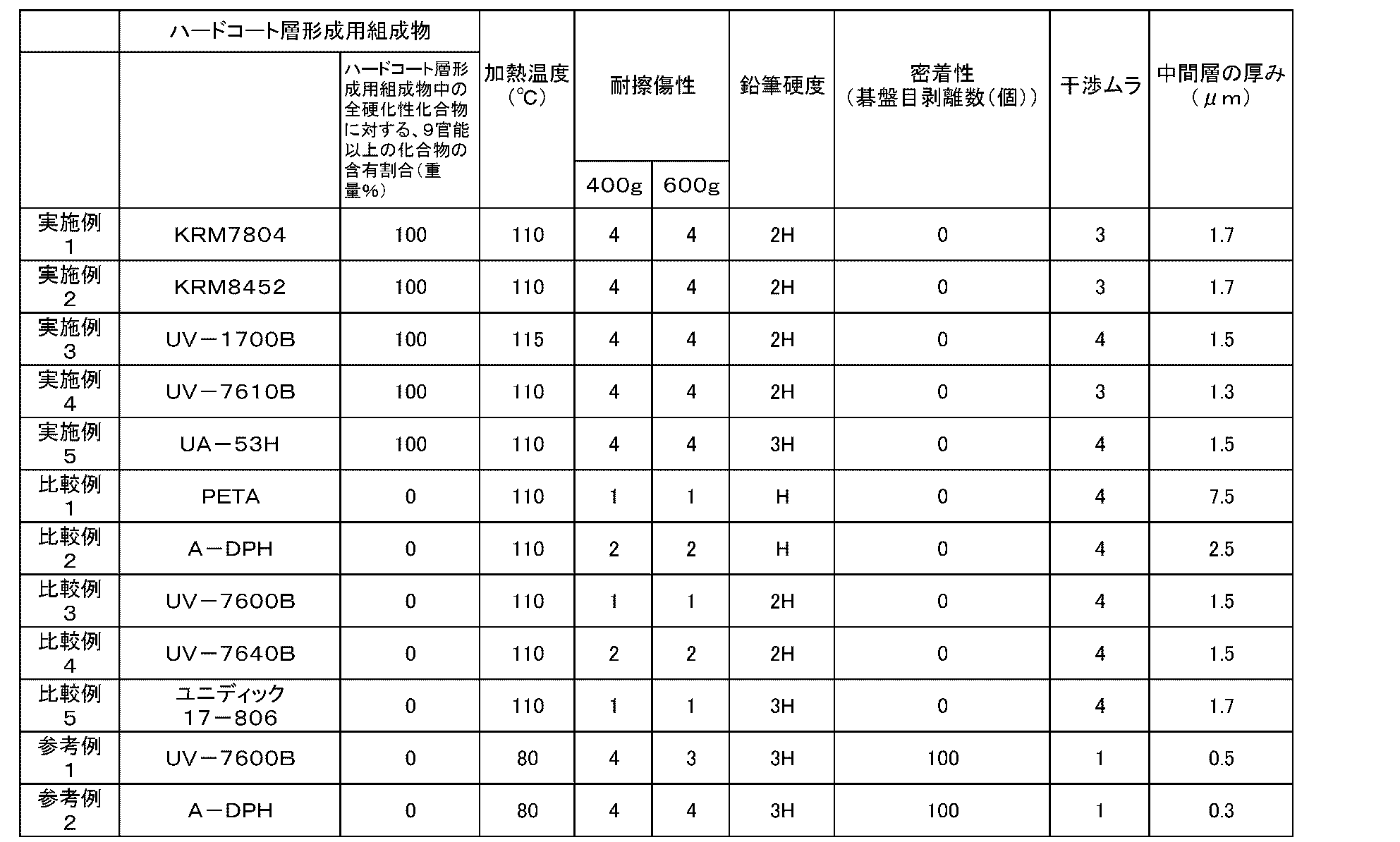
ジペンタエリスリトールヘキサアクリレート(新中村化学社製、商品名:A-DPH)100部をさらに加えてハードコート層形成用組成物を調製した以外は、実施例1と同様にして光学積層体を得た。この光学積層体を上記(1)~(5)の評価に供した。結果を下記表2に示す。
ペンタエリスリトールトリアクリレート(PETA)(大阪有機化学工業社製、商品名:ビスコート#300)25部をさらに加えてハードコート層形成用組成物を調製し、塗布層の加熱温度を100℃にした以外は、実施例1と同様にして光学積層体を得た。この光学積層体を上記(1)~(5)の評価に供した。結果を下記表2に示す。
15官能ウレタンアクリルオリゴマー(新中村化学社製、商品名:NK オリゴ UA-53H、重量平均分子量:2300)60部、ペンタエリスリトールトリアクリレート(PETA)(大阪有機化学工業社製、商品名:ビスコート#300)40部、レベリング剤(DIC社製、商品名:GRANDIC PC-4100)5部、光重合開始剤(チバ・ジャパン社製、商品名:イルガキュア907)3部を混合し、固形分濃度が50%となるように、メチルイソブチルケトンで希釈して調製したハードコート層形成用組成物を用い、塗布層の加熱温度を100℃とした以外は、実施例1と同様にして光学積層体を得た。結果を表2に示す。
下記組成からなる紫外線硬化型樹脂(DIC社製、商品名:PC1070、固形分:66%、溶媒:酢酸エチル、酢酸ブチル)100部およびレベリング剤(DIC社製、商品名:GRANDIC PC-4100)5部を混合し、固形分濃度が50%となるように、メチルイソブチルケトンで希釈して、ハードコート層形成用組成物を調製した。
製造例1で得られた基材フィルム上に、得られたハードコート層形成用組成物を塗布して塗布層を形成し、当該塗布層を110℃で1分間加熱した。加熱後の塗布層に高圧水銀ランプにて積算光量300mJ/cm2の紫外線を照射して塗布層を硬化させて、基材層、ハードコート層および浸透層を形成し、光学積層体を得た。この光学積層体を上記(1)~(5)の評価に供した。結果を下記表2に示す。
紫外線硬化型樹脂の組成
ペンタエリスリトール系アクリレートと水添キシレンジイソシアネートとから得られるウレタンアクリレート100部、
ジペンタエリスリトールヘキサアクリレート49部、
ペンタエリスリトールテトラアクリレート41部、
ペンタエリスリトールトリアクリレート24部、
2-ヒドロキシエチル基および2、3-ジヒドロキシプロピル基を有する(メタ)アクリルポリマー(重量平均分子量:3000、官能基数:10以上)58部、
光反応開始剤(チバ・ジャパン社製、商品名:イルガキュア184;BASF社製、商品名:ルシリンTPO)
9官能ウレタンアクリルオリゴマー(ダイセル・サイテック社製、商品名:KRM7804、重量平均分子量:3000)100部に代えて、ペンタエリスリトールトリアクリレート(PETA)(大阪有機化学工業社製、商品名:ビスコート#300)30部および上記紫外線硬化型樹脂(DIC社製、商品名:PC1070)100部を用い、塗布層の加熱温度を100℃にした以外は、実施例1と同様にして光学積層体を得た。この光学積層体を上記(1)~(5)の評価に供した。結果を下記表2に示す。
9官能ウレタンアクリルオリゴマー(ダイセル・サイテック社製、商品名:KRM7804、重量平均分子量:3000)100部に代えて、アクリロイルモルホリン(ACMO)(興人社製)25部および上記紫外線硬化型樹脂(DIC社製、商品名:PC1070)100部を用い、塗布層の加熱温度を100℃にした以外は、実施例1と同様にして光学積層体を得た。この光学積層体を上記(1)~(5)の評価に供した。結果を下記表2に示す。
9官能ウレタンアクリルオリゴマー(ダイセル・サイテック社製、商品名:KRM7804、重量平均分子量:3000)100部に代えて、ウレタンアクリレート100部と50以上の官能基を有するエポキシアクリレート系ポリマー(重量平均分子量:40000)100部とを含む樹脂(荒川化学社製、商品名:ビームセット371、固形分66%:酢酸エチル・酢酸ブチル)を用いた以外は、実施例1と同様にして光学積層体を得た。この光学積層体を上記(1)~(5)の評価に供した。結果を下記表2に示す。
9官能ウレタンアクリルオリゴマー(ダイセル・サイテック社製、商品名:KRM7804、重量平均分子量:3000)100部に代えて、ペンタエリスリトールトリアクリレート(PETA)(大阪有機化学工業社製、商品名:ビスコート#300)70部および上記荒川化学社製「ビームセット371」45部を用いた以外は、実施例1と同様にして光学積層体を得た。この光学積層体を上記(1)~(5)の評価に供した。結果を下記表2に示す。
9官能ウレタンアクリルオリゴマー(ダイセル・サイテック社製、商品名:KRM7804、重量平均分子量:3000)100部に代えて、ペンタエリスリトールトリアクリレート(PETA)(大阪有機化学工業社製、商品名:ビスコート#300)70部および上記荒川化学社製「ビームセット371」45部を用い、塗布層の加熱温度を100℃とした以外は、実施例1と同様にして光学積層体を得た。この光学積層体を上記(1)~(5)の評価に供した。結果を下記表2に示す。
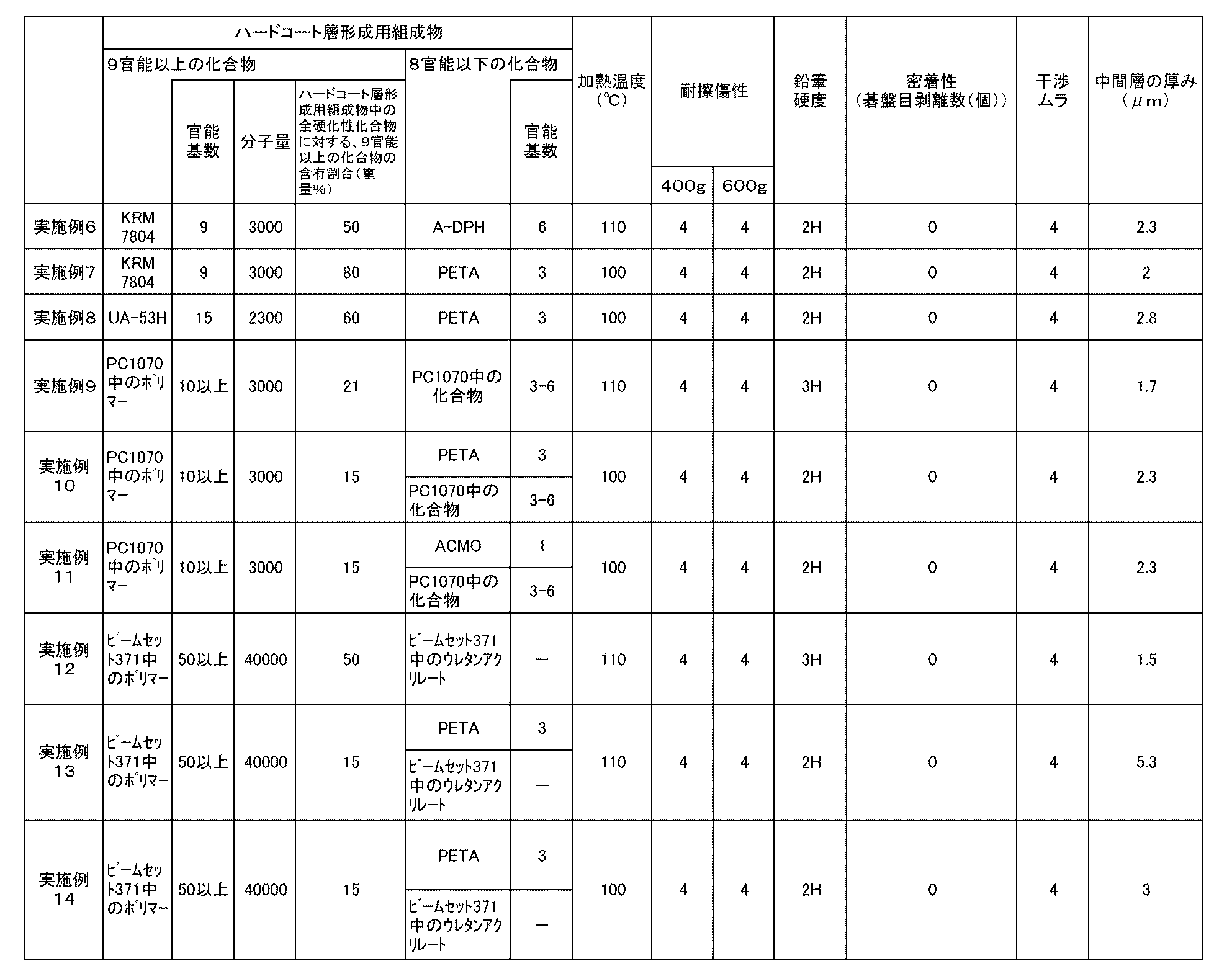
15官能ウレタンアクリルオリゴマー(新中村化学社製、商品名:NK オリゴ UA-53H、重量平均分子量:2300)60部、ペンタエリスリトールトリアクリレート(PETA)(大阪有機化学工業社製、商品名:ビスコート#300)25部、アクリロイルモルホリン(ACMO)(興人社製)15部、レベリング剤(DIC社製、商品名:GRANDIC PC-4100)5部、光重合開始剤(チバ・ジャパン社製、商品名:イルガキュア907)3部を混合し、固形分濃度が50%となるように、メチルイソブチルケトンで希釈して調製したハードコート層形成用組成物を用い、塗布層の加熱温度を95℃とした以外は、実施例1と同様にして光学積層体を得た。結果を表3に示す。
15官能ウレタンアクリルオリゴマー(新中村化学社製、商品名:NK オリゴ UA-53H、重量平均分子量:2300)60部、ペンタエリスリトールトリアクリレート(PETA)(大阪有機化学工業社製、商品名:ビスコート#300)25部、4-ヒドロキシブチルアクリレート(4-HBA)(大阪有機化学工業社製)15部、レベリング剤(DIC社製、商品名:GRANDIC PC-4100)5部、光重合開始剤(チバ・ジャパン社製、商品名:イルガキュア907)3部を混合し、固形分濃度が50%となるように、メチルイソブチルケトンで希釈して調製したハードコート層形成用組成物を用い、塗布層の加熱温度を90℃とした以外は、実施例1と同様にして光学積層体を得た。結果を表3に示す。
15官能ウレタンアクリルオリゴマー(新中村化学社製、商品名:NK オリゴ UA-53H、重量平均分子量:2300)50部、ペンタエリスリトールトリアクリレート(PETA)(大阪有機化学工業社製、商品名:ビスコート#300)25部、4-ヒドロキシブチルアクリレート(4-HBA)(大阪有機化学工業社製)25部、レベリング剤(DIC社製、商品名:GRANDIC PC-4100)5部、光重合開始剤(チバ・ジャパン社製、商品名:イルガキュア907)3部を混合し、固形分濃度が50%となるように、メチルイソブチルケトンで希釈して調製したハードコート層形成用組成物を用い、塗布層の加熱温度を90℃とした以外は、実施例1と同様にして光学積層体を得た。結果を表3に示す。
15官能ウレタンアクリルオリゴマー(新中村化学社製、商品名:NK オリゴ UA-53H、重量平均分子量:2300)60部、ペンタエリスリトールトリアクリレート(PETA)(大阪有機化学工業社製、商品名:ビスコート#300)25部、N-(2-ヒドロキシエチル)アクリルアミド(HEAA)(興人社製)15部、レベリング剤(DIC社製、商品名:GRANDIC PC-4100)5部、光重合開始剤(チバ・ジャパン社製、商品名:イルガキュア907)3部を混合し、固形分濃度が50%となるように、メチルイソブチルケトンで希釈して調製したハードコート層形成用組成物を用い、塗布層の加熱温度を90℃とした以外は、実施例1と同様にして光学積層体を得た。結果を表3に示す。
9官能ウレタンアクリルオリゴマー(ダイセル・サイテック社製、商品名:KRM7804、重量平均分子量:3000)60部、ペンタエリスリトールトリアクリレート(PETA)(大阪有機化学工業社製、商品名:ビスコート#300)25部、4-ヒドロキシブチルアクリレート(4-HBA)(大阪有機化学工業社製)15部、レベリング剤(DIC社製、商品名:GRANDIC PC-4100)5部、光重合開始剤(チバ・ジャパン社製、商品名:イルガキュア907)3部を混合し、固形分濃度が50%となるように、メチルイソブチルケトンで希釈して調製したハードコート層形成用組成物を用い、塗布層の加熱温度を90℃とした以外は、実施例1と同様にして光学積層体を得た。結果を表3に示す。
9官能ウレタンアクリルオリゴマー(ダイセル・サイテック社製、商品名:KRM7804、重量平均分子量:3000)50部、ペンタエリスリトールトリアクリレート(PETA)(大阪有機化学工業社製、商品名:ビスコート#300)25部、4-ヒドロキシブチルアクリレート(4-HBA)(大阪有機化学工業社製)25部、レベリング剤(DIC社製、商品名:GRANDIC PC-4100)5部、光重合開始剤(チバ・ジャパン社製、商品名:イルガキュア907)3部を混合し、固形分濃度が50%となるように、メチルイソブチルケトンで希釈して調製したハードコート層形成用組成物を用い、塗布層の加熱温度を90℃とした以外は、実施例1と同様にして光学積層体を得た。結果を表3に示す。
9官能ウレタンアクリルオリゴマー(ダイセル・サイテック社製、商品名:KRM7804、重量平均分子量:3000)60部、ペンタエリスリトールトリアクリレート(PETA)(大阪有機化学工業社製、商品名:ビスコート#300)25部、N-(2-ヒドロキシエチル)アクリルアミド(HEAA)(興人社製)15部、レベリング剤(DIC社製、商品名:GRANDIC PC-4100)5部、光重合開始剤(チバ・ジャパン社製、商品名:イルガキュア907)3部を混合し、固形分濃度が50%となるように、メチルイソブチルケトンで希釈して調製したハードコート層形成用組成物を用い、塗布層の加熱温度を90℃とした以外は、実施例1と同様にして光学積層体を得た。結果を表3に示す。
上記紫外線硬化樹脂((DIC社製、商品名:PC1070、固形分:66%、溶媒:酢酸エチル、酢酸ブチル))100部、ペンタエリスリトールトリアクリレート(PETA)(大阪有機化学工業社製、商品名:ビスコート#300)15部、4-ヒドロキシブチルアクリレート(4-HBA)(大阪有機化学工業社製)15部、レベリング剤(DIC社製、商品名:GRANDIC PC-4100)5部、光重合開始剤(チバ・ジャパン社製、商品名:イルガキュア907)3部を混合し、固形分濃度が50%となるように、メチルイソブチルケトンで希釈して調製したハードコート層形成用組成物を用い、塗布層の加熱温度を90℃とした以外は、実施例1と同様にして光学積層体を得た。結果を表3に示す。
上記紫外線硬化樹脂((DIC社製、商品名:PC1070、固形分:66%、溶媒:酢酸エチル、酢酸ブチル))100部、ペンタエリスリトールトリアクリレート(PETA)(大阪有機化学工業社製、商品名:ビスコート#300)15部、N-(2-ヒドロキシエチル)アクリルアミド(HEAA)(興人社製)15部、レベリング剤(DIC社製、商品名:GRANDIC PC-4100)5部、光重合開始剤(チバ・ジャパン社製、商品名:イルガキュア907)3部を混合し、固形分濃度が50%となるように、メチルイソブチルケトンで希釈して調製したハードコート層形成用組成物を用い、塗布層の加熱温度を90℃とした以外は、実施例1と同様にして光学積層体を得た。結果を表3に示す。
上記紫外線硬化樹脂(DIC社製、商品名:PC1070、固形分:66%、溶媒:酢酸エチル、酢酸ブチル)100部、エトキシ化グリセリントリアクリレート(新中村化学社製、商品名:NK エステル A-GLY-9E)15部、4-ヒドロキシブチルアクリレート(4-HBA)(大阪有機化学工業社製)15部、レベリング剤(DIC社製、商品名:GRANDIC PC-4100)5部、光重合開始剤(チバ・ジャパン社製、商品名:イルガキュア907)3部を混合し、固形分濃度が50%となるように、メチルイソブチルケトンで希釈して調製したハードコート層形成用組成物を用い、塗布層の加熱温度を90℃とした以外は、実施例1と同様にして光学積層体を得た。結果を表3に示す。

9官能ウレタンアクリルオリゴマー(ダイセル・サイテック社製、商品名:KRM7804、重量平均分子量:3000)に代えて、ペンタエリスリトールトリアクリレート(PETA)(大阪有機化学工業社製、商品名:ビスコート#300)を用いた以外は、実施例1と同様にして光学積層体を得た。この光学積層体を上記(1)~(5)の評価に供した。結果を上記表1に示す。
9官能ウレタンアクリルオリゴマー(ダイセル・サイテック社製、商品名:KRM7804、重量平均分子量:3000)に代えて、ジペンタエリスリトールヘキサアクリレート(新中村化学社製、商品名:A-DPH)を用いた以外は、実施例1と同様にして光学積層体を得た。この光学積層体を上記(1)~(5)の評価に供した。結果を上記表1に示す。
9官能ウレタンアクリルオリゴマー(ダイセル・サイテック社製、商品名:KRM7804、重量平均分子量:3000)100部に代えて、6官能ウレタンアクリルオリゴマー60部、ペンタエリスリトールテトラアクリレート30部およびペンタエリスリトールトリアクリレート10部の混合物(日本合成化学社製、商品名:紫光UV-7600B、重量平均分子量:1400)を用いた以外は、実施例1と同様にして光学積層体を得た。この光学積層体を上記(1)~(5)の評価に供した。結果を上記表1に示す。
9官能ウレタンアクリルオリゴマー(ダイセル・サイテック社製、商品名:KRM7804、重量平均分子量:3000)に代えて、6~7官能ウレタンアクリルオリゴマー(日本合成化学社製、商品名:紫光UV-7640B、重量平均分子量:1500)を用いた以外は、実施例1と同様にして光学積層体を得た。この光学積層体を上記(1)~(5)の評価に供した。結果を上記表1に示す。
イソシアヌル酸トリアクリレート13部、ペンタエリスリトールトリアクリレート16部、ジペンタエリスリトールヘキサアクリレート62部およびイソホロンジイソシアネートポリウレタン9部を含む紫外線硬化型樹脂(DIC社製、商品名:ユニディック17-806、固形分:80%、溶媒:酢酸ブチル)100部、レベリング剤(DIC社製、商品名:GRANDIC PC-4100)5部、光重合開始剤(チバ・ジャパン社製、商品名:イルガキュア907)3部を混合し、固形分濃度が50%となるように、メチルイソブチルケトンで希釈して、ハードコート層形成用組成物を調製した。
製造例1で得られた基材フィルムA上に、得られたハードコート層形成用組成物を塗布して塗布層を形成し、当該塗布層を110℃で1分間加熱した。加熱後の塗布層に高圧水銀ランプにて積算光量300mJ/cm2の紫外線を照射して塗布層を硬化させて、ハードコート層および浸透層を形成し、光学積層体を得た。この光学積層体を上記(1)~(5)の評価に供した。結果を上記表1に示す。
官能ウレタンアクリルオリゴマー(ダイセル・サイテック社製、商品名:KRM7804、重量平均分子量:3000)100部に代えて、6官能ウレタンアクリルオリゴマー60部、ペンタエリスリトールテトラアクリレート30部およびペンタエリスリトールトリアクリレート10部の混合物(日本合成化学社製、商品名:紫光UV-7600B、重量平均分子量:1400)を用い、加熱温度を80℃にした以外は、実施例1と同様にして光学積層体を得た。この光学積層体を上記(1)~(5)の評価に供した。結果を上記表1に示す。
9官能ウレタンアクリルオリゴマー(ダイセル・サイテック社製、商品名:KRM7804、重量平均分子量:3000)に代えて、ジペンタエリスリトールヘキサアクリレート(新中村化学社製、商品名:A-DPH)を用い、加熱温度を80℃にした以外は、実施例1と同様にして光学積層体を得た。この光学積層体を上記(1)~(5)の評価に供した。結果を上記表1に示す。
20 ハードコート層
30 浸透層
40 ブロック層
100、200、300 光学積層体
Claims (16)
- (メタ)アクリル系樹脂フィルムから形成される基材層と、
該(メタ)アクリル系樹脂フィルムにハードコート層形成用組成物を塗工して形成されたハードコート層とを備え、
ハードコート層形成用組成物が9個以上のラジカル重合性不飽和基を有する化合物(A)含み、
該化合物(A)の含有割合が、該ハードコート層形成用組成物中の全硬化性化合物に対して、15重量%~100重量%である、
光学積層体。 - 前記基材層と前記ハードコート層との間に、前記ハードコート層形成用組成物が前記(メタ)アクリル系樹脂フィルムに浸透して形成された浸透層をさらに備え、該浸透層の厚みが1.2μm以上である、請求項1に記載の光学積層体。
- 前記化合物(A)の重量平均分子量が、1000以上である、請求項1または2に記載の光学積層体。
- 前記ハードコート層形成用組成物が、2個~8個のラジカル重合性不飽和基を有する化合物(B1)をさらに含み、
前記化合物(A)の重量平均分子量が2000以上である、
請求項1または2に記載の光学積層体。 - 前記化合物(B1)の含有割合が、前記ハードコート層形成用組成物中の全硬化性化合物に対して、15重量%~85重量%である、請求項4に記載の光学積層体。
- 前記(メタ)アクリル系樹脂フィルムの波長380nmにおける光の透過率が、15%以下である、請求項1から5のいずれかに記載の光学積層体。
- 前記(メタ)アクリル系樹脂フィルムを形成する(メタ)アクリル系樹脂が、正の複屈折を発現する構造単位と負の複屈折を発現する構造単位とを有する、請求項1から6のいずれかに記載の光学積層体。
- 前記(メタ)アクリル系樹脂フィルムを形成する(メタ)アクリル系樹脂の重量平均分子量が、10000~500000である、請求項1から7のいずれかに記載の光学積層体。
- 前記ハードコート層形成用組成物が、単官能モノマー(B2)をさらに含む、請求項4から8のいずれかに記載の光学積層体。
- 前記単官能モノマー(B2)の重量平均分子量が500以下である、請求項9に記載の光学積層体。
- 前記単官能モノマーが、水酸基を有する、請求項9または10に記載の光学積層体。
- 前記単官能モノマー(B2)が、ヒドロキシアルキル(メタ)アクリレートおよび/またはN-(2-ヒドロキシアルキル)(メタ)アクリルアミドである、請求項11に記載の光学積層体。
- 前記ハードコート層の前記基材層とは反対側の表面が、凹凸構造を有する、請求項1から12のいずれかに記載の光学積層体。
- 前記ハードコート層の前記基材層とは反対側に、反射防止層をさらに備える、請求項1から13のいずれかに記載の光学積層体。
- 請求項1から14のいずれかに記載の光学積層体を含む、偏光フィルム。
- 請求項1から14のいずれかに記載の光学積層体を含む、画像表示装置。
Priority Applications (3)
| Application Number | Priority Date | Filing Date | Title |
|---|---|---|---|
| CN201280019682.XA CN103492181B (zh) | 2011-04-22 | 2012-04-18 | 光学层叠体 |
| US14/112,496 US20140044891A1 (en) | 2011-04-22 | 2012-04-18 | Optical laminate |
| KR1020137030672A KR102095602B1 (ko) | 2011-04-22 | 2012-04-18 | 광학 적층체 |
Applications Claiming Priority (4)
| Application Number | Priority Date | Filing Date | Title |
|---|---|---|---|
| JP2011095723 | 2011-04-22 | ||
| JP2011-095723 | 2011-04-22 | ||
| JP2012-093004 | 2012-04-16 | ||
| JP2012093004A JP6128629B2 (ja) | 2011-04-22 | 2012-04-16 | 光学積層体 |
Publications (1)
| Publication Number | Publication Date |
|---|---|
| WO2012144510A1 true WO2012144510A1 (ja) | 2012-10-26 |
Family
ID=47041616
Family Applications (1)
| Application Number | Title | Priority Date | Filing Date |
|---|---|---|---|
| PCT/JP2012/060422 Ceased WO2012144510A1 (ja) | 2011-04-22 | 2012-04-18 | 光学積層体 |
Country Status (6)
| Country | Link |
|---|---|
| US (1) | US20140044891A1 (ja) |
| JP (1) | JP6128629B2 (ja) |
| KR (1) | KR102095602B1 (ja) |
| CN (1) | CN103492181B (ja) |
| TW (1) | TWI531600B (ja) |
| WO (1) | WO2012144510A1 (ja) |
Cited By (16)
| Publication number | Priority date | Publication date | Assignee | Title |
|---|---|---|---|---|
| JP2014091743A (ja) * | 2012-10-31 | 2014-05-19 | Olympus Corp | 塗料、光学塗膜および光学素子 |
| WO2016147776A1 (ja) * | 2015-03-18 | 2016-09-22 | リケンテクノス株式会社 | ハードコート積層フィルム |
| WO2017086141A1 (ja) * | 2015-11-16 | 2017-05-26 | 富士フイルム株式会社 | 光学フィルム、画像表示装置、および光学フィルムの製造方法 |
| JP2017097322A (ja) * | 2015-11-16 | 2017-06-01 | 富士フイルム株式会社 | 光学フィルム、画像表示装置、および光学フィルムの製造方法 |
| US10241235B2 (en) * | 2012-12-25 | 2019-03-26 | Dai Nippon Printing Co., Ltd. | Optical layered object, polarizer obtained using same, and image display device |
| US10596739B2 (en) | 2015-03-18 | 2020-03-24 | Riken Technos Corporation | Molded body |
| US10809418B2 (en) | 2015-03-18 | 2020-10-20 | Riken Technos Corporation | Anti-glare hard coat laminated film |
| US10816700B2 (en) | 2015-12-08 | 2020-10-27 | Riken Technos Corporation | Hard coat layered film |
| US11065852B2 (en) | 2015-03-18 | 2021-07-20 | Riken Technos Corporation | Adhesive film |
| US11065851B2 (en) | 2015-03-18 | 2021-07-20 | Riken Technos Corporation | Multilayer hard coating film |
| US11241866B2 (en) | 2015-11-25 | 2022-02-08 | Riken Technos Corporation | Door body |
| US11352473B2 (en) | 2015-03-18 | 2022-06-07 | Riken Technos Corporation | Hard coat laminated film and method for producing same |
| US11407870B2 (en) | 2016-09-14 | 2022-08-09 | Riken Technos Corporation | Hard coat laminated film |
| US11433651B2 (en) | 2015-03-18 | 2022-09-06 | Riken Technos Corporation | Hard coat laminated film |
| US11639428B2 (en) | 2016-11-25 | 2023-05-02 | Riken Technos Corporation | Hardcoat multilayer film |
| US11774166B2 (en) | 2015-11-25 | 2023-10-03 | Riken Technos Corporation | Door body |
Families Citing this family (24)
| Publication number | Priority date | Publication date | Assignee | Title |
|---|---|---|---|---|
| JP6128576B2 (ja) | 2011-04-22 | 2017-05-17 | 日東電工株式会社 | 光学積層体 |
| JP2012234164A (ja) | 2011-04-22 | 2012-11-29 | Nitto Denko Corp | 光学積層体 |
| JP6074144B2 (ja) * | 2012-02-06 | 2017-02-01 | リンテック株式会社 | 光学用フィルム、並びにディスプレイ装置 |
| JP6194665B2 (ja) * | 2013-07-16 | 2017-09-13 | 凸版印刷株式会社 | ハードコート組成物および反射防止フィルム |
| KR101697404B1 (ko) * | 2013-09-30 | 2017-01-17 | 주식회사 엘지화학 | 편광판 및 이를 포함하는 화상표시장치 |
| JP6235288B2 (ja) * | 2013-09-30 | 2017-11-22 | 日東電工株式会社 | 光学積層体 |
| KR101697403B1 (ko) * | 2013-09-30 | 2017-01-17 | 주식회사 엘지화학 | 편광판 및 이를 포함하는 화상표시장치 |
| JP6238684B2 (ja) * | 2013-11-07 | 2017-11-29 | 日東電工株式会社 | 光学積層体 |
| JP2015152763A (ja) * | 2014-02-14 | 2015-08-24 | 大倉工業株式会社 | ハードコート層形成用樹脂組成物、及びこれを用いたハードコートフィルムとその製造方法 |
| JP2015210308A (ja) * | 2014-04-24 | 2015-11-24 | 日本製紙株式会社 | 反射防止フィルム |
| JP6599789B2 (ja) * | 2015-11-25 | 2019-10-30 | リケンテクノス株式会社 | ハードコート積層フィルム |
| JP6662232B2 (ja) * | 2016-07-26 | 2020-03-11 | 三菱ケミカル株式会社 | 樹脂積層体、ディスプレー前面板、携帯型情報端末装置及び移動体用グレージング |
| KR101988549B1 (ko) * | 2016-12-12 | 2019-06-12 | 주식회사 엘지화학 | 광학 필름 및 이를 포함하는 화상 표시 장치 |
| CN110520765B (zh) * | 2017-04-10 | 2021-12-10 | 日东电工株式会社 | 光学层叠体、偏振片及图像显示装置 |
| CN110494773B (zh) * | 2017-04-10 | 2022-09-06 | 日东电工株式会社 | 光学层叠体、偏振片及图像显示装置 |
| CN110537115B (zh) * | 2017-04-10 | 2023-02-17 | 日东电工株式会社 | 光学膜、偏振片及图像显示装置 |
| JP2019203931A (ja) * | 2018-05-21 | 2019-11-28 | 株式会社ダイセル | 防眩フィルムならびにその製造方法および用途 |
| JP2019206178A (ja) * | 2018-05-25 | 2019-12-05 | 三菱ケミカル株式会社 | 積層体、偏光子保護フィルム及び偏光板 |
| TWI684632B (zh) * | 2018-08-02 | 2020-02-11 | 明基材料股份有限公司 | 抗反射膜、具此抗反射膜之偏光板、及含此抗反射膜及/或含具此抗反射膜之偏光板的影像顯示裝置 |
| TWI667303B (zh) * | 2018-08-02 | 2019-08-01 | 明基材料股份有限公司 | 硬塗層光學膜、具有此硬塗層光學膜的偏光板、及含此硬塗層光學膜及/或偏光板的影像顯示裝置 |
| JP7372805B2 (ja) * | 2019-09-30 | 2023-11-01 | 日鉄ケミカル&マテリアル株式会社 | 筐体用コーティング膜および筐体用光硬化性コーティング樹脂組成物 |
| US12032121B2 (en) * | 2021-09-17 | 2024-07-09 | Benq Materials Corporation | High-haze anti-glare film and high-haze anti-glare anti-reflection film |
| KR102725884B1 (ko) * | 2021-10-20 | 2024-11-04 | 아티엔스 가부시키가이샤 | 하드 코트 필름 및 그 제조 방법 |
| JP2024139261A (ja) * | 2023-03-27 | 2024-10-09 | 日東電工株式会社 | 光学積層体および表示システム |
Citations (10)
| Publication number | Priority date | Publication date | Assignee | Title |
|---|---|---|---|---|
| JPH06184267A (ja) * | 1992-12-17 | 1994-07-05 | Mitsui Toatsu Chem Inc | 密着性に優れた光硬化型樹脂組成物 |
| JP2003236970A (ja) * | 2002-02-20 | 2003-08-26 | Dainippon Printing Co Ltd | 表面が強化された反射防止層、反射防止材、および反射防止体 |
| JP2006126802A (ja) * | 2004-09-30 | 2006-05-18 | Dainippon Printing Co Ltd | 光学積層体 |
| JP2008165041A (ja) * | 2006-12-28 | 2008-07-17 | Dainippon Printing Co Ltd | ハードコートフィルム、及びその製造方法 |
| JP2009042648A (ja) * | 2007-08-10 | 2009-02-26 | Dainippon Printing Co Ltd | ハードコートフィルム |
| JP2009084328A (ja) * | 2007-09-28 | 2009-04-23 | Dainippon Printing Co Ltd | 硬化性樹脂組成物及びハードコートフィルム |
| JP2010044163A (ja) * | 2008-08-11 | 2010-02-25 | Meihan Shinku Kogyo Kk | ディスプレイ面板用透明多層シート |
| JP2010065109A (ja) * | 2008-09-10 | 2010-03-25 | Nippon Shokubai Co Ltd | 熱可塑性樹脂組成物とそれを用いたフィルム |
| JP2010237648A (ja) * | 2009-03-09 | 2010-10-21 | Toppan Printing Co Ltd | 反射防止フィルム及びその製造方法、偏光板、透過型液晶ディスプレイ |
| JP2011033948A (ja) * | 2009-08-04 | 2011-02-17 | Dainippon Printing Co Ltd | 光学積層体、偏光板及び画像表示装置 |
Family Cites Families (17)
| Publication number | Priority date | Publication date | Assignee | Title |
|---|---|---|---|---|
| TW200307733A (en) * | 2002-02-01 | 2003-12-16 | Natoco Co Ltd | Composition curable with actinic energy ray and use thereof |
| JP3982377B2 (ja) * | 2002-10-08 | 2007-09-26 | Jsr株式会社 | 光硬化性樹脂組成物及び光学部材 |
| JP4475016B2 (ja) * | 2003-06-30 | 2010-06-09 | 東レ株式会社 | ハードコートフィルム、反射防止フィルムおよび画像表示装置 |
| JP2005133026A (ja) * | 2003-10-31 | 2005-05-26 | Lintec Corp | コーティング用組成物、ハードコートフィルムおよび光ディスク |
| JP4746863B2 (ja) * | 2004-11-11 | 2011-08-10 | リンテック株式会社 | 防眩性ハードコート層形成用材料及び防眩性ハードコートフィルム |
| JP2008165205A (ja) | 2006-12-05 | 2008-07-17 | Fujifilm Corp | 光学フィルム、反射防止フィルム、それを用いた偏光板およびディスプレイ装置 |
| JP2008181078A (ja) * | 2006-12-27 | 2008-08-07 | Nitto Denko Corp | 偏光子保護フィルム、偏光板、および画像表示装置 |
| JP5125118B2 (ja) * | 2007-01-29 | 2013-01-23 | 大日本印刷株式会社 | コーティング組成物、硬化膜、光学積層体及びその製造方法 |
| JP5063141B2 (ja) * | 2007-02-28 | 2012-10-31 | リンテック株式会社 | 防眩性ハードコートフィルムの製造方法 |
| JP4958609B2 (ja) * | 2007-04-06 | 2012-06-20 | リンテック株式会社 | 防眩性ハードコートフィルム及びその製造方法 |
| JP5181573B2 (ja) | 2007-08-10 | 2013-04-10 | 住友電装株式会社 | コネクタ |
| JP5078520B2 (ja) * | 2007-09-19 | 2012-11-21 | リンテック株式会社 | 防眩性ハードコートフィルム及びその製造方法 |
| JP5504605B2 (ja) * | 2007-10-30 | 2014-05-28 | 大日本印刷株式会社 | ハードコート層用硬化性樹脂組成物、及びハードコートフィルム |
| JP5291919B2 (ja) | 2007-11-20 | 2013-09-18 | 富士フイルム株式会社 | ディスプレイ表面に用いる偏光板用保護フィルム又は画像表示装置前面板用フィルム |
| WO2009084663A1 (ja) * | 2007-12-28 | 2009-07-09 | Nippon Shokubai Co., Ltd. | 光学フィルムとそれを備える画像表示装置 |
| JP2009262148A (ja) * | 2008-03-31 | 2009-11-12 | Dainippon Printing Co Ltd | 多層塗工膜の製造方法 |
| US20110304817A1 (en) * | 2009-04-20 | 2011-12-15 | Shunichiro Nakatsukasa | Coating composition |
-
2012
- 2012-04-16 JP JP2012093004A patent/JP6128629B2/ja active Active
- 2012-04-18 KR KR1020137030672A patent/KR102095602B1/ko active Active
- 2012-04-18 CN CN201280019682.XA patent/CN103492181B/zh active Active
- 2012-04-18 WO PCT/JP2012/060422 patent/WO2012144510A1/ja not_active Ceased
- 2012-04-18 US US14/112,496 patent/US20140044891A1/en not_active Abandoned
- 2012-04-20 TW TW101114325A patent/TWI531600B/zh active
Patent Citations (10)
| Publication number | Priority date | Publication date | Assignee | Title |
|---|---|---|---|---|
| JPH06184267A (ja) * | 1992-12-17 | 1994-07-05 | Mitsui Toatsu Chem Inc | 密着性に優れた光硬化型樹脂組成物 |
| JP2003236970A (ja) * | 2002-02-20 | 2003-08-26 | Dainippon Printing Co Ltd | 表面が強化された反射防止層、反射防止材、および反射防止体 |
| JP2006126802A (ja) * | 2004-09-30 | 2006-05-18 | Dainippon Printing Co Ltd | 光学積層体 |
| JP2008165041A (ja) * | 2006-12-28 | 2008-07-17 | Dainippon Printing Co Ltd | ハードコートフィルム、及びその製造方法 |
| JP2009042648A (ja) * | 2007-08-10 | 2009-02-26 | Dainippon Printing Co Ltd | ハードコートフィルム |
| JP2009084328A (ja) * | 2007-09-28 | 2009-04-23 | Dainippon Printing Co Ltd | 硬化性樹脂組成物及びハードコートフィルム |
| JP2010044163A (ja) * | 2008-08-11 | 2010-02-25 | Meihan Shinku Kogyo Kk | ディスプレイ面板用透明多層シート |
| JP2010065109A (ja) * | 2008-09-10 | 2010-03-25 | Nippon Shokubai Co Ltd | 熱可塑性樹脂組成物とそれを用いたフィルム |
| JP2010237648A (ja) * | 2009-03-09 | 2010-10-21 | Toppan Printing Co Ltd | 反射防止フィルム及びその製造方法、偏光板、透過型液晶ディスプレイ |
| JP2011033948A (ja) * | 2009-08-04 | 2011-02-17 | Dainippon Printing Co Ltd | 光学積層体、偏光板及び画像表示装置 |
Cited By (19)
| Publication number | Priority date | Publication date | Assignee | Title |
|---|---|---|---|---|
| CN104428377A (zh) * | 2012-10-31 | 2015-03-18 | 奥林巴斯株式会社 | 涂料、光学涂膜和光学元件 |
| JP2014091743A (ja) * | 2012-10-31 | 2014-05-19 | Olympus Corp | 塗料、光学塗膜および光学素子 |
| US10241235B2 (en) * | 2012-12-25 | 2019-03-26 | Dai Nippon Printing Co., Ltd. | Optical layered object, polarizer obtained using same, and image display device |
| US11352473B2 (en) | 2015-03-18 | 2022-06-07 | Riken Technos Corporation | Hard coat laminated film and method for producing same |
| WO2016147776A1 (ja) * | 2015-03-18 | 2016-09-22 | リケンテクノス株式会社 | ハードコート積層フィルム |
| US11512176B2 (en) | 2015-03-18 | 2022-11-29 | Riken Technos Corporation | Anti-glare hard coat laminated film |
| US10596739B2 (en) | 2015-03-18 | 2020-03-24 | Riken Technos Corporation | Molded body |
| US10780685B2 (en) | 2015-03-18 | 2020-09-22 | Riken Technos Corporation | Hard coat laminated film |
| US10809418B2 (en) | 2015-03-18 | 2020-10-20 | Riken Technos Corporation | Anti-glare hard coat laminated film |
| US11433651B2 (en) | 2015-03-18 | 2022-09-06 | Riken Technos Corporation | Hard coat laminated film |
| US11065852B2 (en) | 2015-03-18 | 2021-07-20 | Riken Technos Corporation | Adhesive film |
| US11065851B2 (en) | 2015-03-18 | 2021-07-20 | Riken Technos Corporation | Multilayer hard coating film |
| JP2017097322A (ja) * | 2015-11-16 | 2017-06-01 | 富士フイルム株式会社 | 光学フィルム、画像表示装置、および光学フィルムの製造方法 |
| WO2017086141A1 (ja) * | 2015-11-16 | 2017-05-26 | 富士フイルム株式会社 | 光学フィルム、画像表示装置、および光学フィルムの製造方法 |
| US11241866B2 (en) | 2015-11-25 | 2022-02-08 | Riken Technos Corporation | Door body |
| US11774166B2 (en) | 2015-11-25 | 2023-10-03 | Riken Technos Corporation | Door body |
| US10816700B2 (en) | 2015-12-08 | 2020-10-27 | Riken Technos Corporation | Hard coat layered film |
| US11407870B2 (en) | 2016-09-14 | 2022-08-09 | Riken Technos Corporation | Hard coat laminated film |
| US11639428B2 (en) | 2016-11-25 | 2023-05-02 | Riken Technos Corporation | Hardcoat multilayer film |
Also Published As
| Publication number | Publication date |
|---|---|
| JP2012234165A (ja) | 2012-11-29 |
| JP6128629B2 (ja) | 2017-05-17 |
| US20140044891A1 (en) | 2014-02-13 |
| KR102095602B1 (ko) | 2020-03-31 |
| TWI531600B (zh) | 2016-05-01 |
| CN103492181A (zh) | 2014-01-01 |
| TW201247754A (en) | 2012-12-01 |
| KR20140024394A (ko) | 2014-02-28 |
| CN103492181B (zh) | 2016-01-20 |
Similar Documents
| Publication | Publication Date | Title |
|---|---|---|
| JP6128629B2 (ja) | 光学積層体 | |
| JP6128576B2 (ja) | 光学積層体 | |
| JP6238684B2 (ja) | 光学積層体 | |
| WO2012144509A1 (ja) | 光学積層体 | |
| JP6235287B2 (ja) | 光学積層体 | |
| JP6235288B2 (ja) | 光学積層体 | |
| JP6054019B2 (ja) | 光学積層体 | |
| JP2017058693A (ja) | 光学積層体 | |
| KR102342375B1 (ko) | 광학 적층체 | |
| JP2017072846A (ja) | 光学積層体 |
Legal Events
| Date | Code | Title | Description |
|---|---|---|---|
| 121 | Ep: the epo has been informed by wipo that ep was designated in this application |
Ref document number: 12774290 Country of ref document: EP Kind code of ref document: A1 |
|
| WWE | Wipo information: entry into national phase |
Ref document number: 14112496 Country of ref document: US |
|
| NENP | Non-entry into the national phase |
Ref country code: DE |
|
| ENP | Entry into the national phase |
Ref document number: 20137030672 Country of ref document: KR Kind code of ref document: A |
|
| 122 | Ep: pct application non-entry in european phase |
Ref document number: 12774290 Country of ref document: EP Kind code of ref document: A1 |