WO2012141272A1 - 液晶ポリエステルの製造方法 - Google Patents
液晶ポリエステルの製造方法 Download PDFInfo
- Publication number
- WO2012141272A1 WO2012141272A1 PCT/JP2012/060075 JP2012060075W WO2012141272A1 WO 2012141272 A1 WO2012141272 A1 WO 2012141272A1 JP 2012060075 W JP2012060075 W JP 2012060075W WO 2012141272 A1 WO2012141272 A1 WO 2012141272A1
- Authority
- WO
- WIPO (PCT)
- Prior art keywords
- mol
- liquid crystal
- crystal polyester
- formula
- temperature
- Prior art date
- Legal status (The legal status is an assumption and is not a legal conclusion. Google has not performed a legal analysis and makes no representation as to the accuracy of the status listed.)
- Ceased
Links
- PFKKTUJMQOKZOR-UHFFFAOYSA-N OC(CC1CC(CC(O)=O)CCC1)=O Chemical compound OC(CC1CC(CC(O)=O)CCC1)=O PFKKTUJMQOKZOR-UHFFFAOYSA-N 0.000 description 2
Classifications
-
- C—CHEMISTRY; METALLURGY
- C08—ORGANIC MACROMOLECULAR COMPOUNDS; THEIR PREPARATION OR CHEMICAL WORKING-UP; COMPOSITIONS BASED THEREON
- C08G—MACROMOLECULAR COMPOUNDS OBTAINED OTHERWISE THAN BY REACTIONS ONLY INVOLVING UNSATURATED CARBON-TO-CARBON BONDS
- C08G63/00—Macromolecular compounds obtained by reactions forming a carboxylic ester link in the main chain of the macromolecule
- C08G63/78—Preparation processes
- C08G63/80—Solid-state polycondensation
-
- C—CHEMISTRY; METALLURGY
- C08—ORGANIC MACROMOLECULAR COMPOUNDS; THEIR PREPARATION OR CHEMICAL WORKING-UP; COMPOSITIONS BASED THEREON
- C08G—MACROMOLECULAR COMPOUNDS OBTAINED OTHERWISE THAN BY REACTIONS ONLY INVOLVING UNSATURATED CARBON-TO-CARBON BONDS
- C08G63/00—Macromolecular compounds obtained by reactions forming a carboxylic ester link in the main chain of the macromolecule
- C08G63/02—Polyesters derived from hydroxycarboxylic acids or from polycarboxylic acids and polyhydroxy compounds
- C08G63/60—Polyesters derived from hydroxycarboxylic acids or from polycarboxylic acids and polyhydroxy compounds derived from the reaction of a mixture of hydroxy carboxylic acids, polycarboxylic acids and polyhydroxy compounds
-
- C—CHEMISTRY; METALLURGY
- C08—ORGANIC MACROMOLECULAR COMPOUNDS; THEIR PREPARATION OR CHEMICAL WORKING-UP; COMPOSITIONS BASED THEREON
- C08G—MACROMOLECULAR COMPOUNDS OBTAINED OTHERWISE THAN BY REACTIONS ONLY INVOLVING UNSATURATED CARBON-TO-CARBON BONDS
- C08G63/00—Macromolecular compounds obtained by reactions forming a carboxylic ester link in the main chain of the macromolecule
- C08G63/02—Polyesters derived from hydroxycarboxylic acids or from polycarboxylic acids and polyhydroxy compounds
- C08G63/60—Polyesters derived from hydroxycarboxylic acids or from polycarboxylic acids and polyhydroxy compounds derived from the reaction of a mixture of hydroxy carboxylic acids, polycarboxylic acids and polyhydroxy compounds
- C08G63/605—Polyesters derived from hydroxycarboxylic acids or from polycarboxylic acids and polyhydroxy compounds derived from the reaction of a mixture of hydroxy carboxylic acids, polycarboxylic acids and polyhydroxy compounds the hydroxy and carboxylic groups being bound to aromatic rings
-
- C—CHEMISTRY; METALLURGY
- C08—ORGANIC MACROMOLECULAR COMPOUNDS; THEIR PREPARATION OR CHEMICAL WORKING-UP; COMPOSITIONS BASED THEREON
- C08L—COMPOSITIONS OF MACROMOLECULAR COMPOUNDS
- C08L67/00—Compositions of polyesters obtained by reactions forming a carboxylic ester link in the main chain; Compositions of derivatives of such polymers
-
- C—CHEMISTRY; METALLURGY
- C09—DYES; PAINTS; POLISHES; NATURAL RESINS; ADHESIVES; COMPOSITIONS NOT OTHERWISE PROVIDED FOR; APPLICATIONS OF MATERIALS NOT OTHERWISE PROVIDED FOR
- C09K—MATERIALS FOR MISCELLANEOUS APPLICATIONS, NOT PROVIDED FOR ELSEWHERE
- C09K19/00—Liquid crystal materials
- C09K19/04—Liquid crystal materials characterised by the chemical structure of the liquid crystal components, e.g. by a specific unit
- C09K19/38—Polymers
- C09K19/3804—Polymers with mesogenic groups in the main chain
- C09K19/3809—Polyesters; Polyester derivatives, e.g. polyamides
Definitions
- the present invention relates to a method for producing a liquid crystal polyester.
- liquid crystalline polymers In recent years, materials excellent in heat resistance, mechanical properties, chemical resistance and the like have been demanded for fibers, films or molded articles. As a material corresponding to these, liquid crystalline polymers have attracted attention. As one type, there is a liquid crystal polyester produced by condensation polymerization of a dicarboxylic acid compound containing an aromatic dicarboxylic acid and a dihydroxy compound containing an aromatic diol.
- composition of liquid crystal polyester has been studied for the purpose of improving polymer properties.
- hydroxycarboxylic acid compounds such as p-hydroxybenzoic acid and liquid crystal polyesters containing a cyclohexanedicarboxylic acid component have been proposed (see, for example, Patent Document 1 below). ).
- the above-mentioned liquid crystalline polyester is usually produced by melt condensation polymerization in which a raw material monomer is charged into a reaction vessel, heated and melted, and a condensation polymerization reaction proceeds while stirring and mixing. In such melt polycondensation, the reaction proceeds and the melting point of the polymer (polymer) increases as the degree of polymerization (molecular weight) increases, so it is necessary to raise the reaction temperature in order to keep the reaction homogeneous while maintaining the molten state. There is.
- the liquid crystal polyester tends to be colored brown due to thermal history.
- the present invention has been made in view of the above circumstances, and provides a method for producing a liquid crystal polyester capable of obtaining a liquid crystal polyester having sufficient heat resistance and mechanical properties and sufficiently suppressed coloring. With the goal.
- the present inventors have intensively studied. As a result, the composition containing a specific compound is melt polycondensed at a specific temperature, and the resulting reaction product is solid-phase polycondensed at a specific temperature. As a result, it was found that a liquid crystal polyester having sufficient heat resistance and mechanical properties but sufficiently suppressed coloring was obtained, and the present invention was completed.
- the method for producing a liquid crystal polyester of the present invention comprises producing a liquid crystal polyester by subjecting a composition containing a dicarboxylic acid compound, a hydroxycarboxylic acid compound and a dihydroxy compound to melt polycondensation, and subjecting the resulting reaction product to solid phase polycondensation.
- the composition comprises 2 to 30 mol% of a dicarboxylic acid compound represented by the following formula (1) based on the total of the dicarboxylic acid compound, the hydroxycarboxylic acid compound and the dihydroxy compound. It contains 40 to 80 mol% of p-hydroxybenzoic acid, the polycondensation temperature of the melt polycondensation is 315 ° C. or less, and the polycondensation temperature of the solid phase polycondensation is 315 ° C. or less.
- a liquid crystal polyester having a good color with sufficiently suppressed coloring while having sufficient heat resistance and mechanical properties can be obtained.
- the present inventors consider the reason why such an effect can be obtained as follows. First, it can be considered that the melt polycondensation of the specific composition is suppressed to the above temperature range and carried out at a low degree of polymerization, whereby the melt (liquid) can be easily stirred and variation in the degree of polymerization can be suppressed.
- a reflector (white reflective frame) is provided around the LED element in order to increase the light utilization rate of the LED.
- a liquid crystal polyester resin composition in which liquid crystal polyester and a white pigment such as titanium oxide are blended may be used.
- the degree of coloring of the liquid crystal polyester is large, it is necessary to increase the blending amount of the white pigment in order to sufficiently ensure the light reflectance of the reflector.
- an increase in the amount of white pigment may affect the physical properties of the reflector.
- the method for producing a liquid crystalline polyester of the present invention by adjusting the reaction temperature in the melt polycondensation and the solid phase polycondensation using a specific composition as described above, sufficient mechanical properties and A liquid crystal polyester having heat resistance and further suppressed coloring can be obtained.
- the liquid crystalline polyester obtained by the method of the present invention sufficient light reflectance can be obtained without increasing or reducing the amount of white pigment, light resistance, mechanical properties and heat resistance. It becomes easy to obtain a molded body satisfying the above at a higher level.
- the liquid crystal polyester obtained by the method of the present invention not only provides a sufficient light reflectance for light having a wavelength of 480 nm, but also is generated from an LED element.
- the present inventors have obtained the knowledge that there is little discoloration due to light and the light reflectance is hardly lowered.
- the composition is based on the total of the dicarboxylic acid compound, the hydroxycarboxylic acid compound, and the dihydroxy compound. 10 to 30 mol% of the dicarboxylic acid compound represented by the formula (1), 40 to 80 mol% of p-hydroxybenzoic acid, and 10 to 30 mol of the aromatic dihydroxy compound represented by the following general formula (2) % Is preferable.
- X represents a divalent group having an aromatic ring.
- the liquid crystalline polyester is composed of 2 to 29 mol% of the dicarboxylic acid compound represented by the above formula (1), 40 to 80 mol% of p-hydroxybenzoic acid, It comprises 10 to 30 mol% of an aromatic dihydroxy compound represented by the formula (2) and 1 to 28 mol% of an aromatic dicarboxylic acid compound represented by the following general formula (3). It is preferable that 1 mol% or more of isophthalic acid is contained as the aromatic dicarboxylic acid compound represented by the formula (3).
- X represents a divalent group having an aromatic ring.
- Y represents a divalent group having an aromatic ring.
- the method for producing a liquid crystal polyester (hereinafter sometimes referred to as “LCP”) of the present embodiment includes a first step of melt polycondensation of a composition containing a dicarboxylic acid compound, a hydroxycarboxylic acid compound and a dihydroxy compound, A second step of subjecting the reaction product obtained in the step to solid phase polycondensation.
- composition according to this embodiment includes 2 to 30 mol% of dicarboxylic acid compound represented by the following formula (1) and p-hydroxybenzoic acid based on the total of the dicarboxylic acid compound, hydroxycarboxylic acid compound and dihydroxy compound. 40 to 80 mol%.
- Examples of the dicarboxylic acid compound represented by the above formula (1) include 1,3-cyclohexanedicarboxylic acid and 1,4-cyclohexanedicarboxylic acid. These can be used individually by 1 type or in combination of 2 types.
- the content of the dicarboxylic acid compound represented by the formula (1) in the composition is less than 2 mol%, sufficient mechanical properties and light resistance cannot be obtained, and if it exceeds 30 mol%, sufficient Heat resistance and moldability cannot be obtained.
- the content ratio of the dicarboxylic acid compound represented by the formula (1) is the sum of the dicarboxylic acid compound, hydroxycarboxylic acid compound and dihydroxy compound. As a standard, it is preferably 5 to 25 mol%, more preferably 15 to 20 mol%.
- the above composition contains 1,4-cyclohexanedicarboxylic acid as a dicarboxylic acid compound. , And preferably 5 to 25 mol% based on the total of the hydroxycarboxylic acid compound and the dihydroxy compound.
- the content of p-hydroxybenzoic acid in the composition is less than 40 mol%, sufficient moldability and heat resistance cannot be obtained, and if it exceeds 80 mol%, sufficient moldability and heat resistance are obtained. I can't get it.
- the content ratio of p-hydroxybenzoic acid should be 50 to 70 mol% based on the total of the dicarboxylic acid compound, hydroxycarboxylic acid compound and dihydroxy compound. Preferably, it is 60 to 70 mol%.
- composition further includes an aromatic dihydroxy compound represented by the following general formula (2), or an aromatic dihydroxy compound represented by the following general formula (2) and an aromatic represented by the following general formula (3).
- aromatic dihydroxy compound represented by the following general formula (2) or an aromatic dihydroxy compound represented by the following general formula (2) and an aromatic represented by the following general formula (3).
- Group dicarboxylic acid compound
- X represents a divalent group having an aromatic ring.
- Y represents a divalent group having an aromatic ring.
- composition contains the aromatic dihydroxy compound represented by the general formula (2) or the aromatic dicarboxylic acid compound represented by the general formula (3)
- the compound and formula represented by the formula (2) can be used alone or in combination of two or more.
- Examples of the compounds represented by the general formulas (2) and (3) include compounds represented by the following general formulas (2-1) and (3-1).
- Ar 1 and Ar 2 represent a divalent aromatic group
- X 1 and Y 1 represent a divalent group having an aromatic ring
- s and t Represents an integer of 0 or 1.
- a divalent aromatic group represented by the following formula (Ar-1) or (Ar-2) is preferable from the viewpoint of heat resistance and molding processability. Note that the two bonds of the benzene ring represented by the formula (Ar-1) are in a meta position or a para position.
- X 1 includes a divalent group represented by the following formula (2-2).
- L 1 represents a divalent hydrocarbon group, —O—, —S—, —CO—, —SO—, or —SO 2 —, and u is 0 or 1 Indicates an integer.
- the divalent hydrocarbon group include alkanediyl groups having 1 to 3 carbon atoms, and among them, —C (CH 3 ) 2 — or —CH (CH 3 ) — is preferable. Note that the two bonds of the benzene ring in formula (2-2) are in a meta or para position.
- Examples of Y 1 include a divalent group represented by the following formula (3-2).
- L 2 represents a divalent hydrocarbon group, —O—, —S—, —SO—, —CO—, or —SO 2 —
- v is 0 or 1 Indicates an integer.
- the divalent hydrocarbon group include alkanediyl groups having 1 to 3 carbon atoms, and among them, —C (CH 3 ) 2 — or —CH (CH 3 ) — is preferable. Note that the two bonds of the benzene ring in formula (3-2) are in the meta or para position.
- the content ratio of the compound represented by the formula (1), p-hydroxybenzoic acid and the compound represented by the formula (2) can be set so that the total content thereof is 100 mol% and the content ratio of the compound of the formula (1) is equal to the content ratio of the compound of the formula (2).
- the compound represented by the above formula (1) is 10 to 30 mol%
- the p-hydroxybenzoic acid is 40 to 80 mol%
- the compound represented by the above general formula (2) is 10 to 30 mol%.
- a composition containing mol% (hereinafter sometimes referred to as the first composition) can be subjected to melt polycondensation.
- Specific examples of the compound represented by the general formula (2) include hydroquinone, 4,4′-dihydroxybiphenyl, 4,4′-dihydroxybenzophenone, 2,6-naphthalenediol, 4,4 ′. Isopropylidene diphenol, bisphenol S and the like. These can be used alone or in combination of two or more.
- the first composition preferably contains 15 to 25 mol% of 4,4′-dihydroxybiphenyl as the compound represented by the general formula (2).
- composition further contains a compound represented by formula (2) and a compound represented by formula (3), the compound represented by formula (1), p-hydroxybenzoic acid, formula (2) ) And the content ratio of the compound represented by formula (3) are 100 mol% in total, and the sum of the content ratio of the compound of formula (1) and the compound of formula (3) and the formula ( It can set so that the content rate of the compound of 2) may become equal.
- % And a composition containing 1 to 28 mol% of the compound represented by the above general formula (3) (hereinafter sometimes referred to as a second composition) can be subjected to melt polycondensation.
- Specific examples of the compound represented by the general formula (3) include terephthalic acid, isophthalic acid, 2,6-naphthalenedicarboxylic acid, 4,4′-biphenyldicarboxylic acid, and benzophenone-4,4 ′. -Dicarboxylic acids and the like. These can be used alone or in combination of two or more.
- the second composition it is preferable to contain 1 to 5 mol% of isophthalic acid in the composition from the viewpoint of moldability and heat resistance.
- the second composition preferably contains 10 to 20 mol% of 1,4-cyclohexanedicarboxylic acid from the viewpoint of light resistance and heat resistance. Further, from the viewpoint of molding processability and heat resistance, it is preferable to contain 15 to 20 mol% of 4,4'-dihydroxybiphenyl.
- the first step of melt polycondensation of the above-described composition is performed.
- acetylation is preferably performed by supplying acetic anhydride to the monomer in the reaction vessel, and this acetylation step is carried out using the same reaction vessel as the melt polycondensation step. Is preferred.
- Acetic anhydride is preferably supplied so that the excess amount of acetic anhydride is 1 to 10 mol% with respect to the number of moles of hydroxyl groups of the monomer. If the excess amount of acetic anhydride is less than 1 mol%, the reaction rate tends to be slow and LCP tends to be colored, and if it exceeds 10 mol%, LCP tends to be colored due to the effect of residual acetic anhydride.
- the acetylated monomer can be subjected to a melt polycondensation reaction with a deacetic acid reaction.
- a reaction tank it is preferable to use a reaction tank provided with a monomer supply means, an acetic acid discharge means, a molten polyester extraction means and a stirring means.
- a reaction vessel polycondensation apparatus
- the melt polycondensation temperature in the first step needs to be 315 ° C. or less, but preferably 290 ° C. to 310 ° C. If this temperature is less than 290 ° C, a prepolymer having a sufficient degree of polymerization tends to be not obtained, and if it exceeds 310 ° C, coloring tends to occur.
- said melt polycondensation temperature is the temperature of the molten polymer which can be detected with the thermocouple installed in the reaction tank inside.
- the temperature of the melt polycondensation temperature within a range of 0.1 to 5.0 ° C./min. More preferably, it is in the range of 0.3 to 3.0 ° C./min.
- the rate of temperature increase is less than 0.1 ° C./min, the production efficiency is remarkably reduced, and when it exceeds 5.0 ° C./min, the amount of unreacted components increases, which causes coloring in the second step. There is a fear.
- the temperature is raised to start polycondensation, the temperature is raised in the range of 0.1 ° C./min to 2 ° C./min, and the final temperature reached 290 to 315 ° C. It is preferable to raise.
- a known catalyst can be used as a polyester polycondensation catalyst.
- the catalyst include metal catalysts such as magnesium acetate, stannous acetate, tetrabutyl titanate, lead acetate, sodium acetate and potassium acetate, and organic compound catalysts such as N-methylimidazole.
- the liquid crystalline polyester having a low polymerization degree is withdrawn from the polymerization tank in the molten state, Supplied to a cooler such as a drum cooler or the like, cooled and solidified.
- the solidified liquid crystal polyester having a low polymerization degree is pulverized to a size suitable for the subsequent solid phase polycondensation reaction.
- the pulverization method is not particularly limited.
- an impact pulverizer such as a feather mill, Victor mill, Coroplex, Pulverizer, Contraplex, scroll mill, ACM pulverizer manufactured by Hosokawa Micron, and a pulverized pulverizer manufactured by Matsubo.
- a preferable example is a method using an apparatus such as a roll granulator. Particularly preferred is a method using a feather mill manufactured by Hosokawa Micron Corporation.
- the particle size of the pulverized product is not particularly limited, but is preferably in the range of 4 mesh to 2000 mesh not passing through industrial sieve (Tyler mesh), 5 mesh to 2000 mesh (aperture 0.01 to 4 mm). ) In the range of 9 mesh to 1450 mesh (aperture 0.02 to 2 mm), and most preferable.
- the pulverized product (prepolymer) obtained in the pulverization step is subjected to solid phase polycondensation to obtain the target liquid crystal polyester.
- the solid-phase polycondensation temperature in the second step needs to be 315 ° C. or lower, preferably 290 ° C. to 310 ° C. When this temperature is less than 290 ° C., a liquid crystal polyester having a sufficient degree of polymerization tends to be difficult to obtain, and when it exceeds 310 ° C., it tends to be easily colored.
- said solid-phase polycondensation temperature is the temperature of the polymer powder which can be detected with the thermocouple installed in the reaction tank inside.
- thermotropic liquid crystal polyester can be obtained by the method of the present embodiment. This can be confirmed by the following procedure. A polyester sample is heated and melted on a microscope heating stage by using a polarizing microscope BH-2 manufactured by Olympus Co., Ltd. equipped with a microscope cooling and heating stage 10002 model manufactured by Japan High-Tech Co., Ltd. And the presence or absence of optical anisotropy can be confirmed by observing at the magnification of 100 times and 200 times at the time of melting.
- the liquid crystal polyester obtained by the production method of the present invention can be suitably used as a resin component of a resin composition for molding an LED reflector.
- Example 1 Production of liquid crystal polyester (A)
- a 6-L polymerization reaction tank manufactured by Nitto Koatsu Co., Ltd. having a double helical stirring blade made of SUS316, 0.83 kg (6.0 mol) of p-hydroxybenzoic acid (Ueno Pharmaceutical Co., Ltd.), 4 , 4'-dihydroxybiphenyl (Honshu Chemical Co., Ltd.) 0.37 kg (2.0 mol), 1,4-cyclohexanedicarboxylic acid (Eastman Chemical Co.) 0.34 kg (2.0 mol), as catalyst
- 0.15 g of potassium acetate manufactured by Kishida Chemical Co., Ltd.
- 0.50 g of magnesium acetate manufactured by Kishida Chemical Co., Ltd.
- the temperature of the polymerization reaction tank in acetic acid distillation was raised at 0.5 ° C./min.
- the melt temperature in the tank reached 310 ° C.
- the polymer was removed from the outlet at the bottom of the reaction tank. It was taken out and cooled and solidified.
- the obtained polymer was pulverized by a pulverizer manufactured by Hosokawa Micron Co., Ltd. into a size passing through a sieve having an opening of 2.0 mm to obtain a prepolymer.
- the prepolymer obtained above is filled into a solid phase polymerization apparatus (rotary kiln) manufactured by Irie Shokai, nitrogen is circulated at a flow rate of 0.1 Nm 3 / hr, and the heater temperature is changed from room temperature to 190 at a rotational speed of 5 rpm. After raising the temperature to 3 ° C. over 3 hours, the temperature was raised to 280 ° C. over 5 hours, further raised to 320 ° C. over 3 hours, and this temperature was maintained for solid phase polycondensation. After confirming that the temperature of the polymer powder in the kiln reached 300 ° C., the heating was stopped, and the kiln was cooled for 4 hours while rotating.
- rotary kiln rotary kiln
- thermotropic liquid crystal polyester (A) When the molten state of the polymer after the solid phase polycondensation was observed under a polarizing microscope, it showed optical anisotropy and liquid crystallinity was confirmed. In this way, about 1.5 kg of powdery thermotropic liquid crystal polyester (A) was obtained. The melting point of the obtained thermotropic liquid crystal polyester (A) was 345 ° C.
- Example 2 Production of liquid crystal polyester (B)
- a 6 L polymerization reaction vessel manufactured by Nitto High Pressure Co., Ltd.
- p-hydroxybenzoic acid manufactured by Ueno Pharmaceutical Co., Ltd.
- p-hydroxybenzoic acid manufactured by Ueno Pharmaceutical Co., Ltd.
- p-hydroxybenzoic acid 1.10 kg (8.0 mol) '-Dihydroxybiphenyl (Honshu Chemical Co., Ltd.) 0.19 kg (1.0 mol)
- 1,4-cyclohexanedicarboxylic acid Eastman Chemical Co.
- potassium acetate as catalyst 0.15 g
- Kishida Chemical Co., Ltd. and 0.50 g of magnesium acetate (manufactured by Kishida Chemical Co., Ltd.)
- acetic anhydride 1.07 kg (10.5 mol) was further added, the rotation speed
- thermotropic liquid crystal polyester (B).
- the melting point of the obtained thermotropic liquid crystal polyester was 342 ° C.
- Example 3 Production of liquid crystal polyester (C)
- a 6 L polymerization reaction vessel manufactured by Nitto High Pressure Co., Ltd.
- 0.55 kg (4.0 mol) of p-hydroxybenzoic acid manufactured by Ueno Pharmaceutical Co., Ltd.
- 4, 4 '-Dihydroxybiphenyl Honshu Chemical Co., Ltd.
- 1,4-cyclohexanedicarboxylic acid Eastman Chemical Co.
- potassium acetate as catalyst 0.15 g (manufactured by Kishida Chemical Co., Ltd.) and 0.50 g of magnesium acetate (manufactured by Kishida Chemical Co., Ltd.) were charged, and after depressurizing and injecting nitrogen into the polymerization reactor twice to perform nitrogen substitution, acetic anhydride 1.07 kg (10.5 mol) was further added
- thermotropic liquid crystal polyester (C)
- the melting point of the obtained thermotropic liquid crystal polyester was 350 ° C.
- Example 4 Production of liquid crystal polyester (D)
- a 6-L polymerization reaction vessel manufactured by Nitto Koatsu Co., Ltd.
- SUS316 made of SUS316 and having a double helical stirring blade was charged with 0.83 kg (6.0 mol) of p-hydroxybenzoic acid (Ueno Pharmaceutical Co., Ltd.), 4, 4 '-Dihydroxybiphenyl (Honshu Chemical Co., Ltd.) 0.37 kg (2.0 mol), 1,4-cyclohexanedicarboxylic acid (Eastman Chemical Co.) 0.29 kg (1.7 mol), isophthalic acid (A ⁇ Dii International Co., Ltd.) 0.05 kg (0.3 mol), 0.15 g of potassium acetate (Kishida Chemical Co., Ltd.) and 0.50 g of magnesium acetate (Kishida Chemical Co., Ltd.) were charged as a catalyst, and polymerization reaction was performed.
- thermotropic liquid crystal polyester D
- the melting point of the obtained thermotropic liquid crystal polyester was 340 ° C.
- Example 5 Production of liquid crystalline polyester (E)
- a 6 L polymerization reaction vessel manufactured by Nitto High Pressure Co., Ltd.
- 0.55 kg (4.0 mol) of p-hydroxybenzoic acid manufactured by Ueno Pharmaceutical Co., Ltd.
- 4, 4 '-Dihydroxybiphenyl Honshu Chemical Co., Ltd.
- 1,4-cyclohexanedicarboxylic acid Eastman Chemical Co.
- terephthalic acid Mitsubishi Chemical Co., Ltd.
- Isophthalic acid manufactured by AG International
- 0.08 kg 0.15 g
- potassium acetate manufactured by Kishida Chemical Co., Ltd.
- thermotropic liquid crystal polyester E
- the melting point of the obtained thermotropic liquid crystal polyester was 338 ° C.
- thermotropic liquid crystal polyester (F) was obtained by performing solid phase polymerization in the same manner as in Example 1 except that the above prepolymer was used.
- the melting point of the obtained thermotropic liquid crystal polyester was 360 ° C., but it was colored brown.
- the prepolymer obtained above is filled into a solid phase polymerization apparatus (rotary kiln) manufactured by Irie Shokai, nitrogen is circulated at a flow rate of 0.1 Nm 3 / hr, and the heater temperature is changed from room temperature to 190 at a rotational speed of 5 rpm. After raising the temperature to 3 ° C. over 3 hours, the temperature was raised to 280 ° C. over 5 hours, and further raised to 340 ° C. over 4.2 hours. After confirming that the temperature of the polyester powder in the kiln reached 320 ° C, the heating was stopped, and the kiln was rotated for 4 hours while cooling, and the powdery thermotropic liquid crystal polyester (G) was about 1.5 kg. Got. The melting point of the obtained thermotropic liquid crystal polyester (G) was 355 ° C., but it was colored brown.
- thermotropic liquid crystal polyester H
- the melting point of the obtained thermotropic liquid crystal polyester was 325 ° C.
- thermotropic liquid crystal polyester (I) (Comparative Example 4: Production of liquid crystal polyester (I)) Acetylation was carried out in the same manner as in Example 1. After completion of the acetylation, the temperature of the polymerization reaction tank in acetic acid distillation was raised at 0.5 ° C./min. When the melt temperature in the tank reached 360 ° C., the polymer was removed from the outlet at the bottom of the reaction tank. It was taken out and cooled and solidified. The obtained polymer was pulverized with a pulverizer manufactured by Hosokawa Micron Co., Ltd. into a size that passed through a sieve having an opening of 2.0 mm to obtain about 1.5 kg of powdered thermotropic liquid crystalline polyester (I). The obtained thermotropic liquid crystal polyester (I) had a melting point of 345 ° C., but was colored brown.
- CHDA 1,4-cyclohexanedicarboxylic acid
- HBA p-hydroxybenzoic acid
- BP 4,4'-dihydroxybiphenyl
- IPA isophthalic acid
- TPA terephthalic acid
- the melting point of the liquid crystal polyester was measured by the following method. (Measurement of melting point) The melting point of the liquid crystal polyester was measured with a differential scanning calorimeter (DSC) manufactured by Seiko Denshi Kogyo Co., Ltd. using ⁇ -alumina as a reference. At this time, the temperature was raised from room temperature to 420 ° C. at a rate of temperature rise of 20 ° C./min to completely melt the polymer, then the temperature was lowered to 150 ° C. at a rate of 10 ° C./min, and further 420 ° C. at a rate of 20 ° C./min. The peak of the endothermic peak obtained when the temperature was raised to ° C. was taken as the melting point.
- DSC differential scanning calorimeter
- the optical anisotropy of the liquid crystal polyester was confirmed by the following method. (Confirmation of optical anisotropy) Using a polarizing microscope BH-2 manufactured by Olympus Co., Ltd. equipped with a microscope cooling and heating stage 10002 manufactured by Japan High-Tech Co., Ltd., a polyester sample was heated and melted on the microscope heating stage, The presence or absence of optical anisotropy was confirmed by observing at 200 times magnification.
- liquid crystal polyester resin composition pellets were prepared by the following procedure.
- This dried mixture is supplied to the hopper of a twin screw extruder (Ikegai Steel Co., Ltd., PCM-30) set at a maximum cylinder temperature of 370 ° C., and further glass fiber (Owens Corning Co., Ltd., PX- 1) was fed into the cylinder of the twin-screw extruder at a ratio of 22 parts by mass (side feed), and melt-kneaded at 15 kg / hr to obtain liquid crystal polyester resin composition pellets.
- a twin screw extruder Ikegai Steel Co., Ltd., PCM-30
- further glass fiber Owens Corning Co., Ltd., PX- 1
- the liquid crystal polyester resin composition obtained above was subjected to a cylinder maximum temperature of 350 ° C., an injection speed of 100 mm / sec, a mold temperature using an injection molding machine (SG-25 manufactured by Sumitomo Heavy Industries, Ltd.). Injection molding was performed at 80 ° C. to produce an injection molded body of 13 mm (width) ⁇ 130 mm (length) ⁇ 3.0 mm (thickness). This was used as a test piece for measuring light reflectance. Further, injection molding was performed under the same conditions as described above to produce a bending test piece in accordance with ASTM D790, which was used as a test piece for measuring a deflection temperature under load (DTUL) and a bending elastic modulus.
- DTUL deflection temperature under load
- thermotropic liquid crystal polyester powder was spread on a plate, and the light emission / light receiving portion of a self-recording spectrophotometer (U-3500: manufactured by Hitachi, Ltd.) was pressed against the upper surface of the powder to obtain an L value and The diffuse reflectance for light having a wavelength of 480 nm was measured.
- the L value is a numerical value in the Lab color system converted into a numerical value according to JIS Z 8729, and the light reflectance is a relative value when the diffuse reflectance of the barium sulfate standard white plate is 100%.
- the measured value used the average value of the measured value of 5 times.
- the diffuse reflectance with respect to light with a wavelength of 480 nm was measured using a self-recording spectrophotometer (U-3500: manufactured by Hitachi, Ltd.).
- the light reflectance is a relative value when the diffuse reflectance of the barium sulfate standard white plate is 100%.
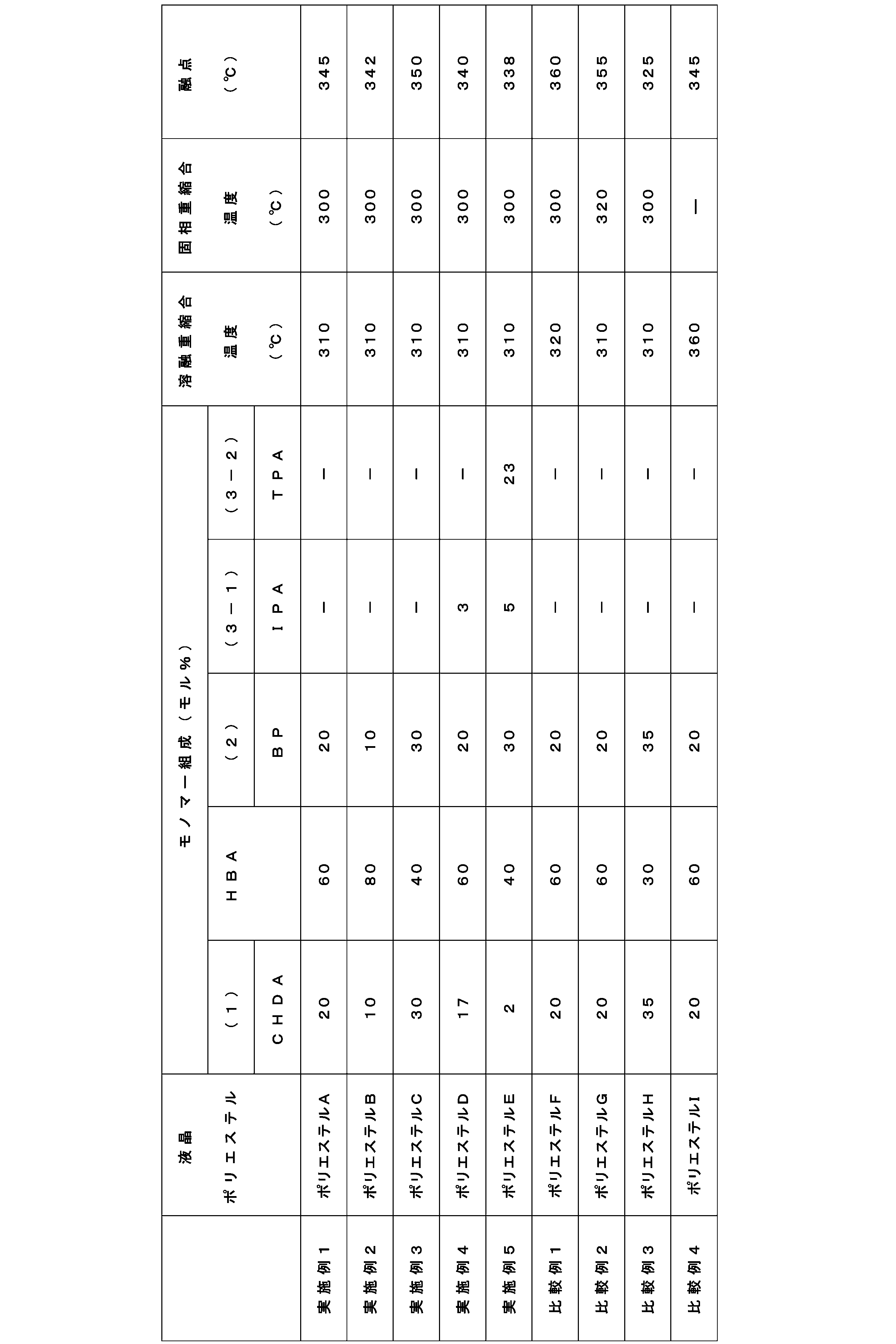
- the content of 1,4-cyclohexanedicarboxylic acid (CHDA) in the component of formula (1) is 2-30 mol% and the content of p-hydroxybenzoic acid (HBA) is 40-80 mol%.
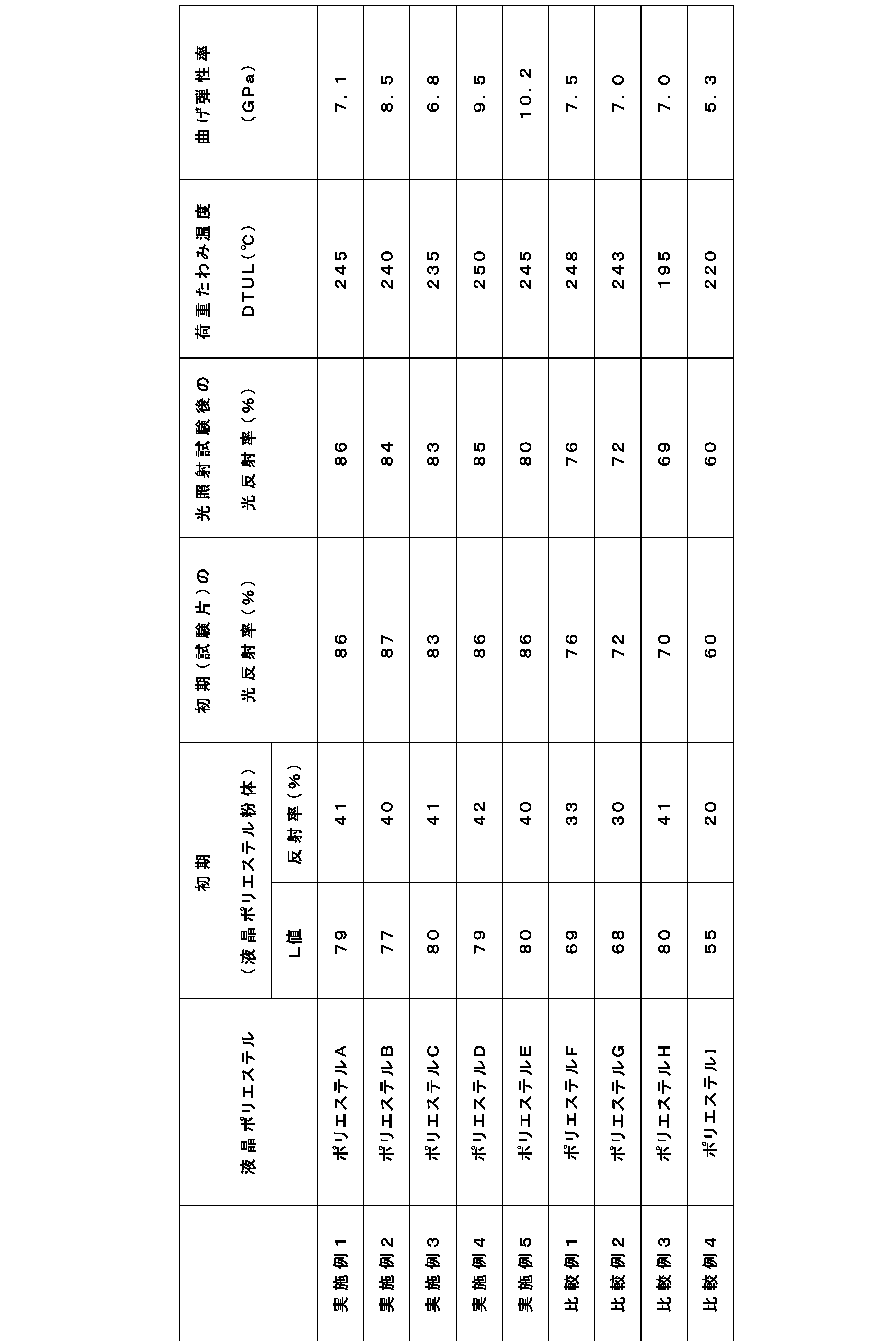
- the liquid crystal polyesters (A) to (E) of Examples 1 to 5 obtained by polymerization at a temperature of 310 ° C. or less in the melt polycondensation and solid phase polycondensation are as shown in Table 2. It was found that the L value was 75 or more and the color tone was bright and coloring was suppressed. These initial reflectivities were 40% or more.
- any of the resin compositions obtained using these liquid crystal polyesters can be injection-molded at 380 ° C.
- the initial light reflectance of the molded product with respect to 480 nm light is all 80%. It was found that the light reflectivity after the 500 hour light irradiation test was only about 7% lower than the initial value and maintained a high level of 80% or higher. Further, no discoloration of the surface of the molded body was observed. Furthermore, all of the injection-molded articles obtained from the resin compositions of Examples 1 to 5 have a deflection temperature under load (DTUL) exceeding 220 ° C. and a sufficiently high bending elastic modulus of 6 GPa or more, and have high heat resistance and mechanical properties. It was confirmed that it has a characteristic.
- DTUL deflection temperature under load
- the liquid crystal polyesters of Comparative Examples 1, 2, and 4 obtained by polymerization with the same composition as the polyester (A) but the temperature of melt polycondensation or solid phase polycondensation exceeded 315 ° C.
- the L value was lowered and the reflectance was lowered as shown in Table 2.
- the initial light reflectivity of the molded article of the resin composition obtained using these was less than 80%.
- the polyester (H) having a CHDA content of 35 mol% and an HBA content of 30 mol% which is out of the scope of the present invention, is liquid crystalline but has a DTUL of less than 200 ° C. and poor heat resistance. It was.
Landscapes
- Chemical & Material Sciences (AREA)
- Organic Chemistry (AREA)
- Health & Medical Sciences (AREA)
- Chemical Kinetics & Catalysis (AREA)
- Medicinal Chemistry (AREA)
- Polymers & Plastics (AREA)
- Crystallography & Structural Chemistry (AREA)
- Engineering & Computer Science (AREA)
- Materials Engineering (AREA)
- Polyesters Or Polycarbonates (AREA)
Abstract
Description


[式(2)中、Xは芳香環を有する2価の基を示す。]

[式(2)中、Xは芳香環を有する2価の基を示す。]

[式(3)中、Yは芳香環を有する2価の基を示す。]


[式(2)中、Xは芳香環を有する2価の基を示す。]

[式(3)中、Yは芳香環を有する2価の基を示す。]


式(2-1)及び式(3-1)中、Ar1及びAr2は2価の芳香族基を示し、X1及びY1は芳香環を有する2価の基を示し、s及びtは、0又は1の整数を示す。



式(2-2)中、L1は、2価の炭化水素基、-O-、-S-、-CO-、-SO-、又は-SO2-を示し、uは、0又は1の整数を示す。2価の炭化水素基としては、炭素数1~3のアルカンジイル基が挙げられ、そのうち、-C(CH3)2-又は-CH(CH3)-が好ましい。なお、式(2-2)中のベンゼン環の2つの結合手はメタ位又はパラ位の関係にある。

式(3-2)中、L2は、2価の炭化水素基、-O-、-S-、-SO-、-CO-、又は-SO2-を示し、vは、0又は1の整数を示す。2価の炭化水素基としては、炭素数1~3のアルカンジイル基が挙げられ、そのうち、-C(CH3)2-又は-CH(CH3)-が好ましい。なお、式(3-2)中のベンゼン環の2つの結合手はメタ位又はパラ位の関係にある。
まず、液晶ポリエステルの製造例を以下に示す。また、製造した各ポリエステルのモノマー組成(モル%)、重縮合温度及び融点を表1に示す。
SUS316を材質とし、ダブルヘリカル攪拌翼を有する内容積6Lの重合反応槽(日東高圧株式会社製)に、p-ヒドロキシ安息香酸(上野製薬株式会社製)0.83kg(6.0モル)、4,4’-ジヒドロキシビフェニル(本州化学工業株式会社製)0.37kg(2.0モル)、1,4-シクロヘキサンジカルボン酸(イーストマンケミカル社製)0.34kg(2.0モル)、触媒として酢酸カリウム(キシダ化学株式会社製)0.15g、及び、酢酸マグネシウム(キシダ化学株式会社製)0.50gを仕込み、重合反応槽の減圧-窒素注入を2回行って窒素置換を行った後、無水酢酸1.07kg(10.5モル)を更に添加し、攪拌翼の回転速度を70rpmとし、1.5時間かけて150℃まで昇温し、還流状態で2時間アセチル化反応を行った。
SUS316を材質とし、ダブルヘリカル攪拌翼を有する6Lの重合反応槽(日東高圧株式会社製)に、p-ヒドロキシ安息香酸(上野製薬株式会社製)1.10kg(8.0モル)、4,4’-ジヒドロキシビフェニル(本州化学工業株式会社製)0.19kg(1.0モル)、1,4-シクロヘキサンジカルボン酸(イーストマンケミカル社製)0.17kg(1.0モル)、触媒として酢酸カリウム(キシダ化学株式会社製)0.15g、及び、酢酸マグネシウム(キシダ化学株式会社製)0.50gを仕込み、重合反応槽の減圧-窒素注入を2回行って窒素置換を行った後、無水酢酸1.07kg(10.5モル)を更に添加し、攪拌翼の回転速度を70rpmとし、1.5時間かけて150℃まで昇温し、還流状態で2時間アセチル化反応を行った。
SUS316を材質とし、ダブルヘリカル攪拌翼を有する6Lの重合反応槽(日東高圧株式会社製)に、p-ヒドロキシ安息香酸(上野製薬株式会社製)0.55kg(4.0モル)、4,4’-ジヒドロキシビフェニル(本州化学工業株式会社製)0.56kg(3.0モル)、1,4-シクロヘキサンジカルボン酸(イーストマンケミカル社製)0.52kg(3.0モル)、触媒として酢酸カリウム(キシダ化学株式会社製)0.15g、及び、酢酸マグネシウム(キシダ化学株式会社製)0.50gを仕込み、重合反応槽の減圧-窒素注入を2回行って窒素置換を行った後、無水酢酸1.07kg(10.5モル)を更に添加し、攪拌翼の回転速度を70rpmとし、1.5時間かけて150℃まで昇温し、還流状態で2時間アセチル化反応を行った。
SUS316を材質とし、ダブルヘリカル攪拌翼を有する6Lの重合反応槽(日東高圧株式会社製)に、p-ヒドロキシ安息香酸(上野製薬株式会社製)0.83kg(6.0モル)、4,4’-ジヒドロキシビフェニル(本州化学工業株式会社製)0.37kg(2.0モル)、1,4-シクロヘキサンジカルボン酸(イーストマンケミカル社製)0.29kg(1.7モル)、イソフタル酸(エイ・ジイ・インターナショナル製)0.05kg(0.3モル)、触媒として酢酸カリウム(キシダ化学株式会社製)0.15g、及び、酢酸マグネシウム(キシダ化学株式会社製)0.50gを仕込み、重合反応槽の減圧-窒素注入を2回行って窒素置換を行った後、無水酢酸1.07kg(10.5モル)を更に添加し、攪拌翼の回転速度を70rpmとし、1.5時間かけて150℃まで昇温し、還流状態で2時間アセチル化反応を行った。
SUS316を材質とし、ダブルヘリカル攪拌翼を有する6Lの重合反応槽(日東高圧株式会社製)に、p-ヒドロキシ安息香酸(上野製薬株式会社製)0.55kg(4.0モル)、4,4’-ジヒドロキシビフェニル(本州化学工業株式会社製)0.56kg(3.0モル)、1,4-シクロヘキサンジカルボン酸(イーストマンケミカル社製)0.03kg(0.2モル)、テレフタル酸(三井化学株式会社製)0.38kg(2.3モル)イソフタル酸(エイ・ジイ・インターナショナル製)0.08kg(0.5モル)、触媒として酢酸カリウム(キシダ化学株式会社製)0.15g、及び、酢酸マグネシウム(キシダ化学株式会社製)0.50gを仕込み、重合反応槽の減圧-窒素注入を2回行って窒素置換を行った後、無水酢酸1.07kg(10.5モル)を更に添加し、攪拌翼の回転速度を70rpmとし、1.5時間かけて150℃まで昇温し、還流状態で2時間アセチル化反応を行った。
実施例1と同様にしてアセチル化まで行った。アセチル化終了後、酢酸留出状態にした重合反応槽を0.5℃/分で昇温して、槽内の溶融体温度が320℃になったところで重合物を反応槽下部の抜き出し口から取り出し、冷却固化した。得られた重合物をホソカワミクロン株式会社製の粉砕機により目開き2.0mmの篩を通過する大きさに粉砕してプレポリマーを得た。プレポリマーは茶色くなった。
実施例1と同様にしてプレポリマーを得た。
SUS316を材質とし、ダブルヘリカル攪拌翼を有する6Lの重合反応槽(日東高圧株式会社製)に、p-ヒドロキシ安息香酸(上野製薬株式会社製)0.41kg(3.0モル)、4,4’-ジヒドロキシビフェニル(本州化学工業株式会社製)0.65kg(3.5モル)、1,4-シクロヘキサンジカルボン酸(イーストマンケミカル社製)0.60kg(3.5モル)、触媒として酢酸カリウム(キシダ化学株式会社製)0.15g、及び、酢酸マグネシウム(キシダ化学株式会社製)0.50gを仕込み、重合反応槽の減圧-窒素注入を2回行って窒素置換を行った後、無水酢酸1.07kg(10.5モル)を更に添加し、攪拌翼の回転速度を70rpmとし、1.5時間かけて150℃まで昇温し、還流状態で2時間アセチル化反応を行った。
実施例1と同様にしてアセチル化まで行った。アセチル化終了後、酢酸留出状態にした重合反応槽を0.5℃/分で昇温して、槽内の溶融体温度が360℃になったところで重合物を反応槽下部の抜き出し口から取り出し、冷却固化した。得られた重合物をホソカワミクロン株式会社製の粉砕機により目開き2.0mmの篩を通過する大きさに粉砕して、粉体状のサーモトロピック液晶ポリエステル(I)約1.5kgを得た。得られたサーモトロピック液晶ポリエステル(I)の融点は345℃であっが、茶色く着色していた。
(融点の測定)
液晶ポリエステルの融点は、セイコー電子工業(株)製の示差走査熱量計(DSC)により、リファレンスとしてα-アルミナを用いて測定した。このとき、昇温速度20℃/分で室温から420℃まで昇温してポリマーを完全に融解させた後、速度10℃/分で150℃まで降温し、更に20℃/分の速度で420℃まで昇温するときに得られる吸熱ピークの頂点を融点とした。
(光学異方性の確認)
ジャパンハイテック(株)製の顕微鏡用冷却加熱ステージ10002型を備えたオリンパス(株)社製の偏光顕微鏡BH-2を用い、ポリエステル試料を顕微鏡加熱ステージ上にて加熱溶融させ、溶融時に100倍、200倍の倍率にて観察して光学異方性の有無を確認した。
まず、以下の手順で液晶ポリエステル樹脂組成物のペレットを作製した。
上記の実施例及び比較例で得られたポリエステル粉体について、下記の方法により、L値及び光反射率を測定した。また、上記の方法によって得られた各試験片について、光照射試験前後の光反射率、荷重たわみ温度、曲げ弾性率を測定した。結果を表2に示す。
得られたサーモトロピック液晶ポリエステル粉体を皿に敷き詰め、自記分光光度計(U-3500:(株)日立製作所製)の発光・受光部を上記粉体の上面に押し当てることにより、L値及び波長480nmの光に対する拡散反射率の測定を行った。なお、L値はJIS Z 8729に則り数値化されたLab表色系の数値であり、光反射率は、硫酸バリウム標準白板の拡散反射率を100%としたときの相対値である。なお、測定値は、5回の測定数値の平均値を用いた。
得られた光反射率測定用試験片の表面について、自記分光光度計(U-3500:(株)日立製作所製)を用いて波長480nmの光に対する拡散反射率の測定を行った。なお、光反射率は、硫酸バリウム標準白板の拡散反射率を100%としたときの相対値である。
得られた光反射率測定用試験片に、(株)東洋精機製作所製サンテストXLS+を用い、キセノンランプにより、600W/m2、BPT温度90℃の設定にて、500時間光照射する光照射試験を行った。この光照射試験後の試験片の表面について、自記分光光度計(U-3500:(株)日立製作所製)を用いて波長480nmの光に対する拡散反射率の測定を行った。なお、光反射率は、硫酸バリウム標準白板の拡散反射率を100%としたときの相対値である。
上記で作製した曲げ試験の試験片を用い、ASTM D648に従い、荷重たわみ温度(DTUL)の測定を行った。
上記で作製した曲げ試験の試験片を用い、ASTM D790に従い、曲げ弾性率の測定を行った。
Claims (3)
- ジカルボン酸化合物、ヒドロキシカルボン酸化合物及びジヒドロキシ化合物が含まれる組成物を溶融重縮合し、得られた反応生成物を固相重縮合することによって液晶ポリエステルを製造する方法であって、
前記組成物が、前記ジカルボン酸化合物、前記ヒドロキシカルボン酸化合物及び前記ジヒドロキシ化合物の合計を基準として、下記式(1)で表されるジカルボン酸化合物を2~30モル%及びp-ヒドロキシ安息香酸を40~80モル%含み、
前記溶融重縮合の重縮合温度が315℃以下であり、前記固相重縮合の重縮合温度が315℃以下である、液晶ポリエステルの製造方法。

- 前記組成物が、前記ジカルボン酸化合物、前記ヒドロキシカルボン酸化合物及び前記ジヒドロキシ化合物の合計を基準として、前記式(1)で表されるジカルボン酸化合物を10~30モル%、p-ヒドロキシ安息香酸を40~80モル%、及び下記一般式(2)で表される芳香族ジヒドロキシ化合物を10~30モル%含んでなるものである、請求項1に記載の液晶ポリエステルの製造方法。

[式(2)中、Xは芳香環を有する2価の基を示す。] - 前記液晶ポリエステルが、前記式(1)で表されるジカルボン酸化合物を2~29モル%、p-ヒドロキシ安息香酸を40~80モル%、下記一般式(2)で表される芳香族ジヒドロキシ化合物を10~30モル%、及び下記一般式(3)で表される芳香族ジカルボン酸化合物を1~28モル%含んでなるものであり、前記一般式(3)で表される芳香族ジカルボン酸化合物としてイソフタル酸を1モル%以上含む、請求項1に記載の液晶ポリエステルの製造方法。

[式(2)中、Xは芳香環を有する2価の基を示す。]

[式(3)中、Yは芳香環を有する2価の基を示す。]
Priority Applications (3)
| Application Number | Priority Date | Filing Date | Title |
|---|---|---|---|
| US14/111,035 US20140088287A1 (en) | 2011-04-15 | 2012-04-12 | Production method for liquid crystal polyester |
| KR1020137025419A KR20140021580A (ko) | 2011-04-15 | 2012-04-12 | 액정 폴리에스테르의 제조 방법 |
| CN201280014216.2A CN103459461B (zh) | 2011-04-15 | 2012-04-12 | 液晶聚酯的制造方法 |
Applications Claiming Priority (2)
| Application Number | Priority Date | Filing Date | Title |
|---|---|---|---|
| JP2011091591A JP5726610B2 (ja) | 2011-04-15 | 2011-04-15 | 液晶ポリエステルの製造方法 |
| JP2011-091591 | 2011-04-15 |
Publications (1)
| Publication Number | Publication Date |
|---|---|
| WO2012141272A1 true WO2012141272A1 (ja) | 2012-10-18 |
Family
ID=47009435
Family Applications (1)
| Application Number | Title | Priority Date | Filing Date |
|---|---|---|---|
| PCT/JP2012/060075 Ceased WO2012141272A1 (ja) | 2011-04-15 | 2012-04-12 | 液晶ポリエステルの製造方法 |
Country Status (6)
| Country | Link |
|---|---|
| US (1) | US20140088287A1 (ja) |
| JP (1) | JP5726610B2 (ja) |
| KR (1) | KR20140021580A (ja) |
| CN (1) | CN103459461B (ja) |
| TW (1) | TWI526468B (ja) |
| WO (1) | WO2012141272A1 (ja) |
Cited By (1)
| Publication number | Priority date | Publication date | Assignee | Title |
|---|---|---|---|---|
| WO2023022083A1 (ja) * | 2021-08-17 | 2023-02-23 | 住友化学株式会社 | 液晶ポリエステル粉末及びその製造方法、液晶ポリエステル組成物、液晶ポリエステルフィルム及びその製造方法、並びに積層体及びその製造方法 |
Families Citing this family (6)
| Publication number | Priority date | Publication date | Assignee | Title |
|---|---|---|---|---|
| JP5909508B2 (ja) | 2012-01-31 | 2016-04-26 | Jxエネルギー株式会社 | 液晶ポリエステルアミド、液晶ポリエステルアミド樹脂組成物及び成形体 |
| DE102013100286B3 (de) | 2013-01-11 | 2014-06-05 | Epcos Ag | Breitbandiges Filter in Abzweigtechnik |
| JP6625050B2 (ja) | 2013-06-07 | 2019-12-25 | ティコナ・エルエルシー | 高強度サーモトロピック液晶ポリマー |
| JP6200458B2 (ja) * | 2015-06-30 | 2017-09-20 | 古河電気工業株式会社 | Led照明装置 |
| EP3636727A4 (en) * | 2017-06-07 | 2020-12-09 | SK Chemicals Co., Ltd. | SYNTHETIC COMPOSITION OF LIQUID CRYSTAL POLYMERS, LIQUID CRYSTAL POLYMER FOR ELECTRICAL AND ELECTRONIC PRODUCTS USER, POLYMER RESIN COMPOSITION USER, AND MOLDED PRODUCT USER |
| KR102734010B1 (ko) | 2018-11-21 | 2024-11-25 | 삼성전자주식회사 | 액정 고분자, 복합체 조성물, 성형품, 전지 케이스, 및 전지 |
Citations (7)
| Publication number | Priority date | Publication date | Assignee | Title |
|---|---|---|---|---|
| US4118372A (en) * | 1974-05-10 | 1978-10-03 | E. I. Du Pont De Nemours And Company | Aromatic copolyester capable of forming an optically anisotropic melt |
| JP2000507624A (ja) * | 1996-04-01 | 2000-06-20 | クラリアント・ゲゼルシャフト・ミト・ベシュレンクテル・ハフツング | Lcp―ブレンド |
| JP2001139674A (ja) * | 1999-11-18 | 2001-05-22 | Polyplastics Co | 液晶性ポリエステルの製造方法 |
| JP2004224913A (ja) * | 2003-01-23 | 2004-08-12 | Sumitomo Chem Co Ltd | 粉体状ポリマーの固相重合方法 |
| JP2004263125A (ja) * | 2003-03-04 | 2004-09-24 | Nippon Petrochemicals Co Ltd | サーモトロピック液晶ポリマーの製造方法 |
| JP2006028287A (ja) * | 2004-07-14 | 2006-02-02 | Ueno Seiyaku Oyo Kenkyusho:Kk | 液晶ポリエステル樹脂およびその製造方法 |
| JP2011032464A (ja) * | 2009-07-06 | 2011-02-17 | Sumitomo Chemical Co Ltd | 液晶ポリエステルの製造方法 |
Family Cites Families (5)
| Publication number | Priority date | Publication date | Assignee | Title |
|---|---|---|---|---|
| US6093787A (en) * | 1997-06-06 | 2000-07-25 | Eastman Chemical Company | Liquid crystalline polyesters and molding compositions prepared therefrom |
| JP4625340B2 (ja) * | 2005-01-31 | 2011-02-02 | 上野製薬株式会社 | 液晶ポリエステル樹脂およびその製造方法 |
| KR100655195B1 (ko) * | 2005-11-02 | 2006-12-08 | 삼성정밀화학 주식회사 | 전방향족 폴리에스테르의 제조방법 |
| KR101353100B1 (ko) * | 2006-02-13 | 2014-01-17 | 스미또모 가가꾸 가부시키가이샤 | 액정 중합체 조성물, 이것의 제조 방법 및 이것을 이용한성형품 |
| TW201030087A (en) * | 2008-10-30 | 2010-08-16 | Solvay Advanced Polymers Llc | Power LED device with a reflector made of aromatic polyester and/or wholly aromatic polyester |
-
2011
- 2011-04-15 JP JP2011091591A patent/JP5726610B2/ja active Active
-
2012
- 2012-04-12 US US14/111,035 patent/US20140088287A1/en not_active Abandoned
- 2012-04-12 WO PCT/JP2012/060075 patent/WO2012141272A1/ja not_active Ceased
- 2012-04-12 CN CN201280014216.2A patent/CN103459461B/zh not_active Expired - Fee Related
- 2012-04-12 KR KR1020137025419A patent/KR20140021580A/ko not_active Ceased
- 2012-04-13 TW TW101113289A patent/TWI526468B/zh active
Patent Citations (7)
| Publication number | Priority date | Publication date | Assignee | Title |
|---|---|---|---|---|
| US4118372A (en) * | 1974-05-10 | 1978-10-03 | E. I. Du Pont De Nemours And Company | Aromatic copolyester capable of forming an optically anisotropic melt |
| JP2000507624A (ja) * | 1996-04-01 | 2000-06-20 | クラリアント・ゲゼルシャフト・ミト・ベシュレンクテル・ハフツング | Lcp―ブレンド |
| JP2001139674A (ja) * | 1999-11-18 | 2001-05-22 | Polyplastics Co | 液晶性ポリエステルの製造方法 |
| JP2004224913A (ja) * | 2003-01-23 | 2004-08-12 | Sumitomo Chem Co Ltd | 粉体状ポリマーの固相重合方法 |
| JP2004263125A (ja) * | 2003-03-04 | 2004-09-24 | Nippon Petrochemicals Co Ltd | サーモトロピック液晶ポリマーの製造方法 |
| JP2006028287A (ja) * | 2004-07-14 | 2006-02-02 | Ueno Seiyaku Oyo Kenkyusho:Kk | 液晶ポリエステル樹脂およびその製造方法 |
| JP2011032464A (ja) * | 2009-07-06 | 2011-02-17 | Sumitomo Chemical Co Ltd | 液晶ポリエステルの製造方法 |
Cited By (2)
| Publication number | Priority date | Publication date | Assignee | Title |
|---|---|---|---|---|
| WO2023022083A1 (ja) * | 2021-08-17 | 2023-02-23 | 住友化学株式会社 | 液晶ポリエステル粉末及びその製造方法、液晶ポリエステル組成物、液晶ポリエステルフィルム及びその製造方法、並びに積層体及びその製造方法 |
| JP2023027502A (ja) * | 2021-08-17 | 2023-03-02 | 住友化学株式会社 | 液晶ポリエステル粉末及びその製造方法、液晶ポリエステル組成物、液晶ポリエステルフィルム及びその製造方法、並びに積層体及びその製造方法 |
Also Published As
| Publication number | Publication date |
|---|---|
| JP5726610B2 (ja) | 2015-06-03 |
| KR20140021580A (ko) | 2014-02-20 |
| CN103459461B (zh) | 2016-03-23 |
| TW201245272A (en) | 2012-11-16 |
| US20140088287A1 (en) | 2014-03-27 |
| CN103459461A (zh) | 2013-12-18 |
| TWI526468B (zh) | 2016-03-21 |
| JP2012224689A (ja) | 2012-11-15 |
Similar Documents
| Publication | Publication Date | Title |
|---|---|---|
| JP5751907B2 (ja) | Ledリフレクター | |
| JP5866423B2 (ja) | 液晶ポリエステル樹脂組成物、成形体及びledリフレクター | |
| JP5681700B2 (ja) | 全芳香族サーモトロピック液晶ポリエステル樹脂組成物、成形体及びledリフレクター | |
| JP2016041828A (ja) | 液晶ポリエステル樹脂組成物、成形体及びledリフレクター | |
| JP5726610B2 (ja) | 液晶ポリエステルの製造方法 | |
| KR101715021B1 (ko) | 액정 폴리에스테르 수지 조성물, 이의 성형체, 및 광학 장치 | |
| TWI549989B (zh) | Liquid crystal polyester amide, liquid crystal polyesteramide resin composition and molded body | |
| JP2008231368A (ja) | 光線反射率および強度に優れた液晶ポリエステル樹脂組成物 | |
| KR20140074094A (ko) | 방향족 액정 폴리에스테르 아미드 수지의 제조방법 및 방향족 액정 폴리에스테르 아미드 수지 컴파운드 | |
| TW201319117A (zh) | 液晶聚酯的製造方法及液晶聚酯 | |
| TW201245271A (en) | Liquid-crystal polyester and manufacturing process therefor | |
| JP4952064B2 (ja) | 液晶性樹脂組成物、およびそれからなる成形品 | |
| JP2014506952A (ja) | 全芳香族液晶ポリエステル樹脂の製造方法、該製造方法によって製造された樹脂、及び該樹脂を含むコンパウンド | |
| JP2016113511A (ja) | 液晶ポリマーの製造方法 | |
| JP2011075628A (ja) | 光反射部品用基材 | |
| JP2011074115A (ja) | 光反射部品用基材 | |
| JP2004182946A (ja) | 液晶ポリエステル樹脂組成物及びその成形品 |
Legal Events
| Date | Code | Title | Description |
|---|---|---|---|
| WWE | Wipo information: entry into national phase |
Ref document number: 201280014216.2 Country of ref document: CN |
|
| 121 | Ep: the epo has been informed by wipo that ep was designated in this application |
Ref document number: 12770716 Country of ref document: EP Kind code of ref document: A1 |
|
| ENP | Entry into the national phase |
Ref document number: 20137025419 Country of ref document: KR Kind code of ref document: A |
|
| NENP | Non-entry into the national phase |
Ref country code: DE |
|
| WWE | Wipo information: entry into national phase |
Ref document number: 14111035 Country of ref document: US |
|
| 122 | Ep: pct application non-entry in european phase |
Ref document number: 12770716 Country of ref document: EP Kind code of ref document: A1 |