WO2012137749A1 - 液晶表示素子用遮光シール剤、上下導通材料及び液晶表示素子 - Google Patents
液晶表示素子用遮光シール剤、上下導通材料及び液晶表示素子 Download PDFInfo
- Publication number
- WO2012137749A1 WO2012137749A1 PCT/JP2012/059023 JP2012059023W WO2012137749A1 WO 2012137749 A1 WO2012137749 A1 WO 2012137749A1 JP 2012059023 W JP2012059023 W JP 2012059023W WO 2012137749 A1 WO2012137749 A1 WO 2012137749A1
- Authority
- WO
- WIPO (PCT)
- Prior art keywords
- light
- liquid crystal
- meth
- crystal display
- shielding
- Prior art date
- Legal status (The legal status is an assumption and is not a legal conclusion. Google has not performed a legal analysis and makes no representation as to the accuracy of the status listed.)
- Ceased
Links
Images

Classifications
-
- C—CHEMISTRY; METALLURGY
- C08—ORGANIC MACROMOLECULAR COMPOUNDS; THEIR PREPARATION OR CHEMICAL WORKING-UP; COMPOSITIONS BASED THEREON
- C08F—MACROMOLECULAR COMPOUNDS OBTAINED BY REACTIONS ONLY INVOLVING CARBON-TO-CARBON UNSATURATED BONDS
- C08F299/00—Macromolecular compounds obtained by interreacting polymers involving only carbon-to-carbon unsaturated bond reactions, in the absence of non-macromolecular monomers
- C08F299/02—Macromolecular compounds obtained by interreacting polymers involving only carbon-to-carbon unsaturated bond reactions, in the absence of non-macromolecular monomers from unsaturated polycondensates
- C08F299/022—Macromolecular compounds obtained by interreacting polymers involving only carbon-to-carbon unsaturated bond reactions, in the absence of non-macromolecular monomers from unsaturated polycondensates from polycondensates with side or terminal unsaturations
- C08F299/024—Macromolecular compounds obtained by interreacting polymers involving only carbon-to-carbon unsaturated bond reactions, in the absence of non-macromolecular monomers from unsaturated polycondensates from polycondensates with side or terminal unsaturations the unsaturation being in acrylic or methacrylic groups
-
- C—CHEMISTRY; METALLURGY
- C08—ORGANIC MACROMOLECULAR COMPOUNDS; THEIR PREPARATION OR CHEMICAL WORKING-UP; COMPOSITIONS BASED THEREON
- C08F—MACROMOLECULAR COMPOUNDS OBTAINED BY REACTIONS ONLY INVOLVING CARBON-TO-CARBON UNSATURATED BONDS
- C08F299/00—Macromolecular compounds obtained by interreacting polymers involving only carbon-to-carbon unsaturated bond reactions, in the absence of non-macromolecular monomers
- C08F299/02—Macromolecular compounds obtained by interreacting polymers involving only carbon-to-carbon unsaturated bond reactions, in the absence of non-macromolecular monomers from unsaturated polycondensates
-
- C—CHEMISTRY; METALLURGY
- C09—DYES; PAINTS; POLISHES; NATURAL RESINS; ADHESIVES; COMPOSITIONS NOT OTHERWISE PROVIDED FOR; APPLICATIONS OF MATERIALS NOT OTHERWISE PROVIDED FOR
- C09K—MATERIALS FOR MISCELLANEOUS APPLICATIONS, NOT PROVIDED FOR ELSEWHERE
- C09K3/00—Materials not provided for elsewhere
- C09K3/10—Materials in mouldable or extrudable form for sealing or packing joints or covers
-
- G—PHYSICS
- G02—OPTICS
- G02F—OPTICAL DEVICES OR ARRANGEMENTS FOR THE CONTROL OF LIGHT BY MODIFICATION OF THE OPTICAL PROPERTIES OF THE MEDIA OF THE ELEMENTS INVOLVED THEREIN; NON-LINEAR OPTICS; FREQUENCY-CHANGING OF LIGHT; OPTICAL LOGIC ELEMENTS; OPTICAL ANALOGUE/DIGITAL CONVERTERS
- G02F1/00—Devices or arrangements for the control of the intensity, colour, phase, polarisation or direction of light arriving from an independent light source, e.g. switching, gating or modulating; Non-linear optics
- G02F1/01—Devices or arrangements for the control of the intensity, colour, phase, polarisation or direction of light arriving from an independent light source, e.g. switching, gating or modulating; Non-linear optics for the control of the intensity, phase, polarisation or colour
- G02F1/13—Devices or arrangements for the control of the intensity, colour, phase, polarisation or direction of light arriving from an independent light source, e.g. switching, gating or modulating; Non-linear optics for the control of the intensity, phase, polarisation or colour based on liquid crystals, e.g. single liquid crystal display cells
- G02F1/133—Constructional arrangements; Operation of liquid crystal cells; Circuit arrangements
- G02F1/1333—Constructional arrangements; Manufacturing methods
- G02F1/1335—Structural association of cells with optical devices, e.g. polarisers or reflectors
- G02F1/133509—Filters, e.g. light shielding masks
- G02F1/133512—Light shielding layers, e.g. black matrix
-
- G—PHYSICS
- G02—OPTICS
- G02F—OPTICAL DEVICES OR ARRANGEMENTS FOR THE CONTROL OF LIGHT BY MODIFICATION OF THE OPTICAL PROPERTIES OF THE MEDIA OF THE ELEMENTS INVOLVED THEREIN; NON-LINEAR OPTICS; FREQUENCY-CHANGING OF LIGHT; OPTICAL LOGIC ELEMENTS; OPTICAL ANALOGUE/DIGITAL CONVERTERS
- G02F1/00—Devices or arrangements for the control of the intensity, colour, phase, polarisation or direction of light arriving from an independent light source, e.g. switching, gating or modulating; Non-linear optics
- G02F1/01—Devices or arrangements for the control of the intensity, colour, phase, polarisation or direction of light arriving from an independent light source, e.g. switching, gating or modulating; Non-linear optics for the control of the intensity, phase, polarisation or colour
- G02F1/13—Devices or arrangements for the control of the intensity, colour, phase, polarisation or direction of light arriving from an independent light source, e.g. switching, gating or modulating; Non-linear optics for the control of the intensity, phase, polarisation or colour based on liquid crystals, e.g. single liquid crystal display cells
- G02F1/133—Constructional arrangements; Operation of liquid crystal cells; Circuit arrangements
- G02F1/1333—Constructional arrangements; Manufacturing methods
- G02F1/1339—Gaskets; Spacers; Sealing of cells
Definitions
- An object of this invention is to provide the light-shielding sealant for liquid crystal display elements which is excellent in the adhesive strength with respect to a board
- a liquid crystal display element such as a liquid crystal display cell is formed by forming a cell by facing two transparent substrates with electrodes facing each other at a predetermined interval and sealing the periphery with a sealing agent.
- the liquid crystal was injected from the liquid crystal injection port into the cell, and the liquid crystal injection port was manufactured by a method called a vacuum injection method in which a sealing agent or a sealing agent was sealed.
- a seal pattern having a liquid crystal injection port using a thermosetting sealant is formed by screen printing on one of two transparent substrates with electrodes, and prebaked at 60 to 100 ° C. The solvent in the sealant is dried.
- the two substrates are opposed to each other with the spacer interposed therebetween, aligned, bonded, and subjected to hot pressing at 110 to 220 ° C. for 10 to 90 minutes to adjust the gap near the seal, and then in an oven at 110 to 220 ° C. To cure for 10 to 120 minutes.
- liquid crystal was injected from the liquid crystal injection port, and finally, the liquid crystal injection port was sealed using a sealing agent to produce a liquid crystal display element.
- liquid crystal display elements such as liquid crystal display cells
- photo radical resin such as acrylic resin and photo radical polymerization
- a liquid crystal dropping method called a dripping method using a sealing agent made of a light and heat curable resin composition containing an agent and a thermosetting resin such as an epoxy resin and a thermosetting agent.
- liquid crystal dropping method first, a seal pattern is formed on one of the two substrates with electrodes. Next, a liquid crystal micro-droplet is dropped on the entire surface of the substrate frame in an uncured state of the sealant, the other substrate is superposed under vacuum, and after returning to normal pressure, the seal portion is irradiated with ultraviolet rays to be photocurable. The resin is cured (temporary curing step). Thereafter, the thermosetting resin is cured by heating to produce a liquid crystal display element.
- the conventional sealant is transparent or milky white, the light that passes through the sealant cannot be shielded even with a black matrix that should originally suppress light leakage, resulting in a decrease in contrast. It was.
- Patent Documents 1 to 3 disclose a sealant containing a titanium black material, a carbon black material, or other light shielding fine particles as a light shielding component.
- a titanium black material having high insulating properties is preferable as the light shielding agent contained in the sealant.
- An object of this invention is to provide the light-shielding sealant for liquid crystal display elements which is excellent in the adhesive strength with respect to a board
- Another object of the present invention is to provide a vertical conduction material and a liquid crystal display element manufactured using the light-shielding sealant for liquid crystal display elements.
- the present invention is a curable resin containing a curable compound having an unsaturated double bond, a radical polymerization initiator, and a light shielding sealant for a liquid crystal dropping method containing a light shielding agent, wherein the curable resin is
- the hydrogen-bonding functional group value is 0.5 ⁇ 10 ⁇ 3 to 3.0 ⁇ 10 ⁇ 3 mol / g, and is a light-shielding sealant for liquid crystal display elements containing titanium black as the light-shielding agent.
- the present inventor has found that the hydrogen bonding functional group value of a curable resin containing a curable compound having an unsaturated double bond in a light-shielding sealant for liquid crystal display elements containing titanium black is 0.5 ⁇ 10 ⁇ When it is 3 to 3.0 ⁇ 10 ⁇ 3 mol / g, it has been found that a decrease in adhesive strength after high-temperature and high-humidity treatment can be suppressed, and the present invention has been completed.
- the light-shielding sealant for liquid crystal display elements of the present invention contains titanium black as a light-shielding agent.
- Titanium black is a substance having a higher transmittance in the vicinity of the ultraviolet region, particularly for light having a wavelength of 370 to 450 nm, compared to the average transmittance for light having a wavelength of 300 to 800 nm. That is, the above-described titanium black sufficiently shields light having a wavelength in the visible light region, thereby providing the light shielding sealant of the present invention with light shielding properties, while having a property of transmitting light having a wavelength near the ultraviolet region. It is.
- the photo-curing property of the light-shielding sealant of the present invention can be obtained by using a photo-radical polymerization initiator, which will be described later, that can start the reaction with light having a wavelength (370 to 450 nm) that increases the transmittance of the titanium black. Can be further increased.
- the light shielding agent contained in the light shielding sealant of the present invention is preferably a highly insulating material, and titanium black is also suitable as the highly insulating light shielding agent.
- the titanium black preferably has an optical density (OD value) per ⁇ m of 3 or more, more preferably 4 or more. The higher the light shielding property of the titanium black, the better. There is no particular upper limit to the OD value of the titanium black, but it is usually 5 or less.
- the above-mentioned titanium black exhibits a sufficient effect even if it is not surface-treated, but the surface is treated with an organic component such as a coupling agent, silicon oxide, titanium oxide, germanium oxide, aluminum oxide, oxidized Surface-treated titanium black such as those coated with an inorganic component such as zirconium or magnesium oxide can also be used. Especially, what is processed with the organic component is preferable at the point which can improve insulation more.
- the liquid crystal display element manufactured using the light-shielding sealant of the present invention is a liquid crystal having excellent image display quality with high contrast without light leakage because the light-shielding sealant has sufficient light shielding properties. A display element can be realized.
- the titanium black is not particularly limited, but specific examples of commercially available products include “12S”, “13M”, “13M-C”, “13R-N” (all manufactured by Mitsubishi Materials Corporation), “Tilack”. D ”(manufactured by Ako Kasei Co., Ltd.) and the like.
- the preferable lower limit of the specific surface area of the titanium black is 13 m 2 / g, the preferable upper limit is 30 m 2 / g, the more preferable lower limit is 15 m 2 / g, and the more preferable upper limit is 25 m 2 / g.
- the preferable lower limit of the volume resistance of the titanium black is 0.5 ⁇ ⁇ cm, the preferable upper limit is 3 ⁇ ⁇ cm, the more preferable lower limit is 1 ⁇ ⁇ cm, and the more preferable upper limit is 2.5 ⁇ ⁇ cm.
- the primary particle diameter of the light-shielding agent is not particularly limited as long as it is not more than the distance between the substrates of the liquid crystal display element, but the preferred lower limit is 1 nm and the preferred upper limit is 5 ⁇ m.
- the primary particle diameter of the light-shielding agent is less than 1 nm, the viscosity and thixotropy of the obtained light-shielding sealant are greatly increased, and workability may be deteriorated.
- the primary particle diameter of the light-shielding agent exceeds 5 ⁇ m, the applicability of the obtained light-shielding sealant to the substrate may be deteriorated.
- the more preferable lower limit of the primary particle diameter of the light shielding agent is 5 nm
- the more preferable upper limit is 200 nm
- the still more preferable lower limit is 10 nm
- the still more preferable upper limit is 100 nm.
- the content of the light-shielding agent in the light-shielding sealant of the present invention is not particularly limited, but a preferred lower limit is 5% by weight and a preferred upper limit is 80% by weight. If the content of the light shielding agent is less than 5% by weight, sufficient light shielding properties may not be obtained. When the content of the light-shielding agent exceeds 80% by weight, the adhesion of the obtained light-shielding sealant to the substrate and the strength after curing may be lowered, or the drawing property may be lowered.
- the more preferable lower limit of the content of the light-shielding agent is 10% by weight, the more preferable upper limit is 70% by weight, the still more preferable lower limit is 30% by weight, and the still more preferable upper limit is 60% by weight.
- the light shielding sealant of the present invention contains a curable resin.
- the curable resin contains a curable compound having an unsaturated double bond. That is, the light-shielding sealant of the present invention contains a curable compound having an unsaturated double bond and a radical polymerization initiator described later, and initiates the reaction by light and / or heat. Specifically, it can be cured by ultraviolet irradiation and / or heating.
- the hydrogen bonding functional group value of the curable resin is 0.5 ⁇ 10 ⁇ 3 to 3.0 ⁇ 10 ⁇ 3 mol / g.
- the hydrogen bonding functional group value of the curable resin is less than 0.5 ⁇ 10 ⁇ 3 mol / g, the resin component is likely to be eluted into the liquid crystal, resulting in liquid crystal contamination.
- the hydrogen bondable functional group value of the curable resin exceeds 3.0 ⁇ 10 ⁇ 3 mol / g, the adhesive strength after high-temperature and high-humidity treatment in the obtained light-shielding sealant is remarkably reduced.
- the preferable lower limit of the hydrogen bonding functional group value of the curable resin is 0.7 ⁇ 10 ⁇ 3 mol / g, the preferable upper limit is 2.5 ⁇ 10 ⁇ 3 mol / g, and the more preferable lower limit is 2.0 ⁇ 10 ⁇ . 3 mol / g.
- the hydrogen bondable functional group value of curable resin is computed as a hydrogen bondable functional group value per unit weight.
- the curable resin is a compound A (hydrogen bonding functional group value ⁇ mol / g), a bg compound B (hydrogen bonding functional group value ⁇ mol / g), and a cg compound C (hydrogen bonding functional group value).
- the hydrogen bonding functional group is not particularly limited as long as it is a functional group or a residue having hydrogen bonding properties, for example, —OH group, —NH 2 group, —NHR group (R is aromatic or aliphatic Group hydrocarbons and derivatives thereof), those having a functional group such as —COOH group, —CONH 2 group, —NHOH group, and —NHCO— bond, —NH— bond, —CONHCO— And those having a residue such as a bond or —NH—NH— bond.
- the hydrogen bonding functional group value may be adjusted to the above range by mixing two or more kinds even if the hydrogen bonding functional group value is in the above range alone. Also good. That is, the average value of the hydrogen bonding functional group value of the compound having a hydrogen bonding functional group to be used may be in the above range.
- the curable compound having the unsaturated double bond is not limited, and examples thereof include resins having a vinyl group, an allyl group, a cinnamoyl group, a cinnamylidene group, a maleimide group, a (meth) acryloyloxy group, and the like. From the viewpoint of reactivity, a resin having a (meth) acryloyloxy group is preferable, and a resin having 2 to 3 (meth) acryloyloxy groups in the molecule is more preferable.
- the “(meth) acryloyloxy group” means “acryloyloxy group or methacryloyloxy group”.
- the resin having the (meth) acryloyloxy group is not particularly limited.
- an ester compound obtained by reacting a compound having a hydroxyl group with (meth) acrylic acid, (meth) acrylic acid and an epoxy compound are reacted.
- examples thereof include completely (meth) acryl-modified epoxy resins obtained by the above, urethane (meth) acrylates obtained by reacting isocyanates with (meth) acrylic acid derivatives having a hydroxyl group, and the like.
- the “(meth) acryl” means “acryl or methacryl”
- the “(meth) acrylate” means “acrylate or methacrylate”.
- the “complete (meth) acryl-modified epoxy resin” represents a compound obtained by reacting all epoxy groups in the epoxy resin with (meth) acrylic acid.
- the ester compound obtained by reacting the above (meth) acrylic acid with a compound having a hydroxyl group is not particularly limited, and examples of monofunctional compounds include 2-hydroxyethyl (meth) acrylate, 2-hydroxypropyl (meth) ) Acrylate, 4-hydroxybutyl (meth) acrylate, 2-hydroxybutyl (meth) acrylate, isobutyl (meth) acrylate, t-butyl (meth) acrylate, isooctyl (meth) acrylate, lauryl (meth) acrylate, stearyl (meth) ) Acrylate, isobornyl (meth) acrylate, cyclohexyl (meth) acrylate, 2-methoxyethyl (meth) acrylate, methoxyethylene glycol (meth) acrylate, 2-ethoxyethyl (meth) acrylate, Lahydrofurfuryl (meth) acrylate, benzyl
- bifunctional compound examples include 1,4-butanediol di (meth) acrylate, 1,3-butanediol di (meth) acrylate, 1,6-hexanediol di (meth) acrylate, 1,9 Nonanediol di (meth) acrylate, 1,10-decanediol di (meth) acrylate, 2-n-butyl-2-ethyl-1,3-propanediol di (meth) acrylate, dipropylene glycol di (meth) Acrylate, tripropylene glycol di (meth) acrylate, polypropylene glycol (meth) acrylate, ethylene glycol di (meth) acrylate, diethylene glycol di (meth) acrylate, tetraethylene glycol di (meth) acrylate, polyethylene glycol di (meth) acrylate, Lopylene oxide-added bisphenol A di (meth) acrylate, ethylene
- tri- or higher functional group examples include pentaerythritol tri (meth) acrylate, trimethylolpropane tri (meth) acrylate, propylene oxide-added trimethylolpropane tri (meth) acrylate, and ethylene oxide-added trimethylolpropane tri (meth).
- the complete (meth) acryl-modified epoxy resin obtained by reacting the (meth) acrylic acid and the epoxy compound is not particularly limited.
- an epoxy resin and (meth) acrylic acid can be converted into a basic catalyst according to a conventional method. And the like obtained by reacting in the presence of.
- the epoxy compound that is a raw material for synthesizing the complete (meth) acryl-modified epoxy resin is not particularly limited.
- bisphenol A type epoxy resin bisphenol F type epoxy resin, bisphenol S type epoxy resin, 2,2′- Diallyl bisphenol A type epoxy resin, hydrogenated bisphenol type epoxy resin, propylene oxide added bisphenol A type epoxy resin, resorcinol type epoxy resin, biphenyl type epoxy resin, sulfide type epoxy resin, diphenyl ether type epoxy resin, dicyclopentadiene type epoxy resin, Naphthalene type epoxy resin, phenol novolac type epoxy resin, orthocresol novolac type epoxy resin, dicyclopentadiene novolac type epoxy resin, biphenyl novolac type epoxy resin Carboxymethyl resins, naphthalene phenol novolac-type epoxy resin, glycidyl amine type epoxy resin, alkyl polyol type epoxy resin, rubber-modified epoxy resins, glycidyl ester compounds.
- Examples of commercially available bisphenol A type epoxy resins include Epicoat 828EL, Epicoat 1004 (all manufactured by Mitsubishi Chemical Corporation), Epicron 850-S (manufactured by DIC Corporation), and the like. As what is marketed among the said bisphenol F type epoxy resins, Epicoat 806, Epicoat 4004 (all are Mitsubishi Chemical Corporation make) etc. are mentioned, for example. As what is marketed among the said bisphenol S-type epoxy resins, Epicron EXA1514 (made by DIC Corporation) etc. are mentioned, for example. Examples of commercially available 2,2′-diallylbisphenol A type epoxy resins include RE-810NM (manufactured by Nippon Kayaku Co., Ltd.).
- Examples of commercially available diphenyl ether type epoxy resins include YSLV-80DE (manufactured by Nippon Steel Chemical Co., Ltd.).
- Examples of commercially available dicyclopentadiene type epoxy resins include EP-4088S (manufactured by ADEKA).
- Examples of commercially available naphthalene type epoxy resins include Epicron HP4032, Epicron EXA-4700 (both manufactured by DIC) and the like.
- Examples of commercially available phenol novolac epoxy resins include Epicron N-770 (manufactured by DIC).
- Examples of the ortho-cresol novolac type epoxy resin that are commercially available include epiclone N-670-EXP-S (manufactured by DIC).
- epiclone HP7200 made by DIC
- examples of commercially available biphenyl novolac epoxy resins include NC-3000P (manufactured by Nippon Kayaku Co., Ltd.).
- examples of commercially available naphthalenephenol novolac type epoxy resins include ESN-165S (manufactured by Nippon Steel Chemical Co., Ltd.).
- Examples of commercially available glycidylamine epoxy resins include Epicoat 630 (manufactured by Mitsubishi Chemical), Epicron 430 (manufactured by DIC), and TETRAD-X (manufactured by Mitsubishi Gas Chemical).
- alkyl polyol type epoxy resins examples include ZX-1542 (manufactured by Nippon Steel Chemical Co., Ltd.), Epicron 726 (manufactured by DIC Corporation), Epolite 80MFA (manufactured by Kyoeisha Chemical Co., Ltd.), Denacol EX- 611 (manufactured by Nagase ChemteX Corporation).
- Examples of commercially available rubber-modified epoxy resins include YR-450, YR-207 (both manufactured by Nippon Steel Chemical Co., Ltd.), Epolide PB (manufactured by Daicel Corp.), and the like.
- Examples of commercially available glycidyl ester compounds include Denacol EX-147 (manufactured by Nagase ChemteX Corporation).
- Other commercially available epoxy resins include, for example, YDC-1312, YSLV-80XY, YSLV-90CR (all manufactured by Nippon Steel Chemical Co., Ltd.), XAC4151 (manufactured by Asahi Kasei Co., Ltd.), Epicoat 1031, Epicoat 1032 (all manufactured by Mitsubishi Chemical Corporation), EXA-7120 (manufactured by DIC Corporation), TEPIC (manufactured by Nissan Chemical Industries, Ltd.) and the like.
- a complete (meth) acryl-modified epoxy resin obtained by reacting the (meth) acrylic acid with an epoxy compound is specifically a resorcinol type epoxy resin (“EX-201” manufactured by Nagase ChemteX Corporation). 360 parts by weight, 2 parts by weight of p-methoxyphenol as a polymerization inhibitor, 2 parts by weight of triethylamine as a reaction catalyst, and 210 parts by weight of acrylic acid were refluxed and stirred at 90 ° C. while feeding air, and reacted for 5 hours. A completely acrylic-modified resorcinol type epoxy resin can be obtained.
- EX-201 manufactured by Nagase ChemteX Corporation
- the urethane (meth) acrylate obtained by reacting the isocyanate with a (meth) acrylic acid derivative having a hydroxyl group is, for example, a (meth) acrylic acid derivative having a hydroxyl group with respect to 1 equivalent of a compound having two isocyanate groups. Two equivalents can be obtained by reacting in the presence of a catalytic amount of a tin-based compound.
- Isocyanate that is a raw material for urethane (meth) acrylate obtained by reacting the above-mentioned isocyanate with a (meth) acrylic acid derivative having a hydroxyl group is not particularly limited.
- Examples of the isocyanate used as a raw material for the urethane (meth) acrylate obtained by reacting the isocyanate with a (meth) acrylic acid derivative having a hydroxyl group include, for example, ethylene glycol, glycerin, sorbitol, trimethylolpropane, (poly) Chain-extended isocyanate compounds obtained by reaction of polyols such as propylene glycol, carbonate diol, polyether diol, polyester diol, polycaprolactone diol and excess isocyanate can also be used.
- the (meth) acrylic acid derivative having a hydroxyl group which is a raw material for the urethane (meth) acrylate obtained by reacting the isocyanate with a hydroxyl group-containing (meth) acrylic acid derivative, is not particularly limited.
- 2-hydroxyethyl Commercial products such as (meth) acrylate, 2-hydroxypropyl (meth) acrylate, 4-hydroxybutyl (meth) acrylate, 2-hydroxybutyl (meth) acrylate, ethylene glycol, propylene glycol, 1,3-propanediol, Mono (meth) acrylates of divalent alcohols such as 1,3-butanediol, 1,4-butanediol and polyethylene glycol, mono (meth) acrylates of trivalent alcohols such as trimethylolethane, trimethylolpropane and glycerin or Di (meth) acrylate, epoxy (meth) acrylates such as bisphenol A type epoxy (meth) acrylate.
- the urethane (meth) acrylate obtained by reacting the isocyanate with a hydroxyl group-containing (meth) acrylic acid derivative is, for example, 134 parts by weight of trimethylolpropane, 0.2 part by weight of BHT as a polymerization inhibitor,
- reaction catalysts 0.01 parts by weight of dibutyltin dilaurate and 666 parts by weight of isophorone diisocyanate were added and reacted at 60 ° C. with stirring under reflux for 2 hours.
- 51 parts by weight of 2-hydroxyethyl acrylate was added and air was fed. It can be obtained by stirring at 90 ° C. under reflux and reacting for 2 hours.
- urethane (meth) acrylates include, for example, M-1100, M-1200, M-1210, M-1600 (all manufactured by Toagosei Co., Ltd.), Evecryl 230, Evekril 270, Evekril 4858.
- the curable resin may contain another resin such as a resin having an epoxy group.
- the resin having the epoxy group is not particularly limited, and examples thereof include an epoxy compound that is a raw material for synthesizing the complete (meth) acryl-modified epoxy resin and a partial (meth) acryl-modified epoxy resin.
- the partial (meth) acryl-modified epoxy resin means a resin having one or more epoxy groups and (meth) acryloyloxy groups in one molecule, for example, two or more epoxy resins. It can be obtained by reacting an epoxy group of a part of the resin having a group with (meth) acrylic acid.
- the partial (meth) acryl-modified epoxy resin can be obtained, for example, by reacting an epoxy resin and (meth) acrylic acid in the presence of a basic catalyst according to a conventional method. Specifically, for example, 190 g of phenol novolac type epoxy resin N-770 (manufactured by DIC) is dissolved in 500 mL of toluene, and 0.1 g of triphenylphosphine is added to this solution to obtain a uniform solution, and acrylic acid is added to this solution. 35 g of the mixture was added dropwise under reflux stirring for 2 hours, followed by further refluxing stirring for 6 hours. Next, by removing toluene, 50 mol% of the epoxy group reacted with (meth) acrylic acid, partially acryl-modified phenol novolak. Type epoxy resin can be obtained (in this case 50% partially acrylated).
- Examples of the commercially available partial (meth) acryl-modified epoxy resin include UVACURE 1561 (manufactured by Daicel Cytec).
- a resin having no (meth) acryloyloxy group as a reactive functional group and having only an epoxy group is a cause of liquid crystal contamination. Therefore, it is preferable not to mix, but for the purpose of improving adhesiveness, it may be added within a range that does not affect liquid crystal contamination.
- the content of the resin having only the epoxy group is preferably 10% by weight with respect to 100 parts by weight of the entire curable resin. When the content of the resin having only the epoxy group exceeds 10% by weight, the obtained light-shielding sealant for liquid crystal display elements may cause liquid crystal contamination.
- the ratio of the (meth) acryloyloxy group and the epoxy group of the curable resin is a molar ratio. It is preferable to blend a resin having a (meth) acryloyloxy group and a resin having an epoxy group so that the ratio becomes 50:50 to 95: 5. If the ratio of the (meth) acryloyloxy group is less than 50%, a large amount of uncured epoxy resin component may be present even if radical polymerization by the radical polymerization initiator described later is completed, and the liquid crystal may be contaminated. When the ratio of the (meth) acryloyloxy group exceeds 95%, the effect of improving the adhesive strength may not be sufficiently obtained.
- the light-shielding sealant of the present invention contains a radical polymerization initiator.
- the radical polymerization initiator is one that generates radicals by external stimulation such as ultraviolet irradiation or heating
- the light-shielding sealant for a liquid crystal display element of the present invention is a photo radical polymerization initiator that generates radicals by ultraviolet irradiation, and / or Alternatively, it contains a thermal radical polymerization initiator that generates radicals by heating.
- the light-shielding sealant of the present invention preferably contains a thermal radical polymerization initiator.
- the liquid crystal display device to be manufactured can be reliably cured by heat even if there is a seal portion in a place where no light is irradiated by a black matrix or the like. Since it is possible, the occurrence of liquid crystal contamination is extremely low.
- the above thermal radical polymerization initiator has a preferred lower limit of 10 hours half-life temperature of 50 ° C. and a preferred upper limit of 90 ° C.
- the 10-hour half-life temperature of the thermal radical polymerization initiator is less than 50 ° C., the storage stability of the obtained light-shielding sealant for liquid crystal display elements may be deteriorated.
- the 10-hour half-life temperature of the thermal radical polymerization initiator exceeds 90 ° C., it takes a long time to cure the light-shielding sealant for liquid crystal display elements of the present invention, which may affect panel productivity. is there.
- the 10-hour half-life temperature refers to the concentration of the thermal radical polymerization initiator before the reaction when the thermal decomposition reaction is carried out at a constant temperature for 10 hours in the presence of an inert gas. It is the temperature at which it halves.
- the thermal radical polymerization initiator is not particularly limited, and examples thereof include azo compounds and organic peroxides. Of these, a polymer azo initiator composed of a polymer azo compound is preferable.
- the polymer azo initiator means a compound having an azo group and generating a radical capable of curing the curable resin with heat and having a molecular weight of 300 or more.
- the said polymeric azo initiator decomposes
- the preferable lower limit of the number average molecular weight of the polymeric azo initiator is 1000, and the preferable upper limit is 300,000.
- the number average molecular weight of the polymer azo initiator is less than 1000, the polymer azo initiator may adversely affect the liquid crystal.
- the number average molecular weight of the polymeric azo initiator exceeds 300,000, mixing with the curable resin may be difficult.
- the more preferable lower limit of the number average molecular weight of the polymeric azo initiator is 5000, the more preferable upper limit is 100,000, the still more preferable lower limit is 10,000, and the still more preferable upper limit is 90,000.
- polymer azo initiator examples include those having a structure in which a plurality of units such as polydimethylsiloxane and polyalkylene oxide are bonded via an azo group.
- a structure in which a plurality of units such as polyalkylene oxide are bonded those having a polyethylene oxide structure are preferable.
- polymeric azo initiators include polycondensates of 4,4′-azobis (4-cyanopentanoic acid) and polyalkylene glycol, and 4,4′-azobis (4-cyanopentanoic acid) with terminal groups.
- Examples thereof include polycondensates of polydimethylsiloxane having an amino group, such as VPE-0201, VPE-0401, VPE-0601, VPS-0501, VPS-1001 (all manufactured by Wako Pure Chemical Industries, Ltd.). ) And the like.
- polymer azo initiator a polymer azo compound represented by the following general formula (I) described in JP-A-2008-50572 and JP-A-2003-12784 is also preferably used. Can do.
- R 12 , R 13 , R 22 and R 23 each independently represents an alkyl group having 1 to 10 carbon atoms or a cyano group, and a and b are each independently a number of 0 to 4 A 11 and A 12 are polymer chains, and Y 11 and Y 12 are each independently —CO—O—, —O—CO—, —NH—CO—, —CO—NH—, -O- or -S-.
- examples of the alkyl group having 1 to 10 carbon atoms represented by R 12 , R 13 , R 22 and R 23 include methyl, ethyl, propyl, isopropyl, butyl, s-butyl, t-butyl, isobutyl, amyl, isoamyl, t-amyl, hexyl, cyclohexyl, cyclohexylmethyl, cyclohexylethyl, heptyl, isoheptyl, t-heptyl, n-octyl, isooctyl, t-octyl, 2-ethylhexyl, n-nonyl, and n-decyl.
- the polymer chains represented by A 11 and A 12 are not particularly limited.
- compounds in which Y 11 is —O—CO— and Y 12 is —CO—O— are preferred, and the polymer chains represented by A 11 and A 12 are polyether chains and polyester chains. Those are more preferred because they are particularly inexpensive and easy to manufacture.
- the compound represented by the following general formula (II) has good solubility and the molecular weight of the polymerization initiator. Since control is easy, it is more preferable.
- R 12 , R 13 , R 22 , R 23 , a and b are the same as those in the general formula (I), and R 11 and R 21 each independently has 1 to 24 carbon atoms.
- Z 11 , Z 12 , Z 21 and Z 22 each independently represents an alkylene group having 1 to 4 carbon atoms, and m, n, s and t are each independently 0 to 1000 The sum of m + n and the sum of s + t are each independently 2 or more.
- examples of the alkylene group having 1 to 4 carbon atoms represented by Z 11 , Z 12 , Z 21 and Z 22 include methylene, ethylene, trimethylene, propylene, propylidene, isopropylidene, tetra Examples include methylene, butylene, isobutylene, ethylethylene, dimethylethylene and the like.
- Examples of the alkyl group having 1 to 24 carbon atoms represented by R 11 and R 21 include methyl, ethyl, propyl, isopropyl, butyl, s-butyl, t-butyl, isobutyl, amyl, isoamyl, t- Examples include amyl, hexyl, cyclohexyl, cyclohexylmethyl, cyclohexylethyl, heptyl, isoheptyl, t-heptyl, n-octyl, isooctyl, t-octyl, 2-ethylhexyl, n-nonyl, n-decyl, lauryl, stearyl, behenyl, etc. It is done.
- the alkyl groups having 1 to 24 carbon atoms represented by R 11 and R 21 those having 1 to 4 carbon atoms are preferable because of high reactivity.
- the compound represented by the following general formula (III) has good solubility and excellent water resistance. Therefore, it is preferable.
- R 12 , R 13 , R 22 , R 23 , a and b are the same as those in the general formula (I), and Z 13 and Z 23 each independently have 1 to 18 carbon atoms.
- R 31 and R 41 each independently represents a hydrogen atom or an alkyl group having 1 to 24 carbon atoms, and p and u are each independently a number from 1 to 1000.
- Examples of the alkyl group having 1 to 24 carbon atoms represented by R 31 and R 41 include those exemplified as R 11 and R 21 in the general formula (II).
- the alkyl group having 1 to 24 carbon atoms represented by R 31 and R 41 is preferably an alkyl group having 1 to 4 carbon atoms because of high reactivity.
- the organic peroxide is not particularly limited, and examples thereof include ketone peroxide, peroxyketal, hydroperoxide, dialkyl peroxide, peroxy ester, diacyl peroxide, and peroxydicarbonate.
- a preferable minimum is 0.1 weight part with respect to 100 weight part of said curable resins, and a preferable upper limit is 30 weight part.
- the content of the thermal radical polymerization initiator is less than 0.1 part by weight, the obtained light shielding sealant may not sufficiently cure.
- the content of the thermal radical polymerization initiator exceeds 30 parts by weight, the viscosity of the obtained light-shielding sealant for liquid crystal display elements is increased, which may adversely affect application workability.
- the minimum with more preferable content of the said thermal radical polymerization initiator is 0.5 weight part, and a more preferable upper limit is 10 weight part.
- the light-shielding sealant of the present invention preferably contains a radical photopolymerization initiator. Since the light-shielding sealant of the present invention contains a titanium black material, the light-radical polymerization initiator contains the light-shielding property and the photo-curing property.
- the radical photopolymerization initiator is preferably one that can be exposed to light having a wavelength range of 370 to 450 nm as described above, but light having a wavelength of less than 370 nm or light having a wavelength of more than 450 nm. It may be one that can be exposed to light.
- Such photo-radical polymerization initiator is not particularly limited, for example, IRGACURE127, IRGACURE184, IRGACURE369, IRGACURE379, IRGACURE651, IRGACURE784, IRGACURE819, IRGACURE907, IRGACURE1300, IRGACURE1700, IRGACURE1800, IRGACURE1870, IRGACURE2959, IRGACURE4265, IRGACUREOXE01, IRGACUREOXE02, CGI242, LUCIRIN TPO, benzoin methyl ether, benzoin ethyl ether, benzoin isopropyl ether (all manufactured by BASF Japan), ESACURE TPO (Lamberti) ), Speedcure TPO, Speedcure TPO-L (all manufactured by LAMBSON), MICURE TPO (manufactured by MIWON), N-1414 (manufactured by ADEKA), Solvathlon BIPE, Solvathlon BI
- a preferable minimum is 0.1 weight part and a preferable upper limit is 10 weight part with respect to 100 weight part of said curable resins. If the content of the radical photopolymerization initiator is less than 0.1 parts by weight, the photopolymerization may not proceed sufficiently or the reaction may become too slow. When the content of the radical photopolymerization initiator exceeds 10 parts by weight, workability may be deteriorated or the reaction may become uneven.
- the minimum with more preferable content of radical photopolymerization initiator is 1 weight part, and a more preferable upper limit is 5 weight part.
- the light-shielding sealing agent for liquid crystal display elements of this invention contains a thermosetting agent further.
- the said thermosetting agent is not specifically limited, For example, organic acid hydrazide, an imidazole derivative, an amine compound, a polyhydric phenol type compound, an acid anhydride etc. are mentioned. Among these, organic acid hydrazide solid at room temperature is preferably used.
- the organic acid hydrazide which is solid at room temperature is not particularly limited, and examples thereof include sebacic acid dihydrazide, isophthalic acid dihydrazide, adipic acid dihydrazide, malonic acid dihydrazide and the like.
- Examples of commercially available products include SDH (Nippon Finechem Co., Ltd.). Amicure VDH, Amicure VDH-J, Amicure UDH (all manufactured by Ajinomoto Fine Techno Co.), ADH (manufactured by Otsuka Chemical Co., Ltd.) and the like.
- thermosetting agent is not specifically limited, A preferable minimum is 1 weight part with respect to 100 weight part of said curable resin, and a preferable upper limit is 50 weight part.
- content of the thermosetting agent is less than 1 part by weight, the effect of containing the thermosetting agent is hardly obtained.
- content of the said thermosetting agent exceeds 50 weight part, the viscosity of the light-shielding sealing agent obtained will become high, and applicability
- the upper limit with more preferable content of the said thermosetting agent is 30 weight part.
- the light-shielding sealant of the present invention preferably contains a filler for the purpose of improving the viscosity, improving the adhesiveness due to the stress dispersion effect, improving the linear expansion coefficient, and further improving the moisture resistance of the cured product.
- the filler is not particularly limited.
- Inorganic fillers such as magnesium, aluminum hydroxide, glass beads, silicon nitride, barium sulfate, gypsum, calcium silicate, sericite activated clay, aluminum nitride, polyester fine particles, polyurethane fine particles, vinyl polymer fine particles, acrylic polymer fine particles, etc.
- organic fillers are examples of organic fillers.
- the light shielding sealant of the present invention preferably contains a silane coupling agent.
- the silane coupling agent mainly has a role as an adhesion assistant for favorably bonding the sealing agent and the substrate.
- the silane coupling agent is not particularly limited, and for example, ⁇ -aminopropyltrimethoxysilane, ⁇ -mercaptopropyltrimethoxysilane, ⁇ -glycidoxypropyltrimethoxysilane and the like are preferably used.
- the light-shielding sealant of the present invention further comprises a reactive diluent for adjusting the viscosity, a thixotropic agent for adjusting the thixotropy, a spacer such as a polymer bead for adjusting the panel gap, if necessary. It may contain a curing accelerator such as chlorophenyl-1,1-dimethylurea, an antifoaming agent, a leveling agent, a polymerization inhibitor, and other additives.
- a reactive diluent for adjusting the viscosity
- a thixotropic agent for adjusting the thixotropy
- spacer such as a polymer bead for adjusting the panel gap
- the method for producing the light-shielding sealant of the present invention is not particularly limited.
- the curable resin, the radical polymerization initiator, the light-shielding agent, and additives that are blended as necessary are conventionally known.
- the method of mixing by a method is mentioned.
- the optical density (OD value) of the cured product obtained by curing the light-shielding sealant of the present invention is preferably 2.0 or more when the thickness of the cured product is 2 to 7 ⁇ m.
- the OD value of the cured body is more preferably 2.5 or more, and further preferably 3.0 or more. The higher the OD value of the cured body, the better.
- the preferable upper limit of the OD value of the cured body is 5 in order to balance the blending amount of the light shielding agent.
- the light-shielding sealant of the present invention produces an adhesive test piece formed by bonding two glass substrates in a cross shape via the light-shielding sealant for liquid crystal display elements of the present invention, and the pressure tester test ( 121 ° C., 100% RH, 0.2 MPa) for 24 hours, the adhesive strength is preferably 30 kgf / cm 2 or more. When the adhesive strength at the time of performing the pressure cooker test is less than 30 kgf / cm 2 , the obtained liquid crystal display element may be inferior in reliability in a high temperature and high humidity environment.
- a vertical conducting material can be produced by blending conductive fine particles with the light-shielding sealant for liquid crystal display elements of the present invention.
- the vertical conduction material containing the light-shielding sealant for liquid crystal display elements of the present invention and conductive fine particles is also one aspect of the present invention.
- the conductive fine particles are not particularly limited, and metal balls, those obtained by forming a conductive metal layer on the surface of resin fine particles, and the like can be used. Among them, the one in which the conductive metal layer is formed on the surface of the resin fine particles is preferable because the conductive connection is possible without damaging the transparent substrate due to the excellent elasticity of the resin fine particles.
- the liquid crystal display element manufactured using the light-shielding sealant for liquid crystal display elements of the present invention and / or the vertical conduction material of the present invention is also one aspect of the present invention.
- the light-shielding sealant for the liquid crystal display element of the present invention is rectangularly formed on one of two transparent substrates with electrodes such as an ITO thin film by screen printing, dispenser application, or the like.
- a liquid crystal micro-droplet is applied to the entire surface of the transparent substrate with the light-shielding sealant for the liquid crystal display element of the present invention in an uncured state, and the other transparent substrate is immediately overlaid.
- the step of irradiating the seal pattern portion such as the light-shielding sealant for the liquid crystal display element of the present invention with light such as ultraviolet rays to temporarily cure the sealant, and heating the temporarily cured sealant to Examples thereof include a method having a step of curing.
- the present invention it is possible to provide a light-shielding sealant for a liquid crystal display element that has excellent adhesion strength to a substrate even after being exposed to a high-temperature and high-humidity environment. Moreover, the vertical conduction material and liquid crystal display element which are manufactured using this light-shielding sealant for liquid crystal display elements can be provided.
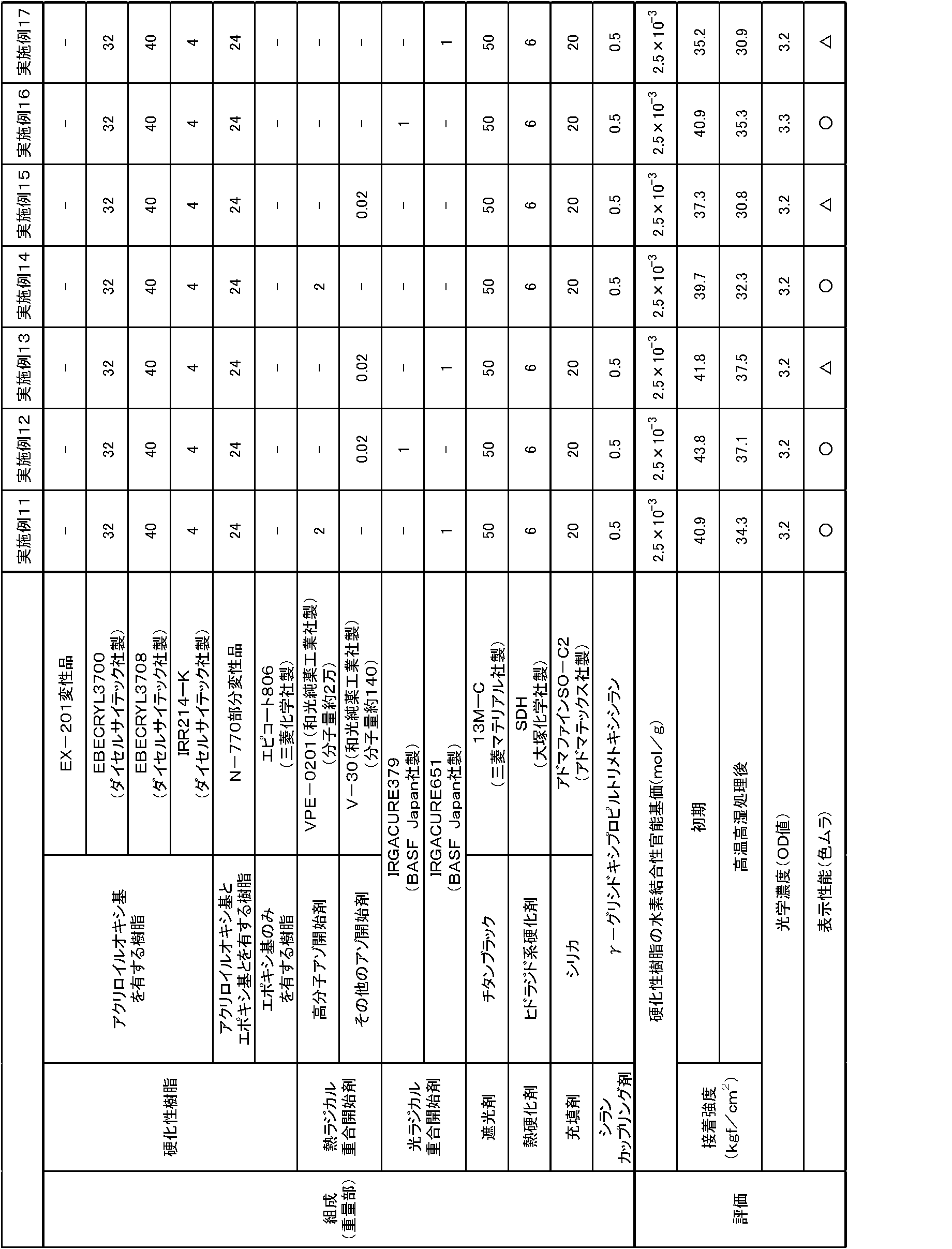
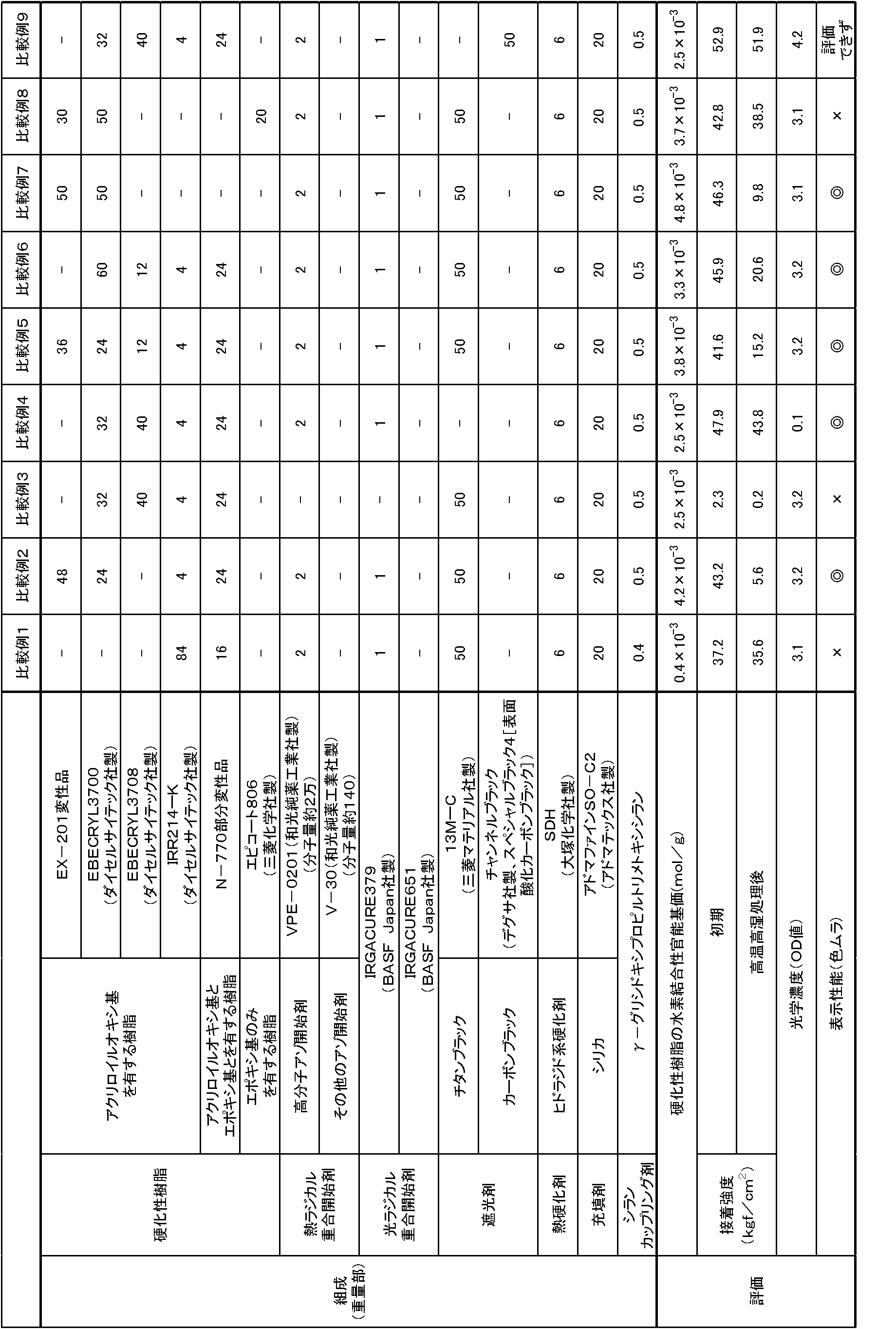
- Examples 1 to 17 and Comparative Examples 1 to 9 Each curable resin was blended according to the blending ratio described in Tables 1 to 3, and then a thermal radical polymerization initiator and / or a photo radical polymerization initiator was blended. Next, after completely dissolving the thermal radical polymerization initiator and / or the photo radical polymerization initiator, the mixture was stirred using a planetary stirrer (“Shinky Co., Ltd.“ Awatori Netaro ”), and then a light shielding agent, a thermosetting agent, A filler and a silane coupling agent were blended and further stirred with a planetary stirrer. Then, the light-shielding sealant for liquid crystal display elements of an Example and a comparative example was prepared by disperse
- FIG. 1 is a diagram schematically showing a procedure for manufacturing a liquid crystal display element by a liquid crystal dropping method in Examples and Comparative Examples.
- the obtained light-shielding sealant for a liquid crystal display element was applied to a substrate on which a transparent electrode and an alignment film were formed with a dispenser so as to draw a square frame.
- liquid crystal Choso "JC-5004LA”
- fine droplets are applied dropwise onto the entire surface of the transparent substrate frame, and the substrate on which another transparent electrode and alignment film are formed is superposed in a vacuum.
- the outer frame seal portion was irradiated with 100 mW / cm 2 ultraviolet rays for 30 seconds using a high-pressure mercury lamp.
- liquid crystal annealing was performed at 120 ° C. for 1 hour, and the light-shielding sealant for liquid crystal display elements was thermally cured to obtain a liquid crystal display element.
- a very small amount of the obtained light-shielding sealant for a liquid crystal display element is placed on the center of a glass substrate (20 mm ⁇ 50 mm ⁇ 1.1 mmt), and a glass substrate of the same size is superimposed on the glass substrate so as to form a cross.
- the sealing agent for liquid crystal display elements was expanded. In this state, 100 mW / cm 2 of ultraviolet rays were irradiated for 30 seconds, and then heated at 120 ° C. for 1 hour to obtain an initial adhesion test piece.
- a pressure cooker test (121 ° C., 100% RH, 0.2 MPa) was performed for 24 hours on the obtained initial adhesion test piece to obtain an adhesion test piece after high-temperature and high-humidity treatment.
- the adhesive strength (kgf / cm 2 ) was measured using a tension gauge.
- Optical density (OD value) 1 g of a silica spacer (Sekisui Chemical Co., Ltd., “Micropearl SI”) having a diameter of 5 ⁇ m was added as a spacer to 100 g of the obtained light-shielding sealant for a liquid crystal display device, and mixed and stirred. Apply the obtained light-shielding sealant for spacer-equipped liquid crystal display elements onto a glass substrate of 20 mm x 20 mm, overlay a glass substrate of the same size on the substrate, apply a load, and crush it to the diameter of the spacer to make the thickness uniform I made it.
- optical test piece After irradiating 100 mW / cm 2 of ultraviolet rays for 30 seconds using a metal halide lamp, heating was performed at 120 ° C. for 1 hour to obtain an optical test piece.
- the optical density (OD value) of the obtained optical test piece was measured using X-rite 360T ( ⁇ ) (manufactured by X-rite).
- the adhesive strength after the high-temperature and high-humidity test of the light-shielding sealant obtained in the examples was 30 kgf / cm 2 or more, both of which had no practical problem at all. Further, the optical density (OD value) was very high at 3.0 or more, and it had a sufficient light shielding property. Regarding the color unevenness, there was no, almost none, or a slight degree, and there was no problem in practical use at all.
- the present invention it is possible to provide a light-shielding sealant for a liquid crystal display element that has excellent adhesion strength to a substrate even after being exposed to a high-temperature and high-humidity environment. Moreover, the vertical conduction material and liquid crystal display element which are manufactured using this light-shielding sealant for liquid crystal display elements can be provided.
Landscapes
- Physics & Mathematics (AREA)
- Chemical & Material Sciences (AREA)
- Nonlinear Science (AREA)
- Organic Chemistry (AREA)
- Mathematical Physics (AREA)
- Crystallography & Structural Chemistry (AREA)
- General Physics & Mathematics (AREA)
- Optics & Photonics (AREA)
- Medicinal Chemistry (AREA)
- Health & Medical Sciences (AREA)
- Chemical Kinetics & Catalysis (AREA)
- Polymers & Plastics (AREA)
- Materials Engineering (AREA)
- Engineering & Computer Science (AREA)
- Sealing Material Composition (AREA)
- Liquid Crystal (AREA)
- Macromonomer-Based Addition Polymer (AREA)
- Polymerisation Methods In General (AREA)
- Polymerization Catalysts (AREA)
Abstract
Description
以下に本発明を詳述する。
チタンブラックは、波長300~800nmの光に対する平均透過率と比較して、紫外線領域付近、特に波長370~450nmの光に対する透過率が高くなる物質である。即ち、上記チタンブラックは、可視光領域の波長の光を充分に遮蔽することで本発明の遮光シール剤に遮光性を付与する一方、紫外線領域付近の波長の光は透過させる性質を有する遮光剤である。従って、後述する光ラジカル重合開始剤として、上記チタンブラックの透過率の高くなる波長(370~450nm)の光によって反応を開始可能なものを用いることで、本発明の遮光シール剤の光硬化性をより増大させることができる。また一方で、本発明の遮光シール剤に含有される遮光剤としては、絶縁性の高い物質が好ましく、絶縁性の高い遮光剤としてもチタンブラックが好適である。
上記チタンブラックは、1μmあたりの光学濃度(OD値)が、3以上であることが好ましく、4以上であることがより好ましい。上記チタンブラックの遮光性は高ければ高いほど良く、上記チタンブラックのOD値に好ましい上限は特に無いが、通常は5以下となる。
また、本発明の遮光シール剤を用いて製造した液晶表示素子は、遮光シール剤が充分な遮光性を有するため、光の漏れ出しがなく高いコントラストを有し、優れた画像表示品質を有する液晶表示素子を実現することができる。
上記チタンブラックの体積抵抗の好ましい下限は0.5Ω・cm、好ましい上限は3Ω・cmであり、より好ましい下限は1Ω・cm、より好ましい上限は2.5Ω・cmである。
上記硬化性樹脂は、不飽和二重結合を有する硬化性化合物を含有する。即ち、本発明の遮光シール剤は、不飽和二重結合を有する硬化性化合物、及び、後述するラジカル重合開始剤を含有することにより、光及び/又は熱によって反応を開始するものであり、具体的には、紫外線照射及び/又は加熱することにより硬化させることができる。
なお、本明細書において硬化性樹脂の水素結合性官能基価とは、硬化性樹脂が一種類の化合物からなる場合、下記式により算出される値である。
硬化性樹脂の水素結合性官能基価
=(構成化合物1分子中の水素結合性官能基数)/(構成化合物の分子量)
硬化性樹脂の水素結合性官能基価=(a×α+b×β+c×γ)/(a+b+c)
なお、本明細書において上記「(メタ)アクリロイルオキシ基」とは、「アクリロイルオキシ基又はメタクリロイルオキシ基」を意味する。
なお、本明細書において上記「(メタ)アクリル」とは、「アクリル又はメタクリル」を意味し、上記「(メタ)アクリレート」とは、「アクリレート又はメタクリレート」を意味する。また、本明細書において上記「完全(メタ)アクリル変性エポキシ樹脂」とは、エポキシ樹脂中の全てのエポキシ基を(メタ)アクリル酸と反応させた化合物のことを表す。
上記ビスフェノールF型エポキシ樹脂のうち市販されているものとしては、例えば、エピコート806、エピコート4004(いずれも三菱化学社製)等が挙げられる。
上記ビスフェノールS型エポキシ樹脂のうち市販されているものとしては、例えば、エピクロンEXA1514(DIC社製)等が挙げられる。
上記2,2’-ジアリルビスフェノールA型エポキシ樹脂のうち市販されているものとしては、例えば、RE-810NM(日本化薬社製)等が挙げられる。
上記水添ビスフェノール型エポキシ樹脂のうち市販されているものとしては、例えば、エピクロンEXA7015(DIC社製)等が挙げられる。
上記プロピレンオキシド付加ビスフェノールA型エポキシ樹脂のうち市販されているものとしては、例えば、EP-4000S(ADEKA社製)等が挙げられる。
上記レゾルシノール型エポキシ樹脂のうち市販されているものとしては、例えば、EX-201(ナガセケムテックス社製)等が挙げられる。
上記ビフェニル型エポキシ樹脂のうち市販されているものとしては、例えば、エピコートYX-4000H(三菱化学社製)等が挙げられる。
上記スルフィド型エポキシ樹脂のうち市販されているものとしては、例えば、YSLV-50TE(新日鐵化学社製)等が挙げられる。
上記ジフェニルエーテル型エポキシ樹脂のうち市販されているものとしては、例えば、YSLV-80DE(新日鐵化学社製)等が挙げられる。
上記ジシクロペンタジエン型エポキシ樹脂のうち市販されているものとしては、例えば、EP-4088S(ADEKA社製)等が挙げられる。
上記ナフタレン型エポキシ樹脂のうち市販されているものとしては、例えば、エピクロンHP4032、エピクロンEXA-4700(いずれもDIC社製)等が挙げられる。
上記フェノールノボラック型エポキシ樹脂のうち市販されているものとしては、例えば、エピクロンN-770(DIC社製)等が挙げられる。
上記オルトクレゾールノボラック型エポキシ樹脂のうち市販されているものとしては、例えば、エピクロンN-670-EXP-S(DIC社製)等が挙げられる。
上記ジシクロペンタジエンノボラック型エポキシ樹脂のうち市販されているものとしては、例えば、エピクロンHP7200(DIC社製)等が挙げられる。
上記ビフェニルノボラック型エポキシ樹脂のうち市販されているものとしては、例えば、NC-3000P(日本化薬社製)等が挙げられる。
上記ナフタレンフェノールノボラック型エポキシ樹脂のうち市販されているものとしては、例えば、ESN-165S(新日鐵化学社製)等が挙げられる。
上記グリシジルアミン型エポキシ樹脂のうち市販されているものとしては、例えば、エピコート630(三菱化学社製)、エピクロン430(DIC社製)、TETRAD-X(三菱ガス化学社製)等が挙げられる。
上記アルキルポリオール型エポキシ樹脂のうち市販されているものとしては、例えば、ZX-1542(新日鐵化学社製)、エピクロン726(DIC社製)、エポライト80MFA(共栄社化学社製)、デナコールEX-611(ナガセケムテックス社製)等が挙げられる。
上記ゴム変性型エポキシ樹脂のうち市販されているものとしては、例えば、YR-450、YR-207(いずれも新日鐵化学社製)、エポリードPB(ダイセル社製)等が挙げられる。
上記グリシジルエステル化合物のうち市販されているものとしては、例えば、デナコールEX-147(ナガセケムテックス社製)等が挙げられる。
上記エポキシ樹脂のうちその他に市販されているものとしては、例えば、YDC-1312、YSLV-80XY、YSLV-90CR(いずれも新日鐵化学社製)、XAC4151(旭化成社製)、エピコート1031、エピコート1032(いずれも三菱化学社製)、EXA-7120(DIC社製)、TEPIC(日産化学社製)等が挙げられる。
なお、本明細書において上記部分(メタ)アクリル変性エポキシ樹脂とは、1分子中にエポキシ基と(メタ)アクリロイルオキシ基とをそれぞれ1つ以上有する樹脂を意味し、例えば、2つ以上のエポキシ基を有する樹脂の一部分のエポキシ基を(メタ)アクリル酸と反応させることによって得ることができる。
上記エポキシ基のみを有する樹脂の含有量は、硬化性樹脂全体100重量部に対して、好ましい上限が10重量%である。上記エポキシ基のみを有する樹脂の含有量が10重量%を超えると、得られる液晶表示素子用遮光シール剤が液晶汚染を引き起こすことがある。
なお、本明細書において上記10時間半減期温度とは、不活性ガスの存在下において、一定の温度で10時間熱分解反応を行った際に熱ラジカル重合開始剤の濃度が反応前の濃度の半分になるときの温度である。
なお、本明細書において高分子アゾ開始剤とは、アゾ基を有し、熱によって上記硬化性樹脂を硬化させることができるラジカルを生成する、分子量が300以上の化合物を意味する。
また、上記高分子アゾ開始剤は、通常光照射によっても分解してラジカルを発生することから、光ラジカル重合開始剤としても機能し得る。
ポリアルキレンオキサイド等のユニットが複数結合した構造としては、ポリエチレンオキサイド構造を有するものが好ましい。
このような高分子アゾ開始剤としては、例えば、4,4’-アゾビス(4-シアノペンタン酸)とポリアルキレングリコールの重縮合物や4,4’-アゾビス(4-シアノペンタン酸)と末端アミノ基を有するポリジメチルシロキサンの重縮合物等が挙げられ、具体的には例えば、VPE-0201、VPE-0401、VPE-0601、VPS-0501、VPS-1001(いずれも和光純薬工業社製)等が挙げられる。


また、R11及びR21で表わされる炭素原子数1~24のアルキル基としては、例えば、メチル、エチル、プロピル、イソプロピル、ブチル、s-ブチル、t-ブチル、イソブチル、アミル、イソアミル、t-アミル、ヘキシル、シクロヘキシル、シクロヘキシルメチル、シクロヘキシルエチル、ヘプチル、イソヘプチル、t-ヘプチル、n-オクチル、イソオクチル、t-オクチル、2-エチルヘキシル、n-ノニル、n-デシル、ラウリル、ステアリル、ベヘニル等が挙げられる。R11及びR21で表わされる炭素原子数1~24のアルキル基は、炭素原子数が1~4であるものが、反応性が高いため好ましい。

また、R31及びR41で表される炭素原子数1~24のアルキル基としては、例えば、上記一般式(II)におけるR11及びR21として例示したものが挙げられる。R31及びR41で表される炭素原子数1~24のアルキル基は、炭素原子数が1~4であるものが、反応性が高いため好ましい。
上記熱硬化剤は特に限定されず、例えば、有機酸ヒドラジド、イミダゾール誘導体、アミン化合物、多価フェノール系化合物、酸無水物等が挙げられる。なかでも、常温固形の有機酸ヒドラジドが好適に用いられる。
上記常温固形の有機酸ヒドラジドは特に限定されず、例えば、セバシン酸ジヒドラジド、イソフタル酸ジヒドラジド、アジピン酸ジヒドラジド、マロン酸ジヒドラジド等が挙げられ、市販されているものとしては、例えば、SDH(日本ファインケム社製)、アミキュアVDH、アミキュアVDH-J、アミキュアUDH(いずれも、味の素ファインテクノ社製)、ADH(大塚化学社製)等が挙げられる。
レゾルシノール型エポキシ樹脂(ナガセケムテックス社製、「EX-201」)120gをトルエン500mLに溶解させ、この溶液にトリフェニルホスフィン0.1gを加え、均一な溶液とした。この溶液にアクリル酸70gを還流撹拌下2時間かけて滴下後、更に還流撹拌を8時間行った。次に、トルエンを除去することによって、全てのエポキシ基をアクリル基に変性した完全アクリル変性レゾルシノール型エポキシ樹脂(EX-201変性品)を得た。
フェノールノボラック型エポキシ樹脂(DIC社製、「N-770」)190gをトルエン500mLに溶解させ、トリフェニルホスフィン0.1gを加え、均一な溶液とし、得られた溶液にアクリル酸35gを還流撹拌下で2時間かけて滴下した後、更に還流撹拌を6時間行った。次に、トルエンを除去することによって50mol%のエポキシ基をアクリロイルオキシ基に変性した部分アクリル変性フェノールノボラック型エポキシ樹脂(N-770部分変性品)を得た。
表1~3に記載した配合比に従い、各硬化性樹脂を配合した後、熱ラジカル重合開始剤及び/又は光ラジカル重合開始剤を配合した。次いで、熱ラジカル重合開始剤及び/又は光ラジカル重合開始剤を完全に溶解した後、遊星式撹拌機(シンキー社製「あわとり練太郎」)を用いて攪拌後、遮光剤、熱硬化剤、充填剤、及び、シランカップリング剤を配合し、更に遊星式攪拌機で攪拌した。その後、3本ロールを用いて均一に分散させることにより、実施例及び比較例の液晶表示素子用遮光シール剤を調製した。
実施例及び比較例で得られた液晶表示素子用遮光シール剤及び液晶表示素子について以下の評価を行った。結果を表1~3に示した。
得られた液晶表示素子用遮光シール剤をガラス基板(20mm×50mm×1.1mmt)の中央部に極微量だけ取り、その上に同じ大きさのガラス基板を十字上になるように重ね合わせて液晶表示素子用シール剤を押し広げた。その状態で100mW/cm2の紫外線を30秒照射した後、120℃で1時間加熱を行い、初期接着試験片を得た。また、得られた初期接着試験片に対して、プレッシャークッカー試験(121℃、100%RH、0.2MPa)を24時間行い、高温高湿処理後接着試験片を得た。得られた初期接着試験片及び高温高湿処理後接着試験片について、テンションゲージを用いて接着強度(kgf/cm2)を測定した。
得られた液晶表示素子用遮光シール剤100gにスペーサとして直径5μmのシリカスペーサ(積水化学工業社製、「ミクロパールSI」)1gを添加して混合撹拌を行った。
得られたスペーサ入り液晶表示素子用遮光シール剤を20mm×20mmのガラス基板上に塗布し、その基板に同サイズのガラス基板を重ね合わせ、荷重をかけ、スペーサの直径まで押しつぶして厚さを均一にした。次に、メタルハライドランプを用いて100mW/cm2の紫外線を30秒照射した後、120℃で1時間加熱を行い、光学試験片を得た。得られた光学試験片についてX-rite360T(ν)(X-rite社製)を用いて光学濃度(OD値)を測定した。
得られた液晶表示素子について、液晶表示素子用遮光シール剤周辺の液晶に生じる色ムラを目視にて観察した。その結果、色ムラが全くなかった場合を「◎」、色ムラがほぼなかった場合を「○」、微かに色ムラがあった場合を「△」、色ムラがかなりあった場合を「×」として評価した。

Claims (6)
- 不飽和二重結合を有する硬化性化合物を含有する硬化性樹脂、ラジカル重合開始剤、及び、遮光剤を含有する液晶滴下工法用遮光シール剤であって、
前記硬化性樹脂は、水素結合性官能基価が0.5×10⁻³~3.0×10⁻³mol/gであり、
前記遮光剤としてチタンブラックを含有する
ことを特徴とする液晶表示素子用遮光シール剤。 - 不飽和二重結合を有する硬化性化合物は、(メタ)アクリロイルオキシ基を有することを特徴とする請求項1記載の液晶表示素子用遮光シール剤。
- ラジカル重合開始剤は、熱ラジカル重合開始剤を含有することを特徴とする請求項1又は2記載の液晶表示素子用遮光シール剤。
- ラジカル重合開始剤は、高分子アゾ開始剤、及び/又は、370~450nmの波長領域の光で感光する光ラジカル重合開始剤を含有することを特徴とする請求項1又は2記載の液晶表示素子用遮光シール剤。
- 請求項1、2、3又は4記載の液晶表示素子用遮光シール剤と導電性微粒子とを含有することを特徴とする上下導通材料。
- 請求項1、2、3又は4記載の液晶表示素子用遮光シール剤及び/又は請求項5記載の上下導通材料を用いて製造されることを特徴とする液晶表示素子。
Priority Applications (3)
| Application Number | Priority Date | Filing Date | Title |
|---|---|---|---|
| CN201280002167.0A CN103026292B (zh) | 2011-04-05 | 2012-04-03 | 液晶显示元件用遮光密封剂、上下导通材料及液晶显示元件 |
| JP2012519643A JP5238909B2 (ja) | 2011-04-05 | 2012-04-03 | 液晶表示素子用遮光シール剤、上下導通材料及び液晶表示素子 |
| KR1020127033525A KR101321694B1 (ko) | 2011-04-05 | 2012-04-03 | 액정 표시 소자용 차광 시일제, 상하 도통 재료 및 액정 표시 소자 |
Applications Claiming Priority (2)
| Application Number | Priority Date | Filing Date | Title |
|---|---|---|---|
| JP2011083673 | 2011-04-05 | ||
| JP2011-083673 | 2011-04-05 |
Publications (1)
| Publication Number | Publication Date |
|---|---|
| WO2012137749A1 true WO2012137749A1 (ja) | 2012-10-11 |
Family
ID=46969147
Family Applications (1)
| Application Number | Title | Priority Date | Filing Date |
|---|---|---|---|
| PCT/JP2012/059023 Ceased WO2012137749A1 (ja) | 2011-04-05 | 2012-04-03 | 液晶表示素子用遮光シール剤、上下導通材料及び液晶表示素子 |
Country Status (5)
| Country | Link |
|---|---|
| JP (1) | JP5238909B2 (ja) |
| KR (1) | KR101321694B1 (ja) |
| CN (1) | CN103026292B (ja) |
| TW (1) | TWI409555B (ja) |
| WO (1) | WO2012137749A1 (ja) |
Cited By (9)
| Publication number | Priority date | Publication date | Assignee | Title |
|---|---|---|---|---|
| JP2014115639A (ja) * | 2012-11-13 | 2014-06-26 | Sekisui Chem Co Ltd | 液晶表示素子用シール剤、上下導通材料、液晶表示素子、及び、ヒドラジド系熱硬化剤 |
| JP2014139662A (ja) * | 2012-12-19 | 2014-07-31 | Sekisui Chem Co Ltd | 液晶滴下工法用シール剤、液晶滴下工法用シール剤の製造方法、上下導通材料、及び、液晶表示素子 |
| JP2015001615A (ja) * | 2013-06-14 | 2015-01-05 | 積水化学工業株式会社 | 液晶滴下工法用シール剤、上下導通材料、及び、液晶表示素子 |
| CN105283803A (zh) * | 2013-06-11 | 2016-01-27 | 积水化学工业株式会社 | 液晶滴下工艺用密封剂、上下导通材料及液晶显示元件 |
| KR20160094929A (ko) * | 2013-12-05 | 2016-08-10 | 세키스이가가쿠 고교가부시키가이샤 | 중합성 단량체, 고분자 화합물, 광경화성 수지 조성물, 액정 표시 소자용 시일제, 상하 도통 재료, 및 액정 표시 소자 |
| WO2016190398A1 (ja) * | 2015-05-28 | 2016-12-01 | 積水化学工業株式会社 | 液晶滴下工法用シール剤、上下導通材料、及び、液晶表示素子 |
| JP2017082021A (ja) * | 2015-10-22 | 2017-05-18 | 株式会社ブリヂストン | エマルジョン粘着剤、粘着シート、エマルジョン粘着剤の製造方法、及び粘着シートの製造方法 |
| WO2017199905A1 (ja) * | 2016-05-17 | 2017-11-23 | 積水化学工業株式会社 | 液晶表示素子用シール剤、上下導通材料、及び、液晶表示素子 |
| JP2019091086A (ja) * | 2014-06-03 | 2019-06-13 | 積水化学工業株式会社 | 液晶表示素子用シール剤、上下導通材料、及び、液晶表示素子 |
Families Citing this family (8)
| Publication number | Priority date | Publication date | Assignee | Title |
|---|---|---|---|---|
| WO2014192881A1 (ja) * | 2013-05-31 | 2014-12-04 | 積水化学工業株式会社 | 液晶表示素子用シール剤、上下導通材料、液晶表示素子、及び、液晶表示素子用シール剤の製造方法 |
| WO2015111570A1 (ja) * | 2014-01-21 | 2015-07-30 | 積水化学工業株式会社 | 光湿気硬化型樹脂組成物、電子部品用接着剤、及び、表示素子用接着剤 |
| JP6408983B2 (ja) * | 2014-03-31 | 2018-10-17 | 積水化学工業株式会社 | 液晶滴下工法用シール剤、上下導通材料、及び、液晶表示素子 |
| CN106415381B (zh) * | 2014-09-24 | 2020-09-25 | 积水化学工业株式会社 | 液晶显示元件用密封剂、上下导通材料及液晶显示元件 |
| CN110041887B (zh) * | 2015-11-09 | 2021-03-16 | 积水化学工业株式会社 | 液晶显示元件用密封剂、上下导通材料和液晶显示元件 |
| JP7181936B2 (ja) * | 2018-07-24 | 2022-12-01 | 三井化学株式会社 | 液晶滴下工法用遮光シール剤、およびこれを用いた液晶表示パネルの製造方法 |
| KR102708814B1 (ko) * | 2018-10-26 | 2024-09-23 | 세키스이가가쿠 고교가부시키가이샤 | 액정 표시 소자용 시일제, 상하 도통 재료, 및 액정 표시 소자 |
| CN109725001A (zh) * | 2018-12-29 | 2019-05-07 | 江苏东旭亿泰智能装备有限公司 | 遮光机构和玻璃基板检测设备 |
Citations (4)
| Publication number | Priority date | Publication date | Assignee | Title |
|---|---|---|---|---|
| WO2005085943A1 (ja) * | 2004-03-09 | 2005-09-15 | Sekisui Chemical Co., Ltd. | 液晶滴下工法用遮光シール剤、上下導通材料、及び、液晶表示素子 |
| JP2006313286A (ja) * | 2005-05-09 | 2006-11-16 | Sekisui Chem Co Ltd | 液晶滴下工法用遮光シール剤、上下導通材料、及び、液晶表示素子 |
| JP2007304273A (ja) * | 2006-05-10 | 2007-11-22 | Hitachi Displays Ltd | 液晶表示素子 |
| WO2009128470A1 (ja) * | 2008-04-18 | 2009-10-22 | 積水化学工業株式会社 | 液晶滴下工法用シール剤、液晶パネル用封口剤、上下導通材料及び液晶表示素子 |
Family Cites Families (2)
| Publication number | Priority date | Publication date | Assignee | Title |
|---|---|---|---|---|
| TWI401535B (zh) * | 2007-09-27 | 2013-07-11 | Dainippon Printing Co Ltd | 彩色濾光片用負型光阻組成物及顏料分散液,使用其等之彩色濾光片及液晶顯示裝置,以及其等之製造方法 |
| JP5489447B2 (ja) * | 2008-11-27 | 2014-05-14 | 協立化学産業株式会社 | 遮光性と粘着性を有する光硬化性樹脂組成物及びその硬化物 |
-
2012
- 2012-04-03 WO PCT/JP2012/059023 patent/WO2012137749A1/ja not_active Ceased
- 2012-04-03 TW TW101111799A patent/TWI409555B/zh active
- 2012-04-03 KR KR1020127033525A patent/KR101321694B1/ko active Active
- 2012-04-03 JP JP2012519643A patent/JP5238909B2/ja active Active
- 2012-04-03 CN CN201280002167.0A patent/CN103026292B/zh active Active
Patent Citations (4)
| Publication number | Priority date | Publication date | Assignee | Title |
|---|---|---|---|---|
| WO2005085943A1 (ja) * | 2004-03-09 | 2005-09-15 | Sekisui Chemical Co., Ltd. | 液晶滴下工法用遮光シール剤、上下導通材料、及び、液晶表示素子 |
| JP2006313286A (ja) * | 2005-05-09 | 2006-11-16 | Sekisui Chem Co Ltd | 液晶滴下工法用遮光シール剤、上下導通材料、及び、液晶表示素子 |
| JP2007304273A (ja) * | 2006-05-10 | 2007-11-22 | Hitachi Displays Ltd | 液晶表示素子 |
| WO2009128470A1 (ja) * | 2008-04-18 | 2009-10-22 | 積水化学工業株式会社 | 液晶滴下工法用シール剤、液晶パネル用封口剤、上下導通材料及び液晶表示素子 |
Cited By (13)
| Publication number | Priority date | Publication date | Assignee | Title |
|---|---|---|---|---|
| JP2018077544A (ja) * | 2012-11-13 | 2018-05-17 | 積水化学工業株式会社 | 液晶表示素子用シール剤、上下導通材料、液晶表示素子、及び、ヒドラジド系熱硬化剤 |
| JP2014115639A (ja) * | 2012-11-13 | 2014-06-26 | Sekisui Chem Co Ltd | 液晶表示素子用シール剤、上下導通材料、液晶表示素子、及び、ヒドラジド系熱硬化剤 |
| JP2014139662A (ja) * | 2012-12-19 | 2014-07-31 | Sekisui Chem Co Ltd | 液晶滴下工法用シール剤、液晶滴下工法用シール剤の製造方法、上下導通材料、及び、液晶表示素子 |
| CN105283803A (zh) * | 2013-06-11 | 2016-01-27 | 积水化学工业株式会社 | 液晶滴下工艺用密封剂、上下导通材料及液晶显示元件 |
| JP2015001615A (ja) * | 2013-06-14 | 2015-01-05 | 積水化学工業株式会社 | 液晶滴下工法用シール剤、上下導通材料、及び、液晶表示素子 |
| KR20160094929A (ko) * | 2013-12-05 | 2016-08-10 | 세키스이가가쿠 고교가부시키가이샤 | 중합성 단량체, 고분자 화합물, 광경화성 수지 조성물, 액정 표시 소자용 시일제, 상하 도통 재료, 및 액정 표시 소자 |
| KR102256146B1 (ko) * | 2013-12-05 | 2021-05-25 | 세키스이가가쿠 고교가부시키가이샤 | 중합성 단량체, 고분자 화합물, 광경화성 수지 조성물, 액정 표시 소자용 시일제, 상하 도통 재료, 및 액정 표시 소자 |
| JP2019091086A (ja) * | 2014-06-03 | 2019-06-13 | 積水化学工業株式会社 | 液晶表示素子用シール剤、上下導通材料、及び、液晶表示素子 |
| JP6078698B1 (ja) * | 2015-05-28 | 2017-02-08 | 積水化学工業株式会社 | 液晶滴下工法用シール剤、上下導通材料、及び、液晶表示素子 |
| WO2016190398A1 (ja) * | 2015-05-28 | 2016-12-01 | 積水化学工業株式会社 | 液晶滴下工法用シール剤、上下導通材料、及び、液晶表示素子 |
| JP2017082021A (ja) * | 2015-10-22 | 2017-05-18 | 株式会社ブリヂストン | エマルジョン粘着剤、粘着シート、エマルジョン粘着剤の製造方法、及び粘着シートの製造方法 |
| JP6263317B1 (ja) * | 2016-05-17 | 2018-01-17 | 積水化学工業株式会社 | 液晶表示素子用シール剤、上下導通材料、及び、液晶表示素子 |
| WO2017199905A1 (ja) * | 2016-05-17 | 2017-11-23 | 積水化学工業株式会社 | 液晶表示素子用シール剤、上下導通材料、及び、液晶表示素子 |
Also Published As
| Publication number | Publication date |
|---|---|
| KR101321694B1 (ko) | 2013-10-23 |
| TWI409555B (zh) | 2013-09-21 |
| JPWO2012137749A1 (ja) | 2014-07-28 |
| CN103026292B (zh) | 2014-03-05 |
| JP5238909B2 (ja) | 2013-07-17 |
| TW201245825A (en) | 2012-11-16 |
| CN103026292A (zh) | 2013-04-03 |
| KR20130030275A (ko) | 2013-03-26 |
Similar Documents
| Publication | Publication Date | Title |
|---|---|---|
| JP5238909B2 (ja) | 液晶表示素子用遮光シール剤、上下導通材料及び液晶表示素子 | |
| JP5139735B2 (ja) | 液晶滴下工法用シール剤、上下導通材料及び液晶表示素子 | |
| JP5926617B2 (ja) | 液晶表示素子用遮光シール剤、上下導通材料及び液晶表示素子 | |
| JP5049409B2 (ja) | 液晶滴下工法用シール剤、上下導通材料、及び、液晶表示素子 | |
| JP5827752B2 (ja) | 液晶滴下工法用シール剤、上下導通材料、及び、液晶表示素子 | |
| JP5759638B1 (ja) | 液晶表示素子用シール剤、上下導通材料、及び、液晶表示素子 | |
| JPWO2009128470A1 (ja) | 液晶滴下工法用シール剤、液晶パネル用封口剤、上下導通材料及び液晶表示素子 | |
| JP6114893B1 (ja) | 液晶表示素子用シール剤、上下導通材料及び液晶表示素子 | |
| JP5340502B2 (ja) | 液晶滴下工法用シール剤、上下導通材料、及び、液晶表示素子 | |
| JP6216260B2 (ja) | 液晶表示素子用シール剤、上下導通材料、及び、液晶表示素子 | |
| JP5249698B2 (ja) | 液晶表示素子用シール剤及び液晶表示素子 | |
| JP5386012B2 (ja) | 液晶滴下工法用シール剤、上下導通材料、及び、液晶表示素子 | |
| JP2012173488A (ja) | 液晶滴下工法用シール剤、及び、液晶表示素子の製造方法 | |
| JP6460797B2 (ja) | 液晶表示素子用シール剤、上下導通材料、及び、液晶表示素子 | |
| JP5369242B2 (ja) | 液晶滴下工法用シール剤、上下導通材料、及び、液晶表示素子 | |
| JP5820184B2 (ja) | 液晶表示素子用シール剤、上下導通材料及び液晶表示素子 | |
| JP5660923B2 (ja) | 液晶滴下工法用シール剤、及び、上下導通材料、及び、液晶表示素子 | |
| JP2012088412A (ja) | 液晶表示素子用遮光シール剤、上下導通材料及び液晶表示素子 | |
| JP6046533B2 (ja) | 液晶滴下工法用シール剤、上下導通材料、及び、液晶表示素子 | |
| JP5965730B2 (ja) | 液晶滴下工法用シール剤、上下導通材料、及び、液晶表示素子 | |
| JP4977166B2 (ja) | 液晶滴下工法用シール剤、液晶パネル用封口剤、上下導通材料、及び、液晶表示素子 | |
| JP5486032B2 (ja) | 熱硬化型液晶滴下工法用シール剤、熱硬化型上下導通材料及び液晶表示素子 | |
| JP2017003989A (ja) | 液晶表示素子用シール剤、上下導通材料、及び、液晶表示素子 |
Legal Events
| Date | Code | Title | Description |
|---|---|---|---|
| WWE | Wipo information: entry into national phase |
Ref document number: 201280002167.0 Country of ref document: CN |
|
| ENP | Entry into the national phase |
Ref document number: 2012519643 Country of ref document: JP Kind code of ref document: A |
|
| 121 | Ep: the epo has been informed by wipo that ep was designated in this application |
Ref document number: 12768494 Country of ref document: EP Kind code of ref document: A1 |
|
| ENP | Entry into the national phase |
Ref document number: 20127033525 Country of ref document: KR Kind code of ref document: A |
|
| NENP | Non-entry into the national phase |
Ref country code: DE |
|
| 122 | Ep: pct application non-entry in european phase |
Ref document number: 12768494 Country of ref document: EP Kind code of ref document: A1 |