WO2012114634A1 - 冷媒輸送ホース用樹脂組成物およびその製法、並びに冷媒輸送ホース - Google Patents
冷媒輸送ホース用樹脂組成物およびその製法、並びに冷媒輸送ホース Download PDFInfo
- Publication number
- WO2012114634A1 WO2012114634A1 PCT/JP2011/079747 JP2011079747W WO2012114634A1 WO 2012114634 A1 WO2012114634 A1 WO 2012114634A1 JP 2011079747 W JP2011079747 W JP 2011079747W WO 2012114634 A1 WO2012114634 A1 WO 2012114634A1
- Authority
- WO
- WIPO (PCT)
- Prior art keywords
- polyamide
- resin composition
- resin
- refrigerant transport
- elastomer
- Prior art date
- Legal status (The legal status is an assumption and is not a legal conclusion. Google has not performed a legal analysis and makes no representation as to the accuracy of the status listed.)
- Ceased
Links
Images
Classifications
-
- C—CHEMISTRY; METALLURGY
- C08—ORGANIC MACROMOLECULAR COMPOUNDS; THEIR PREPARATION OR CHEMICAL WORKING-UP; COMPOSITIONS BASED THEREON
- C08L—COMPOSITIONS OF MACROMOLECULAR COMPOUNDS
- C08L77/00—Compositions of polyamides obtained by reactions forming a carboxylic amide link in the main chain; Compositions of derivatives of such polymers
- C08L77/06—Polyamides derived from polyamines and polycarboxylic acids
-
- B—PERFORMING OPERATIONS; TRANSPORTING
- B60—VEHICLES IN GENERAL
- B60H—ARRANGEMENTS OF HEATING, COOLING, VENTILATING OR OTHER AIR-TREATING DEVICES SPECIALLY ADAPTED FOR PASSENGER OR GOODS SPACES OF VEHICLES
- B60H1/00—Heating, cooling or ventilating devices
- B60H1/00507—Details, e.g. mounting arrangements, desaeration devices
- B60H1/00557—Details of ducts or cables
- B60H1/00571—Details of ducts or cables of liquid ducts, e.g. for coolant liquids or refrigerants
-
- F—MECHANICAL ENGINEERING; LIGHTING; HEATING; WEAPONS; BLASTING
- F16—ENGINEERING ELEMENTS AND UNITS; GENERAL MEASURES FOR PRODUCING AND MAINTAINING EFFECTIVE FUNCTIONING OF MACHINES OR INSTALLATIONS; THERMAL INSULATION IN GENERAL
- F16L—PIPES; JOINTS OR FITTINGS FOR PIPES; SUPPORTS FOR PIPES, CABLES OR PROTECTIVE TUBING; MEANS FOR THERMAL INSULATION IN GENERAL
- F16L11/00—Hoses, i.e. flexible pipes
- F16L11/04—Hoses, i.e. flexible pipes made of rubber or flexible plastics
- F16L11/08—Hoses, i.e. flexible pipes made of rubber or flexible plastics with reinforcements embedded in the wall
- F16L11/085—Hoses, i.e. flexible pipes made of rubber or flexible plastics with reinforcements embedded in the wall comprising one or more braided layers
-
- C—CHEMISTRY; METALLURGY
- C08—ORGANIC MACROMOLECULAR COMPOUNDS; THEIR PREPARATION OR CHEMICAL WORKING-UP; COMPOSITIONS BASED THEREON
- C08L—COMPOSITIONS OF MACROMOLECULAR COMPOUNDS
- C08L2205/00—Polymer mixtures characterised by other features
- C08L2205/02—Polymer mixtures characterised by other features containing two or more polymers of the same C08L -group
-
- C—CHEMISTRY; METALLURGY
- C08—ORGANIC MACROMOLECULAR COMPOUNDS; THEIR PREPARATION OR CHEMICAL WORKING-UP; COMPOSITIONS BASED THEREON
- C08L—COMPOSITIONS OF MACROMOLECULAR COMPOUNDS
- C08L2205/00—Polymer mixtures characterised by other features
- C08L2205/03—Polymer mixtures characterised by other features containing three or more polymers in a blend
-
- F—MECHANICAL ENGINEERING; LIGHTING; HEATING; WEAPONS; BLASTING
- F16—ENGINEERING ELEMENTS AND UNITS; GENERAL MEASURES FOR PRODUCING AND MAINTAINING EFFECTIVE FUNCTIONING OF MACHINES OR INSTALLATIONS; THERMAL INSULATION IN GENERAL
- F16L—PIPES; JOINTS OR FITTINGS FOR PIPES; SUPPORTS FOR PIPES, CABLES OR PROTECTIVE TUBING; MEANS FOR THERMAL INSULATION IN GENERAL
- F16L11/00—Hoses, i.e. flexible pipes
- F16L11/04—Hoses, i.e. flexible pipes made of rubber or flexible plastics
- F16L2011/047—Hoses, i.e. flexible pipes made of rubber or flexible plastics with a diffusion barrier layer
-
- Y—GENERAL TAGGING OF NEW TECHNOLOGICAL DEVELOPMENTS; GENERAL TAGGING OF CROSS-SECTIONAL TECHNOLOGIES SPANNING OVER SEVERAL SECTIONS OF THE IPC; TECHNICAL SUBJECTS COVERED BY FORMER USPC CROSS-REFERENCE ART COLLECTIONS [XRACs] AND DIGESTS
- Y10—TECHNICAL SUBJECTS COVERED BY FORMER USPC
- Y10T—TECHNICAL SUBJECTS COVERED BY FORMER US CLASSIFICATION
- Y10T428/00—Stock material or miscellaneous articles
- Y10T428/13—Hollow or container type article [e.g., tube, vase, etc.]
- Y10T428/1352—Polymer or resin containing [i.e., natural or synthetic]
- Y10T428/139—Open-ended, self-supporting conduit, cylinder, or tube-type article
-
- Y—GENERAL TAGGING OF NEW TECHNOLOGICAL DEVELOPMENTS; GENERAL TAGGING OF CROSS-SECTIONAL TECHNOLOGIES SPANNING OVER SEVERAL SECTIONS OF THE IPC; TECHNICAL SUBJECTS COVERED BY FORMER USPC CROSS-REFERENCE ART COLLECTIONS [XRACs] AND DIGESTS
- Y10—TECHNICAL SUBJECTS COVERED BY FORMER USPC
- Y10T—TECHNICAL SUBJECTS COVERED BY FORMER US CLASSIFICATION
- Y10T428/00—Stock material or miscellaneous articles
- Y10T428/13—Hollow or container type article [e.g., tube, vase, etc.]
- Y10T428/1352—Polymer or resin containing [i.e., natural or synthetic]
- Y10T428/139—Open-ended, self-supporting conduit, cylinder, or tube-type article
- Y10T428/1393—Multilayer [continuous layer]
Definitions
- the present invention relates to a resin composition for a refrigerant transport hose useful as a material for a refrigerant transport hose for vehicles such as automobiles, a method for producing the resin composition, and a refrigerant transport hose comprising the resin composition.
- refrigerant transport hoses air conditioner hoses
- a highly crystalline resin such as a polyamide resin is used as a resin material for forming the resin layer of the refrigerant transport hose.
- PA9T polyamide 9T
- semi-aromatic polyamide resins such as PA9T have a high melting point and a high crystallization speed, they are crystallized immediately after extrusion (change from a molten state to a solid state) when extruded during hose production. In the resin layer thus extruded, a weld line can often be confirmed at a visual level, and therefore deformation (unevenness) during molding and local physical property deterioration of the hose are likely to occur.
- semi-aromatic polyamide resin such as PA9T
- PA9T semi-aromatic polyamide resin
- the semi-aromatic polyamide resin is not suitable for use as a refrigerant transport hose, and its improvement is required.
- the present invention has been made in view of such circumstances, and has excellent refrigerant permeation resistance and acid resistance, as well as excellent extrudability, flexibility, etc., and a resin composition for a refrigerant transport hose, its production method, and refrigerant transport The purpose is to provide a hose.
- the present invention is a resin composition for a refrigerant transport hose comprising the following (A) as a main component and the following (B) and (C) components, wherein the component (A) (B) component is dispersed in the phase consisting of, and the resin composition for refrigerant transport hose in which the uncrosslinked (C) component is contained in particles in the dispersed (B) component.
- A Semi-aromatic polyamide resin.
- B Aliphatic polyamide resin.
- C Elastomer.
- the present invention is also a method for producing a resin composition for a refrigerant transport hose according to the first aspect, in which an aliphatic polyamide resin (B) and an uncrosslinked elastomer (C) are kneaded to form an aliphatic polyamide resin.
- the second gist is a method for producing a resin composition for a refrigerant transport hose in which the elastomer (C) is finely dispersed in (B) and then the kneaded product and the semi-aromatic polyamide resin (A) are mixed.
- the present invention also relates to a refrigerant transport hose comprising one or more constituent layers, wherein at least one constituent layer includes the refrigerant transport hose comprising the resin composition for a refrigerant transport hose according to the first aspect. It is the gist of 3.
- the present inventors have conducted intensive research to solve the above problems.
- the present inventors have solved the above-mentioned problems such as extrudability and flexibility while having the semi-aromatic polyamide resin (A) excellent in refrigerant permeation resistance and acid resistance as a main component. Therefore, it was studied to blend the aliphatic polyamide resin (B) and the elastomer (C) and thereby prepare a resin composition for refrigerant transport hose.
- the desired effect cannot be obtained by simply blending them.
- the aliphatic polyamide resin (B) when the aliphatic polyamide resin (B) is simply blended with the semi-aromatic polyamide resin (A), the crystallization rate of the aliphatic polyamide resin (B) is slow (the crystallization temperature is low).
- the aliphatic polyamide resin (B) plays a role like a lubricant, thereby being excellent in extrusion processability, but the result is that sufficient flexibility cannot be obtained.
- the elastomer (C) when the elastomer (C) is blended with the semi-aromatic polyamide resin (A), the compatibility between the two is poor, so that the elastomer (C) is contained in the semi-aromatic polyamide resin (A). Difficult to disperse, resulting in poor overall dispersibility of the refrigerant due to poor dispersibility and low refrigerant permeability of the elastomer.
- the present inventors conducted further research. As a result, after the aliphatic polyamide resin (B) and the elastomer (C) are kneaded and the elastomer (C) is finely dispersed in the aliphatic polyamide resin (B), the kneaded product and the semi-aromatic polyamide resin are mixed. (A) is mixed, so that the dispersion state of each of the components (A) to (C) has a special structure, that is, in the phase composed of the semi-aromatic polyamide resin (A).
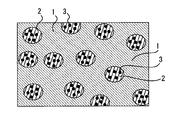
- An aliphatic polyamide resin (B) was dispersed in the resin composition, and a resin composition containing an uncrosslinked elastomer (C) in the form of particles in the dispersed aliphatic polyamide resin (B) was prepared (FIG. 1).
- the aliphatic polyamide resin (B) becomes a semi-aromatic polyamide resin (A) phase because of good compatibility between the semi-aromatic polyamide resin (A) and the aliphatic polyamide resin (B).
- the dispersed aliphatic polyamide resin dispersion contains a flexible elastomer (C) in the form of particles.
- the rigidity resulting from the semi-aromatic polyamide resin (A) is relaxed, the entire resin composition becomes flexible, and the elastomer (C) is contained in the aliphatic polyamide resin dispersion rich in refrigerant resistance resistance. Since it is contained in the form of particles, the low refrigerant resistance permeability of the elastomer (C) is covered, and the refrigerant resistance resistance of the entire resin composition is also ensured. Therefore, when such a resin composition is used as a layer forming material for a refrigerant transport hose, the extrusion processability and flexibility are improved without impairing the refrigerant permeability and acid resistance due to the semi-aromatic polyamide resin (A). The present invention has been found.
- the resin composition for a refrigerant transport hose of the present invention is a resin composition containing a semi-aromatic polyamide resin as a main component and an aliphatic polyamide resin and an elastomer, and is composed of a semi-aromatic polyamide resin.
- An aliphatic polyamide resin is dispersed in the phase, and an uncrosslinked elastomer is contained in the dispersed aliphatic polyamide resin in the form of particles. Therefore, it is excellent in refrigerant permeation resistance and acid resistance, and effects such as extrusion processability and flexibility are improved.
- the elastomer when contained in the form of particles having an average particle size of 0.1 to 1 ⁇ m, the flexibility and the like are further improved without impairing the refrigerant permeation resistance.
- the resin composition for refrigerant transport hoses of the invention in which the dispersion state of each component has a special structure as described above can be efficiently produced.
- the conventional semi-aromatic polyamide resin layer can be seen. Since the occurrence of such weld lines can be suppressed, the problems of conventional refrigerant transport hoses with semi-aromatic polyamide resin layers such as deformation during molding (uneven thickness) and local physical property degradation of the hose are eliminated. Can be resolved. Furthermore, since this refrigerant transport hose is excellent in refrigerant permeation resistance and acid resistance, and is excellent in flexibility and the like, it can exhibit excellent performance as a refrigerant transport hose.
- the resin composition for a refrigerant transport hose of the present invention contains the following (A) as a main component and the following (B) and (C) components. And (B) component is dispersed in the phase comprising component (A), and uncrosslinked (C) component is contained in the dispersed (B) component in the form of particles It is what has been. Since the dispersion state of each of the components (A) to (C) shows such a special structure, the resin composition of the present invention is excellent in refrigerant permeability resistance and acid resistance, as well as extrudability and flexibility. It becomes excellent in properties.
- the “main component” of the resin composition has a great influence on the characteristics of the entire resin composition.
- the amount is greater than 50% by weight.
- the following semi-aromatic polyamide resin (A) is obtained by substituting a part of an aliphatic diamine or an aliphatic dicarboxylic acid, which is a raw material of an aliphatic polyamide resin, with an aromatic diamine or an aromatic dicarboxylic acid.
- the semi-aromatic polyamide resin (A) forms a matrix phase (sea phase), and the aliphatic polyamide resin (B) forms an island phase (domain).
- SPM scanning probe microscope
- IR infrared absorption spectrum
- the dispersion state of these components (A) to (C) in the resin composition is as shown in FIG. 1, in which 1 is a semi-aromatic polyamide resin, 2 is an aliphatic polyamide resin, 3 Indicates an elastomer.
- 1 is a semi-aromatic polyamide resin
- 2 is an aliphatic polyamide resin
- 3 Indicates an elastomer.
- the elastomer (C) is preferably contained in the form of particles having an average particle diameter of 0.1 to 1 ⁇ m. That is, if the average particle size of the elastomer (C) is less than the above range, the desired flexibility may not be obtained, and conversely if it exceeds the above range, the refrigerant permeation resistance may be impaired. It is.
- the average particle size of the elastomer (C) is, for example, that the resin composition of the present invention is observed with a scanning probe microscope (SPM), and the particle size of a large number of elastomers (C) is measured. It can be derived by calculating.
- the content of the elastomer (C) in the resin composition of the present invention is preferably 10 to 40% by weight of the total amount of the aliphatic polyamide resin (B) and the elastomer (C) component, more preferably 20%. It is in the range of ⁇ 30% by weight. That is, if the content of the elastomer (C) is less than the above range, the desired flexibility may not be obtained, and conversely if it exceeds the above range, the refrigerant permeation resistance may be impaired. is there.
- the content of the semi-aromatic polyamide resin (A) in the resin composition of the present invention is preferably 60 to 90% by weight, more preferably 70 to 80% by weight based on the total amount of the resin composition. is there. That is, if the content of the semi-aromatic polyamide resin (A) is less than the above range, the refrigerant permeation resistance and the acid resistance may be impaired. This is because there is a risk of damage.
- semi-aromatic polyamide resin specifically, polyamide 4T (PA4T), polyamide 6T (PA6T), polyamide MXD6 (PAMXD6), polyamide 9T (PA9T), polyamide 10T (PA10T), polyamide 11T (PA11T), polyamide 12T (PA12T), polyamide 13T (PA13T) and the like. These may be used alone or in combination of two or more.
- aliphatic polyamide resin (B) examples include polyamide 46 (PA46), polyamide 6 (PA6), polyamide 66 (PA66), polyamide 92 (PA92), polyamide 99 (PA99), and polyamide 610.
- PA610 polyamide 612 (PA612), polyamide 11 (PA11), polyamide 912 (PA912), polyamide 12 (PA12), a copolymer of polyamide 6 and polyamide 66 (PA6 / 66), polyamide 6 and polyamide 12 Copolymer (PA6 / 12) and the like. These may be used alone or in combination of two or more.
- elastomer (C) for example, styrene, olefin, vinyl chloride, polyester, polyurethane, and polyamide elastomers are used.
- styrene elastomer examples include styrene butadiene styrene block copolymer (SBS), styrene ethylene butylene styrene block copolymer (SEBS), styrene isobutylene block copolymer (SIB), and styrene isobutylene styrene block copolymer.
- SIBS styrene butadiene styrene block copolymer
- SEBS styrene ethylene butylene styrene block copolymer
- SIB styrene isobutylene block copolymer
- styrene isobutylene styrene block copolymer examples thereof include a combination (SIBS) and a styrene ethylene propylene styrene block copolymer (SEPS).
- olefin elastomers include ethylene-propylene-diene rubber (EPDM) or ethylene-propylene rubber (EPM) blends, ethylene-butene copolymers, ethylene- ⁇ olefin copolymers, reactor TPO. Etc.
- an olefin elastomer for example, a polyolefin elastomer obtained by homopolymerizing or copolymerizing an olefin such as ethylene, propylene, butadiene, or a diene monomer, maleic anhydride, silicone (silane), chlorine, amine, acrylic, epoxy compound, etc.
- a modified polyolefin elastomer obtained by chemically modifying the polymer side chain and terminal examples include those obtained by partially crosslinking a part of a PVC / rubber or plasticizer blend.
- examples of the polyester elastomer include polybutylene terephthalate / polyether / polybutylene terephthalate copolymer.
- examples of the polyurethane elastomer include a copolymer obtained by a reaction of a polyol such as polyether polyol, polycarbonate polyol, and polyester polyol with isocyanate.
- the polyamide elastomer examples include polyamide 6 / polyether copolymer, polyamide 12 / polyether copolymer, polyamide 12 / polyester copolymer, and the like.
- the above various elastomers are used alone or in combination of two or more.
- the above-mentioned various elastomers may be used after being modified with maleic anhydride or epoxy as necessary so as to be excellent in adhesion and workability.
- the resin composition for a refrigerant transport hose of the present invention includes a crosslinking agent (including a vulcanizing agent), carbon black, silica, an anti-aging agent, a vulcanizing agent.
- a crosslinking agent including a vulcanizing agent
- the resin composition for a refrigerant transport hose of the present invention includes, for example, an aliphatic polyamide resin (B) and an uncrosslinked elastomer (C) using a biaxial kneader or the like, and the aliphatic polyamide resin (B). Kneading (kneading until the elastomer (C) has a specific particle size) at a temperature in the vicinity of the melting point (200 to 250 ° C.), finely dispersing the elastomer (C) in the aliphatic polyamide resin (B), It can prepare by mixing this kneaded material and a semi-aromatic polyamide resin (A).
- the mixing with the semi-aromatic polyamide resin (A) is not particularly limited.
- an extruder for producing the hose for example, a multilayer extruder produced by Plastic Engineering Laboratory Co., Ltd.
- the timing of blending is not particularly limited, but for example, an additive for elastomer (C) is used.
- a sulfurizing agent or the like is blended, it is made to act on the elastomer (C), and therefore usually mixed with the elastomer (C) before kneading with the aliphatic polyamide resin (B).
- the refrigerant transport hose of the present invention will be described.
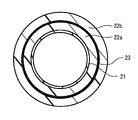
- a rubber layer 22a is formed on the outer peripheral surface of a tubular resin layer 21 in contact with the refrigerant, and an outer surface rubber is interposed on the outer peripheral surface via a reinforcing layer 23.
- the layer 22b is formed.
- the resin layer 21 consists of a vulcanizate of the resin composition for refrigerant
- the material for forming the outer rubber layer (rubber layer 22a and outer rubber layer 22b) of the resin layer 21 is not particularly limited.
- a rubber material such as hydrin rubber (ECO), acrylic rubber, silicon rubber, chlorinated polyethylene rubber (CPE), urethane rubber, or the like, which is appropriately mixed with a vulcanizing agent, carbon black, or the like is used.
- EPDM ethylene-propylene-diene rubber
- carbon black, anti-aging agent, vulcanizing agent, vulcanization accelerator, processing aid, white filler, plasticizer, softener, acid acceptor, A colorant, an anti-scorch agent and the like are appropriately blended.
- a reinforcing layer 23 may be formed as necessary as shown in FIG.
- the reinforcing layer 23 is preferably interposed between two rubber layers because its function (hose pressure resistance) is sufficiently exhibited.
- the reinforcing layer 3 is made of, for example, a reinforcing yarn such as polyethylene terephthalate (PET), polyethylene naphthalate (PEN), aramid, polyamide (nylon), vinylon, rayon, metal wire, etc. by spiral braid, knit braid, blade braid, etc. It can be configured as a reinforcing layer by braiding.
- the refrigerant transport hose of the present invention is a refrigerant transport hose having one or more constituent layers, and at least one of the constituent layers is made of the resin composition for the refrigerant transport hose of the present invention.
- each rubber layer may be formed using the same rubber base material.
- an adhesive may be applied between the layers.
- the resin composition of the present invention to be the material for the resin layer 21 and the rubber composition to be the material for the rubber layer (rubber layer 22a and outer surface rubber layer 22b) are prepared. And the resin composition of this invention used as the material for resin layers 21 is extruded on a mandrel in the shape of a hose, and the tubular resin layer 21 is formed. Next, the rubber layer 22a material is extruded on the outer peripheral surface of the resin layer 21 to form the rubber layer 22a, and then the reinforcing layer 23 is formed on the outer peripheral surface by braiding a reinforcing thread with a blade.
- the rubber composition is extruded on the outer peripheral surface of the reinforcing layer 23 to form the outer rubber layer 22b. Then, this is vulcanized under predetermined conditions (preferably 170 ° C. ⁇ 30 to 60 minutes), and then the mandrel is extracted. In this way, as shown in FIG. 2, the refrigerant transport hose in which the rubber layer 22a is formed on the outer peripheral surface of the tubular resin layer 21 and the outer rubber layer 22b is formed on the outer peripheral surface via the reinforcing layer 23 is provided. Can be produced.
- the inner diameter of the hose is preferably in the range of 5 to 40 mm.
- the thickness of the resin layer 21 is preferably in the range of 0.02 to 2 mm, particularly preferably 0.15 to 0.2 mm, and the thickness of the rubber layer 22a is preferably in the range of 0.5 to 5 mm. Particularly preferably, the thickness is 1.5 to 2 mm, and the thickness of the outer rubber layer 22b is preferably in the range of 0.5 to 2 mm, particularly preferably 1 to 1.5 mm.
- Example 1 ⁇ Preparation of resin composition> Polyamide 6 (PA6), which is an aliphatic polyamide resin (manufactured by Ube Industries, nylon 6 1030B), and an elastomer (modified ethylene- ⁇ -olefin copolymer, Mitsui Chemicals, Tuffmer MH7020) were prepared, Blended so that the content is 27% by weight of the total amount of the aliphatic polyamide resin and the elastomer, this was kneaded at 230 ° C. for 4 to 5 minutes using a biaxial kneader (manufactured by JSW), The elastomer was finely dispersed in an uncrosslinked state in the aliphatic polyamide resin.
- PA6 polyamide 6
- elastomer modified ethylene- ⁇ -olefin copolymer, Mitsui Chemicals, Tuffmer MH7020
- the resin composition prepared above was melt-extruded into a hose shape on a mandrel (outer diameter 12 mm) made by TPX (manufactured by Mitsui Chemicals) to form a tubular resin layer (thickness 0.15 mm).
- TPX manufactured by Mitsui Chemicals
- a rubber composition containing EPDM as a rubber component was extruded on the outer peripheral surface of the resin layer to form a rubber layer (thickness 1.6 mm).
- a reinforcing layer is formed on the outer peripheral surface of the hose body by blade braiding of PET yarn, and an outer rubber outer layer is formed on the outer peripheral surface of the reinforcing layer by extrusion molding of a rubber composition containing EPDM as a rubber component.
- Example 2 The blending amount of the semi-aromatic polyamide resin used in the preparation of the resin composition of Example 1 was 80% by weight of the total amount of the resin composition, and the blending amount of the aliphatic polyamide resin (kneaded material) in which the elastomer was finely dispersed was And 20% by weight of the total amount of the resin composition. Otherwise, the resin composition was prepared in the same manner as in Example 1. And the hose was produced like Example 1 using the resin composition.
- Example 3 The blending amount of the semi-aromatic polyamide resin used for the preparation of the resin composition of Example 1 is 70% by weight of the total amount of the resin composition, and the blending amount of the aliphatic polyamide resin (kneaded material) in which the elastomer is finely dispersed is And 30% by weight of the total amount of the resin composition. Otherwise, the resin composition was prepared in the same manner as in Example 1. And the hose was produced like Example 1 using the resin composition.
- Example 4 The blending amount of the semi-aromatic polyamide resin used for the preparation of the resin composition of Example 1 was 60% by weight of the total amount of the resin composition, and the blending amount of the aliphatic polyamide resin (kneaded material) in which the elastomer was finely dispersed was And 40% by weight of the total amount of the resin composition. Otherwise, the resin composition was prepared in the same manner as in Example 1. And the hose was produced like Example 1 using the resin composition.
- Example 1 The blending amount of the semi-aromatic polyamide resin used in the preparation of the resin composition of Example 1 was 50% by weight of the total amount of the resin composition, and the blending amount of the aliphatic polyamide resin (kneaded material) in which the elastomer was finely dispersed was And 50% by weight of the total amount of the resin composition. Otherwise, the resin composition was prepared in the same manner as in Example 1. And the hose was produced like Example 1 using the resin composition.
- the hose was wound around a tubular tube (mandrel) having a diameter of 200 mm, and the flexibility was evaluated based on the degree of winding. That is, ⁇ indicates that the resin layer of the hose was not kinked (buckled) by the winding, and ⁇ indicates that the resin layer was kinked (buckled).
- the measurement value of the alternative chlorofluorocarbon gas permeation amount in the hose of Comparative Example 2 in which the resin layer is formed only by PA9T, which is a semi-aromatic polyamide resin, is set to 100.
- the above index was evaluated as ⁇ , and the index exceeding 150 was evaluated as x.
- Comparative Example 1 the ratio of the semi-aromatic polyamide resin in the material of the resin layer was too small compared to the example, resulting in poor refrigerant permeation resistance.
- Comparative Example 2 since the resin layer material was only a semi-aromatic polyamide resin, the extrusion processability and flexibility were inferior.
- Comparative Example 3 since the material of the resin layer is a semi-aromatic polyamide resin in which an elastomer is blended as it is, the dispersibility of the elastomer in the semi-aromatic polyamide resin is poor and the refrigerant permeability resistance is poor. It became.
- the material of the resin layer is a semi-aromatic polyamide resin blended with an aliphatic polyamide resin.
- the resin layer is flexible. The result was inferior.
- the material of the resin layer is the same as that of the example, but unlike the example, since all the materials are blended at the same time, unlike the dispersed state shown in FIG. The extrusion processability and refrigerant permeation resistance were inferior.
- PA9T is used for a semi-aromatic polyamide resin
- PA6 is used for an aliphatic polyamide resin
- an olefin elastomer is used for an elastomer, but other semi-aromatics are used.
- a resin composition is prepared in the same procedure as in the example, and a hose is prepared. Experiments confirmed that performance was obtained.
- the refrigerant transport hose of the present invention is used as a transport hose for refrigerants such as carbon dioxide, chlorofluorocarbon, alternative chlorofluorocarbon, and propane used in air conditioners and radiators.
- refrigerant transport hose can be used not only for automobiles but also for other transport machines (industrial transport vehicles such as airplanes, forklifts, excavators, cranes, railway vehicles, etc.).
Landscapes
- Chemical & Material Sciences (AREA)
- Engineering & Computer Science (AREA)
- Mechanical Engineering (AREA)
- General Engineering & Computer Science (AREA)
- Health & Medical Sciences (AREA)
- Chemical Kinetics & Catalysis (AREA)
- Medicinal Chemistry (AREA)
- Polymers & Plastics (AREA)
- Organic Chemistry (AREA)
- Physics & Mathematics (AREA)
- Thermal Sciences (AREA)
- Compositions Of Macromolecular Compounds (AREA)
- Rigid Pipes And Flexible Pipes (AREA)
Abstract
下記の(A)を主成分とし、下記の(B)および(C)成分を含有する冷媒輸送ホース用樹脂組成物であって、(A)成分からなる相の中に(B)成分が分散され、その分散された(B)成分の中に、未架橋の(C)成分が粒子状で含有されている。このため、耐冷媒透過性および耐酸性に優れるとともに、押出加工性、柔軟性等に優れた効果を奏する。 (A)半芳香族ポリアミド樹脂。 (B)脂肪族ポリアミド樹脂。 (C)エラストマー。
Description
本発明は、自動車等の車両用の冷媒輸送ホースの材料として有用な冷媒輸送ホース用樹脂組成物およびその製法、並びにその樹脂組成物からなる冷媒輸送ホースに関するものである。
近年、オゾン層破壊ガスの蒸散規制強化に伴い、自動車等に使用される冷媒輸送ホース(エアコンホース)のバリア性(耐冷媒透過性)に対する要求が厳しくなっている。そのため、冷媒輸送ホースの樹脂層を形成する樹脂材料には、ポリアミド樹脂のような結晶性の高い樹脂が使用されている。
しかしながら、自動車用冷媒は、長期使用により劣化して酸を発生させることが知られている。この酸により、アミド結合が分解されやすいことから、上記冷媒輸送ホースのポリアミド樹脂層は劣化されやすい状況にある。ポリアミド樹脂層が劣化した冷媒輸送ホースは、屈曲させるとホース割れが生じる。しかも、自動車等の車両用の冷媒輸送ホースは、通常、高温環境下で使用されることから、上記酸によるアミド結合の分解が促進されやすい。
そこで、近年、冷媒輸送ホースの材料として、耐冷媒透過性とともに耐酸性にも優れた、ポリアミド9T(PA9T)等の半芳香族ポリアミド樹脂が注目されている(例えば、特許文献1,2参照)。
しかしながら、PA9T等の半芳香族ポリアミド樹脂は、融点が高く結晶化速度が速いために、ホース製造に際し押出成形すると、押出し後すぐに結晶化する(溶融状態から固体状態へ変わる)。このようにして押出成形された樹脂層には、ウェルドラインが目視レベルで確認できることが多く、そのため、成形時の変形(偏肉)や、ホースの局所的な物性低下が起こりやすくなる。
また、PA9T等の半芳香族ポリアミド樹脂は、ホース材料として用いる場合、上記のようなホース製造時の押出加工性の問題のほかにも、例えば、剛性が高く柔軟性に劣るといった問題や、さらに、低温での衝撃に弱いといった問題もある。この点においても、半芳香族ポリアミド樹脂は、冷媒輸送ホースの用途には適しておらず、その改善が求められる。
本発明は、このような事情に鑑みなされたもので、耐冷媒透過性および耐酸性に優れるとともに、押出加工性、柔軟性等に優れる、冷媒輸送ホース用樹脂組成物およびその製法、並びに冷媒輸送ホースの提供をその目的とする。
上記の目的を達成するため、本発明は、下記の(A)を主成分とし、下記の(B)および(C)成分を含有する冷媒輸送ホース用樹脂組成物であって、(A)成分からなる相の中に(B)成分が分散され、その分散された(B)成分の中に、未架橋の(C)成分が粒子状で含有されている冷媒輸送ホース用樹脂組成物を第1の要旨とする。
(A)半芳香族ポリアミド樹脂。
(B)脂肪族ポリアミド樹脂。
(C)エラストマー。
(A)半芳香族ポリアミド樹脂。
(B)脂肪族ポリアミド樹脂。
(C)エラストマー。
また、本発明は、上記第1の要旨の冷媒輸送ホース用樹脂組成物の製法であって、脂肪族ポリアミド樹脂(B)と、未架橋のエラストマー(C)とを混練し、脂肪族ポリアミド樹脂(B)中にエラストマー(C)を微分散させた後、この混練物と、半芳香族ポリアミド樹脂(A)とを混合する冷媒輸送ホース用樹脂組成物の製法を第2の要旨とする。
また、本発明は、単数ないし複数の構成層を備えた冷媒輸送ホースであって、その少なくとも一つの構成層が、上記第1の要旨の冷媒輸送ホース用樹脂組成物からなる冷媒輸送ホースを第3の要旨とする。
すなわち、本発明者らは、前記課題を解決するため鋭意研究を重ねた。その研究の過程で、本発明者らは、耐冷媒透過性および耐酸性に優れる半芳香族ポリアミド樹脂(A)を主成分としつつ、前記の、押出加工性、柔軟性等の問題を解消するために、脂肪族ポリアミド樹脂(B)やエラストマー(C)をブレンドし、これにより冷媒輸送ホース用樹脂組成物を調製することを検討した。しかしながら、これらを単にブレンドしただけでは、所望の効果が得られないことが、本発明者らによる研究の結果明らかとなった。すなわち、半芳香族ポリアミド樹脂(A)に脂肪族ポリアミド樹脂(B)を単にブレンドした場合、脂肪族ポリアミド樹脂(B)の結晶化速度が遅い(結晶化温度が低い)ことから、そのブレンドにより脂肪族ポリアミド樹脂(B)が滑剤のような役割を果たし、それにより押出加工性には優れるようになるものの、柔軟性が充分に得られない結果となる。また、柔軟性を得るため、半芳香族ポリアミド樹脂(A)にエラストマー(C)をブレンドした場合、両者の相溶性が悪いために、半芳香族ポリアミド樹脂(A)中でエラストマー(C)が分散しづらく、その分散性の悪さやエラストマーの耐冷媒透過性の低さから、全体の耐冷媒透過性が悪化する結果となる。
これらの問題を解決するため、本発明者らは更なる研究を重ねた。その結果、脂肪族ポリアミド樹脂(B)とエラストマー(C)とを混練し、脂肪族ポリアミド樹脂(B)中にエラストマー(C)を微分散させた後、この混練物と、半芳香族ポリアミド樹脂(A)とを混合し、これにより、上記(A)~(C)の各成分の分散状態が特殊な構造を有する樹脂組成物、すなわち、半芳香族ポリアミド樹脂(A)からなる相の中に脂肪族ポリアミド樹脂(B)が分散され、その分散された脂肪族ポリアミド樹脂(B)の中に、未架橋のエラストマー(C)が粒子状で含有されている樹脂組成物を調製した(図1参照)。このように調製することにより、半芳香族ポリアミド樹脂(A)と脂肪族ポリアミド樹脂(B)との相溶性の良さから、脂肪族ポリアミド樹脂(B)が、半芳香族ポリアミド樹脂(A)相中に良好な状態で分散し、かつ、その分散した脂肪族ポリアミド樹脂分散体中には、柔軟性を有するエラストマー(C)が粒子状で含有されている。これにより、半芳香族ポリアミド樹脂(A)に起因する剛性が緩和され、樹脂組成物全体が柔軟になるとともに、上記エラストマー(C)が、耐冷媒透過性に富む脂肪族ポリアミド樹脂分散体中に粒子状で含有されていることから、エラストマー(C)の耐冷媒透過性の低さがカバーされ、樹脂組成物全体の耐冷媒透過性も確保される。したがって、このような樹脂組成物を、冷媒輸送ホースの層形成材料に用いると、半芳香族ポリアミド樹脂(A)による耐冷媒透過性および耐酸性を損なうことなく、押出加工性、柔軟性を向上させることができることを見いだし、本発明に到達した。
以上のように、本発明の冷媒輸送ホース用樹脂組成物は、半芳香族ポリアミド樹脂を主成分とし、脂肪族ポリアミド樹脂およびエラストマーを含有する樹脂組成物であって、半芳香族ポリアミド樹脂からなる相の中に脂肪族ポリアミド樹脂が分散され、その分散された脂肪族ポリアミド樹脂の中に、未架橋のエラストマーが粒子状で含有されているものである。そのため、耐冷媒透過性および耐酸性に優れるとともに、押出加工性、柔軟性等の効果が向上する。
特に、上記エラストマーが、平均粒径0.1~1μmの粒子状で含有されていると、より一層、耐冷媒透過性を損なうことなく、柔軟性等に優れるようになる。
そして、脂肪族ポリアミド樹脂と、未架橋のエラストマーとを混練し、脂肪族ポリアミド樹脂中にエラストマーを微分散させた後、この混練物と、半芳香族ポリアミド樹脂とを混合するといった製法を、本発明の冷媒輸送ホース用樹脂組成物の製法として適用すると、上記のように各成分の分散状態が特殊な構造を有する本発明の冷媒輸送ホース用樹脂組成物を、効率よく製造することができる。
また、単数ないし複数の構成層を備えた冷媒輸送ホースの、少なくとも一つの構成層を、本発明の冷媒輸送ホース用樹脂組成物からなるものとすると、従来の半芳香族ポリアミド樹脂層にみられるようなウェルドラインの発生を抑えることができることから、成形時の変形(偏肉)や、ホースの局所的な物性低下といった、半芳香族ポリアミド樹脂層を備えた従来の冷媒輸送ホースの問題点を解消することができる。さらに、この冷媒輸送ホースは、耐冷媒透過性および耐酸性に優れるとともに、柔軟性等に優れるようになることから、冷媒輸送ホースとして優れた性能を発揮することができる。
つぎに、本発明の実施の形態について説明する。
本発明の冷媒輸送ホース用樹脂組成物(以下、単に「樹脂組成物」と略す場合もある。)は、下記の(A)を主成分とし、下記の(B)および(C)成分を含有する樹脂組成物であって、(A)成分からなる相の中に(B)成分が分散され、その分散された(B)成分の中に、未架橋の(C)成分が粒子状で含有されているものである。上記(A)~(C)の各成分の分散状態がこのような特殊な構造を示すことから、本発明の樹脂組成物は、耐冷媒透過性および耐酸性に優れるとともに、押出加工性、柔軟性等に優れるようになる。なお、上記樹脂組成物の「主成分」とは、その樹脂組成物全体の特性に大きな影響を与えるもののことであり、本発明においては、全体の50重量%より多い量であることを意味する。また、下記の半芳香族ポリアミド樹脂(A)は、脂肪族ポリアミド樹脂の原料である脂肪族ジアミン又は脂肪族ジカルボン酸の一部を、芳香族ジアミン又は芳香族ジカルボン酸で置換したものである。
(A)半芳香族ポリアミド樹脂。
(B)脂肪族ポリアミド樹脂。
(C)エラストマー。
(A)半芳香族ポリアミド樹脂。
(B)脂肪族ポリアミド樹脂。
(C)エラストマー。
上記樹脂組成物においては、半芳香族ポリアミド樹脂(A)と脂肪族ポリアミド樹脂(B)との相溶性が高いことから、両樹脂の相の境界線が明確に確認しづらいことが多いが、厳密には、半芳香族ポリアミド樹脂(A)がマトリクス相(海相)を形成し、脂肪族ポリアミド樹脂(B)が島相(ドメイン)を形成している。このような海-島構造の識別は、例えば、走査型プローブ顕微鏡(SPM)による観察および赤外線吸収スペクトル(IR)測定により、行うことができる。そして、その島相の中に、先に述べたように、未架橋のエラストマー(C)が粒子状で含有されている。なお、これら(A)~(C)成分の、樹脂組成物中での分散状態は、図1に示す通りであり、図において、1は半芳香族ポリアミド樹脂、2は脂肪族ポリアミド樹脂、3はエラストマーを示す。このような分散状態を示すことにより、本発明の樹脂組成物は、耐冷媒透過性、耐酸性、押出加工性、柔軟性等に、より優れるようになる。
本発明の樹脂組成物中において、上記エラストマー(C)は、平均粒径0.1~1μmの粒子状で含有されていることが好ましい。すなわち、エラストマー(C)の平均粒径が上記範囲未満であると、所望の柔軟性を得ることができないおそれがあり、逆に、上記範囲を超えると、耐冷媒透過性を損なうおそれがあるからである。なお、エラストマー(C)の平均粒径は、例えば、本発明の樹脂組成物を、走査型プローブ顕微鏡(SPM)で観察し、多数のエラストマー(C)の粒子径を測定し、その平均値を算出することにより導き出すことができる。
本発明の樹脂組成物中におけるエラストマー(C)の含有量は、脂肪族ポリアミド樹脂(B)とエラストマー(C)成分との合計量の10~40重量%であることが好ましく、より好ましくは20~30重量%の範囲である。すなわち、エラストマー(C)の含有量が上記範囲未満であると、所望の柔軟性を得ることができないおそれがあり、逆に、上記範囲を超えると、耐冷媒透過性を損なうおそれがあるからである。
また、本発明の樹脂組成物中における半芳香族ポリアミド樹脂(A)の含有量は、樹脂組成物全量の60~90重量%であることが好ましく、より好ましくは70~80重量%の範囲である。すなわち、半芳香族ポリアミド樹脂(A)の含有量が上記範囲未満であると、耐冷媒透過性や耐酸性を損なうおそれがあり、逆に、上記範囲を超えると、押出加工性や柔軟性を損なうおそれがあるからである。
つぎに、上記(A)~(C)の各成分について具体的に説明する。
すなわち、上記半芳香族ポリアミド樹脂(A)としては、具体的には、ポリアミド4T(PA4T),ポリアミド6T(PA6T),ポリアミドMXD6(PAMXD6),ポリアミド9T(PA9T),ポリアミド10T(PA10T),ポリアミド11T(PA11T),ポリアミド12T(PA12T)、ポリアミド13T(PA13T)等があげられる。これらは単独でもしくは二種以上併せて用いられる。
また、上記脂肪族ポリアミド樹脂(B)としては、具体的には、ポリアミド46(PA46),ポリアミド6(PA6),ポリアミド66(PA66),ポリアミド92(PA92),ポリアミド99(PA99),ポリアミド610(PA610),ポリアミド612(PA612),ポリアミド11(PA11),ポリアミド912(PA912),ポリアミド12(PA12),ポリアミド6とポリアミド66との共重合体(PA6/66),ポリアミド6とポリアミド12との共重合体(PA6/12)等があげられる。これらは単独でもしくは二種以上併せて用いられる。
また、上記エラストマー(C)としては、例えば、スチレン系,オレフィン系,塩化ビニル系,ポリエステル系,ポリウレタン系,ポリアミド系のエラストマーが用いられる。
上記スチレン系エラストマーとして、具体的には、スチレンブタジエンスチレンブロック共重合体(SBS),スチレンエチレンブチレンスチレンブロック共重合体(SEBS),スチレンイソブチレンブロック共重合体(SIB),スチレンイソブチレンスチレンブロック共重合体(SIBS),スチレンエチレンプロピレンスチレンブロック共重合体(SEPS)等があげられる。また、上記オレフィン系エラストマーとして、具体的には、エチレン-プロピレン-ジエンゴム(EPDM)あるいはエチレン-プロピレンゴム(EPM)のブレンド物,エチレン-ブテン共重合体,エチレン-αオレフィン共重合体,リアクターTPO等があげられる。さらに、オレフィン系エラストマーとして、例えば、エチレン,プロピレン,ブタジエン等のオレフィンやジエンモノマーを単独重合または共重合したポリオレフィン系エラストマーに、無水マレイン酸、シリコーン(シラン)、塩素、アミン、アクリル、エポキシ化合物等でポリマー側鎖および末端を化学修飾することによって得られる、変性ポリオレフィン系エラストマーを用いることもできる。また、上記塩化ビニル系エラストマーとしては、PVC/ゴムあるいは可塑剤のブレンド物の一部を部分架橋したもの等があげられる。また、上記ポリエステル系エラストマーとしては、ポリブチレンテレフタレート/ポリエーテル/ポリブチレンテレフタレート共重合体等があげられる。また、上記ポリウレタン系エラストマーとしては、ポリエーテルポリオール,ポリカーボネートポリオール,ポリエステルポリオール等のポリオールとイソシアネートとの反応により得られる共重合体等があげられる。また、上記ポリアミド系エラストマーとしては、例えば、ポリアミド6/ポリエーテル共重合体、ポリアミド12/ポリエーテル共重合体、ポリアミド12/ポリエステル共重合体等があげられる。
そして、上記の各種エラストマーは、単独でもしくは二種以上併せて用いられる。なお、上記の各種エラストマーは、接着性や加工性に優れるよう、必要に応じ、無水マレイン酸変性あるいはエポキシ変性して使用してもよい。
なお、本発明の冷媒輸送ホース用樹脂組成物には、上記(A)~(C)の各成分以外に、架橋剤(加硫剤を含む)、カーボンブラック、シリカ、老化防止剤、加硫促進剤、加硫助剤、加工助剤、可塑剤、軟化剤、受酸剤、接着剤成分(レゾルシノール系化合物、メラミン系化合物等)、着色剤、スコーチ防止剤等を、必要に応じて適宜に配合しても差し支えない。
本発明の冷媒輸送ホース用樹脂組成物は、例えば、脂肪族ポリアミド樹脂(B)と、未架橋のエラストマー(C)とを、2軸混練機等を使用して、脂肪族ポリアミド樹脂(B)の融点付近の温度(200~250℃)で混練(エラストマー(C)が特定の粒径を示すまで混練)し、脂肪族ポリアミド樹脂(B)中にエラストマー(C)を微分散させた後、この混練物と、半芳香族ポリアミド樹脂(A)とを混合することにより、調製することができる。なお、半芳香族ポリアミド樹脂(A)との混合は、特に限定はないが、例えば、ホース製造時に、そのホース製造用の押出成形機(例えば、プラスチック工学研究所社製の多層押出成形機)を用いて、半芳香族ポリアミド樹脂(A)の融点付近の温度(260~310℃)で溶融混合することにより行なうことができる。また、本発明の冷媒輸送ホース用樹脂組成物に、上記(A)~(C)成分以外の材料を配合する場合、その配合するタイミングは特に限定されないが、例えば、エラストマー(C)用の加硫剤等を配合する場合、エラストマー(C)に作用させるものであるため、通常、脂肪族ポリアミド樹脂(B)と混練する前のエラストマー(C)に混合するといったことが行われる。
つぎに、本発明の冷媒輸送ホースについて説明する。本発明の冷媒輸送ホースとしては、例えば、図2に示すように、冷媒と接する管状の樹脂層21の外周面にゴム層22aが形成され、その外周面に補強層23を介して、外面ゴム層22bが形成されたものがあげられる。そして、図2の冷媒輸送ホースにおいては、樹脂層21が、上述した本発明の冷媒輸送ホース用樹脂組成物の加硫物からなるものである。
上記樹脂層21の外周のゴム層(ゴム層22aおよび外面ゴム層22b)を形成する材料としては、特に限定はなく、例えば、ブチルゴム(IIR)、塩素化ブチルゴム(Cl-IIR),臭素化ブチルゴム(Br-IIR)等のハロゲン化ブチルゴム、アクリロニトリル-ブタジエンゴム(NBR)、クロロプレンゴム(CR)、エチレン-プロピレン-ジエンゴム(EPDM)、エチレン-プロピレンゴム(EPM)、フッ素ゴム(FKM)、エピクロロヒドリンゴム(ECO)、アクリルゴム、シリコンゴム、塩素化ポリエチレンゴム(CPE)、ウレタンゴム等のゴム材料に、加硫剤、カーボンブラック等を適宜に配合したものが用いられる。なかでも、耐候性等の観点から、エチレン-プロピレン-ジエンゴム(EPDM)が好適に用いられる。なお、上記ゴム層の材料中には、必要に応じて、カーボンブラック、老化防止剤、加硫剤、加硫促進剤、加工助剤、白色充填材、可塑剤、軟化剤、受酸剤、着色剤、スコーチ防止剤等が適宜に配合される。
また、本発明の冷媒輸送ホースには、図2のように、必要に応じ、補強層23を形成してもよい。上記補強層23は、図示のように、二つのゴム層の間に介在させることが、その機能(ホース耐圧性能)が充分発揮されることから、好ましい。上記補強層3は、例えば、ポリエチレンテレフタレート(PET),ポリエチレンナフタレート(PEN),アラミド,ポリアミド(ナイロン),ビニロン,レーヨン,金属ワイヤ等の補強糸を、スパイラル編組,ニット編組,ブレード編組等によって編組することにより補強層として構成することができる。
なお、本発明の冷媒輸送ホースは、単数ないし複数の構成層を備えた冷媒輸送ホースであって、その少なくとも一つの構成層が、本発明の冷媒輸送ホース用樹脂組成物からなるものであればよく、図2に示した構成に限定されるものではない。また、図2に示すように、複数のゴム層を備える場合は、各ゴム層は同じゴム基材を用いて形成しても差し支えない。なお、冷媒輸送ホースの層間接着性向上のため、各層間には接着剤を塗布しても差し支えない。
つぎに、本発明の冷媒輸送ホースの製法について説明する。すなわち、まず、樹脂層21用材料となる本発明の樹脂組成物、ゴム層(ゴム層22aおよび外面ゴム層22b)用材料となるゴム組成物をそれぞれ準備する。そして、樹脂層21用材料となる本発明の樹脂組成物を、マンドレル上でホース状に押し出して、管状の樹脂層21を形成する。つぎに、樹脂層21の外周面に、ゴム層22a用材料を押出成形して、ゴム層22aを形成した後、その外周面に補強糸をブレード編組等して補強層23を形成する。さらに、上記補強層23の外周面に、ゴム組成物を押出成形して、外面ゴム層22bを形成する。そして、これを所定の条件(好ましくは、170℃×30~60分)で加硫した後、マンドレルを抜き取る。このようにして、図2に示すように、管状の樹脂層21の外周面にゴム層22aが形成され、その外周面に補強層23を介して外面ゴム層22bが形成された冷媒輸送ホースを作製することができる。
本発明の冷媒輸送ホースにおいて、ホース内径は5~40mmの範囲が好ましい。また、上記樹脂層21の厚みは、0.02~2mmの範囲が好ましく、特に好ましくは0.15~0.2mmであり、ゴム層22aの厚みは、0.5~5mmの範囲が好ましく、特に好ましくは1.5~2mmであり、外面ゴム層22bの厚みは、0.5~2mmの範囲が好ましく、特に好ましくは1~1.5mmである。
つぎに、実施例について比較例と併せて説明する。ただし、本発明はこれら実施例に限定されるものではない。
〔実施例1〕
〈樹脂組成物の調製〉
脂肪族ポリアミド樹脂であるポリアミド6(PA6)(宇部興産社製、ナイロン6 1030B)と、エラストマー(変性エチレン-α-オレフィン共重合体、三井化学社製、タフマーMH7020)とを準備し、エラストマーの含有量が、脂肪族ポリアミド樹脂とエラストマーとの合計量の27重量%となるよう配合し、これを、2軸混練機(JSW社製)を使用し、230℃で4~5分間混練し、脂肪族ポリアミド樹脂中にエラストマーを未架橋の状態で微分散させた。このようにして得られた混練物10重量%と、半芳香族ポリアミド樹脂であるPA9T(クラレ社製、ジェネスタN1001A)90重量%とを、押出成形機(プラスチック工学研究所社製)を使用し、310℃で溶融混合することにより、樹脂組成物を調製した。なお、このようにして調製された樹脂組成物に対し、走査型プローブ顕微鏡(SPM)による観察および赤外線吸収スペクトル(IR)測定を行ったところ、図1に示すように、半芳香族ポリアミド樹脂からなる相の中に、脂肪族ポリアミド樹脂が分散され、その分散された脂肪族ポリアミド樹脂の中に、エラストマーが粒子状で含有されていることが確認された。そして、そのエラストマー粒子数十個の粒子径を測定して平均値を算出した結果、平均粒径は1μmであった。
〈樹脂組成物の調製〉
脂肪族ポリアミド樹脂であるポリアミド6(PA6)(宇部興産社製、ナイロン6 1030B)と、エラストマー(変性エチレン-α-オレフィン共重合体、三井化学社製、タフマーMH7020)とを準備し、エラストマーの含有量が、脂肪族ポリアミド樹脂とエラストマーとの合計量の27重量%となるよう配合し、これを、2軸混練機(JSW社製)を使用し、230℃で4~5分間混練し、脂肪族ポリアミド樹脂中にエラストマーを未架橋の状態で微分散させた。このようにして得られた混練物10重量%と、半芳香族ポリアミド樹脂であるPA9T(クラレ社製、ジェネスタN1001A)90重量%とを、押出成形機(プラスチック工学研究所社製)を使用し、310℃で溶融混合することにより、樹脂組成物を調製した。なお、このようにして調製された樹脂組成物に対し、走査型プローブ顕微鏡(SPM)による観察および赤外線吸収スペクトル(IR)測定を行ったところ、図1に示すように、半芳香族ポリアミド樹脂からなる相の中に、脂肪族ポリアミド樹脂が分散され、その分散された脂肪族ポリアミド樹脂の中に、エラストマーが粒子状で含有されていることが確認された。そして、そのエラストマー粒子数十個の粒子径を測定して平均値を算出した結果、平均粒径は1μmであった。
〈ホースの作製〉
上記で調製した樹脂組成物を、TPX(三井化学社製)製のマンドレル(外径12mm)上にホース状に溶融押出成形して、管状の樹脂層(厚み0.15mm)を形成した。つぎに、この樹脂層の外周面に、EPDMをゴム成分とするゴム組成物を押出成形して、ゴム層(厚み1.6mm)を形成した。つぎに、このホース体の外周面にPET糸のブレード編組により補強層を形成し、さらに上記補強層の外周面に、EPDMをゴム成分とするゴム組成物の押出成形により、外面ゴム外層を形成(厚み1.0mm)した。そして、170℃で30分間加硫した後、この積層ホース体からマンドレルを抜き取り、長尺の成形品を切断することにより、ホースを作製した(図2参照)。
上記で調製した樹脂組成物を、TPX(三井化学社製)製のマンドレル(外径12mm)上にホース状に溶融押出成形して、管状の樹脂層(厚み0.15mm)を形成した。つぎに、この樹脂層の外周面に、EPDMをゴム成分とするゴム組成物を押出成形して、ゴム層(厚み1.6mm)を形成した。つぎに、このホース体の外周面にPET糸のブレード編組により補強層を形成し、さらに上記補強層の外周面に、EPDMをゴム成分とするゴム組成物の押出成形により、外面ゴム外層を形成(厚み1.0mm)した。そして、170℃で30分間加硫した後、この積層ホース体からマンドレルを抜き取り、長尺の成形品を切断することにより、ホースを作製した(図2参照)。
〔実施例2〕
実施例1の樹脂組成物の調製に用いた半芳香族ポリアミド樹脂の配合量を、樹脂組成物全量の80重量%とし、エラストマーを微分散させた脂肪族ポリアミド樹脂(混練物)の配合量を、樹脂組成物全量の20重量%とした。それ以外は、実施例1と同様にして、樹脂組成物の調製を行った。そして、その樹脂組成物を用いて、実施例1と同様にして、ホースを作製した。
実施例1の樹脂組成物の調製に用いた半芳香族ポリアミド樹脂の配合量を、樹脂組成物全量の80重量%とし、エラストマーを微分散させた脂肪族ポリアミド樹脂(混練物)の配合量を、樹脂組成物全量の20重量%とした。それ以外は、実施例1と同様にして、樹脂組成物の調製を行った。そして、その樹脂組成物を用いて、実施例1と同様にして、ホースを作製した。
〔実施例3〕
実施例1の樹脂組成物の調製に用いた半芳香族ポリアミド樹脂の配合量を、樹脂組成物全量の70重量%とし、エラストマーを微分散させた脂肪族ポリアミド樹脂(混練物)の配合量を、樹脂組成物全量の30重量%とした。それ以外は、実施例1と同様にして、樹脂組成物の調製を行った。そして、その樹脂組成物を用いて、実施例1と同様にして、ホースを作製した。
実施例1の樹脂組成物の調製に用いた半芳香族ポリアミド樹脂の配合量を、樹脂組成物全量の70重量%とし、エラストマーを微分散させた脂肪族ポリアミド樹脂(混練物)の配合量を、樹脂組成物全量の30重量%とした。それ以外は、実施例1と同様にして、樹脂組成物の調製を行った。そして、その樹脂組成物を用いて、実施例1と同様にして、ホースを作製した。
〔実施例4〕
実施例1の樹脂組成物の調製に用いた半芳香族ポリアミド樹脂の配合量を、樹脂組成物全量の60重量%とし、エラストマーを微分散させた脂肪族ポリアミド樹脂(混練物)の配合量を、樹脂組成物全量の40重量%とした。それ以外は、実施例1と同様にして、樹脂組成物の調製を行った。そして、その樹脂組成物を用いて、実施例1と同様にして、ホースを作製した。
実施例1の樹脂組成物の調製に用いた半芳香族ポリアミド樹脂の配合量を、樹脂組成物全量の60重量%とし、エラストマーを微分散させた脂肪族ポリアミド樹脂(混練物)の配合量を、樹脂組成物全量の40重量%とした。それ以外は、実施例1と同様にして、樹脂組成物の調製を行った。そして、その樹脂組成物を用いて、実施例1と同様にして、ホースを作製した。
〔比較例1〕
実施例1の樹脂組成物の調製に用いた半芳香族ポリアミド樹脂の配合量を、樹脂組成物全量の50重量%とし、エラストマーを微分散させた脂肪族ポリアミド樹脂(混練物)の配合量を、樹脂組成物全量の50重量%とした。それ以外は、実施例1と同様にして、樹脂組成物の調製を行った。そして、その樹脂組成物を用いて、実施例1と同様にして、ホースを作製した。
実施例1の樹脂組成物の調製に用いた半芳香族ポリアミド樹脂の配合量を、樹脂組成物全量の50重量%とし、エラストマーを微分散させた脂肪族ポリアミド樹脂(混練物)の配合量を、樹脂組成物全量の50重量%とした。それ以外は、実施例1と同様にして、樹脂組成物の調製を行った。そして、その樹脂組成物を用いて、実施例1と同様にして、ホースを作製した。
〔比較例2〕
実施例1の樹脂組成物に代えて、半芳香族ポリアミド樹脂であるPA9Tのみを用いた。そして、それを用いて、実施例1と同様にして、ホースを作製した。
実施例1の樹脂組成物に代えて、半芳香族ポリアミド樹脂であるPA9Tのみを用いた。そして、それを用いて、実施例1と同様にして、ホースを作製した。
〔比較例3〕
実施例1の樹脂組成物の調製に用いた、エラストマーを微分散させた脂肪族ポリアミド樹脂(混練物)に代えて、エラストマーのみを、樹脂組成物全量の10重量%の割合で配合した。それ以外は、実施例1と同様にして、樹脂組成物の調製を行った。そして、その樹脂組成物を用いて、実施例1と同様にして、ホースを作製した。
実施例1の樹脂組成物の調製に用いた、エラストマーを微分散させた脂肪族ポリアミド樹脂(混練物)に代えて、エラストマーのみを、樹脂組成物全量の10重量%の割合で配合した。それ以外は、実施例1と同様にして、樹脂組成物の調製を行った。そして、その樹脂組成物を用いて、実施例1と同様にして、ホースを作製した。
〔比較例4〕
実施例1の樹脂組成物の調製に用いた、エラストマーを微分散させた脂肪族ポリアミド樹脂(混練物)に代えて、脂肪族ポリアミド樹脂のみを、樹脂組成物全量の10重量%の割合で配合した。それ以外は、実施例1と同様にして、樹脂組成物の調製を行った。そして、その樹脂組成物を用いて、実施例1と同様にして、ホースを作製した。
実施例1の樹脂組成物の調製に用いた、エラストマーを微分散させた脂肪族ポリアミド樹脂(混練物)に代えて、脂肪族ポリアミド樹脂のみを、樹脂組成物全量の10重量%の割合で配合した。それ以外は、実施例1と同様にして、樹脂組成物の調製を行った。そして、その樹脂組成物を用いて、実施例1と同様にして、ホースを作製した。
〔比較例5〕
実施例1の樹脂組成物の調製に用いた、半芳香族ポリアミド樹脂、脂肪族ポリアミド樹脂およびエラストマーを、その配合割合を実施例1と同じにして、それらを同時にブレンドするため、押出成形機(プラスチック工学研究所社製)を使用して290℃で溶融混合し、樹脂組成物を調製した。なお、このようにして調製された樹脂組成物に対し、走査型プローブ顕微鏡(SPM)による観察および赤外線吸収スペクトル(IR)測定を行ったところ、樹脂組成物中で、エラストマーは、平均粒径1~10μmの粒子上で含有されている状態となっていた。そして、その樹脂組成物を用いて、実施例1と同様にして、ホースを作製した。
実施例1の樹脂組成物の調製に用いた、半芳香族ポリアミド樹脂、脂肪族ポリアミド樹脂およびエラストマーを、その配合割合を実施例1と同じにして、それらを同時にブレンドするため、押出成形機(プラスチック工学研究所社製)を使用して290℃で溶融混合し、樹脂組成物を調製した。なお、このようにして調製された樹脂組成物に対し、走査型プローブ顕微鏡(SPM)による観察および赤外線吸収スペクトル(IR)測定を行ったところ、樹脂組成物中で、エラストマーは、平均粒径1~10μmの粒子上で含有されている状態となっていた。そして、その樹脂組成物を用いて、実施例1と同様にして、ホースを作製した。
このようにして得られた、実施例および比較例の樹脂組成物(およびホース)に関して、下記の基準に従い、各特性の評価を行った。その結果を、後記の表1に併せて示した。
〔押出加工性〕
ホース作製時に、マンドレル上にホース状に溶融押出成形された樹脂組成物を、目視観察し、ウェルドラインおよび偏肉が確認されるものを×、偏肉までは確認されないがウェルドラインは確認されるものを△、ウェルドラインおよび偏肉が確認されないものを○と評価した。
ホース作製時に、マンドレル上にホース状に溶融押出成形された樹脂組成物を、目視観察し、ウェルドラインおよび偏肉が確認されるものを×、偏肉までは確認されないがウェルドラインは確認されるものを△、ウェルドラインおよび偏肉が確認されないものを○と評価した。
〔柔軟性〕
ホースを、直径200mmの管状の筒(マンドレル)に巻きつけ、その巻きつけ度合により、柔軟性の評価を行った。すなわち、上記巻きつけにより、ホースの樹脂層がキンク(座屈)しなかったものを○、樹脂層がキンク(座屈)したものを×と表示した。
ホースを、直径200mmの管状の筒(マンドレル)に巻きつけ、その巻きつけ度合により、柔軟性の評価を行った。すなわち、上記巻きつけにより、ホースの樹脂層がキンク(座屈)しなかったものを○、樹脂層がキンク(座屈)したものを×と表示した。
〔耐冷媒透過性〕
ホース長500mmのホースに対し、代替フロンガス(HFC-134a)を12g封入して、ホースの両端開口部に栓をし、その後、このホースを100℃のオーブン中に放置した。そして、ホースの減量を時間とともにプロットし、その傾きにより、ホースの透過面積に対する、1日あたりの代替フロンガス透過量(HFC-134a透過係数、mg・mm/cm2・day)を算出した。そして、半芳香族ポリアミド樹脂であるPA9Tのみによって樹脂層が形成された比較例2のホースにおける代替フロンガス透過量の測定値を100とし、この値に対し、各ホースにおける代替フロンガス透過量の測定値を指数換算した。そして、耐冷媒透過性の評価において、上記指標が150以下であるものを○、150を超えるものを×と評価した。
ホース長500mmのホースに対し、代替フロンガス(HFC-134a)を12g封入して、ホースの両端開口部に栓をし、その後、このホースを100℃のオーブン中に放置した。そして、ホースの減量を時間とともにプロットし、その傾きにより、ホースの透過面積に対する、1日あたりの代替フロンガス透過量(HFC-134a透過係数、mg・mm/cm2・day)を算出した。そして、半芳香族ポリアミド樹脂であるPA9Tのみによって樹脂層が形成された比較例2のホースにおける代替フロンガス透過量の測定値を100とし、この値に対し、各ホースにおける代替フロンガス透過量の測定値を指数換算した。そして、耐冷媒透過性の評価において、上記指標が150以下であるものを○、150を超えるものを×と評価した。

上記結果から、実施例品は、いずれも、耐冷媒透過性に優れるとともに、押出加工性、柔軟性に優れることがわかる。
これに対し、比較例1では、実施例のものに比べ、樹脂層の材料における半芳香族ポリアミド樹脂の割合が少なすぎ、耐冷媒透過性に劣る結果となった。比較例2では、樹脂層の材料が半芳香族ポリアミド樹脂のみであることから、押出加工性、柔軟性に劣る結果となった。比較例3では、樹脂層の材料が、半芳香族ポリアミド樹脂にエラストマーをそのまま配合したものであることから、半芳香族ポリアミド樹脂中でのエラストマーの分散性が悪く、耐冷媒透過性に劣る結果となった。比較例4では、樹脂層の材料が、半芳香族ポリアミド樹脂に脂肪族ポリアミド樹脂を配合したものであるが、実施例のように脂肪族ポリアミド樹脂中にエラストマーが微分散されていないため、柔軟性に劣る結果となった。比較例5では、樹脂層の材料が実施例と同じであるが、実施例と異なり、全ての材料を同時にブレンドしていることから、図1に示す分散状態とは異なり、不均一状態となり、押出加工性、耐冷媒透過性が劣る結果となった。
なお、上記実施例における樹脂層の材料として、半芳香族ポリアミド樹脂にはPA9Tを、脂肪族ポリアミド樹脂にはPA6を、エラストマーにはオレフィン系エラストマーを使用しているが、これ以外の半芳香族ポリアミド樹脂、脂肪族ポリアミド樹脂およびエラストマーを用いた場合であっても、実施例と同様の手順で樹脂組成物を調製しホースを作製することにより、実施例と同様、冷媒輸送用ホースとして優れた性能が得られることが、実験により確認された。
また、上記実施例においては、本発明における具体的な形態について示したが、上記実施例は単なる例示にすぎず、限定的に解釈されるものではない。さらに、請求の範囲の均等範囲に属する変更は、全て本発明の範囲内である。
本発明の冷媒輸送ホースは、エアコン・ラジエター等に用いられる二酸化炭素,フロン,代替フロン,プロパン等の冷媒の輸送ホースに使用される。なお、上記冷媒輸送ホースは、自動車用のみならず、その他の輸送機械(飛行機,フォークリフト,ショベルカー,クレーン等の産業用輸送車両、鉄道車両等)等にも用いることができる。
1 半芳香族ポリアミド樹脂
2 脂肪族ポリアミド樹脂
3 エラストマー
2 脂肪族ポリアミド樹脂
3 エラストマー
Claims (10)
- 下記の(A)を主成分とし、下記の(B)および(C)成分を含有する冷媒輸送ホース用樹脂組成物であって、(A)成分からなる相の中に(B)成分が分散され、その分散された(B)成分の中に、未架橋の(C)成分が粒子状で含有されていることを特徴とする冷媒輸送ホース用樹脂組成物。
(A)半芳香族ポリアミド樹脂。
(B)脂肪族ポリアミド樹脂。
(C)エラストマー。 - 半芳香族ポリアミド樹脂(A)がマトリクス相を形成し、未架橋のエラストマー(C)を含有する脂肪族ポリアミド樹脂(B)が島相(ドメイン)を形成している、請求項1記載の冷媒輸送ホース用樹脂組成物。
- エラストマー(C)が、平均粒径0.1~1μmの粒子状で含有されている、請求項1または2記載の冷媒輸送ホース用樹脂組成物。
- (C)成分の含有量が、(B)成分と(C)成分との合計量の10~40重量%である、請求項1~3のいずれか一項に記載の冷媒輸送ホース用樹脂組成物。
- (A)成分の含有量が、冷媒輸送ホース用樹脂組成物全量の60~90重量%である、請求項1~4のいずれか一項に記載の冷媒輸送ホース用樹脂組成物。
- 半芳香族ポリアミド樹脂(A)が、ポリアミド4T(PA4T),ポリアミド6T(PA6T),ポリアミドMXD6(PAMXD6),ポリアミド9T(PA9T),ポリアミド10T(PA10T),ポリアミド11T(PA11T),ポリアミド12T(PA12T)およびポリアミド13T(PA13T)からなる群から選ばれた少なくとも一つである、請求項1~5のいずれか一項に記載の冷媒輸送ホース用樹脂組成物。
- 脂肪族ポリアミド樹脂(B)が、ポリアミド46(PA46),ポリアミド6(PA6),ポリアミド66(PA66),ポリアミド92(PA92),ポリアミド99(PA99),ポリアミド610(PA610),ポリアミド612(PA612),ポリアミド11(PA11),ポリアミド912(PA912),ポリアミド12(PA12),ポリアミド6とポリアミド66との共重合体(PA6/66),およびポリアミド6とポリアミド12との共重合体(PA6/12)からなる群から選ばれた少なくとも一つである、請求項1~6のいずれか一項に記載の冷媒輸送ホース用樹脂組成物。
- エラストマー(C)が、スチレン系,オレフィン系,塩化ビニル系,ポリエステル系,ポリウレタン系およびポリアミド系からなる群から選ばれた少なくとも一つの系のエラストマーである、請求項1~7のいずれか一項に記載の冷媒輸送ホース用樹脂組成物。
- 請求項1~8のいずれか一項に記載の冷媒輸送ホース用樹脂組成物の製法であって、脂肪族ポリアミド樹脂(B)と、未架橋のエラストマー(C)とを混練し、脂肪族ポリアミド樹脂(B)中にエラストマー(C)を微分散させた後、この混練物と、半芳香族ポリアミド樹脂(A)とを混合することを特徴とする冷媒輸送ホース用樹脂組成物の製法。
- 単数ないし複数の構成層を備えた冷媒輸送ホースであって、その少なくとも一つの構成層が、請求項1~8のいずれか一項に記載の冷媒輸送ホース用樹脂組成物からなることを特徴とする冷媒輸送ホース。
Priority Applications (1)
| Application Number | Priority Date | Filing Date | Title |
|---|---|---|---|
| US13/665,421 US9228085B2 (en) | 2011-02-25 | 2012-10-31 | Resin composition for refrigerant-transporting hose and method of producing the resin composition, and refrigerant-transporting hose |
Applications Claiming Priority (2)
| Application Number | Priority Date | Filing Date | Title |
|---|---|---|---|
| JP2011039661A JP5860598B2 (ja) | 2011-02-25 | 2011-02-25 | 冷媒輸送ホースおよびその製法 |
| JP2011-039661 | 2011-02-25 |
Related Child Applications (1)
| Application Number | Title | Priority Date | Filing Date |
|---|---|---|---|
| US13/665,421 Continuation US9228085B2 (en) | 2011-02-25 | 2012-10-31 | Resin composition for refrigerant-transporting hose and method of producing the resin composition, and refrigerant-transporting hose |
Publications (1)
| Publication Number | Publication Date |
|---|---|
| WO2012114634A1 true WO2012114634A1 (ja) | 2012-08-30 |
Family
ID=46720434
Family Applications (1)
| Application Number | Title | Priority Date | Filing Date |
|---|---|---|---|
| PCT/JP2011/079747 Ceased WO2012114634A1 (ja) | 2011-02-25 | 2011-12-21 | 冷媒輸送ホース用樹脂組成物およびその製法、並びに冷媒輸送ホース |
Country Status (3)
| Country | Link |
|---|---|
| US (1) | US9228085B2 (ja) |
| JP (1) | JP5860598B2 (ja) |
| WO (1) | WO2012114634A1 (ja) |
Cited By (3)
| Publication number | Priority date | Publication date | Assignee | Title |
|---|---|---|---|---|
| WO2015156086A1 (ja) * | 2014-04-10 | 2015-10-15 | 三菱瓦斯化学株式会社 | 成形体及びその製造方法 |
| CN107109052A (zh) * | 2014-12-26 | 2017-08-29 | 三菱瓦斯化学株式会社 | 热塑性树脂组合物和包含其的成型体 |
| CN114585688A (zh) * | 2019-11-29 | 2022-06-03 | 东洋纺株式会社 | 半芳香族聚酰胺树脂组合物、及金属镀敷成形体 |
Families Citing this family (8)
| Publication number | Priority date | Publication date | Assignee | Title |
|---|---|---|---|---|
| JP5648740B2 (ja) * | 2012-02-15 | 2015-01-07 | 東レ株式会社 | 複合ポリアミド微粒子およびその製造方法 |
| US9580565B2 (en) | 2012-10-12 | 2017-02-28 | Unitika Ltd. | Semi-aromatic polyamide film |
| ITTO20120926A1 (it) * | 2012-10-19 | 2014-04-20 | Dytech Dynamic Fluid Tech Spa | Tubo multistrato per sistemi aria condizionata di veicoli |
| DE112017005273B4 (de) * | 2016-12-27 | 2023-01-05 | Sumitomo Riko Company Limited | Schlauch zum Leiten eines Kältemittels |
| JP6850151B2 (ja) * | 2017-02-21 | 2021-03-31 | 株式会社ブリヂストン | 冷媒輸送ホース用ポリアミド樹脂組成物及びこれを用いた冷媒輸送ホース |
| DE102018102445A1 (de) * | 2018-02-05 | 2019-08-08 | Rehau Ag + Co | Schlauch |
| DE102018102927A1 (de) * | 2018-02-09 | 2019-08-14 | Voss Automotive Gmbh | Fluidverteilermodul für ein modulares Temperiersystem und Temperiersystem |
| JP7357469B2 (ja) * | 2019-06-03 | 2023-10-06 | 積水化学工業株式会社 | 管継手の製造方法及び管継手 |
Citations (2)
| Publication number | Priority date | Publication date | Assignee | Title |
|---|---|---|---|---|
| JP2004181628A (ja) * | 2002-11-29 | 2004-07-02 | Mitsubishi Gas Chem Co Inc | 多層チューブ |
| JP2006002130A (ja) * | 2004-05-17 | 2006-01-05 | Bridgestone Corp | ポリアミド系複合樹脂及び冷媒輸送用ホース |
Family Cites Families (16)
| Publication number | Priority date | Publication date | Assignee | Title |
|---|---|---|---|---|
| JPH0697076B2 (ja) * | 1986-12-16 | 1994-11-30 | 横浜ゴム株式会社 | 低透過性ホ−ス |
| US5147944A (en) * | 1990-10-16 | 1992-09-15 | Mitsubishi Gas Chemical Company, Inc. | Polyamide resin, and polyamide resin compositions |
| JPH0486257A (ja) * | 1990-07-30 | 1992-03-18 | Toyobo Co Ltd | 積層構造管状体 |
| JP4258042B2 (ja) * | 1998-10-16 | 2009-04-30 | 株式会社ブリヂストン | 冷媒輸送用ホース |
| JP2004197905A (ja) * | 2002-12-20 | 2004-07-15 | Bridgestone Corp | ガス供給用ホース及びその製造方法 |
| BRPI0402583A (pt) * | 2003-07-11 | 2005-05-31 | Goodyear Tire & Rubber | Mangueira para refrigerante |
| JP5072173B2 (ja) * | 2004-09-08 | 2012-11-14 | 東海ゴム工業株式会社 | 燃料系ホース用熱可塑性エラストマーおよびそれを用いた燃料系ホース、並びにその熱可塑性エラストマーの製法 |
| JP2006212966A (ja) | 2005-02-04 | 2006-08-17 | Tokai Rubber Ind Ltd | 低透過樹脂ホースおよびその製法 |
| EP1879963B1 (en) * | 2005-05-12 | 2018-01-03 | JTEKT Corporation | Polyamide resin composition |
| JP2007090563A (ja) | 2005-09-27 | 2007-04-12 | Tokai Rubber Ind Ltd | 低透過ホースおよびその製法 |
| JP4983004B2 (ja) * | 2005-11-07 | 2012-07-25 | 宇部興産株式会社 | ブロー成形用材料 |
| JP2008018702A (ja) * | 2006-07-14 | 2008-01-31 | Nitta Moore Co | チューブ |
| JP2008055640A (ja) * | 2006-08-29 | 2008-03-13 | Tokai Rubber Ind Ltd | 低透過ホース |
| JP2008248995A (ja) * | 2007-03-29 | 2008-10-16 | Tokai Rubber Ind Ltd | 低ガス透過性ホース |
| EP1974903A1 (en) | 2007-03-29 | 2008-10-01 | Tokai Rubber Industries, Ltd. | Low gas-permeable hose |
| WO2010073375A1 (ja) * | 2008-12-26 | 2010-07-01 | 横浜ゴム株式会社 | 冷媒輸送用ホース |
-
2011
- 2011-02-25 JP JP2011039661A patent/JP5860598B2/ja not_active Expired - Fee Related
- 2011-12-21 WO PCT/JP2011/079747 patent/WO2012114634A1/ja not_active Ceased
-
2012
- 2012-10-31 US US13/665,421 patent/US9228085B2/en active Active
Patent Citations (2)
| Publication number | Priority date | Publication date | Assignee | Title |
|---|---|---|---|---|
| JP2004181628A (ja) * | 2002-11-29 | 2004-07-02 | Mitsubishi Gas Chem Co Inc | 多層チューブ |
| JP2006002130A (ja) * | 2004-05-17 | 2006-01-05 | Bridgestone Corp | ポリアミド系複合樹脂及び冷媒輸送用ホース |
Cited By (10)
| Publication number | Priority date | Publication date | Assignee | Title |
|---|---|---|---|---|
| WO2015156086A1 (ja) * | 2014-04-10 | 2015-10-15 | 三菱瓦斯化学株式会社 | 成形体及びその製造方法 |
| KR20160143645A (ko) * | 2014-04-10 | 2016-12-14 | 미쯔비시 가스 케미칼 컴파니, 인코포레이티드 | 성형체 및 그 제조방법 |
| JPWO2015156086A1 (ja) * | 2014-04-10 | 2017-04-13 | 三菱瓦斯化学株式会社 | 成形体及びその製造方法 |
| RU2678031C2 (ru) * | 2014-04-10 | 2019-01-22 | Мицубиси Гэс Кемикал Компани, Инк. | Формованное тело и способ его производства |
| TWI661002B (zh) * | 2014-04-10 | 2019-06-01 | 日商三菱瓦斯化學股份有限公司 | 成形體及其製造方法 |
| US10605384B2 (en) | 2014-04-10 | 2020-03-31 | Mitsubishi Gas Chemical Company, Inc. | Molded body and manufacturing method thereof |
| KR102292012B1 (ko) | 2014-04-10 | 2021-08-23 | 미쯔비시 가스 케미칼 컴파니, 인코포레이티드 | 성형체 및 그 제조방법 |
| CN107109052A (zh) * | 2014-12-26 | 2017-08-29 | 三菱瓦斯化学株式会社 | 热塑性树脂组合物和包含其的成型体 |
| CN107109052B (zh) * | 2014-12-26 | 2020-03-06 | 三菱瓦斯化学株式会社 | 热塑性树脂组合物和包含其的成型体 |
| CN114585688A (zh) * | 2019-11-29 | 2022-06-03 | 东洋纺株式会社 | 半芳香族聚酰胺树脂组合物、及金属镀敷成形体 |
Also Published As
| Publication number | Publication date |
|---|---|
| US9228085B2 (en) | 2016-01-05 |
| US20130056107A1 (en) | 2013-03-07 |
| JP2012177006A (ja) | 2012-09-13 |
| JP5860598B2 (ja) | 2016-02-16 |
Similar Documents
| Publication | Publication Date | Title |
|---|---|---|
| JP5860598B2 (ja) | 冷媒輸送ホースおよびその製法 | |
| JP5662852B2 (ja) | 冷媒輸送ホースおよびその製法 | |
| CN104619768B (zh) | 丁基橡胶组合物及使用其的软管 | |
| CN114829820B (zh) | 用于制冷剂输送软管的树脂组合物以及制冷剂输送软管 | |
| JP6115386B2 (ja) | 熱可塑性樹脂組成物並びにそれを用いたタイヤ及びホース | |
| CN103228732B (zh) | 制冷剂输送软管 | |
| CN103339430B (zh) | 树脂软管及其制法 | |
| US8685515B2 (en) | Refrigerant-transporting hose | |
| CN109952460B (zh) | 制冷剂输送用软管 | |
| JP5424716B2 (ja) | ポリアミド樹脂組成物及びその製造方法並びに冷媒輸送用ホース | |
| JP7529995B2 (ja) | 冷媒輸送ホース用熱可塑性樹脂組成物および冷媒輸送ホース | |
| JP2010091051A (ja) | 冷媒輸送用ホース | |
| JP5623789B2 (ja) | ポリアミド樹脂組成物及びその製造方法並びに冷媒輸送用ホース | |
| JP6823438B2 (ja) | 冷媒輸送用ホース | |
| JP2017155764A (ja) | 冷媒輸送用ホース | |
| JP2012072290A (ja) | 冷媒輸送ホース用樹脂組成物およびそれを用いて得られる冷媒輸送ホース | |
| JP5711891B2 (ja) | ブチル系ゴム組成物及びこれを用いた車輌用フレキシブルホース | |
| CN108473738A (zh) | 橡胶组合物以及软管 |
Legal Events
| Date | Code | Title | Description |
|---|---|---|---|
| 121 | Ep: the epo has been informed by wipo that ep was designated in this application |
Ref document number: 11859538 Country of ref document: EP Kind code of ref document: A1 |
|
| NENP | Non-entry into the national phase |
Ref country code: DE |
|
| 122 | Ep: pct application non-entry in european phase |
Ref document number: 11859538 Country of ref document: EP Kind code of ref document: A1 |