WO2012093598A1 - 音響トランスデューサ、および該音響トランスデューサを利用したマイクロフォン - Google Patents
音響トランスデューサ、および該音響トランスデューサを利用したマイクロフォン Download PDFInfo
- Publication number
- WO2012093598A1 WO2012093598A1 PCT/JP2011/079843 JP2011079843W WO2012093598A1 WO 2012093598 A1 WO2012093598 A1 WO 2012093598A1 JP 2011079843 W JP2011079843 W JP 2011079843W WO 2012093598 A1 WO2012093598 A1 WO 2012093598A1
- Authority
- WO
- WIPO (PCT)
- Prior art keywords
- vibrating
- electrode
- fixed
- film
- acoustic transducer
- Prior art date
- Legal status (The legal status is an assumption and is not a legal conclusion. Google has not performed a legal analysis and makes no representation as to the accuracy of the status listed.)
- Ceased
Links
Images






Classifications
-
- H—ELECTRICITY
- H04—ELECTRIC COMMUNICATION TECHNIQUE
- H04R—LOUDSPEAKERS, MICROPHONES, GRAMOPHONE PICK-UPS OR LIKE ACOUSTIC ELECTROMECHANICAL TRANSDUCERS; ELECTRIC HEARING AIDS; PUBLIC ADDRESS SYSTEMS
- H04R19/00—Electrostatic transducers
- H04R19/04—Microphones
-
- B—PERFORMING OPERATIONS; TRANSPORTING
- B81—MICROSTRUCTURAL TECHNOLOGY
- B81B—MICROSTRUCTURAL DEVICES OR SYSTEMS, e.g. MICROMECHANICAL DEVICES
- B81B3/00—Devices comprising flexible or deformable elements, e.g. comprising elastic tongues or membranes
- B81B3/0018—Structures acting upon the moving or flexible element for transforming energy into mechanical movement or vice versa, i.e. actuators, sensors, generators
- B81B3/0021—Transducers for transforming electrical into mechanical energy or vice versa
-
- H—ELECTRICITY
- H04—ELECTRIC COMMUNICATION TECHNIQUE
- H04R—LOUDSPEAKERS, MICROPHONES, GRAMOPHONE PICK-UPS OR LIKE ACOUSTIC ELECTROMECHANICAL TRANSDUCERS; ELECTRIC HEARING AIDS; PUBLIC ADDRESS SYSTEMS
- H04R1/00—Details of transducers, loudspeakers or microphones
- H04R1/02—Casings; Cabinets ; Supports therefor; Mountings therein
- H04R1/023—Screens for loudspeakers
-
- H—ELECTRICITY
- H04—ELECTRIC COMMUNICATION TECHNIQUE
- H04R—LOUDSPEAKERS, MICROPHONES, GRAMOPHONE PICK-UPS OR LIKE ACOUSTIC ELECTROMECHANICAL TRANSDUCERS; ELECTRIC HEARING AIDS; PUBLIC ADDRESS SYSTEMS
- H04R19/00—Electrostatic transducers
- H04R19/005—Electrostatic transducers using semiconductor materials
-
- H—ELECTRICITY
- H04—ELECTRIC COMMUNICATION TECHNIQUE
- H04R—LOUDSPEAKERS, MICROPHONES, GRAMOPHONE PICK-UPS OR LIKE ACOUSTIC ELECTROMECHANICAL TRANSDUCERS; ELECTRIC HEARING AIDS; PUBLIC ADDRESS SYSTEMS
- H04R19/00—Electrostatic transducers
- H04R19/01—Electrostatic transducers characterised by the use of electrets
- H04R19/016—Electrostatic transducers characterised by the use of electrets for microphones
-
- H—ELECTRICITY
- H04—ELECTRIC COMMUNICATION TECHNIQUE
- H04R—LOUDSPEAKERS, MICROPHONES, GRAMOPHONE PICK-UPS OR LIKE ACOUSTIC ELECTROMECHANICAL TRANSDUCERS; ELECTRIC HEARING AIDS; PUBLIC ADDRESS SYSTEMS
- H04R3/00—Circuits for transducers
-
- H—ELECTRICITY
- H04—ELECTRIC COMMUNICATION TECHNIQUE
- H04R—LOUDSPEAKERS, MICROPHONES, GRAMOPHONE PICK-UPS OR LIKE ACOUSTIC ELECTROMECHANICAL TRANSDUCERS; ELECTRIC HEARING AIDS; PUBLIC ADDRESS SYSTEMS
- H04R3/00—Circuits for transducers
- H04R3/005—Circuits for transducers for combining the signals of two or more microphones
-
- H—ELECTRICITY
- H04—ELECTRIC COMMUNICATION TECHNIQUE
- H04R—LOUDSPEAKERS, MICROPHONES, GRAMOPHONE PICK-UPS OR LIKE ACOUSTIC ELECTROMECHANICAL TRANSDUCERS; ELECTRIC HEARING AIDS; PUBLIC ADDRESS SYSTEMS
- H04R31/00—Apparatus or processes specially adapted for the manufacture of transducers or diaphragms therefor
-
- H—ELECTRICITY
- H04—ELECTRIC COMMUNICATION TECHNIQUE
- H04R—LOUDSPEAKERS, MICROPHONES, GRAMOPHONE PICK-UPS OR LIKE ACOUSTIC ELECTROMECHANICAL TRANSDUCERS; ELECTRIC HEARING AIDS; PUBLIC ADDRESS SYSTEMS
- H04R1/00—Details of transducers, loudspeakers or microphones
- H04R1/08—Mouthpieces; Microphones; Attachments therefor
- H04R1/083—Special constructions of mouthpieces
- H04R1/086—Protective screens, e.g. all weather or wind screens
-
- H—ELECTRICITY
- H04—ELECTRIC COMMUNICATION TECHNIQUE
- H04R—LOUDSPEAKERS, MICROPHONES, GRAMOPHONE PICK-UPS OR LIKE ACOUSTIC ELECTROMECHANICAL TRANSDUCERS; ELECTRIC HEARING AIDS; PUBLIC ADDRESS SYSTEMS
- H04R2201/00—Details of transducers, loudspeakers or microphones covered by H04R1/00 but not provided for in any of its subgroups
- H04R2201/003—Mems transducers or their use
-
- H—ELECTRICITY
- H04—ELECTRIC COMMUNICATION TECHNIQUE
- H04R—LOUDSPEAKERS, MICROPHONES, GRAMOPHONE PICK-UPS OR LIKE ACOUSTIC ELECTROMECHANICAL TRANSDUCERS; ELECTRIC HEARING AIDS; PUBLIC ADDRESS SYSTEMS
- H04R2499/00—Aspects covered by H04R or H04S not otherwise provided for in their subgroups
- H04R2499/10—General applications
- H04R2499/11—Transducers incorporated or for use in hand-held devices, e.g. mobile phones, PDA's, camera's
Definitions
- the present invention relates to an acoustic transducer that converts sound waves into electrical signals, and a microphone using the acoustic transducer.
- the present invention relates to a micro-sized acoustic transducer or the like manufactured using MEMS (Micro Electro Mechanical System) technology.
- MEMS Micro Electro Mechanical System
- ECM Electronic Condenser Microphone
- the MEMS microphone detects a sound wave and converts it into an electric signal (detection signal).
- the capacitor type acoustic sensor acoustic transducer
- a drive circuit for applying a voltage to the acoustic sensor and detection signals from the acoustic sensor
- a signal processing circuit that performs signal processing such as amplification and outputs the signal to the outside.
- the acoustic sensor is manufactured using MEMS technology. Further, the drive circuit and the signal processing circuit are integrally manufactured as an application specific integrated circuit (ASIC) by using a semiconductor manufacturing technology.
- ASIC application specific integrated circuit
- the maximum input sound pressure (dynamic range) is limited by the harmonic distortion rate (hereinafter referred to as "THD"). This is because, when a large sound is to be detected by a microphone, harmonic distortion occurs in the output signal, and the sound quality is impaired. Therefore, if the THD can be reduced, the maximum input sound pressure can be increased.
- THD harmonic distortion rate
- the detection sensitivity of the sound wave and the THD are in a trade-off relationship. Therefore, the high sensitivity microphone has a large THD, and the maximum input sound pressure is reduced. This is because a high sensitivity microphone has a large output signal and THD is easily generated.
- the low sensitivity microphone has a smaller THD and a larger maximum input sound pressure.
- low sensitivity microphones have difficulty in detecting small sounds with high quality.
- Patent Documents 1 and 2 disclose microphones provided with a plurality of acoustic sensors, and switching or fusing a plurality of signals from the plurality of acoustic sensors according to the sound pressure.
- Patent Document 1 switches between a high sensitivity acoustic sensor having a detectable sound pressure level (SPL) of 20 dB to 110 dB and a low sensitivity acoustic sensor having a detectable sound pressure level of 50 dB to 140 dB.
- SPL detectable sound pressure level
- Patent Documents 3 and 4 disclose configurations in which a plurality of independent acoustic sensors are formed on one chip.
- the variation in acoustic characteristics refers to the difference between the acoustic characteristics of the acoustic sensors among the chips.
- the mismatching of the acoustic characteristics refers to the difference between the acoustic characteristics of a plurality of acoustic sensors in the same chip.
- each acoustic sensor variations among chips regarding detection sensitivity occur independently due to variations in warpage of a thin film to be formed. As a result, the variation between chips with respect to the difference in detection sensitivity between acoustic sensors becomes large.
- each acoustic sensor is formed with a back chamber and a vent hole separately, the acoustic characteristics such as frequency characteristics and phase affected by the back chamber and the vent hole are mismatched in the chip. It will be.
- the present invention has been made in view of the above problems, and its object is to convert a sound wave into a plurality of electrical signals and to suppress inter-chip variation and acoustic mismatch in the chip with respect to acoustic characteristics. It is in providing an acoustic transducer etc.
- a vibrating film and a fixed film are formed on the upper surface of a substrate, and a sound wave is detected by a change in capacitance between the vibrating electrode in the vibrating film and the fixed electrode in the fixed film.
- acoustic transducer that converts and outputs an electric signal at least one of the vibrating electrode and the fixed electrode is divided in order to solve the above problem, and a plurality of divided electric electrodes output a plurality of electric signals. It is characterized by
- an acoustic transducer capable of converting a sound wave into a plurality of electric signals can be realized by outputting a plurality of electric signals from the plurality of divided electrodes.
- each variable capacitor has similar inter-chip variation in detection sensitivity, and as a result, the detection sensitivity between the above-mentioned variable capacitors Between chips in relation to the difference in In addition, each variable capacitor shares the vibrating film and the fixed film, and as a result, it is possible to suppress the in-chip mismatching relating to acoustic characteristics such as frequency characteristics and phase.
- the acoustic transducer by dividing at least one of the vibrating electrode and the fixed electrode, a plurality of variable capacitors are formed between the vibrating electrode and the fixed electrode.
- a plurality of variable capacitors are formed between the vibrating electrode and the fixed electrode.
- the plurality of variable capacitors are formed in the same vibrating film and fixed film, it is possible to suppress inter-chip variations related to differences in detection sensitivity among the variable capacitors, and to control the in-chip related to acoustic characteristics such as frequency characteristics and phase. The effect of suppressing the mismatching of the variable capacitor of
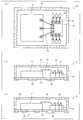
- FIG. 2 shows a schematic configuration of the MEMS microphone according to the present embodiment, where (a) in the same figure is a plan view showing the top cut away, and (b) and (c) in the same figure are front views It is a front view which notches a part and shows. In addition, (c) of the figure is a modification of (b) of the figure.
- the MEMS microphone 10 is configured to include an acoustic sensor (acoustic transducer) 11, an ASIC 12, a wiring board 13, and a cover 14.
- acoustic sensor acoustic transducer
- ASIC application-specific integrated circuit
- the acoustic sensor 11 detects a sound wave and converts it into an electric signal (detection signal), and is a MEMS chip manufactured using MEMS technology.
- the ASIC 12 is an IC having a power supply function of supplying power to the acoustic sensor 11 and a signal processing function of appropriately processing the electrical signal from the acoustic sensor 11 and outputting the signal to the outside.
- the ASIC 12 is a semiconductor chip manufactured using a semiconductor manufacturing technology.
- the acoustic sensor 11 and the ASIC 12 are disposed on the wiring board 13 and covered by a cover 14.
- connection terminals 16 for electrically connecting to the outside.
- the connection terminal 16 is used for external power supply, external signal output, and the like.
- the wiring substrate 13 is attached to various devices, typically by surface reflow mounting, and is electrically connected by the connection terminals 16.
- the cover 14 has a function of protecting the acoustic sensor 11 and the ASIC 12 from external noise, physical contact, and the like. For this reason, the cover 14 is provided with an electromagnetic shield layer on the surface or inside. Further, in the cover 14, a through hole 17 is formed in order to allow an acoustic wave from the outside to reach the acoustic sensor 11. Although the through hole 17 is formed on the upper surface of the cover 14 in (b) of FIG. 2, it may be formed on the side surface of the cover 14 or, as shown in (c) of FIG. At 13, it may be formed in the area where the acoustic sensor 11 is provided.
- FIG. 1 shows a schematic configuration of the acoustic sensor 11 in the present embodiment, (a) of the same figure is a plan view, and (b) of the same figure is an AA of (a) of the same figure. It is the figure which cut
- a vibrating film 22 is provided on the upper surface of the semiconductor substrate 21, and a fixing film 23 is further provided to cover the vibrating film 22.
- the vibrating film 22 is a conductor and functions as a vibrating electrode 220.
- the fixed film 23 is composed of a fixed electrode 230 which is a conductor and a protective film 231 which is an insulator for protecting the fixed electrode 230.
- the vibrating electrode 220 and the fixed electrode 230 face each other via an air gap and function as a capacitor.
- the edge of the vibrating film 22 is attached to the semiconductor substrate 21 via the insulating layer 30.
- the insulating layer 30 is discretely and uniformly disposed between the edge of the vibrating membrane 22 and the semiconductor substrate 21.
- a void (a vent hole) is present between the edge of the vibrating film 22 and the semiconductor substrate 21.
- the semiconductor substrate 21 has an opening (back chamber) 31 in which a region facing the central portion of the vibrating film 22 is opened.
- the fixed film 23 has many sound hole parts 32 in which the sound hole was formed.
- the sound holes 32 are regularly arranged at equal intervals, and the size of the sound holes of each sound hole 32 is approximately equal.
- the sound wave passes through the through hole 17 and the sound hole 32 of the fixed film 23 and reaches the vibrating film 22.
- the through hole 17 and the opening 31 of the acoustic sensor 11 are connected, and the sound wave passes through the through hole 17 and the opening 31 and vibrates.
- the membrane 22 will be reached.
- the characteristic deterioration of the sensitivity and the frequency characteristic due to the volume effect of the opening 31 can be suppressed.
- the acoustic sensor 11 configured as described above, sound waves from the outside reach the diaphragm 22 through the sound hole 32 or the opening 31 of the fixed film 23. At this time, since the vibrating film 22 vibrates by applying the sound pressure of the reached sound wave, the distance (air gap) between the vibrating electrode 220 and the fixed electrode 230 changes, and the vibrating film 22 is moved between the vibrating electrode 220 and the fixed electrode 230. The capacitance changes. By converting the change in capacitance into a change in voltage or current, the acoustic sensor 11 can detect an external sound wave and convert it into an electrical signal (detection signal).
- the fixed film 23 has a large number of sound holes 32.
- the sound holes 32 allow sound waves from the outside to pass through and reach the vibrating film 22. Besides the above, it works as follows. (1) Since the sound wave reaching the fixed film 23 passes through the sound hole 32, the sound pressure applied to the fixed film 23 is reduced. (2) Since the air between the vibrating membrane 22 and the fixed membrane 23 moves in and out through the sound hole 32, the thermal noise (the fluctuation of air) is reduced. Further, since the damping of the vibrating membrane 22 due to the air is reduced, the deterioration of the high frequency characteristics due to the damping is reduced. (3) When forming a space between the vibrating electrode 220 and the fixed electrode 230 using surface micromachining technology, it can be used as an etching hole.
- the semiconductor substrate 21 is a semiconductor having a thickness of about 400 ⁇ m and produced from single crystal silicon or the like.
- the vibrating film 22 has a thickness of about 0.7 ⁇ m, is a conductor produced from polycrystalline silicon or the like, and functions as a vibrating electrode 220.
- the fixed film 23 is composed of a fixed electrode 230 and a protective film 231.
- the fixed electrode 230 has a thickness of about 0.5 ⁇ m and is a conductor made of polycrystalline silicon or the like.
- the protective film 231 has a thickness of about 2 ⁇ m and is an insulator produced from silicon nitride or the like.
- the gap between the vibrating electrode 220 and the fixed electrode 230 is about 4 ⁇ m.
- the fixed electrode 230 is divided into a central electrode 230 a provided at the central portion of the fixed film 23 and a peripheral electrode 230 b provided at the peripheral portion of the fixed film 23. Electrically isolated.
- the central electrode 230a is connected to the connection terminal 29a via the contact portion 27a and the wiring 28a.
- the peripheral electrode 230b is connected to the connection terminal 29b via the contact portion 27b and the wiring 28b.
- the vibrating electrode 220 is connected to the connection terminal 26 through the wire 25.
- the capacitor that functions by the vibrating electrode 220 and the fixed electrode 230 functions by the central capacitor that functions by the central electrode 230 a and the central portion of the vibrating electrode 220 and the peripheral portion of the peripheral electrode 230 b and the vibrating electrode 220.
- the acoustic sensor 11 of the present embodiment can convert an external sound wave into an electrical signal from the central capacitor and an electrical signal from the peripheral capacitor.
- the vibrating membrane 22 is fixed at the edge, the vibration displacement of the central portion is large and the vibration displacement of the peripheral portion is small.
- the central capacitor becomes a high sensitivity capacitor with high detection sensitivity
- the peripheral capacitor becomes a low sensitivity capacitor with low detection sensitivity. Therefore, the acoustic sensor 11 of the present embodiment can convert an external sound wave into two electric signals having different detection sensitivities. Thereby, the detectable sound pressure level can be expanded as compared with the conventional acoustic sensor including only one variable capacitor.
- the central electrode 230a has a larger area than the peripheral electrode 230b. Thereby, the detectable sound pressure level can be further expanded.
- the vibrating film 22 and the protective film 231 are common. Therefore, in the acoustic sensor 11 of the present embodiment, the variation between chips regarding the detection sensitivity of the center capacitor and the peripheral capacitor is similar to that of the conventional acoustic sensor in which the vibrating membrane and the protective film are separate. As a result, it is possible to suppress chip-to-chip variations related to the difference in detection sensitivity between the center capacitor and the peripheral capacitor.
- the central capacitor and the peripheral capacitor share the vibrating film 22 and the protective film 231. As a result, it is possible to suppress in-chip mismatching relating to acoustic characteristics such as frequency characteristics and phase. Furthermore, since the central capacitor and the peripheral capacitor share the back chamber, the air gap, and the vent hole, it is possible to further suppress the in-chip mismatching related to the acoustic characteristics.
- the central capacitor and the peripheral capacitor are formed in the vibrating film 22 and the fixed film 23, it is possible to suppress an increase in chip size as compared with the prior art. Further, since the length of the wiring can be suppressed, the deterioration of the various characteristics can be suppressed.
- the air gap when the vibrating membrane 22 is stationary is constant.
- the center capacitor and the peripheral capacitor have the same distance between the vibrating electrode 220 and the fixed electrode 230, it is possible to further suppress the in-chip mismatching relating to the acoustic characteristics.
- the formation of the vibrating electrode 220 and the fixed electrode 230 in the manufacturing process of the acoustic sensor 11 can be simplified.
- each of the vibrating electrode 220 and the fixed electrode 230 is formed with a uniform thickness. This makes it possible to further make the chip-to-chip variations with respect to the detection sensitivity of the center capacitor and the peripheral capacitor due to manufacturing variations, and further to make the chip-to-chip variation with respect to the difference in detection sensitivity between the center capacitor and the peripheral capacitor. It can be suppressed.
- the base of the vibrating membrane 22 is circular, stress concentration occurring in the vibrating membrane 22 can be reduced as compared with the case where the base of the vibrating membrane is rectangular. As a result, the resistance to external stress and internal stress is enhanced.
- the displacement of the vibrating membrane 22 can be increased as compared with the configuration in which the vent holes are not present, and the detection sensitivity can be improved. Further, even if the semiconductor substrate 21 is distorted by an external force or the like, the vibrating film 22 is not easily distorted, so that the acoustic characteristics are hardly changed. In addition, the influence of fluctuations in external pressure can be mitigated.
- the center electrode 230a and the peripheral electrode 230b are separately formed in the shape of the mask for forming the fixed electrode, as compared with the conventional method of manufacturing the acoustic sensor. And the others are similar.
- a sacrificial layer (SiO 2) is formed on the upper surface of a single crystal silicon substrate to be the semiconductor substrate 21.
- a polycrystalline silicon layer is formed on the sacrificial layer and etching is performed to form the vibrating film 22.
- a sacrificial layer is formed again so as to cover the vibrating membrane 22.
- a polycrystalline silicon layer and a silicon nitride layer are formed so as to cover the sacrificial layer, and etching is performed to form the fixed film 23 composed of the fixed electrode 230 and the protective film 231.
- the fixed electrode 230 is separated into the central electrode 230a and the peripheral electrode 230b by forming the polycrystalline silicon layer separately in the central portion and the peripheral portion by a mask pattern or the like.
- the opening 31 is formed by etching the single crystal silicon substrate. Then, by etching the sacrificial layer through the sound hole 32, an air gap between the vibrating film 22 and the fixed film 23 is formed, the insulating layer 30 is formed, and the acoustic sensor 11 is completed.
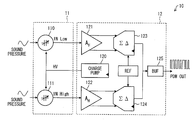
- FIG. 3 is a circuit diagram of the MEMS microphone 10 shown in FIG.
- the acoustic sensor 11 is configured to include a low sensitivity variable capacitor 110 and a high sensitivity variable capacitor 111 whose capacitance changes according to sound waves.
- the low sensitivity variable capacitor 110 corresponds to the peripheral capacitor
- the high sensitivity variable capacitor 111 corresponds to the central capacitor.
- the ASIC 12 is configured to include a charge pump 120, a low sensitivity amplifier 121, a high sensitivity amplifier 122, a ⁇ ( ⁇ ⁇ ) type ADC (Analog-to-Digital Converter) 123 ⁇ 124, and a buffer 125.
- a charge pump 120 a low sensitivity amplifier 121
- a high sensitivity amplifier 122 a high sensitivity amplifier 122
- a ⁇ ( ⁇ ⁇ ) type ADC (Analog-to-Digital Converter) 123 ⁇ 124 and a buffer 125.
- the high voltage HV from the charge pump 120 is applied to the variable capacitors 110 and 111 of the acoustic sensor 11, whereby the sound waves are converted into electric signals by the variable capacitors 110 and 111.
- the electric signal converted by the low sensitivity variable capacitor 110 is amplified by the low sensitivity amplifier 121 and converted into a digital signal by the ⁇ type ADC 123.
- the electric signal converted by the high sensitivity variable capacitor 111 is amplified by the high sensitivity amplifier 122 and converted into a digital signal by the ⁇ type ADC 124.
- the digital signal converted by the ⁇ type ADCs 123 and 124 is output to the outside as a PDM (pulse density modulation) signal through the buffer 125.
- PDM pulse density modulation
- the two digital signals converted by the ⁇ type ADCs 123 and 124 are mixed and output on one data line, but the two digital signals are output on separate data lines. You may
- the fixed electrode 230 is divided, and the vibrating electrode 220 is not divided.
- the number of connections with the ASIC 12 is reduced as compared to the case where both the fixed electrode 230 and the vibrating electrode 220 are divided, so that the productivity is improved.
- the number of connection terminals with the ASIC 12 is reduced, it is possible to improve the characteristics by reducing the parasitic capacitance caused by the connection terminals.
- the size of the ASIC 12 including the charge pump 120 can be reduced, the manufacturing cost can be reduced, and the difference in detection sensitivity due to the variation in generation of the charge pump 120 can be reduced. Can be reduced.
- FIG. 4 shows a schematic configuration of the acoustic sensor 11 according to the present embodiment, where (a) of the figure is a plan view, and (b) of the figure is a B- of (a) of the figure. It is the figure which was cut by the B line and was seen in the arrow direction.
- the acoustic sensor 11 shown in FIG. 4 omits the insulating layer 30 and does not fix the edge of the vibrating membrane 22 to the semiconductor substrate 21, and the protective film of the fixed film 23.
- the configuration is the same as that of the point that the protrusions 232 protruding from the diaphragm 231 to the vibrating membrane 22 are discretely provided along the peripheral electrode 230 b, and the other configuration is the same.
- symbol is attached
- the vibrating membrane 22 is not fixed to the semiconductor substrate 21, but when a voltage is applied between the vibrating membrane 22 (the vibrating electrode 220) and the fixed electrode 230, the vibrating membrane 22 is held by the projection 232 by electrostatic force. Be done. Thereby, the influence of the external stress or internal stress applied to the vibrating membrane 22 can be reduced. In addition, since the vibration in the peripheral portion of the vibrating membrane 22 is restricted by the projection 232, the detection sensitivity of the peripheral capacitor that functions by the peripheral electrode 230b and the peripheral portion of the vibrating electrode 220 can be further lowered. As a result, the sensitivity difference between the detection sensitivity of the center capacitor and the detection sensitivity of the peripheral capacitors can be further increased.
- FIG. 5 is a plan view showing a schematic configuration of the acoustic sensor 11 according to the present embodiment.
- the protective film 231 of the fixed film 23 is omitted.
- the acoustic sensor 11 shown in FIG. 5 is different from the acoustic sensor 11 shown in FIG. 1 in the shape of the vibrating film 22 and therefore the shape of the fixed film is also different.
- the other configurations are the same.
- the vibrating film 22 of the acoustic sensor 11 shown in FIG. 1 is circular, and is fixed to the semiconductor substrate 21 at its edge.
- the vibrating membrane 22 of the acoustic sensor 11 of the present embodiment has a substantially square base as shown in FIG. 5, and the corner portions 50 respectively extend outward from the center, It is fixed to the semiconductor substrate 21 by the extension portion 51.
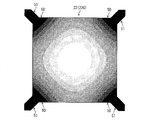
- FIG. 6 shows the amount of vibration of the vibrating membrane 22 when a predetermined sound wave reaches the vibrating membrane 22 of the above configuration. In the same figure, it is shown brighter as the amount of vibration increases. As illustrated, the vibrating membrane 22 has less vibration at the corner 50 and the extension 51. Therefore, as shown in FIG. 5, the fixed electrode 230 according to the present embodiment is substantially square in shape, and the central portion is the central electrode 230a, and the corner portion and the connection portion connecting the corner portions are the peripheral electrode 230b. It becomes. As described above, regardless of the shape of the vibrating membrane 22 (the vibrating electrode 220), the central electrode 230a is formed to face the central region of the vibrating membrane 22, and the peripheral electrode 230b is formed with the vibrating membrane 22. It may be formed to face a region near the place fixed to the semiconductor substrate 21.
- the base of the vibrating membrane 22 is square, the area on the rectangular chip can be effectively used. Further, compared to the vibrating film 22 having a circular base, the fixing portion between the vibrating film 22 and the semiconductor substrate 21 can be variously changed, so that the detection sensitivity can be variously changed. Further, compared to the vibrating film 22 whose base is circular, the vibrating film 22 when the sound wave arrives is deformed into a substantially flat plate shape and is deformed substantially parallel to the fixed film 23, so that the sound pressure of the electrode It will function as a capacitor similar to a parallel plate capacitor of varying spacing. Therefore, the linearity of the capacity change with respect to the sound pressure is improved.
- FIG. 7 is a plan view showing a schematic configuration of the acoustic sensor 11 according to the present embodiment
- FIG. 8 is a cross-sectional view taken along the line C-C of FIG.
- FIG. 9 is a plan view showing a schematic configuration of the vibrating membrane 22 in the acoustic sensor 11 of the present embodiment.
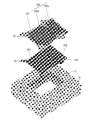
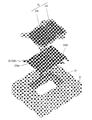
- FIG. 10 is an exploded view of the acoustic sensor 11 according to the present embodiment. Note that, in FIG. 7, the protective film 231 of the fixed film 23 is illustrated only at the outline where it is installed with the semiconductor substrate 21.
- the acoustic sensor 11 shown in FIGS. 7 to 10 has a point that the vibrating membrane 22 and the fixed membrane 23 further extend laterally from the base, and the fixed membrane 23.
- the separation configuration of the fixed electrode 230 is different, and the other configurations are the same.
- the fixed electrode 230 of the fixed film 23 is provided with an extended electrode 230c in the laterally extending portion which is laterally extended, instead of the peripheral electrode 230b. That is, the fixed electrode 230 is divided into the central electrode 230a and the extended electrode 230c. Similarly, instead of the contact portion 27b, the wire 28b, and the connection terminal 29b, a contact portion 27c, a wire 28c, and a connection terminal 29c are provided.
- the vibrating electrode 220 is connected to the connection terminal 26 via the contact portion 24 and the wire 25.
- the vibrating membrane 22 has the base wider than the lateral extension. Further, in the vibrating membrane 22, the base portion is fixed at the fixing portion 51a at the tip end portion of the extending portion 51, while the side extending portion is fixed at the fixing portion 52a at the end portion 52 in the front-rear direction Be done.
- the portion not fixed at the edge of the vibrating membrane 22 is a void (vent hole). That is, in the vibrating membrane 22, the area ratio of the fixing portion 51a of the base to the area of the base is smaller than the area ratio of the fixing portion 52a of the side extending portion to the area of the side extending portion. There is. As a result, the base is displaced more than the side extension. In the example of FIG. 9, the front right fixing portion 51a and the front fixing portion 52a are connected.
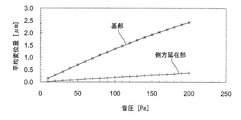
- FIG. 11 is a graph showing the change in the average displacement for each region of the vibrating membrane 22 with respect to the sound pressure applied to the vibrating membrane 22.
- the unit of sound pressure is Pa
- the unit of average displacement is ⁇ m.
- the variable capacitor formed by the above-mentioned base of the vibrating membrane 22 and the central electrode 230a of the fixed film 23 functions as a high sensitivity variable capacitor which can detect a small sound well.
- the variable capacitor formed by the above-mentioned lateral extension of the vibrating film 22 and the extended electrode 230c of the fixed film 23 functions as a low sensitivity variable capacitor capable of favorably detecting a loud sound.
- a slit 221 is formed so as to face the boundary region of the central electrode 230 a and the extended electrode 230 c in the fixed film 23.
- the slit 221 is only formed in a part of the area facing the boundary area, the base and the laterally extending portion are physically and electrically connected.
- the displacement of the base and the displacement of the side extension are influenced with each other because the base and the side extension are continuous.
- the base and the laterally extending portion are divided in most parts, and the displacement of the base and the displacement of the laterally extending portion The difference is more pronounced.
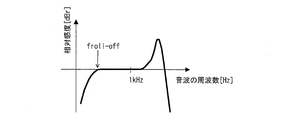
- FIG. 12 shows typical frequency characteristics in a MEMS microphone.
- the vertical axis of the figure is the frequency of the sound wave (unit: Hz), and the horizontal axis is the relative sensitivity (unit: dBr).
- the range in which the graph is horizontal is a range in which the sound wave can be favorably detected because the relative sensitivity does not depend on the frequency of the sound wave.
- the lower limit frequency of this range is the roll-off frequency f roll-off .
- the roll-off frequency f roll-off depends on the acoustic resistance R ventholl of the ventilation hole and the compliance (air spring constant) C backchamber of air in the back chamber (opening 31), and is expressed by the following equation Ru. f roll-off ⁇ 1 / (R ventholl ⁇ C backchamber ) (1).
- the acoustic resistance R ventholl is also affected by the length of the slit 221, but decreases as the width of the slit 221 is wider. Therefore, the roll-off frequency f roll-off is increased according to the above equation (1), and as a result, the low frequency characteristics are deteriorated.
- the width of the slit 221 is 1 ⁇ m
- the roll-off frequency f roll-off is 50 Hz or less, but when it is 10 ⁇ m, it is 500 Hz.
- the width of the slit 221 is preferably 10 ⁇ m or less.
- FIG. 13 is a plan view showing a schematic configuration of the diaphragm 22 in the acoustic sensor 11 according to the present embodiment
- FIG. 14 is an exploded view of the acoustic sensor 11 according to the present embodiment.
- the central electrode 230a and the extended electrode 230c of the fixed electrode 230 are connected, while the vibrating electrode 220 is the above-described base and The difference is that the center electrode 220a and the extended electrode 220c are separated at the side extension portion, and the other configuration is the same. Thus, the vibrating electrode 220 can also be separated.
- the central electrode 220 a and the extended electrode 220 c are connected to the amplifiers 121 and 122 of the ASIC 12.
- the sound hole 32 has a circular cross section, but may have an arbitrary shape such as a triangle or a square.
- one of the vibrating electrode 220 and the fixed electrode 230 is divided into two, but may be divided into three or more.
- the number of divided electrodes it is necessary to increase the wiring for transmitting the signal from the electrode, the electric circuit for processing the above signal in the ASIC 12, etc. The size will increase. Therefore, it is desirable that the number of divided electrodes be as small as, for example, two.
- both the vibrating electrode 220 and the fixed electrode 230 may be divided.
- one of the divided electrodes of the vibrating electrode 220 and the fixed electrode 230 is connected to the amplifiers 121 and 122, and the other divided electrodes are shorted. Good.
- a plurality of charge pumps 120 of the ASIC 12 may be provided and connected to any one of the divided electrodes, and the amplifiers 121 and 122 may be connected to the other divided electrode.
- the vibrating film and the fixed film are formed on the upper surface of the substrate, and the capacitance between the vibrating electrode in the vibrating film and the fixed electrode in the fixed film is changed.
- an acoustic transducer for detecting a sound wave, converting it into an electric signal, and outputting it in order to solve the above problem, at least one of the vibrating electrode and the fixed electrode is divided, and a plurality of divided electrodes are divided. It is characterized in that electrical signals are output respectively.
- an acoustic transducer capable of converting a sound wave into a plurality of electric signals can be realized by outputting a plurality of electric signals from the plurality of divided electrodes.
- each variable capacitor has similar inter-chip variation in detection sensitivity, and as a result, the detection sensitivity between the above-mentioned variable capacitors Between chips in relation to the difference in In addition, each variable capacitor shares the vibrating film and the fixed film, and as a result, it is possible to suppress the in-chip mismatching relating to acoustic characteristics such as frequency characteristics and phase.
- variable capacitors have different detectable sound pressure levels.
- the acoustic sensor including the plurality of variable capacitors can expand the detectable sound pressure level as compared to the conventional acoustic sensor including only one variable capacitor.
- At least two of the plurality of divided electrodes may have different sensitivities of detecting the sound wave.
- At least two of the plurality of divided electrodes may have different areas. Further, among the electrodes having different areas, the area of the vibrating film corresponding to the wider electrode has a larger average value of the amplitude of vibration by the sound wave than the area of the vibrating film corresponding to the narrower electrode. It should be made to become. In this case, the detectable sound pressure levels can be further differentiated, and the detectable sound pressure levels can be further expanded.
- the plurality of divided electrodes is preferably a small number of divided electrodes, for example, two electrodes divided into two.
- the distance between the vibrating electrode and the fixed electrode is preferably constant.
- each variable capacitor has the same interval between the vibrating electrode and the fixed electrode, it is possible to further suppress the in-chip mismatching related to the acoustic characteristic.
- the formation of the vibrating electrode and the fixed electrode in the manufacturing process of the acoustic transducer can be simplified.
- one of the vibrating electrode and the fixed electrode be divided.
- productivity is improved.
- the number of external connection terminals is reduced, the parasitic capacitance due to the connection terminals can be reduced to improve the characteristics.
- the size of the external circuit including the charge pump can be reduced, the manufacturing cost can be reduced, and the detection sensitivity due to the variation in the formation of the external charge pump Variation of the difference between
- each of the vibrating electrode and the fixed electrode preferably has a uniform thickness.
- the vibrating membrane may have a rectangular base. Since the chip is generally rectangular, in the case of the above configuration, the area on the chip can be used effectively. In addition, since the fixed portion between the vibrating membrane and the substrate can be variously changed as compared with the vibrating membrane having a circular base, the detection sensitivity can be variously changed. Also, as compared with a vibrating membrane having a circular base, the vibrating membrane is deformed in a substantially flat plate shape when the sound wave arrives and is deformed substantially in parallel to the fixed membrane, so the distance between the electrodes changes due to the sound pressure. Function as a capacitor similar to a parallel plate capacitor. Therefore, the linearity of the capacity change with respect to the sound pressure is improved.
- the vibrating membrane may have a circular base.
- stress concentration generated in the vibrating film can be reduced as compared with the vibrating film having a rectangular base, durability against external stress and internal stress is enhanced.
- the vibrating membrane preferably includes an extending portion extending outward from the base, and is preferably fixed to the substrate or the fixed film at the extending portion. In this case, the displacement of the diaphragm can be increased.
- the vibrating film may have a slit formed in the boundary region of the divided vibration electrodes or in the region facing the boundary region of the divided fixed electrodes.
- the difference between the displacement amounts of the vibrating films is increased for the plurality of variable capacitors by the slits, so that the difference in detection sensitivity can be increased. Further, since air flows in and out through the slit, it is possible to suppress the fluctuation of the air pressure due to the vibration of the vibrating film, and to suppress the fluctuation of the characteristics due to the fluctuation of the air pressure.
- the width of the slit is preferably 10 ⁇ m or less. In this case, significant deterioration of the low frequency characteristics can be suppressed.
- an air gap be present between the vibrating membrane and the substrate.
- the displacement of the vibrating membrane can be increased and the detection sensitivity can be improved as compared with the configuration in which the air gap does not exist.
- the vibrating film is not easily distorted, so that the acoustic characteristics hardly change.
- the influence of fluctuations in external pressure can be mitigated.
- At least two of the plurality of regions corresponding to the plurality of divided electrodes are the area ratio to the region of the fixed portion fixed to the substrate or the fixed film. May be different.
- the displacement of the vibrating membrane relative to the sound pressure changes depending on the shape of the fixed portion. For example, as the number of fixed parts increases, the displacement with respect to the sound pressure decreases, and the detection sensitivity decreases. Therefore, in the case of the above configuration, the plurality of variable capacitors can be made to have different detection sensitivities due to the difference in the area ratio.
- the substrate may be provided with an opening in a region facing the central portion of the vibrating film, and a sound wave may be incident from the opening.
- the variable capacitors share the opening, it is possible to further suppress the in-chip mismatching related to the acoustic characteristics such as frequency characteristics and phase. Further, since the sound wave is incident from the opening, deterioration of the sensitivity and the frequency characteristic due to the volume effect of the opening can be suppressed as compared with the case where the sound wave is incident from the fixed film.
- the microphone includes the acoustic transducer having the above-described configuration and an IC that supplies power to the acoustic transducer and amplifies the electrical signal from the acoustic transducer and outputs the signal to the outside. be able to.
- the acoustic transducer according to the present invention can suppress variations in acoustic characteristics by realizing an acoustic transducer capable of converting sound waves into a plurality of electrical signals in the same vibrating membrane and fixed membrane.
- the present invention can be applied to any MEMS acoustic sensor.
Landscapes
- Engineering & Computer Science (AREA)
- Physics & Mathematics (AREA)
- Acoustics & Sound (AREA)
- Signal Processing (AREA)
- Health & Medical Sciences (AREA)
- General Health & Medical Sciences (AREA)
- Otolaryngology (AREA)
- Manufacturing & Machinery (AREA)
- Chemical & Material Sciences (AREA)
- Analytical Chemistry (AREA)
- Computer Hardware Design (AREA)
- Microelectronics & Electronic Packaging (AREA)
- Electrostatic, Electromagnetic, Magneto- Strictive, And Variable-Resistance Transducers (AREA)
- Pressure Sensors (AREA)
- Micromachines (AREA)
- Circuit For Audible Band Transducer (AREA)
Priority Applications (9)
| Application Number | Priority Date | Filing Date | Title |
|---|---|---|---|
| US13/978,531 US9936305B2 (en) | 2011-01-07 | 2011-12-22 | Acoustic transducer and microphone using the acoustic transducer |
| KR1020137017482A KR101512583B1 (ko) | 2011-01-07 | 2011-12-22 | 음향 트랜스듀서 및 그 음향 트랜스듀서를 이용한 마이크로폰 |
| EP11854547.4A EP2663093B1 (en) | 2011-01-07 | 2011-12-22 | Sound transducer and microphone using same |
| CN201180064105.8A CN103329575B (zh) | 2011-01-07 | 2011-12-22 | 音响转换器及使用该音响转换器的麦克风 |
| US13/936,110 US9380380B2 (en) | 2011-01-07 | 2013-07-05 | Acoustic transducer and interface circuit |
| US13/936,104 US9363608B2 (en) | 2011-01-07 | 2013-07-05 | Acoustic transducer |
| US15/017,514 US9843868B2 (en) | 2011-01-07 | 2016-02-05 | Acoustic transducer |
| US15/814,256 US10405107B2 (en) | 2011-01-07 | 2017-11-15 | Acoustic transducer |
| US15/904,209 US10484798B2 (en) | 2011-01-07 | 2018-02-23 | Acoustic transducer and microphone using the acoustic transducer |
Applications Claiming Priority (2)
| Application Number | Priority Date | Filing Date | Title |
|---|---|---|---|
| JP2011-002313 | 2011-01-07 | ||
| JP2011002313A JP5872163B2 (ja) | 2011-01-07 | 2011-01-07 | 音響トランスデューサ、および該音響トランスデューサを利用したマイクロフォン |
Related Child Applications (4)
| Application Number | Title | Priority Date | Filing Date |
|---|---|---|---|
| US13/978,531 A-371-Of-International US9936305B2 (en) | 2011-01-07 | 2011-12-22 | Acoustic transducer and microphone using the acoustic transducer |
| US13/936,104 Continuation-In-Part US9363608B2 (en) | 2011-01-07 | 2013-07-05 | Acoustic transducer |
| US13/936,110 Continuation-In-Part US9380380B2 (en) | 2011-01-07 | 2013-07-05 | Acoustic transducer and interface circuit |
| US15/904,209 Continuation US10484798B2 (en) | 2011-01-07 | 2018-02-23 | Acoustic transducer and microphone using the acoustic transducer |
Publications (1)
| Publication Number | Publication Date |
|---|---|
| WO2012093598A1 true WO2012093598A1 (ja) | 2012-07-12 |
Family
ID=46457458
Family Applications (1)
| Application Number | Title | Priority Date | Filing Date |
|---|---|---|---|
| PCT/JP2011/079843 Ceased WO2012093598A1 (ja) | 2011-01-07 | 2011-12-22 | 音響トランスデューサ、および該音響トランスデューサを利用したマイクロフォン |
Country Status (6)
| Country | Link |
|---|---|
| US (5) | US9936305B2 (https=) |
| EP (1) | EP2663093B1 (https=) |
| JP (1) | JP5872163B2 (https=) |
| KR (1) | KR101512583B1 (https=) |
| CN (1) | CN103329575B (https=) |
| WO (1) | WO2012093598A1 (https=) |
Cited By (7)
| Publication number | Priority date | Publication date | Assignee | Title |
|---|---|---|---|---|
| US20150078591A1 (en) * | 2013-09-13 | 2015-03-19 | Omron Corporation | Acoustic transducer and microphone |
| US9407231B2 (en) | 2013-02-06 | 2016-08-02 | Htc Corporation | Apparatus and method of multi-sensor sound recording |
| US9456274B2 (en) | 2012-11-14 | 2016-09-27 | Stmicroelectronics S.R.L. | Digital electronic interface circuit for an acoustic transducer, and corresponding acoustic transducer system |
| US9609410B2 (en) | 2014-02-20 | 2017-03-28 | Stmicroelectronics S.R.L. | Processing circuit for a multiple sensing structure digital microelectromechanical sensor having a broad dynamic range and sensor comprising the processing circuit |
| DE112013006821B4 (de) | 2013-03-13 | 2019-05-09 | Omron Corp. | Kapazitiver Sensor, Akustiksensor, und Mikrophon |
| DE112013003536B4 (de) | 2012-09-14 | 2019-06-27 | Omron Corporation | Kapazitiver Sensor, Akustiksensor und Mikrophon |
| CN116600224A (zh) * | 2022-02-11 | 2023-08-15 | 苹果公司 | 用于声学设备的电感式声学滤波器 |
Families Citing this family (40)
| Publication number | Priority date | Publication date | Assignee | Title |
|---|---|---|---|---|
| US9380380B2 (en) | 2011-01-07 | 2016-06-28 | Stmicroelectronics S.R.L. | Acoustic transducer and interface circuit |
| JP5872163B2 (ja) | 2011-01-07 | 2016-03-01 | オムロン株式会社 | 音響トランスデューサ、および該音響トランスデューサを利用したマイクロフォン |
| US8767512B2 (en) | 2012-05-01 | 2014-07-01 | Fujifilm Dimatix, Inc. | Multi-frequency ultra wide bandwidth transducer |
| US9454954B2 (en) * | 2012-05-01 | 2016-09-27 | Fujifilm Dimatix, Inc. | Ultra wide bandwidth transducer with dual electrode |
| US9804003B2 (en) * | 2012-10-23 | 2017-10-31 | Apple Inc. | Electronic devices with environmental sensors |
| US9660170B2 (en) | 2012-10-26 | 2017-05-23 | Fujifilm Dimatix, Inc. | Micromachined ultrasonic transducer arrays with multiple harmonic modes |
| TWM457365U (zh) * | 2012-11-09 | 2013-07-11 | Raytrend Technology Corp | 具多聲道輸出的靜電式喇叭 |
| US9681234B2 (en) * | 2013-05-09 | 2017-06-13 | Shanghai Ic R&D Center Co., Ltd | MEMS microphone structure and method of manufacturing the same |
| JP6179297B2 (ja) * | 2013-09-13 | 2017-08-16 | オムロン株式会社 | 音響トランスデューサ及びマイクロフォン |
| ITTO20130901A1 (it) | 2013-11-05 | 2015-05-06 | St Microelectronics Srl | Interfaccia di espansione dell'intervallo dinamico di un segnale di ingresso, in particolare di un segnale audio di un trasduttore acustico a due strutture di rilevamento, e relativo metodo |
| CN106105259A (zh) * | 2014-01-21 | 2016-11-09 | 美商楼氏电子有限公司 | 提供极高声学过载点的麦克风设备和方法 |
| US9344808B2 (en) * | 2014-03-18 | 2016-05-17 | Invensense, Inc. | Differential sensing acoustic sensor |
| JP6364653B2 (ja) | 2014-05-20 | 2018-08-01 | Tdk株式会社 | マイクロホンおよびマイクロホンの動作方法 |
| US11619983B2 (en) * | 2014-09-15 | 2023-04-04 | Qeexo, Co. | Method and apparatus for resolving touch screen ambiguities |
| KR101550636B1 (ko) | 2014-09-23 | 2015-09-07 | 현대자동차 주식회사 | 마이크로폰 및 그 제조 방법 |
| JP6390423B2 (ja) * | 2014-12-26 | 2018-09-19 | オムロン株式会社 | 音響センサおよび音響センサの製造方法 |
| CN204408625U (zh) * | 2015-01-21 | 2015-06-17 | 瑞声声学科技(深圳)有限公司 | Mems麦克风 |
| WO2016118351A1 (en) * | 2015-01-22 | 2016-07-28 | The Board Of Trustees Of The University Of Illinois | Micro-electro-mechanical-systems based acoustic emission sensors |
| JP6432372B2 (ja) * | 2015-02-02 | 2018-12-05 | オムロン株式会社 | 音響センサ |
| KR101638730B1 (ko) | 2015-02-10 | 2016-07-12 | 경북대학교 산학협력단 | 초음파 트랜스듀서, 이를 포함하는 초음파 장치 및 이의 제조 방법 |
| WO2016153851A1 (en) * | 2015-03-20 | 2016-09-29 | Knowles Electronics, Llc | Acoustic device with one or more trim capacitors |
| US10291973B2 (en) * | 2015-05-14 | 2019-05-14 | Knowles Electronics, Llc | Sensor device with ingress protection |
| US9807532B2 (en) * | 2015-05-22 | 2017-10-31 | Kathirgamasundaram Sooriakumar | Acoustic apparatus, system and method of fabrication |
| CN106197776B (zh) | 2015-05-27 | 2019-11-05 | 意法半导体股份有限公司 | 压力传感器、压力测量设备、制动系统和测量压力的方法 |
| US9560455B2 (en) | 2015-06-26 | 2017-01-31 | Stmicroelectronics S.R.L. | Offset calibration in a multiple membrane microphone |
| US9752900B2 (en) * | 2015-07-10 | 2017-09-05 | Wyrobek International, Inc. | Multi-plate capacitive transducer |
| US10003889B2 (en) | 2015-08-04 | 2018-06-19 | Infineon Technologies Ag | System and method for a multi-electrode MEMS device |
| RU2619807C1 (ru) * | 2016-03-04 | 2017-05-18 | Акционерное общество "Творческо-производственное объединение "Центральная киностудия детских и юношеских фильмов им. М. Горького" | Капсюль конденсаторного микрофона |
| US9731965B1 (en) | 2016-03-31 | 2017-08-15 | Stmicroelectronics S.R.L. | Dry scribing methods, devices and systems |
| US10153740B2 (en) * | 2016-07-11 | 2018-12-11 | Knowles Electronics, Llc | Split signal differential MEMS microphone |
| KR101916052B1 (ko) | 2016-09-09 | 2018-11-07 | 현대자동차 주식회사 | 마이크로폰, 이의 제조 방법 및 제어 방법 |
| IT201600121533A1 (it) | 2016-11-30 | 2018-05-30 | St Microelectronics Srl | Trasduttore elettroacustico integrato mems con sensibilita' migliorata e relativo processo di fabbricazione |
| DE102017206744B9 (de) | 2017-04-21 | 2023-01-12 | Infineon Technologies Ag | Mems package mit hoher wärmekapazität und verfahren zum herstellen selbiger |
| US10361145B2 (en) * | 2017-07-18 | 2019-07-23 | Skyworks Solutions, Inc. | Through-mold openings for dual-sided packaged modules with ball grid arrays |
| US10718801B2 (en) | 2017-08-21 | 2020-07-21 | Cirrus Logic, Inc. | Reducing noise in a capacitive sensor with a pulse density modulator |
| JP1602867S (https=) * | 2017-08-24 | 2018-05-07 | ||
| WO2019178355A1 (en) * | 2018-03-16 | 2019-09-19 | Vesper Technologies, Inc. | Transducer system with configurable acoustic overload point |
| JP7452476B2 (ja) | 2021-03-10 | 2024-03-19 | 株式会社デンソー | 圧電素子、圧電装置、および圧電素子の製造方法 |
| TWI818600B (zh) * | 2022-06-27 | 2023-10-11 | 國立臺灣大學 | 用於壓電揚聲器的壓電單元 |
| CN121013661A (zh) * | 2023-04-24 | 2025-11-25 | 菲利普莫里斯生产公司 | 用于气溶胶生成装置的改进的青少年访问预防 |
Citations (8)
| Publication number | Priority date | Publication date | Assignee | Title |
|---|---|---|---|---|
| JP2003028740A (ja) * | 2001-07-18 | 2003-01-29 | Denso Corp | 静電容量型圧力センサ |
| JP2006101302A (ja) * | 2004-09-30 | 2006-04-13 | Audio Technica Corp | コンデンサマイクロホン |
| US20070047746A1 (en) | 2005-08-23 | 2007-03-01 | Analog Devices, Inc. | Multi-Microphone System |
| JP2008245267A (ja) | 2007-02-26 | 2008-10-09 | Yamaha Corp | シリコンマイクロフォン |
| JP2009098022A (ja) * | 2007-10-17 | 2009-05-07 | Rohm Co Ltd | 半導体装置 |
| WO2009104389A1 (ja) * | 2008-02-20 | 2009-08-27 | オムロン株式会社 | 静電容量型振動センサ |
| US20090316916A1 (en) | 2008-05-23 | 2009-12-24 | Analog Devices, Inc. | Wide Dynamic Range Microphone |
| US20100183167A1 (en) | 2009-01-20 | 2010-07-22 | Nokia Corporation | Multi-membrane microphone for high-amplitude audio capture |
Family Cites Families (93)
| Publication number | Priority date | Publication date | Assignee | Title |
|---|---|---|---|---|
| US3588382A (en) | 1967-10-11 | 1971-06-28 | Northern Electric Co | Directional electret transducer |
| CH533408A (de) | 1972-02-02 | 1973-01-31 | Bommer Ag | Hörgerät |
| SE438233B (sv) * | 1983-08-19 | 1985-04-01 | Ericsson Telefon Ab L M | Elektretmikrofon |
| SU1582361A1 (ru) | 1985-05-06 | 1990-07-30 | Предприятие П/Я Р-6947 | Микрофон с измен емой чувствительностью |
| JPS62213400A (ja) * | 1986-03-13 | 1987-09-19 | Sony Corp | コンデンサ形マイクロホン |
| JPH0726887B2 (ja) | 1986-05-31 | 1995-03-29 | 株式会社堀場製作所 | コンデンサマイクロフオン型検出器用ダイアフラム |
| DK155269C (da) | 1986-07-17 | 1989-07-24 | Brueel & Kjaer As | Trykgradientmikrofon |
| SU1670807A1 (ru) | 1989-01-09 | 1991-08-15 | Предприятие П/Я Р-6947 | Конденсаторный микрофон |
| JPH03139097A (ja) | 1989-10-25 | 1991-06-13 | Hitachi Ltd | マイクの収音方式 |
| US5388163A (en) | 1991-12-23 | 1995-02-07 | At&T Corp. | Electret transducer array and fabrication technique |
| US5524056A (en) | 1993-04-13 | 1996-06-04 | Etymotic Research, Inc. | Hearing aid having plural microphones and a microphone switching system |
| DE4342169A1 (de) | 1993-12-10 | 1995-06-14 | Sennheiser Electronic | Elektromechanischer Wandler, wie Mikrofon |
| US5452268A (en) | 1994-08-12 | 1995-09-19 | The Charles Stark Draper Laboratory, Inc. | Acoustic transducer with improved low frequency response |
| US5517683A (en) | 1995-01-18 | 1996-05-14 | Cycomm Corporation | Conformant compact portable cellular phone case system and connector |
| DE69527790D1 (de) | 1995-09-29 | 2002-09-19 | St Microelectronics Srl | Digitale mikrophonische Vorrichtung |
| JPH10126886A (ja) * | 1996-10-21 | 1998-05-15 | Hirahiro Toshimitsu | ディジタル式電気音響変換器 |
| US5982709A (en) | 1998-03-31 | 1999-11-09 | The Board Of Trustees Of The Leland Stanford Junior University | Acoustic transducers and method of microfabrication |
| US6271780B1 (en) | 1998-10-08 | 2001-08-07 | Cirrus Logic, Inc. | Gain ranging analog-to-digital converter with error correction |
| US7003127B1 (en) | 1999-01-07 | 2006-02-21 | Sarnoff Corporation | Hearing aid with large diaphragm microphone element including a printed circuit board |
| EP1172020B1 (en) | 1999-02-05 | 2006-09-06 | Hearworks Pty Ltd. | Adaptive dynamic range optimisation sound processor |
| GB2351169B (en) | 1999-06-14 | 2003-11-19 | Nokia Mobile Phones Ltd | Audio apparatus |
| US6449593B1 (en) | 2000-01-13 | 2002-09-10 | Nokia Mobile Phones Ltd. | Method and system for tracking human speakers |
| WO2002013572A2 (en) | 2000-08-07 | 2002-02-14 | Audia Technology, Inc. | Method and apparatus for filtering and compressing sound signals |
| US6535460B2 (en) | 2000-08-11 | 2003-03-18 | Knowles Electronics, Llc | Miniature broadband acoustic transducer |
| AU2002250080A1 (en) | 2001-02-14 | 2002-08-28 | Gentex Corporation | Vehicle accessory microphone |
| US6944474B2 (en) | 2001-09-20 | 2005-09-13 | Sound Id | Sound enhancement for mobile phones and other products producing personalized audio for users |
| WO2003047307A2 (en) | 2001-11-27 | 2003-06-05 | Corporation For National Research Initiatives | A miniature condenser microphone and fabrication method therefor |
| US7181030B2 (en) | 2002-01-12 | 2007-02-20 | Oticon A/S | Wind noise insensitive hearing aid |
| US20030210799A1 (en) | 2002-05-10 | 2003-11-13 | Gabriel Kaigham J. | Multiple membrane structure and method of manufacture |
| EP1385324A1 (en) | 2002-07-22 | 2004-01-28 | Siemens Aktiengesellschaft | A system and method for reducing the effect of background noise |
| EP1554800A1 (en) | 2002-10-17 | 2005-07-20 | Koninklijke Philips Electronics N.V. | Means for limiting an output signal of an amplifier stage |
| US7359504B1 (en) | 2002-12-03 | 2008-04-15 | Plantronics, Inc. | Method and apparatus for reducing echo and noise |
| JP4311034B2 (ja) | 2003-02-14 | 2009-08-12 | 沖電気工業株式会社 | 帯域復元装置及び電話機 |
| DE10313330B4 (de) | 2003-03-25 | 2005-04-14 | Siemens Audiologische Technik Gmbh | Verfahren zur Unterdrückung mindestens eines akustischen Störsignals und Vorrichtung zur Durchführung des Verfahrens |
| WO2004103020A1 (en) | 2003-05-19 | 2004-11-25 | Widex A/S | A hearing aid |
| JP4101785B2 (ja) | 2003-09-11 | 2008-06-18 | アオイ電子株式会社 | コンデンサーマイクロフォン及びその作製方法 |
| DE102004010863B3 (de) | 2004-03-05 | 2005-10-20 | Siemens Audiologische Technik | Hörgerät mit mehreren Mikrofonen |
| WO2006007441A1 (en) | 2004-06-16 | 2006-01-19 | Cardo Systems Inc. | Wireless communication headset with microphone switching system |
| US7346178B2 (en) | 2004-10-29 | 2008-03-18 | Silicon Matrix Pte. Ltd. | Backplateless silicon microphone |
| JP4539450B2 (ja) | 2004-11-04 | 2010-09-08 | オムロン株式会社 | 容量型振動センサ及びその製造方法 |
| FR2884101B1 (fr) | 2005-03-30 | 2007-06-29 | Merry Electronics Co Ltd | Condensateur de microphone au silicium avec effort minimal du diaphragme |
| EP1732352B1 (en) | 2005-04-29 | 2015-10-21 | Nuance Communications, Inc. | Detection and suppression of wind noise in microphone signals |
| US8072010B2 (en) | 2005-05-17 | 2011-12-06 | Knowles Electronics Asia PTE, Ltd. | Membrane for a MEMS condenser microphone |
| JP4641217B2 (ja) | 2005-06-08 | 2011-03-02 | 株式会社豊田中央研究所 | マイクロホンとその製造方法 |
| DE102005032292B3 (de) | 2005-07-11 | 2006-09-21 | Siemens Audiologische Technik Gmbh | Hörgerät mit reduzierter Windempfindlichkeit und entsprechendes Verfahren |
| JP5069682B2 (ja) | 2005-07-22 | 2012-11-07 | エスティーマイクロエレクトロニクス エス.アール.エル. | 二重測定スケールおよび高フルスケール値を有する集積化圧力センサ |
| SG130158A1 (en) | 2005-08-20 | 2007-03-20 | Bse Co Ltd | Silicon based condenser microphone and packaging method for the same |
| JP4535046B2 (ja) | 2006-08-22 | 2010-09-01 | ヤマハ株式会社 | 静電容量センサ及びその製造方法 |
| US20070121972A1 (en) | 2005-09-26 | 2007-05-31 | Yamaha Corporation | Capacitor microphone and diaphragm therefor |
| US7856283B2 (en) | 2005-12-13 | 2010-12-21 | Sigmatel, Inc. | Digital microphone interface, audio codec and methods for use therewith |
| US7836770B2 (en) | 2005-12-20 | 2010-11-23 | Etymotic Research, Inc. | Method and system for noise dosimeter with quick-check mode and earphone adapter |
| DE102006004287A1 (de) | 2006-01-31 | 2007-08-02 | Robert Bosch Gmbh | Mikromechanisches Bauelement und entsprechendes Herstellungsverfahren |
| TW200738028A (en) | 2006-02-24 | 2007-10-01 | Yamaha Corp | Condenser microphone |
| TW200746868A (en) | 2006-02-24 | 2007-12-16 | Yamaha Corp | Condenser microphone |
| US7676052B1 (en) | 2006-02-28 | 2010-03-09 | National Semiconductor Corporation | Differential microphone assembly |
| GB0605576D0 (en) | 2006-03-20 | 2006-04-26 | Oligon Ltd | MEMS device |
| JP4770605B2 (ja) | 2006-06-26 | 2011-09-14 | ヤマハ株式会社 | 平衡出力マイクロホンおよび平衡出力マイクロホンの製造方法 |
| EP2044802B1 (en) | 2006-07-25 | 2013-03-27 | Analog Devices, Inc. | Multiple microphone system |
| US7804969B2 (en) | 2006-08-07 | 2010-09-28 | Shandong Gettop Acoustic Co., Ltd. | Silicon microphone with impact proof structure |
| KR100892095B1 (ko) | 2007-01-23 | 2009-04-06 | 삼성전자주식회사 | 헤드셋에서 송수신 음성신호 처리 장치 및 방법 |
| US20080192963A1 (en) | 2007-02-09 | 2008-08-14 | Yamaha Corporation | Condenser microphone |
| JP2008199226A (ja) * | 2007-02-09 | 2008-08-28 | Yamaha Corp | コンデンサマイク装置 |
| US20080192962A1 (en) | 2007-02-13 | 2008-08-14 | Sonion Nederland B.V. | Microphone with dual transducers |
| US8644528B2 (en) | 2007-02-20 | 2014-02-04 | Case Western Reserve University | Microfabricated microphone |
| JP2008263498A (ja) | 2007-04-13 | 2008-10-30 | Sanyo Electric Co Ltd | 風雑音低減装置、音響信号録音装置及び撮像装置 |
| CN101346014B (zh) | 2007-07-13 | 2012-06-20 | 清华大学 | 微机电系统麦克风及其制备方法 |
| JP2009028808A (ja) | 2007-07-24 | 2009-02-12 | Rohm Co Ltd | Memsセンサおよびmemsセンサの製造方法 |
| JP2009081624A (ja) | 2007-09-26 | 2009-04-16 | Rohm Co Ltd | 半導体センサ装置 |
| US8045733B2 (en) | 2007-10-05 | 2011-10-25 | Shandong Gettop Acoustic Co., Ltd. | Silicon microphone with enhanced impact proof structure using bonding wires |
| US20090095081A1 (en) | 2007-10-16 | 2009-04-16 | Rohm Co., Ltd. | Semiconductor device |
| JP4946796B2 (ja) | 2007-10-29 | 2012-06-06 | ヤマハ株式会社 | 振動トランスデューサおよび振動トランスデューサの製造方法 |
| JP2009124474A (ja) | 2007-11-15 | 2009-06-04 | Yamaha Corp | 静電型スピーカ |
| US8467559B2 (en) | 2008-02-20 | 2013-06-18 | Shandong Gettop Acoustic Co., Ltd. | Silicon microphone without dedicated backplate |
| JP5006364B2 (ja) * | 2008-07-28 | 2012-08-22 | アオイ電子株式会社 | 指向性マイクロフォン |
| JP4419103B1 (ja) | 2008-08-27 | 2010-02-24 | オムロン株式会社 | 静電容量型振動センサ |
| US20100117485A1 (en) | 2008-11-13 | 2010-05-13 | Avago Technologies Wireless Ip (Singapore) Pte. Ltd. | Piezoelectric transducers with noise-cancelling electrodes |
| US8284958B2 (en) | 2008-12-22 | 2012-10-09 | Nokia Corporation | Increased dynamic range microphone |
| IT1392742B1 (it) | 2008-12-23 | 2012-03-16 | St Microelectronics Rousset | Trasduttore acustico integrato in tecnologia mems e relativo processo di fabbricazione |
| IT1395550B1 (it) | 2008-12-23 | 2012-09-28 | St Microelectronics Rousset | Trasduttore acustico integrato in tecnologia mems e relativo processo di fabbricazione |
| US8175293B2 (en) * | 2009-04-16 | 2012-05-08 | Nokia Corporation | Apparatus, methods and computer programs for converting sound waves to electrical signals |
| EP2252077B1 (en) | 2009-05-11 | 2012-07-11 | STMicroelectronics Srl | Assembly of a capacitive acoustic transducer of the microelectromechanical type and package thereof |
| JP5491080B2 (ja) * | 2009-06-18 | 2014-05-14 | 国立大学法人 東京大学 | マイクロフォン |
| KR20120034763A (ko) | 2009-06-29 | 2012-04-12 | 노키아 코포레이션 | 온도 보상 장치, 방법, 마이크로폰, 전자 장치 및 이동 단말 장치 |
| JP5588745B2 (ja) | 2010-05-27 | 2014-09-10 | オムロン株式会社 | 音響トランスデューサ、および該音響トランスデューサを利用したマイクロフォン |
| CN103155032B (zh) | 2010-08-27 | 2016-10-19 | 诺基亚技术有限公司 | 用于去除非所需声音的麦克风装置和方法 |
| TWI437555B (zh) | 2010-10-19 | 2014-05-11 | Univ Nat Chiao Tung | 空間前處理目標干擾比權衡之濾波裝置及其方法 |
| JP5872163B2 (ja) | 2011-01-07 | 2016-03-01 | オムロン株式会社 | 音響トランスデューサ、および該音響トランスデューサを利用したマイクロフォン |
| ITTO20120987A1 (it) | 2012-11-14 | 2014-05-15 | St Microelectronics Srl | Circuito elettronico digitale di interfaccia per un trasduttore acustico, e relativo sistema di trasduzione acustico |
| US9380380B2 (en) | 2011-01-07 | 2016-06-28 | Stmicroelectronics S.R.L. | Acoustic transducer and interface circuit |
| JP4924853B1 (ja) | 2011-02-23 | 2012-04-25 | オムロン株式会社 | 音響センサ及びマイクロフォン |
| US9036838B2 (en) | 2013-07-11 | 2015-05-19 | Merry Electronics (Shenzhen) Co., Ltd. | Dual-diaphragm acoustic transducer |
| US8934649B1 (en) | 2013-08-29 | 2015-01-13 | Solid State System Co., Ltd. | Micro electro-mechanical system (MEMS) microphone device with multi-sensitivity outputs and circuit with the MEMS device |
| JP6179300B2 (ja) | 2013-09-13 | 2017-08-16 | オムロン株式会社 | 音響トランスデューサ、およびマイクロホン |
-
2011
- 2011-01-07 JP JP2011002313A patent/JP5872163B2/ja not_active Expired - Fee Related
- 2011-12-22 KR KR1020137017482A patent/KR101512583B1/ko not_active Expired - Fee Related
- 2011-12-22 CN CN201180064105.8A patent/CN103329575B/zh active Active
- 2011-12-22 WO PCT/JP2011/079843 patent/WO2012093598A1/ja not_active Ceased
- 2011-12-22 EP EP11854547.4A patent/EP2663093B1/en active Active
- 2011-12-22 US US13/978,531 patent/US9936305B2/en active Active
-
2013
- 2013-07-05 US US13/936,104 patent/US9363608B2/en active Active
-
2016
- 2016-02-05 US US15/017,514 patent/US9843868B2/en not_active Expired - Fee Related
-
2017
- 2017-11-15 US US15/814,256 patent/US10405107B2/en active Active
-
2018
- 2018-02-23 US US15/904,209 patent/US10484798B2/en active Active
Patent Citations (8)
| Publication number | Priority date | Publication date | Assignee | Title |
|---|---|---|---|---|
| JP2003028740A (ja) * | 2001-07-18 | 2003-01-29 | Denso Corp | 静電容量型圧力センサ |
| JP2006101302A (ja) * | 2004-09-30 | 2006-04-13 | Audio Technica Corp | コンデンサマイクロホン |
| US20070047746A1 (en) | 2005-08-23 | 2007-03-01 | Analog Devices, Inc. | Multi-Microphone System |
| JP2008245267A (ja) | 2007-02-26 | 2008-10-09 | Yamaha Corp | シリコンマイクロフォン |
| JP2009098022A (ja) * | 2007-10-17 | 2009-05-07 | Rohm Co Ltd | 半導体装置 |
| WO2009104389A1 (ja) * | 2008-02-20 | 2009-08-27 | オムロン株式会社 | 静電容量型振動センサ |
| US20090316916A1 (en) | 2008-05-23 | 2009-12-24 | Analog Devices, Inc. | Wide Dynamic Range Microphone |
| US20100183167A1 (en) | 2009-01-20 | 2010-07-22 | Nokia Corporation | Multi-membrane microphone for high-amplitude audio capture |
Cited By (9)
| Publication number | Priority date | Publication date | Assignee | Title |
|---|---|---|---|---|
| DE112013003536B4 (de) | 2012-09-14 | 2019-06-27 | Omron Corporation | Kapazitiver Sensor, Akustiksensor und Mikrophon |
| US9456274B2 (en) | 2012-11-14 | 2016-09-27 | Stmicroelectronics S.R.L. | Digital electronic interface circuit for an acoustic transducer, and corresponding acoustic transducer system |
| US9807500B2 (en) | 2012-11-14 | 2017-10-31 | Stmicroelectronics S.R.L. | Digital electronic interface circuit for an acoustic transducer, and corresponding acoustic transducer system |
| US9407231B2 (en) | 2013-02-06 | 2016-08-02 | Htc Corporation | Apparatus and method of multi-sensor sound recording |
| DE112013006821B4 (de) | 2013-03-13 | 2019-05-09 | Omron Corp. | Kapazitiver Sensor, Akustiksensor, und Mikrophon |
| US20150078591A1 (en) * | 2013-09-13 | 2015-03-19 | Omron Corporation | Acoustic transducer and microphone |
| US9374644B2 (en) * | 2013-09-13 | 2016-06-21 | Omron Corporation | Acoustic transducer and microphone |
| US9609410B2 (en) | 2014-02-20 | 2017-03-28 | Stmicroelectronics S.R.L. | Processing circuit for a multiple sensing structure digital microelectromechanical sensor having a broad dynamic range and sensor comprising the processing circuit |
| CN116600224A (zh) * | 2022-02-11 | 2023-08-15 | 苹果公司 | 用于声学设备的电感式声学滤波器 |
Also Published As
| Publication number | Publication date |
|---|---|
| US10405107B2 (en) | 2019-09-03 |
| KR20130091773A (ko) | 2013-08-19 |
| JP5872163B2 (ja) | 2016-03-01 |
| US20130294622A1 (en) | 2013-11-07 |
| CN103329575A (zh) | 2013-09-25 |
| US20140191343A1 (en) | 2014-07-10 |
| US20180295454A1 (en) | 2018-10-11 |
| EP2663093A1 (en) | 2013-11-13 |
| CN103329575B (zh) | 2016-08-10 |
| JP2012147115A (ja) | 2012-08-02 |
| US9843868B2 (en) | 2017-12-12 |
| US20160157023A1 (en) | 2016-06-02 |
| US9936305B2 (en) | 2018-04-03 |
| US20180176693A1 (en) | 2018-06-21 |
| EP2663093A4 (en) | 2016-07-13 |
| US9363608B2 (en) | 2016-06-07 |
| US10484798B2 (en) | 2019-11-19 |
| EP2663093B1 (en) | 2019-06-26 |
| KR101512583B1 (ko) | 2015-04-15 |
Similar Documents
| Publication | Publication Date | Title |
|---|---|---|
| JP5872163B2 (ja) | 音響トランスデューサ、および該音響トランスデューサを利用したマイクロフォン | |
| JP5252104B1 (ja) | 静電容量型センサ、音響センサ及びマイクロフォン | |
| US9380380B2 (en) | Acoustic transducer and interface circuit | |
| JP6237978B2 (ja) | 静電容量型センサ、音響センサ及びマイクロフォン | |
| US9374644B2 (en) | Acoustic transducer and microphone | |
| JP6028479B2 (ja) | 静電容量型センサ、音響センサ及びマイクロフォン | |
| CN114513731B (zh) | 一种麦克风组件及电子设备 | |
| JP5928163B2 (ja) | 静電容量型センサ、音響センサ及びマイクロフォン | |
| CN114520947B (zh) | 一种麦克风组件及电子设备 | |
| US20190191245A1 (en) | Apparatus and method to bias mems motors | |
| KR101108853B1 (ko) | 마이크로폰 모듈 |
Legal Events
| Date | Code | Title | Description |
|---|---|---|---|
| 121 | Ep: the epo has been informed by wipo that ep was designated in this application |
Ref document number: 11854547 Country of ref document: EP Kind code of ref document: A1 |
|
| ENP | Entry into the national phase |
Ref document number: 20137017482 Country of ref document: KR Kind code of ref document: A |
|
| NENP | Non-entry into the national phase |
Ref country code: DE |
|
| WWE | Wipo information: entry into national phase |
Ref document number: 2011854547 Country of ref document: EP |
|
| WWE | Wipo information: entry into national phase |
Ref document number: 13978531 Country of ref document: US |