WO2012070548A1 - 感放射線性組成物及び化合物 - Google Patents
感放射線性組成物及び化合物 Download PDFInfo
- Publication number
- WO2012070548A1 WO2012070548A1 PCT/JP2011/076839 JP2011076839W WO2012070548A1 WO 2012070548 A1 WO2012070548 A1 WO 2012070548A1 JP 2011076839 W JP2011076839 W JP 2011076839W WO 2012070548 A1 WO2012070548 A1 WO 2012070548A1
- Authority
- WO
- WIPO (PCT)
- Prior art keywords
- group
- formula
- compound
- represented
- carbon atoms
- Prior art date
- Legal status (The legal status is an assumption and is not a legal conclusion. Google has not performed a legal analysis and makes no representation as to the accuracy of the status listed.)
- Ceased
Links
- 0 *C(C(C1C(C2)C3C4C(C5)C6)C2C3[C@]4C5C6S([O-])(=O)=O)C1I Chemical compound *C(C(C1C(C2)C3C4C(C5)C6)C2C3[C@]4C5C6S([O-])(=O)=O)C1I 0.000 description 4
- PHJQKXAHYOASPO-UHFFFAOYSA-N C=CC(OC(C1CC2C3C1)C3OC2=O)=O Chemical compound C=CC(OC(C1CC2C3C1)C3OC2=O)=O PHJQKXAHYOASPO-UHFFFAOYSA-N 0.000 description 1
- JJMQLQLMPJLIPZ-UHFFFAOYSA-N CC(C(OC(C1CC2C3C1)C3OC2=O)=O)=C Chemical compound CC(C(OC(C1CC2C3C1)C3OC2=O)=O)=C JJMQLQLMPJLIPZ-UHFFFAOYSA-N 0.000 description 1
- ODHXBMXNKOYIBV-UHFFFAOYSA-N c(cc1)ccc1N(c1ccccc1)c1ccccc1 Chemical compound c(cc1)ccc1N(c1ccccc1)c1ccccc1 ODHXBMXNKOYIBV-UHFFFAOYSA-N 0.000 description 1
Classifications
-
- C—CHEMISTRY; METALLURGY
- C07—ORGANIC CHEMISTRY
- C07C—ACYCLIC OR CARBOCYCLIC COMPOUNDS
- C07C309/00—Sulfonic acids; Halides, esters, or anhydrides thereof
- C07C309/01—Sulfonic acids
- C07C309/25—Sulfonic acids having sulfo groups bound to carbon atoms of rings other than six-membered aromatic rings of a carbon skeleton
- C07C309/27—Sulfonic acids having sulfo groups bound to carbon atoms of rings other than six-membered aromatic rings of a carbon skeleton containing carboxyl groups bound to the carbon skeleton
-
- C—CHEMISTRY; METALLURGY
- C07—ORGANIC CHEMISTRY
- C07C—ACYCLIC OR CARBOCYCLIC COMPOUNDS
- C07C381/00—Compounds containing carbon and sulfur and having functional groups not covered by groups C07C301/00 - C07C337/00
- C07C381/12—Sulfonium compounds
-
- G—PHYSICS
- G03—PHOTOGRAPHY; CINEMATOGRAPHY; ANALOGOUS TECHNIQUES USING WAVES OTHER THAN OPTICAL WAVES; ELECTROGRAPHY; HOLOGRAPHY
- G03F—PHOTOMECHANICAL PRODUCTION OF TEXTURED OR PATTERNED SURFACES, e.g. FOR PRINTING, FOR PROCESSING OF SEMICONDUCTOR DEVICES; MATERIALS THEREFOR; ORIGINALS THEREFOR; APPARATUS SPECIALLY ADAPTED THEREFOR
- G03F7/00—Photomechanical, e.g. photolithographic, production of textured or patterned surfaces, e.g. printing surfaces; Materials therefor, e.g. comprising photoresists; Apparatus specially adapted therefor
- G03F7/004—Photosensitive materials
-
- G—PHYSICS
- G03—PHOTOGRAPHY; CINEMATOGRAPHY; ANALOGOUS TECHNIQUES USING WAVES OTHER THAN OPTICAL WAVES; ELECTROGRAPHY; HOLOGRAPHY
- G03F—PHOTOMECHANICAL PRODUCTION OF TEXTURED OR PATTERNED SURFACES, e.g. FOR PRINTING, FOR PROCESSING OF SEMICONDUCTOR DEVICES; MATERIALS THEREFOR; ORIGINALS THEREFOR; APPARATUS SPECIALLY ADAPTED THEREFOR
- G03F7/00—Photomechanical, e.g. photolithographic, production of textured or patterned surfaces, e.g. printing surfaces; Materials therefor, e.g. comprising photoresists; Apparatus specially adapted therefor
- G03F7/004—Photosensitive materials
- G03F7/0045—Photosensitive materials with organic non-macromolecular light-sensitive compounds not otherwise provided for, e.g. dissolution inhibitors
-
- G—PHYSICS
- G03—PHOTOGRAPHY; CINEMATOGRAPHY; ANALOGOUS TECHNIQUES USING WAVES OTHER THAN OPTICAL WAVES; ELECTROGRAPHY; HOLOGRAPHY
- G03F—PHOTOMECHANICAL PRODUCTION OF TEXTURED OR PATTERNED SURFACES, e.g. FOR PRINTING, FOR PROCESSING OF SEMICONDUCTOR DEVICES; MATERIALS THEREFOR; ORIGINALS THEREFOR; APPARATUS SPECIALLY ADAPTED THEREFOR
- G03F7/00—Photomechanical, e.g. photolithographic, production of textured or patterned surfaces, e.g. printing surfaces; Materials therefor, e.g. comprising photoresists; Apparatus specially adapted therefor
- G03F7/004—Photosensitive materials
- G03F7/0047—Photosensitive materials characterised by additives for obtaining a metallic or ceramic pattern, e.g. by firing
-
- G—PHYSICS
- G03—PHOTOGRAPHY; CINEMATOGRAPHY; ANALOGOUS TECHNIQUES USING WAVES OTHER THAN OPTICAL WAVES; ELECTROGRAPHY; HOLOGRAPHY
- G03F—PHOTOMECHANICAL PRODUCTION OF TEXTURED OR PATTERNED SURFACES, e.g. FOR PRINTING, FOR PROCESSING OF SEMICONDUCTOR DEVICES; MATERIALS THEREFOR; ORIGINALS THEREFOR; APPARATUS SPECIALLY ADAPTED THEREFOR
- G03F7/00—Photomechanical, e.g. photolithographic, production of textured or patterned surfaces, e.g. printing surfaces; Materials therefor, e.g. comprising photoresists; Apparatus specially adapted therefor
- G03F7/004—Photosensitive materials
- G03F7/039—Macromolecular compounds which are photodegradable, e.g. positive electron resists
- G03F7/0392—Macromolecular compounds which are photodegradable, e.g. positive electron resists the macromolecular compound being present in a chemically amplified positive photoresist composition
-
- G—PHYSICS
- G03—PHOTOGRAPHY; CINEMATOGRAPHY; ANALOGOUS TECHNIQUES USING WAVES OTHER THAN OPTICAL WAVES; ELECTROGRAPHY; HOLOGRAPHY
- G03F—PHOTOMECHANICAL PRODUCTION OF TEXTURED OR PATTERNED SURFACES, e.g. FOR PRINTING, FOR PROCESSING OF SEMICONDUCTOR DEVICES; MATERIALS THEREFOR; ORIGINALS THEREFOR; APPARATUS SPECIALLY ADAPTED THEREFOR
- G03F7/00—Photomechanical, e.g. photolithographic, production of textured or patterned surfaces, e.g. printing surfaces; Materials therefor, e.g. comprising photoresists; Apparatus specially adapted therefor
- G03F7/004—Photosensitive materials
- G03F7/039—Macromolecular compounds which are photodegradable, e.g. positive electron resists
- G03F7/0392—Macromolecular compounds which are photodegradable, e.g. positive electron resists the macromolecular compound being present in a chemically amplified positive photoresist composition
- G03F7/0397—Macromolecular compounds which are photodegradable, e.g. positive electron resists the macromolecular compound being present in a chemically amplified positive photoresist composition the macromolecular compound having an alicyclic moiety in a side chain
-
- H—ELECTRICITY
- H10—SEMICONDUCTOR DEVICES; ELECTRIC SOLID-STATE DEVICES NOT OTHERWISE PROVIDED FOR
- H10P—GENERIC PROCESSES OR APPARATUS FOR THE MANUFACTURE OR TREATMENT OF DEVICES COVERED BY CLASS H10
- H10P76/00—Manufacture or treatment of masks on semiconductor bodies, e.g. by lithography or photolithography
-
- C—CHEMISTRY; METALLURGY
- C07—ORGANIC CHEMISTRY
- C07C—ACYCLIC OR CARBOCYCLIC COMPOUNDS
- C07C2601/00—Systems containing only non-condensed rings
- C07C2601/12—Systems containing only non-condensed rings with a six-membered ring
- C07C2601/14—The ring being saturated
-
- C—CHEMISTRY; METALLURGY
- C07—ORGANIC CHEMISTRY
- C07C—ACYCLIC OR CARBOCYCLIC COMPOUNDS
- C07C2602/00—Systems containing two condensed rings
- C07C2602/36—Systems containing two condensed rings the rings having more than two atoms in common
- C07C2602/42—Systems containing two condensed rings the rings having more than two atoms in common the bicyclo ring system containing seven carbon atoms
-
- C—CHEMISTRY; METALLURGY
- C07—ORGANIC CHEMISTRY
- C07C—ACYCLIC OR CARBOCYCLIC COMPOUNDS
- C07C2603/00—Systems containing at least three condensed rings
- C07C2603/56—Ring systems containing bridged rings
- C07C2603/58—Ring systems containing bridged rings containing three rings
- C07C2603/70—Ring systems containing bridged rings containing three rings containing only six-membered rings
- C07C2603/74—Adamantanes
-
- G—PHYSICS
- G03—PHOTOGRAPHY; CINEMATOGRAPHY; ANALOGOUS TECHNIQUES USING WAVES OTHER THAN OPTICAL WAVES; ELECTROGRAPHY; HOLOGRAPHY
- G03F—PHOTOMECHANICAL PRODUCTION OF TEXTURED OR PATTERNED SURFACES, e.g. FOR PRINTING, FOR PROCESSING OF SEMICONDUCTOR DEVICES; MATERIALS THEREFOR; ORIGINALS THEREFOR; APPARATUS SPECIALLY ADAPTED THEREFOR
- G03F7/00—Photomechanical, e.g. photolithographic, production of textured or patterned surfaces, e.g. printing surfaces; Materials therefor, e.g. comprising photoresists; Apparatus specially adapted therefor
- G03F7/20—Exposure; Apparatus therefor
- G03F7/2041—Exposure; Apparatus therefor in the presence of a fluid, e.g. immersion; using fluid cooling means
-
- Y—GENERAL TAGGING OF NEW TECHNOLOGICAL DEVELOPMENTS; GENERAL TAGGING OF CROSS-SECTIONAL TECHNOLOGIES SPANNING OVER SEVERAL SECTIONS OF THE IPC; TECHNICAL SUBJECTS COVERED BY FORMER USPC CROSS-REFERENCE ART COLLECTIONS [XRACs] AND DIGESTS
- Y10—TECHNICAL SUBJECTS COVERED BY FORMER USPC
- Y10S—TECHNICAL SUBJECTS COVERED BY FORMER USPC CROSS-REFERENCE ART COLLECTIONS [XRACs] AND DIGESTS
- Y10S430/00—Radiation imagery chemistry: process, composition, or product thereof
- Y10S430/1053—Imaging affecting physical property or radiation sensitive material, or producing nonplanar or printing surface - process, composition, or product: radiation sensitive composition or product or process of making binder containing
- Y10S430/1055—Radiation sensitive composition or product or process of making
- Y10S430/114—Initiator containing
-
- Y—GENERAL TAGGING OF NEW TECHNOLOGICAL DEVELOPMENTS; GENERAL TAGGING OF CROSS-SECTIONAL TECHNOLOGIES SPANNING OVER SEVERAL SECTIONS OF THE IPC; TECHNICAL SUBJECTS COVERED BY FORMER USPC CROSS-REFERENCE ART COLLECTIONS [XRACs] AND DIGESTS
- Y10—TECHNICAL SUBJECTS COVERED BY FORMER USPC
- Y10S—TECHNICAL SUBJECTS COVERED BY FORMER USPC CROSS-REFERENCE ART COLLECTIONS [XRACs] AND DIGESTS
- Y10S430/00—Radiation imagery chemistry: process, composition, or product thereof
- Y10S430/1053—Imaging affecting physical property or radiation sensitive material, or producing nonplanar or printing surface - process, composition, or product: radiation sensitive composition or product or process of making binder containing
- Y10S430/1055—Radiation sensitive composition or product or process of making
- Y10S430/128—Radiation-activated cross-linking agent containing
Definitions
- a fine resist pattern having a line width of about 90 nm can be formed using an ArF excimer laser, but in the future, a finer pattern formation will be required.
- the chemical amplification type radiation-sensitive composition that is currently widely used generates an acid in an exposed area by irradiation with far ultraviolet light such as KrF excimer laser or ArF excimer laser, and this acid is used as a catalyst. The dissolution rate of the exposed portion with respect to the developing solution is changed by the reaction, and a resist pattern can be formed on the substrate (see Patent Document 1 and Non-Patent Document 1).
- a radiation-sensitive acid generator having a trifluoromethanesulfonyl structure has a sufficiently high acid strength but a low boiling point and a long acid diffusion length. Therefore, a radiation-sensitive composition containing it has a resolution performance. Not enough.
- a radiation-sensitive acid generator having a sulfonyl structure bonded to a large organic group such as a 10-camphorsulfonyl structure has a sufficiently high boiling point of the generated acid and a short acid diffusion length. The insoluble composition is difficult to dissolve in commonly used solvents.
- the chemically amplified resist not only has the above-mentioned resolution but also resist pattern formation. It is also necessary to have excellent smoothness of the subsequent film surface. If the smoothness of the film surface is inferior, when the resist pattern is transferred to the substrate by etching or the like, the uneven shape of the film surface (hereinafter also referred to as “nano edge roughness”) is transferred to the substrate, and as a result There is a risk that the dimensional accuracy of the pattern is lowered, and the electrical characteristics of the device are eventually impaired (see Non-Patent Documents 2 to 5). A radiation-sensitive composition that can suppress such nano-edge roughness and is excellent in controlling the line width of a fine pattern has not been obtained so far.
- the present invention has been made in view of the above circumstances, and is a radiation-sensitive composition that has excellent sensitivity, improved resolution and smoothness of the film surface after formation of a resist pattern (nanoedge roughness suppression), and It aims at providing the compound suitable for this radiation sensitive composition.
- [A] a compound represented by the following formula (1) (hereinafter also referred to as “[A] compound”), and [B] a polymer having a structural unit containing an acid dissociable group (hereinafter referred to as “[B] (Also called “union”) Is a radiation-sensitive composition.
- the radiation-sensitive composition of the present invention contains the [A] compound having the above specific structure, the radiation sensitivity and resolution are high, and the film surface after resist pattern formation is excellent in smoothness.
- This [A] compound functions as a radiation sensitive acid generator in the radiation sensitive composition.
- the reason why the above characteristics are obtained is that the [A] compound has a bulky structure, so that the diffusion length of the acid generated by exposure is shortened and the acid diffusion can be suppressed, and the [A] compound has a polar group. By having it, interaction with resin etc. which a radiation sensitive composition contains increases, and it is thought that the spreading
- the alicyclic hydrocarbon group represented by A preferably has 5 to 20 carbon atoms.
- A is an alicyclic hydrocarbon group having 5 to 20 carbon atoms
- the compound [A] has a bulkier structure, and therefore, the diffusion length of the generated acid can be further appropriately shortened.
- the radiation-sensitive composition further improves the resolution and is superior in the smoothness of the film surface after the formation of the resist pattern.
- the compound may be at least one compound selected from the group consisting of a compound represented by the following formula (1-A) and a compound represented by the following formula (1-B).
- R 1 and M + is as defined in the above formula (1).
- R 1 and R 1 of formula (1-B) of may be the same or different.
- formula (1-a) is optionally be the same or different .
- m 1 is 0 or 1
- M 2 is an integer from 0 to 2.
- the diffusion length of the generated acid can be further appropriately shortened by setting A in the above formula (1) to the above specific alicyclic structure.
- the radiation-sensitive composition further improves the resolution and is superior in the smoothness of the film surface after the formation of the resist pattern.
- M + has the same meaning as in the above formula (1).
- the compound [A] contained in the radiation-sensitive composition of the present invention is bulky and has high polarity because R 1 is a side chain having an ester bond, so that diffusion of the generated acid is further suppressed.
- the As a result, the radiation-sensitive composition has higher resolution and is more excellent in the smoothness of the film surface after the resist pattern is formed.
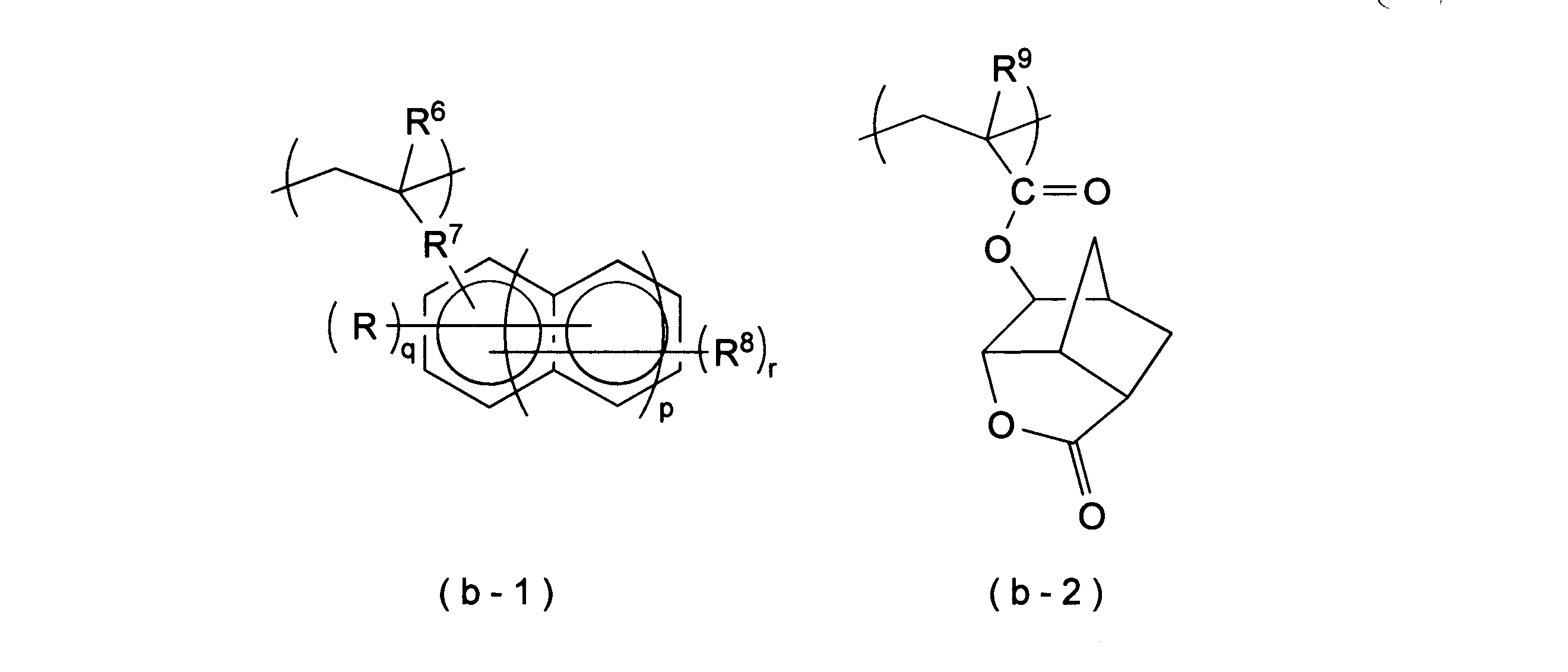
- the polymer further comprises at least one structural unit selected from the group consisting of a structural unit represented by the following formula (b-1) and a structural unit represented by the following formula (b-2): It is preferable to have.
- R 6 is a hydrogen atom or a methyl group
- R 7 is a single bond, —CO—O—, or —CO—NH—
- R 8 has 1 carbon atom.
- the [B] polymer has the specific structural unit described above, whereby the interaction between the [B] polymer and the [A] compound becomes strong. As a result, diffusion of the acid generated from the [A] compound is suppressed, and the resolution and smoothness of the film surface after formation of the resist pattern are further improved.
- the present invention also includes a compound represented by the following formula (1).
- R 1 is a group having a polar group .n, when .R 1 is plural is an integer of 1-4, a plurality of R 1 may be the same or different At least a pair of R 1 may be bonded to each other to form a cyclic structure, A is an (n + 1) -valent alicyclic hydrocarbon group, and M + is a monovalent onium cation.
- the compound of the present invention is preferably represented by the following formula (1-A) or the following formula (1-B).
- R 1 and M + have the same meanings as in Formula (1) above.
- M + and Formula (1-B) M + is, R 1 and R 1 of formula (1-B) of may be the same or different.
- formula (1-a) is optionally be the same or different .
- m 1 is 0 or 1 M 2 is an integer from 0 to 2.
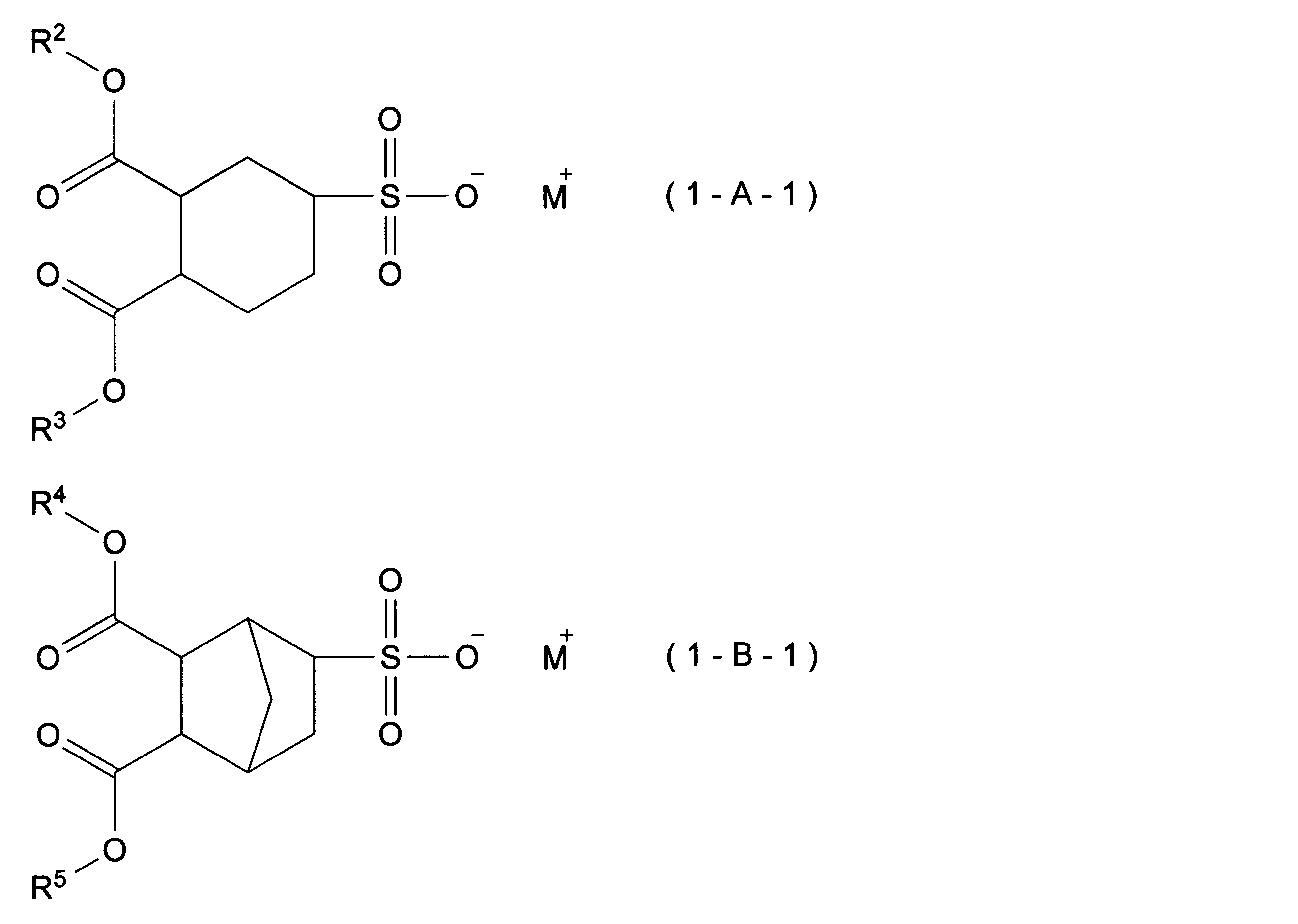
- the compound of the present invention is more preferably a compound represented by the following formula (1-A-1) or the following formula (1-B-1).
- R 2 , R 3 , R 4 and R 5 are each independently linear or branched having 1 to 30 carbon atoms.
- the compound of the present invention is suitably used as an acid generator in a radiation sensitive composition. Since the compound is bulky and highly polar, the radiation-sensitive composition containing the compound as an acid generator is appropriately controlled so that the diffusion length of the acid generated by exposure is short, and the resist film after resolution and pattern formation Excellent surface smoothness. Moreover, since the said compound has a high boiling point, it is hard to volatilize during a pattern formation process and can form a favorable pattern.
- (meth) acrylate means “acrylate” or “methacrylate”.
- the “radiation” of the “radiation-sensitive composition” is a concept including visible light, ultraviolet light, far ultraviolet light, X-rays, charged particle beams and the like.
- the radiation sensitive composition of this invention contains a [A] compound and a [B] polymer. Moreover, a [C] solvent is contained as a suitable component. Furthermore, the radiation-sensitive composition may contain other optional components as long as the intended effect is not impaired.
- a compound is a compound shown by the above-mentioned formula (1).
- the compound [A] is a radiation sensitive acid generator that generates an acid upon exposure. Since the compound [A] has a high solubility in a solvent and a high boiling point, it is difficult to volatilize during the photolithography process and can sufficiently exert its effect as an acid generator. Furthermore, since the compound [A] has a bulky structure and has a polar group, diffusion of acid generated in the resist film is suppressed. As a result, according to the radiation-sensitive composition containing the [A] compound, it is possible to obtain a good resist pattern having excellent resolution and excellent nanoedge roughness suppression.
- R 1 is a group having a polar group.
- n is an integer of 1 to 4.
- R 1 is plural, a plurality of R 1 is, at least one pair of R 1 may be the same or different may form a cyclic structure bonded to each other.
- A is an (n + 1) -valent alicyclic hydrocarbon group.
- M + is a monovalent onium cation.
- R is a chain hydrocarbon group having 1 to 10 carbon atoms or an alicyclic hydrocarbon group having 5 to 20 carbon atoms.
- R ′ is the polar group.
- X is a single bond, a methylene group, an alkylene group having 2 to 10 carbon atoms, an alicyclic hydrocarbon group having 3 to 30 carbon atoms, or an aromatic hydrocarbon group having 6 to 30 carbon atoms.
- the number of polar groups that R 1 has may be one or two or more, but is preferably one. Further, the number of R 1 having a polar group contained in the compound represented by the formula (1) is preferably 1 to 4, more preferably 2 to 4.
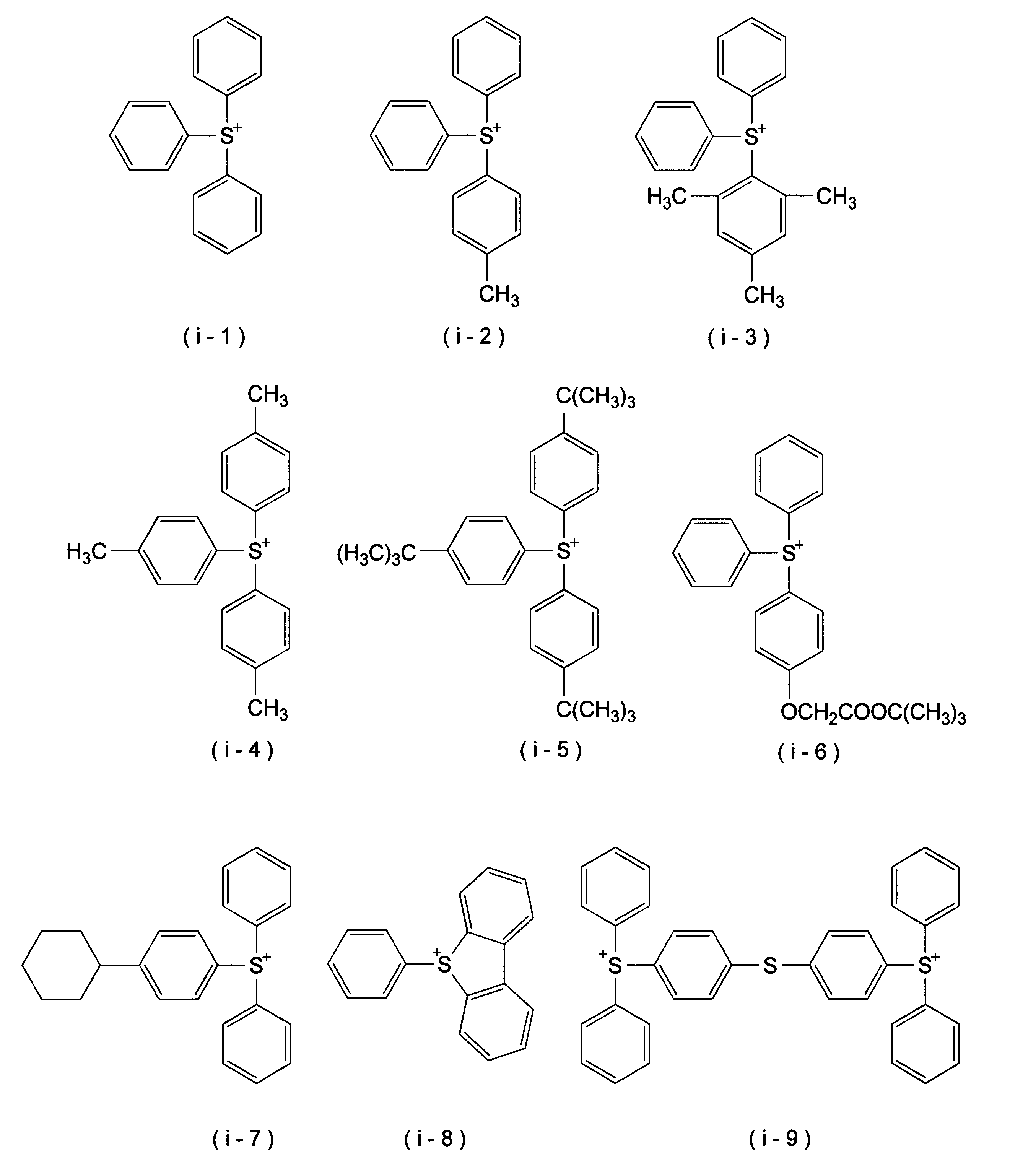
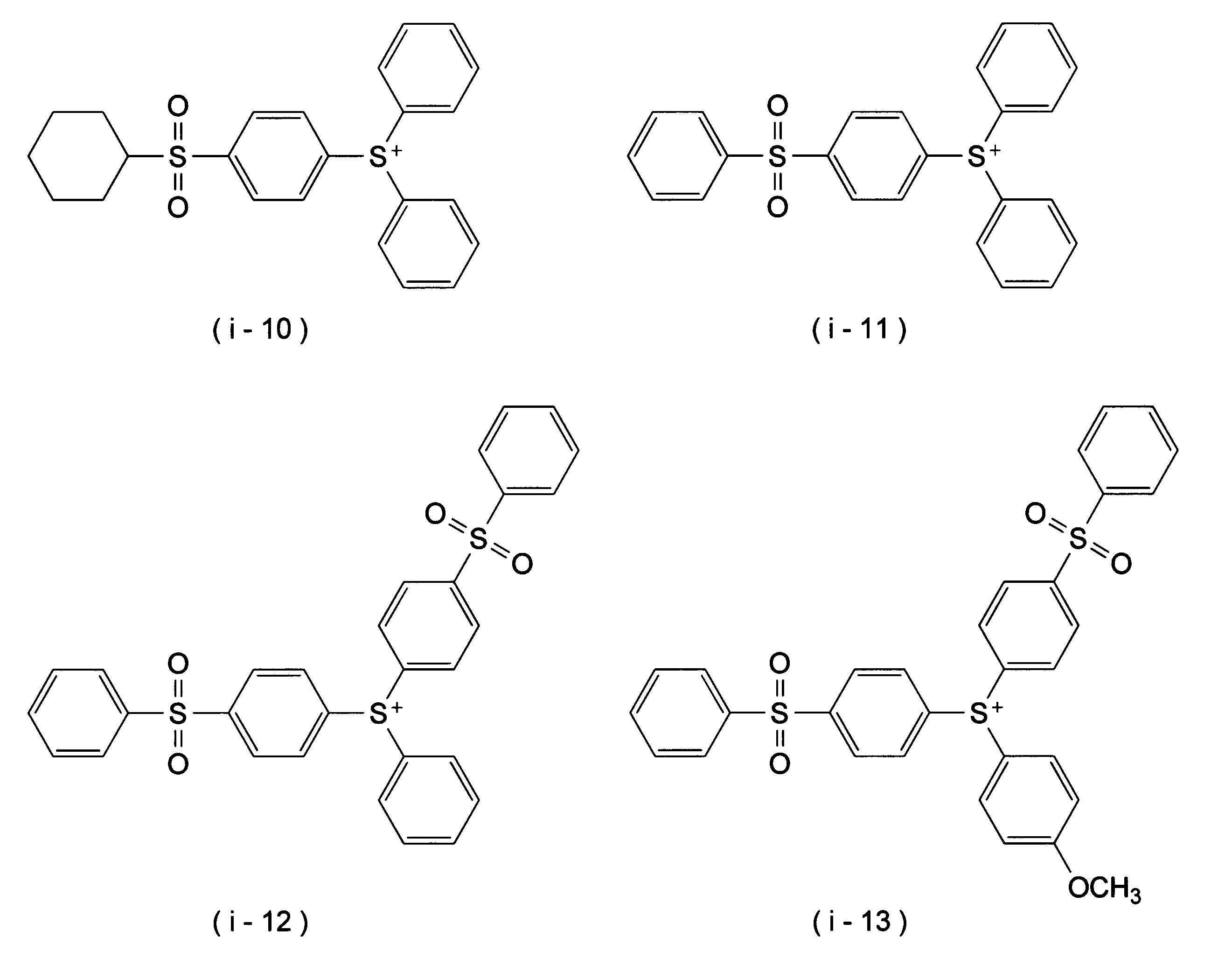
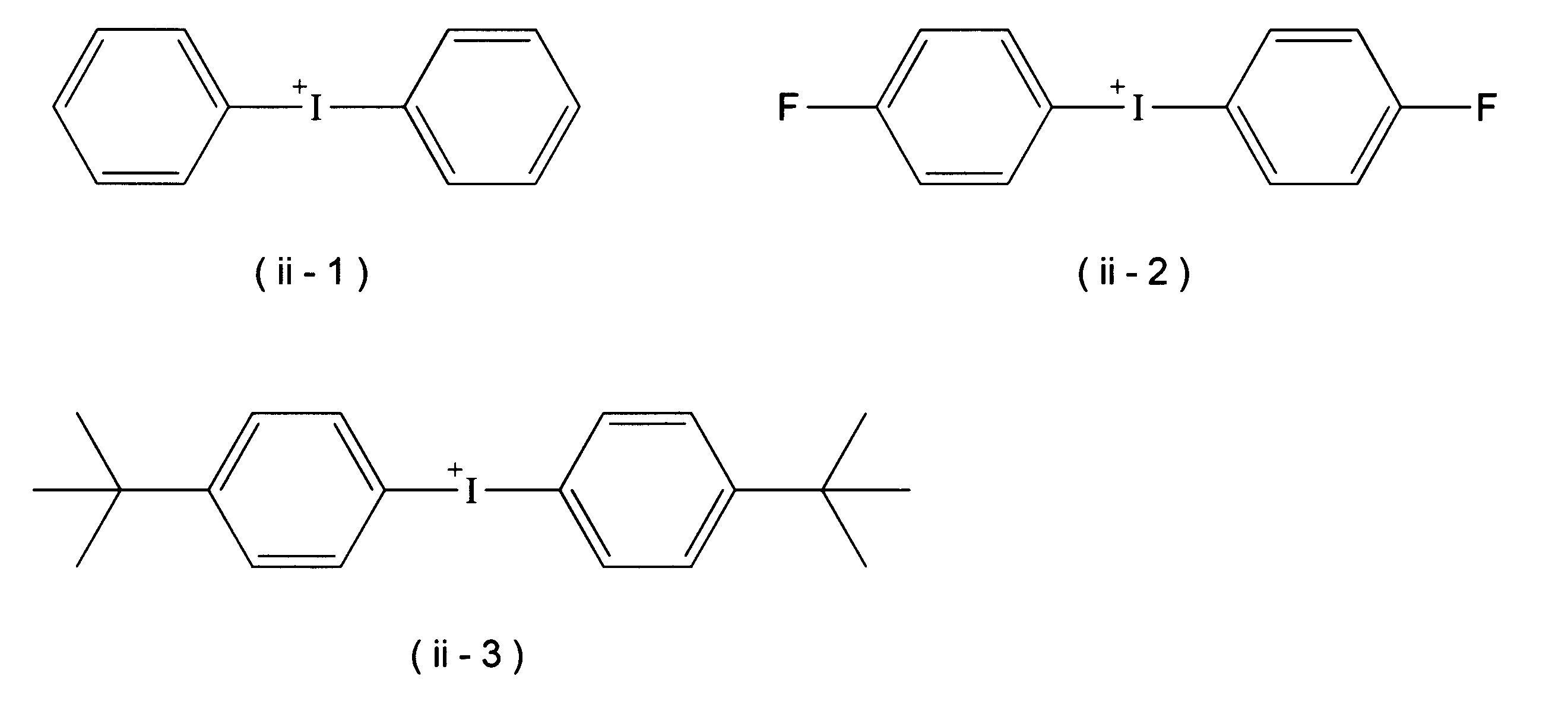
- M + monovalent onium cation examples include onium cations such as O, S, Se, N, P, As, Sb, Cl, Br, and I. Among these, S and I onium cations are preferable.
- R 13 and R 14 are each independently a linear or branched alkyl group having 1 to 10 carbon atoms or an aromatic hydrocarbon group having 6 to 18 carbon atoms. Some or all of the hydrogen atoms of the alkyl group and aromatic hydrocarbon group may be substituted. However, R 13 and R 14 may be bonded to each other to form a cyclic structure together with the iodine atom to which each is bonded.
- Examples of the linear or branched alkyl group having 1 to 10 carbon atoms in R 10 to R 12 include, for example, methyl group, ethyl group, n-propyl group, i-propyl group, n-butyl group, t- Butyl, n-pentyl, i-pentyl, n-hexyl, i-hexyl, n-heptyl, n-octyl, i-octyl, n-nonyl, n-decyl, 2- An ethylhexyl group etc. are mentioned.
- alkyl group may have include, for example, halogen atoms such as fluorine, chlorine, bromine, iodine, hydroxyl group, cyano group, thiol group, alkylthio group, aromatic hydrocarbon group, alkenyl group.
- a keto group in which two hydrogen atoms on the same carbon of a hydrocarbon group are substituted with one oxygen atom can be exemplified. Any number of these substituents may be present as long as structurally possible.
- R 15 to R 17 are each independently a hydrogen atom, a linear or branched alkyl group having 1 to 12 carbon atoms, or an aromatic hydrocarbon having 6 to 12 carbon atoms.
- two or more of R 15 to R 17 may be bonded to each other to form a ring.
- R 15 to R 17 may be the same or different.
- some or all of the hydrogen atoms possessed by the alkyl group and aromatic hydrocarbon group may be substituted.
- R 20 and R 21 are each independently a linear or branched alkyl group having 1 to 12 carbon atoms, an alicyclic hydrocarbon group having 5 to 25 carbon atoms, or an aromatic group having 6 to 12 carbon atoms. It is a hydrocarbon group. Some or all of the hydrogen atoms of the alkyl group, alicyclic hydrocarbon group, and aromatic hydrocarbon group may be substituted.
- q1 to q3 are each independently an integer of 0 to 5.
- Examples of the linear or branched alkyl group having 1 to 12 carbon atoms represented by R 15 to R 17 include a methyl group, an ethyl group, an n-propyl group, an i-propyl group, and an n-butyl group. T-butyl group, n-pentyl group, i-pentyl group, n-hexyl group, i-hexyl group, n-heptyl group, n-octyl group, i-octyl group, n-nonyl group, n-decyl group And 2-ethylhexyl group.
- Examples of the substituent that the alkyl group may have include the same substituents as those exemplified as the substituent that the alkyl group in R 10 to R 12 may have.
- Examples of the linear or branched alkyl group having 1 to 12 carbon atoms represented by R 20 and R 21 include, for example, a methyl group, an ethyl group, an n-propyl group, an i-propyl group, and an n-butyl group.
- 2-ethylhexyl group 2-ethylhexyl group.
- Examples of the alicyclic hydrocarbon group having 5 to 25 carbon atoms represented by R 20 and R 21 include a cyclopentyl group, a cyclohexyl group, a cyclooctyl group, an adamantyl group, and a norbornyl group.
- Examples of the aromatic hydrocarbon group having 6 to 12 carbon atoms represented by R 20 and R 21 include a phenyl group and a naphthyl group.
- Examples of the linear or branched alkyl group having 1 to 8 carbon atoms represented by R 18 include, for example, methyl group, ethyl group, n-propyl group, i-propyl group, n-butyl group, t- Examples thereof include a butyl group, n-pentyl group, i-pentyl group, n-hexyl group, i-hexyl group, n-heptyl group, n-octyl group, i-octyl group, 2-ethylhexyl group and the like.
- Examples of the aromatic hydrocarbon group having 6 to 18 carbon atoms represented by R 13 and R 14 include a phenyl group, a 1-naphthyl group, a 2-naphthyl group, a 1-anthryl group, and a 1-phenanthryl group. Can be mentioned.
- Examples of the substituent that the alkyl group and aromatic hydrocarbon group in the above-described formula (3) may have include the substituent that the alkyl group in R 10 to R 12 in the above-described formula (2) may have. The thing similar to what was illustrated as can be mentioned.
- an onium cation represented by the following formula (3-1) is preferable.
- Examples of the linear or branched alkyl group having 1 to 12 carbon atoms represented by R 22 and R 23 include, for example, a methyl group, an ethyl group, an n-propyl group, an i-propyl group, and an n-butyl group. 2-methylpropyl group, 1-methylpropyl group, t-butyl group and the like.
- iodonium cations represented by the above formula (3-1) those represented by the following formulas (ii-1) to (ii-3) are preferable. Of these, those represented by (ii-1) or (ii-2) are more preferred.
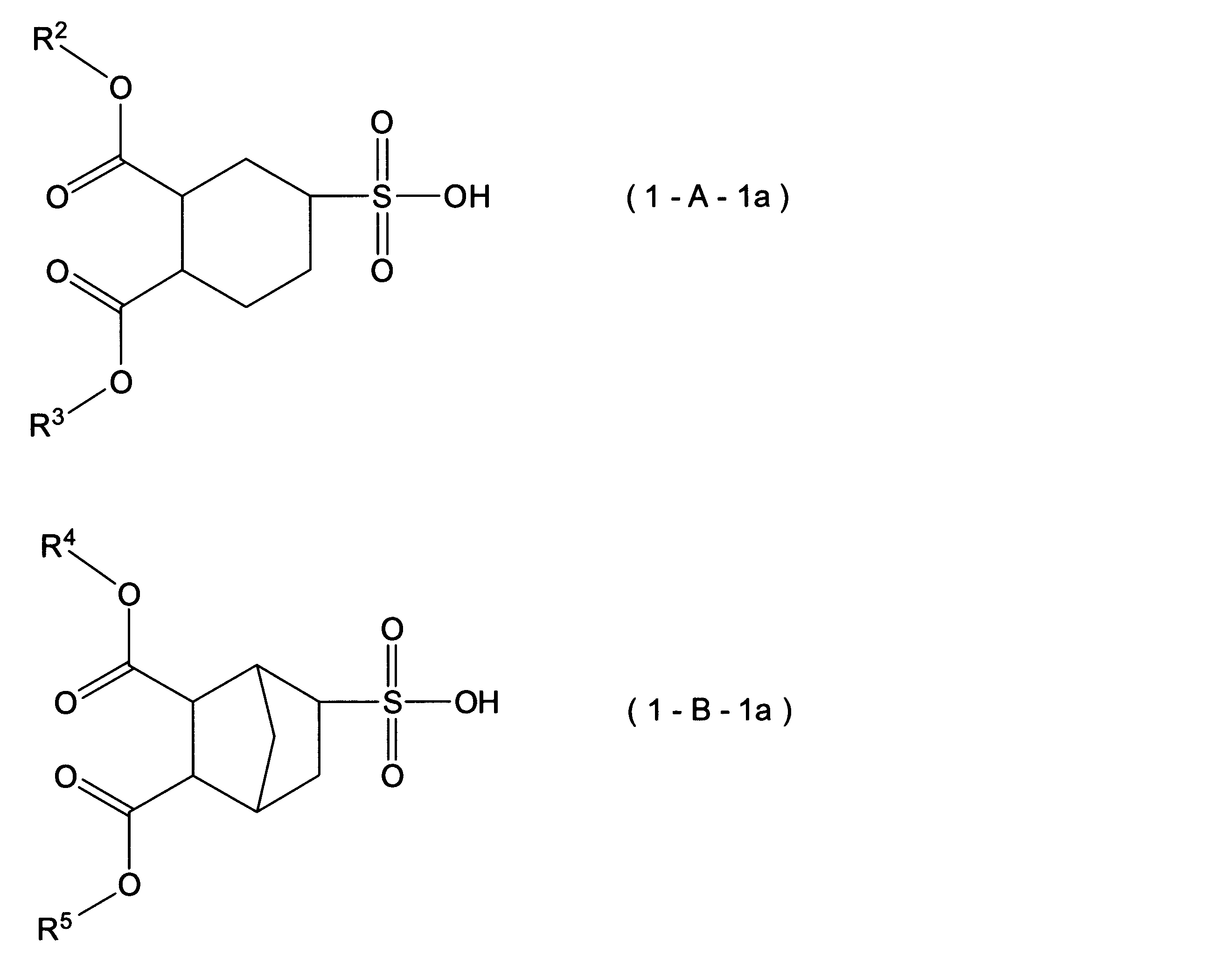
- the compound [A] contained in the radiation-sensitive composition of the present invention dissociates the monovalent onium cation (M + ) by exposure or heating, and generates an acid. Specifically, it generates a sulfonic acid represented by the following formula (1a), preferably a sulfonic acid represented by the following formula (1-A-1a) or the following formula (1-B-1a) Is generated.
- R 1 and A have the same meanings as the above formula (1).
- R 2 and R 3 have the same meanings as the above formula (1-A-1).
- R 4 and R 6 represent the above formula ( It is synonymous with 1-B-1).
- the [A] compound represented by the above formula (1) is selected from the group consisting of the compound represented by the above formula (1-A) and the compound represented by the above formula (1-B).
- the compound is at least one compound.
- R 1 and M + have the same meaning as in formula (1) above.
- M + is of the formula (1-A) of the M + and Equation (1-B), it may be the same or different.
- R 1 and R 1 of formula (1-B) of the formula (1-A) may be the same or different.
- m 1 is 0 or 1.
- m 2 is an integer of 0-2.
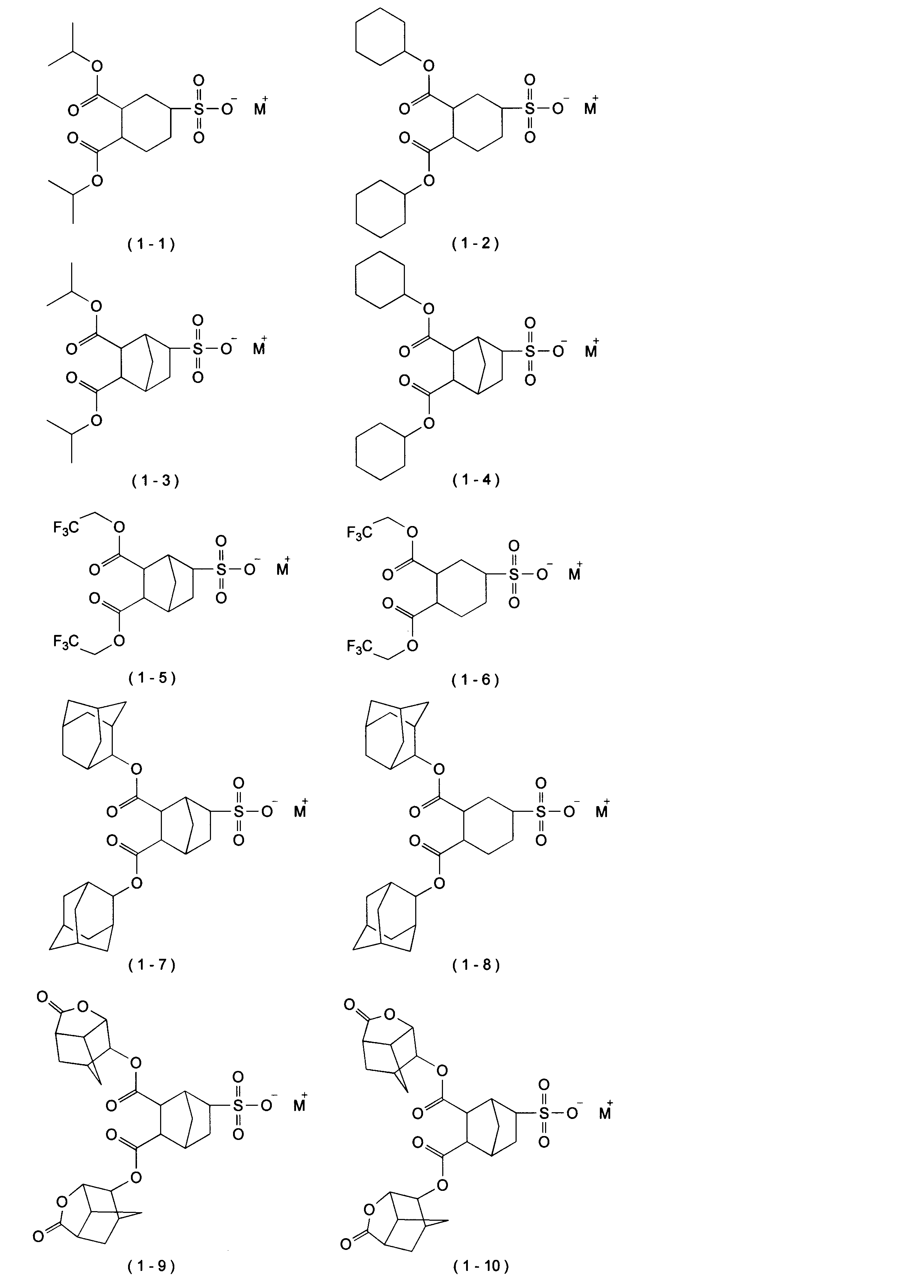
- the compound represented by the above formula (1-A) is a compound represented by the following formula (1-A-1), and the compound represented by the above formula (1-B) is represented by the following formula (1- A compound represented by B-1) is particularly preferred.
- Examples of the linear or branched hydrocarbon group having 1 to 30 carbon atoms represented by R 2 , R 3 , R 4 and R 5 include, for example, a methyl group, an ethyl group, an n-propyl group, i- Propyl group, n-butyl group, t-butyl group, n-pentyl group, i-pentyl group, n-hexyl group, i-hexyl group, n-heptyl group, n-octyl group, i-octyl group, n- Nonyl group, n-decyl group, 2-ethylhexyl group, n-dodecyl group and the like can be mentioned.
- linear or branched hydrocarbon group having 1 to 30 carbon atoms substituted with the above substituent examples include benzyl group, methoxymethyl group, methylthiomethyl group, ethoxymethyl group, phenoxymethyl group, and methoxycarbonylmethyl.
- Examples of the alicyclic hydrocarbon group having 3 to 30 carbon atoms represented by R 2 , R 3 , R 4 and R 5 include a cyclopropyl group, a cyclobutyl group, a cyclopentyl group, a cyclohexyl group, a bornyl group, a norbornyl group, Examples thereof include an adamantyl group, a pinanyl group, a tuyoyl group, a carbyl group, and a camphanyl group.
- Examples of the substituent that the alicyclic hydrocarbon group having 3 to 30 carbon atoms may have are those exemplified as the substituent that the alkyl group in R 10 to R 12 in the above formula (2) may have. The same thing is mentioned.
- Examples of the alicyclic hydrocarbon group having 3 to 30 carbon atoms substituted with the above substituent include, for example, 4-fluorocyclohexyl group, 4-hydroxycyclohexyl group, 4-methoxycyclohexyl group, 4-methoxycarbonylcyclohexyl group, 3 -Hydroxy-1-adamantyl group, 3-methoxycarbonyl-1-adamantyl group, 3-hydroxycarbonyl-1-adamantyl group and the like can be mentioned.
- Examples of the aromatic hydrocarbon group having 6 to 30 carbon atoms represented by R 2 , R 3 , R 4 and R 5 include a phenyl group, a 1-naphthyl group, a 2-naphthyl group, a 1-anthryl group, and 1 A phenanthryl group and the like.
- Examples of the substituent that the aromatic hydrocarbon group having 6 to 30 carbon atoms may have include those exemplified as the substituent that the alkyl group in R 10 to R 12 of the above formula (2) may have. The same can be mentioned.
- aromatic hydrocarbon group having 6 to 30 carbon atoms substituted with the above substituent examples include, for example, o-hydroxyphenyl group, m-hydroxyphenyl group, p-hydroxyphenyl group, and 3,5-bis (hydroxy) phenyl.
- Monocyclic or polycyclic lactones include ⁇ -butyrolaclone, ⁇ -valerolactone, angelica lactone, ⁇ -hexanolactone, ⁇ -heptanolactone, ⁇ -octanolactone, ⁇ -nonanolactone, 3-methyl-4 -Octanolide (whiskey lactone), ⁇ -decanolactone, ⁇ -undecanolactone, ⁇ -dodecanolactone, ⁇ -jasmolactone (7-decenolactone), ⁇ -hexanolactone, 4, 6, 6 (4, 4, 6) -trimethyltetrahydropyran-2-one, ⁇ -octanolactone, ⁇ -nonanolactone, ⁇ -decanolactone, ⁇ -2-decenolactone, ⁇ -undecanolactone, ⁇ -dodecanolactone, ⁇ -tridecanolactone, ⁇ -Tetrade
- Examples of the substituent that the heterocyclic group may have include those exemplified as the substituents that the alkyl group in R 10 to R 12 of the above formula (2) may have. .
- heterocyclic group having 4 to 30 carbon atoms substituted with the above substituent examples include a 2-bromofuryl group and a 3-methoxythienyl group.
- the method for synthesizing the [A] compound is not particularly limited.
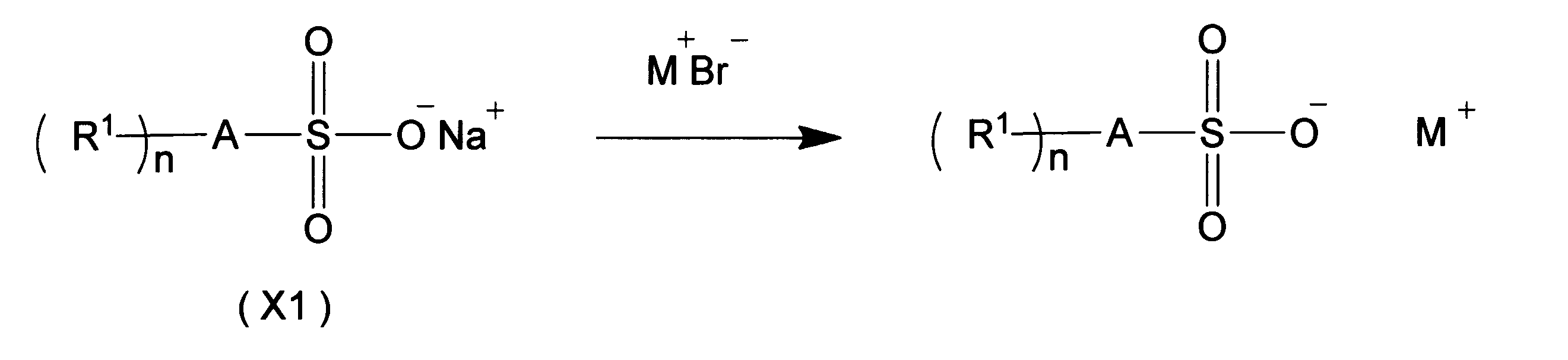
- a compound represented by the following formula (X1) or (X2) is converted to a desired onium cation (M + ) Halide (for example, M + Br ⁇ ) in an aqueous solution.
- the content of the [A] compound in the radiation-sensitive composition of the present invention is usually 0.1 to 50 parts by weight, preferably 1 to 40 parts by weight, based on 100 parts by weight of the [B] polymer described later. Further, 5 to 30 parts by mass is more preferable. [A] By making content of a compound into the said specific range, the said radiation sensitive composition is excellent in resolution.
- the radiation-sensitive composition of the present invention contains a [B] polymer in addition to the [A] compound.
- the polymer is a polymer having a structural unit containing an acid dissociable group (hereinafter also referred to as “structural unit (III)”).
- the radiation-sensitive composition contains a [B] polymer having an acid-dissociable group, so that the acid-dissociable group is dissociated using an acid generated from the [A] compound upon exposure as a catalyst, and dissolved in a developer. The speed changes and a resist pattern can be formed.
- the [B] polymer of the present invention comprises a structural unit represented by the above formula (b-1) (hereinafter also referred to as “structural unit (I)”) and a structural unit represented by (b-2) (hereinafter referred to as “structural unit (I)”). It is preferable to further have at least one structural unit selected from the group consisting of “structural unit (II)”. Moreover, you may have another structural unit (IV).
- R 6 is a hydrogen atom or a methyl group.
- R 7 is a single bond, —CO—O—, or —CO—NH—.
- R 8 is a linear or branched alkyl group having 1 to 12 carbon atoms, a linear or branched alkoxyl group having 1 to 12 carbon atoms, or an acyloxy group having 2 to 12 carbon atoms.
- R is a hydroxyl group or a group containing a hydroxyl group.
- p is 0 or 1.
- q and r are each independently an integer of 0 to 3. However, when p is 0, the condition of q + r ⁇ 5 is satisfied. If R 8 is plural, a plurality of R 8 may be the same or different.
- R 9 represents a hydrogen atom or a methyl group.
- R 7 is preferably —CO—O— from the viewpoint of excellent nanoedge roughness.
- Examples of the linear or branched alkyl group having 1 to 12 carbon atoms represented by R 8 include a methyl group, an ethyl group, an n-propyl group, an i-propyl group, an n-butyl group, and 2-methylpropyl. Group, 1-methylpropyl group, t-butyl group and the like. Among these, a methyl group, an ethyl group, an n-butyl group, and a t-butyl group are preferable from the viewpoint of excellent nanoedge roughness.
- Examples of the acyloxy group having 2 to 12 carbon atoms represented by R 8 include an acetoxy group, a propionyloxy group, a butyryloxy group, and a pentylcarbonyloxy group. Among these, an acetoxy group is preferable because of excellent nano edge roughness.
- Examples of the group containing a hydroxyl group represented by R include a part of hydrogen atoms possessed by a linear or branched alkyl group having 1 to 12 carbon atoms, an alicyclic hydrocarbon group having 3 to 12 carbon atoms, or the like. Examples include groups that are all substituted with hydroxyl groups. In addition, some hydrogen atoms which the said alkyl group and alicyclic hydrocarbon group have may be substituted by groups other than hydroxyl groups, such as a fluorine atom.
- linear or branched alkyl group having 1 to 12 carbon atoms examples include the same groups as those exemplified as the linear or branched alkyl group having 1 to 12 carbon atoms represented by R 8. .
- the group containing a hydroxyl group represented by R is preferably a group in which part or all of the hydrogen atoms of a linear or branched alkyl group having 1 to 12 carbon atoms are substituted with a hydroxyl group. More preferred is a group in which part or all of the hydrogen atoms of the linear or branched alkyl group of 5 are substituted with hydroxyl groups, and the hydrogen of the linear or branched alkyl group having 1 to 5 carbon atoms. A group in which a part of the atoms is substituted with a hydroxyl group and all the remaining hydrogen atoms are substituted with fluorine atoms is more preferable.
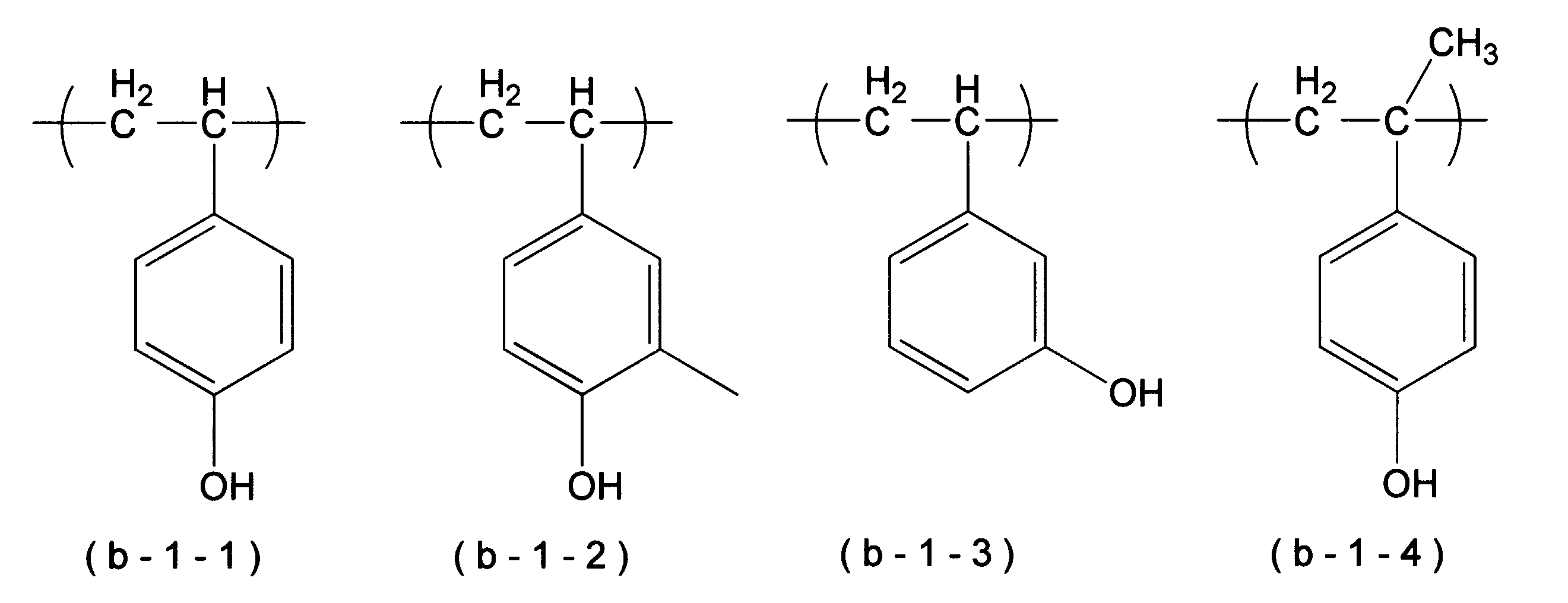
- the structural units represented by the above formulas (b-1-1) to (b-1-4) can be obtained by using the corresponding hydroxystyrene derivative as a monomer. Moreover, it can also obtain by using as a monomer the compound from which a hydroxy styrene derivative is obtained by hydrolyzing.
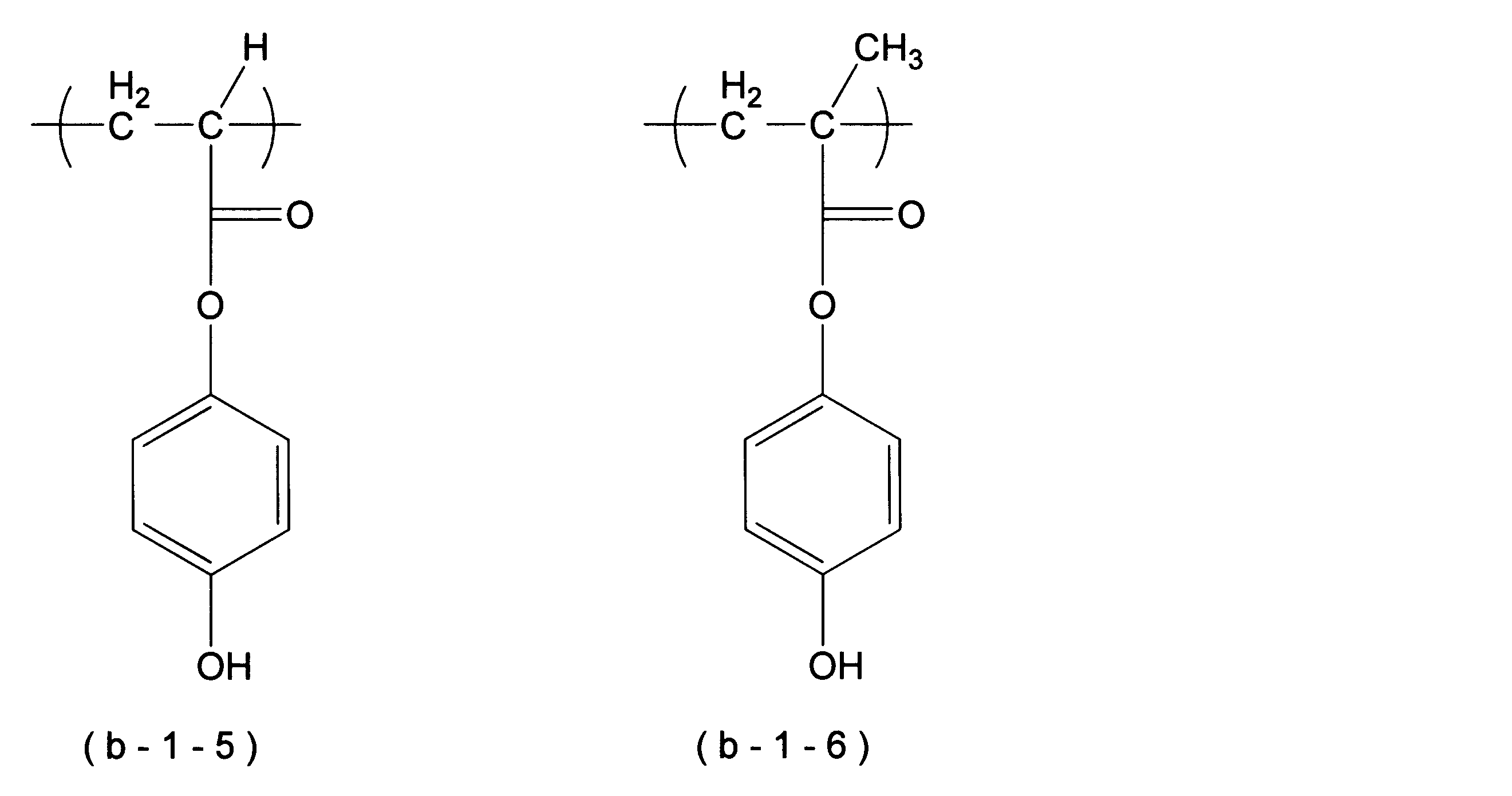
- Examples of the monomer used for generating the structural unit include 4-hydroxyphenyl acrylate and 4-hydroxyphenyl methacrylate.
- Examples of the monomer used for generating the structural unit include N- (4-hydroxyphenyl) acrylamide, N- (4-hydroxyphenyl) methacrylamide and the like.
- Examples of the monomer used for generating the structural unit include 5-hydroxynaphthalen-1-yl methacrylate and 5-hydroxynaphthalen-1-yl acrylate.
- examples of the case where R is a group containing a hydroxyl group include structural units represented by the following formulas (b-1-11) and (b-1-12).
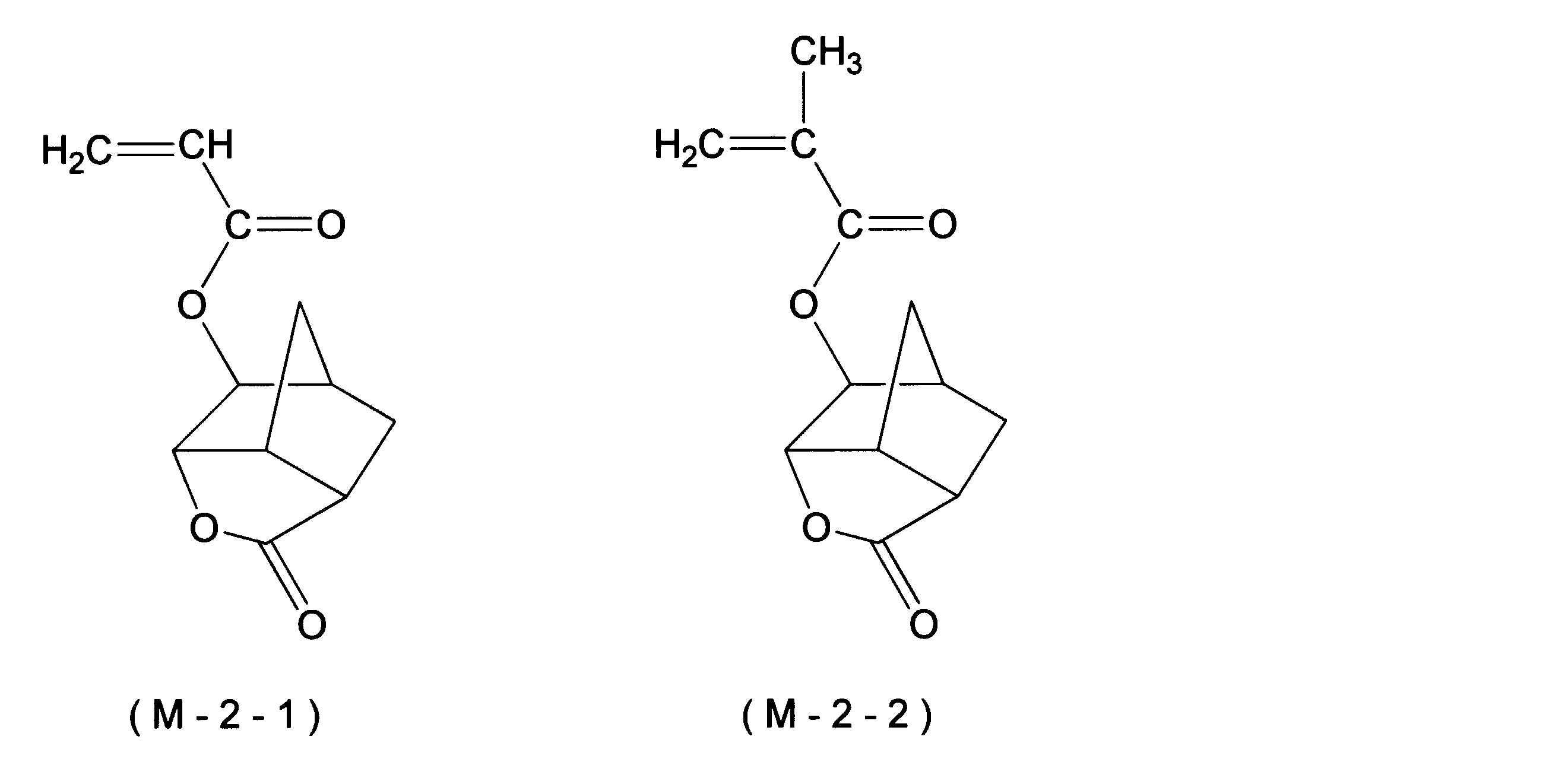
- Examples of the monomer used to generate the structural unit represented by the above formula (b-2) include those represented by the following formula (M-2-1) and the following formula (M-2-2). And the like.
- R 24 represents a hydrogen atom, a methyl group, a trifluoromethyl group or a hydroxymethyl group.
- R 25 to R 27 are each independently a linear or branched alkyl group having 1 to 4 carbon atoms, an aromatic hydrocarbon group having 6 to 22 carbon atoms, or an alicyclic carbon group having 4 to 20 carbon atoms.
- R 25 and R 26 may be bonded to each other to form a divalent alicyclic hydrocarbon group or a group derived therefrom with the carbon atom to which each is bonded.
- R 28 represents a hydrogen atom, a methyl group, a trifluoromethyl group or a hydroxymethyl group.
- R 29 to R 31 are each independently an alicyclic hydrocarbon group having 4 to 20 carbon atoms or a group derived therefrom. However, R 29 and R 30 may be bonded to each other to form a divalent alicyclic hydrocarbon group or a group derived therefrom with the carbon atom to which each is bonded.
- Examples of the alicyclic hydrocarbon group having 4 to 20 carbon atoms represented by R 25 to R 27 include a norbornyl group, a tricyclodecyl group, a tetracyclododecyl group, an adamantyl group, a cyclobutyl group, a cyclopentyl group, and a cyclohexyl group. Group, cycloheptyl group, cyclooctyl group and the like.
- Examples of the group derived from the alicyclic hydrocarbon group include a part or all of the hydrogen atoms of the alicyclic hydrocarbon group, for example, a methyl group, an ethyl group, an n-propyl group, an i- Groups substituted with linear, branched or cyclic alkyl groups having 1 to 4 carbon atoms such as propyl group, n-butyl group, 2-methylpropyl group, 1-methylpropyl group, t-butyl group, etc. Is mentioned.
- Some or all of the hydrogen atoms possessed by the aromatic hydrocarbon group may be substituted.
- the substituent include a methyl group, ethyl group, hydroxyl group, carboxyl group, halogen atom (fluorine atom, chlorine atom, bromine atom, etc.), alkoxyl group (methoxy group, ethoxy group, propoxy group, butoxy group, etc.) And an alkyloxycarbonyl group.
- Examples of the divalent alicyclic hydrocarbon group formed by combining R 25 and R 26 together with the carbon atom to which each R 25 and R 26 are bonded (the carbon atom bonded to the oxygen atom) include, for example, the number of carbon atoms Examples thereof include 4 to 20 divalent alicyclic hydrocarbon groups. Specific examples include a norbornanediyl group, a tricyclodecanediyl group, a tetracyclododecanediyl group, an adamantanediyl group, a cyclopentanediyl group, and a cyclohexanediyl group.
- the radiation-sensitive composition can form an excellent resist pattern due to nanoedge roughness.
- R 24 to R 27 have the same meanings as the above formula (p-1).
- a monovalent alicyclic hydrocarbon group having 4 to 20 carbon atoms or a group derived therefrom, and R 25 and R 26 may be bonded to each other and formed together with the carbon atoms to which they are bonded. Examples thereof include the same groups as those exemplified for the good divalent alicyclic hydrocarbon group or a group derived therefrom.
- the [B] polymer may contain only one type of structural unit (III-2), or may contain two or more types.
- the polymer may further contain a structural unit (IV) derived from a non-acid dissociable compound as another structural unit.
- a non-acid dissociable compound means a compound that does not contain a group (acid dissociable group) that dissociates by the action of an acid.
- Non-acid dissociable compounds that give structural units (IV) include, for example, styrene, ⁇ -methylstyrene, 4-methylstyrene, 2-methylstyrene, 3-methylstyrene, isobornyl acrylate, tricyclodecanyl (meta ) Acrylate, tetracyclododecenyl (meth) acrylate, and the like.
- styrene, ⁇ -methylstyrene, 4-methylstyrene, 2-methylstyrene, 3-methylstyrene, and tricyclodecanyl acrylate are preferable.
- only one type of structural unit (IV) may be contained in the [B] polymer, or two or more types may be contained.
- the total content of the structural units (I) and (II) in the polymer is 95 mol% or less when the total of all the structural units contained in the [B] polymer is 100 mol%.
- 1 to 95 mol% is more preferable, 10 to 95 mol% is more preferable, and 40 to 80 mol% is particularly preferable.
- the radiation-sensitive composition can form an excellent resist film due to nanoedge roughness. it can.
- the total content of the structural units (I), (II), and (III) in the polymer is [B] when the total of all the structural units contained in the polymer is 100 mol%. 10 mol% or more is preferable, 40 to 100 mol% is more preferable, and 50 to 100 mol% is still more preferable. [B] By making the total content of the structural units (I), (II) and (III) in the polymer within the specific range, the radiation-sensitive composition forms an excellent resist film due to nanoedge roughness. can do.
- the method for synthesizing the polymer is not particularly limited, and can be obtained, for example, by known radical polymerization or anionic polymerization. Moreover, the phenol part or naphthol part of the side chain in the structural unit (I) is obtained by hydrolyzing the obtained [B] polymer in the presence of a base or an acid in an organic solvent. Obtainable.
- a polymerization aid such as 2,2,6,6-tetramethyl-1-piperidinyloxy, iodine, mercaptan, styrene dimer can be added as necessary.
- the reaction temperature in the radical polymerization is not particularly limited and can be appropriately set depending on the kind of the initiator, but can be set to, for example, 50 ° C. to 200 ° C.
- a temperature at which the half life of the initiator is about 10 minutes to about 30 hours is preferable, and a temperature at which the half life of the initiator is about 30 minutes to about 10 hours. More preferably it is.
- reaction time varies depending on the type of initiator and the reaction temperature, but the reaction time during which 50% or more of the initiator is consumed is preferable, and in many cases, about 0.5 to 24 hours.
- reaction time varies depending on the type of initiator and the reaction temperature, but the reaction time during which 50% or more of the initiator is consumed is preferable, and in many cases, about 0.5 to 24 hours.
- examples of the base that can be used for the hydrolysis reaction include Inorganic bases such as potassium hydroxide, sodium hydroxide, sodium carbonate and potassium carbonate; organic bases such as triethylamine, N-methyl-2-pyrrolidone, piperidine and tetramethylammonium hydroxide.
- Inorganic bases such as potassium hydroxide, sodium hydroxide, sodium carbonate and potassium carbonate
- organic bases such as triethylamine, N-methyl-2-pyrrolidone, piperidine and tetramethylammonium hydroxide.
- organic solvent examples include ketones such as acetone, methyl ethyl ketone, and methyl amyl ketone; ethers such as diethyl ether and tetrahydrofuran (THF); alcohols such as methanol, ethanol, and propanol.
- ketones such as acetone, methyl ethyl ketone, and methyl amyl ketone
- ethers such as diethyl ether and tetrahydrofuran (THF)
- alcohols such as methanol, ethanol, and propanol.
- Aliphatic hydrocarbons such as hexane, heptane and octane; Aromatic hydrocarbons such as benzene, toluene and xylene; Alkyl halides such as chloroform, bromoform, methylene chloride, methylene bromide and carbon tetrachloride; Acetic acid Esters such as ethyl, butyl acetate, ethyl lactate, propylene glycol monomethyl ether, propylene glycol monomethyl ether acetate, cellosolves; dimethylformamide, dimethyl sulfoxide, hexamethylphosphoroamide, etc. Protic polar solvents, and the like.
- the ratio (Mw / Mn) between the polymer Mw and the polystyrene-equivalent number average molecular weight (Mn) measured by GPC is preferably 1 to 5, more preferably 1 to 3, More preferably, it is 1 to 2.5.
- the said radiation sensitive composition may contain only 1 type of the above-mentioned [B] polymer, and may contain 2 or more types.
- ethylene glycol monoalkyl ether acetates examples include ethylene glycol monomethyl ether acetate, ethylene glycol monoethyl ether acetate, ethylene glycol mono-n-propyl ether acetate, and ethylene glycol mono-n-butyl ether acetate.
- the solvent may contain other solvents other than ethylene glycol monoalkyl ether acetates and propylene glycol monoalkyl ether acetates.
- the other solvent examples include propylene glycol monoalkyl ethers such as propylene glycol monomethyl ether, propylene glycol monoethyl ether, propylene glycol mono-n-propyl ether and propylene glycol mono-n-butyl ether; propylene glycol dimethyl ether, propylene And propylene glycol dialkyl ethers such as glycol diethyl ether, propylene glycol di-n-propyl ether, and propylene glycol di-n-butyl ether.
- propylene glycol monoalkyl ethers such as propylene glycol monomethyl ether, propylene glycol monoethyl ether, propylene glycol mono-n-propyl ether and propylene glycol mono-n-butyl ether
- propylene glycol dimethyl ether propylene glycol dimethyl ether
- propylene And propylene glycol dialkyl ethers such as glycol diethyl ether
- lactate esters such as methyl lactate, ethyl lactate, n-propyl lactate, i-propyl lactate; formate esters such as n-amyl formate and i-amyl formate; ethyl acetate, n-propyl acetate, acetic acid Acetic esters such as i-propyl, n-butyl acetate, i-butyl acetate, n-amyl acetate, i-amyl acetate, 3-methoxybutyl acetate, 3-methyl-3-methoxybutyl acetate; i-propyl propionate , Propionates such as n-butyl propionate, i-butyl propionate, 3-methyl-3-methoxybutyl propionate; ethyl hydroxyacetate, ethyl 2-hydroxy-2-methylpropionate, 2-hydroxy- Methyl 3-methylbutyrate, ethy
- the amount of the solvent is preferably such that the total solid concentration of the radiation-sensitive composition is 1 to 70% by mass, more preferably 1 to 15% by mass, and 1 to 10% by mass. More preferred is an amount of When the blending amount is within the specific range, the radiation-sensitive composition is excellent in coatability and can form a resist film having a sufficient thickness.
- the radiation-sensitive composition is an optional component other than the [A] compound and [B] polymer as essential components and the [C] solvent as a preferred component, as long as the intended effect of the present invention is not impaired. Ingredients can be included. As other optional components, various additives such as [D] acid diffusion controller, other radiation sensitive acid generators other than [A] compounds, surfactants, sensitizers, aliphatic additives and the like are further included. Can be contained.
- the acid diffusion controlling agent has a function of controlling the diffusion phenomenon in the resist film of an acid generated from the [A] compound by exposure and suppressing an undesirable chemical reaction in a non-exposed region.
- the storage stability of the resulting radiation-sensitive composition is improved by including such a [D] acid diffusion controller.
- the resolution of the resist film formed from the radiation-sensitive composition is further improved, and a change in the line width of the resist pattern due to fluctuations in the holding time (PED) from the exposure to the heat treatment after the exposure is suppressed.
- PED holding time
- Examples of the acid diffusion controller include nitrogen-containing organic compounds and photosensitive basic compounds.
- nitrogen-containing organic compound examples include a compound represented by the following formula (4) (hereinafter, also referred to as “nitrogen-containing compound (i)”), a compound having two nitrogen atoms in the same molecule (hereinafter, “ A nitrogen-containing compound (ii) "), a polyamino compound or polymer having 3 or more nitrogen atoms (hereinafter collectively referred to as” nitrogen-containing compound (iii) "), an amide group-containing compound, a urea compound, And nitrogen-containing heterocyclic compounds.
- nitrogen-containing compound (i) a compound represented by the following formula (4)
- a nitrogen-containing compound (ii) a compound having two nitrogen atoms in the same molecule
- a nitrogen-containing compound (ii) a polyamino compound or polymer having 3 or more nitrogen atoms
- an amide group-containing compound a urea compound
- nitrogen-containing heterocyclic compounds examples include a compound represented by the following formula (4) (hereinafter, also referred to as “nitro
- each R 41 is independently a hydrogen atom, a linear, branched or cyclic alkyl group, an aromatic hydrocarbon group, or an aralkyl group. Some or all of the hydrogen atoms of the hydrocarbon group and aralkyl group may be substituted.
- Examples of the nitrogen-containing compound (i) represented by the above formula (4) include mono (cyclohexane) such as n-hexylamine, n-heptylamine, n-octylamine, n-nonylamine, n-decylamine and cyclohexylamine.
- alkylamines such as cyclohexylmethylamine, dicyclohexylamine; triethylamine, tri-n-propylamine, tri-n-butylamine, tri-n-pentylamine, tri-n-hexylamine, tri-n- Heptylamine, tri-n-octylamine, tri-n-nonylamine, tri-n-decylamine
- Di (cyclo) alkylamines such as cyclohexylmethylamine, dicyclohexylamine; triethylamine, tri-n-propylamine, tri-n-butylamine, tri-n-pentylamine, tri-n-hexylamine, tri-n- Heptylamine, tri-n-octylamine, tri-n-nonylamine, tri-n-de Tri (cyclo) alkylamines such as ruamine, cyclohexyldimethylamine,
- nitrogen-containing compound (ii) examples include ethylenediamine, N, N, N ′, N′-tetramethylethylenediamine, tetramethylenediamine, hexamethylenediamine, 4,4′-diaminodiphenylmethane, and 4,4′-diaminodiphenyl ether.
- nitrogen-containing compound (iii) examples include polymers of polyethyleneimine, polyallylamine, 2-dimethylaminoethylacrylamide, and the like.
- urea compounds include urea, methylurea, 1,1-dimethylurea, 1,3-dimethylurea, 1,1,3,3-tetramethylurea, 1,3-diphenylurea, tri-n-butylthiourea. Etc.
- nitrogen-containing heterocyclic compound examples include imidazole, 4-methylimidazole, 4-methyl-2-phenylimidazole, benzimidazole, 2-phenylbenzimidazole, 1-benzyl-2-methylimidazole, 1-benzyl-2- Imidazoles such as methyl-1H-imidazole; pyridine, 2-methylpyridine, 4-methylpyridine, 2-ethylpyridine, 4-ethylpyridine, 2-phenylpyridine, 4-phenylpyridine, 2-methyl-4-phenylpyridine , Nicotine, nicotinic acid, nicotinamide, quinoline, 4-hydroxyquinoline, 8-oxyquinoline, acridine, pyridines such as 2,2 ′: 6 ′, 2 ′′ -terpyridine; piperazine, 1- (2-hydroxy In addition to piperazines such as ethyl) piperazine, Razine, pyrazole, pyridazine, quinosaline, purine,
- the photosensitive basic compound is not particularly limited as long as it has the above-mentioned properties, and examples thereof include compounds represented by the following formulas (5-1) and (5-2).
- R 51 to R 53 each independently represents a hydrogen atom, a halogen atom, an alkyl group having 1 to 10 carbon atoms, an alicyclic hydrocarbon group, or a —OSO 2 —R 56 group. Or —SO 2 —R 57 group, wherein R 56 and R 57 are each independently an alkyl group having 1 to 10 carbon atoms, an alicyclic hydrocarbon group, or an aromatic hydrocarbon group.
- Two or more of R 51 to R 53 may be bonded to each other to form a cyclic structure, and A ⁇ is OH ⁇ , R 58 O ⁇ , or R 58 COO — .
- R 58 is a monovalent organic group.
- R 54 and R 55 each independently represent a hydrogen atom, a halogen atom, an alkyl group having 1 to 10 carbon atoms, or an alicyclic hydrocarbon group.
- a ⁇ is OH ⁇ , R 59 O ⁇ , or R 59 COO — .
- R59 is a monovalent organic group.
- one part or all part of the hydrogen atom which the said alkyl group, alicyclic hydrocarbon group, and aromatic hydrocarbon group have may be substituted.
- Examples of the halogen atom represented by R 51 to R 53 in the above formula (5-1) include a fluorine atom and a bromine atom.
- Examples of the alkyl group having 1 to 10 carbon atoms represented by R 51 to R 57 in the formulas (5-1) and (5-2) include a methyl group, an ethyl group, an n-propyl group, and i-propyl. Group, n-butyl group, 2-methylpropyl group, 1-methylpropyl group, t-butyl group and the like.
- the alkyl group includes a hydroxyl group, a carboxyl group, a halogen atom (fluorine atom, bromine atom, etc.), an alkoxyl group (methoxy group, ethoxy group, propoxy group, butoxy group, t-butoxy group, etc.), alkyloxycarbonyl group. It may be substituted with a substituent such as (t-butoxycarbonylmethyloxy group and the like).
- Examples of the alicyclic hydrocarbon group represented by R 51 to R 57 include an alicyclic hydrocarbon group having 5 to 25 carbon atoms. Specific examples include a cyclopentyl group and a cyclohexyl group.
- the alicyclic hydrocarbon group includes a hydroxyl group, a carboxyl group, a halogen atom (fluorine atom, bromine atom, etc.), an alkoxyl group (methoxy group, ethoxy group, propoxy group, butoxy group, t-butoxy group, etc.), It may be substituted with a substituent such as an alkyloxycarbonyl group (such as t-butoxycarbonylmethyloxy group).
- Examples of the aromatic hydrocarbon group represented by R 56 and R 57 include an aromatic hydrocarbon group having 6 to 12 carbon atoms. Specific examples include a phenyl group and a naphthyl group.
- the aromatic hydrocarbon group includes a halogen atom such as fluorine, chlorine, bromine and iodine, a hydroxyl group, a thiol group, an alkyl group, and a hetero atom (for example, a halogen atom, an oxygen atom, a nitrogen atom, a sulfur atom, And may be substituted with a substituent such as an organic group containing a phosphorus atom, a silicon atom, or the like.
- R 51 to R 55 in the above formulas (5-1) and (5-2) are each preferably a hydrogen atom, a methyl group, or a t-butyl group.
- Examples of the monovalent organic group represented by R 58 and R 59 in A ⁇ in the formulas (5-1) and (5-2) include an alkyl group and an aromatic hydrocarbon group. Note that some or all of the hydrogen atoms of the alkyl group and aromatic hydrocarbon group may be substituted.
- a ⁇ is preferably OH ⁇ , CH 3 COO ⁇ , or a compound represented by the following formulas (6-1) to (6-5).
- the photosensitive basic compound examples include a triphenylsulfonium compound (a compound represented by the above formula (5-1)), and an anion portion (A ⁇ ) thereof is OH ⁇ , CH 3 COO. -, the formula (6-2), (6-3) or (6-4) is a compound represented by the preferred.
- these [D] acid diffusion control agents may be used individually by 1 type, and may be used in combination of 2 or more type.
- the content of the acid diffusion controller is preferably 15 parts by mass or less, more preferably 0.001 to 10 parts by mass, and more preferably 0.005 to 100 parts by mass of [B] polymer. 5 parts by mass is more preferable. [D] By making content of an acid diffusion control agent into the said specific range, the said radiation sensitive composition is excellent by resolution.
- the radiation-sensitive composition can further contain other radiation-sensitive acid generators (hereinafter also referred to as “other acid generators”).
- other acid generators include onium salt compounds and sulfonic acid compounds, excluding the [A] compound.
- onium salt compounds include iodonium salts, sulfonium salts, phosphonium salts, diazonium salts, and pyridinium salts.
- sulfonic acid compounds include alkyl sulfonic acid esters, alkyl sulfonic acid imides, haloalkyl sulfonic acid esters, aryl sulfonic acid esters, and imino sulfonates.
- diphenyliodonium trifluoromethanesulfonate diphenyliodonium nonafluoro-n-butanesulfonate, diphenyliodonium perfluoro-n-octanesulfonate, bis (4-t-butylphenyl) iodonium trifluoromethanesulfonate
- bis (4-t-butylphenyl) iodonium trifluoromethanesulfonate Bis (4-t-butylphenyl) iodonium nonafluoro-n-butanesulfonate, bis (4-t-butylphenyl) iodonium perfluoro-n-octanesulfonate, cyclohexyl, 2-oxocyclohexyl, methylsulfonium trifluoromethanesulfonate, Dicyclohexyl 2-oxocyclohexylsulfonium tri
- Trifluoromethanesulfonylbicyclo [2.2.1] hept-5-ene-2,3-dicarbodiimide, nonafluoro-n-butanesulfonylbicyclo [2.2.1] hept-5-ene-2,3-dicarbodiimide Perfluoro-n-octanesulfonylbicyclo [2.2.1] hept-5-ene-2,3-dicarbodiimide, N-hydroxysuccinimide trifluoromethanesulfonate, N-hydroxysuccinimide nonafluoro-n- Butanesulfonate, N-hydroxysuccinimide perfluoro-n-octanesulfonate, 1,8-naphthalenedicarboxylic acid imide trifluoromethanesulfonate, triphenylsulfonium nonafluorobutanesulfonate, triphenylsulfonium trifluoromethanesul
- the compounding amount of the other acid generator is 0 to 80 parts by mass with respect to 100 parts by mass of the polymer [B] from the viewpoint of ensuring the sensitivity and developability of the resist film formed from the radiation-sensitive composition.
- the amount is preferably 0 to 50 parts by mass.
- a surfactant is a component having an action of improving coating properties, striation, developability and the like.
- the sensitizer absorbs radiation energy and transmits the absorbed energy to the compound [A] to increase the amount of acid generated, thereby improving the apparent sensitivity of the radiation-sensitive composition. It has an effect.
- the alicyclic additive is a component having an action of further improving dry etching resistance, pattern shape, adhesion to the substrate, and the like.
- an alkali-soluble polymer a low-molecular alkali-solubility control agent having an acid-dissociable protecting group, an antihalation agent, a storage stabilizer, an antifoaming agent, etc. may be blended. it can.
- the radiation-sensitive composition contains [A] compound and [B] polymer, [D] an acid diffusion controller, other acid generator, surfactant and other additives added as necessary. It can be prepared by uniformly dissolving in [C] solvent so that the concentration is in the above range. In addition, after preparing in this way, it is preferable to filter with a filter with a pore diameter of about 0.2 ⁇ m, for example.
- the said radiation sensitive composition is used suitably for resist pattern formation.
- an acid-dissociable group in the [B] polymer is produced by the action of an acid generated from the [A] compound by exposure. Is eliminated, and the [B] polymer becomes alkali-soluble. That is, an alkali-soluble site is generated in the resist film.
- This alkali-soluble portion is an exposed portion of the resist, and this exposed portion can be dissolved and removed by an alkali developer. In this way, a positive resist pattern having a desired shape can be formed. This will be specifically described below.
- a resist film is formed using the radiation-sensitive composition of the present invention.
- the radiation-sensitive composition for example, as described above, after adjusting the total solid content concentration, a composition filtered with a filter having a pore diameter of about 0.2 ⁇ m can be used.
- a resist film is formed by applying this radiation-sensitive composition onto a substrate such as a silicon wafer or a wafer coated with aluminum by an appropriate application means such as spin coating, cast coating or roll coating. To do. Thereafter, in some cases, heat treatment (PB) may be performed at a temperature of about 70 ° C. to 160 ° C. in advance.
- PB heat treatment
- this resist film is exposed so that a predetermined resist pattern is formed.
- radiation that can be used for this exposure include (extreme) far ultraviolet rays such as KrF excimer laser (wavelength 248 nm), ArF excimer laser (wavelength 193 nm), EUV (extreme ultraviolet light, wavelength 13.5 nm, etc.), and synchro Examples include X-rays such as tron radiation, and charged particle beams such as electron beams.
- exposure conditions, such as exposure amount can be suitably selected according to the compounding composition of a radiation sensitive composition, the kind of additive, etc. This exposure can also be immersion exposure.
- the heating conditions for PEB can be appropriately selected depending on the composition of the radiation-sensitive composition, but are preferably 30 ° C. to 200 ° C., more preferably 50 ° C. to 170 ° C.
- the radiation-sensitive composition in order to maximize the potential of the radiation-sensitive composition, it is used, for example, as disclosed in Japanese Patent Publication No. 6-12452 (Japanese Patent Laid-Open No. 59-93448).
- An organic or inorganic antireflection film can also be formed on the substrate.
- a protective film can be provided on the resist film as disclosed in, for example, Japanese Patent Laid-Open No. 5-188598. These techniques can be used in combination.
- a predetermined resist pattern is formed by developing the exposed resist film.
- the developer used for development include sodium hydroxide, potassium hydroxide, sodium carbonate, sodium silicate, sodium metasilicate, ammonia, ethylamine, n-propylamine, diethylamine, di-n-propylamine, Triethylamine, methyldiethylamine, ethyldimethylamine, triethanolamine, tetramethylammonium hydroxide, pyrrole, piperidine, choline, 1,8-diazabicyclo- [5.4.0] -7-undecene, 1,5-diazabicyclo- [ 4.3.0]
- An alkaline aqueous solution in which at least one alkaline compound such as 5-nonene is dissolved is preferable.
- the concentration of the alkaline aqueous solution is preferably 10% by mass or less. When the concentration of the alkaline aqueous solution exceeds 10% by mass, the unexposed area may be dissolved in the developer.
- the developer is preferably pH 8 to 14, more preferably pH 9 to 14.
- an organic solvent can be added to the developer composed of an alkaline aqueous solution.
- the organic solvent include ketones such as acetone, methyl ethyl ketone, methyl i-butyl ketone, cyclopentanone, cyclohexanone, 3-methylcyclopentanone, and 2,6-dimethylcyclohexanone; methanol, ethanol, n-propyl alcohol, i Alcohols such as propyl alcohol, n-butyl alcohol, t-butyl alcohol, cyclopentanol, cyclohexanol, 1,4-hexanediol, 1,4-hexanedimethylol; ethers such as tetrahydrofuran and dioxane; ethyl acetate And esters such as n-butyl acetate and i-amyl acetate; aromatic hydrocarbons such as toluene and xylene; phenol,
- the developing solution which consists of alkaline aqueous solution
- it can also wash with water and can be dried.
- the compound of the present invention is represented by the above formula (1).
- the compound is preferably one represented by the above formula (1-A) or (1-B), and one represented by the above formula (1-A-1) or (1-B-1). More preferably.
- the compound has high solubility in a solvent and can be suitably used as the [A] compound in the radiation-sensitive composition. Since the compound is bulky and highly polar, when used as an acid generator in a radiation-sensitive composition, the diffusion length of the acid generated by exposure is appropriately controlled to be short, and the resist film after resolution and pattern formation Surface smoothness can be improved. Moreover, since the said compound has a high boiling point, it is hard to volatilize during a pattern formation process and can form a favorable pattern. In addition, about the said compound, the description as [A] compound which is an essential component of the said radiation sensitive composition can be applied as it is.
- EB electron beam
- ArF electron beam
- the basic resist characteristics are similar even when short wavelength radiation such as EUV is used. It is also known that there is a correlation between them.
- the obtained solid was dissolved in 100 g of water, 50 g of tetrahydrofuran was added, and the mixture was stirred for 30 minutes at room temperature and allowed to stand for 30 minutes. Only the upper layer separated into two layers was recovered, and the solvent of the upper layer was distilled off under reduced pressure to obtain the compound (I-4) represented by the following formula (I-4) (yield 70%).
- An eggplant flask was mixed with 5.0 g of the compound (I-4), 3.3 g of the compound (I-5) represented by the following formula (I-5), 100 g of methylene chloride, and 100 g of water, and stirred at room temperature for 10 hours. . After completion of the reaction, the methylene chloride layer was collected and washed 4 times with 500 g of water.
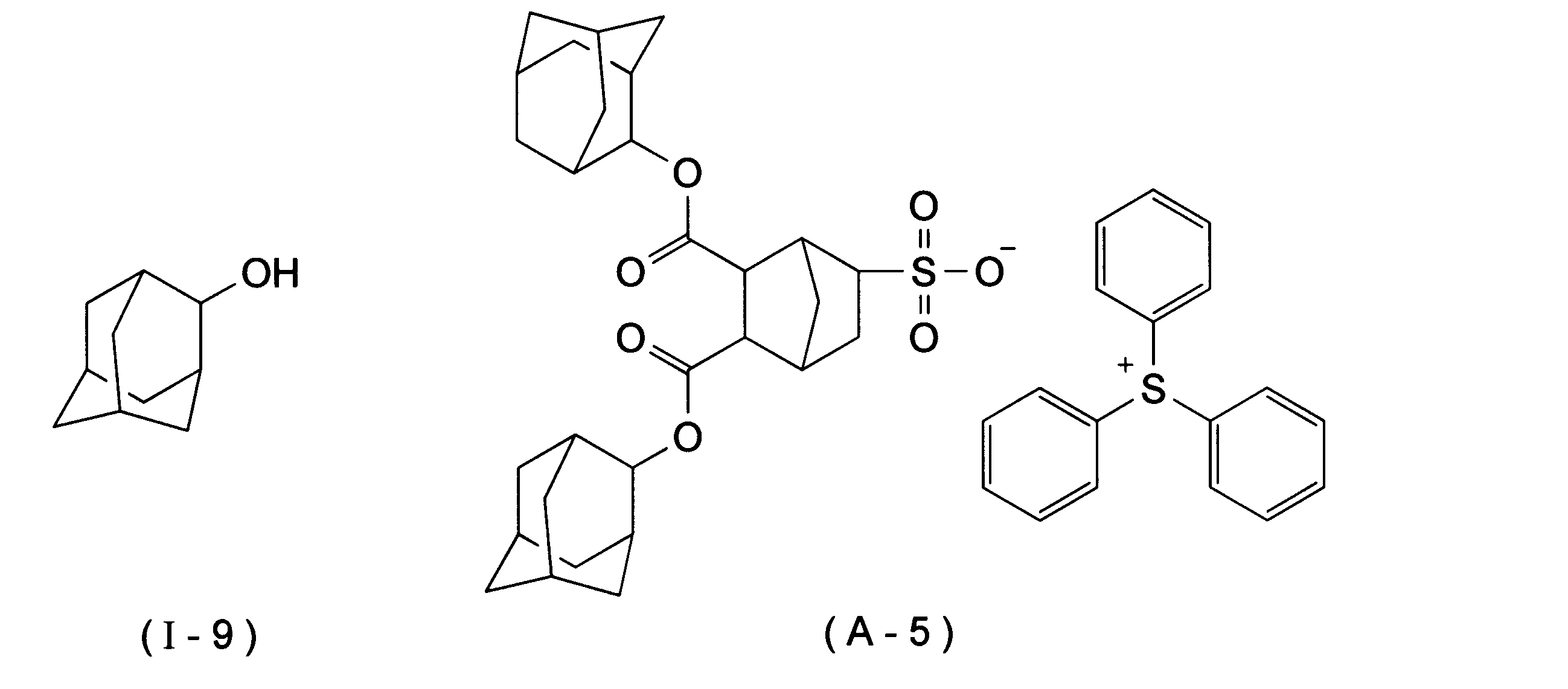
- Example 3 Synthesis of (A-3) Example except that compound (I-2) used in Example 1 was changed to compound (I-7) represented by the following formula (I-7) In the same manner as in Example 1, a compound (A-3) represented by the following formula (A-3) was obtained.
- Example 5 Synthesis of (A-5) Example except that compound (I-2) used in Example 1 was changed to compound (I-9) represented by the following formula (I-9) In the same manner as in Example 1, a compound (A-5) represented by the following formula (A-5) was obtained.
- the obtained polymer (B-3) had an Mw of 7,000 and an Mw / Mn of 2.1.
- the compound (M-4) and the compound (M-5) The content ratio (mol%) of each derived structural unit was a copolymer of 52:47.
- the obtained polymer (B-6) had Mw of 10,000 and Mw / Mn of 2.1, and as a result of 13 C-NMR analysis, the compound (M-1), (M-2) and the compound The content ratio (mol%) of the structural unit derived from (M-9) was a copolymer of 30:50:20.
- the measurement of the weight average molecular weight (Mw) and the number average molecular weight (Mn) in this example was performed using a Tosoh GPC column (2 G2000HXL, 1 G3000HXL, 1 G4000HXL), flow rate: 1.0 ml / min, Elution solvent: Tetrahydrofuran, Column temperature: It was measured by gel permeation chromatography (GPC) using monodisperse polystyrene as a standard under analysis conditions of 40 ° C. Further, the degree of dispersion Mw / Mn was calculated from the measurement results. Further, 13 C-NMR analysis was performed using a model “JNM-EX270” manufactured by JEOL Ltd.
- Example 6 As shown in Table 1, 100 parts by mass of the polymer (B-1) prepared in the above synthesis example, 27 parts by mass of the compound (A-1), 1,400 parts by mass of the solvent (C-1 / C-2) / 3,300 parts by mass and 2 parts by mass of the acid diffusion controller (D-1) were mixed, and the resulting mixture was filtered through a membrane filter having a pore size of 200 nm to prepare a radiation-sensitive composition solution.
- Examples 7 to 21 and Comparative Examples 1 to 3 [B] polymer, [A] compound, [C] solvent, and [D] acid diffusion control agent of the kind and preparation amount shown in Table 1 were mixed, and the resulting mixture was filtered through a membrane filter having a pore size of 200 nm. Thus, the radiation sensitive compositions of Examples 7 to 21 and Comparative Examples 1 to 3 were prepared.
- C-1 Ethyl lactate
- C-2 Propylene glycol monomethyl ether acetate
- C-3 Cyclohexanone
- a pattern (a so-called line-and-space pattern (1L1S)) composed of a line portion having a line width of 130 nm and a space portion (that is, a groove) having a spacing of 130 nm formed by adjacent line portions is 1: 1.
- the exposure amount formed in the line width was set as the optimum exposure amount, and the sensitivity ( ⁇ C / cm 2 ) was evaluated based on the optimum exposure amount.
- Nano edge roughness (i) A line-and-space pattern (1L1S) with a design line width of 130 nm was observed with a scanning electron microscope for semiconductors (high-resolution FEB measuring device, trade name “S-9220”, manufactured by Hitachi, Ltd.). . Ten line line widths (nm) were observed at arbitrary points, and the value representing the measurement variation with 3 sigma was defined as nano edge roughness (nm). It shows that the linearity of a pattern is excellent, so that the value of nano edge roughness is low.
- NSR S610C ArF excimer laser immersion exposure apparatus
- PEB was performed under the conditions shown in Table 3.
- development was performed with a 2.38% tetramethylammonium hydroxide aqueous solution, washed with water, and dried to form a positive resist pattern.
- Each evaluation test was performed on the resist pattern thus formed, and the evaluation results are shown in Table 3.
- MEEF Mesk Error Enhancement Factor
- the exposure amount at which a line-and-space (LS) pattern with a line width of 50 nm is formed by exposing through a mask pattern with a target size of 50 nm 1 L / 1S under the above evaluation conditions was defined as the optimum exposure amount.
- an LS pattern with a pitch of 100 nm is formed using a mask pattern with an optimum exposure amount and a line width target size of 46 nm, 48 nm, 50 nm, 52 nm, and 54 nm, and the line width formed on the resist film is changed to Hitachi.
- Measured length SEM measured with CG4000.
- the slope of the straight line when the target size (nm) was plotted on the horizontal axis and the line width (nm) formed on the resist film using each mask pattern was plotted on the vertical axis was calculated as MEEF.
- MEEF the slope of the straight line when the target size (nm) was plotted on the horizontal axis and the line width (nm) formed on the resist film using each mask pattern was plotted on the vertical axis
- the radiation-sensitive compositions of Examples 6 to 21 containing [A] compounds (A-1) to (A-5) as acid generators are acid generators.
- the radiation-sensitive compositions of Comparative Examples 1 to 3 that do not contain (A-1) to (A-5) they are more sensitive to electron beams or extreme ultraviolet rays, have low roughness and resolution.
- a chemical amplification type positive resist film that was excellent and capable of forming a fine pattern with high accuracy and stability could be formed.
- the radiation sensitive composition of the present invention is sensitive to X-rays such as KrF excimer laser, ArF excimer laser, EUV (extreme) deep ultraviolet rays, synchrotron radiation, and electron beams, and nano edge roughness, sensitivity and resolution. And a fine pattern can be formed with high accuracy and stability. Therefore, the radiation-sensitive composition of the present invention is suitably used for manufacturing semiconductor devices that are expected to be further miniaturized in the future.
Landscapes
- Physics & Mathematics (AREA)
- Chemical & Material Sciences (AREA)
- Spectroscopy & Molecular Physics (AREA)
- Organic Chemistry (AREA)
- General Physics & Mathematics (AREA)
- Engineering & Computer Science (AREA)
- Ceramic Engineering (AREA)
- Organic Low-Molecular-Weight Compounds And Preparation Thereof (AREA)
- Materials For Photolithography (AREA)
- Compositions Of Macromolecular Compounds (AREA)
Abstract
Description
[A]下記式(1)で表される化合物(以下、「[A]化合物」ともいう)、及び
[B]酸解離性基を含む構造単位を有する重合体(以下、「[B]重合体」ともいう)
を含有する感放射線性組成物である。


式(b-2)中、R9は、水素原子又はメチル基である。)



本発明の感放射線性組成物は、[A]化合物及び[B]重合体を含有する。また、[C]溶媒を好適成分として含有する。さらに、当該感放射線性組成物は、所期の効果を損なわない限り、その他の任意成分を含有してもよい。
[A]化合物は、上記式(1)で示される化合物である。[A]化合物は、露光により酸を発生する感放射線性酸発生剤である。[A]化合物は、溶媒に対する溶解度が高く、また沸点が高いため、フォトリソグラフィー工程中に揮発し難く、酸発生剤として十分にその効果を発揮することができる。さらに[A]化合物はかさ高い構造であり、かつ極性基を有しているため、レジスト膜において発生する酸の拡散が抑制される。その結果、[A]化合物を含有する感放射線性組成物によれば、解像度に優れ、ナノエッジラフネスの抑制性に優れる良好なレジストパターンを得ることができる。
上記R1が表す極性基を有する基としては、例えば炭素数1~10の鎖状炭化水素基又は炭素数5~20の脂環式炭化水素基の有する水素原子の一部が上記極性基で置換された基、R-R’-X-*(*は、Aと結合する部位を示す。)等が挙げられる。このRは炭素数1~10の鎖状炭化水素基又は炭素数5~20の脂環式炭化水素基である。R’は、上記極性基である。Xは、単結合、メチレン基、炭素数2~10のアルキレン基、炭素数3~30の脂環式炭化水素基、又は炭素数6~30の芳香族炭化水素基である。
R1が有する極性基の数は、1つであってもよいし、2つ以上であってもよいが、1つであることが好ましい。また、上記式(1)で示される化合物中に含まれる極性基を有するR1の数として好ましくは1~4つであり、より好ましくは2~4つである。


また、上記アルキル基が有してもよい置換基としては、例えば、フッ素、塩素、臭素、ヨウ素等のハロゲン原子、ヒドロキシル基、シアノ基、チオール基、アルキルチオ基、芳香族炭化水素基、アルケニル基、アルキルカルボキシル基、アシル基、ヘテロ原子(例えば、ハロゲン原子、酸素原子、窒素原子、硫黄原子、リン原子、ケイ素原子等)を含むアルキル基、脂環式炭化水素基等の有機基等が挙げられる。さらに、炭化水素基の同一炭素上の2つの水素原子が1つの酸素原子で置換されたケト基を例示することができる。これらの置換基は、構造上可能な範囲内でいくつ存在していても良い。
また、上記芳香族炭化水素基が有してもよい置換基としては、上記アルキル基が有してもよい置換基として例示したものと同様のものを挙げることができる。
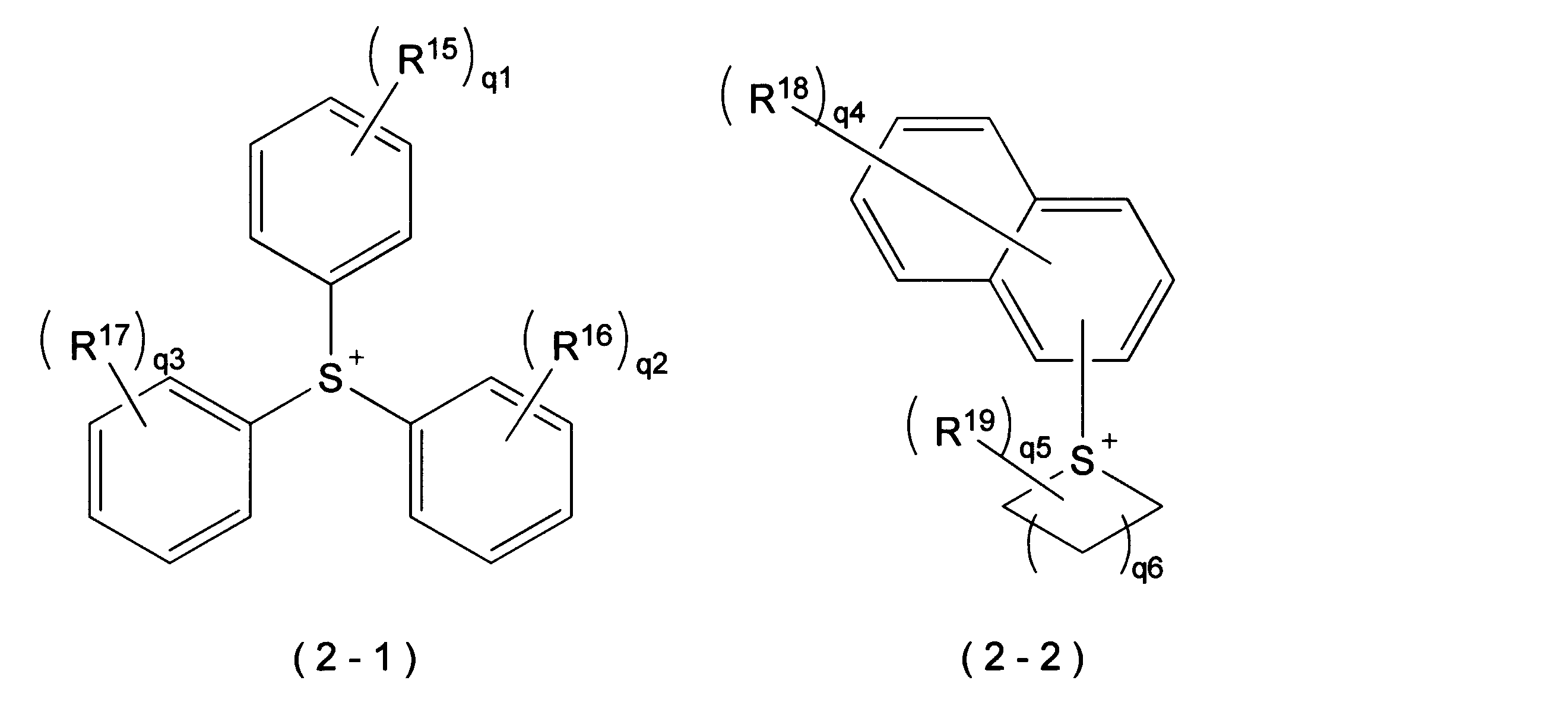
R20及びR21は、それぞれ独立して、炭素数1~12の直鎖状若しくは分岐状のアルキル基、炭素数5~25の脂環式炭化水素基、又は炭素数6~12の芳香族炭化水素基である。上記アルキル基、脂環式炭化水素基及び芳香族炭化水素基が有する水素原子の一部又は全部は置換されていてもよい。
q1~q3は、それぞれ独立して、0~5の整数である。
R19は水素原子、炭素数1~7の直鎖状若しくは分岐状のアルキル基、又は炭素数6~7の芳香族炭化水素基である。上記アルキル基及び芳香族炭化水素基が有する水素原子の一部又は全部は置換されていてもよい。但し、R18が複数ある場合、それぞれのR18は同一でも異なっていてもよく、複数のR18が互いに結合して環を形成していてもよい。
q4は0~7の整数であり、q5は0~6の整数であり、q6は0~3の整数である。
また、上記アルキル基が有してもよい置換基としては、上記R10~R12におけるアルキル基が有してもよい置換基として例示したものと同様のものを挙げることができる。


単環式又は多環式ラクトンとしては、γ-ブチロラクロン、γ-バレロラクトン、アンゲリカラクトン、γ-ヘキサノラクトン、γ-ヘプタノラクトン、γ-オクタノラクトン、γ-ノナノラクトン、3-メチル-4-オクタノライド(ウイスキーラクトン)、γ-デカノラクトン、γ-ウンデカノラクトン、γ-ドデカノラクトン、γ-ジャスモラクトン(7-デセノラクトン)、δ-ヘキサノラクトン、4,6,6(4,4,6)-トリメチルテトラヒドロピラン-2-オン、δ-オクタノラクトン、δ-ノナノラクトン、δ-デカノラクトン、δ-2-デセノラクトン、δ-ウンデカノラクトン、δ-ドデカノラクトン、δ-トリデカノラクトン、δ-テトラデカノラクトン、ラクトスカトン、ε-デカノラクトン、ε-ドデカノラクトン、シクロヘキシルラクトン、ジャスミンラクトン、シスジャスモラクトン、メチルγ-デカノラクトン、下記式(R-1)及び(R-2)で表されるラクトン(点線は結合位置を示す。)等が挙げられる。


本発明の感放射線性組成物は、[A]化合物に加えて[B]重合体を含有する。[B]重合体は酸解離性基を含む構造単位(以下、「構造単位(III)」ともいう)を有する重合体である。当該感放射線性組成物は、酸解離性基を有する[B]重合体を含有することで、露光により[A]化合物から発生する酸を触媒として酸解離性基が解離し、現像液に対する溶解速度が変化し、レジストパターンを形成することができる。
上記式(b-1)中、R6は、水素原子又はメチル基である。R7は、単結合、-CO-O-、又は-CO-NH-である。R8は、炭素数1~12の直鎖状若しくは分岐状のアルキル基、炭素数1~12の直鎖状若しくは分岐状のアルコキシル基、又は炭素数2~12のアシロキシ基である。Rは、水酸基又は水酸基を含む基である。pは、0又は1である。q及びrは、それぞれ独立して0~3の整数である。但し、pが0の場合、q+r≦5の条件を満たす。R8が複数の場合、複数のR8は、同一でも異なっていてもよい。
式(b-2)中、R9は、水素原子又はメチル基である。


当該感放射線性組成物は、[B]重合体が、上記式(b-2)で表される構造単位(II)を含有することで、ナノエッジラフネスにより優れたレジストパターンを形成することができる。

[B]重合体は、酸解離性基を含む構造単位(III)を有する。構造単位(III)としては、下記式(p-1)で表される構造単位(以下、「構造単位(III-1)」ともいう)、及び下記式(p-2)で表される構造単位(以下、「構造単位(III-2)」ともいう)のうちの少なくとも一方であることが好ましい。当該感放射線性組成物は、[B]重合体が構造単位(III)として、構造単位(III-1)及び(III-2)のうちの少なくとも一方を有することにより、良好な放射線感度を得ることができる。
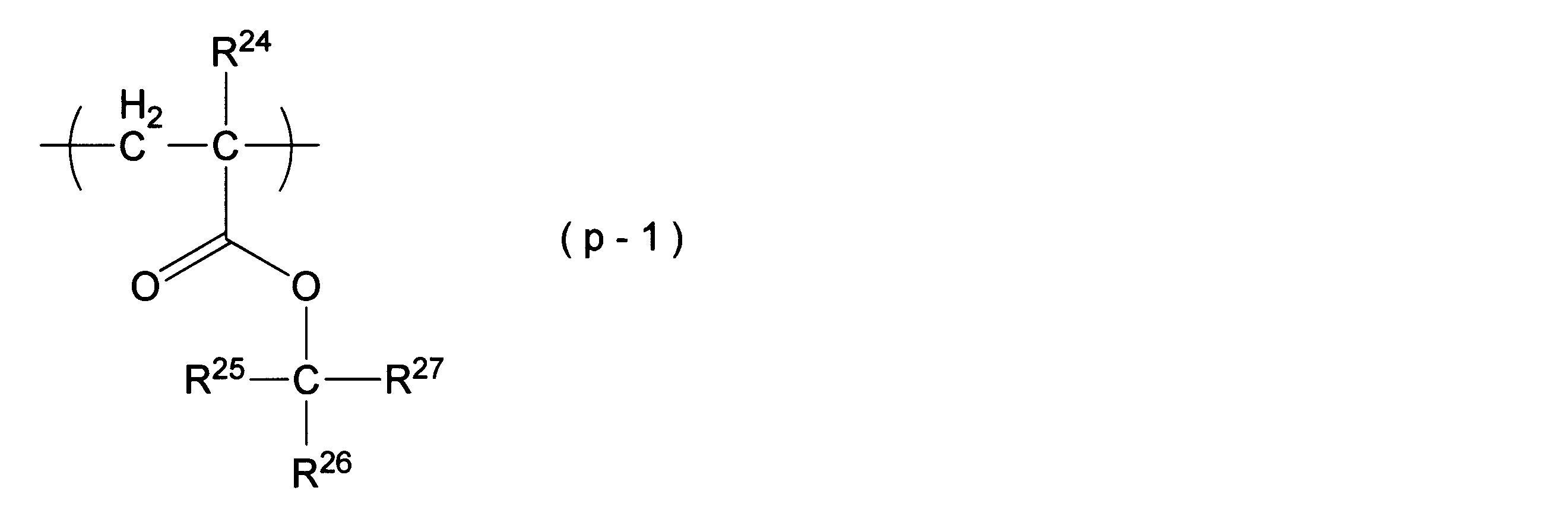
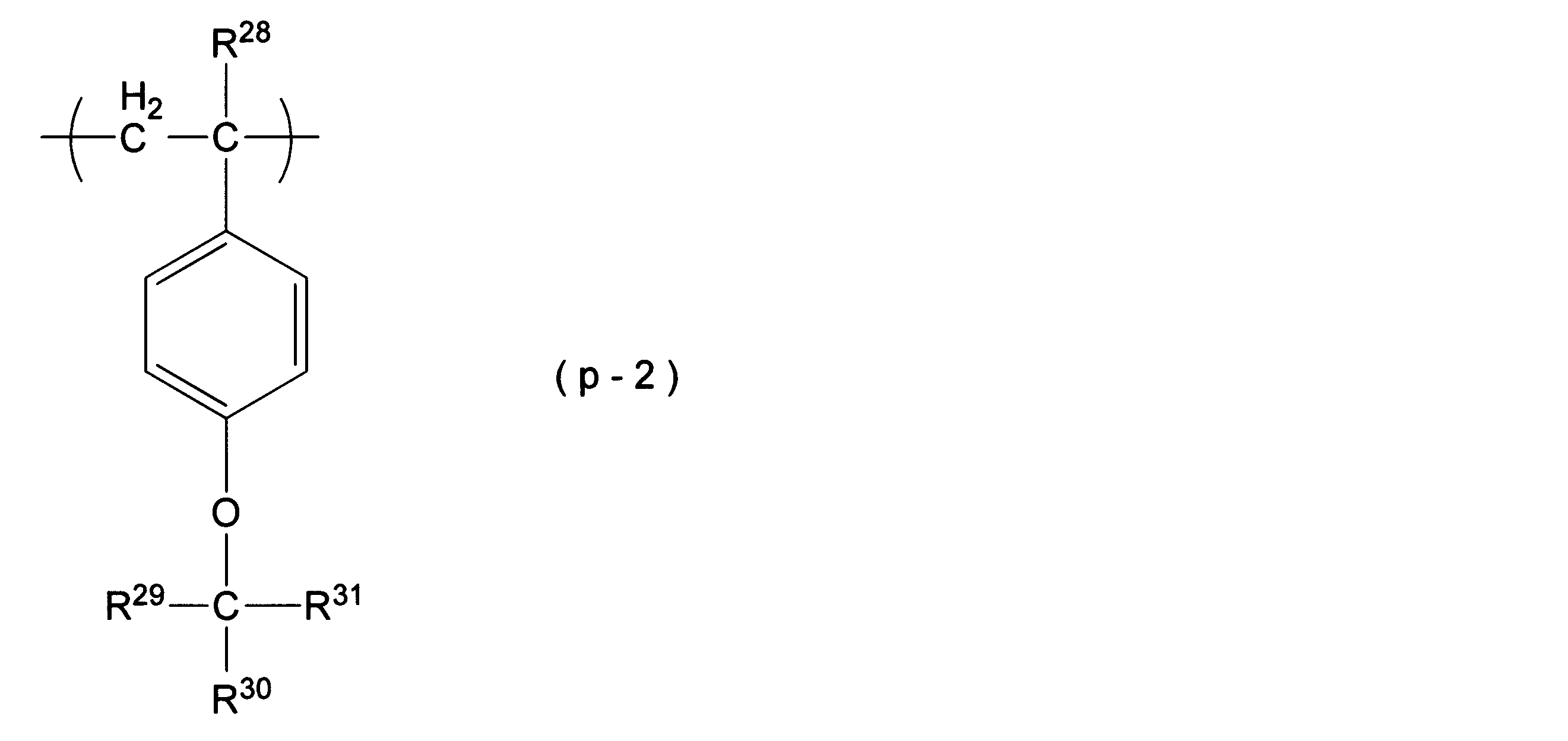


[B]重合体は、上述した構造単位(I)、(II)及び(III)以外に、その他の構造単位として非酸解離性化合物に由来する構造単位(IV)をさらに含有していてもよい。本明細書において非酸解離性化合物とは、酸の作用によって解離する基(酸解離性基)を含有しない化合物をいう。[B]重合体が、構造単位(IV)を含有することで、当該感放射線性組成物は、ナノエッジラフネスにより優れたレジストパターンを形成することができる。
これらのなかでも、アセトン、メチルアミルケトン、メチルエチルケトン、テトラヒドロフラン、メタノール、エタノール、プロパノール、酢酸エチル、酢酸ブチル、乳酸エチル、プロピレングリコールモノメチルエーテル、プロピレングリコールモノメチルエーテルアセテートが好ましい。
当該感放射線性組成物は、[C]溶媒を好適に含有する。[C]溶媒は、エチレングリコールモノアルキルエーテルアセテート類及びプロピレングリコールモノアルキルエーテルアセテート類からなる群より選択される少なくとも1種を全体の70質量%以上含む。[C]溶媒を用いることで、本発明の感放射線性組成物は塗布性を向上させることができる。
当該感放射線性組成物は、必須成分である[A]化合物及び[B]重合体、好適成分である[C]溶媒以外に、本発明の所期の効果を損なわない範囲で、その他の任意成分を含有することができる。その他の任意成分としては、[D]酸拡散制御剤、[A]化合物以外のその他の感放射線性酸発生剤、界面活性剤、増感剤、脂肪族添加剤等の各種の添加剤をさらに含有することができる。
[D]酸拡散制御剤は、露光により[A]化合物から生じる酸の、レジスト膜中における拡散現象を制御し、非露光領域における好ましくない化学反応を抑制する作用を有するものである。


式(5-2)中、R54及びR55は、それぞれ独立して、水素原子、ハロゲン原子、炭素数1~10のアルキル基、又は、脂環式炭化水素基である。A-は、OH-、R59O-、又はR59COO-である。但し、R59は1価の有機基である。
但し、上記アルキル基、脂環式炭化水素基、及び芳香族炭化水素基が有する水素原子の一部又は全部は置換されていてもよい。)
上記式(5-1)及び(5-2)のR51~R57で表される炭素数1~10のアルキル基としては、例えば、メチル基、エチル基、n-プロピル基、i-プロピル基、n-ブチル基、2-メチルプロピル基、1-メチルプロピル基、t-ブチル基等が挙げられる。
また、このアルキル基は、ヒドロキシル基、カルボキシル基、ハロゲン原子(フッ素原子、臭素原子等)、アルコキシル基(メトキシ基、エトキシ基、プロポキシ基、ブトキシ基、t-ブトキシ基等)、アルキルオキシカルボニル基(t-ブトキシカルボニルメチルオキシ基等)等の置換基により置換されていてもよい。

当該感放射線性組成物は、[A]化合物以外にも、その他の感放射線性酸発生剤(以下、「他の酸発生剤」ともいう。)をさらに含有することができる。他の酸発生剤としては、例えば、[A]化合物を除く、オニウム塩化合物、スルホン酸化合物等が挙げられる。
具体的には、ジフェニルヨードニウムトリフルオロメタンスルホネート、ジフェニルヨードニウムノナフルオロ-n-ブタンスルホネート、ジフェニルヨードニウムパーフルオロ-n-オクタンスルホネート、ビス(4-t-ブチルフェニル)ヨードニウムトリフルオロメタンスルホネート、ビス(4-t-ブチルフェニル)ヨードニウムノナフルオロ-n-ブタンスルホネート、ビス(4-t-ブチルフェニル)ヨードニウムパフルオロ-n-オクタンスルホネート、シクロヘキシル・2-オキソシクロヘキシル・メチルスルホニウムトリフルオロメタンスルホネート、ジシクロヘキシル・2-オキソシクロヘキシルスルホニウムトリフルオロメタンスルホネート、2-オキソシクロヘキシルジメチルスルホニウムトリフルオロメタンスルホネート、
界面活性剤は、塗布性、ストリエーション、現像性等を改良する作用を有する成分である。
増感剤は、放射線のエネルギーを吸収し、吸収したエネルギーを[A]化合物に伝達して酸の生成量を増加させる作用を有するものであり、感放射線性組成物のみかけの感度を向上させる効果を有するものである。
脂環族添加剤は、ドライエッチング耐性、パターン形状、基板との接着性等をさらに改善する作用を有する成分である。
当該感放射線性組成物は、[A]化合物及び[B]重合体、必要に応じて加える[D]酸拡散制御剤、他の酸発生剤、界面活性剤等の添加剤を、前固形分濃度が上記範囲になるように[C]溶剤に均一に溶解して調製することができる。なお、このように調製した後、例えば、孔径0.2μm程度のフィルターでろ過することが好ましい。
当該感放射線性組成物は、レジストパターン形成用に好適に用いられる。具体的には、例えば、当該感放射線性組成物からなる化学増幅型ポジ型レジスト膜においては、露光により[A]化合物から発生した酸の作用によって、[B]重合体中の酸解離性基が脱離し、[B]重合体がアルカリ可溶性となる。即ち、レジスト膜に、アルカリ可溶性部位が生じる。このアルカリ可溶性部位は、レジストの露光部であり、この露光部はアルカリ現像液によって溶解、除去することができる。このようにして所望の形状のポジ型のレジストパターンを形成することができる。以下、具体的に説明する。
本発明の化合物は、上記式(1)で表される。当該化合物は上記式(1-A)又は(1-B)で表されるものであることが好ましく、上記式(1-A-1)又は(1-B-1)で表されるものであることがより好ましい。当該化合物は、溶媒への溶解性が高く、当該感放射線性組成物における[A]化合物として好適に用いることができる。当該化合物は、かさ高く極性も高いので、感放射線性組成物における酸発生剤として用いた場合には、露光により発生する酸の拡散長が適切に短く制御され、解像度及びパターン形成後のレジスト膜表面の平滑性を向上させることができる。また当該化合物は沸点が高いため、パターン形成工程中に揮発し難く、良好なパターンを形成することができる。なお、当該化合物については、当該感放射線性組成物の必須成分である[A]化合物としての説明をそのまま適用することができる。
[実施例1](A-1)の合成
ナスフラスコに下記式(I-1)で表される化合物(I-1)16.4g、下記式(I-2)で表される化合物(I-2)30.0g、パラトルエンスルホン酸1.7g、トルエン200gを混合し、トルエン還流下、8時間反応させた。反応終了後、トルエンを減圧留去し、塩化メチレンを加え、有機層を3wt%NaHCO3水溶液で3回、次いで水で3回洗浄した。その後、塩化メチレンを減圧留去し、展開溶媒に酢酸エチル/n-ヘキサン=1/1(体積比)の混合溶媒を用いて、シリカゲルカラムクロマトグラフィーを行うことにより、目的とする下記式(I-3)で表される化合物(I-3)を得た(収率60%)。
ナスフラスコに化合物(I-3)15.0g、NaHSO313.5g、水50g、メタノール50gを混合し、8時間反応させた。反応終了後、水/メタノールを減圧留去した。得られた固体を水100gに溶解させ、テトラヒドロフラン50gを加え、30分間室温で撹拌し、30分間静置した。二層に分かれた上層のみを回収し、上層の溶媒を減圧留去することで、下記式(I-4)で表される化合物(I-4)を得た(収率70%)。
ナスフラスコに化合物(I-4)5.0g、下記式(I-5)で表される化合物(I-5)3.3g、塩化メチレン100g、水100gを混合し、室温で10時間撹拌した。反応終了後、塩化メチレン層を回収し、水500gで4回洗浄した。その後、塩化メチレン層を回収し、塩化メチレンを減圧留去することにより、目的とする化合物である下記式(A-1)で表される化合物(A-1)を得た(収率80%)。
なお、得られた化合物の構造確認を、1H-NMR(日本電子社製、型番「JNM-ECA-400型」)で行った。この結果を以下に示す。
1H-NMR(400MHz、溶媒DMSO-d6、内部標準TMS):δ(ppm)=0.91~2.50(26.0H)、2.50~3.50(3.0H)、4.20~4.70(2.0H)、7.70~8.30(15.0H)

上記実施例1で用いた化合物(I-5)を下記式(I-6)で表される化合物(I-6)に変更した以外は実施例1と同様の方法により下記式(A-2)で表される化合物(A-2)を得た。
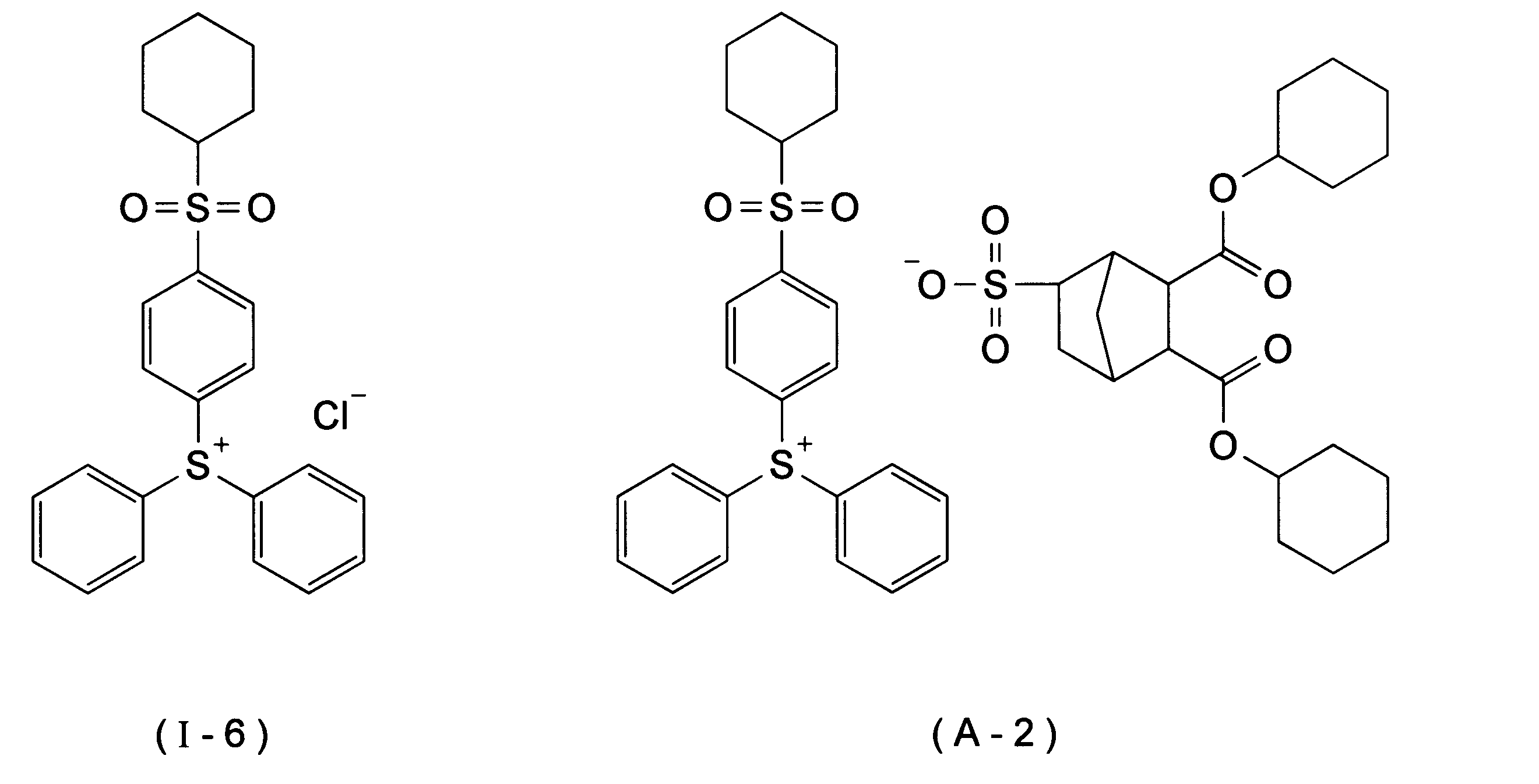
上記実施例1で用いた化合物(I-2)を下記式(I-7)で表される化合物(I-7)に変更した以外は実施例1と同様にして下記式(A-3)で表される化合物(A-3)を得た。

上記実施例1で用いた化合物(I-2)を下記式(I-8)で表される化合物(I-8)に変更し、化合物(I-5)を化合物(I-6)に変更した以外は実施例1と同様にして下記式(A-4)で表される化合物(A-4)を得た。
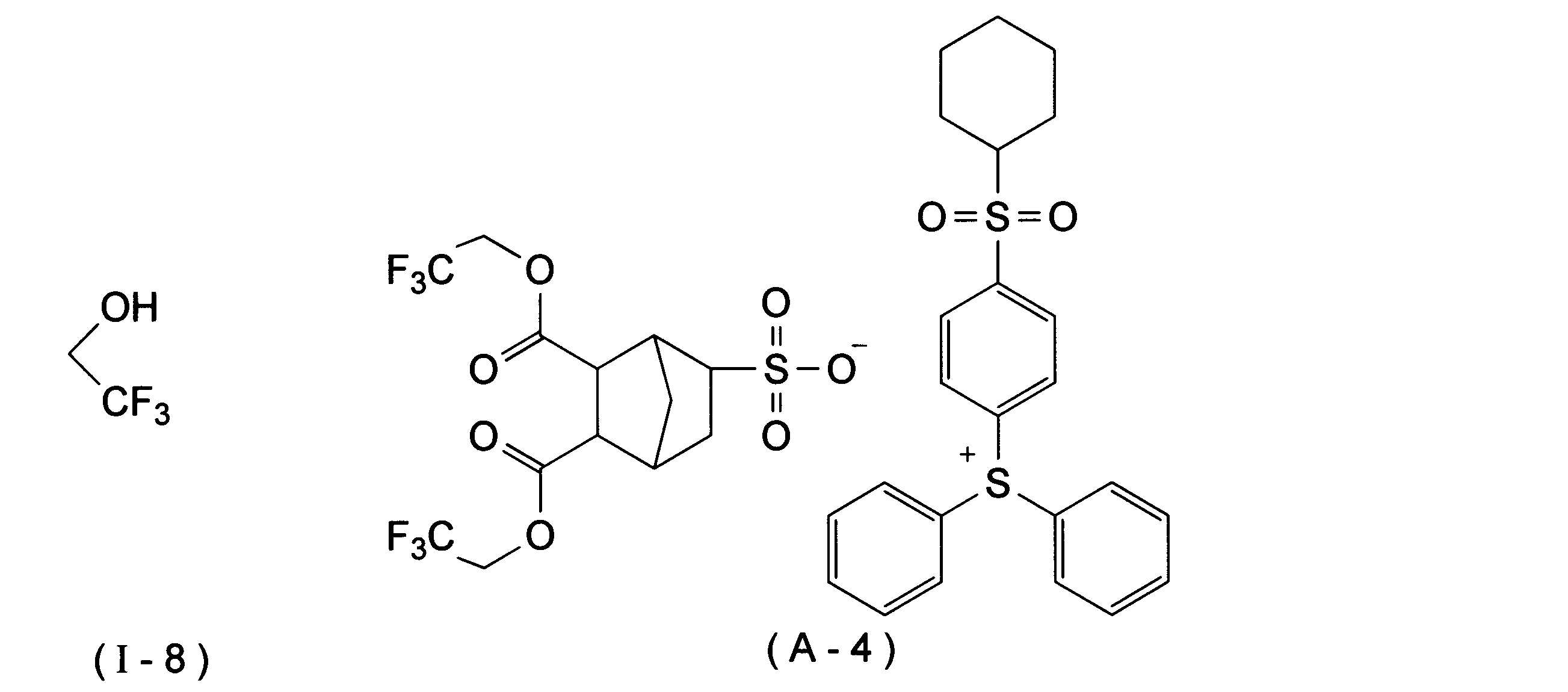
上記実施例1で用いた化合物(I-2)を下記式(I-9)で表される化合物(I-9)に変更した以外は実施例1と同様にして下記式(A-5)で表される化合物(A-5)を得た。
[合成例1]重合体(B-1)の合成
下記式(M-1)で表される化合物(M-1)55g、下記式(M-2)で表される化合物(M-2)45g、アゾビスイソブチロニトリル4g、及びt-ドデシルメルカプタン1gを、プロピレングリコールモノメチルエーテル100gに溶解した後、窒素雰囲気下、反応温度を70℃に保持して、16時間重合させた。重合後、反応溶液を1,000gのn-ヘキサン中に滴下して、共重合体を凝固精製した。次いで、この共重合体に、再度プロピレングリコールモノメチルエーテル150gを加えた後、さらに、メタノール150g、トリエチルアミン34g、及び水6gを加えて、沸点にて還流させながら、8時間加水分解反応を行った。反応後、溶剤及びトリエチルアミンを減圧留去し、得られた共重合体をアセトン150gに溶解した後、2,000gの水中に滴下して凝固させ、生成した白色粉末をろ過して、減圧下50℃で一晩乾燥し重合体(B-1)を得た。得られた重合体(B-1)は、Mwが10,000、Mw/Mnが2.1であり、13C-NMR分析の結果、化合物(M-1)及び化合物(M-2)に由来する構造単位の含有割合(モル%)が65:35の共重合体であった。
化合物(M-1)53g、下記式(M-3)で表される化合物(M-3)47g、アゾビスイソブチロニトリル4g、及びt-ドデシルメルカプタン0.2gを、プロピレングリコールモノメチルエーテル200gに溶解した後、窒素雰囲気下、反応温度を70℃に保持して、6時間重合させた。重合後、反応溶液を2,000gのn-ヘキサン中に滴下して、共重合体を凝固精製した。次いで、この重合体に、再度プロピレングリコールモノメチルエーテル150gを加えた後、さらに、メタノール150g、トリエチルアミン37g、及び水7gを加えて、沸点にて還流させながら、8時間加水分解反応を行った。反応後、溶剤及びトリエチルアミンを減圧留去し、得られた共重合体をアセトン150gに溶解した後、2,000gの水中に滴下して凝固させ、生成した白色粉末をろ過して、減圧下50℃で一晩乾燥し、重合体(B-2)を得た。得られた共重合体は、Mwが13,000、Mw/Mnが2.4であり、13C-NMR分析の結果、化合物(M-1)及び化合物(M-3)に由来する各構造単位の含有割合(モル%)が50:50の共重合体であった。
下記式(M-4)で表される化合物(M-4)55g、下記式(M-5)で表される化合物(M-5)45g、及びアゾビスイソブチロニトリル3gを、メチルエチルケトン300gに溶解した後、窒素雰囲気下、反応温度を78℃に保持して、6時間重合させた。重合後、反応溶液を2,000gのメタノール中に滴下して、共重合体を凝固させた。次いで、この共重合体を300gのメタノールで2回洗浄し、生成した白色粉末をろ過して、減圧下50℃で一晩乾燥した。得られた重合体(B-3)は、Mwが7,000、Mw/Mnが2.1であり、13C-NMR分析の結果、化合物(M-4)及び化合物(M-5)に由来する各構造単位の含有割合(モル%)が52:47の共重合体であった。
下記式(M-1)で表される化合物(M-1)20g、下記式(M-3)で表される化合物(M-3)38g、下記式(M-7)で表される化合物(M-7)42g、アゾビスイソブチロニトリル5g、及びt-ドデシルメルカプタン0.2gを、プロピレングリコールモノメチルエーテル100gに溶解した後、窒素雰囲気下、反応温度を70℃に保持して、16時間重合させた。重合後、反応溶液を1,000gのn-ヘキサン中に滴下して、共重合体を凝固精製した。次いで、この共重合体に、再度プロピレングリコールモノメチルエーテル150gを加えた後、さらに、メタノール150g、トリエチルアミン14g、及び水4gを加えて、沸点にて還流させながら、8時間加水分解反応を行った。反応後、溶剤及びトリエチルアミンを減圧留去し、得られた共重合体をアセトン150gに溶解した後、2,000gの水中に滴下して凝固させ、生成した白色粉末をろ過して、減圧下50℃で一晩乾燥し重合体(B-4)を得た。得られた重合体(B-4)は、Mwが10,000、Mw/Mnが2.2であり、13C-NMR分析の結果、化合物(M-1)、(M-3)及び化合物(M-7)に由来する構造単位の含有割合(モル%)が25:55:20の共重合体であった。
下記式(M-1)で表される化合物(M-1)34g、下記式(M-6)で表される化合物(M-6)40g、下記式(M-8)で表される化合物(M-8)26g、アゾビスイソブチロニトリル8g、及びt-ドデシルメルカプタン3gを、プロピレングリコールモノメチルエーテル100gに溶解した後、窒素雰囲気下、反応温度を70℃に保持して、16時間重合させた。重合後、反応溶液を1,000gのn-ヘキサン中に滴下して、共重合体を凝固精製した。次いで、この共重合体に、再度プロピレングリコールモノメチルエーテル150gを加えた後、さらに、メタノール150g、トリエチルアミン26g、及び水7gを加えて、沸点にて還流させながら、8時間加水分解反応を行った。反応後、溶剤及びトリエチルアミンを減圧留去し、得られた共重合体をアセトン150gに溶解した後、2,000gの水中に滴下して凝固させ、生成した白色粉末をろ過して、減圧下50℃で一晩乾燥し重合体(B-5)を得た。得られた重合体(B-5)は、Mwが5,000、Mw/Mnが2.0であり、13C-NMR分析の結果、化合物(M-1)、(M-6)及び化合物(M-8)に由来する構造単位の含有割合(モル%)が45:35:20の共重合体であった。
下記式(M-1)で表される化合物(M-1)23g、下記式(M-2)で表される化合物(M-2)60g、下記式(M-9)で表される化合物(M-9)17g、アゾビスイソブチロニトリル4g、及びt-ドデシルメルカプタン0.2gを、プロピレングリコールモノメチルエーテル100gに溶解した後、窒素雰囲気下、反応温度を70℃に保持して、16時間重合させた。重合後、反応溶液を1,000gのn-ヘキサン中に滴下して、共重合体を凝固精製した。次いで、この共重合体に、再度プロピレングリコールモノメチルエーテル150gを加えた後、さらに、メタノール150g、トリエチルアミン16g、及び水4gを加えて、沸点にて還流させながら、8時間加水分解反応を行った。反応後、溶剤及びトリエチルアミンを減圧留去し、得られた共重合体をアセトン150gに溶解した後、2,000gの水中に滴下して凝固させ、生成した白色粉末をろ過して、減圧下50℃で一晩乾燥し重合体(B-6)を得た。得られた重合体(B-6)は、Mwが10,000、Mw/Mnが2.1であり、13C-NMR分析の結果、化合物(M-1)、(M-2)及び化合物(M-9)に由来する構造単位の含有割合(モル%)が30:50:20の共重合体であった。

[実施例6]
表1に示すように、上記合成例で調製した重合体(B-1)100質量部、化合物(A-1)27質量部、溶媒(C-1/C-2)1,400質量部/3,300質量部、及び酸拡散制御剤(D-1)2質量部を混合し、得られた混合液を孔径200nmのメンブランフィルターでろ過することにより、感放射線性組成物溶液を調製した。
表1に示す種類及び仕込み量の[B]重合体、[A]化合物、[C]溶媒、及び[D]酸拡散制御剤を混合し、得られた混合液を孔径200nmのメンブランフィルターでろ過することにより、実施例7~21及び比較例1~3の各感放射線性組成物を調製した。

下記式(A-1)~(A-5)、(a-1)及び(a-2)で表わされる化合物

(C-1):乳酸エチル
(C-2):プロピレングリコールモノメチルエーテルアセテート
(C-3):シクロヘキサノン
(D-1):トリ-n-オクチルアミン
(D-2):下記式(D-2)で表される化合物
(D-3):N-tert-ブトキシカルボニル-2-フェニルベンズイミダゾール
(D-4):下記式(D-4)で表される化合物

東京エレクトロン社製の「クリーントラックACT-8」内で、シリコンウエハー上に感放射線性組成物溶液(実施例6~14、18~21及び比較例1~2の各感放射線性組成物)をスピンコートした後、表2に示す条件でPB(加熱処理)を行い、膜厚50nmのレジスト膜を形成した。その後、簡易型の電子線描画装置(日立製作所社製、型式「HL800D」、出力;50KeV、電流密度;5.0アンペア/cm2)を用いてレジスト膜に電子線を照射した。電子線の照射後、表2に示す条件でPEBを行った。その後、2.38質量%テトラメチルアンモニウムヒドロキシド水溶液を用い、23℃で1分間、パドル法により現像した後、純水で水洗し、乾燥して、レジストパターンを形成した。
このようにして形成されたレジストパターンについて各評価試験を行い、その評価結果を表2に示した。
線幅130nmのライン部と、隣り合うライン部によって形成される間隔が130nmのスペース部(即ち、溝)と、からなるパターン(いわゆる、ライン・アンド・スペースパターン(1L1S))を1対1の線幅に形成する露光量を最適露光量とし、この最適露光量により感度(μC/cm2)を評価した。
設計線幅130nmのライン・アンド・スペースパターン(1L1S)のラインパターンを、半導体用走査型電子顕微鏡(高分解能FEB測長装置、商品名「S-9220」、日立製作所社製)にて観察した。ライン線幅(nm)を任意のポイントで10点観測し、その測定ばらつきを3シグマで表現した値をナノエッジラフネス(nm)とした。ナノエッジラフネスの値が低い程、パターンの直線性が優れていることを示す。
ライン・アンド・スペースパターン(1L1S)について、上記最適露光量により解像されるラインパターンの最小線幅(nm)を解像度とした。
下層反射防止膜(「ARC66」、日産化学社製)を形成した12インチシリコンウェハ上に、感放射線性組成物溶液(実施例15~17及び比較例3の各感放射線性組成物)を用いて、膜厚75nmの被膜を形成し、表3に示す条件でPBを行った。次に、形成した被膜上に、WO2008/047678号の実施例1に記載の上層膜形成用組成物をスピンコートし、PB(90℃、60秒)を行うことにより膜厚90nmの塗膜を形成した。この被膜を、ArFエキシマレーザー液浸露光装置(「NSR S610C」、NIKON社製)を用い、NA=1.3、ratio=0.800、Annularの条件により、マスクパターンを介して縮小投影露光を行った。露光後、表3に示す条件でPEBを行った。その後、2.38%のテトラメチルアンモニウムヒドロキシド水溶液により現像し、水洗し、乾燥して、ポジ型のレジストパターンを形成した。
このようにして形成されたレジストパターンについて各評価試験を行い、その評価結果を表3に示した。
上記評価条件にてターゲットサイズが50nm1L/1Sのマスクパターンを介して露光することによって線幅が50nmのラインアンドスペース(LS)パターンが形成される露光量を最適露光量とした。次いで、最適露光量にてライン幅のターゲットサイズを46nm、48nm、50nm、52nm、54nmのとするマスクパターンをそれぞれ用い、ピッチ100nmのLSパターンを形成し、レジスト膜に形成されたライン幅を日立製測長SEM:CG4000にて測定した。
このとき、ターゲットサイズ(nm)を横軸に、各マスクパターンを用いてレジスト膜に形成されたライン幅(nm)を縦軸にプロットしたときの直線の傾きをMEEFとして算出した。
なお、MEEFの値が低い程、マスク作成コストを低減でき、優れていると評価される。
上記評価条件にてターゲットサイズが50nm1L/1.8Sのマスクパターンを介して露光することによって線幅が50nmのレジストパターンが形成される露光量を最適露光量とした。最適露光量にて得られた50nm1L/1.8Sパターンの観測において、日立製測長SEM:CG4000にてパターン上部から観察する際、線幅(nm)を任意のポイントで10点観測し、その測定ばらつきを3シグマで表現した値をナノエッジラフネス(nm)とした。なお、ナノエッジラフネスの値が小さいほどパターンの直線性が優れていることを示す。
上記評価条件にてターゲットサイズが50nm1L/1.8Sのマスクパターンを介して1mJずつ露光量を変化させながら露光した。ラインの倒れが発生した露光量よりも1mJ小さい露光量にて形成されたパターンのライン幅(nm)を測長SEM(日立製作所社製、型番「CG4000」)により測定し、最小倒壊寸法(nm)とした。なお、この値が小さいほどパターンの倒れに対する耐性が高いことを示す。
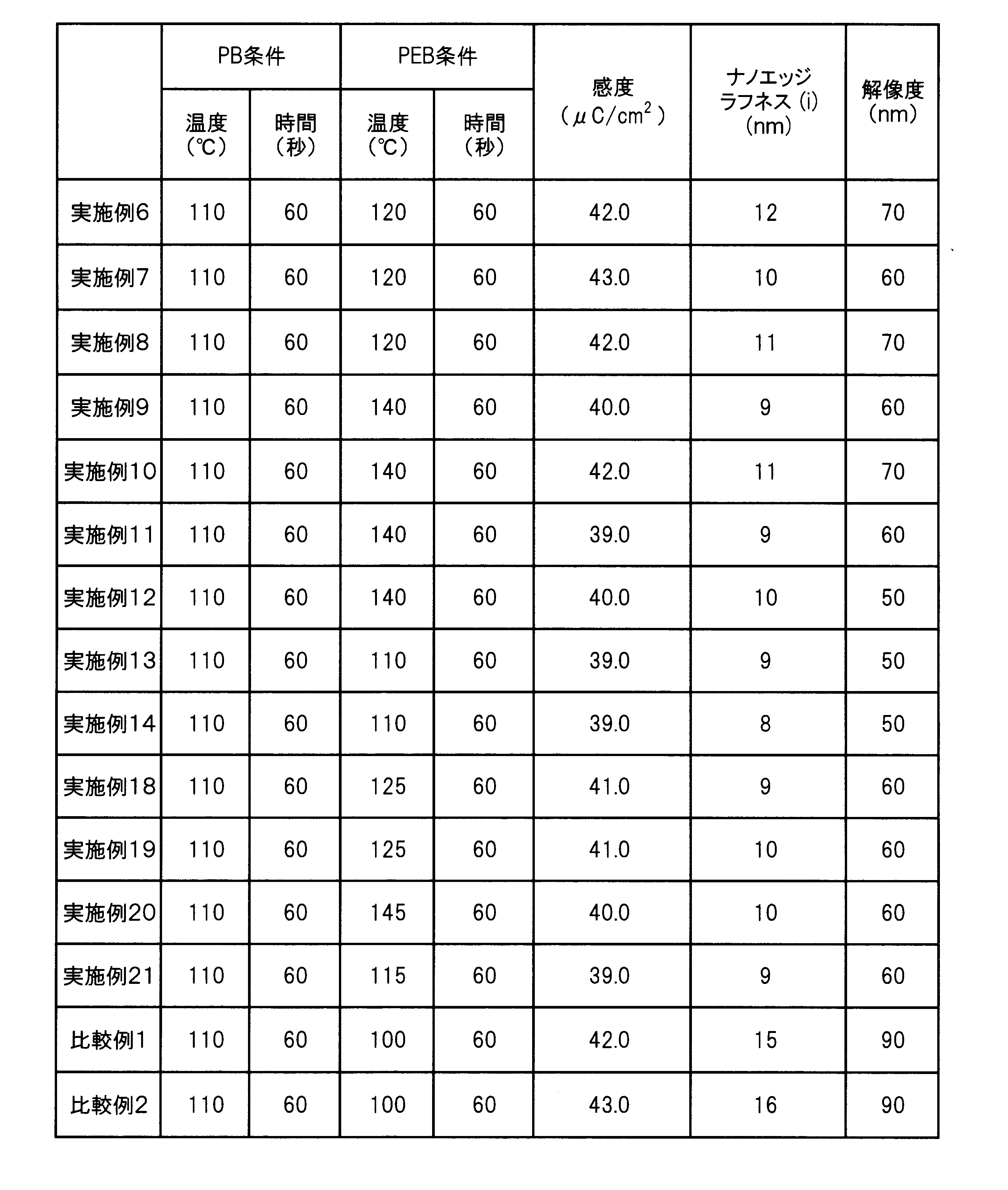

Claims (9)
- [A]下記式(1)で表される化合物、及び
[B]酸解離性基を含む構造単位を有する重合体
を含有する感放射線性組成物。

- 上記式(1)におけるAで示す脂環式炭化水素基の炭素数が、5以上20以下である請求項1に記載の感放射線性組成物。
- [A]化合物が、下記式(1-A)で表される化合物、及び下記式(1-B)で表される化合物からなる群より選択される少なくとも1種の化合物である請求項2に記載の感放射線性組成物。
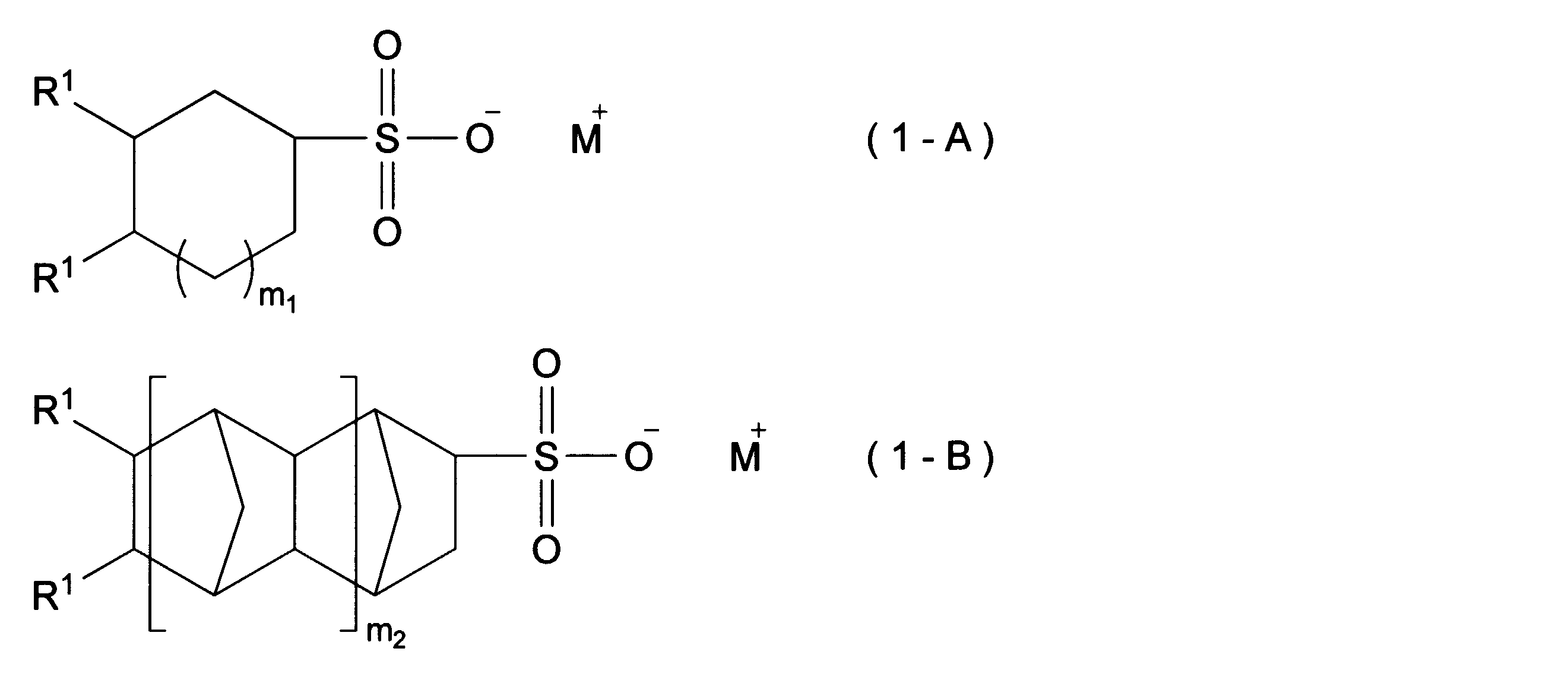
- 上記式(1-A)で表される化合物が下記式(1-A-1)で表される化合物であり、上記式(1-B)で表される化合物が下記式(1-B-1)で表される化合物である請求項3に記載の感放射線性組成物。
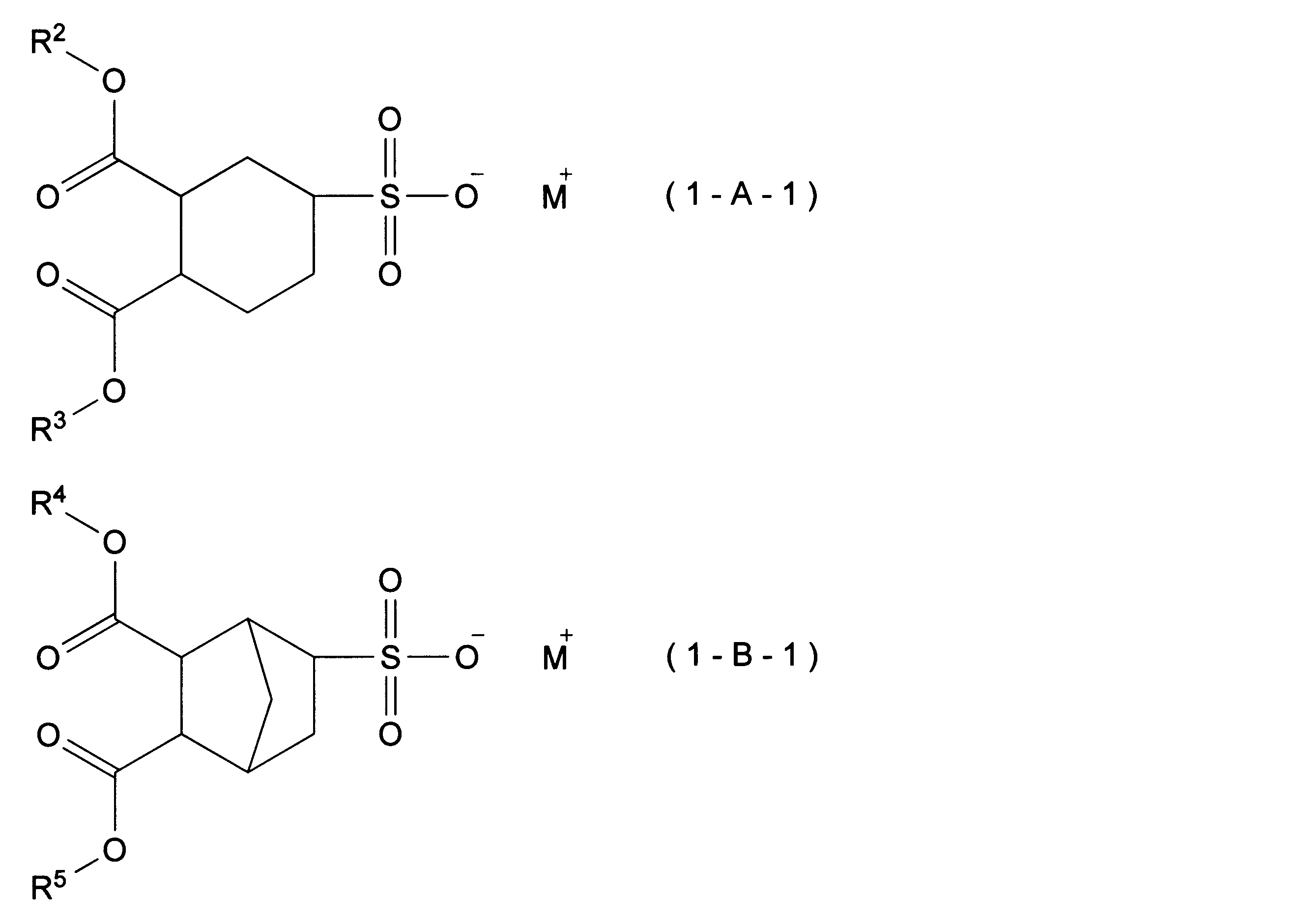
- [B]重合体が、下記式(b-1)で表される構造単位、及び下記式(b-2)で表される構造単位からなる群より選択される少なくとも1種の構造単位をさらに有する請求項1から請求項4のいずれか1項に記載の感放射線性組成物。
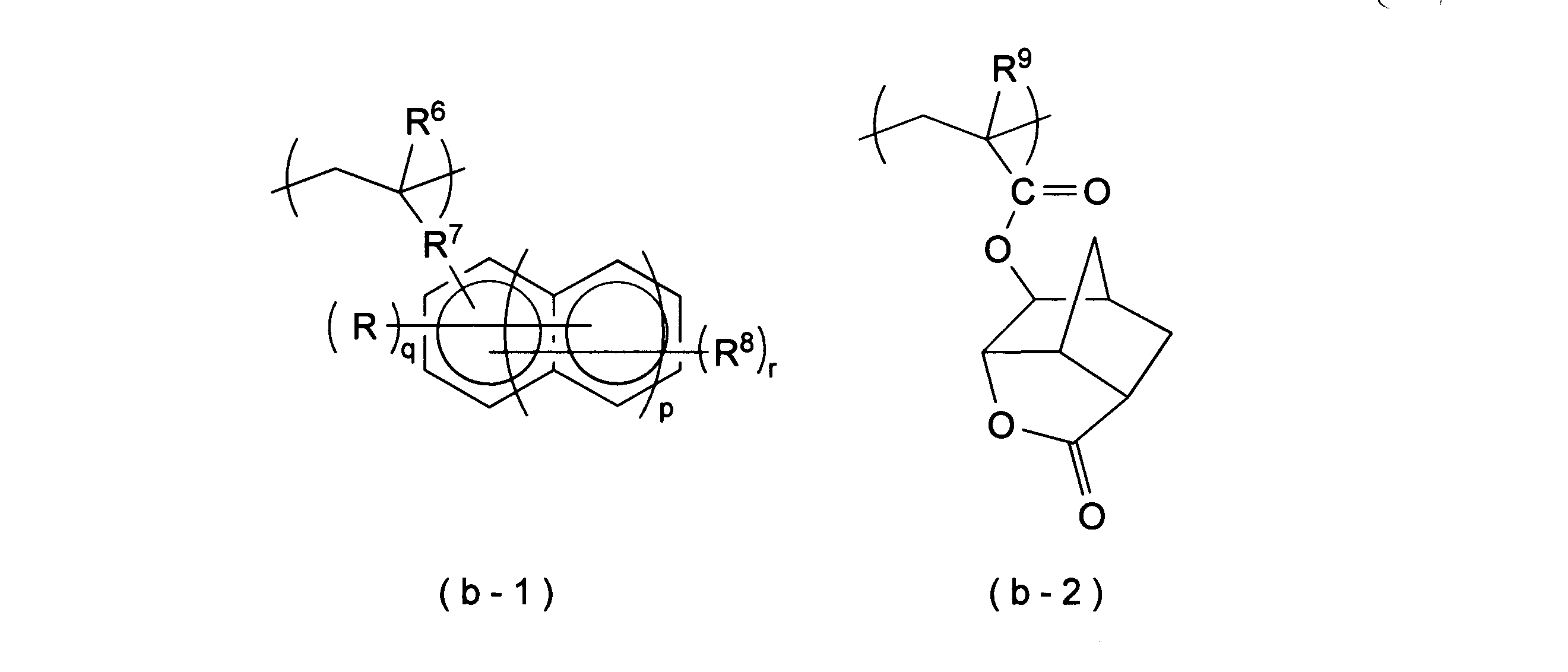
式(b-2)中、R9は、水素原子又はメチル基である。) - [C]溶媒をさらに含有し、
[C]溶媒が、(C1)エチレングリコールモノアルキルエーテルアセテート類及びプロピレングリコールモノアルキルエーテルアセテート類からなる群より選択される少なくとも1種の化合物を含み、
[C]溶媒中の(C1)化合物の含有率が70質量%以上である請求項1から請求項5のいずれか1項に記載の感放射線性組成物。 - 下記式(1)で表される化合物。

- 下記式(1-A)又は下記式(1-B)で表される請求項7に記載の化合物。
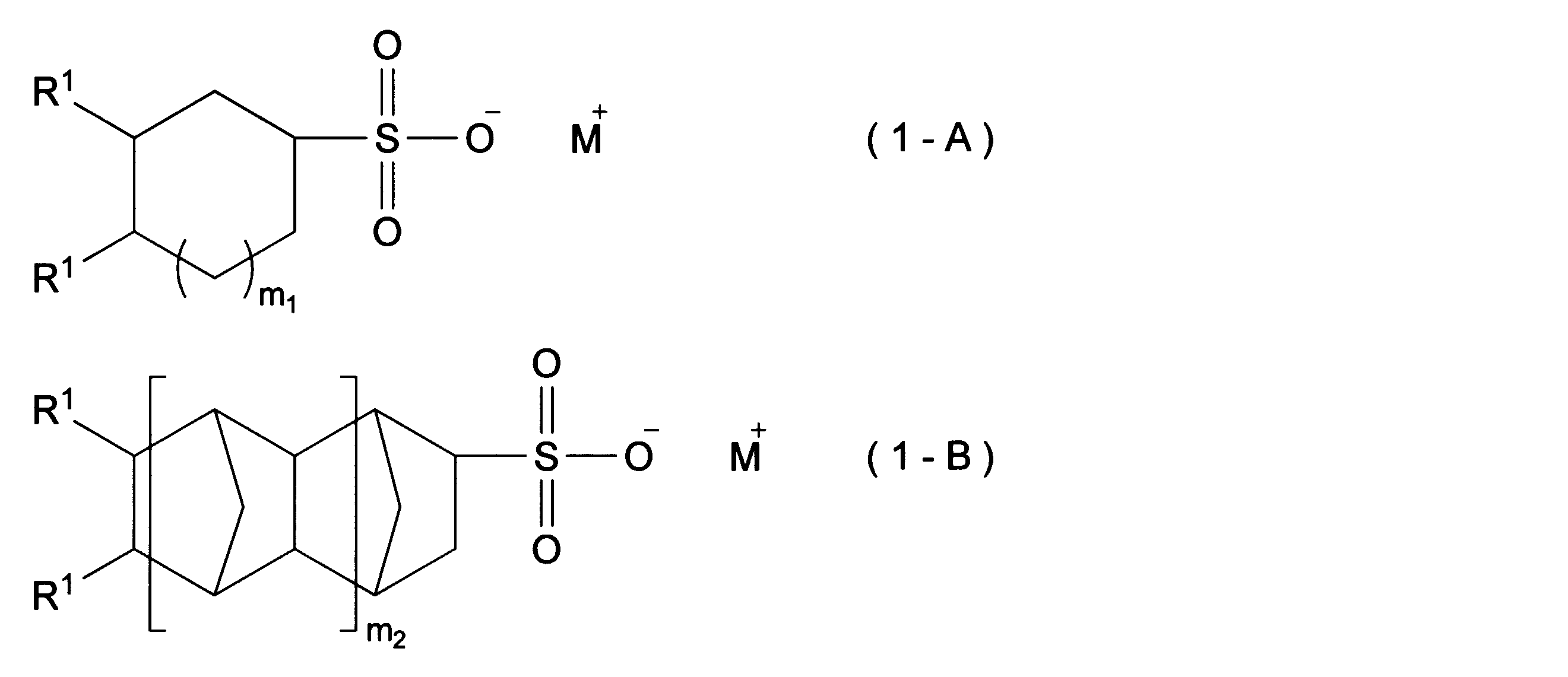
- 下記式(1-A-1)又は下記式(1-B-1)で表される請求項8に記載の化合物。
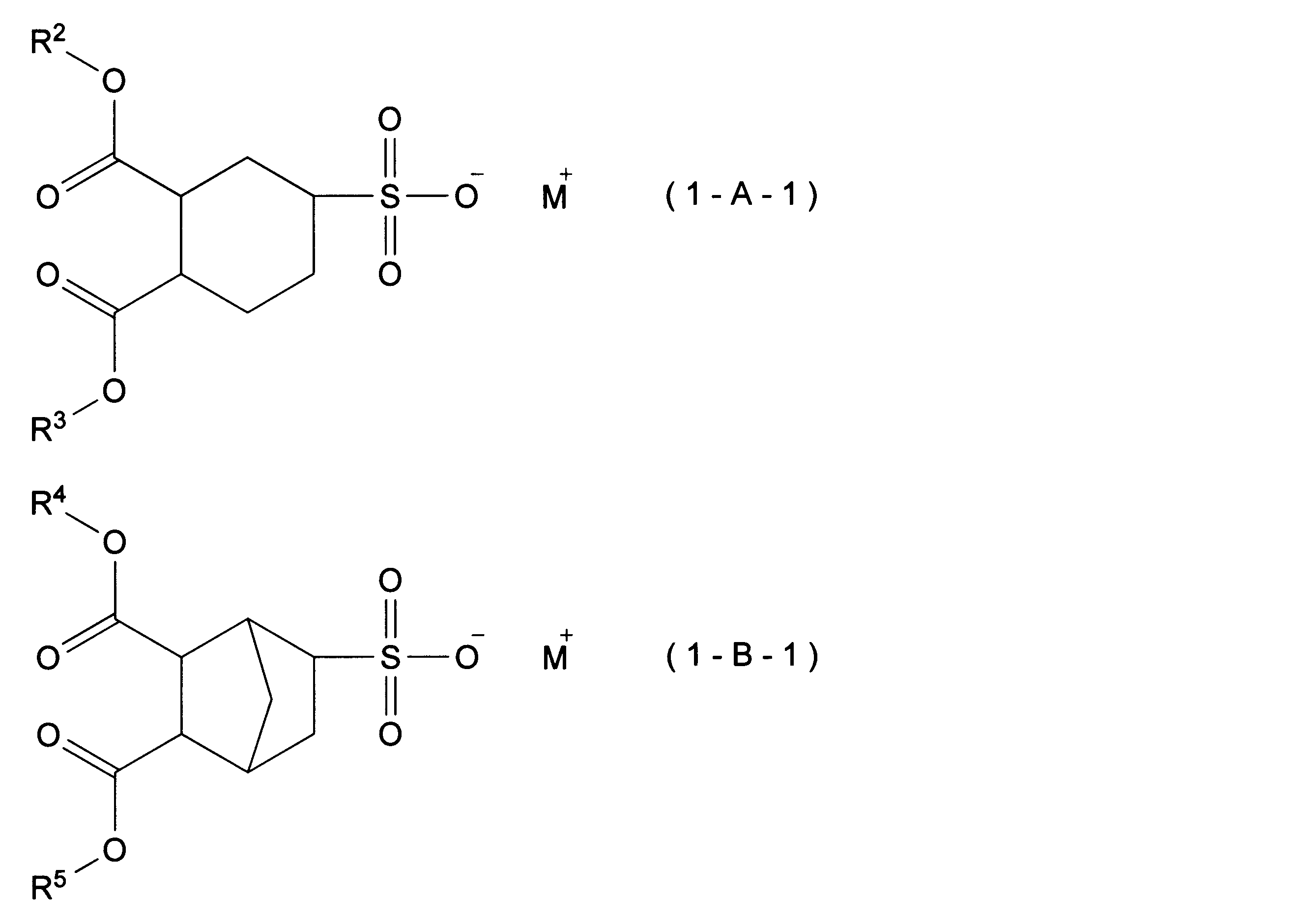
Priority Applications (3)
| Application Number | Priority Date | Filing Date | Title |
|---|---|---|---|
| KR1020137013139A KR101819261B1 (ko) | 2010-11-26 | 2011-11-21 | 감방사선성 조성물 및 화합물 |
| JP2012545753A JP5754444B2 (ja) | 2010-11-26 | 2011-11-21 | 感放射線性組成物 |
| US13/901,621 US9023584B2 (en) | 2010-11-26 | 2013-05-24 | Radiation-sensitive composition, and compound |
Applications Claiming Priority (4)
| Application Number | Priority Date | Filing Date | Title |
|---|---|---|---|
| JP2010264360 | 2010-11-26 | ||
| JP2010-264360 | 2010-11-26 | ||
| JP2011074080 | 2011-10-19 | ||
| JPPCT/JP2011/074080 | 2011-10-19 |
Related Child Applications (1)
| Application Number | Title | Priority Date | Filing Date |
|---|---|---|---|
| US13/901,621 Continuation US9023584B2 (en) | 2010-11-26 | 2013-05-24 | Radiation-sensitive composition, and compound |
Publications (1)
| Publication Number | Publication Date |
|---|---|
| WO2012070548A1 true WO2012070548A1 (ja) | 2012-05-31 |
Family
ID=46145890
Family Applications (1)
| Application Number | Title | Priority Date | Filing Date |
|---|---|---|---|
| PCT/JP2011/076839 Ceased WO2012070548A1 (ja) | 2010-11-26 | 2011-11-21 | 感放射線性組成物及び化合物 |
Country Status (4)
| Country | Link |
|---|---|
| US (1) | US9023584B2 (ja) |
| JP (1) | JP5754444B2 (ja) |
| KR (1) | KR101819261B1 (ja) |
| WO (1) | WO2012070548A1 (ja) |
Cited By (15)
| Publication number | Priority date | Publication date | Assignee | Title |
|---|---|---|---|---|
| JP2012226325A (ja) * | 2011-04-07 | 2012-11-15 | Sumitomo Chemical Co Ltd | レジスト組成物及びレジストパターンの製造方法 |
| WO2015141504A1 (ja) * | 2014-03-19 | 2015-09-24 | Jsr株式会社 | 感放射線性樹脂組成物、レジストパターン形成方法、感放射線性酸発生剤及び化合物 |
| JP2016047817A (ja) * | 2014-08-25 | 2016-04-07 | 住友化学株式会社 | 化合物、樹脂、レジスト組成物及びレジストパターンの製造方法 |
| JP2016133546A (ja) * | 2015-01-16 | 2016-07-25 | 東京応化工業株式会社 | レジスト組成物及びレジストパターン形成方法 |
| WO2017065207A1 (ja) * | 2015-10-16 | 2017-04-20 | 東京応化工業株式会社 | レジスト組成物およびレジストパターン形成方法 |
| JP2018028574A (ja) * | 2016-08-15 | 2018-02-22 | Jsr株式会社 | 感放射線性樹脂組成物、レジストパターン形成方法及び感放射線性酸発生剤 |
| WO2018101339A1 (ja) * | 2016-12-01 | 2018-06-07 | Jsr株式会社 | 感放射線性樹脂組成物、オニウム塩化合物及びレジストパターンの形成方法 |
| US10101658B2 (en) | 2015-01-16 | 2018-10-16 | Tokyo Ohka Kogyo Co., Ltd. | Resist composition and method of forming resist pattern |
| US10324377B2 (en) | 2015-06-15 | 2019-06-18 | Tokyo Ohka Kogyo Co., Ltd. | Resist composition and method of forming resist pattern |
| JP2019189655A (ja) * | 2016-08-31 | 2019-10-31 | ローム アンド ハース エレクトロニック マテリアルズ エルエルシーRohm and Haas Electronic Materials LLC | 光酸発生化合物、それ由来のポリマー、光酸発生化合物またはポリマーを含むフォトレジスト組成物、及びフォトレジストレリーフ像を形成する方法 |
| JPWO2019054282A1 (ja) * | 2017-09-15 | 2020-03-26 | 富士フイルム株式会社 | 感活性光線性又は感放射線性樹脂組成物、レジスト膜、パターン形成方法、電子デバイスの製造方法 |
| KR20200056929A (ko) * | 2018-11-15 | 2020-05-25 | 도오꾜오까고오교 가부시끼가이샤 | 레지스트 조성물 및 레지스트 패턴 형성 방법 |
| JP2020091312A (ja) * | 2018-12-03 | 2020-06-11 | 東京応化工業株式会社 | レジスト組成物及びレジストパターン形成方法 |
| CN111670177A (zh) * | 2018-10-11 | 2020-09-15 | 株式会社Lg化学 | 化合物、包含其的光致抗蚀剂组合物、包含其的光致抗蚀剂图案和用于制备光致抗蚀剂图案的方法 |
| JP2021176020A (ja) * | 2016-11-29 | 2021-11-04 | 東京応化工業株式会社 | レジスト組成物及びレジストパターン形成方法 |
Families Citing this family (10)
| Publication number | Priority date | Publication date | Assignee | Title |
|---|---|---|---|---|
| WO2012090959A1 (ja) * | 2010-12-28 | 2012-07-05 | Jsr株式会社 | 感放射線性樹脂組成物及び化合物 |
| JP6571912B2 (ja) * | 2012-12-31 | 2019-09-04 | ローム アンド ハース エレクトロニック マテリアルズ エルエルシーRohm and Haas Electronic Materials LLC | 樹状化合物、フォトレジスト組成物、および電子デバイスを作製する方法 |
| JP6456176B2 (ja) * | 2015-02-10 | 2019-01-23 | 東京応化工業株式会社 | 厚膜用化学増幅型ポジ型感光性樹脂組成物 |
| US10431106B1 (en) | 2015-04-13 | 2019-10-01 | Aptima, Inc. | Systems and methods to measure performance |
| KR102707717B1 (ko) * | 2018-05-28 | 2024-09-19 | 도오꾜오까고오교 가부시끼가이샤 | 레지스트 조성물 및 레지스트 패턴 형성 방법, 그리고, 화합물 및 산 발생제 |
| KR102707718B1 (ko) | 2018-05-28 | 2024-09-19 | 도오꾜오까고오교 가부시끼가이샤 | 레지스트 조성물, 레지스트 패턴 형성 방법, 화합물, 산 발생제 및 화합물의 제조 방법 |
| US11256169B2 (en) | 2018-05-28 | 2022-02-22 | Tokyo Ohka Kogyo Co., Ltd. | Resist composition, and method of forming resist pattern |
| KR102673929B1 (ko) | 2018-05-28 | 2024-06-10 | 도오꾜오까고오교 가부시끼가이샤 | 레지스트 조성물 및 레지스트 패턴 형성 방법 |
| JP7101541B2 (ja) | 2018-05-28 | 2022-07-15 | 東京応化工業株式会社 | レジスト組成物及びレジストパターン形成方法 |
| WO2020195428A1 (ja) * | 2019-03-28 | 2020-10-01 | Jsr株式会社 | 感放射線性樹脂組成物及びレジストパターンの形成方法 |
Citations (5)
| Publication number | Priority date | Publication date | Assignee | Title |
|---|---|---|---|---|
| JP2000327654A (ja) * | 1999-05-14 | 2000-11-28 | Jsr Corp | スルホン酸オニウム塩化合物および感放射線性樹脂組成物 |
| JP2001188344A (ja) * | 1999-12-28 | 2001-07-10 | Nec Corp | 化学増幅型レジスト |
| JP2005004158A (ja) * | 2003-05-19 | 2005-01-06 | Fuji Photo Film Co Ltd | ポジ型レジスト組成物及びそれを用いたパターン形成方法 |
| JP2009120762A (ja) * | 2007-11-16 | 2009-06-04 | Idemitsu Kosan Co Ltd | ポリアニリン複合体、その組成物及び成形体 |
| JP2009258586A (ja) * | 2008-03-28 | 2009-11-05 | Fujifilm Corp | ネガ型現像用レジスト組成物及びこれを用いたパターン形成方法 |
Family Cites Families (17)
| Publication number | Priority date | Publication date | Assignee | Title |
|---|---|---|---|---|
| US4491628A (en) | 1982-08-23 | 1985-01-01 | International Business Machines Corporation | Positive- and negative-working resist compositions with acid generating photoinitiator and polymer with acid labile groups pendant from polymer backbone |
| US4454074A (en) * | 1982-09-20 | 1984-06-12 | Texaco Inc. | Salts of dicyclopentadiene sulfonate and method of preparing |
| JPH0612452B2 (ja) | 1982-09-30 | 1994-02-16 | ブリュ−ワ−・サイエンス・インコ−ポレイテッド | 集積回路素子の製造方法 |
| US4910122A (en) | 1982-09-30 | 1990-03-20 | Brewer Science, Inc. | Anti-reflective coating |
| JPH07111573B2 (ja) * | 1988-02-01 | 1995-11-29 | 富士写真フイルム株式会社 | ハロゲン化銀カラー写真感光材料の処理方法 |
| JP2643056B2 (ja) | 1991-06-28 | 1997-08-20 | インターナショナル・ビジネス・マシーンズ・コーポレイション | 表面反射防止コーティング形成組成物及びその使用 |
| JP4448730B2 (ja) * | 2004-04-20 | 2010-04-14 | 富士フイルム株式会社 | 感光性組成物、該感光性組成物に用いられる化合物及び該感光性組成物を用いたパターン形成方法 |
| GB2441032B (en) * | 2006-08-18 | 2008-11-12 | Sumitomo Chemical Co | Salts of perfluorinated sulfoacetic acids |
| JP5088326B2 (ja) | 2006-10-13 | 2012-12-05 | Jsr株式会社 | 上層膜形成用組成物及びフォトレジストパターン形成方法 |
| JP4355725B2 (ja) * | 2006-12-25 | 2009-11-04 | 信越化学工業株式会社 | ポジ型レジスト材料及びパターン形成方法 |
| JP4554665B2 (ja) * | 2006-12-25 | 2010-09-29 | 富士フイルム株式会社 | パターン形成方法、該パターン形成方法に用いられる多重現像用ポジ型レジスト組成物、該パターン形成方法に用いられるネガ現像用現像液及び該パターン形成方法に用いられるネガ現像用リンス液 |
| JP2010248174A (ja) * | 2009-03-26 | 2010-11-04 | Sumitomo Chemical Co Ltd | 酸発生剤として用いられる塩 |
| JP5608443B2 (ja) * | 2009-07-02 | 2014-10-15 | 出光興産株式会社 | 導電性組成物 |
| WO2011027578A1 (ja) * | 2009-09-07 | 2011-03-10 | 出光興産株式会社 | 導電性組成物 |
| US8597869B2 (en) * | 2010-10-25 | 2013-12-03 | Shin-Etsu Chemical Co., Ltd. | Sulfonium salt, resist composition, and patterning process |
| KR20140010398A (ko) * | 2011-02-23 | 2014-01-24 | 바스프 에스이 | 술포늄 술페이트, 그의 제조법 및 용도 |
| JP6019677B2 (ja) * | 2012-04-02 | 2016-11-02 | Jsr株式会社 | フォトレジスト組成物及びレジストパターン形成方法 |
-
2011
- 2011-11-21 JP JP2012545753A patent/JP5754444B2/ja active Active
- 2011-11-21 WO PCT/JP2011/076839 patent/WO2012070548A1/ja not_active Ceased
- 2011-11-21 KR KR1020137013139A patent/KR101819261B1/ko active Active
-
2013
- 2013-05-24 US US13/901,621 patent/US9023584B2/en active Active
Patent Citations (5)
| Publication number | Priority date | Publication date | Assignee | Title |
|---|---|---|---|---|
| JP2000327654A (ja) * | 1999-05-14 | 2000-11-28 | Jsr Corp | スルホン酸オニウム塩化合物および感放射線性樹脂組成物 |
| JP2001188344A (ja) * | 1999-12-28 | 2001-07-10 | Nec Corp | 化学増幅型レジスト |
| JP2005004158A (ja) * | 2003-05-19 | 2005-01-06 | Fuji Photo Film Co Ltd | ポジ型レジスト組成物及びそれを用いたパターン形成方法 |
| JP2009120762A (ja) * | 2007-11-16 | 2009-06-04 | Idemitsu Kosan Co Ltd | ポリアニリン複合体、その組成物及び成形体 |
| JP2009258586A (ja) * | 2008-03-28 | 2009-11-05 | Fujifilm Corp | ネガ型現像用レジスト組成物及びこれを用いたパターン形成方法 |
Cited By (27)
| Publication number | Priority date | Publication date | Assignee | Title |
|---|---|---|---|---|
| JP2012226325A (ja) * | 2011-04-07 | 2012-11-15 | Sumitomo Chemical Co Ltd | レジスト組成物及びレジストパターンの製造方法 |
| WO2015141504A1 (ja) * | 2014-03-19 | 2015-09-24 | Jsr株式会社 | 感放射線性樹脂組成物、レジストパターン形成方法、感放射線性酸発生剤及び化合物 |
| JP2015194703A (ja) * | 2014-03-19 | 2015-11-05 | Jsr株式会社 | 感放射線性樹脂組成物、レジストパターン形成方法、感放射線性酸発生剤及び化合物 |
| JP2016047817A (ja) * | 2014-08-25 | 2016-04-07 | 住友化学株式会社 | 化合物、樹脂、レジスト組成物及びレジストパターンの製造方法 |
| JP2016133546A (ja) * | 2015-01-16 | 2016-07-25 | 東京応化工業株式会社 | レジスト組成物及びレジストパターン形成方法 |
| US10101658B2 (en) | 2015-01-16 | 2018-10-16 | Tokyo Ohka Kogyo Co., Ltd. | Resist composition and method of forming resist pattern |
| US10324377B2 (en) | 2015-06-15 | 2019-06-18 | Tokyo Ohka Kogyo Co., Ltd. | Resist composition and method of forming resist pattern |
| US11150554B2 (en) | 2015-10-16 | 2021-10-19 | Tokyo Ohka Kogyo Co., Ltd. | Resist composition and method of forming resist pattern |
| WO2017065207A1 (ja) * | 2015-10-16 | 2017-04-20 | 東京応化工業株式会社 | レジスト組成物およびレジストパターン形成方法 |
| JPWO2017065207A1 (ja) * | 2015-10-16 | 2018-08-02 | 東京応化工業株式会社 | レジスト組成物およびレジストパターン形成方法 |
| JP2018028574A (ja) * | 2016-08-15 | 2018-02-22 | Jsr株式会社 | 感放射線性樹脂組成物、レジストパターン形成方法及び感放射線性酸発生剤 |
| JP2019189655A (ja) * | 2016-08-31 | 2019-10-31 | ローム アンド ハース エレクトロニック マテリアルズ エルエルシーRohm and Haas Electronic Materials LLC | 光酸発生化合物、それ由来のポリマー、光酸発生化合物またはポリマーを含むフォトレジスト組成物、及びフォトレジストレリーフ像を形成する方法 |
| JP2021176020A (ja) * | 2016-11-29 | 2021-11-04 | 東京応化工業株式会社 | レジスト組成物及びレジストパターン形成方法 |
| JP7275205B2 (ja) | 2016-11-29 | 2023-05-17 | 東京応化工業株式会社 | レジスト組成物及びレジストパターン形成方法 |
| WO2018101339A1 (ja) * | 2016-12-01 | 2018-06-07 | Jsr株式会社 | 感放射線性樹脂組成物、オニウム塩化合物及びレジストパターンの形成方法 |
| JPWO2019054282A1 (ja) * | 2017-09-15 | 2020-03-26 | 富士フイルム株式会社 | 感活性光線性又は感放射線性樹脂組成物、レジスト膜、パターン形成方法、電子デバイスの製造方法 |
| JP7029462B2 (ja) | 2017-09-15 | 2022-03-03 | 富士フイルム株式会社 | 感活性光線性又は感放射線性樹脂組成物、レジスト膜、パターン形成方法、電子デバイスの製造方法 |
| CN111670177A (zh) * | 2018-10-11 | 2020-09-15 | 株式会社Lg化学 | 化合物、包含其的光致抗蚀剂组合物、包含其的光致抗蚀剂图案和用于制备光致抗蚀剂图案的方法 |
| CN111670177B (zh) * | 2018-10-11 | 2022-08-23 | 株式会社Lg化学 | 化合物、包含其的光致抗蚀剂组合物、光致抗蚀剂图案及其制备方法 |
| US11680040B2 (en) | 2018-10-11 | 2023-06-20 | Lg Chem, Ltd. | Compound, photoresist composition comprising same, photoresist pattern comprising same, and method for manufacturing photoresist pattern |
| KR20200056929A (ko) * | 2018-11-15 | 2020-05-25 | 도오꾜오까고오교 가부시끼가이샤 | 레지스트 조성물 및 레지스트 패턴 형성 방법 |
| JP7158251B2 (ja) | 2018-11-15 | 2022-10-21 | 東京応化工業株式会社 | レジスト組成物及びレジストパターン形成方法 |
| JP2020085917A (ja) * | 2018-11-15 | 2020-06-04 | 東京応化工業株式会社 | レジスト組成物及びレジストパターン形成方法 |
| KR102895194B1 (ko) | 2018-11-15 | 2025-12-03 | 도오꾜오까고오교 가부시끼가이샤 | 레지스트 조성물 및 레지스트 패턴 형성 방법 |
| JP2020091312A (ja) * | 2018-12-03 | 2020-06-11 | 東京応化工業株式会社 | レジスト組成物及びレジストパターン形成方法 |
| US11586111B2 (en) | 2018-12-03 | 2023-02-21 | Tokyo Ohka Kogyo Co., Ltd. | Resist composition and method of forming resist pattern |
| JP7300823B2 (ja) | 2018-12-03 | 2023-06-30 | 東京応化工業株式会社 | レジスト組成物及びレジストパターン形成方法 |
Also Published As
| Publication number | Publication date |
|---|---|
| JPWO2012070548A1 (ja) | 2014-05-19 |
| JP5754444B2 (ja) | 2015-07-29 |
| KR20140022367A (ko) | 2014-02-24 |
| US20130280658A1 (en) | 2013-10-24 |
| US9023584B2 (en) | 2015-05-05 |
| KR101819261B1 (ko) | 2018-01-16 |
Similar Documents
| Publication | Publication Date | Title |
|---|---|---|
| JP5754444B2 (ja) | 感放射線性組成物 | |
| JP5655786B2 (ja) | 感放射線性組成物 | |
| TWI416253B (zh) | 敏輻射線性樹脂組成物 | |
| JP5578170B2 (ja) | 感放射線性樹脂組成物および重合体 | |
| JP5365452B2 (ja) | 感放射線性樹脂組成物 | |
| JP5660037B2 (ja) | 感放射線性樹脂組成物 | |
| JP5664652B2 (ja) | 感放射線性組成物 | |
| WO2010095698A1 (ja) | 重合体及び感放射線性組成物並びに単量体 | |
| KR101678233B1 (ko) | 감방사선성 수지 조성물 | |
| WO2009110388A1 (ja) | 感放射線性組成物及び重合体並びに単量体 | |
| JP5716744B2 (ja) | 感放射線性組成物及び新規化合物 | |
| JP5617844B2 (ja) | 感放射線性樹脂組成物 | |
| JP4793417B2 (ja) | 感放射線性樹脂組成物 | |
| JP5092986B2 (ja) | 重合体及び感放射線性組成物並びに単量体 | |
| TWI503303B (zh) | Radiation Sensitive Compositions and Compounds | |
| JP5515471B2 (ja) | 感放射線性樹脂組成物 | |
| JP5407906B2 (ja) | 感放射線性樹脂組成物 |
Legal Events
| Date | Code | Title | Description |
|---|---|---|---|
| 121 | Ep: the epo has been informed by wipo that ep was designated in this application |
Ref document number: 11842543 Country of ref document: EP Kind code of ref document: A1 |
|
| WWE | Wipo information: entry into national phase |
Ref document number: 2012545753 Country of ref document: JP |
|
| ENP | Entry into the national phase |
Ref document number: 20137013139 Country of ref document: KR Kind code of ref document: A |
|
| NENP | Non-entry into the national phase |
Ref country code: DE |
|
| 122 | Ep: pct application non-entry in european phase |
Ref document number: 11842543 Country of ref document: EP Kind code of ref document: A1 |