WO2012056906A1 - 熱硬化型導電性コーティング用組成物、光学フィルム及びプロテクトフィルム - Google Patents
熱硬化型導電性コーティング用組成物、光学フィルム及びプロテクトフィルム Download PDFInfo
- Publication number
- WO2012056906A1 WO2012056906A1 PCT/JP2011/073701 JP2011073701W WO2012056906A1 WO 2012056906 A1 WO2012056906 A1 WO 2012056906A1 JP 2011073701 W JP2011073701 W JP 2011073701W WO 2012056906 A1 WO2012056906 A1 WO 2012056906A1
- Authority
- WO
- WIPO (PCT)
- Prior art keywords
- film
- conductive
- weight
- composition
- melamine resin
- Prior art date
- Legal status (The legal status is an assumption and is not a legal conclusion. Google has not performed a legal analysis and makes no representation as to the accuracy of the status listed.)
- Ceased
Links
Images
Classifications
-
- C—CHEMISTRY; METALLURGY
- C09—DYES; PAINTS; POLISHES; NATURAL RESINS; ADHESIVES; COMPOSITIONS NOT OTHERWISE PROVIDED FOR; APPLICATIONS OF MATERIALS NOT OTHERWISE PROVIDED FOR
- C09D—COATING COMPOSITIONS, e.g. PAINTS, VARNISHES OR LACQUERS; FILLING PASTES; CHEMICAL PAINT OR INK REMOVERS; INKS; CORRECTING FLUIDS; WOODSTAINS; PASTES OR SOLIDS FOR COLOURING OR PRINTING; USE OF MATERIALS THEREFOR
- C09D5/00—Coating compositions, e.g. paints, varnishes or lacquers, characterised by their physical nature or the effects produced; Filling pastes
- C09D5/24—Electrically-conducting paints
-
- C—CHEMISTRY; METALLURGY
- C09—DYES; PAINTS; POLISHES; NATURAL RESINS; ADHESIVES; COMPOSITIONS NOT OTHERWISE PROVIDED FOR; APPLICATIONS OF MATERIALS NOT OTHERWISE PROVIDED FOR
- C09D—COATING COMPOSITIONS, e.g. PAINTS, VARNISHES OR LACQUERS; FILLING PASTES; CHEMICAL PAINT OR INK REMOVERS; INKS; CORRECTING FLUIDS; WOODSTAINS; PASTES OR SOLIDS FOR COLOURING OR PRINTING; USE OF MATERIALS THEREFOR
- C09D165/00—Coating compositions based on macromolecular compounds obtained by reactions forming a carbon-to-carbon link in the main chain; Coating compositions based on derivatives of such polymers
-
- C—CHEMISTRY; METALLURGY
- C09—DYES; PAINTS; POLISHES; NATURAL RESINS; ADHESIVES; COMPOSITIONS NOT OTHERWISE PROVIDED FOR; APPLICATIONS OF MATERIALS NOT OTHERWISE PROVIDED FOR
- C09D—COATING COMPOSITIONS, e.g. PAINTS, VARNISHES OR LACQUERS; FILLING PASTES; CHEMICAL PAINT OR INK REMOVERS; INKS; CORRECTING FLUIDS; WOODSTAINS; PASTES OR SOLIDS FOR COLOURING OR PRINTING; USE OF MATERIALS THEREFOR
- C09D181/00—Coating compositions based on macromolecular compounds obtained by reactions forming in the main chain of the macromolecule a linkage containing sulfur, with or without nitrogen, oxygen, or carbon only; Coating compositions based on polysulfones; Coating compositions based on derivatives of such polymers
-
- C—CHEMISTRY; METALLURGY
- C09—DYES; PAINTS; POLISHES; NATURAL RESINS; ADHESIVES; COMPOSITIONS NOT OTHERWISE PROVIDED FOR; APPLICATIONS OF MATERIALS NOT OTHERWISE PROVIDED FOR
- C09D—COATING COMPOSITIONS, e.g. PAINTS, VARNISHES OR LACQUERS; FILLING PASTES; CHEMICAL PAINT OR INK REMOVERS; INKS; CORRECTING FLUIDS; WOODSTAINS; PASTES OR SOLIDS FOR COLOURING OR PRINTING; USE OF MATERIALS THEREFOR
- C09D201/00—Coating compositions based on unspecified macromolecular compounds
-
- G—PHYSICS
- G02—OPTICS
- G02B—OPTICAL ELEMENTS, SYSTEMS OR APPARATUS
- G02B1/00—Optical elements characterised by the material of which they are made; Optical coatings for optical elements
- G02B1/10—Optical coatings produced by application to, or surface treatment of, optical elements
Definitions
- the present invention relates to a thermosetting conductive coating composition, and an optical film and a protective film obtained using the thermosetting conductive coating composition.
- a coating layer (antistatic layer) having an antistatic function is provided on an optical film constituting a flat panel such as a liquid crystal television, a plasma television, an electroluminescence display, or a solar cell in order to eliminate troubles such as electrostatic breakdown.
- a protective film which is a kind of optical film, is bonded to the surface of the panel panel to prevent the panel surface from being scratched, dirt, and dust.
- This protective film has an adhesive layer on one side of a resin base material such as PET, and is used by sticking the adhesive layer side to a display.
- the electrical product is broken by static electricity generated when the film is peeled off.
- an antistatic layer is formed on the surface of the resin substrate opposite to the adhesive layer side.
- this antistatic layer has a scratch resistance to prevent scratches, an antifouling property to prevent adhesion of the adhesive during cutting, and a wiped adhesive.
- properties such as printing adhesion of oil-based inks are required for printing lot numbers and the like on the protective film.
- cost reduction it is required to form a film that satisfies the above-mentioned characteristics at the same time with a single layer coating.
- Patent Document 1 discloses a conductive polymer composition for forming an antistatic layer.
- This conductive polymer composition is a composition comprising a polythiophene-based conductive polymer and a polyester binder, and an antistatic layer having excellent adhesion is formed on a resin substrate by drying at 100 ° C. for about 1 minute. Is possible. However, since it is a solvent-drying composition, the formed antistatic layer does not have sufficient scratch resistance and solvent resistance, and a top coat is laminated on the antistatic layer to ensure these properties. All of the above performances could not be satisfied with a single layer coating.
- Patent Document 2 discloses a composition containing a conductive polymer and a water-soluble polyether-modified silicone. By adding a silicone whose side chain is modified with a polyether, a film having excellent lubricity can be obtained. Although it has been shown that it can be formed, no mention is made of scratch resistance and printability, and in a conductive composition containing silicone whose side chain is modified with polyether, the scratch resistance and The printability could not be satisfied at the same time.
- Patent Document 3 discloses an antistatic layer having surface resistivity, solvent resistance, scratch resistance, and printability by a composition comprising a resin having active hydrogen, a polysiloxane-containing polyurethane resin, polyisocyanate, and an antistatic agent. Although it has been shown that it can be formed by a single layer coating, this composition has insufficient print adhesion, and the formation of an antistatic layer requires aging at 40 ° C. for 48 hours. Productivity is low and not suitable for mass production.
- Patent Document 4 discloses a composition containing an organosiloxane having a reactive functional group such as a hydroxyl group at the terminal, and a film formed using this composition has antifouling properties (high contact with water). (Corner) and print adhesion in specific inks are shown to be compatible. However, the curing of this composition requires conditions of 2 minutes at 140 ° C., so the productivity is low and it is not suitable for mass production.
- Patent Document 5 discloses a composition containing a conductive polymer, a melamine resin derivative, and an acid catalyst. By using this composition, antistatic function, scratch resistance, solvent resistance, and antifouling properties are disclosed. It is shown that the coating film can be formed at a low temperature of about 1 minute at 100 ° C. in a short time. However, a film formed using this composition cannot achieve both printability and print adhesion and scratch resistance.
- the present inventors have found that the conductive polymer (a), the melamine resin derivative (b), the sulfonic acid curing catalyst (c), the both-end polyether-modified silicone (d),
- the conductive composition containing the conductivity improver (e) and the solvent or dispersion medium (f) is improved in scratch resistance, solvent resistance, printability and print adhesion by thermal curing in a low temperature in a short time.
- the present invention was completed by finding that an excellent conductive film can be formed.
- thermosetting conductive coating composition of the present invention is (A) a conductive polymer; (B) a melamine resin derivative, (C) a sulfonic acid curing catalyst, (D) both-end polyether-modified silicone, (E) a conductivity improver, and (F) It contains a solvent or a dispersion medium.
- the conductive polymer (a) has the following formula (I): (Wherein, R 1 and R 2 each independently represent a hydrogen atom or a C 1-4 alkyl group, or a C 1-4 alkylene group which may be substituted together) ) Is a complex of a dopant with poly (3,4-dialkoxythiophene) or poly (3,4-alkylenedioxythiophene) having a repeating structure.
- the content of the melamine resin derivative (b) is preferably 150 to 750 parts by weight with respect to 100 parts by weight of the conductive polymer.
- the sulfonic acid curing catalyst (c) is an aromatic sulfonic acid, and the content thereof is 8 to 40 parts by weight with respect to 100 parts by weight of the melamine resin derivative. It is desirable that
- the content of the both-end polyether-modified silicone (d) is preferably 10 to 60 parts by weight with respect to 100 parts by weight of the melamine resin derivative.
- the conductivity improver (e) is preferably a compound having at least one substituent of an amide group, a sulfo group and a hydroxyl group.
- thermosetting conductive coating composition preferably further contains (g) a water-soluble antioxidant, and the water-soluble antioxidant (g) is preferably ascorbic acid or erythorbic acid.
- thermosetting conductive coating composition preferably further contains (h) a wettability improver.
- thermosetting conductive coating composition preferably further contains (i) an antifoaming agent, and the antifoaming agent (i) is preferably a silicone emulsion.
- the optical film of the present invention is an optical film comprising a base material and a conductive film laminated on the base material,
- the conductive film is a film formed using the thermosetting conductive coating composition of the present invention.
- the conductive film is preferably formed by applying the thermosetting conductive coating composition to the substrate, and drying and thermosetting at a temperature of 130 ° C. or lower.
- the calculated film thickness of the conductive film is preferably less than 45 nm.
- the protect film of the present invention is characterized by comprising the optical film of the present invention.
- thermosetting conductive coating composition of the present invention a conductive film that simultaneously satisfies scratch resistance, solvent resistance, printability, and print adhesion can be subjected to heat treatment (drying / thermosetting) at a low temperature for a short time. ).
- thermosetting conductive coating composition it is possible to form a conductive film that simultaneously satisfies excellent scratch resistance, excellent printability, and print adhesion.
- the optical film of the present invention is formed by applying and curing the thermosetting conductive coating composition of the present invention on a substrate, so that it has excellent conductivity, scratch resistance, Provided with a conductive film excellent in solvent, printability and print adhesion.
- the optical film of the present invention is extremely suitable as a protective film, and a protective film comprising the above optical film is also one aspect of the present invention.
- thermosetting conductive coating composition of the present invention (hereinafter also simply referred to as “conductive composition”) comprises (a) a conductive polymer, (b) a melamine resin derivative, (c) a sulfonic acid curing catalyst, ( d) It contains a polyether-modified silicone at both ends, (e) a conductivity improver, and (f) a solvent or dispersion medium.
- conductive composition comprises (a) a conductive polymer, (b) a melamine resin derivative, (c) a sulfonic acid curing catalyst, ( d) It contains a polyether-modified silicone at both ends, (e) a conductivity improver, and (f) a solvent or dispersion medium.
- conductive composition comprises (a) a conductive polymer, (b) a melamine resin derivative, (c) a sulfonic acid curing catalyst, ( d) It contains a polyether-modified silicone at both ends, (e) a conductivity improver
- the conductive polymer (a) is a compound for imparting conductivity to the formed conductive film (coating layer).
- the conductive polymer include polythiophene, polypyrrole, polyaniline, polyacetylene, polyphenylene vinylene, polynaphthalene, derivatives thereof, and a composite of these and a dopant.
- a polythiophene conductive polymer composed of a composite of polythiophene and a dopant is suitable.
- polythiophene conductive polymer poly (3,4-dialkoxythiophene) or poly (3,4-alkoxy) is preferable. More preferred is a complex of (rangeoxythiophene) and a dopant.
- poly(3,4-dialkoxythiophene) or poly (3,4-alkylenedioxythiophene) include the following formula (I):
- R 1 and R 2 each independently represent a hydrogen atom or a C 1-4 alkyl group, or a C 1-4 alkylene group which may be substituted together.
- the C 1-4 alkyl group include a methyl group, an ethyl group, a propyl group, an isopropyl group, an n-butyl group, an isobutyl group, a sec-butyl group, and a t-butyl group.
- the optionally substituted C 1-4 alkylene group formed by combining R 1 and R 2 include a methylene group, a 1,2-ethylene group, and a 1,3-propylene group.
- 1,4-butylene group 1-methyl-1,2-ethylene group, 1-ethyl-1,2-ethylene group, 1-methyl-1,3-propylene group, 2-methyl-1,3-propylene Groups and the like. Preferred are a methylene group, 1,2-ethylene group and 1,3-propylene group, and a 1,2-ethylene group is particularly preferred.
- polythiophene having an alkylene group poly (3,4-ethylenedioxythiophene) is particularly preferable.
- a composite composed of poly (3,4-ethylenedioxythiophene) and a dopant is extremely excellent in chemical stability in addition to conductivity and transparency, and formed using this composite as a conductive polymer.
- the conductive film has extremely stable conductivity independent of humidity and extremely high transparency.
- the conductive composition containing this composite as a conductive polymer can form a film at a low temperature and in a short time, so it is extremely suitable for production of optical films such as protective films that require mass production. It also has sex.
- the dopant constituting the polythiophene-based conductive polymer is an anionic polymer capable of forming a complex by forming an ion pair with the polythiophene and stably dispersing the polythiophene in water.
- Examples of such dopants include carboxylic acid polymers (eg, polyacrylic acid, polymaleic acid, polymethacrylic acid, etc.), sulfonic acid polymers (eg, polystyrene sulfonic acid, polyvinyl sulfonic acid, polyisoprene sulfonic acid, etc.), and the like. Can be mentioned.
- carboxylic acid polymers and sulfonic acid polymers are also copolymers of vinyl carboxylic acids and vinyl sulfonic acids with other polymerizable monomers, eg, aromatic vinyl compounds such as acrylates, styrene, vinyl naphthalene, etc. It may be. Among these, polystyrene sulfonic acid is particularly preferable.
- the polystyrene sulfonic acid preferably has a weight average molecular weight of more than 20000 and 500,000 or less. More preferably, it is 40,000 to 200,000. If polystyrene sulfonic acid having a molecular weight outside this range is used, the dispersion stability of the polythiophene-based conductive polymer in water may decrease.
- the weight average molecular weight of the polymer is a value measured by gel permeation chromatography (GPC). For the measurement, an ultrahydrogel 500 column manufactured by Waters was used.
- the content of the conductive polymer is preferably 0.01 to 1.2% by weight as a solid content with respect to the entire conductive composition. More preferably, it is 0.03 to 0.5% by weight. If the amount is less than 0.01% by weight, the conductivity is difficult to develop. If the amount is more than 1.2% by weight, precipitation may occur due to mixing with other components.
- meltamine resin derivative (b) The melamine resin derivative (b) imparts thermosetting properties at a low temperature to the conductive composition, coating appearance, conductivity (for example, surface resistivity, hereinafter; SR), transparency (for example, total light transmittance). Tt and haze value, hereinafter; Haze), it is possible to form a conductive film excellent in adhesion to a substrate and solvent resistance.
- SR surface resistivity
- Haze total light transmittance
- the melamine resin derivative is, for example, the following formula (II):
- R 3 to R 8 are represented by H or CH 2 OR 9
- R 9 represents H or a C 1-4 alkyl group.
- the melamine resin derivative in which all the substituents R 3 to R 8 are hydrogen atoms is an imino type melamine resin derivative, and the melamine resin derivative in which all the substituents R 3 to R 8 are CH 2 OH is a methylol type melamine resin derivative.
- a melamine resin derivative having a structure in which all of the substituents R 3 to R 8 are CH 2 OR 9 and R 9 is substituted with a C 1-4 alkyl group is a full ether melamine resin derivative.
- melamine resin derivatives having a structure in which two of the three substituents are mixed in one molecule are classified into iminomethylol type, methylol ether type and imino ether type, and melamine resin derivatives in which all are mixed are iminomethylol ether. It is a type.
- R 3 to R 8 are represented by CH 2 OR 9 and when R 9 is a C 1-4 alkyl group, the C 1-4 alkyl group includes a methyl group, an ethyl group, and a propyl group. , A butyl group and the like, and a methyl group is preferable in consideration of low-temperature curability.
- the melamine resin derivative may be an oligomer self-condensed with formula (II) as a basic skeleton. These melamine resin derivatives may be used alone or in combination of two or more.
- the melamine resin derivatives having the above structure a full ether type melamine is more preferable from the viewpoint of the stability of the conductive composition and curability at low temperature, and a full ether type melamine in which R 9 is a methyl group is particularly preferable.
- the average degree of polymerization is preferably low in view of the pot life of the conductive composition, and more preferably more than 1.0 and less than 1.8.
- the pot life of the conductive composition means the appearance of the conductive composition (coating liquid) (presence of precipitation), the appearance of the formed conductive film, transparency, conductivity, and the base material. This shows the time during which various properties such as adhesion, scratch resistance, solvent resistance, printability, and print adhesion can be sufficiently maintained after the conductive composition (coating liquid) is prepared.
- the content of the melamine resin derivative (b) for the conductive film cured at low temperature to have a coating appearance, conductivity, transparency, adhesion to a substrate, and solvent resistance is determined by the conductive polymer (a). It is preferably 150 to 750 parts by weight with respect to 100 parts by weight of the solid content. More preferably, it is 250 to 450 parts by weight. When content exceeds 750 weight part, the electroconductivity of a film may fall, or a film may whiten and transparency may fall. On the other hand, when the amount is less than 150 parts by weight, sufficient solvent resistance is hardly imparted to the coating.
- the sulfonic acid curing catalyst (c) has a role of promoting cross-linking of the melamine resin derivative (b) on the base material during drying and curing. Since the sulfonic acid exhibits acidity in the conductive composition, the crosslinking of the melamine resin derivative in the conductive composition is promoted, and the pot life of the coating solution is shortened.
- the sulfonic acid curing catalyst also has a function of improving the leveling property of the conductive composition to the substrate. Therefore, it is desirable that the sulfonic acid curing catalyst has a structure capable of promoting curing on the substrate and maintaining the leveling property of the conductive composition to the substrate and the pot life of the conductive composition. Examples of such a sulfonic acid curing catalyst include aliphatic or aromatic sulfonic acids.
- aliphatic sulfonic acid examples include methanesulfonic acid, trifluoromethanesulfonic acid, isoprenesulfonic acid, camphorsulfonic acid, hexanesulfonic acid, octanesulfonic acid, nonanesulfonic acid, decanesulfonic acid, hexadecanesulfonic acid and the like.
- aromatic sulfonic acid examples include benzenesulfonic acid, p-toluenesulfonic acid, cumenesulfonic acid, dodecylbenzenesulfonic acid, naphthalenesulfonic acid, nonylnaphthalenesulfonic acid, and the like.
- aromatic sulfonic acids are preferable, and dodecylbenzenesulfonic acid is particularly preferable from the viewpoint of pot life of the coating solution and curability at low temperatures.
- the upper limit of the content of the sulfonic acid curing catalyst is preferably 40 parts by weight and more preferably 33 parts by weight with respect to 100 parts by weight of the melamine resin derivative. Moreover, as for the minimum, it is desirable that it is 8 weight part with respect to 100 weight part of melamine resin derivatives. This is because, within this range, the melamine resin derivative can be cured at a low temperature in a short time and the pot life of the coating solution can be sufficiently maintained. On the other hand, when the content exceeds 40 parts by weight, the pot life of the coating liquid is not easily maintained. On the other hand, when the content is less than 8 parts by weight, the film forming property of the conductive composition is deteriorated and formed. In some cases, repellency is observed in the coating, and the solvent resistance of the coating may be reduced.
- Both-end polyether-modified silicone (d) has a role of imparting scratch resistance, solvent resistance, printability, and print adhesion to the conductive film.
- the thermosetting conductive coating composition of the present invention since both terminal polyether-modified silicone is used in combination with other components, the formed conductive film has scratch resistance, printability and print adhesion. It can be given at the same time.
- R 10 is a polyether group, R 11 (C 2 H 4 O) a R 12 composed of ethylene oxide, R 11 (C 3 H 6 O) b R 12 composed of propylene oxide, or It represents hybrid R 11 (C 2 H 4 O) a (C 3 H 6 O) b R 12.
- R 11 and R 12 in the polyether group each independently represents an alkyl group or an alkylene group. What is shown. Further, the polyether groups R 10 at both ends of the formula (III) may be the same or different.
- the polymerization degree (n) of the polysiloxane is desirably 380 or less, and preferably 45 to 230.
- the polymerization degree (a and b) of the polyether group contained in R 10 is such that the solubility of the both-end polyether-modified silicone is maintained and the required characteristics are expressed in the conductive composition.
- the skeleton of the polyether group there is ethylene oxide, propylene oxide, or a copolymer of ethylene oxide and propylene oxide.
- ethylene oxide is preferable from the viewpoint of water solubility
- propylene oxide or a copolymer of ethylene oxide and propylene oxide is preferable in consideration of printability and print adhesion.
- a polyether-modified silicone having an optimum structure it is possible to reliably achieve both scratch resistance, printability, and print adhesion in the formed conductive film.
- the both-end polyether-modified silicone contained in the conductive composition imparts scratch resistance without deteriorating solvent resistance, and makes it possible to form a conductive film excellent in printability and print adhesion.
- a both-end polyether-modified silicone having a structure represented by the above formula (III) is preferable.
- the both-end polyether-modified silicone represented by the above formula (III) one kind may be used alone, or two or more kinds of both-end polyether-modified silicones having different molecular weights may be used in combination.
- the upper limit of the content of the both-end polyether-modified silicone is preferably 60 parts by weight and more preferably 33 parts by weight with respect to 100 parts by weight of the melamine resin derivative. Moreover, it is preferable that the minimum is 10 weight part with respect to 100 weight part of melamine resin derivatives. This is because within this range, scratch resistance, printability and print adhesion can be simultaneously imparted to the formed coating. On the other hand, when the content of the both-end polyether-modified silicone exceeds 60 parts by weight, the solvent resistance of the formed film may be deteriorated.
- the conductivity improver (e) contained in the conductive composition can improve the conductivity of the formed conductive film.
- Examples of the conductivity improver (e) include amide compounds such as N-methylformamide, N, N-dimethylformamide, ⁇ -butyrolactone, and N-methylpyrrolidone; ethylene glycol, diethylene glycol, propylene glycol, trimethylene glycol, Contains hydroxyl groups such as 1,4-butanediol, 1,5-pentanediol, 1,6-hexanediol, neopentyl glycol, catechol, cyclohexanediol, cyclohexanedimethanol, glycerin, diethylene glycol monoethyl ether, propylene glycol monomethyl ether Compounds: Isophorone, propylene carbonate, cyclohexanone, acetylacetone, ethyl acetate, ethy
- Boniru group-containing compound a compound having a sulfo group such as dimethyl sulfoxide and the like.
- N-methylpyrrolidone, dimethyl sulfoxide, and ethylene glycol are particularly preferable.
- the content of the conductivity improver is not particularly limited, but usually it is preferably contained in the conductive composition in an amount of 0.1 to 60% by weight.
- solvent or dispersion medium (f) is not particularly limited as long as it dissolves or disperses each component contained in the conductive composition, and examples thereof include water, organic solvents, and mixtures thereof. .
- a solvent when each component other than the solvent or dispersion medium contained in the conductive composition is dissolved, it is referred to as a solvent, and at least one component constituting the composition is uniformly dispersed. Is called a dispersion medium.
- the melamine resin derivative may not dissolve in water. In this case, a mixture of water and an organic solvent can be used as a solvent or a dispersion medium.
- the organic solvent when an admixture of water and an organic solvent is used, the organic solvent preferably includes at least one organic solvent miscible with water, and further includes an organic solvent miscible with water.
- An organic solvent that is immiscible with water (hydrophobic) may be contained.
- the water-based thermosetting conductive coating composition is a thermosetting conductive coating composition in which the solvent or dispersion medium is water alone or a mixture with an organic solvent miscible with water.
- the composition, a solvent-based thermosetting conductive coating composition is a thermosetting conductive coating composition in which the solvent or dispersion medium contains a water-insoluble organic solvent.
- Organic Solvent examples include those that can uniformly dissolve or disperse components such as melamine resin derivatives that are difficult to dissolve in water.
- Examples of the organic solvent miscible with water include alcohols such as methanol, ethanol, 2-propanol, and 1-propanol; ethylene glycols such as ethylene glycol, diethylene glycol, triethylene glycol, and tetraethylene glycol; ethylene glycol monomethyl ether; Glycol ethers such as diethylene glycol monomethyl ether, ethylene glycol diethyl ether, diethylene glycol dimethyl ether; Glycol ether acetates such as ethylene glycol monoethyl ether acetate, diethylene glycol monoethyl ether acetate, diethylene glycol monobutyl ether acetate; Propylene glycol, dipropylene glycol, tripropylene Pro such as glycol Lenglycols; propylene such as propylene glycol monomethyl ether, propylene glycol monomethyl ether,
- hydrophobic organic solvent examples include esters such as ethyl acetate, butyl acetate, and ethyl lactate; ethers such as diisopropyl ether and diisobutyl ether; ketones such as methyl ethyl ketone and methyl diisobutyl ketone; hexane, octane, petroleum Aliphatic hydrocarbons such as ether; aromatic hydrocarbons such as toluene and xylene, and mixtures thereof. These organic solvents may be used alone or in combination of two or more.
- the content of the organic solvent is preferably 20 parts by weight or more with respect to 100 parts by weight of water.
- the amount is less than 20 parts by weight, components such as the melamine resin derivative are not uniformly dissolved or dispersed, the film formability is deteriorated, and the performance may not be exhibited.
- the said electroconductive composition is a solvent-type electroconductive composition, there is no restriction
- Examples of the water used for the water-based conductive composition include distilled water, ion exchange water, and ion exchange distilled water.
- the water also includes water contained in the aqueous dispersion of the conductive polymer and other components.
- the water content is preferably 1% by weight or more with respect to the entire conductive composition.
- the pH of the conductive composition is preferably in the range of 1 to 14, and more preferably 1 to 7 in view of curability at low temperatures. It is particularly preferably 1.5 to 3.
- the pH of the conductive composition may be adjusted with a pH adjuster such as a base.
- the pH adjuster include alkanolamines such as ammonia, ethanolamine, and isopropanolamine.
- the addition amount of the pH adjuster is such that the base forms an acid and a salt, which may reduce the curing acceleration effect of the melamine resin derivative, while the higher the pH of the conductive composition, the lower the curing.
- the self-crosslinking of the melamine resin derivative in the solution is suppressed, so that the stability and pot life of the solution may be improved.
- the said pH adjuster is an arbitrary component in the said electroconductive composition.
- a pot for the conductive composition This is particularly preferable in that the life is remarkably improved.
- thermosetting conductive coating composition of the present invention contains a water-soluble antioxidant (g), a wettability improver (h), an antifoaming agent (i) and the like as necessary. Also good.
- the conductive composition may contain a water-soluble antioxidant (g).
- a water-soluble antioxidant g
- the water-soluble antioxidant (g) is present uniformly with respect to the conductive polymer in the film and effectively functions to suppress an increase in resistance due to air exposure.
- a fat-soluble antioxidant cannot exist uniformly in a film, and cannot suppress the resistance increase by air exposure effectively.
- water-soluble antioxidant examples include reducing or non-reducing water-soluble antioxidants.
- water-soluble antioxidant having reducibility include substitution with two hydroxyl groups such as L-ascorbic acid, sodium L-ascorbate, potassium L-ascorbate, erythorbic acid, sodium erythorbate and potassium erythorbate Compound having a lactone ring formed; monosaccharide or disaccharide such as maltose, lactose, cellobiose, xylose, arabinose, glucose, fructose, galactose, mannose; flavonoid such as catechin, rutin, myricetin, quercetin, kaempferol; curcumin, rosmarin Compounds having two or more phenolic hydroxyl groups such as acid, chlorogenic acid, hydroquinone, 3,4,5-trihydroxybenzoic acid; cysteine, glutathione, pentaerythritol tetrakis (3-mercapto
- non-reducing water-soluble antioxidant examples include oxidation of phenylimidazolesulfonic acid, phenyltriazolesulfonic acid, 2-hydroxypyrimidine, phenyl salicylate, sodium 2-hydroxy-4-methoxybenzophenone-5-sulfonate, and the like.
- examples include compounds that absorb ultraviolet rays that cause deterioration. These may be used alone or in combination of two or more.
- water-soluble antioxidants ascorbic acid and erythorbic acid are desirable, and ascorbic acid is more desirable. This is because the effect of suppressing an increase in resistance due to air exposure and the effect that the formed conductive film is excellent in transparency are remarkably exhibited.
- content of the said water-soluble antioxidant is not specifically limited, 60 weight part is preferable with respect to 100 weight part of melamine resin derivatives, and 40 weight part is more preferable.
- the lower limit is preferably 9 parts by weight, and more preferably 20 parts by weight. If the content exceeds 60 parts by weight, the solvent resistance of the formed conductive film may be reduced. Conversely, if the content is less than 9 parts by weight, the rate of increase in SR due to air exposure may increase.
- the conductive composition may contain a wettability improver (h).
- the said wettability improvement agent (h) improves the wettability to the base material of an electroconductive composition, and makes it possible to improve the uniformity of the electroconductive film formed.
- the wettability improver include acrylic copolymers and polyoxyethylene fatty acid ester compounds. Of these, acrylic copolymers are preferred. This is because the conductive film is excellent in transparency, scratch resistance and solvent resistance.
- the content of the wettability improver as a solid content is not particularly limited, but the upper limit is preferably 70 parts by weight and more preferably 40 parts by weight with respect to 100 parts by weight of the melamine resin derivative.
- the lower limit is preferably 4 parts by weight with respect to 100 parts by weight of the melamine resin derivative.
- the content exceeds 70 parts by weight, the crosslinking density of the melamine resin derivative is lowered, and the solvent resistance may be deteriorated.
- the content is less than 4 parts by weight, the film formability is not improved and the coating is nonuniform. It may become.
- the conductive composition may contain an antifoaming agent (i).
- an antifoaming agent i.
- the antifoaming agent include glycol compounds such as polyacetylene glycol, siloxane compounds such as organically modified polysiloxane, and emulsions obtained by dispersing polydimethylsiloxane in water using an emulsifier.
- an emulsion of polydimethylsiloxane is preferable from the viewpoint of excellent antifoaming properties.
- the content of the antifoaming agent is not particularly limited, but it is preferably 1 to 30 parts by weight with respect to 100 parts by weight of both terminal polyether-modified silicone. If it exceeds 30 parts by weight, the crosslinking density of the melamine resin derivative may be reduced, and the solvent resistance may be deteriorated. If it is less than 1 part by weight, the defoaming property may not be improved and bubbles may remain for a long time.
- thermosetting conductive coating composition of the present invention may contain other components as necessary in addition to the components described above. 10. Other components 10-1.
- Binder Resin The conductive composition may contain a binder resin for the purpose of improving the film formability and printability of the formed conductive film.
- the self-crosslinking film of the melamine resin derivative has a binder function, but by adding a binder resin, film formability, film flexibility and adhesion, Printability and print adhesion may be further improved.
- binder resin examples include homopolymers such as polyester, poly (meth) acrylate, polyurethane, polyvinyl acetate, polyvinylidene chloride, polyamide, polyimide, polyvinyl alcohol, polyacryl polyol, and polyester polyol; styrene, vinylidene chloride, Examples thereof include a copolymer containing a compound selected from the group consisting of vinyl chloride and alkyl (meth) acrylate as a copolymerization component.
- content of the said binder resin is not specifically limited, It is preferable that it is 200 weight part or less with respect to 100 weight part of melamine resin derivatives, and it is more preferable that it is 40 weight part or less. When the amount of the binder resin exceeds 200 parts by weight, the crosslinking density of the melamine resin derivative is lowered, and the solvent resistance of the formed conductive film may be deteriorated.
- the thermosetting of the melamine resin derivative in the conductive composition of the present invention is preferably a self-crosslinking reaction of the melamine resin derivative. This is because the formed conductive film is excellent in scratch resistance and solvent resistance. The reason why the film formed by self-crosslinking of the melamine resin derivative is excellent in scratch resistance and solvent resistance is considered to be its high crosslinking density.
- a melamine resin derivative can react with a functional group such as a carbonyl group or a hydroxyl group contained in the binder resin, and thus functions as a crosslinking agent for the binder resin. However, the melamine resin derivative functions as a crosslinking agent for the binder resin. The formed film tends to have lower scratch resistance and solvent resistance than the self-crosslinked film of melamine resin derivative.
- the conductive composition may contain a surfactant for the purpose of improving leveling properties.
- the surfactant include fluorine-based surfactants such as perfluoroalkyl carboxylic acid and perfluoroalkyl polyoxyethylene ethanol; polyethers such as polyoxyethylene alkyl phenyl ether, propylene oxide polymer, and ethylene oxide polymer Compound; Carboxylic acid such as coconut oil fatty acid amine salt and gum rosin; Castor oil sulfate ester, phosphate ester, alkyl ether sulfate, sorbitan fatty acid ester, sulfonate ester, succinate ester and other ester compounds; alkyl aryl sulfonic acid Amine salts, sulfonate compounds such as dioctyl sodium sulfosuccinate; phosphate compounds such as sodium lauryl phosphate; amide compounds such as coconut oil fatty acid ethanolamide; anionic surfactants,
- content of the said surfactant is not specifically limited, It is preferable that it is 100 weight part or less with respect to 100 weight part of melamine resin derivatives. When it exceeds 100 parts by weight, the crosslinking density of the melamine resin derivative is lowered, and the solvent resistance of the formed conductive film may be deteriorated.
- the conductive composition may contain a silane coupling agent for the purpose of improving the solvent resistance, printability, and print adhesion of the conductive coating.
- a silane coupling agent for the purpose of improving the solvent resistance, printability, and print adhesion of the conductive coating.
- the silane coupling agent include 3-glycidoxypropyltrimethoxysilane, 3-glycidoxypropylmethyldimethoxysilane, 2- (3,4-epoxycyclohexyl) ethyltrimethoxysilane, and 3-mercaptotrimethoxysilane. Is mentioned.
- content of the said silane coupling agent is not specifically limited, It is preferable that it is 100 weight part or less with respect to 100 weight part of melamine resin derivatives. If it exceeds 100 parts by weight, the crosslink density of the melamine resin derivative is lowered, and the solvent resistance of the formed conductive film may be deteriorated.
- the conductive composition may contain a thickener for the purpose of improving the viscosity of the conductive composition.
- a thickener for the purpose of improving the viscosity of the conductive composition.
- the thickener include water-soluble polymers such as alginic acid salts and derivatives, xanthan gum derivatives, saccharide compounds such as carrageenan and cellulose.
- content of the said thickener is not specifically limited, It is preferable that it is 100 weight part or less with respect to 100 weight part of melamine resin derivatives. If it exceeds 100 parts by weight, the crosslink density of the melamine resin derivative is lowered, and the solvent resistance of the formed conductive film may be deteriorated.
- the conductive composition contains fine particle material such as colloidal silica, hollow silica, fluororesin fine particles, and metal fine particles such as titanium for the purpose of improving the slipperiness, printability and print adhesion of the conductive film. You may let them.
- content of the said fine particle material is not specifically limited, It is preferable that it is 100 weight part or less with respect to 100 weight part of melamine resin derivatives. If it exceeds 100 parts by weight, the crosslink density of the melamine resin derivative is lowered, and the solvent resistance of the formed conductive film may be deteriorated.
- the conductive composition may contain an organic carboxylic acid having a carboxyl group for the purpose of improving the printability and print adhesion of the conductive coating.
- Organic carboxylic acids include aliphatic and aromatic monovalent and polyvalent carboxylic acids, and may contain functional groups such as hydroxyl groups and vinyl groups in the molecule.
- Examples of the aliphatic carboxylic acid include acetic acid, butyric acid, hexanecarboxylic acid, octanecarboxylic acid, acetoacetic acid, malonic acid, succinic acid, glutaric acid, adipic acid, fumaric acid, maleic acid, malic acid, tartaric acid, and citric acid.
- Etc examples of the aromatic carboxylic acid include benzoic acid, salicylic acid, gallic acid, cinnamic acid, phthalic acid, trimellitic acid, and pyromellitic acid.
- the optical film of the present invention is an optical film comprising a base material and a conductive film laminated on the base material,
- the conductive film is a film formed using the thermosetting conductive coating composition of the present invention.
- the said optical film consists of a base material and the electroconductive film laminated
- the substrate include a resin substrate and a glass substrate.
- the resin material of the resin base include polyolefin resins such as polyethylene, polypropylene, ethylene-vinyl acetate copolymer, ethylene-acrylic acid ester copolymer, ionomer copolymer, cycloolefin resin; polyethylene terephthalate, Polyester resins such as polybutylene terephthalate, polycarbonate, polyoxyethylene, modified polyphenylene, polyphenylene sulfide; nylon 6, nylon 6,6, nylon 9, semi-aromatic polyamide 6T6, semi-aromatic polyamide 6T66, semi-aromatic polyamide 9T, etc.
- Polyamide resin acrylic resin, polystyrene, acrylonitrile-styrene copolymer, acrylonitrile-butadiene-styrene copolymer, vinyl chloride resin, triacetyl cellulose, etc.
- the substrate is transparent (has high transmittance).
- polyethylene terephthalate and triacetyl cellulose are preferably used from the viewpoint of processability and functionality.
- the shape of the substrate is not particularly limited, and may be appropriately selected according to the shape of the optical film. Examples thereof include a film shape, a plate shape, and other desired shapes. Therefore, various materials such as a film, a sheet, a plate, and a molded product can be used as the substrate. Further, the surface of the base material may be subjected to physical treatment such as corona treatment, flame treatment, and plasma treatment. By performing these treatments, the coating property of the conductive composition can be improved.
- the said electroconductive film is a film formed using the electroconductive composition of this invention, and it forms by apply
- the method for applying the conductive composition to the substrate is not particularly limited, and can be appropriately selected from methods generally used in the field. For example, spin coating, gravure coating, bar coating, dip coating, curtain Examples of the application method include coating, die coating, and spray coating.
- the conductive composition may be applied by adopting a printing method such as screen printing, spray printing, ink jet printing, letterpress printing, intaglio printing, and planographic printing.
- coating the said electroconductive composition the coating liquid which diluted the said electroconductive composition previously with alcohol etc. may be prepared, and this coating liquid may be apply
- the thickness of the said conductive film is not specifically limited, According to the objective, it can select suitably.
- the calculated film thickness after heating and drying is preferably 45 nm or less, more preferably 10 to 20 nm.
- the conductive film contains a conductive polymer and thus has conductivity, but the surface resistivity is preferably 10 4 to 10 11 ⁇ / ⁇ . This is because when the surface resistivity is in this range, the required characteristics as an antistatic layer are sufficiently satisfied.
- the conductive film is formed by heating the conductive composition applied to the substrate, evaporating the solvent or dispersion medium, and simultaneously heat-curing (drying / thermosetting).
- the heating condition is preferably a condition of heating at a temperature of 130 ° C. or lower (80 ° C. to 130 ° C.) for about 1 minute (30 to 90 seconds).
- a conductive film can be sufficiently formed under the above conditions, and in the present technical field, the conditions are low temperature and short time conditions, and therefore, the productivity is excellent. It is. If the curing is insufficient under these conditions, the film may be post-cured for 1 hour to several weeks in a roll film after roll coating in a dryer or storage at 25 ° C. to 60 ° C.
- a normal ventilation dryer, a hot air dryer, an infrared dryer or the like is used for drying to evaporate the solvent or the dispersion medium and heat curing.
- a dryer having a heating means hot air dryer, infrared dryer, etc.
- the conductive composition of the present invention contains a conductive polymer, a melamine resin derivative, a sulfonic acid curing catalyst, a polyether-modified silicone at both ends, a conductivity improver, and a solvent or dispersion medium as essential components. Furthermore, it contains a water-soluble antioxidant, a wettability improver, an antifoaming agent, a binder resin, a surfactant, a silane coupling agent, a thickener, a fine particle material, and the like as necessary.
- the composition having such a structure is usually supplied in a state where the melamine resin derivative and the acidic component are separated (herein, the component showing acidity) And conductive polymers and sulfonic acid curing catalysts). And each said component is mixed in a predetermined ratio before use, and it uses it in the state in which all the components were mixed.
- the acidic component is neutralized with a base or the like, the storage stability can be maintained even if all components are supplied in a mixed state.
- the coating liquid for preparing the conductive composition is supplied in the form of two to three liquids in which the melamine resin derivative and the acidic component are separated in consideration of the pot life and storage stability of the composition.
- the components of these coating liquids may be sufficiently concentrated from the viewpoint of cost.
- each component is mixed and prepared, stirring with stirrers, such as a mechanical stirrer and a magnetic stirrer.
- the stirring is preferably continued for about 1 to 60 minutes.
- a diluent such as alcohol first in order to avoid mixing the conductive polymer, the sulfonic acid curing catalyst, and further the melamine resin derivative at a high concentration.
- a solution containing a water-soluble conductive polymer is mixed with a solution containing an organic solvent such as alcohol at a high concentration, dispersion stability may be reduced and agglomeration may occur, resulting in a decrease in pot life.
- the pot life of the conductive composition may be shortened because melamine self-crosslinking easily proceeds in the solution.
- the pot life of an electroconductive composition is dependent also on the temperature of a composition, it is preferable to prepare, keeping liquid temperature lower than 30 degreeC. A more preferable liquid temperature is ⁇ 5 ° C. to 10 ° C.
- the conductive composition is stable at room temperature around 25 ° C., but when it contains an acidic component, the self-crosslinking of the melamine resin derivative proceeds in the liquid, and the pot life may be deteriorated. Since the pot life depends on the temperature of the coating solution, the pot life can be improved by applying the solution while maintaining the temperature at ⁇ 20 ° C. to 20 ° C. It is particularly preferable to apply to the substrate while maintaining a temperature of ⁇ 5 ° C. to 10 ° C. The pot life is improved as the temperature is kept low, but in the case of an aqueous conductive composition, the composition may freeze at a temperature lower than ⁇ 20 ° C.
- the conductive composition is preferably prepared at a temperature lower than 30 ° C. from the time of preparation, and more preferably maintained at a temperature of ⁇ 5 ° C. to 10 ° C.
- the optical film having such a structure is suitable as an optical film having an antistatic layer used for a liquid crystal display, a polarizing plate, an electroluminescence display, a plasma display, an electrochromic display, a solar cell, and the like.
- the said optical film is especially suitable as a protective film, and the protective film which consists of an optical film of this invention is also one of this invention.
- the base material is preferably polyethylene terephthalate from the viewpoints of processability, hardness, transparency, and the like.
- Examples 1 to 27 and Comparative Examples 1 to 9 Each component (used raw material) shown in Table 1 was added one by one to the solvent or dispersion medium while stirring. After confirming that the added component is dissolved or uniformly dispersed, add the next component, and after adding all the components, stir for another 5 minutes to heat cure the solution or dispersion. A type conductive coating composition was prepared. Then, this composition was diluted 6 times with 80% ethanol (1: 5, weight ratio) to prepare a coating solution. Immediately after preparation of this coating solution, No. 1 was applied on a base material made of polyethylene terephthalate film (Lumirror T-60 (trade name) manufactured by Toray Industries, Inc.).
- thermosetting conductive coating composition 4 was applied with a wire bar (wet film thickness 9 ⁇ m), dried and thermally cured at 130 ° C. for 1 minute in a hot air dryer to form a conductive film. Moreover, as an evaluation of pot life, a conductive film was produced in the same manner even after 24 hours had elapsed since the preparation of the thermosetting conductive coating composition.
- Example 28 Each component (used raw material) shown in Table 2 was added while stirring one component at a time in the same manner as in Examples 1 to 27 to prepare a thermosetting conductive coating composition. Thereafter, the composition was diluted 4-fold with 80% ethanol (1: 3, weight ratio) to prepare a coating solution. Immediately after preparation of this coating solution, No. 1 was applied on a base material made of polyethylene terephthalate film (Lumirror T-60 (trade name) manufactured by Toray Industries, Inc.). 4 was applied with a wire bar (wet film thickness 9 ⁇ m), dried and thermally cured at 130 ° C. for 1 minute in a hot air dryer to form a conductive film.
- a base material made of polyethylene terephthalate film (Lumirror T-60 (trade name) manufactured by Toray Industries, Inc.). 4 was applied with a wire bar (wet film thickness 9 ⁇ m), dried and thermally cured at 130 ° C. for 1 minute in a hot air dryer to form a conductive film.
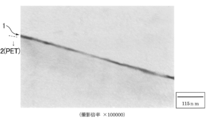
- FIG. 1 is a TEM observation image obtained by photographing the conductive coating produced in Example 28 at a magnification of 100,000 times.
- 1 is a conductive film
- 2 is a PET film
- a scale bar with a length of 115 nm is shown in the lower right in the figure.
- I. 3 Sulfonic acid curing catalyst As a sulfonic acid curing catalyst, Teika Tox T-500 (trade name) (molecular weight 187.2; compound name, cumene sulfonic acid; QS) manufactured by Teika, Neoperex GS (trade name) (molecular weight) manufactured by Kao Corporation 326.8; compound name, dodecylbenzenesulfonic acid; hereinafter, DBS). In some of the comparative examples, nitric acid (molecular weight 63.01; 60% by weight) manufactured by Wako Pure Chemical Industries, Ltd. diluted to 2% by weight was used as the acid catalyst.
- Water-soluble antioxidant As a water-soluble antioxidant, ascorbic acid or erythorbic acid manufactured by Wako Pure Chemical Industries, Ltd. was used. As an organic solvent soluble type antioxidant, dry mix FS-20 (trade name) (main component: vitamin E) manufactured by Riken Vitamin Co., Ltd. was also used.
- NMP N-methylpyrrolidone
- DMSO dimethyl sulfoxide
- EG ethylene glycol
- NMF N-methylformamide
- Organic solvent (f) As an organic solvent, primary ethanol manufactured by Wako Pure Chemical Industries, Ltd. was used.
- Antifoam 013A (trade name) (compound name: polydimethylsiloxane emulsion, hereinafter referred to as 013A) manufactured by Toray Dow Corning was used as an antifoaming agent.
- SIRQUEST A-189 (trade name) (compound name: 3-mercaptopropyltriethoxysilane) manufactured by Momentive Performance Materials, which is a silane coupling agent
- a Snowtex OXS (trade name) manufactured by a certain Nissan Chemical Company (compound name: aqueous dispersion of colloidal silica) and trimellitic acid (trade name) manufactured by Mitsubishi Gas Chemical Company, which is an organic carboxylic acid, were used.
- Total light transmittance (Tt:%) The total light transmittance was measured using a haze computer HGM-2B (trade name) manufactured by Suga Test Instruments Co., Ltd. according to JIS K 7150, and evaluated by the measured value. The pot life was evaluated based on the following three levels of change with respect to the initial value. A: Greater than -0.5 and less than +0.5 B: -1.0 to -0.5 or +0.5 to +1.0 ⁇ : less than ⁇ 1.0 or greater than +1.0
- Haze (%) Haze was measured using a haze computer HGM-2B (trade name) manufactured by Suga Test Instruments Co., Ltd. according to JIS K 7150, and evaluated by the measured value. The pot life was evaluated based on the following three levels of change with respect to the initial value. A: Greater than -0.5 and less than +0.5 B: -1.0 to -0.5 or +0.5 to +1.0 ⁇ : less than ⁇ 1.0 or greater than +1.0
- Adhesiveness to base material The adhesiveness of the conductive film to the base material was evaluated according to a cross-cut peel test of JIS K 5400, and was evaluated with a prescribed score. Pot life was evaluated in the following three stages. ⁇ : No change from the initial value ⁇ : Decrease in the range of less than 2 points from the initial value ⁇ : Decrease in the range of 2 points or more from the initial value
- the conductive film formed on the base material was subjected to an ethanol wiping test, an ethyl acetate (hereinafter referred to as ethyl acetate) wiping test, a methyl ethyl ketone (hereinafter referred to as MEK) wiping test, and a hexane wiping test. Specifically, a 10 cm length was rubbed 15 times with a load of about 200 g with a bencott soaked with each solvent, and the coating appearance after the test was evaluated in the following three stages. The pot life was similarly evaluated. ⁇ : No change in film ⁇ : Trace of rubbing is visible ⁇ : Film peels off
- the curing catalyst is preferably a sulfonic acid.
- QS has a slightly poor pot life of the coating solution, and its characteristics deteriorate after 24 hours. Therefore, it was revealed that DBS is particularly suitable as a curing catalyst.
- the content is preferably 40 parts by weight or less with respect to 100 parts by weight of the melamine resin derivative in maintaining pot life.
- Example 1 is a both-end polyether-modified silicone, which simultaneously satisfies scratch resistance, solvent resistance, printability and print adhesion, whereas in the side-chain polyether-modified silicone of Comparative Example 9, I was not satisfied at the same time. From this result, it has been clarified that the use of the both-end polyether-modified silicone as the polyether-modified silicone produces the effects of the present invention specifically. Further, from Examples 1 and 19 to 21, it was revealed that the content of both-end polyether-modified silicone is preferably 60 parts by weight or less with respect to 100 parts by weight of the melamine resin derivative in terms of solvent resistance. .
- Example 27 From Example 27, it was revealed that the generated foam can be effectively removed by adding an antifoaming agent. Further, from Example 28 and FIG. 1, a film having a calculated film thickness of about 30 nm was analyzed by TEM. As a result, it was revealed that the film thickness was about 12 nm in actual measurement. It was found that the film thickness of the composition formed under these conditions was much thinner than the calculated value.
- the conductive composition of the present invention can form a conductive coating that simultaneously satisfies scratch resistance, solvent resistance, printability, and print adhesion at low temperatures in a short time. It can be suitably used for forming a conductive film (antistatic layer) or the like constituting a film or the like.
Landscapes
- Chemical & Material Sciences (AREA)
- Organic Chemistry (AREA)
- Engineering & Computer Science (AREA)
- Materials Engineering (AREA)
- Wood Science & Technology (AREA)
- Life Sciences & Earth Sciences (AREA)
- Paints Or Removers (AREA)
- Chemical Kinetics & Catalysis (AREA)
- Physics & Mathematics (AREA)
- Laminated Bodies (AREA)
- Optics & Photonics (AREA)
- General Physics & Mathematics (AREA)
- Surface Treatment Of Optical Elements (AREA)
- Application Of Or Painting With Fluid Materials (AREA)
- Conductive Materials (AREA)
Priority Applications (2)
| Application Number | Priority Date | Filing Date | Title |
|---|---|---|---|
| CN201180052196.3A CN103237852B (zh) | 2010-10-29 | 2011-10-14 | 热固型导电性涂布用组合物、光学膜和保护膜 |
| KR1020137013251A KR101921346B1 (ko) | 2010-10-29 | 2011-10-14 | 열 경화형 도전성 코팅용 조성물, 광학 필름 및 프로텍트 필름 |
Applications Claiming Priority (2)
| Application Number | Priority Date | Filing Date | Title |
|---|---|---|---|
| JP2010243352A JP5776957B2 (ja) | 2010-10-29 | 2010-10-29 | 熱硬化型導電性コーティング用組成物、光学フィルム及びプロテクトフィルム |
| JP2010-243352 | 2010-10-29 |
Publications (1)
| Publication Number | Publication Date |
|---|---|
| WO2012056906A1 true WO2012056906A1 (ja) | 2012-05-03 |
Family
ID=45993631
Family Applications (1)
| Application Number | Title | Priority Date | Filing Date |
|---|---|---|---|
| PCT/JP2011/073701 Ceased WO2012056906A1 (ja) | 2010-10-29 | 2011-10-14 | 熱硬化型導電性コーティング用組成物、光学フィルム及びプロテクトフィルム |
Country Status (5)
| Country | Link |
|---|---|
| JP (1) | JP5776957B2 (enExample) |
| KR (1) | KR101921346B1 (enExample) |
| CN (1) | CN103237852B (enExample) |
| TW (1) | TWI518154B (enExample) |
| WO (1) | WO2012056906A1 (enExample) |
Cited By (4)
| Publication number | Priority date | Publication date | Assignee | Title |
|---|---|---|---|---|
| JP2013249368A (ja) * | 2012-05-31 | 2013-12-12 | Shin Etsu Polymer Co Ltd | 導電性高分子塗料及び導電性塗膜 |
| WO2014036206A1 (en) * | 2012-08-29 | 2014-03-06 | Eastman Chemical Company | Electrically conductive polymer compositions and films |
| JP2018504467A (ja) * | 2014-11-19 | 2018-02-15 | バイオテクティクス・リミテッド・ライアビリティ・カンパニーBiotectix, LLC | 3次元基材のための導電性ポリマーコーティング |
| JP2019065117A (ja) * | 2017-09-29 | 2019-04-25 | マクセルホールディングス株式会社 | 透明導電性膜、透明導電性膜を形成するためのコーティング組成物、及び透明導電性膜の製造方法 |
Families Citing this family (10)
| Publication number | Priority date | Publication date | Assignee | Title |
|---|---|---|---|---|
| JP6050632B2 (ja) * | 2012-08-06 | 2016-12-21 | リンテック株式会社 | 導電性組成物、及び電気デバイス |
| EP2997581A4 (en) | 2013-05-17 | 2017-05-03 | Biotectix LLC | Impregnation of a non-conductive material with an intrinsically conductive polymer |
| JP6325364B2 (ja) * | 2014-06-18 | 2018-05-16 | マクセルホールディングス株式会社 | 透明導電性コーティング組成物、透明導電性シート及びその製造方法、並びに透明導電パターン形成方法 |
| JP6299829B2 (ja) * | 2015-10-20 | 2018-03-28 | 荒川化学工業株式会社 | 熱硬化性離型コーティング剤、離型フィルム及び離型ポリエチレンテレフタレートフィルム |
| JP2019069541A (ja) | 2017-10-06 | 2019-05-09 | 日東電工株式会社 | トップコート層付きフィルム、表面保護フィルムおよび光学部品 |
| CN111372515B (zh) * | 2018-01-15 | 2023-03-24 | Nok株式会社 | 生物电极 |
| CN110845933A (zh) * | 2018-08-03 | 2020-02-28 | 荒川化学工业株式会社 | 水系防静电脱模涂敷剂组合物和防静电脱模膜 |
| WO2020116288A1 (ja) * | 2018-12-05 | 2020-06-11 | リンテック株式会社 | 保護膜形成用複合シート、及び半導体チップの製造方法 |
| JP6639712B1 (ja) * | 2019-02-15 | 2020-02-05 | 桜宮化学株式会社 | 熱硬化性離型塗料および熱硬化性離型塗料キット |
| CN109913142B (zh) * | 2019-03-01 | 2021-12-10 | 苏州格睿光电科技有限公司 | 一种抗静电性有机硅压敏胶制品 |
Citations (7)
| Publication number | Priority date | Publication date | Assignee | Title |
|---|---|---|---|---|
| JP2004256702A (ja) * | 2003-02-26 | 2004-09-16 | Toyobo Co Ltd | 導電性塗料 |
| JP2007320093A (ja) * | 2006-05-31 | 2007-12-13 | Dainichiseika Color & Chem Mfg Co Ltd | 帯電防止フィルムおよび帯電防止層形成用塗料 |
| JP2009138042A (ja) * | 2007-12-04 | 2009-06-25 | Nagase Chemtex Corp | 低温熱硬化型導電性コーティング用組成物 |
| JP2010077187A (ja) * | 2008-09-24 | 2010-04-08 | Shin Etsu Polymer Co Ltd | 導電性高分子溶液、導電性塗膜および入力デバイス |
| JP2010083940A (ja) * | 2008-09-30 | 2010-04-15 | Nagase Chemtex Corp | ポリアミドフィルムの帯電防止方法、帯電防止フィルム、およびその製造方法 |
| JP2010106245A (ja) * | 2008-09-30 | 2010-05-13 | Nagase Chemtex Corp | 低温熱硬化型導電性コーティング用組成物 |
| JP2010196022A (ja) * | 2009-02-27 | 2010-09-09 | Nagase Chemtex Corp | 導電性コーティング用組成物 |
Family Cites Families (5)
| Publication number | Priority date | Publication date | Assignee | Title |
|---|---|---|---|---|
| JP2785136B2 (ja) | 1989-06-29 | 1998-08-13 | チッソ株式会社 | 導電性樹脂組成物 |
| JPH04334805A (ja) * | 1991-05-11 | 1992-11-20 | Kao Corp | 導電性ペーストおよび導電性塗膜 |
| JP3294774B2 (ja) * | 1996-11-26 | 2002-06-24 | 関西ペイント株式会社 | 塗料組成物及びこれを用いた塗装金属板 |
| JP2007324142A (ja) * | 2007-08-15 | 2007-12-13 | Nissan Chem Ind Ltd | 導電性コーティング組成物 |
| JP2009107329A (ja) * | 2007-10-10 | 2009-05-21 | Jsr Corp | 表面保護フィルム |
-
2010
- 2010-10-29 JP JP2010243352A patent/JP5776957B2/ja active Active
-
2011
- 2011-10-14 WO PCT/JP2011/073701 patent/WO2012056906A1/ja not_active Ceased
- 2011-10-14 KR KR1020137013251A patent/KR101921346B1/ko active Active
- 2011-10-14 CN CN201180052196.3A patent/CN103237852B/zh not_active Expired - Fee Related
- 2011-10-19 TW TW100137819A patent/TWI518154B/zh active
Patent Citations (7)
| Publication number | Priority date | Publication date | Assignee | Title |
|---|---|---|---|---|
| JP2004256702A (ja) * | 2003-02-26 | 2004-09-16 | Toyobo Co Ltd | 導電性塗料 |
| JP2007320093A (ja) * | 2006-05-31 | 2007-12-13 | Dainichiseika Color & Chem Mfg Co Ltd | 帯電防止フィルムおよび帯電防止層形成用塗料 |
| JP2009138042A (ja) * | 2007-12-04 | 2009-06-25 | Nagase Chemtex Corp | 低温熱硬化型導電性コーティング用組成物 |
| JP2010077187A (ja) * | 2008-09-24 | 2010-04-08 | Shin Etsu Polymer Co Ltd | 導電性高分子溶液、導電性塗膜および入力デバイス |
| JP2010083940A (ja) * | 2008-09-30 | 2010-04-15 | Nagase Chemtex Corp | ポリアミドフィルムの帯電防止方法、帯電防止フィルム、およびその製造方法 |
| JP2010106245A (ja) * | 2008-09-30 | 2010-05-13 | Nagase Chemtex Corp | 低温熱硬化型導電性コーティング用組成物 |
| JP2010196022A (ja) * | 2009-02-27 | 2010-09-09 | Nagase Chemtex Corp | 導電性コーティング用組成物 |
Cited By (5)
| Publication number | Priority date | Publication date | Assignee | Title |
|---|---|---|---|---|
| JP2013249368A (ja) * | 2012-05-31 | 2013-12-12 | Shin Etsu Polymer Co Ltd | 導電性高分子塗料及び導電性塗膜 |
| WO2014036206A1 (en) * | 2012-08-29 | 2014-03-06 | Eastman Chemical Company | Electrically conductive polymer compositions and films |
| JP2018504467A (ja) * | 2014-11-19 | 2018-02-15 | バイオテクティクス・リミテッド・ライアビリティ・カンパニーBiotectix, LLC | 3次元基材のための導電性ポリマーコーティング |
| JP2019065117A (ja) * | 2017-09-29 | 2019-04-25 | マクセルホールディングス株式会社 | 透明導電性膜、透明導電性膜を形成するためのコーティング組成物、及び透明導電性膜の製造方法 |
| JP7102118B2 (ja) | 2017-09-29 | 2022-07-19 | マクセル株式会社 | 透明導電性膜、透明導電性膜を形成するためのコーティング組成物、及び透明導電性膜の製造方法 |
Also Published As
| Publication number | Publication date |
|---|---|
| CN103237852A (zh) | 2013-08-07 |
| TW201219514A (en) | 2012-05-16 |
| CN103237852B (zh) | 2016-04-06 |
| KR101921346B1 (ko) | 2018-11-22 |
| JP2012097132A (ja) | 2012-05-24 |
| KR20130132449A (ko) | 2013-12-04 |
| JP5776957B2 (ja) | 2015-09-09 |
| TWI518154B (zh) | 2016-01-21 |
Similar Documents
| Publication | Publication Date | Title |
|---|---|---|
| JP5776957B2 (ja) | 熱硬化型導電性コーティング用組成物、光学フィルム及びプロテクトフィルム | |
| JP5945881B2 (ja) | 帯電防止離型剤組成物及び離型フィルム | |
| JP5740925B2 (ja) | 導電性コーティング組成物及び積層体 | |
| JP5594455B2 (ja) | 低温熱硬化型導電性コーティング用組成物 | |
| JP2012097132A5 (enExample) | ||
| JP5509462B2 (ja) | 導電性コーティング用組成物 | |
| WO2012073474A1 (ja) | 透明面発熱体形成用導電性コーティング剤及び透明面発熱体 | |
| JP2008050609A (ja) | 伝導性高分子コーティング組成物、それを利用したコーティングフィルムの製造方法及びそのコーティングフィルム | |
| JP2018090755A (ja) | 導電性組成物及びその用途 | |
| JPWO2015056609A1 (ja) | 透明導電膜形成用組成物、透明導電体及び透明導電体の製造方法 | |
| US20150315391A1 (en) | Transparent conductive films, compositions, articles, and methods | |
| JP2012172024A (ja) | 導電性コーティング用組成物、導電性薄膜及び導電性フィルム | |
| JP5984054B2 (ja) | 有機導電膜 | |
| JP2009138042A (ja) | 低温熱硬化型導電性コーティング用組成物 | |
| JP5554578B2 (ja) | 導電性フィルム | |
| US7828994B2 (en) | Conductive paint compositions for forming conductive coatings on substrates | |
| KR101735915B1 (ko) | 전도성 고분자 잉크 조성물 | |
| US20130308180A1 (en) | Infrared reflective substrate | |
| JP2008308560A (ja) | 表面防汚性複合フィルムの製造方法 | |
| JP2017157530A (ja) | 導電性フィルム及びその製造方法 | |
| JP7565777B2 (ja) | 導電性高分子含有液及びその製造方法、並びに導電性積層体及びその製造方法 | |
| KR100772926B1 (ko) | 전도성 고분자 조성물, 이로부터 제조된 전도성 고분자 박막 및 이를 이용한 유기 전자 소자 | |
| JP2023004071A (ja) | 導電性高分子含有液及びその製造方法、並びに導電性積層体及びその製造方法 | |
| KR20250153247A (ko) | 전도성 폴리머 분산액 | |
| WO2025211351A1 (ja) | 導電性高分子組成物、及びその用途 |
Legal Events
| Date | Code | Title | Description |
|---|---|---|---|
| WWE | Wipo information: entry into national phase |
Ref document number: 201180052196.3 Country of ref document: CN |
|
| 121 | Ep: the epo has been informed by wipo that ep was designated in this application |
Ref document number: 11836045 Country of ref document: EP Kind code of ref document: A1 |
|
| NENP | Non-entry into the national phase |
Ref country code: DE |
|
| ENP | Entry into the national phase |
Ref document number: 20137013251 Country of ref document: KR Kind code of ref document: A |
|
| 122 | Ep: pct application non-entry in european phase |
Ref document number: 11836045 Country of ref document: EP Kind code of ref document: A1 |