WO2012017960A1 - スルホン酸基を有する芳香族系共重合体、ならびにその用途 - Google Patents
スルホン酸基を有する芳香族系共重合体、ならびにその用途 Download PDFInfo
- Publication number
- WO2012017960A1 WO2012017960A1 PCT/JP2011/067512 JP2011067512W WO2012017960A1 WO 2012017960 A1 WO2012017960 A1 WO 2012017960A1 JP 2011067512 W JP2011067512 W JP 2011067512W WO 2012017960 A1 WO2012017960 A1 WO 2012017960A1
- Authority
- WO
- WIPO (PCT)
- Prior art keywords
- group
- aromatic
- structural unit
- formula
- represented
- Prior art date
- Legal status (The legal status is an assumption and is not a legal conclusion. Google has not performed a legal analysis and makes no representation as to the accuracy of the status listed.)
- Ceased
Links
- HKKGIHCPNBYMFD-UHFFFAOYSA-N C1=CC=[I]C=C1 Chemical compound C1=CC=[I]C=C1 HKKGIHCPNBYMFD-UHFFFAOYSA-N 0.000 description 2
- HFVGHBPOSYCHOC-UHFFFAOYSA-N O=C(c(cc1)ccc1Oc1ccccn1)c1cc(Cl)ccc1Cl Chemical compound O=C(c(cc1)ccc1Oc1ccccn1)c1cc(Cl)ccc1Cl HFVGHBPOSYCHOC-UHFFFAOYSA-N 0.000 description 1
- UHOVQNZJYSORNB-UHFFFAOYSA-N c1ccccc1 Chemical compound c1ccccc1 UHOVQNZJYSORNB-UHFFFAOYSA-N 0.000 description 1
Classifications
-
- H—ELECTRICITY
- H01—ELECTRIC ELEMENTS
- H01B—CABLES; CONDUCTORS; INSULATORS; SELECTION OF MATERIALS FOR THEIR CONDUCTIVE, INSULATING OR DIELECTRIC PROPERTIES
- H01B1/00—Conductors or conductive bodies characterised by the conductive materials; Selection of materials as conductors
- H01B1/06—Conductors or conductive bodies characterised by the conductive materials; Selection of materials as conductors mainly consisting of other non-metallic substances
- H01B1/12—Conductors or conductive bodies characterised by the conductive materials; Selection of materials as conductors mainly consisting of other non-metallic substances organic substances
- H01B1/122—Ionic conductors
-
- C—CHEMISTRY; METALLURGY
- C08—ORGANIC MACROMOLECULAR COMPOUNDS; THEIR PREPARATION OR CHEMICAL WORKING-UP; COMPOSITIONS BASED THEREON
- C08G—MACROMOLECULAR COMPOUNDS OBTAINED OTHERWISE THAN BY REACTIONS ONLY INVOLVING UNSATURATED CARBON-TO-CARBON BONDS
- C08G61/00—Macromolecular compounds obtained by reactions forming a carbon-to-carbon link in the main chain of the macromolecule
- C08G61/02—Macromolecular compounds containing only carbon atoms in the main chain of the macromolecule, e.g. polyxylylenes
- C08G61/10—Macromolecular compounds containing only carbon atoms in the main chain of the macromolecule, e.g. polyxylylenes only aromatic carbon atoms, e.g. polyphenylenes
-
- C—CHEMISTRY; METALLURGY
- C08—ORGANIC MACROMOLECULAR COMPOUNDS; THEIR PREPARATION OR CHEMICAL WORKING-UP; COMPOSITIONS BASED THEREON
- C08G—MACROMOLECULAR COMPOUNDS OBTAINED OTHERWISE THAN BY REACTIONS ONLY INVOLVING UNSATURATED CARBON-TO-CARBON BONDS
- C08G61/00—Macromolecular compounds obtained by reactions forming a carbon-to-carbon link in the main chain of the macromolecule
- C08G61/12—Macromolecular compounds containing atoms other than carbon in the main chain of the macromolecule
-
- C—CHEMISTRY; METALLURGY
- C08—ORGANIC MACROMOLECULAR COMPOUNDS; THEIR PREPARATION OR CHEMICAL WORKING-UP; COMPOSITIONS BASED THEREON
- C08J—WORKING-UP; GENERAL PROCESSES OF COMPOUNDING; AFTER-TREATMENT NOT COVERED BY SUBCLASSES C08B, C08C, C08F, C08G or C08H
- C08J5/00—Manufacture of articles or shaped materials containing macromolecular substances
- C08J5/20—Manufacture of shaped structures of ion-exchange resins
- C08J5/22—Films, membranes or diaphragms
- C08J5/2206—Films, membranes or diaphragms based on organic and/or inorganic macromolecular compounds
- C08J5/2218—Synthetic macromolecular compounds
- C08J5/2256—Synthetic macromolecular compounds based on macromolecular compounds obtained by reactions other than those involving carbon-to-carbon bonds, e.g. obtained by polycondensation
-
- H—ELECTRICITY
- H01—ELECTRIC ELEMENTS
- H01M—PROCESSES OR MEANS, e.g. BATTERIES, FOR THE DIRECT CONVERSION OF CHEMICAL ENERGY INTO ELECTRICAL ENERGY
- H01M8/00—Fuel cells; Manufacture thereof
- H01M8/10—Fuel cells with solid electrolytes
- H01M8/1016—Fuel cells with solid electrolytes characterised by the electrolyte material
- H01M8/1018—Polymeric electrolyte materials
- H01M8/102—Polymeric electrolyte materials characterised by the chemical structure of the main chain of the ion-conducting polymer
- H01M8/103—Polymeric electrolyte materials characterised by the chemical structure of the main chain of the ion-conducting polymer having nitrogen, e.g. sulfonated polybenzimidazoles [S-PBI], polybenzimidazoles with phosphoric acid, sulfonated polyamides [S-PA] or sulfonated polyphosphazenes [S-PPh]
-
- H—ELECTRICITY
- H01—ELECTRIC ELEMENTS
- H01M—PROCESSES OR MEANS, e.g. BATTERIES, FOR THE DIRECT CONVERSION OF CHEMICAL ENERGY INTO ELECTRICAL ENERGY
- H01M8/00—Fuel cells; Manufacture thereof
- H01M8/10—Fuel cells with solid electrolytes
- H01M8/1016—Fuel cells with solid electrolytes characterised by the electrolyte material
- H01M8/1018—Polymeric electrolyte materials
- H01M8/102—Polymeric electrolyte materials characterised by the chemical structure of the main chain of the ion-conducting polymer
- H01M8/1032—Polymeric electrolyte materials characterised by the chemical structure of the main chain of the ion-conducting polymer having sulfur, e.g. sulfonated-polyethersulfones [S-PES]
-
- H—ELECTRICITY
- H01—ELECTRIC ELEMENTS
- H01M—PROCESSES OR MEANS, e.g. BATTERIES, FOR THE DIRECT CONVERSION OF CHEMICAL ENERGY INTO ELECTRICAL ENERGY
- H01M8/00—Fuel cells; Manufacture thereof
- H01M8/10—Fuel cells with solid electrolytes
- H01M8/1016—Fuel cells with solid electrolytes characterised by the electrolyte material
- H01M8/1018—Polymeric electrolyte materials
- H01M8/1039—Polymeric electrolyte materials halogenated, e.g. sulfonated polyvinylidene fluorides
-
- C—CHEMISTRY; METALLURGY
- C08—ORGANIC MACROMOLECULAR COMPOUNDS; THEIR PREPARATION OR CHEMICAL WORKING-UP; COMPOSITIONS BASED THEREON
- C08G—MACROMOLECULAR COMPOUNDS OBTAINED OTHERWISE THAN BY REACTIONS ONLY INVOLVING UNSATURATED CARBON-TO-CARBON BONDS
- C08G2261/00—Macromolecular compounds obtained by reactions forming a carbon-to-carbon link in the main chain of the macromolecule
- C08G2261/10—Definition of the polymer structure
- C08G2261/14—Side-groups
- C08G2261/145—Side-chains containing sulfur
- C08G2261/1452—Side-chains containing sulfur containing sulfonyl or sulfonate-groups
-
- C—CHEMISTRY; METALLURGY
- C08—ORGANIC MACROMOLECULAR COMPOUNDS; THEIR PREPARATION OR CHEMICAL WORKING-UP; COMPOSITIONS BASED THEREON
- C08G—MACROMOLECULAR COMPOUNDS OBTAINED OTHERWISE THAN BY REACTIONS ONLY INVOLVING UNSATURATED CARBON-TO-CARBON BONDS
- C08G2261/00—Macromolecular compounds obtained by reactions forming a carbon-to-carbon link in the main chain of the macromolecule
- C08G2261/30—Monomer units or repeat units incorporating structural elements in the main chain
- C08G2261/31—Monomer units or repeat units incorporating structural elements in the main chain incorporating aromatic structural elements in the main chain
- C08G2261/312—Non-condensed aromatic systems, e.g. benzene
-
- C—CHEMISTRY; METALLURGY
- C08—ORGANIC MACROMOLECULAR COMPOUNDS; THEIR PREPARATION OR CHEMICAL WORKING-UP; COMPOSITIONS BASED THEREON
- C08G—MACROMOLECULAR COMPOUNDS OBTAINED OTHERWISE THAN BY REACTIONS ONLY INVOLVING UNSATURATED CARBON-TO-CARBON BONDS
- C08G2261/00—Macromolecular compounds obtained by reactions forming a carbon-to-carbon link in the main chain of the macromolecule
- C08G2261/30—Monomer units or repeat units incorporating structural elements in the main chain
- C08G2261/34—Monomer units or repeat units incorporating structural elements in the main chain incorporating partially-aromatic structural elements in the main chain
- C08G2261/344—Monomer units or repeat units incorporating structural elements in the main chain incorporating partially-aromatic structural elements in the main chain containing heteroatoms
- C08G2261/3444—Polyethersulfones
-
- C—CHEMISTRY; METALLURGY
- C08—ORGANIC MACROMOLECULAR COMPOUNDS; THEIR PREPARATION OR CHEMICAL WORKING-UP; COMPOSITIONS BASED THEREON
- C08G—MACROMOLECULAR COMPOUNDS OBTAINED OTHERWISE THAN BY REACTIONS ONLY INVOLVING UNSATURATED CARBON-TO-CARBON BONDS
- C08G2261/00—Macromolecular compounds obtained by reactions forming a carbon-to-carbon link in the main chain of the macromolecule
- C08G2261/40—Polymerisation processes
- C08G2261/41—Organometallic coupling reactions
- C08G2261/412—Yamamoto reactions
-
- C—CHEMISTRY; METALLURGY
- C08—ORGANIC MACROMOLECULAR COMPOUNDS; THEIR PREPARATION OR CHEMICAL WORKING-UP; COMPOSITIONS BASED THEREON
- C08J—WORKING-UP; GENERAL PROCESSES OF COMPOUNDING; AFTER-TREATMENT NOT COVERED BY SUBCLASSES C08B, C08C, C08F, C08G or C08H
- C08J2365/00—Characterised by the use of macromolecular compounds obtained by reactions forming a carbon-to-carbon link in the main chain; Derivatives of such polymers
- C08J2365/02—Polyphenylenes
-
- Y—GENERAL TAGGING OF NEW TECHNOLOGICAL DEVELOPMENTS; GENERAL TAGGING OF CROSS-SECTIONAL TECHNOLOGIES SPANNING OVER SEVERAL SECTIONS OF THE IPC; TECHNICAL SUBJECTS COVERED BY FORMER USPC CROSS-REFERENCE ART COLLECTIONS [XRACs] AND DIGESTS
- Y02—TECHNOLOGIES OR APPLICATIONS FOR MITIGATION OR ADAPTATION AGAINST CLIMATE CHANGE
- Y02E—REDUCTION OF GREENHOUSE GAS [GHG] EMISSIONS, RELATED TO ENERGY GENERATION, TRANSMISSION OR DISTRIBUTION
- Y02E60/00—Enabling technologies; Technologies with a potential or indirect contribution to GHG emissions mitigation
- Y02E60/30—Hydrogen technology
- Y02E60/50—Fuel cells
Definitions
- the present invention relates to an aromatic copolymer having a novel sulfonic acid group, a solid polymer electrolyte comprising the aromatic copolymer having the sulfonic acid group, and use thereof.
- Electrolytes are usually used in an aqueous solution.
- the first reason is, for example, the ease of processing when applied to electrical / electronic materials, and the second reason is the shift to light, thin, small, and power saving.
- inorganic compounds are known as proton conductive materials.
- examples of inorganic compounds include uranyl phosphate, which is a hydrated compound.
- uranyl phosphate which is a hydrated compound.
- a conductive layer is formed on the substrate or electrode. Many problems arise.
- organic compounds include sulfonated products of vinyl polymers such as polystyrene sulfonic acid, perfluoroalkyl sulfonic acid polymers represented by Nafion (trade name, manufactured by DuPont), and perfluoroalkyl carboxylic acid polymers.
- vinyl polymers such as polystyrene sulfonic acid, perfluoroalkyl sulfonic acid polymers represented by Nafion (trade name, manufactured by DuPont), and perfluoroalkyl carboxylic acid polymers.
- examples include polymers belonging to so-called cation exchange resins, or organic polymers such as polymers in which a sulfonic acid group or a phosphoric acid group is introduced into a heat-resistant polymer such as polybenzimidazole or polyether ether ketone.
- an electrode-membrane assembly is usually obtained by sandwiching an electrolyte membrane made of the perfluoroalkylsulfonic acid polymer between both electrodes and performing a heat treatment such as hot pressing.
- a fluorine-based film such as this perfluoroalkyl sulfonic acid polymer has a relatively low heat deformation temperature of about 80 ° C., and can be easily joined.
- the temperature may be 80 ° C. or higher due to the reaction heat, so that the electrolyte membrane softens and a creep phenomenon occurs, which causes a problem that both electrodes are short-circuited and power generation becomes impossible.
- the fuel cell is designed so that the thickness of the electrolyte membrane is increased to some extent or the temperature during power generation is 80 ° C. or less, but the maximum output of power generation is It will decline.
- Patent Document 1 discloses a solid polymer electrolyte made of sulfonated rigid polyphenylene.
- This polymer is mainly composed of a polymer obtained by polymerizing an aromatic compound comprising a phenylene chain, and this is reacted with a sulfonating agent to introduce a sulfonic acid group.
- the electrolyte membrane made of this polymer has a heat distortion temperature of 180 ° C. or higher and is excellent in creep resistance at high temperatures.
- electrolyte membranes are still insufficient as electrolyte membranes used for polymer electrolyte fuel cells in terms of chemical stability before and after power generation.
- an aromatic copolymer having a sulfonic acid group having high proton conductivity and excellent chemical stability before and after power generation, and proton conductivity produced from the copolymer It would be desirable to provide a high solid polymer electrolyte.
- the present inventors have intensively studied to solve the above problems. As a result, it has been found that the above problems can be solved by an aromatic copolymer having a specific structural unit, and the present invention has been completed.
- each R 1 is independently a halogen atom, a monovalent hydrocarbon group having 1 to 20 carbon atoms, or a monovalent halogenated hydrocarbon group having 1 to 20 carbon atoms
- a represents an integer of 0 to 3
- k represents an integer of 1 to 4.
- a + k ⁇ 4 and a plurality of R 1 may be the same or different.
- Ar 1 is an organic group having 3 to 30 carbon atoms having a heterocyclic structure containing nitrogen.
- the structural unit represented by the formula (2) is at least one group selected from a divalent heterocyclic group containing nitrogen and a group represented by the following formula (2-1): Aromatic copolymer.
- R h represents a monovalent heterocyclic group containing nitrogen
- Ar 22 represents a trivalent aromatic group
- R s represents a divalent C 1-20 divalent group.
- a polymer electrolyte fuel cell having the membrane-electrode assembly according to [6].
- the aromatic copolymer having a sulfonic acid group according to the present invention has a specific structural unit, swelling in hot water and shrinkage upon drying are small. Therefore, it is possible to introduce a sulfonic acid group at a high concentration, and it is possible to obtain a solid polymer electrolyte and a proton conductive membrane having high proton conductivity, high dimensional stability, and high mechanical strength.
- the aromatic block copolymer having a sulfonic acid group according to the present invention can be suitably used for a proton conductive membrane for a fuel cell.
- the aromatic copolymer of the present invention has a structural unit having a sulfonic acid group and a structural unit having a divalent heterocyclic group containing nitrogen.
- the structure of the copolymer is not particularly limited, and may be a random copolymer or a block copolymer, or a mixture thereof.
- a block copolymer is preferable.
- the structural unit having a sulfonic acid group of the present invention is represented by the following formula (1).
- each R 1 is independently a halogen atom, a monovalent hydrocarbon group having 1 to 20 carbon atoms, or a monovalent halogenated hydrocarbon group having 1 to 20 carbon atoms, Represents an integer of 0 to 3, k represents an integer of 1 to 4, and an integer of a + k ⁇ 4.
- the plurality of R 1 may be the same or different.
- Examples of the monovalent hydrocarbon group having 1 to 20 carbon atoms in R 1 include a methyl group, an ethyl group, a propyl group, an isopropyl group, a butyl group, an isobutyl group, a t-butyl group, a tetramethylbutyl group, an amyl group, C1-C20 alkyl groups such as pentyl and hexyl groups; C3-C20 cycloalkyl groups such as cyclopentyl and cyclohexyl groups; C6-C20 aromatics such as phenyl, naphthyl and biphenyl groups Group hydrocarbon group; alkenyl groups having 2 to 20 carbon atoms such as vinyl group and allyl group.
- Examples of the monovalent halogenated hydrocarbon group having 1 to 20 carbon atoms in R 1 include a halogenated alkyl group having 1 to 20 carbon atoms, a halogenated cycloalkyl group having 3 to 20 carbon atoms, and 6 to 20 carbon atoms. And halogenated aromatic hydrocarbon groups.
- Examples of the halogenated alkyl group include a trichloromethyl group, a trifluoromethyl group, a tribromomethyl group, a pentachloroethyl group, a pentafluoroethyl group, and a pentabromoethyl group; and the halogenated aromatic hydrocarbon group. Examples thereof include a chlorophenyl group and a chloronaphthyl group.
- a is preferably 0 or 1, more preferably 0, from the viewpoint of increasing the density of sulfonic acid groups per unit weight of the structural unit.
- k is preferably 1 from the viewpoint of reducing the polymerization reactivity of the main chain phenylene moiety due to steric hindrance due to the presence of a plurality of sulfonic acid groups.
- at least two structural units represented by the above formula (1) are preferably continuous from the viewpoint of mechanical strength and hot water resistance of the obtained electrolyte membrane. More preferably, at least 5 continuous, more preferably at least 10 continuous. Usually, when calculated from the composition ratio, two or more structural units (1) are continuous. The continuity of the structural unit represented by (1) can be proved by NMR or the like.
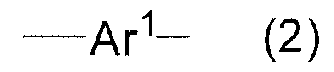
- the structural unit having a divalent heterocyclic group containing nitrogen of the present invention is represented by the following formula (2).
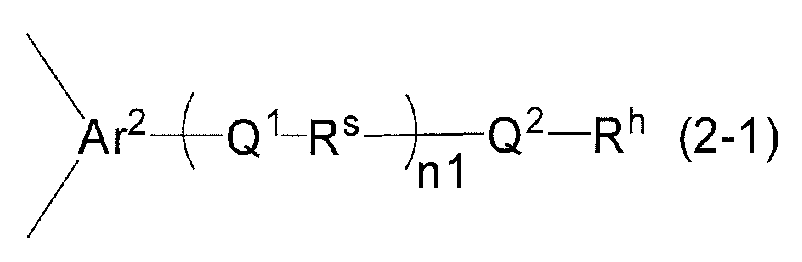
- Ar 1 represents a divalent organic group having a heterocyclic structure containing nitrogen, preferably an organic group having 3 to 30 carbon atoms having a heterocyclic structure containing nitrogen, And a divalent heterocyclic group containing nitrogen and a group represented by the following formula (2-1).
- R h represents a monovalent heterocyclic group containing nitrogen
- Ar 2 represents a trivalent aromatic group
- R s represents a divalent fatty acid having 1 to 20 carbon atoms.
- Examples of the monovalent heterocyclic group containing nitrogen represented by R h include nitrogen-containing 5-membered and 6-membered ring structures. Further, the number of nitrogen atoms in the heterocycle is not particularly limited as long as it is 1 or more, and the heterocycle may contain oxygen or sulfur in addition to nitrogen. Specific examples of the monovalent heterocyclic group containing nitrogen constituting R h include pyrrole, thiazole, isothiazole, oxazole, isoxazole, pyridine, imidazole, imidazoline, pyrazole, 1,3,5-triazine, and pyrimidine.
- substituents examples include alkyl groups such as a methyl group, an ethyl group, and a propyl group, and aryl groups such as a phenyl group, a toluyl group, and a naphthyl group.
- alkyl groups such as a methyl group, an ethyl group, and a propyl group
- aryl groups such as a phenyl group, a toluyl group, and a naphthyl group.
- Examples of the trivalent aromatic group represented by Ar 2 include a trivalent monocyclic aromatic group derived from a phenyl group, a trivalent condensed ring aromatic group derived from a naphthyl group, pyridine, quinoxaline, and thiophene. And trivalent aromatic heterocyclic groups derived from the above. Of these, a monocyclic aromatic group is preferable.
- Examples of the divalent aromatic group represented by R s include divalent monocyclic aromatic groups such as 1,3-phenylene group and 1,4-phenylene group, 1,3-naphthalenediyl group, 1,4 -Divalent condensation of naphthalenediyl group, 1,5-naphthalenediyl group, 1,6-naphthalenediyl group, 1,7-naphthalenediyl group, 2,6-naphthalenediyl group, 2,7-naphthalenediyl group, etc.
- Examples thereof include a divalent aromatic heterocyclic group such as a ring aromatic group, a pyridinediyl group, a quinoxalinediyl group, and a thiophenediyl group.
- Examples of the divalent aliphatic hydrocarbon group having 1 to 20 carbon atoms and the divalent alicyclic hydrocarbon group having 3 to 20 carbon atoms represented by R s include a methylene group, an ethylene group, and a cyclohexylene group. Is mentioned.
- R s is preferably a divalent monocyclic aromatic group.
- the divalent to trivalent binding sites are not particularly limited.
- divalent heterocyclic group containing nitrogen represented by Ar 1 examples include a pyrrole diyl group, a 2H-pyrrole diyl group, an imidazole diyl group, a pyrazole diyl group, an isothiazole diyl group, an isoxazole diyl group, and a pyridinediyl group.
- Examples of the divalent aliphatic hydrocarbon group having 1 to 20 carbon atoms represented by R s include a methylene group, a propylene group, and a butylene group.
- Examples of the divalent alicyclic hydrocarbon group having 3 to 20 carbon atoms represented by R s include a cyclopentylene group, a cyclohexylene group, and a cycloheptylene group.
- R s is preferably a divalent monocyclic aromatic group.
- the aromatic copolymer of the present invention includes the structural unit represented by the above formula (1) and the above formula (from the viewpoint of the stability of the sulfonic acid, the mechanical strength and the hot water resistance of the obtained membrane)
- the structural unit represented by 2) is preferably bonded directly.
- a solid polymer electrolyte membrane having high sulfonic acid stability at high temperatures without imparting basicity and impairing proton conductivity is obtained.
- Obtainable in particular, by using in combination with the structural unit represented by the formula (1), elution to hot water in the film can be suppressed, and a film excellent in hot water resistance can be obtained.
- the nitrogen-containing heterocyclic group is contained, chemical deterioration of the film is suppressed, so that a film having higher durability can be obtained.
- the aromatic copolymer of the present invention is represented by the following formula (3) as a structural unit having an aromatic structure in addition to the structural unit represented by the above formula (1) and the structural unit represented by the above formula (2). Structural units can be included.
- the structural unit having an aromatic structure is represented by the following formula (3).
- Ar 21 , Ar 22 , Ar 23 and Ar 24 each independently represent a divalent group having a benzene ring, condensed aromatic ring (such as a naphthalene ring) or a nitrogen-containing heterocyclic ring structure. .
- some or all of the hydrogen atoms may be fluorine-substituted, nitro group, nitrile groups, or some or all of the hydrogen atoms may be halogen-substituted. It may be substituted with at least one atom or group selected from the group consisting of an alkyl group, an allyl group or an aryl group.
- a and D are each independently a direct bond or —CO—, —COO—, —CONH—, —SO 2 —, —SO—, — (CF 2 ) 1 — (l is an integer of 1 to 10 A), — (CH 2 ) l — (l is an integer of 1 to 10), —CR ′ 2 — (R ′ represents an aliphatic hydrocarbon group, an aromatic hydrocarbon group and a halogenated hydrocarbon group) ), A cyclohexylidene group, a fluorenylidene group, —O— or S—, B is an oxygen atom or a sulfur atom, s and t each independently represent an integer of 0 to 4, and r is 0 Or an integer greater than or equal to 1 is shown.
- the structural unit having an aromatic structure is preferably one represented by the following formula (3-1).
- a and D are independently a direct bond, or —CO—, —SO 2 —, —SO—, —COO—, —CONH—, — (CF 2 ) l — (l is 1 is an integer of 1 to 10), — (CH 2 ) 1 — (l is an integer of 1 to 10), —CR ′ 2 — (R ′ is an aliphatic hydrocarbon group, aromatic hydrocarbon group and halogen Represents at least one structure selected from the group consisting of a cyclohexylidene group, a fluorenylidene group, —O—, and —S—, and B is independently an oxygen atom or a sulfur atom, R 1 to R 16 may be the same or different from each other, and may be a hydrogen atom, a fluorine atom, a nitro group, a nitrile group, an alkyl group, an allyl group or At least one atom selected from the group consisting of
- the hydrophobicity of the copolymer is remarkably improved. For this reason, the outstanding hot water tolerance can be provided, providing the proton conductivity similar to the past.
- a copolymer containing a nitrile group in the above structural unit can produce a copolymer having small swelling during hot water and shrinkage during drying.
- the structural unit represented by the above-described formula (1) has low resistance to hot water and may have a low cell voltage retention rate, but is represented by the above-described formula (3).
- a large number of sulfonic acid groups can be introduced, and a high cell voltage holding ratio is achieved.
- the aromatic copolymer of the present invention can contain a structural unit having a phosphonic acid group in addition to the structural unit represented by the above formula (1) and the structural unit represented by the above formula (2).
- a structural unit which has a phosphonic acid group the structural unit represented by following formula (4) can be mentioned, for example.
- each E is individually at least one selected from the group consisting of —CO—, —SO 2 —, —SO—, —CONH—, —NHCO—, and —COO— groups.
- the structure is shown. Of these, —CO— and —SO 2 — are preferable.
- Ar 31 , Ar 32 , Ar 33 may be the same or different, and may be substituted with a fluorine atom, and at least one structure selected from the group consisting of a benzene ring, a naphthalene ring, and a nitrogen-containing heterocyclic ring Indicates.
- the nitrogen-containing heterocycle includes pyrrole, 2H-pyrrole, imidazole, pyrazole, isothiazole, isoxazole, pyridine, pyrazine, pyrimidine, pyridazine, indolizine, isoindole, 3H-indole, indole, 1H-indazole, purine.
- R 31 is at least one selected from the group consisting of a direct bond, —O (CH 2 ) p —, —O (CF 2 ) p —, — (CH 2 ) p —, and — (CF 2 ) p —.
- P represents an integer of 1 to 12).
- e represents an integer of 0 to 10, preferably 0 to 5, more preferably 0 to 2.
- f represents an integer of 1 to 5, preferably 1 to 4, more preferably 1 to 3.
- g represents an integer of 0 to 4, preferably 0 to 3, more preferably 0 to 2.
- the structural unit having a phosphonic acid group is preferably represented by the following formula (4 ′).
- E, R 31 , e, f and g are the same as those in the formula (4).
- Specific examples of the structural unit having a phosphonic acid group include the following.
- a polymer electrolyte fuel cell hydrogen peroxide is generated and decomposed by a side reaction during power generation to generate hydroxy radicals.
- This peroxide radical is believed to cause oxidative degradation of the electrolyte polymer in the membrane, causing breakage of the membrane and the like.
- a phosphoric acid compound such as a phosphonic acid group has an antioxidant ability and is effective in preventing deterioration of the electrolyte membrane in the fuel cell.
- the phosphonic acid group functions to trap and inactivate Fe 2+ ions and Cu 2+ ions that promote the decomposition of hydrogen peroxide into hydroxy radicals.
- the phosphate compound has a chain initiation inhibiting function, a chain inhibiting function, and a peroxide decomposing function, and is used as an antioxidant.
- Reference Document JP-A-2004-134294 By including such a structural unit having a phosphonic acid group, the phosphonic acid group is introduced into an aromatic ring having a low electron density. For this reason, the aromatic copolymer of this invention can improve the radical tolerance with respect to a peroxide, and can maintain high proton conductivity. In the structural unit, a phosphonic acid group is introduced into an aromatic ring having a low electron density.
- a phosphonic acid group introduced into an aromatic main chain or a phosphonic acid group introduced into an aromatic ring having a high electron density (for example, an aromatic ring bonded to —O— or —S—)
- the conductivity may be significantly reduced.
- the proton conductivity is greatly reduced by introduction like a non-conductive phosphonic acid ester group. The conductivity can be maintained without doing so.
- the amount of each structural unit is determined according to desired properties such as ion exchange capacity and molecular weight.
- the molecular weight of the aromatic copolymer of the present invention is 10,000 to 1,000,000, preferably 20,000 to 800,000, more preferably 50,000 to 30 in terms of polystyrene-equivalent weight average molecular weight by gel permeation chromatography (GPC). Ten thousand.
- the ion exchange capacity of the aromatic copolymer according to the present invention is usually 0.3 to 6 meq / g, preferably 0.5 to 4 meq / g, more preferably 0.8 to 3.5 meq / g. If the ion exchange capacity is within this range, the proton conductivity is high, the power generation performance can be enhanced, and sufficiently high water resistance can be provided.
- the above-mentioned ion exchange capacity can be adjusted by changing the type, usage ratio, and combination of each structural unit. Therefore, it can be adjusted by changing the charge amount ratio and type of the precursor (monomer / oligomer) that induces the structural unit during polymerization.
- the polymer of the present invention desirably contains the structural unit represented by the formula (1) in a proportion of 0.5 to 99.9 mol%, preferably 10 to 99.5 mol%. Moreover, it is desirable that the structural unit represented by the formula (2) is contained in an amount of more than 0.01 mol%, preferably 20 mol% or less of all the structural units. Further, it is desirable that the structural unit represented by the formula (3) (aromatic ring structure) contains 0.1 to 99.5 mol%, preferably 0.5 to 89.5 mol%.
- the amount of the structural unit represented by the above formula (2) with respect to 1 mol of the structural unit represented by the above formula (1) is: The amount is preferably 0.001 to 0.5 mol, more preferably 0.005 to 0.2 mol, and still more preferably 0.01 to 0.1 mol.
- the ion exchange capacity increases and the proton conductivity increases, but the water resistance tends to decrease.
- the ion exchange capacity decreases and the water resistance increases, but the proton conductivity tends to decrease.
- a copolymer having small swelling in hot water and shrinkage upon drying can be produced.
- the copolymer which consists of such a structural unit is excellent also in mechanical strength.
- the copolymer of the present invention preferably has a swelling ratio of 20% or less, more preferably 15% or less.
- the shrinkage of the copolymer is preferably 6% or less, more preferably 5% or less.
- the swelling shrinkage rate of such a copolymer is preferably 25% or less and 20% or less. Such swelling rate, shrinkage rate, and swelling shrinkage rate are evaluated by the hot water test shown in the examples.
- the aromatic copolymer of the present invention is obtained by, for example, the compound (A) derived from the structural unit represented by the above formula (1) and the above formula (2) by the method described in JP-A No. 2004-137444.
- the compound derived from the structural unit represented by (B) and, if necessary, the compound derived from the other structural unit are copolymerized and synthesized by converting the sulfonic acid ester group into a sulfonic acid group. Can do.
- Compound (A) from which the structural unit represented by the above formula (1) is derived (hereinafter also referred to as “Compound A”)
- the structural unit represented by the above formula (1) can be introduced by using, for example, a compound represented by the following formula (1-1) as a polymerization raw material for the aromatic copolymer.
- Z 1 is a halogen atom, a nitro group, an atom or group selected from —SO 2 CH 3 and —SO 2 CF 3
- R a is a group represented by —OR b
- R b Represents a monovalent hydrocarbon group having 1 to 20 carbon atoms or a monovalent halogenated hydrocarbon group having 1 to 20 carbon atoms.
- R a may be the same or different and represents a hydrocarbon group having 1 to 20 carbon atoms, preferably a hydrocarbon group having 4 to 20 carbon atoms.
- tert-butyl group iso-butyl group, n-butyl group, sec-butyl group, neopentyl group, cyclopentyl group, hexyl group, cyclohexyl group, cyclopentylmethyl group, cyclohexylmethyl group, adamantylmethyl group, adamantylmethyl group 2-ethylhexyl group, bicyclo [2.2.1] heptyl group, bicyclo [2.2.1] heptylmethyl group, tetrahydrofurfuryl group, 2-methylbutyl group, 3,3-dimethyl-2,4-dioxolane
- Examples include a straight chain hydrocarbon group such as a methyl group, a branched hydrocarbon group, an alicyclic hydrocarbon group
- n-butyl group, neopentyl group, tetrahydrofurfuryl group, cyclopentylmethyl group, cyclopentyl group, cyclohexyl group, cyclohexylmethyl group, adamantyl from the viewpoint of availability, solubility of other compounds and polymerization reactivity
- a methyl group and a bicyclo [2,2,1] heptylmethyl group are preferred, and a neopentyl group is most preferred.
- Compound (B) derived from the structural unit having a nitrogen-containing heterocyclic group (hereinafter also referred to as “Compound B”)
- the structural unit having a nitrogen-containing heterocyclic group represented by the above formula (2) is obtained by using, for example, an aromatic group by using a compound represented by the following formula (2-2) as a raw material for an aromatic copolymer. It can be introduced into the polymer.
- Ar 1 has the same meaning as Ar 1 in the formula (2), and Z 3 is an atom selected from a halogen atom, a nitro group, a —SO 3 CH 3 group, and SO 3 CF 3. Or a group.
- Ar 1 is a divalent heterocyclic group containing nitrogen
- specific examples of the compound represented by the above formula (2-2) include 1-methyl-2,5-dichloropyrrole, 1- Hexyl-2,5-dibromopyrrole, 1-octyl-2,5-dichloropyrrole, 2,5-dichloropyridine, 3,5-dichloropyridine, 2,5-dibromopyridine, 3-methyl-2,5-dichloro Pyridine, 3-hexyl-2,5-dichloropyridine, 5,5′-dichloro-2,2′-bipyridine, 3,3′-dimethyl-5,5′-dichloro-2,2′-bipyridine, 3, 3'-dioctyl-5,5'-dibromo-2,2'-bipyridine, 2,5-dichloropyrimidine, 2,5-dibromopyrimidine, 5,8-dichloroquinoline, 5,8-dibro
- R h , R s , Ar 2 , Q 1 , Q 2 , n 1 are R h , R s , Ar 2 , Q 1 , Q 2 , It is synonymous with n1, and Z 3 represents an atom or group selected from a halogen atom, a nitro group, a —SO 3 CH 3 group, and SO 3 CF 3 .
- Compound (C) derived from the structural unit represented by the above formula (3) (hereinafter also referred to as “compound C”) A structural unit having an aromatic structure, derived from a monomer having the following formula (3-2).
- Ar 21 , Ar 22 , Ar 23 , and Ar 24 are at least one structure selected from the group consisting of a benzene ring, a condensed aromatic ring (such as a naphthalene ring), and a nitrogen-containing heterocyclic ring.
- Ar 21 , Ar 22 , Ar 23 , and Ar 24 are each a hydrogen atom, a fluorine atom, an alkyl group, a halogenated alkyl group in which part or all of them are fluorine-substituted, an allyl group, an aryl group, It may be substituted with a nitro group or a nitrile group.
- X represents at least one structure selected from the group consisting of chlorine, bromine, iodine, methanesulfonyl group, trifluoromethanesulfonyl group, benzenesulfonyl group, and toluenesulfonyl group.
- a and D are independently a direct bond, or —CO—, —COO—, —CONH—, —SO 2 —, —SO—, — (CF 2 ) 1 — (l is an integer of 1 to 10), — (CH 2 ) 1 — (wherein 1 is an integer of 1 to 10), —CR ′ 2 — (R ′ represents an aliphatic hydrocarbon group, an aromatic hydrocarbon group and a halogenated hydrocarbon group), cyclohexene Represents at least one structure selected from the group consisting of a silidene group, a fluorenylidene group, —O—, and —S—, B is independently an oxygen atom or a sulfur atom, and s and t are 0-4 An integer is shown, and r is 0 or an integer of 1 or more. )
- the structural unit having an aromatic structure can be obtained by using, for example, an oligomer represented by the following general formula (3-3) as a polymerization
- X represents at least one structure selected from the group consisting of chlorine, bromine, iodine, methanesulfonyl group, trifluoromethanesulfonyl group, and benzenesulfonyl group.
- a and D are independently a direct bond, or —CO—, —SO 2 —, —SO—, — (CF 2 ) l — (l is an integer of 1 to 10), — (CH 2 ) l — ( l is an integer of 1 to 10), —CR ′ 2 — (R ′ represents an aliphatic hydrocarbon group, an aromatic hydrocarbon group and a halogenated hydrocarbon group), a cyclohexylidene group, a fluorenylidene group, — At least one structure selected from the group consisting of O— and —S—; B is independently an oxygen atom or a sulfur atom, and R 1 to R 16 may be the same or different from each other, and are a hydrogen atom, a fluorine atom, an alkyl group, or a halogenated alkyl group in which a part or all of them are halogenated.
- s and t are integers of 0 to 4, and r is 0 or an integer of 1 or more.
- Specific examples of the oligomer represented by the above formula (3-3) include the following.
- the oligomers represented by the above formulas (3-2) and (3-3) can be produced, for example, by copolymerizing the following monomers.
- These compounds include compounds in which chlorine atoms are replaced by bromine atoms or iodine atoms.
- r 1, for example, compounds described in JP-A No. 2003-113136 can be exemplified.
- a phosphonic acid compound derived from a structural unit having a phosphonic acid group is used as a polymerization raw material for an aromatic copolymer, for example, the following general formula (4-1) or (4-2): It can introduce
- R 31 is at least one selected from the group consisting of a direct bond, —O (CH 2 ) p —, —O (CF 2 ) p —, — (CH 2 ) p —, and — (CF 2 ) p —.
- P represents an integer of 1 to 12).
- R 32 represents an alkyl group, a fluorine-substituted alkyl group, an aryl group, a metal ion, an onium ion, or hydrogen.
- alkyl group include a methyl group, an ethyl group, a propyl group, an isopropyl group, a butyl group, an amyl group, a hexyl group, a cyclohexyl group, and an octyl group.
- Examples of the fluorine-substituted alkyl group include a trifluoromethyl group, a pentafluoroethyl group, a perfluoropropyl group, a perfluorobutyl group, a perfluoropentyl group, and a perfluorohexyl group.
- Examples of the allyl group include a propenyl group
- examples of the aryl group include a phenyl group and a pentafluorophenyl group.
- a methyl group, an ethyl group, a propyl group, an isopropyl group, and a phenyl group are preferable.
- metal ion examples include alkali metal sodium ion, potassium ion, lithium ion, alkaline earth metal magnesium and calcium. Of these, sodium ion, potassium ion, and lithium ion are particularly preferable.
- onium ions include ammonium, phosphonium, oxonium, sulfonium and the like.
- X represents an atom or group selected from halogen atoms excluding fluorine (chlorine, bromine, iodine) and —OSO 2 Rb (where Rb represents an alkyl group, a fluorine-substituted alkyl group or an aryl group). Of these, chlorine and bromine are preferred.
- Examples of the compound represented by the formula (4-1) include the structures shown below.
- R 33 is represented by- (CR 34 R 35 ) h1- (CR 36 R 37 ) h2- (CR 38 R 39 ) h3- (CR 40 R 41 ) h4- Indicates a valent group.
- R 33 is an alkylene group which may be branched.
- R 34 to R 41 may be the same as or different from each other, and each represents a group selected from a hydrogen atom, a fluorine atom, an alkyl group, a fluorine-substituted alkyl group, an allyl group, and an aryl group.
- the alkyl group include a methyl group, an ethyl group, a propyl group, an isopropyl group, a butyl group, an amyl group, a hexyl group, a cyclohexyl group, and an octyl group.
- Examples of the fluorine-substituted alkyl group include a trifluoromethyl group, a pentafluoroethyl group, a perfluoropropyl group, a perfluorobutyl group, a perfluoropentyl group, and a perfluorohexyl group.
- Examples of the allyl group include a propenyl group
- examples of the aryl group include a phenyl group and a pentafluorophenyl group.
- a methyl group, an ethyl group, a propyl group, an isopropyl group, and a phenyl group are preferable.
- h1, h2, h3, and h4 may be the same as or different from each other, and are 0 or 1, and h1 + h2 + h3 + h4 is 2 or more.
- Specific examples of the structure represented by the formula (4-2) include the structures shown below.
- a compound in which a chlorine atom is replaced with a bromine atom in the above compound, and —CO— in the above compound is changed to —SO 2 —.
- Examples thereof include compounds in which a chlorine atom is replaced by a bromine atom and -CO- is replaced by -SO 2- in the above compound.
- the above compound can be prepared by a substitution reaction with a precursor in which a bromine atom is introduced in advance at a substitution site where a phosphonic acid group is introduced, and a phosphonic acid ester, phosphonate, or phosphonic acid.
- a phosphonate neutralization may be performed after introducing phosphonic acid.
- the above-mentioned various compounds are copolymerized to obtain a precursor.
- This copolymerization is carried out in the presence of a catalyst, and the catalyst used in this case is a catalyst system containing a transition metal compound.
- This catalyst system is (1) a transition metal salt and a ligand.
- a compound hereinafter referred to as “ligand component” or a transition metal complex coordinated with a ligand (including a copper salt) and (2) a reducing agent as essential components, and further increase the polymerization rate. Therefore, salts other than transition metal salts may be added.
- transition metal salts include nickel compounds such as nickel chloride, nickel bromide, nickel iodide, nickel acetylacetonate, palladium compounds such as palladium chloride, palladium bromide, palladium iodide, iron chloride, iron bromide And iron compounds such as iron iodide and cobalt compounds such as cobalt chloride, cobalt bromide and cobalt iodide.
- nickel chloride, nickel bromide and the like are particularly preferable.
- Examples of the ligand include triphenylphosphine, tri (2-methyl) phenylphosphine, tri (3-methyl) phenylphosphine, tri (4-methyl) phenylphosphine, 2,2′-bipyridine, 1,5- Examples thereof include cyclooctadiene and 1,3-bis (diphenylphosphino) propane. Triphenylphosphine, tri (2-methyl) phenylphosphine, and 2,2′-bipyridine are preferable.
- the said ligand can be used individually by 1 type or in combination of 2 or more types.
- transition metal (salt) in which the ligand is coordinated in advance for example, nickel chloride bis (triphenylphosphine), nickel chloride bis (tri (2-methyl) phenylphosphine), nickel bromide bis (triphenyl) Phosphine), nickel iodide bis (triphenylphosphine), nickel nitrate bis (triphenylphosphine), nickel chloride (2,2′bipyridine), nickel bromide (2,2′bipyridine), nickel iodide (2,2) 'Bipyridine), nickel nitrate (2,2'bipyridine), bis (1,5-cyclooctadiene) nickel, tetrakis (triphenylphosphine) nickel, tetrakis (triphenylphosphite) nickel, tetrakis (triphenylphosphine) palladium Nickel chloride bis (Triphenylphosphine), nickel chloride bis (tri (2-methyl) phen
- Examples of the reducing agent that can be used in the catalyst system of the present invention include iron, zinc, manganese, aluminum, magnesium, sodium, and calcium, and zinc, magnesium, and manganese are preferable. These reducing agents can be used after being more activated by bringing them into contact with an acid such as an organic acid.
- salts other than transition metal salts that can be used in the catalyst system of the present invention include sodium compounds such as sodium fluoride, sodium chloride, sodium bromide, lithium bromide, sodium iodide, sodium sulfate, and fluorides.
- Examples include potassium compounds such as potassium, potassium chloride, potassium bromide, potassium iodide, and potassium sulfate, and ammonium compounds such as tetraethylammonium fluoride, tetraethylammonium chloride, tetraethylammonium bromide, tetraethylammonium iodide, and tetraethylammonium sulfate.
- sodium bromide, sodium iodide, potassium bromide, lithium bromide, tetraethylammonium bromide and tetraethylammonium iodide are preferred.
- the proportion of each component in the catalyst system is such that the transition metal salt or the transition metal (salt) coordinated with the ligand can be a structural unit represented by the above general formula (1) and the above general formula.
- the amount is generally 0.0001 to 10 mol, preferably 0.01 to 0.5 mol, based on 1 mol in total with the compound B that can be the structural unit represented by (2).
- the polymerization reaction proceeds sufficiently, and the catalytic activity is high and the molecular weight can be increased.
- the amount is less than the above range, the polymerization reaction does not proceed sufficiently.
- the amount is too large, the molecular weight is lowered.
- the amount of the ligand used is usually 0.1 to 100 mol, preferably 1 to 10 mol, per 1 mol of the transition metal salt. When used in this range, a polymer having a high catalytic activity and a high molecular weight can be obtained.
- the ratio of the reducing agent used in the catalyst system is a total of 1 between the compound A that can be the structural unit represented by the general formula (1) and the compound B that can be the structural unit represented by the general formula (2).
- the amount is usually 0.1 to 100 mol, preferably 1 to 10 mol, relative to mol. If it exists in this range, superposition
- the use ratio thereof is a compound A that can be a structural unit represented by the general formula (1) and a structure represented by the general formula (2)
- the amount is generally 0.001 to 100 mol, preferably 0.01 to 1 mol, relative to a total of 1 mol with compound B which can be a unit. Within this range, the polymerization rate is high, and purification of the resulting polymer is easy.
- the amount of catalyst is the total amount of these.
- the polymerization solvent that can be used in the present invention include tetrahydrofuran, cyclohexanone, dimethyl sulfoxide, N, N-dimethylformamide, N, N-dimethylacetamide, 1-methyl-2-pyrrolidone, ⁇ -butyrolactone, ⁇ - Examples include butyrolactam, and tetrahydrofuran, N, N-dimethylformamide, N, N-dimethylacetamide, and 1-methyl-2-pyrrolidone are preferable. These polymerization solvents are preferably used after sufficiently dried.
- the concentration of the compound A that can be the structural unit represented by the general formula (1) and the compound B that can be the structural unit represented by the general formula (2) in the polymerization solvent is usually 1 to 90% by weight, Preferably, it is 5 to 40% by weight.
- the reaction of compounds A, B, C and the like corresponds to the composition of each structural unit, with the charged amount as it is.
- the polymerization temperature for polymerizing the polymer of the present invention is usually 0 to 200 ° C., preferably 50 to 80 ° C.
- the polymerization time is usually 0.5 to 100 hours, preferably 1 to 40 hours.
- the ester group of the sulfonic acid ester group contained in the obtained copolymer is deprotected and converted to a sulfonic acid group (—SO 3 H).
- a sulfonic acid group (—SO 3 H)
- (2) The aromatic copolymer is 80 in trifluoroacetic acid. Method of reacting at a temperature of about 120 ° C.
- the aromatic copolymer of the present invention includes a proton conducting membrane, an electrolyte for a primary battery, an electrolyte for a secondary battery, a solid polymer electrolyte for a fuel cell, a display element, various sensors, a signal transmission medium, a solid capacitor, and an ion exchange membrane.
- the membrane state, the solution state, and the powder state may be used.
- the membrane state and the solution state are preferable (hereinafter, the membrane state is referred to as a polymer electrolyte membrane).
- the solid polymer electrolyte membrane according to the present invention contains the above aromatic copolymer.
- the dry film thickness of the solid polymer electrolyte membrane according to the present invention is usually 10 to 100 ⁇ m, preferably 20 to 80 ⁇ m.
- the solid polymer electrolyte membrane according to the present invention can also contain a metal compound or a metal ion.
- Other metal compounds or metal ions include aluminum (Al), manganese (Mn), niobium (Nb), tantalum (Ta), chromium (Cr), molybdenum (Mo), tungsten (W) iron, iron (Fe), Ruthenium (Ru), nickel (Ni), tin (Sn), palladium (Pd), platinum (Pt), silver (Ag), cerium (Ce), vanadium (V), neodymium (Nd), praseodymium (Pr), Metal compounds containing metal atoms such as samarium (Sm), cobalt (Co), gadolinium (Gd), terbium (Tb), dysprosium (Dy), holmium (Ho), and erbium (Er), or these metal ions Can be mentioned.
- the solid polymer electrolyte membrane according to the present invention can also contain a fluorine-containing polymer.
- a fluorine-containing polymer a solvent-soluble compound is preferably used because the fluorine-containing polymer can be uniformly dispersed in the pores of the electrolyte membrane or the porous substrate.
- the fluorine-containing polymer is not particularly limited, and examples thereof include vinylidene fluoride homo (co) polymers, fluoroolefin / hydrocarbon olefin copolymers, fluoroacrylate copolymers, fluoroepoxy compounds and the like. Can be used.
- the polymer electrolyte membrane of the present invention is produced by, for example, a casting method in which the aromatic copolymer is mixed in an organic solvent and cast onto a substrate to form a film. can do.
- the substrate is not particularly limited as long as it is a substrate used in a normal solution casting method.
- a substrate made of plastic, metal, or the like is used, and preferably a heat treatment such as a polyethylene terephthalate (PET) film.
- PET polyethylene terephthalate
- a substrate made of a plastic resin is used.
- the solvent for mixing the aromatic copolymer may be a solvent that dissolves the copolymer or a solvent that swells, such as N-methyl-2-pyrrolidone, N, N-dimethylformamide, ⁇ -butyrolactone.
- N, N-dimethylacetamide, dimethylsulfoxide, dimethylurea, dimethylimidazolidinone, acetonitrile, and other aprotic polar solvents dichloromethane, chloroform, 1,2-dichloroethane, chlorobenzene, dichlorobenzene and other chlorinated solvents, methanol Alcohols such as ethanol, propanol, iso-propyl alcohol, sec-butyl alcohol, tert-butyl alcohol, ethylene glycol monomethyl ether, ethylene glycol monoethyl ether, propylene glycol monoethyl Alkylene glycol monoalkyl ethers such as ether, acetone, methyl ethyl ketone, cyclohexanone, ketones such as ⁇ - butyrolactone, tetrahydrofuran, solvents such as ethers 1,3-dioxane and the like.
- solvents can be used alone or in combination of
- the composition of the mixture is 95-25% by weight of the aprotic polar solvent, preferably 90-25% by weight
- the solvent is 5 to 75% by weight, preferably 10 to 75% by weight (however, the total is 100% by weight).
- the amount of the other solvent is within the above range, the effect of lowering the solution viscosity is excellent.
- the combination of the aprotic polar solvent and the other solvent is preferably NMP as the aprotic polar solvent and methanol having an effect of lowering the solution viscosity in a wide composition range as the other solvent.
- the polymer concentration of the solution in which the copolymer and the additive are dissolved depends on the molecular weight of the sulfonic acid-containing aromatic copolymer, but is usually 5 to 40% by weight, preferably 7 to 25% by weight. is there. If the polymer concentration is within the above range, a film having a desired film thickness can be formed, no pinholes are generated, and film formation is easy in terms of solution viscosity. Is excellent.
- the solution viscosity is usually 2,000 to 100,000 mPa ⁇ s, preferably 3,000 to 50, although depending on the molecular weight of the aromatic copolymer, the polymer concentration, and the concentration of the additive. 000 mPa ⁇ s. If the viscosity is within this range, the solution stays well during film formation, does not flow from the substrate, and is low in viscosity, so it can be easily extruded from a die and can be easily formed into a film by the casting method. It becomes.
- the organic solvent in the undried film can be replaced with water, and the amount of residual solvent in the resulting polymer electrolyte membrane is reduced. can do.
- the undried film may be preliminarily dried before the undried film is immersed in water.
- the preliminary drying is performed by holding the undried film at a temperature of usually 50 to 150 ° C. for 0.1 to 10 hours.
- the undried film When the undried film is immersed in water and dried as described above, a film with a reduced amount of residual solvent is obtained.
- the residual solvent amount of the film thus obtained is usually 5% by weight or less. Further, depending on the dipping conditions, the amount of residual solvent in the obtained film can be set to 1% by weight or less.
- the amount of water used is 50 parts by weight or more with respect to 1 part by weight of the undried film
- the temperature of the water during immersion is 10 to 60 ° C.
- the immersion time is 10 minutes to 10 hours. is there.
- the film After immersing the undried film in water as described above, the film is dried at 30-100 ° C., preferably 50-80 ° C., for 10-180 minutes, preferably 15-60 minutes, and then at 50-150 ° C.
- the film can be obtained by vacuum drying under reduced pressure of 500 mmHg to 0.1 mmHg for 0.5 to 24 hours.
- the polymer electrolyte membrane obtained by the method of the present invention has a dry film thickness of usually 10 to 100 ⁇ m, preferably 20 to 80 ⁇ m.
- the aromatic copolymer having the sulfonic acid ester group or the alkali metal salt of sulfonic acid is formed into a film by the method described above, it is subjected to appropriate post-treatment such as hydrolysis and acid treatment.
- the polymer electrolyte membrane according to the present invention can also be produced. Specifically, an aromatic copolymer having a sulfonic acid ester group or an alkali metal salt of sulfonic acid is formed into a film by the above-described method, and then the membrane is hydrolyzed or acid-treated for hydrolysis. A polymer electrolyte membrane made of a group copolymer can be produced.
- inorganic acids such as sulfuric acid and phosphoric acid, phosphate glass, tungstic acid, phosphate hydrate, ⁇ -alumina proton substitution product
- Inorganic proton conductor particles such as proton-introduced oxides, organic acids containing carboxylic acids, organic acids containing sulfonic acids, organic acids containing phosphonic acids, and appropriate amounts of water may be used in combination.
- a reinforced solid polymer electrolyte membrane can also be produced by using a porous substrate or a sheet-like fibrous material.
- a method for producing a reinforced solid polymer electrolyte membrane for example, a liquid composition is impregnated into a porous base material or a sheet-like fibrous material, and the aromatic copolymer is used as a porous base material or A method of filling the pores inside the sheet-like fibrous material, the liquid composition is applied to a porous substrate or a sheet-like fibrous material, and the aromatic copolymer is added to the porous substrate or A method of filling the pores inside the sheet-like fibrous substance, and after forming a film from the liquid composition, the film is laminated on a porous substrate or a sheet-like fibrous substance and hot pressed, Examples thereof include a method of filling the aromatic copolymer into the pores of a porous substrate or a sheet-like fibrous material.
- a die coat, spray coat, knife coat, roll coat, spin coat, gravure is further applied to the surface of the solid polymer electrolyte membrane obtained by the above-described methods.
- the composition containing the aromatic copolymer is applied by a known method such as coating, and dried as necessary, or a film formed from the composition containing the aromatic copolymer is described above.
- the film obtained by the above method may be hot-pressed on the film.
- the thickness of the polymer layer may be adjusted by adjusting the coating amount. For example, one polymer layer may be thick and the other thin.
- the porous substrate is not particularly limited as long as it has a large number of pores or voids penetrating in the thickness direction.
- organic porous substrates made of various resins, glass, alumina Inorganic porous base materials composed of metal oxides and metals themselves.
- the porous substrate may have a large number of through holes penetrating in a direction substantially parallel to the thickness direction.
- JP 2008-119662 A, JP 2007-154153 A, JP 8-20660 A, JP 8-20660 A, JP 2006-120368 A Those disclosed in Japanese Patent Application Laid-Open Nos. 2004-171994 and 2009-64777 can be used.
- an organic porous substrate is preferable, and specifically, polyolefins such as polytetrafluoroethylene, high molecular weight polyethylene, cross-linked polyethylene, polyethylene and polypropylene, polyimide, polyacrylo What consists of 1 or more types chosen from the group which consists of tolyl, polyamideimide, polyetherimide, polyethersulfone, and glass is preferable.
- the polyolefin is preferably high molecular weight polyethylene, cross-linked polyethylene, polyethylene or the like.
- the membrane-electrode assembly is a membrane-electrode assembly comprising the solid polymer electrolyte membrane, a catalyst layer, and a gas diffusion layer.
- a catalyst layer for the cathode electrode is provided on one side of the solid polymer electrolyte membrane
- a catalyst layer for the anode electrode is provided on the other side, and each of the catalyst layers on the cathode side and the anode side is further provided.
- Gas diffusion layers are provided on the cathode side and the anode side, respectively, in contact with the side opposite to the solid polymer electrolyte membrane.
- the gas diffusion layer is composed of a porous substrate or a laminated structure of a porous substrate and a microporous layer.
- the microporous layer is provided in contact with the catalyst layer.
- the gas diffusion layers on the cathode side and the anode side preferably contain a fluoropolymer in order to impart water repellency.
- the catalyst layer is composed of a catalyst and an ion exchange resin electrolyte.
- a noble metal catalyst such as platinum, palladium, gold, ruthenium or iridium is preferably used.
- the noble metal catalyst may contain two or more elements such as an alloy or a mixture. As such noble metal catalyst, one supported on high specific surface area carbon fine particles can be used.
- the ion exchange resin electrolyte functions as a binder component for binding the carbon carrying the catalyst, and at the anode electrode, efficiently supplies ions generated by the reaction on the catalyst to the solid polymer electrolyte membrane. Then, ions supplied from the solid polymer electrolyte membrane are efficiently supplied to the catalyst.
- a polymer having a proton exchange group is preferable in order to improve proton conductivity in the catalyst layer.
- Proton exchange groups contained in such polymers include sulfonic acid groups, carboxylic acid groups, and phosphoric acid groups, but are not particularly limited.
- such a polymer having a proton exchange group is also selected without any particular limitation, but a polymer having a proton exchange group composed of a fluoroalkyl ether side chain and a fluoroalkyl main chain, a sulfonic acid group
- An aromatic hydrocarbon polymer having the same is preferably used.
- an aromatic hydrocarbon polymer having a sulfonic acid group constituting the solid polymer electrolyte membrane may be used as an ion-exchange resin, and a polymer containing a fluorine atom having a proton exchange group or ethylene Or other polymers obtained from styrene or the like, copolymers or blends thereof.
- an ion exchange resin electrolyte a known one can be used without any particular limitation, and for example, Nafion (DuPont, registered trademark), an aromatic hydrocarbon polymer having a sulfonic acid group, or the like can be used without any particular limitation. .
- the catalyst layer used in the present invention may further include a resin having no carbon fiber or ion exchange group.
- resins are preferably resins with high water repellency.
- fluorine-containing copolymers, silane coupling agents, silicone resins, waxes, polyphosphazenes and the like can be mentioned, and fluorine-containing copolymers are preferred.
- the polymer electrolyte fuel cell according to the present invention is characterized by including the membrane-electrode assembly. Specifically, at least one electricity generating part including at least one membrane-electrode assembly and separators located on both sides thereof; a fuel supply part for supplying fuel to the electricity generating part; and an oxidant for the electricity A fuel cell comprising an oxidant supply section for supplying to a generation section, wherein the membrane-electrode assembly is as described above.
- separator used in the battery of the present invention those used in ordinary fuel cells can be used. Specifically, carbon type or metal type can be used.
- a known member can be used without any particular limitation.
- the battery of the present invention can be used as a single cell or as a stack in which a plurality of single cells are connected in series.
- a stacking method a known method can be used. Specifically, planar stacking in which single cells are arranged in a plane and bipolar stacking in which single cells are stacked via separators each having a fuel or oxidant flow path formed on the back surface of the separator can be used. .
- NMP buffer solution N-methylpyrrolidone buffer solution
- GPC gel permeation chromatography
- Mn polystyrene-equivalent number average molecular weight
- Mw weight average molecular weight
- the reaction solution was heated to reflux at 150 ° C. in an oil bath. Water produced by the reaction was trapped in a Dean-stark tube. After 3 hours, when almost no water was observed, toluene was removed from the Dean-stark tube out of the system. The reaction temperature was gradually raised to 200 ° C. and stirring was continued for 3 hours. Then, 51.6 g (0.3 mol) of 2,6-dichlorobenzonitrile was added, and the reaction was further continued for 5 hours.
- the reaction solution was allowed to cool and then diluted by adding 250 mL of toluene.
- Inorganic salts insoluble in the reaction solution were filtered, and the filtrate was poured into 8 L of methanol to precipitate the product.
- the precipitated product was filtered and dried, then dissolved in 500 mL of tetrahydrofuran, and poured into 5 L of methanol for reprecipitation.
- the precipitated white powder was filtered and dried to obtain 258 g of the desired product.
- Mn measured by GPC was 8,200. It was confirmed that the obtained compound was an oligomer represented by formula (3-2a).
- the reaction solution was heated to reflux at 150 ° C. in an oil bath. Water produced by the reaction was trapped in a Dean-stark tube. After 3 hours, when almost no water was observed, toluene was removed from the Dean-stark tube out of the system. The reaction temperature was gradually raised from 180 to 190 ° C., and stirring was continued for 3 hours. Then, 24.6 g (0.14 mol) of 2,6-dichlorobenzonitrile was added, and the reaction was further continued for 5 hours.
- the reaction solution was allowed to cool and then coagulated in 2401 mL of a methanol / 4 wt% (5/1 (volume ratio)) sulfuric acid solution.
- the precipitated product was filtered and stirred in 2401 mL of water at 55 ° C. for 1 hour. After filtration, the mixture was again stirred in 2401 mL of water at 55 ° C. for 1 hour. After filtration, the mixture was stirred in methanol (2401 mL) at 55 ° C. for 1 hour, filtered, and again stirred in methanol (2401 mL) at 55 ° C. for 1 hour and filtered. After air drying, it was vacuum-dried at 80 ° C. to obtain 125 g (yield 90%) of the desired product. Mn measured by GPC was 7,000. It was confirmed that the obtained compound was an oligomer represented by formula (3-2b).
- the reaction solution was allowed to cool and then coagulated in 2400 mL of a methanol / 4 wt% (5/1 (volume ratio)) sulfuric acid solution.
- the precipitated product was filtered and stirred in 2400 mL of water at 55 ° C. for 1 hour. After filtration, the mixture was again stirred in 2400 mL of water at 55 ° C. for 1 hour. After filtration, the mixture was stirred in methanol (2401 mL) at 55 ° C. for 1 hour, filtered, and again stirred in methanol (2400 mL) at 55 ° C. for 1 hour and filtered. After air drying, it was vacuum dried at 80 ° C. to obtain 187.6 g (yield 80%) of the target product.
- the Mn measured by GPC was 8,500. It was confirmed that the obtained compound was an oligomer represented by formula (3-2c).
- Non-Patent Document 1 Am. Chem. Soc. , 118, 3930-3937 (1996).
- Non-Patent Document 2 Macromolecules, 27, 756-761 (1994).
- Example 1 Synthesis of Aromatic Polymer 28.06 g (94.4 mmol) of the compound (1-1a) obtained in Synthesis Example 1-1 and the oligomer (3- 2a) 22.70 g (2.77 mmol), 0.98 g (2.83 mmol) of the nitrogen-containing heterocyclic compound (2-2a) obtained in Synthesis Example 3-1, 2.62 g of bis (triphenylphosphine) nickel dichloride (4.0 mmol), 166 mL of dried dimethylacetamide (DMAc) in a mixture of triphenylphosphine 3.15 g (12.0 mmol), zinc 15.69 g (240 mmol) was added under nitrogen.
- DMAc dried dimethylacetamide
- the reaction system was heated with stirring (finally heated to 79 ° C.) and reacted for 3 hours. An increase in viscosity in the system was observed during the reaction.
- the polymerization reaction solution was diluted with 200 mL of DMAc, stirred for 30 minutes, and filtered using Celite as a filter aid.
- Lithium bromide (32.79 g, 378 mmol) was added to the filtrate, and the mixture was reacted at an internal temperature of 120 ° C. for 7 hours in a nitrogen atmosphere. After the reaction, the mixture was cooled to room temperature, poured into 5.0 L of water and solidified. The coagulum was immersed in acetone, filtered and washed. The washed product was washed while being stirred with 6500 g of 1N sulfuric acid. After filtration, the product was washed with ion exchanged water until the pH of the washing solution became 5 or higher. The washed solid was dried with a hot air dryer at 80 ° C. to obtain 35.5 g (yield 93.2%) of the target polymer.
- the obtained polymer was a polymer having a structure represented by the following formula (P-1).
- the reaction system was heated with stirring (finally heated to 79 ° C.) and reacted for 3 hours. An increase in viscosity in the system was observed during the reaction.
- the polymerization reaction solution was diluted with 200 mL of DMAc, stirred for 30 minutes, and filtered using Celite as a filter aid.
- Lithium bromide (38.01 g, 438 mmol) was added to the filtrate and reacted at an internal temperature of 120 ° C. for 7 hours under a nitrogen atmosphere. After the reaction, the mixture was cooled to room temperature, poured into 5.0 L of water and solidified. The coagulum was immersed in acetone, filtered and washed. The washed product was washed while being stirred with 6500 g of 1N sulfuric acid. After filtration, the product was washed with ion exchanged water until the pH of the washing solution became 5 or higher. The washed solid was dried with a hot air dryer at 80 ° C. to obtain 35.5 g (yield 92.4%) of the target polymer. The molecular weight of the obtained polymer was 120,000 as a result of measurement by GPC. The ion exchange capacity was 2.33 meq / g.
- the obtained polymer was a polymer having a structure represented by the following formula (P-11).
- the base layer was applied and dried to prepare a diffusion layer 3 composed of the base layer and carbon paper.
- the electrode paste for evaluation was applied using a doctor blade so that the amount of platinum applied was 0.5 mg / cm 2 . This was heated and dried at 95 ° C. for 10 minutes to form a gas diffusion electrode layer.
- a polymer electrolyte fuel cell was constructed by laminating a separator also serving as a gas flow path on both sides of the membrane-electrode assembly obtained above. Using this as a single cell, one was supplied with air as an oxygen electrode, and one was supplied with pure hydrogen as a fuel electrode to generate electricity.
- Initial power generation characteristics were evaluated under the conditions of power generation: cell temperature 95 ° C., air electrode side relative humidity 75%, air electrode side flow rate 4 L / min, fuel electrode side relative humidity 40%, fuel electrode side flow rate 1 L / min.
- Table 2 shows the output voltage at a current density of 1.0 A / cm 2 .
- the current density was measured at a cell temperature of 95 ° C., an air electrode side relative humidity of 75%, an air electrode side flow rate of 0.2 L / min, a fuel electrode side relative humidity of 40%, and a fuel electrode side flow rate of 0.6 L / min. Holding at 0.1 A / cm 2 , continuous power generation was performed for 500 hours. After 500 hours, the output voltage at a current density of 1.0 A / cm 2 was measured under the same conditions as the initial power generation characteristic evaluation conditions. The results are shown in Table 2.
Landscapes
- Chemical & Material Sciences (AREA)
- Chemical Kinetics & Catalysis (AREA)
- Engineering & Computer Science (AREA)
- Manufacturing & Machinery (AREA)
- Sustainable Energy (AREA)
- Life Sciences & Earth Sciences (AREA)
- Polymers & Plastics (AREA)
- Medicinal Chemistry (AREA)
- Sustainable Development (AREA)
- Health & Medical Sciences (AREA)
- Electrochemistry (AREA)
- General Chemical & Material Sciences (AREA)
- Organic Chemistry (AREA)
- Crystallography & Structural Chemistry (AREA)
- Inorganic Chemistry (AREA)
- Materials Engineering (AREA)
- Physics & Mathematics (AREA)
- Spectroscopy & Molecular Physics (AREA)
- Conductive Materials (AREA)
- Polyoxymethylene Polymers And Polymers With Carbon-To-Carbon Bonds (AREA)
- Manufacture Of Macromolecular Shaped Articles (AREA)
- Fuel Cell (AREA)
Abstract
発電前後における化学的安定性に優れたスルホン酸基を有する芳香族系共重合体を提供する。下記式(1)で表される構造単位と、下記式(2)で表わされる構造単位を含む芳香族系共重合体。 (上記式(1)中、R1は、各々独立に、ハロゲン原子、炭素数1~20の1価の炭化水素基、または炭素数1~20の1価のハロゲン化炭化水素基であり、aは0~3の整数、kは1~4の整数を表わす。ただし、a+k≦4の整数である。なお、複数のR1は、同一であっても異なっていてもよい。上記式(2)中、Ar1は、窒素を含む複素環構造を有する炭素数3~30の有機基である。)
Description
本発明は、新規なスルホン酸基を有する芳香族系共重合体、ならびに該スルホン酸基を有する芳香族系共重合体からなる固体高分子電解質およびその用途に関する。
電解質は、通常、水溶液などで用いられることが多い。しかし、近年、この電解質を固体系に置き替えていく傾向が高まってきている。その第1の理由として、例えば、電気・電子材料に応用する場合のプロセッシングの容易さが挙げられ、第2の理由として、軽薄短小・省電力化への移行が挙げられる。
従来より、プロトン伝導性材料として、無機化合物、有機化合物の双方が知られている。無機化合物の例としては、例えば水和化合物であるリン酸ウラニルが挙げられるが、これらの無機化合物は基板または電極との界面での接触が十分でないため、伝導層を基板または電極上に形成する際に多くの問題が生じる。
一方、有機化合物の例としては、例えばポリスチレンスルホン酸などのビニル系ポリマーのスルホン化物、ナフィオン(商品名、デュポン社製)を代表とするパーフルオロアルキルスルホン酸ポリマー、パーフルオロアルキルカルボン酸ポリマーなどのいわゆる陽イオン交換樹脂に属するポリマー、あるいはポリベンズイミダゾールまたはポリエーテルエーテルケトンなどの耐熱性高分子にスルホン酸基またはリン酸基を導入したポリマーなどの有機系ポリマーなどが挙げられる。
燃料電池を作製する際、通常、両電極間に前記パーフルオロアルキルスルホン酸系ポリマーからなる電解質膜を挟み、ホットプレス等の熱処理加工により、電極―膜接合体を得ている。このパーフルオロアルキルスルホン系酸ポリマーのようなフッ素系膜は、熱変形温度が80℃程度と比較的低く、容易に接合加工が可能である。しかし、燃料電池発電時には、その反応熱により80℃以上の温度となる場合があるため、電解質膜が軟化してクリープ現象が生じることにより、両極が短絡して発電不能となる問題が起こる。
このような問題を回避するために、現状では、電解質膜の膜厚をある程度厚くしたり、発電時の温度が80℃以下になるように燃料電池を設計しているが、発電の最高出力が低下してしまう。
ところで、パーフルオロアルキルスルホン酸系ポリマーの熱変形温度が低いことによって、該ポリマーからなる電解質の高温での機械特性が乏しくなることを解決するために、近年エンジニアプラスチック等に用いられる芳香族系ポリマーを用いた固体高分子電解質膜が開発されている。
例えば、米国特許第5,403,675号公報(特許文献1)には、スルホン化された剛直ポリフェニレンからなる固体高分子電解質が開示されている。このポリマーは、フェニレン連鎖からなる芳香族化合物を重合して得られるポリマーを主成分とし、これをスルホン化剤と反応させてスルホン酸基を導入している。このポリマーからなる電解質膜は、熱変形温度が180℃以上であり、高温でのクリープ耐性に優れる。
しかし、これらの電解質膜は、発電前後における化学的安定性という点で、固体高分子型燃料電池に利用する電解質膜としては、まだ不十分であった。
このような情況のもと、プロトン伝導度が高く、発電前後における化学的安定性に優れた、ルホン酸基を有する芳香族系共重合体、ならびに該共重合体から作製されるプロトン伝導性の高い、固体高分子電解質を提供することが望まれている。
本発明者らは、上記の問題点を解決すべく、鋭意研究した。その結果、特定の構造単位を有する芳香族系共重合体によって、上記課題を解決できることを見出し、本発明を完成させるに至った。
本発明の態様は、以下[1]~[7]に示される。
[1]下記式(1)で表される構造単位と、下記式(2)で表わされる構造単位を含む芳香族系共重合体。
[1]下記式(1)で表される構造単位と、下記式(2)で表わされる構造単位を含む芳香族系共重合体。


[2]前記式(2)で表わされる構造単位が、窒素を含む2価の複素環基および下記式(2-1)で表わされる基から選ばれる少なくとも一つの基である、[1]の芳香族系共重合体。

[3]上記式(1)で表される構造単位が少なくとも2個連続している、[1]または[2]の芳香族系共重合体。
[4][1]~[3]の芳香族系共重合体からなる高分子電解質。
[5][1]~[3]の芳香族系共重合体からなる固体高分子電解質膜。
[6][5]の固体高分子電解質膜と、該固体高分子電解質膜の両側に接して、触媒層とガス拡散層とを有することを特徴とする膜-電極接合体。
[7][6]の膜-電極接合体を有する固体高分子型燃料電池。
[4][1]~[3]の芳香族系共重合体からなる高分子電解質。
[5][1]~[3]の芳香族系共重合体からなる固体高分子電解質膜。
[6][5]の固体高分子電解質膜と、該固体高分子電解質膜の両側に接して、触媒層とガス拡散層とを有することを特徴とする膜-電極接合体。
[7][6]の膜-電極接合体を有する固体高分子型燃料電池。
本発明に係るスルホン酸基を有する芳香族系共重合体は、特定の構造単位を有しているので、熱水中での膨潤および乾燥時の収縮が小さい。したがって、スルホン酸基を高い濃度で導入することが可能となり、プロトン伝導度が高く、しかも寸法安定性が高く、機械的強度も高い固体高分子電解質およびプロトン伝導膜を得ることができる。
また、発電前後における化学的安定性に優れており、発電後の膜の分子量の変化も低く、スルホン酸保持率も高い。このため、本発明に係るスルホン酸基を有する芳香族系ブロック共重合体は燃料電池用のプロトン伝導膜に好適に使用できる。
以下、本発明に係る芳香族系ブロック共重合体、固体高分子電解質、およびプロトン伝導膜について詳細に説明する。
[芳香族系共重合体]
本発明の芳香族系共重合体は、スルホン酸基を有する構造単位と、窒素を含む2価の複素環基を有する構造単位とを有する。共重合体としては、これらのセグメントを有するかぎり、その構造は特に制限なく、ランダム共重合体、ブロック共重合体のいずれであってもよく、またこれらの混合物であってもよい。とくに本発明では、ブロック共重合体が好ましい。
本発明の芳香族系共重合体は、スルホン酸基を有する構造単位と、窒素を含む2価の複素環基を有する構造単位とを有する。共重合体としては、これらのセグメントを有するかぎり、その構造は特に制限なく、ランダム共重合体、ブロック共重合体のいずれであってもよく、またこれらの混合物であってもよい。とくに本発明では、ブロック共重合体が好ましい。
(スルホン酸基を有する構造単位)
本発明のスルホン酸基を有する構造単位は、下記式(1)で表される。
本発明のスルホン酸基を有する構造単位は、下記式(1)で表される。

なお、複数のR1は、同一であっても異なっていてもよい。
上記R1における炭素数1~20の1価の炭化水素基としては、メチル基、エチル基、プロピル基、イソプロピル基、ブチル基、イソブチル基、t-ブチル基、テトラメチルブチル基、アミル基、ペンチル基およびヘキシル基などの炭素数1~20のアルキル基;シクロペンチル基およびシクロヘキシル基などの炭素数3~20のシクロアルキル基;フェニル基、ナフチル基およびビフェニル基などの炭素数6~20の芳香族炭化水素基;ビニル基およびアリル基などの炭素数2~20のアルケニル基などが挙げられる。
上記R1における炭素数1~20の1価のハロゲン化炭化水素基としては、炭素数1~20のハロゲン化アルキル基、炭素数3~20のハロゲン化シクロアルキル基および炭素数6~20のハロゲン化芳香族炭化水素基などが挙げられる。前記ハロゲン化アルキル基としては、トリクロロメチル基、トリフルオロメチル基、トリブロモメチル基、ペンタクロロエチル基、ペンタフルオロエチル基およびペンタブロモエチル基などが挙げられ;前記ハロゲン化芳香族炭化水素基としては、クロロフェニル基およびクロロナフチル基などが挙げられる。
aとしては、構造単位重量当りのスルホン酸基の密度を高める観点から、0または1であることが好ましく、0であることがより好ましい。
kとしては、複数のスルホン酸基が存在することによる立体障害により主鎖フェニレン部の重合反応性が低下する観点から1であることが好ましい。
また、本発明の芳香族系共重合体は、得られる電解質膜の機械的強度や熱水耐性の観点から上記式(1)で表される構造単位が少なくとも2個連続していることが好ましく、少なくとも5個連続していることがより好ましく、少なくとも10個連続していることがさらに好ましい。
通常、組成比から計算すると、構造単位(1)は、2個以上連続している。
なお、かかる(1)で表される構造単位の連続は、NMR等での証明することも可能である。
kとしては、複数のスルホン酸基が存在することによる立体障害により主鎖フェニレン部の重合反応性が低下する観点から1であることが好ましい。
また、本発明の芳香族系共重合体は、得られる電解質膜の機械的強度や熱水耐性の観点から上記式(1)で表される構造単位が少なくとも2個連続していることが好ましく、少なくとも5個連続していることがより好ましく、少なくとも10個連続していることがさらに好ましい。
通常、組成比から計算すると、構造単位(1)は、2個以上連続している。
なお、かかる(1)で表される構造単位の連続は、NMR等での証明することも可能である。
(窒素を含む2価の複素環基を有する構造単位)
本発明の窒素を含む2価の複素環基を有する構造単位は下記式(2)で表わされる。
本発明の窒素を含む2価の複素環基を有する構造単位は下記式(2)で表わされる。
Rhで示される窒素を含む1価の複素環基としては、窒素を含む5員環、6員環構造が挙げられる。また、複素環内の窒素原子の数は、1個以上あれば特に制限されない、また複素環内には、窒素以外に、酸素や硫黄を含んでいても良い。Rhを構成する窒素を含む1価の複素環基として、具体的には、ピロール、チアゾール、イソチアゾール、オキサゾール、イソオキサゾール、ピリジン、イミダゾール、イミダゾリン、ピラゾール、1,3,5-トリアジン、ピリミジン、ピリタジン、ピラジン、インドール、キノリン、イソキノリン、プリン、ベンズイミダゾール、ベンズオキサゾール、ベンズチアゾール、テトラゾール、テトラジン、トリアゾール、カルバゾール、アクリジン、キノキサリン、キナゾリンからなる含窒素複素環化合物およびこれらの誘導体の炭素または窒素に結合する水素原子が引き抜かれてなる構造の基である。これらの含窒素複素環基は、置換基を有していてもよく、置換基としては、例えば、メチル基、エチル基、プロピル基などのアルキル基、フェニル基、トルイル基、ナフチル基等のアリール基、シアノ基、フッ素原子などがあげられる。
Ar2で示される3価の芳香族基としては、フェニル基に由来する3価の単環性芳香族基、ナフチル基に由来する3価の縮環系芳香族基、ピリジン、キノキサリン、チオフェン等に由来する3価の芳香族複素環基等が挙げられる。このうち好ましくは単環性芳香族基である。
Rsで示される2価の芳香族基としては、1,3-フェニレン基、1,4-フェニレン基等の2価の単環性芳香族基、1,3-ナフタレンジイル基、1,4-ナフタレンジイル基、1,5-ナフタレンジイル基、1,6-ナフタレンジイル基、1,7-ナフタレンジイル基、2,6-ナフタレンジイル基、2,7-ナフタレンジイル基等の2価の縮環系芳香族基、ピリジンジイル基、キノキサリンジイル基、チオフェンジイル基等の2価の芳香族複素環基等が挙げられる。また、Rsで示される炭素数1~20の2価の脂肪族炭化水素基、炭素数3~20の2価の脂環式炭化水素基としては、メチレン基、エチレン基、シクロヘキシレン基などが挙げられる。本発明ではRsとしては、2価の単環性芳香族基が好ましい。
2価ないし3価の結合部位は特に制限されない。
Rsで示される2価の芳香族基としては、1,3-フェニレン基、1,4-フェニレン基等の2価の単環性芳香族基、1,3-ナフタレンジイル基、1,4-ナフタレンジイル基、1,5-ナフタレンジイル基、1,6-ナフタレンジイル基、1,7-ナフタレンジイル基、2,6-ナフタレンジイル基、2,7-ナフタレンジイル基等の2価の縮環系芳香族基、ピリジンジイル基、キノキサリンジイル基、チオフェンジイル基等の2価の芳香族複素環基等が挙げられる。また、Rsで示される炭素数1~20の2価の脂肪族炭化水素基、炭素数3~20の2価の脂環式炭化水素基としては、メチレン基、エチレン基、シクロヘキシレン基などが挙げられる。本発明ではRsとしては、2価の単環性芳香族基が好ましい。
2価ないし3価の結合部位は特に制限されない。
Ar1で示される窒素を含む2価の複素環基としては、具体的には、ピロールジイル基、2H-ピロールジイル基、イミダゾールジイル基、ピラゾールジイル基、イソチアゾールジイル基、イソオキサゾールジイル基、ピリジンジイル基、ピラジンジイル基、ピリミジンジイル基、ピリダジンジイル基、インドリジンジイル基、イソインドールジイル基、3H-インドールジイル基、インドールジイル基、1H-インダゾールジイル基、プリンジイル基、4H-キノリジンジイル基、キノリンジイル基、イソキノリンジイル基、フタラジンジイル基、ナフチリジンジイル基、キノキサリンジイル基、キナゾリンジイル基、シンノリンジイル基、プテリジンジイル基、カルバゾールジイル基、カルボリンジイル基、フェナントリジンジイル基、アクリジンジイル基、ペリミジンジイル基、フェナントロリンジイル基、フェナジンジイル基、フェノチアジンジイル基、フラザンジイル基、フェノキサジンジイル基、ピロリジンジイル基、ピロリンジイル基、イミダゾリンジイル基、イミダゾリジンジイル基、ピラゾリジンジイル基、ピラゾリンジイル基、ピペリジンジイル基、ピペラジンジイル基、インドリンジイル基、イソインドリンジイル基、キヌクリジンジイル基、オキサゾールジイル基、ベンゾオキサゾールジイル基、1,3,5-トリアジンジイル基、ブリンジイル基、テトラゾールジイル基、テトラジンジイル基、トリアゾールジイル基、フェナルサジンジイル基、ベンゾイミダゾールジイル基、ベンゾトリアゾールジイル基、チアゾールジイル基、ベンゾチアゾールジイル基、ベンゾチアジアゾールジイル基からなる群より選ばれる少なくとも1種に由来する構造か、下記式で表される構造からなる群より選ばれる少なくとも1種の構造を挙げることができる。

Rsで示される炭素数1~20の2価の脂肪族炭化水素基としては、メチレン基、プロピレン基、ブチレン基などを挙げることができる。
また、Rsで示される炭素数3~20の2価の脂環式炭化水素基としては、シクロペンチレン基、シクロへキシレン基、シクロヘプチレン基などを挙げることができる。本発明では、Rsとしては、2価の単環性芳香族基が好ましい。
また、本発明の芳香族系共重合体は、スルホン酸の安定性の観点、得られた膜の機械的強度や熱水耐性の観点から上記式(1)で表わされる構造単位と上記式(2)で表わされる構造単位が直接結合していることが好ましい。
以上のような、含窒素複素環基を有する構造単位を含むことにより、塩基性が付与され、プロトン伝導性を損なうことなく、高温下で高いスルホン酸の安定性を有する固体高分子電解質膜を得ることができる。また、特に式(1)で表わされる構造単位と組み合わせて用いることで膜中の熱水への溶出を抑制し、熱水耐性に優れた膜を得ることができる。さらに、含窒素複素環基を含んでいることにより、膜の化学的な劣化が抑制されるため、より耐久性の優れた膜を得ることができる。
また、本発明の芳香族系共重合体は、スルホン酸の安定性の観点、得られた膜の機械的強度や熱水耐性の観点から上記式(1)で表わされる構造単位と上記式(2)で表わされる構造単位が直接結合していることが好ましい。
以上のような、含窒素複素環基を有する構造単位を含むことにより、塩基性が付与され、プロトン伝導性を損なうことなく、高温下で高いスルホン酸の安定性を有する固体高分子電解質膜を得ることができる。また、特に式(1)で表わされる構造単位と組み合わせて用いることで膜中の熱水への溶出を抑制し、熱水耐性に優れた膜を得ることができる。さらに、含窒素複素環基を含んでいることにより、膜の化学的な劣化が抑制されるため、より耐久性の優れた膜を得ることができる。
[芳香族構造を有する構造単位]
本発明の芳香族系共重合体は、上記式(1)で表わされる構造単位および上記式(2)で表わされる構造単位以外に、芳香族構造を有する構造単位として下記式(3)で表される構造単位を含むことができる。
芳香族構造を有する構造単位は、下記式(3)で表される。
本発明の芳香族系共重合体は、上記式(1)で表わされる構造単位および上記式(2)で表わされる構造単位以外に、芳香族構造を有する構造単位として下記式(3)で表される構造単位を含むことができる。
芳香族構造を有する構造単位は、下記式(3)で表される。

ただし、Ar21、Ar22、Ar23、Ar24は、その水素原子の一部またはすべてが、フッ素原子、ニトロ基、ニトリル基、または水素原子の一部またはすべてがハロゲン置換されていてもよいアルキル基、アリル基若しくはアリール基からなる群より選ばれた少なくとも1種の原子または基で置換されていてもよい。
A、Dは、それぞれ独立に、直接結合または、-CO-、-COO-、-CONH-、-SO2-、-SO-、-(CF2)l-(lは1~10の整数である)、-(CH2)l-(lは1~10の整数である)、-CR'2-(R'は脂肪族炭化水素基、芳香族炭化水素基およびハロゲン化炭化水素基を示す)、シクロヘキシリデン基、フルオレニリデン基、-O-またはS-を示し、Bは酸素原子または硫黄原子であり、s、tは、それぞれ独立に、0~4の整数を示し、rは、0または1以上の整数を示す。
前記芳香族構造を有する構造単位は、さらに、下記式(3-1)で表されるものが好ましい。

このような構成単位として具体的には、以下のものが例示される。


本発明にかかる芳香族系共重合体は、上記構成単位にニトリル基を含むものは、熱水中での膨潤および乾燥時の収縮が小さい共重合体を製造できる。
また、通常、前記した式(1)で表される構造単位は、熱水への耐性が低く、セル電圧の保持率が低くなってしまうこともあったが、上記した式(3)で表される構造単位と組合わせることで、スルホン酸基を多く導入でき、高いセル電圧の保持率が達成される。
また、通常、前記した式(1)で表される構造単位は、熱水への耐性が低く、セル電圧の保持率が低くなってしまうこともあったが、上記した式(3)で表される構造単位と組合わせることで、スルホン酸基を多く導入でき、高いセル電圧の保持率が達成される。
(ホスホン酸基を有する構造単位)
本発明の芳香族系共重合体は、上記式(1)で表わされる構造単位および上記式(2)で表わされる構造単位以外に、ホスホン酸基を有する構造単位を含むことができる。ホスホン酸基を有する構造単位としては、例えば、下記式(4)で表される構造単位を挙げることができる。
本発明の芳香族系共重合体は、上記式(1)で表わされる構造単位および上記式(2)で表わされる構造単位以外に、ホスホン酸基を有する構造単位を含むことができる。ホスホン酸基を有する構造単位としては、例えば、下記式(4)で表される構造単位を挙げることができる。

Ar31、Ar32、Ar33は同一でも、異なっていてもよく、フッ素原子で置換されていてもよい、ベンゼン環、ナフタレン環、含窒素複素環からなる群より選ばれた少なくとも1種の構造を示す。なお、含窒素複素環としては、ピロール、2H-ピロール、イミダゾール、ピラゾール、イソチアゾール、イソオキサゾール、ピリジン、ピラジン、ピリミジン、ピリダジン、インドリジン、イソインドール、3H-インドール、インドール、1H-インダゾール、プリン、4H-キノリジン、キノリン、イソキノリン、フタラジン、ナフチリジン、キノキサリン、キナゾリン、シンノリン、プテリジン、カルバゾール、カルボリン、フェナントリジン、アクリジン、ペリミジン、フェナントロリン、フェナジン、フェノチアジン、フラザン、フェノキサジン、ピロリジン、ピロリン、イミダゾリン、イミダゾリジン、ピラゾリジン、ピラゾリン、ピペリジン、ピペラジン、インドリン、イソインドリン、キヌクリジン、オキサゾール、ベンゾオキサゾール、1,3,5-トリアジン、プリン、テトラゾール、テトラジン、トリアゾール、フェナルサジン、ベンゾイミダゾール、ベンゾトリアゾール、チアゾール、ベンゾチアゾール、ベンゾチアジアゾールが挙げられ、この内、イミダゾール、ピリジン、1,3,5-トリアジン、トリアゾールが好ましい。
R31は、直接結合、-O(CH2)p-、-O(CF2)p-、-(CH2)p-、-(CF2)p-からなる群より選ばれた少なくとも1種の構造を示す(pは、1~12の整数を示す)。
eは0~10の整数を示し、好ましくは0~5、より好ましくは0~2を示す。
fは1~5の整数を示し、好ましくは1~4、より好ましくは1~3を示す。
gは0~4の整数を示し、好ましくは0~3、より好ましくは0~2を示す。
また、ホスホン酸基を有する構造単位は、好ましくは下記式(4')で表される。
fは1~5の整数を示し、好ましくは1~4、より好ましくは1~3を示す。
gは0~4の整数を示し、好ましくは0~3、より好ましくは0~2を示す。
また、ホスホン酸基を有する構造単位は、好ましくは下記式(4')で表される。
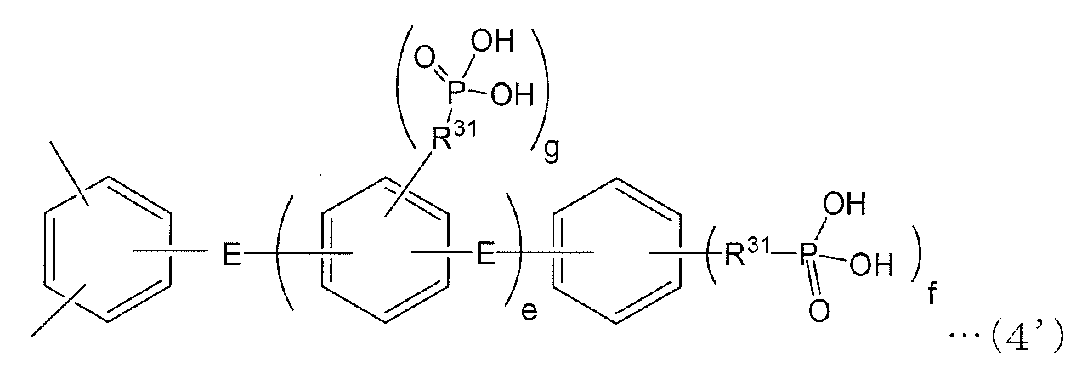
ホスホン酸基を有する構造単位の具体的構造としては、下記を挙げることができる。
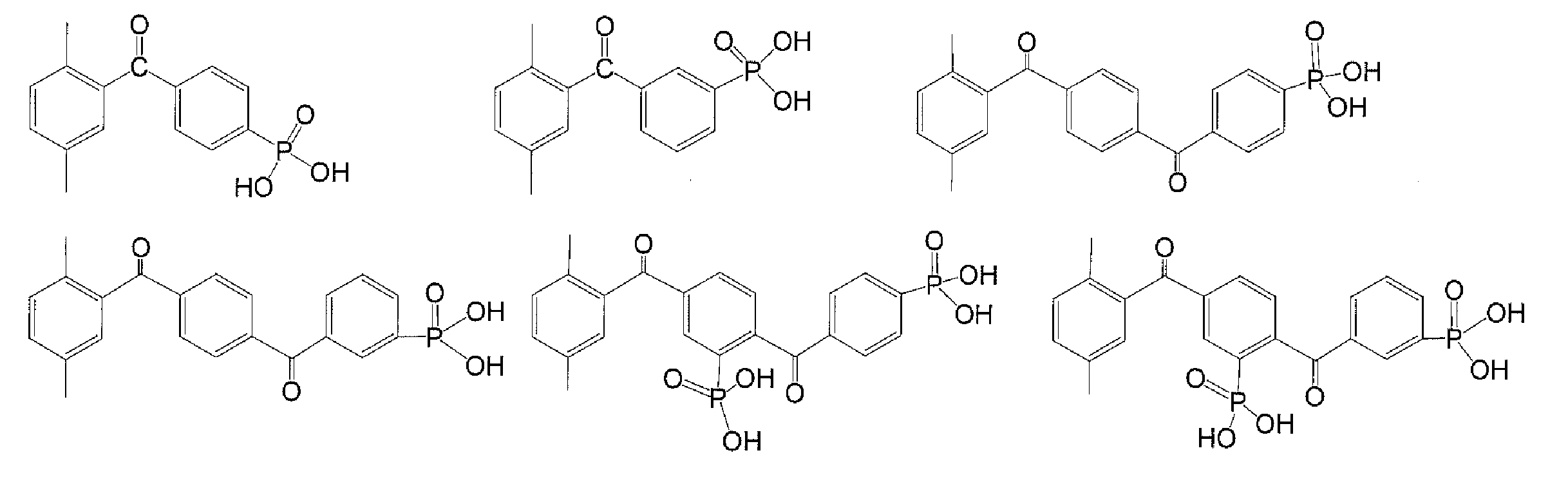
この劣化反応を抑制するには、過酸化水素等に対する酸化防止能を付与すればよく、このために、電解質中にホスホン酸基を導入することが好ましい。
具体的なメカニズムは明らかになっていないが、ホスホン酸基のようなリン酸化合物は、酸化防止能を有し、燃料電池中の電解質膜の劣化防止に効果的である。
ホスホン酸基は、過酸化水素のヒドロキシラジカルへの分解を促進するFe2+イオンやCu2+イオンをトラップ、不活性化する働きがある。
なお、リン酸化合物は、連鎖開始阻害機能、連鎖禁止機能や過酸化物分解機能を有しており、酸化防止剤として用いられている。
*参考文献 特開2004-134294号公報
このようなホスホン酸基を有する構造単位を含むことで、電子密度の低い芳香族環にホスホン酸基が導入される。
このため、本発明の芳香族系共重合体は、過酸化物に対するラジカル耐性を向上でき、かつ、高いプロトン伝導度を保持できる。
上記構造単位では、電子密度の低い芳香族環にホスホン酸基が導入されている。芳香族系の主鎖にホスホン酸基を導入したり、また電子密度が高い芳香族環(たとえば-O-、-S-に結合した芳香族環)に導入されたホスホン酸基では、プロトン伝導度が低下するため十分なラジカル耐性を得ようとし導入量を増やすと著しい伝導度の低下を示すことがある。さらにまた、本発明では、ホスホン酸エステル基では無く、脱保護されたホスホン酸基の状態で導入されているため、伝導性の無いホスホン酸エステル基のように導入によってプロトン伝導性が大幅に低下することなく、伝導性を保持できる。
本発明にかかる共重合体は、イオン交換容量、分子量などの所望の性状に応じて、各構成単位の量が決定される。
本発明の芳香族系共重合体の分子量は、ゲルパーミエションクロマトグラフィ(GPC)によるポリスチレン換算重量平均分子量で、1万~100万、好ましくは2万~80万、さらに好ましくは5万~30万である。
本発明の芳香族系共重合体の分子量は、ゲルパーミエションクロマトグラフィ(GPC)によるポリスチレン換算重量平均分子量で、1万~100万、好ましくは2万~80万、さらに好ましくは5万~30万である。
本発明に係る芳香族系共重合体のイオン交換容量は通常0.3~6meq/g、好ましくは0.5~4meq/g、さらに好ましくは0.8~3.5meq/gである。イオン交換容量がこの範囲にあれば、プロトン伝導度が高く、かつ発電性能を高くすることができるとともに、充分に高い耐水性を具備できる。
上記のイオン交換容量は、各構造単位の種類、使用割合、組み合わせを変えることにより、調整することができる。したがって重合時に構成単位を誘導する前駆体(モノマー・オリゴマー)の仕込み量比、種類を変えれば調整することができる。
本発明の重合体は、式(1)で表される構造単位を0.5~99.9モル%、好ましくは10~99.5モル%の割合で含むことが望ましい。また、式(2)で表される構造単位は、全構造単位の0.01モル%より多く、好ましくは20モル%以下の割合で含まれていることが望ましい。さらに、式(3)(芳香環構造)で表される構造単位は0.1~99.5モル%、好ましくは0.5~89.5モル%を含有していることが望ましい。
また、得られる膜の熱水耐性、プロトン伝導性およびスルホン酸基の安定性の観点から、上記式(1)で表わされる構造単位1molに対する上記式(2)で表わされる構造単位の量は、0.001~0.5molであることが好ましく、0.005~0.2molであることがより好ましく、0.01~0.1molであることがさらに好ましい。
また、得られる膜の熱水耐性、プロトン伝導性およびスルホン酸基の安定性の観点から、上記式(1)で表わされる構造単位1molに対する上記式(2)で表わされる構造単位の量は、0.001~0.5molであることが好ましく、0.005~0.2molであることがより好ましく、0.01~0.1molであることがさらに好ましい。
概してスルホン酸基(必要に応じてホスホン酸基)を含む構造単位が多くなるとイオン交換容量が増え、プロトン伝導性が高くなるが、耐水性が低下する傾向にあり、一方、これらの構造単位が少なくなると、イオン交換容量が小さくなり、耐水性が高まるが、プロトン伝導性が低下する傾向にある。この場合、特に、ニトリル基を有する芳香族構造を有する構造単位を含有させることによって、熱水中での膨潤および乾燥時の収縮が小さい共重合体を製造できる。
またこのような構造単位からなる共重合体は、機械的強度にも優れている。本発明の共重合体は、膨潤率20%以下、さらに15%以下が好ましい。また、共重合体の収縮率が6%以下、さらに5%以下が好ましい。さらに、このような共重合体の膨潤収縮率が25%以下、20%以下が好ましい。
このような膨潤率、収縮率、膨潤収縮率は、実施例に示される熱水試験によって評価される。
またこのような構造単位からなる共重合体は、機械的強度にも優れている。本発明の共重合体は、膨潤率20%以下、さらに15%以下が好ましい。また、共重合体の収縮率が6%以下、さらに5%以下が好ましい。さらに、このような共重合体の膨潤収縮率が25%以下、20%以下が好ましい。
このような膨潤率、収縮率、膨潤収縮率は、実施例に示される熱水試験によって評価される。
[芳香族系共重合体の製造方法]
本発明の芳香族系共重合体は、例えば、特開2004-137444号公報に記載の方法で、上記式(1)で表わされる構造単位の由来となる化合物(A)、上記式(2)で表わされる構造単位の由来となる化合物(B)、および必要に応じて、その他の構造単位の由来となる化合物を共重合させ、スルホン酸エステル基をスルホン酸基に変換することにより合成することができる。
本発明の芳香族系共重合体は、例えば、特開2004-137444号公報に記載の方法で、上記式(1)で表わされる構造単位の由来となる化合物(A)、上記式(2)で表わされる構造単位の由来となる化合物(B)、および必要に応じて、その他の構造単位の由来となる化合物を共重合させ、スルホン酸エステル基をスルホン酸基に変換することにより合成することができる。
上記式(1)で表わされる構造単位の由来となる化合物(A)(以下、「化合物A」ともいう。)
上記式(1)で表わされる構造単位は、芳香族系共重合体の重合原料として、例えば、下記式(1-1)で示される化合物を使用することにより導入することができる。
上記式(1)で表わされる構造単位は、芳香族系共重合体の重合原料として、例えば、下記式(1-1)で示される化合物を使用することにより導入することができる。
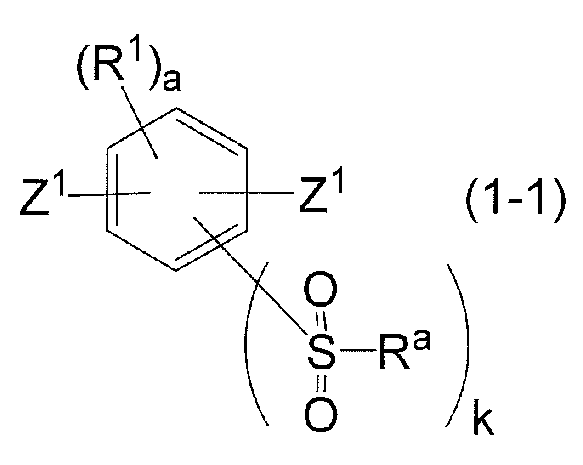
Raは同一でも異なっていてもよく、炭素数1~20の炭化水素基を示し、好ましくは炭素数4~20の炭化水素基である。具体的にはtert-ブチル基、iso-ブチル基、n-ブチル基、sec-ブチル基、ネオペンチル基、シクロペンチル基、ヘキシル基、シクロヘキシル基、シクロペンチルメチル基、シクロヘキシルメチル基、アダマンチル基、アダマンチルメチル基、2-エチルヘキシル基、ビシクロ[2.2.1]ヘプチル基、ビシクロ[2.2.1]ヘプチルメチル基、テトラヒドロフルフリル基、2-メチルブチル基、3,3-ジメチル-2,4-ジオキソランメチル基などの直鎖状炭化水素基、分岐状炭化水素基、脂環式炭化水素基、5員複素環を有する炭化水素基などが挙げられる。これらのうち、入手容易性、他の化合物の溶解性と重合反応性の観点から、n-ブチル基、ネオペンチル基、テトラヒドロフルフリル基、シクロペンチルメチル基、シクロペンチル基、シクロヘキシル基、シクロヘキシルメチル基、アダマンチルメチル基およびビシクロ[2、2、1]ヘプチルメチル基が好ましく、ネオペンチル基が最も好ましい。
含窒素複素環基を有する構造単位の由来となる化合物(B)(以下、「化合物B」ともいう。)
上記式(2)で表わされる含窒素複素環基を有する構造単位は、芳香族系共重合体の原料として、例えば、下記式(2-2)で示される化合物を使用することにより芳香族系重合体に導入することができる。
上記式(2)で表わされる含窒素複素環基を有する構造単位は、芳香族系共重合体の原料として、例えば、下記式(2-2)で示される化合物を使用することにより芳香族系重合体に導入することができる。
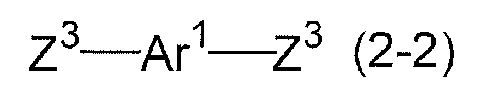
Ar1が窒素を含む2価の複素環基である場合には、上記式(2-2)で示される化合物としては、具体的には、1-メチル-2,5-ジクロロピロール、1-ヘキシル-2,5-ジブロモピロール、1-オクチル-2,5-ジクロロピロール、2,5-ジクロロピリジン、3,5-ジクロロピリジン、2,5-ジブロモピリジン、3-メチル-2,5-ジクロロピリジン、3-ヘキシル-2,5-ジクロロピリジン、5,5'-ジクロロ-2,2'-ビピリジン、3,3'-ジメチル-5,5'-ジクロロ-2,2'-ビピリジン、3,3'-ジオクチル-5,5'-ジブロモ-2,2'-ビピリジン、2,5-ジクロロピリミジン、2,5-ジブロモピリミジン、5,8-ジクロロキノリン、5,8-ジブロモキノリン、2,6-ジクロロキノリン、1,4-ジクロロイソキノリン、5,8-ジブロモイソキノリン、4,7-ジブロモ-2,1,3-ベンゾチアジアゾール、4,7-ジクロロベンゾイミダゾール、5,8-ジクロロキノキサリン、5,8-ジクロロ-2,3-ジフェニルキノキサリン、2,6-ジブロモキノキサリンなどを挙げることができる。
Ar2が上記式(2-1)で表わされる基である場合には、上記式(2-2)で示される化合物としては、具体的には、下記式(2-3)で示される化合物を挙げることができる。

上記式(2-3)で示される化合物の具体例として、下記の化合物を挙げることができる。
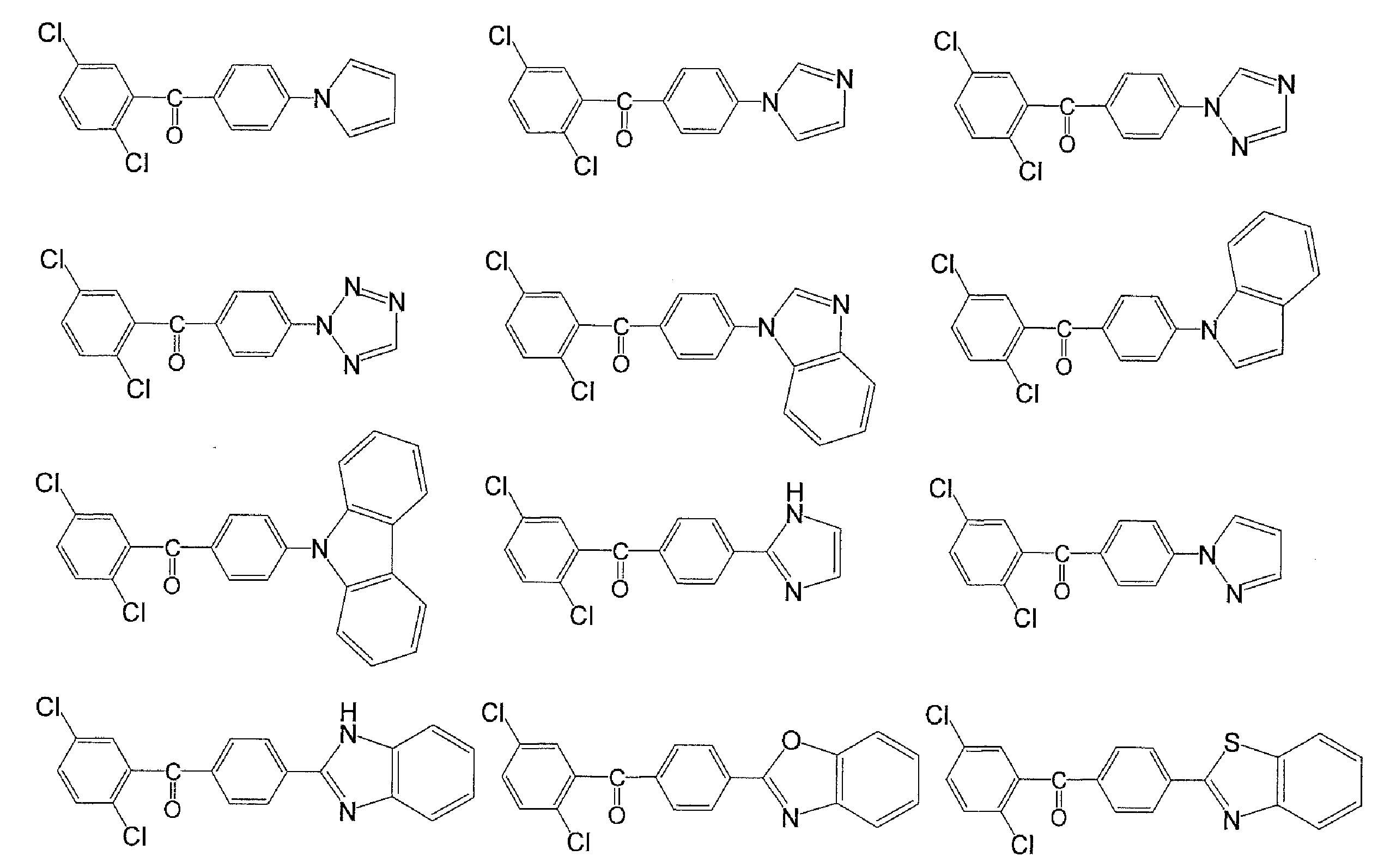

上記式(3)で表わされる構造単位の由来となる化合物(C)(以下、「化合物C」ともいう。)
芳香族構造を有する構造単位、下記式(3-2)からなるモノマーから誘導される。
芳香族構造を有する構造単位、下記式(3-2)からなるモノマーから誘導される。

Xは、塩素、臭素、ヨウ素、メタンスルホニル基、トリフルオロメタンスルホニル基、ベンゼンスルホニル基、トルエンスルホニル基からなる群より選ばれた少なくとも1種の構造を示す。
A、Dは独立に直接結合または、-CO-、-COO-、-CONH-、-SO2-、-SO-、-(CF2)l-(lは1~10の整数である)、-(CH2)l-(lは1~10の整数である)、-CR'2-(R'は脂肪族炭化水素基、芳香族炭化水素基およびハロゲン化炭化水素基を示す)、シクロヘキシリデン基、フルオレニリデン基、-O-、-S-からなる群より選ばれた少なくとも1種の構造を示し、Bは独立に酸素原子または硫黄原子であり、s、tは、0~4の整数を示し、rは、0または1以上の整数を示す。)
芳香族構造を有する構造単位は、ポリアリーレン系共重合体の重合原料として、例えば、下記一般式(3-3)で表されるオリゴマーを使用することにより得られる。
芳香族構造を有する構造単位は、ポリアリーレン系共重合体の重合原料として、例えば、下記一般式(3-3)で表されるオリゴマーを使用することにより得られる。

Bは独立に酸素原子または硫黄原子であり、R1~R16は、互いに同一でも異なっていてもよく、水素原子、フッ素原子、アルキル基、一部またはすべてがハロゲン化されたハロゲン化アルキル基、アリル基、アリール基、ニトロ基、ニトリル基からなる群より選ばれた少なくとも1種の原子または基を示す。s、tは0~4の整数を示し、rは0または1以上の整数を示す。
上記式(3-3)で表されるオリゴマーの具体的な例としては、下記が挙げられる。


上記式(3-2)および(3-3)で表されるオリゴマーは、例えば、以下のモノマーを共重合することにより製造することができる。式(3-2)および(3-3)でr=0の場合、例えば4,4'-ジクロロベンゾフェノン、4,4'-ジクロロベンズアニリド、2,2-ビス(4-クロロフェニル)ジフルオロメタン、2,2-ビス(4-クロロフェニル)-1,1,1,3,3,3-ヘキサフルオロプロパン、4-クロロ安息香酸-4-クロロフェニルエステル、ビス(4-クロロフェニル)スルホキシド、ビス(4-クロロフェニル)スルホン、2,6-ジクロロベンゾニトリルが挙げられる。
これらの化合物において塩素原子が臭素原子またはヨウ素原子に置き換わった化合物などが挙げられる。r=1の場合、例えば特開2003-113136号公報に記載の化合物を挙げることができる。
r≧2の場合、例えば特開2004-137444号公報、特開2004-244517号公報、特願2003-143914号(特開2004-346164号公報)、特願2003-348523号(特開2005-112985号公報)、特願2003-348524号、特願2004-211739号(特開2006-28414号公報)、特願2004-211740号(特開2006-28415号公報)に記載の化合物を挙げることができる。
ホスホン酸基を有する構造単位の由来となるホスホン酸化合物
ホスホン酸基を有する構造単位は、芳香族系共重合体の重合原料として、例えば、下記一般式(4-1)あるいは(4-2)で表される芳香族化合物を使用することにより導入することができる。
ホスホン酸基を有する構造単位は、芳香族系共重合体の重合原料として、例えば、下記一般式(4-1)あるいは(4-2)で表される芳香族化合物を使用することにより導入することができる。

R31は、直接結合、-O(CH2)p-、-O(CF2)p-、-(CH2)p-、-(CF2)p-からなる群より選ばれた少なくとも1種の構造を示す(pは、1~12の整数を示す)。
R32は、アルキル基、フッ素置換アルキル基、アリール基、金属イオン、オニウムイオン、水素を示す。アルキル基としては、メチル基、エチル基、プロピル基、イソプロピル基、ブチル基、アミル基、ヘキシル基、シクロヘキシル基、オクチル基などが挙げられる。フッ素置換アルキル基としては、トリフルオロメチル基、ペンタフルオロエチル基、パーフルオロプロピル基、パーフルオロブチル基、パーフルオロペンチル基、パーフルオロヘキシル基などが挙げられる。アリル基としては、プロペニル基などが挙げられ、アリール基としては、フェニル基、ペンタフルオロフェニル基などが挙げられる。このうち、メチル基、エチル基、プロピル基、イソプロピル基、フェニル基が好ましい。
金属イオンとしては、アルカリ金属系のナトリウムイオン、カリウムイオン、リチウムイオン、アルカリ土類金属系のマグネシウム、カルシウムなどが挙げられる。このうちナトリウムイオン、カリウムイオン、リチウムイオンが特に好ましい。
オニウムイオンとしては、アンモニウム、ホスホニウム、オキソニウム、スルホニウムなどが挙げられる。
Xはフッ素を除くハロゲン原子(塩素、臭素、ヨウ素)、-OSO2Rb(ここで、Rbはアルキル基、フッ素置換アルキル基またはアリール基を示す)から選ばれる原子または基を示す。このうち、塩素、臭素が好ましい。
Xはフッ素を除くハロゲン原子(塩素、臭素、ヨウ素)、-OSO2Rb(ここで、Rbはアルキル基、フッ素置換アルキル基またはアリール基を示す)から選ばれる原子または基を示す。このうち、塩素、臭素が好ましい。
式(4-1)で表される化合物としては、下記に示されるような構造が挙げられる。


式(4-2)における、R33は、-(CR34R35)h1-(CR36R37)h2-(CR38R39)h3-(CR40R41)h4-で表される2価の基を示す。好ましくは、R33は、分岐していてもよいアルキレン基である。
R34~R41は互いに同一でも異なっていてもよく、水素原子、フッ素原子、アルキル基、フッ素置換アルキル基、アリル基およびアリール基から選ばれる基を示す。アルキル基としては、メチル基、エチル基、プロピル基、イソプロピル基、ブチル基、アミル基、ヘキシル基、シクロヘキシル基、オクチル基などが挙げられる。フッ素置換アルキル基としては、トリフルオロメチル基、ペンタフルオロエチル基、パーフルオロプロピル基、パーフルオロブチル基、パーフルオロペンチル基、パーフルオロヘキシル基などが挙げられる。アリル基としては、プロペニル基などが挙げられ、アリール基としては、フェニル基、ペンタフルオロフェニル基などが挙げられる。このうち、メチル基、エチル基、プロピル基、イソプロピル基、フェニル基が好ましい。
h1、h2、h3、およびh4は互いに同一でも異なっていてもよく、0または1であり、h1+h2+h3+h4は2以上である。
式(4-2)で表される構造の具体例としては、下記に示される構造が挙げられる。
式(4-2)で表される構造の具体例としては、下記に示される構造が挙げられる。


また-CO-結合が、-SO2-結合、-SO-結合、-COO-結合、-OCO-結合、-CONH-結合、-NHCO-結合に置き換わった化合物を挙げることができる。
ホスホン酸基の結合位置は、特に限定されるものではなく、o位、m位であってもp位であってもよい。
また、上記一般式(4-1)および(4-2)で表される化合物の誘導体として、上記化合物において塩素原子が臭素原子に置き換わった化合物、上記化合物において-CO-が-SO2-に置き換わった化合物、上記化合物において塩素原子が臭素原子に置き換わり、かつ-CO-が-SO2-に置き換わった化合物なども挙げられる。
上記化合物は、ホスホン酸基が導入される置換部位に予め臭素原子を導入した前駆体と、ホスホン酸エステル、ホスホン酸塩、ホスホン酸と置換反応させることで調製可能である。ホスホン酸塩の場合、ホスホン酸を導入した後、中和してもよい。
重合方法
目的の芳香族系共重合体を得るためは、まず、上記各種化合物を共重合させ前駆体を得る。この共重合は、触媒の存在下に行われるが、この際使用される触媒は、遷移金属化合物を含む触媒系であり、この触媒系としては、(1)遷移金属塩および配位子となる化合物(以下、「配位子成分」という。)、または配位子が配位された遷移金属錯体(銅塩を含む)、ならびに(2)還元剤を必須成分とし、さらに、重合速度を上げるために、遷移金属塩以外の塩を添加してもよい。
目的の芳香族系共重合体を得るためは、まず、上記各種化合物を共重合させ前駆体を得る。この共重合は、触媒の存在下に行われるが、この際使用される触媒は、遷移金属化合物を含む触媒系であり、この触媒系としては、(1)遷移金属塩および配位子となる化合物(以下、「配位子成分」という。)、または配位子が配位された遷移金属錯体(銅塩を含む)、ならびに(2)還元剤を必須成分とし、さらに、重合速度を上げるために、遷移金属塩以外の塩を添加してもよい。
ここで、遷移金属塩としては、塩化ニッケル、臭化ニッケル、ヨウ化ニッケル、ニッケルアセチルアセトナートなどのニッケル化合物、塩化パラジウム、臭化パラジウム、ヨウ化パラジウムなどのパラジウム化合物、塩化鉄、臭化鉄、ヨウ化鉄などの鉄化合物、塩化コバルト、臭化コバルト、ヨウ化コバルトなどのコバルト化合物などが挙げられる。これらのうち特に、塩化ニッケル、臭化ニッケルなどが好ましい。また、配位子としては、トリフェニルホスフィン、トリ(2-メチル)フェニルホスフィン、トリ(3-メチル)フェニルホスフィン、トリ(4-メチル)フェニルホスフィン、2,2'-ビピリジン、1,5-シクロオクタジエン、1,3-ビス(ジフェニルホスフィノ)プロパンなどが挙げられるが、トリフェニルホスフィン、トリ(2-メチル)フェニルホスフィン、2,2'-ビピリジンが好ましい。上記配位子は、1種単独で、あるいは2種以上を併用することができる。
さらに、あらかじめ配位子が配位された遷移金属(塩)としては、例えば、塩化ニッケルビス(トリフェニルホスフィン)、塩化ニッケルビス(トリ(2ーメチル)フェニルホスフィン)、臭化ニッケルビス(トリフェニルホスフィン)、ヨウ化ニッケルビス(トリフェニルホスフィン)、硝酸ニッケルビス(トリフェニルホスフィン)、塩化ニッケル(2,2'ビピリジン)、臭化ニッケル(2,2'ビピリジン)、ヨウ化ニッケル(2,2'ビピリジン)、硝酸ニッケル(2,2'ビピリジン)、ビス(1,5-シクロオクタジエン)ニッケル、テトラキス(トリフェニルホスフィン)ニッケル、テトラキス(トリフェニルホスファイト)ニッケル、テトラキス(トリフェニルホスフィン)パラジウムなどが挙げられるが、塩化ニッケルビス(トリフェニルホスフィン)、塩化ニッケルビス(トリ(2ーメチル)フェニルホスフィン)、塩化ニッケル(2,2'ビピリジン)が好ましい。
本発明の触媒系において使用することができる上記還元剤としては、例えば、鉄、亜鉛、マンガン、アルミニウム、マグネシウム、ナトリウム、カルシウムなどを挙げることできるが、亜鉛、マグネシウム、マンガンが好ましい。これらの還元剤は、有機酸などの酸に接触させることにより、より活性化して用いることができる。
また、本発明の触媒系において使用することのできる遷移金属塩以外の塩としては、フッ化ナトリウム、塩化ナトリウム、臭化ナトリウム、臭化リチウム、ヨウ化ナトリウム、硫酸ナトリウムなどのナトリウム化合物、フッ化カリウム、塩化カリウム、臭化カリウム、ヨウ化カリウム、硫酸カリウムなどのカリウム化合物、フッ化テトラエチルアンモニウム、塩化テトラエチルアンモニウム、臭化テトラエチルアンモニウム、ヨウ化テトラエチルアンモニウム、硫酸テトラエチルアンモニウムなどのアンモニウム化合物などが挙げられるが、臭化ナトリウム、ヨウ化ナトリウム、臭化カリウム、臭化リチウム、臭化テトラエチルアンモニウム、ヨウ化テトラエチルアンモニウムが好ましい。
触媒系における各成分の使用割合は、遷移金属塩または配位子が配位された遷移金属(塩)が、上記一般式(1)で表される構造単位となりうる化合物Aと、上記一般式(2)で表される構造単位となりうる化合物Bとの総計1モルに対し、通常、0.0001~10モル、好ましくは0.01~0.5モルである。この範囲にあれば重合反応が充分に進行し、しかも触媒活性が高く、分子量を高くすることも可能となる。前記範囲よりも少ないと、重合反応が充分に進行せず、一方、多すぎても、分子量が低下するという問題がある。触媒系において、遷移金属塩および配位子を用いる場合、この配位子の使用割合は、遷移金属塩1モルに対し、通常、0.1~100モル、好ましくは1~10モルである。この範囲で用いると、触媒活性が高く、分子量の高い重合体が得られる。
また、触媒系における還元剤の使用割合は、上記一般式(1)で表される構造単位となりうる化合物Aと、上記一般式(2)で表される構造単位となりうる化合物Bとの総計1モルに対し、通常、0.1~100モル、好ましくは1~10モルである。この範囲にあれば、重合が充分に進行し、高収率で重合体を得ることができ、重合体の精製も容易である。
さらに、触媒系に遷移金属塩以外の塩を使用する場合、その使用割合は、上記一般式(1)で表される構造単位となりうる化合物Aと、上記一般式(2)で表される構造単位となりうる化合物Bとの総計1モルに対し、通常、0.001~100モル、好ましくは0.01~1モルである。この範囲にあれば、重合速度が高く、また得られる重合体の精製も容易である。
なお、ほかに化合物CおよびDを含む場合、これらの合計量に対する触媒量となる。
本発明で使用することのできる重合溶媒としては、例えば、テトラヒドロフラン、シクロヘキサノン、ジメチルスルホキシド、N,N-ジメチルホルムアミド、N,N-ジメチルアセトアミド、1-メチル-2-ピロリドン、γ-ブチロラクトン、γ-ブチロラクタムなどが挙げられ、テトラヒドロフラン、N,N-ジメチルホルムアミド、N,N-ジメチルアセトアミド、1-メチル-2-ピロリドンが好ましい。これらの重合溶媒は、充分に乾燥してから用いることが好ましい。重合溶媒中における上記一般式(1)で表される構造単位となりうる化合物Aと、上記一般式(2)で表される構造単位となりうる化合物Bの濃度は、通常、1~90重量%、好ましくは5~40重量%である。
本発明で使用することのできる重合溶媒としては、例えば、テトラヒドロフラン、シクロヘキサノン、ジメチルスルホキシド、N,N-ジメチルホルムアミド、N,N-ジメチルアセトアミド、1-メチル-2-ピロリドン、γ-ブチロラクトン、γ-ブチロラクタムなどが挙げられ、テトラヒドロフラン、N,N-ジメチルホルムアミド、N,N-ジメチルアセトアミド、1-メチル-2-ピロリドンが好ましい。これらの重合溶媒は、充分に乾燥してから用いることが好ましい。重合溶媒中における上記一般式(1)で表される構造単位となりうる化合物Aと、上記一般式(2)で表される構造単位となりうる化合物Bの濃度は、通常、1~90重量%、好ましくは5~40重量%である。
なお、含窒素複素環基を有する構造単位やその他の構成単位を導入する場合、上記化合物AとBとを反応させる際に化合物Cや、その他の構成単位に相当するモノマーを添加したり、あるいは、化合物AないしBのどちらかと化合物Cなどを予め反応させておき、ついで、化合物AないしBのまだ反応させていない方と反応させればよい。
化合物A、B、Cなどの反応は仕込み量がそのまま、各構成単位の組成に相当する。
また、本発明の重合体を重合する際の重合温度は、通常、0~200℃、好ましくは50~80℃である。また、重合時間は、通常、0.5~100時間、好ましくは1~40時間である。
また、本発明の重合体を重合する際の重合温度は、通常、0~200℃、好ましくは50~80℃である。また、重合時間は、通常、0.5~100時間、好ましくは1~40時間である。
以上の製造方法では、得られた共重合体に含まれる、スルホン酸エステル基のエステル基を脱保護して、スルホン酸基(-SO3H)に転換する。
具体的には、
(1)少量の塩酸を含む過剰量の水またはアルコールに、上記芳香族系共重合体を投入し、5分間以上撹拌する方法
(2)トリフルオロ酢酸中で上記芳香族系共重合体を80~120℃程度の温度で5~10時間程度反応させる方法
(3)芳香族系共重合体中のスルホン酸エステル基(-SO3R)1モルに対して1~9倍モルのリチウムブロマイドを含む溶液、例えばN-メチルピロリドンなどの溶液中で上記芳香族系共重合体を80~150℃程度の温度で3~10時間程度反応させた後、塩酸を添加する方法
などを挙げることができる。
なお、スルホン酸金属塩となっている場合、イオン交換などの方法で水素置換すればよい。
具体的には、
(1)少量の塩酸を含む過剰量の水またはアルコールに、上記芳香族系共重合体を投入し、5分間以上撹拌する方法
(2)トリフルオロ酢酸中で上記芳香族系共重合体を80~120℃程度の温度で5~10時間程度反応させる方法
(3)芳香族系共重合体中のスルホン酸エステル基(-SO3R)1モルに対して1~9倍モルのリチウムブロマイドを含む溶液、例えばN-メチルピロリドンなどの溶液中で上記芳香族系共重合体を80~150℃程度の温度で3~10時間程度反応させた後、塩酸を添加する方法
などを挙げることができる。
なお、スルホン酸金属塩となっている場合、イオン交換などの方法で水素置換すればよい。
[高分子電解質膜]
本発明の芳香族系共重合体は、プロトン伝導膜、一次電池用電解質、二次電池用電解質、燃料電池用高分子固体電解質、表示素子、各種センサー、信号伝達媒体、固体コンデンサー、イオン交換膜などに用いる場合、膜状態、溶液状態、粉体状態で用いることが考えられるが、このうち膜状態、溶液状態が好ましい(以下、膜状態のことを高分子電解質膜と呼ぶ)。
本発明の芳香族系共重合体は、プロトン伝導膜、一次電池用電解質、二次電池用電解質、燃料電池用高分子固体電解質、表示素子、各種センサー、信号伝達媒体、固体コンデンサー、イオン交換膜などに用いる場合、膜状態、溶液状態、粉体状態で用いることが考えられるが、このうち膜状態、溶液状態が好ましい(以下、膜状態のことを高分子電解質膜と呼ぶ)。
本発明にかかる固体高分子電解質膜は、上記芳香族系共重合体を含有する。本発明にかかる固体高分子電解質膜の乾燥膜厚は、通常10~100μm、好ましくは20~80μmである。
また、本発明にかかる固体高分子電解質膜は、金属化合物または金属イオンを含むこともできる。他の金属化合物または金属イオンとしては、アルミニウム(Al)、マンガン(Mn)、ニオブ(Nb)、タンタル(Ta)、クロム(Cr)、モリブデン(Mo)、タングステン(W) 、鉄(Fe)、ルテニウム(Ru)、ニッケル(Ni)、スズ(Sn)、パラジウム(Pd)、白金(Pt)、銀(Ag)、セリウム(Ce)、バナジウム(V)、ネオジウム(Nd)、プラセオジウム(Pr)、サマリウム(Sm)、コバルト(Co)、ガドリニウム(Gd)、テルビウム(Tb)、ジスプロシウム(Dy)、ホルミウム(Ho)、及び、エルビウム(Er)等の金属原子を含む金属化合物またはこれらの金属イオンが挙げられる。
また、本発明にかかる固体高分子電解質膜は、含フッ素ポリマーを含むこともできる。含フッ素ポリマーとしては、電解質膜または多孔質基材の孔内に含フッ素ポリマーを均一に分散することができるため、溶剤可溶性の化合物を用いることが好ましい。含フッ素ポリマーとしては、特に制限されるものではないが、例えば、フッ化ビニリデン系単独(共)重合体、フルオロオレフィン/炭化水素系オレフィン共重合体、フルオロアクリレート共重合体、フルオロエポキシ化合物などを使用することができる。
高分子電解質膜の製造方法
本発明の高分子電解質膜は、上記芳香族系共重合体を有機溶剤中で混合させ、それを基体上に流延してフィルム状に成形するキャスティング法などにより製造することができる。ここで、上記基体としては、通常の溶液キャスティング法に用いられる基体であれば特に限定されず、たとえばプラスチック製、金属製などの基体が用いられ、好ましくは、ポリエチレンテレフタレート(PET)フィルムなどの熱可塑性樹脂からなる基体が用いられる。
本発明の高分子電解質膜は、上記芳香族系共重合体を有機溶剤中で混合させ、それを基体上に流延してフィルム状に成形するキャスティング法などにより製造することができる。ここで、上記基体としては、通常の溶液キャスティング法に用いられる基体であれば特に限定されず、たとえばプラスチック製、金属製などの基体が用いられ、好ましくは、ポリエチレンテレフタレート(PET)フィルムなどの熱可塑性樹脂からなる基体が用いられる。
上記芳香族系共重合体を混合させる溶媒としては、共重合体を溶解する溶媒や膨潤させる溶媒であれば良く、たとえば、N-メチル-2-ピロリドン、N,N-ジメチルホルムアミド、γ-ブチロラクトン、N,N-ジメチルアセトアミド、ジメチルスルホキシド、ジメチル尿素、ジメチルイミダゾリジノン、アセトニトリルなどの非プロトン系極性溶剤や、ジクロロメタン、クロロホルム、1,2-ジクロロエタン、クロロベンゼン、ジクロロベンゼン等の塩素系溶剤、メタノール、エタノール、プロパノール、iso-プロピルアルコール、sec-ブチルアルコール、tert-ブチルアルコール等のアルコール類、エチレングリコールモノメチルエーテル、エチレングリコールモノエチルエーテル、プロピレングリコールモノエチルエーテル等のアルキレングリコールモノアルキルエーテル類、アセトン、メチルエチルケトン、シクロヘキサノン、γ-ブチルラクトン等のケトン類、テトラヒドロフラン、1,3-ジオキサン等のエーテル類などの溶剤が挙げられる。これらの溶剤は、1種単独で、または2種以上を組み合わせて用いることができる。特に溶解性、溶液粘度の面から、N-メチル-2-ピロリドン(以下「NMP」ともいう。)が好ましい。
また、上記溶媒として、非プロトン系極性溶剤と他の溶剤との混合物を用いる場合、該混合物の組成は、非プロトン系極性溶剤が95~25重量%、好ましくは90~25重量%、他の溶剤が5~75重量%、好ましくは10~75重量%(但し、合計は100重量%)である。他の溶剤の量が上記範囲内にあると、溶液粘度を下げる効果に優れる。この場合の非プロトン系極性溶剤と他の溶剤との組み合わせとしては、非プロトン系極性溶剤としてNMP、他の溶剤として幅広い組成範囲で溶液粘度を下げる効果があるメタノールが好ましい。
上記共重合体と添加剤を溶解させた溶液のポリマー濃度は、上記スルホン酸含有芳香族系共重合体の分子量にもよるが、通常、5~40重量%、好ましくは7~25重量%である。ポリマー濃度が前記範囲にあれば所望の膜厚のものを形成できるとともに、ピンホールなどを生じることもなく、また、溶液粘度の点でもフィルム化が容易であり、得られたフィルムも表面平滑性に優れている。
なお、溶液粘度は、上記芳香族系共重合体の分子量や、ポリマー濃度や、添加剤の濃度にもよるが、通常、2,000~100,000mPa・s、好ましくは3,000~50,000mPa・sである。この範囲の粘度であれば、成膜中の溶液の滞留性が良く、基体から流れてしまうこともなく、粘度が低いので、ダイからの押し出しも容易であり、流延法によるフィルム化が容易となる。
上記のようにして成膜した後、得られた未乾燥フィルムを水に浸漬すると、未乾燥フィルム中の有機溶剤を水と置換することができ、得られる高分子電解質膜の残留溶媒量を低減することができる。
なお、成膜後、未乾燥フィルムを水に浸漬する前に、未乾燥フィルムを予備乾燥してもよい。予備乾燥は、未乾燥フィルムを通常50~150℃の温度で、0.1~10時間保持することにより行われる。
上記のように未乾燥フィルムを水に浸漬した後乾燥すると、残存溶媒量が低減された膜が得られるが、このようにして得られる膜の残存溶媒量は、通常5重量%以下である。また、浸漬条件によっては、得られる膜の残存溶媒量を1重量%以下とすることができる。このような条件としては、たとえば、未乾燥フィルム1重量部に対する水の使用量が50重量部以上であり、浸漬する際の水の温度が10~60℃、浸漬時間が10分~10時間である。
上記のように未乾燥フィルムを水に浸漬した後、フィルムを30~100℃、好ましくは50~80℃で、10~180分、好ましくは15~60分乾燥し、次いで、50~150℃で、好ましくは500mmHg~0.1mmHgの減圧下、0.5~24時間、真空乾燥することにより、膜を得ることができる。
本発明の方法により得られる高分子電解質膜は、その乾燥膜厚が、通常10~100μm、好ましくは20~80μmである。
また、上記スルホン酸エステル基ないしスルホン酸のアルカリ金属塩を有する芳香族系共重合体を上述したような方法でフィルム状に成形した後、加水分解や酸処理等の適切な後処理することにより本発明に係る高分子電解質膜を製造することもできる。具体的には、スルホン酸エステル基ないしスルホン酸のアルカリ金属塩を有する芳香族系共重合体を上述したような方法でフィルム状に成形した後、その膜を加水分解あるいは酸処理することにより芳香族系共重合体からなる高分子電解質膜を製造することができる。
また、上記スルホン酸エステル基ないしスルホン酸のアルカリ金属塩を有する芳香族系共重合体を上述したような方法でフィルム状に成形した後、加水分解や酸処理等の適切な後処理することにより本発明に係る高分子電解質膜を製造することもできる。具体的には、スルホン酸エステル基ないしスルホン酸のアルカリ金属塩を有する芳香族系共重合体を上述したような方法でフィルム状に成形した後、その膜を加水分解あるいは酸処理することにより芳香族系共重合体からなる高分子電解質膜を製造することができる。
また、高分子電解質膜を製造する際に、上記芳香族系共重合体以外に、硫酸、リン酸などの無機酸、リン酸ガラス、タングステン酸、リン酸塩水和物、β-アルミナプロトン置換体、プロトン導入酸化物等の無機プロトン伝導体粒子、カルボン酸を含む有機酸、スルホン酸を含む有機酸、ホスホン酸を含む有機酸、適量の水などを併用しても良い。
また、高分子電解質膜を製造する際に、別に多孔質基材やシート状の繊維質物質を用いることで、補強された固体高分子電解質膜を製造することもできる。
補強された固体高分子電解質膜を製造する方法としては、たとえば、液状組成物を多孔質基材やシート状の繊維質物質に含浸して、上記芳香族系共重合体を多孔質基材やシート状の繊維質物質の内部の細孔に充填させる方法、上記液状組成物を多孔質基材やシート状の繊維質物質に塗布して、上記芳香族系共重合体を多孔質基材やシート状の繊維質物質の内部の細孔に充填させる方法、ならびに、上記液状組成物から膜を形成した後、多孔質基材やシート状の繊維質物質に前記膜を重ねて熱プレスし、上記芳香族系共重合体を多孔質基材やシート状の繊維質物質の細孔に充填させる方法などを挙げることができる。
補強された固体高分子電解質膜を製造する方法としては、たとえば、液状組成物を多孔質基材やシート状の繊維質物質に含浸して、上記芳香族系共重合体を多孔質基材やシート状の繊維質物質の内部の細孔に充填させる方法、上記液状組成物を多孔質基材やシート状の繊維質物質に塗布して、上記芳香族系共重合体を多孔質基材やシート状の繊維質物質の内部の細孔に充填させる方法、ならびに、上記液状組成物から膜を形成した後、多孔質基材やシート状の繊維質物質に前記膜を重ねて熱プレスし、上記芳香族系共重合体を多孔質基材やシート状の繊維質物質の細孔に充填させる方法などを挙げることができる。
また、多層構造の固体高分子電解質膜を形成する場合には、上述の各方法などによって得られた固体高分子電解質膜表面に、さらにダイコート、スプレーコート、ナイフコート、ロールコート、スピンコート、グラビアコートなどの公知の方法で、上記芳香族系共重合体を含む組成物を塗布し、必要に応じて乾燥する、あるいは、上記芳香族系共重合体を含む組成物から形成された膜を上述の方法で得られた膜に重ねて熱プレスすることなどが挙げられる。なお、塗布量を調節して、ポリマー層の厚さを調製してもよく、例えば一方のポリマー層を厚く、他方を薄くしてもよい。
多孔質基材としては、厚さ方向に対して貫通する多数の細孔又は空隙を有するものであれば特に制限されるものではなく、例えば、各種樹脂からなる有機多孔質基材、ガラス、アルミナなど金属酸化物や金属自体から構成される無機多孔質基材等が挙げられる。
多孔質基材としては、厚さ方向に対してほぼ平行な方向に貫通している貫通孔を多数個有するものであってもよい。
このような、多孔質基材として、特開2008-119662号公報、特開2007-154153号公報、特開平8-20660号公報、特開平8-20660号公報、特開2006-120368号公報、特開2004-171994号公報、特開2009-64777号公報に開示されたものを使用することができる。
このような、多孔質基材として、特開2008-119662号公報、特開2007-154153号公報、特開平8-20660号公報、特開平8-20660号公報、特開2006-120368号公報、特開2004-171994号公報、特開2009-64777号公報に開示されたものを使用することができる。
本発明で使用される多孔質基材としては、有機多孔質基材が好ましく、具体的には、ポリテトラフルオロエチレン、高分子量ポリエチレン、架橋型ポリエチレン、ポリエチレン、ポリプロピレン等のポリオレフィン、ポリイミド、ポリアクリロトリル、ポリアミドイミド、ポリエーテルイミド、ポリエーテルサルホン、ガラスからなる群から選ばれる1種以上からなるものが好ましい。なお、ポリオレフィンとしては、高分子量ポリエチレン、架橋型ポリエチレン、ポリエチレンなどが望ましい。
[膜-電極接合体]
本発明にかかる膜-電極接合体は、前記固体高分子電解質膜と、触媒層と、ガス拡散層とを備えた膜-電極接合体である。典型的には、前記固体高分子電解質膜を挟んで一方にはカソード電極用の触媒層と他方にはアノード電極用の触媒層が設けられており、さらにカソード側およびアノード側の各触媒層の固体高分子電解質膜と反対側に接して、カソード側およびアノード側にそれぞれガス拡散層が設けられている。
本発明にかかる膜-電極接合体は、前記固体高分子電解質膜と、触媒層と、ガス拡散層とを備えた膜-電極接合体である。典型的には、前記固体高分子電解質膜を挟んで一方にはカソード電極用の触媒層と他方にはアノード電極用の触媒層が設けられており、さらにカソード側およびアノード側の各触媒層の固体高分子電解質膜と反対側に接して、カソード側およびアノード側にそれぞれガス拡散層が設けられている。
ガス拡散層、触媒層として、公知のものを特に制限なく使用可能である。
具体的にガス拡散層は、多孔性基材又は多孔性基材と微多孔層の積層構造体からなる。ガス拡散層が多孔性基材と微多孔層の積層構造体からなる場合には、微多孔層が触媒層に接して設けられる。カソード側およびアノード側のガス拡散層は、撥水性を付与するために含フッ素重合体を含んでいることが好ましい。
具体的にガス拡散層は、多孔性基材又は多孔性基材と微多孔層の積層構造体からなる。ガス拡散層が多孔性基材と微多孔層の積層構造体からなる場合には、微多孔層が触媒層に接して設けられる。カソード側およびアノード側のガス拡散層は、撥水性を付与するために含フッ素重合体を含んでいることが好ましい。
触媒層は、触媒、イオン交換樹脂電解質から構成される。触媒としては、白金、パラジウム、金、ルテニウム、イリジウムなどの貴金属触媒が好ましく用いられる。また、貴金属触媒は、合金や混合物などのように、2種以上の元素が含まれるものであってもよい。このような貴金属触媒は、通常、高比表面積カーボン微粒子に担持したものを用いることができる。
イオン交換樹脂電解質は、前記触媒を担持したカーボンを結着させるバインダー成分として働くとともに、アノード極では触媒上の反応によって発生したイオンを固体高分子電解質膜へ効率的に供給し、また、カソード極では固体高分子電解質膜から供給されたイオンを触媒へ効率的に供給する。
本発明で用いられる触媒層のイオン交換樹脂としては、触媒層内のプロトン伝導性を向上させるためにプロトン交換基を有するポリマーが好ましい。このようなポリマーに含まれるプロトン交換基としては、スルホン酸基、カルボン酸基、リン酸基などがあるが特に限定されるものではない。また、このようなプロトン交換基を有するポリマーも、特に限定されることなく選ばれるが、フルオロアルキルエーテル側鎖とフルオロアルキル主鎖とから構成されるプロトン交換基を有するポリマーや、スルホン酸基を有する芳香族炭化水素系重合体などが好ましく用いられる。また、上記の固体高分子電解質膜を構成するスルホン酸基を有する芳香族炭化水素系重合体をイオン交換性樹脂として使用してもよく、さらにプロトン交換基を有するフッ素原子を含むポリマーや、エチレンやスチレンなどから得られる他のポリマー、これらの共重合体やブレンドであっても構わない。このようなイオン交換樹脂電解質は、公知のものを特に制限なく使用可能であり、たとえばNafion(DuPont社、登録商標)やスルホン酸基を有する芳香族炭化水素系重合体等を特に制限なく使用できる。
本発明で用いられる触媒層に必要に応じてさらに、炭素繊維、イオン交換基を有しない樹脂を用いてもよい。これらの樹脂としては撥水性の高い樹脂であることが好ましい。例えば含フッ素共重合体、シランカップリング剤、シリコーン樹脂、ワックス、ポリホスファゼンなどを挙げることができるが、好ましくは含フッ素共重合体である。
[燃料電池]
本発明に係る固体高分子型燃料電池は、前記膜-電極接合体を含むことを特徴としている。具体的には、少なくとも一つ以上の膜-電極接合体及びその両側に位置するセパレータを含む少なくとも一つの電気発生部;燃料を前記電気発生部に供給する燃料供給部;及び酸化剤を前記電気発生部に供給する酸化剤供給部を含む型燃料電池であって、膜-電極接合体が上記記載のものであることを特徴とする。
本発明に係る固体高分子型燃料電池は、前記膜-電極接合体を含むことを特徴としている。具体的には、少なくとも一つ以上の膜-電極接合体及びその両側に位置するセパレータを含む少なくとも一つの電気発生部;燃料を前記電気発生部に供給する燃料供給部;及び酸化剤を前記電気発生部に供給する酸化剤供給部を含む型燃料電池であって、膜-電極接合体が上記記載のものであることを特徴とする。
本発明の電池に用いられるセパレータとしては、通常の燃料電池に用いられるものを用いることができる。具体的にはカーボンタイプのもの、金属タイプのものなどを用いることができる。
また、燃料電池を構成する部材としては、公知のものを特に制限なく使用することが可能である。本発明の電池は単セルで用いることもできるし、複数の単セルを直列に繋いだスタックとして用いることもできる。スタックの方法としては公知のものを用いることができる。具体的には単セルを平面状に並べた平面スタッキング、及び燃料または酸化剤の流路がセパレータの裏表面にそれぞれ形成されているセパレータを介して単セルを積み重ねるバイポーラースタッキングを用いることができる。
以下、実施例を挙げ本発明をさらに具体的に説明するが、本発明は以下の実施例に限定されるものではない。また、実施例において、「%」とは特に断りのない限り「重量%」を意味する。
[評価用電解質膜の調製]
各実施例・比較例で得られた共重合体をN-メチルピロリドン/メタノール溶液に溶解させた後、アプリケーターを用いてPET基板上にキャスティングし、オーブンを用いて60℃×30分、80℃×40分、120℃×60分乾燥させた。乾燥した膜を脱イオン水に浸漬した。浸漬後、50℃で45分乾燥させることにより評価用の膜を得た。
各実施例・比較例で得られた共重合体をN-メチルピロリドン/メタノール溶液に溶解させた後、アプリケーターを用いてPET基板上にキャスティングし、オーブンを用いて60℃×30分、80℃×40分、120℃×60分乾燥させた。乾燥した膜を脱イオン水に浸漬した。浸漬後、50℃で45分乾燥させることにより評価用の膜を得た。
[分子量]
各実施例・比較例で得られた共重合体をN-メチルピロリドン緩衝溶液(以下、NMP緩衝溶液という。)に溶解し、ゲルパーミエーションクロマトグラフィー(GPC、東ソー(株)製TSK-GELカラム 、ALPHA-M型)によって、ポリスチレン換算の数平均分子量(Mn)および重量平均分子量(Mw)を求めた。NMP緩衝溶液は、NMP(3L)/リン酸(3.3mL)/臭化リチウム(7.83g)の比率で調製した。
各実施例・比較例で得られた共重合体をN-メチルピロリドン緩衝溶液(以下、NMP緩衝溶液という。)に溶解し、ゲルパーミエーションクロマトグラフィー(GPC、東ソー(株)製TSK-GELカラム 、ALPHA-M型)によって、ポリスチレン換算の数平均分子量(Mn)および重量平均分子量(Mw)を求めた。NMP緩衝溶液は、NMP(3L)/リン酸(3.3mL)/臭化リチウム(7.83g)の比率で調製した。
[スルホン酸基の当量]
得られたスルホン化ポリマーの水洗水が中性になるまで蒸留水で洗浄して、フリーの残存している酸を除去した後、乾燥させた。この後、所定量を秤量し、THF/水の混合溶剤に溶解させ、フェノールフタレインを指示薬として、NaOHの標準液にて滴定し、中和点から、スルホン酸基の当量(イオン交換容量)(meq/g)を求めた。
なお、収率は、収率(%)=(生成物収量/理論生成量)×100により算出し、以下同様とする。
得られたスルホン化ポリマーの水洗水が中性になるまで蒸留水で洗浄して、フリーの残存している酸を除去した後、乾燥させた。この後、所定量を秤量し、THF/水の混合溶剤に溶解させ、フェノールフタレインを指示薬として、NaOHの標準液にて滴定し、中和点から、スルホン酸基の当量(イオン交換容量)(meq/g)を求めた。
なお、収率は、収率(%)=(生成物収量/理論生成量)×100により算出し、以下同様とする。
<式(1)で表される構造単位となる化合物A>
<合成例1-1>
3、5-ジクロロベンゼンスルホニルクロライド(114.65g、467mmol)を、ネオペンチルアルコール(45.30g、514mmol)のピリジン(300mL)溶液に、少量ずつ攪拌しながら15分かけて添加した。この間、反応温度は18~20℃に保った。反応混合物を、冷却しながらさらに30分攪拌した後、氷冷した10% HCl(1600mL)を添加した。水に不溶の成分を700mLの酢酸エチルで抽出し、1N HClで2回(各700mL)洗浄し、5% NaHCO3で2回(各700mL)洗浄し、MgSO4で乾燥させた。回転乾燥機を用いて溶媒を除去し、残渣を500mLのメタノールから再結晶させた。その結果、純粋な(1H NMRで99%を超える純度)3、5-ジクロロベンゼンスルホン酸ネオペンチル(下記式(1-1a)で表される化合物))を、光沢のある無色の結晶として得た。収量は、105.98g、収率76%であった。
<合成例1-1>
3、5-ジクロロベンゼンスルホニルクロライド(114.65g、467mmol)を、ネオペンチルアルコール(45.30g、514mmol)のピリジン(300mL)溶液に、少量ずつ攪拌しながら15分かけて添加した。この間、反応温度は18~20℃に保った。反応混合物を、冷却しながらさらに30分攪拌した後、氷冷した10% HCl(1600mL)を添加した。水に不溶の成分を700mLの酢酸エチルで抽出し、1N HClで2回(各700mL)洗浄し、5% NaHCO3で2回(各700mL)洗浄し、MgSO4で乾燥させた。回転乾燥機を用いて溶媒を除去し、残渣を500mLのメタノールから再結晶させた。その結果、純粋な(1H NMRで99%を超える純度)3、5-ジクロロベンゼンスルホン酸ネオペンチル(下記式(1-1a)で表される化合物))を、光沢のある無色の結晶として得た。収量は、105.98g、収率76%であった。
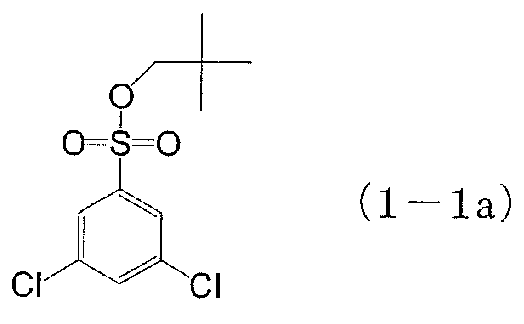
2、5-ジクロロベンゼンスルホニルクロライド(114.65g、467mmol)を、ネオペンチルアルコール(45.30g、514mmol)のピリジン(300mL)溶液に、少量ずつ攪拌しながら15分かけて添加した。この間、反応温度は18~20℃に保った。反応混合物を、冷却しながらさらに30分攪拌した後、氷冷した10% HCl(1600mL)を添加した。水に不溶の成分を700mLの酢酸エチルで抽出し、1N HClで2回(各700mL)洗浄し、5% NaHCO3で2回(各700mL)洗浄し、MgSO4で乾燥させた。回転乾燥機を用いて溶媒を除去し、残渣を500mLのメタノールから再結晶させた。その結果、純粋な(1H NMRで99%を超える純度)2、5-ジクロロベンゼンスルホン酸ネオペンチル(下記式(1-1b)で表される化合物)を、光沢のある無色の結晶として得た。収量は99.93g、収率は72%であった。

<合成例2-1>
攪拌機、温度計、Dean-stark管、窒素導入管、冷却管をとりつけた1Lの三口フラスコに、2,6-ジクロロベンゾニトリル154.8g(0.9mol)、2,2-ビス(4-ヒドロキシフェニル)-1,1,1,3,3,3-ヘキサフルオロプロパン269.0g(0.8mol)、炭酸カリウム143.7g(1.04mol)をはかりとった。窒素置換後、スルホラン1020mL、トルエン510mLを加えて攪拌した。オイルバスで反応液を150℃で加熱還流させた。反応によって生成する水はDean-stark管にトラップした。3時間後、水の生成がほとんど認められなくなったところで、トルエンをDean-stark管から系外に除去した。徐々に反応温度を200℃に上げ、3時間攪拌を続けた後、2,6-ジクロロベンゾニトリル51.6g(0.3mol)を加え、さらに5時間反応させた。
反応液を放冷後、トルエン250mLを加えて希釈した。反応液に不溶の無機塩を濾過し、濾液をメタノール8Lに注いで生成物を沈殿させた。沈殿した生成物を濾過、乾燥後、テトラヒドロフラン500mLに溶解し、これをメタノール5Lに注いで再沈殿させた。沈殿した白色粉末を濾過、乾燥し、目的物258gを得た。GPCで測定したMnは8,200であった。得られた化合物は式(3-2a)で表されるオリゴマーであることを確認した。

攪拌機、温度計、Dean-stark管、窒素導入管、冷却管をとりつけた1Lの三口フラスコに、2,6-ジクロロベンゾニトリル90.1g(0.52mol)、2,5-ジ-tert-ブチルハイドロキノン26.6g(0.12mol)、2-tert-ブチルハイドロキノン59.4g(0.36mol)、炭酸カリウム85.6g(0.62mol)をはかりとった。窒素置換後、スルホラン600mL、トルエン300mLを加えて攪拌した。オイルバスで反応液を150℃で加熱還流させた。反応によって生成する水はDean-stark管にトラップした。3時間後、水の生成がほとんど認められなくなったところで、トルエンをDean-stark管から系外に除去した。徐々に反応温度を180から190℃に上げ、3時間攪拌を続けた後、2,6-ジクロロベンゾニトリル24.6g(0.14mol)を加え、さらに5時間反応させた。
反応液を放冷後、メタノール/4wt%(5/1(体積比))硫酸溶液2401mL中に凝固した。沈殿した生成物を濾過し、水2401mL中、55℃で1時間攪拌した。濾過後、再度水2401mL中、55℃で1時間攪拌した。濾過後、メタノール2401mL中、55℃で1時間攪拌した後、濾過し、再度メタノール2401mL中、55℃で1時間攪拌し濾過した。風乾後、80℃で真空乾燥し目的物125g(収率90%)を得た。GPCで測定したMnは7,000であった。得られた化合物は式(3-2b)で表されるオリゴマーであることを確認した。
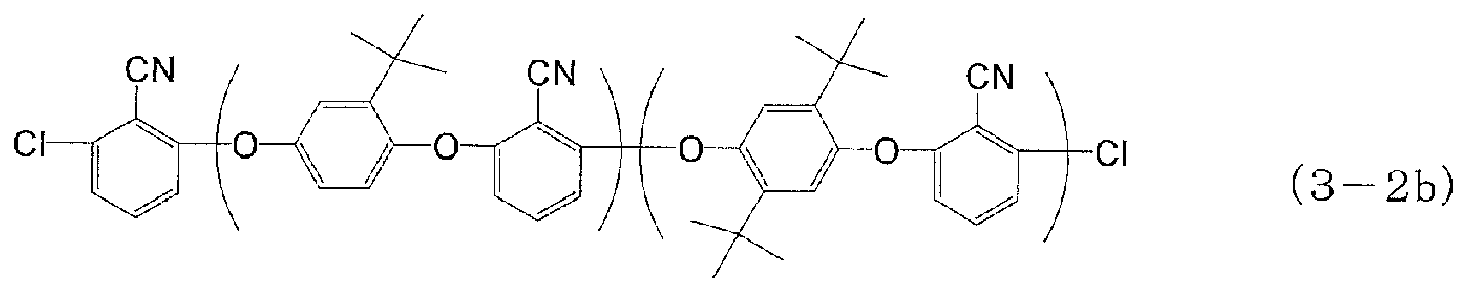
攪拌機、温度計、Dean-stark管、窒素導入管、冷却管をとりつけた1Lの三口フラスコに、ビス(4-クロロフェニル)スルホン149.3g(0.52mol)、ビス(4-ヒドロキシフェニル)スルホン120.1g(0.48mol)、炭酸カリウム85.6g(0.62mol)をはかりとった。窒素置換後、スルホラン700mL、トルエン350mLを加えて攪拌した。オイルバスで反応液を150℃で加熱還流させた。反応によって生成する水はDean-stark管にトラップした。3時間後、水の生成がほとんど認められなくなったところで、トルエンをDean-stark管から系外に除去した。徐々に反応温度を180から190℃に上げ、3時間攪拌を続けた後、ビス(4-クロロフェニル)スルホン40.2g(0.14mol)を加え、さらに5時間反応させた。
反応液を放冷後、メタノール/4wt%(5/1(体積比))硫酸溶液2400mL中に凝固した。沈殿した生成物を濾過し、水2400mL中、55℃で1時間攪拌した。濾過後、再度水2400mL中、55℃で1時間攪拌した。濾過後、メタノール2401mL中、55℃で1時間攪拌した後、濾過し、再度メタノール2400mL中、55℃で1時間攪拌し濾過した。風乾後、80℃で真空乾燥し目的物187.6g(収率80%)を得た。GPCで測定したMnは8,500であった。得られた化合物は式(3-2c)で表されるオリゴマーであることを確認した。

<合成例3-1>
撹拌羽根、温度計、窒素導入管を取り付けた2Lの3口フラスコに、フルオロベンゼン240.2g(2.50mol)を取り、氷浴で10℃まで冷却し、2,5-ジクロロ安息香酸クロライド134.6g(0.50mol)、塩化アルミニウム86.7g(0.65mol)を反応温度が40℃を超えないように徐々に添加した。添加後、40℃で8時間撹拌した。薄層クロマトグラフィーにより原料の消失を確認した後、氷水に滴下し、酢酸エチルから抽出を行った。5%重曹水により中和した後、飽和食塩水で洗浄し、硫酸マグネシウムにより乾燥させた後、エバポレーターでにより溶媒を留去した。メタノールから再結晶を行うことにより、中間体の2,5-ジクロロ-4'-フルオロベンゾフェノンを得た。収量130g。収率97%。
撹拌機、温度計、冷却管、Dean-Stark管、窒素導入の三方コックを取り付けた2Lの3口フラスコに、上記2,5-ジクロロ-4'-フルオロベンゾフェノン130.5g(0.49mol)、2-ヒドロキシピリジン46.1g(0.49mol)、炭酸カリウム73.7g(0.53mol)、を取り、N,N-ジメチルアセトアミド(DMAc)500mL、トルエン100mLを加え、オイルバス中、窒素雰囲気下で加熱、撹拌下130℃で反応させた。反応により生成する水をトルエンと共沸させ、Dean-Stark管で系外に除去しながら反応させると、約3時間で水の生成がほとんど認められなくなった。その後、大部分のトルエンを除去し、130℃で10時間反応を続けた。得られた反応液を放冷後、濾液を2Lの水/メタノール(9/1)中に投入した。沈殿した生成物を濾別、回収し乾燥した。撹拌機、温度計、冷却管、Dean-Stark管、窒素導入の三方コックを取り付けた2Lの3口フラスコに乾燥物を取り、トルエン1L中で100℃で撹拌し、残留した水分を留去し溶解させた。放冷後、結晶化物を濾過することにより淡黄色の目的物である2,5-ジクロロ-4'-(ピリジン-2-オキシ)ベンゾフェノン(2-2a)を142g、収率83%で得た。
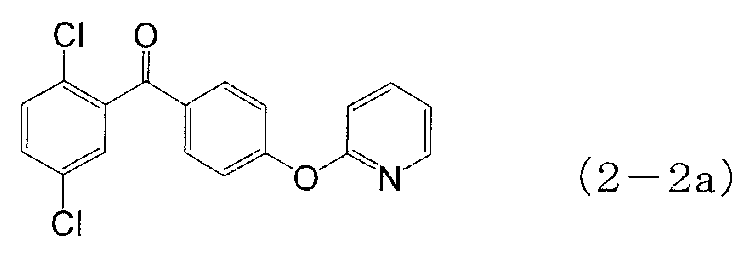
攪拌機、温度計、冷却管、窒素導入管を取り付けた2L三口フラスコに、2,5-ジクロロ―4'―フルオロベンゾフェノン150.7g(0.560mol)、イミダゾール 114.4g(1.68mol)、炭酸カリウム100.6g(0.728mol)、N,N'-ジメチルアセトアミド 840mlを量りとった。反応溶液を、窒素雰囲気下オイルバスを用いて110℃で2時間加熱した。薄層クロマトグラフィーにより原料の消失を確認した後、反応液を室温まで放冷した。その後、反応液を3Lの水に徐々に加え、生成物を凝固させ、ろ過した。ろ過により得られた生成物をTHF(1.2L)で溶かし、トルエン(4L)を加えた後、水層が中性になるまで食塩水により洗浄した。有機層を硫酸マグネシウムにより乾燥させた後、エバポレーターにより溶媒を留去した。粗収量180。80℃に加熱したトルエン1Lとメタノール20mlの混合溶媒を用いて再結晶単離操作を行い、2,5-ジクロロ-4'-(1-イミダゾリル)ベンゾフェノン(2-2b)の白色固体155gを収率87%で得た。
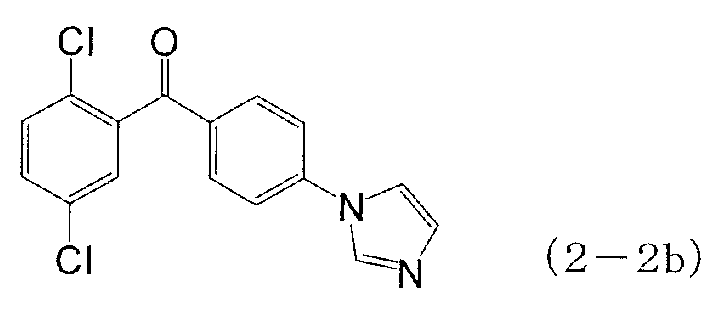
非特許文献1 J.Am.Chem.Soc., 118、3930-3937(1996).
非特許文献2 Macromolecules, 27、756-761(1994).
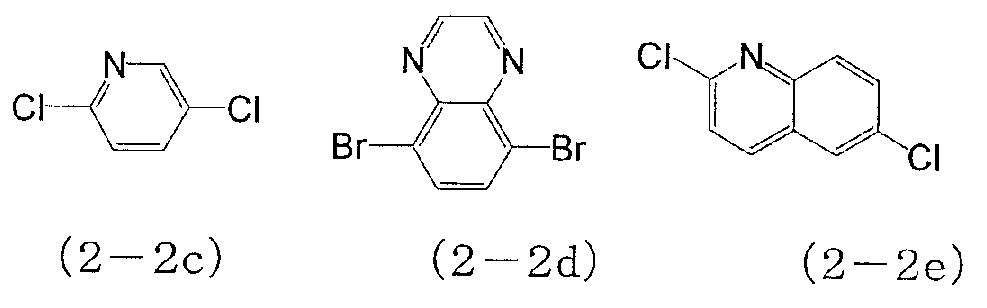
合成例1-1で得られた化合物(1-1a)28.06g(94.4mmol)と、合成例2-1で得られたオリゴマー(3-2a)22.70g(2.77mmol)、合成例3-1で得られた含窒素複素環化合物(2-2a)0.98g(2.83mmol)、ビス(トリフェニルホスフィン)ニッケルジクロリド2.62g(4.0mmol)、トリフェニルホスフィン3.15g(12.0mmol)、亜鉛15.69g(240mmol)の混合物中に乾燥したジメチルアセトアミド(DMAc)166mLを窒素下で加えた。
反応系を撹拌下に加熱し(最終的には79℃まで加温)、3時間反応させた。反応途中で系中の粘度上昇が観察された。重合反応溶液をDMAc 200mLで希釈し、30分撹拌し、セライトを濾過助剤に用い、濾過した。
濾液に臭化リチウム32.79g(378mmol)を加え、内温120℃で7時間、窒素雰囲気下で反応させた。反応後、室温まで冷却し、水5.0Lに注ぎ、凝固した。凝固物をアセトンに浸漬し、濾過し洗浄した。洗浄物を1N硫酸6500gで攪拌しながら洗浄を行った。濾過後、生成物は洗浄液のpHが5以上となるまで、イオン交換水で洗浄した。洗浄した固形物を、80℃熱風乾燥機で乾燥し、目的のポリマー35.5g(収率93.2%)を得た。得られたポリマーの重量平均分子量は、GPCで測定した結果、141,000、イオン交換容量は、2.33meq/gであった。得られたポリマーは、下記式(P-1)で表される構造を含むポリマーであった。

表1に示すようなスルホン酸を有する化合物/オリゴマー/含窒素複素環の組み合わせにて、仕込比を表1に示すような割合で用いた以外は、実施例1と同様にしてポリマーを得た。得られたポリマーの分子量、イオン交換容量をGPCで測定した結果を表1に併せて示す。
実施例3~9で得られたポリマーの一般式(P-2~10)は以下の通りであった。
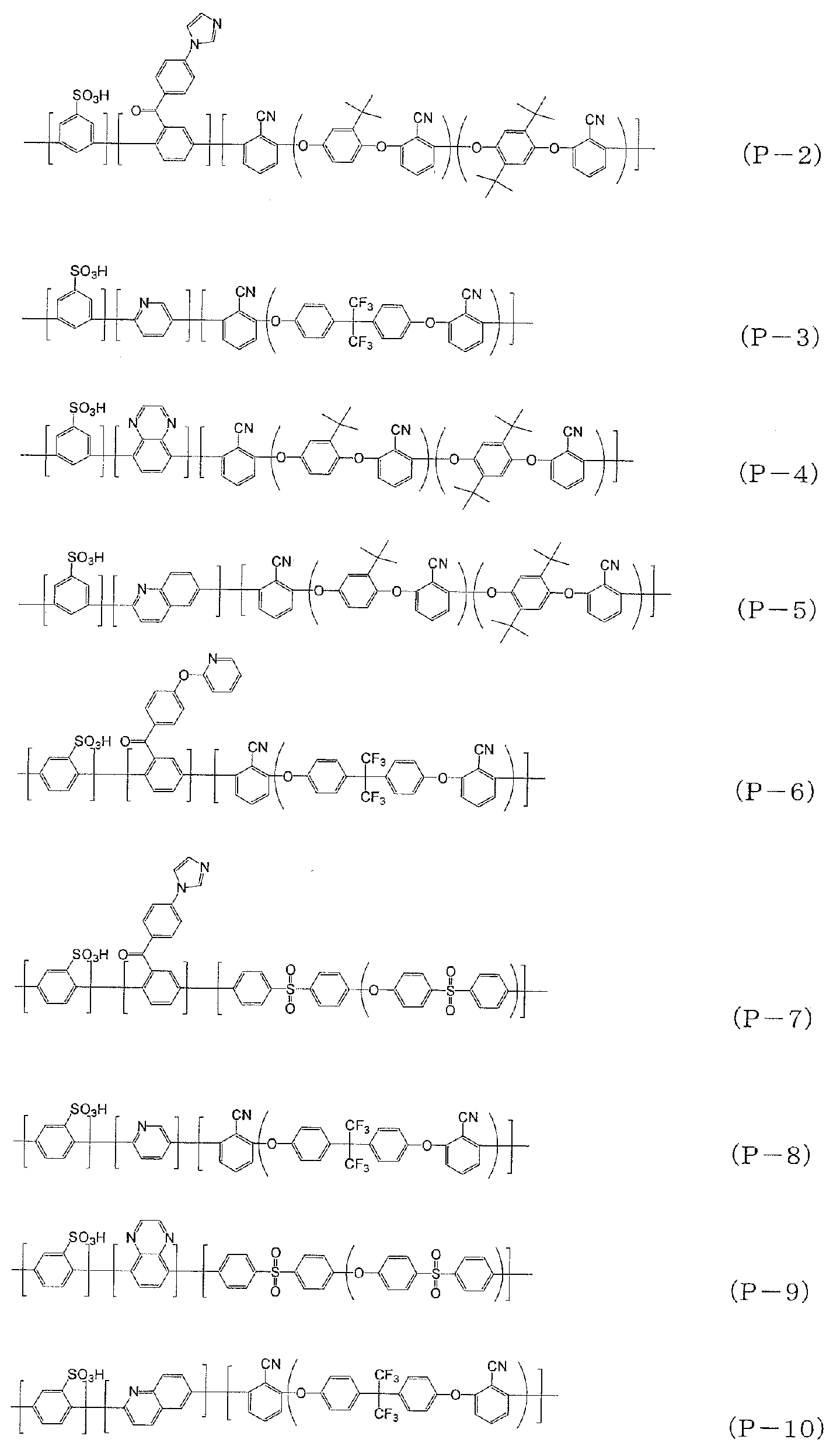
合成例1-2で得られた化合物28.86g(97.1mmol)と、合成例2-3で得られたオリゴマー24.65g(2.90mmol)、ビス(トリフェニルホスフィン)ニッケルジクロリド2.62g(4.0mmol)、トリフェニルホスフィン3.15g(12.0mmol)、亜鉛15.69g(240mmol)の混合物中に乾燥したジメチルアセトアミド(DMAc)166mLを窒素下で加えた。
反応系を撹拌下に加熱し(最終的には79℃まで加温)、3時間反応させた。反応途中で系中の粘度上昇が観察された。重合反応溶液をDMAc 200mLで希釈し、30分撹拌し、セライトを濾過助剤に用い、濾過した。
濾液に臭化リチウム38.01g(438mmol)を加え、内温120℃で7時間、窒素雰囲気下で反応させた。反応後、室温まで冷却し、水5.0Lに注ぎ、凝固した。凝固物をアセトンに浸漬し、濾過し洗浄した。洗浄物を1N硫酸6500gで攪拌しながら洗浄を行った。濾過後、生成物は洗浄液のpHが5以上となるまで、イオン交換水で洗浄した。洗浄した固形物を、80℃熱風乾燥機で乾燥し、目的のポリマー35.5g(収率92.4%)を得た。得られたポリマーの分子量は、GPCで測定した結果、120,000であった。イオン交換容量は、2.33meq/gであった。得られたポリマーは、下記式(P-11)で表される構造を含むポリマーであった。


実施例1~11および比較例1で得られたポリマーをN-メチルピロリドンに溶解し、PET板上にキャストして、膜厚30μmの電解質膜を作製した。電解質膜を2.0cm×3.0cmにカットし秤量して、試験用のテストピースとした。24℃、相対湿度(RH)50%条件下にて8時間以上静置し状態調整した後、この電解質膜の重量を測定した。同電解質膜をポリカーボネート製の250ml瓶に入れ、そこに約100mlの蒸留水を加え、プレッシャークッカー試験機(HIRAYAMA MFS CORP製、PC-242HS)を用いて、120℃で24時間加温した。加熱終了後、室温まで放冷し、試料膜を取出し、表面の水滴を軽く拭き取った後、23℃50%RHの環境下で8時間以上静置し状態調節した後、電解質膜の重量を測定した。得られ得た数値を用い、得られた電解質膜の重量保持率について以下の通り算出し、重量保持率が90%以上である場合を「○」、重量保持率が90%未満である場合を「×」と評価した。
重量保持率(%)=(試験後の膜重量(g)/試験前の膜重量(g))×100
この熱水試験の結果、実施例1~11の膜では「○」、比較例1が「×」であった。
〔ガス拡散層の作製〕
カーボンブラックとポリテトラフルオロエチレン(PTFE)粒子とを、カーボンブラック:PTFE粒子=4:6の重量比で混合し、得られた混合物をエチレングリコールに均一に分散させたスラリーをカーボンペーパーの片面に塗布し、乾燥させて下地層とし、該下地層とカーボンペーパーとからなる拡散層3を作製した。
カーボンブラックとポリテトラフルオロエチレン(PTFE)粒子とを、カーボンブラック:PTFE粒子=4:6の重量比で混合し、得られた混合物をエチレングリコールに均一に分散させたスラリーをカーボンペーパーの片面に塗布し、乾燥させて下地層とし、該下地層とカーボンペーパーとからなる拡散層3を作製した。
[ガス拡散電極の作製]
上記で作製した拡散層上に、評価用電極ペーストを白金塗布量が0.5mg/cm2になるようにドクターブレードを用いて塗布した。これを95℃で10分間加熱乾燥し、ガス拡散電極層を形成させた。
上記で作製した拡散層上に、評価用電極ペーストを白金塗布量が0.5mg/cm2になるようにドクターブレードを用いて塗布した。これを95℃で10分間加熱乾燥し、ガス拡散電極層を形成させた。
[膜-電極接合体の作製]
実施例1-11および比較例1からなる電解質膜(膜厚30μm)の電解質膜を1枚用意し、上記で作製した一対のガス拡散電極層で挟み、圧力100kg/cm2下で、160℃×15minの条件でホットプレス成形して、膜-電極接合体を作成した。
実施例1-11および比較例1からなる電解質膜(膜厚30μm)の電解質膜を1枚用意し、上記で作製した一対のガス拡散電極層で挟み、圧力100kg/cm2下で、160℃×15minの条件でホットプレス成形して、膜-電極接合体を作成した。
〔発電評価〕
上記で得た膜―電極接合体の両側にガス流路を兼ねるセパレータを積層することにより、固体高分子型燃料電池を構成させた。これを単セルとして、一方を酸素極として空気を供給し、一方は燃料極として純水素を供給して発電させた。発電条件は、セル温度95℃、空気極側相対湿度75%、空気極側流量4L/min、燃料極側相対湿度40%、燃料極側流量1L/minで初期発電特性評価を行った。電流密度1.0A/cm2時の出力電圧を表2に示す。初期特性評価後、セル温度95℃、空気極側相対湿度75%、空気極側流量0.2L/min、燃料極側相対湿度40%、燃料極側流量0.6L/minで、電流密度を0.1A/cm2に保持し、500時間連続発電を行った。500時間後、初期発電特性評価条件と同条件で、電流密度1.0A/cm2時の出力電圧を測定した。結果を表2に示した。
上記で得た膜―電極接合体の両側にガス流路を兼ねるセパレータを積層することにより、固体高分子型燃料電池を構成させた。これを単セルとして、一方を酸素極として空気を供給し、一方は燃料極として純水素を供給して発電させた。発電条件は、セル温度95℃、空気極側相対湿度75%、空気極側流量4L/min、燃料極側相対湿度40%、燃料極側流量1L/minで初期発電特性評価を行った。電流密度1.0A/cm2時の出力電圧を表2に示す。初期特性評価後、セル温度95℃、空気極側相対湿度75%、空気極側流量0.2L/min、燃料極側相対湿度40%、燃料極側流量0.6L/minで、電流密度を0.1A/cm2に保持し、500時間連続発電を行った。500時間後、初期発電特性評価条件と同条件で、電流密度1.0A/cm2時の出力電圧を測定した。結果を表2に示した。
〔発電評価後の電解質膜の分析〕
上記発電評価を実施した後の膜―電極接合体より、ガス拡散層のカーボンペーパーを剥離した後、膜表面の電極層をはがして電解質膜を取り出した。得られた電解質膜より試験片を作製し、前述と同様の方法でスルホン酸当量、分子量を測定した。これら膜の分析結果を表2に示した。
上記発電評価を実施した後の膜―電極接合体より、ガス拡散層のカーボンペーパーを剥離した後、膜表面の電極層をはがして電解質膜を取り出した。得られた電解質膜より試験片を作製し、前述と同様の方法でスルホン酸当量、分子量を測定した。これら膜の分析結果を表2に示した。
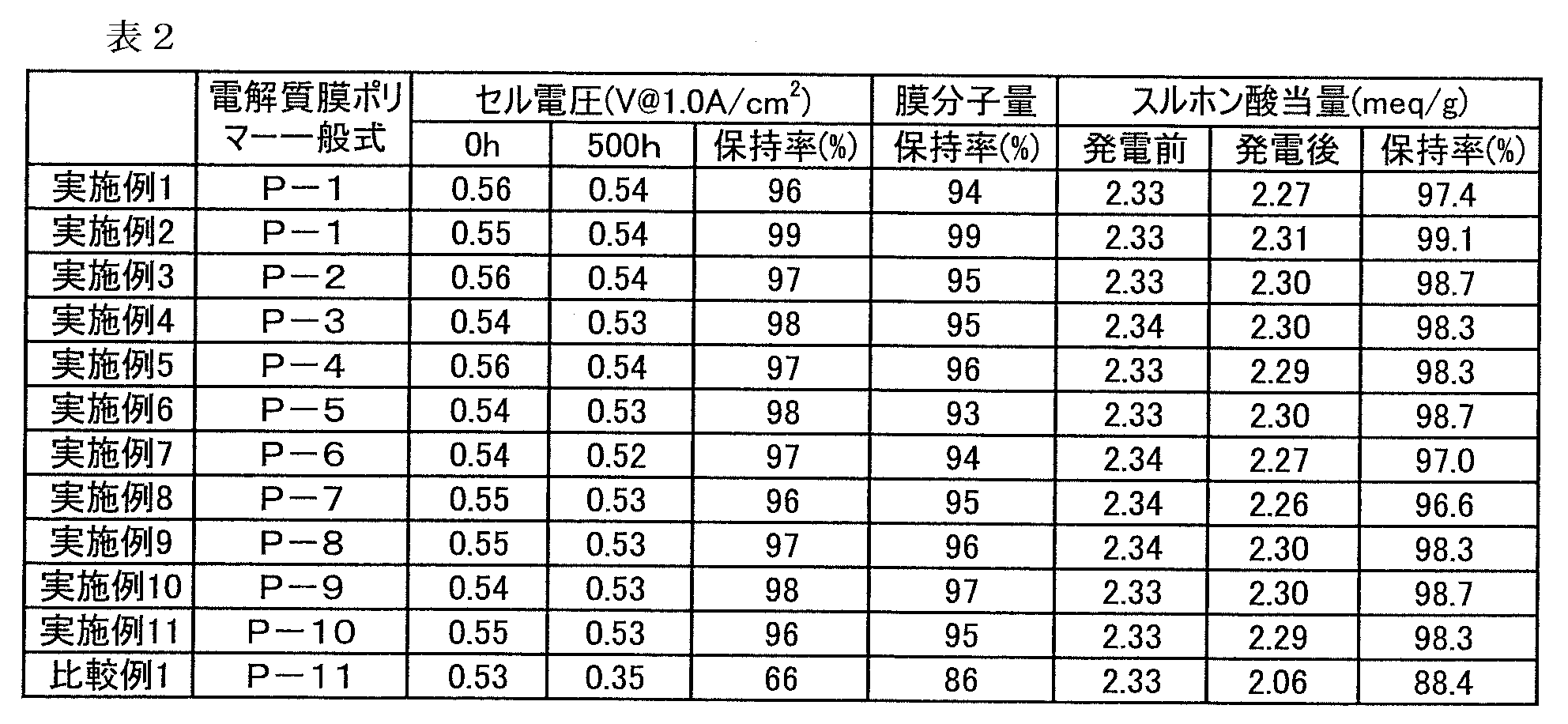
Claims (7)
- 下記式(1)で表される構造単位と、下記式(2)で表わされる構造単位を含む芳香族系共重合体。

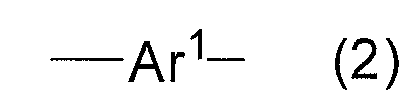
- 前記式(2)で表わされる構造単位が、窒素を含む2価の複素環基および下記式(2-1)で表わされる基から選ばれる少なくとも一つの基である、請求項1に記載の芳香族系共重合体。

- 上記式(1)で表される構造単位が少なくとも2個連続している、請求項1または2に記載の芳香族系共重合体。
- 請求項1~3のいずれか1項に記載の芳香族系共重合体からなる高分子電解質。
- 請求項1~3のいずれか1項に記載の芳香族系共重合体からなる固体高分子電解質膜。
- 請求項5に記載の高分子電解質膜と、該高分子電解質膜の両側に接して、触媒層とガス拡散層とを有することを特徴とする膜-電極接合体。
- 請求項6に記載の膜-電極接合体を有する固体高分子型燃料電池。
Priority Applications (1)
| Application Number | Priority Date | Filing Date | Title |
|---|---|---|---|
| JP2012527722A JPWO2012017960A1 (ja) | 2010-08-03 | 2011-07-29 | スルホン酸基を有する芳香族系共重合体、ならびにその用途 |
Applications Claiming Priority (2)
| Application Number | Priority Date | Filing Date | Title |
|---|---|---|---|
| JP2010174897 | 2010-08-03 | ||
| JP2010-174897 | 2010-08-03 |
Publications (1)
| Publication Number | Publication Date |
|---|---|
| WO2012017960A1 true WO2012017960A1 (ja) | 2012-02-09 |
Family
ID=45559459
Family Applications (1)
| Application Number | Title | Priority Date | Filing Date |
|---|---|---|---|
| PCT/JP2011/067512 Ceased WO2012017960A1 (ja) | 2010-08-03 | 2011-07-29 | スルホン酸基を有する芳香族系共重合体、ならびにその用途 |
Country Status (2)
| Country | Link |
|---|---|
| JP (1) | JPWO2012017960A1 (ja) |
| WO (1) | WO2012017960A1 (ja) |
Citations (9)
| Publication number | Priority date | Publication date | Assignee | Title |
|---|---|---|---|---|
| JP2008078130A (ja) * | 2006-08-25 | 2008-04-03 | Sumitomo Chemical Co Ltd | 高分子電解質膜及びその製造方法、並びに、高分子電解質膜のプロトン伝導性の評価方法 |
| WO2009142274A1 (ja) * | 2008-05-21 | 2009-11-26 | 住友化学株式会社 | ポリマー、ポリアリーレン系ブロック共重合体、高分子電解質、高分子電解質膜及び燃料電池 |
| WO2010061963A1 (ja) * | 2008-11-28 | 2010-06-03 | 住友化学株式会社 | ポリマー、高分子電解質、燃料電池、及び高分子電解質膜の製造方法 |
| JP2010135280A (ja) * | 2008-10-28 | 2010-06-17 | Jsr Corp | プロトン伝導膜およびその製造方法、膜−電極接合体、固体高分子型燃料電池 |
| JP2010135279A (ja) * | 2008-10-28 | 2010-06-17 | Jsr Corp | プロトン伝導膜およびその製造方法、膜−電極接合体、固体高分子型燃料電池 |
| JP2010131922A (ja) * | 2008-12-07 | 2010-06-17 | Sumitomo Chemical Co Ltd | 高分子電解質膜の洗浄方法及びそれに用いるスペーサ並びに巻取体 |
| JP2010135282A (ja) * | 2008-10-28 | 2010-06-17 | Jsr Corp | プロトン伝導膜およびその製造方法、膜−電極接合体、固体高分子型燃料電池 |
| JP2011089036A (ja) * | 2009-10-22 | 2011-05-06 | Jsr Corp | 新規な芳香族化合物および側鎖にスルホン酸基を含む芳香環を有するポリアリーレン系共重合体 |
| JP2011090908A (ja) * | 2009-10-22 | 2011-05-06 | Jsr Corp | 固体高分子型燃料電池用電極電解質およびそれを用いた電極ワニス、電極ペースト、膜−電極接合体 |
-
2011
- 2011-07-29 WO PCT/JP2011/067512 patent/WO2012017960A1/ja not_active Ceased
- 2011-07-29 JP JP2012527722A patent/JPWO2012017960A1/ja active Pending
Patent Citations (9)
| Publication number | Priority date | Publication date | Assignee | Title |
|---|---|---|---|---|
| JP2008078130A (ja) * | 2006-08-25 | 2008-04-03 | Sumitomo Chemical Co Ltd | 高分子電解質膜及びその製造方法、並びに、高分子電解質膜のプロトン伝導性の評価方法 |
| WO2009142274A1 (ja) * | 2008-05-21 | 2009-11-26 | 住友化学株式会社 | ポリマー、ポリアリーレン系ブロック共重合体、高分子電解質、高分子電解質膜及び燃料電池 |
| JP2010135280A (ja) * | 2008-10-28 | 2010-06-17 | Jsr Corp | プロトン伝導膜およびその製造方法、膜−電極接合体、固体高分子型燃料電池 |
| JP2010135279A (ja) * | 2008-10-28 | 2010-06-17 | Jsr Corp | プロトン伝導膜およびその製造方法、膜−電極接合体、固体高分子型燃料電池 |
| JP2010135282A (ja) * | 2008-10-28 | 2010-06-17 | Jsr Corp | プロトン伝導膜およびその製造方法、膜−電極接合体、固体高分子型燃料電池 |
| WO2010061963A1 (ja) * | 2008-11-28 | 2010-06-03 | 住友化学株式会社 | ポリマー、高分子電解質、燃料電池、及び高分子電解質膜の製造方法 |
| JP2010131922A (ja) * | 2008-12-07 | 2010-06-17 | Sumitomo Chemical Co Ltd | 高分子電解質膜の洗浄方法及びそれに用いるスペーサ並びに巻取体 |
| JP2011089036A (ja) * | 2009-10-22 | 2011-05-06 | Jsr Corp | 新規な芳香族化合物および側鎖にスルホン酸基を含む芳香環を有するポリアリーレン系共重合体 |
| JP2011090908A (ja) * | 2009-10-22 | 2011-05-06 | Jsr Corp | 固体高分子型燃料電池用電極電解質およびそれを用いた電極ワニス、電極ペースト、膜−電極接合体 |
Also Published As
| Publication number | Publication date |
|---|---|
| JPWO2012017960A1 (ja) | 2013-10-03 |
Similar Documents
| Publication | Publication Date | Title |
|---|---|---|
| KR101023577B1 (ko) | 직접 메탄올형 연료 전지용 막-전극 접합체 및 프로톤전도막 | |
| JP5854046B2 (ja) | プロトン伝導性基を有する芳香族系共重合体およびその用途 | |
| JP5181004B2 (ja) | スルホン酸基を有するポリアリーレン系ブロック共重合体、ならびにその用途 | |
| US20110311899A1 (en) | Polymer, polyarylene block copolymer, polyelectrolyte, polyelectrolyte membrane, and fuel cell | |
| WO2011155528A1 (ja) | スルホン酸基を有する芳香族系共重合体、ならびにその用途 | |
| JP2018060789A (ja) | 高分子電解質組成物ならびにそれを用いた高分子電解質膜、触媒層付き電解質膜、膜電極複合体、固体高分子形燃料電池、電気化学式水素ポンプおよび水電解式水素発生装置 | |
| JP5028828B2 (ja) | ポリアリーレン系ブロック共重合体及びその用途 | |
| CN101426832B (zh) | 具有芴骨架的芳香族化合物和具有磺酸基的聚芳撑 | |
| JP5581937B2 (ja) | 芳香族系共重合体、ならびにその用途 | |
| JP2010031231A (ja) | 新規な芳香族化合物および含窒素芳香環を有するポリアリーレン系共重合体 | |
| JP4976919B2 (ja) | 固体高分子型燃料電池用膜−電極構造体 | |
| WO2012017965A1 (ja) | スルホン酸基を有する芳香族系共重合体、ならびにその用途 | |
| JP5352128B2 (ja) | 固体高分子型燃料電池用膜−電極構造体 | |
| JP5692226B2 (ja) | スルホン酸基を有するポリアリーレン系ブロック共重合体、ならびにその用途 | |
| JP5350974B2 (ja) | 固体高分子型燃料電池用膜−電極構造体 | |
| WO2013183386A1 (ja) | 共重合体、組成物、高分子電解質膜、膜-電極接合体および固体高分子型燃料電池 | |
| JP5512488B2 (ja) | 固体高分子型燃料電池用膜−電極構造体 | |
| JP2015008060A (ja) | 電解質膜、膜−電極接合体および固体高分子型燃料電池 | |
| WO2012017960A1 (ja) | スルホン酸基を有する芳香族系共重合体、ならびにその用途 | |
| JP5562129B2 (ja) | 固体高分子型燃料電池用膜−電極構造体 | |
| JP2010010007A (ja) | 固体高分子型燃料電池用膜−電極構造体 | |
| JP2007254486A (ja) | 新規な芳香族スルホン酸エステル、スルホン酸基を有するポリアリーレンおよびその製造方法 |
Legal Events
| Date | Code | Title | Description |
|---|---|---|---|
| 121 | Ep: the epo has been informed by wipo that ep was designated in this application |
Ref document number: 11814586 Country of ref document: EP Kind code of ref document: A1 |
|
| WWE | Wipo information: entry into national phase |
Ref document number: 2012527722 Country of ref document: JP |
|
| NENP | Non-entry into the national phase |
Ref country code: DE |
|
| 122 | Ep: pct application non-entry in european phase |
Ref document number: 11814586 Country of ref document: EP Kind code of ref document: A1 |