WO2012011586A1 - 非水電解液及びそれを用いた電気化学素子 - Google Patents
非水電解液及びそれを用いた電気化学素子 Download PDFInfo
- Publication number
- WO2012011586A1 WO2012011586A1 PCT/JP2011/066755 JP2011066755W WO2012011586A1 WO 2012011586 A1 WO2012011586 A1 WO 2012011586A1 JP 2011066755 W JP2011066755 W JP 2011066755W WO 2012011586 A1 WO2012011586 A1 WO 2012011586A1
- Authority
- WO
- WIPO (PCT)
- Prior art keywords
- group
- carbon atoms
- carbon
- carbonate
- electrolytic solution
- Prior art date
- Legal status (The legal status is an assumption and is not a legal conclusion. Google has not performed a legal analysis and makes no representation as to the accuracy of the status listed.)
- Ceased
Links
Classifications
-
- H—ELECTRICITY
- H01—ELECTRIC ELEMENTS
- H01M—PROCESSES OR MEANS, e.g. BATTERIES, FOR THE DIRECT CONVERSION OF CHEMICAL ENERGY INTO ELECTRICAL ENERGY
- H01M10/00—Secondary cells; Manufacture thereof
- H01M10/05—Accumulators with non-aqueous electrolyte
- H01M10/056—Accumulators with non-aqueous electrolyte characterised by the materials used as electrolytes, e.g. mixed inorganic/organic electrolytes
- H01M10/0564—Accumulators with non-aqueous electrolyte characterised by the materials used as electrolytes, e.g. mixed inorganic/organic electrolytes the electrolyte being constituted of organic materials only
- H01M10/0566—Liquid materials
- H01M10/0567—Liquid materials characterised by the additives
-
- H—ELECTRICITY
- H01—ELECTRIC ELEMENTS
- H01G—CAPACITORS; CAPACITORS, RECTIFIERS, DETECTORS, SWITCHING DEVICES, LIGHT-SENSITIVE OR TEMPERATURE-SENSITIVE DEVICES OF THE ELECTROLYTIC TYPE
- H01G11/00—Hybrid capacitors, i.e. capacitors having different positive and negative electrodes; Electric double-layer [EDL] capacitors; Processes for the manufacture thereof or of parts thereof
- H01G11/54—Electrolytes
- H01G11/58—Liquid electrolytes
- H01G11/60—Liquid electrolytes characterised by the solvent
-
- H—ELECTRICITY
- H01—ELECTRIC ELEMENTS
- H01G—CAPACITORS; CAPACITORS, RECTIFIERS, DETECTORS, SWITCHING DEVICES, LIGHT-SENSITIVE OR TEMPERATURE-SENSITIVE DEVICES OF THE ELECTROLYTIC TYPE
- H01G11/00—Hybrid capacitors, i.e. capacitors having different positive and negative electrodes; Electric double-layer [EDL] capacitors; Processes for the manufacture thereof or of parts thereof
- H01G11/54—Electrolytes
- H01G11/58—Liquid electrolytes
- H01G11/62—Liquid electrolytes characterised by the solute, e.g. salts, anions or cations therein
-
- H—ELECTRICITY
- H01—ELECTRIC ELEMENTS
- H01G—CAPACITORS; CAPACITORS, RECTIFIERS, DETECTORS, SWITCHING DEVICES, LIGHT-SENSITIVE OR TEMPERATURE-SENSITIVE DEVICES OF THE ELECTROLYTIC TYPE
- H01G9/00—Electrolytic capacitors, rectifiers, detectors, switching devices, light-sensitive or temperature-sensitive devices; Processes of their manufacture
- H01G9/004—Details
- H01G9/022—Electrolytes; Absorbents
- H01G9/025—Solid electrolytes
- H01G9/028—Organic semiconducting electrolytes, e.g. TCNQ
-
- H—ELECTRICITY
- H01—ELECTRIC ELEMENTS
- H01M—PROCESSES OR MEANS, e.g. BATTERIES, FOR THE DIRECT CONVERSION OF CHEMICAL ENERGY INTO ELECTRICAL ENERGY
- H01M10/00—Secondary cells; Manufacture thereof
- H01M10/05—Accumulators with non-aqueous electrolyte
- H01M10/052—Li-accumulators
-
- H—ELECTRICITY
- H01—ELECTRIC ELEMENTS
- H01M—PROCESSES OR MEANS, e.g. BATTERIES, FOR THE DIRECT CONVERSION OF CHEMICAL ENERGY INTO ELECTRICAL ENERGY
- H01M10/00—Secondary cells; Manufacture thereof
- H01M10/05—Accumulators with non-aqueous electrolyte
- H01M10/052—Li-accumulators
- H01M10/0525—Rocking-chair batteries, i.e. batteries with lithium insertion or intercalation in both electrodes; Lithium-ion batteries
-
- H—ELECTRICITY
- H01—ELECTRIC ELEMENTS
- H01M—PROCESSES OR MEANS, e.g. BATTERIES, FOR THE DIRECT CONVERSION OF CHEMICAL ENERGY INTO ELECTRICAL ENERGY
- H01M10/00—Secondary cells; Manufacture thereof
- H01M10/05—Accumulators with non-aqueous electrolyte
- H01M10/056—Accumulators with non-aqueous electrolyte characterised by the materials used as electrolytes, e.g. mixed inorganic/organic electrolytes
- H01M10/0564—Accumulators with non-aqueous electrolyte characterised by the materials used as electrolytes, e.g. mixed inorganic/organic electrolytes the electrolyte being constituted of organic materials only
- H01M10/0566—Liquid materials
- H01M10/0569—Liquid materials characterised by the solvents
-
- H—ELECTRICITY
- H01—ELECTRIC ELEMENTS
- H01M—PROCESSES OR MEANS, e.g. BATTERIES, FOR THE DIRECT CONVERSION OF CHEMICAL ENERGY INTO ELECTRICAL ENERGY
- H01M2300/00—Electrolytes
- H01M2300/0017—Non-aqueous electrolytes
- H01M2300/0025—Organic electrolyte
- H01M2300/0045—Room temperature molten salts comprising at least one organic ion
-
- H—ELECTRICITY
- H01—ELECTRIC ELEMENTS
- H01M—PROCESSES OR MEANS, e.g. BATTERIES, FOR THE DIRECT CONVERSION OF CHEMICAL ENERGY INTO ELECTRICAL ENERGY
- H01M2300/00—Electrolytes
- H01M2300/0088—Composites
- H01M2300/0091—Composites in the form of mixtures
-
- Y—GENERAL TAGGING OF NEW TECHNOLOGICAL DEVELOPMENTS; GENERAL TAGGING OF CROSS-SECTIONAL TECHNOLOGIES SPANNING OVER SEVERAL SECTIONS OF THE IPC; TECHNICAL SUBJECTS COVERED BY FORMER USPC CROSS-REFERENCE ART COLLECTIONS [XRACs] AND DIGESTS
- Y02—TECHNOLOGIES OR APPLICATIONS FOR MITIGATION OR ADAPTATION AGAINST CLIMATE CHANGE
- Y02E—REDUCTION OF GREENHOUSE GAS [GHG] EMISSIONS, RELATED TO ENERGY GENERATION, TRANSMISSION OR DISTRIBUTION
- Y02E60/00—Enabling technologies; Technologies with a potential or indirect contribution to GHG emissions mitigation
- Y02E60/10—Energy storage using batteries
-
- Y—GENERAL TAGGING OF NEW TECHNOLOGICAL DEVELOPMENTS; GENERAL TAGGING OF CROSS-SECTIONAL TECHNOLOGIES SPANNING OVER SEVERAL SECTIONS OF THE IPC; TECHNICAL SUBJECTS COVERED BY FORMER USPC CROSS-REFERENCE ART COLLECTIONS [XRACs] AND DIGESTS
- Y02—TECHNOLOGIES OR APPLICATIONS FOR MITIGATION OR ADAPTATION AGAINST CLIMATE CHANGE
- Y02E—REDUCTION OF GREENHOUSE GAS [GHG] EMISSIONS, RELATED TO ENERGY GENERATION, TRANSMISSION OR DISTRIBUTION
- Y02E60/00—Enabling technologies; Technologies with a potential or indirect contribution to GHG emissions mitigation
- Y02E60/13—Energy storage using capacitors
-
- Y—GENERAL TAGGING OF NEW TECHNOLOGICAL DEVELOPMENTS; GENERAL TAGGING OF CROSS-SECTIONAL TECHNOLOGIES SPANNING OVER SEVERAL SECTIONS OF THE IPC; TECHNICAL SUBJECTS COVERED BY FORMER USPC CROSS-REFERENCE ART COLLECTIONS [XRACs] AND DIGESTS
- Y02—TECHNOLOGIES OR APPLICATIONS FOR MITIGATION OR ADAPTATION AGAINST CLIMATE CHANGE
- Y02T—CLIMATE CHANGE MITIGATION TECHNOLOGIES RELATED TO TRANSPORTATION
- Y02T10/00—Road transport of goods or passengers
- Y02T10/60—Other road transportation technologies with climate change mitigation effect
- Y02T10/70—Energy storage systems for electromobility, e.g. batteries
Definitions
- electrochemical devices particularly lithium secondary batteries
- small electronic devices such as mobile phones and laptop computers, electric vehicles, and power storage.
- these electronic devices and automobiles may be used in a wide temperature range such as a high temperature in midsummer or a low temperature of extremely cold, it is required to improve electrochemical characteristics in a wide range over a wide temperature range.
- hybrid electric vehicles are among the environmentally friendly vehicles equipped with power storage devices composed of electrochemical elements such as lithium secondary batteries and capacitors.
- HEV high temperature in midsummer or a low temperature of extremely cold
- PHEV plug-in hybrid electric vehicles
- BEV battery electric vehicles
- lithium secondary battery is used as a concept including so-called lithium ion secondary batteries.
- the lithium secondary battery is mainly composed of a positive electrode and a negative electrode containing a material capable of inserting and extracting lithium, a non-aqueous electrolyte composed of a lithium salt and a non-aqueous solvent, and the non-aqueous solvent includes ethylene carbonate (EC), Carbonates such as propylene carbonate (PC) are used.
- EC ethylene carbonate
- PC propylene carbonate
- metal lithium metal compounds that can occlude and release lithium (metal simple substance, oxide, alloy with lithium, etc.) and carbon materials are known, and in particular, lithium can be occluded and released.
- Lithium secondary batteries using carbon materials such as coke, artificial graphite and natural graphite have been widely put into practical use.
- a lithium secondary battery using a highly crystallized carbon material such as natural graphite or artificial graphite as a negative electrode material is a decomposition product generated by reductive decomposition of a solvent in a non-aqueous electrolyte on the negative electrode surface during charging. It has been found that the gas causes a decrease in cycle characteristics because it inhibits the desired electrochemical reaction of the battery. Moreover, when the decomposition product of the nonaqueous solvent accumulates, it becomes impossible to smoothly occlude and release lithium into the negative electrode, and the electrochemical characteristics in a wide temperature range are liable to deteriorate.
- lithium secondary batteries using lithium metal, alloys thereof, simple metals such as tin or silicon, and oxides as negative electrode materials have high initial capacities, but fine powders progress during the cycle.
- reductive decomposition of a non-aqueous solvent occurs at an accelerated rate, and battery performance such as battery capacity and cycle characteristics is greatly reduced.
- these anode materials are pulverized or a decomposition product of a nonaqueous solvent accumulates, lithium cannot be smoothly inserted into and released from the anode, and the electrochemical characteristics in a wide temperature range are likely to be deteriorated.
- a lithium secondary battery using, for example, LiCoO 2 , LiMn 2 O 4 , LiNiO 2 , LiFePO 4, or the like as the positive electrode has a non-aqueous solvent in the non-aqueous electrolyte charged and a positive electrode material and a non-aqueous electrolyte. It has been found that degradation products and gases generated by partial oxidative decomposition locally at the interface of the battery inhibit the desired electrochemical reaction of the battery, resulting in degradation of electrochemical characteristics over a wide temperature range. Yes.
- Patent Document 1 proposes a nonaqueous electrolytic solution containing a specific organotin compound. For example, an electrolytic solution to which dibutyltin (1-allyloxymethyl) ethylene glycolate or dibutyltin bis (acetylacetonate) is added. It has been suggested that the cycle characteristics at 60 ° C. are improved.
- Patent Document 2 when a tin compound having a specific structure (such as a combination of bis (acetylacetonato) tin (II) and tetrabutyltin) is contained in a non-aqueous electrolyte, cycle characteristics at 25 ° C., It has been shown that the charge storage characteristics at 60 ° C. are good.
- An object of the present invention is to provide a nonaqueous electrolytic solution capable of improving electrochemical characteristics in a wide temperature range and an electrochemical element using the same.
- the present inventors have examined in detail the performance of the above-described prior art non-aqueous electrolyte.
- the non-aqueous electrolyte of the above-mentioned patent document is sufficiently satisfactory for the problem of improving electrochemical characteristics in a wide temperature range such as low temperature cycle characteristics and low temperature discharge characteristics after high temperature storage. That was not the case.
- the present inventors have made extensive studies to solve the above problems, and in a non-aqueous electrolyte solution in which an electrolyte salt is dissolved in a non-aqueous solvent, a specific organotin compound is added to the non-aqueous electrolyte solution.
- the inventors have found that the addition of 0.001 to 5% by mass can improve the electrochemical characteristics in a wide temperature range, particularly the lithium battery electrochemical characteristics, and have completed the present invention.
- the present invention provides the following (1) and (2).
- One or more organic tin compounds represented by any one of the following general formulas (I) to (IV) in a non-aqueous electrolyte solution in which an electrolyte salt is dissolved in a non-aqueous solvent Is contained in an amount of 0.001 to 5% by mass.
- R 1 represents an alkyl group having 1 to 8 carbon atoms, an alkenyl group having 2 to 8 carbon atoms, or an alkynyl group having 2 to 8 carbon atoms
- R 2 to R 4 each independently represent carbon An alkyl group having 1 to 8 carbon atoms, an alkenyl group having 2 to 8 carbon atoms, an alkynyl group having 2 to 8 carbon atoms, or an aryl group having 6 to 12 carbon atoms, wherein the hydrogen atoms of R 1 to R 4 are fluorine atoms May be substituted.
- R 23 to R 25 are each independently an alkyl group having 1 to 8 carbon atoms, a cycloalkyl group having 3 to 8 carbon atoms, an alkenyl group having 2 to 8 carbon atoms, or an alkynyl group having 2 to 8 carbon atoms. Or an aryl group having 6 to 12 carbon atoms, wherein R 26 and R 27 are each independently an alkyl group having 1 to 6 carbon atoms, an alkenyl group having 2 to 6 carbon atoms, or an alkyl group having 2 to 6 carbon atoms.
- R 26 and R 27 may combine with each other to form a ring
- R 28 represents a hydrogen atom, an alkyl group having 1 to 6 carbon atoms, an alkenyl group having 2 to 6 carbon atoms, or a carbon atom. Represents an alkynyl group of formula 2 to 6.
- the hydrogen atoms of R 23 to R 28 may be substituted with fluorine atoms.
- X 1 , X 2 and X 3 each independently represent the following substituents containing an oxygen atom or a sulfur atom,
- X 1 and X 2 may be bonded to each other and may have the following substituents.
- R 31 represents an alkyl group having 1 to 8 carbon atoms, an alkenyl group having 2 to 8 carbon atoms, an alkynyl group having 2 to 8 carbon atoms, or an aryl group having 6 to 12 carbon atoms
- R 32 and R 33 are Represents an alkyl group having 1 to 8 carbon atoms or an aryl group having 6 to 12 carbon atoms
- Y represents an oxygen atom or a sulfur atom
- L represents a carbon which may have an ether bond or a carbon-carbon unsaturated bond.
- the hydrogen atoms of R 31 , R 32 , R 33 and L 3 may be substituted with a fluorine atom.
- a, b and c each represent 0 or 1
- d represents an integer of 1 to 3
- m represents 0 or 1.
- a + b + c + d 4.
- the non-aqueous electrolyte is the non-aqueous electrolyte of (1) above. Electrochemical element to do.
- the present invention relates to a non-aqueous electrolyte and an electrochemical device using the same.
- the nonaqueous electrolytic solution of the present invention contains 0.001 to 5% by mass of one or more organic tin compounds represented by any one of the general formulas (I) to (IV) in the nonaqueous electrolytic solution. More specifically, the nonaqueous electrolytic solution according to the following aspects (1) to (3) is preferable. (1) In a nonaqueous electrolytic solution in which an electrolyte salt is dissolved in a nonaqueous solvent, the nonaqueous solvent contains a cyclic carbonate and a chain carbonate, and the chain carbonate is at least a symmetric chain carbonate and an asymmetric chain carbonate.
- the content of the symmetric chain carbonate is greater than that of the asymmetric chain carbonate, and further, 0.001 to 5% by mass of an organotin compound represented by the following general formula (I) is contained in the non-aqueous electrolyte.
- a non-aqueous electrolyte hereinafter referred to as “the first invention”.
- nonaqueous electrolytic solution in which an electrolyte salt is dissolved in a nonaqueous solvent, the nonaqueous solvent contains a cyclic carbonate and a chain ester, and the cyclic carbonate has at least a fluorine atom or a carbon-carbon double bond.
- a nonaqueous electrolytic solution comprising carbonate, and further containing 0.001 to 5% by mass of an organic tin compound represented by the following general formula (IV) in the nonaqueous electrolytic solution. (Hereinafter referred to as “III invention”).
- the reason why the non-aqueous electrolyte of the invention I can greatly improve the electrochemical characteristics in a wide temperature range is not necessarily clear, but is considered as follows.
- the organotin compound represented by the general formula (I) contained in the non-aqueous electrolyte of the invention I has four substituents on the tin element, at least one of which is an aliphatic substituent, Furthermore, the remaining three substituents are aliphatic or aromatic hydrocarbon substituents.
- the non-aqueous electrolyte contains both a symmetric chain carbonate that functions to increase the heat resistance of the coating and an asymmetric chain carbonate that prevents excessive densification of the coating, If more is included, the coating derived from the organotin compound and the coating derived from the chain carbonate are combined to provide a coating with higher heat resistance and excellent discharge performance at low temperatures. For this reason, it was found that the electrochemical characteristics in a wide temperature range from low temperature to high temperature are significantly improved.
- the organotin compound contained in the non-aqueous electrolyte of the first invention is represented by the following general formula (I).
- R 2 to R 4 are each independently a linear or branched alkyl group having 1 to 8 carbon atoms, a linear or branched alkenyl group having 2 to 8 carbon atoms, or 2 to 8 carbon atoms.
- a chain alkenyl group is more preferable, and a linear or branched alkyl group having 5 to 8 carbon atoms is particularly preferable.
- the hydrogen atoms of R 1 to R 4 may be substituted with fluorine atoms. More preferably, the substituents in any of the groups R 1 and R 2 to R 4 are different.
- R 1 examples include (i) straight chain such as methyl group, ethyl group, n-propyl group, n-butyl group, n-pentyl group, n-hexyl group, n-heptyl group, n-octyl group, etc.
- Branched chain alkyl group such as alkyl group, iso-propyl group, sec-butyl group, tert-butyl group, tert-amyl group, fluoromethyl group, trifluoromethyl group, 2,2,2-trifluoroethyl
- n-butyl group, n-pentyl group, n-pentyl group, n-hexyl group, n-heptyl group, n-octyl group, and 2-propen-1-yl group are more preferable, and n-pentyl group N-hexyl group, n-heptyl group and n-octyl group are particularly preferred.
- R 2 to R 4 include (i) methyl group, ethyl group, n-propyl group, n-butyl group, n-pentyl group, n-hexyl group, n-heptyl group, n-octyl group, etc.
- a linear alkenyl group such as a linear alkenyl group such as 4-penten-1-yl group or 5-hexen-1-yl group, or a 3-buten-2-yl group or 2-methyl-1-propene -1-yl group, 2-methyl-2-propene Branched alkenyl groups such as -yl group, 3-pent-2-yl group, 2-methyl-3-buten-2-yl group, 3-
- n-butyl group, n-pentyl group, n-hexyl group, n-heptyl group, n-octyl group and 2-propen-1-yl group are preferable, n-pentyl group, n-hexyl group, An n-heptyl group and an n-octyl group are more preferable.
- organotin compound represented by the general formula (I) examples include tetramethyltin, tetraethyltin, tetrapropyltin, tetra (propan-2-yl) tin, tetrabutyltin, tetra (2-methylpropane- 1-yl) tin, tetra (butan-2-yl) tin, tetrapentyltin, tetrahexyltin, tetraheptyltin, tetraoctyltin, tetracyclohexyltin, tetravinyltin, tetra (2-propen-1-yl) Tin, trimethylvinyltin, trimethyl (2-propen-1-yl) tin, tributylmethyltin, tributyl (2-methylpropan-2-yl) tin, tributyl (2-methylbutan-2-yl)
- tetrabutyltin, tetrapentyltin, tetrahexyltin, tetraheptyltin, tetraoctyltin, tetra (2-propen-1-yl) tin, tributyl (2-propen-1-yl) tin, dibutyldi (2 -Propen-1-yl) tin is more preferred, tetrapentyl) tin, tetrahexyl) tin, tetraheptyltin, tetraoctyl) tin, tributyl (2-propen-1-yltin is more preferred, tetrapentyl) tin, tetra Hexyl tin, tetraheptyl tin, and tetraoctyl tin are particularly preferable.
- substituents of R 1 to R 4 are in the above range
- the content of the organotin compound represented by the general formula (I) contained in the non-aqueous electrolyte is preferably 0.001 to 5% by mass in the non-aqueous electrolyte.
- the content is preferably 0.01% by mass or more, more preferably 0.03% by mass or more, still more preferably 0.05% by mass or more, and the upper limit is preferably 1% by mass or less in the non-aqueous electrolyte.
- the organic tin compound represented by the general formula (I) is combined with a nonaqueous solvent, an electrolyte salt, and other additives described below to perform electrochemical over a wide temperature range. A unique effect of synergistically improving the characteristics is exhibited.
- the organotin compound represented by the general formula (II) and / or (III) contained in the nonaqueous electrolytic solution of the second invention has four substituents in the tin element, at least two of which are aliphatic A substituent which is bonded to each other to form a ring (general formula (II)), or at least one substituent has a carbon bonded to a tin element, and the carbon has two more fatty acids Group substituent (general formula (III)).
- the organotin compound contained in the non-aqueous electrolyte of the second invention is represented by the following general formula (II) and / or (III).
- R 11 and R 12 in the general formula (II) are each independently a linear or branched alkyl group having 1 to 8 carbon atoms, a linear or branched alkenyl group having 2 to 8 carbon atoms, carbon A linear or branched alkynyl group having 2 to 8 carbon atoms, or an aryl group having 6 to 12 carbon atoms, a linear or branched alkyl group having 4 to 8 carbon atoms, or 3 to 8 carbon atoms
- a straight-chain or branched alkenyl group is more preferable, and a straight-chain or branched alkyl group having 5 to 8 carbon atoms or a straight-chain or branched alkenyl group having 3 to 6 carbon atoms is still more preferable.
- R 11 and R 12 are each a linear or branched alkyl group having 1 to 8 carbon atoms and may form a ring with each other.
- the connecting chain constituting the preferred ring is L 1 It is the same.
- L 1 represents a linear or branched alkylene group having 2 to 10 carbon atoms, or a linear or branched alkenylene group having 4 to 10 carbon atoms, and is a linear or branched group having 4 to 8 carbon atoms.
- a chain alkylene group or a linear or branched alkylene group having 4 to 8 carbon atoms is more preferable, and a linear alkylene group having 4 to 6 carbon atoms is still more preferable.
- the hydrogen atoms of R 11 , R 12 and L 1 may be substituted with a fluorine atom.
- R 11 and R 12 include (i) methyl group, ethyl group, n-propyl group, n-butyl group, n-pentyl group, n-hexyl group, n-heptyl group, n-octyl group, etc.
- a linear alkenyl group such as 4-penten-1-yl group and 5-hexen-1-yl group, or 3-buten-2-yl group, 2-methyl-1-propen-1-yl group, 2 -Methyl-2-propen-1-yl group, 3-pen Branched alkenyl groups such as 2-methyl-2-buten-2-yl, 3-methyl-2-buten-1-yl, (iii) eth
- n-butyl group, n-pentyl group, n-hexyl group, n-heptyl group, n-octyl group and 2-propen-1-yl group are preferable, n-pentyl group, n-hexyl group, An n-heptyl group, an n-octyl group, and a 2-propen-1-yl group are more preferable.
- R 11 and R 12 are linear or branched alkyl groups having 1 to 8 carbon atoms and form a ring with each other include ethane-1,2-diyl group, propane- 1,3-diyl group, butane-1,4-diyl group, pentane-1,5-diyl group, hexane-1,6-diyl group, heptane-1,7-diyl group, octane-1,8-diyl Preferred examples include a group.
- a butane-1,4-diyl group, a pentane-1,5-diyl group, a hexane-1,6-diyl group, a heptane-1,7-diyl group, and an octane-1,8-diyl group are preferable. More preferred are butane-1,4-diyl group, pentane-1,5-diyl group, and hexane-1,6-diyl group.
- L 1 examples include ethane-1,2-diyl group, propane-1,3-diyl group, butane-1,4-diyl group, pentane-1,5-diyl group, hexane-1,6- Preferred examples include diyl group, heptane-1,7-diyl group, octane-1,8-diyl group and the like.
- a butane-1,4-diyl group, a pentane-1,5-diyl group, a hexane-1,6-diyl group, a heptane-1,7-diyl group, and an octane-1,8-diyl group are preferable. More preferred are butane-1,4-diyl group, pentane-1,5-diyl group, and hexane-1,6-diyl group.
- organotin compound represented by the general formula (II) include 1,1-dimethyl-1-stannacyclopropane, 1,1-dibutyl-1-stannacyclopropane, and 1,1-dipentyl.
- R 23 to R 25 in the general formula (III) are each independently a linear or branched alkyl group having 1 to 8 carbon atoms, a cycloalkyl group having 3 to 8 carbon atoms, or a group having 2 to 8 carbon atoms.
- one or more is preferably a branched alkyl group having 3 to 8 carbon atoms or a cycloalkyl group having 5 to 7 carbon atoms, and two or more are 3 to 8 carbon atoms. It is more preferable that the branched chain alkyl group is a cycloalkyl group having 5 to 7 carbon atoms.
- R 26 and R 27 are each independently a linear or branched alkyl group having 1 to 6 carbon atoms, a linear or branched alkenyl group having 2 to 6 carbon atoms, or a carbon number having 2 to 6 carbon atoms.
- a straight-chain or branched alkynyl group, a straight-chain or branched alkyl group having 1 to 4 carbon atoms, or a straight-chain or branched alkenyl group having 2 to 4 carbon atoms is more preferable.
- R 26 and R 27 are more preferably bonded to each other to form a ring.
- the number of carbon atoms constituting the ring is preferably 3 to 9, and more preferably 4 to 6.
- R 28 represents a hydrogen atom, a linear or branched alkyl group having 1 to 6 carbon atoms, a linear or branched alkenyl group having 2 to 6 carbon atoms, or a linear or branched group having 2 to 6 carbon atoms.
- R 23 to R 25 in the general formula (III) include (i) methyl group, ethyl group, n-propyl group, n-butyl group, n-pentyl group, n-hexyl group, n-heptyl group.
- linear alkyl group such as n-octyl group, branched alkyl group such as iso-propyl group, sec-butyl group, tert-butyl group, tert-amyl group, fluoromethyl group, trifluoromethyl group
- R 26 and R 27 include (i) linear alkyl groups such as methyl, ethyl, n-propyl, n-butyl, n-pentyl, and n-hexyl, iso-propyl, A hydrogen atom such as a branched chain alkyl group such as a group, sec-butyl group, tert-butyl group, tert-amyl group, fluoromethyl group, trifluoromethyl group, 2,2,2-trifluoroethyl group, etc.
- Alkyl groups substituted with fluorine atoms (ii) vinyl group, 2-propen-1-yl group, 2-buten-1-yl group, 3-buten-1-yl group, 4-penten-1-yl group , A straight-chain alkenyl group such as 5-hexen-1-yl group, 3-buten-2-yl group, 2-methyl-1-propen-1-yl group, 2-methyl-2-propen-1- Yl group, 3-penten-2-yl group, 2-methyl-3- Branched alkenyl groups such as buten-2-yl group and 3-methyl-2-buten-1-yl group, (iii) ethynyl group, 2-propyn-1-yl group, 2-butyn-1-yl Straight chain alkynyl group such as 3-butyn-1-yl group, 4-pentyn-1-yl group, 5-hexyn-1-yl group, or 3-butyn-2-yl group, 3-pentyne- Preferred examples include branched
- a methyl group, an ethyl group, an n-propyl group, an iso-propyl group, a vinyl group, a 2-propen-1-yl group, an ethynyl group, and a 2-propyn-1-yl group are preferable.
- a vinyl group are more preferable.
- R 28 are the same as R 26 and R 27 except that they may be hydrogen atoms, and include hydrogen atoms, methyl groups, ethyl groups, n-propyl groups, iso-propyl groups, vinyl groups, A 2-propen-1-yl group, an ethynyl group, and a 2-propyn-1-yl group are preferable, and a hydrogen atom, a methyl group, and an ethyl group are more preferable.
- R 26 and R 27 are more preferably bonded to each other to form a ring.
- substituent (—CR 26 R 27 R 28 ) bonded to the Sn atom include a cyclopropyl group, a cyclobutyl group, and a cyclopentyl group.
- Preferred examples include a cycloalkyl group such as a group, a cyclohexyl group, a cycloheptyl group, and a cyclooctyl group, and a cyclopentyl group, a cyclohexyl group, and a cycloheptyl group are more preferable.
- organotin compound represented by the general formula (I) examples include trimethyl (iso-propyl) tin, (sec-butyl) trimethyltin, (tert-butyl) trimethyltin, and (tert-amyl) trimethyltin.
- dibutyldi (iso-propyl) tin dibutyldi (sec-butyl) tin, dibutyldi (tert-butyl) tin, dipentyldi (iso-propyl) tin, di (sec-butyl) dipentyltin, di (tert- Butyl) dipentyltin, tributyl (cyclopentyl) tin, cyclopentyltripentyltin, tributyl (cyclohexyl) tin, cyclohexyltripentyltin, tributyl (cycloheptyl) tin, cycloheptyllipentyltin, dibutyldi (cyclopentyl) tin, di (cyclopentyl) Dipentyltin, butylditri (cyclopentyl) tin, tri (cyclopentyldi (iso-
- the content of the organotin compound represented by the general formula (II) and / or (III) contained in the nonaqueous electrolytic solution is 0.001 in the nonaqueous electrolytic solution. ⁇ 5% by weight is preferred. When the content is 5% by mass or less, there is little possibility that a coating film is excessively formed on the electrode and the low-temperature characteristics are deteriorated. The effect of improving the characteristics is increased.
- the content is preferably 0.008% by mass or more, and more preferably 0.02% by mass or more in the nonaqueous electrolytic solution.
- the upper limit is preferably 3% by mass or less, and more preferably 1% by mass or less.
- the organotin compound represented by the general formula (II) and / or (III) can be combined with a non-aqueous solvent, an electrolyte salt, and other additives described below in a wide range. It exhibits a unique effect that the electrochemical properties in the temperature range are synergistically improved.
- the organotin compound represented by the general formula (IV) contained in the nonaqueous electrolytic solution of the III invention has a substituent in the tin element, at least one of which is a hydrocarbon group, and at least one substituent. Are bonded to a tin atom through an oxygen atom or a sulfur atom.
- an organic tin compound having such a specific structure and a cyclic carbonate having a fluorine atom or a carbon-carbon double bond in a non-aqueous electrolyte By including an organic tin compound having such a specific structure and a cyclic carbonate having a fluorine atom or a carbon-carbon double bond in a non-aqueous electrolyte, it can be obtained at a low temperature derived from a tin atom and an oxygen atom or sulfur atom. It is considered that the coating film is of a good quality having both the properties of excellent discharge performance and high heat resistance due to the cyclic carbonate having a fluorine atom or a carbon-carbon double bond. For this reason, it was found that the electrochemical characteristics in a wide temperature range from low temperature to high temperature are significantly improved.
- X 1 , X 2 , and X 3 each independently represent the following substituents containing an oxygen atom or a sulfur atom,
- X 1 and X 2 may be bonded to each other and may have the following substituents.
- R 31 in the general formula (IV) is a linear or branched alkyl group having 1 to 8 carbon atoms, a linear or branched alkenyl group having 2 to 8 carbon atoms, or a linear chain having 2 to 8 carbon atoms. Or a branched alkynyl group, or an aryl group having 6 to 12 carbon atoms, and a linear or branched alkyl group having 4 to 8 carbon atoms or a linear or branched alkenyl group having 3 to 8 carbon atoms Groups are preferred.
- R 32 and R 33 represent a linear or branched alkyl group having 1 to 8 carbon atoms or an aryl group having 6 to 12 carbon atoms, and a linear or branched alkyl group having 1 to 4 carbon atoms Is preferred.
- Y represents an oxygen atom or a sulfur atom, preferably an oxygen atom.
- L represents a linear or branched alkylene group having 1 to 8 carbon atoms which may have an ether bond or a carbon-carbon unsaturated bond, and a linear or branched alkylene group having 1 to 4 carbon atoms. Groups are preferred.
- the hydrogen atoms of R 31 , R 32 , R 33 and L 3 may be substituted with a fluorine atom.
- a, b and c represent 0 or 1
- d represents an integer of 1 to 3
- m represents 0 or 1.
- a + b + c + d 4.
- R 31 include (i) straight chain such as methyl group, ethyl group, n-propyl group, n-butyl group, n-pentyl group, n-hexyl group, n-heptyl group, and n-octyl group.
- Branched chain alkyl group such as alkyl group, iso-propyl group, sec-butyl group, tert-butyl group, tert-amyl group, fluoromethyl group, trifluoromethyl group, 2,2,2-trifluoroethyl
- An alkyl group in which a part of hydrogen atoms such as a group is substituted with a fluorine atom (ii) a vinyl group, a 2-propen-1-yl group, a 2-buten-1-yl group, a 3-buten-1-yl group, 4
- a linear alkenyl group such as a penten-1-yl group or 5-hexen-1-yl group, or a 3-buten-2-yl group, a 2-methyl-1-propen-1-yl group, or a 2-methyl group -2-propen-1-yl group, 3-pentene-2- Branched chain alkenyl groups such as yl group, 2-methyl-3-buten-2-yl
- R 32 and R 33 include (i) methyl group, ethyl group, n-propyl group, n-butyl group, n-pentyl group, n-hexyl group, n-heptyl group, n-octyl group, etc.
- L 3 examples include methylene group, ethane-1,2-diyl group, propane-1,3-diyl group, butane-1,4-diyl group, pentane-1,5-diyl group, hexane-1 , 6-diyl group, heptane-1,7-diyl group, octane-1,8-diyl group, etc., linear alkylene group, 1,1-ethanediyl group, 2,2-dimethyl-1,3-propanediyl A branched alkylene group such as 1-methyl-1,2-butanediyl group, 2-methyl-2,4-pentanediyl group, 1,2-octanediyl group, 1- (butyloxymethyl) ethane-1, Alkylene groups having an ether bond or carbon-carbon unsaturated bond such as 2-diyl group, 1- (allyloxymethyl) ethane-1,2-diyl
- methylene group, ethane-1,2-diyl group, propane-1,3-diyl group are preferable.
- X 1 , X 2 , X 3 , Y and R 31 are in the above ranges, it is preferable because electrochemical characteristics in a wide temperature range can be greatly improved.
- Examples of the compound represented by the general formula (IV) include the following (a) to (f).
- (A) Organotin sulfonate [a compound in which at least one of m 0, X 1 , X 2 and X 3 is represented by —OSO 2 R 32 ]
- (B) Organotin carboxylate [a compound in which at least one of m 0, X 1 , X 2 and X 3 is represented by —OC (O) R 32 ]
- C) Organotin alkoxide [a compound in which at least one of m 0, X 1 , X 2 and X 3 is represented by —OR 32 or —OL 3 —O—]
- Organic tin carboxylates include dimethyltin diacetate, diisopropyltin diacetate, dibutyltin diacetate, diphenyltin diacetate, tributyltin acetate, dibutyltin diacrylate, dibutyltin dimethacrylate, dibutyltin dibenzoate, dibutyltin bis (hexafluorobenzoate) , Dibutyltin bis (neodecanoate), dibutyltin bis (2-ethylhexanoate), dibutyltin didodecanoate, and other compounds having a Sn-OC (O) bond.
- dimethyltin diacetate, diisopropyltin diacetate, dibutyltin diacetate, dibutyltin diacrylate, dibutyltin dimethacrylate, dibutyltin dibenzoate, dibutyltin bis (hexafluorobenzoate), and dibutyltin bis (2-ethylhexanoate) are preferable. More preferred are dibutyltin diacetate, dibutyltin diacrylate, dibutyltin dimethacrylate, and dibutyltin dibenzoate.
- Organic tin alkoxides include butyltin trimethoxide, dibutyltin dimethoxide, tributyltin methoxide, dioctyltin dimethoxide, diphenyltin dimethoxide, dibutyltin dibutoxide, dibutyltin diisopropoxide, monohydric alcohol alkoxide, dibutyltin ethylene Glycolate, divinyltin ethylene glycolate, diallyltin ethylene glycolate, dibutyltin (1-hexyl) ethylene glycolate, divinyltin (1-hexyl) ethylene glycolate, dibutyltin (1-vinyloxymethyl) ethylene glycolate, dibutyltin (1 -Allyloxymethyl) ethylene glycolate, dibutyls (1-butoxymethyl) ethylene glycolate, dibutyltin-1,3-propylene Glycolate, dibutyltin (2
- Organic tin ⁇ -dicarbonyl compounds include dibutyltin bis (acetylacetonate), diphenyltin bis (acetylacetonate), tributyltin (acetylacetonate), dibutyltin bis (hexafluoroacetylacetonate), dibutyltin bis (2 , 2,6,6-tetramethyl-3,5-heptanedionate), dibutyltin bis (2,2-dimethyl-3,5-hexanedionate), dibutyltin bis (methylacetylacetate), dibutyltin bis (ethylacetyl) And organic tin ⁇ -diketonate and ⁇ -ketoester compounds such as acetate), dibutyltin bis (benzoylacetonate), and dibutyltin bis (dibenzoylmethanate).
- dibutyltin bis acetylacetonate
- dibutyltin bis hexafluoroacetylacetonate
- dibutyltin bis methylacetylacetate
- dibutyltin bis ethylacetylacetate
- dibutyltin bis benzoylacetonate
- dibutyltin bis More preferred are (acetylacetonate), dibutyltin bis (methylacetylacetate), and dibutyltinbis (ethylacetylacetate).
- dimethyltin oxide, diisopropyltin oxide, dibutyltin oxide, dioctyltin oxide, methylphenyltin oxide, and dicyclohexyltin oxide are preferable, and dibutyltin oxide and dioctyltin oxide are more preferable.
- Organic tin thiolate, mercaptooxide, mercaptocarboxylate includes monobutyltin tris (methanethiolate), dibutyltin bis (methanethiolate) [(C 4 H 9 ) 2 Sn (SCH 3 ) 2 ], diphenyltin bis ( Methanethiolate), tributyltin methanethiolate, monobutyltin tris (methanethiolate), dibutyltin (1,2-ethanedithiolate), dibutyltin-O, S-monothioethylene glycolate [(C 4 H 9 ) 2 Sn (—SCH 2 CH 2 O—)] and other compounds containing Sn—S bond or O—Sn—S bond, monomethyltin S, S, S-tris (isooctylthioglycolate), monobutyltin-S, S, S-tris (isooctylthioglycolate),
- monobutyltin tris (methanethiolate), dibutyltin bis (methanethiolate), dibutyltin-1,2-ethanedithiolate, dibutyltin-O, S-monothioethylene glycolate, dibutyltin-S, S-bis (Isooctylthioglycolate), dioctyltin-S, S-bis (isooctylthioglycolate), dibutyltin-S, S-bis (butyl-3-mercaptopropionate), dibutyltin-O, S-thioglycol Preferred are dibutyltin-O, S- (3-mercaptopropionate), dibutyltin-S, S-bis (methylthioglycolate), dibutyltin bis (methanethiolate), dibutyltin-1,2-ethanedithiolate, Dibutyltin-O, S-mono
- the content of the organotin compound represented by the general formula (IV) contained in the nonaqueous electrolytic solution is preferably 0.001 to 5% by mass in the nonaqueous electrolytic solution.
- the content is preferably 0.008% by mass or more, and more preferably 0.02% by mass or more in the nonaqueous electrolytic solution.
- the upper limit is preferably 3% by mass or less, and more preferably 1% by mass or less.
- the organic tin compound represented by the general formula (IV) is combined with a nonaqueous solvent, an electrolyte salt, and other additives described below to combine electrochemical characteristics in a wide temperature range. Expresses a unique effect of improving synergistically.
- Nonaqueous solvent examples include cyclic carbonates, chain esters, ethers, amides, phosphate esters, sulfones, lactones, nitriles, S ⁇ O bond-containing compounds, and the like. It is preferred that both carbonate and chain ester are included.
- chain ester is a concept including a chain carbonate and a chain carboxylic acid ester.
- Cyclic carbonates include ethylene carbonate (EC), propylene carbonate (PC), 1,2-butylene carbonate, 2,3-butylene carbonate, 4-fluoro-1,3-dioxolan-2-one (FEC), trans or Preferred examples include cis-4,5-difluoro-1,3-dioxolan-2-one (hereinafter collectively referred to as “DFEC”), vinylene carbonate (VC), vinyl ethylene carbonate (VEC), and the like.
- DFEC cis-4,5-difluoro-1,3-dioxolan-2-one
- VC vinylene carbonate
- VEC vinyl ethylene carbonate
- the cyclic carbonate is composed of two or more kinds of cyclic carbonates not containing a carbon-carbon double bond, it is more preferable because electrochemical characteristics in a wide temperature range are further improved.
- propylene carbonate is contained as a cyclic carbonate not containing a carbon-carbon double bond.
- the proportion of the volume occupied by propylene carbonate in the cyclic carbonate is preferably 1% by volume or more, more preferably 5% by volume or more, particularly preferably 10% by volume or more, and the upper limit is preferably 45% by volume or less. Preferably it is 35 volume% or less, Most preferably, it is 25 volume% or less.
- the cyclic carbonate content is preferably in the range of 10 to 40% by volume with respect to the total volume of the non-aqueous solvent. If the content is less than 10% by volume, the conductivity of the non-aqueous electrolyte may decrease, and the electrochemical characteristics in a wide temperature range may decrease. If the content exceeds 40% by volume, the viscosity of the non-aqueous electrolyte is high. Therefore, the electrochemical characteristics in a wide temperature range may be deteriorated, so the above range is preferable. As preferred combinations of these cyclic carbonates, EC and PC, EC and FEC, PC and FEC, FEC and DFEC, EC and DFEC, PC and DFEC, EC and PC and FEC, and the like are preferable.
- the cyclic carbonate used in combination with the organotin compound represented by the general formula (IV) includes a cyclic carbonate having at least a fluorine atom or a carbon-carbon double bond, it is wide. It exhibits a unique effect that the electrochemical properties in the temperature range are synergistically improved.
- a carbon-carbon double bond as a cyclic carbonate having a fluorine atom
- vinylene carbonate (VC) and / or vinyl ethylene carbonate (VEC) is contained as the cyclic carbonate having the above.
- the proportion of the volume in the cyclic carbonate is preferably 0.1% by volume or more, more preferably 1% by volume or more, still more preferably 10% by volume or more, and particularly preferably 30% by volume.
- the upper limit becomes like this.
- it is 90 volume% or less, More preferably, it is 80 volume% or less, More preferably, it is 70 volume% or less.
- the volume ratio in the cyclic carbonate is preferably 0.1% by volume or more, more preferably 0.5% by volume or more, still more preferably 1% by volume or more, Moreover, the upper limit becomes like this.
- it is 10 volume% or less, More preferably, it is 5 volume% or less, More preferably, it is 3 volume% or less.
- chain esters examples include asymmetric chain carbonates such as methyl ethyl carbonate (MEC), methyl propyl carbonate (MPC), methyl isopropyl carbonate (MIPC), methyl butyl carbonate, and ethyl propyl carbonate, dimethyl carbonate (DMC), and diethyl carbonate ( DEC), symmetric chain carbonates such as dipropyl carbonate and dibutyl carbonate, and chain carboxylic acid esters such as methyl propionate, ethyl propionate, methyl acetate, and ethyl acetate.
- MEC methyl ethyl carbonate
- MPC methyl propyl carbonate
- MIPC methyl isopropyl carbonate
- DMC dimethyl carbonate
- DEC diethyl carbonate
- chain carboxylic acid esters such as methyl propionate, ethyl propionate, methyl acetate, and ethyl acetate.
- the content of the chain ester is not particularly limited, but it is preferably used in the range of 60 to 90% by volume with respect to the total volume of the nonaqueous solvent. If the content is 60% by volume or more, the viscosity of the non-aqueous electrolyte does not become too high. The above range is preferable because there is little fear of decreasing.
- chain esters chain esters containing a methyl group selected from dimethyl carbonate, methyl ethyl carbonate, methyl propyl carbonate, methyl isopropyl carbonate, methyl butyl carbonate, methyl propionate, methyl acetate, and ethyl acetate are preferable, particularly methyl.
- a chain carbonate having a group is preferred.
- a linear carbonate when using a linear carbonate, it is more preferable when both a symmetrical linear carbonate and an asymmetrical linear carbonate are contained, and it is still more preferable that content of a symmetrical linear carbonate is contained more than an asymmetrical linear carbonate.
- the proportion of the volume occupied by the symmetrical linear carbonate in the linear carbonate is 50% by volume or more, and more preferably 55% by volume or more. As an upper limit, 95 volume% or less is more preferable, and it is still more preferable that it is 85 volume% or less, and it is especially preferable when dimethyl carbonate and diethyl carbonate are contained in a symmetrical linear carbonate.
- the content of diethyl carbonate in the non-aqueous solvent is preferably 1% by volume or more, more preferably 2% by volume or more, and the upper limit is preferably 10% by volume or less, more preferably 6% by volume or less. More preferably, the asymmetric chain carbonate has a methyl group, and MEC is particularly preferable. The above case is preferable because electrochemical characteristics in a wider temperature range are improved.
- the ratio between the cyclic carbonate and the chain carbonate is preferably 10:90 to 45:55, and 15:85 to 40:55 in terms of cyclic carbonate: chain carbonate (volume ratio) from the viewpoint of improving electrochemical characteristics in a wide temperature range. 60 is more preferable, and 20:80 to 35:65 is particularly preferable.
- a benzene compound in which an aliphatic hydrocarbon group having 1 to 6 carbon atoms is bonded to the benzene ring via a tertiary carbon atom or a quaternary carbon atom in the non-aqueous electrolyte (second additive) Is preferable because the electrochemical characteristics in a wider temperature range are improved.
- the reason is not necessarily clear, but since the benzene ring is adsorbed on the negative electrode and further has a branched alkyl group on the benzene ring, it is represented by any one of the general formulas (I) to (IV). It is considered that the heat resistance is improved without excessively densifying the coating derived from one or more organic tin compounds.
- the content of the benzene compound in which the aliphatic hydrocarbon group having 1 to 6 carbon atoms contained in the non-aqueous electrolyte is bonded to the benzene ring via a tertiary carbon atom or a quaternary carbon atom is The mass is preferably 1 to 50 times the mass of the organotin compound represented by any one of formulas (I) to (IV). If the content is 50 times or less with respect to the mass of the organotin compound represented by any one of the general formulas (I) to (IV), the low temperature characteristics may be deteriorated due to excessive adsorption on the negative electrode. If it is less and more than 1 time, the effect of adsorption on the negative electrode is sufficiently obtained.
- the benzene compound in which an aliphatic hydrocarbon group having 1 to 6 carbon atoms is bonded to the benzene ring through a tertiary carbon atom or a quaternary carbon atom include biphenyl, cyclohexylbenzene, fluorocyclohexylbenzene (1-fluorobenzene).
- non-aqueous solvents include tertiary carboxylic acid esters such as methyl pivalate, butyl pivalate, hexyl pivalate, octyl pivalate, oxalate esters such as dimethyl oxalate, ethyl methyl oxalate, diethyl oxalate, Tetrahydrofuran, 2-methyltetrahydrofuran, 1,3-dioxolane, 1,3-dioxane, 1,4-dioxane and other cyclic ethers, 1,2-dimethoxyethane, 1,2-diethoxyethane, 1,2-dibutoxy Chain ethers such as ethane, amides such as dimethylformamide, phosphate esters such as trimethyl phosphate, tributyl phosphate, trioctyl phosphate, sulfones such as sulfolane, ⁇ -butyrolactone, ⁇ -vale
- Dioxathiolane-2-oxide also referred to as 1,2-cyclohexanediol cyclic sulfite
- 5-vinyl-hexahydro-1,3,2-benzodioxathiol-2-oxide 4- (methylsulfonylmethyl) Cyclic sulfites such as 1,3,2-dioxathiolane-2-oxide, 2-propynyl methanesulfonate, butane-1,4-diyl dimethanesulfonate, pentane-1,5-
- Selected S O bond-containing compound, chain carboxylic acid anhydride such as acetic anhydride, propionic anhydride, succinic anhydride, maleic anhydride, glutaric anhydride, itaconic anhydride, 3-sulfo-propionic anhydride, etc.
- chain carboxylic acid anhydride such as acetic anhydride, propionic anhydride, succinic anhydride, maleic anhydride, glutaric anhydride, itaconic anhydride, 3-sulfo-propionic anhydride, etc.
- Cyclic phosphazenes such as methoxypentafluorocyclotriphosphazene, ethoxypentafluorocyclotriphosphazene, phenoxypentafluorocyclotriphosphazene, ethoxyheptafluorocyclotetraphosphazene, fluorocyclohexylbenzene (1-fluorobenzene)
- Aromatic compounds having branched alkyl groups such as 2-cyclohexylbenzene, 1-fluoro-3-cyclohexylbenzene, 1-fluoro-4-cyclohexylbenzene), 1-fluoro-4-tert-butylbenzene, and biphenyl , Terphenyl (o-, m-, p-isomer), diphenyl ether, fluorobenzene, difluorobenzene (o-, m-, p-isomer), anisole, 2,4-difluoroanisole
- nitrile when including at least one kind (third additive) selected from nitrile, an S ⁇ O group-containing compound having a cyclic structure or an unsaturated group, and a sulfonic acid ester, electrochemical characteristics in a wider temperature range are obtained. Since it improves, it is preferable.
- nitriles dinitriles are preferable, and those in which two cyano groups are linked by an aliphatic hydrocarbon group having 2 to 6 carbon atoms are more preferable, and succinonitrile, glutaronitrile, adiponitrile, and pimelonitrile are more preferable. Adiponitrile and pimelonitrile are particularly preferred.
- S O group-containing compounds having a cyclic structure or an unsaturated group, sultone such as 1,3-propane sultone, ethylene sulfite, hexahydrobenzo [1,3,2] dioxathiolane-2-oxide, 5-vinyl -Cyclic sulfites such as hexahydro-1,3,2-benzodioxathiol-2-oxide, 4- (methylsulfonylmethyl) -1,3,2-dioxathiolane-2-oxide, divinylsulfone, bis (2- Vinyl sulfones such as vinylsulfonylethyl) ether are preferred, hexahydrobenzo [1,3,2] dioxathiolane-2-oxide, 5-vinyl-hexahydro-1,3,2-benzodioxathiol-2-oxide, 4 -(Methylsulfonylmethyl) -1,3,2-
- disulfonic acid esters are preferable, and those in which two sulfonyloxy groups are linked by an aliphatic hydrocarbon group having 2 to 6 carbon atoms are more preferable.
- Butane-1,4-diyl diester is preferable.
- Methane sulfonate, pentane-1,5-diyl dimethane sulfonate, propane-1,2-diyl dimethane sulfonate, butane-2,3-diyl dimethane sulfonate are more preferable, and two sulfonyloxy groups are branched alkylene groups.
- Linked propane-1,2-diyl dimethanesulfonate, butane-2,3-diyl dimethanesulfonate are particularly preferred.
- S ⁇ O group-containing compounds having a cyclic structure or an unsaturated group, and sulfonic acid esters S ⁇ O group-containing compounds having a cyclic structure or an unsaturated group and sulfonic acid esters are particularly preferable.
- the content of the nitrile, the S ⁇ O group-containing compound having a cyclic structure or an unsaturated group, and the sulfonic acid ester is preferably 0.001 to 5% by mass in the non-aqueous electrolyte. If the content is 5% by mass or less, there is little possibility that the coating film is excessively formed on the electrode and the low-temperature characteristics are deteriorated. The effect of improving the later low temperature characteristics is enhanced.
- the content is preferably 0.005% by mass or more, more preferably 0.01% by mass or more, still more preferably 0.1% by mass or more, and particularly preferably 0.2% by mass or more in the non-aqueous electrolyte.
- the upper limit is preferably 4% by mass or less, more preferably 3% by mass or less, further preferably 2% by mass or less, further preferably 1% by mass or less, and particularly preferably 0.4% by mass or less.
- the above non-aqueous solvents are usually used as a mixture in order to achieve appropriate physical properties.
- the combination includes, for example, a combination of a cyclic carbonate and a chain carbonate, a combination of a cyclic carbonate, a chain carbonate and a lactone, a combination of a cyclic carbonate, a chain carbonate and an ether, a cyclic carbonate, a chain carbonate and a chain ester.
- a combination, a combination of a cyclic carbonate, a chain carbonate, and a nitrile, and the like are preferable.
- Electrode salt Preferred examples of the electrolyte salt used in the present invention include the following lithium salts and onium salts.
- Examples of the lithium salt include inorganic lithium salts such as LiPF 6 , LiPO 2 F 2 , LiBF 4 , and LiClO 4 , LiN (SO 2 CF 3 ) 2 , LiN (SO 2 C 2 F 5 ) 2 , LiCF 3 SO 3 , LiC (SO 2 CF 3 ) 3 , LiPF 4 (CF 3 ) 2 , LiPF 3 (C 2 F 5 ) 3 , LiPF 3 (CF 3 ) 3 , LiPF 3 (iso-C 3 F 7 ) 3 , LiPF 5 (iso A lithium salt having a chain-like fluorinated alkyl group such as —C 3 F 7 ), or a cyclic fluorination such as (CF 2 ) 2 (SO 2 ) 2 NLi, (CF 2 ) 3 (SO 2 ) 2 NLi
- LiPF 6 LiPF 6 , LiBF 4 , LiN (SO 2 CF 3 ) 2 and LiN (SO 2 C 2 F 5 ) 2 is preferable, and LiPF 6 , LiBF 4 and LiN (SO 2 CF 3).
- At least one selected from 2 is more preferable.
- onium salt As an onium salt, the various salts which combined the onium cation and anion shown below are mentioned suitably.
- Specific examples of onium cations include tetramethylammonium cation, ethyltrimethylammonium cation, diethyldimethylammonium cation, triethylmethylammonium cation, tetraethylammonium cation, N, N-dimethylpyrrolidinium cation, N-ethyl-N-methylpyrrole.
- N, N-diethylpyrrolidinium cation Dinium cation, N, N-diethylpyrrolidinium cation, spiro- (N, N ′)-bipyrrolidinium cation, N, N′-dimethylimidazolinium cation, N-ethyl-N′-methylimidazoli
- Preferable examples include nium cation, N, N′-diethylimidazolinium cation, N, N′-dimethylimidazolium cation, N-ethyl-N′-methylimidazolium cation, and N, N′-diethylimidazolium cation.
- anions include PF 6 anion, BF 4 anion, ClO 4 anion, AsF 6 anion, CF 3 SO 3 anion, N (CF 3 SO 2 ) 2 anion, N (C 2 F 5 SO 2 ) 2 anion. Etc. are preferable.
- electrolyte salts can be used individually by 1 type or in combination of 2 or more types.
- the concentration at which these total electrolyte salts are dissolved is generally preferably 0.3 M or more, more preferably 0.7 M or more, and even more preferably 1.1 M or more with respect to the non-aqueous solvent. Moreover, the upper limit is preferably 2.5 M or less, more preferably 2.0 M or less, and even more preferably 1.5 M or less.
- the nonaqueous electrolytic solution of the present invention is represented, for example, by any of the above general formulas (I) to (IV) with respect to the electrolyte salt and the nonaqueous electrolytic solution mixed with the nonaqueous solvent. It can be obtained by adding one or more organic tin compounds. At this time, it is preferable that the compound added to the non-aqueous solvent and the non-aqueous electrolyte to be used is one that is purified in advance and has as few impurities as possible within a range that does not significantly reduce the productivity.
- the nonaqueous electrolytic solution of the present invention can be used in the following first to fourth electrochemical elements, and as the nonaqueous electrolyte, not only a liquid but also a gelled one can be used. Furthermore, the non-aqueous electrolyte of the present invention can be used for a solid polymer electrolyte. In particular, it is preferably used for a first electrochemical element (ie, for a lithium battery) or a fourth electrochemical element (ie, for a lithium ion capacitor) that uses a lithium salt as an electrolyte salt, and is used for a lithium battery. More preferably, it is most suitable to be used for a lithium secondary battery.
- the lithium battery of the present invention is a generic term for a lithium primary battery and a lithium secondary battery.
- the term lithium secondary battery is used as a concept including a so-called lithium ion secondary battery.
- the lithium battery of the present invention comprises the nonaqueous electrolyte solution in which an electrolyte salt is dissolved in a positive electrode, a negative electrode, and a nonaqueous solvent.
- Components other than the non-aqueous electrolyte, such as a positive electrode and a negative electrode can be used without particular limitation.
- a positive electrode active material for a lithium secondary battery a composite metal oxide with lithium containing one or more of cobalt, manganese, and nickel is used.
- lithium composite metal oxides include LiCoO 2 , LiMn 2 O 4 , LiNiO 2 , LiCo 1-x Ni x O 2 (0.01 ⁇ x ⁇ 1), LiCo 1/3 Ni 1/3. Examples thereof include Mn 1/3 O 2 , LiNi 1/2 Mn 3/2 O 4 , LiCo 0.98 Mg 0.02 O 2 and the like. Further, LiCoO 2 and LiMn 2 O 4 , LiCoO 2 and LiNiO 2 , LiMn 2 O 4 and LiNiO 2 may be used in combination.
- a part of the lithium composite metal oxide may be substituted with another element.
- a part of cobalt, manganese, nickel is replaced with at least one element such as Sn, Mg, Fe, Ti, Al, Zr, Cr, V, Ga, Zn, Cu, Bi, Mo, La, etc.
- a part of O may be substituted with S or F, or a compound containing these other elements may be coated.
- lithium composite metal oxides such as LiCoO 2 , LiMn 2 O 4 , and LiNiO 2 that can be used at a charged potential of the positive electrode in a fully charged state of 4.3 V or more on the basis of Li are preferable, and LiCo 1-x M x O 2 (where M is at least one element represented by Sn, Mg, Fe, Ti, Al, Zr, Cr, V, Ga, Zn, Cu, 0.001 ⁇ x ⁇ 0.05) ), LiCo 1/3 Ni 1/3 Mn 1/3 O 2 , LiNi 1/2 Mn 3/2 O 4 , Li 2 MnO 3 and LiMO 2 (M is a transition metal such as Co, Ni, Mn, Fe, etc.) Lithium composite metal oxide that can be used at 4.4 V or higher, such as a solid solution.
- M is at least one element represented by Sn, Mg, Fe, Ti, Al, Zr, Cr, V, Ga, Zn, Cu, 0.001 ⁇ x ⁇ 0.05
- the electrochemical characteristics in a wide temperature range are liable to deteriorate due to the reaction with the electrolyte during charging.
- these electrochemical properties are reduced.
- the deterioration of characteristics can be suppressed.
- the resistance of the battery tends to increase with the elution of Mn ions from the positive electrode, so that the electrochemical characteristics in a wide temperature range tend to be lowered.
- Lithium secondary batteries are preferred because they can suppress a decrease in these electrochemical characteristics.
- lithium-containing olivine-type phosphate can also be used as the positive electrode active material.
- a lithium-containing olivine-type phosphate containing at least one selected from iron, cobalt, nickel and manganese is preferable. Specific examples thereof include LiFePO 4 , LiCoPO 4 , LiNiPO 4 , LiMnPO 4 and the like. Some of these lithium-containing olivine-type phosphates may be substituted with other elements, and some of iron, cobalt, nickel, and manganese are replaced with Co, Mn, Ni, Mg, Al, B, Ti, V, and Nb.
- Cu, Zn, Mo, Ca, Sr, W and Zr can be substituted with one or more elements selected from these, or can be coated with a compound or carbon material containing these other elements.
- LiFePO 4 or LiMnPO 4 is preferable.
- mold phosphate can also be mixed with the said positive electrode active material, for example, and can be used.
- the positive electrode for lithium primary battery CuO, Cu 2 O, Ag 2 O, Ag 2 CrO 4, CuS, CuSO 4, TiO 2, TiS 2, SiO 2, SnO, V 2 O 5, V 6 O 12 , VO x , Nb 2 O 5 , Bi 2 O 3 , Bi 2 Pb 2 O 5 , Sb 2 O 3 , CrO 3 , Cr 2 O 3 , MoO 3 , WO 3 , SeO 2 , MnO 2 , Mn 2 O 3 , Fe 2 O 3 , FeO, Fe 3 O 4 , Ni 2 O 3 , NiO, CoO 3 , CoO and other oxides of one or more metal elements or chalcogen compounds, sulfur such as SO 2 and SOCl 2 Examples thereof include compounds, and fluorocarbons (fluorinated graphite) represented by the general formula (CF x ) n . Of these, MnO 2 , V 2 O 5 , graphite fluoride and the like are preferable.
- the positive electrode conductive agent is not particularly limited as long as it is an electron conductive material that does not cause a chemical change.
- Examples thereof include graphite such as natural graphite (flaky graphite and the like) and artificial graphite, carbon black such as acetylene black, ketjen black, channel black, furnace black, lamp black and thermal black. Further, graphite and carbon black may be appropriately mixed and used.
- the addition amount of the conductive agent to the positive electrode mixture is preferably 1 to 10% by mass, and particularly preferably 2 to 5% by mass.
- the positive electrode active material is made of a conductive agent such as acetylene black or carbon black, and polytetrafluoroethylene (PTFE), polyvinylidene fluoride (PVDF), a copolymer of styrene and butadiene (SBR), acrylonitrile and butadiene.
- a conductive agent such as acetylene black or carbon black
- PTFE polytetrafluoroethylene
- PVDF polyvinylidene fluoride
- SBR styrene and butadiene
- SBR styrene and butadiene
- acrylonitrile and butadiene acrylonitrile and butadiene.
- binder such as copolymer (NBR), carboxymethyl cellulose (CMC), ethylene propylene diene terpolymer, etc.
- high boiling point solvent such as 1-methyl-2-pyrrolidone.
- this positive electrode mixture was applied to a current collector aluminum foil, a stainless steel lath plate, etc., dried and pressure-molded, and then subjected to vacuum at a temperature of about 50 ° C. to 250 ° C. for about 2 hours. It can be manufactured by heat treatment.
- the density of the part except the collector of the positive electrode is usually at 1.5 g / cm 3 or more, to further enhance the capacity of the battery, is preferably 2 g / cm 3 or more, more preferably, 3 g / cm 3 It is above, More preferably, it is 3.6 g / cm 3 or more.
- the upper limit is preferably 4 g / cm 3 or less.
- Examples of the negative electrode active material for a lithium secondary battery include lithium metal, lithium alloy, and a carbon material capable of occluding and releasing lithium (easily graphitized carbon and a (002) plane spacing of 0.37 nm or more).
- a highly crystalline carbon material such as artificial graphite and natural graphite
- the lattice spacing (002) of the lattice plane ( 002 ) is 0.00. It is particularly preferable to use a carbon material having a graphite-type crystal structure of 340 nm (nanometer) or less, particularly 0.335 to 0.337 nm.
- the density of the portion excluding the current collector of the negative electrode can be obtained from X-ray diffraction measurement of the negative electrode sheet when pressure-molded to a density of 1.5 g / cm 3 or more.
- the crystallinity of the carbon material of the coating can be confirmed by TEM.
- a highly crystalline carbon material reacts with the non-aqueous electrolyte during charging and tends to lower the electrochemical characteristics at low or high temperatures due to an increase in interface resistance.
- Excellent electrochemical characteristics over a wide temperature range in the lithium secondary battery according to the present invention.
- Examples of the metal compound capable of inserting and extracting lithium as the negative electrode active material include Si, Ge, Sn, Pb, P, Sb, Bi, Al, Ga, In, Ti, Mn, Fe, Co, Ni, and Cu. , Zn, Ag, Mg, Sr, Ba, and other compounds containing at least one metal element.
- These metal compounds may be used in any form such as a simple substance, an alloy, an oxide, a nitride, a sulfide, a boride, and an alloy with lithium, but any of a simple substance, an alloy, an oxide, and an alloy with lithium. Is preferable because the capacity can be increased.
- those containing at least one element selected from Si, Ge and Sn are preferable, and those containing at least one element selected from Si and Sn are particularly preferable because the capacity of the battery can be increased.
- the negative electrode is kneaded using the same conductive agent, binder, and high-boiling solvent as in the preparation of the positive electrode, and then the negative electrode mixture is applied to the copper foil of the current collector. After being dried and pressure-molded, it can be produced by heat treatment under vacuum at a temperature of about 50 ° C. to 250 ° C. for about 2 hours.
- the density of the portion excluding the current collector of the negative electrode is usually 1.1 g / cm 3 or more, and is preferably 1.5 g / cm 3 or more, particularly preferably 1.7 g in order to further increase the battery capacity. / Cm 3 or more.
- 2 g / cm ⁇ 3 > or less is preferable.
- examples of the negative electrode active material for a lithium primary battery include lithium metal and lithium alloy.
- the structure of the lithium battery is not particularly limited, and a coin-type battery, a cylindrical battery, a square battery, a laminated battery, or the like having a single-layer or multi-layer separator can be applied. Although it does not restrict
- the lithium secondary battery in the present invention is excellent in electrochemical characteristics in a wide temperature range even when the end-of-charge voltage is 4.2 V or higher, particularly 4.3 V or higher, and also has good characteristics even at 4.4 V or higher. is there.
- the end-of-discharge voltage is usually 2.8 V or higher, and more preferably 2.5 V or higher, but the lithium secondary battery in the present invention can be 2.0 V or higher.
- the current value is not particularly limited, but is usually used in the range of 0.1 to 30C. Further, the lithium battery in the present invention can be charged / discharged at ⁇ 40 to 100 ° C., preferably ⁇ 10 to 80 ° C.
- a method of providing a safety valve on the battery lid or cutting a member such as a battery can or a gasket can be employed.
- the battery lid can be provided with a current interruption mechanism that senses the internal pressure of the battery and interrupts the current.
- Electrode (electric double layer capacitor) It is an electrochemical element that stores energy by using the electric double layer capacity at the electrolyte / electrode interface.
- An example of the present invention is an electric double layer capacitor.
- the most typical electrode active material used in this electrochemical device is activated carbon. Double layer capacity increases roughly in proportion to surface area.
- the positive electrode include those using an electric double layer between an activated carbon electrode and an electrolytic solution, and those using a doping / dedoping reaction of a ⁇ -conjugated polymer electrode.
- the electrolyte contains at least a lithium salt such as LiPF 6 .
- Examples I-1 to I-16, Comparative Examples I-1 to I-3 [Production of lithium ion secondary battery] LiNi 1/3 Mn 1/3 Co 1/3 O 2 ; 94% by mass, acetylene black (conductive agent); 3% by mass are mixed in advance, and polyvinylidene fluoride (binder); A positive electrode mixture paste was prepared by adding to and mixing with the solution previously dissolved in -2-pyrrolidone. This positive electrode mixture paste was applied to one side of an aluminum foil (current collector), dried and pressurized, punched out to a predetermined size, and a positive electrode sheet was produced. The density of the portion excluding the current collector of the positive electrode was 3.6 g / cm 3 .
- Discharge capacity maintenance rate after 50 cycles at 0 ° C. (%) (discharge capacity after 50 cycles at 0 ° C./discharge capacity after 1 cycle at 0 ° C.) ⁇ 100
- Table 1 shows battery fabrication conditions and battery characteristics. [Evaluation of low temperature characteristics after high temperature charge storage]
- Initial discharge capacity Using the coin battery produced by the above method, in a constant temperature bath at 25 ° C, charge at a constant current of 1C and a constant voltage for 3 hours to a final voltage of 4.2V. was discharged to a final voltage of 2.75 V under a constant current of 1 C, and the initial 0 ° C. discharge capacity was determined.
- Examples I-17 to I-18, Comparative Example I-4 instead of the negative electrode active material used in Example I-2 and Comparative Example I-1, a negative electrode sheet was prepared using silicon (single element) (negative electrode active material). Silicon (simple substance): 80% by mass, acetylene black (conductive agent); 15% by mass were mixed, and polyvinylidene fluoride (binder); 5% by mass was previously dissolved in 1-methyl-2-pyrrolidone. In addition to the solution, mixing was performed to prepare a negative electrode mixture paste.
- Examples I-19 to I-20, Comparative Example I-5 A positive electrode sheet was prepared using LiFePO 4 (positive electrode active material) coated with amorphous carbon instead of the positive electrode active material used in Example I-2 and Comparative Example I-1.
- LiFePO 4 coated with amorphous carbon 90% by mass, acetylene black (conducting agent); 5% by mass are mixed in advance and polyvinylidene fluoride (binder); 5% by mass is 1-methyl-2-pyrrolidone
- the positive electrode mixture paste was prepared by adding to and mixing with the solution previously dissolved in the mixture. This positive electrode mixture paste was applied onto an aluminum foil (current collector), dried and pressurized, punched out to a predetermined size, and a positive electrode sheet was produced.
- a coin battery was fabricated and evaluated in the same manner as in Example I-2 and Comparative Example I-1, except that the voltage was 6 V and the discharge end voltage was 2.0 V. The results are shown in Table 3.
- Patent Document Comparative Example I-2 which is a non-aqueous electrolyte to which dibutyltin (1-allyloxymethyl) ethylene glycolate, which is an organotin compound described in Example 3 of Example 1, is added, Example 1 of Patent Document 2, etc.
- the effect of the present invention is that, in a non-aqueous electrolyte in which an electrolyte salt is dissolved in a non-aqueous solvent, the non-aqueous solvent includes a cyclic carbonate and a chain carbonate, and the chain carbonate is at least a symmetric chain carbonate.
- the content of the symmetric chain carbonate is greater than that of the asymmetric chain carbonate, and the specific organotin compound of the present invention is added in an amount of 0.001 to 1% by mass in the non-aqueous electrolyte. It was found that the effect was unique when it was contained. Further, from the comparison between Examples I-17 to I-18 and Comparative Example I-4, and the comparison between Examples I-19 to I-20 and Comparative Example I-5, when Si is used for the negative electrode, A similar effect is seen when lithium-containing olivine-type iron phosphate is used. Therefore, it is clear that the effect of the present invention is not an effect dependent on a specific positive electrode or negative electrode. Furthermore, the non-aqueous electrolyte of the present invention also has an effect of improving the discharge characteristics in a wide temperature range of the lithium primary battery.
- Examples II-1 to II-12, Comparative Examples II-1 to II-2 [Production of lithium ion secondary battery] LiCoO 2 ; 94% by mass, acetylene black (conductive agent); 3% by mass were mixed, and a solution in which 3% by mass of polyvinylidene fluoride (binder) was previously dissolved in 1-methyl-2-pyrrolidone was mixed. In addition, the mixture was mixed to prepare a positive electrode mixture paste. This positive electrode mixture paste was applied to one side of an aluminum foil (current collector), dried and pressurized, punched out to a predetermined size, and a positive electrode sheet was produced. The density of the portion excluding the current collector of the positive electrode was 3.6 g / cm 3 .
- the ratio of the peak intensity I (110) of the (110) plane of the graphite crystal to the peak intensity I (004) of the (004) plane [I (110) / I (004)] was 0.1.
- Examples II-13 to II-14, Comparative Example II-3 In place of the negative electrode active material used in Example II-2, Example II-9 and Comparative Example II-1, a negative electrode sheet was prepared using silicon (single element) (negative electrode active material). Silicon (simple substance): 80% by mass, acetylene black (conductive agent); 15% by mass were mixed, and polyvinylidene fluoride (binder); 5% by mass was previously dissolved in 1-methyl-2-pyrrolidone. In addition to the solution, mixing was performed to prepare a negative electrode mixture paste. Example II-2, Example except that this negative electrode mixture paste was applied on a copper foil (current collector), dried and pressurized, punched to a predetermined size, and a negative electrode sheet was produced. Coin batteries were produced in the same manner as II-9 and Comparative Example II-1, and the batteries were evaluated. The results are shown in Table 5.
- Examples II-15 to II-16, Comparative Example II-4 A positive electrode sheet was prepared using LiFePO 4 (positive electrode active material) coated with amorphous carbon instead of the positive electrode active material used in Example II-2, Example II-9, and Comparative Example II-1. did. LiFePO 4 coated with amorphous carbon; 90% by mass, acetylene black (conducting agent); 5% by mass are mixed in advance and polyvinylidene fluoride (binder); 5% by mass is 1-methyl-2-pyrrolidone
- the positive electrode mixture paste was prepared by adding to and mixing with the solution previously dissolved in the mixture. This positive electrode mixture paste was applied onto an aluminum foil (current collector), dried and pressurized, punched out to a predetermined size, and a positive electrode sheet was produced.
- a coin battery was manufactured and evaluated in the same manner as in Example II-2, Example II-9, and Comparative Example II-1, except that the discharge end voltage was 6 V and 6 V. The results are shown in Table 6.
- any of the lithium secondary batteries of Examples II-1 to II-12 described above is described in Comparative Example II-1 in which the organotin compound is not added to the nonaqueous electrolytic solution of the present invention, and in Example 3 of Patent Document 1.
- Comparative Example II-1 which is a non-aqueous electrolyte to which dibutyltin (1-allyloxymethyl) ethylene glycolate, an organic tin compound that has been used, is added, has electrochemical characteristics in a wide temperature range. Remarkably improved.
- the effect of the present invention is a characteristic effect when the specific organic tin compound of the present invention is contained in an amount of 0.001 to 5% by mass in a nonaqueous electrolytic solution in which an electrolyte salt is dissolved in a nonaqueous solvent. It turned out to be. Further, from the comparison between Examples II-13 to II-14 and Comparative Example II-3, and the comparison between Examples II-15 to II-16 and Comparative Example II-4, The same effect is also observed when lithium-containing olivine-type iron phosphate is used for the positive electrode. Therefore, it is clear that the effect of the present invention is not an effect dependent on a specific positive electrode or negative electrode. Furthermore, the non-aqueous electrolyte of the present invention also has an effect of improving the discharge characteristics in a wide temperature range of the lithium primary battery.
- Examples III-1 to III-25, Comparative Examples III-1 to III-2 [Production of lithium ion secondary battery] LiCoO 2 ; 94% by mass, acetylene black (conductive agent); 3% by mass were mixed, and a solution in which 3% by mass of polyvinylidene fluoride (binder) was previously dissolved in 1-methyl-2-pyrrolidone was mixed. In addition, the mixture was mixed to prepare a positive electrode mixture paste. This positive electrode mixture paste was applied to one side of an aluminum foil (current collector), dried and pressurized, punched out to a predetermined size, and a positive electrode sheet was produced. The density of the portion excluding the current collector of the positive electrode was 3.6 g / cm 3 .
- the ratio of the peak intensity I (110) of the (110) plane of the graphite crystal to the peak intensity I (004) of the (004) plane [I (110) / I (004)] was 0.1.
- Example III-26 Comparative Example III-3
- a negative electrode sheet was prepared using silicon (single element) (negative electrode active material). Silicon (simple substance): 80% by mass, acetylene black (conductive agent); 15% by mass were mixed, and polyvinylidene fluoride (binder); 5% by mass was previously dissolved in 1-methyl-2-pyrrolidone. In addition to the solution, mixing was performed to prepare a negative electrode mixture paste.
- a coin battery was prepared in the same manner as III-1, and the battery was evaluated. The results are shown in Table 9.
- Example III-27, Comparative Example III-4 A positive electrode sheet was prepared using LiFePO 4 (positive electrode active material) coated with amorphous carbon instead of the positive electrode active material used in Example III-2 and Comparative Example III-1.
- LiFePO 4 coated with amorphous carbon 90% by mass, acetylene black (conducting agent); 5% by mass are mixed in advance and polyvinylidene fluoride (binder); 5% by mass is 1-methyl-2-pyrrolidone
- the positive electrode mixture paste was prepared by adding to and mixing with the solution previously dissolved in the mixture. This positive electrode mixture paste was applied onto an aluminum foil (current collector), dried and pressurized, punched out to a predetermined size, and a positive electrode sheet was produced.
- a coin battery was manufactured and evaluated in the same manner as in Example III-2, Example III-9, and Comparative Example III-1, except that the voltage was 6 V and the discharge end voltage was 2.0 V. The results are shown in Table 10.
- any of the lithium secondary batteries of Examples III-1 to III-14 described above has a wider temperature range than the lithium secondary battery of Comparative Example III-1 when no organotin compound is added to the nonaqueous electrolytic solution of the present invention.
- the electrochemical properties at are significantly improved.
- dibutyltin bis (acetylacetate), which is an organotin compound described in Example 1-13 of Patent Document 1 was added.
- the electrochemical characteristics in a wide temperature range are remarkably improved.
- the effect of the present invention is that the nonaqueous electrolytic solution in which the electrolyte salt is dissolved in the nonaqueous solvent contains a cyclic carbonate and a chain ester, and the cyclic carbonate has at least a fluorine atom or a carbon-carbon double bond. It has been found that this is a unique effect when it contains cyclic carbonate and further contains 0.001 to 5% by mass of the specific organotin compound of the present invention. Further, from the comparison between Example III-26 and Comparative Example III-3, and the comparison between Example III-27 and Comparative Example III-4, when silicon (single) was used for the negative electrode, or lithium-containing olivine-type phosphorus was used for the positive electrode.
- the effect of the present invention is not an effect dependent on a specific positive electrode or negative electrode.
- the non-aqueous electrolyte of the present invention also has an effect of improving the discharge characteristics in a wide temperature range of the lithium primary battery.
- nonaqueous electrolytic solution of the present invention an electrochemical element having excellent electrochemical characteristics in a wide temperature range can be obtained. Especially when used as a non-aqueous electrolyte for electrochemical devices mounted on hybrid electric vehicles, plug-in hybrid electric vehicles, battery electric vehicles, etc. Obtainable.
Landscapes
- Chemical & Material Sciences (AREA)
- Electrochemistry (AREA)
- Engineering & Computer Science (AREA)
- Chemical Kinetics & Catalysis (AREA)
- Power Engineering (AREA)
- General Chemical & Material Sciences (AREA)
- Manufacturing & Machinery (AREA)
- Microelectronics & Electronic Packaging (AREA)
- Inorganic Chemistry (AREA)
- Physics & Mathematics (AREA)
- General Physics & Mathematics (AREA)
- Condensed Matter Physics & Semiconductors (AREA)
- Materials Engineering (AREA)
- Secondary Cells (AREA)
- Electric Double-Layer Capacitors Or The Like (AREA)
- Primary Cells (AREA)
Abstract
Description
特に地球温暖化防止のため、CO2排出量を削減することが急務となっており、リチウム二次電池やキャパシタ等の電気化学素子からなる蓄電装置を搭載した環境対応車の中でも、ハイブリッド電気自動車(HEV)、プラグインハイブリッド電気自動車(PHEV)、バッテリー電気自動車(BEV)の早期普及が求められている。しかしながら自動車は移動距離が長いため、熱帯の非常に暑い地域から極寒の地域まで幅広い温度範囲の地域で使用される可能性がある。従って、これらの車載用の電気化学素子は、高温から低温まで幅広い温度範囲で使用しても電気化学特性が劣化しないことが要求されている。
尚、本明細書において、リチウム二次電池という用語は、いわゆるリチウムイオン二次電池も含む概念として用いる。
また、負極としては、金属リチウム、リチウムを吸蔵及び放出可能な金属化合物(金属単体、酸化物、リチウムとの合金等)や炭素材料が知られており、特にリチウムを吸蔵及び放出することが可能なコークス、人造黒鉛、天然黒鉛等の炭素材料を用いたリチウム二次電池が広く実用化されている。
更に、リチウム金属やその合金、スズ又はケイ素等の金属単体や酸化物を負極材料として用いたリチウム二次電池は、初期の容量は高いもののサイクル中に微粉化が進むため、炭素材料の負極に比べて非水溶媒の還元分解が加速的に起こり、電池容量やサイクル特性のような電池性能が大きく低下することが知られている。また、これらの負極材料の微粉化や非水溶媒の分解物が蓄積すると、負極へのリチウムの吸蔵及び放出がスムーズにできなくなり、広い温度範囲での電気化学特性が低下しやすくなる。
一方、正極として、例えばLiCoO2、LiMn2O4、LiNiO2、LiFePO4等を用いたリチウム二次電池は、非水電解液中の非水溶媒が充電状態で正極材料と非水電解液との界面において、局部的に一部酸化分解することにより発生した分解物やガスが電池の望ましい電気化学的反応を阻害するため、やはり広い温度範囲での電気化学特性の低下を生じることが分かっている。
特許文献1には、特定の有機スズ化合物を含有する非水電解液が提案されており、例えば、ジブチルスズ(1-アリロキシメチル)エチレングリコラートやジブチルスズビス(アセチルアセトネート)を添加した電解液を用いて、60℃でのサイクル特性等の向上が示唆されている。
特許文献2には、特定の構造を有するスズ化合物(ビス(アセチルアセトナート)スズ(II)とテトラブチルスズの組み合わせ等)を非水電解液中に含有させた場合、25℃でのサイクル特性、60℃での充電保存特性が良好となることが示されている。
そこで、本発明者らは、上記課題を解決するために鋭意研究を重ね、非水溶媒に電解質塩が溶解されている非水電解液において、非水電解液中に特定の有機スズ化合物を0.001~5質量%含有させることで、広い温度範囲での電気化学特性、特にリチウム電池の電気化学特性を改善できることを見出し、本発明を完成した。
(1)非水溶媒に電解質塩が溶解されている非水電解液において、非水電解液中に下記一般式(I)~(IV)のいずれかで表される有機スズ化合物の1種以上が0.001~5質量%含有されていることを特徴とする非水電解液。



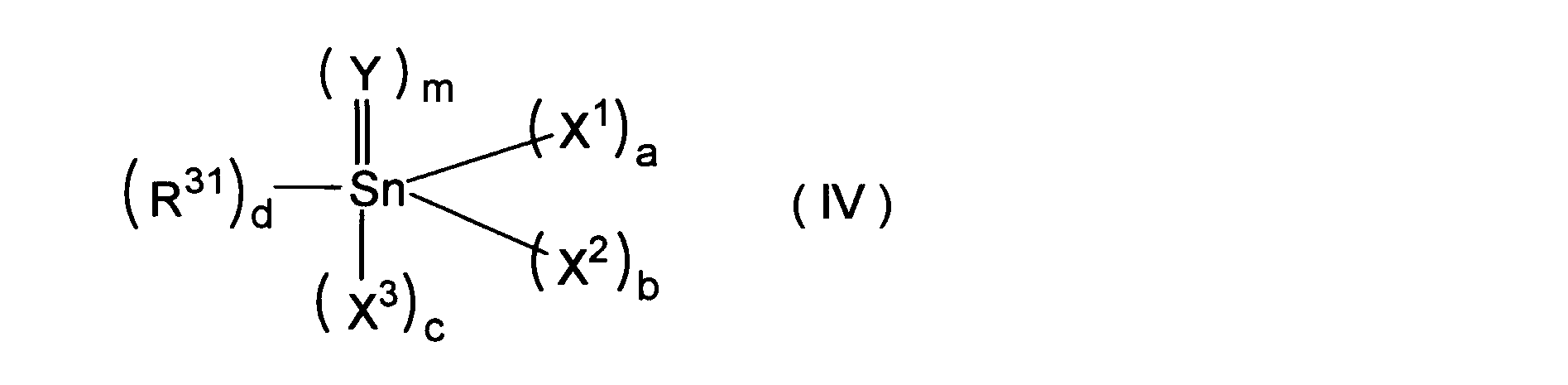


本発明の非水電解液は、非水電解液中に前記一般式(I)~(IV)のいずれかで表される有機スズ化合物の1種以上が0.001~5質量%含有されていることを特徴とするが、より具体的には、下記(1)~(3)の態様の非水電解液であることが好ましい。
(1)非水溶媒に電解質塩が溶解されている非水電解液において、該非水溶媒が、環状カーボネートと鎖状カーボネートを含み、該鎖状カーボネートが少なくとも対称鎖状カーボネートと非対称鎖状カーボネートの両方を含み、該対称鎖状カーボネートの含有量が非対称鎖状カーボネートより多く、更に、非水電解液中に下記一般式(I)で表される有機スズ化合物が0.001~5質量%含有されていることを特徴とする非水電解液(以下、「第I発明」という)。

(2)非水溶媒に電解質塩が溶解されている非水電解液において、非水電解液中に下記一般式(II)及び/又は(III)で表される有機スズ化合物が0.001~5質量%含有されていることを特徴とする非水電解液。(以下、「第II発明」という)。

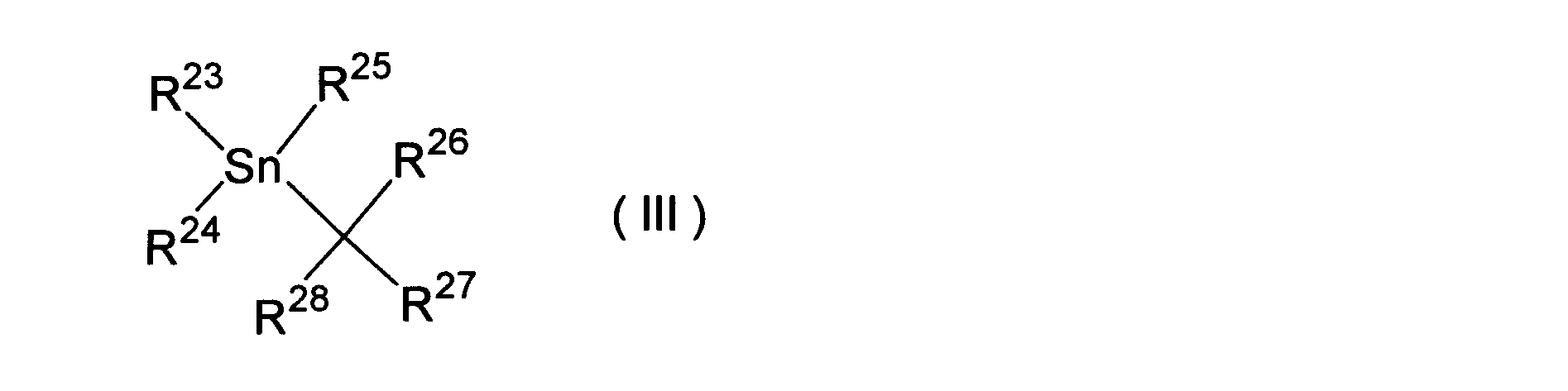
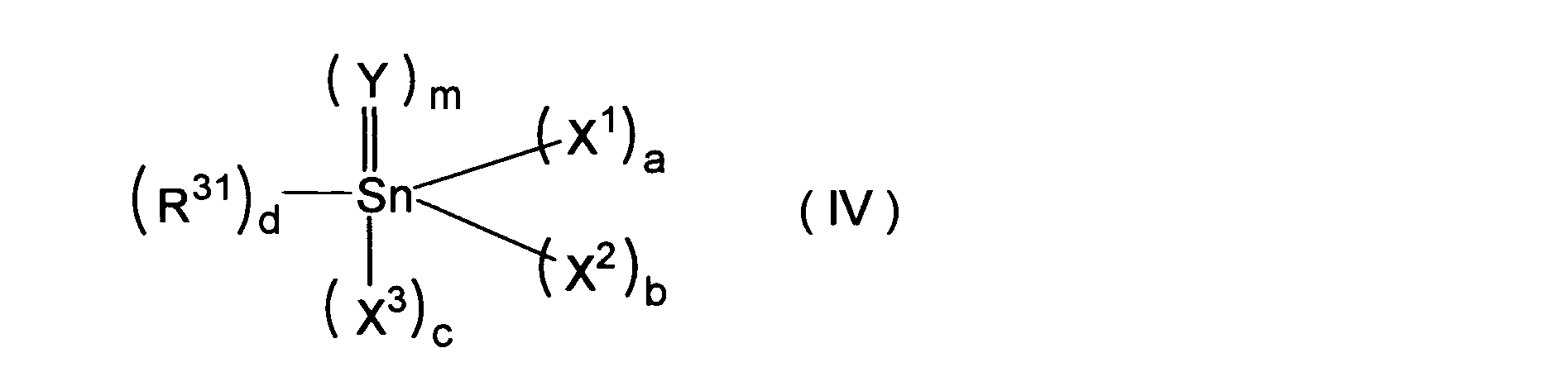
第I発明の非水電解液が、広い温度範囲での電気化学特性を大幅に改善できる理由は必ずしも明確ではないが、以下のように考えられる。
第I発明の非水電解液が含有する前記一般式(I)で表される有機スズ化合物は、スズ元素に4つの置換基を有し、そのうちの少なくとも1つは脂肪族置換基であり、更に、残りの3つの置換基は脂肪族又は芳香族の炭化水素置換基である。更に非水電解液中には被膜の耐熱性を高める働きをする対称鎖状カーボネートと被膜の過度の緻密化を防ぐ非対称鎖状カーボネートの両方の鎖状カーボネートが含まれ、特に非対称鎖状カーボネートの方が多く含まれると、前記の有機スズ化合物由来の被膜と鎖状カーボネート由来の被膜が相俟って一段と耐熱性が高く、しかも低温での放電性能に優れた被膜となるためと考えられる。そのため低温から高温まで広い温度範囲での電気化学特性が著しく向上する特異的な効果をもたらすことが分かった。

また、R2~R4は、それぞれ独立に、炭素数1~8の直鎖もしくは分枝鎖のアルキル基、炭素数2~8の直鎖もしくは分枝鎖のアルケニル基、炭素数2~8の直鎖もしくは分枝鎖のアルキニル基、又は炭素数6~12のアリール基を示し、炭素数4~8の直鎖もしくは分枝鎖のアルキル基又は炭素数3~8の直鎖もしくは分枝鎖のアルケニル基がより好ましく、炭素数5~8の直鎖もしくは分枝鎖のアルキル基が特に好ましい。
ここで、R1~R4の水素原子はフッ素原子で置換されていてもよい。また、R1とR2~R4の群のいずれかの置換基が異なっているとより好ましい。
R1~R4の置換基が上記の範囲の場合に、広い温度範囲での電気化学特性を大幅に改善できるので好ましい。
本発明の非水電解液において、前記一般式(I)で表される有機スズ化合物を以下に述べる非水溶媒、電解質塩、更にその他の添加剤を組み合わせることにより、広い温度範囲での電気化学特性が相乗的に向上するという特異な効果を発現する。
第II発明の非水電解液が、広い温度範囲での電気化学特性を大幅に改善できる理由は必ずしも明確ではないが、以下のように考えられる。
第II発明の非水電解液が含有する前記一般式(II)及び/又は(III)で表される有機スズ化合物は、スズ元素に4つの置換基を有し、そのうちの少なくとも2つが脂肪族置換基であり、互いに結合して環を形成した構造を有する(一般式(II))か、もしくは、少なくとも1つの置換基がスズ元素と結合する炭素を有し、この炭素に更に2つの脂肪族置換基を有している(一般式(III))。このような特定構造を有する有機スズ化合物を非水電解液中に含有させることにより、スズ元素に由来した耐熱性の高い被膜と環構造もしくは分枝構造を有する嵩高い置換基による立体的な効果により、耐熱性が高く、しかも低温での放電性能に優れた被膜となると考えられる。そのため低温から高温まで広い温度範囲での電気化学特性が著しく向上する特異的な効果をもたらすことが分かった。
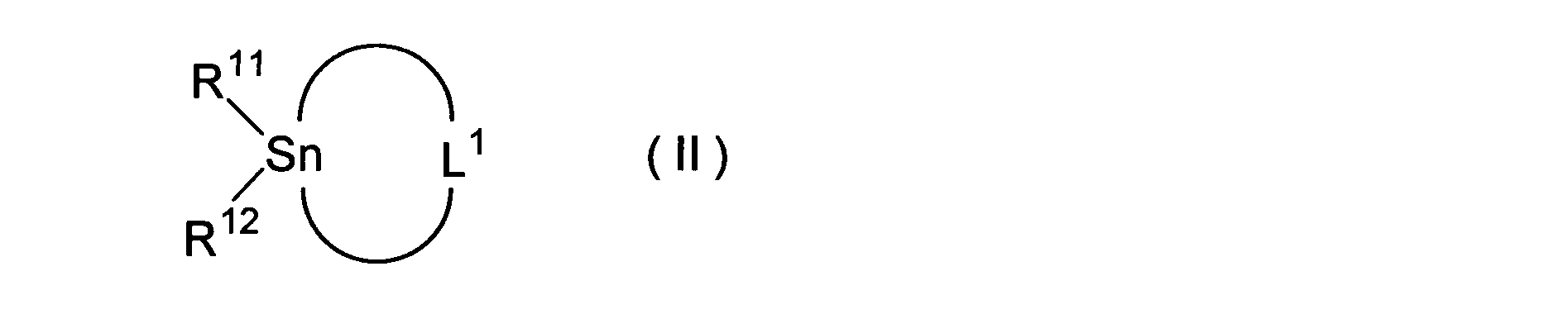

また、R11及びR12が、炭素数1~8の直鎖もしくは分枝鎖のアルキル基であり、互いに環を形成していてもよく、この場合、好ましい環を構成する連結鎖はL1と同様である。
L1は、炭素数2~10の直鎖もしくは分枝鎖のアルキレン基、又は炭素数4~10の直鎖もしくは分枝鎖のアルケニレン基を示し、炭素数4~8の直鎖もしくは分枝鎖のアルキレン基、又は炭素数4~8の直鎖もしくは分枝鎖のアルキレン基がより好ましく、炭素数4~6の直鎖のアルキレン基が更に好ましい。
R11、R12、L1の水素原子はフッ素原子で置換されていてもよい。
R11及びR12が、炭素数1~8の直鎖もしくは分枝鎖のアルキル基であり、互いに環を形成している場合の具体例としては、エタン-1,2-ジイル基、プロパン-1,3-ジイル基、ブタン-1,4-ジイル基、ペンタン-1,5-ジイル基、ヘキサン-1,6-ジイル基、ヘプタン-1,7-ジイル基、オクタン-1,8-ジイル基等が好適に挙げられる。これらの中でも、ブタン-1,4-ジイル基、ペンタン-1,5-ジイル基、ヘキサン-1,6-ジイル基、ヘプタン-1,7-ジイル基、オクタン-1,8-ジイル基が好ましく、ブタン-1,4-ジイル基、ペンタン-1,5-ジイル基、ヘキサン-1,6-ジイル基が更に好ましい。
R26及びR27は、それぞれ独立に、炭素数1~6の直鎖もしくは分枝鎖のアルキル基、炭素数2~6の直鎖もしくは分枝鎖のアルケニル基、又は炭素数2~6の直鎖もしくは分枝鎖のアルキニル基を示し、炭素数1~4の直鎖もしくは分枝鎖のアルキル基、炭素数2~4の直鎖もしくは分枝鎖のアルケニル基がより好ましい。R26及びR27は互いに結合して環を形成しているとより好ましく、この場合、環を構成する炭素数は3~9がより好ましく4~6が更に好ましい。
R28は、水素原子、炭素数1~6の直鎖もしくは分枝鎖のアルキル基、炭素数2~6の直鎖もしくは分枝鎖のアルケニル基、又は炭素数2~6の直鎖もしくは分枝鎖のアルキニル基を示し、水素原子、炭素数1~4の直鎖もしくは分枝鎖のアルキル基、又は炭素数2~4の直鎖もしくは分枝鎖のアルケニル基がより好ましい。
R23~R28の水素原子はフッ素原子で置換されていてもよい。
R28の具体例としては、水素原子であってもよいこと以外はR26及びR27と同じであり、水素原子、メチル基、エチル基、n-プロピル基、iso-プロピル基、ビニル基、2-プロペン-1-イル基、エチニル基、2-プロピン-1-イル基が好ましく、水素原子、メチル基、エチル基が更に好ましい。
R26及びR27は互いに結合して環を形成しているとより好ましく、Sn原子に結合する置換基(-CR26R27R28)の具体例としては、シクロプロピル基、シクロブチル基、シクロペンチル基、シクロヘキシル基、シクロヘプチル基、シクロオクチル基等のシクロアルキル基が好適に挙げられ、シクロペンチル基、シクロヘキシル基、シクロヘプチル基が更に好ましい。
R11、R12、L1、R23~R28の置換基が上記の範囲の場合に、広い温度範囲での電気化学特性を大幅に改善できるので好ましい。
本発明の非水電解液において、前記一般式(II)及び/又は(III)で表される有機スズ化合物を以下に述べる非水溶媒、電解質塩、更にその他の添加剤を組み合わせることにより、広い温度範囲での電気化学特性が相乗的に向上するという特異な効果を発現する。
第III発明の非水電解液が、広い温度範囲での電気化学特性を大幅に改善できる理由は必ずしも明確ではないが、以下のように考えられる。
第III発明の非水電解液が含有する前記一般式(IV)で示される有機スズ化合物は、スズ元素に置換基を有し、そのうちの少なくとも1つが炭化水素基であり、少なくとも1つの置換基がスズ原子と酸素原子又は硫黄原子を介して結合している。このような特定構造を有する有機スズ化合物とフッ素原子又は炭素-炭素二重結合を有する環状カーボネートを非水電解液中に含有させることにより、スズ原子と酸素原子又は硫黄原子に由来する低温での放電性能に優れるという性質とフッ素原子又は炭素-炭素二重結合を有する環状カーボネートによる高い耐熱性を併せ持つ良質な被膜となると考えられる。そのため低温から高温まで広い温度範囲での電気化学特性が著しく向上する特異的な効果をもたらすことが分かった。
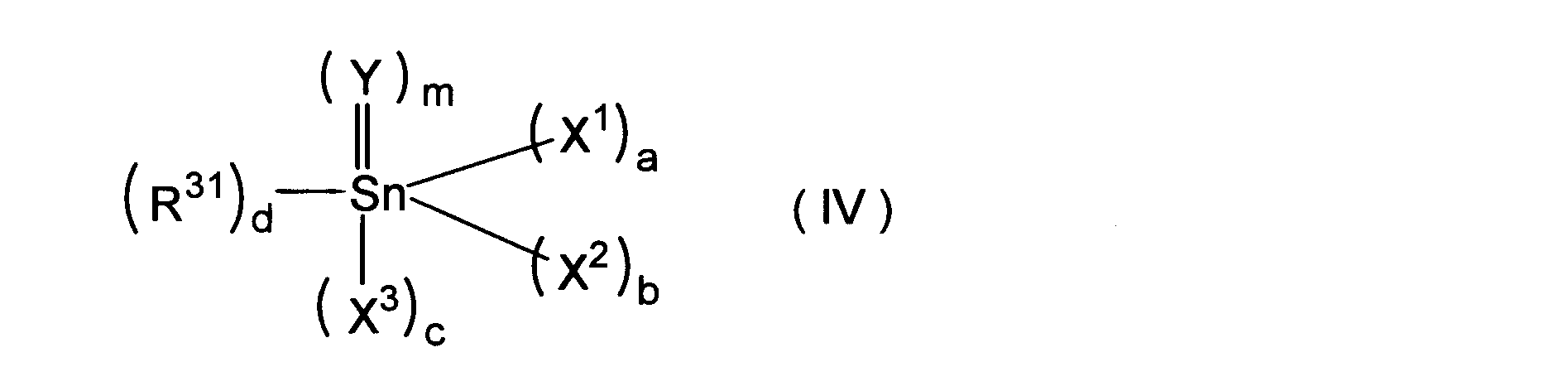


R32及びR33は、炭素数1~8の直鎖もしくは分枝鎖のアルキル基、又は炭素数6~12のアリール基を示し、炭素数1~4の直鎖もしくは分枝鎖のアルキル基が好ましい。
Yは酸素原子又は硫黄原子を示し、酸素原子が好ましい。
Lは、エーテル結合又は炭素-炭素不飽和結合を有してもよい炭素数1~8の直鎖もしくは分枝鎖のアルキレン基を示し、炭素数1~4の直鎖もしくは分枝鎖のアルキレン基が好ましい。
R31、R32、R33及びL3の水素原子はフッ素原子で置換されていてもよい。
一般式(IV)のa、b及びcは0又は1を示し、dは1~3の整数を示し、mは0又は1を示す。m=0場合、a+b+c+d=4であり、m=1の場合、a=b=c=0、d=2である。
X1、X2、X3、Y及びR31の置換基が上記の範囲の場合に、広い温度範囲での電気化学特性を大幅に改善できるので好ましい。
(a)有機スズスルホネート〔m=0、X1、X2及びX3のうち少なくとも1つが、-OSO2R32で示される化合物〕
(b)有機スズカルボキシレート〔m=0、X1、X2及びX3のうち少なくとも1つが、-OC(O)R32で示される化合物〕
(c)有機スズアルコキシド〔m=0、X1、X2及びX3のうち少なくとも1つが、-OR32もしくは、-O-L3-O-で示される化合物〕
(d)有機スズβ-ジカルボニル〔m=0、X1、X2及びX3のうち少なくとも1つが、-OC(R32)=CHC(O)R32、又は-OC(R33)=CHC(O)OR32で示される化合物〕
(e)有機スズオキシド/サルファイド〔m=1、Yが酸素原子もしくは硫黄原子で示される化合物〕
(f)有機スズチオレート、メルカプトオキシド、メルカプトカルボキシレート〔m=0、X1、X2及びX3のうち少なくとも1つが、-S-L3-S-、-S-L3-O-、又は-S-L3-C(O)O-で示される化合物〕
より具体的には次に示す化合物が例示されるが、下記の例示により何ら制限されるものではない。
これらの中でも、ジメチルスズジメタンスルホネート、ジブチルスズジメタンスルホネート、トリブチルスズメタンスルホネート、モノブチルスズトリメタンスルホネート、ジブチルスズジエタンスルホネート、ジブチルスズビス(トリフルオロメタンスルホネート)、6,6-ジブチル-1,5,2,4,6-ジオキサジチアスズ 2,2,4,4-テトラオキシドが好ましく、ジブチルスズジメタンスルホネート、ジブチルスズジエタンスルホネート、ジブチルスズビス(トリフルオロメタンスルホネート)、6,6-ジブチル-1,5,2,4,6-ジオキサジチアスズ 2,2,4,4-テトラオキシドが更に好ましい。
これらの中でも、ジメチルスズジアセテート、ジイソプロピルスズジアセテート、ジブチルスズジアセテート、ジブチルスズジアクリレート、ジブチルスズジメタクリレート、ジブチルスズジベンゾエート、ジブチルスズビス(ヘキサフルオロベンゾエート)、ジブチルスズビス(2-エチルヘキサノエート)が好ましく、ジブチルスズジアセテート、ジブチルスズジアクリレート、ジブチルスズジメタクリレート、ジブチルスズジベンゾエートが更に好ましい。
これらの中でも、ジブチルスズジメトキシド、ジオクチルスズジメトキシド、ジブチルスズジブトキシド、ジブチルスズエチレングリコラート、ジビニルスズエチレングリコラート、ジアリルスズエチレングリコラート、ジブチルスズ(1-ヘキシル)エチレングリコラート、ジブチルスズ(1-アリロキシメチル)エチレングリコラート、ジブチルスズ(1-ブトキシメチル)エチレングリコラート、ジブチルスズ-1,3-プロピレングリコラート、ジブチルスズ(2,2-ジメチル)-1,3-プロピレングリコラート、ジブチルスズ(2,2-ジフルオロ)-1,3-プロピレングリコラート、ジブチルスズ(2-ブテニレン)-1,4-グリコラートが好ましく、ジブチルスズジメトキシド、ジオクチルスズジメトキシド、ジブチルスズジブトキシド、ジブチルスズエチレングリコラート、ジブチルスズ-1,3-プロピレングリコラートが更に好ましい。
これらの中でも、ジブチルスズビス(アセチルアセトネート)、ジブチルスズビス(ヘキサフルオロアセチルアセトネート)、ジブチルスズビス(メチルアセチルアセテート)、ジブチルスズビス(エチルアセチルアセテート)、ジブチルスズビス(ベンゾイルアセトネート)が好ましく、ジブチルスズビス(アセチルアセトネート)、ジブチルスズビス(メチルアセチルアセテート)、ジブチルスズビス(エチルアセチルアセテート)が更に好ましい。
これらの中でも、ジメチルスズオキシド、ジイソプロピルスズオキシド、ジブチルスズオキシド、ジオクチルスズオキシド、メチルフェニルスズオキシド、ジシクロヘキスルスズオキシドが好ましく、ジブチルスズオキシド、ジオクチルスズオキシドが更に好ましい。
これらの中でも、モノブチルスズトリス(メタンチオレート)、ジブチルスズビス(メタンチオレート)、ジブチルスズ-1,2-エタンジチオラート、ジブチルスズ-O,S-モノチオエチレングリコラート、ジブチルスズ-S,S-ビス(イソオクチルチオグリコレート)、ジオクチルスズ-S,S-ビス(イソオクチルチオグリコレート)、ジブチルスズ-S,S-ビス(ブチル-3-メルカプトプロピオネート)、ジブチルスズ-O,S-チオグリコレート、ジブチルスズ-O,S-(3-メルカプトプロピオネート)、ジブチルスズ-S,S-ビス(メチルチオグリコレート)が好ましく、ジブチルスズビス(メタンチオレート)、ジブチルスズ-1,2-エタンジチオラート、ジブチルスズ-O,S-モノチオエチレングリコラート、ジブチルスズ-O,S-チオグリコレート、ジブチルスズ-O,S-3-メルカプトプロピオネート、ジブチルスズ-S,S-ビス(メチルチオグリコレート)が更に好ましい。
上記有機スズ化合物の中でも(a)有機スズスルホネート、(b)有機スズカルボキシレートがより好ましい。
本発明の非水電解液において、前記一般式(IV)で示される有機スズ化合物を以下に述べる非水溶媒、電解質塩、更にその他の添加剤を組み合わせることにより、広い温度範囲での電気化学特性が相乗的に向上するという特異な効果を発現する。
本発明の非水電解液に使用される非水溶媒としては、環状カーボネート、鎖状エステル、エーテル、アミド、リン酸エステル、スルホン、ラクトン、ニトリル、S=O結合含有化合物等が挙げられ、環状カーボネートと鎖状エステルの両方が含まれることが好ましい。
なお、「鎖状エステル」なる用語は、鎖状カーボネート及び鎖状カルボン酸エステルを含む概念である。
これらの中でも、環状カーボネートが、炭素-炭素二重結合を含まない環状カーボネートの二種類以上で構成される場合に広い温度範囲での電気化学特性が一段と向上するのでより好ましい。特に炭素-炭素二重結合を含まない環状カーボネートとしてプロピレンカーボネートが含まれていると好ましい。
上記の理由は必ずしも明らかではないが、環状カーボネートが炭素-炭素二重結合を含まない環状カーボネートの二種類以上で構成される場合には、有機スズ化合物と相俟って形成される被膜が過度に緻密化することなく耐熱性が向上するためであると考えられる。
環状カーボネート中にプロピレンカーボネートが占める体積の割合は、1体積%以上が好ましく、更に好ましくは5体積%以上、特に好ましくは10体積%以上、また、上限としては、45体積%以下が好ましく、更に好ましくは35体積%以下、特に好ましくは25体積%以下である。
環状カーボネートの含有量は、非水溶媒の総体積に対して、10体積%~40体積%の範囲で用いるのが好ましい。含有量が10体積%未満であると非水電解液の伝導度が低下し、広い温度範囲での電気化学特性が低下する場合があり、40体積%を超えると非水電解液の粘性が高くなるため広い温度範囲での電気化学特性が低下する場合があるので上記範囲であることが好ましい。
これらの環状カーボネートの好適な組合せとしては、ECとPC、ECとFEC、PCとFEC、FECとDFEC、ECとDFEC、PCとDFEC、ECとPCとFEC等が好ましい。
フッ素原子を有する環状カーボネートの場合、環状カーボネート中に占める体積の割合は、好ましくは0.1体積%以上、より好ましくは1体積%以上、更に好ましくは10体積%以上、特に好ましくは30体積%以上、最も好ましくは55体積%以上である。また、その上限は、好ましくは90体積%以下、より好ましくは80体積%以下、更に好ましくは70体積%以下である。
炭素-炭素二重結合を有する環状カーボネートの場合、環状カーボネート中に占める体積の割合は、好ましくは0.1体積%以上、より好ましくは0.5体積%以上、更に好ましくは1体積%以上、また、その上限は、好ましくは10体積%以下、より好ましくは5体積%以下、更に好ましくは3体積%以下である。
鎖状エステルの含有量は、特に制限されないが、非水溶媒の総体積に対して、60~90体積%の範囲で用いるのが好ましい。該含有量が60体積%以上であれば非水電解液の粘度が高くなりすぎず、90体積%以下であれば非水電解液の電気伝導度が低下して広い温度範囲での電気化学特性が低下するおそれが少ないので上記範囲であることが好ましい。
前記鎖状エステルの中でも、ジメチルカーボネート、メチルエチルカーボネート、メチルプロピルカーボネート、メチルイソプロピルカーボネート、メチルブチルカーボネート、プロピオン酸メチル、酢酸メチル及び酢酸エチルから選ばれるメチル基を含む鎖状エステルが好ましく、特にメチル基を有する鎖状カーボネートが好ましい。
また、鎖状カーボネートを用いる場合には、対称鎖状カーボネートと非対称鎖状カーボネートの両方が含まれるとより好ましく、対称鎖状カーボネートの含有量が非対称鎖状カーボネートより多く含まれると更に好ましい。
鎖状カーボネート中に対称鎖状カーボネートが占める体積の割合は、50体積%以上であり、55体積%以上がより好ましい。上限としては、95体積%以下がより好ましく、85体積%以下であると更に好ましく、対称鎖状カーボネートにジメチルカーボネート及びジエチルカーボネートが含まれると特に好ましい。非水溶媒中のジエチルカーボネートの含有量としては、1体積%以上が好ましく、2体積%以上がより好ましく、上限としては、10体積%以下が好ましく、6体積%以下である場合がより好ましい。
非対称鎖状カーボネートはメチル基を有するとより好ましく、MECが特に好ましい。
上記の場合に一段と広い温度範囲での電気化学特性が向上するので好ましい。
非水電解液に含有される炭素数1~6の脂肪族炭化水素基が第3級炭素原子又は第4級炭素原子を介してベンゼン環に結合しているベンゼン化合物の含有量は、前記一般式(I)~(IV)のいずれかで表される有機スズ化合物の質量に対して1~50倍の質量であることが好ましい。該含有量が前記一般式(I)~(IV)のいずれかで表される有機スズ化合物の質量に対して50倍以下であれば、負極上に過度に吸着して低温特性が低下するおそれが少なく、また1倍以上であれば負極への吸着の効果が十分得られる。従って、1倍以上が好ましく、4倍以上が更に好ましく、10倍以上が特に好ましい。上限としては、50倍以下が好ましく、40倍以下が更に好ましく、30倍以下が特に好ましい。
炭素数1~6の脂肪族炭化水素基が第3級炭素原子又は第4級炭素原子を介してベンゼン環に結合しているベンゼン化合物としては、ビフェニル、シクロヘキシルベンゼン、フルオロシクロヘキシルベンゼン(1-フルオロ-2-シクロヘキシルベンゼン、1-フルオロ-3-シクロヘキシルベンゼン、1-フルオロ-4-シクロヘキシルベンゼン)、tert-ブチルベンゼン、1,3-ジ-tert-ブチルベンゼン、tert-アミルベンゼン、1-フルオロ-4-tert-ブチルベンゼンが好適に挙げられ、ビフェニル、シクロヘキシルベンゼン、tert-ブチルベンゼン、tert-アミルベンゼンがより好ましく、tert-ブチルベンゼン、tert-アミルベンゼンが特に好ましい。
ニトリルの中では、ジニトリルが好ましく、中でも2つのシアノ基が炭素数2~6の脂肪族炭化水素基で連結されたものがより好ましく、スクシノニトリル、グルタロニトリル、アジポニトリル、ピメロニトリルが更に好ましく、アジポニトリル、ピメロニトリルが特に好ましい。
環状構造もしくは不飽和基を有するS=O基含有化合物の中でも、1,3-プロパンスルトン等のスルトン、エチレンサルファイト、ヘキサヒドロベンゾ[1,3,2]ジオキサチオラン-2-オキシド、5-ビニル-ヘキサヒドロ-1,3,2-ベンゾジオキサチオール-2-オキシド、4-(メチルスルホニルメチル)-1,3,2-ジオキサチオラン-2-オキシド等の環状サルファイト、ジビニルスルホン、ビス(2-ビニルスルホニルエチル)エーテル等のビニルスルホンが好ましく、ヘキサヒドロベンゾ[1,3,2]ジオキサチオラン-2-オキシド、5-ビニル-ヘキサヒドロ-1,3,2-ベンゾジオキサチオール-2-オキシド、4-(メチルスルホニルメチル)-1,3,2-ジオキサチオラン-2-オキシド、ビス(2-ビニルスルホニルエチル)エーテルが更に好ましく、分枝した構造を有する環状サルファイトであるヘキサヒドロベンゾ[1,3,2]ジオキサチオラン-2-オキシド、5-ビニル-ヘキサヒドロ-1,3,2-ベンゾジオキサチオール-2-オキシド、4-(メチルスルホニルメチル)-1,3,2-ジオキサチオラン-2-オキシドが特に好ましい。
また、スルホン酸エステルの中では、ジスルホン酸エステルが好ましく、中でも2つのスルホニルオキシ基が炭素数2~6の脂肪族炭化水素基で連結されたものがより好ましく、ブタン-1,4-ジイル ジメタンスルホネート、ペンタン-1,5-ジイル ジメタンスルホネート、プロパン-1,2-ジイル ジメタンスルホネート、ブタン-2,3-ジイル ジメタンスルホネートが更に好ましく、2つのスルホニルオキシ基が分枝アルキレン基で連結されたプロパン-1,2-ジイル ジメタンスルホネート、ブタン-2,3-ジイル ジメタンスルホネートが特に好ましい。
ニトリル、環状構造もしくは不飽和基を有するS=O基含有化合物、スルホン酸エステルの含有量は、非水電解液中に0.001~5質量%が好ましい。該含有量が5質量%以下であれば、電極上に過度に被膜が形成され低温特性が低下するおそれが少なく、また0.001質量%以上であれば被膜の形成が十分であり、高温保存後の低温特性の改善効果が高まる。該含有量は、非水電解液中に0.005質量%以上が好ましく、0.01質量%以上がより好ましく、0.1質量%以上が更に好ましく、0.2質量%以上が特に好ましく、その上限は、4質量%以下が好ましく、3質量%以下がより好ましく、2質量%以下が更に好ましく、1質量%以下が更に好ましく、0.4質量%以下が特に好ましい。
また、非水電解液中には、二酸化炭素を0.01~0.5質量%含有させると広い温度範囲での電気化学特性が一段と向上するため好ましい。
本発明に使用される電解質塩としては、下記のリチウム塩、オニウム塩が好適に挙げられる。
(リチウム塩)
リチウム塩としては、LiPF6、LiPO2F2、LiBF4、LiClO4等の無機リチウム塩、LiN(SO2CF3)2、LiN(SO2C2F5)2、LiCF3SO3、LiC(SO2CF3)3、LiPF4(CF3)2、LiPF3(C2F5)3、LiPF3(CF3)3、LiPF3(iso-C3F7)3、LiPF5(iso-C3F7)等の鎖状のフッ化アルキル基を有するリチウム塩や、(CF2)2(SO2)2NLi、(CF2)3(SO2)2NLi等の環状のフッ化アルキレン鎖を含有するリチウム塩、ビス[オキサレート-O,O’]ホウ酸リチウムやジフルオロ[オキサレート-O,O’]ホウ酸リチウム等のオキサレート錯体をアニオンとするリチウム塩が好適に挙げられる。これらの中でも、LiPF6、LiBF4、LiN(SO2CF3)2及びLiN(SO2C2F5)2から選ばれる少なくとも1種が好ましく、LiPF6、LiBF4及びLiN(SO2CF3)2から選ばれる少なくとも1種がより好ましい。
また、オニウム塩としては、下記に示すオニウムカチオンとアニオンを組み合わせた各種塩が好適に挙げられる。
オニウムカチオンの具体例としては、テトラメチルアンモニウムカチオン、エチルトリメチルアンモニウムカチオン、ジエチルジメチルアンモニウムカチオン、トリエチルメチルアンモニウムカチオン、テトラエチルアンモニウムカチオン、N,N-ジメチルピロリジニウムカチオン、N-エチル-N-メチルピロリジニウムカチオン、N,N-ジエチルピロリジニウムカチオン、スピロ-(N,N')-ビピロリジニウムカチオン、N,N'-ジメチルイミダゾリニウムカチオン、N-エチル-N'-メチルイミダゾリニウムカチオン、N,N'-ジエチルイミダゾリニウムカチオン、N,N'-ジメチルイミダゾリウムカチオン、N-エチル-N'-メチルイミダゾリウムカチオン、N,N'-ジエチルイミダゾリウムカチオン等が好適に挙げられる。
アニオンの具体例としては、PF6アニオン、BF4アニオン、ClO4アニオン、AsF6アニオン、CF3SO3アニオン、N(CF3SO2)2アニオン、N(C2F5SO2)2アニオン等が好適に挙げられる。
これらの電解質塩は、1種単独で又は2種以上を組み合わせて使用することができる。
本発明の非水電解液は、例えば、前記の非水溶媒を混合し、これに前記の電解質塩及び該非水電解液に対して前記一般式(I)~(IV)のいずれかで表される有機スズ化合物の1種以上を添加することにより得ることができる。
この際、用いる非水溶媒及び非水電解液に加える化合物は、生産性を著しく低下させない範囲内で、予め精製して、不純物が極力少ないものを用いることが好ましい。
本発明のリチウム電池は、リチウム一次電池及びリチウム二次電池を総称する。また、本明細書において、リチウム二次電池という用語は、いわゆるリチウムイオン二次電池も含む概念として用いる。本発明のリチウム電池は、正極、負極及び非水溶媒に電解質塩が溶解されている前記非水電解液からなる。非水電解液以外の正極、負極等の構成部材は特に制限なく使用できる。
例えば、リチウム二次電池用正極活物質としては、コバルト、マンガン、及びニッケルから1種以上を含有するリチウムとの複合金属酸化物が使用される。これらの正極活物質は、1種単独又は2種以上を組み合わせて用いることができる。
このようなリチウム複合金属酸化物としては、例えば、LiCoO2、LiMn2O4、LiNiO2、LiCo1-xNixO2(0.01<x<1)、LiCo1/3Ni1/3Mn1/3O2、LiNi1/2Mn3/2O4、LiCo0.98Mg0.02O2等が挙げられる。また、LiCoO2とLiMn2O4、LiCoO2とLiNiO2、LiMn2O4とLiNiO2のように併用してもよい。
これらの中では、LiCoO2、LiMn2O4、LiNiO2のような満充電状態における正極の充電電位がLi基準で4.3V以上で使用可能なリチウム複合金属酸化物が好ましく、LiCo1-xMxO2(但し、MはSn、Mg、Fe、Ti、Al、Zr、Cr、V、Ga、Zn、Cuから表される少なくとも1種類以上の元素、0.001≦x≦0.05)、LiCo1/3Ni1/3Mn1/3O2、LiNi1/2Mn3/2O4、Li2MnO3とLiMO2(Mは、Co、Ni、Mn、Fe等の遷移金属)との固溶体のような4.4V以上で使用可能なリチウム複合金属酸化物がより好ましい。高充電電圧のリチウム複合金属酸化物を使用すると、充電時における電解液との反応により特に広い温度範囲での電気化学特性が低下しやすいが、本発明に係るリチウム二次電池ではこれらの電気化学特性の低下を抑制することができる。
特にMnを含む正極の場合に正極からのMnイオンの溶出に伴い電池の抵抗が増加しやすい傾向にあるため、広い温度範囲での電気化学特性が低下しやすい傾向にあるが、本発明に係るリチウム二次電池ではこれらの電気化学特性の低下を抑制することができるので好ましい。
これらのリチウム含有オリビン型リン酸塩の一部は他元素で置換してもよく、鉄、コバルト、ニッケル、マンガンの一部をCo、Mn、Ni、Mg、Al、B、Ti、V、Nb、Cu、Zn、Mo、Ca、Sr、W及びZr等から選ばれる1種以上の元素で置換したり、又はこれらの他元素を含有する化合物や炭素材料で被覆することもできる。これらの中では、LiFePO4又はLiMnPO4が好ましい。
また、リチウム含有オリビン型リン酸塩は、例えば前記の正極活物質と混合して用いることもできる。
正極の集電体を除く部分の密度は、通常は1.5g/cm3以上であり、電池の容量を更に高めるため、好ましくは2g/cm3以上であり、より好ましくは、3g/cm3以上であり、更に好ましくは、3.6g/cm3以上である。なお、上限としては、4g/cm3以下が好ましい。
これらの中では、リチウムイオンの吸蔵及び放出能力において、人造黒鉛や天然黒鉛等の高結晶性の炭素材料を使用することが更に好ましく、格子面(002)の面間隔(d002)が0.340nm(ナノメータ)以下、特に0.335~0.337nmである黒鉛型結晶構造を有する炭素材料を使用することが特に好ましい。
複数の扁平状の黒鉛質微粒子が互いに非平行に集合或いは結合した塊状構造を有する人造黒鉛粒子や、例えば鱗片状天然黒鉛粒子に圧縮力、摩擦力、剪断力等の機械的作用を繰り返し与え、球形化処理を施した黒鉛粒子を用いることにより、負極の集電体を除く部分の密度を1.5g/cm3以上の密度に加圧成形したときの負極シートのX線回折測定から得られる黒鉛結晶の(110)面のピーク強度I(110)と(004)面のピーク強度I(004)の比I(110)/I(004)が0.01以上となると一段と広い温度範囲での電気化学特性が向上するので好ましく、0.05以上となることがより好ましく、0.1以上となることが更に好ましい。また、過度に処理し過ぎて結晶性が低下し電池の放電容量が低下する場合があるので、上限は0.5以下が好ましく、0.3以下がより好ましい。
また、高結晶性の炭素材料(コア材)はコア材よりも低結晶性の炭素材料によって被膜されていると、広い温度範囲での電気化学特性が一段と良好となるので好ましい。被覆の炭素材料の結晶性は、TEMにより確認することができる。
高結晶性の炭素材料を使用すると、充電時において非水電解液と反応し、界面抵抗の増加によって低温もしくは高温における電気化学特性を低下させる傾向があるが、本発明に係るリチウム二次電池では広い温度範囲での電気化学特性が良好となる。
負極の集電体を除く部分の密度は、通常は1.1g/cm3以上であり、電池の容量を更に高めるため、好ましくは1.5g/cm3以上であり、特に好ましくは1.7g/cm3以上である。なお、上限としては、2g/cm3以下が好ましい。
電池用セパレータのとしては、特に制限はされないが、ポリプロピレン、ポリエチレン等のポリオレフィンの単層又は積層の微多孔性フィルム、織布、不織布等を使用できる。
本発明においては、リチウム電池の内圧上昇の対策として、電池蓋に安全弁を設けたり、電池缶やガスケット等の部材に切り込みを入れる方法も採用することができる。また、過充電防止の安全対策として、電池の内圧を感知して電流を遮断する電流遮断機構を電池蓋に設けることができる。
電解液と電極界面の電気二重層容量を利用してエネルギーを貯蔵する電気化学素子である。本発明の一例は、電気二重層キャパシタである。この電気化学素子に用いられる最も典型的な電極活物質は、活性炭である。二重層容量は概ね表面積に比例して増加する。
電極のドープ/脱ドープ反応を利用してエネルギーを貯蔵する電気化学素子である。この電気化学素子に用いられる電極活物質として、酸化ルテニウム、酸化イリジウム、酸化タングステン、酸化モリブデン、酸化銅等の金属酸化物や、ポリアセン、ポリチオフェン誘導体等のπ共役高分子が挙げられる。これらの電極活物質を用いたキャパシタは、電極のドープ/脱ドープ反応にともなうエネルギー貯蔵が可能である。
負極であるグラファイト等の炭素材料へのリチウムイオンのインターカレーションを利用してエネルギーを貯蔵する電気化学素子である。リチウムイオンキャパシタ(LIC)と呼ばれる。正極は、例えば活性炭電極と電解液との間の電気ニ重層を利用したものや、π共役高分子電極のドープ/脱ドープ反応を利用したもの等が挙げられる。電解液には少なくともLiPF6等のリチウム塩が含まれる。
〔リチウムイオン二次電池の作製〕
LiNi1/3Mn1/3Co1/3O2;94質量%、アセチレンブラック(導電剤);3質量%を混合し、予めポリフッ化ビニリデン(結着剤);3質量%を1-メチル-2-ピロリドンに溶解させておいた溶液に加えて混合し、正極合剤ペーストを調製した。この正極合剤ペーストをアルミニウム箔(集電体)上の片面に塗布し、乾燥、加圧処理して所定の大きさに打ち抜き、正極シートを作製した。正極の集電体を除く部分の密度は3.6g/cm3であった。また、コア材よりも低結晶質の炭素で被覆した人造黒鉛(d002=0.335nm、TEMによりコア材よりも低結晶性の炭素が被覆していることが確認されたもの、負極活物質)95質量%を、予めポリフッ化ビニリデン(結着剤)5質量%を1-メチル-2-ピロリドンに溶解させておいた溶液に加えて混合し、負極合剤ペーストを調製した。この負極合剤ペーストを銅箔(集電体)上の片面に塗布し、乾燥、加圧処理して所定の大きさに打ち抜き負極シートを作製した。負極の集電体を除く部分の密度は1.5g/cm3であった。また、この電極シートを用いてX線回折測定した結果、黒鉛結晶の(110)面のピーク強度I(110)と(004)面のピーク強度I(004)の比〔I(110)/I(004)〕は0.1であった。そして、正極シート、微多孔性ポリエチレンフィルム製セパレータ、負極シートの順に積層し、表1に記載の組成の非水電解液を加えて、2032型コイン電池を作製した。
上記の方法で作製したコイン電池を用いて25℃の恒温槽中、1Cの定電流及び定電圧で終止電圧4.2Vまで3時間充電し、次に1Cの定電流下終止電圧2.75Vまで放電することでプレサイクルを行った。次に、0℃の恒温槽中、1Cの定電流及び定電圧で終止電圧4.2Vまで3時間充電し、次に1Cの定電流下終止電圧2.75Vまで放電した。これを50サイクルに達するまで繰り返した。そして、以下の式により0℃での50サイクル後の放電容量維持率を求めた。
0℃50サイクル後の放電容量維持率(%)=(0℃50サイクル後の放電容量/0℃1サイクル後の放電容量)×100
電池の作製条件及び電池特性を表1に示す。
〔高温充電保存後の低温特性の評価〕
初期の放電容量
上記の方法で作製したコイン電池を用いて、25℃の恒温槽中、1Cの定電流及び定電圧で、終止電圧4.2Vまで3時間充電し、0℃に恒温槽の温度を下げ、1Cの定電流下終止電圧2.75Vまで放電して、初期の0℃の放電容量を求めた。
高温充電保存試験
次に、このコイン電池を85℃の恒温槽中、1Cの定電流及び定電圧で終止電圧4.2Vまで3時間充電し、4.2Vに保持した状態で3日間保存を行った。その後、25℃の恒温槽に入れ、一旦1Cの定電流下終止電圧2.75Vまで放電した。
高温充電保存後の放電容量
更にその後、初期の放電容量の測定と同様にして、高温充電保存後の0℃の放電容量を求めた。
高温充電保存後の低温特性
高温充電保存後の低温特性を下記の0℃放電容量の維持率より求めた。
高温充電保存後の0℃放電容量維持率(%)=(高温充電保存後の0℃の放電容量/初期の0℃の放電容量)×100
また、電池の作製条件及び電池特性を表1に示す。

実施例I-2、比較例I-1で用いた負極活物質に変えて、ケイ素(単体)(負極活物質)を用いて、負極シートを作製した。ケイ素(単体);80質量%、アセチレンブラック(導電剤);15質量%を混合し、予めポリフッ化ビニリデン(結着剤);5質量%を1-メチル-2-ピロリドンに溶解させておいた溶液に加えて混合し、負極合剤ペーストを調製した。この負極合剤ペーストを銅箔(集電体)上に塗布し、乾燥、加圧処理して所定の大きさに打ち抜き、負極シートを作製したことの他は、実施例I-2、比較例I-1と同様にコイン電池を作製し、電池評価を行った。結果を表2に示す。

実施例I-2、比較例I-1で用いた正極活物質に変えて、非晶質炭素で被覆されたLiFePO4(正極活物質)を用いて、正極シートを作製した。非晶質炭素で被覆されたLiFePO4;90質量%、アセチレンブラック(導電剤);5質量%を混合し、予めポリフッ化ビニリデン(結着剤);5質量%を1-メチル-2-ピロリドンに溶解させておいた溶液に加えて混合し、正極合剤ペーストを調製した。この正極合剤ペーストをアルミニウム箔(集電体)上に塗布し、乾燥、加圧処理して所定の大きさに打ち抜き、正極シートを作製したこと、電池評価の際の充電終止電圧を3.6V、放電終止電圧を2.0Vとしたことの他は、実施例I-2、比較例I-1と同様にコイン電池を作製し、電池評価を行った。結果を表3に示す。

また、実施例I-17~I-18と比較例I-4の対比、実施例I-19~I-20と比較例I-5の対比から、負極にSiを用いた場合や、正極にリチウム含有オリビン型リン酸鉄塩を用いた場合にも同様な効果がみられる。従って、本発明の効果は、特定の正極や負極に依存した効果でないことは明らかである。
更に、本発明の非水電解液は、リチウム一次電池の広い温度範囲での放電特性を改善する効果も有する。
〔リチウムイオン二次電池の作製〕
LiCoO2;94質量%、アセチレンブラック(導電剤);3質量%を混合し、予めポリフッ化ビニリデン(結着剤);3質量%を1-メチル-2-ピロリドンに溶解させておいた溶液に加えて混合し、正極合剤ペーストを調製した。この正極合剤ペーストをアルミニウム箔(集電体)上の片面に塗布し、乾燥、加圧処理して所定の大きさに打ち抜き、正極シートを作製した。正極の集電体を除く部分の密度は3.6g/cm3であった。また、人造黒鉛(d002=0.335nm、負極活物質)95質量%を、予めポリフッ化ビニリデン(結着剤)5質量%を1-メチル-2-ピロリドンに溶解させておいた溶液に加えて混合し、負極合剤ペーストを調製した。この負極合剤ペーストを銅箔(集電体)上の片面に塗布し、乾燥、加圧処理して所定の大きさに打ち抜き負極シートを作製した。負極の集電体を除く部分の密度は1.5g/cm3であった。また、この電極シートを用いてX線回折測定した結果、黒鉛結晶の(110)面のピーク強度I(110)と(004)面のピーク強度I(004)の比〔I(110)/I(004)〕は0.1であった。そして、正極シート、微多孔性ポリエチレンフィルム製セパレータ、負極シートの順に積層し、表4に記載の組成の非水電解液を加えて、2032型コイン電池を作製した。
低温サイクル特性の評価、高温充電保存後の低温特性の評価(初期の放電容量、高温充電保存試験、高温充電保存後の放電容量、高温充電保存後の低温特性)は、前記と同じ方法で行った。
電池の作製条件及び電池特性を表4に示す。

実施例II-2、実施例II-9、比較例II-1で用いた負極活物質に変えて、ケイ素(単体)(負極活物質)を用いて、負極シートを作製した。ケイ素(単体);80質量%、アセチレンブラック(導電剤);15質量%を混合し、予めポリフッ化ビニリデン(結着剤);5質量%を1-メチル-2-ピロリドンに溶解させておいた溶液に加えて混合し、負極合剤ペーストを調製した。この負極合剤ペーストを銅箔(集電体)上に塗布し、乾燥、加圧処理して所定の大きさに打ち抜き、負極シートを作製したことの他は、実施例II-2、実施例II-9、比較例II-1と同様にコイン電池を作製し、電池評価を行った。結果を表5に示す。
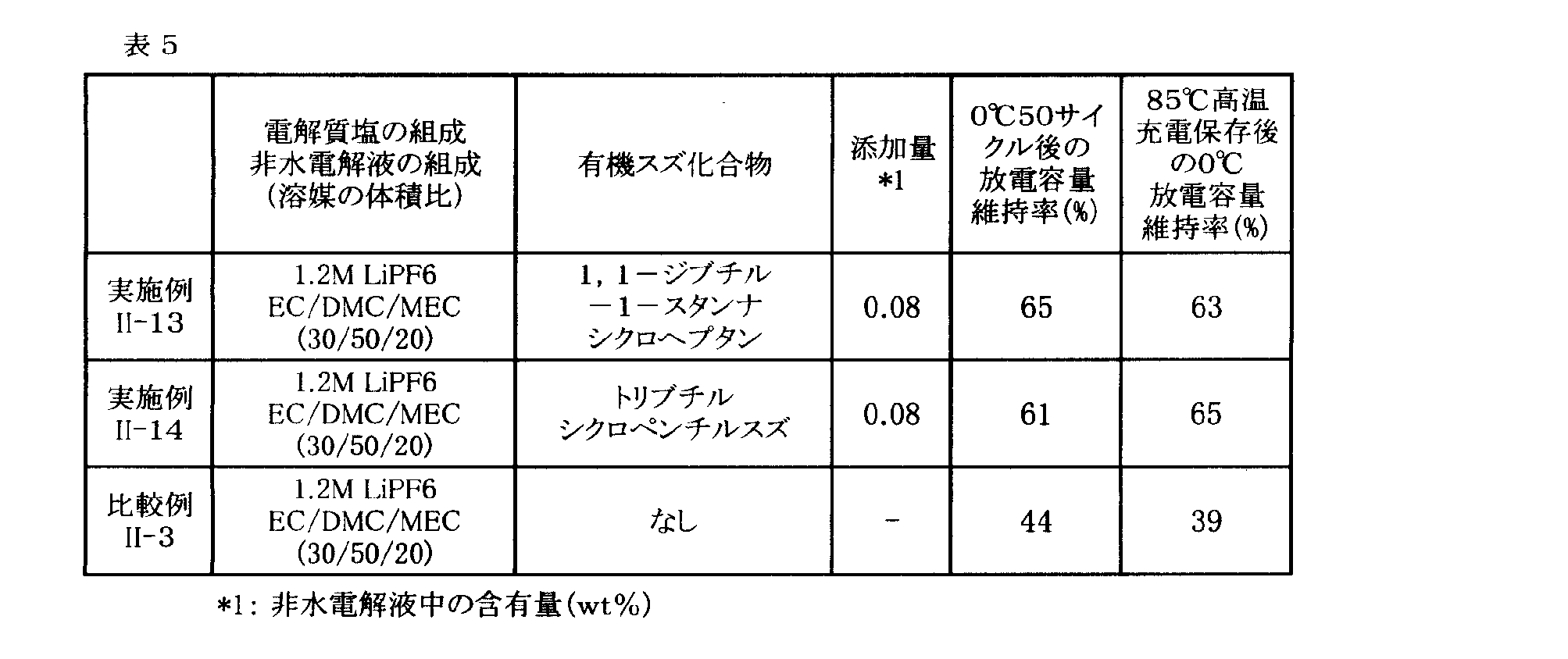
実施例II-2、実施例II-9、比較例II-1で用いた正極活物質に変えて、非晶質炭素で被覆されたLiFePO4(正極活物質)を用いて、正極シートを作製した。非晶質炭素で被覆されたLiFePO4;90質量%、アセチレンブラック(導電剤);5質量%を混合し、予めポリフッ化ビニリデン(結着剤);5質量%を1-メチル-2-ピロリドンに溶解させておいた溶液に加えて混合し、正極合剤ペーストを調製した。この正極合剤ペーストをアルミニウム箔(集電体)上に塗布し、乾燥、加圧処理して所定の大きさに打ち抜き、正極シートを作製したこと、電池評価の際の充電終止電圧を3.6V、放電終止電圧を2.0Vとしたことの他は、実施例II-2、実施例II-9、比較例II-1と同様にコイン電池を作製し、電池評価を行った。結果を表6に示す。

また、実施例II-13~II-14と比較例II-3の対比、実施例II-15~II-16と比較例II-4の対比から、負極にケイ素(単体)を用いた場合や、正極にリチウム含有オリビン型リン酸鉄塩を用いた場合にも同様な効果がみられる。従って、本発明の効果は、特定の正極や負極に依存した効果でないことは明らかである。
更に、本発明の非水電解液は、リチウム一次電池の広い温度範囲での放電特性を改善する効果も有する。
〔リチウムイオン二次電池の作製〕
LiCoO2;94質量%、アセチレンブラック(導電剤);3質量%を混合し、予めポリフッ化ビニリデン(結着剤);3質量%を1-メチル-2-ピロリドンに溶解させておいた溶液に加えて混合し、正極合剤ペーストを調製した。この正極合剤ペーストをアルミニウム箔(集電体)上の片面に塗布し、乾燥、加圧処理して所定の大きさに打ち抜き、正極シートを作製した。正極の集電体を除く部分の密度は3.6g/cm3であった。また、人造黒鉛(d002=0.335nm、負極活物質)95質量%を、予めポリフッ化ビニリデン(結着剤)5質量%を1-メチル-2-ピロリドンに溶解させておいた溶液に加えて混合し、負極合剤ペーストを調製した。この負極合剤ペーストを銅箔(集電体)上の片面に塗布し、乾燥、加圧処理して所定の大きさに打ち抜き負極シートを作製した。負極の集電体を除く部分の密度は1.5g/cm3であった。また、この電極シートを用いてX線回折測定した結果、黒鉛結晶の(110)面のピーク強度I(110)と(004)面のピーク強度I(004)の比〔I(110)/I(004)〕は0.1であった。そして、正極シート、微多孔性ポリエチレンフィルム製セパレータ、負極シートの順に積層し、表7に記載の組成の非水電解液を加えて、2032型コイン電池を作製した。
低温サイクル特性の評価、高温充電保存後の低温特性の評価(初期の放電容量、高温充電保存試験、高温充電保存後の放電容量、高温充電保存後の低温特性)は、前記と同じ方法で行った。
電池の作製条件及び電池特性を表7及び表8に示す。
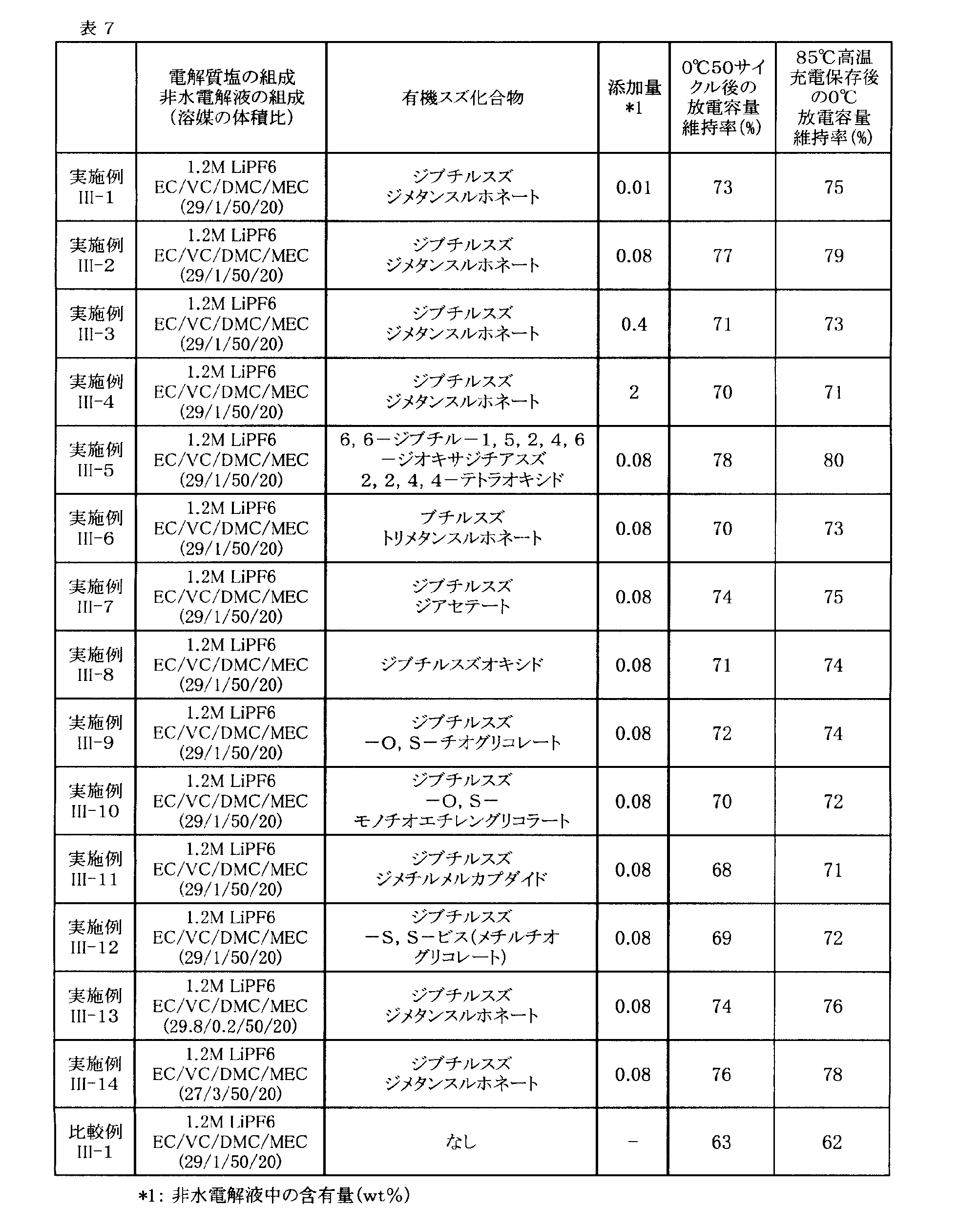

実施例III-2、比較例III-1で用いた負極活物質に変えて、ケイ素(単体)(負極活物質)を用いて、負極シートを作製した。ケイ素(単体);80質量%、アセチレンブラック(導電剤);15質量%を混合し、予めポリフッ化ビニリデン(結着剤);5質量%を1-メチル-2-ピロリドンに溶解させておいた溶液に加えて混合し、負極合剤ペーストを調製した。この負極合剤ペーストを銅箔(集電体)上に塗布し、乾燥、加圧処理して所定の大きさに打ち抜き、負極シートを作製したことの他は、実施例III-2、比較例III-1と同様にコイン電池を作製し、電池評価を行った。結果を表9に示す。
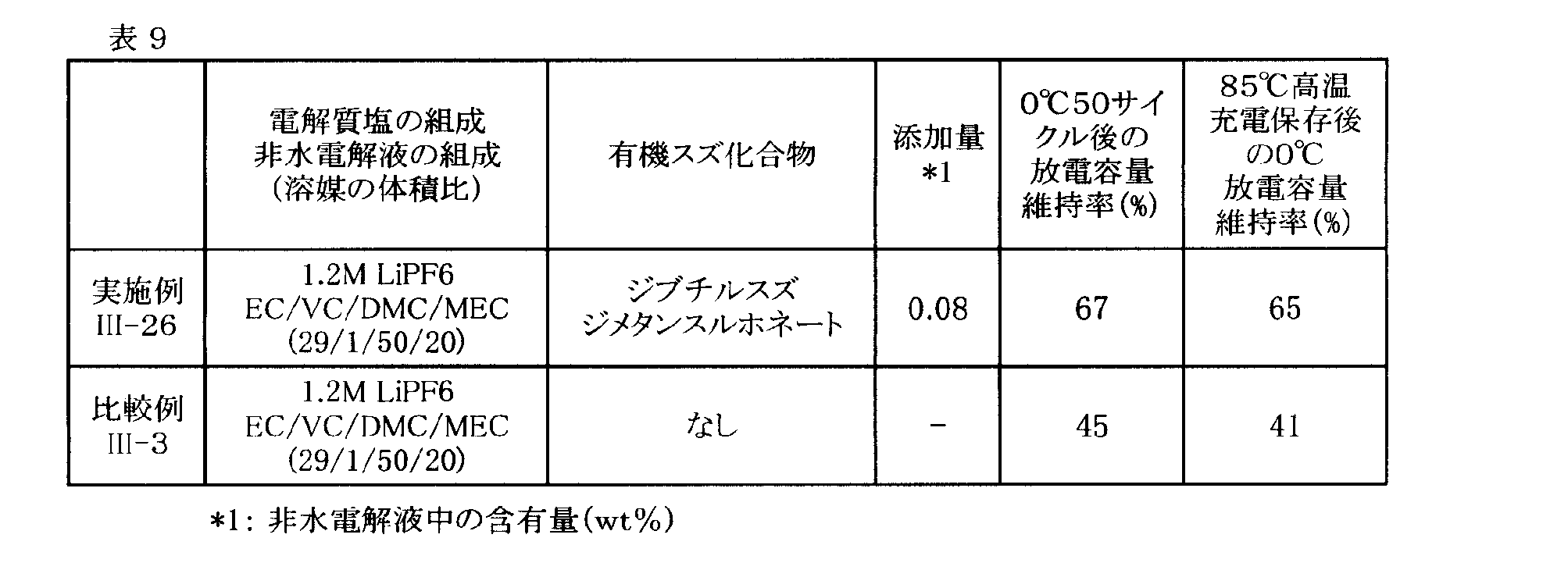
実施例III-2、比較例III-1で用いた正極活物質に変えて、非晶質炭素で被覆されたLiFePO4(正極活物質)を用いて、正極シートを作製した。非晶質炭素で被覆されたLiFePO4;90質量%、アセチレンブラック(導電剤);5質量%を混合し、予めポリフッ化ビニリデン(結着剤);5質量%を1-メチル-2-ピロリドンに溶解させておいた溶液に加えて混合し、正極合剤ペーストを調製した。この正極合剤ペーストをアルミニウム箔(集電体)上に塗布し、乾燥、加圧処理して所定の大きさに打ち抜き、正極シートを作製したこと、電池評価の際の充電終止電圧を3.6V、放電終止電圧を2.0Vとしたことの他は、実施例III-2、実施例III-9、比較例III-1と同様にコイン電池を作製し、電池評価を行った。結果を表10に示す。

また、上記実施例III-15~III-25のリチウム二次電池は何れも、特許文献1の実施例1-13に記載されている有機スズ化合物であるジブチルスズビス(アセチルアセテート)のみを添加した非水電解液である比較例III-2のリチウム二次電池に比べ、広い温度範囲での電気化学特性が顕著に向上している。以上より、本発明の効果は、非水溶媒に電解質塩が溶解されている非水電解液において、環状カーボネートと鎖状エステルを含み、環状カーボネートが少なくともフッ素原子又は炭素-炭素二重結合を有する環状カーボネートを含み、更に、本願発明の特定の有機スズ化合物を0.001~5質量%含有させた場合に特有の効果であることが判明した。
また、実施例III-26と比較例III-3の対比、実施例III-27と比較例III-4の対比から、負極にケイ素(単体)を用いた場合や、正極にリチウム含有オリビン型リン酸鉄塩を用いた場合にも同様な効果がみられる。従って、本発明の効果は、特定の正極や負極に依存した効果でないことは明らかである。
更に、本発明の非水電解液は、リチウム一次電池の広い温度範囲での放電特性を改善する効果も有する。
Claims (9)
- 非水溶媒に電解質塩が溶解されている非水電解液において、非水電解液中に下記一般式(I)~(IV)のいずれかで表される有機スズ化合物の1種以上が0.001~5質量%含有されていることを特徴とする非水電解液。


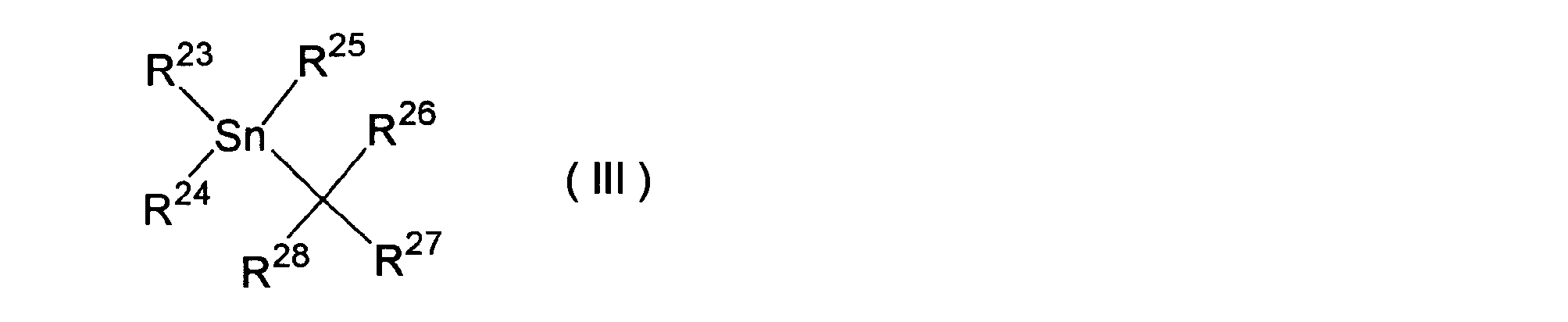
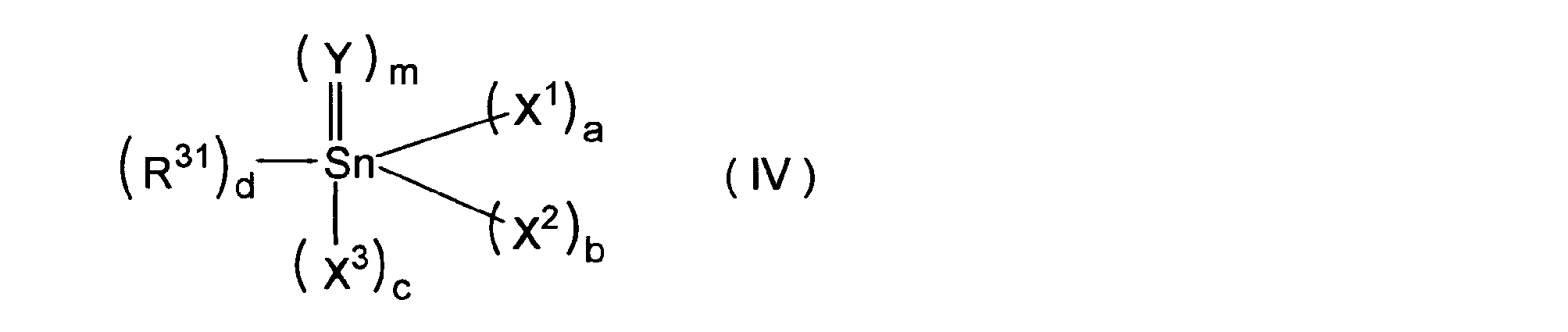


- 非水溶媒が、環状カーボネートと鎖状エステルを含む請求項1に記載の非水電解液。
- 鎖状エステルが鎖状カーボネートである請求項2に記載の非水電解液。
- 鎖状カーボネートが少なくとも対称鎖状カーボネートと非対称鎖状カーボネートの両方を含み、該対称鎖状カーボネートの含有量が非対称鎖状カーボネートより多い請求項3に記載の非水電解液。
- 非水溶媒中の対称鎖状カーボネートの含有量が40~60体積%である請求項4に記載の非水電解液。
- 環状カーボネートを少なくとも2種以上含む請求項2に記載の非水電解液。
- 環状カーボネートが少なくともフッ素原子又は炭素-炭素二重結合を有する環状カーボネートを含む請求項6に記載の非水電解液。
- フッ素原子を有する環状カーボネートが、4-フルオロ-1,3-ジオキソラン-2-オン又は4,5-ジフルオロ-1,3-ジオキソラン-2-オンであり、炭素-炭素二重結合を有する環状カーボネートが、ビニレンカーボネート及び/又はビニルエチレンカーボネートである請求項7に記載の非水電解液。
- 正極、負極及び非水溶媒に電解質塩が溶解されている非水電解液を備えた電気化学素子において、非水電解液が請求項1に記載した非水電解液であることを特徴とする電気化学素子。
Priority Applications (2)
| Application Number | Priority Date | Filing Date | Title |
|---|---|---|---|
| US13/810,457 US20130115520A1 (en) | 2010-07-23 | 2011-07-22 | Non-aqueous electrolytic solution, and electrochemical element utilizing same |
| JP2012525454A JP5817725B2 (ja) | 2010-07-23 | 2011-07-22 | 非水電解液及びそれを用いた電気化学素子 |
Applications Claiming Priority (6)
| Application Number | Priority Date | Filing Date | Title |
|---|---|---|---|
| JP2010166445 | 2010-07-23 | ||
| JP2010-166445 | 2010-07-23 | ||
| JP2010-202759 | 2010-09-10 | ||
| JP2010202759 | 2010-09-10 | ||
| JP2010-273056 | 2010-12-07 | ||
| JP2010273056 | 2010-12-07 |
Publications (1)
| Publication Number | Publication Date |
|---|---|
| WO2012011586A1 true WO2012011586A1 (ja) | 2012-01-26 |
Family
ID=45497003
Family Applications (1)
| Application Number | Title | Priority Date | Filing Date |
|---|---|---|---|
| PCT/JP2011/066755 Ceased WO2012011586A1 (ja) | 2010-07-23 | 2011-07-22 | 非水電解液及びそれを用いた電気化学素子 |
Country Status (3)
| Country | Link |
|---|---|
| US (1) | US20130115520A1 (ja) |
| JP (1) | JP5817725B2 (ja) |
| WO (1) | WO2012011586A1 (ja) |
Cited By (1)
| Publication number | Priority date | Publication date | Assignee | Title |
|---|---|---|---|---|
| US20130004862A1 (en) * | 2010-03-30 | 2013-01-03 | Ube Industries Ltd | Nonaqueous electrolyte solution, electrochemical element using same, and 1,2-dioxypropane compound used in same |
Families Citing this family (5)
| Publication number | Priority date | Publication date | Assignee | Title |
|---|---|---|---|---|
| US20170130347A1 (en) * | 2014-03-27 | 2017-05-11 | University Of Delaware | System and process for electrochemical conversion of carbon dioxide to carbon monoxide |
| EP3353844B1 (en) | 2015-03-27 | 2022-05-11 | Mason K. Harrup | All-inorganic solvents for electrolytes |
| US10707531B1 (en) | 2016-09-27 | 2020-07-07 | New Dominion Enterprises Inc. | All-inorganic solvents for electrolytes |
| CN109616698B (zh) * | 2018-10-19 | 2020-02-18 | 深圳启辰新能源科技有限公司 | 锂硫电池电解液及其制备方法 |
| CN120878966B (zh) * | 2025-09-22 | 2026-01-06 | 山东大学 | 一种用于低温锂离子电池的高压、高电化学性能电解液及其制备方法与应用 |
Citations (5)
| Publication number | Priority date | Publication date | Assignee | Title |
|---|---|---|---|---|
| JP2003173816A (ja) * | 2001-01-22 | 2003-06-20 | Denso Corp | 非水電解液及び該電解液を用いた非水電解液二次電池 |
| WO2005074067A1 (ja) * | 2004-02-02 | 2005-08-11 | Ube Industries, Ltd. | 非水電解液およびリチウム二次電池 |
| JP2006107815A (ja) * | 2004-10-01 | 2006-04-20 | Sony Corp | 電解液および電池 |
| WO2007023700A1 (ja) * | 2005-08-22 | 2007-03-01 | Ube Industries, Ltd. | 非水電解液及びそれを用いたリチウム二次電池 |
| JP2007165292A (ja) * | 2005-11-16 | 2007-06-28 | Mitsubishi Chemicals Corp | 二次電池用非水系電解液及びそれを用いた二次電池 |
Family Cites Families (6)
| Publication number | Priority date | Publication date | Assignee | Title |
|---|---|---|---|---|
| EP1202373B1 (en) * | 2000-10-30 | 2012-01-18 | Denso Corporation | Nonaqueous electrolytic solution and nonaqueous secondary battery |
| KR20030010508A (ko) * | 2001-07-25 | 2003-02-05 | 메르크 파텐트 게엠베하 | 모노-, 올리고- 및 폴리-4-플루오로티오펜 및 전하 이동물질로서의 이들의 용도 |
| JP4921702B2 (ja) * | 2004-09-17 | 2012-04-25 | 三菱化学株式会社 | 非水電解液二次電池及び非水電解液 |
| JP4815795B2 (ja) * | 2004-12-01 | 2011-11-16 | ソニー株式会社 | リチウムイオン二次電池 |
| CN101657416B (zh) * | 2007-04-20 | 2014-03-12 | 宇部兴产株式会社 | 锂二次电池用非水电解液及使用其的锂二次电池 |
| JP5428274B2 (ja) * | 2008-10-09 | 2014-02-26 | 宇部興産株式会社 | 非水電解液及びそれを用いたリチウム電池 |
-
2011
- 2011-07-22 WO PCT/JP2011/066755 patent/WO2012011586A1/ja not_active Ceased
- 2011-07-22 JP JP2012525454A patent/JP5817725B2/ja not_active Expired - Fee Related
- 2011-07-22 US US13/810,457 patent/US20130115520A1/en not_active Abandoned
Patent Citations (5)
| Publication number | Priority date | Publication date | Assignee | Title |
|---|---|---|---|---|
| JP2003173816A (ja) * | 2001-01-22 | 2003-06-20 | Denso Corp | 非水電解液及び該電解液を用いた非水電解液二次電池 |
| WO2005074067A1 (ja) * | 2004-02-02 | 2005-08-11 | Ube Industries, Ltd. | 非水電解液およびリチウム二次電池 |
| JP2006107815A (ja) * | 2004-10-01 | 2006-04-20 | Sony Corp | 電解液および電池 |
| WO2007023700A1 (ja) * | 2005-08-22 | 2007-03-01 | Ube Industries, Ltd. | 非水電解液及びそれを用いたリチウム二次電池 |
| JP2007165292A (ja) * | 2005-11-16 | 2007-06-28 | Mitsubishi Chemicals Corp | 二次電池用非水系電解液及びそれを用いた二次電池 |
Cited By (2)
| Publication number | Priority date | Publication date | Assignee | Title |
|---|---|---|---|---|
| US20130004862A1 (en) * | 2010-03-30 | 2013-01-03 | Ube Industries Ltd | Nonaqueous electrolyte solution, electrochemical element using same, and 1,2-dioxypropane compound used in same |
| US9203113B2 (en) * | 2010-03-30 | 2015-12-01 | Ube Industries, Ltd. | Nonaqueous electrolyte solution, electrochemical element using same, and 1,2-dioxypropane compound used in same |
Also Published As
| Publication number | Publication date |
|---|---|
| US20130115520A1 (en) | 2013-05-09 |
| JPWO2012011586A1 (ja) | 2013-09-09 |
| JP5817725B2 (ja) | 2015-11-18 |
Similar Documents
| Publication | Publication Date | Title |
|---|---|---|
| JP5979150B2 (ja) | 非水電解液及びそれを用いた蓄電デバイス | |
| JP6035684B2 (ja) | 非水電解液及びそれを用いた電気化学素子 | |
| JP6024670B2 (ja) | 非水電解液及びそれを用いた蓄電デバイス | |
| JP6007915B2 (ja) | 非水電解液及びそれを用いた蓄電デバイス | |
| JP6098507B2 (ja) | リチウム電池又はリチウムイオンキャパシタ用の非水電解液及びそれを用いた蓄電デバイス | |
| JP6380392B2 (ja) | 非水電解液、それを用いた蓄電デバイス、及びそれに用いられるビフェニル基含有カーボネート化合物 | |
| JP5907070B2 (ja) | リチウム電池又はリチウムイオンキャパシタ用の非水電解液及びそれを用いた電気化学素子 | |
| JP6176112B2 (ja) | 非水電解液及びそれを用いた蓄電デバイス | |
| JP5561163B2 (ja) | リチウム電池用非水電解液、それを用いたリチウム電池、及びそれに用いられるホルミルオキシ基含有化合物 | |
| JP5822070B2 (ja) | 非水電解液及びそれを用いた蓄電デバイス | |
| WO2015174455A1 (ja) | 非水電解液、それを用いた蓄電デバイス、及びそれに用いるリチウム塩 | |
| JP5589796B2 (ja) | 非水電解液、それを用いた電気化学素子、及びそれに用いられるトリアルキルシリルオキシ基含有化合物 | |
| JP5817725B2 (ja) | 非水電解液及びそれを用いた電気化学素子 | |
| JP2016066404A (ja) | 非水電解液およびそれを用いた蓄電デバイス | |
| JP6015673B2 (ja) | 非水電解液及びそれを用いた蓄電デバイス |
Legal Events
| Date | Code | Title | Description |
|---|---|---|---|
| 121 | Ep: the epo has been informed by wipo that ep was designated in this application |
Ref document number: 11809756 Country of ref document: EP Kind code of ref document: A1 |
|
| WWE | Wipo information: entry into national phase |
Ref document number: 2012525454 Country of ref document: JP |
|
| WWE | Wipo information: entry into national phase |
Ref document number: 13810457 Country of ref document: US |
|
| NENP | Non-entry into the national phase |
Ref country code: DE |
|
| 122 | Ep: pct application non-entry in european phase |
Ref document number: 11809756 Country of ref document: EP Kind code of ref document: A1 |