WO2012005327A1 - カーゴオイルタンク用耐食性鋼材 - Google Patents
カーゴオイルタンク用耐食性鋼材 Download PDFInfo
- Publication number
- WO2012005327A1 WO2012005327A1 PCT/JP2011/065595 JP2011065595W WO2012005327A1 WO 2012005327 A1 WO2012005327 A1 WO 2012005327A1 JP 2011065595 W JP2011065595 W JP 2011065595W WO 2012005327 A1 WO2012005327 A1 WO 2012005327A1
- Authority
- WO
- WIPO (PCT)
- Prior art keywords
- corrosion
- less
- steel material
- upper limit
- effect
- Prior art date
- Legal status (The legal status is an assumption and is not a legal conclusion. Google has not performed a legal analysis and makes no representation as to the accuracy of the status listed.)
- Ceased
Links
Images

Classifications
-
- C—CHEMISTRY; METALLURGY
- C22—METALLURGY; FERROUS OR NON-FERROUS ALLOYS; TREATMENT OF ALLOYS OR NON-FERROUS METALS
- C22C—ALLOYS
- C22C38/00—Ferrous alloys, e.g. steel alloys
- C22C38/02—Ferrous alloys, e.g. steel alloys containing silicon
-
- C—CHEMISTRY; METALLURGY
- C22—METALLURGY; FERROUS OR NON-FERROUS ALLOYS; TREATMENT OF ALLOYS OR NON-FERROUS METALS
- C22C—ALLOYS
- C22C38/00—Ferrous alloys, e.g. steel alloys
- C22C38/04—Ferrous alloys, e.g. steel alloys containing manganese
-
- C—CHEMISTRY; METALLURGY
- C22—METALLURGY; FERROUS OR NON-FERROUS ALLOYS; TREATMENT OF ALLOYS OR NON-FERROUS METALS
- C22C—ALLOYS
- C22C38/00—Ferrous alloys, e.g. steel alloys
- C22C38/08—Ferrous alloys, e.g. steel alloys containing nickel
-
- C—CHEMISTRY; METALLURGY
- C22—METALLURGY; FERROUS OR NON-FERROUS ALLOYS; TREATMENT OF ALLOYS OR NON-FERROUS METALS
- C22C—ALLOYS
- C22C38/00—Ferrous alloys, e.g. steel alloys
- C22C38/12—Ferrous alloys, e.g. steel alloys containing tungsten, tantalum, molybdenum, vanadium, or niobium
-
- C—CHEMISTRY; METALLURGY
- C22—METALLURGY; FERROUS OR NON-FERROUS ALLOYS; TREATMENT OF ALLOYS OR NON-FERROUS METALS
- C22C—ALLOYS
- C22C38/00—Ferrous alloys, e.g. steel alloys
- C22C38/16—Ferrous alloys, e.g. steel alloys containing copper
Definitions
- the present invention relates to a steel material for a cargo oil tank used for a crude oil tank in a tanker.
- the plate thickness design considering the corrosion allowance is carried out, and it is considered as a countermeasure against the general corrosion and the local corrosion.
- a plate thickness design that takes into account the corrosion allowance, such as 2 mm corrosion allowance for 20 years of use has been performed.
- the bottom plate is regularly inspected, and those with a large pitting corrosion depth are repaired by overlay welding, but this creates a problem with enormous maintenance costs. .
- Patent Document 1 proposes steel containing Cu and Mg as essential components
- Patent Literature 2 proposes steel containing Cr and Al as essential components.
- H 2 S has not been considered at all for effects against corrosion, Therefore, sufficient corrosion resistance is obtained at the cargo oil tank to be mounted on an actual ship There was no case.
- H 2 S since the influence of H 2 S is extremely large in the environment of the crude oil tank bottom plate, it is essential to ensure corrosion resistance in the H 2 S existence environment.
- Patent Document 3 containing Cu and Ni as essential components is said to have improved overall corrosion resistance and pitting corrosion resistance in the cargo oil tank.
- this steel material certainly improves the corrosion resistance, since it contains expensive alloy components such as Cu and Ni, there is a problem that the melting cost of the steel material becomes high. In particular, in recent years, the prices of these elements have risen, and even the low content of alloy components increases the cost of the alloy components, which is a significant cost increase compared to the coating specifications of ordinary steel materials.
- Patent Document 4 Cu: 0.05-2%, Ni: 0.01-1%, W: 0.01-1%, N: 0.001-0.01%, and O (oxygen) : Steel material containing 0.0001 to 0.005% as an essential component is disclosed, and it is said that both the general corrosion resistance and the local corrosion resistance in the cargo oil tank are improved.
- this steel material contains expensive alloy components such as Cu and Ni, there remains a problem that the melting cost of the steel material becomes high.
- the present invention has been made in view of the above situation, and an object of the present invention is to provide a corrosion-resistant steel material for a cargo oil tank that has excellent resistance to general corrosion and local corrosion and has high cost performance.
- the inventors conducted an experiment on the overall corrosion occurring in the gas phase portion of the top plate portion and the local corrosion occurring in the bottom plate portion, simulating the corrosive environment caused by crude oil on an actual ship. It was. That is, for the gas phase, in the wet and dry repeatedly environment containing inert gas and H 2 S, were reproduced experiment corrosion product layer found in the deck behind the actual ship loaded with crude oil containing H 2 S. And about the baseplate part, the experiment which simulated the pitting corrosion generation
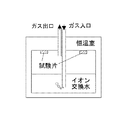
- FIGS. 1 is a reproduction test apparatus for a gas phase part
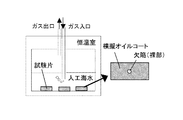
- FIG. 2 is a reproduction test apparatus for a bottom plate part.
- the corrosion resistance of the base material itself is improved by suppressing the anodic dissolution reaction of the steel material.
- an iron rust ( ⁇ -FeOOH) layer is usually formed on the surface of the steel material.
- a sulfide layer is first formed on the steel material surface, and then an iron rust layer is formed. Since this sulfide layer remarkably suppresses the anodic dissolution reaction, it contributes to the improvement of corrosion resistance.
- a layer containing W sulfide or further Mo sulfide exhibits cation selectivity and has an effect of suppressing permeation of Cl 2 ⁇ ions through the sulfide layer. When this layer is formed, the contribution to the improvement of the corrosion resistance becomes particularly large.
- the present invention has been completed based on these findings, and the gist of the invention resides in the following corrosion-resistant steel materials for cargo oil tanks (1) to (7).
- a corrosion-resistant steel material for a cargo oil tank characterized by comprising a balance Fe and impurities.
- Corrosion resistant steel material for cargo oil tank according to (1) above containing one or more of 3% or less and Sn: 0.3% or less.
- Nb not more than 0.1%
- V not more than 0.2%
- B not more than 0.01%
- the surface is covered with an anticorrosion film through an intermediate layer made of sulfide of Cu, Ni and W or further sulfide of Mo. Corrosion-resistant steel material for cargo oil tanks as described.
- FIG. 1 shows a reproduction test apparatus for a gas phase part.
- regeneration test apparatus of a baseplate part is shown.
- An acid immersion test apparatus is shown.
- Chemical composition C 0.01 to 0.2% C is an element necessary for securing strength as a material, and a content of 0.01% or more is necessary. However, if the content exceeds 0.2%, weldability decreases. Further, as the C content increases, the amount of cementite that becomes a cathode in an acidic environment and promotes corrosion increases, and the weldability deteriorates. For this reason, the upper limit was made 0.2%. A preferable upper limit is 0.15%, and a preferable lower limit is 0.04%.
- Si 0.01 to 1.0%
- Si is an element necessary for deoxidation, and in order to obtain a sufficient deoxidation effect, it is necessary to contain 0.01% or more. However, if the content exceeds 1%, the toughness of the base material and the welded joint is impaired. Therefore, the Si content is set to 0.01 to 1.0%.
- a preferable upper limit is 0.8%, and a more preferable upper limit is 0.5%.
- a preferred lower limit is 0.04%, and a more preferred lower limit is 0.10%.
- Mn 0.05 to 2.0%
- Mn is an element having an effect of increasing the strength of steel at a low cost, and a content of 0.05% or more is necessary to obtain this effect. However, if the content exceeds 2.0%, weldability deteriorates and joint toughness also deteriorates. Therefore, the Mn content is set to 0.05 to 2.0%.
- a preferable upper limit is 1.8%, and a more preferable upper limit is 1.6%.
- a preferred lower limit is 0.3%, and a more preferred lower limit is 0.5%.
- P 0.002 to 0.1%
- P has the effect of improving the general corrosion resistance and pitting resistance.
- acid resistance improves by containing P in Cu containing steel.
- the effect of improving acid resistance in such general corrosion resistance and pitting corrosion resistance and the effect of improving acid resistance in Cu-containing steel are exhibited by containing 0.002% or more of P.
- the P content is set to 0.002 to 0.1%.
- a preferable upper limit is 0.08%, and a more preferable upper limit is 0.06%.
- a preferred lower limit is 0.003%, and a more preferred lower limit is 0.004%.
- S 0.01% or less S is unavoidably present as an impurity in steel. However, if the content exceeds 0.01%, a large amount of MnS is produced in the steel, and MnS becomes a starting point of corrosion, resulting in overall corrosion and pitting corrosion. Therefore, the S content is set to 0.01% or less. A preferable upper limit is 0.008%, and a more preferable upper limit is 0.005%. In addition, the lower the S content, the better.
- Cu 0.01 to 2.0%
- Cu is an element that not only improves the overall corrosion resistance, but also forms a sulfide layer together with S to improve the pitting corrosion resistance under the bottom plate environment (local corrosion environment) in the cargo oil tank.
- This effect is exhibited by containing 0.01% or more of Cu, but even if Cu is contained exceeding 2.0%, the effect is not only saturated, but also for preventing cracking during hot rolling. Since the amount of Ni contained in the steel also increases, the cost increases. Therefore, the Cu content is set to 0.01 to 2.0%.
- a preferable upper limit is 1.8%, and a more preferable upper limit is 1.5%.
- a preferred lower limit is 0.05%, and a more preferred lower limit is 0.10%. Details of the sulfide layer will be described later.
- Ni 0.01 to 1.0%
- Ni, as well as Cu is an element that not only improves the overall corrosion resistance, but also forms a sulfide layer together with S to improve the pitting corrosion resistance under the bottom plate environment (local corrosion environment) in the cargo oil tank. .
- This effect is exhibited when the content is 0.01% or more. However, if the content exceeds 1.0%, the effect is not only saturated but also the cost is increased. Therefore, the Ni content is set to 0.01 to 1.0%.
- a preferable upper limit is 0.9%, and a more preferable upper limit is 0.8%.
- a preferred lower limit is 0.05%, and a more preferred lower limit is 0.1%. Details of the sulfide layer will be described later.
- W more than 0% and less than 0.01%
- W is an element that improves acid resistance and improves overall corrosion resistance.
- W also has the effect of increasing the overall corrosion resistance by combining with other elements and the effect of improving the pitting corrosion resistance by forming a corrosion-resistant sulfide layer together with S in a wet hydrogen sulfide environment.
- These effects can be obtained by containing a trace amount of W.
- W is contained in an amount of 0.01% or more, an effect commensurate with the cost cannot be obtained, and deterioration of weldability is also a concern. Therefore, the W content is more than 0% and less than 0.01%. Details of the sulfide layer will be described later.
- Al 0.1% or less Al is an element effective for deoxidation of steel, but since Si is contained in the present invention, deoxidation is performed with Si. Therefore, since it is not always necessary to deoxidize with Al, it is not necessary to contain Al. However, in addition to Si, the composite deoxidation can be performed by further adding Al. In this case, when Al is contained 0.005% or more, it can be effectively deoxidized. On the other hand, if the Al content exceeds 0.1%, not only the overall corrosiveness is remarkably deteriorated but also the nitride is coarsened, resulting in a decrease in toughness. Therefore, the upper limit of the Al content when Al is contained is set to 0.1% or less. A preferred upper limit is 0.05%.
- the corrosion-resistant steel material for cargo oil tank according to the present invention has the above-described elements, and the balance is made of Fe and impurities.
- the impurities are components that are mixed due to various factors in the manufacturing process including raw materials such as ores and scraps when industrially manufacturing steel materials, and do not adversely affect the present invention. Means what is allowed.
- Corrosion resistant steel material for cargo oil tank according to the present invention may be replaced with a part of Fe, if necessary, among Cr, Mo, Ti, Zr, Sb, Sn, Nb, V, B, Ca, Mg, REM. 1 type, or 2 or more types of elements can be contained.
- the second group is one or more of Nb: 0.1% or less, V: 0.2% or less, and B: 0.01% or less.
- the third group is one or more of Ca: 0.01% or less, Mg: 0.01% or less, and REM: 0.01% or less.
- Mo 1.0% or less Mo can be contained as necessary.
- Mo is an element that improves acid resistance, and has the effect of improving overall corrosion resistance in a dry and wet repeated environment with acidic water.
- the upper limit of the Mo content when Mo is contained is 1.0%.
- a preferable upper limit is 0.5%, and a more preferable upper limit is 0.4%.
- Ti 0.2% or less Ti can be contained as necessary.
- Ti also has an effect of improving the toughness of steel and an effect of suppressing the generation of MnS as a starting point of corrosion and increasing the resistance to general corrosion and pitting corrosion by forming TiS. Furthermore, since the coarsening of the crystal grains is suppressed by the dispersion of TiN, the toughness of the high heat input weld is improved. However, even if Ti is contained in excess of 0.2%, the above effect is saturated and the cost is increased. Therefore, the upper limit of the Ti content when Ti is contained is 0.2%. A preferable upper limit is 0.15%, and a more preferable upper limit is 0.1%. In addition, in order to acquire the effect by containing Ti stably, it is preferable to contain Ti 0.005% or more. More preferably, it is 0.01% or more, More preferably, it is 0.015% or more.
- Zr 0.2% or less Zr can be contained if necessary.
- Zr like Ti, preferentially forms sulfides and has the effect of suppressing the generation of MnS.
- Zr is an element that hardly forms nitrides as compared with Ti, and has a feature that sulfides are formed more efficiently.
- the upper limit of the Zr content when Zr is contained is 0.2%.
- a preferable upper limit is 0.15%, and a more preferable upper limit is 0.1%.
- Sb 0.3% or less Sb can be contained as required.
- Sb has the effect of improving the overall corrosion resistance in a wet and dry repeated environment and increasing the acid resistance. Furthermore, it has the effect
- the upper limit of the Sb content when Sb is contained is 0.3%.
- a preferable upper limit is 0.25%, and a more preferable upper limit is 0.2%.
- Sn 0.3% or less Sn can be contained as necessary.
- Sn is an element that improves the corrosion resistance in an acid environment, and has the effect of improving the overall corrosion resistance in a dry and wet repeated environment with acidic water. Moreover, it has the effect
- the upper limit of the Sn content when Sn is contained is 0.3%.
- a preferable upper limit is 0.25%, and a more preferable upper limit is 0.2%.
- Nb, V and B Nb 0.1% or less Nb can be contained as necessary.
- Nb is an element having an effect of increasing the strength of steel.
- the upper limit of the Nb content when Nb is contained is 0.1%.
- a preferable upper limit is 0.08%, and a more preferable upper limit is 0.05%.
- Nb 0.001% or more More preferably, it is 0.005% or more, More preferably, it is 0.01% or more.
- V 0.2% or less V can be contained as necessary.
- V is an element having an effect of increasing the strength of steel.
- the upper limit of the V content when V is contained is 0.2%.
- a preferable upper limit is 0.15%.
- V 0.005% or more More preferably, it is 0.01% or more.
- B 0.01% or less B can be contained if necessary.
- B is an element having an effect of increasing the strength of steel.
- toughness deteriorates. Therefore, the upper limit of the B content when B is contained is 0.01%.
- a preferable upper limit is 0.008%, and a more preferable upper limit is 0.005%.
- B 0.0002% or more More preferably, it is 0.0005% or more, More preferably, it is 0.0008% or more.
- Ca, Mg and REM Ca 0.01% or less Ca can be contained as necessary.
- Ca dissolves in water at the time of a corrosion reaction and becomes alkaline, and has an action of suppressing pH reduction at the steel material interface. For this reason, the corrosion resistance of bare steel and a coating part improves. However, this effect is saturated even if Ca is contained exceeding 0.01%. Therefore, the upper limit of the Ca content when Ca is contained is 0.01%. A preferable upper limit is 0.008%, and a more preferable upper limit is 0.005%.
- Mg 0.01% or less Mg can be contained as required.
- Mg like Ca, has the effect of improving the corrosion resistance by suppressing the pH drop at the steel material interface during the corrosion reaction. However, the effect is saturated even if Mg is contained exceeding 0.01%. Therefore, the upper limit of the Mg content when Mg is contained is 0.01%. A preferable upper limit is 0.008%, and a more preferable upper limit is 0.005%.
- Mg 0.0002% or more More preferably, it is 0.0005% or more, More preferably, it is 0.001% or more.
- REM 0.01% or less REM can be contained as necessary. REM has the effect of improving the weldability of steel. However, even if REM exceeds 0.01%, not only this effect is saturated but also the cost of the steel material increases. Therefore, the upper limit of the REM content when REM is contained is 0.01%. A preferable upper limit is 0.008%, and a more preferable upper limit is 0.005%. In addition, in order to acquire the effect by containing REM stably, it is preferable to contain REM 0.0001% or more. More preferably, it is 0.0005% or more, More preferably, it is 0.001% or more.
- REM is a general term for 17 elements in which Y and Sc are combined with 15 elements of lanthanoid, and one or more of these elements can be contained. Note that the content of REM means the total content of these elements.
- a sulfide layer contains Cu, W, Ni, or Mo further in steel materials, and is formed by using it in the bottom plate environment of a cargo oil tank. Therefore, it is not necessary to form a sulfide layer when shipping steel. Cargo to use the initial by using as a bottom plate steel oil tank H 2 S and Cl - proceeds constant pitting attack of, after a certain period of time, the sulfide layer is formed. Sulfide layer reduces the concentration of H 2 S in the steel material surface, suppresses the anodic dissolution of steel, W sulfide or even Mo sulfide particular a cation selective is Cl - inhibiting the transmission of. This slows down the progress of pitting corrosion and improves corrosion resistance.
- an iron rust ( ⁇ -FeOOH) layer that is normally formed on the surface of the steel material may be formed thereon.
- the iron rust layer does not have the effect of reducing the H 2 S concentration or the effect of suppressing the permeation of Cl ⁇ , but H 2 S and Cl ⁇ that have permeated the iron rust layer are blocked by the sulfide layer, so that excellent corrosion resistance is achieved Demonstrate.
- the sulfide layer may be partially damaged by cleaning the cargo oil tank. Even in such a case, since the sulfide layer is formed again by use, the corrosion resistance is not lowered.
- the steel material of the present invention can also be used as a tank top plate portion where a sulfide layer is not formed, and when used in a full corrosive environment, the corrosion resistance of the base material itself causes corrosion. Progress can be suppressed.
- the steel material of the present invention described above exhibits good corrosion resistance even when used as it is, and can reduce the corrosion allowance.
- an anticorrosion coating made of an organic resin or metal the durability of the anticorrosion coating is improved and the corrosion resistance is further improved, which is more suitable for use as a corrosion resistant steel material for cargo oil tanks.
- examples of the anticorrosion coating made of an organic resin include vinyl butyral, epoxy, urethane, and phthalic acid resin coatings
- examples of the anticorrosion coating made of metal include a plating coating and a thermal spray coating of Zn or Al. be able to.
- the durability of the anticorrosion film is improved because the corrosion of the steel material of the present invention, which is the base, is remarkably suppressed. This is considered to be because of this.
- the treatment with the above anticorrosion coating may be performed by a usual method. Moreover, it is not always necessary to apply the anticorrosion coating to the entire surface of the steel material, and only one surface of the steel material as the surface exposed to the corrosive environment may be subjected to the anticorrosion treatment. Alternatively, only a part of the steel material that is exposed to the corrosive environment may be subjected to anticorrosion treatment.
- the steel material of the present invention can be manufactured as follows. However, the manufacturing method of the steel material of the present invention is not limited to this manufacturing method.
- Slab having a composition defined in the present invention in which the content of S is kept low and RH, DH, electromagnetic stirring, etc. are performed in the steelmaking stage.
- This slab is hot-rolled under the conditions that the heating temperature is about 1100 ° C. to 1200 ° C., the rolling reduction per rolling is 3% or more, and the rolling finish temperature is about 700 to 900 ° C.
- the heating temperature is about 1100 ° C. to 1200 ° C.
- the rolling reduction per rolling is 3% or more
- the rolling finish temperature is about 700 to 900 ° C.
- it is allowed to cool in the air, or a temperature range from a temperature of Ar 3 or higher to at least about 570 ° C. is cooled at a cooling rate of 5 ° C./s or higher, and then cooled in the air.
- the steel material of the present invention can be manufactured.
- all the above-mentioned temperature is the temperature in the surface part of steel materials.
- the block was heated at 1120 ° C. for 1 hour, hot-rolled, finished to a thickness of 20 mm at 850 ° C., and then allowed to cool to room temperature.
- a test piece having a width of 25 mm, a length of 50 mm, and a thickness of 4 mm was taken from each steel plate having a thickness of 20 mm and subjected to a corrosion test simulating the environment behind the deck of an actual ship.
- This corrosion test assumes a cargo tank gas phase.
- a modified epoxy paint is spray-coated to form an anticorrosion film of about 200 ⁇ m, and a cross bark is attached to the anticorrosion film to partially bullion. Exposed and subjected to a similar corrosion test.
- an acrylic lid having a gas supply port with a sample specimen attached to the lower surface while preparing a glass container in which ion exchange water is placed in the lower third portion. was used to seal the upper end of the glass container.
- the sealed glass container was placed in a thermostatic bath, and a temperature cycle of 50 ° C. ⁇ 20 hours ⁇ 25 ° C. ⁇ 4 hours was applied for 56 days.
- the corrosive gas in the cargo tank was simulated in the gas phase portion in the glass container, and the gas A having the following composition was blown from the gas supply port.
- [Gas A] 5% by volume, 5% O 2 -13% CO 2 -0.01% SO 2 -0.05% H 2 S-residual N 2
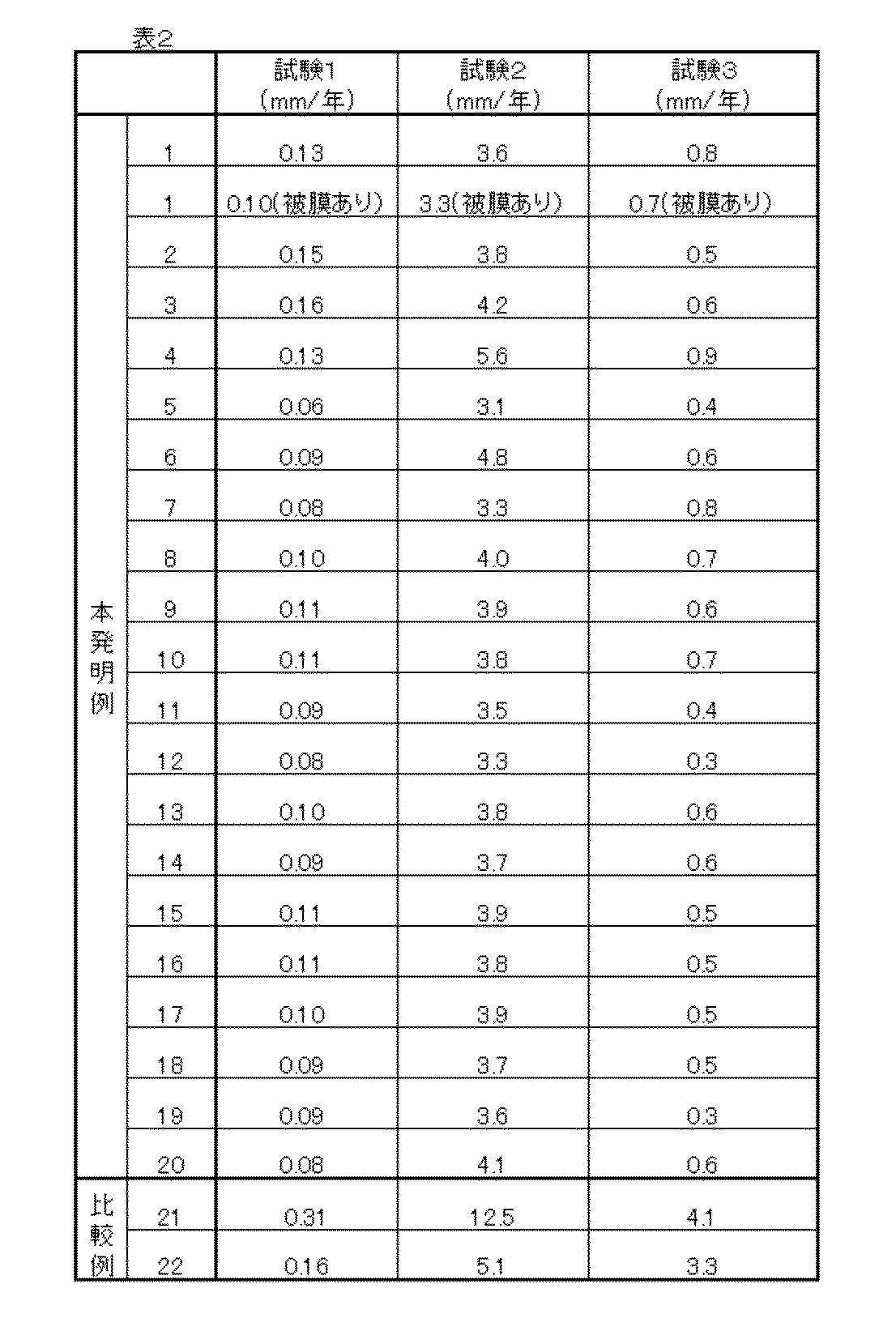
- the corrosion rate (total corrosion rate) in units of “mm / year” was determined from the reduced mass of each specimen. Table 2 shows the test result as “Test 1”. In Table 2, for the test steel (steel type 1 (with coating)) on which the anticorrosion coating was formed, the corrosion rate of the bare metal exposed portion was determined.
- Gas B having the following composition was blown from the gas supply port.
- Gas B having the following composition was blown from the gas supply port.
- [Gas B] 5% by volume, 5% O 2 -13% CO 2 -0.01% SO 2 -0.2% H 2 S-residual N 2
- the corrosion test piece was prepared by applying a simulated oil coat (mixture of crude oil and rust) on a test piece taken from a steel plate except for a 5 mm diameter circular portion.
- the measurement of pitting corrosion depth was carried out using a micrometer based on the portion where pitting corrosion did not occur, that is, the simulated oil coat application portion, in the corrosion test piece after the test.
- the maximum value of the depth at the pitting corrosion occurrence portion was adopted as the pitting corrosion depth.
- the pitting corrosion rate in units of “mm / year” was determined from the pitting depth of each test piece.
- Table 2 shows the test results as “Test 2”.
- the corrosion rate of the bare metal exposed portion was determined for the test steel (steel type 1 (with coating)) on which the anticorrosion coating was formed.
- Example 2 A test was taken from each steel plate having a thickness of 20 mm produced in the same manner as in Example 1, and a test piece having a width of 40 mm, a length of 50 mm, and a thickness of 4 mm was taken to simulate the environment in the pitting corrosion of the cargo tank bottom plate. Carried out.
- HCl was added to a 10% NaCl solution at 30 ° C., and the test piece was immersed in a solution adjusted to pH 0.85.
- the test period was 72 hours, and the solution was changed every 24 hours in order to minimize the impact on corrosion due to solution degradation.
- the corrosion rate in “mm / year” was determined from the reduced mass of each test piece.
- Table 3 shows the test result as “Test 3”.
- the corrosion rate of the bare metal exposed portion was determined for the test steel (steel type 1 (with coating)) on which the anticorrosion coating was formed.
- inventive examples (1 to 20) show good corrosion resistance in Tests 1, 2 and 3.
Landscapes
- Chemical & Material Sciences (AREA)
- Engineering & Computer Science (AREA)
- Materials Engineering (AREA)
- Mechanical Engineering (AREA)
- Metallurgy (AREA)
- Organic Chemistry (AREA)
- Heat Treatment Of Steel (AREA)
Abstract
Description
C:0.01~0.2%
Cは、材料としての強度を確保するために必要な元素であり、0.01%以上の含有量が必要である。しかし、0.2%を超えて含有させると溶接性が低下する。また、C含有量の増大とともに、酸性の環境でカソードとなって腐食を促進するセメンタイトの生成量が増大するとともに溶接性が悪化する。このため上限を0.2%とした。好ましい上限は0.15%、好ましい下限は0.04%である。
Siは、脱酸に必要な元素であり、十分な脱酸効果を得るためには0.01%以上含有させる必要がある。しかし、1%を超えて含有させると母材および溶接継手部の靱性が損なわれる。このため、Siの含有量を0.01~1.0%とした。好ましい上限は0.8%、より好ましい上限は0.5%である。好ましい下限は0.04%、より好ましい下限は0.10%である。
Mnは、低コストで鋼の強度を高める作用を有する元素であり、この効果を得るためには0.05%以上の含有量が必要である。しかし、2.0%を超えて含有させると溶接性が劣化するとともに継手靭性も劣化する。このため、Mnの含有量を0.05~2.0%とした。好ましい上限は1.8%、より好ましい上限は1.6%である。好ましい下限は0.3%、より好ましい下限は0.5%である。
Pは耐全面腐食性および耐孔食性を向上させる作用を有する。また、通常Pの含有量が多いほど耐酸性が劣化するが、Cu含有鋼ではPを含有させることで耐酸性が向上する。このような耐全面腐食性および耐孔食性における耐酸性向上効果並びにCu含有鋼における耐酸性向上効果は0.002%以上のPを含有させることで発揮される。しかし、0.1%を超えて含有させると溶接性が著しく低下する。このため、Pの含有量は0.002~0.1%とした。好ましい上限は0.08%、より好ましい上限は0.06%である。好ましい下限は0.003%、より好ましい下限は0.004%である。
Sは鋼中に不純物として不可避的に存在する。ただし、その含有量が0.01%を超えると鋼中にMnSが多く生成し、MnSが腐食の起点となって全面腐食及び孔食が生じる。このため、Sの含有量を0.01%以下とした。好ましい上限は0.008%、より好ましい上限は0.005%である。なお、S含有量は低ければ低いほどよい。
Cuは耐全面腐食性を向上させるだけでなく、カーゴオイルタンクにおける底板環境下(局部腐食環境下)で、Sとともに硫化物層を形成し耐孔食性を向上させる元素である。この効果はCuを0.01%以上含有させることにより発揮されるが、2.0%を超えてCuを含有させてもその効果は飽和するだけでなく、熱間圧延時の割れ防止のために含有させるNi量も増加するので、コスト増につながる。そのため、Cuの含有量は0.01~2.0%とした。好ましい上限は1.8%、より好ましい上限は1.5%である。好ましい下限は0.05%、より好ましい下限は0.10%である。なお、硫化物層の詳細は後述する。
Niも、Cuと同様に耐全面腐食性を向上させるだけでなく、カーゴオイルタンクにおける底板環境下(局部腐食環境下)で、Sとともに硫化物層を形成し耐孔食性を向上させる元素である。この効果は0.01%以上含有させることにより発揮されるが、1.0%を超えて含有してもその効果は飽和するだけでなく、コスト増につながる。そのため、Niの含有量は0.01~1.0%とした。好ましい上限は0.9%、より好ましい上限は0.8%である。好ましい下限は0.05%、より好ましい下限は0.1%である。なお、硫化物層の詳細は後述する。
Wは耐酸性を向上させる元素であり、耐全面腐食性を向上させる。また、Wには、他の元素と複合して耐全面腐食性を高める効果や、湿潤硫化水素環境においてSとともに防食性の硫化物層を形成して耐孔食性を向上させる効果もある。これらの効果は微量のWを含有することにより得られる。しかし、Wを0.01%以上含有させるとコストに見合う効果が得られなくなり、また溶接性の悪化も懸念される。したがって、Wの含有量は0%を超え0.01%未満とした。なお、硫化物層の詳細は後述する。
Alは、鋼の脱酸に有効な元素であるが、本発明においてはSiを含有させているので、Siで脱酸がなされる。したがって、Alで脱酸処理することは必ずしも必要でないため、Alは含有させなくてもよい。ただし、Siに加えて、さらにAlを含有させて複合脱酸することもできる。この場合、Alを0.005%以上含有させると効果的に脱酸できる。一方、Alの含有量が0.1%を超えると、全面腐食性が著しく悪化するばかりか、窒化物が粗大化するために靱性の低下を引き起こす。したがって、Alを含有させる場合のAl含有量の上限を0.1%以下とする。好ましい上限は0.05%である。
Cr:5.0%以下
Crは必要に応じて含有させることができる。Crを単独で含有させると酸環境における耐食性を低下させるが、Cuと複合して含有させると、乾湿繰り返しの環境において保護性の高いさび層を形成させ、耐全面腐食性が向上する。ただし、Cr含有量が5.0%を超えると、その効果は飽和するばかりでなく、溶接性の低下やコスト増につながる。したがって、Cr含有量の上限は、5.0%とする。好ましい上限は4.5%、より好ましい上限は4.0%である。なお、Crを含有させることによる効果を安定的に得るためには、Cr含有量を0.5%以上とするのが好ましい。より好ましくは1.0%以上である。
Moは必要に応じて含有させることができる。Moは耐酸性を向上させる元素であり、酸性水による乾湿繰り返し環境における耐全面腐食性を向上させる効果がある。また、湿潤硫化水素環境においてSとともに防食性の硫化物層を形成して耐孔食性を向上させる効果もある。ただし、Moを1.0%を超えて含有させても、効果が飽和するばかりか、溶接性を損なうし、コストも嵩む。したがって、Moを含有させるときのMo含有量の上限は、1.0%とする。好ましい上限は0.5%であり、より好ましい上限は0.4%である。なお、Moを含有させることによる効果を安定的に得るためには、Moを0.01%以上含有させるのが好ましい。より好ましくは0.1%以上であり、さらに好ましくは0.2%以上である。
Tiは必要に応じて含有させることができる。Tiは、鋼の強度を高める作用を有する。Tiには、鋼の靱性を向上させる作用や、TiSを形成することによって、腐食の起点となるMnSの生成を抑制し、耐全面腐食性及び耐孔食性を高める作用もある。さらに、TiNの分散により結晶粒の粗大化を抑制するので、大入熱溶接部の靭性が向上する。ただし、Tiを0.2%を超えて含有させても、前記の効果は飽和しコストが嵩むばかりである。したがって、Tiを含有させるときのTi含有量の上限は、0.2%とする。好ましい上限は0.15%であり、より好ましい上限は0.1%である。なお、Tiを含有させることによる効果を安定的に得るためには、Tiを0.005%以上含有させるのが好ましい。より好ましくは0.01%以上であり、さらに好ましくは0.015%以上である。
Zrは必要に応じて含有させることができる。Zrは、Tiと同様、硫化物を優先的に形成し、MnSの生成を抑制する効果を有する。また、ZrはTiに比べ窒化物を形成しにくい元素であり、より効率よく硫化物が形成されるという特徴も有する。ただし、Zrを0.2%を超えて含有させると、靱性の低下を招く。したがって、Zrを含有させるときのZr含有量の上限は、0.2%とする。好ましい上限は0.15%であり、より好ましい上限は0.1%である。なお、Zrを含有させることによる効果を安定的に得るためには、Zrを0.005%以上含有させるのが好ましい。より好ましくは0.01%以上であり、さらに好ましくは0.02%以上である。
Sbは必要に応じて含有させることができる。Sbは、乾湿繰り返し環境での耐全面腐食性を向上させるとともに耐酸性を高める作用を有する。さらに、孔食部のpHが低い環境における耐食性を向上させることにより、耐孔食性を向上させる作用も有する。ただし、Sbを0.3%を超えて含有させても、前記の効果は飽和する。したがって、Sbを含有させるときのSb含有量の上限は、0.3%とする。好ましい上限は0.25%であり、より好ましい上限は0.2%である。なお、Sbを含有させることによる効果を安定的に得るためには、Sbを0.03%以上含有させるのが好ましい。より好ましくは0.05%以上である。
Snは必要に応じて含有させることができる。Snは、酸環境における耐食性を向上させる元素であり、酸性水による乾湿繰り返し環境での耐全面腐食性を向上させる作用を有する。また、孔食部のpHが低い環境における耐食性を向上させることにより耐孔食性を向上させる作用も有する。ただし、Snを0.3%を超えて含有させても、前記の効果は飽和するばかりでなく、母材および大入熱溶接継手の靭性が著しく劣化する。したがって、Snを含有させるときのSn含有量の上限は、0.3%とする。好ましい上限は0.25%であり、より好ましい上限0.2%である。なお、Snを含有させることによる効果を安定的に得るためには、Snを0.01%以上含有させるのが好ましい。より好ましくは0.02%以上であり、さらに好ましくは0.03%以上である。
Nb:0.1%以下
Nbは必要に応じて含有させることができる。Nbは、鋼の強度を高める作用を有する元素である。ただし、Nbを0.1%を超えて含有させると、靱性が劣化する。したがって、Nbを含有させるときのNb含有量の上限は、0.1%とする。好ましい上限は0.08%であり、より好ましい上限は0.05%である。なお、Nbを含有させることによる効果を安定的に得るためには、Nbを0.001%以上含有させるのが好ましい。より好ましくは0.005%以上であり、さらに好ましくは0.01%以上である。
Vは必要に応じて含有させることができる。Vは、鋼の強度を高める作用を有する元素である。ただしVを0.2%を超えて含有させると、靱性及び溶接性が劣化する。したがって、Vを含有させるときのV含有量の上限は、0.2%とする。好ましい上限は0.15%である。なお、Vを含有させることによる効果を安定的に得るためには、Vを0.005%以上含有させるのが好ましい。より好ましくは0.01%以上である。
Bは必要に応じて含有させることができる。Bは、鋼の強度を高める作用を有する元素である。ただし、Bを0.01%を超えて含有させると、靱性が劣化する。したがって、Bを含有させるときのB含有量の上限は、0.01%とする。好ましい上限は0.008%であり、より好ましい上限は0.005%である。なお、Bを含有させることによる効果を安定的に得るためには、Bを0.0002%以上含有させるのが好ましい。より好ましくは0.0005%以上であり、さらに好ましくは0.0008%以上である。
Ca:0.01%以下
Caは必要に応じて含有させることができる。Caは、腐食反応時に水に溶けてアルカリ性となり鋼材界面のpH低下を抑制する作用がある。このため、裸鋼および塗装部の耐食性が向上する。ただし、Caを0.01%を超えて含有させても、この効果が飽和する。したがって、Caを含有させるときのCa含有量の上限は、0.01%とする。好ましい上限は0.008%であり、より好ましい上限は0.005%である。なお、Caを含有させることによる効果を安定的に得るためには、Caを0.0002%以上含有させるのが好ましい。より好ましくは0.0005%以上であり、さらに好ましくは0.001%以上である。
Mgは必要に応じて含有させることができる。MgもCaと同様に、腐食反応時の鋼材界面のpH低下を抑制することにより耐食性を向上させる効果がある。ただし、Mgを0.01%を超えて含有させても、その効果が飽和する。したがって、Mgを含有させるときのMg含有量の上限は、0.01%とする。好ましい上限は0.008%であり、より好ましい上限は0.005%である。なお、Mgを含有させることによる効果を安定的に得るためには、Mgを0.0002%以上含有させるのが好ましい。より好ましくは0.0005%以上であり、さらに好ましくは0.001%以上である。
REMは必要に応じて含有させることができる。REMは、鋼の溶接性を向上させる効果がある。ただし、REMを0.01%を超えて含有させてもこの効果が飽和するだけでなく、鋼材のコストが上昇する。したがって、REMを含有させるときのREM含有量の上限は、0.01%とする。好ましい上限は0.008%であり、より好ましい上限は0.005%である。なお、REMを含有させることによる効果を安定的に得るためには、REMを0.0001%以上含有させるのが好ましい。より好ましくは0.0005%以上であり、さらに好ましくは0.001%以上である。
硫化物層は鋼材にCu、W、NiあるいはさらにMoを含有し、カーゴオイルタンクの底板環境下で使用することで形成される。したがって、鋼材出荷時には硫化物層を形成しておく必要はない。カーゴオイルタンク用の底板鋼材として使用することで使用初期にはH2SおよびCl-の攻撃を受け一定の孔食が進むが、一定期間経過後、硫化物層が形成される。硫化物層は、鋼材界面でのH2S濃度を低減し、鋼のアノード溶解を抑制するとともに、特にカチオン選択性を有するW硫化物あるいはさらにMo硫化物はCl-の透過を抑制する。これにより孔食の進行が鈍化し耐食性が向上する。
上記に説明した本発明の鋼材は、そのまま使用しても良好な耐食性を示し、腐食代を少なくすることができる。しかし、その表面を有機樹脂や金属からなる防食被膜で覆った場合には、防食被膜の耐久性が向上し、耐食性が一段と向上し、カーゴオイルタンク用耐食鋼材として使用するのにより好適となる。
本発明の鋼材は、以下のようにして製造が可能である。ただし、本発明の鋼材の製造方法はこの製造方法に限定されるものではない。

[ガスA]体積%で、5%O2-13%CO2-0.01%SO2-0.05%H2S-残N2
56日間の腐食試験の後、各試験片の減少質量から「mm/年」単位での腐食速度(全面腐食速度)を求めた。表2に、上記の試験結果を「試験1」として示す。なお、表2中、防食被膜を形成した供試鋼(鋼種1(被膜あり))については、地金露出部の腐食速度を求めた。
[ガスB]体積%で、5%O2-13%CO2-0.01%SO2-0.2%H2S-残N2
なお、腐食試験片は鋼板より採取した試験片の上に、5mm径の円型の部分を除き模擬オイルコート(原油とさびの混合物)を塗布することにより作製した。
Claims (7)
- 質量%で、C:0.01~0.2%、Si:0.01~1.0%、Mn:0.05~2.0%、P:0.002~0.1%、S:0.01%以下、Cu:0.01~2.0%、Ni:0.01~1.0%、W:0%を超え0.01%未満、Al:0.1%以下を含有し、残部Fe及び不純物からなることを特徴とする、カーゴオイルタンク用耐食鋼材。
- 質量%で、Feの一部に代えて、Cr:5.0%以下、Mo:1.0%以下、Ti:0.2%以下、Zr:0.2%以下、Sb:0.3%以下およびSn:0.3%以下のうちの1種または2種以上を含有することを特徴とする、請求項1に記載のカーゴオイルタンク用耐食鋼材。
- 質量%で、Feの一部に代えて、Nb:0.1%以下、V:0.2%以下およびB:0.01%以下のうちの1種または2種以上を含有することを特徴とする、請求項1または2に記載のカーゴオイルタンク用耐食鋼材。
- 質量%で、Feの一部に代えて、Ca:0.01%以下、Mg:0.01%以下およびREM:0.01%以下のうちの1種または2種以上を含有することを特徴とする、請求項1から3までのいずれかに記載のカーゴオイルタンク用耐食鋼材。
- 表面にCu、NiおよびWの硫化物あるいはさらにMoの硫化物の層を有することを特徴とする、請求項1から4までのいずれかに記載のカーゴオイルタンク用耐食鋼材。
- 表面が防食皮膜によって被覆されていることを特徴とする、請求項1から4までのいずれかに記載のカーゴオイルタンク用耐食鋼材。
- Cu、NiおよびWの硫化物あるいはさらにMoの硫化物からなる中間層を介して、表面が防食皮膜によって被覆されていることを特徴とする、請求項1から4までのいずれかに記載のカーゴオイルタンク用耐食鋼材。
Priority Applications (2)
| Application Number | Priority Date | Filing Date | Title |
|---|---|---|---|
| CN2011800051436A CN102686760A (zh) | 2010-07-09 | 2011-07-07 | 货油舱用耐腐蚀性钢材 |
| JP2011550372A JP4941620B2 (ja) | 2010-07-09 | 2011-07-07 | カーゴオイルタンク用耐食性鋼材 |
Applications Claiming Priority (2)
| Application Number | Priority Date | Filing Date | Title |
|---|---|---|---|
| JP2010-156698 | 2010-07-09 | ||
| JP2010156698 | 2010-07-09 |
Publications (1)
| Publication Number | Publication Date |
|---|---|
| WO2012005327A1 true WO2012005327A1 (ja) | 2012-01-12 |
Family
ID=45441304
Family Applications (1)
| Application Number | Title | Priority Date | Filing Date |
|---|---|---|---|
| PCT/JP2011/065595 Ceased WO2012005327A1 (ja) | 2010-07-09 | 2011-07-07 | カーゴオイルタンク用耐食性鋼材 |
Country Status (4)
| Country | Link |
|---|---|
| JP (1) | JP4941620B2 (ja) |
| KR (1) | KR20120035935A (ja) |
| CN (1) | CN102686760A (ja) |
| WO (1) | WO2012005327A1 (ja) |
Cited By (3)
| Publication number | Priority date | Publication date | Assignee | Title |
|---|---|---|---|---|
| JP2013166992A (ja) * | 2012-02-15 | 2013-08-29 | Nippon Steel & Sumitomo Metal Corp | 耐食性に優れた鋼材 |
| JP2016027206A (ja) * | 2015-09-03 | 2016-02-18 | 新日鐵住金株式会社 | 耐食性に優れた鋼材 |
| CN107904487A (zh) * | 2017-11-03 | 2018-04-13 | 钢铁研究总院 | 一种多元铬钼耐二氧化碳腐蚀油井管及其制造方法 |
Families Citing this family (15)
| Publication number | Priority date | Publication date | Assignee | Title |
|---|---|---|---|---|
| CN102923820A (zh) * | 2012-11-09 | 2013-02-13 | 无锡电站辅机厂 | 树脂捕捉器 |
| CN103194679B (zh) * | 2013-04-07 | 2015-01-21 | 南京钢铁股份有限公司 | 一种具有优异抗海洋大气腐蚀的结构用钢板及其生产方法 |
| CN103451575B (zh) * | 2013-08-23 | 2015-07-01 | 苏州长盛机电有限公司 | 一种铜铁合金材料 |
| CN103643175A (zh) * | 2013-11-12 | 2014-03-19 | 铜陵市肆得科技有限责任公司 | 一种阀芯用合金钢材料及其制备方法 |
| CN103695773B (zh) * | 2013-12-11 | 2015-10-28 | 武汉钢铁(集团)公司 | 屈服强度为690MPa级耐火耐候抗震建筑用钢及其生产方法 |
| CN103695772B (zh) * | 2013-12-11 | 2015-12-30 | 武汉钢铁(集团)公司 | 屈服强度为550MPa级耐火耐候抗震建筑用钢及其生产方法 |
| CN103866188B (zh) * | 2014-03-31 | 2016-01-20 | 武汉钢铁(集团)公司 | 屈服强度为460MPa级耐火耐腐蚀抗震建筑用钢及生产方法 |
| CN104836418A (zh) * | 2015-05-14 | 2015-08-12 | 江苏有能新能源有限公司 | 一种变频器电源箱 |
| CN105039872A (zh) * | 2015-06-09 | 2015-11-11 | 倍德力能源装备(江苏)有限公司 | 一种耐高温高强度弹簧吊架 |
| CN104879572B (zh) * | 2015-06-09 | 2017-07-14 | 倍德力能源装备(江苏)有限公司 | 一种弹簧支吊架安装用连接件及其制备方法 |
| CN105042191B (zh) * | 2015-06-09 | 2017-07-14 | 倍德力能源装备(江苏)有限公司 | 一种耐腐蚀高强度支吊架组件及其制造工艺 |
| CN107904512A (zh) * | 2017-12-15 | 2018-04-13 | 苏州赛斯德工程设备有限公司 | 一种防腐蚀钢材及其加工工艺 |
| CN111270135A (zh) * | 2020-02-17 | 2020-06-12 | 本钢板材股份有限公司 | 一种利用re-p强化生产经济型耐候钢及制备工艺 |
| CN113637891B (zh) * | 2020-04-27 | 2022-07-19 | 宝山钢铁股份有限公司 | 一种耐碱脆的低合金钢、板材、焊管、无缝管及其制造方法 |
| CN115466903A (zh) * | 2022-07-13 | 2022-12-13 | 海峡(晋江)伞业科技创新中心有限公司 | 一种高强度特种钢及其生产工艺 |
Citations (5)
| Publication number | Priority date | Publication date | Assignee | Title |
|---|---|---|---|---|
| JP2005325439A (ja) * | 2004-04-14 | 2005-11-24 | Sumitomo Metal Ind Ltd | カーゴオイルタンク用鋼材 |
| JP2007262441A (ja) * | 2006-03-27 | 2007-10-11 | Jfe Steel Kk | 原油タンク用鋼およびその製造方法 |
| JP2008144204A (ja) * | 2006-12-07 | 2008-06-26 | Nippon Steel Corp | 電気防食される船舶バラストタンク用防錆鋼板および船舶バラストタンクの防錆方法 |
| JP2010043342A (ja) * | 2008-08-18 | 2010-02-25 | Nippon Steel Corp | 耐食性と耐延性破壊特性に優れた原油油槽用溶接継手 |
| JP2010150620A (ja) * | 2008-12-26 | 2010-07-08 | Jfe Steel Corp | 防食被覆鋼材 |
Family Cites Families (1)
| Publication number | Priority date | Publication date | Assignee | Title |
|---|---|---|---|---|
| CN1946864A (zh) * | 2004-04-14 | 2007-04-11 | 住友金属工业株式会社 | 货油舱用钢材 |
-
2011
- 2011-07-07 WO PCT/JP2011/065595 patent/WO2012005327A1/ja not_active Ceased
- 2011-07-07 KR KR1020127003522A patent/KR20120035935A/ko not_active Ceased
- 2011-07-07 CN CN2011800051436A patent/CN102686760A/zh active Pending
- 2011-07-07 JP JP2011550372A patent/JP4941620B2/ja active Active
Patent Citations (5)
| Publication number | Priority date | Publication date | Assignee | Title |
|---|---|---|---|---|
| JP2005325439A (ja) * | 2004-04-14 | 2005-11-24 | Sumitomo Metal Ind Ltd | カーゴオイルタンク用鋼材 |
| JP2007262441A (ja) * | 2006-03-27 | 2007-10-11 | Jfe Steel Kk | 原油タンク用鋼およびその製造方法 |
| JP2008144204A (ja) * | 2006-12-07 | 2008-06-26 | Nippon Steel Corp | 電気防食される船舶バラストタンク用防錆鋼板および船舶バラストタンクの防錆方法 |
| JP2010043342A (ja) * | 2008-08-18 | 2010-02-25 | Nippon Steel Corp | 耐食性と耐延性破壊特性に優れた原油油槽用溶接継手 |
| JP2010150620A (ja) * | 2008-12-26 | 2010-07-08 | Jfe Steel Corp | 防食被覆鋼材 |
Cited By (3)
| Publication number | Priority date | Publication date | Assignee | Title |
|---|---|---|---|---|
| JP2013166992A (ja) * | 2012-02-15 | 2013-08-29 | Nippon Steel & Sumitomo Metal Corp | 耐食性に優れた鋼材 |
| JP2016027206A (ja) * | 2015-09-03 | 2016-02-18 | 新日鐵住金株式会社 | 耐食性に優れた鋼材 |
| CN107904487A (zh) * | 2017-11-03 | 2018-04-13 | 钢铁研究总院 | 一种多元铬钼耐二氧化碳腐蚀油井管及其制造方法 |
Also Published As
| Publication number | Publication date |
|---|---|
| KR20120035935A (ko) | 2012-04-16 |
| CN102686760A (zh) | 2012-09-19 |
| JP4941620B2 (ja) | 2012-05-30 |
| JPWO2012005327A1 (ja) | 2013-09-05 |
Similar Documents
| Publication | Publication Date | Title |
|---|---|---|
| JP4941620B2 (ja) | カーゴオイルタンク用耐食性鋼材 | |
| JP5145897B2 (ja) | カーゴオイルタンク用耐食性鋼材 | |
| JP4502075B1 (ja) | 原油タンカー用耐食鋼材 | |
| JP4868916B2 (ja) | 耐食性に優れた船舶用鋼材 | |
| JP4449691B2 (ja) | カーゴオイルタンク用鋼材 | |
| JP4811277B2 (ja) | 石炭・鉱石運搬船ホールド用耐食性鋼材 | |
| CN101389782B (zh) | 船舶用耐腐蚀钢材 | |
| JP5453840B2 (ja) | 耐食性に優れた船舶用鋼材 | |
| JP4525687B2 (ja) | 船舶用耐食鋼材 | |
| JP3753088B2 (ja) | カーゴオイルタンク用鋼材 | |
| JP2010064110A (ja) | 石炭・鉱石運搬船ホールド用溶接継手 | |
| JP5481980B2 (ja) | 耐塗膜膨れ性に優れた船舶用鋼材 | |
| JP2000017381A (ja) | 造船用耐食鋼 | |
| JP2010285673A (ja) | 耐塗膜膨れ性に優れた船舶用鋼材 | |
| JP4577158B2 (ja) | 原油タンク用耐食鋼材 | |
| JP2007270196A (ja) | カーゴオイルタンク用鋼材 | |
| JP2005290479A (ja) | 原油タンク底板用鋼材 | |
| JP2010229526A (ja) | 高耐食性塗装鋼材 | |
| JP2012092404A (ja) | 塗装耐食性に優れた船舶用鋼材 | |
| JP4243863B2 (ja) | 原油タンク用溶接継手及び原油タンク | |
| JP6645462B2 (ja) | 鋼材およびその製造方法 | |
| JP5284769B2 (ja) | 耐食性に優れた原油タンク天井用鋼材、原油タンクおよび原油タンカーの上甲板 | |
| JP6048104B2 (ja) | 石炭船および石炭・鉱石兼用船ホールド用の耐食鋼 | |
| JP5862166B2 (ja) | 船舶艤装用耐食鋼材 | |
| JP2011094184A (ja) | 高耐食性塗装鋼材 |
Legal Events
| Date | Code | Title | Description |
|---|---|---|---|
| WWE | Wipo information: entry into national phase |
Ref document number: 201180005143.6 Country of ref document: CN |
|
| WWE | Wipo information: entry into national phase |
Ref document number: 2011550372 Country of ref document: JP |
|
| ENP | Entry into the national phase |
Ref document number: 20127003522 Country of ref document: KR Kind code of ref document: A |
|
| 121 | Ep: the epo has been informed by wipo that ep was designated in this application |
Ref document number: 11803661 Country of ref document: EP Kind code of ref document: A1 |
|
| NENP | Non-entry into the national phase |
Ref country code: DE |
|
| 122 | Ep: pct application non-entry in european phase |
Ref document number: 11803661 Country of ref document: EP Kind code of ref document: A1 |